Join the Bowery Boys Movie Club! Support us on Patreon at any level and get these Patreon-exclusive, full-length and ad-free podcast. Each month we talk about one classic (or cult-classic) film that says something interesting about New York City.
In the new Bowery Boys Movie Club, Tom and Greg visit the year 1978 and a cult classic thriller starring Faye Dunaway, Tommy Lee Jones and Raul Julia.
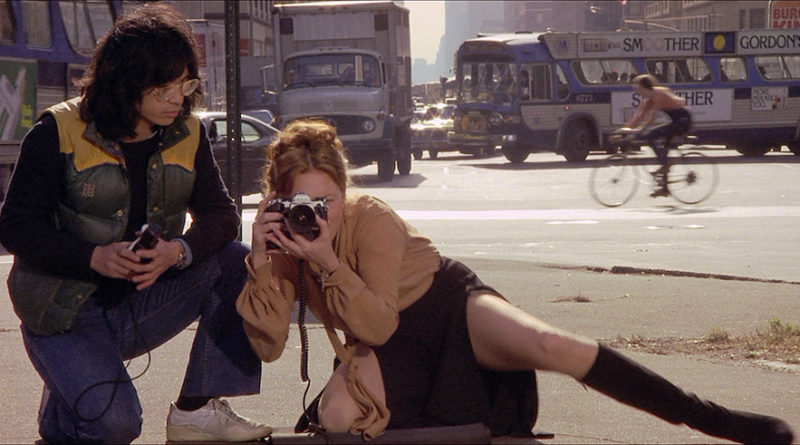
Eyes of Laura Mars presents the chic downtown art world of 1970s SoHo within a supernatural thriller involving a famed fashion photographer (played by Dunaway) and her psychic connection to a menacing killer. The thriller also takes us on a ride to Columbus Circle, the Christopher Street Pier and Hell’s Kitchen.
Listen in as Greg and Tom set up the film’s backstory — Barbra Streisand was almost the star — then give a suspenseful synopsis through the film’s fun but implausible story line. And there’s disco music too!
Should you watch the movie before you listen to this episode? This podcast can be enjoyed both by those who have seen the film and those who’ve never even heard of it.
We think our take on Eyes on Laura Mars might inspire you to look for the film’s many fascinating (but easy to overlook) historical details, so if you don’t mind being spoiled on the plot, give it a listen first, then watch the movie! Otherwise come back to the show after you’ve watched it.
The film is available on Amazon Prime, among other services.
To get the episode, simply head to Patreon and sign up to support the Bowery Boys podcast at any level.
Sometimes an artist’s biography can work on two levels, providing both the sweep of history within the subject matter of the artist’s own output and a grand view of American art history in the artist’s working life.
In Mary Schmidt Campbell’s absorbing biography of the painter, illustrator and collagist Romare Bearden, we get to look at the New York City art world of the 20th century with insights into the life of an African-American painter who managed to remain relevant in a career of almost 60 years.
Campbell, currently the president of Spelman College, knew Bearden leading up to her role as executive director of the Studio Museum in Harlem in the 1970s and 80s. (The appendix features copies of handwritten letters from Bearden written on stationary from his Canal Street studio. That alone gave me chills.)
Bearden’s body of work is unique in that it reflects, in its longevity, both the changing tides of 20th century art and his own conflicts with depicting the American black experience on his canvas.
He came of age in Harlem in the 1920s, among the creative swirl of the Harlem Renaissance, even as his formal training came from the famed Art Students League in Midtown Manhattan. His mother Bessye Bearden was a noted journalist whose connections to such Harlem figures as Duke Ellington and A’Lelia Walker introduced Romare to a new world of possibilities for black creators. “She not only found her way into Harlem’s inner circle,” writes Campbell, “but she also helped define and expand its perimeter.”
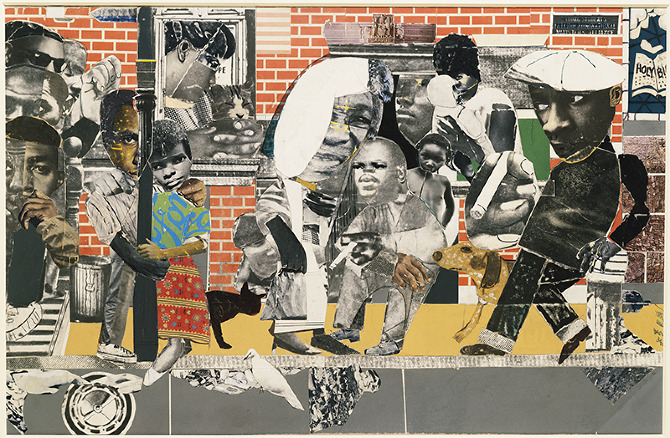
Young Students – Romare Bearden, 1964 – Romare Bearden Foundation
Romare developed into both an renowned artist and an insightful critic of the art world, setting up a studio right above the most famous place in Harlem — the Apollo Theater. It was here that he later pivoted his style away from concrete representational forms, finding his own path into the world of abstract modernism.
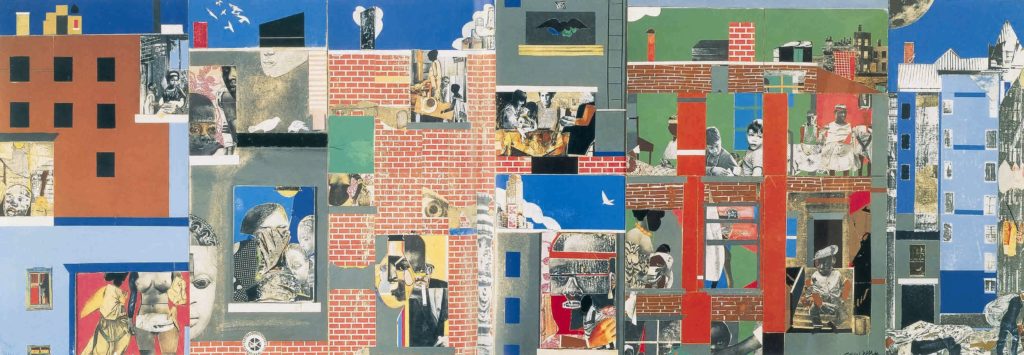
The Block by Romare Bearden, 1971 — Romare Bearden Foundation
By the late 1940s he oddly found himself an outsider — wanting to break out from shows that only featured black artists but eventually excluded from mainstream galleries for not being sufficiently abstract.
It took a revitalizing intellectual journey to Paris, a change of scenery within New York City (to the newly developed artists’ enclave in SoHo) and a shift to collage work to reinvent Bearden’s role in the art world. His groundbreaking 1964 show Projections also established him as an artist in conversation with the American civil rights movement.
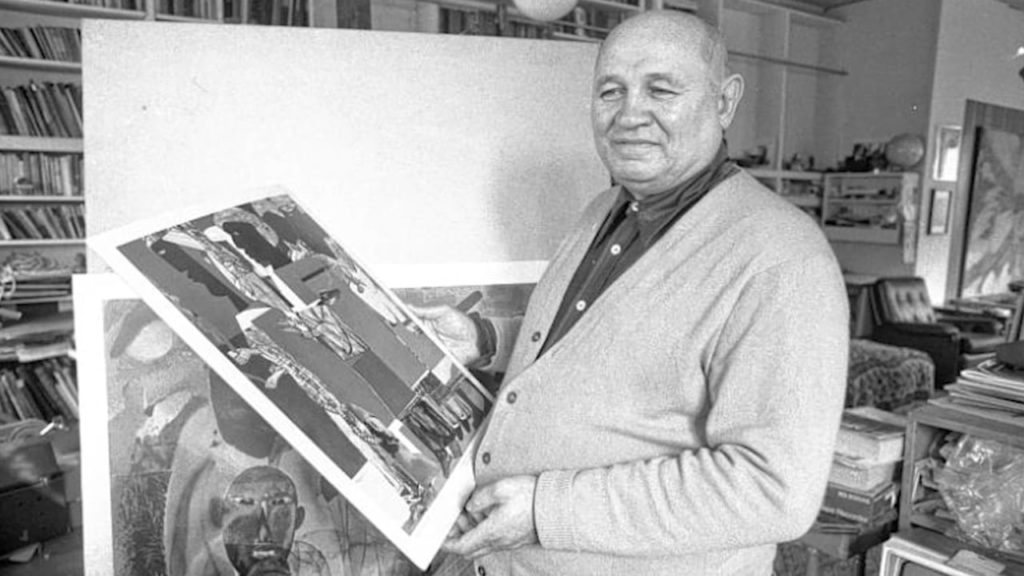
Bearden in his Long Island City studio
By 1987, when Ronald Reagan awarded Bearden the National Medal of the Arts, the artist had secured his legacy. Yet today his body of work — including some of his most profound collages — often remains unseen.
As Campbell explains, “Despite Bearden’s care in the assemblage of materials, his collages with their multitude of different materials are a preservationist’s nightmare. Major museums exhibit his works infrequently because they are so perishable.”
“Bearden’s legacy is as complicated as his art; he would become many things to many people — all at once.”
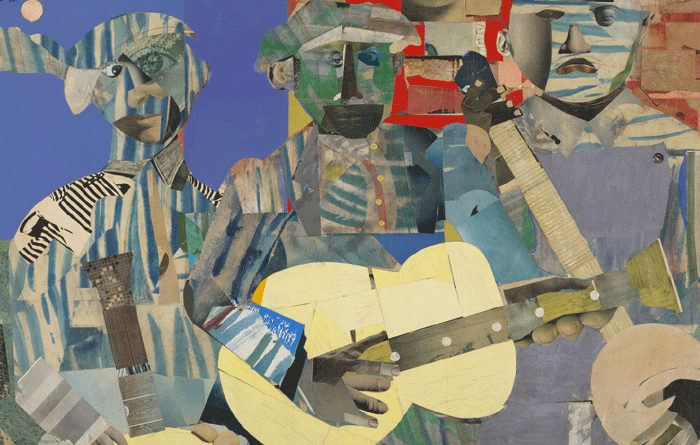
At top: Three Folk Musiciansby Romare Bearden / Virginia Museum of Fine Arts
Bayard’s Mount, one of the highest points in Manhattan, has been gone for more than two hundred years. Where other hills and high points have been incorporated into the modern topography New York, this old hill was wiped from the map.
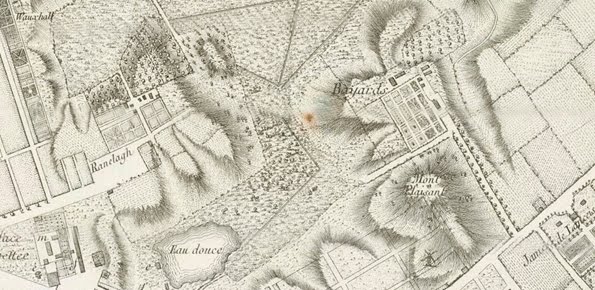
Bayard’s Mount used to sit at around where Mott and Grand Streets meet today, in today’s Little Italy. Indeed, back when nearby SoHo was but a dense thicket of oak and tulip trees, the Mount was the best place to view the waters of CollectPond, the wild northern orchards, and the flat tidal creeks to the west.
A smaller hilltop, called Mount Pleasant, sat to its east and, with the introduction of Europeans, a farm road (Bowery) ran along it. Sitting atop Bayard’s Mount, a person could wile away the day watching travelers going along the Bowery, to and from the city.
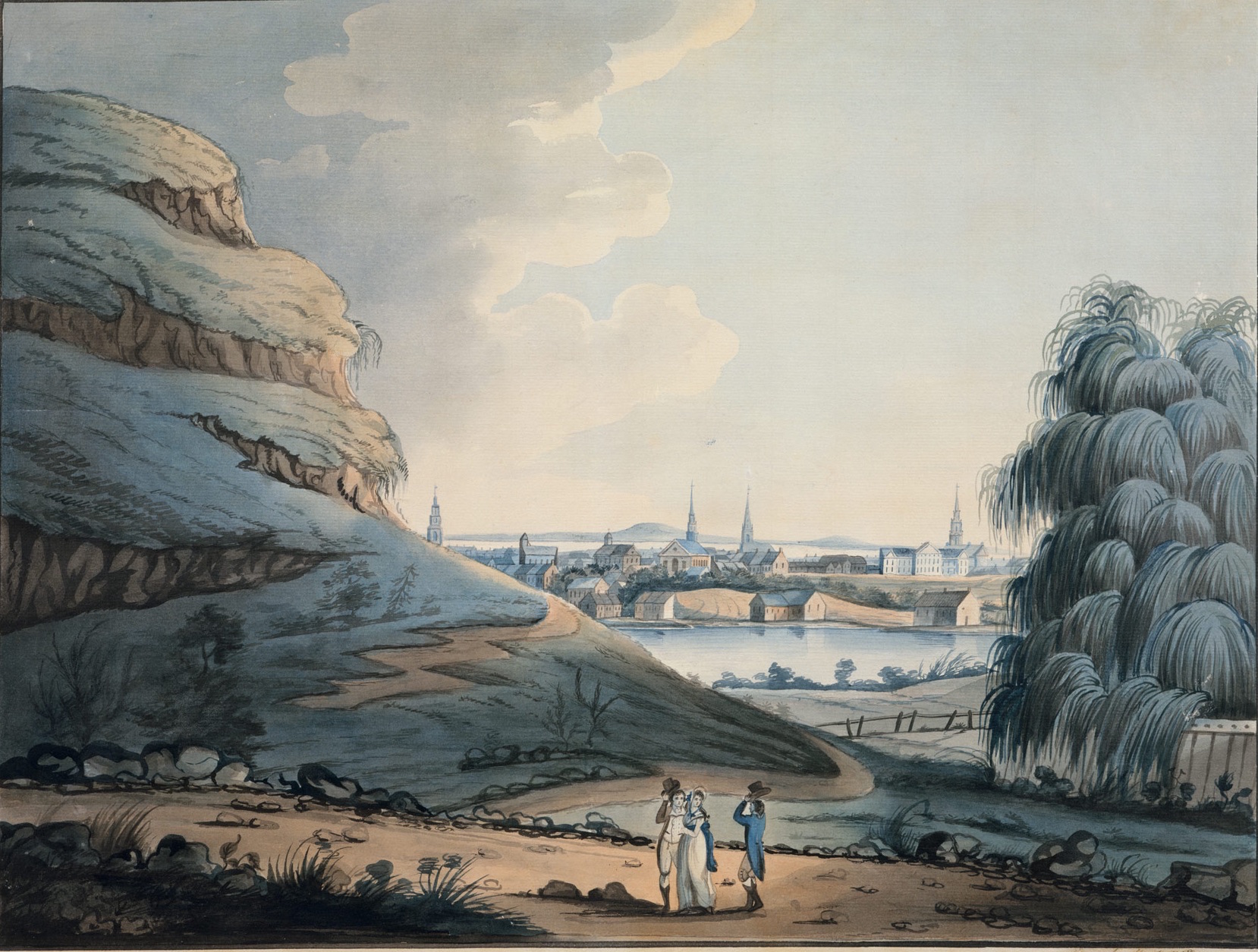
A watercolor by artist Archibald Robertson in 1798, looking south, with Bayard’s Mount/Bunker Hill to the left and Collect Pond dead center.
Some reminiscences refer to Bayard’s Mount and Mount Pleasant as the same hill, and they were close enough they seem to be part of the same ridge.
After the territory went from Dutch to British hands in the mid-17th century, most of this property fell into the hands of Nicholas Bayard, and the “small, cone-shaped mount” took on the name of its landowner, who built his sturdy estate just to its north. Even by the early 18th century, Bayard’s family would still have few neighbors; swampy ground prevented much development west, while property to the east eventually belonged to James DeLancey, the governor of the colony.
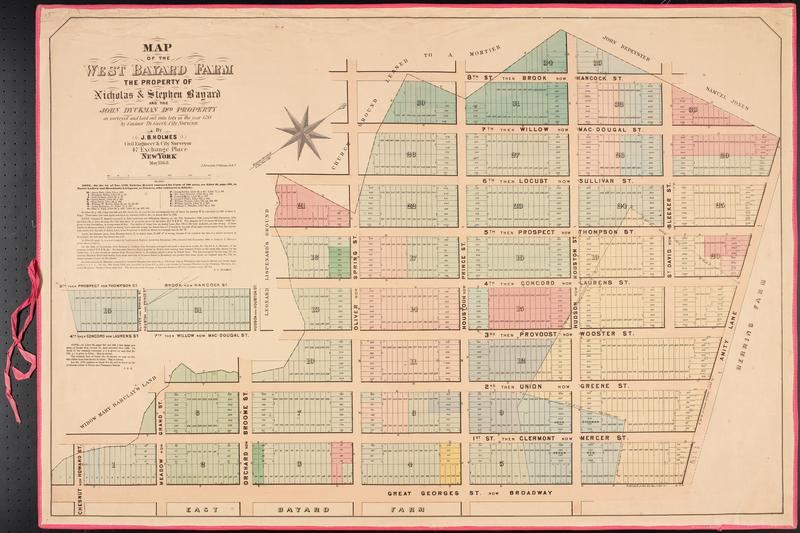
Below: A later 19th century property map highlights the broken western border of Bayard’s farm. The wetlands known as Lispenard’sMeadow prevented the estate from developing further westward.
The mount took on a more serious purpose with the onset of the Revolutionary War. In March of 1776, “One third of the citizens were ordered out to erect new works; they began a fort upon Mr. Bayard’s Mount near the Bowery.” [source]
This fortification, built in anticipation of a messy battle with the British, was named after a critical battle the year previous at Bunker Hill in Boston; soon, the hill itself took on the name, and in most histories after 1776, this place at today’s Mott and Grand Streets is officially known as Bunker Hill. Notably stationed here at Bunker Hill was NathanHale.
There would be no significant altercations here between British troops and the Continental Army. No, in fact, the bloodshed would wait until after the war, when the hilltop would be known as a fashionable place to host your duel.
For instance, in 1787, a disagreement between two French men ended in a duel here and the death of one of them, a “Monsieur Chevalier de Longchamps” who was apparently no stranger tooffense and violent response.
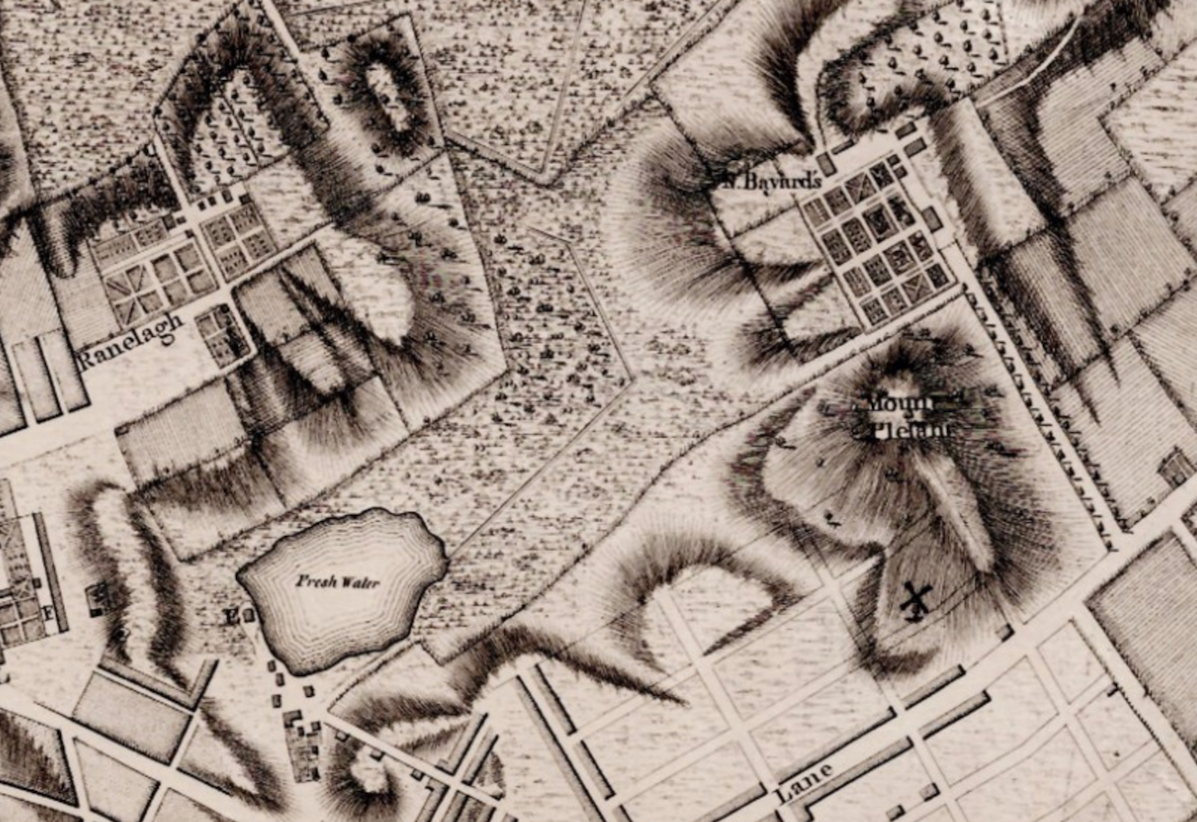
Below: From Montressor’smap of Manhattan, 1755, you can see Bayard’s property and both hills — Bayard’s Mount and Mount Pleasant, the elongated hill. The Bowery runs along the bottom right hand of the illustration, with Collect Pond in the bottom left corner. You can also see the grid plan of Bayard’s farm (which was ultimately adapted for the modern street plan of SoHo).
In July 1788, to celebrate the federal ratification of the Constitution, a procession marched through the city and ended its revelry at Bayard’s Mount/Bunker Hill, where “ten enormous tables laden with provisions” and hundreds of pounds ofroasted ox were served to hungry patriots. Several years later, in 1795, a different gathering, angered by their governor John Jay over his (perceived) treasonous treaty with the British, burned his portrait in a bonfire here.
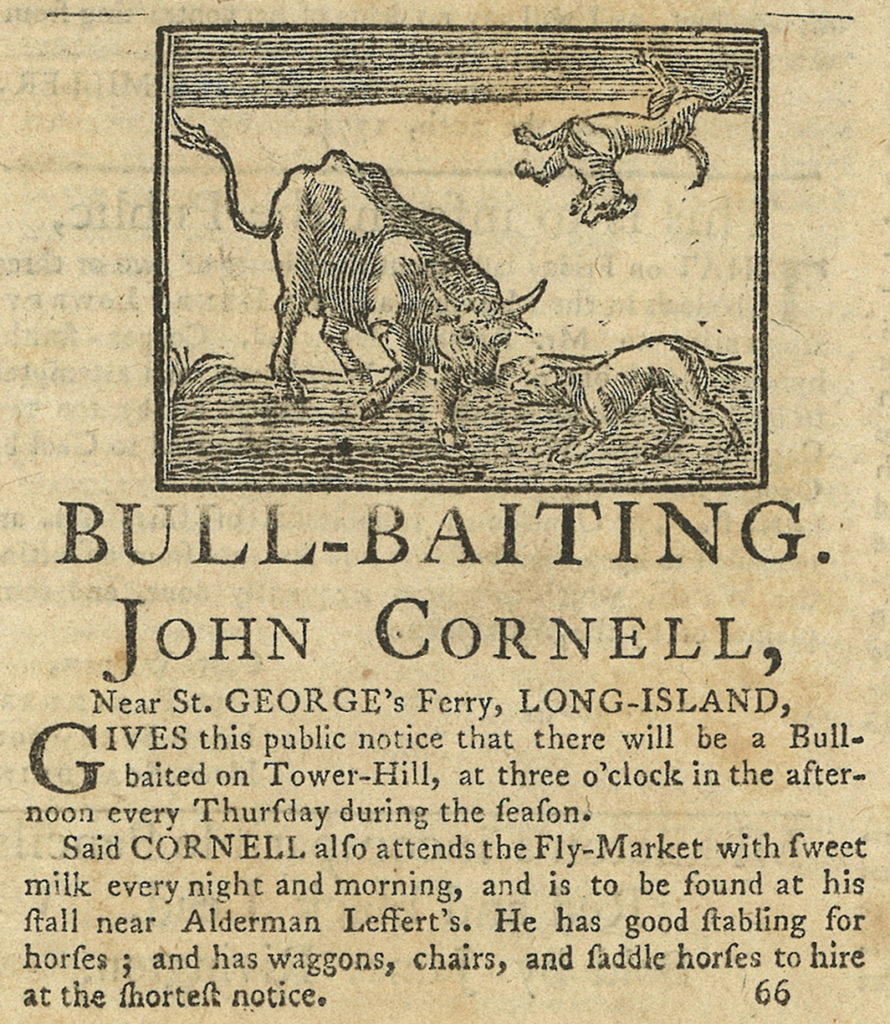
Another curious pastime at the hilltop was the British sport of ‘bull baiting’, where a bull would be tied to a stake and slowly tortured by angry dogs. Why this is of any visible amusement is beyond me, although its cousin ‘bear baiting’ is still sometimes practicedin Pakistan.
Below: A bit of this nasty little pastime out in Long Island as it was advertised in 1774
New York was outgrowing the southern point of Manhattan, and former deterrents for expansion — the marshes of Lispinard’sMeadow, polluted Collect Pond, and of course, Bayard’s Mount — were slated for elimination. The ponds and marshes would soon be drained, creating Canal Street, and Broadway expanded further north. (Listen to our podcast on Collect Pond and Canal Street formore information.) By then, Bayard’s was but a memory.
Beginning in 1802, workmen began levelling Bayard’s Mount and Mount Pleasant which also included moving the old Bayard family crypt which had its entrance at the bottom of the hill. Unfortunately, it was discovered that a “hermit or ragman” had moved into the vault and turned it into his very own macabre home. Remarkably, the man was allowed to live there — “he was somewhat feared and not much troubled by visitors” — until he was found one day dead in the vault.
By the time Collect Pond was completely drained (around 1811), the hills to its north had gone, replaced with land lots and the first hints of townhouses and new businesses.
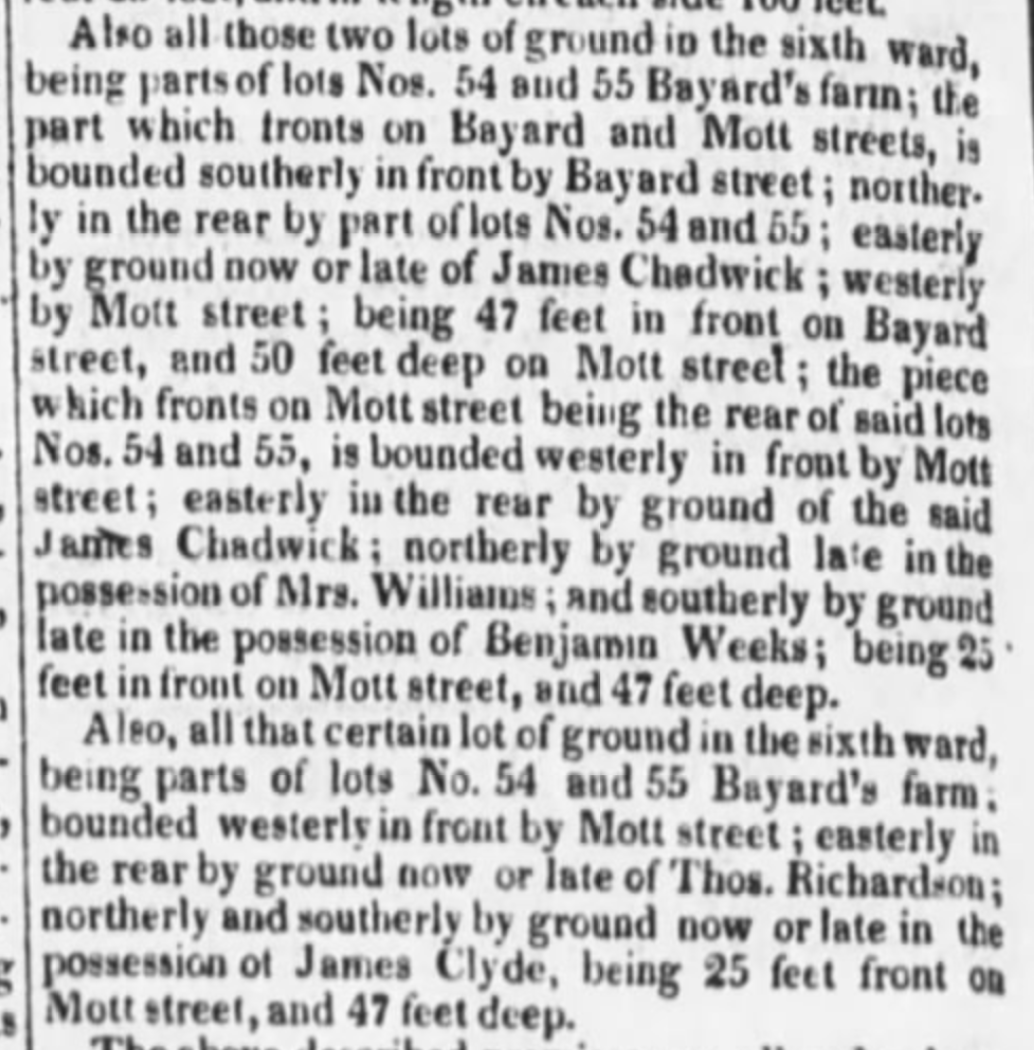
Below: From an 1821 New York Evening Post, an advertisement for plots on the old Bayard farm — at Bayard Street and Mott Street, just a couple blocks south of the location of the Mount
PODCAST The history of SoHo, New York’s 19th century warehouse district turned shopping mecca
Picture the neighborhood of SoHo (that’s right, South of Houston) in your head today, and you might get a headache. Crowded sidewalks on the weekend, filled with tourists, shoppers and vendors, could almost distract you from SoHo’s unique appeal as a place of extraordinary architecture and history.
On this podcast we present the story of how a portion of Hell’s Hundred Acres became one of the most famously trendy places in the world.
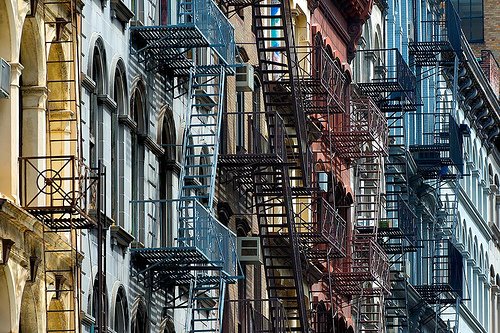
In the mid 19th century this area, centered along Broadway, became the heart of retail and entertainment, department stores and hotels setting up shop in grand palaces. (It also became New York’s most notorious brothel district). The streets between Houston and Canal became known as the Cast Iron District, thanks to an exciting construction innovation that transformed the Gilded Age.
Today SoHo contains the world’s greatest surviving collection of cast-iron architecture. But these gorgeous iron tributes to New York industry were nearly destroyed — first by rampant fires, then by Robert Moses. Community activists saved these buildings, and just in time for artists to move into their spacious loft spaces in the 1960s and 70s. The artists are still there of course but these once-desolate cobblestone streets have almost unrecognizably changed, perhaps a victim of its own success.
The Bowery Boys: New York City History podcast is brought to you …. by you!
We are now producing a new Bowery Boys podcast every two weeks. We’re also looking to improve the show in other ways and expand in other ways as well — through publishing, social media, live events and other forms of media. But we can only do this with your help!
We are now a member of Patreon, a patronage platform where you can support your favorite content creators for as little as a $1 a month.
Please visitour page on Patreon and watch a short video of us recording the show and talking about our expansion plans. If you’d like to help out, there are five different pledge levels (and with clever names too — Mannahatta, New Amsterdam, Five Points, Gilded Age, Jazz Age and Empire State). Check them out and consider being a sponsor.
We greatly appreciate our listeners and readers and thank you for joining us on this journey so far. And the best is yet to come!
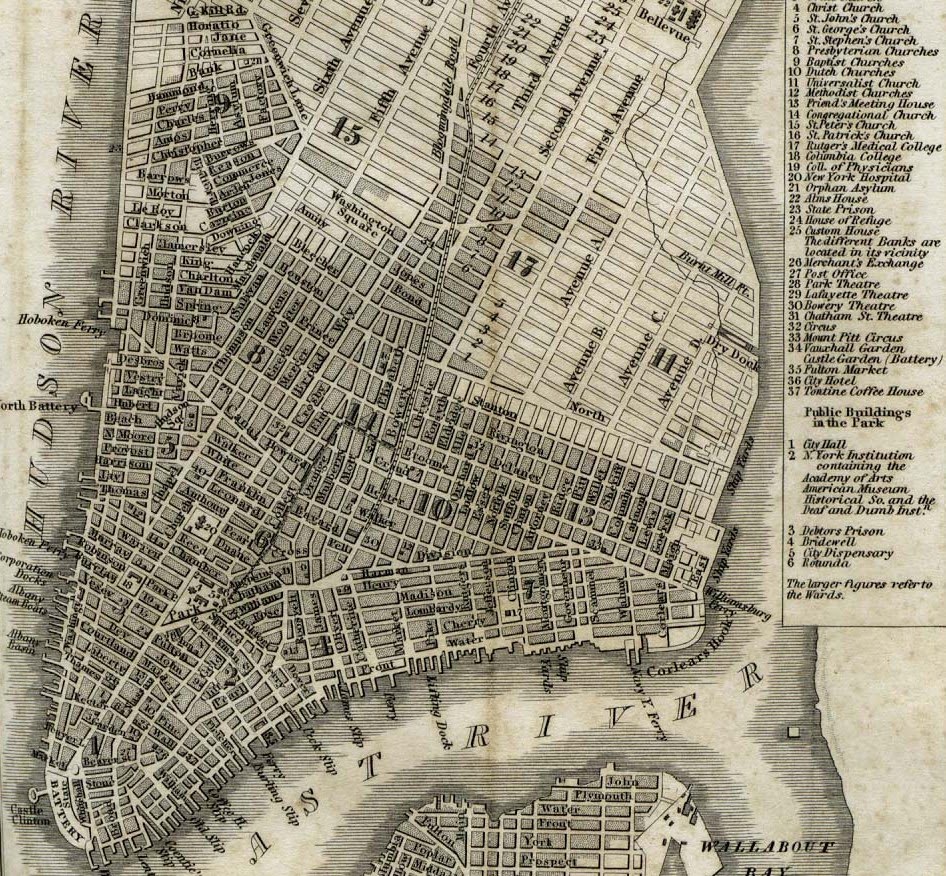
A map of the Bayard farm and how it was broken up and carved into the streets we know today.
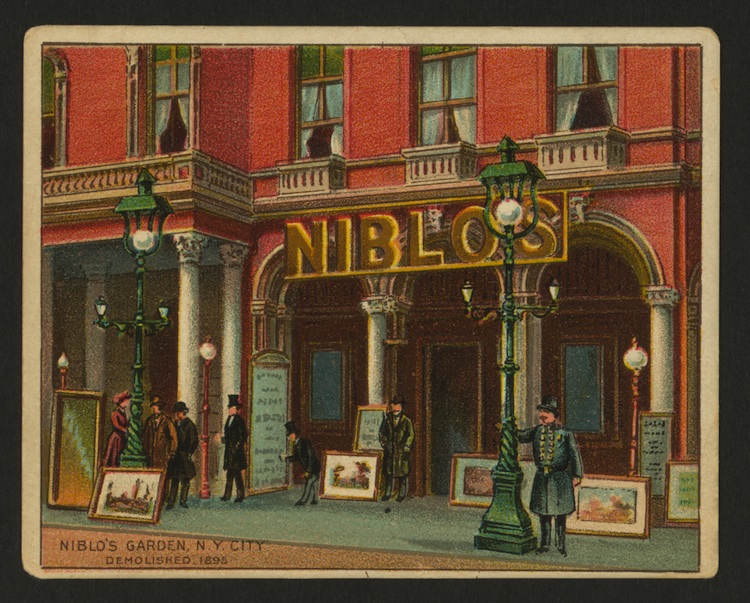
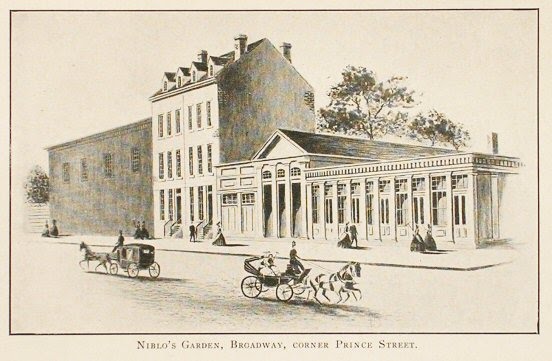
Niblo’sGarden, located at Broadway and Prince Streets, was one of the finest theaters along Broadway in the area of today’s SoHo.
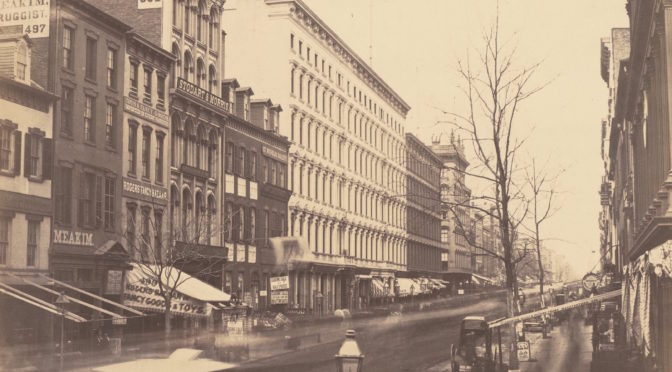
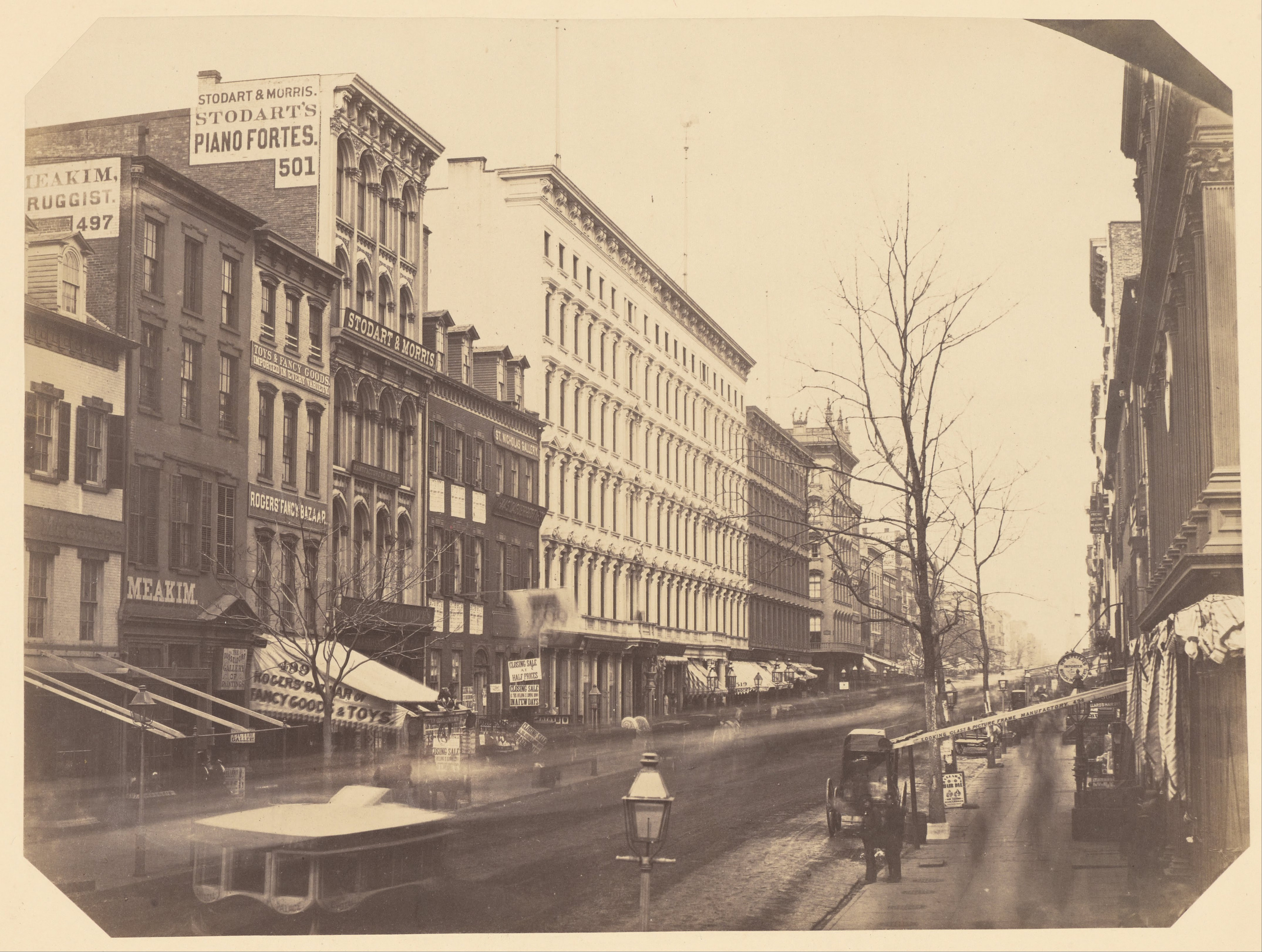
Looking north along Broadway between Grand and Broome Street. The St. Nicholas Hotel is the white structure in the center of the photo.
Photo attributed to Silas A Holmes
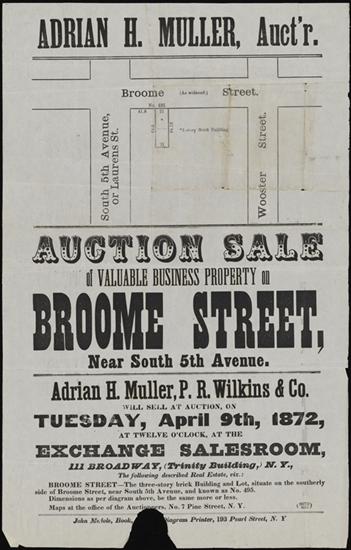
An auction poster from 1872 advertising a property on Broome Street and “South Fifth Avenue or Laurens Street” — today’s West Broadway.
MCNY
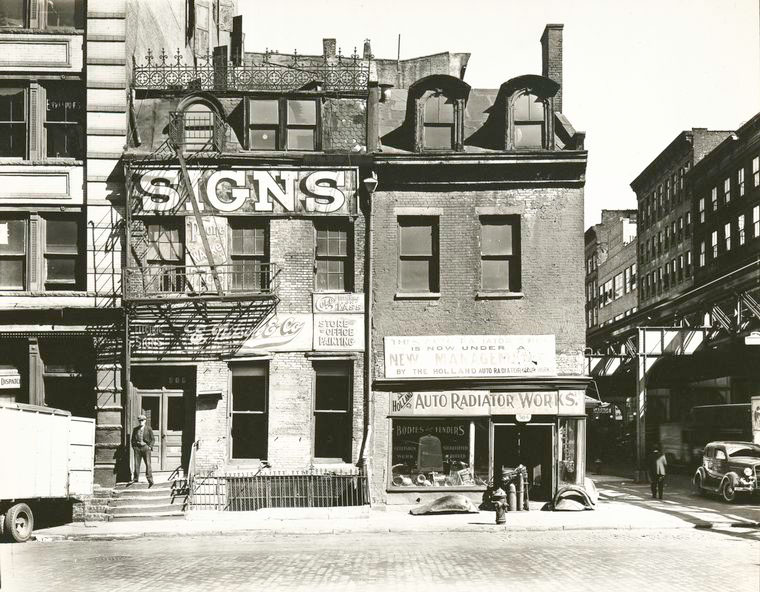
Here is that corner at 504-506 Broome Street — in 1935 (photo by Berenice Abbott). Per Sean Sweeney on Facebook: “The two buildings were demolished and for years were a parking lot. Now a new 3-story retail building sits in their place.”
NYPL
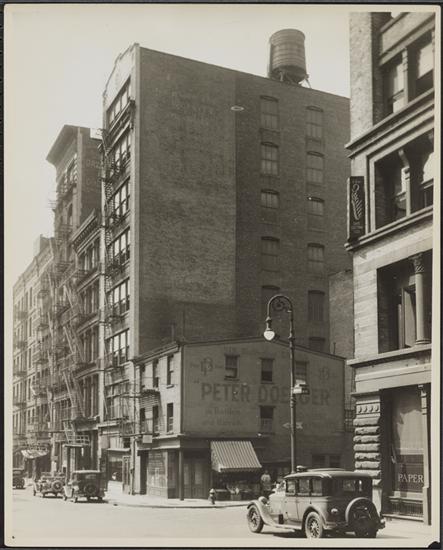
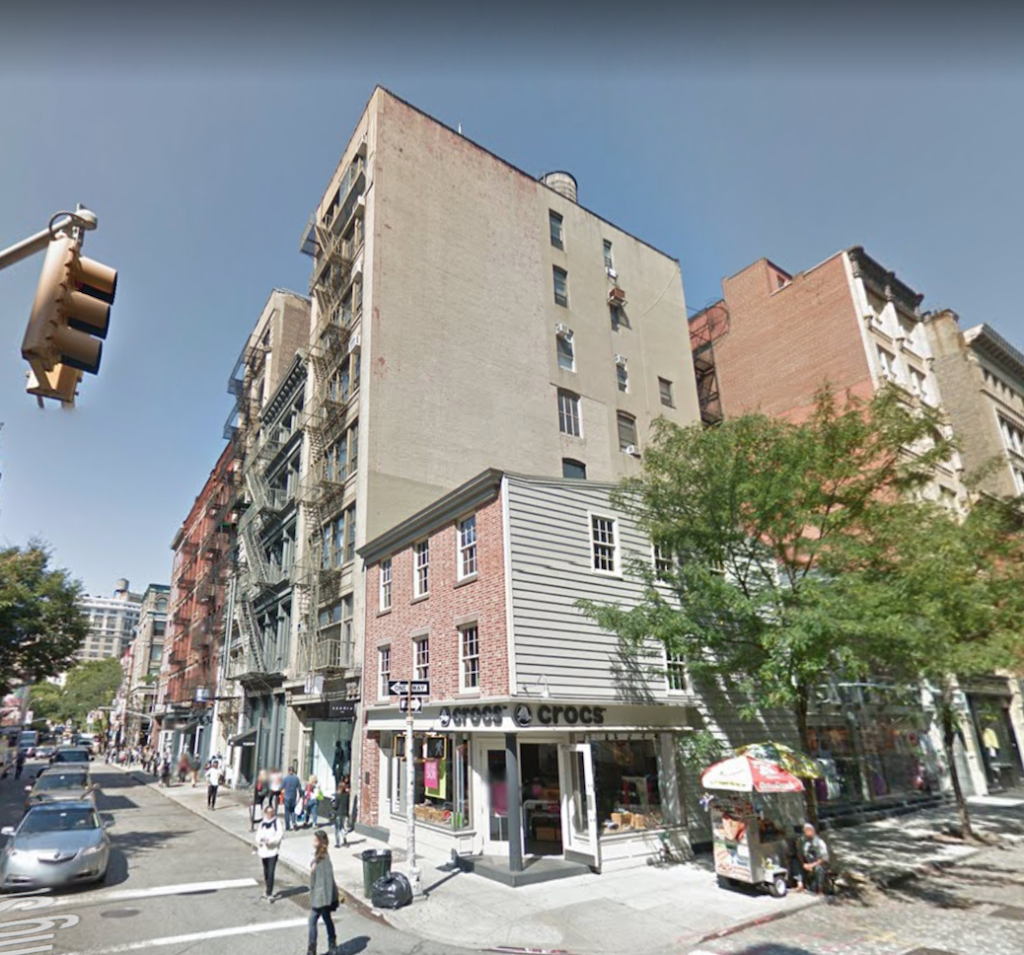
The house at 143 Spring Street — in 1932 (photograph by Charles Von Urban) and today (it’s a Crocs shop!)
Museum of City of New York/Charles Von Urban collection
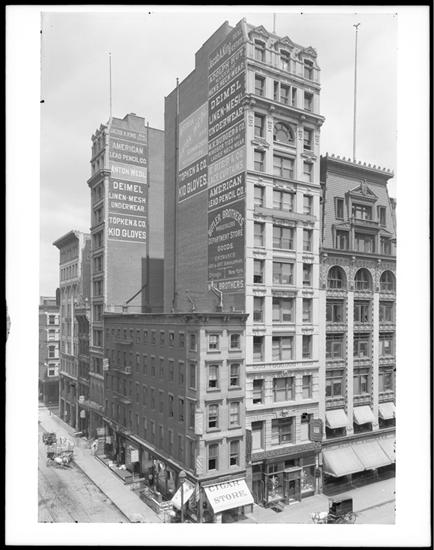
491 Broadway at Broome Street — in 1905 (photograph by the Wurts Bros.) and today
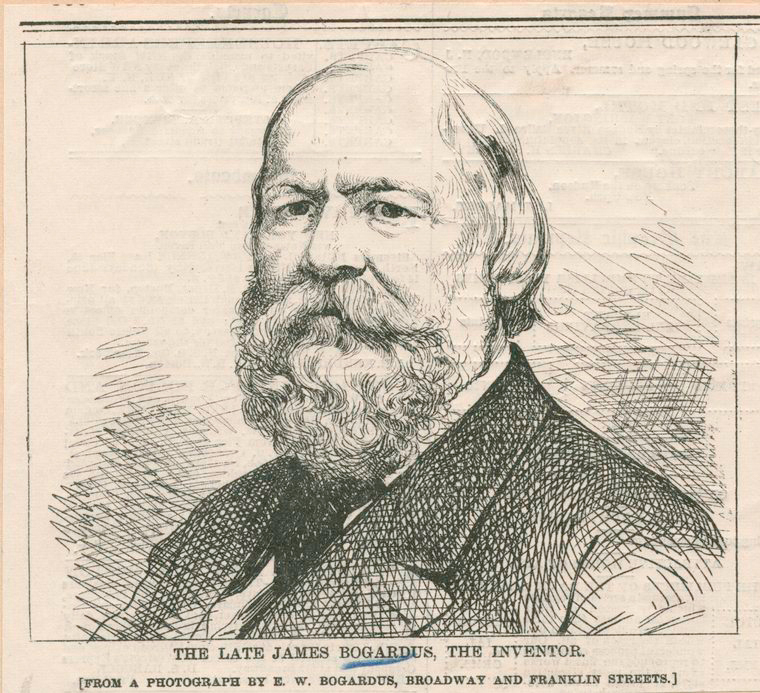
James Bogardus, the man who helped give SoHo its distinctive appearance thanks to his vigorous marketing and promotion of cast-iron architecture.
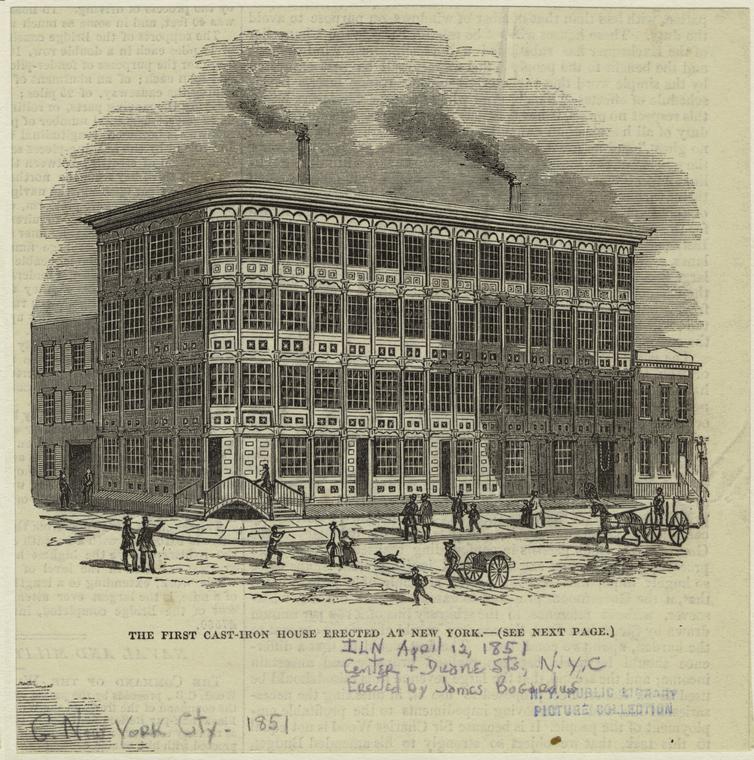
The first cast-iron structure in New York, built in 1848, was further south at the corner of Centre and Duane Streets.
NYPL
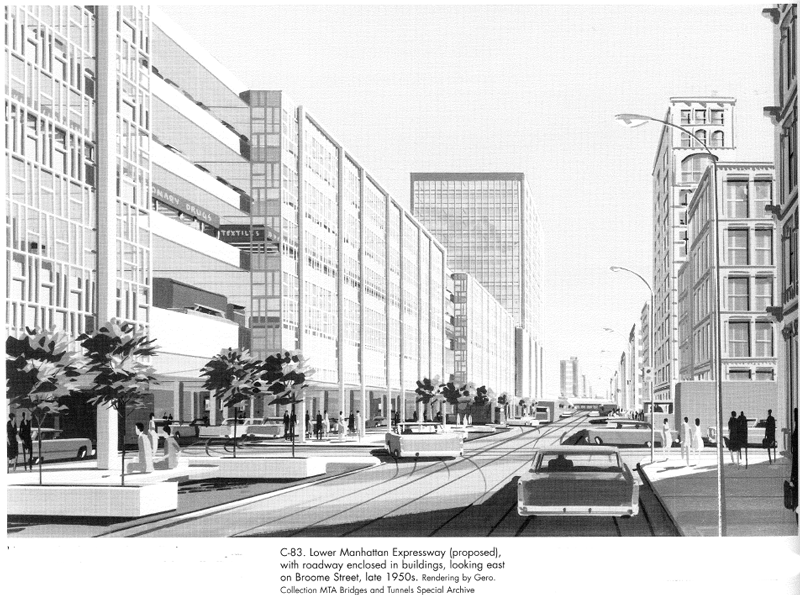
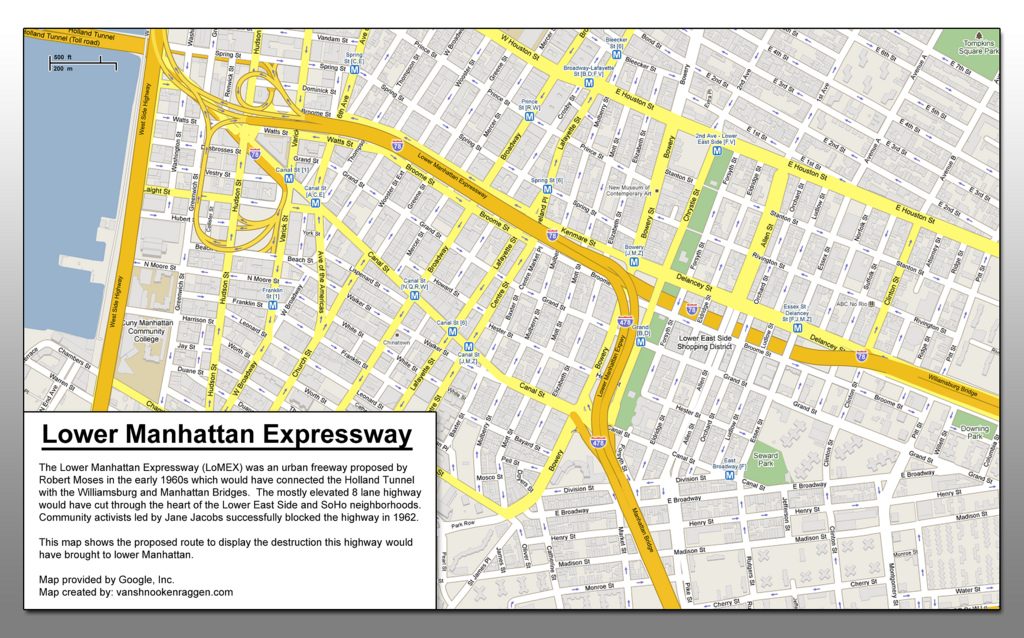
Robert Moses’ view of Broome Street via his project Lower Manhattan Expressway project. Broom Street would have had an elevated highway, enclosed within modern buildings. A view of surviving cast-iron architecture on the right.
SoHo would have been eliminated (or greatly reduced) by Moses’ project which was thankfully nixed.
Map produced by vanshnookenraggen
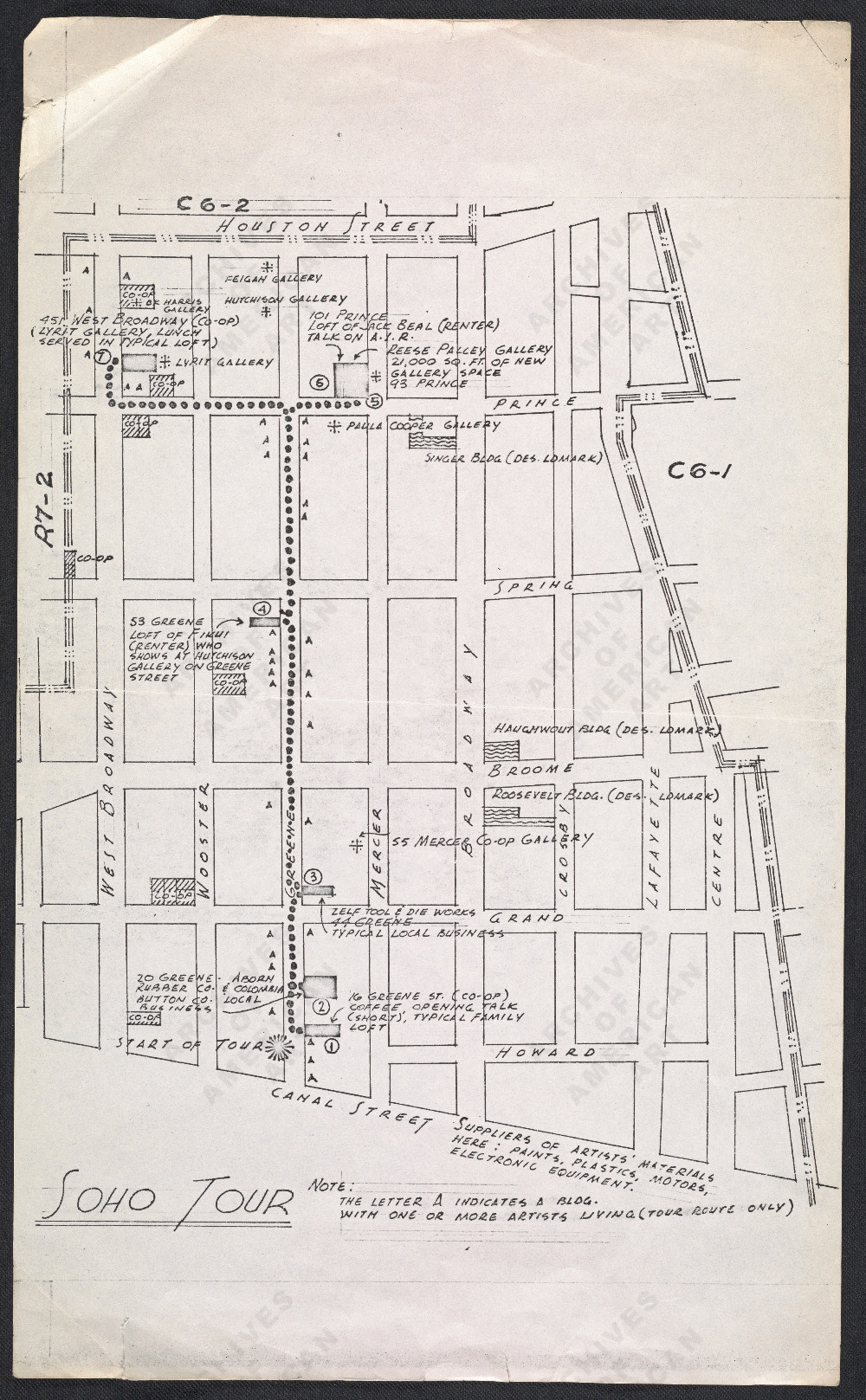
A map of the art galleries in the SoHo art scene during the 1970s.
SoHo Artists Association Records, 1968-1978. Archives of American Art, Smithsonian Institution
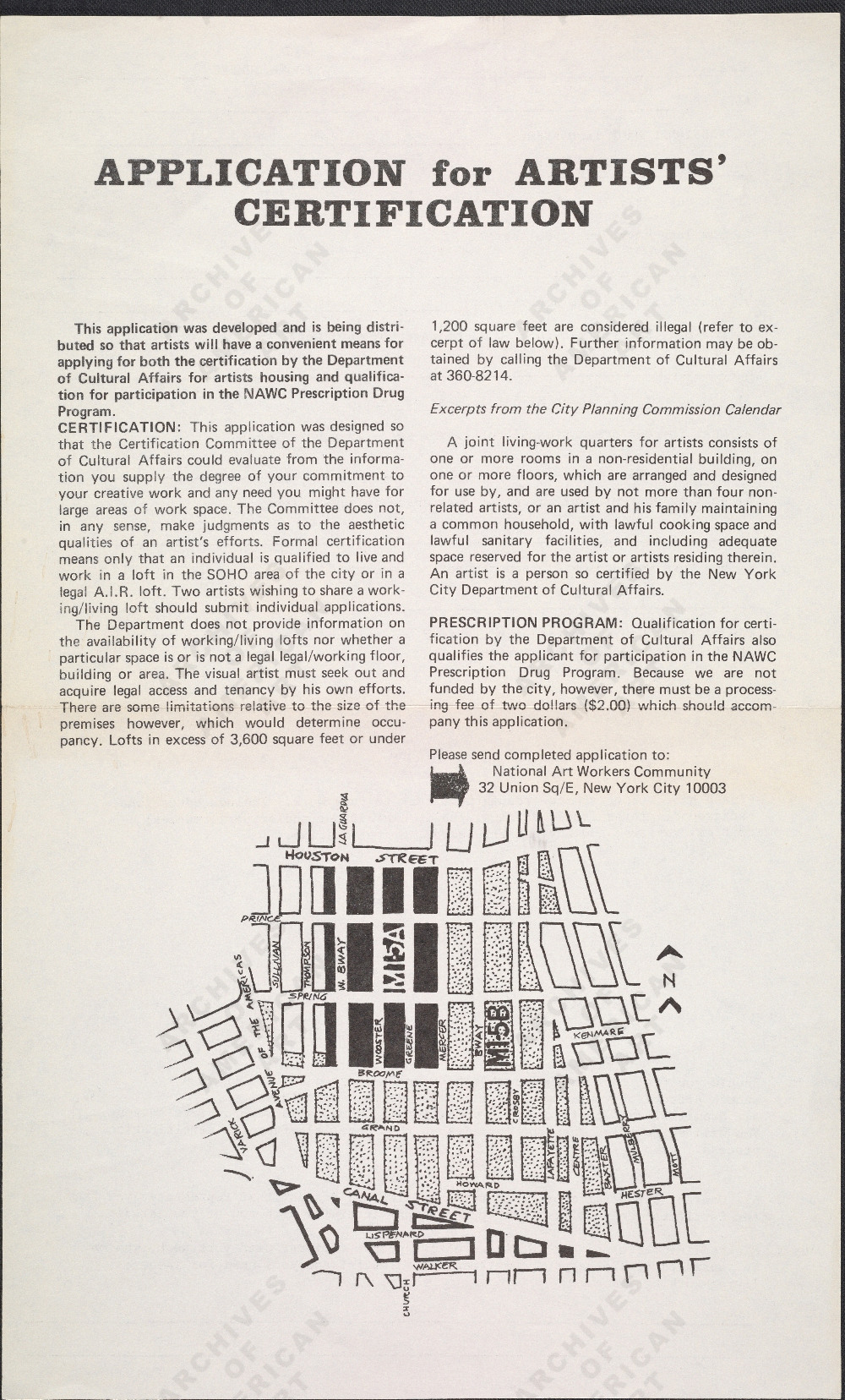
SoHo Artists Association Records, 1968-1978. Archives of American Art, Smithsonian Institution
We greatly encourage you to check out the SoHo Memory Project for a lot of fantastic and often deeply personal recollections about the SoHo days of yore.
For further listening, check out the following Bowery Boys podcasts which were referenced in this week’s show:
Cast-iron construction, pioneered in America by architect James Bogardus in the 1850s, became the preferred method of building large dry goods shops and department stores in the mid- and late nineteenth century, thanks to the speed with which these enormous buildings could go up and the savings they presented over heavier, more cumbersome construction methods.
Today SoHo contains the largest surviving collection of cast-iron buildings in the world. Wandering through these streets in the late afternoon, sun ignites their white- and cream-colored exteriors. It’s magical—and the stuff of a million postcards, album covers, and selfies.
But SoHo contains another secret. It’s the location of New York City’s very first commercial elevator.
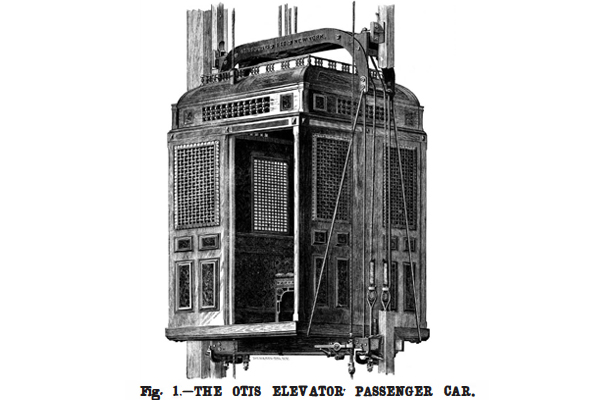
There had been so-called ‘hoisting elevators’ — crude platforms elevated by man power — but they were dangerous and their cords easily snapped. Elisha Otis, an inventor from Yonkers, New York, perfected the safety break which allowed a large containment to be moved up and down without fear of plummeting. He debuted this device to enthusiastic acclaim at the 1854 Crystal Palace Exposition. And soon, after some savvy newspaper advertisements, Otis finally found his first major client.
Library of Congress
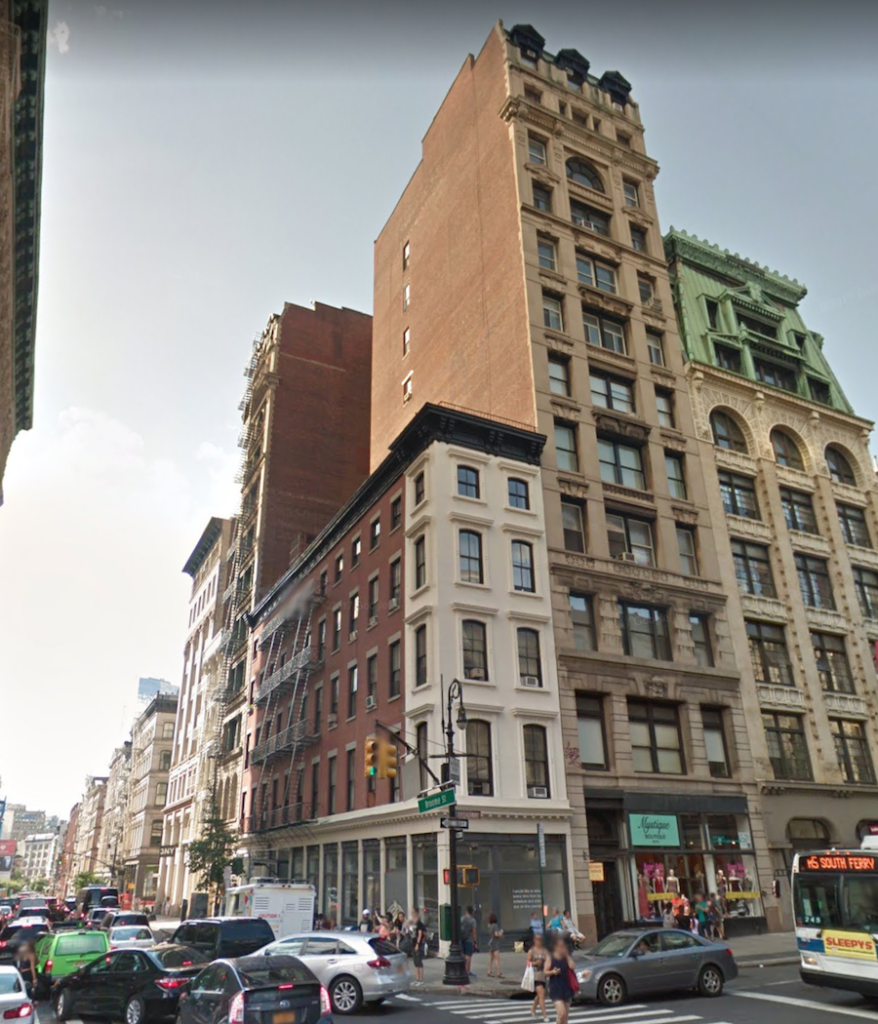
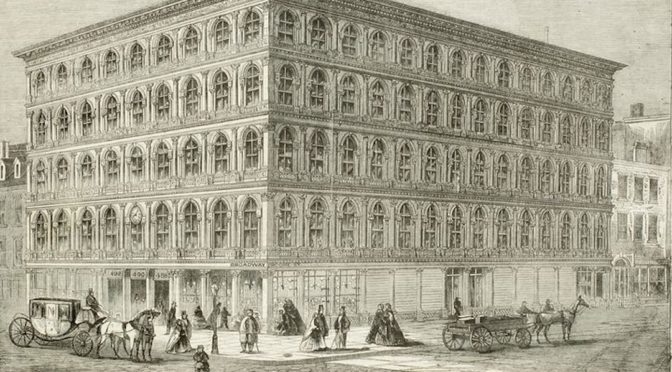
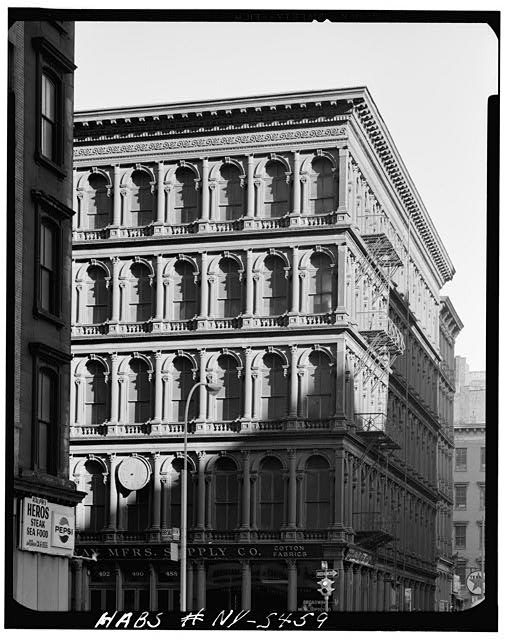
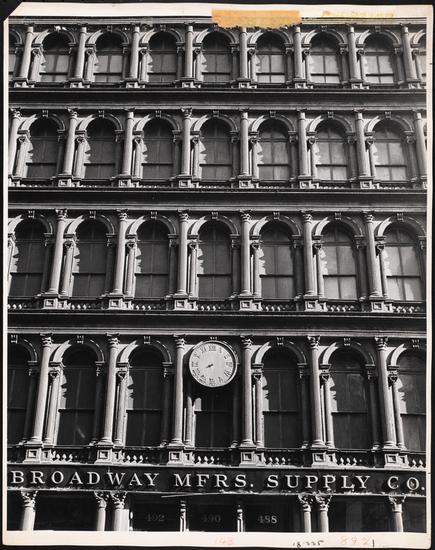
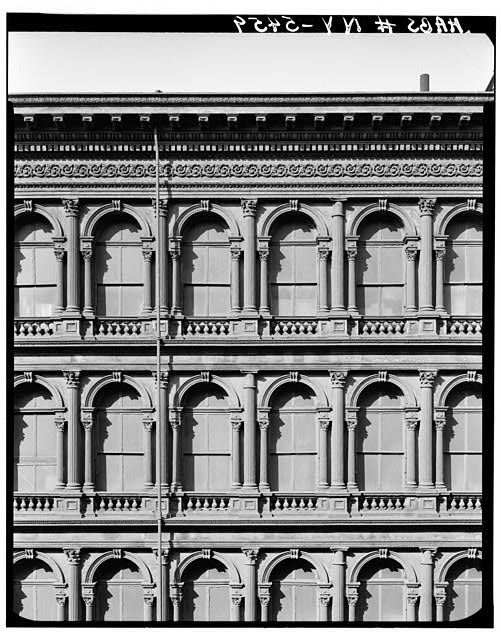
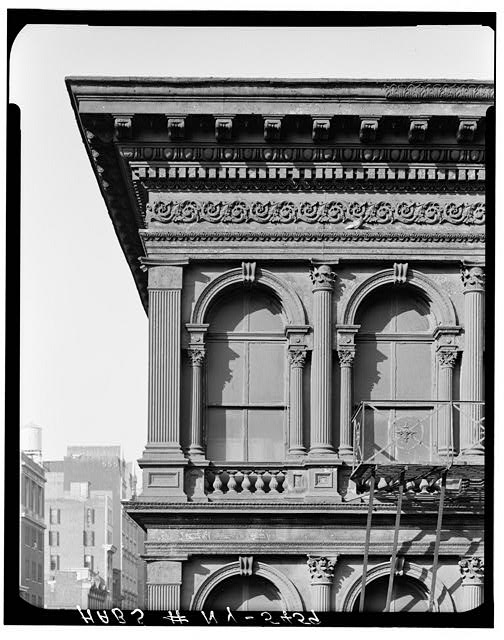
That would be the magical emporium of E. V. Haughwout, at Broadway and Broome Street, a luxury store which sold fine china and glassware. The corner building’s two-sided cast-iron construction and facade was the first of its kind when it was completed in 1857, and soon inspired blocks lined with similar construction throughout SoHo.
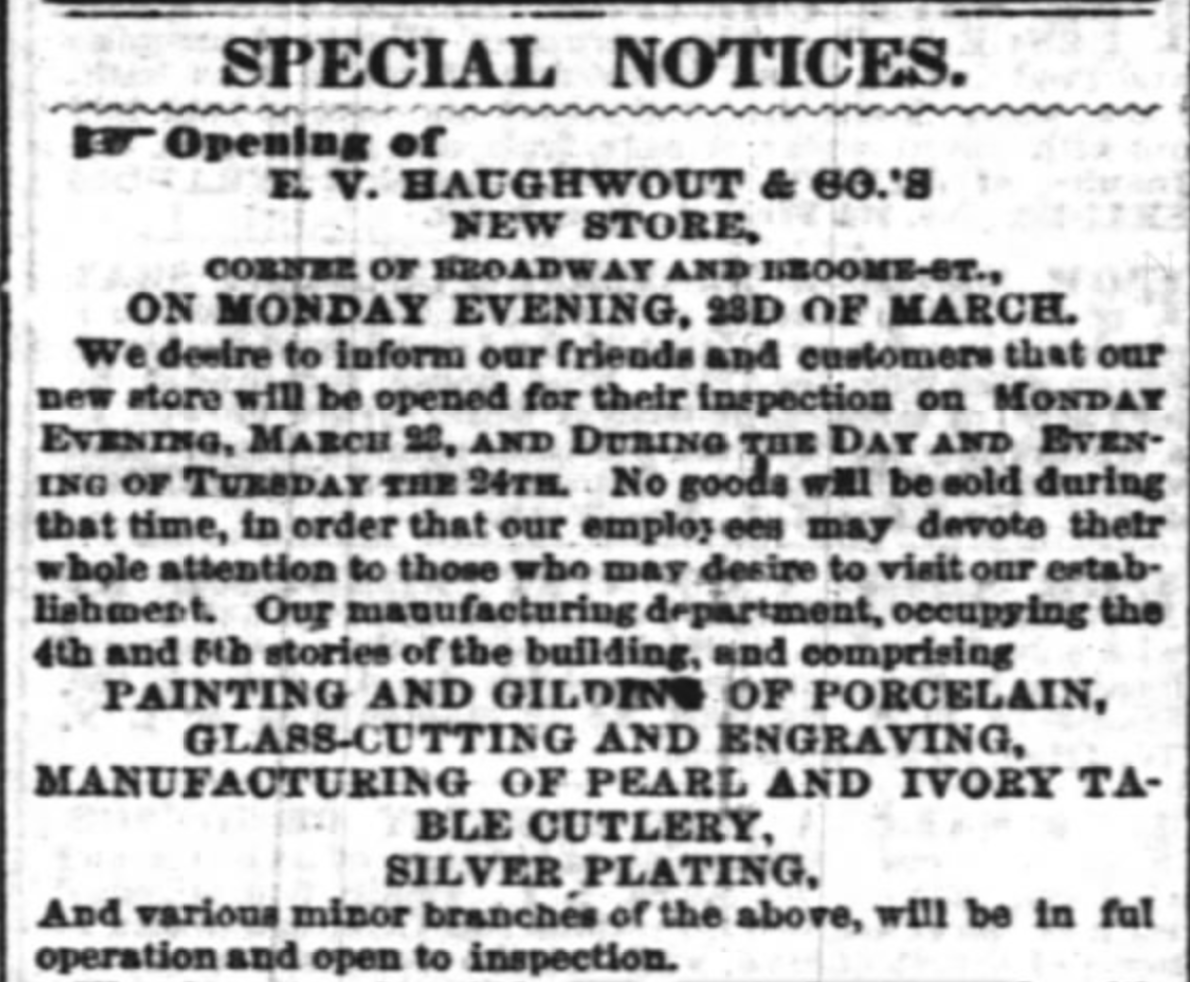
Below: The department store — and the elevator — were first opened ‘for public inspection’ on March 23, 1857.
New York Times
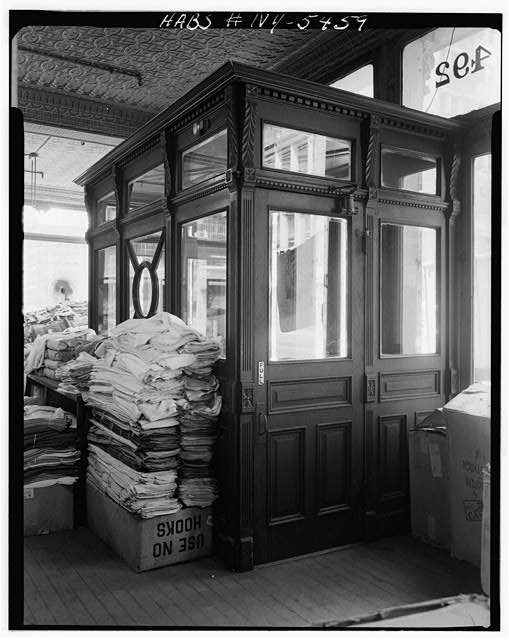
But its most important contribution was placed inside—a passenger elevator, installed the same year, which lifted and lowered its wealthy clients to its various exotic departments.
According to the website of OTIS elevators themselves: “On March 23, 1857, Otis’ first commercial passenger elevator was installed in the E.V. Haughwout and Company…….The price of the elevator was US $300. The unit rose at a speed of 40 feet per minute (0.2 meters per second).”
From the New York Tribune: “Among the novelties we noticed is an elevator to be worked by steam, which is to be furnished with a sofa and carriage to carry ladies from one floor to the other. The steam engine and boiler are located on the rear lot disconnected from the main edifice.”
Haughwout’s Emporium was also famed for its French champagne and for the fine flutes that it was drunk from. Surprised? While the neighborhood today still pops more than its share of bubbly, SoHo was never more glamorous than during the Haughwout years. And part of the reason for its acclaim was its marvelous, state-of-the-art elevator.
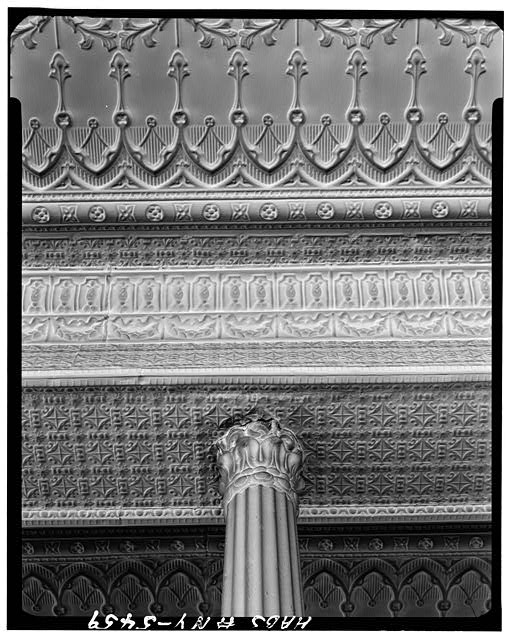
More pictures of the Haughwout Building, courtesy the Library of Congress, via the Historic American Buildings Survey, Cervin Robinson, Photographer March 1967.
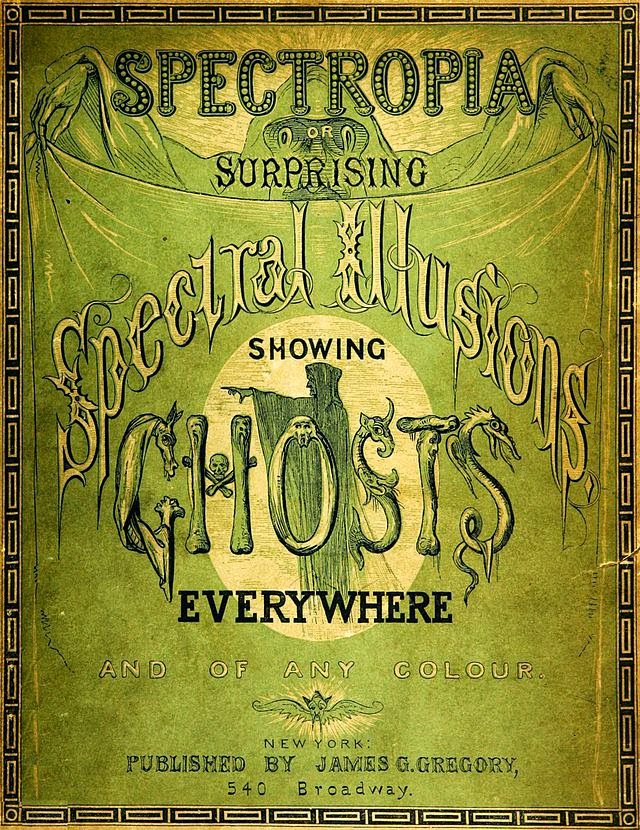
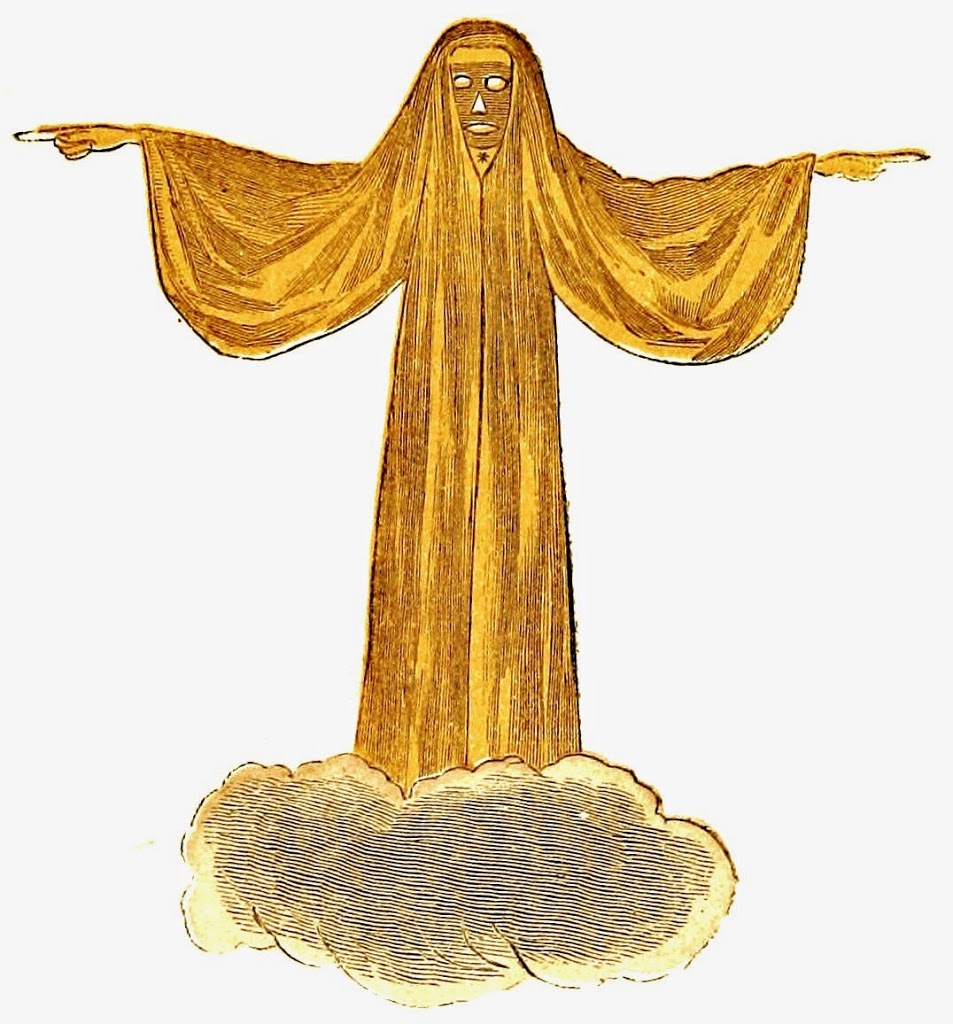
Above: The cover of the New York edition of Brown’s optical illusion book
One of the hottest books in New York City in the fall of 1864 was an optical illusion collection that conjured ghosts through a simple trick of the eye.
Spectropia, or surprising spectral illusions showing ghosts everywhere and of any colour was both a parlor amusement and picture-filled chapbook written and illustrated by J. H. Brown, an early skeptic of the spiritualism movement.
From the books introduction: “It is a curious fact that, in this age of scientific research, the absurd follies of spiritualism should find an increase in supporters; but mental epidemics seem at certain seasons to affect our minds, and one of the oldest of these mental afflictions — witchcraft — is once more prevalent in this nineteenth century, under the contemptible forms of spirit-rapping and table-turning.”
To counter the phonies, Brown presents readers with a nifty optical illusion that will allow its readers to create their own ghosts at home.
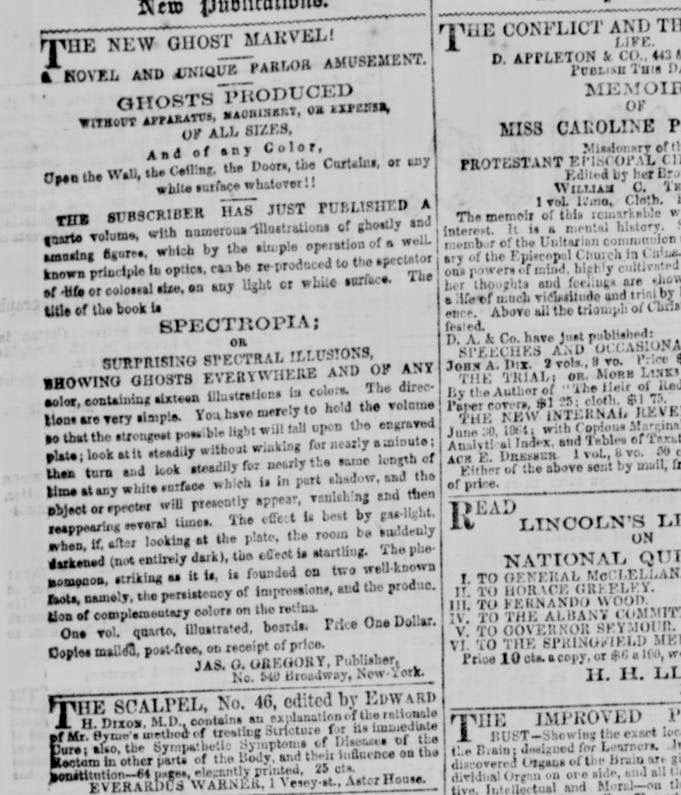
According to advertisements for the book:
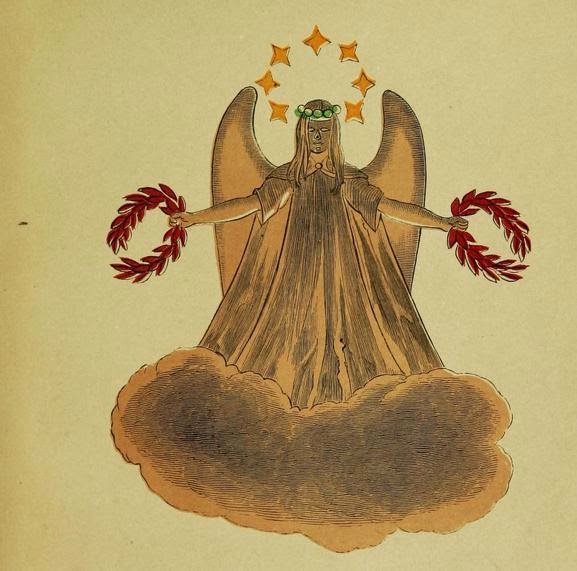
“The directions are very simple. You have merely to hold the volume so that the strongest possible light will fall upon the engraved plate; look at it steadily without blinking for nearly a minute; then turn and look steadily for the same length of time at any white surface which is in part shadow, and the object or specter will presently appear.”
“The effect is best by gaslight.” My goodness, what isn’t?
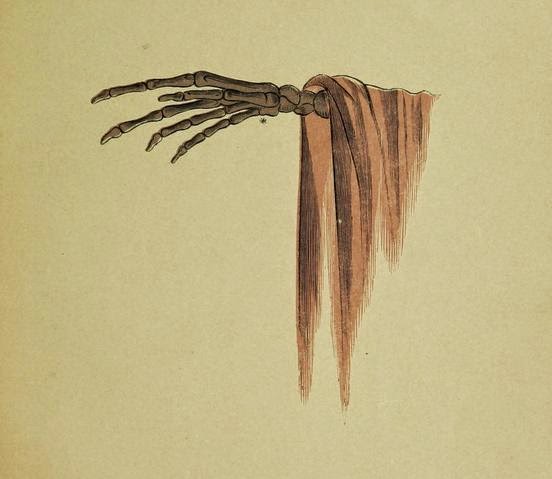
Here’s a sampling of the illustrations. See if they work for you! And yes, definitely try these out if your home is equipped with gaslight….
The book was produced in New York by publisher James Gregory at 540 Broadway in today’s SoHo area. (It’s the building where the Steve Madden shoe store is today.).
Believe it or not, Spectropia was a hot gift under the tree that Christmas. The New York Times lists it that year in their recommended holiday gift list. “The publications of Mr. JAS. G. GREGORY, of No. 540 Broadway, are characterized by good taste and fine execution.” Mr. Gregory kept the book in publication for several years afterwards or at least until the novelty wore off.
Stuyvesant Street is mentioned as one of the few streets in New York that was allowed to break the grid, and its diagonal path between Second and Third avenues is a reminder of the original farm grid of Peter Stuyvesant. But as a few listeners have pointed out, it holds another unique distinction.
The original estate owners of Manhattan often carved up their own lands into the shape of small grids. For instance, the grid of the DeLancey farm is still impressed upon the Lower East Side below Delancey Street. The Stuyvesants also had a system of streets on their property that ran true east to west. (Manhattan is obviously not on a true north-south axis, and its grid streets do not truly run east to west, but progress at a slight diagonal. Charles Petzold has a very detailed article on the island’s true orientation.)
Thus, Stuyvesant Street is the only street in Manhattan that actually runs east to west. Walk its length with a compass and be amazed!
—–
Not too far from Stuyvesant Street is the beginning of grid plan, First Street and First Avenue, Kramer’s “nexus of the universe”. This is the spot were near-uniformity along New York’s streets and avenues begins.
The southern border of the grid plan was, ironically, called North Street at the time, for it was truly north of the city. As I mentioned back in the Niblo’s Garden podcast, today’s Houston Street is actually the adjoining of two roads, the other being a path that cut through the property of Nicholas Bayard, land that is today’s SoHo. Bayard renamed his street after his daughter’s new husband, the esteemed Georgian patriot William Houstoun. Later, it made sense to link Houstoun’s street to North Street, and thus the whole thing was called Houston Street (with a ‘u’ vanishing in the process). —–
The occasion of the Commissioners Plan is presents a good opportunity to peer into the extraordinary collection of old New York maps in the David Rumsey Collection. The original 1811 Randel maps are there, as well as others that chart the course of development during the 19th Century. This Tanner map from 1836 shows the grid progressing nicely. —–
So, if I didn’t quite get it across on the show, let me say it now: Gouverneur Morris is awesome. I devoured two different biographies on the controversial Founding Father, and I highly recommended them both. Although Richard Brookhiser’s “Gentleman Revolutionary” is a breezier read, the quieter “Gouverneur Morris: An Independent Life” by William Howard Adams still makes room for some salacious details. —–
And to repeat one major CORRECTION: Due to my complete misreading of my own handwritten notes and in the flurry of wrapping up the show, I said that Manhattanhenge occurs on March 28 and July 12 or July 13. I meant MAY 28, not March 28.
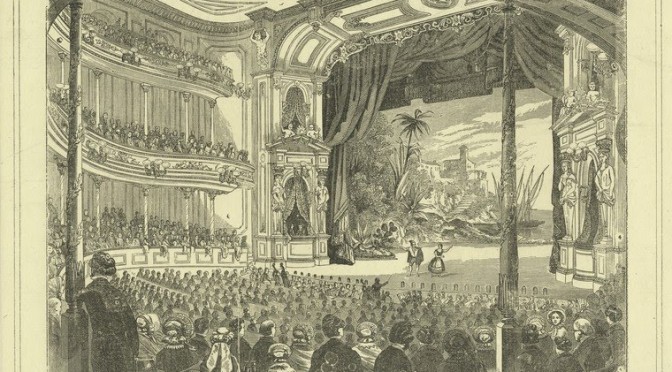
Show-stopping: The interior of Niblo’s Garden Theatre. Illustration by Thomas Addis Emmet, courtesy NYPL
PODCAST It’s the 1820s and welcome to the era ofthe pleasure garden, an outdoor entertainment complex delighting wealthy New Yorkers in the years before public parks. Wandering gravel paths wind past candle-lit sculptures, songbirds in gilded cages, and string quartets in gazebos, while high above, nightly fireworks spray the sky.
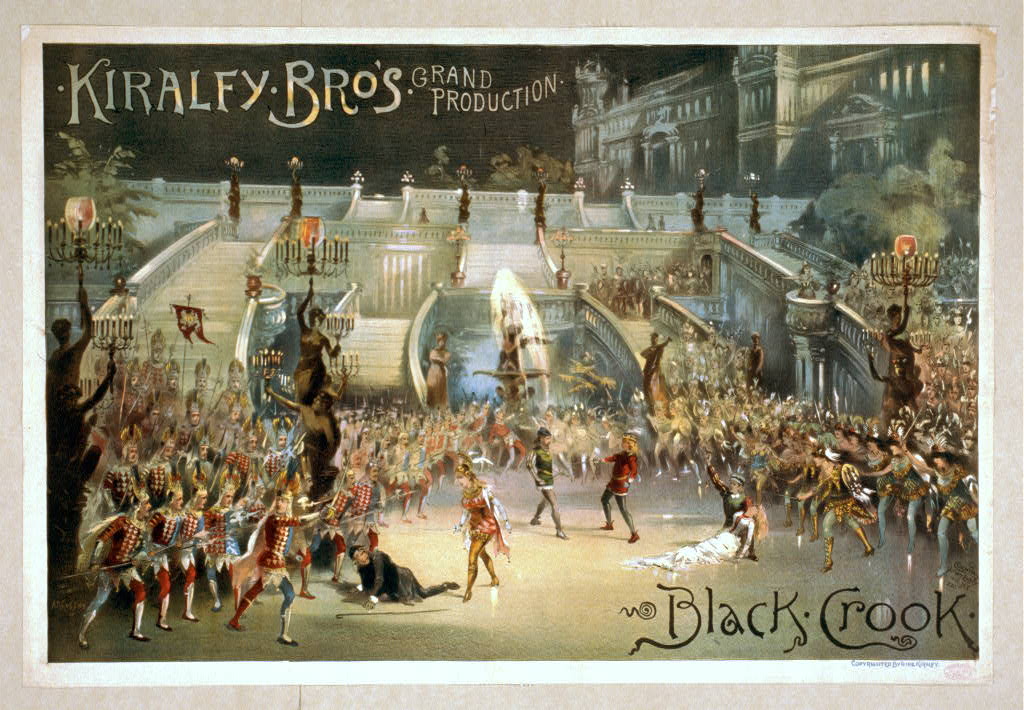
Niblo’s Garden, at the corner of Broadway and Prince Street, was the greatest of them all, with an exhibit room for panoramas and refreshment hall consider by some to be one of New York’s very first restuarants. But it was Niblo’s grand theater, seating 3,000 people, that would make Niblo’s reputation as the venue for both high- and low-brow events. And in 1866, a production debuted there that would change everything — the gaudy, much-too-long spectacle The Black Crook, considered by most as the very first Broadway musical.
Music in the episode is Enigma Variation VI. Ysobel by Elgar. It’s actually from after the time period of Niblo’s, but it’s so very strolling-the-garden, isn’t it? And I had a cold this week, so please forgive my scratchy voice!
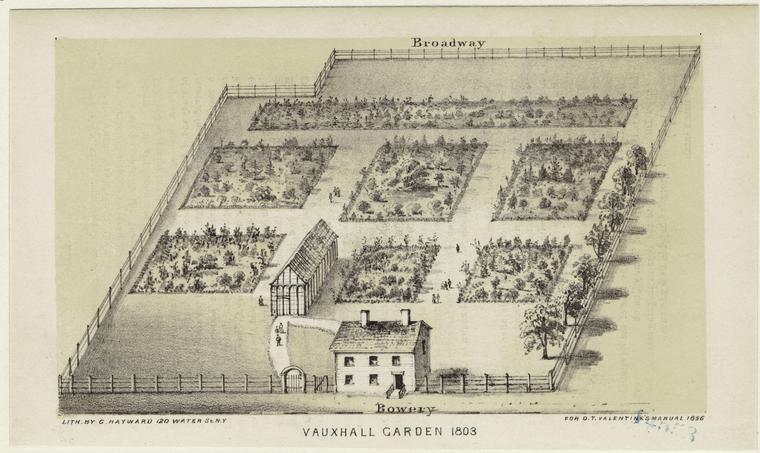
Before Niblo’s, the premier pleasure garden was Vauxhall Garden, derived from a British garden of the same name. The one picture below is from the incarnation before it moved in 1807 to the area just below Astor Place, in what would become Lafayette Street. (NYPL)
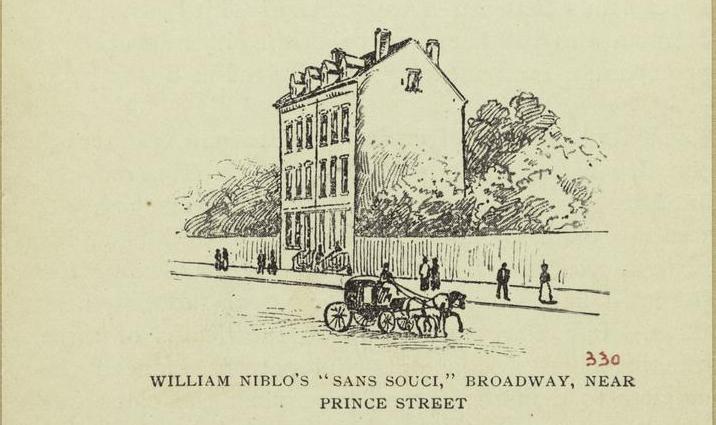
The first theater on the Niblo property was a small stage he called ‘Sans Souci’. Demand soon dictated that a larger venue be built. [NYPL]
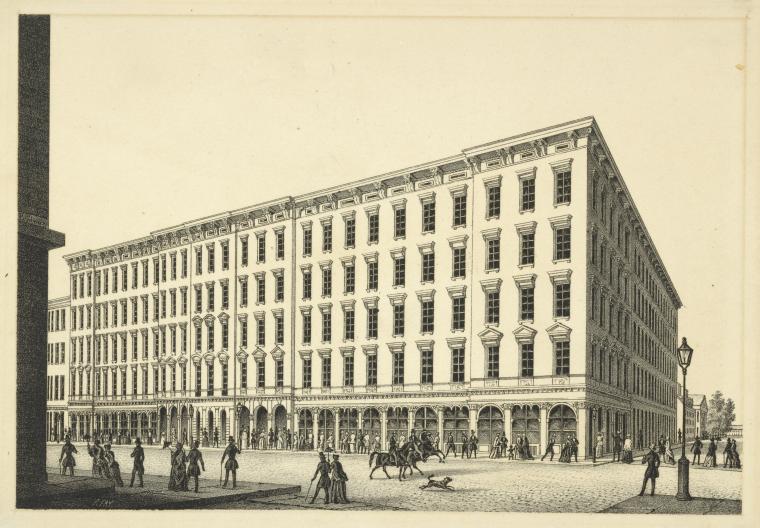
From another illustration detailing the block just a few years later. The theater looks the same, but other buildings (possibly the saloon or a greenhouse?) have been built up around it. (from Merrycoz)
The garden was soon overtaken by a great hotel, the Metropolitan, which opened in 1852. This image is looking east, down Prince Street, with Broadway stretching to the left. NOTE: The original caption on this illustration says 1850, but the hotel would not be open for a couple years later. (NYPL)
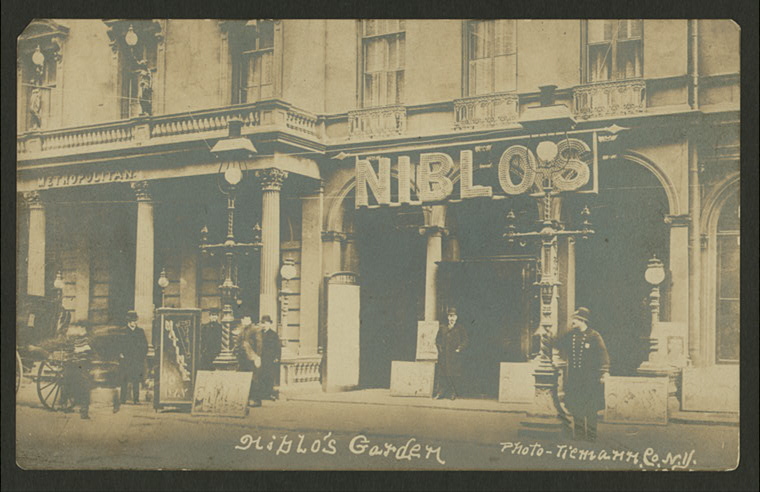
This is one of the only photographs of Niblo’s Theater, certainly from its last years, judging from the fashion of the day. The theater and the hotel were demolished in 1895. [Pic from here]
This poster is from a Boston production of ‘The Black Crook’, but it illustrates nicely the scope and theatricality of the production. The show was cobbled together using a poorly written German fantasia, a troupe of out-of-work Parisian dancers, and some original music. The show ran five and a half hours nightly and was a runaway hit. [Image from Kirafly Bros]
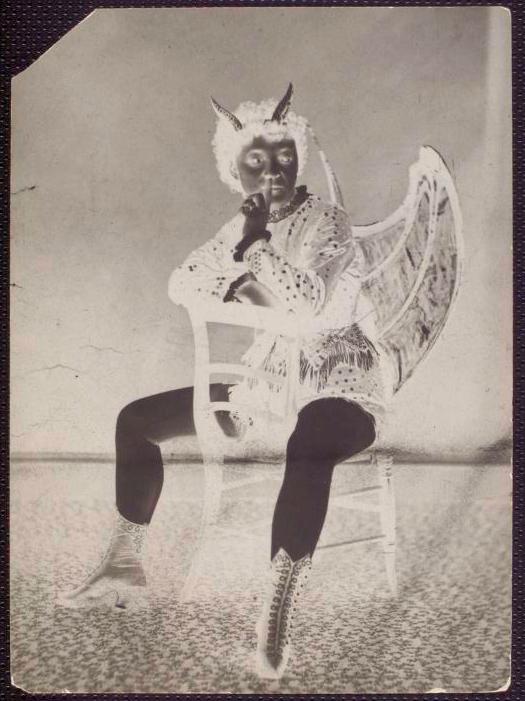
A costumed damsel (in photographic negative) from an early production of The Black Crook. [source]
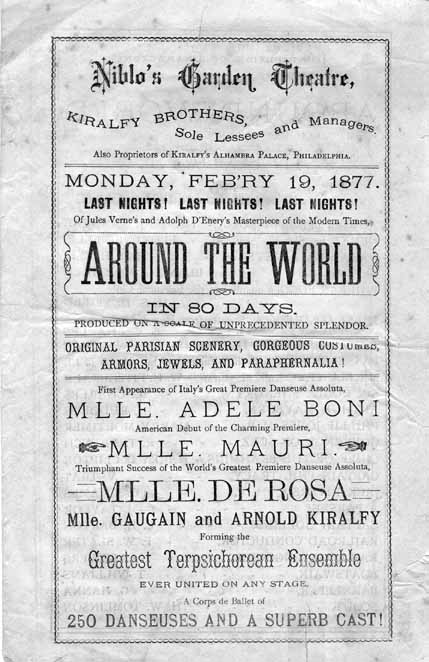
An early program from Niblo’s, from 1877, featuring stage rendition of Jules Verne’s Around The World In 80 Days. I can only imagine the sets for this one! Also featuring the ‘Greatest Terpsichordean Ensemble’ and ‘250 Danseuses and a Superb Cast’.[Courtesy Jules Verne]
FRIDAY NIGHT FEVERTo get you in the mood for the weekend, on occasional Fridays we’ll be featuring an old New York nightlife haunt, from the dance halls of 19th Century Bowery, to the massive warehouse clubs of the mid-1990s. Past entries can be found here.
LOCATIONCerebrum Broome and Crosby streets, Manhattan
The 1960s were a decade of experimentation, and not just for people. As rock and roll tripped out, so did the places you went to hear it. No longer were clubs merely about alcohol and frivolity, music and fashion. A nightclub could create ‘happenings’, self-conscious environments of pleasure; recreational drugs helped.
The most glamorous example of this sort of public venue in downtown Manhattan was probably the Electric Circus, psychedelic haunt of the Velvet Underground and Andy Warhol, mixing light shows and performance art onto a dance floor of fashionable mods. But even the swirling, mohair environments of the Factory’s favorite club paled in comparison the experiments going on at Cerebrum.
I have to say, part of my fascination with Cerebrum was the hard time I had in researching this article. The place was open less than a year (winter 1968 to summer 1969), and its participants were on the true art fringe. Its most famous patron was most likely Jimi Hendrix — who stole the club’s designer John Storyk to create his fabulous Electric Lady Studios — but I found virtually no mentions of this in biographies. In fact, it took me a few articles to even clarify that the place even existed, that it wasn’t a mass acid hallucination conjured up by a frothing artist in a Nehru jacket.
Cerebrum, which opened in November 1968, was not a mere club but, as New York Magazine calls it in March 1969, a “place implicitly geared to voyeuristic impulses.”
Located at 429 Broome Street at Crosby Street in SoHo, Cerebrum was the brainchild (ahem) of a group of underground theater artists who decided to turn their highly groovy loft parties into regular events, combining theatrical flair with the frippery of psychedelic drug culture.
Chief among the creators was Ruffin Cooper Jr., son of a Texan banker would later achieve some renown as a abstract photographer in San Francsico. To the surprise of no one, his other collaborators, all fabulously creative, would soon be connected to the Ridiculous Theatrical Company, still in its early days of absurdist productions: Richard Currie the lighting designer, Bobjack Callejo its set designer.
Imagine the city at night with the radio on. You’re listening to WNEW-FW and the sweet sounds of Allison “Nightbird” Steele, when suddenly you hear an unusual commercial describing a strange experimental nightclub, an “electric studio of participation.” A “super, electric, turned on, far-out fantasy land. Two 3 hour sessions nightly. 8 to 11 and 11:30 to 2:30 am. Reservations are necessary. Call 966-4031. But above all get to CEREBRUM.”
Behind the unmarked door on Broome Street, the collective pushed the boundaries for the bizarre.
Arriving at the darkened street — SoHo’s warehouses have yet to meet haute couture in 1968 — you press a small lighted doorbell and enter an entirely dark room. A voice asks, “Welcome to Cerebrum. Do you have a reservation?” You are, after all, in a 60s speakeasy. After passing muster, you’re lead into an orientation room, take off your shoes and pay your admission (anywhere from $1 to a pricey $7, depending on the night.)
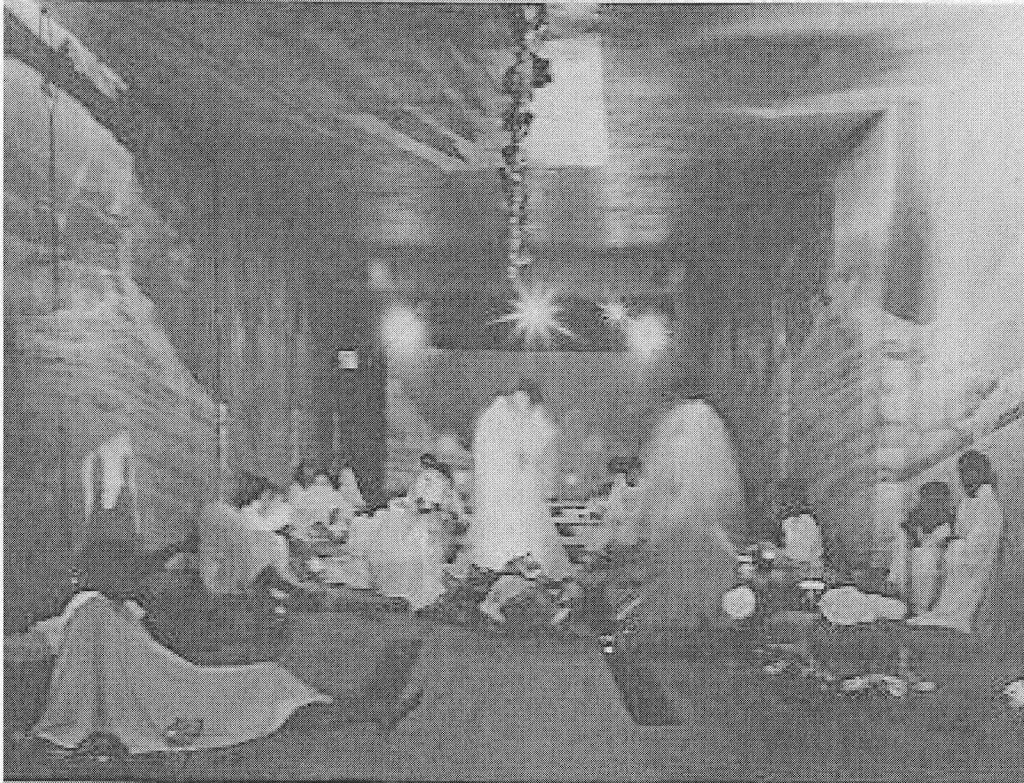
Ghostly figures inhabit Cerebrum, lost in trances*
At Cerebrum, you let everything go. Your clothes even. Once inside, you were asked by a kind young fellow dressed in silver to get completely naked. He then handed you your ensemble for the evening — a flowing, diaphranous robe, hooded and silky, faux futuristic.
Once garbed, you are led inside via a ramp to a gigantic white room, trippy projections on the wall, distortions of a wide variety of music buzz around you, a thin, scented fog sitting in the air. There’s no liquor, only water and marshmallows, served by the so-called ‘Cerebrum guides’, who led visitors through this strange psychedelic spa. No gabby conversations at a crowded bar, only people sitting and staring.
The club was divided into elevated platforms which you could visit to experience the unique stimulants taking place there — headphones with groovy music, musical instruments, balloons, kaleidoscopes, children’s toys — reclining on white pillows on lush white carpeting. Sometimes the ‘guides’ came along and smeared menthol on yoru lips or tingly lotions upon your skin.
Clearly, it wasn’t those marshmallows enhancing your experience here. Cerebrum clientele were a stoned, listless lot, lost in the vague, spectral imagery and sounds. In Currie’s own words, from a biography on the Ridiculous Theatre Company, “Several people said that it always looked like it was going to become an orgy at any moment.”
Time Magazine called it “a theater without a stage show, a cabaret without food or liquor, a party without an occasion”; the fact that Time was there at all meant it was on the cultural radar, at least with drug-friendly, downtown fashionistas. But its novelty drew only the bravest of trendy crowds.
Cooper explains it this way to Time: “We are trying to overturn every entertainment convention—the ‘sit here,’ the ‘look that way,’ the ‘dance over here’.”
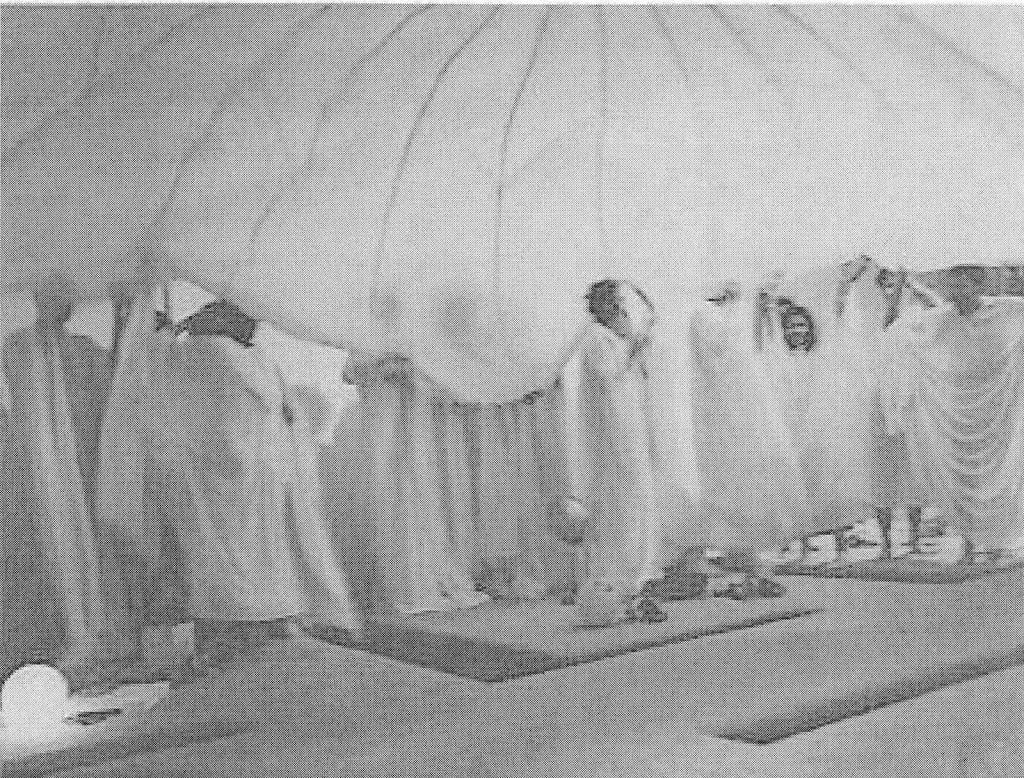
Enter the parachute. You like the parachute.*
Eventually they break out the parachute, with patrons grabbing each side and watching as the white billowy fabrics flaps back and forth in the air. Like what you did in elementary school, except with lots of stoned adults.
Cerebrum stretched the boundaries of interactive theater within the environment of an incredibly chill-out party. And like any good off-off-Broadway production, it closed a lot sooner than it should.
It shuttered early summer of the very next year. The reason was rumored to be mob related. Keep in mind this was the summer of riots outside the mob-run Stonewall bar. But most likely a concept of this type is probably not meant to last. With the 70s on the horizon — with CBGB’s, the Mudd Club, and Studio 54 at the door — a club like Cerebrum seems positively quaint.
FUN FACT: Less than 40 years later, Heath Ledger would die a couple doors down, at 421 Broome Street. Ledger was 28 years old when he died, Cerebrum habitue Hendrix was 27.
You can read here a short recollection by Bart Friedman here, and there’s a nice academic description of the experience here.
*Photos above are by Ferdinand Boesch and are from here. I’m sorry they’re so blurry, but I copied them from a paper and I just had to have pictures of this place to accompany the article.
But the greatest treat is that there’s actual video evidence that this place actually existed, narrated by Ruffin Cooper himself. This video takes awhile to load, but it’s worth it:
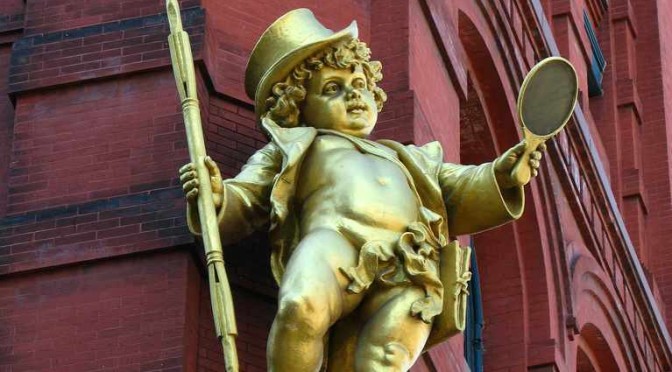
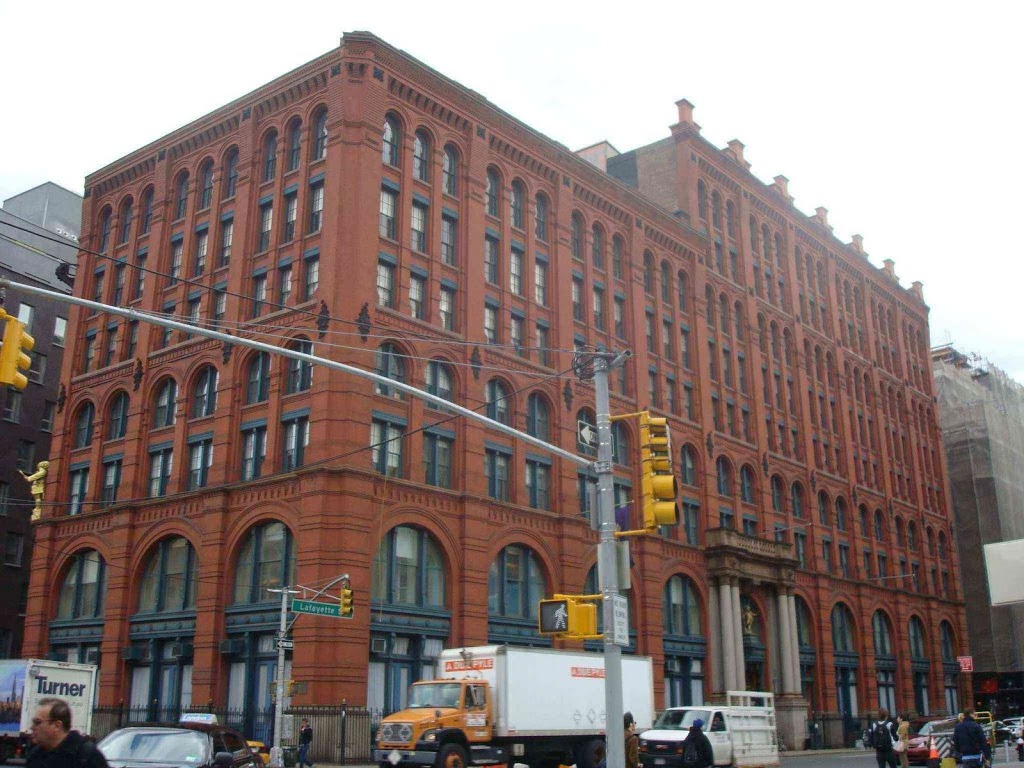
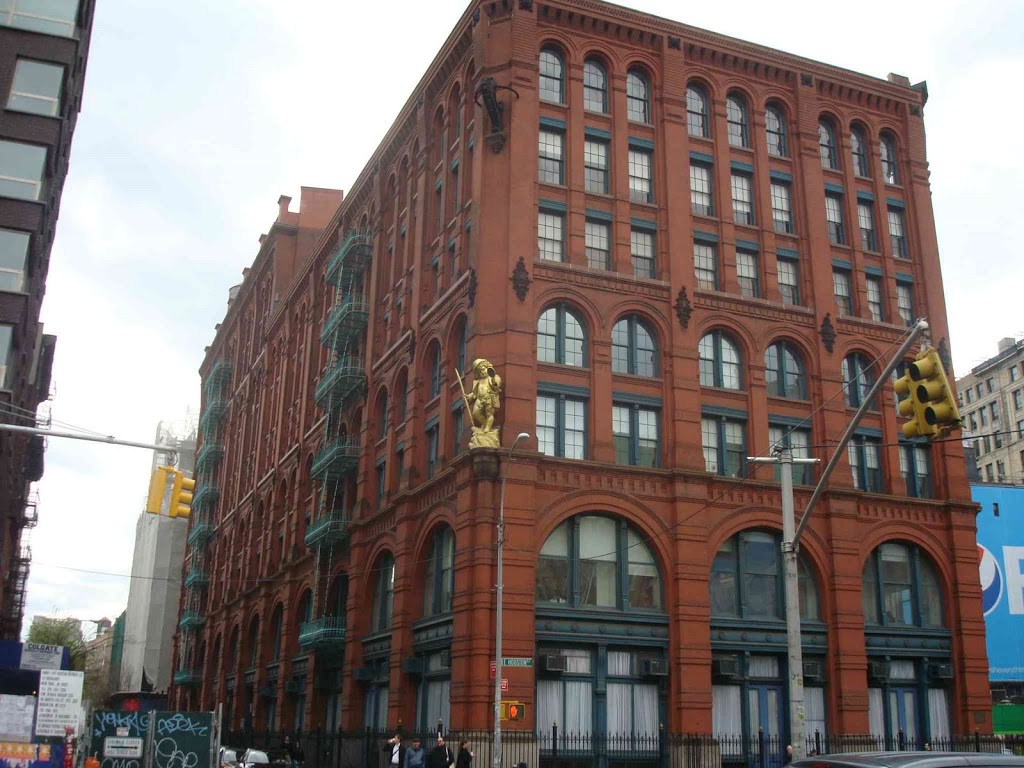
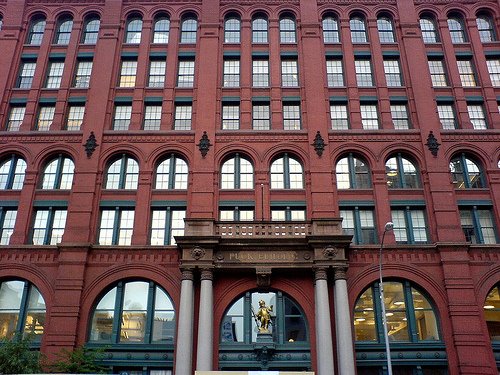
A 6-foot plump gold impish figure stares down as you look up to observe the gorgeous red-brick design of the Puck Building, built for one of the 19th century’s most popular illustrated publications. But this architectural masterpiece was very nearly wiped away by a sudden decision by the city. How did it survive?
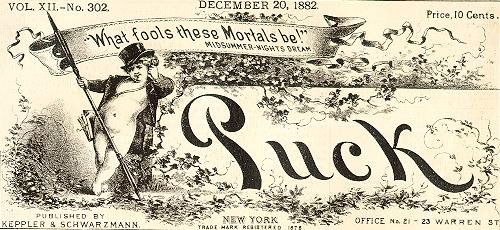
Puck’s utterance “What Fools These Mortals Be!” is the slogan for Puck Magazine and words written by Shakespeare.
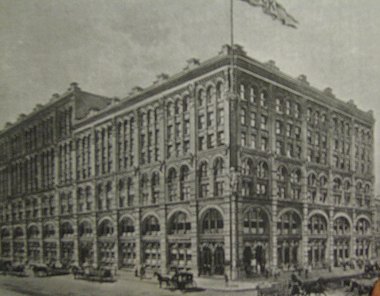
An illustration of what the Puck Building looked like pre-1897….
…and how the truncated Puck looks today.
The impish Puck standing at the corner of the building — and above the western doorway — is echoed in Puck’s magazine banner
There are, of course, two Pucks at the Puck Building. A smaller, newer Puck stands over the main entrance. Neither this entrance nor the Puck above it existed before 1897.
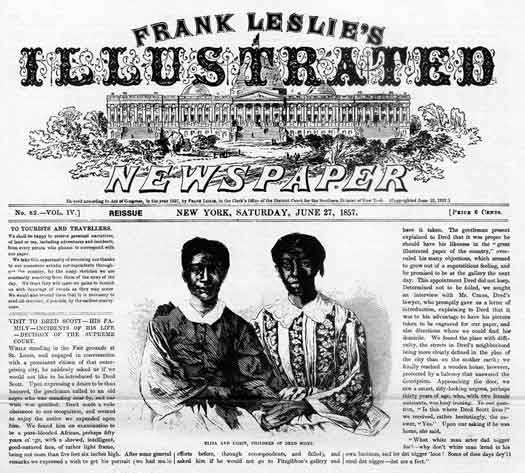
An early issue of Frank Leslie’s Illustrated Newspaper. Keppler went to work for Leslie before striking out on his own with the far more satirical Puck Magazine.
Some images from Puck Magazine. Please click into the images for greater detail.
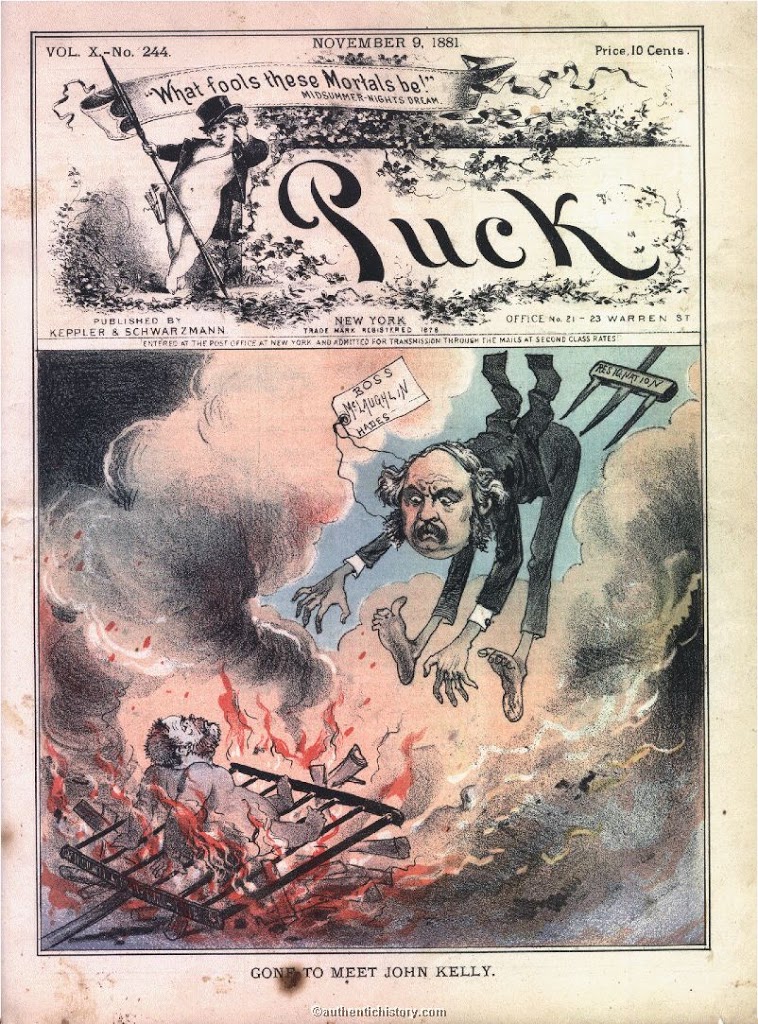
Below is a cover from 1881, satirizing Brooklyn’s most powerful Democrat, Hugh McLaughlin, who frequently butted heads with Tammany Hall.
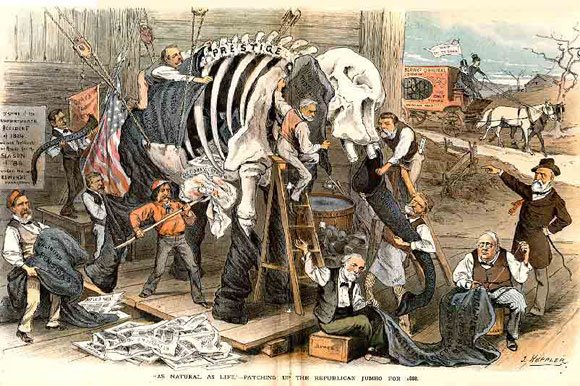
Republicans attempt to stitch together their fractured party, in an illustration by Keppler himself. Keppler was one of the most influential illustrators of his time, second only to the great Thomas Nast of Harper’s Weekly.
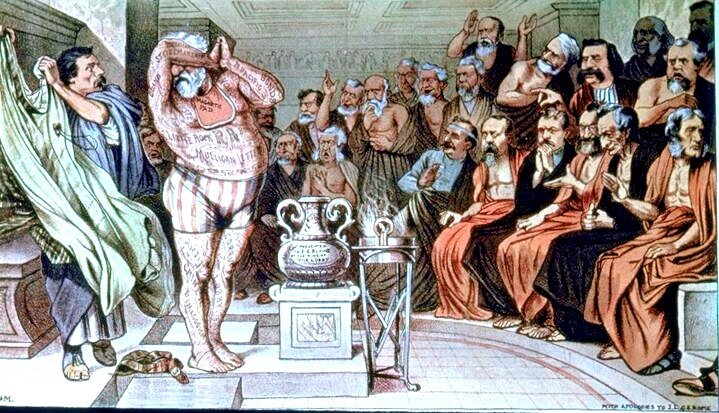
Possibly the most powerful image the magazine ever ran was this one, mocking presidential Republican candidate James Blaine. Keppler was a supporter of Democrat Grover Cleveland, and cartoons like this swayed public opinion. Cleveland beat Blaine in the presidential election of 1884.
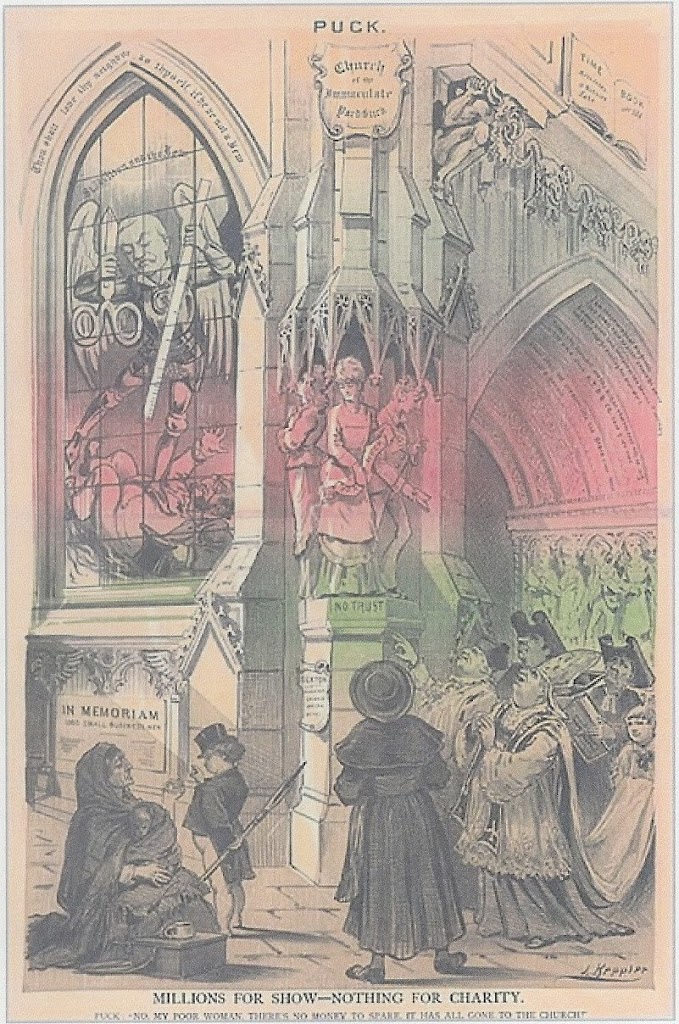
In the interior illustration below, Keppler displays his obvious anti-Catholic (and, by extension, anti-Irish) bias. Puck himself is inserted in this image at bottom left.
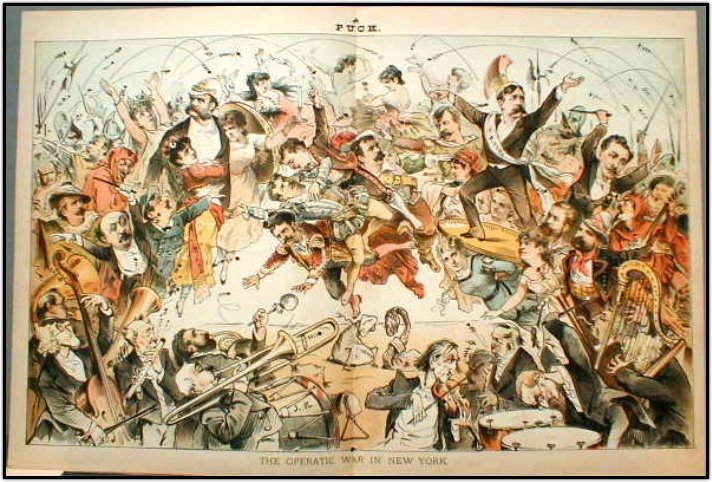
One of my favorite images, and a good example of Puck’s centerfold illustrations, this one expanding on the war in 1883 between the Metropolitan Opera and New York’s Academy of Music.
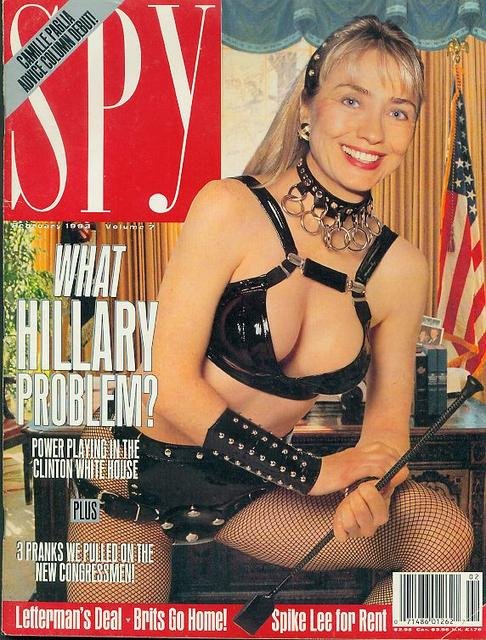
One hundred years after the Puck Building opened, another catty, satirical magazine Spy Magazine moved in, carrying on the tradition of political lampooning.
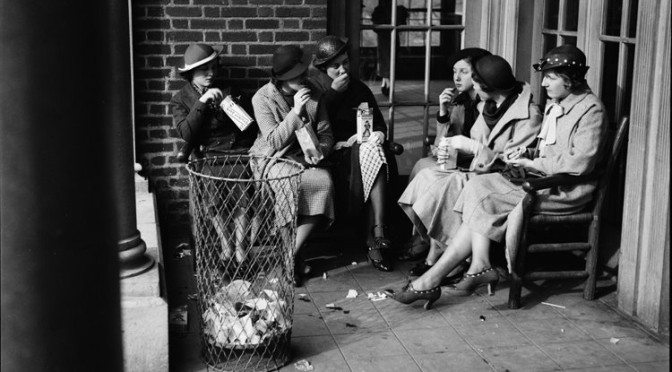
ABOVE: These are the ladies who lunch in Prospect Park 1935
We talk about a lot of white men on the Bowery Boys podcast. When
discussing the mainstream history of the city, it’s pretty unavoidable.
Men had the money, the power, the influence. Not to mention most of the
corruption, the crime, the scandal.
So as Women’s History Month draws to a close (okay, I’m one day
late), I thought I’d make a very opinionated list of the 25 women who
made the biggest impact to the city of New York, at least as seen by
this humble blogger and podcaster.
There have obviously been many, many New York-based women whose
contributions changed the country and the world. There are your
feminists (Elizabeth Cady Stanton), your activists (Ella Baker), your
entrepreneurs (Estee Lauder), your tastemakers (Diana Vreeland) and your
entertainers (Madonna).
But these 25 helped shape
the actual city itself. The neighborhoods, populations and culture, to
be sure. But most importantly, they each effected perceptions of the
city, both to its residents and outward to the world. (Thus, for
instance, you’ll note my heavy emphasis on preservationists.)
This is not an ultimate list. I obviously do not know the impact of
every woman who ever lived in New York City. Many women communicated
power through wealth and property; I don’t have the social register from
every season and cannot gauge the influence of every bold-faced name.
These are just 25 that have crossed my path since we started the Bowery
Boys that I just wanted to celebrate today.
I’ve obviously missed out on a few, so if you have a
particular favorite that’s missing, please put them in the comment
section. At the bottom I have a list of ladies that made my personal
honorable mention. So here we go!
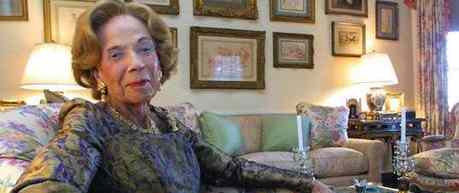
Brooke Astor (1902-2007)
Philanthropist
She was the last of the socialites, as they say. The queen of old
American money, for 105 years Astor ruled as the last official vestige
of one of Manhattan’s wealthiest families, setting a standard for
philanthropy and sadly leaving an uncertain legacy amid scandals
involving her heirs.
Power is the ability to do good things for others. — Brooke Astor
Alice Austen (1866-1952)
Photographer
Few saw the Gilded Age city quite as Austen did, a Staten Island
native who captured the beauties of New York, the horrors of Ellis
Island’s quarantine station, and the wonders of the world, but probably
took her best shots from her own backyard at Clear Comfort, in Rosebank,
SI.
Below: a girl newsie in 1896, as captured by Austen
Nellie Bly (1864-1922)
Journalist
Her bravery, curiosity and outright nerve made her a writer of
international fame, one of the first investigative journalists in the
age of sensational journalism. But the story that put her on the map was
her undercover expose at Blackwell’s Island, ripping open the abuses of
New York’s island of untouchables, changing how the city thought about
both the infirm and the incarcerated.
Could I pass a week in the insane ward at Blackwell’s Island? I said I could and I would. And I did. — Nellie Bly
Margaret Corbin (1751-1800)
Revolutionary
Things were so precarious in the fall of 1776, the dawn of the
Revolution, that anyone who lived in New York might have turned the tide
of war. Many women did their part to battle the British, from Mary Lindlay Murray the to the mysterious Agent 355,
a shrouded spy among the British. But Corbin is notable not just for
particular bravery but for sacrifice; she continued to lob cannon fire
at the British from Fort Washington in today’s Washington Heights well
after her husband was killed. Corbin herself was later imprisoned by the
British. Today the street along Fort Tryon is named for her.
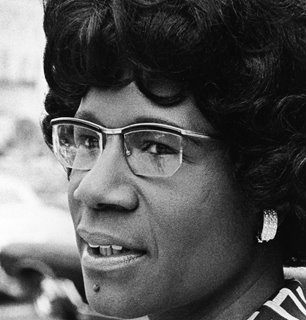
Shirley Chisholm (1924-2005)
Trailblazer
The pride of Bedford-Stuyvesant maneuvering through the precarious world
of New York politics, Chisholm won a seat in the state legislature in
1964 but always dreamed to represent Brooklyn on a national level, in
the U.S House of Representatives. She finally got her wish to represent
her neighborhood when redistricting lines were finally redrawn — finally
allowing a black candidate to run (and win) in a largely black
community — and won her seat in Congress in 1968. Shirley never
disguised her ties to her beloved Brooklyn neighborhood, even as a
candidate for president of the United States.
That I am a national figure because I
was the first person in 192 years to be at once a congressman, black
and a woman proves, I think, that our society is not yet either just or
free. — Shirley Chisholm
Margot Gayle (1908-2008)
Community leader
Gayle, who died last year at age 100, loved her Victorian
architecture and in particular cast-iron, the antiquated style of
downtown New York warehouses. Seeing destruction imminent, she decided
to save what she considered one of the city’s most neglected treasures.
Forming her first community group in the 1950s to save castle-like
Jefferson Market Courthouse, Gayle galvanized a grassroots architecture
movement.
There might be no SoHo without Gayle; as a campaigner, her work in
saving and preserving this heretofore disregarded part of downtown led
to one of Manhattan’s great neighborhood success stories. The SoHo Cast
Iron Historic District exists due to her efforts. And, more importantly,
her work became a template for how future neighborhoods could be
revitalized. (Read her Times obituary here).
Emma Goldman (1869-1940)
Agitator
Probably the most influential anarchist in American history, Goldman
promoted the rights of workers and upended the role of women in New York
politics. The Russian-born activist made her name on the streets of
Manhattan, stirring Bohemia and workers alike, butting heads with most
of New York’s leading industrialists in the process.
Her views are controversial, often horrifying by today’s standards.
(She once ordered the assassination of Henry Clay Frick, for instance.)
But her powers as an orator and rabble-rouser are unquestioned; her
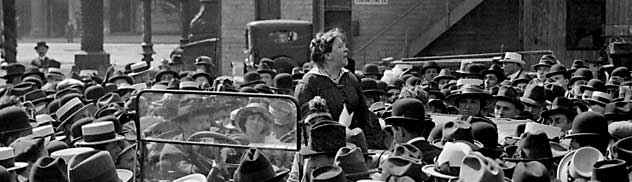
stirring words in Union Square (pictured above) during the panic of 1893
gave voice to the outrage of the city.
If voting changed anything, they’d make it illegal. — Emma Goldman
Leona Helmsley (1920-2007)
Magnate
Leona and her husband Harry reigned over a vast Manhattan empire of
highrises and hotels, permanently changing Park and Madison avenues,
helping transform New York into a city of condominiums. Her status as
the Queen of Mean also formed the modern caricature of overbearing and
out of touch wealthy elite. Later convicted of tax evasion, Leona died
in 2007 a laughing-stock. (That Suzanne Pleshette film
didn’t help either.) But her reach extends through many of the city’s
great iconic buildings, including the Empire State Building, which she
and her husband once managed.
Billie Holiday (1915-1959)
Chanteuse
Of all the thousands of entertainers that have left their imprint on the
city, Holiday’s is the one that makes the deepest impact. Her entire
story — her birth, her rise to fame, her indiscretions and her tragic
death — takes place in New York. Her greatest performances electrified
and reshaped race assumptions in 1930s and 40s nightlife; legendary
nights at places like Cafe Society ensured entertainment would no longer
be strictly a black and white affair. Her performance style is emulated
nightly in cabarets and clubs throughout the city.
Ada Louise Huxtable (1921-2013)
Critic
She is the best known woman in twentieth century architecture, and she
isn’t even an architect. It’s hard to analyze the history of any
building without first checking in with Ada to see what she has to say
on the matter. Her writing is elegant, persnickety, direct and
affectionate to architectural aesthetic as a whole, and New York City in
specific. As a writer for the New York Times and Wall Street Journal,
Huxtable directed New York’s architecture scene from behind her desk,
excoriating designers for excess or dullness, praising beauty when it
improved the city’s legendary skyline.
I like old buildings that are
intriguing and quite wonderful but don’t make the history books. What
you discover is there’s a little group of people that have been admiring
them quietly by themselves all along. — Ada Louise Huxtable
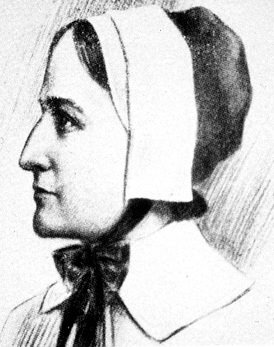
Anne Hutchinson (1591-1643)
Dissident
Escaping persecution in both Puritan Massachusetts and Rhode Island,
religious revolutionary Hutchinson and her followers settled in today’s
area of the North Bronx in the 1640s, one of two significant female
leaders in the early New York area. Although she was later murdered —
Lenapes wiped out the settlement in 1643, a victim of New Amsterdam’s
persistent conflicts with native tribes — she still leaves her mark
today. The Hutchinson River and Parkway both carry her name.
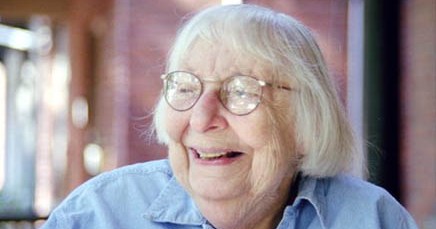
Jane Jacobs (1916-2006)
Community defender
Her theories on urban life have benefited many North American cities,
but it was her struggles to save neighborhoods from Robert Moses and
the rise of car culture in the 1950s and 60s that make her most
influential today. The entirely of downtown Manhattan has her to thank
for fighting back — and ultimately defeating — Moses’ destructive Lower
Manhattan Expressway proposal. The theories described in her classic
“Death and Life of Great American Cities” were shaped from observing
life from her window at 555 Hudson Street in the West Village.
Cities have the capability of providing something for
everybody, only because, and only when, they are created by everybody. —
Jane Jacobs
Lady Deborah Moody (1586 – 1659)
Founder
The British-born Moody, like Hutchinson, took to the unknown when
persecuted for her religious beliefs. With the permission of William
Kieft, the “dangerous” Moody set up the colony of Gravesend in 1645,
becoming the first female founder of an American colony. Gravesend was
one of the original towns of Brooklyn and is still the name of a south
Brooklyn neighborhood today.
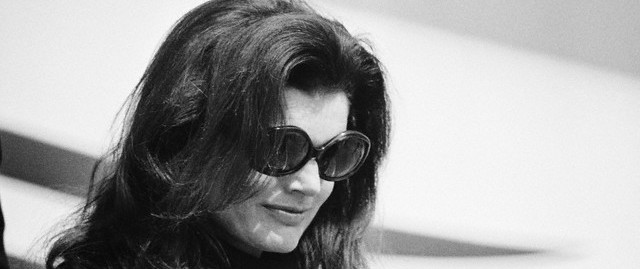
Jackie Kennedy Onassis (1929-1994)
Icon
Settling in New York after the deaths of two husbands, Onassis was
the biggest bold-faced name in the city, famously suffering the
intrusive effects of paparazzi. However she used her headline grabbing
name wisely as a member of the Municipal Art Society, helping defend
Grand Central Station, Columbus Circle and Staten Island’s Snug Harbor
from modification or outright destruction. The Central Parks reservoir
is named in her honor, and MAS gives out a yearly Jackie Kennedy Onassis
Medal to noteworthy New Yorkers. (Margot Gayle received it in 1997.)
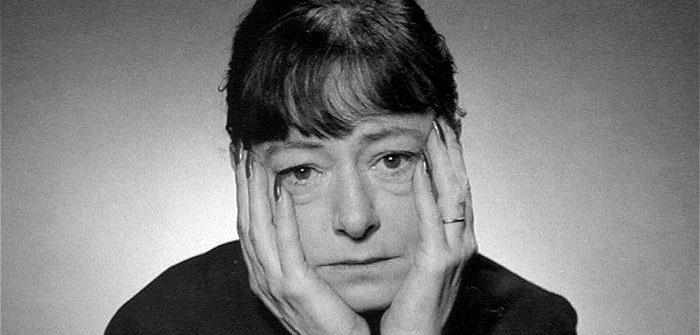
Dorothy Parker (1893-1967)
Wit
As doyenne of the Algonquin Round Table, Parker had the sharpest
friends in town in the 1920s. Her droll charm helped create the
archetype of New York caustic intellectualism, something Woody Allen,
Fran Lebowitz and an entire culture of New Yorker readers can well
recognize.
I’d rather have a bottle in front of me, than a frontal lobotomy. — Dorothy Parker
Abby Aldrich Rockefeller (1874-1948)
Collector
She could very well have stayed in the sidelines with the other
spouses of multi-millionares. But Abby’s tastes and passions for modern
art led her to an astonishing collection she kept on an upper floor of
her townhouse, away from her husband J.D. Rockefeller Jr., who didn’t
much care for those odd little pictures. Years later, that townhouse
would give way to Abby’s pet project, the Museum of Modern Art, one of
the most influential galleries for 20th Century art. Her memory is kept
alive at the museum with the Abby Aldrich Rockefeller Sculpture Garden.
Emily Warren Roebling (1843-1903)
Bridge Builder
Construction on the Brooklyn Bridge had barely begun when her husband
and master engineer Washington Roebling came down with crippling
symptoms of the Bends. Emily at first operated only as his eyes and
ears, but soon grew into the role of leading the completion of New
York’s first great bridge. Ceremonially, she was the first person to
cross it.
Eleanor Roosevelt (1884-1962)
World Leader
One of the most powerful American women to have ever lived was a New
Yorker through and through. Her aristocratic name may have opened doors
for her early on, but her compassion and ingenuity would soon set her
apart, first as a social worker in Manhattan slums, then as the spouse
of a governor and president. She returned to New York after FDR’s death
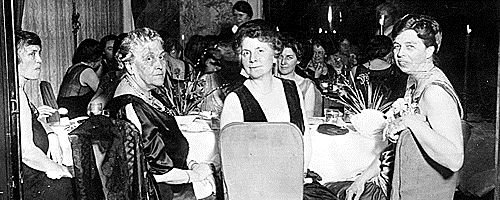
to become a U.S. delegate to the United Nations. (Above: Eleanor with
New York City society women.)
Beautiful young people are accidents of nature, but beautiful old people are works of art. — Eleanor Roosevelt
Margaret Sanger (1879-1966)
Rebel
Her influence in the fields of reproduction and birth control would
eventually go global, but all nurse Sanger really wanted to do at first
was help out women in the Lower East Side. From her work in the slums,
Sanger believed radical action was neccessary to control the rising tide
of pregnancies, leading to larger families and greater poverty. In 1917
she opened New York’s first birth control clinic in Brooklyn and was
promptly thrown in jail. Ten years later, her innovations as an educator
in birth control — she’s the mother of Planned Parenthood! — would
catch on worldwide.
During these years in New York more and more my calls began
to come from the Lower East Side, as though I were being magnetically
drawn there by some force outside my control. — Margaret Sanger
Verna Small (1916-2008)
Preservationist
Small is the queen of Greenwich Village, a fiesty, often poetic
community leader who provoked residents into lobbying for historic
preservation. She organized or led one group after another, all in an
effort to preserve the remainder of the Village before developers could
sweep it away. She succeeded. Today it seem impossible that the Village
was ever in that much danger at all. Her many years with the Landmarks
Committee in the 1980s assured the rest of the city would benefit from
her tender loving care.
The attitude of the Village was ‘We’ve got to catch up with Brooklyn Heights!’ —Verna Small
Dorothy Schiff (1903-1989)
Publisher
Native New Yorker Schiff owned the New York Post from 1939 to the 1970s
and eventually shaped its editorial policy as publisher, the first New
York woman to do so. Her stinging, left-leaning views and saavy tastes
for great writers turned the once tame newspaper into the city’s most
successful tabloid. Her sudden decision to sell it to Rupert Murdoch in
1976 led to the decidedly different, far more sensational Post we’re
familiar with today.
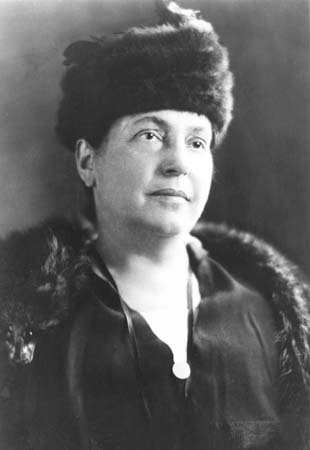
Lillian Wald (1867–1940)
Social Worker
The patron saint of the Lower East Side, devoted nurse Wald helped
found both the Henry Street Settlement and the National Association for
the Advancement of Colored People. Her desire to help New York’s poorest
consumed her life. Her altruism helped save thousands of lives and set
the standard modern social work and nursing. If that isn’t enough, her
innovations from everything to playgrounds and school lunch programs
redefined New York education and reverberated throughout America. Um,
what have you done today to help your fellow man?
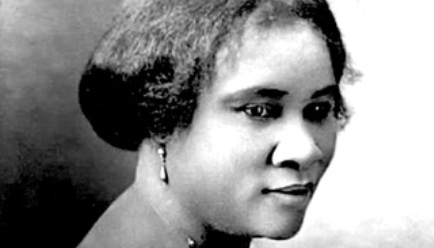
Madam C.J. Walker (1867-1919)
Tycoon
Walker, a self-made entrepreneur and hair product queen, was the
richest and most powerful woman in Harlem, during the neighborhood’s
pivotal years of growth in the dawn of the Harlem Renaissance. (Some
sources say she was America’s first female millionaire.) She shattered
color and gender barriers, employing hundreds of other black women and
eventually leaving most of her wealth to notable African-American
organizations. Walker’s daughter A’Lelia was a patron of many great
writers of the Renaissance era.
And her name? She was once married to a man named Charles Joseph Walker; he left in 1910, but the C.J. — and the Madam — stayed.
Edith Wharton (1862-1937)
Observer
Wharton was a woman of ultimate privledge in Gilded Age New York but
had an uncanny ability to describe it. Our notions of what upper-crust
New York was at this time are shaped in part by her novels and short
stories. Her creations Lily Bart and the Countess Ellen Olenska are
still the best evidence we have of the absurdities and restraints
upper-class New York.
A New York divorce is in itself a diploma of virtue. — Edith Wharton
Gertrude Vanderbilt Whitney (1875-1942)
Patron
Gertrude, the daughter of Cornelius Vanderbilt, turned her powerful
name, untold wealth and fascinations with art into an endeavor that
would benefit the general public, eventually founding the Whitney Museum
in 1931. But unlike Abby Rockefeller, Whitney actually was an artist
herself, a sculptrress and a habitue of turn-of-the-century Greenwich
Village bohemia. Gertrude’s daughter Flora Payne Whitney would go on to
head her mother’s museum for decades.
And 25 more that I didn’t get to write about this time around:
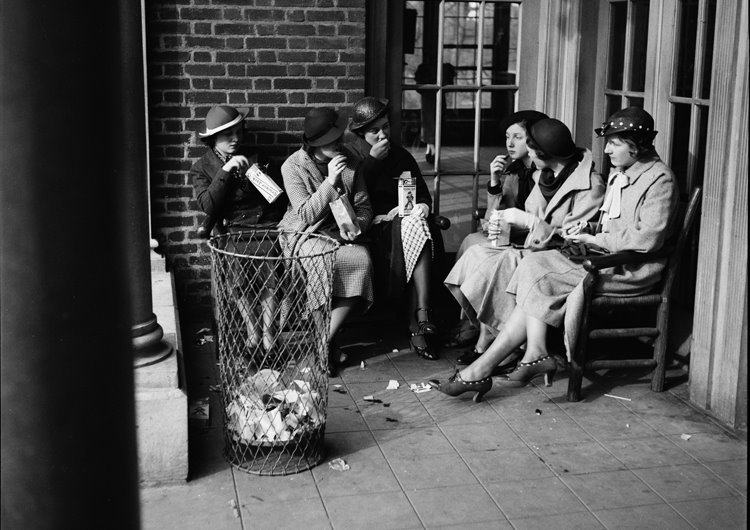
ABOVE: These are the ladies who lunch in Prospect Park 1935
We talk about a lot of white men on the Bowery Boys podcast. When discussing the mainstream history of the city, it’s pretty unavoidable. Men had the money, the power, the influence. Not to mention most of the corruption, the crime, the scandal.
So as Women’s History Month draws to a close (okay, I’m one day late), I thought I’d make a very opinionated list of the 25 women who made the biggest impact to the city of New York, at least as seen by this humble blogger and podcaster.
There have obviously been many, many New York-based women whose contributions changed the country and the world. There are your feminists (Elizabeth Cady Stanton), your activists (Ella Baker), your entrepreneurs (Estee Lauder), your tastemakers (Diana Vreeland) and your entertainers (Madonna).
But these 25 helped shape the actual city itself. The neighborhoods, populations and culture, to be sure. But most importantly, they each effected perceptions of the city, both to its residents and outward to the world. (Thus, for instance, you’ll note my heavy emphasis on preservationists.)
This is not an ultimate list. I obviously do not know the impact of every woman who ever lived in New York City. Many women communicated power through wealth and property; I don’t have the social register from every season and cannot gauge the influence of every bold-faced name. These are just 25 that have crossed my path since we started the Bowery Boys that I just wanted to celebrate today.
I’ve obviously missed out on a few, so if you have a particular favorite that’s missing, please put them in the comment section. At the bottom I have a list of ladies that made my personal honorable mention. So here we go!
Brooke Astor (1902-2007)
Philanthropist
She was the last of the socialites, as they say. The queen of old American money, for 105 years Astor ruled as the last official vestige of one of Manhattan’s wealthiest families, setting a standard for philanthropy and sadly leaving an uncertain legacy amid scandals involving her heirs.
Power is the ability to do good things for others. — Brooke Astor
Alice Austen (1866-1952)
Photographer
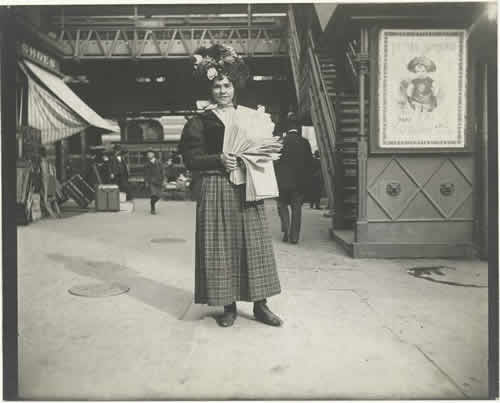
Few saw the Gilded Age city quite as Austen did, a Staten Island native who captured the beauties of New York, the horrors of Ellis Island’s quarantine station, and the wonders of the world, but probably took her best shots from her own backyard at Clear Comfort, in Rosebank, SI.
Below: a girl newsie in 1896, as captured by Austen
Nellie Bly (1864-1922)
Journalist
Her bravery, curiosity and outright nerve made her a writer of international fame, one of the first investigative journalists in the age of sensational journalism. But the story that put her on the map was her undercover expose at Blackwell’s Island, ripping open the abuses of New York’s island of untouchables, changing how the city thought about both the infirm and the incarcerated.
Could I pass a week in the insane ward at Blackwell’s Island? I said I could and I would. And I did. — Nellie Bly
Margaret Corbin (1751-1800)
Revolutionary
Things were so precarious in the fall of 1776, the dawn of the Revolution, that anyone who lived in New York might have turned the tide of war. Many women did their part to battle the British, from Mary Lindlay Murray the to the mysterious Agent 355, a shrouded spy among the British. But Corbin is notable not just for particular bravery but for sacrifice; she continued to lob cannon fire at the British from Fort Washington in today’s Washington Heights well after her husband was killed. Corbin herself was later imprisoned by the British. Today the street along Fort Tryon is named for her.
Shirley Chisholm (1924-2005)
Trailblazer
The pride of Bedford-Stuyvesant maneuvering through the precarious world of New York politics, Chisholm won a seat in the state legislature in 1964 but always dreamed to represent Brooklyn on a national level, in the U.S House of Representatives. She finally got her wish to represent her neighborhood when redistricting lines were finally redrawn — finally allowing a black candidate to run (and win) in a largely black community — and won her seat in Congress in 1968. Shirley never disguised her ties to her beloved Brooklyn neighborhood, even as a candidate for president of the United States.
That I am a national figure because I was the first person in 192 years to be at once a congressman, black and a woman proves, I think, that our society is not yet either just or free. — Shirley Chisholm
Margot Gayle (1908-2008)
Community leader
Gayle, who died last year at age 100, loved her Victorian architecture and in particular cast-iron, the antiquated style of downtown New York warehouses. Seeing destruction imminent, she decided to save what she considered one of the city’s most neglected treasures. Forming her first community group in the 1950s to save castle-like Jefferson Market Courthouse, Gayle galvanized a grassroots architecture movement.
There might be no SoHo without Gayle; as a campaigner, her work in saving and preserving this heretofore disregarded part of downtown led to one of Manhattan’s great neighborhood success stories. The SoHo Cast Iron Historic District exists due to her efforts. And, more importantly, her work became a template for how future neighborhoods could be revitalized. (Read her Times obituary here).
Emma Goldman (1869-1940)
Agitator
Probably the most influential anarchist in American history, Goldman promoted the rights of workers and upended the role of women in New York politics. The Russian-born activist made her name on the streets of Manhattan, stirring Bohemia and workers alike, butting heads with most of New York’s leading industrialists in the process.
Her views are controversial, often horrifying by today’s standards. (She once ordered the assassination of Henry Clay Frick, for instance.) But her powers as an orator and rabble-rouser are unquestioned; her stirring words in Union Square (pictured above) during the panic of 1893 gave voice to the outrage of the city.
If voting changed anything, they’d make it illegal. — Emma Goldman
Leona Helmsley (1920-2007)
Magnate
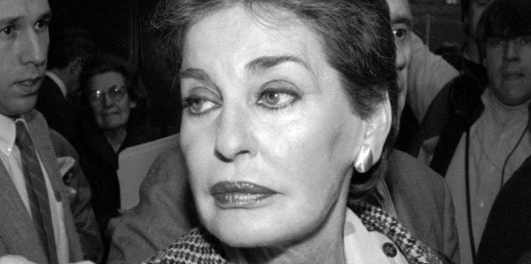
Leona and her husband Harry reigned over a vast Manhattan empire of highrises and hotels, permanently changing Park and Madison avenues, helping transform New York into a city of condominiums. Her status as the Queen of Mean also formed the modern caricature of overbearing and out of touch wealthy elite. Later convicted of tax evasion, Leona died in 2007 a laughing-stock. (That Suzanne Pleshette film didn’t help either.) But her reach extends through many of the city’s great iconic buildings, including the Empire State Building, which she and her husband once managed.
Billie Holiday (1915-1959)
Chanteuse
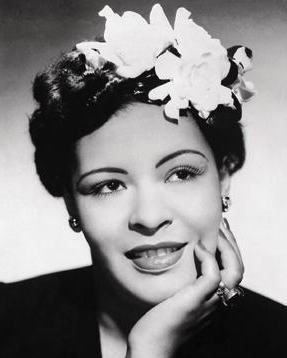
Of all the thousands of entertainers that have left their imprint on the city, Holiday’s is the one that makes the deepest impact. Her entire story — her birth, her rise to fame, her indiscretions and her tragic death — takes place in New York. Her greatest performances electrified and reshaped race assumptions in 1930s and 40s nightlife; legendary nights at places like Cafe Society ensured entertainment would no longer be strictly a black and white affair. Her performance style is emulated nightly in cabarets and clubs throughout the city.
Ada Louise Huxtable (1921-2013)
Critic
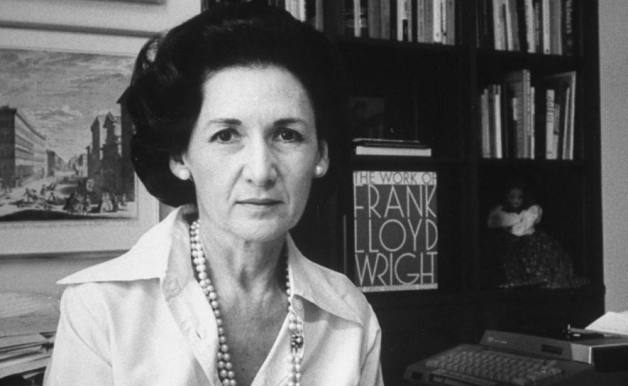
She is the best known woman in twentieth century architecture, and she isn’t even an architect. It’s hard to analyze the history of any building without first checking in with Ada to see what she has to say on the matter. Her writing is elegant, persnickety, direct and affectionate to architectural aesthetic as a whole, and New York City in specific. As a writer for the New York Times and Wall Street Journal, Huxtable directed New York’s architecture scene from behind her desk, excoriating designers for excess or dullness, praising beauty when it improved the city’s legendary skyline.
I like old buildings that are intriguing and quite wonderful but don’t make the history books. What you discover is there’s a little group of people that have been admiring them quietly by themselves all along. — Ada Louise Huxtable
Anne Hutchinson (1591-1643)
Dissident
Escaping persecution in both Puritan Massachusetts and Rhode Island, religious revolutionary Hutchinson and her followers settled in today’s area of the North Bronx in the 1640s, one of two significant female leaders in the early New York area. Although she was later murdered — Lenapes wiped out the settlement in 1643, a victim of New Amsterdam’s persistent conflicts with native tribes — she still leaves her mark today. The Hutchinson River and Parkway both carry her name.
Jane Jacobs (1916-2006)
Community defender
Her theories on urban life have benefited many North American cities, but it was her struggles to save neighborhoods from Robert Moses and the rise of car culture in the 1950s and 60s that make her most influential today. The entirely of downtown Manhattan has her to thank for fighting back — and ultimately defeating — Moses’ destructive Lower Manhattan Expressway proposal. The theories described in her classic “Death and Life of Great American Cities” were shaped from observing life from her window at 555 Hudson Street in the West Village.
Cities have the capability of providing something for everybody, only because, and only when, they are created by everybody. — Jane Jacobs
Lady Deborah Moody (1586 – 1659)
Founder
The British-born Moody, like Hutchinson, took to the unknown when persecuted for her religious beliefs. With the permission of William Kieft, the “dangerous” Moody set up the colony of Gravesend in 1645, becoming the first female founder of an American colony. Gravesend was one of the original towns of Brooklyn and is still the name of a south Brooklyn neighborhood today.
Jackie Kennedy Onassis (1929-1994)
Icon
Settling in New York after the deaths of two husbands, Onassis was the biggest bold-faced name in the city, famously suffering the intrusive effects of paparazzi. However she used her headline grabbing name wisely as a member of the Municipal Art Society, helping defend Grand Central Station, Columbus Circle and Staten Island’s Snug Harbor from modification or outright destruction. The Central Parks reservoir is named in her honor, and MAS gives out a yearly Jackie Kennedy Onassis Medal to noteworthy New Yorkers. (Margot Gayle received it in 1997.)
Dorothy Parker (1893-1967)
Wit
As doyenne of the Algonquin Round Table, Parker had the sharpest friends in town in the 1920s. Her droll charm helped create the archetype of New York caustic intellectualism, something Woody Allen, Fran Lebowitz and an entire culture of New Yorker readers can well recognize.
I’d rather have a bottle in front of me, than a frontal lobotomy. — Dorothy Parker
Abby Aldrich Rockefeller (1874-1948)
Collector
She could very well have stayed in the sidelines with the other spouses of multi-millionares. But Abby’s tastes and passions for modern art led her to an astonishing collection she kept on an upper floor of her townhouse, away from her husband J.D. Rockefeller Jr., who didn’t much care for those odd little pictures. Years later, that townhouse would give way to Abby’s pet project, the Museum of Modern Art, one of the most influential galleries for 20th Century art. Her memory is kept alive at the museum with the Abby Aldrich Rockefeller Sculpture Garden.
Emily Warren Roebling (1843-1903)
Bridge Builder
Construction on the Brooklyn Bridge had barely begun when her husband and master engineer Washington Roebling came down with crippling symptoms of the Bends. Emily at first operated only as his eyes and ears, but soon grew into the role of leading the completion of New York’s first great bridge. Ceremonially, she was the first person to cross it.
Eleanor Roosevelt (1884-1962)
World Leader
One of the most powerful American women to have ever lived was a New Yorker through and through. Her aristocratic name may have opened doors for her early on, but her compassion and ingenuity would soon set her apart, first as a social worker in Manhattan slums, then as the spouse of a governor and president. She returned to New York after FDR’s death to become a U.S. delegate to the United Nations. (Above: Eleanor with New York City society women.)
Beautiful young people are accidents of nature, but beautiful old people are works of art. — Eleanor Roosevelt
Margaret Sanger (1879-1966)
Rebel
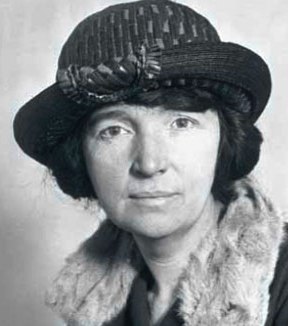
Her influence in the fields of reproduction and birth control would eventually go global, but all nurse Sanger really wanted to do at first was help out women in the Lower East Side. From her work in the slums, Sanger believed radical action was neccessary to control the rising tide of pregnancies, leading to larger families and greater poverty. In 1917 she opened New York’s first birth control clinic in Brooklyn and was promptly thrown in jail. Ten years later, her innovations as an educator in birth control — she’s the mother of Planned Parenthood! — would catch on worldwide.
During these years in New York more and more my calls began to come from the Lower East Side, as though I were being magnetically drawn there by some force outside my control. — Margaret Sanger
Verna Small (1916-2008)
Preservationist
Small is the queen of Greenwich Village, a fiesty, often poetic community leader who provoked residents into lobbying for historic preservation. She organized or led one group after another, all in an effort to preserve the remainder of the Village before developers could sweep it away. She succeeded. Today it seem impossible that the Village was ever in that much danger at all. Her many years with the Landmarks Committee in the 1980s assured the rest of the city would benefit from her tender loving care.
The attitude of the Village was ‘We’ve got to catch up with Brooklyn Heights!’ —Verna Small
Dorothy Schiff (1903-1989)
Publisher
Native New Yorker Schiff owned the New York Post from 1939 to the 1970s and eventually shaped its editorial policy as publisher, the first New York woman to do so. Her stinging, left-leaning views and saavy tastes for great writers turned the once tame newspaper into the city’s most successful tabloid. Her sudden decision to sell it to Rupert Murdoch in 1976 led to the decidedly different, far more sensational Post we’re familiar with today.
Lillian Wald (1867–1940)
Social Worker
The patron saint of the Lower East Side, devoted nurse Wald helped found both the Henry Street Settlement and the National Association for the Advancement of Colored People. Her desire to help New York’s poorest consumed her life. Her altruism helped save thousands of lives and set the standard modern social work and nursing. If that isn’t enough, her innovations from everything to playgrounds and school lunch programs redefined New York education and reverberated throughout America. Um, what have you done today to help your fellow man?
Madam C.J. Walker (1867-1919)
Tycoon
Walker, a self-made entrepreneur and hair product queen, was the richest and most powerful woman in Harlem, during the neighborhood’s pivotal years of growth in the dawn of the Harlem Renaissance. (Some sources say she was America’s first female millionaire.) She shattered color and gender barriers, employing hundreds of other black women and eventually leaving most of her wealth to notable African-American organizations. Walker’s daughter A’Lelia was a patron of many great writers of the Renaissance era.
And her name? She was once married to a man named Charles Joseph Walker; he left in 1910, but the C.J. — and the Madam — stayed.
Edith Wharton (1862-1937)
Observer
Wharton was a woman of ultimate privledge in Gilded Age New York but had an uncanny ability to describe it. Our notions of what upper-crust New York was at this time are shaped in part by her novels and short stories. Her creations Lily Bart and the Countess Ellen Olenska are still the best evidence we have of the absurdities and restraints upper-class New York.
A New York divorce is in itself a diploma of virtue. — Edith Wharton
Gertrude Vanderbilt Whitney (1875-1942)
Patron
Gertrude, the daughter of Cornelius Vanderbilt, turned her powerful name, untold wealth and fascinations with art into an endeavor that would benefit the general public, eventually founding the Whitney Museum in 1931. But unlike Abby Rockefeller, Whitney actually was an artist herself, a sculptrress and a habitue of turn-of-the-century Greenwich Village bohemia. Gertrude’s daughter Flora Payne Whitney would go on to head her mother’s museum for decades.
And 25 more that I didn’t get to write about this time around:
Laura is disturbed “I’m completely out of control!”
BOWERY BOYS RECOMMEND is an occasional feature where we find an unusual movie or TV show that — whether by accident or design — uniquely captures an era of New York City better than any reference or history book. Other entrants in this particular film festival can be found HERE.
The New York Times had an intriguing piece last Sundayon modern “fetishizing” of New York in the 1970s, as popularly depicted in the TV show “Life on Mars.” This blog is probably as guilty as any at looking at this crime-riddled, bankrupt period of New York’s history and seeing only a glossier rendition. The article suggests people may fear this view as the economic crisis begins to transform the city; I personally suggest it appeals to people as a flipside to New York’s current crawl towards homogeny and total gentrification.
Two vastly different 1970s movies I recently re-watched suggest that the city’s combination of grit and glamour were already being analyzed and parodied before the decade was even finished.
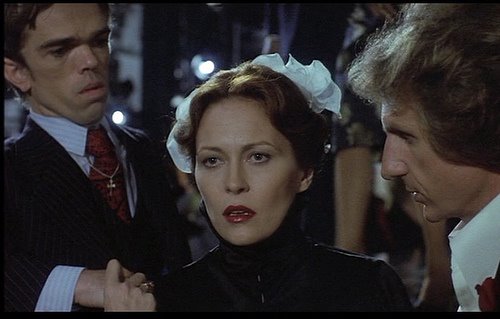
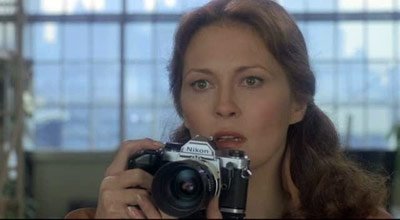
In the silly thriller The Eyes of Laura Mars, Faye Dunaway stars as a downtown fashion photographer who can somehow see through the eyes of a serial killer who wrecks havoc among New York’s stylistas. The plot is preposterous, aching for some legitimacy, either a setting at the Mudd Club or a cameo from Halston or Bianca Jagger maybe. Or Andy Warhol: the idea of framing death for pop photography was nothing new to him.
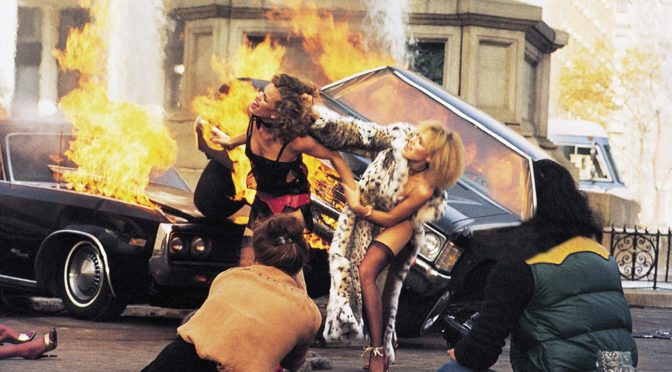
As such, it seems a thin but playful satire of downtown New York decadence. Manhattan looks unusually great for such a commonplace horror flick. The best set is easily Mars’ studio, in one of the Chelsea warehouses piers overlooking the Hudson River, just steps from the West Side elevated highway. The most notable — and campy scene — erupts at Columbus Circle, at a ridiculous fashion shoot involving burning cars and models in lingerie and fur coats. Oh Columbus Circle! Were you ever so fun?
You get a taste of Hell’s Kitchen in a brisk chase scene involving Tommy Lee Jones’ cop character, his feathered hair flapping in the wind. But seeing Soho was more striking to me, devoid of shopfronts, mysterious flat warehouses during the day that open to become large, disco-thumping galleries at night. There are still galleries in Soho, of course, but the one in ‘Laura Mars’ is a big, hokey circus. (The director even condescendingly throws in a dwarf, to get the point across.)
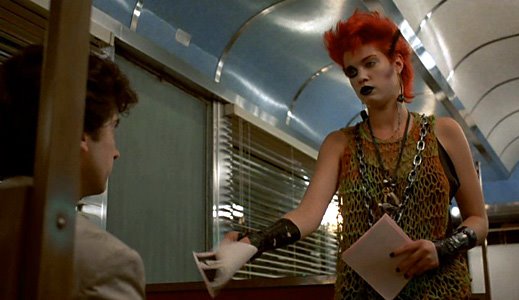
The secrets of late 70s Soho art and fashion worlds are expanded and distorted in Martin Scorsese’s masterpiece AfterHours, one of my absolute favorite New York movies ever. The director doesn’t intend reality, but his movie shaped the perspective of Soho culture for those of us who weren’t in it.
Like ‘Laura Mars’, but far more intentional, the plot conceit involves absurd artwork — in this case a “Plaster of Paris bagel and cream cheese” sought out by hapless computer geek Paul (Griffin Dunne). He is an uptown exaggeration, even though he works at the not-too-uptown Metropolitan Life Tower. No matter; he descends into Soho and its late-night collection of kooks almost get him killed.
Did New Yorkers really see Soho as otherworldly like this? Despite the surreal plot and vast, empty streets, ‘After Hours’ is filled with identifiable places, including the Emerald Pub (subbing as the ‘Terminal Bar’) and the Spring Street subway station. But the Moondance Diner (seen below) is long gone. From Scorsese to Wyoming.
Both are on DVD, both are must-sees for New York lovers. I wouldn’t exactly call ‘Laura Mars’ a conventional ‘classic’ unless you love thrillers you can also laugh unintentionally at.
Some New York neighborhoods are simply named for their location on a map (East Village, Midtown). Others are given prefabricated real-estate designations (SoHo, DUMBO). But a few retain names that link them intimately with their pasts. Other entries in this series can be found here.
For all the New York City neighborhoods with wonderful old names hearkening back to Lenape, Dutch and British settlers, we have a small number crafted by other, more venerable tribes — real estate brokers and community organizers. Dumbo is not a city in the Netherlands; NoLiTa is not Lenape for ‘neighborhood’. And at least one –TriBeCa, that fashionable neighborhood northwest of City Hall — is made of comprised of a complex portmanteau that isn’t even technically accurate.
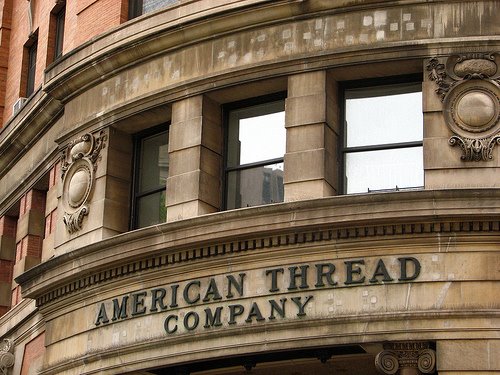
The area bounded on the north by Canal, south by Vesey Street, east by Broadway and west by the Hudson River is calm and quirky compared to other neighborhoods, owing to its shape, sculpted by a cross work of diagonal streets braced against the grid-like blocks between Church and Broadway. While the Lower West Side, as it was earlier known, began as a residential district in the late 18th century, its proximity to the docks and to the Hudson River Railroad’s St. John’s Park Depot transformed the neighborhood into a center of industry, primarily textiles by the 1850s.
Like the Meatpacking District further north, the western edge of the area also became a grocery center for New Yorkers, with fresh produce, dairy and meat. The streets of Washington Market, as it was known then, were clogged with buyers and sellers with vendors even set up along the Hudson River docks. A chaotic mess to be sure, to contrast with many of the gorgeous Italianate and Romanesque Revival buildings built by wealthy companies to house their offices and factories.
Below: You can easily find remnants of TriBeCa’s ‘material’ past
Flash forward to the 1960s. The factories long abandoned and the western warehouses cleared away to construct the West Side Highway, the large now-empty spaces attracted artists, musicians and “bohemians”, slowly returning the neighborhood to its original residential leanings. Similar, in fact, to the phenomenon of SoHo just north, also a locus for artists, whose tenacious effort to turn industrial space residential led to the creation of its made-up name (SOuth of HOuston) and historical landmark designation in 1973.
The residents of Washington Market followed suit. Or rather, those centered around an actual triangular block — the one with Canal to its north, Lispenard to its south and Church to its west. (It narrows pointing to Broadway on its eastern edge.) They formed a block association called the Triangle Below Canal to rally behind a similar designation for their area. Although they too are technically south of Houston — and Washington Market has a cleaner, historical ring to it — the organization’s name was truncated, and TriBeCa was soon born.
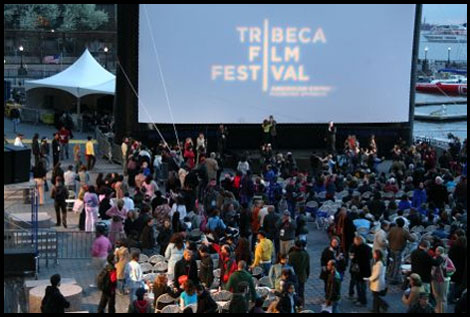
Although TriBeCa represents the entire area, in fact the neighborhood (outside of a few individual blocks) is not actually triangular at all. But as the true sign of the neighborhood’s drastic transformation, the area’s unofficial king is an Oscar-winning celebrity — Robert De Niro. The actor, who moved here in the ’90s, brought two restaurants and a film festival here, which allowed other celebrities to follow suit.
You can find more indepth information on the history of TriBeCa at its official website.
Below: Where once crowds of produce cellars clogged the streets, now filmgoers enjoy cocktails and watch film premieres
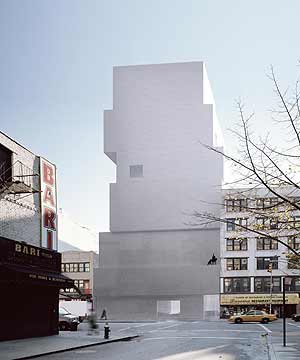
The oddest thing to ever peek its head above the Bowery, the brand new New Museum of Contemporary Art, captured the culture headlines last week during its week-long opening. Critics, even the toughest ones, praised its architecture by Kazuyo Sejima and Ryue Nishizawa of the Japanese firm Sanaa, admired its open gallery spaces glowing with natural light, and generally liked the art displays from around the world. The only thing missing from the downtown hoopla is the woman who started it all — Marcia Tucker.
Brooklynite Tucker might have greeted the success of the new New Museum as mixed bag: thrilled at reaching new audiences, wary of how such attention might censure the core philosophy — presenting new international voices in art, artists that might not find their footing in the current ‘modern art’ world.
Tucker was a curator at the Whitney Museum of Art from 1969 until 1977, when poor critical reception of her exhibit on artist Richard Tuttle got her fired. She then opened the first New Museum, on a single modest floor of the New School’s social research building, at Fifth Avenue and 14th St. You had to walk through a lobby and over book-burdened students to get to the gallery, yet even then, according to a critic in 1981, the artist displayed were unconventional, and “by any imaginable objective standard they vary enormously in the degree of their success.”
Tucker was fascinated in giving spaces to the artistic voices underneath the radar of traditional galleries. Her obituary describes her philosophy succinctly: Tucker “wanted the museum to welcome art that was excluded elsewhere because it was difficult, out of fashion, unsalable or made by artists who were not white or male or straight.”
In the 80s, she naturally moved to the heart of the world’s art scene, Soho, to a basement gallery in the Astor Building at 583 Broadway, between Prince and Houston. Although larger than the typical Soho gallery, its unglamorous basement locale allowed for peculiar gallery spaces perfectly in line with selections of art from around the world — Cameroon, Chile, Bulgaria, Cuba, Turkey, Poland and dozens of other countries. In 2000, the New Museum opened a then-unprecedented gallery to digital artwork.
The plans for the new space were unveiled in 2004, at a cost of $35 million dollars. New Yorkers have been anxious for the opening ever since the building’s clean, alien-like facade started hovering above the Bowery streets. Tucker never got to see the spectacular final product; she died in California on October 17, 2006 of cancer. At an affectionate memorial service held in January of this year, artist John Baldessari paid her the ultimate compliment: ““I thought I was pretty wiggy, but she was wiggier than I was.”