Categories
Bowery Boys Bookshelf

Happy birthday Herman Melville! Some New York City trivia Plus: News on our upcoming podcasts

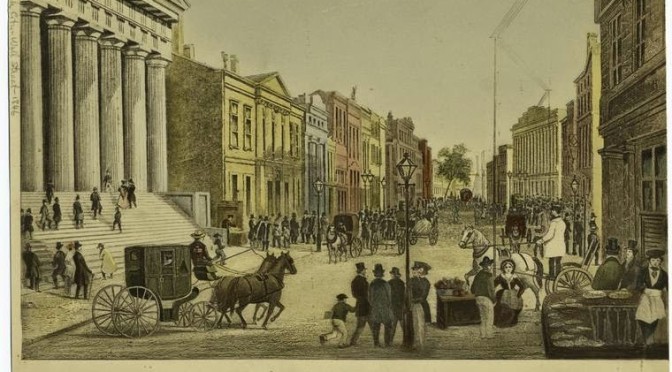
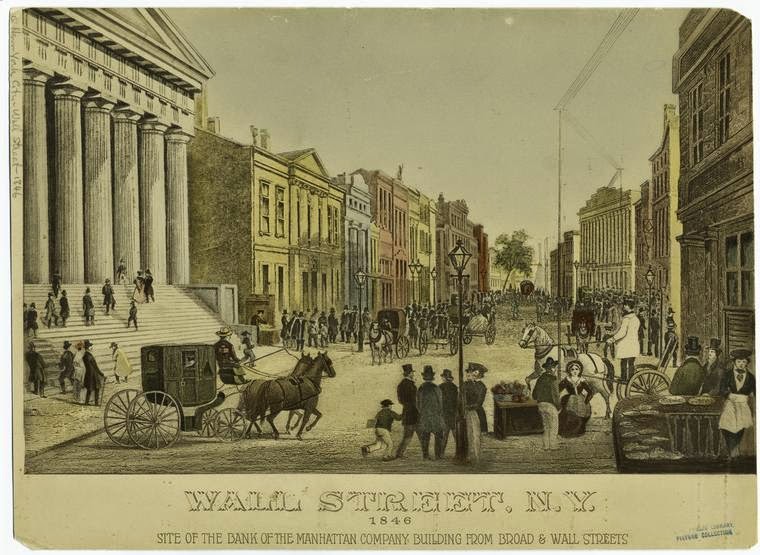
“Of a Sunday, Wall-Street is deserted as Petra; and every night of every day it is an emptiness.” — Herman Melville, Bartelby the Scrivener.  The lithograph above is what Wall Street would have looked like in Melville’s day. (NYPL)

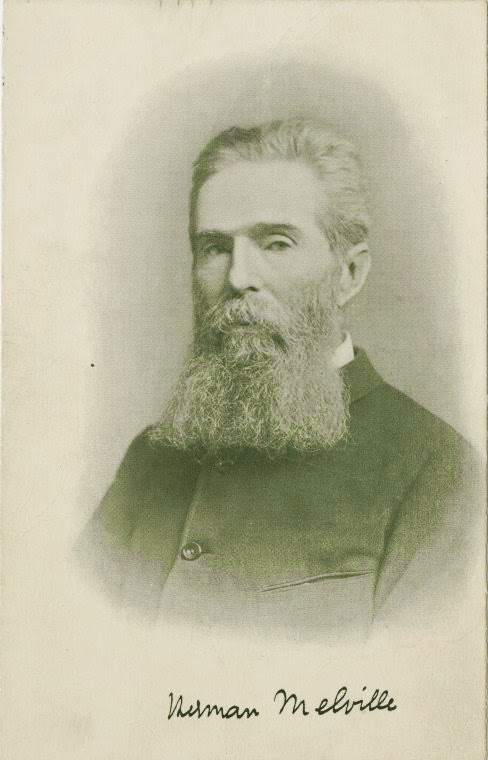
Herman Melville, one of America’s greatest writers of the 19th century, was born 195 years ago today.  Here are five New York-centric facts about Melville that you may not have known:

1)  Melville was born at 11:30 pm on August 1, 1819, at 6 Pearl Street. Today, across the street from that approximate location of the address sits a Starbucks, the coffee franchise named after a character in Melville’s Moby Dick.

2)  His grandfather Peter Gansevoort, a colonel in the Continental Army, had a fort named after him on the west side of Manhattan, in the area of today’s Meatpacking District.  Gansevoort Street is a lasting tribute to both the colonel and his fort.

Melville worked on whalers and merchant ships as a young man, acquiring the rich experiences he would immortalize in his writing. For a time, he also worked in a customs office at West Street and Gansevoort Street, almost exactly where the old fort once stood.

3)  His family’s wealth widely fluctuated, and Herman’s father was at one point thrown in debtor’s prison.  But at the height of the Melville’s prosperity, they managed to live in a luxurious townhouse at 675 Broadway, between Bond and Jones Street. (Click the address to see what’s there today.)   In the 1820s, that would have put them in the lap of wealthy New York.

4)  Melville was very familiar with all of downtown New York’s seaport culture but made special note to mention those places along the East River — WhitehallCorlear’s Hook and Coenties Slip — in his book Moby Dick.  These locations along the east side would have been his landscape as a youth, the places where his mind began crafting tales of adventure. From Moby Dick:

“Circumambulate the city of a dreamy Sabbath afternoon. Go from Corlears Hook to Coenties Slip, and from thence, by Whitehall, northward. What do you see?- Posted like silent sentinels all around the town, stand thousands upon thousands of mortal men fixed in ocean reveries. Some leaning against the spiles; some seated upon the pier-heads; some looking over the bulwarks of ships from China; some high aloft in the rigging, as if striving to get a still better seaward peep.” 

5)  For much of his later career, Melville lived at 104 East 26th Street.  Most of his greatest works had already been written, but it was from this house that he started a novella called Billy Budd. Uncompleted at the time of his death in 1891, it was later published and is today considered one of his greatest works.  There’s a plaque nearby where this building once stood, making note of this important literary spot.
___________________

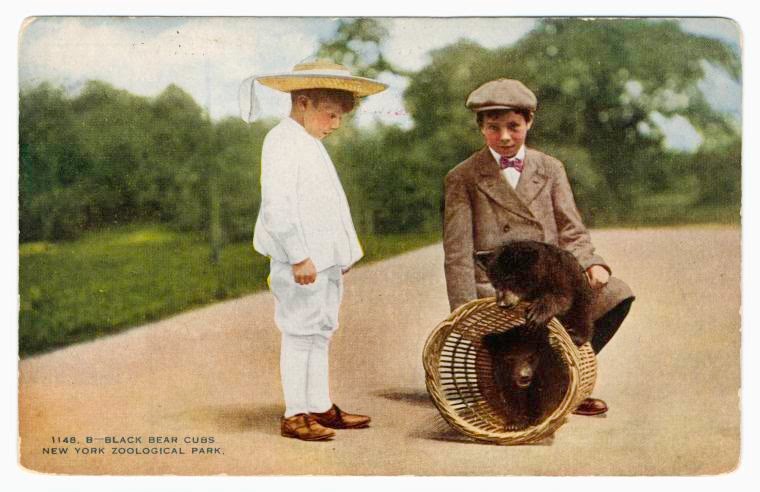
Above: Boys in fancy dress marvel over baby bears at the Bronx Zoo (NYPL)

Bonjour and hey! I’ve just returned from Europe where I saw Tom Meyers get married to his partner amid the bucolic beauty of southern France.  This may shock you but there was not a single pun made the entire ceremony.

This was also the longest vacation I’ve taken since starting the Bowery Boys so I thank you for your patience in the general silence around these parts.  I’ll have a Parisian flavored posting on Monday or Tuesday.

The podcast release schedule has been very erratic this summer so we’ve tried to give you a little extra doses wherever possible.  Sohis month you’ll be getting TWO new shows.  Here’s the layout:

August 8 — A new solo podcast
August 22 — Tom returns with a new duo show

At that point we’ll return to our monthly schedule with the next show on September 19.

Name That Neighborhood: TriBeCa not so triangular

Some New York neighborhoods are simply named for their location on a map (East Village, Midtown). Others are given prefabricated real-estate designations (SoHo, DUMBO). But a few retain names that link them intimately with their pasts. Other entries in this series can be found here.

For all the New York City neighborhoods with wonderful old names hearkening back to Lenape, Dutch and British settlers, we have a small number crafted by other, more venerable tribes — real estate brokers and community organizers. Dumbo is not a city in the Netherlands; NoLiTa is not Lenape for ‘neighborhood’. And at least one –TriBeCa, that fashionable neighborhood northwest of City Hall — is made of comprised of a complex portmanteau that isn’t even technically accurate.

The area bounded on the north by Canal, south by Vesey Street, east by Broadway and west by the Hudson River is calm and quirky compared to other neighborhoods, owing to its shape, sculpted by a cross work of diagonal streets braced against the grid-like blocks between Church and Broadway. While the Lower West Side, as it was earlier known, began as a residential district in the late 18th century, its proximity to the docks and to the Hudson River Railroad’s St. John’s Park Depot transformed the neighborhood into a center of industry, primarily textiles by the 1850s.

Like the Meatpacking District further north, the western edge of the area also became a grocery center for New Yorkers, with fresh produce, dairy and meat. The streets of Washington Market, as it was known then, were clogged with buyers and sellers with vendors even set up along the Hudson River docks. A chaotic mess to be sure, to contrast with many of the gorgeous Italianate and Romanesque Revival buildings built by wealthy companies to house their offices and factories.

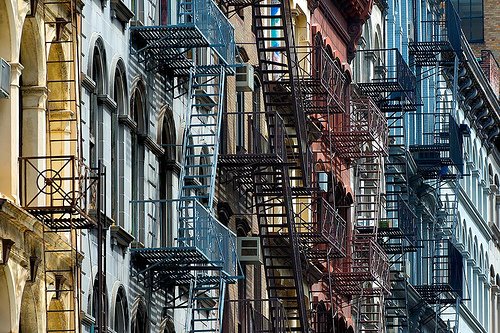
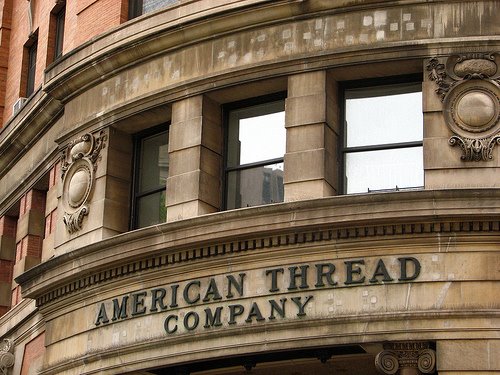
Below: You can easily find remnants of TriBeCa’s ‘material’ past

Flash forward to the 1960s. The factories long abandoned and the western warehouses cleared away to construct the West Side Highway, the large now-empty spaces attracted artists, musicians and “bohemians”, slowly returning the neighborhood to its original residential leanings. Similar, in fact, to the phenomenon of SoHo just north, also a locus for artists, whose tenacious effort to turn industrial space residential led to the creation of its made-up name (SOuth of HOuston) and historical landmark designation in 1973.

The residents of Washington Market followed suit. Or rather, those centered around an actual triangular block — the one with Canal to its north, Lispenard to its south and Church to its west. (It narrows pointing to Broadway on its eastern edge.) They formed a block association called the Triangle Below Canal to rally behind a similar designation for their area. Although they too are technically south of Houston — and Washington Market has a cleaner, historical ring to it — the organization’s name was truncated, and TriBeCa was soon born.

Although TriBeCa represents the entire area, in fact the neighborhood (outside of a few individual blocks) is not actually triangular at all. But as the true sign of the neighborhood’s drastic transformation, the area’s unofficial king is an Oscar-winning celebrity — Robert De Niro. The actor, who moved here in the ’90s, brought two restaurants and a film festival here, which allowed other celebrities to follow suit.

You can find more indepth information on the history of TriBeCa at its official website.

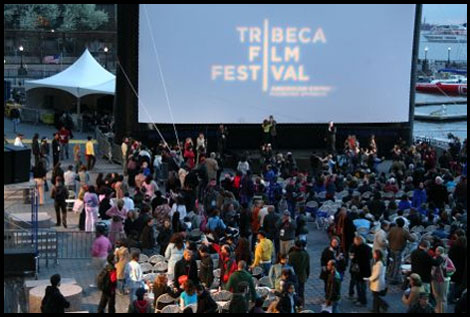
Below: Where once crowds of produce cellars clogged the streets, now filmgoers enjoy cocktails and watch film premieres

The sexy secret underneath ‘Little Flatiron’

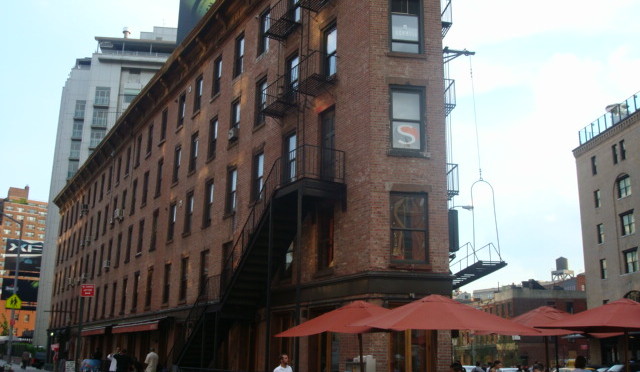
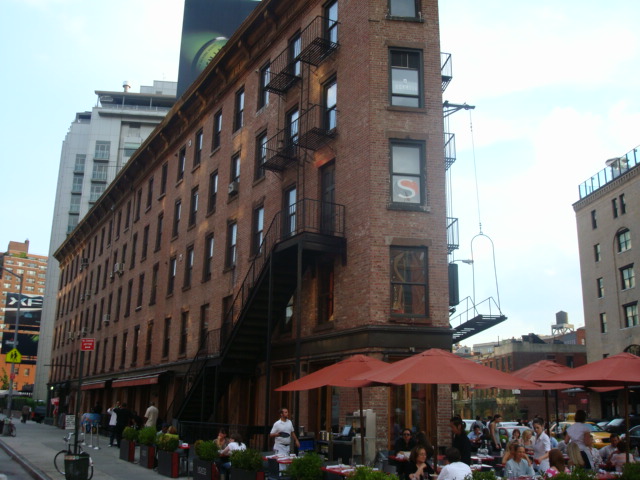
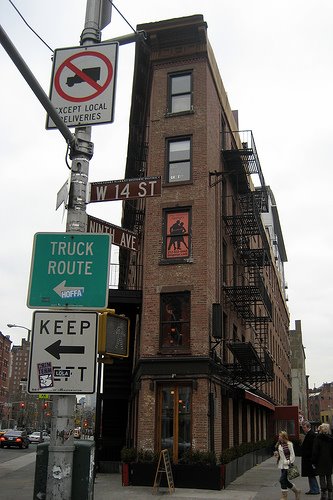
Some of the most interesting buildings in New Yorks are the triangular ones, those that sit at the intersection of diagonal streets that cut through the grid system. The Silas C. Herring Lock and Safe Company Building, more affectionately known as the L’il Flatiron Building or simply the Triangle Building, is probably the ‘cutest’ example of these, a five-story brick structure that notifies traffic to the change in neighborhood. Hudson spills down to the West Village to its east, while cobblestones grace its western front. But this girl’s led a hard life.

L’il Flatiron was built in 1849 as a four-story building for Herring’s well-known safe company. After Herring died in 1881, a fifth floor was added to the building two years later and converted into general shop space.

Today, its ground floor is presently occupied by pleasant Italian restaurant Vento, while the basement houses the lounge Level V. The crowds at these places are mainstream, young, professional. Are they aware that they dine and imbibe in what was once one of the most sexually active places in all of New York City? Literally thousands of people have had sex in the basement of the Little Flatiron.

A host of erotic clubs once took residence here, most notably the legendary Vault, perhaps best known as the location of a few of Madonna’s ‘Sex’ book photoshoots. After a few years in this space, the Vault was such a success that it moved a short distance away on Little West 12th Street (and later still to another location on 23rd Street), where it became a sort of ‘sex mall’.

The Hellfire Club, the Manhole and Jay’s Hangout were also residences of the little Flatiron at some point during the 80s and 90s, catering to the various sexual proclivities of both straight and gay people.

And that was just the inside. Prostitutes openly trolled around outside during the 80s and early 90s, hobbling over the cobblestone, trying to make a living. Says one person who lived in the neighborhood in the early 90s: “The corner in front of that triangle building was tranny hooker & drug dealer central! Now it’s all Prada girls chatting away over triple low-carb lattes.”

Even its most prestigious filmic moment aches of high drama. Glenn Close’s psychotic character in ‘Fatal Attraction’ lived here, and the building was also used in the Oscar-nominated film ‘The Hours’. In fact a pivotal character leaped to his death from a window on its upper floors. As far as I know, no movie character has ever lived in this building and survived. (Sorry to spoil the movies.)

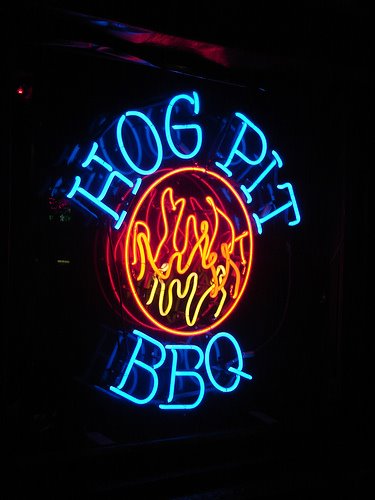
Today about the only hot spicy action one can find in the building is at the Hog Pit barbecue restaurant around the corner. This stomach-destroying barbecue establishment has been a mainstay of the neighborhood and has attracted its share of famous fans, such as Harrison Ford, Willie Nelson and Keanu Reeves . However, it, too, is being run out of the neighborhood by the end of the year. With a Ralph Lauren store slated to move in by 2009, the Little Flatiron will officially (and regrettably) become a respectable place.

However, they may want to reconsider moving in there. Perhaps the most starling and shocking fact of all — the building starred in a hit music video ‘2 Become 1’ by the Spice Girls. Oh, knowing that, how can I even look at it the same way? Lil Flatiron, hide your shame!

(Second pic above courtesy wallyg at Flickr)