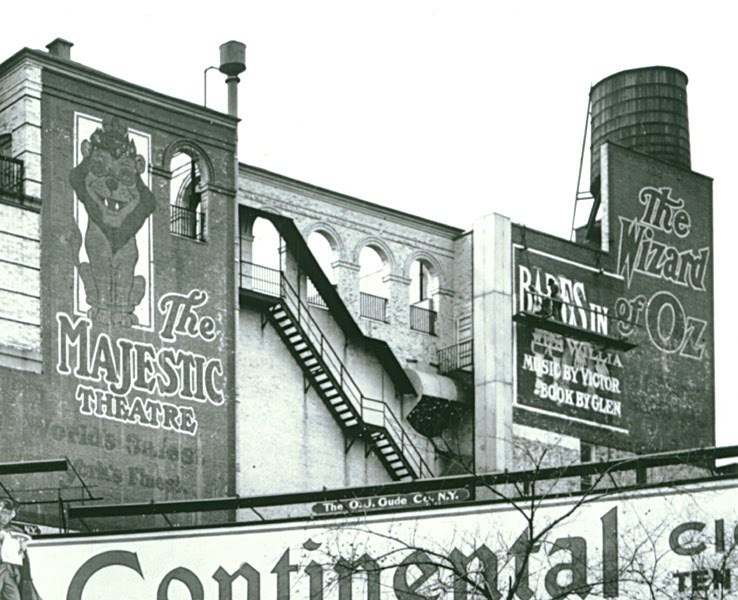
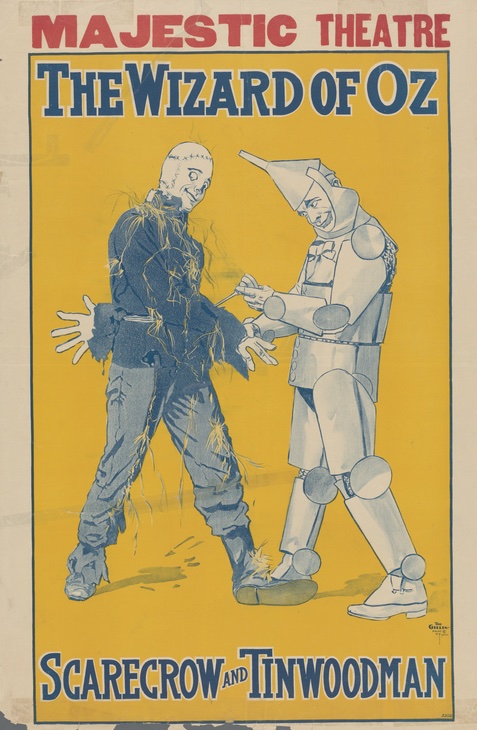
The very first musical version of The Wizard of Oz opened at the Majestic Theatre (at 5 Columbus Circle) on January 20, 1903, after playing to enthusiastic audiences in Chicago.
L. Frank Baum wrote the book to the musical, based on his novel ‘The Wonderful Wizard of Oz’ which was published in 1900.
New York Public Library
The temperatures were chilly that day, but New Yorkers were undeterred.
Or, as the New York Times observed: “With a dash of brilliant discovery ‘The Wizard of Oz’ last night discovered the north pole of the Broadway theatrical world in the Columbus Monument, at Fifty-ninth Street.
In a proximity as close as that of the Majestic Theatre frosts undoubtedly threaten, just as there is said to be a gathering chill in the theatres situated near the south pole in the Flatiron Building.”
The vaudeville act Montgomery and Stone played the Scarecrow and the Tinman.
Anna Laughlin, who played Dorothy, headed quickly to New York’s budding film business, starring in eighteen films between 1913-1915, many for the Brooklyn-based Vitagraph Company.
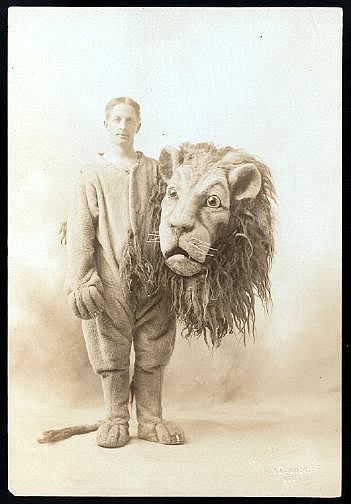
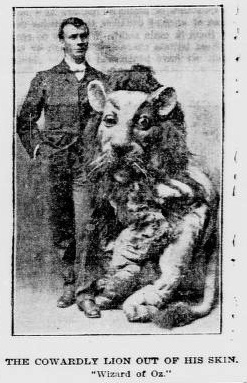
As for the Cowardly Lion, he was played by the handsome pantomimist Arthur Hill. He became so beloved in the role that he returned to the Broadway stage in other roles, always playing animals (including the wolf in a rendition of ‘Little Red Riding Hood’).
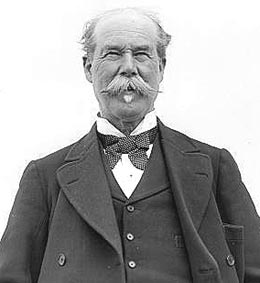
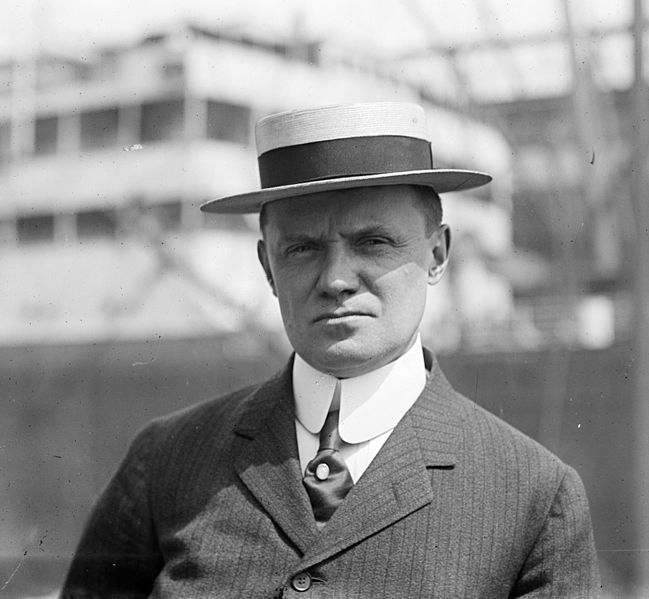
Among its admirers later that summer was the renown yachtsman Sir Thomas Lipton (pictured below), such a popular figure in 1903 that mobs arrived in Columbus Circle just to see his car pull up to the theater.
An ode to Lipton was performed by one of the chorus girls — Tommy! Oh! Oh Sir Tommy! You’re a dandy from your feet up — to his quite noticeable embarrassment.
Still, he came back to see the show a second time. Standing to give a speech, “[h]e may have intended to say more, but a misunderstanding about the calcium lights threw him suddenly into darkness, and he sat down.”
The show was a blockbuster, running in New York for two whole years, eventually closing on the final day of 1904.
I believe ‘Wizard’ was the inaugural performance at the Majestic Theatre, which survived several decades — as the International Theatre, it even co-hosted the Academy Awards — until it was demolished in the 1950s.
The play was such a success that Baum was convinced to write a sequel called ‘The Marvelous Land of Oz’. From there, he went on to expand his Oz franchise for several more books, including beloved installments featuring Tik-Tok, the Patchwork Girl and Ozma.
On the occasion of its 225th performance, the management of the Majestic gave out souvenir, telescopic silver drinking cups, “in which the friends and well-wishers of ‘The Wizard of Oz’ may drink to that potentate’s long long life and prosperous reign.”
Clippings courtesy the New York Tribune/Library of Congress.
Join the Bowery Boys Movie Club! Support us on Patreon at any level and get these Patreon-exclusive, full-length and ad-free podcast. Each month we talk about one classic (or cult-classic) film that says something interesting about New York City.
In the new Bowery Boys Movie Club, Tom and Greg visit the year 1978 and a cult classic thriller starring Faye Dunaway, Tommy Lee Jones and Raul Julia.
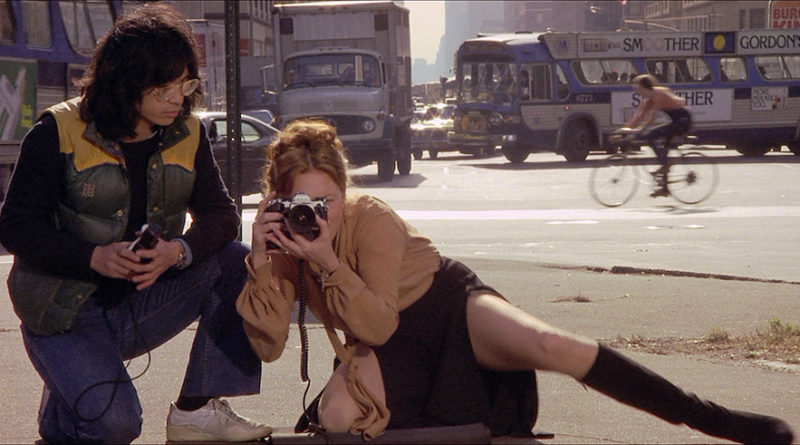
Eyes of Laura Mars presents the chic downtown art world of 1970s SoHo within a supernatural thriller involving a famed fashion photographer (played by Dunaway) and her psychic connection to a menacing killer. The thriller also takes us on a ride to Columbus Circle, the Christopher Street Pier and Hell’s Kitchen.
Listen in as Greg and Tom set up the film’s backstory — Barbra Streisand was almost the star — then give a suspenseful synopsis through the film’s fun but implausible story line. And there’s disco music too!
Should you watch the movie before you listen to this episode? This podcast can be enjoyed both by those who have seen the film and those who’ve never even heard of it.
We think our take on Eyes on Laura Mars might inspire you to look for the film’s many fascinating (but easy to overlook) historical details, so if you don’t mind being spoiled on the plot, give it a listen first, then watch the movie! Otherwise come back to the show after you’ve watched it.
The film is available on Amazon Prime, among other services.
To get the episode, simply head to Patreon and sign up to support the Bowery Boys podcast at any level.
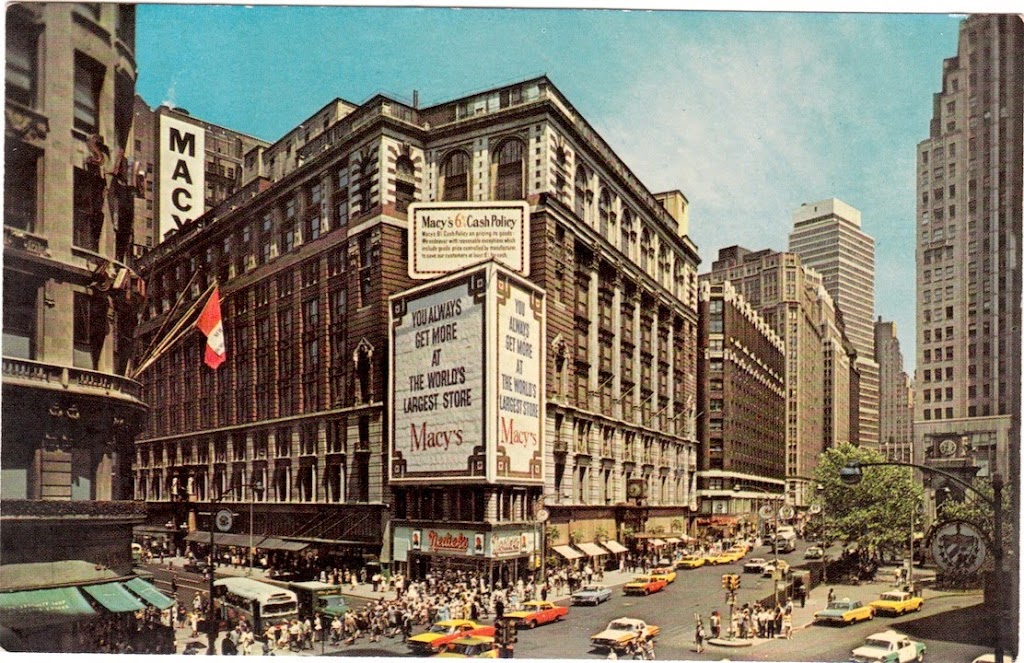
The Macy’s Thanksgiving Day Parade of 1963 had been a downer of a parade.
President John F. Kennedy had just been assassinated a few days before but, deciding that cancelling the event would be “a disappointment to millions of children,” the parade went on as planned.
Leading the parade that year was a 38-foot rubber Unisphere to promote the upcoming World’s Fair. Further back in the line was young television star Michael Landon.
Flash forward to the following year — the World’s Fair out at Flushing-Meadows had celebrated a rocky first year. Landon’s Bonanza was about to become the most popular show on television, a distinction it would hold throughout the mid-1960s. New York City was, generally speaking, in a cautiously more festive mood.
Not that the specter of the previous year’s tragedy was far from people’s minds. “Americans plan to savor the traditional cheer of Thanksgiving today in an atmosphere that contrasts with the numbing experience of last year,” said the New York Times. [source]
For their part, Macy’s was trying to whip New Yorkers back up into a holiday shopping frenzy. Among the hottest items advertised by the department store during Thanksgiving week were Hitachi record players, Consolette hair dryers and mink coats for $99.99.
The 1964 Thanksgiving Day parade (November 27) held a certain campier flair than normal, loaded with family-friendly cheerfulness slightly more heightened than normal, with a few assorted mishaps and lots of goofiness mixed in. Why? For the same reason the 1964 is among the most memorable in parade history — television:
— First in Color: NBC has been broadcasting the parade since 1952. By 1964 coverage had expanded to 90 minutes — in 2014, it’s three hours — and now, for the first time ever, it would be broadcast in color. Several NBC shows had gone to a color broadcast previously, but Americans didn’t yet have affordable color sets at home. But by 1964 sets were finally being mass produced and sold as luxury items in department stores.
There were a little over one million color televisions in American homes with the potential to tune in to a color broadcast in 1964. Ten years later, that number would rise to almost 45 million.
— The Official Debut of Lip-Syncing: But some lamented the attention to the television audience. At one point, the parade was held up for eight minutes while waiting for a television signal. “Near Herald Square television took over the parade …. and some of the spontaneity went out of it.” [source]
Performances were pantomimed while songs were pumped in for the television audience. The Times notes that cameras zoomed in on “performers who were only feigning a performance.” Today, of course, this is a regular feature of the parade and almost none of the performances (outside of the marching bands) feature live singing.
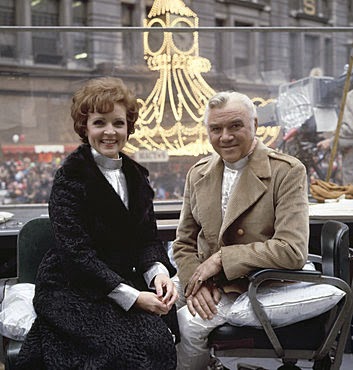
At right: The hosts at the 1968 parade
— Lorne and Betty: The hosts of NBC’s 1964 broadcast were Lorne Greene — Landon’s Bonanza co-star — and the effervescent Betty White, celebrated star of a 1950s show called Life With Elizabeth. Greene was perhaps one of NBC’s hottest actors at the time, while White was busy as a television spokeswoman. She was also a regular host of the Tournament of Roses parade. Almost every role you’ve ever loved Betty White in lay far in the future for her at this time.
— First Men In the Moon: Being a special televised event meant more promotion of film and television properties. Â Among the most unusual was the space-themed float promoting the new film First Men In The Moon, a British sci-fi romp featuring special effects by Ray Harryhausen.
The float did its best to simulate Harryhausen’s unique creations — ‘Moon Cows’, gigantic bugs who poked their heads out of craters upon a floating moonscape. Lorne Greene is reported to have said, “Wow look at those big grasshoppers!” [source]
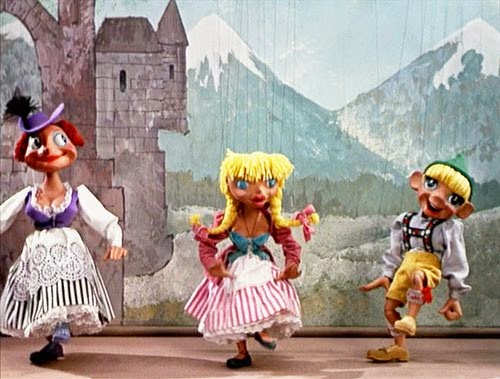
—The Sound of Puppets: A few stars of the upcoming film The Sound of Music would appear in the parade. No, not Julie Andrews, bur rather the colorful marionettes of Bil Baird, featured in the ‘goatherd’ scene of the film. I’m not sure how they were presented, and I assume most of the spectators were unable to see them perform.
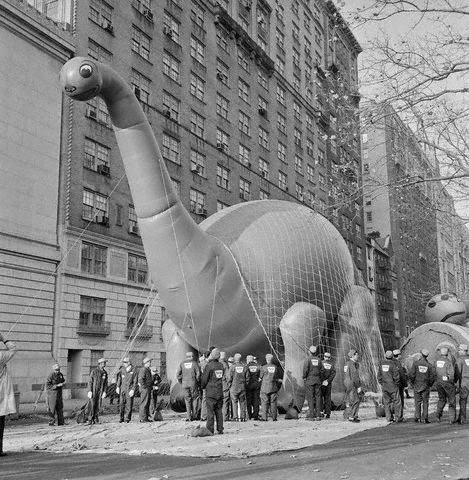
— The Fate of Dino the Dinosaur: A great danger threatened the 1964 parade — horrible winds. Fortunately no spectators were injured by the gusts, some up to 21 miles an hour.
The balloons did not emerge unscathed. Dino the Dinosaur (not to be confused with Dino, the dog from the Flintstones) would grow to become a favorite site in the 1960s and 70s. (He’s pictured at right, from the 1963 parade.)
But at the 1964 parade, a sudden gust blew the dinosaur into a lamppost at Columbus Circle, tearing a hole in its side. Â Its handlers along the avenue continued to pull the beast down the street, but by the time they got to Macy’s, the dinosaur was partially deflated and dragging the ground.
— Popeye The Limp Sailor: Dino wasn’t the only balloon with performance mishaps. The impressively sized Popeye balloon failed to properly inflate the night before; or as the papers note, “there was not enough spinach in the pumps, and Popeye wouldn’t expand at all.”
He was unceremoniously replaced in the parade by a dragon balloon that Macy’s just had lying around.
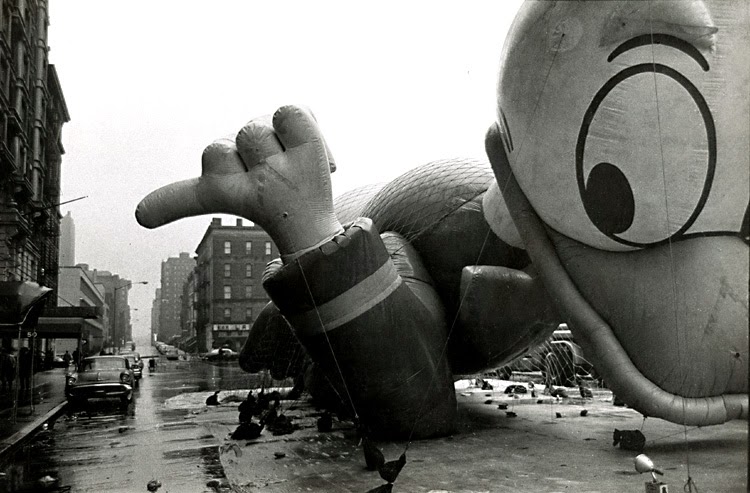
Donald Duck (pictured below from 1964) had fewer troubles that year.
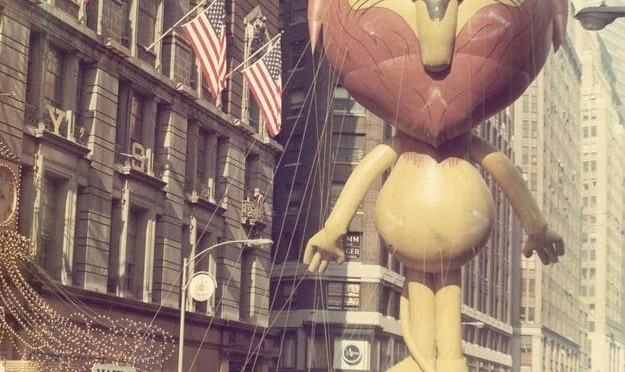
— Linus the Lion-Hearted: Pictured at top, this balloon with excellent posture debuted at the 1964 parade. It was based upon a Crispy Critters breakfast cereal spokesman who had his own television show which debuted just a couple months earlier. Â However, when the FCC determined in 1969 that advertising mascots could not also have children’s show, Linus was abruptly cancelled. He would still make frequent appearances in the parade until 1991.
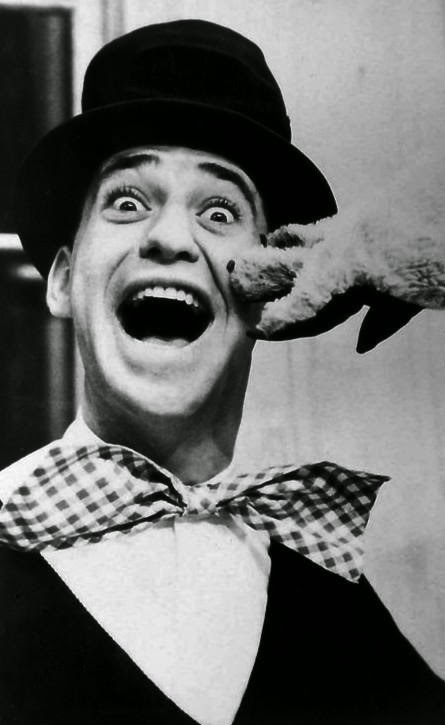
— The Soupiest Star: New to NBC, New York City and to the parade itself was children’s comedian Soupy Sales (pictured at left), whose daily show Lunch with Soupy was a local hit that year. He was probably one of the biggest hits in the parade, riding atop a rocking horse, as his trademark beaming grin was as noticeable as the floats themselves.
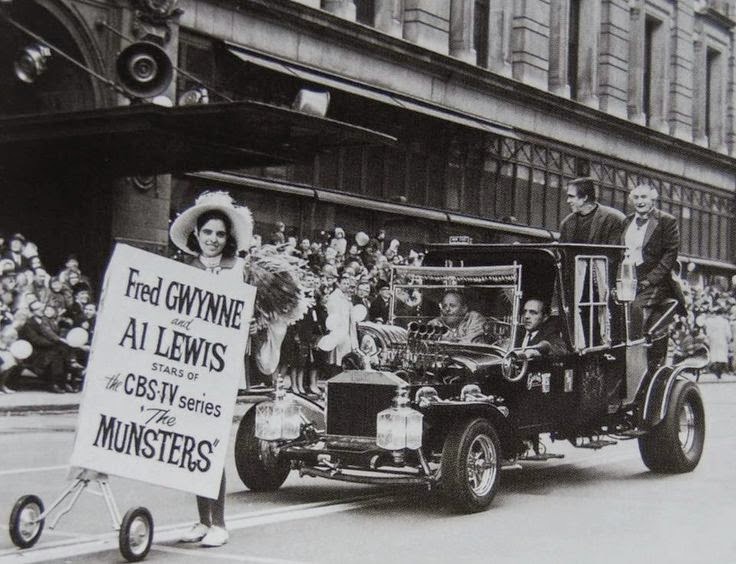
— The Drunk Munster: And then there was Fred Gwynne and Al Lewis, the stars of NBC’s monster comedy The Munsters.
From a prior article — because this incident has fascinated me for years — “[The] stars of The Munsters, appeared in the 1964 parade in their ghoulish costumes, riding along in their ‘Munster Koach’ car. Neither star was very amused. Gwynne was high on ‘nerve medicine‘ and began cursing at the crowd.”
According to their makeup man (pictured below, in the front seat): “I was in the Koach handling the loudspeaker and radio system that was playing the Munsters song. Fred had brought along a bottle with him, wrapped in a paper bag, and he got fractured [drunk]. And Al was mad at him. Fred was cussin’ at people. I just kept the music up so nobody could hear him.” [source]
Passing the hosts Greene and White in the media box, Herman Munster fired off a rude expletive in their direction as well
Here are some video highlights from the parade, with the Munsters stars prominently featured:
“Peacock NBC presentation in RCA color” Licensed under Fair use of copyrighted material in the context of NBC via Wikipedia
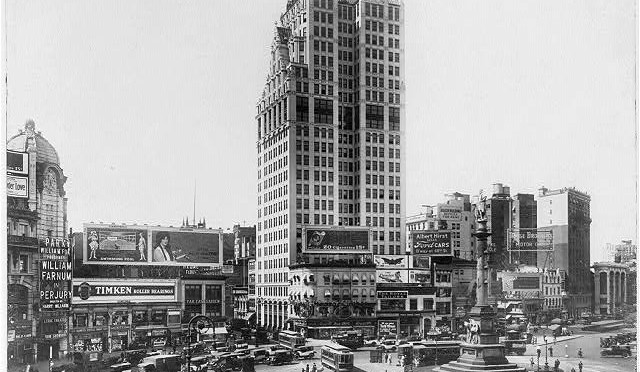
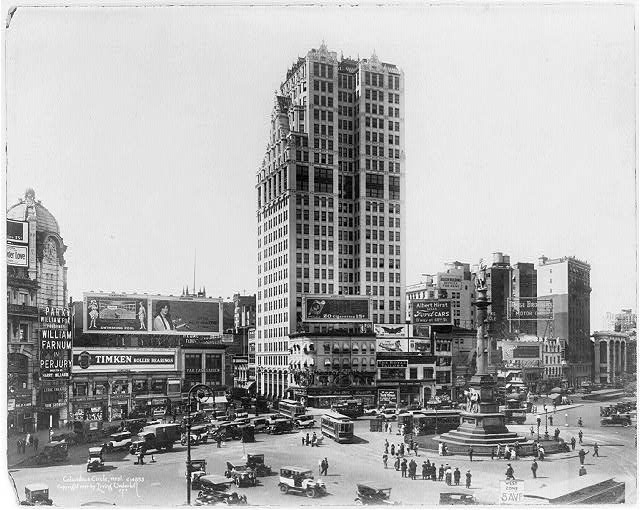
Columbus Circle in 1921, looking west. Healy’s was a few blocks north of this scene.
Many of New York’s most popular restaurants and cafes a century ago were located around Columbus Circle, lively hot spots that drew in the theater and burlesque patrons well into the late hours. Crowds would exit the Park Theaterand head over to Reisenweber’s Cafe to take in some champagne and cabaret, years before it would be associated with bawdy star Sophie Tucker. Others might partake of the beefsteak at the Morgue on West 58th Street or Child’s Restaurant a block over.
One of the busiest spots was Healy’s (slightly north, at Broadway and 66th Street), a spacious dining and dancing spot, featuring an indoor ice-skating rink and enormous ballroom, among its many indulgences. It was one of New York’s most trendy dining palaces in 1913, the site of a celebratory dinner by artists from the Armory Showjust a few months before.
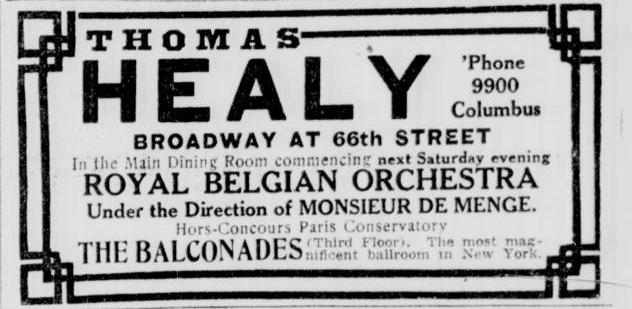
Below: An advertisement for Healy’s from 1914
But nobody was exactly celebrating at 1 a.m. on August 13, 1913, when the police burst into Healy’s and violently threw out all the patrons. Men were grabbed by their collars and thrown to the sidewalk. Women screamed as they were separated from their tables, “shoved, pushed and dragged” to the doorway. Thousands of people had gathered outside, both curious and perturbed, shouting at the police and cheering on the discarded diners.
So what was the problem exactly? Naturally, it had to do with liquor.
The fun began several days before, whenMayor William J. Gaynor instigated a new ‘cafe curfew’ for the wild lobster palaces and nightclubs that were turning Midtown into an all-night soiree. Establishments holding proper liquor licenses must now close at 1 a.m. unless granted an exemption or extended license (often given to hotels).
This did not make Broadway proprietors happy, as it greatly cut into profits. However most restaurant and cafe owners along the “White Light zone“ planned to comply with the order, fearing fines or police reprisals.
But Thomas Healy was ready to fight the law. His lavish cafe at Broadway and 66th Street thrived on the after-theater, late-supper crowd, a party crew who liked their champagne. Although Healy’s regularly closed at 2 a.m., that one lost hour would have greatly hurt business, Healy claimed.
He also contested the wording of the law. It stated that “any room which liquor is sold during lawful hours must be closed and the doors locked during the prescribed hours, whether for the sale of liquor and foods.” If his bar room was indeed locked up, why couldn’t his patrons stay and enjoy themselves in the dining room?
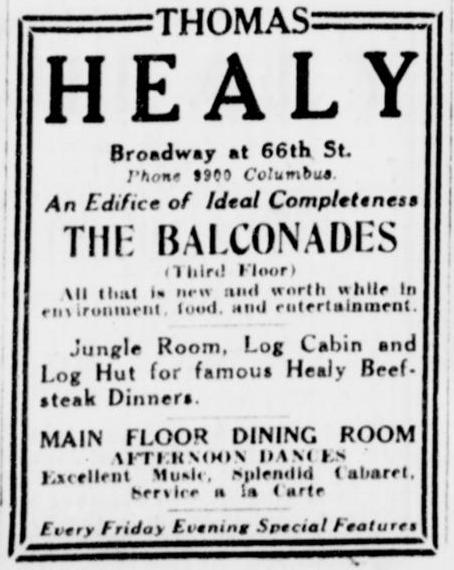
At left: An ad from 1915. Note the ‘Jungle Room, Log Cabin and Log Hut for famous Healy Beefsteak Dinner’
Healy stood ready to combat the mayor, keeping his place open while filing an injunction to keep the law at bay.
For several days, police entered the restaurant and asked patrons to leave at 1 a.m. On Tuesday, August 12, police barricaded patrons in the restaurant, announcing that none of them could leave until 6 a.m. But a defiant Healy removed his remaining diners out a back entrance, foiling the police.
This is certainly explains why the police were especially hostile the following day, August 13. At 1 a.m, police officers mounted the orchestra stage and announced that everybody must leave the restaurant. Drunken patrons laughed and even booed the officer, many proclaiming they had no interest in leaving. Most likely, it was this stubbornness that ignited the rough-handling that followed.
“The recalcitrant guests found themselves enfolded in the uniformed arms, lifted into the air, rushed down the disordered aisles and literally thrown into Columbus Avenue,” reported the New York Times. “In the scramble, tables went over, chairs were smashed, electroliers were damaged, glasses and crockery were broken into fragments. There was pandemonium for a time.”
Violence returned the following night, Thursday, August 14, as rebellious New Yorkers were now insolently dining past the allotted time. Promptly at 1 a.m., an increased force of fifty police officers rushed the restaurant. “Three hundred men and women were led, pushed, shoved, carried, clubbed and thrown out.” [source]
One of those patrons was New York District Attorney Charles S. Whitman (pictured above in 1910), a rumored candidate for mayor and one of the city’s most popular politicians. (In 1916, he would be elected governor of New York.) His appearance at Healy’s was clearly to draw attention. Thousands of people crowded the streets; the nearly elevated train station was filled with people trying to get a better look, and ‘automobile parties’ cruised by, desperate for a peek at the violence inside.
Whitman’s appearance had done the trick. Gaynor backed down, allowing Healy’s to remain open if it wished. In fact, warrants were then issued for police detective John. F. Dwyer and two dozen police officers.
But Healy had created a bit of an unwieldy beast. Crowds gathered the next night and cars lined the street, anticipating more excitement, building uncontrollable mess that the proprietor actually called the police himself! In the end, Healy did end up closing at 1 a.m., just for the protection of his own restaurant and staff.
Christopher Columbus is among the most honored figures in New York statuary, appearing abundantly throughout the five boroughs — standing prominently, nestled in parks and squares, peering from building features.
I’ve located a seemingly complete list of New York Columbus monuments, strangely enough, on a German website, inclusive even of Chris’s appearance of 8th Avenue subway tiles.
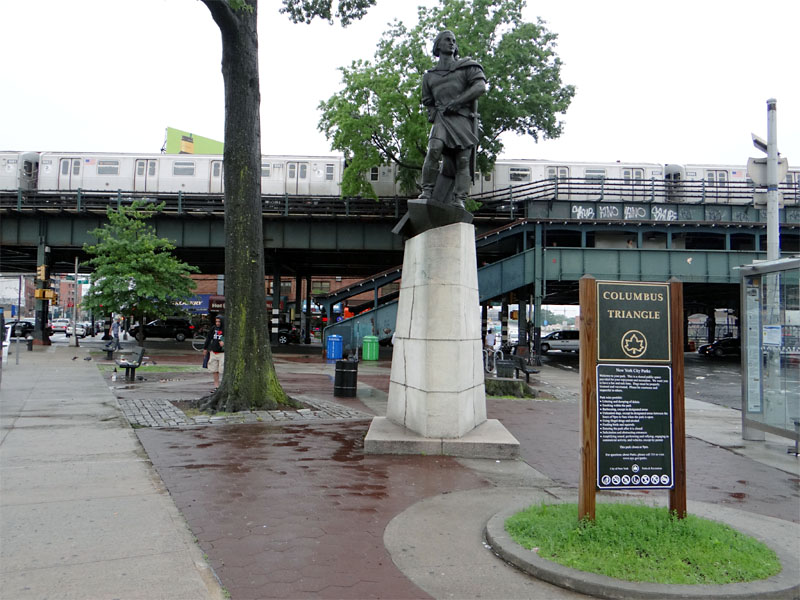
While the one perched atop the column at Columbus Circle is the most famous, perhaps the most interesting one sits in Columbus Park, in Astoria, Queens.
Depicting a young, robust explorer, the statue was erected here in 1941 in recognition of the area’s growing Italian population. But youthful Chris was almost immediately removed to the basement of Queens Borough Hall, for fears it would get melted down in wartime scrap-metal programs.
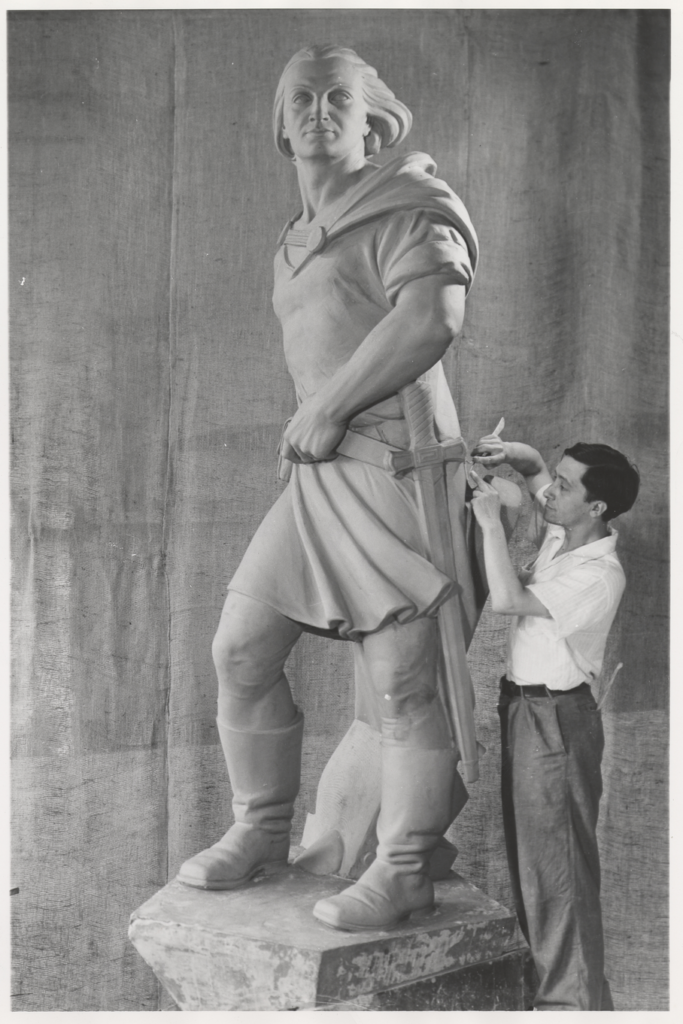
Racioppi works on Astoria’s Columbus as part of the WPA program.
It was returned to dignity by the end of the war and has commanded the crossroads here ever since.
Had Parks Commissioner Robert Moses had his way, however, the striking, romantic monument would never have seen light of day. “We don’t think the statue looks like anything we have read about Columbus, or that as a piece of symbolism it represents anything associated with Columbus,” Moses complained.
“Anything Moses doesn’t design himself, he thinks is no good,” replied Queens Borough President George U. Harvey.
Nearby you’ll find a dedication plaque from the Italian Chamber of Commerce. Your eyes aren’t deceiving you; it lists a dedication date of 1937.
Although sculptor Angelo Racioppi had completed the work by then, the community couldn’t afford the base until a few years later.