In 1972 the Robert Altman film M*A*S*H was turned into a weekly half-hour situation comedy series. In retrospect I’m stunned that anybody thought to make this. The landscape of television comedy was cluttered with novelty premises and perfect families dealing with contrived scenarios which always, always resolved in a happy freeze-frame.
There was no sense of reality to television before 1972. Westerns set in the 19th century had no historical sense to them. Gunsmoke and Bonanza rarely if ever referenced an understandable place and time. The Ponderosa was somewhere in Nevada, set vaguely in the 1860s.
Television’s M*A*S*H broke both of these molds. It was real life, affected by real history. It was in a recognizable place, and its characters were changed by events that were vividly real. For the first time it felt like a show was operating by the same cosmic rules as its viewers.
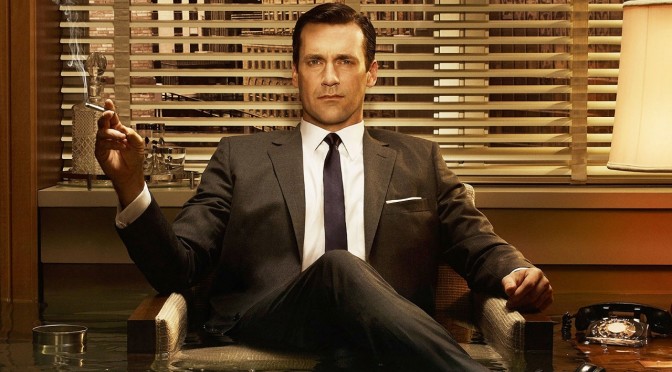
The year that Altman’s film was released is the year that the last season of Mad Men, which finishes its run this Sunday, is set. We know this because creator Matthew Weiner and his writing team make very sure to watermark almost every scene.
Every detail — from the buttons on Joan’s dresses to the brand of cigarette in Betty’s hand — speaks to the show’s obsessive need to plant its coordinates into the narrative.
Every time I see Peggy’s New York Film Festival 1964 poster, I want a copy for my house. #MadMen pic.twitter.com/FtK4dAp23W
— The Bowery Boys NYC (@BoweryBoys) May 5, 2014
Mad Men has re-envisioned the historical television show in exactly the same way that M*A*S*H reinvented the sitcom. You can no longer make a television show set in the past without following (or rebelling against) the example set by the adventures of Don Draper and crew.
Cognizant of the harsh mistress of social media, Mad Men has created a flawless timeline, leaving a masterful, rarely obvious path of breadcrumbs that have led viewers through the 1960s. The first episode “Smoke Gets In Your Eyes,” is set in March 1960. The last episode, named “Person To Person,” will be set in either November or (most likely) December 1970.
The Charlie Brown hanging is taken from a 1969 Peanuts Date Book. Here are two other pages: #MadMen pic.twitter.com/GK5lVh2MAk — The Bowery Boys NYC (@BoweryBoys) April 21, 2014
Episodes are crammed with historical and pop cultural references, but very rarely are they front and center. Don ate and drank his way through the finest restaurants in New York. Joan made out with somebody at the Electric Circus, while Peggy went to a happening at Washington Market. Kinsey joined the Hare Krishnas!
Shock treatment, LSD, race riots, Weight Watchers, moon landings, assassinations — the entirety of America in the 1960s was fully and richly presented, in far greater volume and diversity than perhaps even a college course would provide.
But not once — not a single time in its seven seasons — did the events of this tumultuous decade overtake the storyline. The characters, their lives, were always front and center.
Peggy has this copy of the New York Daily News with her. #MadMen pic.twitter.com/Q9tnQ06UWv
— The Bowery Boys NYC (@BoweryBoys) April 29, 2013
It has been an extraordinary pleasure the past few years to Tweet along with live viewings of Mad Men on Sunday night. I’m not paid to do it. It’s just a total blast. I just love a good scavenger hunt.
Weiner and the Mad Men production team can infuse entirely new themes, sometimes with traces of irony, that only reside within the borders of an episode. Far from history being a binding and limiting framework, Mad Men has turned it into a set of playground monkey-bars from which to playfully swing.
I Ching was so pervasive that Wonder Woman was redesigned in ’68 as mod secret agent w. mentor named I Ching #MadMen pic.twitter.com/psDXbL09zD — The Bowery Boys NYC (@BoweryBoys) May 20, 2013
Setting the show in New York, but not filming it here, seemed, at first, like a troubling and even annoying decision. But it worked because the Manhattan skyline is a dead giveaway, like the rings of a tree.
And Mad Men‘s not the kind of show that uses CGI. (A New York-filmed show might have been tempted to have Don swagger down the street with the under-construction World Trade Center in the background. Thank god Mad Men is not that show.)
History has been a vivid hue on Mad Men, as vivid as one of Pete Campbell’s most flamboyant ties. They don’t just plan episodes “in the spring of 1967.” There are usually clues that accurately pinpoint a scene to an actual day and, sometimes, an actual minute. You never had to be consciously aware of this information. It sits like a juicy footnote at the bottom of the page, waiting to reveal another facet of the story.
Will this formula work for future historically based television programs? Mad Men had the luxury of a cast of fictional characters, so history can coalesce around them with convenience.
Shows like Turn or Boardwalk Empire, on the other hand, have characters based on real-life individuals, and negotiation around historical events is trickier.
That weird-looking adding machine was of Japanese make, and purchased at Sears. #MadMen pic.twitter.com/hvY0uPday6
— The Bowery Boys NYC (@BoweryBoys) May 6, 2013
I wonder where the Mad Men effect will turn up next. The Knick, set in 1900s New York, makes obvious nods to Weiner’s precise use of historical detail, but understandably, it’s not consistent. (Being set over a century ago, it has a higher degree of difficulty.)
The writers of Downton Abbey love their history, but it’s often an interloper. It invades more than informs. Outlander would probably not be a good show if characters stopped to wonder what day it was. Halt and Catch Fire could be a successor to Mad Men if it pulls its storylines together in the next season.
Farewell Mad Men! And thank you for the best time-traveling adventure on television. Throughout this article is a sampling of a few of my Mad Men Tweets over the past few years to illustrate some of the details that the production team has incorporated into its shows.
You can find the complete list of my Mad Men Tweets right here! And for other Bowery Boys articles on Mad Men, you can check them out here.
McCann Erickson touting their female employees in 1972, claiming 23 in top positions: #MadMen pic.twitter.com/1mxlSdrikg — The Bowery Boys NYC (@BoweryBoys) April 27, 2015
All those magazines on Don’s desk are from January 1970. #MadMen pic.twitter.com/cUam9Y8I77
— The Bowery Boys NYC (@BoweryBoys) April 20, 2015
“The Accutron slogan isn’t advertising puffery. It’s a law of nature.” An Accutron ad from 1969: #MadMen pic.twitter.com/yIZh4Ps5lY — The Bowery Boys NYC (@BoweryBoys) April 14, 2014
Here’s a Burger Chef restaurant from the exact date of this episode, July 1969 #MadMen http://t.co/EaEmB6XxJs pic.twitter.com/DGzIXJgBRc
— The Bowery Boys NYC (@BoweryBoys) May 26, 2014
Undercover officers (members of the Morals squad) frequented gay bars in the 1960s, luring men who propositioned them. #MadMen — The Bowery Boys NYC (@BoweryBoys) May 19, 2014
The poster in his office: VISIT DANTE’S INFERNO, THE END PLACE is a frequent set piece: #MadMen pic.twitter.com/luSPSc7jCH
— The Bowery Boys NYC (@BoweryBoys) May 5, 2014
The Greek-inspired coffee cup debuted in NYC delis in 1963 so that would have been a fairly unfamiliar sight. #MadMen pic.twitter.com/54WTtH2mlR — The Bowery Boys NYC (@BoweryBoys) April 8, 2013
The cover of Life Magazine in March 1966: ‘The Exploding Threat of the Mind Drug That Got Out of Control’ #MadMen pic.twitter.com/8oEWR92v
— The Bowery Boys NYC (@BoweryBoys) April 23, 2012
Â
LSD is still legal at the time of this episode, but would soon be made illegal in the U.S. on October 6, 1966 #MadMen — The Bowery Boys NYC (@BoweryBoys) April 23, 2012
Draper had a mimeograph of this actual Sunkist ad on his desk from 1965: #MadMen pic.twitter.com/cKZWfiA4Jx
— The Bowery Boys NYC (@BoweryBoys) June 24, 2013
Margarine vs. butter? Let this Blue Bonnet butter ad from 1968 help you decide. #MadMen pic.twitter.com/5YhJgqmuJU — The Bowery Boys NYC (@BoweryBoys) May 27, 2013
Ah, but they got the Milk Duds packaging exactly right! #MadMen pic.twitter.com/NxYWUQysMH
— The Bowery Boys NYC (@BoweryBoys) April 29, 2013