Categories
Holidays

Wacky, windy and weird: 1964 Macy’s Thanksgiving Day Parade

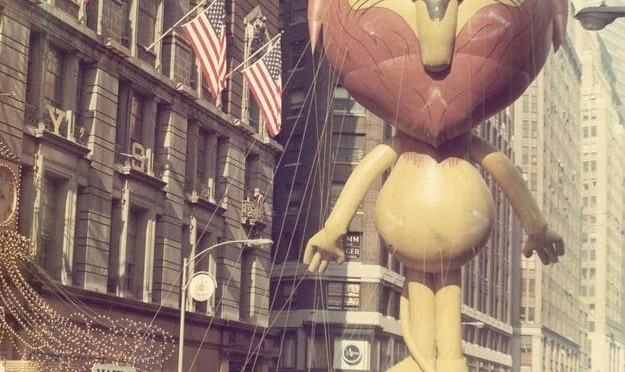
Linus the Lion-Hearted at the 1964 Macy’s Parade

The Macy’s Thanksgiving Day Parade of 1963 had been a downer of a parade.

President John F. Kennedy had just been assassinated a few days before but, deciding that cancelling the event would be “a disappointment to millions of children,” the parade went on as planned.

Leading the parade that year was a 38-foot rubber Unisphere to promote the upcoming World’s Fair. Further back in the line was young television star Michael Landon.

Flash forward to the following year — the World’s Fair out at Flushing-Meadows had celebrated a rocky first year. Landon’s Bonanza was about to become the most popular show on television, a distinction it would hold throughout the mid-1960s. New York City was, generally speaking, in a cautiously more festive mood.

Not that the specter of the previous year’s tragedy was far from people’s minds. “Americans plan to savor the traditional cheer of Thanksgiving today in an atmosphere that contrasts with the numbing experience of last year,” said the New York Times. [source]

Below: Macy’s in 1964 (courtesy The Paper Collector)
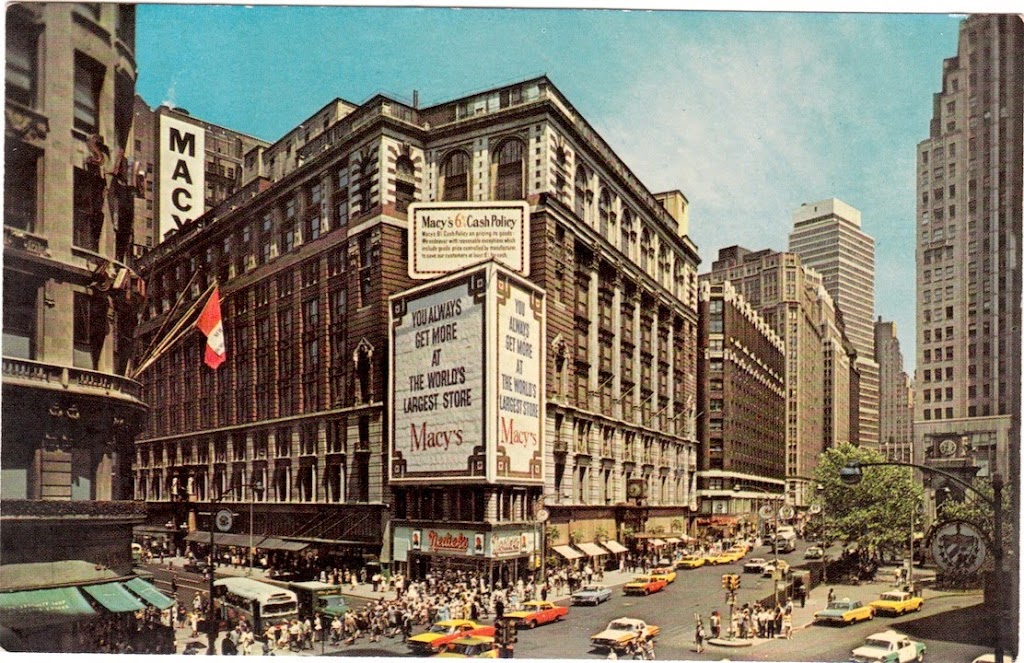
For their part, Macy’s was trying to whip New Yorkers back up into a holiday shopping frenzy. Among the hottest items advertised by the department store during Thanksgiving week were Hitachi record players, Consolette hair dryers and mink coats for $99.99.


The 1964 Thanksgiving Day parade (November 27) held a certain campier flair than normal, loaded with family-friendly cheerfulness slightly more heightened than normal, with a few assorted mishaps and lots of goofiness mixed in. Why? For the same reason the 1964 is among the most memorable in parade history — television:
First in Color: NBC has been broadcasting the parade since 1952. By 1964 coverage had expanded to 90 minutes — in 2014, it’s three hours — and now, for the first time ever, it would be broadcast in color. Several NBC shows had gone to a color broadcast previously, but Americans didn’t yet have affordable color sets at home. But by 1964 sets were finally being mass produced and sold as luxury items in department stores.

There were a little over one million color televisions in American homes with the potential to tune in to a color broadcast in 1964. Ten years later, that number would rise to almost 45 million.

The Official Debut of Lip-Syncing: But some lamented the attention to the television audience. At one point, the parade was held up for eight minutes while waiting for a television signal. “Near Herald Square television took over the parade …. and some of the spontaneity went out of it.”  [source]
Performances were pantomimed while songs were pumped in for the television audience. The Times notes that cameras zoomed in on “performers who were only feigning a performance.” Today, of course, this is a regular feature of the parade and almost none of the performances (outside of the marching bands) feature live singing.

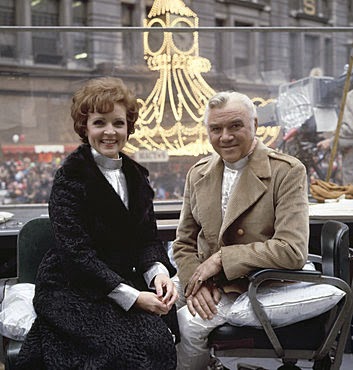
At right: The hosts at the 1968 parade

Lorne and Betty:  The hosts of NBC’s 1964 broadcast were Lorne Greene — Landon’s Bonanza co-star — and the effervescent Betty White, celebrated star of a 1950s show called Life With Elizabeth. Greene was perhaps one of NBC’s hottest actors at the time, while White was busy as a television spokeswoman. She was also a regular host of the Tournament of Roses parade. Almost every role you’ve ever loved Betty White in lay far in the future for her at this time.

First Men In the Moon: Being a special televised event meant more promotion of film and television properties.  Among the most unusual was the space-themed float promoting the new film First Men In The Moon, a British sci-fi romp featuring special effects by Ray Harryhausen.

The float did its best to simulate Harryhausen’s unique creations — ‘Moon Cows’, gigantic bugs who poked their heads out of craters upon a floating moonscape. Lorne Greene is reported to have said, “Wow look at those big grasshoppers!” [source]
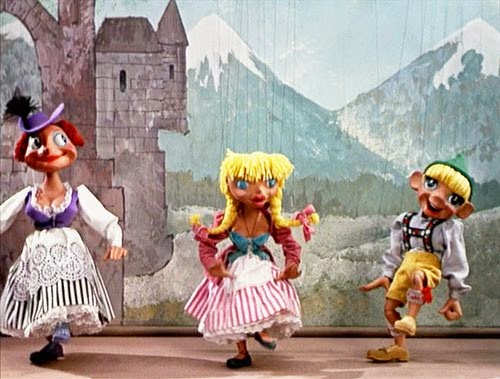
The Sound of Puppets: A few stars of the upcoming film The Sound of Music would appear in the parade. No, not Julie Andrews, bur rather the colorful marionettes of Bil Baird, featured in the ‘goatherd’ scene of the film. I’m not sure how they were presented, and I assume most of the spectators were unable to see them perform.
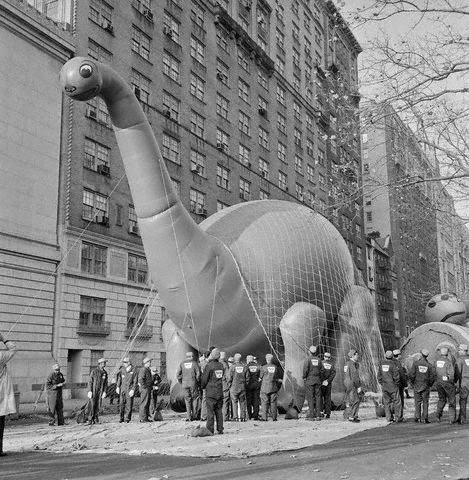
The Fate of Dino the Dinosaur: A great danger threatened the 1964 parade — horrible winds. Fortunately no spectators were injured by the gusts, some up to 21 miles an hour.

The balloons did not emerge unscathed. Dino the Dinosaur (not to be confused with Dino, the dog from the Flintstones) would grow to become a favorite site in the 1960s and 70s. (He’s pictured at right, from the 1963 parade.)

But at the 1964 parade, a sudden gust blew the dinosaur into a lamppost at Columbus Circle, tearing a hole in its side.  Its handlers along the avenue continued to pull the beast down the street, but by the time they got to Macy’s, the dinosaur was partially deflated and dragging the ground.

Popeye The Limp Sailor: Dino wasn’t the only balloon with performance mishaps. The impressively sized Popeye balloon failed to properly inflate the night before; or as the papers note, “there was not enough spinach in the pumps, and Popeye wouldn’t expand at all.”

He was unceremoniously replaced in the parade by a dragon balloon that Macy’s just had lying around.

Donald Duck (pictured below from 1964) had fewer troubles that year.
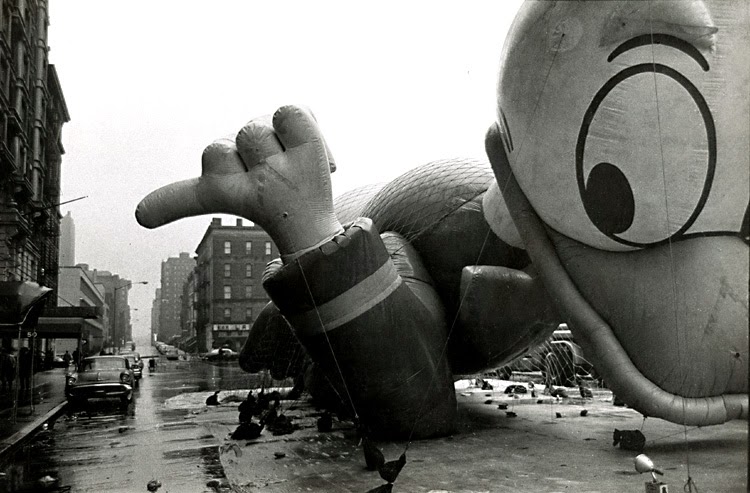
Linus the Lion-Hearted: Pictured at top, this balloon with excellent posture debuted at the 1964 parade. It was based upon a Crispy Critters breakfast cereal spokesman who had his own television show which debuted just a couple months earlier.  However, when the FCC determined in 1969 that advertising mascots could not also have children’s show, Linus was abruptly cancelled. He would still make frequent appearances in the parade until 1991.
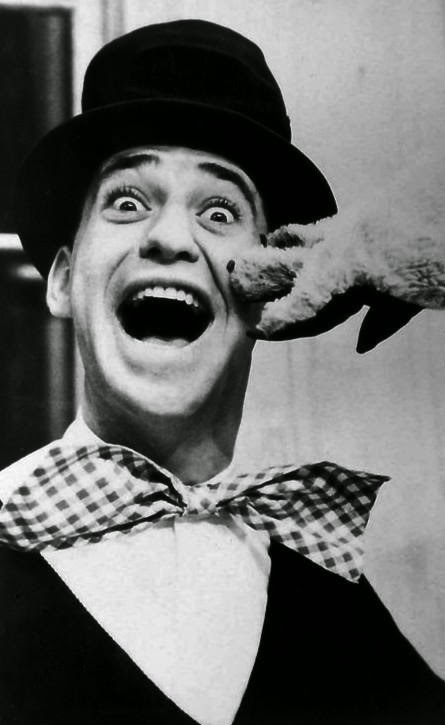
The Soupiest Star: New to NBC, New York City and to the parade itself was children’s comedian Soupy Sales (pictured at left), whose daily show Lunch with Soupy was a local hit that year. He was probably one of the biggest hits in the parade, riding atop a rocking horse, as his trademark beaming grin was as noticeable as the floats themselves.

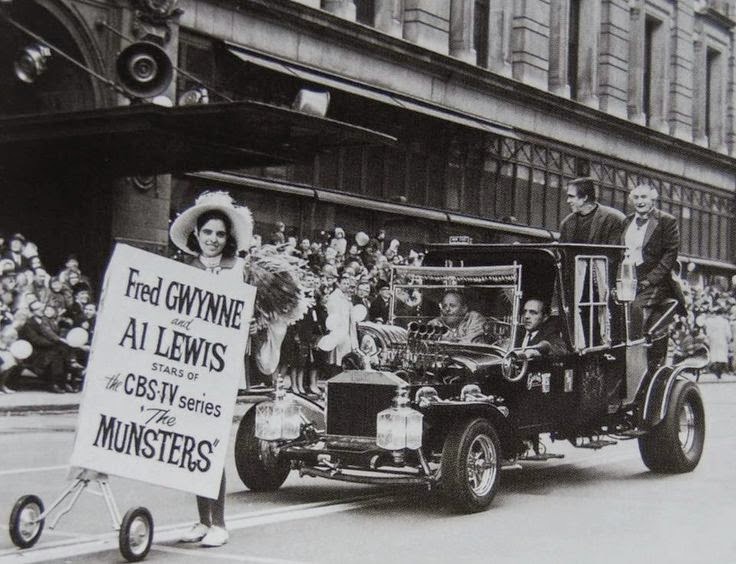
The Drunk Munster: And then there was Fred Gwynne and Al Lewis, the stars of NBC’s monster comedy The Munsters.

From a prior article — because this incident has fascinated me for years — “[The] stars of The Munsters, appeared in the 1964 parade in their ghoulish costumes, riding along in their ‘Munster Koach’ car. Neither star was very amused. Gwynne was high on ‘nerve medicine‘ and began cursing at the crowd.”

According to their makeup man (pictured below, in the front seat): “I was in the Koach handling the loudspeaker and radio system that was playing the Munsters song.  Fred had brought along a bottle with him, wrapped in a paper bag, and he got fractured [drunk]. And Al was mad at him. Fred was cussin’ at people. I just kept the music up so nobody could hear him.” [source]

Passing the hosts Greene and White in the media box, Herman Munster fired off a rude expletive in their direction as well
Here are some video highlights from the parade, with the Munsters stars prominently featured:


“Peacock NBC presentation in RCA color” Licensed under Fair use of copyrighted material in the context of NBC via Wikipedia  
Categories
Holidays

Months after the Draft Riots, New York celebrates the first national Thanksgiving, in the shadow of war and lunar eclipse


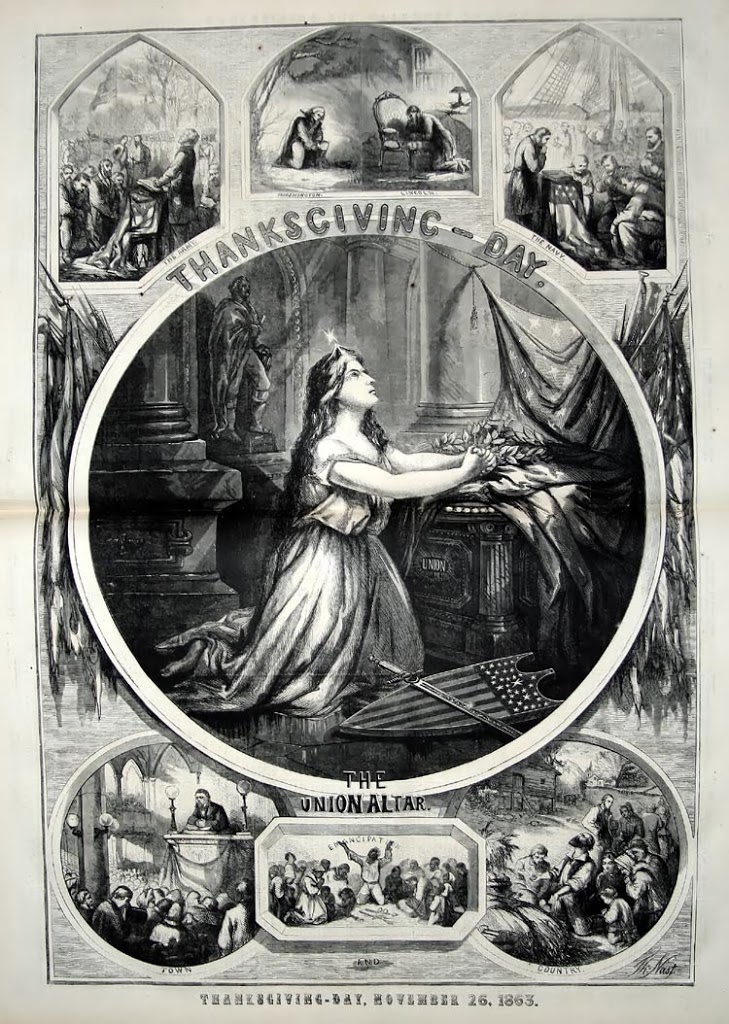
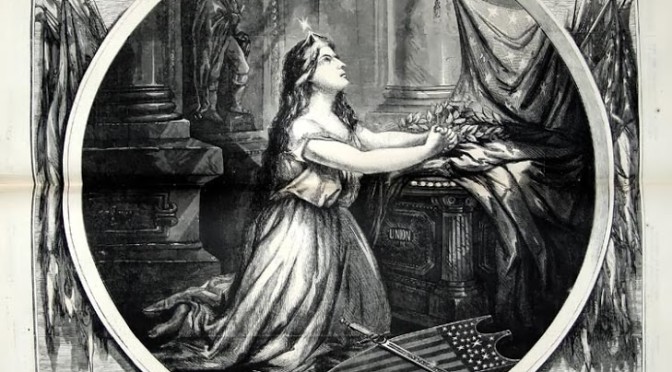
Above: A Thomas Nast illustration from Harper’s Weekly, November 1863, clearly putting the event in the context of war and hardship. 

In practice, Thanksgiving celebrates the supposed feast between the Pilgrims and their Native American neighbors in Massachusetts. But meals of ‘thanksgiving’ have been part of the Western world customs for hundreds of years, and today the meal is more an excuse to gather the family together and count the seconds until holiday shopping.

Because that ‘original’ meal was only vaguely documented, let me give you a more definite event — 150 years ago, President Abraham Lincoln declared a national celebration of Thanksgiving for the last week in November:

“I do therefore invite my fellow-citizens in every part of the United States, and also those who are at sea and those who are sojourning in foreign lands, to set apart and observe the last Thursday of November next as a day of thanksgiving and praise to our beneficent Father who dwelleth in the heavens.”

Perhaps you did a double-take at that statement.  There’s no mention of Pilgrims or Indians in Lincoln’s proclamation, which was made on October 3, 1863.  There is, of course, several soothing religious references. (You can read the entire statement here.)  After all, the United States had been fighting a Civil War for over two and a half years. Any words of peace and calm, paired with boasts of American bounty and expansion, would have put the bloody conflict in a divine context.  “[H]armony has prevailed everywhere except in the theatre of military conflict,” Lincoln wrote.

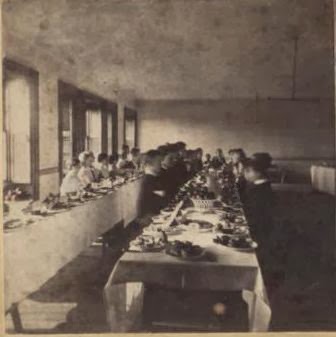
At right: Thanksgiving dinner at ‘the Home for the Friendless’, 1860s.  I cannot imagine a more grimly named institution! courtesy NYPL

New Yorkers had celebrated a form of Thanksgiving for many years prior to the 1863 proclamation.  But the feast had always been considered a regional, New England celebration, one a little foreign for the city.

From The New York Sun, November 26, 1863:  “The sights and scenes in our city yesterday afforded evident indications of a unanimous determination … to break up once and all the monopoly of Thanksgiving, so long enjoyed by the New Englanders.  For years past, it had been a standing boast of the genuine ‘Down Easters’ that the air of New York was unsuited to the festival of the Pilgrim fathers.”

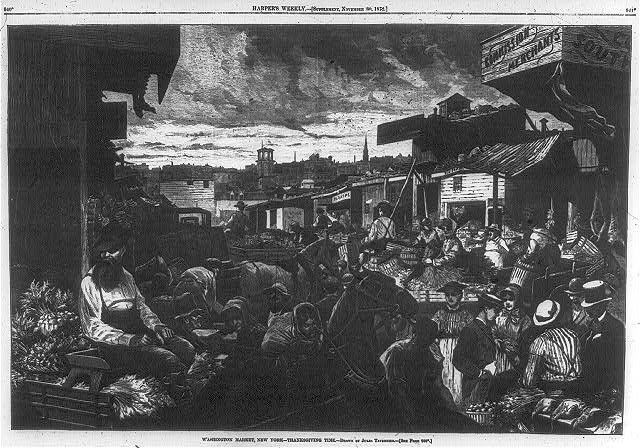
Below: Washington Market, always a hectic place, was especially so on Thanksgiving. This scene from Harper’s Weekly depicts frantic shoppers in 1872. Courtesy Library of Congress

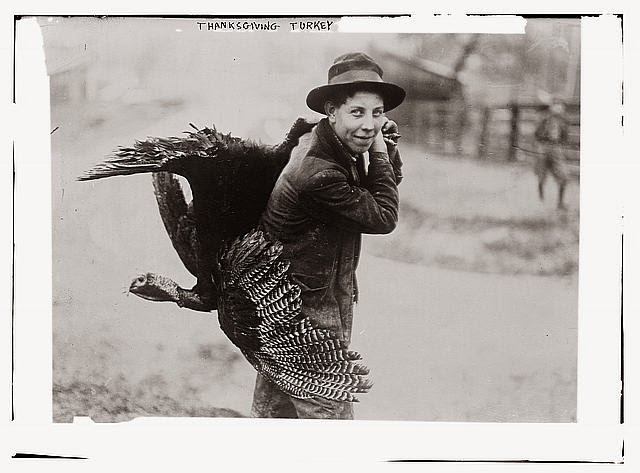
Don’t tell New Yorkers what they can’t have!  The Sun promised a “racy and peculiar” New York Thanksgiving that year.  The markets were clogged with shoppers, as New Yorkers came out in force to purchase items for their own Thanksgiving meals.  Every other man on the street seemed to have a naked bird flung over their shoulders.  “Evidentally, every family man and woman, who could raise the number of greenbacks, invested them in Thanksgiving fixings.”

This might have been a little journalistic posturing.  Just five months earlier, New York had been ablaze in the Draft Riots, several days of violence towards its own citizens, fueled by an unfair conscription policy and the fears and racial hatreds of its citizens.  Most of the burned buildings had been cleared, but the bloodshed was on many minds.  Many benefits throughout the city raised money for injured Union soldiers and the families of those who had died in battle.

The Sun quietly refers to the Draft Riots’ most sickening event, the burning of the Colored Orphan Asylum.  “At the Five Points House of Industry the little ones are to have a bountiful feast.   The colored children burnt out by the mob will be taken care of at Carmansville.”

Below: Boy with a turkey, circa 1910-1915 (LOC)

Generally speaking, celebrations went forward as they would in subsequent years — the food, the church services, the carousing, the merriment, decades before anybody would think of blowing up gigantic balloons and dragging them down Broadway.

However, one thing had been very different that year.  On the evening before Thanksgiving, New Yorkers looked up into sky and witnessed a partial lunar eclipse.

While the event might have filled some with dread, it cast a mysterious pall further south, on the battle field of Lookout Mountain in Chattanooga, Tennessee.  It occurred hours after the Confederacy’s defeat by the Union army and helped shield the Southern forces as they slipped away by cover of fog.

Alongside news of New York’s embrace of Thanksgiving, the newspapers that day reported of a victory and a death toll:  “General [Joseph] Hooker, in command of General Geary’s division, Twelfth corps, General Osterhau’s divison, Fifteenth corps, and two brigades, carried the north slope of Lookout Mountain, with small loss on our side, and a loss to the enemy of five hundred or six hundred prisoners: killed and wounded not reported.”

Dressed for success: The tradition of Thanksgiving masking, children in drag, begging for money!


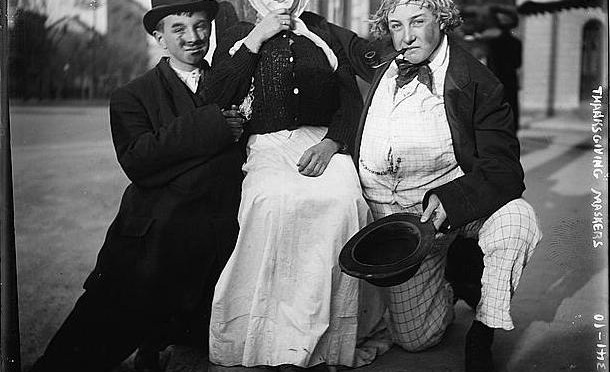
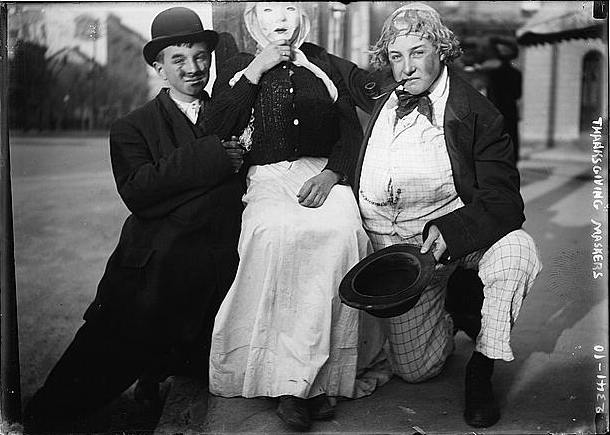
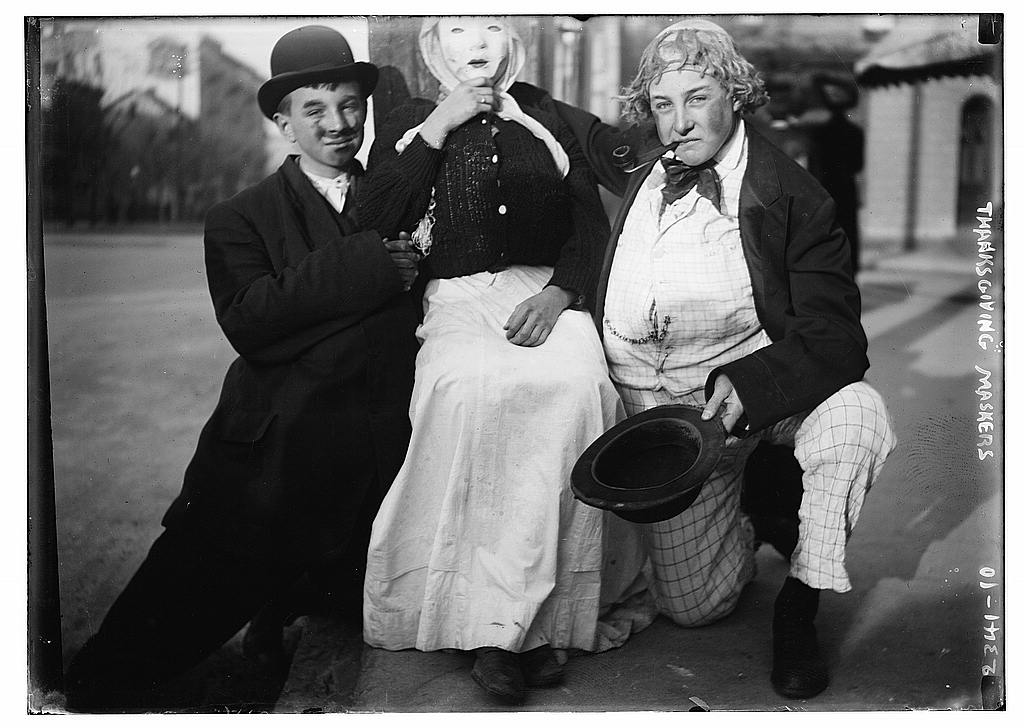
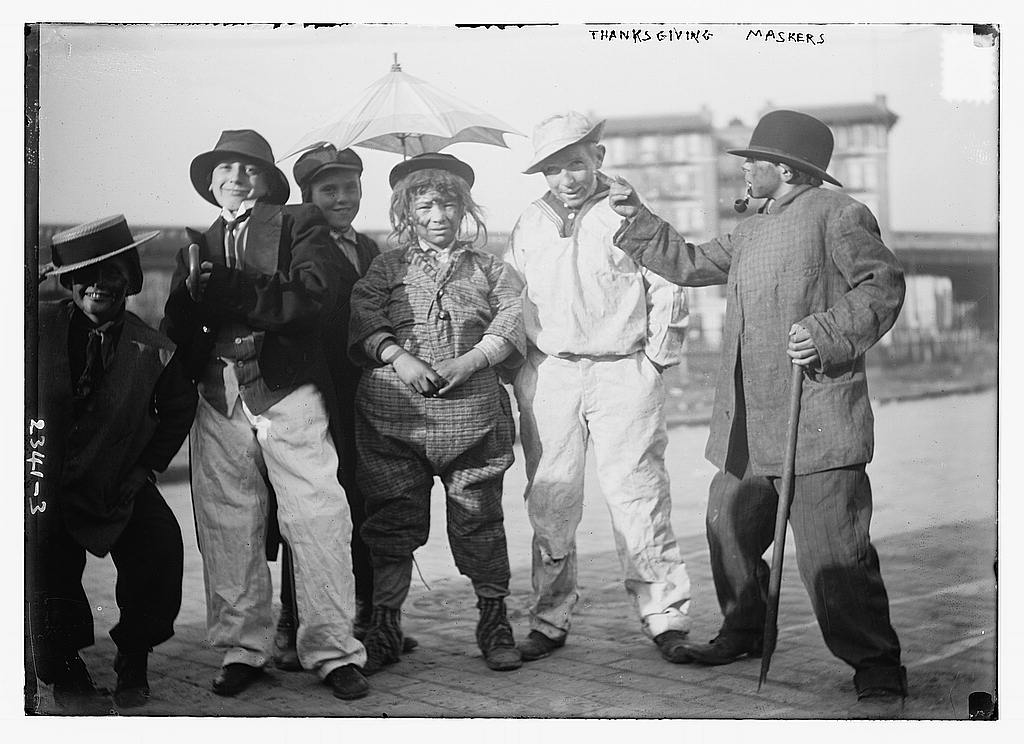
Turkey anyone? Thanksgiving maskers, in New York, taken sometime between 1910-15. Whatever you do, don’t look the ‘lady’ directly in the eye!

My new column for the Huffington Post is live, and the topic is a strange, forgotten holiday custom called Thanksgiving masking, popular among New York kids from the 1890s-1930s. Children dressed as exaggerated versions of poor people! Boys in their sisters’ clothes! I wrote about this last year at this time, but this article is newly expanded, and I’ve done a bit more research on the origins of this very odd tradition.

You can check out my story here.

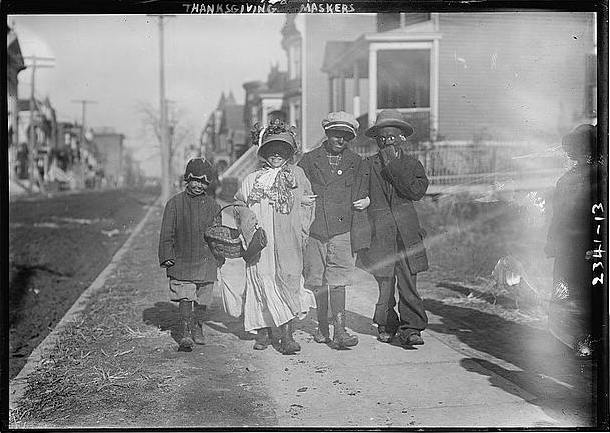
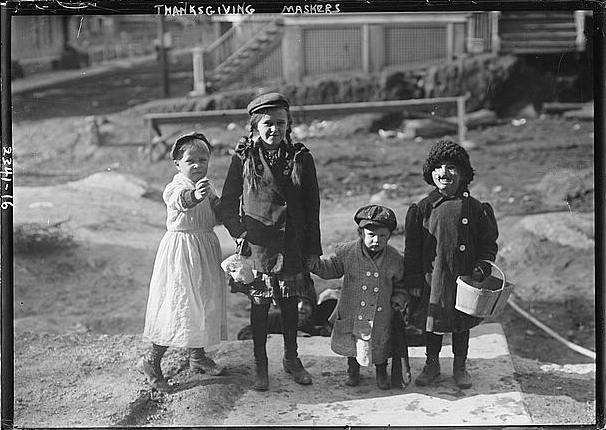
There are several archive photos attached to the article as well. However, here are a few more, courtesy the Library of Congress.

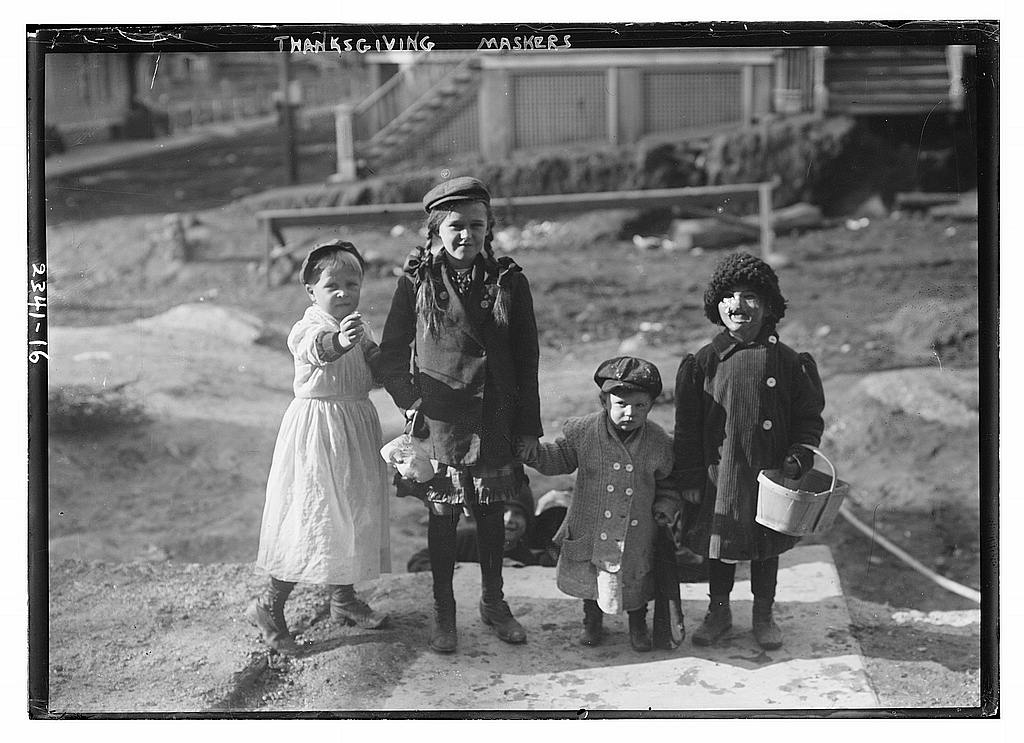
All these were taken in New York between the years 1910-15 according to file captions. However the background looks quite unfamiliar. Any guesses?

I especially love these little rascals. Cute, cute, really cute, SCARY.

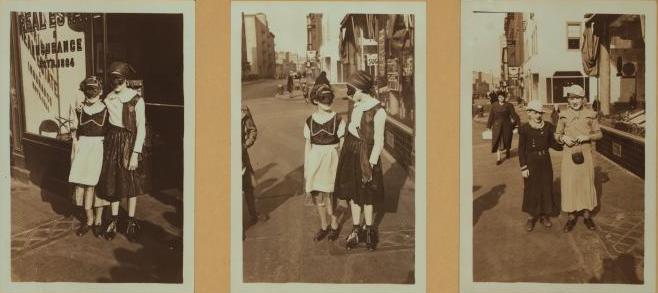
And finally, here’s a selection of small portraits of Thanksgiving maskers in the West Village in 1933. Courtesy New York Public Library

Categories
Holidays

Happy Thanksgiving Masking: The pleasures of mischief, featureless masks and cross-dressing children!

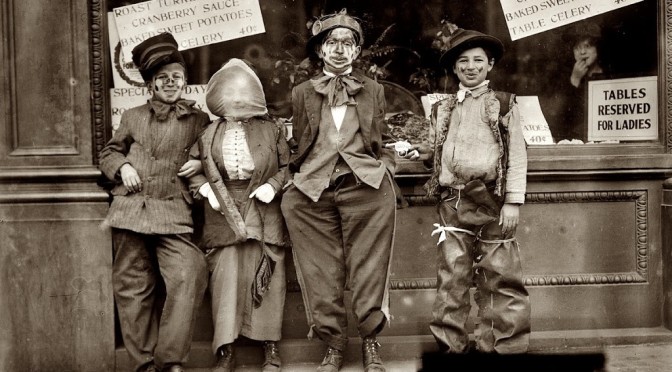
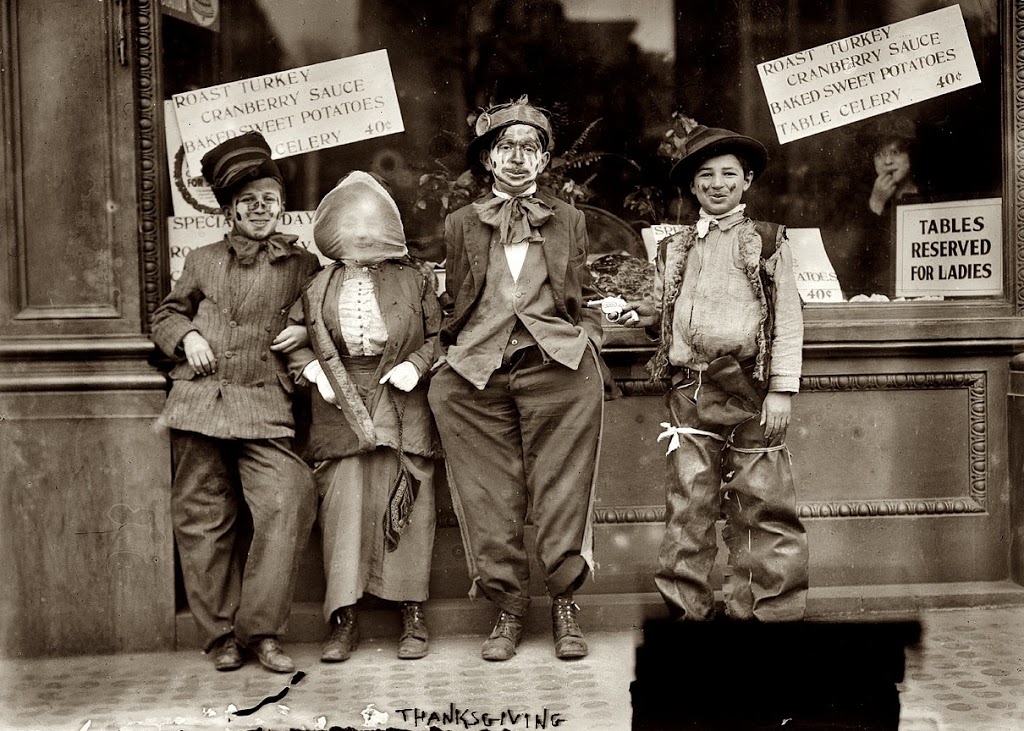
No, these children have not gotten their calendars confused. One early American Thanksgiving tradition amongst rascals and rowdies involved goofy costumes and disguised faces. Sometimes called ‘Thanksgiving masking’, the strange practice stemmed from a satirical perversion of poverty and an ancient tradition of ‘mumming’, where men in costumes floated from door to door, asking for food and money, sometimes in exchange for music. The annual Philadelphia Mummers Parade traces back to the original tradition which some believe began in the 17th century.

By the 1800s, those going door-to-door asking for handouts were most likely homeless and poor. This seems to have inspired a children’s tradition not unlike modern trick-or-treat. “Every street had its band of children,” proclaimed the 1901 Tribune, “dressed as ragamuffins, who kept in the open air for hours.”

Newspapers advertised ‘Thanksgiving masks’ and ‘lithographed character masks’ for the tots. These featureless disguises were often sold in candy stores alongside holiday related treats like spiced jelly gums, opera drops, crystallized ginger and tinted hard candies.

“This play of masking is deeply rooted in the New York child,” said Appleton’s Magazine in 1909. “All toy shops carry a line of hideous and terrifying false faces or ‘dough faces’ as they are termed on the East Side.”

Boys frequently wore girls clothing on this occasion, “tog[ging] themselves out in worn-out finery of their sisters” and spending their afternoon “gamboling in awkward mimicry of their sisters to the casual street piano.”

The New York Times in 1899 found the streets filled with costumed tricksters that Thanksgiving. “There were Fausts, Filipinos, Mephistos, Boers, Uncle Sams, John Boers, Harlequins, bandits, sailors… In poorer quarters a smear of burned cork and a dab of vermilion sufficed for babbling celebrants.”

Those that benefited most — outside of the costumed children, obviously having a ball — were the candy stores that both sold the masks and provided the sweets distributed to the little devils. In particular, Loft Candy stores, headquartered at the corner of West 42nd Street and Eighth Avenue, ran spectacular ads filled with Thanksgiving themed candy treats.

In general however it’s difficult to find too much enthusiasm for this unsavory tradition in newspapers of the day. Thanksgiving was (and continues to be) one of the most austere holidays. Poor, cross-dressing, shoddy-garbed children in masks flew in the face of this perception and was generally discouraged. Editors preferred to focus on family gatherings, recipes and table placements, not only out of social convention but on the behest of advertisers, who made more money selling turkey and china than cheap masks.

While the chaotic tradition was associated with poverty and mischief, some educators saw a bright side to the tradition, especially in the waning years of World War I. One writer on early Kindergarten practices suggested that “the masking on the streets of Thanksgiving Day … has its redeeming quality, in reminding the children of our dear soldiers’ need for real masks.” They would be referring to gas masks. Educational indeed!

Such mischief, not surprisingly, occasionally went out of control. For instance, the New York Tribune in 1907 reports a poor lad “in mask and fantastic garb” who was hit by a train and had his leg amputated.

With the rise and commercialization of Halloween, the practice of Thanksgiving masking seems to have died out. And the entrance of the Macy’s Thanksgiving Day parade in 1924 certain gave focus to the city’s need for costumed celebration.

NOTE: These photos are from the Library of Congress. As such, the locations are unmarked. Most likely they are all of New York children, but a few may be children from other cities in delirious states of costume. (The top photo is courtesy Shorpy)

Happy Thanksgiving!