You better clean your room or you’ll end up like the Collyer Brothers.
New York City, a city crammed of 8.6 million people. It’s filled with stories of people who just want to be left alone – recluses, hermits, cloistering themselves from the public eye, closing themselves off from scrutiny.
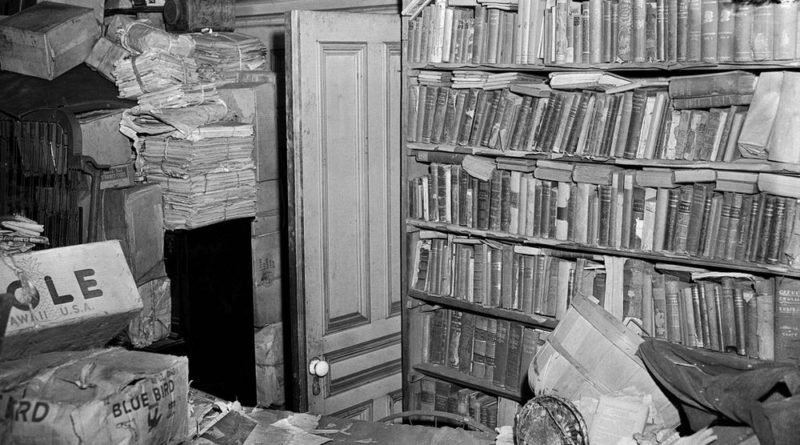
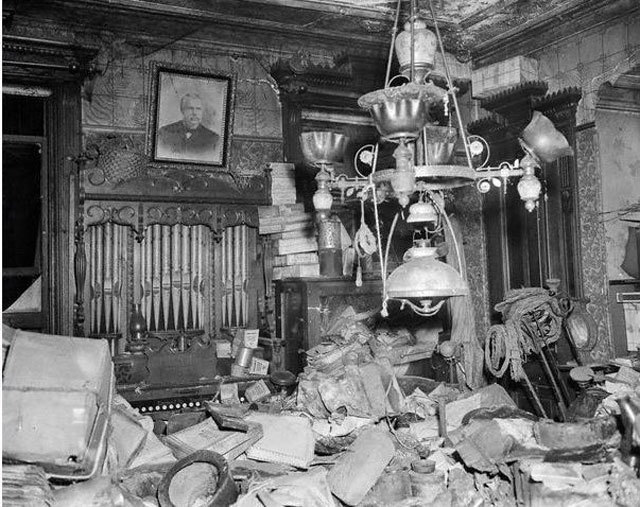
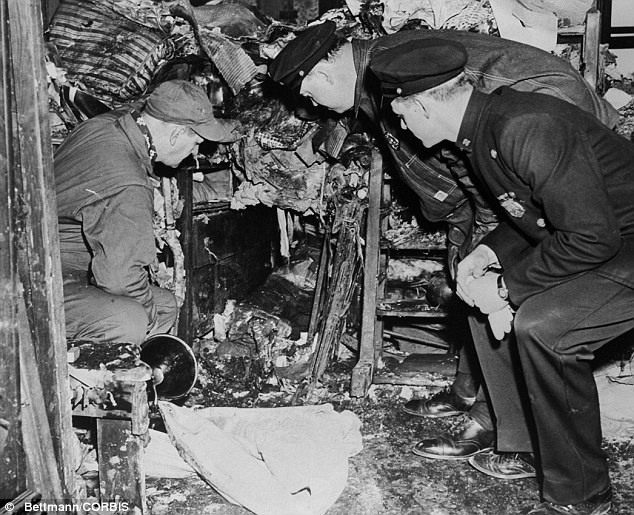
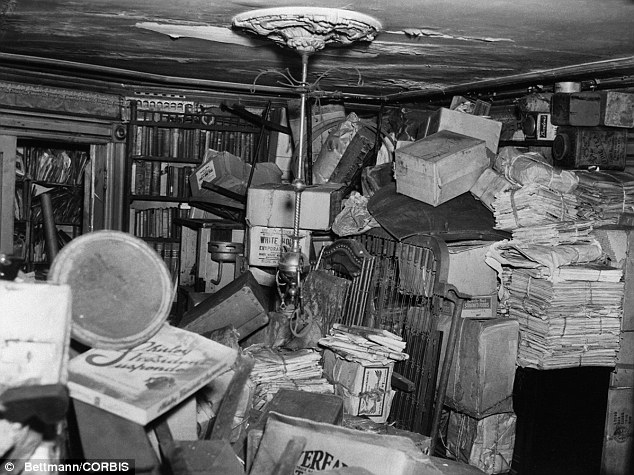
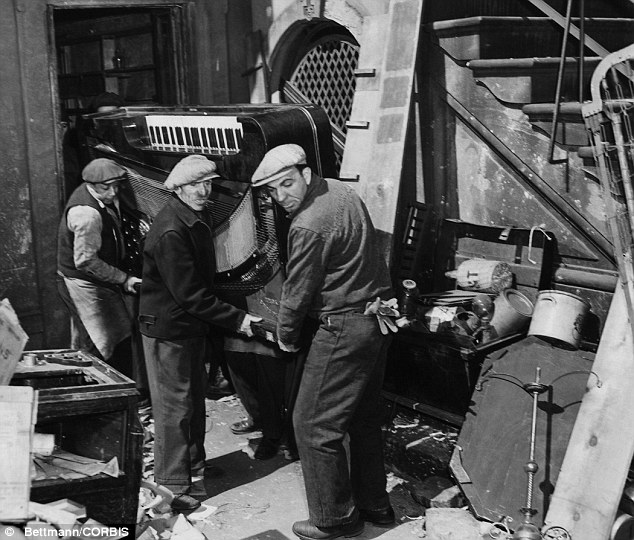
But none attempted to seal themselves off so completely in the way that Homer and Langley Collyer attempted in the 1930s and 1940s. Their story is infamous. In going several steps further to be left alone, they in effect drew attention to themselves and to their crumbling Fifth Avenue mansion – dubbed by the press ‘the Harlem house of mystery’.
They were the children of the Gilded Age, clinging to blue-blooded lineage and drawing-room social customs, in a neighborhood that was about to become the heart of African-American culture. But their unusual retreat inward — off the grid, hidden from view — suggested something more troubling than fear and isolation. And in the end, their house consumed them.
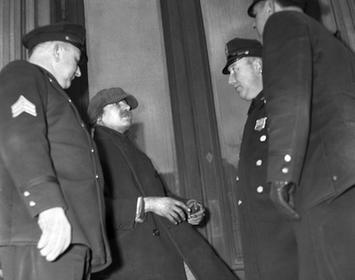
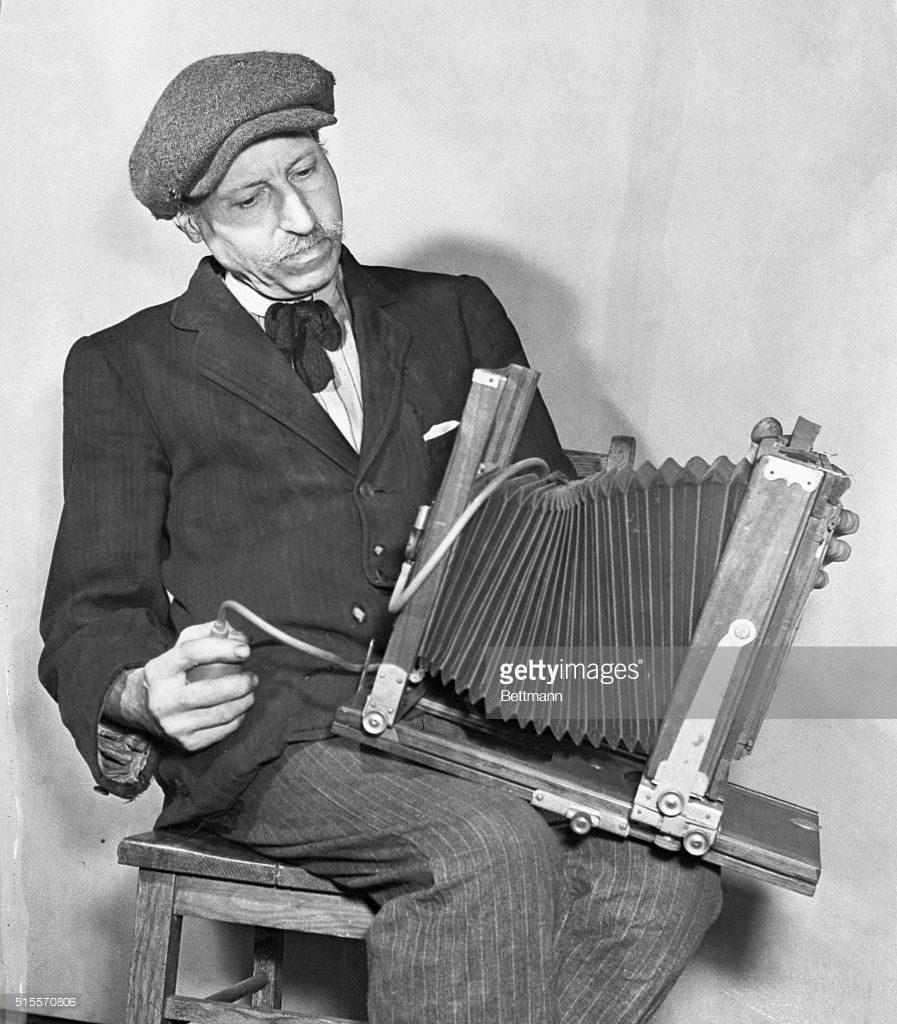
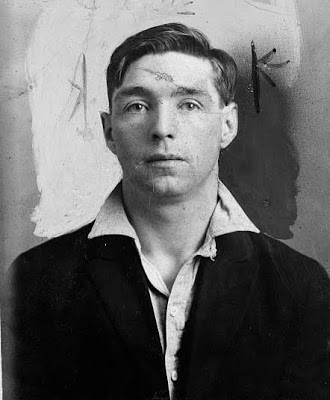
Langley Collyer, 1942, at his New York Herald Tribune photo shoot
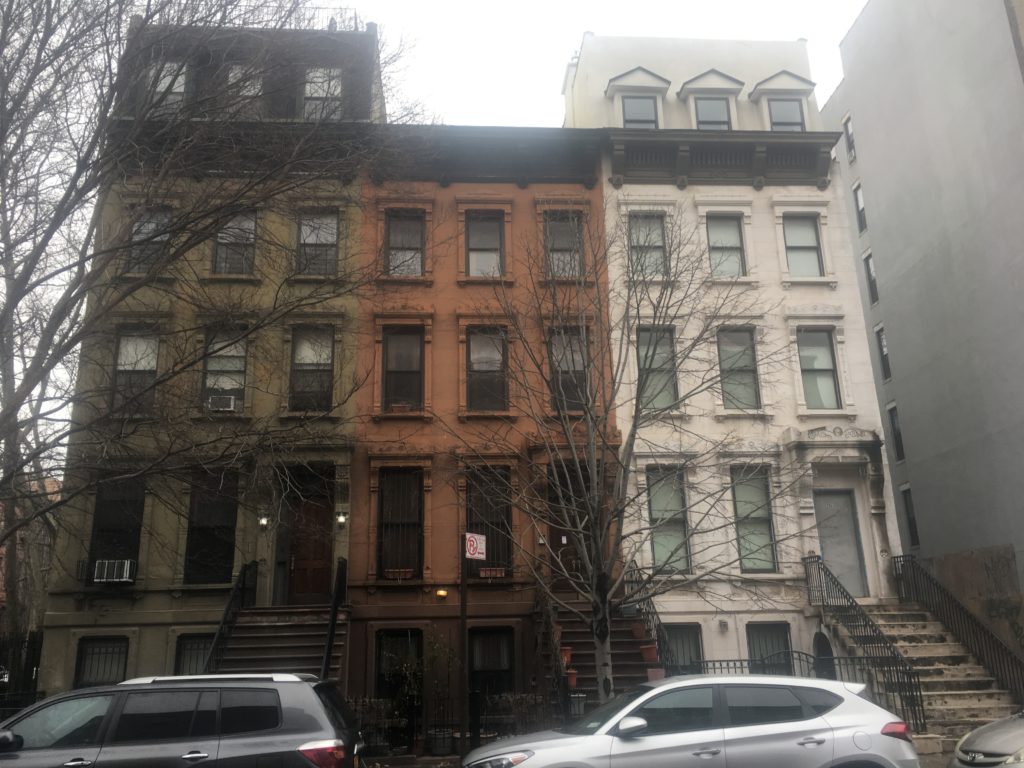
The three remaining rowhouses developed by George J. Hamilton. The middle house gives you some idea of what the Collyer mansion looked like.
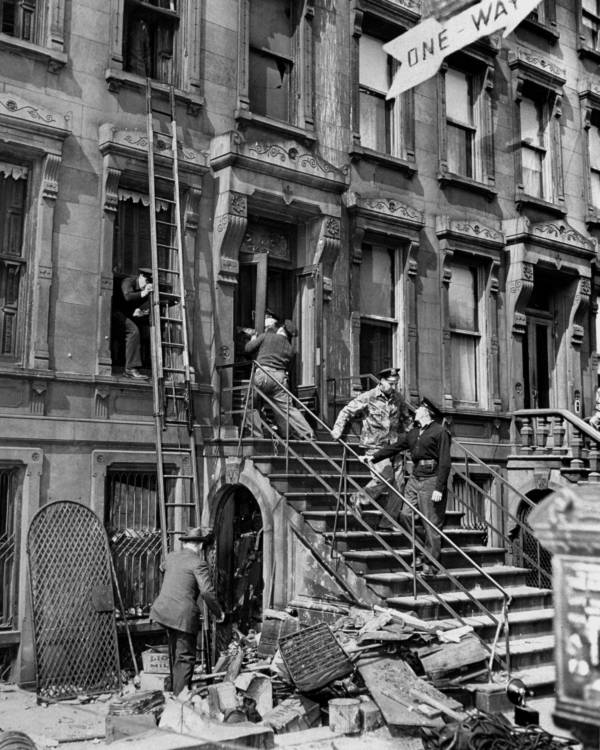
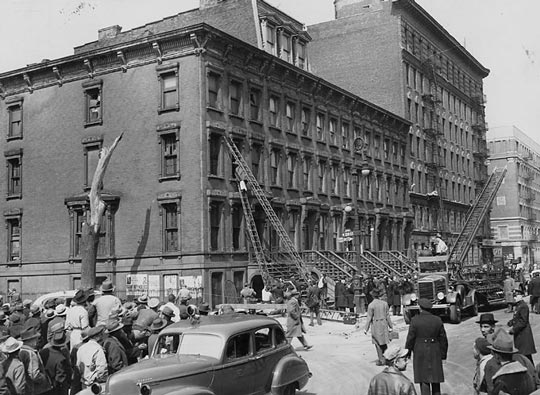
Charles Hoff / NY Daily News
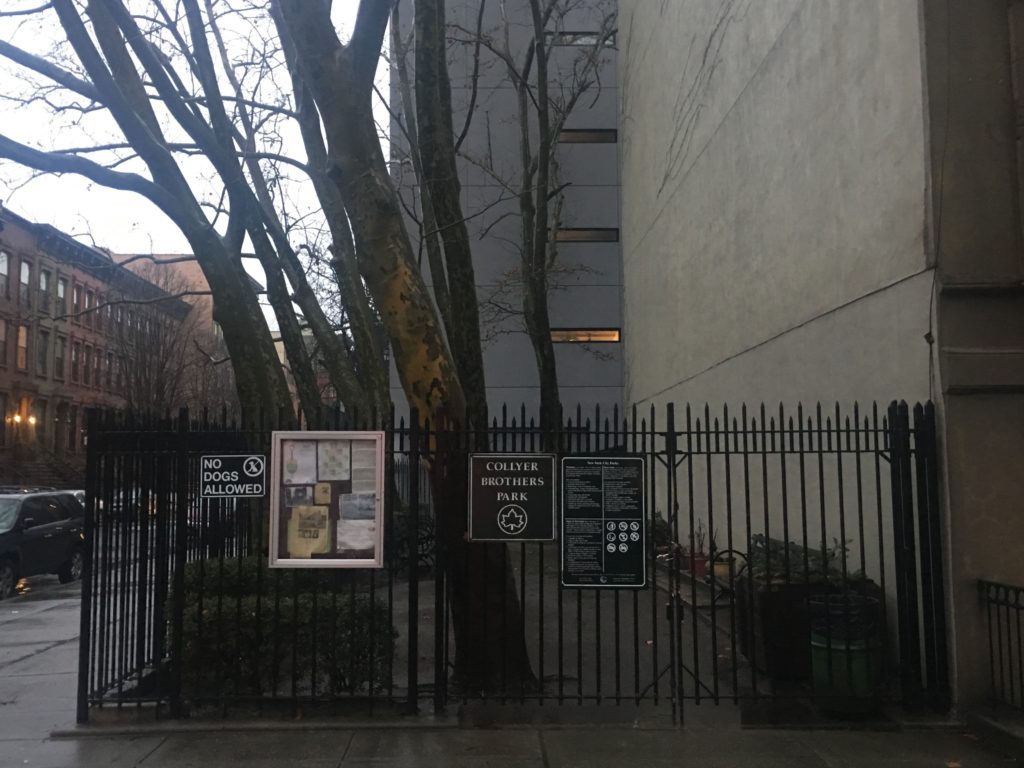
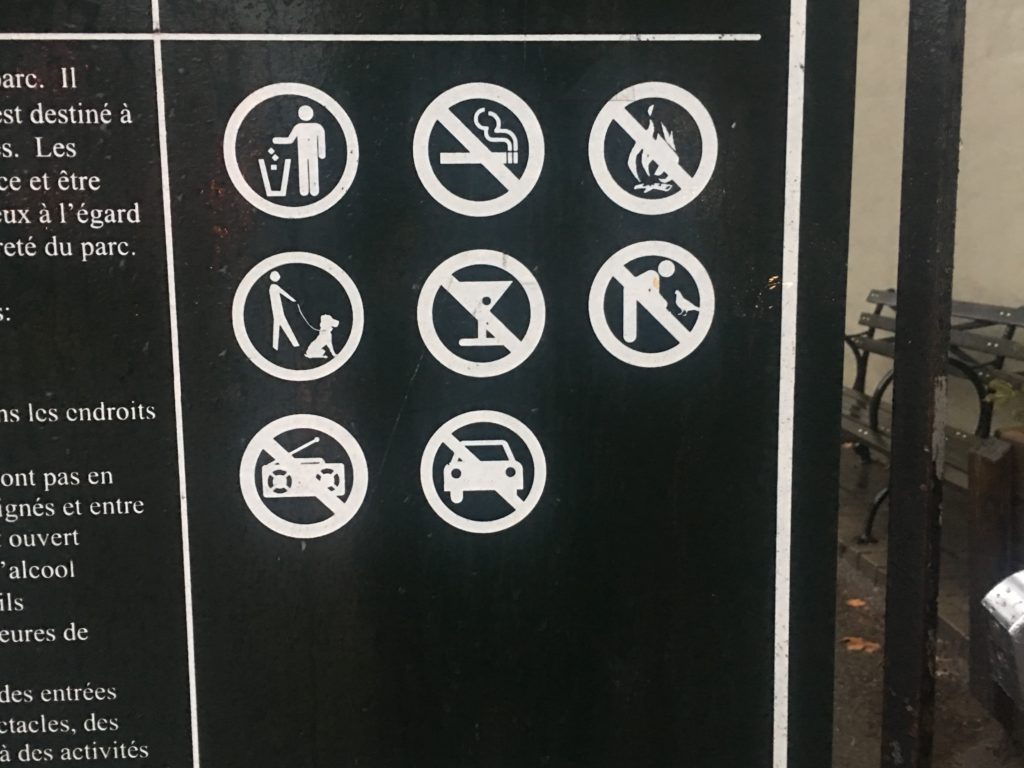
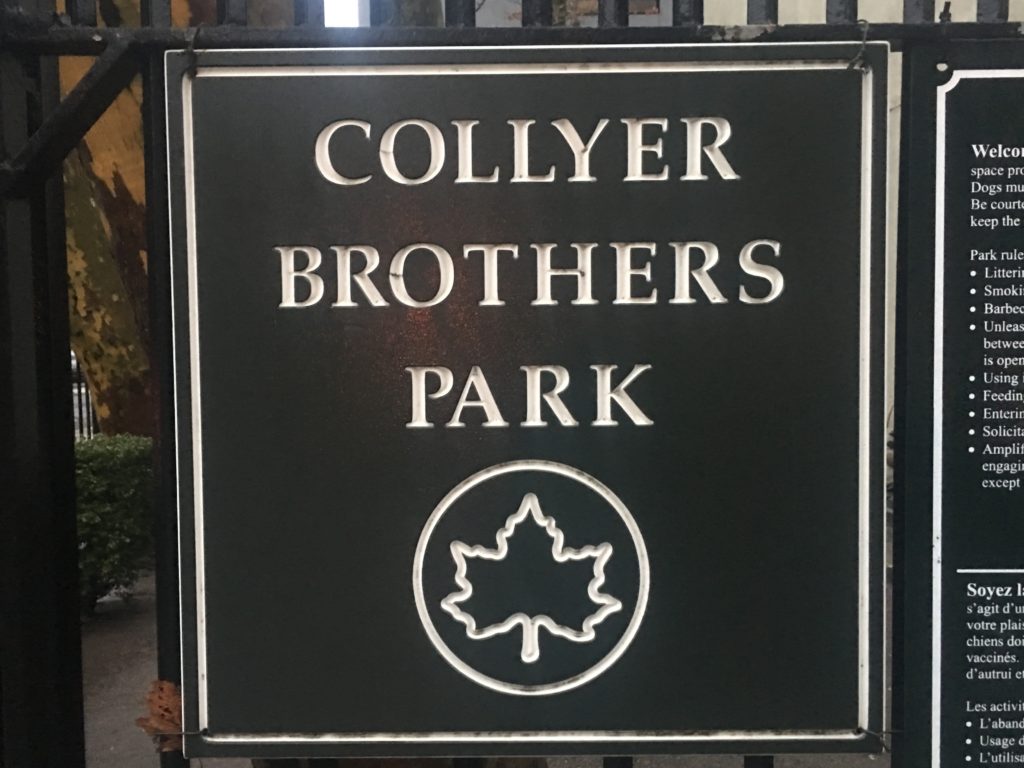
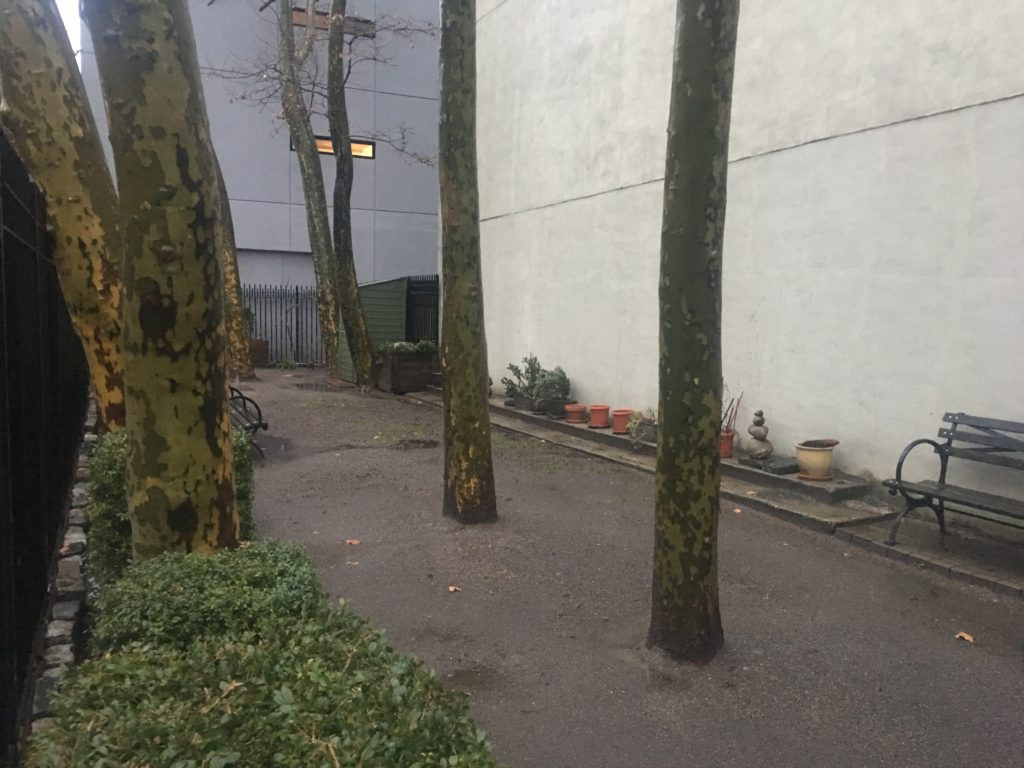
No littering in Collyer Brothers Park!
Silent footage taken outside the Collyer house, 1947
FURTHER READING
Homer and Langley by E.L. Doctorow Out of this World by Helen Worden Erskine Stuff: Compulsive Hoarding and the Meaning of Things by Randy O. Frost and Grail Steketee Ghosty Men by Franz Lidz
FURTHER LISTENING
We’ve visited the back story of famous recluses in past shows with the story of Big Edie and Little Edie Bouvier (Grey Gardens) and the legendary film actress Greta Garbo:
And the story of changing Harlem is profiled in the biography episode of the great Madam C. J. Walker
Howard Philip Lovecraft — aka H.P. Lovecraft — was born 130 years ago this week (on August 20, 1890) in Providence, Rhode Island.
The pulp-fiction storyteller, known for claustrophobic tales of the occult, lived for a time in Brooklyn. He did not enjoy it.
In 1924, he moved to 259 Parkside Avenue in Flatbush, Brooklyn, close to Ebbets Field and Prospect Park. When his new wife relocated for work in Cincinnati, Lovecraft moved from the pleasant Flatbush neighborhood to a small flat at 169 Clinton Street in Brooklyn. He only lived here until 1926 but during his stay, possessed of anxiety and neurosis, he practically starved himself.
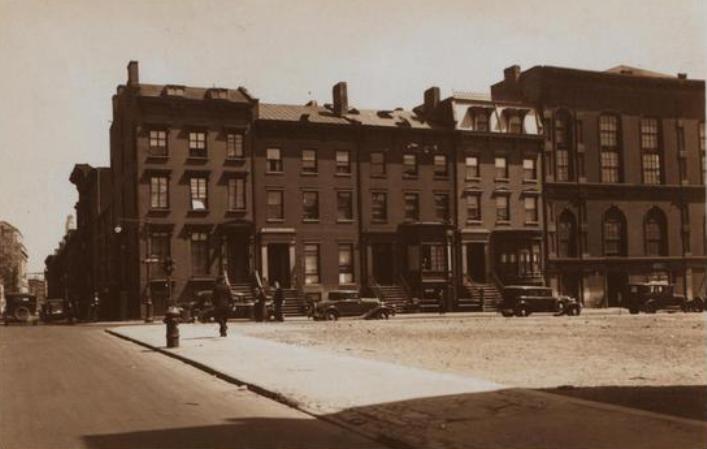
Below: The boardinghouse at 169 Clinton Street, pictured here at left, from 1935. The first four buildings still exist. The building at the far right is the old Brooklyn Athenaeum.
Courtesy New York Public Library
Lovecraft had contempt for New York’s thriving immigrant population and those workers who sustained Brooklyn waterfront in the 1920s. In particular he negatively interacted with the residents of Brooklyn’s so-called “Little Syria” on Atlantic Avenue.
I find his invective ugly and even a little obsessive, but it illustrates that occasional truth that the culture of New York City is simply not for everybody, especially if you have certain racist dispositions mixed with a little mental instability.
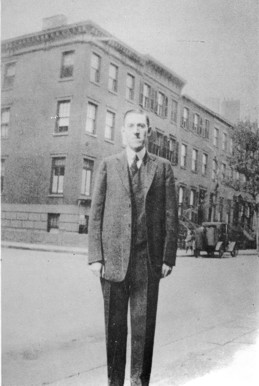
Below: Lovecraft in Brooklyn Heights in 1925. The house behind him may be his Clinton Street boarding house. Compare to the image above and the current view here. (Photo courtesy HPL.com)
In a comparison with Philadelphia, Lovecraft wrote “[Philadelphia has] none of the crude, foreign hostility and underbreeding of New York — none of the vulgar trade spirit and plebian hustle.” He further described New York as “an Asiatic hell’s huddle of the world’s cowed, broken, inartistic, and unfit.” [source]
According to author Donald Tyson, “when [H.P.’s wife Sonia] and Lovecraft were walking the streets of New York and encountered a group of immigrants, Lovecraft would become so animated and enraged that she feared for his sanity.”
The renovated, wealthy houses of today’s Brooklyn Heights were often working-class housing in the 1920s, many turned into affordable boarding houses. Lovecraft disliked his ethnic neighbors and held particular scorn for his Irish landlady. “Only later was I to learn of her shrewish tongue, desperate household negligence, miserly watchfulness of lights and unwatchfulness of repairs, and reckless indifference to the class of lodger she admitted.” [source]
He would have lived with mostly single men of differing ethnicity, many employed along the congested docks that lined the waterfront all the way down to Red Hook, culminating in two self-contained shipping areas — the Atlantic and Erie basins. Back in the 1920s, it was the busiest freight port in the entire world.
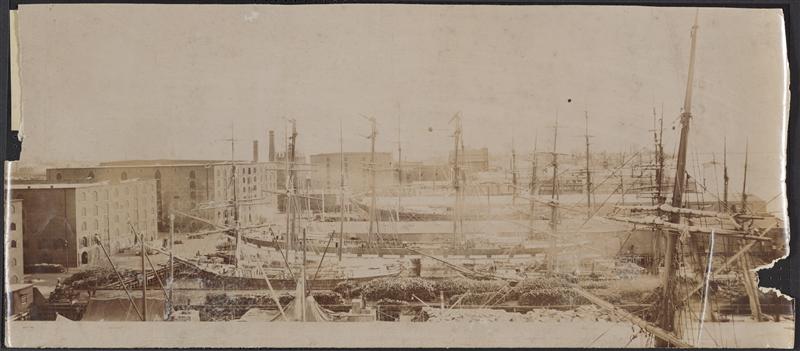
Below: Ships along the waterfront heading towards Red Hook, circa 1890
Courtesy Museum of the City of New York
He seemed to filter all his untethered anxiety into the very building at 169 Clinton Street. “I conceived the idea that the great brownstone house was a malignly sentient thing — a dead, vampire creature which sucked something out of those within it and implanted in them the seeds of some horrible and immaterial psychic growth.”
Yet Lovecraft saved his greater fantasies for the neighborhood south of here. He eventually funneled all this tortured and deranged hysteria into his horror writing with the publication of “The Horror at Red Hook,” a story that literally depicts the neighborhood as a gateway to Hell. Naturally he wrote it over a two-day period from the Brooklyn Heights boardinghouse.
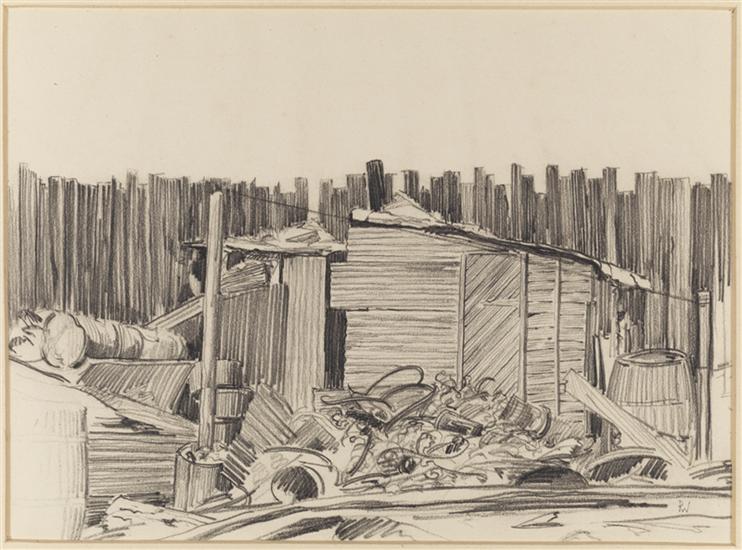
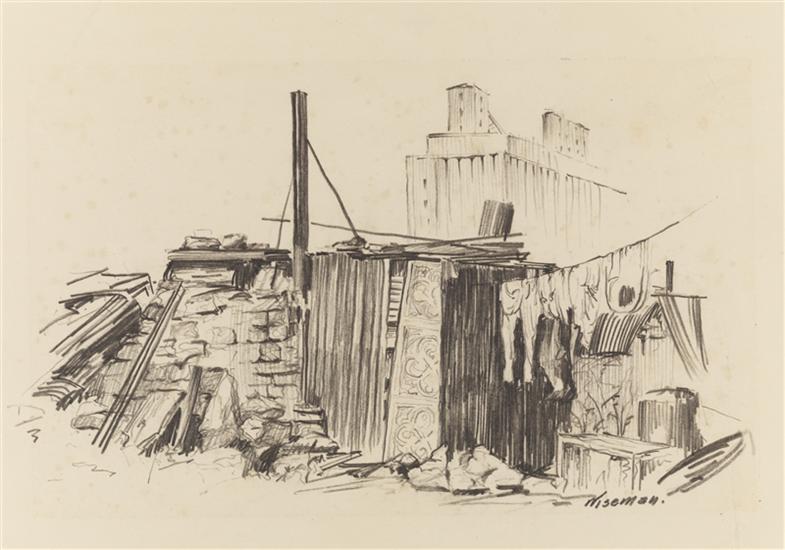
Below (the next two pictures): Some striking illustrations by Robert Cummings Wiseman of shanties around the Atlantic Basin in 1930, courtesy the Museum of the City of New York
The short story, one of his best known, is an amusing curiosity to read today. Its a muddled, sometimes incomprehensible work with some occasional flashes of creepy description. Clearly the story is self-therapy as much as it is an actual story, an early 20th century entry in the field of conspiratorial fiction. It’s undeniably haunting if you manage to forgive the vast amount of virulent, anti-immigrant description:
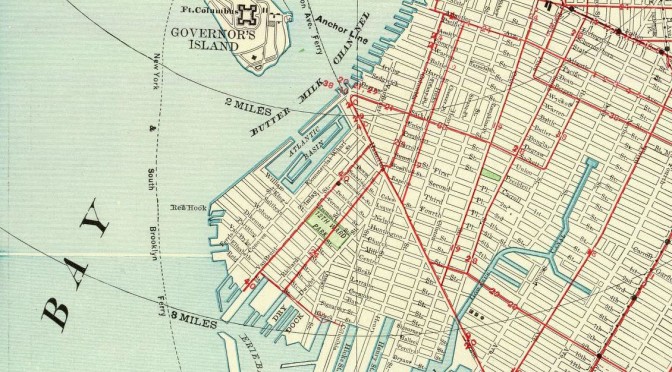
“Red Hook is a maze of hybrid squalor near the ancient waterfront opposite Governor’s Island, with dirty highways climbing the hill from the wharves to that higher ground where the decayed lengths of Clinton and Court Streets lead off toward the Borough Hall. Its houses are mostly of brick, dating from the first quarter to the middle of the nineteenth century, and some of the obscurer alleys and byways have that alluring antique flavour which conventional reading leads us to call “Dickensian”.
The population is a hopeless tangle and enigma; Syrian, Spanish, Italian, and negro elements impinging upon one another, and fragments of Scandinavian and American belts lying not far distant. It is a babel of sound and filth, and sends out strange cries to answer the lapping of oily waves at its grimy piers and the monstrous organ litanies of the harbour whistles.”
Courtesy Museum of the City of New York
I won’t spoil any of the plot points of the story. (If you’re interested in reading ‘The Horror At Red Hook’, you can check it out here. ) But let’s just say the author confirms his suspicions — the street gangs and liquor rackets of the Prohibition era are really just dens of age-old evil:
“The soul of the beast is omnipresent and triumphant, and Red Hook’s legions of blear-eyed, pockmarked youths still chant and curse and howl as they file from abyss to abyss, none knows whence or whither, pushed on by blind laws of biology which they may never understand. As of old, more people enter Red Hook than leave it on the landward side, and there are already rumours of new canals running underground to certain centres of traffic in liquor and less mentionable things.”
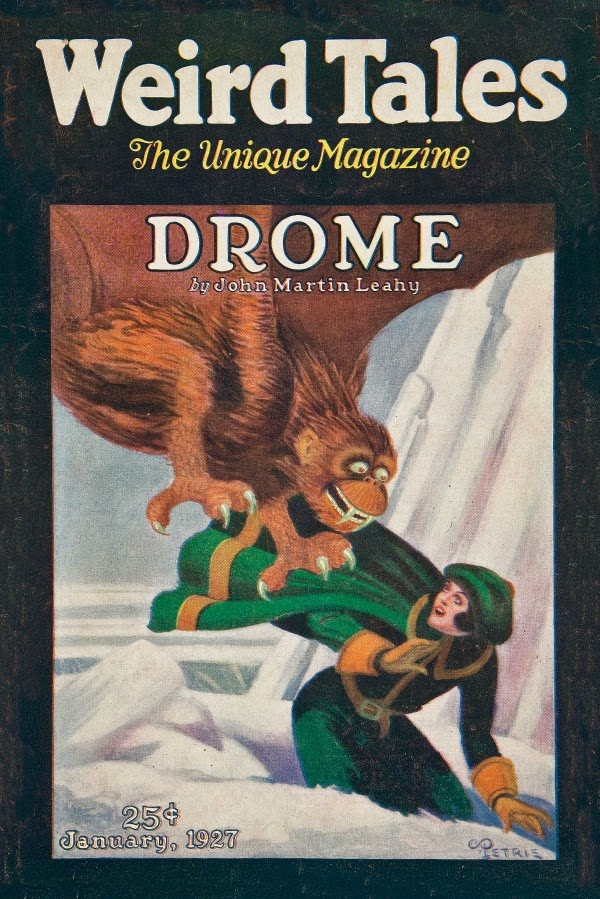
The story would be published in 1927 in the pulp magazine Weird Tales. Notably, their offices were in Chicago, not in New York
Once he left New York, he pursued some of his more famous writing projects, using his anxiety to more disturbing effect in runic, terror-filled stories of the occult. He died in 1937, revered by many as a truly boundary-breaking writer, greatly inspiring writers like Stephen King.
It would be almost fifty years before an author attempted to look at south Brooklyn with similar monstrous intent — in the 1970s horror novels The Sentinel and The Guardian by Jeffrey Konvitz.
Top picture: Detail from a 1897 Rand McNally map of Brooklyn
PODCAST (EPISODE 310):New York’s 369th Infantry Regiment was America’s first black regiment engaged in World War I. The world knew them as the Harlem Hellfighters.
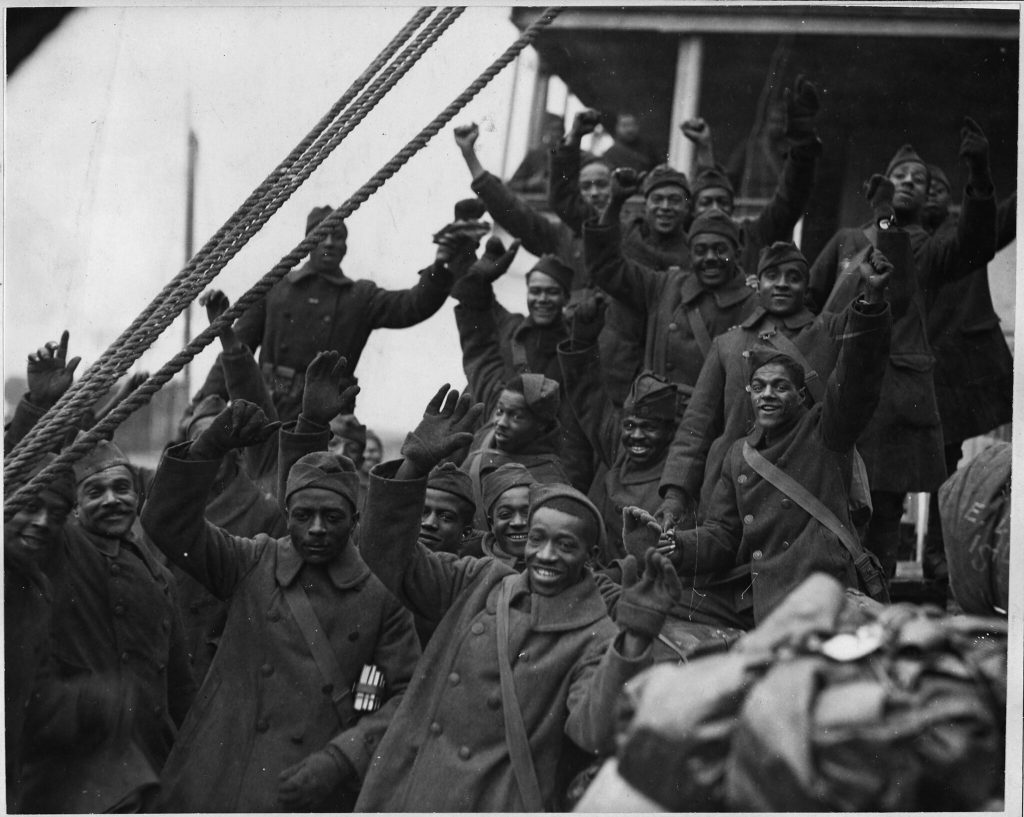
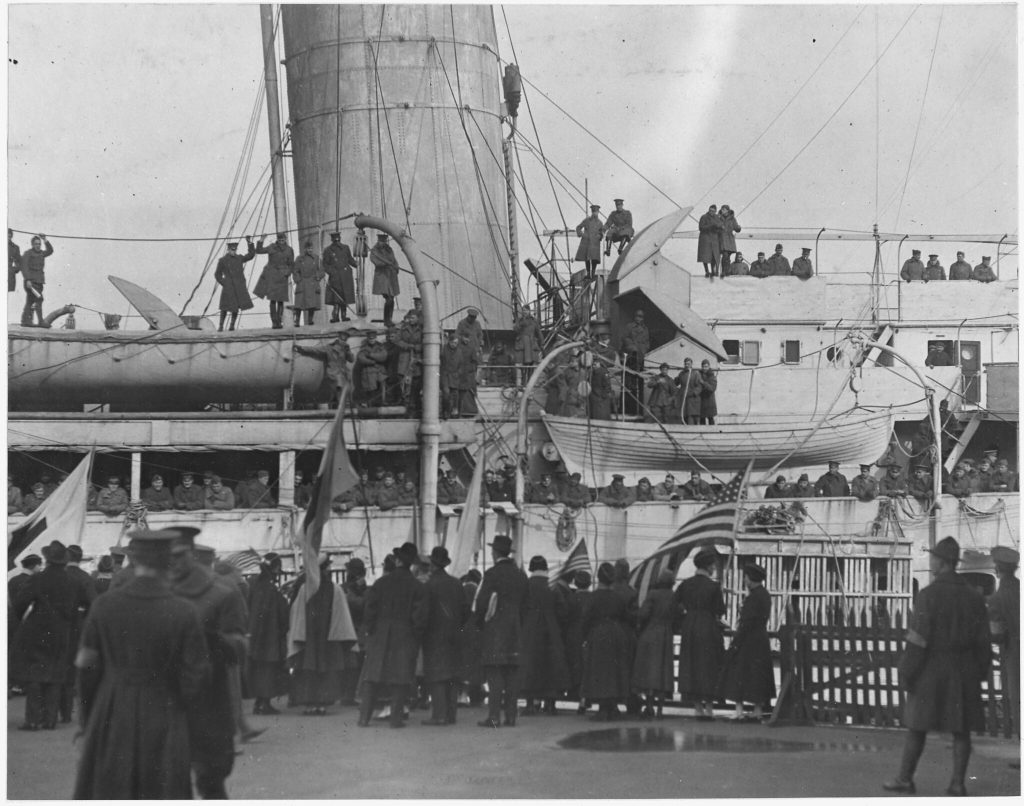
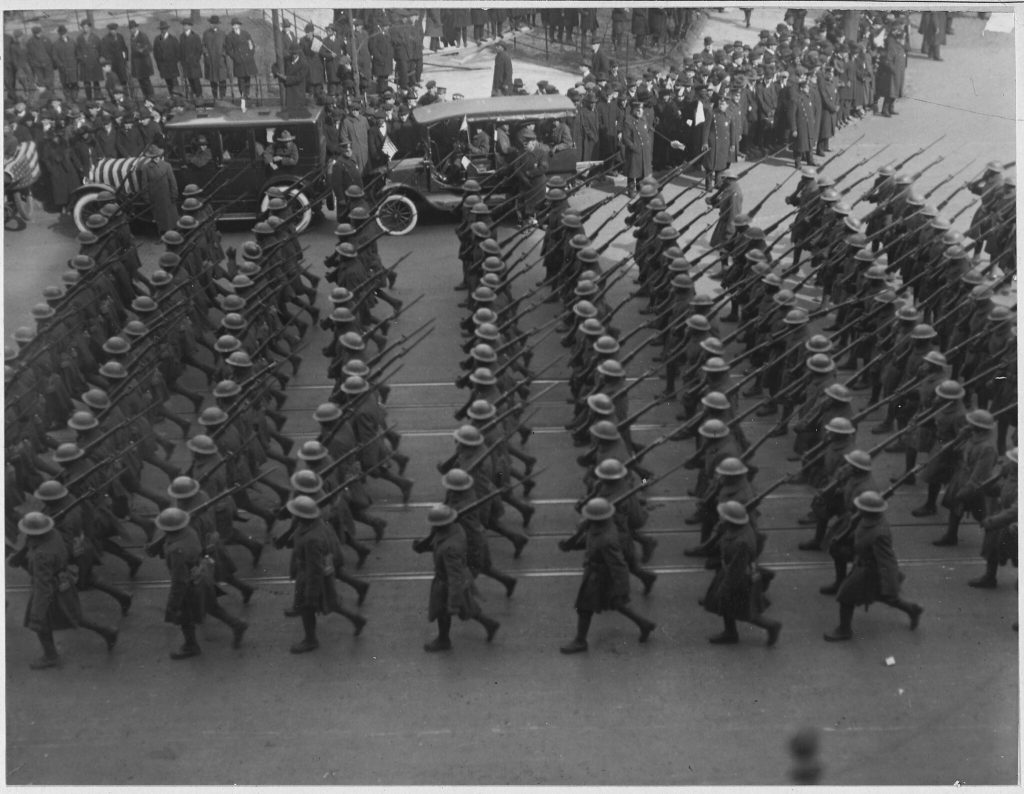
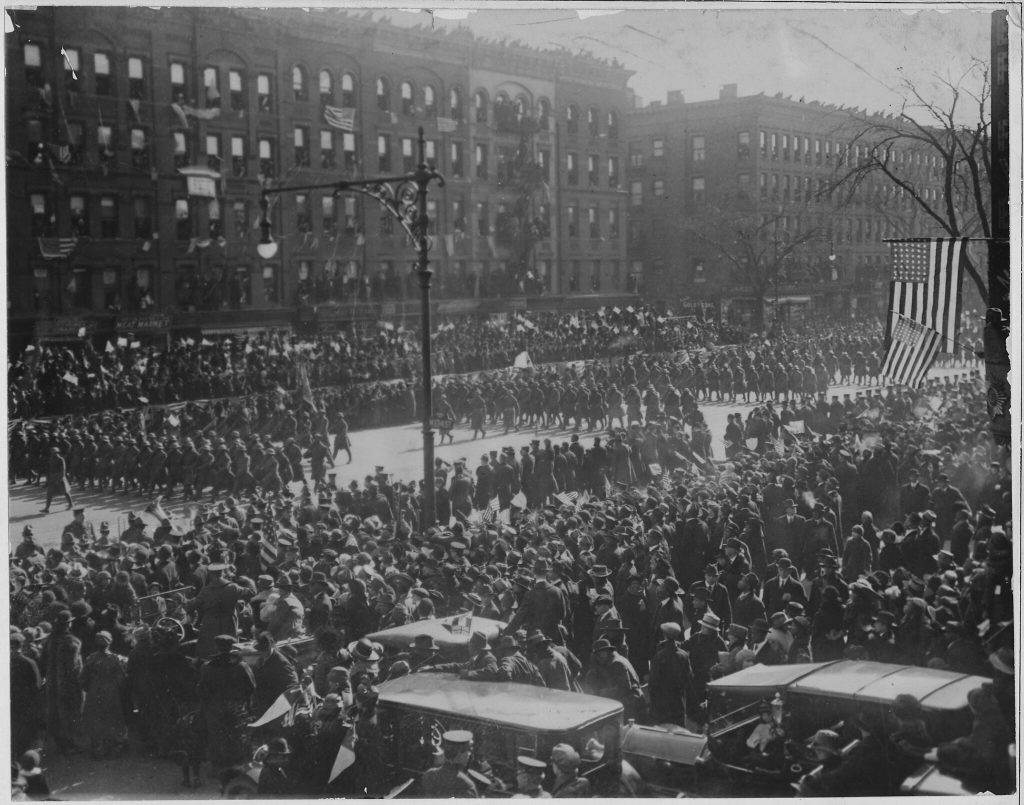
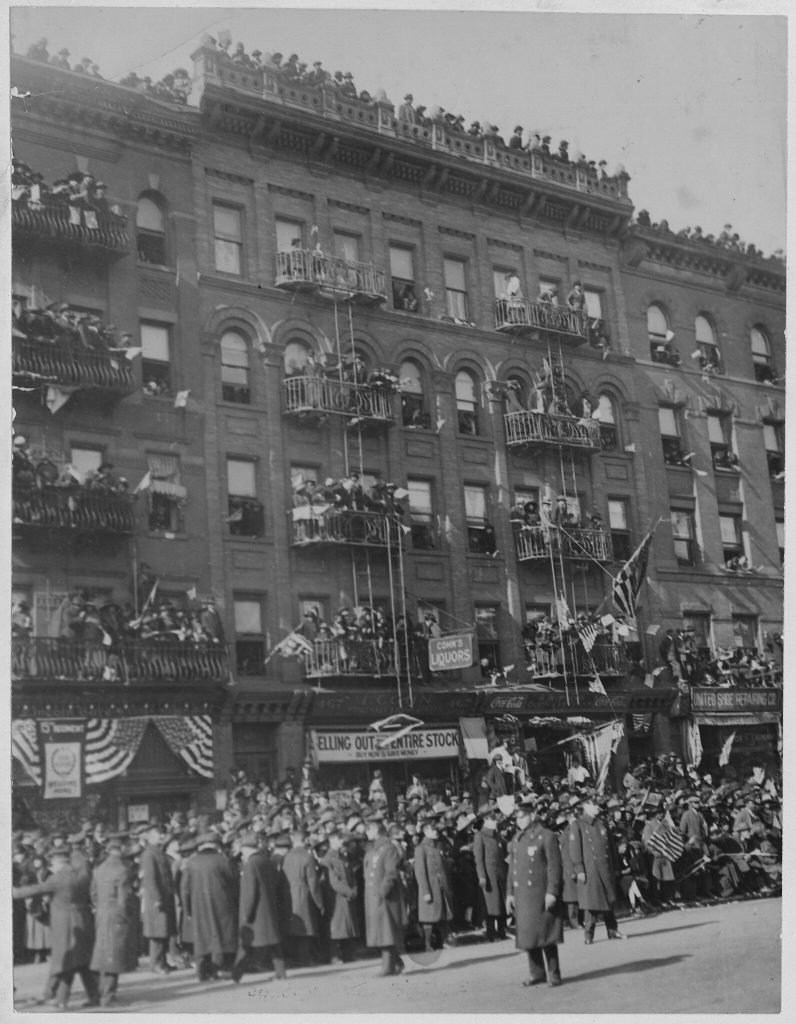
On February 17, 1919, the Hellfighters – who had spent much of the year 1918 on the frontline – marched up Fifth Avenue to an unbelievable show of support and love.
The Harlem Hellfighters were made up of young African-American men from New York City and the surrounding area, its enthusiastic recruits made up of those who had arrived in the city during a profound period of migration from the Reconstruction South to (only slightly) more tolerant Northern cities.
They were not able to serve in regular American military
units because of segregation, but because of an unusual series of events, the
regiment instead fought alongside the French in the trenches, for 191 days,
more than any other American unit.
They were known around the world for
their valor, ferocity and bravery. This is the story of New York musicians, red
caps, budding painters, chauffeurs and teenagers just out of school, serving
their country in a way that would become legendary.
FEATURING the voices of World War I veterans telling their own stories. PLUS some brilliant music and a story from Barack Obama (okay it’s just a clip of the former president but still.)
LISTEN NOW — THE HARLEM HELLFIGHTERS
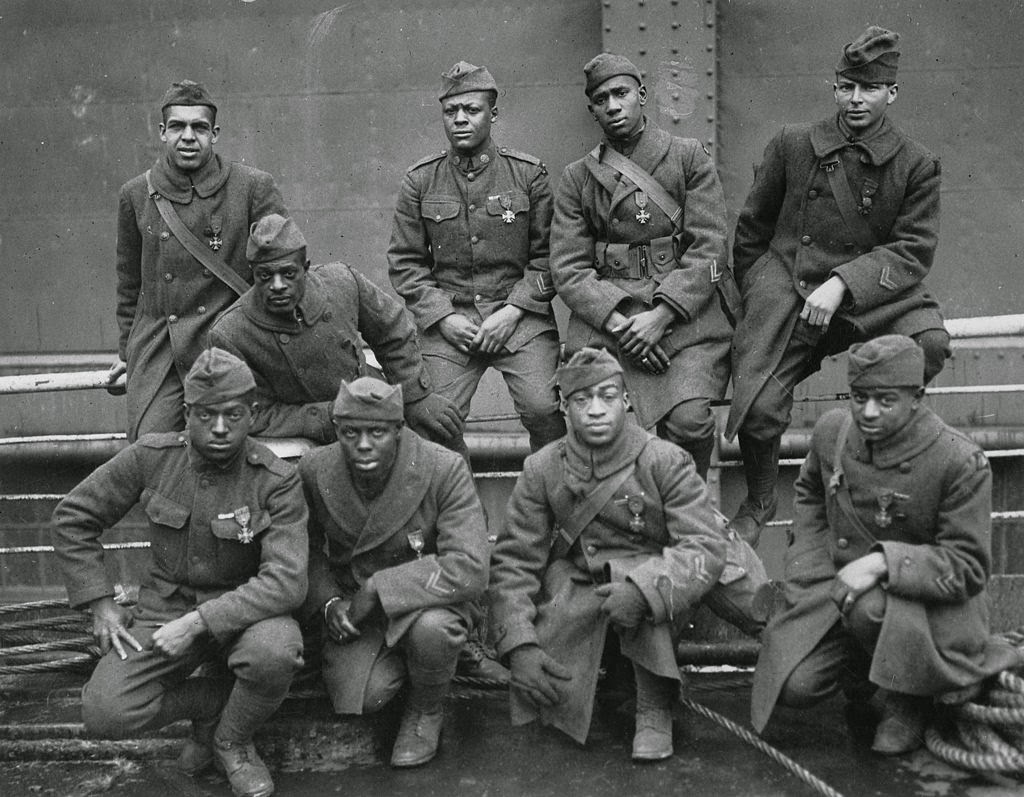
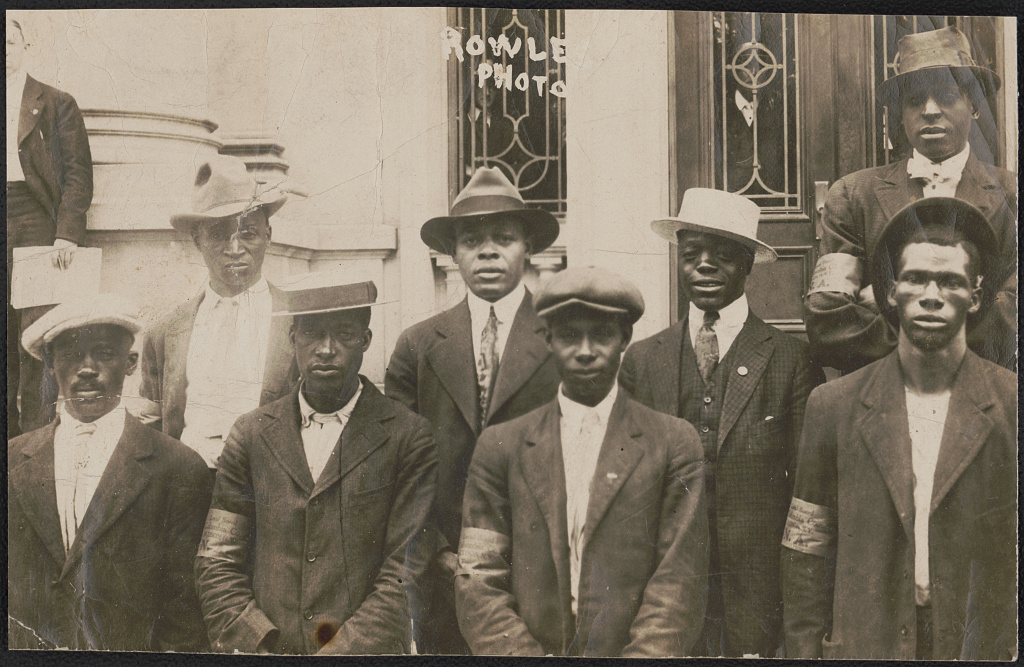
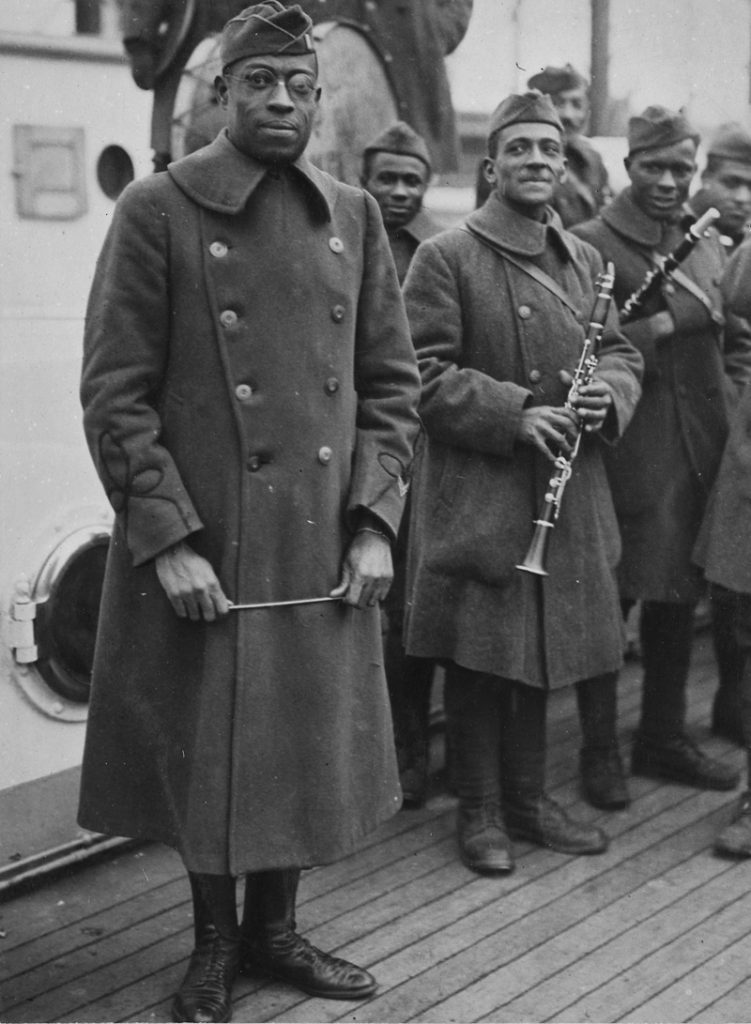
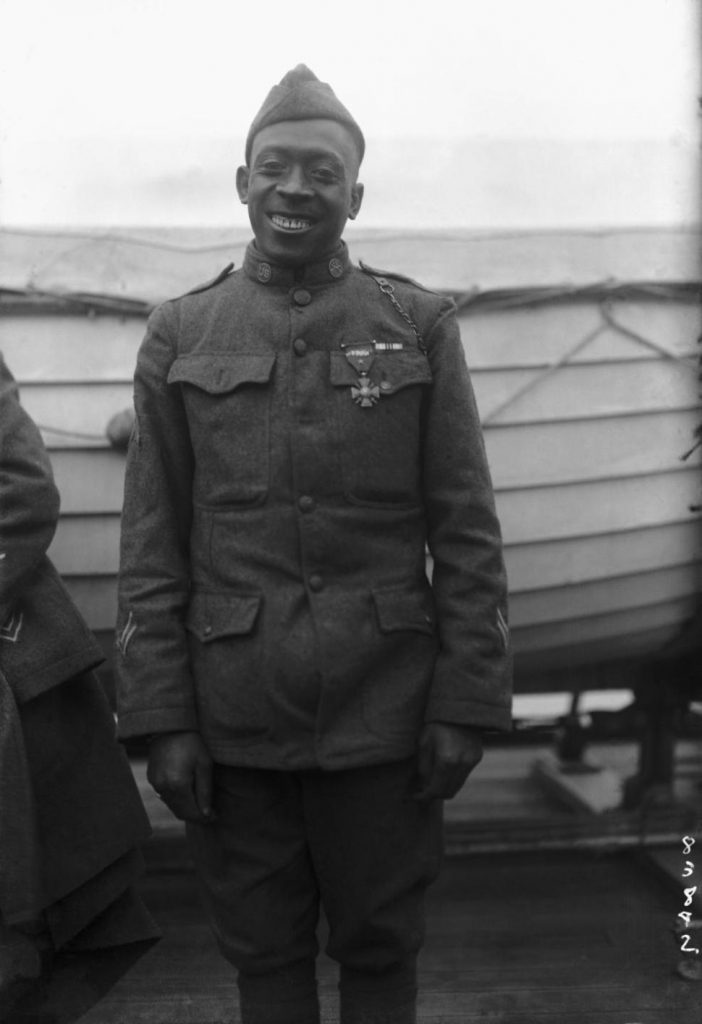
Photograph shows group portrait of men recruited for the 15th New York National Guard Regiment, later known as the 369th Infantry Regiment (the Harlem Hellfighters), wearing armbands. Library of Congress.James Reese Europe, who both fought on the front lines AND brought jazz to France.Henry Johnson, whose skills on the battlefield earned him the French Croix de guerre in his lifetime — and a U.S. Medal of Honor many decades later.
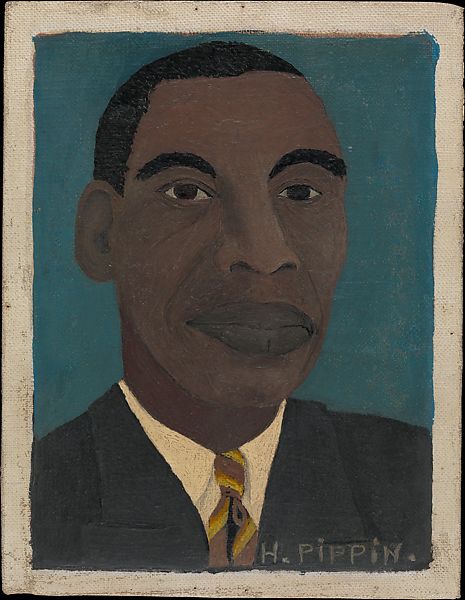
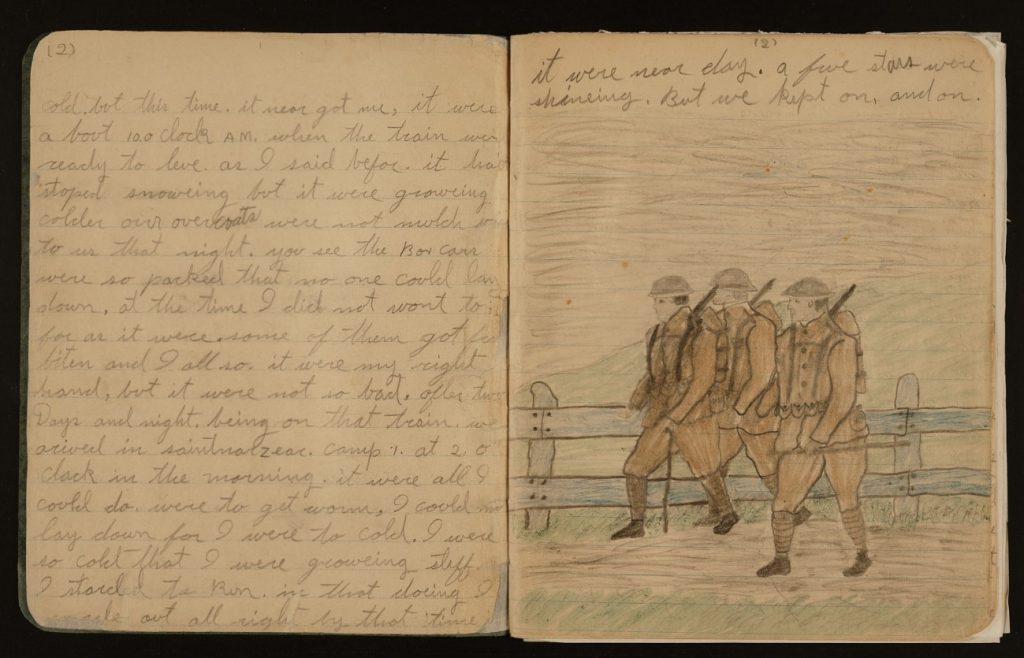
Horace Pippin (American, West Chester, Pennsylvania 1888–1946 West Chester, Pennsylvania) Self-Portrait, 1944. Courtesy the Metropolitan Museum of Art, New York, Bequest of Jane Kendall Gingrich, 1982 (1982.55.7) http://www.metmuseum.org/Collections/search-the-collections/482605
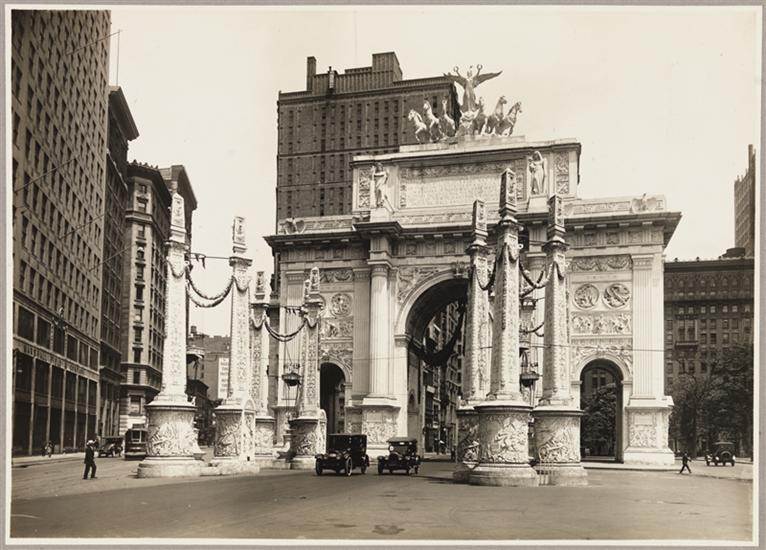
From the journal of Horace Pippin, featuring illustrations among his observations.US National ArchivesThe 369th were the first regiment to march beneath the Victory Arch, installed near Madison Square Park. Courtesy Museum of the City of New YorkUS National ArchivesUS National Archives
From the New York Times the following day after the parade:
“New York’s negro soldiers, bringing with them from France one of the bravest records achieved by any organization in the war, marched amidst waving flags and cheering crowds yesterday from Twenty-third Street and Fifth Avenue to 145th Street and Lenox Avenue.”
“At Thirty-Fourth Street the men marched under a shower of cigarettes and candy, and such tokens were pitched at them at other points in the line, but the files did not waver for an instant.”
US National Archives
The complete version of the 1977 film Men of Bronze, detailing the story of the Harlem Hellfighters, directed by Bill Miles, is available to watch on YouTube.
President Obama awards the Medal of Honor posthumously to two World War I veterans, Private Henry Johnson (featured in this show) and Sergeant William Shemin.
READING LIST From Harlem to the Rhine by Arthur West Little Harlem Rattlers and the Great War by Jeffrey Sammons and John Howard Morrow A Life In Ragtime: A Biography of James Reese Europe by Reid Badger Lost Battalions by Richard Slotkin A More Unbending Battle by Peter Nelson We Return Fighting from the National Museum of African American History and Culture When Pride Met Courage by Walter Dean Myers
FURTHER LISTENING
The Bowery Boys: New York City History podcast is brought to you …. by you!
We are now producing a new Bowery Boys podcast every other week.
We’re also looking to improve and expand the show in other ways —
publishing, social media, live events and other forms of media. But we
can only do this with your help!
We are now a creator on Patreon, a patronage platform where you can support your favorite content creators.
Please visit our page on Patreon
and watch a short video of us recording the show and talking about our
expansion plans. If you’d like to help out, there are six different
pledge levels. Check them out and consider being a sponsor.
ALL patrons at all levels will receive many benefits include the next episode of the Bowery Boys Movie Club,
an exclusive podcast (released every 6-8 weeks) celebrating New York
City in the movies. And patrons at the Five Points ($5) level and up
will get our other exclusive podcast — The Bowery Boys: The Takeout — released every two weeks.
We greatly appreciate our listeners and readers and thank you for joining us on this journey so far.
One hot summer’s morning, in the neighborhood of Yorkville on the Upper East Side, high school student James Powell was shot and killed by police officer James Gilligan.
Powell either attempted to stab the officer or else the unarmed boy was brutally set upon by a man with violent tendencies. Gilligan, a war veteran, was either defending himself from a troubled delinquent or else he gunned down the teenager with little remorse.
There were few actual witnesses but dozens of bystanders. The incident took place across the street from a high school, and the students, incensed by rumors and the fear of blood running in the streets, began panicking.
The year was 1964.
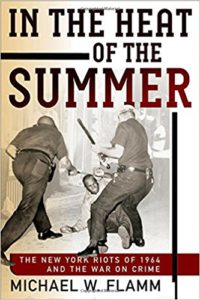
It’s hard not to read the opening pages to Michael W. Flamm’s gripping In The Heat Of The Summer: The New York Riots of 1964 and the War on Crime (University of Pennsylvania Press) and not see the parallels to modern police brutality cases.  So many different testimonies obscure the truth that it’s hard to know what really did happen in front of 215 East 76th Street that day. (Video footage might not have even cleared it up.)
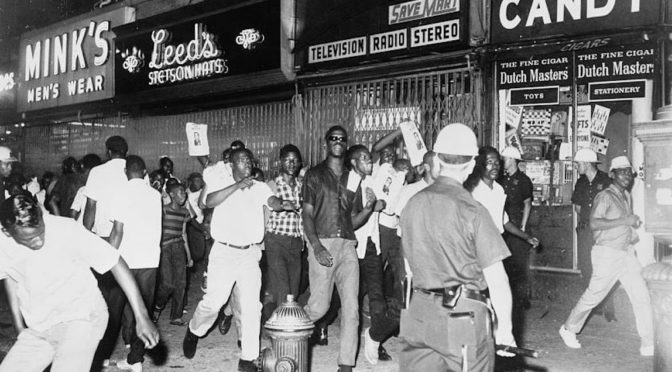
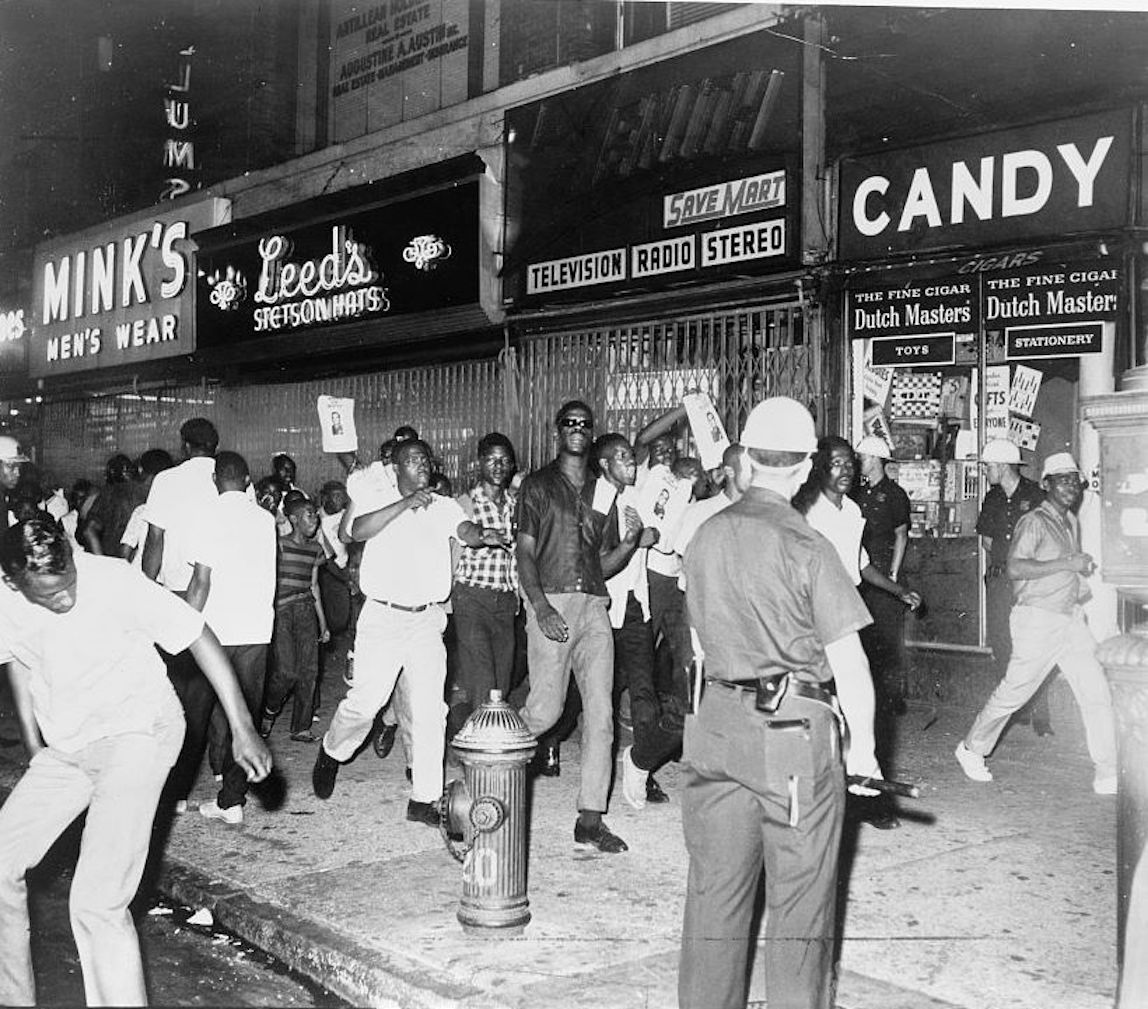
Yet Flamm’s book isn’t specifically about the crime, but the chaos which ensued — the New York Riots of 1964 (with the most violent night often referred to as the Harlem Riot of 1964). For several evenings following the shooting, a host of speculations and false rumors — mixing with grief and despair on a series of hot summer evenings — led to roaming violence and looting in Harlem (with some also reported in the Brooklyn neighborhood of Bedford-Stuyvesant).
The incidents which occurred that summer stem from hostilities which had built up within the black community for decades. A great distrust between the police and African-Americans played a part in the rising crime rate in poor neighborhoods like Harlem in the 1960s.
Courtesy the New York Daily News
Fearful residents felt powerless against increasing criminal behavior and drug abuse in their streets but didn’t risk involving law enforcement, who most considered corrupt and racist.
White residents avoided black neighborhoods — and vice versa — due to wildly dramatic reports in the press. Black power movements like the Nation of Islam escalated talk of violence while, in some neighborhoods, white vigilantes stopped and interrogated every black person found in the streets.
Writes Flamm: “New York sounded to the rest of the country like some frontier town helpless before the uncontrollable violence stalking its streets.”
Dick DeMarsico, New York World Telegraph & Sun
Flamm follows two parallel threads, both coming together in raw, unexpected ways. The first is a terrifying minute-by-minute account of the late-night street riots, the chaotic protests and the rallies organized by those who wished to funnel that rage into a mechanism of change. The second is the reactions of politicians and civil rights leaders to New York’s race and law enforcement problems.
The author’s meticulous research finds microcosms of hate and fear at nearly ever corner — of the kind which will make nobody particularly nostalgic for the period. “Central Harlem seemed like a war zone, with screams from people and cracks from bullets as they ricocheted off brick walls and cement sidewalks.”
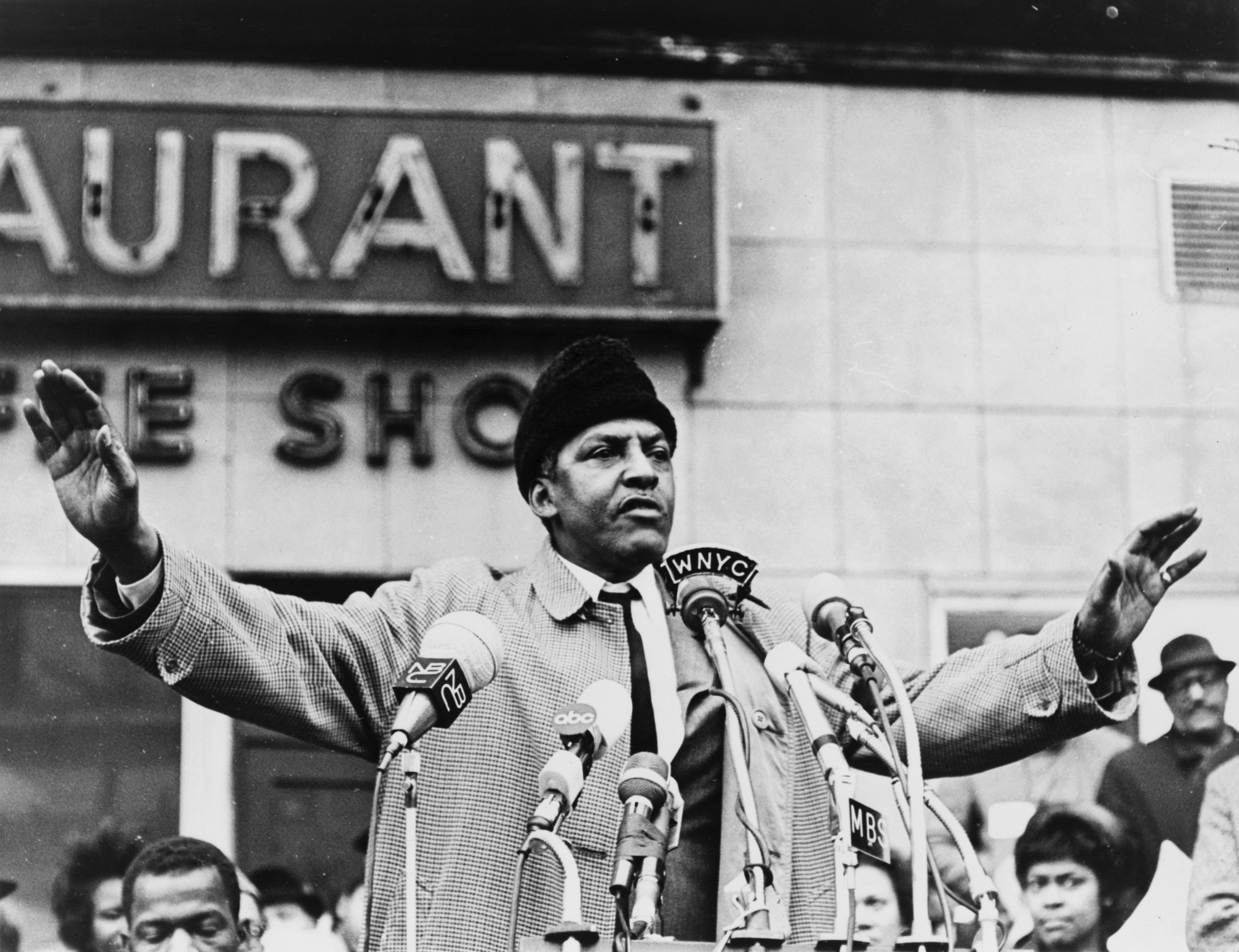
New York World-Telegram and the Sun staff photographer: Wolfson, Stanley, photographer.
At the center of the story is civil rights leader Bayard Rustin (pictured above) and the Congress for Racial Equality (CORE), often caught between keeping and promoting the peace and quelling the concerns of angry residents.
At one point, Rustin was literally disarming people. “The toll might have gone much higher if not for Rustin, who personally disposed of three cases of dynamite — enough to destroy a city block — after two young black men agreed to give it to him instead of using it.”
Few history books I’ve read in the past twelve months have felt as immediate as In the Heat of the Summer, with anecdotes that seem to speak pointedly to the events of today’s headlines.
For example, some police authorities applauded television coverage of the riots. Said one commissioner: “It’s the best answer we have to the cries of police brutality. The camera, after all, cannot distort or lie; the worst that can happen is that the film is edited. But what you see on the home screen is the actual occurrence.”
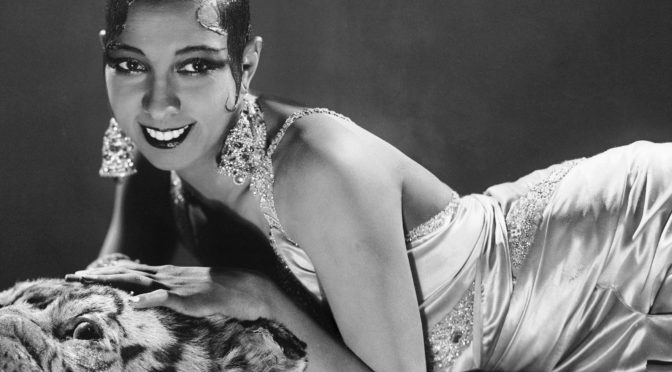
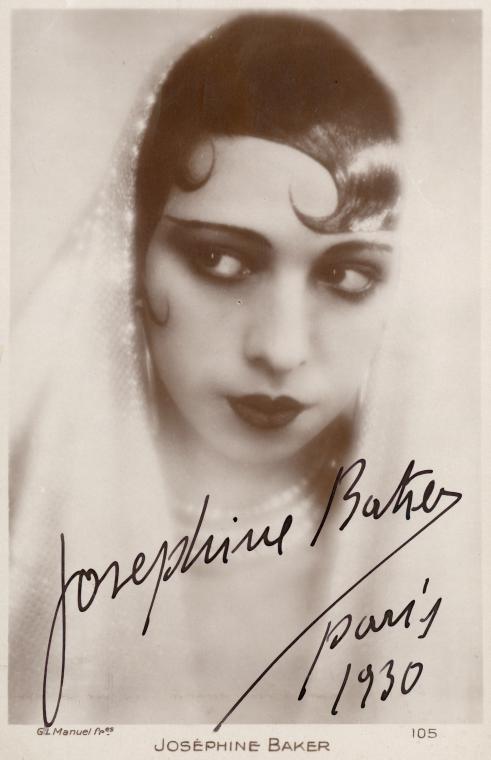
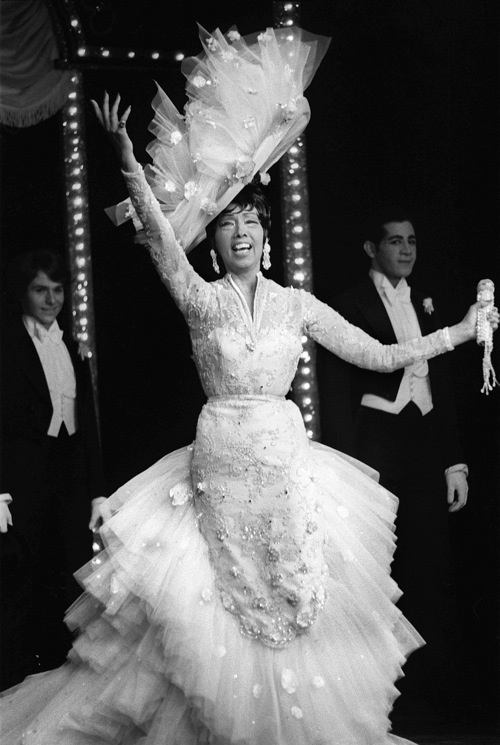
Josephine Baker is a spellbinding icon. Her persona is magnetic, mysterious, intangible, taking inspiration from Sophie Tucker and Bessie Smith, the divas of the silent screen and the flappers of Harlem and Greenwich Village.
And yet this most alluring figure of the Jazz Age was born 110 years ago today in St. Louis, Missouri.
Barely 15 years old, Baker made a quick impression upon her arrival to New York, notably appearing in the original touring production of Shuffle Along.  Her first appearance in 1924 in the New York Times was as part of the show The Chocolate Dandies playing ‘That Comedy Chorus Girl’: “As a freak Terpsachorian artist, Josephine Baker, with her imitation of Ben Turpin’s eyes, made quite a hit.”
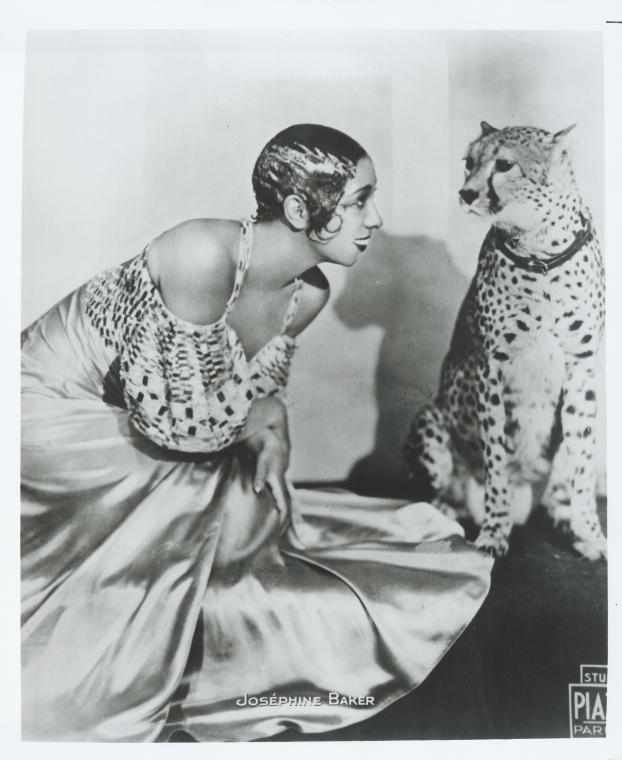
Baker’s career would only really take off after appearing in shows in France. She would accentuate her unique talent and beauty with extravagent style. Baker was famous for her animal companions — a cheetah named Chiquita and a chimpanzee named Ethel.
But the most powerful story about Josephine Baker would transpire back in New York City, many years later, in a incident which blew open the absurd, racist nightclub practices of the 1940s and 50s.  Baker took aim at the segregationist policies of Stork Club, the hotspot frequented by the world’s biggest celebrities.
On October 16, 1951, Baker attempted to have dinner there after a sold-out performance at the Roxy Theatre. While her white dinner companions got their food, she and a fellow black guest were never served. If you think perhaps this was just an oversight, keep in mind that Baker was a prominent civil-rights activist, openly critical of such policies. This was no mistake.
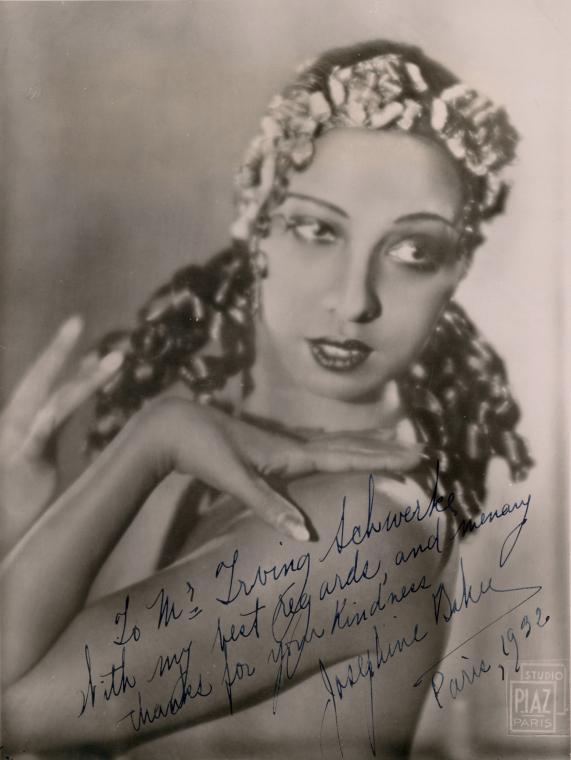
Baker in 1932:
Yet she was eventually excoriated in the press by none other than Walter Winchell, the powerful gossip columnist. Â “The Josephine Baker affair at the Stork Club made Winchell look like a self-serving hypocrite, if not racist; and his weekly radio show fell out of the top ten for the first time.” [source]
But Baker was permanently shaken by the whole affair.  “After that…there was nothing left for me in America. What little there was left, he ruined for me.” [source]
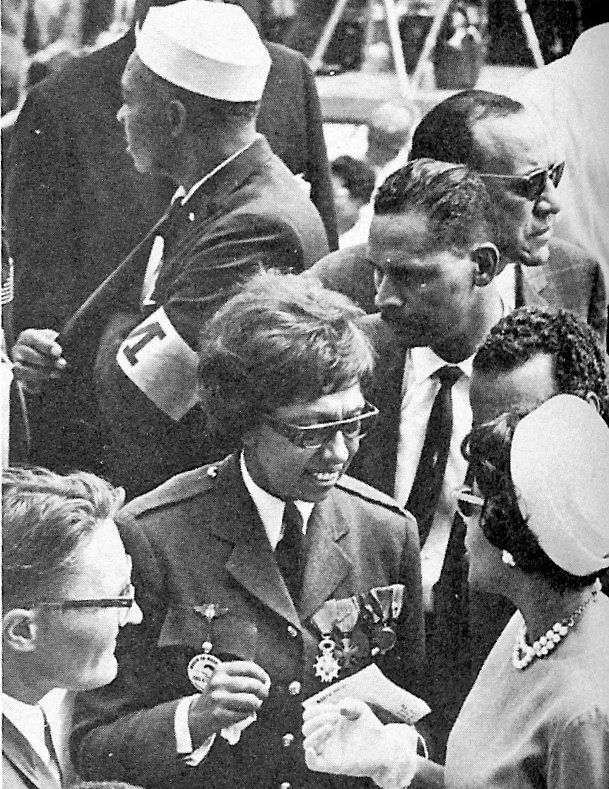
Below: Baker at the 1963 March on Washington where she was the only woman who gave a speech that day. “I am not a young woman now, friends. My life is behind me. There is not too much fire burning inside me. And before it goes out, I want you to use what is left to light that fire in you.”  [source]
Her final New York performances were in June of 1973 — at Carnegie Hall and at the Victoria Theater in Harlem.
(Photo credit PIERRE GUILLAUD/AFP/Getty Images)
“Josephine Baker knows how to make an entrance. The American-born singer and dancer, who celebrated her 67th birthday on Sunday, brought a full house at Carnegie Hall to its feet cheering and applauding Tuesday evening merely by stepping into a spotlight wearing a spangled body-stocking that left no doubt about the slim, trim, youthful lines of her figure, topped by an outrageously towering headdress of flamingo-colored plumes that was as tall as she was herself.” [source]
Here’s a little number from that very performance, her take on a Bob Dylan number. Â And happy birthday Josephine!
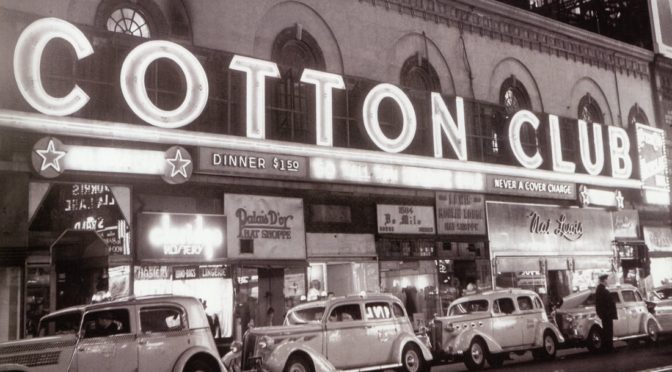
PODCAST The musical story of the Cotton Club, the most famous (and infamous) nightclub of the Jazz Age.
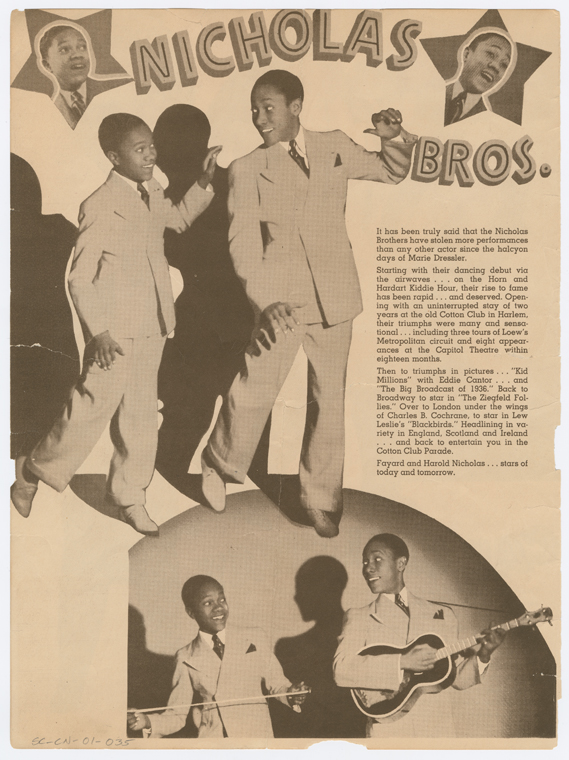
The Cotton Club, Harlem’s most prominent nightclub during the Prohibiton era, delivered some of the greatest music legends of the Jazz Age — Duke Ellington, Cab Calloway, Fletcher Henderson, Ethel Waters, the Nicolas Brothers. Some of the most iconic songs in the American songbook made their debut at the Cotton Club or were popularized in performances here.
But the story of gangster Owney Madden‘s notorious supper club is hardly one to be celebrated.
That the Cotton Club was owned by Prohibition’s most ruthless mob boss was just the beginning. The club enshrined the segregationist policies of the day, placing black talent on the stage for the pleasure of white patrons alone. Even the club’s flamboyant decor — by Ziegfeld’s scenic designer, no less — made sure to remind people of these ugly admission practices.
This is the tale of Harlem late night — of hot jazz and illegal booze, of great music and very bad mobsters. Featuring some of the greatest tunes of the day by Ellington, Calloway, King Oliver and more.
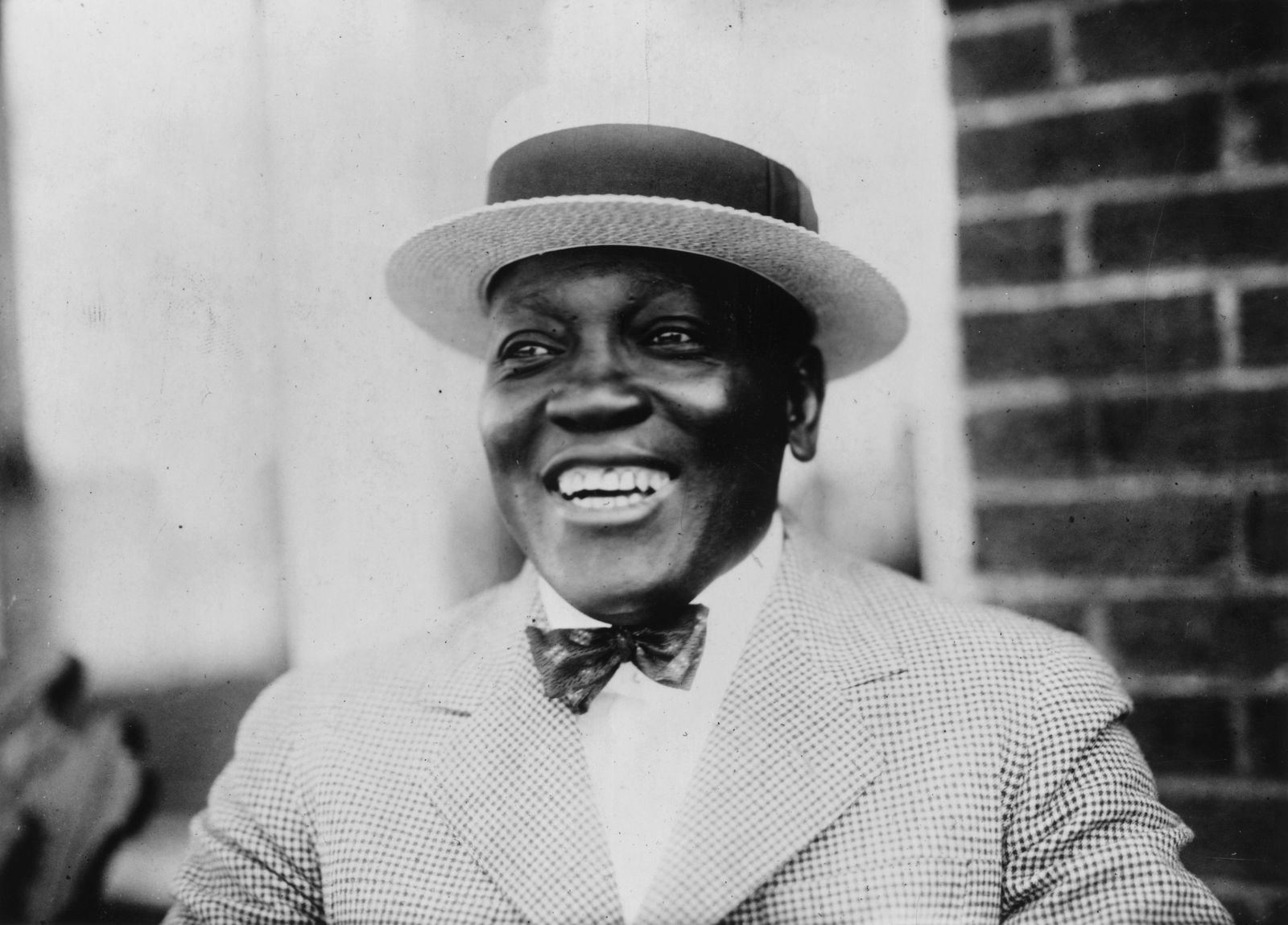
The Cotton Club was spawned from an earlier nightspot called Club Deluxe, owned by boxer Jack Johnson. (Below: Johnson in 1910)
Courtesy Getty Images)
Club Deluxe was renamed The Cotton Club in 1923 by Owney Madden, the mob boss and supplier of illegal booze.
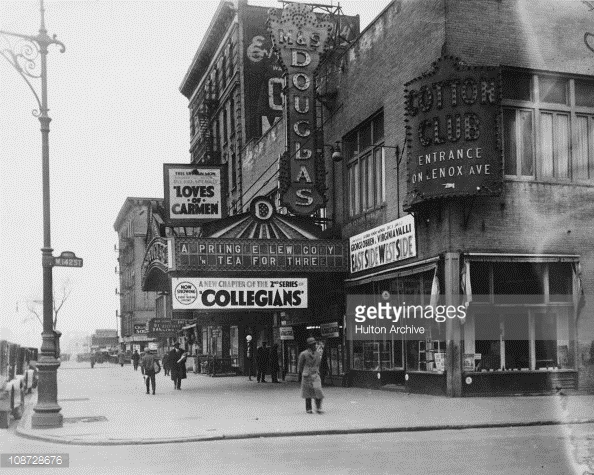
The original Cotton Club at 142nd Street and Lenox Avenue. The Douglas Theater, on the ground floor, is doing much better here, photo taken sometime in 1927:
Courtesy Getty Images
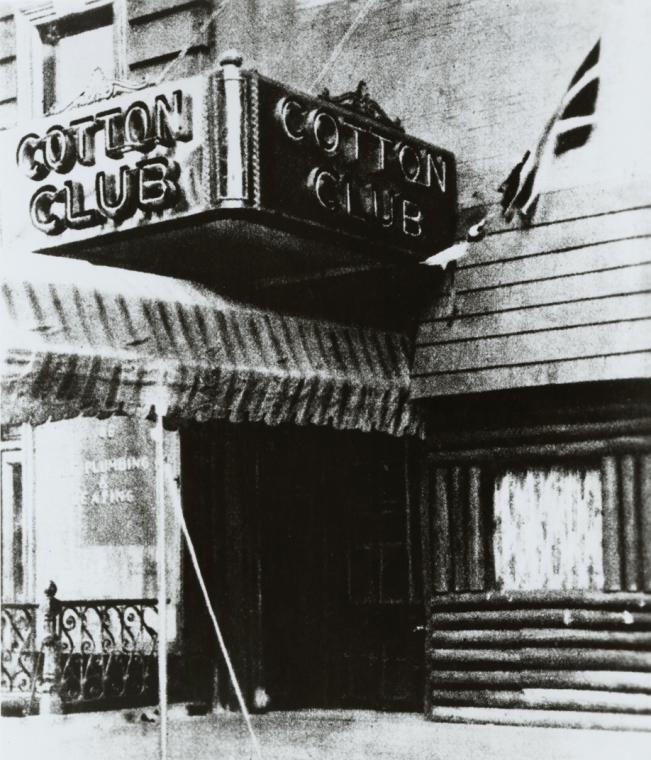
The entrance to the Harlem Cotton Club. Note the log decoration to make it appear like some old rugged shack.
Courtesy New York Public Library
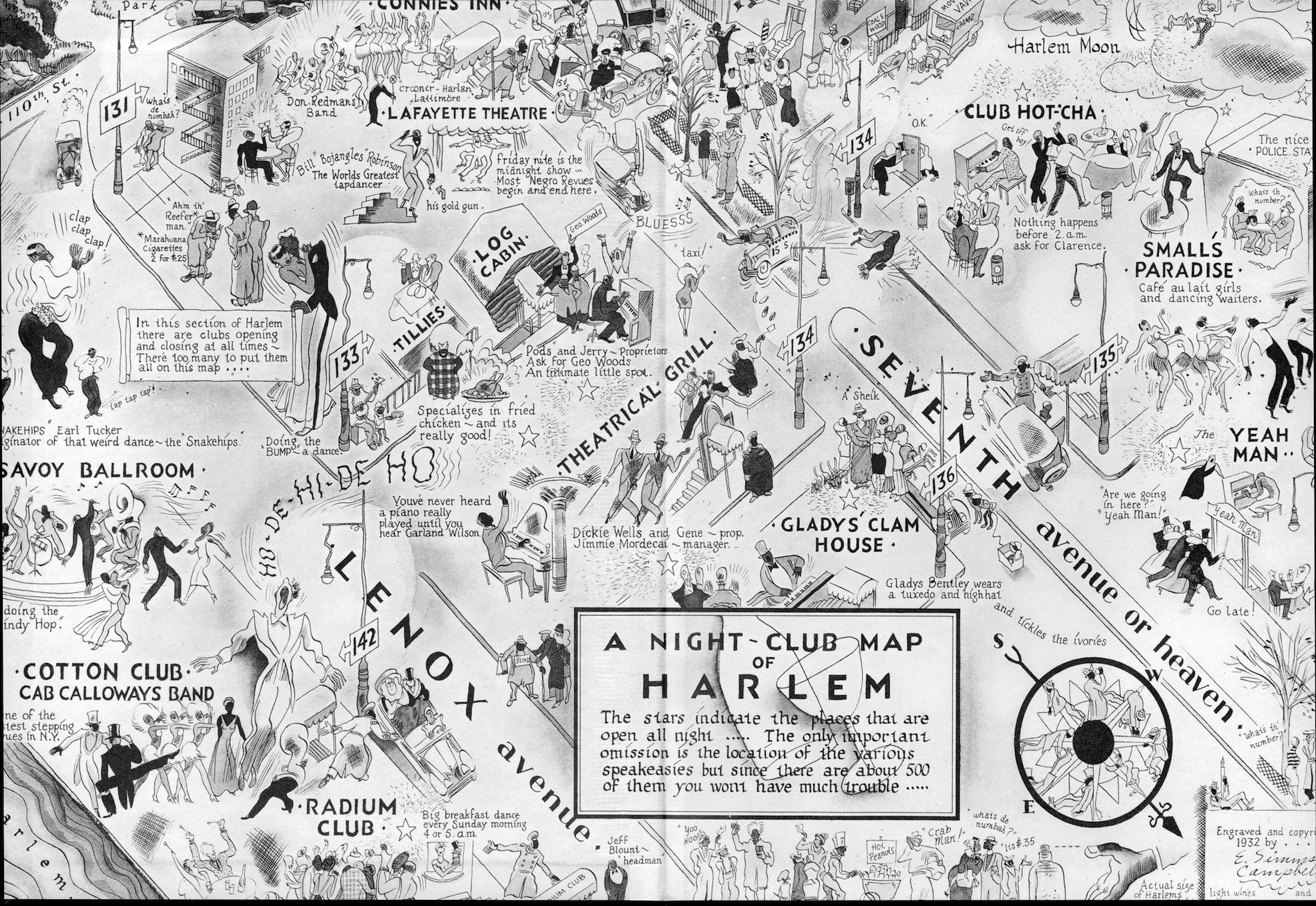
A map from 1932 of the Harlem nightclub scene, featuring the Cotton Club, Small’s Paradise, Connie’s Inn, the Savoy Ballroom and more….
Courtesy Open Culture
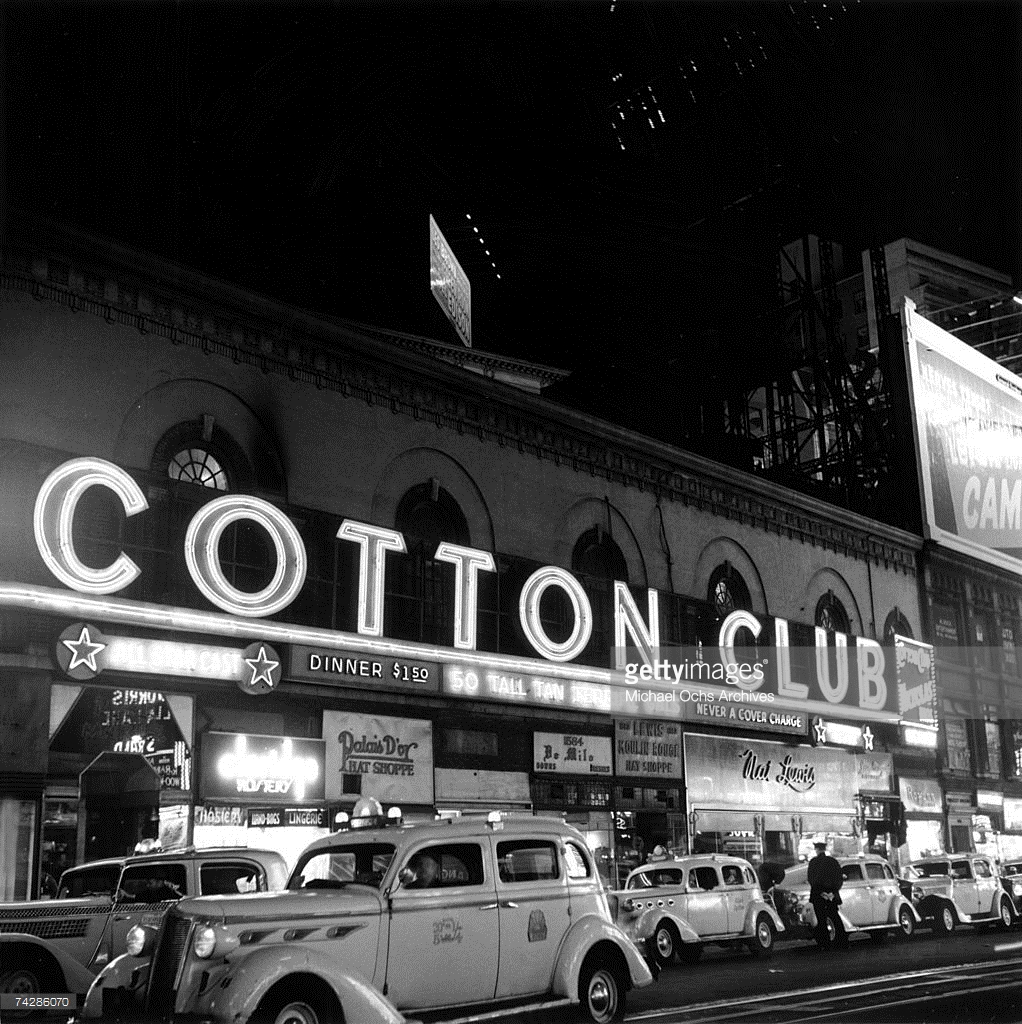
The Broadway Cotton Club as it looked one evening in 1938.
Courtesy Getty Images/ Michael Ochs Archives
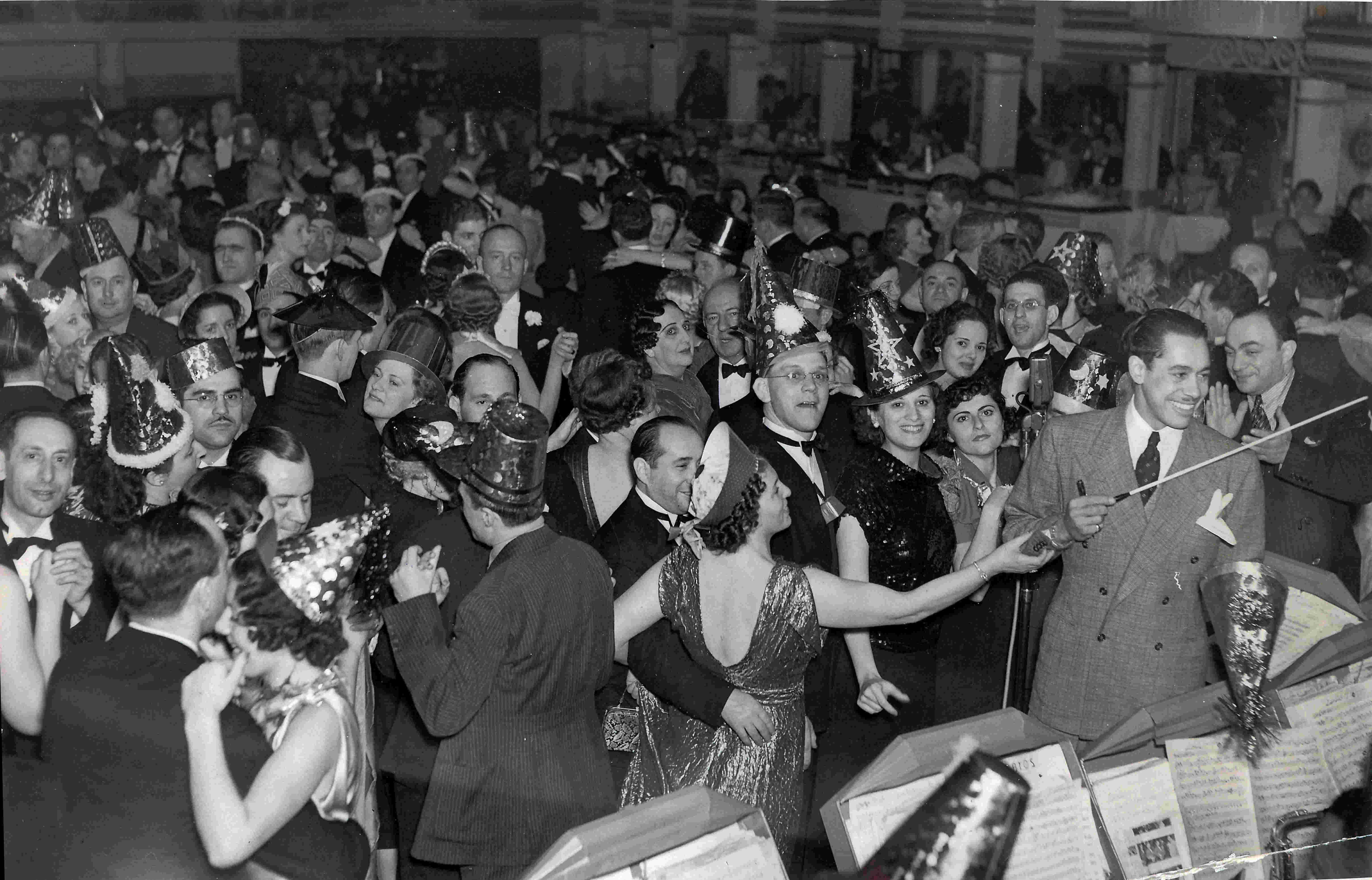
A look at the interior of the Broadway Cotton Club circa, during an New Year’s celebration, 1937, with Cab Calloway conducting.
Courtesy the Hi De Ho Blog, devoted to Cab Calloway
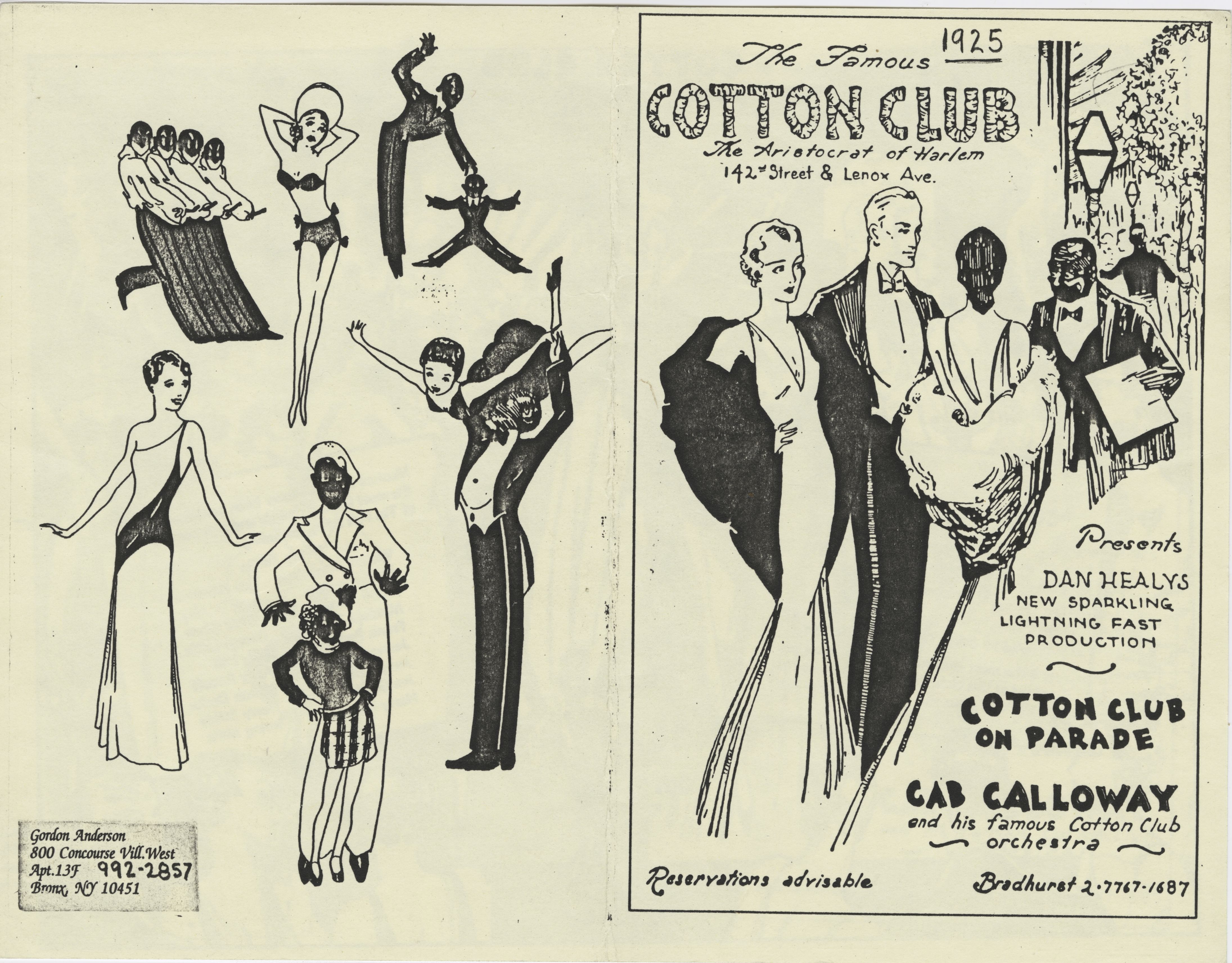
An advertisement or program for The Cotton Club. The year 1925 is penciled in at the top, but it has to be from a later date. Calloway had just graduated from high school in 1925!
Courtesy New York Public Library
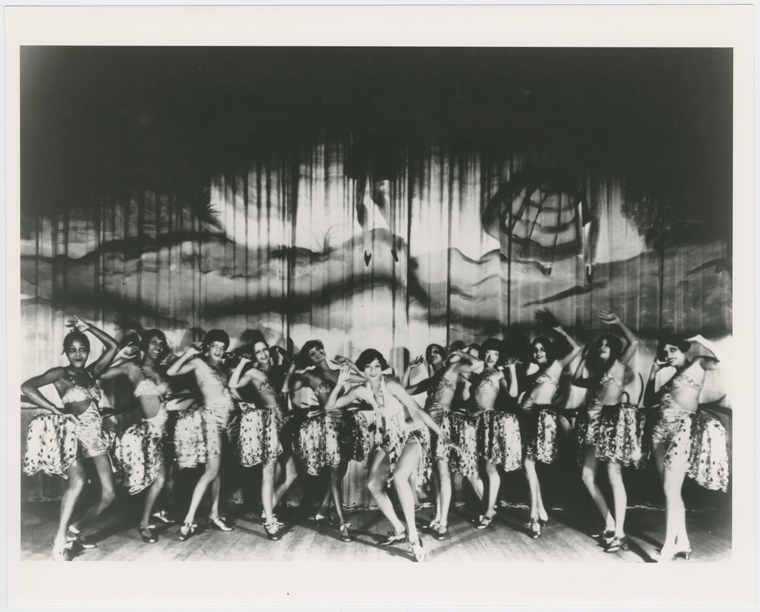
Maude Russel and her Ebony Steppers, performing in the 1929 Cotton Club show called ‘Just A Minute’.
Courtesy New York Public Library
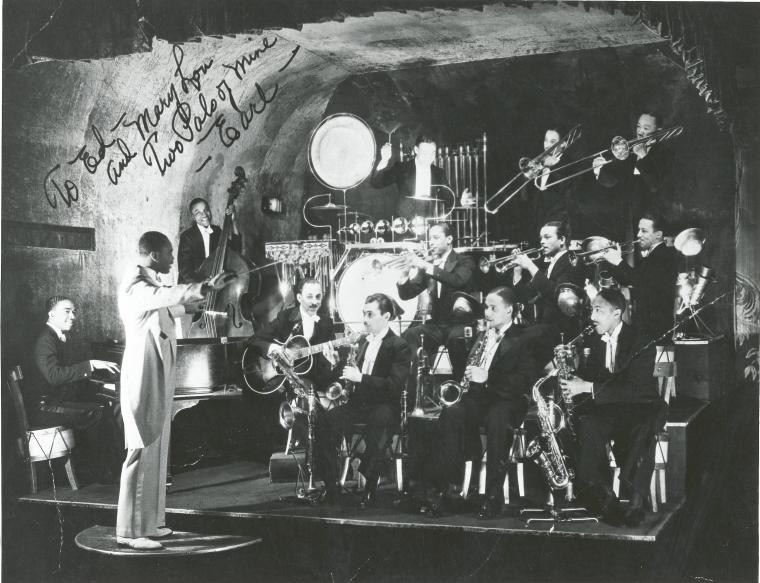
A shot of Jimmy Lunceford and His Orchestra in 1934.
Courtesy New York Public Library
An advertisement for the Nicolas Brothers, for a performance in 1938 at the Broadway Cotton Club.
Courtesy New York Public Library
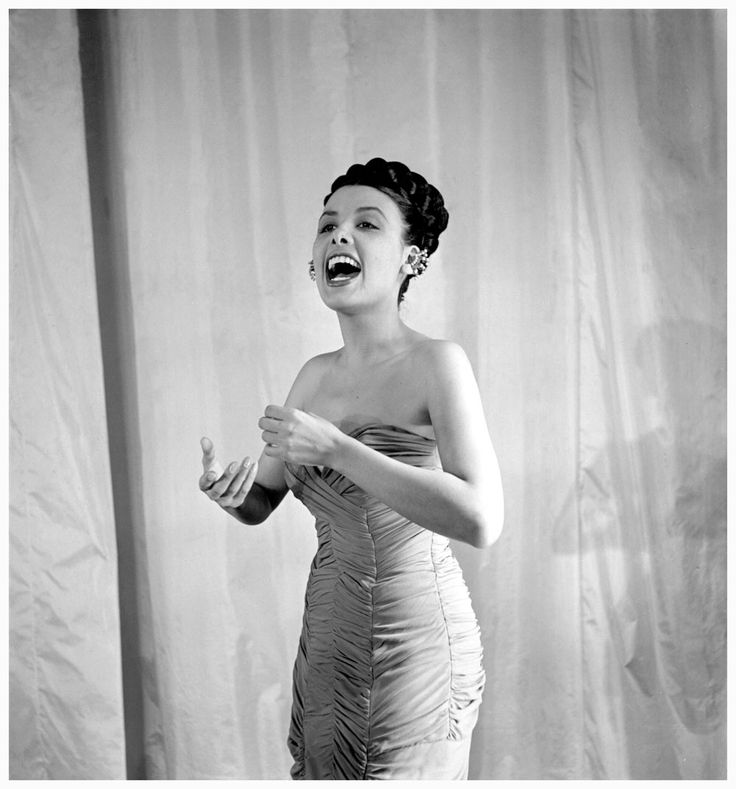
Lena Horne started out in the Cotton Club chorus line but eventually became a headlining star in her own right.
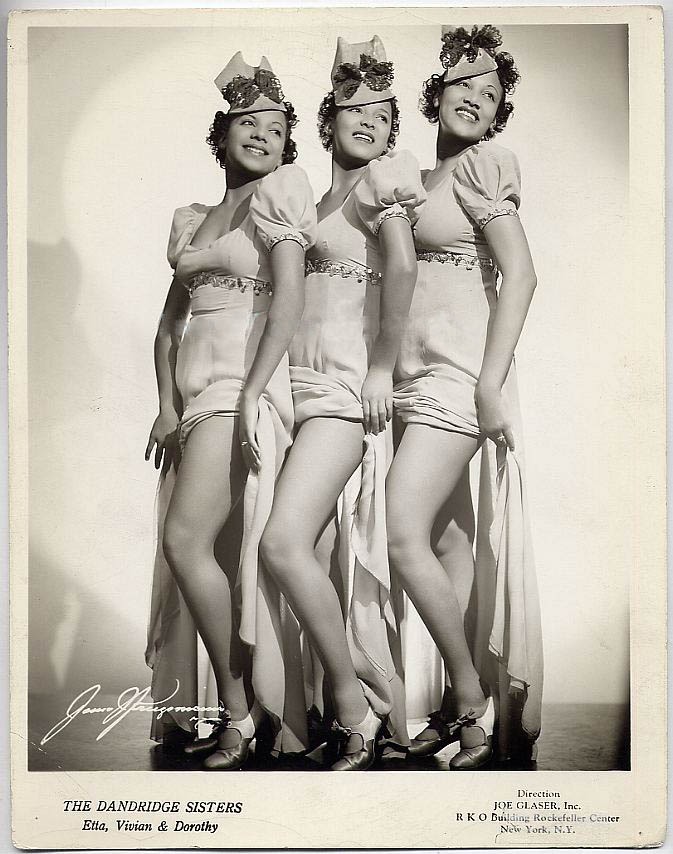
The Dandridge Sisters were notable performers in the final years of the Cotton Club.
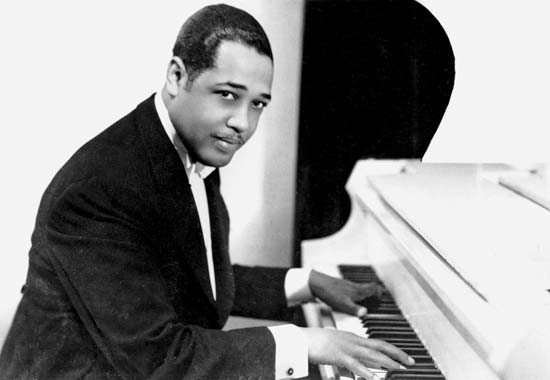
The young and dashing Duke Ellington became a superstar in the years following his Cotton Club residency.
Duke Ellington and his Cotton Club Band, in a 1930 film appearance:
In 1934, Cab Calloway made this short film featuring his music:
Cab Calloway’s here too, in this clip from the film Stormy Weather, but the real stars are the Nicholas Brothers in a breathtaking dance number:
THIS PODCAST FEATURED MUSICAL SNIPPETS FROM THE FOLLOWING SONGS:
Black and Tan Fantasy – Duke Ellington
Drop Me Off In Harlem – Duke Ellington
Speak Easy Blues – King Oliver Jazz Band
Charleston – Paul Whiteman
Mood Indigo – Duke Ellington
Swing Session – Duke Ellington
If You Were In My Place – Duke Ellington
Minnie the Moocher – Cab Calloway
I’ve Got The World On A String – Duke Ellington
Stormy Weather – Ethel Waters
On The Sunny Side of the Street – Duke Ellington
NOTES ON THIS SHOW:
— I made two amusing flubs in this show 1) Duke Ellington’s nickname is probably inspired by the Duke of Wellington, not (obviously) the Duke of Ellington, 2) the name of the movie with Lena Horne and the Nicholas Brothers is obviously named Stormy Weather, not Stormy Weathers (which must be the name of a drag queen somewhere)
— Jack Johnson‘s story is so much more complex and I wish I had more time to talk about him. For more information, check out the incredible documentary (and the book it’s based on by Geoffrey C Ward) called Unforgivable Blackness: The Rise and Fall of Jack Johnson.
The political landscape of modern New York City is a stew of neighborhood, borough, financial and ethnic interests built upon over two centuries of experience and tradition.  The most interesting story of the past fifty years — both locally and nationally — is the ascension of minority voices into the public sphere, reflecting population changes but also rising strategies of organization.
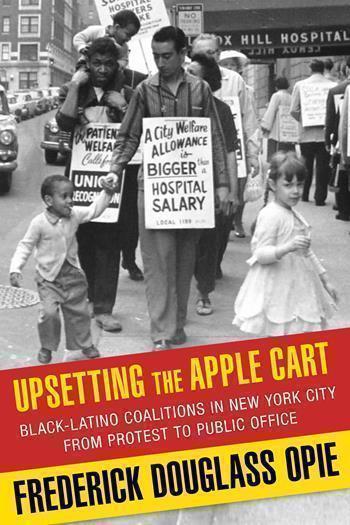
How did non-white New Yorkers first find their voice in modern politics? In Upsetting the Apple Cart, an impressive navigation through late 20th century politics by Frederick Douglass Opie, the answer comes from seemingly surprising places — the hospital, the classroom, the kitchen table.
Opie, a professor at Babson College, inspects the particular relationship between New York’s black and Latino communities as they find ways to align at the workplace and in the voting booth. Today it seems obvious that two large minority interest groups might team up to achieve common goals, but it wasn’t until after labor and student activists explored the relationship in the 1950s and 60s that alliances were forged in the major political spheres.
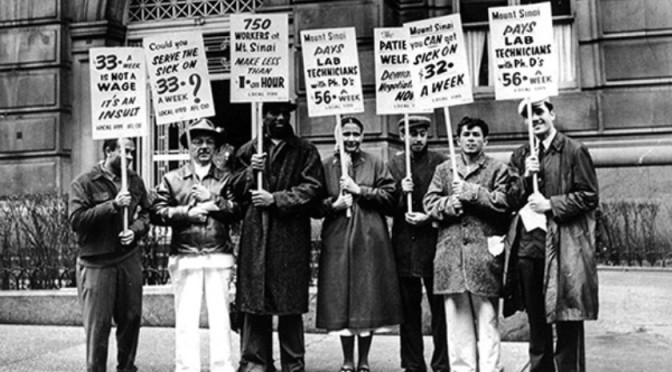
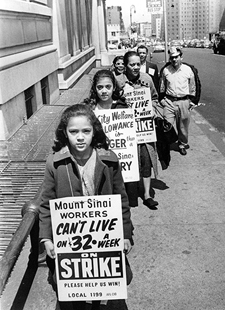
The first half of Upsetting the Apple Cart traces the influences of both the unions and the civil rights movement upon minority workers at local hospitals and students at universities. Â Frustrated by lower pay and unfair hours in comparison to their white counterparts, black and Puerto Rican New Yorkers found common ground and successfully organized. This culminated in a massive, ultimately successful city-wide strike on May 8, 1959, lasting almost two months.
Minority higher-education students at Columbia University, Hunter College and other school found other reasons to work together — to improve enrollment and educational needs. At Columbia students successfully closed the campus in protest over a new gymnasium being built in Morningside Heights, seen by many as an encroachment into the majority black neighborhood.
Personally I found the second half of Upsetting the Apple Cart more intriguing, but then, I love rooting around in the history of New York backroom political alliances. Â Opie’s book excellently explains the early history of black and Latino political organization, from the rise of power in Harlem by the Gang of Four (including David Dinkins and Charlie Rangel) to the first politicians of Puerto Rican, Mexican and Dominican descent in New York.
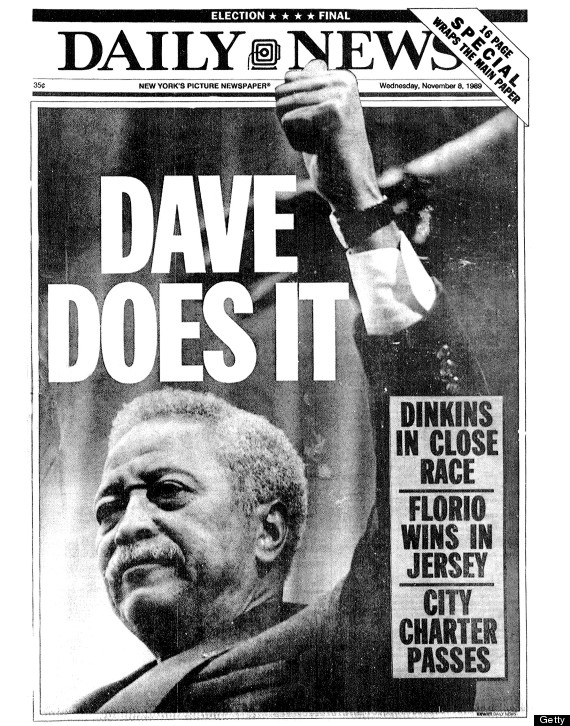
UNITED STATES – NOVEMBER 08: Daily News front page dated Nov. 8, 1989, Headlines: DAVE DOES IT, Dinkins in close race, Florio wins in jersey, City Charter passes, David Dinkins elected Mayor of New York City (Photo by NY Daily News Archive via Getty Images)
Politics is made from shifting alliances but it wasn’t until the victory of Harold Washington as mayor of Chicago in 1983 that the united front of African-American, Hispanic and Latino-American activists made itself felt in a major political race. Such unification of goals made its way to New York through the presidential aspirations of Jesse Jackson and the various (ultimately unsuccessful) attempts to unseat New York mayor Ed Koch.
The apex of minority political alliances occurred with the election of David Dinkins, famous for his appeal to the “gorgeous mosaic” of New York ethnicities. Dinkins won because, in the end, he appealed to a majority of New Yorkers. But Opie makes note of the unique organizations of outer-borough Hispanics that helped get him elected.
Wait, did I mention that Upsetting  the Apple Cart is also a cookbook? Somewhat incongruously, traditional recipes for tamales, arroz con pollo, fried chicken and other dishes pop up throughout the chapters. Opie, a food traditions professor, emphasizes the role of social interaction in creating these unique coalitions.  To paraphrase a popular adage, the best way to a neighbor’s heart is through her stomach.  The success of these early alliances lends some credence to food as the great uniter.
Upsetting the Apple Cart: Black-Latino Coalitions in New York City from Protest to Public Office
by Frederick Douglass Opie
Columbia University Press
Howard Philip Lovecraft — aka H.P. Lovecraft — was born 125 years ago today in Providence, Rhode Island.
The pulp-fiction storyteller, known for claustrophobic tales of the occult, lived for a time in Brooklyn. He did not enjoy it.
In 1924, he moved to 259 Parkside Avenue in Flatbush, Brooklyn, close to Ebbets Field and Prospect Park. When his new wife relocated for work in Cincinnati, Lovecraft moved from the pleasant Flatbush neighborhood to a small flat at169 Clinton Street in Brooklyn. He only lived here until 1926 but during his stay, possessed of anxiety and neurosis, he practically starved himself.
Below: The boardinghouse at 169 Clinton Street, pictured here at left, from 1935. The first four buildings still exist. The building at the far right is the old Brooklyn Athenaeum.
Courtesy New York Public Library
Lovecraft had contempt for New York’s thriving immigrant population and those workers who sustained Brooklyn waterfront in the 1920s.
In particular he negatively interacted with the residents of Brooklyn’s so-called “Little Syria” on Atlantic Avenue.
I find his invective ugly and even a little obsessive, but it illustrates that occasional truth that the culture of New York City is simply not for everybody, especially if you have certain racist dispositions mixed with a little mental instability.
Below: Lovecraft in Brooklyn Heights in 1925. The house behind him may be his Clinton Street boarding house. Compare to the image above and the current view here. (Photo courtesy HPL.com)
In a comparison with Philadelphia, Lovecraft wrote “[Philadelphia has] none of the crude, foreign hostility and underbreeding of New York — none of the vulgar trade spirit and plebian hustle.” He further described New York as “an Asiatic hell’s huddle of the world’s cowed, broken, inartistic, and unfit.” [source]
According toauthor Donald Tyson, “when [H.P.’s wife Sonia] and Lovecraft were walking the streets of New York and encountered a group of immigrants, Lovecraft would become so animated and enraged that she feared for his sanity.”
The renovated, wealthy houses of today’s Brooklyn Heights were often working-class housing in the 1920s, many turned into affordable boarding houses. Lovecraft disliked his ethnic neighbors and held particular scorn for his Irish landlady. “Only later was I to learn of her shrewish tongue, desperate household negligence, miserly watchfulness of lights and unwatchfulness of repairs, and reckless indifference to the class of lodger she admitted.” [source]
He would have lived with mostly single men of differing ethnicity, many employed along the congested docks that lined the waterfront all the way down to Red Hook, culminating in two self-contained shipping areas — the Atlantic and Erie basins. Back in the 1920s, it was the busiest freight port in the entire world.
Below: Ships along the waterfront heading towards Red Hook, circa 1890
Courtesy Museum of the City of New York
He seemed to filter all his untethered anxiety into the very building at 169 Clinton Street. “I conceived the idea that the great brownstone house was a malignly sentient thing — a dead, vampire creature which sucked something out of those within it and implanted in them the seeds of some horrible and immaterial psychic growth.”
Yet Lovecraft saved his greater fantasies for the neighborhood south of here. He eventually funneled all this tortured and deranged hysteria into his horror writing with the publication of “The Horror at Red Hook,” a story that literally depicts the neighborhood as a gateway to Hell.
Naturally he wrote it over a two-day period from the Brooklyn Heights boardinghouse.
Below (the next two pictures): Some striking illustrations by Robert Cummings Wiseman of shanties around the Atlantic Basin in 1930, courtesy the Museum of the City of New York
The short story, one of his best known, is an amusing curiosity to read today.
Its a muddled, sometimes incomprehensible work with some occasional flashes of creepy description. Clearly the story is self-therapy as much as it is an actual story, an early 20th century entry in the field of conspiratorial fiction. It’s undeniably haunting if you manage to forgive the vast amount of virulent, anti-immigrant description:
“Red Hook is a maze of hybrid squalor near the ancient waterfront opposite Governor’s Island, with dirty highways climbing the hill from the wharves to that higher ground where the decayed lengths of Clinton and Court Streets lead off toward the Borough Hall. Its houses are mostly of brick, dating from the first quarter to the middle of the nineteenth century, and some of the obscurer alleys and byways have that alluring antique flavour which conventional reading leads us to call “Dickensianâ.”
The population is a hopeless tangle and enigma; Syrian, Spanish, Italian, and negro elements impinging upon one another, and fragments of Scandinavian and American belts lying not far distant. It is a babel of sound and filth, and sends out strange cries to answer the lapping of oily waves at its grimy piers and the monstrous organ litanies of the harbour whistles.”
Courtesy Museum of the City of New York
I won’t spoil any of the plot points of the story. (If you’re interested in reading ‘The Horror At Red Hook’, you can check it out here. ) But let’s just say the author confirms his suspicions — the street gangs and liquor rackets of the Prohibition era are really just dens of age-old evil:
“The soul of the beast is omnipresent and triumphant, and Red Hook’s legions of blear-eyed, pockmarked youths still chant and curse and howl as they file from abyss to abyss, none knows whence or whither, pushed on by blind laws of biology which they may never understand. As of old, more people enter Red Hook than leave it on the landward side, and there are already rumours of new canals running underground to certain centres of traffic in liquor and less mentionable things.”
The story would be published in 1927 in the pulp magazine Weird Tales. Notably, their offices were in Chicago, not in New York
Once he left New York, he pursued some of his more famous writing projects, using his anxiety to more disturbing effect in runic, terror-filled stories of the occult. He died in 1937, revered by many as a truly boundary-breaking writer, greatly inspiring writers like Stephen King.
It would be almost fifty years before an author attempted to look at south Brooklyn with similar monstrous intent — in the 1970s horror novels The Sentinel and The Guardian by Jeffrey Konvitz.
Top picture: Detail from a 1897 Rand McNally map of Brooklyn
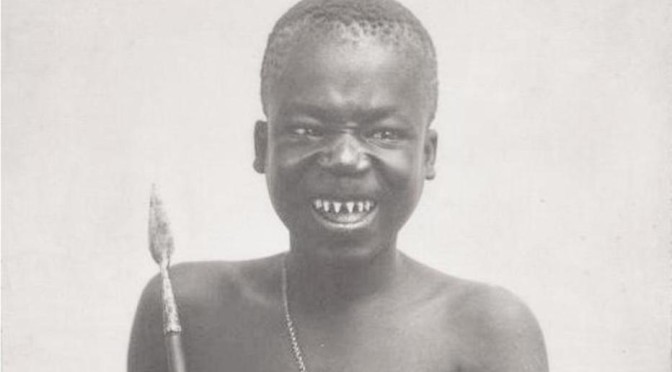
In 1906, visitors to the Bronx Zoo observed a rather bizarre sight in the Monkey House — the exhibition of a man in African dress, often accompanied by a parrot or an orangutan.
An African pygmy, so read the sign, “Age, 23, Height, 4 feet 11 inches, Weight 103 pounds, Brought from the Kasai River, Congo Free State, South Central Africa.” Displayed in one of America’s foremost institutions devoted to the display and care of exotic animals. Elephants, tigers, polar bears, snow leopards, bison. And one young man named Ota Benga.
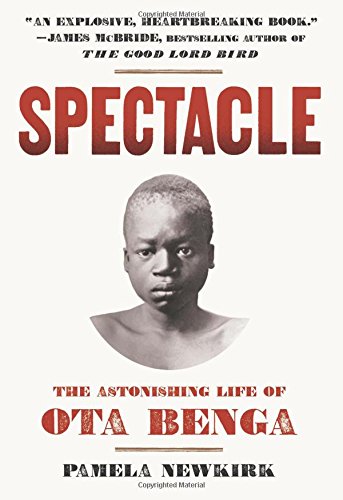
He is the subject of Pamela Newkirk’s engaging new book Spectacle: The Astonishing Life of Ota Benga, both a sincere ode to his tragic life and a contemporary accusation of the terrible forces that exploited him over a century ago.
But the story is really about the ghost of Ota Benga.
He spoke little English and there are no accounts from his perspective. Almost everything we know is from the perspective of a jaundiced press and the glare of condescending authority. He was the subject of great fabrications over the years; the truth is almost impossible to extricate from hyperbole.
While his story is front and center in Spectacle, but he barely raises his voice. He never had one.
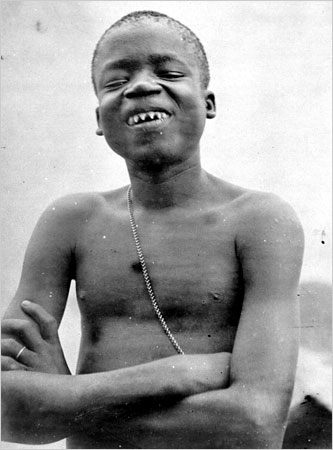
1906 photograph of Ota Benga, described as being taken at Bronx Zoo. (Wikimedia) Creator(s): Bain News Service, publisher Ota Benga is probably not even his real name. And even then, it’s twisted and distorted mercilessly, sometimes by the man himself. (When he died in 1916, he was known as Ota Bingo.)  In 1904 he was rescued from captivity in the Congo by the explorer and would-be scientist Samuel Phillips Verner.
This is probably true although Verner is an unreliable source, often changing his own biography to burnish his reputation in the science community.  Verner was the product of his age, seeing Africans as inferior beings but seeing their continent as a source of revenue. Verner sought to profit handsomely from his ‘explorations’ both by currying favor with the Belgian King Leopold II (the ruthless leader who exploited the people of the Congo) and by snatching human specimens for display in America.
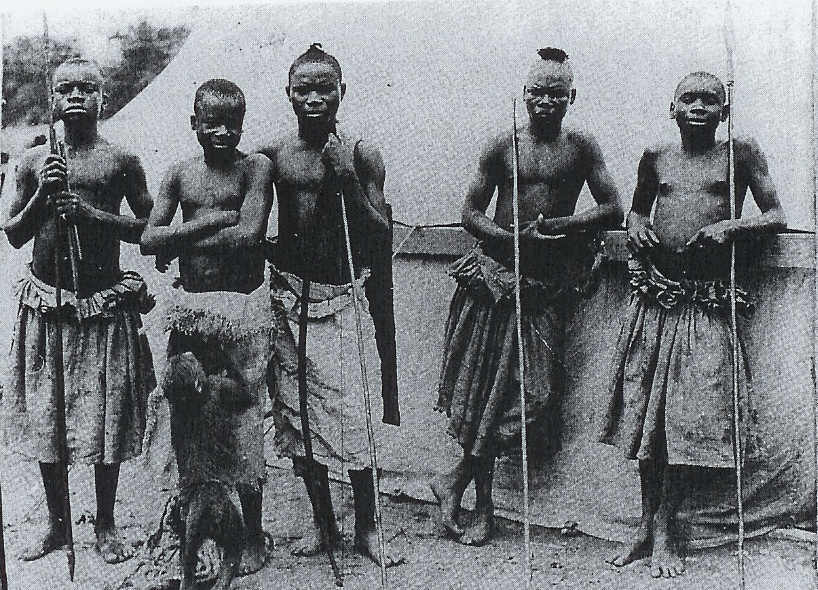
Ota Benga first arrived with a group of other men and boys for an exhibition at the 1904 St. Louis World’s Fair. Â People delighted at his mischievous nature and unusual appearance. His teeth were filed into points, a decorative trait that exhibitors (including Verner) proclaimed were the product of a cannibalistic nature.
Below: Ota Benga at the St. Louis World’s Fair with other men taken from AfricaÂ
He went back with Verner to Africa only to arrive back in America by 1906 where he was placed in the care of the American Museum of Natural History. Ota Benga actually lived inside the museum, subject to more than a few indignities. “I have bought a duck suit for the Pigmy,” wrote Hermon Carey Bumpus, the director of the museum, to Verner. “He is around the museum, apparently perfectly happy and more or less a favorite of the men.”
Ota Benga’s removal to the Bronx Zoo and subsequent display in the Monkey House has certainly been a blight to that institution’s history. The decision reveals the outmoded and racist philosophies that pervaded scientific thinking of the day.
At best, Ota Benga was simply an object in an exotic diorama with audiences prodding him to do tricks. His humanity was barely considered. At worst, the exhibition lays bare the racism of the day in the most baldy sinister way possible, corroding even the most esteemed institutions of the day.
It’s a small relief to hear of the many criticisms the zoo received in the press back in 1906. Sanity soon prevailed and Ota Benga left the zoo to live in an orphanage in Weeksville, Brooklyn.
Newkirk gives the life of Ota Benga a proper eulogy. She crafts an intriguing tale around the many uncertainties of his biography, sometimes even stopping to analyze his state of mind.  I greatly credit the author for parsing through volumes of inaccurate news reports in search of even the smallest grains of truth.
His story ends with an unsatisfying hollowness, outside New York and far from the Congo. Few in his life ever treated him as an equal. In fact, due to his size, he was frequently treated like a boy, although he mostly like ended his life in his early 30s.  He never found a place to fit in.
There’s only a single moment in the book where Newkirk lets us in on his marvelous potential, on a life that could have been under more fair and enlightened circumstances.
He becomes, for a moment, “a father figure and hero” to a group of small African-American boys in Lynchburg, Virginia. Â “In Benga they found an open and patient teacher, a beloved companion, and a remarkably agile athlete who sprinted and leaped over logs like a boy. And with his young companions Benga could uninhibitedly relive memories of a lost and longed-for life and retreat to woods that recalled home.”
Spectacle: The Astonishing Life of Ota Benga
Amistad, HarperCollinsPublishers
by Pamela Newkirk
Other recently reviewed books on the Bowery Boys Bookshelf:

 It’s hard not to read the opening pages to Michael W. Flamm’s gripping In The Heat Of The Summer: The New York Riots of 1964 and the War on Crime (University of Pennsylvania Press) and not see the parallels to modern police brutality cases.  So many different testimonies obscure the truth that it’s hard to know what really did happen in front ofÂ
It’s hard not to read the opening pages to Michael W. Flamm’s gripping In The Heat Of The Summer: The New York Riots of 1964 and the War on Crime (University of Pennsylvania Press) and not see the parallels to modern police brutality cases.  So many different testimonies obscure the truth that it’s hard to know what really did happen in front of 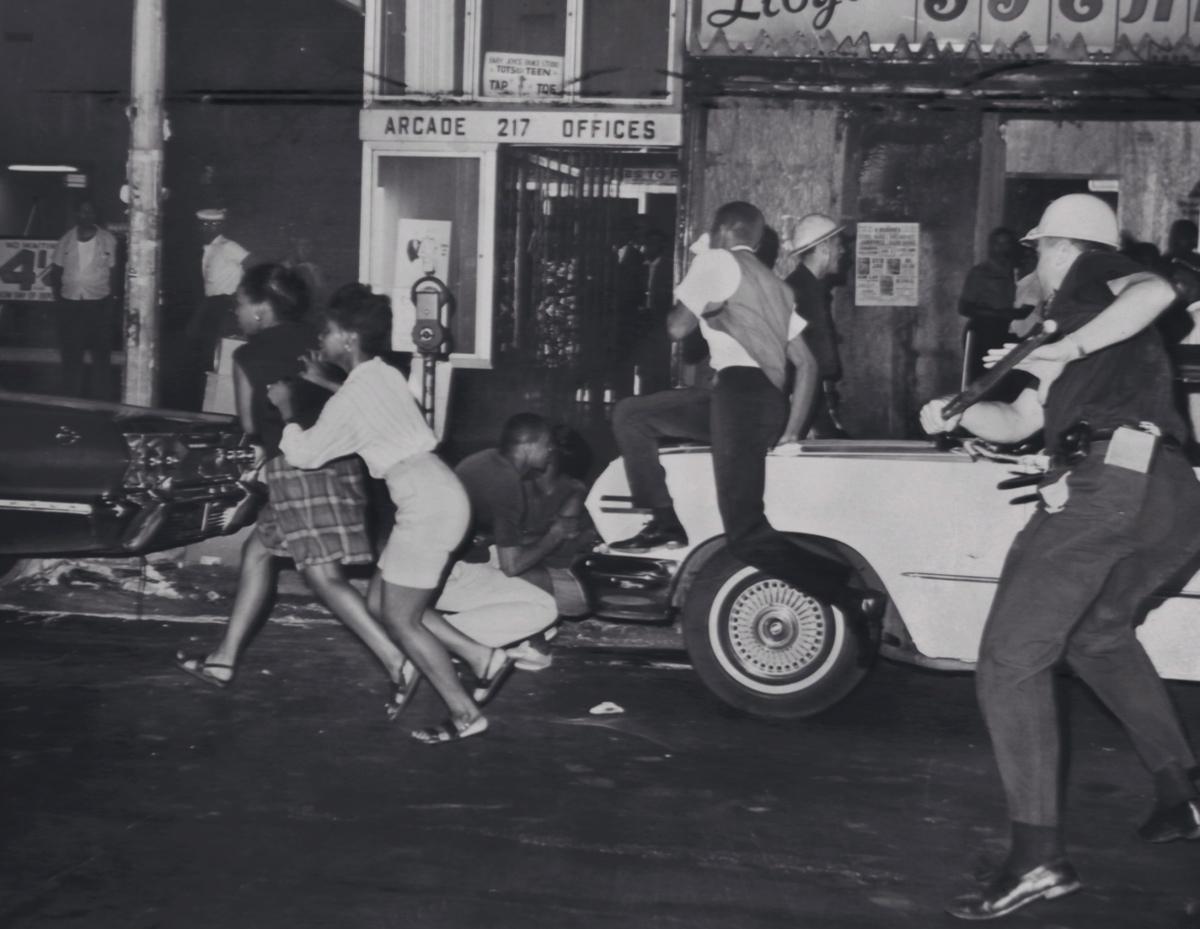
![1906 photograph of Ota Benga, described as being taken at Bronx Zoo. (Wikimedia) Title: Ota Bengi Creator(s): Bain News Service, publisher Date Created/Published: [no date recorded on caption card] Medium: 1 negative : glass ; 5 x 7 in. or smaller. Reproduction Number: LC-DIG-ggbain-22741 (digital file from original negative) Rights Advisory: No known restrictions on publication. Call Number: LC-B2- 3971-2 [P&P] Repository: Library of Congress Prints and Photographs Division Washington, D.C. 20540 USA http://hdl.loc.gov/loc.pnp/pp.print Notes: Title from unverified data provided by the Bain News Service on the negatives or caption cards. Forms part of: George Grantham Bain Collection (Library of Congress). General information about the Bain Collection is available at http://hdl.loc.gov/loc.pnp/pp.ggbain Format: Glass negatives. Collections: Bain Collection Bookmark This Record: http://www.loc.gov/pictures/item/ggb2005022751/](https://www.boweryboyshistory.com/wp-content/uploads/2015/06/tumblr_mblqmjIlfr1rxtv35.jpg)