Categories
Bowery Boys Bookshelf

Modern Family: Black and Latino Alliances in New York City

The political landscape of modern New York City is a stew of neighborhood, borough, financial and ethnic interests built upon over two centuries of experience and tradition.  The most interesting story of the past fifty years — both locally and nationally — is the ascension of minority voices into the public sphere, reflecting population changes but also rising strategies of organization.

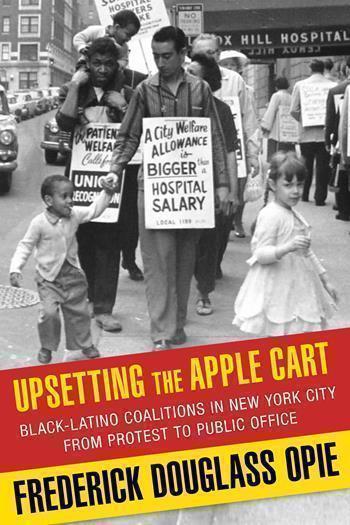
How did non-white New Yorkers first find their voice in modern politics? In Upsetting the Apple Cart, an impressive navigation through late 20th century politics by Frederick Douglass Opie, the answer comes from seemingly surprising places — the hospital, the classroom, the kitchen table.
1

Opie, a professor at Babson College, inspects the particular relationship between New York’s black and Latino communities as they find ways to align at the workplace and in the voting booth. Today it seems obvious that two large minority interest groups might team up to achieve common goals, but it wasn’t until after labor and student activists explored the relationship in the 1950s and 60s that alliances were forged in the major political spheres.

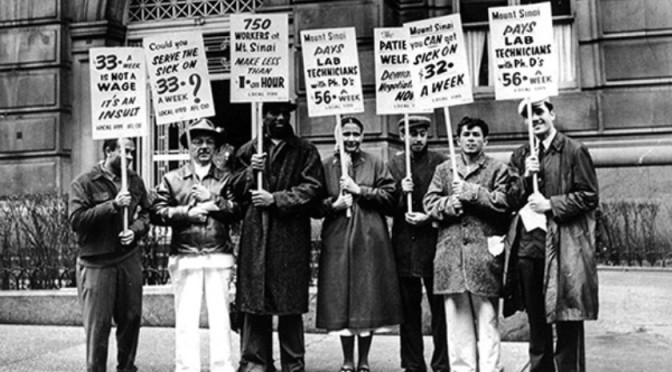
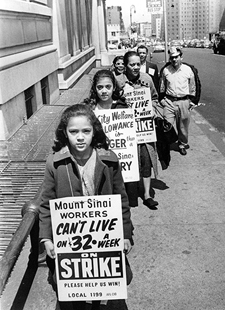
The first half of Upsetting the Apple Cart traces the influences of both the unions and the civil rights movement upon minority workers at local hospitals and students at universities.  Frustrated by lower pay and unfair hours in comparison to their white counterparts, black and Puerto Rican New Yorkers found common ground and successfully organized. This culminated in a massive, ultimately successful city-wide strike on May 8, 1959, lasting almost two months.
2

Minority higher-education students at Columbia University, Hunter College and other school found other reasons to work together — to improve enrollment and educational needs. At Columbia students successfully closed the campus in protest over a new gymnasium being built in Morningside Heights, seen by many as an encroachment into the majority black neighborhood.

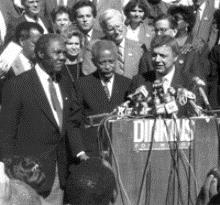
Personally I found the second half of Upsetting the Apple Cart more intriguing, but then, I love rooting around in the history of New York backroom political alliances.  Opie’s book excellently explains the early history of black and Latino political organization, from the rise of power in Harlem by the Gang of Four (including David Dinkins and Charlie Rangel) to the first politicians of Puerto Rican, Mexican and Dominican descent in New York.
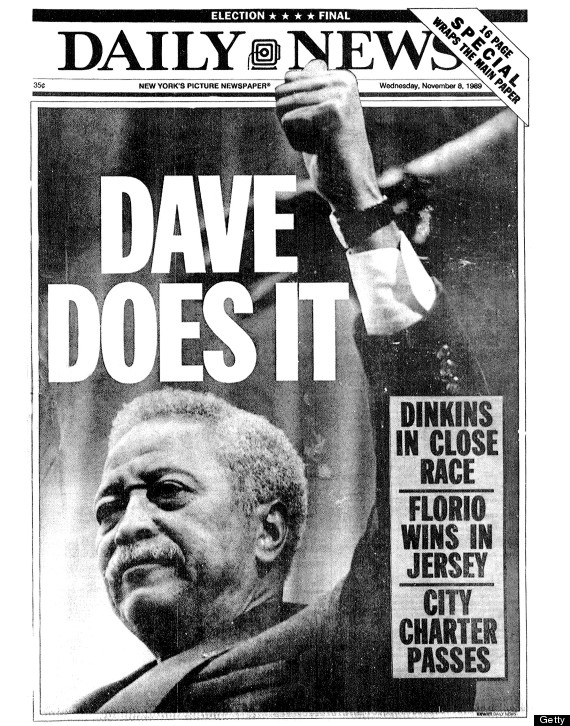
UNITED STATES - NOVEMBER 08: Daily News front page dated Nov. 8, 1989, Headlines: DAVE DOES IT, Dinkins in close race, Florio wins in jersey, City Charter passes, David Dinkins elected Mayor of New York City (Photo by NY Daily News Archive via Getty Images)
UNITED STATES – NOVEMBER 08: Daily News front page dated Nov. 8, 1989, Headlines: DAVE DOES IT, Dinkins in close race, Florio wins in jersey, City Charter passes, David Dinkins elected Mayor of New York City (Photo by NY Daily News Archive via Getty Images)

Politics is made from shifting alliances but it wasn’t until the victory of Harold Washington as mayor of Chicago in 1983 that the united front of African-American, Hispanic and Latino-American activists made itself felt in a major political race. Such unification of goals made its way to New York through the presidential aspirations of Jesse Jackson and the various (ultimately unsuccessful) attempts to unseat New York mayor Ed Koch.

The apex of minority political alliances occurred with the election of David Dinkins, famous for his appeal to the “gorgeous mosaic” of New York ethnicities. Dinkins won because, in the end, he appealed to a majority of New Yorkers. But Opie makes note of the unique organizations of outer-borough Hispanics that helped get him elected.

Wait, did I mention that Upsetting  the Apple Cart is also a cookbook? Somewhat incongruously, traditional recipes for tamales, arroz con pollo, fried chicken and other dishes pop up throughout the chapters. Opie, a food traditions professor, emphasizes the role of social interaction in creating these unique coalitions.  To paraphrase a popular adage, the best way to a neighbor’s heart is through her stomach.  The success of these early alliances lends some credence to food as the great uniter.

Upsetting the Apple Cart:
Black-Latino Coalitions in New York City from Protest to Public Office
by Frederick Douglass Opie
Columbia University Press


Strike pictures courtesy 1199SEIU
Know Your Mayors: David Dinkins

Our modest little series about some of the greatest, notorious, most important, even most useless, mayors of New York City. Other entrants in our mayoral survey can be found here.

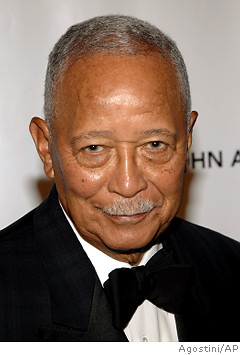
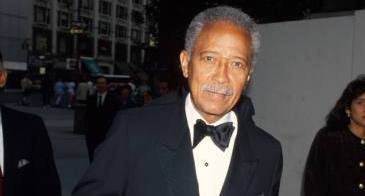
As we cap a historical week for our nation, it seems appropriate to take a brief look at New York City’s own first African-American leader, David Dinkins, mayor of the city from 1990 to 1993, and the last Democrat to hold the office. My only hesitation in bringing this up is that I hope Obama has far better luck than Dinkins, whose tenure was most notable for at least appearing to make almost everything worse. (Appearances, however, can be deceiving.)

Dinkins is one of the most successful products of a Harlem political machine that has been slowly churning since the 1920s, when a huge population influx into the neighborhood bestowed political influence to community leaders and business owners.

Not surprisingly, many of today’s political organizations are spinoffs of Tammany Hall from its last waning days of power, and so came J. Raymond Jones, Tammany Hall’s first black leader in the 1960s.  Jones developed his own political coterie here — known as the ‘Harlem Clubhouse’ — and proceeded to foster some of New York’s saaviest political talents, including New York congressman Charlie Rangel and former deputy New York mayor Basil Patterson, father of our current governor.

Dinkins became a core member of this influential political group. (Rangel actually calls himself, Dinkins, Patterson and Percy Sutton the “Gang of Four.”) Although born in Trenton, New Jersey, David’s family moved to Harlem during the 1930s, just as the neighborhood, once flourishing under a cultural renaissance, begin feeling the pinch of economic depression. After a stint in the Marines, Dinkins returned to New York, became a lawyer and slowly began his ascent into Harlem’s growing political scene.

His close political connections with the Clubhouse granted him access to real opportunity — first in the state assembly in 1966, then City Clerk in 1975 — but it was his work with the city’s lower class that endeared him to constituents. In 1985 he was elected Manhattan Borough President, often a springboard to the mayoralty.

From our vantage today, Dinkins is sandwiched between two great forces in New York City politics — Ed Koch and Rudy Guiliani. Koch however, bore the brunt of New York’s pitiful economic downturn during the 1980s and Dinkins handily defeated him in the Democratic primary. Guiliani, on the Republican side, was a far more formidable foe; fresh from defeating the wealthy Ronald Lauder (son of Estee Lauder), Rudy put up a good fight against Dinkins, although a New York Times opinion piece laments: “voters have heard almost as much about Jackie Mason and Jesse Jackson as about David Dinkins and Rudolph Giuliani. So far, the two candidates haven’t even managed to debate each other.”

Ultimately, in November 1989, Dinkins defeated Guiliani, in the smallest margin of victory in modern times — 47,080 votes.

Dinkins seems almost immediately carried off by events of the city. Although he was initially seen as a potential salve to the city’s uneasy ethnic tensions, he was soon caught up in rocky political scandals, most involving racial violence.

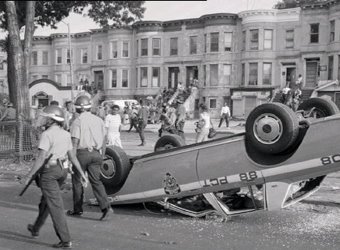
None were as damaging as the Crown Heights riots of 1991. A deadly three days of racially fueled mayhem between West Indian and Jewish residents which left dozens injured, Dinkins was remarkably ineffective in quelling the violence and later was even accused of restraining police and refusing to get involved. It was a political disaster for Dinkins, one he was never able to recover from for the duration of his term.

In fact, the event disguises a surprising fact: Dinkins did successfully lower the city’s crime rate and grow the city’s police force.  It’s widely argued that many of Dinkin’s policies laid the ground work for Guiliani’s many successes in the late 90s.

However, Rudy successfully lobbed Crown Heights back at Dinkins during an electoral rematch in 1993.  Although Dinkins still had great support in Manhattan, Rudy swept past him to officially end the Democratic hold on the mayor’s office.

Dinkins is currently a professor at Columbia University. His term as mayor is still one of the most hotly debated even today.

And because he’s a Bowery Boys fave, I thought you might like to know his thoughts on another controversial New York figure, Robert Moses (quote courtesy PBS.org):

“Robert Moses left a legacy. To be sure, we would not have had the kinds of development that we had, had he not behaved as he did. Which incidentally doesn’t mean that it was necessarily a good thing to so behave. There was a lot of pain in the wake of some of the things that got accomplished and he fought with mayors and governors along the way, but he did achieve a lot of development that would not have occurred otherwise, and that no way could occur today.”