Categories
Amusements and Thrills

The decline and fall of Coney Island’s original Thunderbolt

Coney Island gets a brand new star attraction this week — the 2,000-feet Thunderbolt roller-coaster in Luna Park.  It’s “narrower than most apartments” (according to Gizmodo), a bright orange ribbon ride that squiggles, rises and plummets within a disturbingly wonky silhouette.

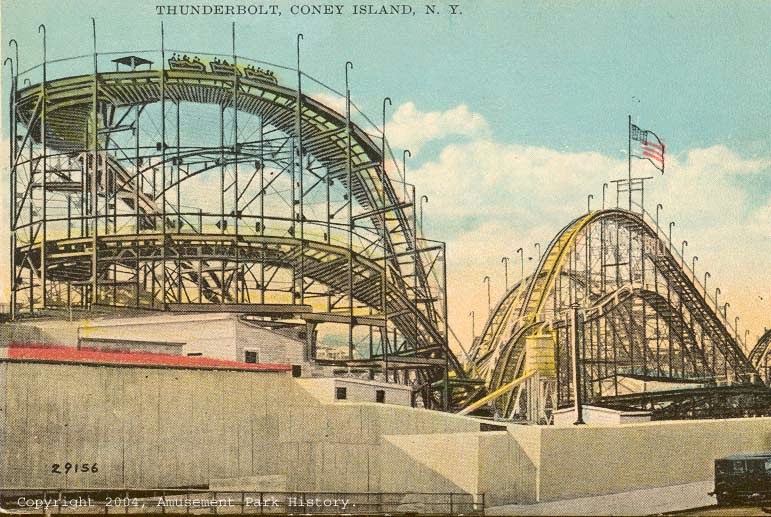
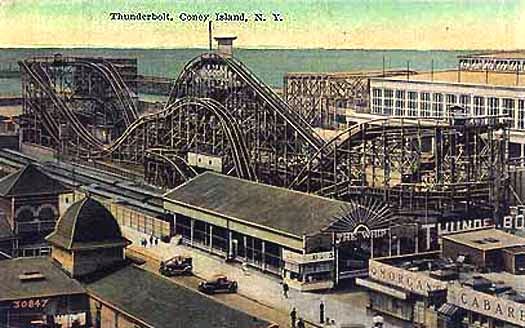
It also takes its name from one of Coney Island’s most famous roller-coasters, designed by famed ride designer John Miller. The Thunderbolt is considered by some to be one of Miller’s least impressive works. (The name is not even original; there are three other Miller-designed coasters named ‘Thunderbolt’.)

This jaunty “scenic railway,” as roller coasters were called then, was a huge success at its opening in 1925. One year later came the first accident, when the train “stalled half way up a steep incline, slipped back to the bottom of the dip and was crashed into by the succeeding train.”
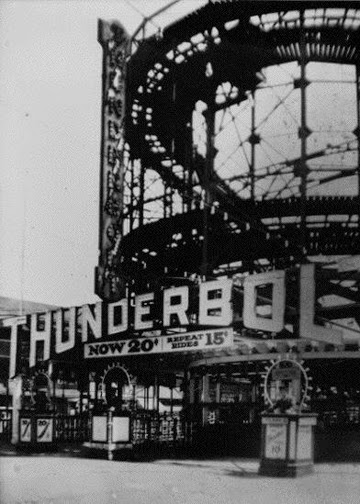
Twenty cents a ride, but a second one for fifteen cents. (Courtesy Brooklyn Memories)
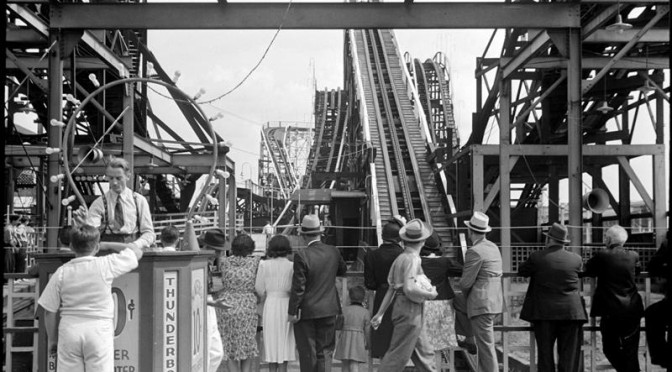
Below: Onlookers watch the cars go ’round the Thunderbolt, 1938 (Reginald Marsh photographer, courtesy MCNY)
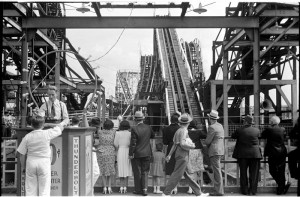
It’s perhaps the cinema’s most famous roller-coaster thanks to Woody Allen and the Oscar-winning film Annie Hall.  John Moran and his son Fred, the operators of the Thunderbolt, really did live underneath it, “the back stanchions of the steel structure come down through the walls of the apartment.”   His home was used in the film. [source] [source]

Fred Moran died in 1982, and the ride closed later that year, in great need of repairs that never came.  It famously sat abandoned during the 1980s-90s, embraced in weeds and surrounded by a rusty fence. The land was sold to Horace Bullard, owner of the Kansas Fried Chicken fast-food chain, who intended on reopening it. 

He never managed to revive the Thunderbolt.   In 1991, the Moran house was destroyed in a fire, and the Thunderbolt itself succumbed to flames in 1998..  Its husk remained standing until it was controversially torn down (and with “deliberate indifference“) starting on November 17, 2000.

Below: The ruins of the Thunderbolt. And I believe the Moran home is also pictured her. (Courtesy the blog Coney Island Playground of the World)


Why rush the destruction of an artifact that, by that time, was one of New York’s best known ruins and a mecca for nostalgists?  The city was looking to lure minor league teams to New York, and with the construction of the new KeySpan Park, the nearby ruin was considered an “eyesore that looked dangerous.”

Ironically, the baseball team that would move into KeySpan would be named after Coney Island’s other famous roller-coaster — the Cyclone.


Less than 14 years later, a new Thunderbolt will make its debut near this very spot.
How Erin Brockovich saved the East River ampitheater

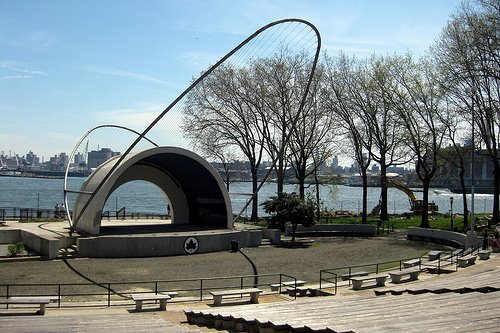
I’ve always been a little fascinated by that small ampitheatre that’s located in Manhattan’s East River Park (near Corlear’s Hook). For years it just seemed so hopelessly abandoned. In the past few years though it’s been making a comeback, featuring the occasional live concert and offering a unique, leafy respite for joggers.

The East River Park is a rather unusual thing, a Robert Moses original from 1939 that features 20 blocks of artificial concrete extension to connect the original land purchase (too narrow to be a useful park) with the East River shore. It’s the largest park in downtown Manhattan, larger in acreage than Battery, Thompkins Square or Washington Square parks.

Among its many Moses staples — ball fields, paved playgrounds and paved picnic areas — is the amphitheater constructed in 1941 as a nod to the neighborhood’s most famous former resident, New York governor Al Smith, who had pursued acting in his youth.

However, nothing much exciting blossomed from its curiously designed proscenium until the late 1950s, which Joseph Papp first launched his series of free Shakespeare performances. That’s right, the Public Theatre’s annual outdoor tradition of Shakespeare In the Park began here — at East River Park, not Central Park.

Once they left uptown for their permanent home, however, things became quite grim for the ampitheatre. By 1973, the city couldn’t even afford to keep it open. It was fenced up, closed down and heavily vandalized. For those living in the city at the time who came upon it, it did in fact seem like a modern ruin, Robert Moses’ very own Acropolis.

The park itself was slowly renovated throughout the 1990s, but relief finally came to the beleaguered stage in December 2001 thanks to, curiously enough, to reality television and Erin Brockovich — the real Brockovich, not the Julia Roberts version.

In the months following 9/11, many restorative projects began popping up throughout downtown. Brockovich, rising to national prominence thanks to the Roberts film, was filming an urban makeover program Challenge America for ABC. Brockovich and her producers chose the amphitheater for renovation, done over the course of a week, using the donated services of Tishman Construction and HLW Architects. Why this place exactly? I’m not sure, but Rudy Guiliani assigned the project to the program during a telecast of Good Morning America.

I didn’t catch the one-shot show, but I’m picturing Ms. Brockovich in one of her signature ensembles directing workman while standing on the stage. Truly one of the stranger stories of renovation that I’ve ever heard.

Know Your Mayors: David Dinkins

Our modest little series about some of the greatest, notorious, most important, even most useless, mayors of New York City. Other entrants in our mayoral survey can be found here.

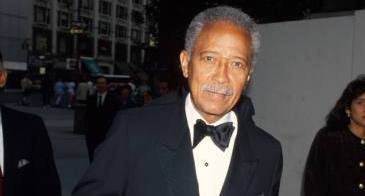
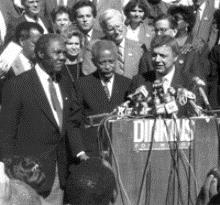
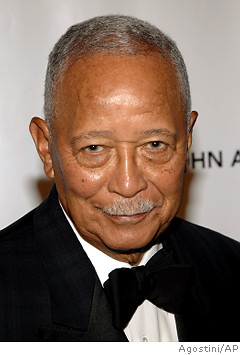
As we cap a historical week for our nation, it seems appropriate to take a brief look at New York City’s own first African-American leader, David Dinkins, mayor of the city from 1990 to 1993, and the last Democrat to hold the office. My only hesitation in bringing this up is that I hope Obama has far better luck than Dinkins, whose tenure was most notable for at least appearing to make almost everything worse. (Appearances, however, can be deceiving.)

Dinkins is one of the most successful products of a Harlem political machine that has been slowly churning since the 1920s, when a huge population influx into the neighborhood bestowed political influence to community leaders and business owners.

Not surprisingly, many of today’s political organizations are spinoffs of Tammany Hall from its last waning days of power, and so came J. Raymond Jones, Tammany Hall’s first black leader in the 1960s.  Jones developed his own political coterie here — known as the ‘Harlem Clubhouse’ — and proceeded to foster some of New York’s saaviest political talents, including New York congressman Charlie Rangel and former deputy New York mayor Basil Patterson, father of our current governor.

Dinkins became a core member of this influential political group. (Rangel actually calls himself, Dinkins, Patterson and Percy Sutton the “Gang of Four.”) Although born in Trenton, New Jersey, David’s family moved to Harlem during the 1930s, just as the neighborhood, once flourishing under a cultural renaissance, begin feeling the pinch of economic depression. After a stint in the Marines, Dinkins returned to New York, became a lawyer and slowly began his ascent into Harlem’s growing political scene.

His close political connections with the Clubhouse granted him access to real opportunity — first in the state assembly in 1966, then City Clerk in 1975 — but it was his work with the city’s lower class that endeared him to constituents. In 1985 he was elected Manhattan Borough President, often a springboard to the mayoralty.

From our vantage today, Dinkins is sandwiched between two great forces in New York City politics — Ed Koch and Rudy Guiliani. Koch however, bore the brunt of New York’s pitiful economic downturn during the 1980s and Dinkins handily defeated him in the Democratic primary. Guiliani, on the Republican side, was a far more formidable foe; fresh from defeating the wealthy Ronald Lauder (son of Estee Lauder), Rudy put up a good fight against Dinkins, although a New York Times opinion piece laments: “voters have heard almost as much about Jackie Mason and Jesse Jackson as about David Dinkins and Rudolph Giuliani. So far, the two candidates haven’t even managed to debate each other.”

Ultimately, in November 1989, Dinkins defeated Guiliani, in the smallest margin of victory in modern times — 47,080 votes.

Dinkins seems almost immediately carried off by events of the city. Although he was initially seen as a potential salve to the city’s uneasy ethnic tensions, he was soon caught up in rocky political scandals, most involving racial violence.

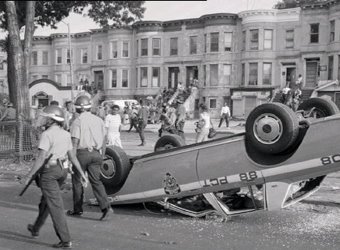
None were as damaging as the Crown Heights riots of 1991. A deadly three days of racially fueled mayhem between West Indian and Jewish residents which left dozens injured, Dinkins was remarkably ineffective in quelling the violence and later was even accused of restraining police and refusing to get involved. It was a political disaster for Dinkins, one he was never able to recover from for the duration of his term.

In fact, the event disguises a surprising fact: Dinkins did successfully lower the city’s crime rate and grow the city’s police force.  It’s widely argued that many of Dinkin’s policies laid the ground work for Guiliani’s many successes in the late 90s.

However, Rudy successfully lobbed Crown Heights back at Dinkins during an electoral rematch in 1993.  Although Dinkins still had great support in Manhattan, Rudy swept past him to officially end the Democratic hold on the mayor’s office.

Dinkins is currently a professor at Columbia University. His term as mayor is still one of the most hotly debated even today.

And because he’s a Bowery Boys fave, I thought you might like to know his thoughts on another controversial New York figure, Robert Moses (quote courtesy PBS.org):

“Robert Moses left a legacy. To be sure, we would not have had the kinds of development that we had, had he not behaved as he did. Which incidentally doesn’t mean that it was necessarily a good thing to so behave. There was a lot of pain in the wake of some of the things that got accomplished and he fought with mayors and governors along the way, but he did achieve a lot of development that would not have occurred otherwise, and that no way could occur today.”