Categories
Amusements and Thrills

The decline and fall of Coney Island’s original Thunderbolt

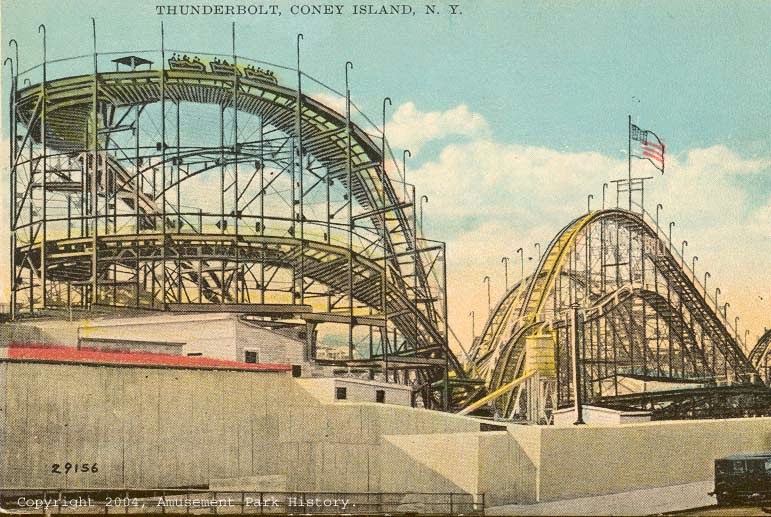
Coney Island gets a brand new star attraction this week — the 2,000-feet Thunderbolt roller-coaster in Luna Park.  It’s “narrower than most apartments” (according to Gizmodo), a bright orange ribbon ride that squiggles, rises and plummets within a disturbingly wonky silhouette.

It also takes its name from one of Coney Island’s most famous roller-coasters, designed by famed ride designer John Miller. The Thunderbolt is considered by some to be one of Miller’s least impressive works. (The name is not even original; there are three other Miller-designed coasters named ‘Thunderbolt’.)

This jaunty “scenic railway,” as roller coasters were called then, was a huge success at its opening in 1925. One year later came the first accident, when the train “stalled half way up a steep incline, slipped back to the bottom of the dip and was crashed into by the succeeding train.”
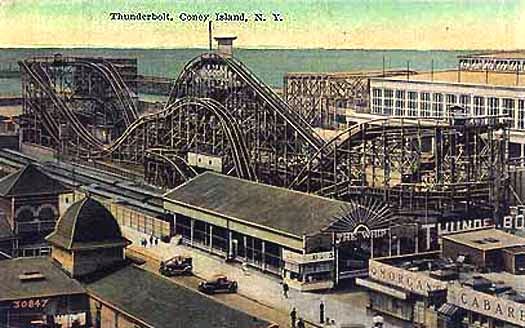
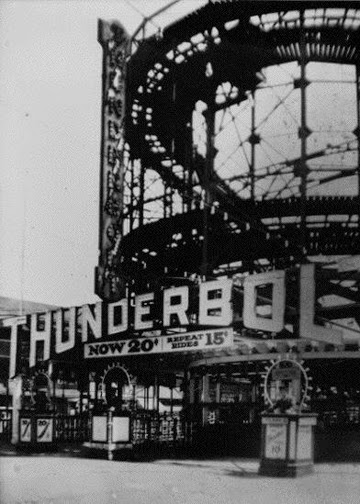
Twenty cents a ride, but a second one for fifteen cents. (Courtesy Brooklyn Memories)
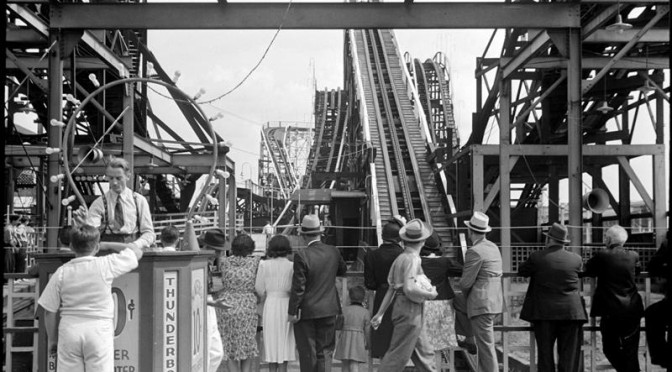
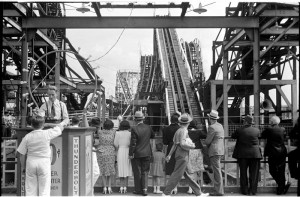
Below: Onlookers watch the cars go ’round the Thunderbolt, 1938 (Reginald Marsh photographer, courtesy MCNY)
It’s perhaps the cinema’s most famous roller-coaster thanks to Woody Allen and the Oscar-winning film Annie Hall.  John Moran and his son Fred, the operators of the Thunderbolt, really did live underneath it, “the back stanchions of the steel structure come down through the walls of the apartment.”   His home was used in the film. [source] [source]

Fred Moran died in 1982, and the ride closed later that year, in great need of repairs that never came.  It famously sat abandoned during the 1980s-90s, embraced in weeds and surrounded by a rusty fence. The land was sold to Horace Bullard, owner of the Kansas Fried Chicken fast-food chain, who intended on reopening it. 

He never managed to revive the Thunderbolt.   In 1991, the Moran house was destroyed in a fire, and the Thunderbolt itself succumbed to flames in 1998..  Its husk remained standing until it was controversially torn down (and with “deliberate indifference“) starting on November 17, 2000.

Below: The ruins of the Thunderbolt. And I believe the Moran home is also pictured her. (Courtesy the blog Coney Island Playground of the World)


Why rush the destruction of an artifact that, by that time, was one of New York’s best known ruins and a mecca for nostalgists?  The city was looking to lure minor league teams to New York, and with the construction of the new KeySpan Park, the nearby ruin was considered an “eyesore that looked dangerous.”

Ironically, the baseball team that would move into KeySpan would be named after Coney Island’s other famous roller-coaster — the Cyclone.


Less than 14 years later, a new Thunderbolt will make its debut near this very spot.
Categories
Neighborhoods

Five items from the Village Voice, 50 years ago this week

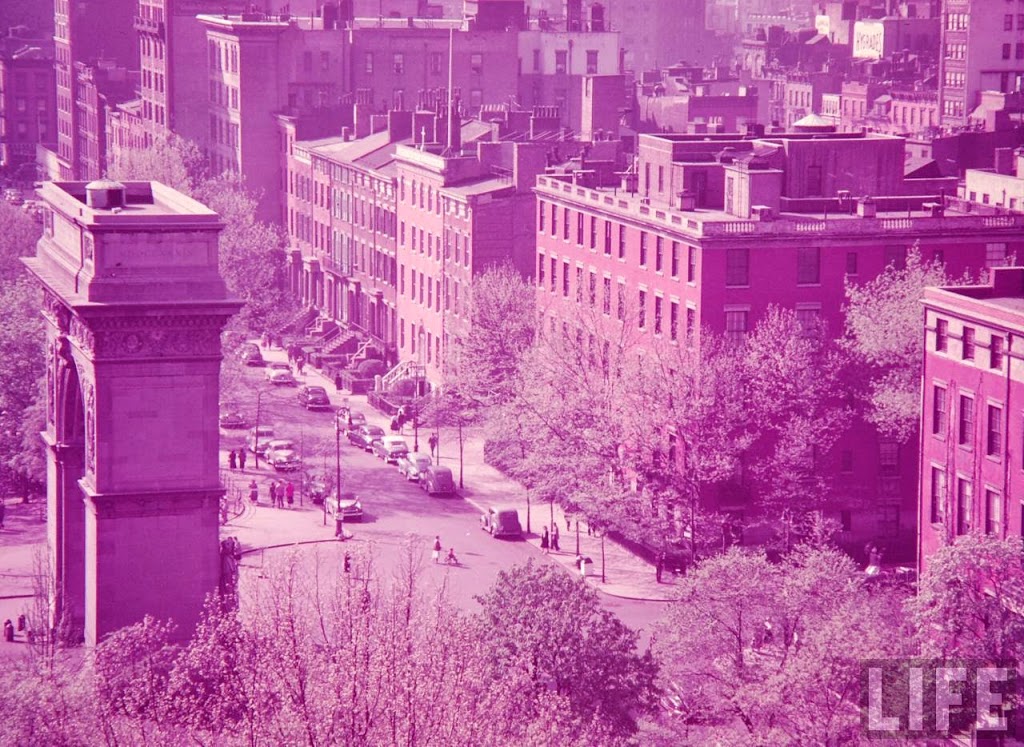
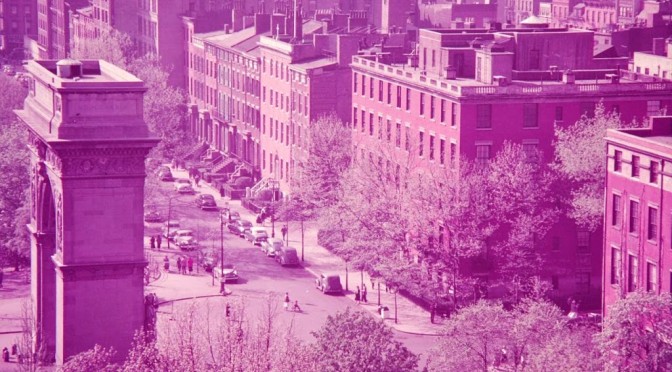
Washington Square North, looking west, 1950, photo by Walter Sanders, Life Magazine

The entire back catalog of the Village Voice, New York’s original alternative weekly, is available online through Google News.  The early issues are especially full of character, a scrappy counter-culture organ which provides an interesting window into downtown Manhattan.  Here are some highlights from an issue which came out fifty years ago this week:

1) Washington Square Park, both the physical epicenter of Greenwich Village and the gathering place for the Village’s various cultural factions, faced a possible makeover by the city in 1964.  “This plan has two objectives.  The first is to clean up the park, which is now physically run-down and neglected.  The second, in response to complaints by adjacent property-owners, is to discourage beatniks and other ‘undesirable elements’ from congregating there.” [source]

The park had been a magnet for the beatnik scene since the early 1950s.   The folk singers who would gather on Sunday afternoons had won a major victory in 1961 after a so-called “beatnik riot” convinced the city to allow musical crowds to congregate there

The park was eventually altered that year, but one major change would have been applauded by all — the traffic lane that cut under the Washington Square Arch and through the park was officially closed.

2) Sara D. Roosevelt Park in the Lower East Side, meanwhile, remained a disheveled dump, and the Voice clearly saw it as a symbol of the city’s neglect of the poor. “While the Parks Department is champing at the bit to pour $750,000 into Washington Square …. Sara Delano Roosevelt playground resembles a post-war Berlin.  The latter, at Forsyth and Chrystie Streets, has been the scene of unrelieved wreckage for almost six years.  It was torn up to make way for a subway and no one one thought to put it back together again.

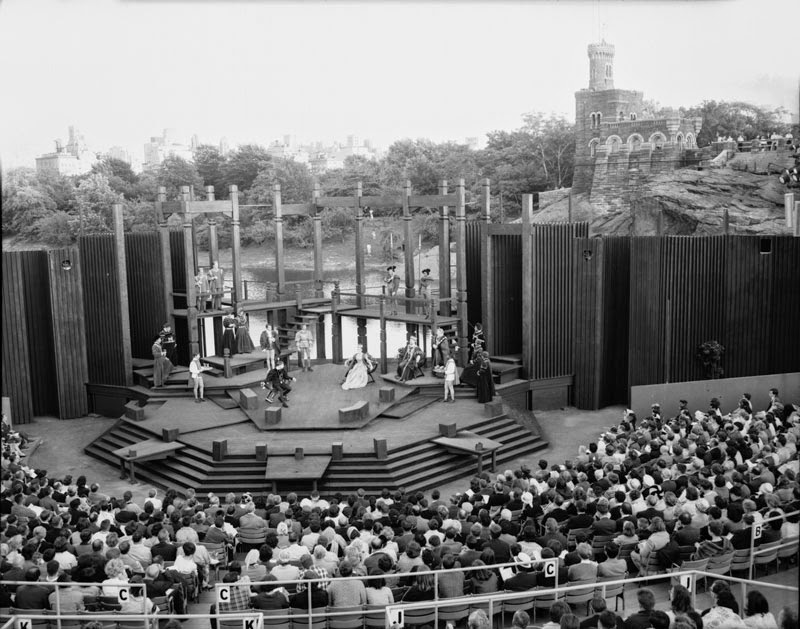
The Delacourte Theater, June 1964, a performance of Hamlet (courtesy NYC Parks)

3) The New York Shakespeare Festival has a new home at the Delacourte Theater in Central Park, but writer John Wilcock, author of the Village Square column, pines for the festival’s shaggier, less respectable days.  Respectability has rendered it commonplace, according to Wilcock. Now you have to line up to grab a seat!  “This is an improvement?”

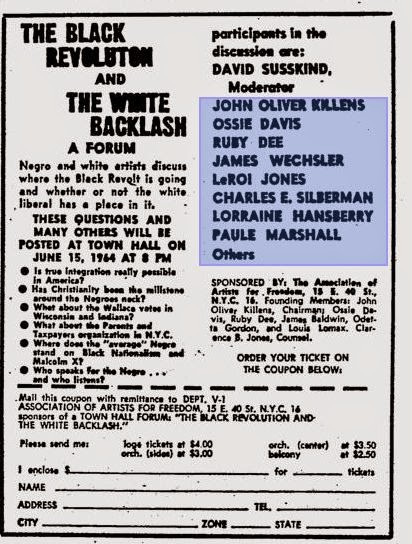
4) The Black Revolution and The White Backlash, a lecture at Town Hall, featured an interesting group of guests, including LeRio Jones (aka Amiri Baraka):

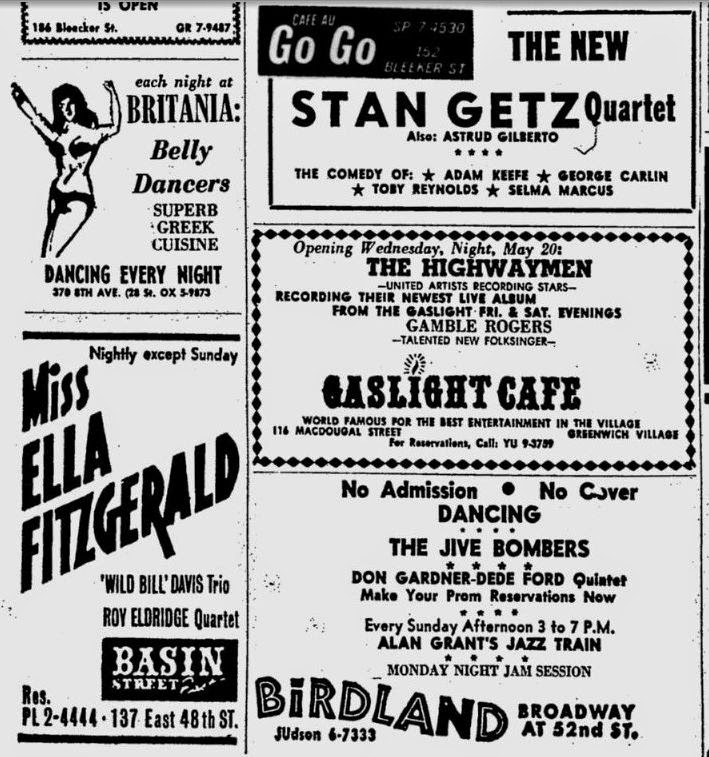
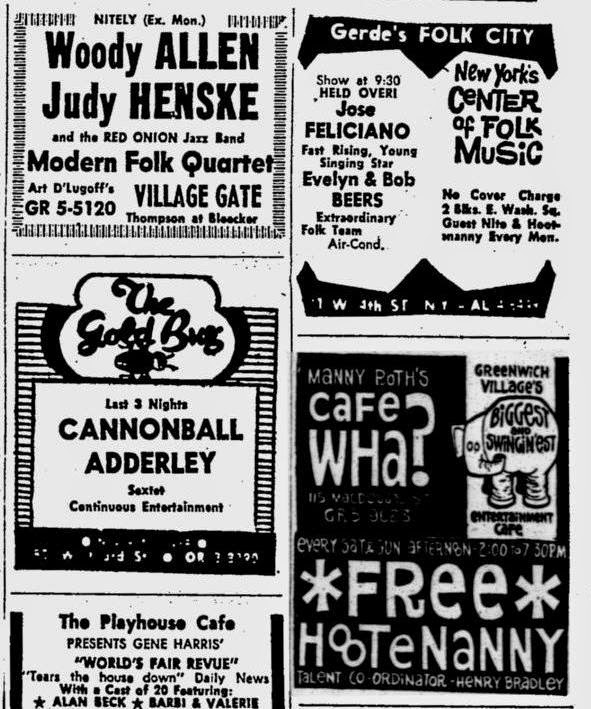
5) The jazz and folk clubs: A glorious sampling of musical icons that week — Ella Fitzgerald, Stan Getz, George Carlin, the Highwaymen, Woody Allen, Jose Feliciano, Cannonball Adderley

When Jupiter aligned with Mars: Hair on Broadway


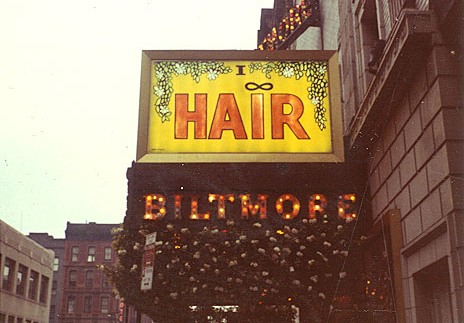
Forty years ago today, April 29, 1968, the musical Hair debuted on Broadway and basically changed New York’s theater industry — where shows come from, how they’re staged, what you can even doon stage.

Here’s ten reasons why Broadway’s first rock musical is so important, and why today you should probably fish out your Fifth Dimension CD or original cast album in tribute to this one of a kind groovy show:

1) Hair made the Public Theater. The show made its debut on October 17, 1967 at the Public, which was itself making its debut. In fact, the theater in which is was being performed — in the former Astor Library — wasn’t even finished yet! The Public Theater would have course to go on to become off-Broadway’s leading theatrical producer.

2) After six weeks, Hair would foreshadow Studio 54’s own transformation into a Broadway house by moving the remainder of its off-Broadway run into the Cheetah discotheque.

3) Hair is the very first musical to be transferred from off-Broadway. At the time an extremely risky proposition, it’s today considered a logical move for the most critically popular of shows. Rent, Avenue Q and Spring Awakening — like Hair, all off-center shows with sexuality and rebellion at their core — also made the jump to the big stage and all won Tonys for Best Musical.

4) Hair brings Tom O’Horgan to Broadway. A regular at the off-off-Broadway La Mama — the East Village’s most venerated experimental theater — O’Horgan brought an uncompromising edge to his staging that was entirely shocking to mainstream theatrical audiences. O’Horgan would stay on Broadway throughout the 70s with pivotal work in Jesus Christ Superstar, Futz!, and Lenny.

5) Hair doubles the number of songs ‘allowed’ in a musical. The sheer number of songs in Broadway restaging made it unique, over thirty. The big musical from the previous year, Cabaret, barely featured half that number

6) O’Horgan also brings the nudity. The uptown redux features one of the most influential scenes in all of Broadway history — at the end of the first act, when the entire cast, in low lights, appear completely unclothed, the first stage nudity to hit the Great White Way.

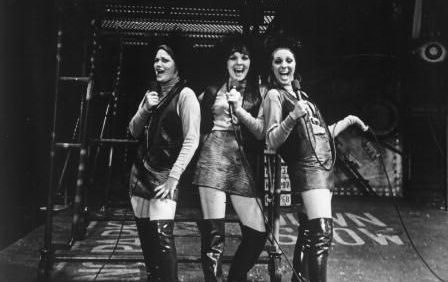
7) A New York icon debuts. Diane Keaton (above, in the middle) becomes an understudy in the show but refuses to do the nude scenes. After several months with the cast, Keaton goes on to her next show — Play It Again, Sam — where she makes the acquaintance of a young director, Woody Allen.

8) Up for two awards (Best Director and Best Musical) at the 1969 Tony Awards, it lost both to the musical 1776. Interestingly, Diane Keaton is up for her Tony that year for Play It Again Sam and also lost.

9) Hair closes July 1, 1972 after 1,750 performances. It is the 38th longest running musical in Broadway history, between La Cage Au Folles (at 37) and The Wiz (at 39).

10) An unbelievable one-night revival of Hair, in 2004, for an Actors Fund benefit, mounted at the New Amsterdam and featured the following cast: JM J. Bullock, Harvey Fierstein, Ana Gasteyer, Annie Golden, Jai Rodriguez, RuPaul, Michael McKean, Laura Benanti, Adam Pascal and future Oscar winner Jennifer Hudson

Here’s about a comprehensive list of some of Hair ‘s original review. Both the New York Post and the New York Times gives the original off-Broadway production a condescendingly mixed review.

The Village Voice? Hated it. “As for Hair, I loathed and despised it. Described as ‘an American tribal love-rock musical’ it turned out to be all phony.” Wow, some things never change!

We’ll see how the critics like it this summer when the Public Theatre restages Hair for its Shakespeare In The Park program at Delacorte Theatre, from July 22 to August 17. Diane Keaton won’t be in it, but will there be nudity?