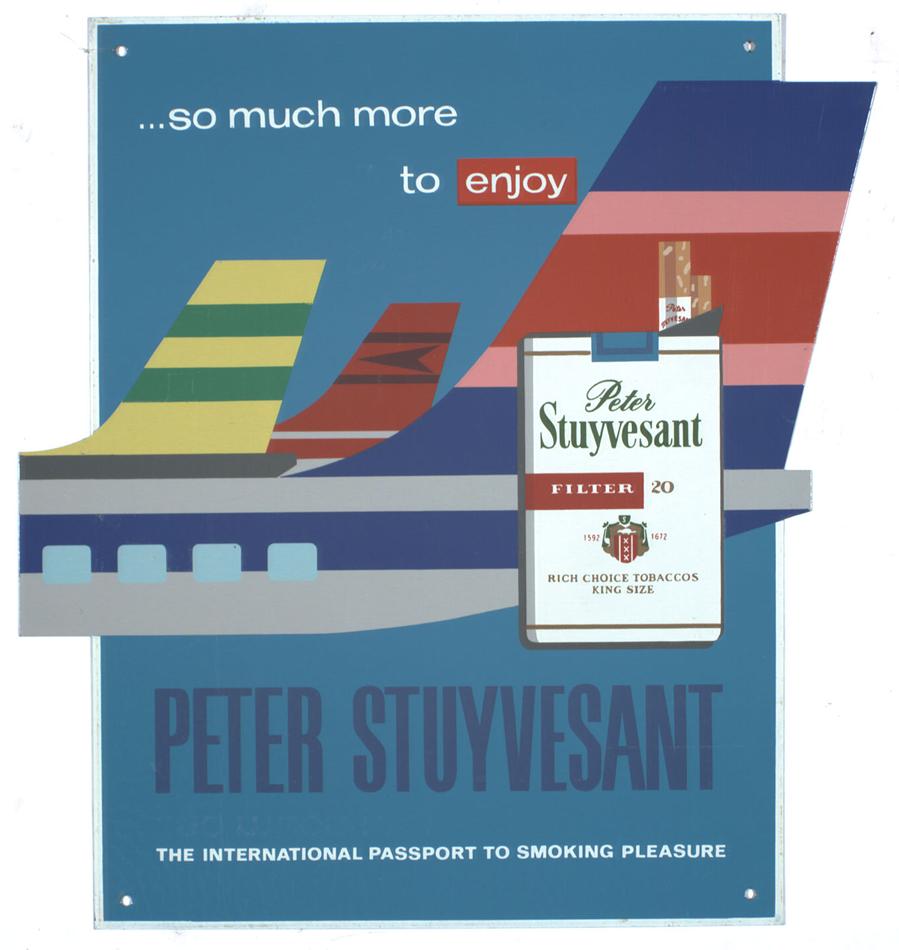
Oh, that Peter Stuyvesant. He was all about luxury, high class athletic sport and international travel. The Concorde! Monte Carlo! Caviar!
Less than three centuries after the iconic Dutch director-general of New Amsterdam died at his palatial farm in today’s East Village, his name was employed to sell a brand of stylish, premium cigarette, still enjoyed today by smokers in Australia, New Zealand, South Africa and other counties, most being places Peter Stuyvesant had no idea existed.
The cigarette was developed by a German company in the 1950s and soon became associated with an international sensibility due to its ‘American blend’ of various tobaccos from different countries. “The smell of the large far world: Peter Stuyvesant” went the slogan in 1958. It was test marketed in New York in 1957. Stuyvesant was not the only Dutch historical figure to make his cigarette debut that year; Rembrandt cigarettes also hit the streets of New York that year.
“Stuyvesant people having fun!” went the jingle, accompanied by rigorous activity that might prove challenging for those enjoying one too many of their advertised product:
By the 1980s, the Peter Stuyvesant cigarette was advertised as a high adventure,Donald Trump-like symbol of masculinity and wealth, trying to closely align with upper class leisure. In London, during the 1980s, the cigarette company even sponsored the Peter Stuyvesant Pops in London. In 2003, the cigarette was even bought by a British company, which would have disturbed the actual Peter Stuyvesant to no end.
The company even experimented with Peter Stuyvesant travel agencies in some places, clever ways to advertise their cigarettes in places with strict advertising laws.
The cigarette embodied the American ideal, a distillation of glamour, capitalism and excess, ‘further testimony to the adoption by European of American dreams’, according to author Alexander Stephan. “Feel the Big Apple beat!” went this promotion in 1985. “It’s fun! It’s fabulous! It’s fast!”
Meanwhile, over in Brooklyn, the neighborhood which bore the Stuyvesant name (Bedford-Stuyvesant) was hardly tasting the fruits of prosperity advertised in Stuyvesant commercials half a world away. And it was hardly Polos and champagne in the East Village, the neighborhood which developed from Stuyvesant’s old farm to become the gritty backdrop for 1980s art and punk music.
Not that Stuyvesant cigarette executives turned their backs to the promotional opportunities provided by the fight for freedom and human rights. In 1989, employees in ‘Come Together’ shirts distributed Peter Stuyvesant cigarettes to East Berliners on their way to the vote in the election that would unite the former Soviet sector with West Berlin.
Here’s an older ad for you German speakers!
Tomorrow, the Bowery Boys will return to the world of Peter Stuyvesant in our newest podcast.
Listen to our podcast on the General Slocum Disaster:
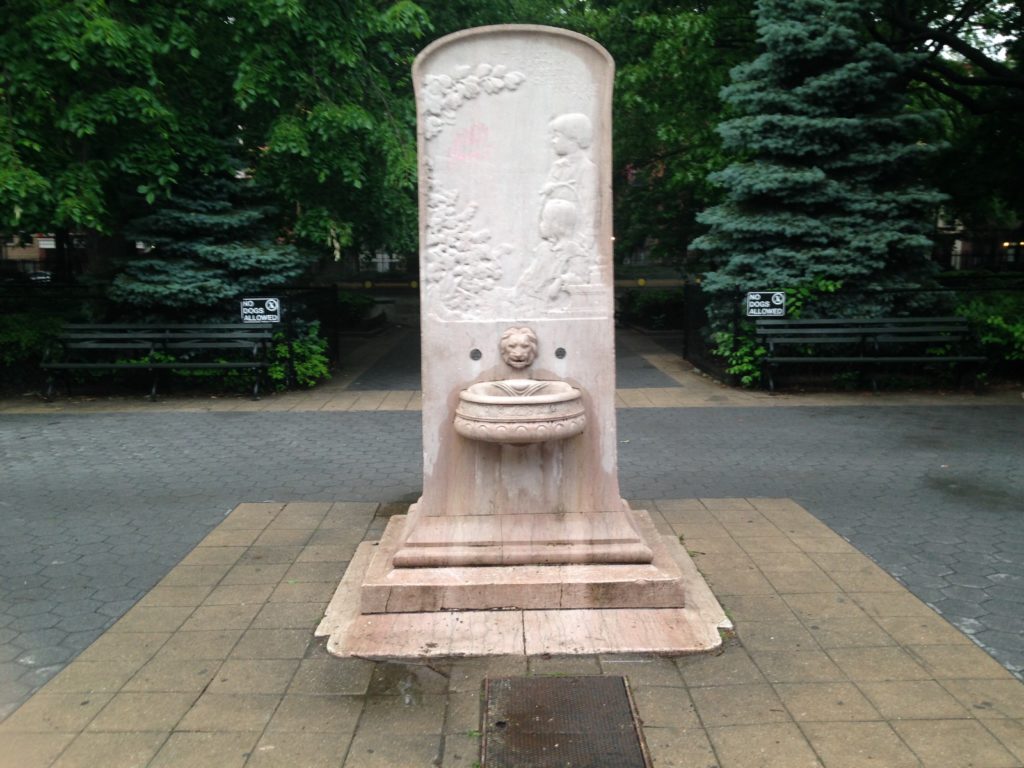
TheGeneral Slocum Memorial Fountain is one of the sole reminders of one of New York City’s darkest days, and it’s not a very awe-inspiring memorial.
This is no dig at the custodians of Tompkins Square Park, where the memorial has been on display since 1906, nor at Bruno Louis Zimm, the fountain’s sculptor whose creation presents two children in idyllic profile, next to an engraving: “They were Earth’s purest children, young and fair.”
Its left side unveils its more tragic context: “In memory of those who lost their lives in the disaster to the steamer General Slocum, June XV MCMIV.”
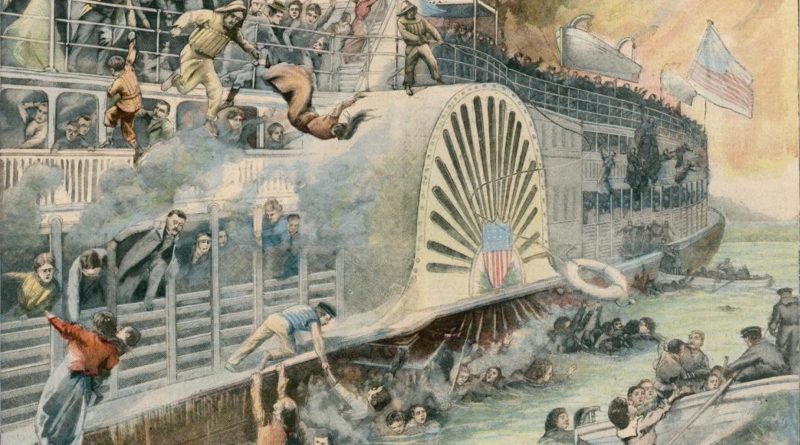
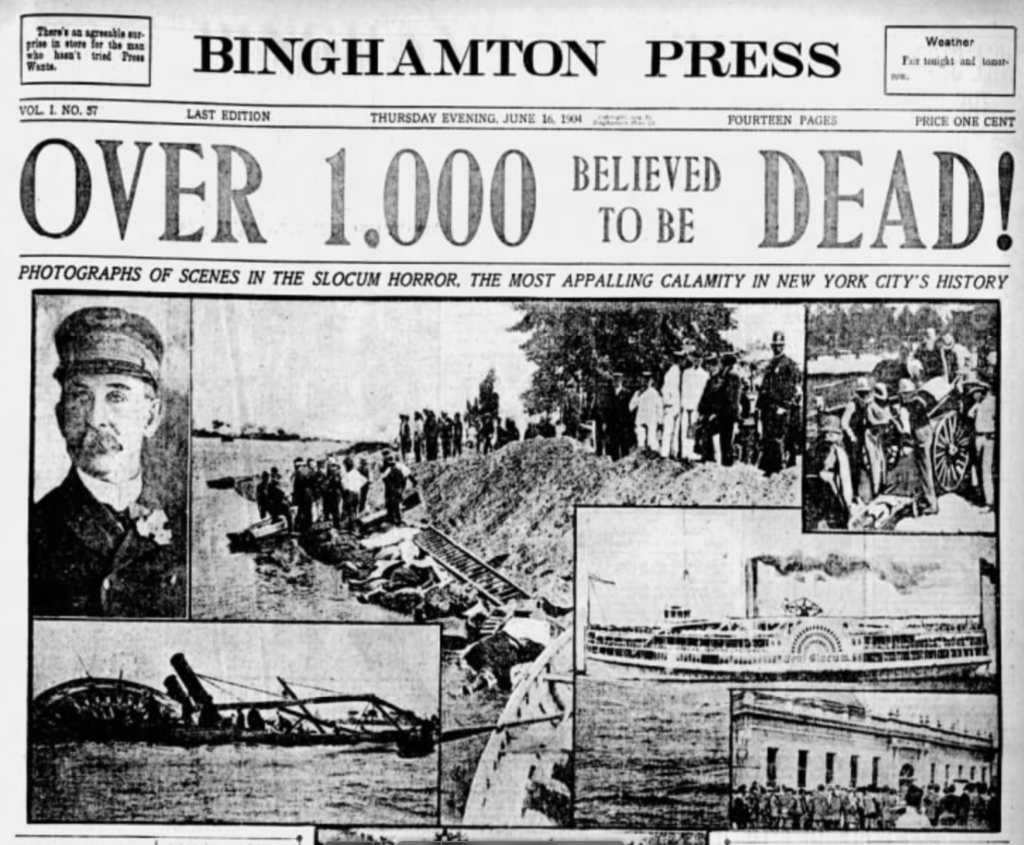
The fountain, while charming and tranquil, is inadequate in expressing the grief and horror that filled New Yorkers on June 15, 1904, when, during a church-sponsored day trip headed for the Long Island Sound, the General Slocum steamboat caught fire and sank in the East River, killing more than a thousand passengers, mostly women and children.
This tragedy was the single deadliest event in New York City history until September 11, 2001.
This disaster virtually wiped out the German presence on the Lower East Side—entire families perished, many of whom had just gotten a foothold in New York a generation before. In a single morning the lights of Kleindeutschland, New York’s Little Germany, permanently faded.
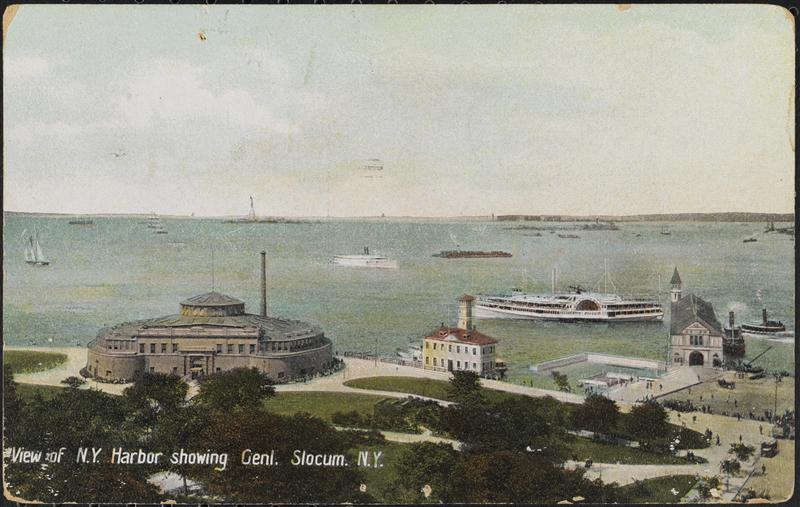
The boat had been chartered by St. Mark’s Evangelical Lutheran Church* for their yearly day trip excursion to the Long Island Sound. The East River was filled with excursion steamers such as the General Slocum and its sister ship the Grand Republic (a vessel with a doomed story of its own).
It was a chance for the congregation to briefly break out of the crowded Lower East Side to enjoy a day in the sun. Among the passengers was the Liebenow family, which consisted of parents and their three daughters, Anna, Helen, and Adella, along with several aunts and cousins.
The Slocum left the pier shortly before 9 a.m. and began its slow crawl up the East River.
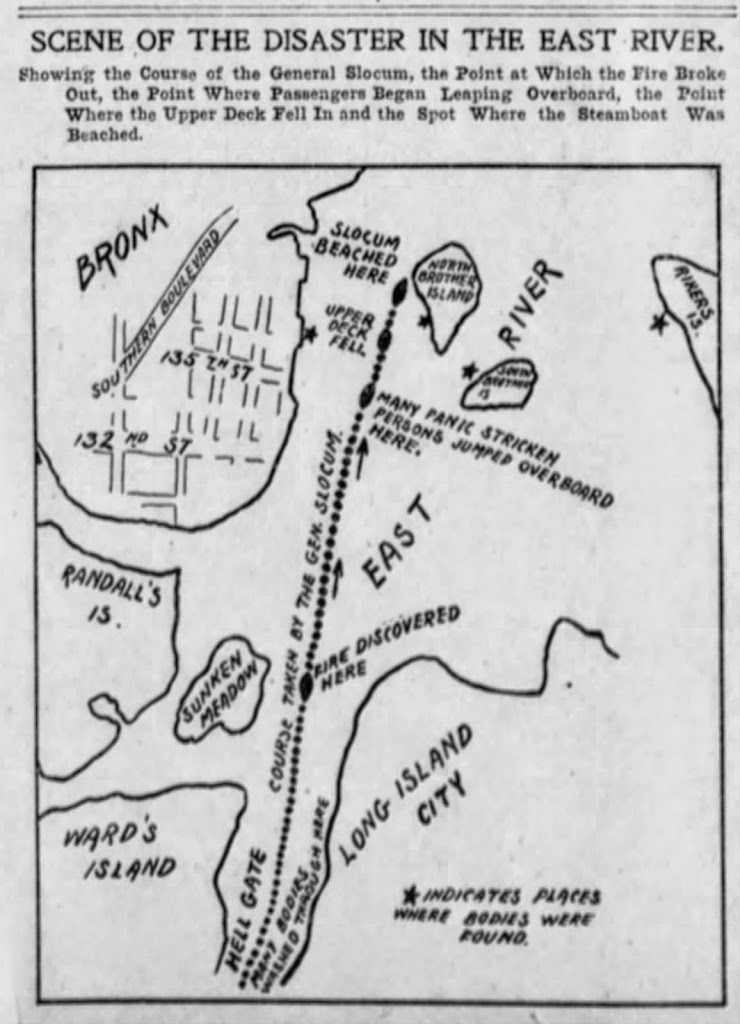
Captain William Van Schaick had been principally concerned that morning with one turbulent spot up the East River, a dangerous confluence of waters known as the Hell Gate. It had already sunk hundreds of vessels as far back as the seventeenth century. By 1904 it was still a dangerous pass, but on this day, the Hell Gate would not be the problem.
About 30 minutes into the voyage, a child noticed that a small fire had started in the lamp room below the main deck.
A crewman tried to stamp it out, throwing charcoal on it in an effort to contain it. But the flames only grew larger.
Crew members grabbed a firehose—only to find it rotten to the point that it burst wide open. These were not men trained for emergency situations; once they realized the hoses were useless, they simply gave up.
from the Brooklyn Daily Eagle
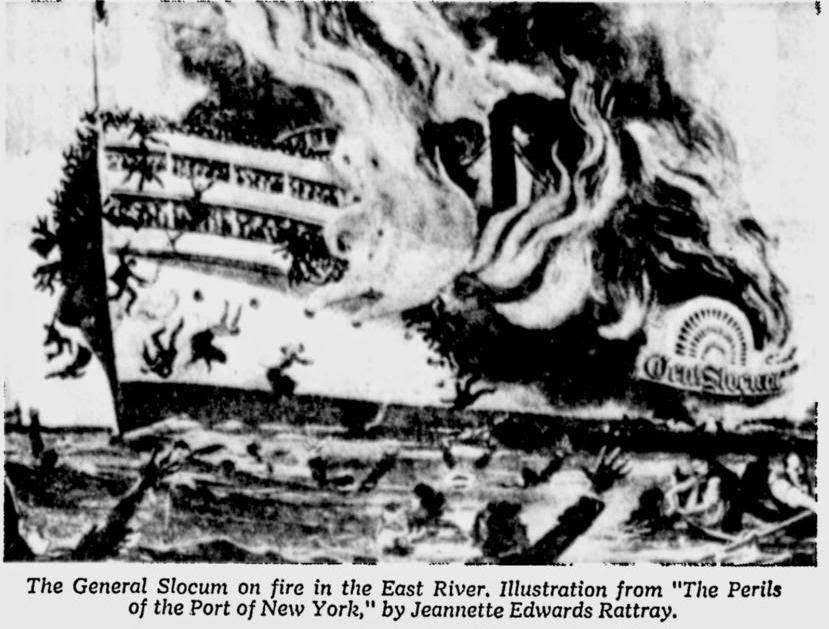
Civilized behavior soon gave way to panic as the flames quickly spread through the lower levels of the steamer, fire jumping from passengers’ clothing to hair.
Families moved away from the flames only to find themselves pressed up against the boat’s railings as panicked crowds pushed forward in search of fresh air. Children lost hold of their parents, never to see them again.
Crowds surged toward the Slocum’s six lifeboats and attempted to hoist them down. But they wouldn’t budge—somebody had wired them to the wall.
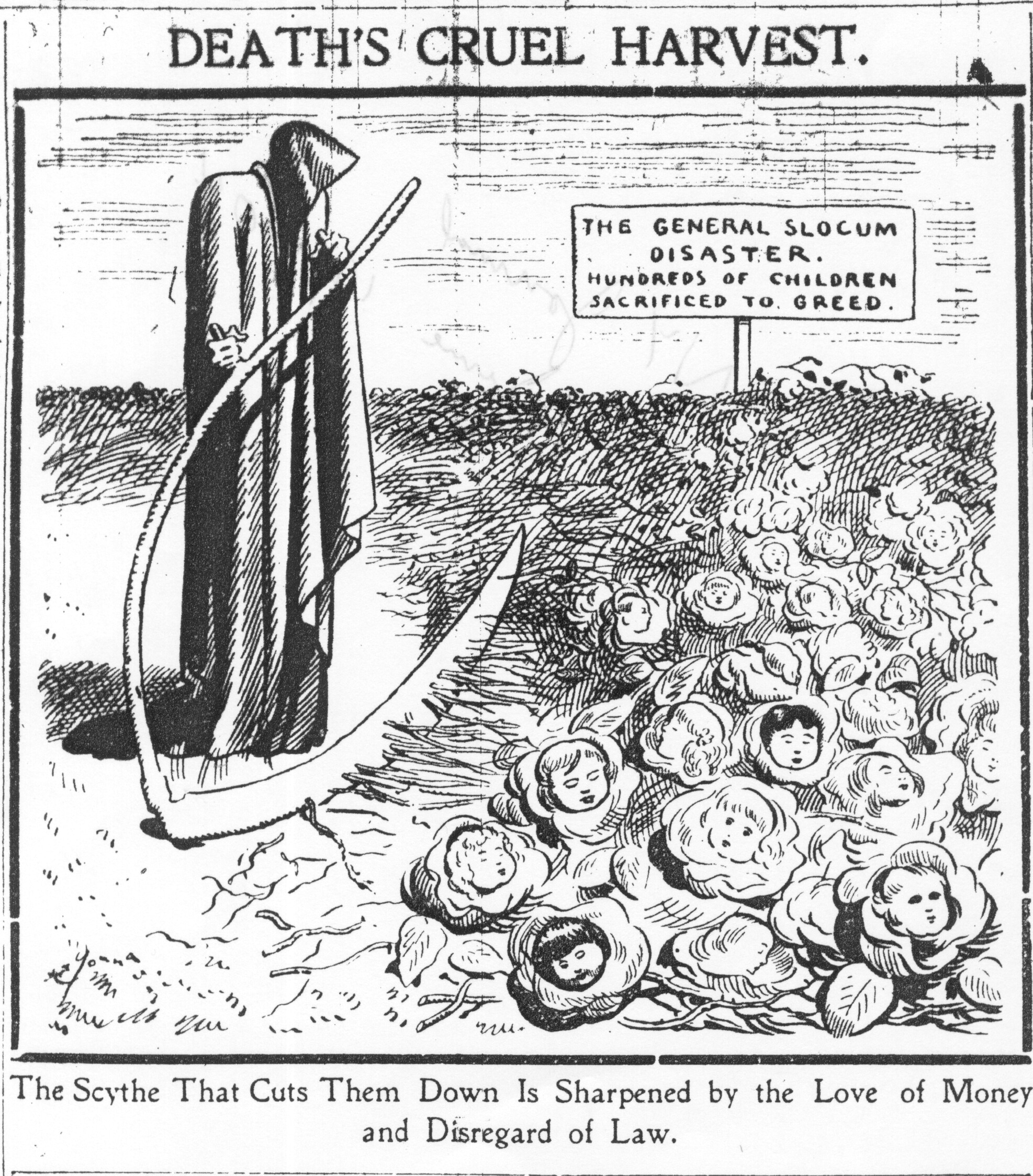
The life preservers, never properly inspected, were filled with rotten cork, and several exploded into dust. They were not only useless—they were actually dangerous. Panicked parents strapped preservers to their children and tossed them overboard, only to watch in horror as they sank from sight.
Below deck, passengers were burned to death—huddled in groups and trapped in corners. Smoke choked many, causing unconsciousness; many were trampled underfoot.
Some jumped into the violent waves. “There was little hope that any of the children who jumped overboard could be saved,” reported the New York Evening World. “The current all along the course taken is on a section of the river where not even a strong swimmer can breast the currents. Scores of little ones were sucked in by the whirlpools in Hell Gate.”
Greenwich Village Society of Historic Preservation
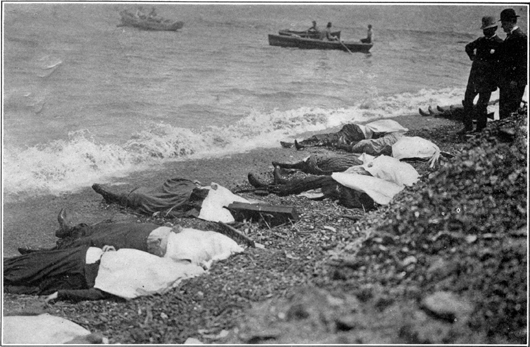
Crowds formed along the shores, and their attention was drawn by the billowing smoke, fire, and horrifying spectacle before them. The captain managed to steer the boat toward North Brother Island, where nurses, doctors, and even patients from the smallpox hospital ran to the water to rescue and attempt to revive those who had washed ashore.
Bodies on the shore of North Brother Island
The Slocum eventually floated out into the Long Island Sound, puffing clouds of cork dust into the air, while leaving a trail of tragedy in its wake.
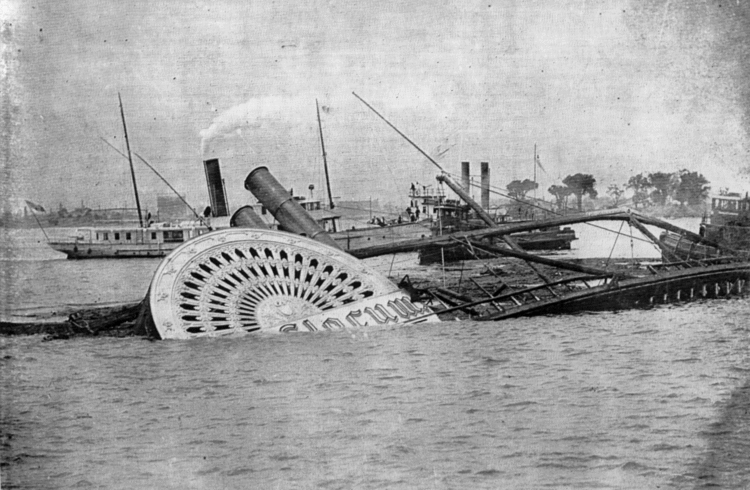
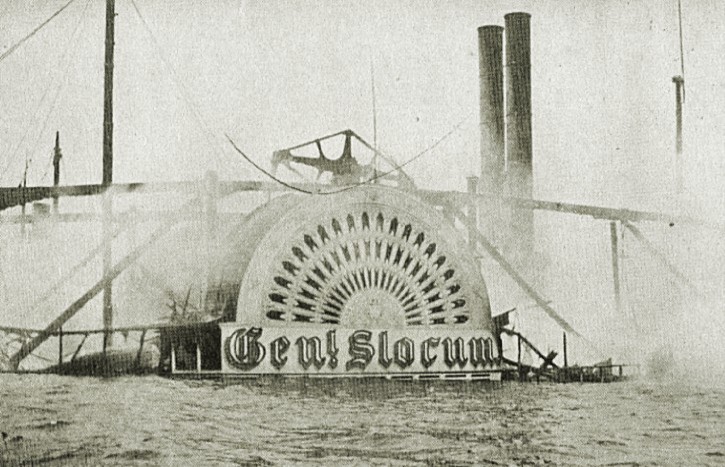
Just after noon, the burning vessel sank, a single paddle box and a smokestack jutting out of the water.
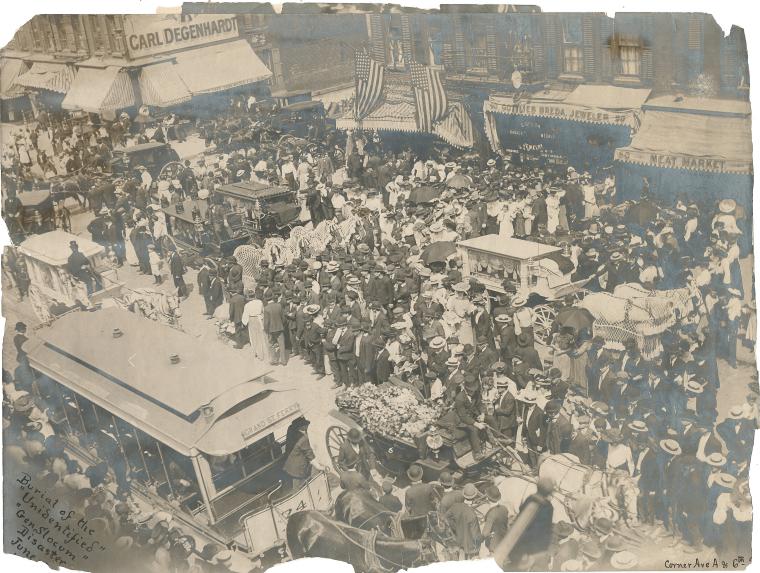
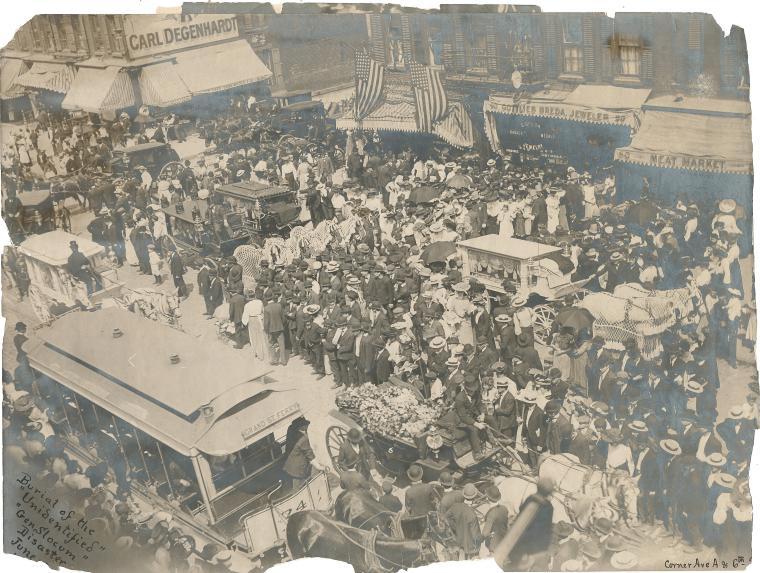
By the final count, 1,021 people perished in the General Slocum disaster that day, making it the deadliest single event in the city’s history up to that date. In the weeks following the disaster, the streets of Kleindeutschland—today’s East Village—were filled with mourners. The community attended funerals in the homes of those who had perished and held solemn processions through the streets.
A mass funeral through the streets of the Lower East Side — “burial of the unidentified”
New York Public Library
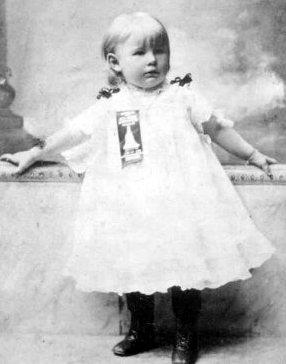
The Liebenow family was hit particularly hard. The entire Liebenow family died in the disaster—all except baby Adella (pictured below), just six months old at the time of the tragedy.
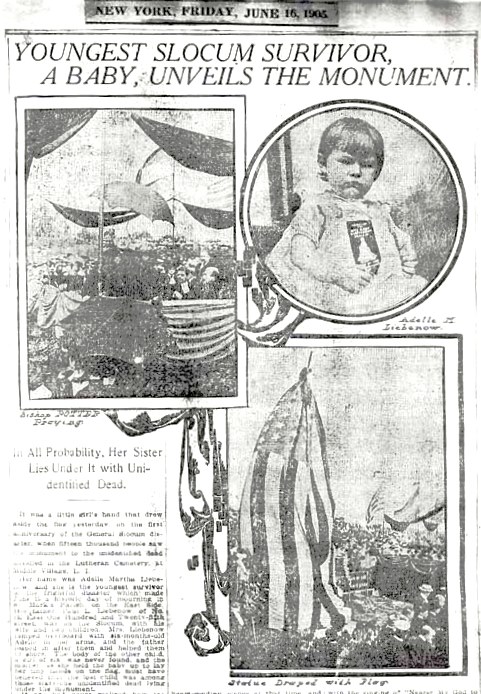
Two years later, now only two-and-a-half years old, Adella was hoisted to a podium here in Tompkins Square Park. She stood before a community that hadn’t yet fully recovered—would they ever?—as she tugged at a cloth to unveil the General Slocum Memorial Fountain.
NYHS
No, the fountain is not perfect. How could it be?
But why hasn’t this tragedy been better memorialized? It’s such an important event in the city’s history, and yet so many don’t know its whole story. There are a few theories about this, many having to do with the anti-German sentiment that cropped up a decade later at the beginning of World War I.
Or was it the social class of the victims that caused it to recede from memory? Adella, who died in 2004, 100 years after the disaster, believed that this might be the case. To a crowd at a 1999 commemoration of the tragedy, she said, “The Titanic had a great many famous people on it. This was just a family picnic.”
*St. Mark’s is located on East 6th Street, between First and Second Avenues, in the heart of New York’s first and largest German neighborhood. A plaque honoring the victims hangs in front.
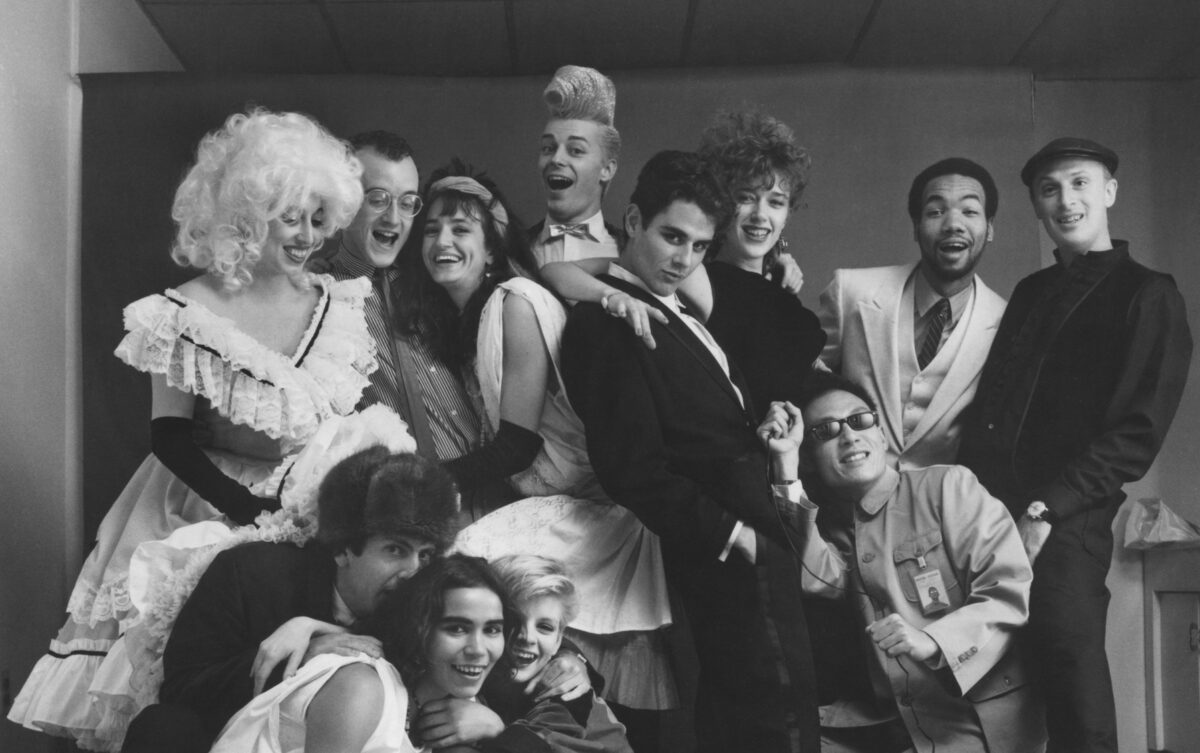
The wonderful wacky artists of Club 57. Photo by Tseng Kwong Chi
PODCAST The rebirth of the East Village in the late 1970s and the flowering of a new and original New York subculture — what Edmund White called “the Downtown Scene” — arose from the shadow of urban devastation and was anchored by a community that reclaimed its own deteriorating neighborhood.
In the last episode (Creating the East Village 1955-1975) this northern corner of New York’s Lower East Side became the desired home for new cultural venues — nightclubs, cafes, theaters, and bars — after the city tore down the Third Avenue Elevated in 1955.
But by the mid 1970s, the high wore off. The East Village was in crisis, one of the Manhattan neighborhoods hit hardest by the city’s fiscal difficulties and cutbacks. It had become a landscape of dark, unsafe streets, buildings demolished in flame.
But the next generation of creative interlopers (following the initial stampede of Greenwich Village beatniks and hippies) built upon the legacies of East Village counter-culture to create poems, music, paintings and stage performances heavily influenced by the apocalyptic situations around them.
This was something truly distinct, a creative scene that was thoroughly and uniquely an East Village creation — punk and hardcore, murals and graffiti, fashion and drag,
And much of that was created by people who did not fit in anywhere else in the world, whether that world which rejected them was a Queens suburb or New Jersey or the Midwest or well beyond.
Photo: New York Daily News Archive
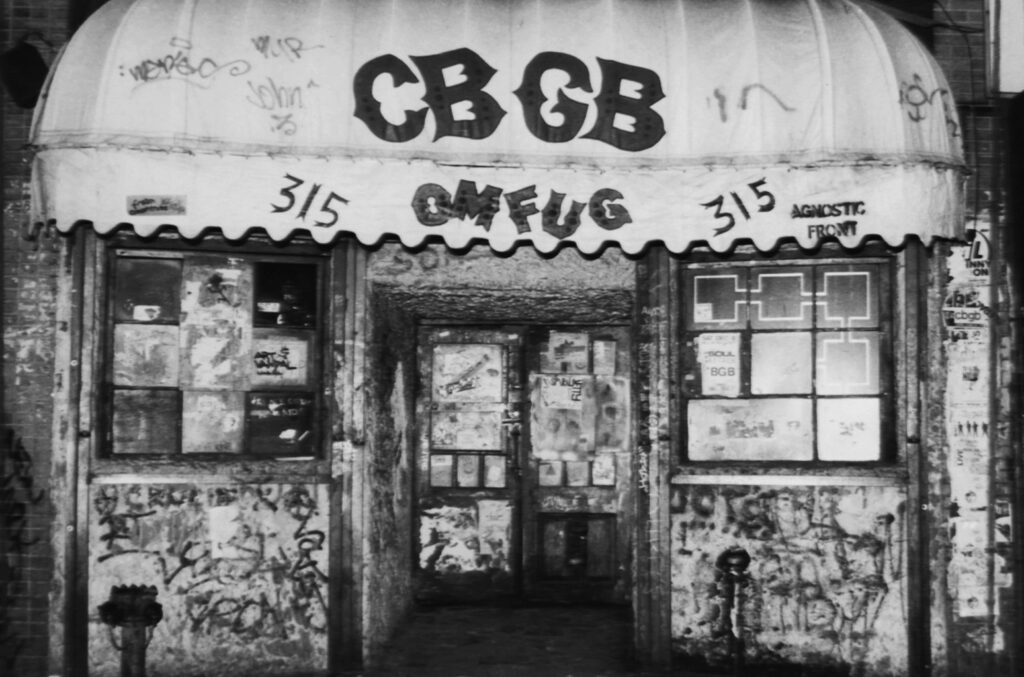
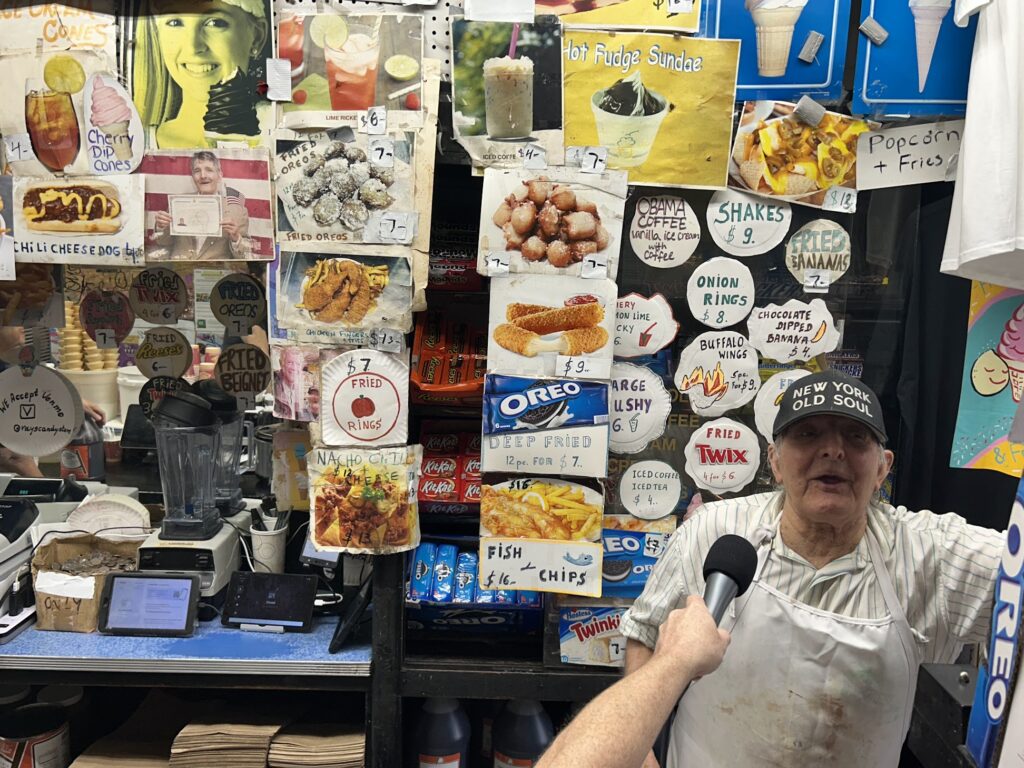
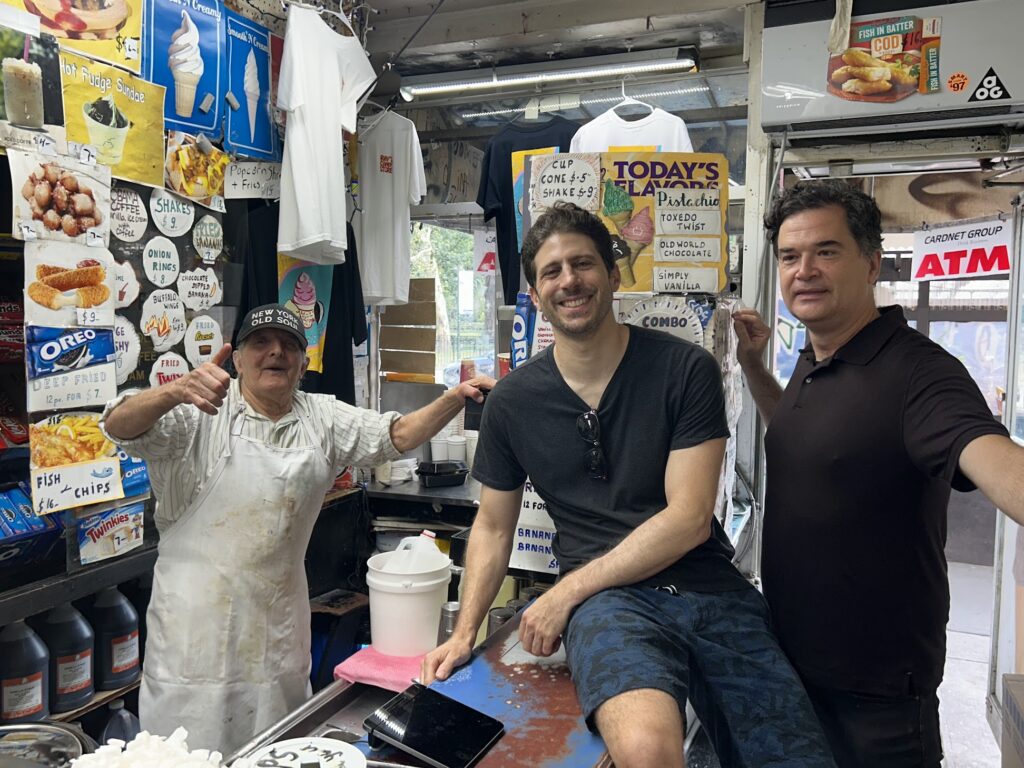
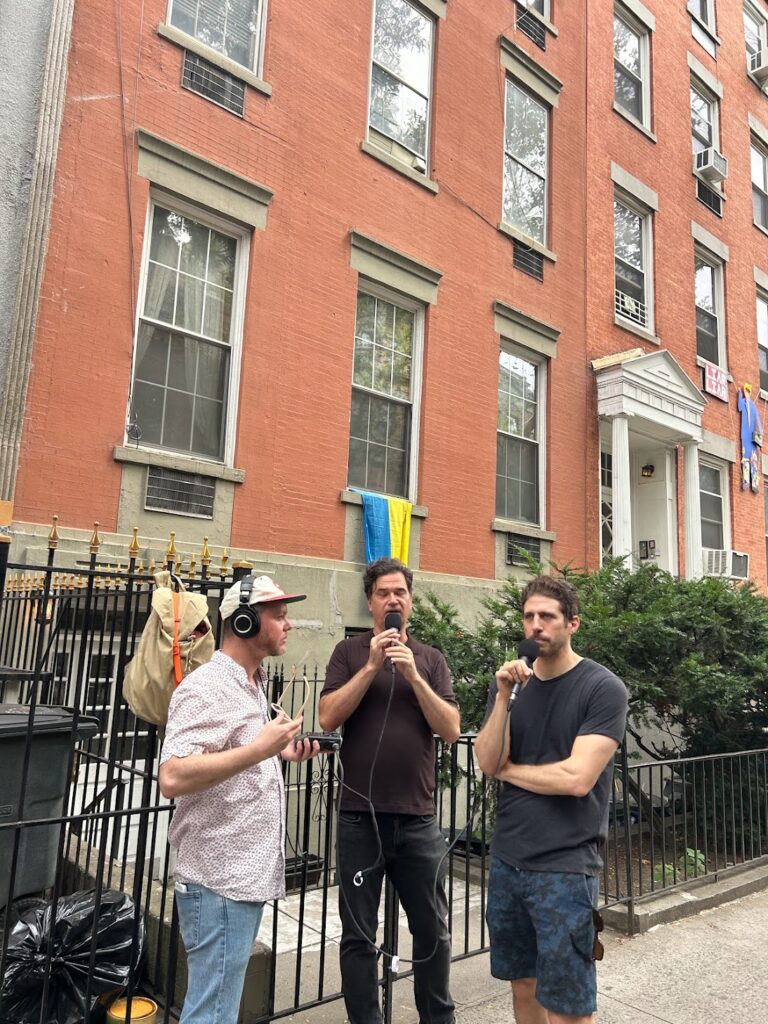
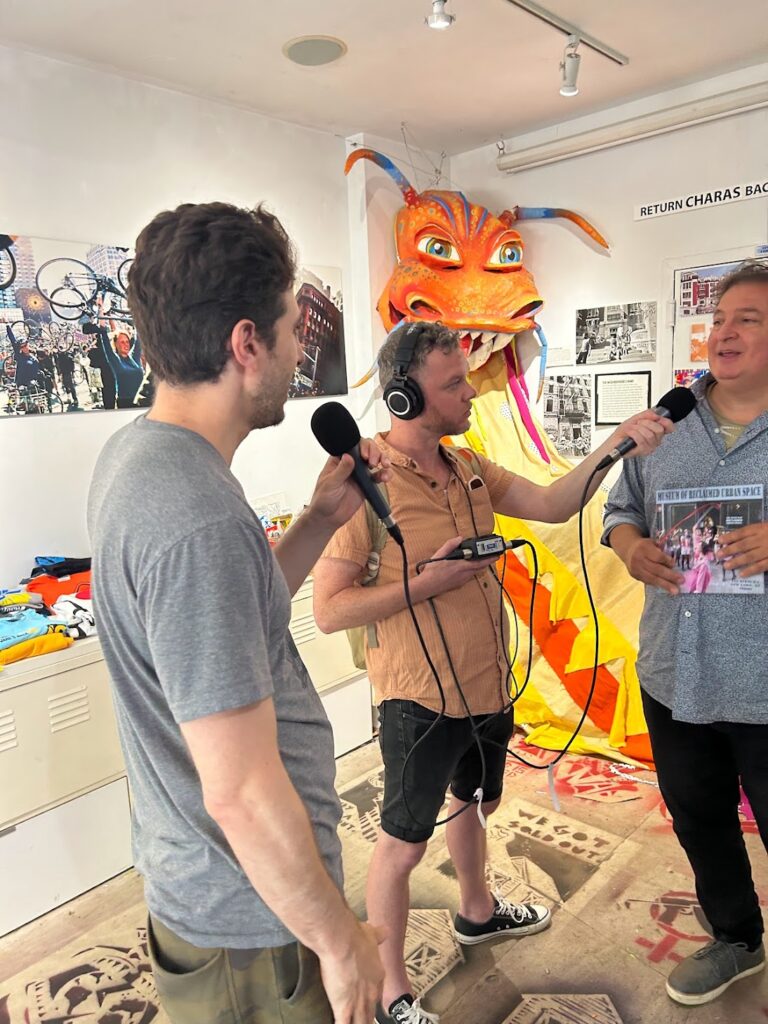
In this episode Greg hits the streets of the East Village with musician and tour guide Krikor Daglian (of True Tales of NYC), exploring the secrets of the recent past — from the origins of skateboarding to the seeds of the American alternative rock scene.
Follow along as they traipse to classic music venues and dive bars to uncover the special ingredients which made the East Village a most special place at the end of the 20th century.
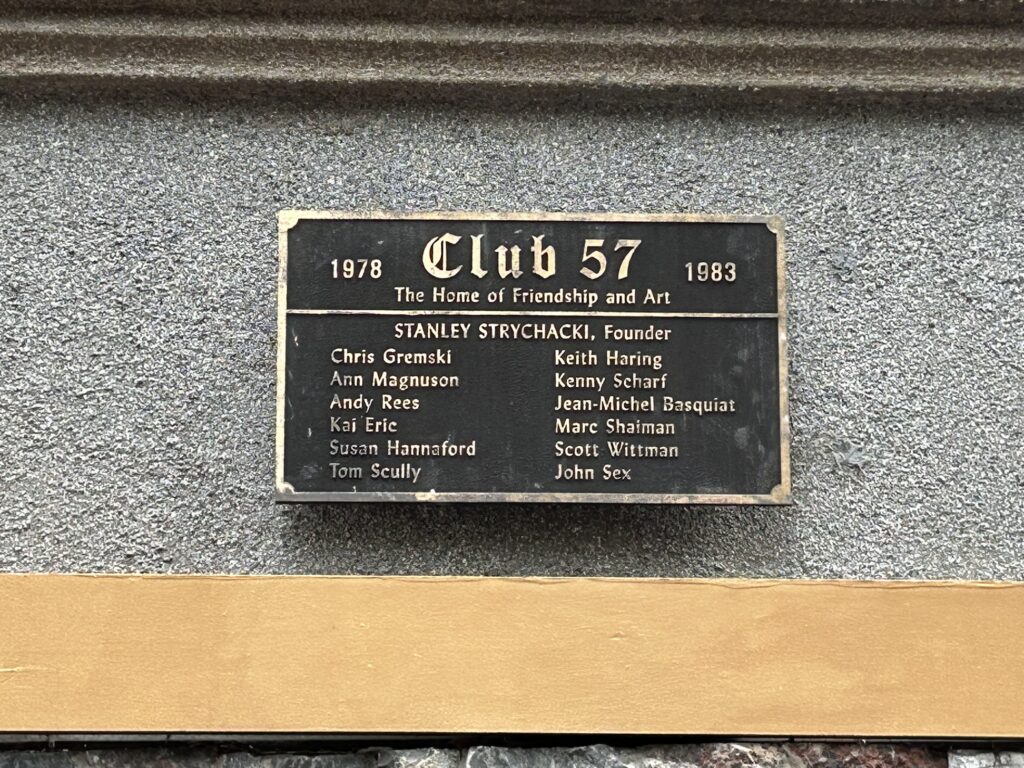
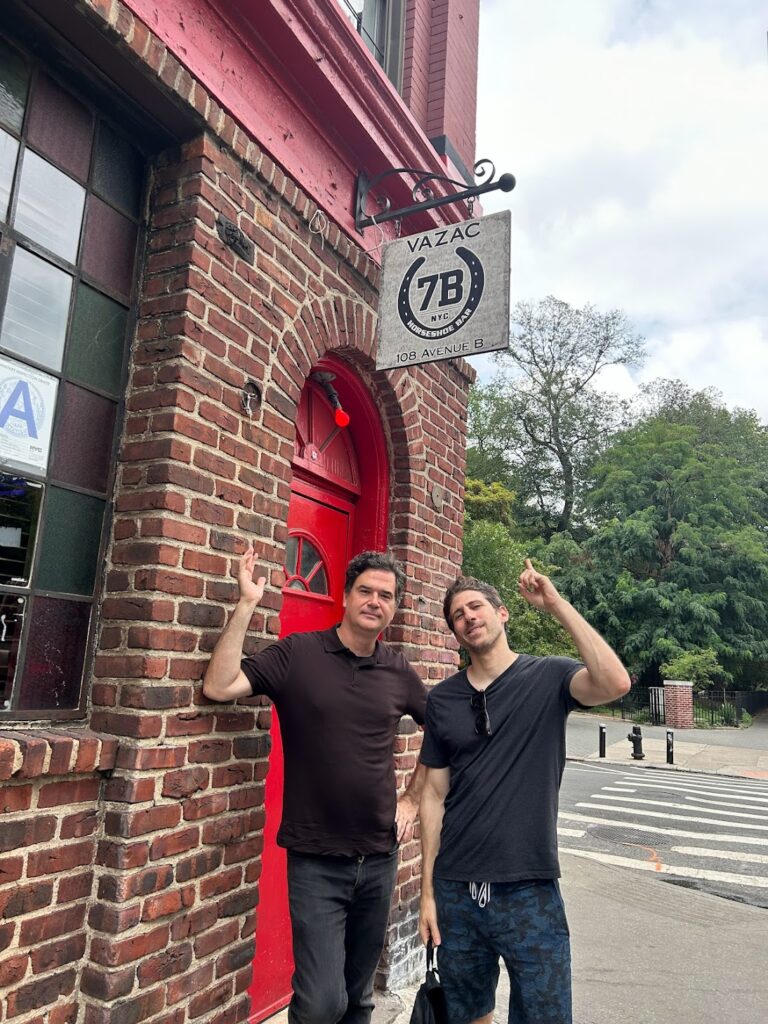
FEATURING: CBGB, Supreme, the Pyramid, Club 57, Niagara, 7B, Brownies and many others
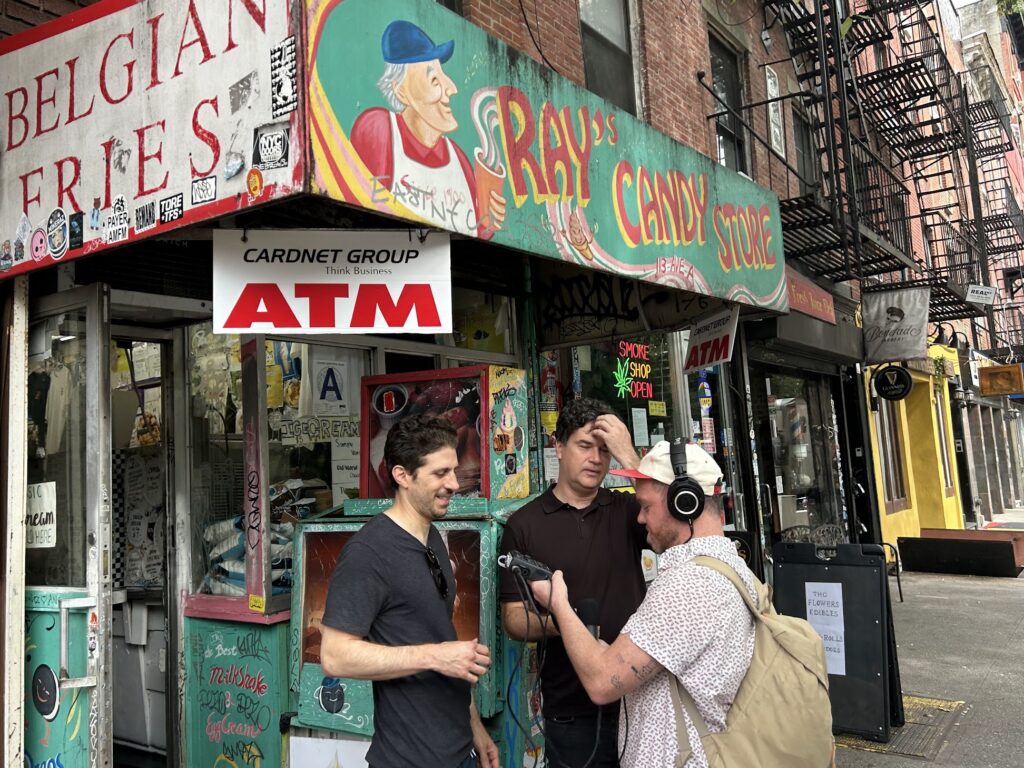
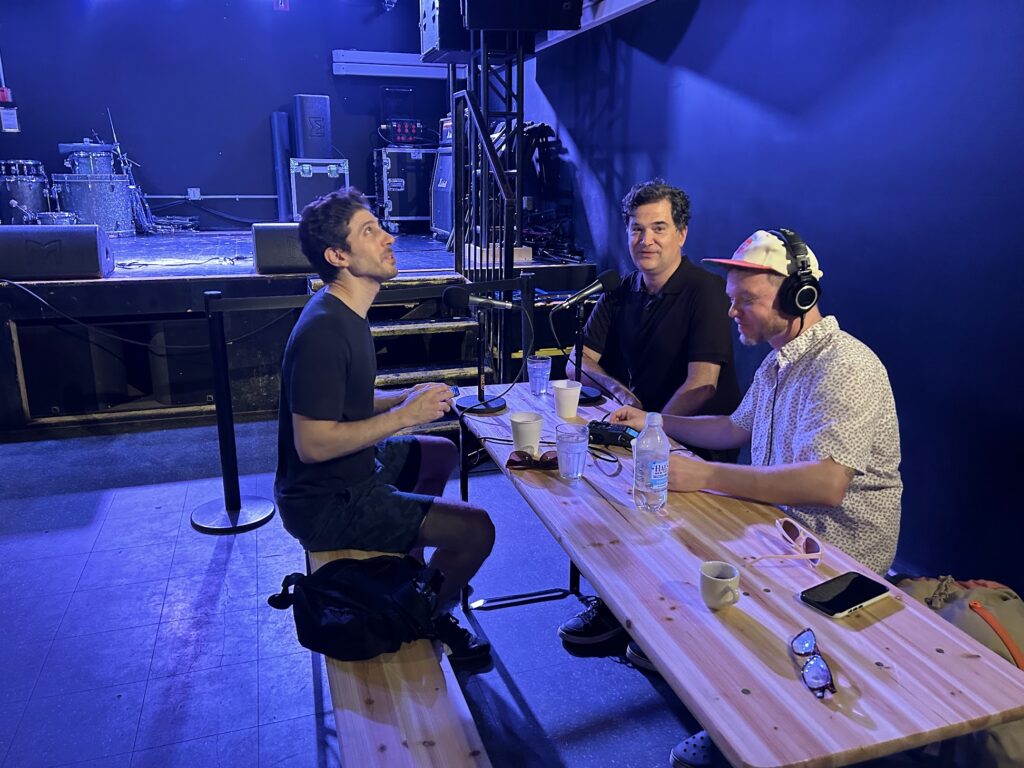
Producer Kieran Gannon with Krikor and Bill De Paola
FURTHER LISTENING
After you listen to this week’s episode, check out these episodes with related themes:
FURTHER READING
The Drag Explosion: New York City’s Drag Scene of the 1980s and 90s / Linda Simpson From Urban Village to East Village / Janet L. Abu-Ludhod New York Rock: From the Rise of the Velvet Underground to the Fall of CBGB / Steven Blush St. Marks Is Dead: The Many Lives of America’s Hippest Street / Ada Calhoun The Village: 400 Years of Beats and Bohemians, Radicals and Rogues / John Strausbaugh This Must Be The Place: Music, Community and Vanished Spaces in New York City / Jesse Rifkin
By a very fun coincidence, our twotime guest — the marvelous Hugh Ryan — just so happens to have written “The Trashy, Freaky, DIY East Village Scene That Birthed Modern Drag” for Curbed this week. Excellent article about the 80s East Village drag scene with a focus on the Pyramid — where Greg and Krikor recorded some of the show!
“By the pricking of my thumbs / something wicked this way comes” — Macbeth
PODCAST In old New York, one hundred and seventy years ago, a theatrical rivalry between two leading actors of the day sparked a terrible night of violence — one of the most horrible moments in New York City history.
England’s great thespian William Macready mounted the stage of the Astor Place Opera House on May 10, 1849, to perform Shakespeare’s Macbeth, just as he had done hundreds of times before. But this performance would become infamous in later years as the trigger for one of New York City’s most violent events — the Astor Place Riot.
The theater, being America’s prime form of public entertainment in the early 19th century, was often home to great disturbances and riots. It was still seen as a British import and often suffered anti-British sentiments that often vexed early New Yorkers.
Macready, known as one of the world’s greatest Shakespearean stars, was soon rivaled by American actor Edwin Forrest, whose brawny, ragged style of performance endeared the audiences of the Bowery. To many, these two actors embodied many of America’s deepest divides — rich vs. poor, British vs. American, Whig vs. Democrat.
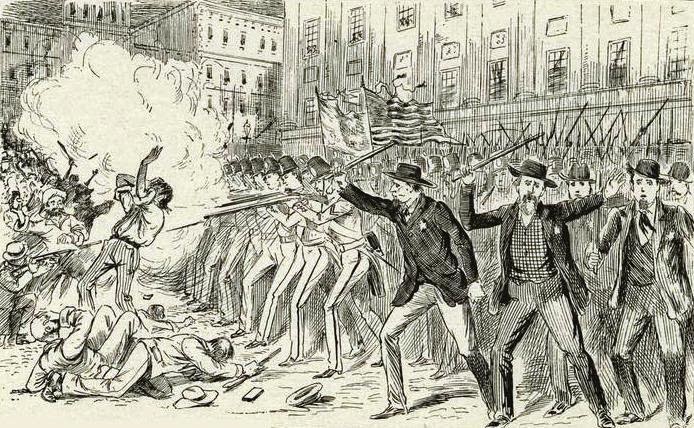
On May 10th, these emotions overflowed into an evening of stark, horrifying violence as armed militia shot indiscriminately into an angry mob gathering outside theater at Astor Place. By the end of this story, over two dozen New Yorkers would be murdered, dozens more wounded, and the culture of the city irrevocably changed.
RIOT OR RIOTS? You may have noticed in our podcast that we go from calling it the Astor Place Riot and the Astor Place Riots. We both saw primary references to both the singular and the plural. Though it was just one riot which occurred on May 10, the incidents on May 7 and May 11 constitute smaller riots or disturbances that lead up or were the result of the May 10 event. The word ‘riot’ is not perfect either as it starts as a riot and ends as a massacre.
CORRECTION: In the podcast, I mention that John Jacob Astor lived in the line of stately buildings today known as Colonnade Row. Although he built them, he never lived here. However he moved his family into them, including his grandson John Jacob Astor III. Cornelius Vanderbilt and Washington Irving also lived here. __________________________________________________________
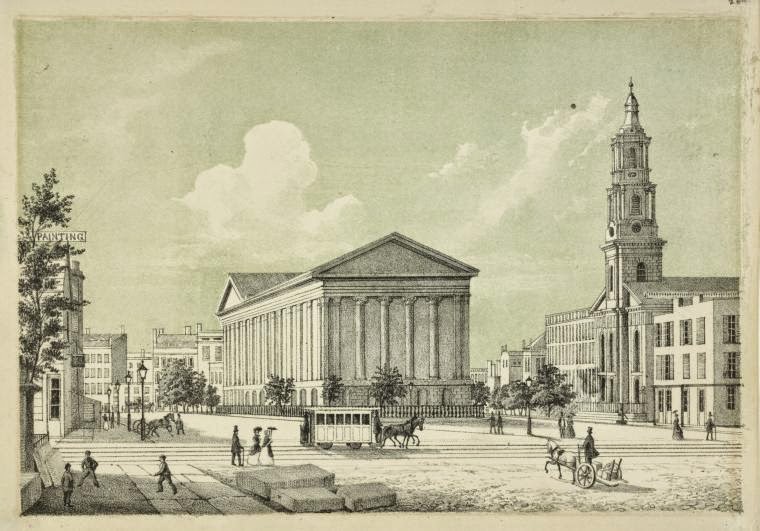
The Astor Place Opera House in 1850:
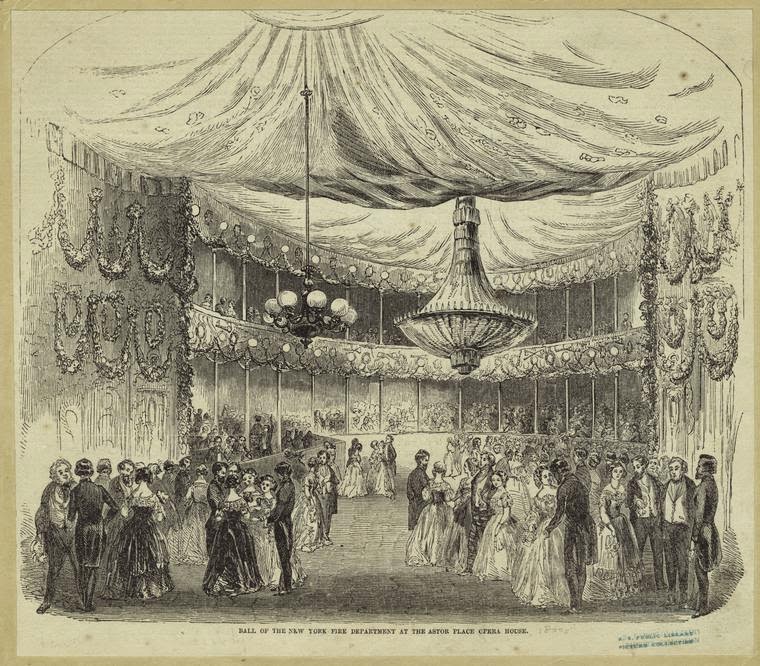
Inside the Astor Opera House, one of the most lavish spaces in all of New York in the 1840s. Curiously, this illustration depicts a ball for the New York Fire Department. Many members of the volunteer fire departments actually set upon the opera house as part of the angry mob.
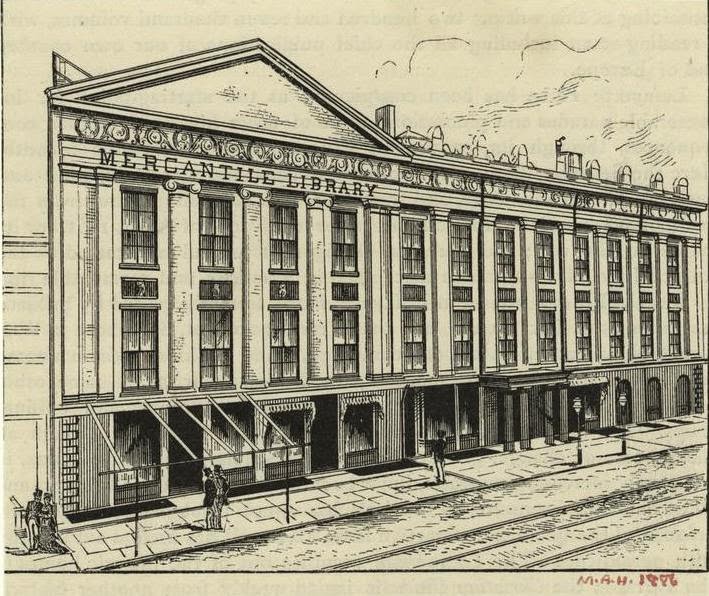
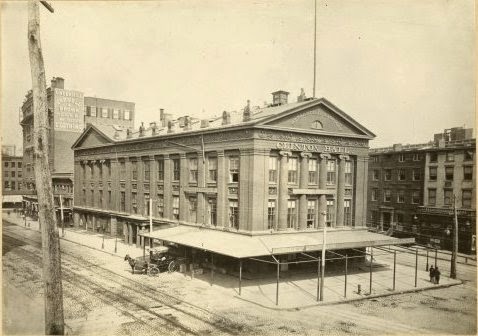
After the riots, the opera house quickly lost its cache. High society moved uptown to the Academy of Music (not so far away actually, on 14th Street, near Union Square). The interior of the theater was eventually demolished and sold to the New York Mercantile Library and renamed Clinton Hall.
This was torn down in 1890 and replaced with the 11-story structure that stands there today.
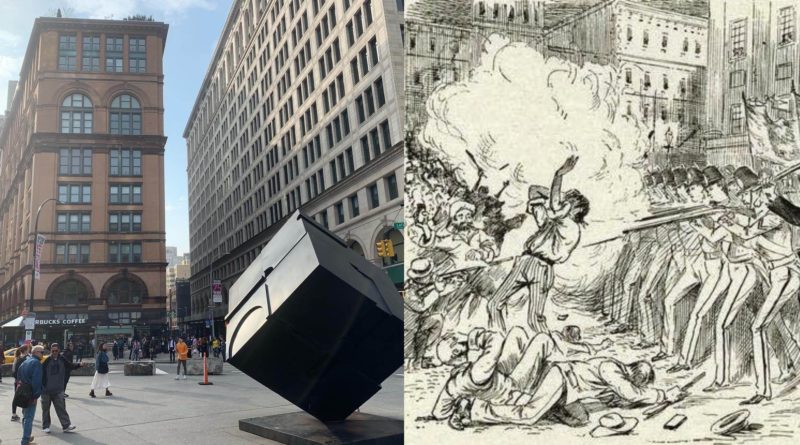
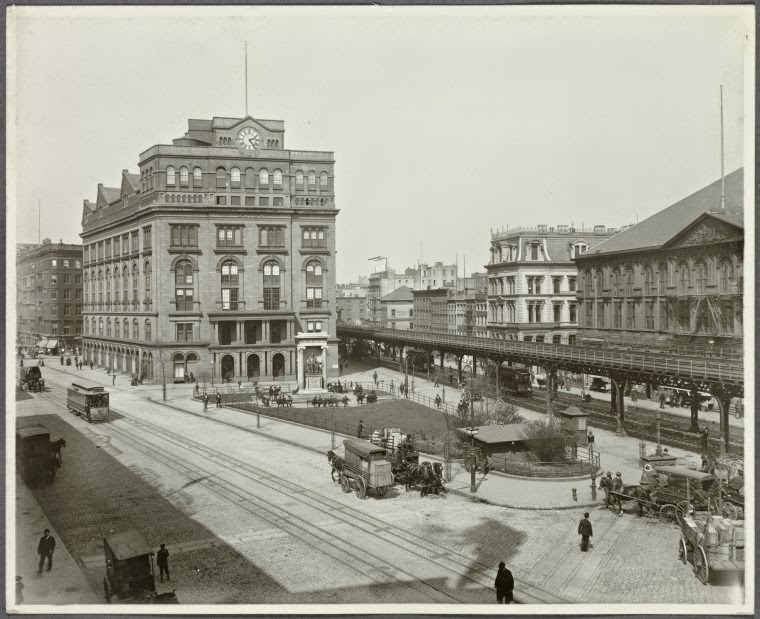
Many considered the demons of Astor Place purged when Cooper Union was finally constructed in 1859, a decade after the riots. In this image, we’re looking up Third Avenue and the final remnant of the Bowery. The Third Avenue Elevated has already been built here:
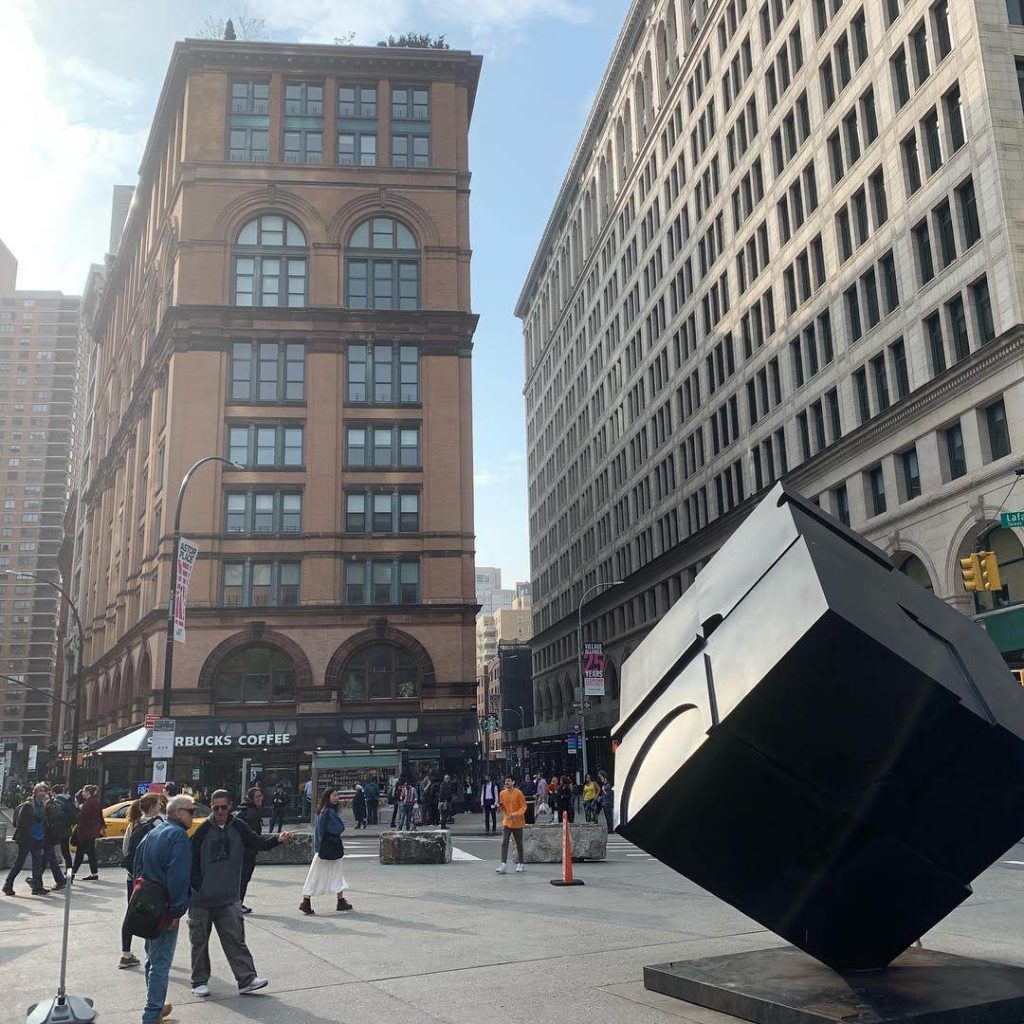
Astor Place in 2019:
William Macready:
From the New York Evening Post, May 1, 1849, advertising his May 7th show (which was interrupted by protesters).
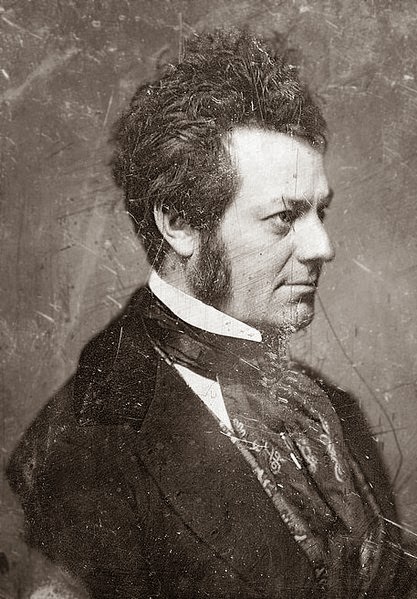
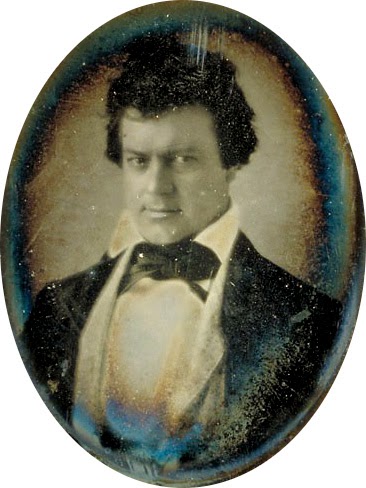
Edwin Forrest: In portrait and in daguerreotype
Images above courtesy the New York Public Library (except where otherwise noted).
FURTHER LISTENING:
We’ve been doing this for so long that we have MANY podcasts about historical landmarks in and around Astor Place. After you listen to this show, check out these older shows from our catalog:
PODCAST: The big, brash history of St. Mark’s Place, the East Village’s most interesting street.
St. Mark’s Place may be named for a saint but it’s been a street full of sinners for much of its history.
One of the most fascinating streets in the city, St. Mark’s traces its story back to Peter Stuyvesant, meets up with the wife of Alexander Hamilton in the 1830s, experiences the incredible influx of German and Polish immigrants in the late 19th century, then veers into the heart of counter-culture — from the political activism of Abbie Hoffman to the glamorously psychedelic parties of Andy Warhol.
And that’s when the party really gets started! St. Mark’s is known for music, fashion, rebellion and pandemonium. In the 1970s and 80s, clothing stores like Limbo and club nights like Club 57 helped define its character — punk, new wave, alternative, raucous.
The Bowery Boys: New York City History podcast is brought to you …. by you!
We are now producing a new Bowery Boys podcast every two weeks. We’re also looking to improve the show in other ways and expand in other ways as well — through publishing, social media, live events and other forms of media. But we can only do this with your help!
We are now a member of Patreon, a patronage platform where you can support your favorite content creators for as little as a $1 a month.
Please visitour page on Patreon and watch a short video of us recording the show and talking about our expansion plans. If you’d like to help out, there are five different pledge levels (and with clever names too — Mannahatta, New Amsterdam, Five Points, Gilded Age, Jazz Age and Empire State). Check them out and consider being a sponsor.
We greatly appreciate our listeners and readers and thank you for joining us on this journey so far. And the best is yet to come!
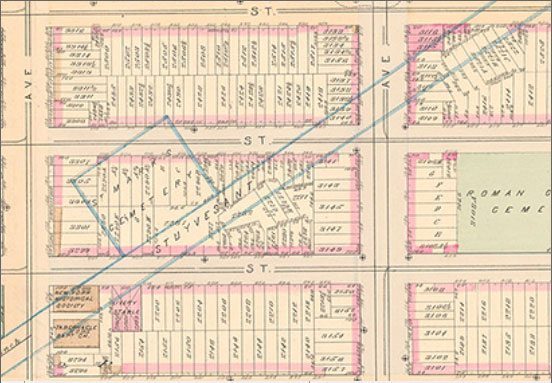
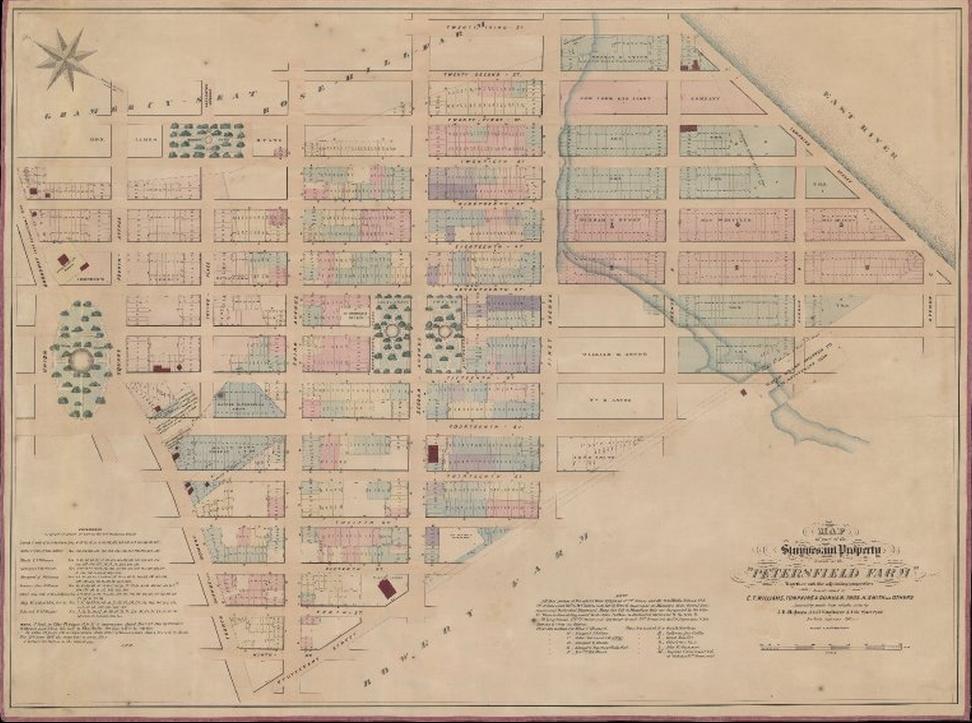
Stuyvesant Street superimposed over the planned grid. Ultimately the street was allowed to remain, breaking the grid. By the way, see that green patch at the far right? That was also a cemetery.
Courtesy EV Transitions
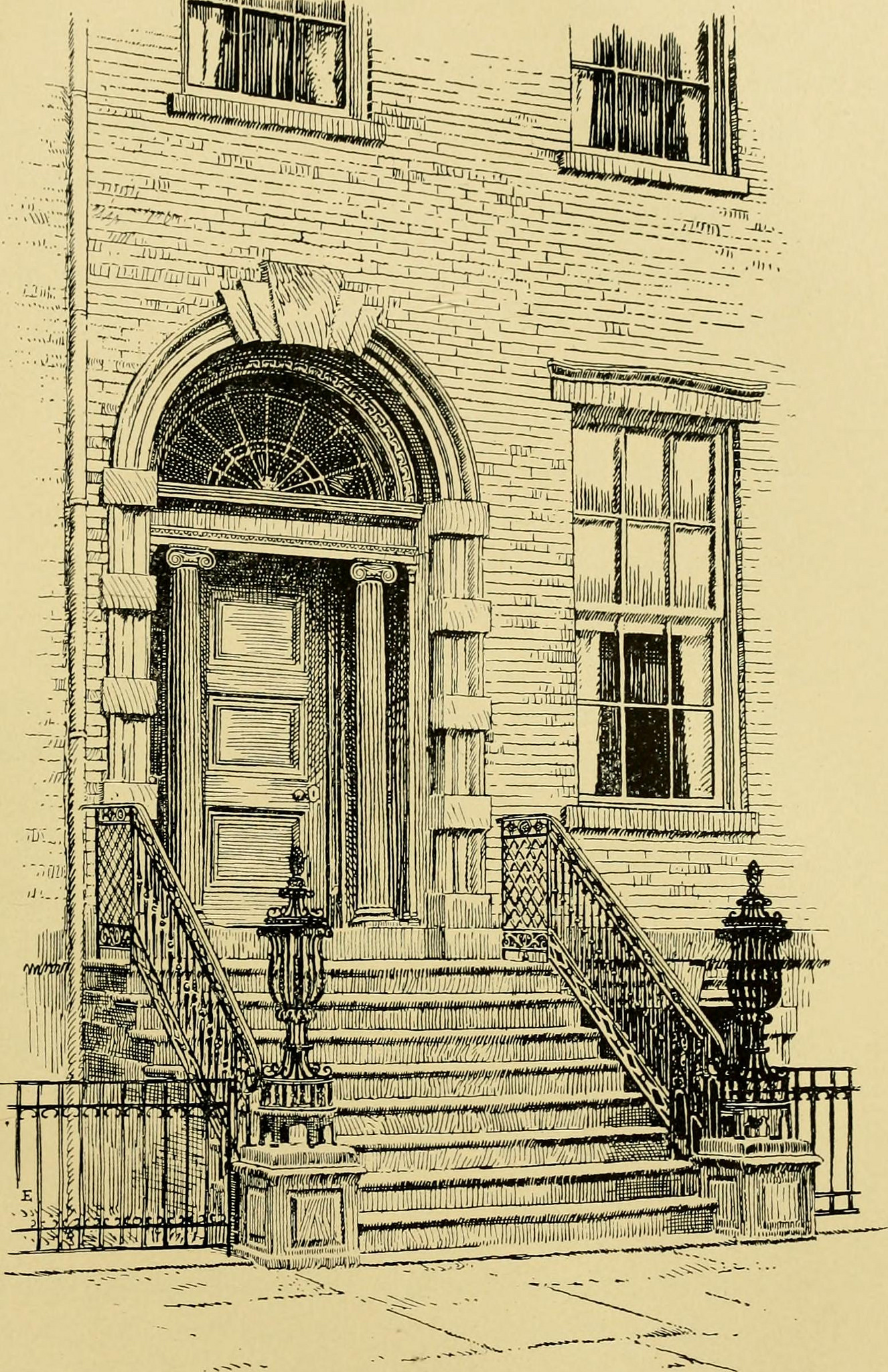
The front of 22 St. Mark’s Place from a 1914 history book. (It looks almost identical to 20 St. Mark’s, the old Daniel LeRoy House, which is still there.). “It had a tea room in the rear of the first floor, which [the tenant] altered into a library, constructing a bathroom in connection with it. A new bedroom was added above the library, and in the basement was installed a cook.” [source]
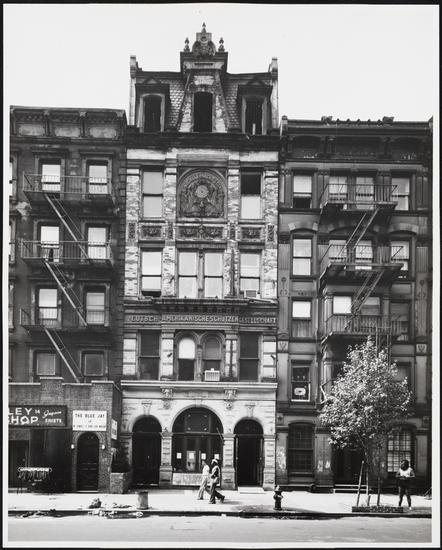
Deutsch-Amerikanische-Schützen Gesellschaft (German-American Shooting Society) building, 12 St. Mark’s Place, pictured here in 1975 in a photograph by Edmund Gillon
Courtesy Museum of the City of New York
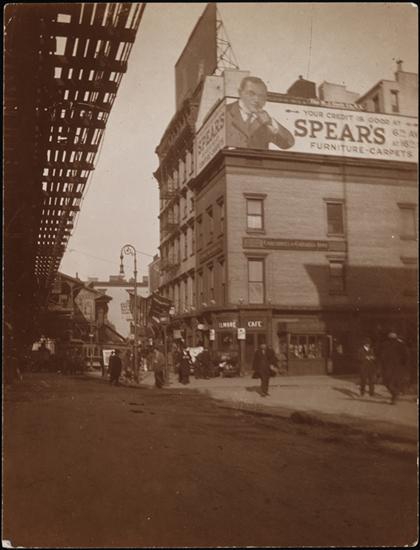
St. Mark’s Place and Third Avenue in 1914, the same year as the shootout at Arlington Hall! The Third Avenue elevated train framed St. Mark’s on the west end, the Second Avenue elevated (which actually ran along First Avenue in the East Village) to the east.
Courtesy Museum of the City of New York
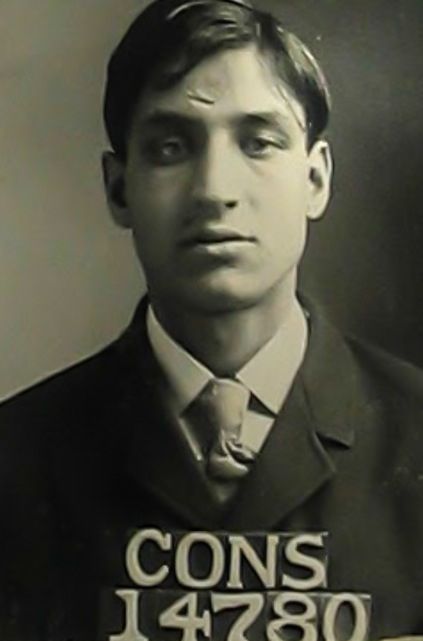
The mugshot of Dopey Benny whose gang was involved in the shootout which killed a city official.
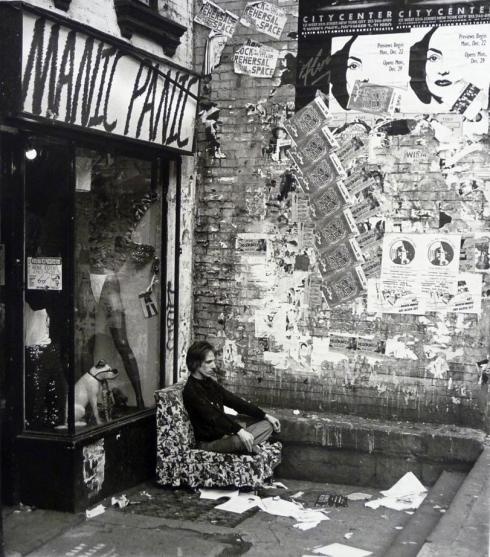
A photo by Victor George Macarol of the boutique Manic Panic (and a man in meditation), 1975
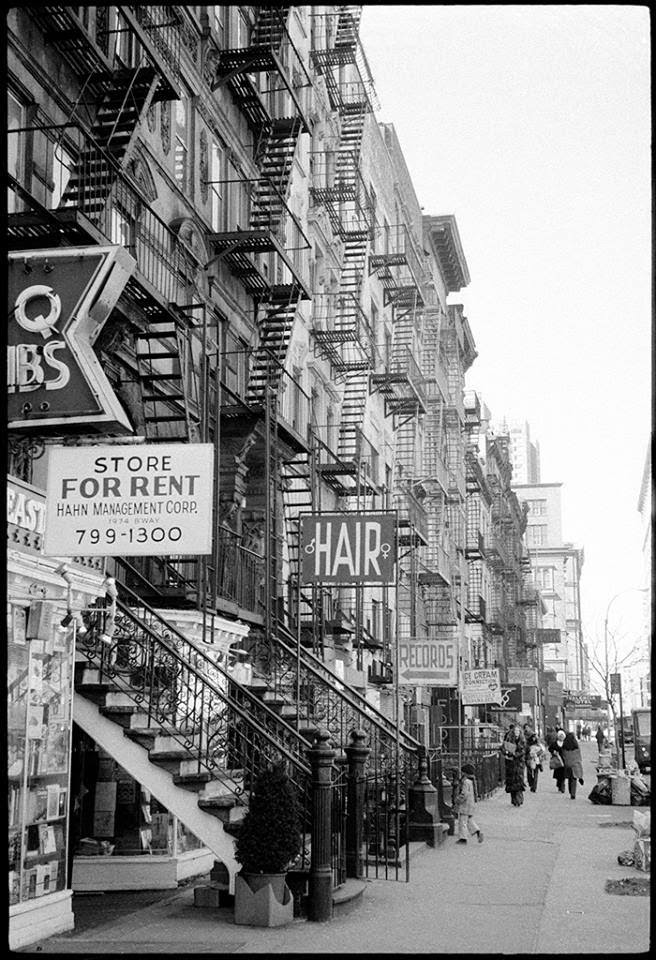
The south side of St. Mark’s Place, 1975
EV Grieve
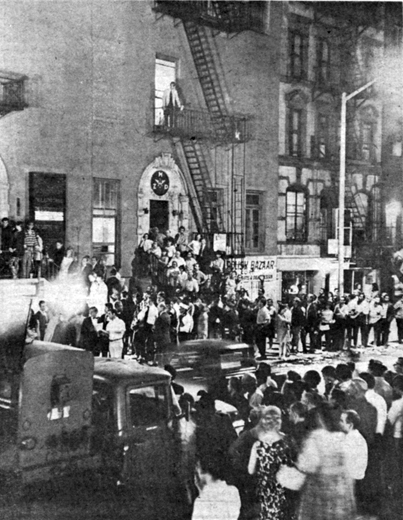
Crowds waiting to get into the Electric Circus
courtesy Alex Ross
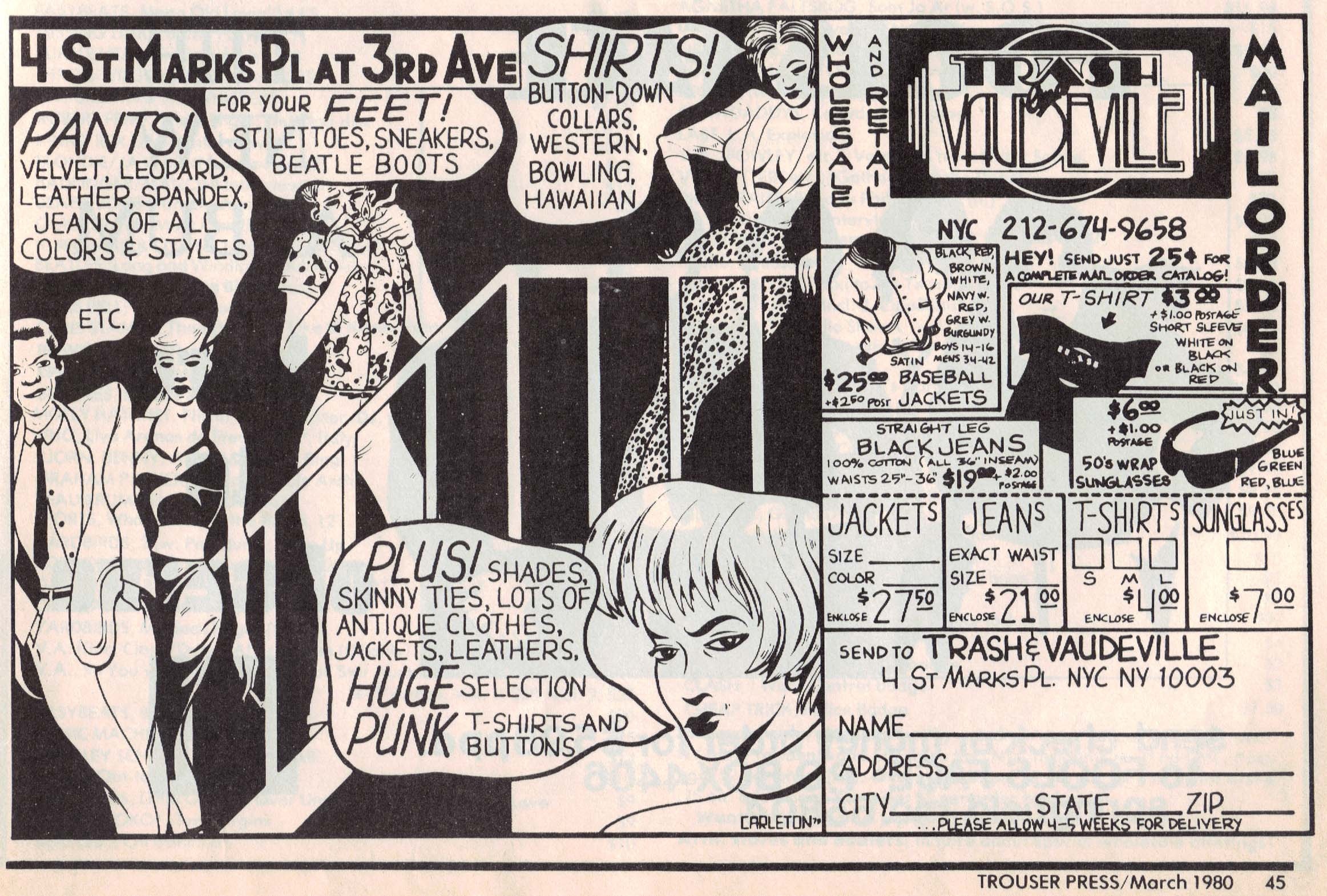
A flyer for Trash and Vaudeville…
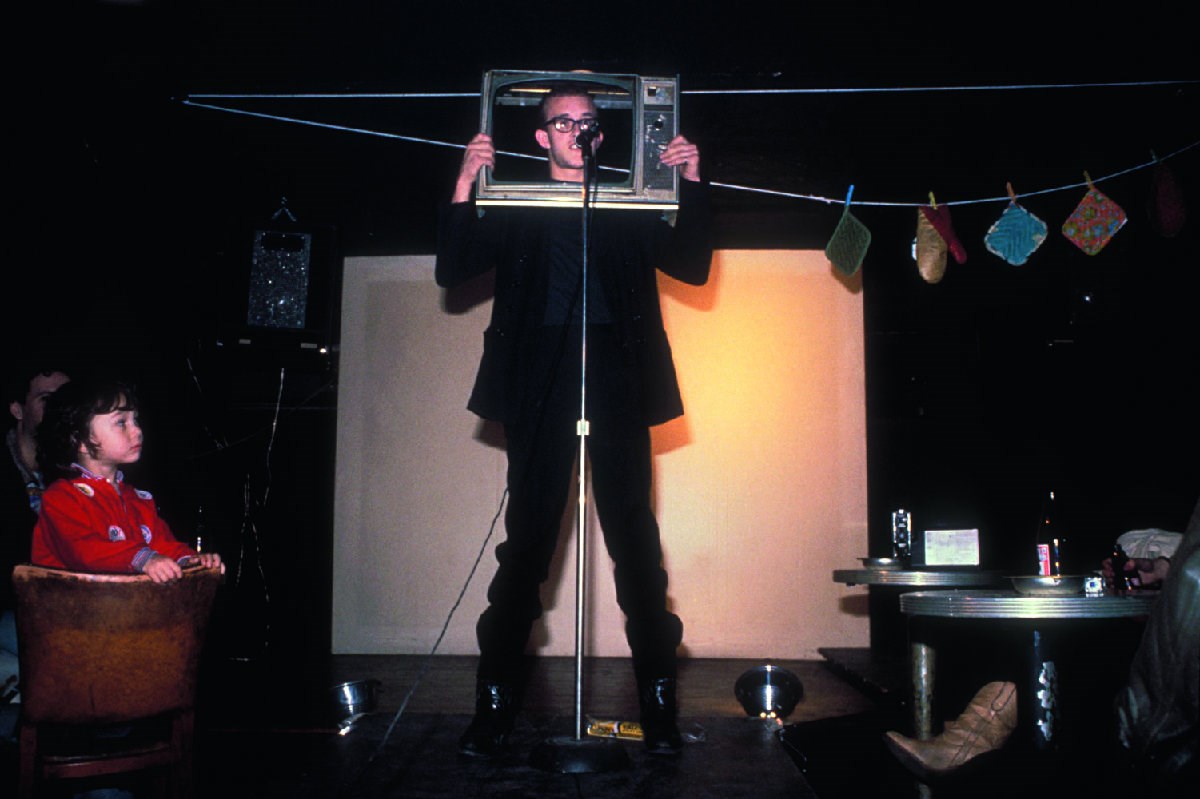
Keith Haring performing at Club 57 in a themed evening called Acts of Live Art. For more information on Club 57, you can read my earlier article about this extraordinary club here. Dazed has a pretty great article about the place here.
Photo by Joseph Szkodzinski
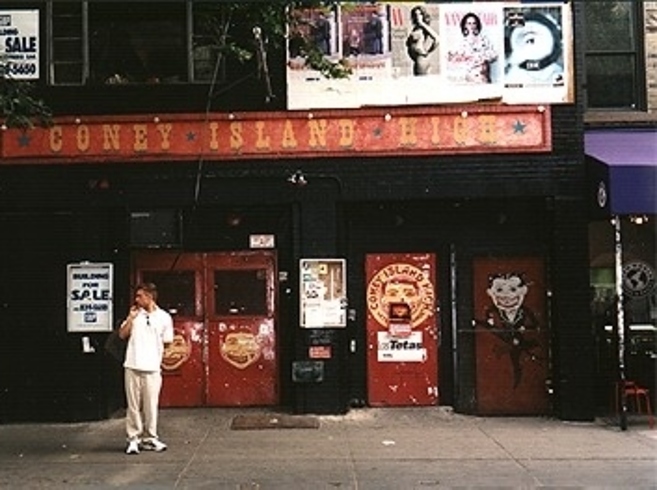
Coney Island High, a pivotal East Village venue during the 1990s.
Courtesy Buzzfeed
Top photo — St. Mark’s Place in 1978, Photos by Leonard Freed / Magnum Photos, care of Vintage Everyday
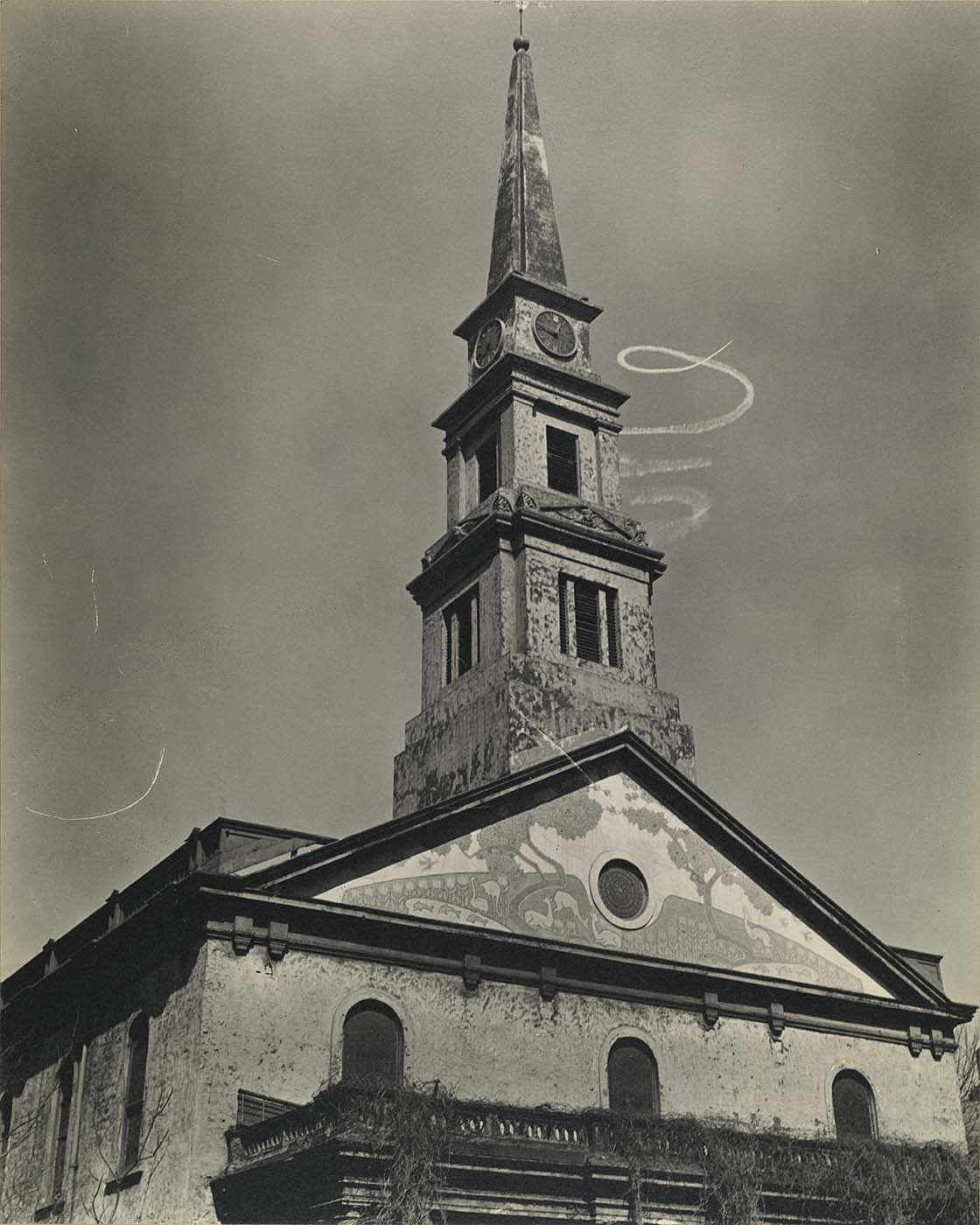
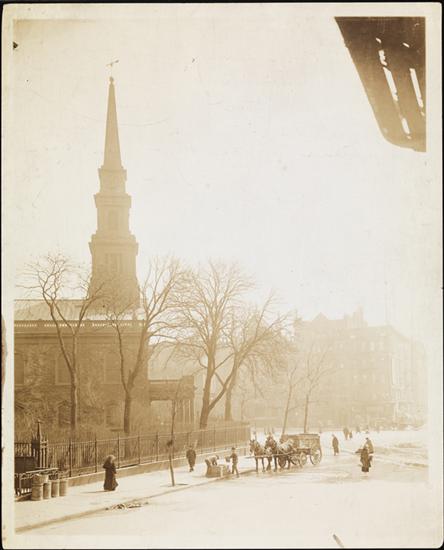
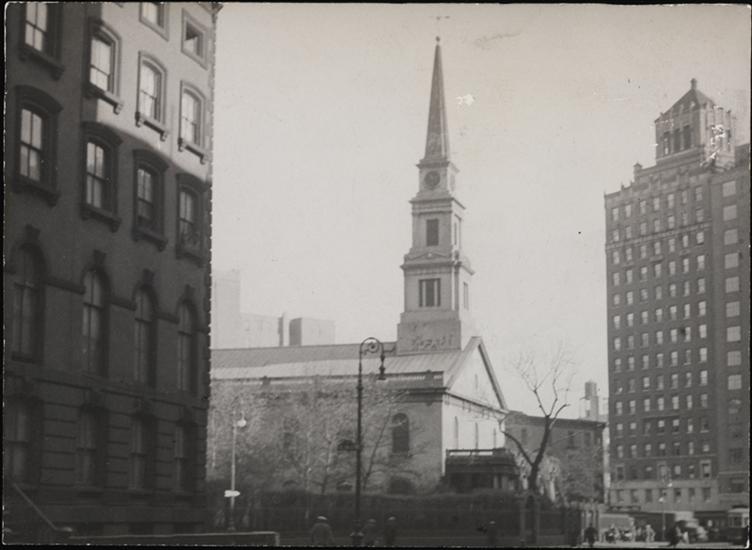
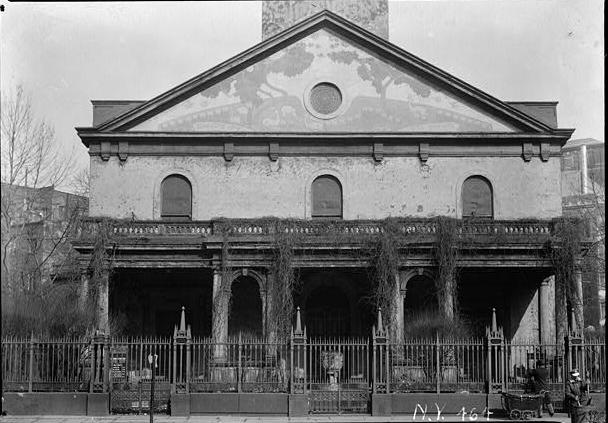
St. Mark’s Church-in-the-Bowery is the oldest standing structure in the East Village. Upon seeing it, you’re almost forced to reevaluate where you are.
It’s intriguing even to those who pass by it everyday. It’s mysterious even to those who work and worship here.
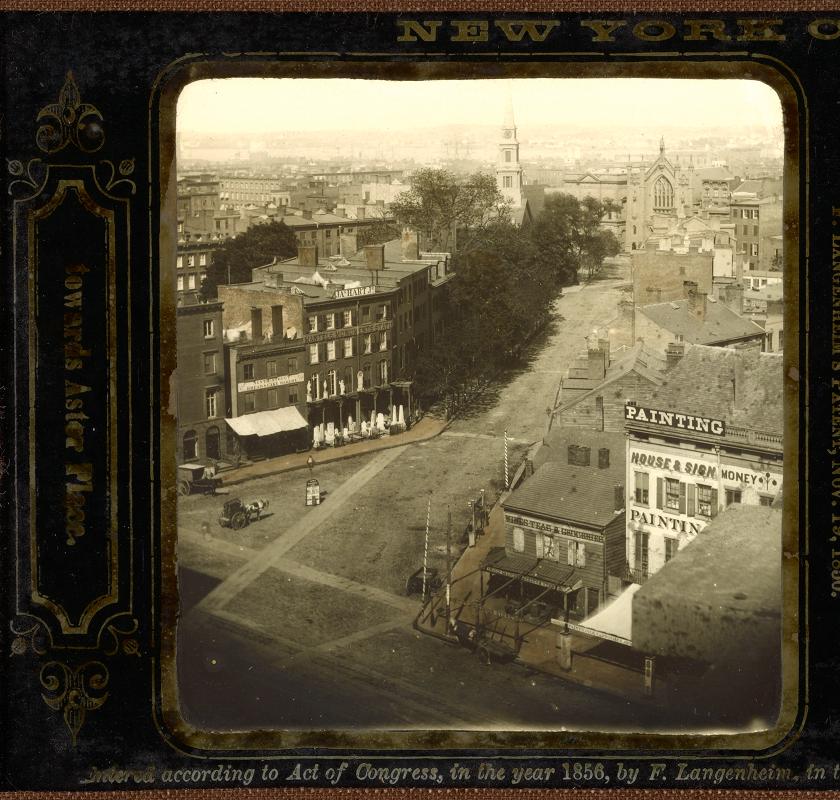
Built in 1799 by the Stuyvesant family, St. Mark’s chapel and cemetery conformed to a street grid plan unique to their farmland. Today the only street that exists from the old Stuyvesant plan is Stuyvesant Street, running diagonally through New York’s standard street grid.
The Stuyvesants planned the street on a true east-west access. Â It’s the rest of the island that’s askew with the compass.
Photo by Berenice Abbott
Buried under the church ground are vaults of some of New York’s greatest civic leaders and social notables. Daniel D Tompkins, Vice President under James Monroe, is here, although the park that bears his name Tompkins Square Park is a couple avenues over. The department store king A.T. Stewart used to be here before his remains were stolen in a bizarre ransom attempt.
Philip Hone, the so-called ‘party mayor’ of New York, is interred in a vault here. From my profile of the mayor a few years ago: “Mostly, he’s remembered as a cultural ambassador, even commissioning artwork for City Hall, approving of a developing theater district in the not-yet-seedy Bowery and encouraging the city’s growth as an American capitol of arts and sciences.”
Courtesy Museum of the City of New York
But of course the most famous individual beneath St. Mark’s is that of the original Stuyvesant — Petrus Stuyvesant, the director-general of New Amsterdam whose farms comprised much of today’s East Village and give the Bowery (Bouwerij) its name.
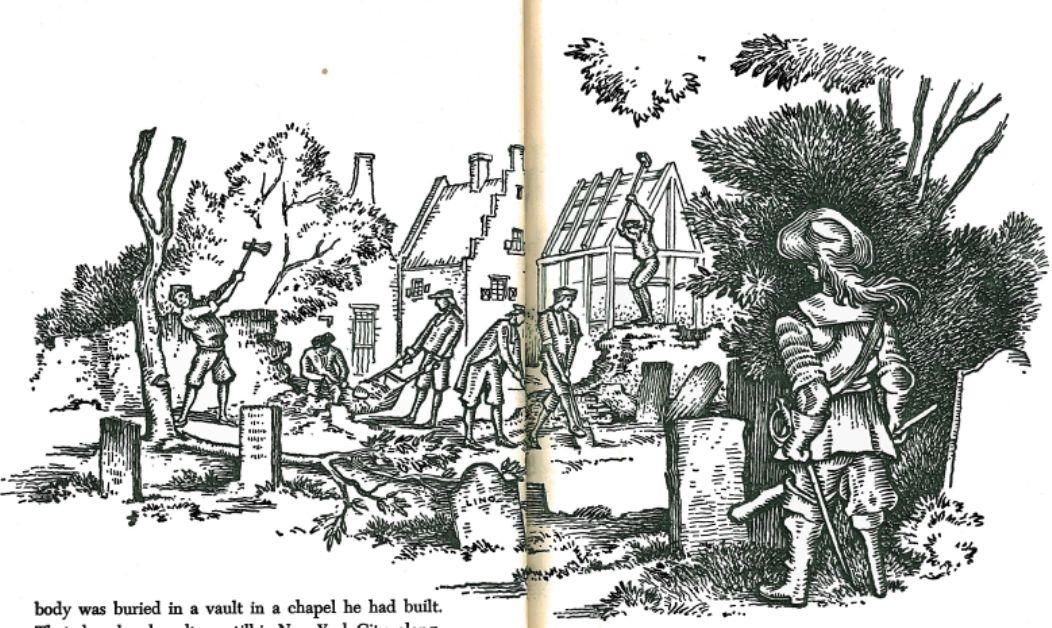
Stuyvesant died in 1672 in the British controlled colony of New York. From an 1893 history on Stuyvesant: “His remains were interred in a vault beneath the chapel which he had built near his house. When the present St. Mark’s Church was erected, on the site of the old chapel, the vault was preserved, and a commemorative stone was placed upon its wall.”
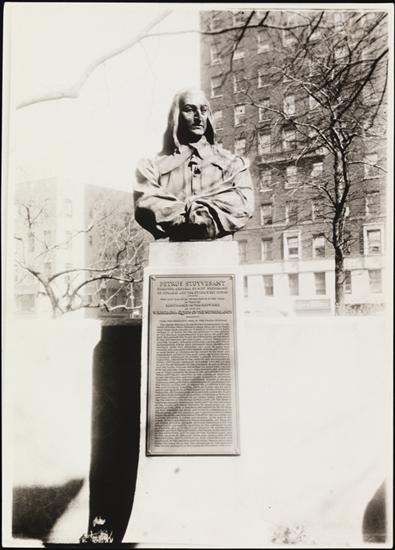
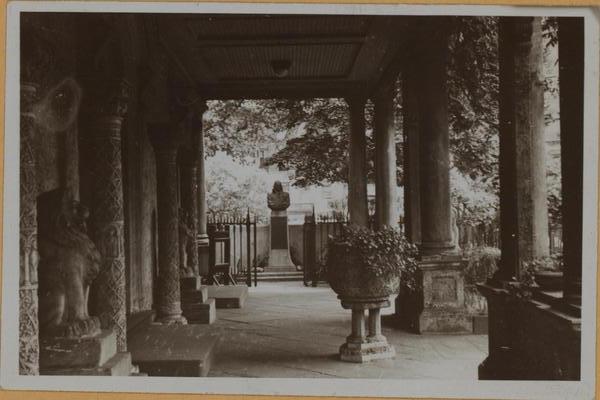
Today his vault marker can be easily seen along the side of the church, and a bust of Petrus sternly greets visitors into the church yard.
Courtesy Museum of the City of New York
The bust by Dutch sculptor Toon Dupuis is 100 years old, placedat St. Mark’s on December 6, 1915. Speaking at the ceremony, oddly enough, was General Leonard Wood, chief of staff of the U.S. Army. “Peter Stuyvesant was a headstrong, positive character with intolerance of lack of interest in the welfare of his company or colony.”
So headstrong that he’s still around perhaps? Legends of the ghost of Peter Stuyvesant have been associated with St. Mark’s since the 19th century.
Courtesy New York Public Library
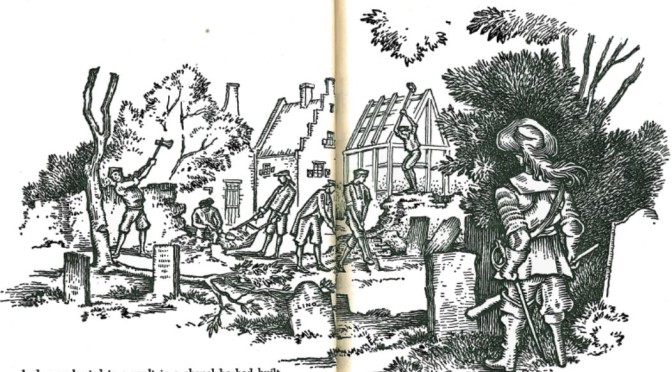
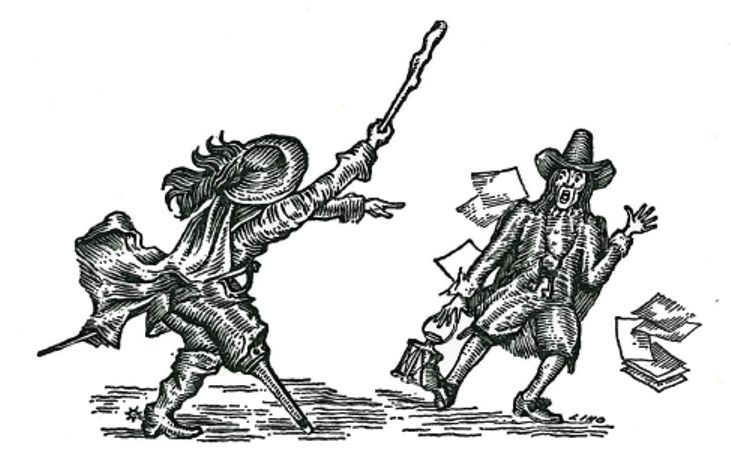
One version of his ghost story recounted in the 1966 children’s book The Ghost of Peg-Leg Peter by M.A. Jagendorf, with illustrations by Lino S. Lipinsky (reprinted here):
“His body had been put into a closed vault. But that did not stop the ghost of the governor from stomping around on black or moonlit nights in his old haunts; his farm and the city hall where he had once reigned. Folks heard his stomping peg leg with the silver band, and saw him — and ran away in fear. That pleased him, particularly if they were English. He wanted no one around his grave, least of all the enemy who had robbed him and the Dutch Government.”
The growth of New York up Manhattan island so that it soon included all of Stuyvesant’s farm apparently enraged his spirit to such an extent that his apparition was reported in locations surrounding the church.
One fateful night a sexton entered the church late at night to fetch something for the rector.
“The moon was only half full, but bright enough to show church, trees … and ghost.
When the ghost saw the sexton, he raised his stick threateningly. The sexton raised his eye, took one look and ran off.
“The governor-ghost looked after the fleeing fellow with contempt and then stomped to the locked church door. He walked through it into the church and stomped up to the hanging bell rope. Taking it in his hands he began pulling it savagely. “
Ringing a church bell two hundred years ago meant an emergency — a fire in the region, perhaps, or a major announcement. According to legend, when neighbors ran to the church to inspect the sound, they found nobody inside. The bell rope had been torn off and its lower section was completely gone.
Over the years stories of his ghost crop up, usually tied with tales of a rapidly changing city.
One can only imagine how he’s taken to the gentrification of the East Village!
“Sometimes the ghost of the governor still comes out again and looks around sadly. But he never rings the bell any more, for he knows it will be of little use.”
Courtesy Museum of the City of New York
Another disturbing event occurred at the church in 1903 although the resolution to this mystery was a bit more mundane.
One day the old clock atop St Mark’s began to act very mysteriously. “Churchgoers and others noticed last Sunday that the clock was acting in a manner befitting neither its age nor its position as hour marker over the historic graveyard. Not only was its course unreliable, but its actions were positively skittish, the minute hand having been seen to wiggle in a most undignified manner.” [source]
After several days of peculiar operation, a repairman climbed to the tower to fix the clock, only to find the culprit — “a kite string and pigeon were found to be responsible for the charges of horological misconduct lodged against the ancient timepiece.â€
Below: Stuyvesant Street in 1856, an aberration to the city grid plan thanks in part to the presence of St. Mark’s Church and its well-established churchyard
WARNING The article contains a couple spoilers about last night’s ‘Mad Men’ on AMC. If you’re a fan of the show, come back once you’re watched the episode. But these posts are about a specific element of New York history from the 1960s and can be read even by those who don’t watch the show at all. You can find other articles in this series here.Â
An unusual subplot takes Harry Crane, Sterling Cooper Draper Pryce’s smug television liaison, down to Second Avenue and the temple of the Hare Krishnas where he finds new recruit Paul Kinsey, a former agency employee. In his prior existence as a pipe-smoking gadabout, Kinsey always made note of his own hipness, and, in this case, as an acolyte of a religious thought only a few months old, we can confirm that he’s ahead of the curve again.
The Hare Krishna movement, derived from Hindu philosophies and reformatted for the groovy ’60s, was actually fostered and popularized here in the East Village.
A.C. Bhaktivedanta Swami Prabhupada, a Hindu teacher and proponent of Gaudiya Vaishnavism, left India in 1965 to spread his religious teaching. Eschewing material possessions, he arrived in New York in 1966 and gravitated towards the East Village, the nucleus of cultural counter-culture.
His reputation preceded him and soon gathered a small group of followers, including artist Harvey Cohen, who soon set up Prabhupada in an apartment on 72nd Street on the Upper West Side and a small studio for religious practice on the Bowery. From here the swami formed the core of what would become the Hare Krishna movement, aka the International Society of Krishna Consciousness.
Given the location, most of his early followers were young people, fascinated by Hindu imagery in books and music and in particular by Prabhupada’s expressions of religious thought, purifying secular consciousness expanding rhetoric into a simple spiritual regiment.
For many, he was as much a mystery as an answer. One early follower confessed later, “I didn’t know what Prabhupada was about. I mean we understood about one-millionth of what Prabhupada was saying.”
Key to religious practice is the ubiquitous mantra, rhythmically repeating the name of God. Said Prabhupada in a lecture in 2010. “[T]his sound, this Hare Krsna, Hare Krsna, Krsna Krsna, Hare Hare. Hare Rama, Hare Rama, Rama Rama, Hare Hare, is the sound representation of the Supreme Lord.”
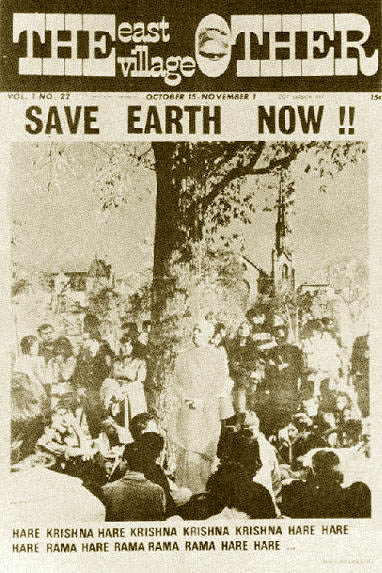
Prabhupada and his followers would frequently be heard chanting their familiar mantra throughout the East Village, but they would be known for one particular destination. On October 19, 1966, Prabhupada led an outdoor chant underneath a elm tree in Tompkins Square Park that lasted for almost two hours, so transcendent that even the New York Times took notice: ‘Swami’s Flock Chants in Park to Find Ecstasy.’ Today that tree (called the Hare Krishna tree) is one of the park’s most popular spots and a mecca for current adherents.
Above: From the late October issue of the East Village Other, in front of the  Hare Krishna tree [source]
By this time, Prabhupada had a new home, a former curio shop at 26 Second Avenue (between First and Second Streets). They kept the old sign ‘Matchless Gifts’ over door, while followers decorated the interior with handmade tapestries. This became the central New York temple and remains central to local worshippers to this day. “[I]n this small room on Second Avenue, guest found themselves transported into another dimension, a spiritual dimension, in which the anxieties and pressures of New York City simply did not exist.” [source]
In that first year, 1966, Prabhupada had only a few dozen followers, but at least one famous one — Allen Ginsberg.
Below: Video of Prabhupada and followers at Tompkins Square Park in 1966
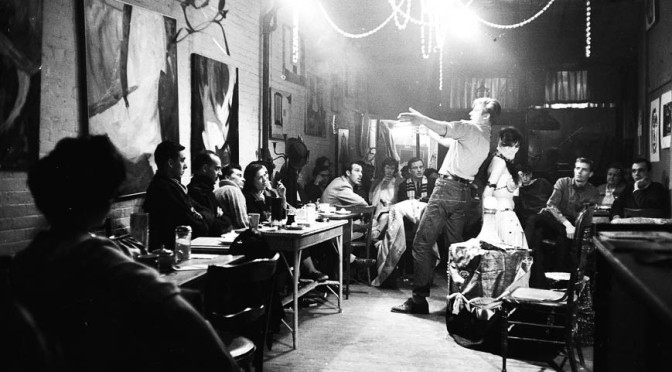
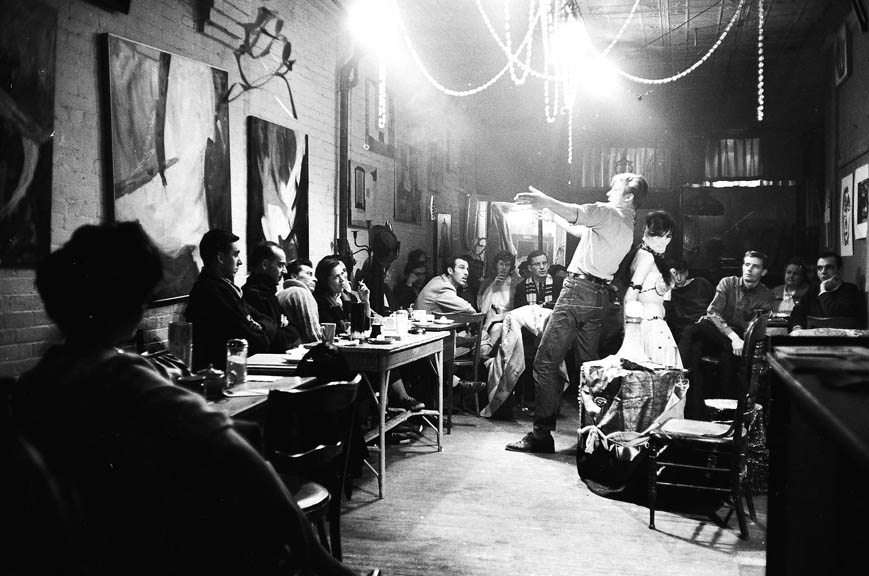
Radical thoughts, limited spaces: a performance at the Caffe Cino. Photo by Ben Martin (from an excellent website by Robert Patrick about this important off-off-Broadway site)
WARNING The article contains a couple spoilers about last night’s ‘Mad Men’ on AMC. If you’re a fan of the show, come back once you’re watched the episode. But these posts are about a specific element of New York history from the 1960s and can be read even by those who don’t watch the show at all. You can find other articles in this series here.
Megan might be Sterling Cooper Draper Pryce’s hottest new pitchwoman, but deep in her heart of delicate French extraction, she wants to be an actress. And in last night’s show, she steals away to an audition of an unnamed off-off-Broadway production. She didn’t get the part, but the experience leads her to make a jarring decision.
This wasn’t merely a plot contrivance, but rather another use of New York geography to delineate character. Don Draper was busy at Danny’s Hideaway, a Midtown East restaurant along famed ‘Steak Row‘ shimmering with late 50s — and, by 1966, ever fading — glamour. Megan’s off-off-Broadway audition could only be one place, and that was downtown below 14th Street, in the thriving epicenter of New York counter culture.
Aspiring performers have made New York their destination for fame since the late 19th century with the birth of the Broadway theater circuit. By the 1950s, playwrights and producers who challenged the preconceptions of standard, mainstream theater found homes for their work off Broadway both literally and metaphysically. The art of theater could now be explored for smaller crowds and with smaller budgets.
But even off-Broadway was not immune to financial realities. By the end of the decade, the popularity of off-Broadway created a parallel industry, “a smaller-scale version of Broadway itself.” [source] If you were to look back at the greatest off-Broadway hits of this era (plays by Tennessee Williams and Edward Albee, musicals like Threepenny Opera) you’d notice that most of them have had subsequent Broadway debuts. Indeed, off-Broadway continues to be a sort of a minor league tryout for future Broadway shows.
By the 1960s, unconventional creative voices were emerging that seemed positively alien even in that world. What do you call the alternative to something that was itself the alternative? Although Village Voice critic Jerry Tallmer is credited with coining the phrase ‘off-off-Broadway’, the phrase might have sprung up naturally the first time audiences came in contact with the early works of this field — modest, broken-down, difficult and experimental shows eager to discard every theatrical trapping that had built up for the past four hundred years.
The first ‘true’ off-off-Broadway performance, according to Tallmer’s fellow Voice critic Michael Smith, was a surreal revival of Ubu Roi, performed at a Bleecker Street coffeehouse in 1960. Theatrical experimentation complimented the Village music scene nicely, as even the smallest venues could now host a production. Only in this new creative world could a cramped, smoke-filled coffeehouse like Caffe Cino, at 31 Cornelia Street, become center stage for a new theatrical revolution.
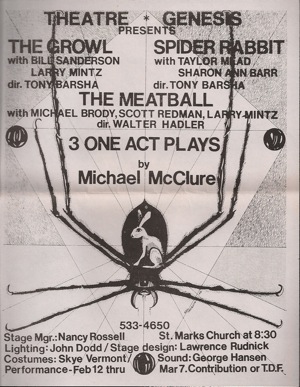
If the art was nontraditional, so too were the venues. Two churches became important homes for alternative theater in the early 1960s and they remain so to this day. Judson Memorial Church, off Washington Square, may seem austere with its elegant Italianate bell tower, turned its meeting room into an off-off-Broadway stage in 1961. And, of course, St. Marks-in-the-Bowery, took a page from its own 1920s radical bohemian past to become home to the Poetry Project and Theater Genesis (performing sometimes sexually explicit plays in the churches parish hall). Above: A poster for Theater Genesis
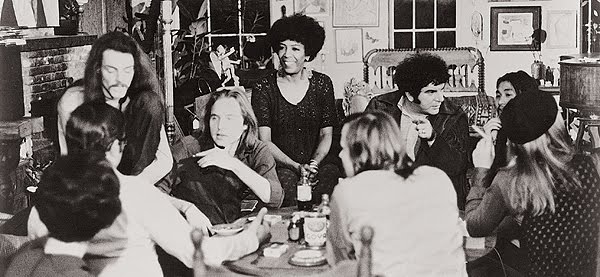
But just as many pivotal and provocative voices of off-off-Broadway were developing further east, in an area of the Lower East Side heavily influenced by Greenwich Village counterculture idealism and referred to by the mid-60s as the East Village. The chief among these, Ellen Stewart’s mold-breaking La Mama Experimental Theatre, opened in 1961 and rejected most theatrical instincts, featuring only new plays in a stripped-down, almost barren theatrical space. Pictured above: Ellen Stewart in 1970. Picture courtesy TCG
By 1966, off-off-Broadway became a banquet of experimental ideas, spaces for gay, feminist and African-American playwrights and performers. In effect, the opposite of a certain ad agency, where creative flowering is hindered by the whims of client preference and the banality of subject.
FOR YOUR CONSIDERATIONUntil May 21st, you can vote every day in the Partners In Preservationinitiative, which will award grant money to certain New York cultural and historical sites among 40 nominees. Having trouble deciding which site to support? I’ll be featuring on a few select sites here on the blog, providing you with a window into their history and hopefully giving you many reasons to visit these places, long after this competition is done. Read about other candidates here.
PODCAST The church of St. Mark’s-in-the-Bowery is one of Manhattan’s most interesting and mysterious links to early New York history. This East Village church was built in 1799 atop the location of the original chapel of Peter Stuyvesant, New Amsterdam’s peg-legged director-general. His descendants — with the help of Alexander Hamilton and the architect of New York City Hall — built this new chapel with the intention of serving the local farming community of Bowery Village.
But in many ways, the more thrilling tales occur among the honeycomb of burial vaults underneath the church, the final resting place of vice presidents, mayors, and even Peter himself.
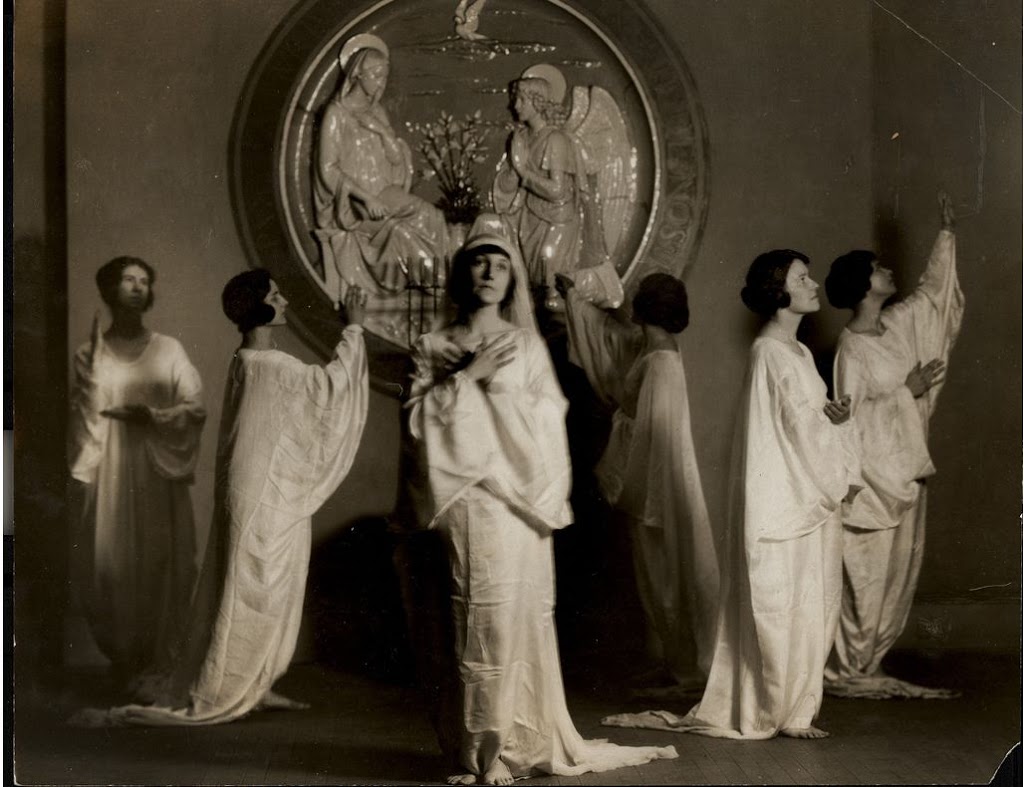
St. Mark’s reflected the changes that swept through Greenwich Village during the 20th century, with experimental and sometimes scandalous church activities, from hypnotism, modern dance and even a trippy foray into psychedelic Christian rock.
ALSO: Find out why you can never EVER go down into the vault of Peter Stuyvesant. And why is the church IN the Bowery, not ON the Bowery?
NOTE ABOUT THE NAME: The modern name of this historic structure is technically St. Mark’s Church In-The-Bowery. However most 18th-19th century sources drop the ‘church’ from the middle of the name. The hearty bust of Peter Stuyvesant in the courtyard calls it ‘Saint-Mark’s-in-the-Bowerie’.
Hyphens are liberally or reservedly applied based on the source. As we decided to spend a great deal of time talking about the old farm and the early years, we settled on ‘St. Mark’s in-the-Bowery’. But I even twisted myself around during recording and said ‘on-the-Bowery’ accidentally at least twice, so sorry for the confusion!
I’ll post some more notes on the show next week, some thank-yous, further information and some further sources to check out for more information.
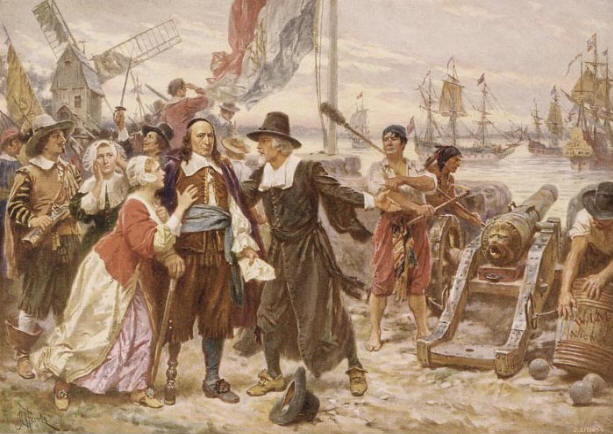
Below: The residents of New Amsterdam beseech Peter Stuyvesant to surrender to the coming British forces in 1664. He is clearly not pleased. The official surrender actually took place at Stuyvesant’s farm house, two miles outside of town along the bouweij or Bowery road. Listen here for the real pronunciation of bouwerij.
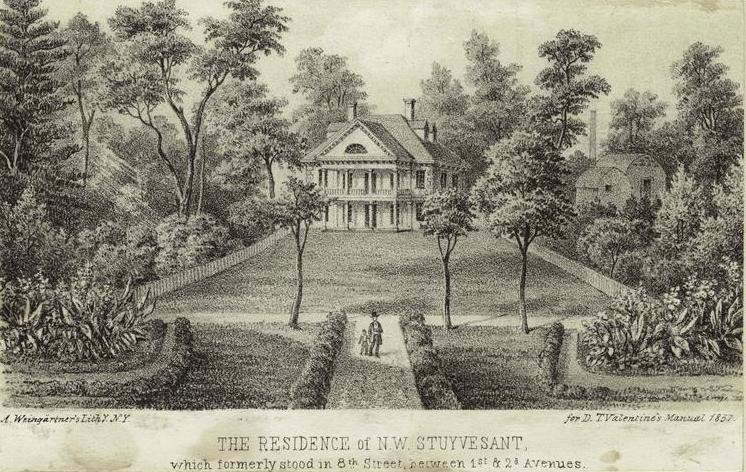
The caption reads ‘The Residence of N.W. Stuyvesant’ which formerly stood in 8th Street, between 1st and 2nd Avenue‘, one property on the land estate of the Stuyvesants during the 18th century. (NYPL) I’ve seen this same illustration differently labeled, dated 1800 and called simply ‘the Bowery House’.
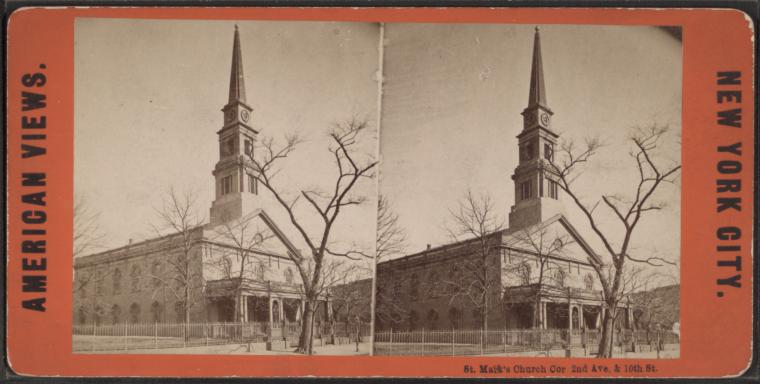
St. Marks in 1865, rendered in an early stereoptic photograph. The church itself looks pretty much as it does today. But the surrounding churchyard would be radically transformed. (NYPL)
A real estate map, imprinted with the grid plan over the Stuyvesant property. You can see Stuyvesant Street at the bottom. The collected properties were also known as ‘Petersfield’ after a manor home of one of the Stuyvesant descendants. (NYPL)
The interpretive dancers of Dr William Norman Guthrie, the Scottish clergyman who oversaw many radical changes to the standard St. Mark’s services.
An excerpt from the Mind Garage’s ‘Electric Liturgy‘, which was performed at St. Mark’s Church in 1969
Disclosure: I have partnered up with Partners in Preservation as a blog ambassador to help spread the word and raise awareness of select historical sites throughout the tri-state area. Though I am compensated for my time, I have not been instructed to express any particular point of view. All opinions expressed here are strictly my own. And since writing about New York landmarks is kinda my thing anyway, I’m thrilled to share my love of these places!
The morning of June 15 — The steamboat smolders off of North Brother Island
Today is the anniversary of undoubtedly one of New York’s most tragic events, a disaster that famously eradicated a neighborhood and became the city’s single largest loss of life in the 20th century — the explosion of the steamboat General Slocum.
SInce the invention of the steamboat, New York Harbor has seen its share of steamboat disasters, often by technical malfunctions like exploding boilers or sometimes by collision. But what took the Slocum on the morning of Wednesday, June 15, was a problem that faced many tenements at the time — inflammatory materials catching fire with little to almost no preventions in place. The blaze began in a room full of kerosene and hay, its initial discovery by a child was ignored by the captain himself, and, when it was taken seriously, all available tools to fight the blaze — hoses and buckets — were rotted through and virtually useless.
When passengers tried to flee, they discovered that the life vests were old and disintegrating and rafts were merely decorative. Regular inspections of the boat’s safety equipment had in the past been paid off in bribes; the result now manifest itself in a fast-burning ship with 1,342 passengers unable to escape.
The unlucky were the mostly women and children congregants of St. Marks Lutheran Church, in New York’s Kleindeutschland (today, the heart of the East Village), the vibrant destination for new German immigrants, seeking solidarity and a friendly, recognizable culture in the new, foreign city.
Being a day excursion, most of the men were off at work, and their families were off to enjoy a daytrip picnic at Eatons Neck along Long Island’s north shore. The Slocum never made it out of the East River however. The fire spread with such horrifying speed that I can only illustrate it the following way — the boat left the 3rd Street Pier at 9:30 and less than an hour later, its smoldering hull ran ashore at North Brother Island, most of its passengers either burned alive, choking from smoke inhalation along the shores or drowned in the waters of the East River. According to author Edward O’Donnell, “At 10:55 a.m., even before the news of the disaster became general, the burning hulk that had been the General Slocum was raised by the incoming tide and set adrift.”
Below: Recovery workers scour the banks of the East River for days afterwards, looking for additional bodies
The tragedy sent the city into mourning. For the residents of Kleindeutschland, the disaster was simply too much to recover from. Of the 1,021 women and children who died, most lived in the German district of the Lower East Side. Their husbands and other family members moved on to other German neighborhoods, up to Yorkville or out to thriving districts in Queens and Brooklyn, or out of New York entirely.
Remnants of Little Germany can be found all throughout the East Village and Lower East Side, but for a memorial to the Slocum disaster, visit the original St. Mark’s Evangelical Lutheran Church on East Sixth Street.
Below: A funeral procession passes Avenue A and Sixth Street, the ‘burial of the unidentified’ according to the caption
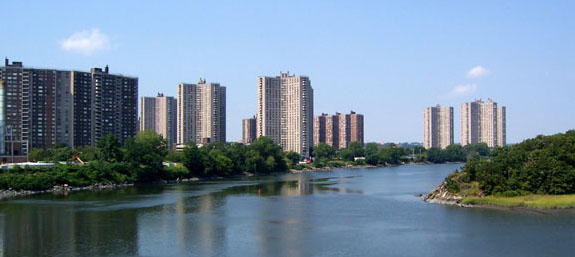
ABOVE Co-op City: the housing development most likely to be seen from space
NAME THAT NEIGHBORHOOD Some New York neighborhoods are simply named for their location on a map (East Village, Midtown). Others are given prefabricated designations (SoHo, DUMBO). But a few retain names that link them intimately with their pasts. Other entries in this series can be found here.
Why are there so many cities in the city of New York City?
New York neighborhoods are often products of their geographic and even geometric environments. They are made of Heights and Estates, Terraces, Channels and Ports, Parks, Hills and Kills, Beaches and Points, Villages and Towers and Gardens, Circles and Squares, not to mention Islands. Some of these name are reflections of the natural environment, others are artificial titles given to real estate properties hoping to lure residents with more natural sounding, civilized names.
But there’s actually quite a number of neighborhoods within the metropolitan area with loftier intentions — neighborhoods that have ‘city’ in their name. Many of them are only cities in the sense of being self-contained housing units. Others are virtual cities, unofficial collections of streets cut off from the main circulation of the city.
But a couple of these places, believe it or not, were once actually self-governing places, their names reminiscent of pre-consolidation days:
Alphabet City, Manhattan By virtue of starting only at 14th Street, the avenues A through D feel segregated from the flow of the city. Almost from the moment they were carved into the city’s grid in 1811, the avenues were home to middle and lower classes. The heart of German culture thrived here in the 19th century, with Eastern Europeans taking it over the 20th. Where calling it a city might once have been derogatory, today as the anchor of the East Village, it underscores its individuality.
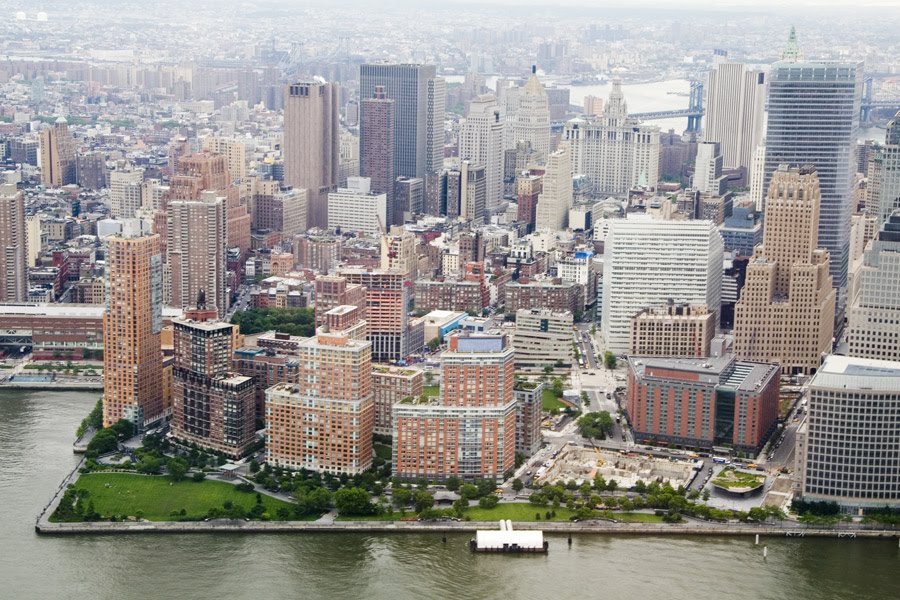
Battery Park City, Manhattan Like Alphabet City, this lower Manhattan planned community, nearby Battery Park, is removed by geography from the regular patterns of the city; unlike Alphabet, every structure is meticulously aligned with the rest. Created on a bed of World Trade Center landfill, most of BPC is younger than its average tenants, with the first structures only started in 1980. It doesn’t feel like New York, which is a benefit for some.
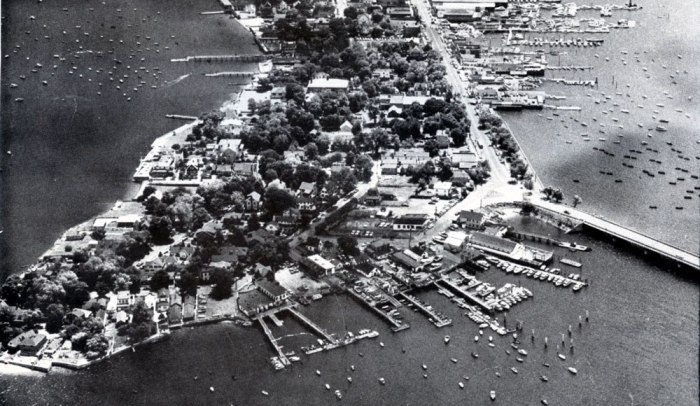
City Island, Bronx For much of its pre-revolutionary European occupancy, this most New England-y of New York islands was owned by the Thomas Pell family (also owners of what would become Pelham Bay Park and Westchester County, among other things). In 1761, speculator Benjamin Palmer bought the property and renamed it New City Island in a bout of wishful thinking; by calling it a ‘new city’, he hoped to turn property into a thriving upriver port. Its future residents — mostly oyster farmers — dropped the ‘new’ from the name.
Co-Op City, Bronx Still largely considered New York’s greatest ‘city within a city’. This super-massive housing community, still the largest co-op development in the world, rose from the ashes of failed amusement venture Freedomland U.S.A. (we have a podcast on that ) and opened in 1971. Like a regular city, Co-op City has its history of near bankruptcy, corrupt mismanagement and transportation woes.
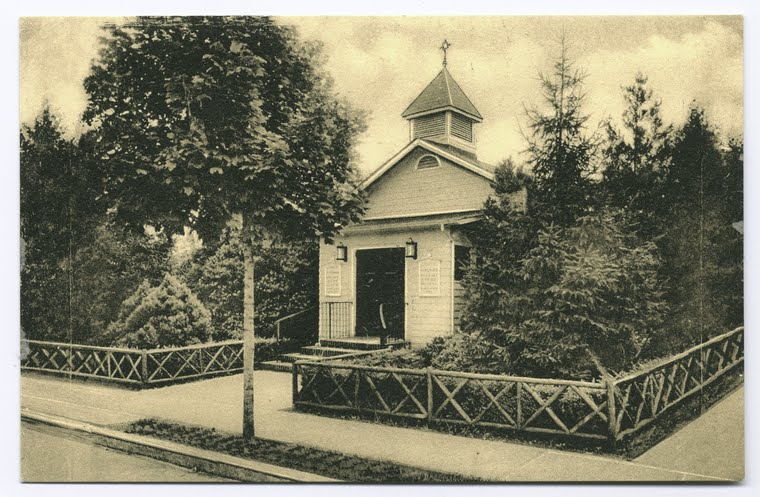
Grant City, Staten Island This eastern neighborhood of SI is actually one of New York’s oldest ‘cities’, starting off with the rather fancy names of Frenchtown, then Red Lane, before being renamed during the Civil War after the Union’s most famous general Ulysses S. Grant. Far from being secluded like other New York ‘cities’, Grant City sits nearby the borough’s most historical communities New Dorp and Richmondtown, as well as Staten Island’s highest point, at Todt Hill. (Above, St. Christopher’s Roman Catholic Church in Grant City, pic courtesy NYPL)
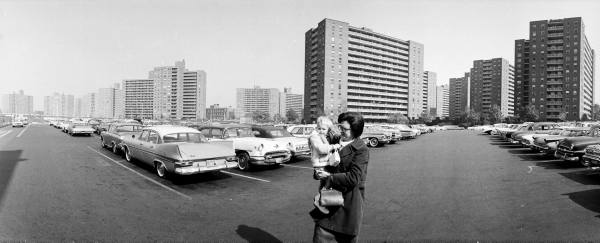
LeFrak City, Queens “Live a Little Better” is the slogan of this well-known housing development, started in 1960 and completed in 1969, from real estate mogul and “master of mass housing” Samuel LeFrak, the largest of several residential projects bearing the LeFrak name. The Lefrak Organization began over a hundred years ago with Aaron LeFrak. Samuel’s son Richard was recently a judge on the Miss Universe pageant. (Pic above courtesy Life)
Long Island City, Queens This is one of the only ‘city’ neighborhoods to actually have, in fact, started as a city. The official Long Island City was cobbled together via charter in 1870 from a cluster of surrounding villages, including Astoria, Steinway, Hunter’s Point and others. It had a run of almost 30 years before being absorbed into the newly formed borough of Queens — and the newly consolidated city — in 1898. Among its many colorful mayors during this time of self-rule was one Paddy Gleason, nicknamed ‘Battle Axe’ for once personally chopping down an objectionable fence owned by the Long Island Railroad.
Starrett City, Brooklyn Just west of JFK, this large housing development with almost 6,000 apartments sprang up in 1974 and by the 1980s became a controversial model of ‘racial quota’ rentals. It’s recently shed its city status, changing its name to Spring Creek Towers in 2002.
Starrett, by the way, was the name of the development company and, like LeFrak, has nothing to do with the area its built on. The Starrett brothers Theodore and Paul were apprentices of Chicago architect (and creator of the Flatiron Building) Daniel Burnham in the 1890s; much later, their construction company tore down the original Waldorf-Astoria to make room for the Empire State Building.
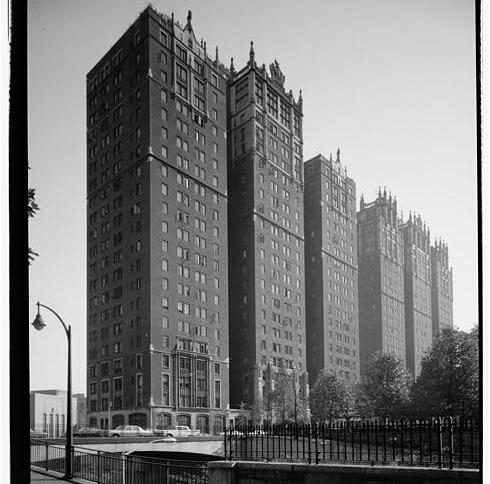
Tudor City, Manhattan Tudor City is just like LeFrak and Starrett, but with the virtue of being far older and more aesthetically pleasing. Developer Fred F. French swept away a rather dingy set of tenements in the 1920s — the nearby slaughterhouses had yet to be cleared away to build the United Nations headquarters — and hoped to lure middle-class families with the promise of a “human residential enclave”.
His risky venture worked, partially because he elevated the buildings 30 feet above First Avenue and creating two 15,000-square foot private parks. Truly a ‘city above a city’.
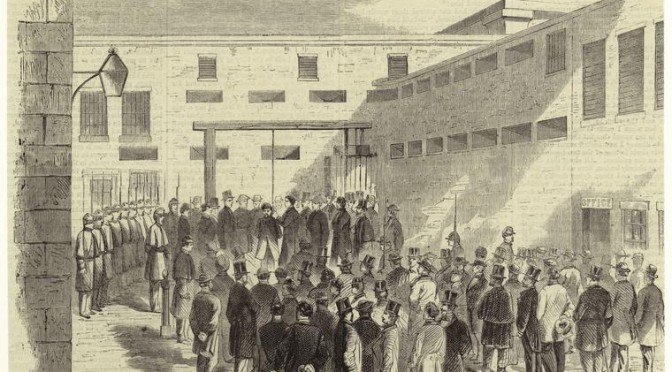
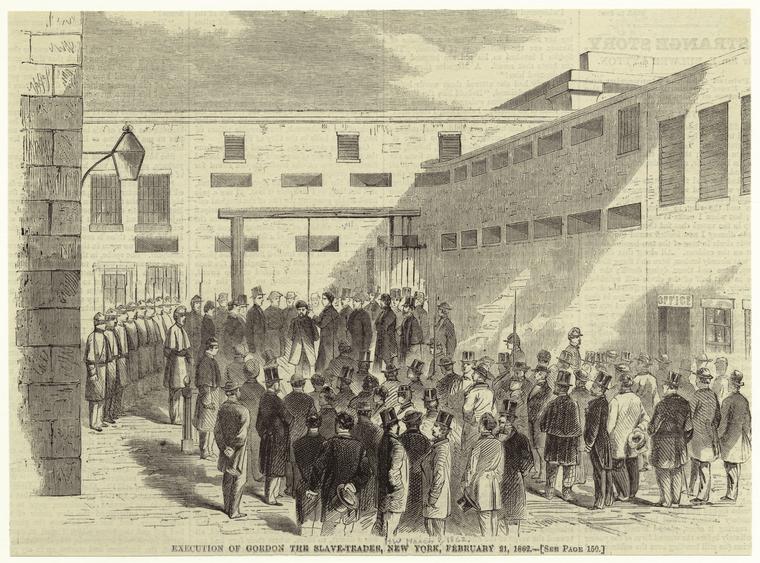
Public hangings were a rare but grisly part of 19th Century New York life. The one illustrated above is from 1862. Another would famously haunt the area near an East Village intersection.
I pass through the intersection of 13th Street and 2nd Avenue fairly frequently on my way home from work. The plain intersection is probably best known as the home of the New York Eye and Ear Infirmary and for being a block away from a movie theater with some rather small movie screens. If you’re a foodie, you probably know it for Momofuku’s Milk Bar.
The most recent modern drama this corner has seen might be the electrified manhole cover that almost killed somebody awhile back. But 185 years ago, when this area was nothing more than a large meadow once the property of the Stuyvesant family, it was the site of one of the most well-attended public execution in American history.
It may be hard to understand why (as some reports suggest) almost 30,000 people came to observe the hanging of John Johnson from this field in 1824. Another source claims 50,000 people came to see the gruesome execution, which at the time would have been almost one-third of the entire city population of New York.
Perhaps the facts of his crimes were simply too shocking to ignore. Johnson, a family man who kept his wife and children at an upstate farm, ran a boardinghouse for wayward sailors during New York’s heyday as a port city in the 1820s. It was located in the bustling heart of the city and dozens of men passed through his door. It was not exactly a four-star resort, however, and certainly the occasional home for misdeeds. But for the visiting seamen, these types of seedy places were hard to avoid, and the threat of murder would have been bone chilling indeed.
One day in 1823, in a nearby alley, the body of sailor James Murray was discovered, his head split open with a hatchet. Murray was staying at Johnson’s lodge; upon inspection, bloody sheets were found in Johnson’s cellar, and the innkeeper was arrested.
Johnson’s behavior was especially erratic. He admitted to the crime, then retracted his statement, saying he was merely protecting his family. He claimed another guest had attacked Murray and that Johnson was merely guilty of “neglecting his duty as a host.” His confession and subsequent about-face piqued public curiosity, with his wife’s letters and even his own minister’s spin on the tale quickly printed up into pamphlets.
Any printed entreaties to his innocence fell on deaf ears. Decrying his innocence to the end, Johnson was sentenced to hang on April 2, 1824. (I have also seen sources that say April 4.) He was escorted to the gallows by his minister and even infantrymen who had to part the growing crowds, “a solid mass of living flesh — men, women and children of all colours and descriptions,” by one account.
Public executions were actually quite rare by this time or else relegated to one of New York’s lonely islands (such as Blackwell’s Island or the tiny oyster island that would later become Ellis Island). Not because they were horrifying displays, but because they attracted large crowds of drunks, rowdies and pickpockets. So in the most macabre sense possible, the event of Johnson’s death signified something unique.
Whether Johnson had truly been fairly treated is unclear but the story had reached a fever pitch, its details splashed across newspaper and gossiped about at city taverns. By the time he stood overlooking the crowd with a rope around his neck, Johnson had become a figure of evil. After hanging, his body was donated to a medical school.
Civility would soon come to this death field, as avenues and streets along the grid plan were carved out and the area quickly developed. Violence would return to the neighborhood during the Civil War draft riots of 1863. A block away, a witness to the murder, Peter Stuyvesant’s pear tree at 3rd Avenue and 13th street, would stand until 1867 when it was mowed down by a wagon.
A plaque stands in honor of Peter’s pear tree. No evidence remains of the public execution which occurred just a few yards — and one block — away.
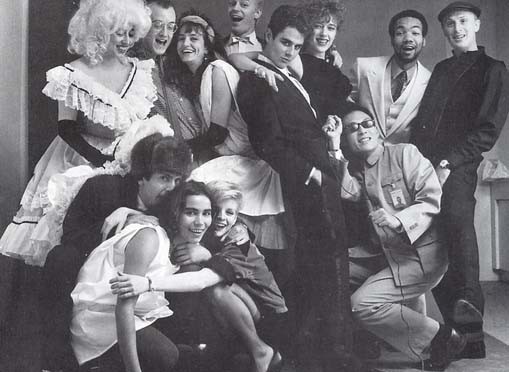
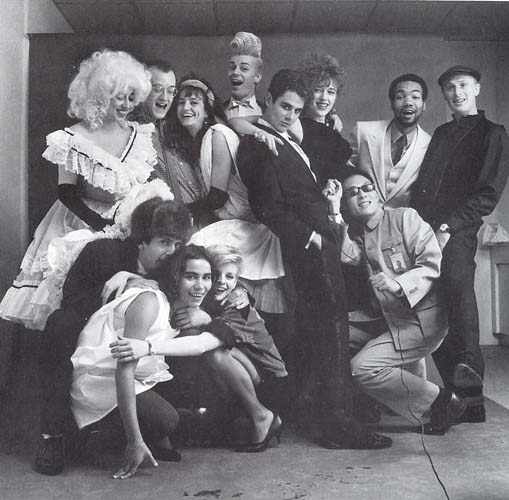
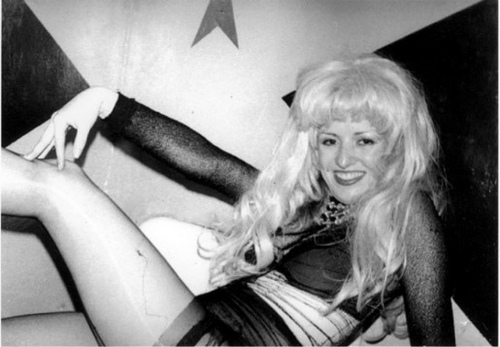
Those crazy kids! The revelers of Club 57 (featuring, among others, Keith Haring), circa 1980
FRIDAY NIGHT FEVERTo get you in the mood for the weekend, every other Friday we’ll be featuring an old New York nightlife haunt, from the dance halls of 19th Century Bowery, to the massive warehouse clubs of the mid-1990s. Past entries can be found HERE.
I try not to editorialize too much about the places I write about, because like people, the beauty of a neighborhood is in the eye of the beholder. But these young whippersnappers today just do not understand how profoundly awesome St. Mark’s Place used to be. *waves fist* There’s a Pinkberry there now. Kim’s Video is gone. Where’s the edge?
Yes, yes, things change. And not everyone would agree anyway; in fact, a traditional New York history buff might look upon anything that happened on this East Village street after 1960 as being pure deterioration. Formerly a part of Peter Stuyvesant’s farm, the street transformed from luxury mansions to the heart of German immigrant culture at the turn of the 20th Century. You could say St. Mark’s suffers from a ghost limb. The street used to officially extend one block west before dignified Cooper Union moved into the neighborhood. It now starts at Third Avenue and barrels through to end at the foot of Tompkins Square Park on Avenue A.
The street was also one of New York’s great epicenters for counter-culture, the home to agitators like Emma Goldman and Leon Trotsky, underground jazz clubs and gay bath houses, avant-garde artists and musicians, and finally, by the late 70s, the stomping grounds of punk youth. It’s during this period that our subject, Club 57, enters the story.
Nightlife in the late 70s was epitomized by Studio 54 — high fashion, disco, celebrity and, quite frankly, aristocratic staleness. If disco didn’t appeal to you, it might have been the most loathsome place in the universe. As more and more clubs began aping and distorting the Studio 54 formula, what was your average East Village, pink-haired, multiple pierced, non-traditionally beautiful transgendered girl to do?
We’ve already seen in this column one rebellious strain — the Paradise Garage, which took the big club aesthetic and transformed it into a temple for music worship. When Club 57 opened up in the basement of the Holy Cross Polish National Church at 57 St. Mark’s Place, it had another philosophy: why must celebrities have all the fun?
The strange and the beautiful (Photo by Harvey Wang)
Club 57 was an anti-disco, anti-glitz dingy diamond of the early new wave era, a ‘punk do-it-yourself’ romper room managed by budding performance artist Ann Magnuson. (She’s now an icon of the downtown New York scene. You may remember her from Desperately Seeking Susan.)
According to Ann, she was hired in 1979 by the owner of Irving Plaza whose smaller club here at St. Mark’s needed to be spiced up with “‘alternative’ entertainment” that reflected the clientele of the neighborhood. With some creativity and abandon, Magnuson and her gang of misfits turned the basement into her own “low rent answer to Andy Warhol’s Factory,” “a center for personal exorcism, devising theme parties (or “enviroteques,” as one drug-dealing-conceptual-artist ex-boyfriend liked to call them),” for its outcast, straight, gay, vanguard clientele.
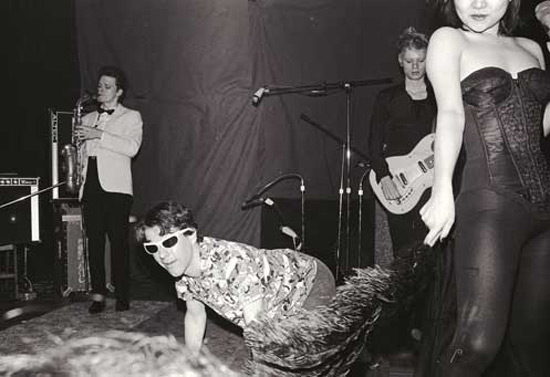
The theme parties would mock serious musical conventions, often requiring silly or even conventional dress done in an ironic fashion — nights like Putt-Putt Reggae night, ‘A Night At the Opry’, and Elvis Memorial night (where everybody dressed as their distorted version of the King). One event featured club goers sitting around making model planes; another emulated the thrill of lady wrestling.
These probably weren’t like the costume parties you’re used to. Kenny Scharf: “There were drugs and promiscuity — it was one big orgy family. Sometimes I’d look around and say ‘Oh my God! I’ve had sex with everybody in this room!”
One of Club 57’s more successful nights was the Monster Movie Club, every Tuesday, showing “the worst monster movie they could find,” according to Drew Straub.
The soundtrack for these absurdist weekly carnival shows were stars of the outer reaches of punk, new wave and rap. The club featured performances by St. Marks resident Klaus Nomi, Fab Five Freddy and John Sex. When it did feature more established names, they were along the lines of the Buzzcocks and the Cramps
Below: the band Certain General plays at Club 57, April 1981
The club soon gained a rowdy reputation. According to Magnuson, her Elvis Memorial night was disrupted when “local juvenile delinquents” caught the air conditioner on fire, sending bizarre Elvis lookalikes spilling into the street. Its reputation was spirited enough to keep away to more ‘cultured’ avant garde of venues like the Mudd Club. Said Magnuson, “The Mudd Club was more into coolness and being hip and shadowy and mysterious, while Club 57 was about being loud and bright and colorful and kooky and silly — and doing mushrooms.”
However one artist who was not detoured was Keith Haring who frequented the club and credits it for inspiring “the beginning of a whole career as the organizer and curator of some really interesting art shows.”
Club 57’s time was brief; it opened in 1979 and closed four years later. But its influence would spread into many other underground clubs, including the longer lasting Jackie 60. Today’s St. Mark’s Place could definitely benefit from a little infusion of its wild, retro chaos.
Below: the wonderful Wendy Wild, a fixture of Club 57 (Photo by Ande Whyland)
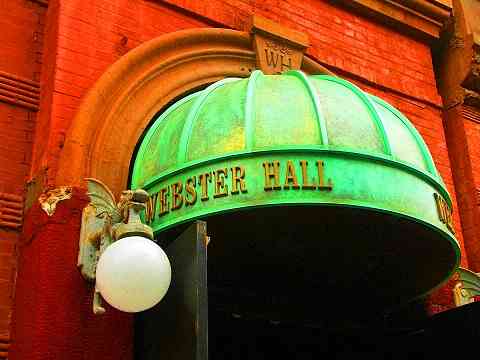
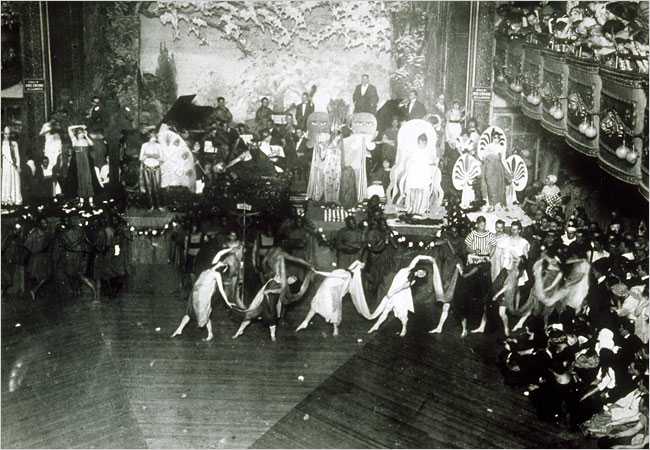
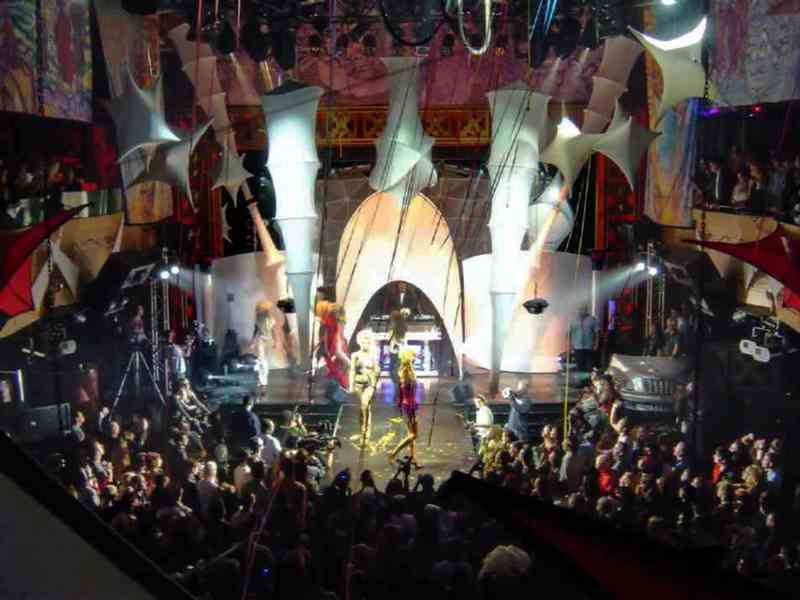
Webster Hall, as beautifully worn and rough-hewn as it was during its heyday in the 1910s and 20s, disguises a very surprising past, a significant venue in the history of the labor movement, Greenwich Village bohemia, gay and lesbian life, and pop and rock music. Its ballroom has hosted the likes of Emma Goldman, Marcel Duchamp, Elvis Presley, Robert F Kennedy and Madonna. Listen in to find out how it got its reputation as ‘the devil’s playhouse’.
Listen to it for FREE on iTunes or other podcasting services. Or click this link to listen to the show or download it directly from our satellite site.
Webster Hall in its first decade of the 20th century….
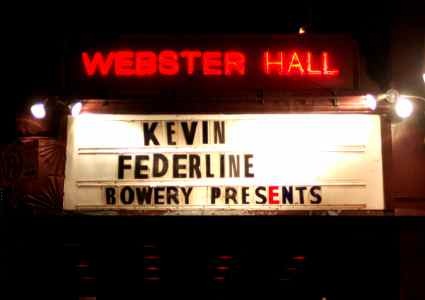
…and the first decade of the 21st century
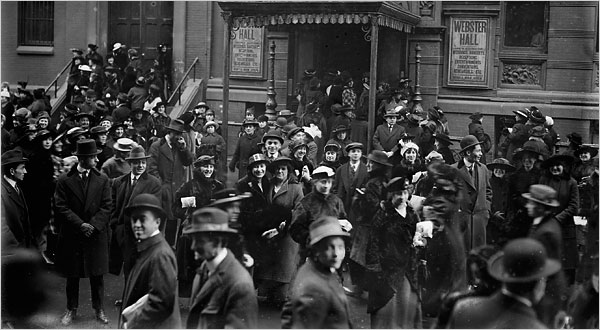
Outside the club during a labor rally in the 1910s (pic courtesy Library of Congress
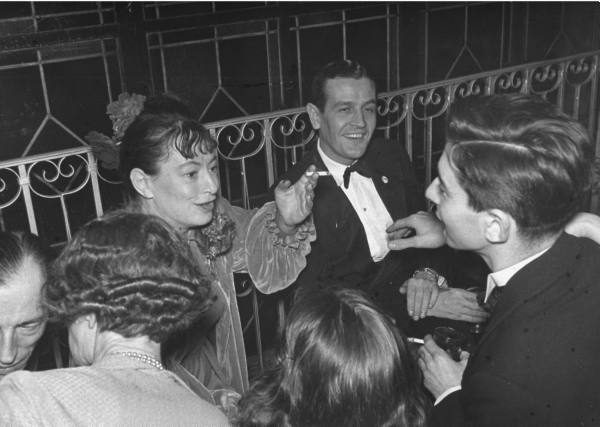
Dorothy Parker arrives at Webster Hall in 1938 with husband Alan Campbell
In its years as an RCA recording studio, Webster Hall saw most of the greats of pop, jazz, classical and Broadway making albums here.
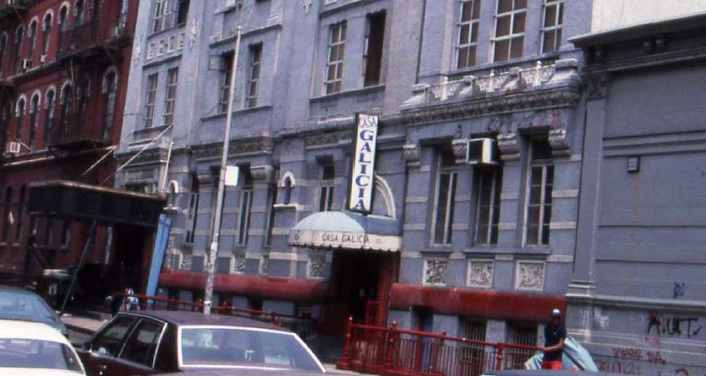
As the Casa Galicia during the 1970s
Elvis, Madonna, Lena Horne, Louis Armstrong, Frank Sinatra, James Brown, Jefferson Airplane, Run DMC, Prince, U2 — all the greats have performed at Webster Hall. And then there’s ….
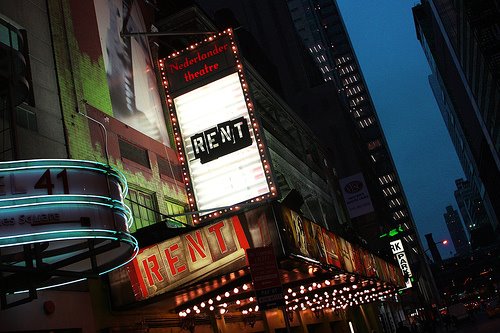
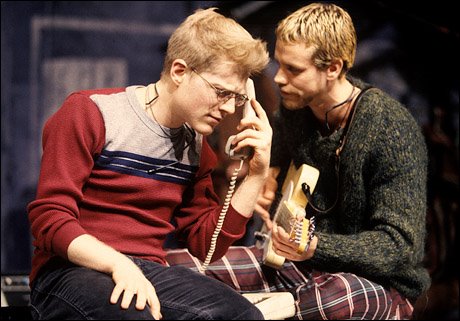
A stubborn group of good-looking, well-meaning squatters were finally evicted last night as the hit Broadway musical ‘Rent’ closed after 5,124 performances.
The show had become the most peculiar historical time capture on Broadway, freezing forever a musical variation of late 80s/early 90s, pre-Guiliani East Village underground, recalling a time when Avenue B had far fewer condos and trendy bars. Seen now as a history of pre-development, ‘Rent’ documents a psychic battle most feel the East Village lost — artistic independence in a shrinking bohemian subculture.
‘Rent’ was written as a tangle of contemporary love stories — based loosely on ‘La Boheme’ — by Jonathan Larson, the young playwright who died of an aortic aneurysm the day before the show’s opening night (January 26, 1996) at the New York Theatre Workshop.
‘Rent’ moved to Broadway that spring and won the Best Musical Tony, eventually becoming the seventh longest running show in Broadway history. It fell into a ragtag category of edgy downtown shows made good — inheritor of ‘Hair’-like passions among fans and setting the stage ten years later of ‘Spring Awakening’, another sexy, youthful show based on an older source.
It ignited the career of many of its original cast members, chief among them married stars Taye Diggs and Idina Menzel (securing her Best Actress Tony for ‘Wicked’). From the show’s perch at the Nederlander Theater on 41rd Street, the show literally saw nearby 42nd Street transform from a shiftless boulevard of empty marquees to the most hyper-neon tourist friendly destination on the planet. Slowly, what felt fresh and contemporary turned nostalgic, as the cast’s trendy fashions became more and more costume-y as the years went by.
The Tower of Toys made famous in ‘Rent’s striking scaffolding set has since been demolished. The Life Cafe — scene of Rent’s rousing ‘La Vie Boheme’ — is still around, although when the film version of ‘Rent’ came around, the roomier bar at 7th Street and Ave B was its stand-in.
I fully admit to being a ‘Rent’-head; I saw the show two days after its opening downtown, when the cast was still stunned by Larson’s passing and energized by audience and critical enthusiasm. Once the show moved to Broadway, it offered front-row seats for $20, as long as you were willing to literally camp out all night for them. (I did it. Twice. Okay, three times.)
The show now faces its final test — as a musical standard spreading to local theatre troupes all over the world. A national tour has been on the boards for years. Can a bit of the old East Village survive perpetually in suburbia?

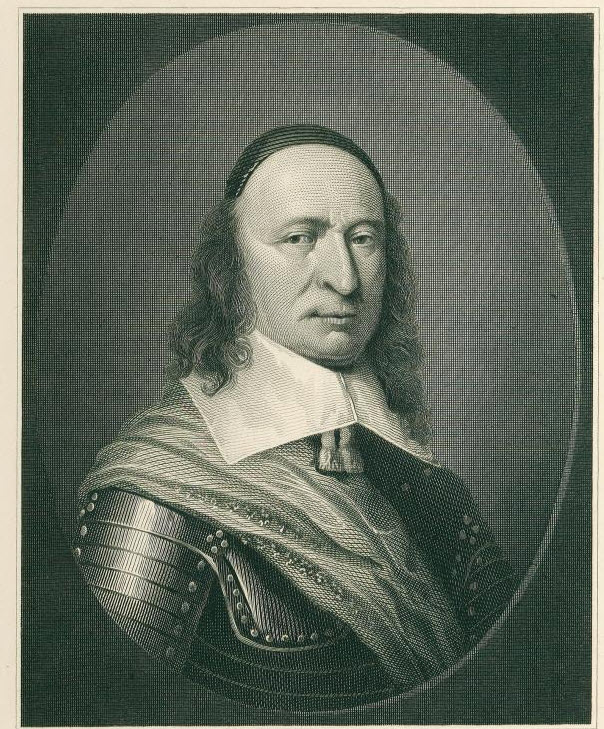 Less than three centuries after the iconic Dutch director-general of New Amsterdam died at his palatial farm in today’s East Village, his name was employed to sell a brand of stylish, premium cigarette, still enjoyed today by smokers in Australia, New Zealand, South Africa and other counties, most being places Peter Stuyvesant had no idea existed.