Categories
Neighborhoods Parks and Recreation

Nostalgia for Astoria Pool, an early Robert Moses project with a high diving, Olympic-sized history

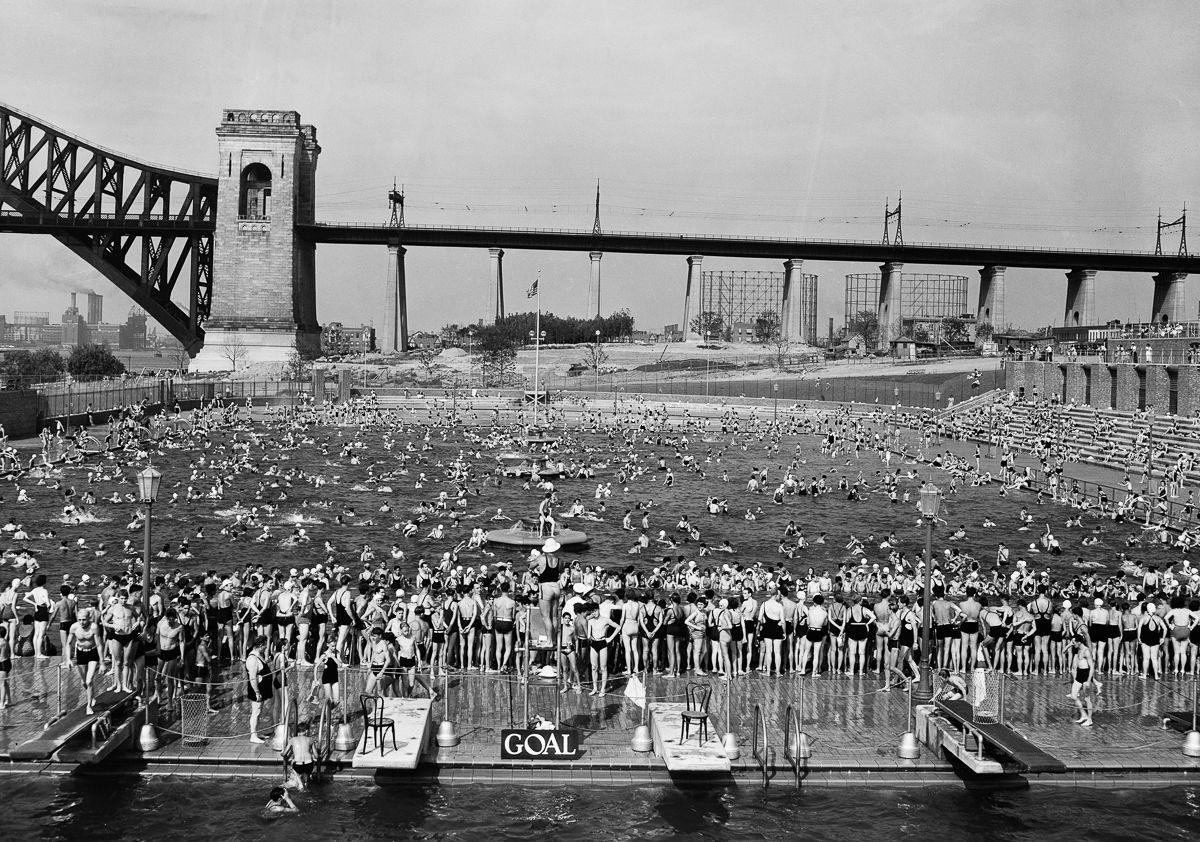
Astoria Pool is the largest venue for swimmers in New York, outside of the Hudson and East Rivers and, of course, the ocean.

Its location in Astoria Park is certainly theatrical, parallel with the river and in sight of two spectacular bridges (the Robert F. Kennedy and the Hell Gate) that sail over to Randall’s Island.
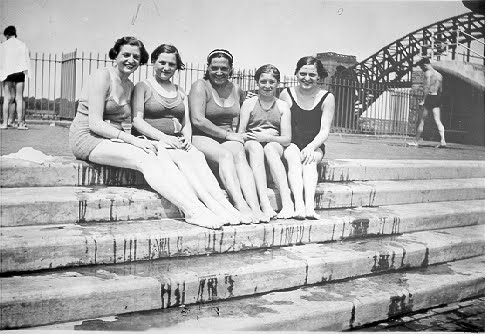
Mermaidens: Five sisters in bathing suits pose on steps of Astoria Pool, circa 1938. Courtesy the LaGuardia and Wagner Archives

For a public pool, its so big (330 feet long, with a supposed capacity of 3,000 people) that it might be more comfortable in a theme park.

Riding the Wave

The pool, the park, one of the bridges (the RFK, aka the Triborough) and the roads you probably used to get to thee places were all 1930s projects overseen by New York Parks Commissioner Robert Moses.

But the real fuel behind the creation of Astoria Pool was the Works Progress Administration, a federal agency that infused billions of dollars into local communities during the Great Depression.
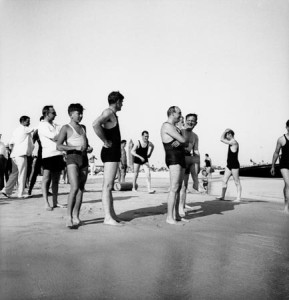
The money came just as Moses (above, in a swimsuit, at Jones Beach) was ascending into his various governmental roles in city and state government. The result was some of his most earnest and arguably most effective projects.

Perhaps his legacy might not be as hotly debated today had he stopped with his greatest hits of the decade: the Triborough, the parkways and the many miles of parkland scattered throughout the city.

And of course the swimming pools, eleven in total, built during the 1930s.

Dipping A Toe Into Swimming Pools

They were of special note as a culmination of the modern public facility, using modern design and new technology to create places of recreation for regular New Yorkers.

The idea of municipal pools wasn’t new — Philadelphia had them as early as 1890s, and New York had plenty of public baths and even floating baths  — but standards of decency had changed by the 1920s.

Women could cavort with men, as could different social classes. (And occasionally people of different races, although many of Moses’ own pools were guilty of segregation.)

Astoria Pool, with its subdued Art Deco design, was the grand model for all the new pools in the other boroughs. And it was certainly the most popular, from the moment it opened in July 1936.
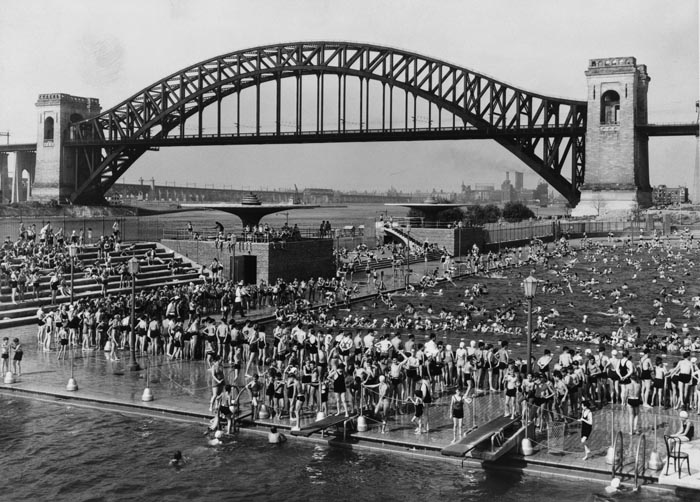
It became a daily destination during the summer for neighborhood children.

“In 1936, I was eight years old,” recalled New York Yankee superstar Whitey Ford. “You could stand by the pool on a hot summer day –along with a couple thousand neighborhood kids in the main pool and maybe another hundred in the diving pool — look up, and see quite a sight. On the right was Hell’s Gate Bridge….and on your left, was the brand new Triboro Bridge heading towards the horizon.”

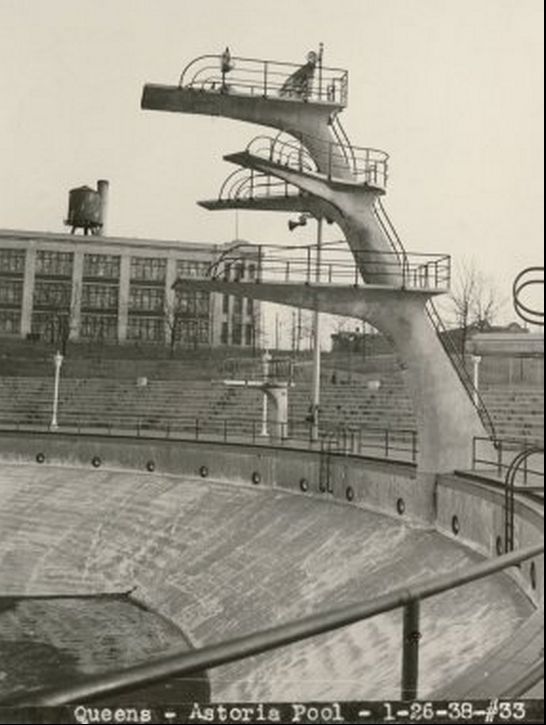
But Moses wasn’t just concerned with public accommodation. He had different intentions for this pool, reflected in the semi-circle of bleachers and that spectacular diving platform stretching like a plant over a deeper half-moon pool.

The Astoria Pool was meant to create swimming superstars.
The Diving Board and the Butterflies

Two days after its opening, on July 4, 1936, Astoria Pool hosted the U.S. Olympic trials in swimming and diving. From these events, victors went straight over to the Games, hosted that year in Berlin.

And they weren’t the only athletes tested that month in a New York WPA project.

Across the water, at Randall’s Island, Olympic track-and-field trials were hosted at Downing Stadium, producing the man who would become the most famous Olympian of the ’36 games — Jesse Owens, winner of four golds. [For more information, check out the podcast on Randall’s Island and the 1936 Olympic trials.]

Two massive Olympic torches stood astride the pool as competitors fought for a spot on the Olympic team.

Events at the Astoria Pool in July 1936 produced several winners, including gold medal swimmers Jack Medica and Adolph Keifer and a slate of athletes that went on win ten of twelve medals in men’s and women’s platform and springboard diving.

(Interestingly, the other two medalists were Germans. And both their medals were bronze, yet another result that must have angered Adolf Hitler.)

Olympics trials returned to Astoria Pool in 1952, and again in 1964, producing athletes that again nearly swept the diving events in the Tokyo games.

Swimmer Don Schollander went on to win 4 golds that year, the most of any athlete in 1964 and the most medals won by an American athlete since Jesse Owens.

But, as it would turn out, the biggest swimming celebrities fostered from the Astoria Pool were neighborhood boys.
Aqua-Zanies

Imagine being a kid in Astoria, Queens, in the early 1940s, living next to a swimming pool that had helped produce the world’s greatest swimmers!

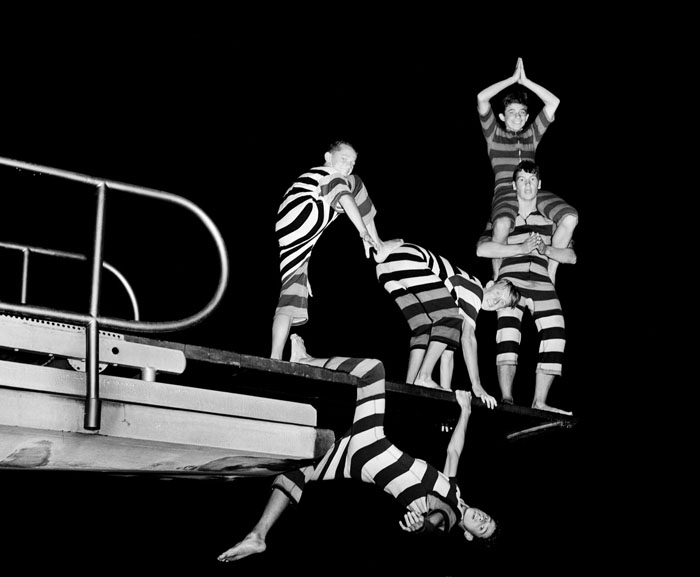
A group of local swimming enthusiasts looked at Astoria Pool’s extended diving platform and saw a opportunity to entertain, forming an athletic-comedy group called the Aqua-Zanies.

Garbed in matching stripped ensembles, the teenagers performed wacky acrobatic stunts from off the platform — darting, twirling and sometimes bellyflopping into the water below.

They soon became ‘America’ leading water comedians‘, performing throughout New York and even going on an international tour in the early 1950s. Several Aqua-Zanies went onto more legitimate swimming careers.

And certainly these effortless performance have inspired hundreds of others to leap from the Astoria diving platform with equal attempts at gravity-defying levity.

Although the swimming pool has remained a important part of the community even to this day, that diving platform, weathering decades of elemental abuse, was shut down in the 1970s and has become something of a beloved ruin.

In June 2006 it was officially designated a New York City landmark. And the pool is open for swimming again. Let your aqua-zany dreams soar!

Thanks to the Parks Department for use of the images above. (Diving platform photo courtesy NYC Dept of Records)
Odds and ends: Grant winners and a Bowery Boys interview

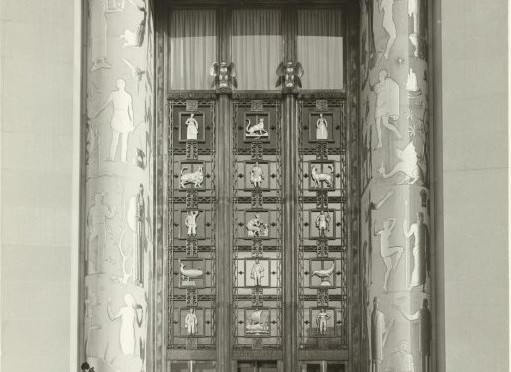
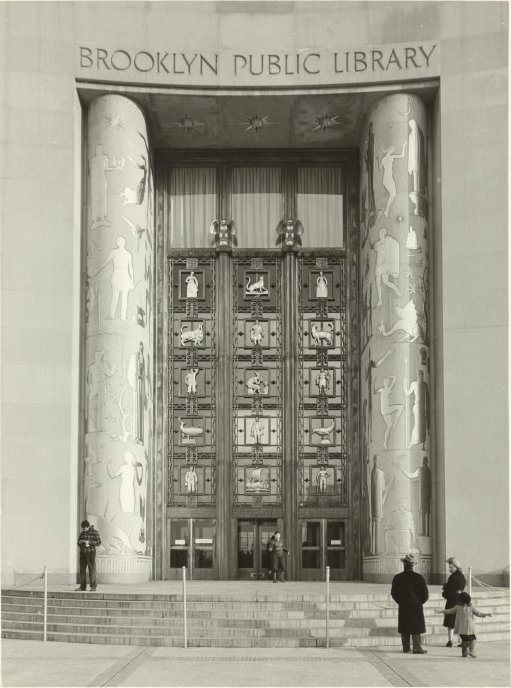
These doors just won a lot of grant money. (Photo by Wurts Brothers, NYPL)

The votes have been counted, and Brooklyn (more specifically, Park Slope) and the Bronx ran away with the Partners In Preservation initiative, sponsored by American Express and the National Trust for Historic Preservation.

 The four locations which received the most votes were the Brooklyn Public Library central branch, the synagogue Congregation Beth Elohim, the New York Botanical Garden and the Bartow-Pell Mansion Museum.

But for the others, there’s good news! The grant proposals for the top four don’t even add up to $1 million, and the initiative will now determine how to distribute the remaining $2.1 million among the other finalists. They will announce the choices in June.

————————————-

I recorded an interview with Andrew Johnstone for the Podcast Squared show (essentially, it’s a podcast about podcasts), discussing the philosophies behind the Bowery Boys: New York City History podcast, as well as some information on how we got started as a look behind the scenes at our process. They also give us a great review!

You can find the show (Episode #99: Golden Age of New York) on iTunes or download it directly from their website.
Or listen to some of it here:

——

Patell and Waterman’s History of New York

Meanwhile, over at Patell and Waterman’s History of New York, they’ve posted my wrap-up interview regarding the Networked New York event from March which was held at New York University. The questions are specifically focused on the relationship of history writing and new digital media, but I talk about the challenges of producing a podcast and the relationship between blogs and newspapers. Check out that interview here.

With the quote: “History enriches peoples’ lives abstractly, of course, but I argue that it does so practically as well. It’s about context. Your pizza tastes a whole lot better when you realize it’s been made in New York’s oldest pizza kitchen. (Whether it actually tastes good is besides the point.) This is the tourist perspective of New York. But to infuse that perspective into a daily experience here is profound. Suddenly, every street corner, every building, has a particular uniqueness. Everything talks back to you.”

Henry Street Settlement: From the doors of old townhouses springs the compassionate heart of the Lower East Side

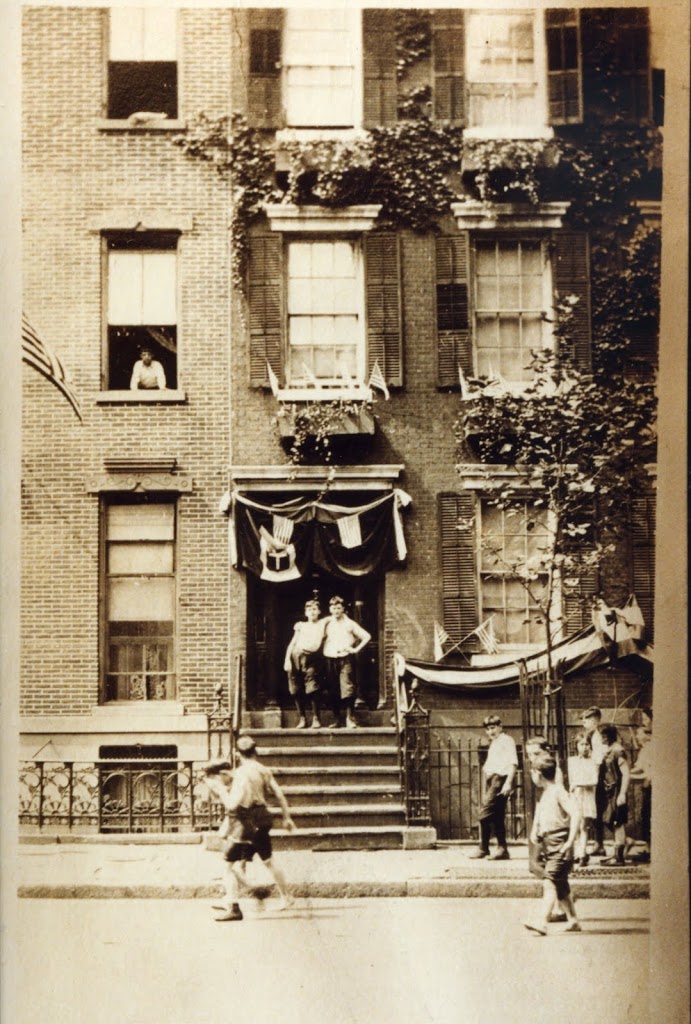
Children gallivant and pose for pictures outside 265 Henry Street, date unknown (Courtesy Henry Street Settlement)

FOR YOUR CONSIDERATION Until May 21st, you can vote every day in the Partners In Preservation initiative, a program that will award grant money to certain New York cultural and historical sites among 40 nominees. Having trouble deciding which site to support? I’ll be featuring a few select sites here on the blog, providing you with a window into their history and hopefully giving you many reasons to visit these places, long after this competition is done. Read about other candidates here.


Historic Site: Henry Street Settlement


Without perhaps intending it, social services pioneer Lillian Wald, in her desire to help thousands of poor immigrant women and children in the Lower East Side, also saved a rare and forgotten part of New York City history.

 The modern Henry Street Settlement is spread throughout several buildings in the neighborhood, providing health care, shelter, job training and a host of services to the community.  But it started out in just three adjacent Federalist-style townhouses on Henry Street, recruited into duty by Wald and her benefactor Jacob Schiff to stem the tide of disease and harm that threatened families in the world’s most densely populated neighborhood in the late 19th century.


A Different Lower East Side
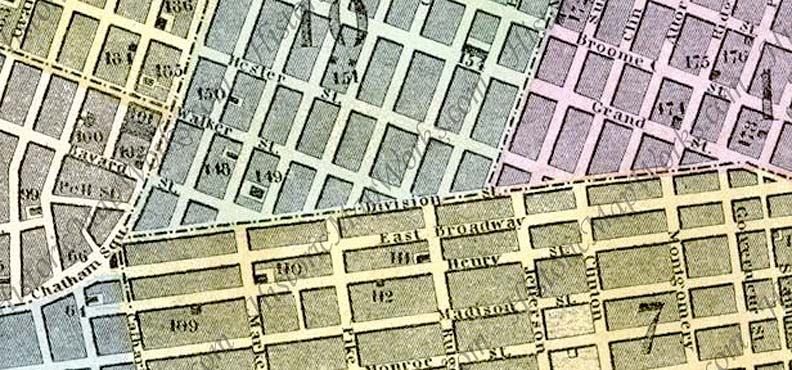
As New York grew northward in the 19th century, wealthy landowners carved up their land with hopes of profit and a desire to foster New York’s next great elegant neighborhood. Revolutionary War colonel Henry Rutgers, who lends his first name to the street where the Settlement makes its home, sold off his property near Corlear’s Hook to businessmen with financial concerns along the Manhattan waterfront.

Below: An illustration from Forgotten NY, outlining the dividing line (literally, Division Street) between surrounding properties and Rutger’s own (in yellow). The buildings discussed are at Henry and Montgomery.

Many of the great shipbuilders lived in today’s Lower East Side (in the 1810s, it might have been called the Upper East Side) in fabulous residences within walking distance of the shore. Even by the 1850s, when the character of the neighborhood began to change, the mayor of New York Jacob Westervelt still resided at 308 East Broadway close to his shipyards. His neighbor at 281 East Broadway was city surveyor Isaac Ludlam.

Typical of the buildings that defined the neighborhood were 263 and 265 Henry Street, Federalist townhouses built in 1827. Its neighbor 267 Henry Street is a touch more ornate, with a different shade of brick  in a Georgian Eclectic style.

Picturing these streets today lined with such buildings is requires a vivid imagination. That’s because of the sudden mass of immigrants who arrived in New York by the 1850s, moving into poorer neighborhoods along the waterfront and in places like Five Points. Most of the homes along once-elegant Henry Street were torn down and replaced with tenements. Later, many of those tenements were themselves replaced with blocks of apartment complexes in the early 20th century.

These three Henry Street buildings have survived (as well as a few others, including Ludlam’s old home) because they were repurposed by a woman of uncommon compassion, one of New York’s most important figures in health and social services.

Settling Down
Lillian Wald first came to the city in 1891 as a student of New York Hospital’s nursing program. An intelligent and ambitious woman from Rochester, Wald quickly found purpose in one of the few respectable professions in the late 19th century where women could rapidly excel. She’s marveled at today as a person of extraordinary compassion. But in many ways Lillian was a modern entrepreneur, able to latch onto the progressive instincts of the day to solve the immediate social ills facing New York with great imagination and a bold lack of prejudice.

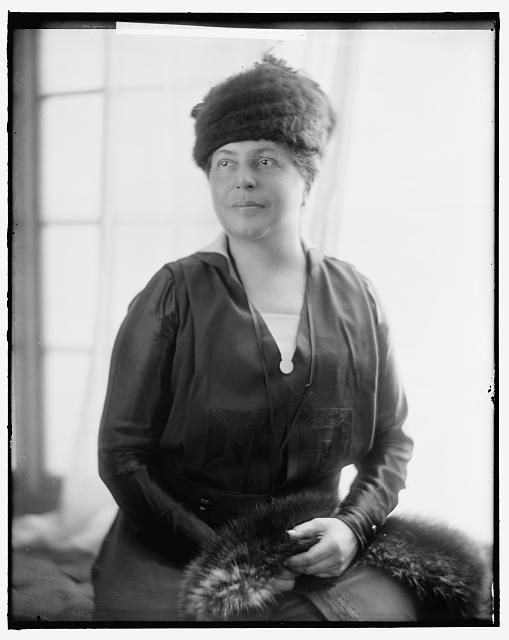
When Wald (at right) founded the Nurses Settlement in 1893, she was building upon the practices of altruistic Christian programs (like the Methodist missions into Five Points) that brought social services into the very heart of slum-filled, overcrowded neighborhoods. However Wald was Jewish, and her perspectives involving health care were profoundly nonreligious and ‘universalist’ for the day.

In that year she also met wealthy banker Jacob Schiff (who himself had immigrated to New York in 1865) who purchased the three Henry Street buildings for Wald to properly set up her nursing agency. From that moment, it became the Henry Street Settlement, housing a squad of nurses sent out into the neighborhood to tackle an ungainly number of health issues.

In an era where poor patients were often turned away from standard hospitals, Wald and her team of extraordinary women provided care for free, often risking their own lives to enter squalid tenements and exposing themselves to many illness that today have been completely eradicated. (One of her nurses, Margaret Sanger, would later become America’s leading birth control advocate.)

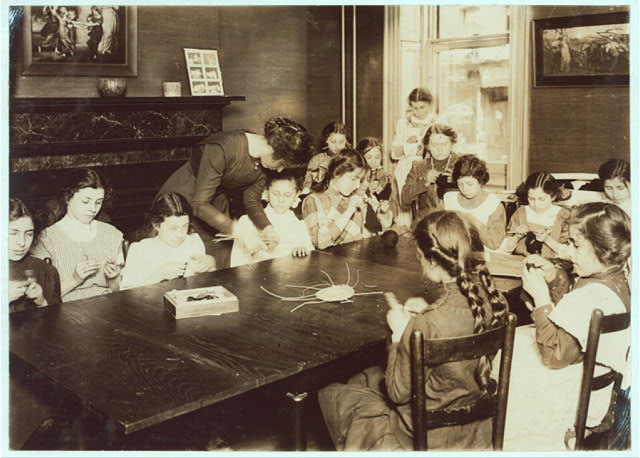
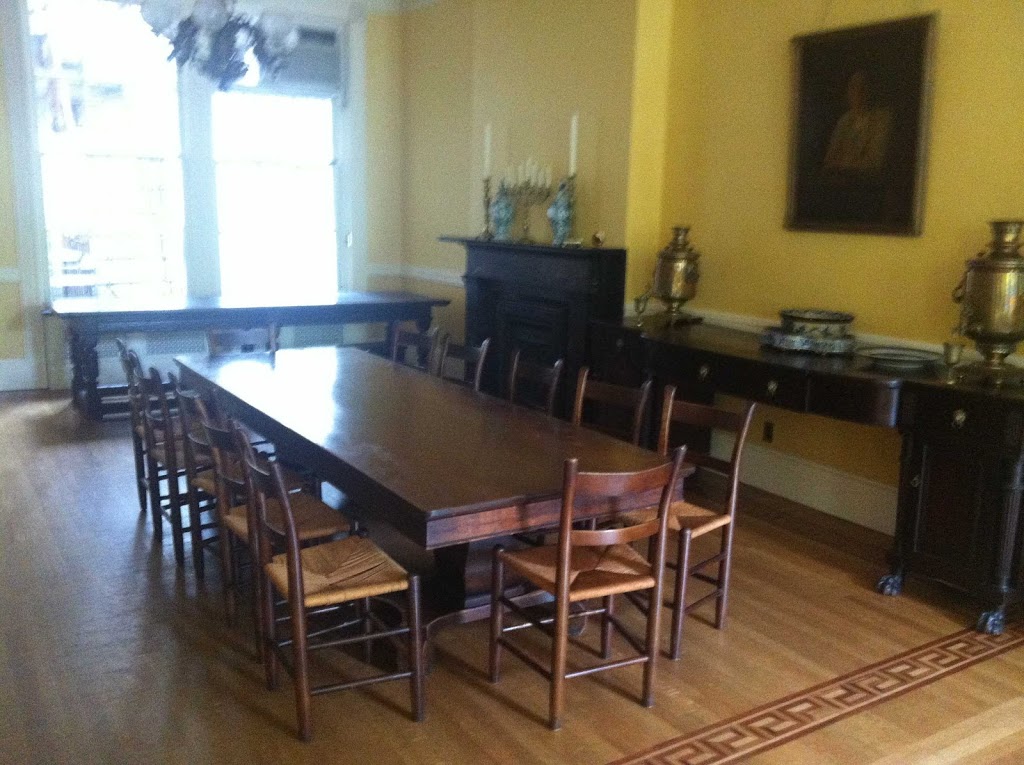
The Settlement had no problem making the former Henry Street residences into working clinics. The rooms still felt like a home in its decor, a respite for many visiting patients. The nurses lived upstairs in rows of small bedrooms, most of which today have been turned into cozy offices. The most lively (and historically important) room at the Settlement was the dining room, with large mahogany tables where Wald entertained a wide variety of guests, from poor patients to the great thinkers and Progressive voices of the day.


Below: A knitting class in the famous Henry Street dining room, May 1910. The fireplace at left is still very much intact. [LOC]

Beyond Borders
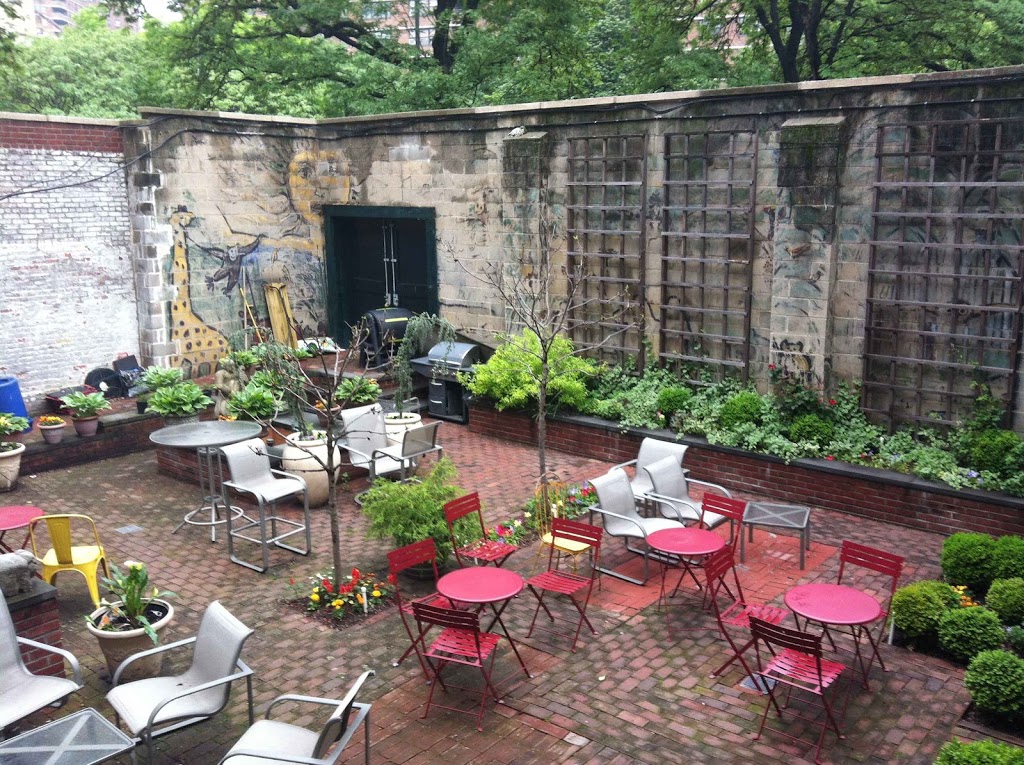
The Henry Street Settlement soon expanded its mission statement to generally improve the quality of life in the Lower East Side. Concerned that neighborhood children had no place to play, Wald set aside her courtyard to become one of New York’s first playgrounds in 1902.


Below: The location of the playground, just behind the Henry Street structures.

Wald frequently held meetings here for strikers rallying against the women’s garment industry. In 1909, she invited both white and black guests for a dinner, organizing a group that would soon grow to become the National Association for the Advancement of Colored People (the NAACP).

An excerpt from her 1915 book ‘A House On Henry Street‘ illustrates the racial politics of such a seemingly simple dinner party:

“At the time of the first convention of the organization, [the NAACP] formed to further better race relations in this country, the occasion promised to be almost too serious unless some social provision were made. 


I suggested a party at the House, but even the organizing committee was fearful. ‘Oh, no!’ they protested. ‘It won’t do! As soon as white and colored people sit down and eat together there begin to be newspaper stories about social equality.’ 


‘But two hundred members of the conference couldn’t sit down,’ I submitted. ‘Our house is too small. Everybody would have to stand up for supper.’ ‘Then it would be all right,’ they said with relief, and the party was successful.”

Above: One of the two original dining tables. Wald hosted hosted dozens of intellectual luminaries in this room, including Jane Addams, Eleanor Roosevelt, Jacob Riis and Theodore Roosevelt.

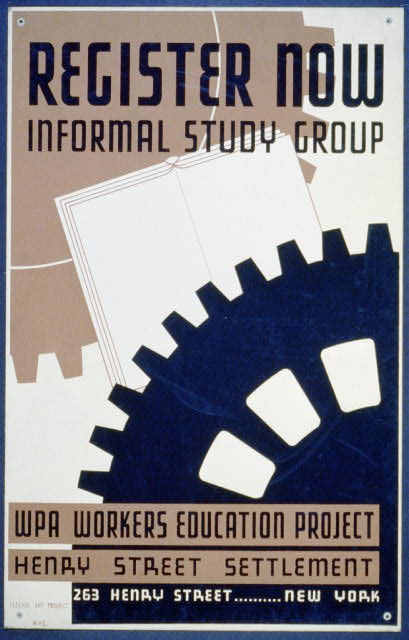
Wald would become a leading figure for New York social programs, often enlisted by the city to bring improvement to the city’s other public services. (In 1902, Henry Street’s Lina Rogers become the very first school nurse.)  The Settlement even become an important venue for the arts with the debut of the Neighborhood Playhouse theater in 1915. The tradition lives on at the Abrons Arts Center, another part of the Settlement that continues to be a critical part of the Lower East Side cultural community. (At right: A flyer for a WPA meeting, between 1936-41, LOC)

Wald died in 1940, but her Henry Street Settlement has only expanded in the years since her passing. Today they have facilities in over a dozen buildings throughout the neighborhood, expanding their focus to include job training, mental health services, adult education, a shelter for victims of domestic violence and even a computer lab.

Those original three buildings, housing mostly administrative offices today, are still a wonderful expression of an early era of New York history. Traces of that history sits next to the practicalities of office life; in one room, an original kitchen hearth and brick oven from the original tenants sit next to a couple photocopiers. Employees sit at laptops in Lillian Wald’s original bedroom with its spectacular sleeping porch overlooking the former playground.

The Henry Street Settlement hopes to use the Partners In Preservation grant money to combat the challenges of keeping their nearly two-centuries old offices in working order, to upgrade and prepare these old rooms for many more decades of providing a little more life to the Lower East Side.

Disclosure: I have partnered up with Partners in Preservation as a blog ambassador to help spread the word and raise awareness of select historical sites throughout the tri-state area. Though I am compensated for my time, I have not been instructed to express any particular point of view. All opinions expressed here are strictly my own. And since writing about New York landmarks is kinda my thing anyway, I’m thrilled to share my love of these places!

Categories
Neighborhoods Podcasts

The secrets of St. Mark’s Church in-the-Bowery, and uncovering the East Village footprint of Peter Stuyvesant


FOR YOUR CONSIDERATION Until May 21st, you can vote every day in the Partners In Preservation initiative, which will award grant money to certain New York cultural and historical sites among 40 nominees. Having trouble deciding which site to support? I’ll be featuring on a few select sites here on the blog, providing you with a window into their history and hopefully giving you many reasons to visit these places, long after this competition is done. Read about other candidates here.


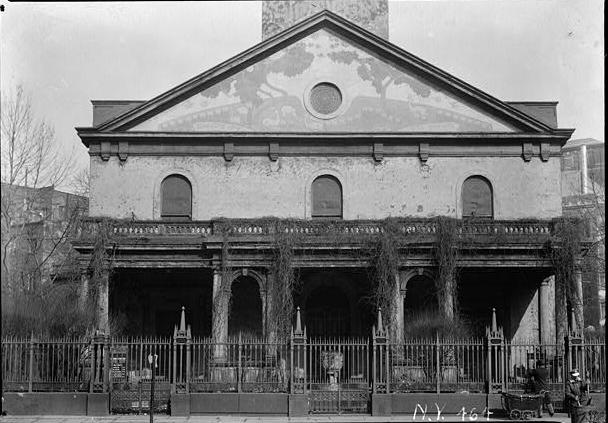
PODCAST The church of St. Mark’s-in-the-Bowery is one of Manhattan’s most interesting and mysterious links to early New York history. This East Village church was built in 1799 atop the location of the original chapel of Peter Stuyvesant, New Amsterdam’s peg-legged director-general. His descendants — with the help of Alexander Hamilton and the architect of New York City Hall — built this new chapel with the intention of serving the local farming community of Bowery Village.

But in many ways, the more thrilling tales occur among the honeycomb of burial vaults underneath the church, the final resting place of vice presidents, mayors, and even Peter himself.

St. Mark’s reflected the changes that swept through Greenwich Village during the 20th century, with experimental and sometimes scandalous church activities, from hypnotism, modern dance and even a trippy foray into psychedelic Christian rock.

ALSO: Find out why you can never EVER go down into the vault of Peter Stuyvesant. And why is the church IN the Bowery, not ON the Bowery?

NOTE ABOUT THE NAME: The modern name of this historic structure is technically St. Mark’s Church In-The-Bowery. However most 18th-19th century sources drop the ‘church’ from the middle of the name. The hearty bust of Peter Stuyvesant in the courtyard calls it ‘Saint-Mark’s-in-the-Bowerie’.

Hyphens are liberally or reservedly applied based on the source. As we decided to spend a great deal of time talking about the old farm and the early years, we settled on ‘St. Mark’s in-the-Bowery’. But I even twisted myself around during recording and said ‘on-the-Bowery’ accidentally at least twice, so sorry for the confusion!

I’ll post some more notes on the show next week, some thank-yous, further information and some further sources to check out for more information.


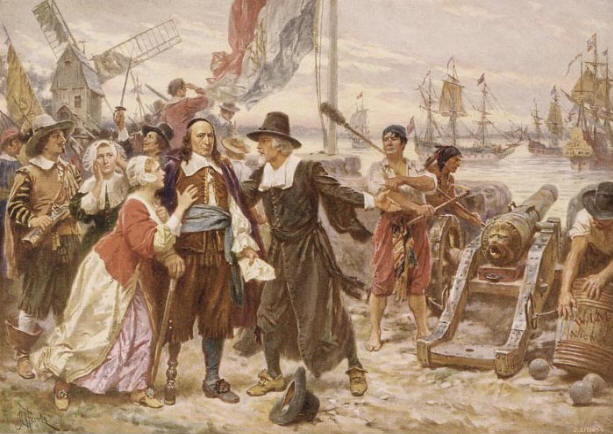
Below: The residents of New Amsterdam beseech Peter Stuyvesant to surrender to the coming British forces in 1664. He is clearly not pleased. The official surrender actually took place at Stuyvesant’s farm house, two miles outside of town along the bouweij or Bowery road. Listen here for the real pronunciation of bouwerij.

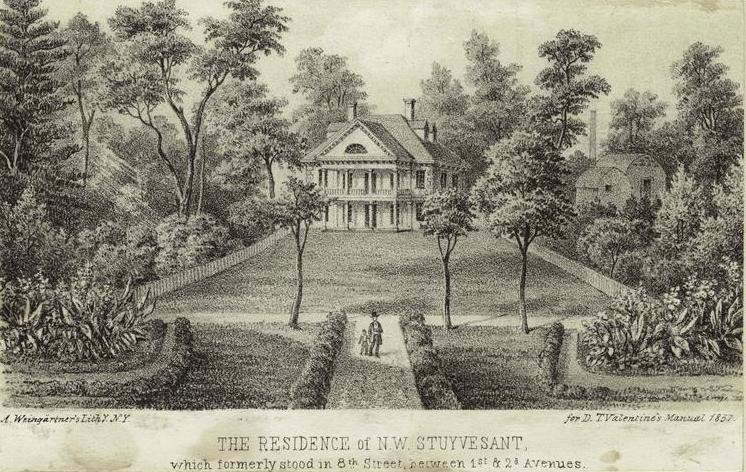
The caption reads ‘The Residence of N.W. Stuyvesant’ which formerly stood in 8th Street, between 1st and 2nd Avenue‘, one property on the land estate of the Stuyvesants during the 18th century. (NYPL) I’ve seen this same illustration differently labeled, dated 1800 and called simply ‘the Bowery House’.

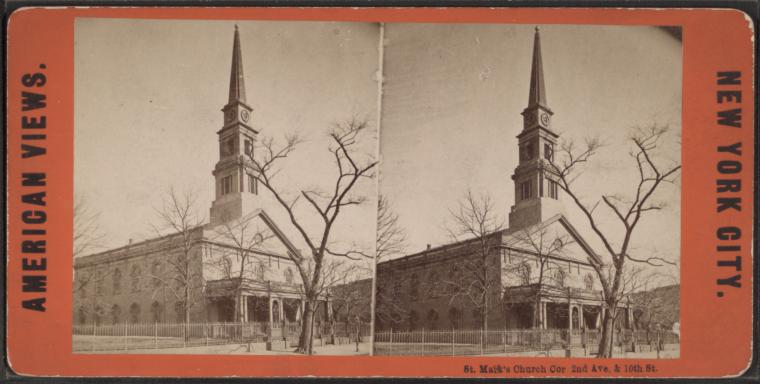
 St. Marks in 1865, rendered in an early stereoptic photograph. The church itself looks pretty much as it does today. But the surrounding churchyard would be radically transformed. (NYPL)

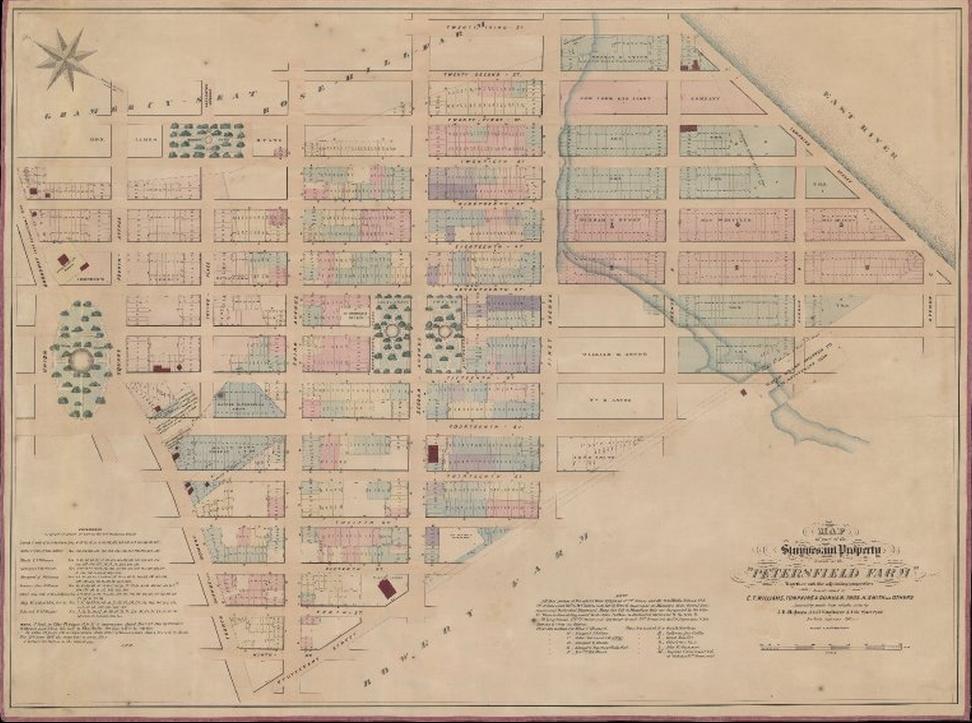
A real estate map, imprinted with the grid plan over the Stuyvesant property. You can see Stuyvesant Street at the bottom. The collected properties were also known as ‘Petersfield’ after a manor home of one of the Stuyvesant descendants. (NYPL)

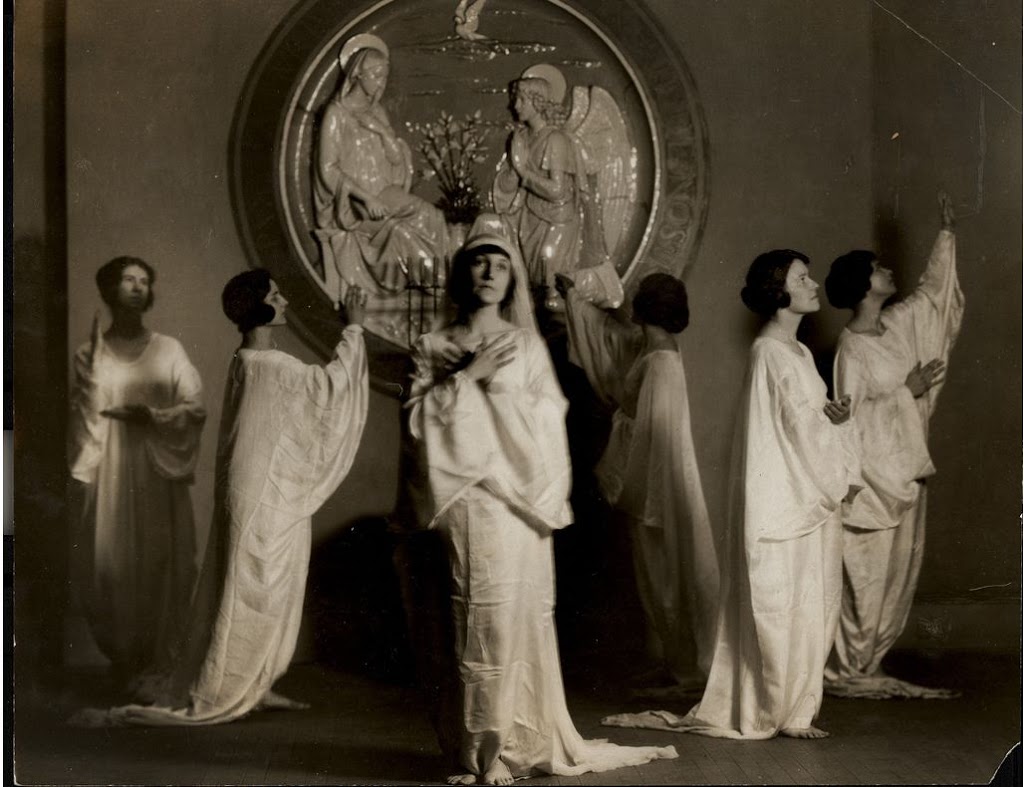
The interpretive dancers of Dr William Norman Guthrie,  the Scottish clergyman who oversaw many radical changes to the standard St. Mark’s services.


An excerpt from the Mind Garage’s ‘Electric Liturgy‘, which was performed at St. Mark’s Church in 1969


Visit St. Mark’s website for a virtual tour of the St. Mark’s church yard.

  Disclosure: I have partnered up with Partners in Preservation as a blog ambassador to help spread the word and raise awareness of select historical sites throughout the tri-state area. Though I am compensated for my time, I have not been instructed to express any particular point of view. All opinions expressed here are strictly my own. And since writing about New York landmarks is kinda my thing anyway, I’m thrilled to share my love of these places!

Categories
Staten Island History

Camera Ready: The Alice Austen House, a rustic reminder of an uncommon artist and a cottage shrine to a life in pictures

DSC00654


FOR YOUR CONSIDERATION Until May 21st, you can vote every day in the Partners In Preservation initiative, which will award grant money to certain New York cultural and historical sites among 40 nominees. Having trouble deciding which site to support? I’ll be featuring on a few select sites here on the blog, providing you with a window into their history and hopefully giving you many reasons to visit these places, long after this competition is done. 


Historic Site: The Alice Austen House
On the banks of Staten Island’s eastern shore sits a worn but elegant cottage, where once lived a woman of modern artistic gifts that just a few decades earlier would have been considered magical.

Alice Austen was a photographer of sublime ability, in an era when the artistic potential of photography was still being assessed. She’s the sort of historical figure whose life could easily be overlooked. In fact, it was, for almost half a century. Her existence at times seems sequestered, in a habitat of old wealth, her universe principally residing in a borough that itself sometimes gets unfairly disregarded. In some ways, it’s the Alice Austen House, in Rosebank, Staten Island. that keeps her legacy in the conversation — as a revolutionary artist, an enigmatic social eccentric and a famous New Yorker.

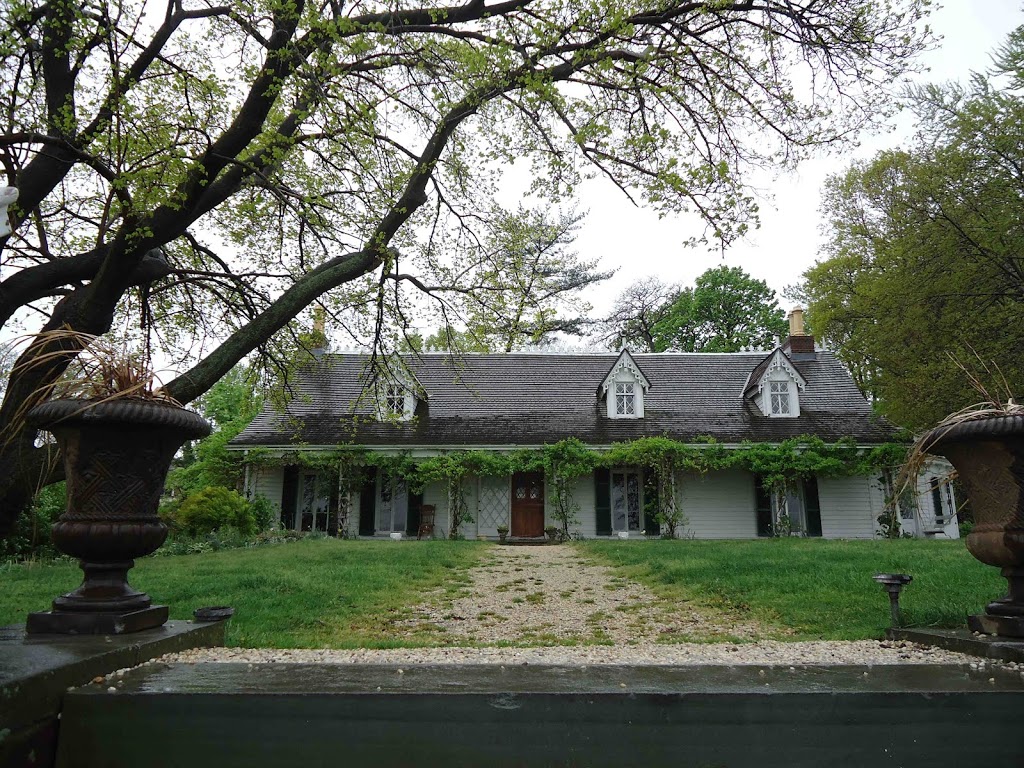
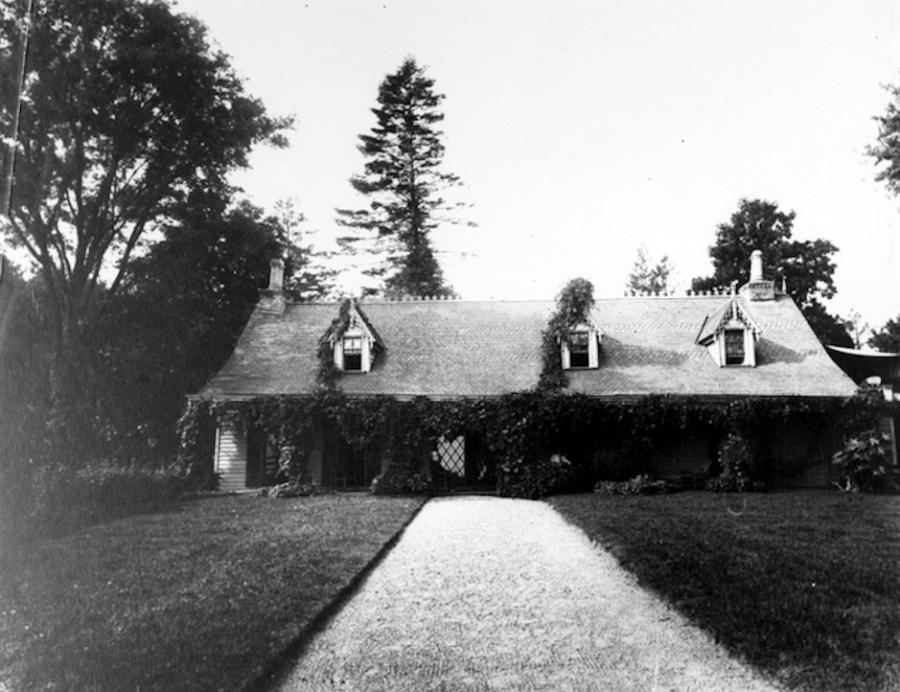
Portions of this curious house — named Clear Comfort, but readily known today as the Alice Austen House, after its most famous resident — can be traced to a modest one-room structure built in the 1690s, when Staten Island (or, as the British preferred to call it, Richmond County) had only about 1,000 residents, mostly Dutch farmers.  From the windows of the original farmhouse, the residents might have seen the British, using Richmond as a base, attacking Washington’s forces on the opposite shore in Brooklyn in August 1776.

18951

Above: Alice’s photo of her home, 1895

By the early 19th century, the house shared the northeastern shore with a smattering of ferry docks, including one owned by an ambitious young periauger operator named Cornelius Vanderbilt.  As New York grew to become a busy port city and a capital of wealth, some prominent residents flocked to the Staten Island shore for respite. Moguls, businessmen, socialites, even Vice Presidents (Daniel D. Tompkins) built lavish homes a short carriage ride away.

That this shoreside Dutch farmhouse survived to even this point in history– hogging a view of the Narrrows that any mansion builder might envy — is extraordinary. As a later history of Staten Island dramatically put it, “[I]t is a relief to the more conservatively inclined to find in Greater New York a house that still defied the sword of the destroying angel….One of these, which for centuries has defied destruction, is the Austen homestead.”

In 1844, a lower Manhattan dry goods merchant John Haggerty Austen purchased the old Dutch house, dilapidated but still desirable due to its view of a harbor clogged with ships. Austen greatly expanded the property into a Gothic revival summer cottage worthy of an old European fairytale. Soon, several members of the Austen clan lived here year-round. And in 1866 they were joined by Austen’s unmarried daughter and her small infant Alice.

The pair had been abandoned by Alice’s father, a situation one might normally consider dire in the mid-19th century. However the Austen family doted upon the child, and their wealth provided a cushion for the girl to pursue her ever bolder ambitions in comfort.

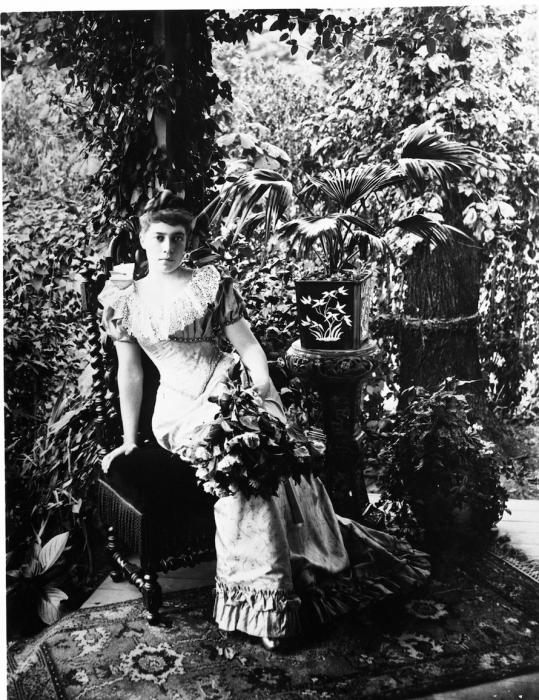
Above: Alice Austen in a self portrait on the porch of Clear Comfort, 1892 [source]

The first camera came to Clear Comfort in 1876, the present of Alice’s uncle, Oswald Muller, a Danish sea captain who demonstrated the bulky, wooden device in the Austen garden. Alice became immediately fascinated, and, although it was certainly unladylike in the Victorian era for a young woman to hunch in front of a large wooden tripod, her talents soon became evident. Another uncle, a chemistry professor, guided her through the development process, and an upstairs closet was eventually transformed into her own personal darkroom. In this dank, inconspicuous room, Austen patiently developed some of the most beautiful pictures of old New York ever taken.

mountains

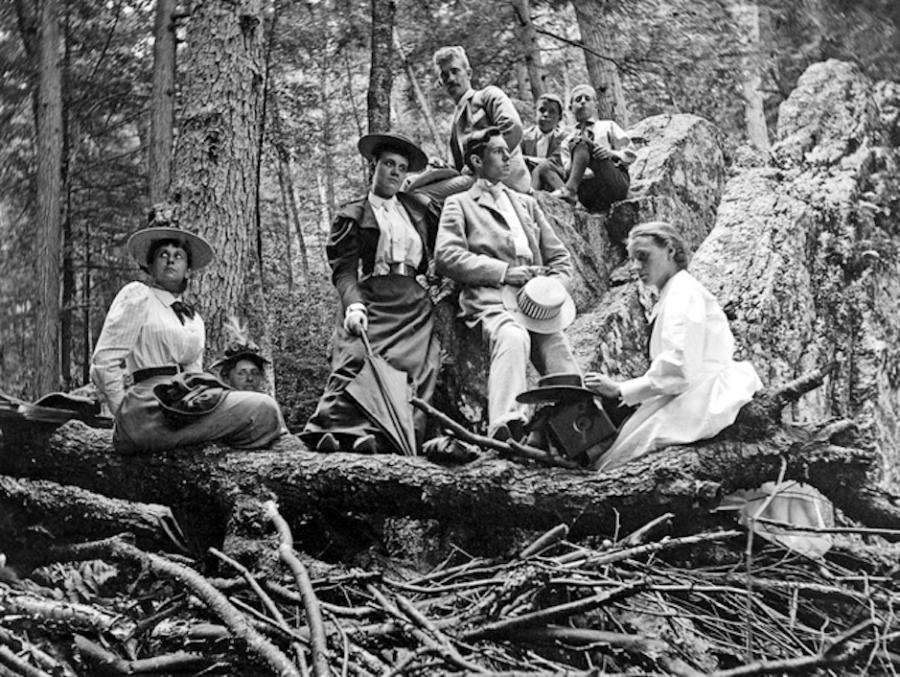
Above: Lounging in the woods, 1893


A THOUSAND WORDS
Alice Austen was not a professional photographer. She did not get paid to document the world or to hover over developing chemicals. She took pictures because she loved it.

The photographic process before the 1890s — before the introduction of camera film — was a complex and frustrating production. The pursuit of leisure photography, capturing casual, outdoor scenes using a portable camera, was a relatively recent phenomenon. And a camera was only ‘portable’ in the sense it could be used outside a studio. A wooden-box camera with a tripod and a satchel of delicate lens and exposed plates would have been difficult to transport.

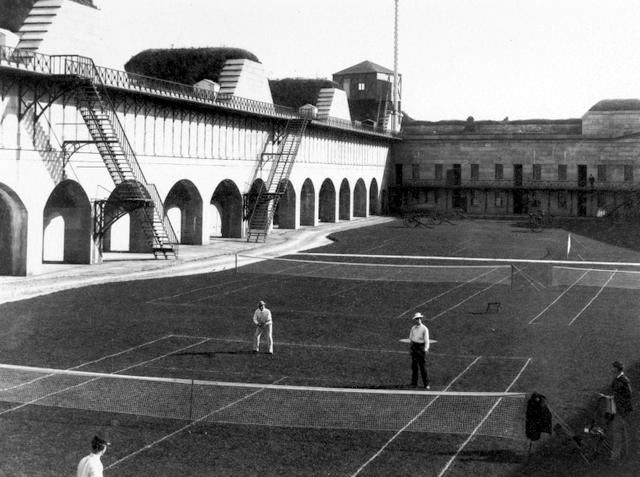
Below: The Staten Island Cricket Club in St. George, in 1893, employing the sort of subject framing that would typify art deco photography a couple decades later.

tennisjpg

Alice’s first images were taken at home, on the grounds of Clear Comfort.  From here she developed the poise, the skill and the guts to take the camera on the road — around Staten Island, along rocky mountainous areas and winding trails. And eventually, to Manhattan itself. What a sight it would have been to behold young Alice Austen on her bike, weaving through the streets of Manhattan with her equipment strapped to the back.

What comes through from her photography is a zest for life rarely documented in images of the era. Due to the conventions of the photographic process, subjects had to stand still or risk being rendered a ghostly blur. Equally important, people rarely knew how to pose. But in the world of Alice Austen, frivolity overrides stiffness. Austen documented her social circle with a provocative candidness, allowing her subjects to goof around, create visual gags, even cross dress.

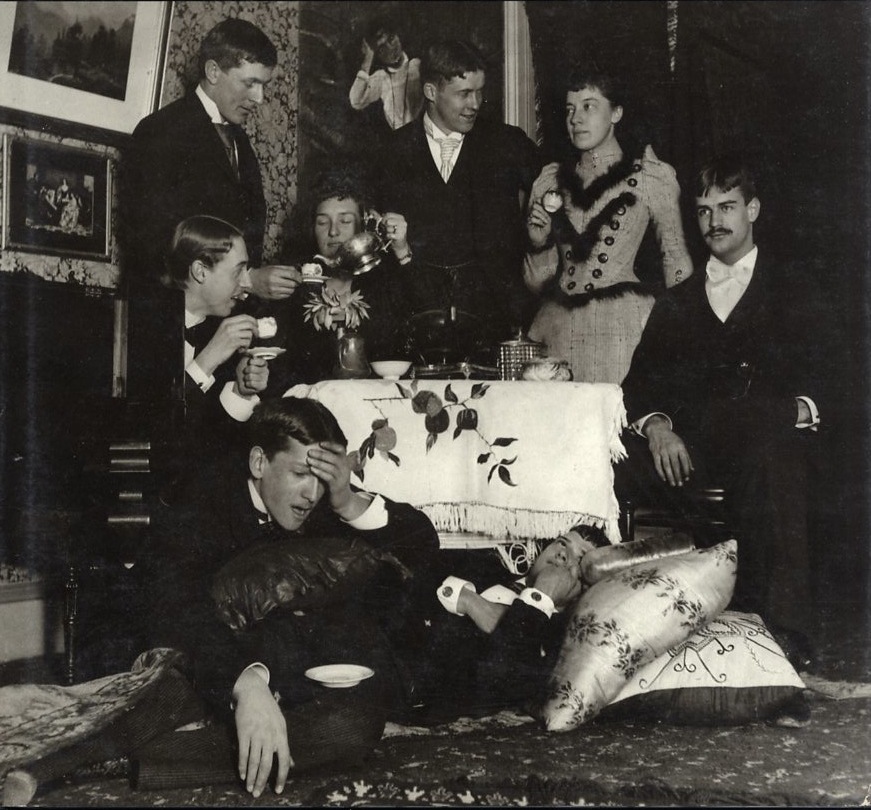
My favorite of all her images finds Alice herself posing awkwardly with a group of men at a mock tea party. What are they doing? This picture presages a billion future Facebook photographs of people acting in a nonsensical fashion.

alices

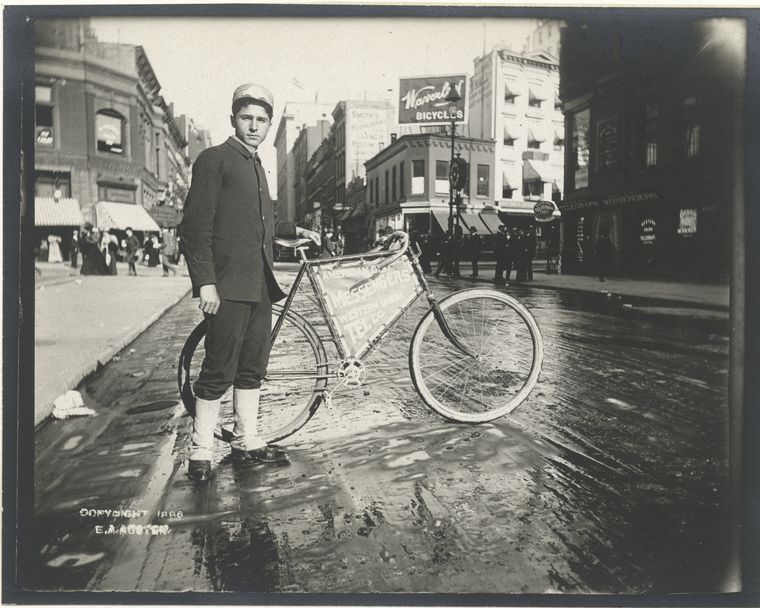
On the streets of New York, Austen found composure and beauty in common situations. More stunningly, she found it among lower class subjects — bike messengers and street urchins, rag pickers and fishmongers. Most likely, she knew ‘proper’ New Yorkers would never have posed so spontaneously for her. Perhaps her choices were informed by contemporary New York photographers of the day, people like Lewis Hine and Jacob Riis, who chose the same subjects but for more social reformist purposes.

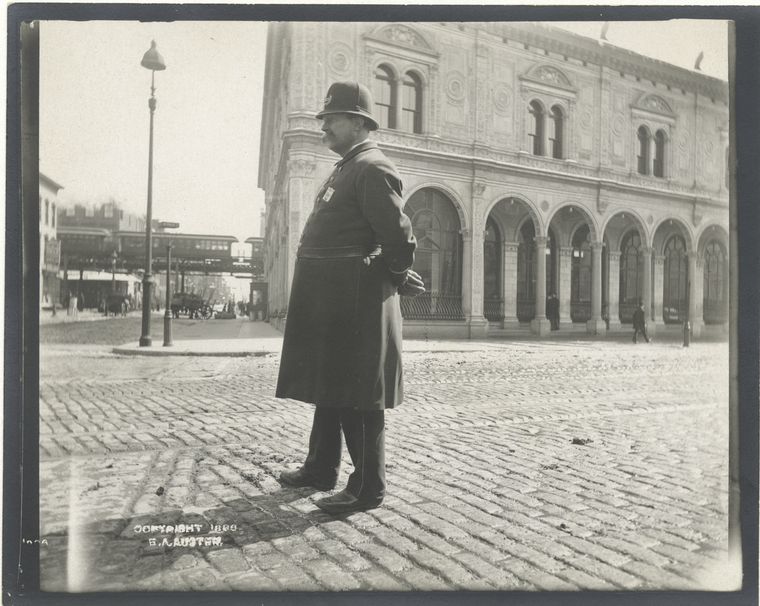
In 1896, Alice stopped a messenger boy on the street to create a masterpiece of composition and form. She would do the same with policemen, postmen, even street sweepers. (NYPL)

1896
police

Her travels took her around New England and even to Europe, but she always returned home to Clear Comfort, and her house and the Narrows framed beautifully in front would remain her most popular subjects.

ALICE AND GERTRUDE
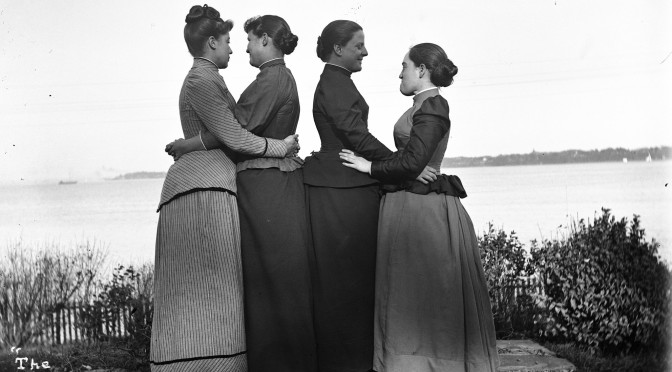
Alice Austen is also an important figure in gay and lesbian history, although she might have recoiled from the word ‘lesbian’, a term which seemed to apply more to the debauched female bohemians of Greenwich Village than an old-money doyenne living in a seaside cottage. In 1899, she met Brooklyn school teacher and dance instructor Gertrude Tate and began a companionship that culminated in 1917 when Gertrude, over objections from her family, moved into Clear Comfort with Alice.

Yes, another female power couple named Alice and Gertrude. Although unlike the Parisian bon vivants of the day, the true relationship led by Austen and Tate continues to remain closed to the world. They were companions for the rest of their lives, even through the troubling trials that would soon befall the residents of Clear Comfort

She had survived this many years quite comfortably on the interest from her grandfather’s wealth. But the Great Depression wiped out most of the family finances. Austen resorted to opening her front yard as a tea room, and when that failed, she mortgaged the house and sold off most of her possessions. Fortunately in 1945 she confided her glass plate negatives to Loring McMillan at the Staten Island Historical Society — although she expected to get them back! (McMillan would later be instrumental in the creation of Historic Richmond Town as a repository of some of the borough’s oldest, most famous structures.)

19511

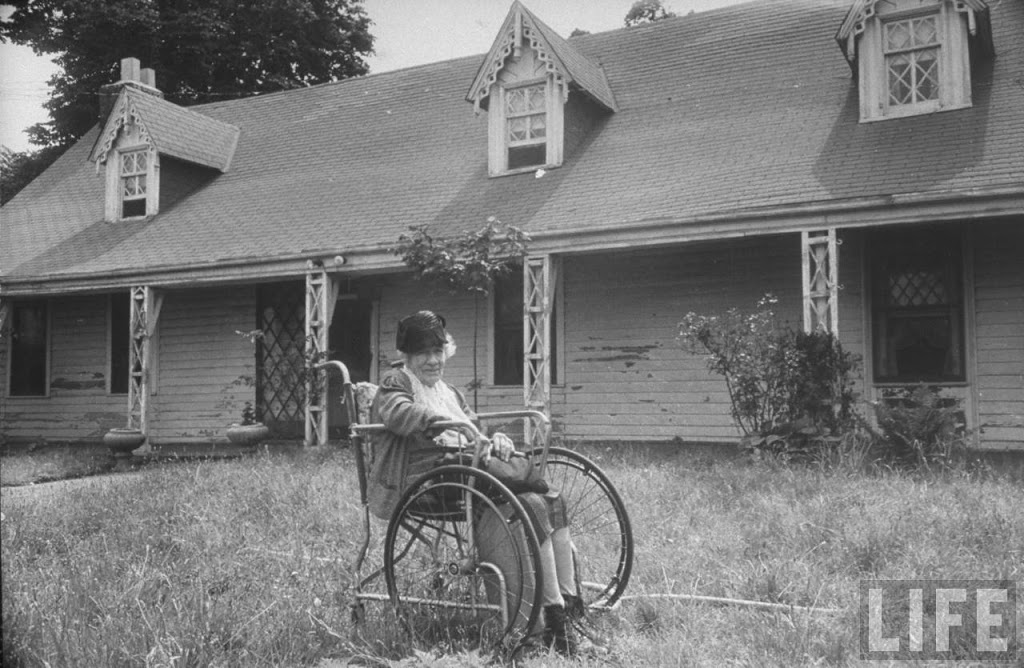
Above: For a Life Magazine article in 1951, Austen was reunited with her tattered old home.

Alice Austen has the rare distinction of being rescued herself by a historical preservation society.  Even as situations became so dire for her in 1950 that she moved into the Staten Island Farm Colony, a pauper’s retreat in Sea View, the Staten Island Historical Society began work with a publisher to publish her photos, most seeing light for the first time in decades. From the proceeds she was able to spend her final years in a private nursing home, the subject of magazine articles and belated tributes. She died in on June 2, 1952.

Gertrude outlived her by ten years. Her request to be buried next to Alice was not honored by her family.

PRESERVING THE IMAGE
Alice Austen’s home was rescued by the community in the 1960s, designated a New York City landmark in 1971 and exhaustively renovated in the 1980s. Today it’s one of Staten Island’s most unusual treasures, close to industry and a heavily developed residential area, but serene as though kept under glass.

The house is as reverent to the craft of photography as it was when Alice was alive. On the blustery afternoon I spent at the Alice Austen House, the rooms were buzzing with children arriving for a workship on how to make and use pinhole cameras. Replicas of her equipment are featured in exhibits fashioned from Alice’s old drawing room.

While the home is in remarkable shape for a building over three centuries old, standing on the shores of the Narrows provides a special challenge for preservation, and the grant it has placed with the Partners In Preservation program would help weatherproof the structure, with additional repairs to the chimney and roof.

The Alice Austen House is digitizing many of her 3,500 existing photographs, available on their newly launched website. You can also go there for information on how to visit.

Below: Alice in a self-portrait with her dog Punch, 1893 [source]

punch

Disclosure: I have partnered up with Partners in Preservation as a blog ambassador to help spread the word and raise awareness of select historical sites throughout the tri-state area. Though I am compensated for my time, I have not been instructed to express any particular point of view. All opinions expressed here are strictly my own. And since writing about New York landmarks is kinda my thing anyway, I’m thrilled to share my love of these places!