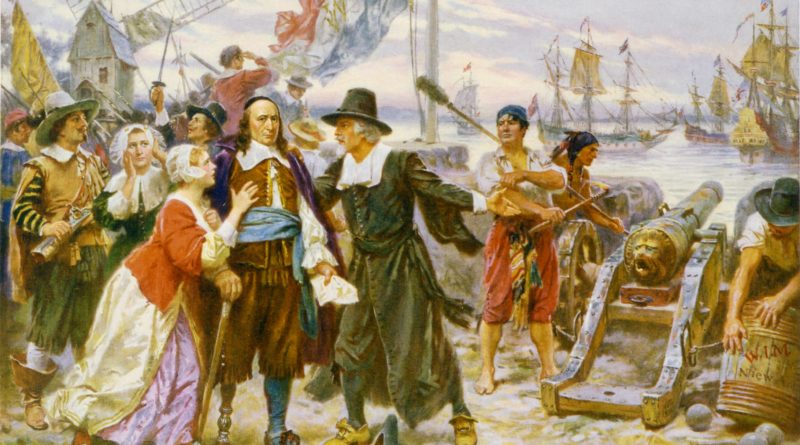
PODCAST There would be no New York City without Peter Stuyvesant, the stern, authoritarian director-general of New Amsterdam, the Dutch port town that predates the Big Apple.
The willpower of this complicated leader took an endangered ramshackle settlement and transformed it into a functioning city. But Mr. Stuyvesant was no angel.
In part two in the Bowery Boys’ look into the history of New Amsterdam, we launch into the tale of Stuyvesant from the moment he steps foot (or peg leg, as it were) onto the shores of Manhattan in 1647.
Stuyvesant immediately set to work reforming the government, cleaning up New Amsterdam’s filth and even planning new streets. He authorized the construction of a new market, a commercial canal and a defense wall — on the spot of today’s Wall Street. But Peter would act very un-Dutch-like in his intolerance of varied religious beliefs, and the institution of slavery would flourish in New Amsterdam under his unwavering direction.
And yet the story of New York City’s Dutch roots does not end with the city’s occupation by the English in 1664 — or even in 1673 (when the city was briefly retaken by a Dutch fleet). The Dutch spirit remained alive in the New York countryside, becoming part of regional customs and dialect.
And yet the story of New Amsterdam might otherwise be ignored if not for a determined group of translators who began work on a critical project in the 1970s……
The Bowery Boys: New York City History podcast is brought to you …. by you!
We are now producing a new Bowery Boys podcast every other week. We’re also looking to improve the show in other ways and expand in other ways as well — through publishing, social media, live events and other forms of media. But we can only do this with your help!
We are now a member of Patreon, a patronage platform where you can support your favorite content creators for as little as a $1 a month.
Please visit our page on Patreon and watch a short video of us recording the show and talking about our expansion plans. If you’d like to help out, there are five different pledge levels (and with clever names too — Mannahatta, New Amsterdam, Five Points, Gilded Age, Jazz Age and Empire State). Check them out and consider being a sponsor.
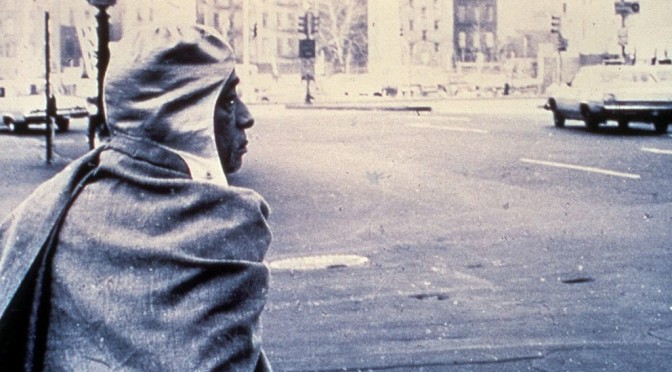
And join us for the first ever Bowery Boys Movie Club, an exclusive podcast provided to our supporters on Patreon. This month’s selection — Taxi Driver.
We greatly appreciate our listeners and readers and thank you for joining us on this journey so far.
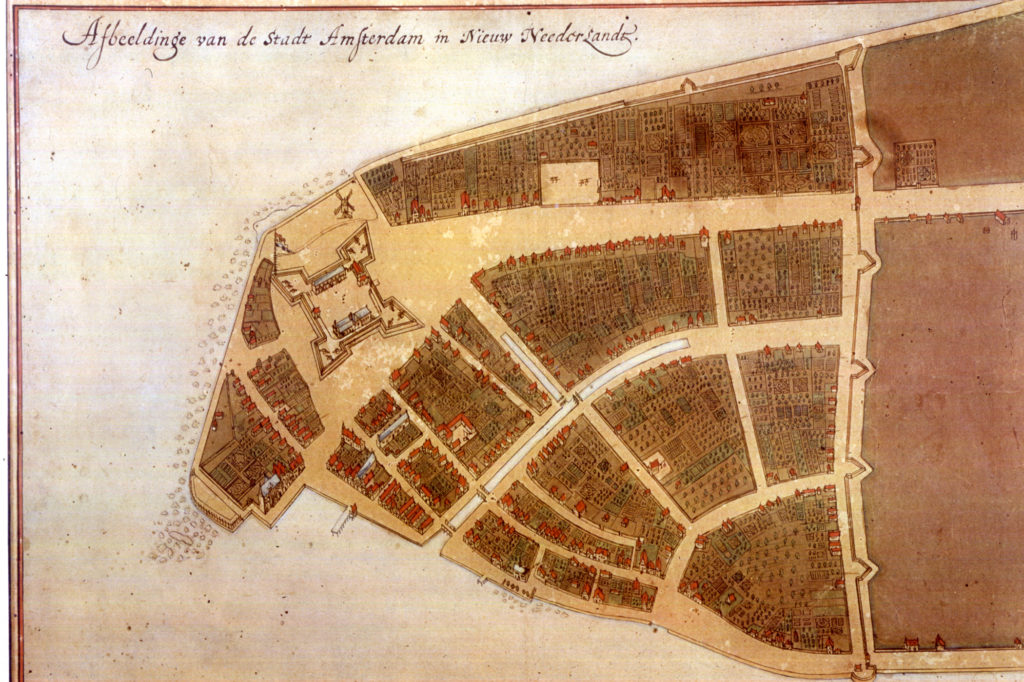
The Costello Plan, New Amsterdam 1660. Surveyed by Jacque Cortelyou. Full size photograph of manuscript map in the Biblioteca Medicea-Laurenziana of Florence, Italy. The Castello plan is the earliest known plan of New Amsterdam, and the only one dating from the Dutch period. Wikicommons.
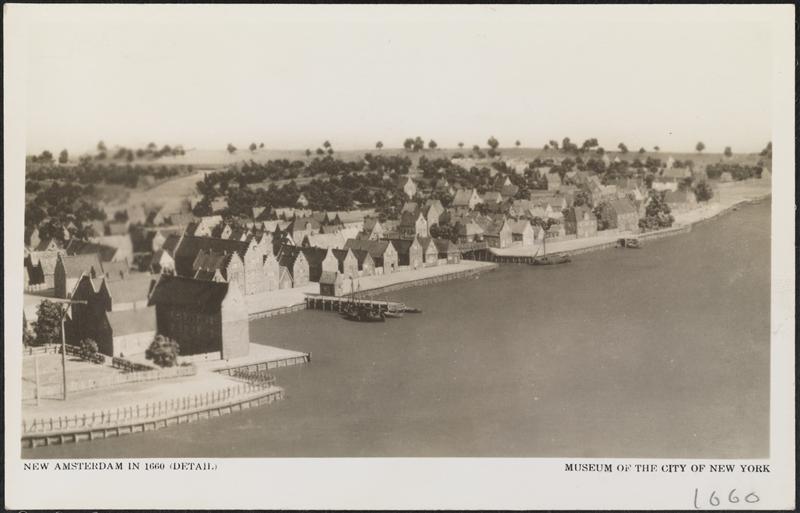
New Amsterdam in miniature at the Museum of the City of New York, photographed in 1932
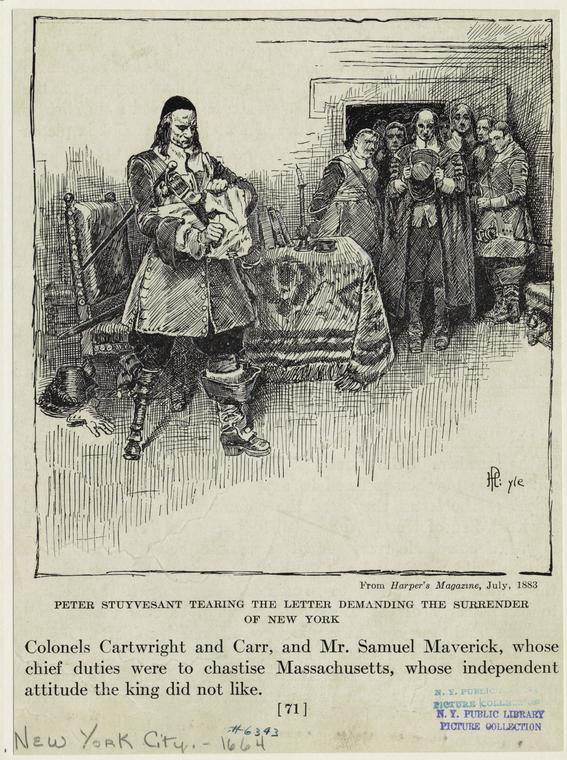
Museum of the City of New YorkPeter Stuyvesant tearing the letter demanding the surrender of New York. Artist Howard Pyle, 1923. New York Public Library
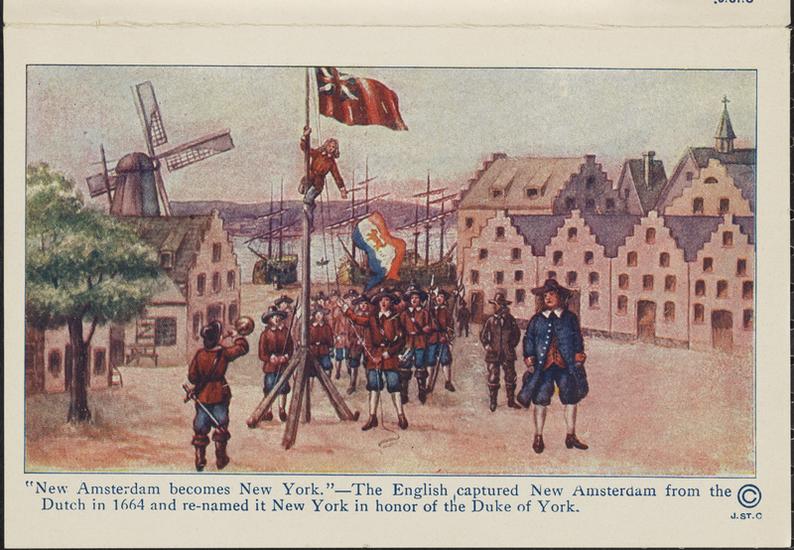
The moment when New Amsterdam became New York, depicted in a 1914 picture book.
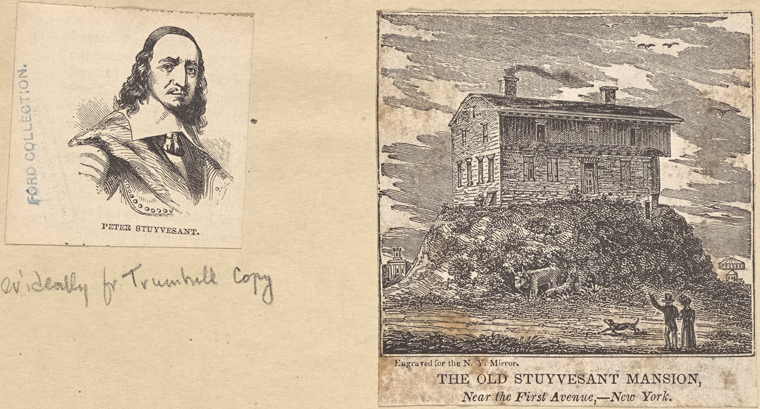
The old Stuyvesant mansion, near First Avenue, engraved for the N.Y. Mirror newspaper. Courtesy NYPL
We didn’t go too deeply into it in our latest show, but the Bronx also has a very rich Dutch history. The name even comes from a (unfortunately doomed) Dutch settler.
The early history of Broadway begins in New Amsterdam.
We also spoke about the ‘rattle watch’ in our show on the New York Fire Department.
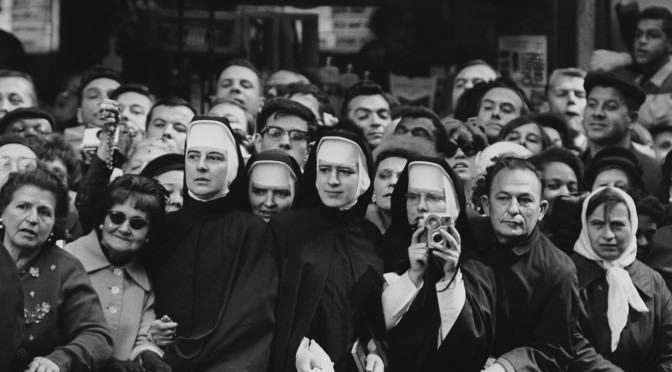
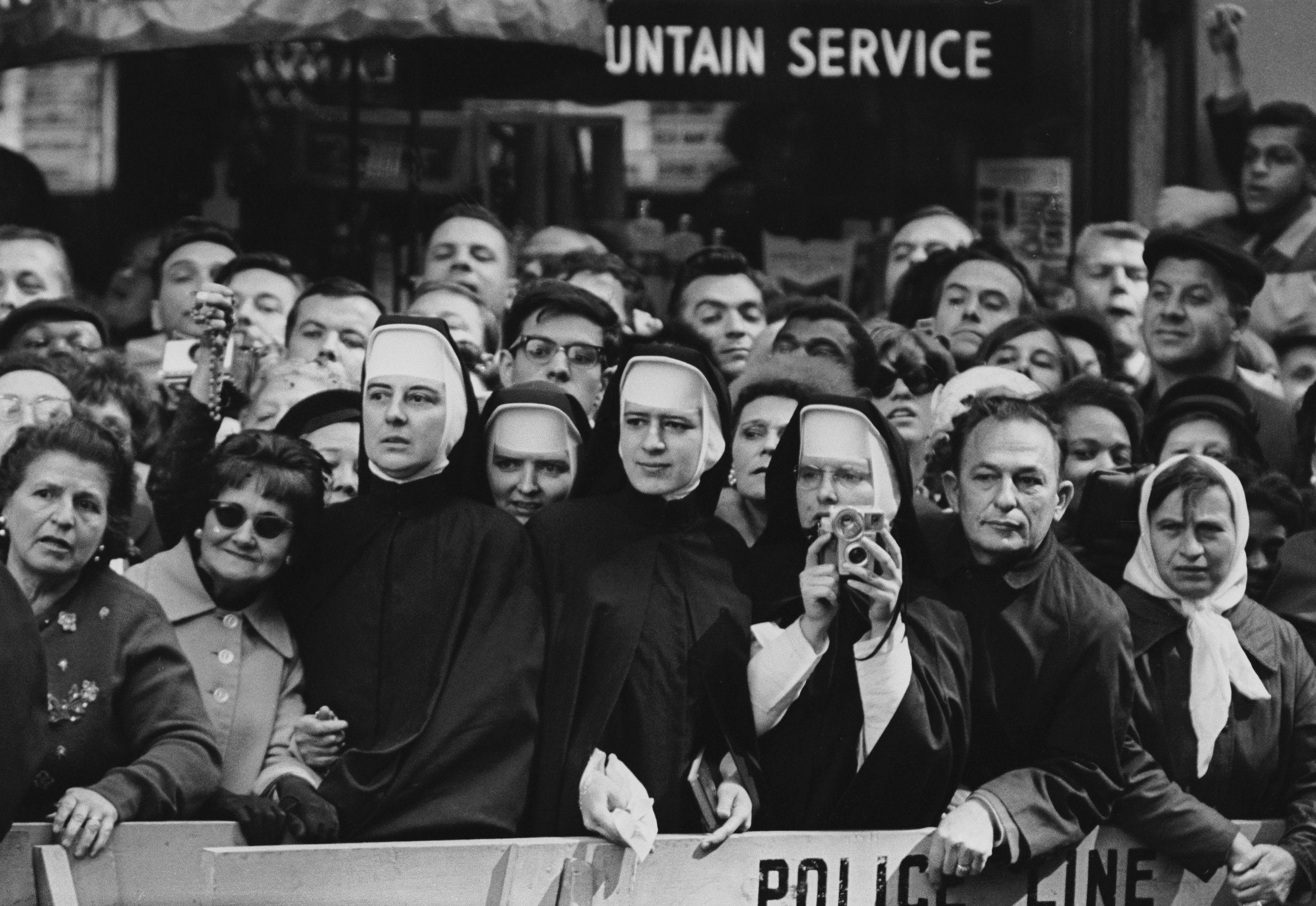
5th October 1965: Photo by Harry Benson/Express/Getty Images
Pope Francis arrives in New York City today — part of his first-ever trip to the United States — and the city is rolling out the red carpet. In fact, all available carpets are being rolled out and even some throw rugs.
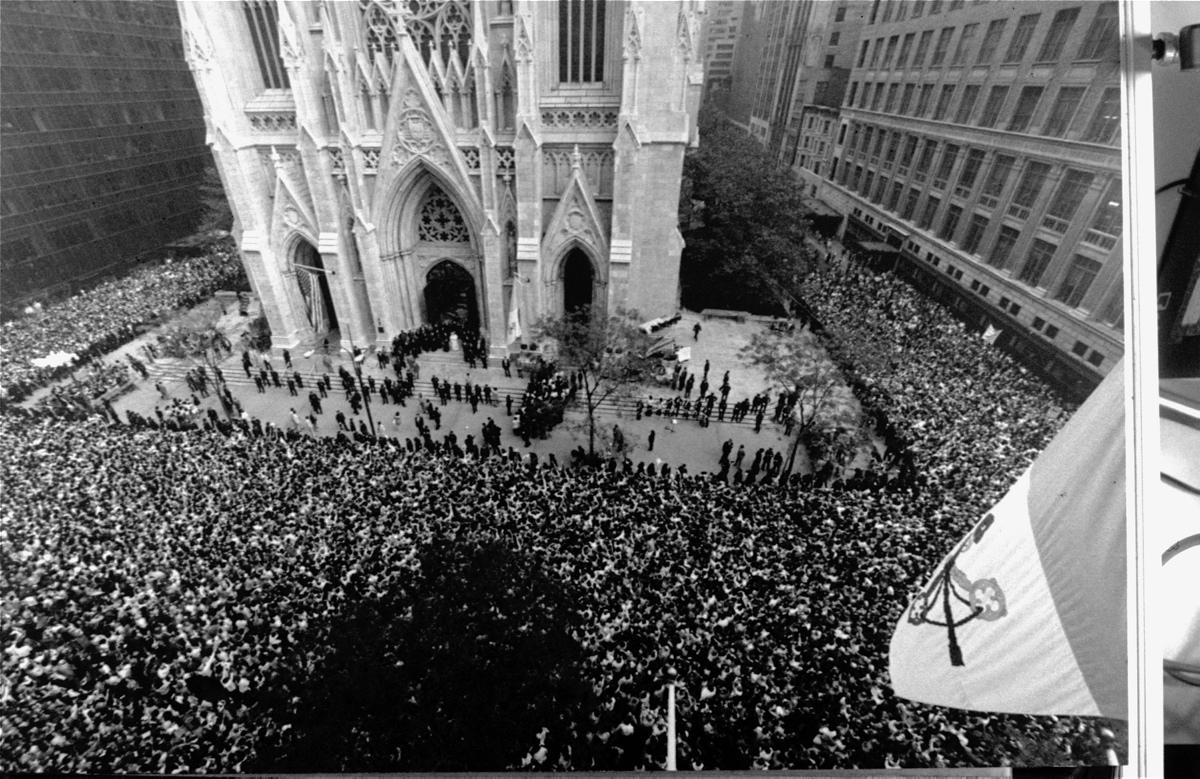
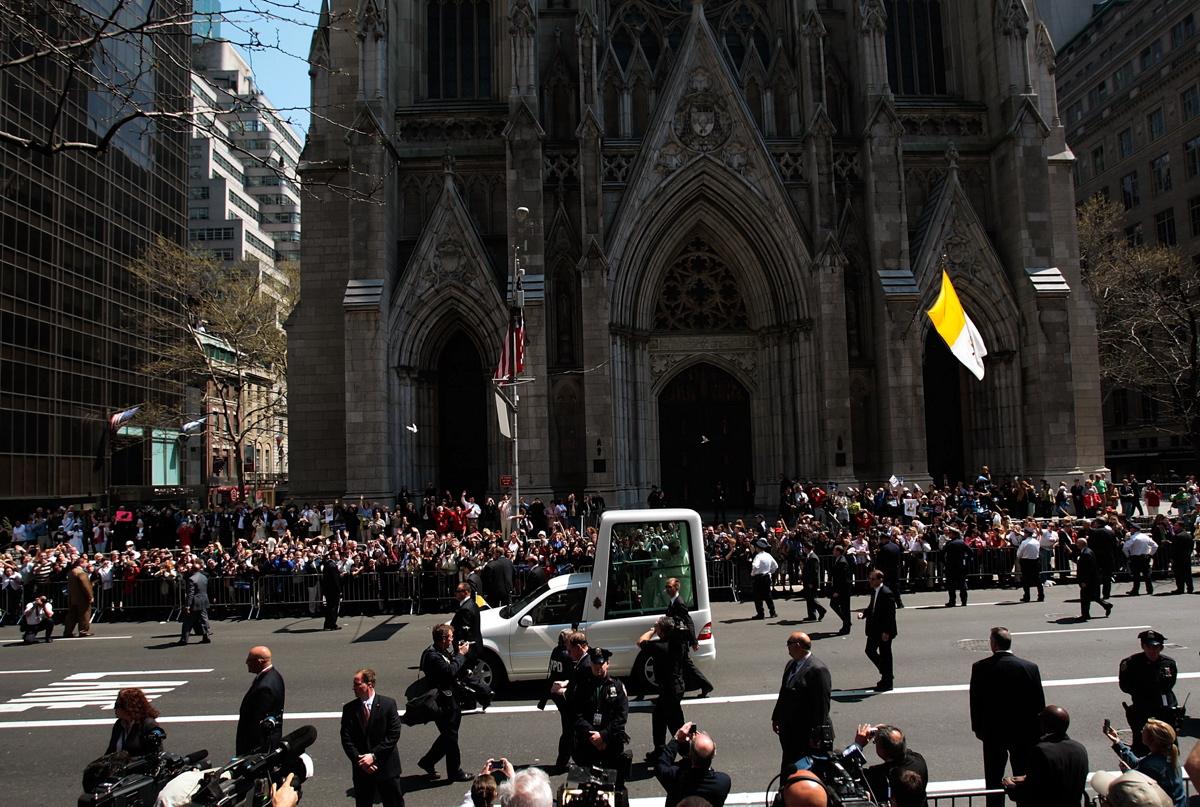
The city has been host to four previous papal visits, and in each case, Saint Patrick’s Cathedral has naturally been the manic center of activity. In fact three such visits have been immortalized on plaques in front of the cathedral.
But with each trip, the pope in question managed to find a couple other unique corners of the city to visit as well.
THE FIRST POPE
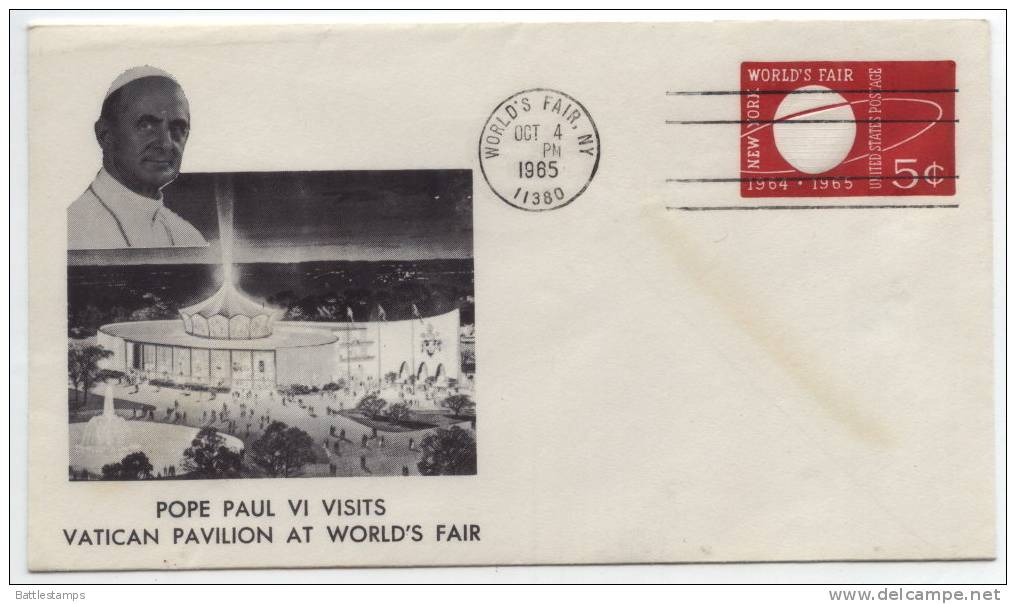
Perhaps the strangest visit of all was the very first — Pope Paul VI, the controversial leader who presided over the Second Vatican Council and made a name for himself traveling all over the world. Finally in an era where a man could be both pope and jetsetter, Pope Paul arrived in New York in October of 1965 and promptly went to visit his old roommate, who was performing in a fair.
The Pope visited the Fair on October 4, 1965, on a busy day that also included mass at Yankee Stadium (the first papal mass ever in the United States), an address to the United Nations, and a meeting in the city with president Lyndon Johnson at the Waldorf-Astoria.
5th October 1965: Photo by Harry Benson/Express/Getty Images
Many will remember the thousands of people who greeted the Pope in the original Pope-mobile (“a closed, bubble-top limousine”) during its 25-mile procession through the city. Here’s a fact to delight your friends and neighbors — the first American bridge ever crossed by a Pope in all of history was the Queensboro Bridge.
Today a rounded bench, or exedra, sits in Flushing Meadows park honoring the moment Pope Paul visited the Pavilion. (It seems that whenever a Pope hovers in a place for more than a few minutes, a plaque or monument springs up in its place.)
But it’s Pope John Paul who’s the real New York favorite; he held the papal throne for so long that he managed two trips to Gotham City — in 1979 and 1995.
His October 1979 trip was like a rock concert tour, also swinging through Philadelphia, Boston, D.C., Chicago and Des Moines. Part of the enthusiasm was because John Paul, at 58 years old, had just been appointed the year before.
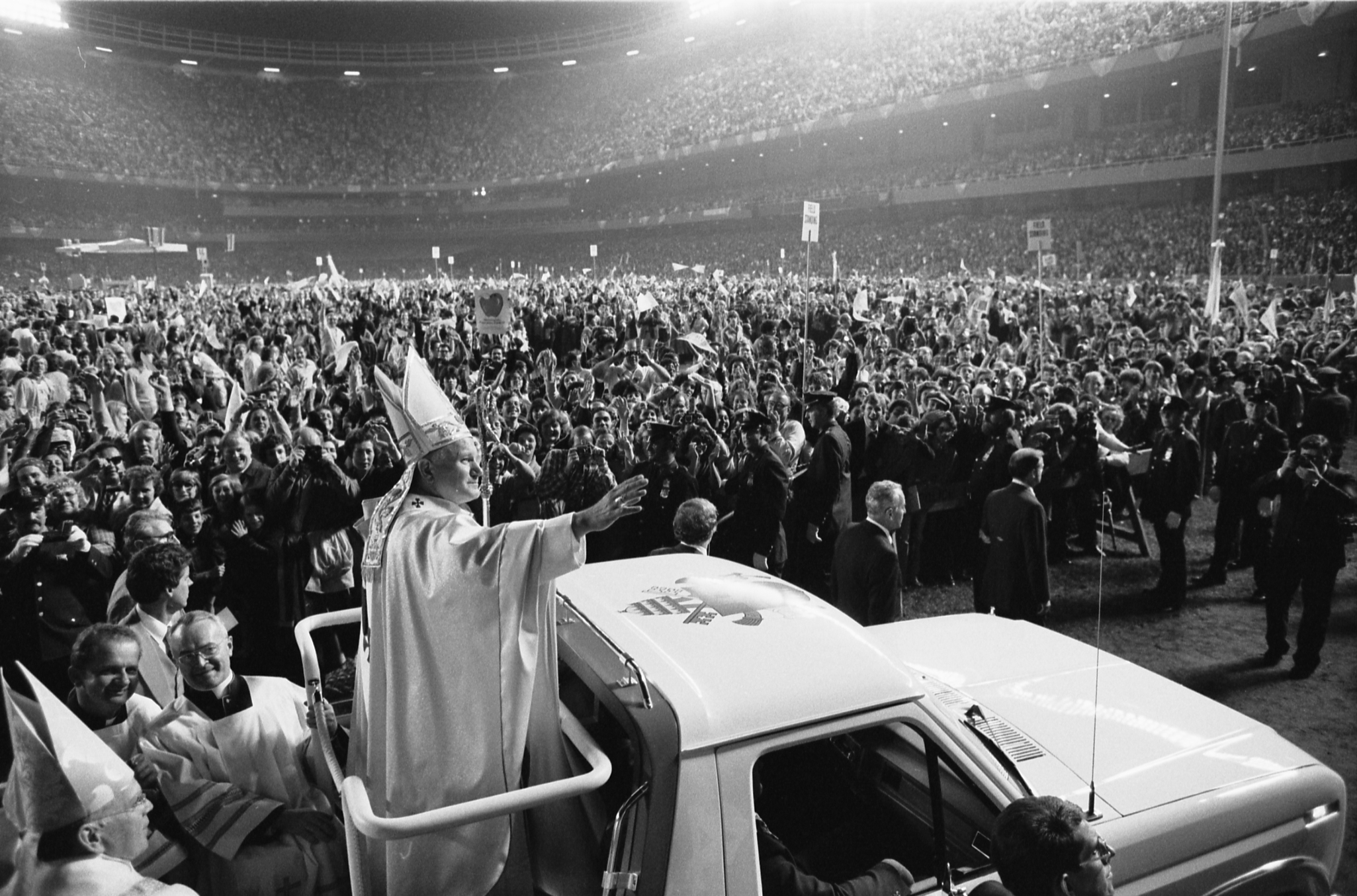
In 1969, as a cardinal, he had held mass at Yankee Stadium, so by the time he did it again on October 2, 1979 — as the Pope — he was as much a fixture as Reggie Jackson. Rain greeted over 9,000 cheering worshippers — or fans — and, according to legend, when the Pope mounted the ballfield to address the crowd, the rain showers stopped. And as a blessing for Mets fans, the next day the Pope also held rapt an audience of 52,000 at Shea Stadium.
Below: the Pope at Yankee Stadium
Courtesy US News and World Report
But like all rock stars, the Pope couldn’t complete his New York odyssey without a performance at Madison Square Garden. Although John Paul also addressed the U.N. and a Saint Patrick’s audience during that trip, he’s best remembered by many for his inspirational address on October 3rd to 19,000 city children.
Saint Patrick’s honored his Holiness’s visit in 1979 by installing a bust. But he would be back. On almost exactly the same day, sixteen years later.
Length of his visit: Almost 48 hours
THE SECOND POPE — THE SECOND VISIT
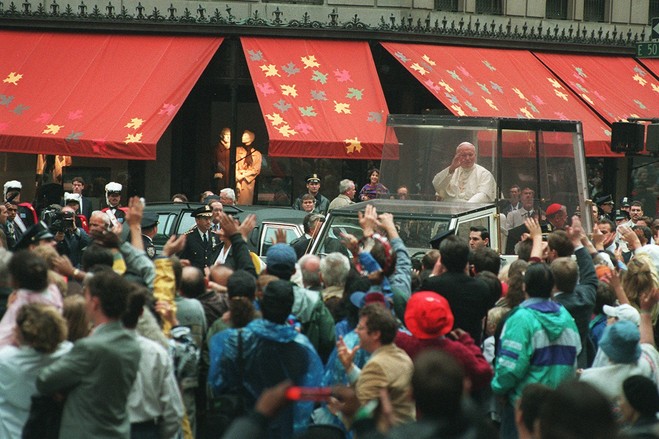
New York City in 1995 was a vastly different city and John Paul returned for a longer visit — four days in total in the entire New York area — on October 4th. This time, instead of just delivering messages to the clergy gathered at Saint Patrick’s, he spontaneously decided he wanted to walk around the block. And why not? You’ve got shopping, Saks, street vendors selling Pope souvenirs!
Below: In the Pope-mobile, riding by Saks Fifth Avenue
Courtesy Wall Street Journal
The Pope also finished off his collection of performing in gigantic venues for mass — holding court in Giants Stadium, the Aquaduct Racetrack in Ozone Park and eventually to 100,000 people on the great lawn in Central Park.
From there, the elderly leader of the Catholic Church gave the city the ultimate shout-out: “This is New York! The great New York! This is Central Park. The beautiful surroundings of Central Park invite us to reflect on a more sublime beauty: the beauty of every human being, made in the image and likeness of God. Then you can tell the whole world that you gave the pope his Christmas present in October, in New York, in Central Park.”
Length of his visit:Â Almost four days! He couldn’t get enough.
Courtesy Chris Hondros/Getty Images./New York Daily News
THE THIRD POPE
Pope Benedict XVI came to New York for three days, two nights (April 18-20), arriving in Manhattan on a military helicopter and breaking the apparently holy tradition of visiting New York in the early Fall. (Still would have needed a light sweater or vestment.) But Benedict, as the cardinal formerly known as Joseph Ratzinger, actually visited the city in that lesser role in 1988, where apparently he was met with protest from gay activists and shunned by some prominent Jewish leaders.
He hit all the “usual” Pope spots — Saint Patricks, the United Nations, Yankee Stadium — but added a couple interesting detours: Park East Synagogue, St Joseph’s Seminary in Yonkers, and the World Trade Center site.
Below: The Pope viewing the World Trade Center site
April 20, 2008 Courtesy MSNBC
Length of his visit: Almost 72 hours
THE FOURTH POPE
Pope Francis’ exhausting itinerary can be found here. He’ll make stops first for evening prayer at Saint Patrick’s Cathedral, then to the residence of the Apostolic nuncio at the United Nations to sleep.
He speaks to the U.N. Assembly in the morning, then down to the National September 11 Memorial & Museum by lunchtime.
Perhaps the most intriguing stop will come in the afternoon, meeting with students from Our Lady Queen of Angels School in East Harlem. Whereas the first Pope to come New York fifty years rode through East Harlem in his covered Pope-mobile, Pope Francis will chat with a third-grade class filled with children who will have quite a story to tell their grandkids.
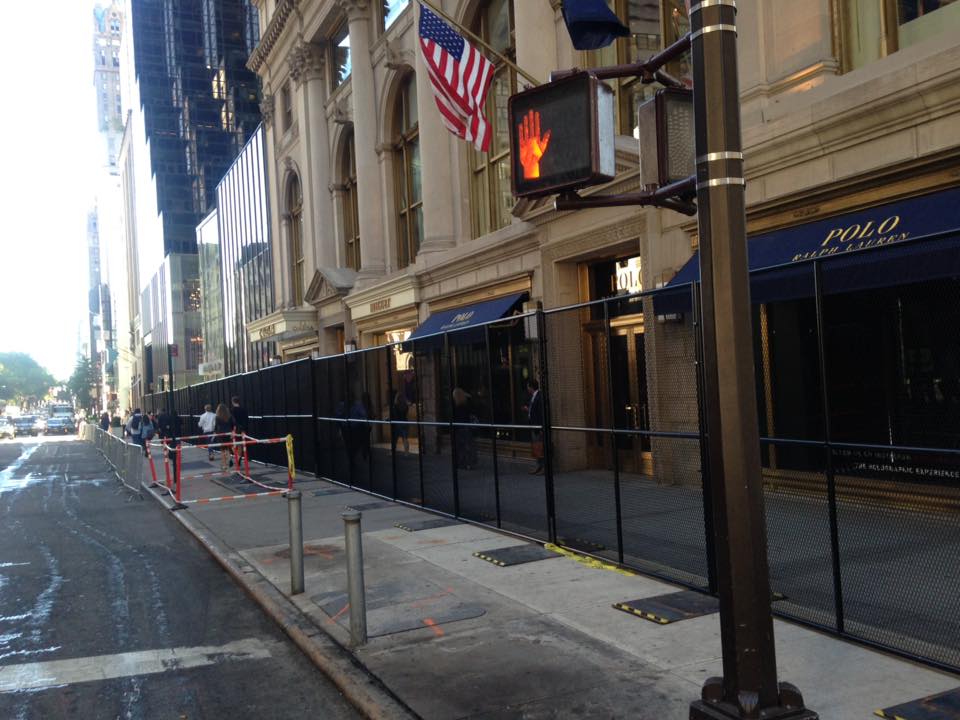
Afterwards he will travel through Central Park and arrive at Madison Square Garden for Mass. At rush hour! Oh right, all the streets are closed. In fact, Fifth Avenue right now is contained in a large fence, easily the tightest security I’ve ever seen here.
But Pope Francis is a man of many surprises. Could he decide that he wants to walk the High Line? And how can he visit New York and not even visit Brooklyn? Is the Pope a Girls fan?
This is a heavily revised version of an article that originally ran in 2008 when Pope Benedict visited New York City.
WARNING The article contains a couple spoilers about last night’s ‘Mad Men’ on AMC. If you’re a fan of the show, come back once you’re watched the episode. But these posts are about a specific element of New York history from the 1960s and can be read even by those who don’t watch the show at all. You can find other articles in this series here.Â
An unusual subplot takes Harry Crane, Sterling Cooper Draper Pryce’s smug television liaison, down to Second Avenue and the temple of the Hare Krishnas where he finds new recruit Paul Kinsey, a former agency employee. In his prior existence as a pipe-smoking gadabout, Kinsey always made note of his own hipness, and, in this case, as an acolyte of a religious thought only a few months old, we can confirm that he’s ahead of the curve again.
The Hare Krishna movement, derived from Hindu philosophies and reformatted for the groovy ’60s, was actually fostered and popularized here in the East Village.
A.C. Bhaktivedanta Swami Prabhupada, a Hindu teacher and proponent of Gaudiya Vaishnavism, left India in 1965 to spread his religious teaching. Eschewing material possessions, he arrived in New York in 1966 and gravitated towards the East Village, the nucleus of cultural counter-culture.
His reputation preceded him and soon gathered a small group of followers, including artist Harvey Cohen, who soon set up Prabhupada in an apartment on 72nd Street on the Upper West Side and a small studio for religious practice on the Bowery. From here the swami formed the core of what would become the Hare Krishna movement, aka the International Society of Krishna Consciousness.
Given the location, most of his early followers were young people, fascinated by Hindu imagery in books and music and in particular by Prabhupada’s expressions of religious thought, purifying secular consciousness expanding rhetoric into a simple spiritual regiment.
For many, he was as much a mystery as an answer. One early follower confessed later, “I didn’t know what Prabhupada was about. I mean we understood about one-millionth of what Prabhupada was saying.”
Key to religious practice is the ubiquitous mantra, rhythmically repeating the name of God. Said Prabhupada in a lecture in 2010. “[T]his sound, this Hare Krsna, Hare Krsna, Krsna Krsna, Hare Hare. Hare Rama, Hare Rama, Rama Rama, Hare Hare, is the sound representation of the Supreme Lord.”
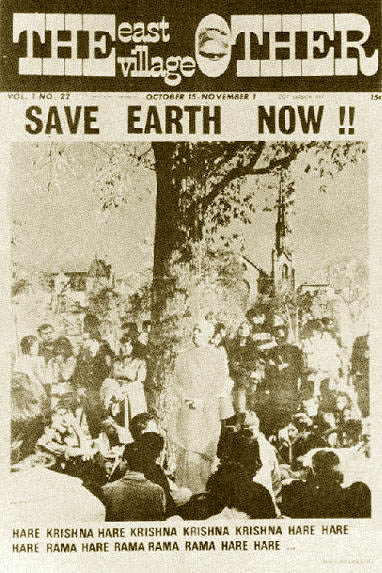
Prabhupada and his followers would frequently be heard chanting their familiar mantra throughout the East Village, but they would be known for one particular destination. On October 19, 1966, Prabhupada led an outdoor chant underneath a elm tree in Tompkins Square Park that lasted for almost two hours, so transcendent that even the New York Times took notice: ‘Swami’s Flock Chants in Park to Find Ecstasy.’ Today that tree (called the Hare Krishna tree) is one of the park’s most popular spots and a mecca for current adherents.
Above: From the late October issue of the East Village Other, in front of the  Hare Krishna tree [source]
By this time, Prabhupada had a new home, a former curio shop at 26 Second Avenue (between First and Second Streets). They kept the old sign ‘Matchless Gifts’ over door, while followers decorated the interior with handmade tapestries. This became the central New York temple and remains central to local worshippers to this day. “[I]n this small room on Second Avenue, guest found themselves transported into another dimension, a spiritual dimension, in which the anxieties and pressures of New York City simply did not exist.” [source]
In that first year, 1966, Prabhupada had only a few dozen followers, but at least one famous one — Allen Ginsberg.
Below: Video of Prabhupada and followers at Tompkins Square Park in 1966