Categories
Neighborhoods Podcasts

The Astor Place Riot of 1849: Bloodshed and Shakespeare splits New York at a busy crossroads

“By the pricking of my thumbs / something wicked this way comes” — Macbeth

PODCAST In old New York, one hundred and seventy years ago, a theatrical rivalry between two leading actors of the day sparked a terrible night of violence — one of the most horrible moments in New York City history.

England’s great thespian William Macready mounted the stage of the Astor Place Opera House on May 10, 1849, to perform Shakespeare’s Macbeth, just as he had done hundreds of times before.  But this performance would become infamous in later years as the trigger for one of New York City’s most violent events — the Astor Place Riot.

The theater, being America’s prime form of public entertainment in the early 19th century, was often home to great disturbances and riots.  It was still seen as a British import and often suffered anti-British sentiments that often vexed early New Yorkers.

Macready, known as one of the world’s greatest Shakespearean stars, was soon rivaled by American actor Edwin Forrest, whose brawny, ragged style of performance endeared the audiences of the Bowery.  To many, these two actors embodied many of America’s deepest divides — rich vs. poor, British vs. American, Whig vs. Democrat.

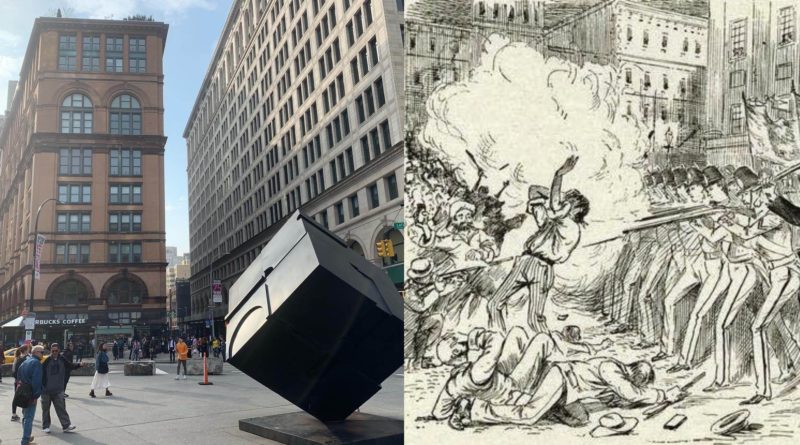
On May 10th, these emotions overflowed into an evening of stark, horrifying violence as armed militia shot indiscriminately into an angry mob gathering outside theater at Astor Place.  By the end of this story, over two dozen New Yorkers would be murdered, dozens more wounded, and the culture of the city irrevocably changed.

Listen Now: The Astor Place Riot Podcast


______________________________________________________
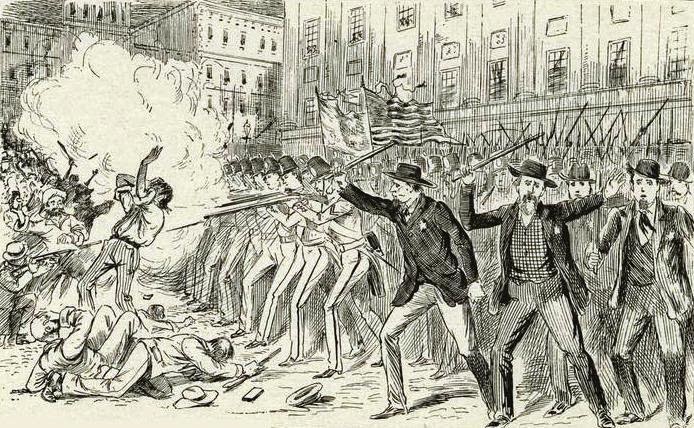
RIOT OR RIOTS?  You may have noticed in our podcast that we go from calling it the Astor Place Riot and the Astor Place Riots.  We both saw primary references to both the singular and the plural.  Though it was just one riot which occurred on May 10, the incidents on May 7 and May 11 constitute smaller riots or disturbances that lead up or were the result of the May 10 event.  The word ‘riot’ is not perfect either as it starts as a riot and ends as a massacre.

CORRECTION: In the podcast, I mention that John Jacob Astor lived in the line of stately buildings today known as Colonnade Row.  Although he built them, he never lived here.  However he moved his family into them, including his grandson John Jacob Astor III.  Cornelius Vanderbilt and Washington Irving also lived here.
__________________________________________________________

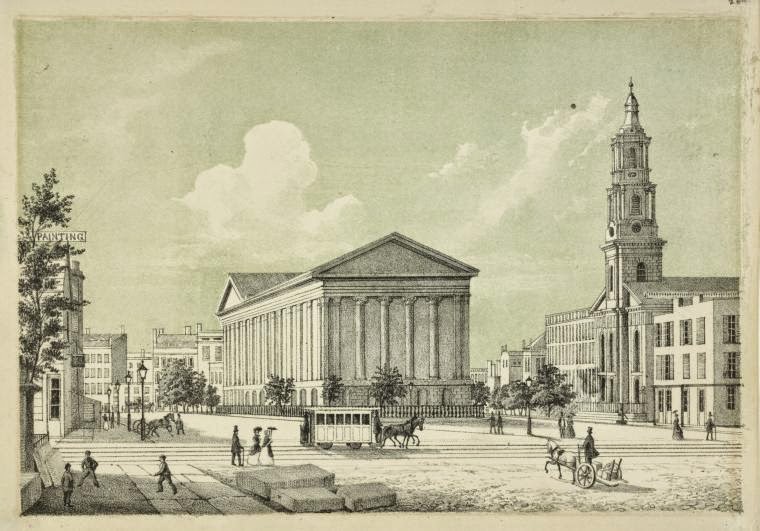
The Astor Place Opera House in 1850:
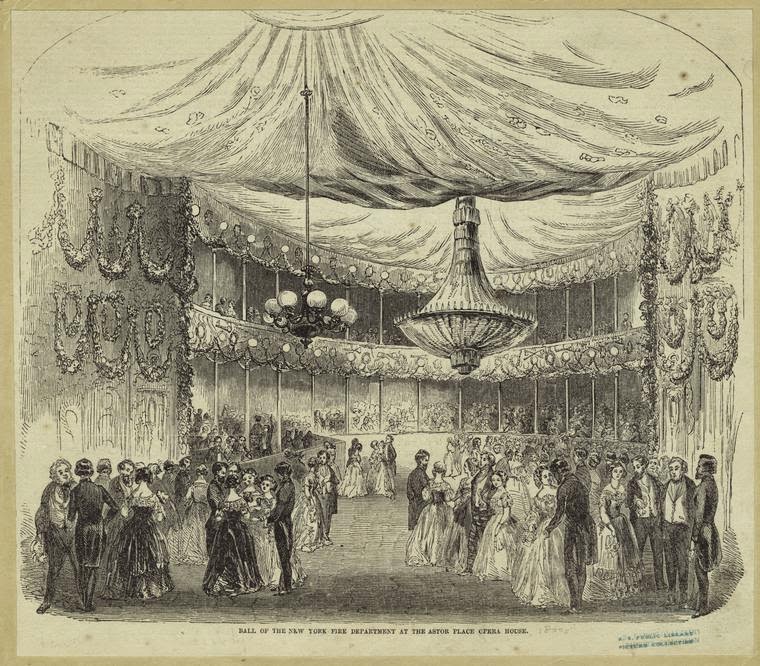
Inside the Astor Opera House, one of the most lavish spaces in all of New York in the 1840s.  Curiously, this illustration depicts a ball for the New York Fire Department.  Many members of the volunteer fire departments  actually set upon the opera house as part of the angry mob.
After the riots, the opera house quickly lost its cache. High society moved uptown to the Academy of Music (not so far away actually, on 14th Street, near Union Square).  The interior of the theater was eventually demolished and sold to the New York Mercantile Library and renamed Clinton Hall.
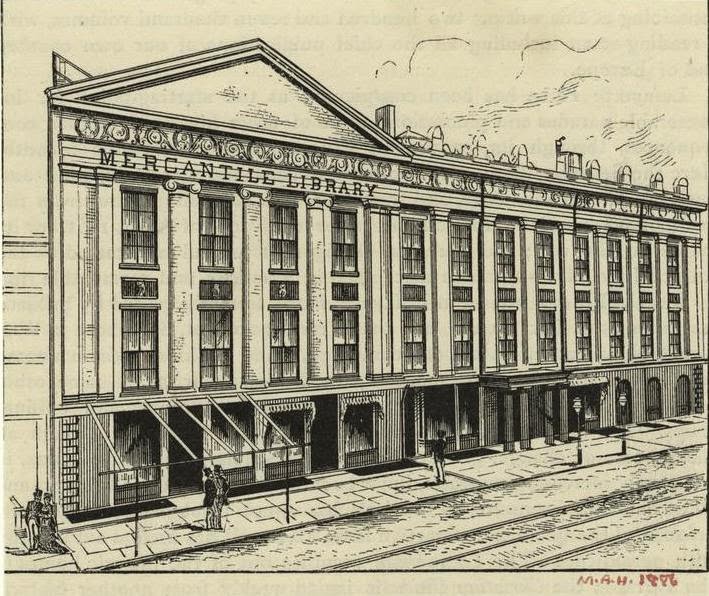
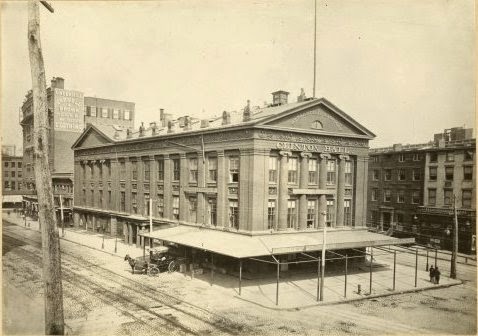
This was torn down in 1890 and replaced with the 11-story structure that stands there today.

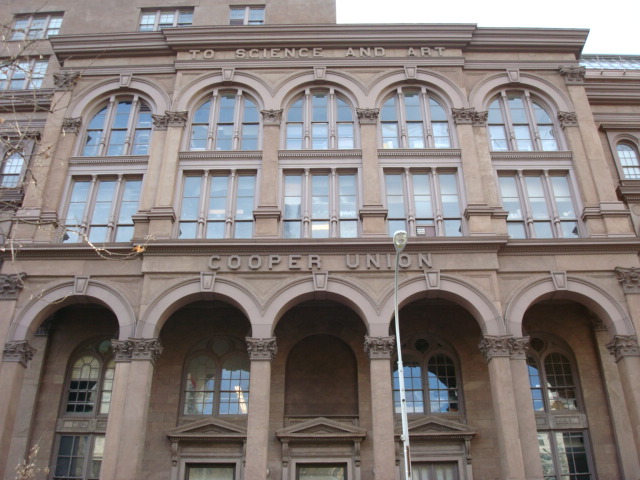
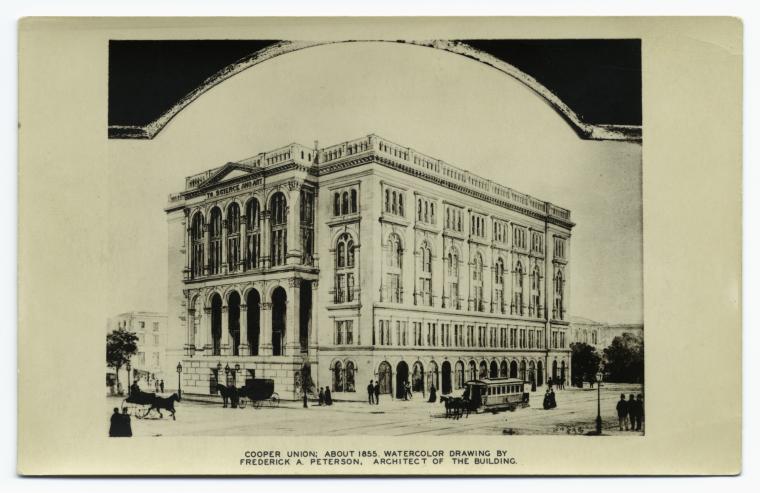
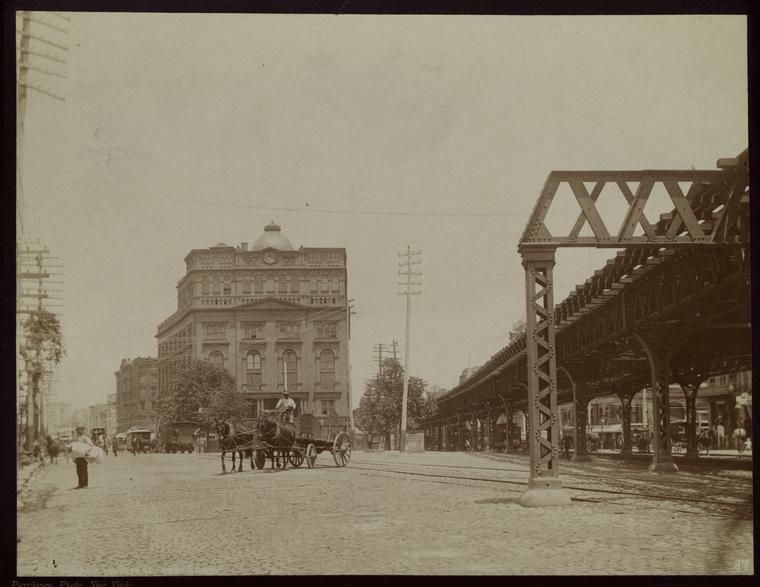
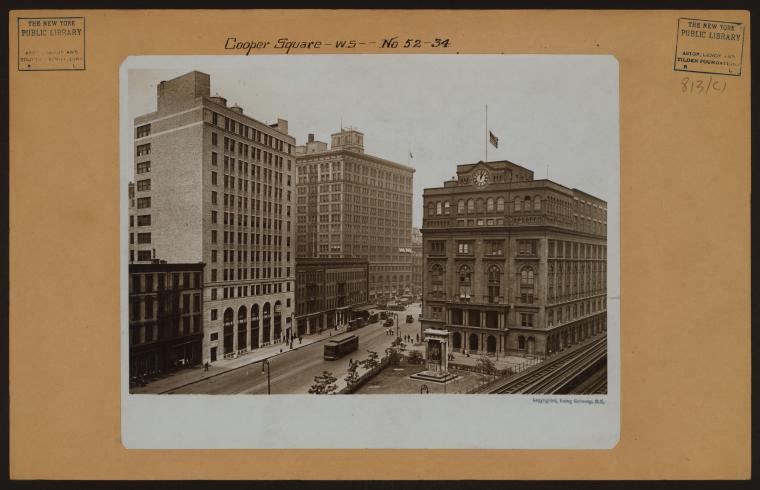
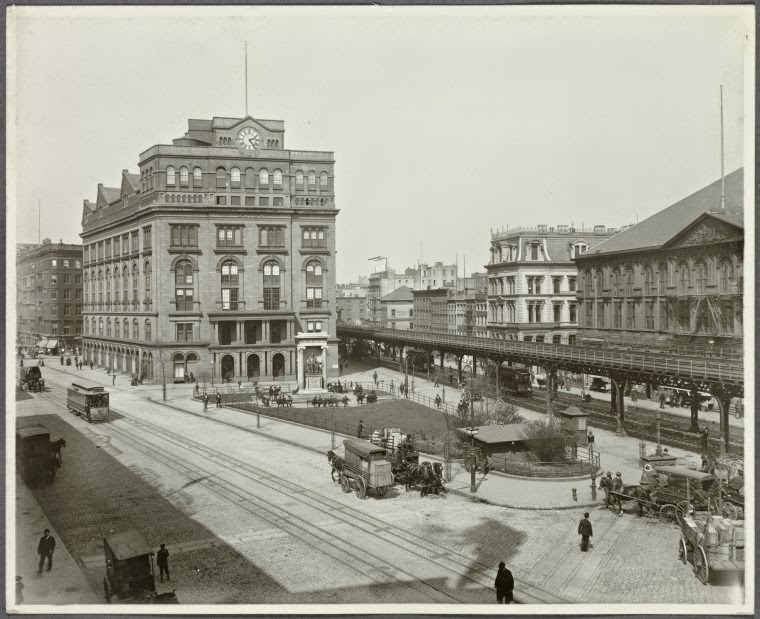
Many considered the demons of Astor Place purged when Cooper Union was finally constructed in 1859, a decade after the riots.  In this image, we’re looking up Third Avenue and the final remnant of the Bowery.  The Third Avenue Elevated has already been built here:
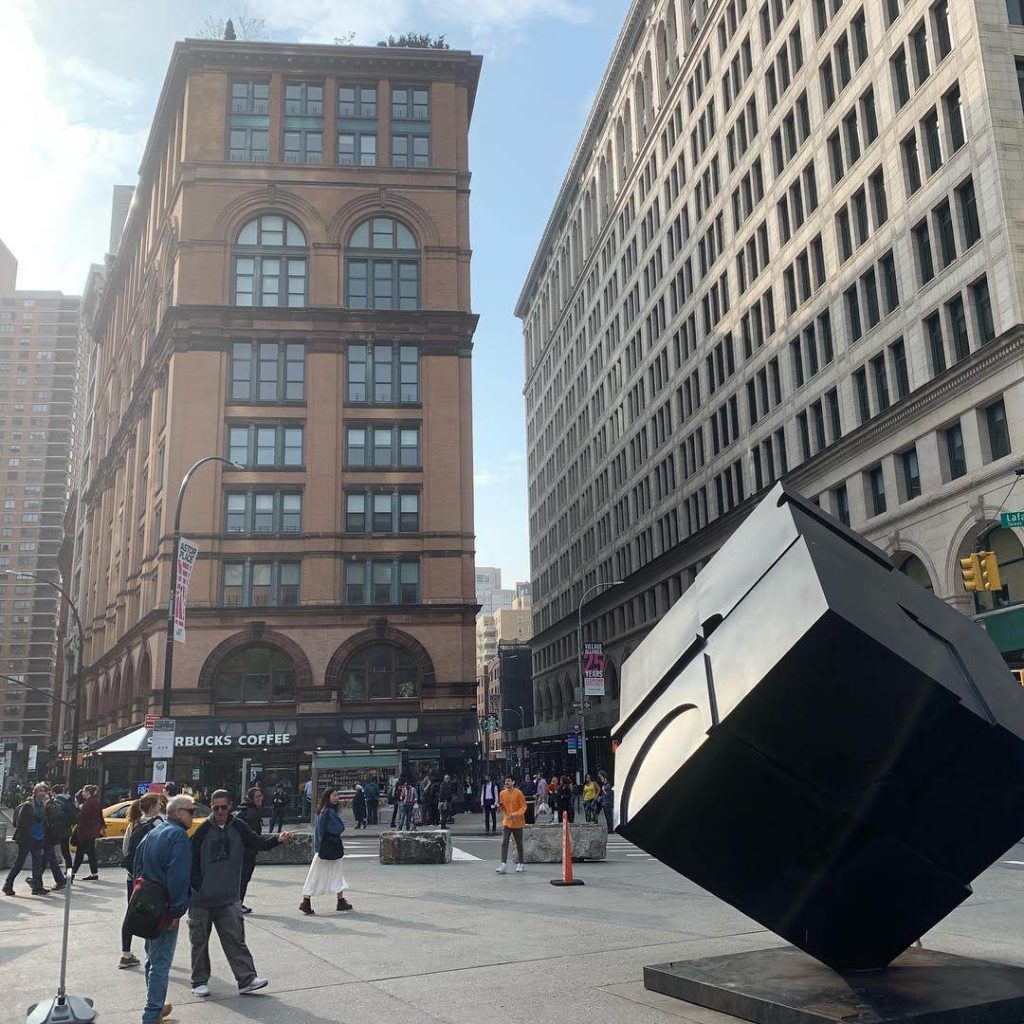
Astor Place in 2019:
William Macready:

From the New York Evening Post, May 1, 1849, advertising his May 7th show (which was interrupted by protesters).

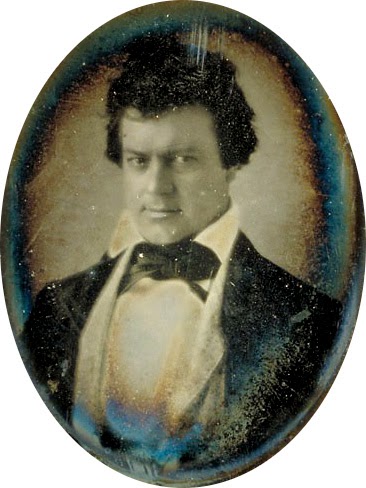
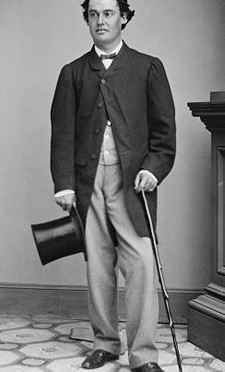
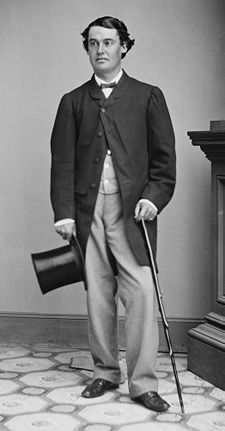
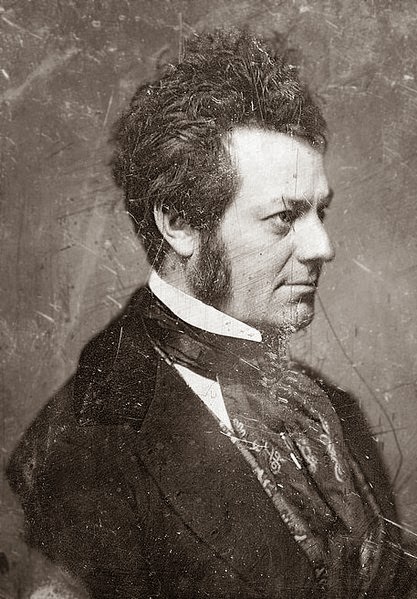
Edwin Forrest: In portrait and in daguerreotype
Images above courtesy the New York Public Library (except where otherwise noted).

FURTHER LISTENING:

We’ve been doing this for so long that we have MANY podcasts about historical landmarks in and around Astor Place. After you listen to this show, check out these older shows from our catalog:
Categories
Gilded Age New York Podcasts

Mark Twain in New York, or His Adventures on Fifth Avenue

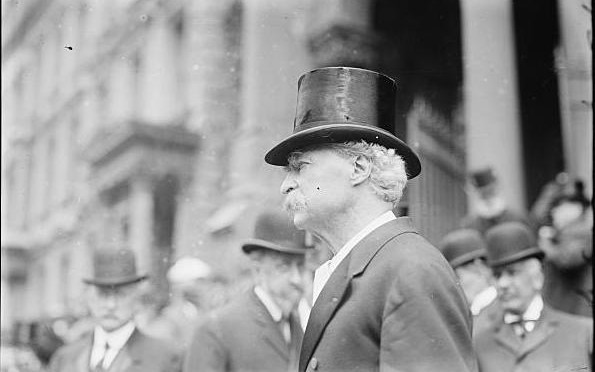
Photo courtesy LOC

PODCAST You hear the name Mark Twain and think of his classic characters Tom Sawyer and Huckleberry Finn, his locales along the Mississippi River and his folksy wit. But he was equal parts New York as well, and the city helped shape his sharp, flamboyant character. Follow his course, from his first visit as an opinionated young man in 1853, to his later years in 1906 as a Fifth Avenue tenant, decked out with a cigar and signature white suit.

His tale offers a glimpse into the glamorous life of turn-of-the-century New York, from the smoke-filled billiard room at the Players Club to late nights at New York’s dining palace Delmonico’s. Tune in and find out which parts of Mark Twain’s city are still around and which of his old homes you can still visit today.

Co-starring Ulysses S. Grant, Helen Keller, Edwin Booth and other toasts of New York during the Gilded Age.

A slight correction: I mentioned in the show that Mark Twain only worked on one play in his lifetime, called ‘Is He Dead?’. That might have been his only solo attempt, but he did try many years earlier to pen one in collaboration with Bret Harte. The play, called “Ah Sin: The Heathen Chinee”, opened and closed in 1877. It was an unmitigated flop and a total creative failure. He worked on another collaborative play called “Cap’n Wheeler” the next year.

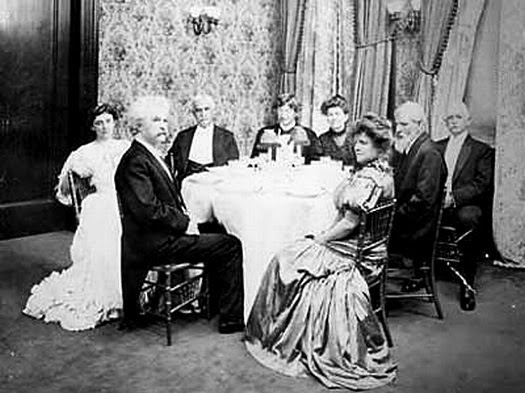
Dinner at Delmonico’s with a few of his closest friends (or at least his fanciest ones) at a celebration for Mark Twain’s 70th birthday.

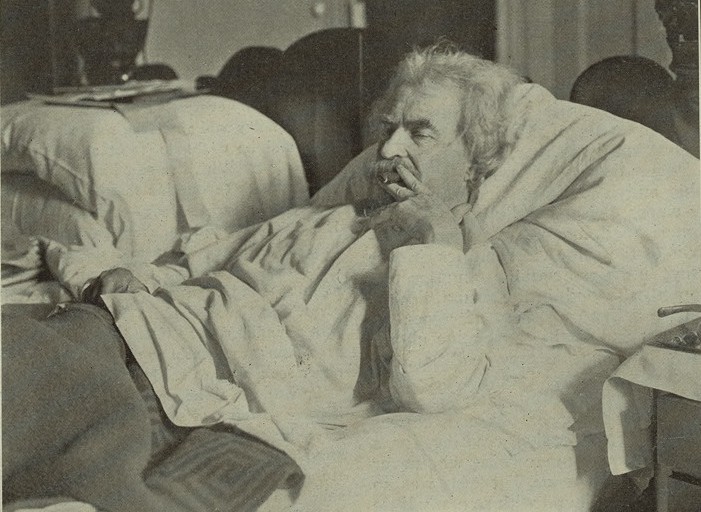
Smoking in bed: Twain’s two favorite places to do business in his Fifth Avenue home was at the pool table and in bed. This wasn’t laziness; in fact, during his final years in the city, the author was constantly out on the town, oftentimes as a guest of honor or featured speaker. He deserved a little time off his feet. (Pic NYPL)

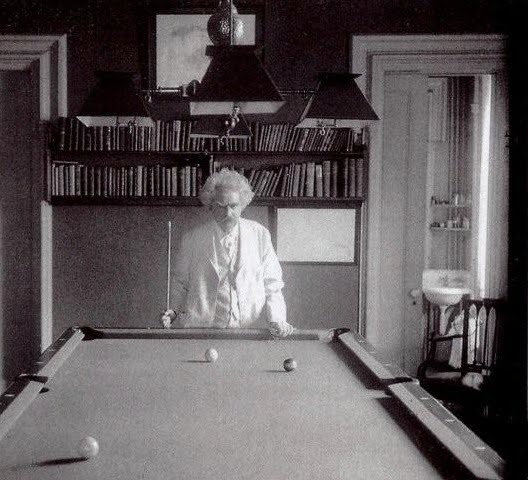
A menacing Mark Twain behind his pool table. (I’m not sure whether this is the Fifth Avenue townhouse or his place in Redding, Connecticut.) Due to his white suit and the photographic process in the 1900s, the writer often looks ghostly and pale.

This extraordinary video is pretty much the only moving images we have of Mark Twain, taken by Thomas Edison in 1909 at Clemens new home Stormfield, in Redding, CT. It’ll give you some idea of Twain’s appearance when he lived in New York the year previous.

If you’re a fan of walking tours — and why shouldn’t you be? — there’s a interesting tour led by author Peter Salwen specializing in Mark Twain’s New York. You can check out their website for more infromation.

For more general information on the life of Mark Twain, I recommend some of the books I used as sources for this show, including Ron Power’s fantastic ‘Mark Twain: A Life’, Michael Sheldon’s ‘Man In White: The Grand Adventure Of His Final Years’ and, of course, the massive, labyrinthine first volume of The Autobiography Of Mark Twain.

And finally, here’s a map of some locations pivotal to Mark Twain’s life in New York — places where he lived and lectured. And you can see, he certainly got around!


View Mark Twain in New York in a larger map

Mayor Edward Cooper, chip off the ole block

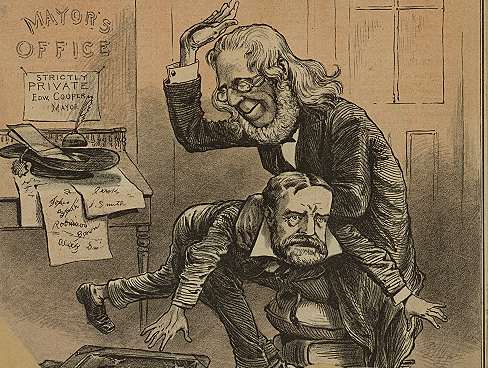
ABOVE: Puck Magazine satirizes father and son, Peter and Edward Cooper

KNOW YOUR MAYORS Our modest little series about some of the greatest, notorious, most important, even most useless, mayors of New York City. Other entrants in our mayoral survey can be found here.

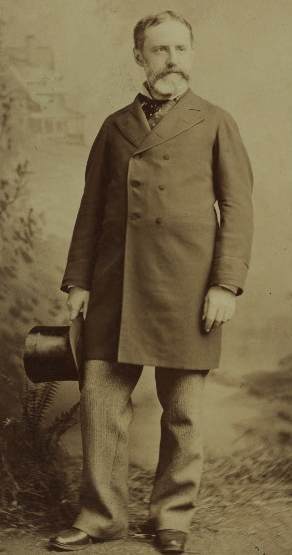
Mayor Edward Cooper

In office: 1879-1880

Many of us must inevitably live in the shadows of the achievements of our parents. Edward Cooper, while no slouch, suffers from the competing bios of two great men in his family — papa Peter Cooper, New York’s cleverest industrialist, and brother-in-law Abram Hewitt, a transformative city leader.

Like Hewitt, Cooper too was mayor of New York, from 1879-1880. Cooper’s tenure wasn’t exactly memorable, but the years following up to it certainly were.

Edward was born on the outskirts of town (i.e., 28th Street and today’s Park Avenue South) in October 1824, the only surviving son of Peter and his wife Sarah, a child with the unique advantage of having one of America’s leading inventors to apprentice from. Peter was already wealthy from his Kips Bay glue factory and employed his free time tinkering, experimenting and dreaming. In fact, Edward was celebrating his third birthday when Peter brought into this world another of his pride and joys — the Tom Thumb, the first operable, steam-powered train engine.

Not surprising, Edward quickly followed his father’s intellectual lead. During his early days in public school, “it was often said of him that there was never a time in his life when he would not sit up half the night to solve a difficult problem in mathematics or engineering which were his especial delights.” Like father, like geek!

Edward went to Columbia University where he befriended his fellow student Abram Hewitt, and the two set out for an educational European vacation in 1844. On the way back however, they were both nearly killed in a shipwreck, stranded with the crew for many days without food or water,

Leave it to outrageous hearsay, but allegedly during this shipwreck, according to Edward’s own obituary, he was almost cannibalized for food by the survivors.

“One report had it that the castaways were so hungry that lots were cast to see who should be eaten. Mr. Cooper drew the unlucky number, but Mr. Hewitt asked to take his place.

“I have brothers,” Mr. Hewitt said, but you are your father’s only son and his life is wrapped up in you. Let me take your place.” Now that’s friendship!

This devastating experience drew the Coopers and the Hewitts together. In fact, Hewitt would later marry Edward’s only sister Sarah Amelia. Edward and Abram, meanwhile would go into the ironworks business together, with capital from Peter Cooper. The results would make them very rich men with foundries in Trenton, New Jersey, producing “mortar beds and gun carriages” in the years leading up to the Civil War.

In 1865, Peter gave control of his coveted glue factory to Edward and soon young Cooper became as distinguished a New York business man in his own right. Just in time to pursue a political career.

Edward was a Democrat, but not of the tainted Tammany Hall stripe. Cooper came from the short-lived rival and reform-minded Irving Hall, battling to sweep away city hall corruption as practiced by the machinations of the other, far powerful Democratic machine. In fact, he would prove instrumental — both through his close friend Samuel Tilden, and as a member of the reform Committee of 70 — in helping bring down the ring of Boss Tweed and the corrupt mayoralty of A. Oakley Hall. He later ardently supported his friend Tilden during his contentious run for the White House in 1876.

The rift was caused by two rival party bosses — John Morrissey, a prize-fighter turned state senator who drew men like Cooper by recoiling from the excesses of Tweed-style politics, and ‘Honest’ John Kelly, who at first rallied in reform rhetoric with Tilden and others but later rebuffed his former allies when he became New York comptroller.

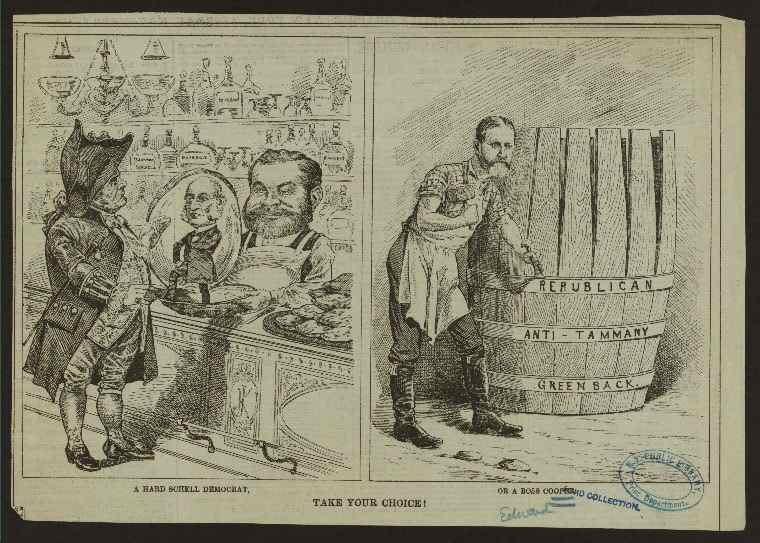
Morrissey ran for state legislature defeating Tammany stalwart August Schell. August turned around and ran for mayor, but this time it was Edward Cooper who defeated him in the fall of 1878. (Ironically, Cooper had to cull together a coalition of Republicans and anti-Tammanys in order to claim victory.)

Below: the electoral decision between Schell and Cooper, as seen through the satire a political cartoon.

The conflict above between Morrissey and Kelly deserves some greater inspection in this column at a later date. Only know that it was John Kelly’s ascension into the comptroller seat before Cooper became mayor that basically ensured Cooper would not be any kind of an effective mayor at all.

Most of Cooper’s time was spent in political infighting, and his prime objective — to reform the corrupt police department — was continually met with criticism, mostly led by Kelly.

Let’s just say, Kelly and Cooper really didn’t get along. Or, in Kelly’s own words, “Let, Edward Cooper, that infamous hypocrite who occupies the Mayoralty chair know that, after his betrayal of the Democracy, he is no nearer Heaven, nor Samuel Tilden near the White House, than they were before!”

Interestingly, Cooper is front and center of a small but precious moment in New York history: the debut of Cleopatra’s Needle, the 3,500 year old obelisk from Egypt planted in Central Park on Oct 9, 1880.

Near the end of his life, Edward would take another, more familiar and far less strenuous office — the president of Cooper Union — in 1898. He died seven years later, in 1905.

Categories
Podcasts

PODCAST: McSorley’s Old Ale House

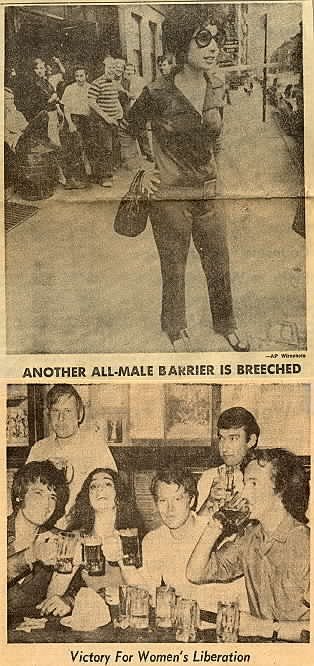
Grab yourself a couple mugs of dark ale and learn about the history of one of New York City’s oldest bars, serving everyone from Abraham Lincoln to John Lennon — and eventually even women!

Listen to it for free on iTunes or other podcasting services. Or you can download or listen to it HERE

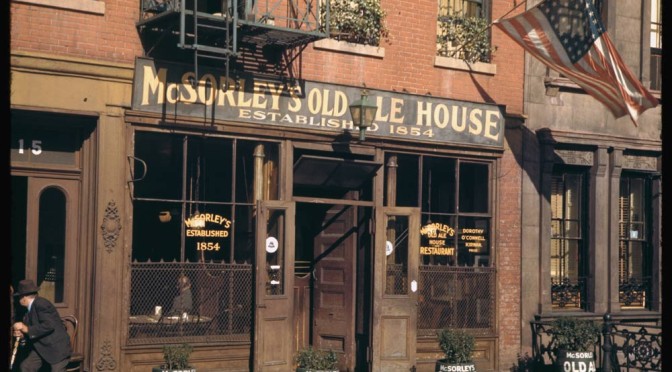
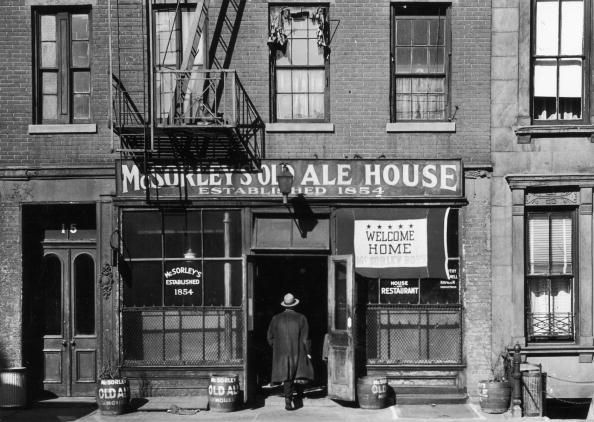
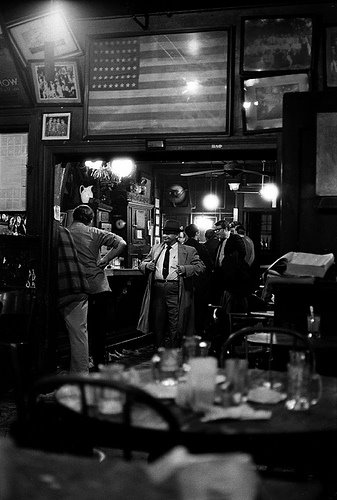
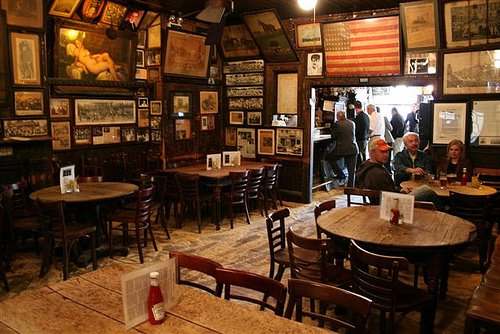
McSorley’s through the ages. Here’s one from 1937:

The outside from 1945

1969:

1998:

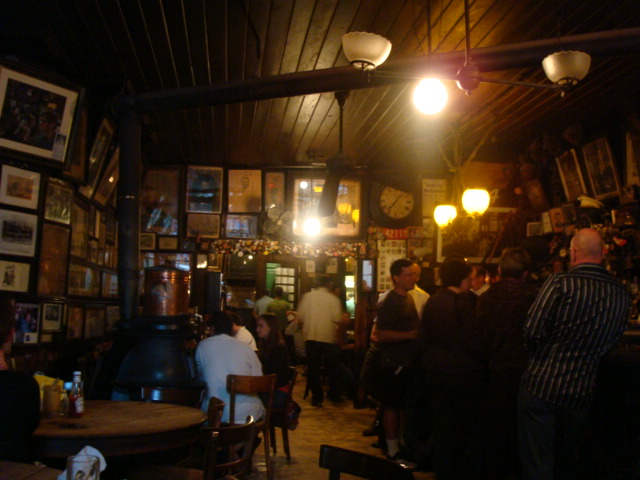
And McSorley’s today

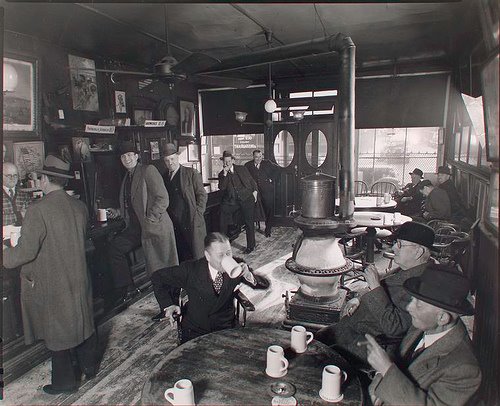
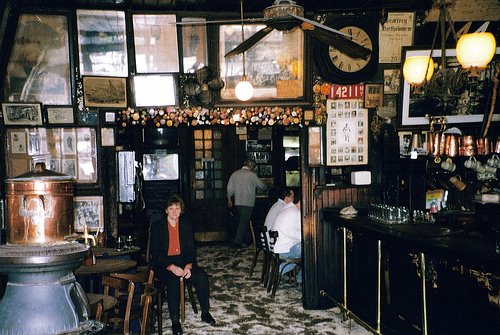
The backroom:

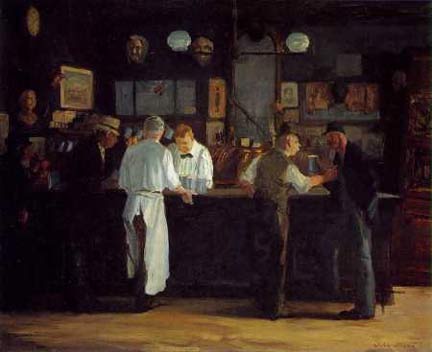
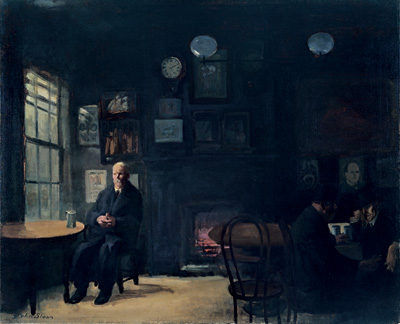
Two of John Sloan’s most famous works, with McSorley’s as its subject:

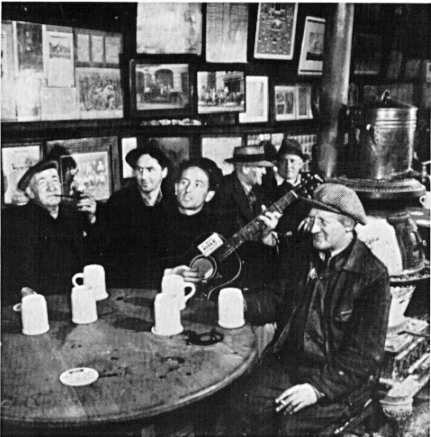
Woody Guthrie hams it up by the coal burning stove.

Women win the right to vote: dark ale or light ale!

Categories
Podcasts

PODCAST: The Triangle Factory Fire of 1911

Shirtwaist factory workers on strike!

Come listen to the strange and shocking facts of the Triangle Shirtwaist Factory fire, of a workplace tragedy that changed how New Yorkers live and work in a world of tall, flammable buildings.

Listen to it for free on iTunes or other podcasting services. Or you can download or listen to it HERE

Time’s up for Astor Place’s famous clock

Before we leave Cooper Union, I thought I was draw your attention a rather controversial decision they’ve made in the past few years that has marred an institution of Astor Place — the Carl Fischer note clock.

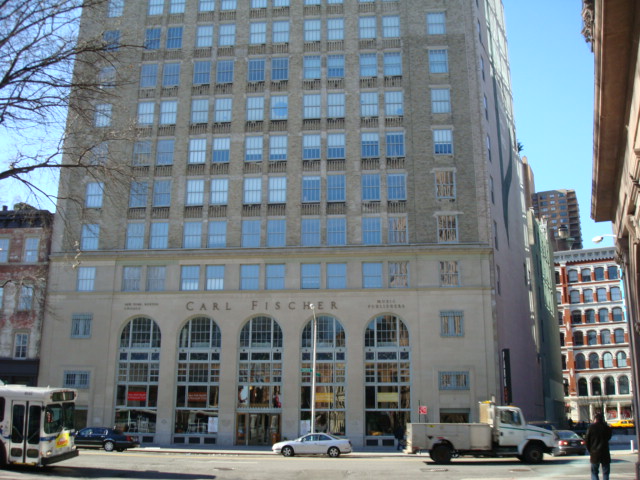
Carl Fischer, still a leader in printed sheet music, began as a tiny musical instrument store on East 4th Street in 1872, successfully incorporating printed music by the end of the century. Carl’s son Walter carried on the business into the next century, moving the enterprise into a new beige 12-story building at 62 Cooper Square, right off Astor Place in 1923.

Throughout the years, it was the place in downtown New York to grab the sheet music for any occasion and even into the 1990s held on to its old-school charm, with uniformed attendants in the elevators and little evidence of modern technical organization. In 1999, the company moved out of the building, which now houses 26 loft apartments. Their new location is at 65 Bleeker Street.

Even if you never bought sheet music, the store was a fixture of Astor Place due to the charming clock, blooming from a gigantic eighth note, that stretched down the side of the building, hovering over a small parking lot below. There has always been a clock alongside the building as long as Fischer was in the building, though it the past it was incorporated into murals featuring a boy scout with a drum, an art-deco sun pattern, and a marching band.

The parking lot has always been owned by Cooper Union, and it’s no surprise given the condo frenzy that has possessed New York that in 1999, the same year that Carl Fischer vacated the premises, they decided to lease to Gwathmey Siegel & Associates for a new condominium.

That parking lot has a bit of a storied history of its own, a frequent spot for people to sell a mix of unusual wares along the street. Author Michael Galinsky wrote about this curious intersection several years ago and kindly forwarded me a link to Flickr that featured some pictures from the book which I highly recommend you check out, especially if you’re a fan of 80s New York street scenes.

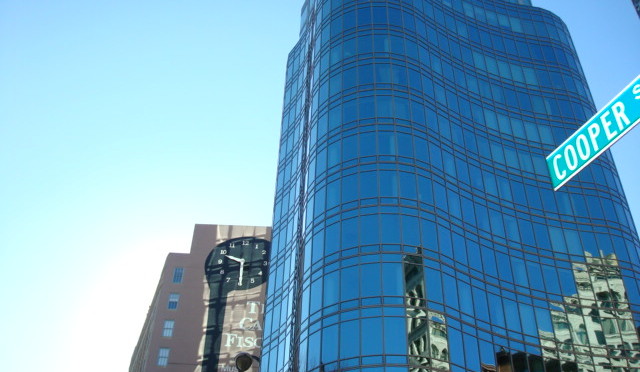
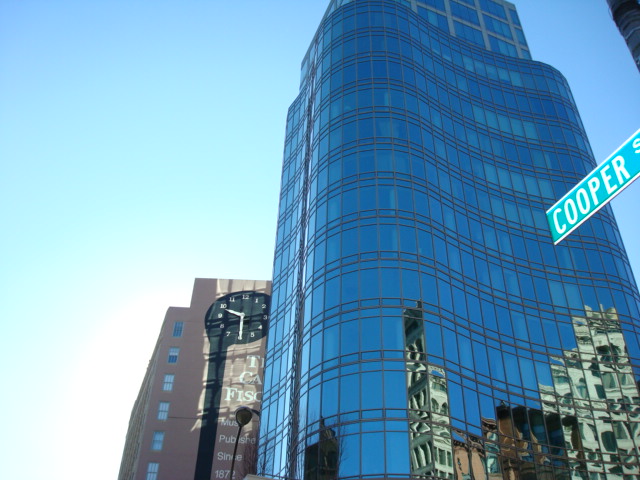
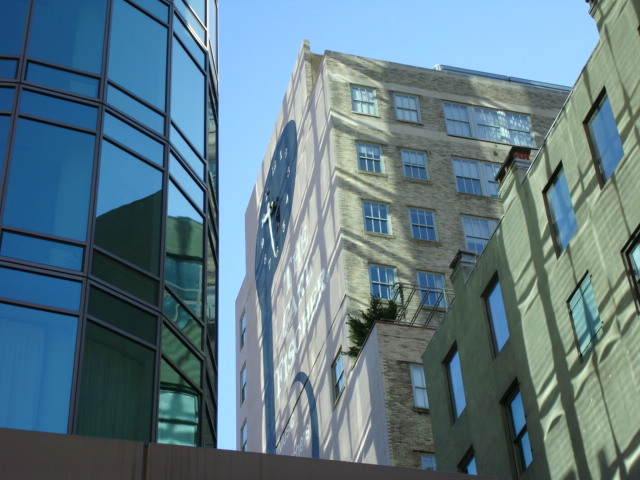
However, that parking lot is gone, replaced with the Astor Place Tower, a sleek 21 story glass tower. I leave it to you to form your own opinions about this building. What is has done, however, is completely dwarf the famous old clock, completely obscuring it at many times of the day with a glare and creating an awkward canyon between the Tower and the Fischer building that can’t be creating a very attractive view from certain windows.

Categories
Podcasts

PODCAST: Peter Cooper and Cooper Union

Cooper Union is one of New York City’s more storied institutions, not only fostering the best and brightest of art and architecture, but playing host to presidents and activists. Also, find out a little about its amazingly resourceful founder Peter Cooper

Listen to it for free on iTunes or other podcasting services. Or you can download or listen to it HERE

Know Your Mayors: Abram S. Hewitt

Our modest little series about some of the greatest, notorious, most important, even most useless, mayors of New York City. Other entrants in our mayoral survey can be found here.

Abram Hewitt could easily be considered a very pivotal mayor in New York City, given the significant development and personal connections he had to the heart of the city. However a shipwreck very nearly did him in before he could even get started.

Hewitt, born upstate in Haverstraw, attended Columbia and taught mathmatics, where he became friendly with a student he was tutoring, Edward Cooper. The two of them later voyaged to Europe in 1844, but on the way back to America, their ship capsized off the coast of Cape May.

He, Edward and the crew were later rescued, but the experience affected Hewitt deeply (and rather vaingloriously): “It taught me…that my life which had been miraculously rescued belonged not to me, and from that hour I gave it to the work which from that time has been in my thoughts — the welfare of my fellow-citizens.”

It had a more lucrative effect as well; for Edward Cooper happened to be the only son of industrialist Peter Cooper. Hewitt’s bravery bonded him with the Cooper family, becoming lifelong friends with Edward and marrying Edward’s sister Sarah.

He helped found Trenton Iron Company with the Coopers and became the first to experiment with the inexpensive steel-producing Bessemer process in the United States.

But politics was soon in Abram’s sights, especially with the crumbling of Boss Tweed’s Tammany Hall after his fall in 1871. Hewitt reorganized that once-corrupt Democratic political machine with political rewards for himself, elected to the U.S. House of Representatives in 1874.

He even tried his hand at national politics, managing Samuel Tilden’s nearly-successful quest for the White House in 1876. Remember this from history class? Despite Tilden winning the popular vote, an electoral fiaso gave the election to Rutherford B Hayes.

As Hewitt held court in Washington — becoming, in Henry Adams’ words “the most useful public man in Washington” — his close friend and brother-in-law Edward Cooper would be elected mayor of New York in 1879.

Hewitt’s connections in Washington would assist in getting the neccessary attentions brought to the building of the Brooklyn Bridge. Although David McCullough dryly notes that Hewitt might have inadvertantly helped weaken the Bridge by helping deliever the wire bid to Brooklyn native (and total fraud) J. Lloyd Haugh. (More about him in last week’s podcast.) Hewitt would give a most stirring speech during the Bridge opening ceremony in 1883.

Finally, Hewitt himself would become mayor of New York City in 1886 during a heated election in which a candidate by the name of Theodore Roosevelt would place third.

Hewitt strong distain for corruption in city politics ran him against his old organization Tammany Hall. He also had strong moral convictions, fighting to keep city saloons closed on Sunday. (This did not endear him to many people.) However, he strongly advocated the creation of new city parks and began work on a much-delayed underground train system — which Tweed’s machine had stalled for years. In fact, Hewitt is considered the “Father of the New York Subway.”

He was defeated in 1888, partially due to angering the Irish community because he refused to attend the St Patricks Day Parade. (Hewitt tended to be of a more nativist stripe; among other demands, he required all immigrants take a literacy test.)

He spent his later years as a philanthropist, on the boards of the Carnegie Institution and the Museum of Natural History. When he died in 1903, Andrew Carnegie himself claimed the former mayor was “America’s foremost private citizen“.

Remember the Alamo

It’s very revealing to me how bizarre, completely unnatural shapes just sprout up out of the ground in New York City, and we walk by them as if they were natural fixtures, as common as a mailbox or a newsstand.

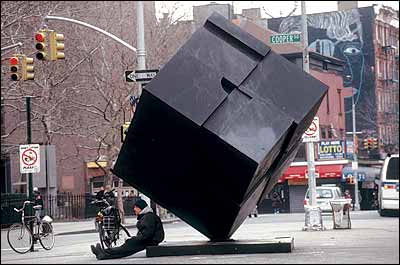
The spinnable cube in Astor Place is the best example of this. Could you imagine this East Village plaza space without it? Even as it’s now shaded by a new condo, sharing the square with a gaudy blue Chase Manhattan vestibule, it still sits immutable like a hunched homeless person that won’t leave.

The broken-looking but still operating sculpture is technically named Alamo, created by Tony Rosenthal and positioned in the middle of Astor Place in 1967. Rosenthal specializes in geometric oddities, usually broken up by their surface textures or interfaces with other shapes.

The Alamo — or Cooper Cube, or simply, The Cube — isnt a solid cube, but an uneven bonding of eight smaller ones, balanced on one of its tips. And it rotates clockwise, if you expend a little bit of elbow grease.

Why the Alamo? Like all of Rosenthal’s work, it might be difficult to ascribe the connection of title with object. Apparently Rosenthal’s wife coined the title, as the balanced cube displayed an “impenetrable strength” similar to the last holdouts at the infamous Texas fort. Hmmm.

The Cube (which everybody calls it) is particularly popular with students at neighboring Cooper Union, who are actually responsible for the Cube being there at all. It was originally placed there on a temporary basis by the NY Park Service, but Cooper Union students petitioned for the sculpture to be installed permanently.

The interlocking cubes making up the entire sculpture were inspiration for a notable prank in 2005, when the Cube was surrepticiously transformed into a Rubiks Cube. Read here to see how they did it.

The Cube was removed for repairs and replaced with a ghostly version, called the Jello Cube, before returning in November 2005, shiny and new. The temporary, transparent pipe version was named the Jello Cube because Peter Cooper, who Cooper Union is named after, is the inventor of Jello.

The Cube has seen a lot of skateboarders, vagrants, tourists, and punks, and thousands of drunk people have been seen attempting a hearty spin at 2 in the morning. It now holds court to two Starbucks (three if you count the one upstairs at the Barnes and Noble), a K-Mart, a new drugstore, and the aforementioned bank and condo. When all those places move on or close, I fully expect the Cube to still be there.

Who knows how far into the future it may survive?