Categories
Parks and Recreation

Where was Manhattan Square? The Gilded Age remaking of a neglected park

Theodore Roosevelt Park (77th and 81st Streets, between Central Park West and Columbus Avenue), which contains the beloved American Museum of Natural History, is the oldest developed section of the Upper West Side, purchased by the city in 1839 as a possible strolling park to be called Manhattan Square.
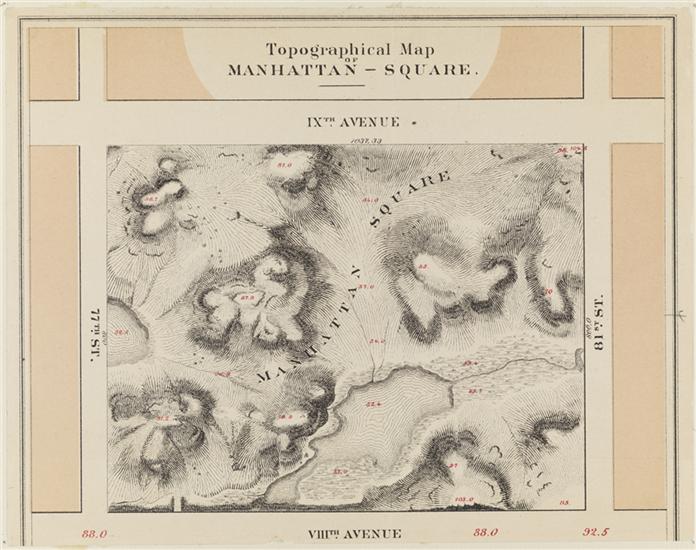
Museum of the City of New York

Central Park was but a gleam in the eye back in 1839! The Grid Plan of 1811 had divvied up upper Manhattan into organized blocks but not much was properly developed in the early 19th century. There were few suitable transportation options and thus upper Manhattan was only sparsely populated.

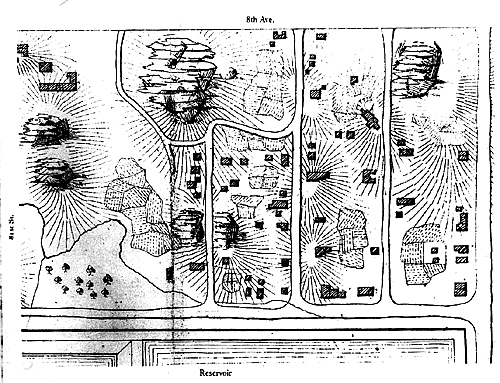
Near this spot on the grid was the old African-American settlement of Seneca Village, which was later wiped away with the development of Central Park.

Below: A sketch by Egbert Viele from 1857 showing the remains of the small village of Seneca Village. Manhattan Square would have been off to the upper left portion of this image.
The original grid plan had no significant parks built into it so later city planners had to carve some out themselves.

Unfortunately, the city almost literally forgot all about Manhattan Square — it’s even included in an 1860 New York Times article headlined NEWLY-DISCOVERED CITY PROPERTY

To be fair, the land had been granted to the Central Park Commission which was rather busy developing the park proper. As a result, Manhattan Square’s rugged and unpleasant terrain became an eye sore and rather dangerous for any actual visitors.

Samuel Ruggles, developer of both Union Square and Gramercy Park, once squawked, “It is a disgrace to the city. It is in some places forty feet below the grade and well characterized as a pestilential hole of stagnant water.”

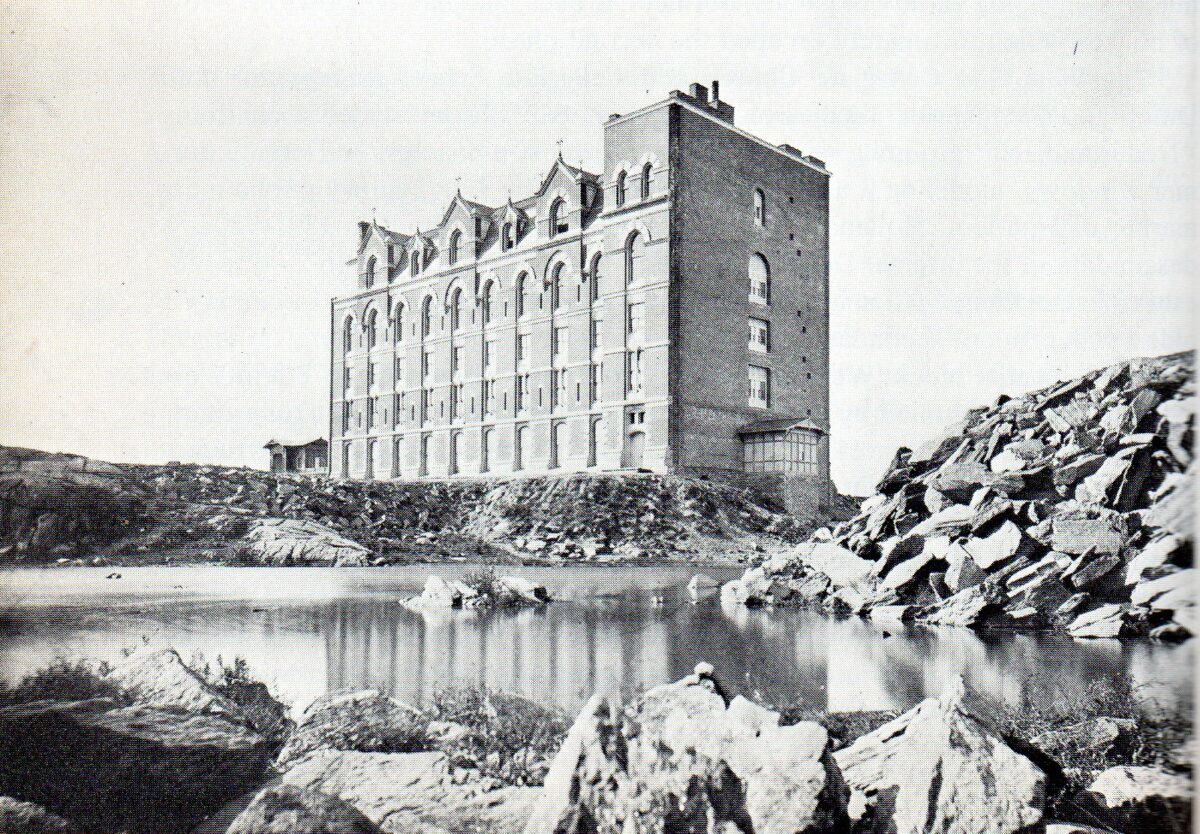
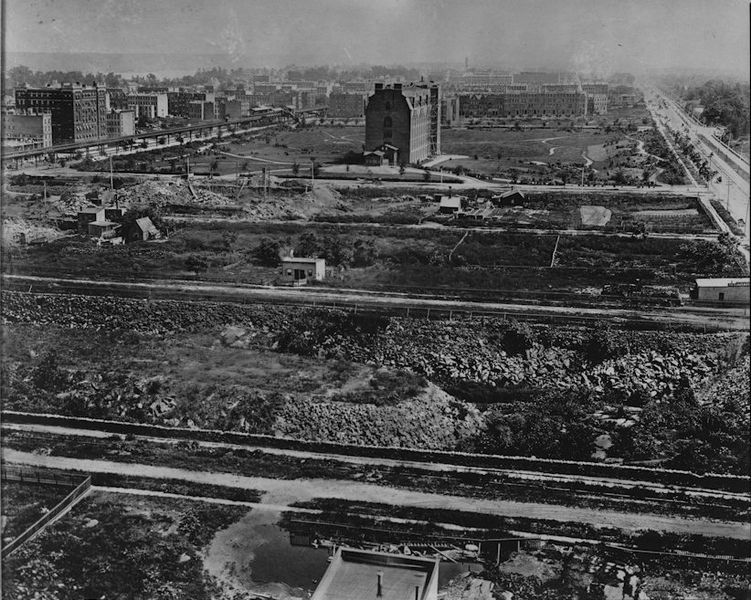
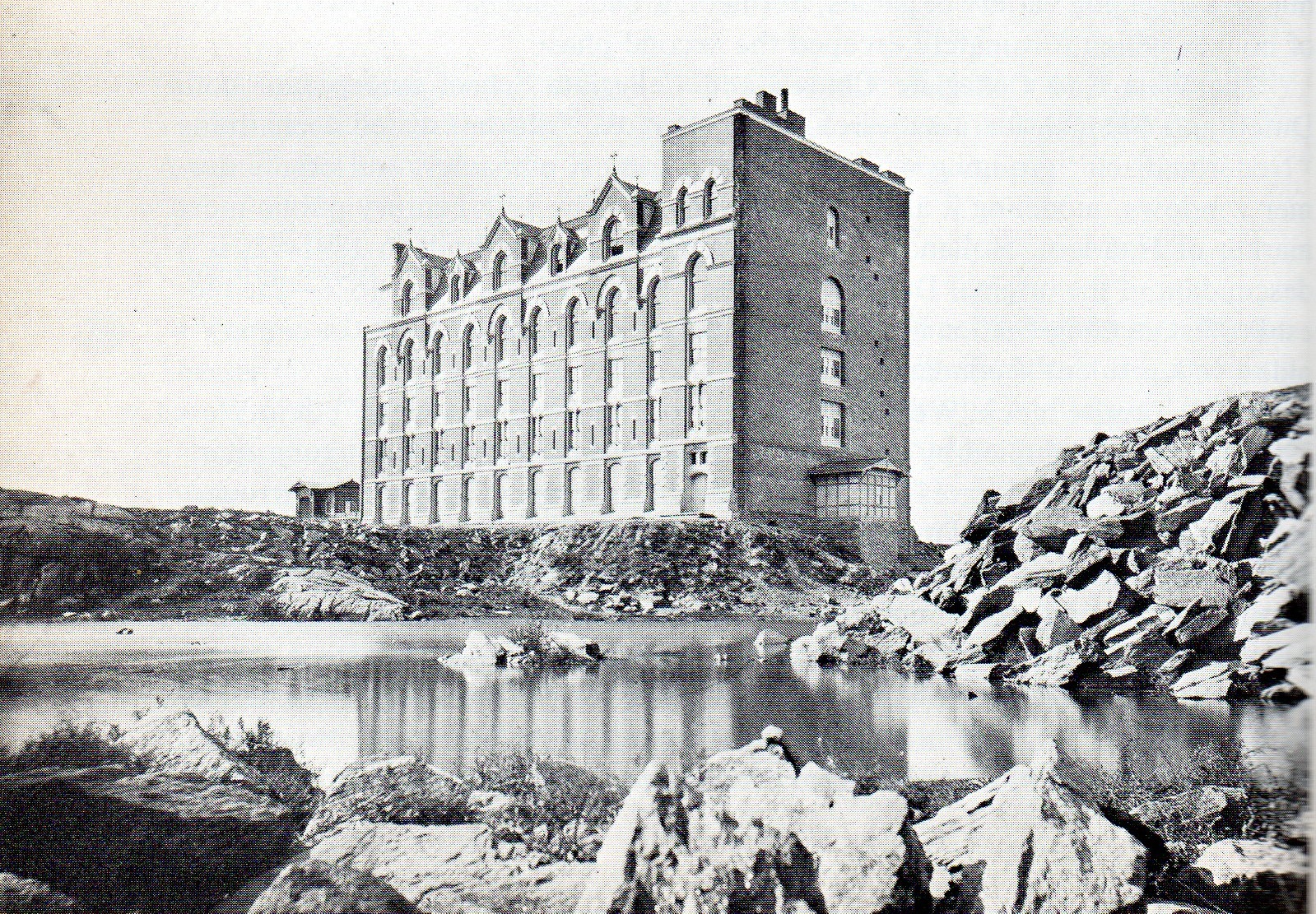
Below: From the late 1870s, the solitary American Museum of Natural History building sits on the spot of Manhattan Square, now leveled out for public enjoyment, even if the lots surrounding it are quite barren.
In the early 1860s, the city proposed selling off this sorely underused area of land.

At one point, during the Civil War, some suggested it be turned into a proper military parade ground.

“Manhattan-square [has] been proposed for the parade-ground; over Manhattan-square the Commissioners have control and it is understood that they are willing to assign it, but, just now, they have not the funds which its preparation would require.” [source]

The next plan was to make a zoo! 

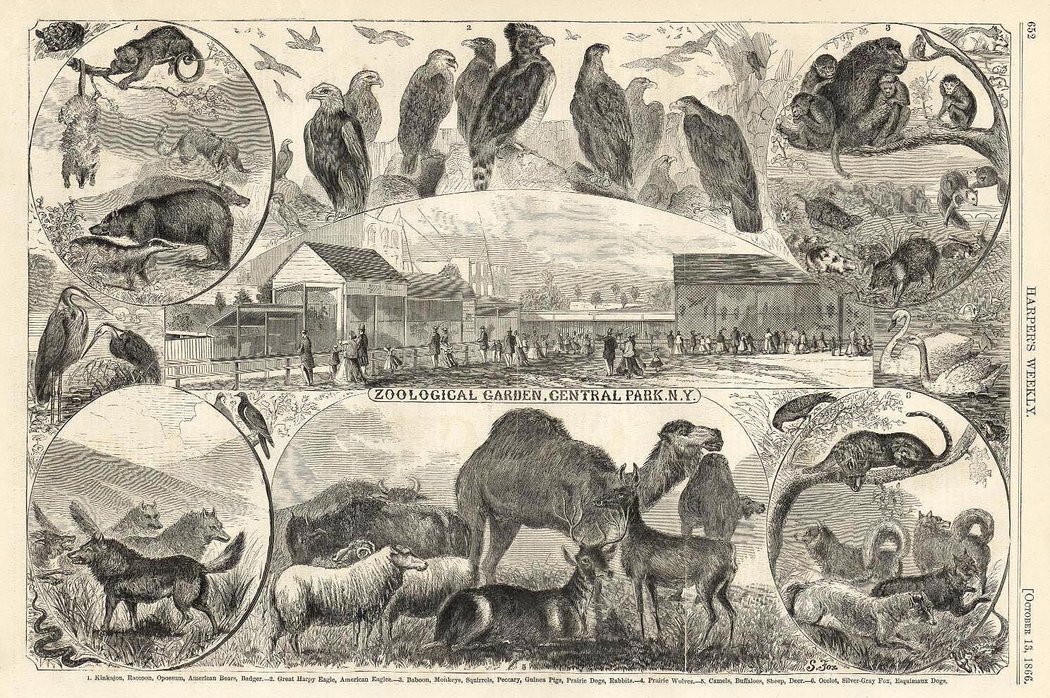
Animals had accumulated near the Central Park Arsenal as a make-shift ‘menagerie‘ — abandoned pets, former circus animals, far-flung beasts brought over on ships. At one point it was determined to move those animals to a more formal Zoological Garden, to be built on the much abused area of Manhattan Square.

From 1865: “The Zoological Gardens are about to be commenced at Manhattan-square, and the commissioners fully expect to have this valuable garden completed before the Summer wanes.”

Below: The chaos of the Central Park menagerie, depicted in an 1866 illustration
Harpers Weekly

Those planned fell through of course. Today the Central Park Zoo marks the location of that former menagerie.

By 1872, the Central Park Commission would utilize Manhattan Square for another mission, designating it the home for the American Museum of Natural History.

The first structure would be completed in 1877. (For more information on the institution’s development, check out our podcast on the subject.)
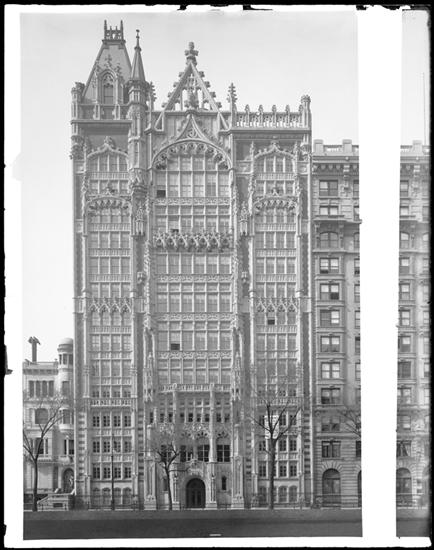
Apartment developers later flocked to the park’s edges, drawn to its proximity to other fashionable apartment houses in the neighborhood like the Dakota Apartments (at 72nd Street, built in 1884).

Luxury apartment living soon transformed the Upper West Side, and the fate of Manhattan Square — renamed Theodore Roosevelt Park in 1958 — changed with it.

Below: 44 West 77th Street. Manhattan Square Studio Apartment, photographed in 1910
MCNY

Of course, you may not know it by that name today either. From the New York Department of Parks and Recreation: “Neighborhood residents have traditionally referred to the parkland as Museum Park or Dinosaur Park.”

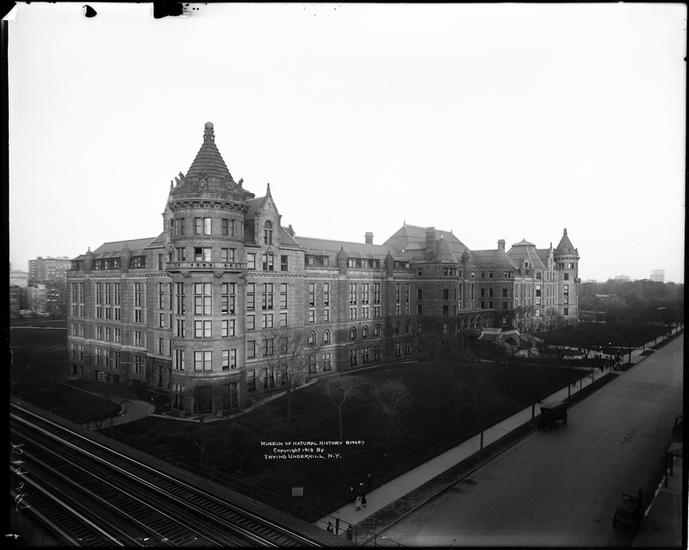
Below: The fully expanded museum as it looked in 1913
MCNY

The above is an expanded excerpt from our book The Bowery Boys Adventures In Old New York, now available at bookstores everywhere.
Categories
Podcasts Science

Dinosaurs and Diamonds: Stories from the American Museum of Natural History

PODCAST Ancient space rocks, dinosaur fossils, anthropological artifacts and biological specimens are housed in New York’s world famous natural history complex on the Upper West Side — the American Museum of Natural History!

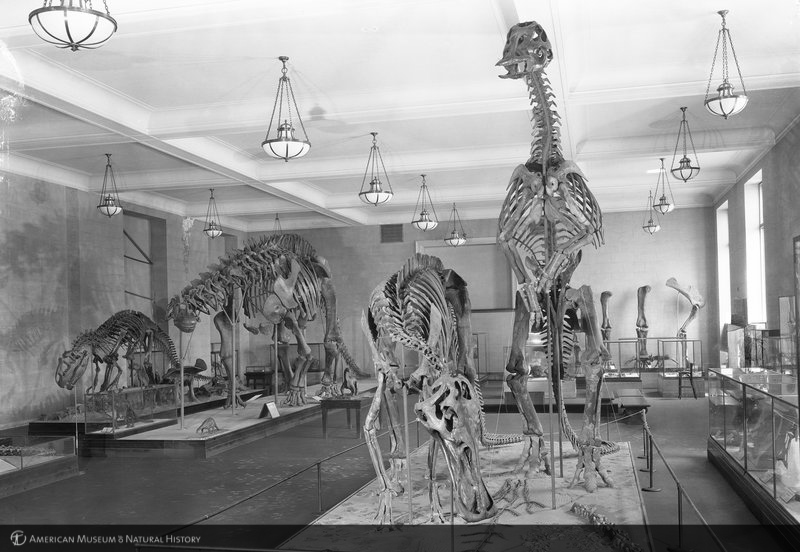
Trachodon Group, Brontosaurus and Allosaurus, Dinosaur Hall, 1927. Courtesy the American Museum of Natural History

Throughout the 19th century, New Yorkers tried to establish a legitimate natural history venue in the city, including an aborted plan for a Central Park dinosaur pavilion.

With the creation of the American Museum of Natural History, the city finally had a premier institution that celebrated science and sent expeditions to the four corners of the earth.

Tune in to hear the stories of some of the museum’s most treasured artifacts and the fascinating folks behind the collection — including one explorer who might have inspired a famous movie hero.

But there’s also a dark side to the museum’s history, one that includes the tragic tale of Minik the Inughuit child, subject by museum directors to a bizarre and cruel lie.

PLUS: How exactly do you display a 68,100 lb meteorite?

AND: An update involving that rather controversial equestrian statue of Theodore Roosevelt.

This is a re-broadcast of a show originally released on November 24, 2010 with bonus material recorded in 2020. 


Listen today on your favorite podcast player or just press play here:


The website of the American Museum of Natural History has all the details you need for your visit — including information on safety. On top of suggested admission, there are additional costs for the special exhibits, including the planetarium.

ALSO: You must check out their dazzling digital photography collection


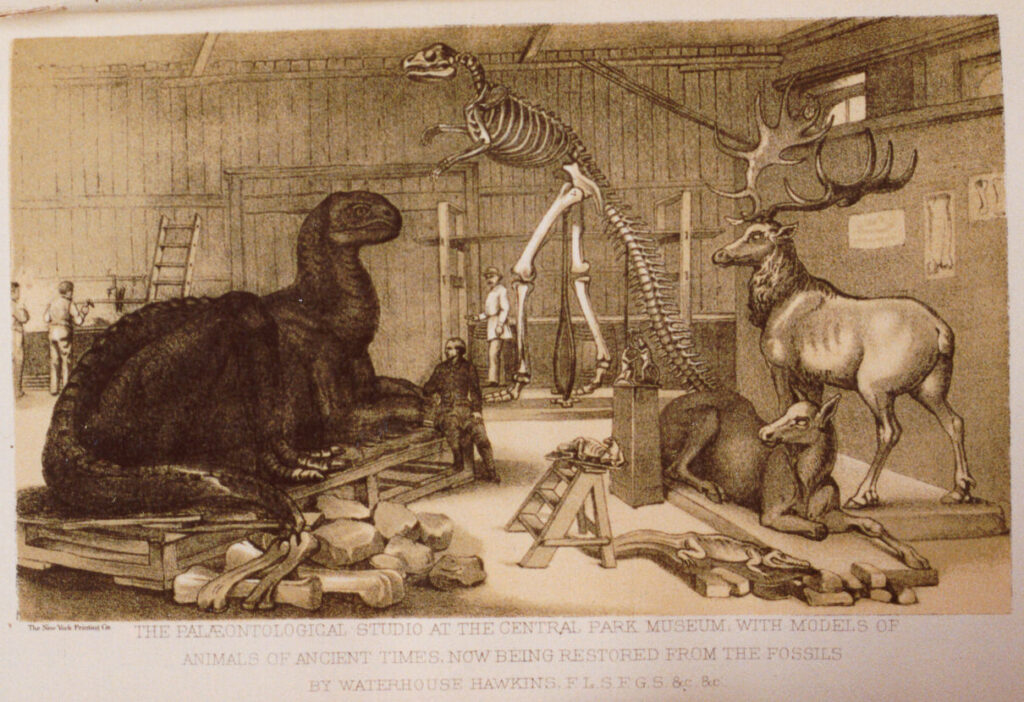
The Arsenal studio of Benjamin Waterhouse Hawkins, 1869.

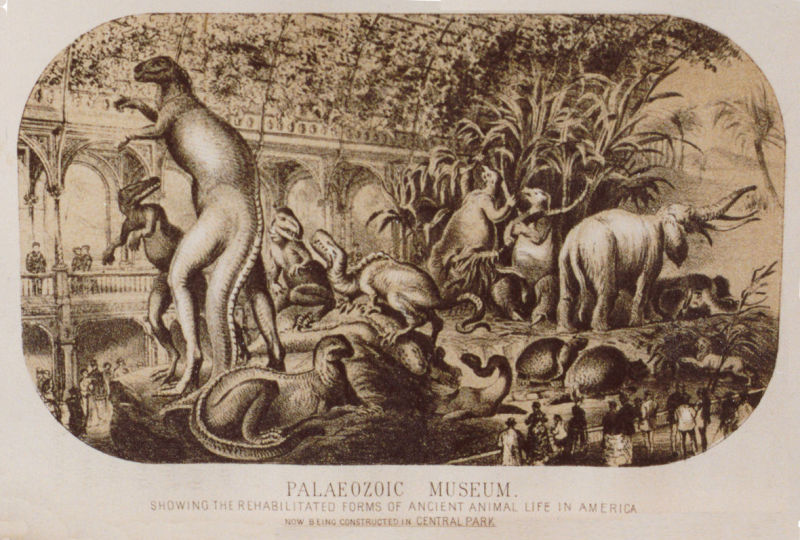
A sketch of what the Paleozoic Museum might have looked like, had construction not been stopped by the cronies of Boss Tweed.

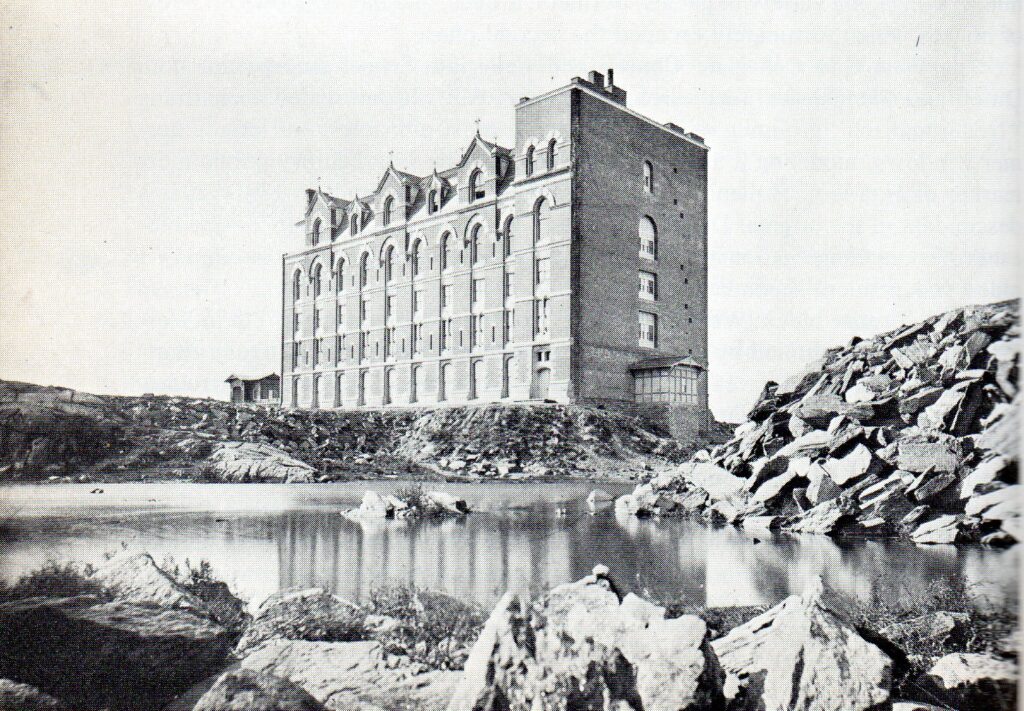
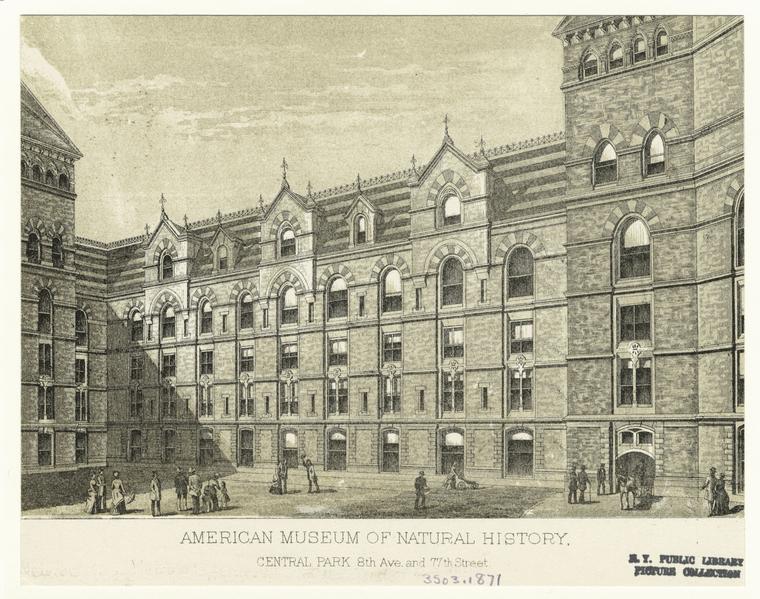
The lonely little first building of New York’s natural history museum, pictured in the early 1870s, placed on an unspectacular lot of land alongside Central Park called Manhattan Square.

New York Public Library

This illustration of the building from 1871 above displays the particular touches of Jacob Wray Mould, in the whimsical window design. What it doesn’t show is the vibrant, robust color of the building.

Although subsumed by later additions, some areas of the original walls are still peeking out within the larger structure today. [source NYPL}

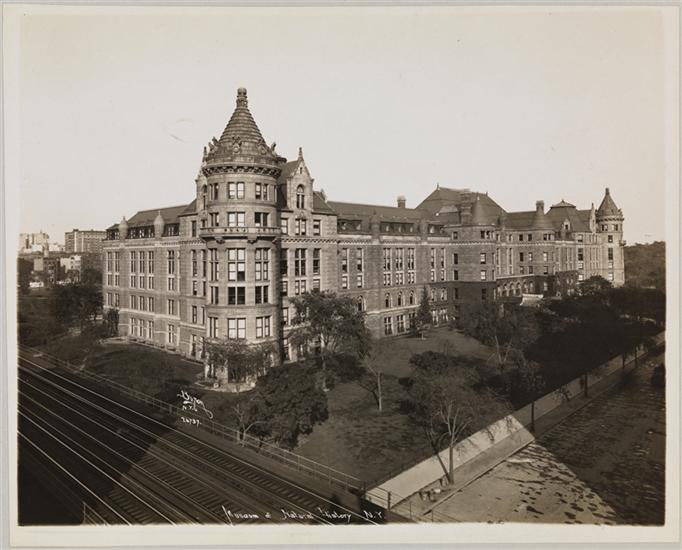
The grandeur of the museum in 1908. Note the elevated tracks running along Columbus Avenue. (Museum of the City of New York)
Library of Congress

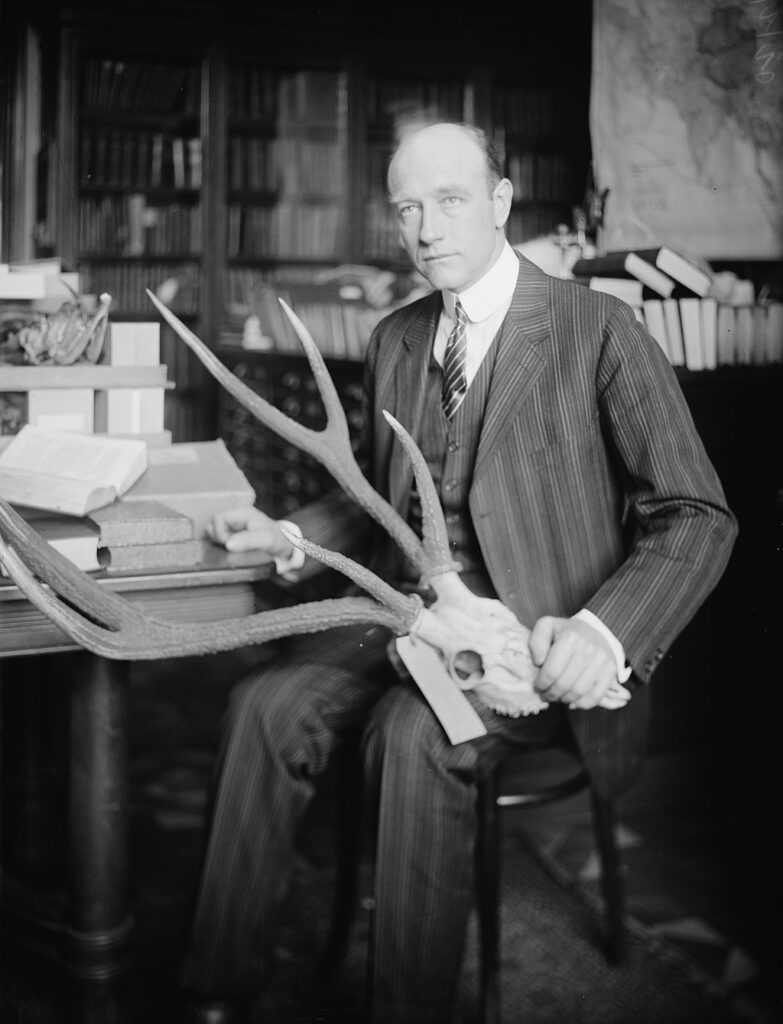
Roy Chapman Andrews, the dashing adventurer who became one of the museum’s most valuable explorers. It’s rumored that Andrews was the inspiration for the character of Indiana Jones.

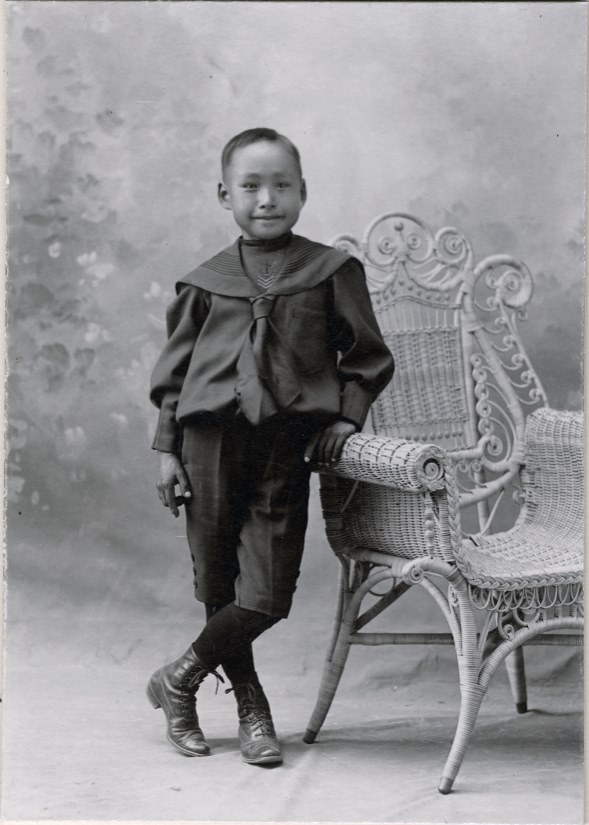
Minik Wallace, the Inuit boy brought to New York with his father in 1897. Minik was subject to one of the most bizarre and tragic cover ups in the museum’s history.

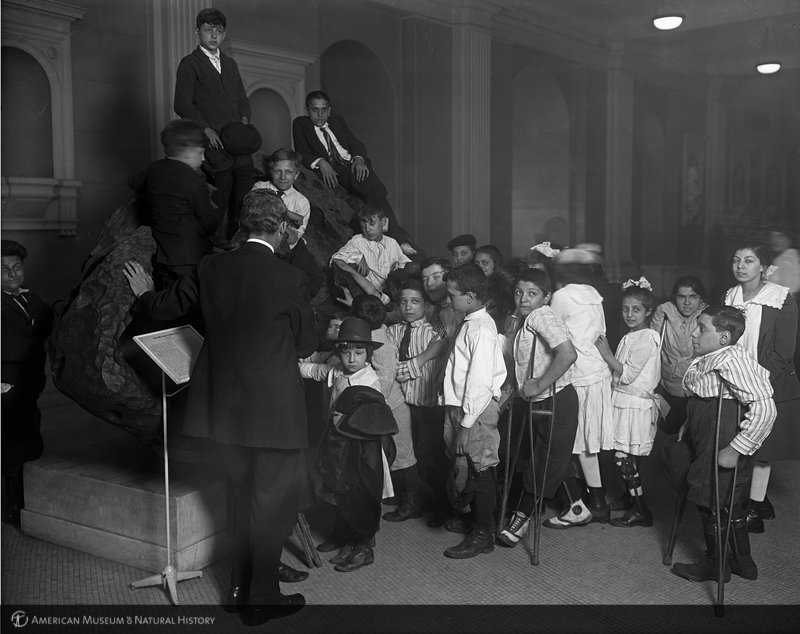
Children viewing the Williamette meteorite, 1920 (AMNH)
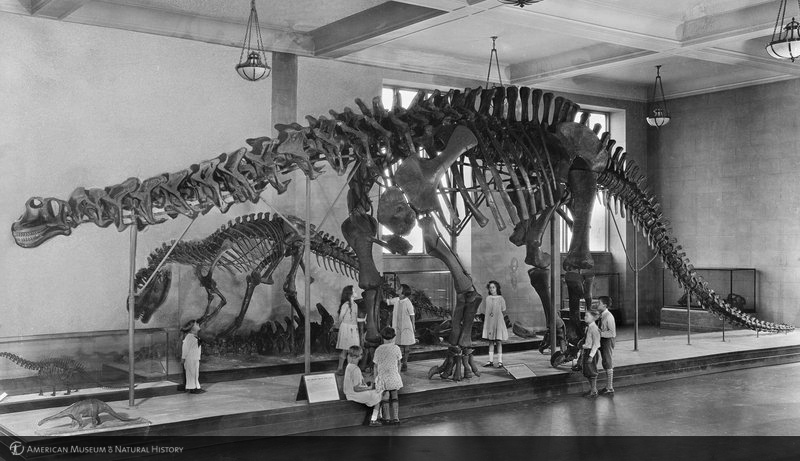
Children viewing Brontosaurus (Apatosaurus) exhibit, 1927, courtesy the American Museum of Natural History
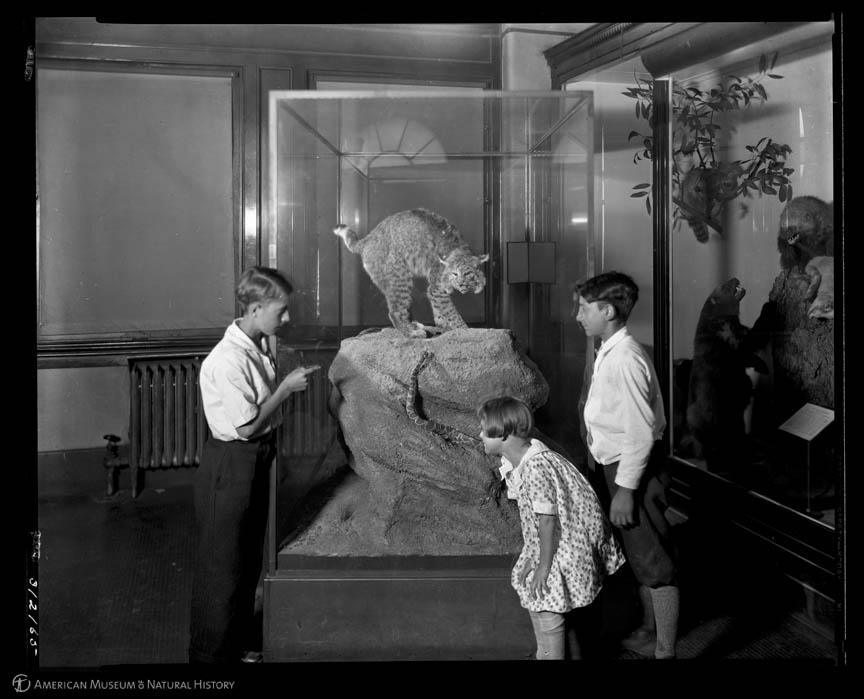
Children viewing Wild Cat Group, 1927, courtesy AMNH
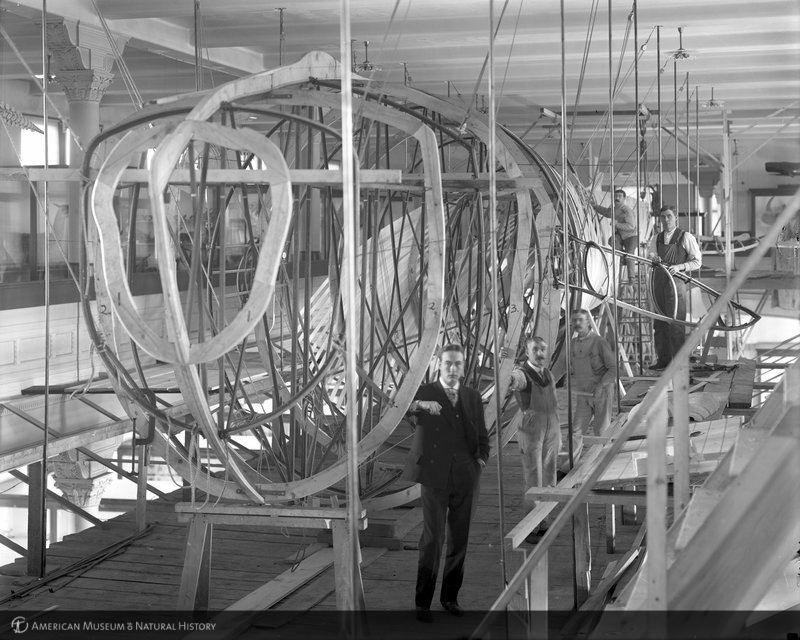
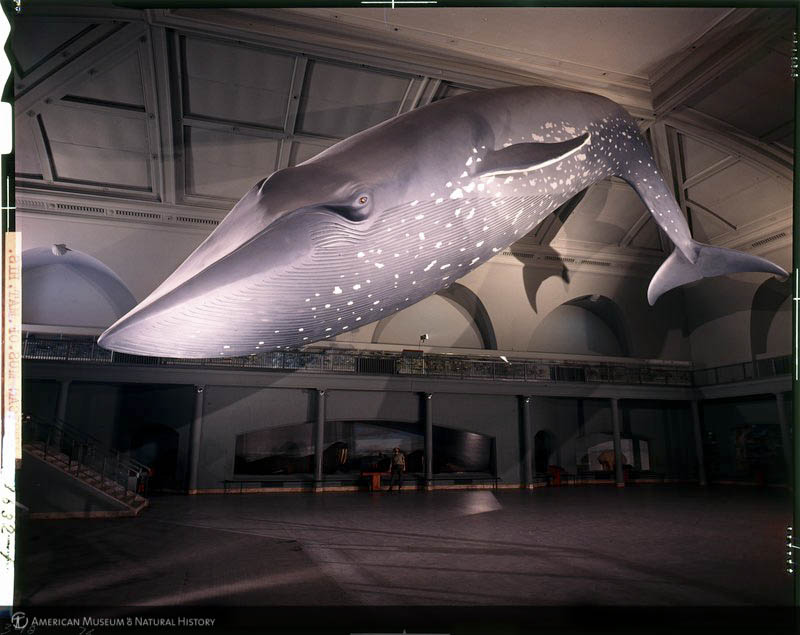
Roy Chapman Andrews with frame for model of sulphur bottom [blue] whale, November, 1906. (Courtesy AMNH). But this is not the whale you know and love! According to the Museum: “The Museum’s iconic blue whale model, first constructed in the mid-1960s, was based on photographs of a female blue whale found dead in 1925 off the southern tip of South America.” It was resculpted in 2001 based on more modern research and made with foam and fiberglass.
The Blue Whale as it appeared in 1969. (Courtesy AMNY)

A little song and dance while you’re marveling at the natural marvels:


The Bowery Boys: New York City History podcast is brought to you …. by you!

We are now producing a new Bowery Boys podcast every week. We’re also looking to improve and expand the show in other ways — publishing, social media, live events and other forms of media. But we can only do this with your help!

We are now a creator on Patreon, a patronage platform where you can support your favorite content creators.

Please visit our page on Patreon and watch a short video of us recording the show and talking about our expansion plans.

If you’d like to help out, there are six different pledge levels.Check them out and consider being a sponsor.

We greatly appreciate our listeners and readers and thank you for joining us on this journey so far.


Categories
Wartime New York

“To the memory of the Brave Soldiers and Sailors Who Saved the Union”

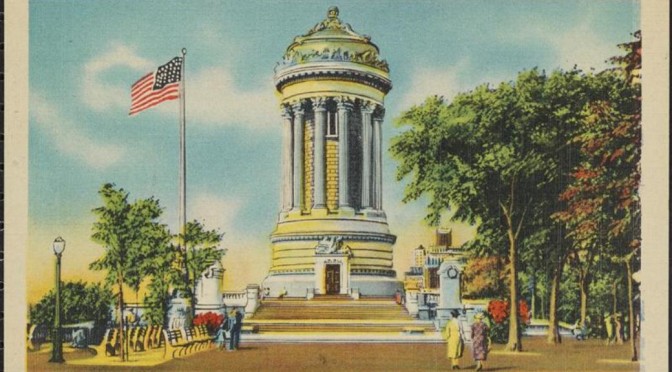
This Monday (May 27, 2019), a Memorial Day observance will be held from 10 a.m to noon at the Soldiers and Sailors Monument in Riverside Park. In honor of the holiday, we’re rerunning this 2015 article on this oft-forgotten monument.

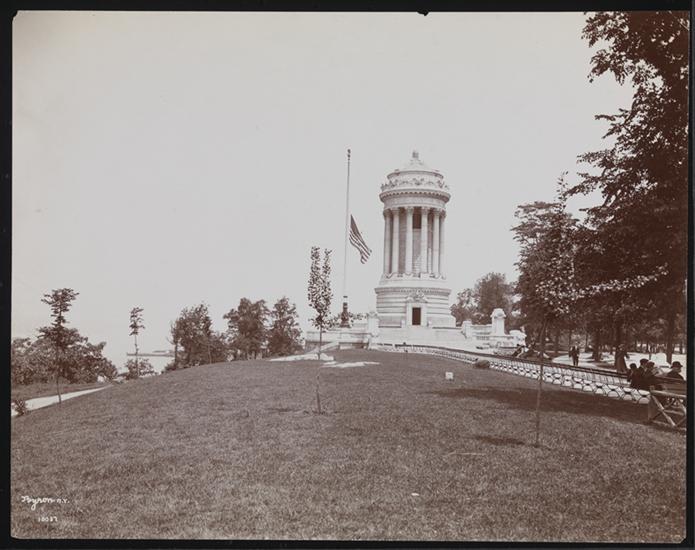
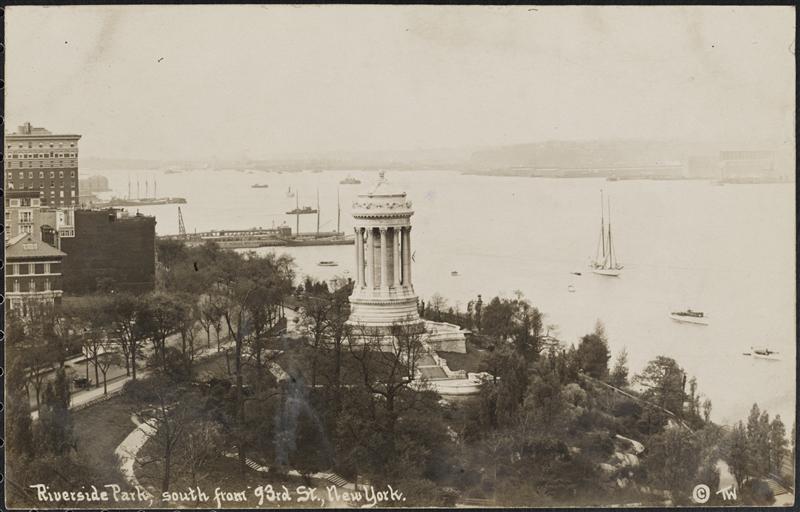
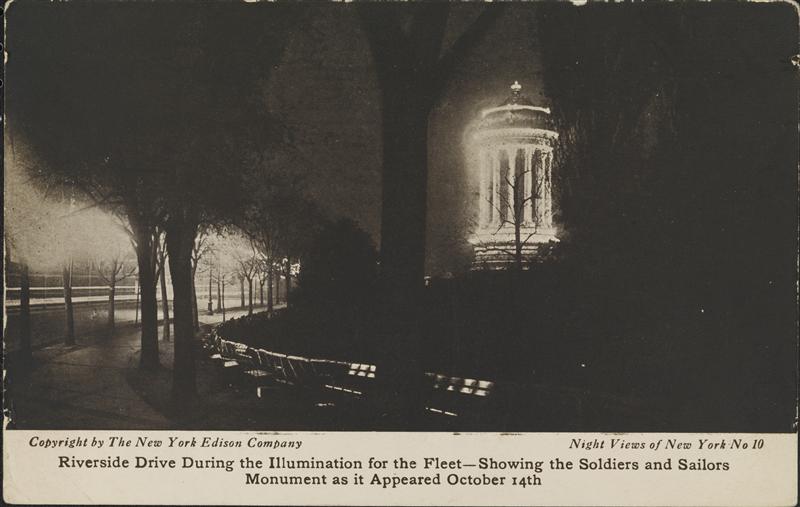
The Soldiers’ and Sailors’ Monument on the Upper West Side has been the centerpiece for Memorial Day commemoration for decades.  Unless you actually live by it, you probably have not been there in years, if at all. It’s a vastly under-appreciated landmark, occasionally vandalized and certainly in need of work. [For more on the history of Riverside Park, listen to our podcast episode: Heaven on the Hudson.]

Courtesy the Museum of the City of New York

It owes its form to the great Gilded Age fervor for classical beauty and the aesthetic appeal of Beaux-Arts architecture. Grand war memorials were sprouting up all over New York during this period, most notably he Soldiers’ and Sailors’ Arch in Brooklyn’s Grand Army Plaza (1892) and Prison Ship Martyrs Monument in Fort Greene (1908).  Then there’s Grant’s Tomb (1897), which owes its existence more to the General’s military career and not so much his scandal-filled presidency.

And similar monuments of such colossal proportion were erected in other cities including Hartford (1886), New Haven (1887), Allentown (1899) Indianapolis (1902), Baltimore (1909)  Syracuse (1910), Pittsburgh (1910), among many others.

Courtesy the Museum of the City of New York

Monuments are dandy indicators of civic pride but many were inspired by practical necessity. Most Union veterans were in their ’50s and ’60s by this time many of these memorials were planned. Those that grew up after the war– the sons and daughters of war heroes — wanted to recognize the achievements of a previous generation.  Many of these men (Grant being the notable example) were now prominent citizens in New York.

Its also not a coincidence patriotic feelings were swelling during this period due to conflicts like the Spanish-American War which would later demand their own memorials like the powerful Maine Monument, unveiled in 1913.

1915, courtesy the Museum of the City of New York

Riverside Drive might seem a curious place to put a Civil War monument. In fact, its location inspired a bit of a civic war itself from the moment it was first planned in 1893.  “THE MONUMENT FIGHT AGAIN” proclaimed the New York Times in 1895, reporting on a rivalry between  members of the Upper East Side Association and the Upper West Side Association.

I mean, in 1895, didn’t it make sense to place it on Fifth Avenue, the most prominent and wealthy street in the world? Proponents chose Fifth Avenue and 59th Street, the entrance to Central Park, as the ideal spot. “It is rather amusing to hear …. grounds for opposition in view of what was said in front of the Commissioners when the west side men wanted to locate the monument on the Riverside Drive and Seventy-Second Street…..[T]hey charged that the Plaza was not suitable because the monument would be surrounded by buildings that would dwarf it.”

Supports of the Riverside site claimed that the foundations would not be sturdy enough near the park, an amusing remark given the skyscraper boom which would take over Midtown Manhattan in the 20th century.  In particular, naval officers bristled at the Fifth Avenue site which was almost as far from the site of water that one could get in Manhattan.

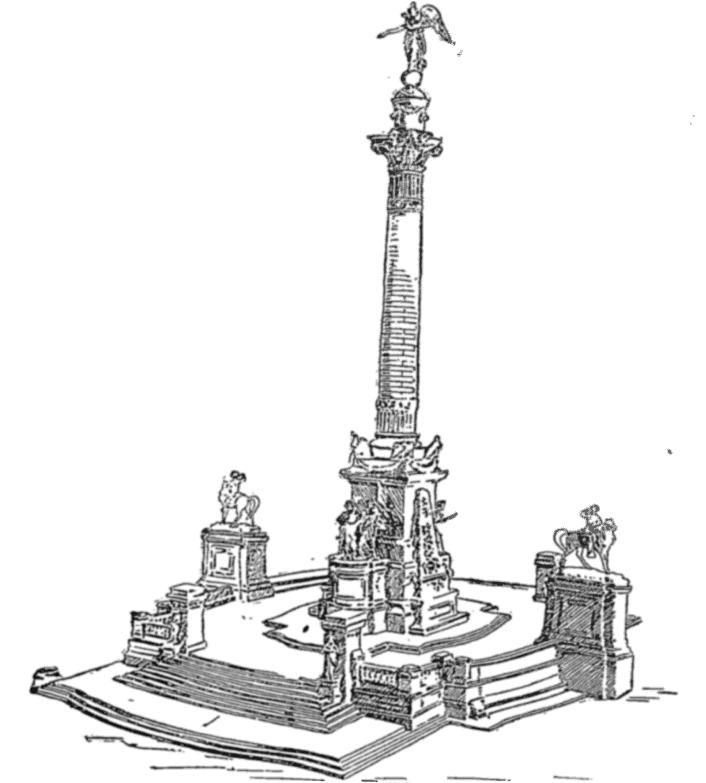
Had the eastsiders won, we would have gotten a Soldier’s and Sailors Monument that looked like this on the spot of today’s Grand Army Plaza:

1

By 1899, years after the project was conceived, proponents of the west side finally won out.  The monument was planned for a spot in the newly developed Riverside Park known as Mount Tom, a “very beautiful little knoll of natural rock,” believed to have been a spot of quiet contemplation for one Edgar Allen Poe (who lived nearby in 1844).  That was at Riverside Drive and 83rd Street.  Eventually that too was deemed inadequate, and the preparations were then moved to the present location at 89th Street.

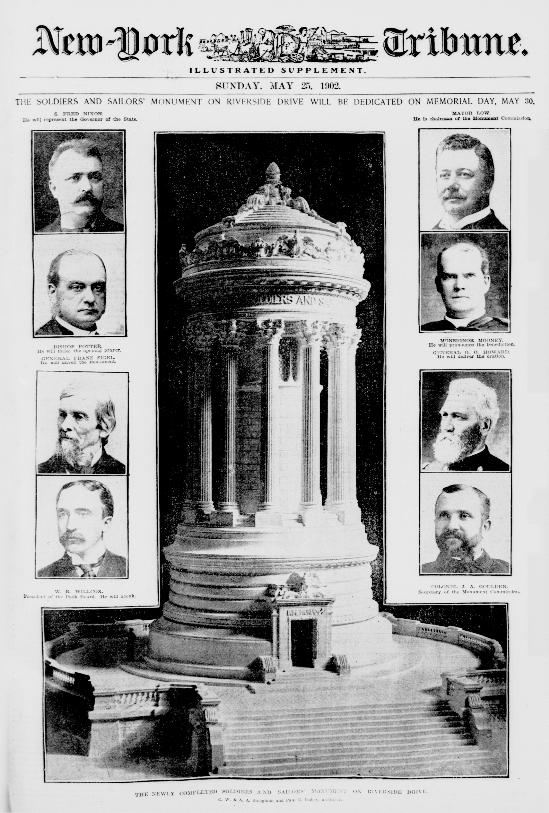
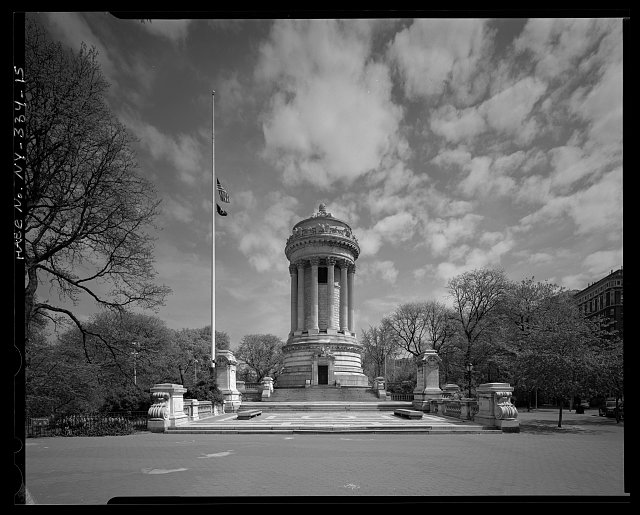
Given the new location, the monument was redesigned by the firm of Straughton and Straughton as a circular temple adorned with Corinthian columns. The Soldiers and Sailors Monument was officially dedicated on Memorial Day 1902:

1

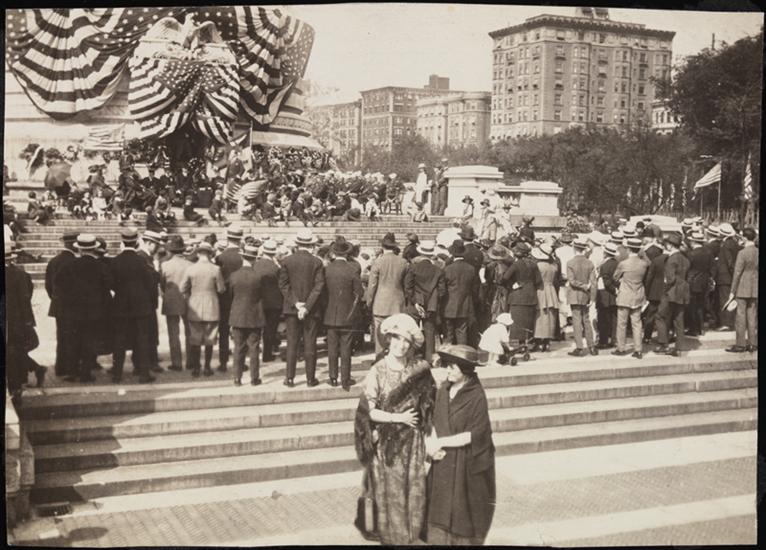
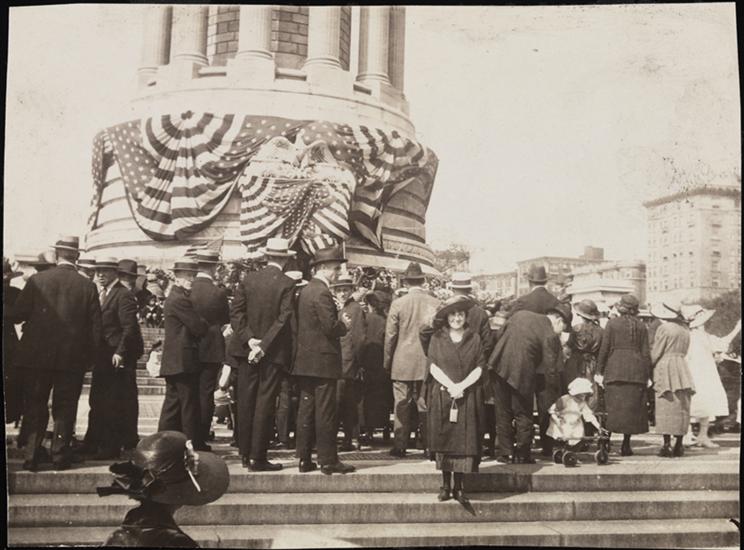
Here are a couple views of its dedication ceremony in 1902:

Courtesy the Museum of the City of New York

The final monument is absolutely beautiful, of noble design, but was not well constructed.  Repairs were necessary less than five years later, and the structure has gone through several alterations.  This New York Times article gives you a look inside the monument and reviews some current efforts to rescue the building from further deterioration.

The weather’s supposed to be spectacular this holiday weekend, so make that a good excuse to visit this unusual and charming little memorial.

Photo by Renee Bieretz, courtesy the Library of Congress

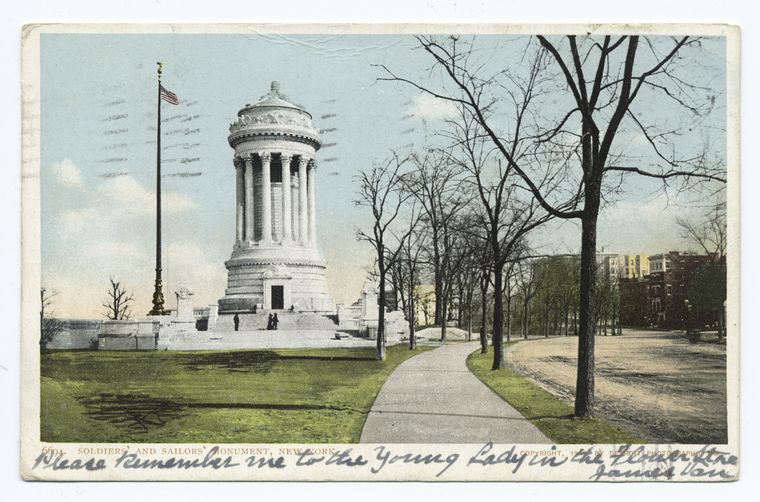
And finally, a mysterious post card from the New York Public Library collection. Note the caption:

forindex

Categories
Landmarks Podcasts

The Origin of Broadway: The Story of a Street

PODCAST What makes a street so extraordinary that it becomes a destination in itself? What makes it Broadway? This is the history of New York City’s most famous street and a progression through the entire history of the city.

In this episode, Tom is joined by Fran Leadon, the author of a new history of Broadway, called Broadway: A History of New York in 13 Miles.

We’ve discussed Broadway, the street, in just about every show we’ve done — as so many of the city’s key events have taken place along Broadway or near it. And that’s also the point of Fran’s book — by telling the story of a street, you’re actually telling the story of the entire city.

On today’s show, we’ll be discussing how Broadway moved north — literally, how did it expand, overcoming natural obstacles and merging with… or avoiding… old, pre-existing roads, and how did it take such an unusual route?

And perhaps most surprisingly, how did Broadway survive the Commissioner’s Plan of 1811 which imposed a rigid street grid on the city?

You’re in for a few surprises.

To download this episode and subscribe to our show for free, visit iTunes or other podcasting services or get it straight from our satellite site.

You can also listen to the show on OvercastGoogle Music and Stitcher streaming radio.

________________________________________________________

The Bowery Boys: New York City History podcast is brought to you …. by you!

We are now producing a new Bowery Boys podcast every other week. We’re also looking to improve the show in other ways and expand in other ways as well — through publishing, social media, live events and other forms of media. But we can only do this with your help!

We are now a member of Patreon, a patronage platform where you can support your favorite content creators for as little as a $1 a month.

Please visit our page on Patreon and watch a short video of us recording the show and talking about our expansion plans. If you’d like to help out, there are five different pledge levels (and with clever names too — Mannahatta, New Amsterdam, Five Points, Gilded Age, Jazz Age and Empire State). Check them out and consider being a sponsor.

We greatly appreciate our listeners and readers and thank you for joining us on this journey so far.

_______________________________________________________

You can read Greg’s review of Fran Leadon’s book from a couple months ago here. “Fran Leadon, an architect and co-author of fifth edition of the AIA Guide to New York City, is a perfect biographer for Broadway, a main character in the development of one of the world’s great cities. His book is dense, richly written and researched, loaded with a million fun anecdotes.”
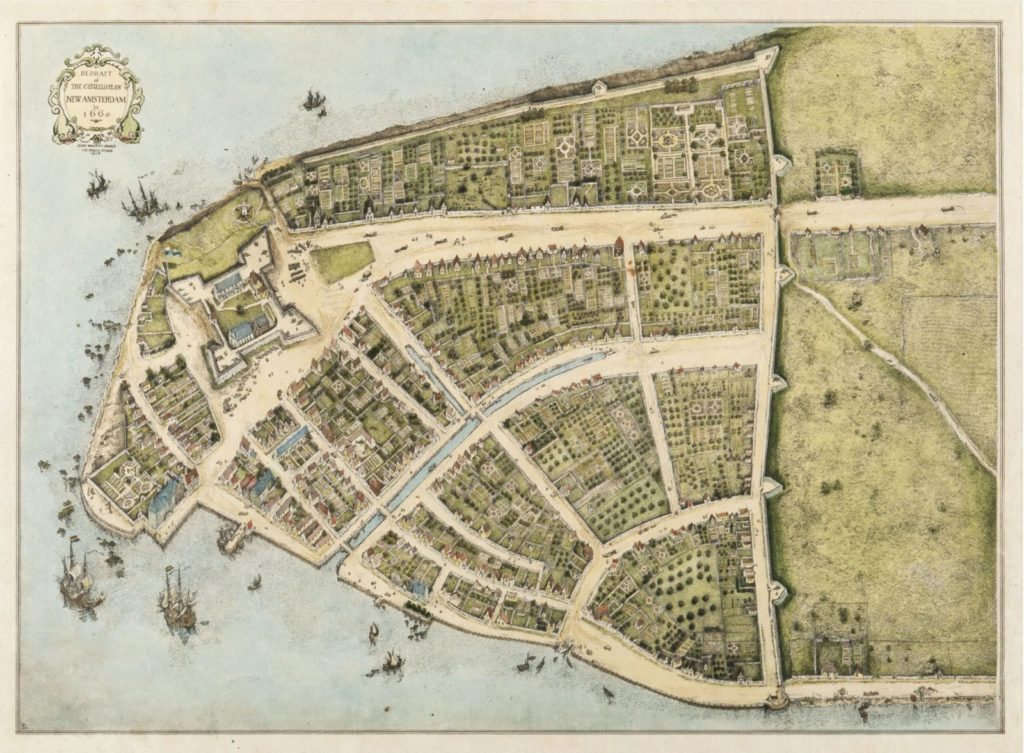
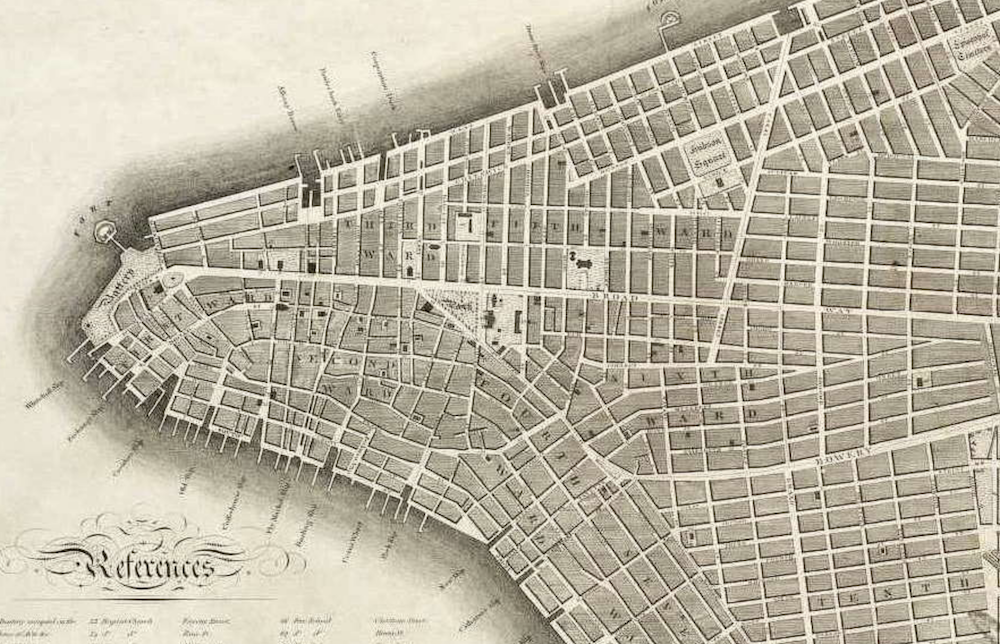
The beginning of Broadway — from a map of New Amsterdam and one from the Commissioners Plan

New York Public Library

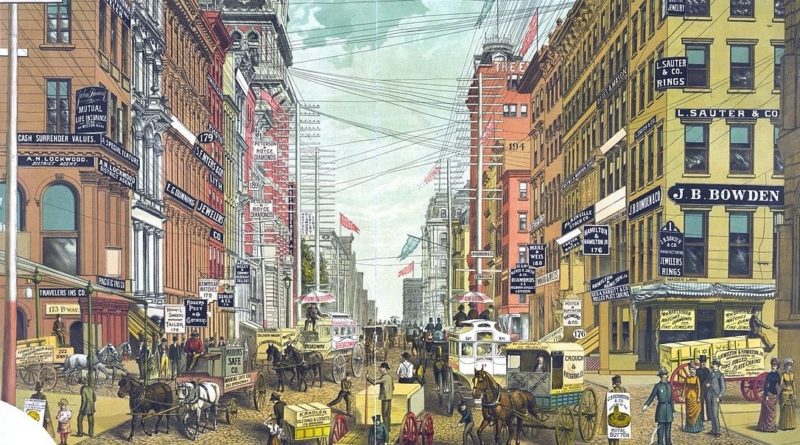
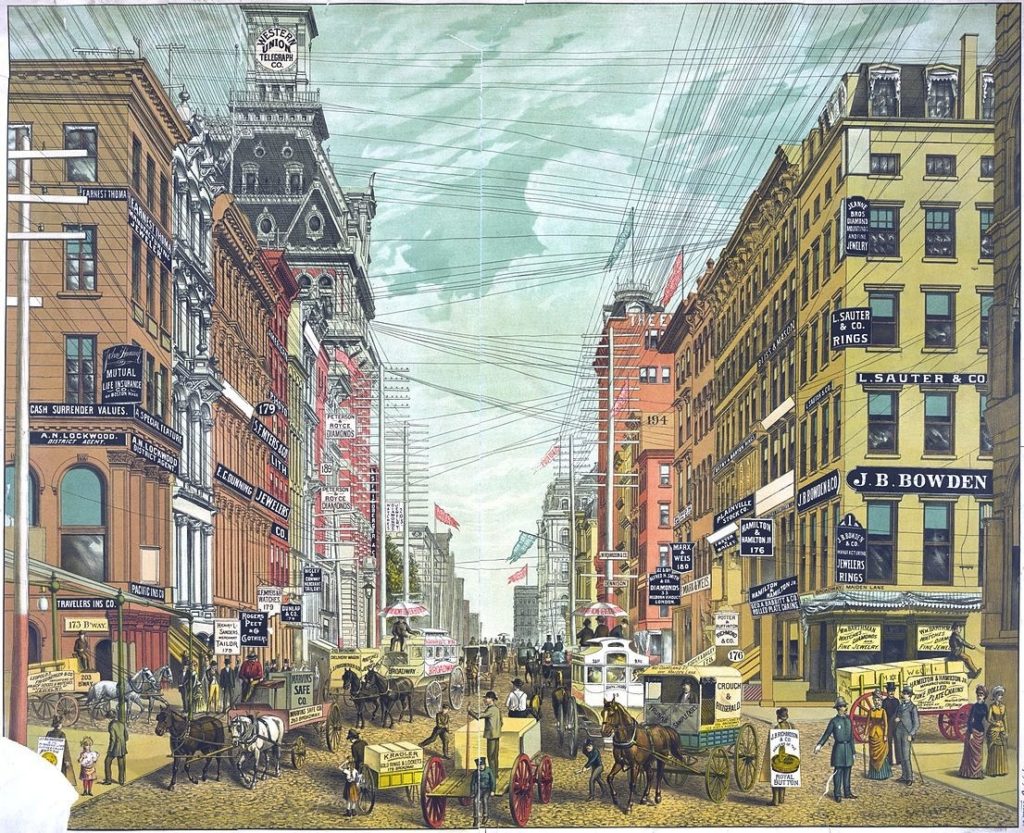
Undated image of the commerce of Broadway. The Western Union building was located on Broadway and Dey Street, placing this view in lower Manhattan. Note the telephone and telegraph wires!

Library of Congress [No Date Recorded on Shelflist Card]

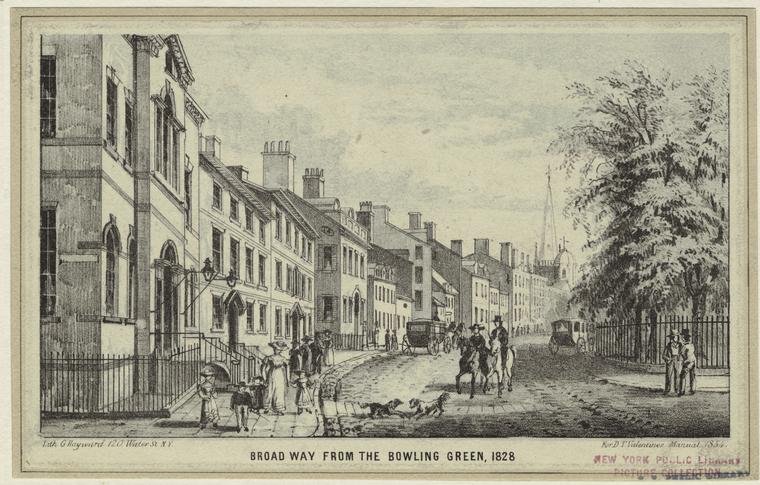
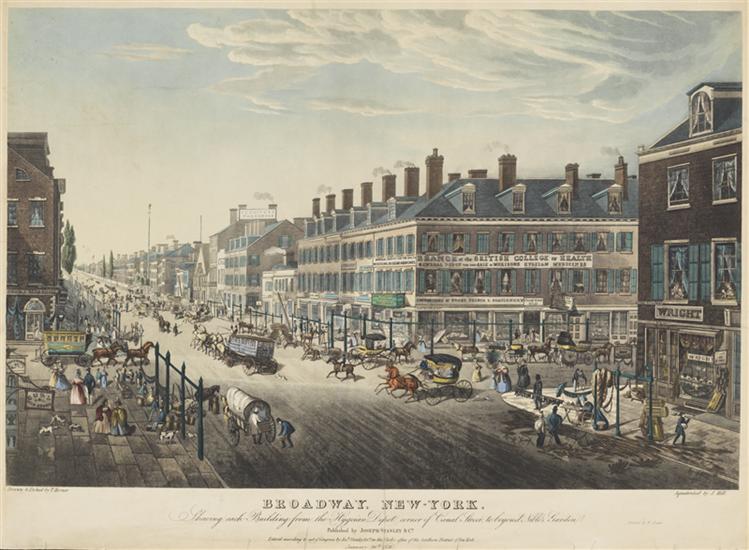
Broadway at Canal Street, 1836, in a lithograph by T. Hornor

Museum of the City of New York

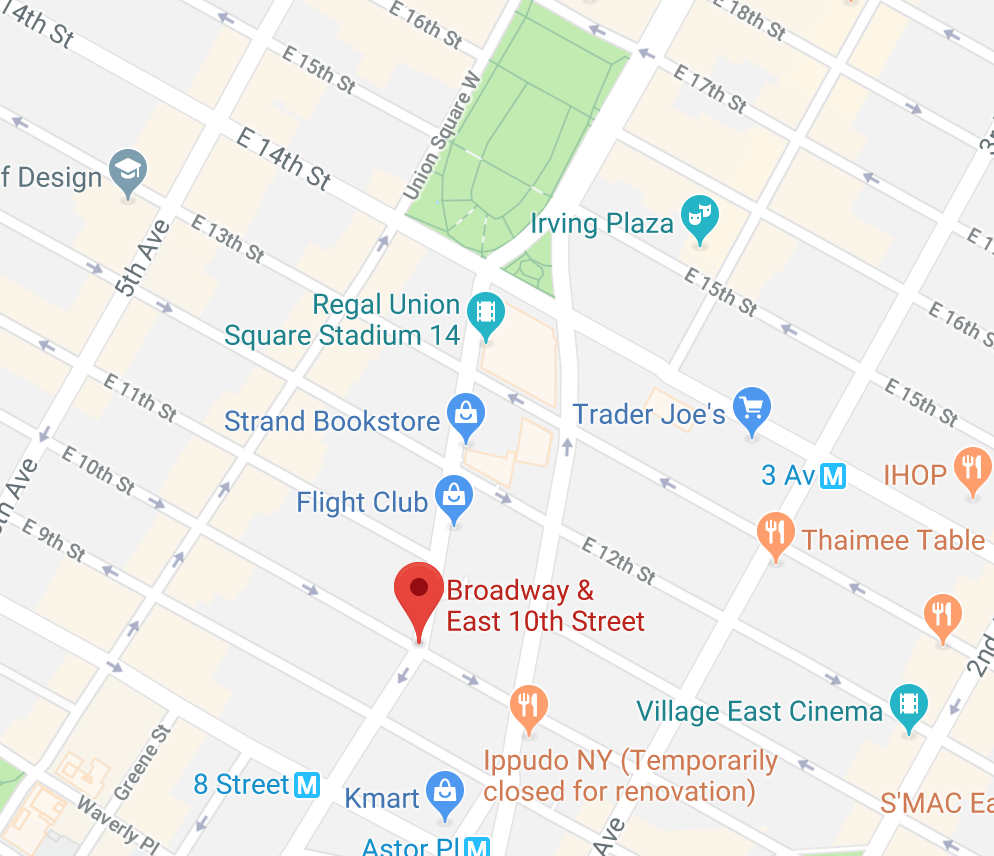
The unique ‘Broadway bend’ that begins on 10th Street, attributed, some say, to the farm of Henry Brevoort.

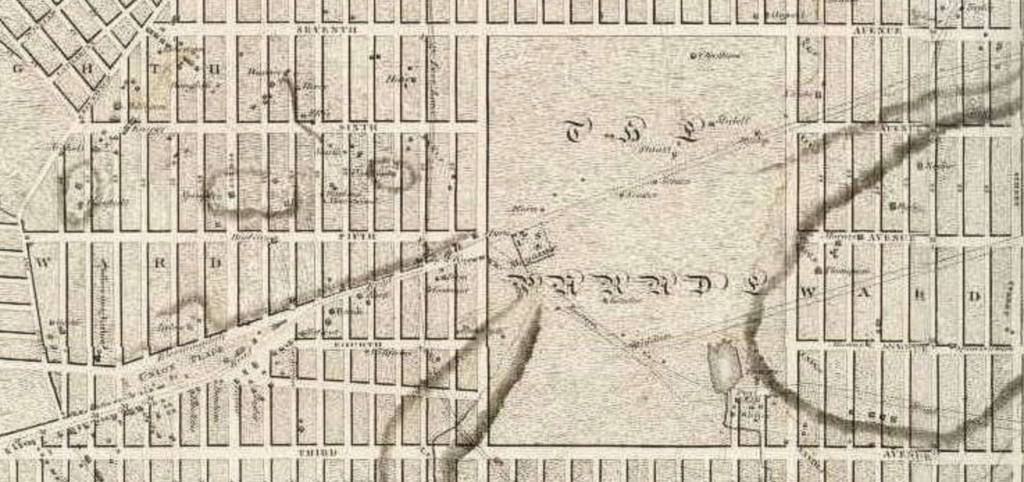
From the Commissioners Plan of 1811, both Broadway and the Bowery were to ‘disappear’ into a massive open space called the Parade.

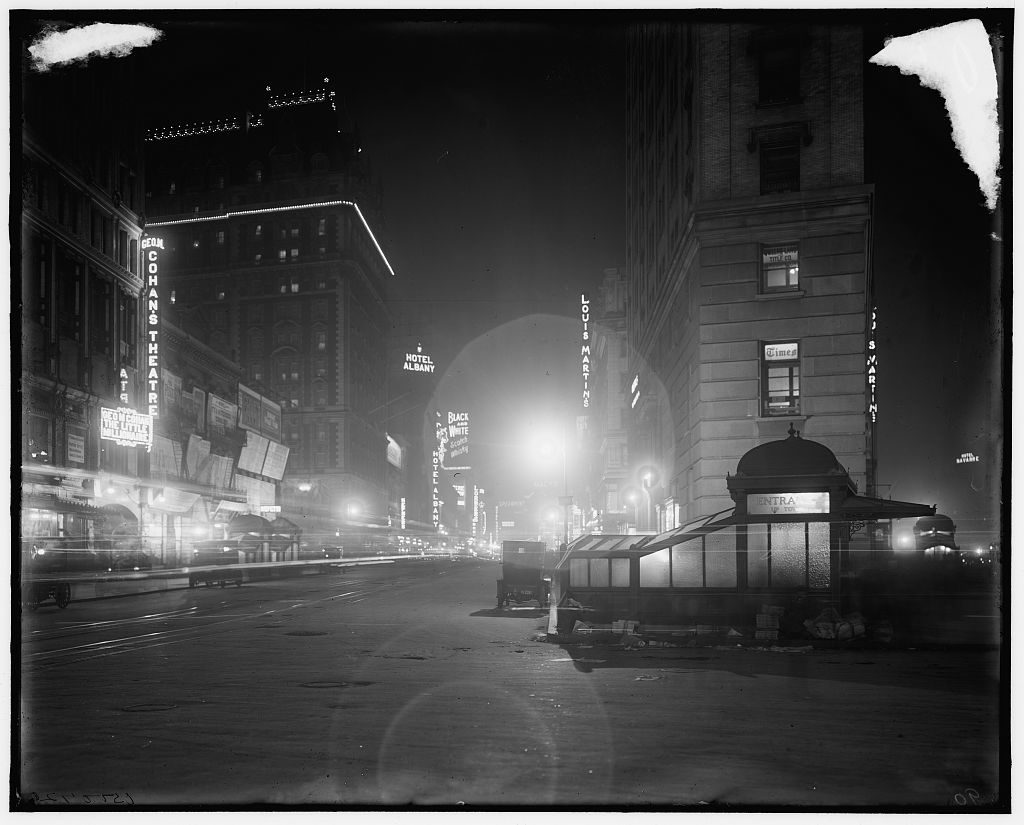
The glamour of Broadway and 42nd Street as it heads into Times Square. Broadway’s many ‘accidental’ plazas are responsible for most of New York’s cultural hubs. Thanks to the subway and proximity to the two major train stations, the ‘center of it all’ seemed to remain in Times Square, even as the city continued to move further northwards.

Library of Congress

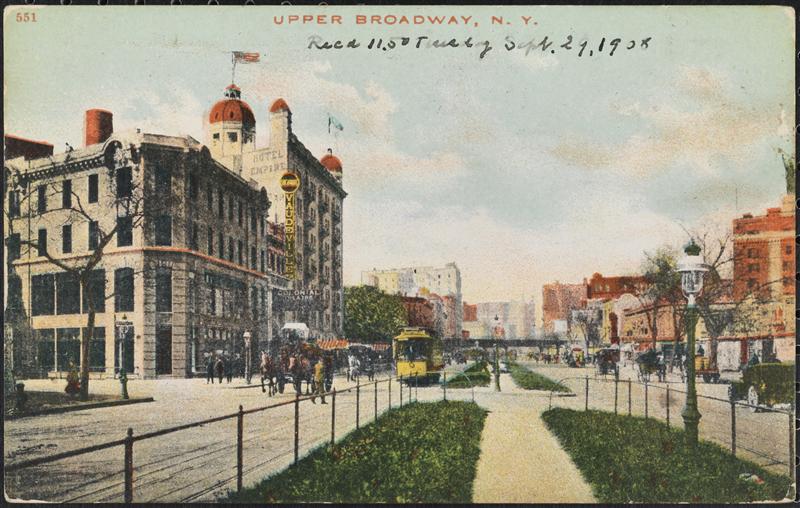
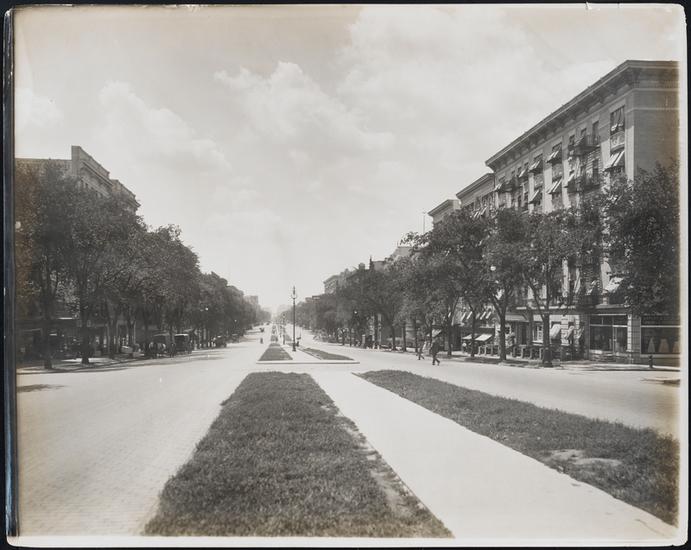
Broadway at West 62nd Street and at West 153rd Street, circa 1900-1915. City planners had an opportunity to make Broadway in upper Manhattan into a grand boulevard, Paris-style.

Museum of the City of New York
Museum City of New York
Categories
Bowery Boys Bookshelf Wartime New York

The marks of World War I, scattered throughout the five boroughs

Echoes of the first World War, one hundred years behind us, can still be found in virtually every neighborhood of New York City.

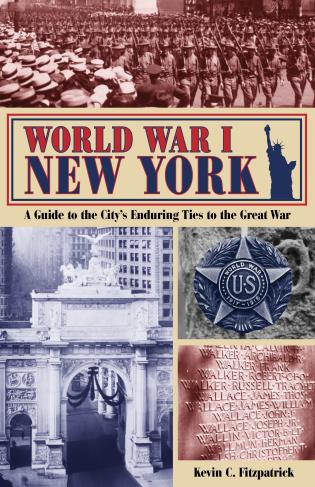
In Kevin C. Fitzpatrick’s revealing and compact guidebook World War I New York: A Guide to the City’s Enduring Ties to the Great War, these memories linger in familiar landmarks and obscure monuments alike. The effect of assembling these reminders in one book is eye-opening; collecting them brings a new sense of poignancy to markers often ignored.

Fitzpatrick organizes these marvelous finds by subject, but in my opinion the most helpful section is near the end, where all entries are arranged by borough and neighborhood.  It’s a book designed for American history buffs and locals who just want to make new connections with their neighborhoods. (There’s even a few maps for those who enjoy self-guided walking tours.)

A few of my favorite World War I related artifacts featured in the book:

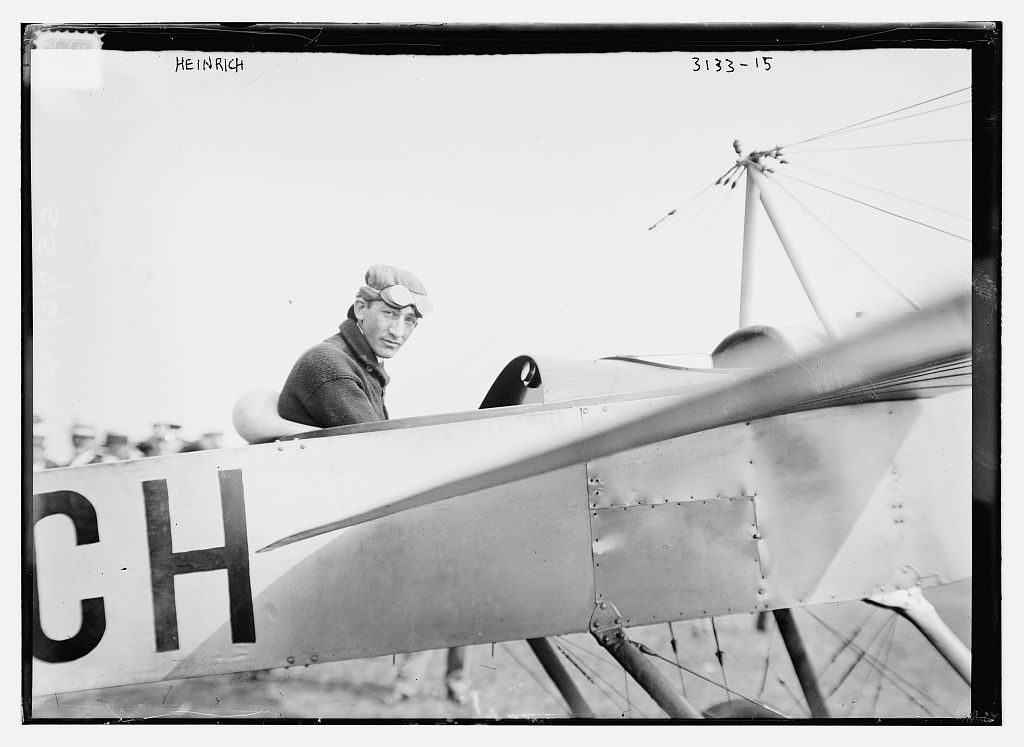
Pilot Albert S. Heinrich on Governors Island July 4, 1914. Heinrich built airplanes for the war effort during WWI. (Library of Congress)

Fort Jay Airfield and the Early Birds

Sure, Governors Island is a veritable pleasure garden now, but back in 1916-17, it was a pivotal location for wartime flight training, the spot of one of America’s first airfields.

Writes Fitzpatrick: “More than two dozen pioneer aviators trained here, and many shipped out as America’s first combat pilots.”

Library of Congress

James Montgomery Flagg and Howard Chandler Christy Studios

Two artists most associated with the war propaganda effort worked and lived on the same block on the Upper West Side.

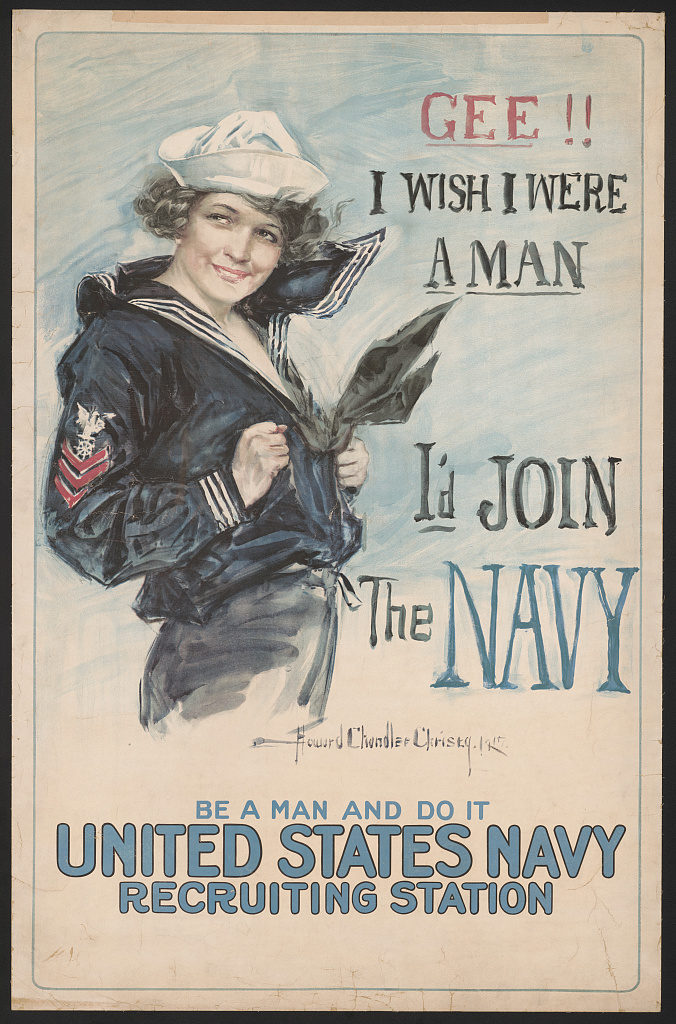
Fitzpatrick: “Christy is remembered for his luscious palette and fetching women, often dressed in men’s uniforms, next to slogans such as ‘Gee! If I Were A Man I’d Join The Navy.’ But Flagg created the real icon, instantly recognizable a century later: Uncle Sam pointing to the viewer over ‘I Want You.'”

Photo by Jim Henderson/Wikimedia

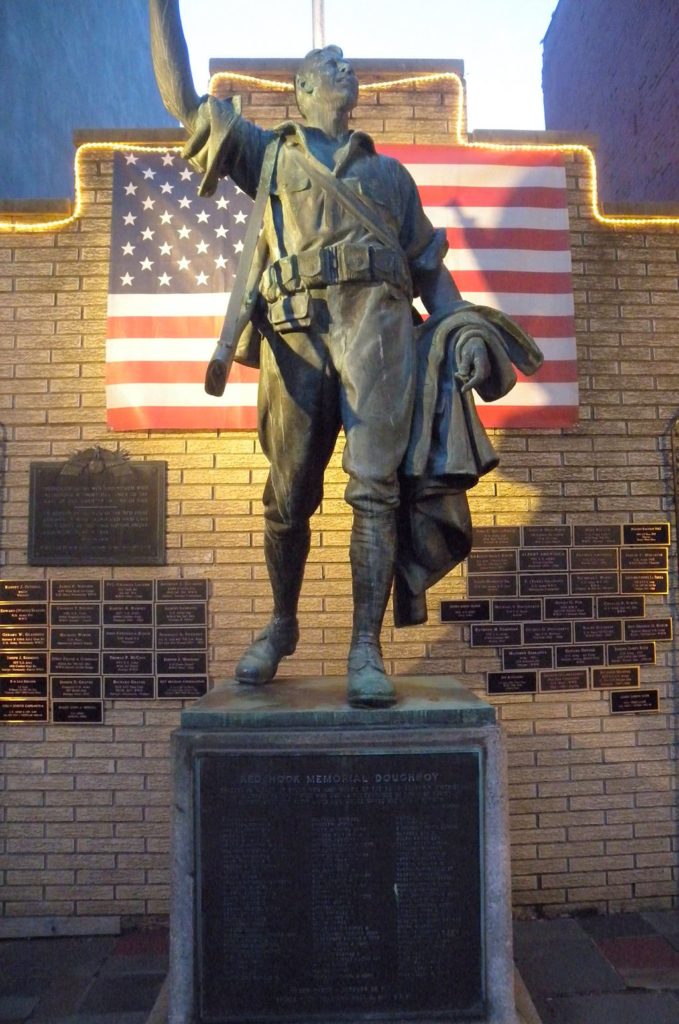
The Red Hook Doughboy

There are Doughboy statues all over New York but they are not always well highlighted. The Brooklyn neighborhood of Red Hook holds one of these treasures which once sat in a local park.

Fitzpatrick: “It was vandalized, the bronze plaques stolen, and the memorial ruined. In 1972 it was hauled to Veterans of Foreign Wars Post 5195, where today it is locked up behind a steel fence next to 325 Van Brunt Street. It was repaired and memorial plaques replaced.”

World War I New York:
A Guide to the City’s Enduring Ties to the Great War
Kevin C. Fitzpatrick
Globe Pequot Press


NOTE: Fitzpatrick also has a book on the Algonquin Round Table and joined us for our podcast on the subject back in March.

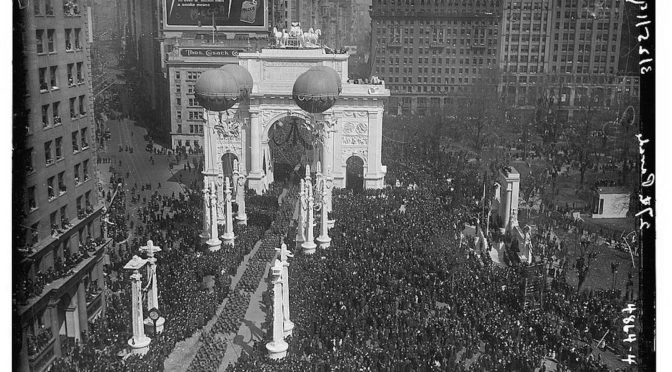
AT TOP: The Victory Arch which once sat astride Madison Square Park. While the arch is no longer there, dozens of other memorials still grace the streets of the city.

Categories
Landmarks

A celebration of New York City and the Leonard Nimoy Thalia

Last night the Guides Association of New York City (GANYC) presented their first-ever GANYC Apple Awards at the Leonard Nimoy Thalia Theater (part of Symphony Space), honoring accomplishments in preservation, history, museum exhibition and tourism. It was a rather lively evening, thanks to the night’s hilarious hosts Kevin James Doyle and Olivia Petzy whom you may know from the off-Broadway hit How 2 B A New Yorker.

The institutions and individuals honored at the ceremony last night include:

— Tour guide Justin Ferate (New York City Walking Tours)

—  the Friends of the High Line

– Christopher Gray and his Streetscapes column for the New York Times

William Helmreich and his book The New York Nobody Knows: 6,000 Miles In The City

— The Museum of the City of New York‘s exhibition Palaces For the People: Guastavino and the Art of Structural Tile

Kathleen O’Connor from the New-York Historical Society

Russ & Daughters, the Lower East Side appetizing shop celebrating its 100 years of business last year

– Kevin Walsh and Forgotten New York

And a lifetime achievement award was presented to artist James Turrell who transformed the Guggenheim Museum in 2013 into a surreal cathedral of light.

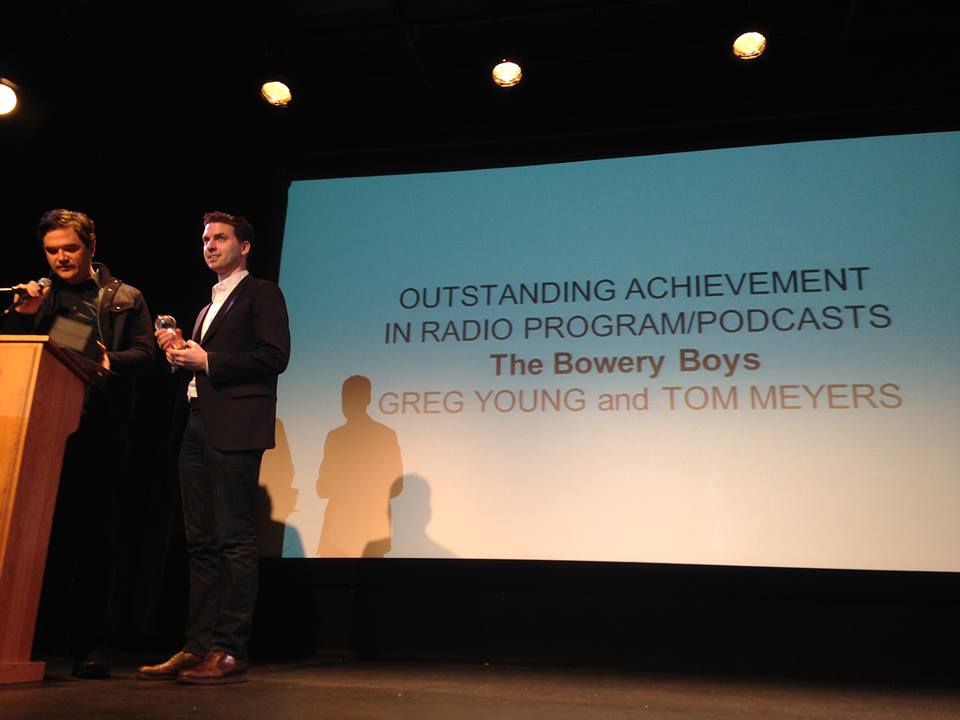
And look who else won an award!

1

Thank you GANYC for this incredible honor! We are truly grateful for the recognition. Actually we were just honored to be invited in the first place so this was especially humbling! It was quite fantastic seeing all these different kinds of people — journalists, curators, filmmakers, politicians, tour guides, entertainers — together in one room to celebrate New York’s rich culture and historical legacy.

The award was presented to us by Ethel Sheffer from the Municipal Art Society who prefaced it with a moving tribute to her husband  Isaiah Sheffer, the founder of Symphony Space, and the man who helped save the very theater we were sitting in — Leonard Nimoy!

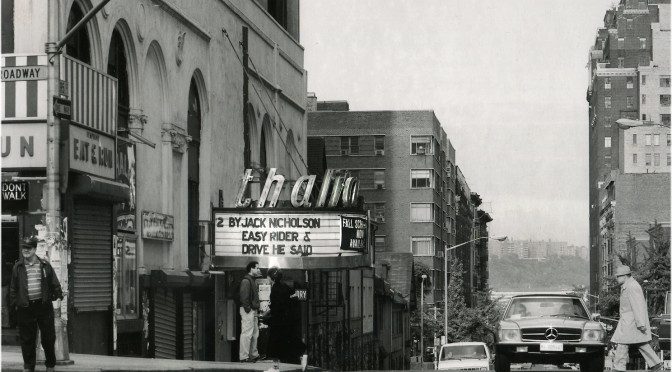
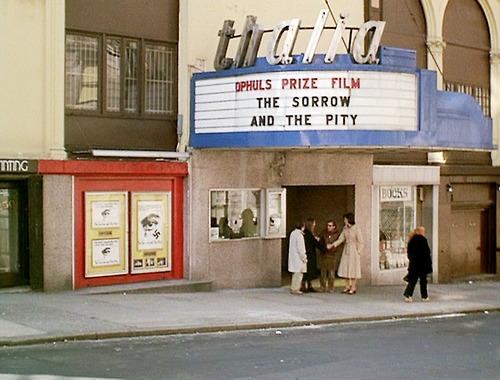
The building which contains the theater today was built one hundred years ago as an indoor market, owned by the Astor family.  In 1931 the basement was converted into the Thalia Theater. (Thalia is the ancient Greek Muse of comedy and idyllic poetry.)  To quote GANYC award winner in his history of the Thalia:

“Generations of Thalia patrons have assumed that its oddly sloping floor – with a depression in the middle – was the result of poor planning or unusual site conditions. But the Thalia’s parabolic reverse floor – apparently the first of its kind in the country – was just what its designer, Ben Schlanger, intended.

In Mr. Schlanger’s view, most movie theaters were poor adaptations of theater designs. The Thalia incorporated not only Mr. Schlanger’s patented floor system – designed to give everyone in the audience the same view of the screen – but also lighting, seating and projection provisions intended specifically for movie presentations.”

The Thalia is best known for showing art house movies and classic film revivals for decades. One might even say it was archetypal of the Upper West Side experience, immortalized in the movie Annie Hall.

2

Martin Scorsese attributes part of his cinematic education to the Thalia:  “That’s where I learned about films. I saw my first Eisenstein there: Alexander Nevsky. I also saw the Yiddish film series there: The Dybbuk and Green Fields and the films of Edgar G. Ulmer. It was the late 50’s. I saw Citizen Kane there and it was amazing on the big screen — well, the little screen. The films were programmed so that there was no intermission: one would end and the other would begin. It was really hard core. It was better than film school. It really was.” [source]

It was actually renowned for being a bit of a dump. According to GANYC nominee Clyde Haberman: “The air in the theater seemed left over from F.D.R.’s third term. Your seat was no thrill, either. It was upright, uncomfortable and usually torn. Pillars stood between it and the screen.”

The theater finally closed in 1987.  Its final screening was a double bill: The Night of the Shooting Stars and Paisan. During the 1990s,  its classic Art Deco interiors were removed to some controversy.  But its ultimate savior would come in the form of a science-fiction icon.

Leonard Nimoy, forever beloved as Spock from Star Trek, does have a background in theater — in 1977, he even performed in Equus on Broadway — and his work would sometimes be performed at Symphony Space.

By 2001, he was living in the Upper West Side, mostly occupied with his work as an acclaimed photographer.  Nimoy donated $1.5 million to the complete renovation of the theater which finally reopened in April 2002. In honor of the donation, the theater was renamed in his honor.  And,  honestly, the Leonard Nimoy Thalia just sounds cool too.

Photo by Seth Kaye, courtesy Buzzfeed


Why not? Let’s build this outlandish Manhattan airport!

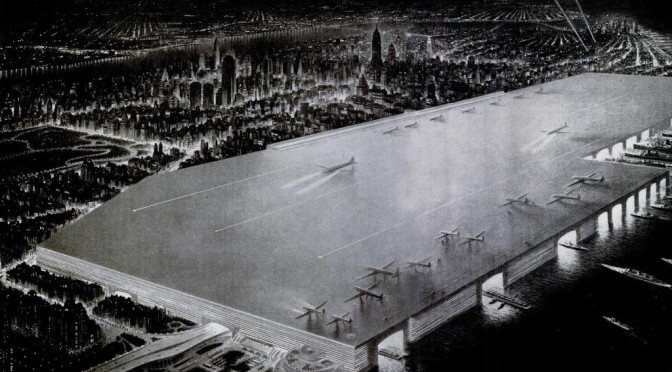
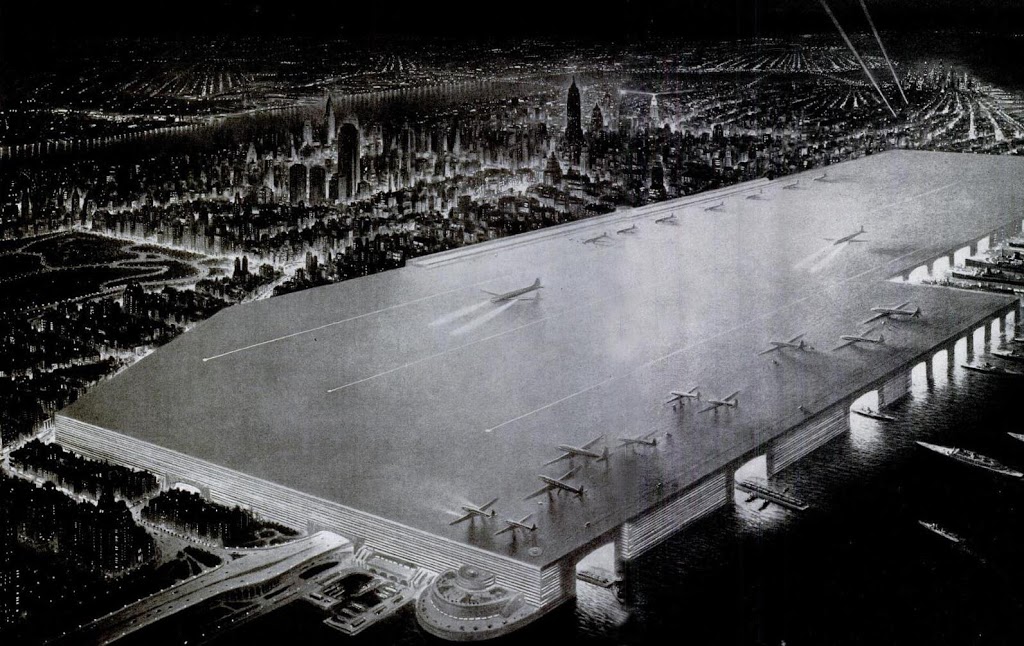
The ultimate terminal for air and sea, if you don’t mind eliminating a few neighborhoods. Goodbye Hell’s Kitchen! (Click image to enlarge)

Are you a Manhattan business professional who’s tired of sitting in maddening traffic to get all the way out to John F. Kennedy Airport? Does LaGuardia Airport seem dreary and dismal to you? And Newark Liberty International? In New Jersey? Fuggedaboutit!

How many times have you thought, “If only they could demolish a significant portion of Manhattan and built an airport here?” Sure enough, visionary New Yorkers are one step ahead of you.

A 1946 issue of Life Magazine, (adorned with a wistful cover of post-war Paris) outlines a proposal by one of the 20th century’s most ambitious land developers, William Zeckendorf. The Hudson River Terminal project would consume Manhattan’s entire westside from Ninth Avenue on to the water, 24th to 71st Street. Chelsea, Hell’s Kitchen and other neighborhoods would cease to exist.

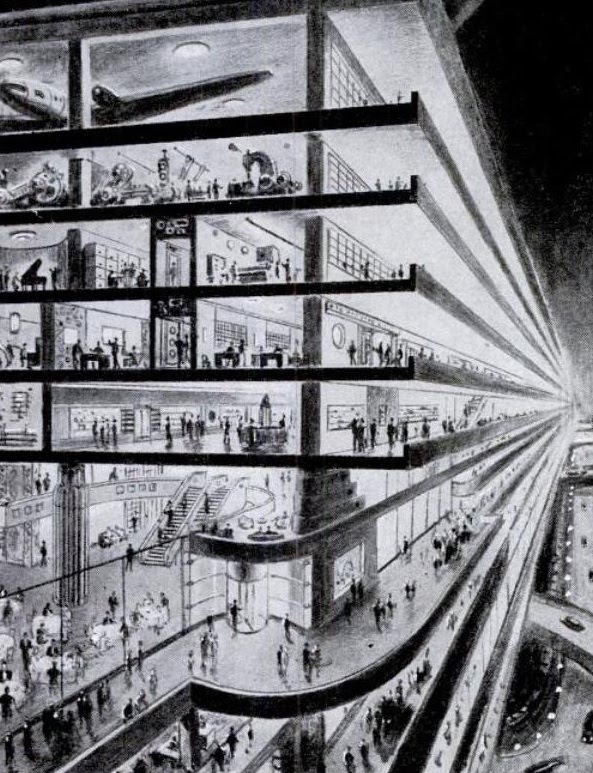
The runway sits atop an all-purpose colossal structure, a mega-dock, able to accomodate both air and river traffic. Ships would anchor at waterfront portals, while a staggering 68 planes an hour (about the number JFK can handle today) would land on the rooftop runway. The planes would then be lowered hangars on multiple floors. No taxiing around wasted empty space here!

But New Yorkers wouldn’t just get a fine runway out of the deal. With connections to both subways and train, the Hudson River terminal would become the ultimate “communications hub.” Naturally, the West Side Highway would burrow through the structure.

Pretty much any New Yorker going anywhere would have to pass through here. Luckily, then, this almost 144-block colossus would house “ticket offices, restaurants, business offices, waiting rooms” and other useful establishments, assuring that you’d never need to go outside.
You can read about this fascinating pipe dream in this issue of Life Magazine, and there’s a couple additional illustrations as well. Thankfully, this travesty never saw the light of day.  Donald Trump’s ‘Television City’ idea, another failed Westside development project, which would have erected a 152-floor building and an elevated parking lot in part of the area affected by Zeckendorf’s proposal, seems like a modest proposal in comparison. (That will be the last time ‘Donald Trump’ and ‘modest’ will be used in a single sentence.)

Zeckendorf was no stranger to riverside annihilation projects. His ambitious plans to built a massive ‘dream city’ on the East River that would have dwarfed Rockefeller Center fell through in the 1940s. The United Nations headquarters sits on the land once earmarked for that purpose.

But people still dream of a Manhattan airport, even in jest. In 2009, the Manhattan Airport Foundation horrified New Yorkers with a plan to replace Central Park with a glorious new airfield. They were joking. Zeckendorf, sixty years earlier, was not.

Images from Life Magazine

Categories
Mysterious Stories Podcasts

Supernatural Stories of New York: spooky seances, violent Jazz Age ghosts and an island of despair

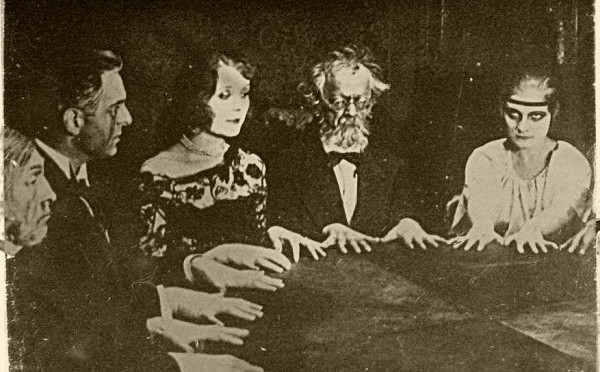
PODCAST It’s our fourth annual Halloween history special, and we’ve got four bloodcurdling stories for the season. The first three are spooky ghost tales — a haunted boardinghouse on 14th street with violent, vain spirits; a short history of New York’s seance craze and a man tormented by the spirit of a dead painter; and a glamorous pair of Jazz Age lovers whose angry spats in their midtown Manhattan penthouse kept up the neighbors, even beyond the grave.

ALSO: A tale with no ghosts at all, but a story with truly spine-tingling facts, featuring the eeriest island in New York and the final resting place for over 850,000 souls. If you ever make it to Hart Island, it means that things have gone very badly for you.

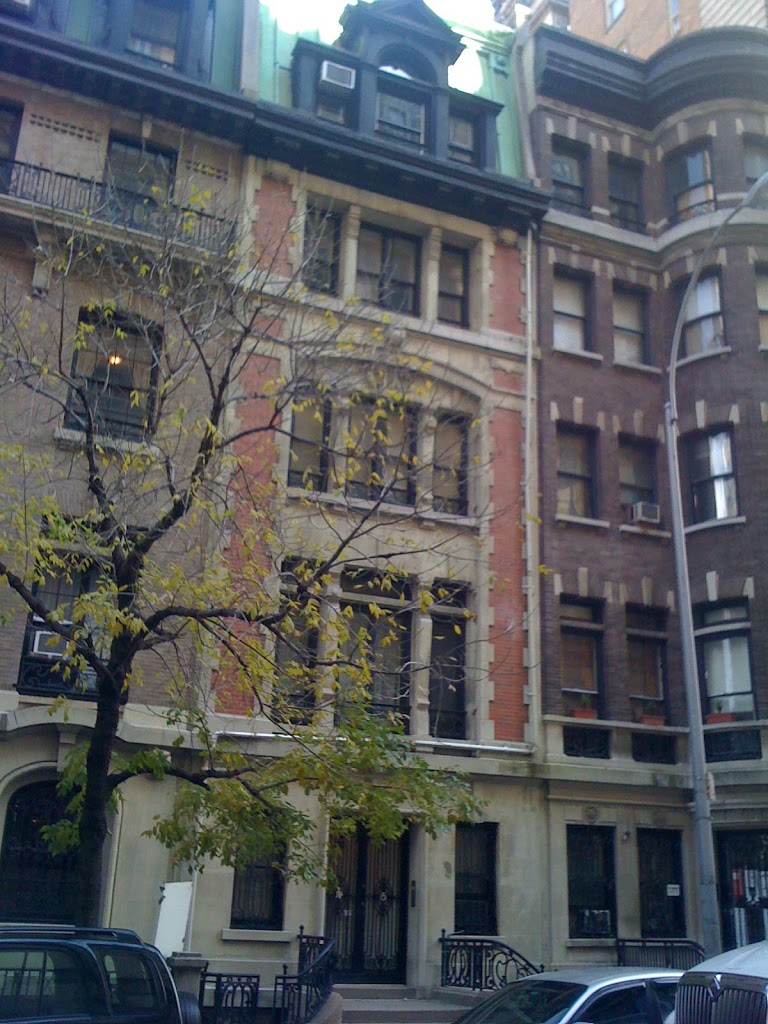
Home to the American Society of Psychical Research on W. 73rd Street, the organization headed by James Hyslop in the early 1900s. Hyslop led the investigation of dozens of reported cases of paranormal and supernatural activity.

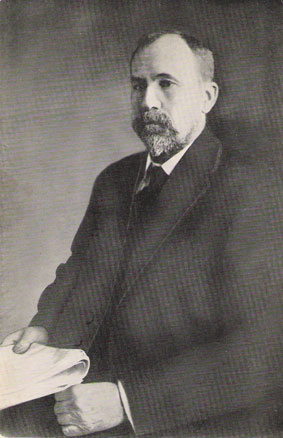
Hyslop, pictured below, believed that he spoke with famous philosopher William James through a medium, and he himself spoke to his secretary via this technique many months after he died.

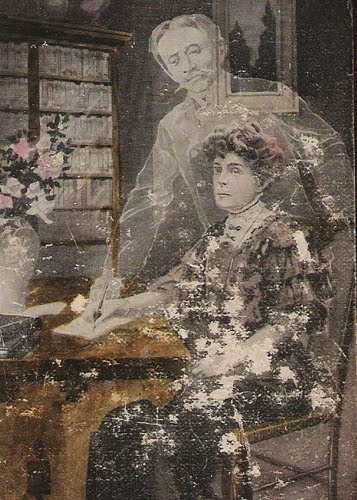
A bizarre image depicting medium Etta De Camp being visited by author Frank Stockton. Ms. De Camp believed her hand was being controlled by Stockton and even wrote a entire book under the control of Stockton.

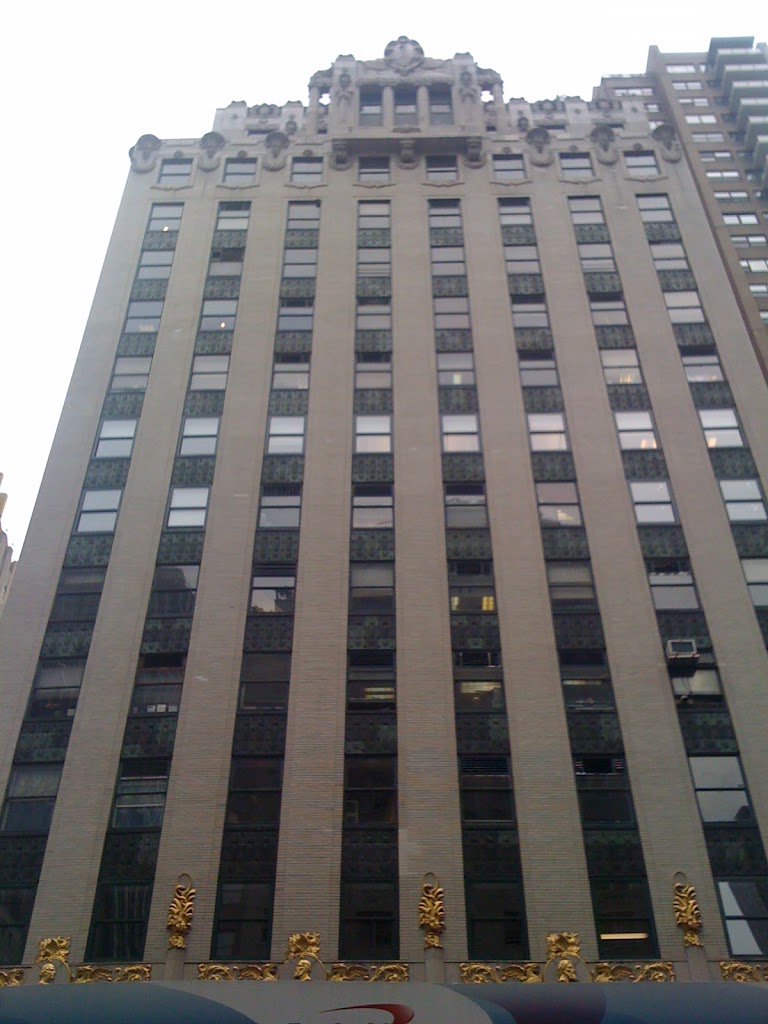
Looking up at the former penthouses of 57 W. 57th Street, where Edna Champion and her lover Charlie argued their way into the grave, then tormented the unfortunate tenants for many years later. Today, these formerly haunted floors are slated to be occupied by Ford Models.

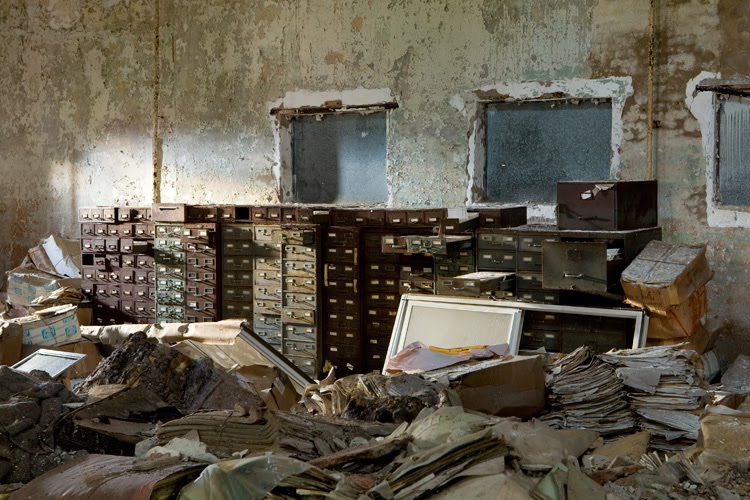
An abandoned records room on Hart Island. This and many other wonderful photographs of Hart Island can be found at Kingston Lounge, bravely venturing to the island in 2008 to witness the strange and forlorn island in person.

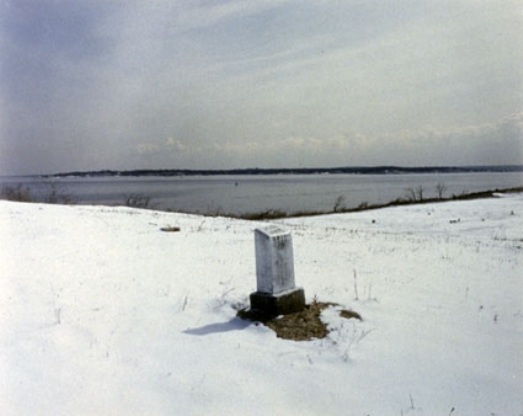
The Hart Island Project has been drawing needed attention the island for years, obtaining lists of people buried there and assisting in families looking for loved ones there. It’s also features a fantastic collection of photographs, such as the one below (of a lonely grave marker) by Joel Sternfeld.
And finally, a fascinating and priceless local news report from 1978 on Hart Island, looking a bit more populated than it is today. Unbelievably, there was talk of actually developing Hart Island for more than just the city’s potter’s field.

If you’re looking to craft your own personal ‘haunted’ walking tour, this map lists all the places we’ve talked about in prior ghost stories podcasts. Simply look up a location and download that particular episode:

View Bowery Boys Ghost Stories in a larger map

1 Ghost Stories of New York
2 Spooky Stories of New York
3 Haunted Tales of New York
4 Supernatural Stories of New York

Ah, the bad ole days of Needle Park

BOWERY BOYS RECOMMEND is an occasional feature whereby we find an unusual movie or TV show that — whether by accident or design — uniquely captures an era of New York City better than any reference or history book.

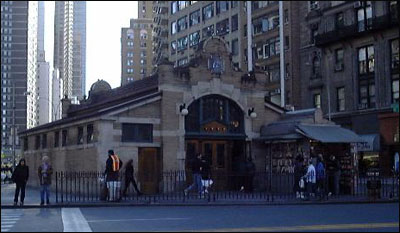
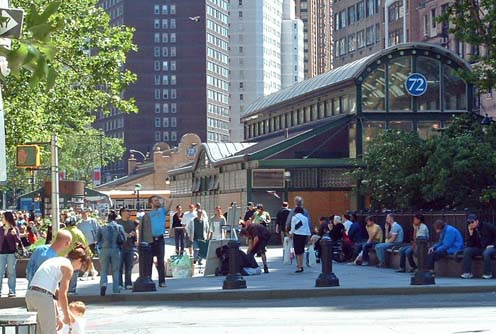
The traffic island at 72nd and Broadway has always been one of the Upper West Side’s most distinctive, with its vintage subway control houses on either side of the street sitting in two distinct ‘parks’ — Verdi Square with its lovely shady patches and statue of composer Giuseppe Fortunino Francesco Verdi; and Sherman Square, a virtually barren traffic triangle that honors nothing in the way of its namesake, Civil War hero William Tecumseh Sherman.

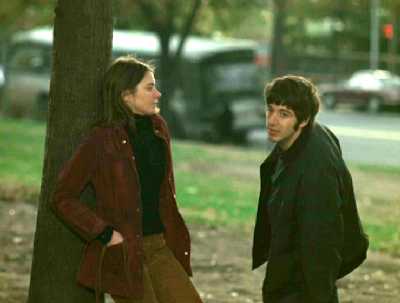
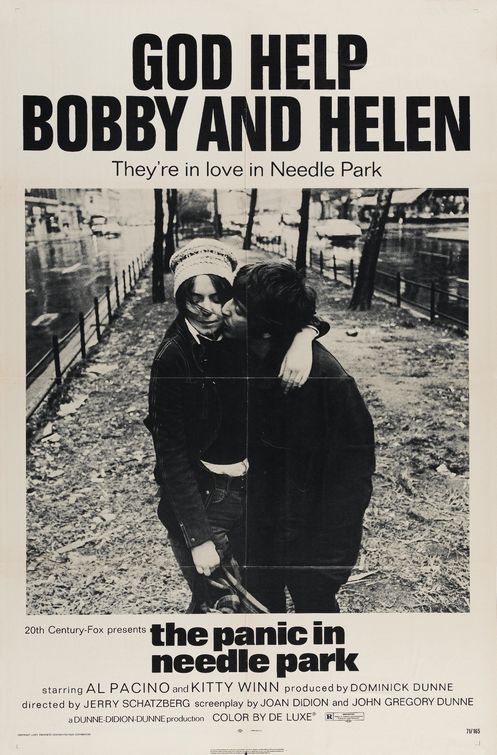
It was a different world 35 years ago, when this area was known by another name — Needle Park, your friendly uptown destination for junkies and dope fiends. The 1972 docudrama Panic In Needle Park vividly depicts this.

The film is primarily known as the breakthrough role of Al Pacino — it’s actually his second film — and its easy to see why. He plays Bobby, a deal who continually fails to break the habit, and even lures his innocent sweet girlfriend Helen (Kitty Winn) into a world of dope scores and prostitution.

More surprising than finding Pacino here is the film’s other contributors — Joan Didion and John Gregory Dunne wrote the screenplay, Dominic Dunne produced it, and showing up in early roles are Raul Julia and Paul Sorvino (as Helen’s hapless john!)

The film is seen through Helen’s eyes who clearly has a few opportunities to escape via a handsome police detective who has seemingly been assigned exclusively to her.

It’s fascinating to see this now-clean stretch of Broadway through a lens of grit, a depiction of New York as a hopeless metropolis sinking into ever-stewing pools of urban decay. Most striking is the scene where Pacino attempts to score from a dealing in front of the Museum of Natural History*.

The raw, early indie style of director Jerry Schatzberg would go on to influence other films, although some of its techniques have been rendered into cliche. However, for lovers of 1970s New York cinema, this sobering and rather exhausting film is a must-see.
Below: a picture of the Sherman Square subway station today:

And Verdi Square:

*One could write an entire book about the depiction of the Natural History museum in film. See the last Bowery Boys Recommends article about Q: the Winged Serpent.