Categories
Landmarks Podcasts

The Sip-In of 1966: Celebrating Julius’ Bar, New York’s Newest Landmark

New York City has a new landmark, a little bar in the West Village named Julius’officially recognized by the New York City Landmarks Preservation Commission on December 6th, 2022. 

It’s here that one moment of protest (the Sip-In of 1966) set the stage for a political revolution, “a signature event in the battle for LGBTQ+ people to gather, socialize, and celebrate openly in bars, restaurants, and other public places.”

So we thought it would be a great time to revisit our 2019 show on the history of Julius’ and a look at the life of gays and lesbians in the mid 20th century. 
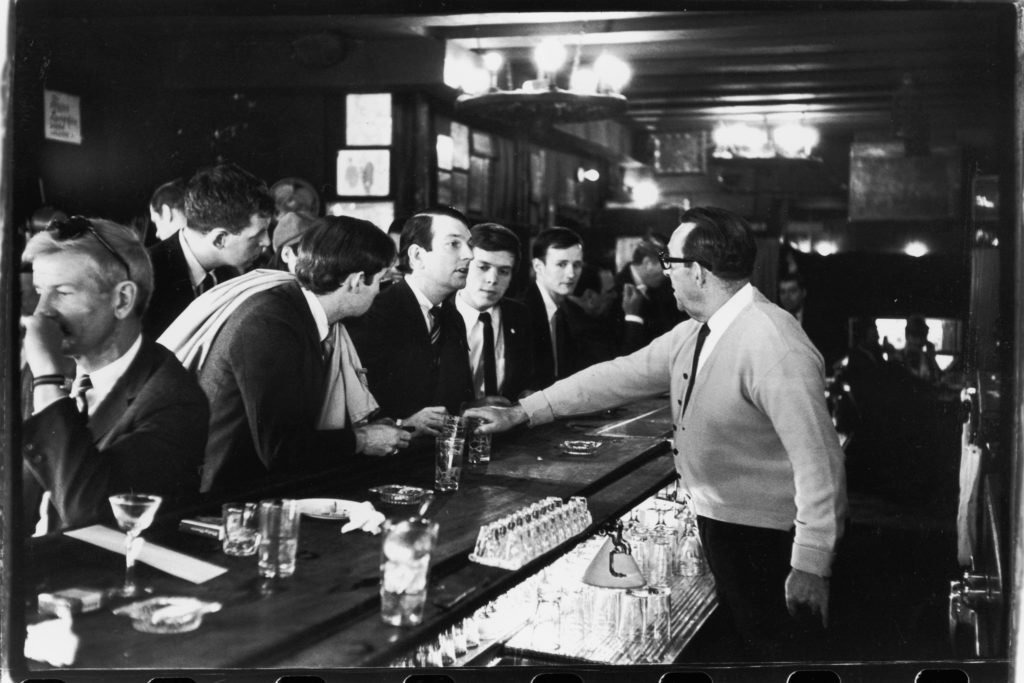

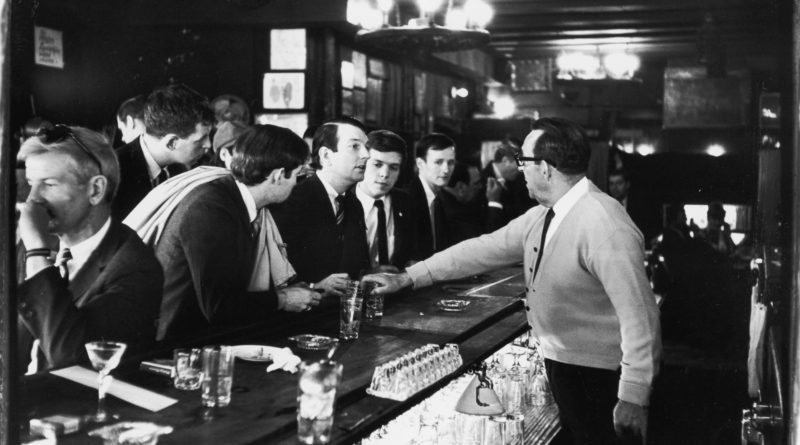
The now-iconic photograph by Fred W. McDarrah (Courtesy Getty Images)

PODCAST Many Americans may now be familiar with Stonewall Uprising, a combative altercation in 1969 between police and bar patrons at the Stonewall Inn in the West Village. It was this event that gave rise to the modern LGBT movement.

But in a way, the Stonewall Riots were simply the start of a new chapter for the gay rights movement. The road leading to Stonewall is often glossed over or forgotten.

By the 1960s, a lively gay scene that traced back to the 19th century — drag balls! lesbian teahouses! — had been effectively buried by decades of cultural and legal oppression.

A few brave individuals, however, were tired of living in the shadows.

In this episode, we’ll be zeroing in on the efforts of a handful of young New Yorkers who, in 1966, took a page from the civil rights movement to stage an unusual demonstration in a small bar in the West Village. This event, called the Sip-In at Julius‘, was a tiny but significant step towards the fair treatment of gay and lesbians in the United States.

IN ADDITION: We’ll be joined by Hugh Ryan, author of When Brooklyn Was Queer, at the bar at Julius’ to talk about the forgotten lives of queer people in the ever-changing borough of Brooklyn.

Listen Now — Sip-In at Julius’ Bar: Celebrating New York’s Newest Landmark

This episode features an audio interview clip from the podcast Making Gay History, an excellent source for gay history. Be sure you check out their coverage of Stonewall 50.

We also feature a musical clip of ‘I Hear A Symphony’ by The Supremes (Motown). The song hit Number #1 on the Billboard charts in November of 1965. The most popular song in the nation at the moment of the Julius’ Sip-In? The Righteous Brothers’ “(You’re My) Soul and Inspiration.”


Julius’ Bar: A Short History

This month is the 50th anniversary of the Stonewall Riots, a chaotic, rowdy altercation that bloomed over the course of the weekend to energize the New York’s LGBT movement. (If you haven’t already, give our podcast on the history of the Stonewall riots a listen.) But despite its reputation, Stonewall is not the oldest gay bar in New York. Not even close.

For that honor, you need only march a few steps to Waverly Place and 10th Street to that beloved old institution Julius (159 W. 10th St). It also happens to be the location of a pre-Stonewall protest of angered gay activists, an event both revolutionary and even occasionally amusing.

Julius is truly an old bar although nobody seems to know exactly how old. The bar itself settles on the year 1864, easily making it one of the oldest bars in New York, just a tad younger than McSorley’s Old Ale House. The building itself is even older, dating from 1826, becoming a grocer in 1840 before transforming to its current, more jovial purposes.

It has many things in common with McSorley’s. The walls are plastered with memorabilia from days gone by. The bar is a well-worn relic, the tables and benches made of old beer barrels.

Like McSorley’s, they even serve burgers, and really, really good ones at that. Its history is a tad more shrouded than McSorley’s but equally studded with famous clientele.
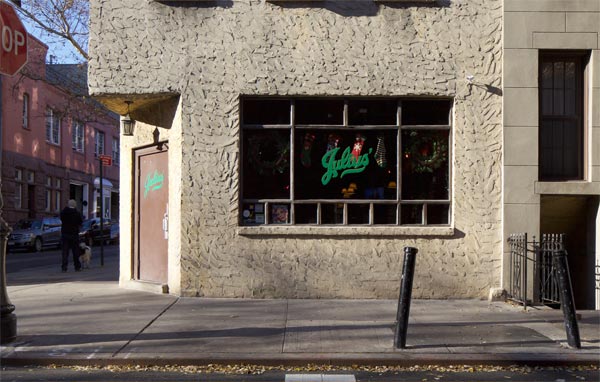
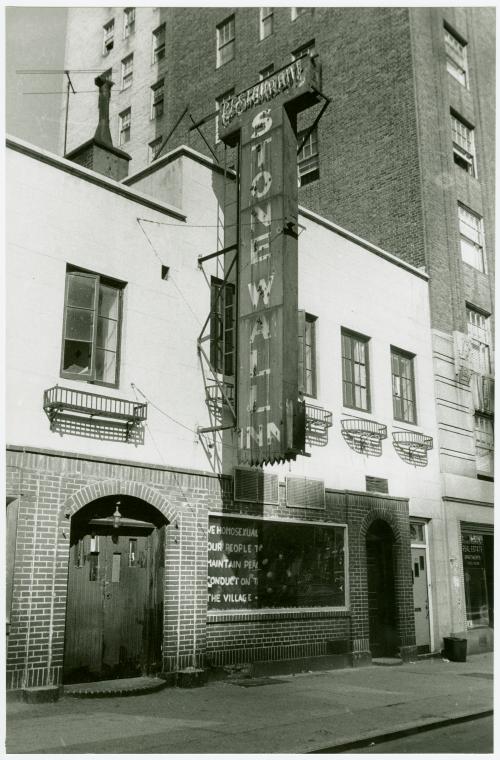
Courtesy the National Park Service

Surviving the 20th century

It was a popular speakeasy throughout the 1920s, evidenced today by Julius’ still existing sidedoor with a peephole. Both Fats Waller and Billie Holiday are rumored to have performed in the backroom, quite likely as Holiday worked at the nearby nightclub Cafe Society during the 1930s.

In subsequent years the clientele was decidedly a mixed lot and Julius would ply writers like Edward Albee, Tennessee Williams and Truman Capote with drink and companionship.

By the 1960s Julius had become a low-key staple of the West Village gay scene. However, it appears that it was ‘straight enough’ that it survived Mayor Robert Wagner’s cleanup of the city in preparation of the 1964 World’s Fair, a wholesale shutdown of West Village gay bars and other ‘undesirable’ places.
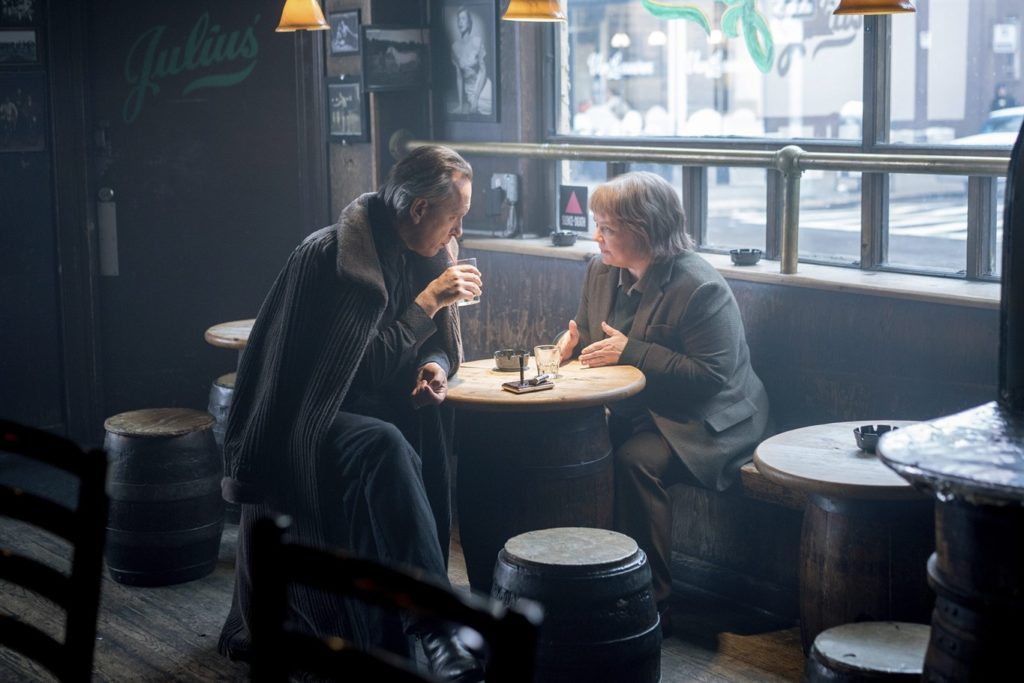
The film Can You Ever Forgive Me?, set in the early 1990s, has several scenes set and filmed at Julius’. (Courtesy Fox Searchlight)

Julius’ Bar in the 1960s

Even through this Julius lived on, although patrons and management alike had to maneuver through rather arcane and sometimes humiliating rituals.

According to writer Edmund White, “There was even a period when we weren’t allowed to face the bar but had to stand absurdly with our back to it to prove, I suppose, that we had nothing to hide.”

It gets even more absurd. The New York State Liquor Authority banned bars from serving drinks to gays and lesbians. This rule was sometimes ignored by brazen Village bartenders, but the constant fear of such a twisted regulation being suddenly enforced by an undercover cop eventually drew action from a burgeoning group of young gay activists.
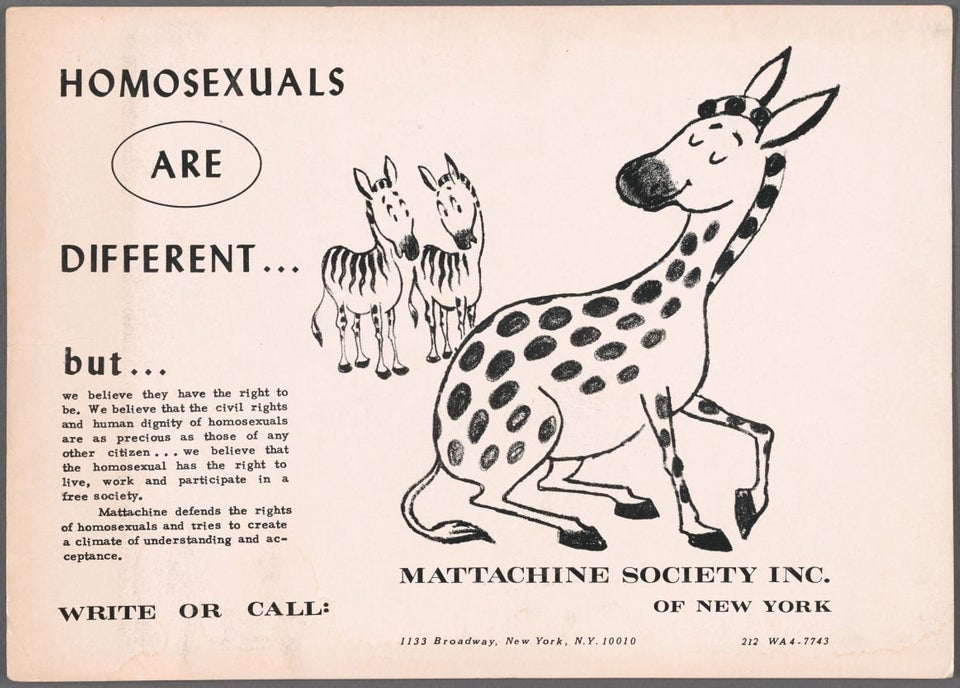
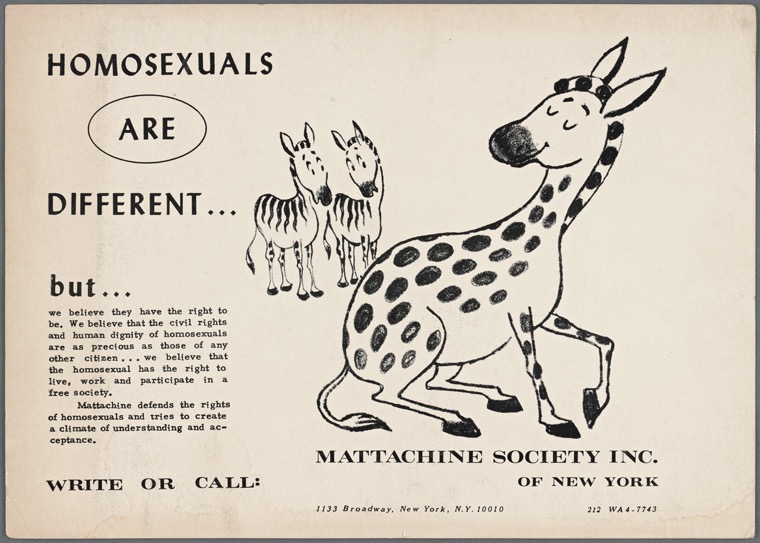
A curious ad for tolerance distributed by the Mattachine Society in 1960.

Members of the Mattachine Society, one of New York’s earliest gay organizations, planned on challenging the rule by going into bars, loudly announcing their homosexuality and ordering a drink.

Their statement at the bar would be calm and simple: “We are homosexuals. We are orderly, we intend to remain orderly, and we are asking for service.”

The key would be that they were followed around by a phalanx of press representatives. So, when the bar refused to serve them, the Mattachine Society would have their moment, captured and ready for print.

More Than Just A Drink

The challenge came on April 21, 1966, more than three years before the Stonewall riots. They told members of the press to meet them at the Ukrainian-American Village Restaurant but management closed shop before they arrived. They tried two other bars, a Howard Johnson’s and a place called Waikiki, and each time they were served without incident.

But of course, the organizers were looking for an incident. They arrived at Julius for their big moment.

The now-legendary Julius Sip-In, as the event as come to be called, was a carefully engineered event with a few unexpected detours, yet it served its purpose. The New York Times even ran the story, under the rather backhanded headline, “3 Deviates Invite Exclusion by Bars.” The law was successfully challenged in court.

Since then, Julius has quietly sat on the sidelines, ceding the historical spotlight to Stonewall around the corner, observing both the curious changes to the neighborhood and the development of a viable and open gay community in the Village and elsewhere.

You don’t have to be gay to appreciate its unique place in New York City history. Just grab a stool and spend awhile admiring the bar’s warm, lived-in details.

Oh, and you really must try the burgers. Did I say that already?

By the way, who the heck is Julius? According to one speculation, Julius was the name of the original owner’s basset hound.

FURTHER READING
Stonewall: The Riots That Sparked The Gay Revolution by David Carter
Gay New York by George Chauncey
Stonewall: The Definitive Story of the LGBTQ Rights Uprising that Changed America by Martin Duberman
Odd Girls and Twilight Lovers by Lillian Faderman
Greater Gotham by Mike Wallace

and of course Hugh Ryan‘s When Brooklyn Was Queer. Thanks to Hugh for coming on the show and joining us at Julius Bar!
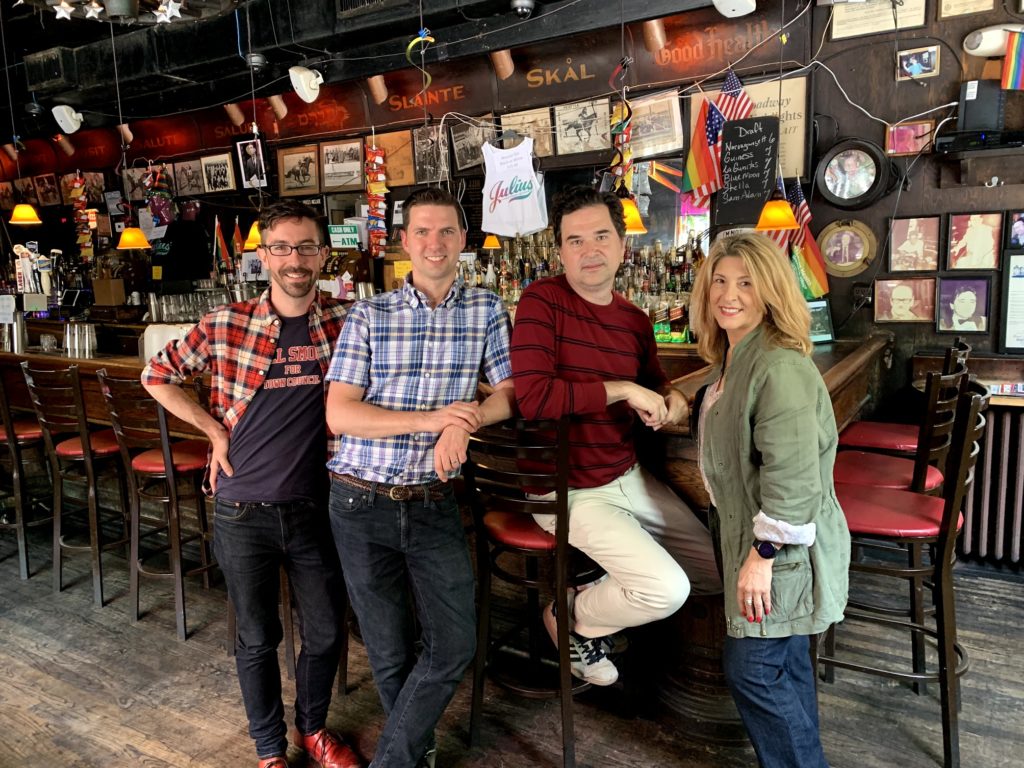
Hugh Ryan, Tom Meyers, Greg Young and Julius’ owner Helen Buford

FURTHER LISTENING

Three companion shows to this episode that you’ll definitely want to listen (or re-listen to) after Sip-In At Julius: Gay New York in the 1960s:

__________________________________________________________
Categories
Podcasts Politics and Protest Preservation

The History of Jefferson Market and the Women’s House of Detention

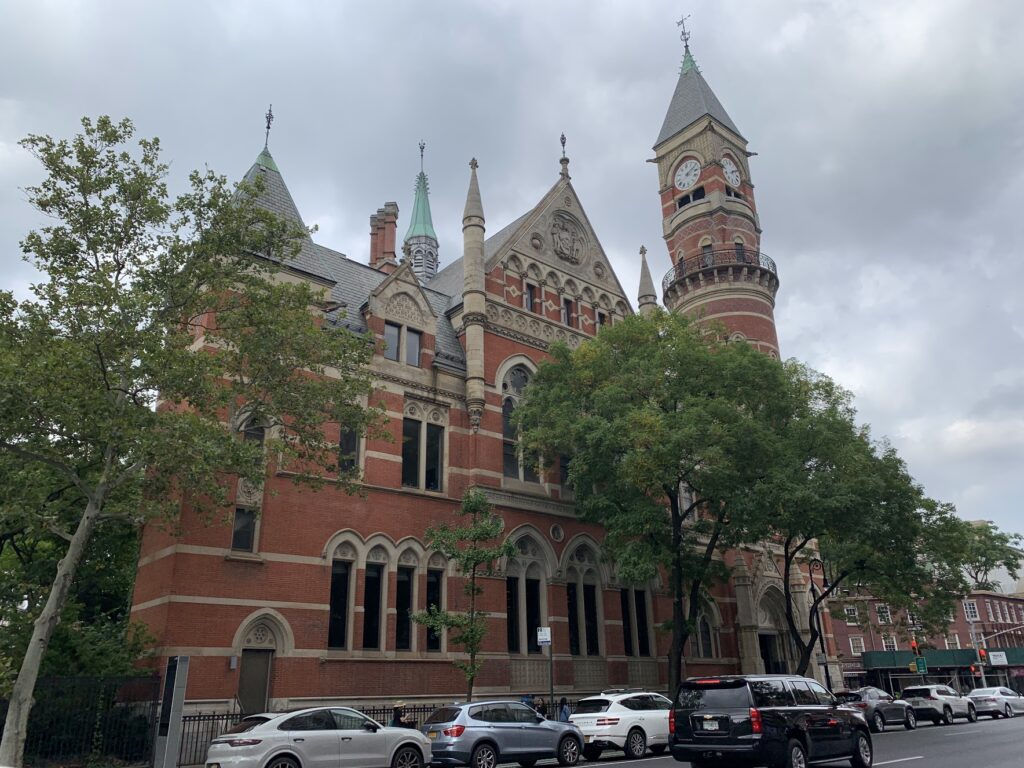
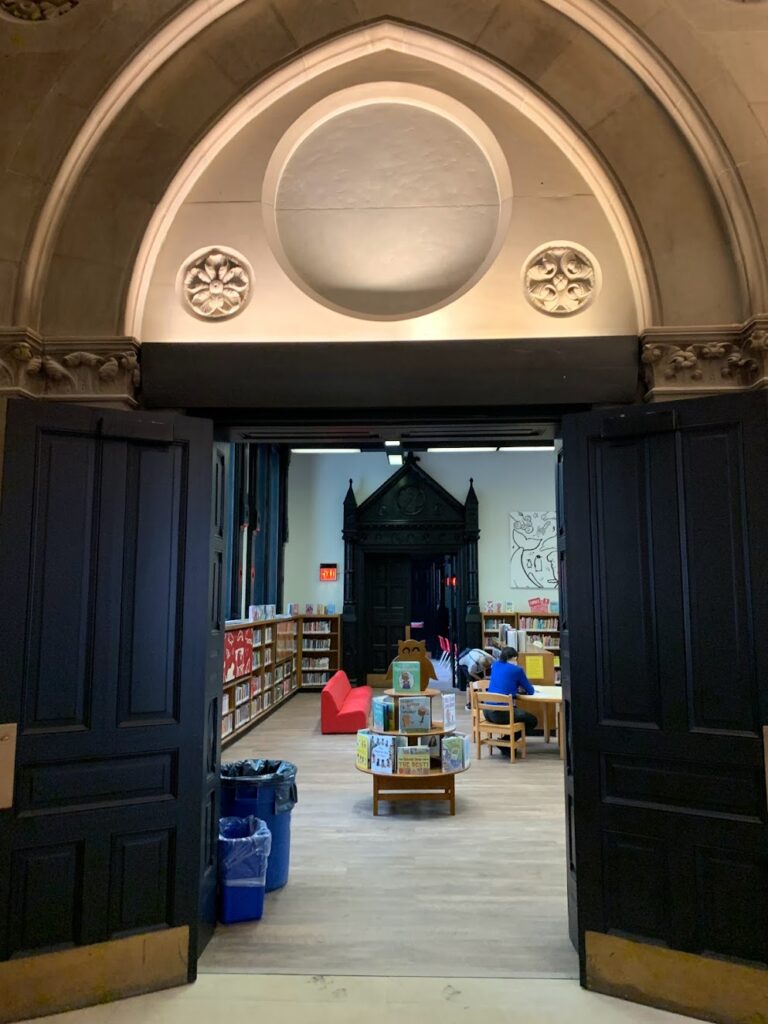
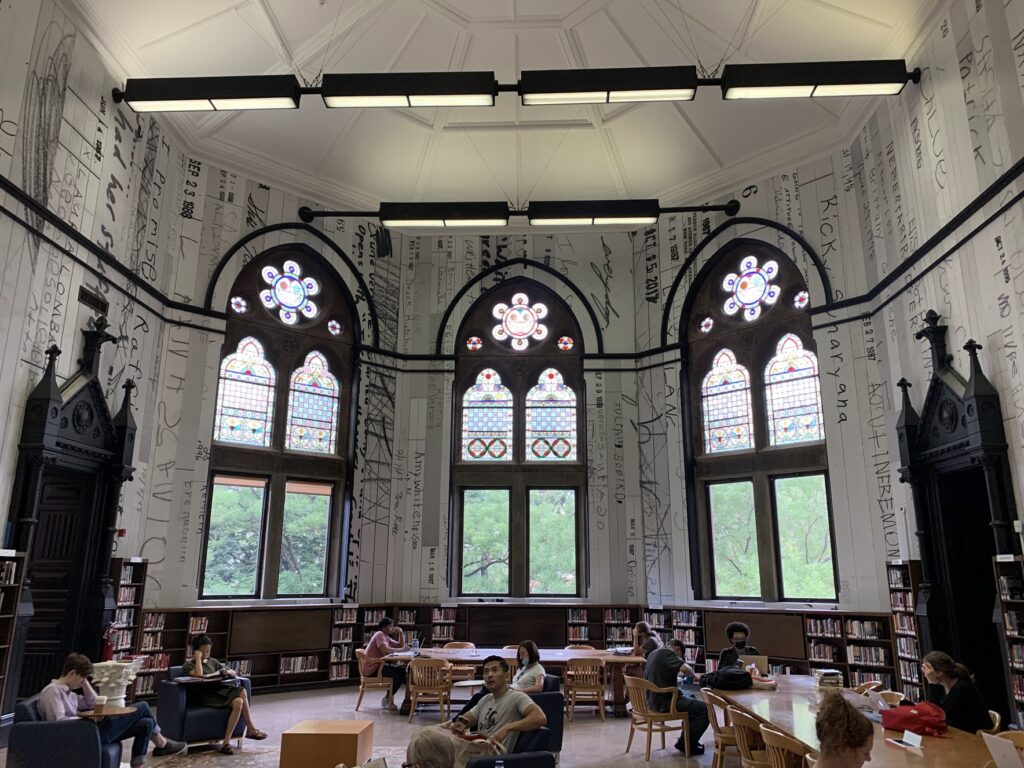
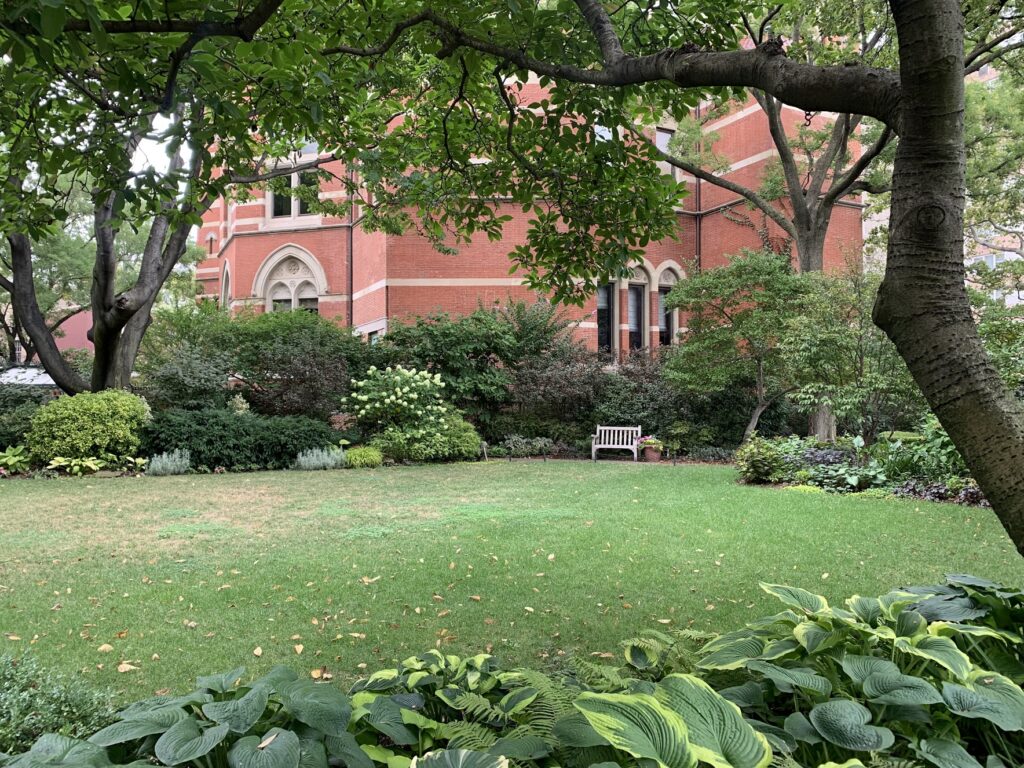
In the heart of Greenwich Village sits the Jefferson Market Library, a branch of the New York Public Library, and a beautiful garden which offers a relaxing respite from the busy neighborhood.

But a prison once rose from this very spot — more than one in fact.

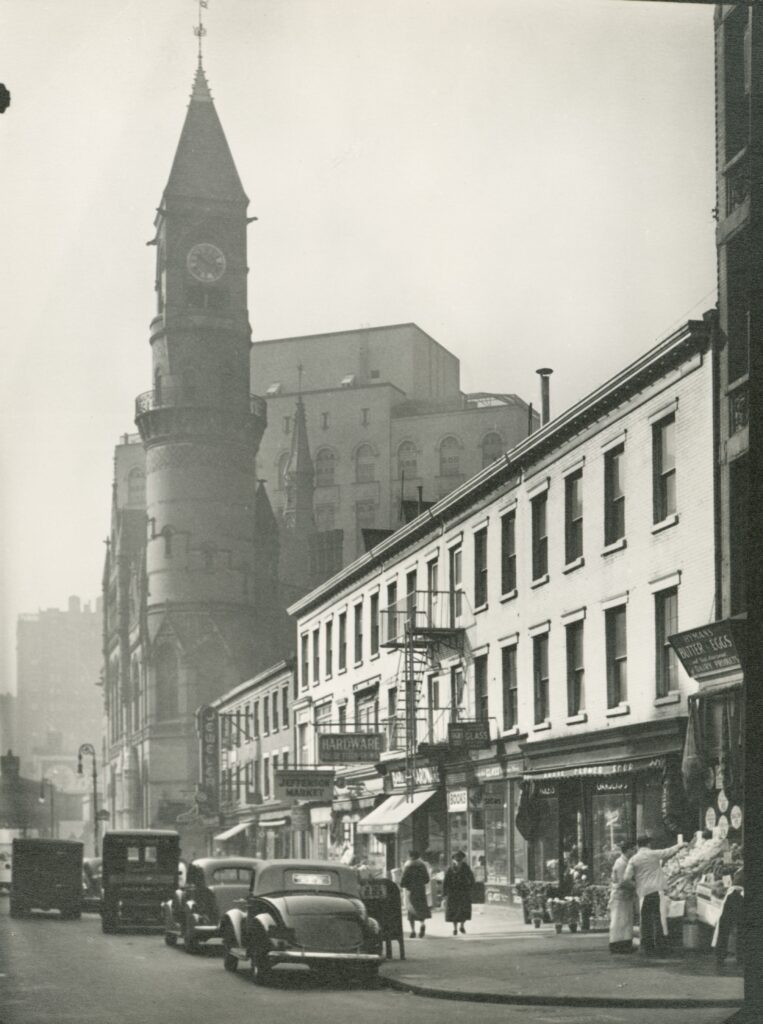
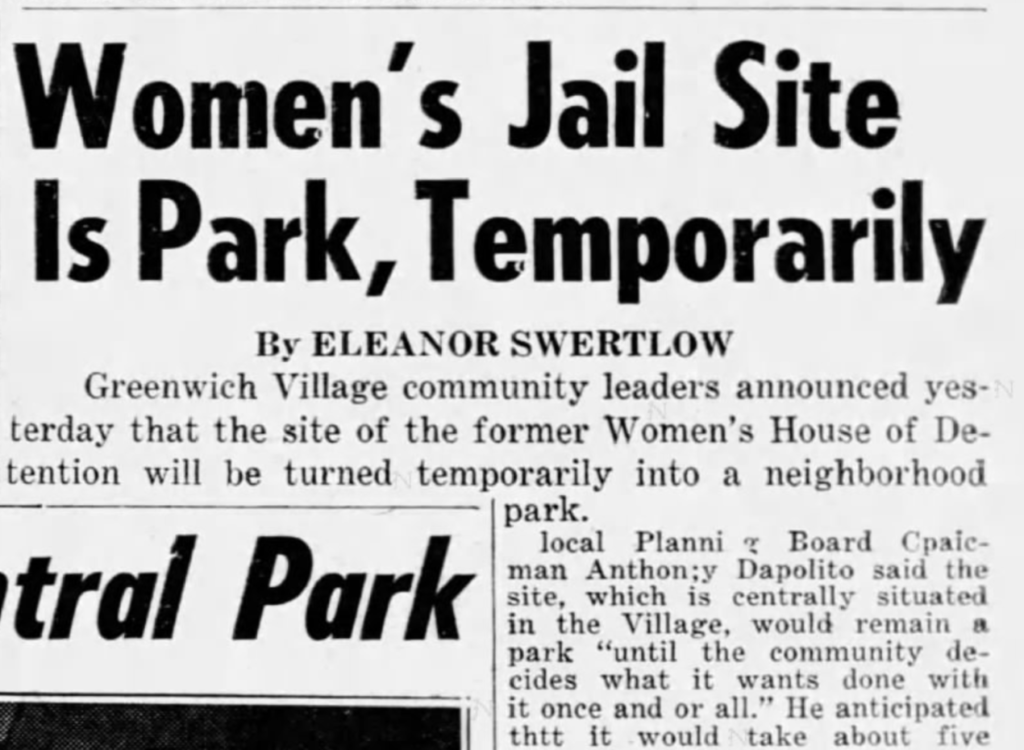
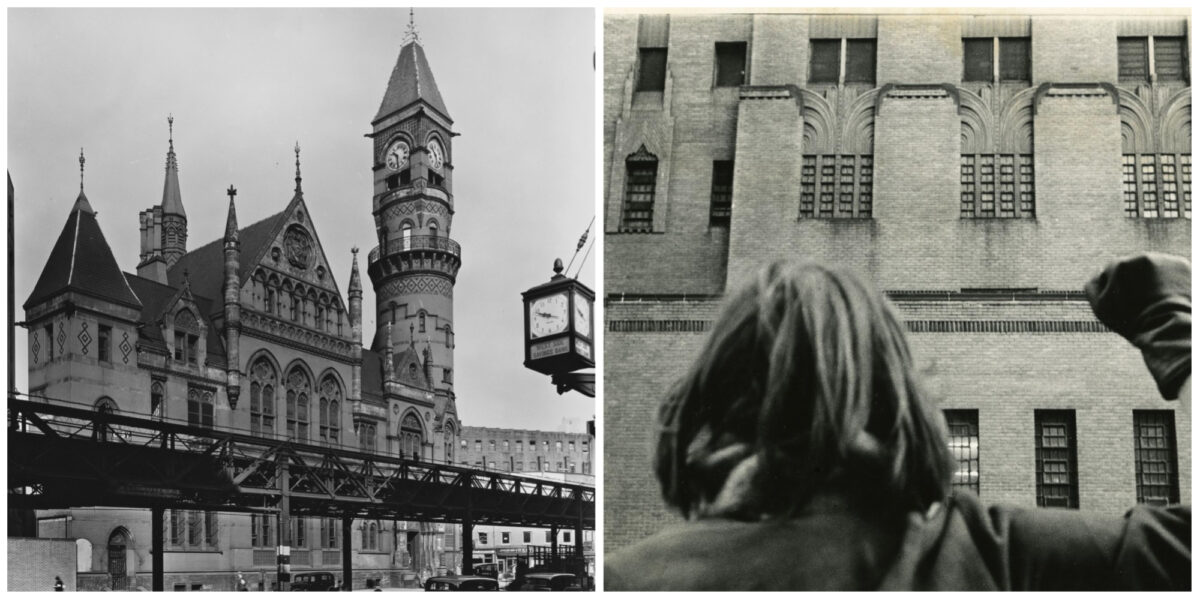
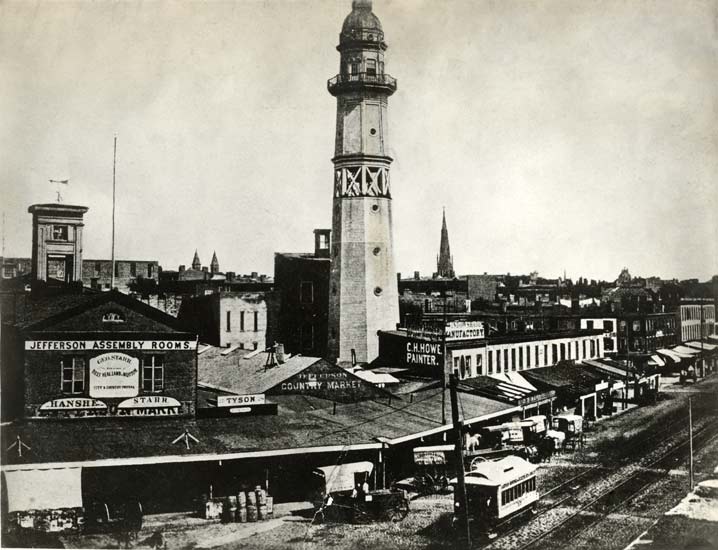
While there was indeed a market at Jefferson Market — dating back to the 1830s — this space is more notoriously known for America’s first night court (at the Jefferson Market Courthouse, site of today’s library) and the Women’s House of Detention, a facility which cast a gloom over the Village for over 40 years.

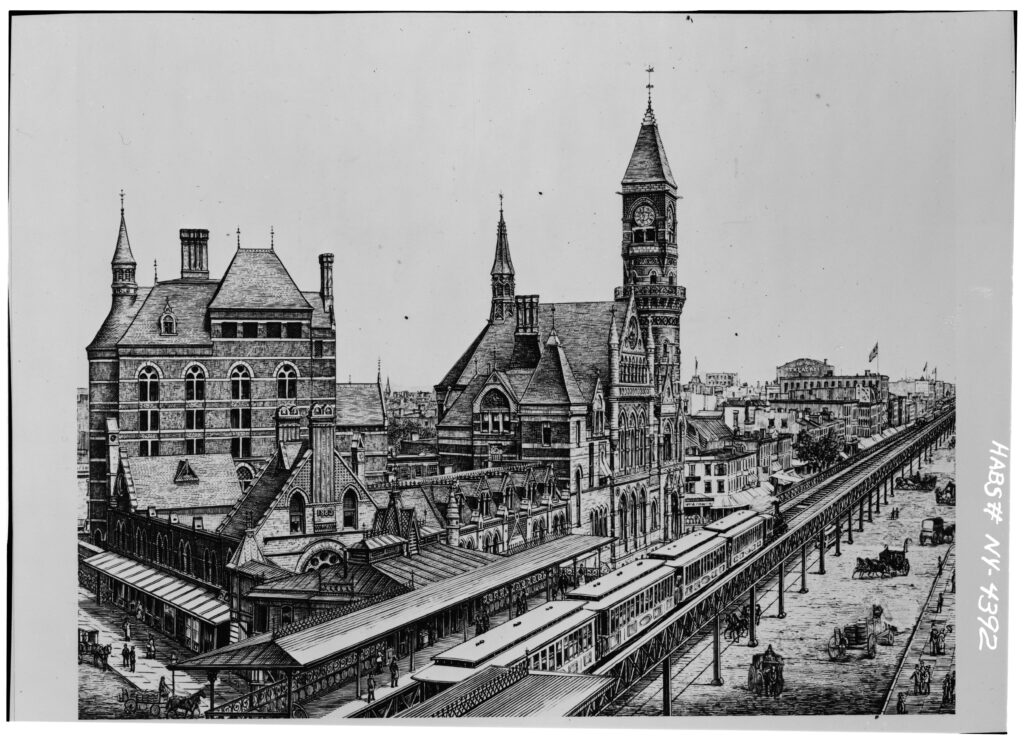
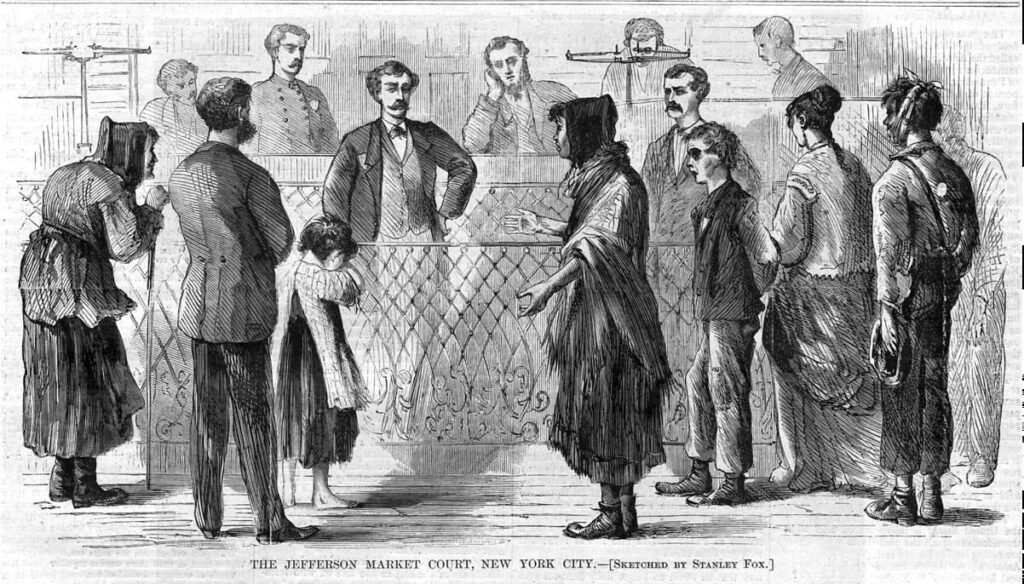
Almost immediately after the original courthouse (designed by Frederick Clarke Withers and Calvert Vaux) opened in 1877, it was quickly overburdened with people arrested in the Tenderloin district. By 1910 a women’s court opened here, and by the Jazz Age, the adjacent confinement was known as “the women’s jail.”

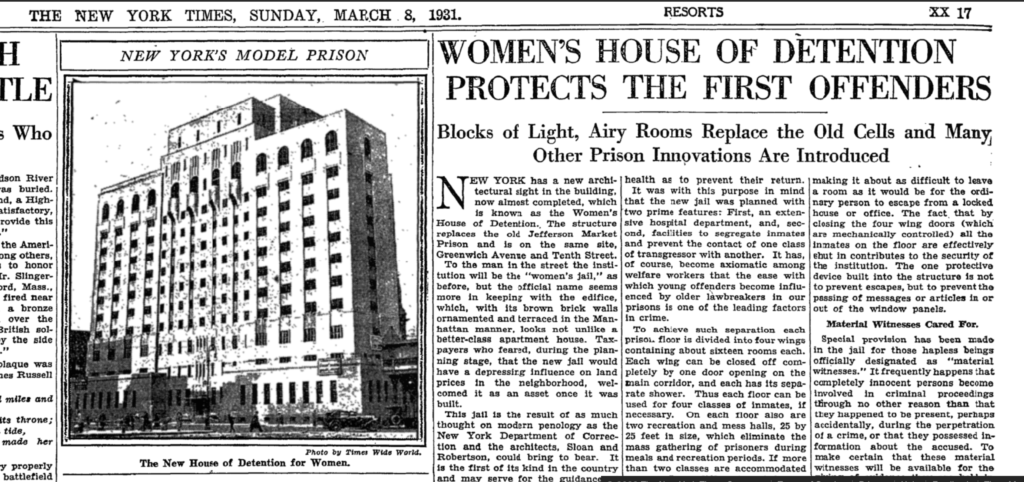
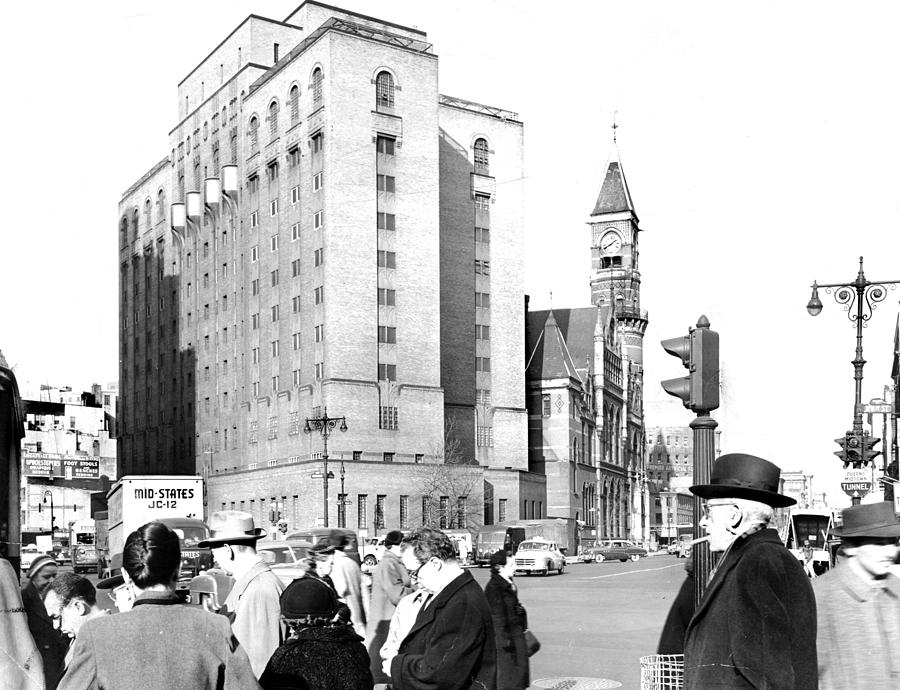
When the Women’s House of Detention opened in 1931 — sometimes referred to as the world’s only Art Deco prison — it was meant to improve the conditions for women who were held there. But the dank and inadequate containment soon became symbol of abuse and injustice.

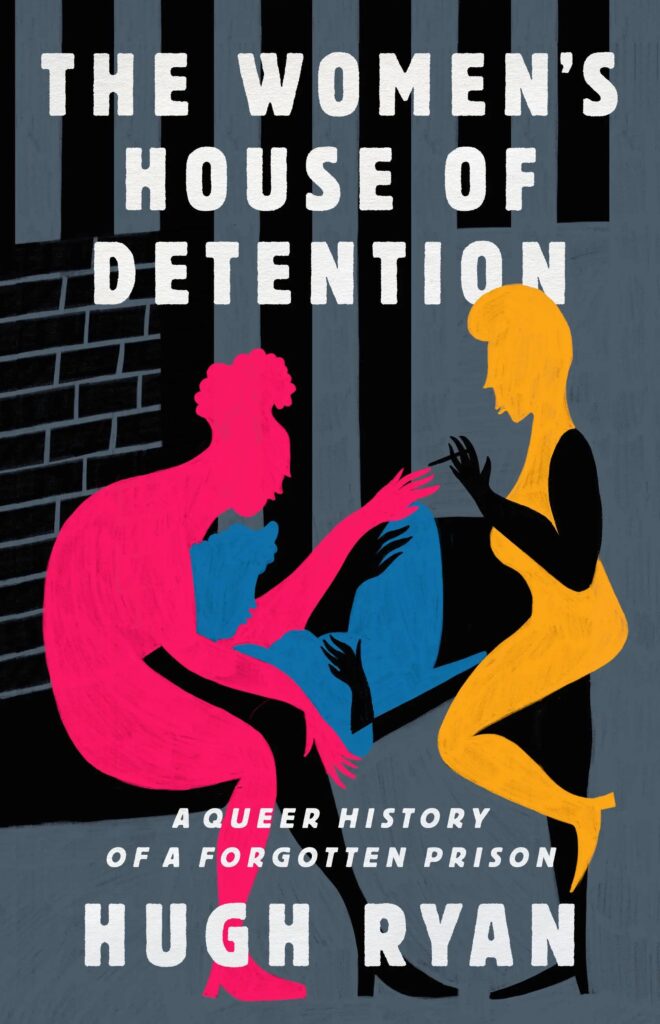
In this special episode — recorded live at Caveat on the Lower East Side — Tom and Greg are joined by Hugh Ryan, author of The Women’s House of Detention: A Queer History of a Forgotten Prison to explore the detention center’s place in both New York City history and LGBT history.

How did the “House of D” figure into the Stonewall Uprising of 1969? And what were the disturbing circumstances surrounding its eventual closure?

FEATURING: Stories of Mae West, Stanford White, Alva Belmont, Mayor Jimmy Walker, Angela Davis, Andrea Dworkin and — Tupac Shakur?

LISTEN NOW: THE HISTORY OF JEFFERSON MARKET AND THE WOMEN’S HOUSE OF DETENTION

Hugh Ryan on Patreon, Twitter and Instagram


Historic American Buildings Survey, Photocopy, c. 1880, Courtesy of New-York Historical Society,
New. York Public Library
The courtroom and House of Detention, 1938, New York Public Library
The Women’s House of Detention. Courtesy the New York Daily News Archives
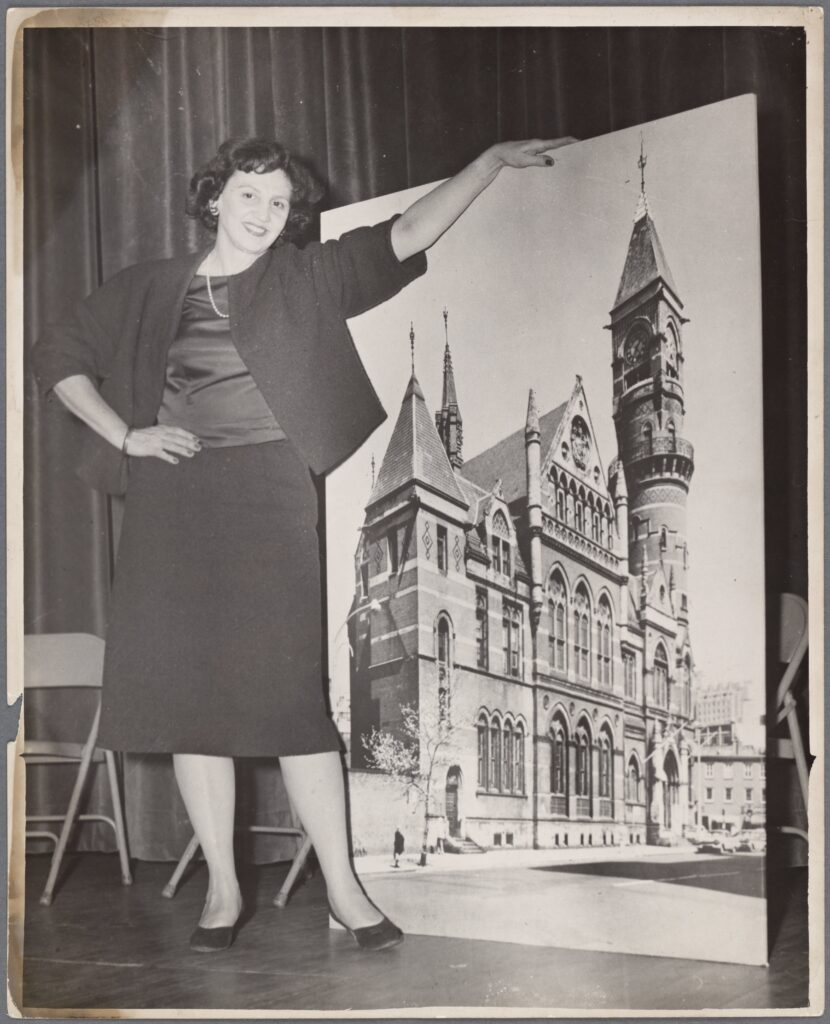
Margot Gayle with an image of the building she would help save. New York Public Library Digital Collections

Photos of the current Jefferson Market Library

Photo by Greg Young
Photo by Greg Young
Photo by Greg Young

FURTHER LISTENING

The subjects of these episodes are featured on this week’s episode. So check them out after listening to the current show:


The Bowery Boys: New York City History podcast is brought to you …. by you!

We are producing a new Bowery Boys podcast every other week. We’re also looking to improve and expand the show in other ways — publishing, social media, live events and other forms of media. But we can only do this with your help!

We are creators on Patreon, a patronage platform where you can support your favorite content creators.

Please visit our page on Patreon and watch a short video of us recording the show and talking about our expansion plans. If you’d like to help out, there are several different pledge levels. Check them out and consider being a sponsor.

We greatly appreciate our listeners and readers and thank you for joining us on this journey so far.

Categories
It's Showtime Long Island Podcasts

The Very Gay History of Fire Island

How did one particular summer settlement on Fire Island become a ‘safe haven’ for gay men and lesbians almost ninety years ago, decades before the uprising at Stonewall Inn?

This is the third and final part of the Bowery Boys Road Trip to Long Island. (Check out the first part on Gatsby and the Gold Coast and the second part on Jones Beach.)

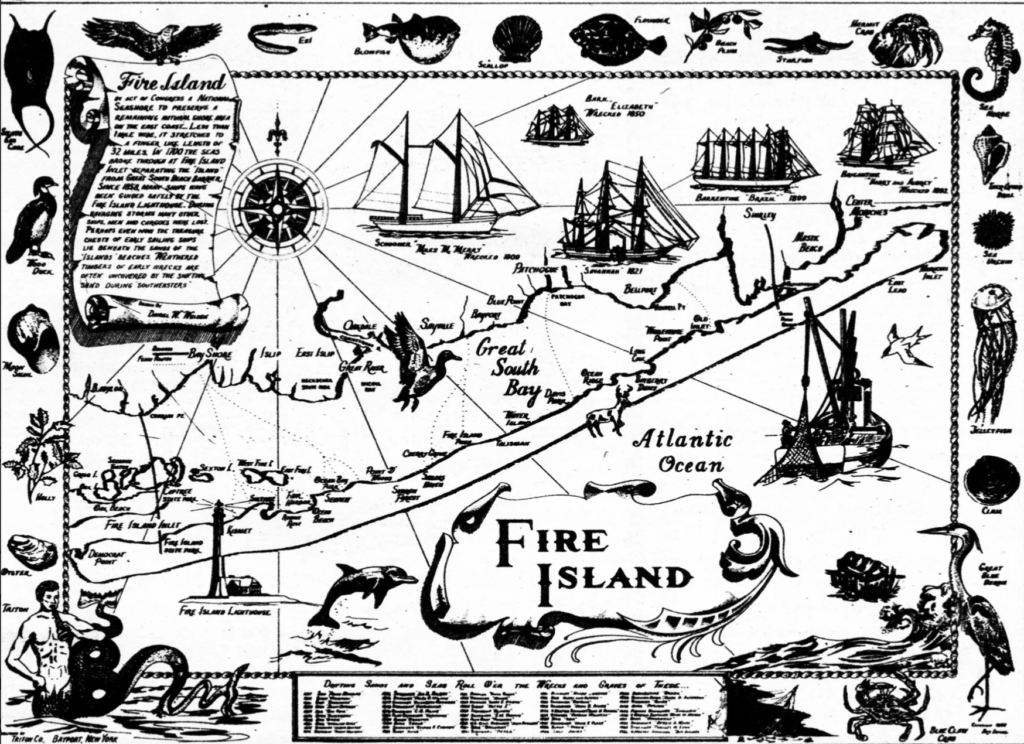
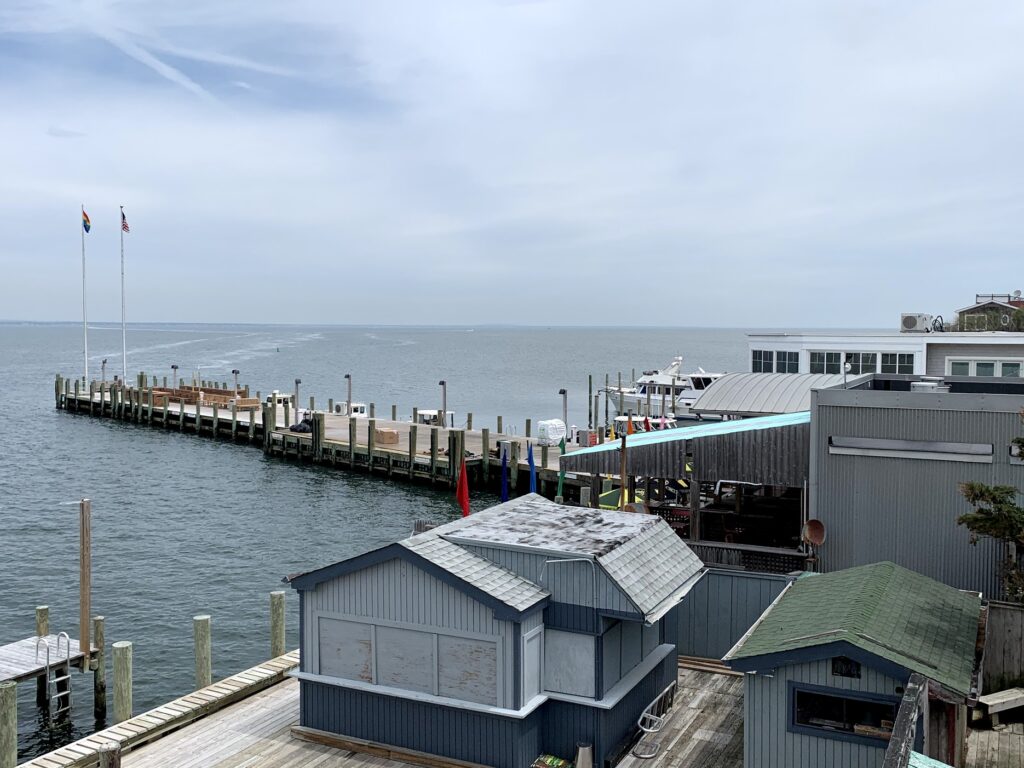
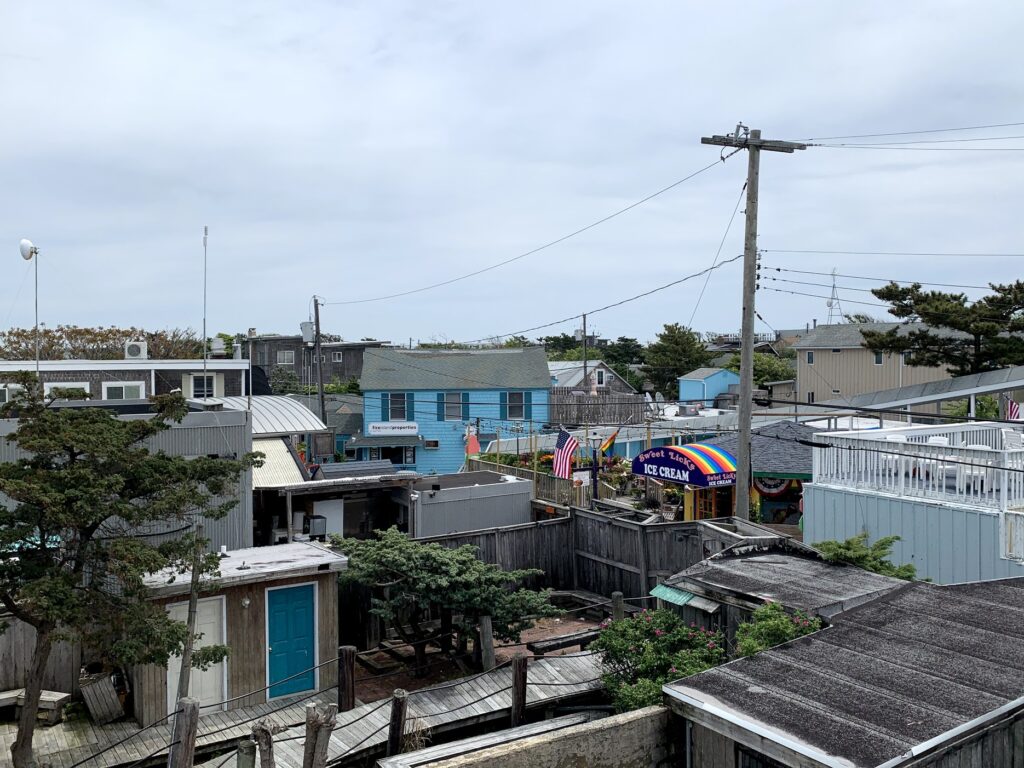
Fire Island is one of New York state’s most attractive summer getaways, a thin barrier island on the Atlantic Ocean lined with seaside villages and hamlets, linked by boardwalks, sandy beaches, natural dunes and water taxis. (And, for the most part, no automobiles.)

But Fire Island has a very special place in American LGBT history.

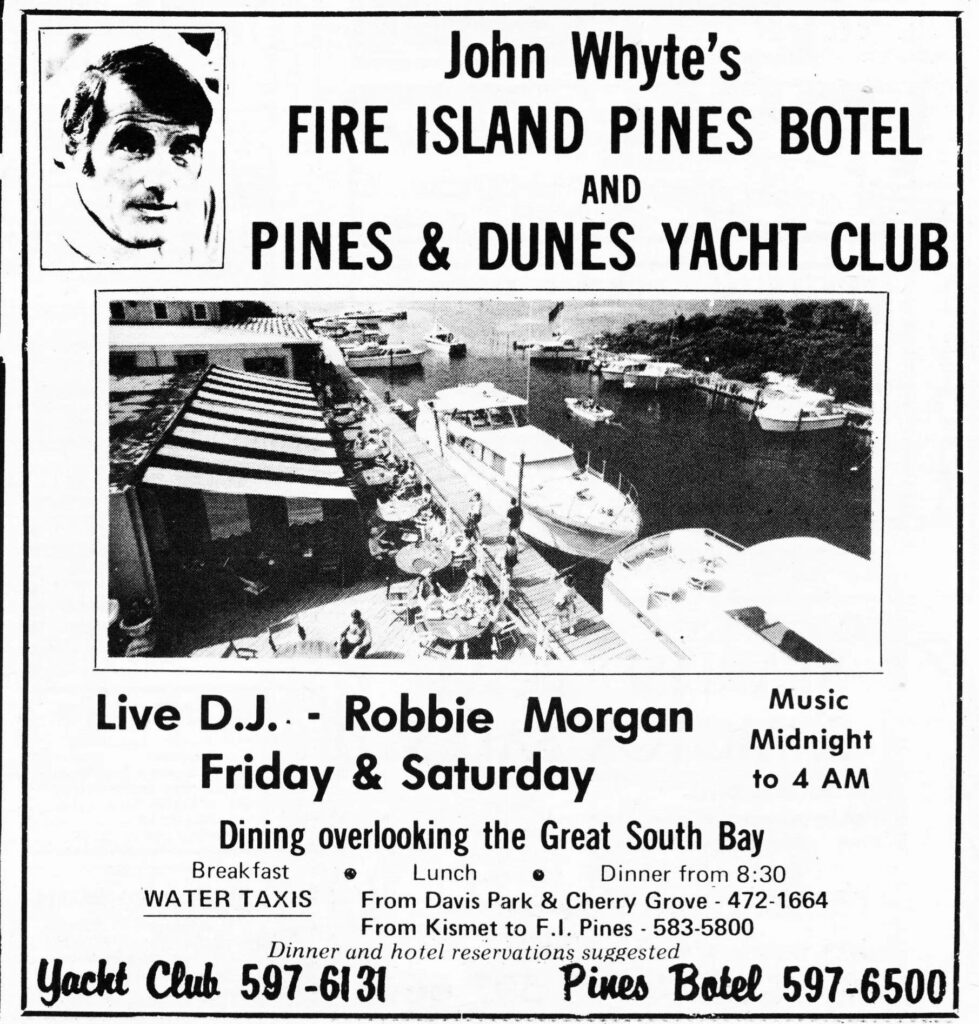
It is the site of one of the oldest gay and lesbian communities in the United States, situated within two neighboring hamlets — Cherry Grove and the Fire Island Pines.

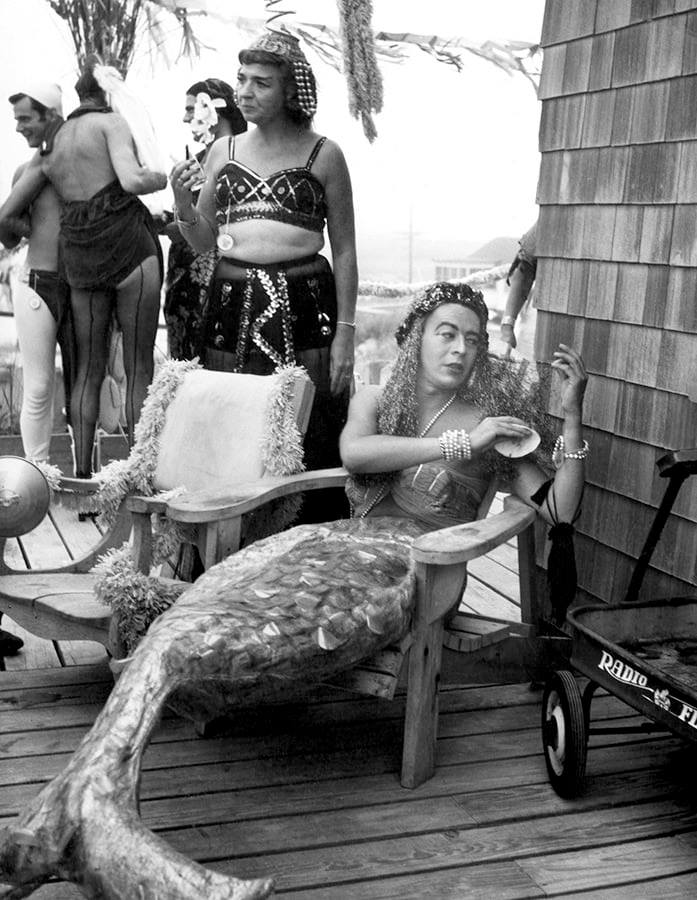
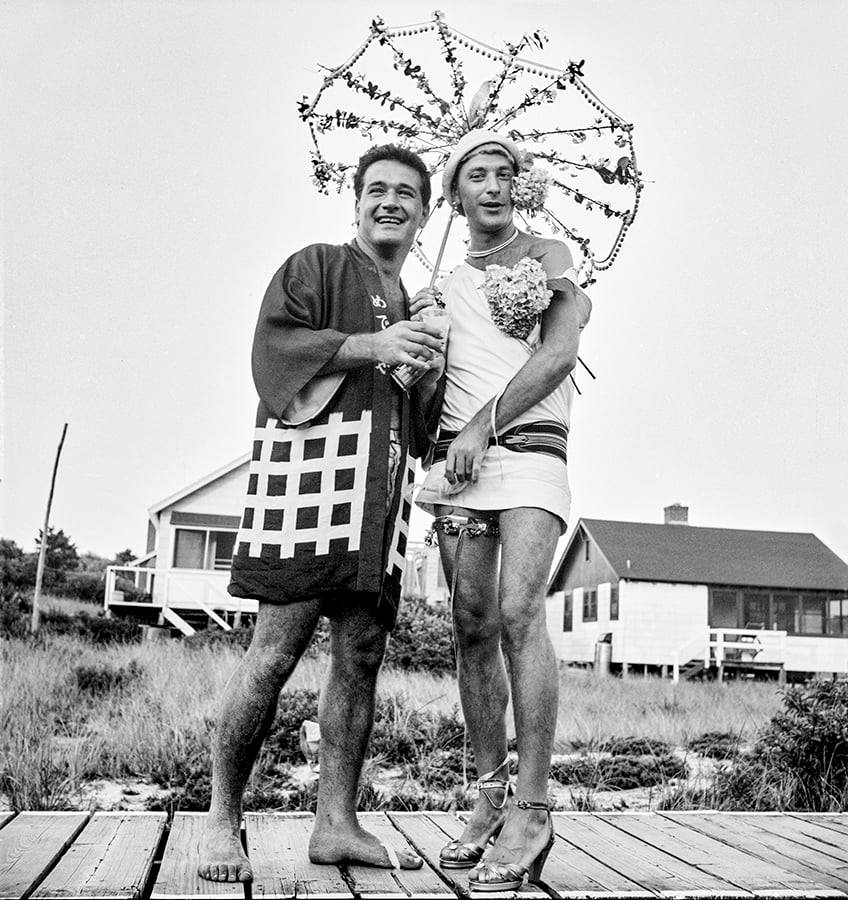
During the 1930s actors, writers and craftspeople from the New York theatrical world began heading to Cherry Grove, its remote and rustic qualities allowing for gay and lesbians to express themselves freely — far away from a world that rejected and persecuted them. 

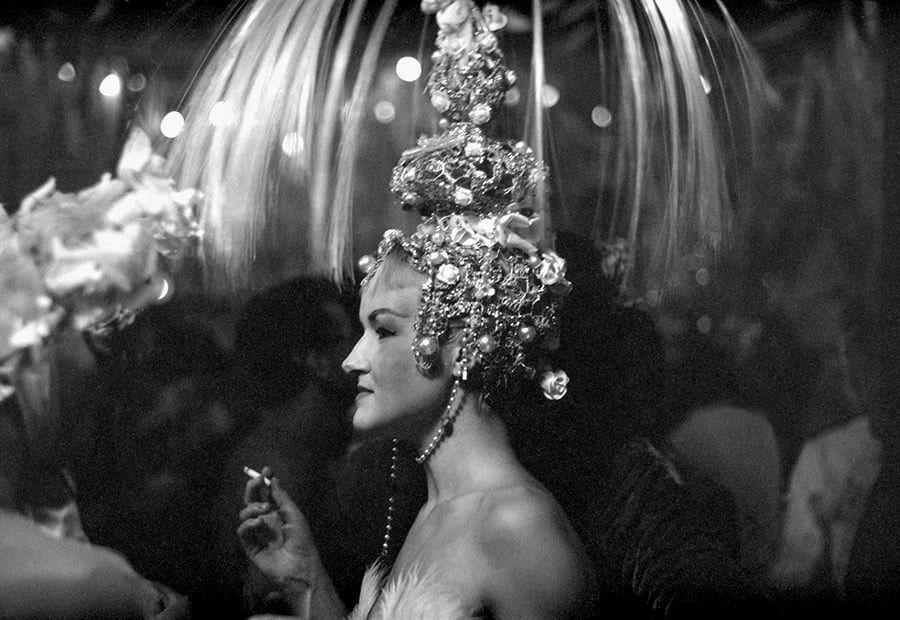
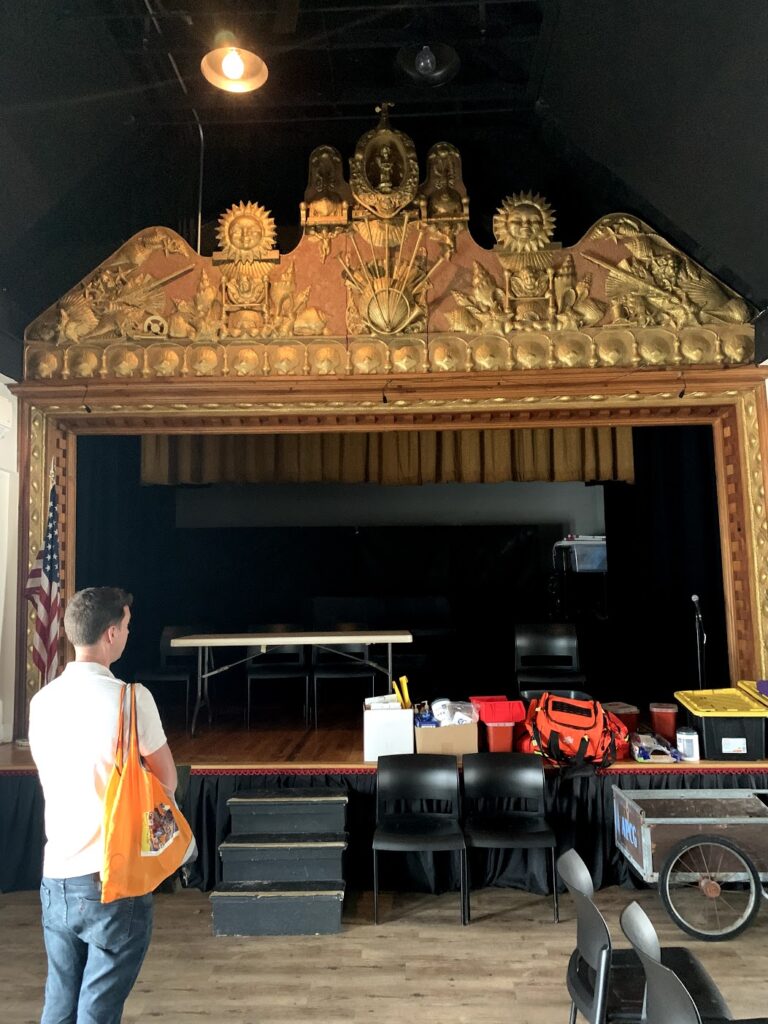
Performers at the Grove’s Community House and Theatre helped define camp culture, paving the way for the modern drag scene.

In this episode, Greg and Tom head to Cherry Grove — and the Community House and Theater — to get a closer look at Fire Island’s unique role in the American LGBT experience.

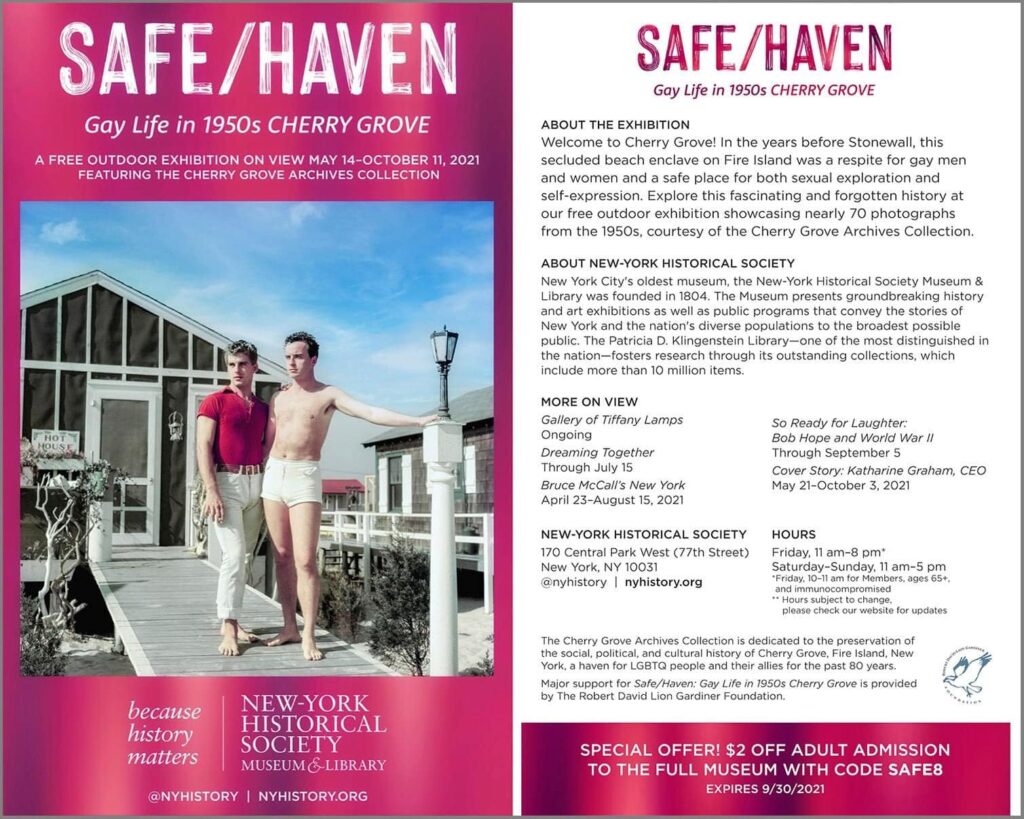
And they are joined by Parker Sargent, a documentary filmmaker and one of the curators of Safe Haven: Gay Life in 1950s Cherry Grove, a new exhibition at the New-York Historical Society, highlighting photography from the collection of the Cherry Grove Archives Collection.

FEATURING: The Great Hurricane of 1938! The Invasion of the Pines! The indescribable Belvedere! And the surprising origin of Fire Island’s name.

Listen Now: The Very Gay History of Fire Island


The Official Bowery Boys
Fire Island Playlist

Your soundtrack for the summer — whether you’re on Fire Island or just want to relive a retro experience from Cherry Grove or The Pines. Here’s a collection of songs inspired by our podcast on the history of Fire Island.

Find it on Spotify or listen to it from here.


Our big thanks to Parker Sargent from the Cherry Grove Archives Collection for joining us on the show this week and giving us such a marvelous tour of the Community House and Theatre.

Go see the show Safe/Haven: Gay Life in 1950s Cherry Grove at the New-York Historical Society. Details here.


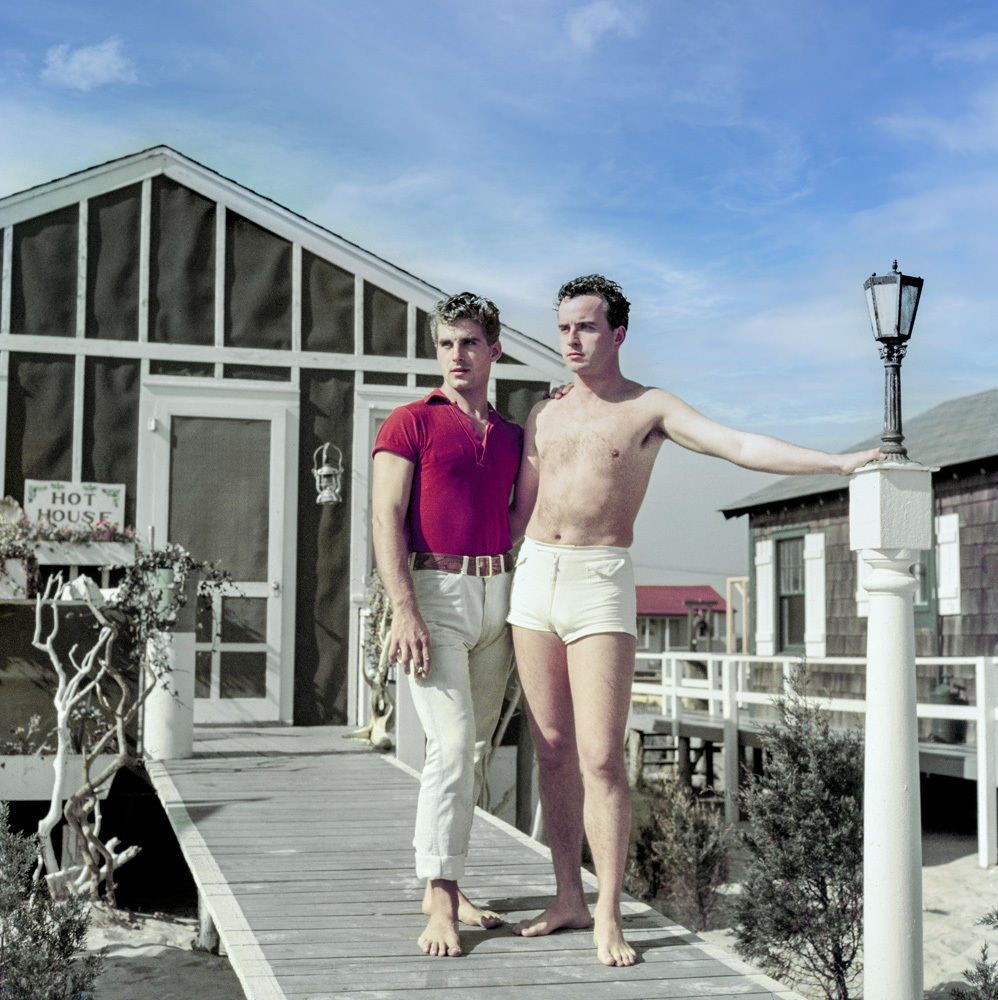
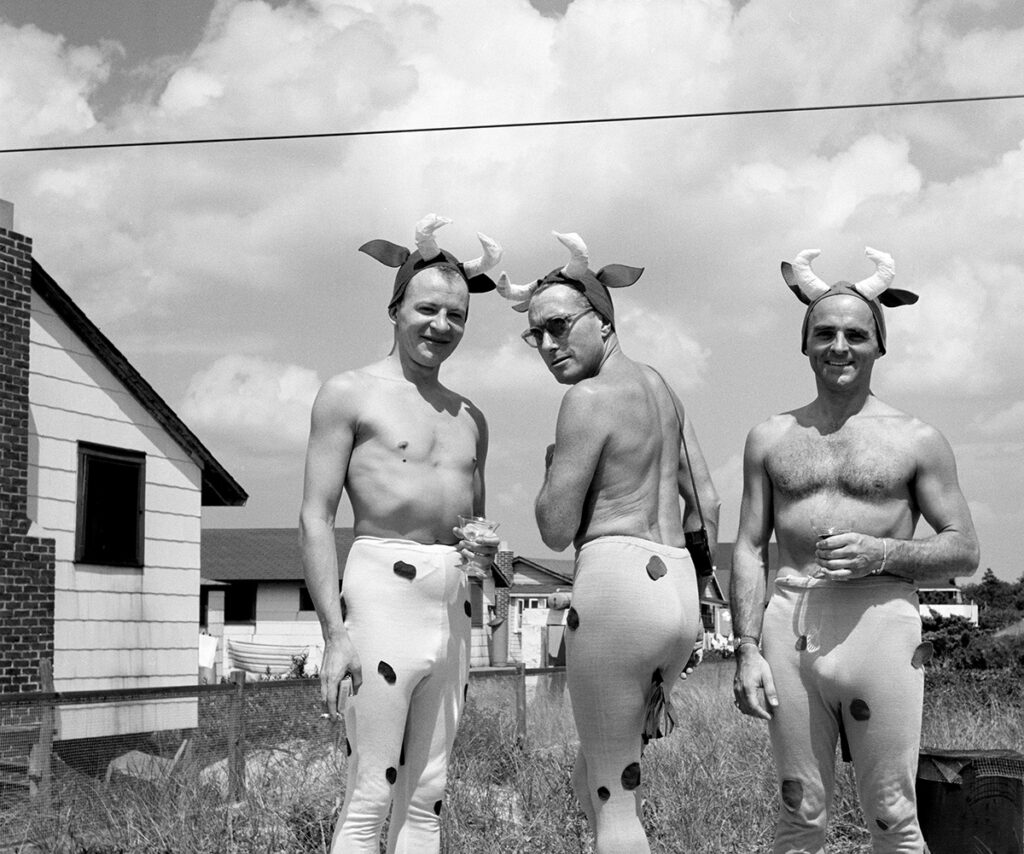
Images courtesy the Cherry Grove Archives Collection, taken by the men and women of Cherry Grove in the 1950s:

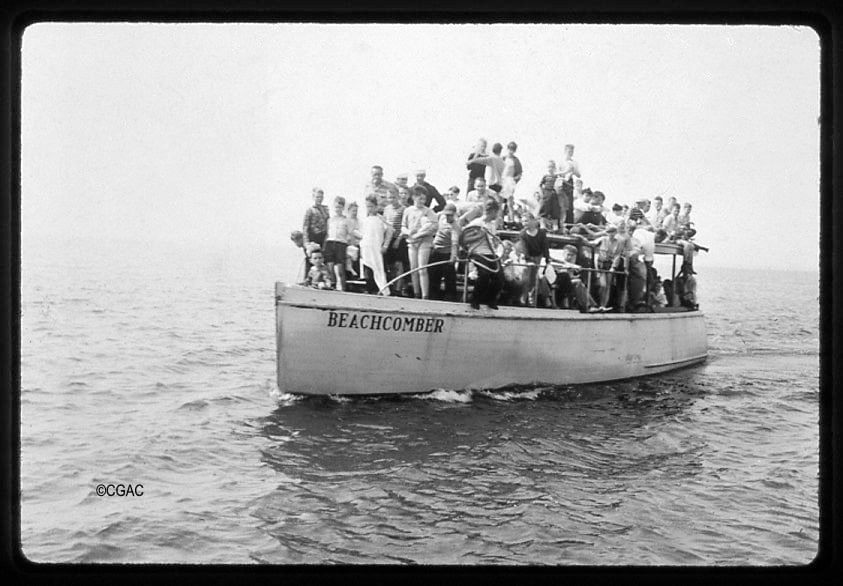
The Beachcomber, 1950s ferry to Cherry Grove. Photographer unknown. Cherry Grove Archives Collection

A few images from the exhibition, courtesy the Cherry Grove Archives Collection:

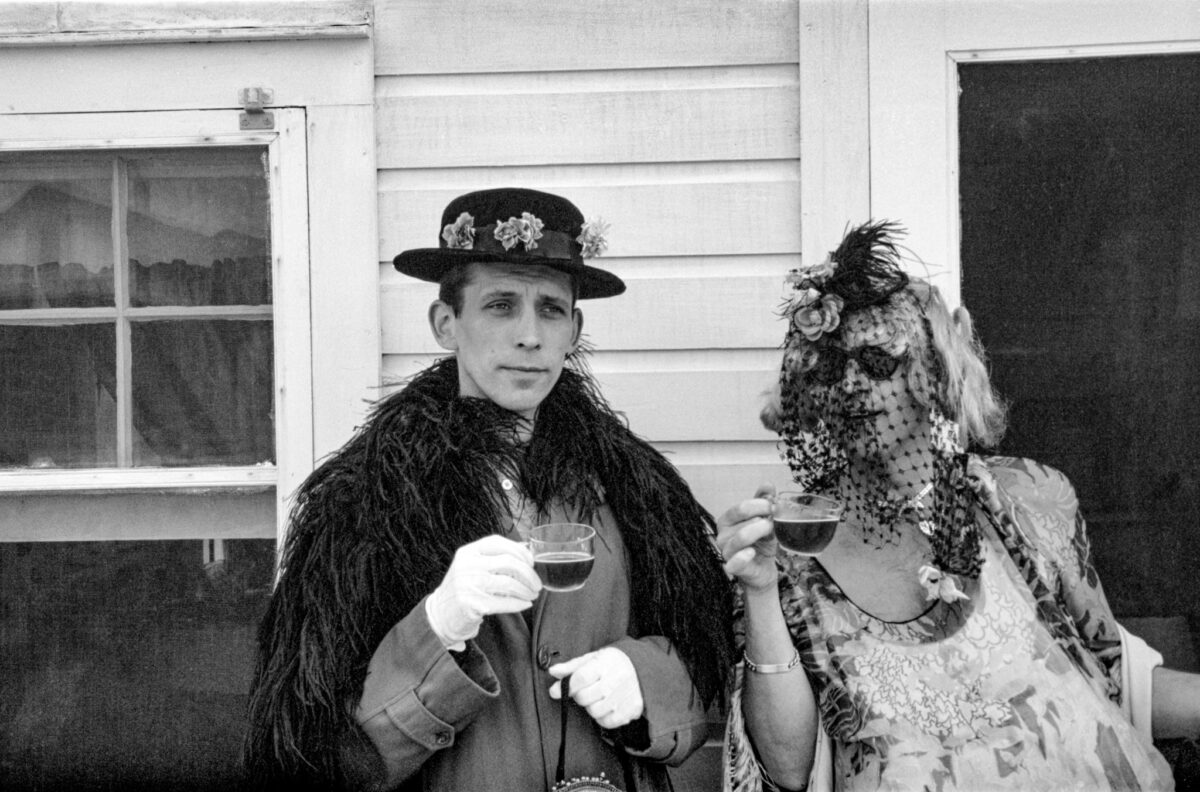
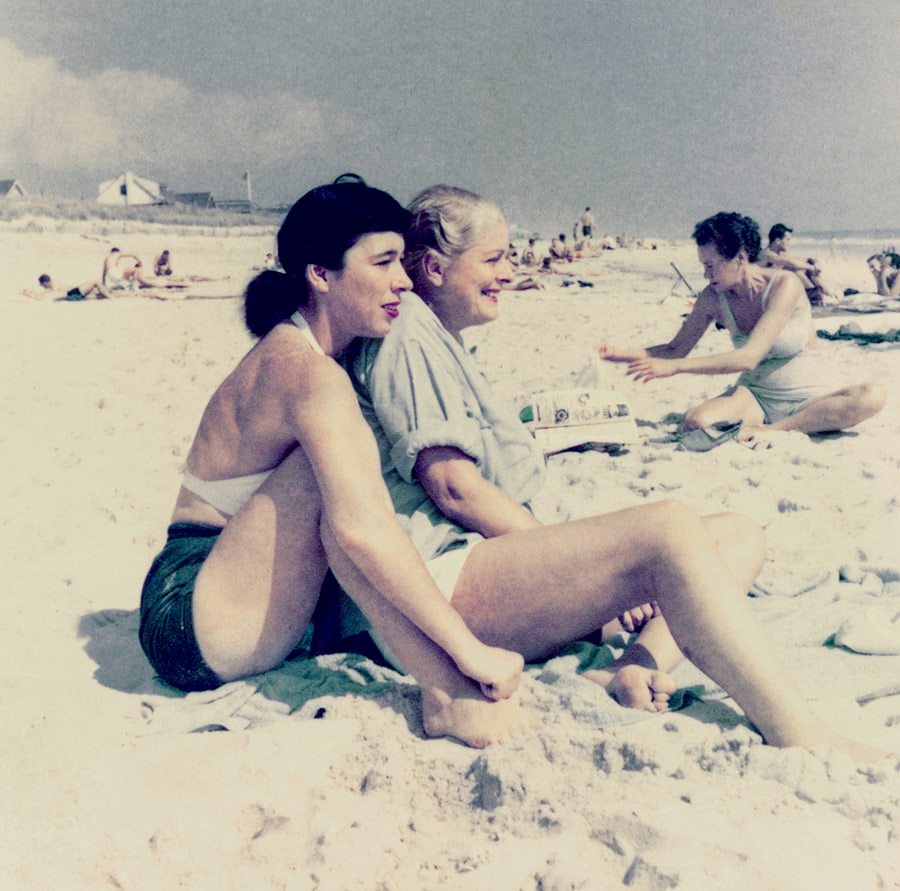
Patricia Fitzgerald & Kay Guinness, Cherry Grove Beach, September 1952

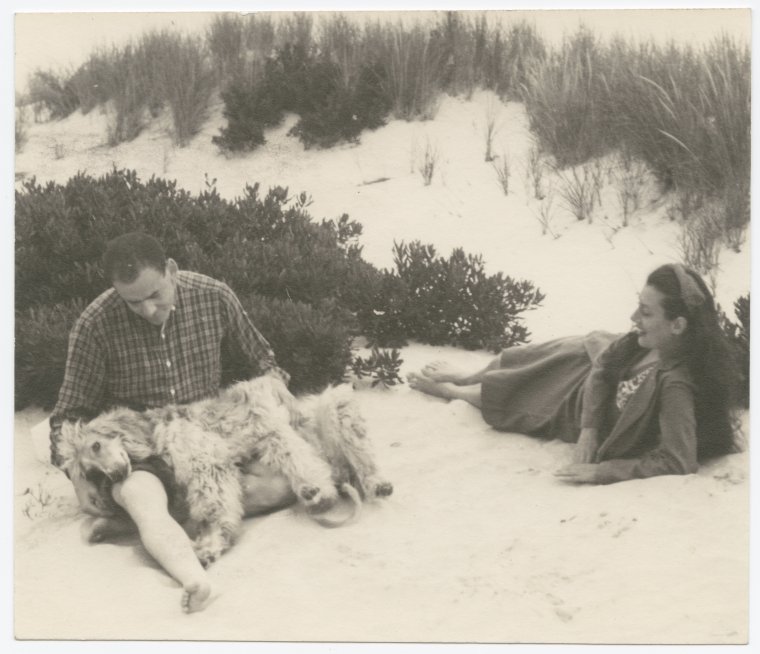
Lincoln Kirstein and Fidelma Cadmus with dog on Fire Island, 1952. New York Public Library
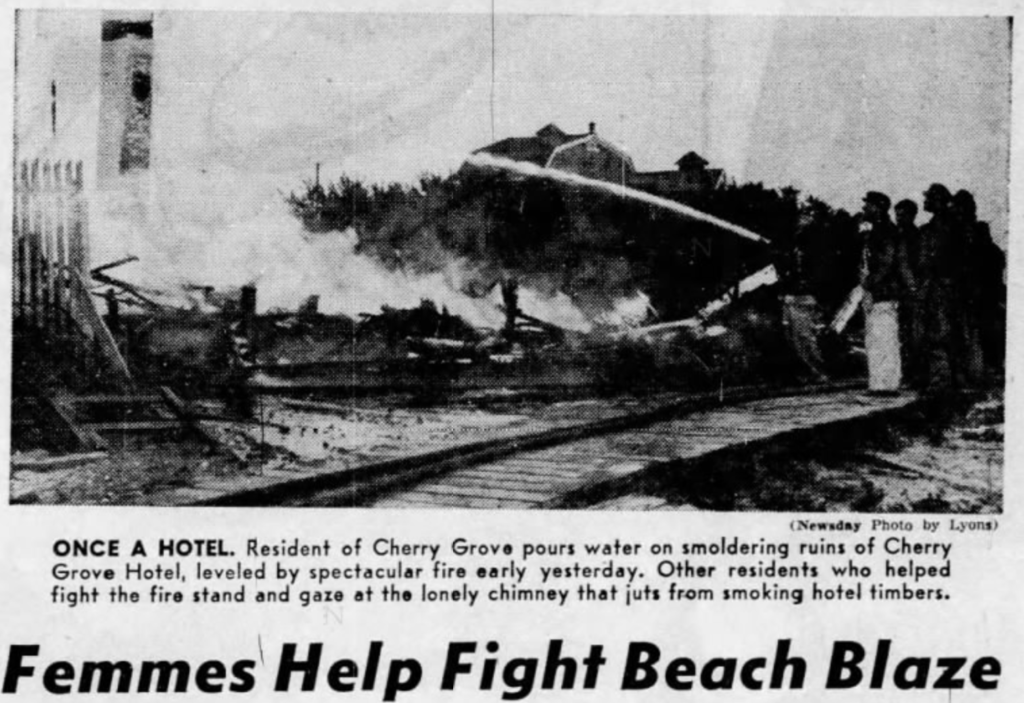
Newsday, September 28, 1956
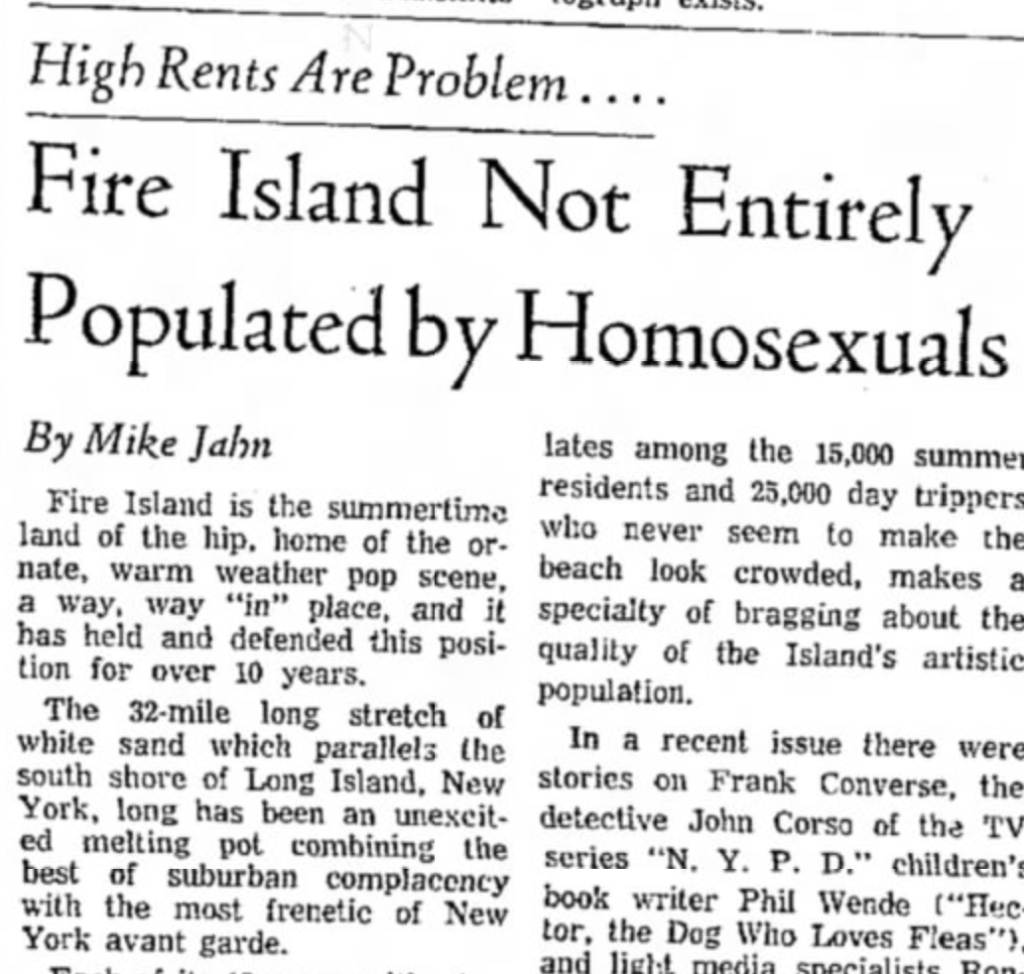
The Emporia Gazette, June 1968
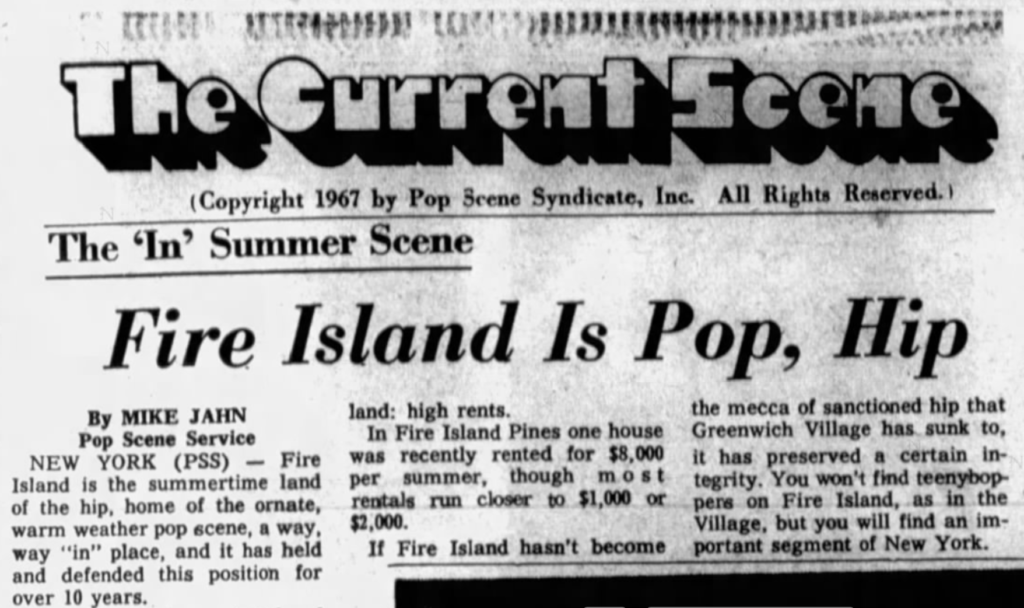
Then Tribune from Scranton, July 1968

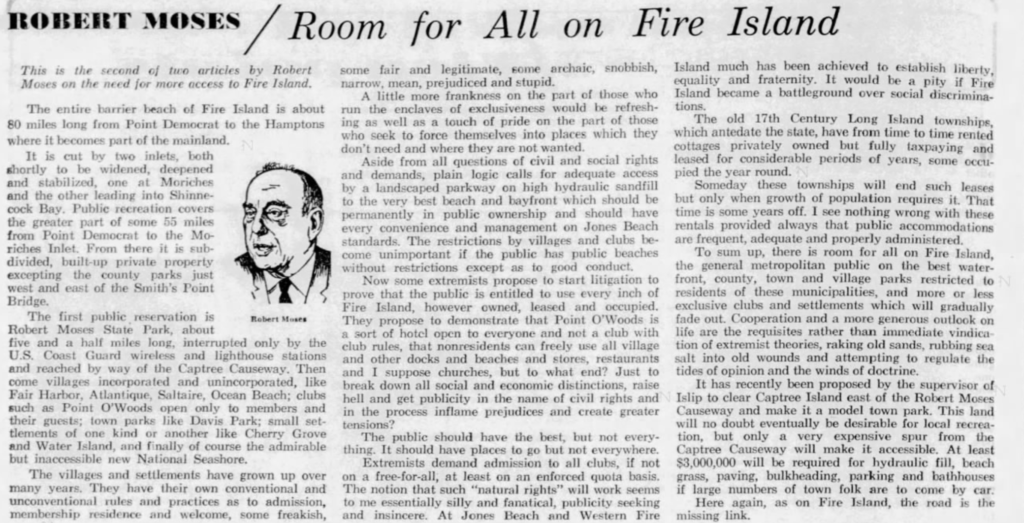
And a column from Robert Moses, 1969


Video about the exhibition from Safe/Haven curator Brian Clark:

https://www.youtube.com/watch?v=HHdROkyMlZ8&t=65s

Photographs of Tom and Greg in Cherry Grove (Photos courtesy Greg Young):

Behold — the Belvedere!


FURTHER LISTENING:

After listening to this show on the history of Fire Island check out these shows with similar themes and historical moments:


The Bowery Boys: New York City History podcast is brought to you …. by you!

We are now producing a new Bowery Boys podcast every other week. We’re also looking to improve and expand the show in other ways — publishing, social media, live events and other forms of media. But we can only do this with your help!

We are now a creator on Patreon, a patronage platform where you can support your favorite content creators.

Please visit our page on Patreon and watch a short video of us recording the show and talking about our expansion plans. If you’d like to help out, there are six different pledge levels. Check them out and consider being a sponsor.

We greatly appreciate our listeners and readers and thank you for joining us on this journey so far.

Categories
Podcasts Writers and Artists

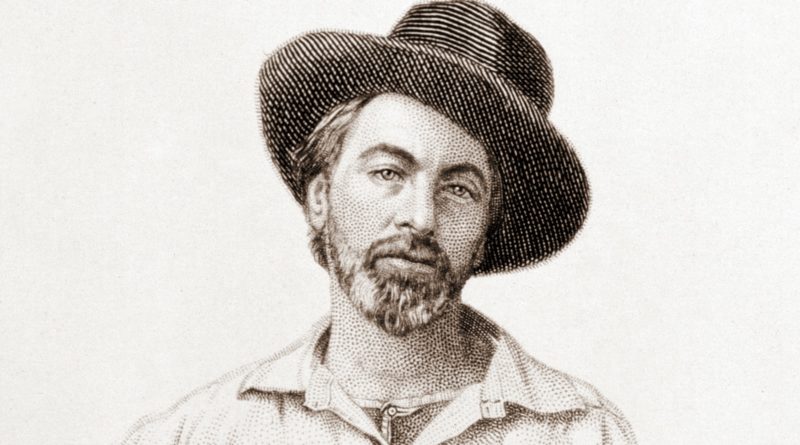
Walt Whitman at 200: Celebrating his life and legacy in the cities of New York and Brooklyn

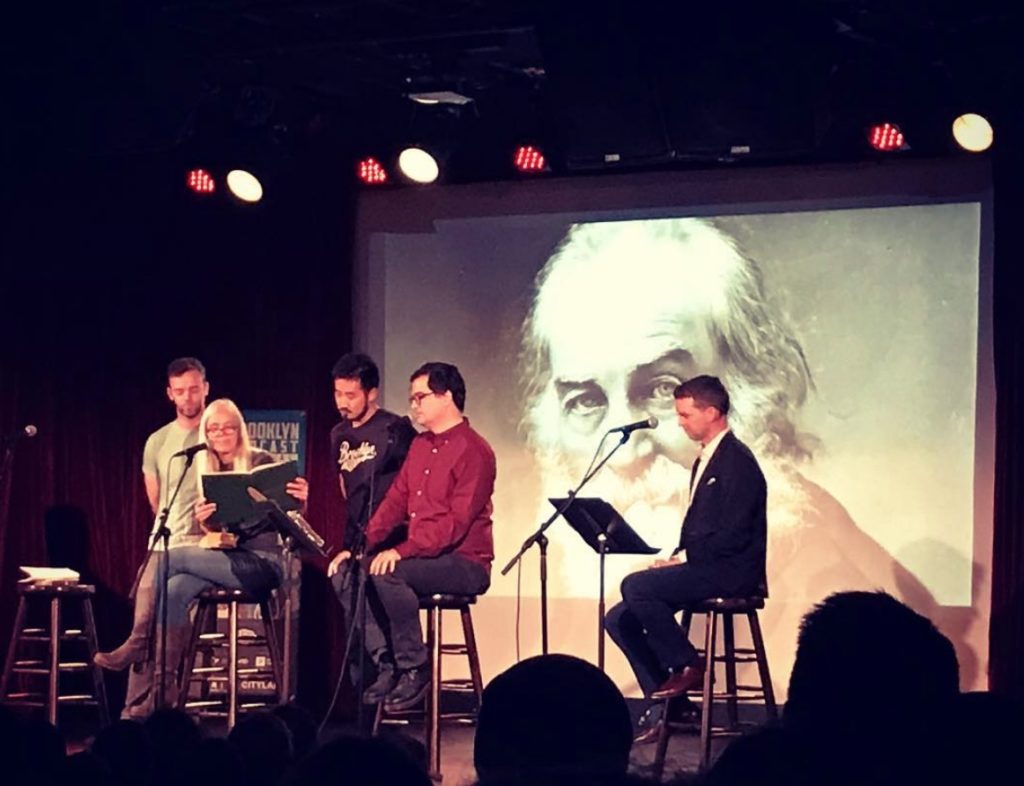
A very special episode of the Bowery Boys podcast, recorded live at the Bell House in Gowanus, Brooklyn, celebrating the legacy of Walt Whitman, a writer with deep ties to New York and its 19th century sister-city Brooklyn.

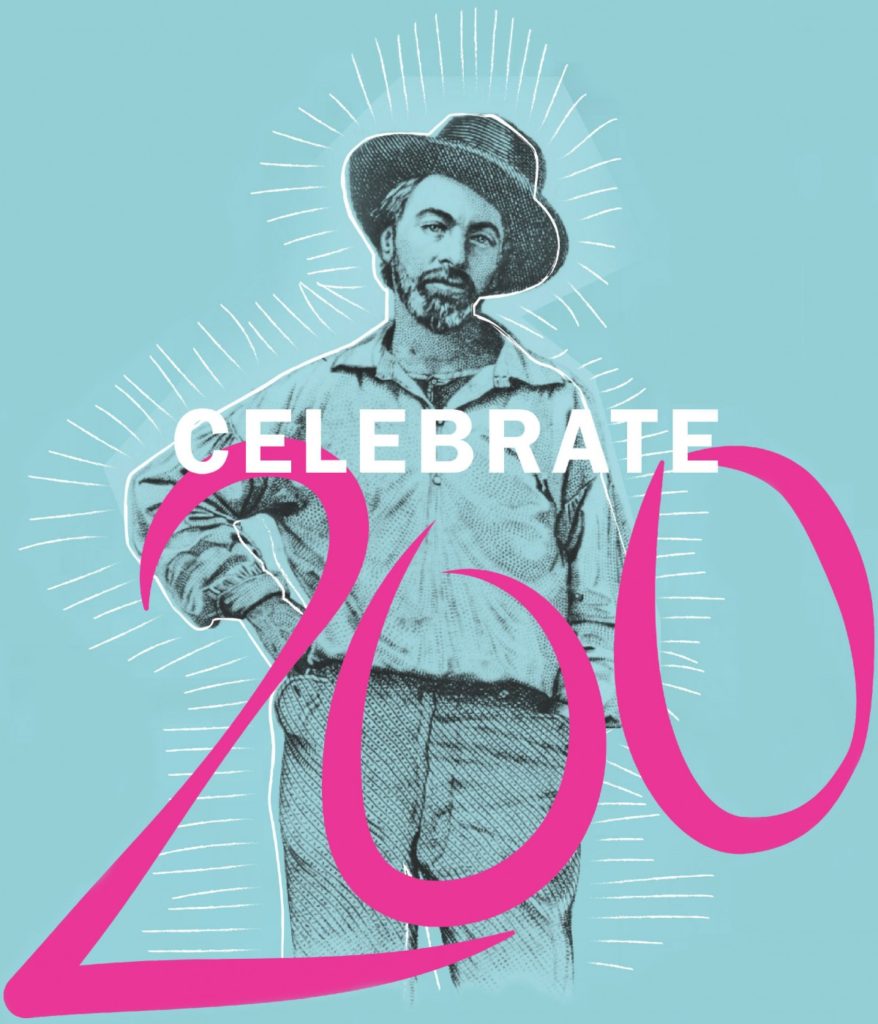
On May 31, 1819, the world will mark the 200th anniversary of the birth of Whitman, a journalist who revolutionized American literature with his long-crafted work Leaves of Grass. The 19th century cities of New York and Brooklyn helped shape the man Whitman would become, from its bustling printing presses to bohemian haunts like Pfaff’s Beer Cellar.

To help them tell this story, Greg and Tom are joined by guests from the worlds of academia, literature and preservation:

Karen Karbiener, NYU professor and head of the Walt Whitman Initiative, an international collective bringing together all people interested in the life and work of Walt Whitman

Jason Koo, award-winning poet, and founder and executive director of Brooklyn Poets, celebrating and cultivating the literary heritage of Brooklyn, the birthplace of American poetry

and Brad Vogel, executive director at the New York Preservation Archive Project and board member of the Walt Whitman Initiative, leading the drive to protect New York City-based Whitman landmarks.

This episode was recorded as part of the Brooklyn Podcast Festival presented by Pandora.

Listen Now: Walt Whitman New York Podcast

________________________________________________________
The Bowery Boys: New York City History podcast is brought to you …. by you!

We are now producing a new Bowery Boys podcast every other week. We’re also looking to improve the show in other ways and expand in other ways as well — through publishing, social media, live events and other forms of media. But we can only do this with your help!

We are now a member of Patreon, a patronage platform where you can support your favorite content creators for as little as a $1 a month.

Please visit our page on Patreon and watch a short video of us recording the show and talking about our expansion plans. If you’d like to help out, there are five different pledge levels (and with clever names too — Mannahatta, New Amsterdam, Five Points, Gilded Age, Jazz Age and Empire State). Check them out and consider being a sponsor.

And join us for the next episode of the Bowery Boys Movie Club, an exclusive podcast provided to our supporters on Patreon.

We greatly appreciate our listeners and readers and thank you for joining us on this journey so far.

_________________________________________________________
For a list of Walt Whitman celebrations in New York City and around the country, visit the Walt Whitman Initiative for details. And the week of Whitman’s bicentennial (May 27-June 1) is International Whitman Week!

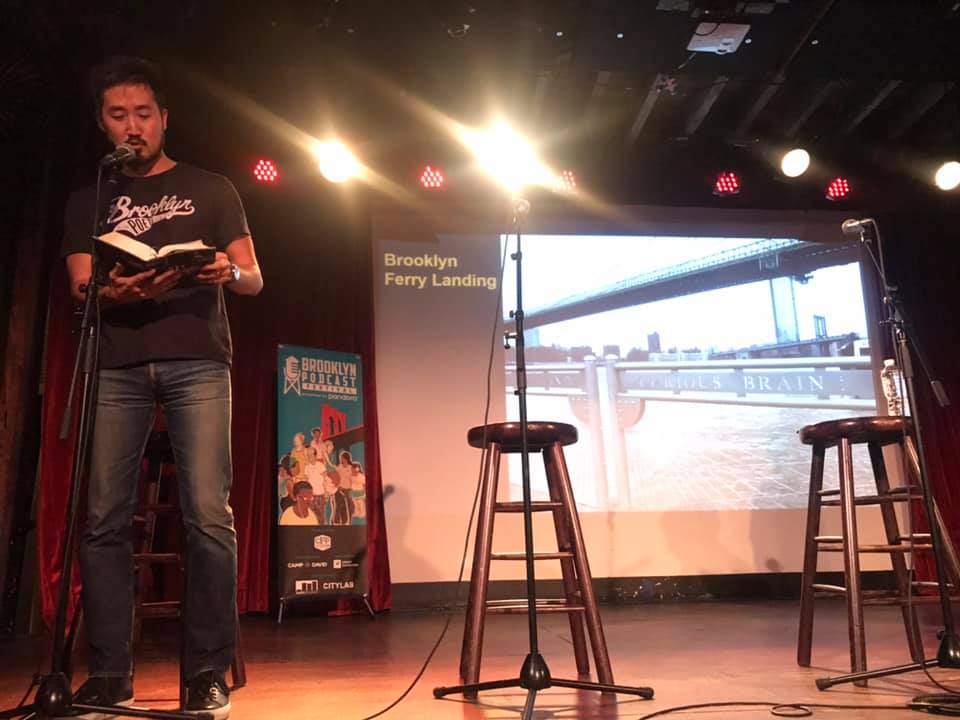
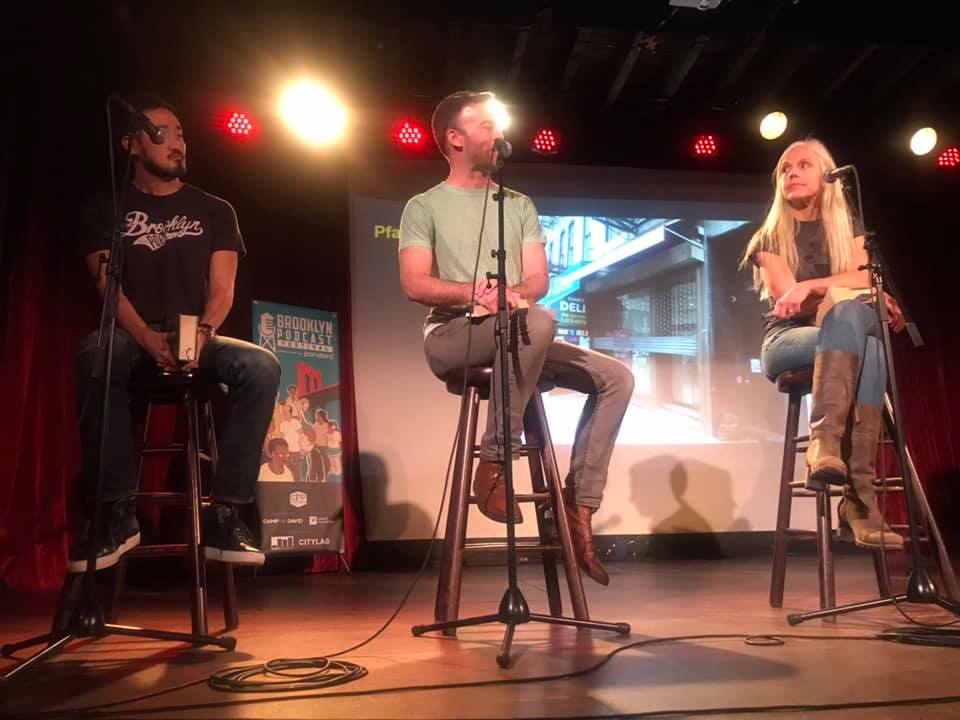
Some images from our live show:

jenna_scherer/Instagram

Jason Koo reading “Crossing Brooklyn Ferry”

Courtesy Marie Carter

Jason Koo, Brad Vogel and Karen Karbiener

Courtesy Marie Carter

This is a recording of what many consider the actual voice of Walt Whitman, recorded on wax cylinder, reading a section of his poem “America”. (There is some controversy over its veracity.)

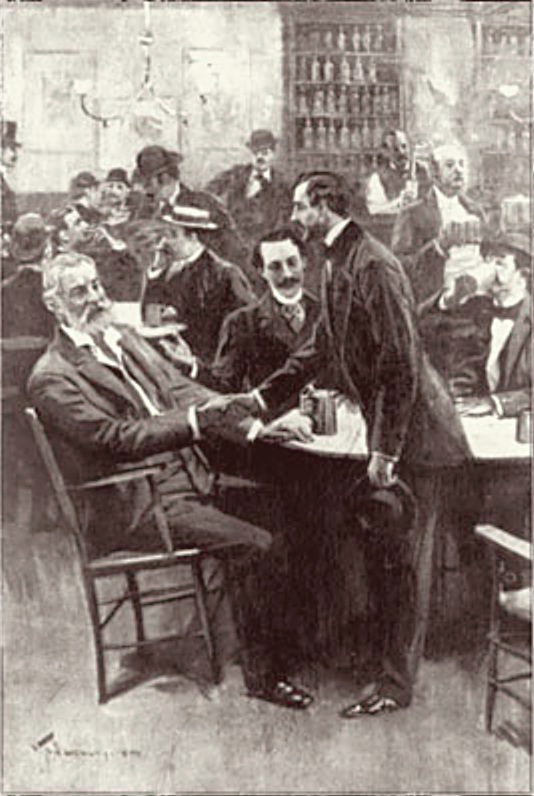
An illustration of the interior of Pfaff’s Beer Cellar, depicted here in 1857 (the seated gentleman is Whitman).

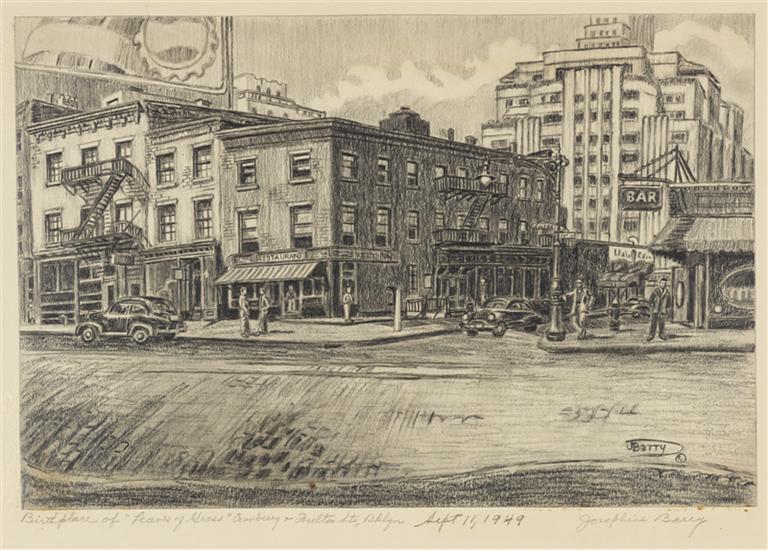
The location of Rome Brothers printing house (at Cranberry and Fulton streets), depicted here in 1949 in an illustration by Josephine Barry.

Museum of the City of New York

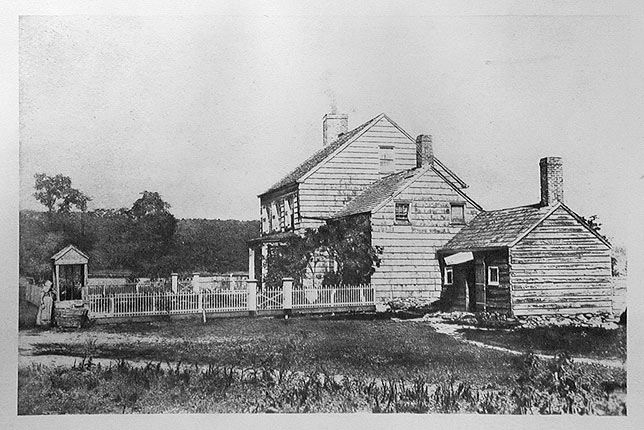
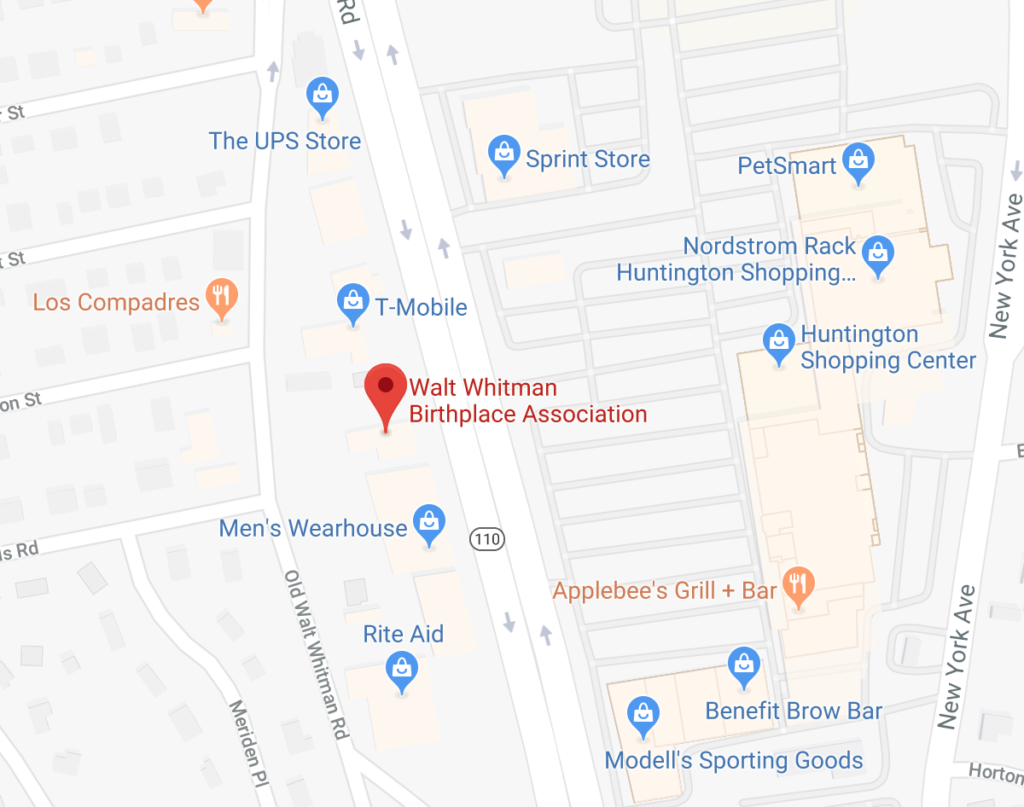
Whitman’s birthplace in Huntington, Long Island, still stands and is well worth a visit. It’s lovely! Unfortunately the landscape around the house has changed dramatically.

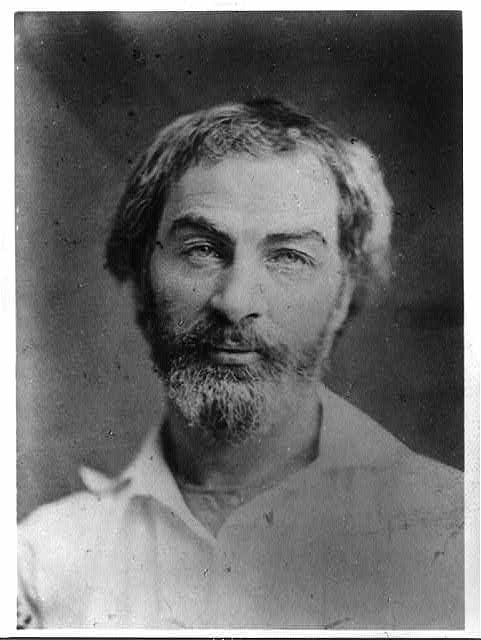
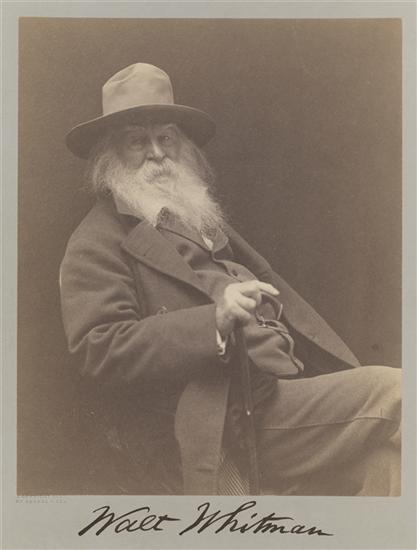
Whitman in 1854

Library of Congress

Whitman in 1890, photographed by George C. Cox

Museum of the City of New York

FURTHER LISTENING

Before Whitman, Poe found inspirations for his poetry in New York and in another future borough — the Bronx:

Whitman was a young man living in New York when a terrible blaze destroyed much of the city (not to mention job prospects):

Downtown Brooklyn, the area where Whitman once lived and published, has gone through several transformations since he lived here:

Categories
It's Showtime Podcasts

Absolutely Flawless: A History of Drag in New York

PODCAST The story of New York City’s most colorful profession.

Television audiences are currently obsessed with shows like RuPaul’s Drag Race and FX’s Pose, presenting different angles on the profession and art of drag. New York City has been crucial to its current moment in pop culture and people have been performing and enjoy drag performers for well over a century.

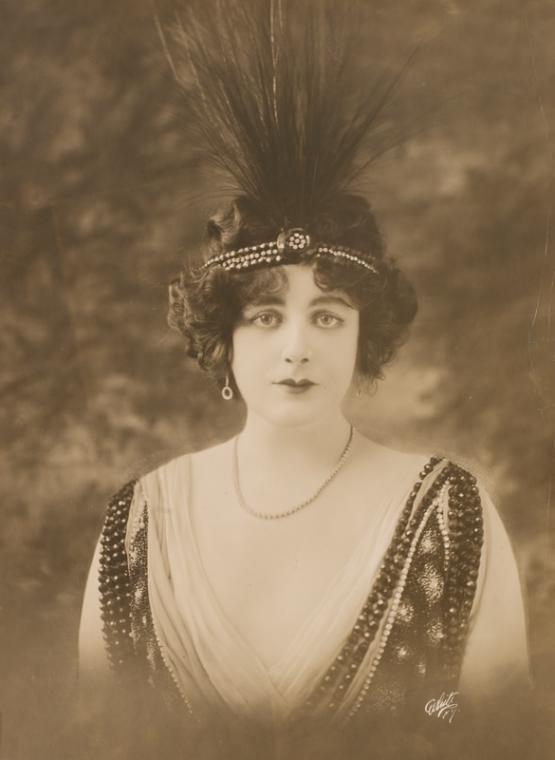
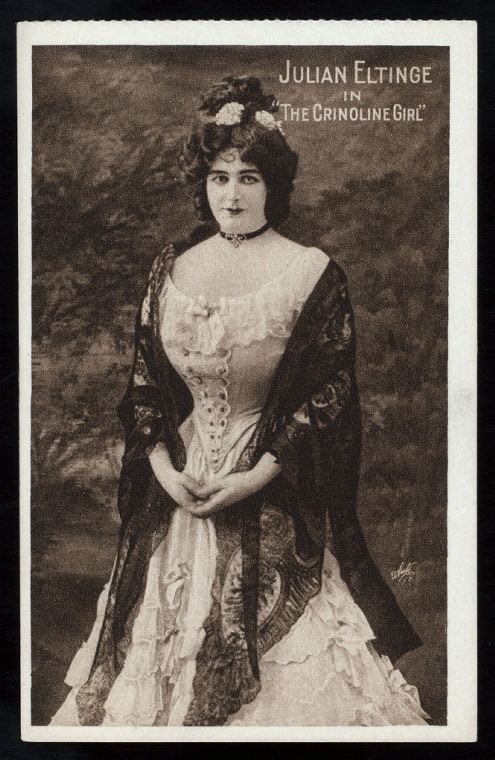
In the beginning there were two kinds of drag — vaudeville and ballroom. As female impersonators filled Broadway theaters — one theater is even named for a famed gender illusionist — thrill seekers were heading to the popular balls of Greenwich Village and Harlem.

During the middle of the 20th century, the gay scene retreated into the shadows, governed by mob control and harshly policed by the city. By design, drag became political. It also became a huge counter-cultural influence in the late 1960s — from the glamour of Andy Warhol‘s superstars to the jubilant schtick of Charles Busch.

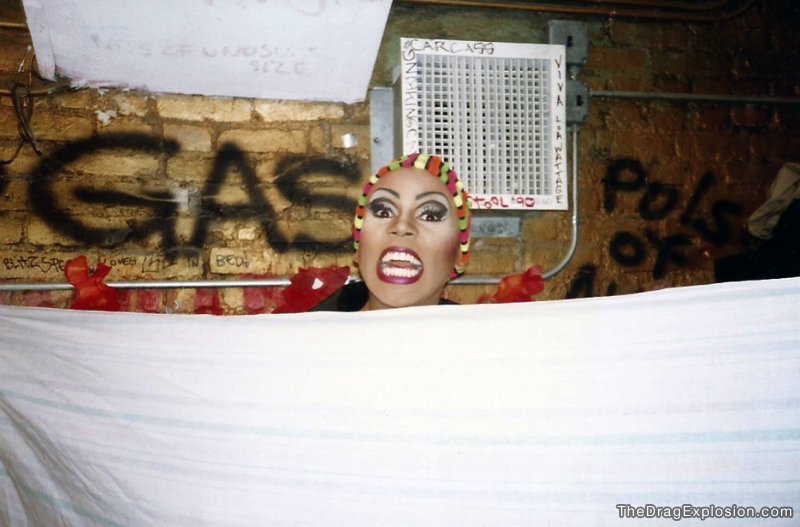
But it was the 1980s that brought the most significant influences to our current pop cultural moment. Joining Greg on this show are two experts on two late 80s/early 90s scenes — Felix Rodriguez, a videographer of the ballroom culture (made famous in the landmark documentary Paris Is Burning) and Linda Simpson, one of the great queens of East Village drag.

FEATURING: Drag kings! Wigstock! And a famous drag queen superstar who got struck by lightning.

Listen Now: Drag Queen History Podcast

_________________________________________________________
The Bowery Boys: New York City History podcast is brought to you …. by you!

We are now producing a new Bowery Boys podcast every other week. We’re also looking to improve the show in other ways and expand in other ways as well — through publishing, social media, live events and other forms of media. But we can only do this with your help!

We are now a member of Patreon, a patronage platform where you can support your favorite content creators for as little as a $1 a month.

Please visit our page on Patreon and watch a short video of us recording the show and talking about our expansion plans. If you’d like to help out, there are five different pledge levels (and with clever names too — Mannahatta, New Amsterdam, Five Points, Gilded Age, Jazz Age and Empire State). Check them out and consider being a sponsor.

We greatly appreciate our listeners and readers and thank you for joining us on this journey so far.

_______________________________________________________
Big thanks to Felix and Linda for joining me on the show! For more information on the history they spoke about, reach out to their work directly.

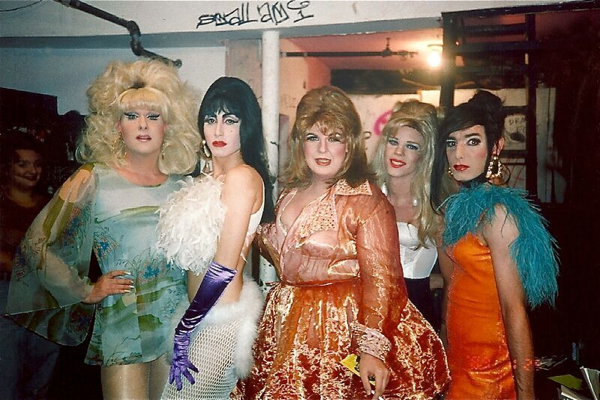
The Drag Explosion — Simpson’s collection of spectacular photographs from the late 80s/early 90s East Village drag scene.

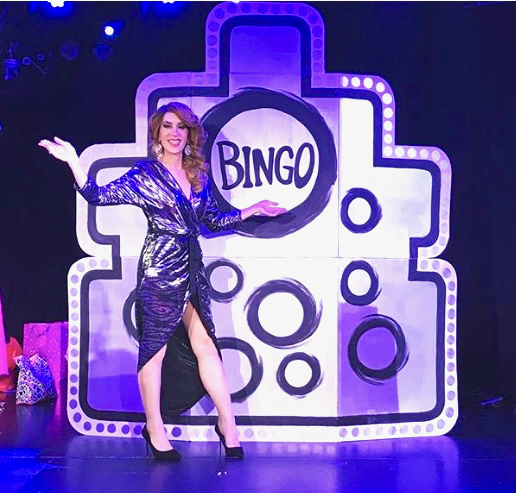
And visit Linda Simpson at her long-running bingo night at (le) poisson rouge

Courtesy Linda Simpson

And here’s one of Felix’s videos featuring the early 90s ballroom scene. Find many more at his YouTube page:

A couple images from Linda Simpson’s Drag Explosion project:

The Drag Explosion

Vaudeville superstar Julian Eltinge, in a couple of popular looks:

New York Public Library

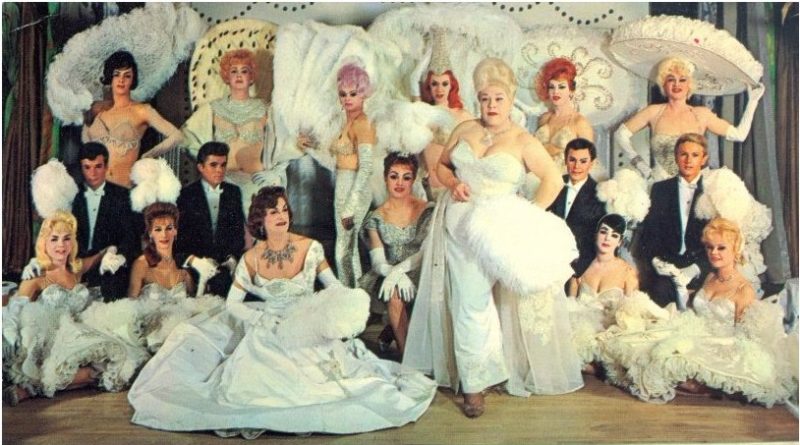
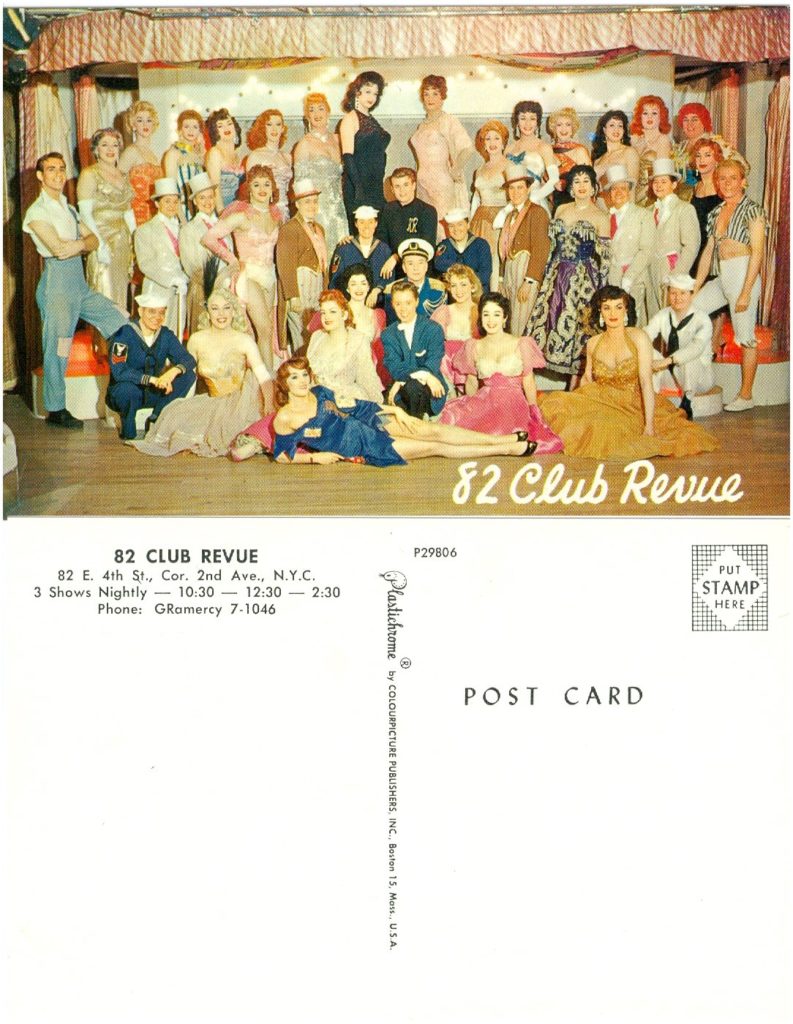
A postcard from Club 82. (Queer Music Heritage has an unbelievable collection of these.)

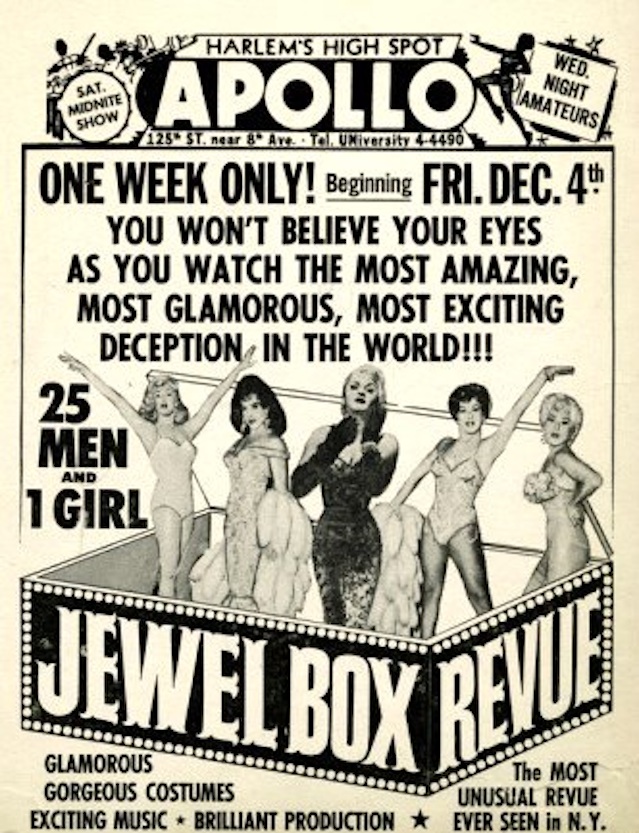
From the Jewel Box Revue’s 1960 appearance at the Apollo Theatre:

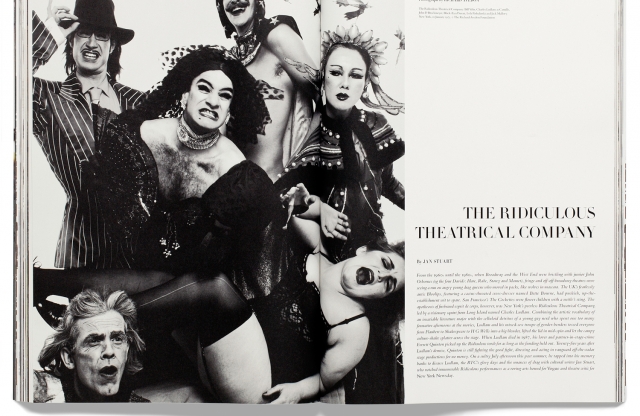
The Ridiculous Theatrical Company (with Charles Ludlum), one of the great influences on the modern drag scene.

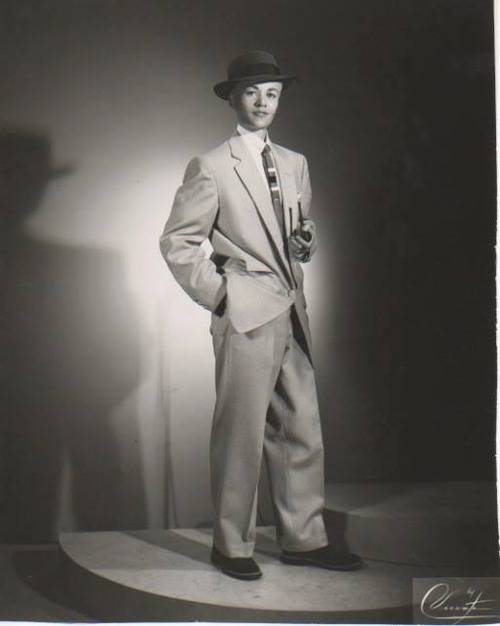
Stormé DeLarverie who performed with the Jewel Box Revue. DeLarverie was also a participant at the Stonewall Riots.

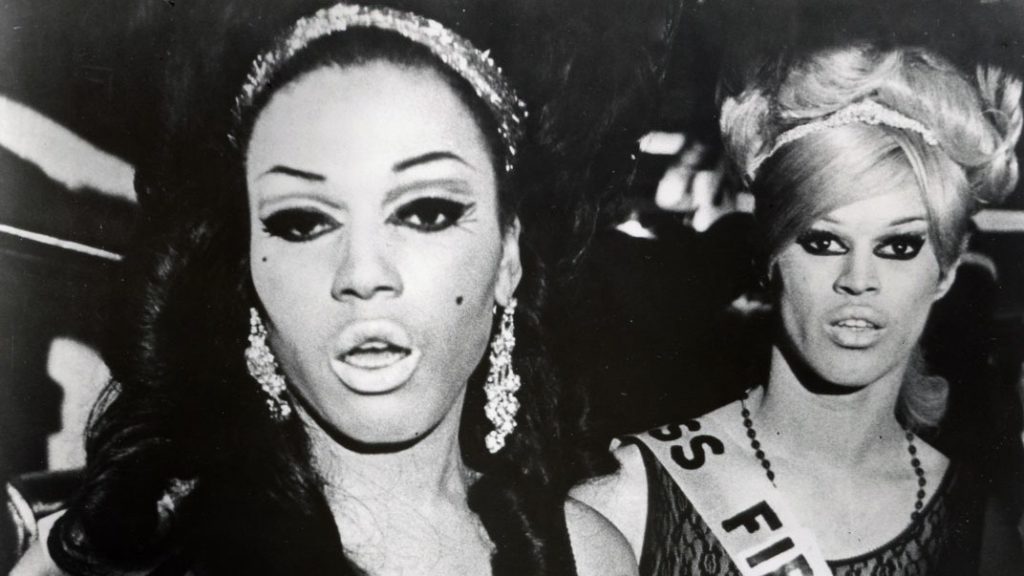
The stars of the eye-opening documentary The Queen

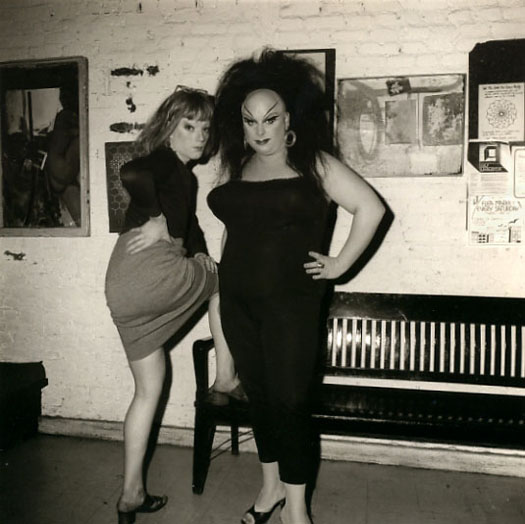
Jackie Curtis with Divine

Flickr/Confetta

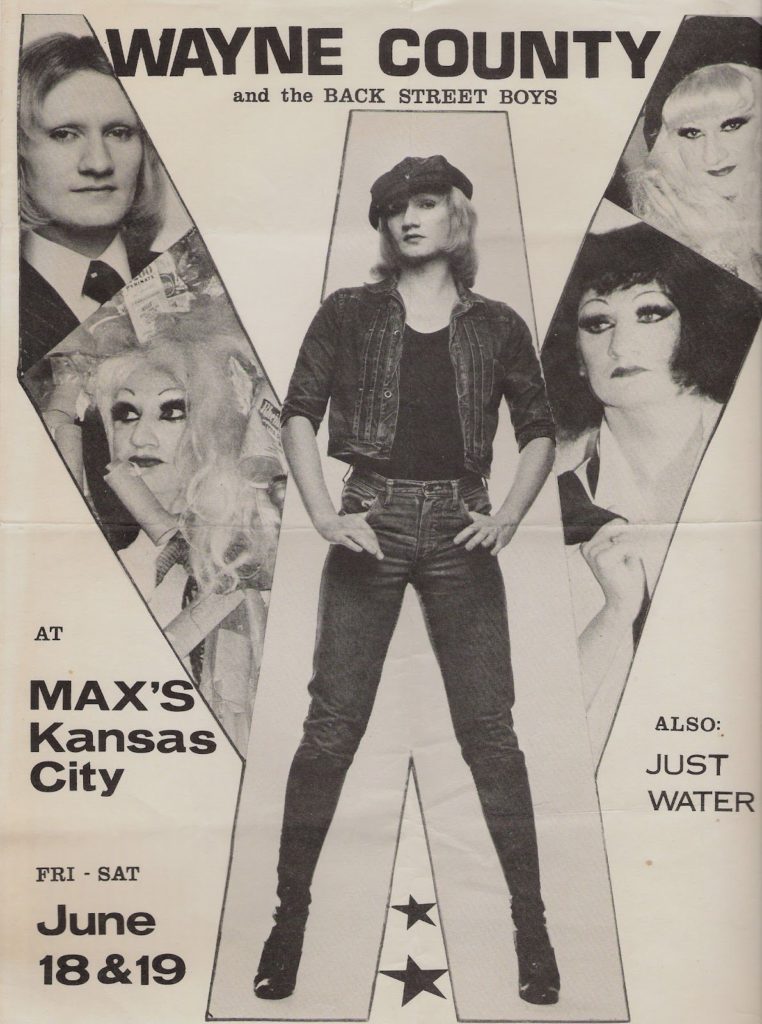
A flyer for a Wayne County (with the Back Street Boys) at the iconic rock venue Max’s Kansas City.

Categories
Landmarks Podcasts Politics and Protest

Revisiting the Stonewall Riots: The Evolving Legacy of a Violent Night

PODCAST The legacy of the Stonewall Riots and their aftermath, in a podcast history told over nine years apart (May 2008, June 2017).

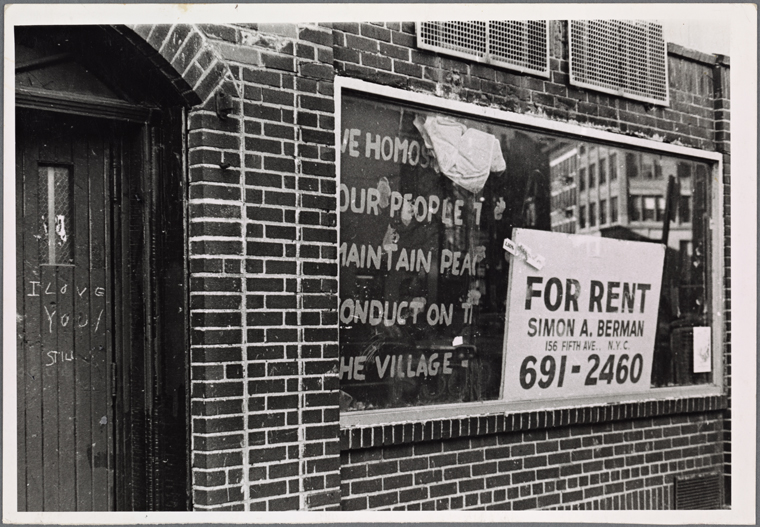
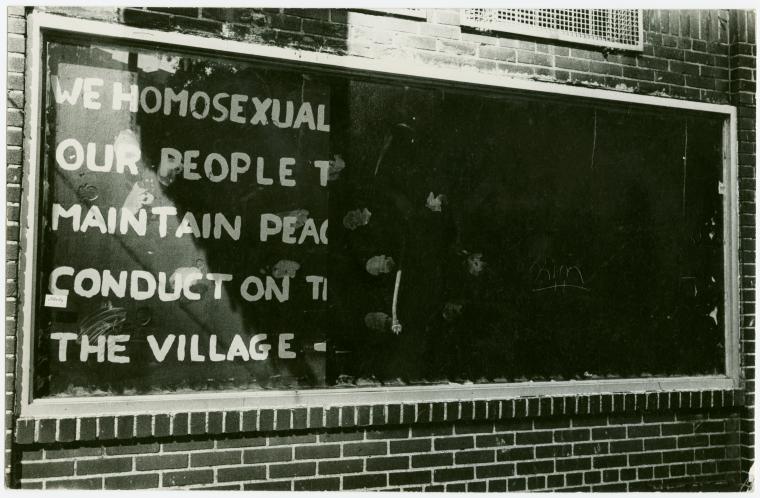
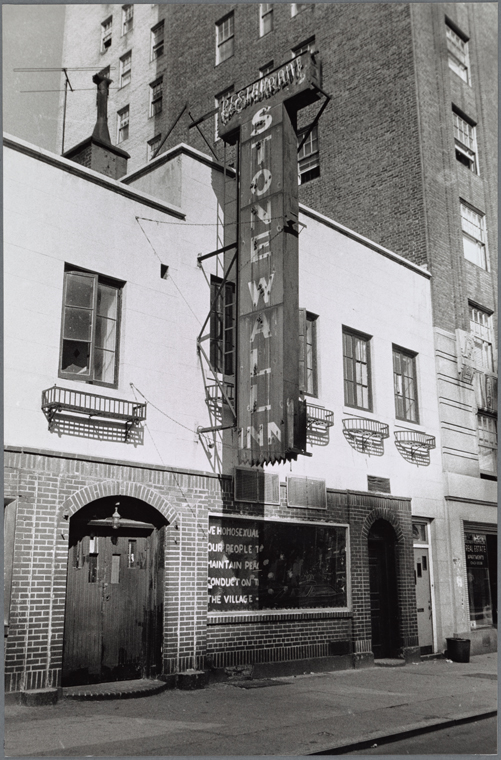
In the early morning hours of June 28, 1969, undercover police officers attempting to raid the Stonewall Inn, a mob-controlled gay bar with darkened windows on Christopher Street, were met with something unexpected — resistance.

That ‘altercation’ was a messy affair indeed — chaotic, violent, dangerous for all. Homeless youth fought against riot police along the twisting, crooked streets of the West Village. And yet, by the end, thousands from all walks of life met on those very same streets in the days and weeks to come in a new sense of empowerment.

In May of 2008, we recorded a podcast on the Stonewall Riots, an event that galvanized the LGBTQ community, giving birth to political organizations and a sense of unity and pride.

So much has changed within the LGBTQ community — and so much was left out of our original show — that’s we’ve decided to do something unique. In the first half, we present to you our original 2008 history on the Stonewall Riots, warts and all. In the second half, we present newly recorded material, exploring the effects of Stonewall on the crises that faced the gay community in the 1980s and 90s.

Now an official U.S. National Monument maintained by the National Park Service, the Stonewall National Monument preserves New York City’s role in the birth of the international LGBT movement.

And please forgive us in advance for being extra personal in this show near the end.


The Bowery Boys: New York City History podcast is brought to you …. by you!

We are now producing a new Bowery Boys podcast every two weeks. We’re also looking to improve the show in other ways and expand in other ways as well — through publishing, social media, live events and other forms of media. But we can only do this with your help!

We are now a member of Patreon, a patronage platform where you can support your favorite content creators for as little as a $1 a month.

Please visit our page on Patreon and watch a short video of us recording the show and talking about our expansion plans. If you’d like to help out, there are five different pledge levels (and with clever names too — Mannahatta, New Amsterdam, Five Points, Gilded Age, Jazz Age and Empire State). Check them out and consider being a sponsor.

We greatly appreciate our listeners and readers and thank you for joining us on this journey so far. And the best is yet to come!


This show is brought to you by Audible. Listen anytime, anywhere to an unmatched selection of audiobooks, original premium podcasts and more.


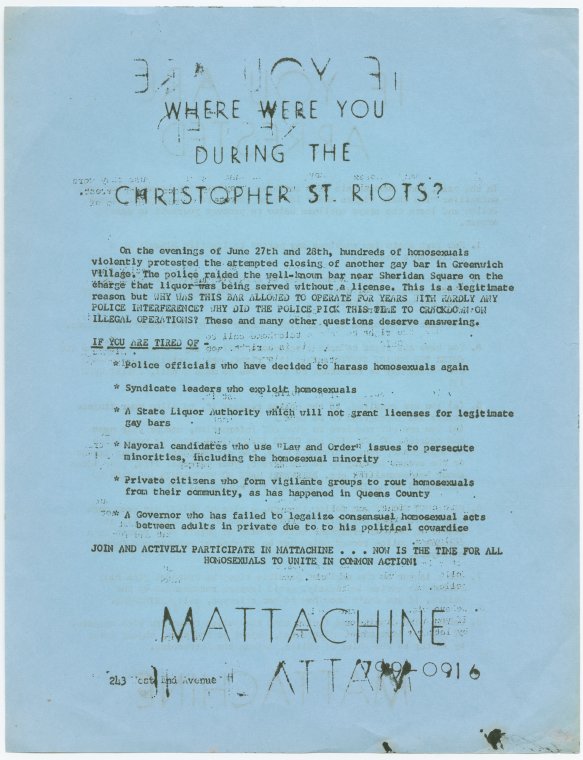
An early advertisement put out by the Mattachine Society, urging people to look at homosexuals different.

NYPL

An example of the types of flyers circulating in the West Village following the Stonewall incident.

NYPL

The Stonewall Inn was closed shortly after the battle with police, not to be reopened again until 1990.

Photographer Diana Davies, courtesy NYPL

Photographer Diana Davies, courtesy NYPL

Photographer Diana Davies, courtesy NYPL

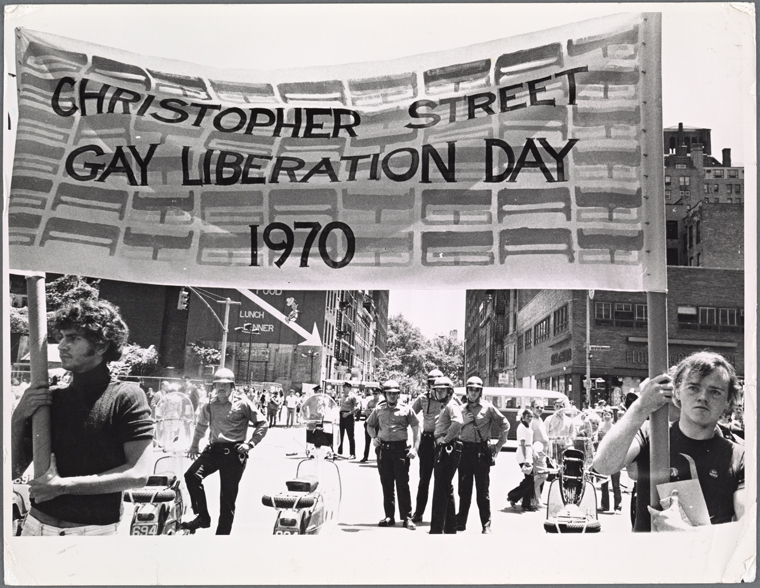
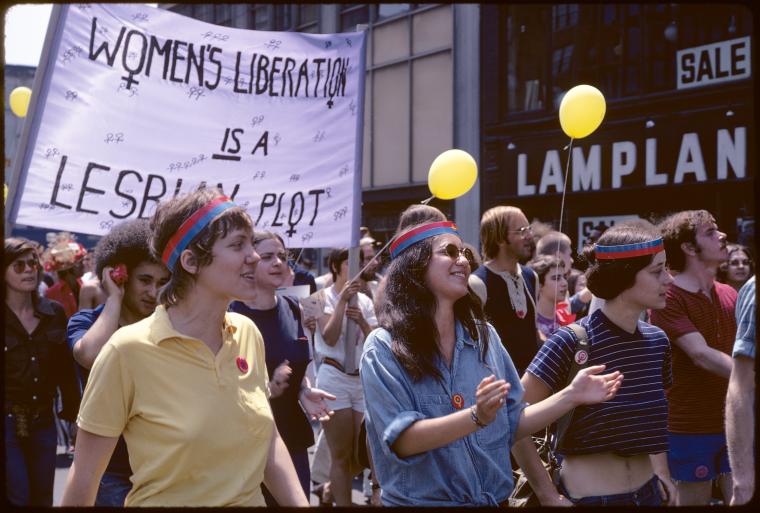
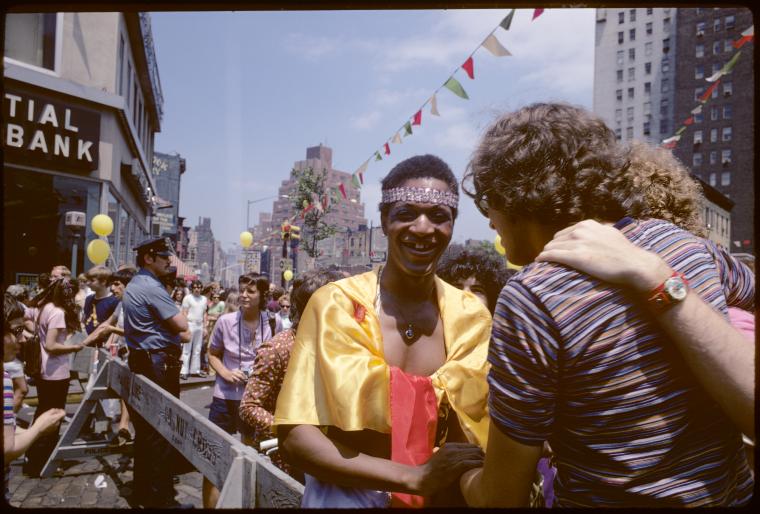
From the first parade (in 1970) to Central Park, the first of what would later be called the Pride Parade.

Diana Davies/NYPL

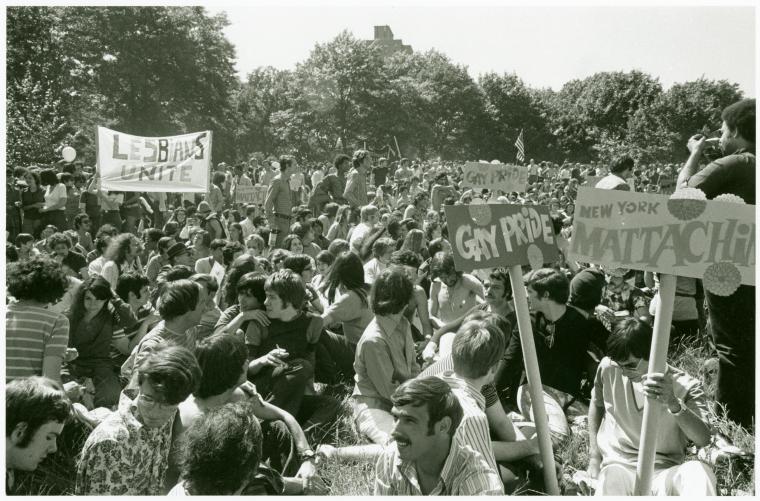
The parade ended with a gigantic rally in Sheep Meadow in Central Park.

Diana Davies/NYPL

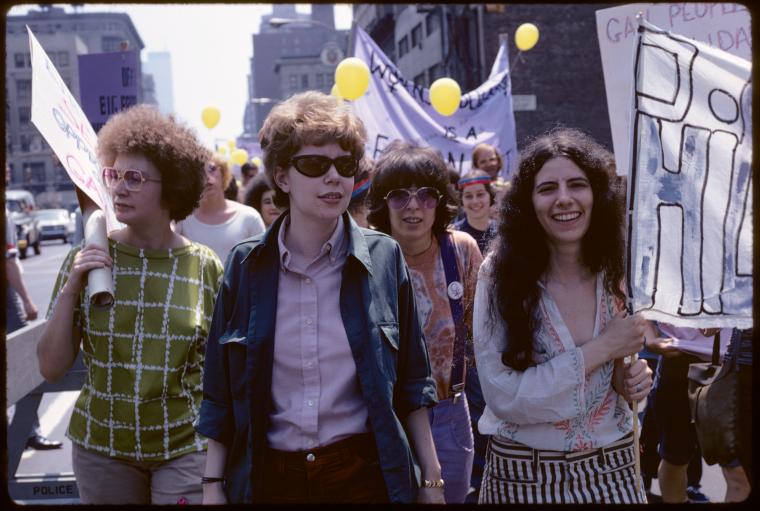
From the parade the following year:

NYPL

NYPL

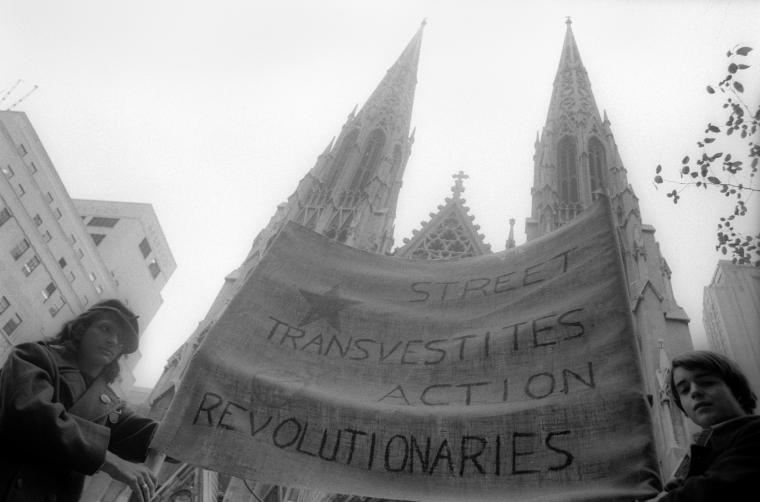
From a 1971 demonstration in front of St. Patrick’s Cathedral.

NYPL

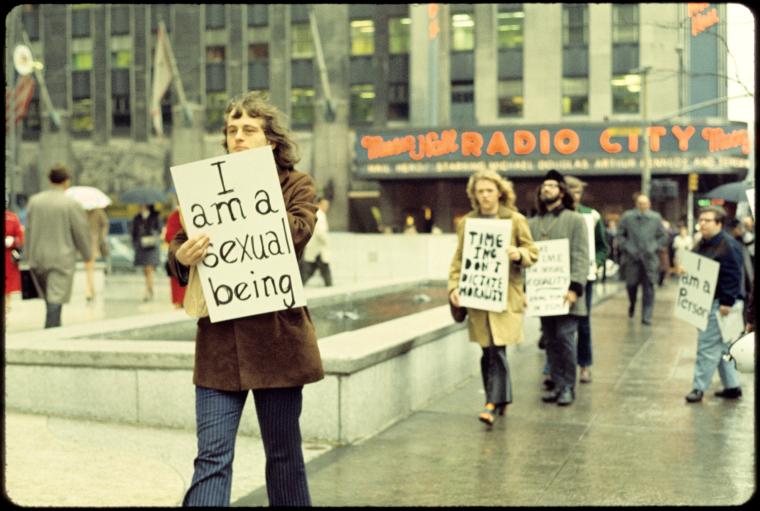
….and another near Radio City Music Hall.

NYPL

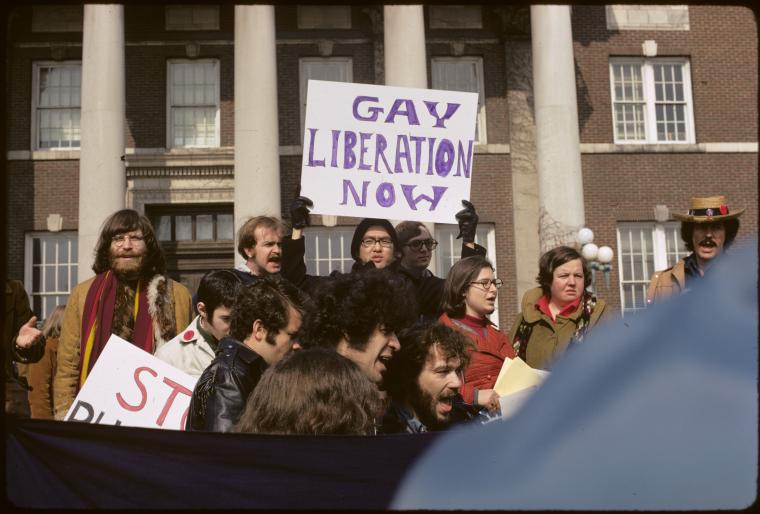
Gay rights demonstrations from 1971 at the state capitol in Albany, NY, from an incredible collection of pictures by Diane Davies, courtesy the New York Public Library.

NYPL

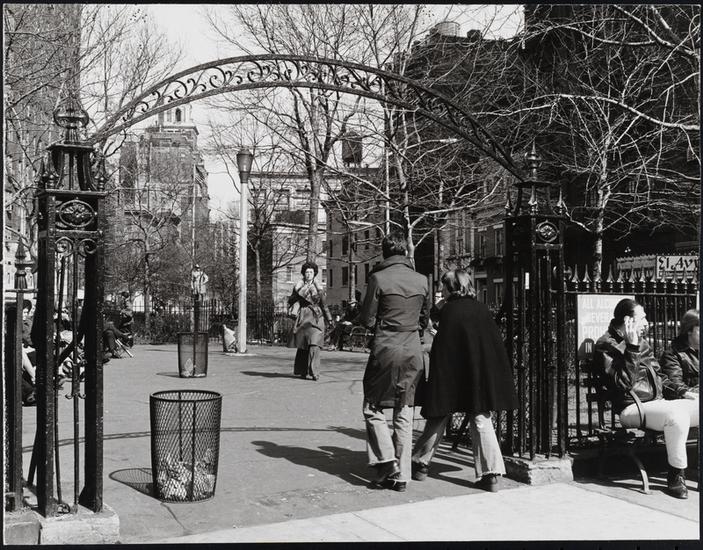
The entrance to Christopher Park in 1975, photo by Edmund Vincent Gillon

MCNY

Gay Liberation, how the statues looked when they were first installed in 1992.

Edmund Gillon/MCNY

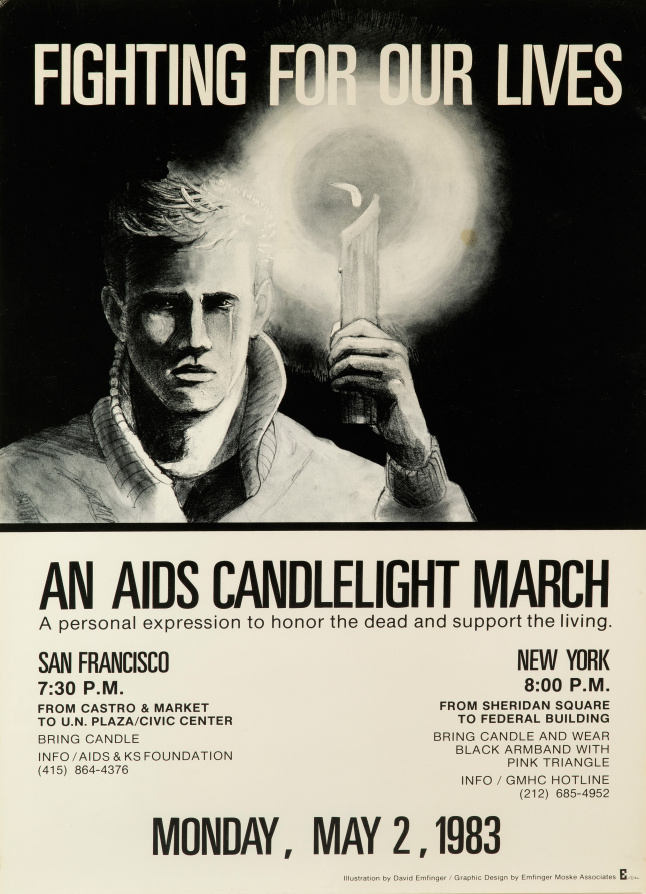
An early AIDS march from 1983 which began near Stonewall in Sheridan Square.

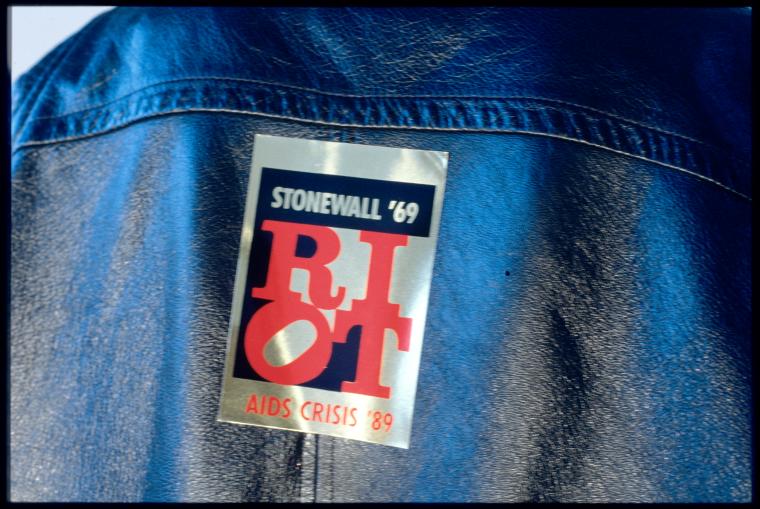
During the AIDS crisis of the 1980s and 90s, many turned to the example of Stonewall as a way to unite the community and fight back against homophobia.

Photographer Gran Fury, Courtesy NYPL

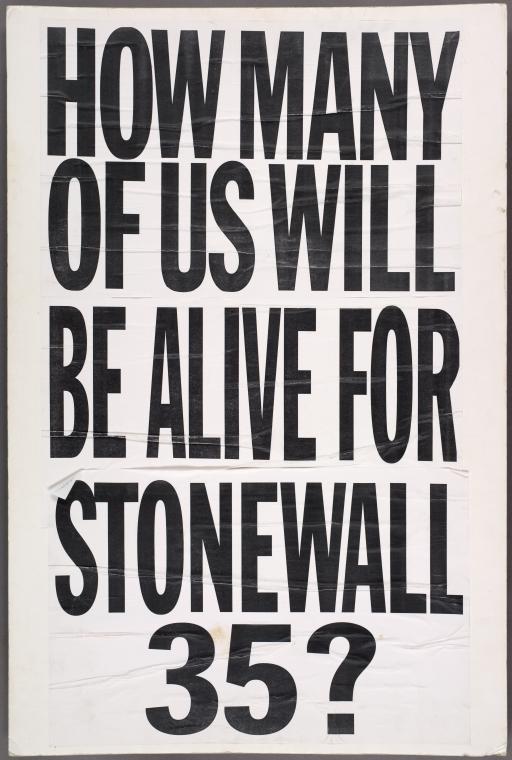
An ACT UP sign for the Stonewall 25 parade and rally “How many of us will be alive for Stonewall 35?” On the opposite side: “AIDS. Where is your rage? ACT UP.”

NYPL

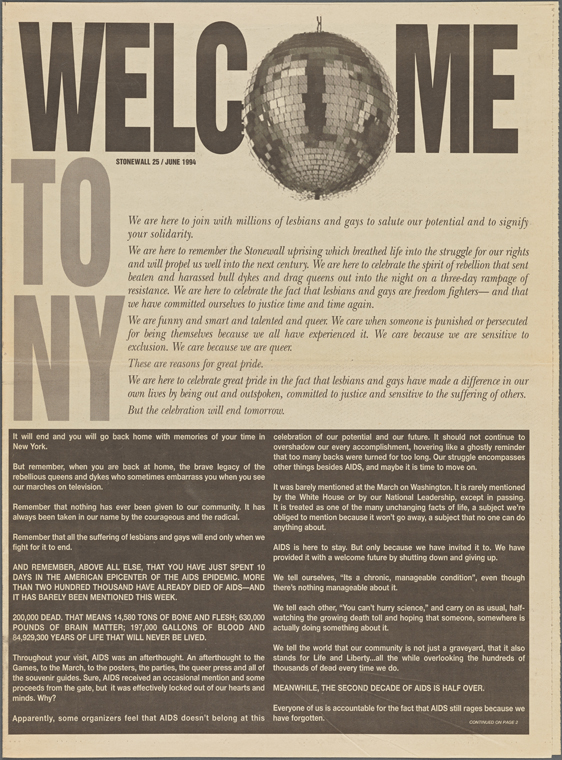
A sobering ACT UP ‘welcome wagon’ message. “But remember, when you are back at home, the brave legacy of the rebellious queens and dykes who sometimes embarrass you when you see our marches on television.”

NYPL

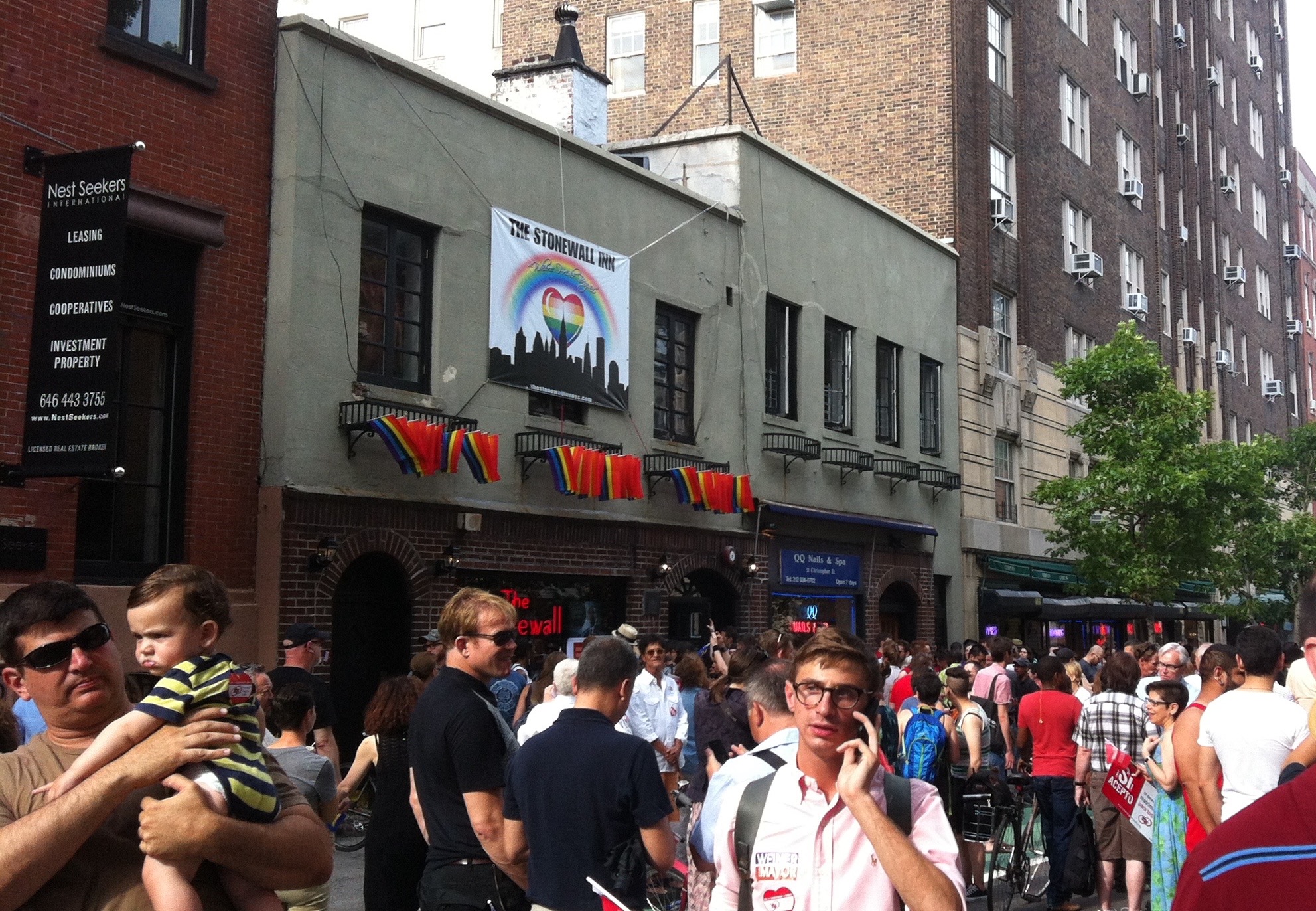
In front of Stonewall in 2013 after the announcement of the Supreme Court verdict in United States v. Windsor, overturning the Defense of Marriage Act.

Photo by Greg Young

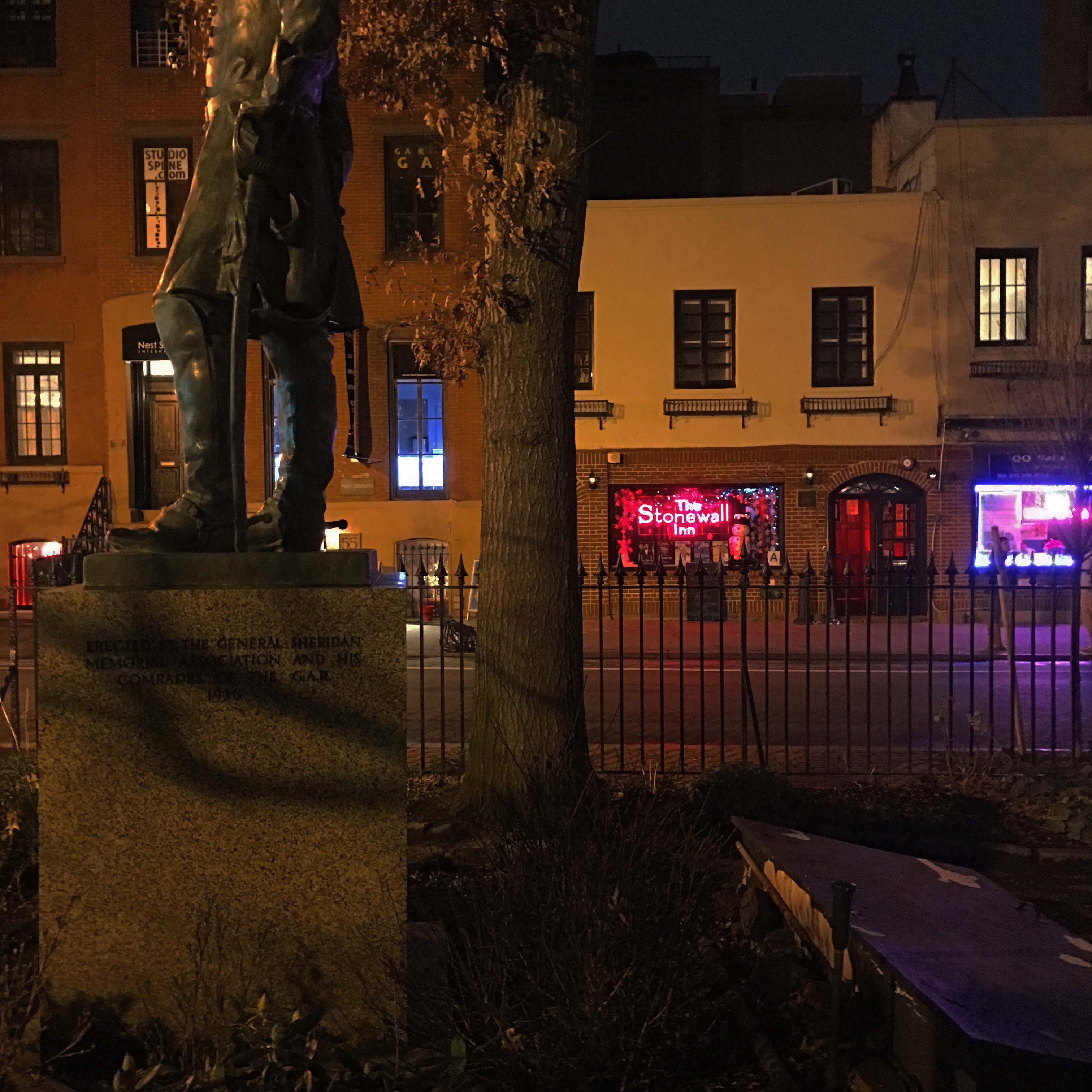
Stonewall Inn and Christopher Park, 2015

Photo by Greg Young

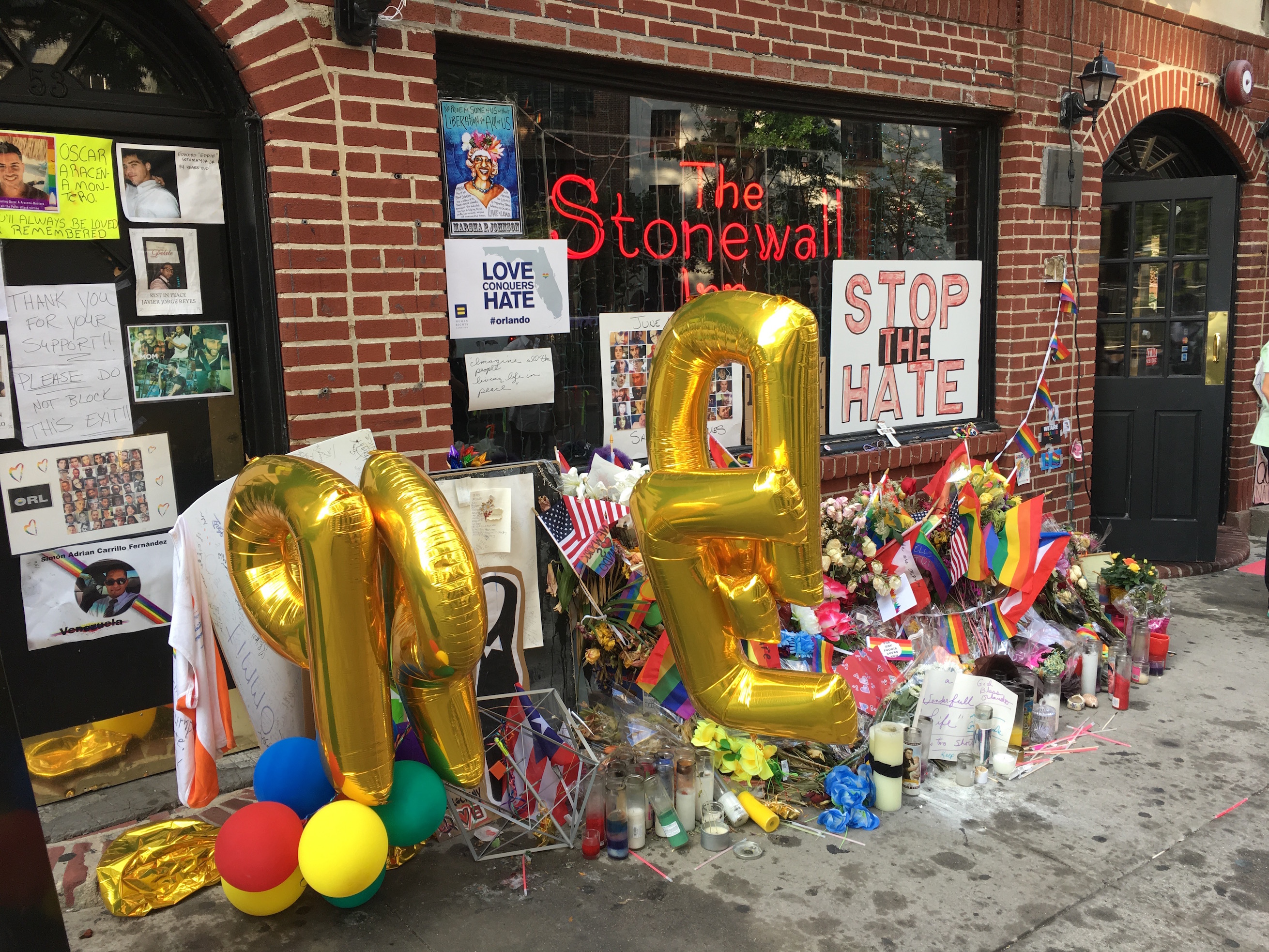
Outside the Stonewall in 2016, following the Pulse nightclub shooting in Orlando, Florida.

Photo by Greg Young

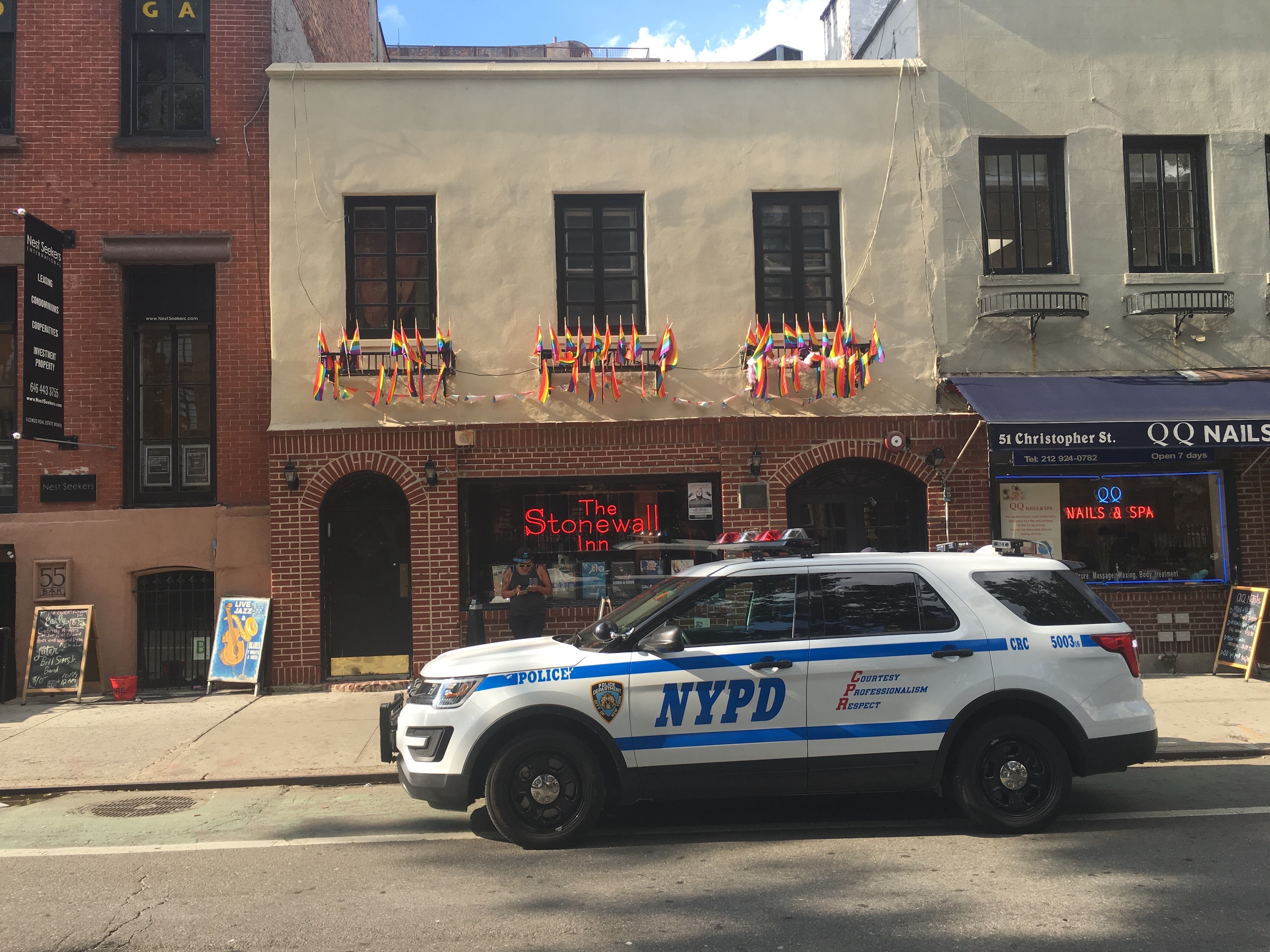
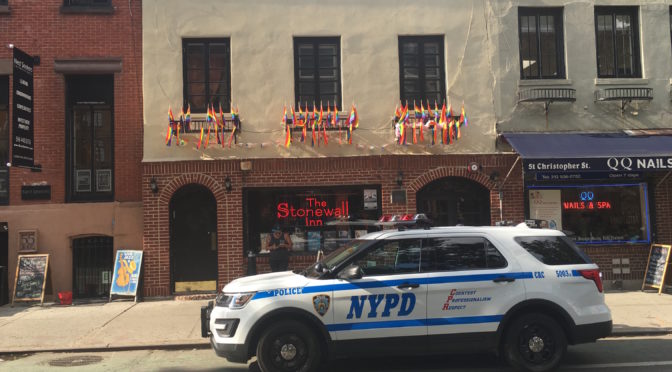
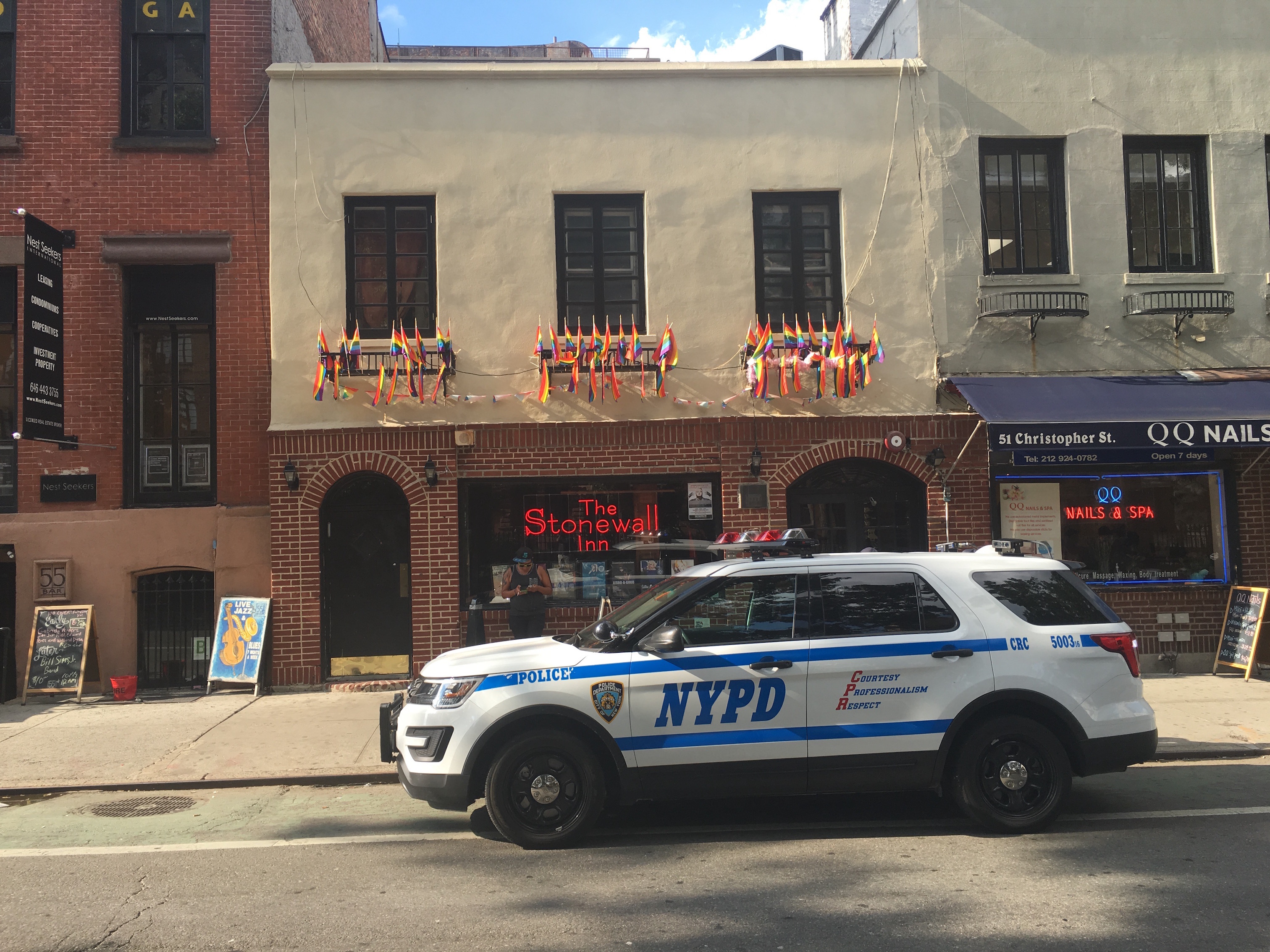
Stonewall 2016, now with police protection! Taken in August 2016, following the announcement of Stonewall as a National Monument.

Categories
Bowery Boys Bookshelf

Insomniac City: A strange tale of love and a tribute to off-beat New York

Writer and photographer Bill Hayes moved to New York in 2009 and experienced what many of us have already learned:  the nights are magic and the subway is a wilderness.

He began jotting down his observations of peculiar experiences, the strange behaviors of others existing in their own little New Yorks. “Every car on every train on every line holds a surprise,” writes Hayes, “a random sampling of humanity brought together in a confined space for a minute or two — a living Rubik’s Cube.”

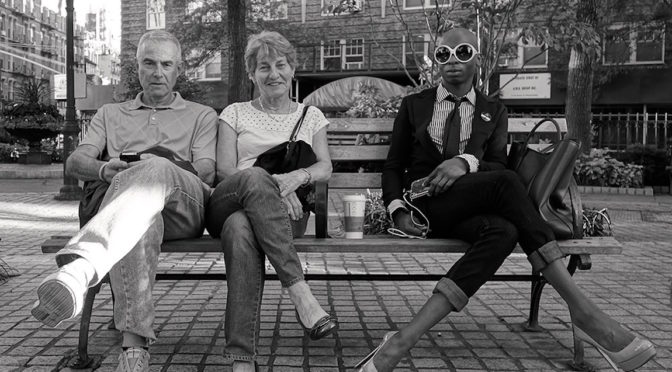
Above and below: A couple of the many strange and captivating photographs by Bill Hayes featured in the book.

During the day he would aim a friendly camera towards New Yorkers of all shapes and affinities. Hayes left San Francisco after the tragic death of his partner and fortunately seems to have fallen into New York like one of its many prodigal souls. His experiences aren’t unique; they mirror yours and mine.

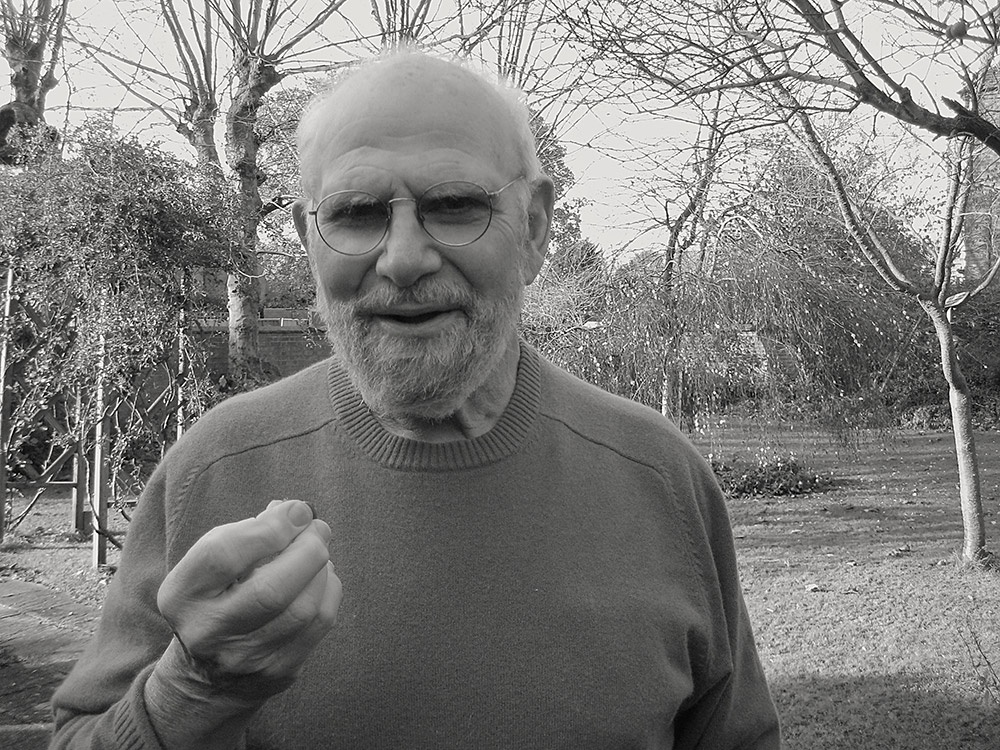
Except for the fact that, oh yes, he falls in love with a noted British neurologist and author — the late and dearly missed Oliver Sacks.

Oliver Sacks, photographed by Bill Hayes

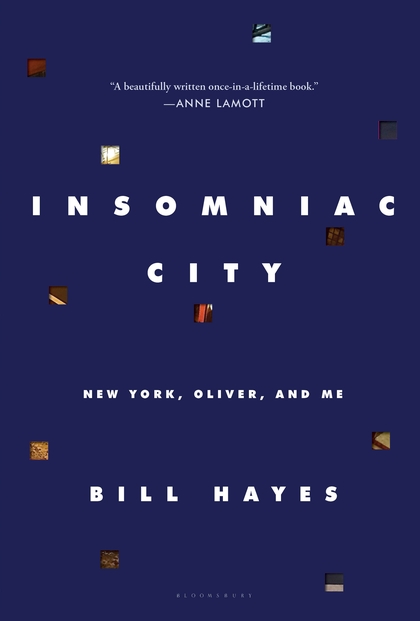
In Insomniac City: New York, Oliver and Me, Hayes’ new memoir and urban rumination, we’re presented with a bird’s eye view of New York’s universal appeal to outsiders, paired with a microscopic look at two of those outsiders.

Sacks, a celebrated author of The Man Who Mistook His Wife For A Hat and Awakenings (the basis of the Robert De Niro/Robin Williams film), was a guarded individual, coming out to himself late in life and socially removed from non-professional affairs.

Hayes introduces us to Sacks’ extraordinary worldview, an intellectual who brought critical thinking into the slightest of gestures and loved going to the roof to drink wine out of the bottle. The love and reverence Hayes has for Sacks is clear, referring to him throughout the text as just ‘O’, giving us their intimate moments only when they illuminate something of his genius.

Insomniac City is a fragmentary, often poetic look at love of a city and of an individual, told in notes and journal entries. It’s a book one could easily devour in a single sitting but I suggest prolonging the experience, reading a little at a time, allowing the individual anecdotes to inform your own adventures out in the big city.

It take on a set of colossal tasks; it can be poem, a documentary and a tribute on just a single page. Hayes is giving us permission to stare into his life — and into the lives of others — in the same durations of time that we experience each other in our daily lives.  In those flash moments of bonding on mass transit or on the street, where we may imagine what another person is thinking and feeling before they vanish.

And knowing, in his vignettes, that he’s exposed an intimacy with strangers, he then bares his own to us, his unabashed mix of love, friendship and bewilderment to a wonderful, complicated man, who also came and went.

INSOMNIAC CITY
New York, Oliver and Me
Bloomsbury Publishing


Photographs courtesy Bill Hayes and Bloomsbury

Categories
Landmarks

Stonewall Inn: The story of New York’s newest National Monument (NPS 100)

This month America celebrates the 100th anniversary of the National Park Service, the organization which protects the great natural and historical treasures of the United States. There are a number of NPS locations in the five borough areas. Throughout the next few weeks, we will focus on a few of our favorites.
For more information, you can visit National Parks Centennial for a complete list of parks and monuments throughout the country. For more blog posts in this series, click here.

And listen to our podcast on this subject here:

IMG_9918
STONEWALL NATIONAL MONUMENT
CHRISTOPHER STREET, WEST VILLAGE, MANHATTAN

On June 24, 2016, President Obama — who had conjured the name of Stonewall Inn in his 2013 inaugural speech — designated the location of the 1969 Stonewall Riots as a National Monument, to be overseen by the National Park Service.

Twelve days earlier, a gunman walked into a gay nightclub in Orlando, Florida, and killed 49 people. It was the deadliest terrorist attack since September 11, 2001, and certainly the greatest single attack upon the American LGBT community in history.

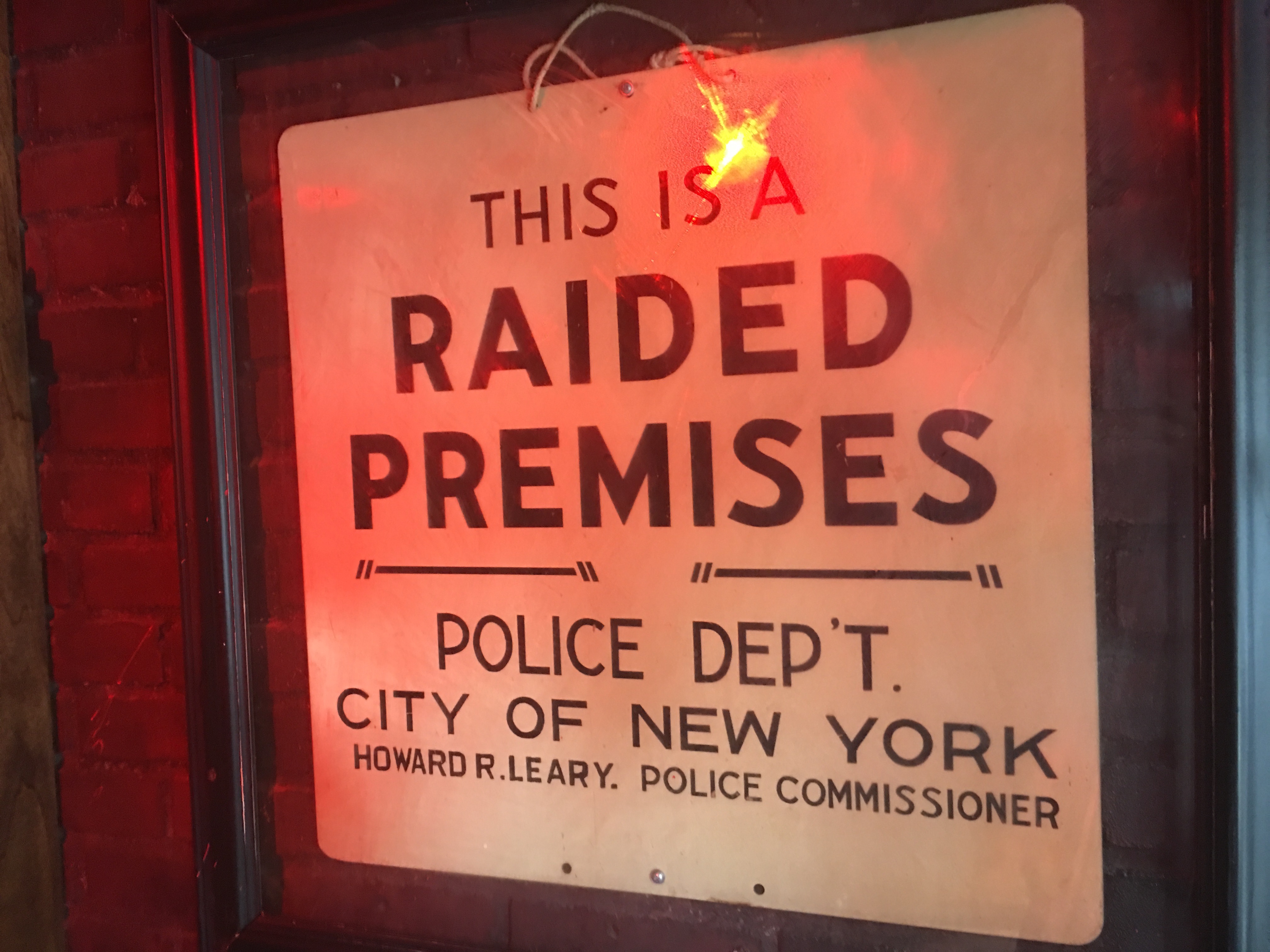
For days after, a makeshift memorial to the Orlando victims sat in front of Stonewall Inn. Even today, as you enter the building, a list of their names greets you upon the wall, next to an older sign that states ‘THIS IS A RAIDED PREMISES’, a vestige of a time when gay bars were diminished, not decorated.

IMG_9923

Thus is the power of Stonewall’s symbolism, the dignity and community represented in the air around this stumpy, architecturally unspectacular structure.

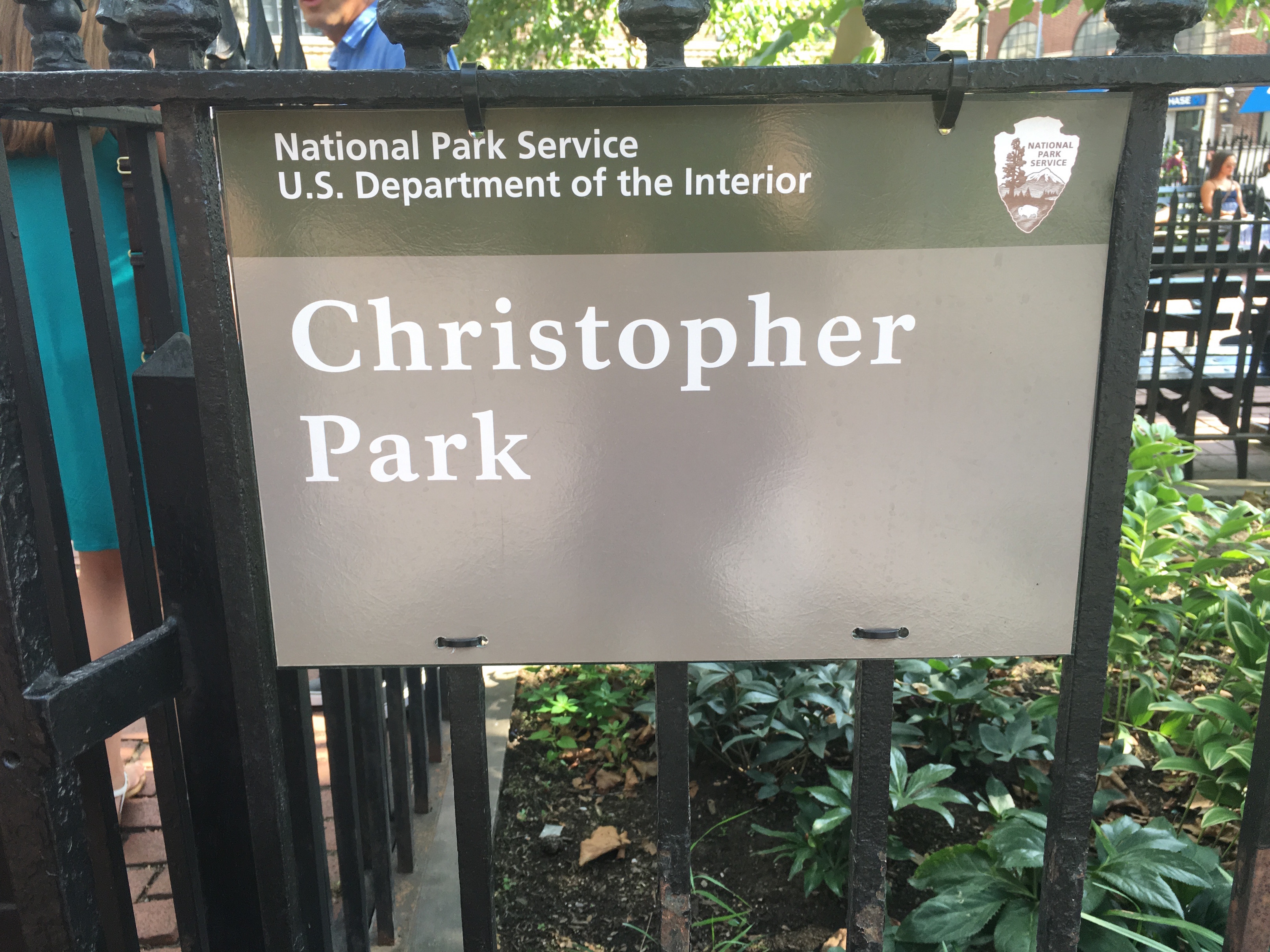
Recognizing the enigmatic atmosphere of this place, Stonewall National Monument is actually the building proper and the portion of Christopher Street which sits in front of it, as well as the entirety of triangular Christopher Park.

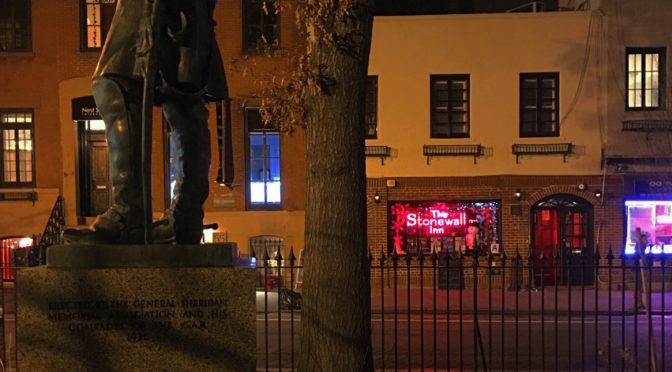
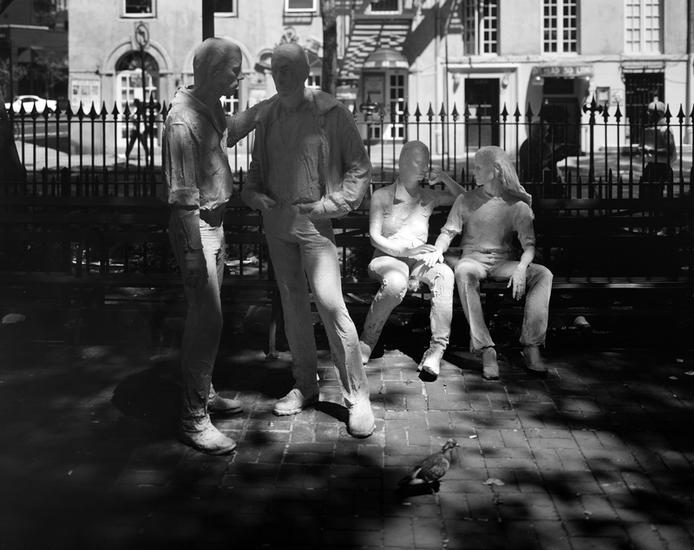
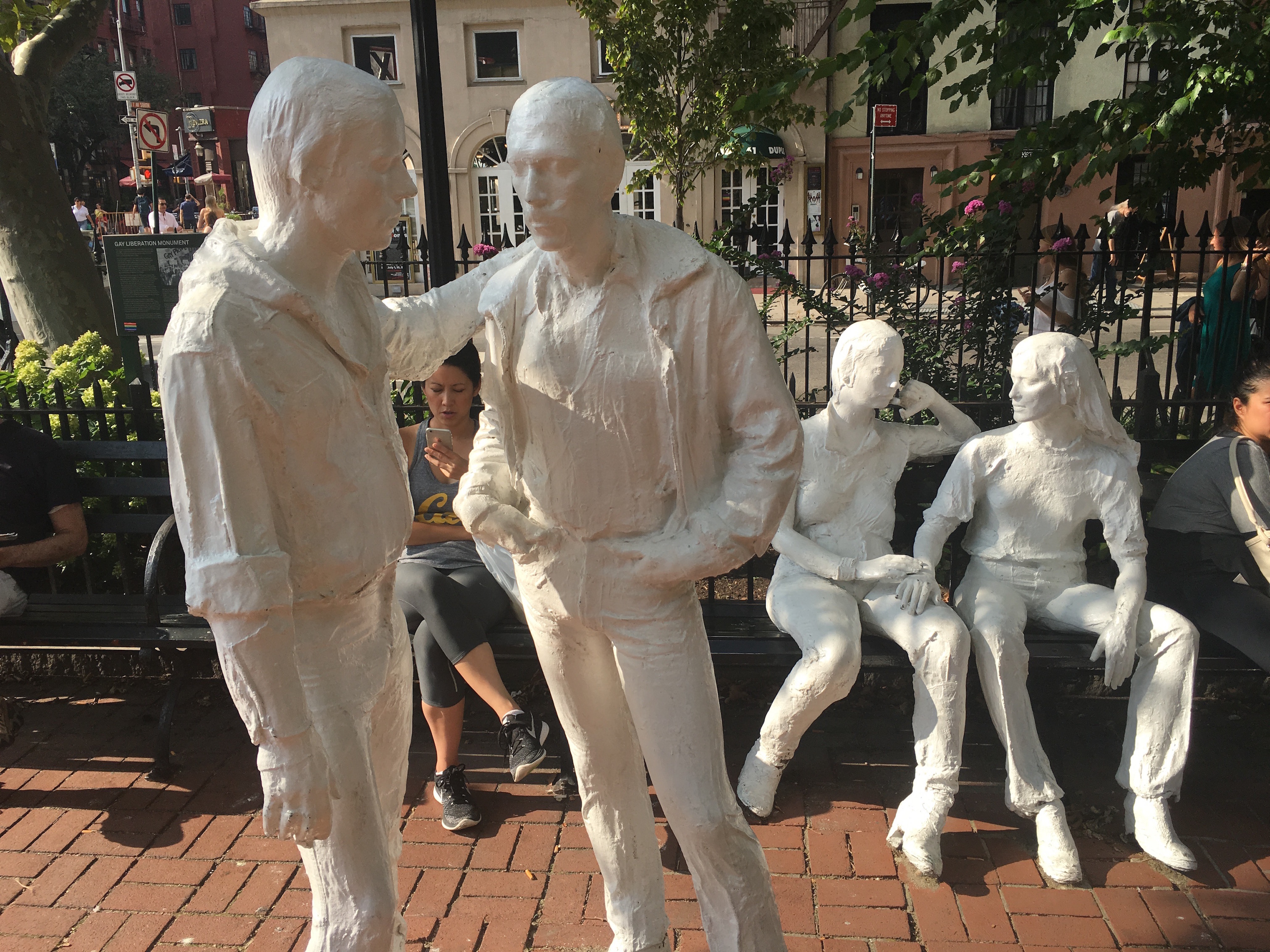
This includes one very relevant piece of art — the four human statues known as the Gay Liberation Monument (placed here in 1992) — and one somewhat random inclusion — a statue to Union general Philip Sheridan.

But perhaps the most unusual aspect to the National Park Service’s newest acquisition is that Stonewall Inn is still very much an active bar, even more so now for its fame. Its Big Gay Happy Hours are but one of many things which sets this NPS site apart from, say, Grant’s Tomb.

There’s a constant police presence in front of Stonewall Inn. On a given night you may even see armed guards out in front, a curious dichotomy with the drag queens who perform on the second floor. I cannot wait to see how they incorporate a temporary ranger station and a visitor center.

IMG_9920

It’s unfortunate that Stonewall — a historic symbol of safe space — should feel like slightly less of one because of current events. But this situation does provide another, more hopeful optic: the image of an alert and engaged law enforcement, entrusted in keeping a gay bar safe and secure.

If you could somehow go back in time to tell the men and women who were arrested in the early morning hours of June 28, 1969, about this, they would have laughed (and maybe spit) in your face.

IMG_9921

In the 1960s the mob had a veritable monopoly on the Greenwich Village gay scene, tucked invisibly down the neighborhood’s side streets.

No bar catering to gays and lesbians could stay open without paying bribes (to both the mob and the police), and complaining bar owners had a funny way of finding themselves arrested or worse. Indeed, police detectives sometimes posed as gay men to corner alleged homophiles.

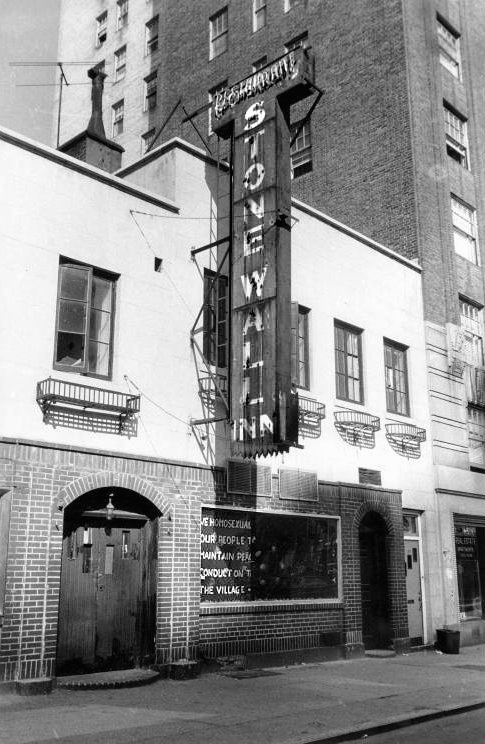
One of these dank and unappealing bars on Christopher Street was the Stonewall Inn. Its history was long and colorful: A former stable, it became a notorious teahouse 1930, then a somewhat respectable restaurant, then was gutted in a fire before becoming a darkened-window dive bar catering to homosexuals in 1967.

Stonewall_Inn_1969

There was nothing especially notable about the Stonewall, with its watered- down drinks and its hat-and-coat check. There was dancing and a jukebox and a good mix of white, African American, and Hispanic patrons just looking to have fun. Wouldn’t you be upset if they kept shutting you down for no good reason?

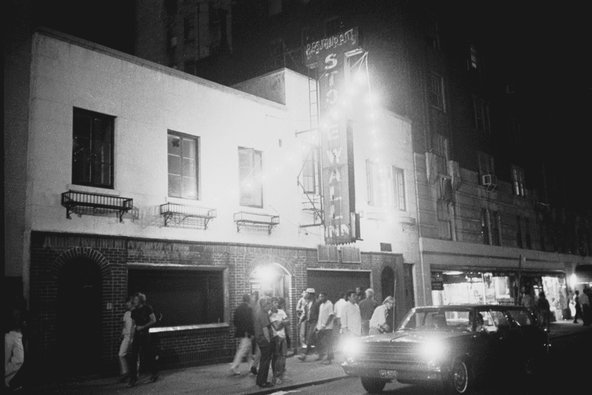
This is precisely what the police attempted just after 1 a.m. on June 28, 1969, when uniformed and undercover cops raided the packed bar and prepared to arrest the patrons.

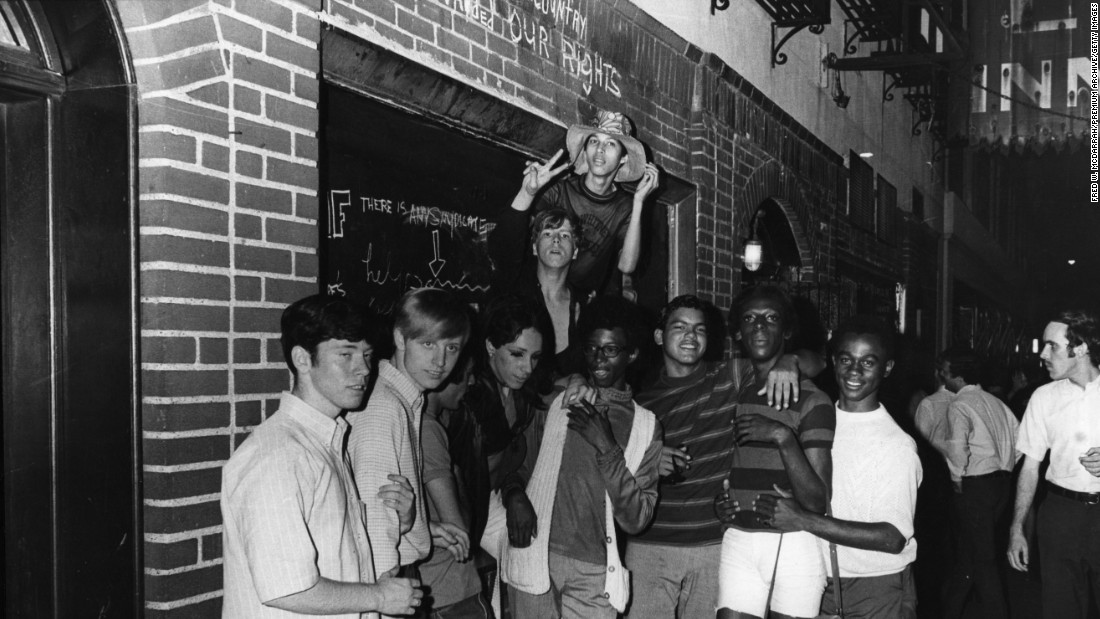
Protesters gathered in the streets outside the Stonewall Inn in the days following the riots on June 28.

Courtesy CNN
Courtesy CNN

But people were not having it. A crowd outside the bar began heckling the officers as they started their arrests, pulling patrons from the bar and loading them into wagons.

One woman in handcuffs fought fiercely, inspiring an extraordinary coalition of street youths and drag queens to push back against restraint. The crowds swelled as patrons from other bars joined the fracas, filling Christopher Street and pushing back against police harassment until well after four in the morning.

insider-stonewall1-tmagArticle

What began as proper rioting aimless anger in the streets grew more focused over the next several days, as hundreds of marginalized New Yorkers returned to the street in front of the Stonewall with a newfound sense of solidarity. Their example inspired people throughout the city and around the country.

One year after the raid, activists would gather in front of the Stonewall and march up to Central Park, an event that would become the city’s annual LGBT Pride March.

Today gay pride celebrations and parades in many European countries are referred to as Christopher Street Day celebrations. Although Stonewall Inn has gained national importance today, it is Christopher Street itself that retains the symbolism for many.

And that is why a very small portion of that street — forever associated with struggle — is America’s newest  National Monument.

WANT MORE INFORMATION? Visit the NPS Stonewall National Monument site for more information.

LISTEN TO OUR PODCAST!

Categories
It's Showtime Podcasts

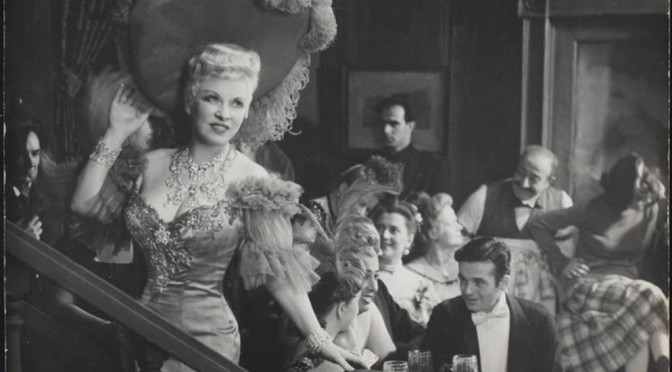
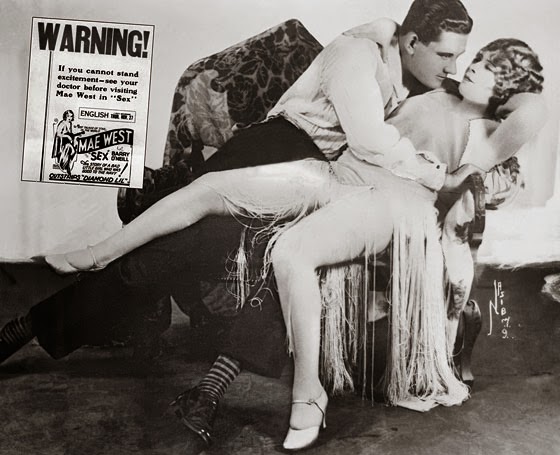
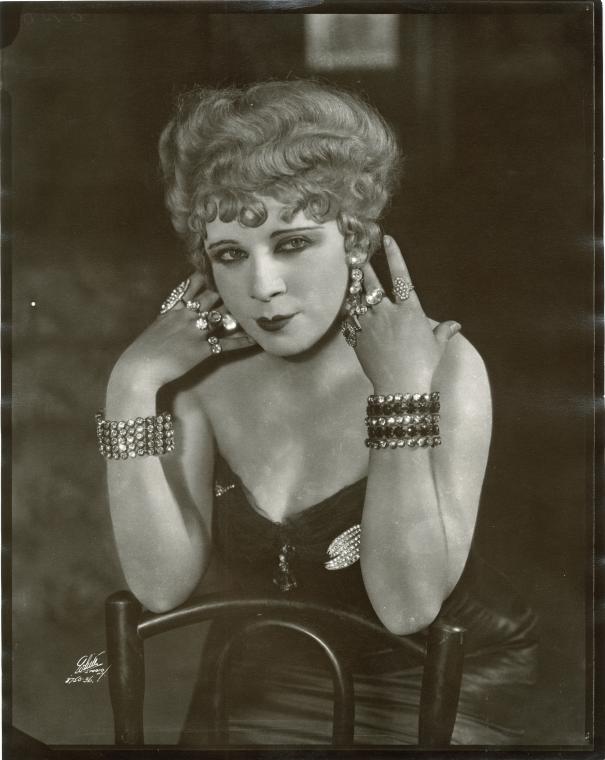
Diamond Girl: How Mae West Brought ‘Sex’ and Scandal to Broadway

PODCAST Mae West (star of I’m No Angel and She Done Him Wrong) would come to revolutionize the idea of American sexuality, challenging and lampooning ideas of femininity while wielding a suggestive and vicious wit. But before she was America’s diamond girl, she was the pride of Brooklyn! In this podcast, we bring you the origin story of this icon and the wacky events of 1927 that brought her brand of swagger to the attention of the world.

1The Brooklyn girl started on the vaudeville stage early, inspired by the influences of performers like Eva Tanguay. She soon proved too smart for the small stuff and set her aim towards Broadway — but on her terms.

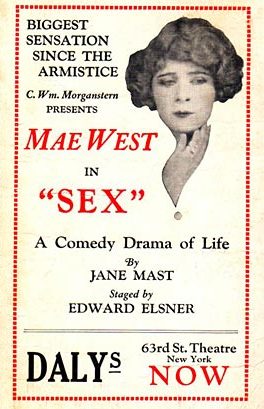
West’s play Sex introduced her devastating allure in the service of a shocking tale of prostitution. It immediately found an audience in 1926 even if the critics were less than enamored. But it’s when she devised an even more shocking play — The Drag — that city leaders became morally outraged and vowed to shut her down forever.

From Bushwick to Midtown, from the boards of Broadway to the workhouse of Welfare Island — this is the story of New York’s ultimate Sex scandal.


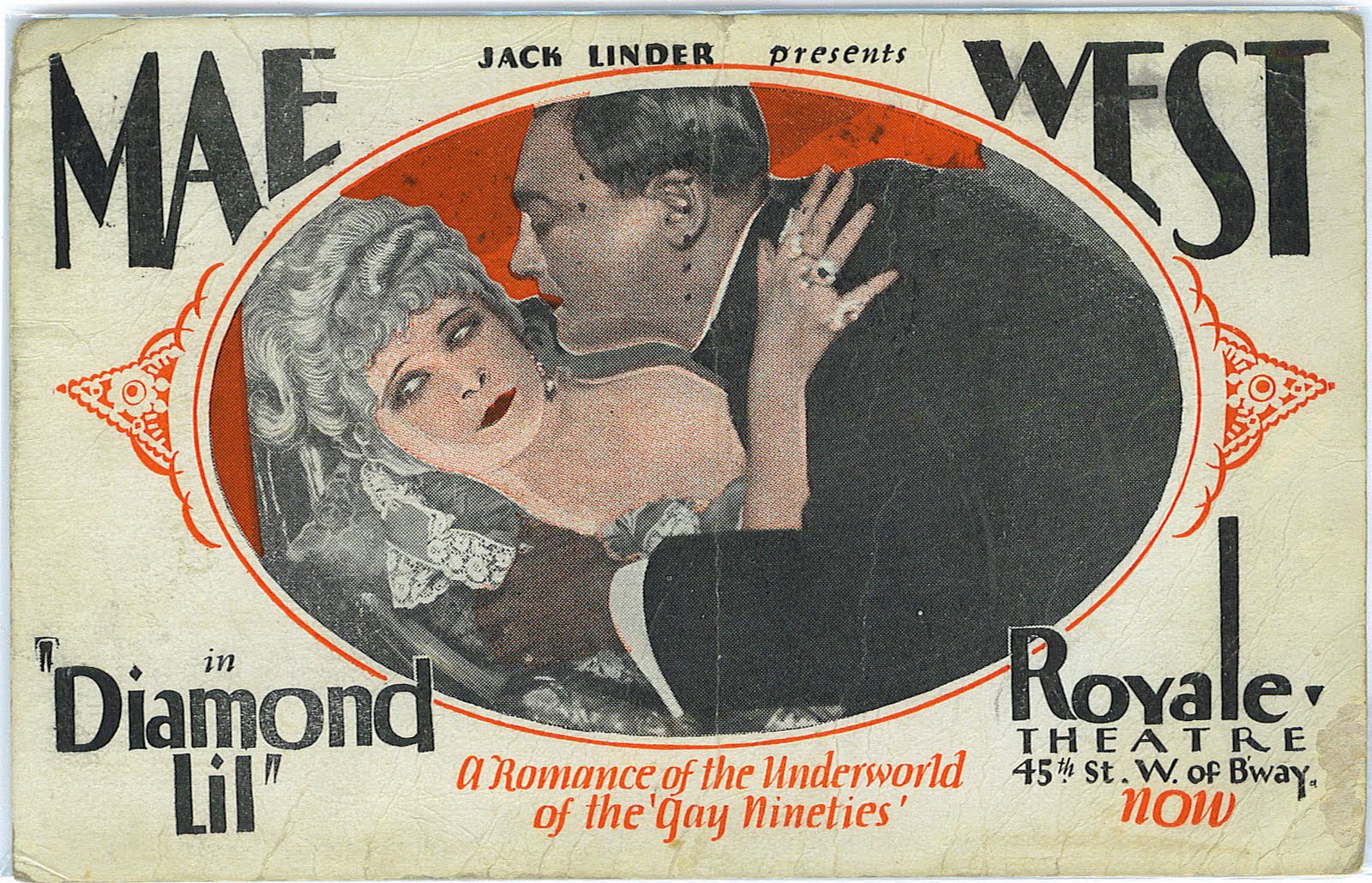
Picture at top: Mae West in a publicity still for her Broadway hit Diamond Lil. (Courtesy Museum of City of New York)

Inset: The poster for Sex by Jane Mast (aka Mae West)

Special thanks to Esther Belle from The West (a Mae West-inspired coffeehouse and bar in Williamsburg). We recorded an interview with her about the legacy of Mae West but weren’t able to use it. But it will be available for Patreon supporters!


The Bowery Boys: New York City History podcast is brought to you …. by you!

Starting this month, we are doubling our number of episodes per month. Now you’ll hear a new Bowery Boys podcast every two weeks. We’re also looking to improve the show in other ways and expand in other ways as well — through publishing, social media, live events and other forms of media. But we can only do this with your help!

We are now a member of Patreon, a patronage platform where you can support your favorite content creators for as little as a $1 a month.

Please visit our page on Patreon and watch a short video of us recording the show and talking about our expansion plans. If you’d like to help out, there are five different pledge levels (and with clever names too — Mannahatta, New Amsterdam, Five Points, Gilded Age, Jazz Age and Empire State). Check them out and consider being a sponsor.

We greatly appreciate our listeners and readers and thank you for joining us on this journey so far. And the best is yet to come!


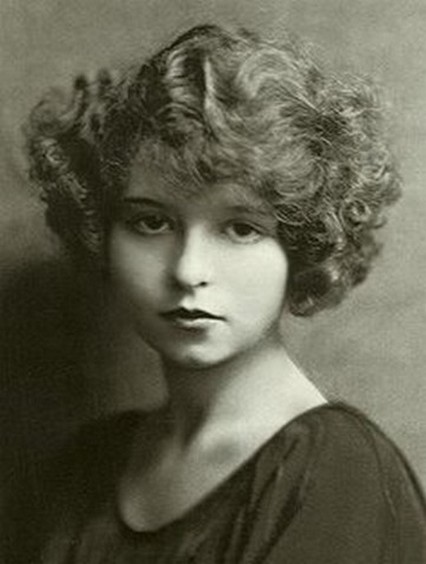
A young Mae West, already a seasoned performer by her teenage years.

Courtesy Notes On The Road

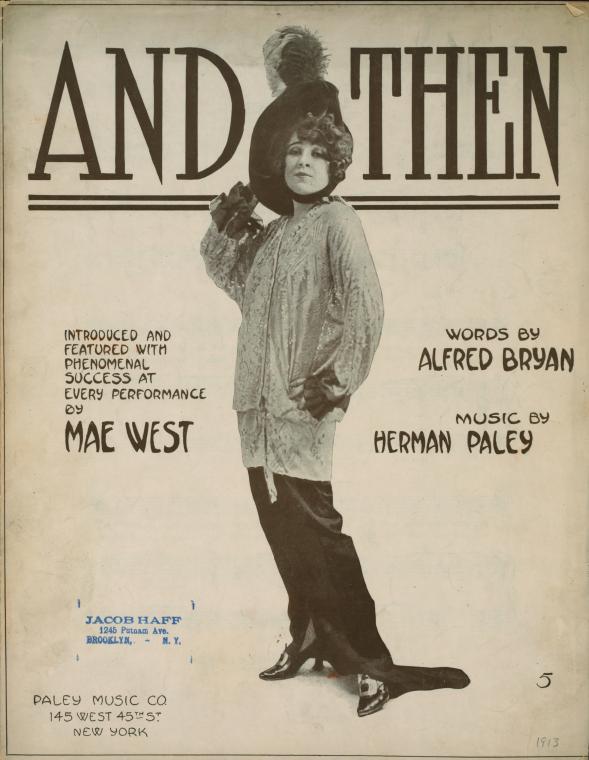
From Mae West’s vaudeville days, a piece of Tin Pan Alley sheet-music she performed in the stage:

Courtesy New York Public Library

A saucy promotional still from Sex

4

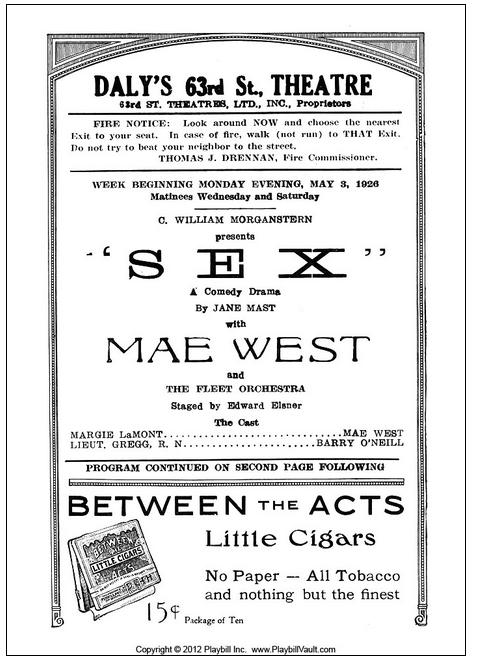
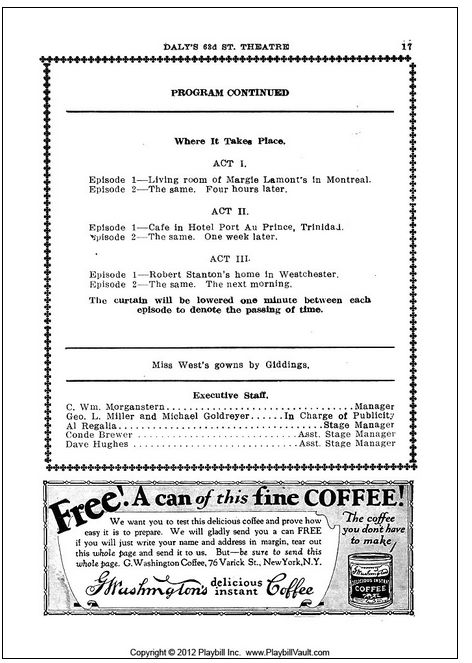
From the original program for Sex:

Courtesy Playbill Vault

1

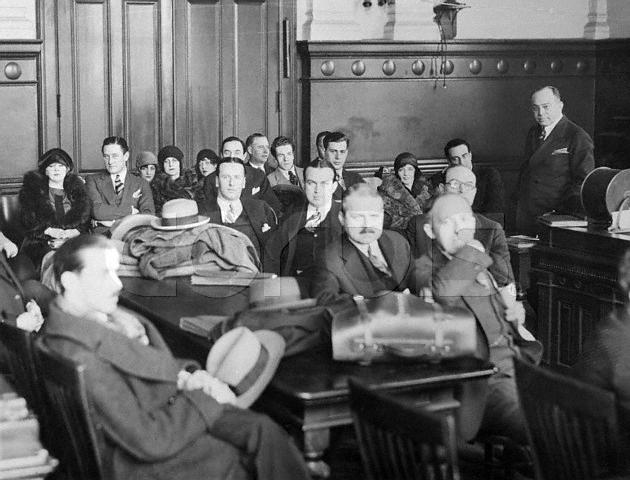
Mae West at the Jefferson Market courthouse:

Original caption: Cast of  Tried By Jury.  New York, New York:  Photo shows scene in courtroom of general sessions part II at start of members of  company.  Mae West and Barry O'Niel, in productions leading roles, can be seen at extreme left. March 28, 1927 New York, New York, USA
Original caption: Cast of Tried By Jury. New York, New York: Photo shows scene in courtroom of general sessions part II at start of members of company. Mae West and Barry O’Niel, in productions leading roles, can be seen at extreme left. March 28, 1927 New York, New York, USA

Mae West in the original photography for the 1928 production of Diamond Lil. She attempted during this period to open the controversial show The Pleasure Man but it was shut down after two days. (Courtesy New York Public Library)

1

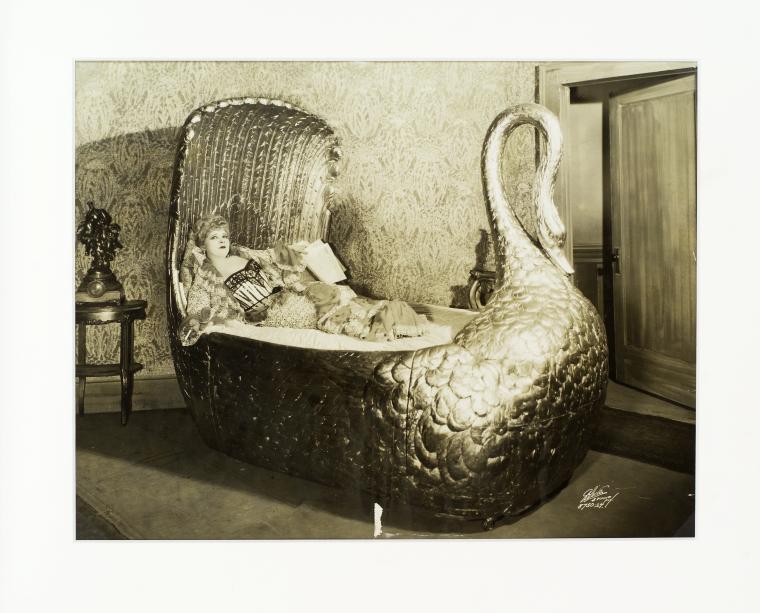
Another odd shot from Diamond Lil, of Mae reclining in a golden swan bed. (source)

Courtesy New York Public Library

5

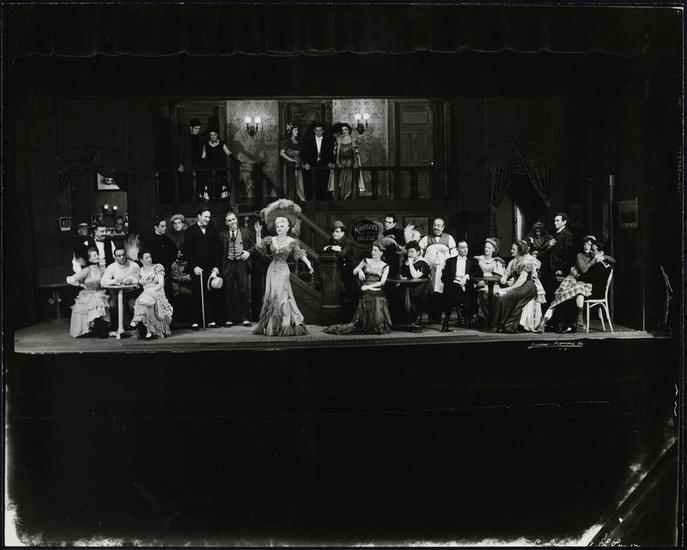
Mae West in the 1949 Broadway revival of Diamond Lil. Once a provocateur of the stage, she settled into her larger-than-life personae in later years, formed mostly from her successes in this role (and its film version She Done Him Wrong). (Courtesy Museum of the City of New York)

Courtesy the Museum of the City of New York

Members of the cast of The Pleasure Man being arrested by police, 1928.

Courtesy Queer Music Heritage -- http://queermusicheritage.com/fem-arts6.html
Courtesy Queer Music Heritage — http://queermusicheritage.com/fem-arts6.html

Courtesy New York Daily News

Mae West (and a young Cary Grant) in She Done Him Wrong

In the hilarious I’m No Angel:

Ladies and gentlemen, Mae West and Mr. Ed:

And her last film — the camp classic Sextette

Categories
Friday Night Fever

In good company: The local significance of Obama’s inaugural quote: “Seneca Falls, and Selma, and Stonewall”

As many others today are ruminating on the symbolic and historic implications of yesterday’s presidential inaugural ceremony, allow me to dwell a little on a curious milestone of far lesser importance.

Until yesterday, no place in New York City has ever been mentioned in a presidential inaugural speech.  Not Ellis Island, not the Statue of Liberty, not Wall Street, not the World Trade Center, none of our fortresses or other towering landmarks.

In fact, New York as a city has actually been name-checked only once. (See below.)  But no individual place has ever been mentioned in what are considered to be the most memorable set of presidential speeches.

That is, until yesterday, when President Barack Obama referenced the name of a West Village gay bar — Stonewall Inn.

index

“We, the people, declare today that the most evident of truths – that all of us are created equal – is the star that guides us still; just as it guided our forebears through Seneca Falls, and Selma, and Stonewall; just as it guided all those men and women, sung and unsung, who left footprints along this great Mall, to hear a preacher say that we cannot walk alone; to hear a King proclaim that our individual freedom is inextricably bound to the freedom of every soul on Earth.”

“Seneca Falls, and Selma, and Stonewall” represent flashpoints of various American social movements.  With his mention of Stonewall — representing the Stonewall riots and subsequent street gatherings of June-July 1969, considered the birthplace of the gay-rights movement — the president has elevated the struggles of gay Americans to those of the women’s movement (the Seneca Falls Convention of 1848) and the African-American civil rights movement of the 1960s (the Selma to Montgomery marches in 1965).

The rhetorical flourish of alliteration unites these movements by the places in which they occurred.  Stonewall thus becomes shorthand for the gay rights movement.  But as it is the actual name of a bar — still very much in operation, right off Christopher Park — Stonewall Inn now holds another very special place in history.

The United Nations, of course, has been mentioned a few times, mostly in the 1940s and 50s. (Without surprise, mentions of the international body literally drop off to nothing after that.)  But all references relate only to the legislative body, not the actual place.  In fact, when it was first mentioned in 1949, by President Harry S. Truman — “We have constantly and vigorously supported the United Nations and related agencies as a means of applying democratic principles to international relations” — its headquarters in Manhattan had not even been completed.

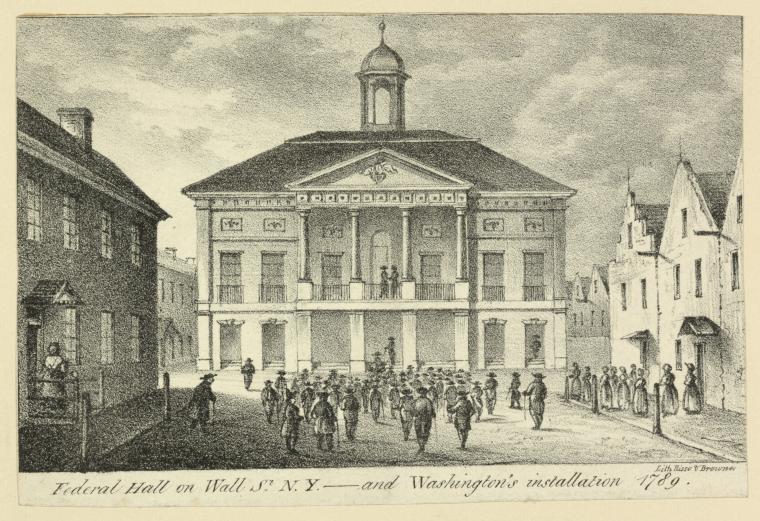
Below: Federal Hall on Wall Street, site of the first American government and the inauguration of George Washington in 1789

When New York has been mentioned in inaugural addresses, it’s because it was the location of the first inaugural address in April 1789, when the seat of American government was in New York.

“This occasion derives peculiar interest from the fact that the Presidential term which begins this day is the twenty-sixth under our Constitution,” Benjamin Harrison remarked in his 1889 speech.  “The first inauguration of President Washington took place in New York, where Congress was then sitting, on the 30th day of April, 1789, having been deferred by reason of delays attending the organization of the Congress and the canvass of the electoral vote.”

George H.W. Bush makes specific mention of Washington’s inauguration in 1989, which happened to be the 200th anniversary of that event. “I have just repeated word for word the oath taken by George Washington 200 years ago, and the Bible on which I placed my hand is the Bible on which he placed his.  It is right that the memory of Washington be with us today, not only because this is our Bicentennial Inauguration, but because Washington remains the Father of our Country.”

While this means very little in terms of the city’s historical stature, it means a great deal to the gay rights movement, and certainly to the bar itself. Or as Stonewall Inn owner Stacey Lentz recently said: “We’re not just a bar. We’re the Stonewall. It’s like owning Rosa Parks’s bus. We don’t own the movement, but we own the bus.”

For more information on Stonewall Inn, check out our podcast #48 The Stonewall Riots (download here or on iTunes.)  

Pics courtesy NYPL

Don’t douse the glim! Four infamous dancehalls and dives which made the notorious reputation of Bleecker Street


“There are no lower outcasts in New York than the women who nightly creep out of the darkness and swarm the pavement of Bleecker Street…” L. Hereward, Eclectic Magazine, 1893

Sure, the Bowery was a rough and rowdy avenue, but one looking for more alternative adventures in the late 19th century might have found themselves somewhere along Bleecker Street. The college bars and cafes which inhabit the street now seem practically chaste compared to some of the dives once housed there.

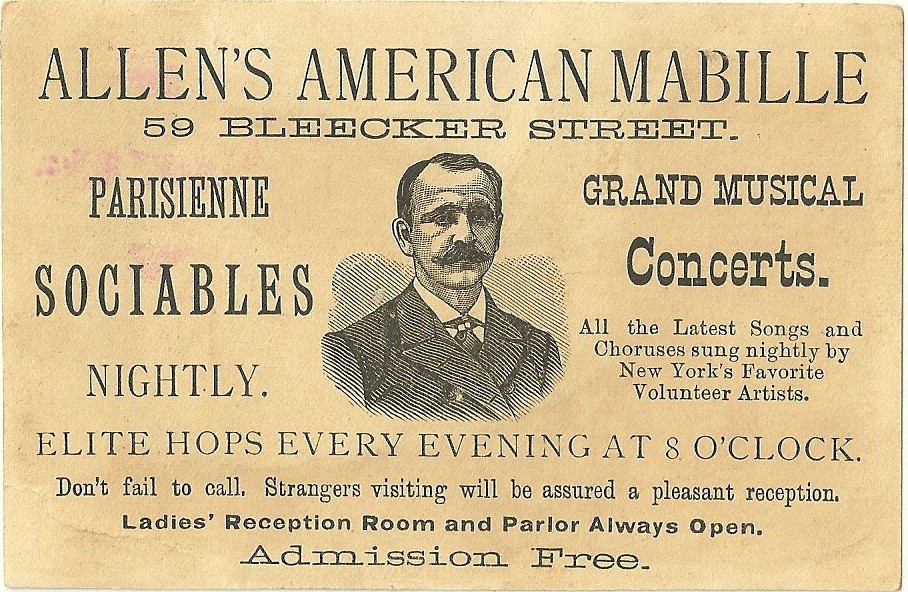
At 59 Bleecker Street, for instance, one could find The Allen’s American Mabille, a ‘Parisienne’ style dance hall and den of prostitution that survived several dozen police raids — police headquarters was literally a block away — and made Allen one of the infamous proprietors in Manhattan, responsible for “the ruin of more young girls then all the dive keepers in New York.” [source]

It joined a collection of prostitution houses along Bleecker and east of Washington Square Park, so many that the neighborhood was sometimes known as Frenchtown, and not because of the fine cooking.

But American Mabille and the other ‘Paris’ houses, from all appearances, specialized in heterosexual couplings. A few places on Bleecker catered to male encounters and often of the most flamboyant kind, if accounts are to be believed. (Keep in mind the hysteria of the late 19th century press!)

The most famous of these was The Slide at 157 Bleecker Street, a basement dive filled with men in drag, horrifying proper New Yorkers with clientele “effeminate, degraded, and addicted to vices which are inhuman and unnatural” according to contemporary scandal sheet descriptions.

The Slide is somewhat well-known today as it shares the same address as rock venue Kenny’s Castaways.

Down the street from The Slide was the Black Rabbit at 183 Bleecker Street, another dive with a mixed clientele, known for scandalous sex shows, from the likes of the ‘Jarbean fairy’ and a female ‘sodomite for pay’. Like many of the others, it survived with sizable bribes to the police. The bar even scandalized thieves. In 1901, a reporter from McClure’s Magazine entered the Black Rabbit with a pickpocket who replied, “[T]his is dead tough. I wouldn’t allow this, ‘f I was the chief….I like an open town where everything goes all right enough, but I’d douse the glim here.” (douse the glim = turn out the lights)

Today, the historically themed 1849 Restaurant occupies the Black Rabbit’s address.

Nearby The Slide was Frank Stephenson’s Black And Tan at 153 Bleecker, “a place of bad repute“, specializing in mixed race heterosexual encounters, something most likely frowned upon even in many low-class Bowery dives. The phrase black-and-tan was used to describe other halls where people of different races drank and caroused together.

 Top image courtesy here.

Categories
Mad Men

‘Mad Men’ notes: Executive (and bohemian) dining


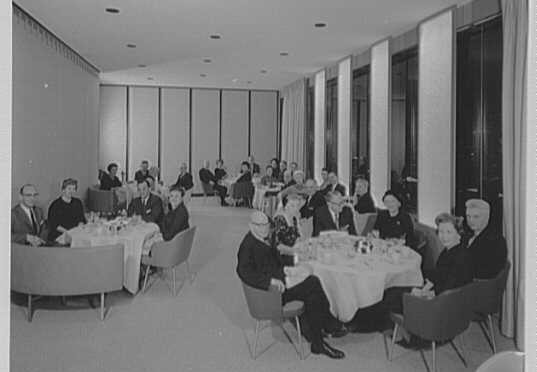
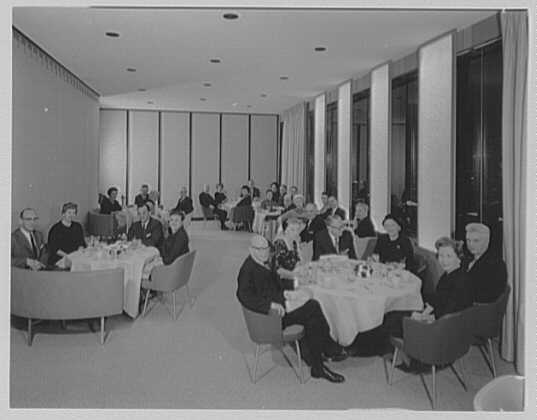
A square meal: The Tower Suite’s packed dining room   


WARNING The article contains a couple spoilers about last night’s ‘Mad Men’ on AMC. If you’re a fan of the show, come back once you’re watched the episode. But these posts are about a specific element of New York history from the 1960s and can be read even by those who don’t watch the show at all. You can find other articles in this series here.

In trying to contrast the life-altering decisions made by two of ‘Mad Men’s central characters, the writers certainly did an excellent job last night in choosing two appropriate and familiar locales.

Don Draper (with Megan in tow) made a last-ditch effort to win over a difficult client by dining at the Tower Suite in the Time & Life Building. (The offices of Sterling Cooper Draper Pryce were actually several floors below.) The restaurant on the 48th floor served as an executive dining room during the day called the Hemisphere Club, one of a number of elevated lunch spots in midtown Manhattan. The destination for businessmen looking to impress — waiters were dressed as butlers  — was opened by George Lang of Cafe des Artistes fame in 1961.

By many accounts however, the Tower Suite was considered a starched and even dreary dining experience. And quickly passe. In 1970, New York Magazine intoned “[T]he Tower Suite is still ideal for enchanting sheltered in-laws, teenagers, the hopelessly in love and out of town clients from Saginaw.”

Peggy Olsen, meanwhile, had a more personal dilemma to attend to downtown in the heart of Greenwich Village where she’s seen much of her personal growth. She’s presented with a decision to make over dinner at Minetta Tavern, a corner Italian restaurant on MacDougal Street at the foot of small Minetta Lane.

This was the former location of The Black Rabbit, one of Greenwich Village’s best known speakeasies, operated by Eve Addams. Her infamous tearoom Eve’s Hangout right up the street was one of New York’s first lesbian hangouts. The Black Rabbit switched to proper Italian cuisine in 1937.

The tavern had been immortalized the previous year in Joseph Mitchell‘s ode to eccentric bohemian Joe Gould, who frequented Minetta’s in his later years. ‘Joe Gould’s Secret’ would become one of Mitchell’s best  known New York tales. (It was also be his last book.)

With the Tower Suite long gone, you can no longer enjoy its faux-butler service, but Minetta Tavern was renovated and reopened in 2009 by restaurateur Keith McNally.

Categories
Landmarks Podcasts

Notes from the podcast (#134) St. Patrick’s Cathedral

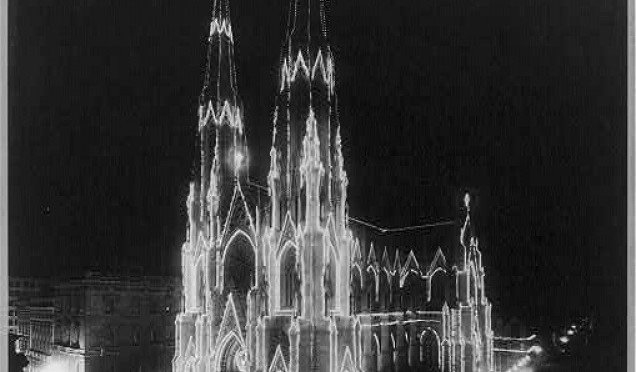
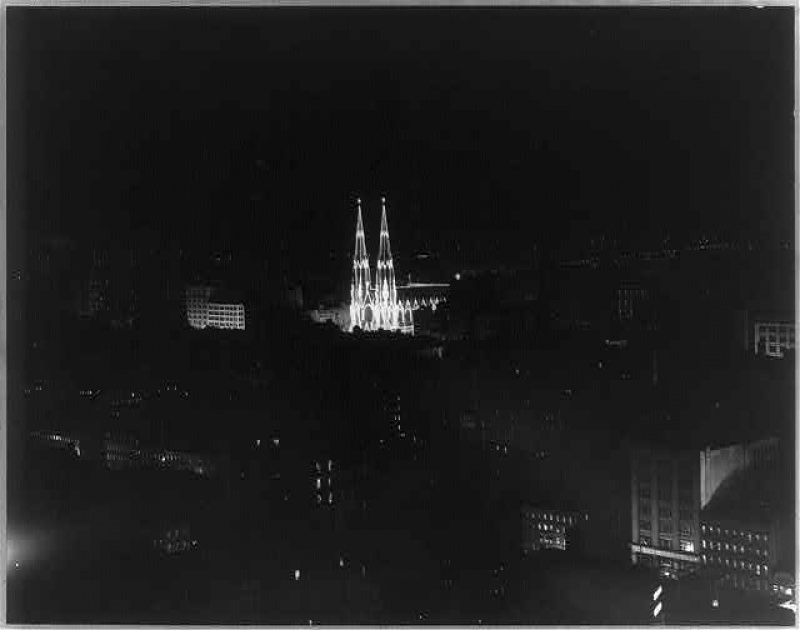
A spectacle from a hundred years ago: St. Patrick’s in 1912, in a gauze of electric lights. The picture below this post illustrates how this particular light performance made the church standout among the as-of-yet mild landscape of Midtown East. Pictures courtesy the Library of Congress

We hope you like our new podcast on St. Patrick’s Cathedral. Very odd timing to be releasing a Catholic themed podcast, given that Archbishop Dolan is set to turn Cardinal tomorrow and, oh right, the contraception controversy.

The church is closely linked to the history of early Irish New Yorkers. However there were obviously huge bodies of Catholics of other nationalities in the mid-19th century, particularly German Catholics. Archbishop John Hughes himself said that “people were composed of representatives from almost all nations.” That said, Germans Catholics opened their own churches, in particular the Roman Catholic Church of the Most Holy Redeemer, opening in the East Village in 1852, in the new German enclave of Kleindeutschland.

Here’s an interesting read about the 1989 ACT UP protest at St. Patrick’s, from a person who was actually arrested at the protest!

VISIT: The official site for St. Patrick’s has a historical timeline, a map, and information on tours.

MUSIC: The music in this week’s show is from the album ‘O Come Let Us Sing’, featuring the St. Patrick’s Cathedral Choir and St. Patrick’s organist Donald Dumler. You can find the album on iTunes.

CORRECTIONS: I made a big blunder in this episode. I’ve always prided myself in New York movie trivia, yet I flubbed it in this episode. ‘The Godfather III’ was filmed at St. Patrick’s Old Cathedral, not at the new one. Sorry for the error.

Speaking of the old cathedral, it’s now a basilica, if you haven’t heard. Although we speak about the original Mott Street cathedral in this episode, you might like to check out our old show (Episode #9). You can tell we’ve come a long way in this podcasting thing!


TIMELINE: We do things a bit out of order at the start of the show, so I thought I’d lay out some of the key dates for you for reference. St. Patrick’s website also has a historical timeline that you can use to follow along. But of the things we speak about:

1801 — David Hosack opens his Elgin Botanical Garden in the vicinity of today’s Rockefeller Center.
1808 — The Diocese of New York is created
1810 — The land where St. Patrick’s sits today is sold to an insurance company, the Eagle Fire Company. One of the trustees of the board is Archibald Gracie. By this time, the Jesuits had already constructed a building on this property.
1813 — Augustin De Lastrange arrives in New York. The following year, he bought the structure and, for a short time, sets up a Trappist monastery here.
1815 — St. Patrick’s Cathedral opens downtown at Mulberry Street.
1828 — The mid-Manhattan land is sold to Francis Cooper, on behalf of St. Peter’s and St Patrick’s, with the intention of building a cemetery
1838 — John Hughes is made a bishop
1850 — The Diocese of New York becomes an archdiocese
1858 — The cornerstone to St. Patrick’s new cathedral is laid. By this time, the controversial figure Madame Restell has already built her mansion across the street, and quite on purpose it seems.
1864 — John Hughes dies
1878 — The ‘Great Cathedral Fair’ is held, raising enough funds to finally complete the structure
1879 — The new Cathedral is officially dedicated
1888 — The cathedral’s distinctive spires are finally completed.

Categories
Parks and Recreation

Time Capsule: Gay Hippies vs the Nudists in Central Park!

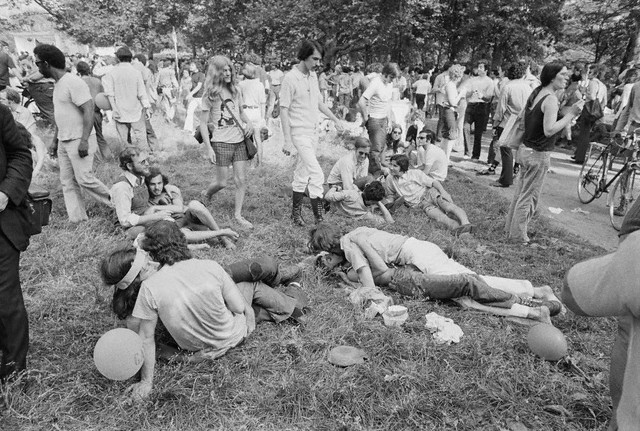
Above: From a great photo stream of images from the 1971 parade by Me In San Fran/Flickr (check them out here)

I happened across some rather extraordinary archival videos on YouTube posted by Randolfe Wicker, recorded in 1971 at New York’s second Gay Pride festivities ever, initially called the Christopher Street Gay Liberation Day. In those days, the march headed north (almost all New York parades head downtown), terminating in a rally at Central Park.

Mr. Wicker’s video features interviews with parade participants and focuses on a controversy involving a ‘nude-in’ that spontaneously erupts at the rally. Hey, it’s 1971 after all! (The nudists in the third video are blurred by the condition of the footage, so this is probably SFW).

Many of these interviews are hilarious, a few quite engaging, others rather awkward. This event took place two years after the Stonewall riots and just one year after the very first activists courageously took to the streets in New York’s first true gay pride parade. So this footage is very valuable indeed, for members of the LGBT community, and for New York history lovers in general.

Wicker also has some videos relating to a gay marriage battle — from forty years ago! Watch them here.

If you want a bit more context to the videos above, check out our podcast on the history of the Stonewall Riots, recorded back in 2008, which you can download directly from here.

Categories
Uncategorized

Xenon and the strange journey of a Broadway theater: Noel Coward, Fellini, porn, disco, ‘Cabaret’, Dame Edna

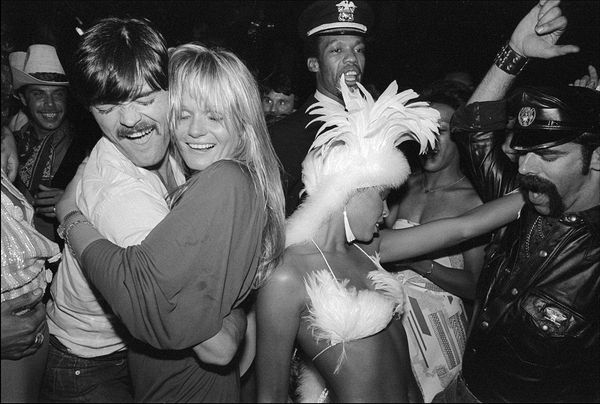
You know it’s a good night at Xenon when you’re drunk on the dance floor, and all of a sudden, the actress Valerie Perrine and the Village People appear (source)

FRIDAY NIGHT FEVER To get you in the mood for the weekend, on occasional Fridays we’ll be featuring an old New York nightlife haunt, from the dance halls of 19th Century Bowery, to the massive warehouse clubs of the mid-1990s. Past entries can be found here.

 LOCATION: XenonTimes Square, 43th Street and Broadway, Manhattan
In operation 1978-84

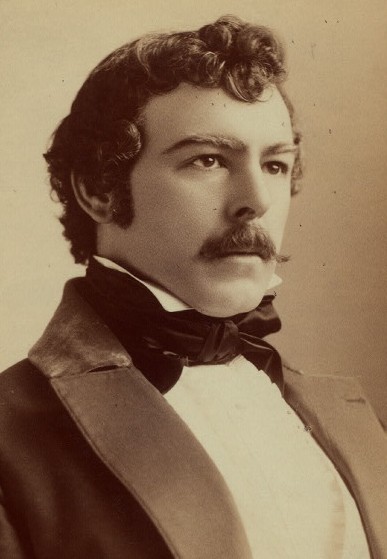
THIS, AT LEFT, IS HENRY MILLER. Clearly this is not the Henry Miller you more popularly know.

This Henry Miller would have never produced Tropic of Cancer. But his major contribution to the American stage would bring New Yorkers an iconic work of French cinema, a world famous theatrical revival, and one of the most successful Studio 54 knockoffs ever.

Miller was a minor theatrical star in the age of Sarah Bernhardt, who began dabbling as a director and stage manager at the same time that theater on 42nd Street began to flourish in New York. He became an early, respectable presence; from an early biography: “It was a foregone conclusion that a Henry Miller production must be in the best tradition of the theater.”

His timing was exquisite as well. The Broadway district in the 1910s was in full swing, with excitement at all hours. His patron (and progressive, feminist icon) Elizabeth Milbank Anderson assisted him in opening a stage in 1918 at 124 W. 43rd Street, a prime location near the theaters of Oscar Hammerstein, Klaw & Erlanger and Florenz Ziegfeld. The old New York Times building was half a block away, the nexus for New Years Eve celebrations for over a decade. Across the street rose the Hotel Metropole with its bustling late night antics; a few years earlier, in 1912, you could have stood in Miller’s lot and watched the bloody mob hit of gambler Herman Rosenthal — possibly ordered by New York cop Charlie Becker. (You can hear more about that in our Case Files of the NYPD podcast.)

There were no hits at Henry Miller’s theater, however, not the lucrative kind at least. In fact, the first show, The Fountain of Youth, was an unmitigated flop, opening in April 1918 and closing in May. (“This fountain of youth plays a very slender stream, and even that is of intermittent vigor,” claimed one review.) Famous names played here — George Gershwin, Billie Burke, Helen Hayes — but it wouldn’t be until Noel Coward debuted his scandalous, sex and cocaine-fueled comedy The Vortex in September 1925 that Miller’s theater would see its first in a string of major successes. Miller himself, however, would not enjoy these successes; he died a few months after Coward’s debut, in early 1926.

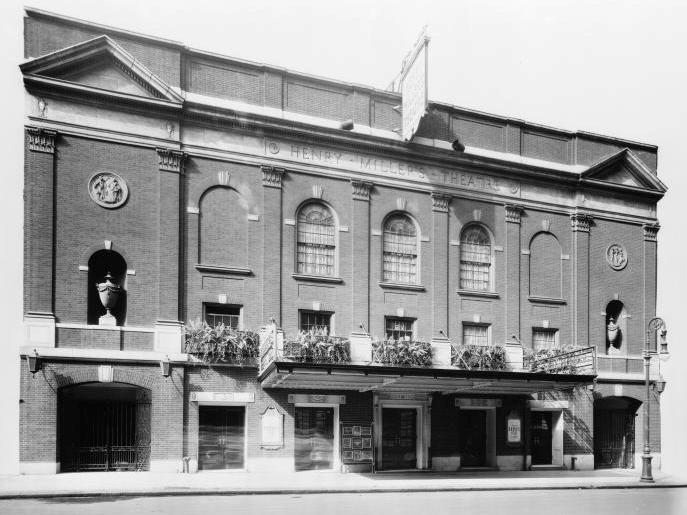
Below: Henry Miller’s theater, during its glory days. Photo courtesy NYPL

But Henry’s son Gilbert Miller had a knack for theatrical production even greater than his father. For three decades, he ushered countless box office hits through the Henry Miller’s Theatre, including the Tony winning T.S. Eliot play The Cocktail Party starring Alec Guinness. Most notably, Our Town would make its Broadway debut here in February 1938, and in 1957, a young British actress named Angela Lansbury would make her American stage debut here in Hotel Paradiso. Gilbert would win an honorary Tony in the mid-1960s for his contributions to the New York stage.

By then, however, the theater began flirting with a transition that many midtown stages had already made — into a legitimate movie house. Its first foray was also its most memorable, Federico Fellini‘s La Dolce Vita, premiering here in April 1961. The strangeness and theatricality of Fellini’s masterpiece fit the Henry Miller playhouse perfectly, even if the stage itself was technically ill-fitted for movies. The grumpy critic Bosley Crowther was even impressed: “Fellini’s “La Dolce Vita” (“The Sweet Life”), which has been a tremendous hit abroad since its initial presentation in Rome early last year, finally got to its American premire at Henry Miller’s Theatre last night and proved to deserve all the hurrahs and the impressive honors it has received.”

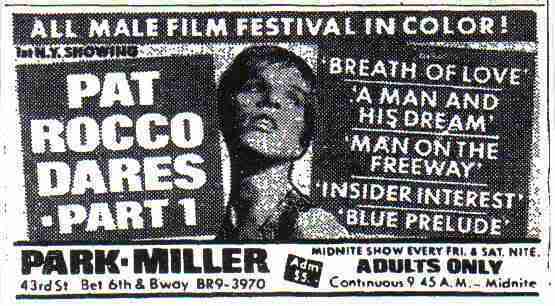
This might have been a harbinger for a fabulous future as an art house, however the theater was instead sold, renamed the Park-Miller, and entered the 1970s as one of Times Square’s most popular porno theaters, specializing in all-male features for gay audiences.

Although Henry Miller was certainly turning in his grave, the theater actually become quite successful, more so than most of Miller’s own productions during his lifetime.

According to author Hilary Radner, “the Park-Miller Theater on 43rd Street grossed in excess of thirty thousand dollars per week in the early 1970s….For a five dollar admission fee, audience members watched a mixed program that included shorts, slides, and a dubbed minifeature, such as Truckers — Men of the Road.” A long way from The Fountain of Youth, indeed!

Below: an advertising glimpse into the theater’s more prurient days

Everything changed in the spring of 1977 with the transformation of an old opera house into the superstar disco spectacular Studio 54, epitomizing the notion of nightlife as a headline-grabbing celebrity wonderland. One night at 54, music manager Howard Stein met Swiss restaurateur Peppo Vanini (the ex of actress Victoria Tennant), and the two cooked up a scheme to match the club’s glamour in another midtown location.

Stein purchased the old porn theater and remade it into the discotheque Xenon, although Xerox might have been a better name, for it adhered closely to the Studio 54 formula of flashy nights, big celebrities and kitschy showmanship (cannons with colored feathers, a neon X above the dance floor).

Being just slightly lesser a club than 54, you actually did stand a chance of getting in if you happened not to be a bold-faced somebody. But Stein would occasionally stand at the door himself “weeding out the detested middle class from the very rich and the colorful poor,” according to a New York Magazine profile.

Below: the club, during the day, in the 1970s:

Still, Xenon had its day, and on a typical hot summer night in 1979 or 1980 you might stumble into private parties hosted by Michael Jackson, Woody Allen, Lauren Bacall, Ben Vereen, or Pele. Inside you might hear deejay Jellybean Benitez.

Although people often stripped down to bikinis on the dance floor, you had fewer naked Grace Jones moments; Xenon “combined the craziness of Studio 54 with the comfort of Regine’s” according to one source, Regine’s being the more elegant nightclub entree owned by French chanteuse Régine Zylberberg.

With the end of disco came the end of Xenon, in 1984, and a brief attempt at turning the space into a rock ‘n’ roll venue called SHOUT! It lay mostly dormant, hosting temporary parties, until the early 1990s, when in a flash of inspiration, the Roundabout Theatre renovated the worn, abused little stage, combining all eras of its history to transform it into the Kit Kat Club, a cabaret venue fit to re-stage, naturally, Cabaret. That version, starring Alan Cumming and the late, wonderful Natasha Richardson, would go on to win the Tony for Best Musical Revival in 1998. Incidentally, that same year, a devastating construction crane accident next door closed the block for weeks, and Cabaret would be forced to move uptown to the former Studio 54.

Suddenly, all its prior incarnations seemed to enjoin to create its most successful reinvention yet. After Cabaret left, the hot off-Broadway show Urinetown moved in; that bawdy musical took three Tonys in 2003.

And then, they demolished it.

Saving the landmarked front exterior — with Henry’s name emblazoned along the top — the rest of the building was scrapped in a massive construction project that eventually put the Conde Nast Building to its west side and the Bank of America building to its north, to which a new theater was attached, using that old exterior and renamed the Stephen Sondheim Theatre. In the fine tradition of Henry Miller himself, the stage has features two shows — a revival of Bye Bye Birdie, and the Dame Edna musical All About Me — both flops.

For some great recollections of the glory days of Xenon, check out the website Disco Music. Featuring one commenter who says: “There’ll never be a club like it again. Pinball machines would drop out of the neon heavens and land next to dancers gyrating to ‘Funky Town’ by Lipps. Not to mention the fake snow (clearly an homage to the abundant cocaine passing through nostrils by one and all) that dropped on you, sticking to your favorite nylon shirt.”