Welcome to The Pansy Club: leave your wig at the door

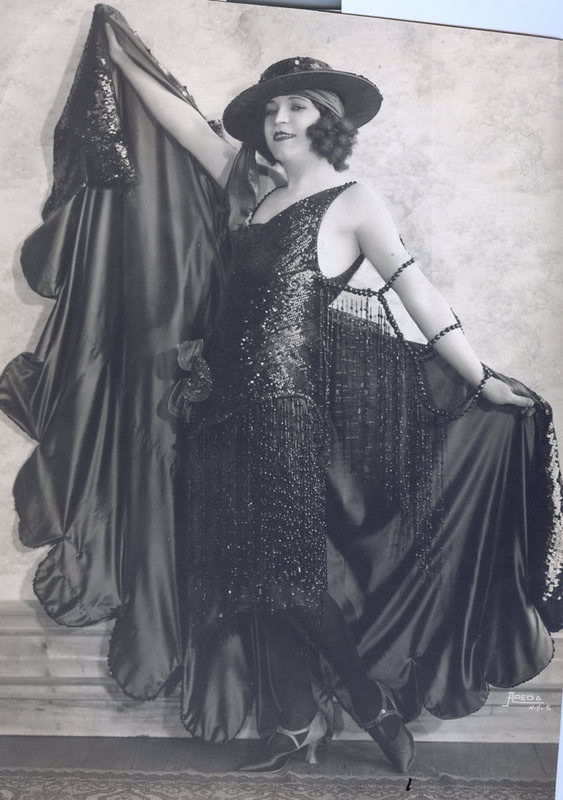
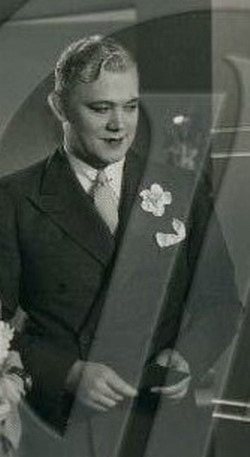
Above: Karyl Norman welcomes you to the Pansy Club!

FRIDAY NIGHT FEVER To get you in the mood for the weekend, on occasional Fridays we’ll be featuring an old New York nightlife haunt, from the dance halls of 19th Century Bowery, to the massive warehouse clubs of the mid-1990s. Past entries can be found here.

LOCATION: The Pansy ClubTimes Square, 48th Street and Broadway, Manhattan
In operation December 1930-31

The moral crusaders who succeeded in banning alcohol sales via the Eighteenth Amendment must have wondered where it all went wrong. Instead of ushering America down a path of productivity and moral fortitude, Prohibition sponsored a decade of unwritten rules, creating a shadow economy and empowering a criminal underworld.

Norms were upended, and the fringes of New York were defined by experimentation and playful risk. Harlem and Greenwich Village became the centers of culture, women found new avenues for empowerment, and black musicians mixed with white to create the sophistication of jazz.

It’s in the light of this churning mix of invention that you have to approach one curious fad of the Prohibition era — the pansy craze, an appreciation of drag-queen worship cultivated in the heart of Manhattan.

I’m not sure a place called The Pansy Club would be popularly received today, but when it opened in late 1930 it was risque and cool. Its location at 48th and Broadway planted it firmly in the theater district where it truly belonged, of course. But given the entertainments it generously offered, it’s amazing to me it was allowed to open at all.

It makes sense that the speakeasy-fueled, white crowds, having fully sampled from black nightclubs of the 1920s, would venture into other subcultures on the fringe of bohemia. There were plenty of places in Greenwich Village for gay and lesbians to meet, and within them came camped-up forms of cabaret, with men in drag emulating the glamorous female stars of the day. It helped that some of those stars, like Sophie Tucker and Mae West, mixed with and borrowed from their costumed admirers.

It all built into a national, urban ‘craze’ in 1930 and 1931 for drag shows in a mainstream cabaret environment.  Why it neatly fit on the nightclub circuit — and what made it somewhat more tolerable for conservative crowds — was partially due to drag’s close association with vaudeville.  Although the term ‘pansy’ was a derogatory one for gay men, for this brief time ‘pansy clubs’ were the hottest ticket in town.

The Pansy Club, at 204 W. 48th, in heart of Times Square (and about where the M&M Store is today) was not the only nightclub of this type, but when it opened the week before Christmas in December 1930, it was the showiest of the lot.

The Pansy Club featured standard-era vaudevillian and cabaret acts, but with a decided gay (read: scandalous) twist — female impersonators, “a bevy of beautiful girls in ‘something different’ entitled ‘Pansies On Parade'” according to a newspaper advertisement, one of the few documents that verify the club’s brief existence.

Mistress of ceremonies was one Karyl Norman, known in drag as the ‘Creole Fashion Plate’. Born George Peduzzi from Baltimore, Norman became a star on the vaudevillian circuits in the US, Europe and Australia in a show that featured him both in and out of drag. As a published songwriter and a favorite of Tin Pan Alley, Norman would have been a big draw in 1930 and as a seasoned vaudevillian star would have brought a touch of credibility to a club with so shocking a theme.
According to Brooks Peters, the club was also “a haven for aging flappers and party-goers who liked “slumming.””

Down the street was an even more popular draw. At Club Abbey (46th and 8th Ave) was a young Jean Malin (at left, courtesy Flickr), a Brooklyn-born wit and sometimes ‘female impersonator’ who hosted drag performances while charming audiences with interludes that made no disguise of his homosexuality.

What distinguished these places is that they were not considered gay and lesbian bars of the sort in the Village. However they did have a similar thread in common with them — ownership by the mob, an association that led to the club’s swift closings.

A gang shooting closed Club Abbey in January, and the police raided the Pansy Club that same month.  While the ‘pansy craze’ would live on in other cities — it made a more lasting impression in Hollywood, naturally — it retreated to the fringes again in New York.

And finally, for your Friday night celebration, here’s a look at Jean Malin, who made a brief appearance in Hollywood films before Malin’s untimely death in 1933. The film is ‘Arizona To Broadway’.
Who is Christopher? The story of a street

The events of the Stonewall Riots so reverberate within the international gay community that the thousands-strong Pride Parade every June ends here every year, while over in Europe (specifically major cities in Germany), their annual celebration is actually called Christopher Street Day. But the Christopher of Christopher Street would most likely be scandalized to learn the how his name is being used.

As we mentioned in this week’s podcast, the quirky street patterns of the West Village are a preservation of many original footpaths from the neighborhood’s early days as farm land. When the 1811 Commissioners’ Plan neatly divided the city into an easily navigable grid, the citizens of the village bucked the city’s advances and kept most of its jagged character intact.

The path that would become Christopher Street passed along the edge of the estate of British admiral Sir Peter Warren, an Irish daring-do from the early 18th Century whose fervid support of imperial England belied a equal love for the town of New York. He also owned one of the largest mansions in New York’s rich countryside, i.e. today’s Greenwich Village.

Warren’s wife kept reign over the manor (and their many slave holdings) while Warren was away on war adventures, and her daughters married well, including her youngest who was betrothed to another Manhattan landowner James De Lancey, who provides his name to Delancey Street today. Another daughter married a British colonel William Skinner, and the Warrens honored the engagement by naming the path that bordered their property Skinner Road.

The descendants of Warren clan kept their countryside property even in post-Revolutionary New York, but as the city crept past its original border, their lands became more valuable and they were eventually parceled into smaller lots. In 1799 the property that included Skinner Road fell into the hands of a trustee of the Warren estate Richard Amos.

Amos was quick to lob off sections of the property and sell to others. But he kept a sizable portion and passed it to his relative Charles Christopher Amos, who then apparently took to the unoriginal idea of giving the roads on his property various parts of his own name — Amos Street (today’s 10th Street), Charles Street (which still exists today), and the former Skinner Road, now newly named Christopher Street. By the 1820s, the former farmland had lost its bucolic character and became a part of the New York urban landscape, with Christopher Street, lined with businesses, the Village’s commercial center.

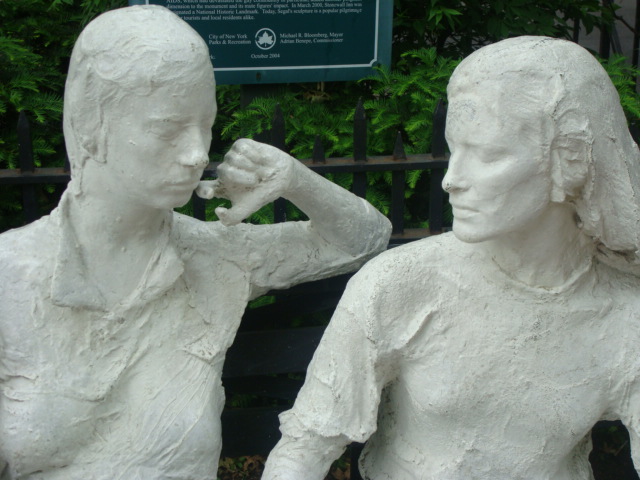
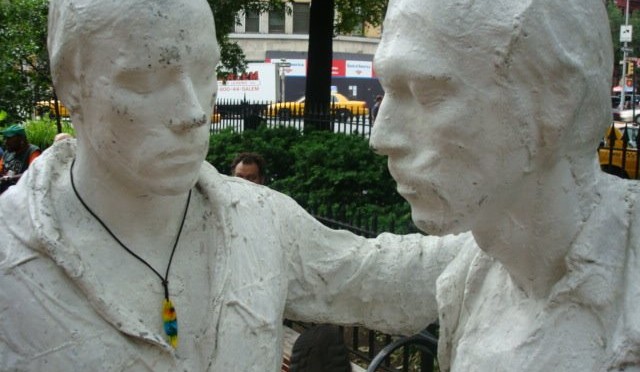
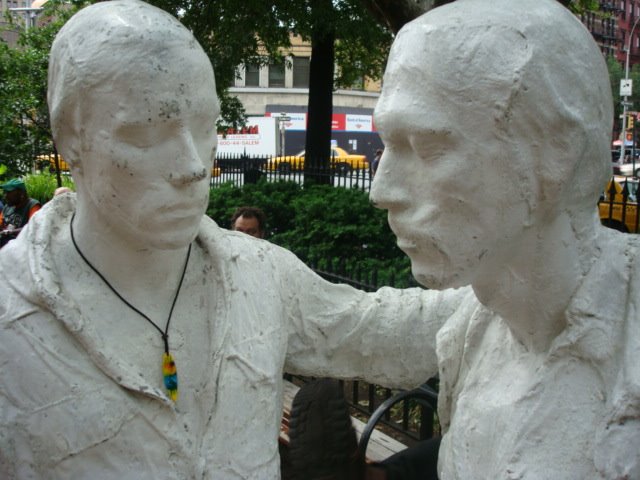
By the way, the white sculpture of Christopher Park are designed by George Segal and were placed in the park in 1992. The piece entitled Gay Liberation features two gay male figures standing next two seated lesbians. Depending on the time of day, the sculptures are either extremely charming or a little creepy.

FRIDAY NIGHT FEVER: The Slide / Kenny’s Castaways

To get you in the mood for the weekend, every Friday we’ll be celebrating ‘FRIDAY NIGHT FEVER’, featuring an old New York nightlife haunt, from the dance halls of 19th Century Bowery, to the massive warehouse spaces of the mid-90s. Past entries can be found HERE.

The rapid transitional personality of a New York City building tends to write over the juicier bits of its past. Will we remember CBGBs 20 years from now when it’s a fashion boutique? Do the college students down at the Palladium NYU dormitory in the East Village know what their building’s named after?

When Patrick Kenny opened Kenny’s Castaways in 1967 at 157 Bleeker Street, he certainly knew he was settling down onto the equivalent of an burial ground of early Village debauchery. And without obscuring the establishment quite seedy origins he would create a bit of history himself.

Patrons slipping into a bar at that address less than a hundred years before would be stepping into what the New York Press (a 19th Century news rag) called “the wickedest place in New York.” Being New York in 1890, I suspect there were a few places more ‘wicked’ in the city; yet The Slide won this notorious title for being a flaunting homosexual dive bar.

You can’t trust police blotters and morality crusader sheets like the Press to give an accurate depiction of what The Slide was really like. But even an attempt to peel back the hyperbole gives you a sight that would rival the bawdier Village gay bars of today.

Dive lord Frank Stephenson seemed to specialize in lubricating the underground fringes of society. His Black and Tan bar down the street from the Slide catered to non-white patrons who preferred the flirtation of ‘amoral’ white ladies (sometimes prostitutes, often thieves). The Slide went a step further, with open displays of men in drag, ‘one to three hundred people, most of whom are males, but are unworthy the name of men’, performing ‘fairies’ on pianos, and backrooms of male prostitution.

Homosexual behavior of any stripe would have been condemned in this era; such flagrant and open displays would have been unthinkable. The clientele were ‘effeminate, degraded, and addicted to vices which are inhuman and unnatural’. A bar today would be honored to be strapped with such description!

Some of the Slide’s patrons went by such names as Princess Toto, Madam Fisher, Maggie Vickers, Phoebe Pinafore and Queen of the Slide. Female prostitutes mingled with the men to create what must have been a dizzying stew of genders, the air filled with cheap booze, wild sex (‘orgies beyond description’) and tunes banged out on an old piano.

Flash forward almost 75 years. The Slide was closed down by police in 1892 and the building took on a host of different identities. In preparing for opening of Kenny’s Castaways, the Kenny family would find the basement cellars — with largely intact evidence of its use as a brothel — almost preserved. Many of the bars floors and fixtures hearken to the 19th century. What Patrick Kenny planned, however, would definitely influence the 20th. Kenny would return the space to its former glory as a raucous bar and host to a very different set of over-the-top characters, while leaving the basic layout of the bar mostly intact.

Instead of mincing drag queens, Kenny’s Castaways would host up-and-coming rockers and superstars longing to return to barroom performance spaces. Patti Smith, the New York Dolls, Blues Traveler and Aerosmith have all played Kenny’s worn stage early in their careers. Two Ramones, DeeDee and Joey, are purported to have first met at a Dolls show here in the 70s.

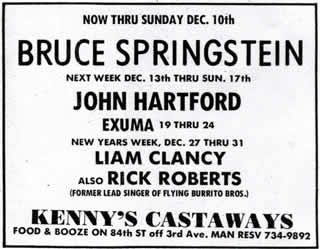
A young singer Bruce Springsteen performed for a week here in 1973 with his new band the E Street Band. Seven years later Kenny’s would hire a house band the Smithereens. Even today the bar hosts a mix of big stars and local cover bands, and all rather discreetly, at least in New York terms. The bar rarely advertises, yet everybody knows Kenny’s.

Patrick died three years ago, but the family continues to run it. This year is Kenny’s 40th anniversary. I can’t help but think that the ghost of Princess Toto sidles up to the bar every night to lord over the festivities with satisfaction.

Still ‘Burning’ after all these years

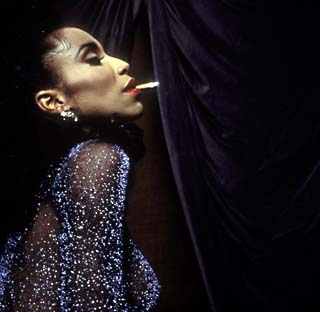
Above: the phenomenal Willi Ninja

BOWERY BOYS RECOMMEND is an occasional feature whereby we find an unusual movie or TV show that — whether by accident or design — uniquely captures an era of New York City better than any reference or history book. Other entrants in this particular film festival can be found HERE.

The Savoy Ballroom in Harlem saw the birth of the Swing-era ‘Lindy hop’ during the late 20s, a hip-swiveling dance named after Charles Lindburgh which became a regular move on dance floors. The Savoy would see a more radical mix of dance styles — and a decidedly more adventurous clientele — in the late 70s with the Harlem drag balls. The rest of the world was let in on this little secret in the cult classic 1990 documentary Paris Is Burning by Jennie Livingston.

‘Paris’ woke up many open-minded Americans — and rankled just about everybody else — to a community even further out of the spotlight than the ‘mainstream’ gay and lesbian community of that time. (Mainstream, of course, being relative in 1990.) Here were groups of primarily young black and Latino gay men and transgenders, with little evidence of stable home environment, enjoying the freedom of glamour and high fashion, elegance and performance on display on dancefloors in late 80s Harlem.

‘Paris Is Burning’ displayed the New York ‘house’ culture, groups of men under the aegis of various fashion houses — featured in the movie are the houses of LaBeija, Ninja and Xtravaganza — that serve practically as unofficial families. They meet on the dancefloor in competitions to emulate feminine and masculine stereotypes with just that extra added component of glamour. Fashion models, banji boys, military. Watching the competitions of ‘realness’ — the ability to pass ones self in the real world as ‘normal’ — has almost amusing relevance filmed as it was before the era of hyper-masculine gay appearances and culture of the ‘down low’.

New York City looks drab next to the colorful and fabulous personalities. You can catch a glimpse of how the West Village piers once looked, but who’s paying attention when Venus Extravaganza is talking? She’s the most heartbreaking character — I won’t spoil why — and has always been my favorite; faced with insurmountable obstacles, you still root for her as she describes her fantasy life to be a kept housewife and a fashion model. Livingston cleverly intercuts with pictures of at-the-time current models, images which are even more strikingly absurd now. Venus might be happy to know she looks more like a model of today than any of those women.

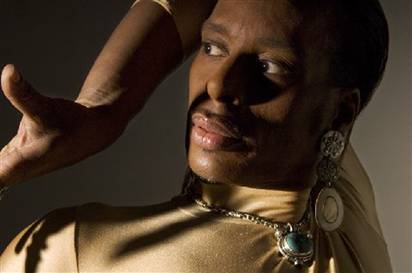
Many of the greatest personalities in ‘Paris’ are no longer with us, giving the movie an even more depressing weight. However, one of the featured stars Octavia St. Laurent (pictured above) is still looking great — although she now calls herself Heavenly Angel Octavia St. Laurent. Like the Lindy hop, another dance borne from the floors of the Savoy, voguing, as infiltrated modern pop music, from Madonna to Britney Spears.

And some members of the houses have gone on to mainstream success. Willi Ninji, who passed away last year, became a recording artist and dance coach, notably to Paris Hilton. Another member of the house of Ninja, Benny Ninja, is a frequent guest on America’s Next Top Model.

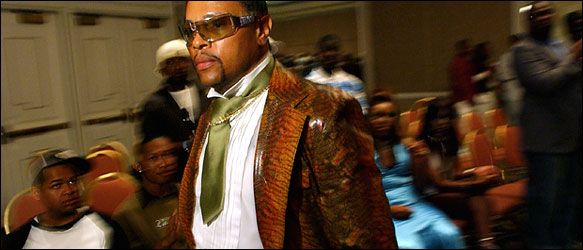
And while the visibility of the Harlem ballroom danceoffs may have peeked with ‘Paris Is Burning’, they’re still going strong, particularly in other cities like Atlanta and Los Angeles. The House of Ultra-Omni recently celebrated their 25th anniversary. While the younger generation now ‘perform’ as modern stars like Jay Z, there’s still plenty of glamour and confidence to go around.

If you haven’t seen ‘Paris Is Burning’ in a few years, I highly recommend another viewing and maybe a little private voguing in your living room.

Below: The style of Kevin Ultra-Omni, at his house’s anniversary party

Above photo: Ann Johansson for The New York Times