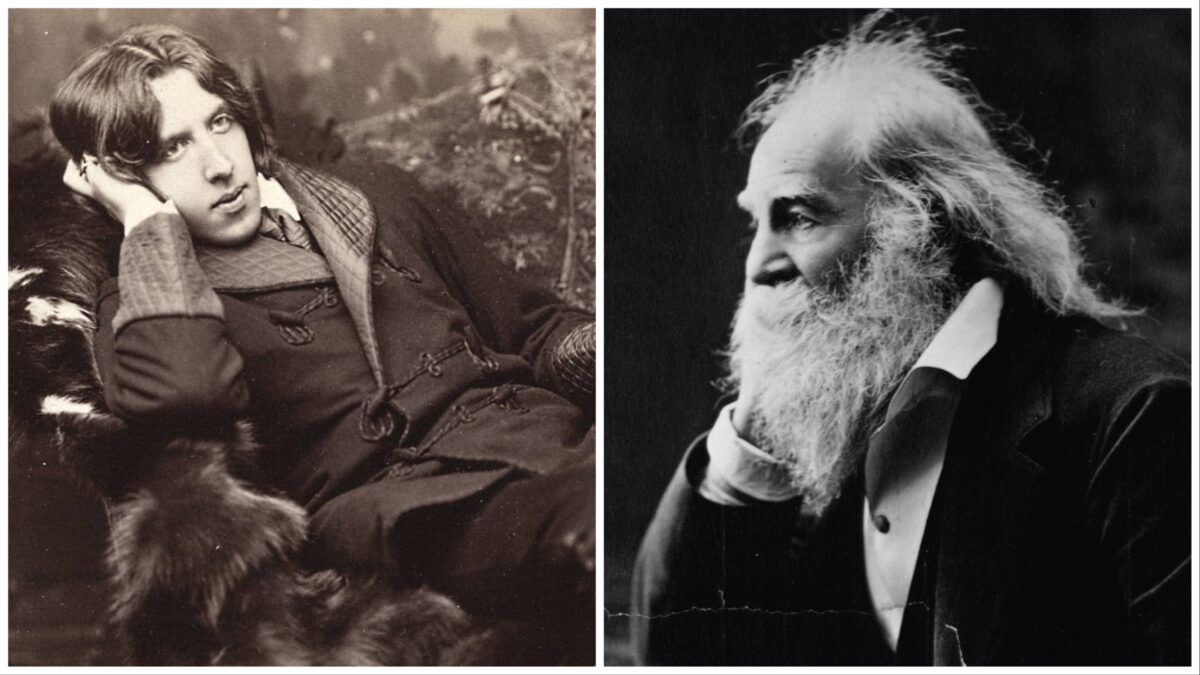
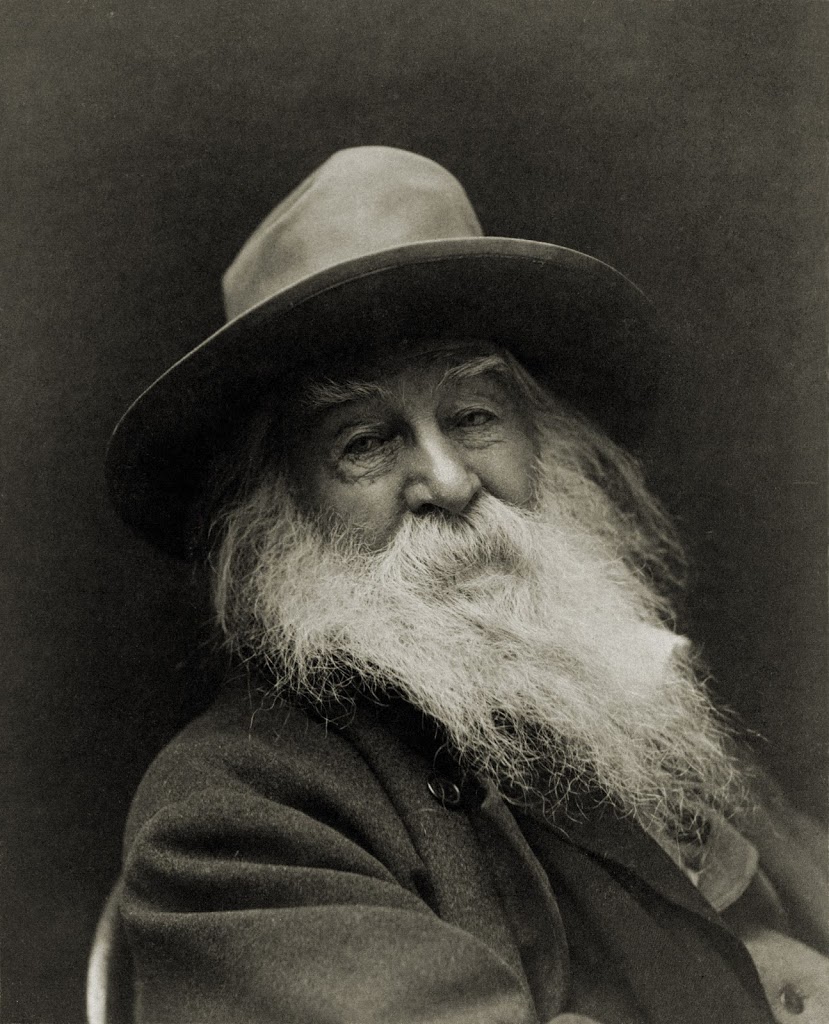
In 1882, Oscar Wilde took break from his lecture tour of North America to meet his childhood idol, the aging poet Walt Whitman, who lived in Camden, New Jersey.
Their afternoon together is the stuff of literary legend. Wilde later recounted, “The kiss of Walt Whitman is still on my lips.”
On these special two episodes of The Gilded Gentleman, host Carl Raymond and guests take a look at the lives of Whitman and Wilde, two revolutionary writers, the times in which they lived, their surprising meeting, and how New York inspired them to move onto great fame and celebrity.
In part one, writer and historian Hugh Ryan(When Brooklyn Was Queer, The Women’s House of Detention) talks about how revolutionary Whitman’s Leaves of Grass was and how Whitman would have defined his same-sex attractions, which had not yet evolved into the concepts of sexuality and gender identification that we know today.
What was the New York and Brooklyn that Whitman knew? Hugh offers insight into just what that famous meeting between the older Whitman and the younger Wilde years later might have been like.
In part two, noted Wilde scholar and expert John Cooper joins Carl to envisions New York that Wilde would have seen upon his arrival.
John guides listeners on a journey to discover just who Wilde was at this point in his life and career, how he and the city of New York interacted with each other and just how Oscar would likely have defined and described his own much debated sexual identity.
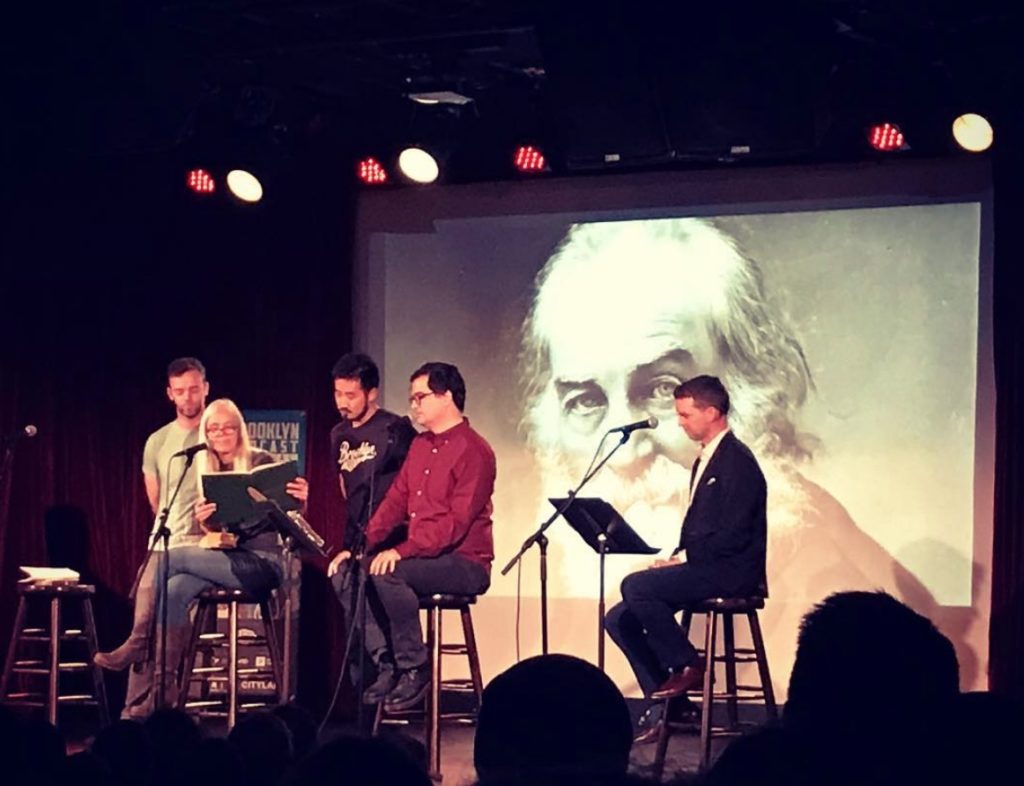
A very special episode of the Bowery Boys podcast, recorded live at the Bell House in Gowanus, Brooklyn, celebrating the legacy of Walt Whitman, a writer with deep ties to New York and its 19th century sister-city Brooklyn.
On May 31, 1819, the world will mark the 200th anniversary of the birth of Whitman, a journalist who revolutionized American literature with his long-crafted work Leaves of Grass. The 19th century cities of New York and Brooklyn helped shape the man Whitman would become, from its bustling printing presses to bohemian haunts like Pfaff’s Beer Cellar.
To help them tell this story, Greg and Tom are joined by guests from the worlds of academia, literature and preservation:
Karen Karbiener, NYU professor and head of the Walt Whitman Initiative, an international collective bringing together all people interested in the life and work of Walt Whitman
Jason Koo, award-winning poet, and founder and executive director of Brooklyn Poets, celebrating and cultivating the literary heritage of Brooklyn, the birthplace of American poetry
and Brad Vogel, executive director at the New York Preservation Archive Project and board member of the Walt Whitman Initiative, leading the drive to protect New York City-based Whitman landmarks.
The Bowery Boys: New York City History podcast is brought to you …. by you!
We are now producing a new Bowery Boys podcast every other week. We’re also looking to improve the show in other ways and expand in other ways as well — through publishing, social media, live events and other forms of media. But we can only do this with your help!
We are now a member of Patreon, a patronage platform where you can support your favorite content creators for as little as a $1 a month.
Please visit our page on Patreon and watch a short video of us recording the show and talking about our expansion plans. If you’d like to help out, there are five different pledge levels (and with clever names too — Mannahatta, New Amsterdam, Five Points, Gilded Age, Jazz Age and Empire State). Check them out and consider being a sponsor.
And join us for the next episode of the Bowery Boys Movie Club, an exclusive podcast provided to our supporters on Patreon.
We greatly appreciate our listeners and readers and thank you for joining us on this journey so far.
For a list of Walt Whitman celebrations in New York City and around the country, visit the Walt Whitman Initiative for details. And the week of Whitman’s bicentennial (May 27-June 1) is International Whitman Week!
Some images from our live show:
jenna_scherer/Instagram
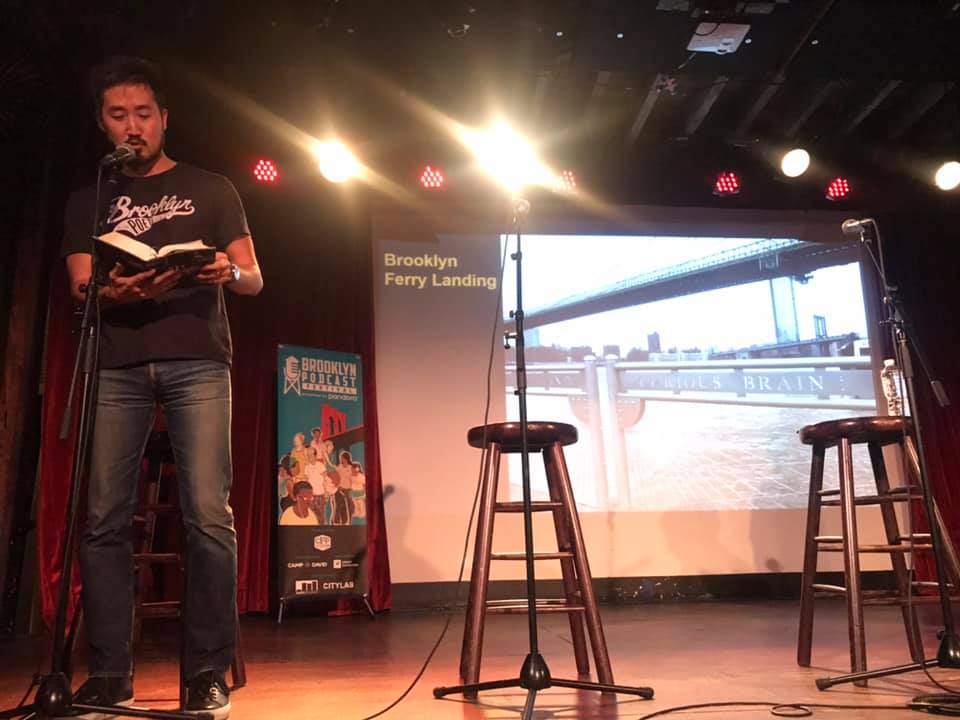
Jason Koo reading “Crossing Brooklyn Ferry”
Courtesy Marie Carter
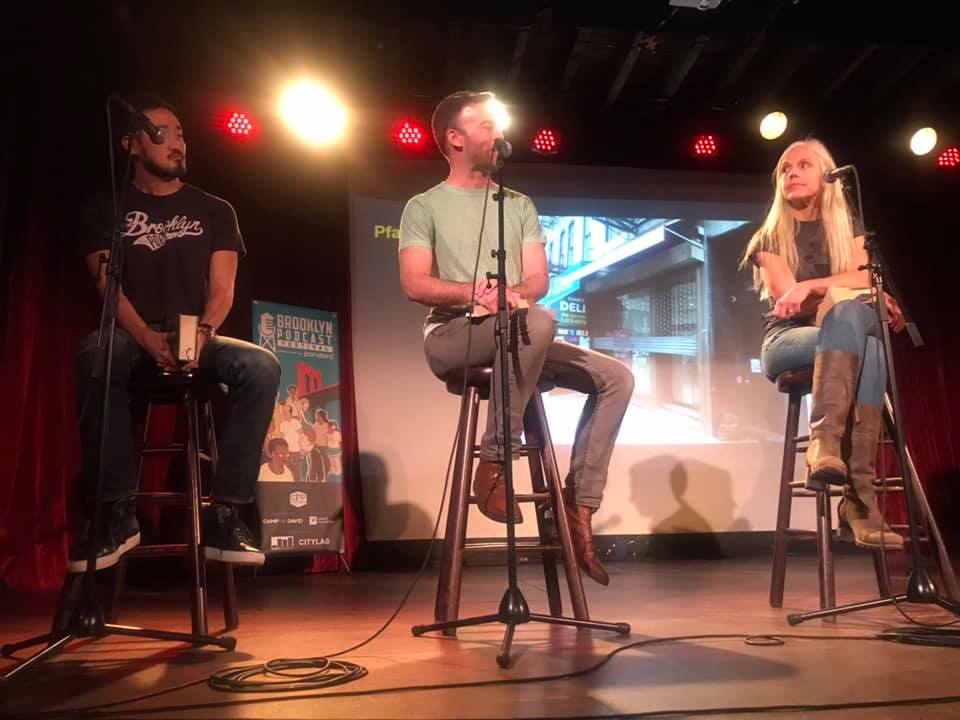
Jason Koo, Brad Vogel and Karen Karbiener
Courtesy Marie Carter
This is a recording of what many consider the actual voice of Walt Whitman, recorded on wax cylinder, reading a section of his poem “America”. (There is some controversy over its veracity.)
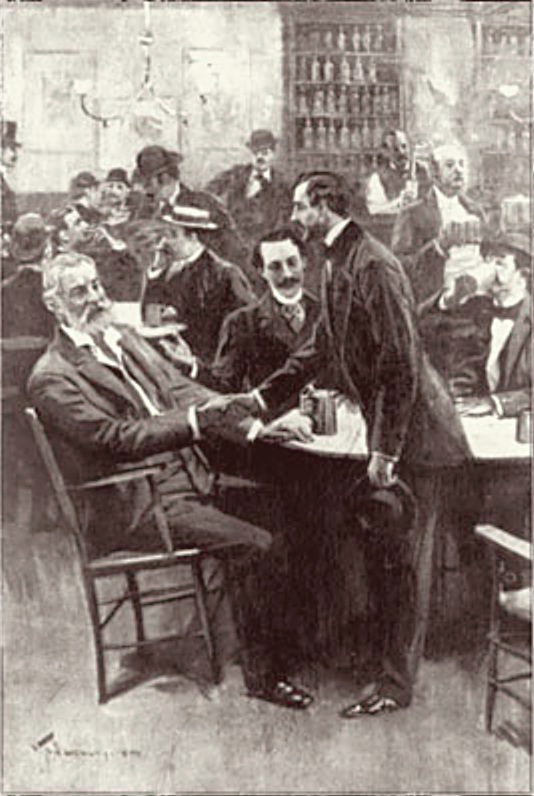
An illustration of the interior of Pfaff’s Beer Cellar, depicted here in 1857 (the seated gentleman is Whitman).
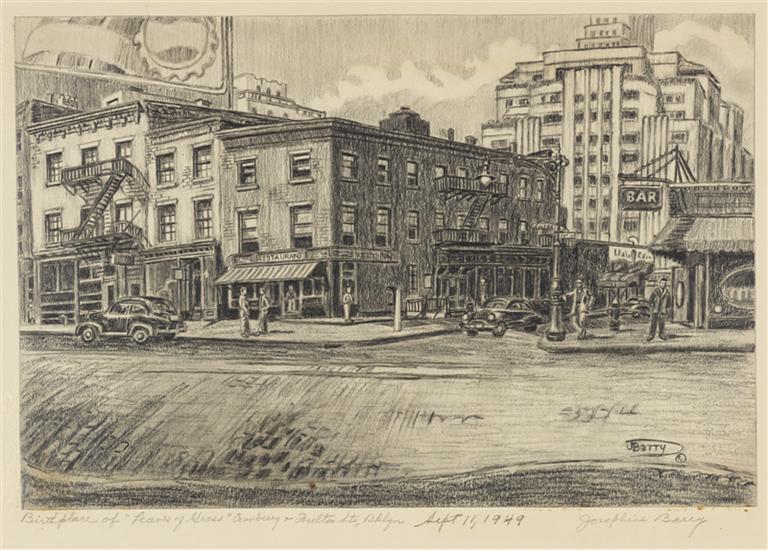
The location of Rome Brothers printing house (at Cranberry and Fulton streets), depicted here in 1949 in an illustration by Josephine Barry.
Museum of the City of New York
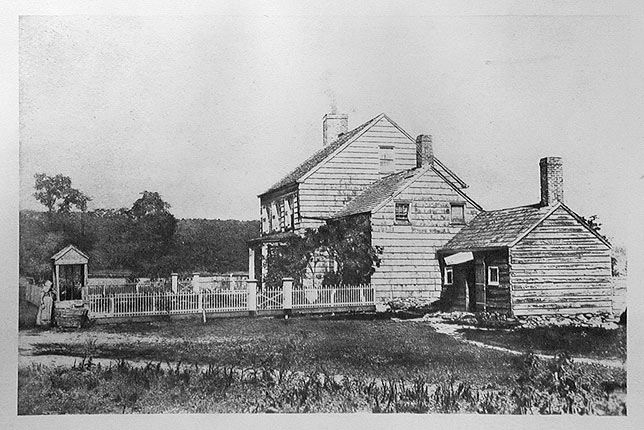
Whitman’s birthplace in Huntington, Long Island, still stands and is well worth a visit. It’s lovely! Unfortunately the landscape around the house has changed dramatically.
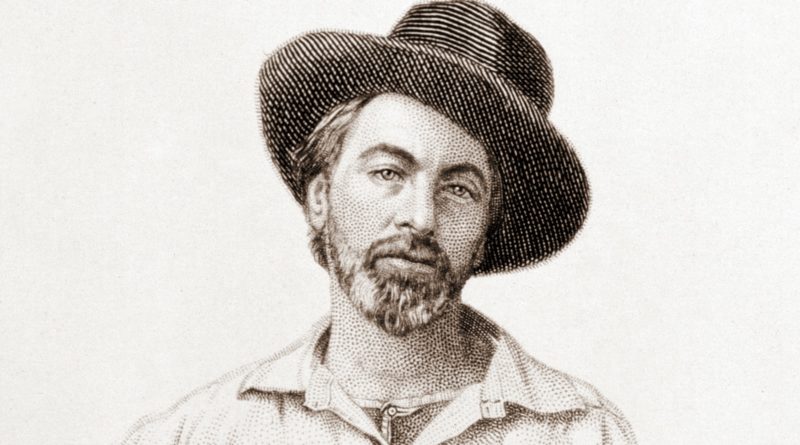
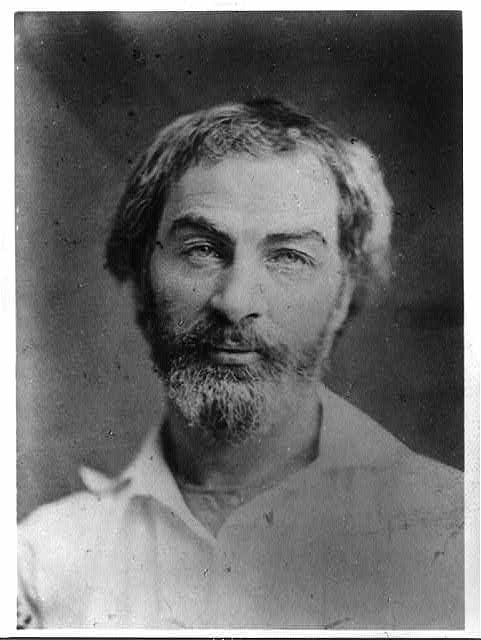
Whitman in 1854
Library of Congress
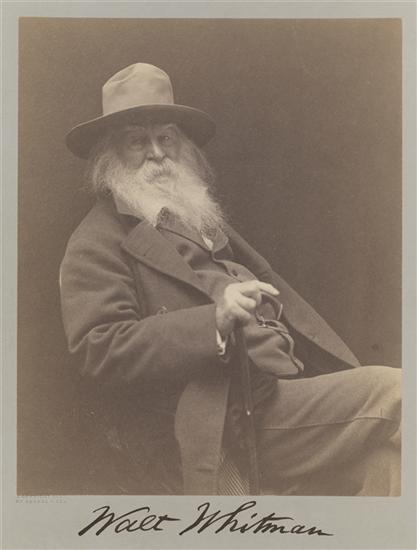
Whitman in 1890, photographed by George C. Cox
Museum of the City of New York
FURTHER LISTENING
Before Whitman, Poe found inspirations for his poetry in New York and in another future borough — the Bronx:
Whitman was a young man living in New York when a terrible blaze destroyed much of the city (not to mention job prospects):
Downtown Brooklyn, the area where Whitman once lived and published, has gone through several transformations since he lived here:
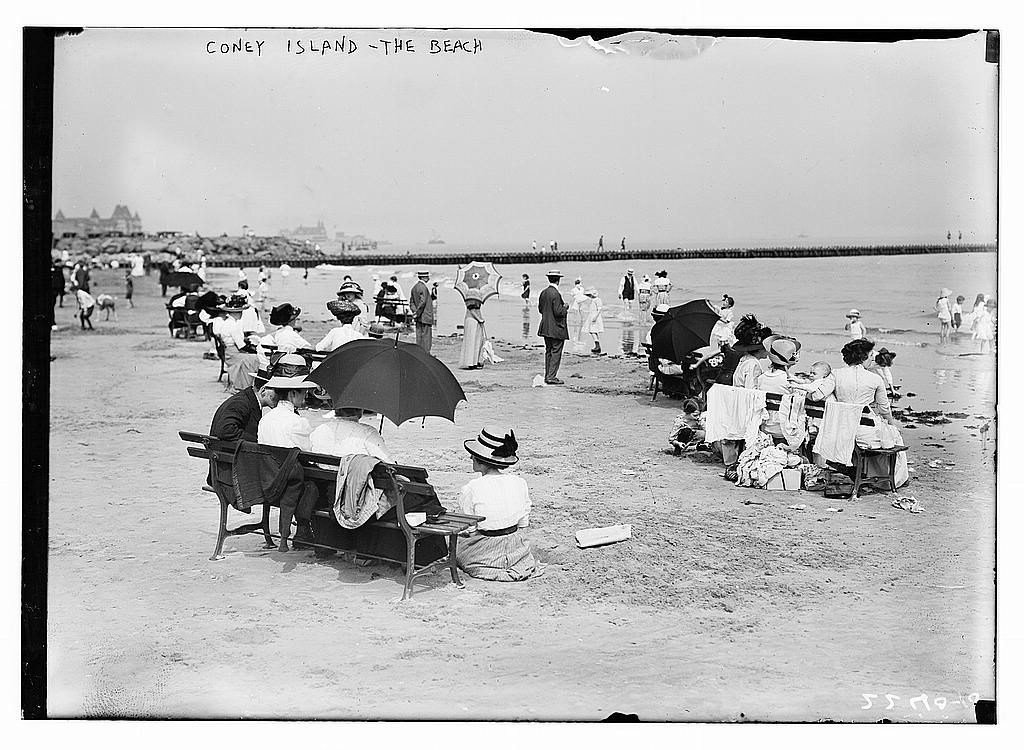
On the beach at Coney Island 1910-15 (Courtesy Library of Congress)
Everybody sees Coney Island a little differently. Most people know it for the amusements but not everybody has the same feeling about them. One person craves the beaches, the food. Another prefers a stroll along the boardwalk, fireworks, an evening Cyclones game. Others live nearby, too familiar with the swelling weekend crowds. And some people — and this seems like blasphemy — have had their fill of Nathan’s hot dogs.
Coney Island has always been a Rorschach test of class, morals and taste, an escape from the city for more than 150 years. (In the 19th century, it was an escape from two cities, as Brooklyn was independent then and had not yet subsumed Coney Island within its borders.)
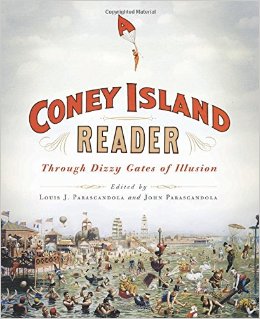
It’s never been considered a bastion high culture, although its degrees of middle- and low-brow have been vibrantly written about from the very beginning. Â In The Coney Island Reader: Through The Dizzy Gates of Illusion, edited by Louis J. and John Parascandola, we get a time machine through its many iterations, thanks to the observations of dozens of writers.
I don’t think of Coney Island as a particularly literary destination, and yet here we have some of their greats chiming in to describe the lusty pleasures of Brooklyn’s beach-side getaway.
We begin with Brooklyn’s greatest voices — Walt Whitman. “Yes: there was a clam-bake — and, of all the places in the world, a clam-bake at Coney-Island! Could moral ambition go higher, or mortal wishes go deeper?” Â He’s writing in 1847 when the area is a barely developed destination.
Jose Marti, the poet and Cuban revolutionary, is overtaken by its magic. “And this squandering, this uproar, these crowds, this astonishing swarm of people, lasts from June to October, from morning until late night, without pause without any change whatsoever.”
Today’s Coney Island amusement district is vastly smaller than the one which greeted Stephen Crane in 1894. Â “We strolled the music hall district, where the sky lines of the rows of buildings are wondrously near to each other, and the crowded little thoroughfares resemble the eternal ‘Street Scene in Cairo’.”
As Coney Island grew larger in the early 20th century — with its three principal amusement parks Dreamland, Steeplechase and Luna Park — it pulled thousands more to its whimsical attractions.  It’s almost  hilarious to picture Russian writer and dramatist Maxim Gorky sitting inside the Dreamland ride Hellgate, with its hellish flames “constructed of paper mache and painted dark red. Everything in it is on fire — paper fire — and it is filled with the thick, dirty odor of grease. Hell is badly done.”
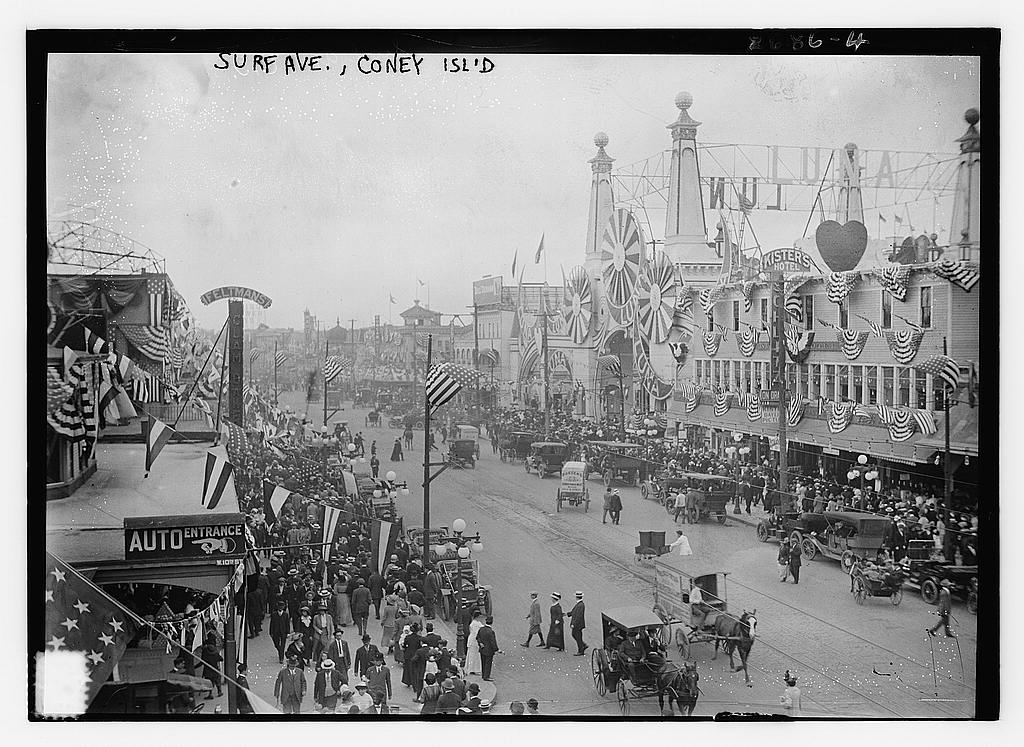
Surf Avenue 1910-15
The Coney Island Reader combines literary observances with social commentary and documentary accounts featuring interviews with the impresarios themselves.  In a 1909 magazine article by Reginald Wright Kauffman, George C. Tilyou, the owner of Steeplechase Park, proclaims, “To sum up my opinion of the whole thing, we Americans want either to be thrilled or amused, and we are ready to pay well for either sensation.” (George’s brother Edward is represented here with a vivid essay called “Human Nature with the Brakes Off — Or: Why the Schoolma’am Walked Into the Sea.”)
More contemporary observations of the fictional kind are represented by Kevin Baker (who also contributes the forward), Josephine W. Johnson and Sol Yurick (from the novel which inspired the film The Warriors).
This is perhaps the only book in history that features the writing of e.e. cummings and Robert Moses. One saw saw “[t]he incredible temple of pity and terror, Â mirth and amazement,” the other “overcrowding at the public beach, inadequete play areas and lack of parking space.”
Ah, Coney Island. It’s what you make of it.
The Coney Island Reader Through Dizzy Gates of Illusion edited by Louis J. Parascandola and John Parascandola Columbia University Press
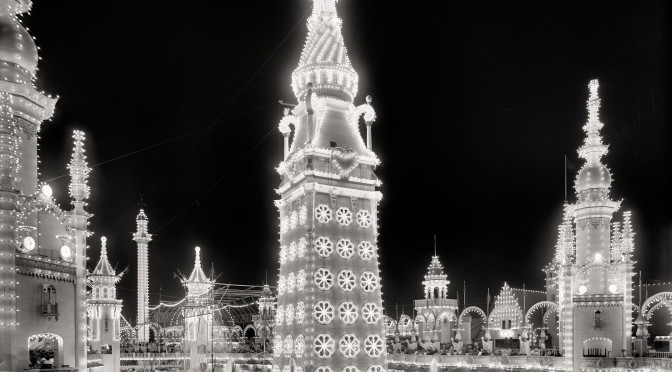
Top image: Luna Park at night, 1905 (polished up image courtesy Shorpy)
In 1888, the New York Herald ran this poem by the great Walt Whitman:
The First Dandelion
Simple and fresh and fair from winter’s close emerging, As if no artifice of fashion, business, politics, had ever been, Forth from its sunny nook of shelter’d grass— innocent, golden, calm as the dawn, The spring’s first dandelion shows its trustful face
Whitman was a living legend by this point. The infirm 78-year old writer lived in Camden, New Jersey, and rarely left his home. His most notable appearance in New York the previous year had been as a lecturer at the Madison Square Theater, discussing the legacy of Abraham Lincoln to an audience which included Mark Twain and Augustus Saint-Gaudens.
A poem by Whitman would have been reason alone to buy an edition of the New York Herald. And indeed, as the Herald’s ‘poet laureate’, several of his most notable works had debuted there. “Mannahatta,” for instance, debuted in the Herald on February 27 that year.
At right: Walt Whitman in 1887, taken in New York by George C. Cox
Unfortunately, “The First Dandelion,” a little ode to the coming spring, ran on March 12, 1888, the worst day of theBlizzard of 1888, a day when several feet of show and deathly winds were making the American northeast a very unpleasant place to be. The poem “made its appearance at a most unfortunate time,” said the journal Illustrated American in 1892.
Nobody wanted to read about a gentle dandelion that day. And in proceeding issues of the Herald, the poem was roundly mocked with parody verse. Two days later, ran a verse below, signed simply “After Walt Whitman.”
The First Blizzard
Simple and fresh and fierce, from Winter’s close emerging, As if no artifice of summer, business, politics had ever been, Forth from its snowy nook of shivering glaciers– innocent, silver, pale as the dawn, The Spring’s first blizzard shows its wryful face.
Not quite finished, the Herald ran another mocking poem the following day:
Served Him Right
The poet began an ode to Spring– “Hail, lusty March! Thy airs inspire My muse of flowers and love to sing–“ And then the blizzard struck the lyre
Neither the Herald nor its readership held it against Whitman personally. Four days later, the paper published “The Wallabout Martyrs,” his tribute to those held capture aboard prison ships during the Revolutionary War.
And the reputation of “The First Dandelion” was saved when it appeared in the ‘deathbed’ edition of Whitman’s Leaves of Grass, where its beauty was better appreciated.