Purging ‘Evil’: New York vs. the Concert Saloon!

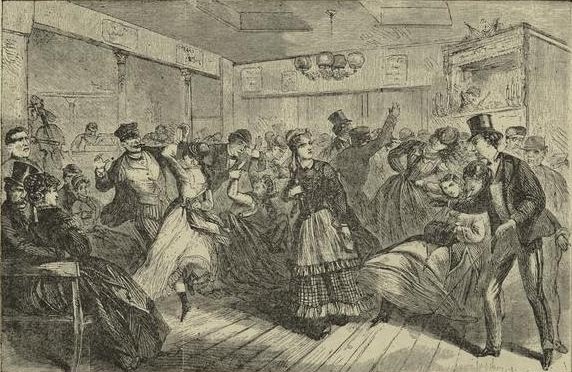
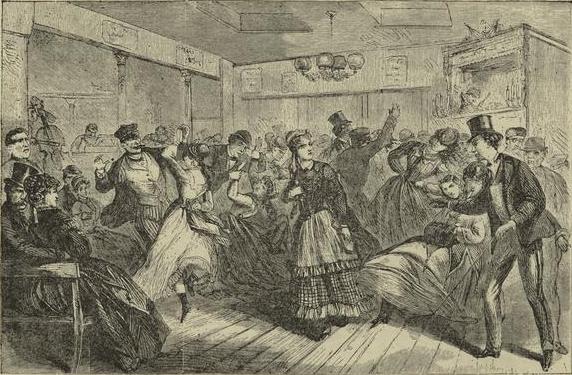
A torrid night at Harry Hill’s concert saloon on Houston Street. Naturally, such fun must be stopped! (Pic courtesy NYPL)

Yes, yes, the Civil War began 150 years ago this year. I hope you have not grown tired of hearing that fact, as I’ve got an entire summer of posts and podcasts relating to it! But for purveyors of New York nightlife, something else occured during that same time period — the peak of the concert saloon. While this particular performance venue does not have a specific date of birth, by 1861, this new form of nightlife rose to such prominence that, quite naturally, cultured people sought to close them down.

The concert saloon combined many entertainment pastimes into a single experience, but its true objective was merely to sell booze. This type of venue developed over a series of years, combining the austerity of the English music hall with the ribald and often debauched leanings of the American musical theater. Think of the Bowery theaters, filled with rowdy audiences and prostitutes going about their business in the balconies, and combine it with the lust for alcohol found in basement grog houses and corner taverns.

As Brooks McNamara notes in his book on the New York concert saloon, the more fashionable concert saloons were found near Broadway, while the more notorious variety found homes near the Bowery. The two streets were often viewed as twins — one good, one evil — but on certain nights, it might have been difficult to tell the two apart.
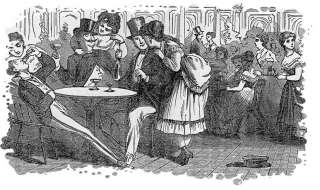
Vaudeville and cabaret trace their lineage to the concert saloon, with musical acts, ‘waiter girls’, and drink served in vibrant excess. The saloons reflected the character of their neighborhoods, although all would have a touch of debauchery about them. Or perhaps a few touches. They would eventually be associated with prostitution and general lascivious behavior. In the 1880s, perhaps the grandest descendant of the city’s concert-saloon tradition, the Haymarket dance hall, was so synonymous with the ancient profession that it was nicknamed ‘the prostitute’s market’.

The concert saloon was a thriving venue by the 1850s, so much so that reformers and prohibitionists made it the concentrated focus of their ire. On their side were owners of so-called legitimate theaters, who saw their clientele drift into these more lustier establishments.

It came to a head in 1861, with petitions circulated throughout the city to shut down the concert saloons, to eliminate “the abominations of Pretty-waiter-gallism and dram-selling, against which the decency and morality of the City have revolted.” Believe it or not, reformers made serious headway with the Republican-controlled state government. A bill was introduced in January of 1862 “to preserve the peace and order of public places” by forcing venues to seek a license if they intended to feature spoken or sung performances of any kind.

Why were reformers so mobilized in 1861? New York was a station for Union militias, both New York’s own volunteer militias and those from New England states. By the spring, hundreds of young troops were stationed here, awaiting orders and transportation to battlelines. What would be more distracting to a group of young men from out of town than a lively concert saloon filled with pretty girls?

The bill was passed in April of 1862, and the New York Times proclaimed “its effect will be to purge our places of public amusement of most of their evils, and to make respectable and popular those that are properly conducted.”

Many concert saloons did go under. Others turned into traditional saloons without the dazzle. Some venues went the opposite route, throwing out the booze and becoming legitimate variety stages albeit, with the same bawdy entertainments. By the 1870s, these stages produced the first American stars of burlesque and vaudeville.

However, many concert saloon simply shrugged off the law. City lawmakers were often at odds with the state anyway, and constituents for in Democratic-leaning wards preferred to look the other way. Some saloon owners took advantage of the law’s ambiguous language, providing music without vocals and encouraging ‘spontaeous’ song. (“Sorry, officer, they just broke out in a chorus!”) And of course, many others, perhaps protected by Tammany Hall or other political ties, simply flaunted their antics in open violation.

The concert saloon would continue to exist into the next decade, and now it had the element of elicitness attached to its very existence. The battle between New York’s two instincts was far from over.

For many other articles on New York City nightlife, check out my part articles titled Friday Night Fever, which survey the city’s great drinking and dancing venues throughout its history.
Bridge Whist Club: The worst booze your taxes can buy!


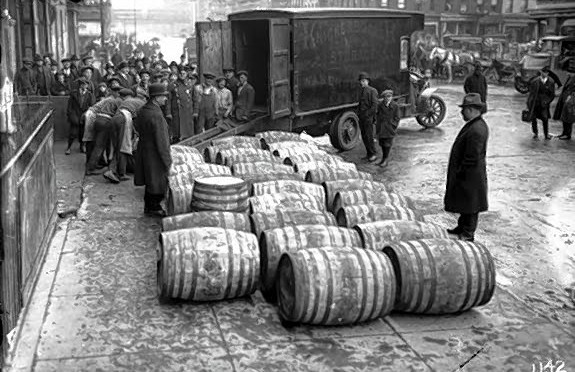
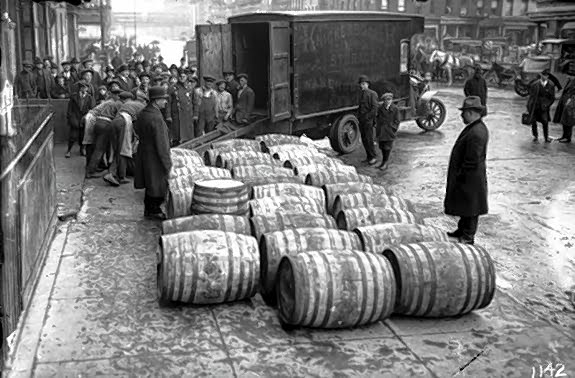
Just a barrel of laughs: Prohibition agents dump illegal containers of wine into the streets.

FRIDAY NIGHT FEVER To get you in the mood for the weekend, on occasional Fridays we’ll be featuring an historic New York nightlife haunt, from the dance halls of the old Bowery, to the massive warehouse clubs of the mid-1990s. Past entries can be found here.

LOCATION: The Bridge Whist Club
44th Street between Madison and Fifth avenues, Manhattan
In operation: 1925-1926

Prohibition in the United States didn’t extinguish the taste for liquor. The Eighteenth Amendment, ratified in 1919, outlawing the sale and transportation of alcohol, merely inspired those who sold it to become more creative.

In New York, prohibition even redefined midtown. Where once nightlife gathered around supper clubs and cabarets in major plazas like Times Square and Columbus Circle, speakeasies now slithered down the side streets and into previously unremarkable buildings. Some of the most famous of these illicit 1920s booze joints were housed in old tenements and small storefronts, down numbered streets off of Times Square and further downtown in Greenwich Village.

Outside the spotlight, a new regime of proprietors, building newfound nightlife empires with mob ties, quenched the thirsts of a populace thirsty for that which they weren’t legally allowed to partake. A great many vied for this business, with a reported “30,000 to 100,000 speakeasy clubs” formed by 1925.

That is an absurd number, reflecting the diversity in establishments — from the gentlemen’s clubs behind secret doors and the high-kicking lounges owned by Larry Fay and Texas Guinan to rundown tenements hastily fashioned with a bar and a few bottles. With no liquor sold there were no liquor licenses required. Everybody could get in the game.

How could the federal government even try and combat such widespread and diverse abuses of a virtually unenforceable law? One tactic manifested in 1925 when, in certainly one of the strangest undercover operation in the history of U.S. law enforcement, the feds got into the speakeasy business themselves. If you can’t beat ’em, drink up and join them.

In the fall of 1925, the United States Bureau of Prohibition sunk a few thousand dollars ($5,576.50, according to official documentation, almost $70,000 today)
to rent a building at 14 East 44th Street to construct its own speakeasy, called the Bridge Whist Club. The dive, called a “plush booze joint” by Herbert Asbury in his history of the Prohibition years, was named for a card game, and it is likely men gathered there to partake in this diversion.

But most were there for the liquor. The undercover agents, meanwhile, used the joint to gather “information concerning the activity of liquor smugglers.” Rubbing elbows with drinkers, agents could theoretically get names of other speakeasies and establish connections to leaders in New York’s underworld. Tables were even equipped with recording devices to pick up incriminating details.

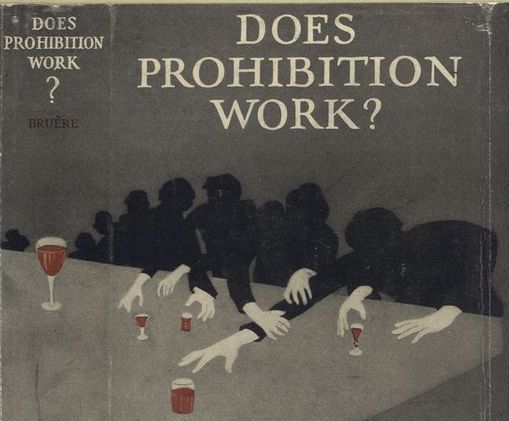
Below: From the jacket of a 1926 book by author Martha Bensley Bruere (courtesy NYPL)

In essence, they were feeding the small fish to draw out the larger ones. The Treasury Department, tasked with enforcing Prohibition by 1925, was well aware of the shifty nature of the enterprise. But an ethical distortion in the philosophy of the Bridge Whist actually put its patrons at risk.

As Wayne Wheeler, head of the Anti-Saloon League, put it, “The government is under no obligation to furnish people with alcohol that is drinkable when the Constitution prohibits it.” So the Bridge Whist served up a mixture containing wood alcohol, also known as Methanol, linked today with causing blindness.

This is not the first time that the U.S. government introduced dangerous substances into illegal drink. Realizing that many bootleggers stole industrial alcohol to make their product, enforcers directed that the industrial stuff be polluted with Methanol, hoping the foul taste and physical illnesses would deter consumption. (Slate Magazine ran an eye-opening article about this last year.)

Some of this toxic mix was sold at the Bridge Whist; other batches infiltrated through speakeasies throughout New York. According to author Deborah Blum, “In 1926, in New York City, 1,200 were sickened by poisonous alcohol; 400 died. The following year, deaths climbed to 700.”

Still, the Bureau claimed such tainted booze was “the most effective denaturant which the government could use, since it was the most difficult denaturant to remove” by bootleggers with their own chemists, tasked with cleaning up the toxic stew.

Having the government in the speakeasy business did not settle well with many in Congress. Anti-Prohibition members equated it to entrapment. Indeed, many arrested due to information gleaned from the Bridge Whist were later set free. Only one “mid-level bootlegger” was ever caught from information gleaned from the speakeasy operation.

New York congressmen Fiorello LaGuardia, ardently against Prohibition, petitioned against the use of ‘under-cover funds’ and extreme measures of enforcement. Ultimately, the Bridge Whist could not weather the scrutiny, and thanks to the efforts of the future mayor of New York, the experiment was officially shut down in May 1926.

Blue Bell Tavern: War and romance in Washington Heights


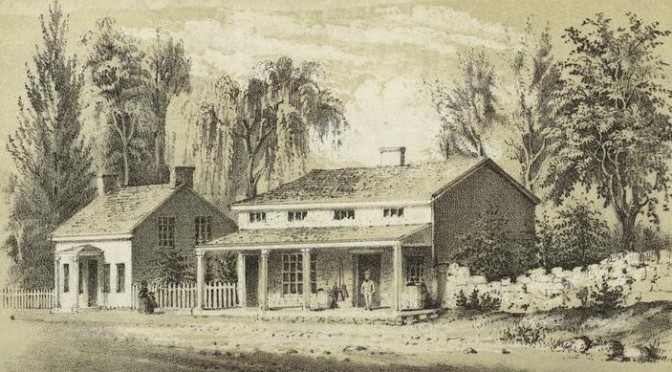
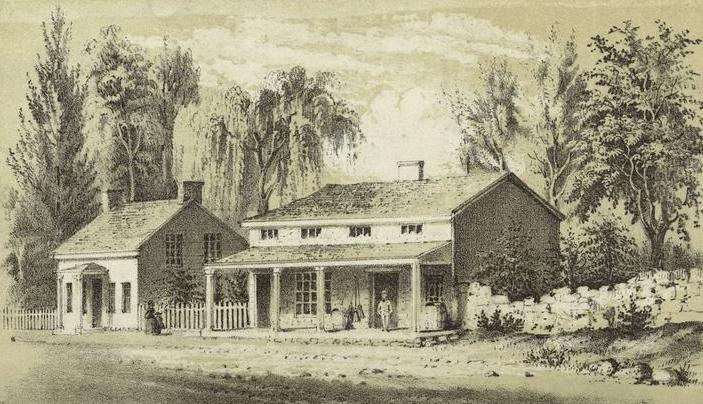
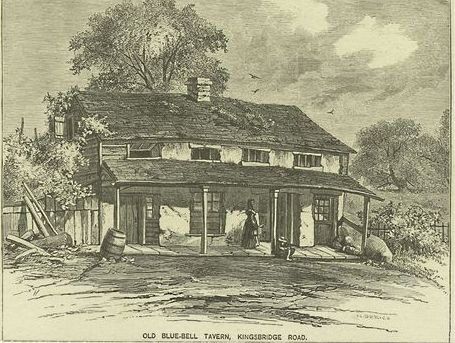
The Blue Bell Tavern, a rustic pit stop along Bloomingdale Road, witness to the changing fortunes of war. (Courtesy NYPL)

FRIDAY NIGHT FEVER To get you in the mood for the weekend, on occasional Fridays we’ll be featuring an old New York nightlife haunt, from the dance halls of 19th Century Bowery, to the massive warehouse clubs of the mid-1990s. Past entries can be found here.

LOCATION: Blue Bell Tavern
181th Street and Broadway, Manhattan
In operation Early 1720s-1915(?)

An old stone tavern once stood high upon the bluffs of Upper Manhattan, in an area many years later referred to as Washington Heights. The Blue Bell Tavern sat off Bloomingdale Road (where Broadway stretches today) nestled in a grove of trees, a modest two-story dwelling alit at all hours with wanderers.

One cold, stormy night some evening in November 1783, a damp and exhausted figure strode up to the door, a young woman who had escaped from her home many miles away. She was there to meet her lover who had already arrived at the Blue Bell, a man soaked, in disarray and wearing what certainly would have been a common sight for the day — a British uniform.

This man was a sergeant in the British military stationed in the Hudson River Valley. But the army was now retreating. Indeed, they were leaving New York that very month.

But he had fallen in love with this woman, who (as these sort of stories go) we know little about. We do know her parents disapproved of the British sergeant and would only relent to their marriage if he agreed to desert the army and remain in the United States.

On that rainy evening, the sergeant and his beleaguered love were married, here at the Blue Bell Tavern. As the story goes, it was a Quaker ceremony, for there were no other officiators that night at the tavern.

The Blue Bell, situated at today’s intersection of 181st Street and Broadway, was built in mid 1720s as a home and renovated into the type of pleasant inn that, by 1753, the venerable Cadwallader Colden (not the former mayor, but his grandfather and later governor of New York) could find “very comfortable” food and lodging with his friend James Delancey, the state’s lieutenant governor.

The tavern might have faded peacefully into oblivion if not for the Revolutionary War. When angry New Yorkers attacked the King George statue in Bowling Green at the foot of the island, his stone head ended up on a pole in front of the Blue Bell.

While the Continental Army fled from Manhattan during the month of September 1776, officers stationed here at the Blue Bell assessed their grim situation and coordinated the army’s next steps. With the tavern located so close to a key pathway out of town, it also became a headquarters and lodging for British officers after Washington’s army left. At one point, even Colonel William Howe, head of the British forces, himself stayed here.

It was during early battles in New Jersey that one British officer, one Colonel Ralle, found true love at the Blue Bell in the form of the innkeeper’s sister, and he married her there within the day. It would not be the last torrid romance to blossom here.

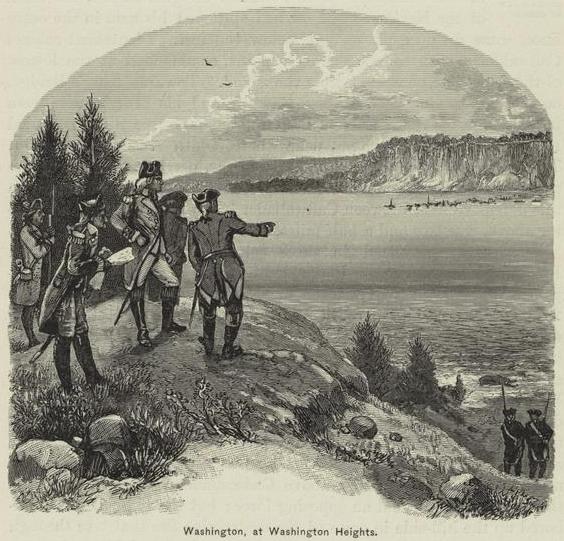
In November of 1783, George Washington and his victorious army re-entered New York, this time to push the British out of town and experience a new, free American nation from the vantage of the ravaged port city. “I remember well our march up the hill, and the noble appearance of George Washington as he sat on his big bay horse,” said a ‘veteran’ of the war in Appleton’s Journal.

George would even stay for an evening at the Blue Bell, awakening early to prepare his army’s grand entry down Bloomingdale Road and into the city. (Another important tavern of the day, the Bull’s Head, would also play a prominent role in Washington’s arrival into the city.) But on that day, they would add two more people to their procession.

The colonel and his new bride — the ones whose rendezvous at the Blue Bell led to their Quaker marriage — emerged from behind the building and called out Washington’s name. Given his rumpled British uniform, I imagine this created quite an uproar. The pair were taken into custody, and the British officer recounted his romantic tale. He wished to desert the army and join the Americans if only they would provide protection for him and his young bride. Indeed, with so many Loyalists still in the city, the soldier’s betrayal would certainly have been met with retaliation.

The tale apparently amused the troops, flush with the excitement of victory. Somebody even wrote a poem in the couple’s honor. You can read the whole thing here, though it begins: “A soldier and a maiden fair, Helped by shy little Cupid, Fled from the camp and momma’s chair, (Such guardians, how stupid!), And to the Blue Bell did repair, To have themselves a-looped.” We can assume with the lighthearted tone of the poem that things turned out well for the happy couple.

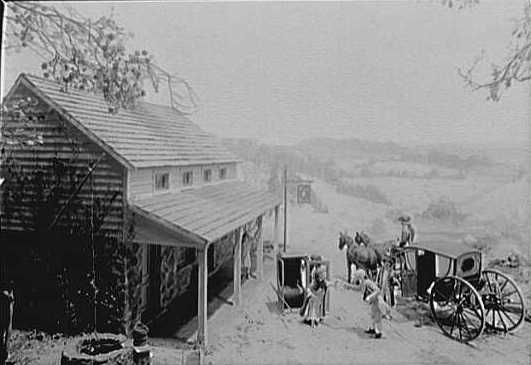
Below: A miniature of the Blue Bell, displayed at the Museum of the City of New York when it opened the doors to its new Fifth Avenue home in 1930. (Courtesy LOC)

The old tavern passed through many owners (and many names) through the 19th century and eventually returned to its original purpose as a residence. One old source suggests that the building burned to the ground in 1876, though it may have survived this blaze into the new century. Whatever structure stood here then was torn down by 1915. But tales of the Blue Bell entered nostalgic accounts of the Revolutionary War almost immediately, as 19th century historians struggled to piece together the American narrative from those who still remembered it.

The Blue Bell lived on long after its demolition in a most curious way — as a well-known miniature housed at the Museum of the City of New York. An issue of Popular Science Magazine from 1930 observes the construction and installation of the Blue Bell exhibit, which made its debut that year in the museum’s new home on Fifth Avenue and 103rd Street.

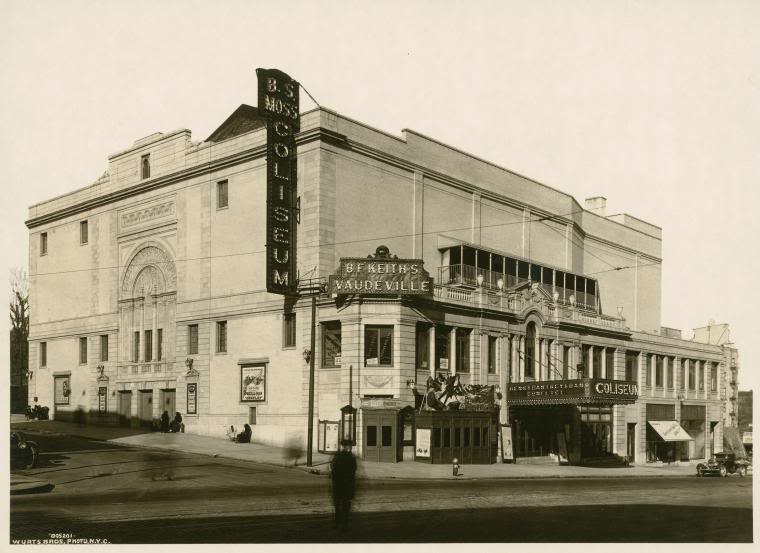
On some days, you can go to the former spot of the Blue Bell Tavern and experience a Gothic romance of your own. Standing there today is the RKO Coliseum, once one of Manhattan’s largest movie theaters, still operating as Coliseum Cinemas. (Here’s a street view of that corner.)

Below: The Coliseum in Washington Heights, date unknown (but there’s a vaudeville bill on one of the marquees!)

Burton’s faux nude follies: NYC’s first ‘legit’ flesh shows

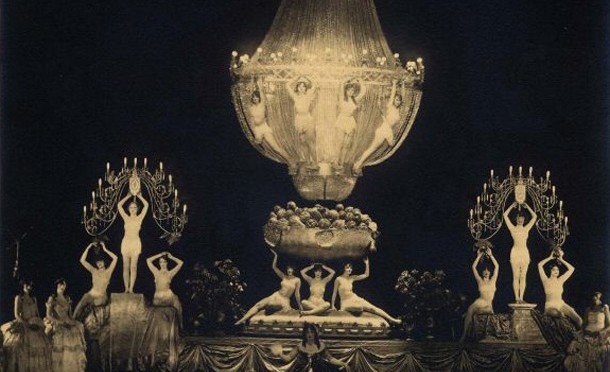
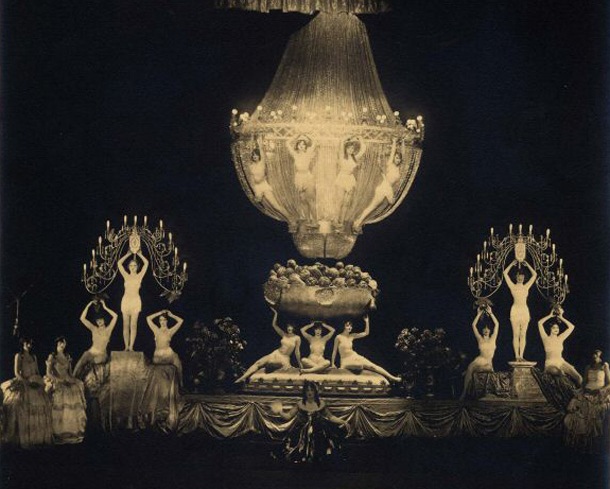
An exotic tableau from the Ziegfeld Follies. The presentations by Burton in the mid-19th century would have been less ornate, but certainly more tantalizing. (photo source)

FRIDAY NIGHT FEVER To get you in the mood for the weekend, on occasional Fridays we’ll be featuring an old New York nightlife haunt, from the dance halls of 19th Century Bowery, to the massive warehouse clubs of the mid-1990s. Past entries can be found here.

LOCATION: Palmo’s Opera House/Burton’s Chamber Street Theater
39-41 Chambers Street, Manhattan
In operation 1844-1870s

The sexual appetites of New Yorkers in the pre-Victorian era would sometimes manifest themselves in peculiar ways. Let me take you back to the 1840s, when raunch and salacious behavior infiltrated the Bowery theater scene, and even respectable downtown playhouses like the Park Theater cordoned off the third tier for encounters with prostitutes. A statesman of the time, Francis Grund, complained: “[F]ew ladies….are ever seen at the theater; and the frequenting of them, even by gentlemen, is not considered a recommendation to their character.”

Public sexual practice become distorted under conflicting cultural movements that smashed together like tectonic plates. On the one hand, New York’s growing international prominence combined with new American religious fervor to create a chaste facade of propriety, a population that seemingly had no sexual life. On the other, growing immigration filled the streets with single men and women, restless and crammed together. The ‘sporting man’ culture — erudite, rich men of well-tweezed masculinity — created New York bachelorhood; a couple social classes below, the Bowery b’hoy, did the same, and had more fun doing it.

It’s under these conditions that a strange new craze erupted — the artist-model tableau, New York’s first unofficial flesh show. I call it the Era of the Nude Body Stocking.

Before the days of burlesque and striptease, New Yorkers could enjoy all the nude flesh they desired. It just pretended to be art. And often, it pretended to be nude.

In the early 1830s, legitimate stages began presenting tableaux of the human form, ‘living statues’ as they were called, stationary figures in nude or white body stockings, in classical poses. Assumably there would be some musical accompaniment or a reading of poetry, with tasteful lighting illuminating the heavenly contours of the human form. Very tasteful, right?

Down-market stages ran with the idea, eventually contorting it for a more tittilated crowd. Early instances of the ‘artist model’ presentations had men dressed as women. Quickly, women joined them on stage. And then, sometimes, the body stockings came off entirely.


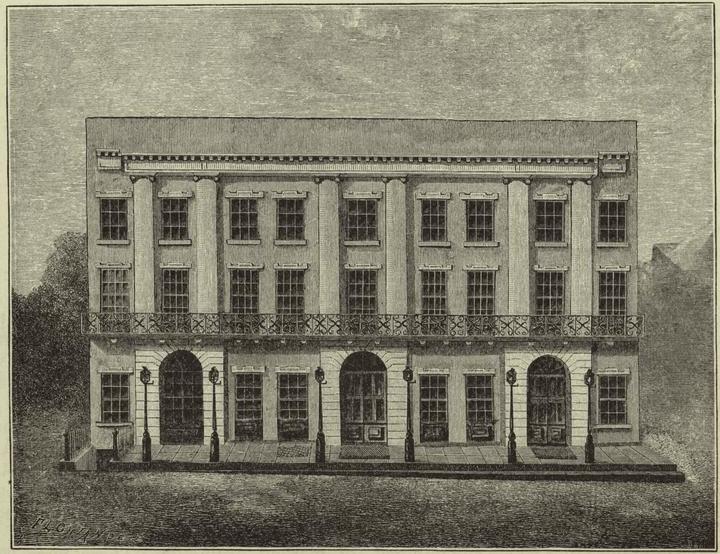
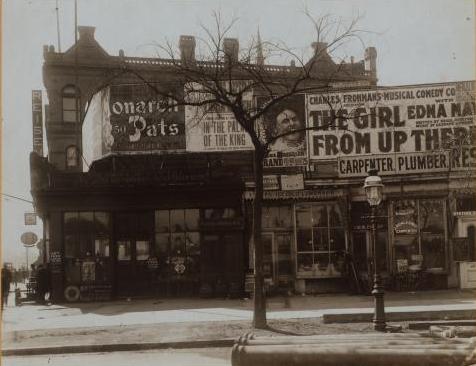
One of the most famous stages for this skimpy sort of tableau vivant began with less prurient intentions. Palmo’s Opera House (pictured above, 39-41 Chambers Street), opened in 1844 by an Italian immigrant Ferdinand Palmo. Italian opera had debuted in New York in 1825 at the Park Theatre, and instantly meshed with the upper class notions of acting more European. But working class New Yorkers didn’t quite warm to it; according to Mark Caldwell, “[o]pera was the ambrosia to a self-professed elite but chloroform to the masses.”

Palmo, owner of the Cafe des Mille Collones right around the corner, threw his money into the new opera house in an effort to bridge the gap. His first production was Bellini’s ‘I Puritani’, launched in February 3, 1844. The masses stayed away, in droves. Palmo kept the opera house open for two years, fending off mounting debts. At one point, performers went on strike — in the middle of a performance — because they had not yet been paid.

The restaurateur lost all his money in the endeavor and promptly lost his opera house as well. The stage then passed through various hands, some taking a crack at legit amusements, with ballet and even Greek tragedy.

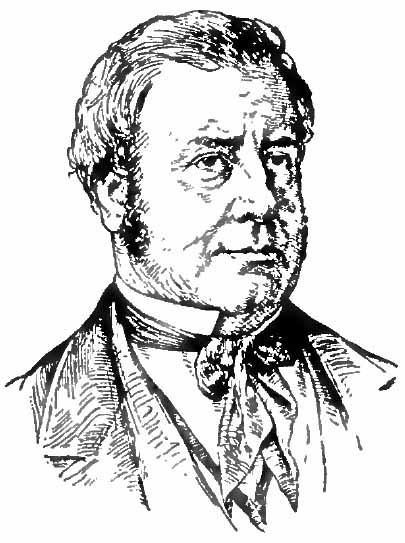
A showman William Burton (at right) took over the lease in 1848 and threw out those high-falutin acts. Burton was concerned with mainstream entertainment, not art per se. And it was during Burton’s variety programs — which notably featured the best minstrel acts in Manhattan — that this unusual, shall we say, indiscreet tableaux made its debut, a presentation of lilywhite, illuminated flesh decorating an evening of song and dance.

In most cases, it was presented as a straight-up art lesson, with such mythology themed dioramas as ‘Psyche Going To The Bath’ and ‘Venus Rising From the Sea’. But, as I said, Burton didn’t care to sell art. He sold a view to nude bodies — or bodies that at least appeared nude — and soldout crowds raced to have a look.

But what if you wanted to see all this solitary nudity but the damned horse carriage had made you late? No worries, for at the newly named Burton’s Chamber Street Theater, you were provided with a New York first — numbered reserved seats.

Burton’s stage wasn’t the only place displaying ‘artist models’; it soon became so common on New York stages that it soon became incorporated into productions, such as the extravagant ‘The Black Crook’ at Niblo’s Garden in 1866, considered the first Broadway musical.

Obviously, the degree to which onstage nudity appeared scandalized proper New Yorkers. In fact, in 1848, police raided several establishments, including Barton’s. According to a contemporary account by Foster Rhea Dulles, a “beautifully formed creature, just drawing on her tights for the Greek Slave, and some of the others, were so dreadfully alarmed at the sight of the police with their clubs in hand that they seized up a portion of their garments in order to hide their faces, forgetting their lower extremities, thus making a scene mixed up with the sublime and the ridiculous.”

While prudish tastes frowned upon such displays, they never quite went away. Even as late as the 1920s, Florenz Ziegfeld frequently paid homage to the craze during his famous Follies.

As for the old opera house, it would continue featuring minstrel shows and comedy pieces well into the 1860s. For a short time it even served as federal courthouse before its demolition in 1876.

And here’s the final kicker — Palmo’s Opera House and its later incarnation as Burton’s Chamber Street Theatre was sat on top of — you guessed it — the African Burial Ground!

Lovelace’s Tavern: Early New York history, under foot

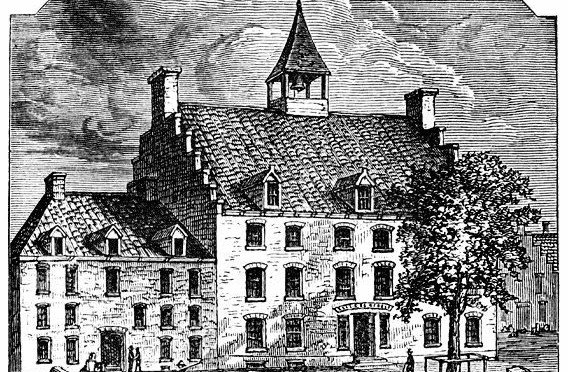
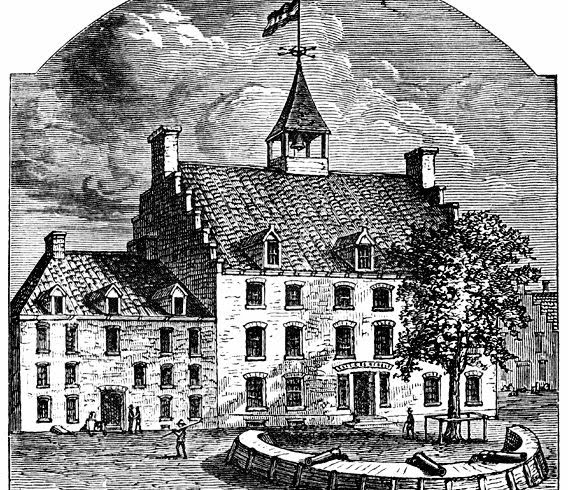
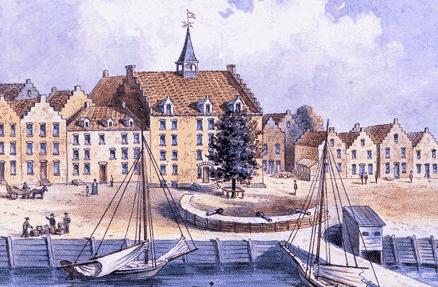
Lovelace’s Tavern is assumably the building to the left, with the Stadt Huys the main structure at center. You can find the foundations of this building still hanging out on Stone Street.

FRIDAY NIGHT FEVER To get you in the mood for the weekend, on occasional Fridays we’ll be featuring an old New York nightlife haunt, from the dance halls of 19th Century Bowery, to the massive warehouse clubs of the mid-1990s. Past entries can be found here.

LOCATION: Lovelace’s Tavern
Stone Street, Manhattan
In operation 1670-1706

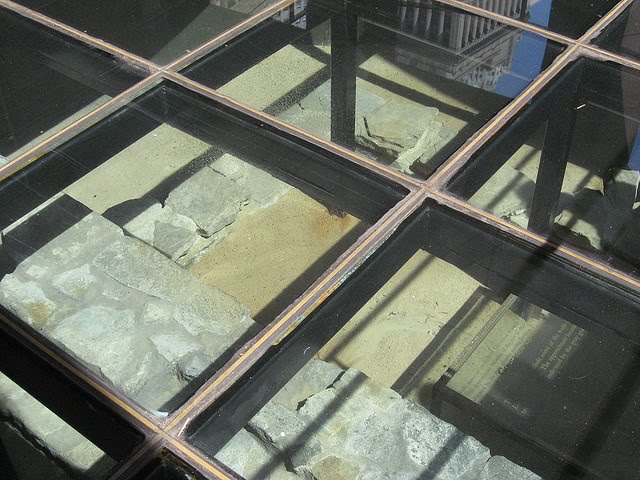
If you’re a wanderer like I am, you’ve walked by Lovelace’s Tavern many times. People regularly walk on it; investment bankers take smoking breaks nearby it. It’s about 100 feet from the more famous Fraunces Tavern and just a block from the Alexander Hamilton Custom House. It’s history under glass, underfoot, remains trapped in a dusty cavity, the intervening eras heaped above it.

When Lovelace’s opened its doors in 1670, the Custom House was a fort and Fraunces was the home to the first mayor of new York, Stephanus van Cortlandt. The city extended a few blocks north, then abruptly stopped at a earthen wall fortified with timber planks 15 feet in height. The tallest building in New York in 1670 was next door to Lovelace’s — all of five or six floors.

All that remains of the tavern of Governor Lovelace today are a few foundation walls set underfoot outside the former Goldman Sachs headquarters at 85 Broad Street. A rather unsightly office tower, 85 Broad Street was built during the glamour of the 1980s financial boom, a brown monolith of “inconspicuous plainness” that hovers above historic Stone Street. They’ve traced a path through the lobby so you can see where Stone Street used to linger before they planted this building here.

If wasn’t for Goldman Sachs, of course, nobody would have ever found Lovelace’s Tavern, whose foundations were unearthed in 1979 during construction. With a little imagination, you can rebuild it in your mind and refit it among the other historical recreations along Pearl and Stone streets.

The Stadt Huys was the center of New Amsterdam’s civic life — its municipal structure, its meeting hall, its sturdy town center. Built as a tavern in 1641, Peter Stuyvesant transformed it into the young settlement’s city hall, but kept it as a place to serve alcohol, all the while restricting many others in New Amsterdam from doing so.

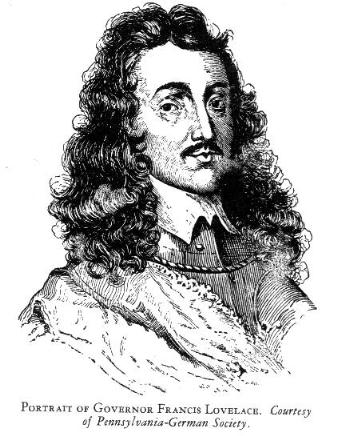
When the British took over in 1664, the building kept its place of importance. Underscoring is position was the building to the southwest that was erected in 1670, a tavern (“an inn, or ordinary“)owned by the governor of New York, Colonel Francis Lovelace (at right).

Francis was in good with the Duke of York during his territorial expansion of the New World and was installed in 1668 as the second governor of the recently acquired New York after the first (Richard Nicolls) was recalled.

Built right next door to the aging Stadt Huys, Lovelace’s tavern may have always been conceived as a second-tier administration building and seemed to offer the same services as the larger building. (It’s sometimes referred to as the King’s House.) In fact, the tavern connected right into municipal chambers, effectually an annex. Even so, the halls of the tavern would be illuminated until late at night with revelers, drinking wine and smoking their pipes.

This was the first of many changes made under Lovelace’s watch. He inaugurated the first postal service to Boston; its first route would become the basis for so many major thoroughfares today, most notably the Bowery. He also strengthened New York as a merchant hub, forcing farmers from surrounding areas to funnel their product through the city, and giving New York merchants a virtual monopoly of posts along the entire Hudson River.

At right: Another depiction of Stadt Huys and Lovelace’s Tavern from a few years later. The tavern also played host to most of the prominent leaders in town. Perhaps even ole Stuyvesant dragged his pegleg along its floors; he did, after all, live on a large farm north of the city and was alive during the tavern’s first two years of operation.

Lovelace, unfortunately, would be dead in a few years. During the short period when the Dutch regained control of New York — from August 1673 to December 1674 — Lovelace was recalled to England and squarely blamed for the loss. He was thrown in the Tower of London and died there in 1675.

But the tavern bearing his name lived on, even incorporating nearly all official New York business for a short time in 1697 when the first structure was deemed too decrepit to continue in. (An official city hall was finally built in 1700 where the city wall once stood.) The tavern burned down in 1706 and the land re-allotted for the growing merchant district.

Below: the remnants of Lovelace’s, in the shadow of 85 Broad Street

Photo courtesy J Gatz/Flickr

Categories
Uncategorized

Xenon and the strange journey of a Broadway theater: Noel Coward, Fellini, porn, disco, ‘Cabaret’, Dame Edna

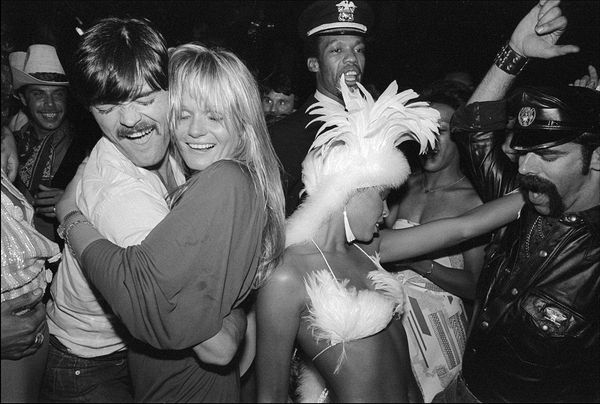
You know it’s a good night at Xenon when you’re drunk on the dance floor, and all of a sudden, the actress Valerie Perrine and the Village People appear (source)

FRIDAY NIGHT FEVER To get you in the mood for the weekend, on occasional Fridays we’ll be featuring an old New York nightlife haunt, from the dance halls of 19th Century Bowery, to the massive warehouse clubs of the mid-1990s. Past entries can be found here.

 LOCATION: XenonTimes Square, 43th Street and Broadway, Manhattan
In operation 1978-84

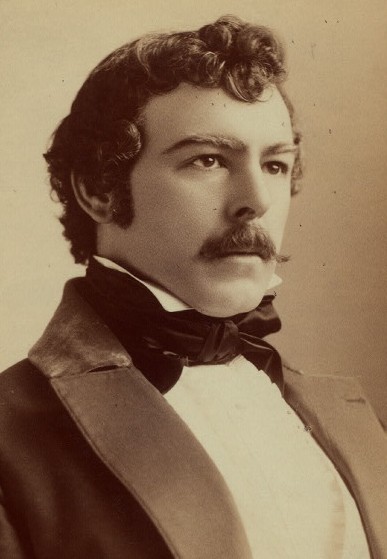
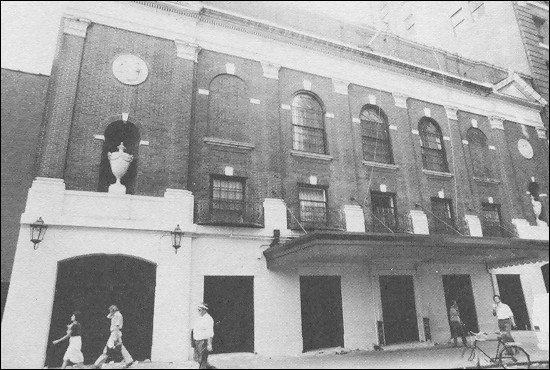
THIS, AT LEFT, IS HENRY MILLER. Clearly this is not the Henry Miller you more popularly know.

This Henry Miller would have never produced Tropic of Cancer. But his major contribution to the American stage would bring New Yorkers an iconic work of French cinema, a world famous theatrical revival, and one of the most successful Studio 54 knockoffs ever.

Miller was a minor theatrical star in the age of Sarah Bernhardt, who began dabbling as a director and stage manager at the same time that theater on 42nd Street began to flourish in New York. He became an early, respectable presence; from an early biography: “It was a foregone conclusion that a Henry Miller production must be in the best tradition of the theater.”

His timing was exquisite as well. The Broadway district in the 1910s was in full swing, with excitement at all hours. His patron (and progressive, feminist icon) Elizabeth Milbank Anderson assisted him in opening a stage in 1918 at 124 W. 43rd Street, a prime location near the theaters of Oscar Hammerstein, Klaw & Erlanger and Florenz Ziegfeld. The old New York Times building was half a block away, the nexus for New Years Eve celebrations for over a decade. Across the street rose the Hotel Metropole with its bustling late night antics; a few years earlier, in 1912, you could have stood in Miller’s lot and watched the bloody mob hit of gambler Herman Rosenthal — possibly ordered by New York cop Charlie Becker. (You can hear more about that in our Case Files of the NYPD podcast.)

There were no hits at Henry Miller’s theater, however, not the lucrative kind at least. In fact, the first show, The Fountain of Youth, was an unmitigated flop, opening in April 1918 and closing in May. (“This fountain of youth plays a very slender stream, and even that is of intermittent vigor,” claimed one review.) Famous names played here — George Gershwin, Billie Burke, Helen Hayes — but it wouldn’t be until Noel Coward debuted his scandalous, sex and cocaine-fueled comedy The Vortex in September 1925 that Miller’s theater would see its first in a string of major successes. Miller himself, however, would not enjoy these successes; he died a few months after Coward’s debut, in early 1926.

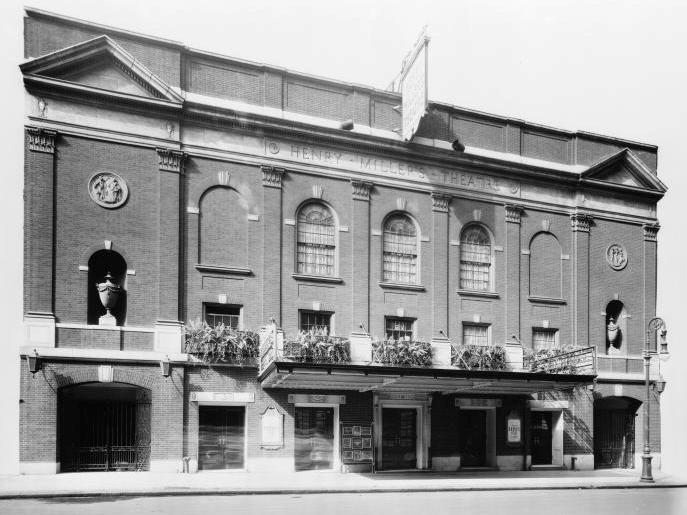
Below: Henry Miller’s theater, during its glory days. Photo courtesy NYPL

But Henry’s son Gilbert Miller had a knack for theatrical production even greater than his father. For three decades, he ushered countless box office hits through the Henry Miller’s Theatre, including the Tony winning T.S. Eliot play The Cocktail Party starring Alec Guinness. Most notably, Our Town would make its Broadway debut here in February 1938, and in 1957, a young British actress named Angela Lansbury would make her American stage debut here in Hotel Paradiso. Gilbert would win an honorary Tony in the mid-1960s for his contributions to the New York stage.

By then, however, the theater began flirting with a transition that many midtown stages had already made — into a legitimate movie house. Its first foray was also its most memorable, Federico Fellini‘s La Dolce Vita, premiering here in April 1961. The strangeness and theatricality of Fellini’s masterpiece fit the Henry Miller playhouse perfectly, even if the stage itself was technically ill-fitted for movies. The grumpy critic Bosley Crowther was even impressed: “Fellini’s “La Dolce Vita” (“The Sweet Life”), which has been a tremendous hit abroad since its initial presentation in Rome early last year, finally got to its American premire at Henry Miller’s Theatre last night and proved to deserve all the hurrahs and the impressive honors it has received.”

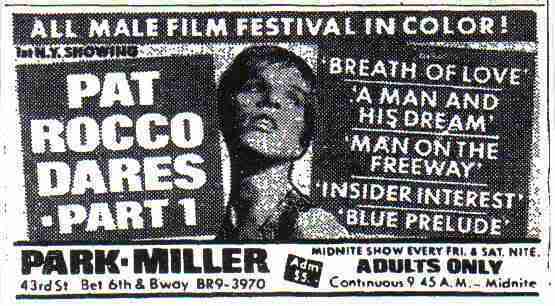
This might have been a harbinger for a fabulous future as an art house, however the theater was instead sold, renamed the Park-Miller, and entered the 1970s as one of Times Square’s most popular porno theaters, specializing in all-male features for gay audiences.

Although Henry Miller was certainly turning in his grave, the theater actually become quite successful, more so than most of Miller’s own productions during his lifetime.

According to author Hilary Radner, “the Park-Miller Theater on 43rd Street grossed in excess of thirty thousand dollars per week in the early 1970s….For a five dollar admission fee, audience members watched a mixed program that included shorts, slides, and a dubbed minifeature, such as Truckers — Men of the Road.” A long way from The Fountain of Youth, indeed!

Below: an advertising glimpse into the theater’s more prurient days

Everything changed in the spring of 1977 with the transformation of an old opera house into the superstar disco spectacular Studio 54, epitomizing the notion of nightlife as a headline-grabbing celebrity wonderland. One night at 54, music manager Howard Stein met Swiss restaurateur Peppo Vanini (the ex of actress Victoria Tennant), and the two cooked up a scheme to match the club’s glamour in another midtown location.

Stein purchased the old porn theater and remade it into the discotheque Xenon, although Xerox might have been a better name, for it adhered closely to the Studio 54 formula of flashy nights, big celebrities and kitschy showmanship (cannons with colored feathers, a neon X above the dance floor).

Being just slightly lesser a club than 54, you actually did stand a chance of getting in if you happened not to be a bold-faced somebody. But Stein would occasionally stand at the door himself “weeding out the detested middle class from the very rich and the colorful poor,” according to a New York Magazine profile.

Below: the club, during the day, in the 1970s:

Still, Xenon had its day, and on a typical hot summer night in 1979 or 1980 you might stumble into private parties hosted by Michael Jackson, Woody Allen, Lauren Bacall, Ben Vereen, or Pele. Inside you might hear deejay Jellybean Benitez.

Although people often stripped down to bikinis on the dance floor, you had fewer naked Grace Jones moments; Xenon “combined the craziness of Studio 54 with the comfort of Regine’s” according to one source, Regine’s being the more elegant nightclub entree owned by French chanteuse Régine Zylberberg.

With the end of disco came the end of Xenon, in 1984, and a brief attempt at turning the space into a rock ‘n’ roll venue called SHOUT! It lay mostly dormant, hosting temporary parties, until the early 1990s, when in a flash of inspiration, the Roundabout Theatre renovated the worn, abused little stage, combining all eras of its history to transform it into the Kit Kat Club, a cabaret venue fit to re-stage, naturally, Cabaret. That version, starring Alan Cumming and the late, wonderful Natasha Richardson, would go on to win the Tony for Best Musical Revival in 1998. Incidentally, that same year, a devastating construction crane accident next door closed the block for weeks, and Cabaret would be forced to move uptown to the former Studio 54.

Suddenly, all its prior incarnations seemed to enjoin to create its most successful reinvention yet. After Cabaret left, the hot off-Broadway show Urinetown moved in; that bawdy musical took three Tonys in 2003.

And then, they demolished it.

Saving the landmarked front exterior — with Henry’s name emblazoned along the top — the rest of the building was scrapped in a massive construction project that eventually put the Conde Nast Building to its west side and the Bank of America building to its north, to which a new theater was attached, using that old exterior and renamed the Stephen Sondheim Theatre. In the fine tradition of Henry Miller himself, the stage has features two shows — a revival of Bye Bye Birdie, and the Dame Edna musical All About Me — both flops.

For some great recollections of the glory days of Xenon, check out the website Disco Music. Featuring one commenter who says: “There’ll never be a club like it again. Pinball machines would drop out of the neon heavens and land next to dancers gyrating to ‘Funky Town’ by Lipps. Not to mention the fake snow (clearly an homage to the abundant cocaine passing through nostrils by one and all) that dropped on you, sticking to your favorite nylon shirt.”

Welcome to The Pansy Club: leave your wig at the door

Above: Karyl Norman welcomes you to the Pansy Club!

FRIDAY NIGHT FEVER To get you in the mood for the weekend, on occasional Fridays we’ll be featuring an old New York nightlife haunt, from the dance halls of 19th Century Bowery, to the massive warehouse clubs of the mid-1990s. Past entries can be found here.

LOCATION: The Pansy ClubTimes Square, 48th Street and Broadway, Manhattan
In operation December 1930-31

The moral crusaders who succeeded in banning alcohol sales via the Eighteenth Amendment must have wondered where it all went wrong. Instead of ushering America down a path of productivity and moral fortitude, Prohibition sponsored a decade of unwritten rules, creating a shadow economy and empowering a criminal underworld.

Norms were upended, and the fringes of New York were defined by experimentation and playful risk. Harlem and Greenwich Village became the centers of culture, women found new avenues for empowerment, and black musicians mixed with white to create the sophistication of jazz.

It’s in the light of this churning mix of invention that you have to approach one curious fad of the Prohibition era — the pansy craze, an appreciation of drag-queen worship cultivated in the heart of Manhattan.

I’m not sure a place called The Pansy Club would be popularly received today, but when it opened in late 1930 it was risque and cool. Its location at 48th and Broadway planted it firmly in the theater district where it truly belonged, of course. But given the entertainments it generously offered, it’s amazing to me it was allowed to open at all.

It makes sense that the speakeasy-fueled, white crowds, having fully sampled from black nightclubs of the 1920s, would venture into other subcultures on the fringe of bohemia. There were plenty of places in Greenwich Village for gay and lesbians to meet, and within them came camped-up forms of cabaret, with men in drag emulating the glamorous female stars of the day. It helped that some of those stars, like Sophie Tucker and Mae West, mixed with and borrowed from their costumed admirers.

It all built into a national, urban ‘craze’ in 1930 and 1931 for drag shows in a mainstream cabaret environment.  Why it neatly fit on the nightclub circuit — and what made it somewhat more tolerable for conservative crowds — was partially due to drag’s close association with vaudeville.  Although the term ‘pansy’ was a derogatory one for gay men, for this brief time ‘pansy clubs’ were the hottest ticket in town.

The Pansy Club, at 204 W. 48th, in heart of Times Square (and about where the M&M Store is today) was not the only nightclub of this type, but when it opened the week before Christmas in December 1930, it was the showiest of the lot.

The Pansy Club featured standard-era vaudevillian and cabaret acts, but with a decided gay (read: scandalous) twist — female impersonators, “a bevy of beautiful girls in ‘something different’ entitled ‘Pansies On Parade'” according to a newspaper advertisement, one of the few documents that verify the club’s brief existence.

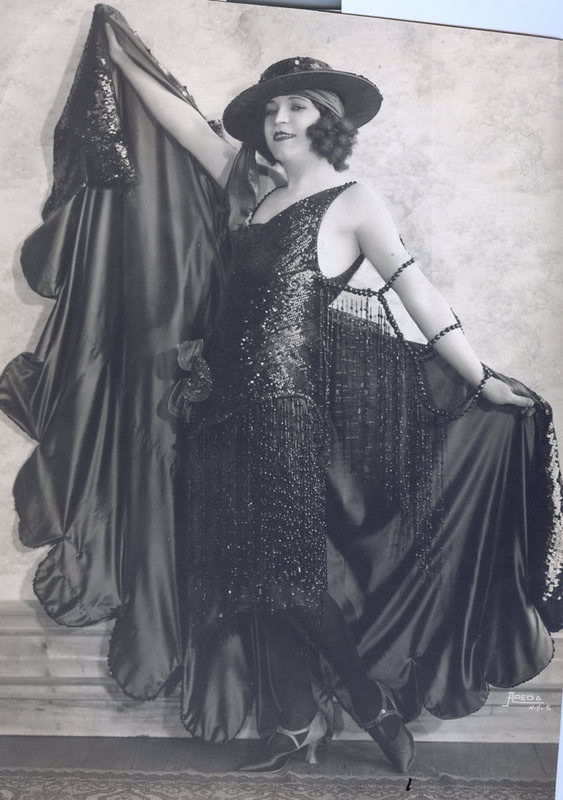
Mistress of ceremonies was one Karyl Norman, known in drag as the ‘Creole Fashion Plate’. Born George Peduzzi from Baltimore, Norman became a star on the vaudevillian circuits in the US, Europe and Australia in a show that featured him both in and out of drag. As a published songwriter and a favorite of Tin Pan Alley, Norman would have been a big draw in 1930 and as a seasoned vaudevillian star would have brought a touch of credibility to a club with so shocking a theme.

According to Brooks Peters, the club was also “a haven for aging flappers and party-goers who liked “slumming.””

Down the street was an even more popular draw. At Club Abbey (46th and 8th Ave) was a young Jean Malin (at left, courtesy Flickr), a Brooklyn-born wit and sometimes ‘female impersonator’ who hosted drag performances while charming audiences with interludes that made no disguise of his homosexuality.

What distinguished these places is that they were not considered gay and lesbian bars of the sort in the Village. However they did have a similar thread in common with them — ownership by the mob, an association that led to the club’s swift closings.

A gang shooting closed Club Abbey in January, and the police raided the Pansy Club that same month.  While the ‘pansy craze’ would live on in other cities — it made a more lasting impression in Hollywood, naturally — it retreated to the fringes again in New York.

And finally, for your Friday night celebration, here’s a look at Jean Malin, who made a brief appearance in Hollywood films before Malin’s untimely death in 1933. The film is ‘Arizona To Broadway’.

Categories
Friday Night Fever Podcasts

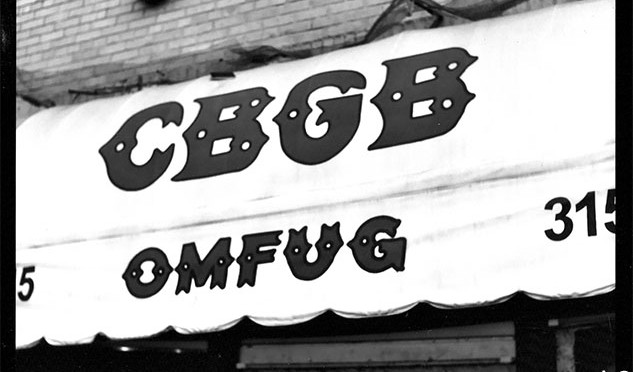
CBGB & OMFUG: Punk music history on the Bowery

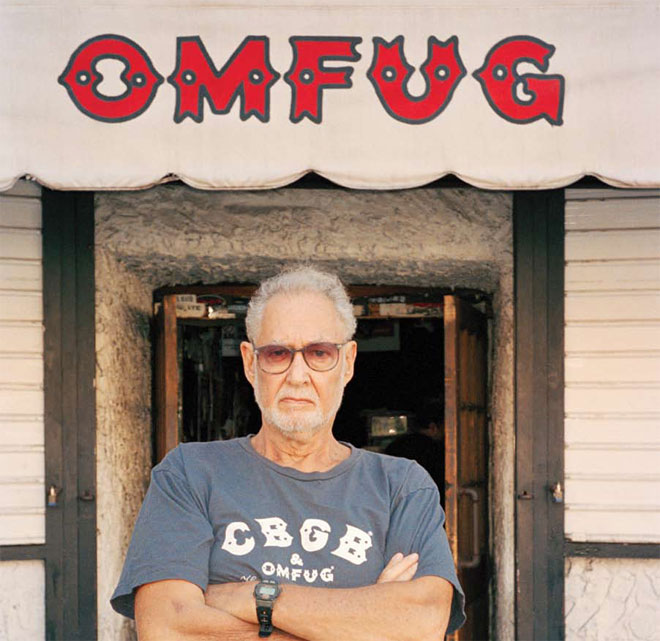
Photo courtesy araceli.g, Flickr

PODCAST Modern American rock music would have been a whole lot different without the rundown dive mecca CBGB’s, a beat-up former flophouse bar that made stars out of young musicians and helped shape the musical edge of downtown Manhattan. Owner Hilly Kristal may have initially envisioned a place for ‘Country Blue Grass and Blues’, but the music spawned by this little hole in the wall would define the contours of American punk and new wave.

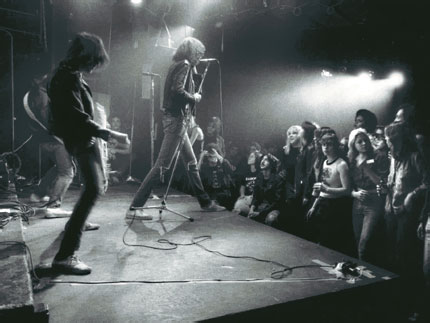
The Ramones, Blondie, the Talking Heads and hundreds of others bands would never have been the same without this dank little club with the most notorious bathroom stalls in New York. Tune in to hear a tale of the club’s rather inauspicious start and find out why, even as a venerated music icon, it was forced to close its doors.

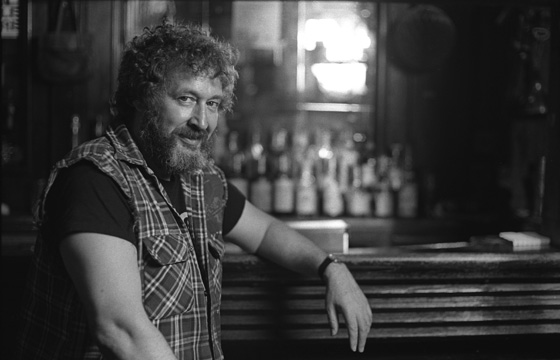
Hilly Kristal, back in the day. CBGB’s was originally Hilly’s On The Bowery, a spin-off of a far more successful West Village venue that frequently hosted performers like Bette Midler and Jerry Stiller. Hoping to draw a more music oriented crowd, Kristal changed the name to reflect broad tastes: Country Bluegrass Blues and Other Music For Uplifting Gormandizers.

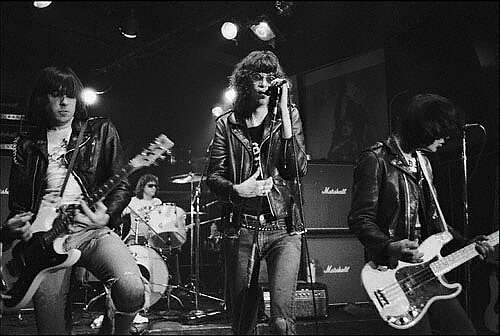
Initially unimpressive by any metric of musical quality, the scraggly group of guys from Forest Hills, Queens who formed The Ramones soon become a staple of the CBGB stage and the one of the most influential acts of the American punk style. If there’s a voice to 315 Bowery, most likely it’s that of Joey Ramone. (Photo by Allan Tannenbaum, from here)


(Photo from here)

Deborah Harry and Chris Stein debuted on the CBGB stage as members of the Stilettos used the club to make their transformation into Blondie, the most successful group borne of Hilly’s Bowery club. Chris and Debbie are seen below with Arturo Vega, 1978. (Photo by Lisa J Kristal, photo from here)

Hilly in later years. The club become a high-profile victim of Bowery gentrification and had to shut its doors in 2006. It lived on briefly as a St. Mark’s clothing shop, even as its old location become home to a John Varvatos menswear boutique. Photo by Peter Sutherland (here)

Check out the official CBGB blog for lots of great stuff associated with the club, including lots of old photos and that full color ‘walk-through of the club. You might want to take a shower after viewing it.

Categories
Friday Night Fever

Reisenweber’s Cafe: glamour, late nights and hot jazz


FRIDAY NIGHT FEVER To get you in the mood for the weekend, on occasional Fridays we’ll be featuring an old New York nightlife haunt, from the dance halls of 19th Century Bowery, to the massive warehouse clubs of the mid-1990s. Past entries can be found here.

LOCATION Reisenweber’s Cafe
Columbus Circle, 58th Street and 8th Avenue, Manhattan
ERA 1856 (as a tavern)-1922

On this day in history, February 26, 1917, the instrumental ensemble Original Dixieland Jass Band recorded the very first usable* jazz recordings in a Victor studio here in New York. I can’t confirm exactly where that studio was, but according to here, Victor’s studios in 1917 were at 46 West 38th Street.

The thick 78 record “Livery Stable Blues” and B-side “Dixie Jass Band One Step” was pressed and released one week later March 6.

And yes, that’s Jass. They changed it to Jazz a year later. (The term was still coming into its own back then.) And though they started in New Orleans in the Dixieland jazz scene, they made their name in Chicago and moved on to New York in 1916. Oh right, and they were a white ensemble who popularized for white audiences a genre created and performed mostly by black musicians.

They were possibly the first white musicians to make jazz fashionable to New York nightlife; as a result, we can thankfully hold them partially responsible for the coinage of the Jazz Age. For from the moment of that first recording, the youth of the late ’10s went wild for the naughty sound of jazz.

Before the release of this recording, the only way to hear the ensemble was live, and the place to hear them live in New York was Reisenweber’s Cafe, one of the most fashionable clubs of the 1910s.

The restaurant/nightclub hybrid — one of the first true ‘entertainment complexes’ –was owned by John Reisenweber, whose father had owned a small tavern at this very corner in 1856. Needless to say, John was far more ambitious plans.

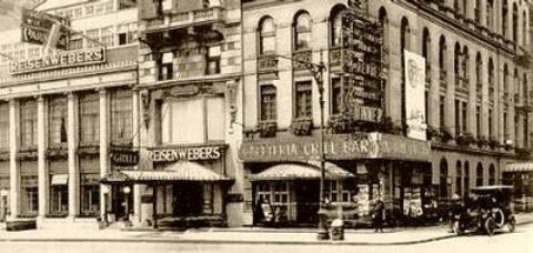
Below: Columbus Circle in the 1900’s. You can see the Reisenweber’s marquee to the left of the picture, on 58th Street.

Reisenweber’s was truly a product of the decade, expanding in 1910, closed by 1922. It held court in Columbus Circle at 58th Street and Eighth Avenue during a time when this corner of Central Park was a popular destination for theater goers, of both the high and low brow varieties. The most famous — and respectable — stage in the neighborhood was the Park Theatre (formerly the Majestic) featuring the hottest names in drama and musical comedy. So, naturally, Reisenweber’s became a magnet for theater stars and their champagne entourages.

Producers would fete their leading ladies here, in festivities that would begin in the downstairs restaurant, move to the second floor 400 Club cabaret, pause for a dance in the elegant third-floor Paradise Supper Club (featuring the first dancefloor within a restaurant), and settle in either the cheeky Hawaiian Room on the fourth floor or up at the rooftop garden.

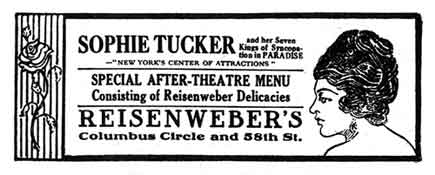
Below: From an advertisement dated March 1917 (thanks to Mule Walk & Talk blog, where there are many more examples)

The Dixieland ensemble hit Reisenweber’s 400 Club in January 1917 (thanks in part to a recommendation from Al Jolson) and were an immediate hit, combining furious, syncopated sound with a comedic touch, perfect for a smoky cafe full of trendy New Yorkers.

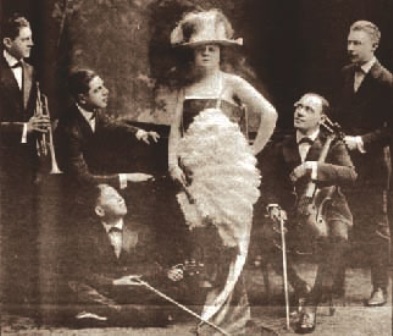
But they weren’t the biggest star at Reisenweber’s. The lady that drew them in 1918 was one of the era’s biggest celebrities and the first star of the Ziegfeld Follies — Sophie Tucker (pictured above).

Tucker was a sassy, vibrant, bawdy performer, hammering out hits loaded with double entendre, inviting starlet pals and even regular cafe patrons on stage to perform with her. Her escapades upstairs to sellout crowds in the 400 room, during her so-called ‘Bohemian Nights’, were so popular that Reisenweber shrugged and remained it The Sophie Tucker Room in 1919.

In fact, Tucker’s regular engagements helped popularize the cabaret form in New York. According the Musicals 101, “Delmonico’s, Reisenweber’s, Palaise Royale and Shanley’s all became legendary night spots. Within a few years, dance floors became a required part of the cabaret environment.”

Reisenweber’s fused together elements that now seem quite commonplace together — music, food, dancing, celebrity, performance — in a way that was both respectable and yet edgy and scandalous for its day. It also introduced a staple of New York nightlife: the cover charge (25 cents).

At its height, Reisenweber’s was one of Manhattan’s best known restaurants, “hous[ing] a dozen dining rooms, employed more than 1,000 in help and seated 5,000 diners at one time” according to the owner’s obituary.

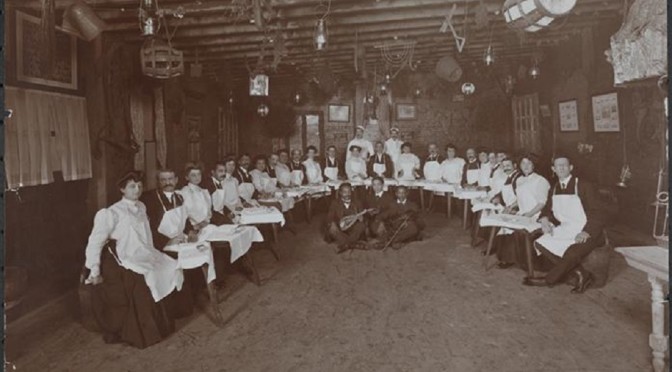
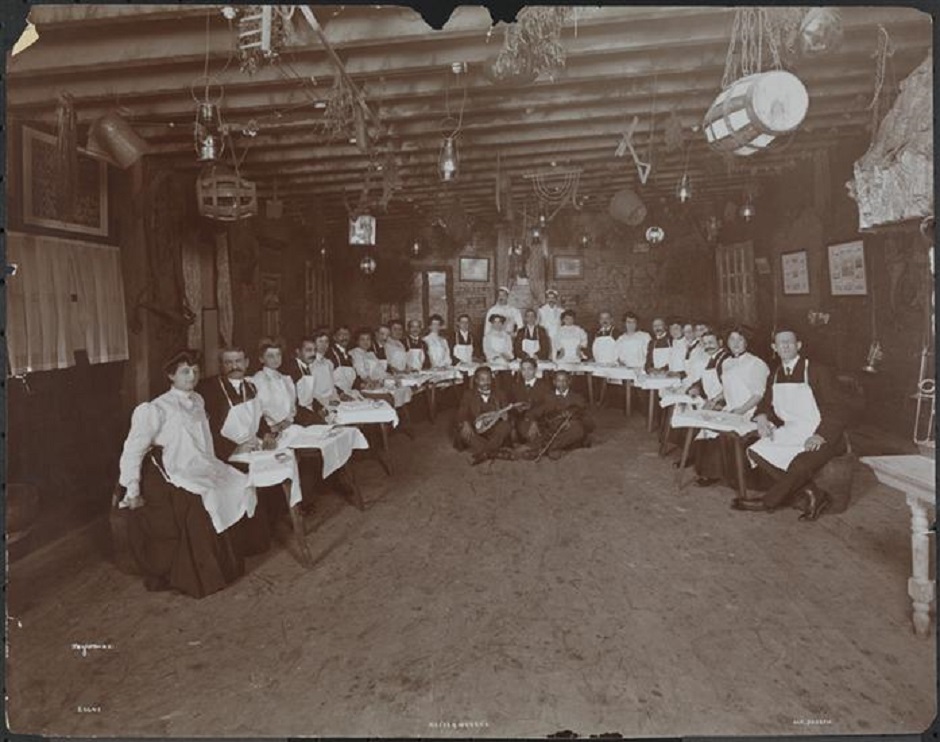
The employees and musicians of Reisenweber’s in 1905 (courtesy Museum of the City of New  York)

MNY40486

In a way, it mirrored the most appealing elements of its neighborhood: the glamour of the theater, the abandon of the taverns, the glitz of the rich, the abandon of the working class. This mix would perfect itself by 1920, the time of Prohibition, when it would go underground.

The modern nightclub would be born there in the shadows; unfortunately Reisenweber’s would not join it. It was an easy target for temperance groups; screamed the headlines in 1922, “CLOSE REISENWEBER’S, DRY OFFICIALS DEMAND“. Crippled by constant police raids — including a bummer of a raid on New Years Eve 1922 — it was closed for good that year.

By 1925, the Original Dixieland Jazz Band would break up. But Sophie Tucker would thrive during the Roaring 20’s, moving on to movies and radio.

Finally, for your listening pleasure, that recording of the “Livery Stable Blues,” a tune which certainly lit up the floors of Reisenweber’s as the champagne flowed….

*A month earlier, they apparently performed for management of the Columbia Gramophone Company and may have recorded for them, but nothing was ever released.

100 Years Ago: Beer, tradition and the new Bohemians

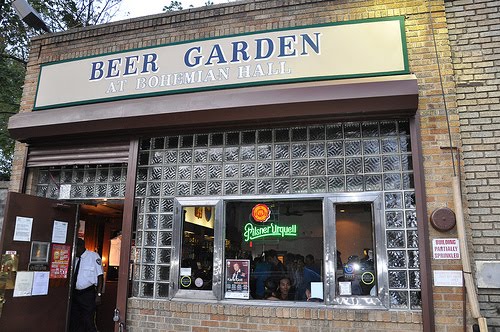
Pic by Coney Girl/Flickr

FRIDAY NIGHT FEVER To get you in the mood for the weekend, on occasional Fridays we’ll be featuring an old New York nightlife haunt, from the dance halls of 19th Century Bowery, to the massive warehouse clubs of the mid-1990s. Past entries can be found here.

LOCATION Bohemian Hall
Opened: 1910-still open!
Astoria, Queens

How about a story on the positive effects of alcohol on New Yorkers? This year is the 100th anniversary of the city’s oldest beer garden, Bohemian Hall, an understated, well-worn treasure in Astoria, Queens, which belies its importance to the borough’s Czech community. It may also be the only place in the New York City that sells liquor in the same building as a school.

These aren’t bohemians of the floaty literary 19thCentury (or 60s groovy) stripe, but an actual culture who trace their lineage to the sizable region of Bohemia, located in the modern Czech Republic today. Sandwiched between the Bohemian Forest and the Ore Mountains, this ancient area of Central Europe was part of the Austro-Hungarian empire and would, later in the 20th century, become the heart of the newly formed Czechoslovakia.

In 1910, New York City is at the tail end of the massive immigration boom hurtling through Ellis Island, with 6 million people processed through the center in the prior decade. Bohemians were among the great throng of new Americans, although not at a rate comparable with other nationalities. According to the US Census, by 1910, 200,000 first generation Czechs lived in the United States, up from about 10,000 total in the 1850s.

There was a sizable Czech community in New York during the late 19th century; one source claims that almost 95 percent of Czech working adults and children were employed in the cigar business. “The factories in the regions of Seventieth street, New York, are filled with Bohemian women and girls employed in the making of cigars,” according to Jane Robbins.

Like other national groups, the Czechs and Slovaks of New York had their own support groups and newspapers (the first two: New Yorske Listy, founded in 1879 and Slovak v Amerike, in 1889) and developed small enclaves throughout the city, including the old Czech neighborhood in Manhattan’s Upper East Side in Yorkville and out in Astoria, among others.

It was in Astoria in 1892 that the Bohemian Citizens’ Benevolent Society was formed to help the transition for new immigrants and provide a community bond for everybody else. In fact, the society is still around today, with purposes that certainly sound very similar to old objectives: “to encourage, support and maintain Schools, Dramatics, Lectures and Libraries for Czech and Slovak children …. [and] to maintain a nonprofit making social home for people of Czech and Slovak ancestry, in which the Czech and Slovak culture may be taught and blended with American traditions and culture, thereby tending to make the members better Americans.”

By 1910, the society would raise funds to open a community center and buy up some available lots in Astoria, some on former farmland. The cornerstone for the modest brick Bohemian Hall was laid October 1, 1910, and the original building swiftly constructed by volunteers in the community.

Selling beer was merely one function of the new building; a meeting hall was constructed soon after, hosting political functions and family functions, and by 1919 an outdoor seating area was completed, in the style of many German outdoor drinking and eating located throughout the city for years. The Society’s enthusiasm to capture the beer garden spirit was felled only by the coming of Prohibition. When legal drinking returned, the Hall in 1933 received a new fence to wrap out the vast yard (200-by-125 feet) and some scattered linden trees, the national tree of the Czechs.

The Hall was more than a place to toss back a few Pilsner Urqells. The Hall provided (and, in fact, still provides) Czech and Slovak language courses specifically for children and once even offered Sokol gymnastic courses, essentially an old-school form of calisthenics dating back to 1862.

Time has pretty much stopped at Bohemian Hall; like any bar, televisions have been added and the patrons are young locals and beer lovers, but I imagine that the vibe is almost identical to what it might have been like 70-80 years ago. Like McSorley’s Old Ale House, the focus is beer — all day, every day — but bolstered with a menu of traditional dishes and (during the summer) barbecue.

In a city were beer gardens once flourished — thanks to the millions of Germans and German-Americans who have lived and worked here — Bohemian Hall is now the last remaining vestige. (Obviously there are many brand-new beer gardens scattered throughout today.)

For some more information on Bohemians, Chechs and Slovaks in New York, check out the blog Slavs of New York. Bohemian Hall’s official website has more information about their hours and other services.

Located at 29-19 24th Avenue in Astoria, Queens, right off the Triborough Bridge

Welcome to Cerebrum. Do you have a reservation?

FRIDAY NIGHT FEVER To get you in the mood for the weekend, on occasional Fridays we’ll be featuring an old New York nightlife haunt, from the dance halls of 19th Century Bowery, to the massive warehouse clubs of the mid-1990s. Past entries can be found here.

LOCATION Cerebrum
Broome and Crosby streets, Manhattan

The 1960s were a decade of experimentation, and not just for people. As rock and roll tripped out, so did the places you went to hear it. No longer were clubs merely about alcohol and frivolity, music and fashion. A nightclub could create ‘happenings’, self-conscious environments of pleasure; recreational drugs helped.

The most glamorous example of this sort of public venue in downtown Manhattan was probably the Electric Circus, psychedelic haunt of the Velvet Underground and Andy Warhol, mixing light shows and performance art onto a dance floor of fashionable mods. But even the swirling, mohair environments of the Factory’s favorite club paled in comparison the experiments going on at Cerebrum.

I have to say, part of my fascination with Cerebrum was the hard time I had in researching this article. The place was open less than a year (winter 1968 to summer 1969), and its participants were on the true art fringe. Its most famous patron was most likely Jimi Hendrix — who stole the club’s designer John Storyk to create his fabulous Electric Lady Studios — but I found virtually no mentions of this in biographies. In fact, it took me a few articles to even clarify that the place even existed, that it wasn’t a mass acid hallucination conjured up by a frothing artist in a Nehru jacket.

Cerebrum, which opened in November 1968, was not a mere club but, as New York Magazine calls it in March 1969, a “place implicitly geared to voyeuristic impulses.”

Located at 429 Broome Street at Crosby Street in SoHo, Cerebrum was the brainchild (ahem) of a group of underground theater artists who decided to turn their highly groovy loft parties into regular events, combining theatrical flair with the frippery of psychedelic drug culture.

Chief among the creators was Ruffin Cooper Jr., son of a Texan banker would later achieve some renown as a abstract photographer in San Francsico. To the surprise of no one, his other collaborators, all fabulously creative, would soon be connected to the Ridiculous Theatrical Company, still in its early days of absurdist productions: Richard Currie the lighting designer, Bobjack Callejo its set designer.

Imagine the city at night with the radio on. You’re listening to WNEW-FW and the sweet sounds of Allison “Nightbird” Steele, when suddenly you hear an unusual commercial describing a strange experimental nightclub, an “electric studio of participation.” A “super, electric, turned on, far-out fantasy land. Two 3 hour sessions nightly. 8 to 11 and 11:30 to 2:30 am. Reservations are necessary. Call 966-4031. But above all get to CEREBRUM.”

Behind the unmarked door on Broome Street, the collective pushed the boundaries for the bizarre.

Arriving at the darkened street — SoHo’s warehouses have yet to meet haute couture in 1968 — you press a small lighted doorbell and enter an entirely dark room. A voice asks, “Welcome to Cerebrum. Do you have a reservation?” You are, after all, in a 60s speakeasy. After passing muster, you’re lead into an orientation room, take off your shoes and pay your admission (anywhere from $1 to a pricey $7, depending on the night.)

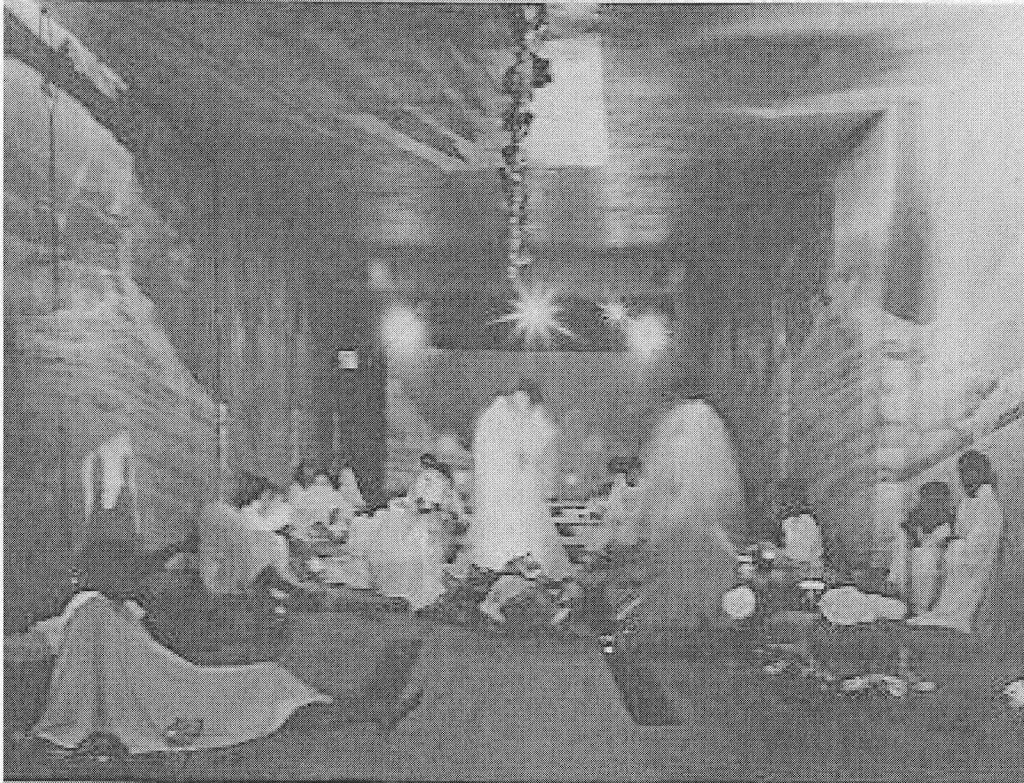
Ghostly figures inhabit Cerebrum, lost in trances*

At Cerebrum, you let everything go. Your clothes even. Once inside, you were asked by a kind young fellow dressed in silver to get completely naked. He then handed you your ensemble for the evening — a flowing, diaphranous robe, hooded and silky, faux futuristic.

Once garbed, you are led inside via a ramp to a gigantic white room, trippy projections on the wall, distortions of a wide variety of music buzz around you, a thin, scented fog sitting in the air. There’s no liquor, only water and marshmallows, served by the so-called ‘Cerebrum guides’, who led visitors through this strange psychedelic spa. No gabby conversations at a crowded bar, only people sitting and staring.

The club was divided into elevated platforms which you could visit to experience the unique stimulants taking place there — headphones with groovy music, musical instruments, balloons, kaleidoscopes, children’s toys — reclining on white pillows on lush white carpeting. Sometimes the ‘guides’ came along and smeared menthol on yoru lips or tingly lotions upon your skin.

Clearly, it wasn’t those marshmallows enhancing your experience here. Cerebrum clientele were a stoned, listless lot, lost in the vague, spectral imagery and sounds. In Currie’s own words, from a biography on the Ridiculous Theatre Company, “Several people said that it always looked like it was going to become an orgy at any moment.”

Time Magazine called it “a theater without a stage show, a cabaret without food or liquor, a party without an occasion”; the fact that Time was there at all meant it was on the cultural radar, at least with drug-friendly, downtown fashionistas. But its novelty drew only the bravest of trendy crowds.

Cooper explains it this way to Time: “We are trying to overturn every entertainment convention—the ‘sit here,’ the ‘look that way,’ the ‘dance over here’.”

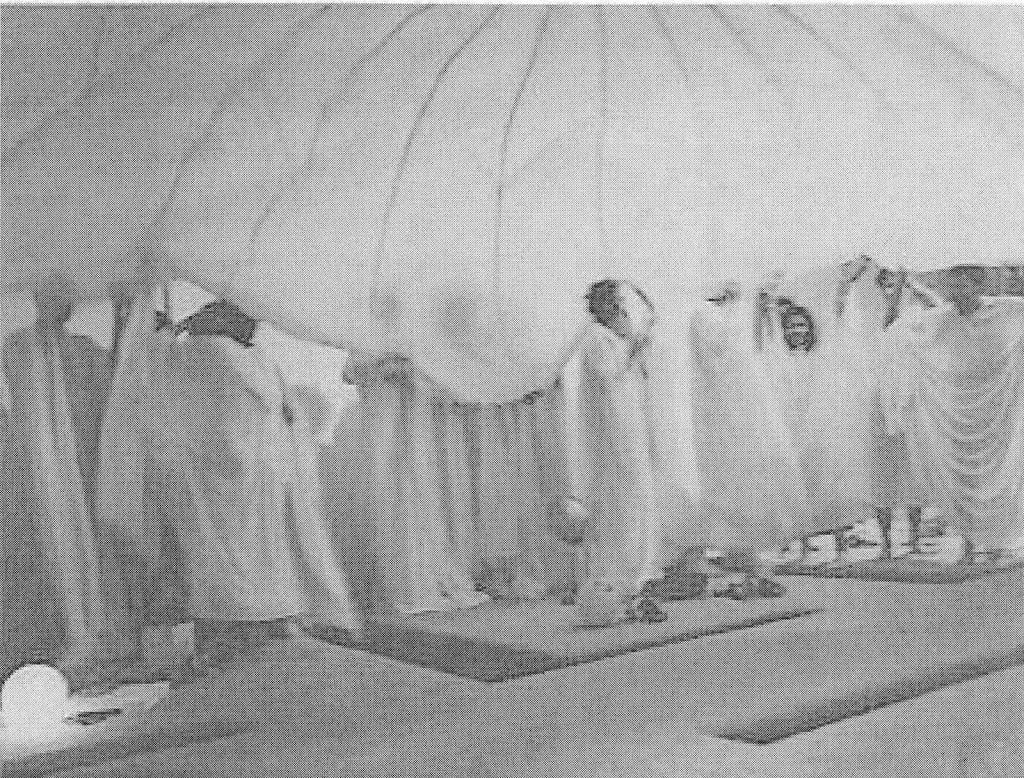
Enter the parachute. You like the parachute.*

Eventually they break out the parachute, with patrons grabbing each side and watching as the white billowy fabrics flaps back and forth in the air. Like what you did in elementary school, except with lots of stoned adults.

Cerebrum stretched the boundaries of interactive theater within the environment of an incredibly chill-out party. And like any good off-off-Broadway production, it closed a lot sooner than it should.

It shuttered early summer of the very next year. The reason was rumored to be mob related. Keep in mind this was the summer of riots outside the mob-run Stonewall bar. But most likely a concept of this type is probably not meant to last. With the 70s on the horizon — with CBGB’s, the Mudd Club, and Studio 54 at the door — a club like Cerebrum seems positively quaint.

FUN FACT: Less than 40 years later, Heath Ledger would die a couple doors down, at 421 Broome Street. Ledger was 28 years old when he died, Cerebrum habitue Hendrix was 27.

You can read here a short recollection by Bart Friedman here, and there’s a nice academic description of the experience here.

*Photos above are by Ferdinand Boesch and are from here. I’m sorry they’re so blurry, but I copied them from a paper and I just had to have pictures of this place to accompany the article.

But the greatest treat is that there’s actual video evidence that this place actually existed, narrated by Ruffin Cooper himself. This video takes awhile to load, but it’s worth it:

Lucky Star: Danceteria and the debut of Madonna


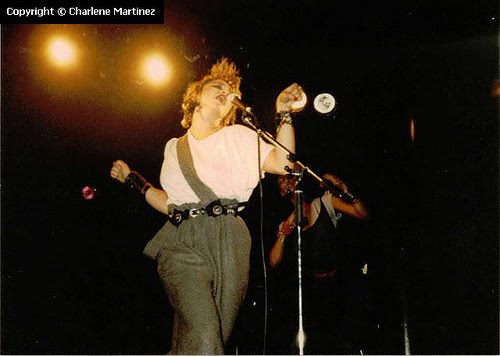
And you can dance: Madge performs Borderline at Danceteria Photograph by Charlene Martinez

FRIDAY NIGHT FEVER To get you in the mood for the weekend, every other Friday we’ll be featuring an old New York nightlife haunt, from the dance halls of 19th Century Bowery, to the massive warehouse clubs of the mid-1990s. Past entries can be found here.

Scrappy nineteen-year-old Michigan teen Madonna Louise Ciccone arrived in New York the same year as Studio 54 — 1977.

“It was the first time I’d ever taken a plane, the first time I’d ever gotten a taxi cab. I came here with $35 in my pocket. It was the bravest thing I’d ever done,” she says (in a UK Mirror interview) with her usual reserve.

She dabbled in contemporary dance with Alvin Ailey, becames employed in a potentially lucrative career at Dunkin Donuts, filmed a provocative movie, and soon began dabbling in the nightclub circuit with the rock groups Breakfast Club and Emmy. She began making dance records of her own with help from her boyfriend Stephen Bray and by spring 1982 had herself a recording contract with Sire Records.

On her way to superstardom, she performed all over town during the early 1980s — the Roxy, the Pyramid, the Mudd Club — but perhaps no club in the city was more influential to her career than Danceteria. Although this staple of 80s New York nightlife moved all over town during its tenure, its most recognized location is the one which saw the birth of Madonna’s career — a four-story building at 30 West 21st Street (now a swank condo!).

“I met her at Danceteria when she was sitting on [a friend’s] lap. She was really, really foxy. She was really glamorous,” says Thurston Moore of Sonic Youth.

She was also apparently such a fixture of the club that the resident DJ, Mark Kamins, even dated the singer. (That’s getting your foot in the door.) Says Kamins: “Madonna was a regular at Danceteria. She had great style and had to be the center of attraction. She always hung out in the booth, one day she gave me a demo to play.” That demo, for the song ‘Everybody’, eventually got her signed to a major label.

Below: Madonna debuts her future hit ‘Everybody’ on the stage at Danceteria

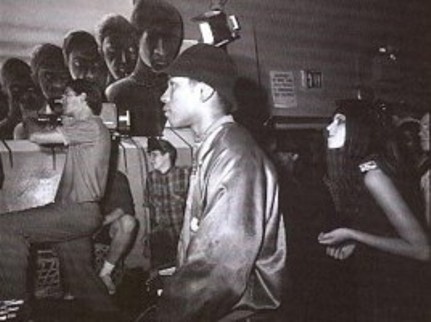
But Madonna was certainly not the only future music star to use the club to her advantage. Many started as routine employees. LL Cool J was the elevator operator, and members of the Beastie Boys were busboys. (Both LL and the Beasties are pictured below at the club, photo by Dorothy Low) Keith Haring worked at coat check, while both Karen Finley and Sade was briefly employed behind the bar.

Everybody — everybody hip— eventually showed up on the dance floor of Danceteria. The after-hours club originally opened in 1980 at West 39th Street, a project of club impressario Rudolf Pieper and promoter Jim Fouratt. “We put it together for $25,000. We rented everything,” Pieper said in a New York Magazine interview.

The club, dramatically put, was “a dreamworld of mysterious souls, sidelong glances, and the perfume of ruin.” (No, I didn’t write that, they did.) Its admission policy was reputedly tight and exclusionary, but not so elitist that a trendy and fashionable nobody couldn’t pass muster; only the most fabulous got to experience this stark, winding little club.

However problems with the law — the neighborhood, after all, the Tenderloin — forced the club to move. Several times it seems. In 1982, it eventually landed at the 21st Street location, adding John Argento as promoter. Believe it or not, Argento would later spin off Danceteria to another location — the Hamptons.

You never knew what you were getting on any random night. Russell Simmons hosted talent showcaseson some Wednesdays, while other days might feature more eclectic nights with Philip Glass or Diamandas Galas. Ann Magnuson might be hosting a barbeque, or you might stumble into a ‘rubber and leather’ party.

With new wave music as its soundtrack, Danceteria seemed to dip its toes in both the East Village art scene and the Studio 54-style celebrity, employing video installations (Kamins claims they were the first to employ videos) and go-go dancers to entertain the throngs of fashionistas, artists and wanna-bes.

Like so many buzzkills, Danceteria lost its lease at 21st Street and eventually closed in 1986. It appears that another Danceteria briefly opened in the 1990s, at 29 East 29th St. (between Madison and Park).

But while we have no more Danceterias — we hardly have any dancing at all — the club provided the world (and its most famous material ingenue) with a glamorous film moment: this scene from ‘Desperate Seeking Susan’

NOTE: I know I just touched on some of Danceteria’s greatest moments and its most fascinating characters. (I didn’t even mention Johnny Dynell, Anita Sarko, and Michael Alig!) Please add your memories below and if you have corrections to any information, I’d be grateful. With the type of press that Danceteria received in the early 80s, its difficult to seperate truth from the hyperbole!

You can start your Danceteria education at Danceteria.com or flipping through this wonderful selection of flyers.

Cafe Wha?: the whys, wheres, whos and hows

FRIDAY NIGHT FEVER To get you in the mood for the weekend, every other Friday we’ll be featuring an old New York nightlife haunt, from the dance halls of 19th Century Bowery, to the massive warehouse clubs of the mid-1990s. Past entries can be found here.

LOCATION Cafe Wha?
115 Macdougal St, at Minetta Lane

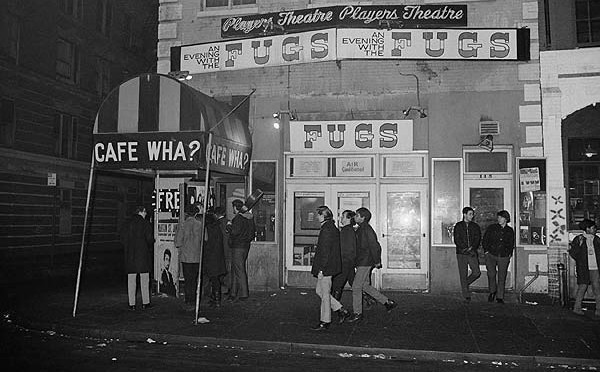
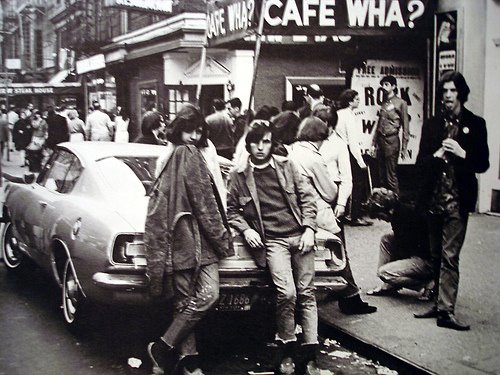
Occasionally, the usual types actually did pack into Cafe Wha? — the intellectuals, the progressive, heavy-lidded types. Some of them actually were true beatniks — Sartre, cigarettes and turtlenecks — although most were just regular college students, some hippie precursors mixed among them, or uptowners who were looking to see these so-called beatniks in their natural habitat. They all filtered into this plain, dark room on Macdougal Street, where revolutions were hatched nightly from a guitar or a harmonica.

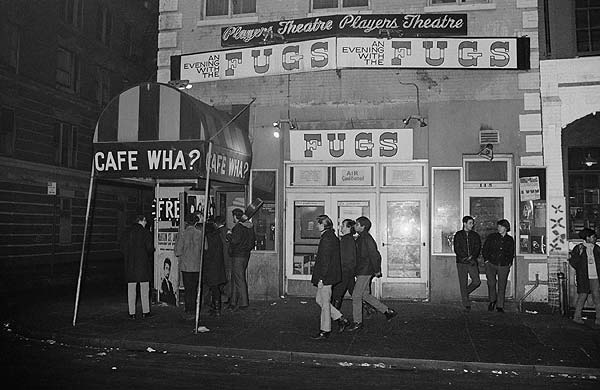
Cafe Wha?, at 115 MacDougal Street, helped create and then outlived New York’s pre-Vietnam War folk era, providing a stage for performers who would literally make music history.
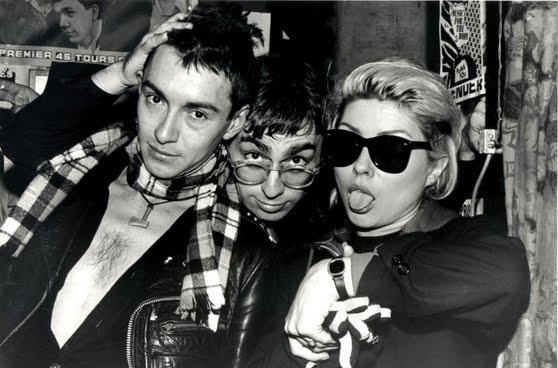
Wha? was one in a string of Village ‘baskethouses’ as they were sometimes called, small music venues where a small wicker basket would be passed around for tips during performances. The music acts didn’t get paid much; there were dozons of aspiring Woody Guthries in the Village, much of the talent interchangable. Performers would traipse up and down the street, playing several times in different places, sometimes on the street.

Many would stumble into Cafe Wha?’s unassuming, sometimes dingy doorway. The club was owned by Manny Roth, who would open here in the late 1950s. He would own a few nightclubs and lounges over time, including another folk venue Cock ‘N Bull (later to become The Bitter End).

Roth’s lineage would create a different source of musical inspiration in the form of his nephew David Lee Roth, to become the flamboyant frontman of Van Halen. Young David would frequently accompany Manny into the club and would often be left with whatever singer happened to be performing at the time (including, a few times, with Richie Havens.) Little David, destined for tight pants, never stood a chance.

Many of folk’s most talented stars played the small Wha? stage, entertaining both bohemian and uptown audiences eager for new talent. Hilly Kristal, later the owner of New York’s most influential rock club CBGBs, was a burgeoning folk singer who frequently performed here. “Those were fun years, the beatnik era,” he said.

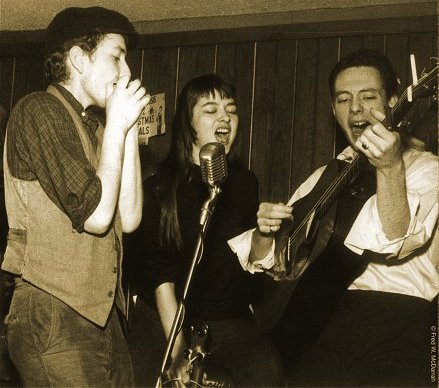
But the kernal of Wha?’s reputation lay with a wan, undistinguished looking boy named Bob Dylan. As the story goes, Cafe Wha? was the very first venue Dylan ever played in New York City, arriving there on his very first day in town on January 24, 1961. He auditioned for Roth, who hired Dylan to play behind one of Roth’s stars Fred Neil, a folkster who would later write songs for Harry Nilsson.

Dylan would only perform as a solo artist at Cafe Wha? only in the afternoons and would perform for free. He would play for bigger audiences at night, but only as backup for Neil.

“I worked for Manny all afternoons, from twelve to eight,” Dylan recalls. “There was constantly something happening on stage. You never really did get popular there, ’cause people never knew who you were….It was just a nonstop flow of people, usually they were tourists who were looking for beatniks in the Village.”

Below: Dylan with Neil and singer Karen Dalton

According to a biography by Bob Spitz, the odd, gangly Dylan instantly set himself apart. “That voice! Nobody had ever heard anything like it before….Bob had perfected the tonsilly scranch, a dry, throaty tenor ‘with all the husk and bark left on the notes’, which, if you weren’t actually looking at him, sounded like a middle-age hillbilly with emphysema.”

Certainly he was perceived by some as a parody of a folk singer: raggy clothing, offbeat and sincere. He would eventually distinguish himself as a solo star at other venues — most notably over at Gerde’s Folk City, a venue which would launch him to fame.

But in February 1961, he was just second-fiddle to Neil, who wasn’t the only notable headliner on the Wha? stage. Noel Stookey had a successful stand-up routine at the club long before he took the stage name Paul which fit nicely between the names Peter and Mary. However the performer that interests me most was another folk singer who would more lucratively abandon music altogether — Lou Gossett Jr. As in Officer and a Gentleman Lou Gossett Jr., quite a talented and well-known folk musician in the early 1960s.

Like a handful of other Village music spots, Cafe Wha? helped create the soundtrack for New York counterculture, enriched the Village’s rich reputation for the different. By the mid-60s, Wha? would diversify its musical acts. For instance, a New York Times article from 1965 a ‘Beatles backlash’ emanating from the Cafe What basement in the form of ‘modern blues’.

At the suggestion of Richie Havens (who also got his start at Wha?), a young guitar player Jimi Hendrix auditioned for Roth and got a three-month gig here in the summer of 1966, performing with a group called the Blue Flames. Hendrix and the Flames performed funkified covers of popular songs, certainly the most dynamic house band one can possibly imagine. Curiously, Hendrix and Dylan, the two great stars of Wha?, met only once, and it was at another Village bar, Kettle of Fish.

Around this time another rock band The Castiles would frequently perform here. The group would dissolve after a couple years, and its lead singer, Bruce Springsteen, would continue his slow climb to fame.

Roth would continue to operate the club for two more decades, presenting a host of entertainers from comedians like Lenny Bruce and Richard Pryor to definitely-not-folk-acts like Kool and the Gang.

Roth sold Cafe Wha? in 1988 but would go on to own other performance venues like the West End Gate. Cafe Wha? is open today under different management, hosting a roster of rock and soul artists. I’m not sure however if they still pass about a basket.

Martling’s Long Room: power plays, power drinkers

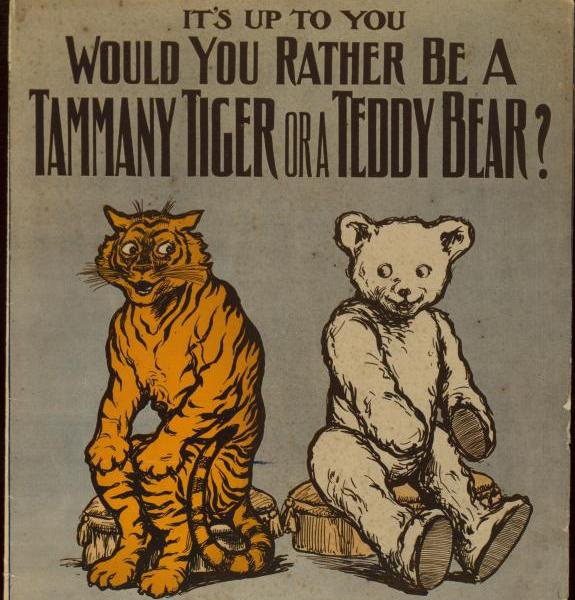
Well, would you?Illustration from sheet music 1908

FRIDAY NIGHT FEVER To get you in the mood for the weekend, every other Friday we’ll be featuring an old New York nightlife haunt, from the dance halls of 19th Century Bowery, to the massive warehouse clubs of the mid-1990s. Past entries can be found here.

LOCATION Martling’s Tavern
Corner of Nassau and Spruce streets, Manhattan

I promise to move away from the messy business of Tammany Hall for awhile after I profile the surprising location of their birth, a tavern that would collect the most powerful men in the city and form a political club that would influence New York history forever — Martling’s Tavern.

Power frequently held court in New York’s taverns in the early days. Few New York locations are more important to the American Revolution than Fraunces Tavern, where the seeds of rebellion were sewn and, once victorious, where George Washington resigned from the Continental Army. The Bull’s Head Tavern became a veritable marketplace for area cattlemen and a place to share a bit of gossip.

When it formed in 1789, the Tammany Society was a mere fraternal, patriotic organization with little interest in real-time political maneuvering. [You can find out more by listening to our last podcast on the early days of Tammany Hall and the rise of Boss Tweed.] Its ceremony and costumed rituals were even looked down upon by elite elements of society as “a vulgar parade.”

But by the late 1890s, this flamboyant men’s club was permanently repurposed as a deft political machine. Early mayors like James Duane were ‘sachems’ who slowly began using the society’s ostensibly innocent functions as cover for more political gains.

As a social club, Tammany would naturally require a tavern for a meeting place, especially one with a grand hall to accommodate all their members. The very first meeting place (or ‘wigwam’) for the Tammany Society was Barden’s Tavern on Broadway and Murray Street, just a stone’s throw from the center of local and, in 1789-90, even national government. Society members even feted actual native Americans here, a contingent of Creek Indians who must have smirked at seeing all these prominent white males in native drag.

In 1790, according to Gustavus Myer’s famous history of Tammany Hall, “the Tammany Society and the military escorted the Indians to Secretary [Henry] Knox’s house, introduced them to [President] Washington and then led them to the Wigwam at Barden’s Tavern, where seductive drink was served.”

Tammany remained at Barden’s until they outgrew it in 1798 and moved to a location on the edge of the city (Nassau and Spruce streets) that was owned by one of their members — Abraham ‘Brom’ Martling.

Martling’s place didn’t look like much, a ‘forlorn’ one-story building. According to author Peter L. Bernstein, “The building was so rundown many people referred to it as the Pig Pen.” Perhaps the transition to politics required a locale with a rougher edge. They would make Martling’s their home until 1812, and it is generally referred to as the first ‘real’ Tammany Hall.

Wicked politics was already at play by the time the Society settled into Martling’s spacious ‘Long Room’ where a majority of Tammany business would be conducted. When Aaron Burr, flanked on either side by Tammany men, shot his enemy and Tammany scourge Alexander Hamilton, it’s alleged that the Society threw a gala that evening in celebration, with toasts raised to Burr’s good aim.

Make no mistake; although the business of government was on their mind, these men could drink. According to Myers, “every night men gathered there to drink, smoke and “swap” stories,” a “den where the Wolves and Bears and Panthers assemble and drink down large potations of beer”:

There’s a barrel of porter at Tammany Hall,
And the Bucktails are swigging it all the night long

The society became so associated with the place that they were frequently called Martlingmen. Alternatively, Tammany would call their future meeting chambers a ‘long room’ in honor of this rundown but effective space.

Martling himself would even became a Tammany sachem, and a tempestuous one at that. Myers: “Taking offense, one day, at the remarks of one John Richard Huggins, a hair-dresser, [Martling] called at Huggins’s shop, 104 Broadway, and administered to him a sound thrashing with a rope.” Take that, hair-dresser!

As Tammany became more powerful and larger (with some 1,500 members), they would eventually have to move from the Long Room into a headquarters of their own. But they didn’t move far from Martling’s however. The very first Tammany Hall would be built at Frankfurt and Nassau, mere steps the tavern that had quenched their thirst and saw the adolescent society grow to become a viable political force.

Location of Martling’s Tavern:

View Larger Map

Toots Shor’s and the art of celebrity male bonding


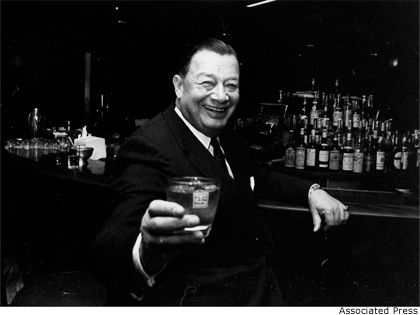
So make it one for my baby, And one more for the road

FRIDAY NIGHT FEVER To get you in the mood for the weekend, every other Friday we’ll be featuring an old New York nightlife haunt, from the dance halls of 19th Century Bowery, to the massive warehouse clubs of the mid-1990s. Past entries can be found here.

NIGHTCLUB Toots Shor’s Restaurant
In operation: 1940-1959; 1961-1971; 1972-73

They really don’t make them like Toots Shor anymore. A stout, gregarious man, back-slappingly friendly with a child’s face, Shor reigned over one of midtown’s legendary martini scenes, his very own eponymous nightspot that attracted the most iconic mad men of music, movies, journalism, and sports. (In fact, Mad Men, the 50s Manhattan throwback TV series, is often set here.) Shor’s was where the world’s most famous alcoholics of the 50s and 60s tippled.

Toots is a bit of a tragic figure today in that he really became a self-branded institution of a simpler time, an old-school, double-breasted nightlife dominated by rich white men. When times became less simple, he foundered and faded.

This Jewish-born Philadelphian made his entry into New York nightlife in the most obvious way for a man of his frame — as a doorman to some of the city’s most famous speakeasies during the dry 1920s. “A kid on the hustle,” in his own words, Shor made 40-50 dollars a week in several places like the Five O’Clock Club and the Napoleon Club, where he would “flatten a guy a day, maybe two.” Along the way, he befriended celebrities and journalists alike; most importantly he also made connections with the influential mafia figures who owned the night spots.

He eventually moved on to a management position in 1936 at a popular tavern owned by Billy Lahiff (158 W. 48th Street), acquiring from his famous clientele the confidence and ease of a celebrity himself. He even married a Ziegfeld girl, nicknamed Baby, who was a virtual pixie next to him.

(By the way, just three years earlier, Lahiff’s served the last meal to Fatty Arbuckle, the embattled silent film star who died in bed that night.)

Shor moved on to his own establishment in 1940. Toots Shor’s Restaurant (51 W 51st Street) would be an instant success, ruling for two decades as the neighborhood lounge for some of New York’s biggest lushes. Most associated with the early years was Jackie Gleason, who would spend the day there drinking, go home and take a nap, then return to Toots for the nighttime crowd.

BELOW: Toots and Jackie and the ground breaking of his second restaurant in 1960 (Bob Gomel, LIFE archives)

You could eat at Toots — it was a restaurant — but, as the 1996 documentary Toots makes clear, it was all about the “whiskey and beer.”

Shor would befriend many of his clientele, calling them ‘crum-bums’ upon entry, joking with them, creating an inner circle for some of the most closely observed men in New York. In particular, the restaurant was quite popular with sports icons (and, by extension, sports writers); for this reason I would describe Toots as one of New York’s greatest sports bars ever. It didn’t need memorabilia on the walls; the memorabilia just walked in through the front door.

If you were a Yankee, you came to Toots. Mickey Mantle was his most recognizable regular; Joe Dimaggio came in for awhile, until Shor called his wife (you know, Marilyn Monroe) a whore, a slight Joe never forgave.

Bing Crosby and Frank Sinatra would frequently enter to applause. Supreme Court justice Earl Warren would enjoy a drink at one end of the bar, while the most notorious gangster in New York, Frank Costello, would be dining on the other side.

When it wasn’t filled with icons, regular businessmen would hit Shor’s for a lingering martini lunch. Few places in the city fostered such a tightly closed fraternity.

Mickey Mantle and his bespecled wife Merlyn, not exactly the most loving of couples, pull it together for master of ceremonies Toots Short, at right (1965, photographer John Dominis, courtesy of Life archives)

Along the way, Shor became quite well-known, a television star even. (That 2006 documentary features footage from his appearances on ‘What’s My Line?’ and ‘This Is Your Life’.) However his penchant for gambling and comping thousands of dollar of beverages for friends took a toll on his finances. Shockingly, he announced in 1959 that he had sold his restaurant. By the next year, it was demolished.

He tried again in 1961 at 33 West 52nd Street, closely copying his old formula. Some of his old friends even came back. But this type of nightlife was swiftly fading from view in the city. How could Shor coexist in a neighborhood with places like the Peppermint Lounge enticing people with the vibrations of counter-culture? It didn’t help that Shor continued to have financial problems; his celebrity and mafia connections couldn’t help him this time.

His new restaurant was unceremoniously closed in 1971 due to income tax evasion. He tried once more in October 1972 in a smaller place on 54th Street; it was closed within a year. Strapped for cash, Shor then sold his name to the Riese Corporation, who opened a small chain of Toots Shor bars throughout the city. Today, Riese operates such chains as TGI Fridays, Dunkin Donuts and Taco Bell. The bars had nothing to do with Toots, and what’s a Toots Shor establishment without Toots? Eventually the notoriety of his name would soon fade and even those knockoffs would close.

Shor died in 1977, living with his family at the Drake Hotel at Park and 56th Street.

Luckily, Shor is fondly remembered today as a vestige of old midtown Manhattan, a starched precursor to today’s more colorful party promoters. I highly recommend the Toots documentary, lovingly made by his granddaughter. Anybody interested in 1950s New York would be remiss not to spend a few minutes over a stiff martini this weekend in his memory.
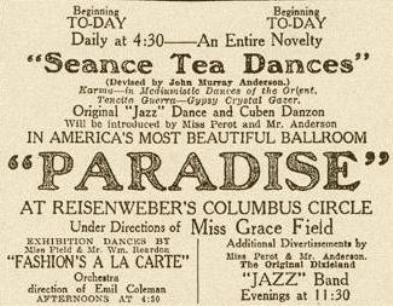
By the way, his real name? Bernard.