FRIDAY NIGHT FEVER: Peppermint Lounge


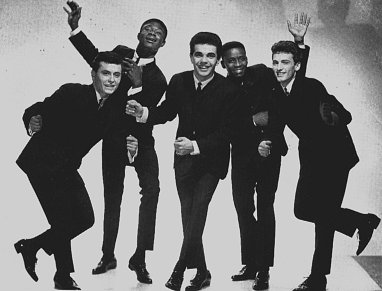
pictured: Joey Dee and the Starliters, who turned a small midtown gay hustler bar into a dance hit in 1961

To get you in the mood for the weekend, every Friday we’ll be celebrating ‘FRIDAY NIGHT FEVER’, featuring an old New York nightlife haunt, from the dance halls of 19th Century Bowery, to the massive warehouse spaces of the mid-90s. Past entries can be found HERE.

Like most things associated with popular music, the early 60s brought sea change to the very notion of nightlife. Clubs typified by the 21 Club and last weeks’ feature El Morocco were very much venues where you dressed up, not where you let your hair down. Harlem and Greenwich Village certainly catered to rowdier fare, but in midtown, things still held a pretense of glamour and society.

All that changed as rock and roll seeped into the streets. Such “naughty” music, inspiring amoral and sexual dancing, sprang first from the seediest places, with the sweetest being the Peppermint Lounge, also known as the home of the Twist. Although the Twist was actually born in Philadelphia, New York and the Peppermint sped it up and whipped it into a frenzy.

The ‘Pep’, as it was called, a hole in the wall at 128 West 45th Street, with a doorway into the adjacent Knickerbocker Hotel, might have remained a quiet gay hustler bar out of the way of the public consciousness had rock and roll not swept through. Vanity Fair calls it an “inauspicious dump destined to become a pop landmark.” The ruffians would soon share the floor with Marilyn Monroe and the Beatles.
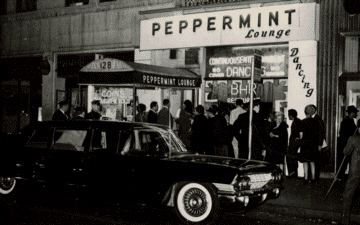
With a capacity of 174 people (and often filled to just slightly over that amount), a tiny stage and even tinier dance floor, the Pep soon pulsed with dance-friendly rock music, featuring house band Jordan Christopher and the Wild Ones slinging R&B rhythms over guitars and marrying it with almost demonic body gyrations. The well kept secret was effectively spilled when frequent performer Joey Dee and the Starliters recorded their biggest hit ‘Peppermint Twist’, cementing the club’s lusty reputation into a hit record in 1961. (Watch a video here of the Starliters performing their hit.)

The Pep was sweaty raunch. It was white society dabbling into the rhythms of black music. Traditional society, leering over the edge of its dry martinis, thumbed up its nose. But like everything forbidden in this city, the Peppermint soon drew its admirers.

Or as Tom Wolfe explains it: “One week in October, 1961, a few socialites, riding hard under the crop of a couple of New York columnists, discovered the Peppermint Lounge and by next week all of Jet Set New York was discovering the Twist.”
The mystique of the Twist — and the dozens of other novelty dances that came afterwards — is that is was a solo dance. And as a result, according to the New York Social Diary, “It was the first time the general public saw men dancing with men and women dancing with women.” The Pep invited sexual intimacy and freedom. Perhaps not of the types we see on dancefloors today, but this was the first significant steps towards it.

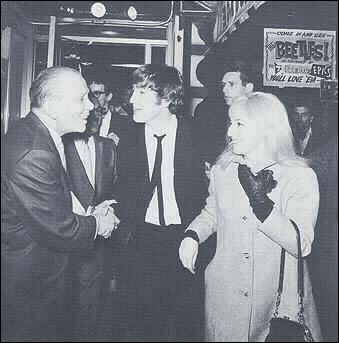
But while the floor of the Pep might have been filled with twisting, sexed up young adults, the allure soon drew icons. Marilyn Monroe, seen last week shimmying at El Morocco, found her way to the Peppermint, as did the Beatles during their legendary week in the city. (Pictured above: John Lennon is welcomed into the Pep.) As well as an odd assortment of celebs that I can’t imagine ever once did the Twist — Liberace, Tennessee Williams, Noel Coward, Norman Mailer, Judy Garland, Zsa Zsa Gabor, John Wayne (!).

According to Time Magazine (via the above Vanity Fair article), “Even Greta Garbo hauled herself out of her myth-lined cocoon and appeared, lank-haired and bone-pale, to snap her fingers and smile.” Even first lady Jackie Kennedy snuck in with her sister Lee.
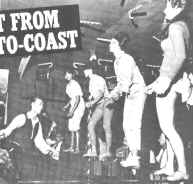
The Pep made stars as well. Three of the Starlighters spun off into another band, the Rascals. And Phil Spector’s pet project the Ronettes, according to legend, got their unexpected big break there: “One night in 1961, the girls dressed in tight skirts and with their hair piled high, stood [outside] in line …. the manager mistook them for a singing trio that hadn’t arrived and took them inside. Ushered them on stage and they belted out a version of Ray Charles’ “What I Say,” … The girls took the club by storm and were signed to appear regularly for $10 a night.” (At right: Ronettes at the Pep)

The Pep wouldn’t survive the 70s. The space on 45th street would become a couple different disco venues: a circus themed disco called GG’s Barnum Room (pictured below) and a glossier disco called Hollywood. The Pep would return in fits and starts in other locations, but nothing approaching the feral frenzy of its early days.
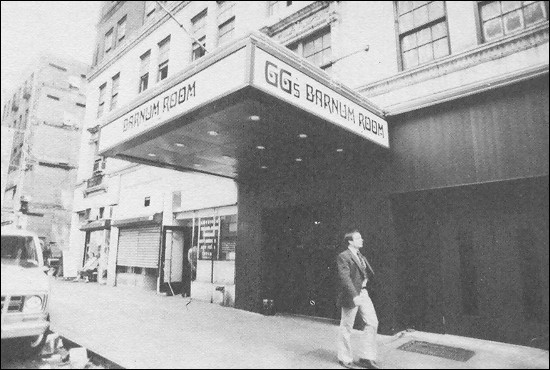
The address of the Peppermint, 128 West 45th Street, is completely gone, replaced with a parking garage, a Citibank and a luxury hotel. However, not more than a 100 feet from its original location was once another legendary rock venue, Bond International Casino.
Categories
Uncategorized

FRIDAY NIGHT FEVER: El Morocco


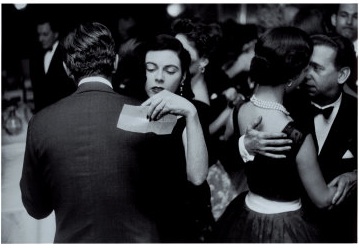
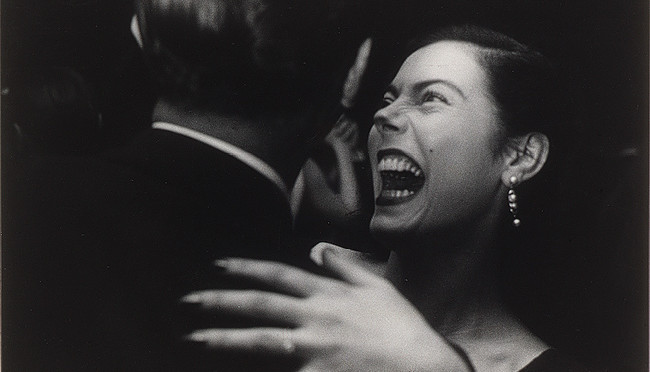
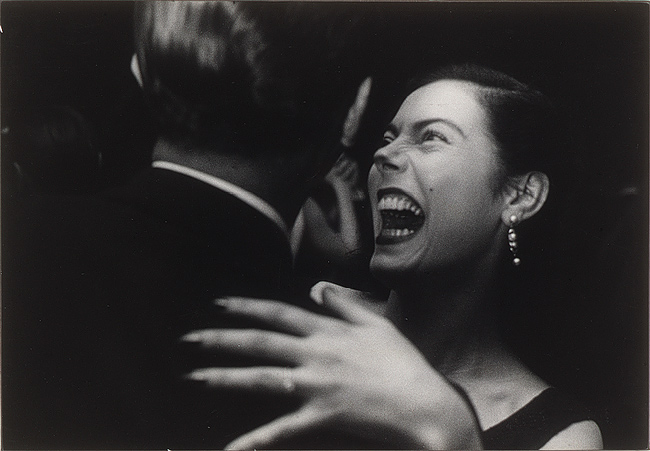
(Top and bottom photos: Garry Winogrand – taken on the El Morocco dance floor – 1955)

To get you in the mood for the weekend, every Friday we’ll be celebrating ‘FRIDAY NIGHT FEVER’, featuring an old New York nightlife haunt, from the dance halls of 19th Century Bowery, to the massive warehouse spaces of the mid-90s. Past entries can be found here .

Has there ever been a place in Manhattan more glamorous than El Morocco? Probably not.

John Perona opened El Morocco as a speakeasy at 154 East 54th Street, moving down the street to 307 East 54th Street in its later days. (Both locations have been destroyed; the Citicorp building stands where the original once stood.) “Elmo”, as the socialites would utter it, transitioned into post-prohibition losing none of its glamour or appeal.

Along the way, it set the standard by which all other nightclubs of the 30s through the 50s were to be judged. (Only the Stork Club and possibly the 21 Club would rival it.) It was the first to use a velvet rope. The ruler of the rope, Angelo Zuccotti, was so revered that the New York Times ran his obit when he died in 1998, a doorman
“who wielded the velvet rope at El Morocco with such authority and finesse that he helped define the very line between cafe society and social Siberia.”

And via Perona’s official photographer Jerome Zerbe (who also worked the Rainbow Room), this midtown speakeasy turned celebrity hotspot was one of the first to employ photographers to snap candids of its famous clientele. Yes folks, you can actually trace the scandalous club photos of Lindsey Lohan and Britney Spears back to their less shameless beginnings at El Morocco.
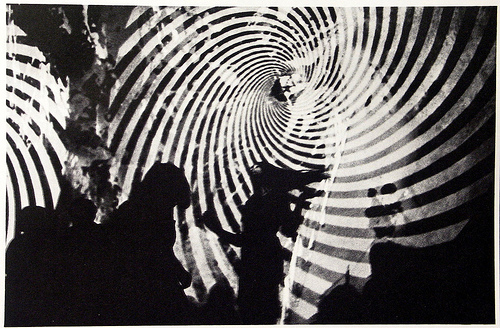
According to an account by Zerbe, “From 1935 until 1939, I was at the El Morocco and I invented a thing which has become a pain in the neck for most people. I took photographs of the fashionable people and sent them to the papers.”
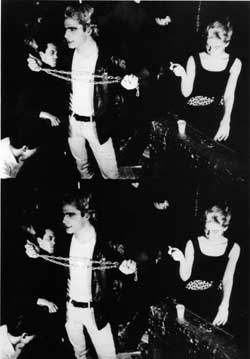
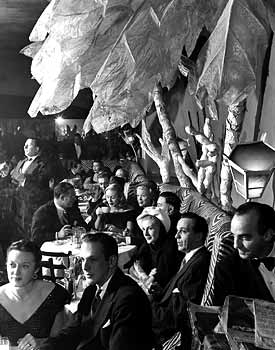
One key element was Elmo’s signature blue and white zebra-striped banquettes, which popped from the corners of every snapshot. Photos running the next day would easily be recognized.

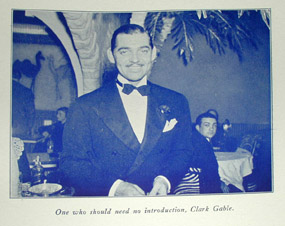
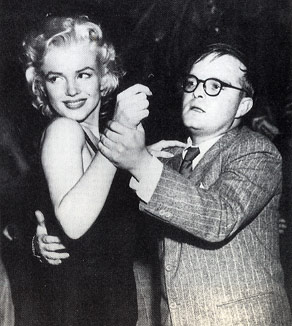
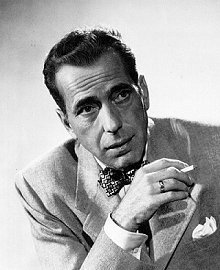
The other, of course, was the who’s-who list of stars that would traipse through. And who exactly showed up at El Morocco’s doorstep? I can throw some names at you — Clark Gable, Cole Porter, Ingred Bergman, Truman Capote, Audrey Hepburn, Marilyn Monroe. Humphrey Bogart, God bless him, was banned from the club for life. (The story is so incredible, I’m saving it for the end.)

But I think Zerbe says it best: “They were really the top, top social — and what you mean by society, that’s difficult again to define. These were the people whose houses one knew were filled with treasures. These were the women who dressed the best. These were the women who had the most beautiful of all jewels. These were the dream people that we all looked up to and hoped that we or our friends could sometimes know and be like.”

Scour any recollections of Elmo, and you’re bound to spend half the night picking up all the dropped names. “Errol Flynn would either sit at Perona’s table or cruise the room,” says Taki Theodoracopulos. “On a normal night Aristotle Socrates Onassis would be there, more often than not without his wife, Tina, who would come in later with the then young Reinaldo Herrera.”

And from Nannette Fabray: “One entered, and there was a hierarchy of where one sat. The first table on the right was the best; the second was reserved for the owner, John Perona. You didn’t dare go unless you were perfectly turned out.”

Human beings were not allowed in El Morocco. It was the place where film stars mixed with European royalty, where a poor Southern girl could be wooed and courted, as long as that poor Southern girl was Ava Gardner.

Sadly, like an aging film actress long past her prime, El Morocco lasted well into the 90s, dissolving into less alluring variants until it took the final step of becoming a topless bar in the mid 90s, under the name Night Owls.

Celebrity hotspots these days rarely have the elegance or the prestige. I can only imagine if Britney Spears turned up at Angelo’s velvet rope, that he would turn her away.

Oh, and why was Humphrey banned from El Morocco? Well, one night in 1950, Bogart dropped off his wife Lauren Bacall at home, and he and a friend went out for the evening. Heavily inebriated, Bogart thought it would be funny to bring two 22 lbs. stuffed panda bears into Elmo as their ‘dates’ and proceeded to prop them up on a chair.

Two drunk young women attempted to pick up the pandas, but, depending on who you believe, were either pushed by Bogart or tumbled to the floor by the shear weight of the heavy toys. Later, in a flurry of half-truths, it was believed Humphrey and his friend violently assaulted the young women for attempting to steal the panda bears. Not helping matters — the boyfriend of one of the women then began throwing plates at Bogart.

The next day Bogart received a summons to appear in court. The man who would become the greatest movie star of all time, on that day, had to convince a judge that it was his excessively large stuffed pandas, and not his fists, that had felled the young women. The judge eventually threw it out of court.

When asked by reporters if he was drunk that night, Humphrey replied, Who isn’t at 3 o’clock in the morning? So we get stiff once in a while. This is a free country isn’t it? I can take my panda any place I want to. And if I want to buy it a drink, that’s my business.

FRIDAY NIGHT FEVER: McGurk’s Suicide Hall

To get you in the mood for the weekend, every Friday we’ll be celebrating ‘FRIDAY NIGHT FEVER’, featuring an old New York nightlife haunt, from the dance halls of 19th Century Bowery, to the massive warehouse spaces of the mid-90s. Past entries can be found here .

To stick with our morbid spooky theme this week, I thought I’d turn the spotlight briefly on literally the deadliest venue in New York nightlife history — McGurk’s Suicide Hall, formerly at 295 Bowery.

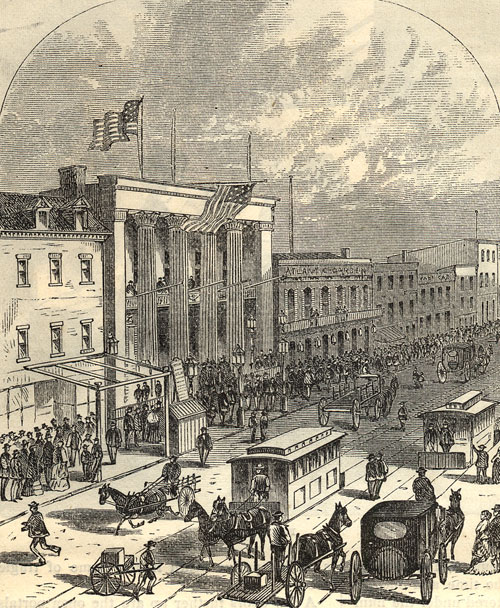
Prostitution was the Bowery’s oldest profession, drawing thousands of women and girls with often the only form of making money they could find. It was so prevalent that even the theaters there on certain nights of performances permitted prostitution in the uppermost tier of seats. “‘Public prostitution [in the theater] is not noticed by law,’ admitted one observer.” (Below is a picture of the old Bowery Theater, where such seamy occurances would happen in the top balcony.)

One had to have fallen pretty low to even enter John McGurk’s tawdry establishment, opened in 1895, in a space once used as a hotel for returning Civil War veterans. And even lower — much, much lower — to attempt to sell your body at McGurk’s. It was considered the worst and most squalid dive bar in the Bowery. “McGurk’s was nearly the lowest rung for prostitutes” according to Luc Sante’s book Low Life. It would not be surprising then to find that those that found themselves draped within the doorways of such a wretched place would be prime candidates for depression and suicide.

The bar became the destination of a great number of suicides, either from carbolic acid or a leap from its fifth story. According to Forgotton NY, six girls killed themselves in 1899. Most were teenagers who believed they had few options in life; I can painfully imagine a few experiencing something particularly rancorous at McGurk’s and taking a improvised leap in grief and horror.

McGurk, turning lemons into a morbid lemonade, actually renamed his place ‘Suicide Hall’ as a marketing ploy. And the reputation of the dive did draw its share of curiousity seekers, often from the upper class after a night at the theatre, looking for a bit of macabre excitement.

McGurk eventually closed the Suicide Hall and moved to California. The building saw nothing but flophouses and ruin for the most part of the 20th century until an artist couple took over and turned into a workspace. They were in turn forced out by the power of gentrification; it has now been transformed into the sleek glass condominium Avalon Bowery Place. 

The resident of the building at the time of demolition, sculptor Kate Millet, sums it up nicely: “If McGurk’s is turned to dust and supplanted with blank high rise market housing, official power will have buried its past in order to expunge it. Then it will be as if it never happened. No one will ever have to notice these deaths, mysterious folk reason that this building has stubbornly remained notorious for a hundred years, a landmark of gossip and legend repeated in every nook about the city of New York, an eerie and appalling specter never dealt with, formally and publicly never acknowledged.”

Well, they certainly tried to warn the Avalon people. If people start seeing the ghosts of women plummeting to their deaths, don’t blame us.

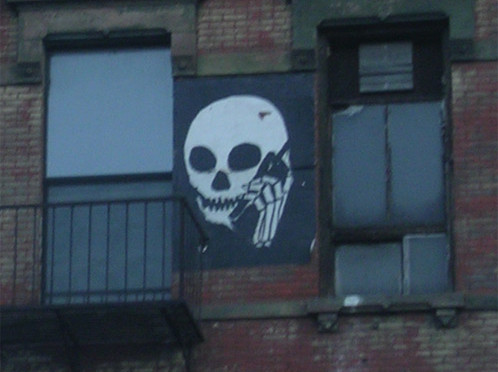
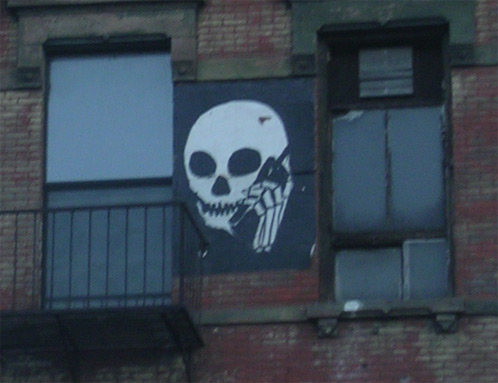
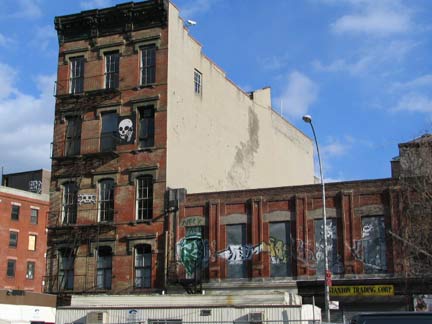
Below: what the building looked like in its final days (the skull is a nice touch).

Site photographs courtesy of Global Graphica.

FRIDAY NIGHT FEVER: Paradise Garage


To get you in the mood for the weekend, every Friday we’ll be celebrating ‘FRIDAY NIGHT FEVER’, featuring an old New York nightlife haunt, from the dance halls of 19th Century Bowery, to the massive warehouse spaces of the mid-90s. Past entries can be found here .

There are few nightclubs in the modern history of New York City that have as much good will attached to them than the Paradise Garage. While other clubs burn out or die, the “Garage” as it came to be referred is spoken about in reverent terms, almost as if it’s still open. The reason is simple — for better or for worse, it’s the birth of the modern nightclub.

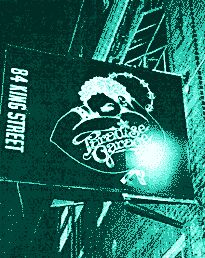
Born from a parking garage on 84 King Street, south of SoHo, in an area still festooned with warehouses, the Garage formed out of the early attempts of a disco called the Chameleon. Owner Michael Brody spent months retooling it as a vast heavenly warehouse and would often host ‘construction parties’ to generate buzz. By the opening on February 17, 1978, he was ready to greet the city.

Unfortunately, so was a devastating blizzard. The sound system was in boxes stranded at the airport while hundreds of partiers were outside, stranded in the snow. It could have been over before it began.

If not for the master of ceremonies — Larry Levan. The Garage was front and center about the music, and Levan, who has since become the patron saint of deejays, was the one who put it there. His music style would smoothly transport disco into the ’80s, and in the process helping popularize a new style of dance music called house — electronic infusions into soul, funk and disco. In fact, ‘garage music’ is a specific type of house, giving what would become house a raw, ‘big room’ urban quality. And named, of course, after the Paradise Garage.

The seeds of the Paradise Garage philosophy were planted in the mid 70s with roving parties under the banner called The Loft. Before then, New York nightclubs still had a primary focus, held over from the ’50s and ’60s, of being social gathering places, where people — often famous people — met other people, lubricated by booze. The music itself was often wallpaper.

The Garage essentially refocused the nightclub experience from meeting places to houses of music worship. The club served no liquor and, mostly notably, was a dancefloor for regular people in an era where locales were eagerly trying to attract celebrities and press. It was also ‘members only’, which served not to create an elitist exclusivity, but rather to ensure that every there was ‘all about the music’.

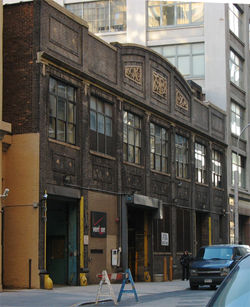
It’s no surprise that the Garage had a superb sound system, reputedly the best in New York, created by Levan and Richard Long to make the new sounds of house literally rumble underfoot, not to mention those murals on the walls by Keith Haring. Not to be outdone, the dazzling strobe and effects were courtesy of almost 730 lighting features, grown from just a dozen or so from the first days of the club.

According to A Garage Tribute, a heartfelt recollection site : “thunderous audio would burst through your heart like a bolt of lighting. . . the warm base vibration would lift you from the floor suspending you weightless, your heart would race and senses would tingle.” Its design has literally influenced every major dance club in the world, from New York to Europe and beyond.

Notably, the Garage clientele was black and Latino, mostly gay, in stark contrast to uptown’s whiter, straighter crowd. But as the club’s reputation grew, so did the makeup of the revelers. That was reflected in the talent that would occasionally arrive on stage — Madonna, Loleatta Holloway, New Order, Phyllis Hyman and Taana Gardner (whose song ‘Heartbeat’ might be considered the ultimate Paradise Garage tune).

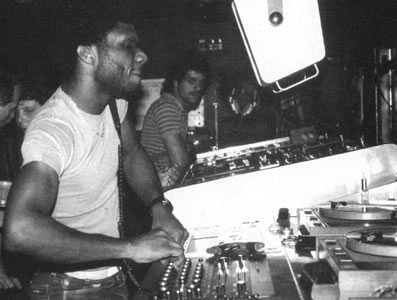
Levan would lord over the proceedings in a deejay tower high above, a sort of musical wizard. According to Disco Disco, Steve Rubell of Studio 54 even attempted to lure Levan away from Garage. Larry’s response: “They’re not ready for me yet.”

A familiar enemy ended the Garage September 1987 — high rent and gentrification. Levan himself died in 1992, having literally partied himself out, according to In Da Mix Worldwide. A beautiful look into the Garage years can be found on CD — “Journey into Paradise: The Larry Levan Story“, a highly infectious time-capsule of some of the Garage’s greatest hits.

Categories
Uncategorized

FRIDAY NIGHT FEVER: Bond International Casino


To get you in the mood for the weekend, every Friday we’ll be celebrating ‘FRIDAY NIGHT FEVER’, featuring an old New York nightlife haunt, from the dance halls of 19th Century Bowery, to the massive warehouse spaces of the mid-90s. Past entries can be found here .

Bond International Casino — save for fifteen days back in 1981 — should not really be considered a “legendary” New York nightclub, by any means. But the space it occupies has a fascinating lineage, and as for those fifteen days, well…can any other nightclub in New York claim to have started what is called the ‘Times Square Riot of 1981‘?

The room was christened in the 1930s as the International Casino (the Bond would come in a bit), not a casino at all, but a swanky dinner club and cabaret that could cater up to 1,500 socialites, sipping on champagne while watching exotic shows featuring “novelties from five continents and the beauties of ten countries” on a motorized stage. Ads in 1936 proclaimed: `a Hollywood dream in theatre restaurants.’ Elaborate musical revue at 7.30 and 11.30 P.M. Minimum charge $2.50 — Saturdays $3.50.”

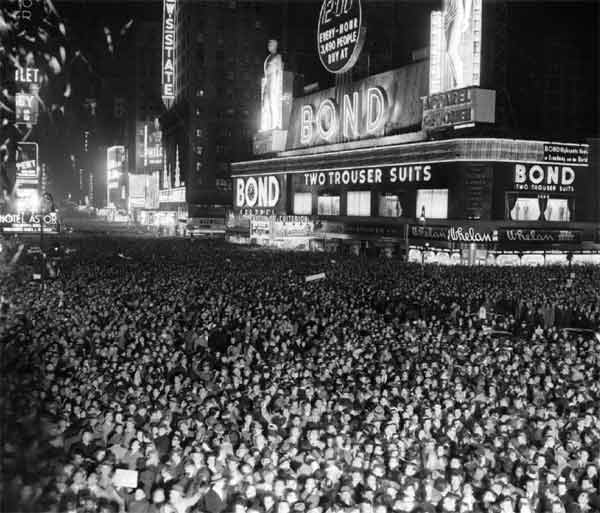
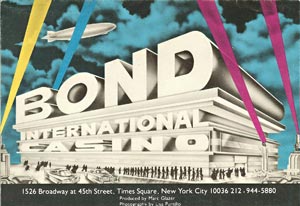
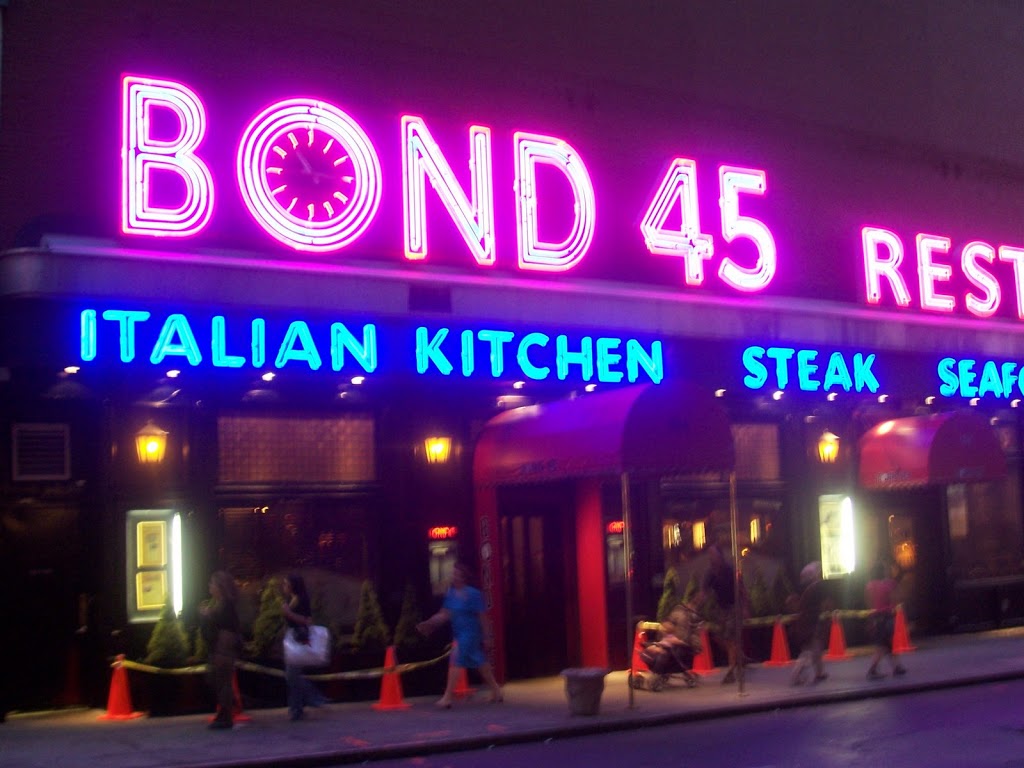
Such luxuriance was not to last, but the dazzle remained, from a most unlikely vector — men’s clothing. Bond Clothes took over the location as a men’s clothing emporium, and chose a flashy facade to match the rooms of garments inside. A huge neon sign held a clock in the O of BOND, alongside a 50-foot man and woman, an electronic waterfall and a news roll zipped along the front — all drenched in electric lights! It all looked especially dazzling at night, as the New York’s Eve ball drop pictures proves below:

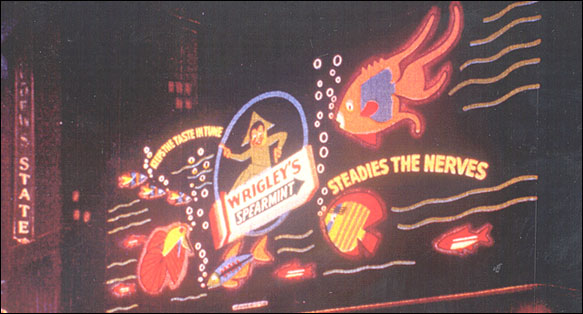
The elaborate sign gave way to a sponsor with bigger trouser pockets — Pepsi — placing gigantic soda bottles where the people once stood. Later the space was given over to a garish yet strangely hypnotic advertisement by Wrigley’s Gum:

The clothing store itself lasted until 1977. Sitting vacant for a couple years — at the true nadir of Times Square, the grit and garishness of 42nd street spilling over — it was finally reopened under a new name, incorporating both its prior incarnations. The ‘International Casino’ returned, the ‘Bond’ sign stayed, and Times Square had its own rock club.

This new incarnation Bond International Casino had interiors, at 9,000 square feet, as theatrical as those in the past. The staircase from the entry level to the dance floor glowed as you stepped on them and played musical notes, not unlike, I suppose, the gigantic piano in the movie Big. The dancefloor, one of the city’s biggest (much bigger than even Studio 54), was overseen by sumptuous on-stage water fountains and inflatable people who hovered above and would fill and deflate to the music.

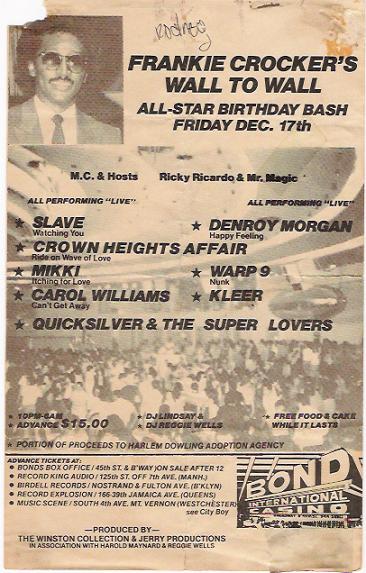
Cream Magazine called it “a shopping mall with bars and a dance floor… and telephone in the men’s room.” Here’s one of their flyers:


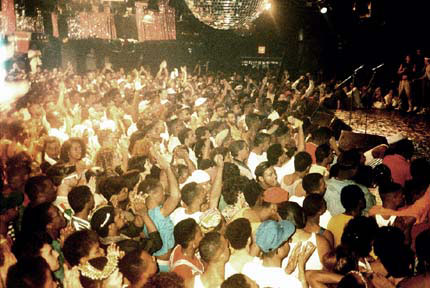
In this ad, you can get a sense of what the dance floor must have been like inside:

Over the course of its brief foray as a rock venue, Bond would see the likes of Blue Oyster Cult, the Plasmatics, the Dead Kennedys and Blondie. Always a slave to disco on regular nights, however, it would eventually give way to full-time usage as an early ’80s dance floor. But not before it saw The Clash.

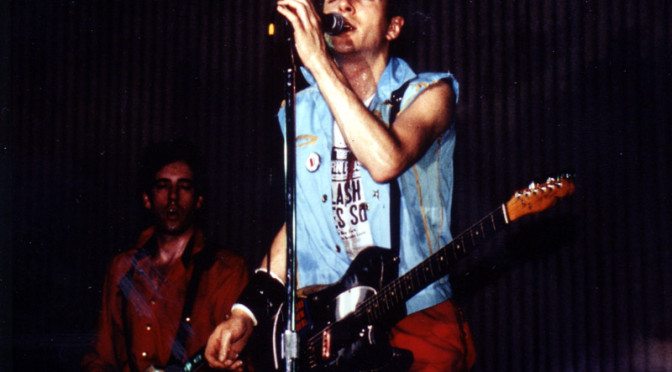
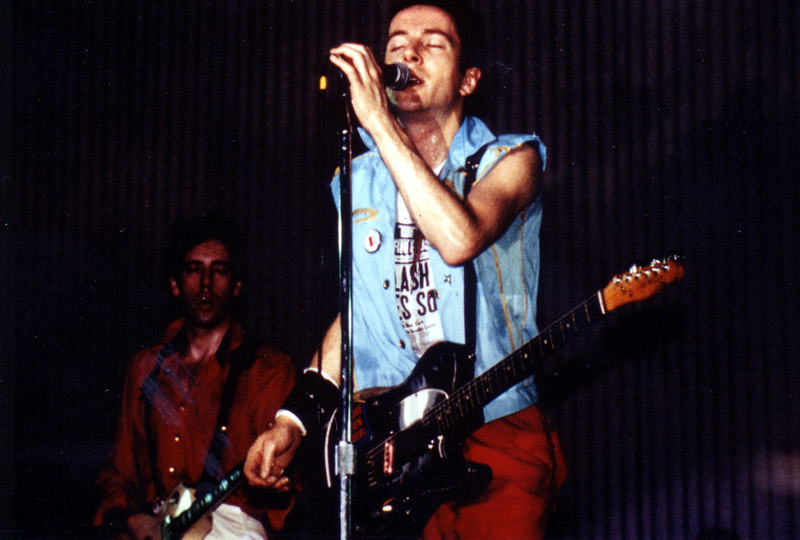
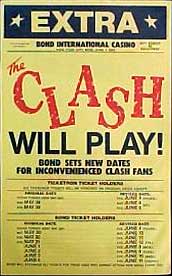
The hot punk group, who had just released one of rock music’s most important records (London Calling) in January 1980, were back in New York to do a series of shows at Bond in May of 1981. Originally they were supposed to play eight nights. The promoters however dangerously oversold the show — 3,500 tickets each night for a venue that could only hold about half that! 


Angry ticket holders rioted outside, filling the streets of Times Square, stopping traffic and drawing dozens of police officers to quell the rage. One website (with lots more information and more history on Bond and ‘the Clash riot’) claims Times Square “hadn’t seen that much commotion since … V-J Day.” The story made international news the next day.

Cream says, “There’s confusion over the numbers game, and inside it’s a sardine sauna. Fire marshalls count 3600 heads leaving the club in what has been a testy evening. Support acts suffered, being booed and hissed by the diehard fans impatient for the arrival of their heroes.”

To assuage the angry ticket holders, The Clash took the unprecedented step of extending their stay at Bond to seventeen shows over fifteen days, to cater to all those ticket holders who were not able to get in. Perhaps stress and the threat of violence and fire brought out the best in the group; the performances are supposedly their best ever, and a bootleg of one of the shows “Live at Bond’s Casino” is considered the finest ‘unofficial’ release in the band’s history. (All seventeen performances are available as bootlegs.)

For those polite enough and lucky (or unlucky? I can’t imagine how unpleasant and scary that club must have been) to have paid attention to the first show, they would have also caught opening act Grandmaster Flash and the Furious Five, the godfathers of rap music. Somebody actually booed them?

Ironically, Bond couldn’t fill the club on any of their other nights, being a discotheque trying to survive in the Reagan ‘disco is dead’ era. In the ’90s, the space was taken over by the Roundabout Theatre Company, who for several years brought some excellent shows into the space. 

It had two stages of different sizes, one classified a Broadway stage, the other off-Broadway. I saw a lot of great shows here back in the day, including Martin Short in ‘Little Me’ and an excellent revival of ‘1776’, starring Star Trek: Next Generation star Brent Spiner as John Adams. After several years, the Roundabout moved their stages to another former disco — Studio 54 — and another location on 42nd Street, the American Airlines Theatre.

Bond has a happy ending however. The space has reopened as Bond 45 restaurant and lounge, recreating the classic sign with some adjustments, and pomping up the front to resemble its ’30s glamour days. Of course, it sits between a Starbucks and a Swatch store, but you can run to the Virgin Megastore literally across the street and pick up some Clash CDs and memorabilia and start your own riot today. (45th Street, between 6th and 7th avenues)


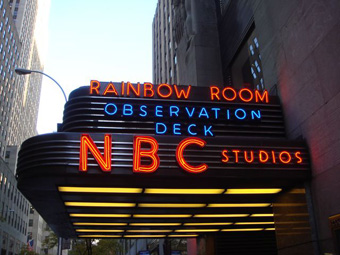
FRIDAY NIGHT FEVER: The Rainbow Room


To get you in the mood for the weekend, every Friday we’ll be celebrating ‘FRIDAY NIGHT FEVER’, featuring an old New York nightlife haunt, from the dance halls of 19th Century Bowery, to the massive warehouse spaces of the mid-90s. Past entries can be found here .

For a change, I thought I’d feature a place that is actually, you know, still open. Although it’s pricey enough that most of us won’t see it much in our lifetimes.

The Rainbow Room offers quite a stark contrast to the Apollo Theater. The Room opened in the same year (1934) as the Apollo opened its doors to black audiences for the first time. Both elicit images of heavenly bodies. Its similarities naturally end there.

Where the Apollo rose from the site of a sleazy burlesque joint, the Rainbow Room was literally the crown on J.D. Rockefeller Jr.’s newly built palace to commercial welfare, Rockefeller Center. Rockefeller, a clean, moral gentleman who preferred warm milk to champagne, was virtually forced to open the place due to social pressures. Rooftop nightclubs were sprouting up all over the city — and in all the society pages — and Rockefeller simply had to have best of everything. 

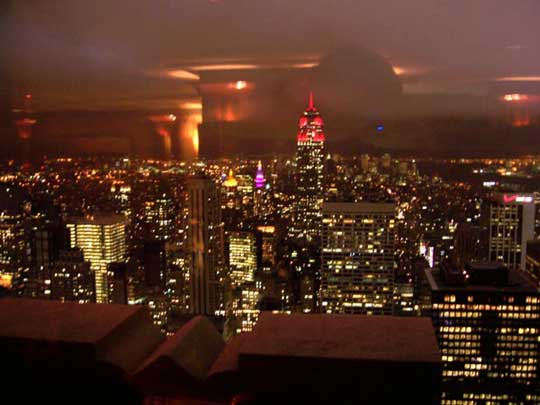
And thus the man who supported Prohibition opened in Oct 3, 1934 what would become the acme of champagne New York life. And all of it, sixty-five floors above the city, atop what was then the RCA Building.

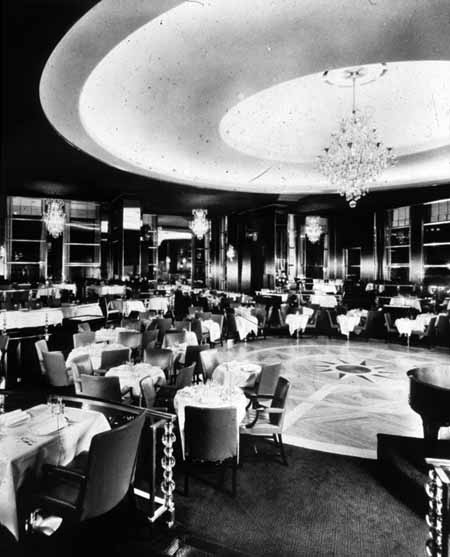
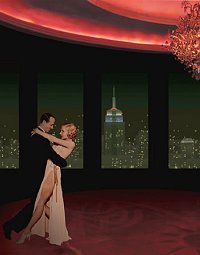
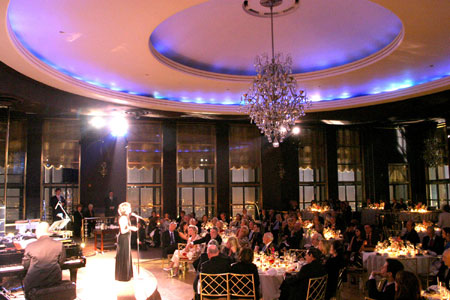
Its design by Elena Bachman Schmidt, with her assistant Vincent Minnelli (yes, Liza’s dad), encapsulated Art Deco luxury while never overshadowing either the clientele or those two-story windows. In fact, faceted mirrors near the bar created an illusion that that gorgeous skyline outside was literally seeping into the room. Perhaps it was, striking a waltz on that impressive dance floor that would have made John Travolta salivate — a slowly rotating plate glowing with dazzling colors that changed moodily to the music.

However it was the well-coiffed and tuxedoed birds atop the floor that gave the Room its polish. The Rainbow Room was strictly high society; for a time, it was ‘white tie’ only, until that was relaxed to ‘merely’ regular tuxedo styles. Its opening night was, as one journalist proclaimed, filled with “five or six hundred of New York’s Four Hundred.” It was considered the ‘upper crust’ of nightclubs, and eventually the well-dressed society families were joined by America’s unofficial royals — Broadway and movie stars. Jean Harlow, Cole Porter, Douglas Fairbanks Jr, Noel Coward, Bette Davis, Laurence Olivier. The hoity-toity club was no match for Marlene Dietrich, who wanted the band to stop playing waltzes and give her a tango. And they obliged.

(It should be noted, just to keep the Apollo in the back of your mind, that at least for a few years, it was not only ‘white tie’, it was strictly, entirely white. Blacks were neither admitted nor even allowed to perform. Contrast this to last week’s Friday Night Fever feature, Cafe Society, which was in a basement, sure, but whose integrated politics ensured truly world class entertainment.)

The Rainbow Grill soon opened down the hall. A more ‘informal’ place — still out of the price range of most New Yorkers — the Grill was considered a junior edition and attracted the college-age trust-funders.

When they weren’t dancing, patrons of the The Rainbow Room dined to the entertainments of a variety of acts, from the hi-lites of the big band era, to a mixture of almost carnival like acts — trained horses, ping pong champions, magicians, palm readers. In fact, Edgar Bergen and his wooden puppet Charlie McCarthy became national celebrities stemming from just a few performances there.

The Room has seen a couple renovations and a downgrade to ‘mere’ suit and tie. And the era of high-society nightclubbing itself has transformed into a more Paris Hilton-like debauchery. But it still holds its charms — as long as you’re dressed correctly — primarily because of that gorgeous view. Have a couple glasses of champagne, gaze out at New York’s perfect skyline, and you can’t help but feel romantic.

I should add here that down the hall there used to be a fantastic cabaret room called ‘Rainbow and Stars’ where out of sheer luck (and a regular columnist position as a theater writer, back when I could only afford mac-and-cheese for dinner) I had the privilege to go to write reviews. Imagine that beautiful New York backdrop, in a more intimate setting, with only the world’s best cabaret performers plopped in front, singing their hearts out.

 I wore the same (the only) suit jacket each time, I had to scrape up coins just to buy a martini or two. But for a couple hours, like the time I got to watch Rosemary Clooney, I could pretend to understand what it was like to be fabulous and Rockerfellian.

(I gleaned a few facts for this article from the excellent, excellent book Great Fortune by Daniel Okrent, about the building of Rockefeller Center. I love this book so much that I’m actually posting its link at Amazon.)

FRIDAY NIGHT FEVER: Geoghegan’s / Steve Brodie’s Saloon


To get you in the mood for the weekend, every Friday we’ll be celebrating ‘FRIDAY NIGHT FEVER’, featuring an old New York nightlife haunt, from the dance halls of 19th Century Bowery, to the massive warehouse spaces of the mid-90s. Past entries can be found here .

We’re going way, way, way back, to New York’s seediest, filthiest and most notorious place — the Bowery in the late 19th century.

The nightlife of the old Bowery could be an entire blog in itself. It has been witness to some of the most rowdy, shameless and debauched New Yorkers who have ever lived. They filled up dives and flophouses, brothels and saloons, catered to the poorest of immigrants and the richest of the upper class ‘slumming it’ for a real idea of fun unimagined in the drawing rooms of the elite.

The two saloons from the late 19th century featured here weren’t extraordinary places as we would consider today — they would both fit comfortably in the 20th century sin-den the Limelight — but they were run by extraordinary people, ‘heroes’ of the Bowery brawler set.

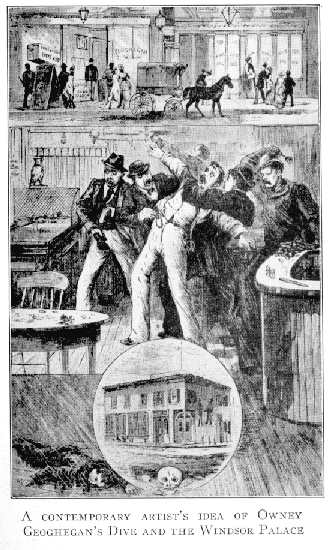
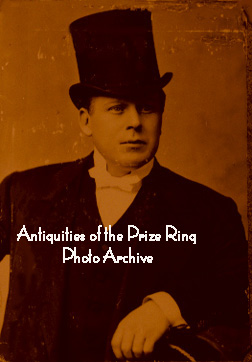
Geoghegan’s at 105 Bowery has been described as “a rendezvous for professional mendicants.” Often called the Bastille of the Bowery, it didn’t just spawn a few fisticuffs; it catered to them. Because this two floor booserie featured two boxing rings, and one of the men in the ring was often the bar’s owner.

Owney Geoghegan held the boxing distinction of Lightweight Champion of America from 1861 to 1964, when he retired to open his tavern/fight palace in the Bowery. His reputation naturally drew the crowds, and Geoghegan encouraged his patrons on to a little pugilism with the help of ample ales and whiskey. In 1891 the ‘Bastille’ even hosted a few rather fierce bouts of women’s wrestling, with the competitors required to cut their hair (to prevent pulling) and costume themselves wearing only tights.

Such a swarthy establishment was bound to attract the lowest elements and the most sinful gangs of New York. One journalist at the time describes it: “The faces around us are worse than those seen in a bench show of pugnacious dogs, and instinct teaches us to have a care for our nickels, for our pockets are in imminent danger.”

But perhaps the person the clientele should have feared the most was Geoghegan himself. A short but powerful Irish man, Geoghegan was known for his impressive, compact strength. And his penchant to cheat when needed. 

Geoghegan was in the ring one night against Viro Small, a very popular black wrestler. Geoghegan was still in his prime but it was clear he was being bested in the ring by Small. The drunken crowd catcalling him, and he knew he couldn’t lose in his own establishment. So he had one of his henchman hold a gun to the referee’s head and call the match for Geoghegan!

(Small didn’t hold a grudge. He later wrestled there again, with a man named Billy McCallum who afterwards tried to murder him.)

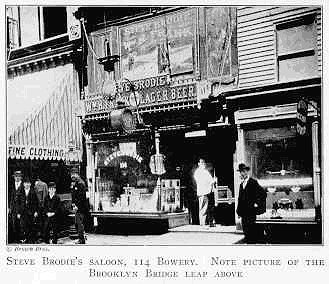
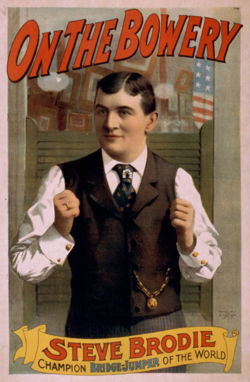
As Geoghegan flexed his strength to his barflys, another Bowery saloon owner was busy displaying his gifts of agility. In 1886 Steve Brodie, on a bet, jumped off the Brooklyn Bridge, the bridge being only about three years old at the time. What was amazing was not the amount of stupidity that took, but the fact that he survived and claimed his $100 bet money.

His feat was celebrated at the time and from the fame of this simple act, he was able to open Steve Brodie’s Saloon, 114 Bowery, at Bowery and Grand Street (a couple doors down from Geoghegan’s place).

If Geoghegan’s dive was a celebration of his profession, Brodie’s was a celebration of his own personality. Behind the bar was an elaborate oil painting depicting Brodie bravely hurling off the bridge, along with a signed affidavit from the boat captain who fished him out of the water. The floor of the bar was inlaid with silver dollars to give it that wealthy feeling that money had been hurled to the floor.

For the cost of a drink, Brodie would gladly recount his tale. As silly as it seems today, he was able to pack in patrons, perhaps many from Geoghegan’s place, still drunk on booze and bloodletting.

Somehow he managed to turn his feat into a touring autobiographical performance entitled ‘On The Bowery’. Eventually he tried to top his feat with a plunge down Niagara Falls in 1889. (It could never be proven that he actually went ahead with it!) He settled in Buffalo and opened another saloon there, but the enigma of his fame apparently didn’t carry that far. He moved to San Antonio and died at age 38.

Owney Geoghegan had a similar short-lived fate. He lapsed into a severe depression at the death of his father and, traveling to Hot Springs, Ark., to try cure himself of his pain, actually died there, age 45.

As his obituary in the New York Times said: “There is mourning in the Bowery, sorrow on Houston and Bleecker streets, and desolation in the dance halls of the slums….. His career as a prize fighter, ward heeler and dive keeper was that of the typical New York rough, and is only interesting as it illustrates a phase of life little known to respectable people.”

Heirs to the vice of modern nightlife, take note.

[Two main pictures are provided by this site, which has some juicy info about the Bowery.]

FRIDAY NIGHT FEVER: Jackie 60


To get you in the mood for the weekend, every Friday we’ll be celebrating ‘FRIDAY NIGHT FEVER’, featuring an old New York nightlife haunt, from the dance halls of 19th Century Bowery, to the massive warehouse spaces of the mid-90s. Past entries can be found here

I was reading Vanishing New York’s piece yesterday on the absurd descent of condos and high fashion culture onto the Meatpacking District, into an area that still, well, processes meat. And it got me thinking of the days when that area was a lot less burdened with designer clothing stores. The days when its aesthetic was dictated not by fashionistas and the upwardly mobile, but by burly leathermen and transsexual prostitutes.

In the ’80s and ’90s, Meatpacking was host to some truly ‘alternative’ nightclubbing options. For the gay leather set, you had The Lure (featured in the controversial 80s Al Pacino flick Cruising), while straight folks with debauched inclinations had the Hellfire Club. The still operating Hogs & Heifers, with its mountain of discarded bras, made the East Village’s Coyote Ugly seem like a classic three-star restaurant. (Hogs has since lapsed into a camp tourist destination.)

But lording over the region was the dark and quirky Mother, a small, caverned club that found its niche as a freakshow outside the universe of the ’90s mega-clubs. And no evening at Mother quite resonated throughout the city as Jackie 60, the Tuesday night party of kooks and costume.

What set it apart from the mega-clubs was its unique sense of creativity and inclusiveness. In fact, its creators Chi Ci Valenti and Johnny Dynell specifically designed it to emulate the fertile spirit of late ’70s places like the Mudd Club (featured in our very first Friday Night Fever article).

According to Chi Chi, “We decided to create a place in the spirit of those smaller clubs. And when someone who used to go to a place like the Mudd Club walks in to Jackie and says, “This feels like those days,” well, that’s when I feel like we’ve really done our job.”

The two met at the Mudd Club and soon created a party together that took some of the neighborhood ideas (remote locale, S&M and sexual imagery) and combined it with striking costumes and themes, incorporating punk, drag and theater. They soon added British fashion designer Kitty Boots and choreographer Richard Move to the mix, and the flamboyant stage was set.

Unlike the spirit of exclusivity that possessed the monster doormen at big clubs, Jackie 60 drew a wide range of people, the only criteria being a flair for the dramatic — and the guts and confidence to exhibit it. As Dynell describes it, “For example, you never know what somebody is here. They could be anything. They could be straight. They could be straight to bed. At Jackie we have an expression: For every cup there is a saucer.”

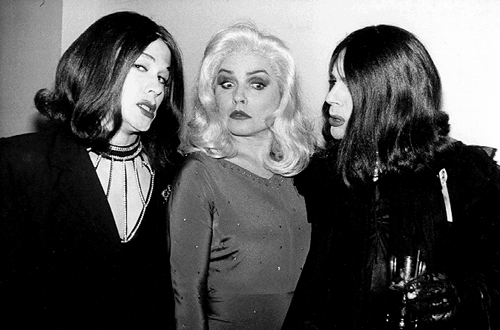
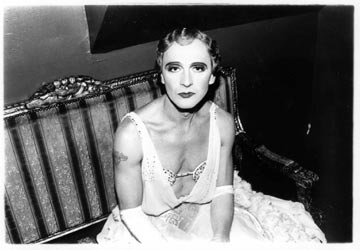
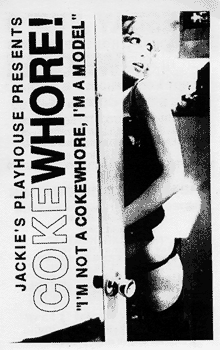
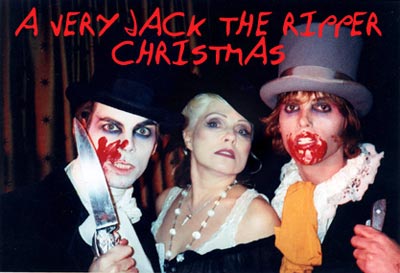
Frequent special guest Deborah Harry (seen in the pic at the top and below) being the exception, celebrities like Mick Jagger, Marc Jacobs, Jack Nicholson, and Robert Deniro came through and were barely noticed. How could you be noticed?

Along with a ‘classic dress code’ (attire within reason, basically), Jackie 60 frequently had an inspired weekly dress code. For example, on Bleak House night (yes, as in Charles Dickens) one must wear ‘Vivienne Westwood urchin-look’ with ‘gruel bowls and utensils’. You can just imagine what Klingon Women Night (an actual theme night) must have looked like.

The regular clientele came attired often in the theme of the evening — Rimbaud night, Hasidic hip-hop, Hooker’s Ball, even supermodel disasters night.

Jackie 60 even had a monthly poetry reading at midnight, with verse delivered from the most painted of lips. Satellite Jackie events included theatrical productions (with one written by Michael Musto) and spinoff parties (Click + Drag, a cyber themed soiree in the days before iPods).


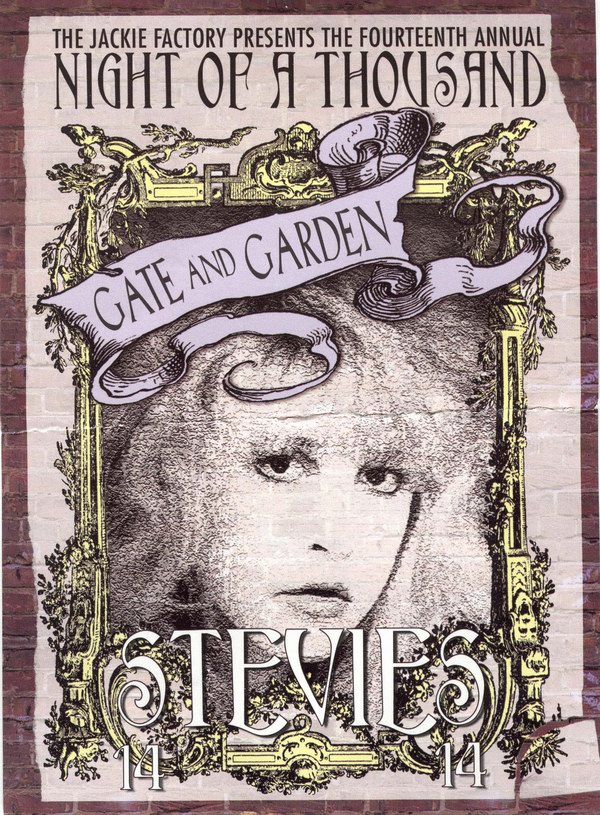
But what was easily their most celebrated event was the Night of a Thousand Stevies, a yearly gathering where hundreds of Stevie Nicks fans from around the country descended on that little hole in the Meatpacking District to worship their favorite songstress. Men and women, young and old, beautiful and not-so, for one night each year, the cobblestone streets were filled with swirling shawls and tambourines.

Jackie 60 closed on the last Tuesday of the 20th century, but the Night of a Thousand Stevies parties live on every May, as do other events in the Jackie 60 brand. In these days of nightlife homogeny, the kids at Jackie 60 just look better with age.

A loving tribute with tons of photos can be found here, or visit their official tribute site and one from Mother.

FRIDAY NIGHT FEVER: The Electric Circus


To get you in the mood for the weekend, every Friday we’ll be celebrating ‘FRIDAY NIGHT FEVER’, featuring an old New York nightlife haunt, from the dance halls of 19th Century Bowery, to the massive warehouse spaces of the mid-90s. Past entries can be found here

No Chipotle burrito and taco restaurant has ever made me as sad as the one that sits on St Marks Place. I can’t be overdramatic and say that every instance of gentrification is a bad one, but this particular case, standing next door to a gourmet grocery store, is a bit more notable than most.

For it stands in the place a former clubhouse and dance hall built all the way back in the 1830s but reached its culture preeminence just over 40 years ago.

The building’s backstory sets a juicy notoriety for its later events, as it was a rowdy 19th century meeting place for political and ethnic dissents, throwing yearly carnivals in the street (often mocking the political giant of the day, such as Boss Tweed) and sparking at least one bloody gunfight in 1914 between rival Italian and Jewish gangs!

It sat through some of the 20th century as the Polish National Home (Polski Dom Narodowy), a community hall and restaurant for Polish New Yorkers (whose influences can still be seen all around this area of the East Village). At a certain point in the 1960s, part of the space was opened as a small bar by Stanley Tolkin, whose watering hole Stanley’s Bar at 13th and Ave B was already a huge magnet for the bohemian set.


The bar at St. Marks Place attracted the same crowd and, now being 1966, eventually drew the interest of Andy Warhol who, with his film-making collaborator Paul Morrissey, rented the upper rooms from Tolkin, fancied the original Polish name (Andy was of Polish descent) and its new moniker “the Dom,” moved in on April 1966 for a series of legendary events he would collectively called “the Exploding Plastic Inevitable.”

It became the East Village fuse box for Warhol’s talents and those of his entourage, in particular the Velvet Underground and Nico. The dazzling synthesis of psychedelica and glamour, of the Velvet’s strange atmospheric music and Warhol’s performance displays of lights and costumes, immediately attracted the scenesters to this odd little street — according to the New York Times, “everyone from hippies to Tom Wolfe and George Plimpton” — way before St. Marks would make its reputation in the 1970s with the punk scene.

Warhol moved on, and the name would change for a short time to the Balloon Farm. The next year it was sold to Jerry Brandt, who decided to take the avant garde (but rather elitist) Warholian approach and mainstream it into the Electric Circus. The new incarnation helped  define the wild visual and colorful aesthetic of the hippie 60s, a virtual overload of light machines and live music. Sometimes it took its name seriously:

“A young man with the moon and stars painted on his back soars overhead on a
silver trapeze, and a ring juggler manipulates colored hoops and shaggy hippies
who unconcernedly perform a pagan tribal dance…Stoboscopic lights flicker over
the dancers, breaking up their movements into a jerky parody of an old-time
Chaplin movie.”

— Radical Rags: Fashions of the Sixties (New York:
Abbeville Press, 1990)

And while audiences pulsated to the swirling lights, in the throes of LSD, bands would materialize onstage, often in long jam sessions. It should be no surprise to find out that early incarnations of the Grateful Dead and the Blue Oyster Cult got their start here.

Much as the psychedelic revolution itself died out once the next decade started, so too did the Electric Circus. In March 1970, a bomb exploded on the dance floor (!) injuring 17 people, which couldn’t have done much for its waning popularity.

It was eventually turned into a church-run craft center and a community center for substance abusers and the homeless through the 80s and into the 90s. As gentrification swept through the East Village, most of St. Marks remained intact; you can still find rows of punk tee-shirt shops, tattoo and piercing parlors, St. Marks Comics and Kim’s Video.

What you can’t find is the remnants of the Electric Circus. The building is now the aforementioned Chipotle and a grocery store. And in one corner — in a move that is either a throwback to its old days or the biggest slap in the face in the world — is a gift store that sells branded products from CBGB’s, another legendary East Village rock club that has since been closed.

Here’s what it looked like when I first moved to the city:

(I apologize, I have a few links to post where I got some of my information, but I can’t do it from this computer. However some information was obtained at the excellent New York blog: http://streetsyoucrossed.blogspot.com. I’ll post the links when I get back on Monday. Have a great weekend!!)

FRIDAY NIGHT FEVER: The 300 Club


To get you in the mood for the weekend, every Friday we’ll be celebrating ‘FRIDAY NIGHT FEVER’, featuring an old New York nightlife haunt, from the dance halls of 19th Century Bowery, to the massive warehouse spaces of the mid-90s. Past entries can be found here

We’re reaching way back for this week’s entry, to the heyday of New York nightlife, the 1920s, when prohibition hardly prohibited anything. The underground speakeasy The 300 Club at 151 W. 54th Street was one of the most successful, despite being raided many, many times, and all because of one scrappy, lovable dame. 

Ladies and gents, I give you New York’s reigning queen of nightlife, Ms. Mary Louise Cecilia — but the boys call her  “Texas” Guinan.

Born in Waco in 1884 to Irish immigrants, she coined her nickname on the youth rodeo circuit, then ran off to New York for a short stint in vaudeville. Her cornfed, bawdy charms caught the eye of a movie scout who rustled her to Hollywood, where she became the silent era’s first movie cowgirl, starring in a string of corny Westerns — The Girl Sherriff, The White Squaw, The School M’arm, Little Miss Deputy.

But New York lured her back, where saloon owner Larry Fay (his speakeasy El Fey Club was on West 47th) convinced her to crack open her own establishment. And the 300 Club* was born.

The bar practically bristled with Guinan’s outsized personality. Its relatively small size worked in its advantage, especially as 40 fan dancers flew from the wings and had to basically dance in the aisles, to the delight of those tippling the bar’s illegal sauce.

Texas was always around greeting customers with her signature slogans, “Hello, Suckers! Come on in and leave your wallet on the bar!” and “Give the little ladies a great big hand!”

It wasn’t just the underbelly of New York captivated by Texas’ charms. The toast of the town often popped by to ogle at her dancing beauties, including Rudolph Valentino, Gloria Swanson and Pola Negri. Young composer George Gershwin would sometimes leap to the piano and pound out a ragtime. She also took a young Walter Winschel under her wing, a man who would later become the most influential gossip columnist of the 1930s and 40s.

With all that attention, it’s no surprise the club was perpetually raided. Guinan never once admitted she sold liquor, claiming her hundreds of customers had brought it in with them. According to one adoring fan site:

“Legend has it that the joint was raided one night when the Prince of Wales was there. She popped an apron on him and hid him in the kitchen, washing dishes.”

After a few weeks she would reopen, and the party would begin again. Occasionally, she would have to move to different locations, and reopen under different names (Salon Royale, Club Intime, the Argonaut), but she always returned W. 54th Street, where the legends of the jazz age were bred.

It ended a little too soon for Texas. The Great Depression rolled over her good fortunes, and she attempted to take her show on the road, touring the United States. (She even attempted to take it to Europe and was denied a permit to perform in France due to Texas’ notorious reputation.) While in Vancouver, she contracted dysentery and died in Nov 5, 1933, age 49.

The tales of her midtown speakeasys have helped to shape our entire perception of New York in the 20s, with its excess and abandon. Guinan herself lived on as an primary influence to Mae West. In fact Guinan was actually considered for West’s debut role in the film Night After Night in 1932.

(By the way, today is Mae West’s birthday.)

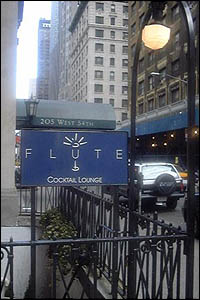
You can still have a drink at Guinan’s speakeasy Club Intime; the space where she once entertained New York’s greatest is now the champagne bar Flute . The location of the 300 Club has been turned into The London luxury hotel.

She literally was the end of an era; the day after she died, the US government repealed prohibition.

Texas Guinan lives on in an incredibly exhaustive blog in her honor and in reruns of Star Trek: the Next Generation (Whoopi Goldberg’s bartender character is named after her). Who knows what mayhem Texas would be getting herself into if she were alive today.

*I admit I couldnt find anything on why it was called the 300 Club, however it could be because when customers would ask her how many films she had made in Hollywood, she always answered, “About 300 of ’em.” Even though it was more like a couple dozen.

FRIDAY NIGHT FEVER: The Limelight


To get you in the mood for the weekend, every Friday we’ll be celebrating ‘FRIDAY NIGHT FEVER’, featuring an old New York nightlife haunt, from the dance halls of 19th Century Bowery, to the massive warehouse spaces of the mid-90s. Past entries can be found here

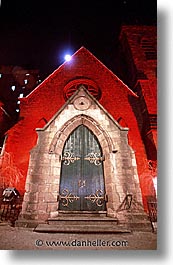
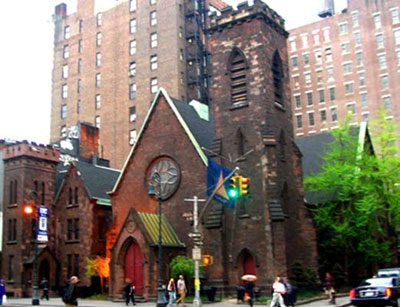
Holy Communion Episcopal Church was never meant to be the gateway to Hell. This lush Gothic style was designed in 1846 by Richard Upjohn, one of early America’s great architects and creator of downtown’s Trinity Church.

Perhaps Upjohn could foresee the church’s future tilting towards the bizarre, as it’s the first asymmetrical Gothic church in America. Think of all the uniform symmetry in most churches over 150 years old, and you’ll appreciate its uniqueness.

In its prime, the toast of New York filled its pews, including Cornelius Vanderbilt, John Jacob Astor and Jay Gould. A shadow of its altruistic days can still be seen hovering over St Luke’s Hospital (now St. Luke’s-Roosevelt Hospital Center), which the congregation helped found. To tie this into our podcast at the beginning of the week, it was in this hospital that John Lennon died of his wounds sustained at the Dakota Apartments.

The church fell upon hard times in the new century and was eventually sold to a drug rehabilitation center. According to a bishop at the time, there was an implicit understanding that the house of worship was always meant to help the needy. Then Peter Gatien came along, and larger ironies have never existed in New York City.

Gatien was a club owner who gobbled up nightclub spaces and transformed them into branded clubs called the Limelight — first in Hollywood, Florida, then Atlanta, and London. (He would eventually own many clubs in Manhattan, including the Tunnel, the Palladium downtown, and Club USA.) The Gothic church on 6th Ave proved too enticing — the one in London was also in a former house of worship — and soon Gatien turned the once reverent spot into a house of decadence.

Its labyrinthine hallways and stairwells spilled into ornately designed lounges and dancefloors. Old marble crypts sat next to rows of liquor bottles. The chapel became a VIP lounge. Upstairs, surrealist illustrator HR Giger, famous for his designs of the creatures from the Alien films, specially designed a dance floor.

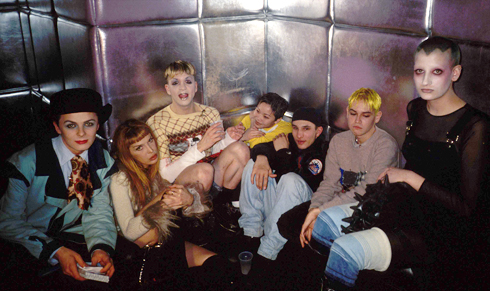
However it was its occupants that made the headlines. In the late 80s and 90s, Peter Gatien and the Limelight helped foster its own buffet of self-made celebrities, the club kid, brightly colored freakshows whose only purpose was to shock and make everybody feel smaller.

King (or queen) among them was Michael Alig, an extravagent promoter of both his club, his lifestyle and himself. A protege of another nightlife maven James St James, Alig’s wild parties at the Limelight were the stuff of urban legend.

Actual celebrities who frequented the club, like Eddie Murphy and Michael Douglas, were no match for Alig and his menagerie, which often included a few New York celebrities around today — Amanda LaPore, Richie Rich, and, most famously, Rupaul and the duo Heatherette, now legitimate fashion designers in their own right.

The avarice of the early ’90s would lead to the downfalls of the Limelight’s main characters. Alig would be charged with murdering fellow club kid Angel Melendez. Gatien was arrested on drug charges in 1996 — by then, the Limelight was a veritable candy store for ecstacy and ‘special k’ — and in 1999 for tax evasion. Alig is in prison, serving a 20-year sentence; Gatien is in Canada, presumably forever.

The Limelight itself? After a dramatic shuttering in 2001, the club was reopened under the name Avalon, and still entertains throngs craving a thumping beat and a really expensive cocktail. The club kids are gone, but ghosts remain, as do the crypts.

You can of course catch a glimpse of the decadence in the film Party Monster, about the kooky days of Alig and the Club Kids, both in documentary and Macauley Culkin-vehicle formats. Harvey Keitel also takes a visit to the club in Bad Lieutenant.

My Podcast Alley feed! {pca-a014ba383be6de5ea1047633ef48420a}

Categories
Uncategorized

FRIDAY NIGHT FEVER: 2001 Odyssey

To get you in the mood for the weekend, every Friday we’ll be celebrating ‘FRIDAY NIGHT FEVER’, featuring an old New York nightlife haunt, from the dance halls of 19th Century Bowery, to the massive warehouse spaces of the mid-90s. Past entries can be found here

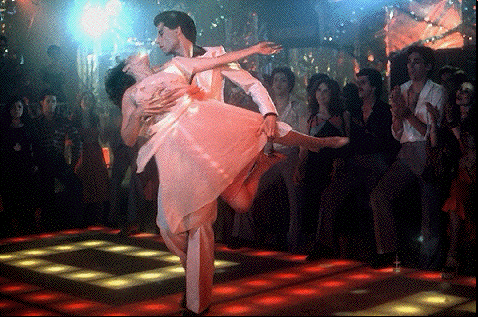
How can I continue to do this series without featuring the most iconic dance floor of all-time, the primary-colored, flashing plastic spectacle from 2001 Odyssey, best known as the dance club from “Saturday Night Fever”?

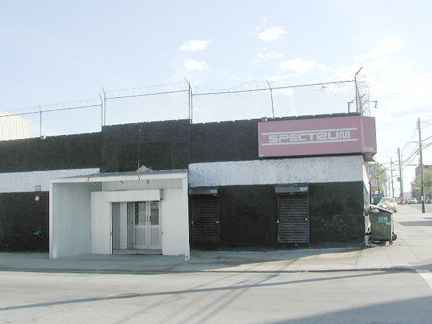
Recently minted drag queen John Travolta once took his iconic swagger to this club, formerly at 802 64th Street, Bay Ridge, Brooklyn.

That sparkly floor was actually built for the movie. Director John Badham was inspired by a similar floor at a private supper club in Birmingham, Alabama, seen by some Southern residents as a landmark.

However the club itself was a mainstay for disco dancers in the Brooklyn neighborhood, many of whom were brought on as extras in the film.

You can literally say disco saved this club. It was formerly the lounge act stage called the 802 Club that in its heyday spotlighted the likes of Jerry Vale and even Christine Jorgensen in her own cabaret act. Falling on hard times, the owner’s son took over the place, wrapped it in mylar and hung up a disco ball. 2001 Odyssey was ready to disco.

And in the process, it changed disco. On top of starring in the Citizen Kane of dance music films, 2001 Odyssey brought in all sorts of up-and-coming talents to perform, like Gloria Gaynor and the Trammps. The clientele itself defined what we might call one of the ‘disco archetypes’. Or as defined by the owner Chuck Rusinak:

[We used to call them cuigines.] A cuigine is somebody that would wear a huckapoo shirt, a pair of dance shoes. Very secure of himself, a womanizer, a little bit of a tough guy too. “Don’t mess my hair up, otherwise you got a problem. I get a baseball bat.”

If Manhattan disco was drug fueled, glitzy and celebrity driven, the Brooklyn disco scene — led by 2001 Odyssey, L’Amour, and other clubs — was the world of the ‘regular joe’, with the focus more on sex and appearance, less on glamour and notoriety. Or, according to 2001 Odyssey bouncer Vito Bruno:

The guys back in those days, even though they were broke, they were dripping with their gold chains. …. Back in those days, the girls got dressed up. They got decked. The girls liked the tough boys. The toughest, meanest guy always got the girl. It’s kind of like the animal kingdom.”

2001 Odyssey wained in the wake of the death of disco, and in the late 80s it became a gay club, Spectrum, which still kept the disco floor but catered to an entirely different audience. It eventually closed in 1995.

And the famous disco floor? The Spectrum tried to auction it off in 2005. (Could you just imagine trying to install it in your living room?) However, the aforementioned bouncer Vito Bruno claims that he won rights to the floor a few months previous, for the whopping sum of $6,000. A judge promptly stopped the auction, and as far as I can tell, Bruno is now the proud owner of a piece of cinema history.

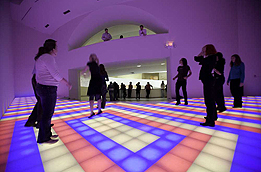
Don’t frown however; you can do your own moves on a very similar floor at the Guggenheim Museum! Their present exhibit The Shape of Space (through Sept 5) features an installation by Piotr UklaÅ„ski — Untitled (Dance Floor)– which emulates, in a far greater color palatte, the legendary dance floor. Needless to say, this is one of the museum’s most popular pieces. (See picture below.)

Nerve does an excellent job in digging up some of the old 2001 Odyssey crew for their recollections of the place. And if youre interested in checking out some other Brooklyn ‘Saturday Night Fever’ locations, check this out.

FRIDAY NIGHT FEVER: The Cotton Club

To get you in the mood for the weekend, every Friday we’ll be celebrating ‘FRIDAY NIGHT FEVER’, featuring an old New York nightlife haunt, from the dance halls of 19th Century Bowery, to the massive warehouse spaces of the mid-90s. Past entries can be found here

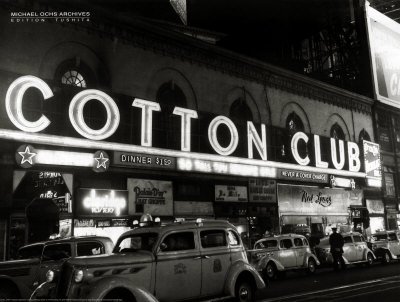
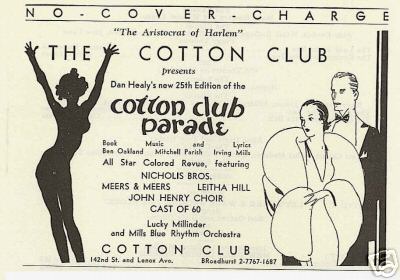
For our second entry, we’d be amiss if we didnt feature the grand-daddy of New York nightclubs, one of the longest (non-contually) operating names in the United States and a place that literally changed music history — The Cotton Club. Formerly at Lenox and 142st, the club was the ‘aristocrat of Harlem’, typifying the very best and very worst parts of African-American life at the beginning of the 20th Century.

Ten years after legendary boxer Jack Johnson stirred up America’s racial tensions by becoming the first black heavyweight champion and victor of the ‘fight of the century’ in 1910, he bought a ramshackle Harlem casino and opened up Club De Lux. It may have had a few successful years and closed quietly had Jack not sold the club then to notorious gangster Owney ‘The Killer’ Madden, who was looking for a venue to sell his beer.

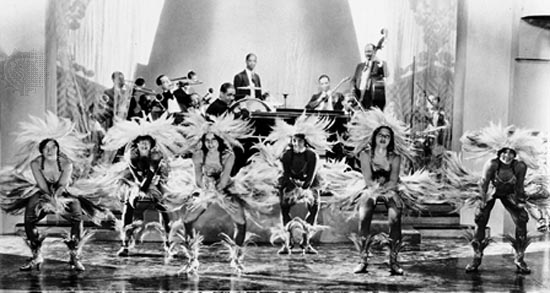
Nobody came to the Cotton Club for the beer though. Madden employed the best young black talent that New York had to offer. His first hire was a young Fletcher Henderson, and the house band was directed by a then-struggling Duke Ellington, who wrote exotic stage shows with wildly dressed chorus girls. One such chorine, Lena Horne, gave her first solo performance there. Other luninaries who shared the stage there included Cab Calloway, Ethyl Waters, and Dorothy Dandrige.

The horrible irony, as with many clubs of the ’30s, is that the performers were mostly black, while the audiences were white-only. The audiences preferred exaggerated “black” shows, and even Ellington was forced to pen spectacles set in jungles or plantations, with performers acting in absurd stereotypes.

As Madden seemed to be directing most of the Cotton’s affairs from his cell in Sing Sing prison, Broadway producer Walter Brooks was brought in to front the place, and managed to bring in a few white songwriters like Harold Arlen and Cole Porter to collaborate with the black entertainment. On Sunday night ‘Celebrity Night’, various New York luminaries like Jimmy Durante and Bing Crosby would leap from their martini-topped tables to the stage to perform impromptu numbers.

The club entered national prominence when the Columbia Broadcasting System (CBS) began broadcasting the club’s entertainment to listeners around the nation.

The club moved downtown to Broadway and 48th Street in 1926, but eventually closed in 1940. A new incarnation opened back up in Harlem in 1978 and still operates today, recapturing as best as possible the excitement and real talent of the original Cotton.

Most people outside New York probably know the club best by the Francis Ford Coppola movie of the same name, however several revues were filmed here during its heyday, and the Cotton Club Orchestra as directed by Cab Calloway or Duke Ellington would clearly make a deeper impression onto vinyl. The recordings would help define the face of jazz music.

FRIDAY NIGHT FEVER: Mudd Club


To get you in the mood for the weekend, every Friday we’ll be celebrating ‘FRIDAY NIGHT FEVER’, featuring an old New York nightlife haunt, from the dance halls of 19th Century Bowery, to the massive warehouse spaces of the mid-90s.

First on the list is the Mudd Club, often viewed as the mirror image of its more known uptown competitor Studio 54. Located between the borderlands of TriBeCa and Chinatown (77 White Street, near mysterious Cortlandt Alley), Mudd was a multi-level playground for the avant garde and strictly fabulous (i.e. one of the most notoriously elite clubs in the 70s), playing more to the burgeoning new wave and punk scene than to the disco beats echoing through other halls.

Unlike nightclubs today, which seem to cater A-list celebrities and their worshipers, the Mudd Club with its gold stairs and dark halls attracted a serious cult set of icons from the deep trenches of New York culture, particularly latter era Warhol proteges and art rock stars like Lydia Lunch.

Mudd owner Steve Moss was able to attract such rough-and-tumble innovators by combining its chicly trashy main floors with an art gallery on the fourth floor. The place became known as much for its Jean Michel Basquiat exhibititions as it did for its groundbreaking performances by the Talking Heads, Klaus Nomi and Bow Wow Wow.

In fact, David Byrne and the Talking Heads immortalized the club in their song ‘Life During Wartime’: “This ain’t the Mudd Club or CBGB’s, I ain’t got time for that now…”

On any given night you could stumble into the club (if you were ‘downtown’ enough) and, for instance, hear Debbie Harry rapping with Fab Five Freddy.

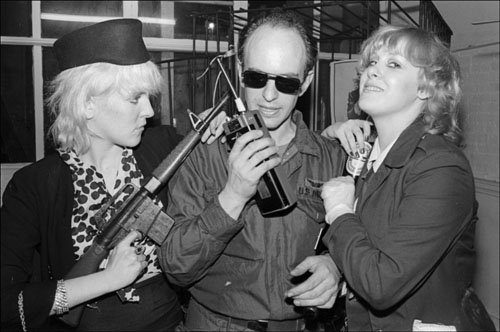
The club thrived on the degenerate but respectable synergy between art and music, a concept that would become mainstreamed in the late 80s. Although its no longer open in NY, its owner Steve Moss opened another version in Berlin in 2001, and purportedly he sits at the bar, still overseeing his nightly menagerie, even as most of the artists and performers he helped create in the 70s and 80s have passed on. (In fact, that’s Steve in the photo above, with members of the punk band Combat Rock.)

In addition to a European club, the former haunt also lives on as a shade of makeup.

There are tons of fun pictures from the Mudd Club’s heydey here.

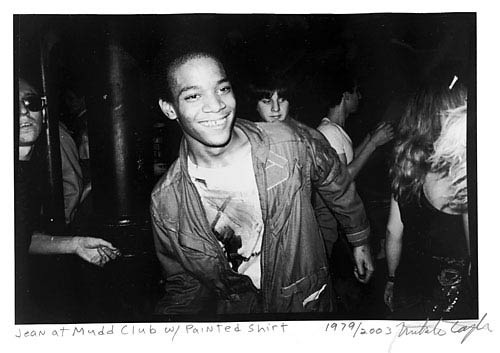
And here’s Jean-Michel, basking in his brief fame:

With his short term girlfriend Madonna looking on, Basquiat’s band GRAY almost exclusively performed at Mudd Club, featuring bassist and future filmmaker Vincent Gallo.

And why the Mudd Club? The urban legend claims that it was alledgedly named after the doctor and alledged Confederate conspirator (or maligned innocent, depending on who you talk to) Samuel Mudd, who helped John Wilkes Booth escape after he murdered Abraham Lincoln. Mudd mended Booth’s broken leg which he received when he fled D.C., and the long stick he used to set the bone was known as ‘Mudd’s club’.

HAPPY FRIDAY!