Categories
Food History The Gilded Gentleman

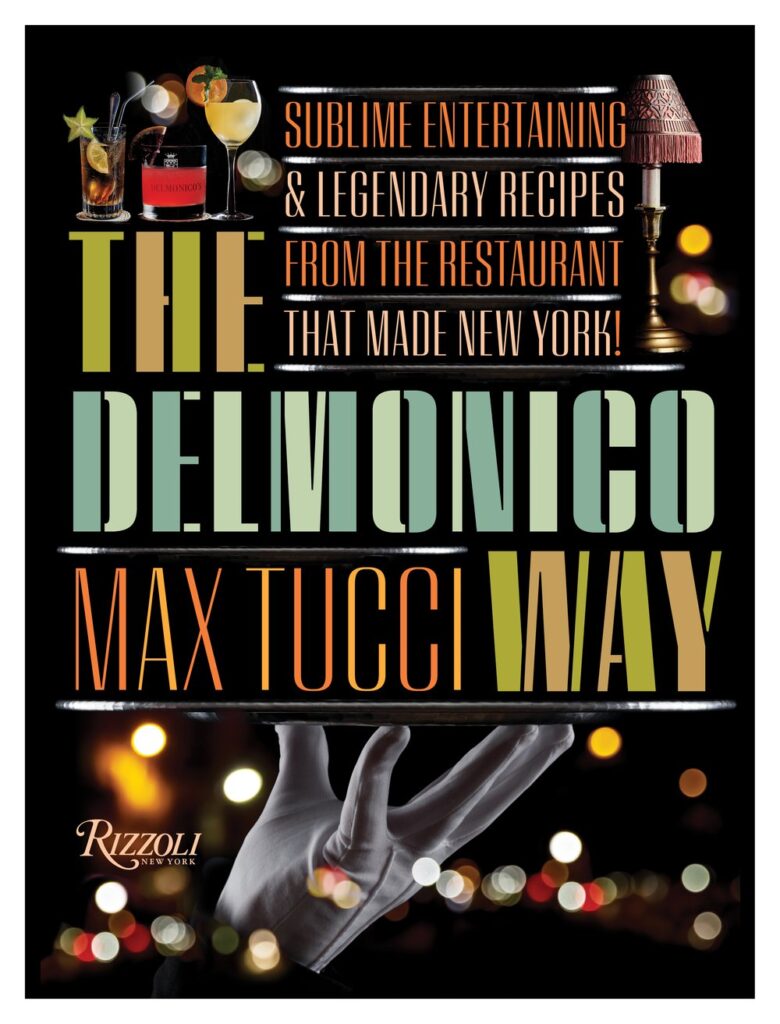
The Delmonico Way: A Conversation with Max Tucci

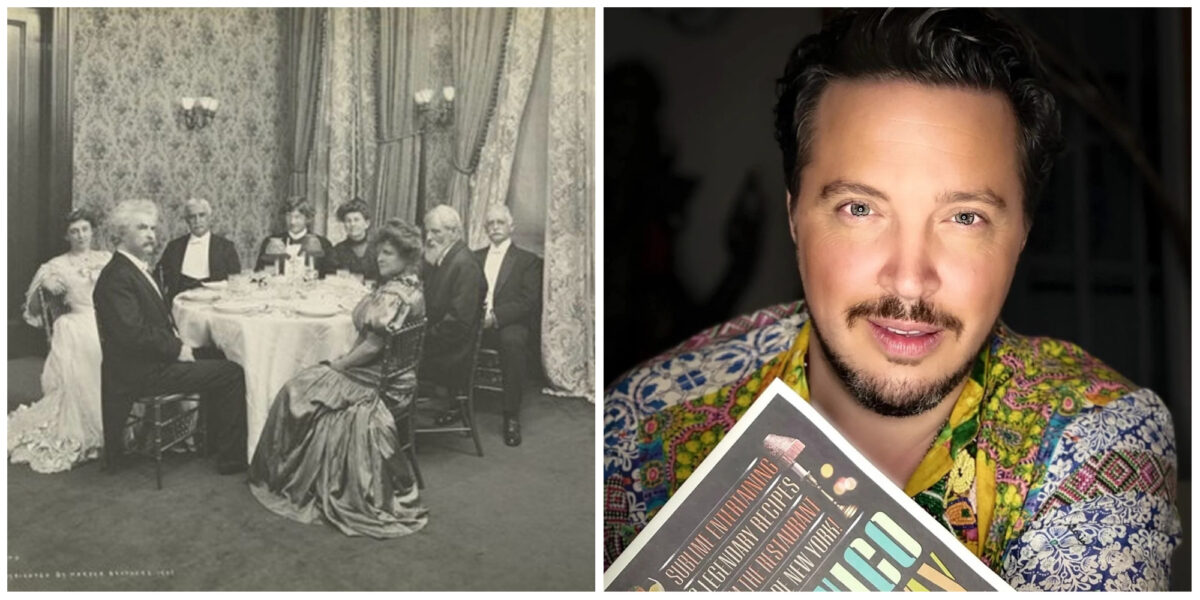
In celebration of his new book “The Delmonico Way: Sublime Entertaining and Legendary Recipes From The Restaurant That Made New York,” author Max Tucci joins The Gilded Gentleman for a talk about food, family history and the real meaning of hospitality. 

Delmonico’s! Just the name was legendary. Edith Wharton mentioned it in her fiction set in the Gilded Age. The dining room hosted royalty and heads of state along with, in later years, Hollywood’s most famous stars. And then there was the equally legendary food. 

Max Tucci is the grandson of Oscar Tucci who reopened the legendary restaurant in the 1920s after the original – in business since 1827 – had been closed due to Prohibition. 

Oscar and his family built an empire that established Delmonico’s as the gold standard of American fine dining and hospitality from the 1920s through the 1980’s. 

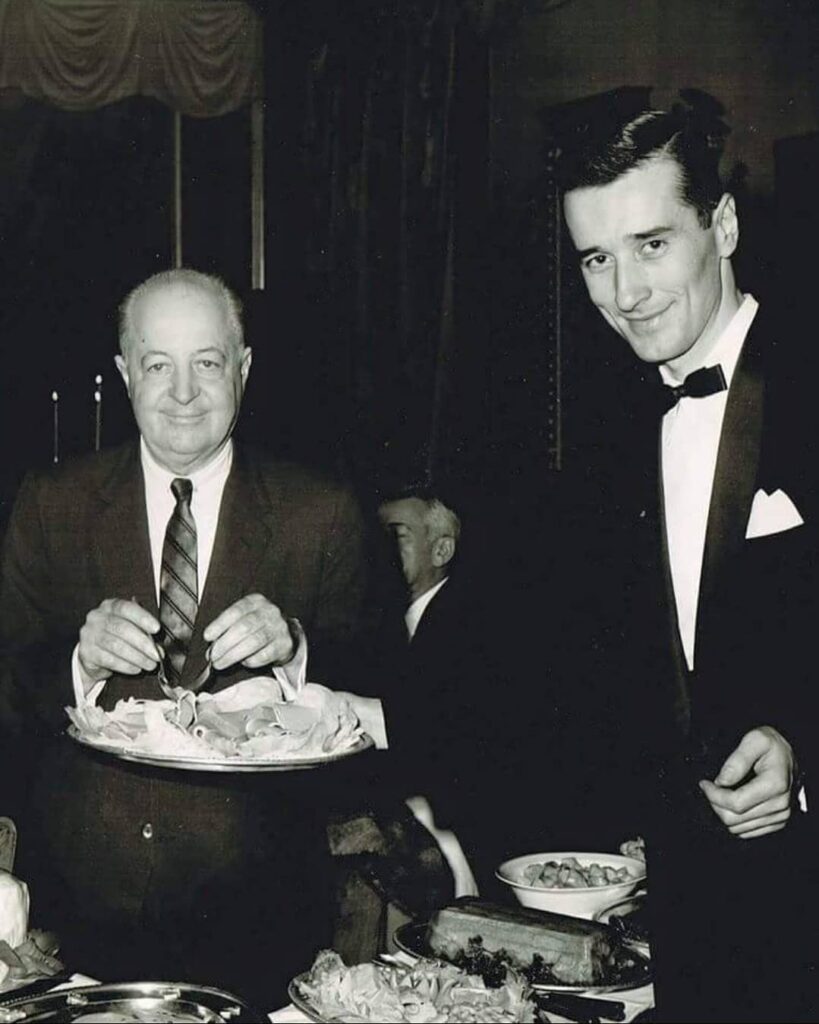
Oscar Tucci with another famed restaurateur, Sirio Maccioni of Le Cirque. Courtesy of Oscar’s Delmonico Facebook page

Max, who holds the largest collection of Delmonico’s memorabilia of his family’s famous establishment, shares his memories, family history and anecdotes about the incomparable hospitality, fine dishes and famous clientele of America’s first truly grand restaurant. 

LISTEN NOW: THE DELMONICO WAY

Follow Max Tucci on Instagram

FURTHER LISTENING

Mentioned on the show — the culinary genius behind these dramatic dishes was Delmonico’s celebrity chef — the Frenchman Charles Ranhofer — who guided their kitchens from 1862 to 1896. 

Ranhofer left us with his extraordinary cookbook published at the height of the Gilded Age in the 1890’s, called The Epicurean, detailing the ingredients and preparations of Delmonico’s classic dishes.   

Back in 2008 (!) the Bowery Boys did a podcast about the history of Delmonico’s. A little rudimentary but good background information for when you’ve finished with this show:

New York’s best film performances – Part One

After spending quite an amount of time in the Revolution, then taking you to church, I’m taking it easy on you (and me, for that matter) and focusing on New York in the movies.

New York City is without a doubt the most photographed and filmed city in the world. Even when filmmakers shoot in other cities — such as Toronto — it’s still New York.

For the week, I’m presenting my incredibly subjective list of the ten best movie scenes shot in New York City. This doesn’t quite equate to the ten best movies about New York. These are just the ten images that I think in total represent the reasons that people continue to turn NYC into the world’s largest back lot. I’ll reel out the first nine today through Thursday; the topic of my number one pick will also be the topic of this week’s podcast.

This list only features scenes that were actually filmed in New York without too much enhancement or special effects, so no sci-fi (King Kong, Ghostbusters, Men In Black, I Am Legend). I also avoid scenes that are obviously in New York City but are interiors with no distinguishing features (‘You talkin’ to me?’ and ‘I coulda been a contender’ both spring to mind.)

I’m obviously going to leave out a few favorites, so after Friday drop me an email of what I’ve left out. I’ll list the notable omissions next week.

FYI, I give 11th place, honorable mention to Marilyn Monroe’s dress-blowing scene in the zany sex comedy ‘Seven Year Itch’, But you’ll have to read here to find out the technicality that excludes it from this list.

Mystique
10. North By Northwest (1958)
Roger Thornhill buys a ticket

Alfred Hitchcock loved using New York as a set piece. He put Jimmy Stewart in a wheelchair here, cooked up a claustrophobic mystery, and used the Statue of Liberty to great effect.

In North By Northwest, he engineers a chase through Grand Central Terminal featuring Cary Grant in shades alluding capture, eventually finding himself on a train with Eva Marie Saint. What makes this scene so alluring is that it’s actually at Grand Central and prefaced by an awkward scene involving a fake United Nations. (Hitchcock couldn’t get permission to film there; nobody could until Nicole Kidman.)

By merits of it being a Hitchcock film, the scene is zippy and glamorous, all the more because Hitch uses a crane shot to follow Grant from one corner to the other, a gravity-less vantage that for a moment takes you above the busiest place in New York.

By the way, once Grant gets on the train, we’ve clearly gone back to a staid movie set. However Grand Central was not the only real location used; you also have some great old views of The Plaza Hotel and the Oak Room.

Drama
9. Vanilla Sky (2001)
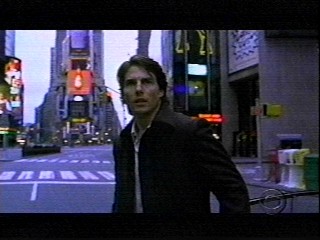
Times Square in dreamtime

See, this list isn’t about good movies. Whatever you think about this Cameron Crowe remake, this fantasy sequence featuring Tom Cruise in a completely empty Times Square is remarkable by merits of them pulling it off at all.

The scene was filmed on an early Sunday morning in November 2000 and they had to shoot quickly. Their efforts to create an eerie setting were almost thwarted by the Dow Jones news ticker, in the background proclaiming details about the disputed Bush-Gore election. They were given permission to digitally erase the information.

Studio execs had also asked Crowe to digitally erase the World Trade Center, which by the film’s release date had been destroyed. This, Crowe did not do.

Perversity
8. Taxi Driver
Marty takes a ride

It’s not Taxi Driver’s best known scene, but it perfectly employs New York at night in a twisted noir-ish way. Travis Bickle (Robert Deniro, essentially silent during the scene) pulls up a passenger to the curb. That passenger happens to be played by Martin Scorsese himself, who argues with Bickle to leave the meter running.

We then see that classic of noir fixture — a woman’s silhouette in the window — and Scorsese goes off on a sick and disturbing explanation of what he intends to do to her, his estanged wife.

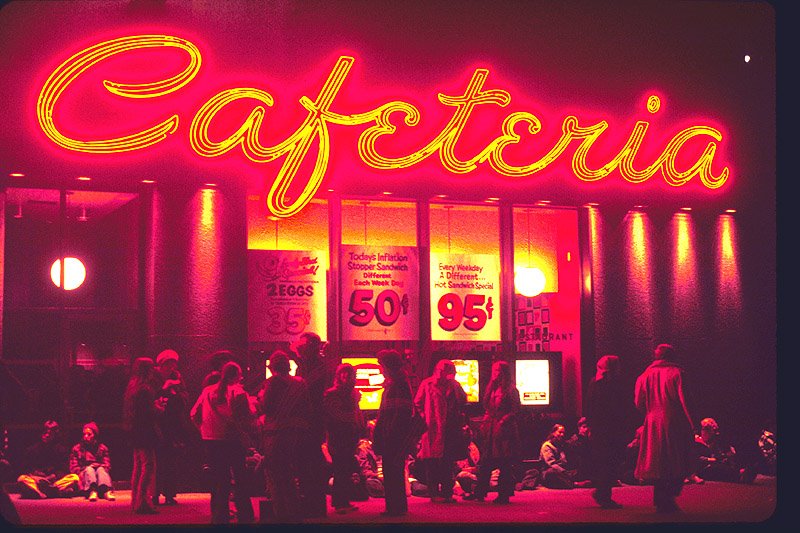
By the way, the scene that proceeds this one — of cabbies gabbing at a diner — is filmed at the Belmore Cafeteria, a classic old-style diner which once sat at 28th Street and Park Avenue South. This site has a great tribute to the old joint. Here’s a shot of its dazzling exterior:

Tomorrow: #7-5!

FRIDAY NIGHT FEVER: Peppermint Lounge


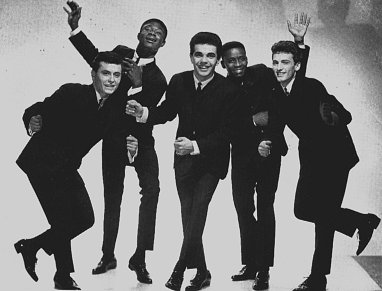
pictured: Joey Dee and the Starliters, who turned a small midtown gay hustler bar into a dance hit in 1961

To get you in the mood for the weekend, every Friday we’ll be celebrating ‘FRIDAY NIGHT FEVER’, featuring an old New York nightlife haunt, from the dance halls of 19th Century Bowery, to the massive warehouse spaces of the mid-90s. Past entries can be found HERE.

Like most things associated with popular music, the early 60s brought sea change to the very notion of nightlife. Clubs typified by the 21 Club and last weeks’ feature El Morocco were very much venues where you dressed up, not where you let your hair down. Harlem and Greenwich Village certainly catered to rowdier fare, but in midtown, things still held a pretense of glamour and society.

All that changed as rock and roll seeped into the streets. Such “naughty” music, inspiring amoral and sexual dancing, sprang first from the seediest places, with the sweetest being the Peppermint Lounge, also known as the home of the Twist. Although the Twist was actually born in Philadelphia, New York and the Peppermint sped it up and whipped it into a frenzy.

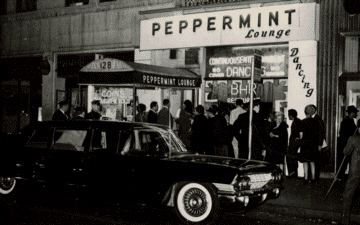
The ‘Pep’, as it was called, a hole in the wall at 128 West 45th Street, with a doorway into the adjacent Knickerbocker Hotel, might have remained a quiet gay hustler bar out of the way of the public consciousness had rock and roll not swept through. Vanity Fair calls it an “inauspicious dump destined to become a pop landmark.” The ruffians would soon share the floor with Marilyn Monroe and the Beatles.

With a capacity of 174 people (and often filled to just slightly over that amount), a tiny stage and even tinier dance floor, the Pep soon pulsed with dance-friendly rock music, featuring house band Jordan Christopher and the Wild Ones slinging R&B rhythms over guitars and marrying it with almost demonic body gyrations. The well kept secret was effectively spilled when frequent performer Joey Dee and the Starliters recorded their biggest hit ‘Peppermint Twist’, cementing the club’s lusty reputation into a hit record in 1961. (Watch a video here of the Starliters performing their hit.)

The Pep was sweaty raunch. It was white society dabbling into the rhythms of black music. Traditional society, leering over the edge of its dry martinis, thumbed up its nose. But like everything forbidden in this city, the Peppermint soon drew its admirers.

Or as Tom Wolfe explains it: “One week in October, 1961, a few socialites, riding hard under the crop of a couple of New York columnists, discovered the Peppermint Lounge and by next week all of Jet Set New York was discovering the Twist.”

The mystique of the Twist — and the dozens of other novelty dances that came afterwards — is that is was a solo dance. And as a result, according to the New York Social Diary, “It was the first time the general public saw men dancing with men and women dancing with women.” The Pep invited sexual intimacy and freedom. Perhaps not of the types we see on dancefloors today, but this was the first significant steps towards it.

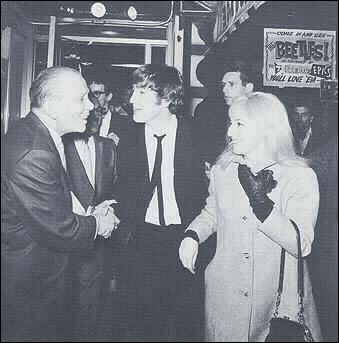
But while the floor of the Pep might have been filled with twisting, sexed up young adults, the allure soon drew icons. Marilyn Monroe, seen last week shimmying at El Morocco, found her way to the Peppermint, as did the Beatles during their legendary week in the city. (Pictured above: John Lennon is welcomed into the Pep.) As well as an odd assortment of celebs that I can’t imagine ever once did the Twist — Liberace, Tennessee Williams, Noel Coward, Norman Mailer, Judy Garland, Zsa Zsa Gabor, John Wayne (!).

According to Time Magazine (via the above Vanity Fair article), “Even Greta Garbo hauled herself out of her myth-lined cocoon and appeared, lank-haired and bone-pale, to snap her fingers and smile.” Even first lady Jackie Kennedy snuck in with her sister Lee.

The Pep made stars as well. Three of the Starlighters spun off into another band, the Rascals. And Phil Spector’s pet project the Ronettes, according to legend, got their unexpected big break there: “One night in 1961, the girls dressed in tight skirts and with their hair piled high, stood [outside] in line …. the manager mistook them for a singing trio that hadn’t arrived and took them inside. Ushered them on stage and they belted out a version of Ray Charles’ “What I Say,” … The girls took the club by storm and were signed to appear regularly for $10 a night.” (At right: Ronettes at the Pep)

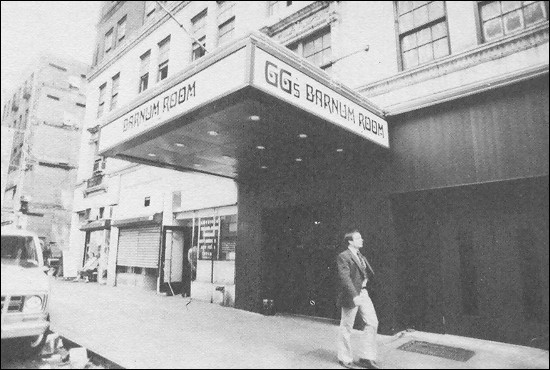
The Pep wouldn’t survive the 70s. The space on 45th street would become a couple different disco venues: a circus themed disco called GG’s Barnum Room (pictured below) and a glossier disco called Hollywood. The Pep would return in fits and starts in other locations, but nothing approaching the feral frenzy of its early days.

The address of the Peppermint, 128 West 45th Street, is completely gone, replaced with a parking garage, a Citibank and a luxury hotel. However, not more than a 100 feet from its original location was once another legendary rock venue, Bond International Casino.

Categories
Uncategorized

FRIDAY NIGHT FEVER: El Morocco


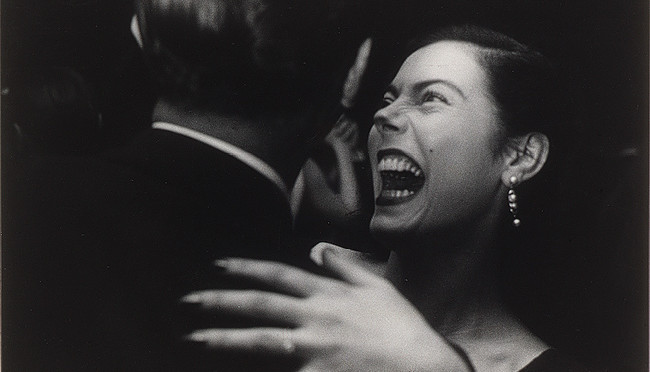
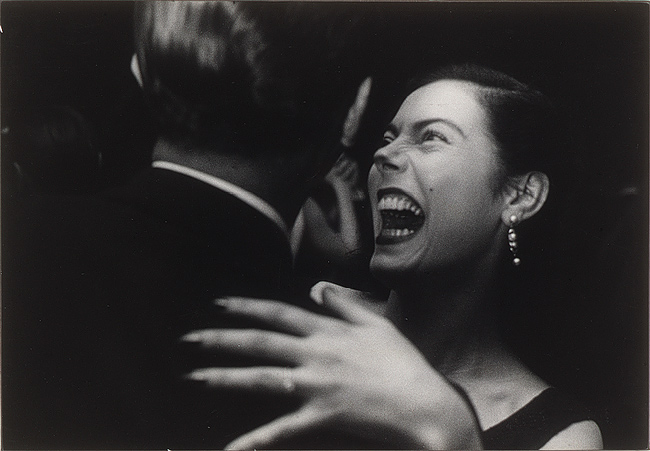
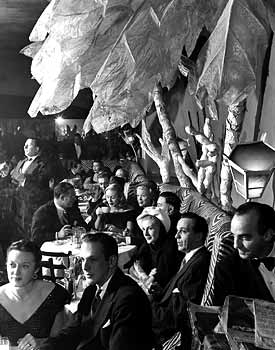
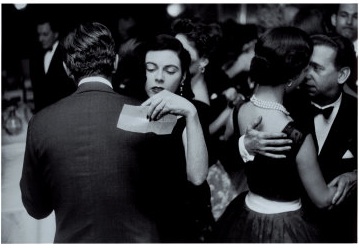
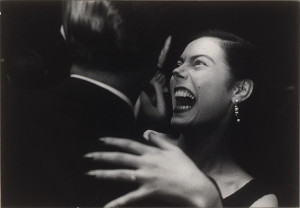
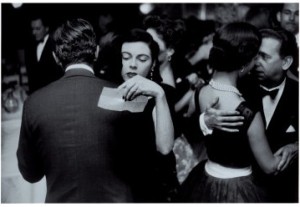
(Top and bottom photos: Garry Winogrand – taken on the El Morocco dance floor – 1955)

To get you in the mood for the weekend, every Friday we’ll be celebrating ‘FRIDAY NIGHT FEVER’, featuring an old New York nightlife haunt, from the dance halls of 19th Century Bowery, to the massive warehouse spaces of the mid-90s. Past entries can be found here .

Has there ever been a place in Manhattan more glamorous than El Morocco? Probably not.

John Perona opened El Morocco as a speakeasy at 154 East 54th Street, moving down the street to 307 East 54th Street in its later days. (Both locations have been destroyed; the Citicorp building stands where the original once stood.) “Elmo”, as the socialites would utter it, transitioned into post-prohibition losing none of its glamour or appeal.

Along the way, it set the standard by which all other nightclubs of the 30s through the 50s were to be judged. (Only the Stork Club and possibly the 21 Club would rival it.) It was the first to use a velvet rope. The ruler of the rope, Angelo Zuccotti, was so revered that the New York Times ran his obit when he died in 1998, a doorman
“who wielded the velvet rope at El Morocco with such authority and finesse that he helped define the very line between cafe society and social Siberia.”
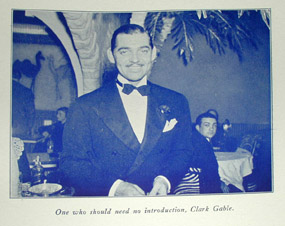
And via Perona’s official photographer Jerome Zerbe (who also worked the Rainbow Room), this midtown speakeasy turned celebrity hotspot was one of the first to employ photographers to snap candids of its famous clientele. Yes folks, you can actually trace the scandalous club photos of Lindsey Lohan and Britney Spears back to their less shameless beginnings at El Morocco.

According to an account by Zerbe, “From 1935 until 1939, I was at the El Morocco and I invented a thing which has become a pain in the neck for most people. I took photographs of the fashionable people and sent them to the papers.”

One key element was Elmo’s signature blue and white zebra-striped banquettes, which popped from the corners of every snapshot. Photos running the next day would easily be recognized.
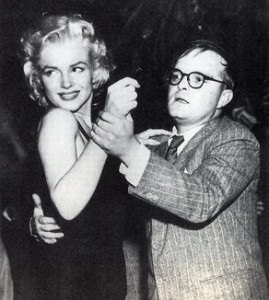
The other, of course, was the who’s-who list of stars that would traipse through. And who exactly showed up at El Morocco’s doorstep? I can throw some names at you — Clark Gable, Cole Porter, Ingred Bergman, Truman Capote, Audrey Hepburn, Marilyn Monroe. Humphrey Bogart, God bless him, was banned from the club for life. (The story is so incredible, I’m saving it for the end.)

But I think Zerbe says it best: “They were really the top, top social — and what you mean by society, that’s difficult again to define. These were the people whose houses one knew were filled with treasures. These were the women who dressed the best. These were the women who had the most beautiful of all jewels. These were the dream people that we all looked up to and hoped that we or our friends could sometimes know and be like.”

Scour any recollections of Elmo, and you’re bound to spend half the night picking up all the dropped names. “Errol Flynn would either sit at Perona’s table or cruise the room,” says Taki Theodoracopulos. “On a normal night Aristotle Socrates Onassis would be there, more often than not without his wife, Tina, who would come in later with the then young Reinaldo Herrera.”
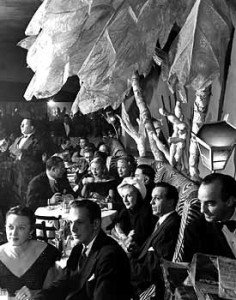
And from Nannette Fabray: “One entered, and there was a hierarchy of where one sat. The first table on the right was the best; the second was reserved for the owner, John Perona. You didn’t dare go unless you were perfectly turned out.”

Human beings were not allowed in El Morocco. It was the place where film stars mixed with European royalty, where a poor Southern girl could be wooed and courted, as long as that poor Southern girl was Ava Gardner.

Sadly, like an aging film actress long past her prime, El Morocco lasted well into the 90s, dissolving into less alluring variants until it took the final step of becoming a topless bar in the mid 90s, under the name Night Owls.

Celebrity hotspots these days rarely have the elegance or the prestige. I can only imagine if Britney Spears turned up at Angelo’s velvet rope, that he would turn her away.
Oh, and why was Humphrey banned from El Morocco? Well, one night in 1950, Bogart dropped off his wife Lauren Bacall at home, and he and a friend went out for the evening. Heavily inebriated, Bogart thought it would be funny to bring two 22 lbs. stuffed panda bears into Elmo as their ‘dates’ and proceeded to prop them up on a chair.
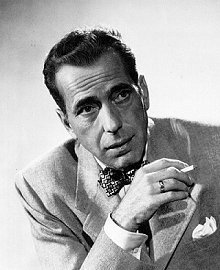
Two drunk young women attempted to pick up the pandas, but, depending on who you believe, were either pushed by Bogart or tumbled to the floor by the shear weight of the heavy toys. Later, in a flurry of half-truths, it was believed Humphrey and his friend violently assaulted the young women for attempting to steal the panda bears. Not helping matters — the boyfriend of one of the women then began throwing plates at Bogart.

The next day Bogart received a summons to appear in court. The man who would become the greatest movie star of all time, on that day, had to convince a judge that it was his excessively large stuffed pandas, and not his fists, that had felled the young women. The judge eventually threw it out of court.

When asked by reporters if he was drunk that night, Humphrey replied, Who isn’t at 3 o’clock in the morning? So we get stiff once in a while. This is a free country isn’t it? I can take my panda any place I want to. And if I want to buy it a drink, that’s my business.