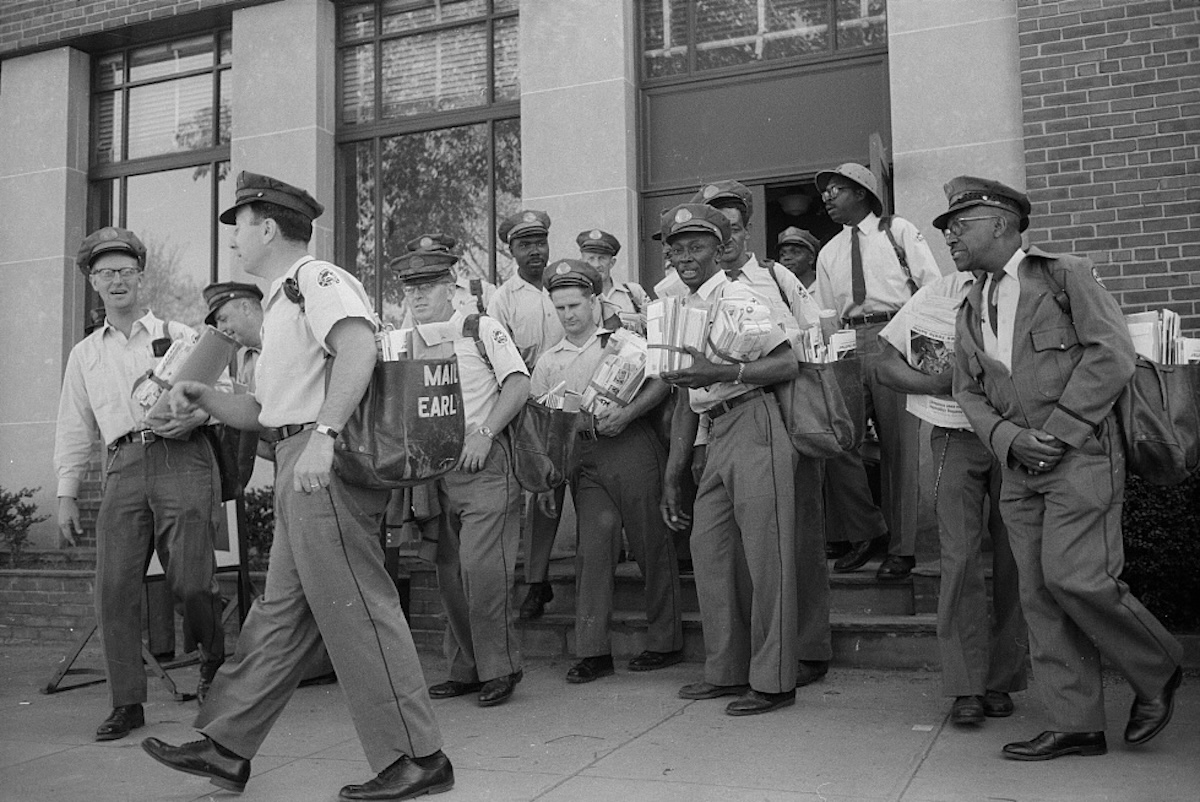
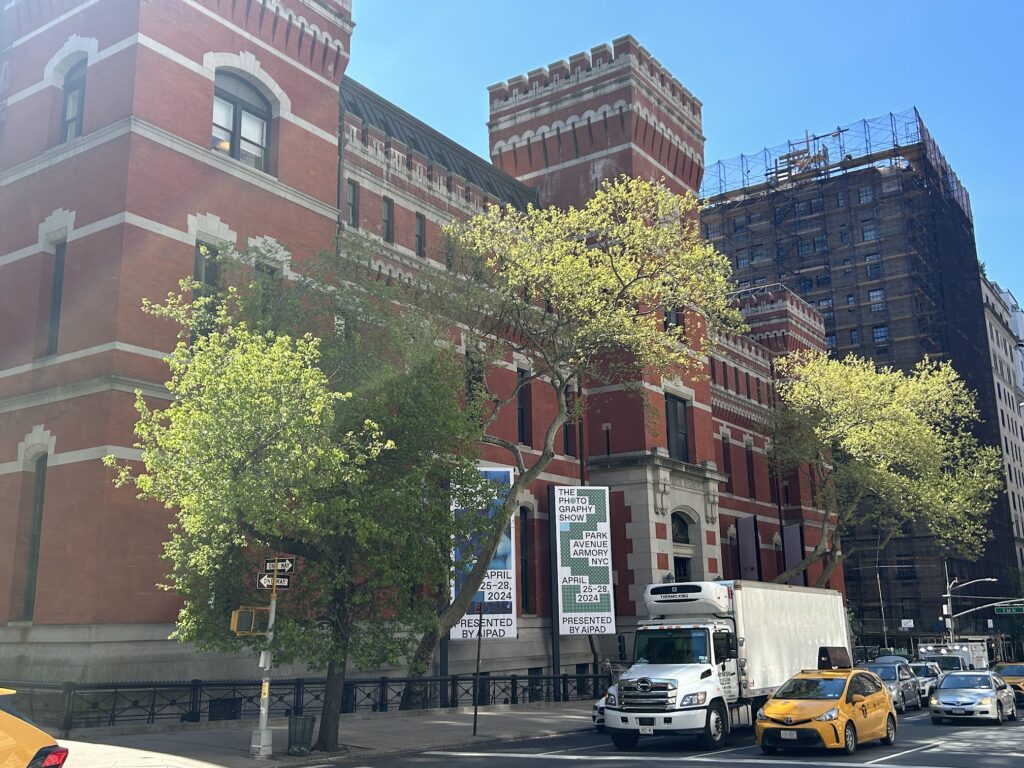
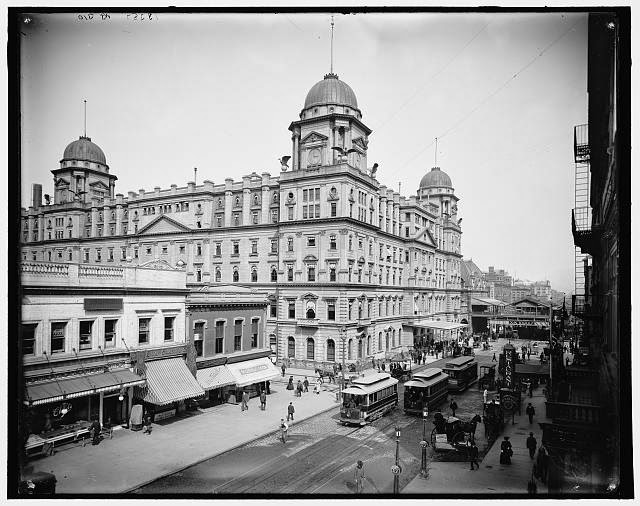
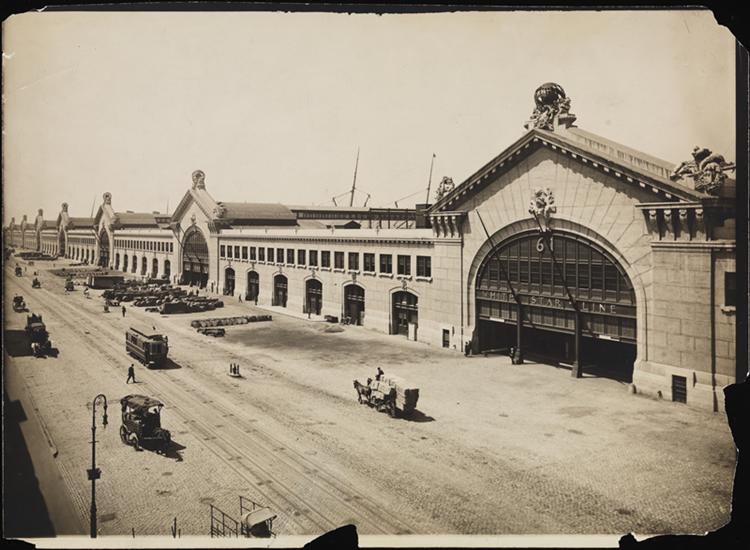
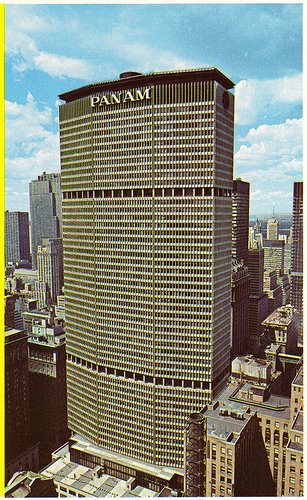
O'Halloran, Thomas J, photographer. New York Post Office. , 1957. Library of Congress
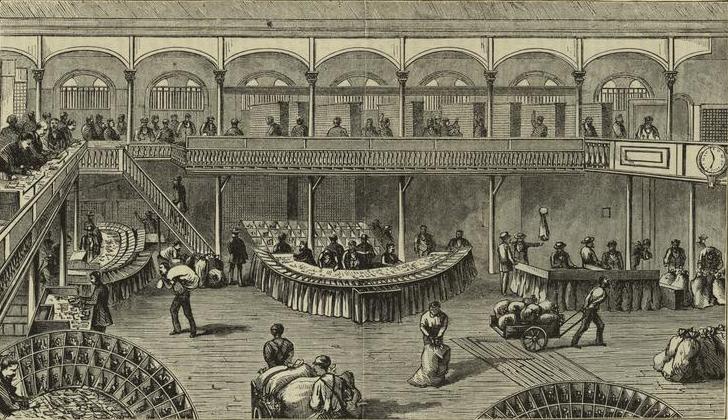
The history of the United States Postal Service as it plays out in the streets of New York City — from the first post road to the first postage stamps.
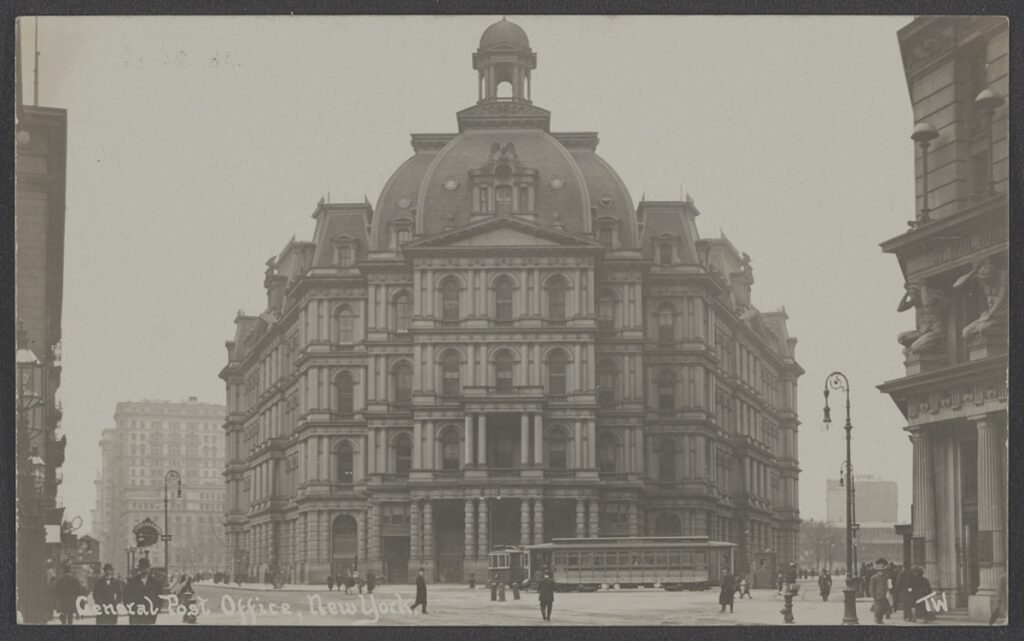
From the most beautiful post office in the country to the forgotten Gilded Age landmark that was once considered the ugliest post office.
The postal service has always served as the country’s circulatory system, linking the densest urban areas to the most rural outposts, a necessary link in moments when the country feels very far apart in other ways. The early American colonies knew this. Benjamin Franklin knew this The Founding Fathers who placed the postal service within the Constitution knew this.
And inventions such as the stagecoach, the steamship, the railroad, the pneumatic tube and even the electric car have helped keep the mail steadily flowing over the centuries.
The City Hall Post Office at the southern tip of City Hall Park
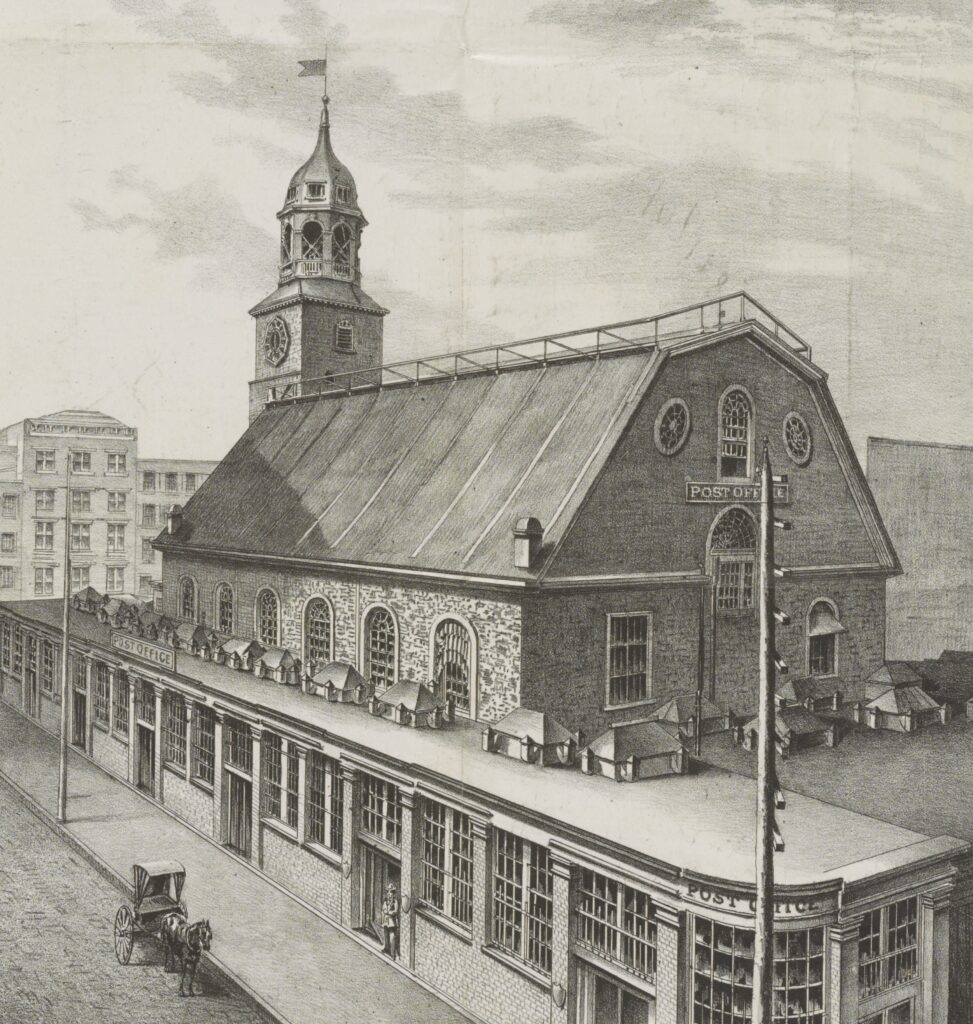
New York has even played a pivotal role in the development of the American mail service, from the creation of the Boston Post Road (the first mail road which snaked through Manhattan and the Bronx) to the first mail boxes. Even the first postage stamps were sold in New York — within former church-turned-post office in lower Manhattan.
Why are there so many post offices from the 1930s? Why is New York’s largest post office next to Penn Station? And why does New York City have so many individual ZIP codes? And who, pray tell, is Barnabas Bates?
LISTEN NOW: A HISTORY OF THE POST OFFICE IN NEW YORK
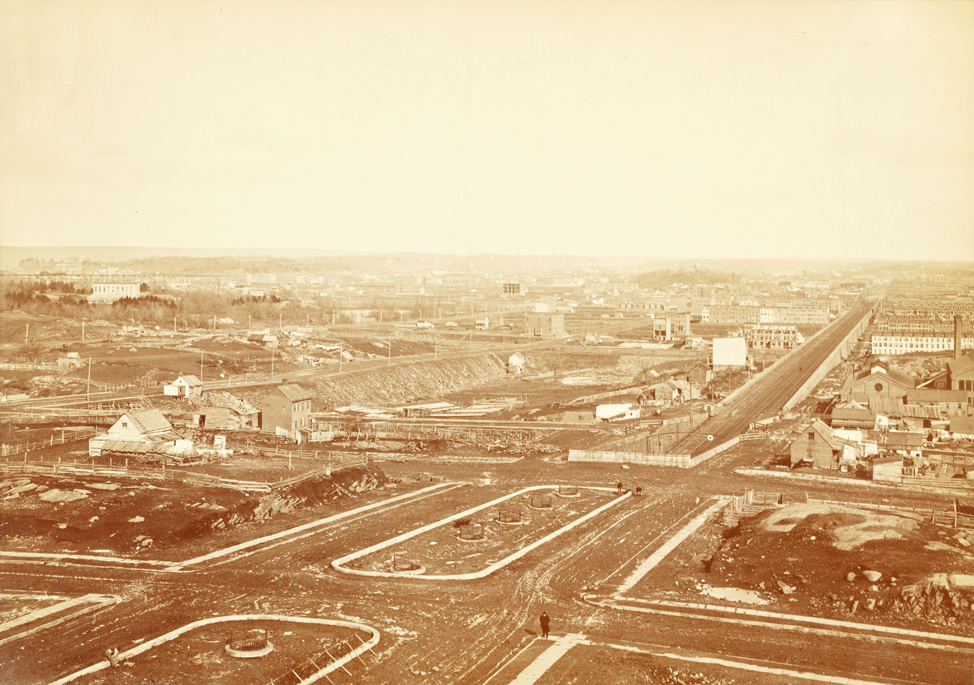
The story of a filthy and dangerous train ditch that became one of the swankiest addresses in the world — Park Avenue.
For over 100 years, a Park Avenue address meant wealth, glamour and the high life. The Fred Astaire version of the Irving Berlin classic “Puttin’ on the Ritz” revised the lyrics to pay tribute to Park Avenue: “High hats and Arrow collars/White spats and lots of dollars/Spending every dime for a wonderful time.”
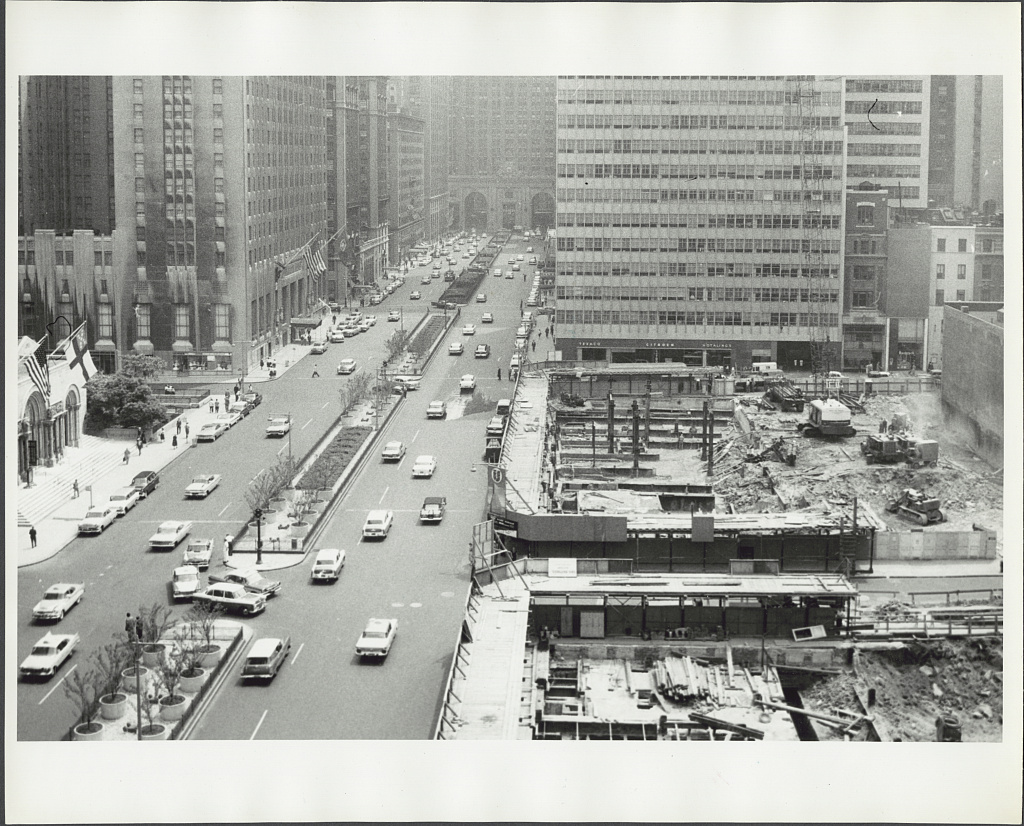
By the 1950s, the avenue was considered the backbone of New York City with corporations setting up glittering new office towers in the International Style — the Lever House, the Seagram Building, even the Pan Am Building.
But the foundation for all this wealth and success was, in actually, a train tunnel, originally operated by the New York Central Railroad. This street, formerly known as Fourth Avenue, was (and is) one of New York’s primary traffic thoroughfares. For many decades, steam locomotives dominated life along the avenue, heading into and out of Cornelius Vanderbilt’s Grand Central (first a depot, then a station, eventually a terminal).
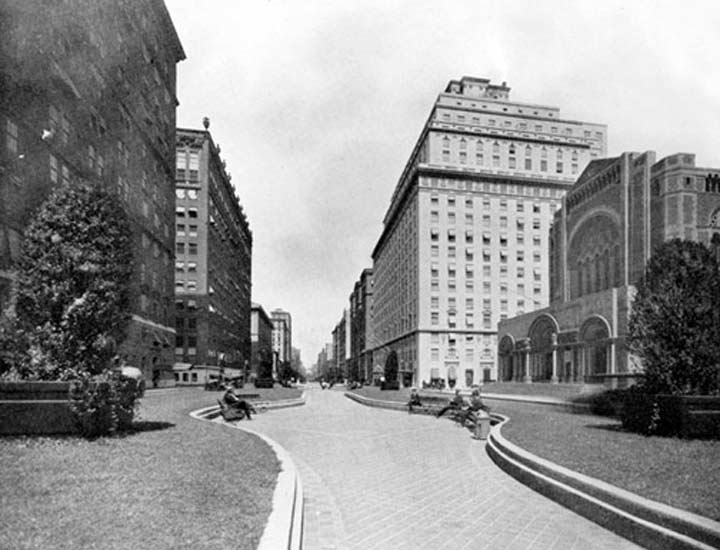
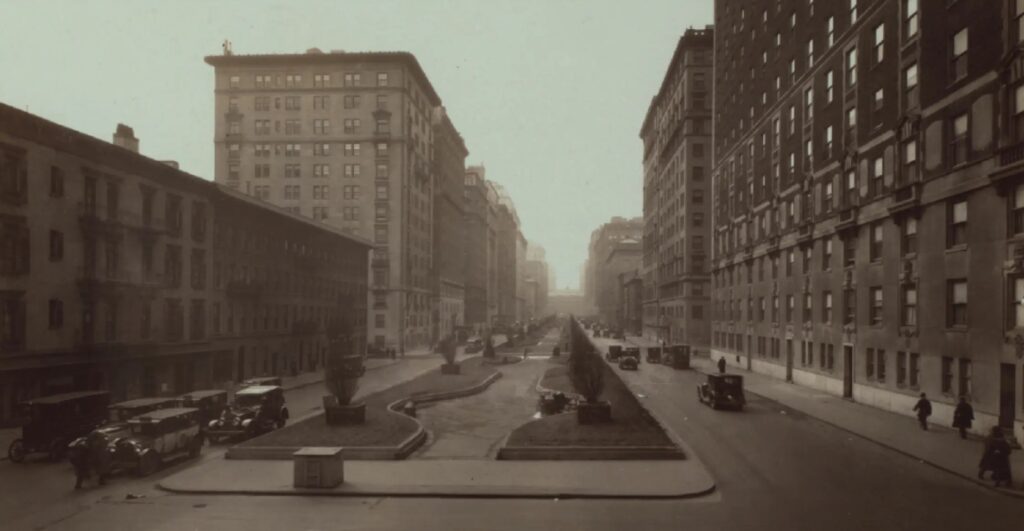
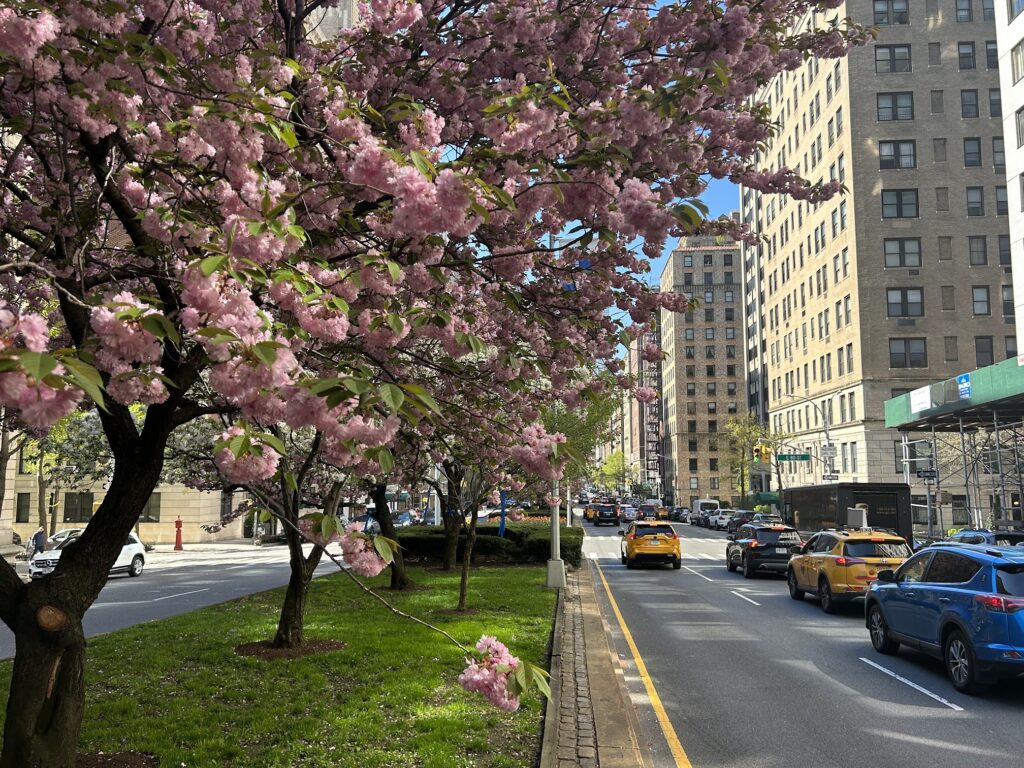
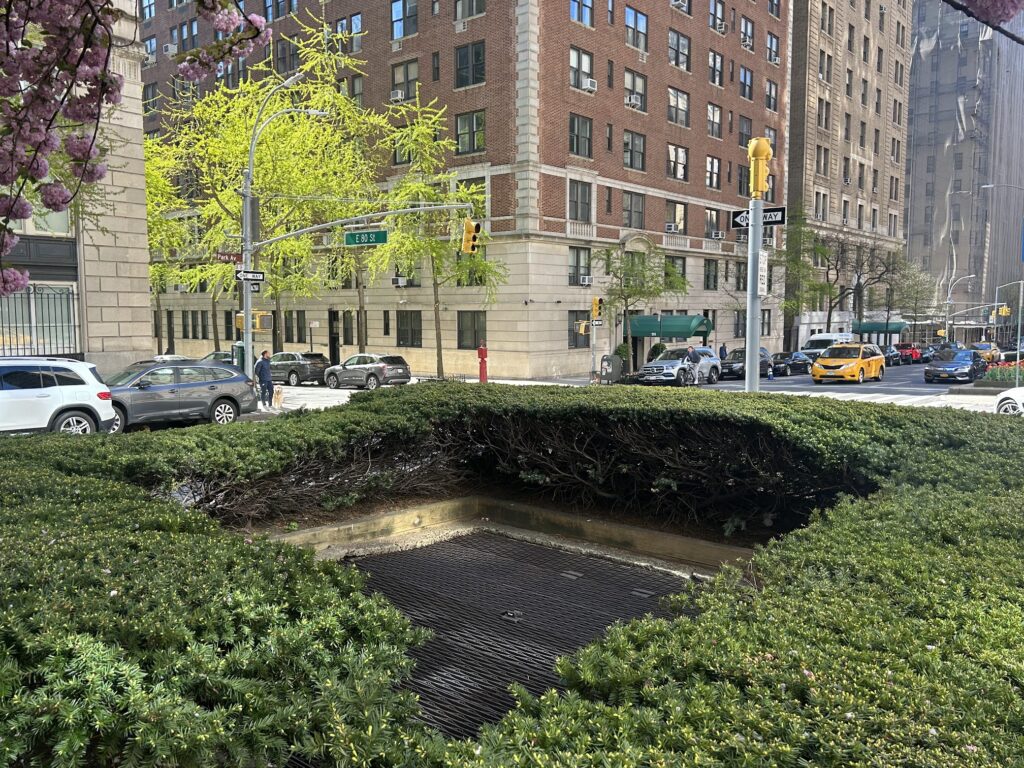
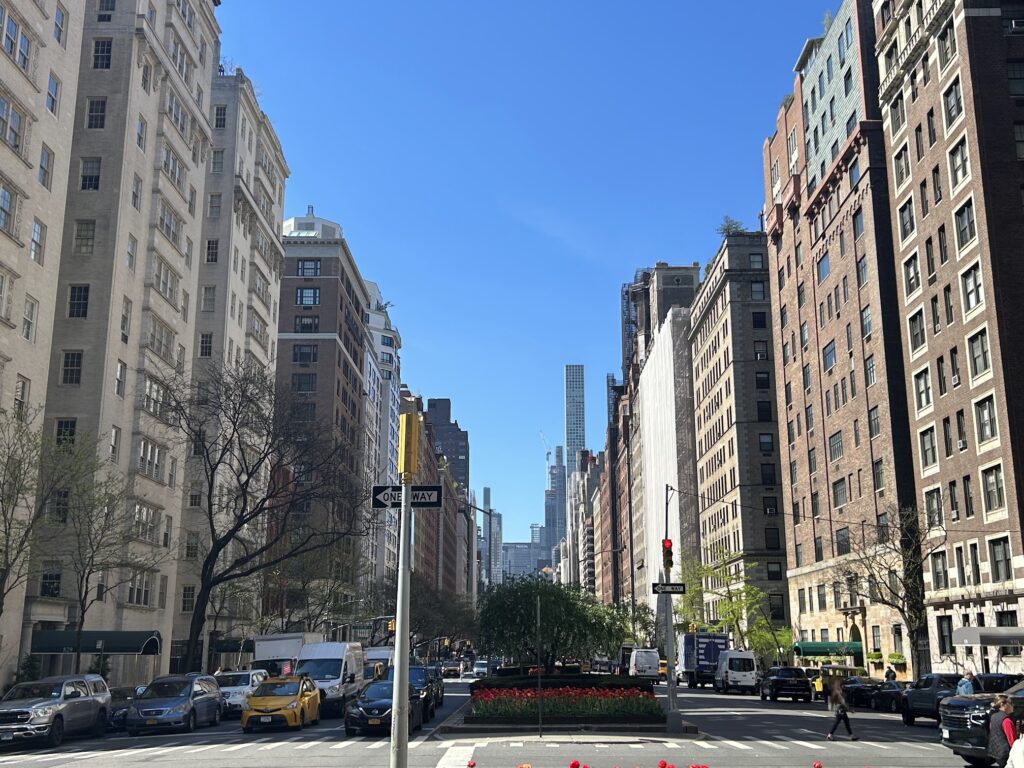
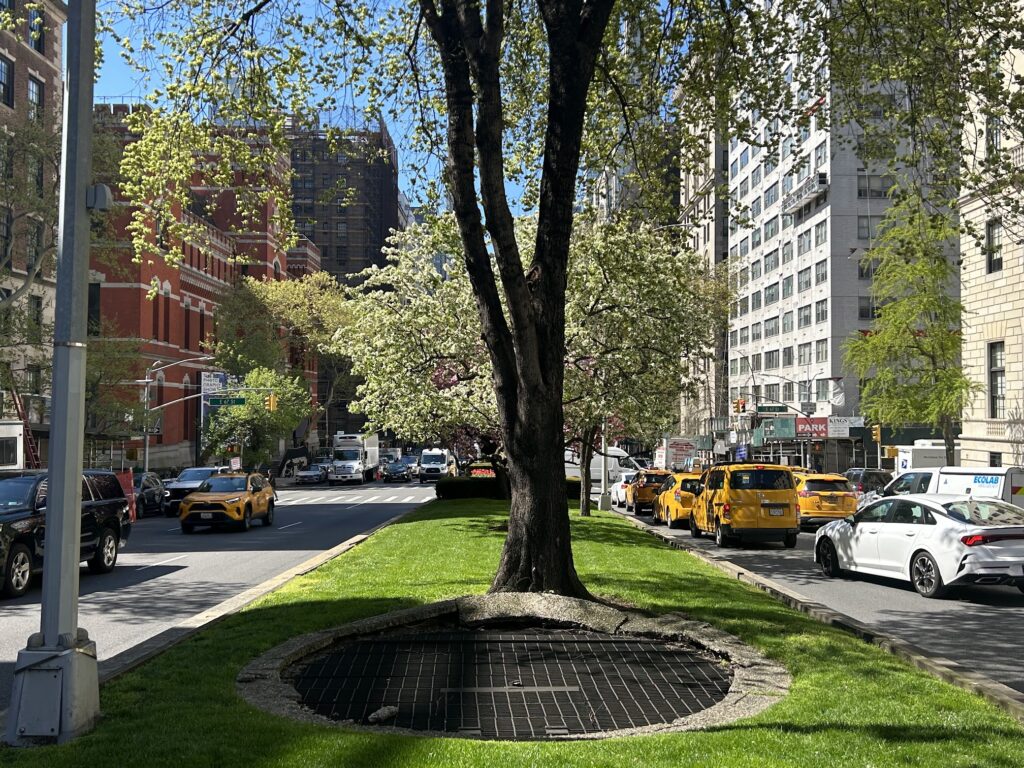
However train tracks running through a quickly growing city are neither safe nor conducive to prosperity. Eventually, the tracks were covered with beautiful flowers and trees, on traffic island malls which have gotten smaller over the years.
By the 1910s this allowed for glamorous apartment buildings to rise, the homes of a new wealthy elite attracted to apartment living in the post-Gilded Age era. But that lifestyle was not quite made available to everyone.
In this episode, Greg and Tom take you on a tour of the tunnels and viaducts that helped New York City to grow, creating billions of dollars of real estate in the process.
LISTEN NOW: UP AND DOWN PARK AVENUE
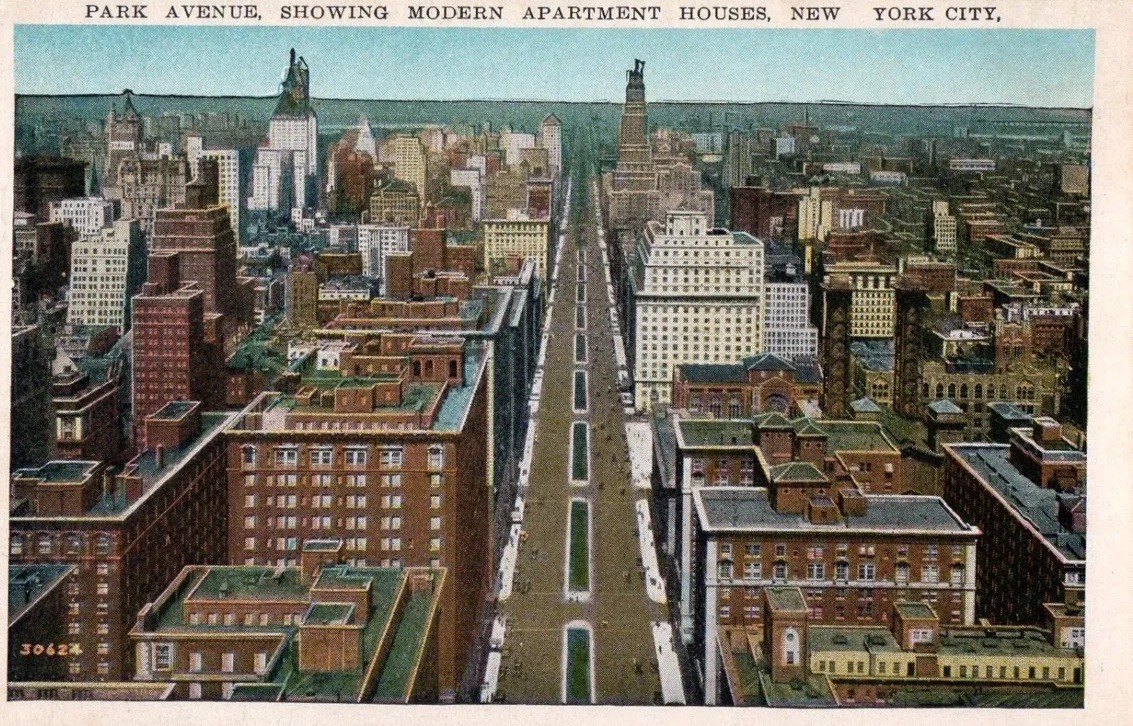
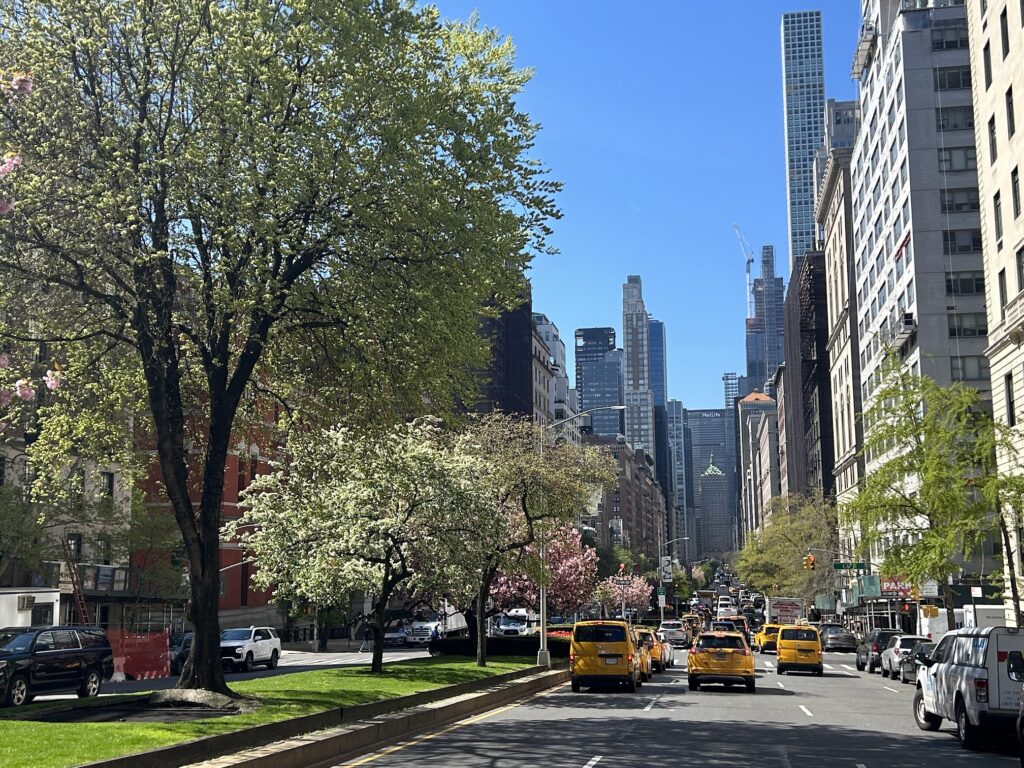
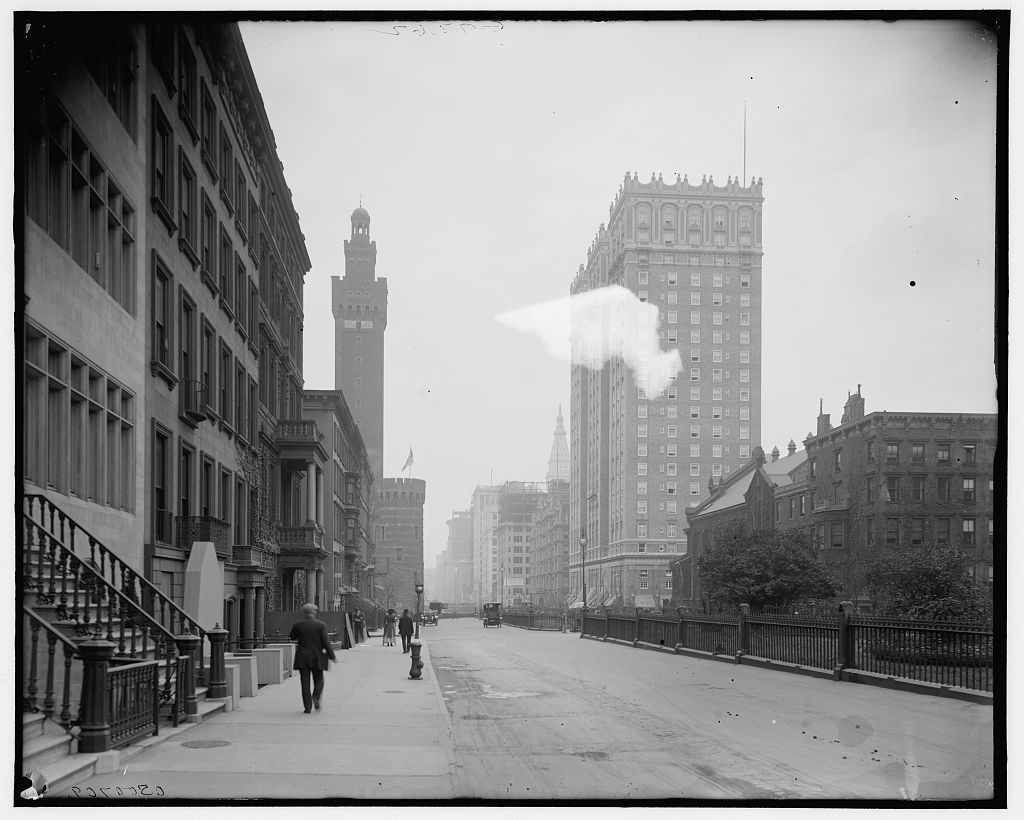
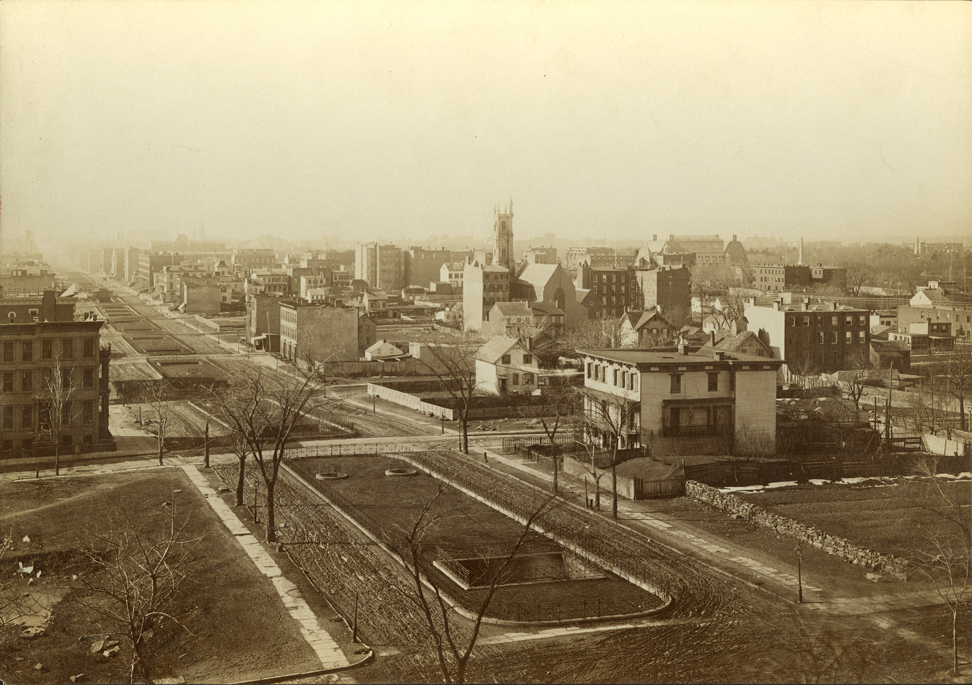
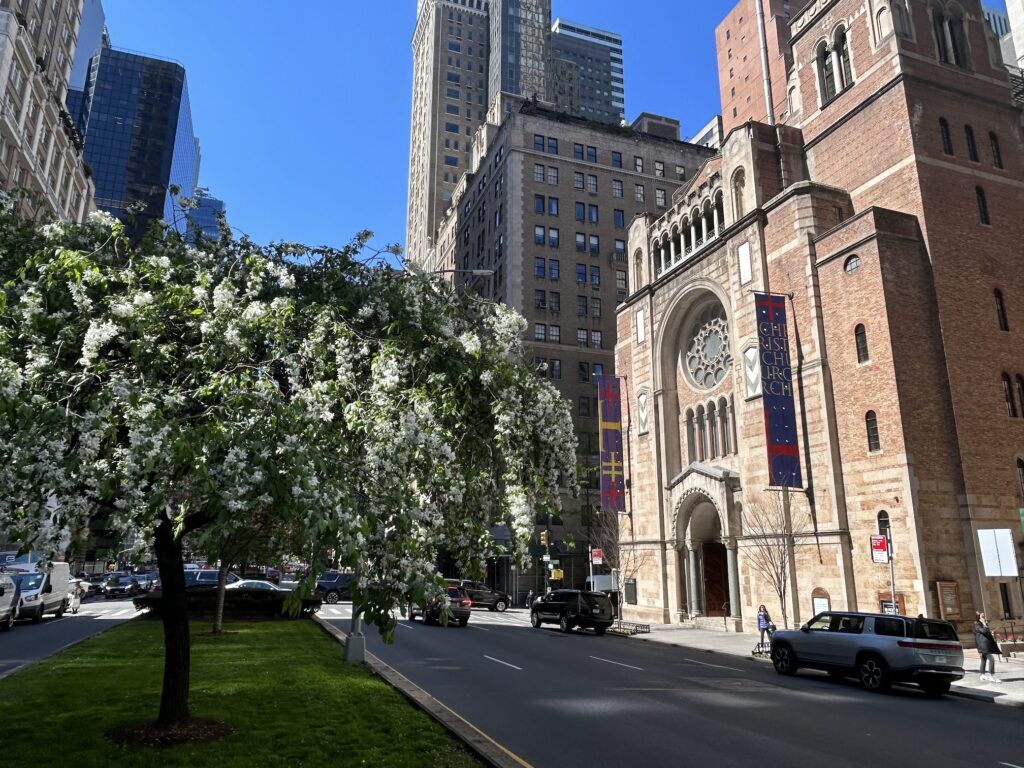
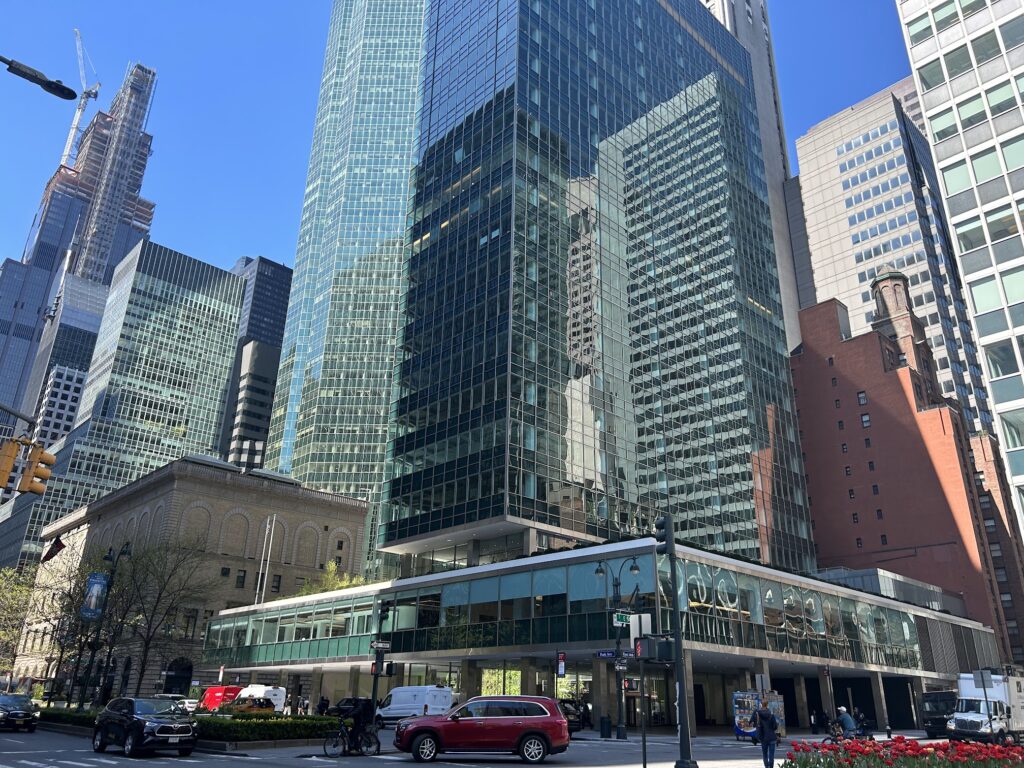
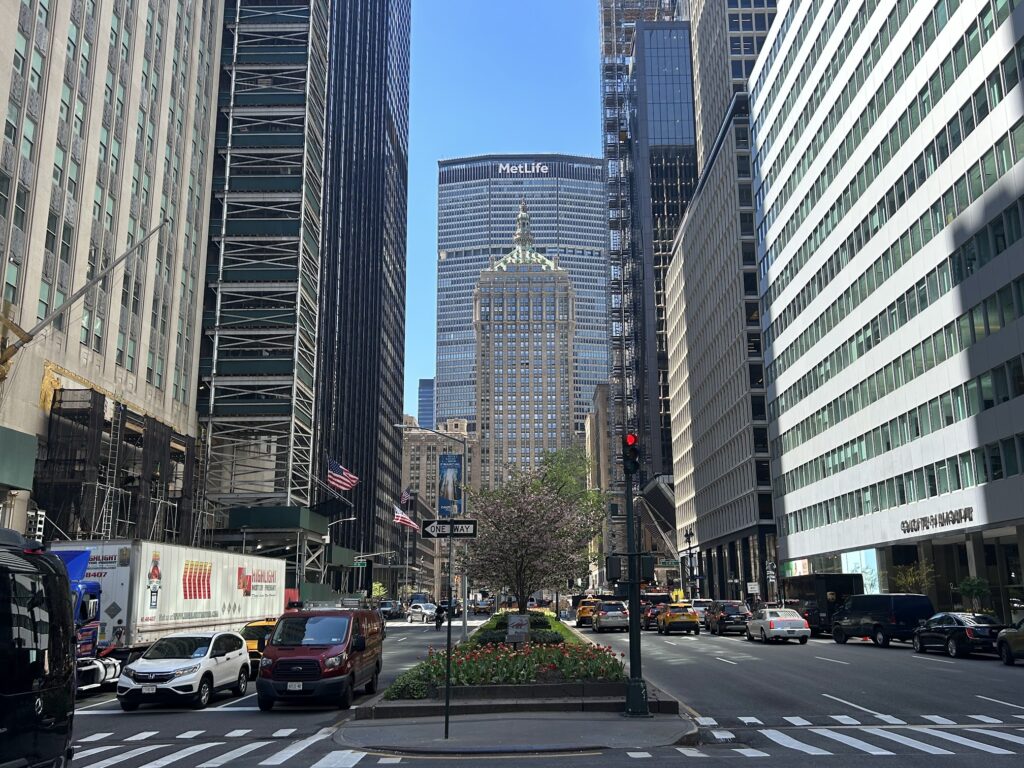
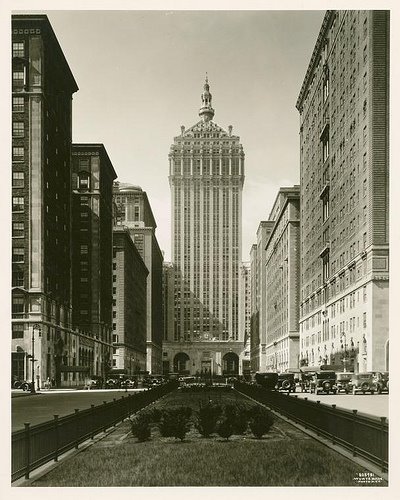
Park Avenue, looking south of 36th Street, 1900-1905 Library of CongressPark Avenue and 94th Street, Library of Congress Park Avenue, late 1800s, Musem of the City of New YorkPark Avenue, after St Bart’s came along in 1918 but before these lovely pedestrian areas were destroyed in the late 1920s. Park Avenue 1927, Department of Transportation“Photograph shows cars moving along Park Avenue as the road heads towards the tunnels of the Helmsley Building, known then as the New York General Building. Building construction visible to the right. St. Bartholomew’s Church slightly visible on left.” Library of Congress, 1959Photo by Greg YoungPhoto by Greg YoungPhoto by Greg YoungPhoto by Greg YoungPhoto by Greg YoungPhoto by Greg YoungPhoto by Greg YoungPhoto by Greg Young
FURTHER LISTENING
Listen to these related Bowery Boys episodes after you’re done listening to the Park Avenue show:
FURTHER READING
This week we’re suggesting a few historic designation reports for you history supergeeks looking for a deep dive into Park Avenue history. Dates indicated are when the structure or historic district was designated
The seats at Radio City Music Hall, rigged with explosive devices planted inside the upholstery. Bombs found at the Empire State Building, others detonating at movie theaters and in phone booths, at the New York Public Library and in subway stations. An explosion inside Macy’s.
Chaos, panic, anonymous letters to the police, copycat bombers. Some of the most sustained levels of domestic terrorism to hit an American city in the 20th century.
It may sound like the plot of a dastardly comic book film. But it actually happened in New York City.
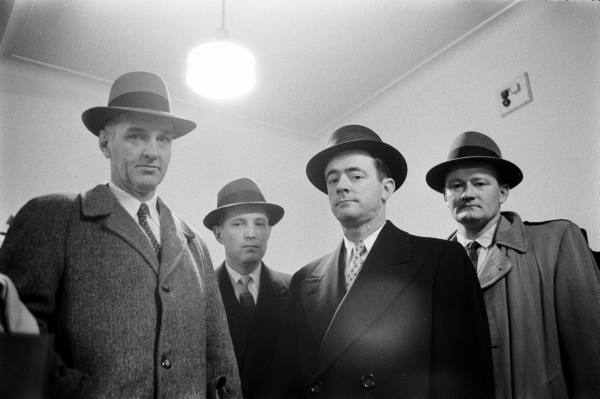
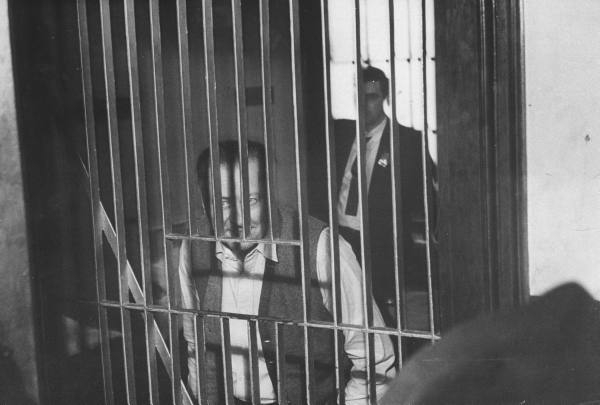
The man in the center, the one who looks like a kind grocer? That’s George Metesky, the insane “Mad Bomber” who terrorized New York for years with crudely made bombs placed in public places. (Photo by Peter Stackpole)
Through two decades, from 1940 to the mid 1950s, the city was under siege by a violent, greatly disturbed ex-Marine dubbed the Mad Bomber by the press.
George Metesky planted dozens of pipe bombs in New York City before he was finally apprehended in January 1957 at his home in Waterbury, Conn. He sheepishly met his captors at the door with the phrase, “I know why you fellows are here. You think I’m the Mad Bomber.”
George had been employed by the utility company until 1931, when a boiler explosion at uptown Manhattan plant left him permanently disabled and in the care of his two sisters in Connecticut.
He claimed the company refused to compensate him for his work-related hardship, fighting in vain with the corporation for five years. “My medical bills and care have cost thousands — I did not get a single penny for a lifetime of misery and suffering,” he would claim in one of his many letters to the press, after the bombings began.
For Con Ed’s part, they claimed Metesky had taken too long to file for disability benefits. Eventually, the truth didn’t matter. Metesky, later to be diagnosed a paranoid schizophrenic, decided to get comeuppance in a more sinister manner.
New York Daily News, November 19, 1940
The first explosive, ultimately a dud (as many were), was placed at Con Ed’s 64th Street office on November 18th, 1940, accompanied by a carefully constructed note, “CON EDISON CROOKS, THIS IS FOR YOU.”
One year later, another device, wrapped in a woolen sock, was hastily dropped in front of Con Ed’s 19th Street offices, without a missive this time. In both cases, investigators were befuddled: were the bombs even meant to go off or was it a scare tactic?
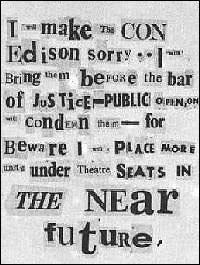
Metesky was feeling ignored yet again by Con Ed. Whether out of frustration or some kind of twisted, legitimate patriotic duty, however, he decided to call off future bombings due to World War II and sent a ‘kidnapper-style’ note(left, one such example), made from cut newspaper letters, to the press informing them so.
Feeling some acceptable amount of time had passed, Metesky decided on a different tactic on March 29th, 1950, planting a bomb at crowded Grand Central Terminal. Another note from George warned of an explosion there, and police were able to locate and defuse the device in time.
Thus began a bizarre game of cat-and-mouse as Metesky laid dozens of bombs throughout the city, unbelievably without detection. (The “see something, say something” mantra was clearly not in effect in the 1950s.)
A fourth device, in front of the New York Public Library, was the first to actually detonate, but it injured no one, the fortunate outcome of many of Metesky’s oddly made devices.
Despite dropping off pipe bombs in such places as Penn Station and the Port Authority Bus Terminal, despite targeting movie houses by scooping out the seats and implanting bombs there — despite some of these weapons actually exploding, nobody had been hurt. He had even thrown a pipe bomb into the Oyster Bar at Grand Central Terminal, with no serious harm.
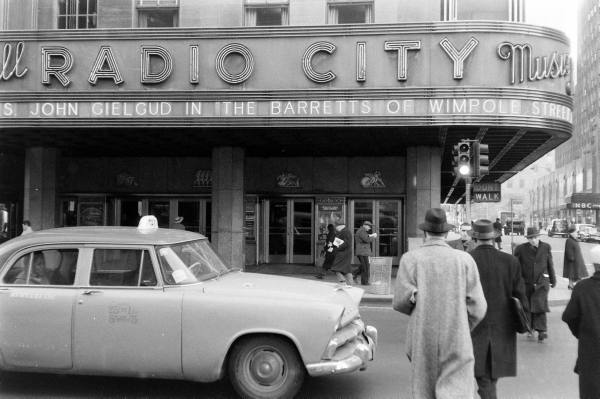
His devices in 1954, however, began to hurt people — minor injuries in a detonation at a Grand Central men’s room, then during a November screening of White Christmas at Radio City Music hall, where five people were hurt. (You can find pictures of the aftermath of one such bombing at Radio City in this Life Magazine article.) Amazingly, Metesky set off three bombs in total at Radio City. Once, a bomb went off with the bomber still in the theater; an usher stopped him as he was escaping but merely “apologized for the disturbance” and let him go.
He also sent a series of letters to the New York Herald Tribune, all in that same exact block-letter styling. Stating in these letters that he was seriously disturbed, George apologized for any potential injuries he might cause but proclaimed, “IT CANNOT BE HELPED—FOR JUSTICE WILL BE SERVED.” Metesky would sign his letters F.P., which investigators would later learn meant ‘Fair Play.’
Two explosions in 1956 ramped up the intensity and urgency of stopping Metesky. One device planted in a Penn Station bathroom seriously injured an elderly attendant. And Metesky left a Christmastime bomb in the Paramount Theatre in Brooklyn that detonated and injured six people, three seriously. (The film playing? War and Peace with Audrey Hepburn.)
The police were frantically piecing together a profile of Metesky, and dozens of people were apprehended and questioned, including one man who frequently drove into the citywith a suspicious trunk in his backseat. It was not Metesky; the trunk contained a pair of sexy fetish boots that the man paid prostitutes to wear.
During this time, dozens of bomb scares were called in throughout the city and there were even other copycat bombers likeFrederick Eberhardtwho sent a ‘sugar bomb‘ in the mail to Con Edison. He too was a former employee….and mentally disturbed.
It’s a bit difficult to get a grasp on the true on-the-street reaction to these bombings, which were numerous but rarely deadly. Slight panic may have passed through the thoughts of commuters passing through Grand Central or riding the subway, but over time, most people seem to have dismissed the danger. These events are sometimes brought up in comparison to the Son of Sam killings of the 1970s, which held the city in a far greater hysteria.
But, as they’re well equipped to do, the newspapers kept reminding New Yorkers of the danger. According to a 1957 Time Magazine article: “Hearst’s Journal-American thoughtfully provided a do-it-yourself spread on how to make a pipe-bomb…..The papers, thirsty and cunning in a news-dry holiday period, were still going strong.”
The Mad Bomber case is a textbook example of early profiling techniques of the day, and the first with a forensics psychologist (Dr. James Brussel) at its forefront.
In January 1957, a Con Edison secretary discovered similarities between letters from ‘F.P.’ published in newspapers and wording in Metesky’s old personnel files. Police were at Metesky’s doorstep in Waterbury a couple days later, where he almost readily spilled the beans about his identity.
Metesky was declared insane and sent to upstate’s Matteawan Hospital for the Criminally Insane. Believe it or not, he was freed on December 13, 1973, and lived for twenty more years back at his home in Waterbury. He claimed to the end that he designed his bombs not to hurt people. And yet, of course, many did.
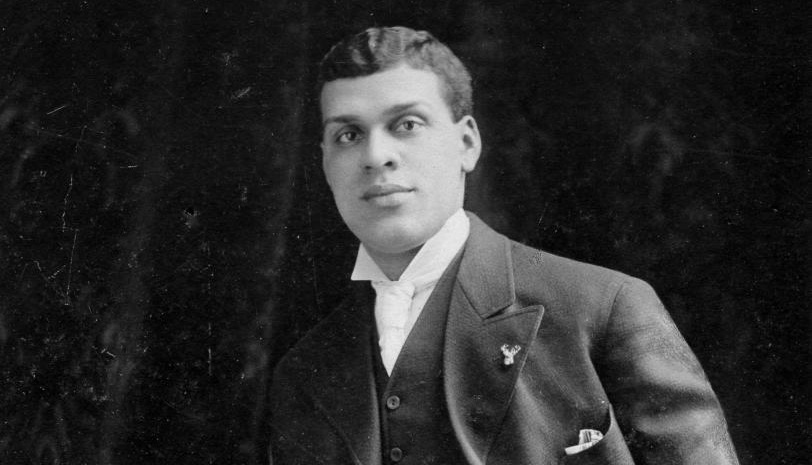
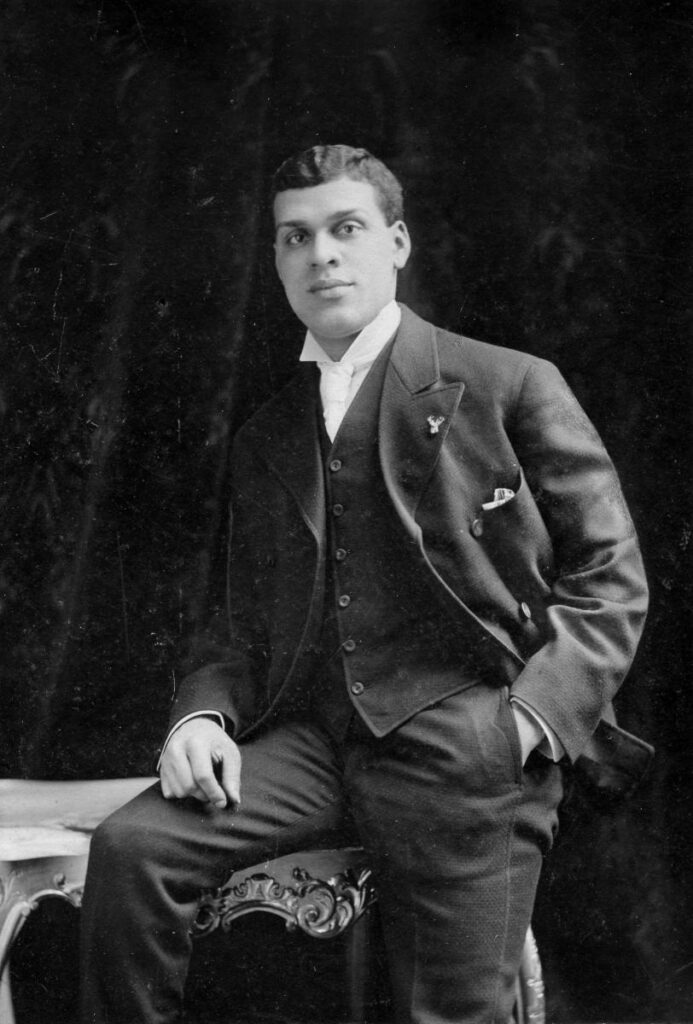
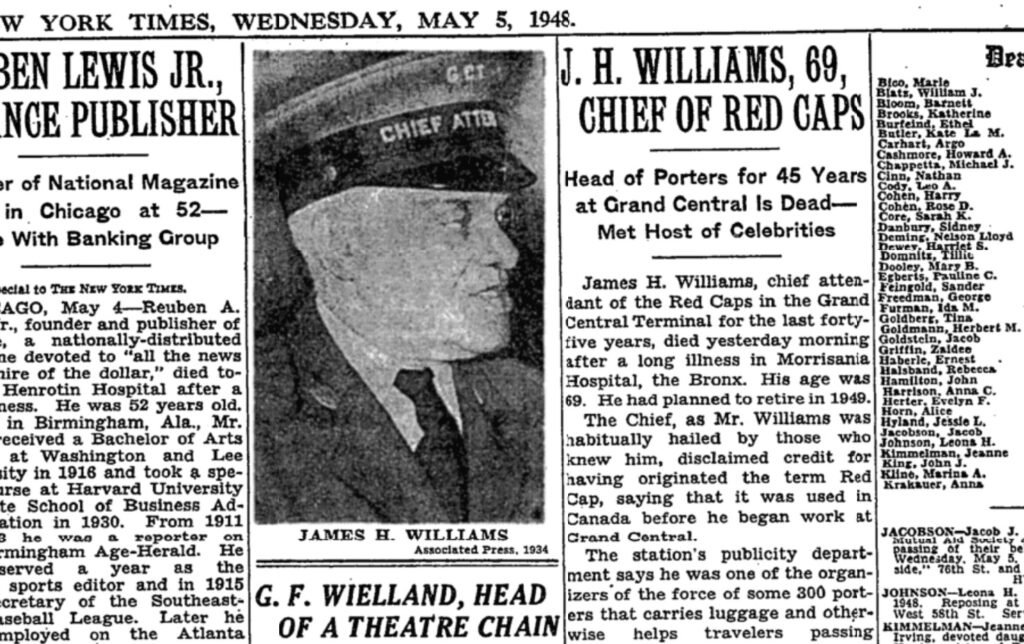
James H. Williams, here in 1905, would soon become the "Chief" of a force of hundreds of Red Caps at Grand Central, a post he'd keep for four decades.
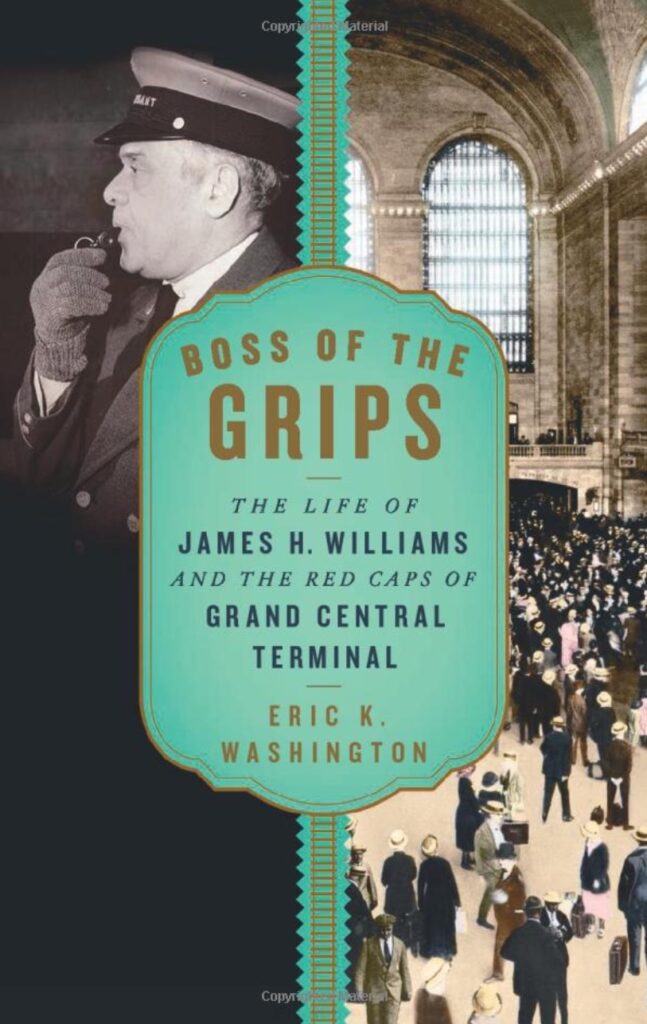
PODCAST EPISODE #339: An interview with author Eric K. Washington, author of “Boss of the Grips: The Life of James H. Williams and the Red Caps of Grand Central Terminal”.
The Red Caps of Grand Central Terminal were a workforce of hundreds of African-American men who were an essential part of the long-distance railroad experience. Passengers relied on Red caps for more than simply grabbing their bags — they were navigators, they helped with taxis, offered advice, and provided a warm greeting.
He also tells the story of Grand Central Terminal, and specifically, of the Red Caps who worked here, especially during the Terminal’s heyday in the first half of the 20th century. And along the way, the book chronicles how New York’s African-American enclaves and communities developed and moved around the city.
That huge story is told through the lens of this one, often underappreciated, and yet instrumental man — James Williams. He was the chief of the Red Caps, but also an under-reported figure in the Harlem Renaissance.
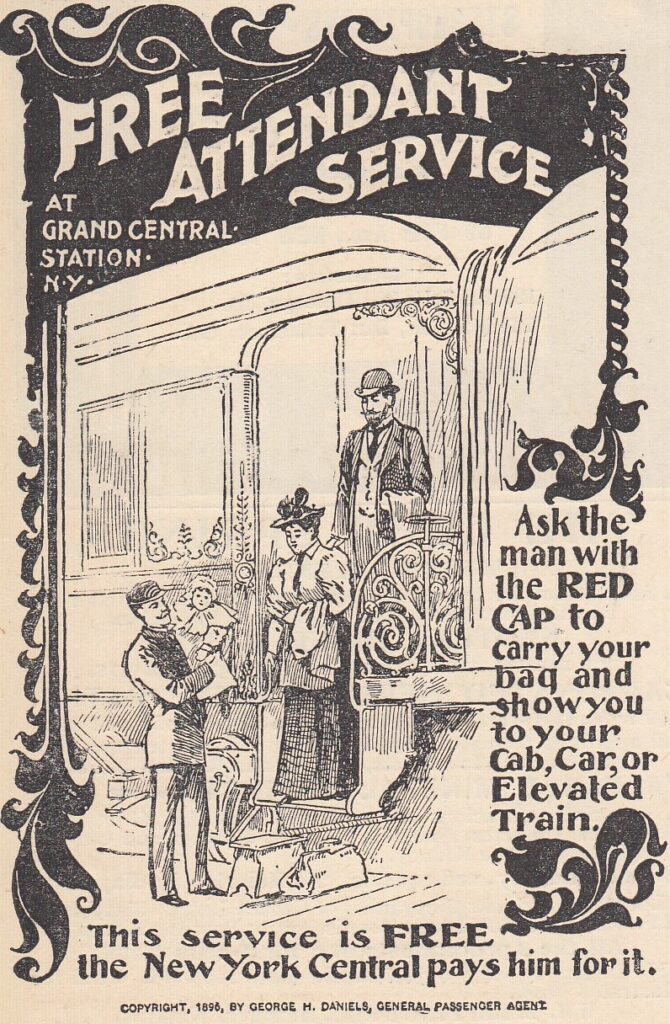
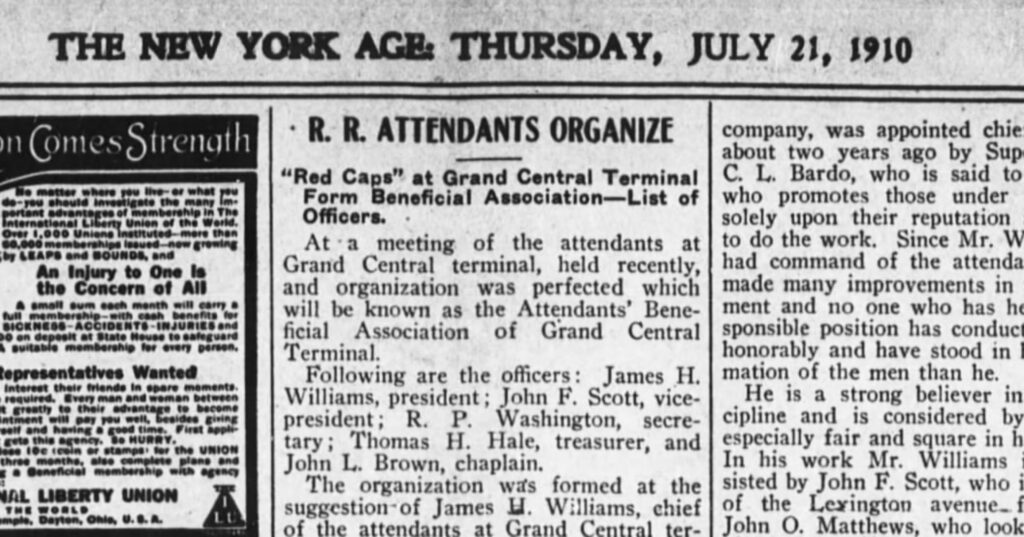
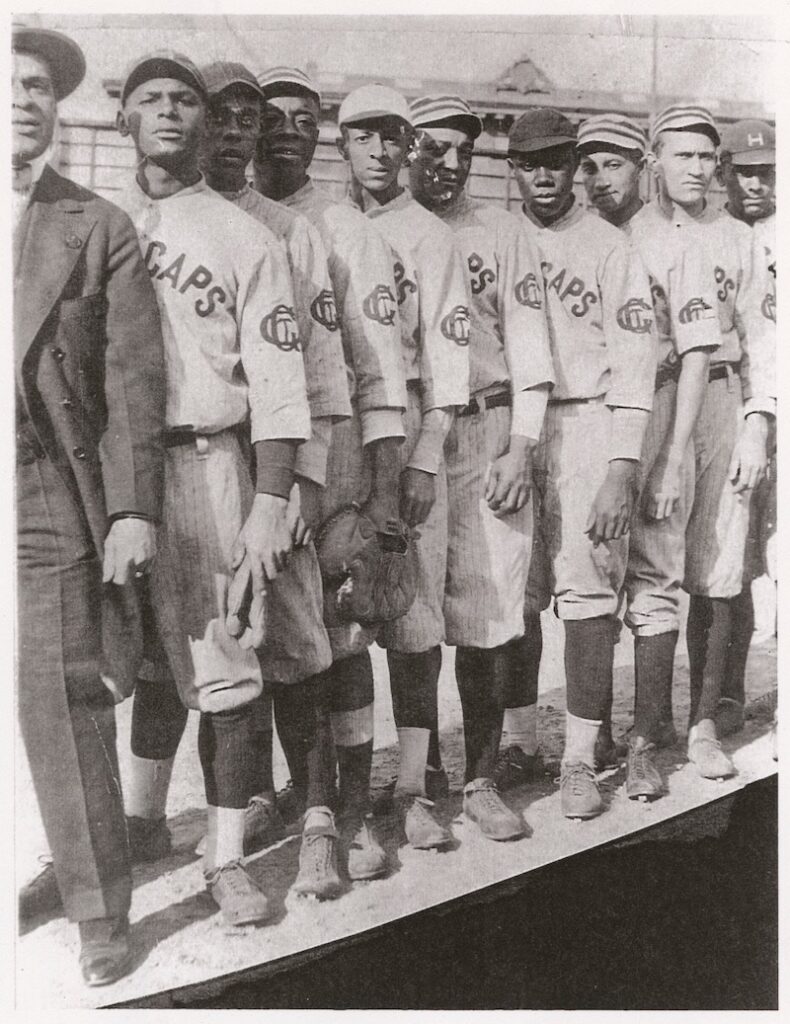
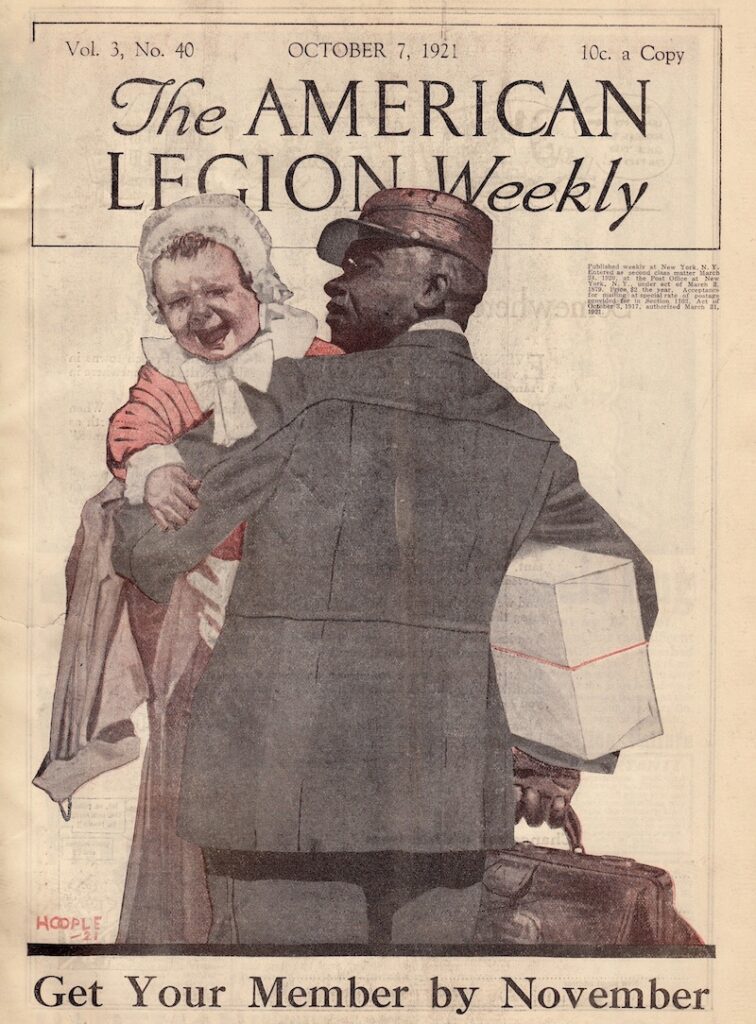
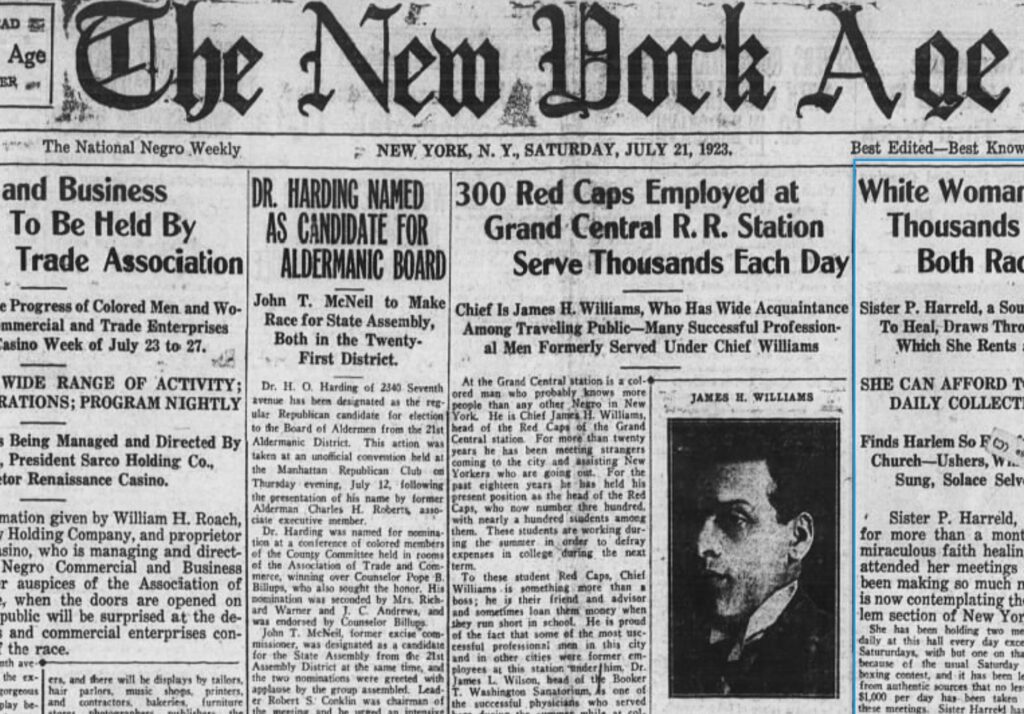
The New York Central launched its free Red Cap service in 1895, and promoted it widely in advertisements like this one, from 1896.When Williams sat for this portrait in 1905, he was working as a Red Cap, but had not yet been named Red Cap director, or “Chief”. Williams became the “Chief” of the Red Caps in 1909, and immediately got to work organizing a benevolent association for the Red Caps, covered here in the New York Age in 1910.Chief Williams posing with the Grand Central Terminal Red Caps baseball team in 1918. Red Caps carried hat boxes, valises… and sometimes even crying babies, too, as illustrated in this 1921 cover of The American Legion Weekly.James H. Williams was regularly covered in the local and national press. In 1923, the New York Age published a profile of Williams on its front page.
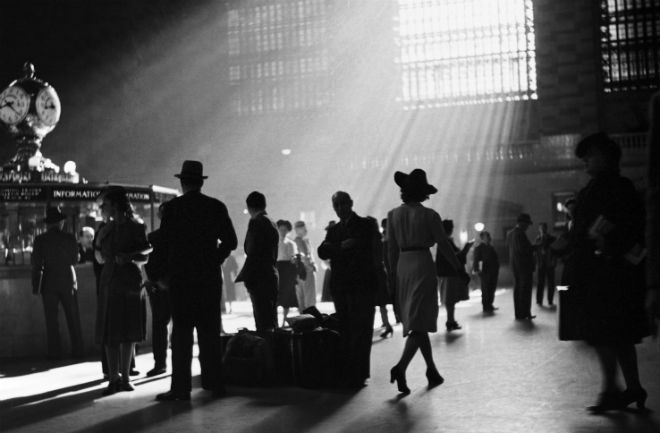
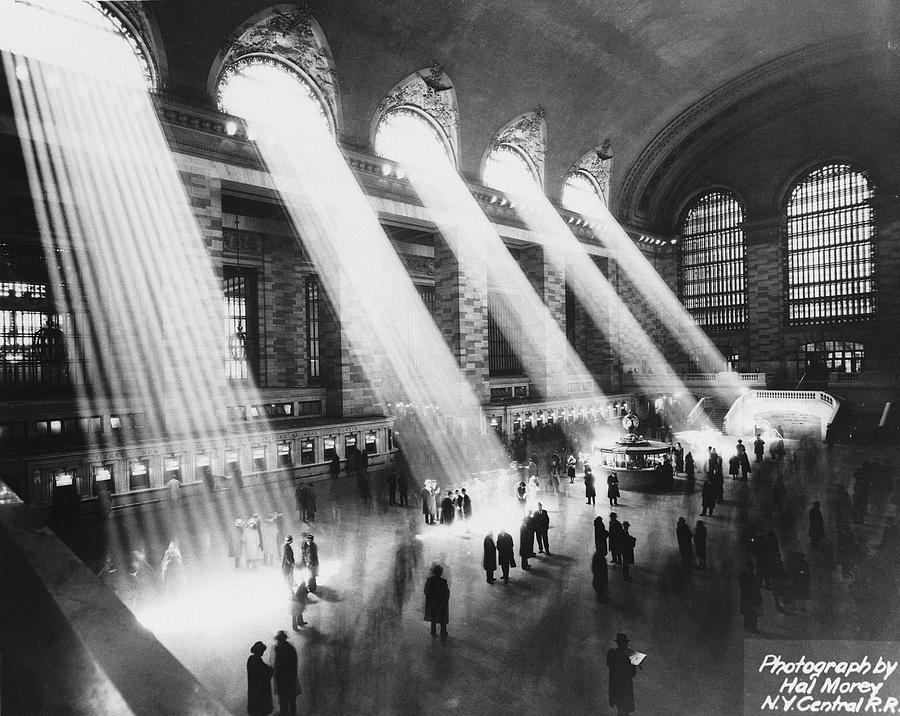
Hal Morey’s iconic shot of Grand Central from 1930 captures a blur of activity in the lower left corner. Could it be a Red Cap carrying a bag, drenched in sun?
The Grand Central Red Caps Orchestra perform “Nina”, under the direction of Russell Wooding, Frank Luther (vocals). RCA Victor, 1931
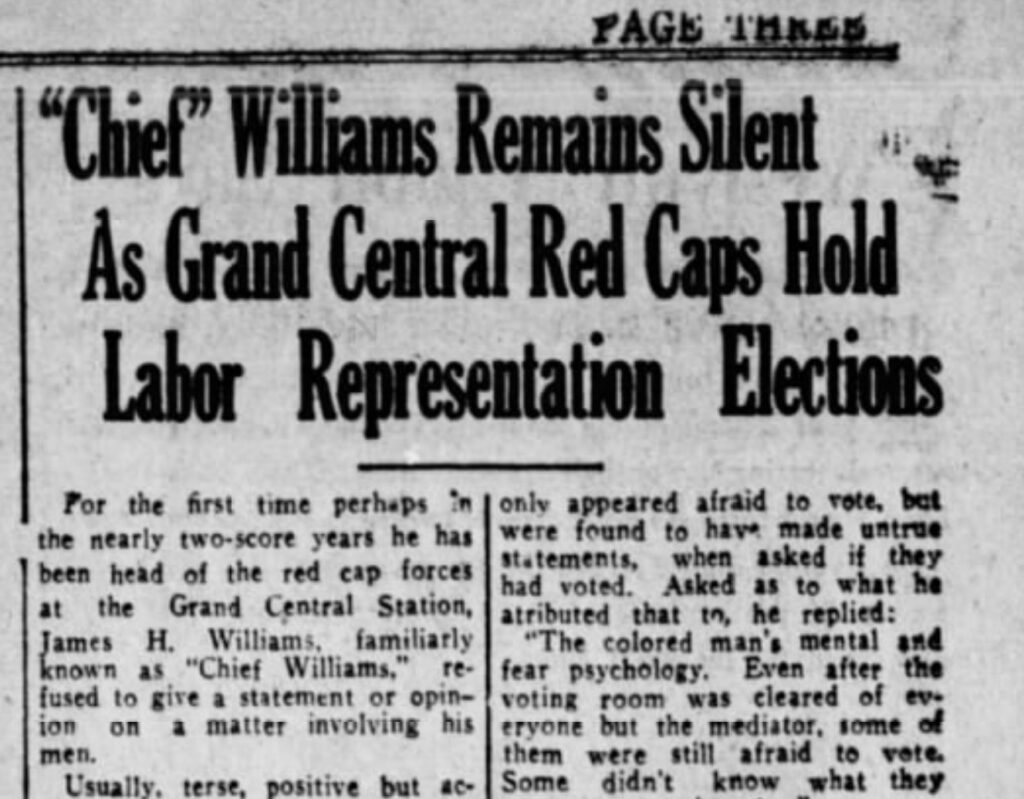
In 1939 as Red Caps around the country started organizing, Chief Williams remained strategically quiet. The formation of a Red Cap union was covered in this piece in the New York Age, September 16, 1939.Williams obit in the New York Times, May 5, 1948.
The Bowery Boys: New York City History podcast is brought to you …. by you!
We are now producing a new Bowery Boys podcast every week. We’re also looking to improve and expand the show in other ways — publishing, social media, live events and other forms of media. But we can only do this with your help!
We are now a creator on Patreon, a patronage platform where you can support your favorite content creators.
Please visit our page on Patreon and watch a short video of us recording the show and talking about our expansion plans.
If you’d like to help out, there are six different pledge levels. Check them out and consider being a sponsor.
We greatly appreciate our listeners and readers and thank you for joining us on this journey so far.
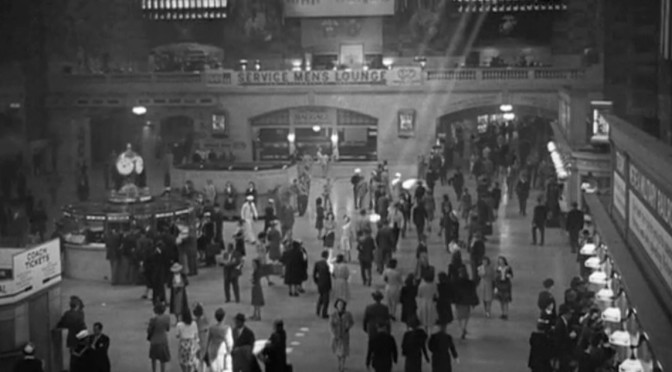
Grand Central Terminal has seen millions of people rush across
its Main Concourse over the past one hundred years, and more than a few
movies have captured that commuter ebb and flow. But while Grand
Central is occasionally a backdrop for romance — especially during World
War II, when returning soldiers would arrive to meet their loved ones —
filmmakers have preferred to capture a darker aspect to the landmark.
The Beaux-Arts train station has become an ideal location for
thrillers, mysteries, fantasies and horror films, a backdrop for chases
and a metaphor for chaos and disorientation. In the movies, its
concourse feels even more cavernous and mythic, its train tunnels havens
for the unknown.
During its first half-century, Grand Central was known mostly for its trains — in particular, the Twentieth Century Limited,
the luxurious passenger locomotive that attracted the most famous
people in the world. In fact, the most common place to see a celebrity
in the 1930s and 40s would probably have been Grand Central. People
would sit at the station watching politicians and stars boarding the
most famous train in the world.
So it’s no surprise that Grand Central’s most notable early film
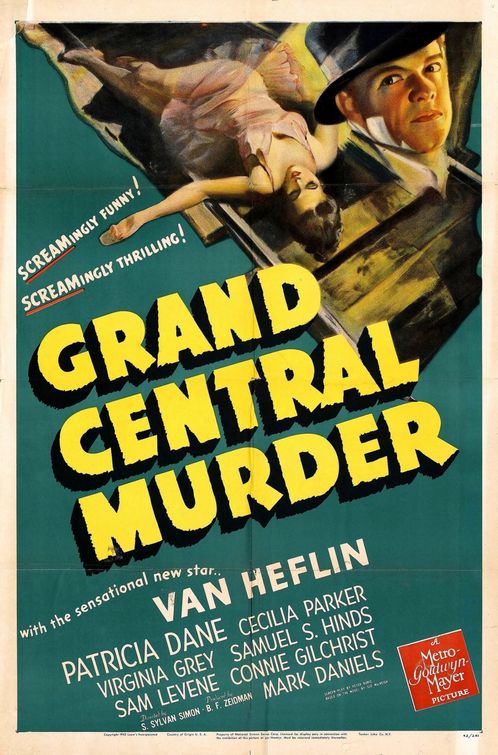
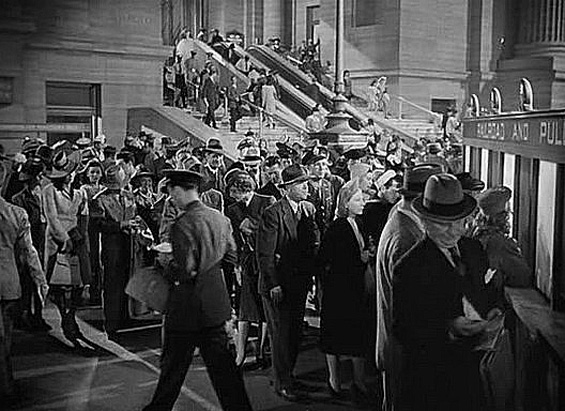
appearances relate to the Twentieth Century, including, of course, Twentieth Century, the ribald 1934 comedy that made Carole Lombard a star. Other glamorous features of this era — including Grand Central Murder (1942) and The Thin Man Goes Home(1945) — use Hollywood reconstructions of Grand Central as a backdrop.
Below: A phony version of Grand Central Terminal used in the film The Thin Man Goes Home. (Courtesy On The Set of New York)
As the train station deteriorated after the 1950s — as train travel
itself fell into disregard — Grand Central became a darker, dangerous
place in the movies. The travelers, the commuters, are now a backdrop
for chase scenes and violent shootouts, homeless people and even psychos
stalking the yellowing, banner-filled concourse of the 1970s and 80s.
Its rehabilitation in the 1990s brought monumentality back to Grand
Central and brought it back to the movies as a place of respect and
beauty. I would never recommend you watch the remake of Arthur starring Russell Brandexcept for this particular scene which demonstrates the Terminal’s remarkable transformation.
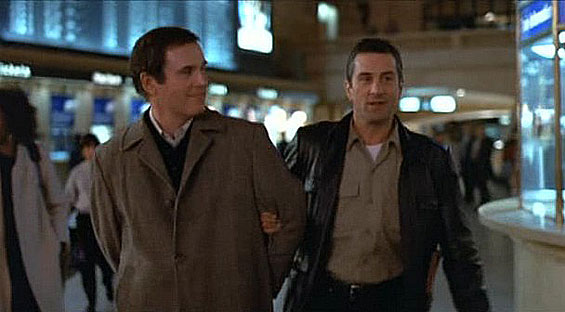
Grand Central makes a brief appearance in the 1988 comedy Midnight Run with Charles Grodin and Robert DeNiro. (Courtesy On The Set of New York)
Here are my personal choices for Grand Central’s top ten moments in
cinema. I’m sure I’m forgetting a few choice ones, so please add them
in the comments section if they come to mind:
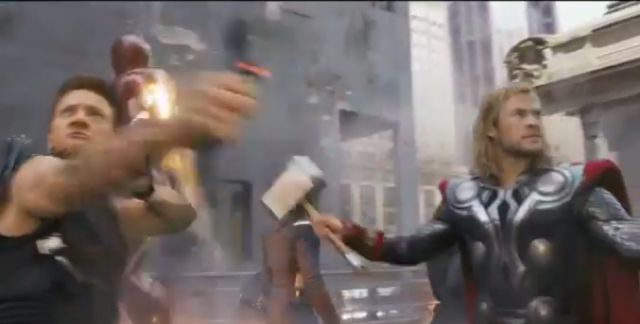
10 The Avengers (2012)
The Terminal as a fortress, a hall of justice. The MetLife Building behind it is completely dismantled and replaced with Iron Man‘s
new headquarters, but nobody would ever think of doing that to Grand
Central. In fact, our heroes fight inter-dimensional aliens right in
front of it, their phalanx mounted on the overpass below. As Earth’s
finest stand in akimbo waiting for the attack, the statue of Cornelius Vanderbilt stands equally defiant in the background. (For another sci-fi use of Grand Central’s exterior, see Will Smith in I Am Legend.)
9 Necrology (1971)
The building has inspired the avant-garde as well. Years after Andy Warhol turned his camera to the Empire State Building, experimental filmmaker Standish Lawder
found supernatural inspiration inside Grand Central for this odd little
film ostensibly about the afterlife. Stay for the credits.
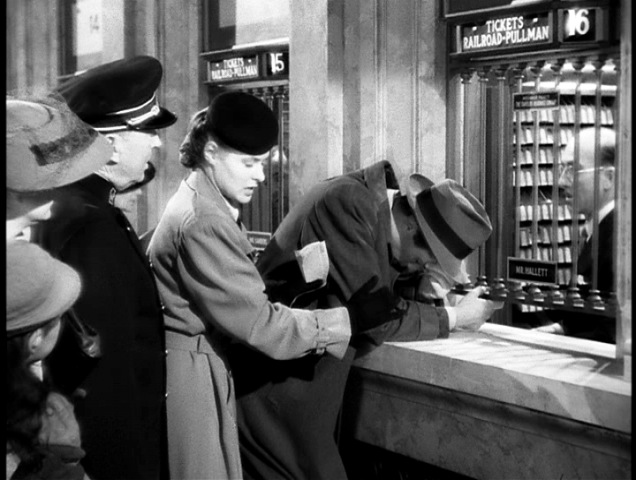
8 Spellbound (1945)
This isn’t even Alfred Hitchcock‘s best film usage of Grand Central (see below), but it’s notable in that both Grand Central and Pennsylvania Station are used in this psychological thriller starring Ingrid Bergman and Gregory Peck.
I can’t recall any other film that would have included both iconic New
York landmarks. With this film, Hitchcock also playfully mocks Grand
Central’s wartime reputation as a place for departing lovers, even while
giving into those romantic impulses.
7 The House on Carroll Street (1988)
This somewhat unsuccessful thriller (with a spectacular cast) is notable
for its creativity involving a climactic chase scene up in Grand
Central’s inaccessible upper tiers. You can see a little bit of it in
this trailer:
6 Superman (1978)
Lex Luther’s secret lair, eccentrically decorated, is hidden in a
forgotten tunnel underneath Grand Central. His lackey Otis (Ned Beatty)
is tracked to the concourse by police officers, but Luther has set a
deadly trap for one of them. Another reason not to roam the tracks by
yourself!
Later, the supervillain waxes about the benefits to his Grand Central lair as the trains rumble overhead.
5 A Stranger Is Watching (1982)
Had Lex not been defeated, he would have been sharing the tunnels with
the maniacal killer of this schlocky thriller, based on a novel by Mary
Higgins Clark. While this movie is pretty bad, Grand Central is used to
superb effect, a veritable haunted house of dark tunnels and abandoned
elevators. There’s even mention of Franklin Delano Roosevelt’s secret elevator!
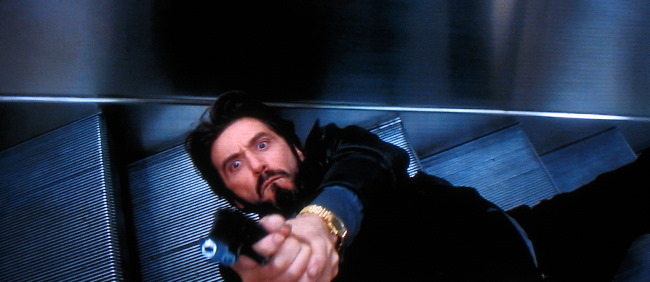
4 Carlito’s Way (1993)
The famous escalator shootout scene (it’s Battleship Potemkin-meets-violent
cop show) is probably the goriest scene ever filmed directly in Grand
Central, topped by Carlito (Al Pacino) running to meet Penelope Ann
Miller. Let’s just say, he misses his train. Watch the scene here.
3 Seconds (1966)
This bizarre John Frankenheimer drama starring Rock Hudson uses
Grand Central Terminal (and a unique camera angle) to set the film’s
off-kilter and twisted perspective. It becomes the crossroads where
opportunities of a second chance are literally handed to you if you dare
to take them.
2 The Fisher King (1991)
Having hosted various mentally disturbed escapades in prior films, we
now get to look in on an actual Grand Central fantasy in this Robin Williams film, as the deranged hallucinations of his character turn the bustling room into a glorious dance floor.
1 North By Northwest (1959)
Has Grand Central Terminal ever looked as beautiful as it does in this
pivotal scene from Hitchcock’s great 1959 masterpiece? It gives Cary Grant
opportunities to be suave, pensive and fabulous all at once. It also
embodies the tension and danger that would influence other filmmakers in
later years to come to Grand Central for inspiration.
John F. Kennedy, the 35th president of the United States, was memorialized in dozens of ways following his assassination on November 22, 1963. None of these are more vital to the daily lives of New Yorkers than John F. Kennedy International Airport — or Kennedy Airport or simply JFK — the business airport in the northeast.
You may not realize how quickly it was renamed for the fallen president. On November 15, 1963, President Kennedy left Idlewild Airport (the airport’s former name) after a short stay in the city. Six weeks later, that airport would be named after him.
New York joined the nation in mourning following the televised funeral of President Kennedy on November 25, 1963. Thousands watched the ceremony from a large television screen hanging in Grand Central Terminal. Traffic stopped in Times Square and buglers played taps from atop the old Hotel Astor. All airport traffic at Idlewild stopped at noon.
Calls immediately rose to memorialize the president in the city. On December 4, less than two weeks after Kennedy’s death, Mayor Robert Wagner announced that he would submit a bill to the city council to honor Kennedy with a name change to the Idlewild.
Unfortunately, these ultimately successful calls to rename New York’s largest airport came at the cost of obliterating the memory of another great American.
Wired New York
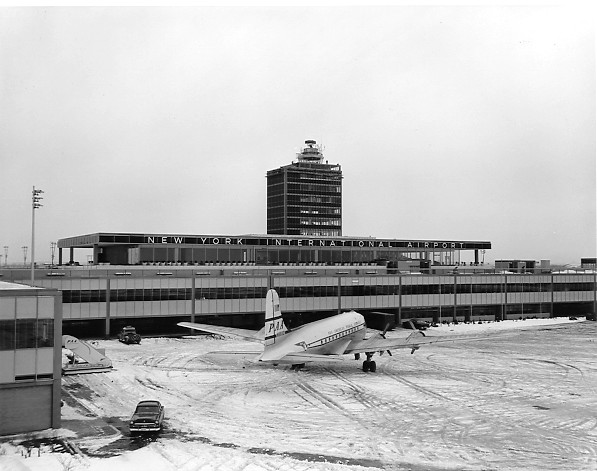
Idlewild was the popular name for the airport which opened on July 1, 1948, because it was built upon a former golf course and luxury accommodation of that name. According to the Times, “The name Idlewild is believed to have been inspired by the fact that the site at that time was wild and that the hotel and park constituted a recreational facility for the idle rich.”
But its full, official name was New York International Airport, Anderson Field, named forMajor General Alexander E. Anderson, a decorated World War I veteran and Queens businessman. Unfortunately Anderson had few proponents fighting to keep his name on the airport by 1963.
The following week, “[i]n an action marked by solemnity and silent prayer, the City Council voted unanimously yesterday to change the name of New York International Airport at Idlewild, Queens, to the John F. Kennedy International Airport.” [source]
It was revealed then that city officials wished to name the airport after Kennedy even more quickly than that. Indeed, the idea had been unofficially approved hours after Kennedy’s assassination but it had taken the extra time to get the official approval from his widow (and future New York City resident) Jackie Kennedy.
Photographer Meyer Liebowitz/The New York Times
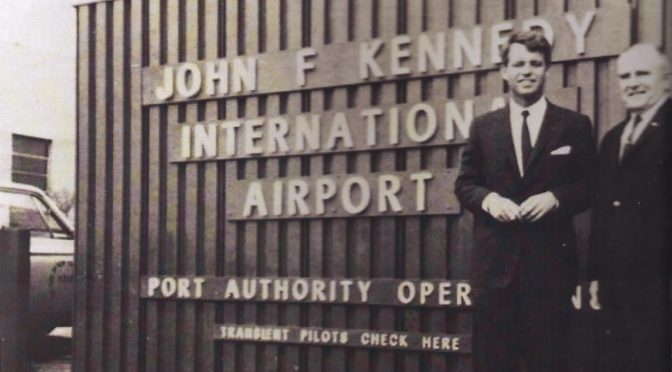
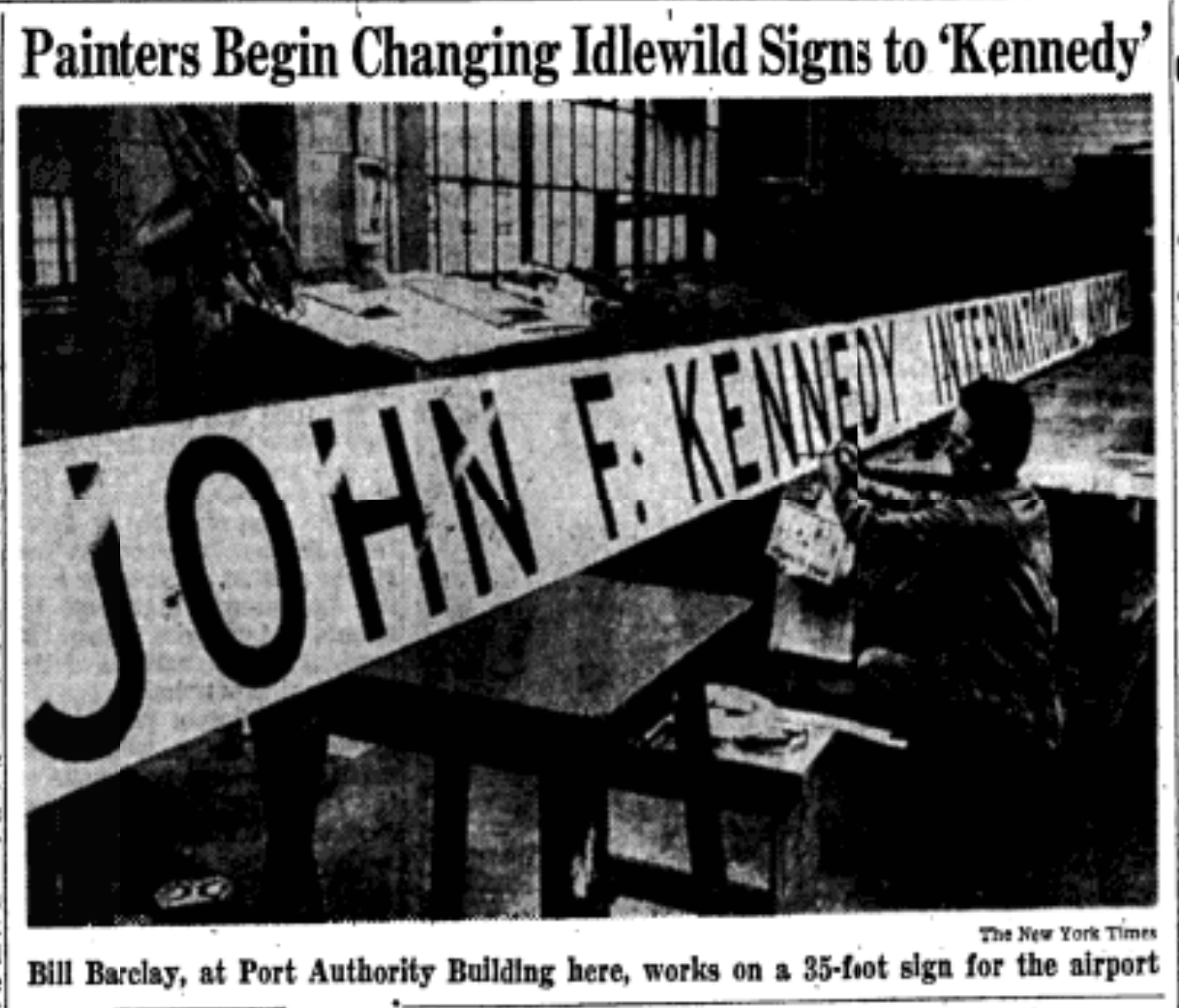
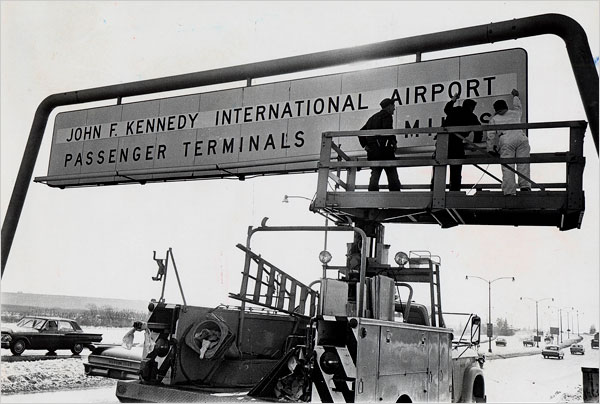
By Wednesday, December 18, the name change had been formally approved and workman busily rushed to change all the signs at the airport. Idlewild officially became John F. Kennedy Airport in a ceremony held on Christmas Eve 1963.
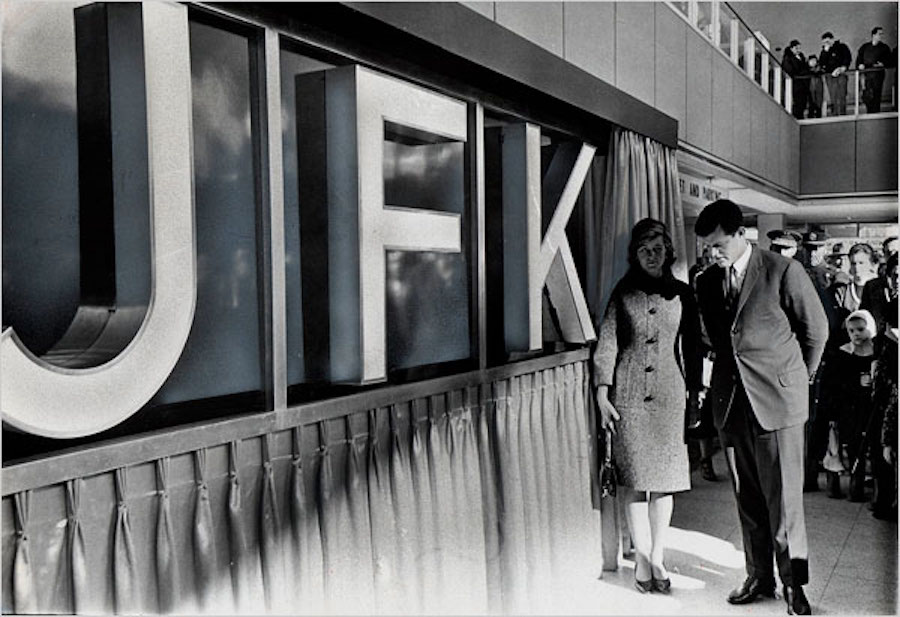
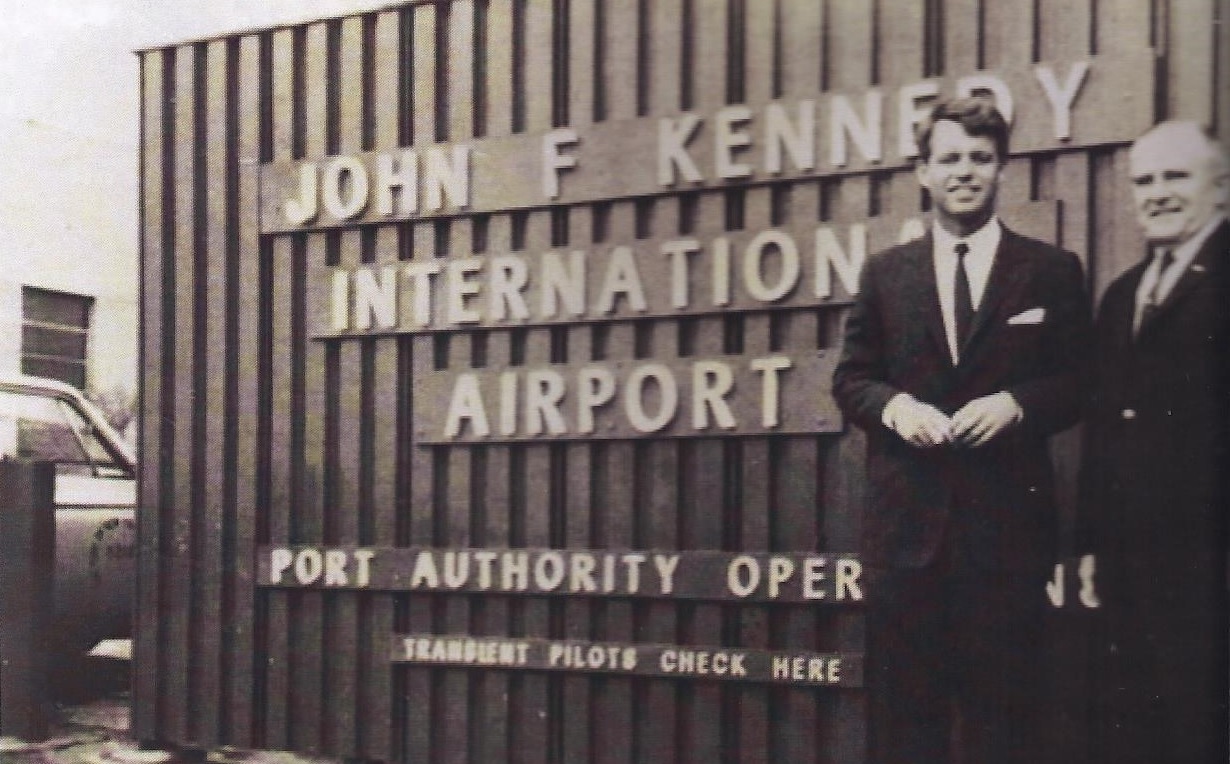
The president’s younger brother Edward Kennedy was in attendance, helping to unveil a 242-foot-long sign emblazoned with the new name. Their brother Robert F. Kennedy was scheduled to attend but canceled.
You would think such a name change to be relatively uncontroversial but this was not the case.
In an editorial which ran a few days after the ceremony, the New York Times remarked: “The speedy change of name — whether it be of an airport or a bridge or a park or a cape — reflects the love that millions of people all over the world had for Present Kennedy; but, as we have previously stated, it is only debasing the subject of our grief to attach his name so hastily to a miscellaneous collection of public works, almost as if we were afraid that without these tangible reminders he would be soon forgotten. “
Meyer Liebowitz/The New York Times
And President Kennedy almost got his name upon a newly built bridge in the New York City area, too.
That same month, a Staten Island politician filed a bill to the New York state legislature to name a new bridge being built in the Narrows after Kennedy. “Assemblyman Edward J. Amann Jr … profiled at Albany for introduction into the Legislature in January a bill calling for changing the name of the Verrazano-Narrows Bridge to the John. F. Kennedy Memorial Bridge.” [source]
The Verrazano kept its tribute to the 16th century European explorer. But New York does have a bridge named for a Kennedy — the Robert F. Kennedy Bridge (the former Triborough Bridge).
Below: A month after the dedication, Robert did stop by the airport named after his brother.
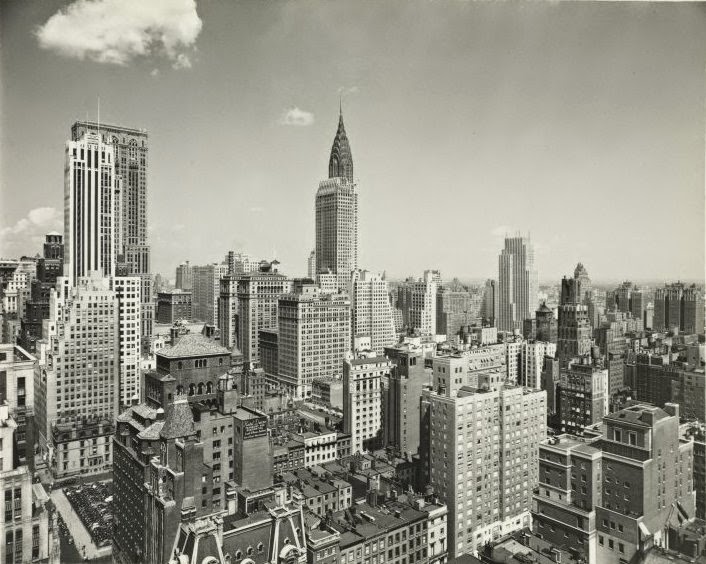
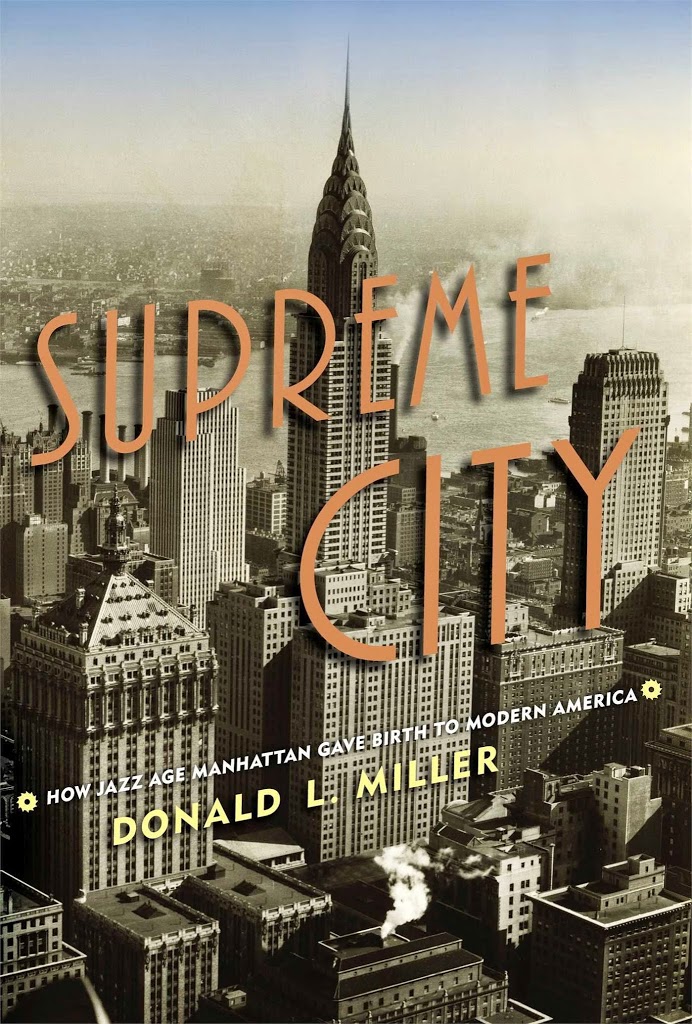
A view of Midtown Manhattan, looking southeast, by the Wurts Brothers (NYPL) Supreme City How Jazz Age Manhattan Gave Birth to Modern America by Donald L. Miller Simon & Schuster
Supreme City, by Donald L. Miller, certainly one of the most entertaining books on New York City history I’ve read in the past couple years, is also one of the strangest. Almost as an obligation, New York’s Prohibition-fueled nightlife and the rowdy administration of Jimmy Walker are conjured up front, and colorfully so, only to then be placed aside.
This is not a book about the standard subjects of the 1920s. This is indeed an epic about New York City in the Jazz Age, but it’s a wildly different tune than the one in which you’re familiar.
This is a tale of architecture and invention, of a boldness and proportion that New Yorkers take for granted today. Supreme City recounts the invention of Midtown Manhattan, but it’s also about a spiritual shift in urban life. This is the story of how New York City became not only a supreme city, but a supersized one.
Miller, a professor of history at Lafayette College perhaps better known for his works on World War II, approaches the sprawl of New York’s most ambitious decade almost like a mathematician. He ties this epic — a swirl of large personalities and impossible ideas — into a specific intersection of time and place.
It’s as though a slew of particles (comprised of ambitions and personalities) just slammed into each other one day, creating a new form of urban environment.
Industrial visions and personal journeys alike culminate in the year 1927, a watershed date for New York history, and arrive within the Manhattan grid system, mostly along 42nd Street between Eighth Avenue and Lexington Avenue, the nucleus of a new urban vision. The story ventures out through the entire city of course but always to the beat of this new Midtown.
From here, Miller brings in the components of growth, the great innovators and personalities, plotted in relation to each other and to the great city blossoming under their feet.
These aren’t just the standard innovators, the expected cast — David Sarnoff, Duke Ellington, Charles Lindburgh. Sure, you get a bit Texas Guinan‘s drunken swagger, a little of Jack Dempsey‘s scrappiness. But Miller gives equal prominence to perhaps less colorful real estate gurus and planners whose contributions created the playing field of modern New York. While it’s always nice to relive the 1920s through a lens of champagne and The Great Gatsby, Miller’s concern is with the players who actually built the city.
The engineer William Wilgus receives deserved placement in Supreme City for his innovations of covering the unpleasant tracks of Grand Central to create acres of new land, “taking wealth from the air” and inventing New York’s ultimate canyon of wealth — Park Avenue.
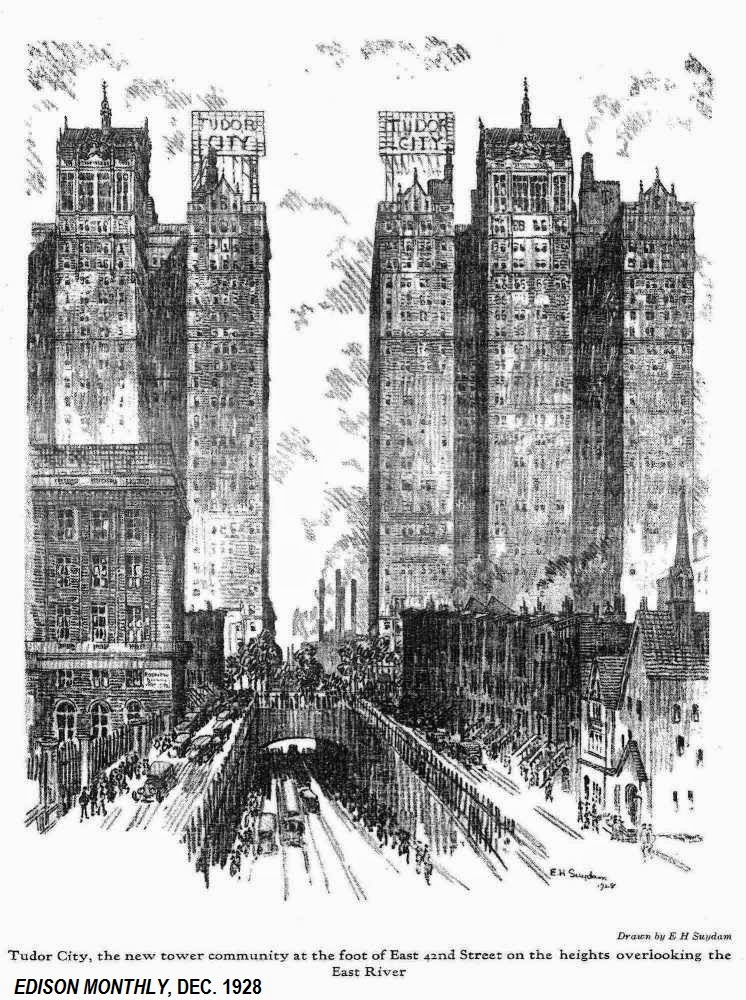
Architect Emery Roth brought the apartment skyscraper to Midtown and practically invented the allure of the penthouse. The almost faceless Fred French — his section is actually called “Who on Earth was Fred French?” — turned the apartment complex into a swanky, thematic thrill with such Midtown projects as Tudor City (a 1928 illustration pictured at left). Of course, it took the wealthiest New Yorkers to fuel these changes. New money sparked the new playing field. The old families hastened their migration up Fifth Avenue, their mansions abandoned, torn down and replaced with the high-end shops in which they would later shop.
While department store masters like Edwin Goodman swept out the socialites to build his Fifth Avenue temple of commerce Bergdorf-Goodman, the pleasant rivalry between Helena Rubenstein and Elizabeth Arden helped generate the avenue’s reputation of social perfection and high glamour.
Sensing the upward surge of Midtown — its almost-amoral infinite rise — impresarios like Samuel “Roxy” Rothefeld, Florenz Ziegfeld and George “Tex” Rickard rose to create venues to corral the masses. Midtown became home in the 1920s to the industries of entertainment — publishing, radio, television. Even Seventh Avenue below Times Square found purpose in the swell as America’s Garment District.
As Midtown grew in the 1920s, the instruments of getting there also rose to the challenge, finally conquering the Hudson River, from the Holland Tunnel to the George Washington Bridge.
The story is so big that Miller can’t contain all of it. Supreme City captures that place before the Great Depression, perhaps New York’s single most decadent moment. He does not venture out into the other boroughs and rarely even ventures below 42nd Street. From the vantage of the Chrysler Building — the treasure most indicative of the age — those places are hazy and distant. By the last page of this heavy tome, Midtown Manhattan creates everything, drives everything, almost entirely is everything. That energy is certainly infectious, making Supreme City is an rich, propelling read.
NOTE: This article has a few plot spoilers but no major twists are revealed or discussed. I’ve tried to write the descriptions within the interactive map as vaguely as possible.
The Alienist by Caleb Carr was published 20 years ago this week, an instant best-seller in 1994 that has become a cult classic among history buffs. Despite some creakiness uniquely inherent to early ’90s fiction thrillers, it remains today a page-turning and utterly spellbinding adventure.
Although the Jack the Ripper murders were an obvious inspiration for Carr, perhaps The Alienist‘s biggest influence is The Silence of the Lambs by Thomas Harris. Carr completed his tale of serial murders in the Gilded Age just as a slew of Silence knockoffs began hitting the bookshelves. The Alienist stands far above the pack, of course, but you can’t deny its success in 1994 was partially inspired by reader’s cravings for murderers with perverted tastes and body parts in formaldehyde jars.
The Alienist follows a quirky team of investigators in 1896 as they follow the bloody trail of a killer with a peculiar penchant for boy prostitutes, often dressed as girls to the delight of their clientele. Dr. Laszlo Kreizler is the alienist (or psychologist) in charge of the case, stitching together a profile of the loathsome figure, conveniently using soon-to-be standard analytic techniques.
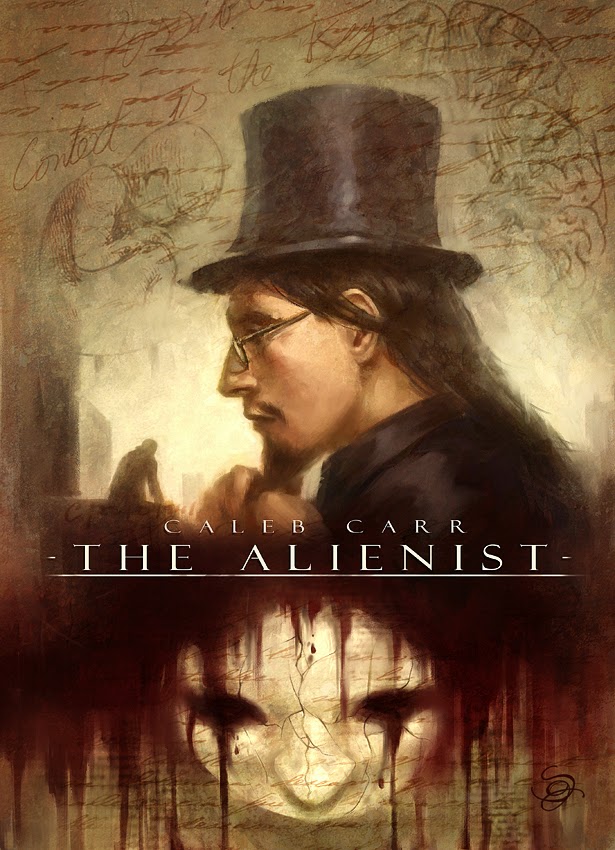
At right: Alternate artwork for The Alienist (Courtesy Nerd Blerp)
As protagonist John Schuyler Moore, a reporter for the New York Times, explains it “[W]e start with the prominent features of the killings themselves, as well as the personality traits of the victims, and from those we determine what kind of man might be at work. Then, using evidence that would otherwise have seemed meaningless, we begin to close in.”
Carr’s book is finely detailed, perhaps overly detailed, which won’t be a problem if you love New York City history. There are over two dozen scenes at various notable landmarks throughout Manhattan, some in various states of construction. Several real-life figures make appearances, although the most entertaining characters are Carr’s own, including the intrepid proto-policewoman Sara Howard and scrappy errand boy Stevie ‘Stovepipe’ Taggart.
When I first read The Alienist back in 1994, I was struck by its preciseness, an expertly placed breadcrumb trail through old Gotham. There is no romantic gloss, as in another history classic Time and Again. He makes it seem possible to retrace almost every step of our heroes. (In researching this article, I tried to do so.) The original New York Times review noted that “[y]ou can practically hear the clip-clop of horses’ hooves echoing down old Broadway.” They’re still echoing.
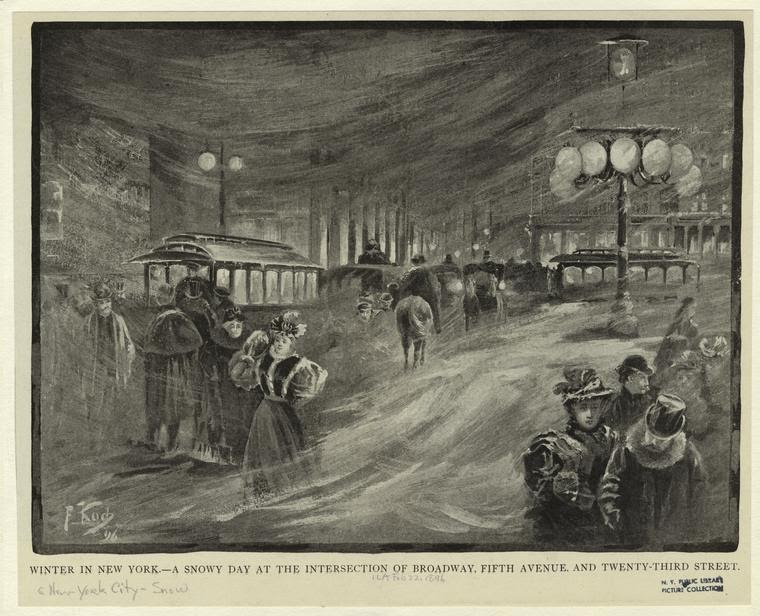
The story begins in the early months of 1896 during a robust winter. Below, from the Illustrated American, a depiction of a snowy Madison Square that year (NYPL):
His depiction of old New York is still glorious. The book’s polite take on certain social issues, however, read a bit wobbly today. To his credit, Carr tackles police corruption, gender discrimination, racial prejudice and the plight of homosexuals, all while elaborating on complicated psychological theories in service of an entertaining story. He has stuffed a hidden epic of New York into the framework of a modern murder mystery. That he chooses to handle hot-button social issues with kid gloves is not a misstep, but merely a symptom of its genre and day.
The Alienist is still greatly enjoyable, perhaps slightly more so now. Thanks to renewed interest in New York City history, the details here are even more shimmering and vital. This is not an old New York emerging from a mysterious fog, but a world that seems to exist alongside our own.
And to prove that — below you will find a detailed, interactive map of the pivotal locations used in the book. You can click into various points for further details. A few of these pins have pictures and other links. Just zoom in and choose a location! (NOTE: Some locations are approximate and a couple are speculation.)
A little elaboration on certain elements of the book’s bigger places and themes:
Paresis Hall Most of the murder victims are boy prostitutes employed as several houses of ill repute throughout the city. Paresis Hall, located steps from Cooper Union, sounds like it was both a place where gay men could congregate in private clubs and a place of sexual transaction, often (as in the book) with underage boys dressed up as girls. This boy, Nathaniel ‘ The Kid’ Cullen, may have worked there, or may have just a habitue of the club. (He appears in this collection of photographs from Paresis Hill.)
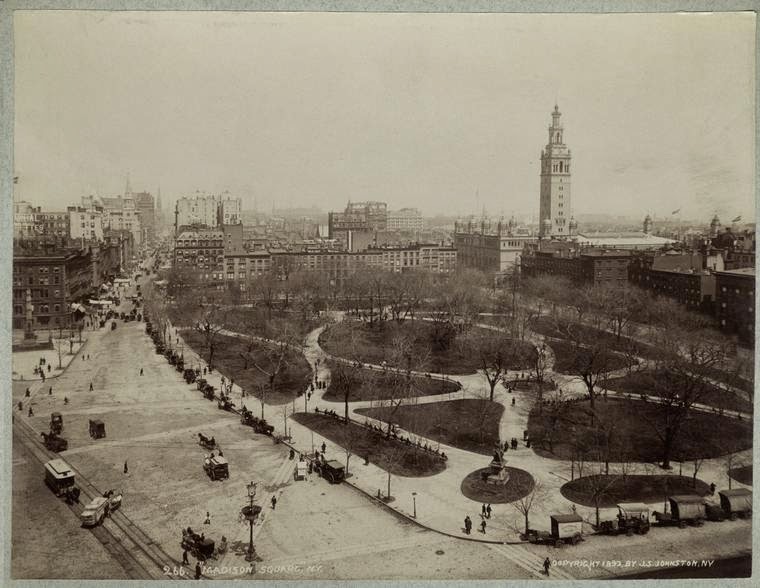
Madison Square This was still a thriving center for culture and dignified entertainments in 1896. Many theaters clustered around the park, although newer stages were making their way up Broadway to Herald Square. If Delmonico’s (on the northwest corner) is too crowded for you, head over to the tea room at Madison SquareGarden on the northeast side. Pictured here in 1893, three years before the events of the Alienist. (NYPL)
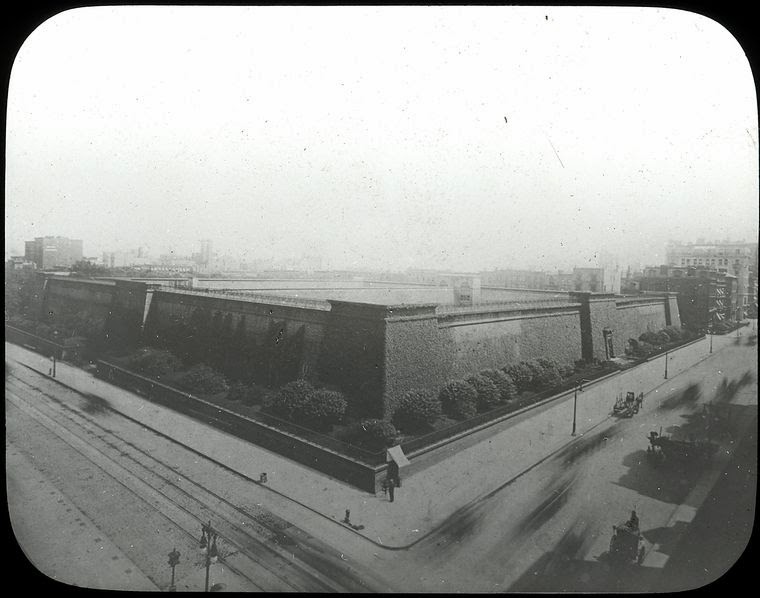
Murray Hill Distributing Reservoir In 1896, New York still relied on this reservoir to provide most people with water. But it was also a tourist destination in itself, with walking paths along the top. Shortly after its appearance it the book, the Egyptian-inspired reservoir was torn down to make way for New York’s new public library. (NYPL)
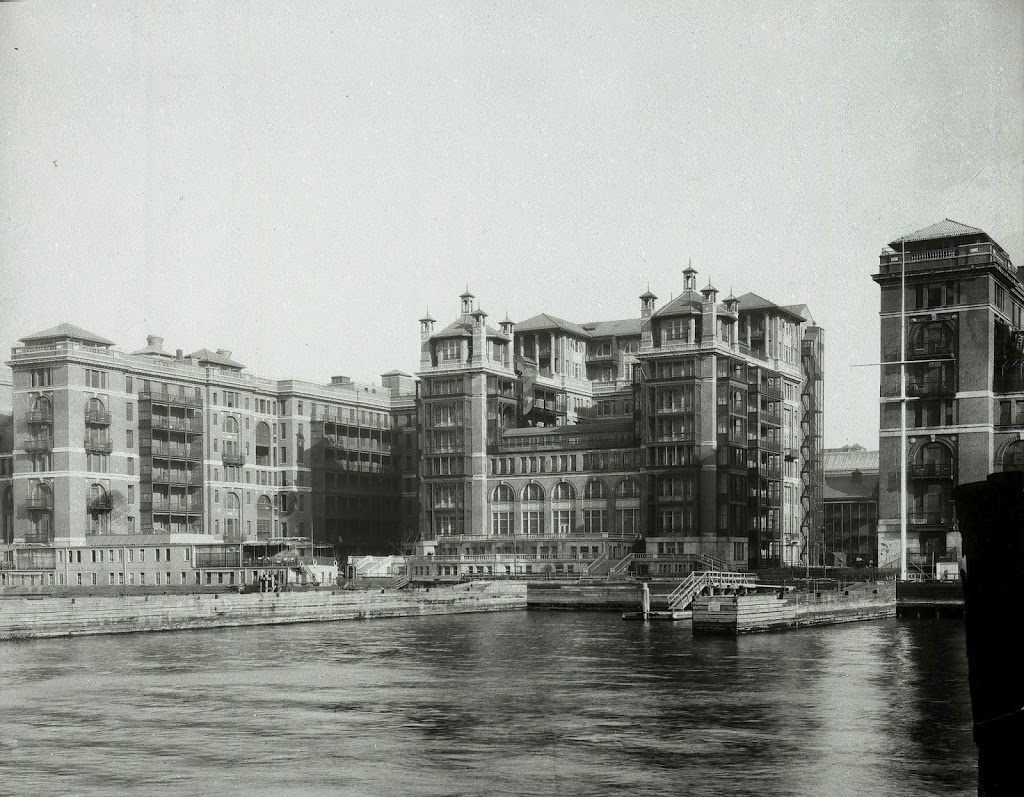
Bellevue Hospital and Morgue Check out our podcast and blog posting on the history of Bellevue Hospital, as many of the details mentioned there appear in this book. Below: Bellevue in 1879.
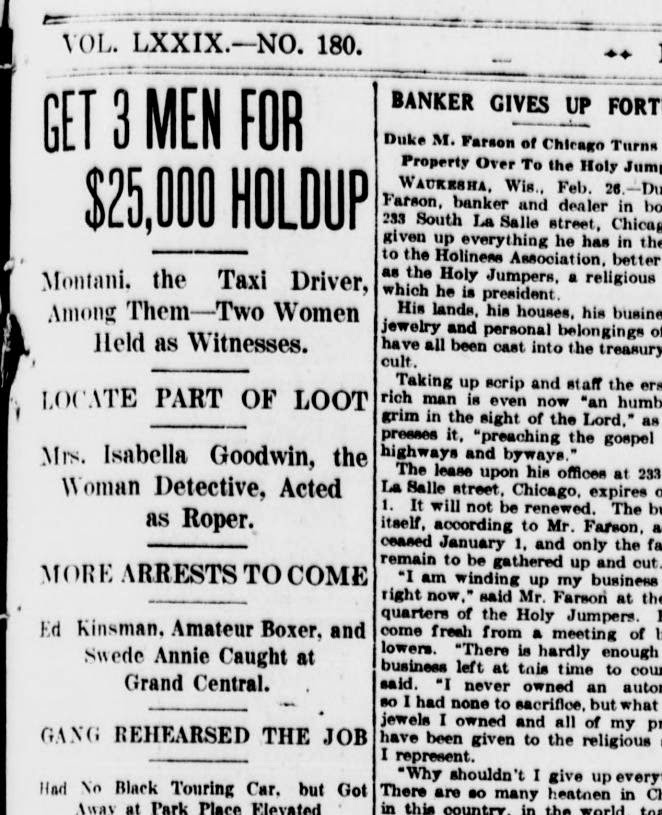
Isabella Goodwin Sara Howard seems to be a little bit Nellie Bly, and a lot Isabella Goodwin, the first female office promoted to detective in 1896 (the year the book is set). Below: A front-page case cracked by Goodwin from February 1912.
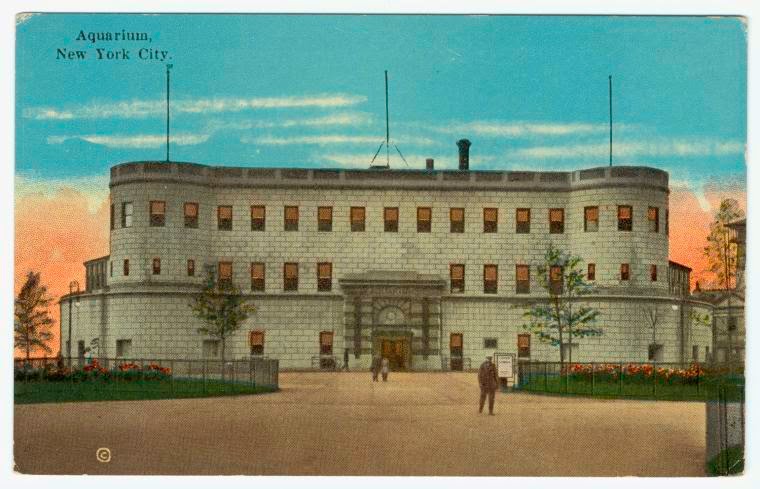
New York Aquarium Carr’s narrative features several New York landmarks in construction. Two of those places take a morbid center stage in the book — the Williamsburg Bridge and the nearly completed New York Aquarium (the former Castle Garden) (NYPL)
Theodore Roosevelt Carr weaves several real life figures into the storyline, from J.P. Morgan (who comes off quite ominous) to Jacob Riis (not a flattering portrait of him either). But future president Roosevelt gets a glowing supporting role as New York’s police commissioner who directs Dr. Kreizler, Moore and Howard to investigate the murders using powers of psychological deduction.
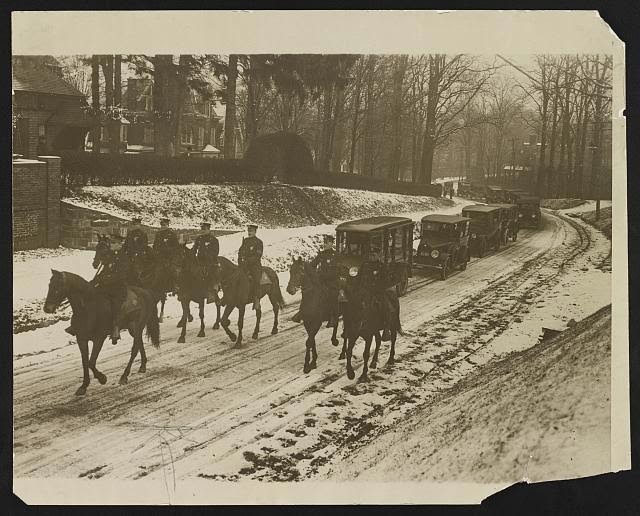
In fact, the book is actually a flashback by our hero Moore, recalled when he visits the Oyster Bay funeral of his dear friend in 1919 (pictured below). (LOC)
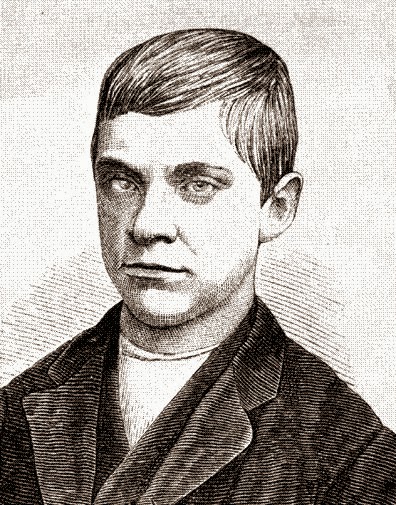
True Crime And there are a great many real-life figures from New York’s criminal underworld as well. In fact, most of the lecherous and notorious figures depicted in the book are real folks, from early gangsters like Paul Kelly to brothel owners such as Biff Ellison. Carr also finds a few disturbing mental cases to bring into the story, including the young killer Jesse Pomeroy (pictured below), considered one of the most brutal of murderers at a ripe age of 14.
Grand Central Depot The characters do venture to places outside the city for further clues, but they always come through Grand Central Depot, the most hectic place in New York. (Pennsylvania Station had not yet been built.) Within a few years, this too would be ripped down and replaced with the present Grand Central Terminal. (LOC)
And finally, there are three central locations from the book that are still around today:
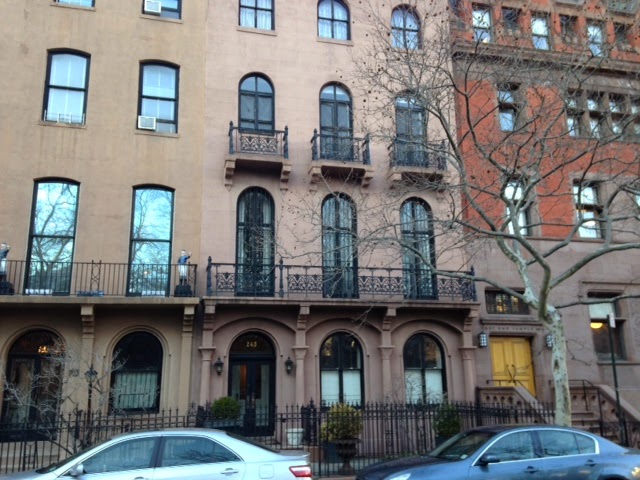
Dr. Laszlo’s residence at Stuyvesant Park. Actually the address in the book doesn’t really exist. But based on a couple descriptions — and its proximity to St. George’s Church, which is mentioned as close by — this building at 237 East 17th Street may be what Carr had in mind:
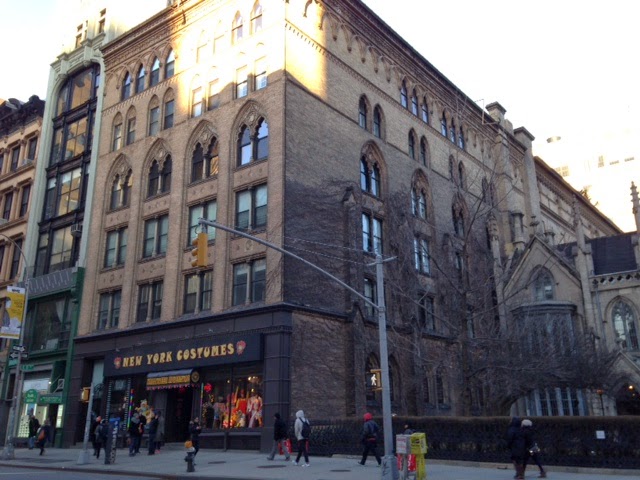
Murder headquarters at 808 Broadway — This exceptionally handsome building was constructed by James Renwick, playing nicely off its neighbor Grace Church. It’s actually called the Renwick! The team was located on the sixth floor. Today, on the first floor, is one of New York’s most popular costume shops.
John Schuyler Moore’s home at Washington Square Park North, facing the park:
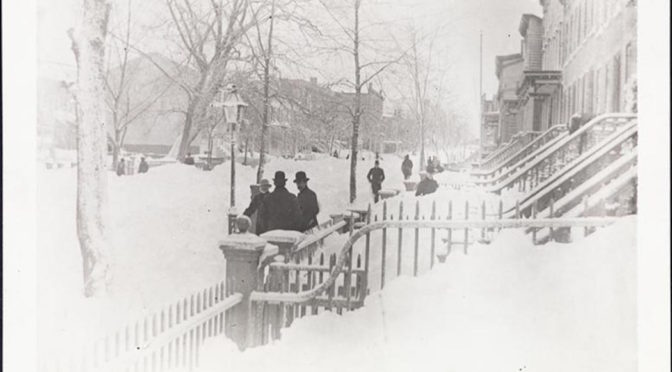
PODCAST This year is the 125th anniversary of one of the worst storms to ever wreak havoc upon New York City, the now-legendary mix of wind and snow called the Great Blizzard of 1888.
Its memory was again conjured up a few months ago as people struggled to compare Hurricane Sandy with some devastating event in New York’s past. And indeed, the Blizzard and Sandy have several disturbing similarities. But the battering snow-hurricane of 1888, with freezing temperatures and drifts three stories high, was made worse by the condition of New York’s transportation and communication systems, all completely unprepared for 36 hours of continual snow.
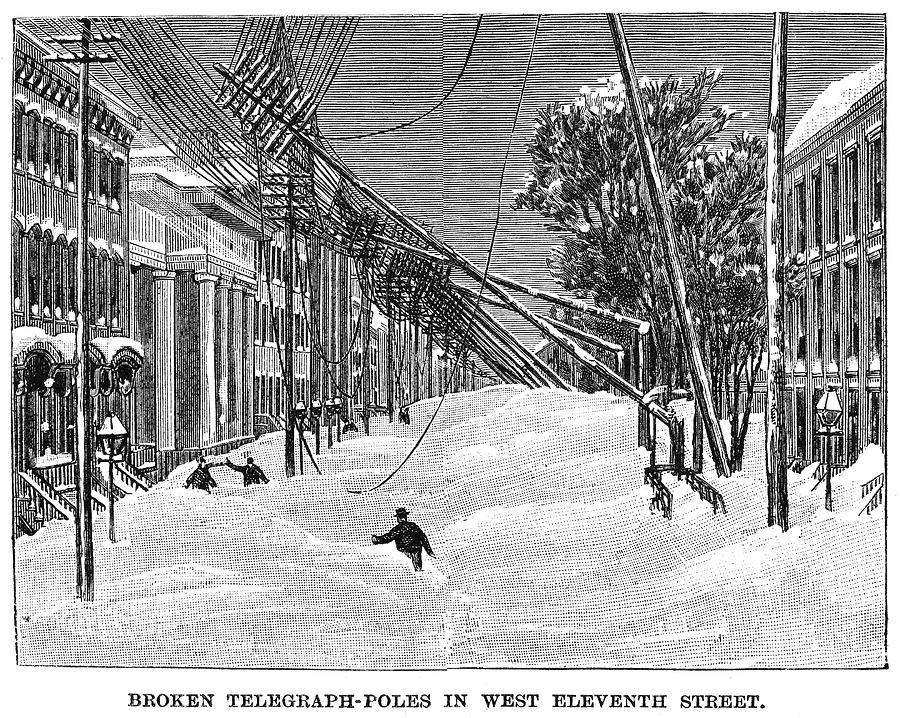
The storm struck in the early hours of Monday, and many thousands attempted to make their way to work, not knowing how severe the storm would be. It would be the worst commute in New York City history! Fallen telephone and telegraph poles became a hidden threat under the quickly accumulating drifts.
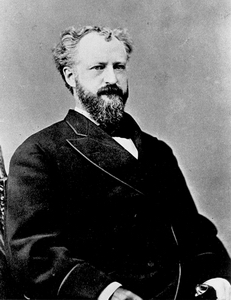
Elevated trains were frozen in place, their passengers unable to get out for hours. Many died simply trying to make their way back home on foot, including Roscoe Conkling (at right), a power broker of New York’s Republican Party.
But there were moments of amusement too. Saloons thrived, and actors trudged through to the snow in time for their performances, And for P.T. Barnum, the show must always go on!
STARRING: Hugh Grant (although maybe not the one you’re thinking)
NOTE: And, yes, we can’t believe the timing of this one, releasing on the same date of an ACTUAL blizzard. We really had this one planned for awhile, delayed it a bit because it seemed too eerie to do it so close after Hurricane Sandy.
So if you’re in New York or the northeast United States, stay inside, stay safe and let this podcast be the only dangerous snow drifts you experience this week!
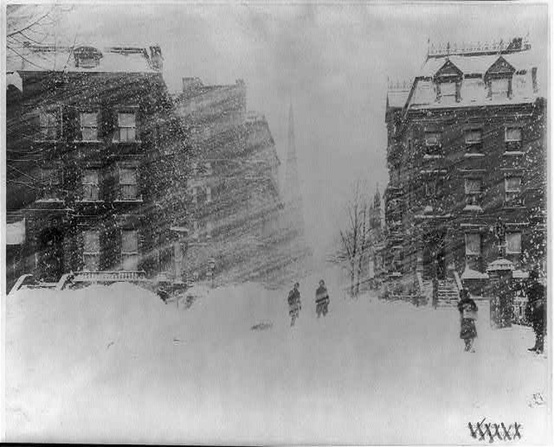
In the blizzard of 1888, the streets disappeared and the snow came down almost horizontally. Imagine being trapped at work, several miles from your home. This was the plight experienced by thousands of New Yorkers (and others throughout the northeast) that Monday. (Library of Congress)
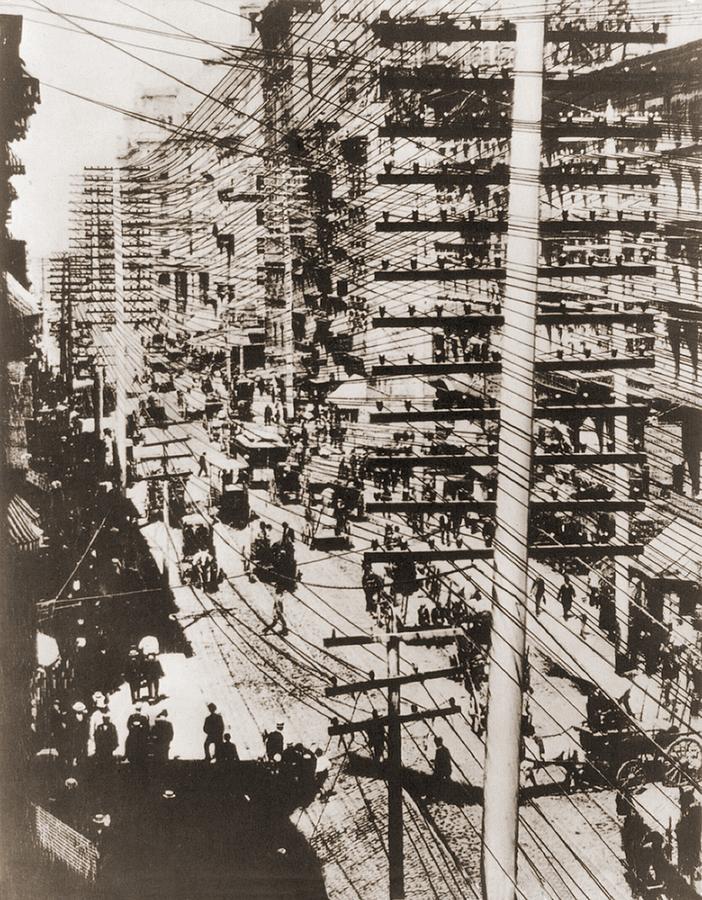
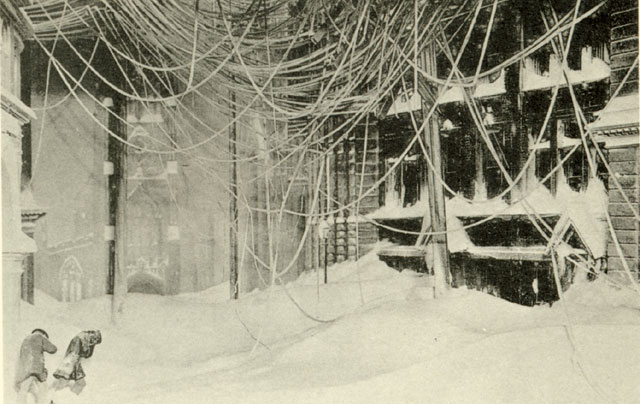
Why did the 1888 blizzard become such a hazard for New Yorkers? Let this picture be your first clue. The city was a cobweb of elevated telegraph, telephone and electric wires. This picture is from 1887. (LOC)
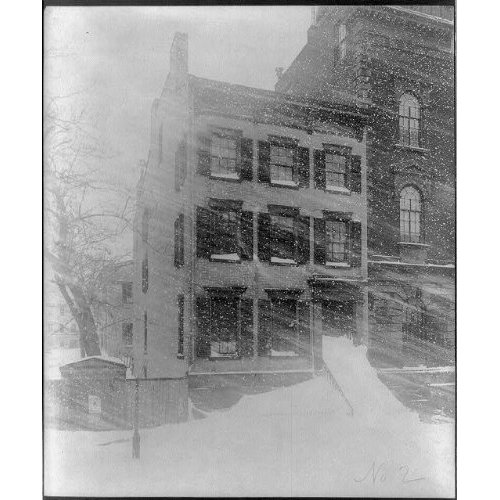
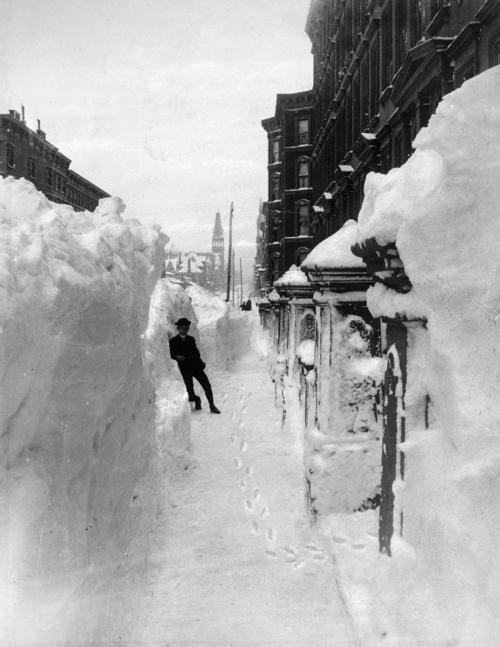
One example of a terrible (although minor) snow drift that might have kept this family in their home all day. Because of the unpredictable changes in wind, some houses might have been drift-free, while others close by completely locked in with snow. (LOC)
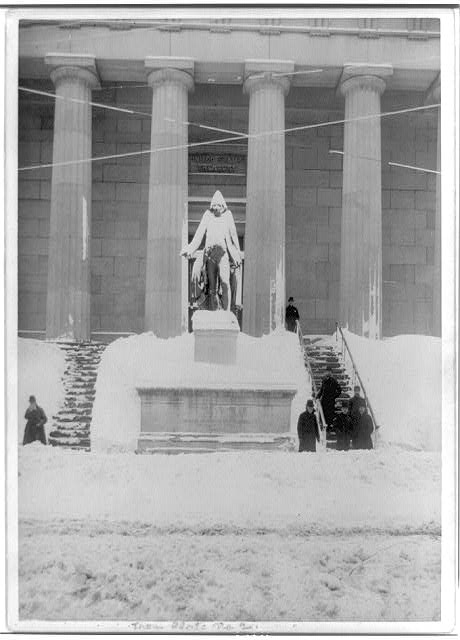
George Washington at the Sub-Treasury Building (today Federal Hall). I ran this photo a few weeks ago, but it’s so bizarre that I think it needs a second posting.
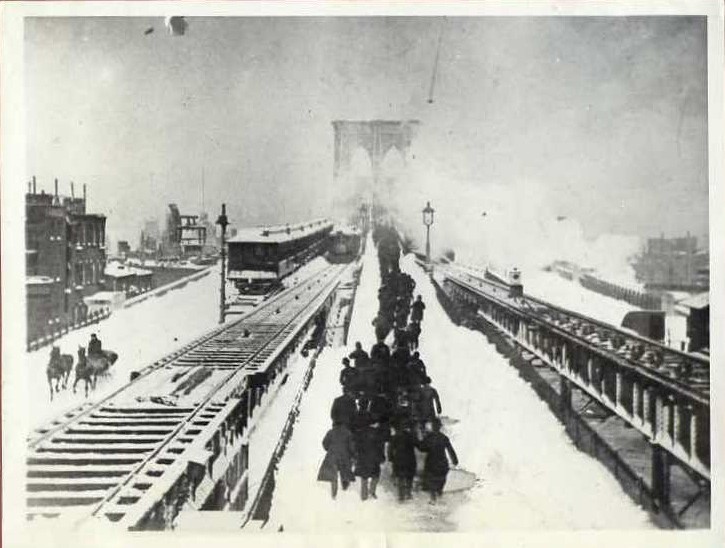
The Brooklyn Bridge, not even five years old, weathered the winds quite well, but became a hazard due to ice. In this picture, people are crossing over as there was no other way to get between Manhattan and Brooklyn. It’s not clear if any of the trains are operating in this picture.
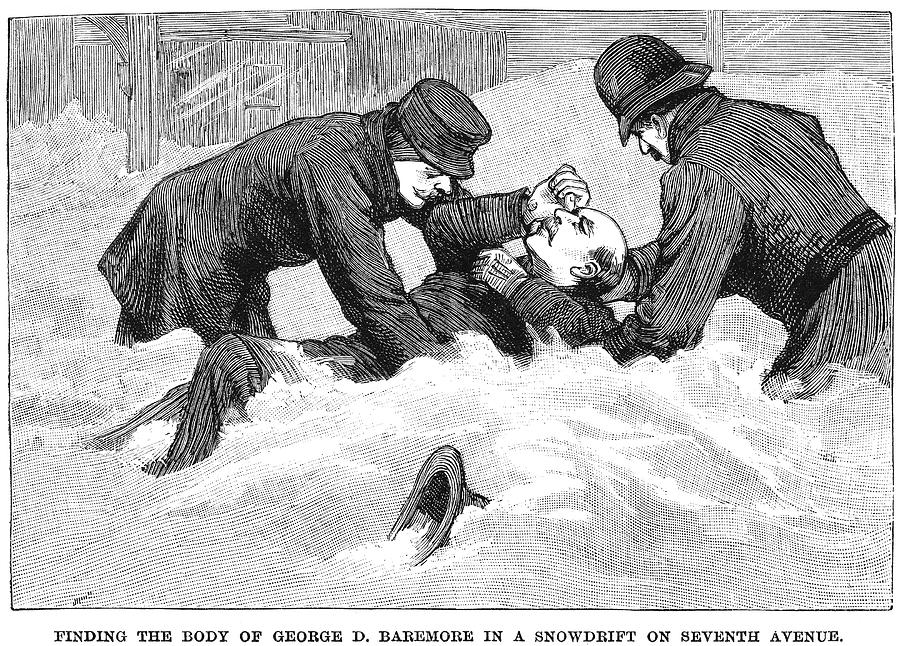
The biggest danger for those venturing outside were the hundreds of downed telegraph, telephone and electrical poles, no match for the intense gusts. The poles would quickly fall then get covered with snow, creating deadly hazards for people walking past. The snow would just as quickly cover over an unconscious individual; many New Yorkers froze to death when they fell and were instantly shrouded.
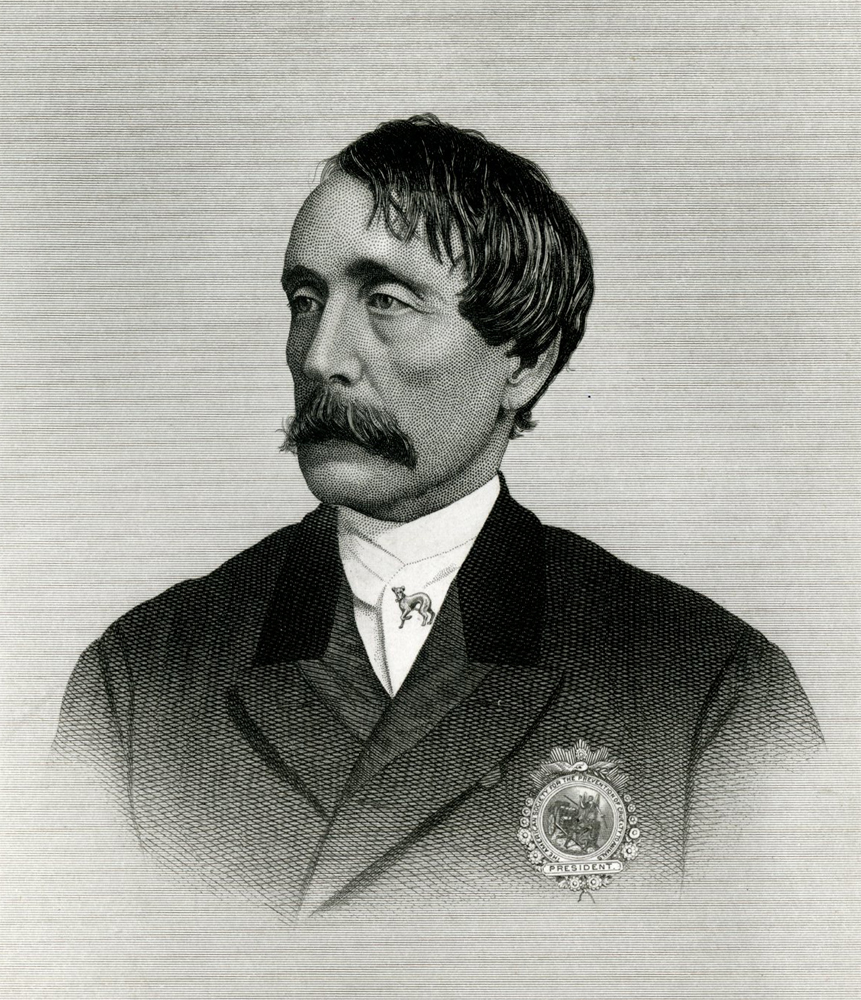
Henry Bergh, founder of the American Society for the Prevention of Cruelty to Animals. He did not survive the blizzard. (NYHS)
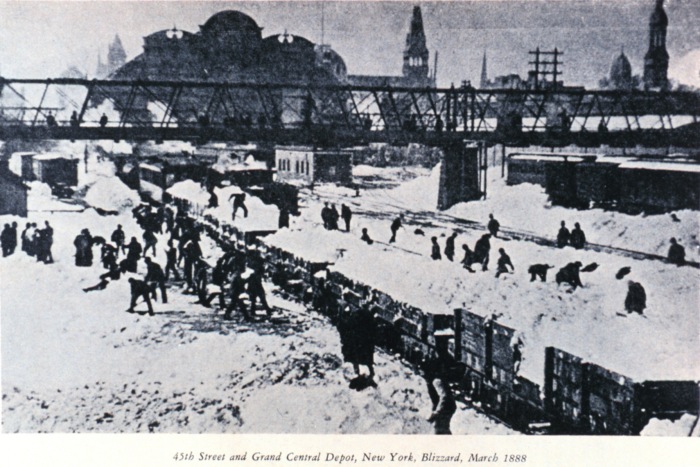
Transportation in and out of the city was at a complete standstill for half the week. Here workers frantically try to clear the way for trains going into Grand Central Depot.
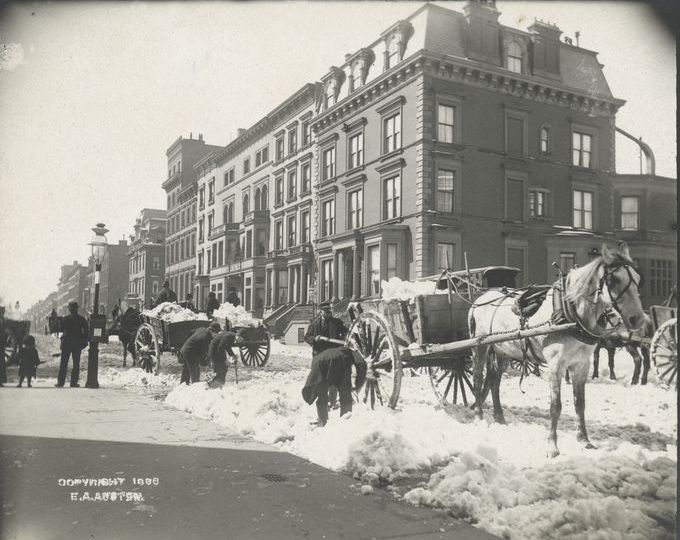
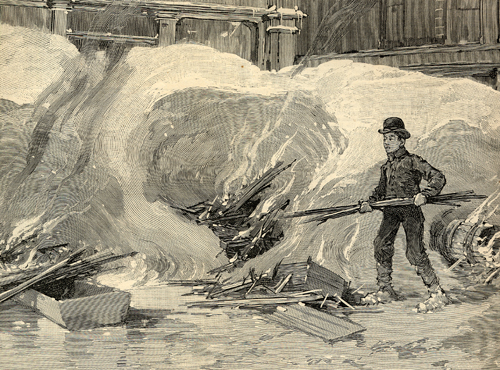
Clean-up was truly chaotic, a feeble effort by the city paired with private contractors with horses, shovels and carts. The piles of snow were taken to water’s edge and dumped, or, in a few less preferred cases, people just started bonfires and melted it away. (For a great picture of a snow dump in the river, see this photo at Shorpy of a blizzard from 1899.) Top pic courtesy LOC, at bottom Maggie Blanck.
The cover of Frank Leslie’s Illustrated Newspaper, usually one of the more sensational pieces of journalism people might have found at their newsstand.
Grand Central Terminal has seen millions of people rush across its Main Concourse over the past one hundred years, and more than a few movies have captured that commuter ebb and flow. Â But while Grand Central is occasionally a backdrop for romance — especially during World War II, when returning soldiers would arrive to meet their loved ones — filmmakers have preferred to capture a darker aspect to the landmark.
The Beaux-Arts train station has become an ideal location for thrillers, mysteries, fantasies and horror films, a backdrop for chases and a metaphor for chaos and disorientation. Â In the movies, its concourse feels even more cavernous and mythic, its train tunnels havens for the unknown.
During its first half-century, Grand Central was known mostly for its trains — in particular, the Twentieth Century Limited, the luxurious passenger locomotive that attracted the most famous people in the world. Â In fact, the most common place to see a celebrity in the 1930s and 40s would probably have been Grand Central, watching politicians and stars boarding the most famous train in the world.
So it’s no surprise that Grand Central’s most notable early film appearances relate to the Twentieth Century, including, of course, Twentieth Century, the ribald 1934 comedy that made Carole Lombard a star. Â Other glamorous features of this era — including Grand Central Murder (1942) and The Thin Man Goes Home(1945) — use Hollywood reconstructions of Grand Central as a backdrop.
Below: A phony version of Grand Central Terminal used in the film The Thin Man Goes Home. (Courtesy On The Set of New York)
As the train station deteriorated after the 1950s — as train travel itself fell into disregard — Grand Central became a darker, dangerous place in the movies. The travelers, the commuters, are now a backdrop for chase scenes and violent shootouts, homeless people and even psychos stalking the yellowing, banner-filled concourse of the 1970s and 80s.
Its rehabilitation in the 1990s brought monumentality back to Grand Central and brought it back to the movies as a place of respect and beauty. I would never recommend you watch the remake of Arthur starring Russell Brand except for this particular scene which demonstrates the Terminal’s remarkable transformation.
Grand Central makes a brief appearance in the 1988 comedy Midnight Run with Charles Grodin and Robert DeNiro. (Courtesy On The Set of New York)
Here are my personal choices for Grand Central’s top ten moments in cinema. Â I’m sure I’m forgetting a few choice ones, so please add them in the comments section if they come to mind:
10 The Avengers (2012)
The Terminal as a fortress, a hall of justice. Â The MetLife Building behind it is completely dismantled and replaced with Iron Man‘s new headquarters, but nobody would ever think of doing that to Grand Central. In fact, our heroes fight inter-dimensional aliens right in front of it, their phalanx mounted on the overpass below. Â As Earth’s finest stand in akimbo waiting for the attack, the statue of Cornelius Vanderbilt stands equally defiant in the background. Â (For another sci-fi use of Grand Central’s exterior, see Will Smith in I Am Legend.)
9 Â Necrology (1971)
The building has inspired the avant garde as well. Â Years after Andy Warhol turned his camera to the Empire State Building, experimental filmmaker Standish Lawder found supernatural inspiration inside Grand Central for this odd little film ostensibly about the afterlife. Â Stay for the credits.
8 Spellbound (1945)
This isn’t even Alfred Hitchcock‘s best film usage of Grand Central (see below), but it’s notable in that both Grand Central and Pennsylvania Station are used in this psychological thriller starring Ingrid Bergman and Gregory Peck. I can’t recall any other film that would have included both iconic New York landmarks. With this film, Hitchcock also playfully mocks Grand Central’s wartime reputation as a place for departing lovers, even while giving into those romantic impulses.
7 The House on Carroll Street (1988)
This somewhat unsuccessful thriller (with a spectacular cast) is notable for its creativity involving a climactic chase scene up in Grand Central’s inaccessible upper tiers. Â You can see a little bit of it in this trailer:
6 Superman (1978)
Lex Luther’s secret lair, eccentrically decorated, is hidden in a forgotten tunnel underneath Grand Central. Â His lackey Otis (Ned Beatty) is tracked to the concourse by police officers, but Luther has set a deadly trap for one of them. Â Another reason not to roam the tracks by yourself!
Later, the super villain waxes about the benefits to his Grand Central lair as the trains rumble overhead.
5 A Stranger Is Watching (1982)
Had Lex not been defeated, he would have been sharing the tunnels with the maniacal killer of this schlocky thriller, based on a novel by Mary Higgins Clark. Â While this movie is pretty bad, Grand Central is used to superb effect, a veritable haunted house of dark tunnels and abandoned elevators. Â There’s even mention of Franklin Delano Roosevelt’s secret elevator!
4 Carlito’s Way (1993)
The famous escalator shootout scene (it’s Battleship Potemkin-meets-violent cop show) is probably the goriest scene ever filmed directly in Grand Central, topped by Carlito (Al Pacino) running to meet Penelope Ann Miller. Â Let’s just say, he misses his train. Â Watch the scene here.
3 Seconds (1966)
This bizarre John Frankenheimer drama starring Rock Hudson uses Grand Central Terminal (and a unique camera angle) to set the film’s off-kilter and twisted perspective. Â It becomes the crossroads where opportunities of a second chance are literally handed to you, if you dare to take them.
2 The Fisher King (1991)
Having hosted various mentally disturbed escapades in prior films, we now get to look in on an actual Grand Central fantasy in this Robin Williams film, as the deranged hallucinations of his character turn the bustling room into a glorious dance floor.
1 North By Northwest (1959)
Has Grand Central Terminal ever looked as beautiful as it does in this pivotal scene from Hitchcock’s great 1959 masterpiece? Â It gives Cary Grant opportunities to be suave, pensive and fabulous all at once. Â It also embodies the tension and danger that would influence other filmmakers in later years to come to Grand Central for inspiration.
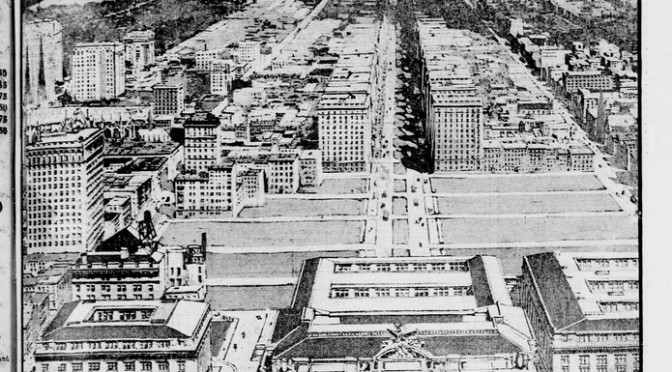
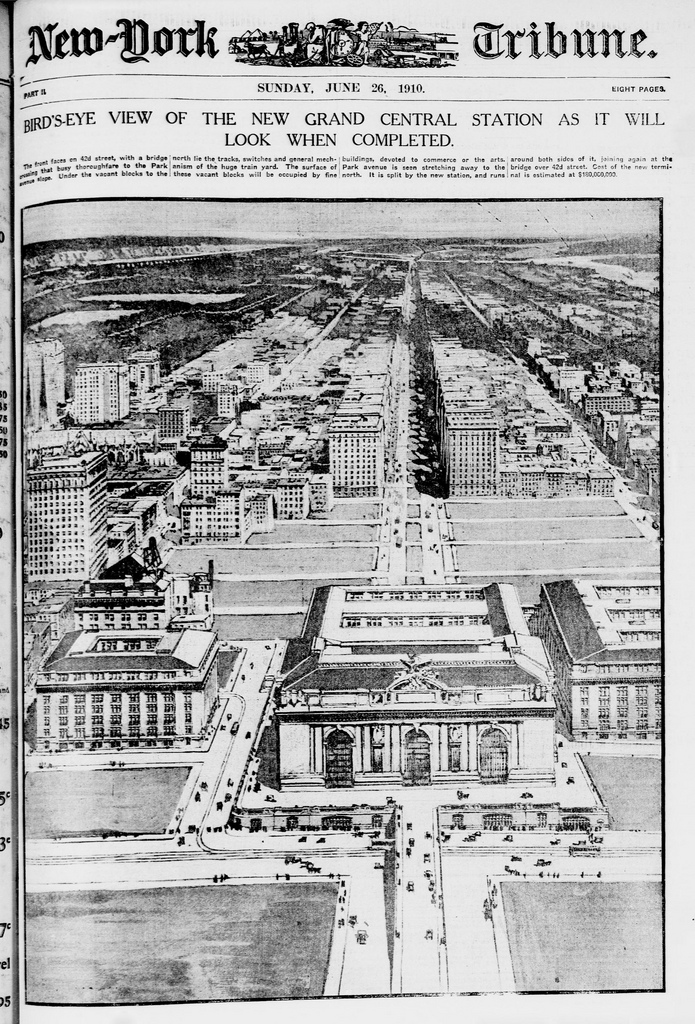
Continuing the celebration of Grand Central Terminal’s 100th anniversary, here’s a look at the proposed street plan which was run in the New York Tribune on June 26, 1910.
“The front faces on 42nd Street, with a bridge crossing that busy thoroughfare to the Park Avenue slope. Under the vacant blocks to the north lie the tracks, switches and mechanisms of the huge train yard. The surface of these vacant blocks will be occupied by fine buildings, devoted to commerce or to the arts.
Park Avenue is seen stretching away to the north. It is split by a new station and runs around both sides of it, joining again at the bridge over 42nd Street. Cost of this new terminal is estimated at $180,000,000.”
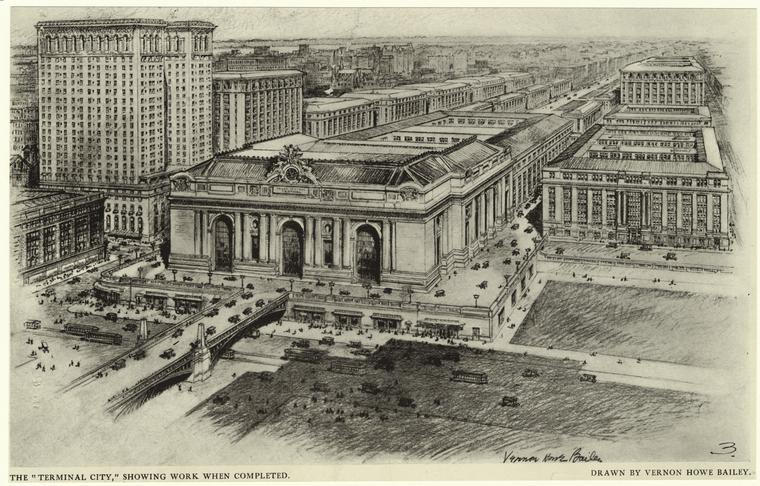
This was the beginning of the ‘Terminal City’ plan, a group of linking buildings with similar design. Sadly, many of those buildings were never built, and those that were have been torn down during the furor of the midtown skyscraper boom.
The plan below shows Terminal City from a different angle, and with new features:
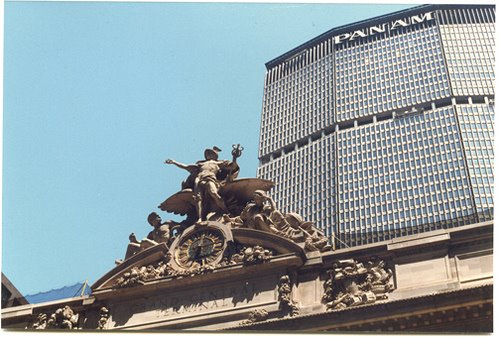
The uniformity intended for Terminal City stands in stark contrast to the multiplicity of towering structures in the area today. In particular, the graceful New York Central Building (today the Helmsley Building) would finally rise to Grand Central’s north in 1929. The decidedly ungraceful Pan Am Building (today the MetLife Building) was planned during the late 1950s, when commuter travel by train decreased and Grand Central was considered an antiquated relic.
But it’s not what you see that New Yorkers marveled at back in 1910. It’s what you didn’t see. “[A]ll of this machinery of this vast terminal — the signals, the tracks and the hundreds of trains — will never be seen from the street,” proclaimed the 1910 Tribune article. “They will be less in evidence than the engines at the heart of an ocean liner.”
Electric trains afforded such a disappearance from street level, creating an entirely new boulevard from 45th Street to 57th Street. In some serious understatement, the Tribune continues, “These changes will revolutionize the character of this part of the city. Along the new part of Park Avenue will be constructed a mile and a half of imposing apartment houses.”
Spectacular apartment complexes would appear on Park Avenue, but mostly above 57th Street. Commerce would eventually fill in the block below, bringing the most innovative skyscrapers of the 1950s, structures like the Seagram Building at 52nd Street and the Lever House at 53rd Street, buildings which toyed with the city’s zoning laws and created new public spaces.
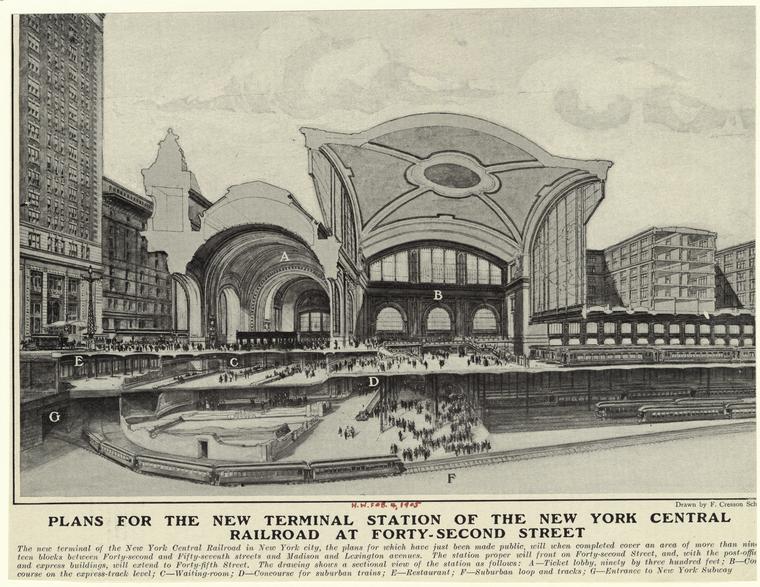
Below: A cross-section plan of the new structure, created in 1905, focuses on what would have focused on the terminal’s most magnificent secret — the buried tracks and public spaces.
Top two images courtesy Library of Congress; bottom image from New York Public Library
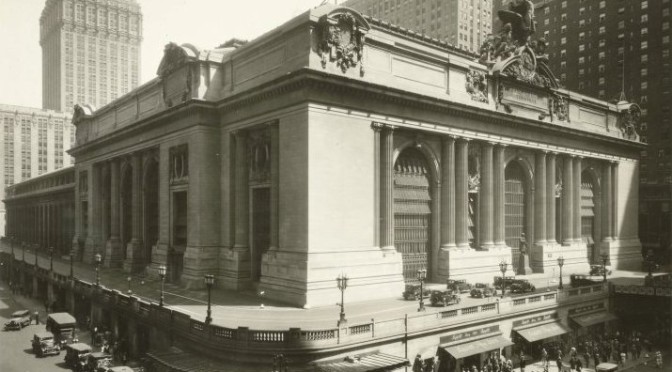
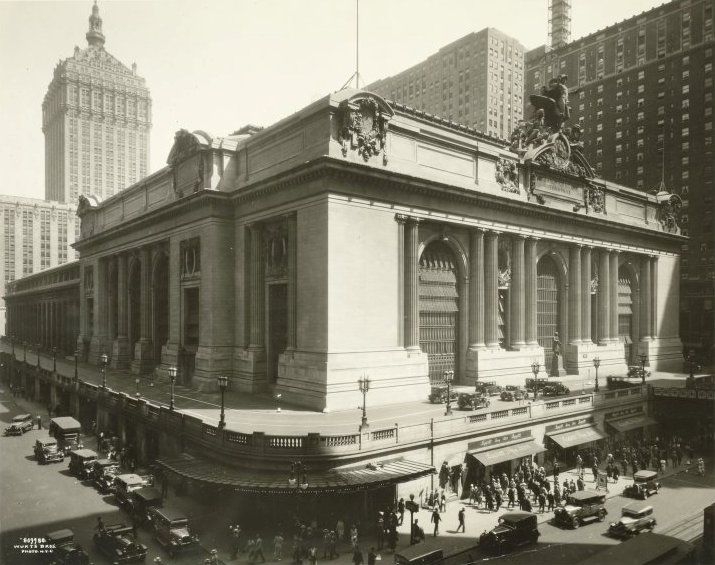
1) Grand Central Terminal The Grand Central Depot was first built at 42nd Street in 1871 as a hub for Cornelius Vanderbilt’s railroad operations. It was greatly expanded at the turn of the century. and by this time, the tracks headed north were electrified and buried, creating Park Avenue.
The present terminal was conceived in 1903 by two teams of architects and took a decade to construct. Meanwhile, the tracks heading north, now sunken and electrified, were covered with a new street and its air rights sold to become Park Avenue.
The ne plus ultra of Beaux-Arts New York opened in February 1, 1913, and its first train, the Boston Express, left the station two days later.
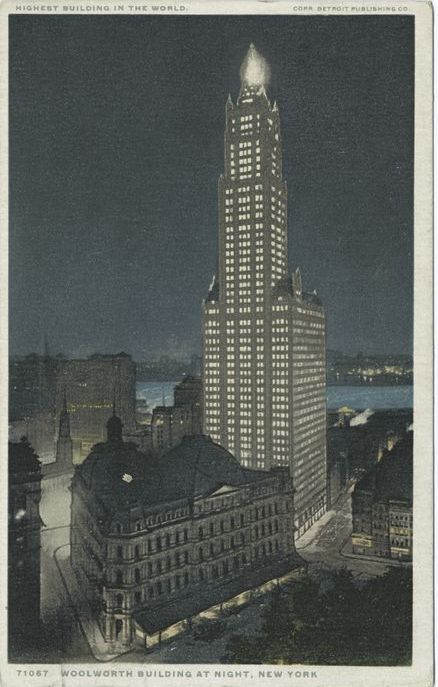
2) Woolworth Building The Woolworth Building and the current One World Trade Center are separated by a couple blocks — and one century. Just as New Yorkers marveled last year at what will be the city’s tallest building as it began to tower over downtown Manhattan, so too did the New Yorkers of 1912, at the ornate Cass Gilbert structure rising near City Hall. In January of 1912, newspapers were already proclaiming Woolworth the crown of “:the world’s greatest construction era.”
One World Trade Center will open later in 2013. The Woolworth opened on April 24, 1913 as New York’s tallest building until 1930. As you can tell from the 1910s postcard above, it rose next to the garish old New York Post Office at the foot of City Hall Park.
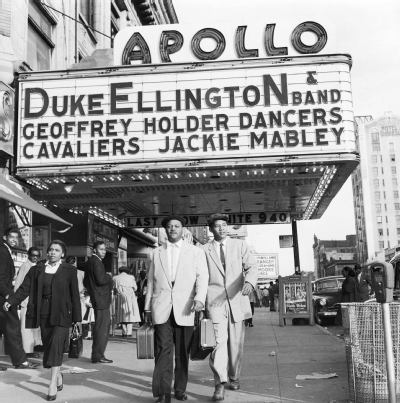
3) The Apollo Theatre The theater that eventually became one of America’s top spotlight for new entertainers was constructed in 1913 — its architect, George Keister, designed many great theaters of the day, including the Belasco — and quickly became a home for Harlem burlesque acts under the name Hurtig and Seamon’s New Burlesque Theater. While far from Times Square’s Broadway district, its stage has actually outlasted most of the theaters there.
It reopened in 1933 as the 125th Street Apollo Theater. It was around this time that the doors were opened to African-American entertainers. Its ‘amateur nights’ would soon become world-famous for discovering major talent.
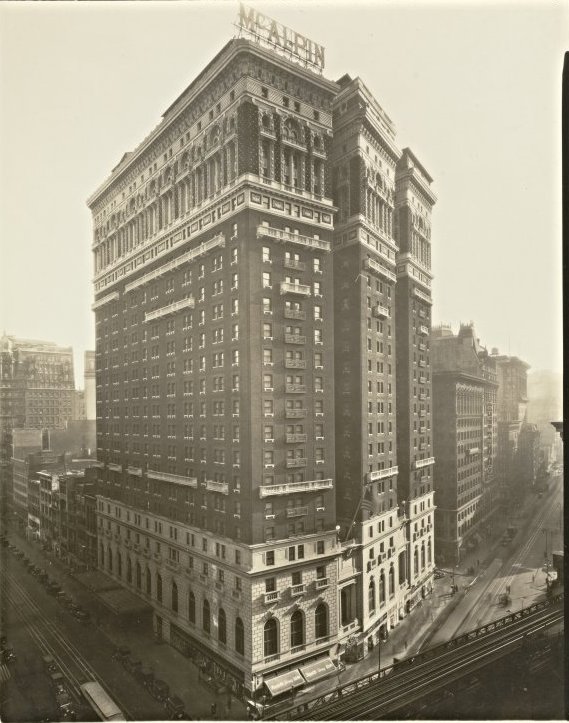
4) Hotel McAlpin New Yorkers got a look at Herald Square’s Hotel McAlpin — the tallest hotel in the world at the time — in a lavish open house on December 29, 1912. Thousands marveled at its almost absurd size, suitable for 2,500 guests and 1,500 employees. It was ready to welcome guests with the new year.
“The McAlpin has many features peculiar to it among hotels,” proclaimed the New York Times. “For one thing there is a woman’s floor to which no men are permitted and where even the clerks are women …The twenty-second floor is devoted exclusively to men.” And the 16th floor was known as the ‘Sleepy Sixteenth’, the silent floor.
Today the Hotel McAlpin is an apartment complex, the Herald Towers.
Fare thee well, you who we once called the Pan Am. We hardly knew thee. Image from Comic Book Movie
Warning: This story contains light spoilers.
Recent fantasy films and TV shows have found ways to alter New York City through the creation of alternate universes. On Fox’s Fringe, a parallel world features a New York where the World Trade Center wasn’t destroyed, the Department of Defense is in a newly-bronzed Statue of Liberty, and Robert Moses never drove the Dodgers from Brooklyn. (The show also showed us what the skyline might look like with some Antonio Gaudi architecture.)
Comic book movies delight in showing super villains destroying the city — this summer’s ‘The Dark Knight Rises’ blows up bridges and ravages Federal Hall, while ‘The Amazing Spider-man’ will trash Midtown — and sometimes they even re-write history itself.
In ‘Captain America: The First Avenger’, the title character, a resident of Red Hook, discovers underground government laboratories in downtown Brooklyn during World War II. Elsewhere in this Marvel Comics timeline, Moses’ World’s Fair of 1939-40 was such a smashing success that Tony Stark (aka ‘Iron Man’) turns the site into a year-round glittering expo of technology!
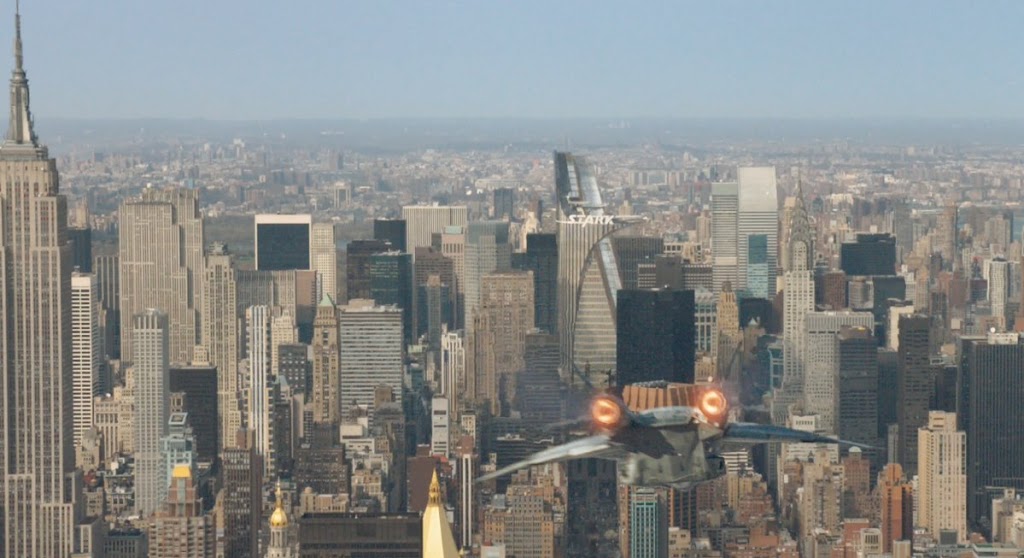
The latest Marvel adventure ‘The Avengers’ takes a more proactive approach to revising the city landscape, as though the entire film was a surly New Yorker architecture critic.
Thanks to the Commissioners Plan of 1811, allowing for a grid striped with long uninterrupted canyons, grotesque alien beings from Asgard can fly down the avenues unabated, wrecking havoc through Manhattan — Park Avenue in particular. Fortunately our heroes gather at Grand Central Terminal‘s traffic overpass, a critical location that they turn into a picturesque battleground. (Honorary Avenger Cornelius Vanderbilt, or at least his old statue from St. John’s terminal, stands resolutely in the background, ready to employ his superpower of acquiring railroads.)
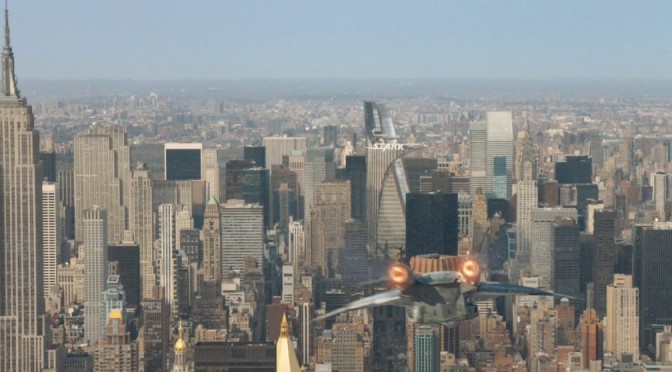
But one famous New York building is notably missing from these shenanigans. Stark, played by Robert Downey Jr., has constructed an energy-efficient new supertower for Stark Industries right on Park Avenue itself. To build this, he has clearly gotten permission from the city to methodically dismantle the MetLife Building (the former Pan Am Building).
The filmmakers have specifically chosen not to merely erase the MetLife Building, but to specifically display it being taken apart. The building is shown greatly reduced in height, decorated with cranes disassembling it like a tinker toy.
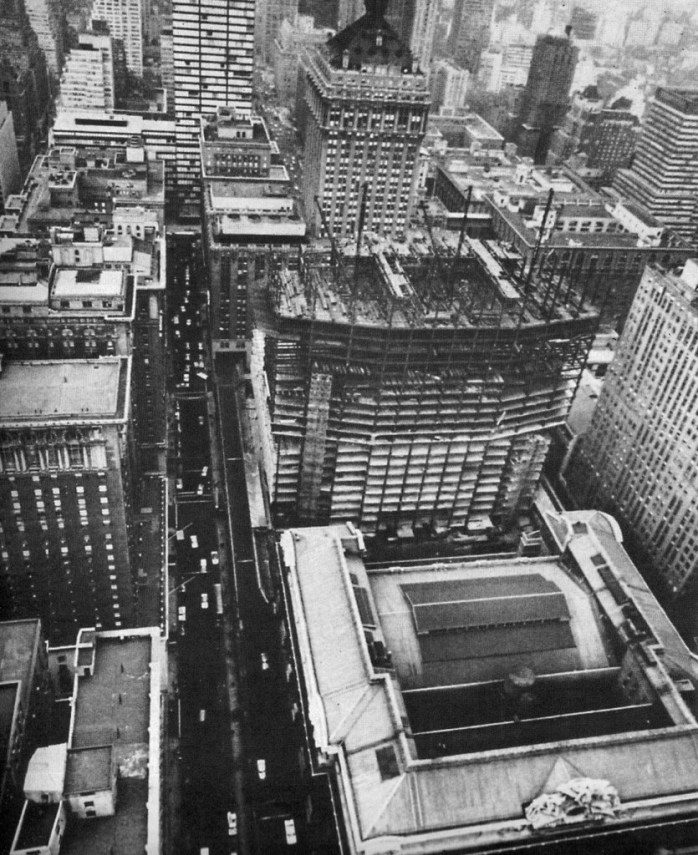
While other buildings enjoy the glamour of being reduced to rubble by gigantic mechanical space fish, the MetLife is ignobly taken apart to be replaced by an even taller, uglier structure. In fact, the dismantling looks a bit like this picture, an image of the Pan Am Building during construction in 1969:
(You can find a few more interesting construction pics here.)
The MetLife Building is easily one of the most disrespected structures in Manhattan and has been almost since the beginnings. Ada Louise Huxtable famously wrote: “A $100 million building cannot really be called cheap. But Pan Am is a colossal collection of minimums.”
According to author Meredith Clausen, “The Pan Am Building and the reaction to it signaled the end of an era. Begun when the modernist aesthetic and the architectural star system ruled architectural theory and practice, the completed building became a symbol of modernism’s fall from grace.”
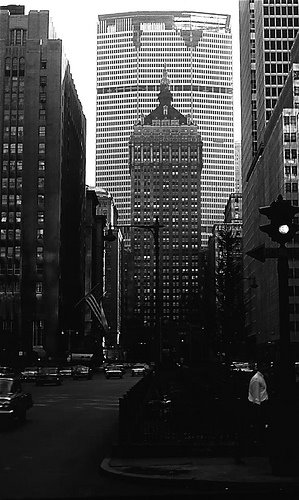
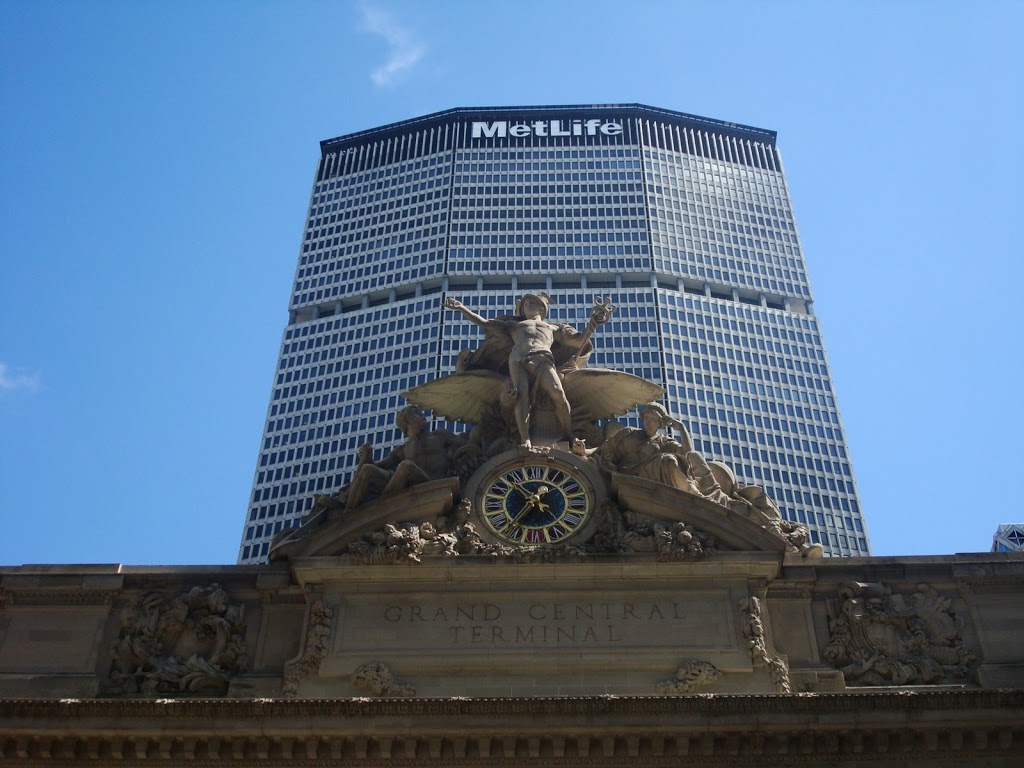
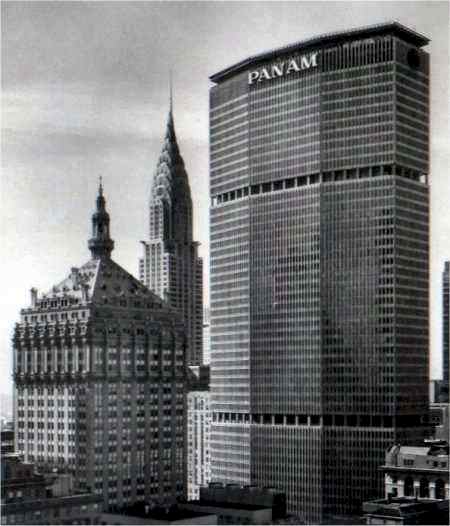
Its broad-shouldered silhouette calls a halt to Park Avenue in a dated style that hovers between two Beaux-Arts structures (Grand Central to its south, the Helmsley Building to its north). Yet people blame the building for somehow ‘ruining’ Park Avenue — when the two other structures already blocked it — and its sly octagonal shape today makes it one of New York’s more interesting Brutalist-style examples.
Modernism happened, and if you use the same criteria that we might apply to other treasured New York structures, then the MetLife Building is a unique and exemplary building. But can you ever imagine a time when the MetLife Building might ever be landmarked?
This is what I was thinking while Thor and the Hulk were tearing into alien lifeforms.
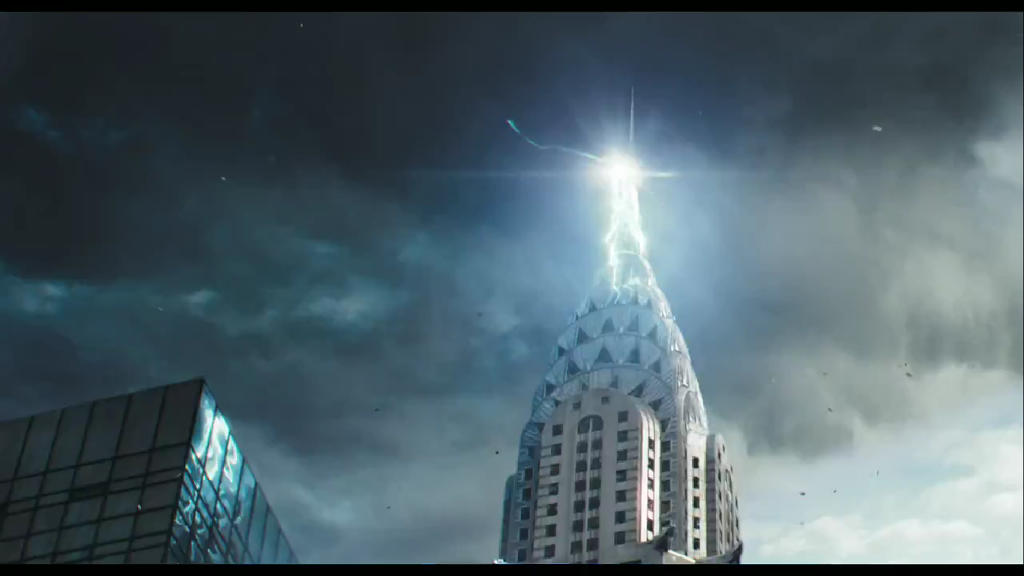
But ‘The Avengers’ isn’t entirely disrespectful of architecture. In fact, the Chrysler Building is practically fetishized as an ideal view from the newly built penthouse of the Stark Building.
Its antenna spire, which makes it New York’s fourth largest building, is even utilized by Thor in the battle to save the Earth. William Van Alen, the building’s architect, would have been quite amused. This very spire was hoisted to the top of the structure from within the building itself in October 1929, a surprise accessory that allowed the Chrysler to take the title of New York’s tallest building from 40 Wall Street.
Our modest little series about some of the greatest, notorious, most important, even most useless, mayors of New York City. Other entrants in our mayoral survey can be found here.
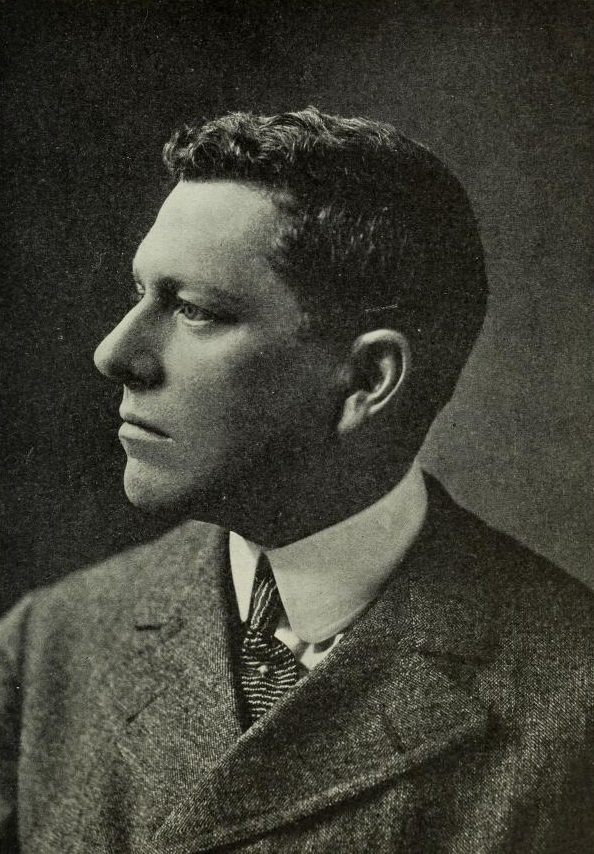
Perhaps no mayor of New York City this side of Fiorello Laguardia has ever overseen so drastic a change to the landscape of the city than George B. McClellan Jr.
For six extraordinary years (1904-09) McClellan presided over the openings of the New York Public Library, Chelsea Piers, Grand Central Station, christened the first subway service and licensed the first taxi cab.
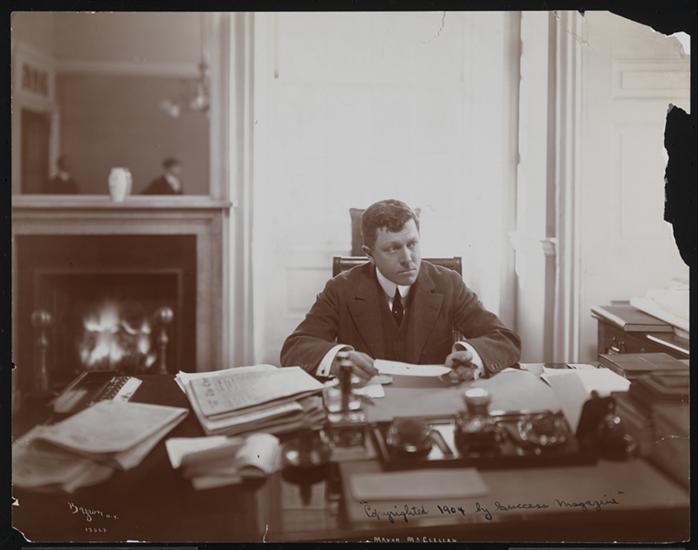
Below: Mayor McClellan in 1904, his first year in office
But oddly, George is perhaps best remembered today for his half-hearted but successful campaign against motion pictures.
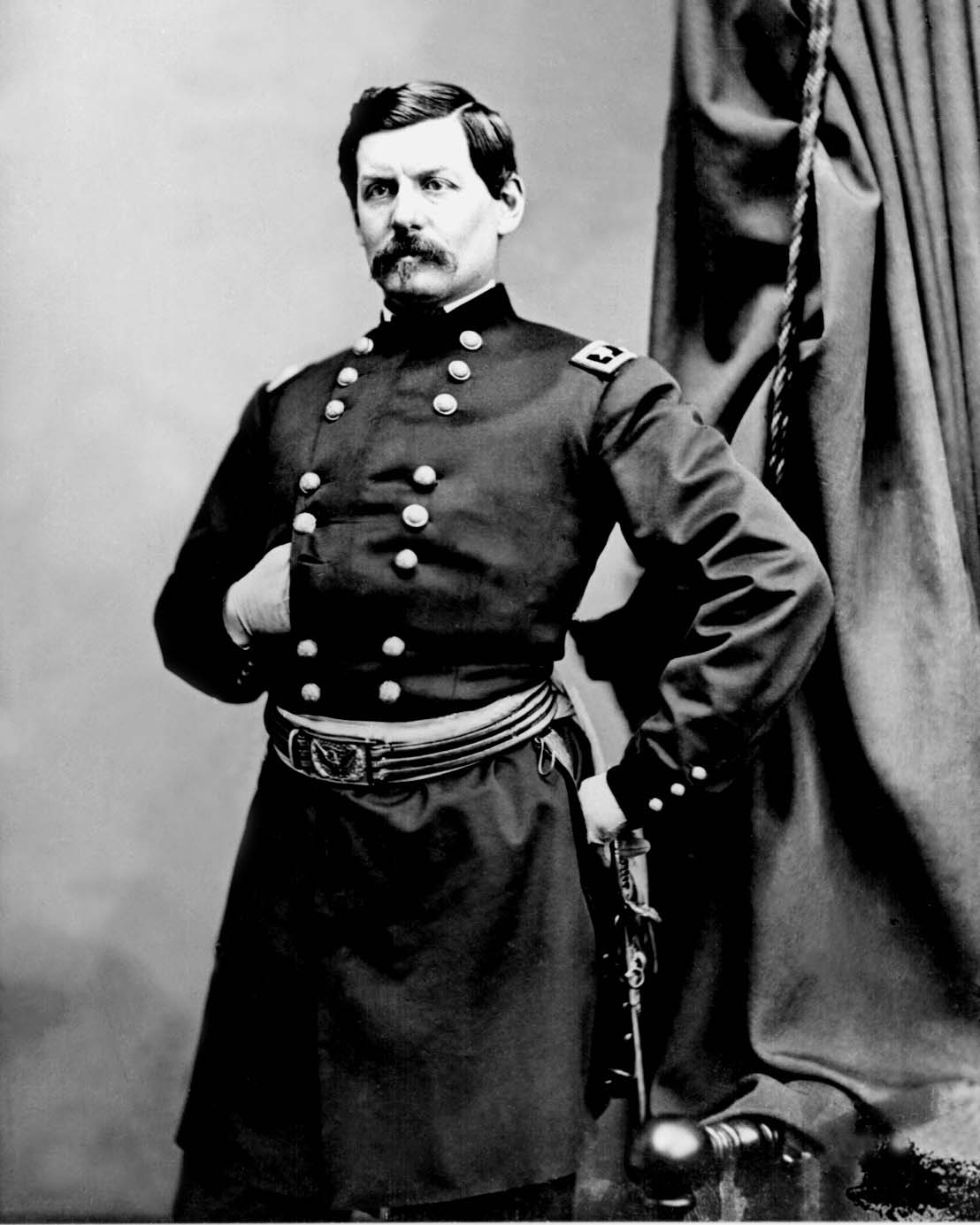
If his name sounds vaguely familiar, thank your high school history teacher. George Jr. was the son of the ultimately disastrous Civil War general of the same name, a Union general first fired by Lincoln, then defeated by him in the presidential election of 1864. Despite this, George McClellan Sr. did become the governor of New Jersey, providing his son with a model of leadership he would implant into his many civic duties.
Below: Papa McClellan
The dashing George Jr — or you can call him Max, his family did — is one of New York’s few foreign-born mayors, born in 1865 in Dresden, a few years before it was absorbed into Germany. Growing up in New Jersey while father governed, George graduated from Princeton in 1886 and a couple years later ended up as a writer for the revitalized New York World, Joseph Pulitzer‘s popular scandal sheet, in its brand new office on Newspaper Row — just across the street from George’s future office at City Hall.
Actually, George was mayor before he was really mayor. Name recognition and an inherited interest in public service placed him on the Board of Aldermen (precursor to the City Council) by the 1890s, and he was elected board president in 1893. The next year, due to an absence from the city by sitting mayor Thomas Gilroy, McClellan, age 29, became the acting leader for a month.
His biggest controversy? Raising on Irish flag over City Hall for St. Patricks Day, outraging local schoolboys. No, really. He even received threats of bodily harm, but held firm. Deal with it, he told the boys.
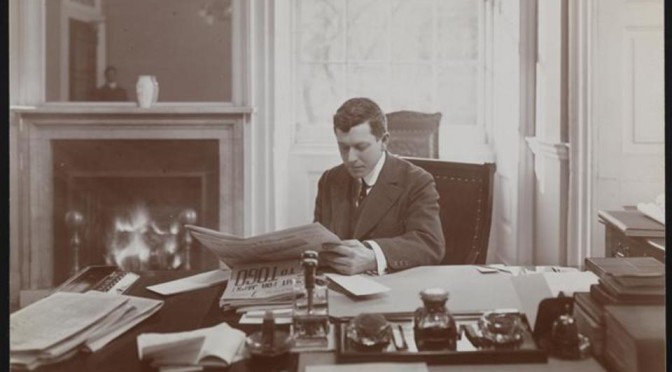
Mayor McClellan in his office, 1904 (Courtesy Museum of the City of New York)
Snugly in bed with Tammany Hall and a favorite of oleBoss Croker, McClellan spent the next several years representing New York in the U.S. House of Representatives. He returned to the New York scene in 1903 as a Tammany instrument to oust mayor Seth Low, a reform ‘clean-up’ mayor who may have irked more than a few tavern owners.
McClellan, with Tammany’s blind eye towards New York’s more lascivious industries, handily won. And would stay in office for six years, making him New York’s longest serving mayor since Richard Varick in 1789. (The man he beat for re-election in 1905? William Randolph Hearst.)
New York blossomed under McClellan’s reign, with many long boiling projects coming to fruition. One new bridge, the Williamsburg, opened under his watch with another (Manhattan Bridge) well on its way, he unveiled lofty plans to improved the city’s water system, and he gave Longacre Square a new name (Times Square). The Battery Maritime Terminal (built in 1906), that jade beauty next to the Staten Island ferry, is even dedicated to McClellan. New York Public Library was nearly completed — and Grand Central Terminal half-way done — by the end of his term.
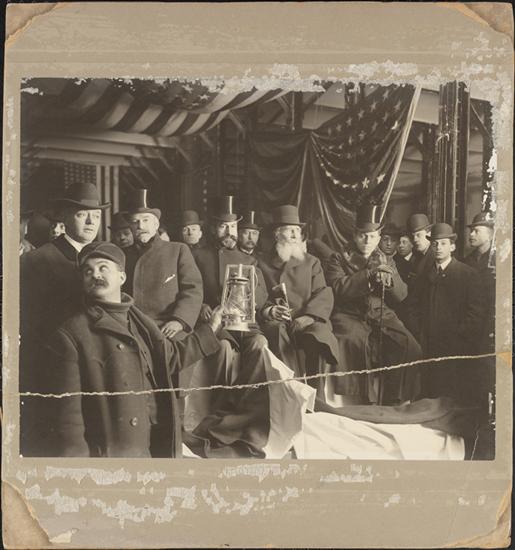
A picture in the new subway tunnels, Mr. McClellan looking very confident near the center right. (Museum of the City of New York)
An intrepid tale springs up about McClellan involving the grand opening of the IRT’s first subway tunnelin October 27, 1904. Meant only go ceremonially start up the engine of the first train, McClellen requested that he would like to actually go ahead and drive the train all the way up to Harlem! (And Bloomberg brags that he only rides the train.) He deftly steered the new engine up to 103rd Street before handing over the controls.
To me, McClellan’s biggest contribution is valuable indeed — overseeing the construction of the Chelsea Piers (below), which allowed massive steamships to dock in the city, turning New York into a truly international port. By 1907, in fact, the Lusitaniawas already at dock here, although the terminal wasn’t officially completed until 1910.
Yet with all of these remarkable changes, the story which arises the most about McClellan involves his war against a technological threat — the rise of cinema.
By 1905, the city had dozens of ‘movie houses’, nickelodeons and amusement arcades where patrons could pay a penny to see the birth of the motion picture. A theater owned by Marcus Loews, quickly to become the biggest name in film exhibition, opened in New York in 1904; the city got its own production company, Biograph, in 1906.
This new moving pictures craze was sweeping the United States — two million patrons in 1907, according to the Saturday Evening Post — and like everything foreign and new, it was soon seen as a corrupting influence, ‘demoralizing’ children, a bastard offspring of vaudeville and burlesque.
Some accounts have McClellan ardently opposed to this new medium on those grounds. I prefera more rational theory: by 1908, McClellan had his eye on a new job — president of Princeton University — and in order to get that, he had to be seen as sticking up for higher morals. (Something Tammany candidates aren’t exactly known for.)
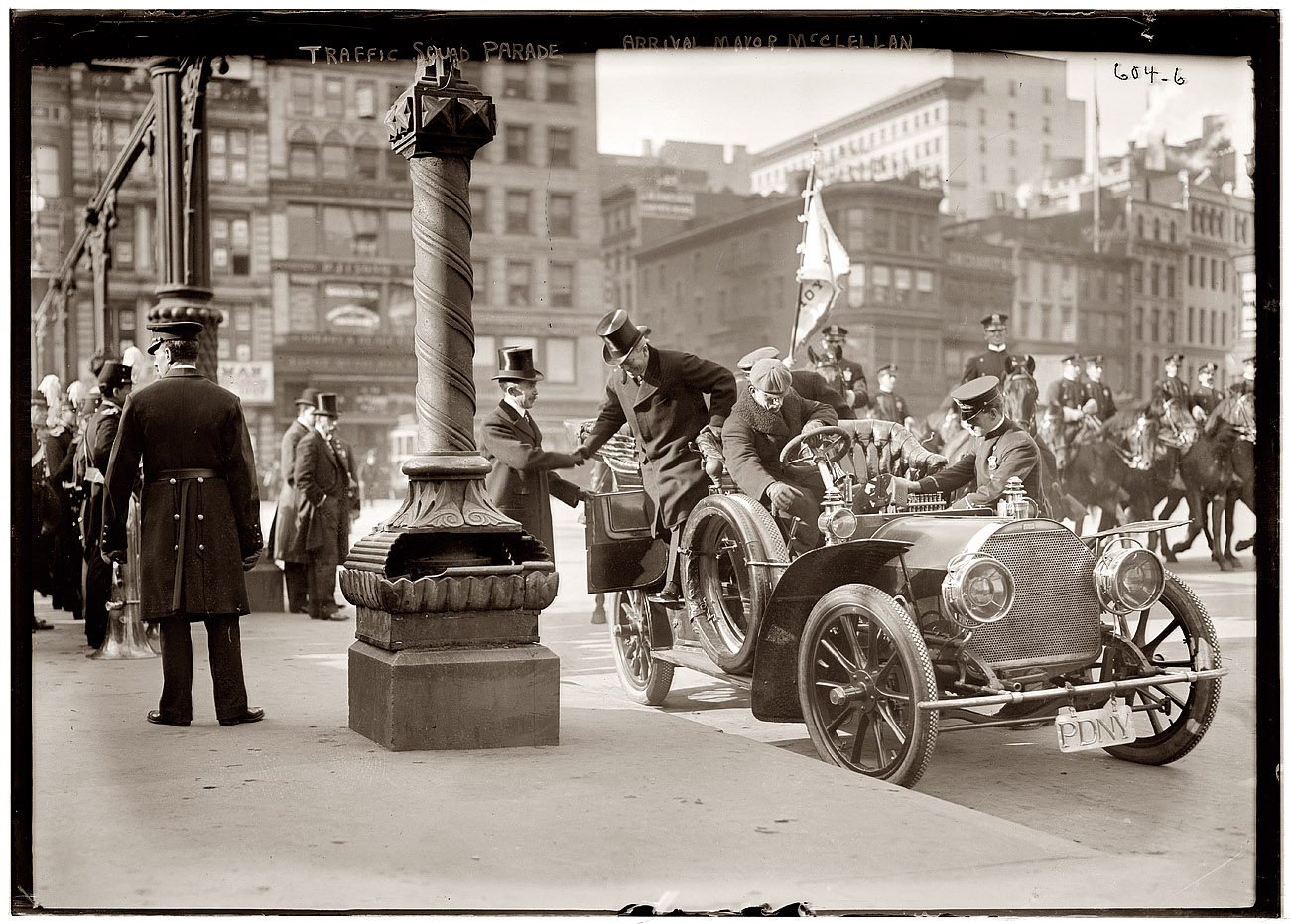
Below: McClellan steps from a newfangled automobile onto the streets of Union Square in 1908 (pic courtesy Shorpy)
And so, on the technicality of being dangerous fire hazards, McClellan tore up the licenses of over 550 motion picture exhibitors — yes, that’s right, 550. (Nickelodeons were in music halls, taverns, even a few restaurants.) Most were not reinstated until the debut of New York’s Board of Censorship in 1909, a reviewing board which ended up not censoring much of anything. By the 1910s, movie makers and theatre owners were becoming too powerful to overrule.
By why was McClellan looking for a new job in the first place? In 1908, he was not long for the mayor’s office. Like blessed as Tammany Hall golden boys, McClellan got a conscious in his second term, hiring many non-Tammany employees and rooting out a mountain of Tammany related corruption in civic offices.
This turncoat did not please new Tammany boss Charlie Murphy, no it didn’t. In 1909, Tammany put up their new contestant, the colorful William J. Gaynor. (Incidentally, he also beat William Randolph Hearst, in his second and final unsuccessful run at the office.)
McClellan never became the president of Princeton, but he spent his remaining years teaching there until 1931, when he retired to the good life, writing books about his real passion — the history of Venice. He died in 1940 in Washington DC and was buried in Arlington Cemetery.
But clearly, it’s to New York that he belong.
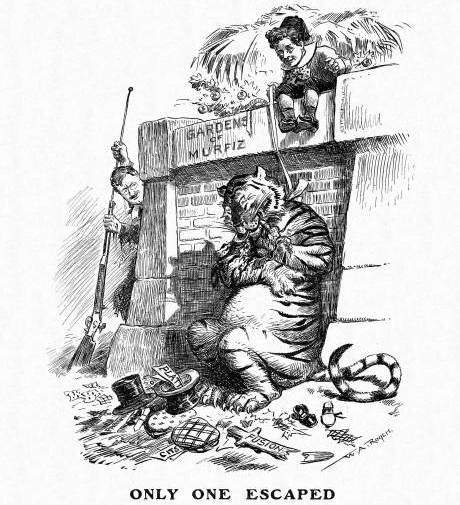
Below: in this 1905 Harpers Weekly cartoon, McClellan is seen as a little boy holding the Tammany tiger, devouring the ‘fusion candidate’ (Seth Low). President Theodore Roosevelt peeks from the side. (He always did like wildlife.) Within three years, McClellan would be the devoured.
Today it’s the Met Life Building. It’s been called the ugliest building in New York City. It sits like a monolith behind one of the city’s most enduring icons Grand Central Terminal. But it’s got some secrets you may not know about. In this podcast, we scale the heights of this misunderstood marvel of modern architecture. Listen to it for free on iTunes or other podcasting services. Or you can download or listen to it HERE
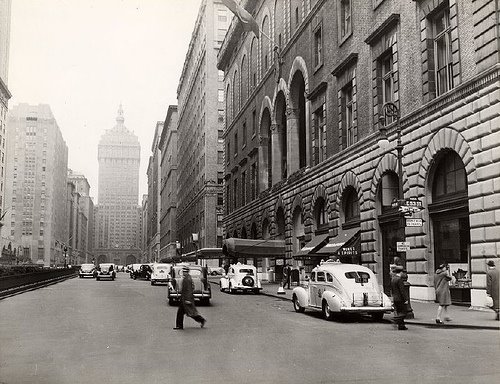
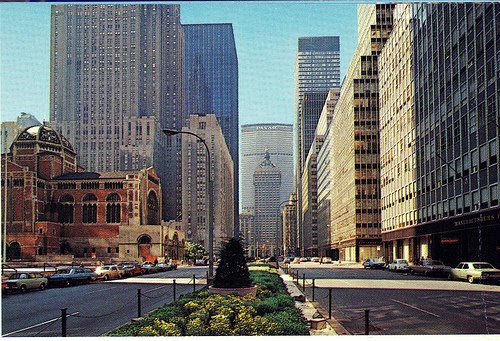
In the days before the Pan Am Building, Park Avenue was lorded over by the ‘dowager queen’ of glamour architecture, the New York Central Building (later the New York General Building, and finally — the Helmsley Building)
Another angle, year of photograph unknown.
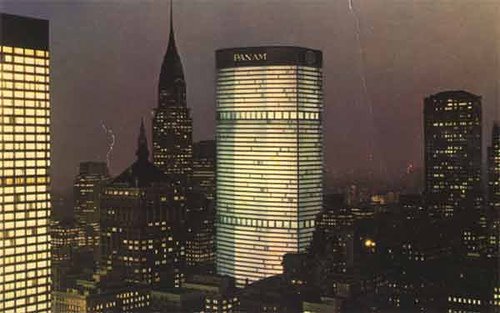
In this picture, taken in 1962, the monolith is almost complete.
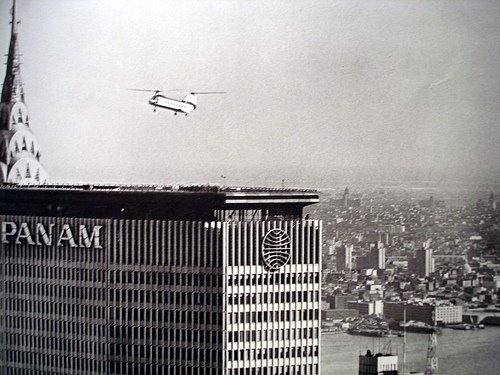
New York Airways once provided helicopter service from the top of the Pan Am in the 1960s. It was briefly revived in 1977, but a tragic accident killing five people ensured it would never be tried again.
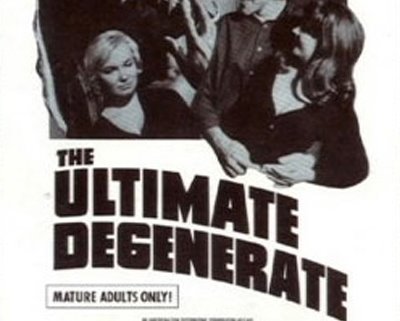
One of those killed in the tragic helicopter blade accident of 1977 was film producer Michael Findlay, creator of such sexploitation classics like the Flesh trilogy and the Ultimate Degenerate. (He also made some films with titles that are bitterly ironic considering his untimely death.)
In 1987
Today
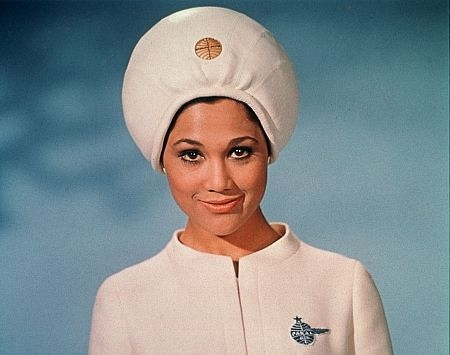
When Pan Am moved into the building in 1962, they were one of the world’s leading airlines, best known for their on-board service and fleet of attentive flight attendants.
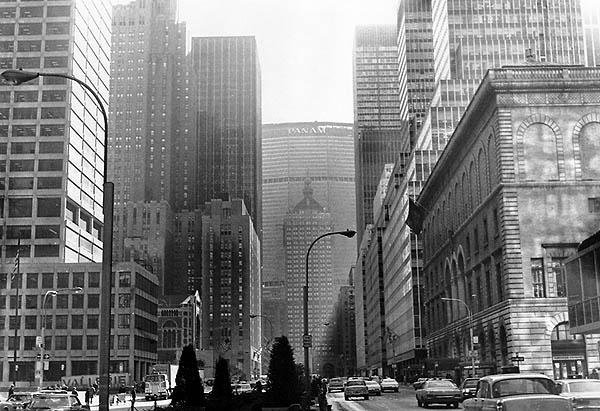
Looking down Park Avenue at the Pan Am in 1970
The same view a few years later
Its relationship to the Helmsley Building has caused great controversy over the years. Some say it’s like hanging a work of art in a cheap frame.
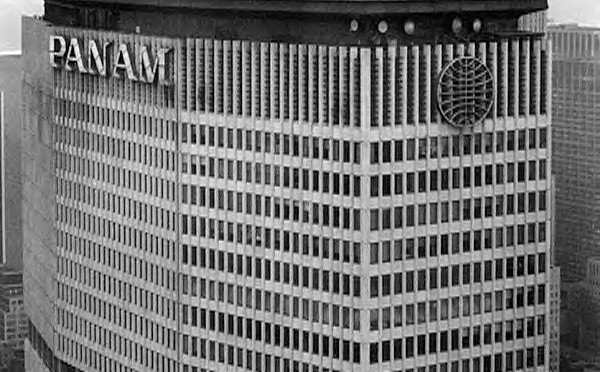
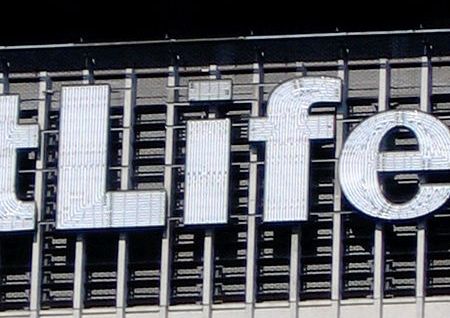
Metropolitan Life replaced the Pan Am logo with its own in 1991
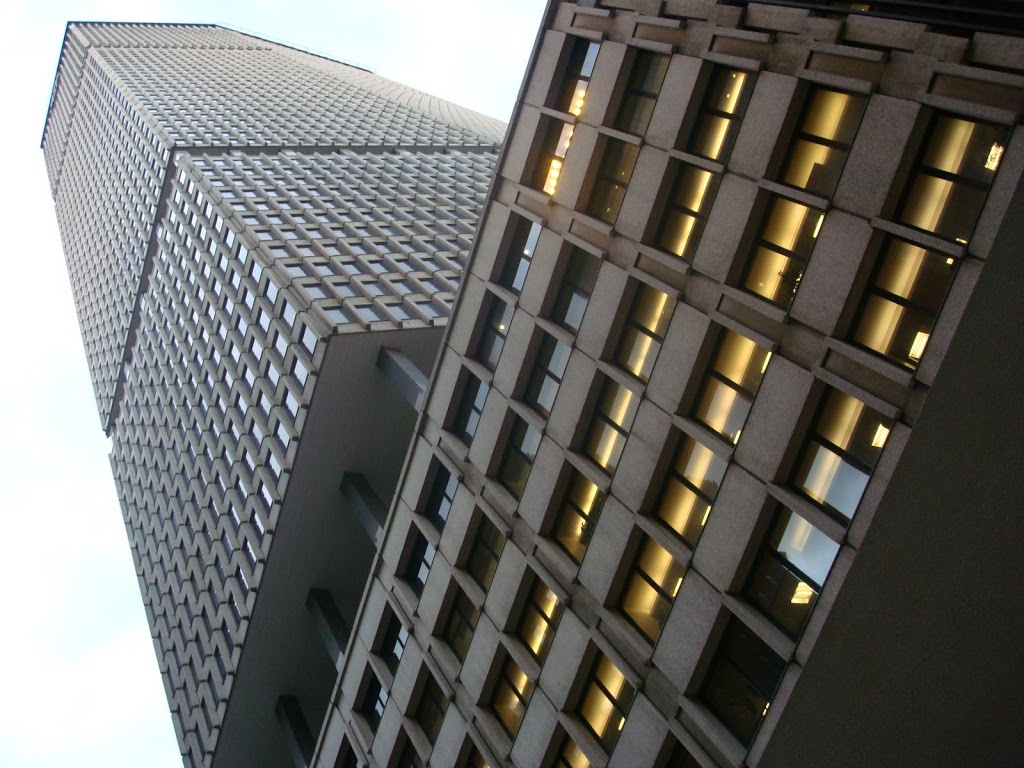
Quite unlike an impressionist painting, the building actually looks more interesting the closer you are to it, revealing some odd angles befitting its imposing proportions and ‘lozenge’ shape
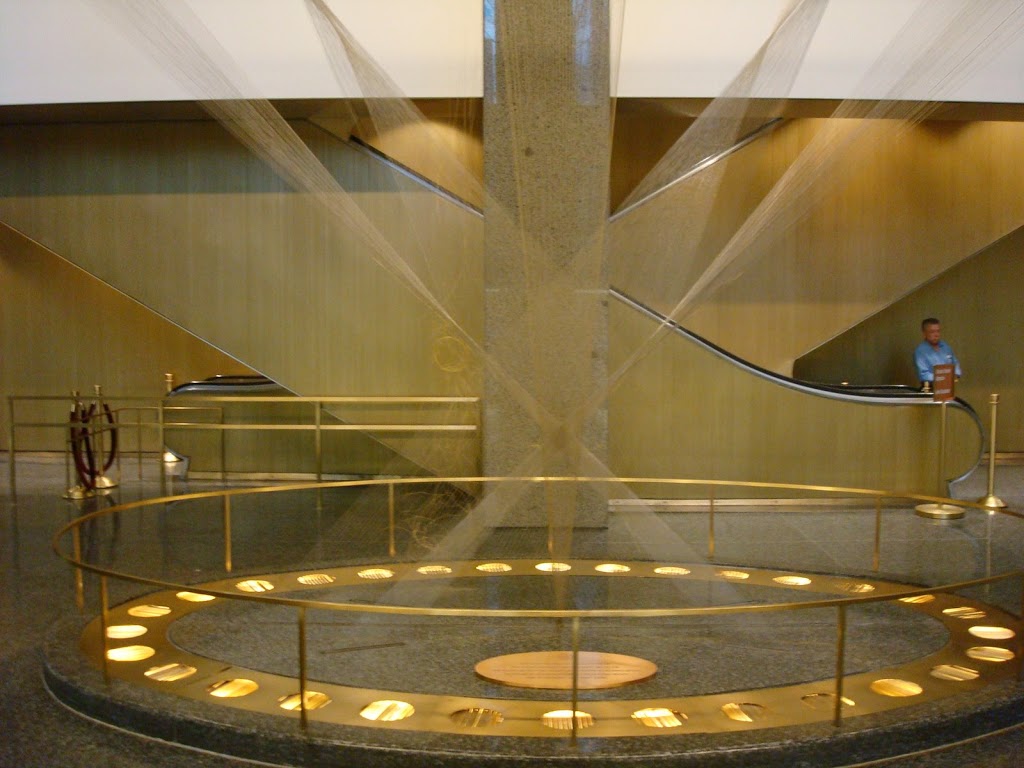
Inside the lobby: Flight, the expressive wire sculpture of Richard Lippold. The lobby once also held a painting by Josef Albers.
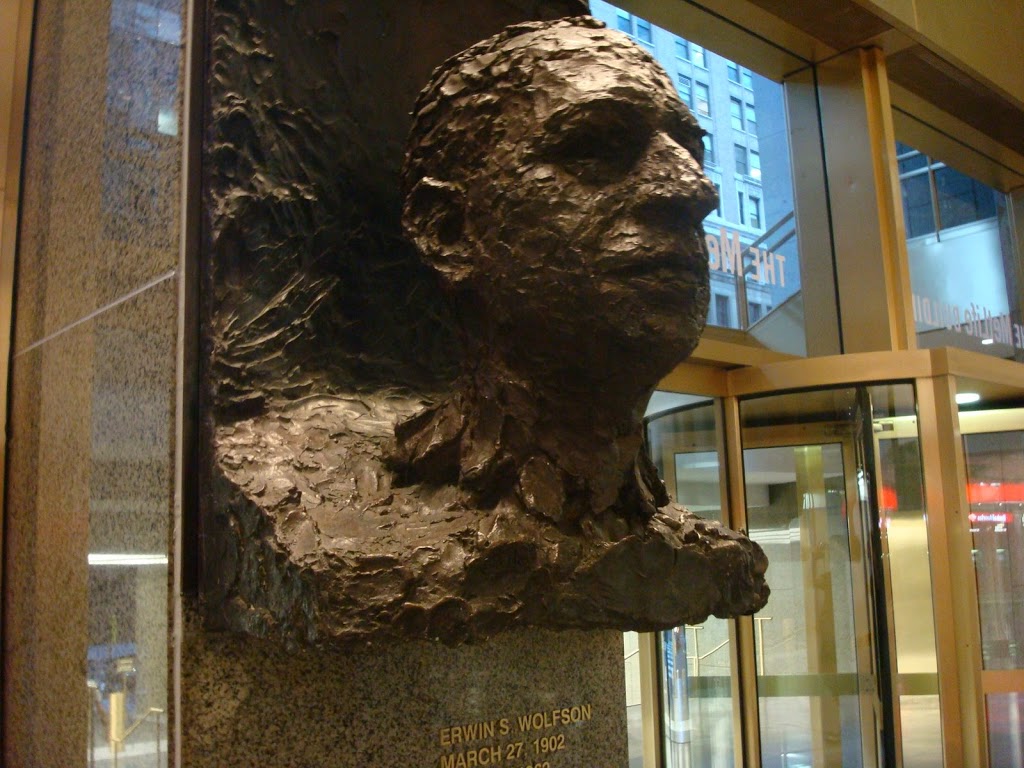
This rather grotesque bronze bust of Erwin Wolfson greets you as you enter the building.
CLARIFICATION: In the podcast, it appears I was a little vague in my description the Metropolitan Life Insurance Tower which is on Madison Square Park. Although the slender clock tower is indeed also topped with gold ornamentation, do not confuse it with Madison Square’s real gold standard — the gilded New York Life Insurance Building