Categories
Podcasts

PODCAST: The Pan Am Building

Today it’s the Met Life Building. It’s been called the ugliest building in New York City. It sits like a monolith behind one of the city’s most enduring icons Grand Central Terminal. But it’s got some secrets you may not know about. In this podcast, we scale the heights of this misunderstood marvel of modern architecture.
Listen to it for free on iTunes or other podcasting services. Or you can download or listen to it HERE

In the days before the Pan Am Building, Park Avenue was lorded over by the ‘dowager queen’ of glamour architecture, the New York Central Building (later the New York General Building, and finally — the Helmsley Building)
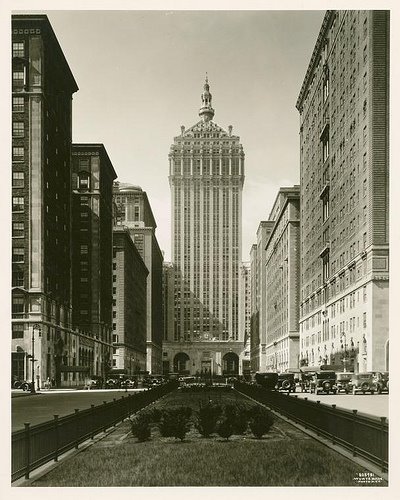
Another angle, year of photograph unknown.
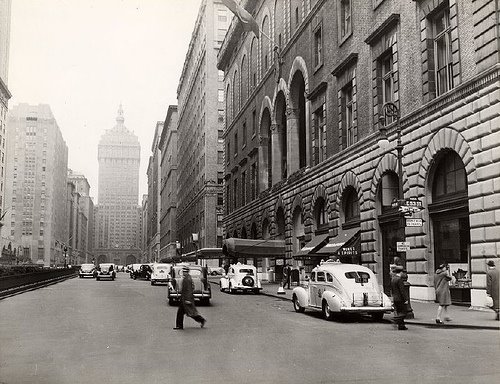
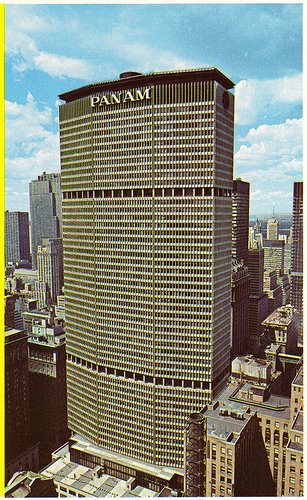
In this picture, taken in 1962, the monolith is almost complete.
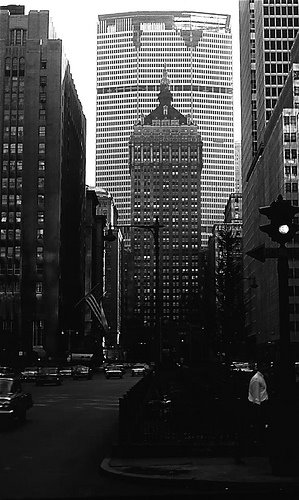
New York Airways once provided helicopter service from the top of the Pan Am in the 1960s. It was briefly revived in 1977, but a tragic accident killing five people ensured it would never be tried again.
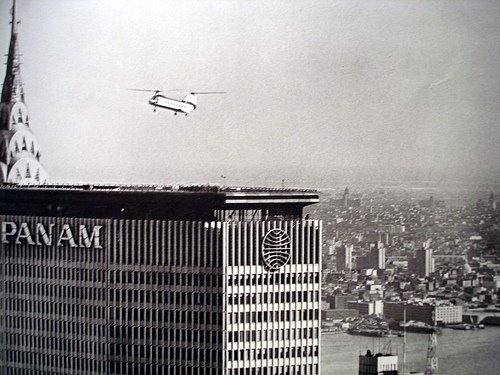
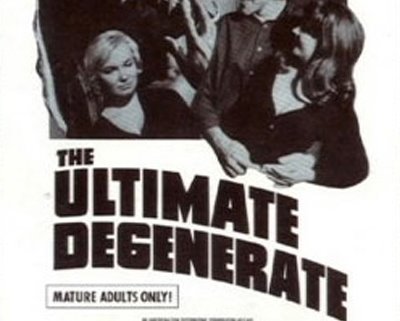
One of those killed in the tragic helicopter blade accident of 1977 was film producer Michael Findlay, creator of such sexploitation classics like the Flesh trilogy and the Ultimate Degenerate. (He also made some films with titles that are bitterly ironic considering his untimely death.)
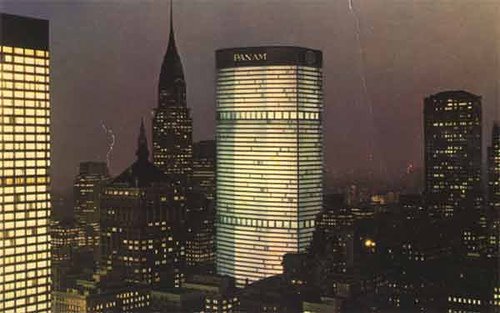
In 1987
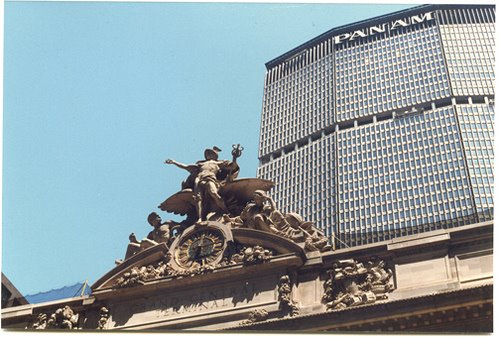
Today
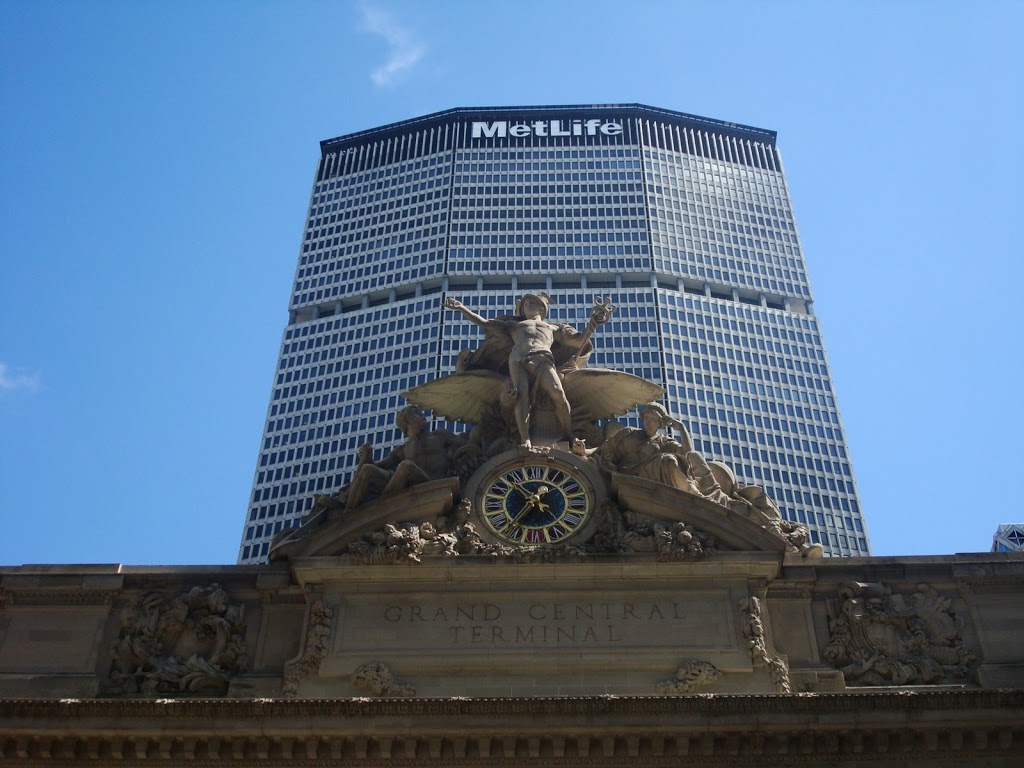
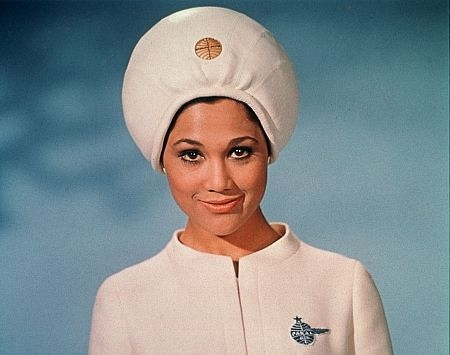
When Pan Am moved into the building in 1962, they were one of the world’s leading airlines, best known for their on-board service and fleet of attentive flight attendants.
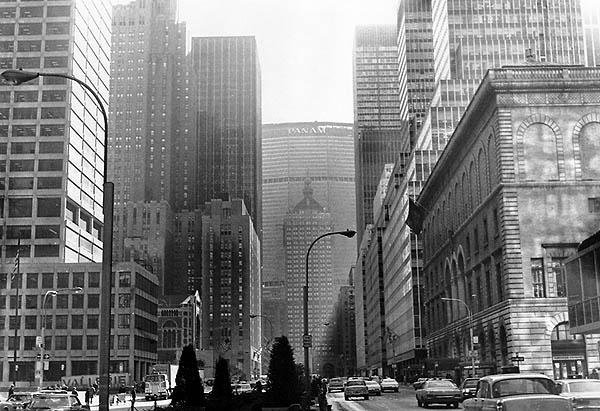
Looking down Park Avenue at the Pan Am in 1970
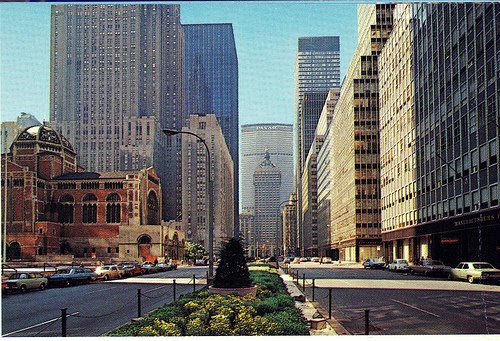
The same view a few years later
Its relationship to the Helmsley Building has caused great controversy over the years. Some say it’s like hanging a work of art in a cheap frame.
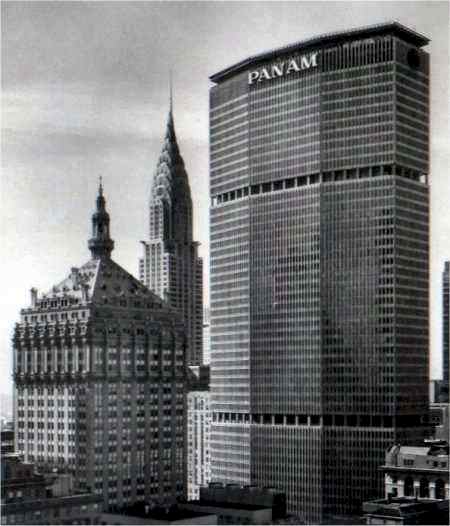
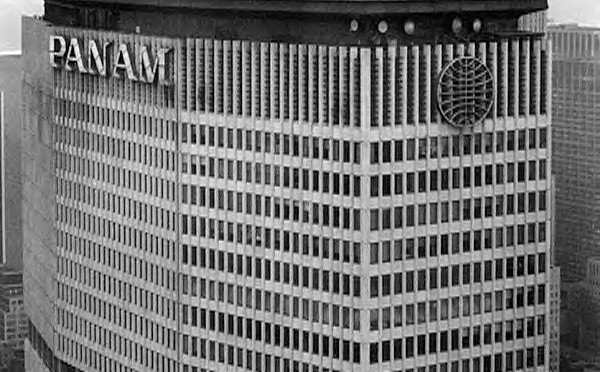
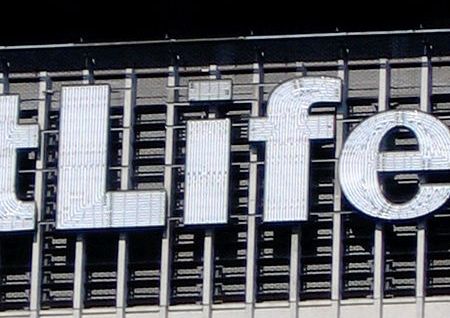
Metropolitan Life replaced the Pan Am logo with its own in 1991
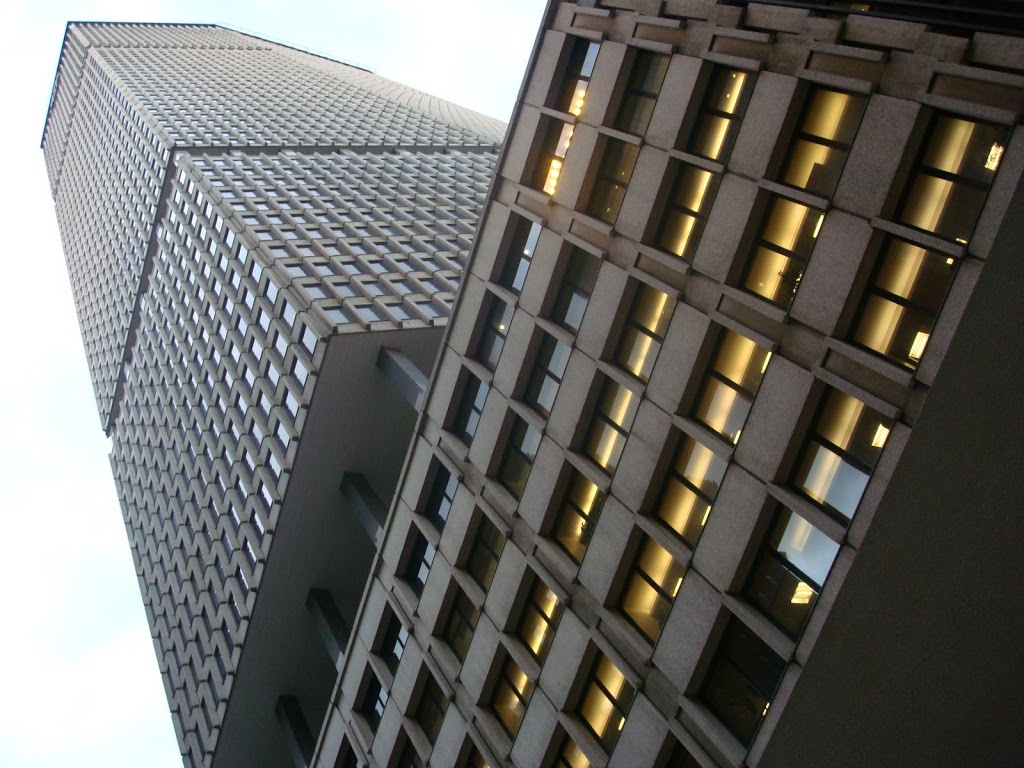
Quite unlike an impressionist painting, the building actually looks more interesting the closer you are to it, revealing some odd angles befitting its imposing proportions and ‘lozenge’ shape
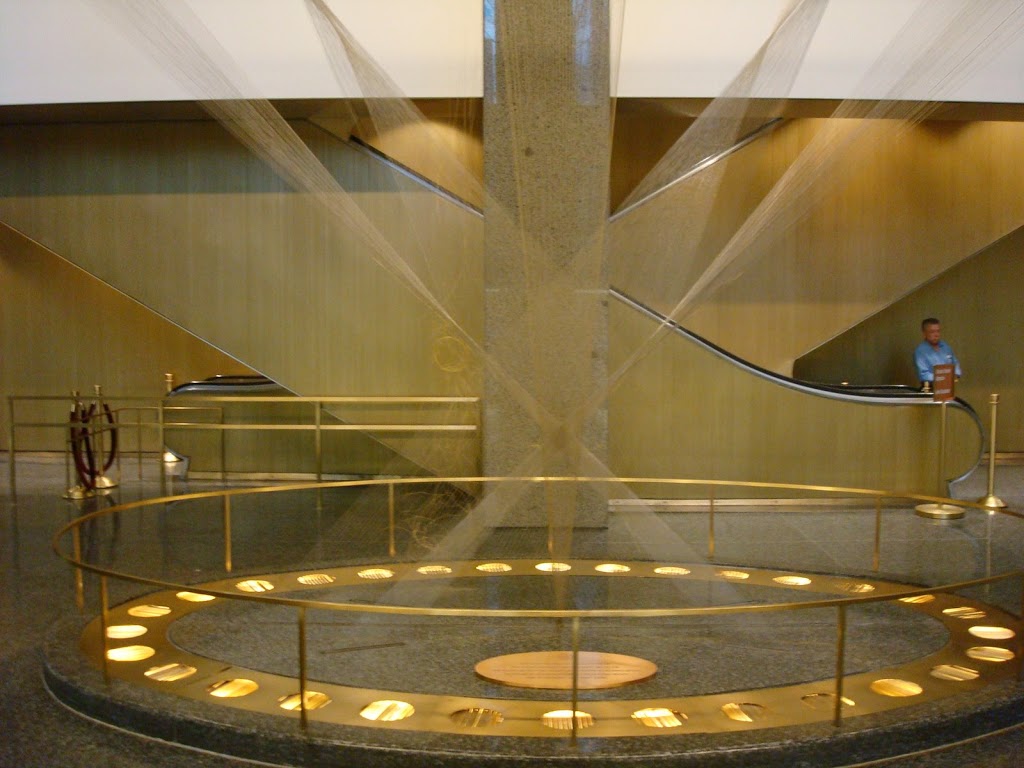
Inside the lobby: Flight, the expressive wire sculpture of Richard Lippold. The lobby once also held a painting by Josef Albers.
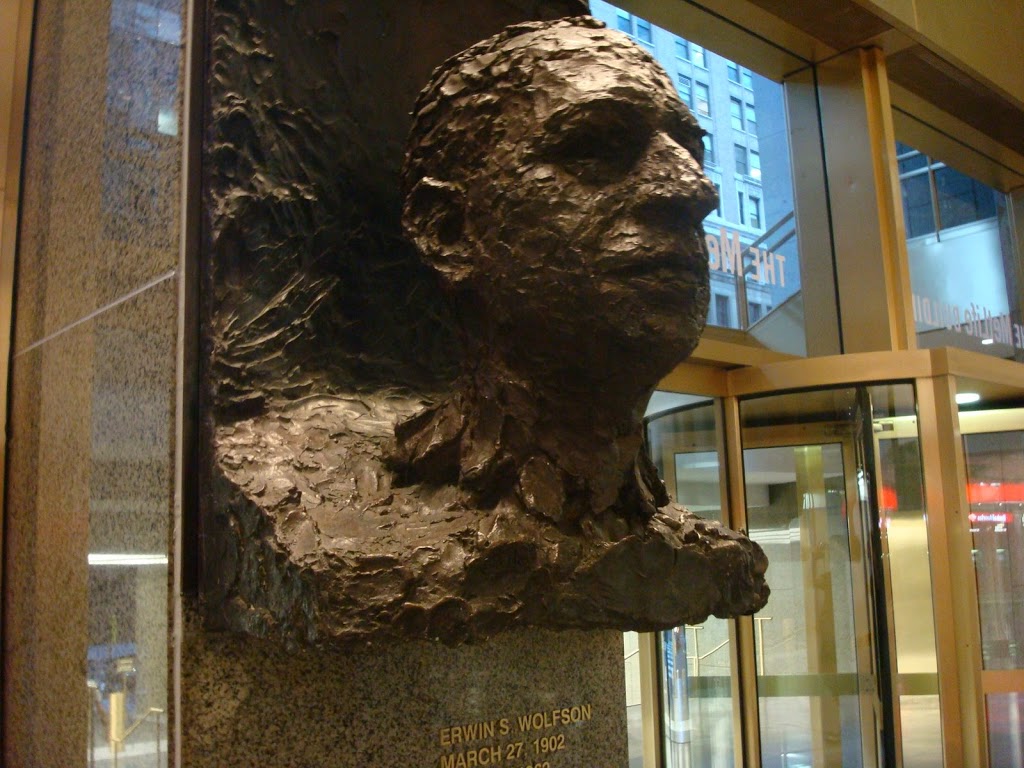
This rather grotesque bronze bust of Erwin Wolfson greets you as you enter the building.
CLARIFICATION: In the podcast, it appears I was a little vague in my description the Metropolitan Life Insurance Tower which is on Madison Square Park. Although the slender clock tower is indeed also topped with gold ornamentation, do not confuse it with Madison Square’s real gold standard — the gilded New York Life Insurance Building
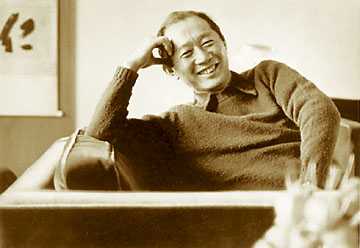
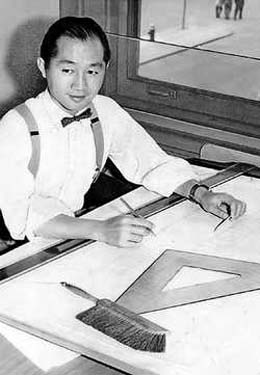
Minoru Yamasaki: The man who made the Twin Towers


In 1962, Minoru Yamasaki was given an improbable, totally ridiculous task.

Yamasaki, a Japanese-American architect best known at the time for his modernist designs of airports, university buildings and synagogues, won the World Trade Center job in 1962 over more internationally famous architects. He was paired with the prolific Emery Roth and Sons, who had marked Park Avenue with a chilling procession of tall concrete monoliths.

Yamasaki and Roth were commissioned by Port Authority, on an inspiration from the Rockefellers, to build a gargantuan office space on a relatively small area of land — 12 million square feet of usable space over a mere 16 acres, all the while with trains rushing beneath it and the Hudson River right next door.

It would take a balancing act worthy of Philippe Petit(the tight-rope walking subject of Man of Wire who later walked between the Twin Towers) to create something both elegant and functional on such absurd dimensions.

One massive tower over the space would tax even the most expert construction teams and cast a large looming shadow over the city. A cluster of buildings would, in the words of Paul Heyer, “[become] too approximate for their size and ‘looked too much like a housing project’.”

This spacial puzzle, however, proved no match for the exceptional Yamasaki. Born in Seattle in 1912, he worked his way through New York University and into the city architecture scene by sheer genius, during a time in the early 40s when many Japanese American back home were placed in internment camps. He started ambitiously — at Shreve, Lamb and Harmon, who brought New York many great skyscrapers including the Empire State Building — and branched out into his own firm in the 1950s.

He distinguished himself with fabulous buildings in Seattle (the IBM Building) and throughout the Midwest, with a unique Gothic twist to the modernist aesthetic. In a world possessed by International style — with coarse, hard and lean as code words to a new world of architecture — Yamasaki was still a poet who eschewed pure brutality. Interestingly, for the World Trade Center, he was paired with New York’s main liners of architectural brutalism, Emery Roth, who never saw a slab of concrete he didn’t like.

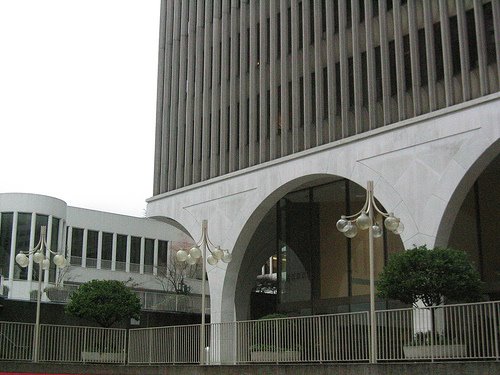
Below: the IBM Building in Seattle, in many ways a practice run for the Twin Towers in its linear form and simplicity

Balancing his own principles with Roth’s, taking an impractical situation presented by Port Authority and the vast budget (eventually $900 million) attached to it, Yamasaki decided that to balance it all meant a physical symmetry — two buildings standing side by side, with an open plaza in between so that the sheer immensity could be admired.

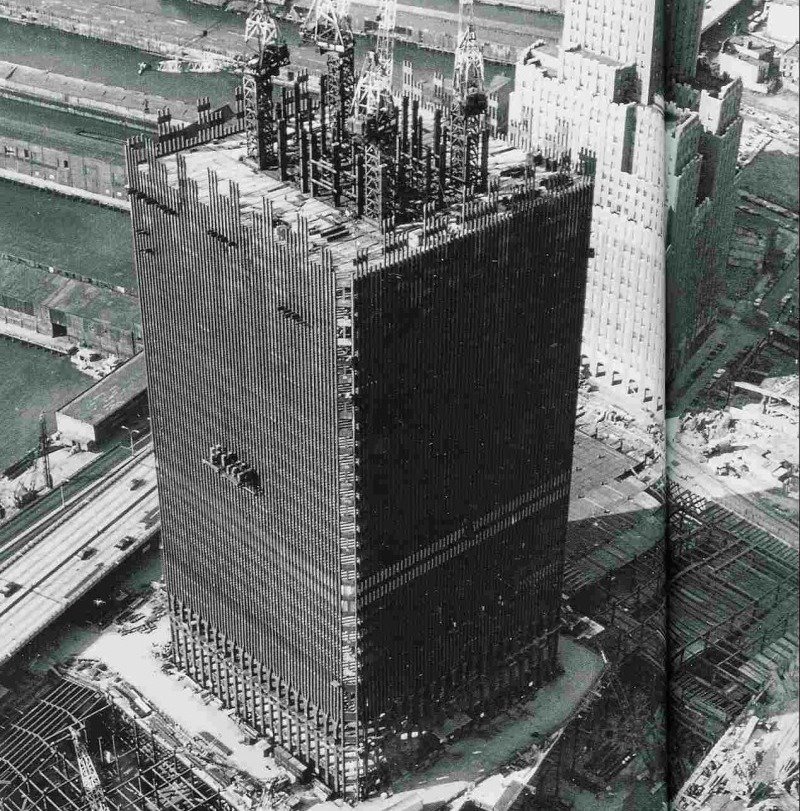
Construction on the towers began in 1966 and the second tower was finally completed in 1973. By then, Yamasaki and his firm would scatter great buildings all over the world, working right up to his death in 1986. But although he would be known as a visionary architect, the World Trade Center was his only building for New York City.

“World Trade Center should, because of its importance, become a representation of man’s belief in humanity, his need for individual dignity, his beliefs in the cooperation of men, and through cooperation, his ability to find greatness.” — Yamasaki

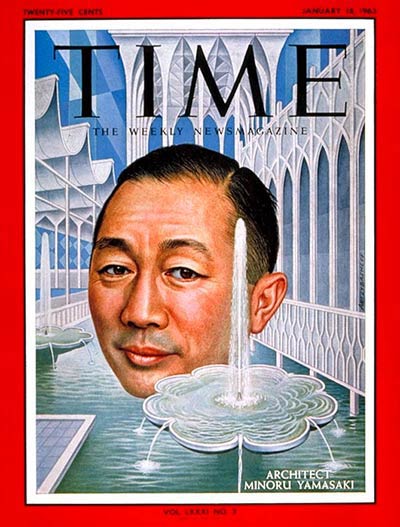
Below: Mere anticipation at the greatness of the World Trade Center planted Yamasaki on the cover of Time Magazine in 1963

Click here for our recollection of September 11, 2001 from last year.