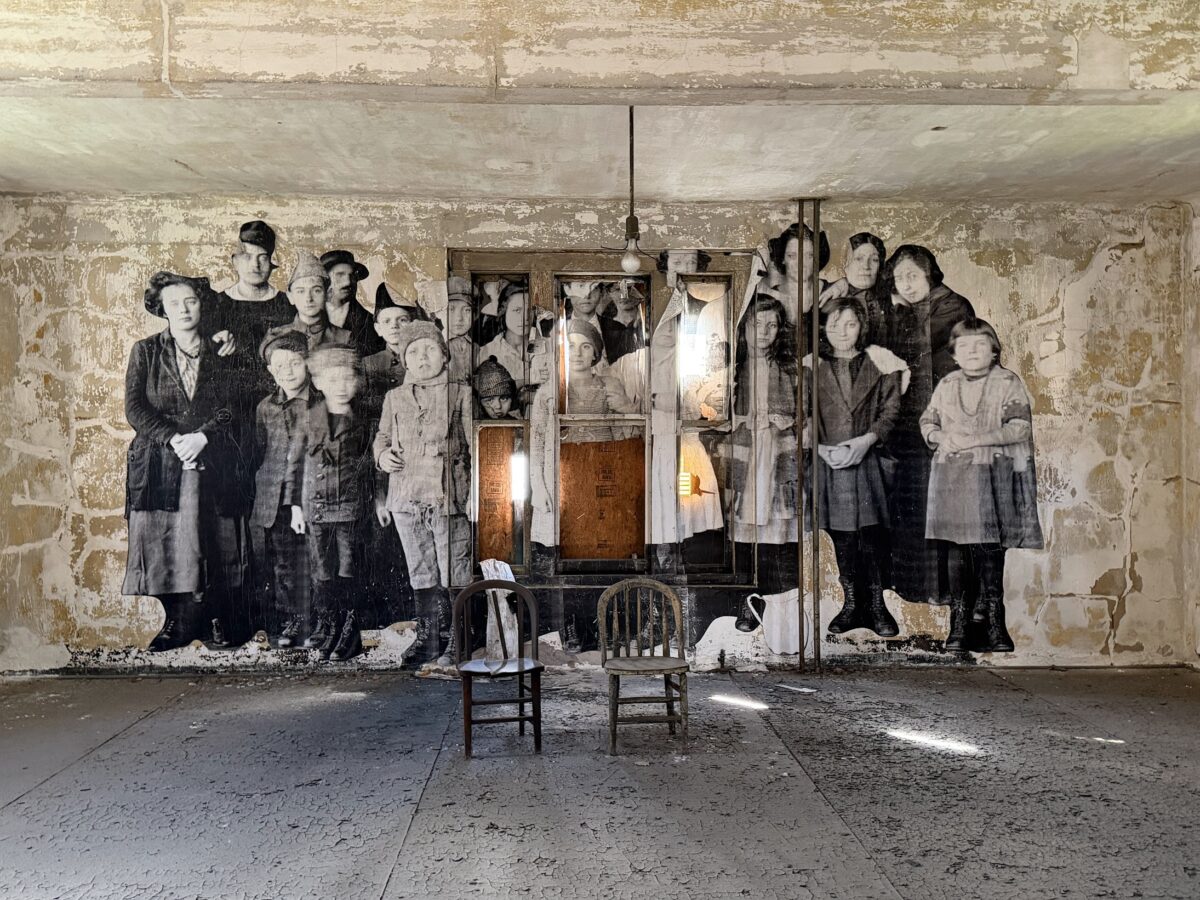
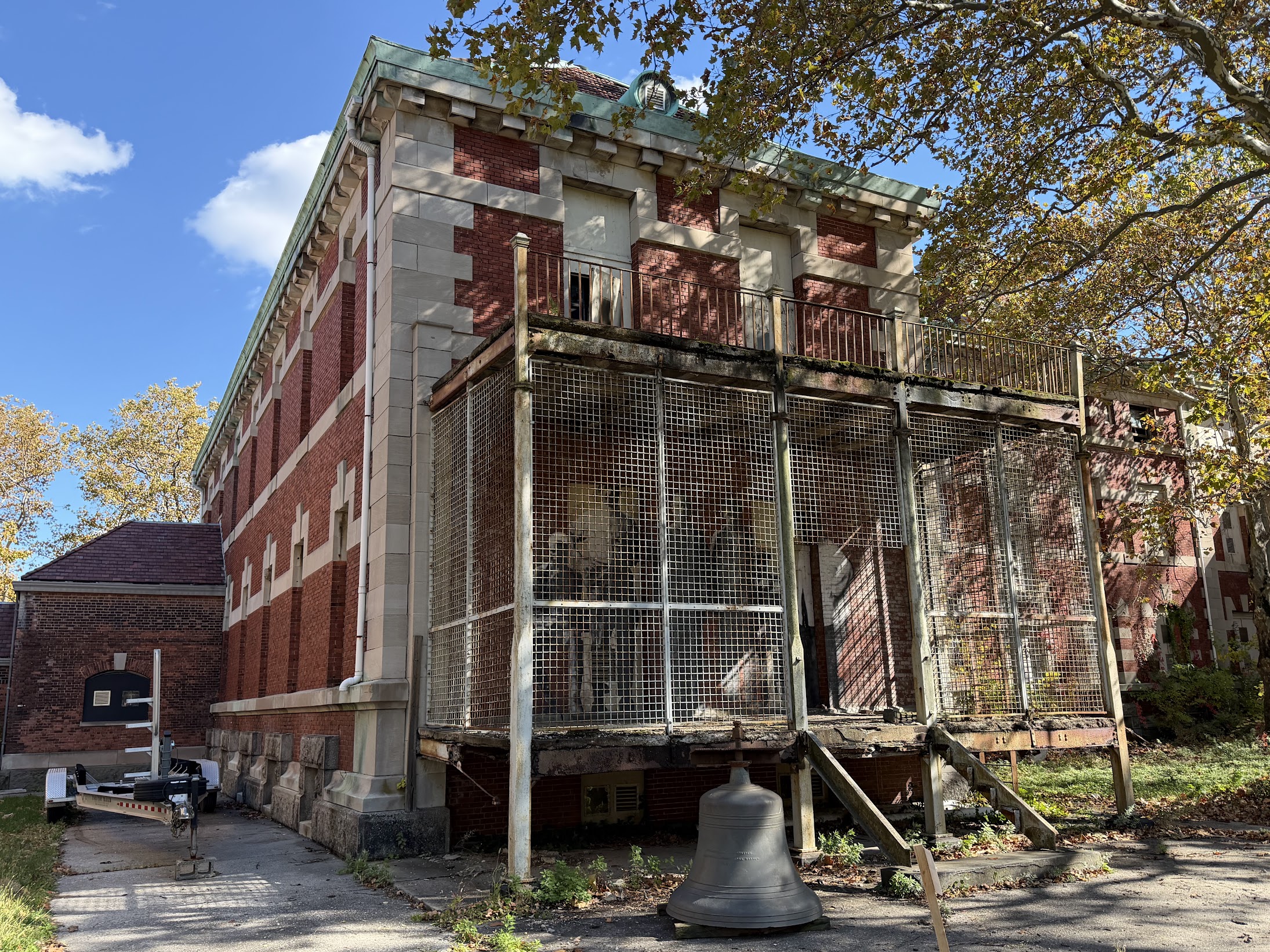
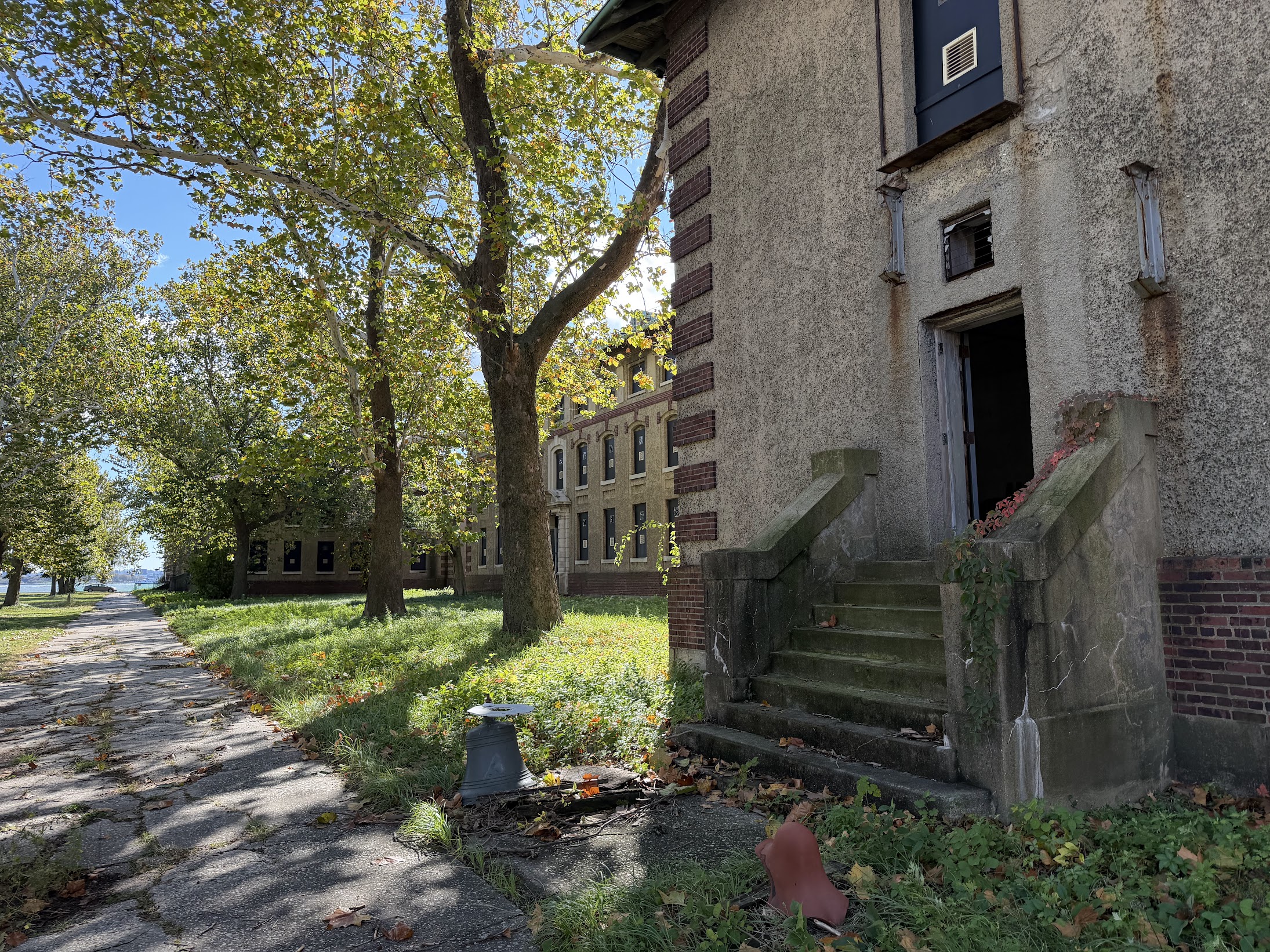
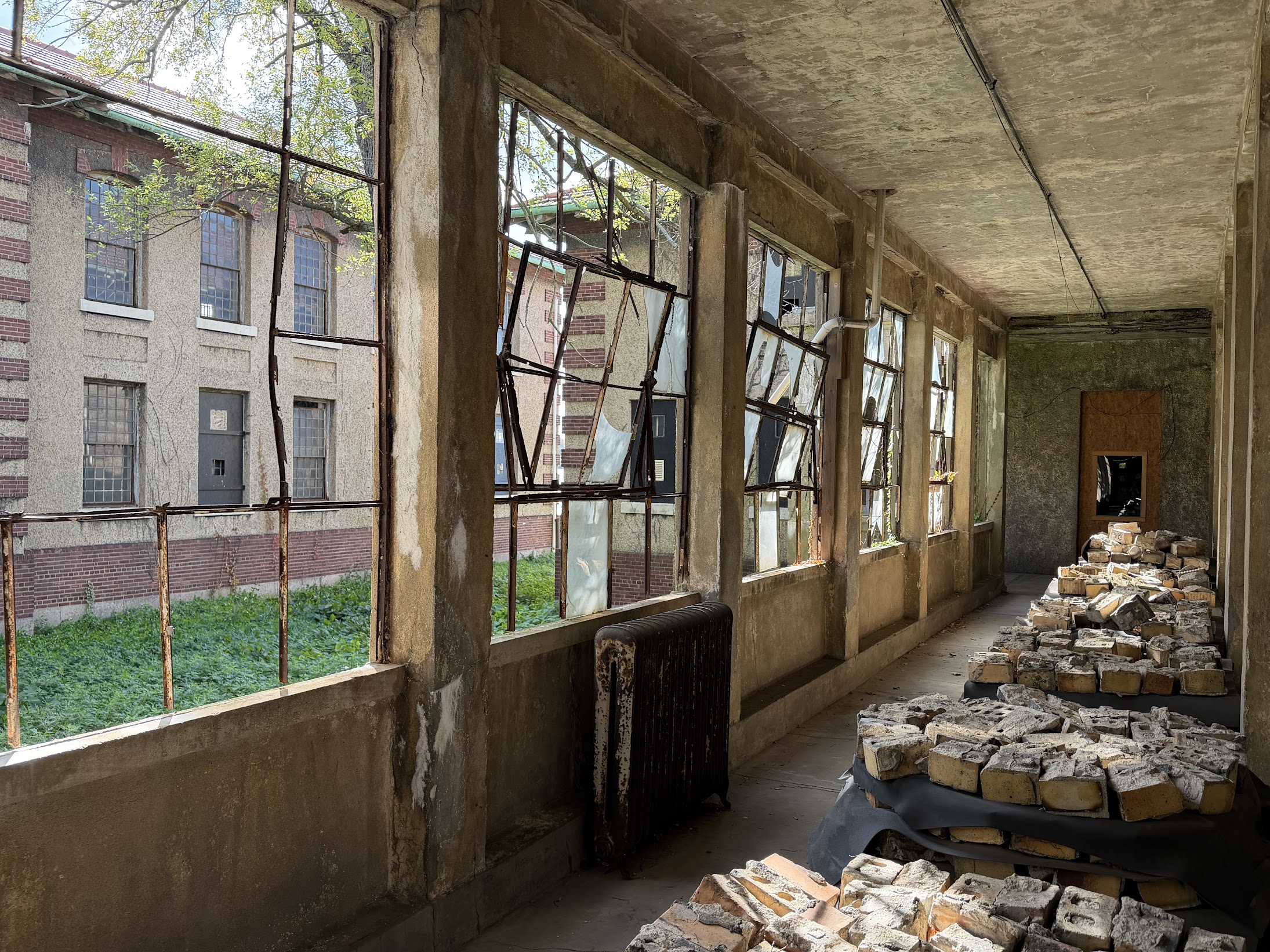
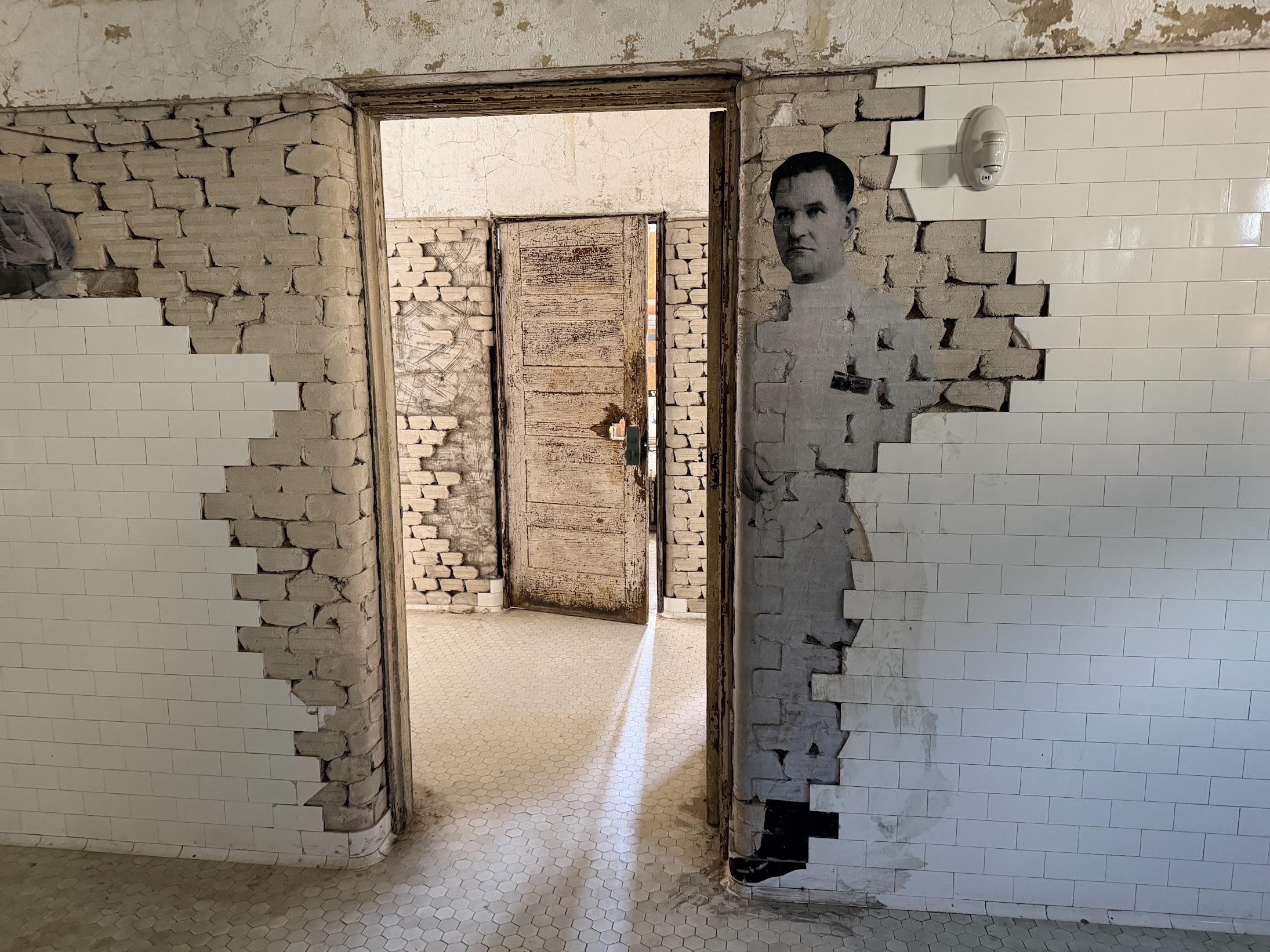
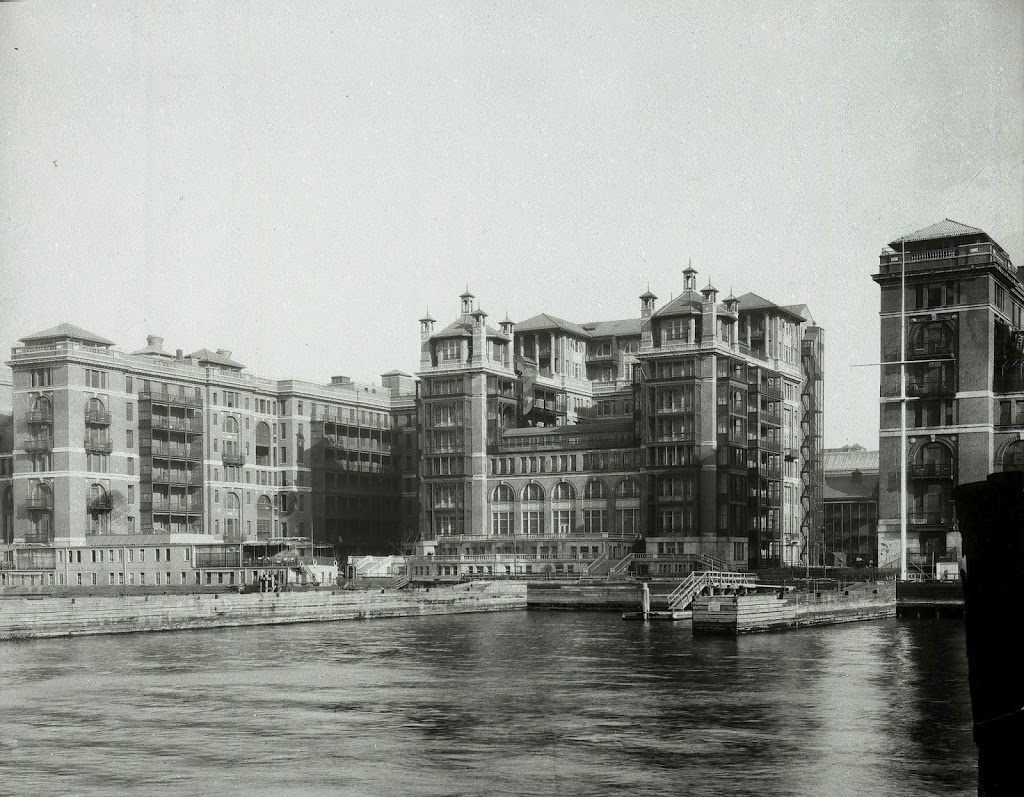
Inside the Measles Ward at the Ellis Island Immigrant Hospital, with a haunted wheat-paste mural by JR
Thanks to its immigration history, Ellis Island is one of America’s great landmarks, a place in New York harbor that represents the millions of people who arrived in this country during the late 19th and early 20th centuries.
Once processed here, a new arrival could head out to their new home — one of New York’s five boroughs or some other destination in the United States.
Part of the “‘processing”’ involved medical and mental health tests. Most people passed successfully, then boarded a ferry to the mainland — and a new life.
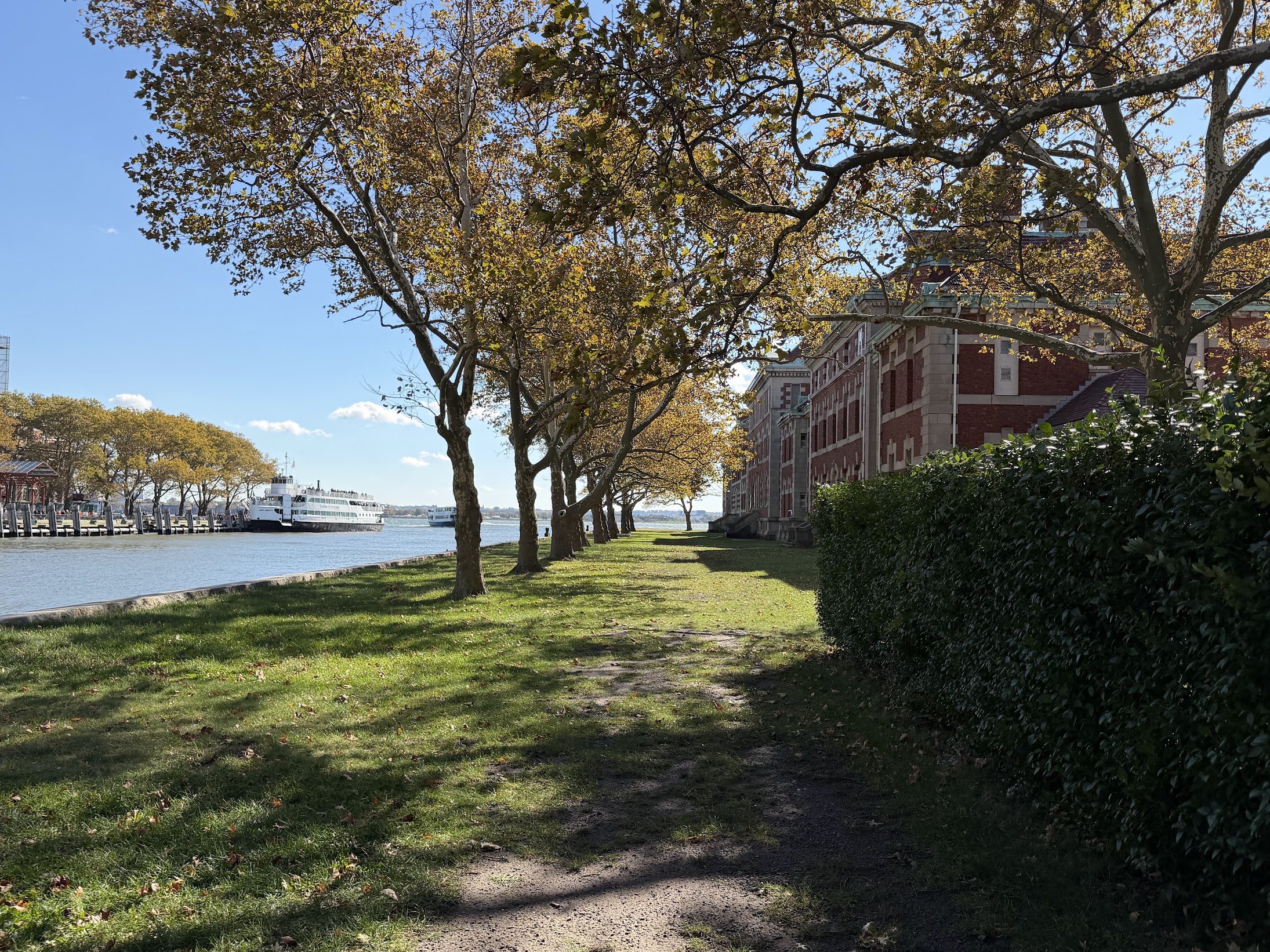
But some were kept behind, those who did not pass those tests. They were then sent to the other side of Ellis Island.
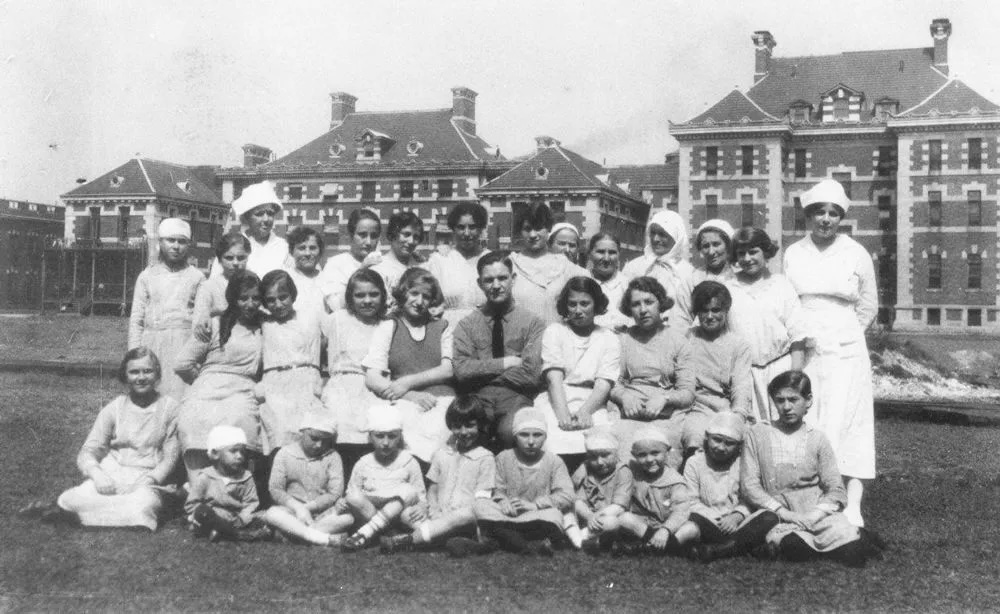
A set of patients at the Ellis Island Immigrant Hospital. It appears these may be children with favus, a fungal scalp infection.
In this special episode, sponsored by Founded By NYC, Greg and Tom recount the history of immigration into New York during the 19th century and the founding of Ellis Island in the 1890s.
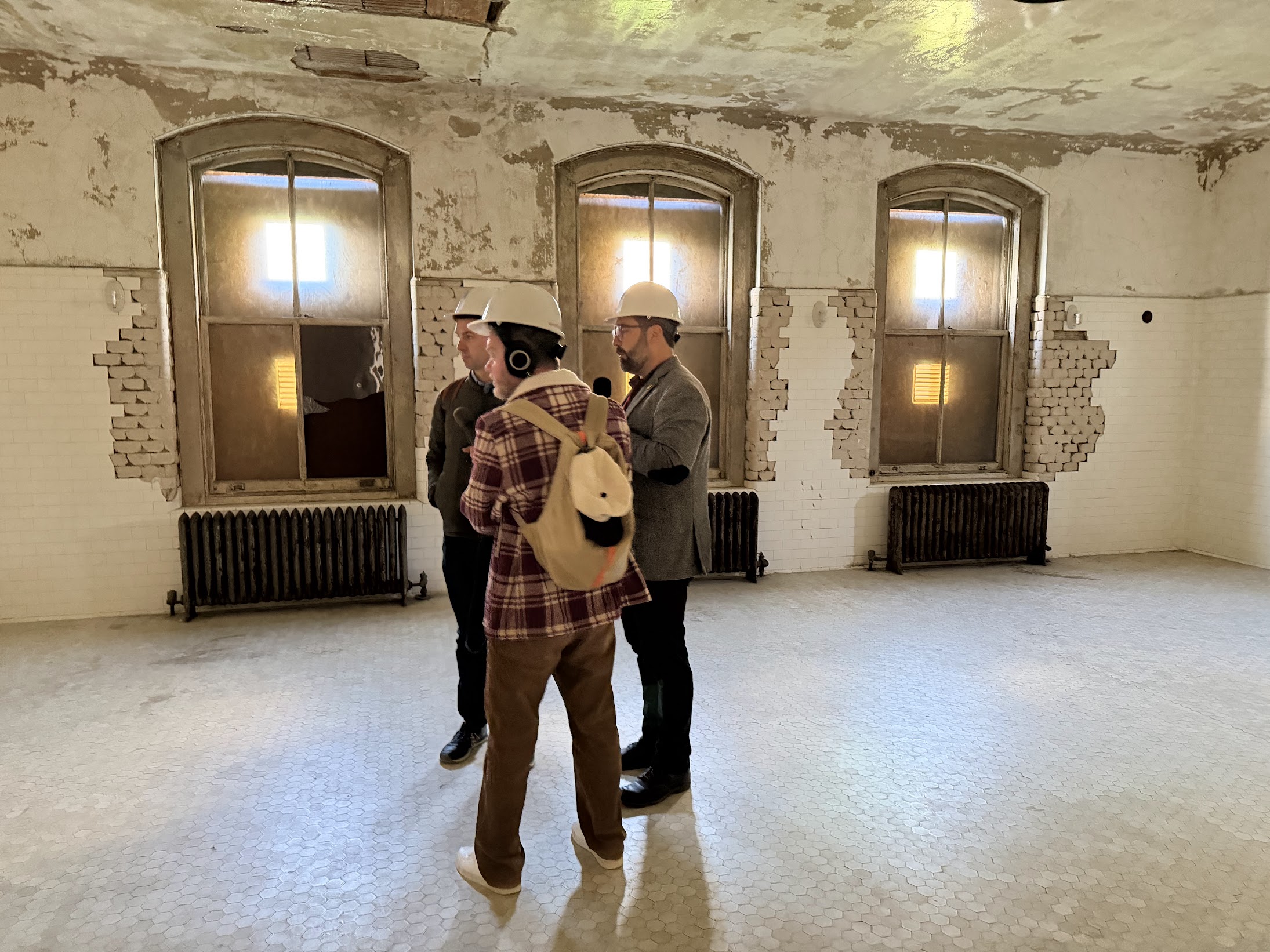
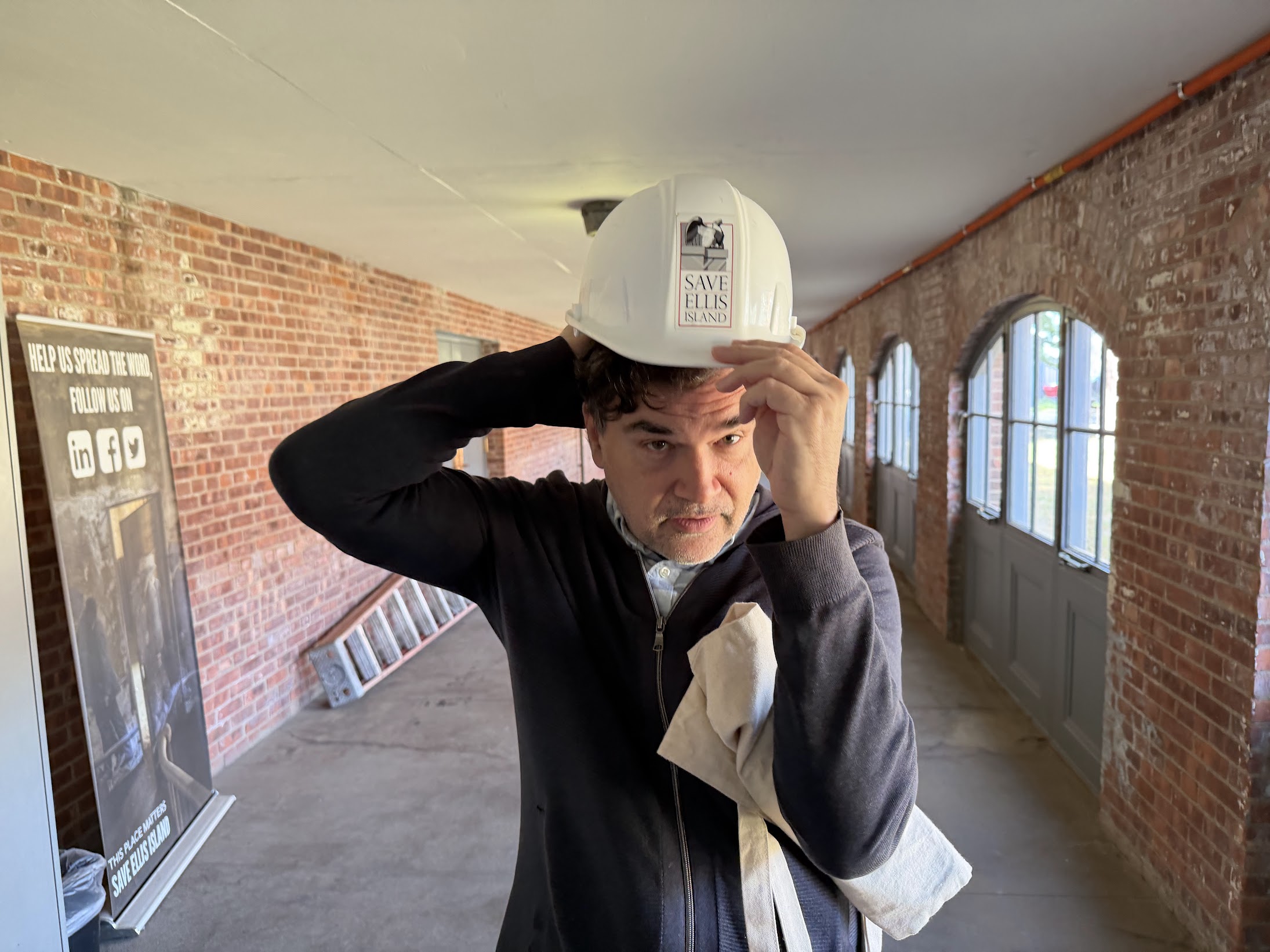
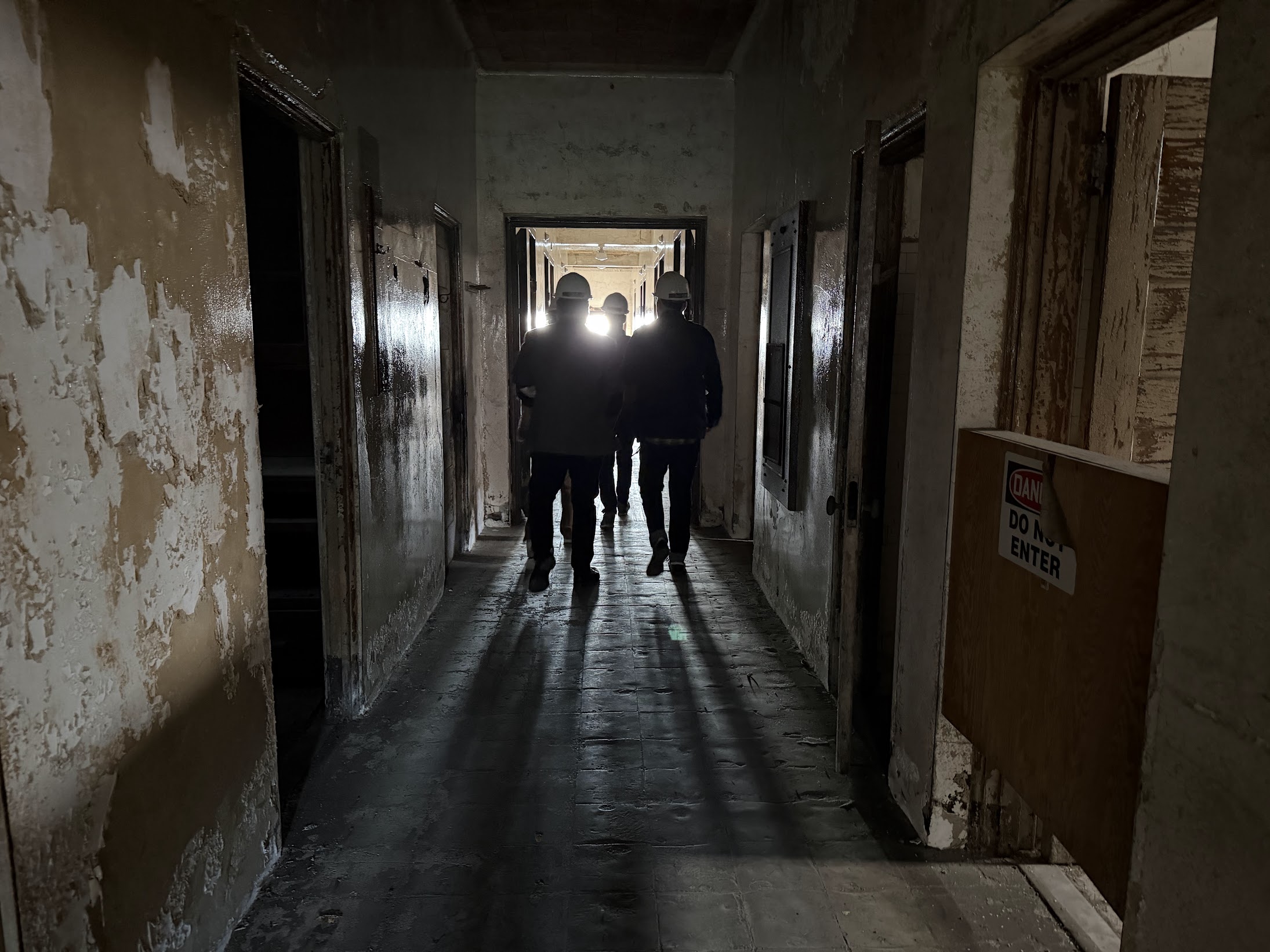
Then they pay a visit to “‘the other side”’ — the Ellis Island Immigrant Hospital — with Justin Southern and Jim Dessicino of Save Ellis Island.
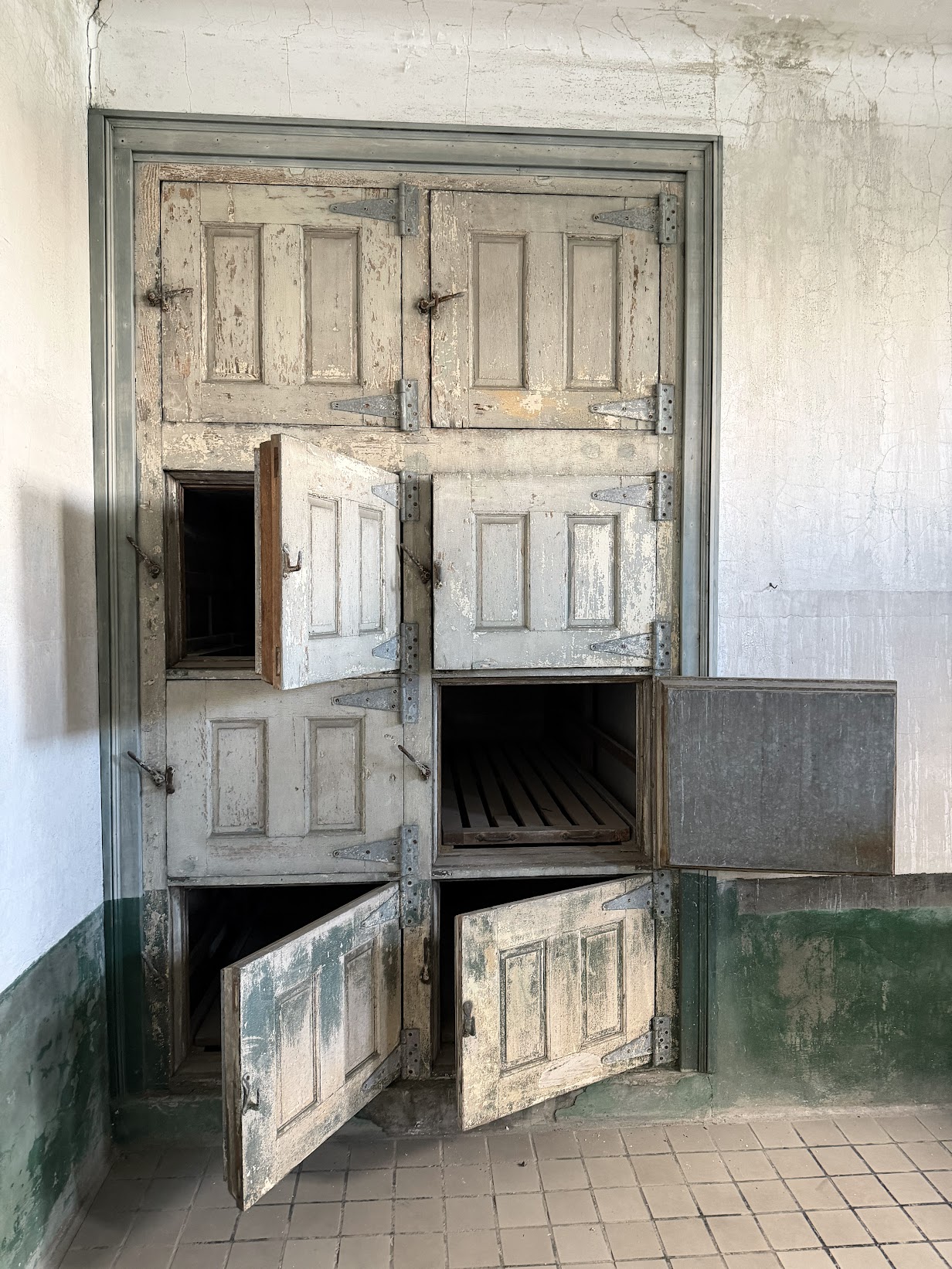
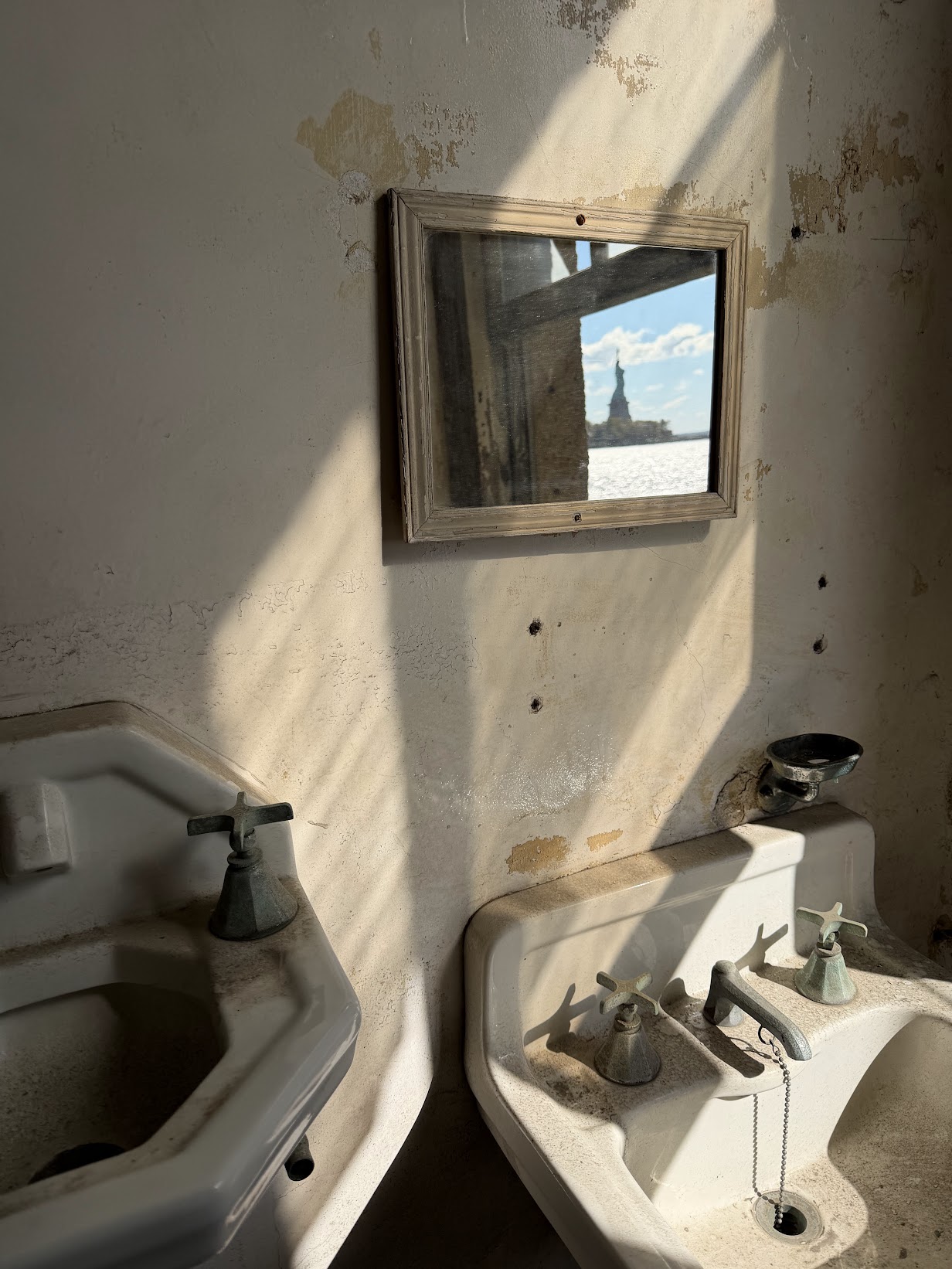
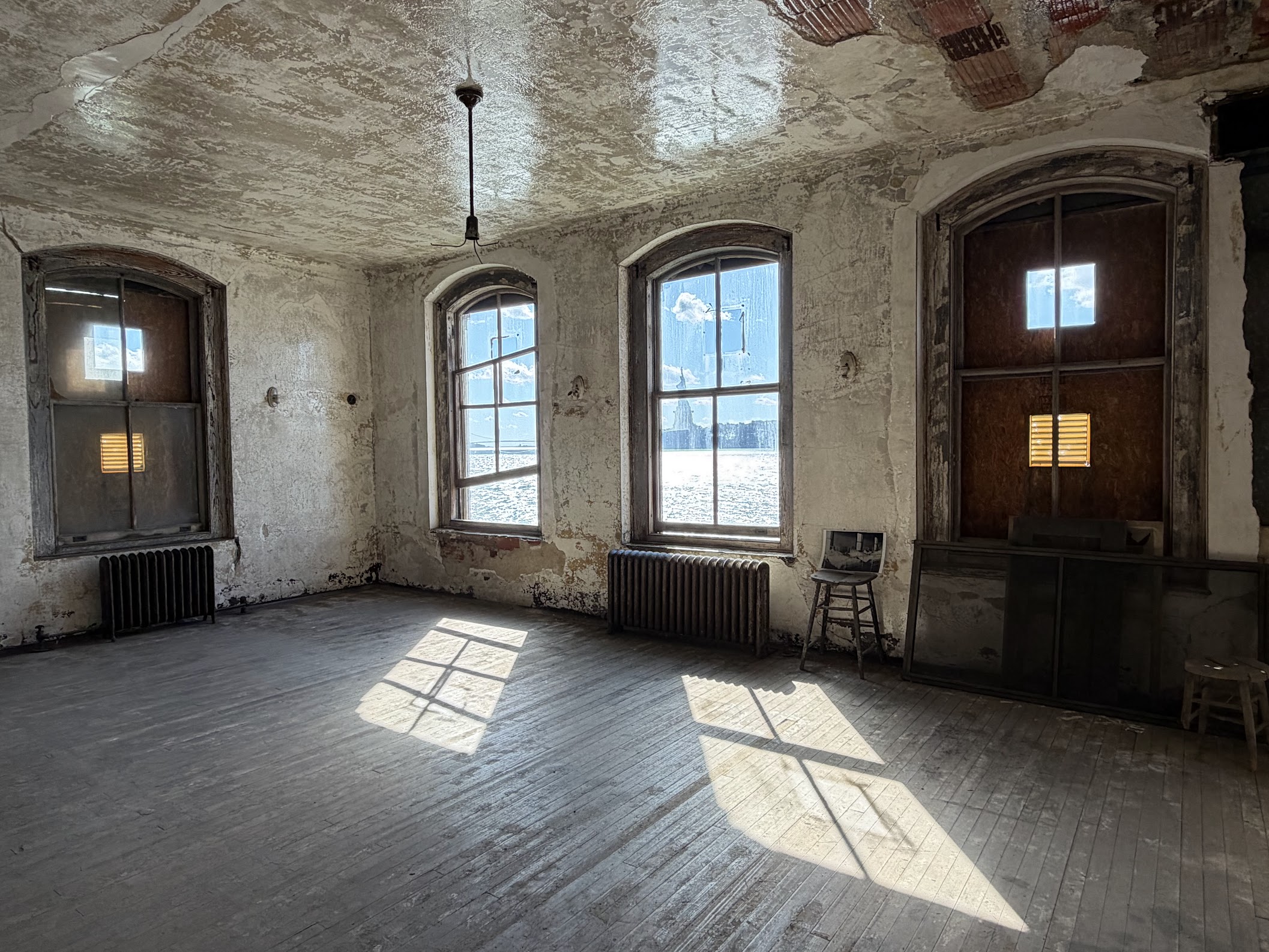
This non-profit leads hard-hat tours through these spectacular and unique ruins. And they are, in fact, ruins. Once a state-of-the-art health care unit, the hospital (and the rest of the island) was abruptly abandoned in 1954 and left to the elements.
Today, these buildings resemble something from an apocalyptic film with only haunted pieces of artwork — derived from images of the people who came through here — as the only evidence of the modern world.
What do these ruins mean to the story of immigration today? And can these memorable landmarks be saved?
LISTEN NOW: THE OTHER SIDE OF ELLIS ISLAND
The Bowery Boys Podcast is proud to be sponsored by Founded By NYC, celebrating New York City’s 400th anniversary in 2025 and the 250th anniversary of the United States in 2026.
Read about all the exciting events and world-class institutions commemorating the five boroughs’’ legacy of groundbreaking achievements, and find ways to celebrate the city that’s always making history at Founded By NYC.
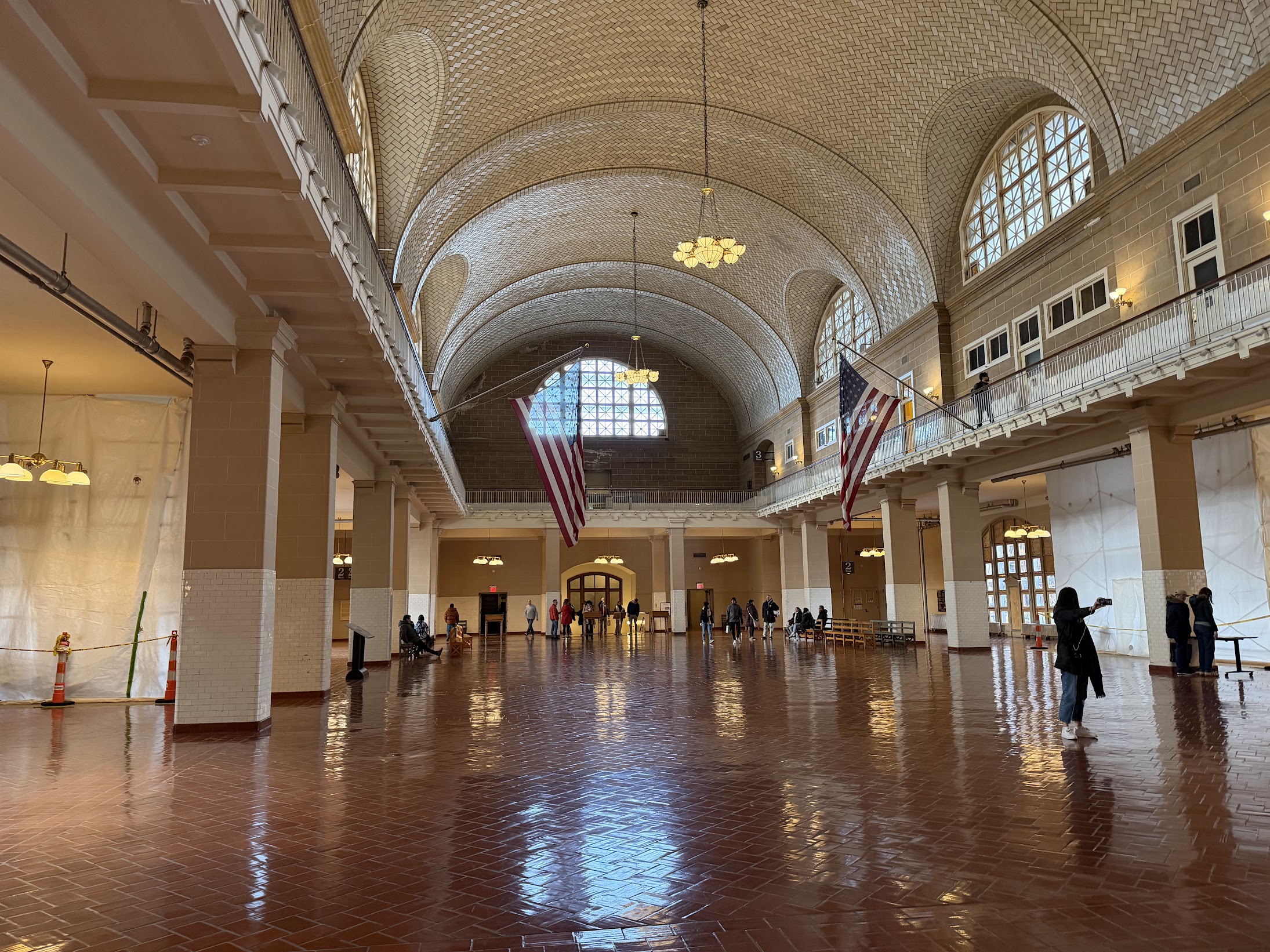
Inside the Ellis Island Immigrant MuseumThe Ellis Island Registry Room
FURTHER LISTENING
After listening to this episode, dive back into our catalog to learn more about some of the subjects from this week’s show.
It has become a name so associated with American sports and entertainment that you barely think about it.
In New York City, when you say you are going to The Garden, you aren’t going to see flowers. Most likely, you’re going to see the Knicks. Or possibly Billy Joel.
New York City’s many actual gardens — the ones with plants, not millionaire performers — are so diverse and numerous that they offer sensual and educational pleasures for people of all ages.
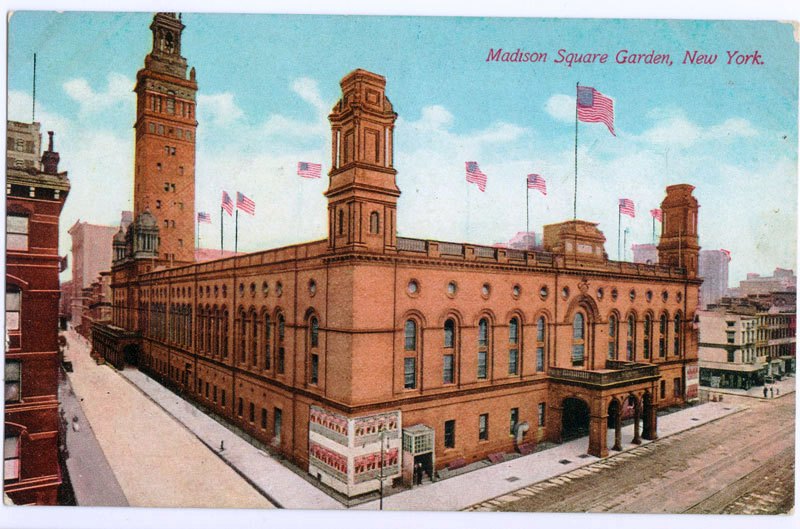
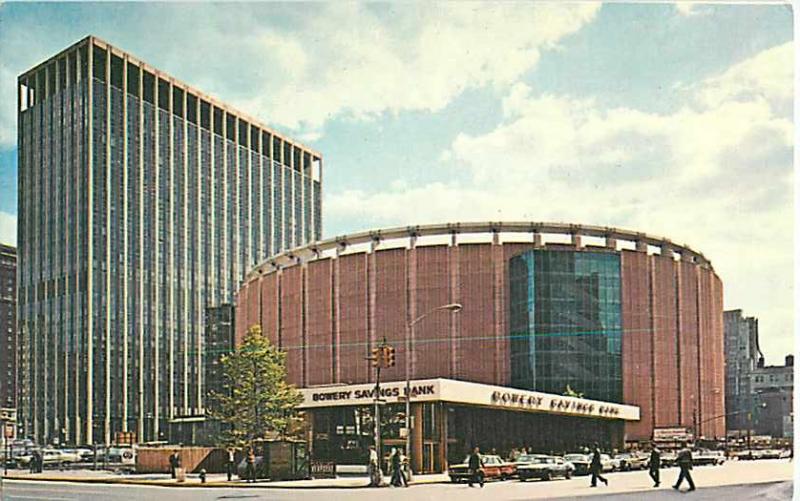
Madison Square Garden (MSG) traces its history back to almost 150 years ago to a vacated New York and Harlem Railroad train depot which once sat on the northeast corner of Madison Square. It was here that P.T. Barnum briefly set up a circus arena called the Great Roman Hippodrome.
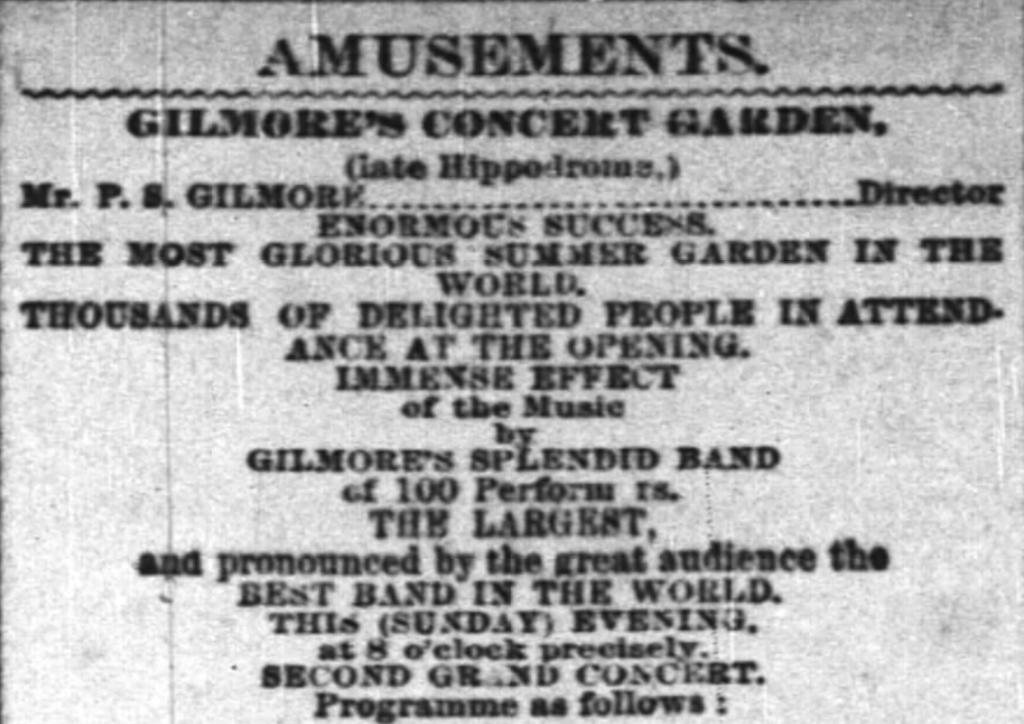
But it was the site’s second impresario — bandleader Patrick Gilmore — who gave the site for his concerts a more fragrant sounding name in the Spring of 1875 — Gilmore’s Garden.
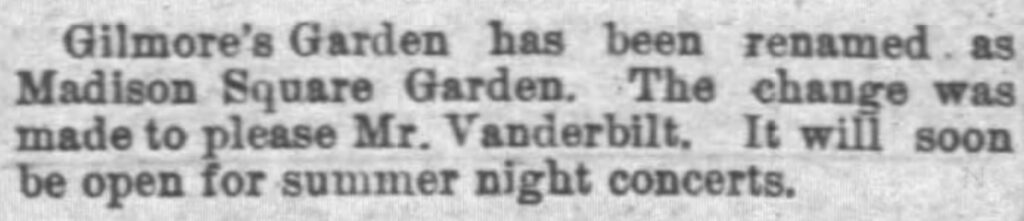
Four years later, the popular venue was renamed Madison Square Garden — “to please Mr. Vanderbilt,” according to the Brooklyn Union clip below. (That would be William Kissam Vanderbilt, the grandson of Cornelius Vanderbilt.)
For more information on the history of Madison Square Garden, listen to our back catalog show on the many locations of this storied venue:
But even Gilmore’s was a rather late entry in New York City’s many well-known pleasure gardens, the name for an all-in-one entertainment space which traces back to the ancient Romans.
The pleasure garden become a key ingredient in the social world of New York City because of its popularity with the British during the Colonial period.
Here are a few of New York’s more notable ‘gardens’, taking root in the city even before the appearance of Madison Square Garden:
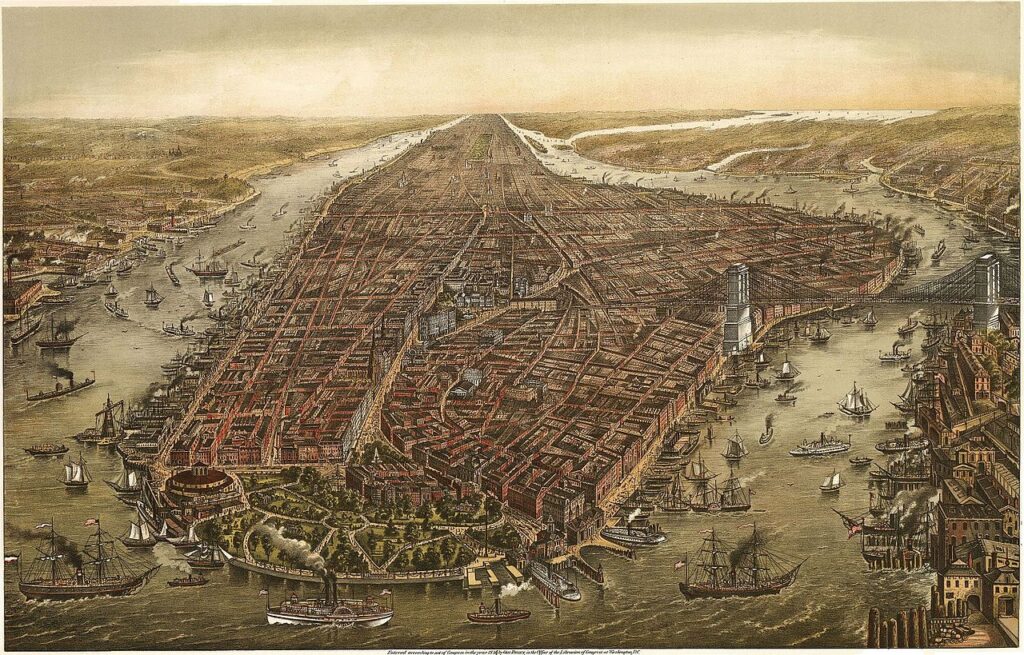
Bird’s eye panorama of Manhattan & New York City in 1873.
Spring Garden and Catiemuts Gardens
The first Colonial-era pleasure gardens in New York leaned upon the popularity of well-known gardens in England. For instance, the 1740 Spring Garden — located just south of today’s City Hall Park — was a nod to 17th century English pleasure gardens by that name.
According to author Hallie Alexander: “The Spring Garden tavern hosted balls, magic shows, tumbling acts, feats of strength (including a Female Samson), and musical concerts.”
Catiemuts Gardens was north of Spring Garden (at Park Row and Chambers Street). Like many early pleasure-garden proprietors, Catiemuts’ owner made sure to center his venue around a tavern, and entertainments were thusly invented to inspire the purchase of alcohol.
New York Public Library
Ranelagh Gardens
Londoners could enjoy the first Ranelagh Gardens in 1741, built on the site of the home of the 1st Earl of Ranelah in the neighborhood of Chelsea. In 1765, New Yorkers got their own Ranelagh.
According to William Harrison Bayles’s 1918 Old Taverns of New York: “It was said that the grounds had been laid out at great expense and that it was by far the most rural retreat near the city. Music by a complete band was promised for every Monday and Thursday evening during the summer season.”
And according to author Vaughn Scribner: “[The venue’s proprietor John] Jones took to the New-York Mercury to announce that, in addition to all the leisurely pleasures already available at Ranelagh, Jones would offer any customer who could pay the two shillings and three pence entrance fee a ‘Concert of Musick’ followed by a grand firework show.”
New York Public Library
Vauxhall Gardens
Vauxhall Gardens is one of London’s most historic public spaces and it was so renown back in the 18th century that it inspired several New York knockoffs, including one owned in 1767 by tavern owner Samuel Fraunces (before operating the more famous tavern which bears his name today.)
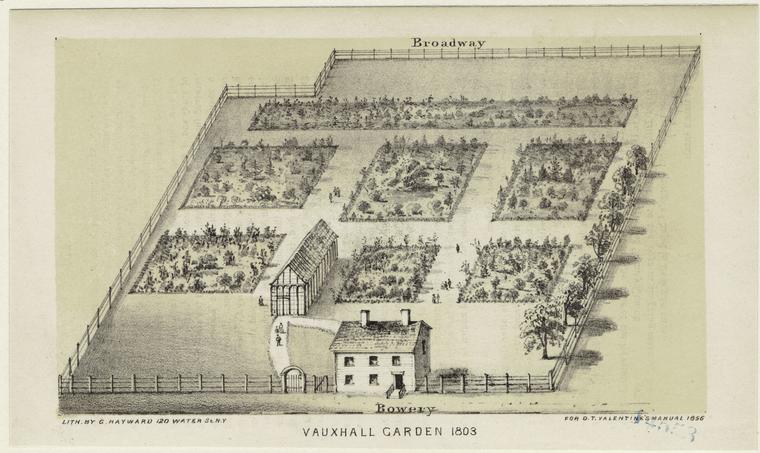
But the most famous, from 1771, was first owned by Jacob Sperry, a charming garden space around the area of today’s Astor Place. (In fact John Jacob Astor would eventually purchase the property for speculative development.)
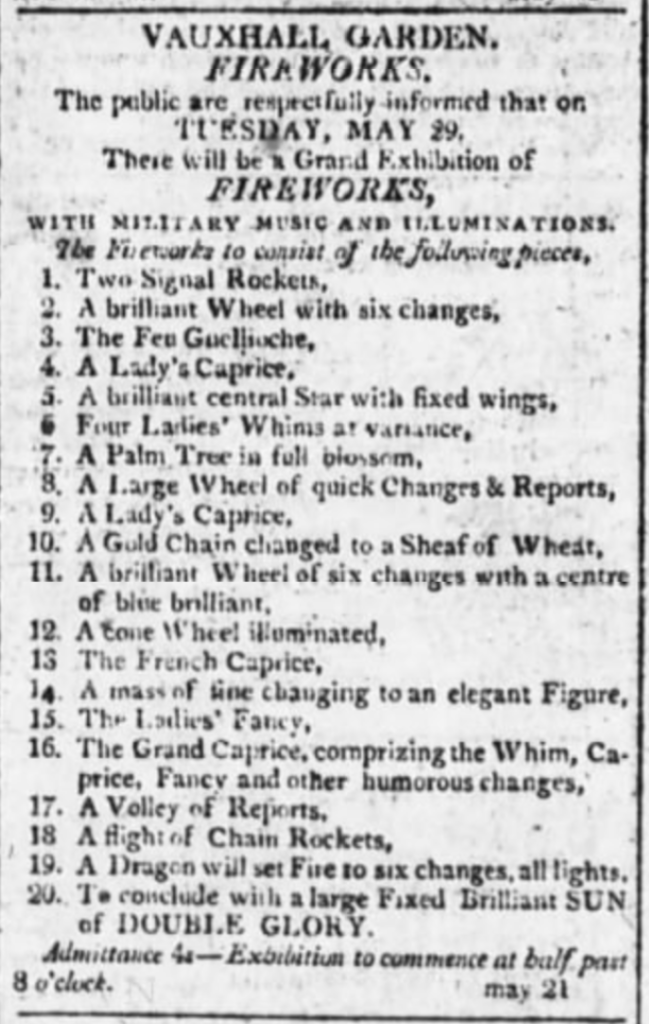
The New York Evening Post, May 28, 1904 (via newspapers.com)
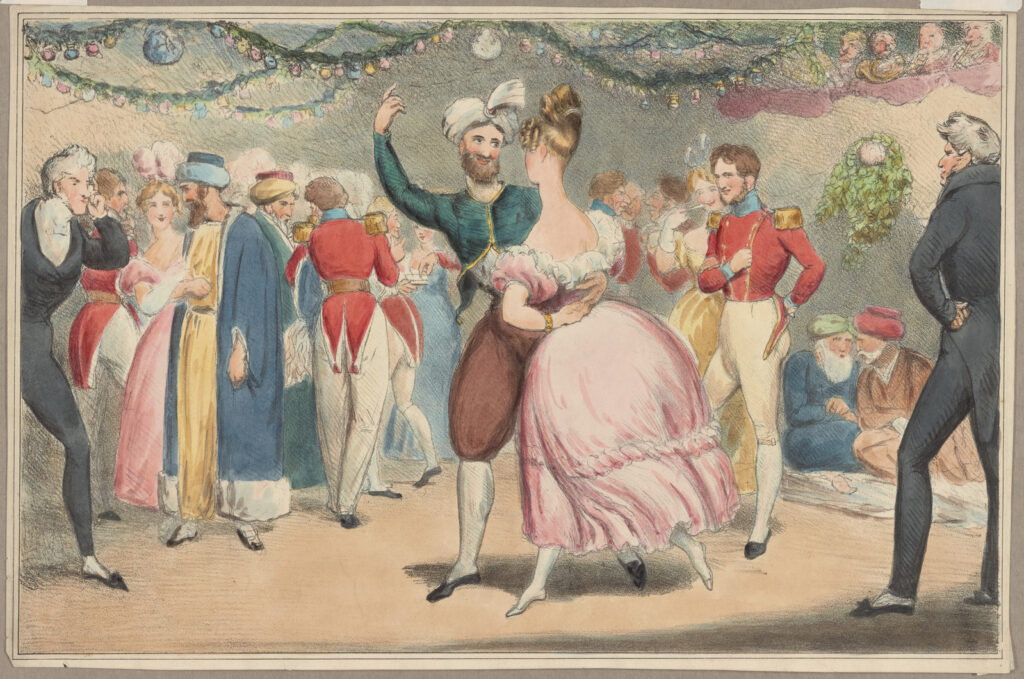
For the first two decades of the 19th century, it was one of the most popular attractions in New York City. Under the management of French proprietor Joseph Delacroix, the cultivated garden pathways were adorned with magical lanterns, accompanied by musicians nestled throughout the flora.
Bayles later wrote in 1918: “Vauxhall Garden was an inclosure said to contain three acres of ground, handsomely laid out with gravel walks and grass plots, and adorned with shrubs, trees, flowers, busts, statues, and arbors. In the center was a large equestrian statue of General Washington.
“All the town flocked to [Vauxhall]. It was to the New York of that day something like what Coney island is to the New York of today. The people of New York considered it to be about as gay a place of recreation as could be found anywhere.”
New York Public Library
Castle Garden
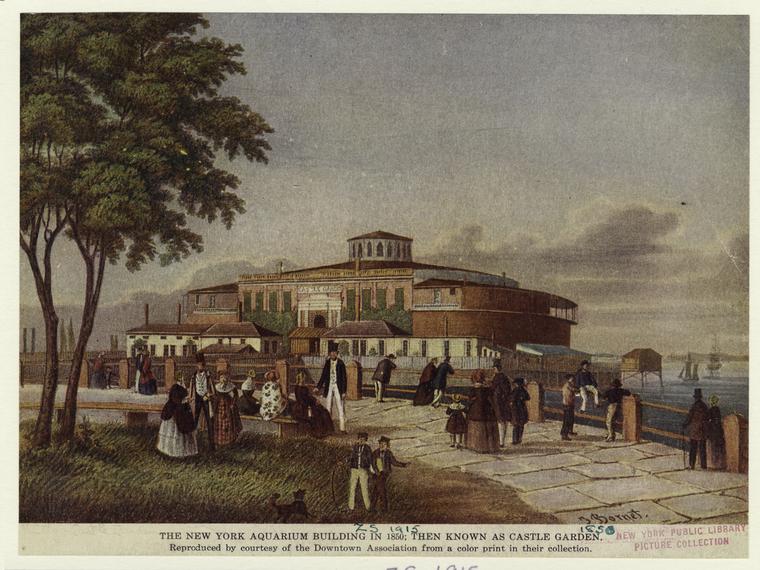
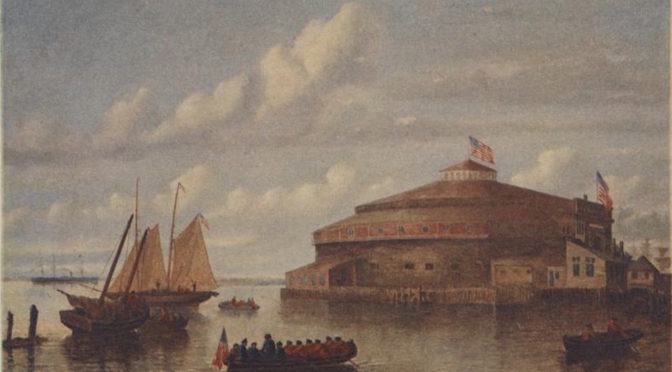
In 1824, the old Castle Clinton in the Battery was transformed into New York’s largest exhibition hall — Castle Garden.
While the Battery did provide the strolling pleasures of an actual garden — a visitors could enjoy refreshments at the beer garden — it was the performances within the building (which was later fitted with a roof) that really drew the crowds.
In 1850 Barnum would bring the Swedish songstress Jenny Lind to Castle Garden to universal acclaim.
For more information, check out our podcast from last year on this iconic moment in New York City entertainment.
Niblo’s Garden
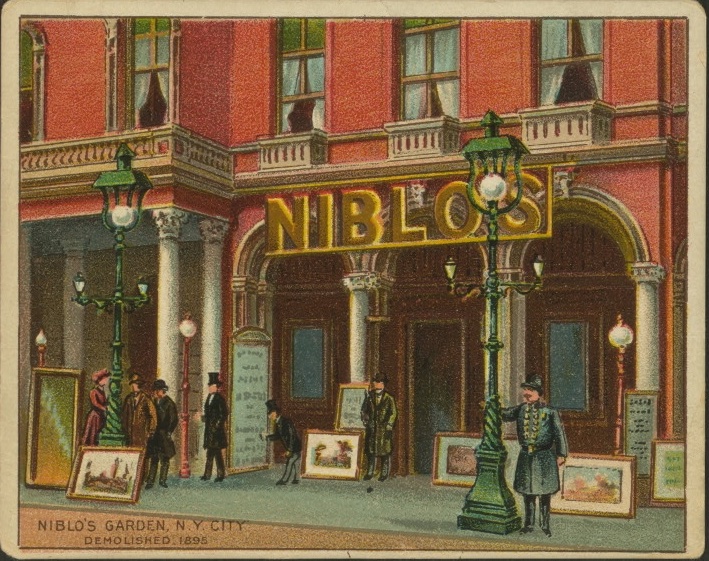
The pleasure garden at the corner of Broadway and Prince Street changed theater history.
The site evolved from a simple garden in 1828 to a lavish destination for entertainment and delight thanks to Irish impresario and coffee house owner William Niblo.
From Bayles’ description: “The interior of the garden was spacious and adorned with shrubs and flowers; cages with singing birds were here and there suspended from the branches of trees, beneath which were placed seats with small tables where were served ice cream, wine negus and cooling lemonade; it was lighted in the evening by numerous clusters of many-colored glass lamps.”
Niblo greatly expanded his romantically lit garden (originally named San Souci) by taking over several surrounding lots and installing a theater and saloon. The venue was large enough that it hosted both large fairs and orchestral productions.
After a fire destroyed the stage in 1846, Niblo built bigger, becoming one of New York’s central performance spaces by the Civil War era with over 3,000 seats.
Operetta Research Center
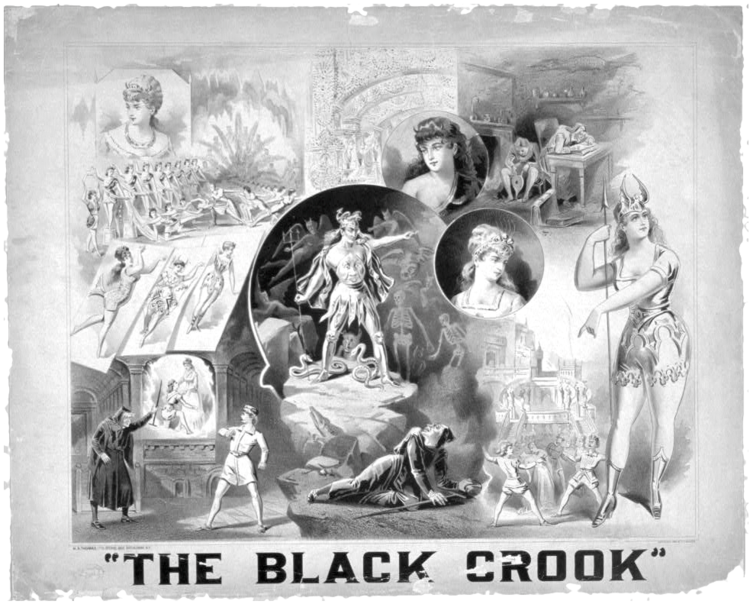
And in 1866 it debuted a show equally as ambitious — The Black Crook, running five-and-a-half hours long and considered by many to be the first Broadway musical.
But by this time, the ‘garden’ of Niblo’s Garden had been greatly reduced, replaced by a luxury hotel — the Metropolitan.
For more information on the history of Niblo’s Garden, listen to this back catalog show on the history of this long-gone theatrical icon:
Palace Garden
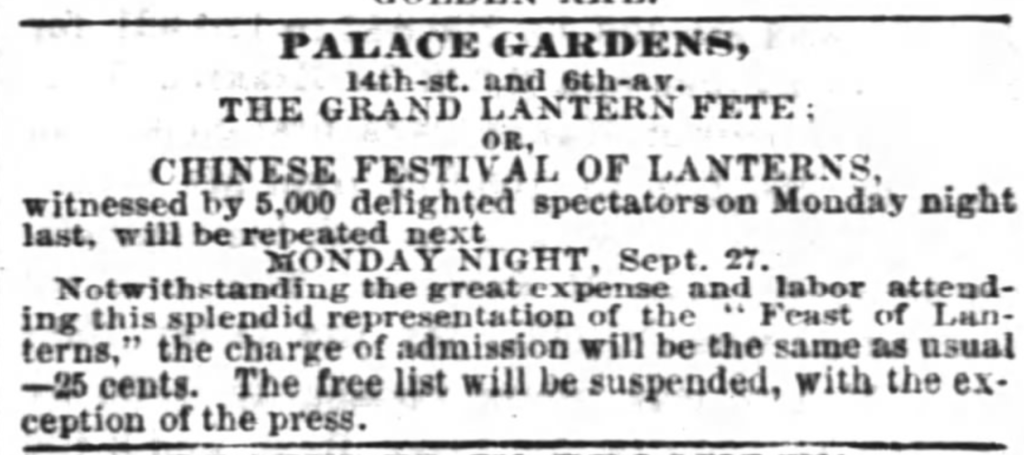
Throughout the decades, New York society moved north up the island and so too did the pleasure gardens. The Palace Garden, at Sixth Avenue and 14th Street, situated its attractions nearby bustling Union Square.
From the New York Times, September 24, 1858
It might be hard to imagine a ‘festival of lanterns’ at that particular street corner today. Just a couple decades the avenue would be transformed by massive department stores, becoming the fashionable shopping district Ladies Mile.
In fact, the entire idea of a pleasure garden was evolving into something that was very much not a garden at all. With the arrival of Central Park in the late 1860s and the rising prices of real estate in high trafficked areas of Manhattan, the simple pleasures of the urban pleasure garden faded away.
But not the name! Pleasure gardens were associated with music and performance and so the ‘garden’ stuck around.
So despite hundreds of beautiful parks, botanical gardens and community gardens in the city, this is the location that is called THE GARDEN:
This month America celebrates the 100th anniversary of the National Park Service, the organization which protects the great natural and historical treasures of the United States. There are a number of NPS locations in the five borough areas. Throughout the next few weeks, we will focus on a few of our favorites.  For more information, you can visit National Parks Centennial for a complete list of parks and monuments throughout the country.Â
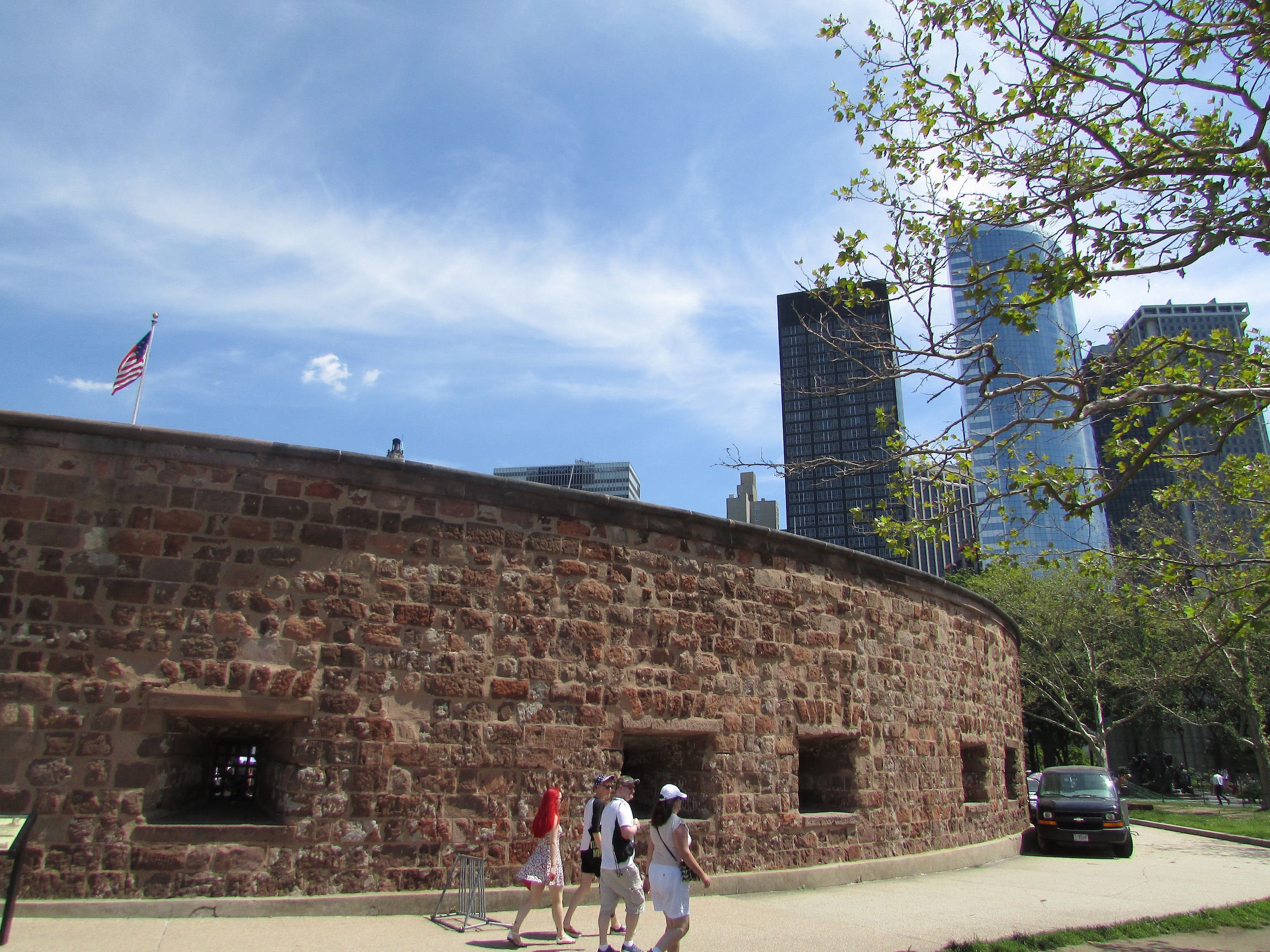
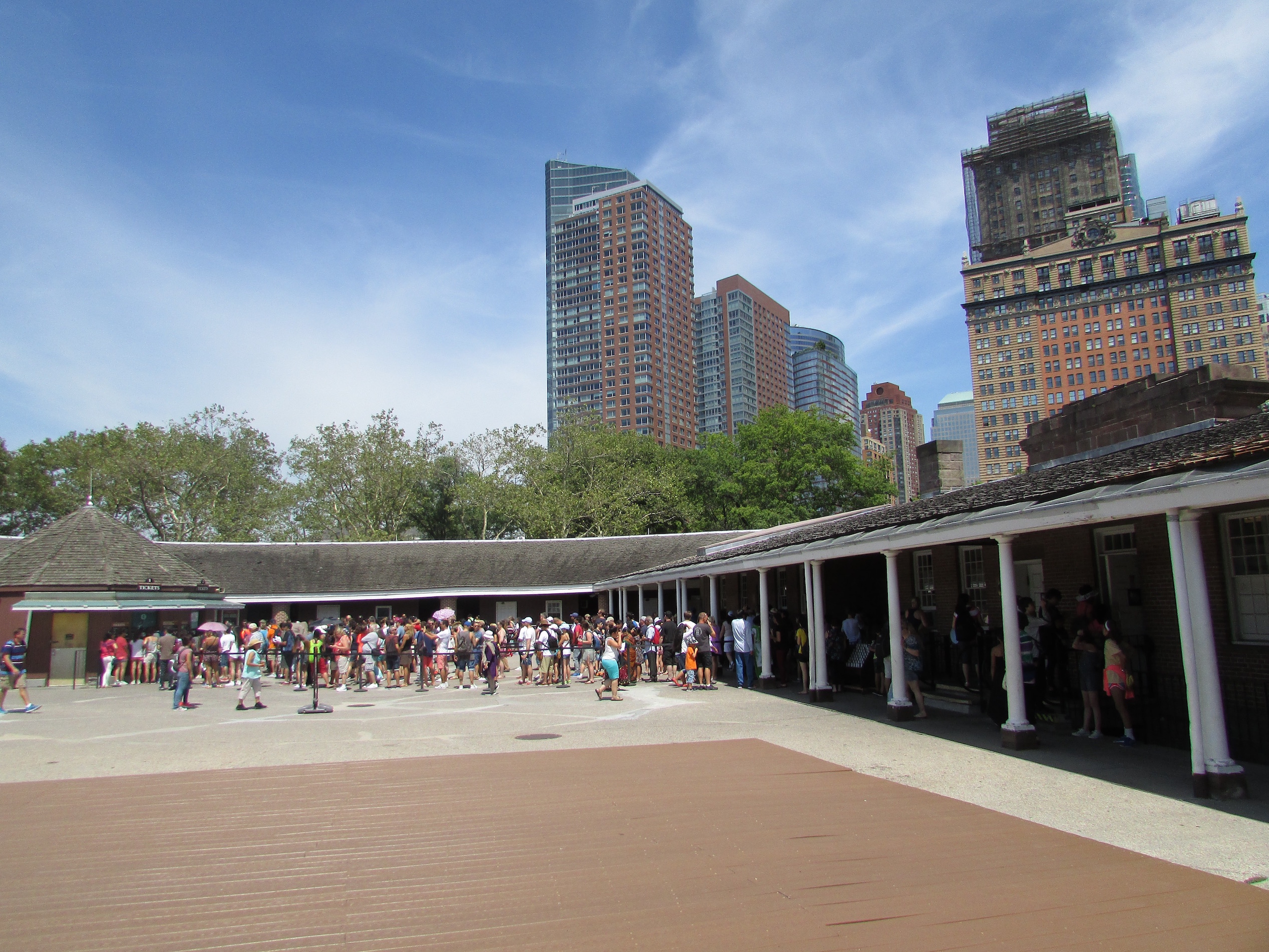
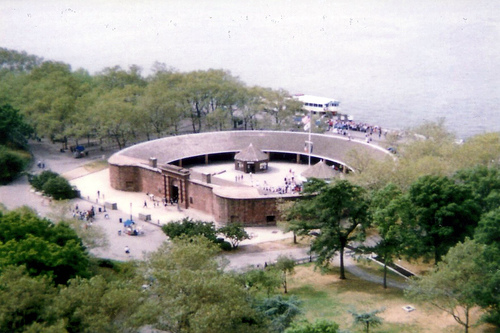
Tourists looking to purchase tickets to the Statue of Liberty and Ellis Island (also two landmarks that are maintained by the NPS) enter an old circular stone structure in Battery Park called Castle Clinton. Ticket selling is by far the least exciting job in the fort’s history, a rather banal function for a building that traces its origins to the founding of the United States.
Back in 1783, fresh from the victories of the Revolutionary War, New Yorkers gathered around the docks on November 25 to forever wave off the British from New York Harbor. When it was soon discovered that one last British flag remained hanging from a greased flagpole—a final goodbye prank, as it were—jaunty patriots shimmied up to remove it. This event would soon become the driving force of New York’s annual Evacuation Day celebrations, a symbolic marker of the end of British rule. (If we could come up with a method to safely secure drunk revelers as they climbed greased flagpoles today, then we’d say let’s bring it back!)
But the threat of an unwelcome British return lingered on. In 1790, the city dismantled Fort George (the dilapidated fort built by the Dutch), and the cannons that gave the Battery its name were removed and replaced with a strolling promenade. But less than two decades later, new saber rattling by British forces so unnerved New Yorkers that they built new, stronger forts at locations scattered throughout the harbor. Some of them—like Fort Wadsworth on Staten Island and Castle Williams on Governors Island (another NPS property) —still stand today.
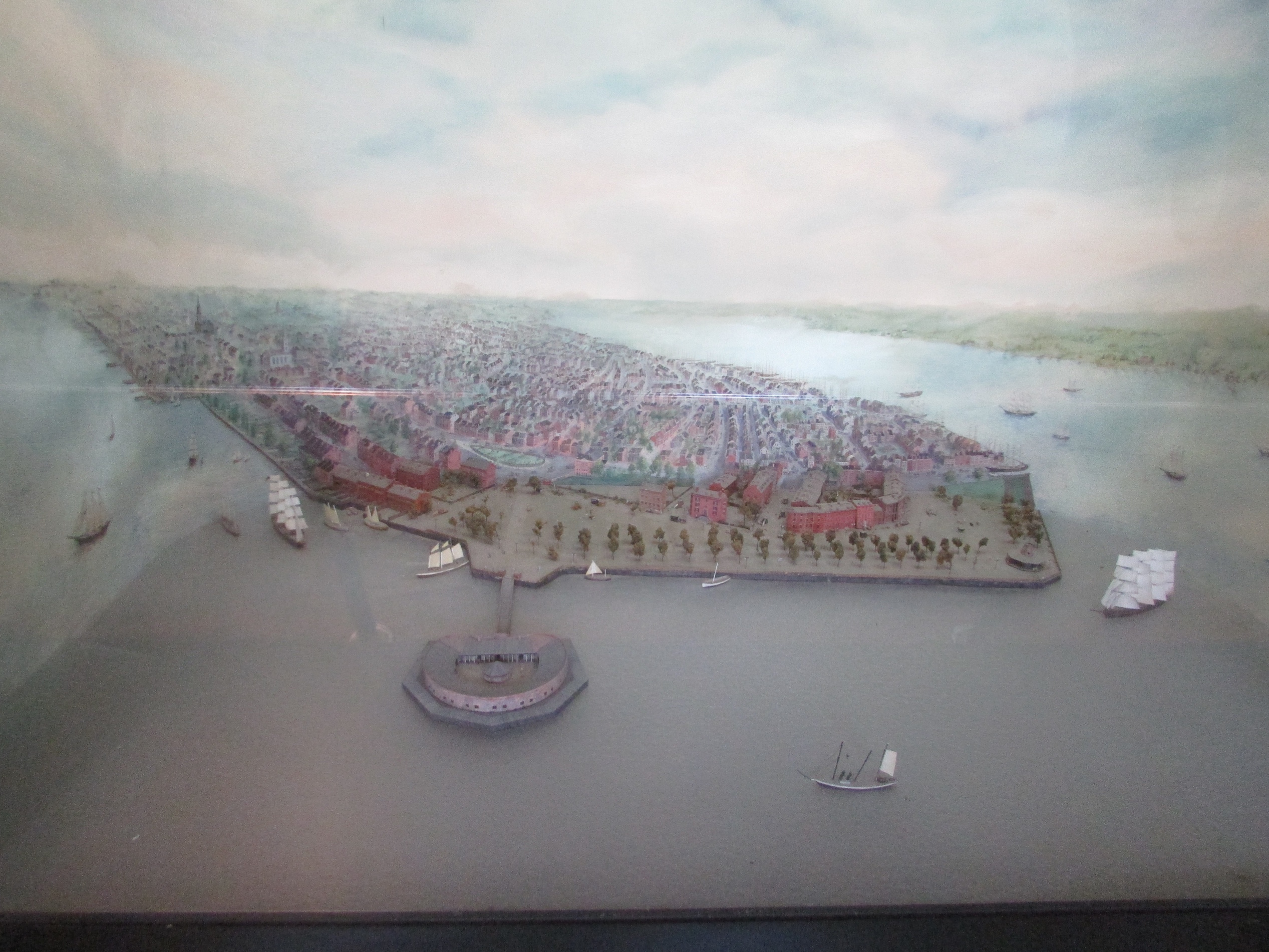
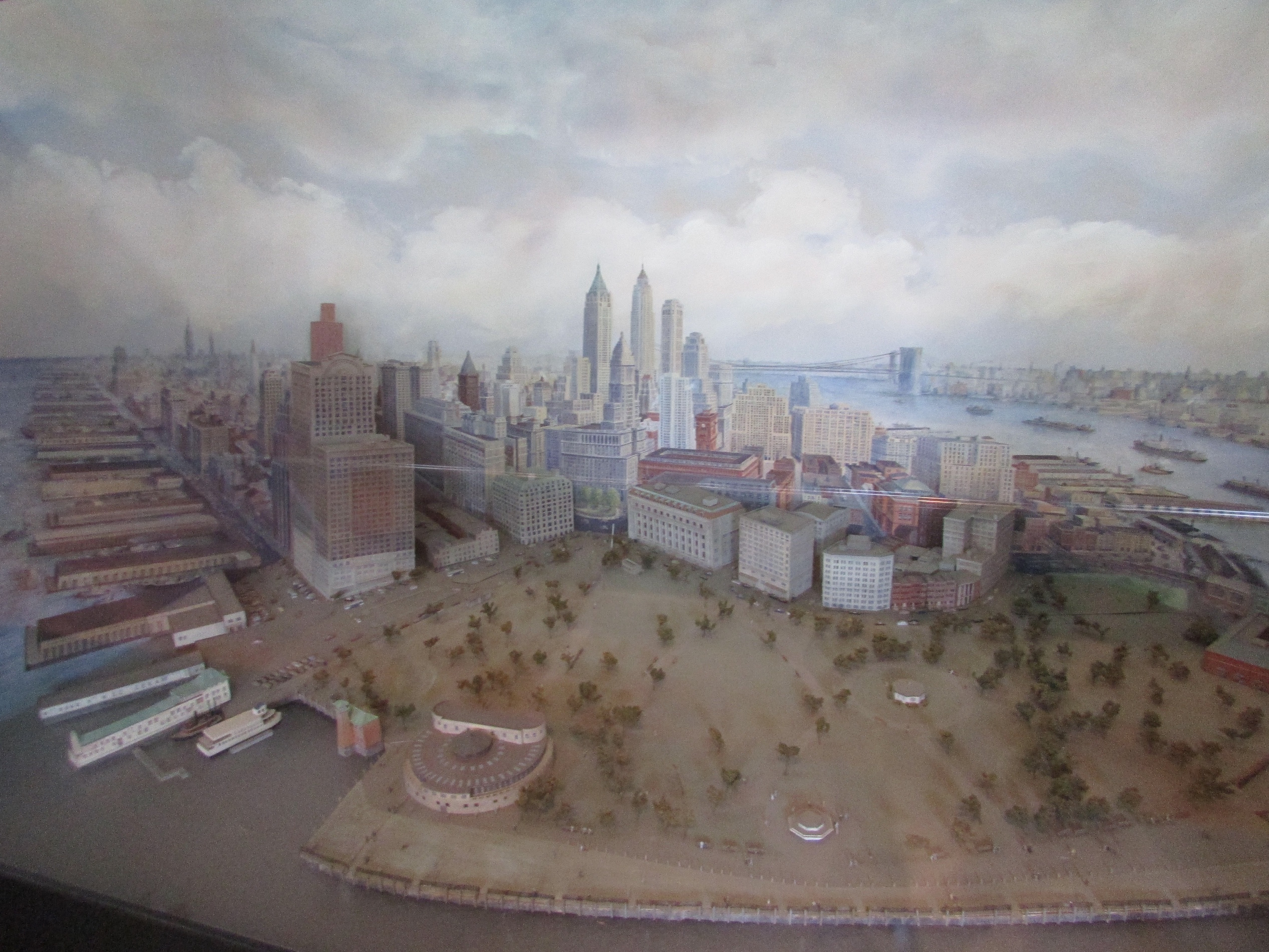
A modest museum inside Castle Clinton features three interesting models of how the structure used to look and how it related to the land around it.
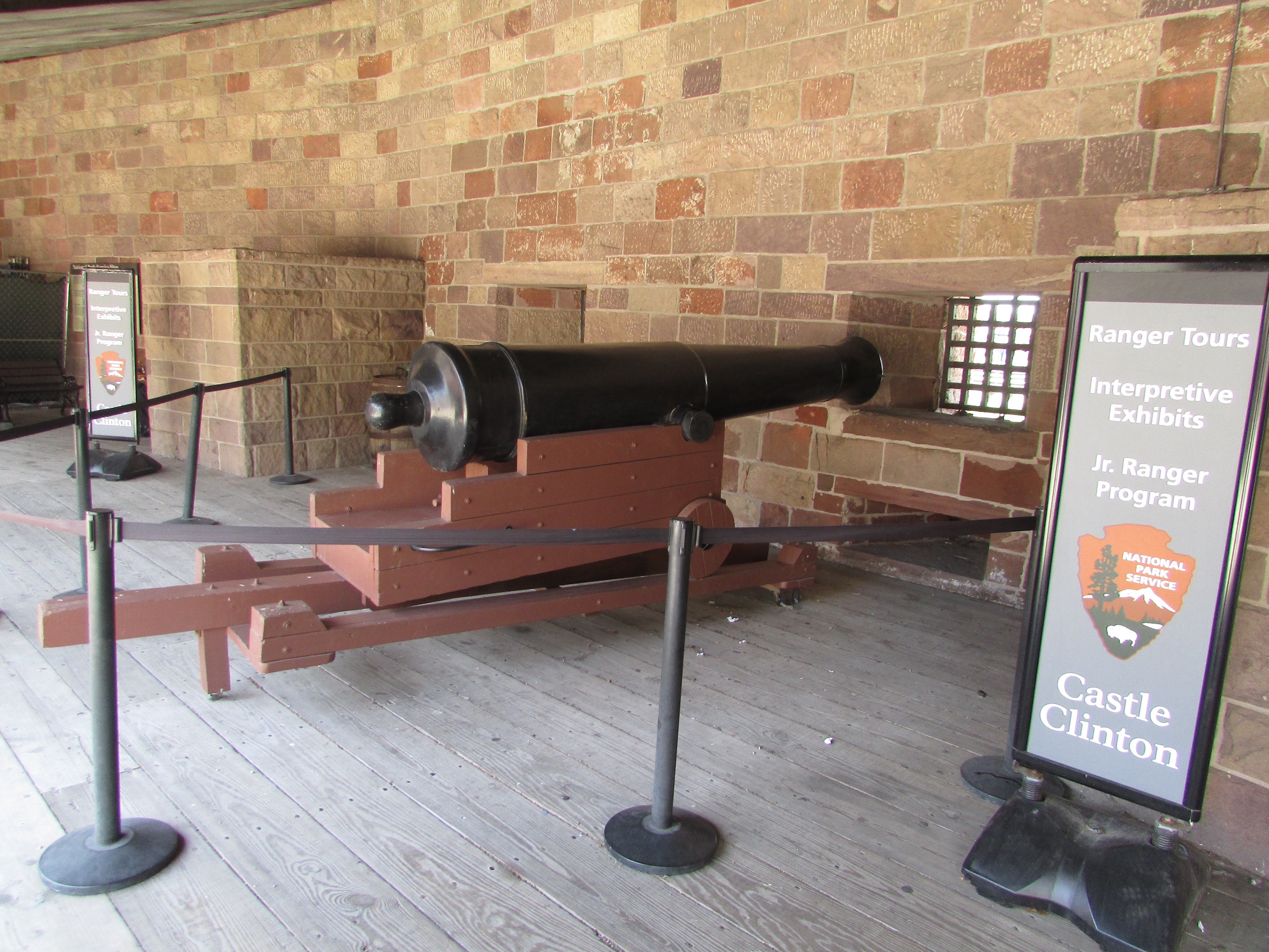
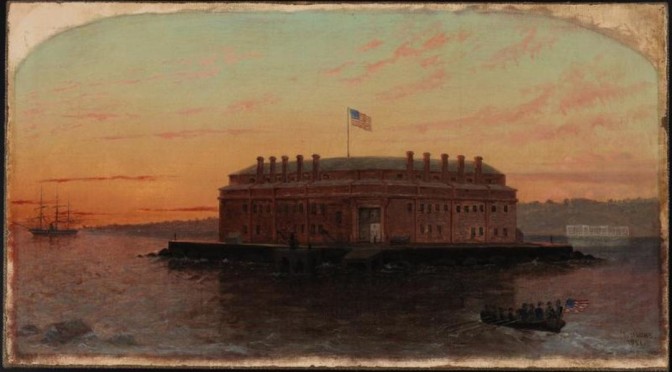
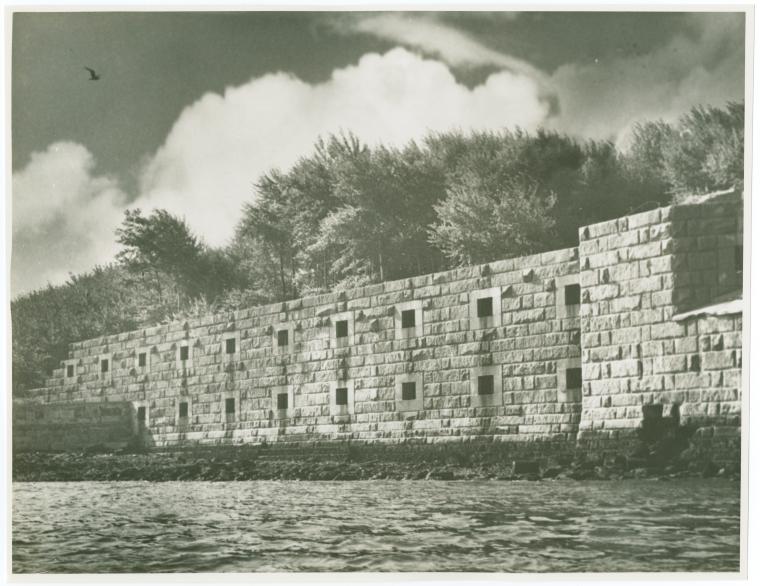
But none has had the inconceivable adventures of West Battery, completed in 1811 as an island fort, located 300 feet from shore and connected to the mainland by a long bridge. Its thick stone walls could withstand a vicious attack, and its 28 guns aimed into the harbor would surely beat back any aggressors. It was later renamed Castle Clinton, after New York’s governor (and former mayor) DeWitt Clinton, a hopeful name, given Clinton’s own political tenacity and endurance.
But while the War of 1812 would come to American shores, it never arrived in New York Harbor. After serving some minor military purposes, Castle Clinton was eventually sold by the federal government to the city in 1823. And it was then that things got decidedly more festive for the old fort.
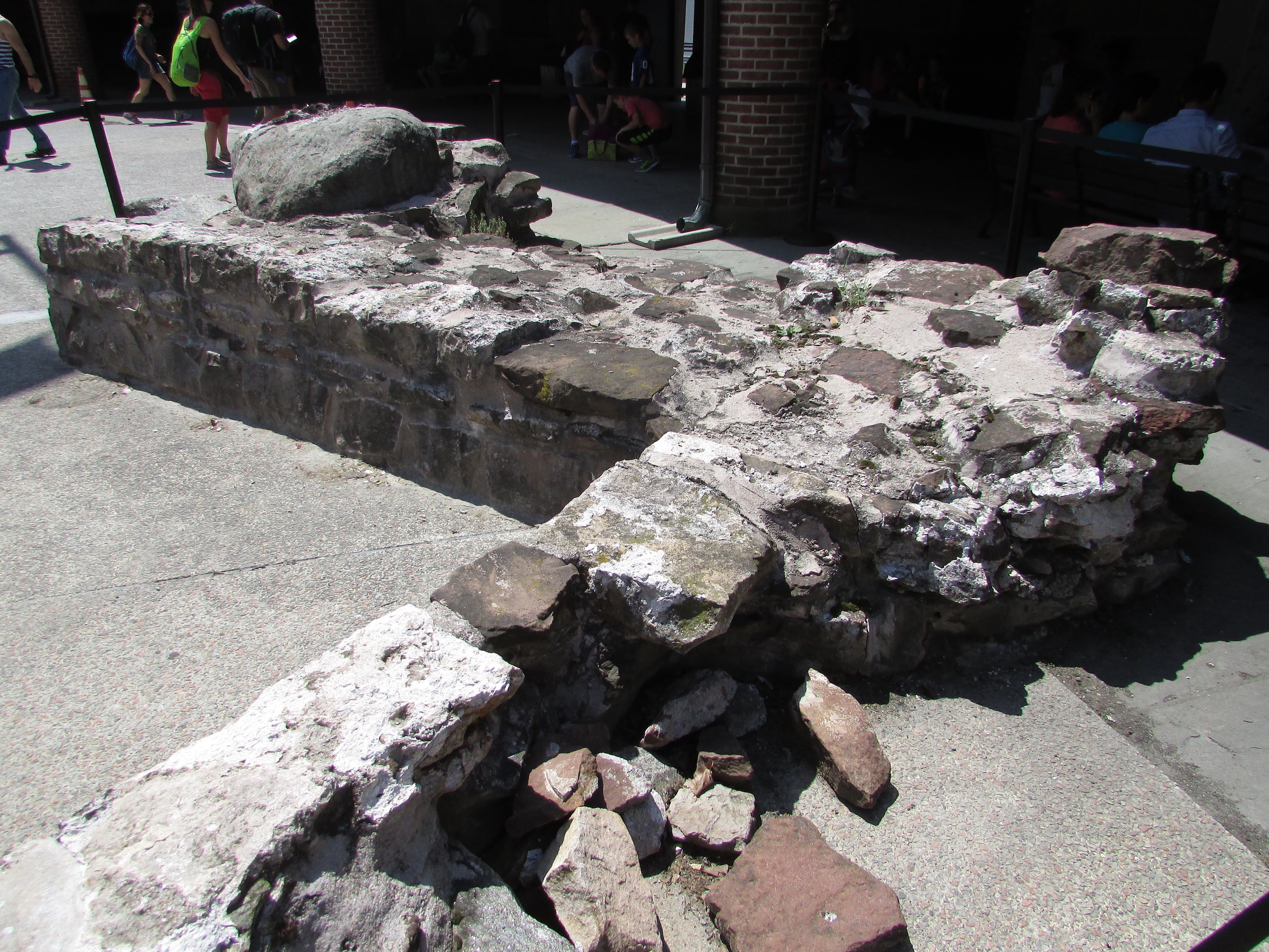
During an excavation in 2006, portions of the old Battery Wall were discovered. Â They are displayed within Castle Clinton today.
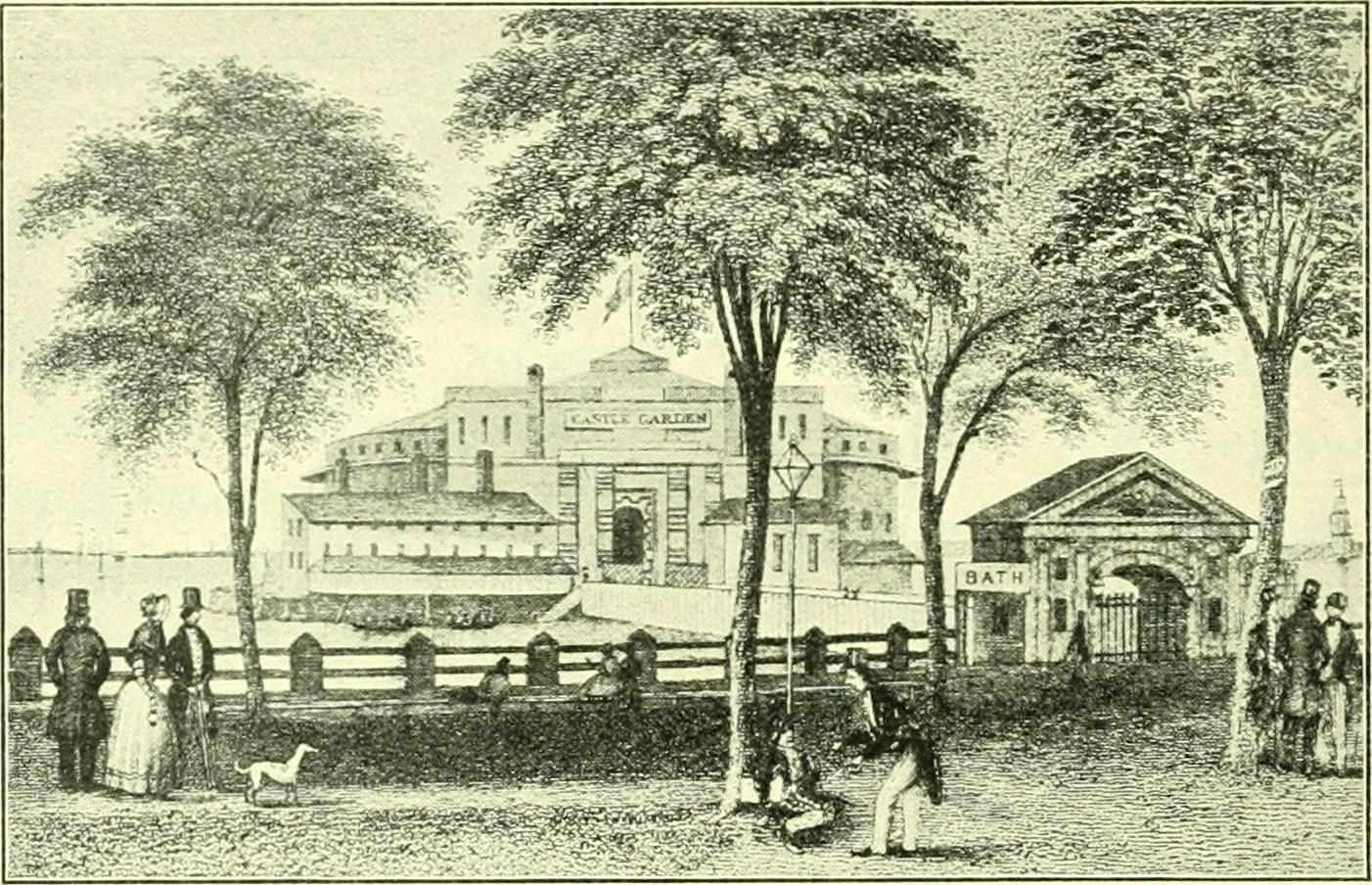
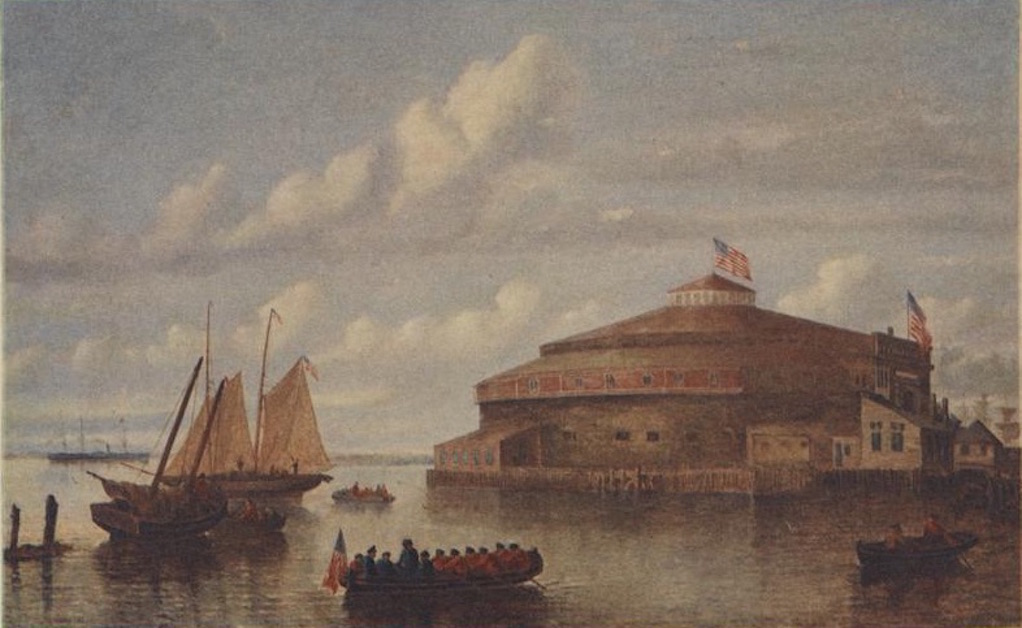
First it was transformed into an entertainment palace, rechristened Castle Garden, and greatly expanded, with a spacious second floor and an ornate fountain at its center. Still accessed by a narrow bridge, the experience was magical and otherworldly for visitors, its gaslight illuminations dancing above the waves.
Image from ‘A Home Geography of New York City (1905).
Castle Garden was a ballroom, concert venue, lecture space, and even beer hall. In 1824, the Marquis de Lafayette, the most exotic still-living embodiment of the Revolutionary era, was feted here by grateful New Yorkers. In 1842 Samuel Morse demonstrated a new gadget that would change the world—the telegraph. (A line was strung between here and Castle Williams; its first message was, rather dramatically, “What hath God wrought?†And they hadn’t even seen their phone bill yet!) For a short time, you could even enjoy luxurious saltwater baths out on the Battery promenade.
Courtesy Museum of the City of New York
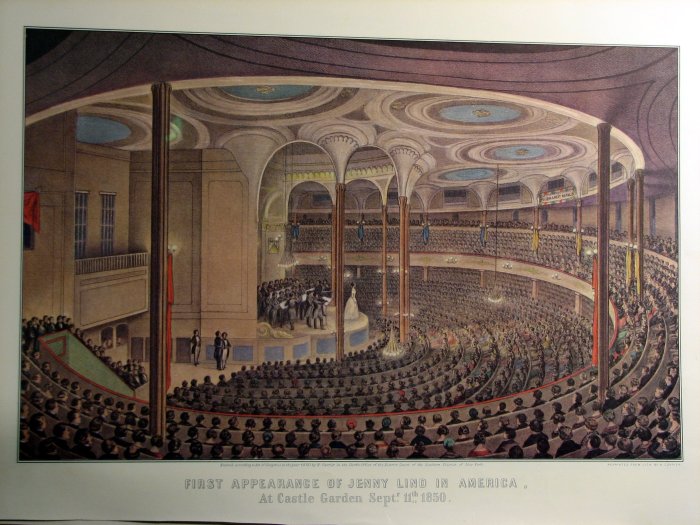
But the most famous evenings at Castle Garden (pictured above in 1850) belonged to the Swedish opera singer Jenny Lind. Extensively hyped by impresario P. T. Barnum, the so-called Swedish nightingale brought New York music lovers to tears here on September 11 and 13, 1850, perhaps the most legendary concert nights in American history (pre–stadium seating, that is). “Jenny Lind has already won a hold on the sympathies of the American public, such as no other vocalist ever obtained,†cooed the New York Daily Tribune. “The audience for which she sang was the greatest ever assembled at a concert in this city.â€
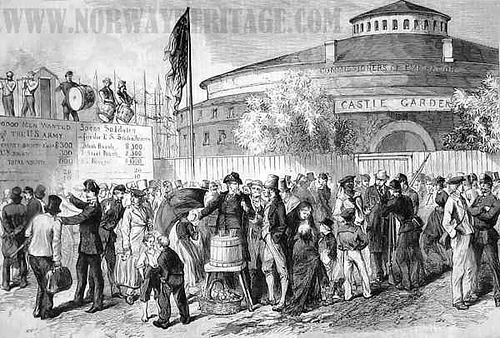
Just five years later, in 1855, Castle Garden would see thousands more foreign imports, albeit less enthusiastically proclaimed. For it was then that the old fort-turned-amusement venue became New York’s first immigration depot, a desperately needed transformation, coming as a tidal wave of European immigrants vexed the ports.
Newly arrived Irish and German immigrants during the 1840s and early ’50s had been taken advantage of by greedy “runners,†unscrupulous characters who led them into scams or false promises of housing and employment, often leaving them with neither (and empty pockets).
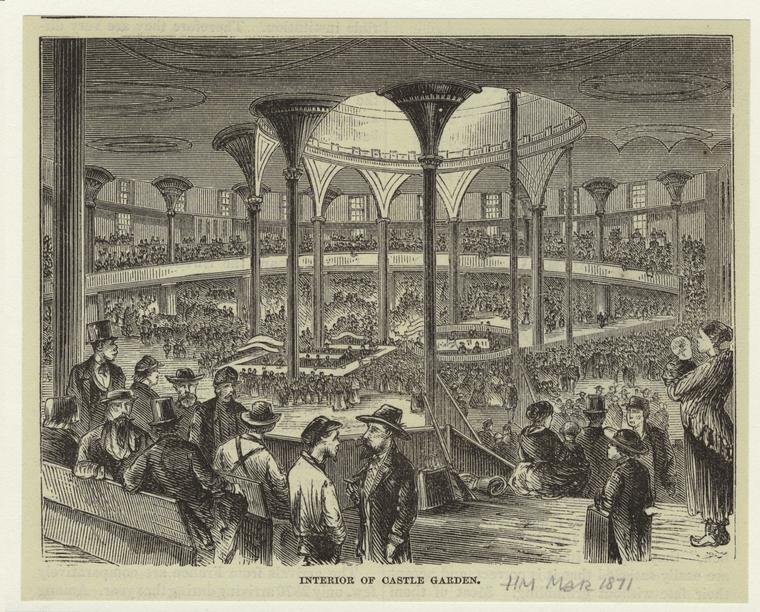
The interior of Castle Garden during its period as an immigration station.
New York Public Library
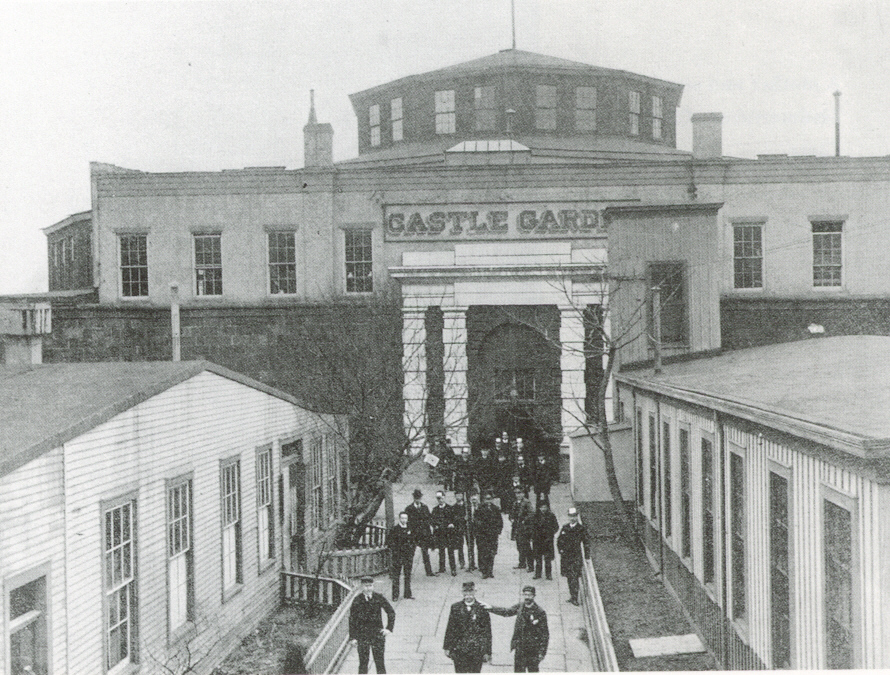
Castle Garden, as an immigration depot, registered the new arrivals and provided vital connections with immigrant aid societies. It would be a proto–Ellis Island, processing more than 8 million people upon their arrival to America. Most likely some of you reading this have ancestors who passed through the halls of Castle Garden.
Castle Garden as an immigration station, 1861, the former battery swarming with activity. Millions of immigrants arriving in New York passed through this depot.
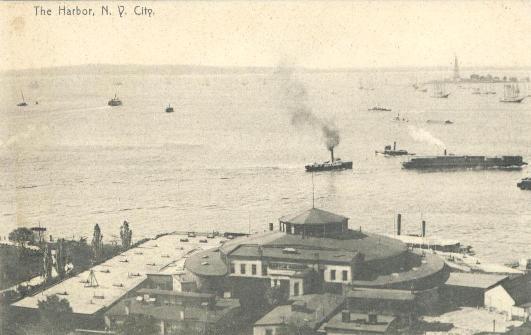
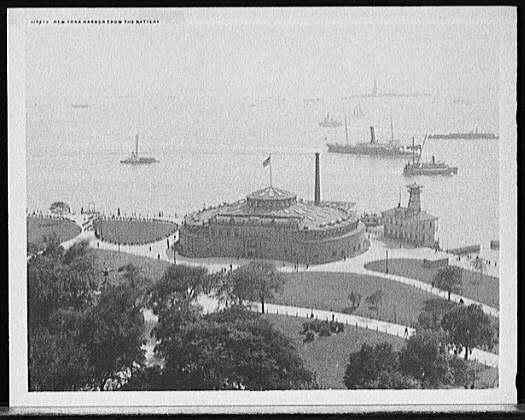
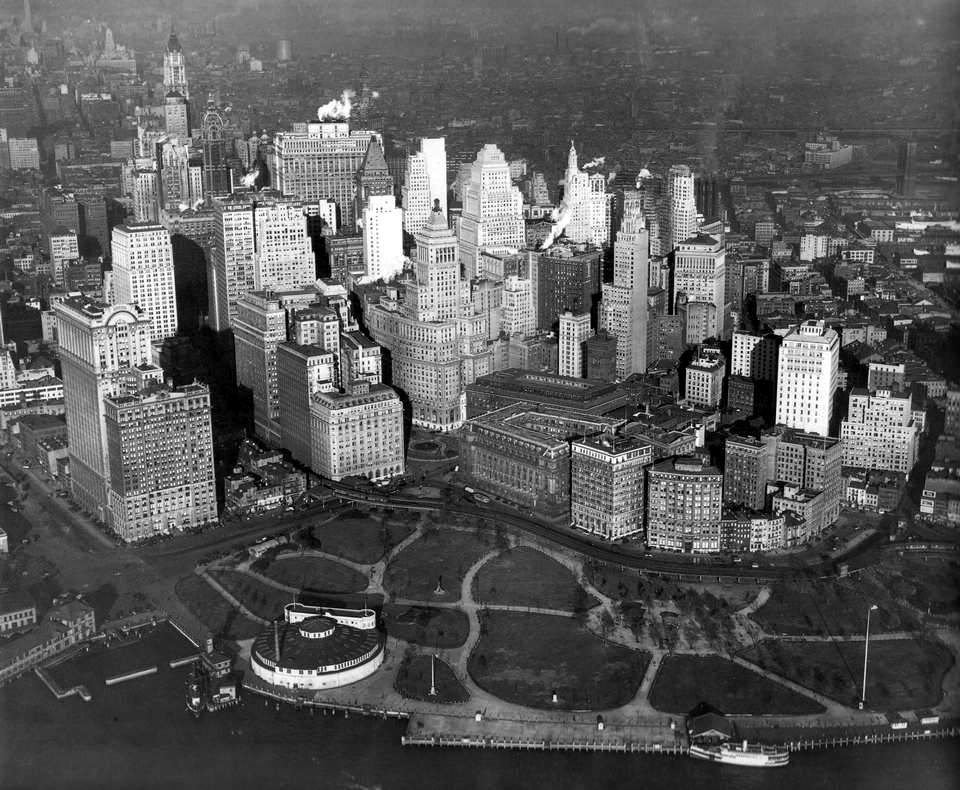
Another model within Castle Clinton features the landscape as it looks during the period the structure housed the New  York Aquarium.
By 1890 the federal government finally got involved with immigration processing and built a new processing center upon a little island in New York Harbor, long ago owned by Samuel Ellis. This switch freed Castle Garden to occupy itself with some other residents—this time of the underwater variety.
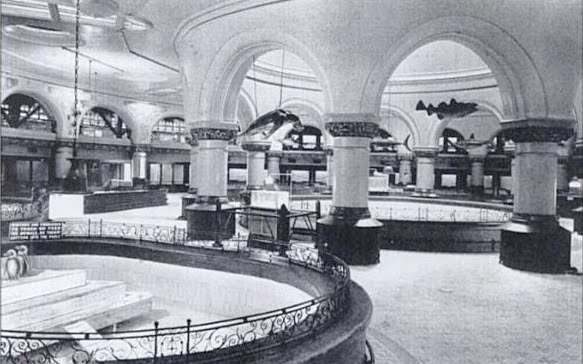
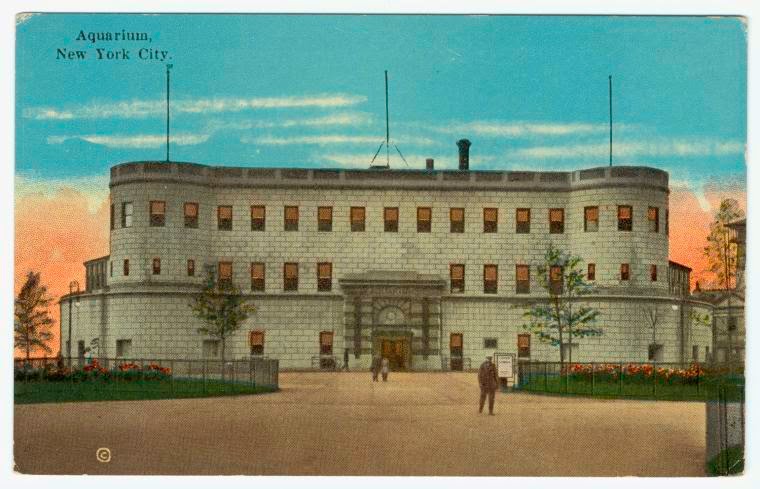
After a redesign by the renowned architectural firm of McKim, Mead, and White, the New York Aquarium would open here in 1896, its former concert hall and processing desks replaced with the latest aquatic technology of the day. By this time, of course, landfill had joined the structure to the mainland. Families could now gallivant through Battery Park and into the front gates to explore a maze of open pools and glass exhibition tanks, filled with a variety of creatures that (more often than not) did not survive the changing of seasons.
Today there are no aquatic creatures of any variety. However there are plenty of tourists from all over the world, lined up to get their boat tickets to the Statue of Liberty and Ellis Island.
They were a surprising yet appropriate pairing, the old fort and a bunch of tropical fish, replete with harbor waves crashing nearby. Unfortunately, Parks Commissioner Robert Moses was not a fan and decreed that the retrofitted old fort had finally performed her last number. In 1941, Moses used the construction of the Brooklyn–Battery Tunnel as an excuse to move the popular aquarium to Coney Island, snarling that “the Aquarium is an ugly wart on the main axis leading straight to the Statue of Liberty.†The fort should be destroyed entirely, he explained, for “its guns never fired a shot against an enemy.â€
Inside the New York Aquarium at Castle Garden:
Courtesy Castle Clinton
His destructive urges were only partially rebuffed by the community. Most of the frill and finery—almost everything that had been added since 1823—was removed, leaving only the barren stone form of the original fort intact. And that’s exactly how it has remained ever since. Castle Clinton received National Monument status in 1975.
Today the old fort quietly allows New York’s showier landmarks their day in the sun. But we challenge you, Mr. Moses. There may never have been a shot fired from Castle Clinton, but these walls have seen more drama and have been more important to the American experience than almost any other American fort standing today.
LISTEN TO OUR PODCAST! We have an entire show on Battery Park and Castle Clinton. It’s Episode #31. You can find it on iTunes at the Bowery Boys Archive, featuring our older shows. Â Or download it from here.
The vestiges of America’s oldest wars surround us to this day.
New York City has had more military fortifications contained within it than perhaps any other major American city. Part of this has to do with its roots in the American Revolution and the subsequent fears of a return invasion in the early 19th century.
Today’s existing forts — and those that remain in part or in ruin — make for a stark architectural contrast to the modern city. Their walls of stone and brick may conjure up a history far older than New York’s or images of a made-up fantasy world. You could pretend, for a few moments, to be a character on Game of Thrones while exploring places like Fort Wadsworth or Castle Williams on Governors Island
Here’s a list of some of the best known forts in the New York City area. Most are still around in some form. Some exist only in commemorative markers.  Others are completely gone but they leave their names as a reminder of their existence.  How many of these have you seen in person?
1 Fort Wadsworth
Location: Staten Island
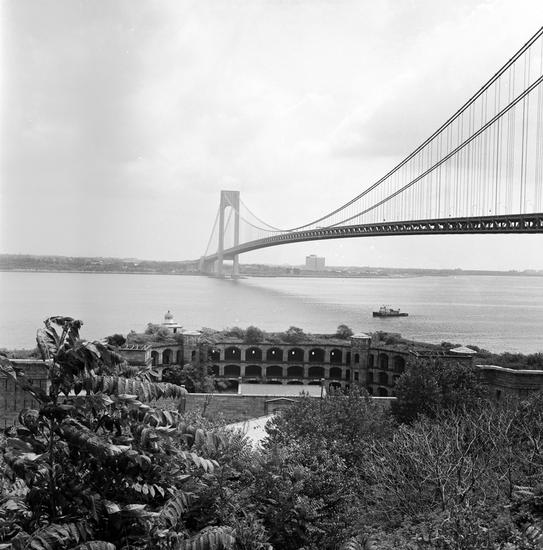
Placed at a strategic site on the Narrows, Wadsworth and its associated defense buildings are perhaps the most dramatic military remains in New York City. It traces to an old Revolutionary War-era fort called Flagstaff Fort.  While it serves minor military functions to this day, Wadsworth has become a popular Staten Island attraction.
1979, photographed by Edmund V. Gillon, Museum of the City of New York
2 Fort Jay (formerly Fort Columbus)Â Location: Governor Island
A star fort constructed from an original 1776 earthen defense. In 1806 its name was changed to Fort Columbus and changed back in the 20th century.
3 Castle Williams Location: Governors Island
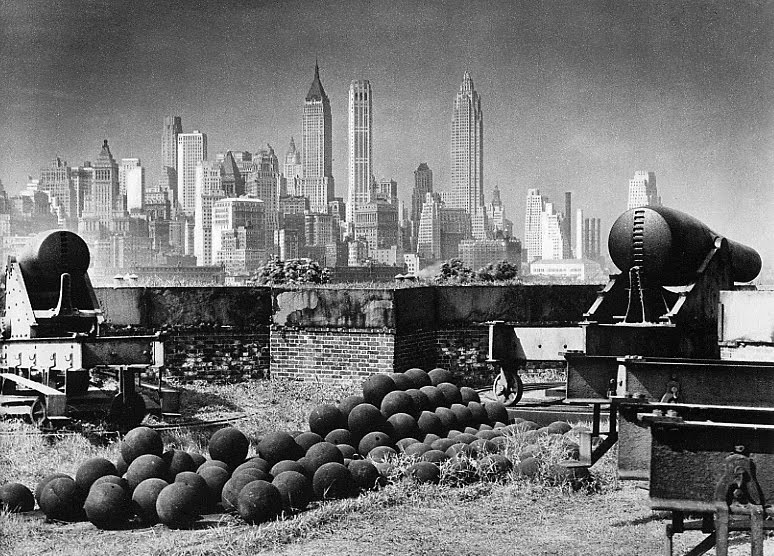
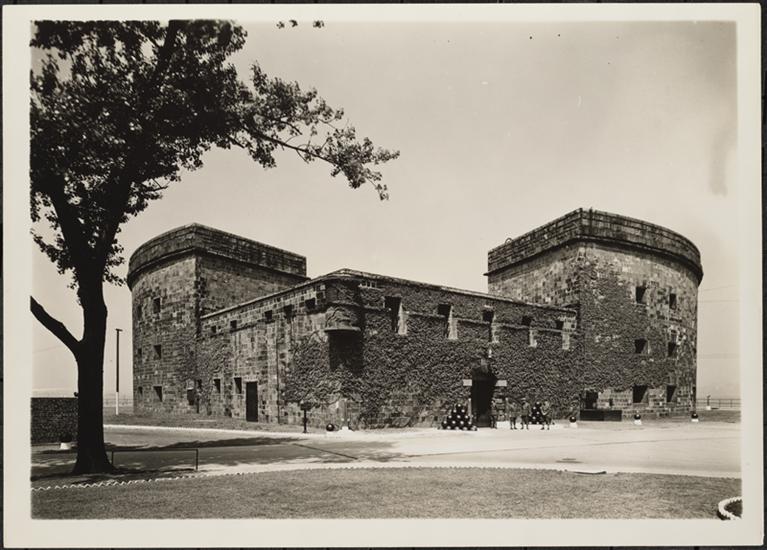
Specifically designed in 1807-1811 to defend the harbor from probable British invasion. While the British did invade America during the battles of the War of 1812, New York was spared. Today, its maintained by the National Park Service, as is Fort Jay.
1936, by Samuel Gottscho, courtesy Museum of the City of New York
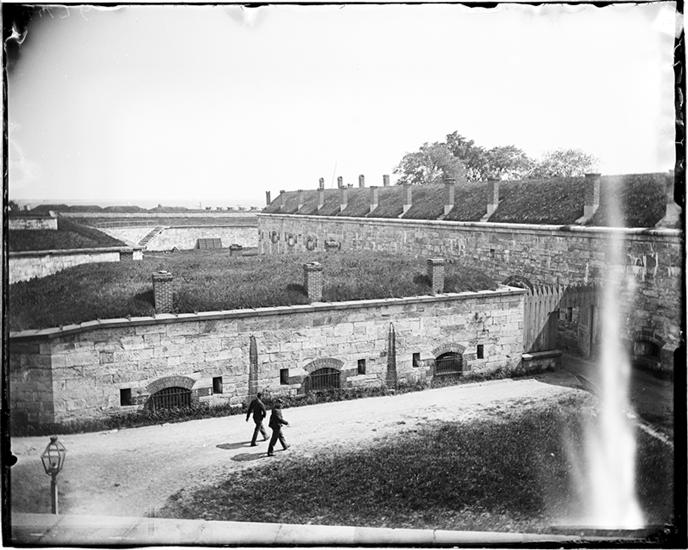
4 Fort Gibson (or Crown Fort) Location: Ellis Island
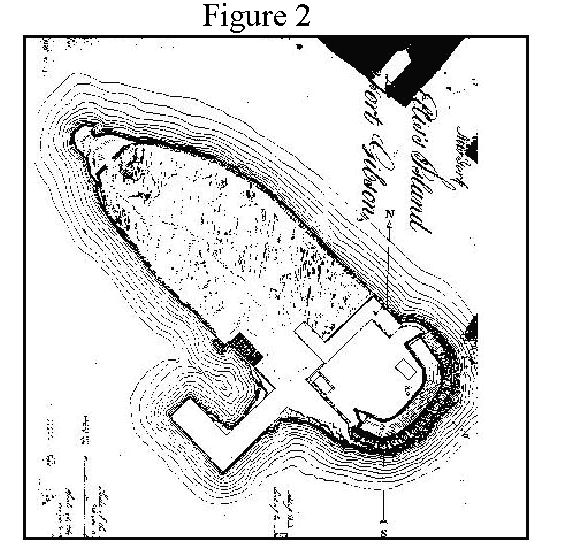
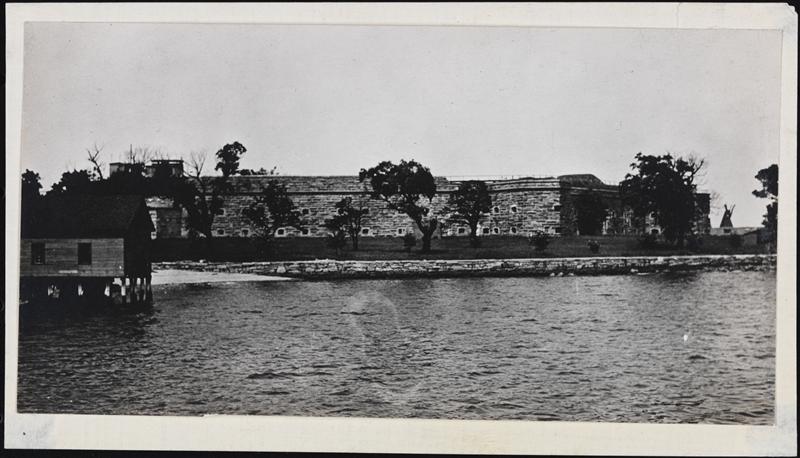
Built by the Army in 1795 and greatly upgraded in 1809 as part of the beefing up of harbor defenses. It was dismantled by the 1860s although the island was used to hold naval munitions for decades before its transformation into Ellis Island Immigration Station.  Today you can find exposed ruins outside the main building.
Courtesy NPS
5 Fort Wood
Location: Liberty Island
This too was completed during the 1810s and was later named for Eleazer Derby Wood, an officer killed at a battle at the Battle of Lake Erie in 1814. Today the Statue of Liberty and her pedestal are affixed atop of the old fort. You can see a trace of the original brickwork on an exposed wall near the exit.
New York Public Library
6 Castle Clinton Location: Manhattan (Battery Park)
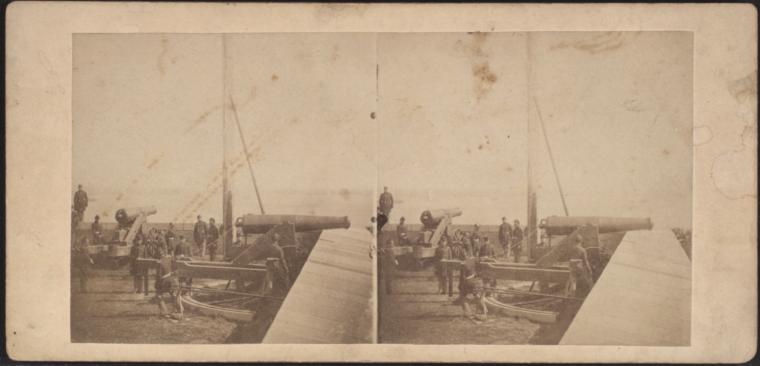
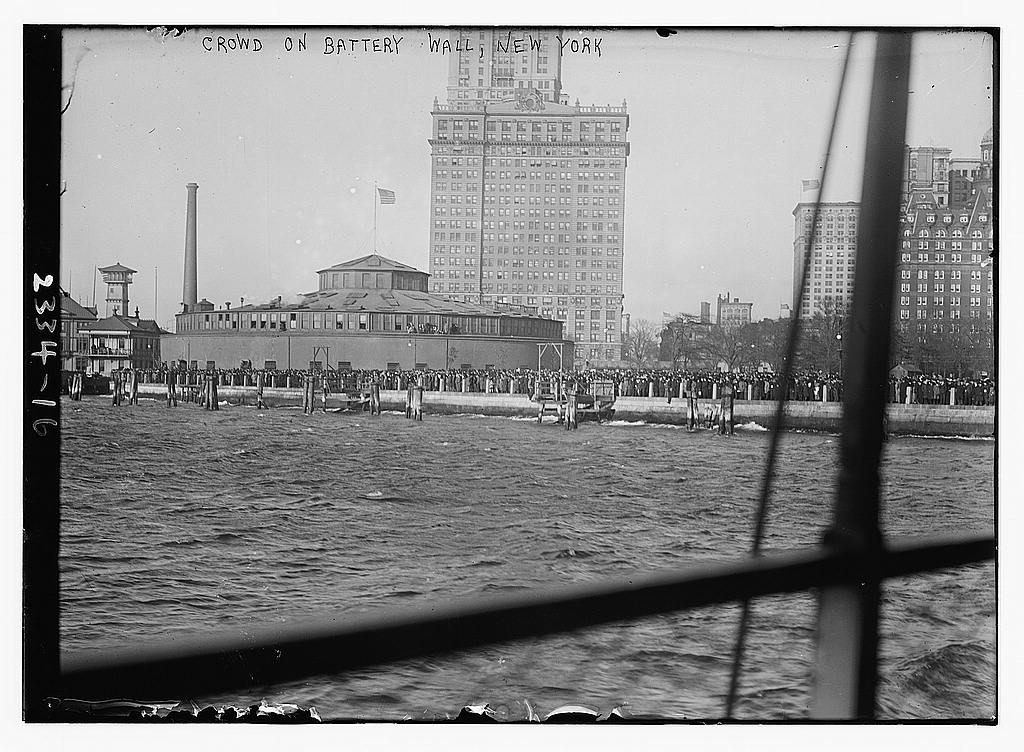
Lower Manhattan was formerly guarded by Fort Amsterdam/Fort George, but that had been dismantled in 1790. (It stood where the Alexander Hamilton U.S. Custom House is today.) Castle Clinton — named for Governor DeWitt Clinton — was built in 1808-1811 to protect lower Manhattan.  It was originally set into the water and connected with a footbridge.  After stints as the performance hall Castle Garden, New York’s pre-Ellis Island immigration station and New  York Aquarium, it sits today as a national monument in its own right.
Library of Congress
7 Fort Gansevoort Location: Manhattan (Meat-Packing District)
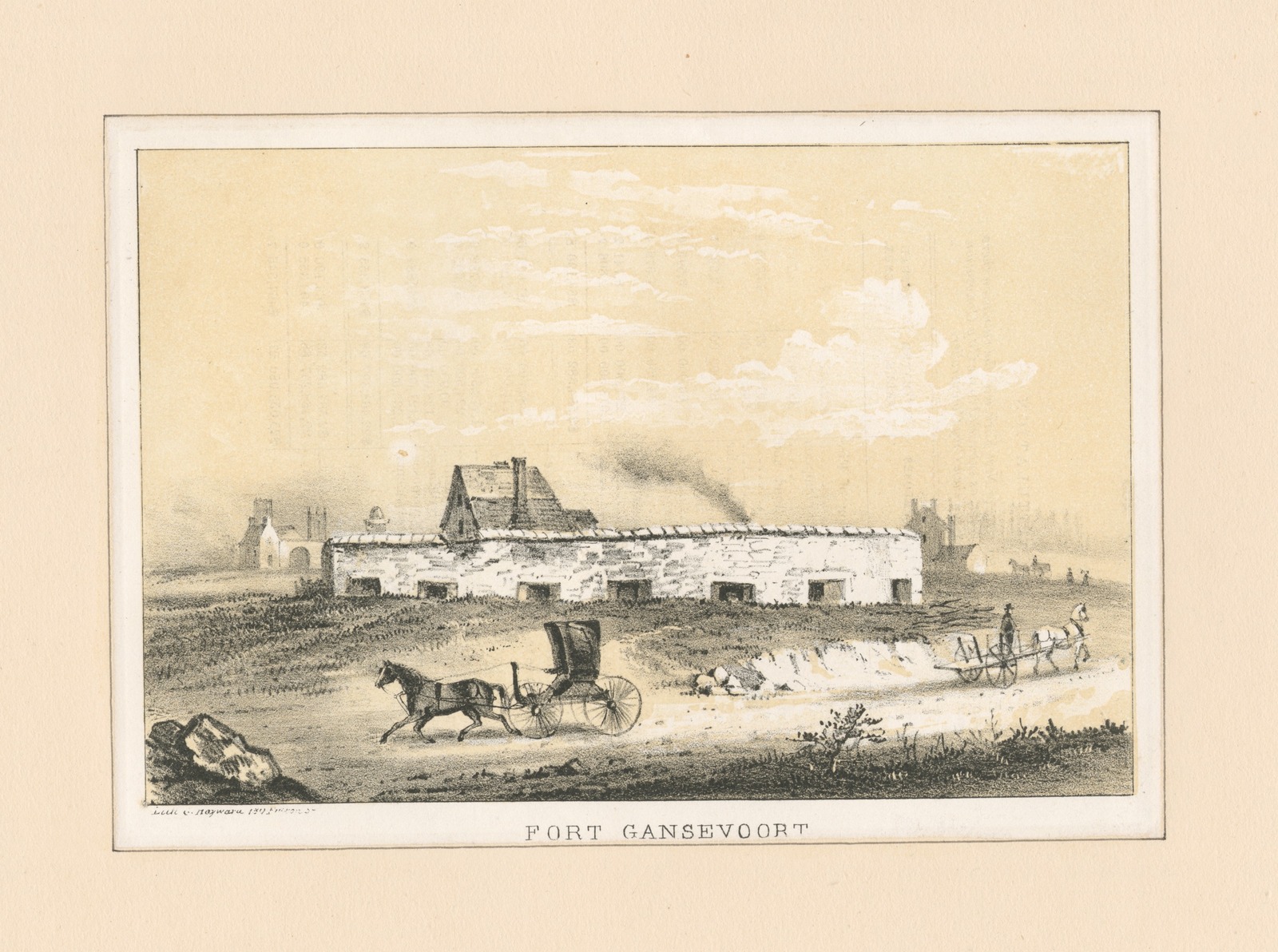
Also called the White Fort, this forgotten redoubt once flanked the western waterfront, built at the same time as the harbor forts. It was named for General Peter Gansevoort (the grandfather of Herman Melville) and stood here until the 1850s. Nothing remains of this fort today but its name, found on the street which cuts through that area — Gansevoort Street.
New York Public Library
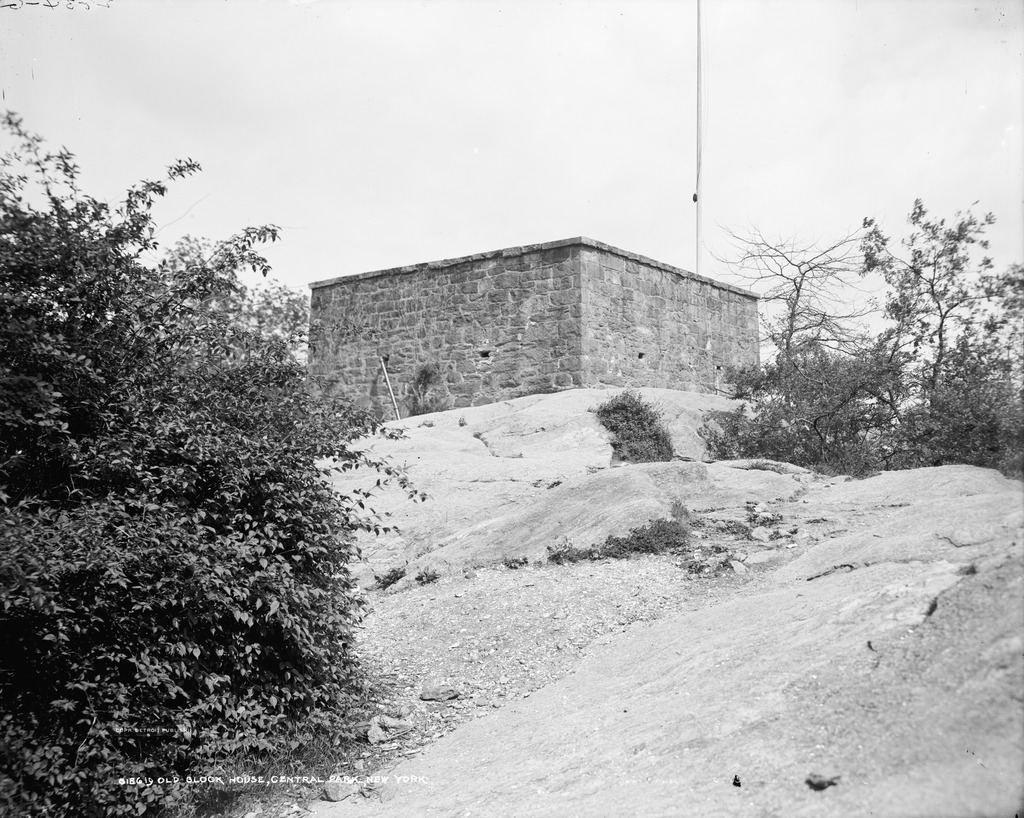
8 Blockhouse No. 1 Location: Manhattan (Central Park)
This curious little structure stands on the northern end of Central Park, a fortification almost two hundred years old.  Its the oldest structure contained within Central Park (although obviously Cleopatra’s Needle, which was moved here, is much, much older.)
Library of Congress
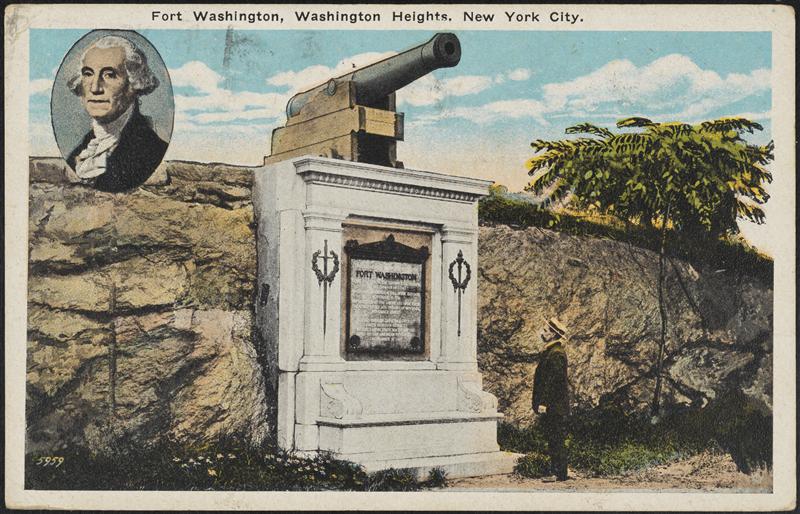
9 Fort Washington
Location: Manhattan (Washington Heights)
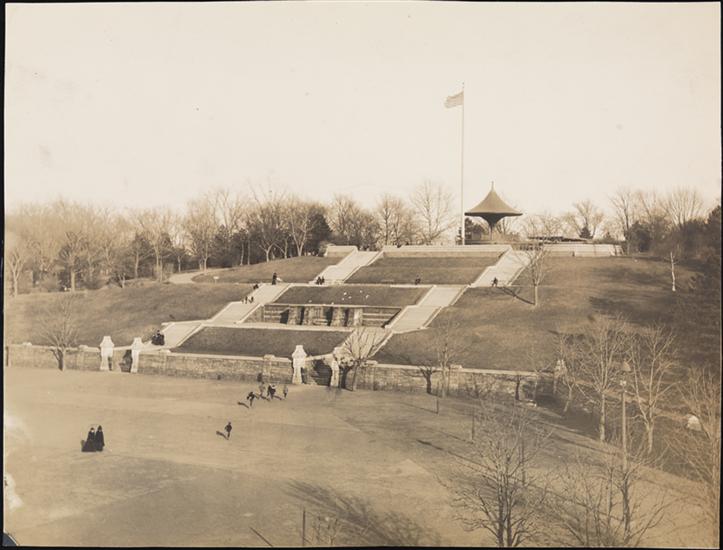
This fort predates most of the rest, built as a companion for Fort Lee on the New Jersey side. It was here that the Battle of Washington Heights was fought on November 16, 1776, and the fort was captured by the British. While this particular fort is no longer there, some stone walls and a plaque mark its former location. Fort Washington Avenue also pays tribute.
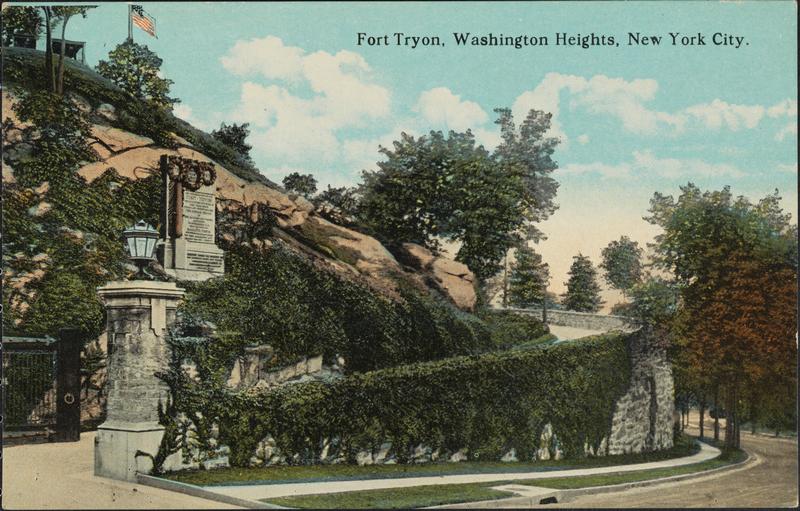
10 Fort Tryon
Location: Washington Heights
This was actually a northern redoubt that was an extension of Fort Washington. When the British took it over, they renamed it for William Tryon, New York’s last British governor. For some reason, the name just stuck! Its location in preserved in the breathtaking Fort Tryon Park, completed in 1935 and designed by the son of Frederick Law Olmsted.
11 Fort Sterling
Location: Brooklyn (Brooklyn Heights)
This fort, tracing to the Revolutionary Era, is unique it that it was almost immediately dismantled once the British left.  There was another fort nearby called Fort Brooklyn that lasted a bit longer,demolished by the 1820s to allow for the growth of Brooklyn’s first wealthy neighborhood. Today, near the Brooklyn Heights Promenade, stands small Fort Sterling Park, with a plaque and a flagpole commemorating the location of this critical defense.
12Â Cobble Hill Fort
Location: Brooklyn (Cobble Hill neighborhood)
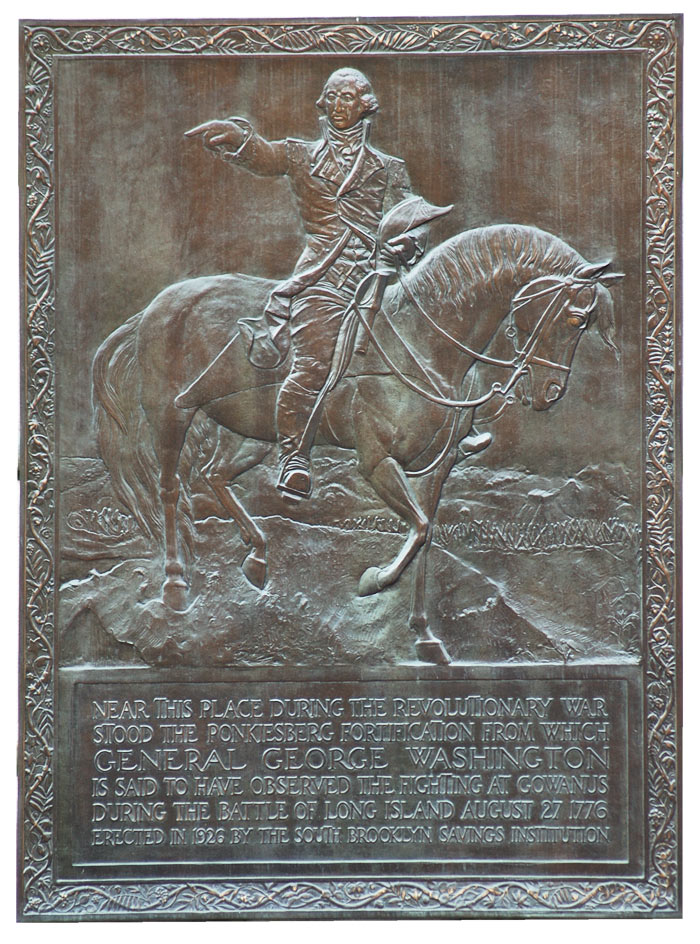
This unusual corkscrew shaped fort — which we talked about in one of our previous ghost story podcasts — is notable for receiving George Washington as he observed his troops during the Battle of Long Island in 1776. Â A handsome plaque on the old bank-turned-Trader-Joe’s at Atlantic Avenue and Court Street marks the location of this forgotten fortification.
Courtesy the blog South Brooklyn
13 Fort Greene
Location: Brooklyn (Fort Greene neighborhood)
There really was a fort here in the area of Fort Greene Park today, on the highest point of the hill, a traditional five-point fortification similar to that on Governors Island. In the 1840s it was torn down to construct one of Brooklyn’s oldest parks — called Washington Park. Oddly enough, the original fort here was called Fort Putnam. There was a Fort Greene (named for Nathaniel Greene) but it was in another area of Brooklyn, closer to today’s area of Boerum Hill.
Museum of the City of New York
14 Fort Hamilton Location: Brooklyn (Bay Ridge)
This is the last active military headquarters in the New York City area. Built in the late 1820s-30s, it was named for Alexander Hamilton who was an officer in the Revolutionary War. Although an active site, you can visit the Harbor Defense Museum which is housed here.
Robert Bracklow, Museum of the City of New York
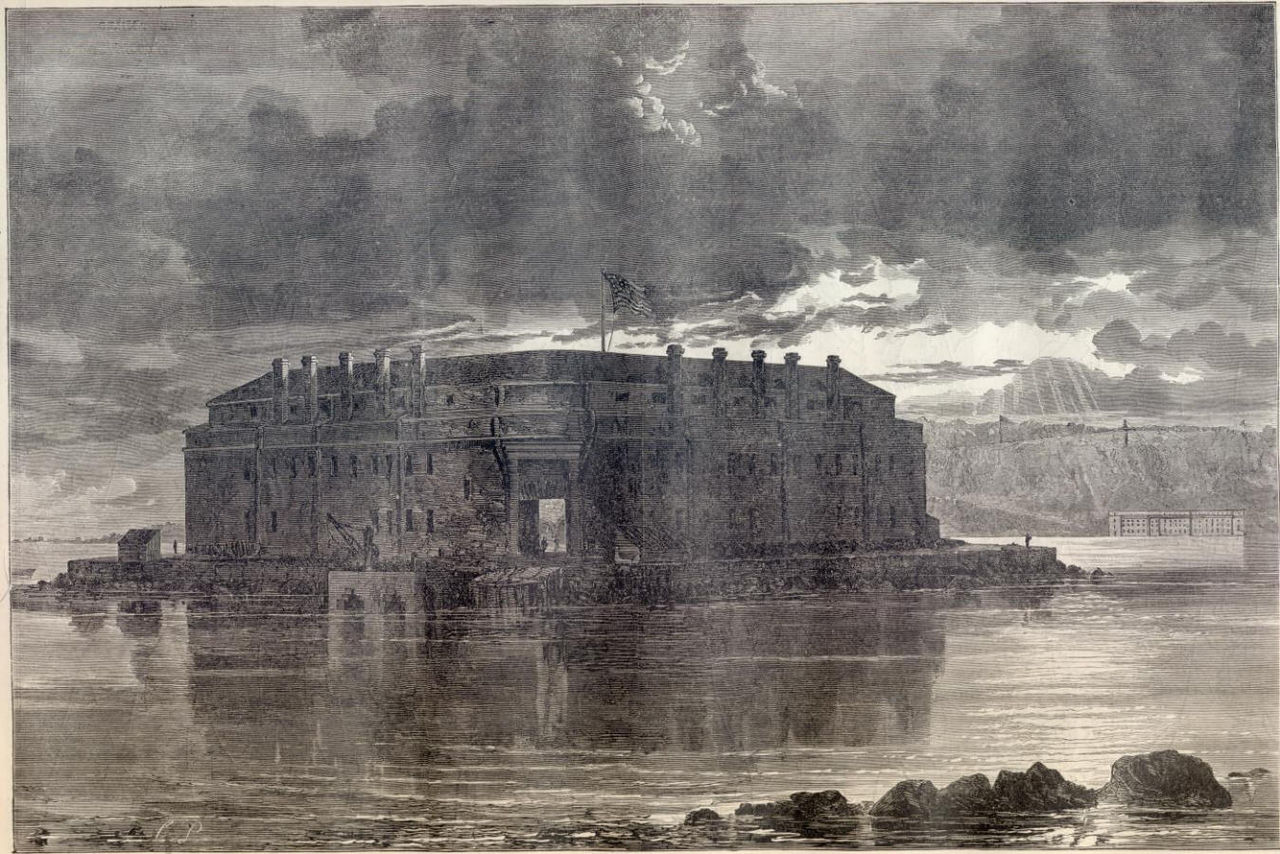
15 Fort Lafayette
Location: Off the coast of Brooklyn (Bay Ridge)
This imposing island fort was built in the 1810s and named for the Marquis De Lafayette. Like many of New York’s forts, it held Confederate and enemy prisoners during the Civil War. The fort was later dismantled for the construction of the Verrazano-Narrows Bridge. You can see where it would have stood as the bridge’s Brooklyn-side tower stands on the location today.
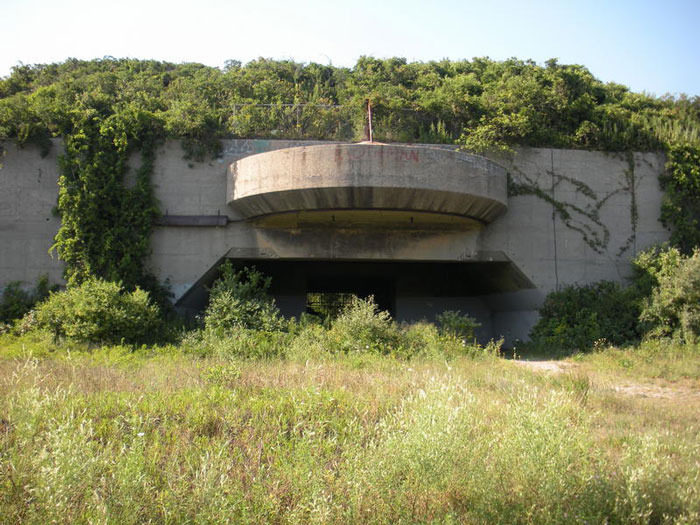
16 Fort Tilden Location: Brooklyn (Rockaway Beach)
While defenses of various kinds have sat out on Rockaway Beach since the early 19th century, Fort Tilden was fully built up during World War I, named for Samuel J. Tilden. Today its ruins peering through overgrowth can be found near the beach as part of the Gateway National Recreation Area.
17 Fort Schuyler
Location: Bronx
Completed in the 1850s, this unique fortification protected New York for any possible attack from enemies approaching along the Long Island Sound. Abandoned for strictly military use in the 1920s, today it houses the State University of New York Maritime College and a maritime museum.
Museum of the City of New York
18 Fort Totten
Location: Queens
This fortification traces to worries relating to the Civil War. It was constructed in 1862 to protect the East River with its companion across the water Fort Schuyler.  You can still visit Fort Totten today as the area has been opened up as a public park with regular tours of the old buildings.
New York Public Library
At top: Fort Lafayette in a painting by Thomas Hicks (1861)
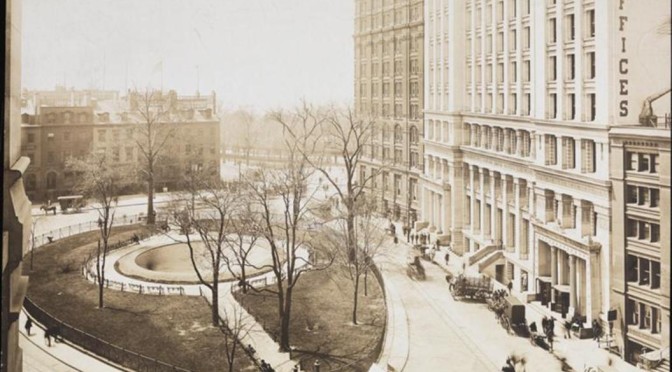
Bowling Green, at the very tip of Manhattan island, is a small oval park so calm in comparison to its surroundings that it’s hard to believe this is one of the oldest sections of the city of New York.
Here are ten facts about Bowling Green, accompanied by ten images and photographs from various periods in this tiny park’s extraordinary history:
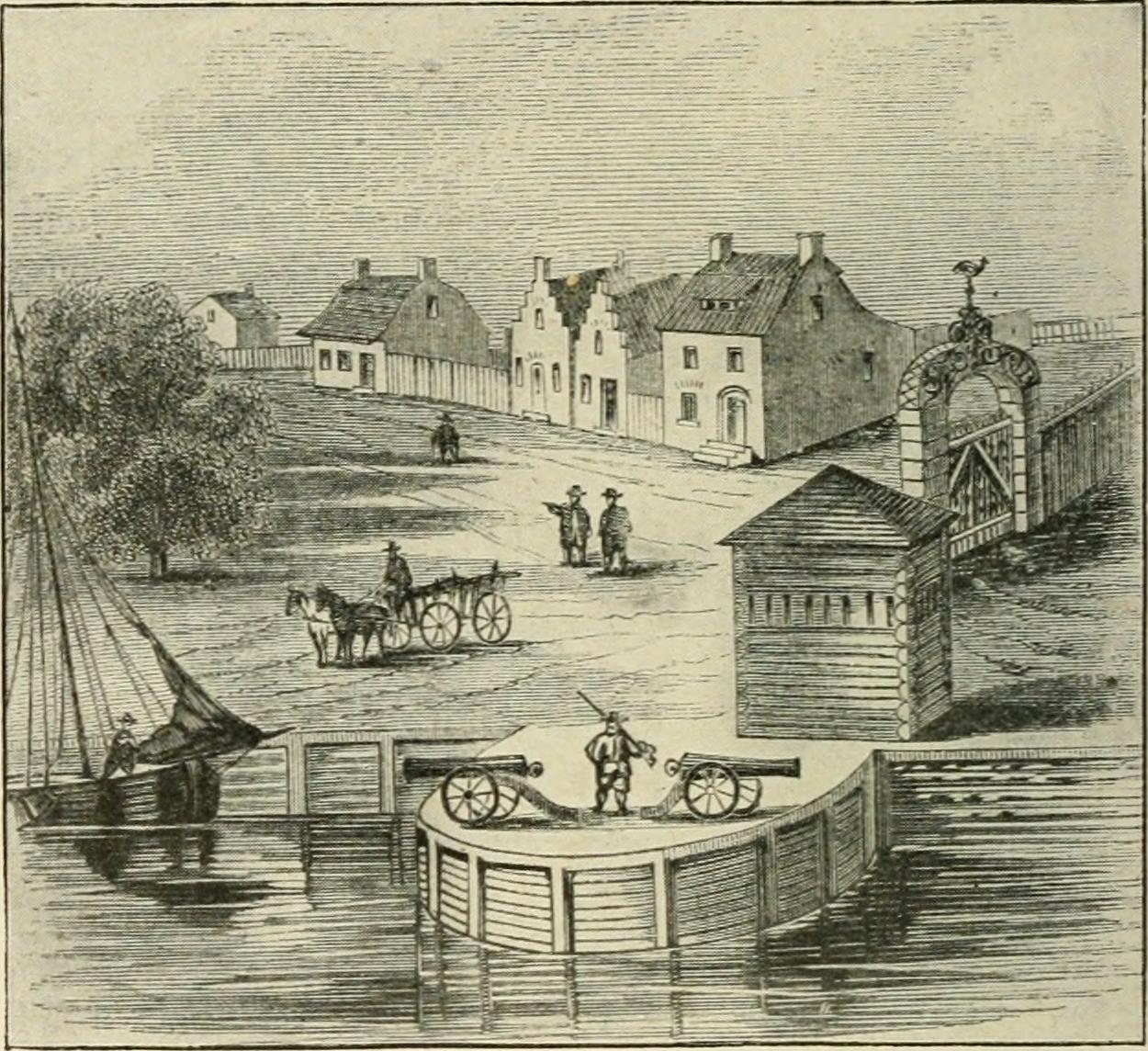
“The Plaine” — where the trees are to the left — is where Bowling Green would eventually be constructed. This depicts the early Dutch years. (Courtesy the Internet Book Archive)
1) The land comprising Bowling Green was situated next to Fort Amsterdam. During the days of New Amsterdam, this was the site of the first public well, dug in 1658 and would remain the only well within the city until 1677, long after the Dutch were replaced by the British.
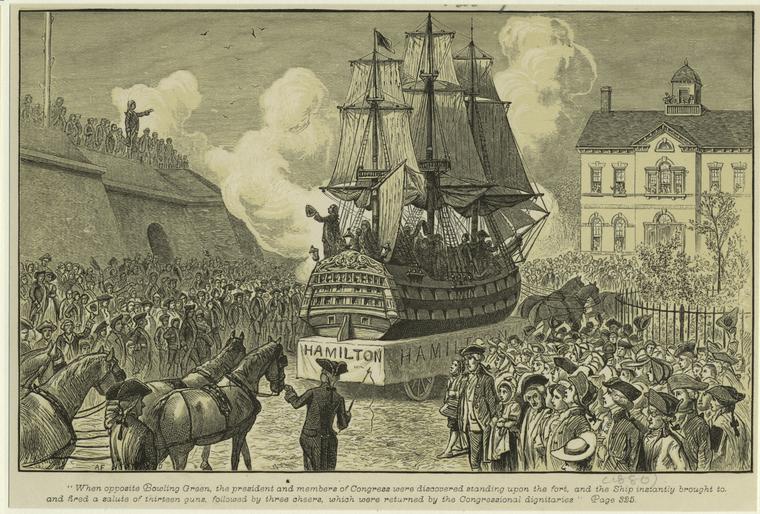
Ship On A Parade Float Drawn By Horses Past Bowling Green, New York, 18th Century. (Courtesy New York Public Library)
2) Since it was next to the fort, it’s not surprising to discover that the area was a parade ground during the early 18th century. In 1733, it was leased to three local landlords — Peter Jay, John Chambers, and Peter Bayard — to develop an English-style park. It quickly became the destination of lavish homes of the wealthy.
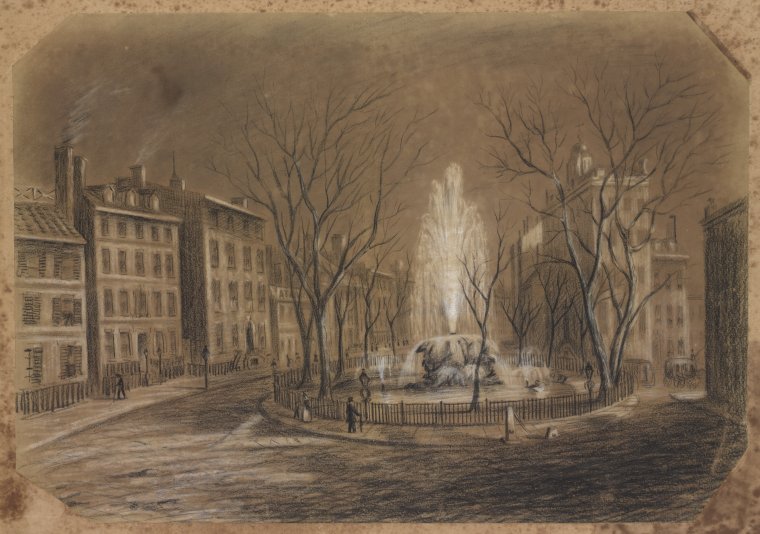
Charcoal drawing of Bowling Green, New York, 1845. (New York Public Library)
3) Yes there was actually bowling here. Or rather, the traditional form of lawn bowling, enjoyed by the residents that lived around the park. This required perpetual maintenance of the lawn. Before the invention of the lawnmower, this was usually accomplished by sheep. I’m not sure whether sheep were employed into service here at Bowling Green. But there were pigs in the street so you never know.
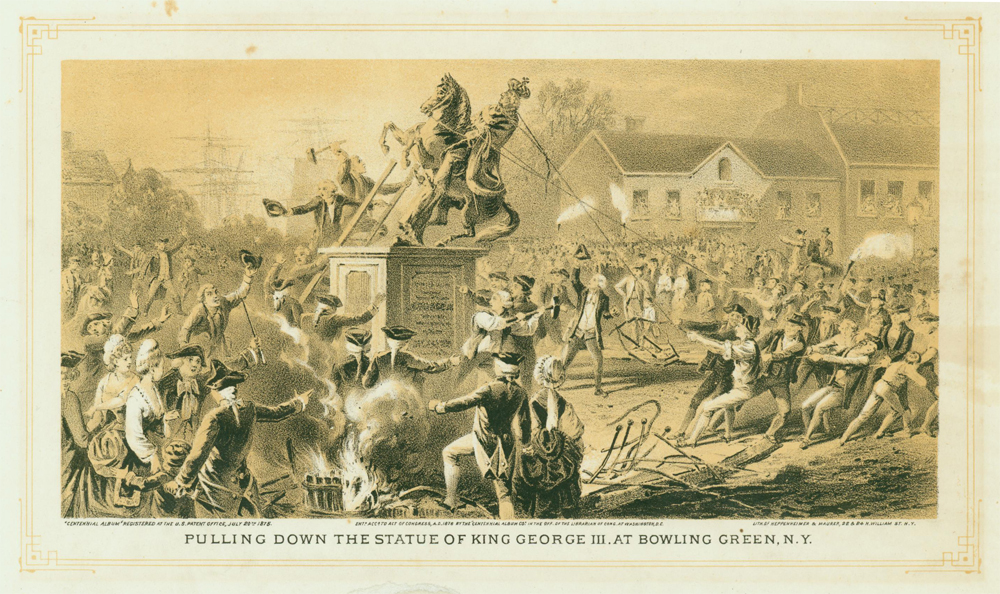
Pulling down the King George statue 1776
4) In 1770, loyalists to the crown erected an equestrian statue of King George III in the center of the park. Six years later, it was ingraciously torn down by New Yorkers after hearing George Washington read the newly crafted Declaration of Independence. Â Parts of that statue still exist in the city.
5) George Washington lived here. No really. He had two residences here during the time when New York was briefly the nation’s capital. The first, over on Cherry Street, provided him and his wife Martha with breathtaking views of the East River, but they soon found it quite unsuitable. So in 1790 they moved to a home at 39-41 Broadway, at the northern tip of Bowling Green, residing here until the capital was finally moved to Philadelphia.
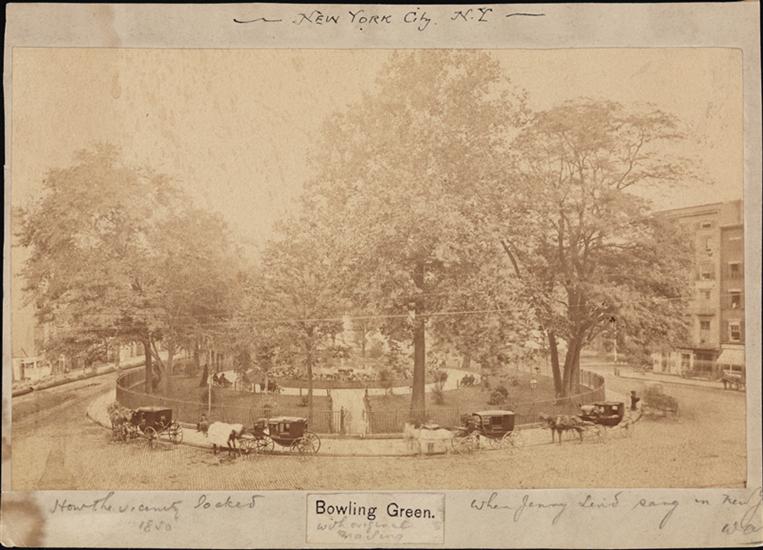
Bowling Green, how the vacinity looked in 1850 whnen Jenny Lind sang in New York. (Courtesy Museum of the City of New York)
6) Bowling Green was still the destination for the New York’s oldest, snootiest families at the start of the 19th century. In fact, it was given a rather inappropriate nickname — Nobs Row. As the town moved northward, the wealthy left their houses around Bowling Green.
7) In the 1820s, the first velodrome was situated near Bowling Green featuring a precursor to the bicycle called the draisine. New Yorkers loved this curious device. “Near Bowling Green these vehicles were first exhibited. Around City Hall Park and the Bowery, at all times of the days, riders might be seen.
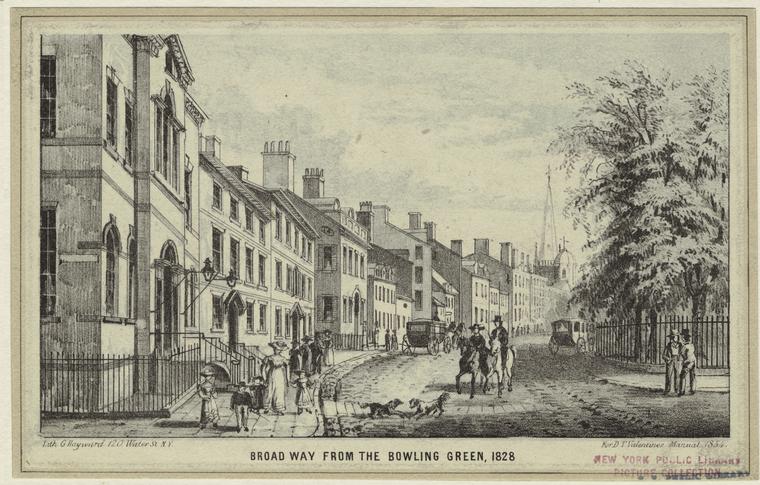
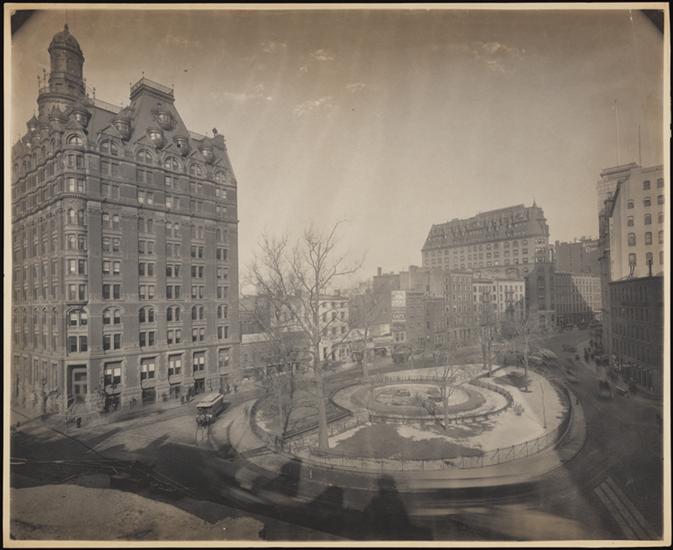
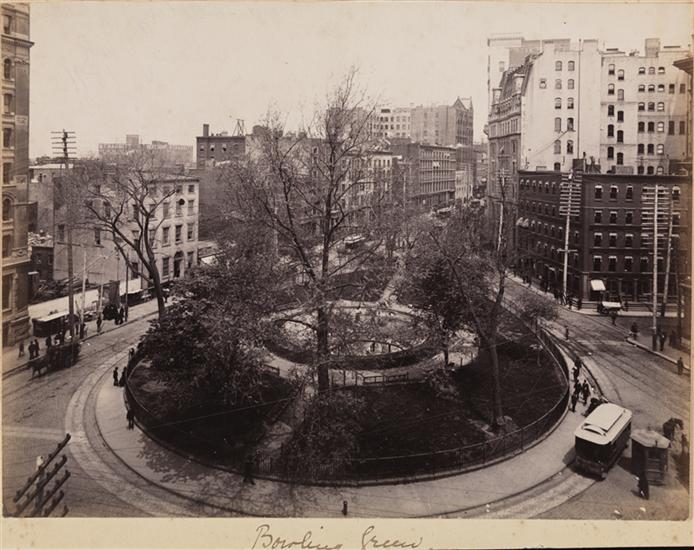
8) Bowling Green soon became known as a transportation terminus for coaches and omnibuses which strode up and down Broadway. In the 1820s, when the entertainment venue Castle Garden opened, the streets around Bowling Green became clogged with busy street life. By the 1850s, Castle Garden became the principal immigration station, filling the once elite neighborhood with a bustling cross-section of classes. In the 1890s, New York’s short-lived cable-car line terminated here.
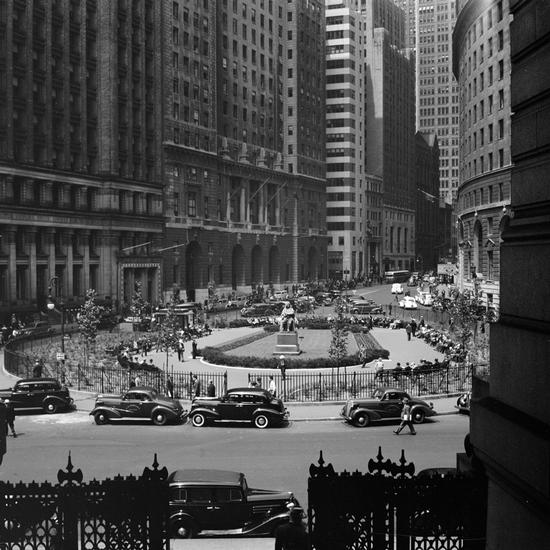
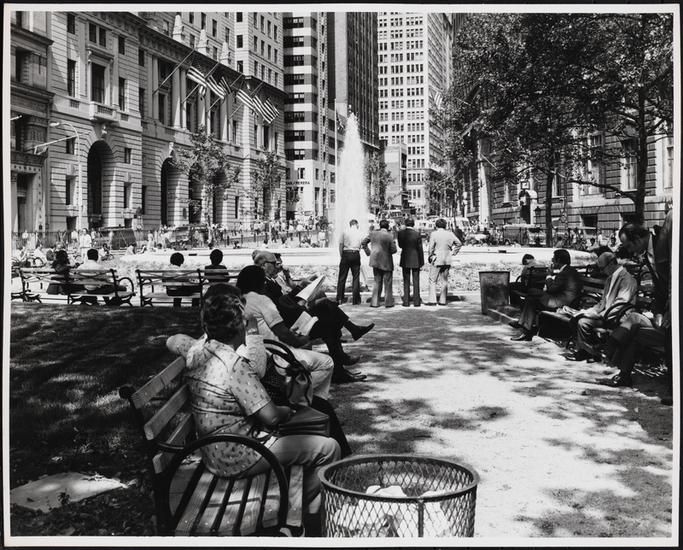
9) The park was much abused and generally unimpressive during the 1950s and ’60s but was rebuilt during the 1970s to approximately resemble how it once looked. The fence which surrounds the park is the original which was first placed around the park in 1773. This makes it one of the oldest free-standing artifacts in all of Manhattan.
10) During the late 1980s the park met its weirdest neighbor yet — the Charging Bull sculpture by Arturo Di Modica. Arguably better known and more beloved by tourists, the bull was originally planted illegally in front of the New York Stock Exchange. By the time the city removed the statue, New Yorkers had come to love it. They eventually placed it next to Bowling Green in 1989.
NOTE: This article has a few plot spoilers but no major twists are revealed or discussed. I’ve tried to write the descriptions within the interactive map as vaguely as possible.
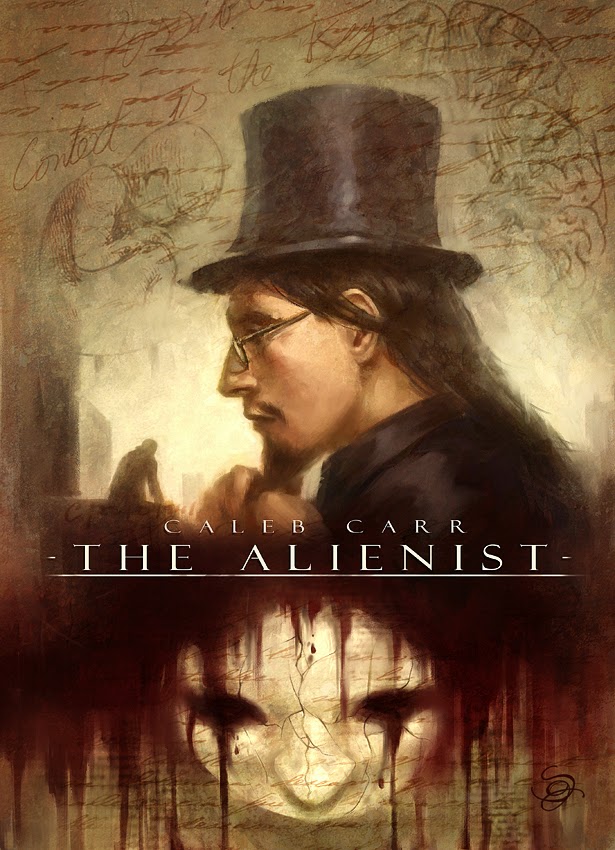
The Alienist by Caleb Carr was published 20 years ago this week, an instant best-seller in 1994 that has become a cult classic among history buffs. Despite some creakiness uniquely inherent to early ’90s fiction thrillers, it remains today a page-turning and utterly spellbinding adventure.
Although the Jack the Ripper murders were an obvious inspiration for Carr, perhaps The Alienist‘s biggest influence is The Silence of the Lambs by Thomas Harris. Carr completed his tale of serial murders in the Gilded Age just as a slew of Silence knockoffs began hitting the bookshelves. The Alienist stands far above the pack, of course, but you can’t deny its success in 1994 was partially inspired by reader’s cravings for murderers with perverted tastes and body parts in formaldehyde jars.
The Alienist follows a quirky team of investigators in 1896 as they follow the bloody trail of a killer with a peculiar penchant for boy prostitutes, often dressed as girls to the delight of their clientele. Dr. Laszlo Kreizler is the alienist (or psychologist) in charge of the case, stitching together a profile of the loathsome figure, conveniently using soon-to-be standard analytic techniques.
At right: Alternate artwork for The Alienist (Courtesy Nerd Blerp)
As protagonist John Schuyler Moore, a reporter for the New York Times, explains it “[W]e start with the prominent features of the killings themselves, as well as the personality traits of the victims, and from those we determine what kind of man might be at work. Then, using evidence that would otherwise have seemed meaningless, we begin to close in.”
Carr’s book is finely detailed, perhaps overly detailed, which won’t be a problem if you love New York City history. There are over two dozen scenes at various notable landmarks throughout Manhattan, some in various states of construction. Several real-life figures make appearances, although the most entertaining characters are Carr’s own, including the intrepid proto-policewoman Sara Howard and scrappy errand boy Stevie ‘Stovepipe’ Taggart.
When I first read The Alienist back in 1994, I was struck by its preciseness, an expertly placed breadcrumb trail through old Gotham. There is no romantic gloss, as in another history classic Time and Again. He makes it seem possible to retrace almost every step of our heroes. (In researching this article, I tried to do so.) The original New York Times review noted that “[y]ou can practically hear the clip-clop of horses’ hooves echoing down old Broadway.” They’re still echoing.
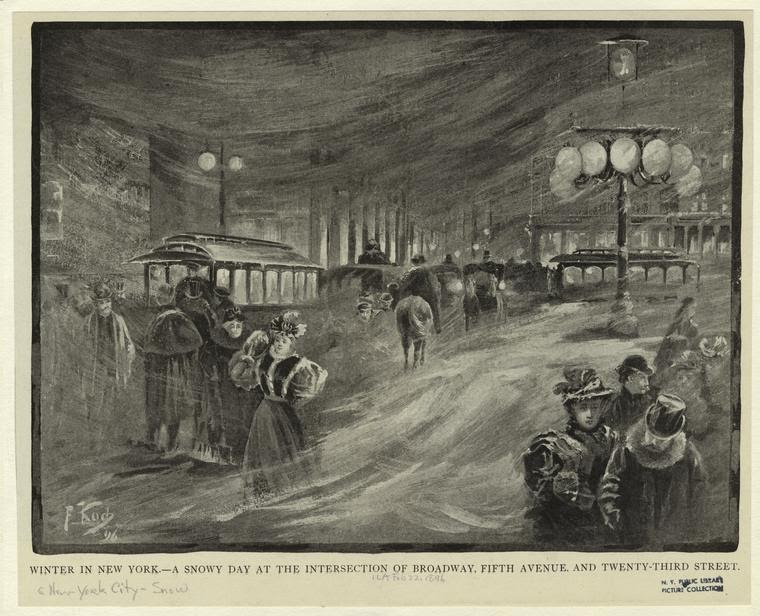
The story begins in the early months of 1896 during a robust winter. Below, from the Illustrated American, a depiction of a snowy Madison Square that year (NYPL):
His depiction of old New York is still glorious. The book’s polite take on certain social issues, however, read a bit wobbly today. To his credit, Carr tackles police corruption, gender discrimination, racial prejudice and the plight of homosexuals, all while elaborating on complicated psychological theories in service of an entertaining story. He has stuffed a hidden epic of New York into the framework of a modern murder mystery. That he chooses to handle hot-button social issues with kid gloves is not a misstep, but merely a symptom of its genre and day.
The Alienist is still greatly enjoyable, perhaps slightly more so now. Thanks to renewed interest in New York City history, the details here are even more shimmering and vital. This is not an old New York emerging from a mysterious fog, but a world that seems to exist alongside our own.
And to prove that — below you will find a detailed, interactive map of the pivotal locations used in the book. You can click into various points for further details. A few of these pins have pictures and other links. Just zoom in and choose a location! (NOTE: Some locations are approximate and a couple are speculation.)
A little elaboration on certain elements of the book’s bigger places and themes:
Paresis Hall Most of the murder victims are boy prostitutes employed as several houses of ill repute throughout the city. Paresis Hall, located steps from Cooper Union, sounds like it was both a place where gay men could congregate in private clubs and a place of sexual transaction, often (as in the book) with underage boys dressed up as girls. This boy, Nathaniel ‘ The Kid’ Cullen, may have worked there, or may have just a habitue of the club. (He appears in this collection of photographs from Paresis Hill.)
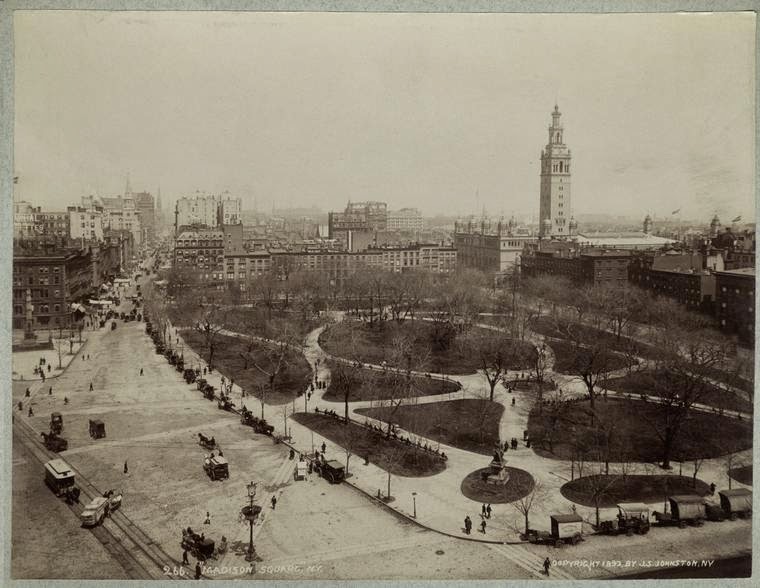
Madison Square This was still a thriving center for culture and dignified entertainments in 1896. Many theaters clustered around the park, although newer stages were making their way up Broadway to Herald Square. If Delmonico’s (on the northwest corner) is too crowded for you, head over to the tea room at Madison SquareGarden on the northeast side. Pictured here in 1893, three years before the events of the Alienist. (NYPL)
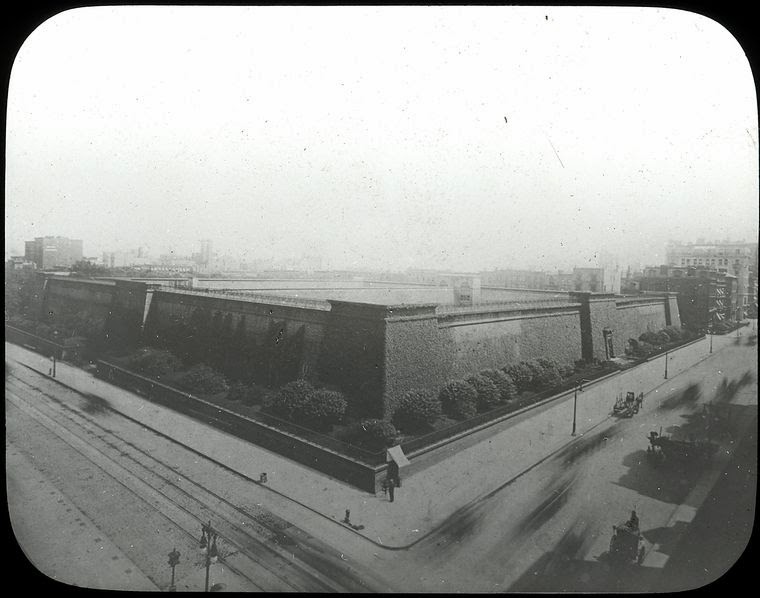
Murray Hill Distributing Reservoir In 1896, New York still relied on this reservoir to provide most people with water. But it was also a tourist destination in itself, with walking paths along the top. Shortly after its appearance it the book, the Egyptian-inspired reservoir was torn down to make way for New York’s new public library. (NYPL)
Bellevue Hospital and Morgue Check out our podcast and blog posting on the history of Bellevue Hospital, as many of the details mentioned there appear in this book. Below: Bellevue in 1879.
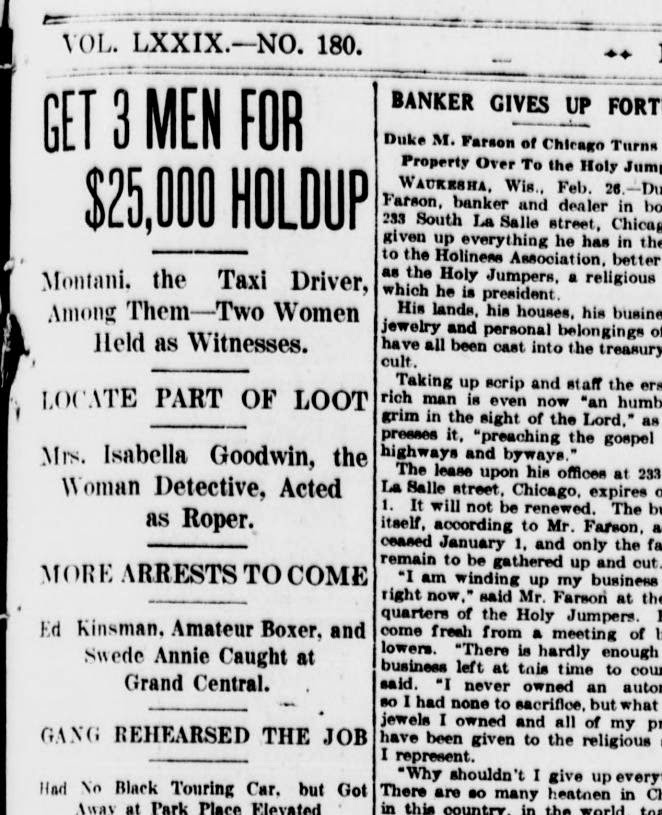
Isabella Goodwin Sara Howard seems to be a little bit Nellie Bly, and a lot Isabella Goodwin, the first female office promoted to detective in 1896 (the year the book is set). Below: A front-page case cracked by Goodwin from February 1912.
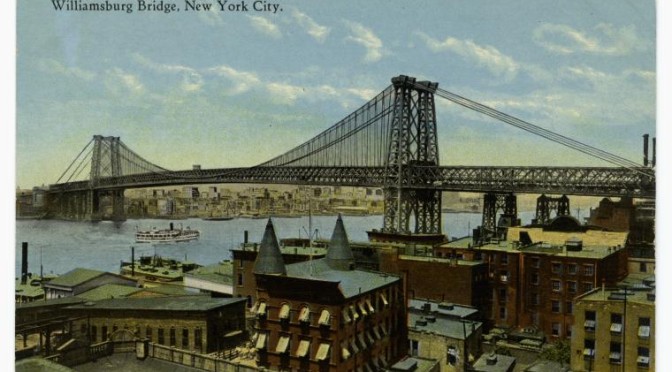
New York Aquarium Carr’s narrative features several New York landmarks in construction. Two of those places take a morbid center stage in the book — the Williamsburg Bridge and the nearly completed New York Aquarium (the former Castle Garden) (NYPL)
Theodore Roosevelt Carr weaves several real life figures into the storyline, from J.P. Morgan (who comes off quite ominous) to Jacob Riis (not a flattering portrait of him either). But future president Roosevelt gets a glowing supporting role as New York’s police commissioner who directs Dr. Kreizler, Moore and Howard to investigate the murders using powers of psychological deduction.
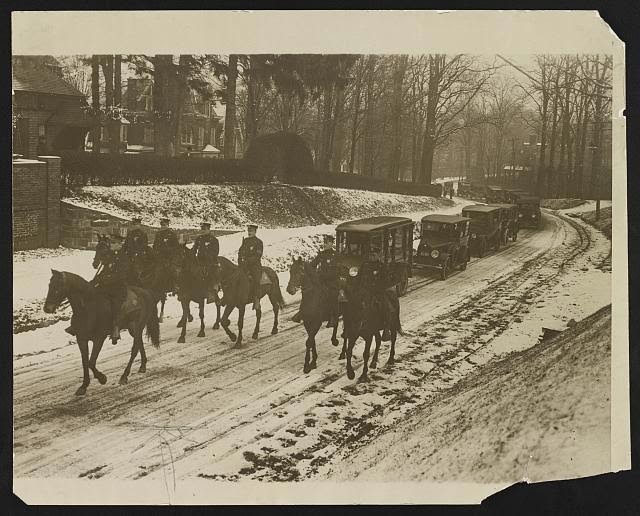
In fact, the book is actually a flashback by our hero Moore, recalled when he visits the Oyster Bay funeral of his dear friend in 1919 (pictured below). (LOC)
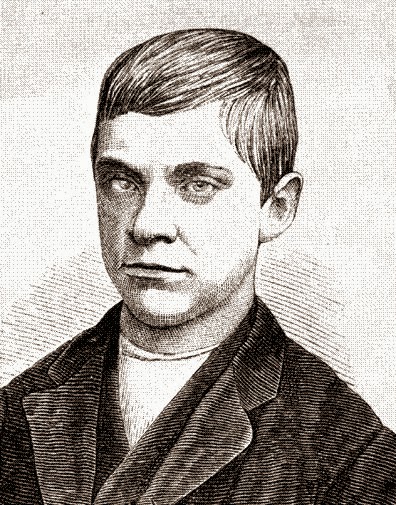
True Crime And there are a great many real-life figures from New York’s criminal underworld as well. In fact, most of the lecherous and notorious figures depicted in the book are real folks, from early gangsters like Paul Kelly to brothel owners such as Biff Ellison. Carr also finds a few disturbing mental cases to bring into the story, including the young killer Jesse Pomeroy (pictured below), considered one of the most brutal of murderers at a ripe age of 14.
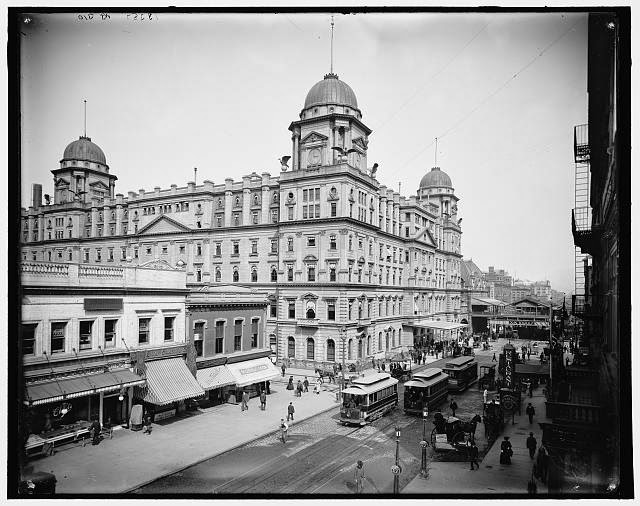
Grand Central Depot The characters do venture to places outside the city for further clues, but they always come through Grand Central Depot, the most hectic place in New York. (Pennsylvania Station had not yet been built.) Within a few years, this too would be ripped down and replaced with the present Grand Central Terminal. (LOC)
And finally, there are three central locations from the book that are still around today:
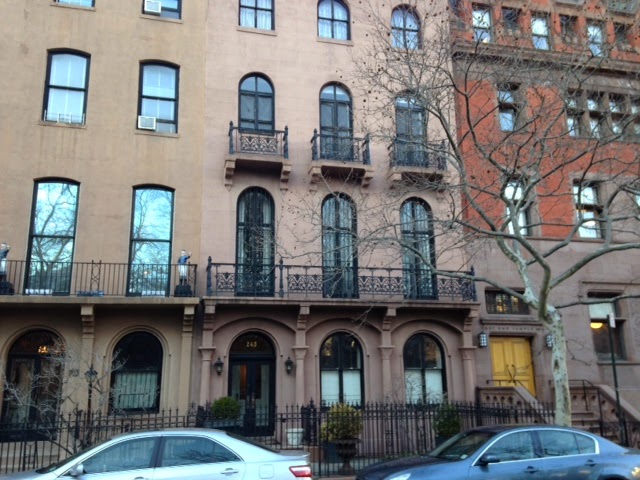
Dr. Laszlo’s residence at Stuyvesant Park. Actually the address in the book doesn’t really exist. But based on a couple descriptions — and its proximity to St. George’s Church, which is mentioned as close by — this building at 237 East 17th Street may be what Carr had in mind:
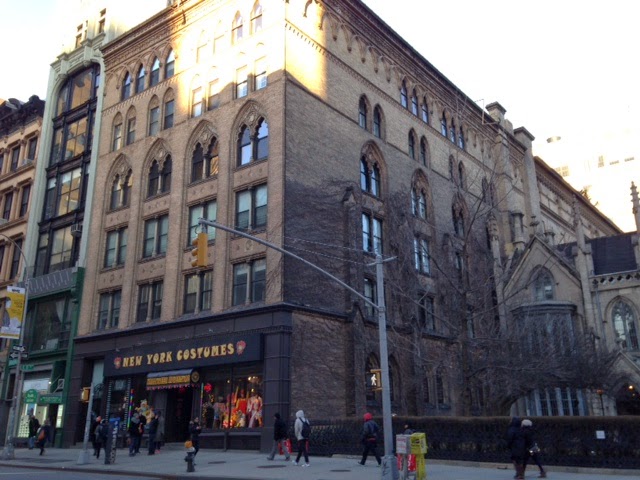
Murder headquarters at 808 Broadway — This exceptionally handsome building was constructed by James Renwick, playing nicely off its neighbor Grace Church. It’s actually called the Renwick! The team was located on the sixth floor. Today, on the first floor, is one of New York’s most popular costume shops.
John Schuyler Moore’s home at Washington Square Park North, facing the park:
Williamsburg used to have an H at the end of its name, not to mention dozens of major industries that once made it the tenth wealthiest place in the world. How did Williamsburgh become a haven for New York’s most well-known factories and then become Williamsburg, home to such wildly diverse communities — Hispanic, Hasidic and hipster? Find out how its history connects with whalebones, baseball, beer, and medicine for intestinal worms.
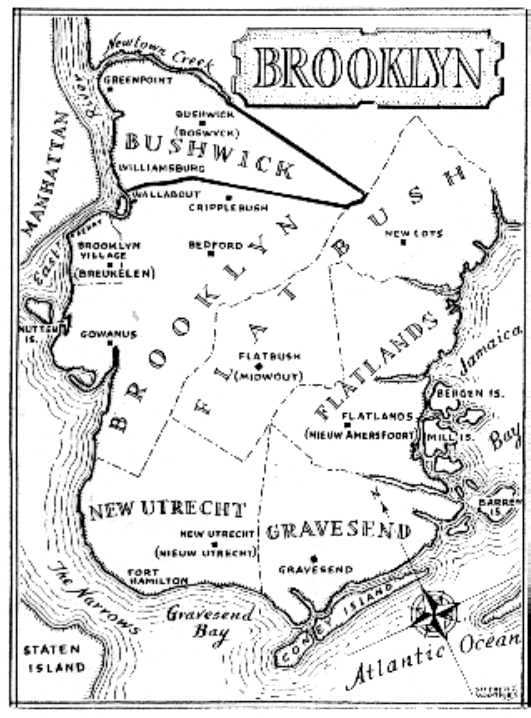
A modern map of the townships of Kings County. Cripplebush is listed here as a settlement in Brooklyn. The dense undergrowth that gave Cripplebush its name stretched well into the jurisdiction of Bushwick, which the Dutch actually called Boswijck.
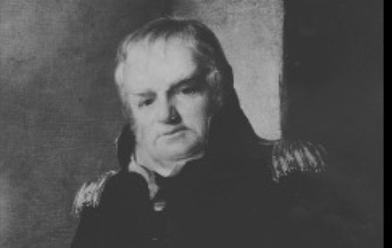
The esteemed Lt Col. Jonathan Williams, who surveyed the land along the Bushwick shore and eventually gave Williamsburg its name. You can also find his handywork at Castle Clinton and Castle Williams (also named after him).
Another father of Williamsburg, David Dunham, can still be found today on a very tiny street near the bridge called Dunham Place. (Forgotten New York has a great look at this odd little side street.)
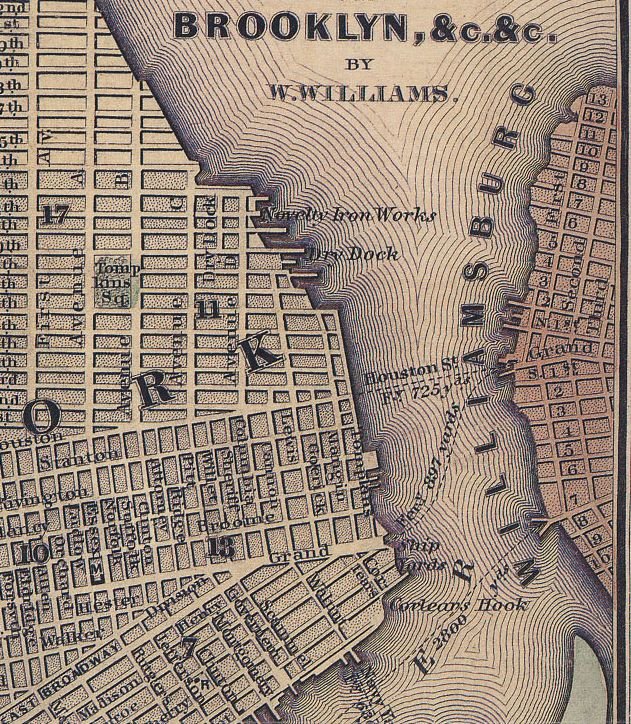
A detail from this mid-19th century map of New York and Brooklyn indicates the two ferry paths across the East River from the Grand Street dock in Williamsburg.
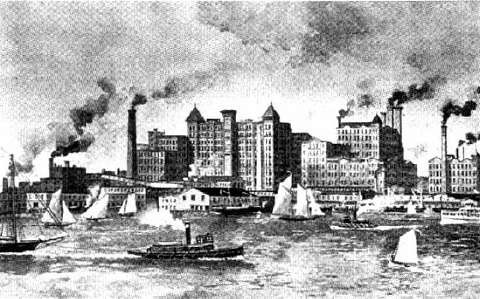
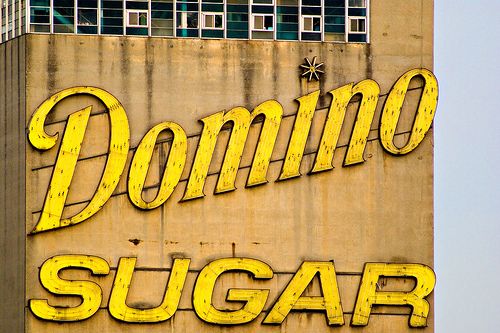
The Williamsburg waterfront during the 1880s. Havemeyer’s sugar refinery became one of the most profitable businesses along the East River. It became Domino Sugar in 1900.
While Havemeyer’s factory, closed in 2004, has been landmarked, its future could include a vast complex of condominiums — but with community opposition and a $1.3 billion dollar price tag, is it viable?
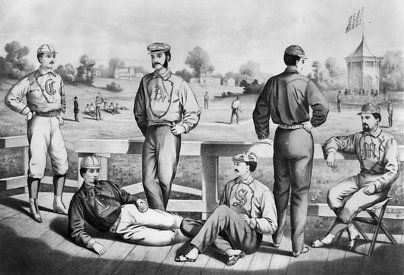
These fancy guys are relaxing after a vigorous game of baseball at the Union Grounds, the first to fence in the playing field and charge spectators. Check out our previous article on this historic place and where you can find its location today.
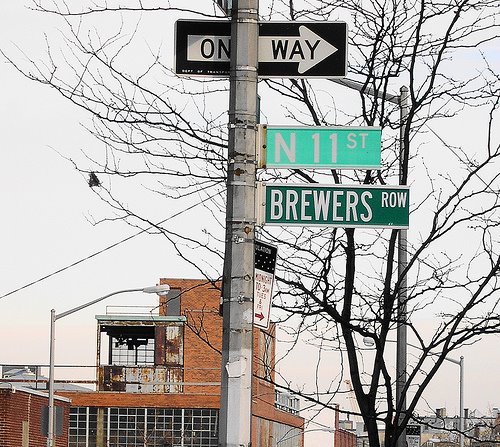
There are no more breweries along Brewer’s Row, but the once grand boulevard of beer makers that stretched from Williamsburg to Bushwick is still recognized on street signs.
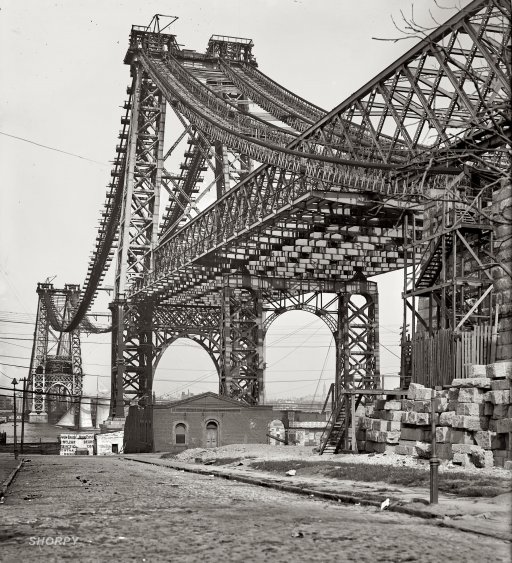
The East River Bridge (today the Williamsburg Bridge) in 1902. It would be opened a year later, opening the neighborhood to thousands of new residents fleeing overcrowded Lower East Side (pic courtesy Shorpy)
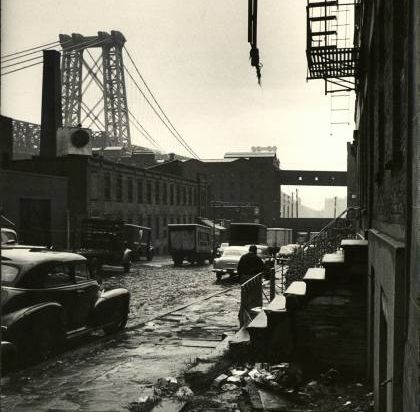
Williamsburg in 1954, not the sunniest place ever. Photo by Alfred Eisenstaedt (LIFE archives)
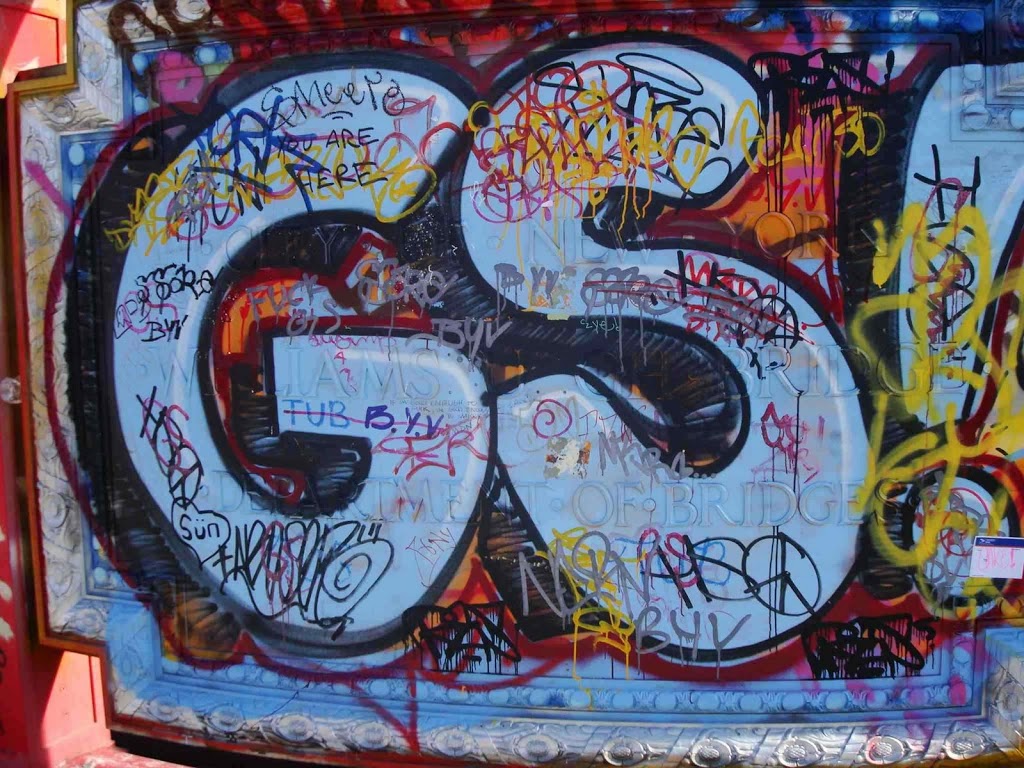
Look really closely at this dedication found at the pedestrian fork on the Williamsburg Bridge. If you scrape away the graffiti, you’ll see Williamsburg with an H on the end. (Click it to get a closer look.)
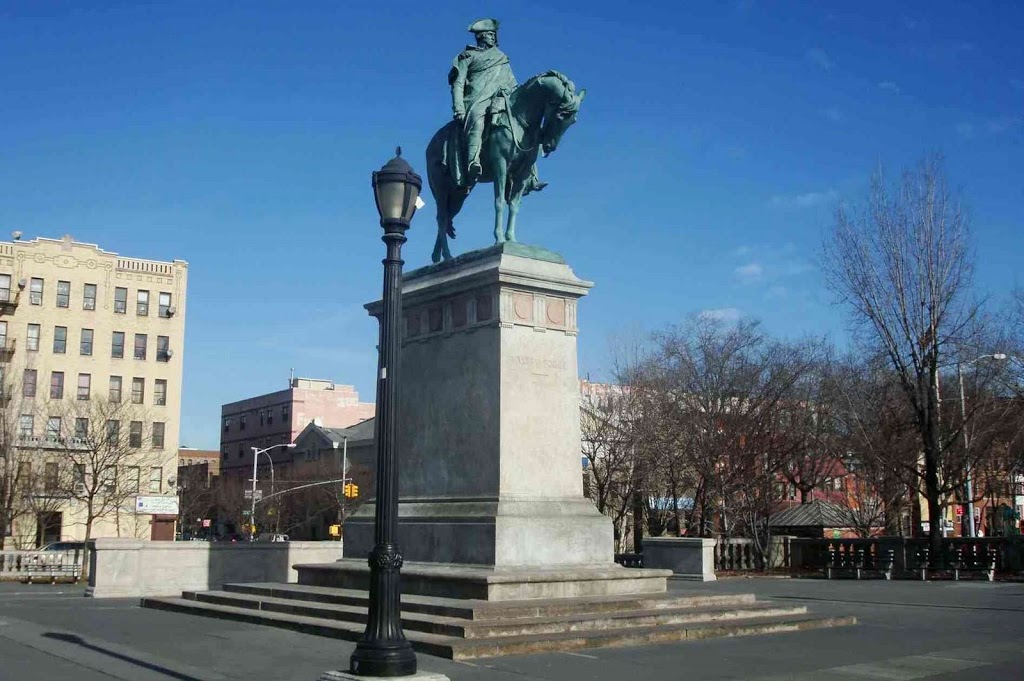
Continental Army Plaza, now overlooking the entrance and exit ramps of the Williamsburg Bridge. An engraving in the sidewalk points towards Valley Forge. The statue and the plaza were installed shortly after the opening of the bridge. So, in fact, this has pretty much always been George’s view.
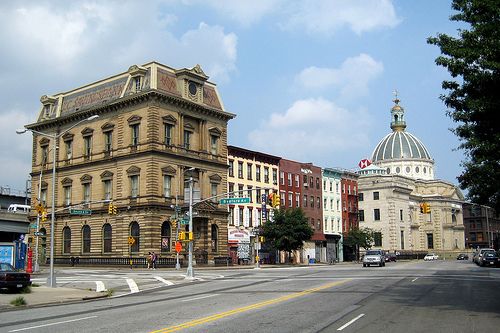
Two gorgeous examples of Williamsburg’s opulent past — the Kings County Savings Bank (built in 1868!) in the foreground, and the George Post’s domed Williamsburgh Savings Bank in the distance. (pic courtesy Flickr)
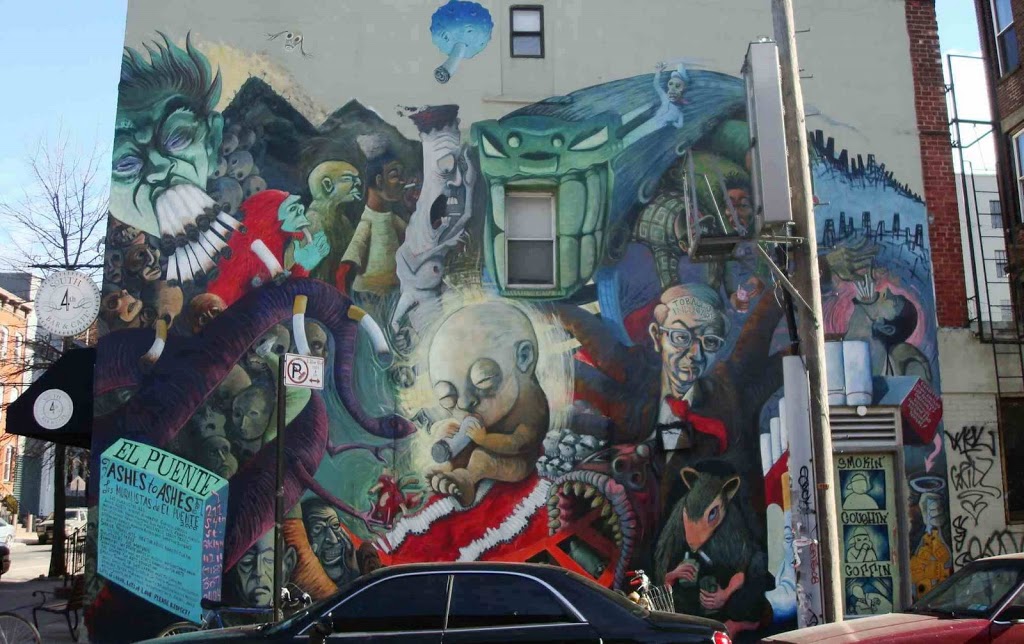
A mural just north of the bridge. Don’t smoke, kids!
A famous depiction in its own right, this is of Jenny Lind inside the Castle Garden auditorium:
Castle Clinton as Emigrant Depot
Castle Clinton as the New York City Aquarium in 1906
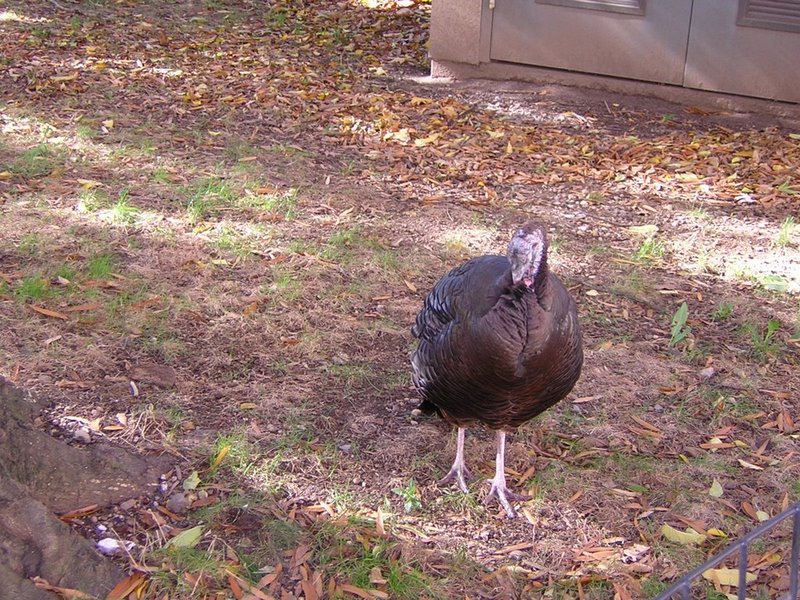
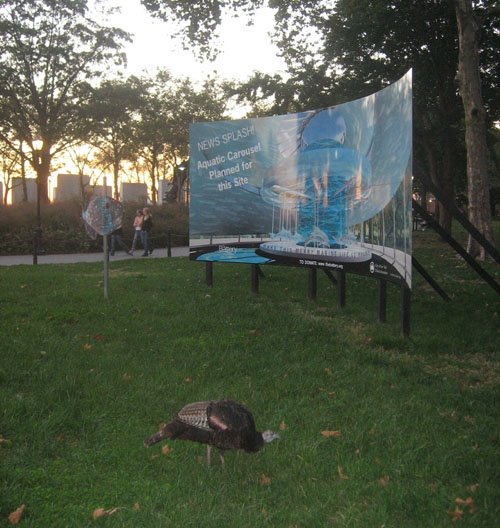
In our podcast, we mention many of the great monuments and statues of Battery Park. What we failed to mention is one of Battery Park’s most treasured features … Zelda the turkey!
Yes, that’s right, a turkey named Zelda lives in Battery Park and freely roams the lawn. She’s still there as far as I know (I last saw Zelda about four months ago). Hopefully she’s keeping warm for the winter.
(Above photo courtesy of Curbed)
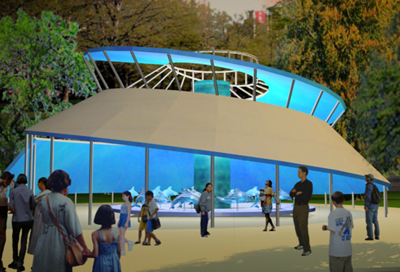
A fixture of future Battery Park — if the Battery Conservancy gets its way — will be a swanky new aquatic themed carousel, paying tribute to the former aquarium there.