The Bowery Boys Road Trip to the Hudson Valley mini-series, exploring stories of American history along the Hudson River, is now complete. Catch up on all three episodes — and join us on Patreon for a special ‘behind the scenes’ episode:
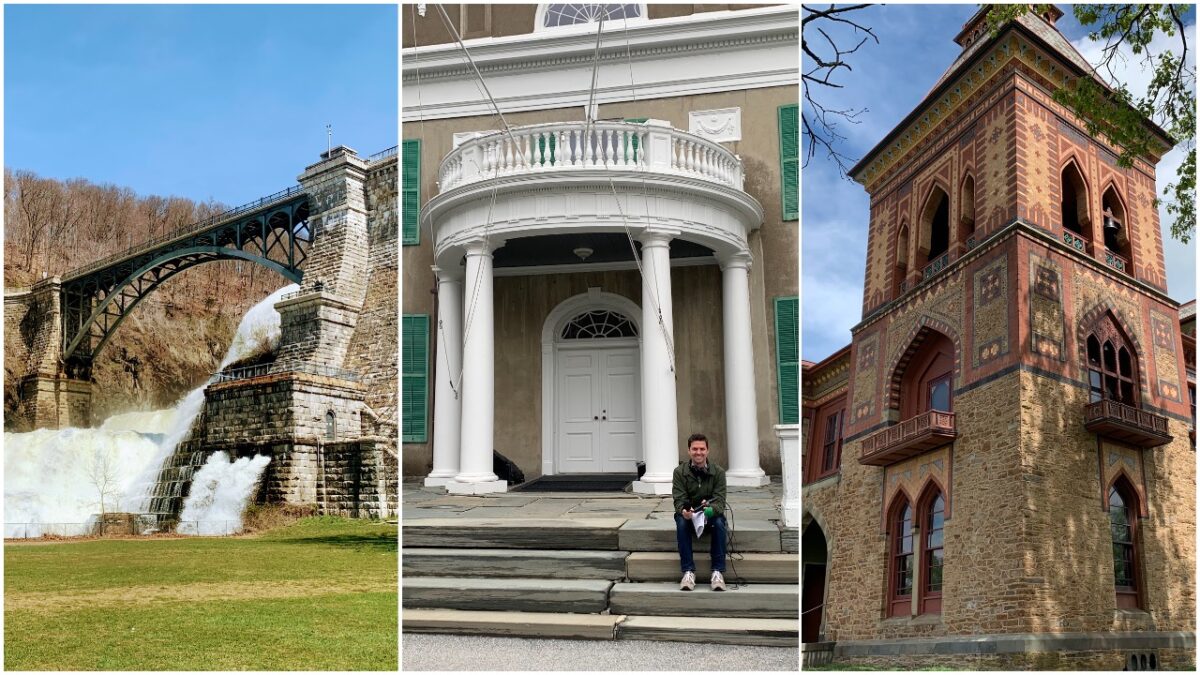
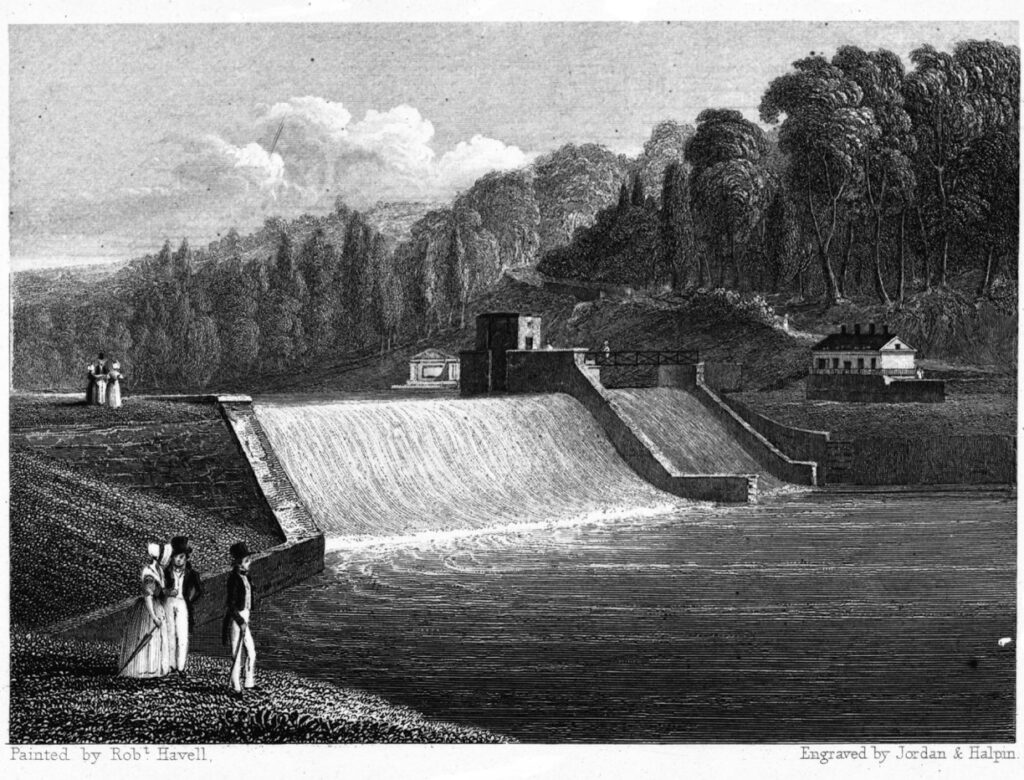
On the Trail of the Croton Aqueduct
Welcome to the Old Croton Aqueduct Trail, 26.5 miles of dusty pathway through some of the most interesting and beautiful towns and villages of Westchester County.
But this is more than a linear park. The trail runs atop — and sometimes alongside — the original Croton Aqueduct, a sloping water system which opened in 1842, inspired by ancient Roman technology which delivered fresh water to the growing metropolis over three dozen miles south.
Locations featured: New Croton Dam, the Double Arch Bridge in Ossining, the Keeper’s House in Dobbs Ferry
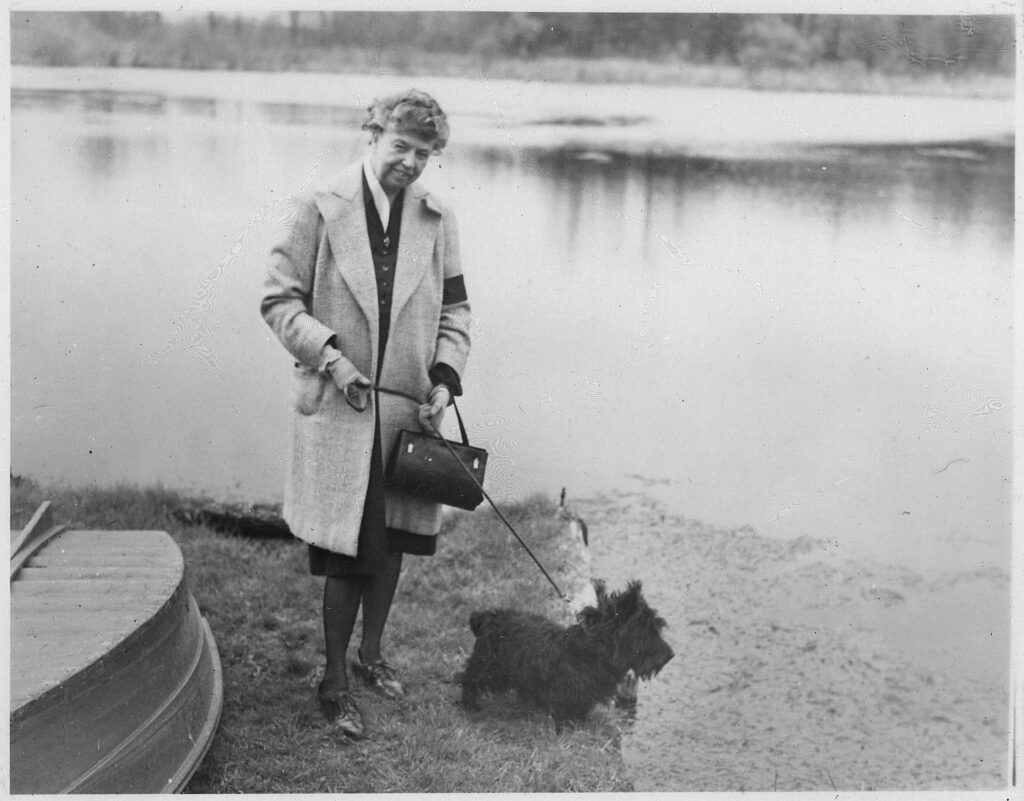
Hyde Park: The Roosevelts on the Hudson
Hyde Park, New York was the home of Franklin Delano Roosevelt, the 32nd president of the United States. He was born here, he lived here throughout his life, and he’s buried here — alongside his wife Eleanor Roosevelt.
But it was more than simply a home.
The Hyde Park presence of the Roosevelts expands outwardly from the Roosevelt ancestral mansion of Springwood, over hundreds of forested acres from former farmlands on the eastern side to the shores of the Hudson River on the west.
Locations featured: Home of Franklin D. Roosevelt National Historic Site, FDR Presidential Library and Museum, Top Cottage, Val-Kill Cottage, all in Hyde Park
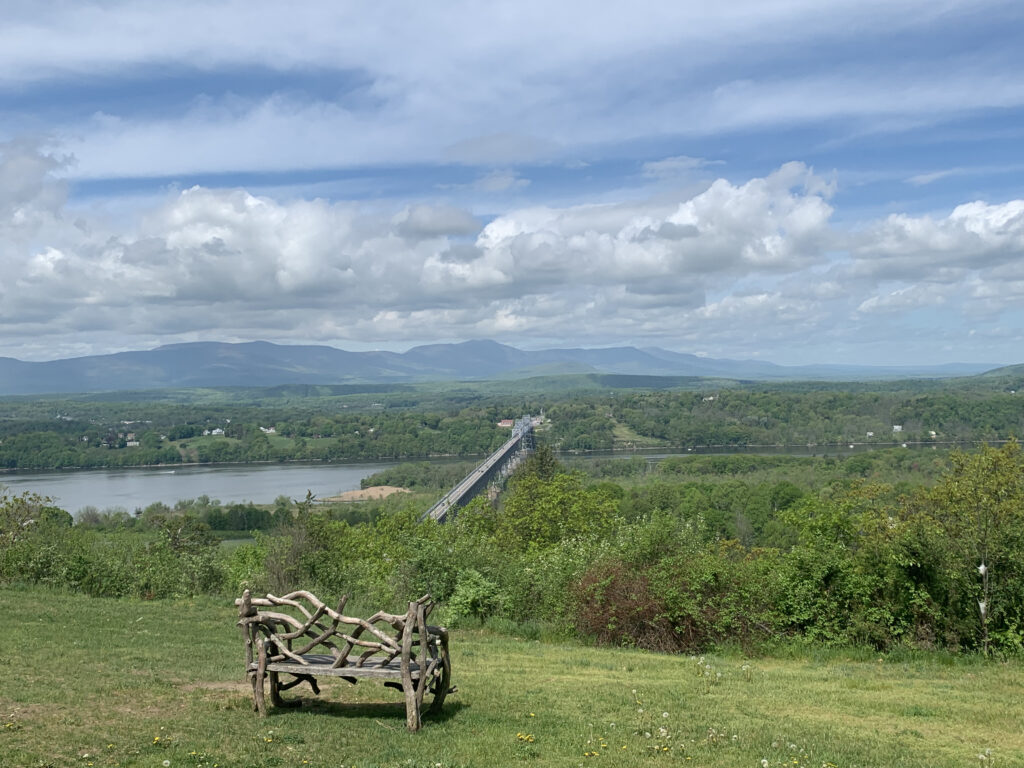
The Hudson River School: An American Art Revolution
Two landmarks to American art history sit on either side of the Rip Van Winkle Bridge over the Hudson River — the homes of visionary artists Thomas Cole and Frederic Edwin Church.
Cole and Church were leaders of the Hudson River School, a collective of 19th century American painters captivated by natural beauty and wide-open spaces. Many of these paintings, often of a massive size, depicted fantastic views of the Hudson River Valley where many of the artists lived.
Locations featured: Thomas Cole National Historic Site in Catskill, Olana State Historic Site in Hudson
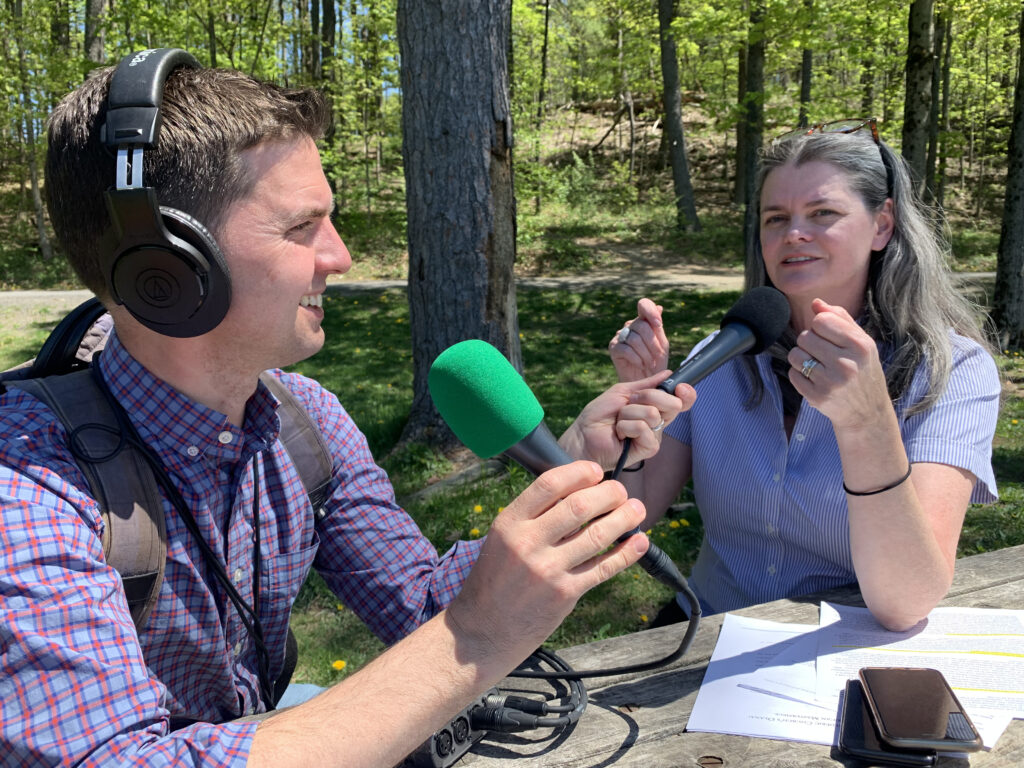
Tom interviewing Amy Hausmann of the Olana State Historic Site
Road Trip to the Hudson Valley: Aftermath
In this Patreon exclusive, Greg and Tom look back on their adventures in the Hudson Valley and give you a behind-the-scenes look at their journeys along the Croton Aqueduct Trail, Hyde Park and the towns of Catskill and Hudson.
PLUS: Some tips on how to make these trips yourself this year.
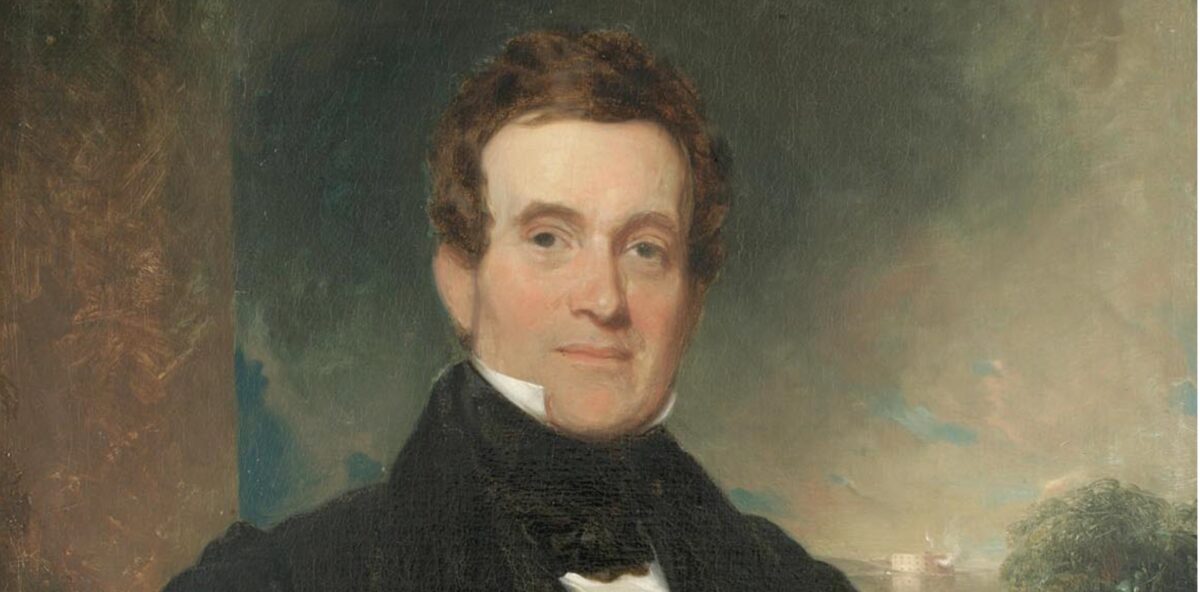
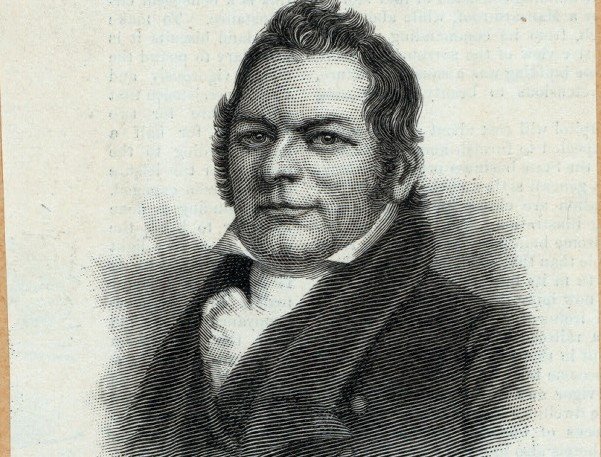
Aaron Clark, from his official City Hall portrait, painted by Henry Inman. Courtesy NYC City Hall
New York City has a new mayor — Eric Adams! So we think it is time that you Know Your Mayors, becoming familiar with other men who’ve held the job, from the ultra-powerful to the political puppets, the most effective to the most useless leaders in New York City history.
This longtime feature of this website is being rebooted with new articles and newly researched and refreshed earlier entries in this series. Check back every other week for a new installment. Read past articles here.
Mayor Aaron Clark 1837-1839 (two one-year terms)
Aaron Clark has many claims to fame in New York City history, none of them really things that recommend him as a defining leader of our city. His most defining characteristic was that he was often very lucky.
Clark is the first mayor ever elected representing the anti-Democrat, anti-Andrew Jackson Whig Party — a political party abolished less than 20 years after Clark’s victory.
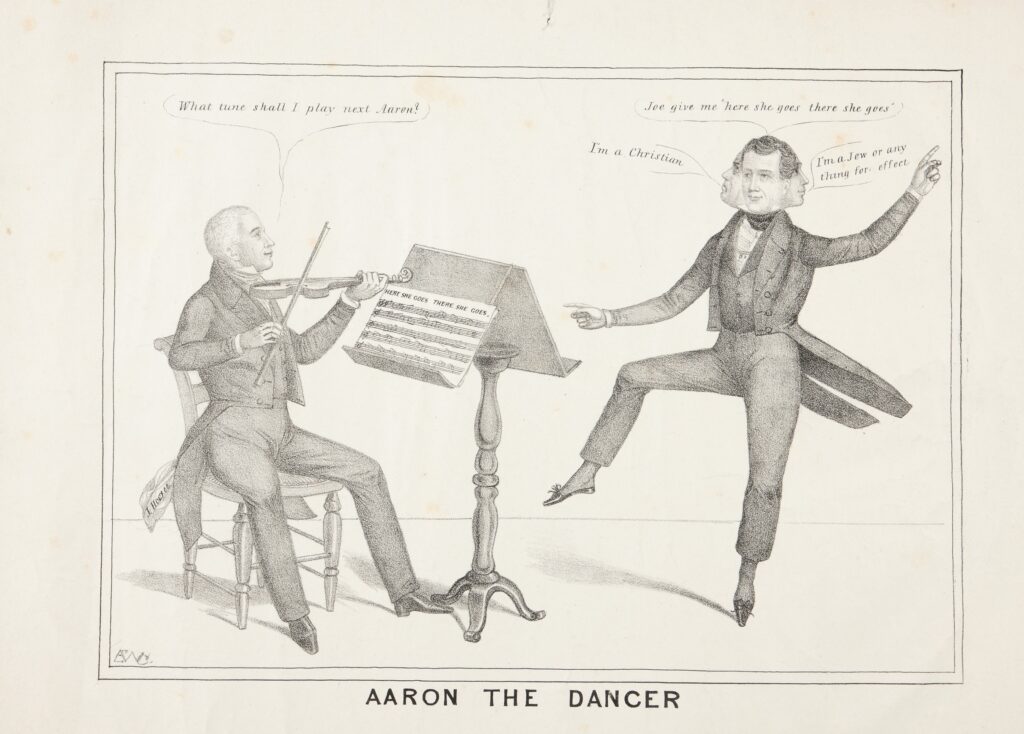
He was known as the ‘Dancing Mayor’, which was not an accomplishment but a mockery.
He called himself the New York’s most prestigious lottery operator, which he considered an accomplishment but was perceived by some as a disqualification.
And finally he was elected amidst one of the worst financial crises in its history– the Panic of 1837.
Previously on ‘Know Your Mayors’
Clark, perhaps more honorably, was also the second man to ever be popularly elected as mayor of New York, i.e. chosen directly by the people of the city.
Previously, the position was selected by the Common Council (city council), district representatives who often chose men beholden to their whims.
When the state finally changed mayoral selection to one of popular election in 1834, the result caused violence at the polls and mass pandemonium. (See the last installment.) Cornelius Lawrence would come out ahead for three consecutive one-year terms.
Lawrence had been a candidate of Democratic machine Tammany Hall — with their influence, who else would be the first mayor? — but Democrats were facing strong opposition from an ascendent Whig party.
In fact, the Whig candidate in 1834, Gulian Verplanck, very nearly won; the animosity between the Democrats and Whigs was so contentious that right before the election, Tammany thugs stormed their opponents headquarters, destroyed everything inside and even killed a man.
During Lawrence’s tenure, the Whigs remained strong as the Democrats got weaker.
In a situation which certainly has some reflection in current national events, Tammany was split between conservative and liberal factions (an ‘Equal Rights’ faction, as they called themselves).
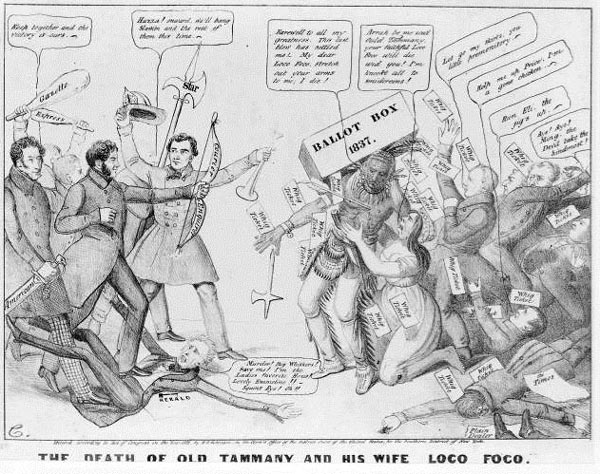
During a Tammany meeting in 1835, the Equal Righters stormed a Tammany committee meeting loaded with conservative members and threw them out.
When the lights were turned out on the party-crashers, they lit Spanish matches or ‘loco-focos‘ and continued. The opposition, which would eventually run the conservatives right out of the party, would forever be known as the Locofocos. (For more on their particular beliefs, read here.)
How Luck Elected A Whig Mayor
So what does this have to do with Whig man Aaron Clark? At another period in history, Mr. Clark might never have gotten to experience life in City Hall.
But the dissention within the Democrats opened the door for the fleeting Whig party to reign briefly in New York. With that sort of luck, it’s no surprise to learn that Clark’s primary occupation up to then was as operator of a lottery business.
Privately-run lotteries were, believe it or not, quite common in early American history.
King’s College (today’s Columbia University) was founded with a lottery pool. A young P.T. Barnum operated one up in the 1820s. Benjamin Franklin and George Washington both held fund-raising lotteries in their day.
Even Alexander Hamilton opined that “everybody … will be willing to hazard a trifling sum for the chance of considerable gain.”
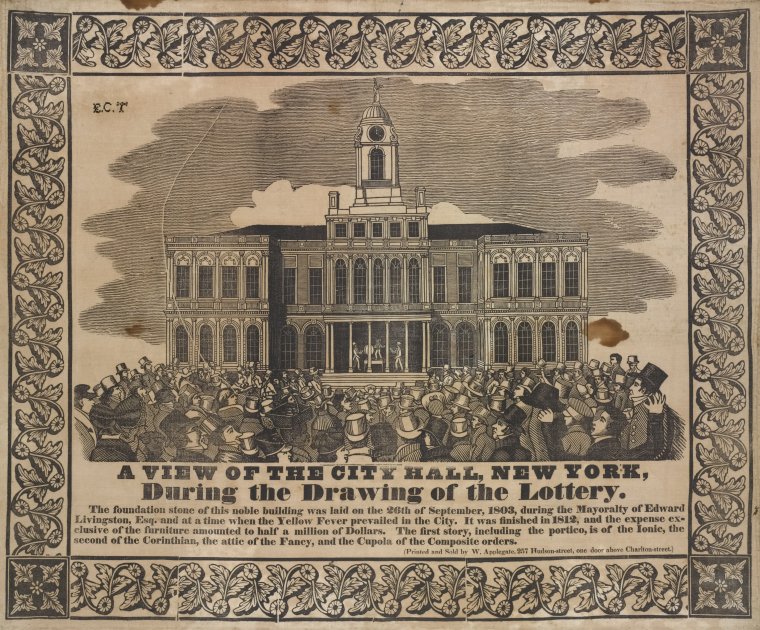
A view of the City Hall, New York, during the drawing of the lottery, New York Public Library
By the mid 19th century, private lotteries would be associated with more disreputable elements and would be abolished at the end of the century. Clark was thus a successful operator of an industry in the 1830s that would soon be looked upon as scandalous and unseemly.
“As lotteries, under certain regulations as to the drawings, which were had upon the esplanade in front of the City Hall, in the presence of an alderman, were authorized by law, there were many offices in the city, notably one at the southwest corner of Broadway and Park Place* kept by Aaron Clark, a much reputed citizen.”
*The Woolworth Building now stands on the spot where Clark’s business once stood.
“He was a great lottery seller and made a fortune of it,” says one source. A recollection from an 1890s New York Times article shortlists Clark as one of the “best known rich men” at the time.
Huzza for Clark, Fortune’s Favorite!
Clark was born in 1787 in Massachusetts, a veteran of the War of 1812, and spent his early years as a clerk of Albany state assembly.
He moved to New York to pursue banking and eventually fell into his lottery endeavors, becoming wealthy and, by extension, highly suitable for early 19th century public office. Clark was soon elected to an alderman’s seat, typically a neat launching pad into the mayor’s chair.
The Whigs announced him as their candidate in 1837 against the intensely split Democrats. Conservative Tammany ran John Jordan Morgan, while the Loco-Focos put up the interestingly named Moses Jacques, considered “the patriarchal leader of the Loco-Focos.”
Clark’s opponents certainly tried to use his occupation against him. Wrote William Leggett : “If we elect Aaron Clark for Mayor who knows but he may get up some ‘splendid scheme’ and insure ‘a grand prize’ to everyman who assisted in making him manager of the municipal lottery. Huzza for Clark, Fortune’s Favorite!”
The Evening Post repeated this nickname — Fortune’s Favorite — March 1837.
However Morgan and Jacques cleaved the opposition in two, and for the first time in New York history, on April 11, 1837, a Whig became mayor.
He then would be re-elected in 1838 when Tammany’s conservatives threw their support to him out of spite towards their liberal LocoFoco brethren. (There was apparently a shocking amount of fraud going about that year, which also helped matters.)
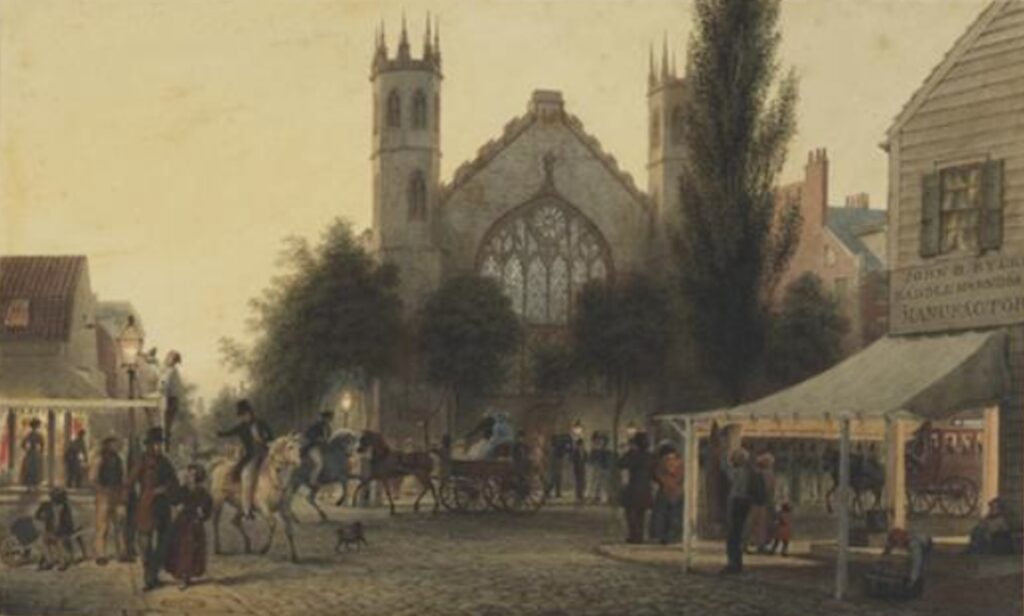
Night-fall. St. Thomas’ Church, Broadway, New York, a beautiful painting by George Harvey from 1837. (The Museum of the City of New York)
Fortune’s Favorite?
Clark was certainly the wrong mayor for the moment. He was an ardent Native American, meaning he generally despised the boatloads of Irish emptying into New York slums, driving “the native workmen to exile,” he said in a meeting to the Common Council.
His campaign was openly hostile to ‘clannish’, ‘untrustworthy’ Irishmen, and his tenure as mayor only stirred up xenophobic sentiments. He advocated for keeping new immigrants on ships, directing them away from city and charging them ‘commutation fees’ of $10.
Clark aimed his racial paranoia at the lower classes at large, fearing that the charity organizations already in place were turning the city “into a rendez-voux of beggars, paupers, vagrants and mischievous persons,” according to the book Gotham.
One general benefit of this alarming hysteria was an improvement to the system of nightwatchmen and security patrols throughout the city, a “military arm” to assuage rioting and general chaos. Clark was no light-weight; he would frequently lead these local militias through the city himself, breaking up rabble-rousing groups.
The Unfortunate Fop
Most unfortunately, however, Clark’s charms were limited. His attempts to woo over New York’s elite in a series of parties at his home on Broadway and Leonard Street fell flat.
This type of social governance was a winning recipe for mayors like the honorable Philip Hone. As mentioned in a prior installment of this column, Hone’s parlor “hosted a nightly gallery of political and foreign dignitaries mixing it up with New York’s social strata.”
Clark, however, was roundly ridiculed for attempting such grand ‘entertainments’. In fact, in an early form of political snark, Clark was ironically called ‘the Dancing Mayor’, not for his graces assumably or even the class of his “splendid patent leather pumps” but for his pretensions of trying too hard.
Also on his watch, the Croton Aqueductcontinued apace although its workers went on strike not once but twice in 1838 for better wages.
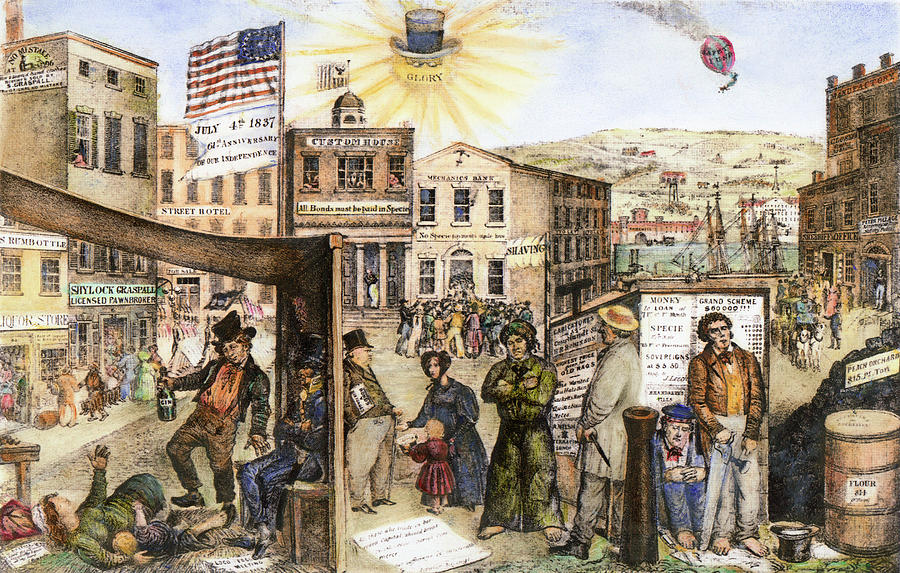
He also governed the city through the beginning of a grueling financial crisis, known today as the Panic of 1837.
Not even a month into Clark’s first term, on May 10, 1837, New York City banks ran out of gold and silver, having loaned out too much due to months of high inflation. President Jackson had hollowed out the central bank and refused to recharter it, leading to bank collapses across the country.
“During the Panic of 1837, approximately ten percent of U.S. workers were unemployed at any one time. Mobs in New York City raided warehouses to secure food to eat. Prominent businessmen, like Arthur Tappan, lost everything.” [source]
The Panic froze real estate developments across the city. Construction projects in Union Square and Gramercy Park sat unfinished.
“A deadly calm pervades this lately flourishing city,” wrote former mayor Philip Hone in his diary. “No goods are selling, no business stirring, no boxes encumber the sidewalks of Pearl Street.”
A Different Kind of Prize
It became clear that Clark was out of his depth. Two years of a Whig in office — with the tide of immigrants hardly abating — was quite enough.
In the election of 1839, Tammany put up Isaac Varian, who had been defeated the year previous by his political machine’s fractious split. Despite the usual cries of fraud, in this round Varian was the victor. Clark’s luck, if that’s ever what it was, had run out.
During its first year, The Clark Prize had eight competitors. “It is expected that the exercises will be unusually interesting and attractive,” claimed one article.
When Clark died in 1861, he was buried right here in the city, at the old New York Marble Cemetery in the East Village. The gates to this historic burial ground are occasionally opened to the public so I recommend bringing a lottery ticket to his headstone.
We’re just a couple months away from a new mayor in New York City so we think it is time that you Know Your Mayors! Become familiar with other men who’ve held the job, from the ultra-powerful to the political puppets, the most effective to the most useless leaders in New York City history.
This longtime feature of this website is being rebooted with new articles and newly researched and refreshed earlier entries in this series. Check back every other week for a new installment. Read past articles here.
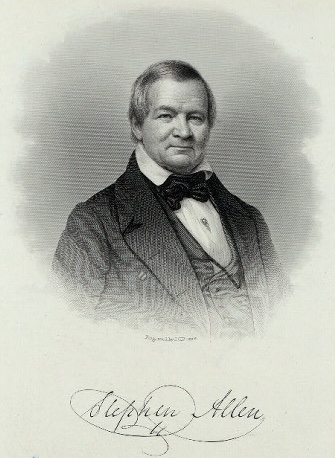
Stephen Allen Terms: 1821-1824
There once was a time when New Yorkers were told who their mayor was going to be. The power was all at the state level.
Imagine Governor Kathy Hochul with the power to install who she chose, or worse, a handful of Albany insiders entirely beholden to special political interests.
Governor In Charge
For most years until 1821 — and through all previous entries in the rebooted Know Your Mayor series — this was precisely the manner in which New York City adopted its mayors every year.
The Council of Appointments, four specially selected state senators, were in charge of hundreds of yearly state and local appointments, approving and (just as often) altering the wishes of the governor.
Those appointed to the job were either prominent citizens, figureheads, or politicians with strong connections to the governor. (And in the case of DeWitt Clinton, the actual nephew of a governor.)
From 1783 to 1821, the governors of New York were George Clinton, John Jay,George Clinton (again), Morgan Lewis, Daniel D. Tompkins and John Tayler (who served briefly after Tompkins became Vice President of the United States under James Monroe).
And at the time of our story in the summer of 1821, DeWitt Clinton had assumed the position of New York governor.
“The mayor of all cities in this state shall be appointed annually by the common councils of their appointed cities.”
Among its changes were a new method of choosing a mayor — still appointed, but by the city’s Common Council (or city council).
Citizens voted for the aldermen who then, among their membership, voted on who would become mayor — indirect, imperfect, but seen at the time as a great step forward. It would not be until 1834 that New Yorkers could directly vote for a candidate.
But one peculiar trait of the mayor’s job was carried over — “annually.” In fact mayors would continue to serve one-year terms — sometimes serving consecutive one-year terms — until the year 1849.
New York Public Library
Allen Sets Sail
For their first appointment, city leaders did not stray from the successful formula of choosing one of the wealthiest, well-connected businessman among them.
In 1821, Stephen Allen became the first mayor appointed by the Common Council, ‘chosen’ by the people because he had first been elected to the council in the first place.
Allen was an inspired candidate, a self-made success story with roots in the American Revolution.
According to an 1848 biographical ‘sketch book’, Allen “affords another instance of what may be accomplished without money, without family connexions or friends. Mr. Allen commenced life, it is said, as a poor sailor boy.”
He was born in New York in 1767 and remained here with his family through the British occupation during the Revolutionary War.
New York Public Library
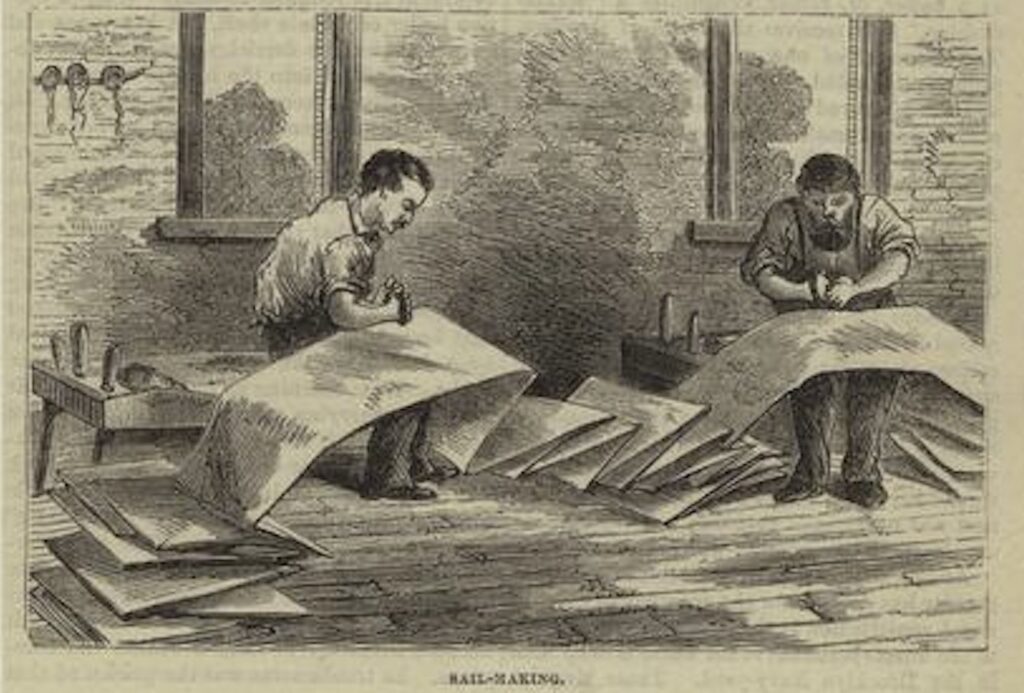
During that time he became an apprentice to a British Tory sail maker when he was only 12 years old. Times were rough for young Stephen in the stressed, over-crowded city; he lived with several other apprentices in a tiny ‘sail loft’, eating only bread and butter for supper.
The Continental Army couldn’t have won the war fast enough to young Allen’s liking.
A teenage Allen was witness to Washington’s return to the city in November 1783: “This was a happy day for the real friends of America and it was celebrated accordingly by young and old, particularly by those who had left the city at the commencement of the troubles and had now returned for the first time from an exile of eight long years.”
Allen worked his way into the sailmaking partnership of Hillson and Allen by age 22. Disgruntled with his partner’s lack of business acumen which, in his own words, tended to “irritate and promote altercation,” Allen launched his own sail-making business by the age of 30.
With the war ended, the British gone and New York becoming the dominant American port, Allen soon became one of the city’s wealthiest artisans by the 1810s.
As a member of the Tammany Society — he would eventually become grand sachem — he transitioned seamlessly into local politics, first as a member of the Common Council in April 1817 then finally as their first appointee for mayor in 1821.
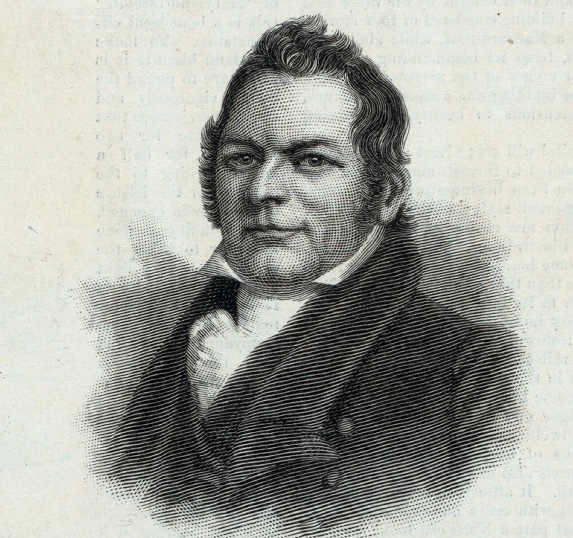
Allen in later years. Courtesy New York Public Library
Water Troubles
For a man who made his fortunes from sails, it’s not surprising that his primary concern as mayor was water.
Clean drinking water was a scarcity; the city’s previous source for fresh water, Collect Pond, had been levelled just years due to pollution from local industry. What would replace it?
Allen’s focus on water was no paltry obsession. The city again faced smallpox and cholera epidemics and the mayor knew the problem would only get worse as foreign vessels came to dock at the city ports.
“Allen immediately turned his attention to the communicable qualities of the disease, focusing on sani- tation and quarantine laws. He questioned whether it made sense to quarantine foreign ships before they docked, while at the same time bringing the ships’ goods to the city’s wharves without inspection.”
He headed a committee that sought additional sources of drinking water, eventually focusing on Rye Pond in the future borough of the Bronx, and a potential canal to be built in Westchester.
Allen and the council were raring to move forward, but state bureaucracy, yellow fever outbreaks and focus on the Erie Canal would delay the development of a viable aqueduct for many years. It would take many more years for the city to get the Croton Aqueduct water system.
Allen also made a significant impact on New York’s prison system as a member of a state committee that inspected conditions at the first state prison in Auburn, New York. Their evaluations eventually led to the construction of Sing Sing prison.
He left office after three years as mayor, but he didn’t leave politics or Tammany behind, eventually becoming a state senator and helping raise money to build the first Tammany Hall.
Tragedy
He spent his latter days at home on Washington Square, but tragically, he did not end up dying peacefully in bed here as other future mayors would do.
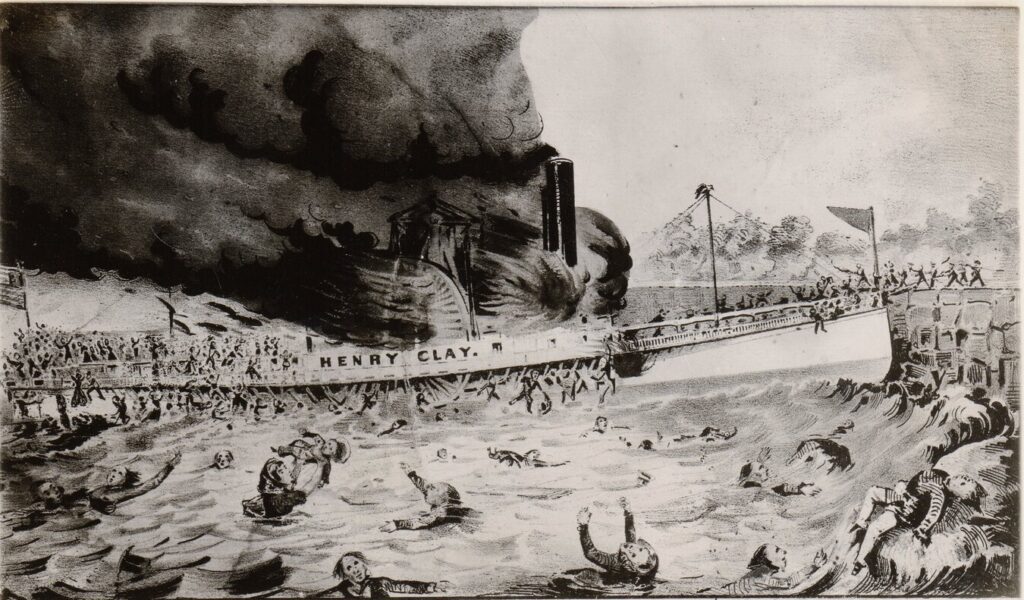
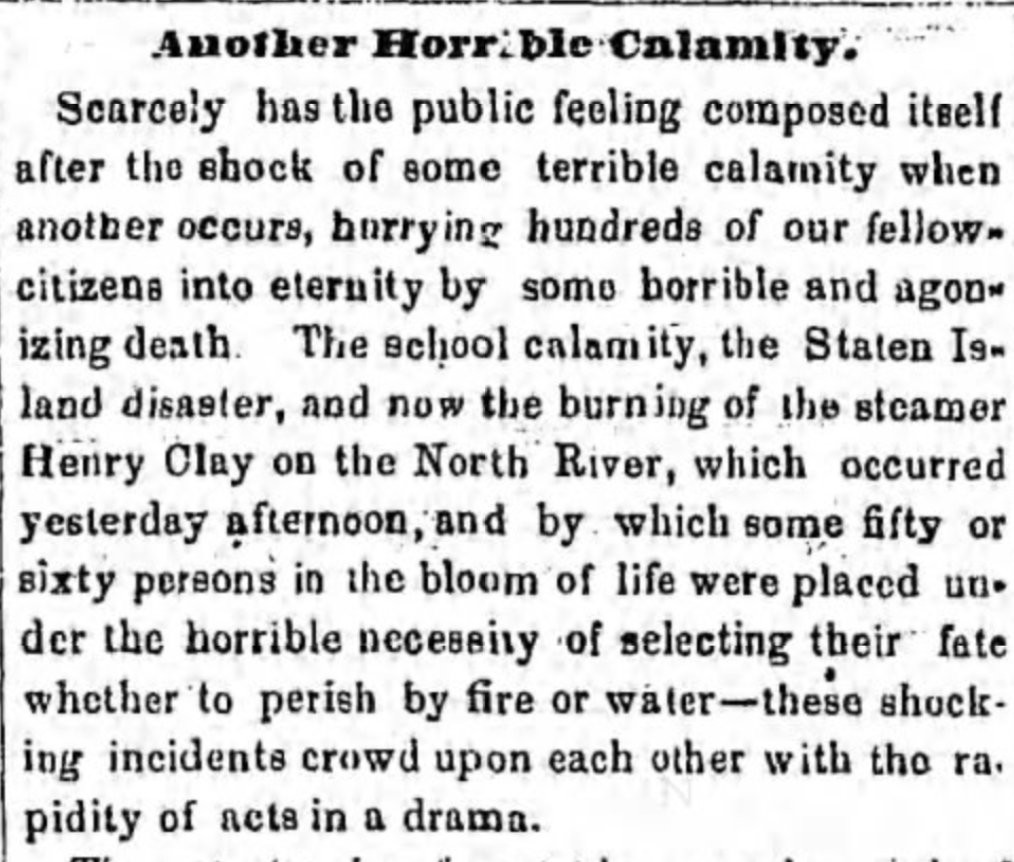
He was aboard the steamship Henry Clay in July 28 1852 when, after an ill-advised race with another vessel, it caught fire and crashed on the Hudson River, killing dozens of passengers.
The terrible tragedy has drawn comparisons to the Titanic disaster as many who perished were well connected New Yorkers including Nathaniel Hawthorne’s sister Maria Hawthorne, famed landscapist Andrew Jackson Downing — and, sadly, our former mayor Allen.
From the Daily Eagle, July 31: “One of the peculiarities of the late steamboat disaster is the havoc which it made among persons widely known and greatly esteemed. We do not recollect any other catastrophe so remarkable in this respect.”
A slip of paper was allegedly found in his pocket, a list of thoughtful and hearty maxims which Allen read over “at least once a week.” Among his list:
— “Keep good company or none. Never be idle. If your hands cannot be usefully employed attend to the cultivation of your mind. Always speak the truth. Make few promises.”
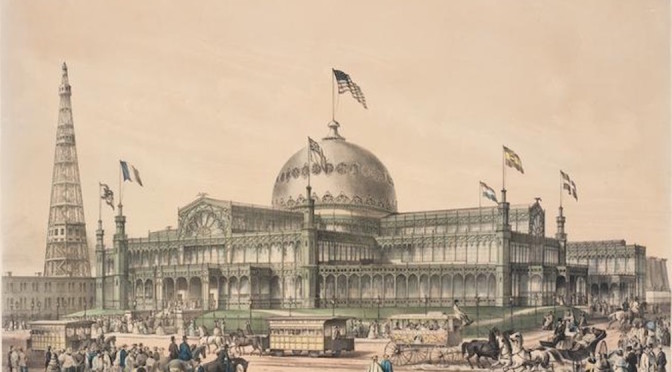
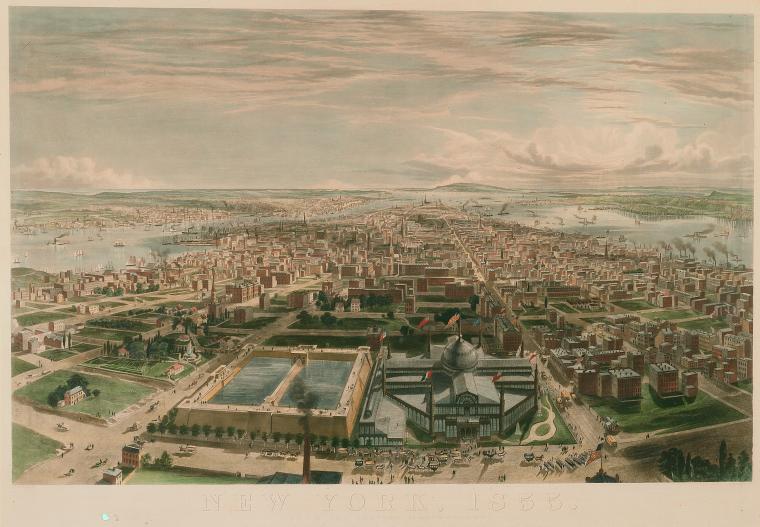
Crystal Palace, 1853, Palmer and Currier Courtesy Museum of the City of New York
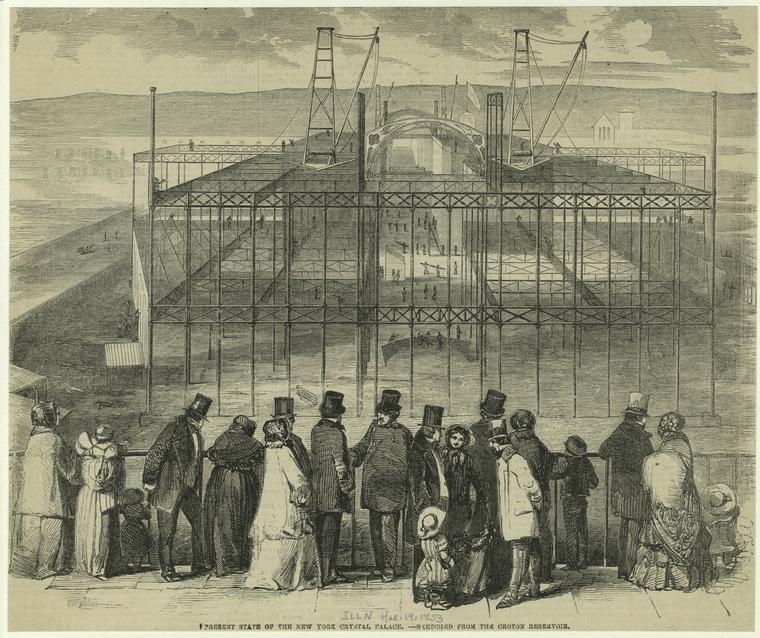
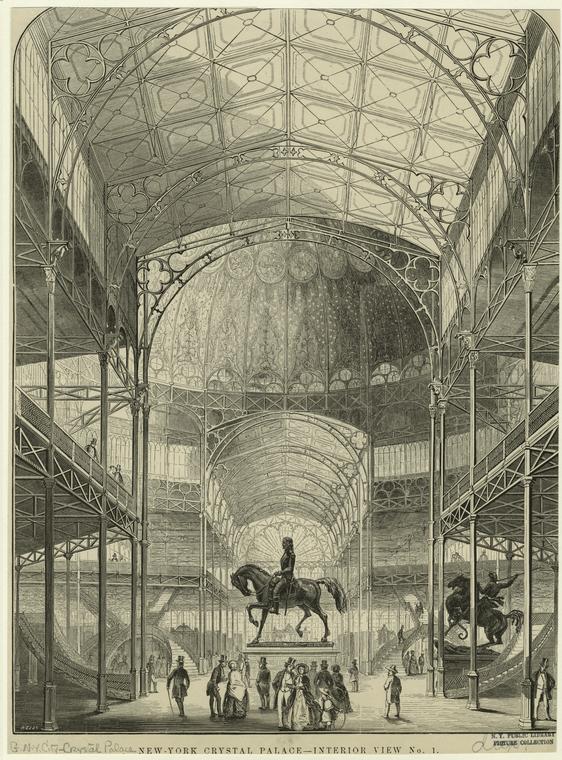
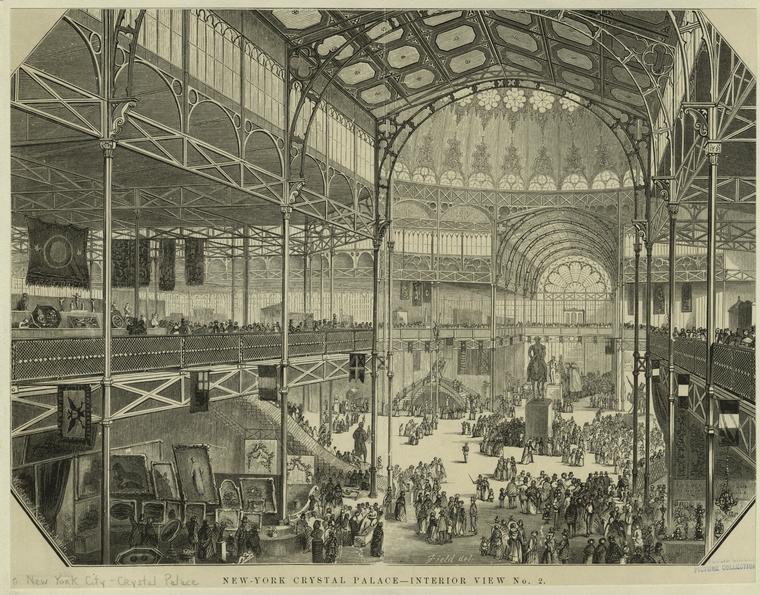
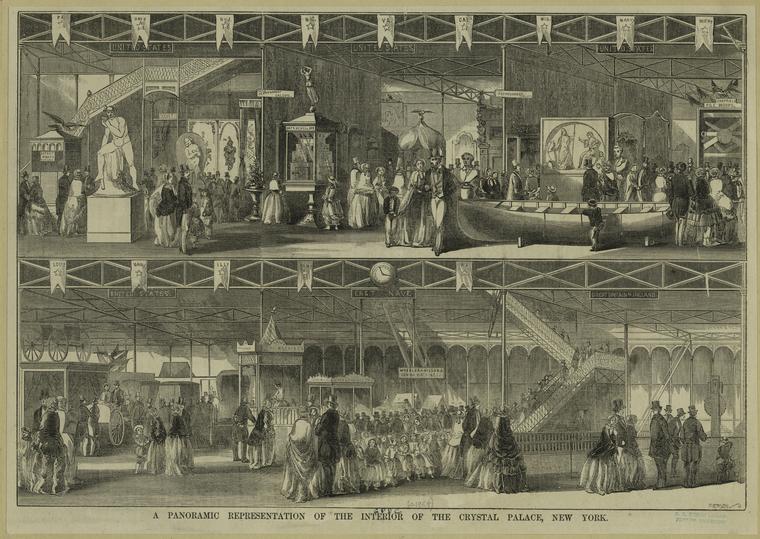
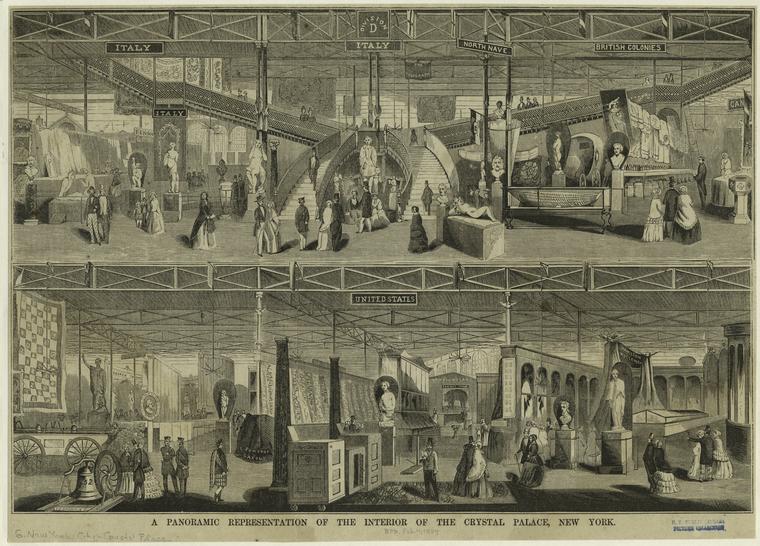
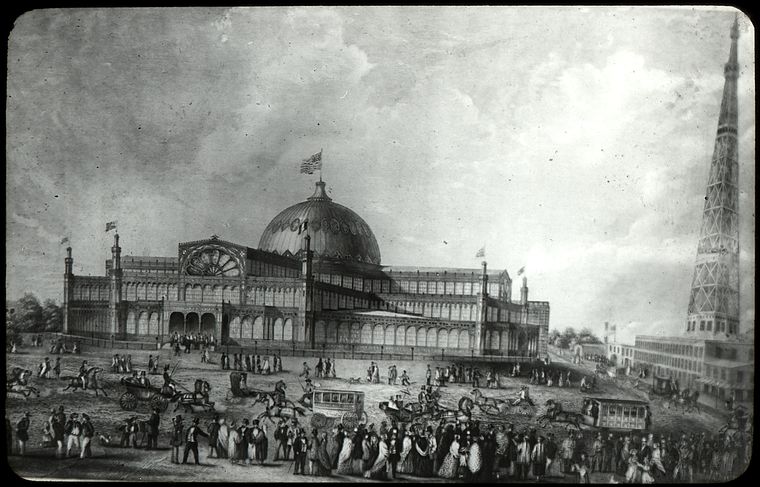
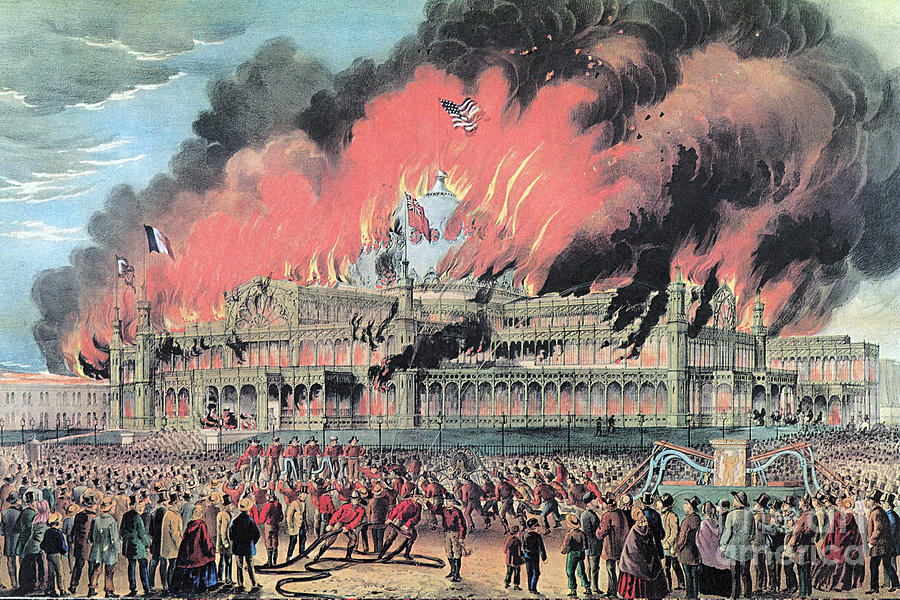
PODCAST New York’s Crystal Palace seems like something out of a dream, a shimmering and spectacular glass-and-steel structure — a gigantic greenhouse — which sat in the area of today’s Bryant Park. In 1853 this was the home to the Exhibition of the Industry of All Nations, a dizzying presentation of items, great and small, meant to exemplify mankind’s industrial might.
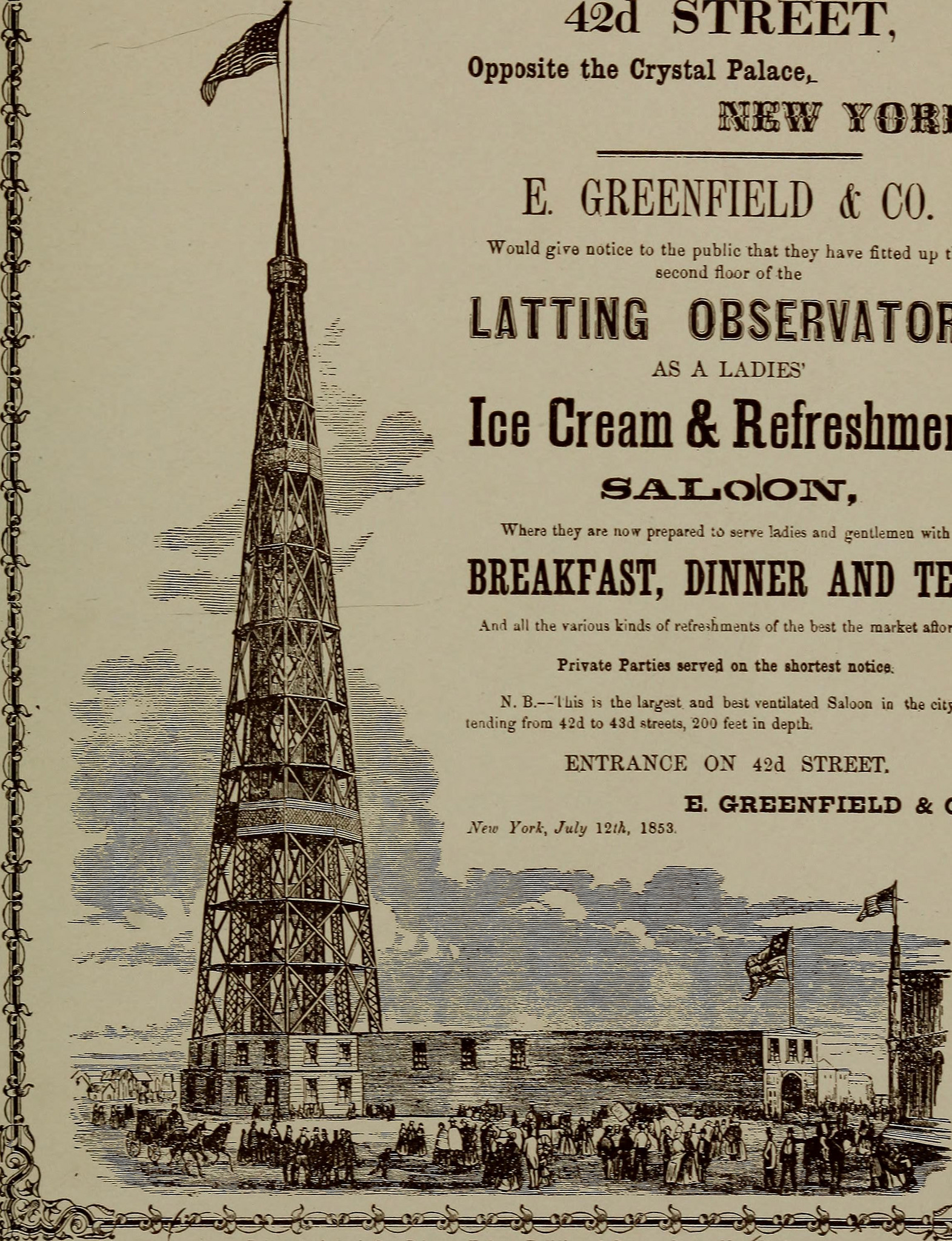
We take you on a breathtaking tour of the Palace and its legendary exhibition, including the Latting Observatory (the tallest building in New York!)
Whatever happened to the Crystal Palace? And what inventions contained within do we still benefit from today?
FEATURING: PT Barnum, Henry Ward Beecher, Elisha Otis and literally millions of items!
EDITOR’S NOTE – I mis-pronounced the name of the Fresnel light (actually pronounced fre-nell). Its modern ancestor is used in theatrical lighting today.
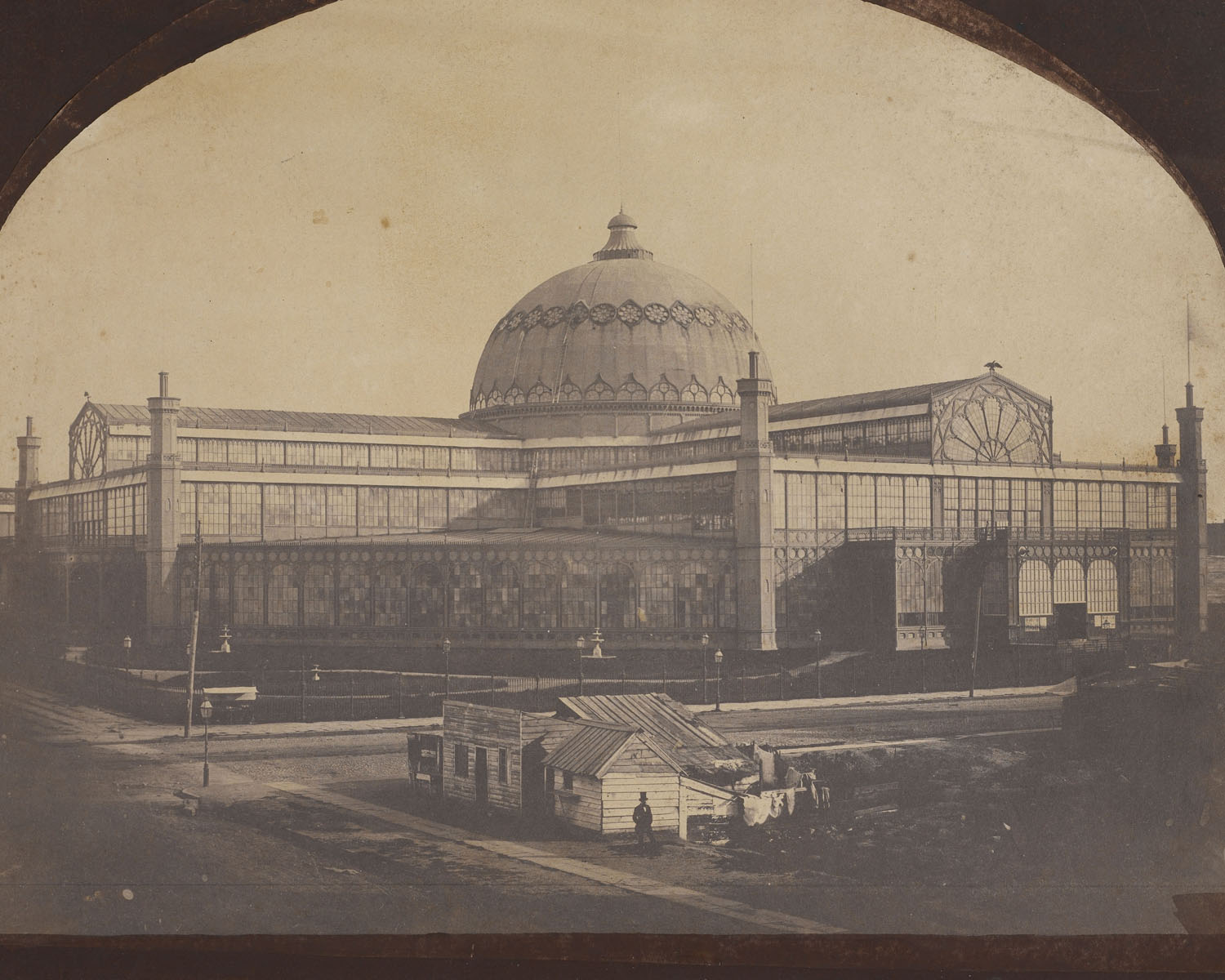
This is one of the earliest photographs of New York City ever taken. As the Crystal Palace hosted examples from the early days of photography, it’s no surprise that one of these early pictures is of the Crystal Palace itself.
A rare photograph of the New York Crystal Palace by Victor Prevost. Courtesy of the Avery Architectural & Fine Arts Library, Columbia University
A look into the pit surrounding the Crystal Palace during construction. There were many delays, somewhat sullying the lofty ambitions of the project at the very start. Courtesy New York Public Library
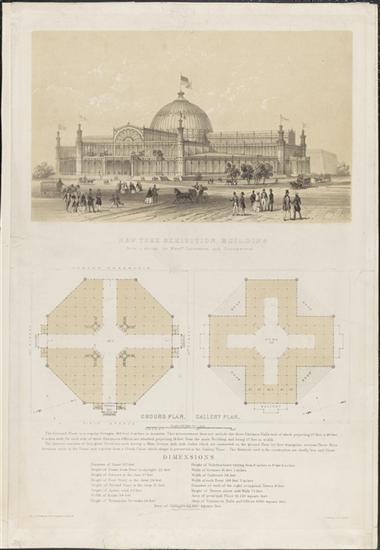
A very church-like plan of the Crystal Palace building by Petermann and Guildemeister. Courtesy Museum of the City of New York
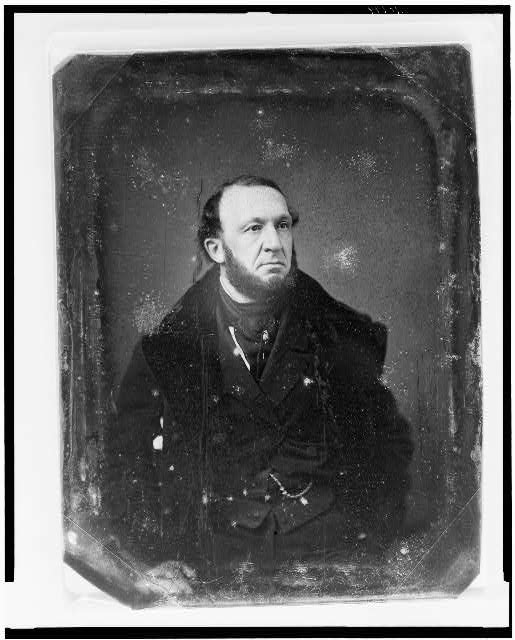
Theodore Sedgwick, who spearheaded the New York Crystal Palace — and bore some of the criticisms of the Exhibition’s rocky opening.
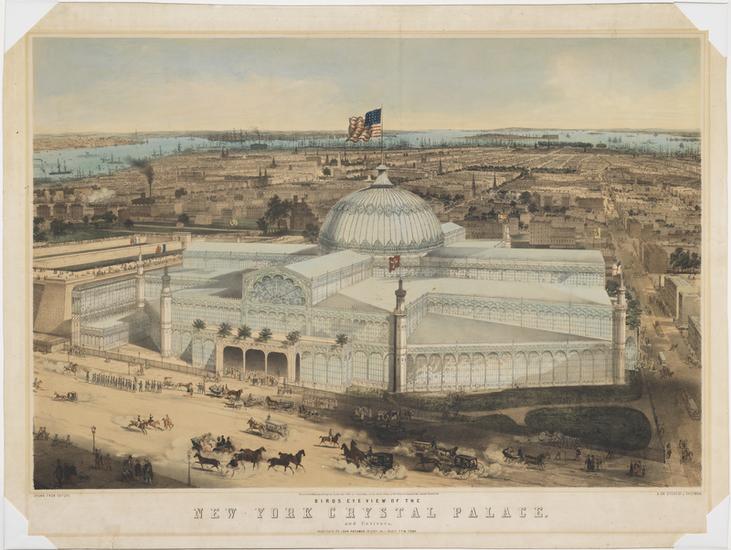
Birds Eye View of the New York Crystal Palace and Environs by John Bachmann. Courtesy the Museum of the City of New York
Illustration of the center of the Crystal Palace by J Wells. Courtesy New York Public Library
The view from one of the naves, looking towards the George Washington statue. Courtesy New York Public Library
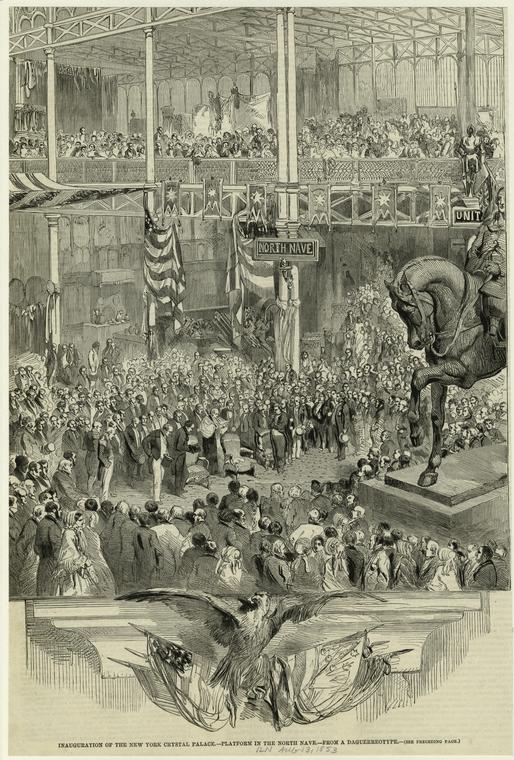
Another view of the inside, this time during the inauguration of the New York Crystal Palace in July 1853 — looking at a platform in the north nave. Courtesy New York Public Library
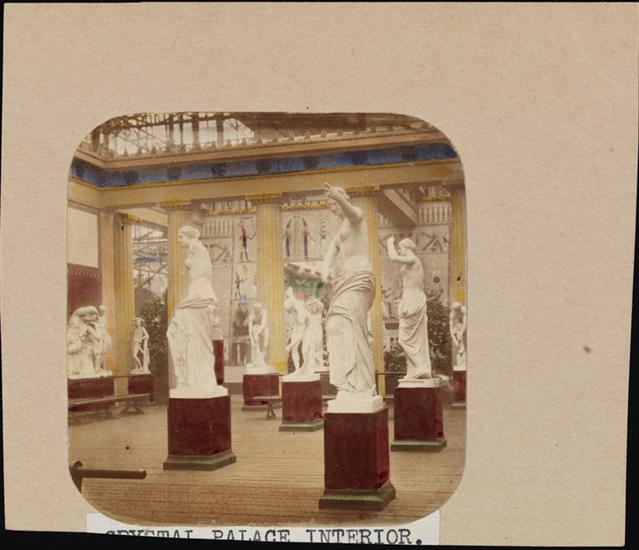
A hand-colored stereoscope of a selection of Crystal Palace statuary. There seems to be some kind of Egyptian thing going on in the background! Courtesy Museum of City of New York
Busts, tapestries, machinery, weapons and various finery! A couple illustrations of the different divisions. Just rooms and rooms of items! Courtesy New York Public Library
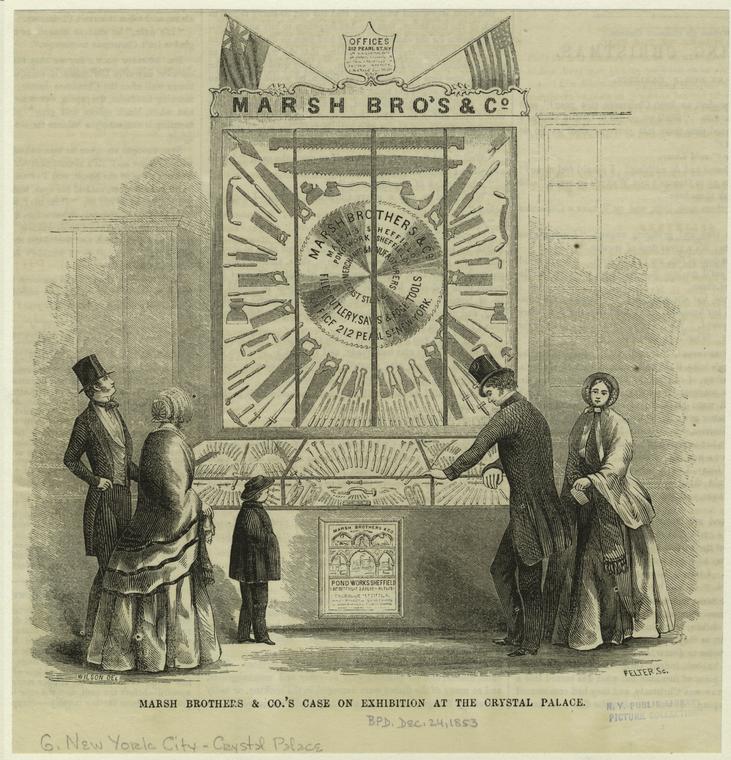
A selection of saws and tools from Marsh Brothers & Co. that one might have seen in the US section. Courtesy NYPL
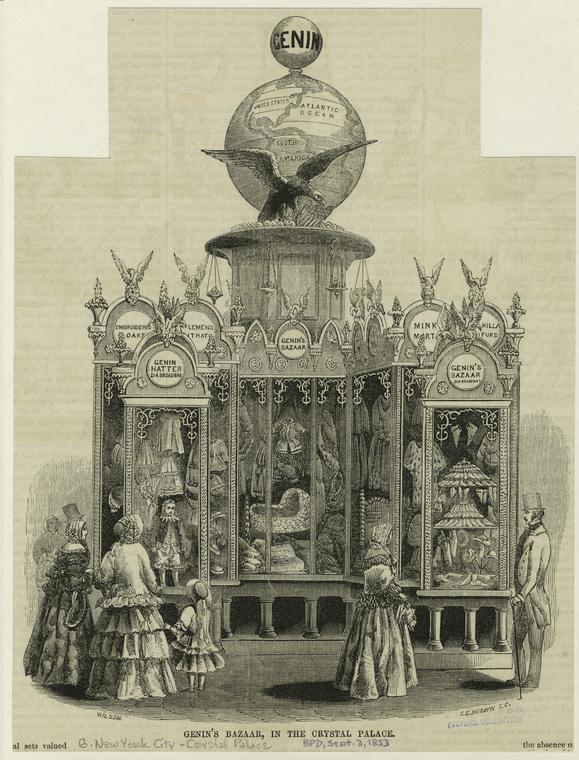
Genin’s Bazaar, containing items for the infant. Courtesy New York Public LIbrary
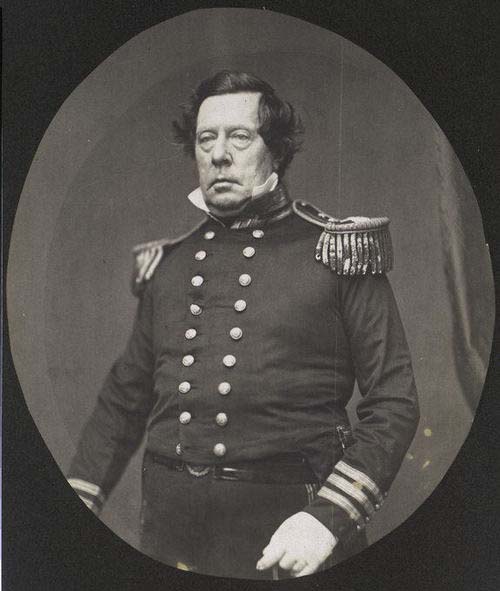
This photo of Commodore Matthew C. Perry was taken by Matthew Brady and displayed at the Crystal Palace, one of the first photographs many people may have seen!
A selection of saws and tools from Marsh Brothers & Co. that one might have seen in the US section. Courtesy New York Public LIbrary
This engraving shows the Latting Observatory in relation to the Crystal Palace, separated by 42nd Street.
A reprinted advertisement from Valentine’s Manual of old New York, outlining some of the charms of Latting Observatory
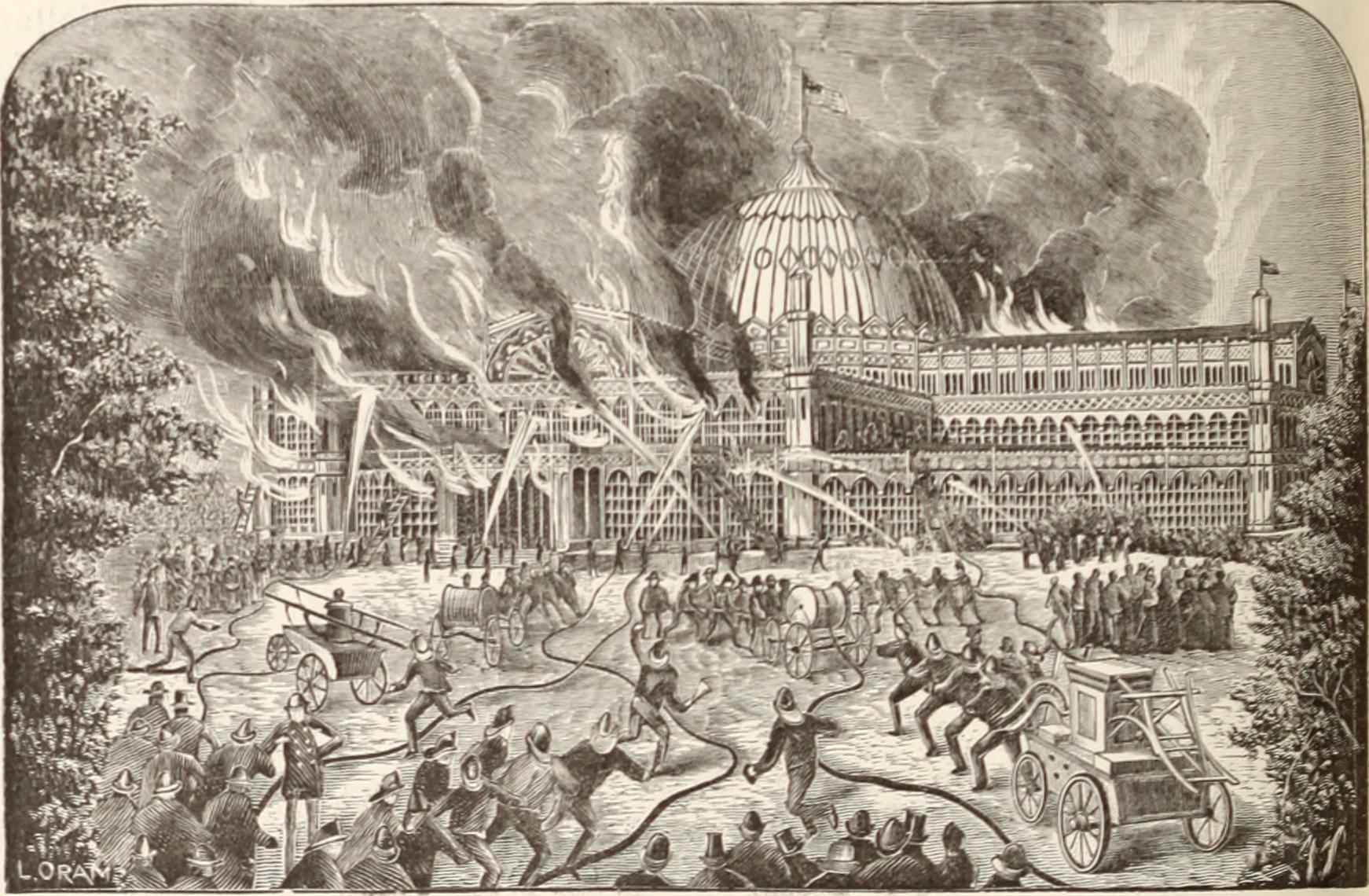
One of several illustrations of the Crystal Palace fire, a dramatic blaze that destroyed the building in under an hour.
An illustration from an 1887 book “Our firemen. A history of the New York fire department” Courtesy Internet Image Book Archives
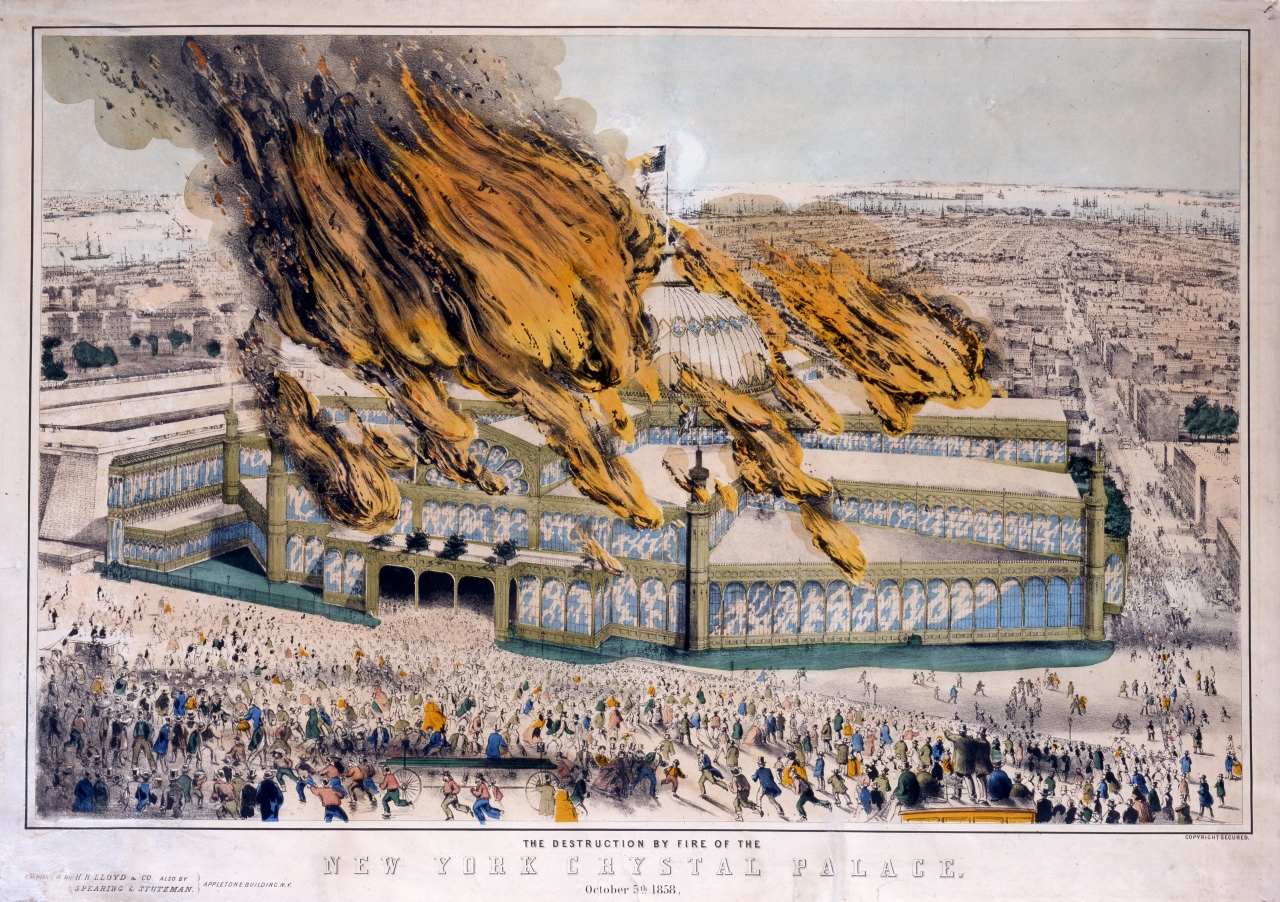
Another view of the blaze, in perspective to the rest of New York to the south. Couirtesy New-York Historical Society
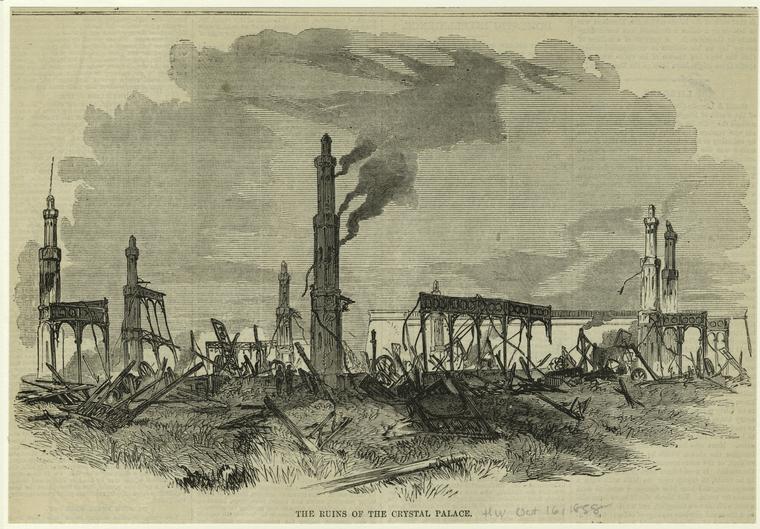
An illustration made in 1858, depicting the aftermath of the horrible fire that destroyed the Crystal Palace. NYPL
Some original documents that you may enjoy reading:
NOTE: This article has a few plot spoilers but no major twists are revealed or discussed. I’ve tried to write the descriptions within the interactive map as vaguely as possible.
The Alienist by Caleb Carr was published 20 years ago this week, an instant best-seller in 1994 that has become a cult classic among history buffs. Despite some creakiness uniquely inherent to early ’90s fiction thrillers, it remains today a page-turning and utterly spellbinding adventure.
Although the Jack the Ripper murders were an obvious inspiration for Carr, perhaps The Alienist‘s biggest influence is The Silence of the Lambs by Thomas Harris. Carr completed his tale of serial murders in the Gilded Age just as a slew of Silence knockoffs began hitting the bookshelves. The Alienist stands far above the pack, of course, but you can’t deny its success in 1994 was partially inspired by reader’s cravings for murderers with perverted tastes and body parts in formaldehyde jars.
The Alienist follows a quirky team of investigators in 1896 as they follow the bloody trail of a killer with a peculiar penchant for boy prostitutes, often dressed as girls to the delight of their clientele. Dr. Laszlo Kreizler is the alienist (or psychologist) in charge of the case, stitching together a profile of the loathsome figure, conveniently using soon-to-be standard analytic techniques.
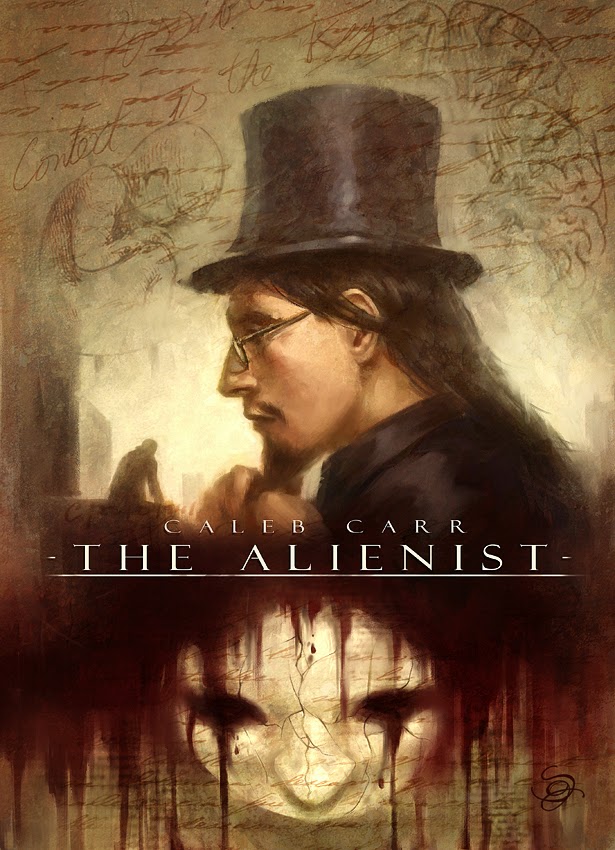
At right: Alternate artwork for The Alienist (Courtesy Nerd Blerp)
As protagonist John Schuyler Moore, a reporter for the New York Times, explains it “[W]e start with the prominent features of the killings themselves, as well as the personality traits of the victims, and from those we determine what kind of man might be at work. Then, using evidence that would otherwise have seemed meaningless, we begin to close in.”
Carr’s book is finely detailed, perhaps overly detailed, which won’t be a problem if you love New York City history. There are over two dozen scenes at various notable landmarks throughout Manhattan, some in various states of construction. Several real-life figures make appearances, although the most entertaining characters are Carr’s own, including the intrepid proto-policewoman Sara Howard and scrappy errand boy Stevie ‘Stovepipe’ Taggart.
When I first read The Alienist back in 1994, I was struck by its preciseness, an expertly placed breadcrumb trail through old Gotham. There is no romantic gloss, as in another history classic Time and Again. He makes it seem possible to retrace almost every step of our heroes. (In researching this article, I tried to do so.) The original New York Times review noted that “[y]ou can practically hear the clip-clop of horses’ hooves echoing down old Broadway.” They’re still echoing.
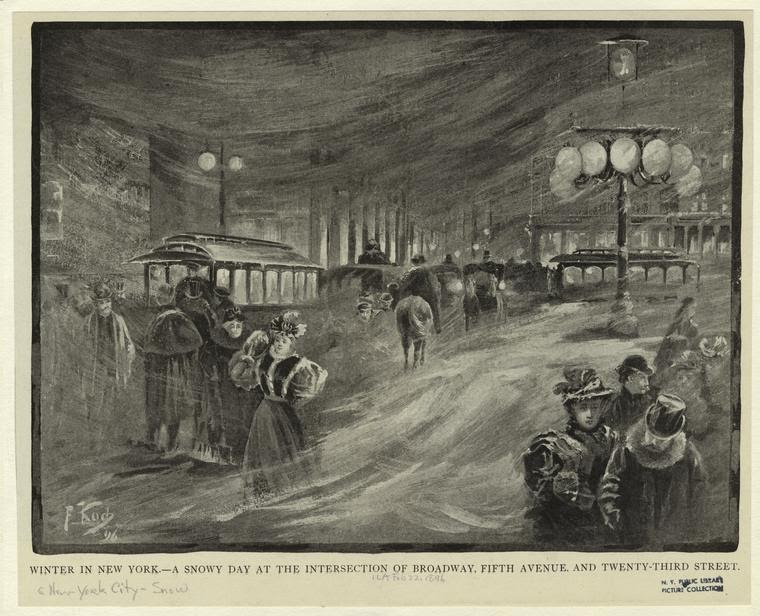
The story begins in the early months of 1896 during a robust winter. Below, from the Illustrated American, a depiction of a snowy Madison Square that year (NYPL):
His depiction of old New York is still glorious. The book’s polite take on certain social issues, however, read a bit wobbly today. To his credit, Carr tackles police corruption, gender discrimination, racial prejudice and the plight of homosexuals, all while elaborating on complicated psychological theories in service of an entertaining story. He has stuffed a hidden epic of New York into the framework of a modern murder mystery. That he chooses to handle hot-button social issues with kid gloves is not a misstep, but merely a symptom of its genre and day.
The Alienist is still greatly enjoyable, perhaps slightly more so now. Thanks to renewed interest in New York City history, the details here are even more shimmering and vital. This is not an old New York emerging from a mysterious fog, but a world that seems to exist alongside our own.
And to prove that — below you will find a detailed, interactive map of the pivotal locations used in the book. You can click into various points for further details. A few of these pins have pictures and other links. Just zoom in and choose a location! (NOTE: Some locations are approximate and a couple are speculation.)
A little elaboration on certain elements of the book’s bigger places and themes:
Paresis Hall Most of the murder victims are boy prostitutes employed as several houses of ill repute throughout the city. Paresis Hall, located steps from Cooper Union, sounds like it was both a place where gay men could congregate in private clubs and a place of sexual transaction, often (as in the book) with underage boys dressed up as girls. This boy, Nathaniel ‘ The Kid’ Cullen, may have worked there, or may have just a habitue of the club. (He appears in this collection of photographs from Paresis Hill.)
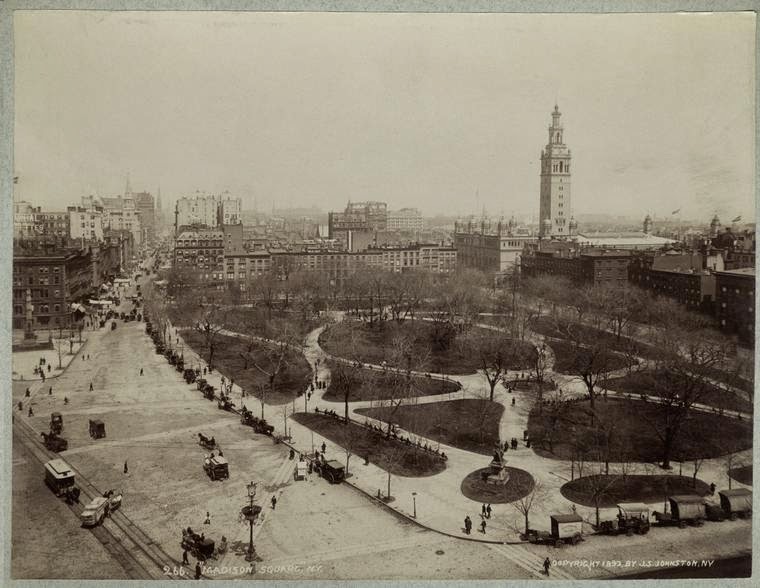
Madison Square This was still a thriving center for culture and dignified entertainments in 1896. Many theaters clustered around the park, although newer stages were making their way up Broadway to Herald Square. If Delmonico’s (on the northwest corner) is too crowded for you, head over to the tea room at Madison SquareGarden on the northeast side. Pictured here in 1893, three years before the events of the Alienist. (NYPL)
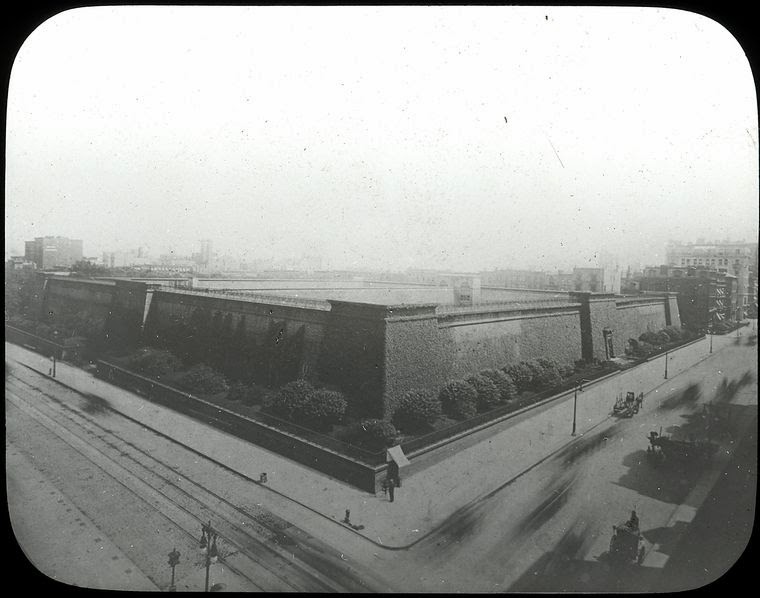
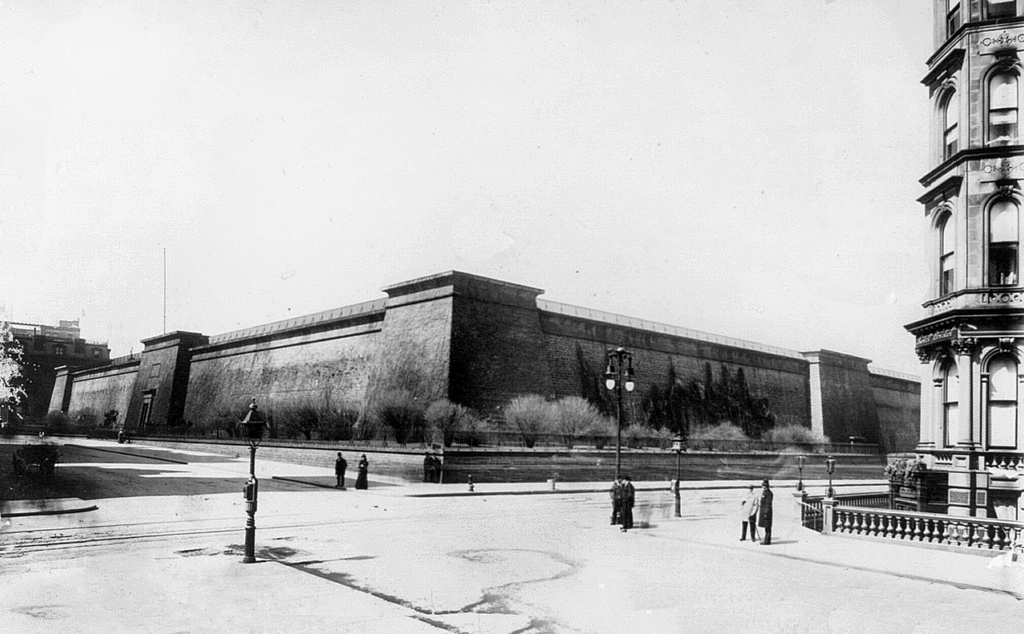
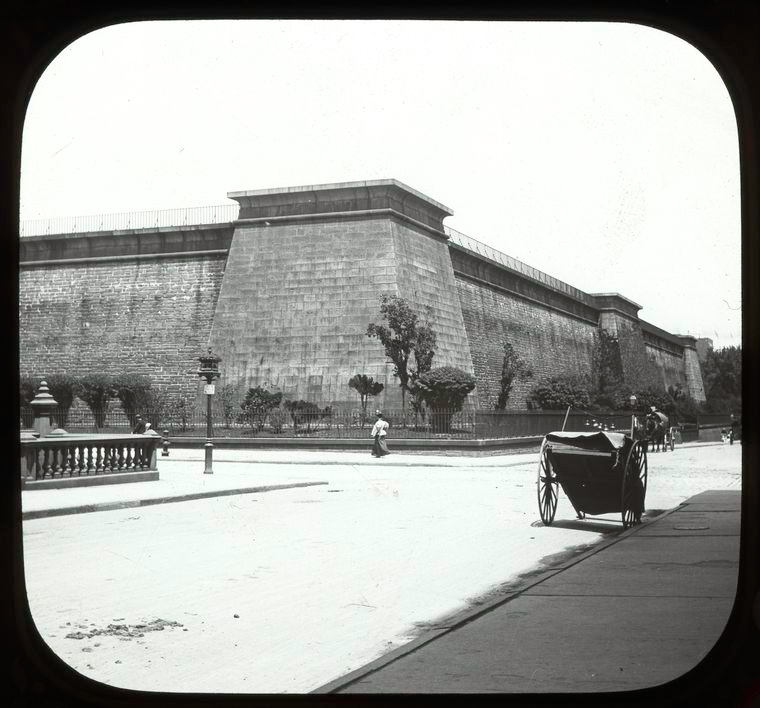
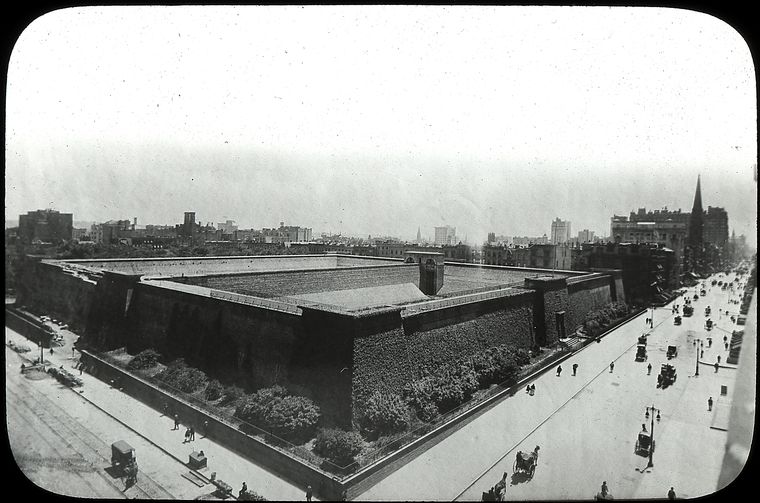
Murray Hill Distributing Reservoir In 1896, New York still relied on this reservoir to provide most people with water. But it was also a tourist destination in itself, with walking paths along the top. Shortly after its appearance it the book, the Egyptian-inspired reservoir was torn down to make way for New York’s new public library. (NYPL)
Bellevue Hospital and Morgue Check out our podcast and blog posting on the history of Bellevue Hospital, as many of the details mentioned there appear in this book. Below: Bellevue in 1879.
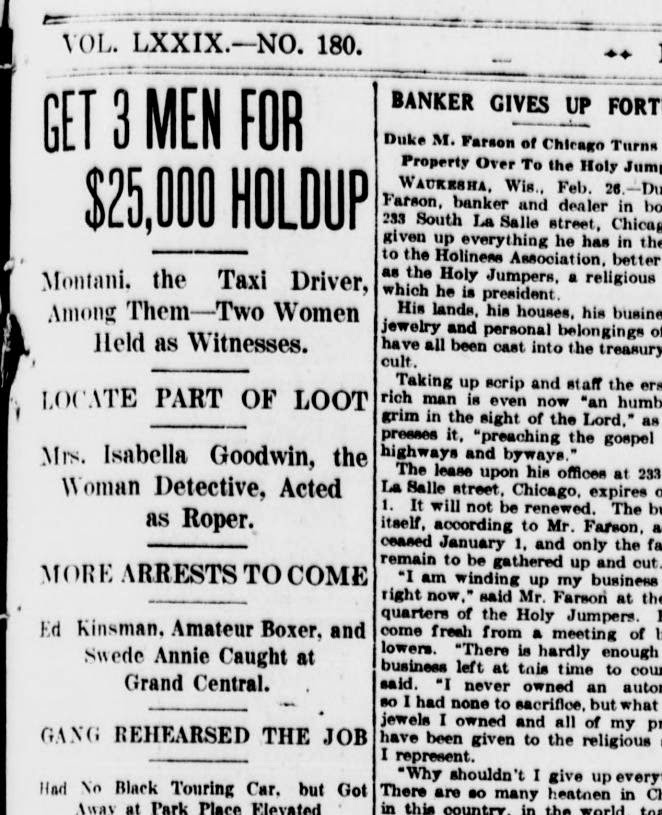
Isabella Goodwin Sara Howard seems to be a little bit Nellie Bly, and a lot Isabella Goodwin, the first female office promoted to detective in 1896 (the year the book is set). Below: A front-page case cracked by Goodwin from February 1912.
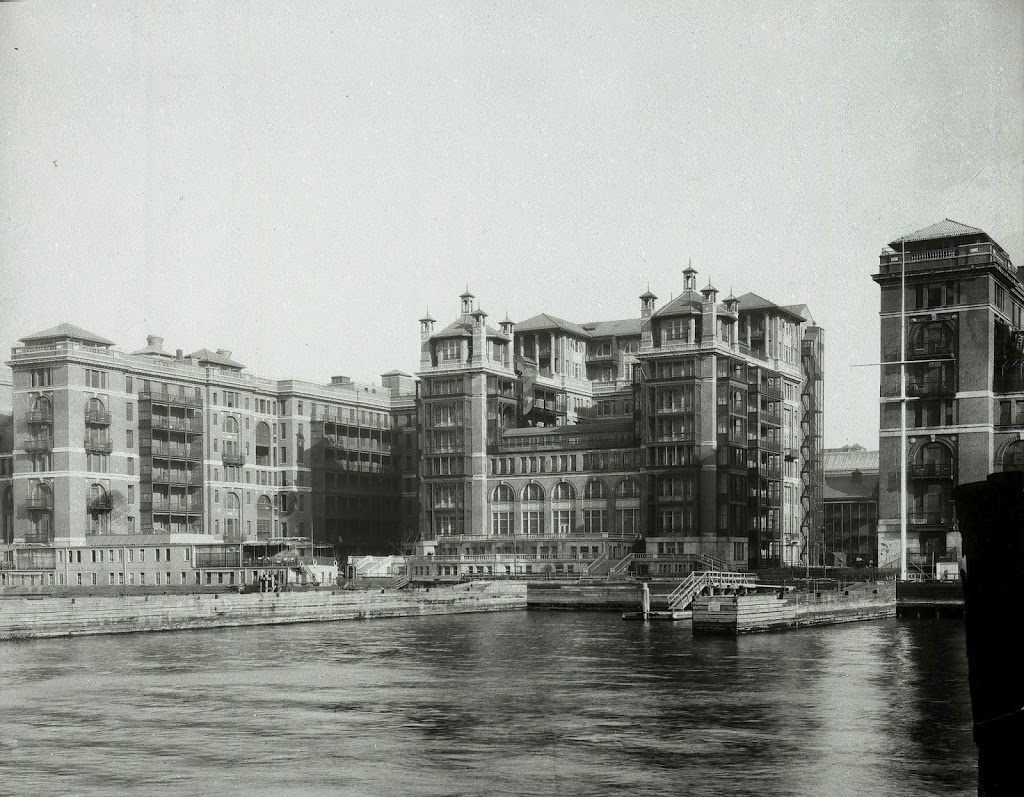
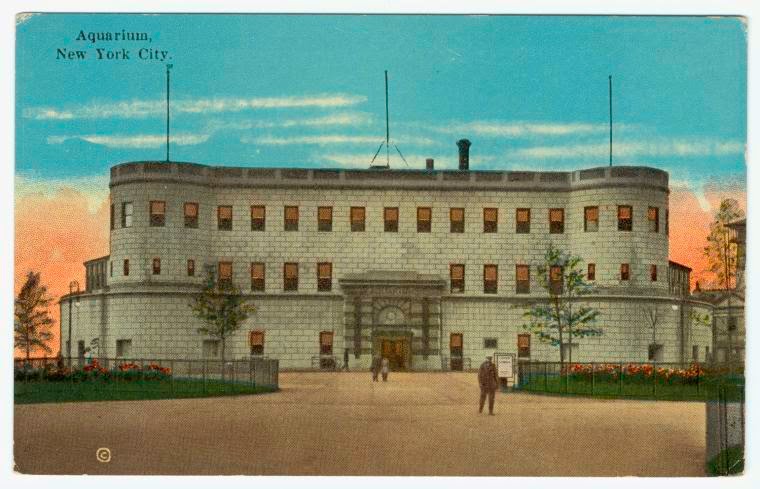
New York Aquarium Carr’s narrative features several New York landmarks in construction. Two of those places take a morbid center stage in the book — the Williamsburg Bridge and the nearly completed New York Aquarium (the former Castle Garden) (NYPL)
Theodore Roosevelt Carr weaves several real life figures into the storyline, from J.P. Morgan (who comes off quite ominous) to Jacob Riis (not a flattering portrait of him either). But future president Roosevelt gets a glowing supporting role as New York’s police commissioner who directs Dr. Kreizler, Moore and Howard to investigate the murders using powers of psychological deduction.
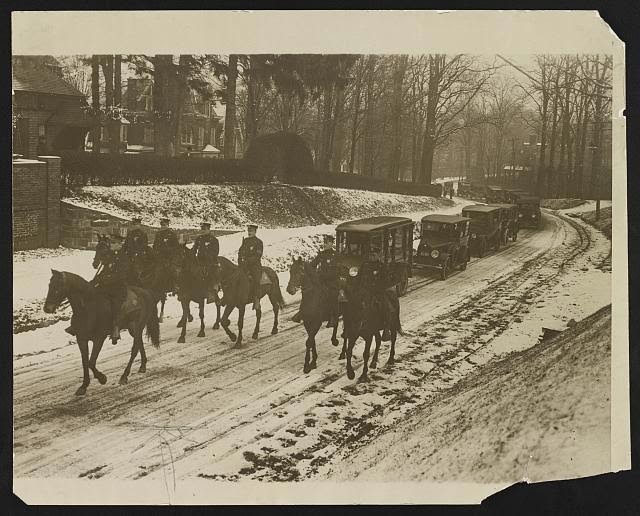
In fact, the book is actually a flashback by our hero Moore, recalled when he visits the Oyster Bay funeral of his dear friend in 1919 (pictured below). (LOC)
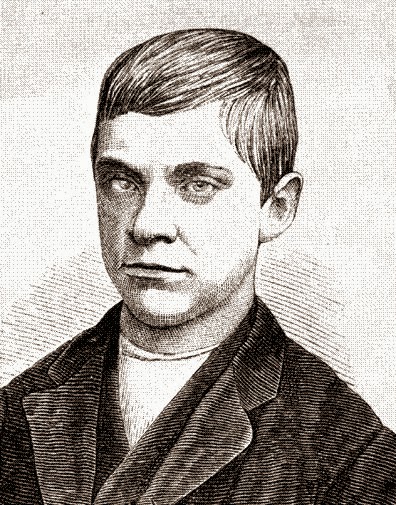
True Crime And there are a great many real-life figures from New York’s criminal underworld as well. In fact, most of the lecherous and notorious figures depicted in the book are real folks, from early gangsters like Paul Kelly to brothel owners such as Biff Ellison. Carr also finds a few disturbing mental cases to bring into the story, including the young killer Jesse Pomeroy (pictured below), considered one of the most brutal of murderers at a ripe age of 14.
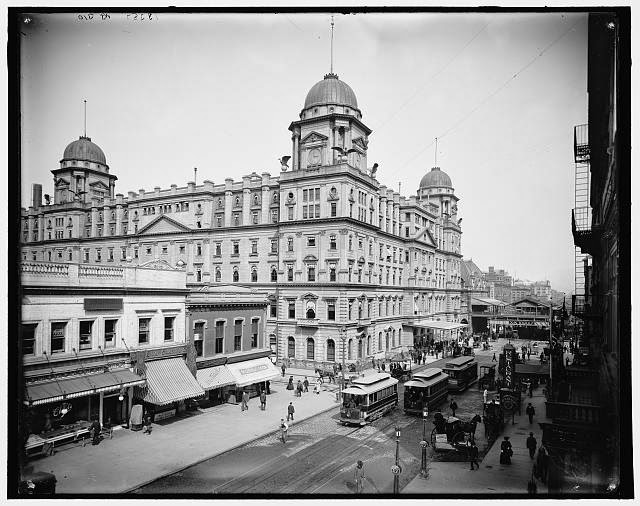
Grand Central Depot The characters do venture to places outside the city for further clues, but they always come through Grand Central Depot, the most hectic place in New York. (Pennsylvania Station had not yet been built.) Within a few years, this too would be ripped down and replaced with the present Grand Central Terminal. (LOC)
And finally, there are three central locations from the book that are still around today:
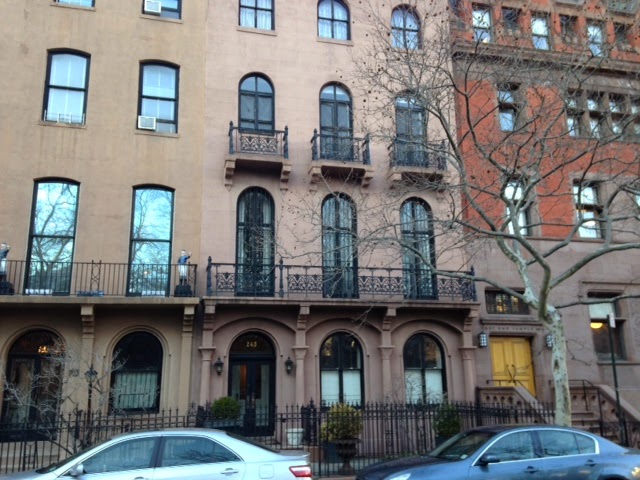
Dr. Laszlo’s residence at Stuyvesant Park. Actually the address in the book doesn’t really exist. But based on a couple descriptions — and its proximity to St. George’s Church, which is mentioned as close by — this building at 237 East 17th Street may be what Carr had in mind:
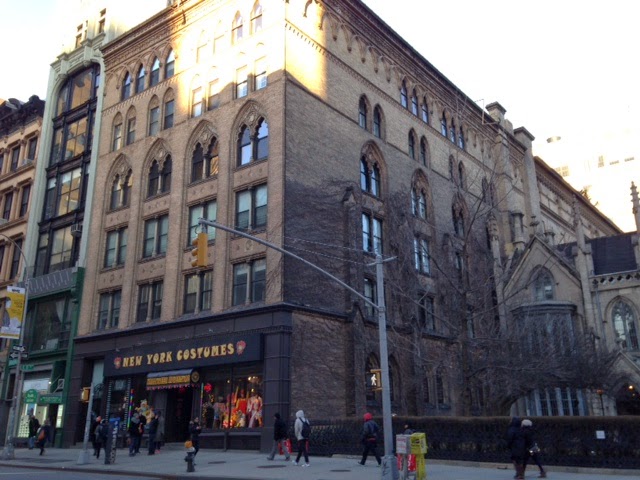
Murder headquarters at 808 Broadway — This exceptionally handsome building was constructed by James Renwick, playing nicely off its neighbor Grace Church. It’s actually called the Renwick! The team was located on the sixth floor. Today, on the first floor, is one of New York’s most popular costume shops.
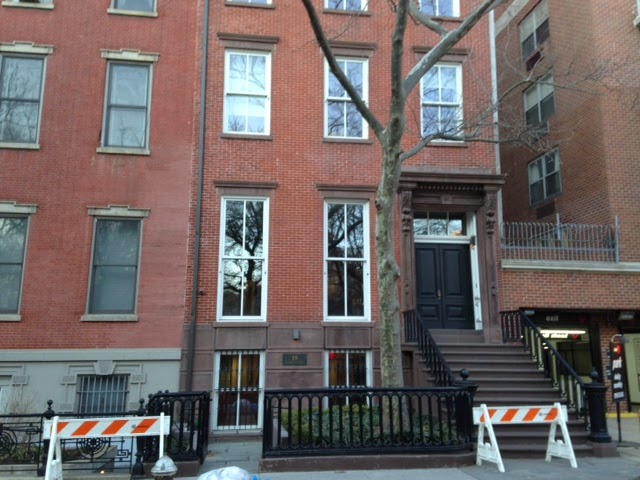
John Schuyler Moore’s home at Washington Square Park North, facing the park:
Above: The Croton Reservoir in 1850, in what would soon become Central Park. (NYPL) PODCAST One of the great challenges faced by a growing, 19th-century New York City was the need for a viable, clean water supply.
We take water for granted today. But before the 1830s, citizens relied on cisterns to collect rainwater, a series of city wells drilled down to bubbling, underground springs, and, of course, the infamously polluted Collect Pond. But these sources were spreading disease and clearly inadequate for a city whose international profile was raising thanks to the Erie Canal.
The solution lay miles north of the city in the Croton River. New York engineers embarked on one of the most ambitious projects in the city’s history — to tame the Croton, funnelling millions of gallons of waters through an aqueduct down to Manhattan, where it would be collected and stored in grand, Egyptian-style reservoirs to serve the city’s needs.
This is the story of both the old and new Croton Aqueducts, and of the many landmarks that are still with us — from New York’s oldest surviving bridge to a former Bronx racetrack that was turned into a gigantic reservoir.
FEATURING: An entire town moved on logs, a famous writer’s strange musings on Irish laborers, the birth of a banking titan, and guest appearances by Isaac Newton, DeWitt Clinton, and Gouverneur Morris (or, at least, men who share those names).
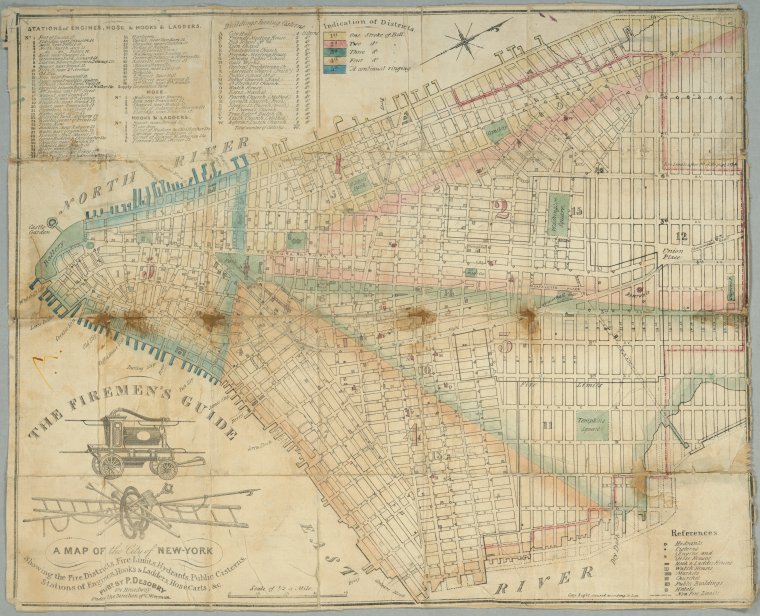
A fireman’s map of New York in 1834, detailing the location of the city water supply, in cisterns and hydrants fueled by the 13th Street Reservoir. (NYPL)
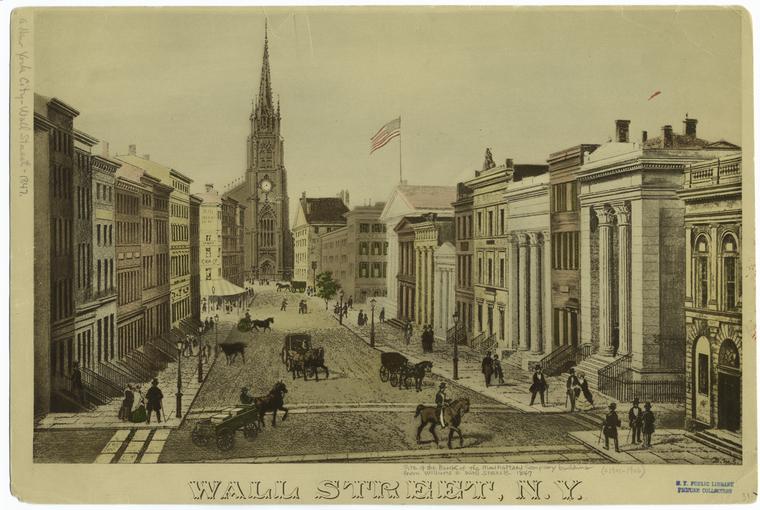
Wall Street in 1847. The Manhattan Company is at 40 Wall Street. Founded by Aaron Burr ostensibly as a public works to distribute water, the Company soon shed its water responsibilities to become a full-fledged financial institution.
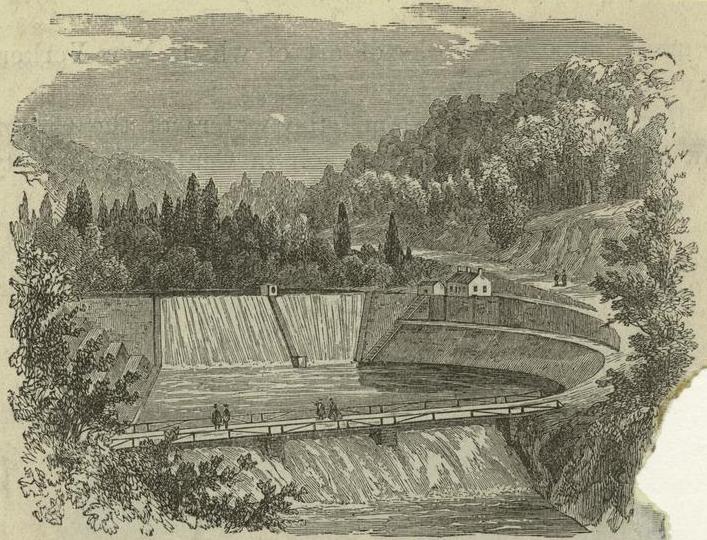
The Croton Dam and the start of the aqueduct system. After a partial collapse in 1841, the dam was quickly rebuilt for the opening of the entire system the following year. Today, the location of this dam is submerged under the current Croton. (NYPL)
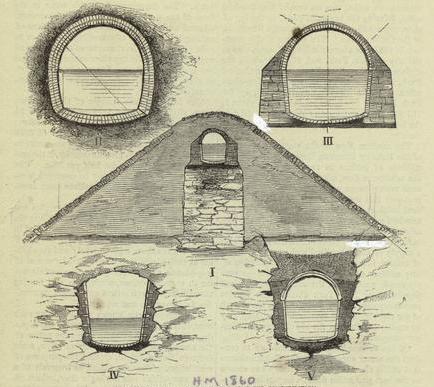
Examples of the various tunnels created to accommodate the various topographical challenges encountered during construction. Miles of these water tunnels were constructed by a team mostly comprised of Irish laborers. (NYPL)
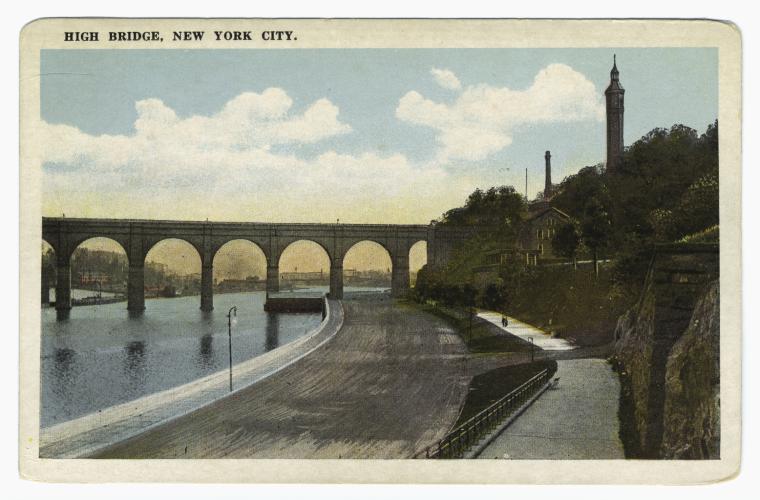
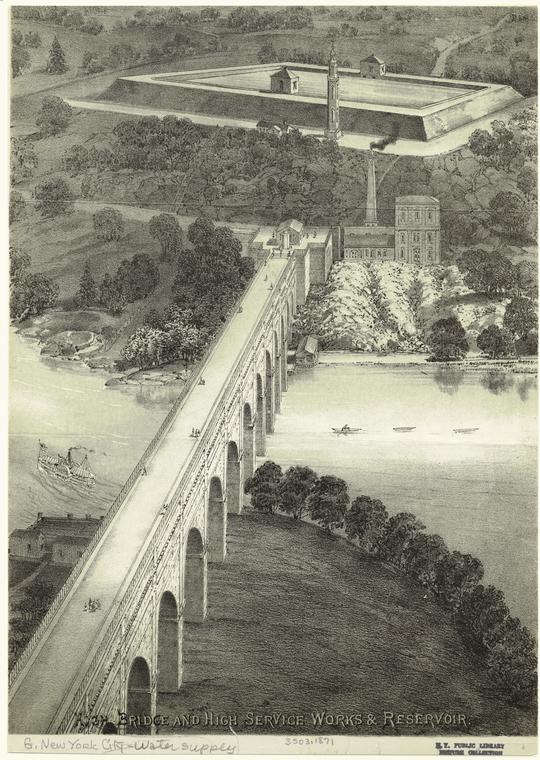
The glorious High Bridge, the oldest surviving bridge in New York — although much of it has been replaced and quite altered. (NYPL)
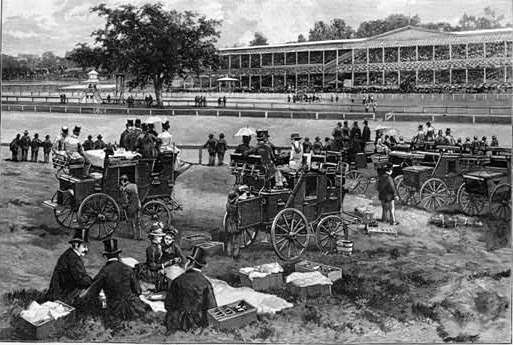
High society flocked to Jerome Park Racetrack on the weekends in the 19th century. But the park was turned into a reservoir at the beginning of the 1900s. (NYPL)
Also: please see my post from yesterday The Art of the Reservoir for pictures of some of the receiving and distributing reservoirs used in the Croton system and others through the New York region.
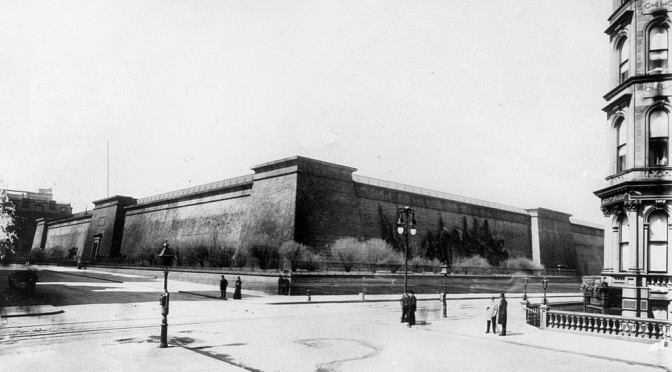
The Fortress of Fifth Avenue: the Murray Hill Reservoir
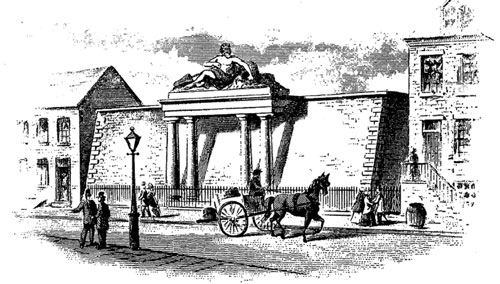
We share a lot of the same needs as New Yorkers of the past, but we’ve just gotten better at hiding the unpleasant ones. There are a great many mental institutions and specialized medical facilities in the city; they just aren’t in creepy, old Gothic buildings anymore. Prisons are out on islands or in nondescript beige towers flaunting only the barest hint of iron bars. We don’t dress them up in Egyptian morbidity like the famous Tombs prison of Five Points.
Our trains and our electricity reside underground, and so does our water, mostly. There are only a few places that seem to suggest that New York City’s water supply doesn’t just magically appear. Water towers dot the skyline, recalling romantic comic book landscapes, while water treatment plants, spread mostly through the outer boroughs, obviously do not. Then there are the reservoirs, the grandest of these, the Jerome Park Reservoir in the Bronx, is a landmarked structure of enormous, albeit hidden, beauty. It’s currently drained and sitting like the Earth’s largest off-season swimming pool.
But New Yorkers used to live with their water, contained in reservoirs meant to evoke might, sophistication and security. After all, New York only got fresh water from the Croton Aqueduct in 1842; before that, it was mostly obtained from wells, cisterns, and that nasty old Collect Pond. People were proud of their new water system, so why not show it off?
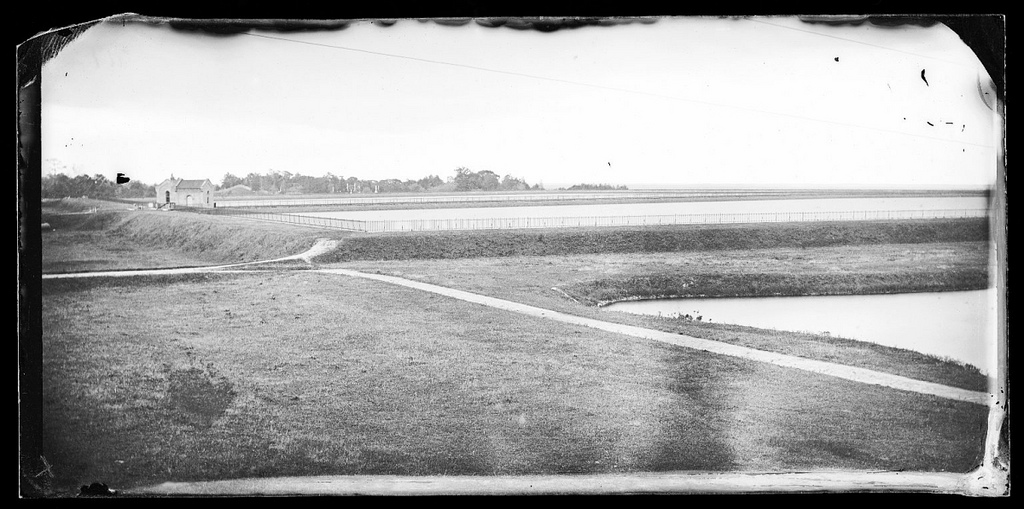
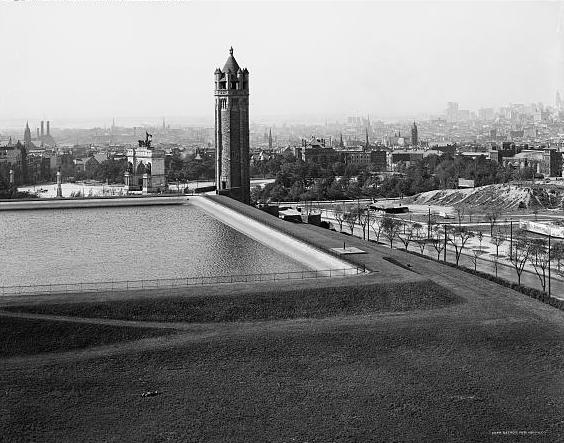
Here’s a gallery of New York’s old 19th century reservoirs. In tomorrow’s podcast, we’ll elaborate on the marvelous story on how the city got its water:
The Manhattan Company reservoir on Chambers Street was opened in 1801 and was quickly deemed inadequate. Looks lovely though. If it were still around — it was demolished in the early 1900’s — it would probably be a nightclub today.
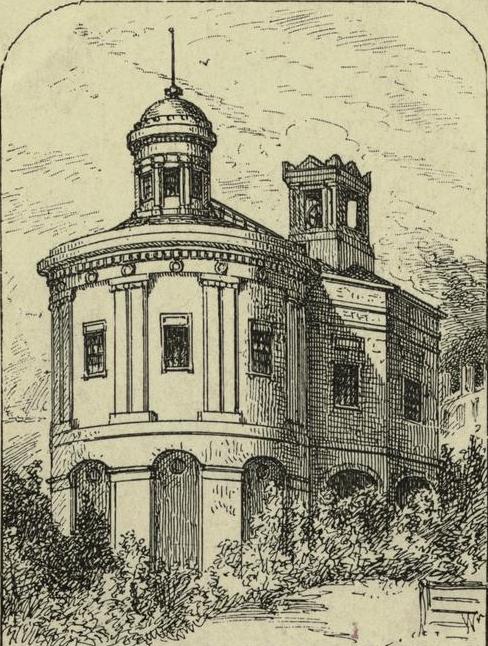
13th Street Reservoir: Opened in 1830 as a water-pooling resource for fire fighting, it pumped water to hydrants on Broadway, the Bowery and other streets, but was little help in stopping the blazes of the Great Fire of 1835.
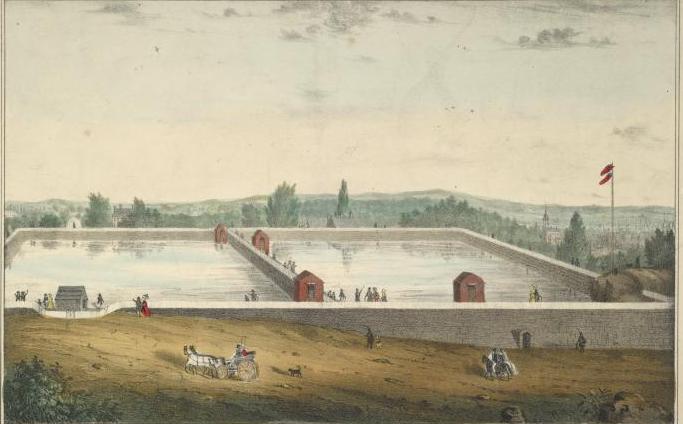
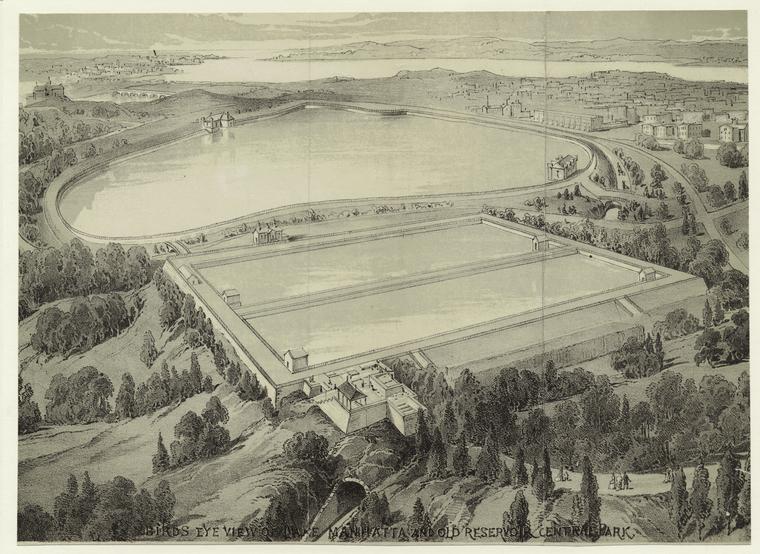
The Yorkville reservoir, how it looked on its opening in 1842. It was located between 79th and 86th Streets and between Sixth and Seventh Avenues. Many years later, was surrounded by Central Park and was later torn down to become the park’s Great Lawn. What does remain, however, is….
…the Central Park receiving reservoir, built in the 1850s and, unlike the Yorkville, incorporated into the park’s designs. Today it’s named for Jacqueline Kennedy Onassis, who lived nearby and frequently jogged around it.
The spectacular High Bridge, part of the Croton system, with its adjoining smaller reservoir and water tower, serving the needs of residents of Manhattan’s higher elevations.
The grand Murray Hill Reservoir, probably the most popular of the reservoirs with 19th century tourists. Situated on land that had held the fabulous Crystal Palace (destroyed by fire in 1858), the reservoir was demolished in the 1890s to make room for Bryant Park and the New York Public Library.
Brooklyn was maintained in the 19th century in two reservoirs, one in Ridgewood and the other high atop Mount Prospect, although the ultimate source of the water came from a variety of places.
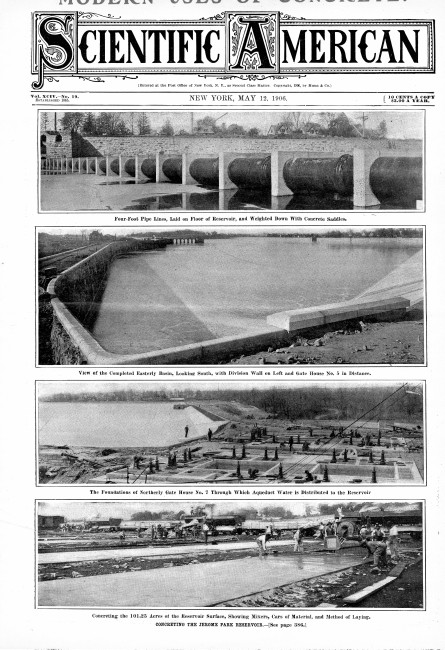
An issue of Scientific American in 1906, celebrating ‘the concreting’ of the Bronx’s Jerome Park Reservoir which opened that year and contained portions of both the old and new Croton Aqueduct systems.
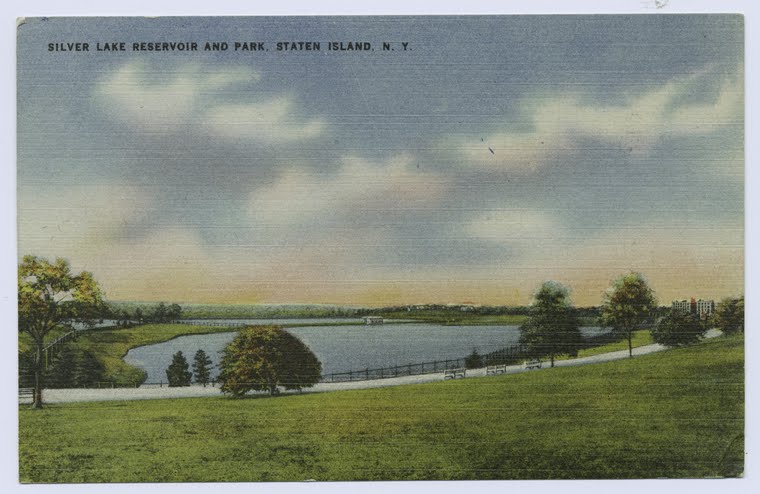
The 1917 Silver Lake reservoir in Staten Island was constructed, like the Central Park reservoir, to be a functional feature of a park setting.
Pictures courtesy the New York Public Library, the Brooklyn Museum and the Library of Congress. Thanks as always to these institutions. The Scientific American can be found here.
KNOW YOUR MAYORS Our modest little series about some of the greatest, notorious, most important, even most useless, mayors of New York City. Other entrants in our mayoral survey can be found here.
MayorThomas Francis Gilroy In office: one term 1893-1894
When it comes to corruption, you can’t get more front and center than Thomas Francis Gilroy. His political education came from the most dishonest names in public service, he was elected mayor in one of the most rigged elections in New York history, and he reigned as a mere figurehead controlled by the ruling political machine. There is little to distinguish him but for his uncanny knack of latching on to the most corrupt men in government.
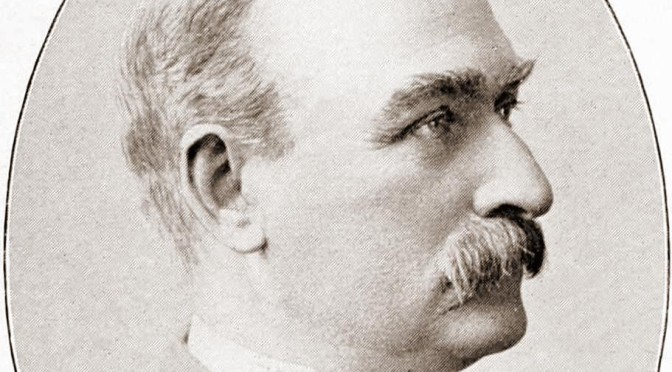
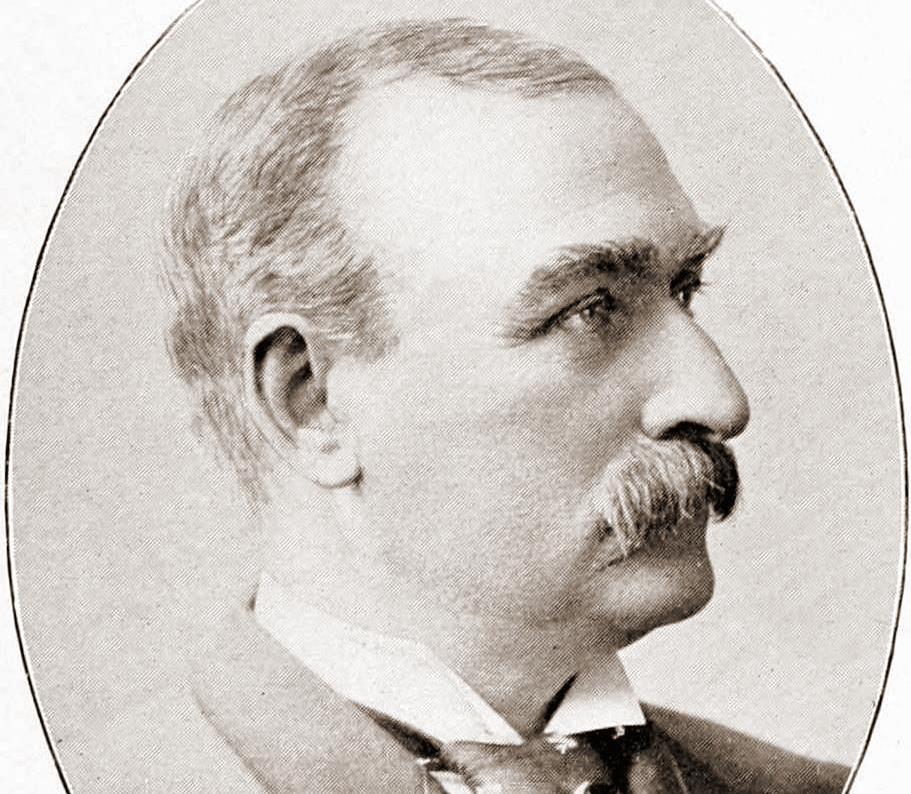
But didn’t he look dashing! “Gilroy was one of the most striking looking mayors this city has ever had, with iron-gray hair, a heavy mustache, a well-knit erect physique and ruddy cheeks,” according to his obit.
In the alternating crests of corruption and reform in New York City government, Gilroy rose when wrong was king and kept his head low every time else. It might have been different for Tommy, as his chums called him, if not for the connections of Boss Tweed, the notorious head of Tammany Hall and the embodiment of New York machine politics.
Gilroy was a bit of a rarity for the late century, a mayor born in another country but of a nationality greatly valued by future Tammany leaders. He was seven years old in 1847 when his parents brought him over from Sligo, Ireland, just one of millions of Irish newcomers at the beginning of a mass wave of immigration that would last decades.
As a teenager, sometime in the 1850s, he began on-the-job training as a printer’s devil for a young, well-known publishing company, G. Putnam Broadway*, who would produce work by Edgar Allen Poe, Nathaniel Hawthorne and most notably to Gilroy, Washington Irving. According to Gilroy: “They were getting out Irving’s ‘Life of Washington’ [the writer’s bio on George Washington] to be sold on subscription. It was a godsend for me to be in a bookstore. I read everything I could lay my hands on.”
“I don’t believe I was a very good servant though, for as soon as the subscription business was done, the publishers let me go.” Gilroy is being modest here; he would be a most excellent servant to the political machine.
He moved onto other publishers and by 1864 had become a proofreader. It may have been through his publisher that he made his introduction with city politics, and Tammany Hall in particular. He soon moved on to a useless city job, his title ‘sixth clerk to the Croton Aqueduct Department’, one of hundreds of padded government jobs requiring no conceivable skills except mendacity and blind ambition.
Gilroy’s home in the 1860s at the corner of Broome and Mott streets would have placed him near the epicenter of immigrant life in New York, which may suggest his usefulness within Tammany. Tommy was the boilerplate Irish American that Democrats liked in their ranks and lusted after during elections.
He became a confidante of Boss Tweed’s in early 1870, at the height of the notorious boss’s power as the city’s commissioner of public works. Apparently not busy enough in his Croton Aqueduct duties, Gilroy served as Tweed’s personal ‘messenger’, delivering the type of ‘messages’ one can only imagine and marvel at.
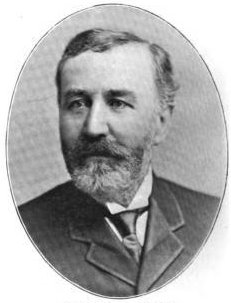
Tweed was arrested in the fall of 1871, but Gilroy had already moved on, as clerk and personal secretary to state senator Herry Genet (at right). Sometimes nicknamed ‘Prince Hal’, Genet was left picking up the pieces of a tattered political machine in the wake of the Tweed scandal and would himself had been shipped off to prison in 1873 on corruption charges had he not escaped from jail and fled the city. (He was eventually caught years later.)
After these associations, Gilroy kept a lower profile, but always worked within the Tammany system, damaged by the Tweed scandals. He became a Mott Haven court clerk in 1874 — the year it was annexed by New York — and observed this Bronx neighborhood grow from an industrial backwater to a tony residential area.
People generally have a short memory when it comes to government corruption, and by the mid 1880s, Tammany Hall was back in full swing. Gilroy took a cozy clerk job closer to City Hall in 1885, benefiting financially from the kind of kickbacks perfected by the Tweed Ring.
He was so snug with Tammany that he was chosen by Boss William Crocker to oversee the campaign of Hugh Grant, who became mayor in 1889. As a reward, Grant make Gilroy commissioner of public works — the same job Boss Tweed had once held! And just to make the parallel complete, he became Tammany’s grand sachem in 1891. Make no mistake however; the man behind the curtain — behind both Grant and Gilroy’s ascensions — was Crocker.
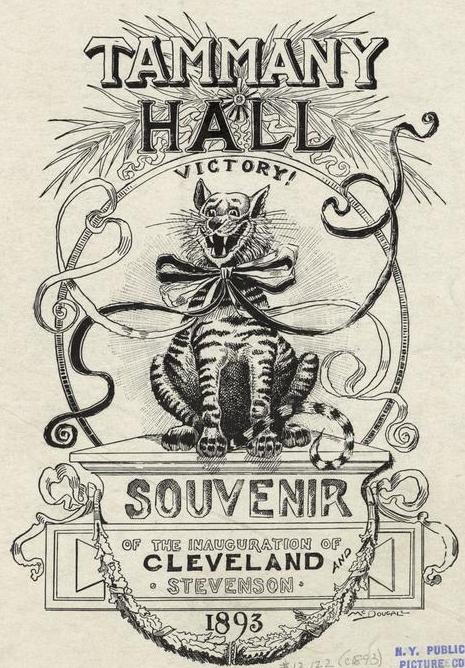
According to Oliver Allen: “There was no question that the good times were now rolling for Tammany Hall; it could hardly lose an election.” Crocker decided, after two two-year terms of Grant, that Gilroy should replace him, and rigged the election to assure that victory, crushing his republican opponent Edwin Einstein. In fact, in one Lower East Side district, 389 votes went to Gilroy and three to another candidate. Croker vowed he would find out who those three voters were. (Also on the ballot that year: Grover Cleveland for president, see 1893 souvenir print below)
Gilroy kept things status quo, for Tammany, that is. According to Burrows and Wallace, City Hall distributed funds from “municipal employees and saloonkeepers” by city charities in need although stopped short of initiating a promised jobs program to deal with a growing unemployment rate. He rejected calls for improved public baths and additional schools, this in a decade of massive immigration swells.
Gilroy is notable only for coming in at the end of Tammany’s moment of glory. He had inherited a deeply corrupted police force, so ineffective that a state commission was called in 1894 to expose the deep fissures. The Lexow Committee would eventually uncover an institutional system of “extortion, bribery, counterfeiting, voter intimidation, election fraud, brutality, and scams.” All of it, naturally, inextricably tied together with Tammany leadership.
Gilroy tried desperately to turn the tide by appointing a ‘bi-partisan’ board of police directors, Democrats and Republicans. This paltry concession persuaded no one. By the next election, New York was a reform mood. In fact, Gilroy didn’t even bother running again; after briefly putting Macy’s president Nathan Straus on the ticket, the Democrats replaced him with also-ran Hugh Grant.
To no avail; Tammany’s nearly decade-long reign was (temporarily) over, as gruff reform candidate William Strong won handily. (The story picks up in my article on Strong’s tenure as mayor.)
Gilroy had played his last political card by this time. After a short stint as a bank president, Tommy retired to his homes, one on West 121st Street and another on Far Rockaway, where he died on December 1, 1911.
*The company still exists today as a division of the Penguin Group: Penguin Putnam Inc, frequently publishing juvenile literature
KNOW YOUR MAYORSOur modest little series about some of the greatest, notorious, most important, even most useless, mayors of New York City. Other entrants in our mayoral survey can be found here.
Mayor Franklin Edson
In office: 1883-1884
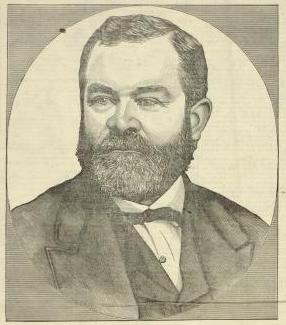
Although the political career of one-term mayor Franklin Edson was indeed brief, he helped commission both the city’s largest acquisition of park land and one of its biggest improvements in drinking water. And he was present for the opening of one of New York’s greatest landmarks. So how did the city thank him for his service? By nearly throwing him into Ludlow Street Jail — where Boss Tweed had been left to rot just a few years before.
Edson, a transplanted New Yorker, was a farmboy from Chester, Vermont, born in 1832, who distinguished himself in the art of whiskey distillery — distinghished with “precocious tact and sagacity,” in fact.
He worked his way over to Albany, New York, as a successful distiller and grain merchant with his brother. Franklin took full advantage of drink demands during the Civil War; his company soon became so profitable that he moved the entire venture to New York in 1866.
Edson, a burgeoning booze mogul of sorts, immediately became a prominent merchant voice in Manhattan, becoming the president of New York’s Produce Exchange three times, serving his first term in 1866 before he had to time to even unpack his moving boxes.
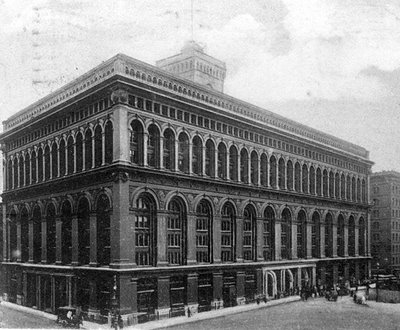
While this naturally afforded Franklin an incredible vantage for commercial power, it would soon place him in the crosshairs of political power as well. In later years he would be most proud of his Exchange days, priding himself in being one of the encouraging voices to tear down the inadequate castle-like Produce Exchange (designed by Leopold Eidlitz) and erecting the larger, more impressive George Post-designed Produce Exchange building near Bowling Green (which itself would be sadly torn down in 1957).
Below: the new Produce Exchange
What sets Edson apart from other future mayors of the time — and what might have potentially hindered his political ambitions — was that he loved the countryside, in this case Old Fordham Village, today a neighborhood in the Bronx.
He would live here for many years and would remain a member of the (now landmarked) Episcopal Saint James Church in Fordham for most of his days. Whether by design or coincidence, this love for what would become New York’s northern borough would soon prove fruitful for the city as a whole.
Franklin was also a practicing anti-Tammany Hall Democrat. And who wouldn’t be anti-Tammany during the 1870s? Edson became politically active in the years following the Boss Tweed scandals, when Tammany was still reeling for the highly publicized affair involving Tweed and then-mayor A. Oakley Hall.
Despite a slow rebounding, Tammany would never fully rinse off the stench of corruption. Naturally, Edson’s prominence among the business class married nicely with mayoral ambitions by the mid 1880s and would eventually include a denunciation of Tammany practices and condemnation of Tammany boss John Kelly (at right). But not at first.
For the election in November 1882, the various Democratic factions, including the still-potent Irving Hall, soon decided on the relatively green Edson, because he was a uncontroversial, neutral choice. To Tammany’s Kelly, Edson must have seemed a fairly agreeable pick indeed compared the previous mayor William Russell Grace, a reform Democrat rebelliously outside the realm of Tammany’s power.
Edson easily swept past his opponent, railroad man Allan Campbell — a sweet victory for John Kelly, as it was Campbell that had replaced Kelly as the city comptroller several years previous under the administration of mayor Edward Cooper. (Check out Edward’s entry for some juicy details of the Kelly/Cooper rivalry.)
How did a political nobody — a “seven day wonder in the political world” — sweep so handily into office? It helps to ride coattails; during that same election, the popular Democrat Grover Cleveland was elected the governor of New York.
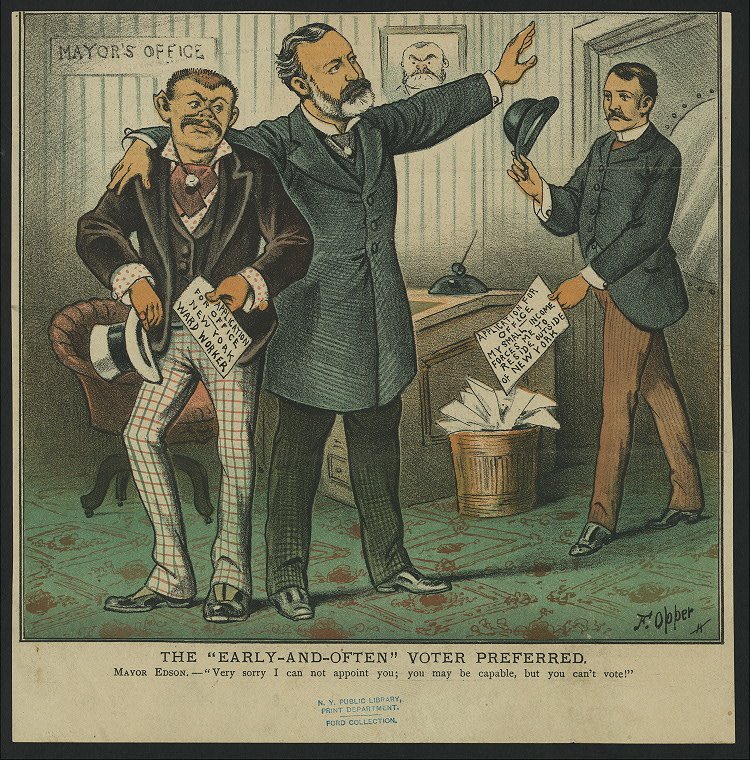
At first, Edson gave in readily to political favoritism, paying back some of his Democratic cohorts — including many of the Tammany variety — with lucrative city jobs, a decision which disgruntled many of his former supporters. In fact, he even appointed Richard Croker as fire commissioner; Croker would become the head of Tammany Hall in the 1890s. (Harper’s Weekly has a coy little cartoon chiding the Croker decision.)
Like many before him, however, Edson soon grew tired of Tammany’s corrupting influence and began adopting reform policies which were currently being installed on the state level. And also like many before him, his against-the-wind attempts at reform would essentially spell the end of his political career. Edson would serve but a single term and would almost entirely vanish from politics afterwards.
But not before throwing his weight behind a major expansion of the Croton Aqueduct, which within in a few years would triple the supply of water into the city. (In fact, most of the expansion he pushed for is still in use today.)
Edson is also partially responsible for the huge increase in New York park land, commissioning a citizens group in 1884 to lobby the state to purchase lands in the area of today’s Bronx; accordiing to an old Bronx history, “the ‘new’ parks, as they were called, comprised 3,757 acres, now included in Van Corlandt, Bronx, Pelham Bay, Crotona, St. Mary’s and Claremont parks.”
And most notably, he was the first New York mayor to walk the Brooklyn Bridge, astride president Chester A. Arthur and governor Cleveland on the bridge’s opening day, May 24, 1883. He would be met in the middle by the mayor of Brooklyn — future New York mayor — Seth Low.
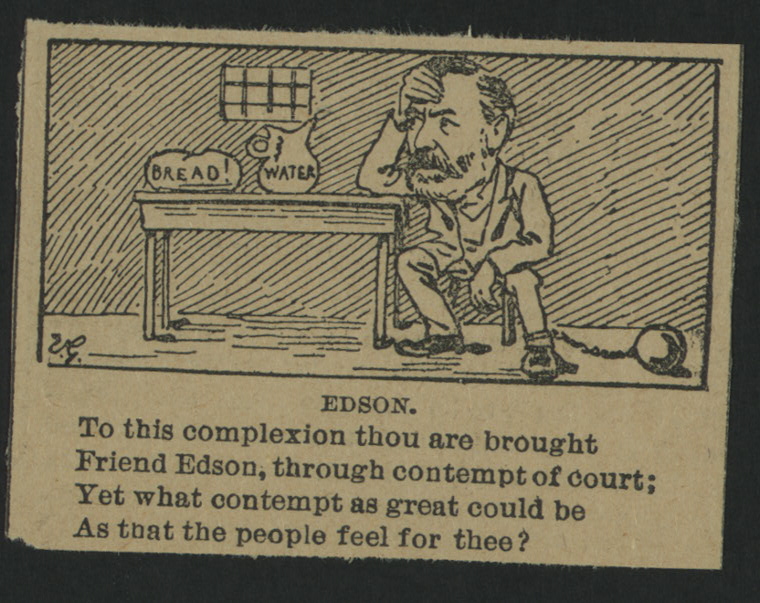
He might have crept quietly into obscurity had Edson not been accused of contempt of court shortly after he left office, threatening a man in his early 50s with jail time with a stint at the notorious Ludlow Street Jail. Apparently, despite a court injunction, Edson had quietly made promotions to two posts — the Commissioner of Public Works and the Corporation Council — on his last day in office. However, after a stressful two months in court, Edson was declared not guilty of the crime.
This did not stop people from imagining the ex-Mayor trapped behind bars, as the newspaper illustration below evidences:
Edson died in 1904, at his home on the Upper East Side. 42 West 71st Street, to be exact, a block from the Dakota Apartments, which were completed during his tenure as mayor.
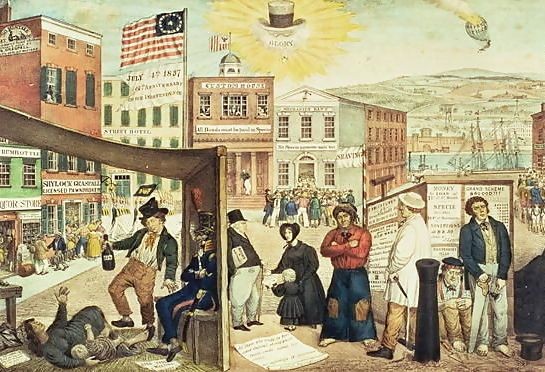
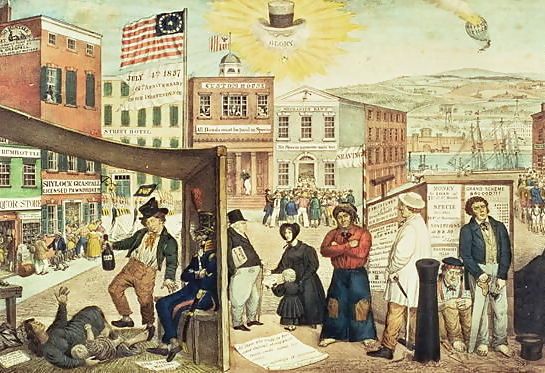
Above: New York by 1837 (in an painting by Edward Williams Clay) — a city surviving financial ups and downs, fires and water shortage, riots, cholera and the mayoralty of Cornelius W. Lawrence
KNOW YOUR MAYORSOur modest little series about some of the greatest, notorious, most important, even most useless, mayors of New York City. Other entrants in our mayoral survey can be found here.
Mayor Cornelius Lawrence
In office: 1834-1837
We’re going back to the era of the great fire one more time to take a look at the man in charge of the city during that time — Cornelius W. Lawrence, the first elected mayor of New York.
I couldn’t find any portraits of Cornelius, but I found something better: the following description from a mid-19th century journal: “…old Cornelius had the ice cream and strawberries of everything in life — in commerce, in politics, in wives, in finances and in religion….He had a peculiar way of carrying his spectacles in his hand, behind his back while he looked at all the pretty girls he met.”
But getting to that ‘ice cream and strawberries’ required surviving one of the most tumultuous city elections — and the subsequent years of trauma — that a New York mayor has ever had to endure.
Lawrence was born in 1791 in bucolic Bay Side(in the future Queens), a farm boy with big city intentions at an early age. He became entranced with the lucrative merchant culture of New York, working his way into his own dry-goods auction house, the firm of Hicks, Lawrence & Co. with the wealthy Quaker financier Willet Hicks and Lawrence’s brother Richard. Their auction house was at Pearl and Fulton streets (just off Schermerhorn Row near the South Street Seaport today).
Lawrence, a high-profile merchant by 1832, was also a politically ambitious Democrat and served two years as a state congressmen before turning to local politics at a uniquely opportune moment.
Before 1834, the position of mayor had been appointed by the Common Council of the city, an unelected job that was shaped more by the political favoritism of governors and city alderman (who were elected) than by any particular leadership characteristic. This was finally amended by New York state in 1834, allowing for the mayor’s job to be popularly elected. And, not surprisingly, that first election was an absolute, chaotic mess.
The long-established Democrats and a surging Whig party wanted to get their hands on this now attainable position. As a result, that election day, spring 1834, came with voter intimidation, massive fraud, and angry riots which overtook the polls, particularly in the volitile Sixth Ward. The Democrats had put up Lawrence to challenge the wonderfully named Gulian Crommelin Verplanck, a colorful poet and former Democrat. When the dust settled, the Whigs were victorious in a majority of alderman posts, but the Democrat came out on top as mayor — by a mere 180 votes!
Lawrence would be elected for three stressful one-year terms (spring 1834-spring 1837). At the very top of his to-do list was New York’s water supply. The new mayor had inherited a city quickly bursting with new residents and a paltry water supply so rancid and inadequete that one source blames it for the increase in public drunkenness. (Hey people have to drink something, right?)
Exacerbating the matter was the fear of disease. In 1832, his first year as congressman, New York was struck with a devastating cholera epidemic, killing hundreds; a lesser but no less dangerous sequel struck in 1834, just as Lawrence was getting comfortable at City Hall. And of course, the spectre of fire lurked, not just jeopardizing a highly flammable city, but Lawrence’s own fortunes: he controlled shares several fire insurance companies.
Plans for what would become the Croton aqueduct were well underwway when the Great Fire of 1835 devastated New York, destroyed the Merchant’s Exchange and potentially spelled doom for the city’s future. Lawrence himself lost thousands of dollars in shares, although his own auction house on Pearl Street had been spared.
The mayor and his entourage stormed down to Washington begging for aid for his beleagured city, to no avail. Fortunately, former mayor Philip Hone succeeded in persuading the state government to dole out millions in relief. Meanwhile, voters finally approved the construction of the aqueduct in 1836. Within the year New York experienced a burst of rapid reconstruction; the price of New York real estate post-fire soared to outlandish prices.
But fire and water weren’t Lawrence’s only distresses. Sometimes he had to fear his own constituents.
BELOW: Anti-abolitionist riots kept the city on edge during the 1830s
Pro-slavery sentiment among some New Yorkers culminated in a series of deadly riots in the 1830s, one during Lawrence’s first months as mayor, leading to the destruction of property owned by abolitionists and prominent businessmen Lewis and Arthur Tappan. Lawrence denounced the mob (after posing a threat to his wealthy friends) and ordered the National Guard to disperse them. Later, Tappen penned this mea culpa to the mayor, ensuring his good intentions, particularly the assurance that the abolitionists “will never, in any way, countenance the oppressed in vindicating their rights by resorting to physical force.”
Being a Democrat in the 1830s meant a marraige between the Jacksonian wealthy and a powerful Irish working-class, strange bed-fellows often culminating in disaster. At a New Years eve celebration at the mayor’s home in 1837, supporters stormed the doors, turning the home into a ‘Five Points tavern’ by one account. The police were summoned in an effort to clear away the mayor’s own supporters!
As if these catastrophic events hadn’t been enough, Lawrence was finally thrown out of the mayor’s seat due to the results of the greatest catastrophe of all — the Panic of 1837, a financial crisis that briefly shifted the city’s power from the Democrats to the Whigs. He was defeated by Aaron Clark, who would prove to be the only Whig mayor of the city.
Perhaps ready to move on anyway, Lawrence entered the world of banking in his later years, interuppted only by a four-year stint in a federal role under President James Polk as the Collector of Customs.
He lived his later years in the city in a home near Broadway and Worth Street, before finally retiring back to the family home in Flushing. He died in 1861 and you can conceivably still go visit him; he’s buried at the Lawrence family burying ground at 216th Street and 42nd Avenue in Bayside, Queens.
The New York Public Library may be one of the most revered libraries in America, but it took a farflung combination of bookworms, millionaires and do-gooders to make it into the institution it is today. Also: find out why the architectural style of the Beaux Arts sometimes reminds us of an old French prostitute.
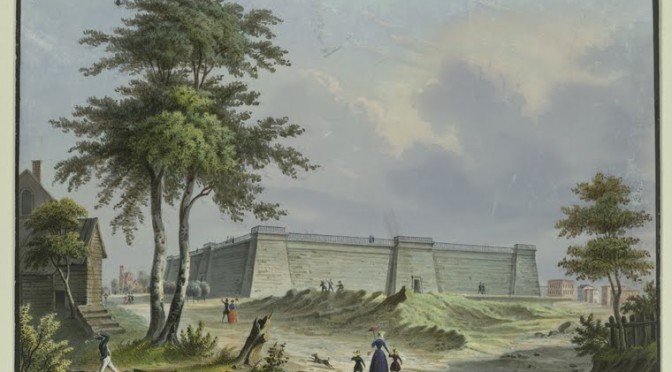
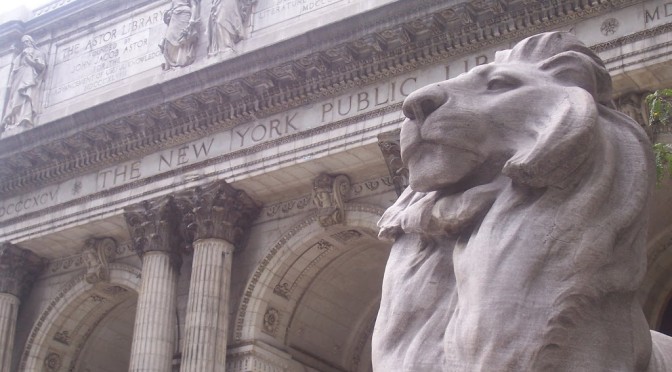
Before the lions of the New York Public Library — now less imposingly called the Humanities and Social Sciences Library — parked themselves at 40th and 6th Ave, the Croton Reservoir stood imposingly there, holding the city’s water supply. As you can tell from this picture, it looked a bit like an Egyptian pyramid, or perhaps a alien spaceship.
This was a distribution reservoir, which received water from a larger ‘receiving reservoir’ in what is now Central Park, but what was then on the outskirts of town.
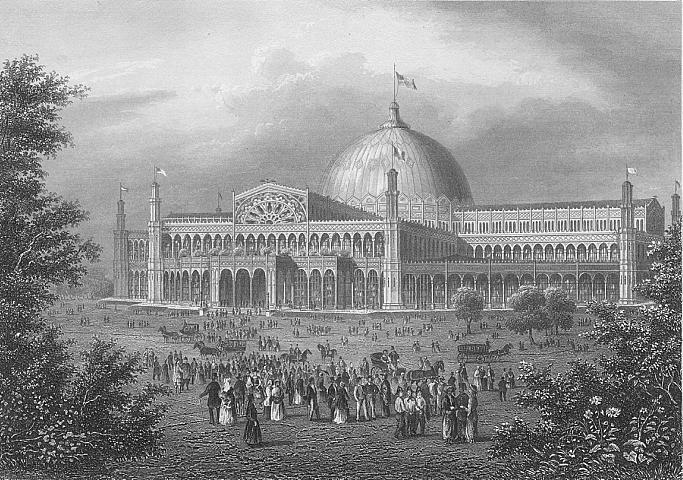
Meanwhile, the space now considered Bryant Park was, in the 1850s, the location of the New York Crystal Palace, home of America’s technological and engineering marvels. Here’s a look at the Crystal Palace in all its glory:
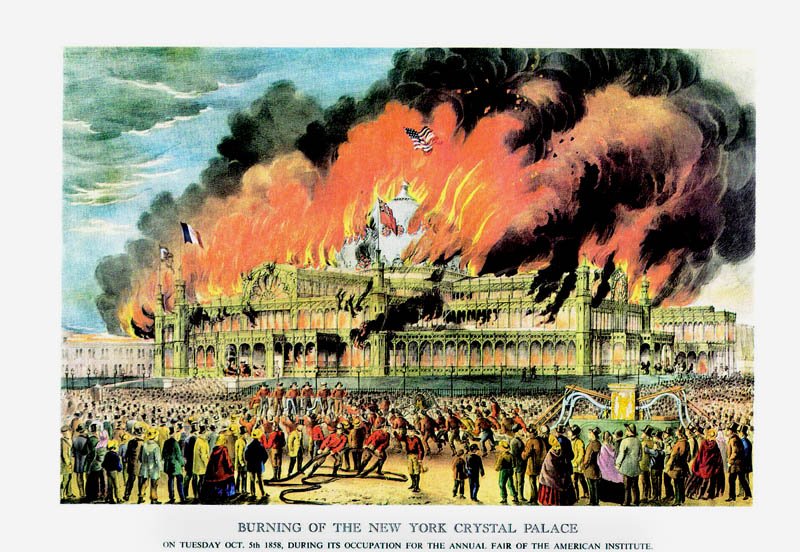
And a dramatic illustration of its final moments, felled in a quick burning fire.
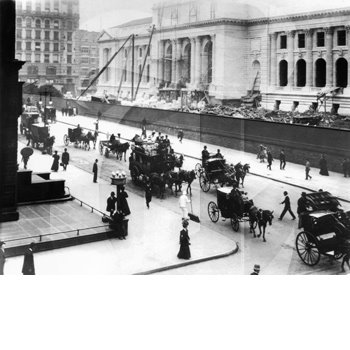
The construction of the library took nine years — sixteen if you consider the time from original design to dedication. The most ambitious marble building of its time, it was covered in Vermont marble so carefully chosen that two-thirds of the shipped stone was rejected for not being refined enough. The marble is at a thickness of almost a foot all around. The net effect even now gives the structure an immovability that makes the modern skyscrapers around it seem light and temporary.
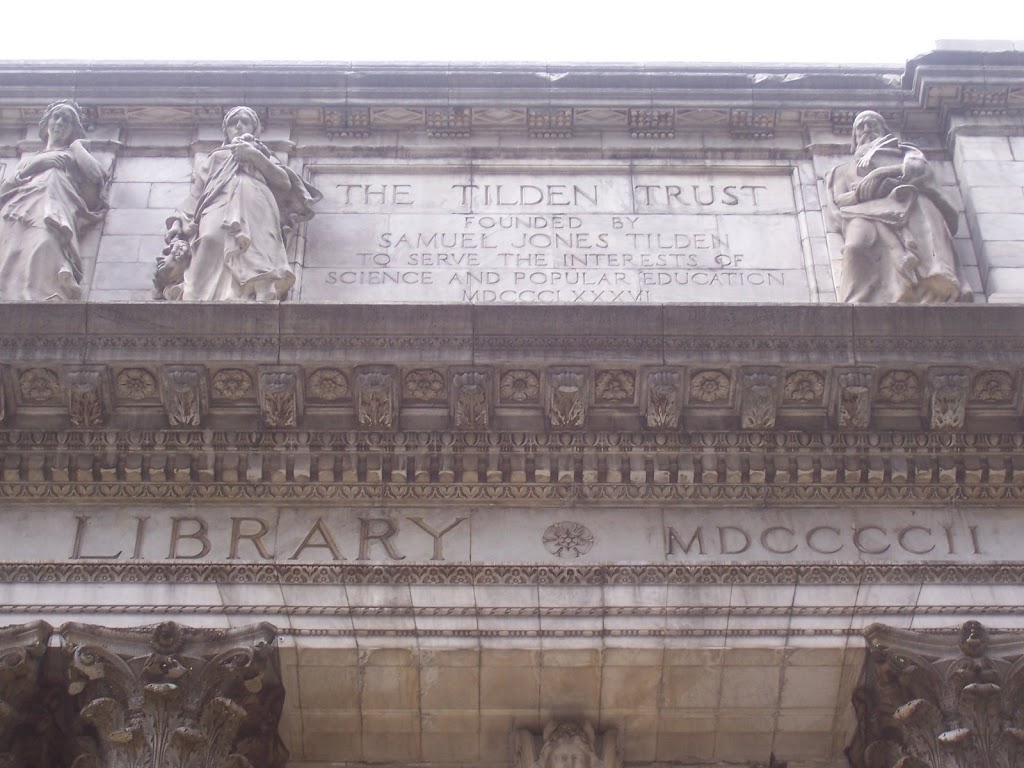
On the frontispiece above the entrance to the library is a tribute to its three creators — millionaire John Jacob Astor, collector James Lenox and former governor Samuel Tilden:
However, the area of 41st street that runs between 5th and 6th Avenue is now called ‘John Bigelow Plaza’, after the man who brought the Astor and Lenox collections together with the Tilden Trust.
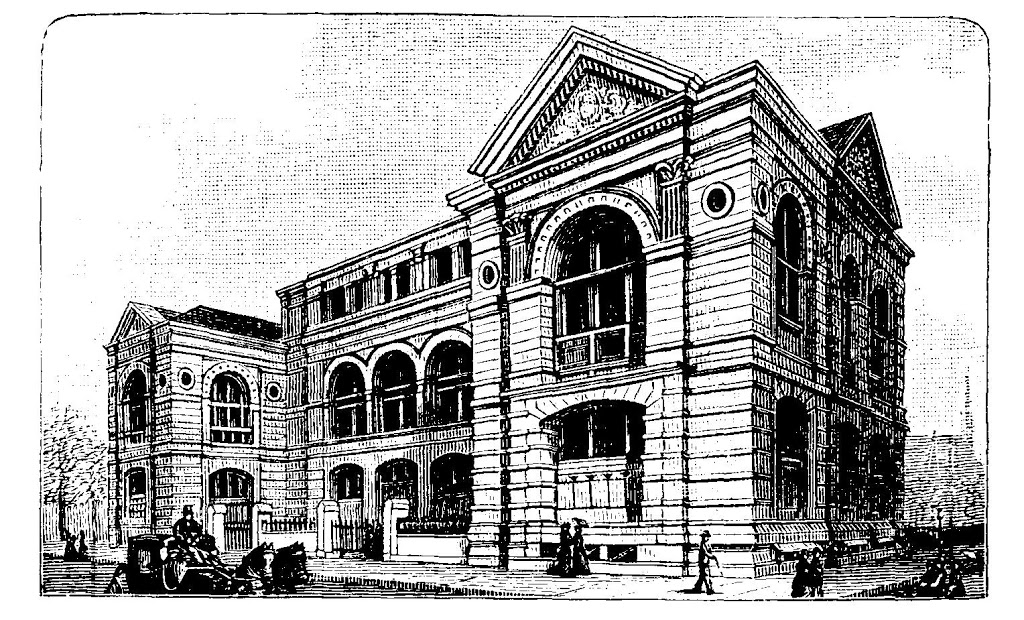
James Lenox has originally kept his collection in his own library on 5th and 70th street. This scratch illustration displays Lenox’s ‘indestructible’ limestone library, which housed most of the items held at the Public Library today, including Lenox’s personal copy of the Gutenberg Bible.
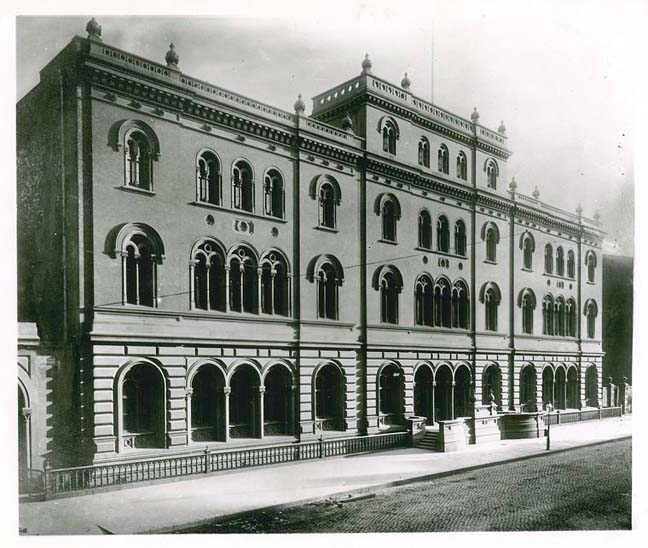
Meanwhile, the rest of the collection came from the Astor Library, constructed with money bequeathed by the millionaire. Thankfully the building remains pretty much intact, thanks to its present occupants, the Public Theatre, whose decades of success on Broadway, off-Broadway, dance, performance art and especially Shakespeare in the Park would have confused but satisfied the building’s original benefactor.
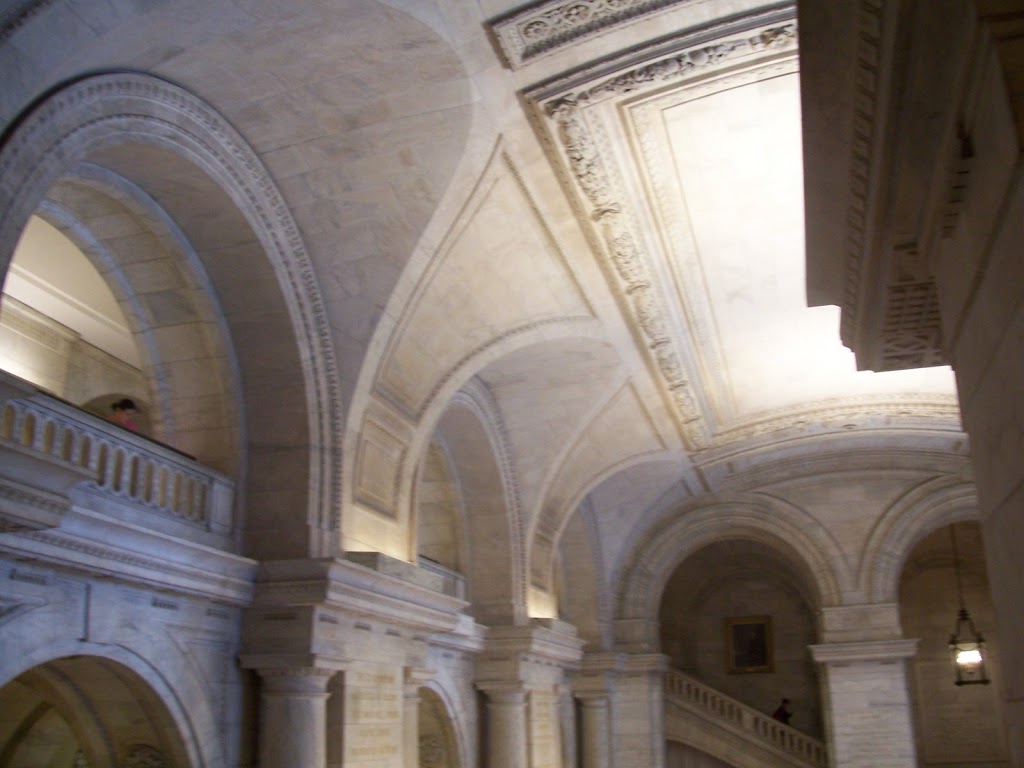
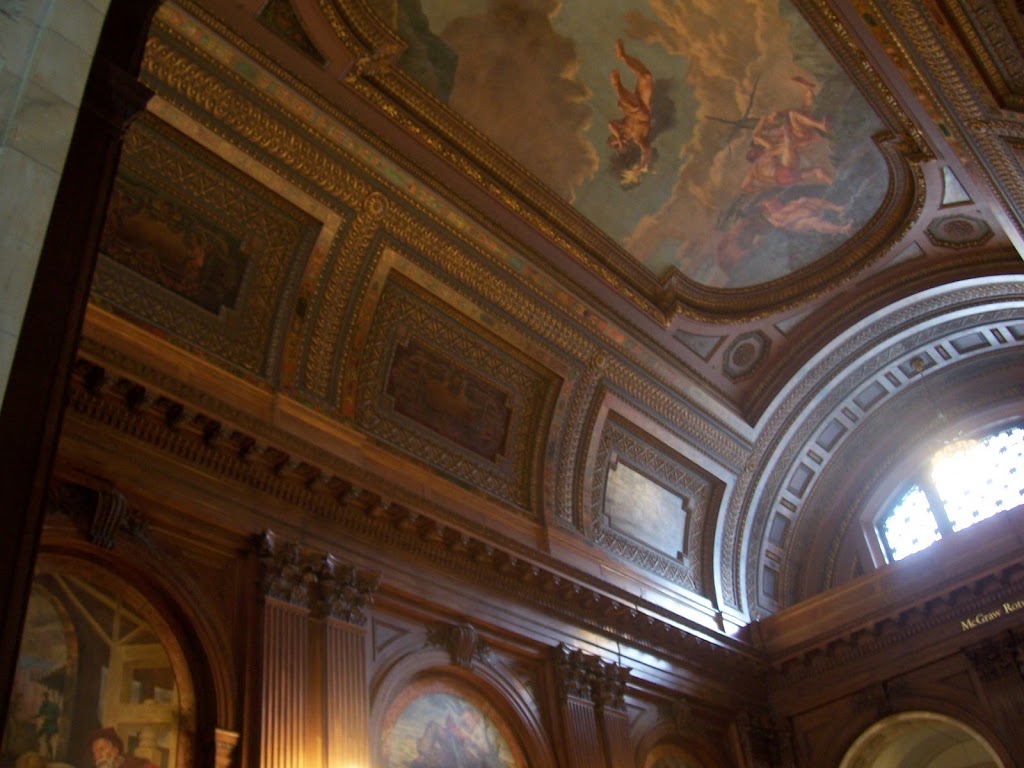
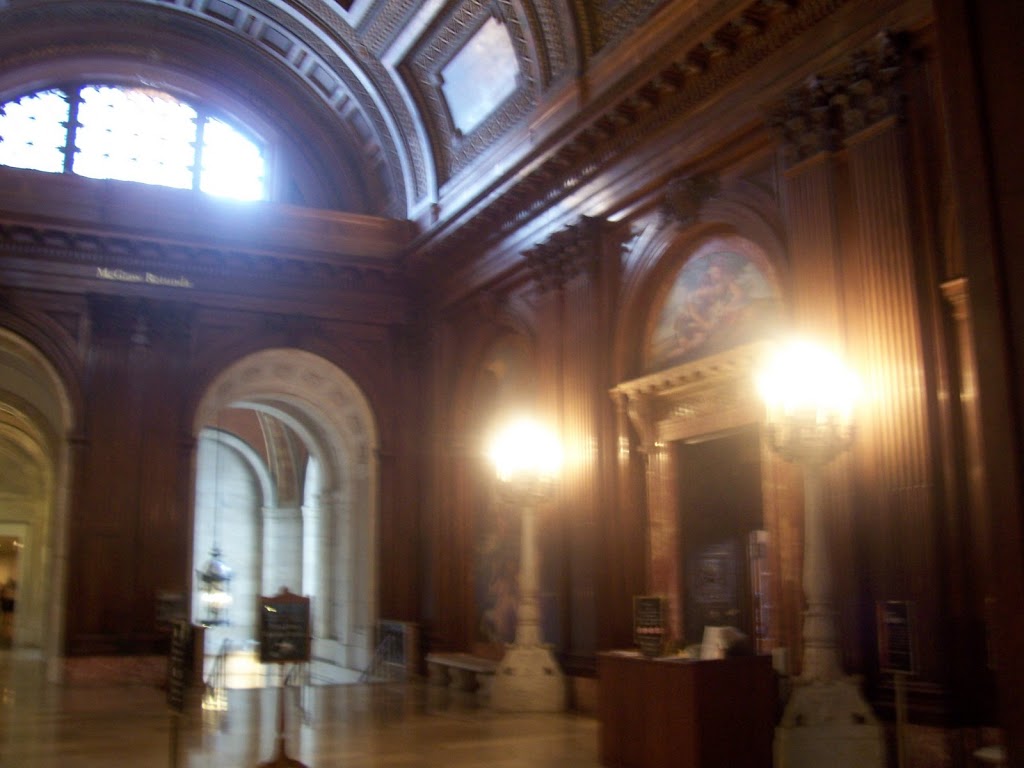
Some pictures from inside the New York Public Library building illustrate some of its more Beaux-Art-ish features. The broad vaulted arches:
And ornate muralled ceilings in the McGraw Rotunda. The effect is a bit like the Vatican apartments mixed with an old bank:
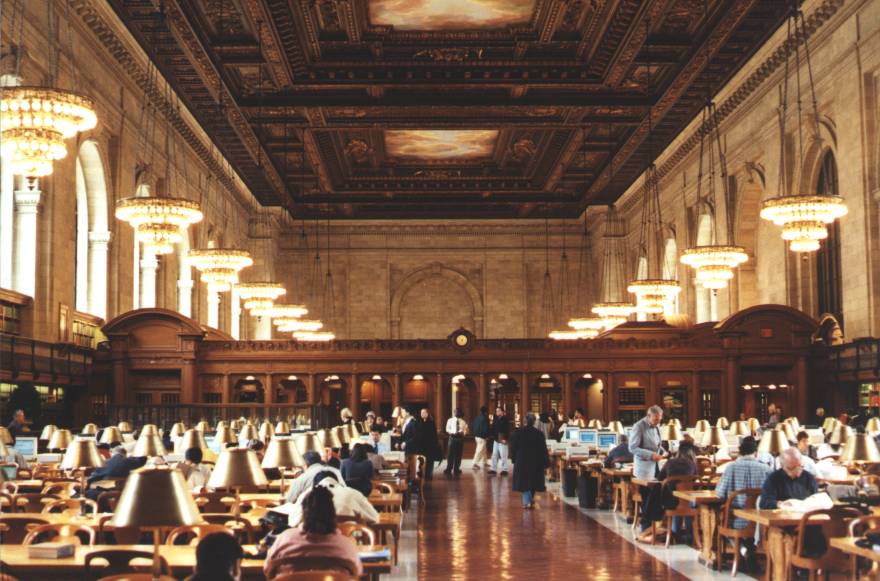
Its all dwarfed, however by the massive Rose Reading Room, whose basic organization came not from the architects but from the library’s first director, Dr. John Shaw Billings, from a sketch he made on a postcard!
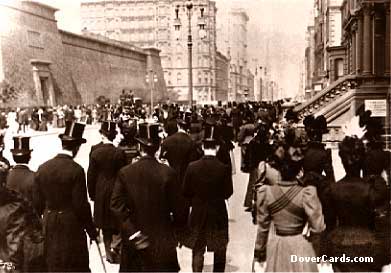
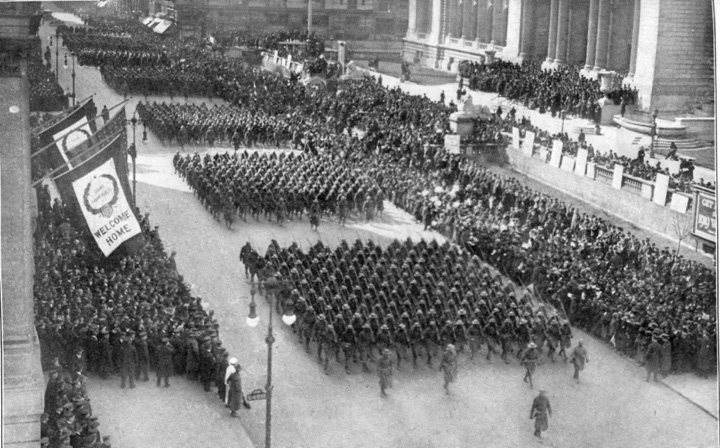
And finally, a beautiful picture I found on a World War I website, showing the fairly new library in all its glory, as New York’s 369th Regiment passes by.
Thanks to the New York Public Library official website for providing us with some of our trivia. And there’s lots more there to intrugue you. Click here for visiting hours and facts about some of the branch libraries.