Categories
Health and Living Podcasts

The Ruins of Roosevelt Island: The macabre history of New York’s “city of asylums”

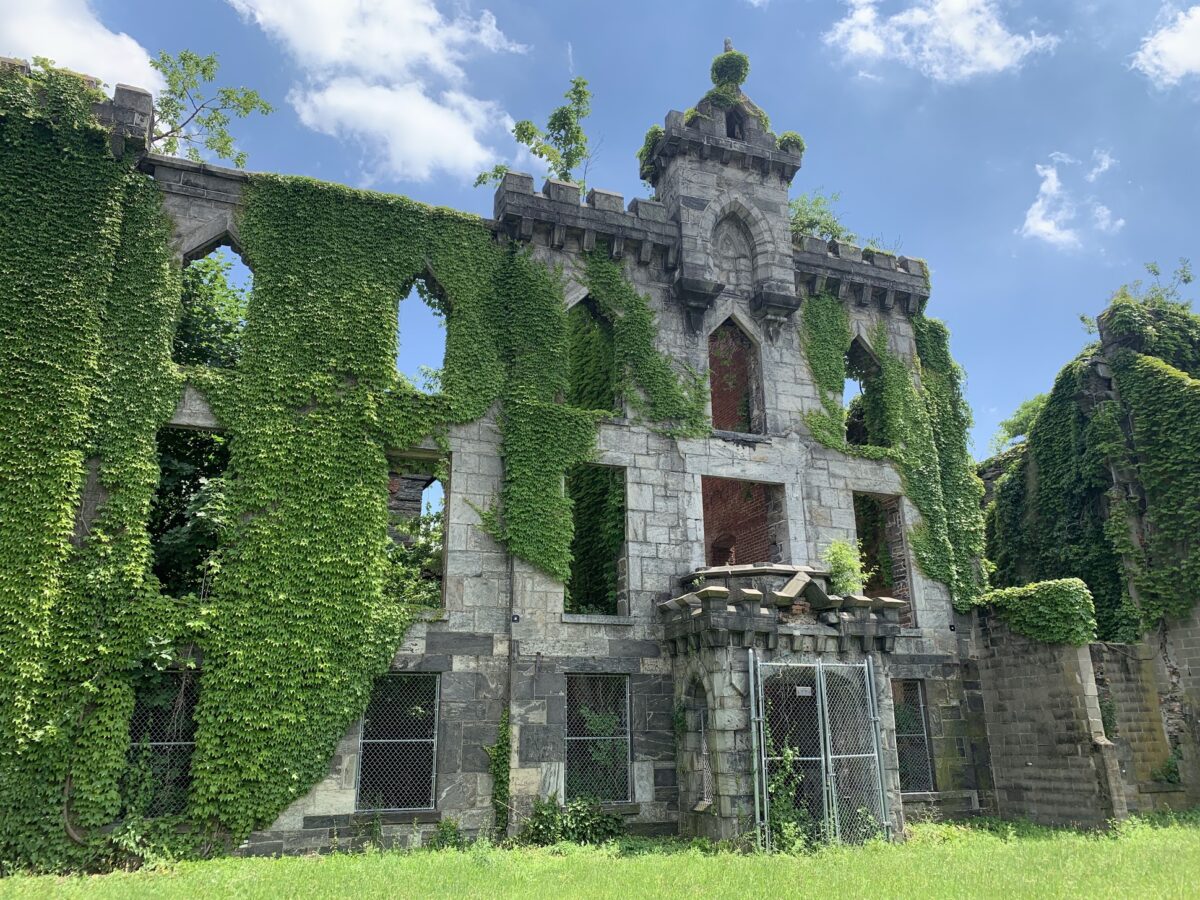
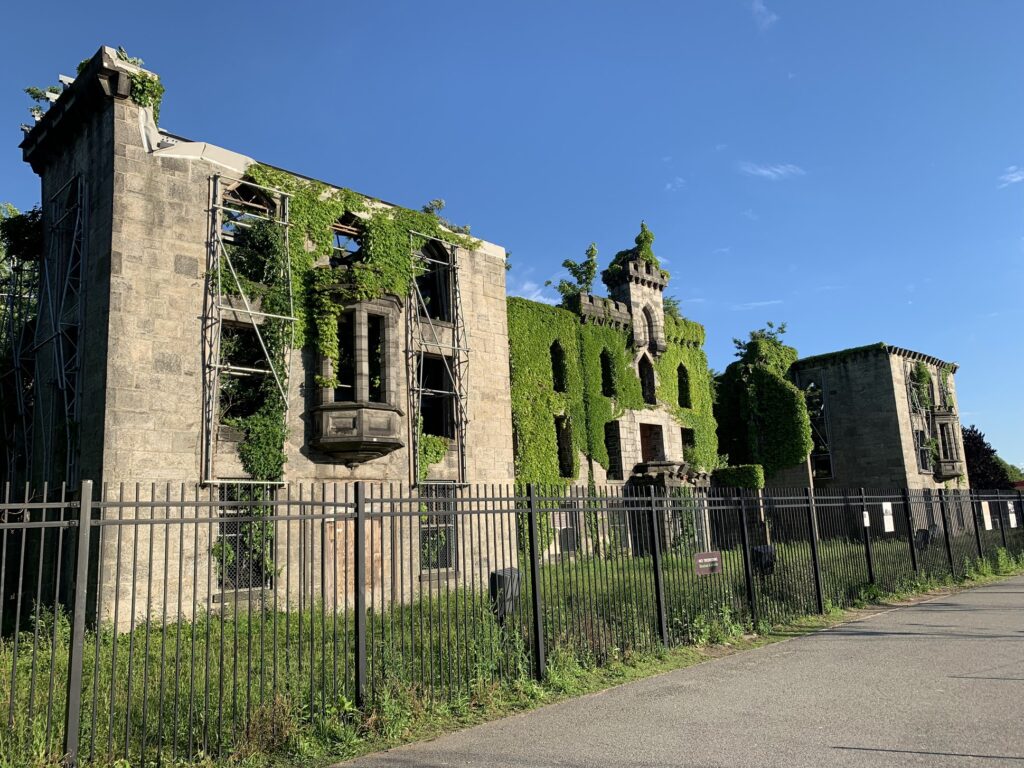
The Renwick Ruin, resembling an ancient castle lost to time, appears along the East River as a crumbling, medieval-like apparition, something not quite believable.

Sitting between two new additions on Roosevelt Island — the campus of Cornell Tech and FDR Four Freedoms Park — these captivating ruins, enrobed in beautiful ivy, tell the story of a dark period in New York City history.

The island between Manhattan and Queens was once known as Blackwell’s Island, a former pastoral escape that transformed into the ominous ‘city of asylums’, the destination for the poor, the elderly and the criminal during the 19th century.

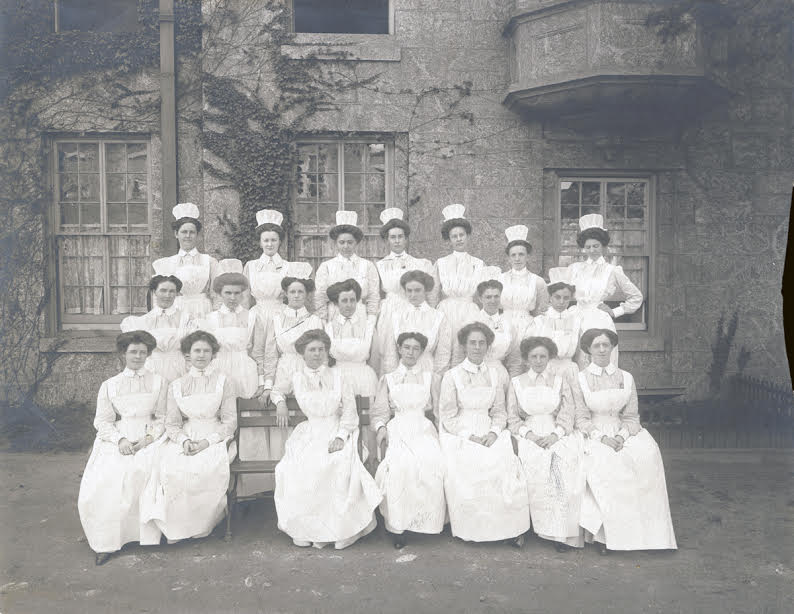
New. York Municipal Archives

During this period, the island embodied every outdated idea about human physical and mental health, and vast political corruption ensured that the inmates and patients of the island would suffer.

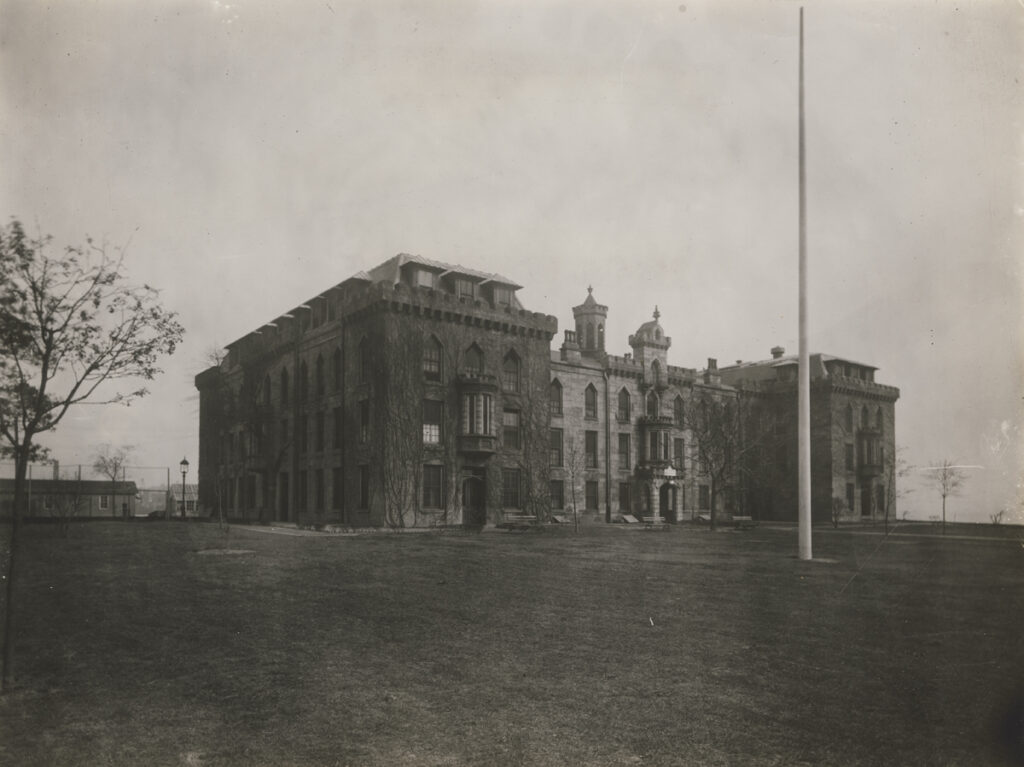
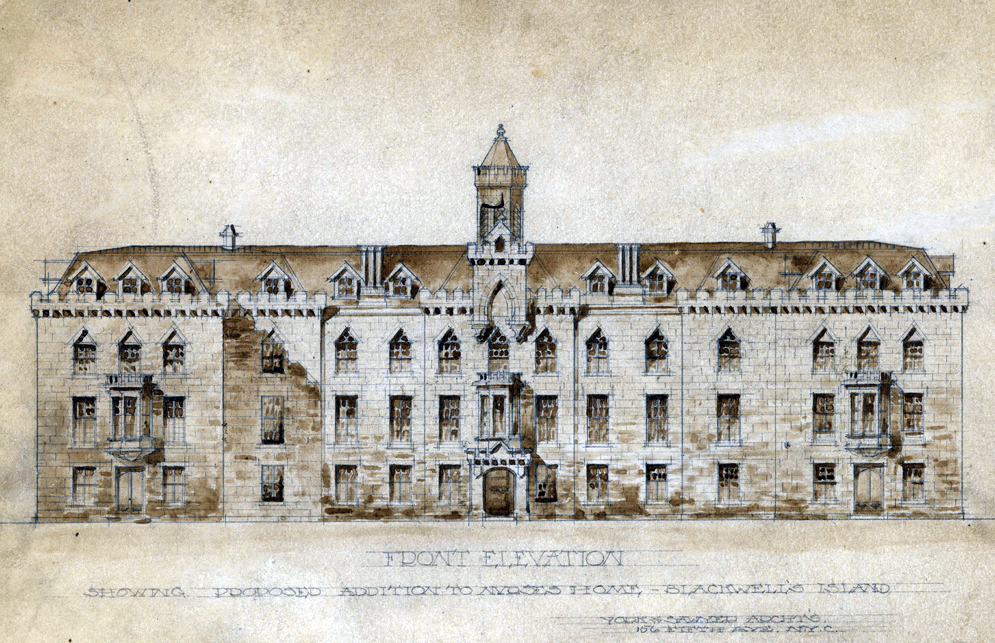
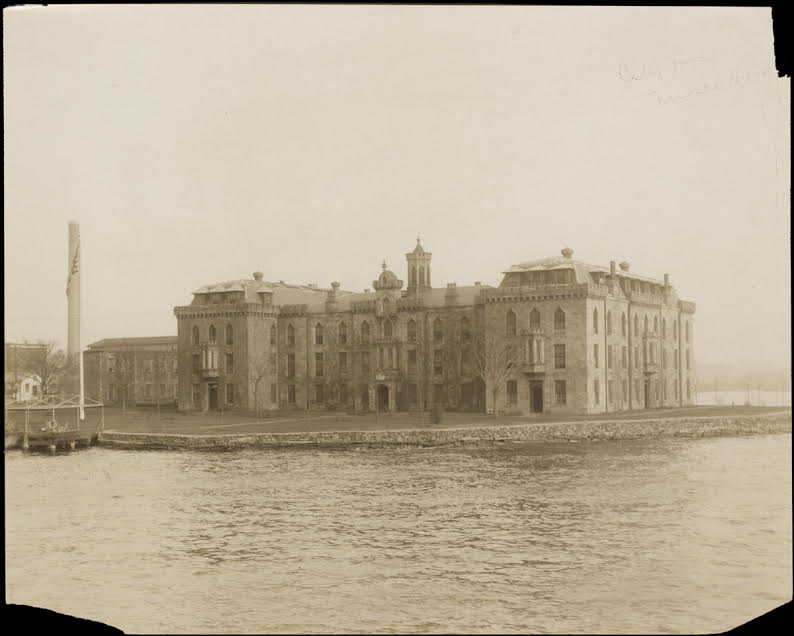
In 1856 the island added a Smallpox Hospital to its notorious roster, designed by acclaimed architect James Renwick Jr (of Saint Patrick’s Cathedral fame) in a Gothic Revival style that captivates visitors to this day — even if the building is in an advanced state of dilapidation.

New York City Municipal Archives

What makes the Renwick Ruin so entrancing? How did this marvelous bit of architecture manage to survive in any form into present day?

PLUS: The grand story of the island — from a hideous execution in 1829 to the modern delights of one of New York City’s most interesting neighborhoods.


For more information on Roosevelt Island history:

Friends of the Ruin

Roosevelt Island Historical Society

I also highly recommend the book Damnation Island: Poor, Sick, Mad, & Criminal in 19th-Century New York by Stacy Horn which tells the story of Blackwell’s Island, institution by institution.

And please check out this great video about Roosevelt Island from 1978:


Historic sites on Roosevelt Island to visit (from north to south):

Roosevelt Island Lighthouse

Nellie Bly Monument “The Girl Puzzle”

The Octagon

Chapel of the Good Shepherd

The Blackwell House

Historic Visitor Center Kiosk and Roosevelt Island Tram

Southpoint Park

Strecker Memorial Laboratory

Smallpox Hospital (aka Renwick Ruin)

FDR Four Freedoms State Park


The entire site of FDR Four Freedoms State Park is located on landfill. Want proof?

New York Municipal Archives
The Renwick Ruin
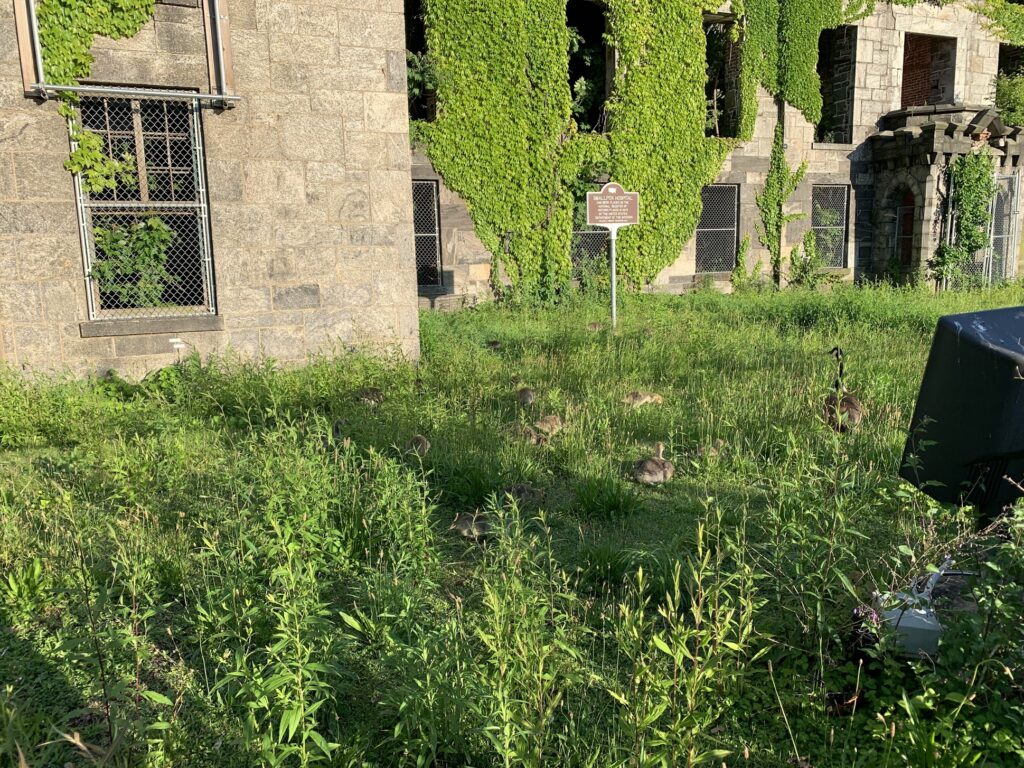
The Smallpox Hospital grounds with grazing geese.
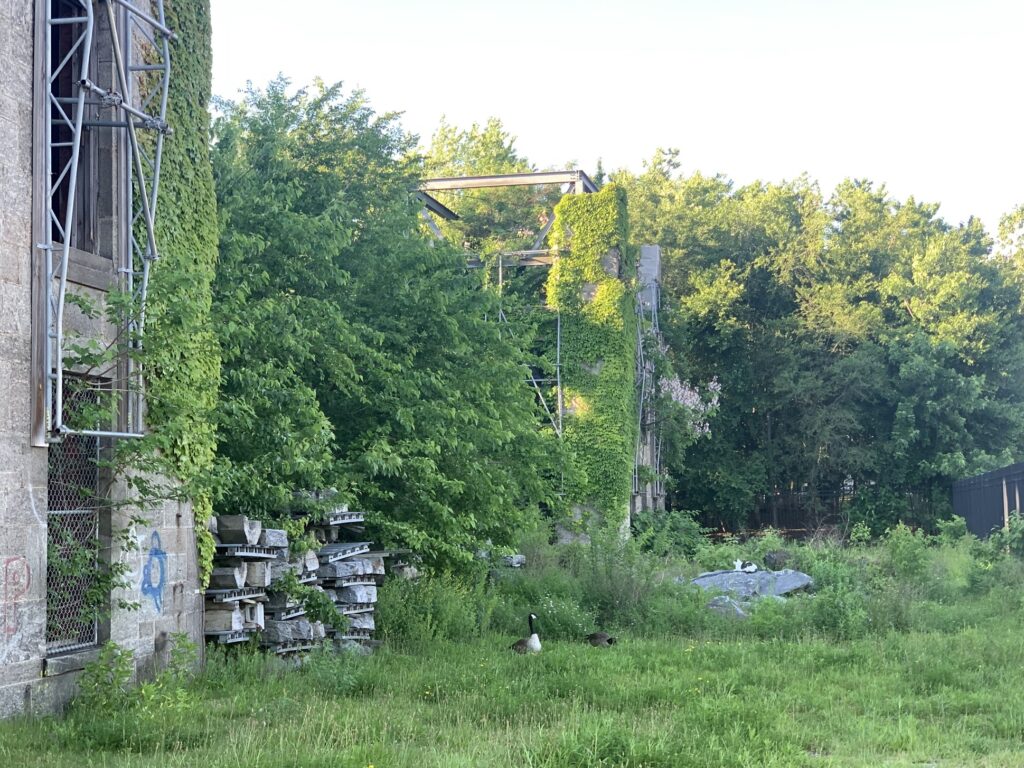
Behind the ruin, guarded by geese and cats.
Southpoint Park, photo by Greg Young

FURTHER LISTENING

After listening to this episode on the Renwick Ruin on Roosevelt Island, jump back into these earlier Bowery Boys podcasts which discuss similar themes or situations from the show:


The Bowery Boys: New York City History podcast is brought to you …. by you!

We are producing a new Bowery Boys podcast every other week. We’re also looking to improve and expand the show in other ways — publishing, social media, live events and other forms of media. But we can only do this with your help!

We are creators on Patreon, a patronage platform where you can support your favorite content creators.

Please visit our page on Patreon and watch a short video of us recording the show and talking about our expansion plans. If you’d like to help out, there are several different pledge levels. Check them out and consider being a sponsor.

We greatly appreciate our listeners and readers and thank you for joining us on this journey so far.

Categories
Hudson Valley Podcasts

Road Trip to the Hudson Valley: The Complete Series Now Available

The Bowery Boys Road Trip to the Hudson Valley mini-series, exploring stories of American history along the Hudson River, is now complete. Catch up on all three episodes — and join us on Patreon for a special ‘behind the scenes’ episode:

On the Trail of the Croton Aqueduct

Welcome to the Old Croton Aqueduct Trail, 26.5 miles of dusty pathway through some of the most interesting and beautiful towns and villages of Westchester County.

But this is more than a linear park. The trail runs atop — and sometimes alongside — the original Croton Aqueduct, a sloping water system which opened in 1842, inspired by ancient Roman technology which delivered fresh water to the growing metropolis over three dozen miles south.

Locations featured: New Croton Dam, the Double Arch Bridge in Ossining, the Keeper’s House in Dobbs Ferry

Hyde Park: The Roosevelts on the Hudson

Hyde Park, New York was the home of Franklin Delano Roosevelt, the 32nd president of the United States. He was born here, he lived here throughout his life, and he’s buried here — alongside his wife Eleanor Roosevelt

But it was more than simply a home.

The Hyde Park presence of the Roosevelts expands outwardly from the Roosevelt ancestral mansion of Springwood, over hundreds of forested acres from former farmlands on the eastern side to the shores of the Hudson River on the west.

Locations featured: Home of Franklin D. Roosevelt National Historic Site, FDR Presidential Library and Museum, Top Cottage, Val-Kill Cottage, all in Hyde Park

The Hudson River School: An American Art Revolution

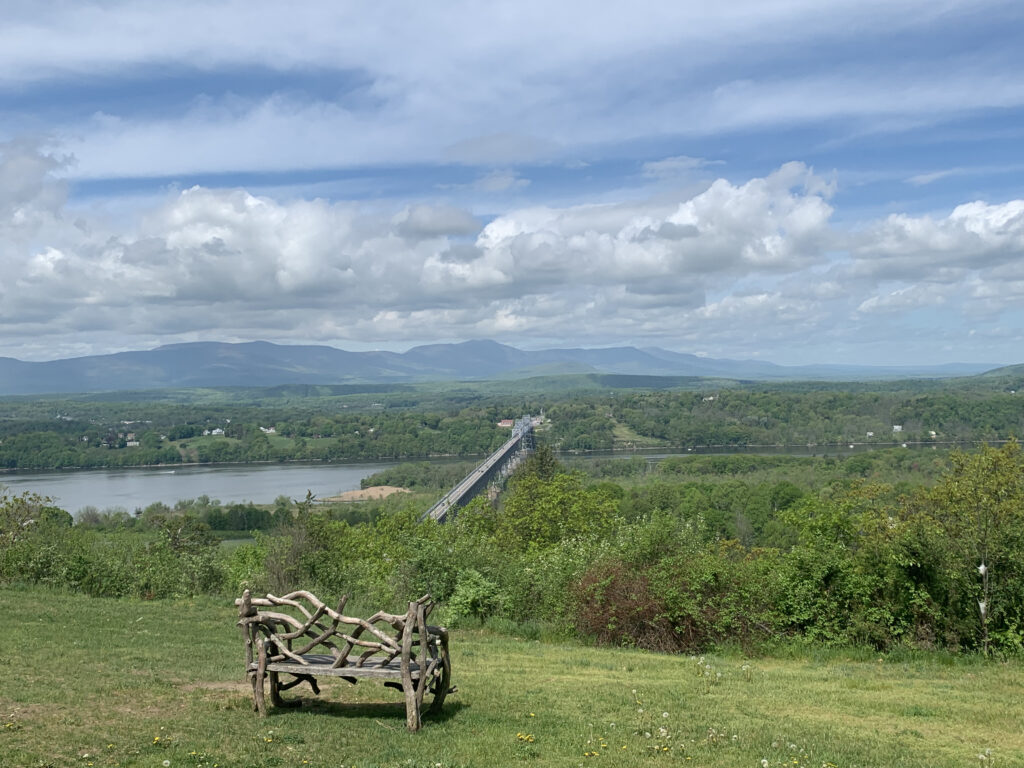
Two landmarks to American art history sit on either side of the Rip Van Winkle Bridge over the Hudson River — the homes of visionary artists Thomas Cole and Frederic Edwin Church.

Cole and Church were leaders of the Hudson River School, a collective of 19th century American painters captivated by natural beauty and wide-open spaces. Many of these paintings, often of a massive size, depicted fantastic views of the Hudson River Valley where many of the artists lived.

Locations featured: Thomas Cole National Historic Site in Catskill, Olana State Historic Site in Hudson

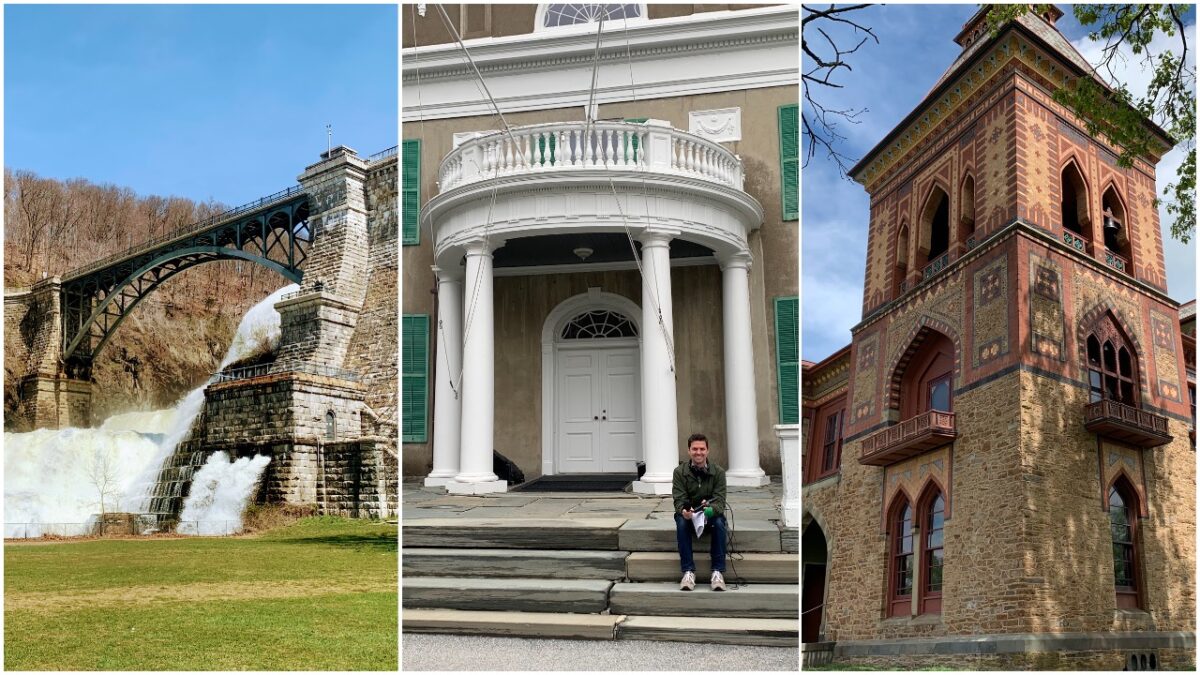
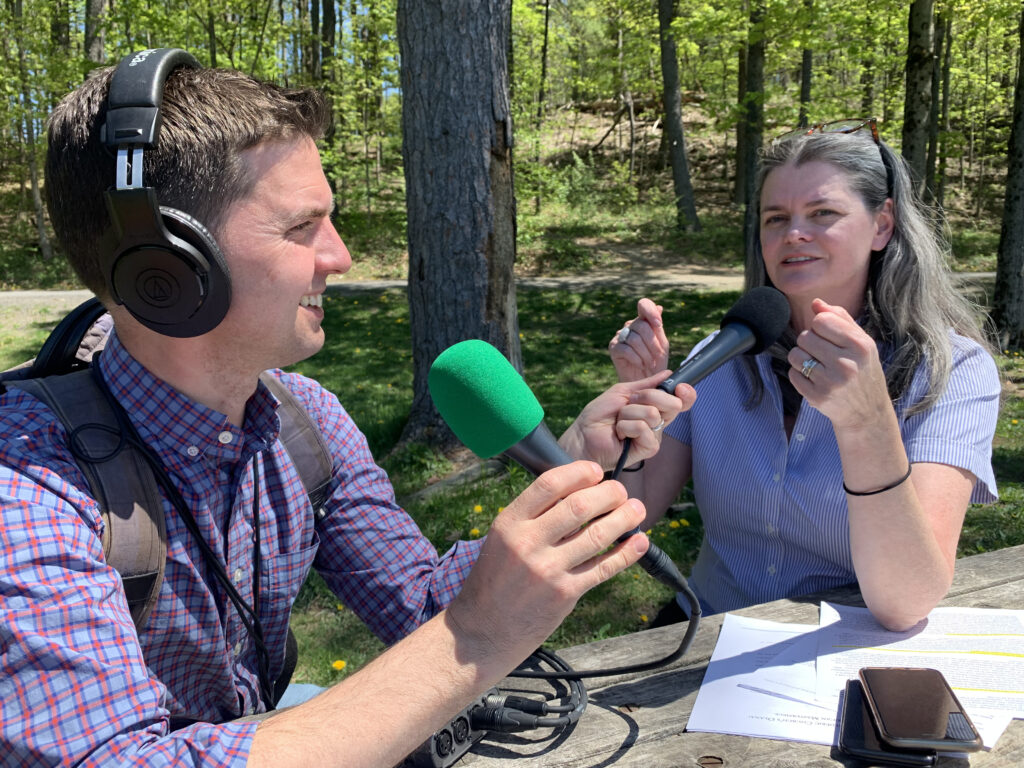
Tom interviewing Amy Hausmann of the Olana State Historic Site

Road Trip to the Hudson Valley: Aftermath

In this Patreon exclusive, Greg and Tom look back on their adventures in the Hudson Valley and give you a behind-the-scenes look at their journeys along the Croton Aqueduct Trail, Hyde Park and the towns of Catskill and Hudson

PLUS: Some tips on how to make these trips yourself this year.

To listen to this show, support the Bowery Boys Podcast on Patreon.

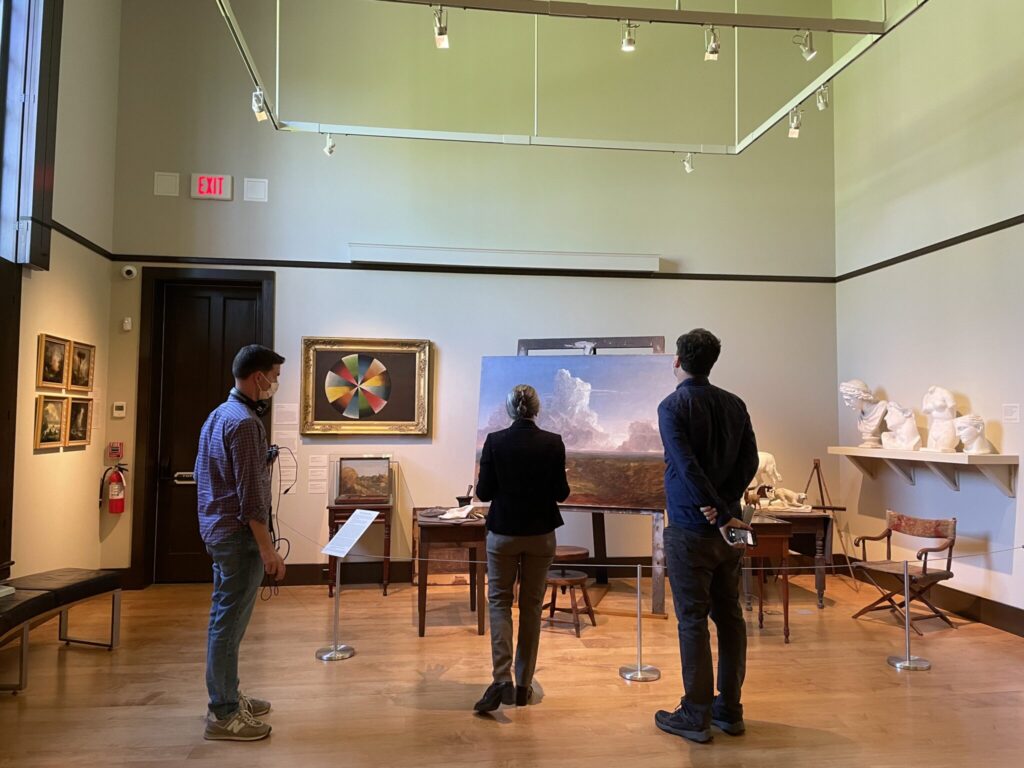
Greg and Tom with Betsy Jacks in the New Studio, admiring Cole’s unfinished painting.
Categories
Podcasts Religious History

The secrets of the Cathedral of St. John the Divine, the unfinished beauty of Morningside Heights

PODCAST The history of the Cathedral of St. John the Divine and a tour of its unique artistic treasures

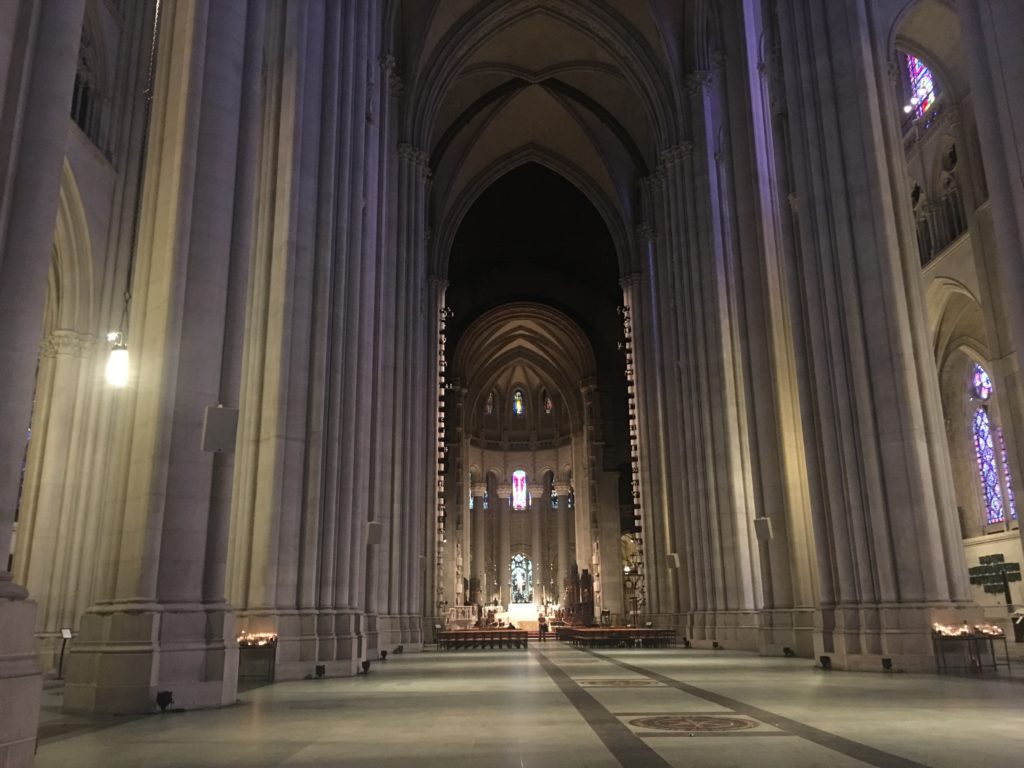
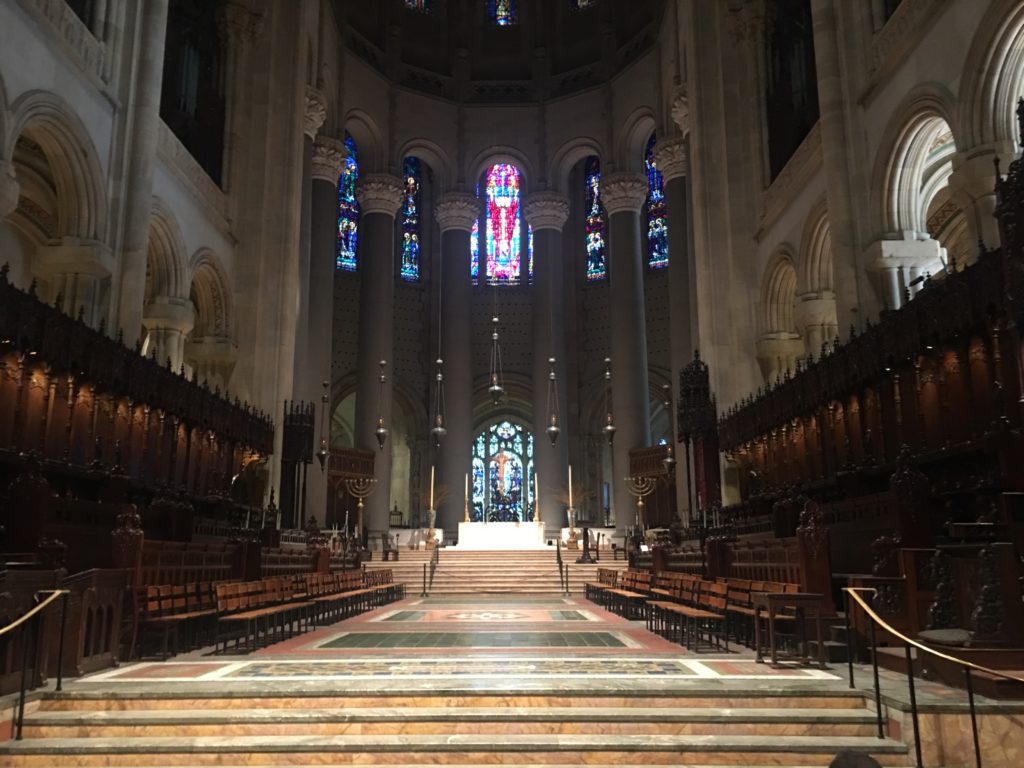
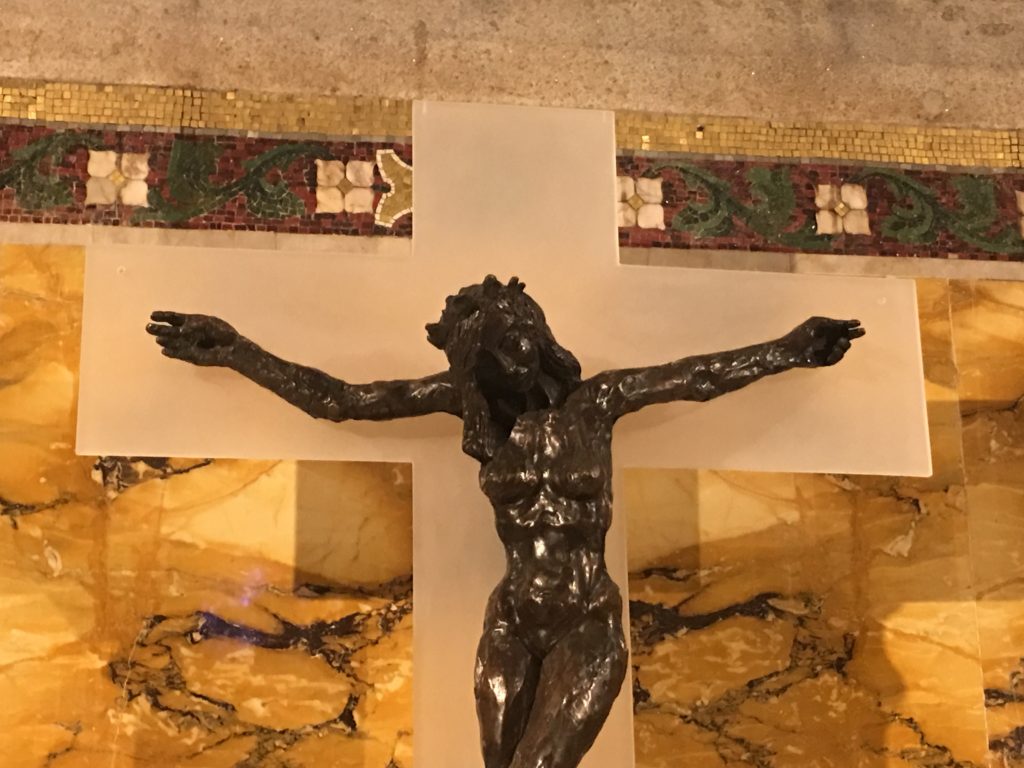
The Bowery Boys have finally made it to one of the most enigmatic and miraculous houses of worship in America – the Cathedral of St John the Divine. This Episcopal cathedral has a story like no other and a collection of eccentric artifacts and allegorical sculpture – both ancient and contemporary – that continues to marvel and confound.

Located in Morningside Heights in Upper Manhattan, St. John the Divine – named for the Apostle and author of the Book of Revelations — is no ordinary cathedral (if such a thing exists). Every corner seems to vibrate on a different frequency from other Christian churches.

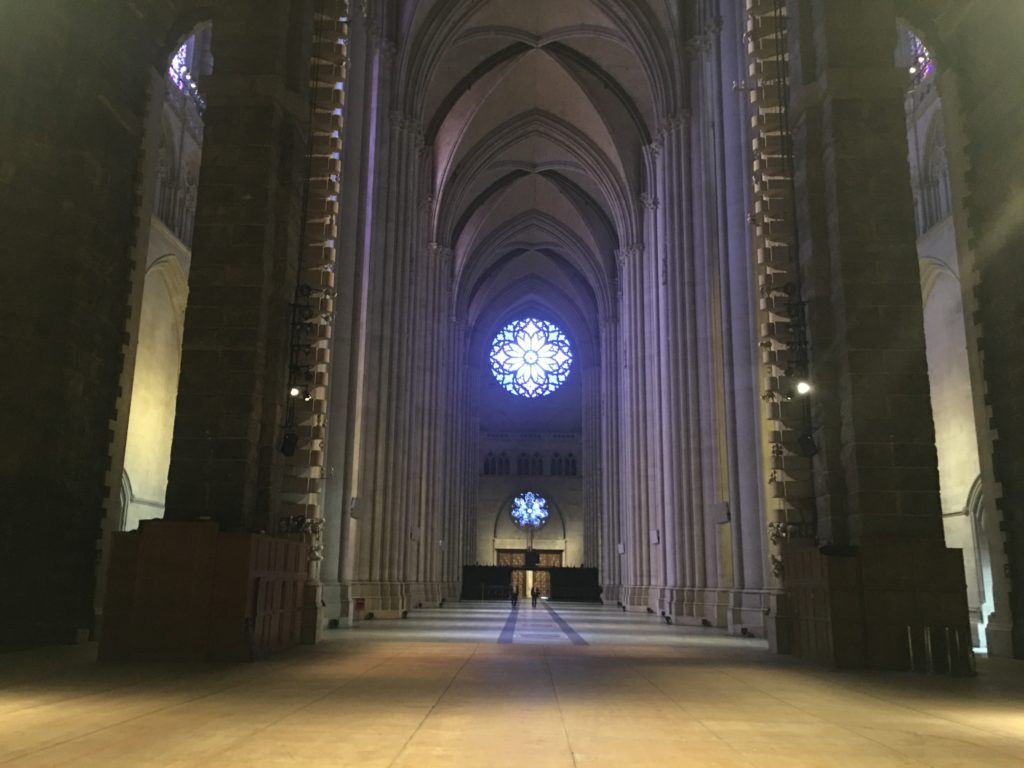
Many ideas have gone into creating St. John the Divine’s unique personality – a quirky mix of architectural styles, some outside-the-box ideas about community outreach, its embrace of the unconventional. But one particularly striking detail sets it apart from the rest: the Cathedral remains unfinished.

FEATURING: Franklin Delano Roosevelt, Keith Haring, Duke Ellington, Martin Luther King Jr. and the high-wire antics of Philippe Petit

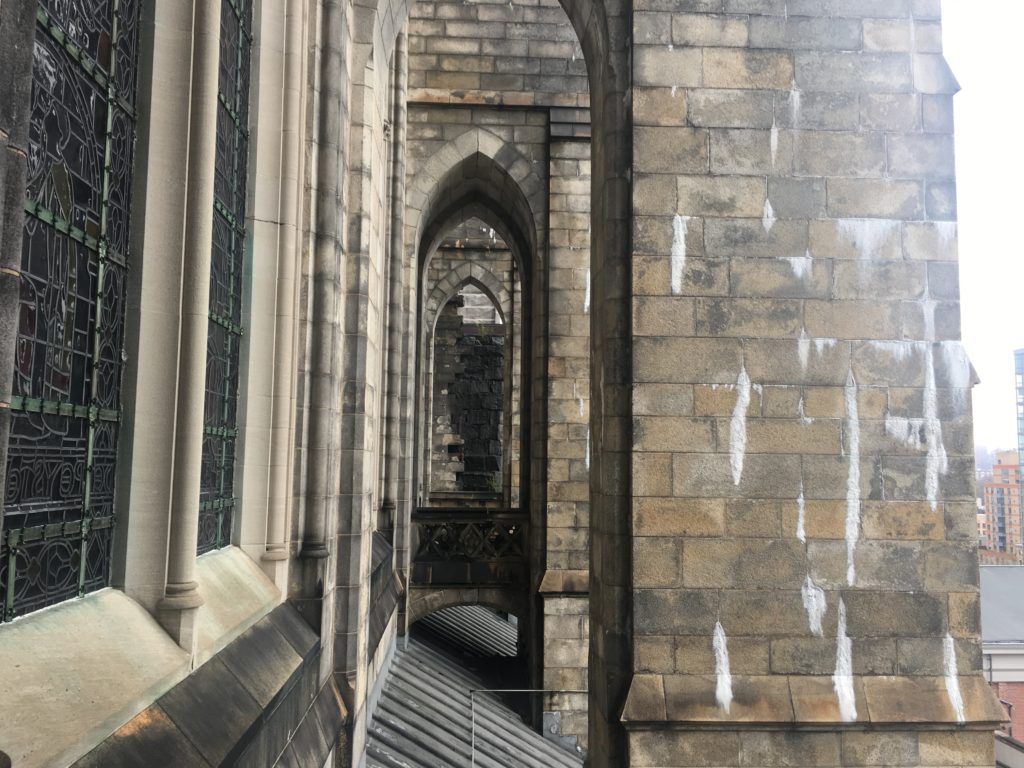
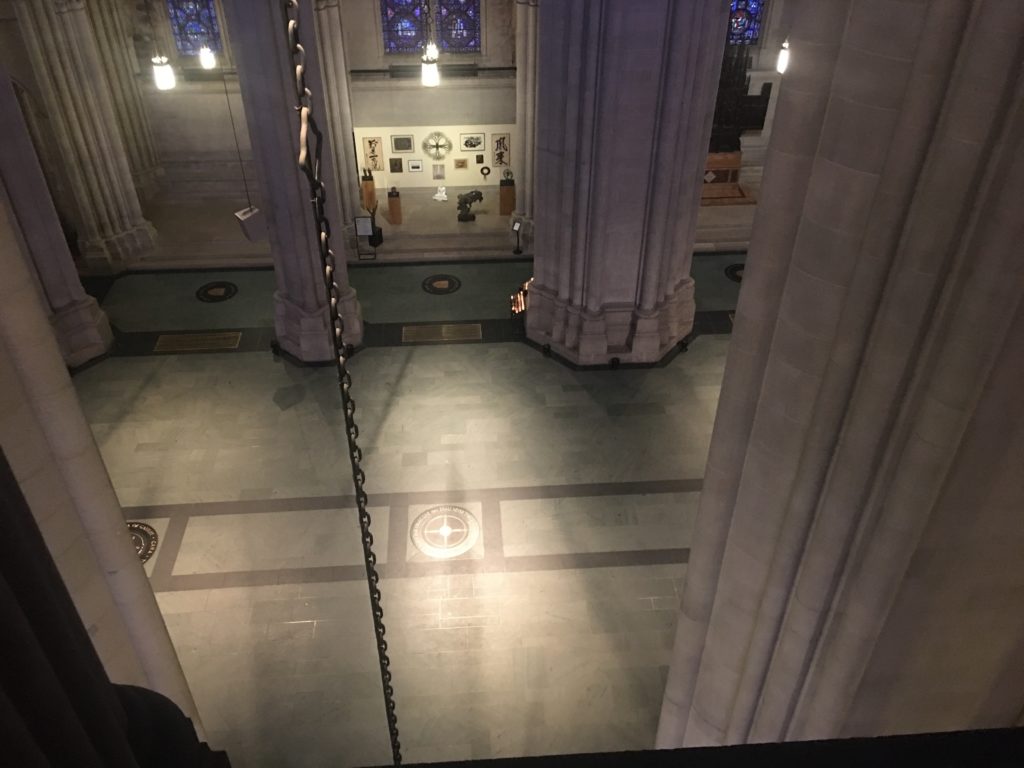
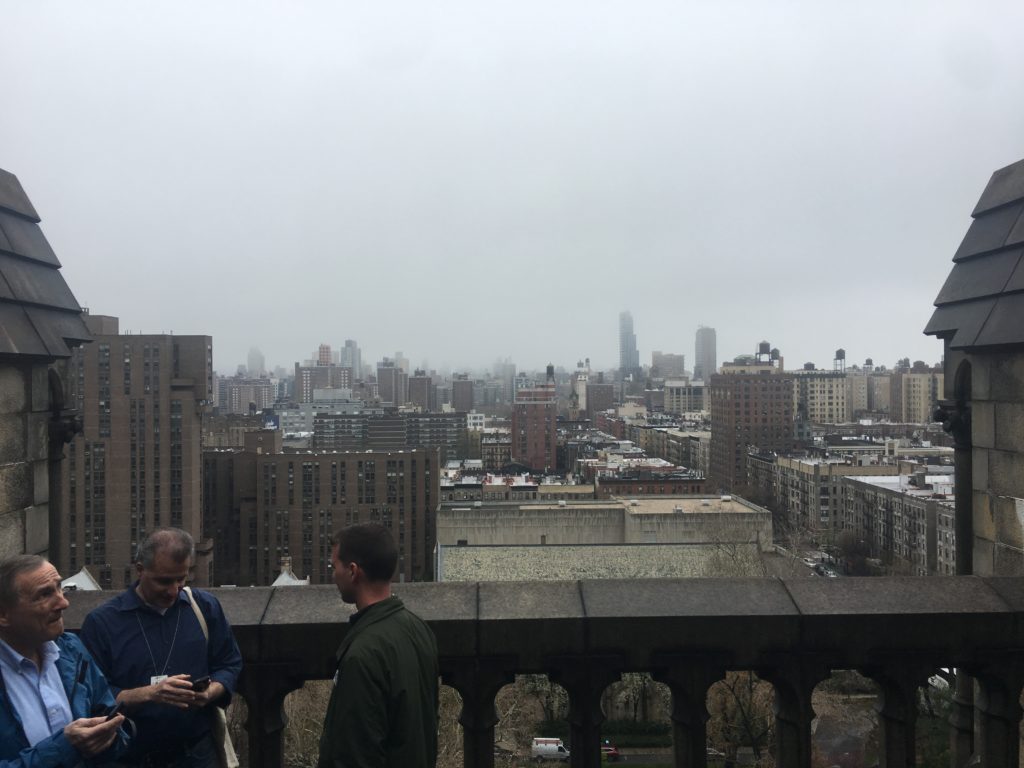
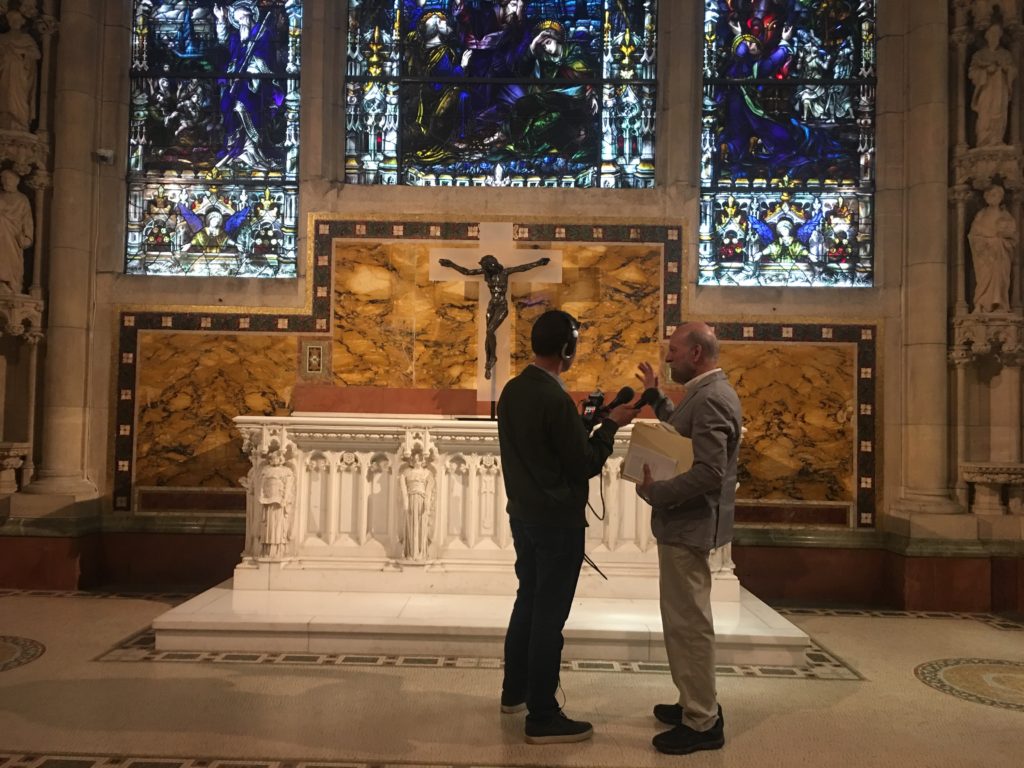
ALSO: Tom and Greg explore the Cathedral — from the crypt to the rooftop – with tour guide Bill Schneberger.

Listen Now: Cathedral of St. John the Divine Podcast

Or listen to it straight from here:

______________________________________________________

The Bowery Boys: New York City History podcast is brought to you …. by you!

We are now producing a new Bowery Boys podcast every other week.  We’re also looking to improve the show in other ways and expand in other ways as well — through publishing, social media, live events and other forms of media.  But we can only do this with your help!

We are now a member of Patreon, a patronage platform where you can support your favorite content creators for as little as a $1 a month.

Please visit our page on Patreon and watch a short video of us recording the show and talking about our expansion plans.  If you’d like to help out, there are five different pledge levels (and with clever names too — Mannahatta, New Amsterdam, Five Points, Gilded Age, Jazz Age and Empire State). Check them out and consider being a sponsor.

We greatly appreciate our listeners and readers and thank you for joining us on this journey so far. 

_______________________________________________________

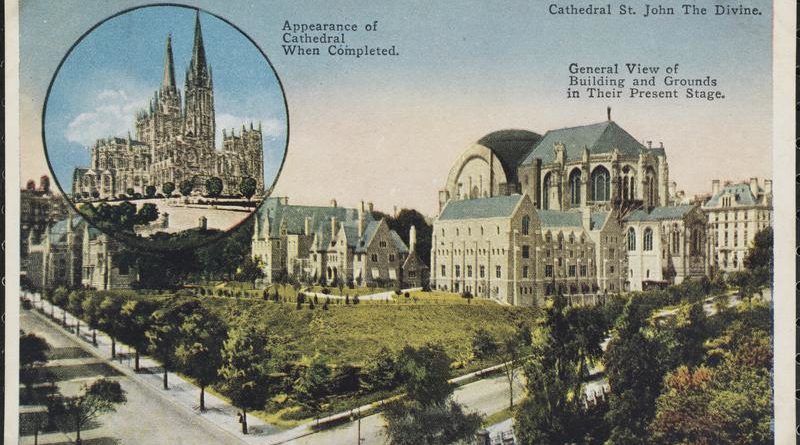
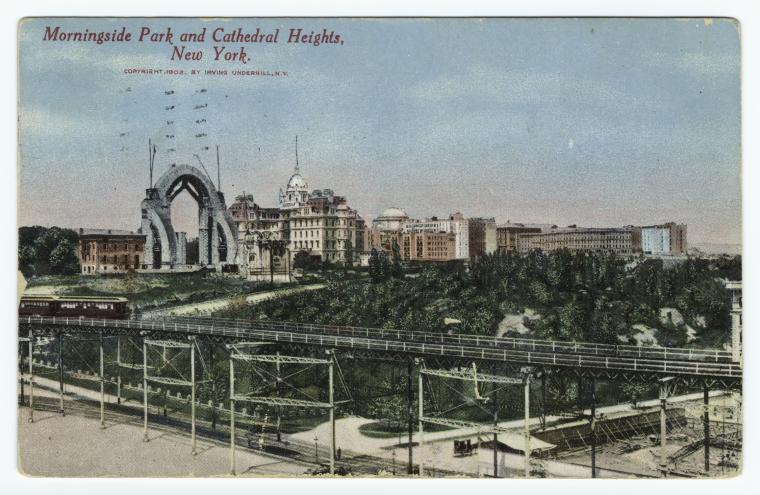
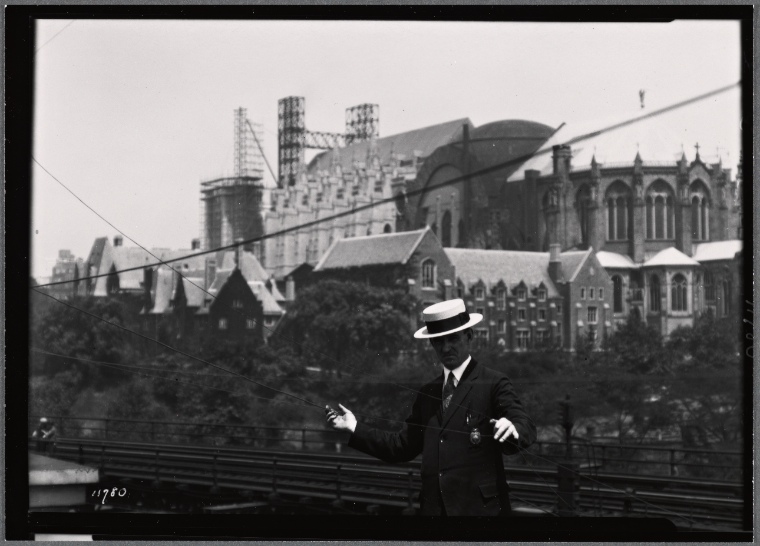
A postcard from 1902 with only a gigantic arch built. The nearby campus of Columbia University was only a few years old by this time.

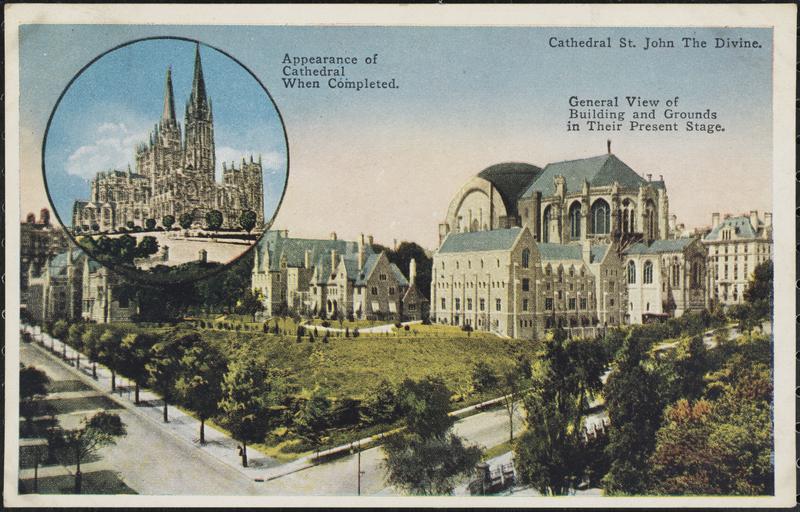
A postcard from 1910. Little did they know that it still would not be finished over a century afterwards.

Museum of the City of New York

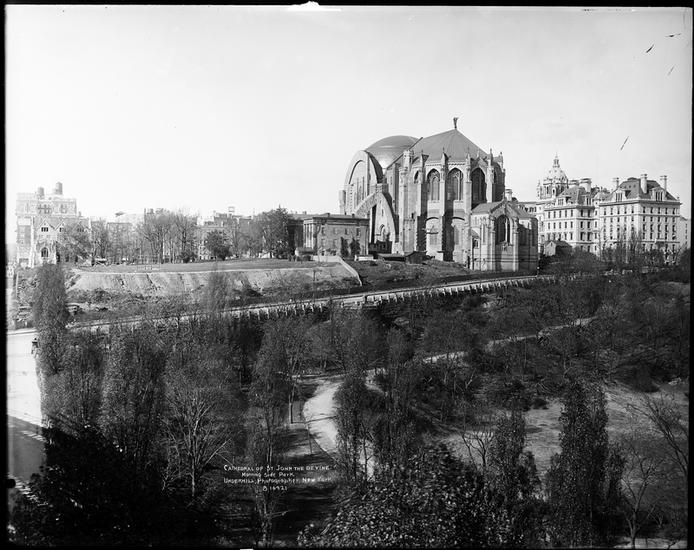
What the church actually looked like in 1910.

Irving Underhill/Museum of the City of New York
New York Public Library

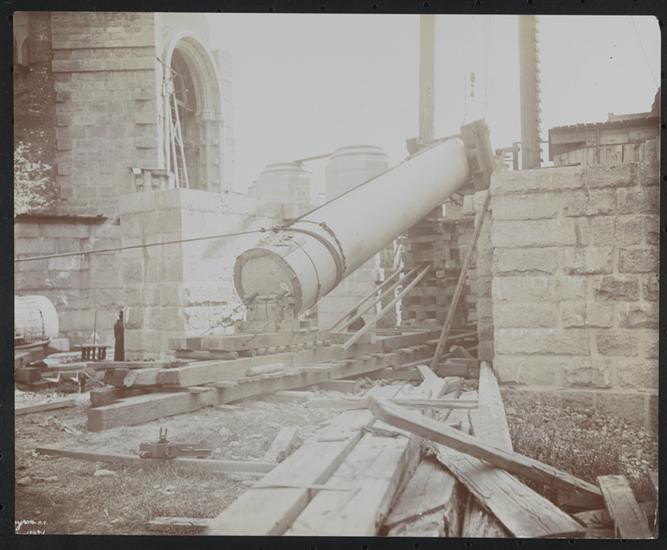
Bringing the columns into the future nave of the church, 1904.

Museum of the City of New York

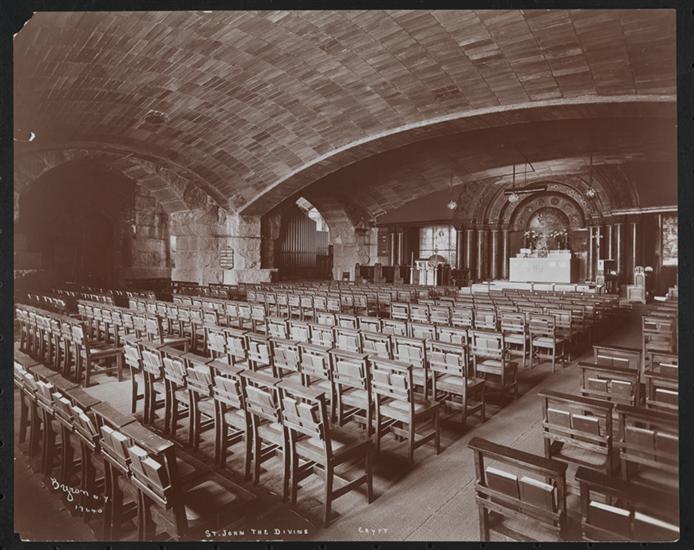
The first services were actually held in the crypt. Note the beautiful Guastavino tiling on the ceiling.

MCNY

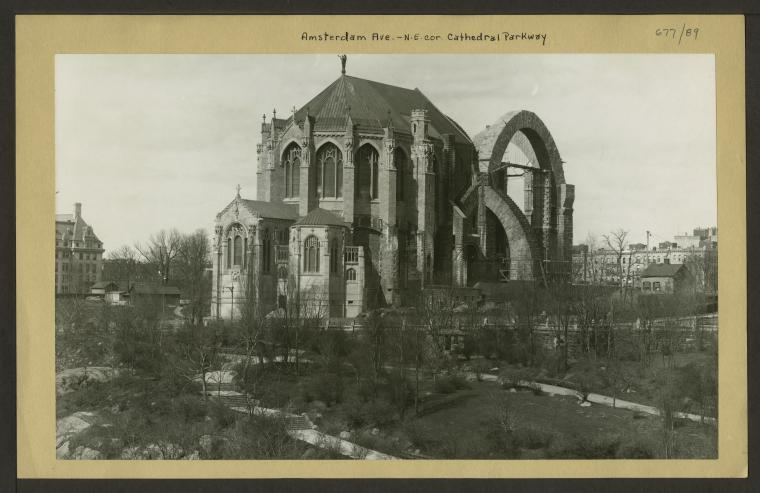
Considerably more work has been done by 1934 as shown in this photograph.

NYPL

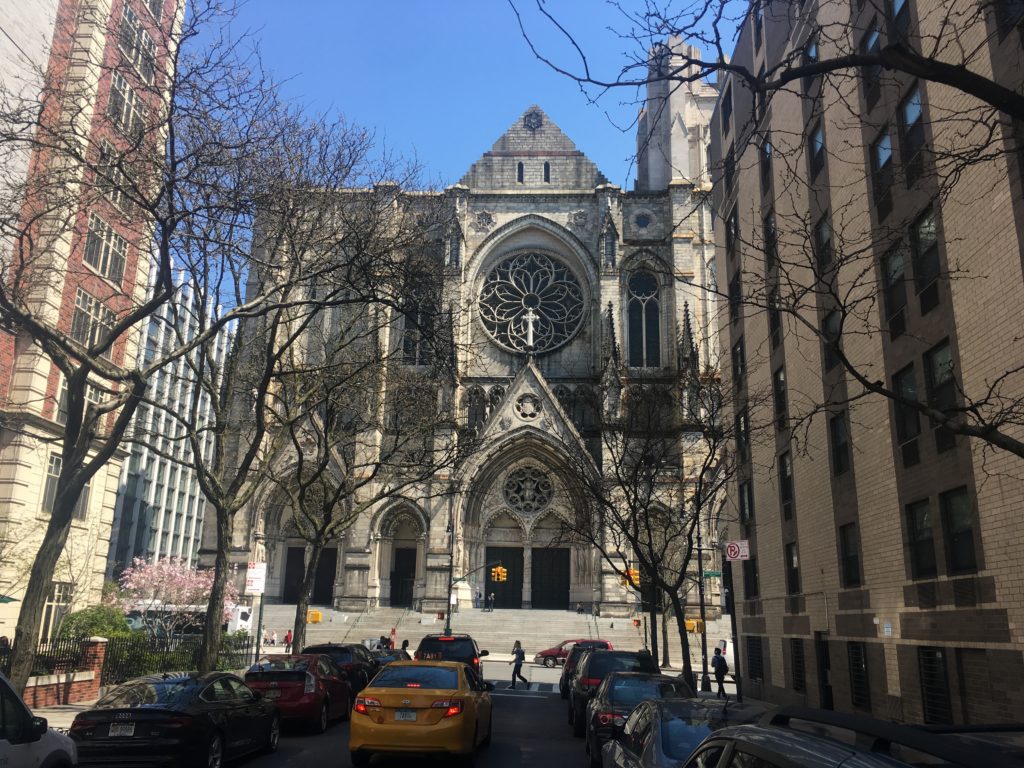
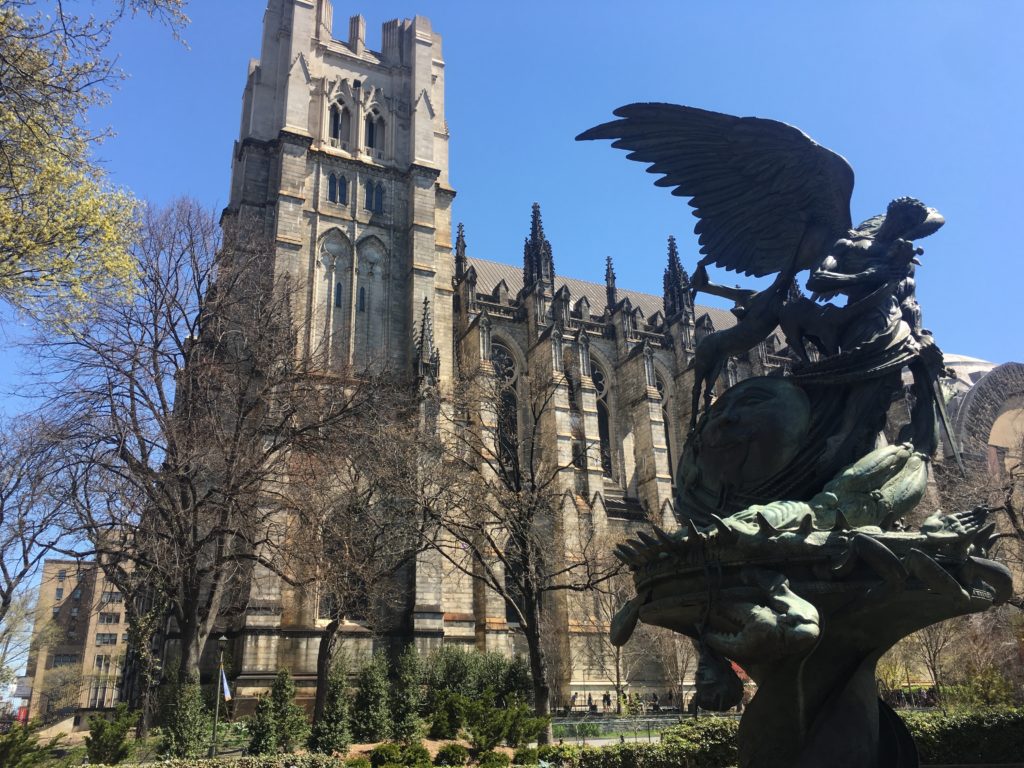
The western end of the cathedral as seen from the children’s garden at the foot of the REALLY weird Peace Fountain by sculptor Greg Wyatt.

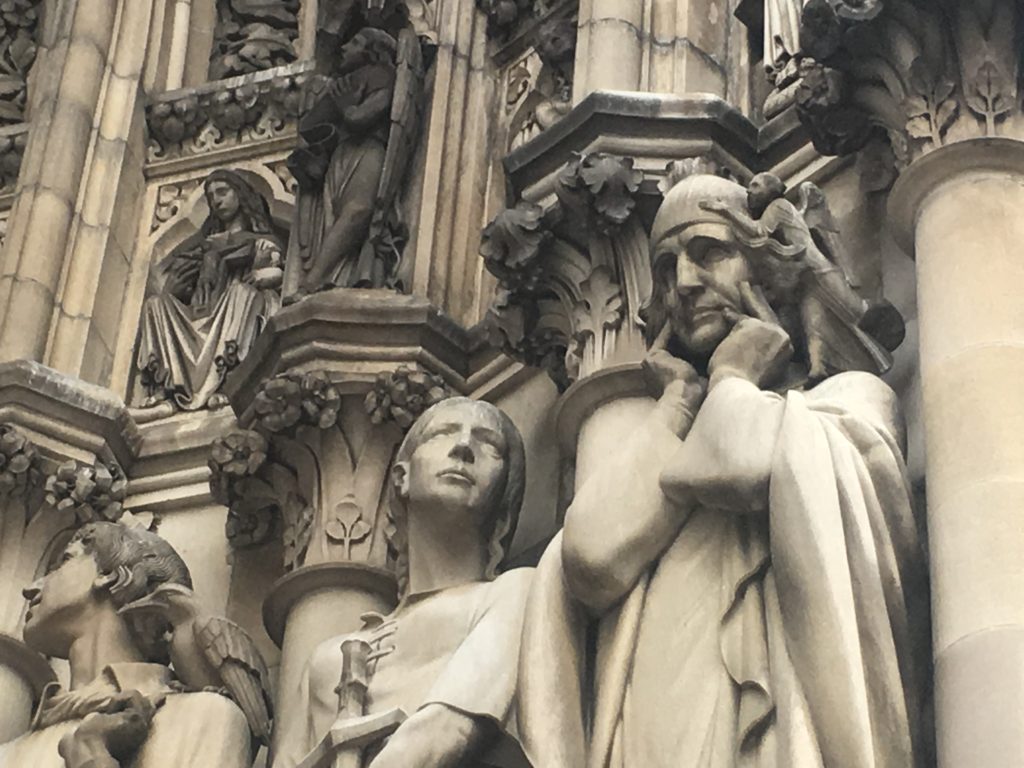
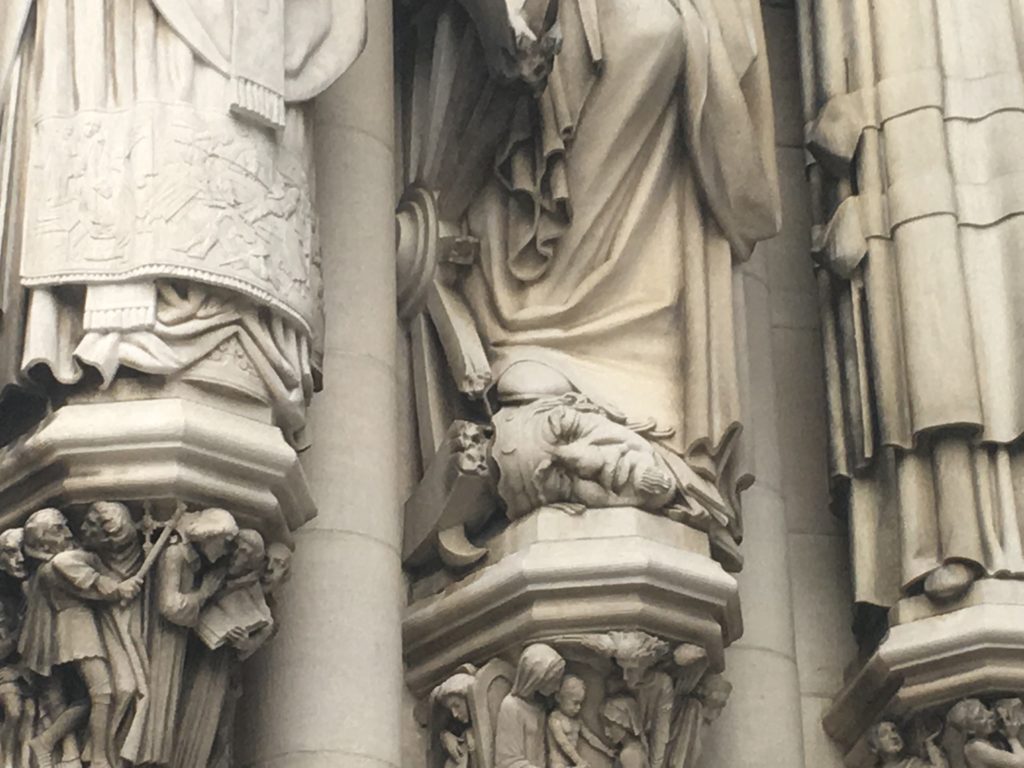
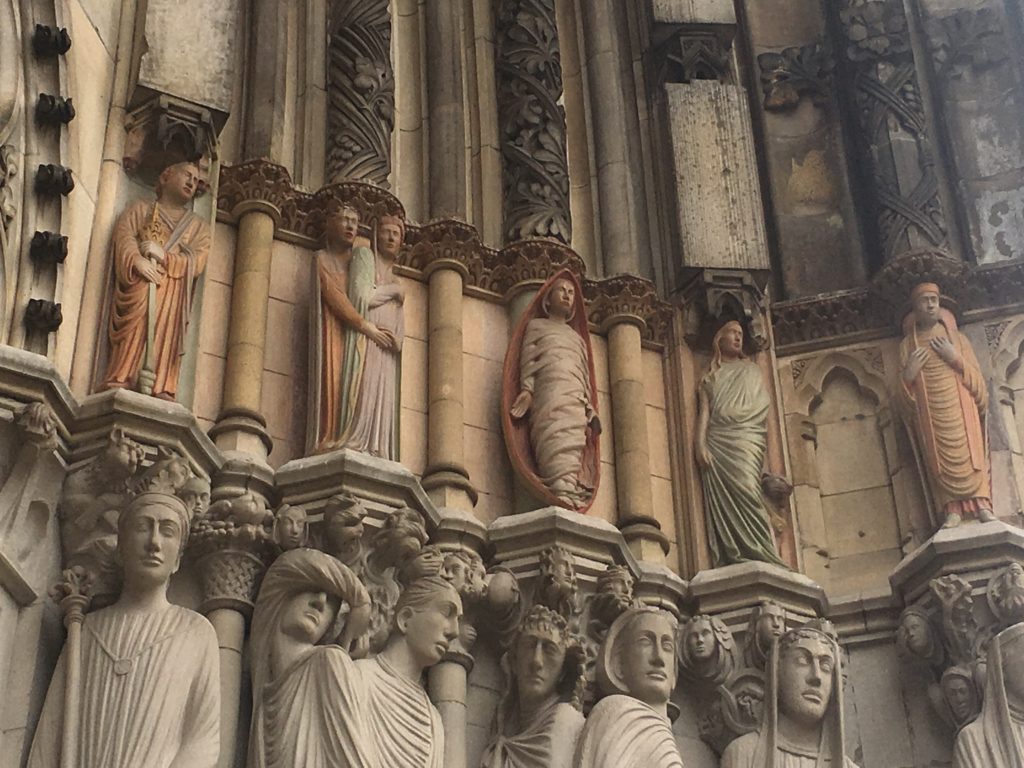
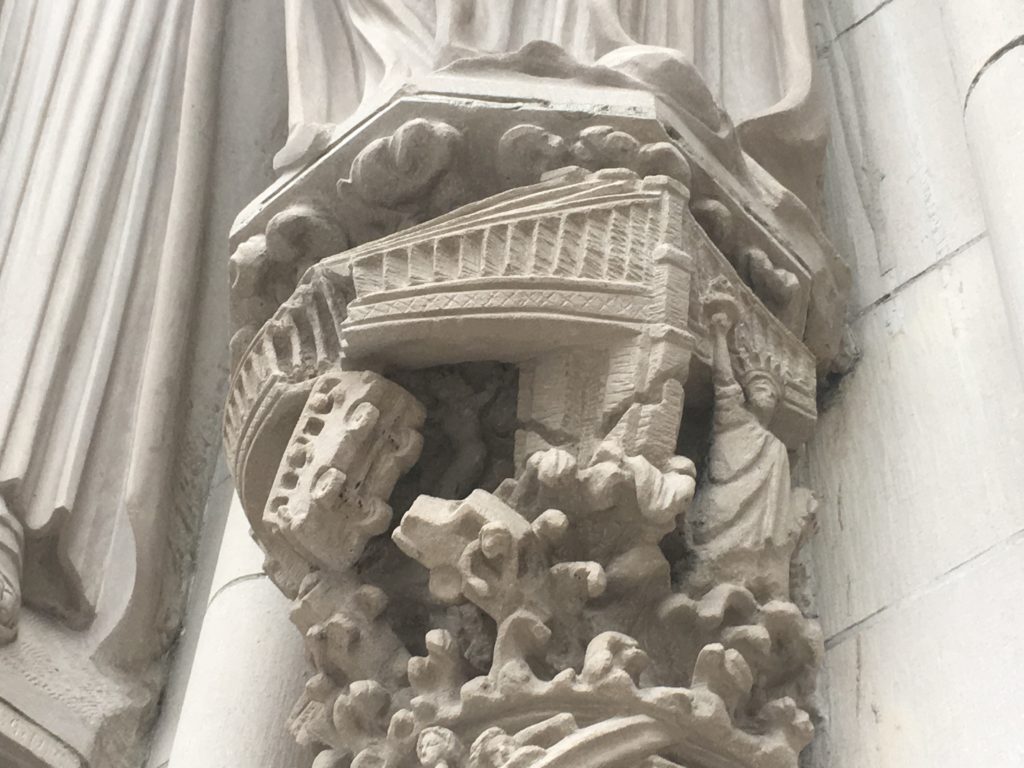
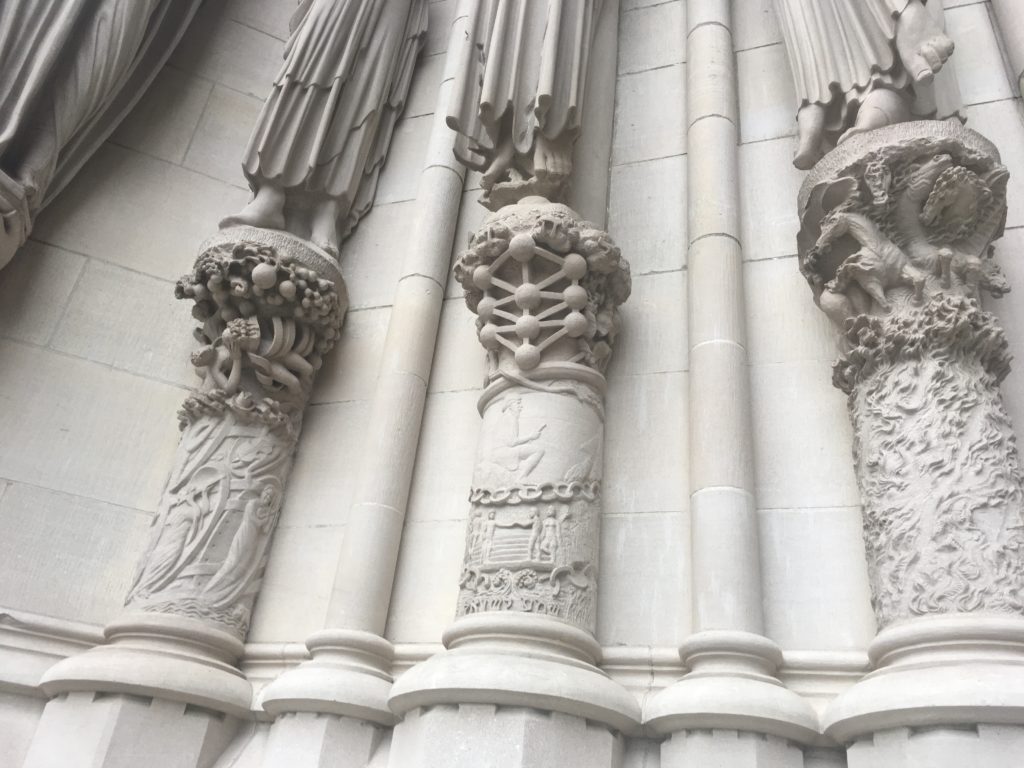
From the western entrance of the church, a collection of curious, strange and even unsettling carvings:

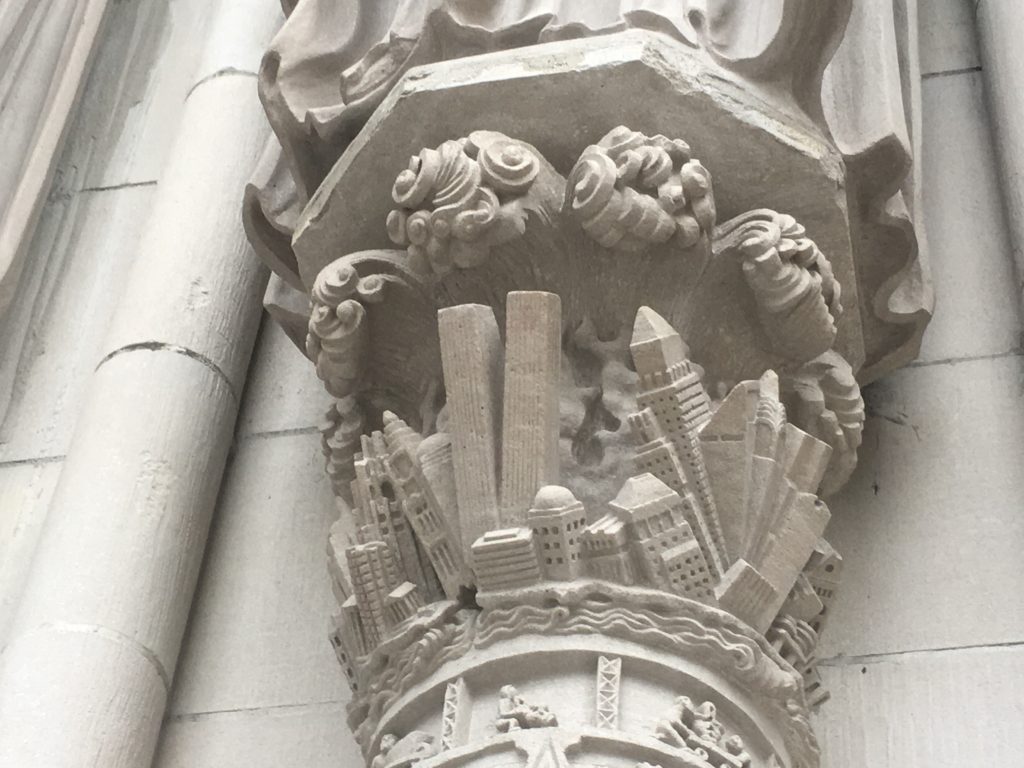
Befitting John’s authorship of the Book of Revelations, a grim depiction of the Apocalypse (and carved well before the events of September 11).

The southern archway had yet to be populated with statues.

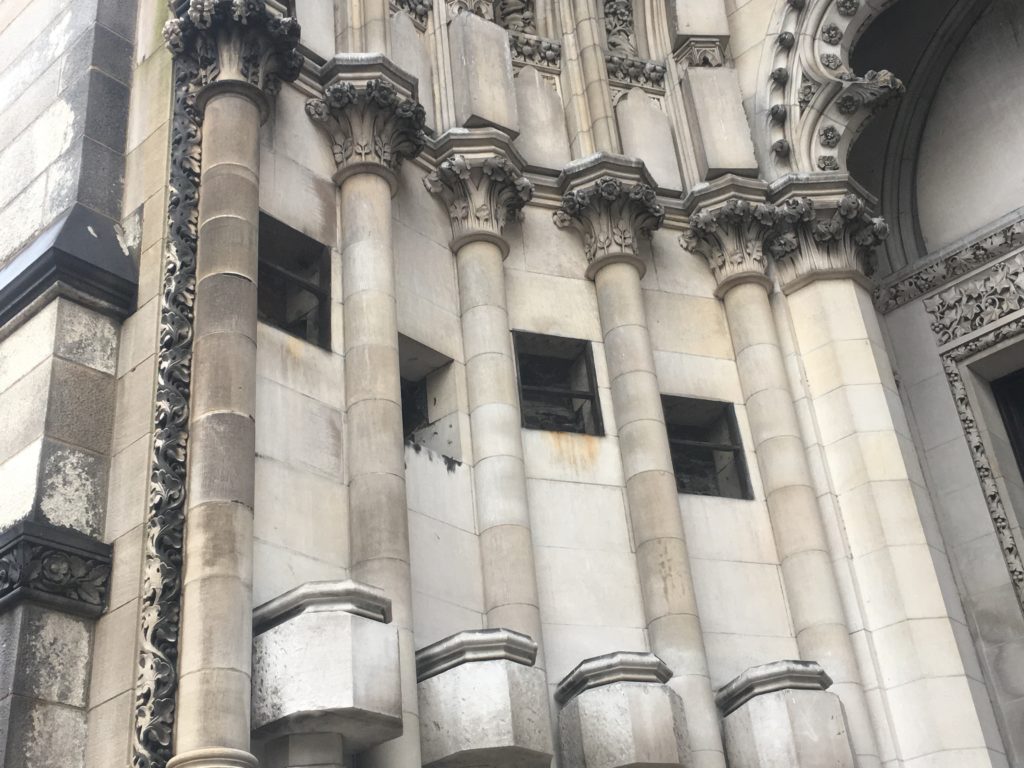
From its northern side, an excellent view of the diverse styles in their unfinished state.

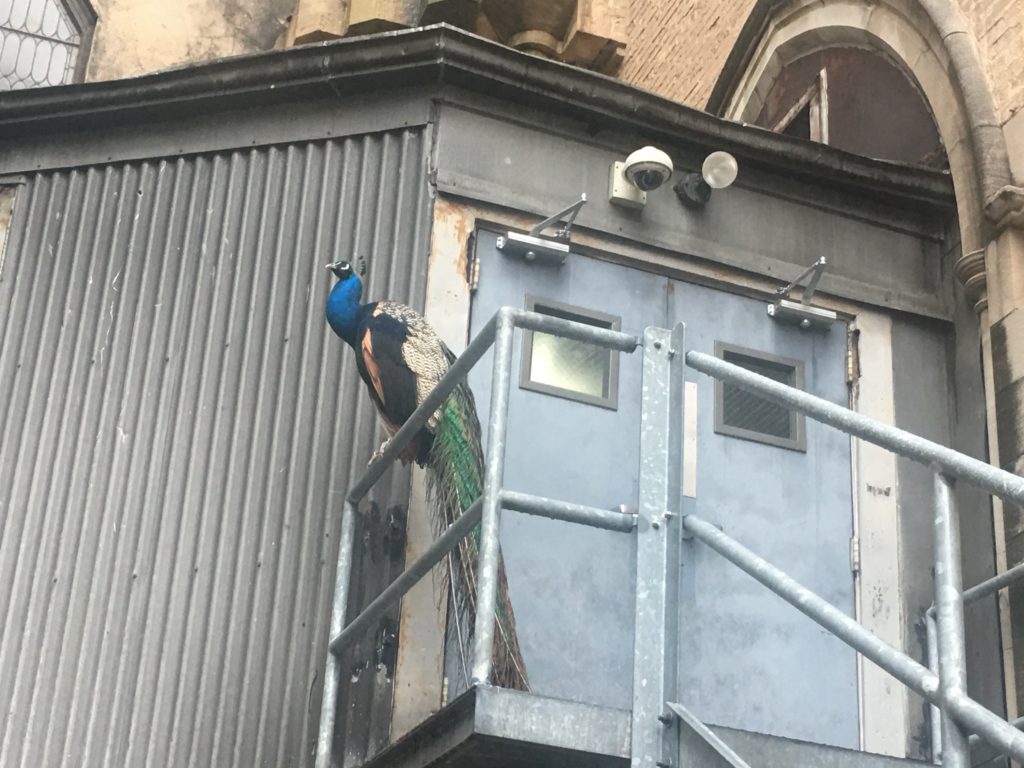
Don’t forget to look and listen for the peacocks which roam the cathedral grounds.

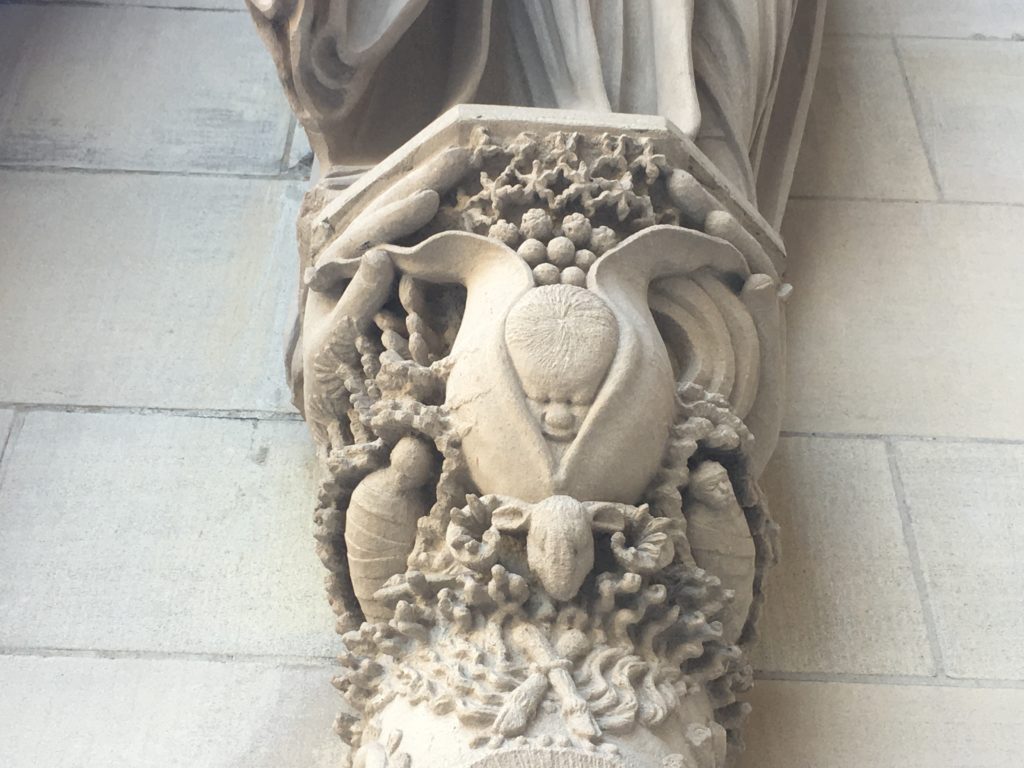
From the triforium, our tour guide Bill Schneberger points out a very bizarre detail, recently revealed. In a sea of flower decorations, one stone carver made the face of a boy. (Video is not great but trust us! It’s there.)Video Player00:0000:14

This video actually shows the very, very top of the church — the ceiling which is enclosed in a separate space, protected from the elements.Video Player00:0000:10

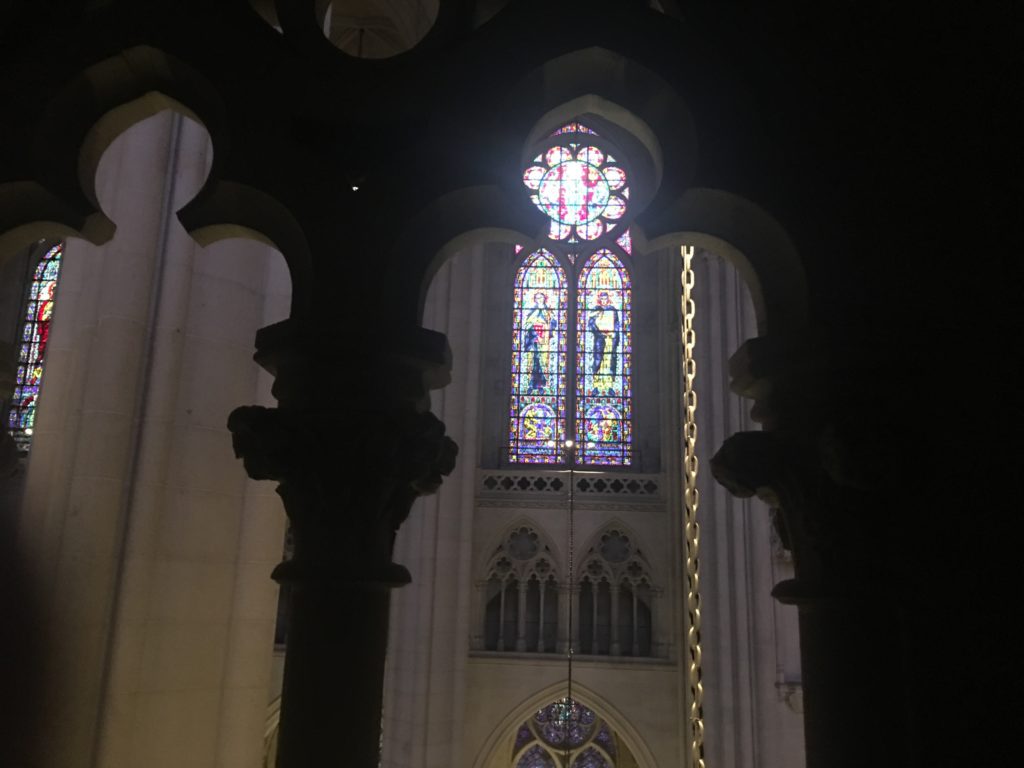
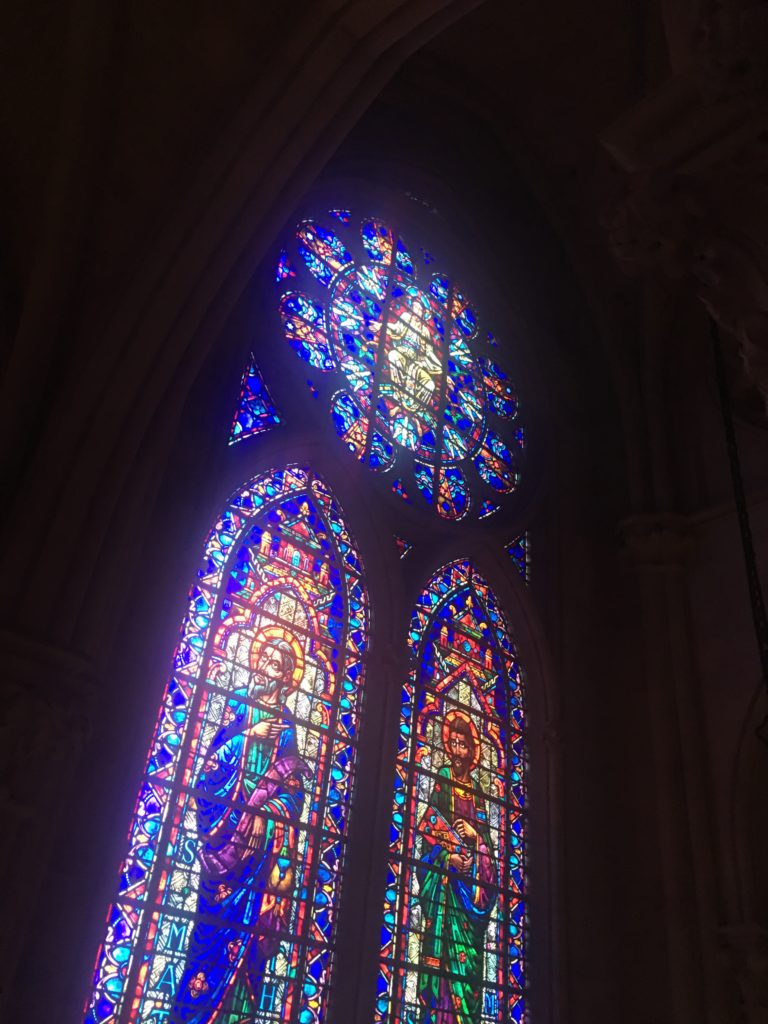
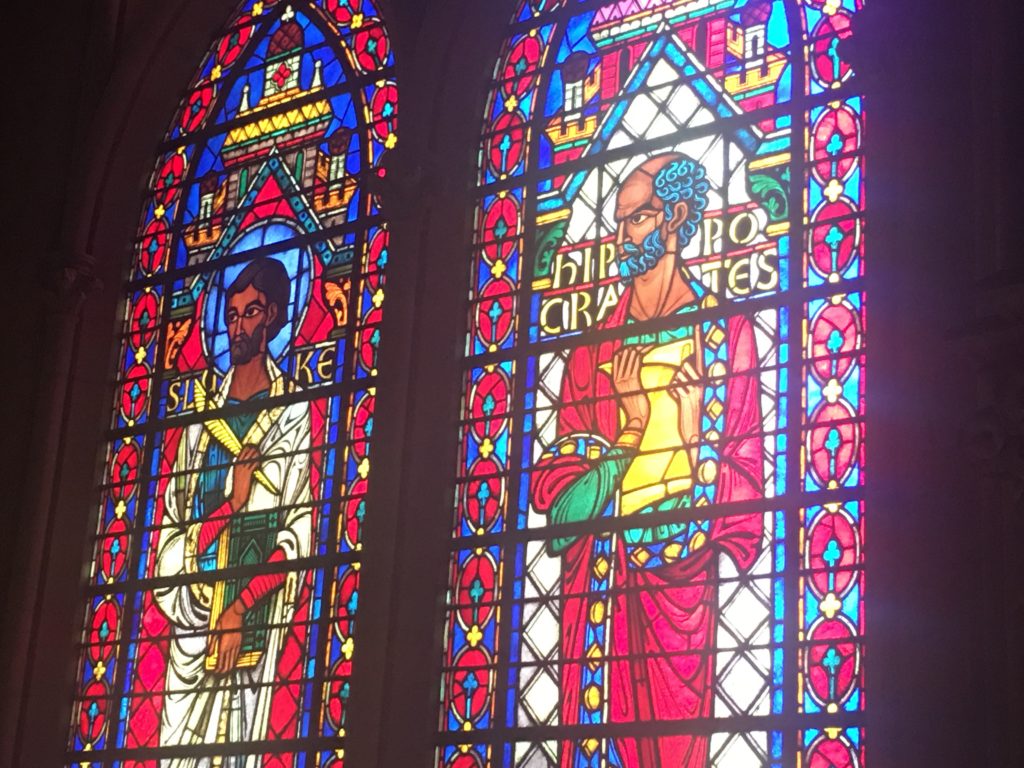
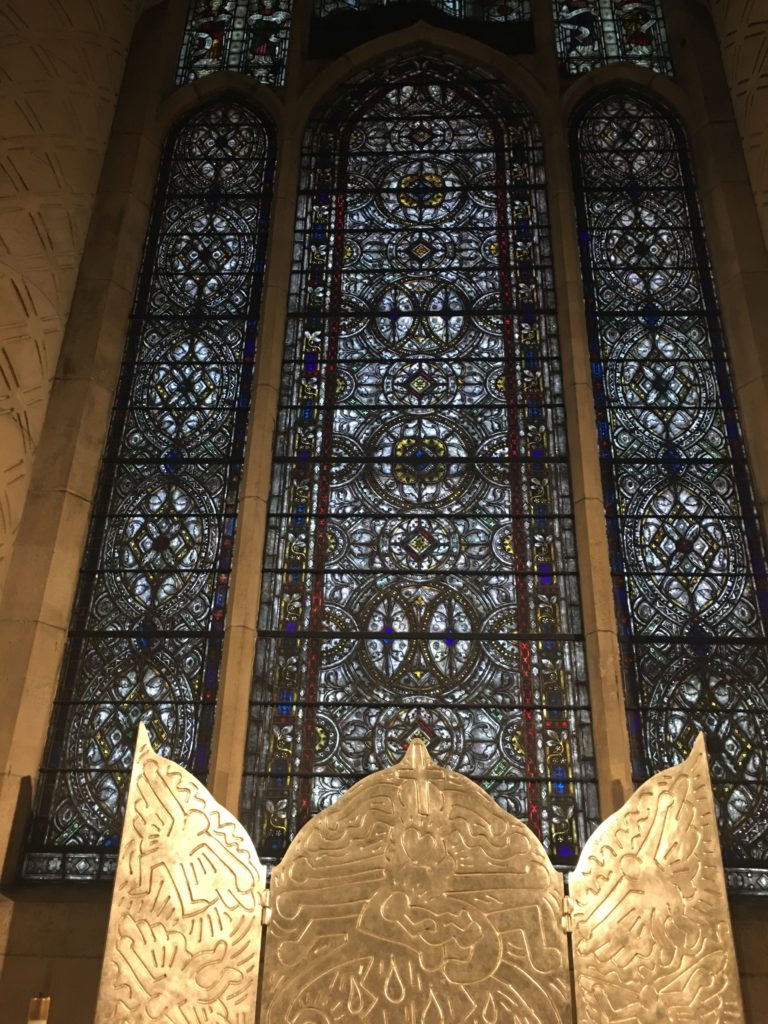
The Keith Haring triptych in contrast to the extraordinary patterned stained-glass window.

Video Player00:0000:41

And finally, we’re pleased to announce that we will emceeing a very special event at the Cathedral later this month — a party for its 125th birthday!

More details here and check this website in the coming days for even more information

The Cathedral Church of Saint John the Divine
invites you to
The 37th Annual Spirit of the City Gala
Celebrating 125 years of this historic landmark!
With a special tribute to José V. Torres and his leadership in the Cathedral’s education programs for children
on Wednesday, May 23rd

Dinner & Party Tickets
An exquisite buffet dinner featuring international foods in the chapels followed by drinks and live music at 6 pm

$1000 Regents Ticket
Includes annual membership in the Cathedral’s Society of Regents, invitations to Cathedral events, and recognition in the evening’s program.

$500 Supporting Ticket
Includes recognition in the evening’s program and invitations to Cathedral events.

After-Party Tickets
Featuring signature cocktails by Highland Park Whiskey along with beer, wine, and desserts and a performance by The Duke Ellington Legacy Band followed by a DJ

Doors open at 7:30 pm
$150 after April 30th

To reserve your ticket online, please click here.

Those who support the Bowery Boys on Patreon will receive a discount code later next week, so check your messages!

Proceeds from the evening benefit the Cathedral.

Categories
Podcasts The Jazz Age

The Wall Street Crash of 1929: The sobering end of New York’s Jazz Age

This is the final part of our three-part NEW YORK IN THE JAZZ AGE podcast series. Check out our two prior episode #233 The Roaring ’20s: The King of the Jazz Age and #234 Queen of the Speakeasies: A Tale of Prohibition New York


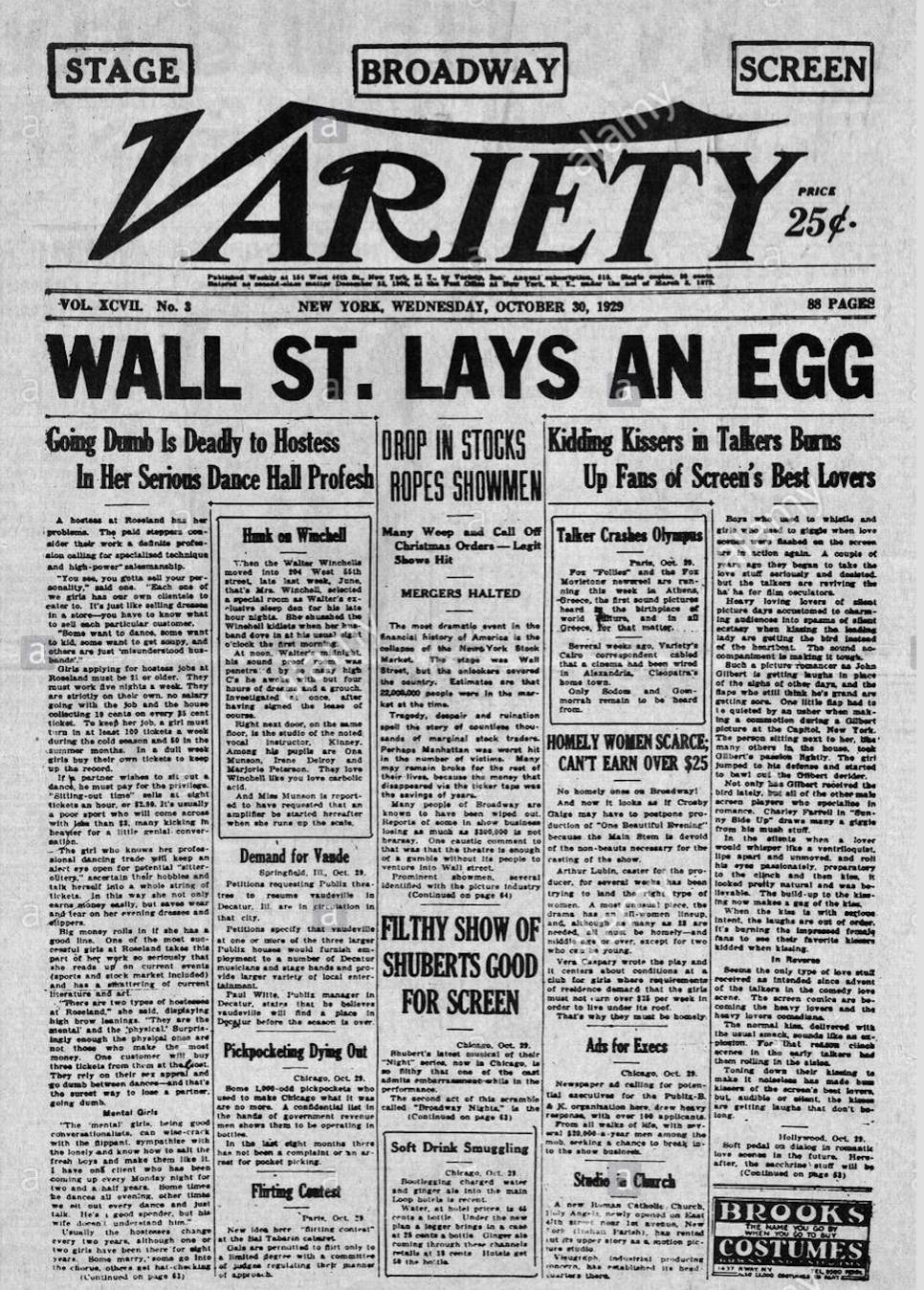
Something so giddy and wild as New York City in the Jazz Age would have to burn out at some point. But nobody expected the double catastrophe of a paralyzing financial crash and a wide-ranging government corruption scandal.

Mayor Jimmy Walker, in a race for a second term against a rising congressman named Fiorello La Guardia, might have had a few cocktails at the Central Park Casino after hearing of the pandemonium on Wall Street in late October 1929.

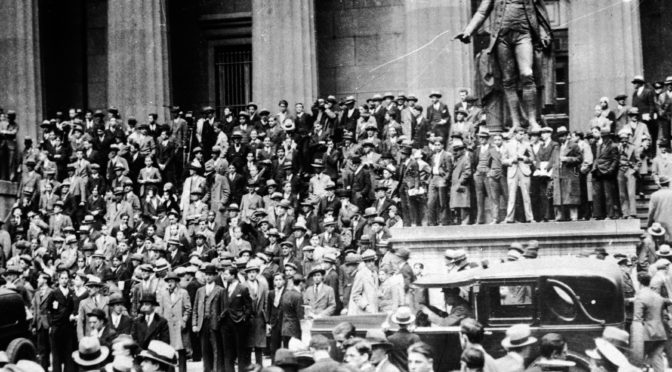
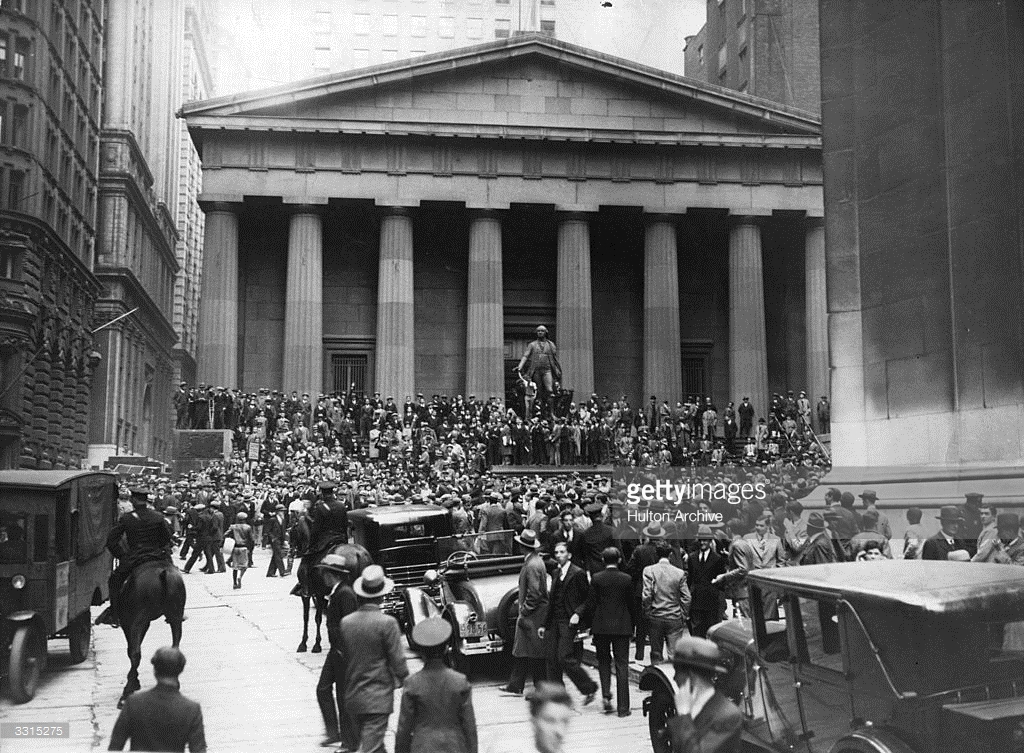
The irresponsible speculation fueling the stock market of the Roaring 20’s suddenly fell apart, turning princes into paupers overnight. Rumors spread among gathering crowds in front of the New York Stock Exchange of distraught traders throwing themselves out windows.

And yet a more immediate crisis was awaiting the Night Mayor of New York — the investigations of Judge Samuel Seabury, steering a crackdown authorized by governor Franklin Delano Roosevelt to rid New York City of its deeply embedded, Tammany Hall-fueled corruption.

With the American economy in free fall and hundreds of New York politicians, police officers and judges falling to corruption revelations, the world needed a drink! Counting down to the last days of Prohibition….

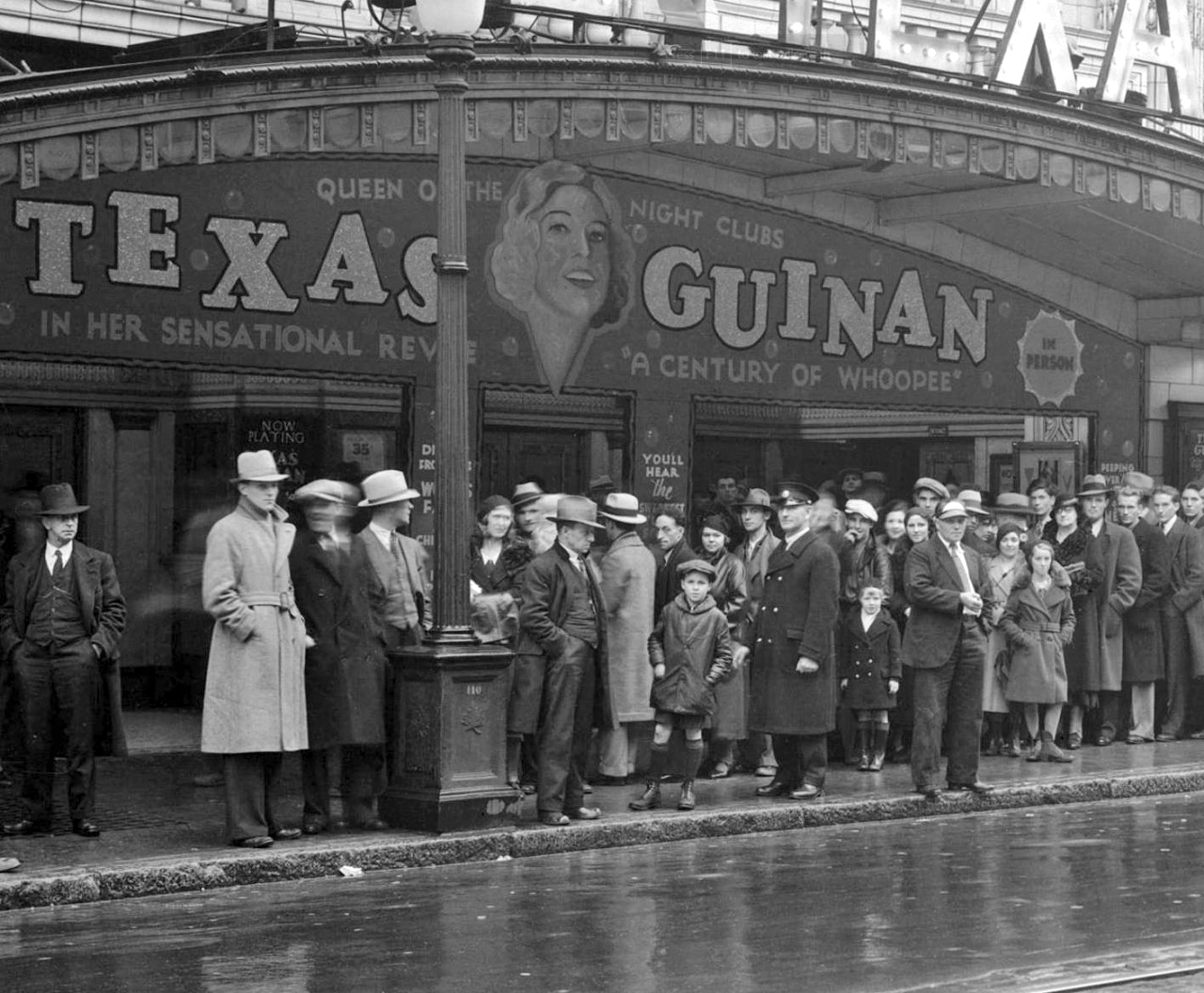
PLUS: The fate of Texas Guinan, the movie star turned Prohibition hostess who hit the road with a bawdy new burlesque — that led to a tragic end.

The song featured in this week’s episode was Bessie Smith’s “Nobody Knows You When You’re Down and Out”


The Bowery Boys: New York City History podcast is brought to you …. by you!

We are now producing a new Bowery Boys podcast every two weeks. We’re also looking to improve the show in other ways and expand in other ways as well — through publishing, social media, live events and other forms of media. But we can only do this with your help!

We are now a member of Patreon, a patronage platform where you can support your favorite content creators for as little as a $1 a month.

Please visit our page on Patreon and watch a short video of us recording the show and talking about our expansion plans.If you’d like to help out, there are five different pledge levels (and with clever names too — Mannahatta, New Amsterdam, Five Points, Gilded Age, Jazz Age and Empire State). Check them out and consider being a sponsor.

We greatly appreciate our listeners and readers and thank you for joining us on this journey so far. And the best is yet to come!


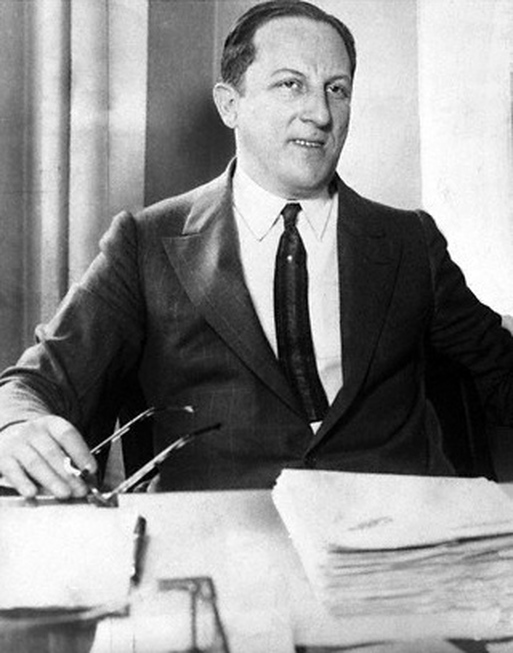
Arnold Rothstein — His murder would kick off a frenzy in New York’s organized crime syndicates and lead to an in-depth investigation into the police and local government

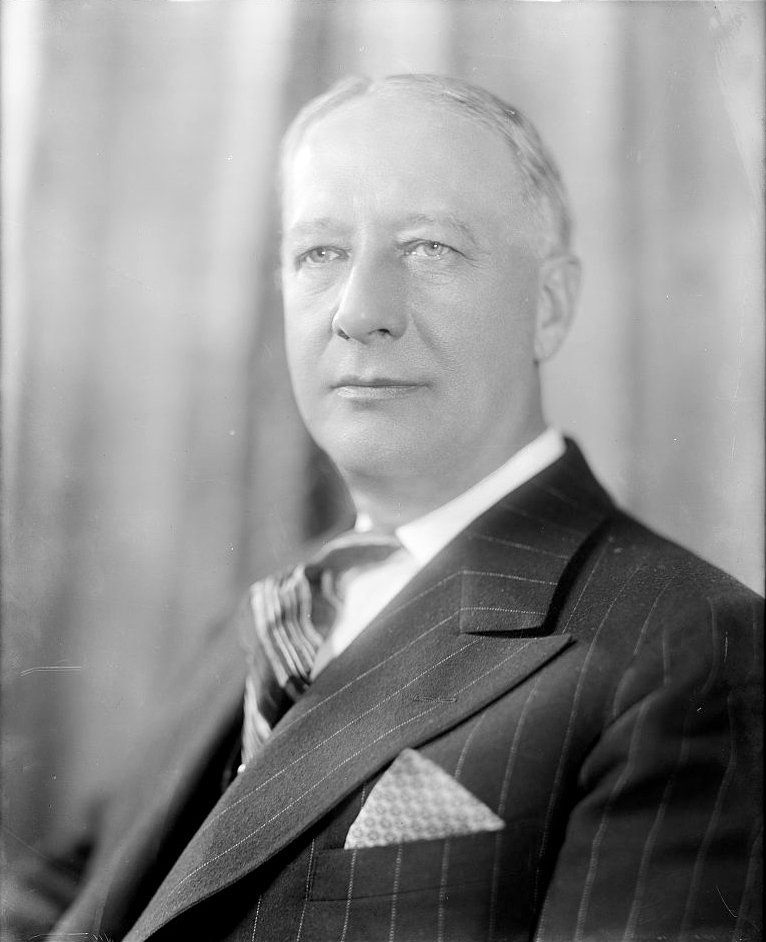
Al Smith — His unsuccessful bid for the presidency in 1928 led him to pursue more business-related projects, including the construction of the Empire State Building.

Harris & Ewing collection at the Library of Congress.

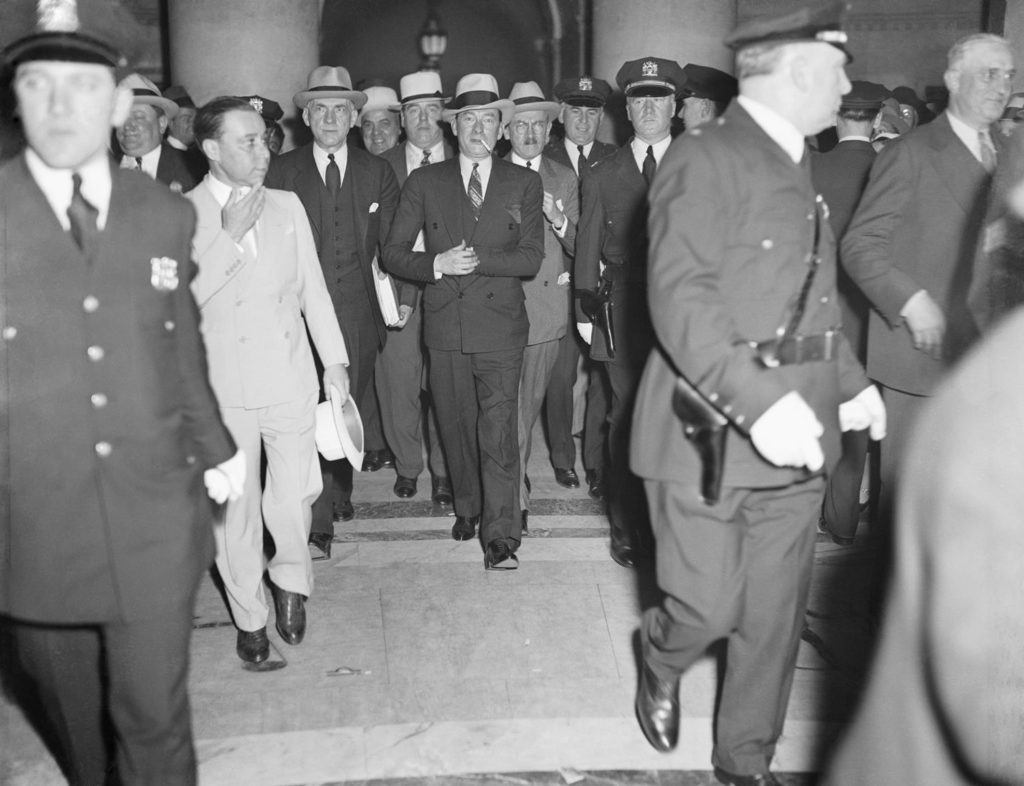
Mayor Jimmy Walker felt invincible at the start of his second term

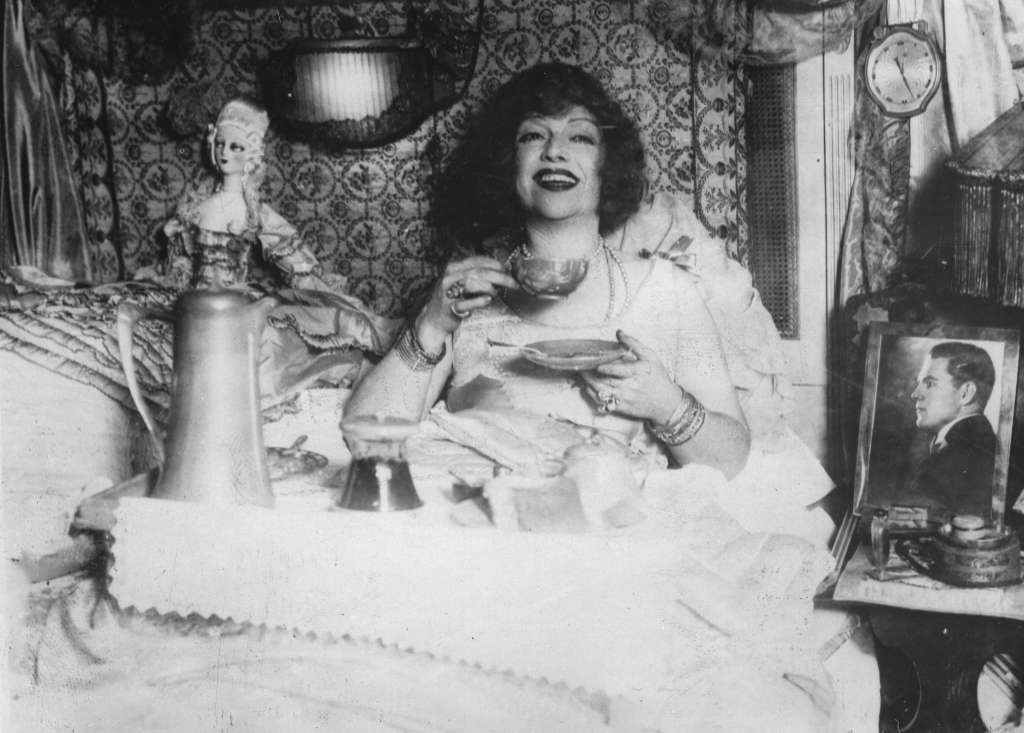
Texas Guinan eventually left the nightclub scene and returned to film and stage work. She’s pictured here in 1931 in Paris. She would later be denied entry into the country for her bawdy performances (at least, that’s what she claimed).

Getty Images

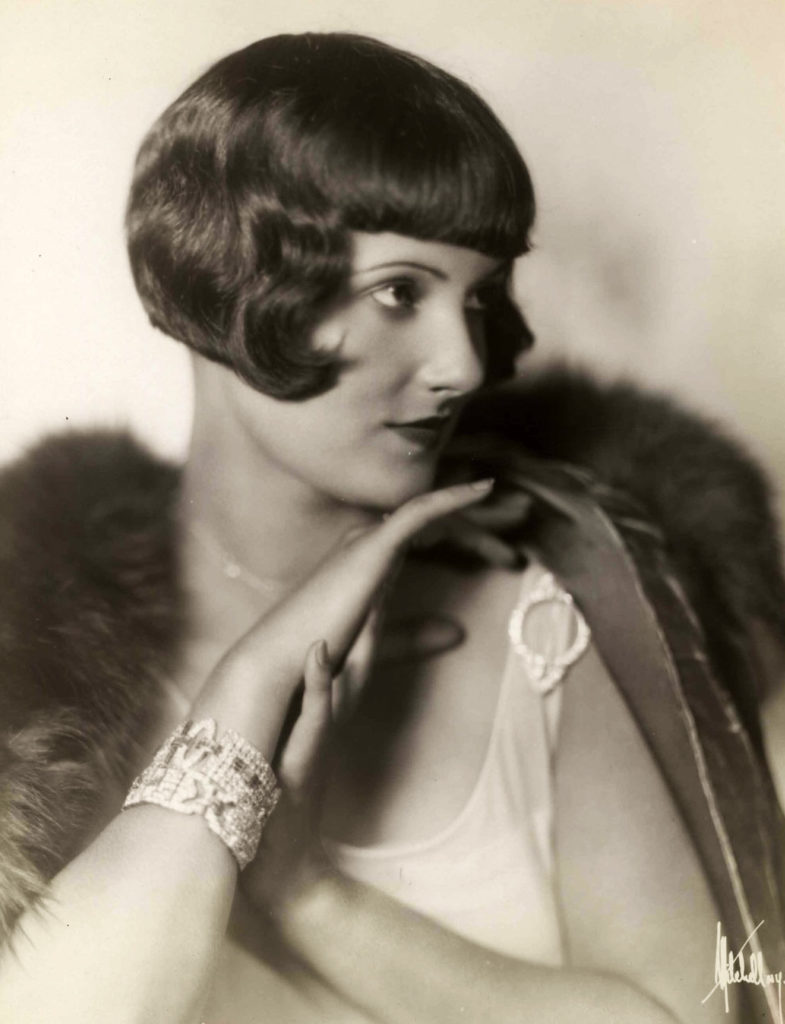
Betty Compton waited patiently for Walker from the sidelines, watching as his political fortunes collapsed in 1932.

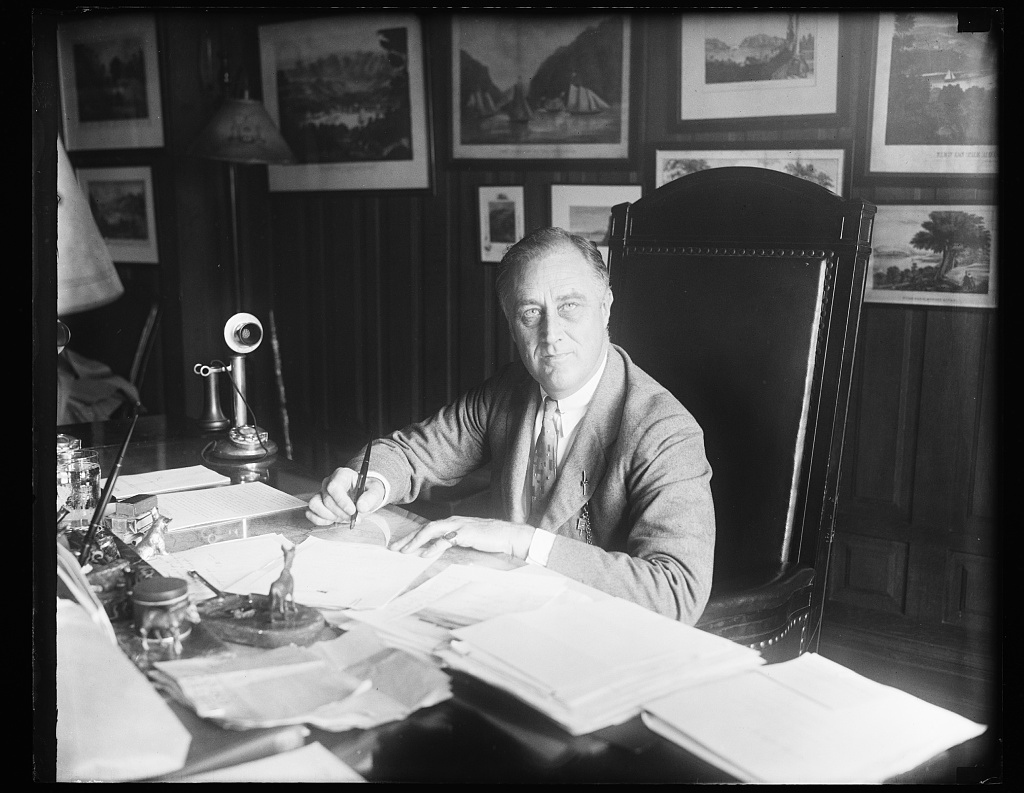
Franklin Delano Roosevelt — The governor of New York (and soon president of the United States) went after corruption during a busy campaign season.

Library of Congress

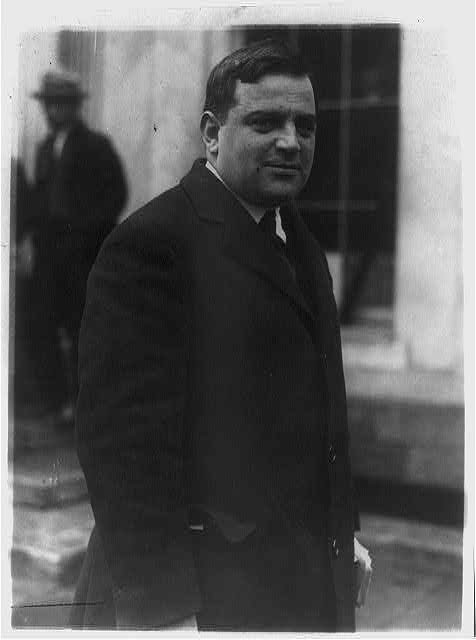
Fiorello La Guardia (pictured here in 1929) was an early supporter of Prohibition repeal and ran for mayor in 1929, losing to Walker.

Library of Congress

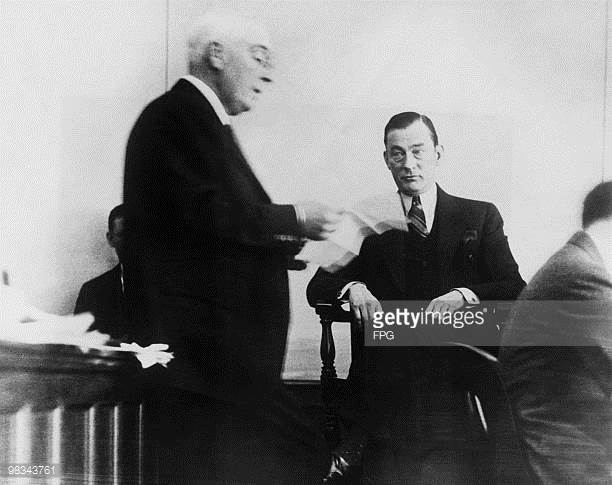
Samuel Seabury, questioning a nonplussed Jimmy Walker on the stand, succeeded in rooting out corrupt officials in public offices. With Roosevelt’s help, he even brought down the Night Mayor himself.

Getty Images

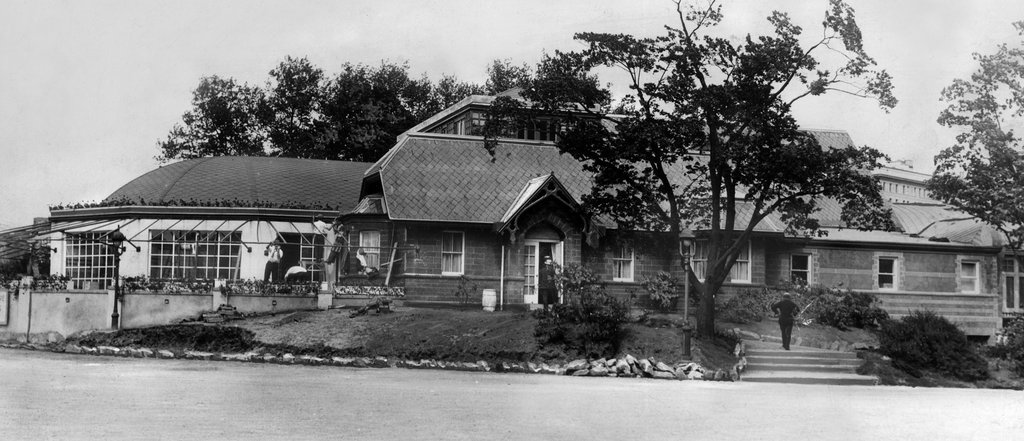
The Central Park Casino transformed into a swanky nightclub in 1929, a favored spot for Jimmy Walker

Courtesy New York Times

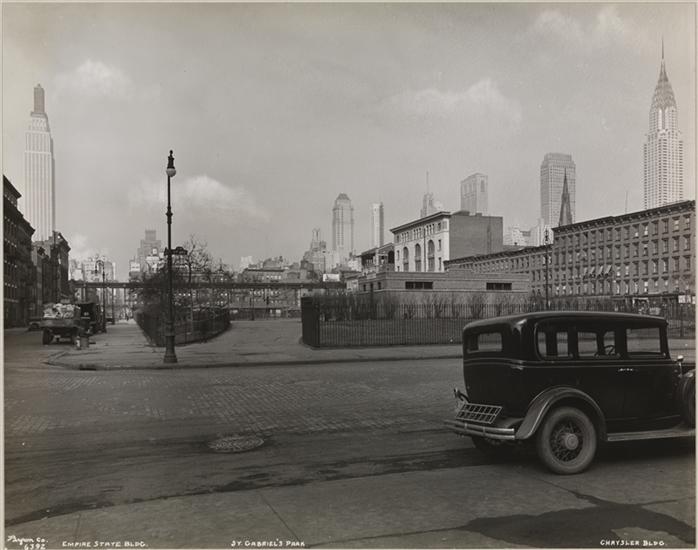
An interesting view of mid-Manhattan in 1931 (from St. Gabriel’s Park at First Avenue and 35th Street) with the newly completed Chrysler Building and the Empire State Building nearly completed.

MCNY/Byron Company

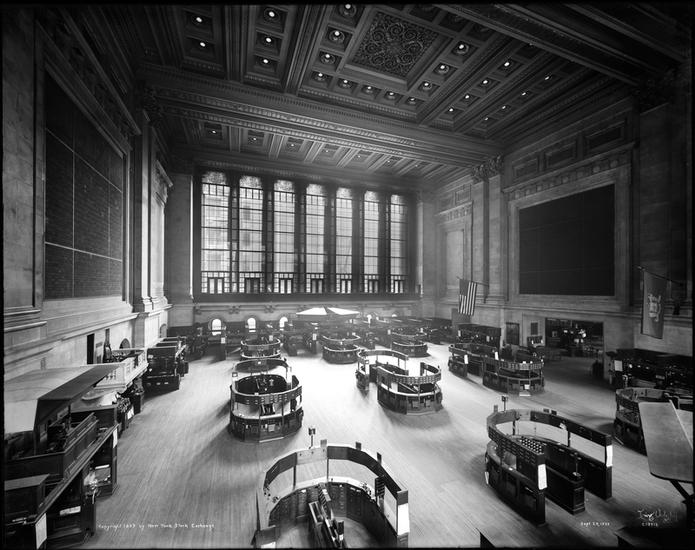
An ominous image of the New York Stock Exchange from September 1929, weeks before the crash.

Irving Underhill/MCNY

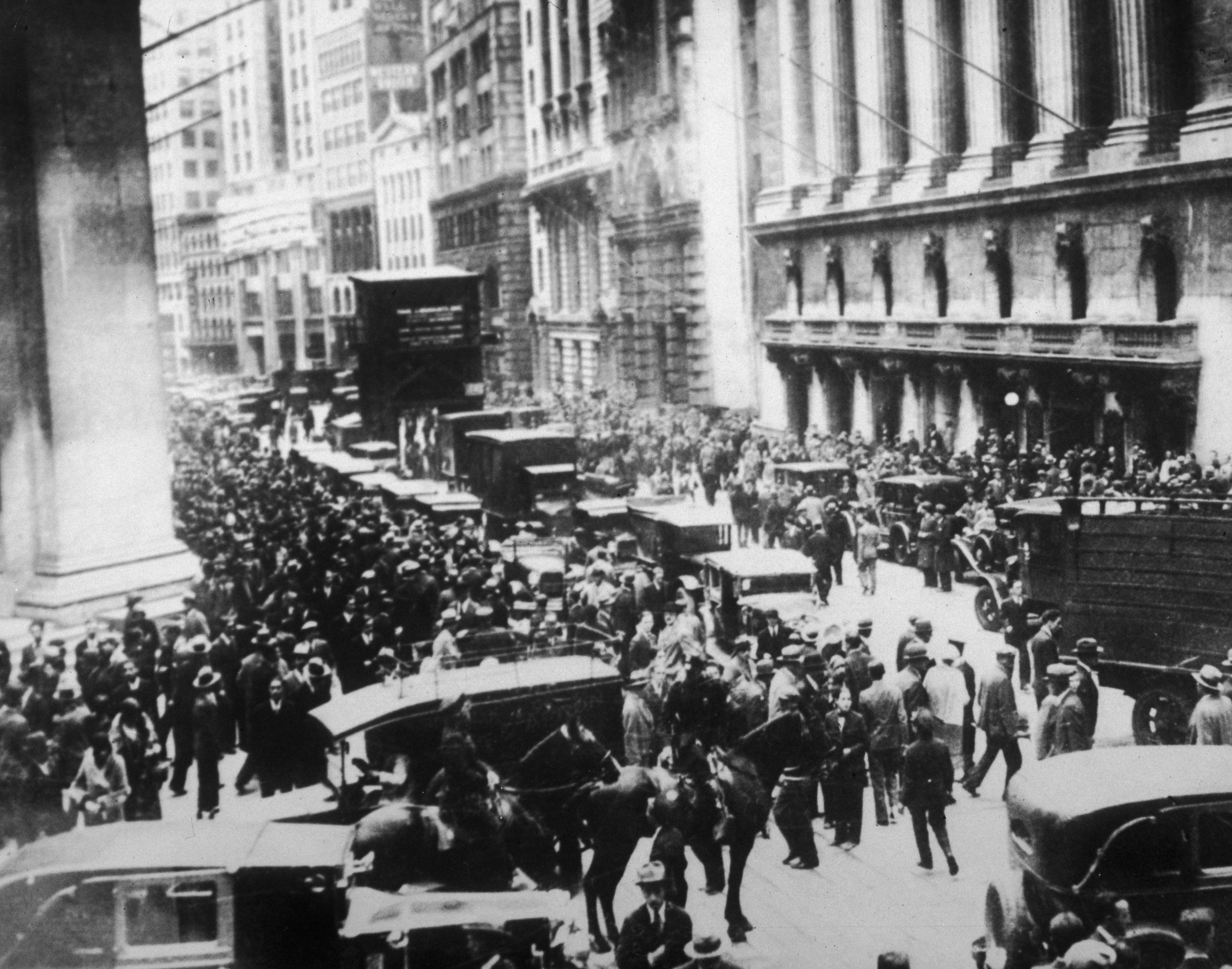
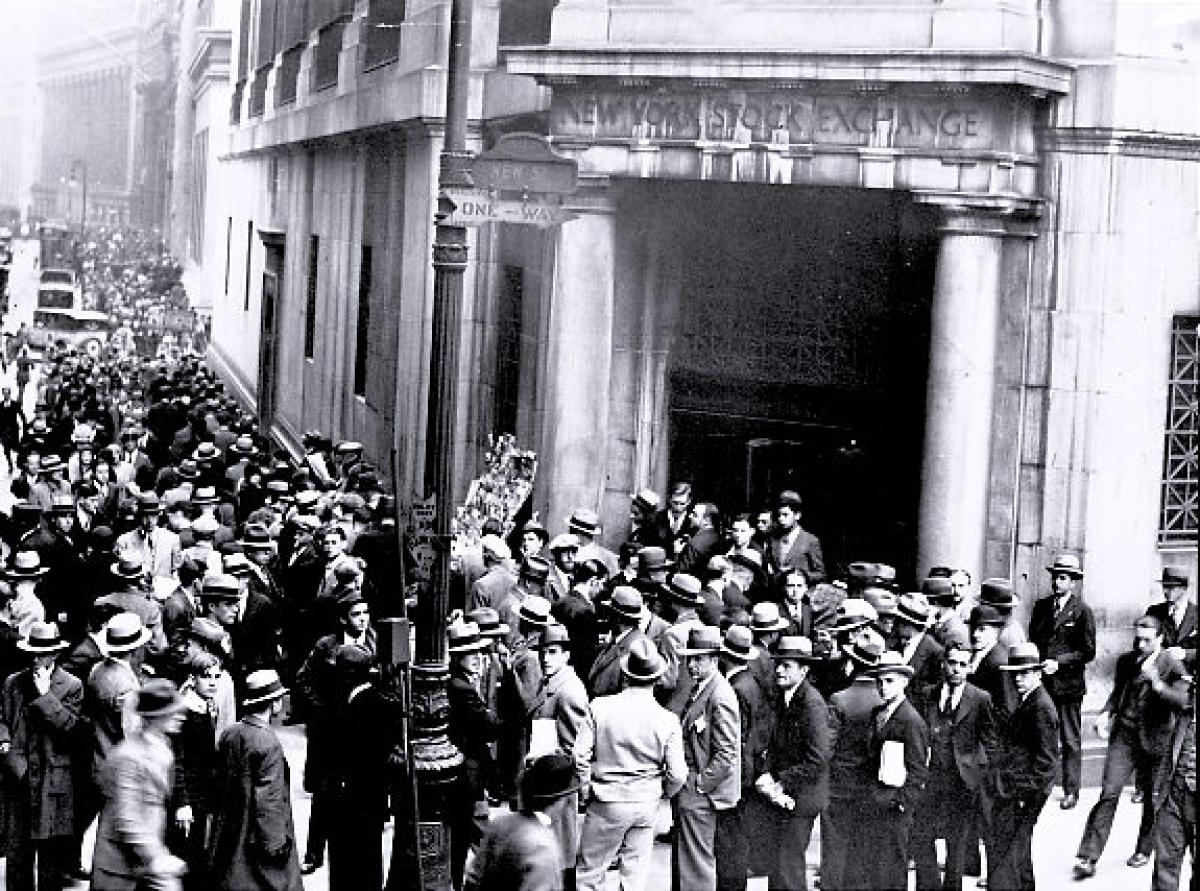
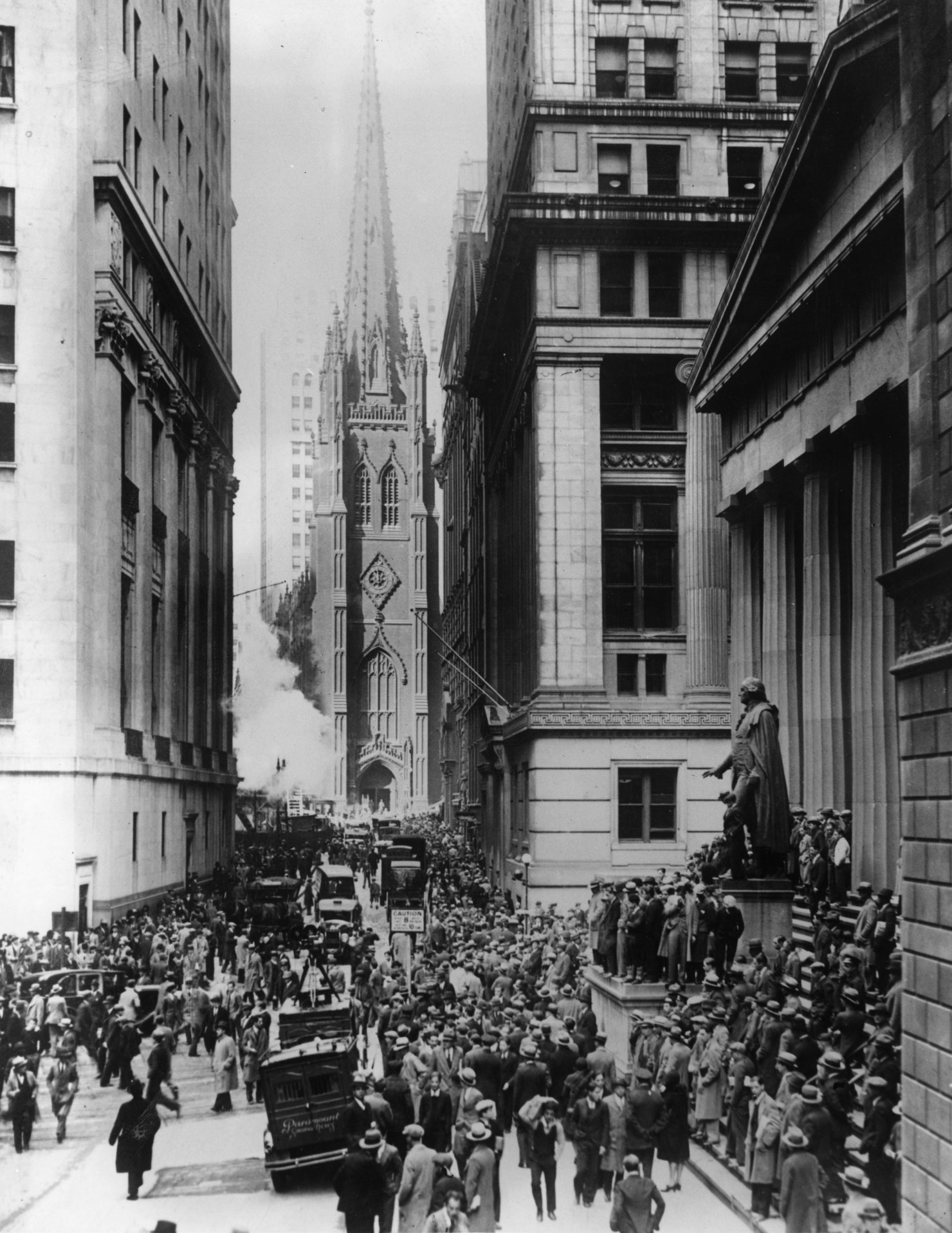
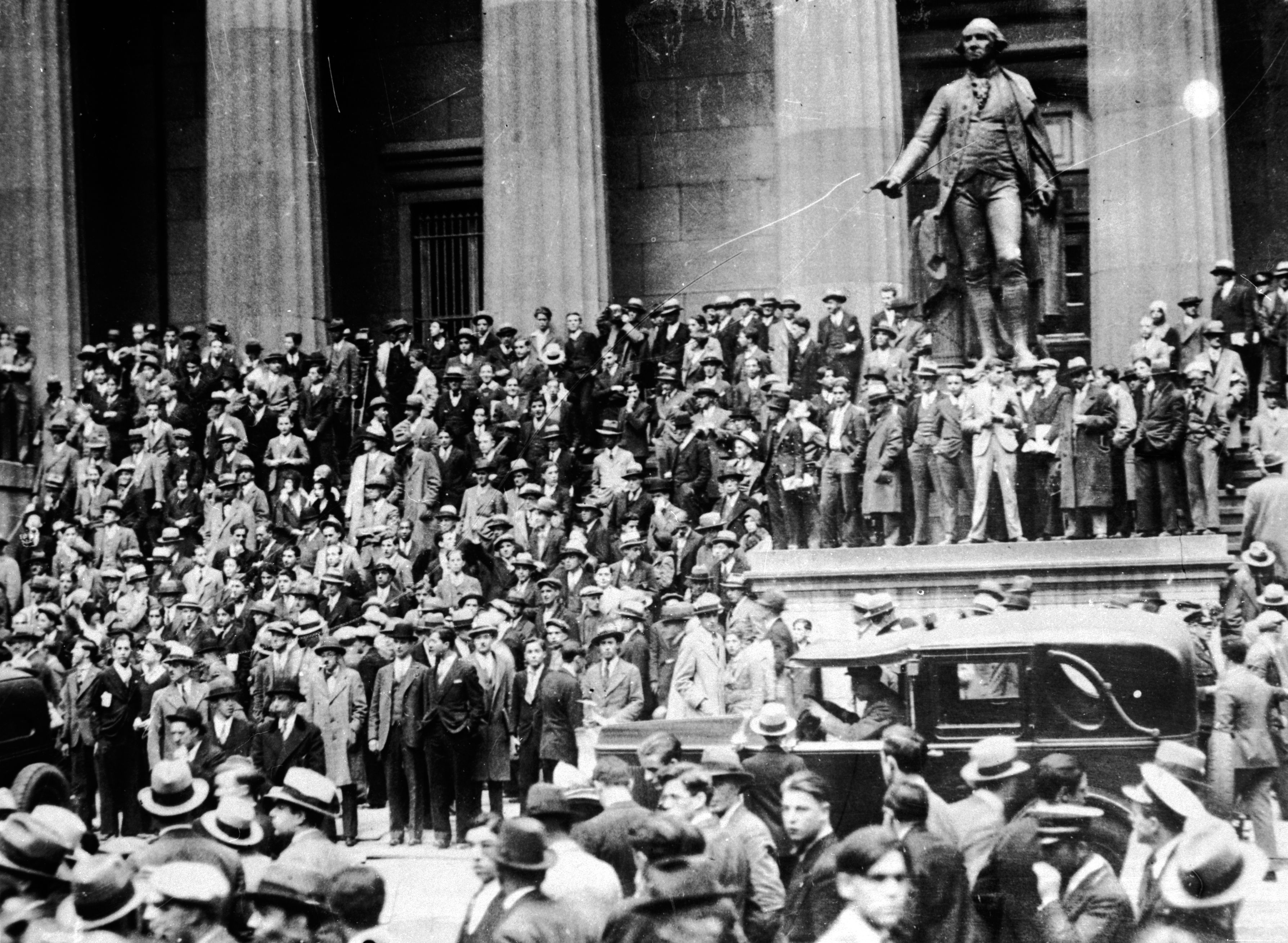
The streets outside the New York Stock Exchange were clogged with people for days, frantic scenes of anger, panic and heartbreak.

29th October 1929. (Photo by Hulton Archive/Getty Images)
New York Daily News
(Photo by Keystone/Getty Images)

A graphic look at the Wall Street Crash of 1929.

Wikicommons

Outside Vancouver’s Beacon Theatre on October 28, 1933, just a week before her death here in this city.


CORRECTION: Jimmy Walker’s second term began on January 1, not January 3.

For more information, check out the following books:

Dry Manhattan: Prohibition in New York City by Michael A. Lerner

The Great Crash by John Kenneth Galbraith

Once Upon A Time In New York by Herbert Mitgang

The Man Who Rode The Tiger: The Life and Times of Judge Samuel Seabury by Herbert Mitgang

Rothstein: The Life, Times, and Murder of the Criminal Genius Who Fixed the 1919 World Series by David Pietrusza

Other Bowery Boys podcasts related to this one:

The Tallest Building In New York: A Short History (#169)

Battle For The Skyline: How High Can It Go? (#199)

The Chrysler Building (#11)

Robert Moses (#100)

Categories
Christmas Robert Moses

And Now … Two Christmas Poems By Robert Moses

My new column for A24 Films is up over on their 1981 site (in support of the film A Most Violent Year). 1981 was the year that Robert Moses died, and his death sparked new discussions into what his legacy to the New York City area truly was.  In a word: automobiles.  You can read my article here.

But that’s a little depressing. How about I tell you about the time that the New York Times published a couple Christmas poems written by Moses?

That’s right, the Santa Claus of Long Island, bearing gifts of bridges and highways, did occasionally get into the Christmas spirit, albeit dripping in vitriol and sass.


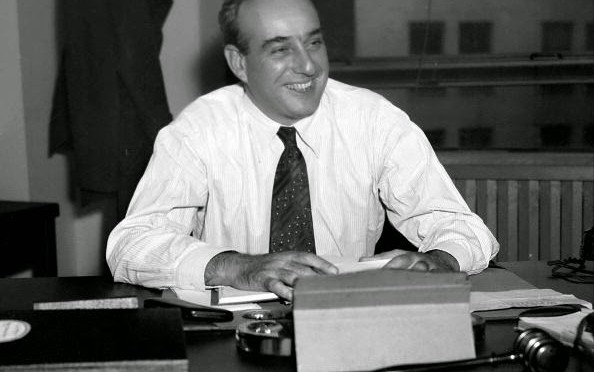
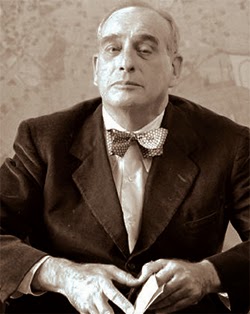
Moses in 1934 during his failed campaign for governor. (Courtesy New York Daily News Archive)

POEM ONE – ‘TIS THE NIGHT BEFORE ELECTION

This loosely poetic speech first manifested in print during the last gasps of Moses’ failed bid for New York governor in 1934.

As the Republican candidate running against incumbent Herbert H. Lehman, young Moses failed to connect with voters, and the experience soured him on elected positions. He was soundly defeated by Lehman, the investment banker-turned-politician aligned with new president Franklin Delano Roosevelt (who had preceded Lehman as governor).

His final words as a candidate were spoken on radio station WEAF and printed the following day.  Those words paid an awkward homage to the great Christmas poem written by Clement Clarke Moore. Despite the fact that the election was in early November, his point in conjuring the visage of Old St. Nick would become clear.  It’s hardly rhythmic. Imagine this read in his gruff, determined voice:

“‘Tis the night before election, and nothing much is stirring throughout the state.

The stockings in Democratic homes are hung by the chimney with care, in the hope that Jim Farley soon will be there.

The Big Bag Man is dressing himself up as Santa. He doesn’t really look the part, but that’s not important.
Neither is the fact that all the presents were bought on credit, and that Santa Claus is running up a tremendous bill.   

The important question is:  Has he plenty of presents to go around for the boys and girls who have been good?

Governor Smith expressed the fondest hopes of the Democratic party, and summed up the strategy of the whole Democratic campaign when he said that he thought the people would not shoot Santa Claus before a hard Christmas.”

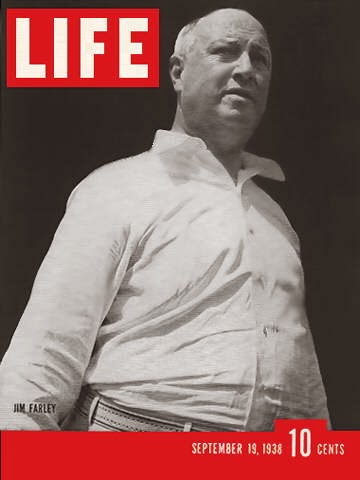
Jim Farley (pictured at right, 1938) was considered a ‘kingmaker’ in Democratic politics, responsible for the election of FDR.  He would become Roosevelt’s U.S. Postmaster General.  The James A. Farley Post Office across from Madison Square Garden is named in his honor.

Using the Santa analogy, Moses was taking a dig at Democratic programs that would soon shape FDR’s New Deal.  Of course, as New York’s power builder, Moses would later benefit greatly from these programs so perhaps he shouldn’t have been complaining.

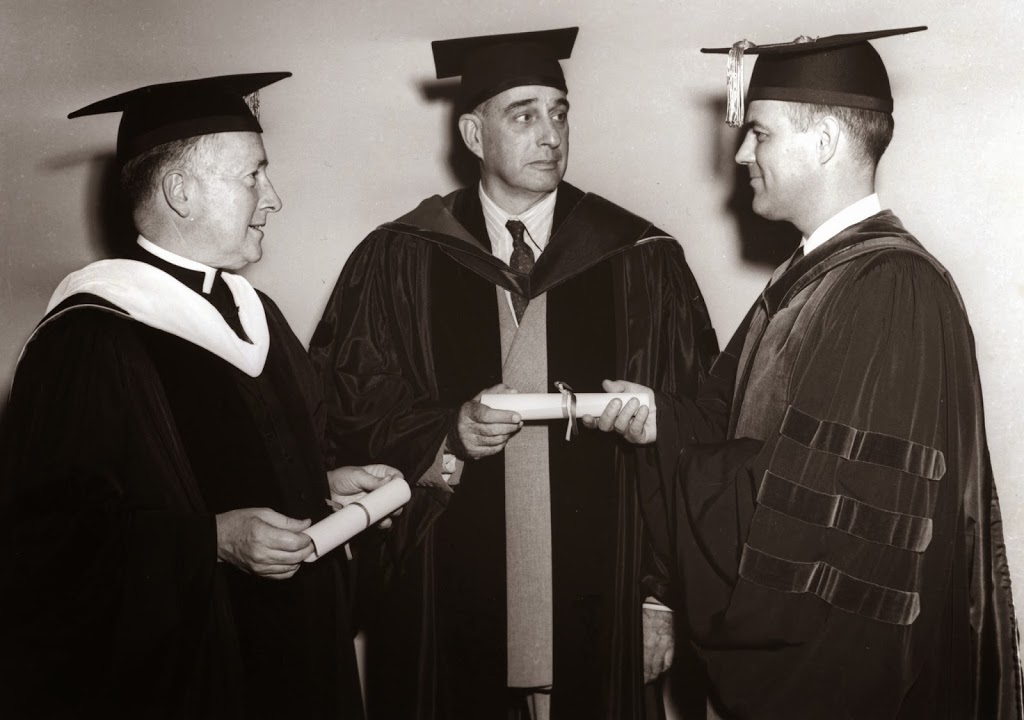
In 1948, Robert Moses received the very first honorary degree from Hofstra University, along with Robert Gannon, the president of Fordham University.  However, that year it would be a phony university that would inspire Moses to pen a sassy Christmas verse. (Courtesy Hofstra University)

POEM TWO: CHRISTMAS GREETINGS (LETTER TO THE CHANCELLOR)

Perhaps more unusual was the poem which ran the day after Christmas in 1948, an inside joke between men of influence.

By the late 1930s, Moses had amassed several positions of responsibility and power and had pushed through a great number of vast, expensive projects, including the Triborough Bridge. Moses had to routinely pitch these projects to the New York Board of Estimate — the men who held the purse strings — which included Henry M. Curran (Deputy Mayor), Newbold Morris (City Council President), and James Lyons (Bronx Borough President).

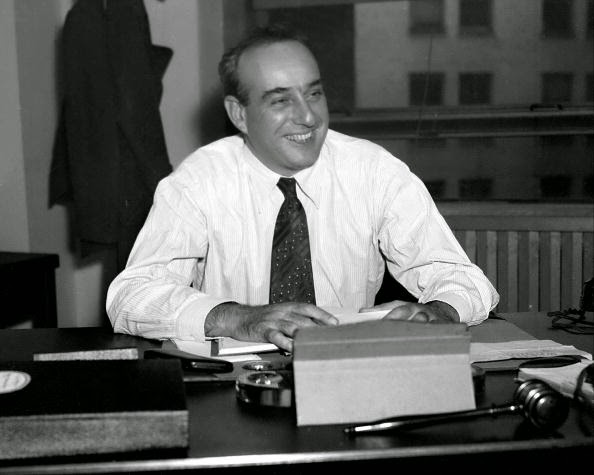
Curran was a bit of a grammar nerd — the kind who cringes at improper usage of words — and recoiled during debates when Moses (at right) and the others misused the English language.

According to the Times, Curran organized among the men a hierarchy of language correction, (jokingly?) referred to as Curran University.  One could only ‘graduate’ from this phony university by excelling in their verbal and written debates with grammatical aplomb.

During a board meeting where the fate of the old Claremont Inn was discussed, Moses used the phrase ‘coign of vantage’ which scandalized Curran but suggested that Moses’ verbal skills were improving.

Then, one day, Moses wrote a memorandum to Lyons using the phrase ‘high-falutin‘ as well an apparent mis-use of the word Aurignacian.  This threw his superiors into a light-hearted conniption.

“We tried to help.  But Moses has failed, flunked.  Up with the bars!  Let Mose wail — without — not within,” wrote Curran.

Moses, who would become more powerful than all three men combined, responded in an unusual way — he wrote a biting Christmas poem.  The following verse, penned by Moses, was delivered to Lyon, who “promptly converted it into a Christmas card — with embellishments — and passed it along to his superior officer.”  The poem, as published in the Times:

CHRISTMAS GREETINGS
To Chancellor Henry H. Curran
Great Chancellor of Curran U
Greetings from Borough Hall and Zoo.
 
Assorted barks and roars and honks
From the four corners of the Bronx.
 
Gannon, Osborn, Robbins and Moses
Greet you with laurel, rhinos and roses.
 
Cheerios and loud hosannas
From Pelham Bay and the Bronx savannas.
 
Great critic of the spoken word,
Greetings with the proverbial bird.
 
From every coign and height definitive
We greet you with a split infinitive.
 
Signed, 
James J Lyons, Dean
Robert Moses, Sophomore Cheer Leader

So remember: the next time you have a friend correct your grammar, remind yourself, “Hey, I have something in common with the Power Broker!”

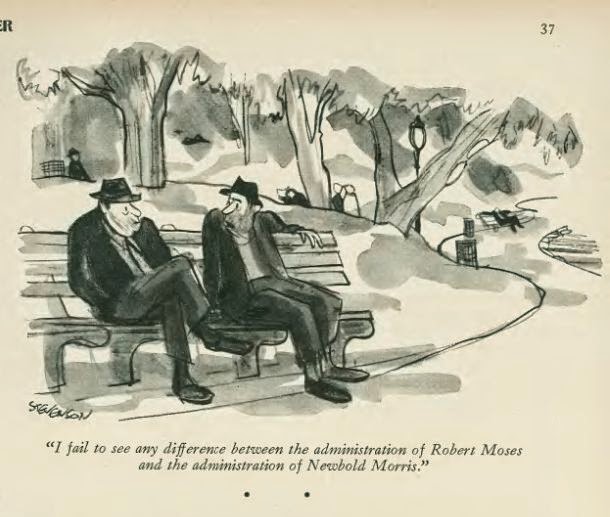
Below: A New Yorker cartoon from 1960, the year when his grammar pal Morris took the job of Parks Commissioner from Moses.

Â