Categories
Parks and Recreation

Brooklyn’s Forgotten Lake: Pictures of Mount Prospect Reservoir

As you can see, the Bowery Boys: New York City  History blog has gone through some major changes this week.  We have a new URL (boweryboyshistory.com) and a dynamic new layout which will present articles, photographs and podcast audio is a more user-friendly way.  There’s still some backlogged clean up to do so thank you for your patience.  But we think this new format is more reader friendly and makes these old photographs look so much more amazing.

And so, on that note, I thought I’d test out the expanded-image waters here by presenting a few views of one of the most enchanting places from the 19th century, a place that no longer exists — the Mount Prospect Reservoir.
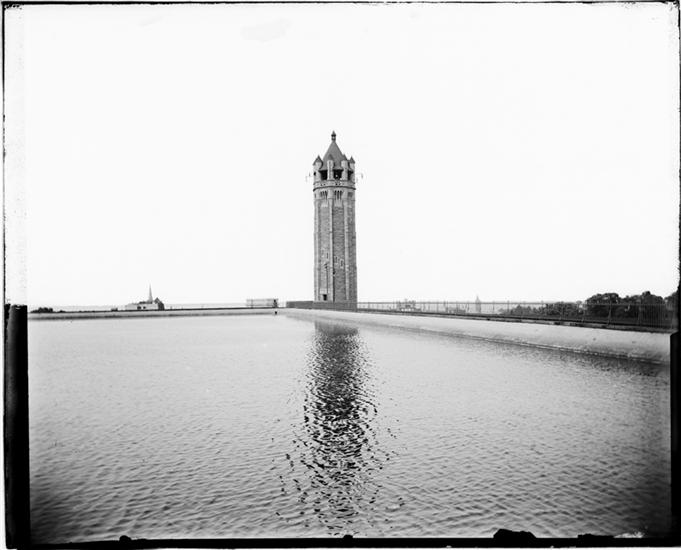
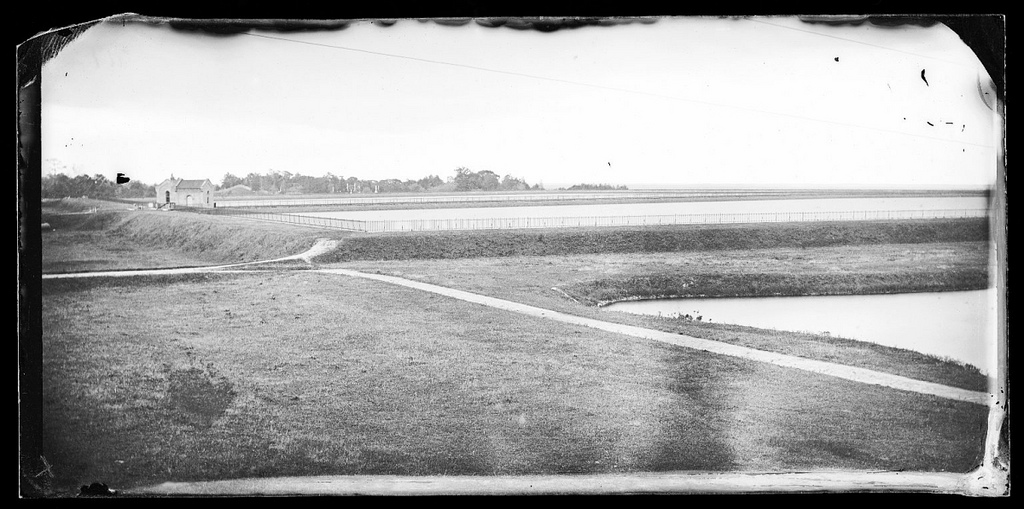
Photographed by Robert Bracklow, courtesy the Museum of the City of New York


Back when it was an independent city, Brooklyn received most of its drinking water from Long Island, pumped into to a large receiving reservoir in Ridgewood.  Some of that was then send southward to a reservoir built in the late 1850s at the second highest point in Brooklyn — Mount Prospect — rising 200 feet above sea level.

The reservoir was 3 1/2 acres, holding 20 million gallons of water at a depth of 20 feet. Or, according to the Brooklyn Daily Eagle, “containing just about enough water to cook the breakfast of the people of Brooklyn for a week

The elevation was not included in the original design of Prospect Park, conceived in the 1860s as Brooklyn’s own Central Park. ** Especially odd when you consider that Prospect Park takes its name from the hill where the reservoir resided.
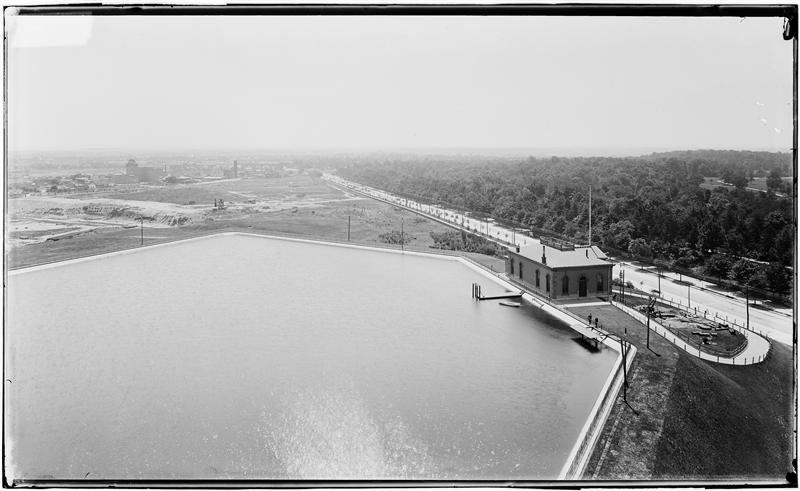
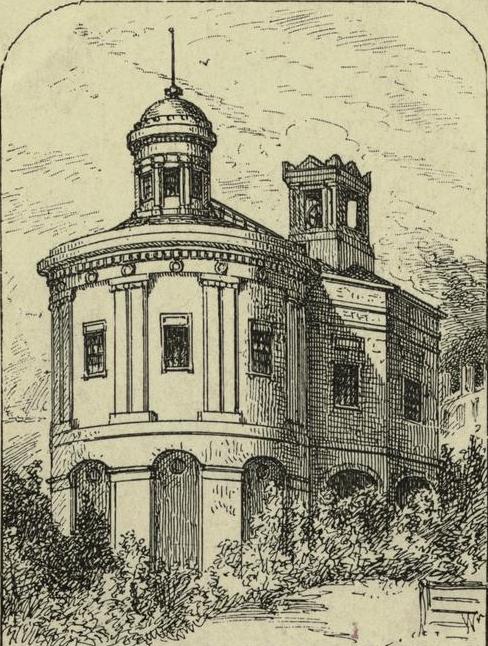
Pump house at the old reservoir on the East Side Lands, with Flatbush Avenue behind it, and Prospect Park in the background.
Pump house at the old reservoir on the East Side Lands, with Flatbush Avenue behind it, and Prospect Park in the background. [Courtesy Museum of the City of New York]
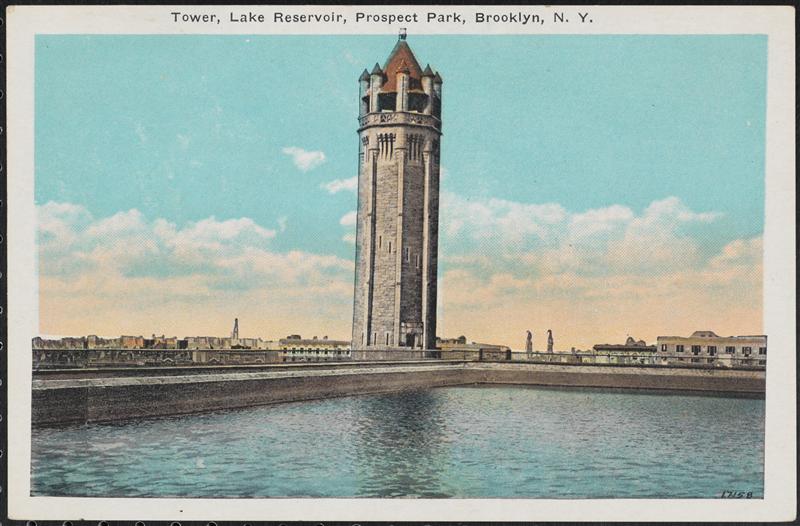
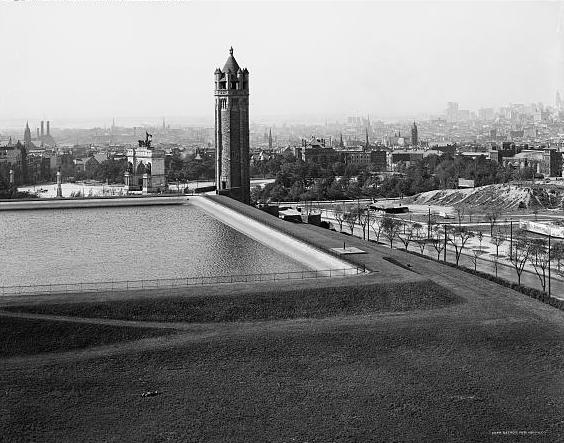
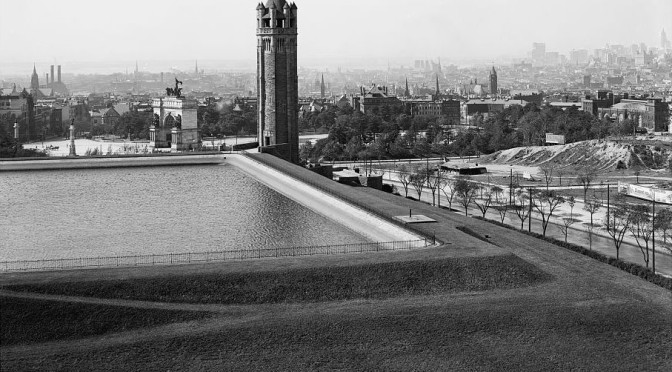
 Standing besides the man made lake was a pumping station and a grand Gothic tower, 30 feet tall. The world could be seen from here. “From the top of the tower … could be afforded a grand view overlooking the Park and City of Brooklyn; south may be seen the Atlantic Ocean; west, Staten Island and New Jersey; north, the Bay and the City of New York; east, the Navy Yard, Williamsburgh and the East River, altogether affording one of the grandest views imaginable.” [source]

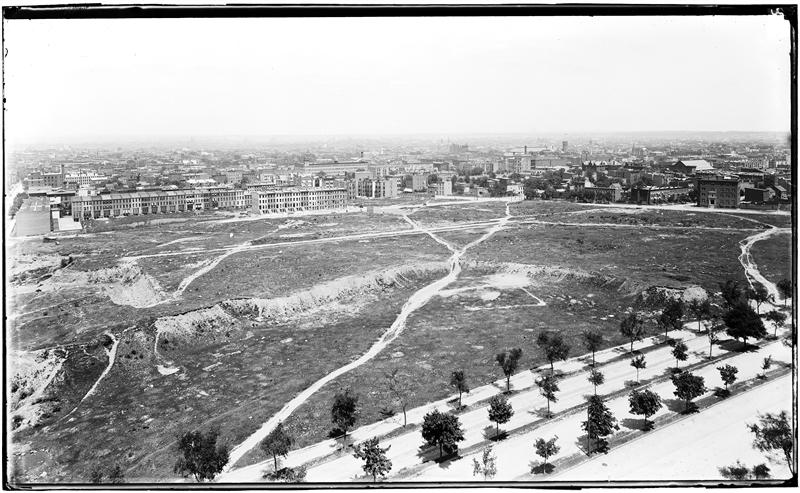
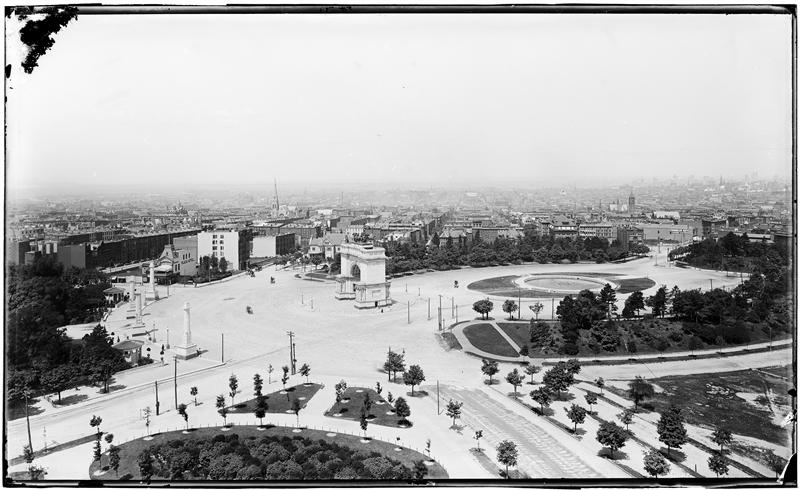
Below: Circa 1900, looking north from the reservoir over Eastern Parkway into what is today’s Prospect Heights neighborhood.  Below that, looking out over Grand Army Plaza. Photos by George Hall and Sons. Courtesy Museum of City of New York
3

4

When Brooklyn was incorporated into the consolidated Greater New York, they also were brought into New  York’s central water system (i.e. the Croton Aqueduct, later blended with the waters of the Delaware and the Catskills).  The Mount Prospect Reservoir was dismantled in 1940 and turned into a park. And the tower was torn down as well when the central branch of the Brooklyn Public Library was constructed.

According to BPL’s blog,  “The wrecking company in charge of tearing it down announced in the Eagle that the Connecticut pink granite used to build the tower would be made freely available to anyone who wanted it.”  So there may be pieces of the old tower incorporated into buildings all across the borough!
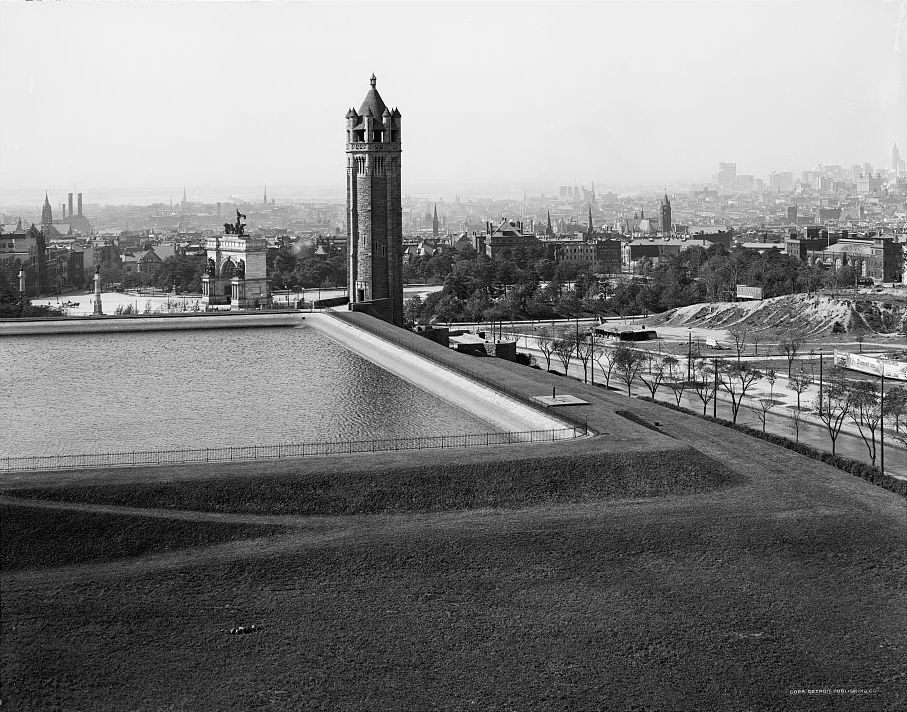
Looking over Brooklyn and Manhattan
Looking over Brooklyn and Manhattan (Library of Congress)


Unsurprisingly, the reservoir was a bit of a tourist attraction as evidenced by this postcard. (Courtesy the Museum of the City of New York)


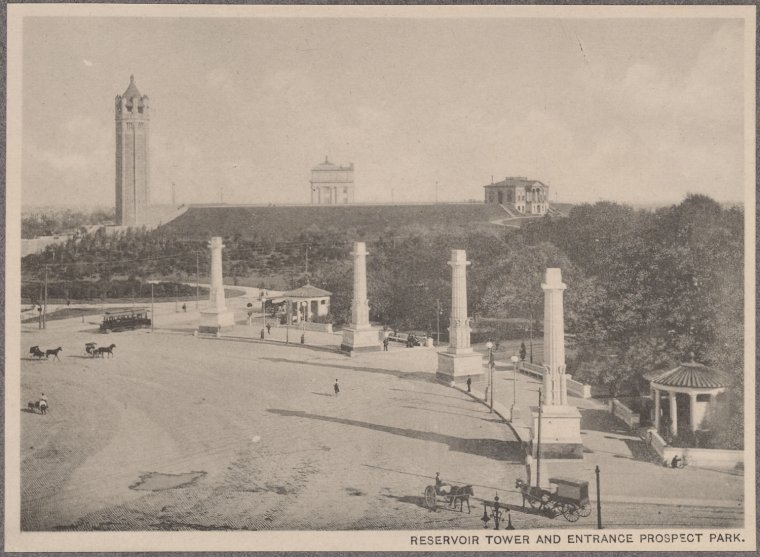
Viewing the entrance to Prospect Park with the reservoir and tower behind it. From this vantage you can see the Brooklyn Museum and the Mount Prospect Laboratory.


** See Matthew’s comment below about Mount Prospect’s appearance in the original Prospect Park plan.
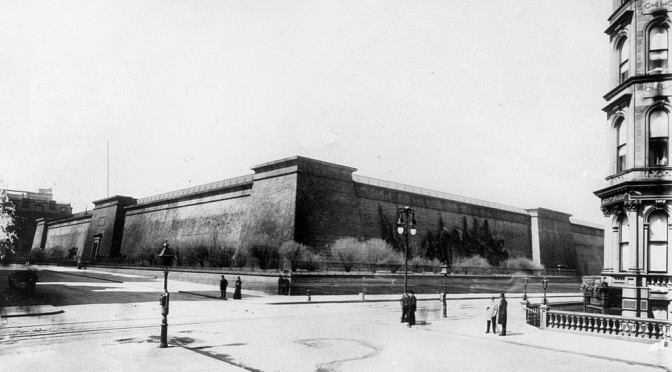
The art of the reservoir, New York’s forgotten architecture

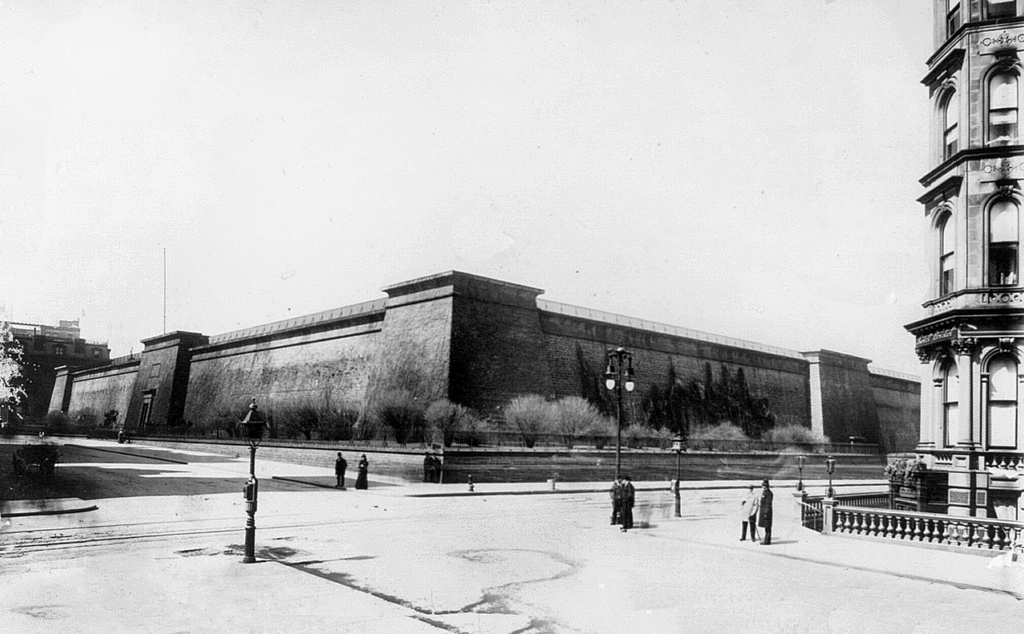
The Fortress of Fifth Avenue: the Murray Hill Reservoir

We share a lot of the same needs as New Yorkers of the past, but we’ve just gotten better at hiding the unpleasant ones.  There are a great many mental institutions and specialized medical facilities in the city; they just aren’t in creepy, old Gothic buildings anymore. Prisons are out on islands or in nondescript beige towers flaunting only the barest hint of iron bars. We don’t dress them up in Egyptian morbidity like the famous Tombs prison of Five Points.

Our trains and our electricity reside underground, and so does our water, mostly. There are only a few places that seem to suggest that New York City’s water supply doesn’t just magically appear. Water towers dot the skyline, recalling romantic comic book landscapes, while water treatment plants, spread mostly through the outer boroughs, obviously do not. Then there are the reservoirs, the grandest of these, the Jerome Park Reservoir in the Bronx, is a landmarked structure of enormous, albeit hidden, beauty. It’s currently drained and sitting like the Earth’s largest off-season swimming pool.

But New Yorkers used to live with their water, contained in reservoirs meant to evoke might, sophistication and security. After all, New York only got fresh water from the Croton Aqueduct in 1842; before that, it was mostly obtained from wells, cisterns, and that nasty old Collect Pond. People were proud of their new water system, so why not show it off?

Here’s a gallery of New York’s old 19th century reservoirs. In tomorrow’s podcast, we’ll elaborate on the marvelous story on how the city got its water:

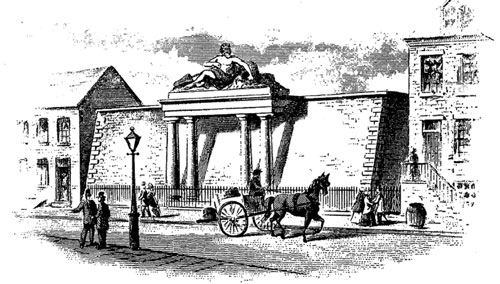
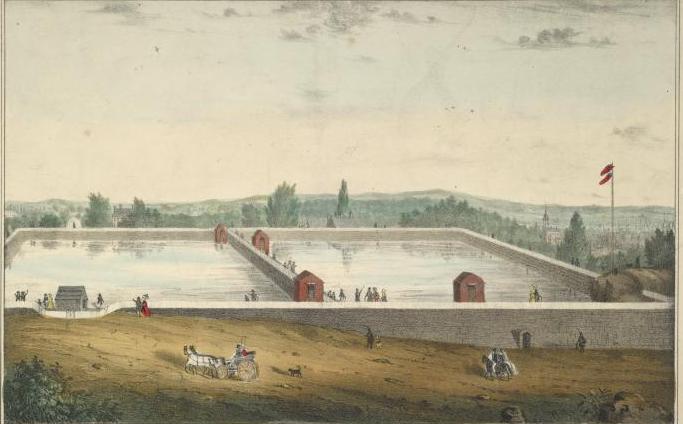
The Manhattan Company reservoir on Chambers Street was opened in 1801 and was quickly deemed inadequate. Looks lovely though. If it were still around — it was demolished in the early 1900’s — it would probably be a nightclub today.

13th Street ReservoirOpened in 1830 as a water-pooling resource for fire fighting, it pumped water to hydrants on Broadway, the Bowery and other streets, but was little help in stopping the blazes of the Great Fire of 1835.

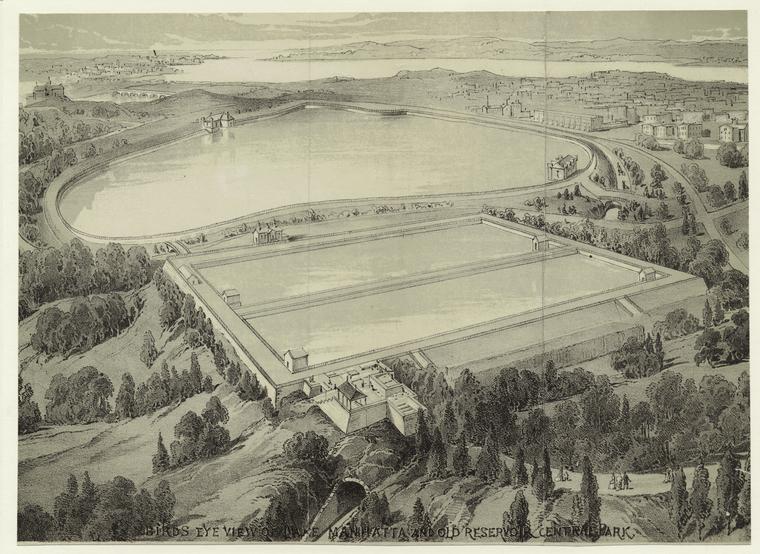
The Yorkville reservoir, how it looked on its opening in 1842. It was located between 79th and 86th Streets and between Sixth and Seventh Avenues. Many years later, was surrounded by Central Park and was later torn down to become the park’s Great Lawn. What does remain, however, is….

…the Central Park receiving reservoir, built in the 1850s and, unlike the Yorkville, incorporated into the park’s designs. Today it’s named for Jacqueline Kennedy Onassis, who lived nearby and frequently jogged around it.

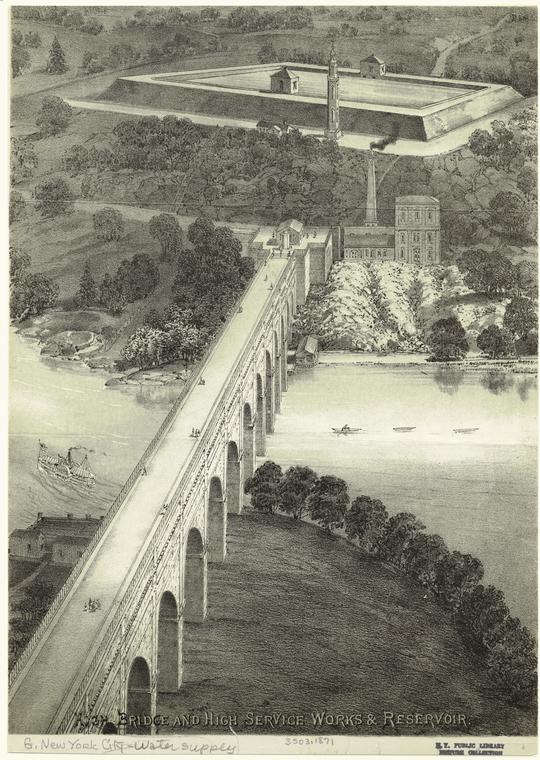
The spectacular High Bridge, part of the Croton system, with its adjoining smaller reservoir and water tower, serving the needs of residents of Manhattan’s higher elevations.

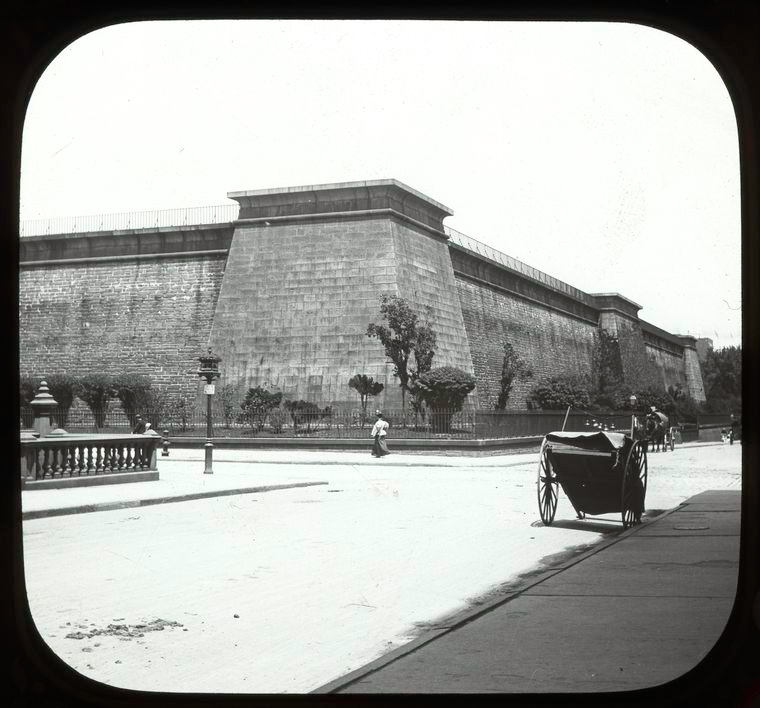
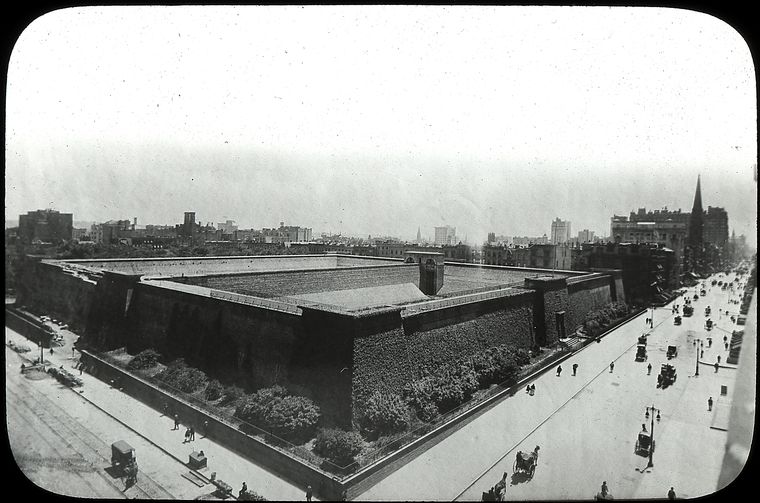
The grand Murray Hill Reservoir, probably the most popular of the reservoirs with 19th century tourists. Situated on land that had held the fabulous Crystal Palace (destroyed by fire in 1858), the reservoir was demolished in the 1890s to make room for Bryant Park and the New York Public Library.

Brooklyn was maintained in the 19th century in two reservoirs, one in Ridgewood and the other high atop Mount Prospect, although the ultimate source of the water came from a variety of places.

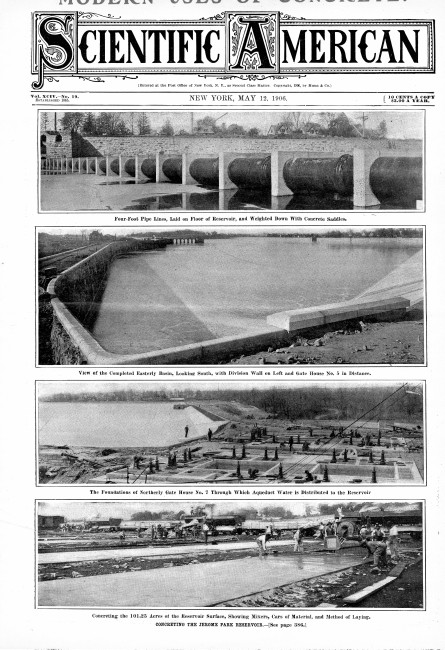
An issue of Scientific American in 1906, celebrating ‘the concreting’ of the Bronx’s Jerome Park Reservoir which opened that year and contained portions of both the old and new Croton Aqueduct systems.

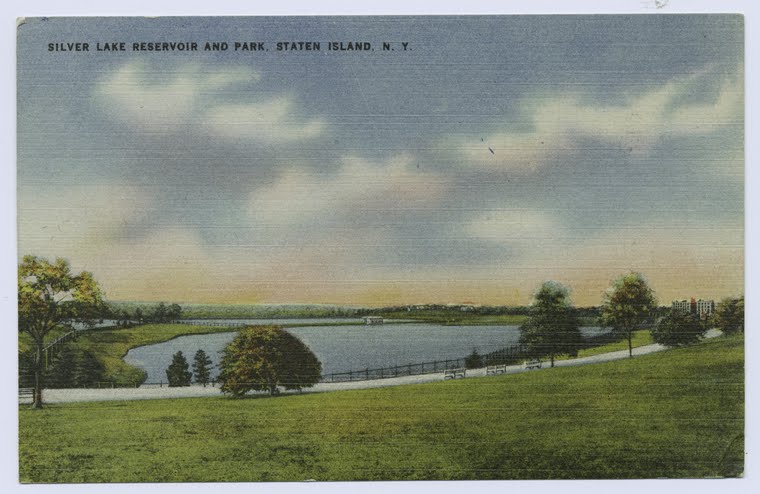
The 1917 Silver Lake reservoir in Staten Island was constructed, like the Central Park reservoir, to be a functional feature of a park setting.

Pictures courtesy the New York Public Library, the Brooklyn Museum and the Library of Congress. Thanks as always to these institutions. The Scientific American can be found here.