Defying gravity: New York’s most famous daredevils

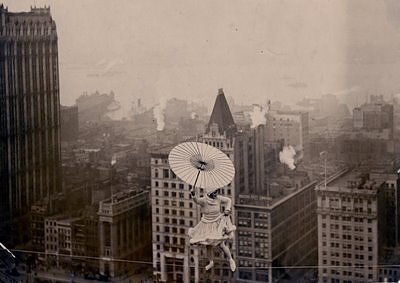
Bird in the sky: The delicate Ms. Millman makes it look easy

Last night on my walk home, I observed something you just don’t always see everyday — a renegade acrobat dangling from the top of the Williamsburg Bridge! The perilous pair, Seanna Sharpe and Savage Skinner, performed this foolhardy trapeze as traffic whizzed by below them, and the two were later apprehended by police. Will this stunt place them in the annals of great stuntwork performed by others who have used New York landmarks as their own personal stages?

1 Jules Leotard
This young French performer, renown in his home country, performed at New York’s Academy of Music in 1868 where he essentially debuted the art of the flying trapeze to startled New Yorkers. While we would not consider his feats particularly compelling today, audiences went wild, with local papers calling him a ‘dazzling, plumed bird’ and the Tribute referred to him as ‘tremendous, as a son of thunder’. He would return to Europe, where his tight, one-piece uniform would be mass produced and eventually bear his name.

2 Hanlon Brothers
The lofty endeavors of tightrope walking and trapeze acrobatics were forever changed on November 1, 1869, when an acrobatic troupe brought an aerial show to New York so ambitious for its time that it required one of its members to invent the aerial safety net! (William Hanlon eventually held the patent for it.) But here’s the odd part. The venue for that performance? Tammany Hall, at the time at 141 East 14th Street — and nearby the Academy of Music — making the block a sort of revolutionary spot for 19th century stuntwork.  [source]

Steve Brodie
A teenage newsie looked over at the Brooklyn Bridge as it slowly rose over the East River during its construction in the 1870s. He looked and thought, “I’m going to jump off that one day!” And so he did, on July 23, 1886 — or so he claimed — and the single event transformed him into a minor celebrity. He toured in a stage show recounting the event and opened a popular saloon at 114 Bowery (at Grand Street) in honor of his claim to fame. Today most people attempting such a ridiculous stunt are hardly considered heroic.

Harry Houdini
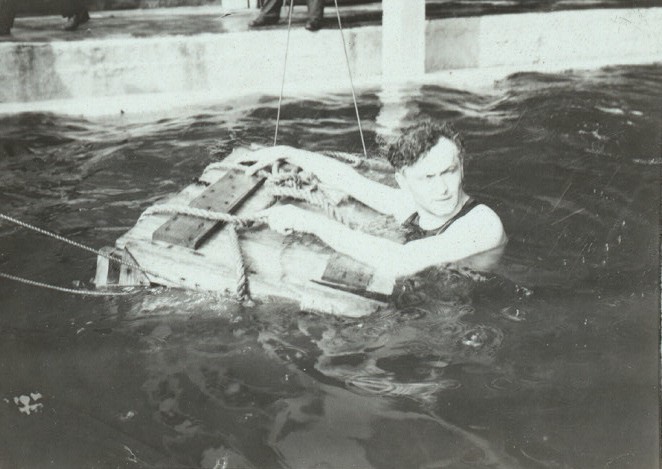
The legendary magician moved to New York at an early age  in the 1880s, and as he honed his crafts of illusion, he frequently used the city as a backdrop to heighten the drama. He was thrown into the East River on July 7, 1912, locked in a crate and bound in handcuffs and leg-irons. (Time it took him to escape: 57 seconds.) And in another rather famous trick in 1916, the escape artist, bound in a strait-jacket, hung precipitously from a crane over an excavation for the New York subway in the middle of Times Square. (Escape time: 2 minutes, 37 seconds.)

Below: Houdini, coming up for air (Pic courtesy NYPL)
Bird Millman
The lovely queen of the tightrope (pictured at top) was a favorite of the Ringling Brothers and Barnum & Bailey Circus, not to mention a featured performer for Florenz Ziegfeld. She performed hundreds of times within vaudeville theaters in New York well into the late 1920s, but occasionally she performed outside, dancing across tightropes stretched between buildings.

Evel Knievel
Garbed in his trademark patriotic colors, Knievel leapt over nine cars at Madison Square Garden during a series of shows in July of 1971 — his only major New York appearances. But the stuntman’s real dream never got off the ground:  the desire to jump his motorcycle from one great skyscraper to another. The city wouldn’t have approved of something so dangerous….

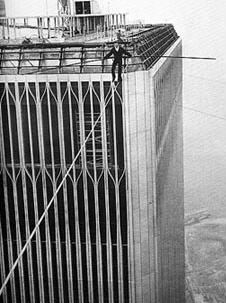
Philippe Petit

…which is why you don’t ask them. The eccentric French high-wire performer snuck into the World Trade Center several times to plan the specifics of an extraordinary display of daredevilry. And on August 13, 1974, this ‘Man on Wire’ walked a narrow cable from one tower to the other. A masterful display of personal courage, and a rather embarrassing on the Twin Towers’ lax security.

Alain Robert
This modern daredevil — the ‘modern Spider-man’ as the press has dubbed him — has scaled all sorts of tall surfaces throughout the world, including the Empire State Building in 1994. When the new New York Times headquarters was completed in 2008, it was like a red cape to a charging bull, and Robert took to the building on June 5, 2008, and unfurled a banner about global warming.

ALSO: Coney Island has been the site of a great many deathdefying performances over the decades. An August 14, 1904 issue of the New York Tribune marvels at the amazing stunts at the theme park Dreamland — “Men Must Do Much to Thrill The Public Now” — and notes one performer who fell off a rusty 725-foot sliding cable, tumbling into the ‘Shoot the Chutes’ ride!
Categories
Podcasts

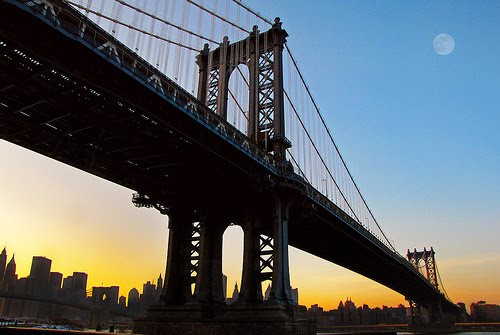
Manhattan Bridge: New York City’s dysfunctional classic

[from Flickr, taken by ajagendorf25]

We love the Manhattan Bridge, but there’s no doubt it’s had a rocky history. For one hundred years, it’s withstood more than just comparisons to its far more iconic neighbor, the Brooklyn Bridge.

Built to relieve pressure on the East River’s best known bridge, the Manhattan Bridge went through two different engineers — and a couple different ambitious designs — before finally being completed by another architect, who then went on in 1940 to design one of the WORST bridges in America. And serious design flaw afflicts the bridge to this day?

Listen in and find something to appreciate in this seriously under appreciated marvel of the East River:


I mention many bridge engineers in this podcast — Leffert Lefferts Buck, Gustav Lindenthal and Leon Moisseiff — but due to time constraints on the show this week, the contributions of Henry Hornbostel were left out. Hornbostel was instrumental in the work with Buck on the Williamsburg Bridge and with Lindenthal on the Queensboro. When we do podcasts on those bridges, he will get his fair due.

Preliminary work on the Manhattan Bridge began in 1901 under Buck, with Lindenthal taking reign of the project a year later. When Moisseiff was brought in to rework the bridge in 1904, construction kicked into high gear. Lindenthal’s innovative suggestion to use eyebars was discarded for a more conventional wire structure. [Pics courtesy Life Google images]

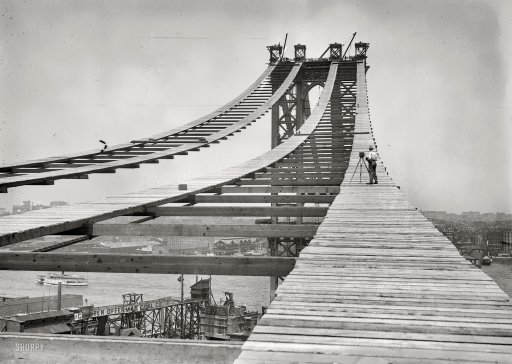
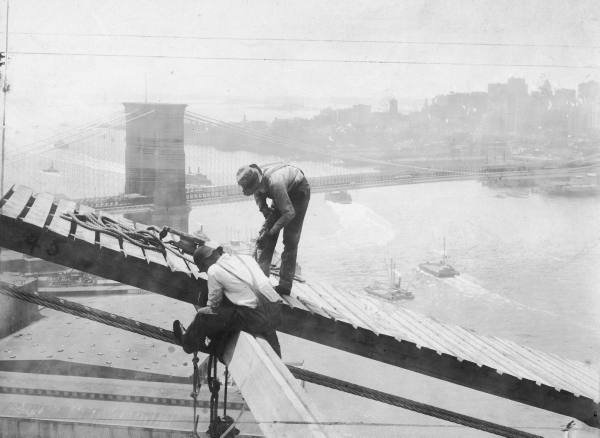
Stringing the cable across the East River took only four months in 1908. Indeed, the traffic snarls on the Brooklyn Bridge demanded them to work quickly. It was also mayor George McClellan’s intention to finish the bridge before he left office. [Photo by GG Bain and cleaned up by Shorpy, see a nifty close-up image here]

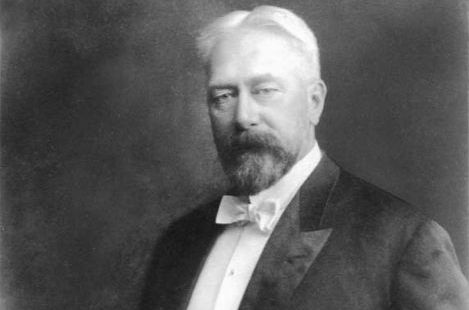
Gustav Lindenthal, born in Brno (now in the Czech Republic), came to the United States, built many bridges, and dreamt up many more that were never completed, like the North River Bridge, which would have spanned the Hudson River, and a monumental Manhattan Bridge designed with 14 lanes of traffic.

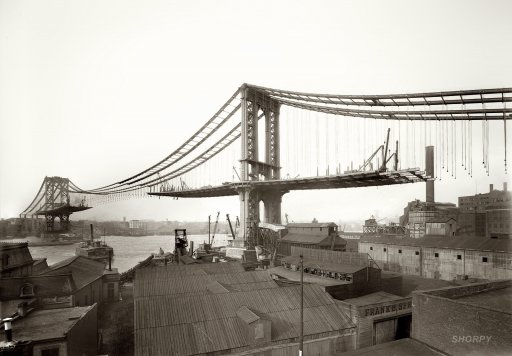
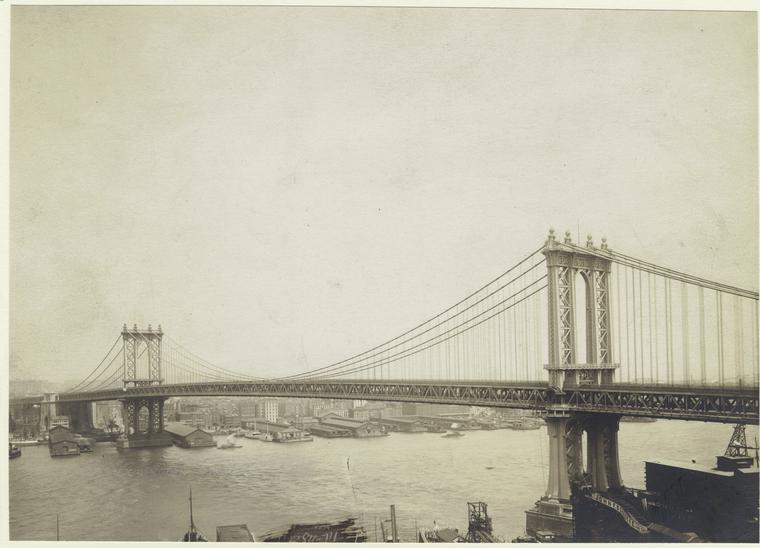
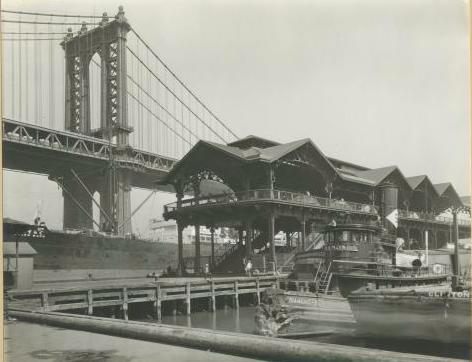
The bridge opened on December 31, 1909, although the pedestrian walkways were not completed and no trains were ready to go over it at that time. Setting it apart from its sister bridges was the flat, blue two-dimensional towers. As you can infer from this photo, facing both sides of the bridge were rows of docks and industrial ports. [Pic courtesy NYPL]

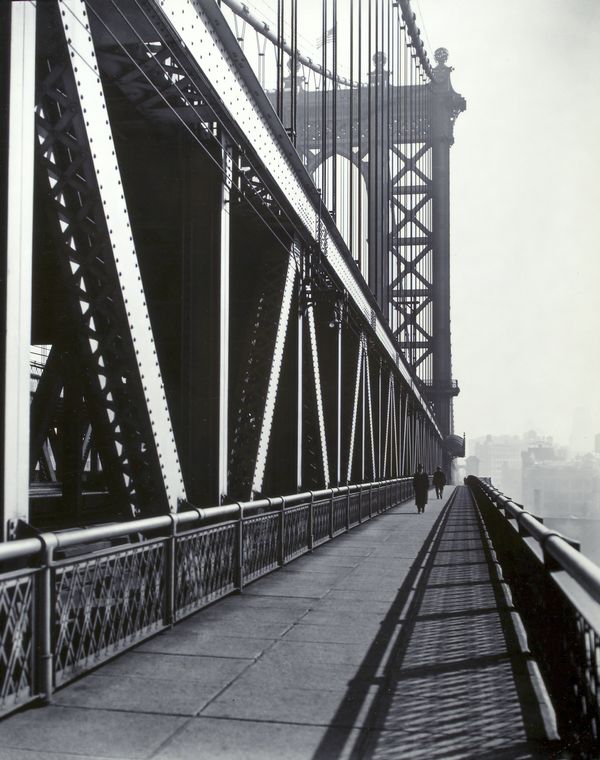
Berenice Abbott has some spectacular views of the Manhattan Bridge, taken in the 1930s. For crisp, dreamlike pictures of Manhattan, you can’t do better than Abbott. [courtesy NYPL]

Speaking of Berniece Abbott, Gothamist has some great shots taken by her of the area below the Manhattan Bridge on the Brooklyn side — today it’s DUMBO, known then as the strangely desolate Irishtown. [Flashback: Brooklyn 1936]

Patrick Henry McCarren: how a politican became a pool

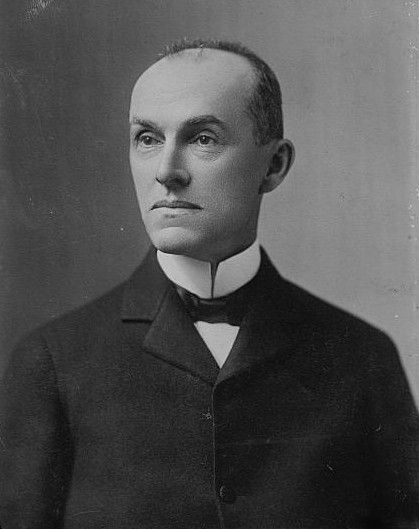
Patrick Henry McCarren — best known today for leaving his last name to a park and a swimming pool — was a complicated figure, so it makes sense he should be considered a sort of godfather to a rather complicated neighborhood like Williamsburg.

McCarren became the voice of Greenpoint and Williamsburg at a pivotal time of growth for Brooklyn, during the years of consolidation with New York. He worked his way up and, once there, bought himself favor like a good old-fashioned machine Democrat would — one hand outstretched to the working class, the other in the pocket of big industry.

Born in East Cambridge, Massachusetts of Irish parents in 1847, McCarren headed to Brooklyn and worked first in Williamsburg’s thriving sugar refineries, then as a cooper, and finally as a lawyer, the springboard for his real ambitions in local politics. Civic service was his singular objective, entering Kings County’s democratic machine at age 21. In 1881, he was elected a state senator, a vantage he would use in accumulating great influence.

“Far from being offended at being called a politician,” according to a glowing eulogy. “[McCarrin] took pains to emphasize his right to the name and became a power….because of his singleness of aim.”

During 18 years as a state senator, McCarrin rallied for the fortunes of Brooklyn and, in particular, for the East River Bridge to link New York with the factories of Greenpoint and Williamsburg. (And, oh yes, blossoming Brooklyn’s population with the fleeing residents of the Lower East Side.)

There is much truth in the statement, “The bridges, the parks, the improved means of transit, the better paved and lighted streets…by which the Brooklyn of to-day is distinguished….are due more to the legislative efficiency of Senator McCarren than to the influence of any other individual.”

Of course, he did so frequently on behalf of the Eastern District’s big industries, becoming a political marionette for both oil and sugar. He was publicly charged with actually being on the payroll of Rockefeller’s Standard Oil Company. According to one account, “No denial of the charge was ever made by the Senator.” One paper even referred to him as “the Standard Oil serpent of Brooklyn politics.”

Remarkably, with such unabashed connections to corruption, you’d think he’d be a welcome ally to New York’s Tammany Hall. Far from it; as a powerful Brooklyn Democrat, he remained unbought by Tammany, on the outskirts of their most important political objectives. By 1908, the year he thwarted Tammany’s plans to put William Randolph Hearst in the governor’s seat, he was possibly the most powerful man in Brooklyn.

He died the next year, 1909, hated and mocked across the water but beloved by most in Brooklyn, even some of his most fractious enemies. His funeral was purported the biggest in the borough since Henry Ward Beecher’s.

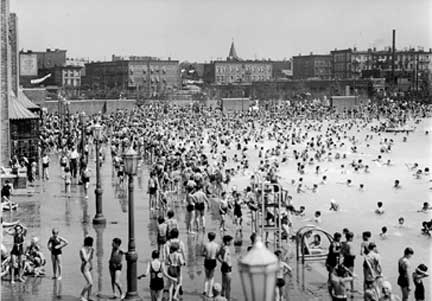
Greenpoint Park, which had opened in 1906, was quickly renamed in his honor. Had he been around, Patrick might have blanched thirty years later when another steadfast politician, Robert Moses, decided to plunk down the biggest of eleven WPA-funded municipal swimming pools here in 1936. Today, the pool is a popular but surprising venue for concerts and is currently being renovated.

Below: McCarren Pool in its heyday, date unknown (Courtesy McCarren Park)

Categories
Podcasts

PODCAST: Williamsburg(h), Brooklyn

Williamsburg used to have an H at the end of its name, not to mention dozens of major industries that once made it the tenth wealthiest place in the world. How did Williamsburgh become a haven for New York’s most well-known factories and then become Williamsburg, home to such wildly diverse communities — Hispanic, Hasidic and hipster? Find out how its history connects with whalebones, baseball, beer, and medicine for intestinal worms.

Listen to it for FREE on iTunes or other podcasting services. Or click this link to listen to the show or download it directly from our satellite site.

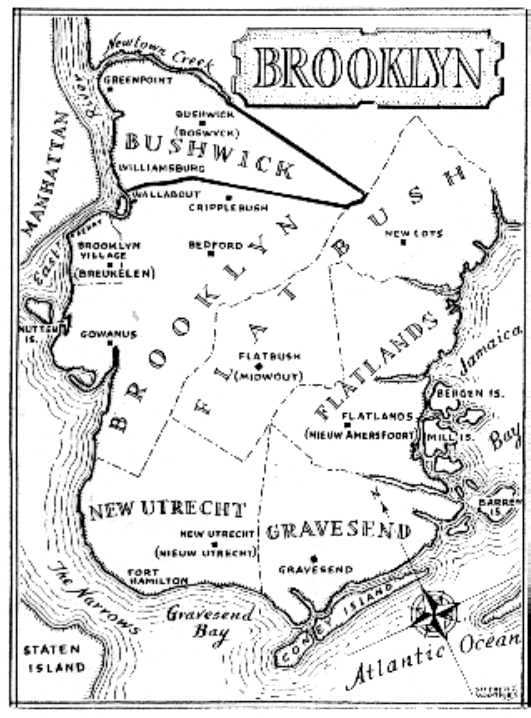
A modern map of the townships of Kings County. Cripplebush is listed here as a settlement in Brooklyn. The dense undergrowth that gave Cripplebush its name stretched well into the jurisdiction of Bushwick, which the Dutch actually called Boswijck.

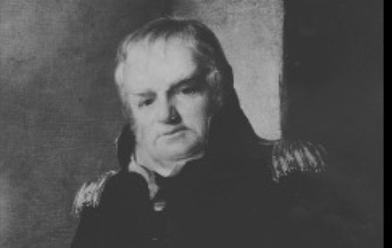
The esteemed Lt Col. Jonathan Williams, who surveyed the land along the Bushwick shore and eventually gave Williamsburg its name. You can also find his handywork at Castle Clinton and Castle Williams (also named after him).

Another father of Williamsburg, David Dunham, can still be found today on a very tiny street near the bridge called Dunham Place. (Forgotten New York has a great look at this odd little side street.)

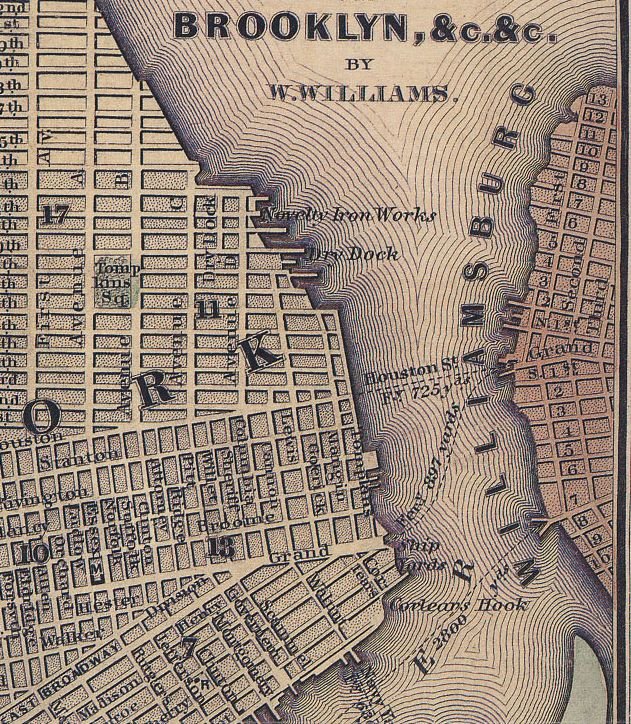
A detail from this mid-19th century map of New York and Brooklyn indicates the two ferry paths across the East River from the Grand Street dock in Williamsburg.

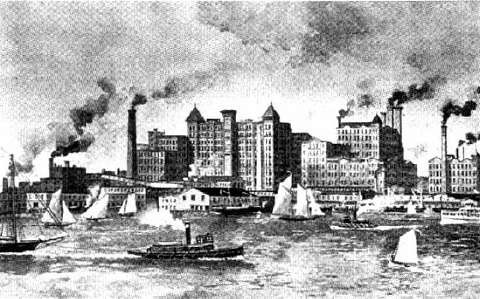
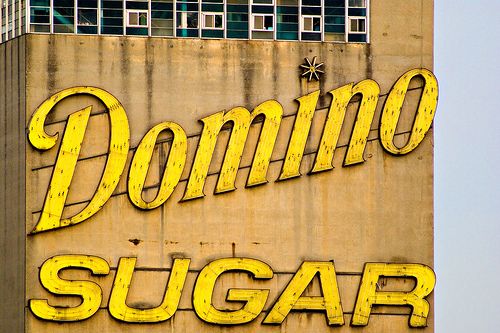
The Williamsburg waterfront during the 1880s. Havemeyer’s sugar refinery became one of the most profitable businesses along the East River. It became Domino Sugar in 1900.

While Havemeyer’s factory, closed in 2004, has been landmarked, its future could include a vast complex of condominiums — but with community opposition and a $1.3 billion dollar price tag, is it viable?

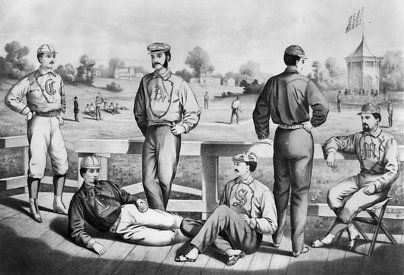
These fancy guys are relaxing after a vigorous game of baseball at the Union Grounds, the first to fence in the playing field and charge spectators. Check out our previous article on this historic place and where you can find its location today.

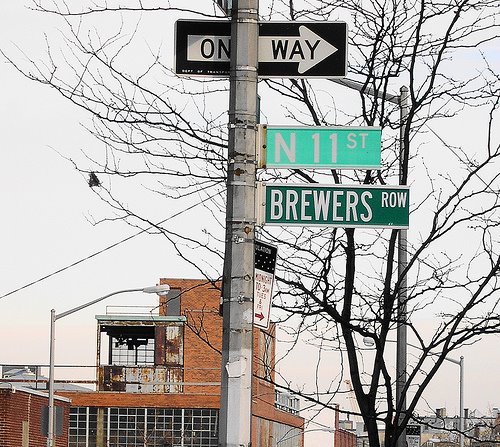
There are no more breweries along Brewer’s Row, but the once grand boulevard of beer makers that stretched from Williamsburg to Bushwick is still recognized on street signs.

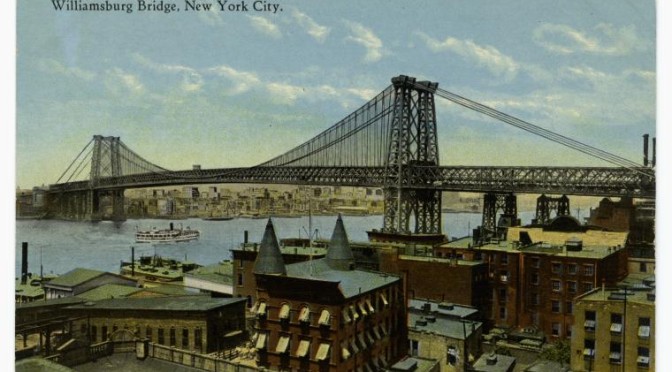
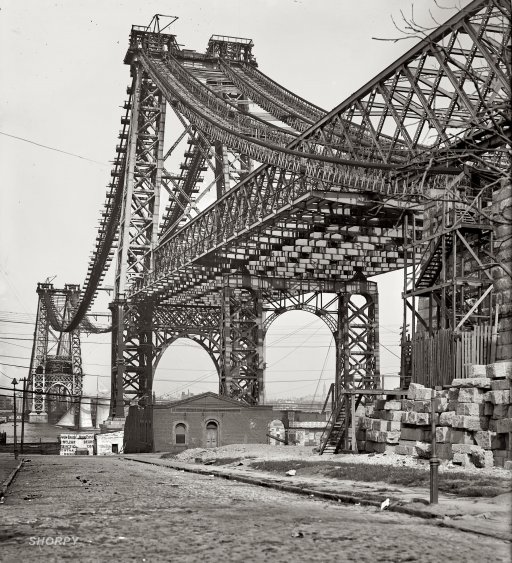
The East River Bridge (today the Williamsburg Bridge) in 1902. It would be opened a year later, opening the neighborhood to thousands of new residents fleeing overcrowded Lower East Side (pic courtesy Shorpy)

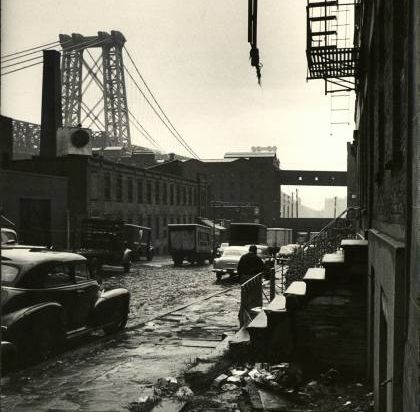
Williamsburg in 1954, not the sunniest place ever. Photo by Alfred Eisenstaedt (LIFE archives)

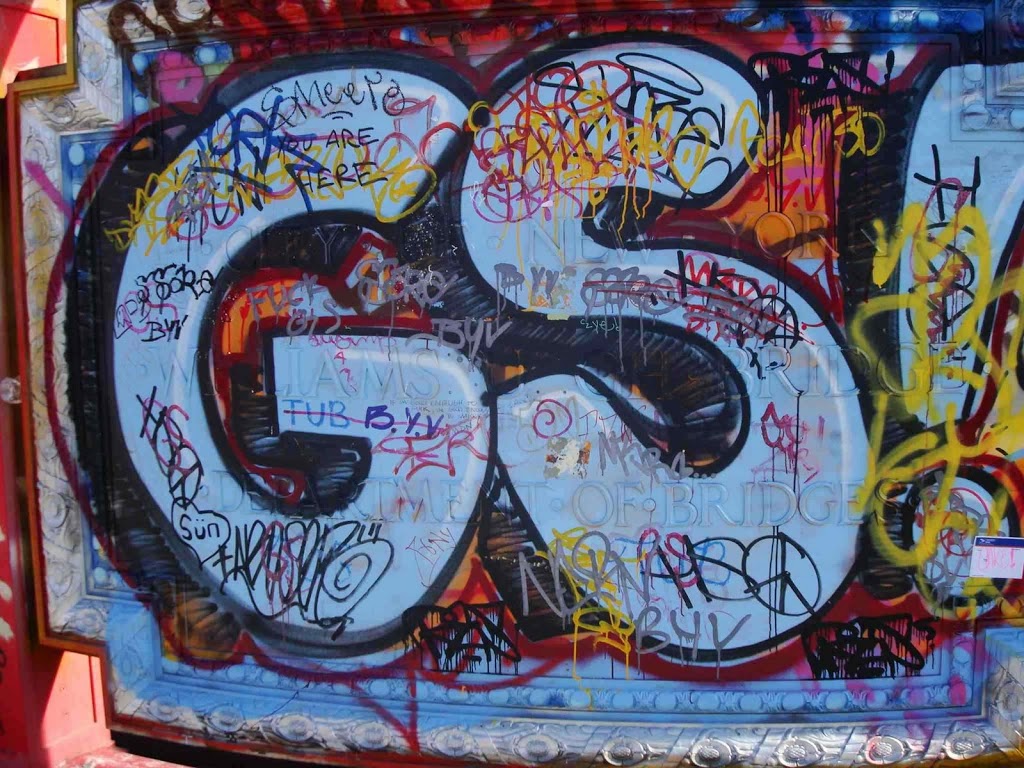
Look really closely at this dedication found at the pedestrian fork on the Williamsburg Bridge. If you scrape away the graffiti, you’ll see Williamsburg with an H on the end. (Click it to get a closer look.)

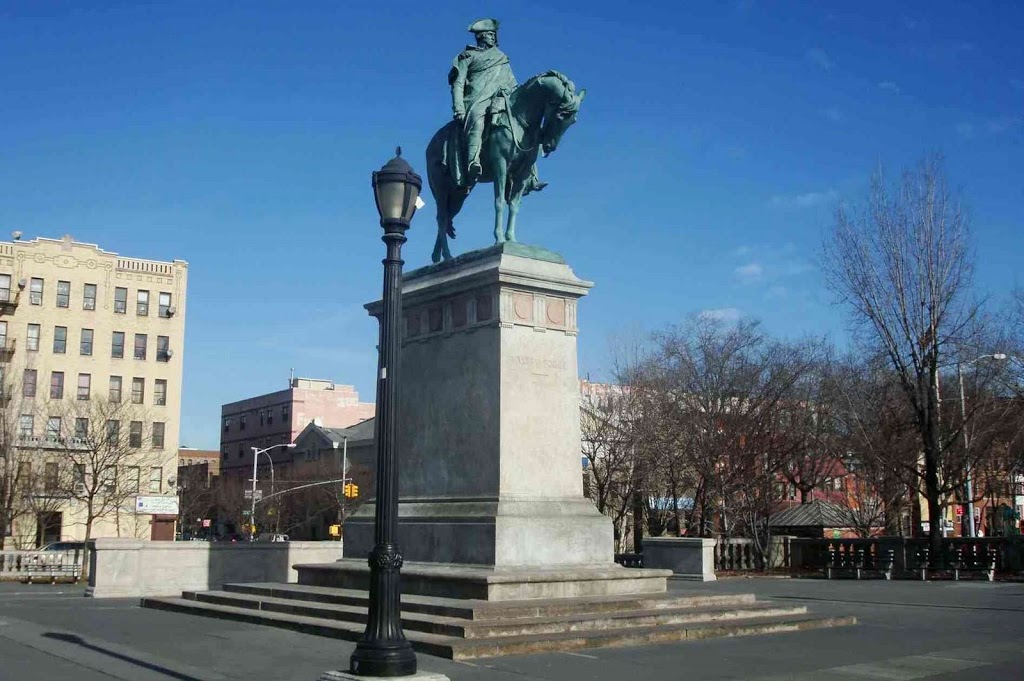
Continental Army Plaza, now overlooking the entrance and exit ramps of the Williamsburg Bridge. An engraving in the sidewalk points towards Valley Forge. The statue and the plaza were installed shortly after the opening of the bridge. So, in fact, this has pretty much always been George’s view.

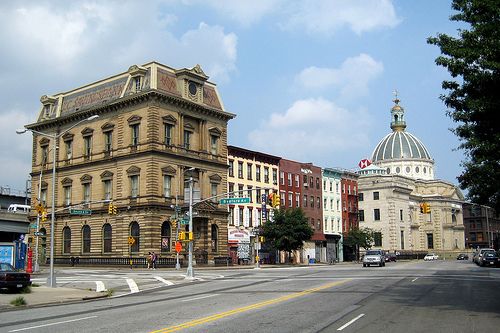
Two gorgeous examples of Williamsburg’s opulent past — the Kings County Savings Bank (built in 1868!) in the foreground, and the George Post’s domed Williamsburgh Savings Bank in the distance. (pic courtesy Flickr)

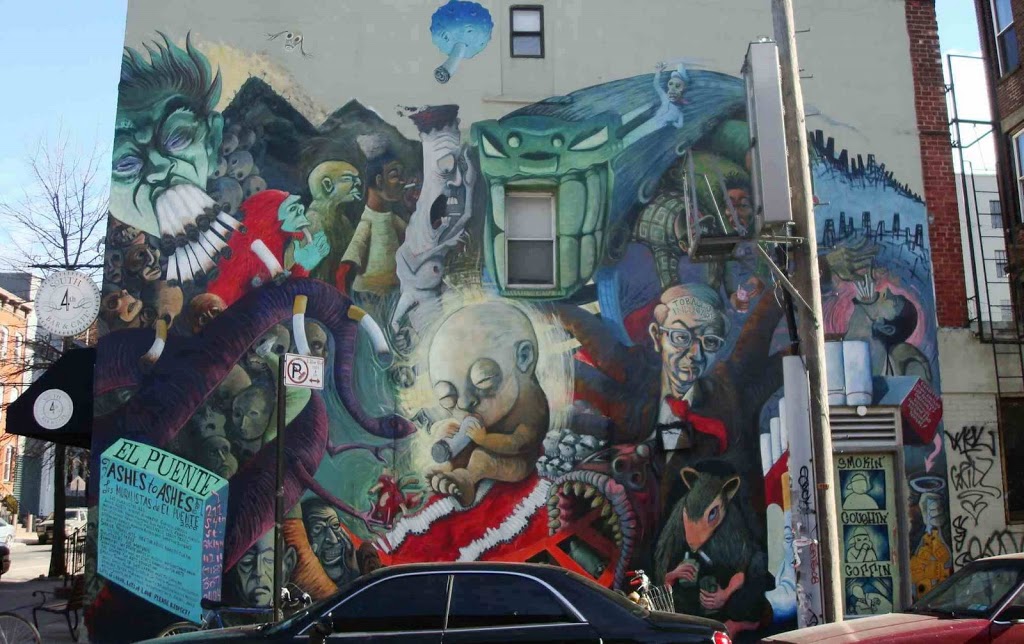
A mural just north of the bridge. Don’t smoke, kids!

Where are you, George Post?

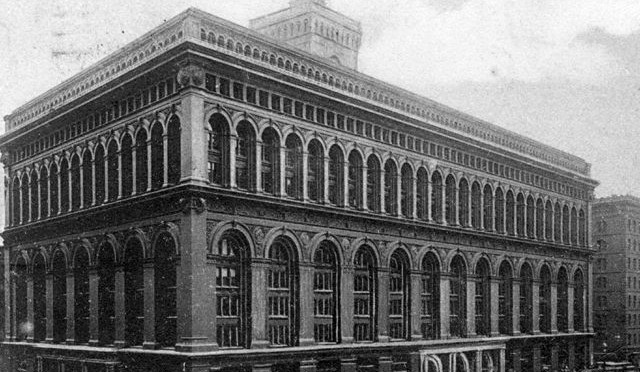
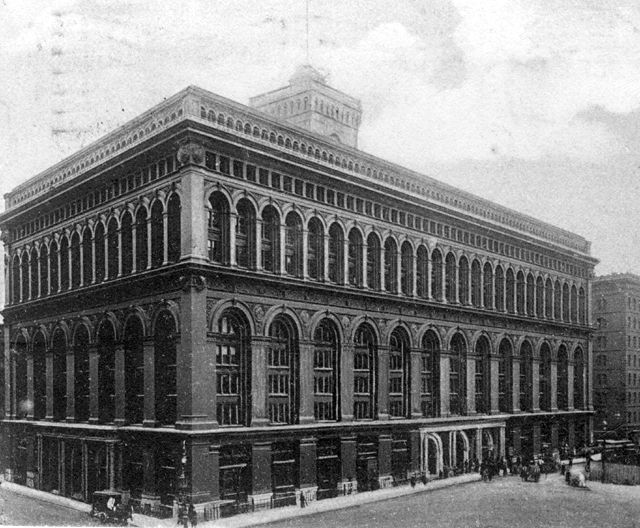
Who knew a produce exchange could look so elegant?

One of New York’s most important architects was George B. Post, but you would barely know it today.

Only a handful of his most important buildings — the New York Stock Exchange being the most famous — still stand, the victim of a rapidly changing city sweeping away the former glories of the Beaux-Arts style.

Post wasn’t your typical purveyor of the sometimes gaudy excesses of Beaux-Arts, that amalgam of classical and formal styles that dictated American architecture from the 1880s into the 1920s. He was known for making its particular beauty climb, refitting its graceful symmetry literally to new heights. Post proved that the merely traditional needn’t be staid and uninspiring. My two favorites of long-gone works:

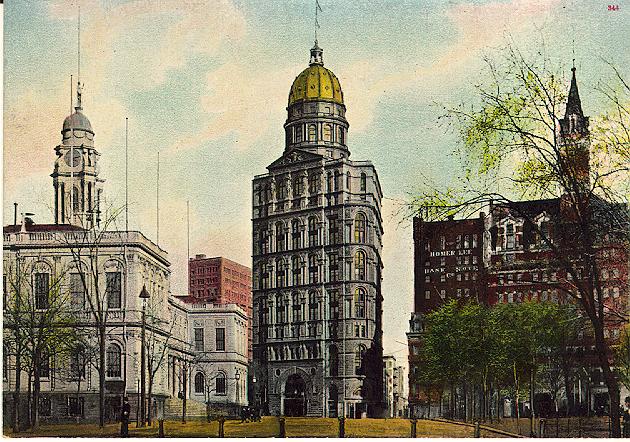
New York World Building

His best known building during his life was the New York World building on Newspaper Row, more appropriate referred to as the Pulitzer building after the paper’s imperious publisher Joseph Pulitzer. It was the tallest building in the world when it was completed in 1890 and was the first building to rise above the spire of Trinity Church.

This was demolished to make way for a car ramp for the Brooklyn Bridge:

(New York Architecture has some more beautiful pictures of this building)

New York Produce Exchange

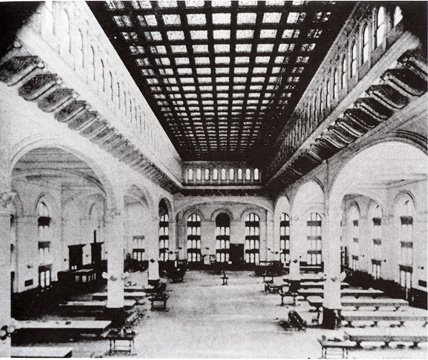
You wouldn’t expect a building made to hold produce to be an architectural marvel, but Post graceful talent at creating lively open spaces made this one, at 2 Broadway down at Bowling Green, a stunner and certainly must have recommended him as the ideal candidate to design the trading room floor at the New York Stock Exchange. The Produce Exchange was wiped out in 1957. (The exterior is shown up top.)

(Picture above, and others of Post’s work, can be found at City Review, reviewing a book of Post’s work by Sarah Bradford Landau.)

Go to New York Architecture to see a sampling of lost Post buildings.

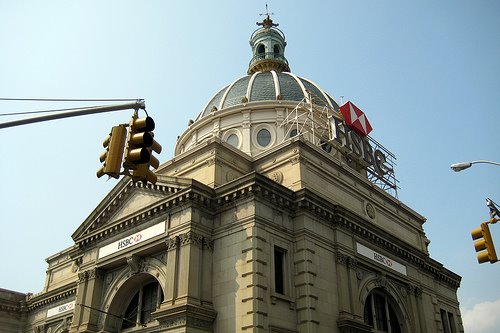
If you’d rather see one of his few existing ones, simply cross the Williamsburg Bridge over to the Brooklyn side, turn left and look for that beautifully domed and very out-of-place beauty that’s now an HSBC bank branch. That’s the Williamsburgh Savings Bank, the little brother of the Williamsburgh Savings Bank Tower and one of Brooklyn’s most beautiful buildings, built in 1875, many years before the bridge sprouted up in front of it:

New York’s best film performances – Part Two

My list of New York’s best movie scenes continues with two in Brooklyn — and one that almost gets there….

Tension
7. Do The Right Thing (1989)
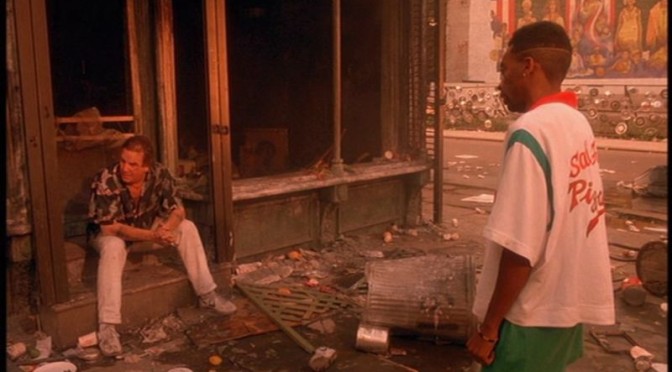
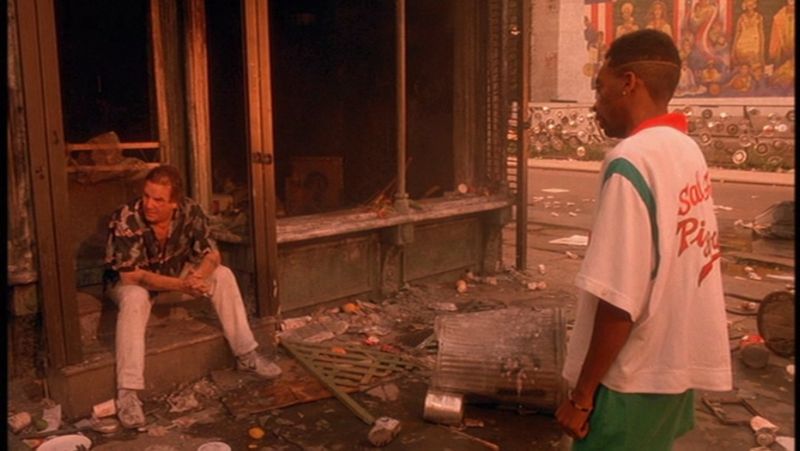
Mookie throws a trash can

Spike Lee is only one of a few directors who knows how to turn New York City into a character in his films. With ‘Do The Right Thing’, he photographs a typically drab streetcorner in Bedford-Stuyvesant with the sorts of color and pizazz more associated with 1950s musicals. Better to match the residents — everybody from the old men on the corner to the customers at Sal’s Pizzeria — a cross-section of vivid characters and a balance of different races getting along. Until, of course, Mookie throws that trashcan through Sal’s window.

The film is loosely based on a violent 1986 incident that occured in Howard Beach, Queens, involving the death of a black teenager after being harassed with his friends at a pizzeria. Mookie’s act of violence — the “did he do the right thing” moment — sparks a mob scene that greatly parallels many incidents during the New York blackout of 1977.

Not suprisingly, Lee goes back to the motif of the ‘hottest day of the summer’ in another great movie actually set in 1977 — “Summer of Sam” — a film loaded with on-location shots in Queens and the Bronx.


Grit
6. The Naked City (1948)
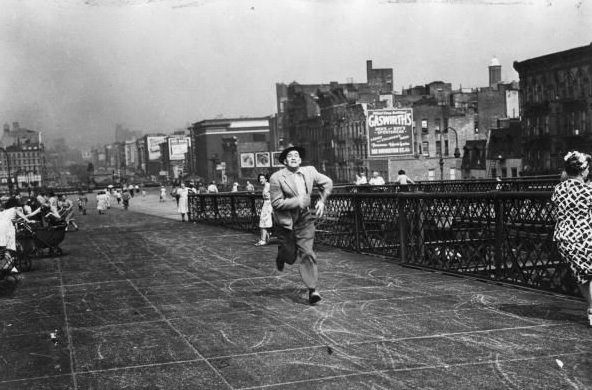
Shootout on the bridge

The Williamsburg Bridge’s best moment ever in a recorded medium is this scene in the Naked City, the climactic chase and shootout in a film already known as one of the best look New York City movies ever made.

Forget the standard issue film noir plot, fun but unspectacular; it’s all about William H. Daniels’ verite cinematography, which won him an Oscar. The Naked City is one of the first film to shoot almost everything on location in New York, 107 on-location scenes in all. The film, and New York, looks better the older it gets.

Among its more famous locales include the ole Roxy Theater, the Whitehall Building, and the City Morgue (!), but its crowning scene is its last, a breathtaking shoot-out literally up in the proverbial rafters of the Williamsburg Bridge. NO film (not even the next on my list) has ever used a bridge to such tangible effect.


Decadence
5. Saturday Night Fever (1977)
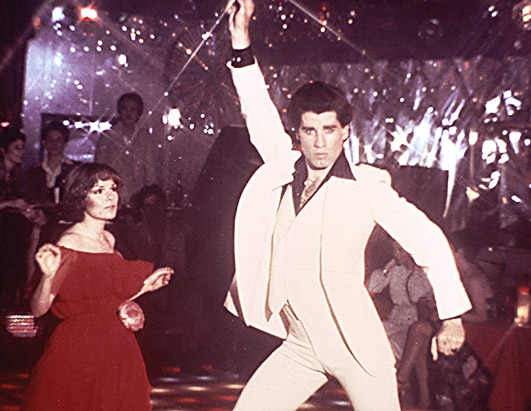
Tony and Stephanie cut a rug

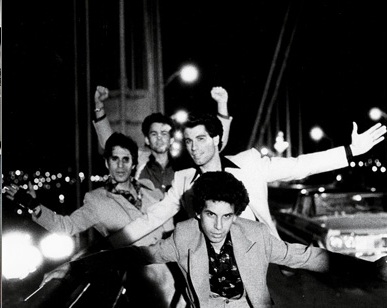
I couldn’t not pick the famous danceoff scene with Tony Manero and Stephanie Mangano. It defines the style of New York nightlife outside the VIP area of the 1970s. But for the record, Saturday Night Fever has two equally beautiful scenes using New York backdrops that are utterly fabulous — Tony strutting down the street with paintcans and, of course, the tragic encounter at the Verrazano-Narrows bridge. I can probably go on record and say ‘Fever’ is the coolest movie about New York City ever filmed.

I’ll save myself some typing and direct you to my writeup a few months ago on Saturday Night Fever and the club where it was filmed 2001 Odyssey, which also includes a report the fate of that sacred dance floor.

By the way, the original name of the movie was ‘Tribal Rights of Saturday Night’, as the film itself is based on a magazine article called ‘Tribal Rights of a New Saturday Night.’