Park Avenue’s stylish slaughterhouse

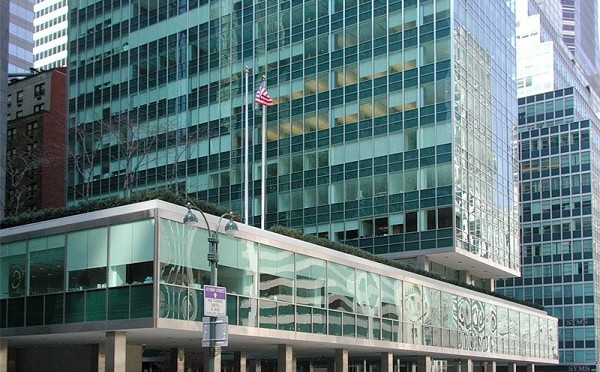
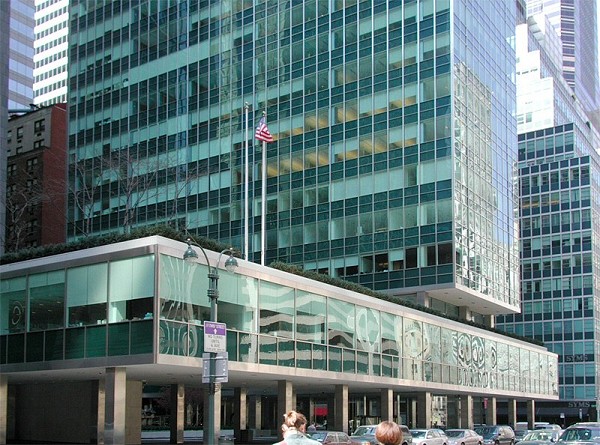
The Lever House at 390 Park Avenue, along with the United Nations building, ushered in New York’s obsession with the International Style of architecture in the 40s and 50s — clean and blocky thin glass icons in the sky. It’s no surprise to find the building was built in 1952 for a soap manufacturer, the Lever Brothers. The soap has since gone from the interiors of this sleek and cool structure, but they’ve been replaced with something more bizarre — human and animal gore.

Or rather, the aesthetic purveyor of such gore, the inimitable Damien Hirst. The Satan spawn of the British art scene, whose sometimes seemingly simple work bursts with shock value (and later, high price tags), has been a favorite of patron and German real estate mogul Aby Rosen, who just happens to own the Lever House.

Rosen is an art collector and enthusiast, hiring Whitney Museum curator Richard Marshall in 2004 to spice up the once frigid plaza and the redesigned William T. Georgis Lever lobby with some truly eye catching pieces.

The Lever has already seen such vivid works by artists like Jorge Pardo, Peter Wegner, A.V. Day (a dramatic, fabric-rent ‘Bride Fight’), and Jeff Koons (literally many blow-up Incredible Hulk dolls). Corridors within the Lever house works by Jean-Michel Basquiat and Andy Warhol.

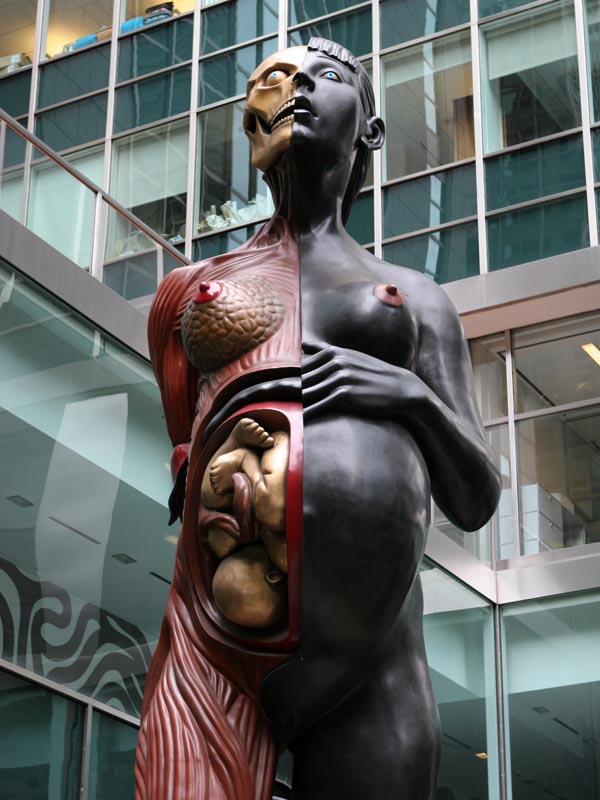
But Hirst is the Lever’s golden boy, giving the outdoor plaza a striking 34 foot tall naked pregnant ‘Virgin Mother’ (at left), in the Hirst fashion with most of her skin falling off. According to Interior Design, The lady “looks directly into the Lever Brothers corporate cafeteria.” As of last year, she has a twin across the pond in London at Royal Academy of Arts.

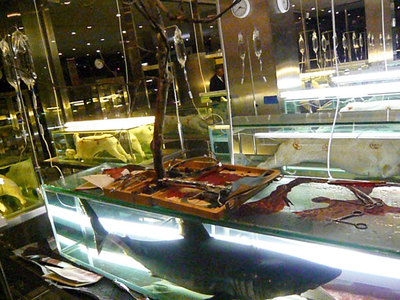
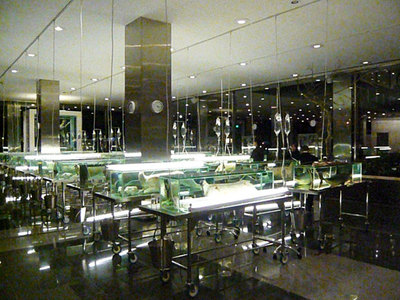
Until mid-February, you can catch more Hirst wrecking havoc in the Lever lobby as well. Laboring under the title “School: The Archaeology of Lost Desires, Comprehending Infinity, and the Search for Knowledge,” the entire lobby if filled with animal carcasses behind glass, often paired with furniture.

A couple images from the exhibit are below. Why not stop by on your lunch break today?

Photos from Slamxhype by Paul Mittleman
FRIDAY NIGHT FEVER: Mudd Club


To get you in the mood for the weekend, every Friday we’ll be celebrating ‘FRIDAY NIGHT FEVER’, featuring an old New York nightlife haunt, from the dance halls of 19th Century Bowery, to the massive warehouse spaces of the mid-90s.

First on the list is the Mudd Club, often viewed as the mirror image of its more known uptown competitor Studio 54. Located between the borderlands of TriBeCa and Chinatown (77 White Street, near mysterious Cortlandt Alley), Mudd was a multi-level playground for the avant garde and strictly fabulous (i.e. one of the most notoriously elite clubs in the 70s), playing more to the burgeoning new wave and punk scene than to the disco beats echoing through other halls.

Unlike nightclubs today, which seem to cater A-list celebrities and their worshipers, the Mudd Club with its gold stairs and dark halls attracted a serious cult set of icons from the deep trenches of New York culture, particularly latter era Warhol proteges and art rock stars like Lydia Lunch.

Mudd owner Steve Moss was able to attract such rough-and-tumble innovators by combining its chicly trashy main floors with an art gallery on the fourth floor. The place became known as much for its Jean Michel Basquiat exhibititions as it did for its groundbreaking performances by the Talking Heads, Klaus Nomi and Bow Wow Wow.

In fact, David Byrne and the Talking Heads immortalized the club in their song ‘Life During Wartime’: “This ain’t the Mudd Club or CBGB’s, I ain’t got time for that now…”

On any given night you could stumble into the club (if you were ‘downtown’ enough) and, for instance, hear Debbie Harry rapping with Fab Five Freddy.

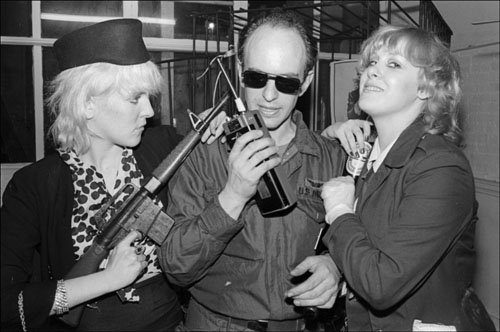
The club thrived on the degenerate but respectable synergy between art and music, a concept that would become mainstreamed in the late 80s. Although its no longer open in NY, its owner Steve Moss opened another version in Berlin in 2001, and purportedly he sits at the bar, still overseeing his nightly menagerie, even as most of the artists and performers he helped create in the 70s and 80s have passed on. (In fact, that’s Steve in the photo above, with members of the punk band Combat Rock.)

In addition to a European club, the former haunt also lives on as a shade of makeup.

There are tons of fun pictures from the Mudd Club’s heydey here.

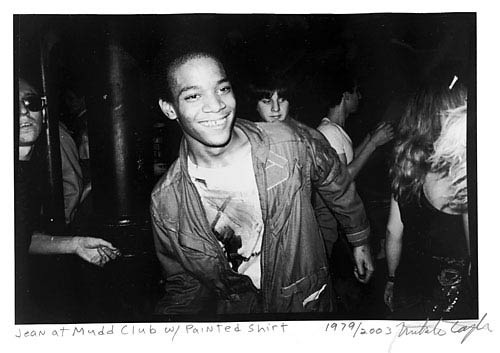
And here’s Jean-Michel, basking in his brief fame:

With his short term girlfriend Madonna looking on, Basquiat’s band GRAY almost exclusively performed at Mudd Club, featuring bassist and future filmmaker Vincent Gallo.

And why the Mudd Club? The urban legend claims that it was alledgedly named after the doctor and alledged Confederate conspirator (or maligned innocent, depending on who you talk to) Samuel Mudd, who helped John Wilkes Booth escape after he murdered Abraham Lincoln. Mudd mended Booth’s broken leg which he received when he fled D.C., and the long stick he used to set the bone was known as ‘Mudd’s club’.

HAPPY FRIDAY!