Categories
Landmarks Podcasts

The Return of the Waldorf Astoria: Grace, Glamour and International Intrigue

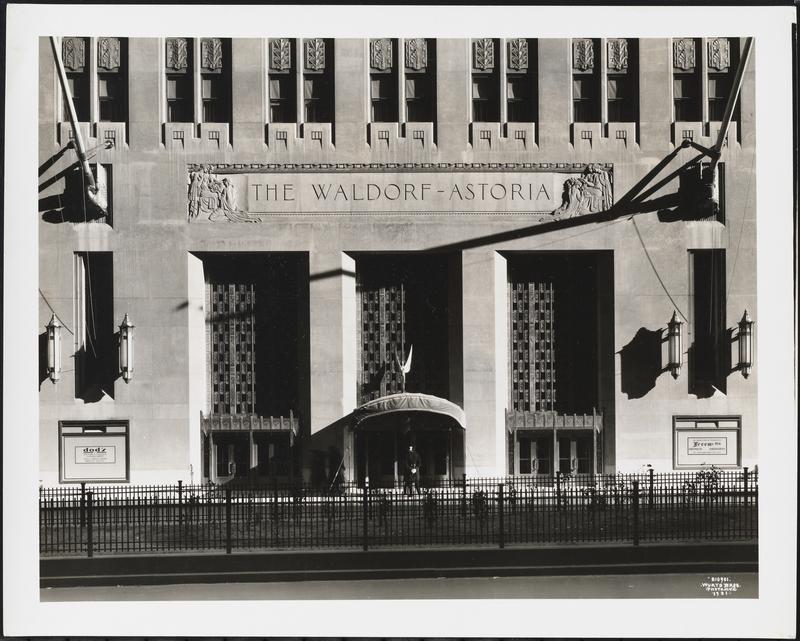
PODCAST A star of the New York City skyline is reborn — the Waldorf Astoria is reopening in 2025!

And so we thought we’d again raise a toast to one of the world’s most famous hotels, an Art Deco classic attached to the Gilded Age’s most prestigious name in luxury and refinement.

Now, you might think you know this story — the famous lobby clock, Peacock Alley, cocktail bars! — but do we have some surprises for you.

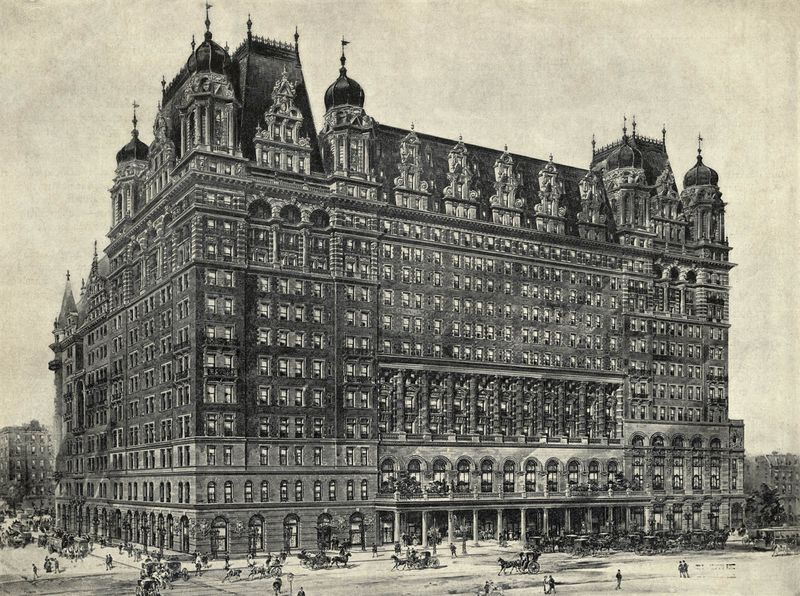
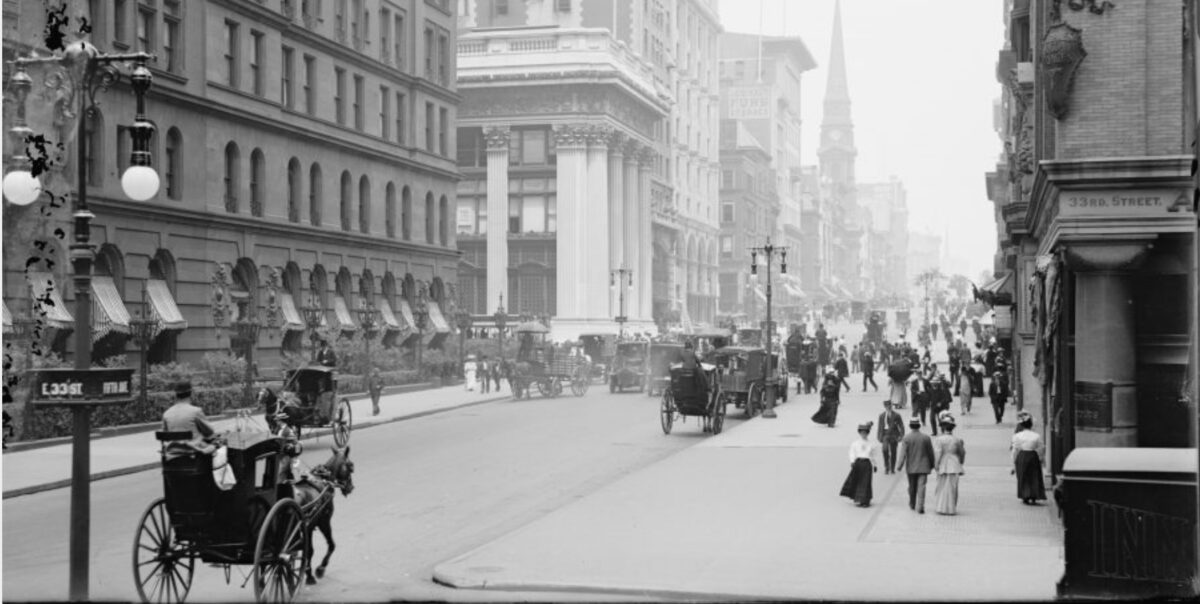
The Waldorf Astoria — once the Waldorf-Astoria and even the Waldorf=Astoria — has been a premier name in hotel accommodations since the opening of the very first edition on 34th Street and Fifth Avenue (the location of today’s Empire State Building).

But the history of the current incarnation on Park Avenue contains the twists and turns of world events, from World War II to recent diplomatic dramas. In essence, the Waldorf Astoria has become the world’s convention center.

Step past the extraordinary Art Deco trappings, and you’ll find rooms which have hosted a plethora of important gatherings, not to mention the frequent homes to Hollywood movie stars.

But its those very trappings — some of it well over a century old — that finds itself in danger today as recent changes threaten to wipe away its glamorous interiors entirely.

LISTEN NOW: THE RETURN OF THE WALDORF ASTORIA


The Bowery Boys: New York City History podcast is brought to you …. by you!

We are now producing a new Bowery Boys podcast every two weeks. We’re also looking to improve the show in other ways and expand in other ways as well — through publishing, social media, live events and other forms of media. But we can only do this with your help!

We are now a member of Patreon, a patronage platform where you can support your favorite content creators for as little as a $1 a month.

Please visit our page on Patreon and watch a short video of us recording the show and talking about our expansion plans. If you’d like to help out, there are five different pledge levels (and with clever names too — Mannahatta, New Amsterdam, Five Points, Gilded Age, Jazz Age and Empire State). Check them out and consider being a sponsor.

We greatly appreciate our listeners and readers and thank you for joining us on this journey so far. And the best is yet to come!


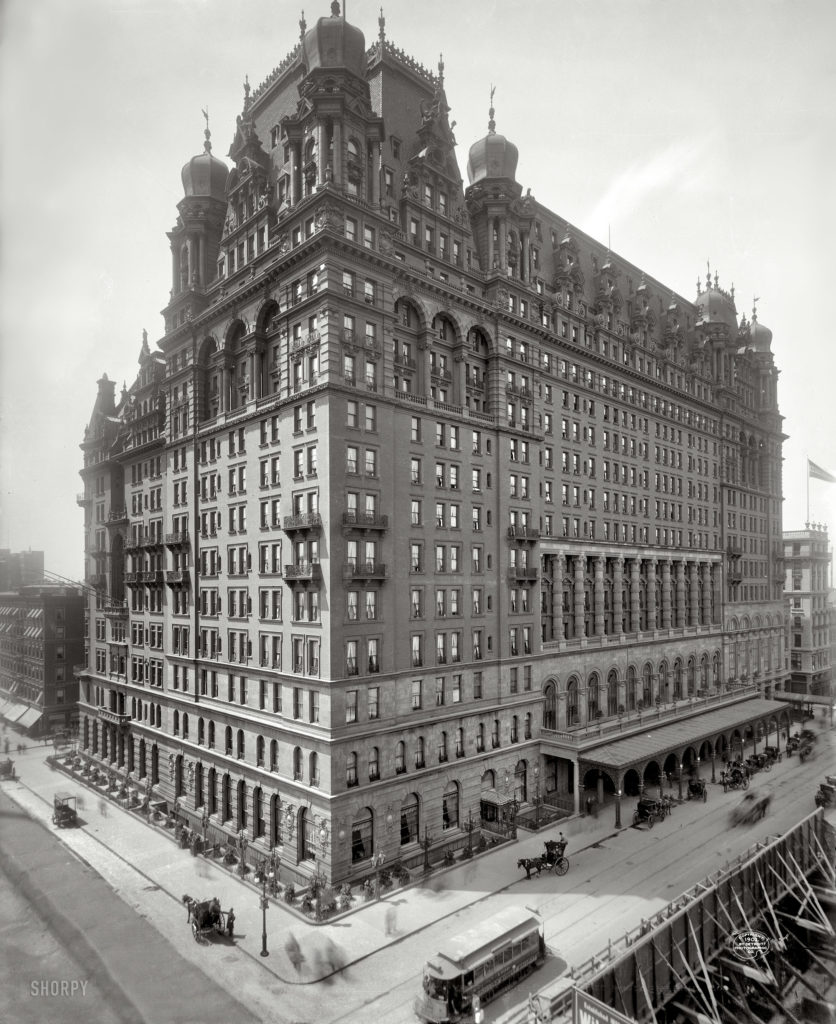
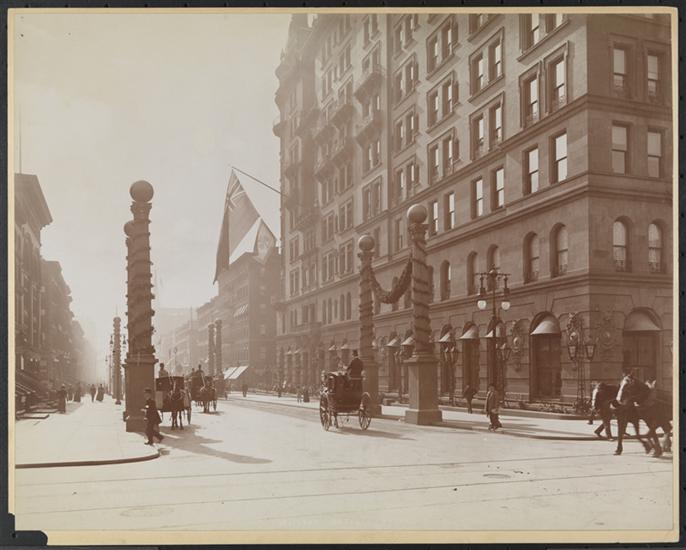
The original Waldorf-Astoria which once sat at 34th Street and Fifth Avenue. The first hotel, the Waldorf, is the shorter one facing 33rd Street.
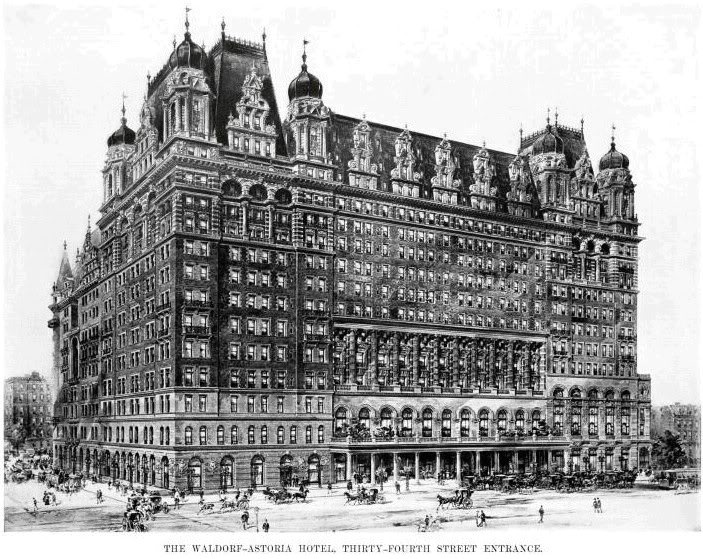
waldorfastoria34thstreetview
0f402138728b008d52c61efc055bd85d

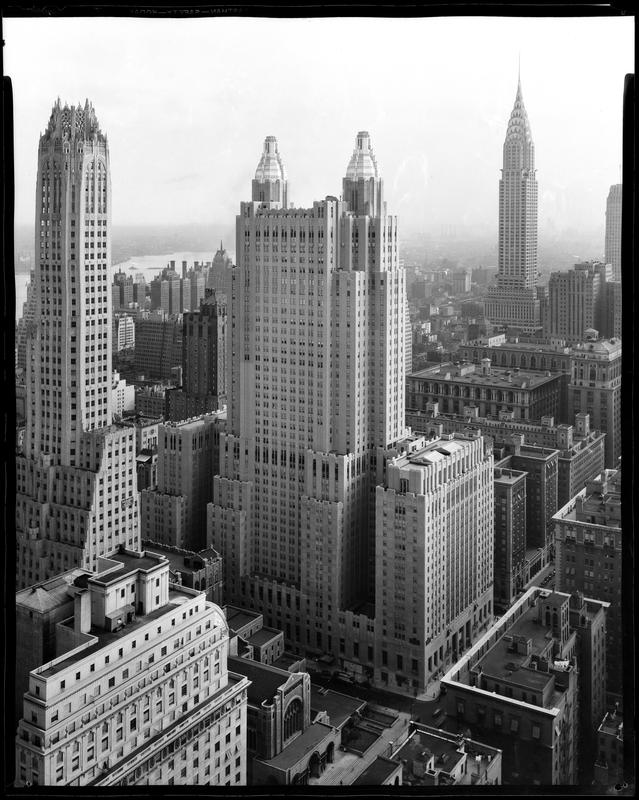
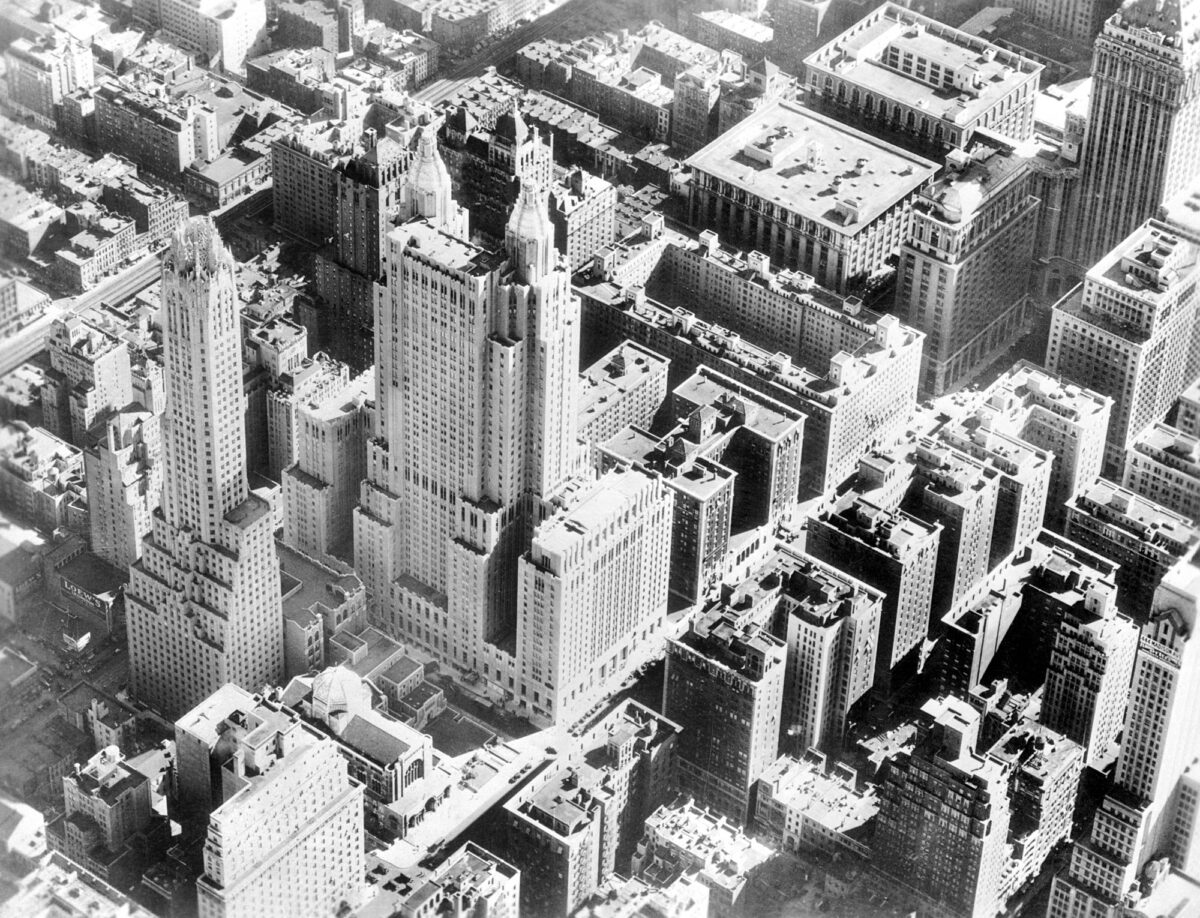
Park Avenue at nighttime, 1937. Seen here: 515 Mad. Ave, Gen. Electric, the Waldorf Astoria, the Chrysler Building, the Chanin Building, and the New York Central Building.
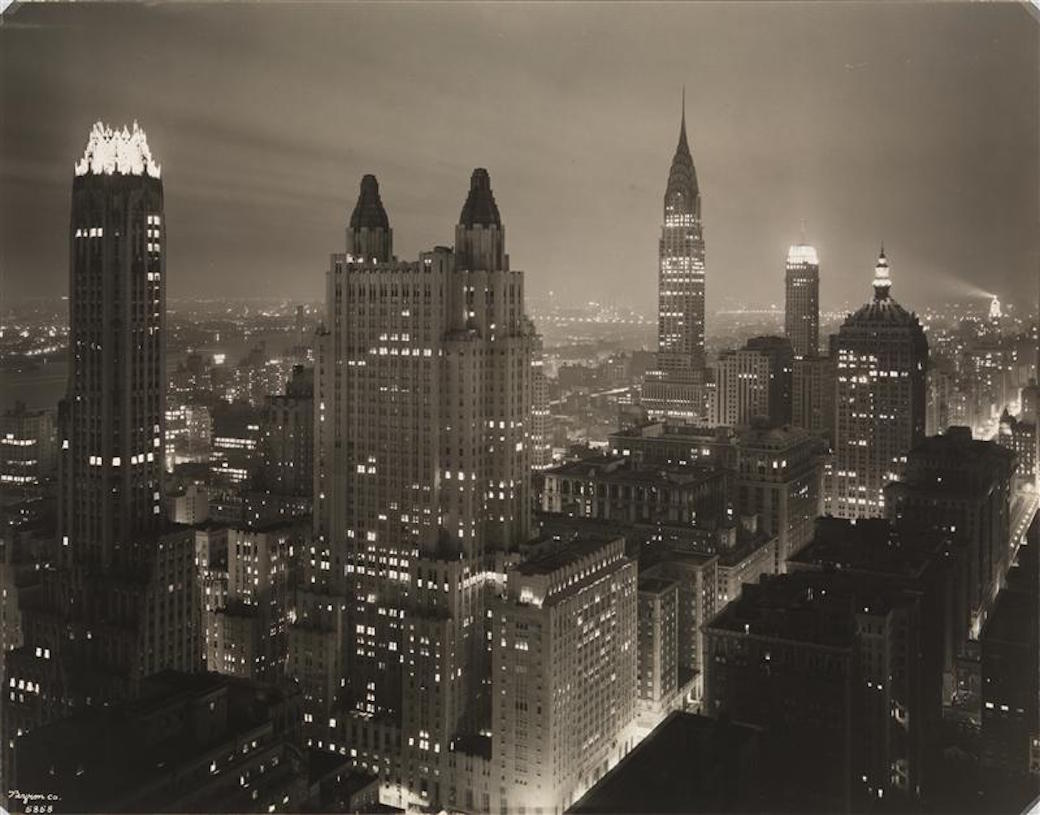
Museum of the City of New York

A 1931 postcard announcing the debut of the Waldorf Astoria with the Chrysler in the background.
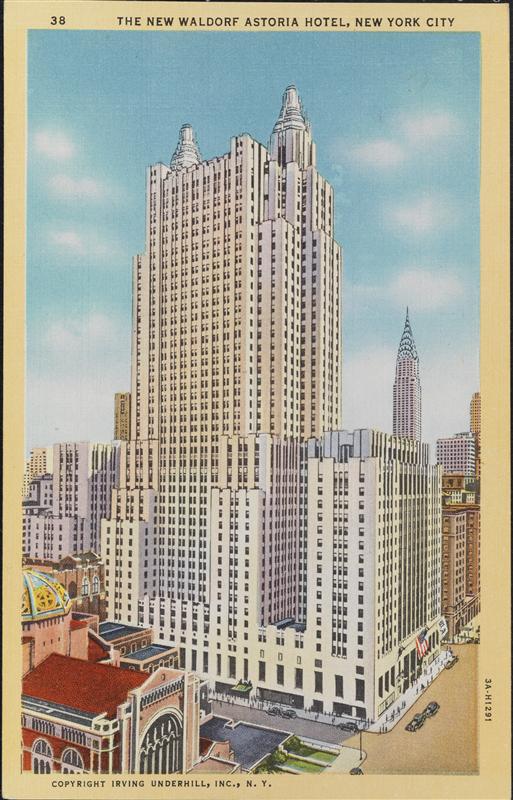
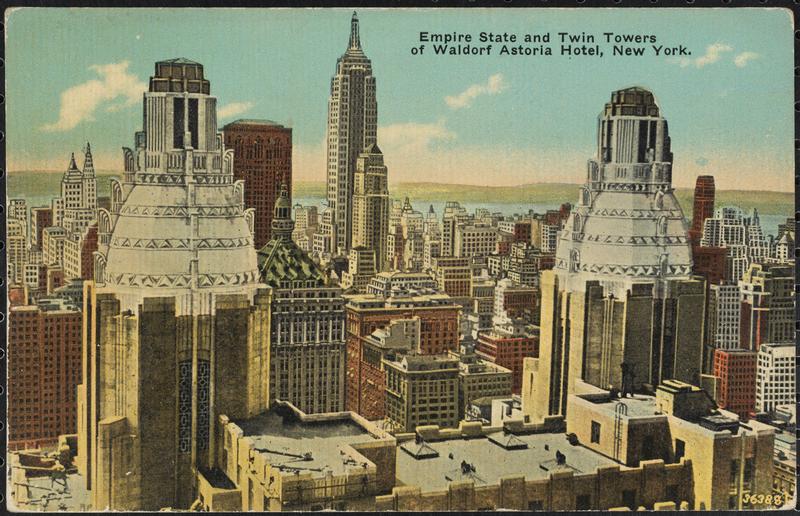
M3Y41755
Courtesy MCNY
Courtesy MCNY
MN116515
MCNY
MCNY

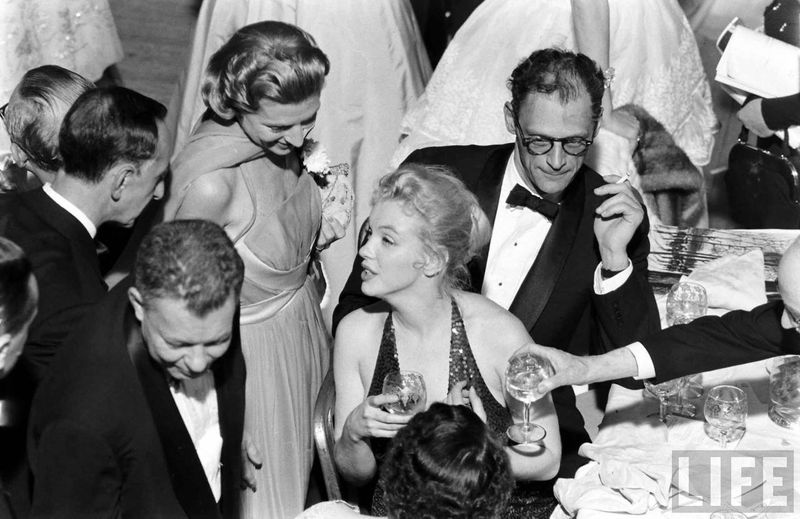
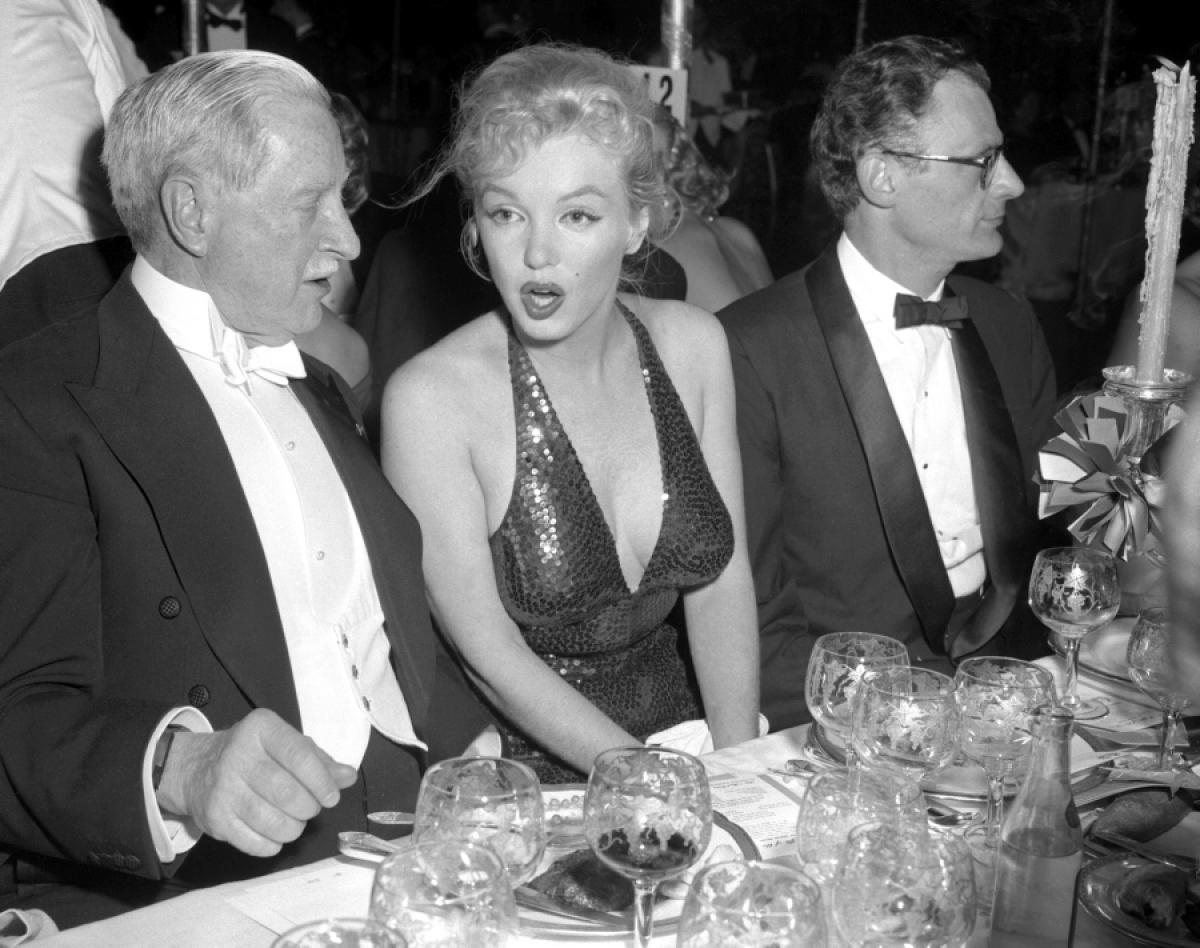
Marilyn Monroe at the Waldorf, her home in 1955. Here she is at the April In Paris ball with her then-husband Arthur Miller.
75515061
marilyn-monroe-1957
Courtesy New York Daily News

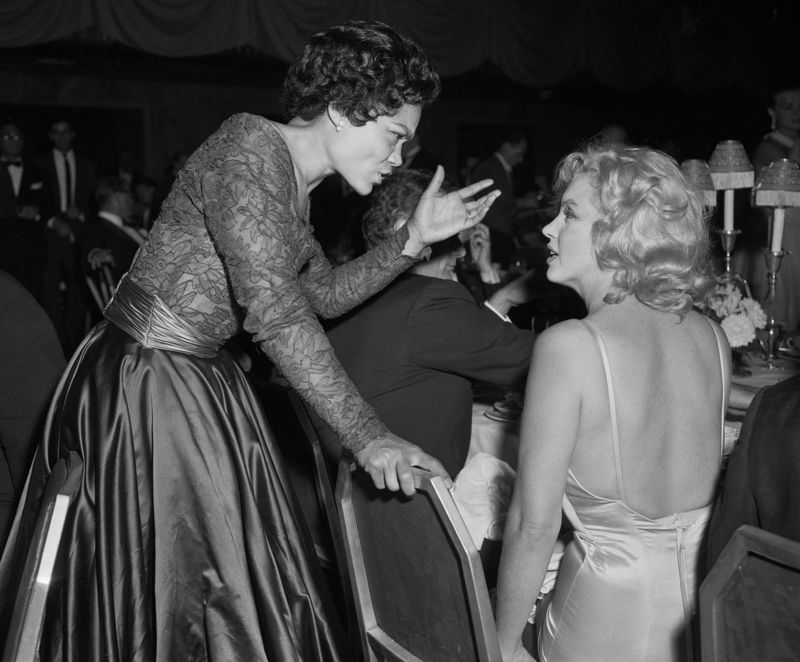
And at another function, this time chatting with Eartha Kitt.
tumblr_ma4a15Mk2e1qd92m4o1_1280

From our Instagram page:


An extraordinary relic — the Waldorf-Astoria clock from the 1893 Worlds Fair. #boweryboys

A photo posted by Gregory Young (@boweryboysnyc) on


Interior of the Waldorf-Astoria, still in Art Deco glamour. #boweryboys

A photo posted by Gregory Young (@boweryboysnyc) on


Tom at Cole Porter’s piano at the Waldorf-Astoria. #boweryboys

A photo posted by Gregory Young (@boweryboysnyc) on

More information here on the Historic District Council’s efforts to help save the interior decor of the Waldorf Astoria.

CORRECTION: There are a few classic photographs of Marilyn Monroe at the Waldorf-Astoria; however the one that Greg described on the show is actually taken at the Ambassador Hotel, a couple blocks north of the Waldorf. (It was torn down in the 1960s.)
Categories
Friday Night Fever Gilded Age New York

What’s behind the Bronze Door? Gambling in the Gilded Age

A tantalizing stretch of New York nightlife history lies in the shadows, illegally operated, often fueled by police bribes — the opium dens of Chinatown and the speakeasies of the Village and midtown.

There were also hundreds of illicit gambling rackets, called ‘poolrooms’, throughout the city in the late 19th century, usually alongside the seediest of taverns, brothels and poolrooms.

Naturally, the pastime was not looked upon lightly by proper society. “The poolroom keeper, like the proverbial worm,” remarked one New York Times article from 1900.

But New York’s wealthy elite liked to gamble as well, and there was no need for them to step into such filthy, disreputable places. The rich had their own houses of vice.

And one, the House with the Bronze Door, which opened in 1891, would have rivaled the great casinos of the day in terms of its lush presentation.

House of Cards

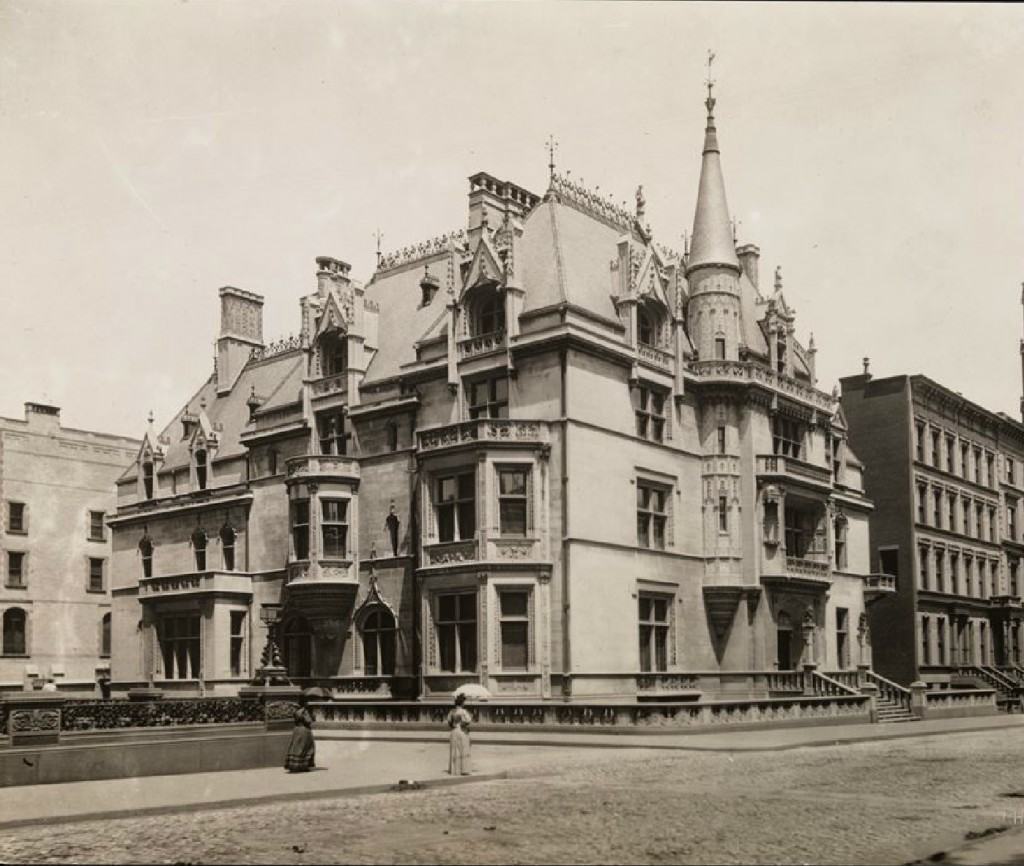
The fine townhouse at 33 West Thirty-third Street sat right around the corner from the Waldorf-Astoria, so close to respectable Fifth Avenue that people certainly strolled by it with no clue of the entertainments within.

Its glorious, defining feature — and where it gets its name — was a $20,000 Italianate Renaissance, 15th century bronze door which gave the building the feel of a classic structure, or perhaps a bank vault.

Luxury greeted those who were fortunate to peer behind that door, imported old school finery, from vases to oil paintings on rich wallpapered walls, along hallways in red velvet carpeting, leading to game rooms with European oak tables hosting games of roulette, poker and baccarat.

In a place where wealth exchanged hands nightly, it was reflected in the imported banisters and marble bathrooms.

High Stakes

And it wasn’t just how it looked, but who designed it to look that way — none other than Stanford White of the city’s most prestigious design firm McKim, Mead and White, a gambling man himself who hired a team of Venician craftsman to give the gambling house its distinctive glamour.

The building next door also belonged to the casino, but was less impressively designed; its sole purpose was as an exit in case of police raids.

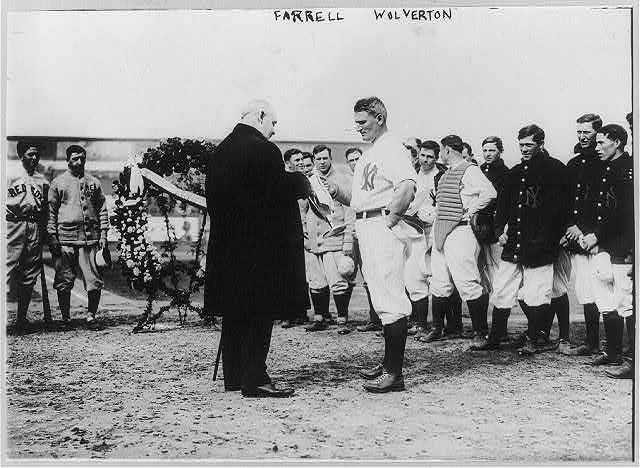
The owner Frank Farrell* was New York’s gambling kingpin, using profits from the Bronze Door to fund over 200 illegal gambling houses throughout the city and grease the palms of police officers to ensure they all stayed open.

If that name sounds familiar to sports fans, it’s because of a riskier gamble Farrell made in 1903 with his business partner William Stephen Devery. (Yes, the former police chief. See how it used to work back then?)

The two purchased the Baltimore Orioles, moved them to New York, lost a lot of money, renamed the team as the New York Yankees and promptly sold them to beer mogul Jacob Ruppert.

Below: Farrell with a Yankees team member in 1912. He would sell off the losing team a few years later. Courtesy Library of Congress

A Night at the Tables

The only people taking risks at the Bronze Door, however, were the rich and well connected clientele. On any given evening you could find the head honchos of Tammany Hall smoking cigars in the corner, or ‘Diamond’ Jim Brady and his entourage at the upstairs roulette wheel.

According to Lloyd Morris: “The casino was conducted with the quiet decorum of a gentleman’s club.” These men expected the royal treatment, and they got it. A midnight buffet of lobsters and steaks, open bar of the best liqueurs, fine cigars for a $1 apiece. More importantly, Farrell strictly applied a philosophy of ‘the customer is always right’. Unlike many of Farrell’s downtown dive, where the house often rigged games and marked cards, the gambling den behind the Bronze Door was straight.

There was little nickel and diming here. It’s purported that fifty thousand dollars would hit the tables each night.

Gamblers would win, and then lose, vast fortunes each night. As Luc Sante so elegantly states: “… the stories of rich men dropping enormous sums in a single evening kept topping each other, so that the phenomenon almost comes to seem like a version of potlatch, in which wealth is proven by the ability to shed it.”

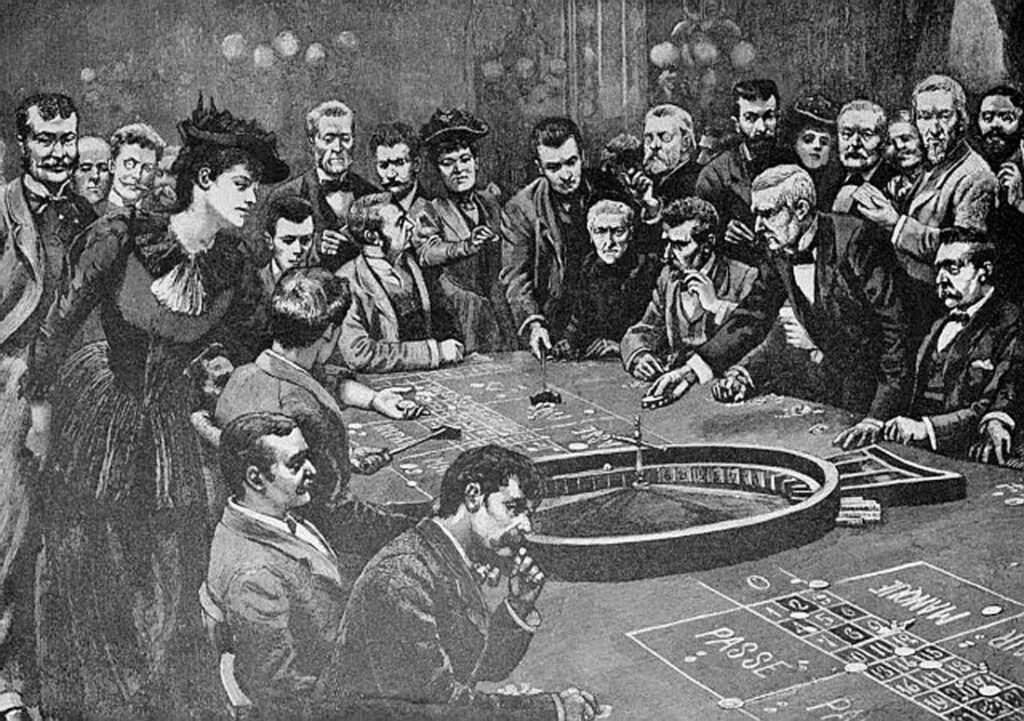
Depiction of a 19th century casino. At the House of the Bronze Door, it was unlikely that women were allowed however.

Luck Runs Out

The casino stood in defiance of the law for almost a dozen years thanks to Farrell’s connections and the reputation of its clientele. However, given the New York’s waxing and waning reform movements, its time would eventually come, and it did so at the hands of one William Travers Jerome, New York’s district attorney with a particular bent for reform.

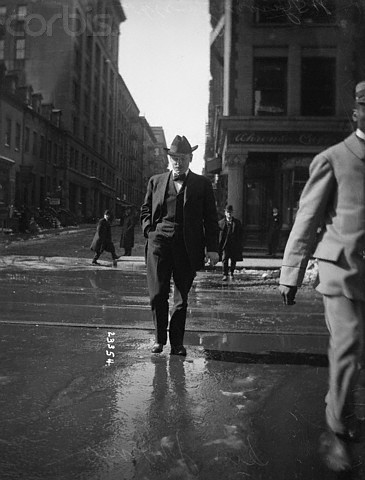
Jerome shut down casinos and poolrooms throughout the city and didn’t discriminate, successfully breaching that imposing door and raiding the club in 1908.

Although the games were gone, the place remained open for many years afterwards, as a restaurant owned by the Waldorfs according to official sources. What its true nature was in these later years is unknown.

The building is completely gone today, replaced with a condo and the shadow of the Empire State Building.

Below: District Attorney Jerome, 1915

*Farrell had other partners in the casino, including racetrack owner Gottfried Walbaum and Billy Burbridge, who later became a hotelier in Havana, Cuba.

Categories
Health and Living

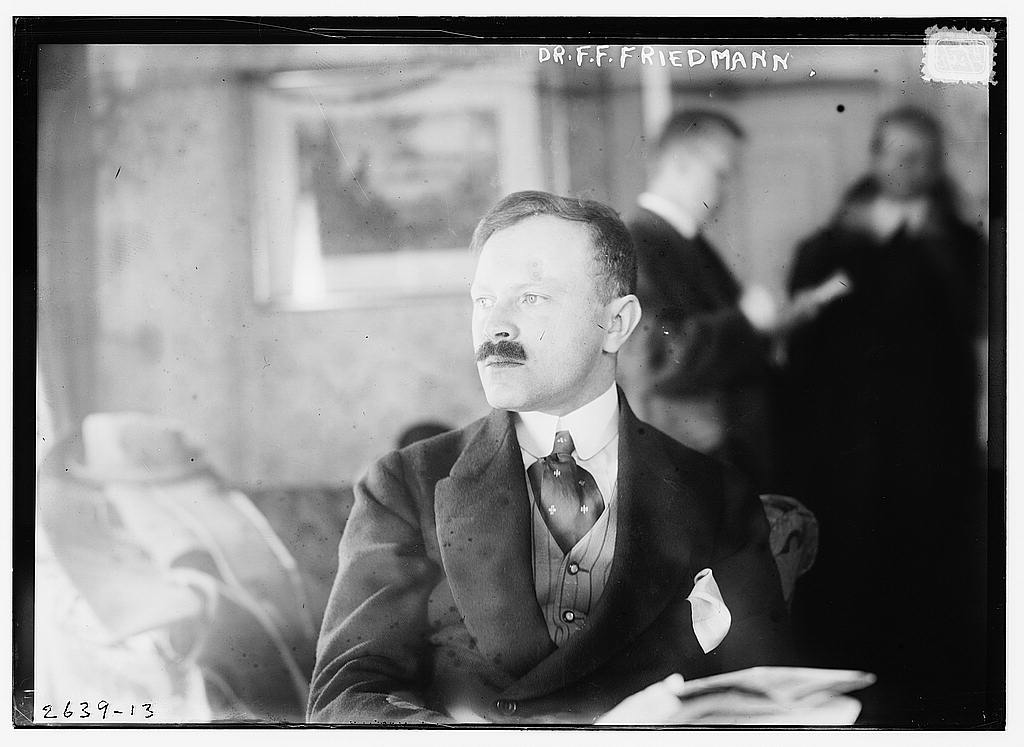
The Turtle Cure: In New York, a German doctor offers an unusual remedy for tuberculosis

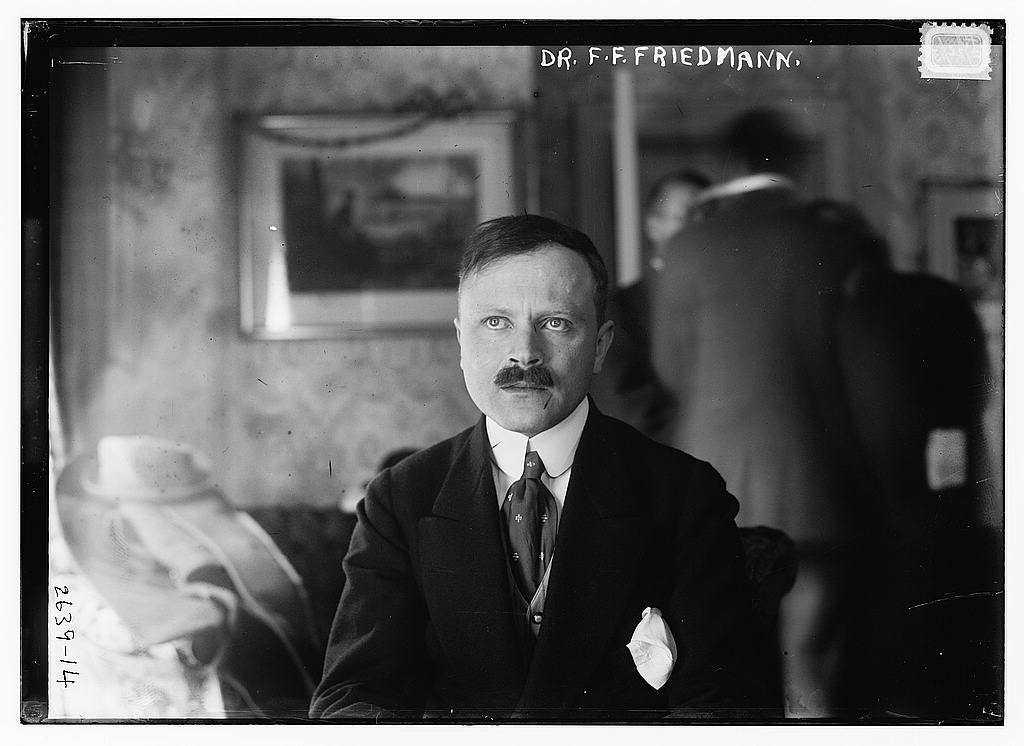
I am here to show what the serum will do,” said the visiting doctor from Berlin. “That is my only answer to those who have natural doubts before they have made observations.”

Library of Congress

Dr. Friedrich Franz Friedmann had come to New York in February 1913 to tackle one of the city’s most persistent scourges upon its population.  

Tuberculosis (or “consumption”) had killed thousands during the 19th century and showed few signs of abating in the new century.

It was considered a “disease of the working class,” ransacking neighborhoods of crowded tenements.  Hospitals on Blackwell’s Island and others around the city were devoted solely to those afflicted by it.  Parents sent their children to open-air schools, inspiring all sorts of strange costume, anything to avoid the dread disease.

So one could imagine the excitement which greeted the visiting doctor, invited here from Berlin where he had announced his marvelous and unusual cure.  

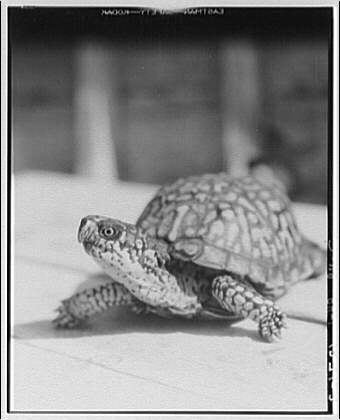
According to Friedman, a serum had been created taking a sample of tubercule bacilli and “passing it through a turtle” in a laboratory, creating a non-virulent strain that could function as a vaccine.  Dr. Friedmann had come upon this discovery in 1902 while experimenting with turtles at the Berlin Zoo.

New Yorkers affected by the disease were anxious to see Dr. Friedmann’s miracle serum. Wealthy banker Charles Finlay, president of Aetna National Bank, immediately sent for the doctor and conspicuously put him up at the Waldorf-Astoria at 34th Street and Fifth Avenue, the finest hotel in New York.  

The invitation also had a challenge attached — if Dr. Friedmann could cure 95 out of a 100 patients (including Finlay’s own son) using the turtle cure, he would be awarded one million dollars. (About $26 million in today’s currency.)
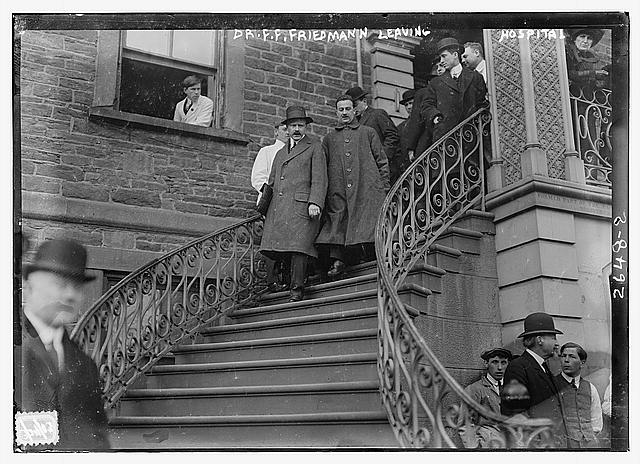
Dr. Friedmann leaving a New York hospital. Library of Congres

Friedrich arrived on February 25 and readied his remedy from his room at the Waldorf. Meanwhile, hundreds of interested parties gathered in the lobby, including members of the press and desperate family members whose loved ones sat in tuberculosis hospitals.

Friedrich eventually rejected the million-dollar challenge — 95 out of 100 is probably ambitious, even for an early vaccine people were confident with — but came armed to the Waldorf with his little red box containing the vaccine and apparently a host of future plans, including the opening of a dispensary somewhere in the city.  

As soon as the vaccine was thoroughly tested and approved, that is.

The doctor stayed in New York for several weeks but he was eventually ejected from the Waldorf.  Manager Oscar Tschirsky rightly feared the hotel would soon be filled with tuberculosis patients begging to be test subjects for the vaccine.  

Soon after a near-riot erupted in the lobby, a sick man collapsed and was taken away in an ambulance.  The Waldorf evicted Dr. Friedmann on March 5th.  He then escaped to the equally tony Ansonia Hotel in the Upper West Side.

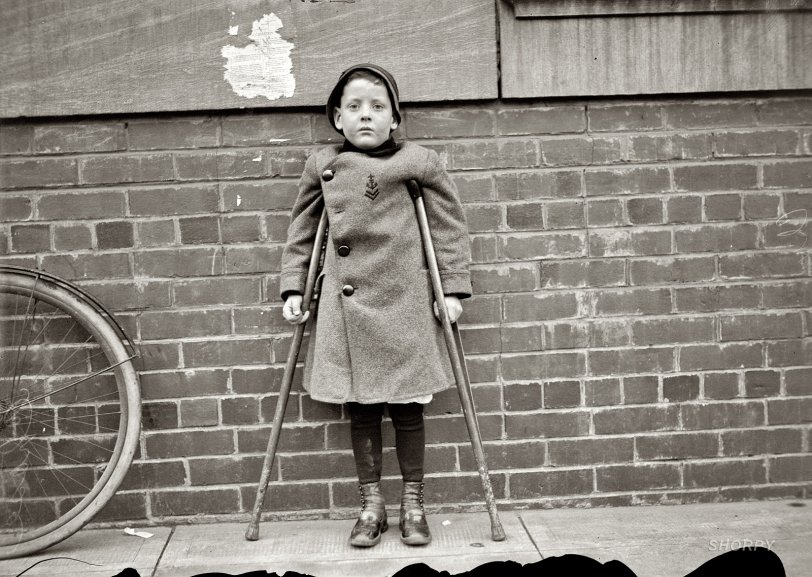
Philip Chase, a young Washington DC resident cured of tuberculosis by the ‘turtle cure’. This cleaned image courtesy Shorpy. See a full-sized version here.

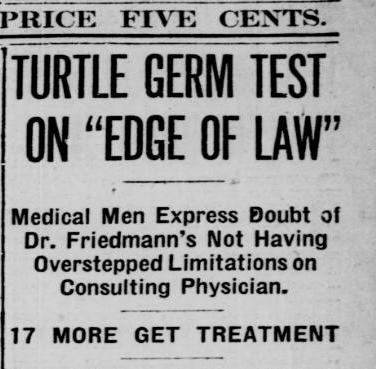
Friedmann’s secretive activities soon caused great doubt in the city. He administered the vaccine to a few patients from an office at W. 51st Street but no results were reported.  People quickly grew skeptical of this miracle cure.

The ‘turtle man’, as Friedmann was soon called in the press, soon became distracted by a  potential thief in his midst —  Dr. Maurice Sturm, the house physician at the Ansonia.  In May, Sterm claimed an improved version of the turtle vaccine, one he was eager to share with reporters (if not actually with patients).

Accused of outright stealing the vaccine, Dr. Sturm declared, “I do not care whether my name is smudged, if I can give the public the benefit of this discovery….I want the cure in proper hands.”

Sturm then produced three turtles in a pail, one of which was named Friedrich Franz.

At hearing of Sturm’s announcement, Dr. Friedmann reportedly replied, “Ach, Gott!” and threatened to sue the former Ansonia confidante.  Amazingly, Sturm eventually counter-sued, citing a lack of payment for services rendered to Dr. Friedmann.

Further pandemonium arrived on the RMS Mauretania on May 17th with another doctor who claimed an even more improved “turtle germ,” using vastly superior turtles from South India.

Hyteria over all these turtle cures died down when it was quickly revealed that they didn’t actually work. “POOR RESULTS FROM THE TURTLE GERMdeclared the New York Tribune in late May.

Even still, Friedmann eventually cashed in, selling the American rights to the turtle vaccine for $125,000 and almost $1.8 million in stocks for a planned series of dispensaries in his name (which never materialized).  

Friedmann died in Monte Carlo in 1953.  The most successful tuberculosis vaccine — the BCG vaccine — would not be tested on humans until after World War I.

Categories
Landmarks

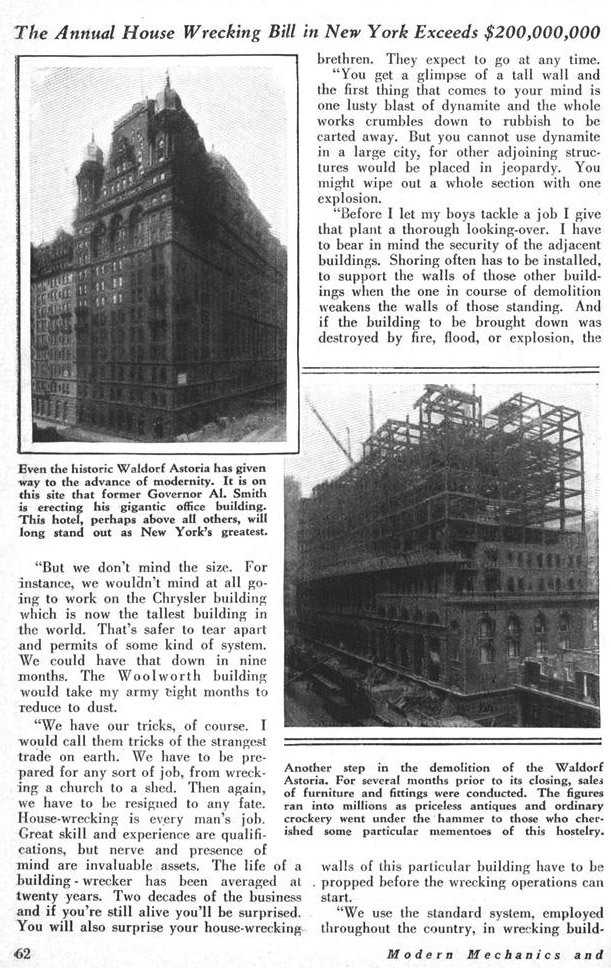
The destruction of the Waldorf-Astoria in 1929 gave rise to an even grander New York icon

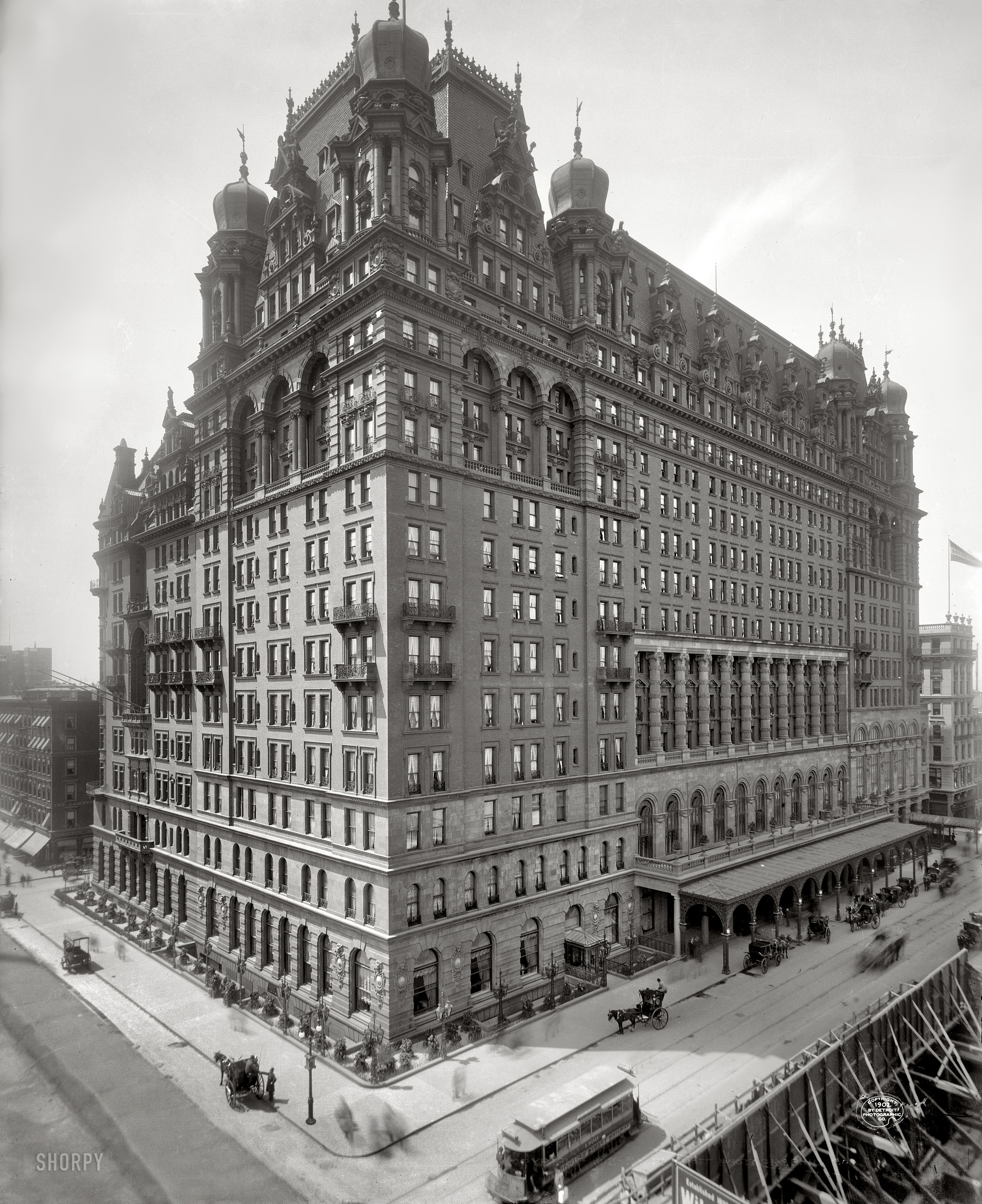
The original Waldorf-Astoria Hotel, the ultimate symbol of the Gilded Age, was demolished in the fall and early winter of 1929 to make way for a new building project.

That the building project in question happened to be the Empire State Building does not make the loss of the Waldorf-Astoria any less regretful. The storied hotel, borne from the rivalry of two factions of the Astor family, was the delight of New York’s upper crust from the moment the Waldorf Hotel opened in 1893. (The Astoria side opened four years later.)
The hotel was an extraordinary piece of architecture, a gracious (if elitist) piece of New York history. Scientific breakthroughs were announced here, Nikola Tesla lived here, and even its telegraph offices were revolutionary.

Cleaned-up version of public domain photo courtesy Shorpy

But the fashions of New York had passed the Waldorf-Astoria by in the 1920s, and the land was sold to a collective of businessmen — led by former New York governor Al Smith — who wished to build the world’s tallest office building on the spot.

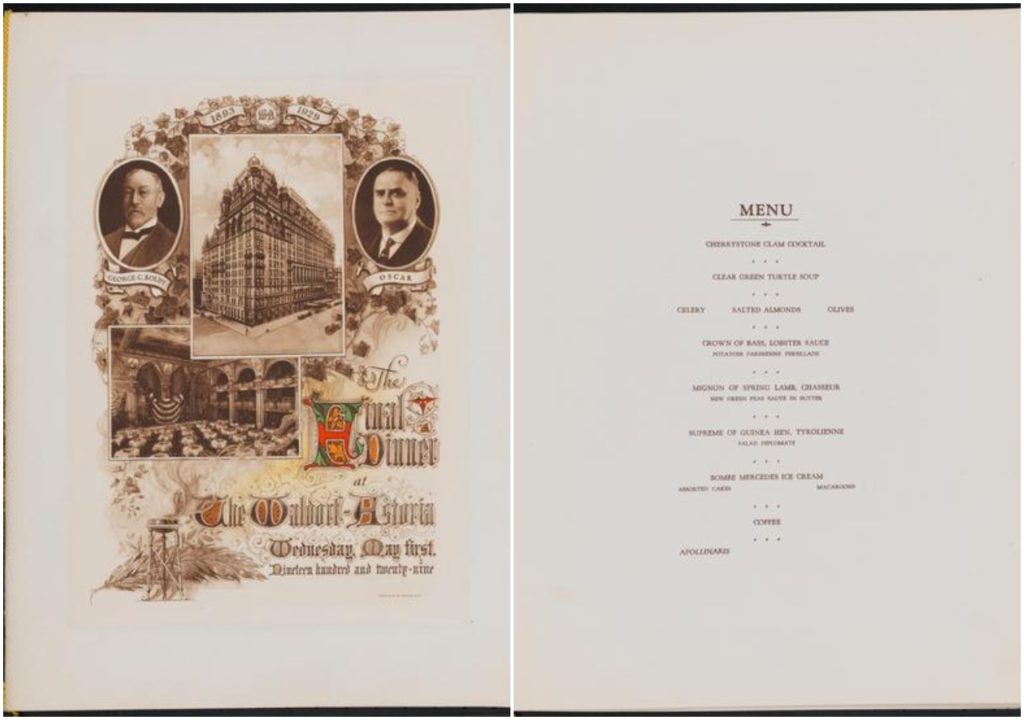
Below: The final menu served at the Waldorf-Astoria — May 1, 1929

Museum of the City of New York

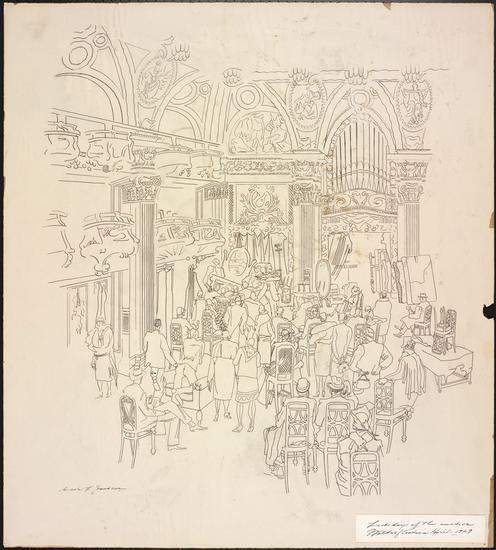
Following a final dinner party on May 1, objects from the hotel were sold at auction. The relinquishing of the hotel’s possession was so captivating that the auction was even broadcast on the radio, a fairly revolutionary idea for its day. “The famed bronze pair [of statues], a large bull and a big bear, which stood on the bar in the hotel for so many years, went to Charles Gutradt & Son, art dealers, for $225 each.” [source]

This was not a building that was dispensed with lightly. The year 1929 was crammed with newspaper and magazine reminders of the hotel’s greatness. “Histories will keep its fame and name alive, for it marked an epoch in the development of an empire city. In its day it gathered together a remarkable clientele; at its banquets the wit and wisdom of the New World and the Old intermingled, stimulated by savory viands and sparkling winds (in pre-prohibition days) from a well-stocked cellar.” [source]

An illustration of one auction of Waldorf-Astoria objects from 1929:

Museum of the City of New York

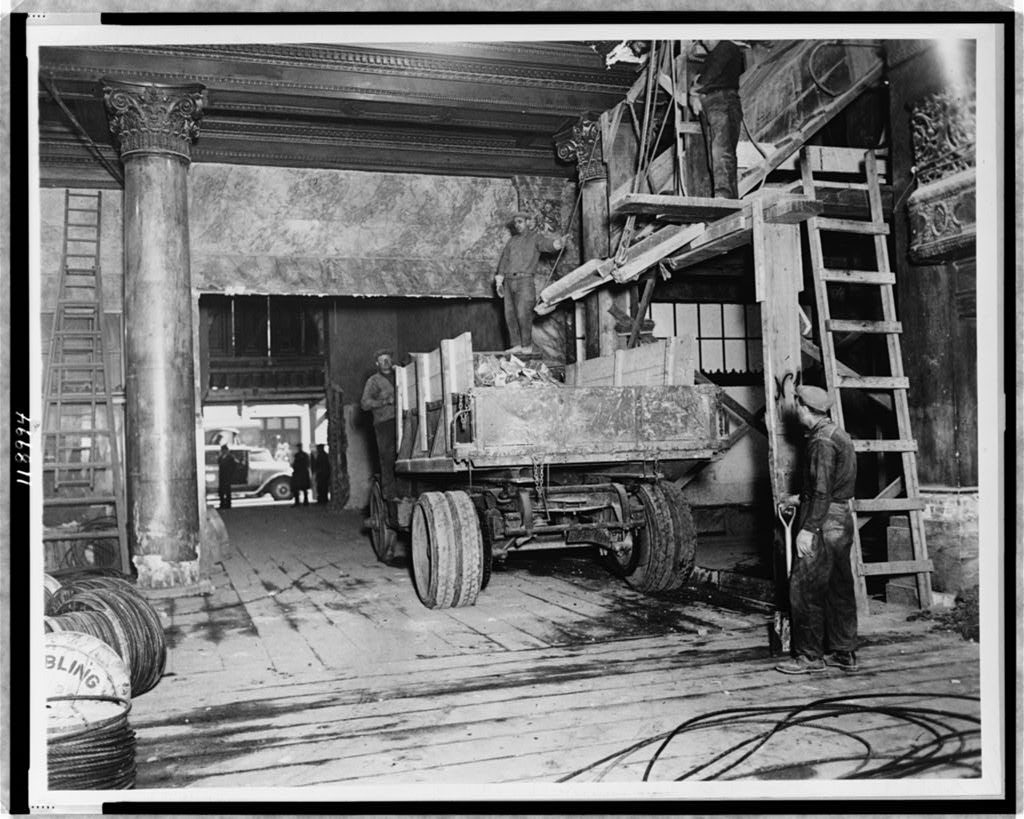
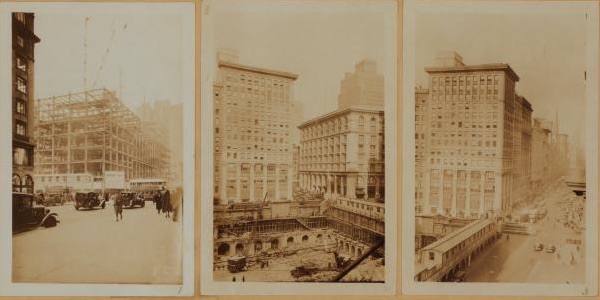
Demolition of the Waldorf-Astoria would take a couple months, owing to difficulties of dismantling the especially sturdy materials holding up the hotel. The process began on October 1st with a somber ceremony on the rooftop, officiated by Smith and his business partners.

He was quoted as saying. “This historic building, known all over the world, must come down in the northward march of progress.”

From the New York Times: “Yawning holes mark the doorways where livered attendants greeted distinguished guests. Men in overall bustle about amid dust and debris in Peacock Alley. The men’s cafe, once a favorite haunt of millionaires, and the giant ballrooms are bare.”

Work began on the Empire State Building on March 17, 1930, despite the fact that America (following the stock market crash of 1929) was on the precipice of the Great Depression. Meanwhile a new Waldorf-Astoria would open uptown, on Park Avenue, on October 1, 1931. The Empire State Building had opened (in record time, it must be said) exactly five months before, on May 1, 1931. New York City had itself two new impressive landmarks.

Trucks emptying the Waldorf-Astoria ballroom:

Library of Congress
NYPL

From Modern Mechanics magazine:

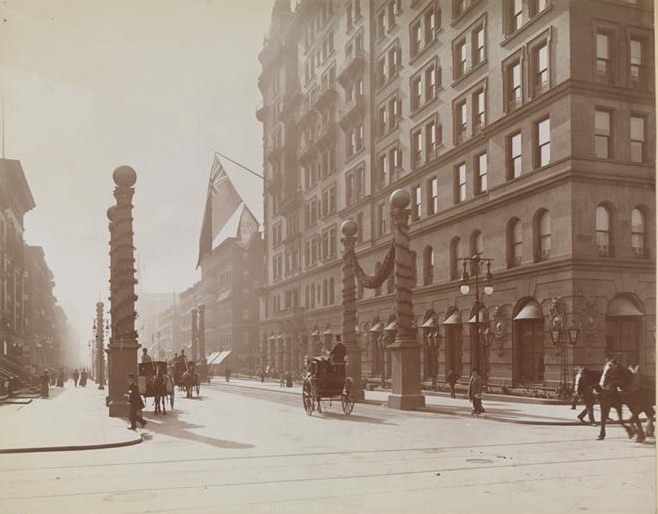
At top: The decorations for the Dewey Parade in front of the Waldorf-Astoria Hotel at 33rd Street and 5th Avenue, 1899.

MCNY

For more information on the new Waldorf-Astoria hotel, listen to our 2016 show:

Categories
Gilded Age New York Podcasts

The Rise of the Fifth Avenue Mansions: Revisiting Forgotten Architecture of New York’s Gilded Age

PODCAST At the heart of New York’s Gilded Age — the late 19th century era of unprecedented American wealth and excess — were families with the names Astor, Waldorf, Schermerhorn and Vanderbilt, alongside power players like A.T. Stewart, Jay Gould and William “Boss” Tweed.

They would all make their homes — and in the case of the Vanderbilts, their great many homes — on Manhattan’s Fifth Avenue.

The image of Fifth Avenue as a luxury retail destination today grew from the street’s aristocratic reputation in the 1800s. The rich were inextricably drawn to the avenue as early as the 1830s when rich merchants, anxious to be near the exquisite row houses of Washington Square Park, began turning it into an artery of expensive abodes.

In this podcast — the first of two parts — Tom and Greg present a world that’s somewhat hard to imagine — free-standing mansions in an exclusive corridor running right through the center of Manhattan. Why was Fifth Avenue fated to become the domain of the so-called “Upper Ten”? What were the rituals of daily life along such an unusual avenue? And what did these Beaux Arts palaces say about their ritzy occupants?

CO-STARRING: Mark Twain, Madame Restell, George Opdyke and “the Marrying Wilsons”.


The Bowery Boys: New York City History podcast is brought to you …. by you!

We are now producing a new Bowery Boys podcast every week. We’re also looking to improve the show in other ways and expand in other ways as well — through publishing, social media, live events and other forms of media. But we can only do this with your help!

We are now a member of Patreon, a patronage platform where you can support your favorite content creators — for as little as a $1 a month.

Please visit our page on Patreon and watch a short video of us recording the show and talking about our expansion plans. If you’d like to help out, there are five different pledge levels (and with clever names too — Mannahatta, New Amsterdam, Five Points, Gilded Age, Jazz Age and Empire State). Check them out and consider being a sponsor.

We greatly appreciate our listeners and readers and thank you for joining us on this journey so far.


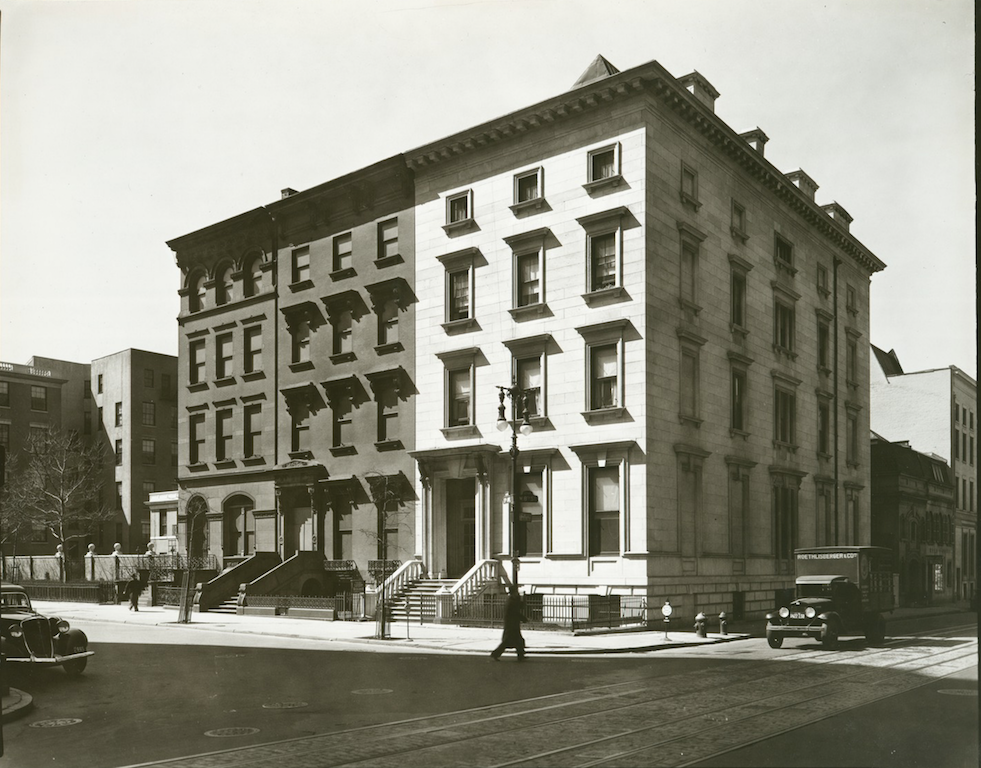
4-8 Fifth Avenue, buildings which were still standing in 1936 for photographer Berenice Abbott.

NYPL

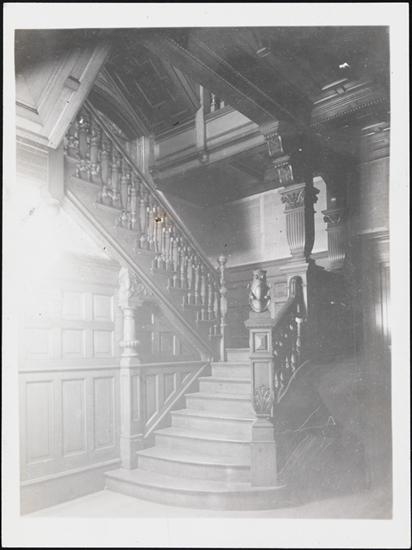
The stairway inside 4 Fifth Avenue, a beautiful relic of old living.

MCNY

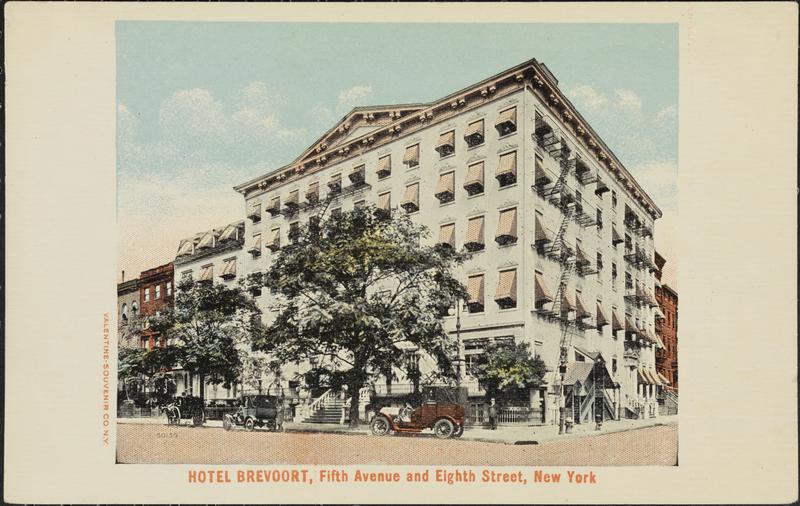
The Brevoort Hotel at Fifth Avenue and 8th Street and the Brevoort Mansion on 9th Street, circa 1925 (the year it was demolished)

NYPL

Delmonico’s Restaurant, pictured here in 1865, moved into an old mansion to serve its wealthy clients.

MCNY

A mansion at the southeast corner of Fifth Avenue and 15th Street. Note that by the date of this photograph (1898), the house has been abandoned and the upper floors are falling in.

MCNY

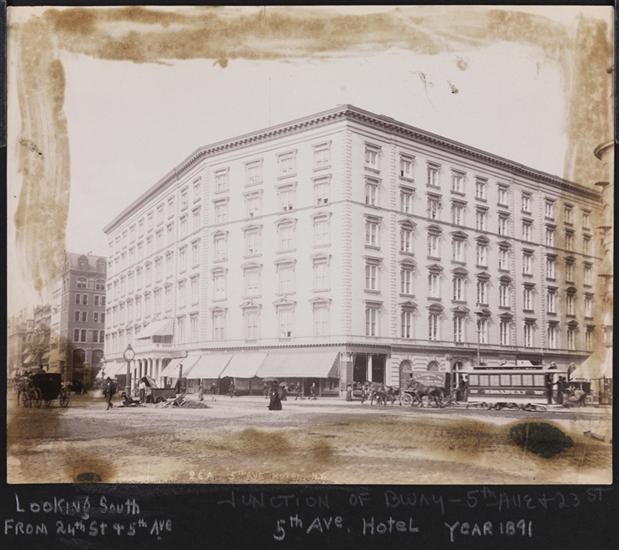
The Fifth Avenue Hotel at 23rd Street and Fifth Avenue, the anchor of the Madison Square area and the spot of great political machinations, especially in the 1870s and 80s.

MCNY

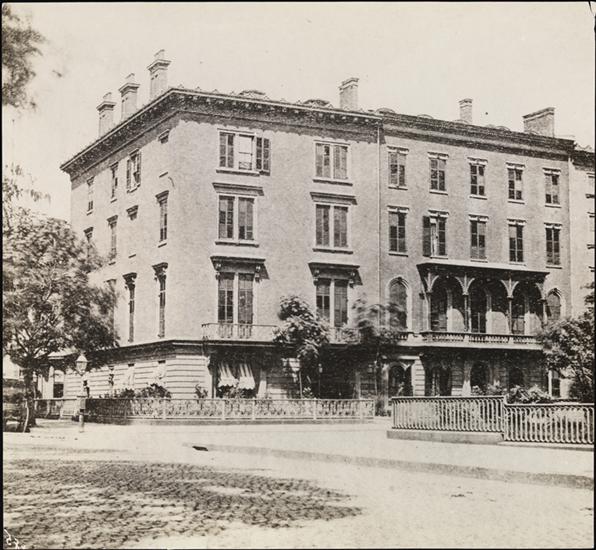
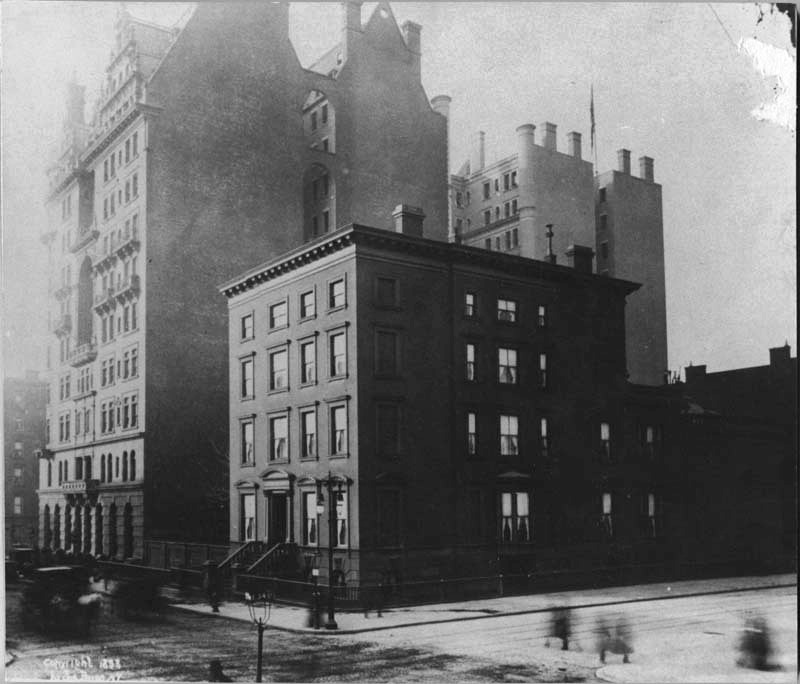
The Waldorf Hotel, rising next to the Astor mansion. Mrs. Astor eventually relented, moving from the house so that it could be demolished and replaced with a companion hotel.

Mina Rees Library, The Graduate Center, CUNY

The combined Waldorf-Astoria Hotel would become the center of high-society entertainment in the Gilded Age.

Library of Congress

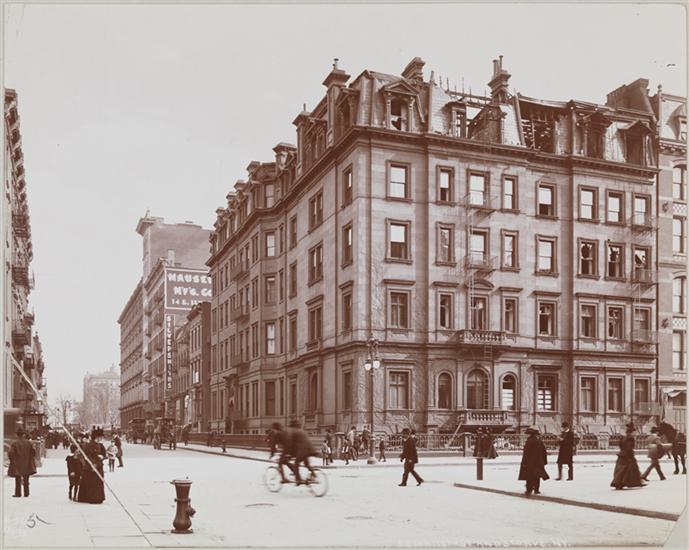
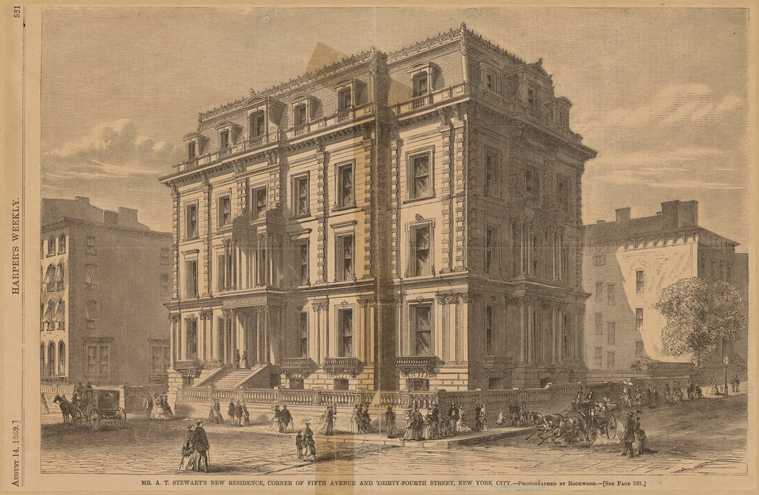
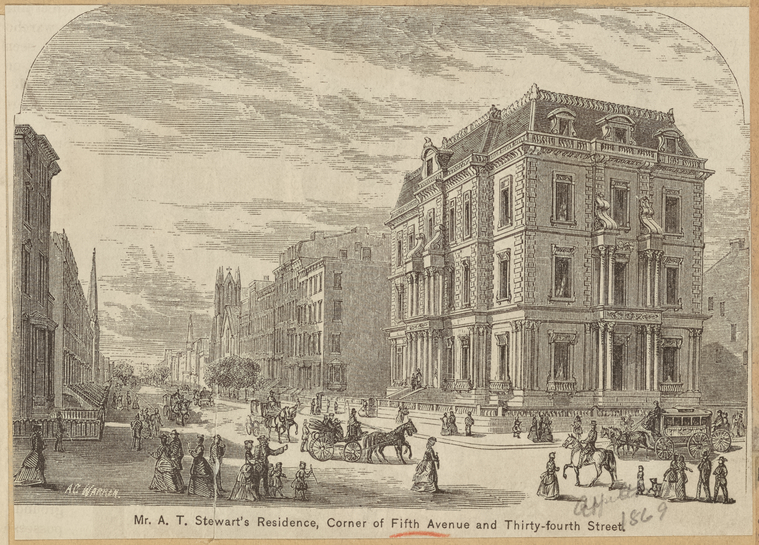
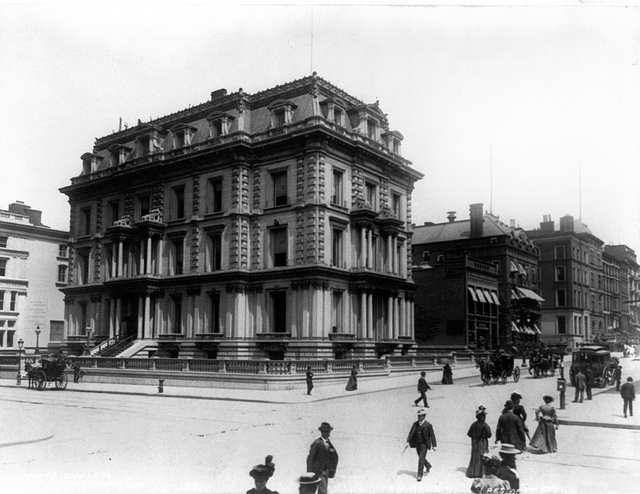
The home of A.T. Stewart — “the glorified shop clerk” — at the corner of Fifth Avenue and 34th Street, across the street from the Astors.

NYPL

The home of Jay Gould in later years.

Library of Congress

The home of the notorious Madame Restell.

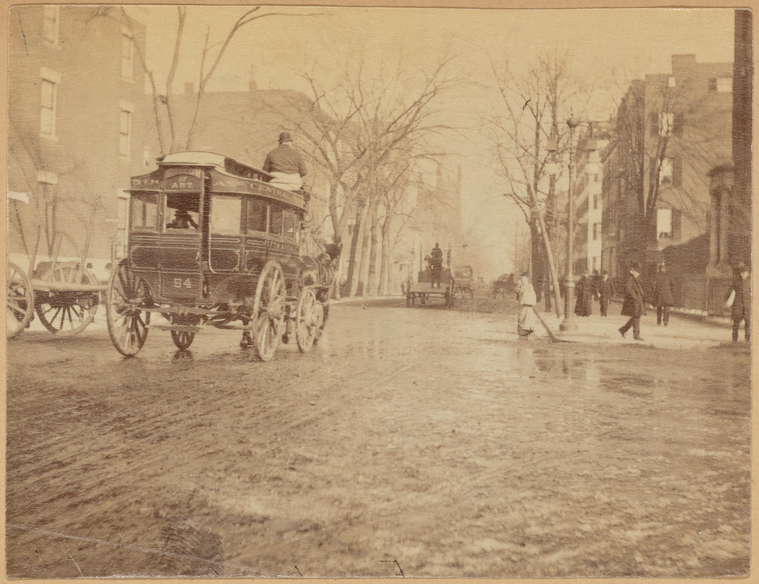
The Fifth Avenue Omnibus, circa 1890, a more elegant alternative to the dirty elevated train which ran just one avenue to the west.

NYPL

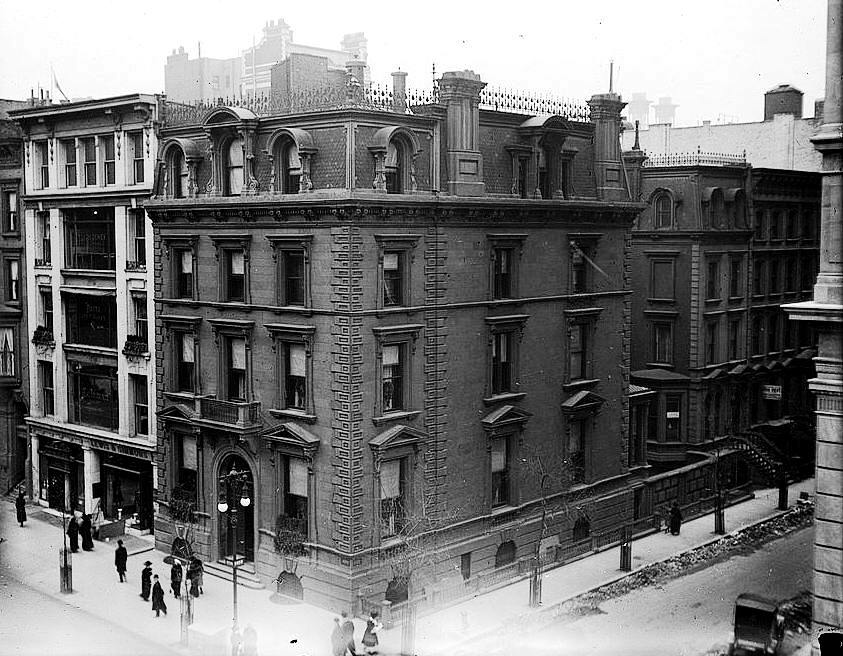
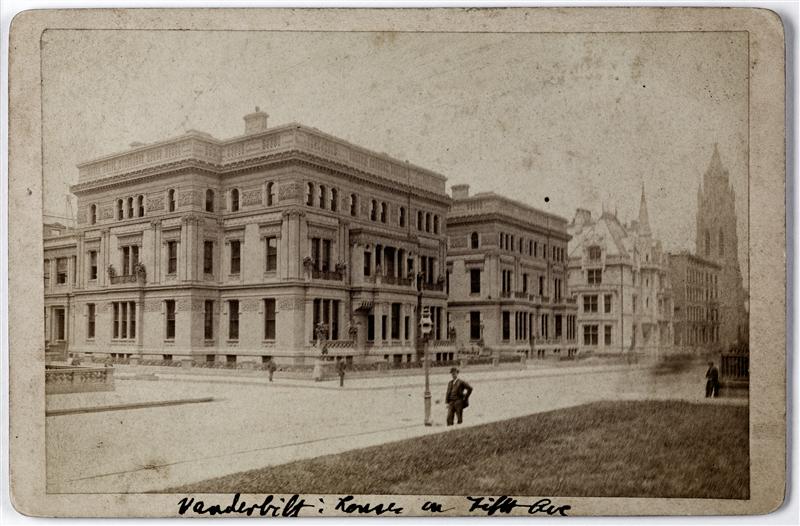
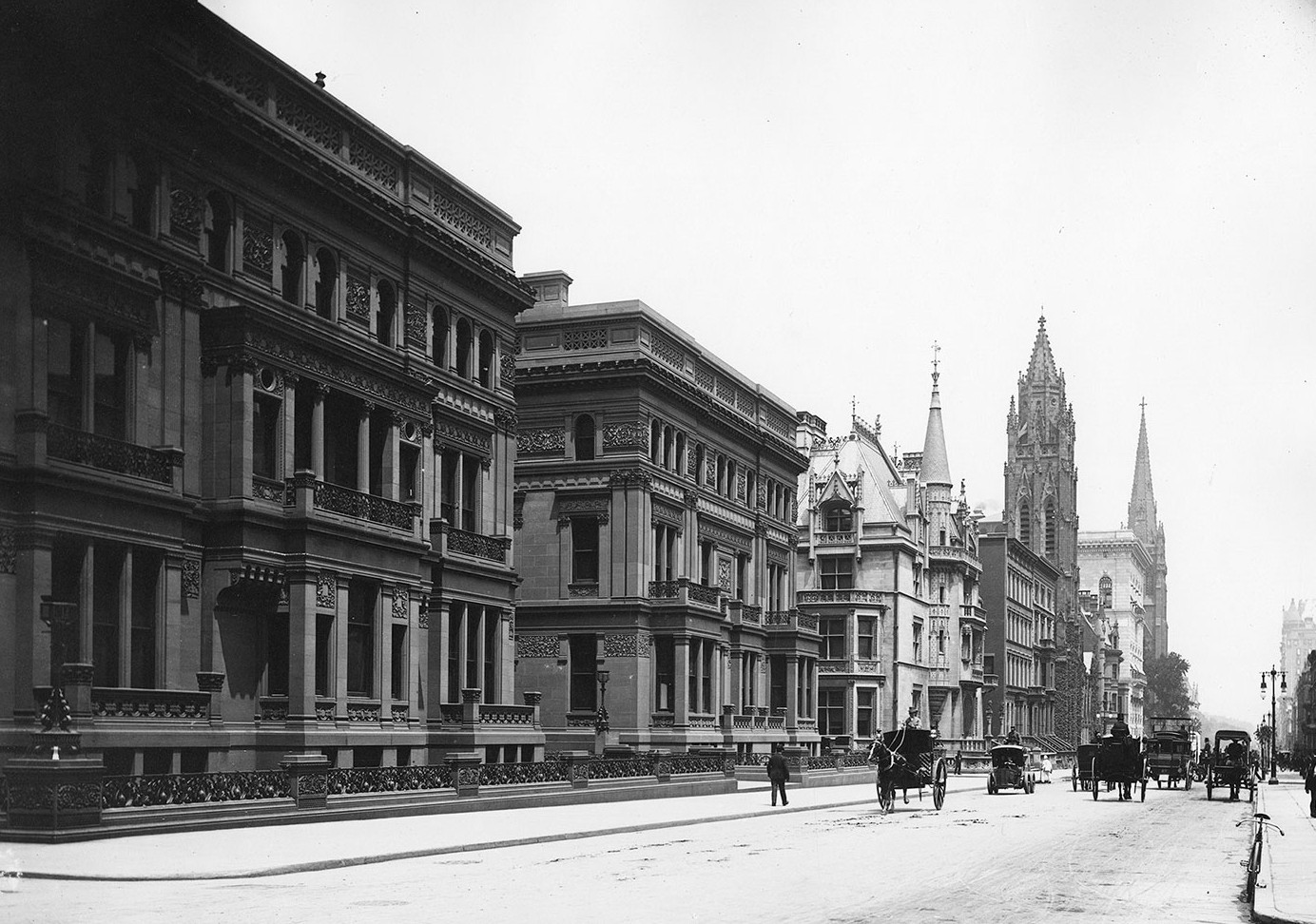
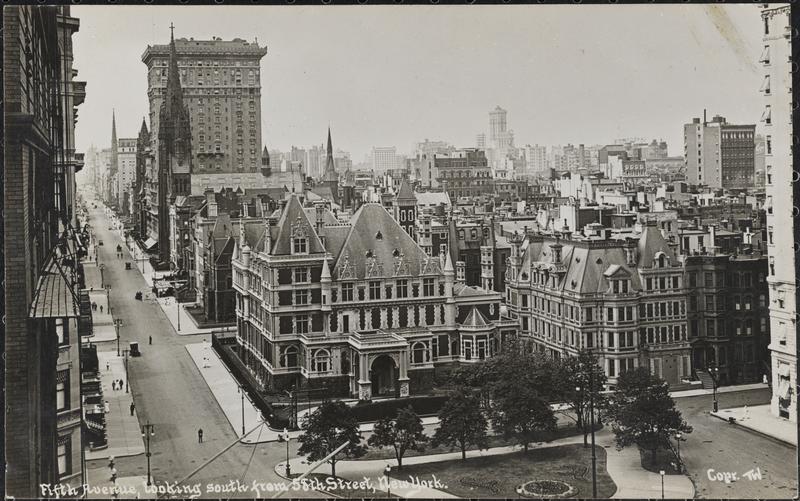
Vanderbilt Row in the 1890s. The family possessed the grandest homes on this stretch of Fifth Avenue from 51st Street to 58th.

NYPL
Vanderbilt University

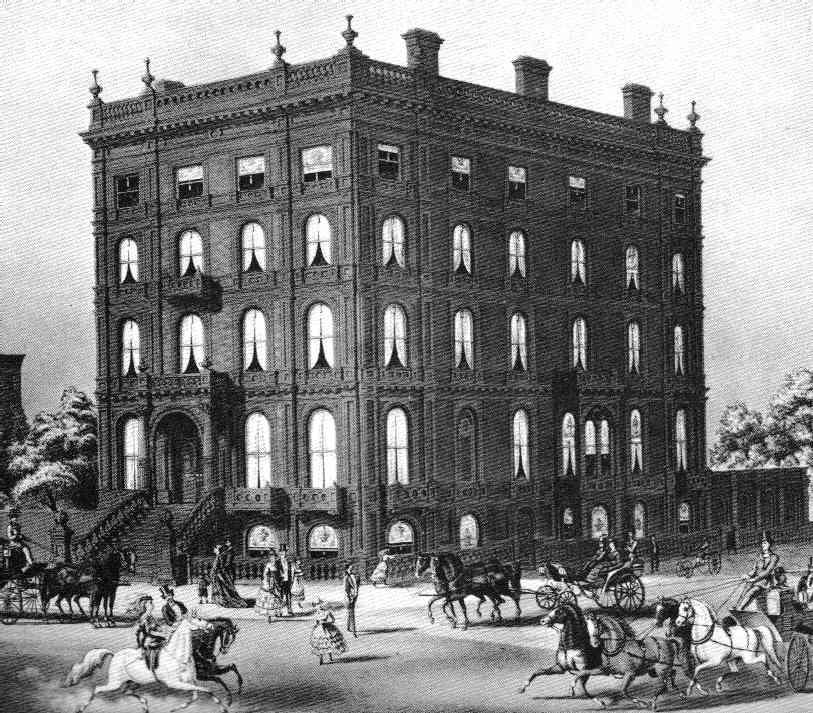
The mansion known as the Petite Chateau, next door to the Vanderbilt Triple Palace (pictured above)

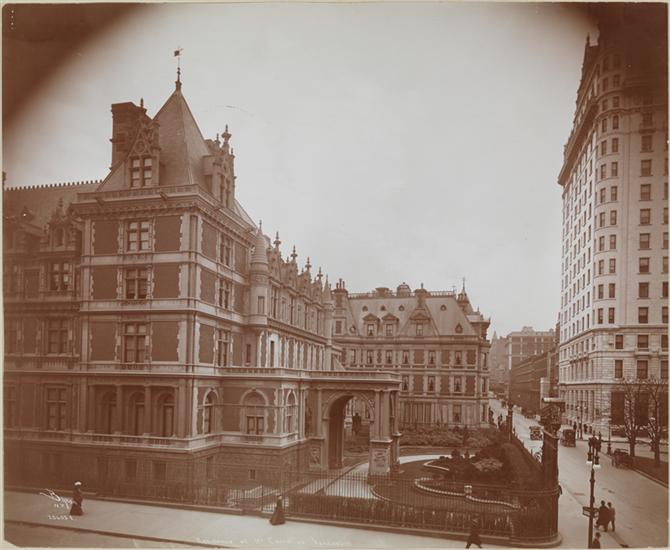
The most insanely lavish of them all — the home of Cornelius Vanderbilt II — at Fifth Avenue between 57th and 58th Streets.

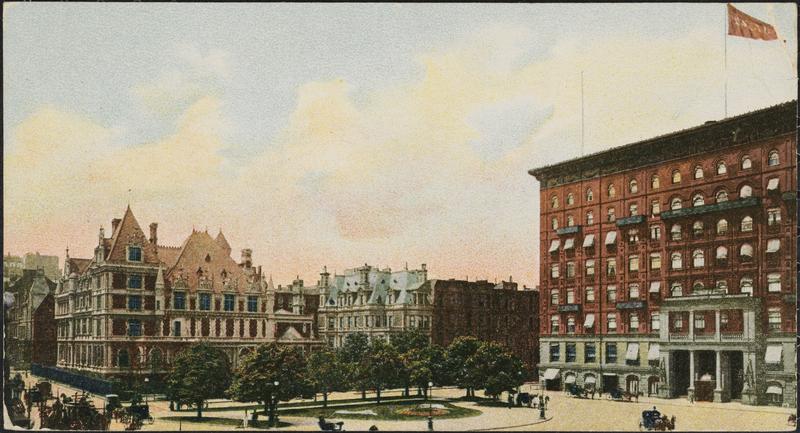
Note in the two images below (from 1901, 1905 and 1906) — both the first and second versions of the Plaza Hotel, in relation to the mansions surrounding it and Grand Army Plaza. All three courtesy Museum of the City of New York

MCNY

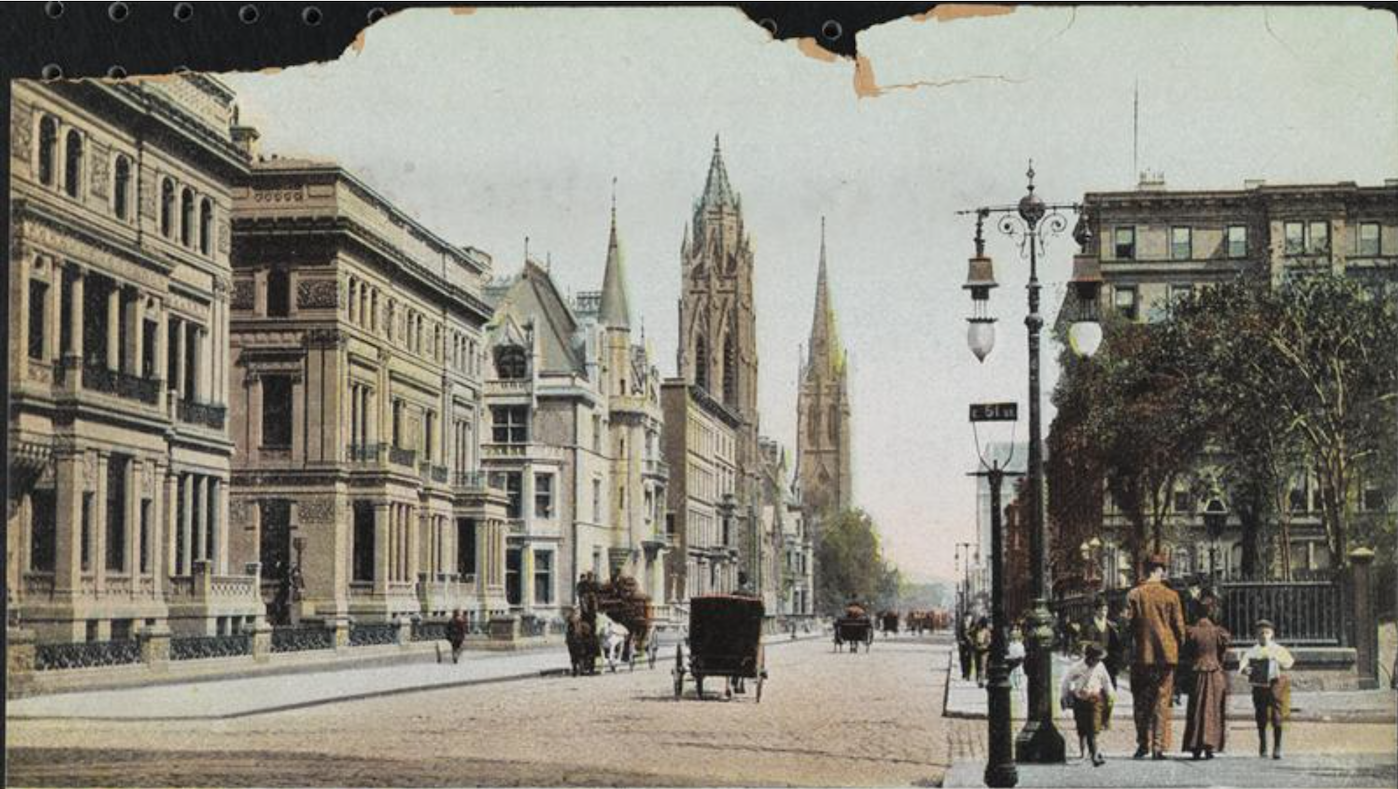
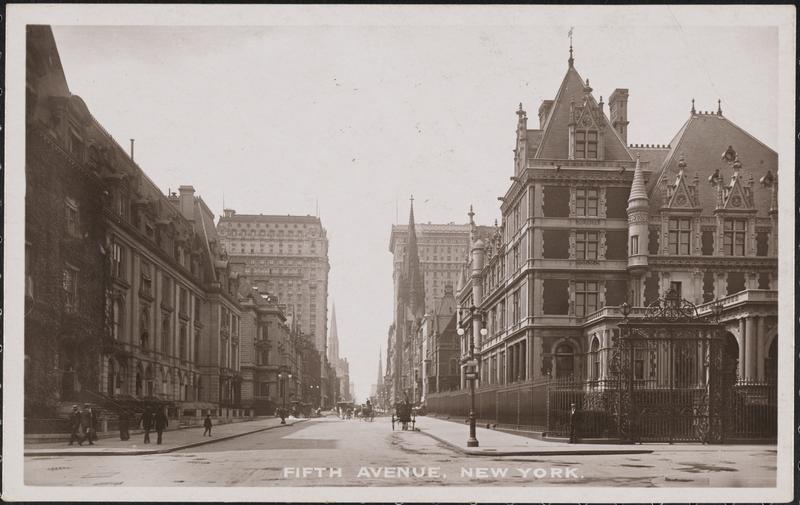
Fifth Avenue as seen in 1906, an avenue in transition by this time.

Categories
Those Were The Days

Love on the airwaves: New York’s first female radio operator

She’s not exactly a Howard Stern or a Robin Quivers, but Anna A. Nevins does deserve to be considered as something of a radio pioneer in New York.

One hundred years ago, ‘wireless telegraphy’ was mostly used to communicate with vessels crossing the Atlantic Ocean. And these weren’t signals with human voices, but rather in the dots and dashes of Morse code. Experiments with sending vocals over the airwaves were already being conducted in New York by Lee De Forest as early as 1907, but radio wouldn’t seriously be considered as a means of voice transmittal for almost another decade.

It was a tool mostly used by the U.S. Navy and commercially by the telegraph companies. It was from the ashes of a De Forest company that the United Wireless Telegraph Company was formed in 1906. It heralded dozens of receiving stations throughout the country and, in particular, three in New York. Their corporate office at 42 Broadway was one, extremely convenient to the offices of the major passenger ship lines of the Cunard (25 Broadway) and the White Star (9 Broadway). They had another out at the luxury hotel spot Manhattan Beach, Brooklyn, where some wealthy New Yorkers spent the summers.

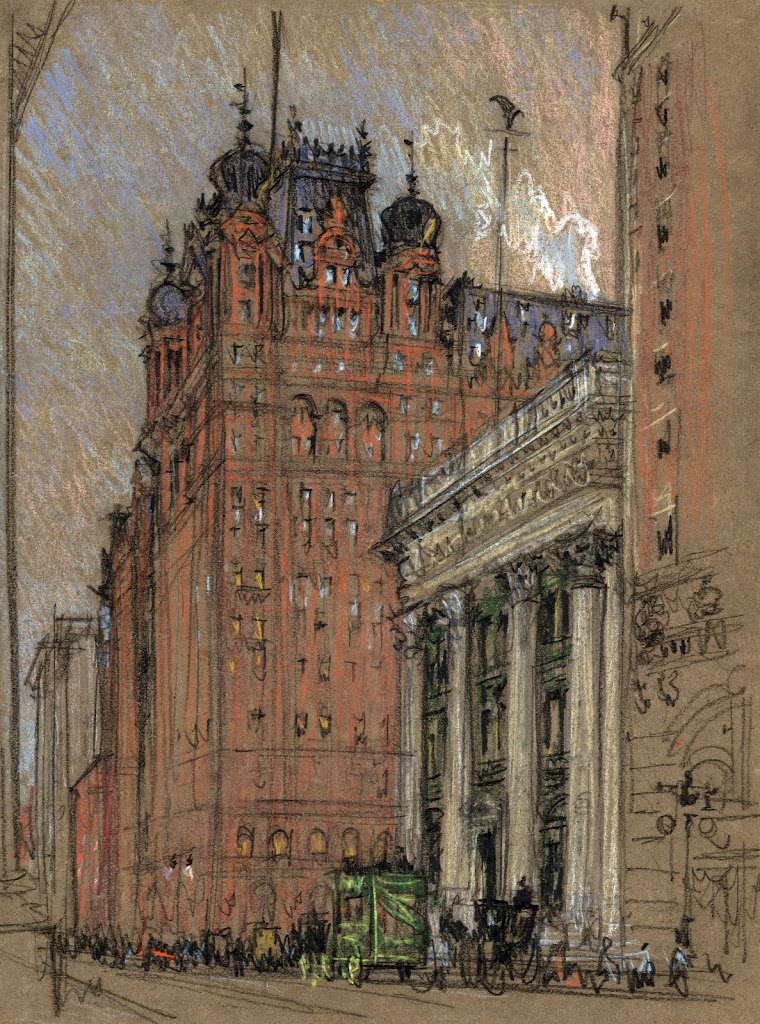
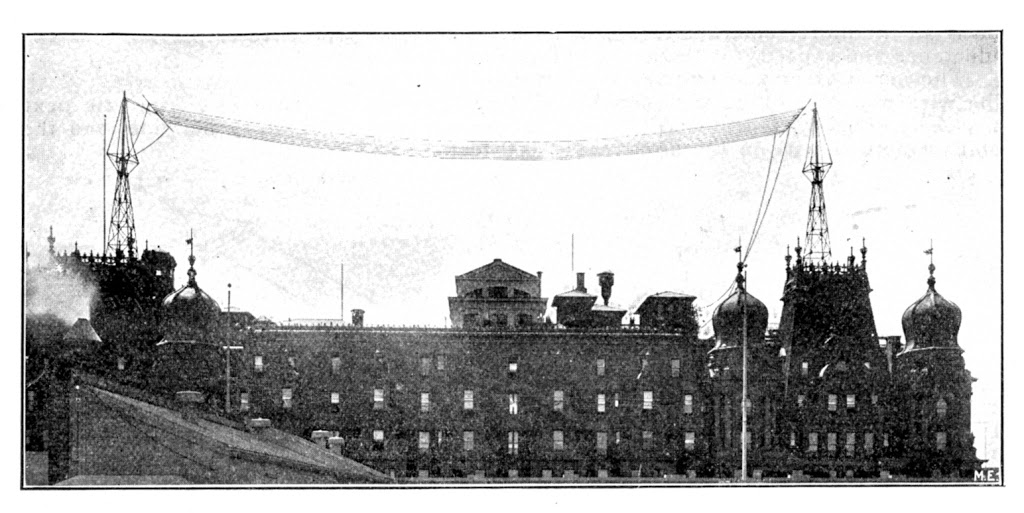
But by far the most notable of these wireless stations in Manhattan was atop the original Waldorf-Astoria, one of the most famous hotels in the world, at 34th Street and Fifth Avenue. (Above: Drawing of the Waldorf-Astoria in 1904 by Joseph Pennell.) From here, operators could send messages to ships hundreds of miles away and even to other cities like Chicago. “The operating room is a model in every respect,” claimed Modern Electrics Magazine in September 1909. “This station without a doubt is the most popular one in New York…. [T]he lofty aerial stretches its wires clear over one side of the famous roof garden.”

Below: the United Wireless telegraph station atop the Waldorf-Astoria Hotel, 1909

But they had another badge of pride — America’s first female wireless operator. Young Anna A. Nevins, 22 years old, worked eight hours a day at the Waldorf-Astoria station, considered by her colleagues “an expert in wireless instruments” By virtue of her sex, this was a news item in papers across the country in 1909.


It was not entirely shocking to see a women at a telegraph desk, but the newness of wireless technology and challenges of early radio would have made Anna’s skills rather unique. It’s believed she trained under De Forest as early as 1906.


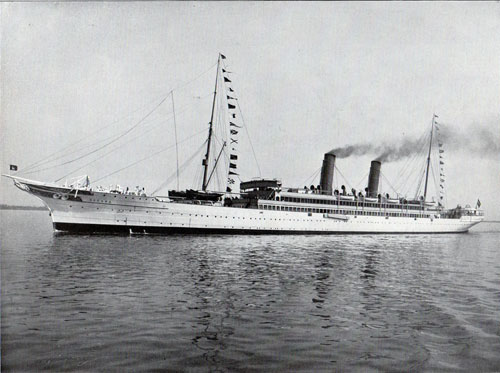
The juicy spin, of course, was romance. According to reports, Nevins had a beau “Jack” on the steamship Oceana (below)), a Hamburg-American line traveling to destinations in the West Indies. The young wireless operator would send ‘messages to her sweetheart’ over the wireless, alleged as far as 1,000 miles away, engaging in an ‘aerial conversation’ believed to be the longest exchange of its kind for the day. (Then again, this sounds like newspaper hyperbole!)


Did reporters seem fascinated to ask about what it was like to be the sole woman working within a new technology? Not when you can ask her about love! In a syndicated article from 1909, she’s quoted as admitting, “Yes I know the young man. When he’s in town, I see him. But almost every day I hear from him.”


The Waldorf station was the jewel in United Wireless’ crown. Unfortunately, United’s reputation as a corrupt company tied to Wall Street shenanigans and perpetually hounded with legal issues caused its demise in 1912, when it was sold to American Marconi. As for Anna, I can’t locate any trace of her after these initial reports. Perhaps she met and married ‘Jack’, whoever he was. Hopefully, years later, she was asked more interesting questions of her career.

Categories
Uncategorized

A trip to Times Square 1904: The Hotel Astor arrives


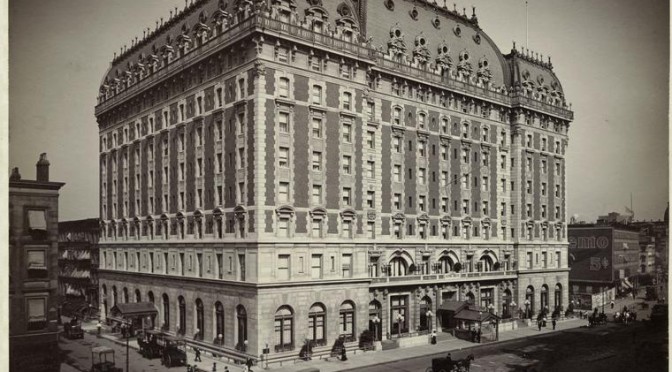
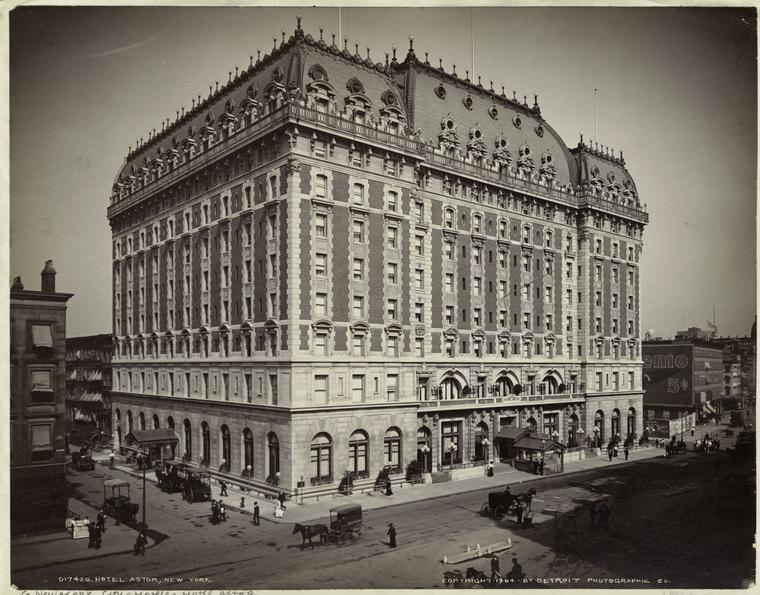
The Hotel Astor in its opening year, 1904. The Astor was a Waldorf; the Knickerbocker was an Astor. Makes sense? (Photo courtesy NYPL)

Longacre Square didn’t become Times Square without the Astor family making a lot of money. Much of the area had been farmland that had been purchased by John Jacob Astor in the 1830s. Later members of the family were not merely content to be landlords. In fact, the great family feud of the Astors and the Waldorfs brought the area its first two luxury hotels.

William Waldorf and his cousin John Jacob Astor IV were famously at odds with each other, but their disagreements produced a few striking landmarks. When Waldorf built a hotel next to the home of his old aunt, Caroline Webster Schermerhorn Astor, her son John moved her uptown and built an even bigger hotel. Voila! The two became one, the original Waldorf-Astoria on 34th Street.

A lesser known manifestation of this real estate feud waged in Times Square. Waldorf would build a spin-off of the Waldorf-Astoria at Broadway and 44th Street, an area once considered too far west for a luxury hotel. However, with the imminent arrival of a major subway station and a host of theaters, the time had arrived.

The Hotel Astor was the brainchild of German businessman William C. Muschenheim, a restaurateur and former proprietor of the New York Athletic Club. Muschenheim’s great dream was to build a hotel. Although planning one at Longacre Square seemed like a risk, it was Astor family property, and the Astors were known for their successful hotels.

With backing from William Waldorf, Muschenheim oversaw the construction of the Hotel Astor, an eleven-floor Beaux-Arts jewel stylistically related to the Waldorf-Astoria. When it opened on September 9, 1904, it seemed the gamble had paid off. Its lush ballrooms, lounges and restaurants would host the biggest soirees of Times Square’s inaugural year. A year later, its sumptuous roof garden would open, providing one of the most romantic views of the city.

John Jacob Astor IV would not be outdone by his cousin. He would soon take over a hotel project that was being constructed on the other side of the Times Building, at the southeast corner of Broadway and 42nd Street. His Hotel Knickerbocker would open in 1906.

An old McClure’s Magazine outlines the rivalry: “John Jacob also flatters William Waldorf by imitation. The latter can hardly make a move not obediently followed by his cousin. He builds the Waldorf and demonstrates his success; John Jacob follows with the Astoria. He goes up to Longacre Square and builds the Hotel Astor; John Jacob takes the hint and puts up the Knickerbocker.”

But John Jacob, who would perish on the Titanic in 1912, would have the last laugh. The Knickerbocker still sits in Times Square today, no longer a hotel but graced with a Gap clothing store on its ground floor. The Hotel Astor would vanish in 1967, to be replaced with the office tower known as One Astor Plaza today — the home of Viacom and The Lion King (in the third floor Minskoff Theatre).

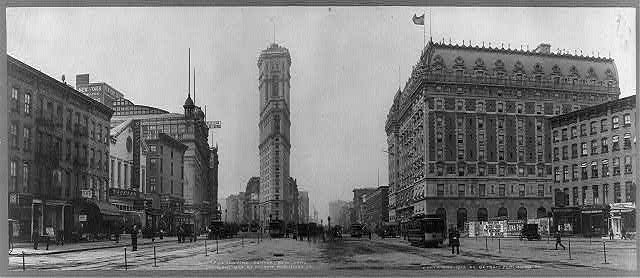
The scene so far: The Packard Motor Car store (which I wrote about Monday) is on the left. The new offices of the New York Times are in the middle. The Hotel Astor is at right. The photographer of this scene has his back facing the Trimble Whiskey written about yesterday.

Lounge Cher: Great moments in wacky NYC music history


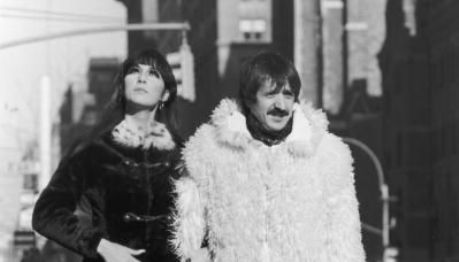
Sonny and Cher in New York City (picture courtesy Getty Images)

June 1, 1970: Sonny and Cher begin a two-week stint at the Empire Room at the Waldorf-Astoria.

The Empire was one of the swankiest hotel lounges in Manhattan, usually the site of stars slightly past their prime, pop and jazz musicians of the prior generation.  Dinah Shore, Ray Bolger, Eddie Fisher — they all played the Empire . In fact, in July 1971, Louis Armstrong would give his final performance here at the Empire.  And just a couple months before the debuts of Salvadore ‘Sonny’ Bono and Cherilyn ‘Cher’ Sarkisian , Peggy Lee delighted audiences here with remakes of ‘Bridge Over Troubled Water’ and ‘Is That All There Is?’

So what, exactly, were the nation’s trendiest pop duo doing here?

It had actually been a few years since their biggest hit, ‘I’ve Got You Babe’, and the duo since then had seen their share of flops, both in music and film.  Cher took the first part of 1969 off to give birth to her daughter Chastity.

It was Sonny’s idea to turn the pair into a Las Vegas showstopper, and their first stop before hitting the gambling capital was New York’s Empire Room, to try out a loungier version of their act.

The pair played off their catty, flirty banter and made particular fodder of Cher’s outrageous costumes.  The cheesy repartee obviously did the trick, but it was TV, not Vegas, that came calling.  Within a year, they had their very own prime-time program, The Sonny And Cher Comedy Hour, a ratings bonanza that might have lasted forever if not for their divorce in 1974.

Meanwhile, at the Empire Room, Sonny & Cher were followed up in late June with a more appropriately loungish headliner — Latin troubadour Trini Lopez.

Russia vs. the Waldorf Astoria: Nikita gets stuck

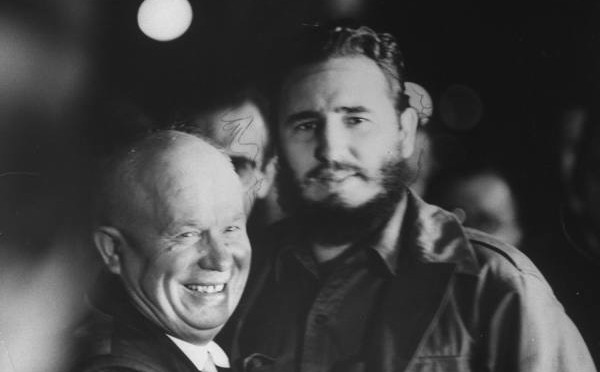
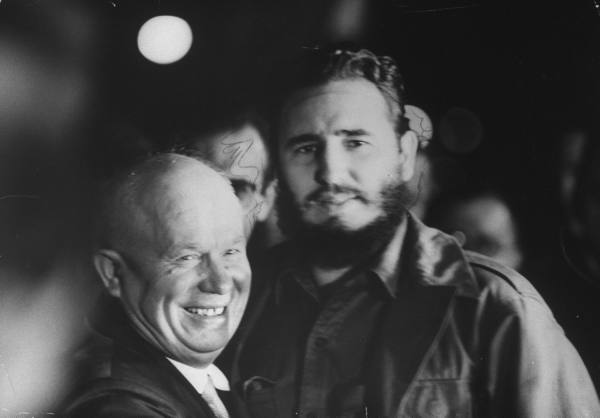
Seeing red: Khrushchev with Fidel Castro in New York (photo by Hank Walker)

Nikita Khrushchev, Cold War leader of the Soviet Union, is perhaps the strangest tourist New York has ever seen. Pete Carlson’s new book ‘K Blows Top’ (named for a snarky Daily News headline) documents Khrushchev’s odd and rocky thirteen-day tour through the United States, in September fifty years ago this year. I heard Carlson on On The Media over the weekend and was particularly struck by an event that occurred at the Waldorf Astoria, an embarrassing situation that might have sparked World War III.

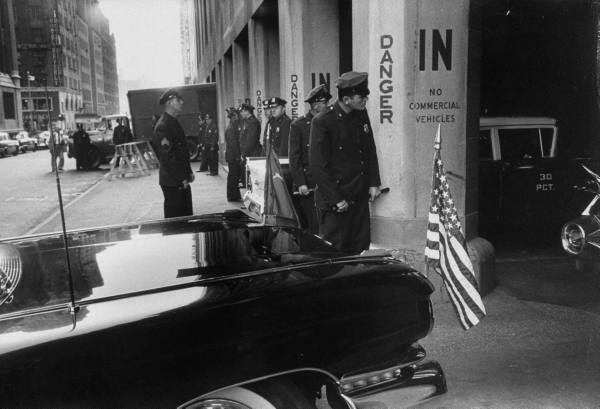
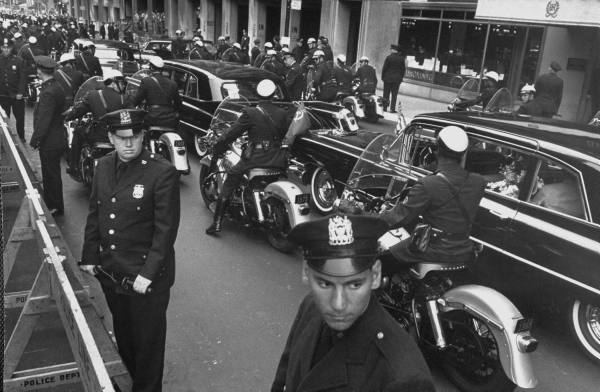
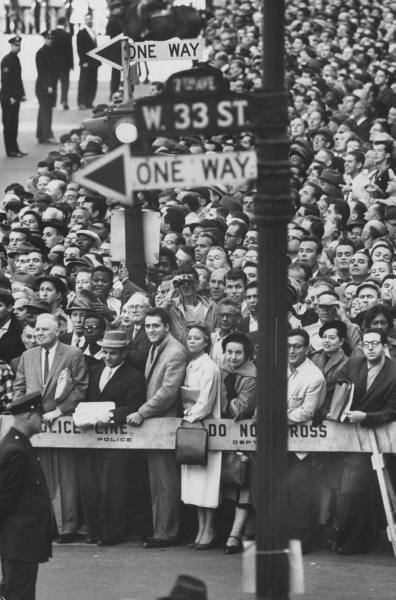
Khrushchev’s arrival in New York was a press sensation and crowds (supporters, protesters and curiousity seekers) gathered outside the Waldorf Astoria, where he and his family were staying. The Russian leader happened to be riding the elevator with U.N. ambassador Henry Cabot Lodge Jr. and the manager of the Waldorf Astoria when the elevator abruptly stopped between floors.

The manager was unable to get the elevator working again, so Khrushchev had to be lifted up with the U.N. ambassador literally shoving the Russian’s buttocks out of the stalled elevator car — which then became functional moments later.

Believe it or not, this was the second controversy surrounding Nikita and the Waldorf Astoria. The first involved a convention of dentists booked in the hotel at the same time as Khrushchev’s visit. Mayor Robert Wagner asked the dentists to move so that he could throw Khrushchev a luncheon there. The dentists adamantly refused.

Russians vs dentists. You’ll have to read the book to find out who wins.

I don’t have any pictures of Khrushchev crawling out of an elevator, but enjoy these images, courtesy Life Google images, of his visit to New York. Carlson’s book has other details of his trip, including Nikita’s lackluster opinion of the Empire State Building.

Police outside the Waldorf Astoria (photographed by Al Fenn and Stan Wayman)

Nikita draws rock-star sized crowds in midtown (photographed by Ed Clark)

Pope-fest 2008: The Holy (Sight) See

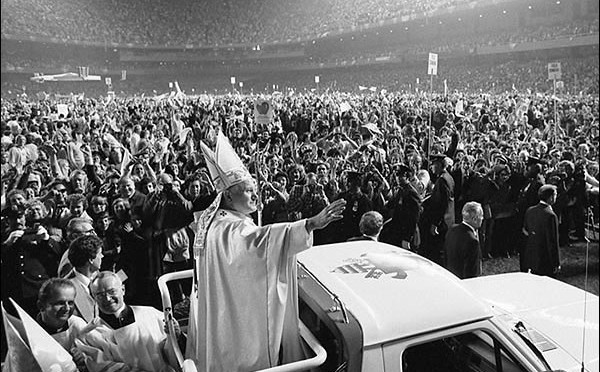
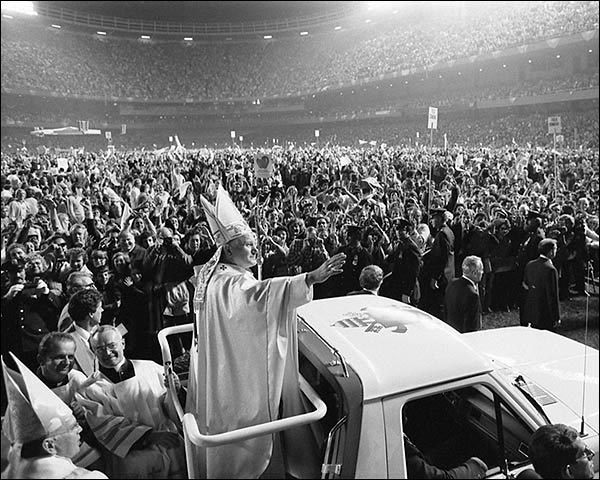
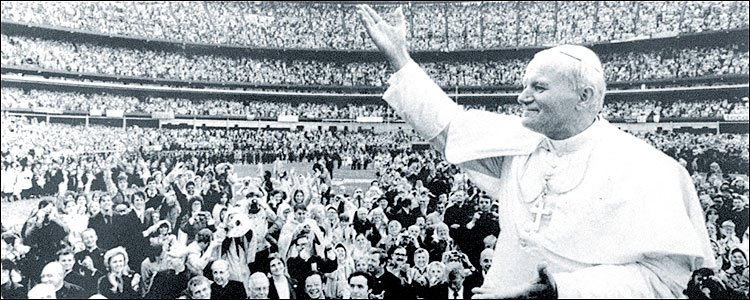
Pope John Paul greets the crowds at Yankee Stadium

Welcome Benedict! I’m not Catholic, but I do love a good papal visit to New York City. Nothing could be more absurd. The leader of the Catholic Church, a man who traces his spiritual lineage all the way back to the apostles — delivering mass at Yankee Stadium, traipsing Fifth Avenue in his sacred robes. I hope that person who dresses as Sesame Street’s Elmo in front of Rockefeller Center waves to Benedict as he enters St. Patrick’s Cathedral on Friday.

Only the Marquis de Lafayette and the Beatles have been treated to more rapturous displays of welcome by New York City residents. The city has been host to three previous papal visits, and in each case, St. Patrick’s has naturally been the manic center of activity. In fact each visit is immortalized on a plaque in front of the cathedral. Although with each trip, the pope in question managed to find a couple other unique corners of the city to visit as well.

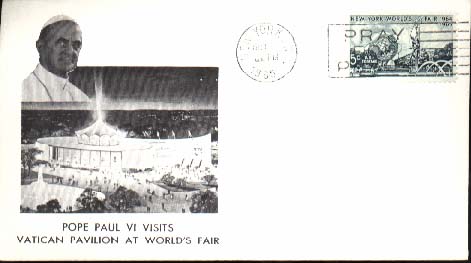
Perhaps the strangest was the very first — Pope Paul VI, the controversial leader who presided over the Second Vatican Council and made a name for himself traveling all over the world. Finally in an era were a man could be both pope and jetsetter, Pope Paul arrived in New York in October of 1965 and promptly went to visit his roommate, who was performing in a fair.

That roommate would be Michelangelo’s Pieta, on loan from St. Peter’s hallways to the Vatican pavilion at the 1964-65 World’s Fair. The Pope visited the Fair on Oct 4, 1965, on a busy day that also included mass at Yankee Stadium (the first papal mass ever in the United States), an address to the United Nations, and a meeting in the city with president Lyndon Johnson at the Waldorf=Astoria.

Today a rounded bench, or exedra, sits in Flushing Meadows park honoring the moment Pope Paul visited the Pavilion. (It seems that whenever a Pope hovers in a place for more than a few minutes, a plaque or monument springs up in its place.)

By the way, I found this extraordinary page full of great photos about the Pope-mobile, the superfine limousine used by the Pope during his visit.

But its Pope John Paul who’s the real New York favorite; he held the office for so long that he managed two trips to Gotham City — in 1979 and 1995.

His October 1979 trip was like a rock concert tour, also swinging through Philadelphia, Boston, D.C., Chicago and Des Moines. Part of the enthusiasm was because John Paul, at 58 years old, had just been appointed the year before.

As a cardinal, he had already held mass at Yankee Stadium, so by the time he did it again on October 2, 1979, he was as much a fixture as Reggie Jackson. Rain greeted over 9,000 cheering worshippers — or fans — and, according to legend, when the Pope mounted the ballfield to address the crowd, the rain showers stopped. And as a blessing for Mets fans, the next day the Pope also held rapt an audience of 52,000 at Shea Stadium (pictured below).

But like all rock stars, the Pope couldn’t complete his New York odyssey without a performance at Madison Square Garden. Although John Paul also addressed the U.N. and a St Patrick’s audience during that trip, he’s best remembered by many for his inspirational address on October 3rd to 19,000 city children.

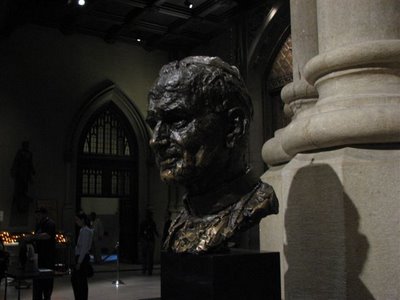
St Patrick’s honored his Holiness’s visit in 1979 by installing a bust (see below). But he would be back. On almost exactly the same day, sixteen years later.

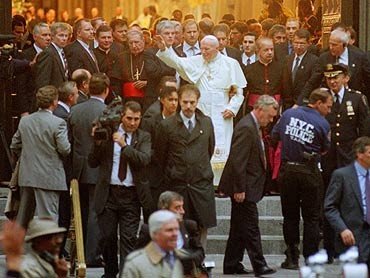
New York City in 1995 was a vastly different city and John Paul returned for a longer visit — four days in total in the entire New York area — on October 4th. This time, instead of just delivering messages to the clergy gathered at St. Patrick’s, he spontaneously decided he wanted to walk around the block. And why not? You’ve got shopping, Saks, street vendors selling Pope souvenirs!

Below: the Pope prepares for his light stroll

The Pope also finished off his collection of performing in gigantic venues for mass — holding court in Giants Stadium, the Aquaduct Racetrack in Ozone Park and eventually to 100,000 people on the great lawn in Central Park.

From there, the elderly leader of the Catholic Church gave the city the ultimate shout-out: “This is New York! The great New York! This is Central Park. The beautiful surroundings of Central Park invite us to reflect on a more sublime beauty: the beauty of every human being, made in the image and likeness of God. Then you can tell the whole world that you gave the pope his Christmas present in October, in New York, in Central Park.”

Pope Benedict, here for two days (April 19-20), has broken the apparently holy tradition of visiting New York in the first week in October. But Benedict, as the cardinal formerly known as Joseph Ratzinger, actually visited the city in that lesser role in 1988, where apparently he was met with protest from gay activists and shunned by some prominent Jewish leaders.

This year, he intends to hit all the “usual” Pope spots — St. Patricks, the United Nations, Yankee Stadium — but has added a couple surprising detours: Park East Synagogue and Ground Zero. At this rate, he might even stop in to see an off-Broadway show! Is Nunsense still playing?

Categories
Podcasts

PODCAST: The Astors and the Waldorf-Astoria

We’re going to the ‘original’ Waldorf-Astoria Hotel in this podcast to hang with the filthy rich.

Our guides are the styling and eccentric Astor family, the centerpiece of 19th Century New York wealth and society. Come along as we weave through a family tree of Williams and John Jacobs, not to mention THE Mrs. Astor, the one and only (even if there was more than one).

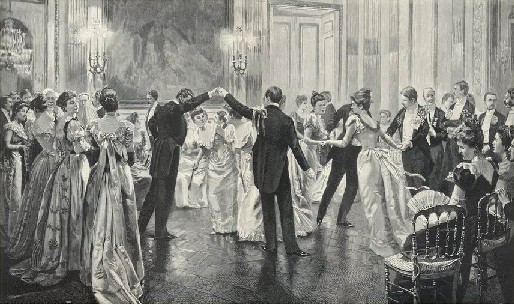
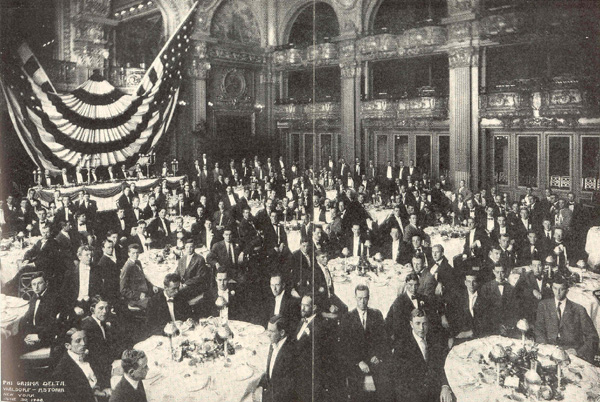
A glimpse inside the Waldorf-Astoria ballroom : a Phi Gamma Delta fraternal function in 1908

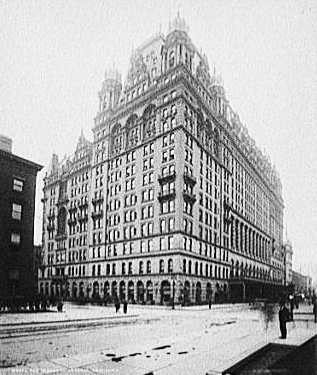
Outside the combined hotels, you can see where the shorter Waldorf ends and the taller Astoria floors begin. The streets look pretty calm too.

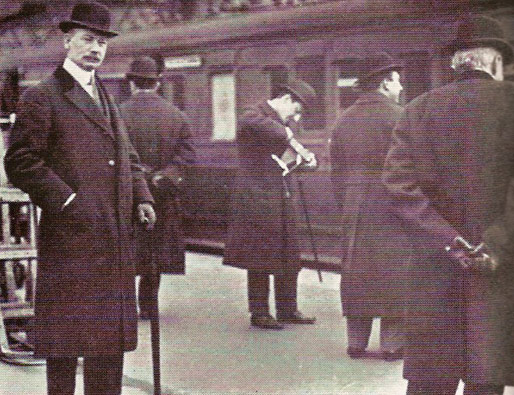
John Jacob Astor IV — inventor, writer, gad-about — at 48 years old, the year he meets his fate on the Titanic

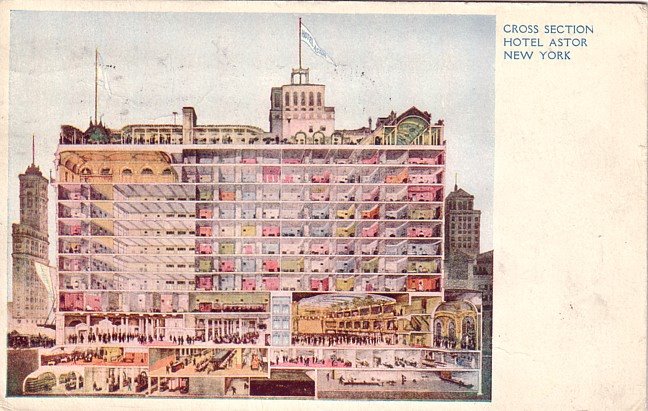
Another Astor holding, the Astor Hotel, was built by William Waldorf Astor in Times Square. This postcard curiously gives us an inside look.

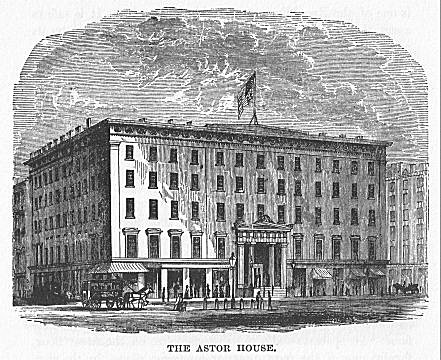
This is not to be confused with the Astor House, the downtown Manattan lodging built in 1836 by William and JJ Astor IV’s great-grandfather, the original John Jacob Astor. Right next door to the long-standing St Paul’s Church, the location of the Astor House is now occupied by a Staples and a New York Sports Club.

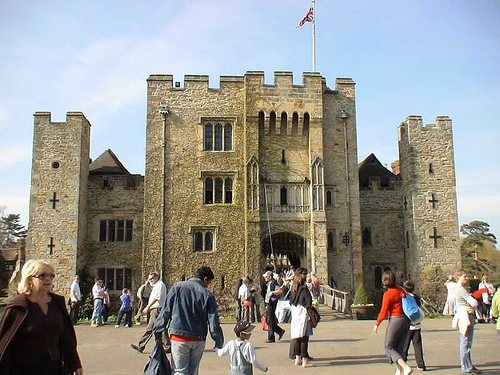
And over in England you can now visit the Hever Castle, once home to Anne Boleyn, but refurbished and lorded over by William Waldorf Astor, shedding his American skin to become an eccentric British viscount.

And we failed to mention that the Waldorf salad gets its name from the hotel where it was purportedly invented by Waldorf-Astoria’s much-admired maître d’hôtel Oscar Tschirky, who incidentally also claimed the invention of eggs benedict and veal oscar. As we mentioned on our podcast, thousand island dressing also made its debut at the Waldorf.

If you’re interested in more, you should read Justin Kaplan’s When The Astors Ruled New York . We’ve previously written about the profundity of Astor-named places here.