Categories
Friday Night Fever Gilded Age New York

What’s behind the Bronze Door? Gambling in the Gilded Age

A tantalizing stretch of New York nightlife history lies in the shadows, illegally operated, often fueled by police bribes — the opium dens of Chinatown and the speakeasies of the Village and midtown.

There were also hundreds of illicit gambling rackets, called ‘poolrooms’, throughout the city in the late 19th century, usually alongside the seediest of taverns, brothels and poolrooms.

Naturally, the pastime was not looked upon lightly by proper society. “The poolroom keeper, like the proverbial worm,” remarked one New York Times article from 1900.

But New York’s wealthy elite liked to gamble as well, and there was no need for them to step into such filthy, disreputable places. The rich had their own houses of vice.

And one, the House with the Bronze Door, which opened in 1891, would have rivaled the great casinos of the day in terms of its lush presentation.

House of Cards

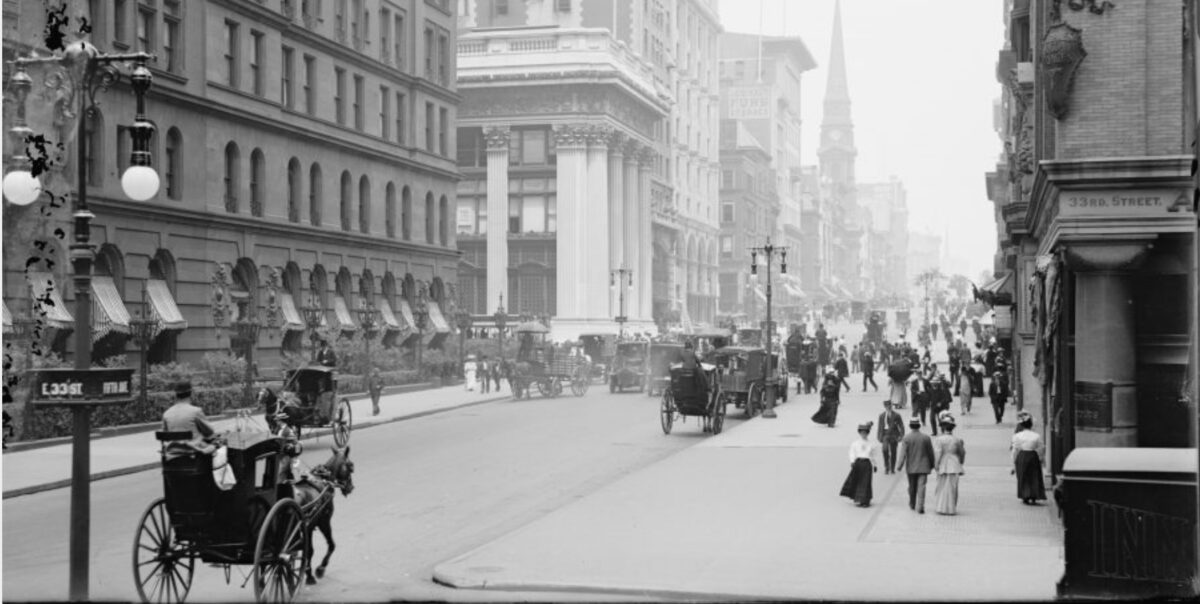
The fine townhouse at 33 West Thirty-third Street sat right around the corner from the Waldorf-Astoria, so close to respectable Fifth Avenue that people certainly strolled by it with no clue of the entertainments within.

Its glorious, defining feature — and where it gets its name — was a $20,000 Italianate Renaissance, 15th century bronze door which gave the building the feel of a classic structure, or perhaps a bank vault.

Luxury greeted those who were fortunate to peer behind that door, imported old school finery, from vases to oil paintings on rich wallpapered walls, along hallways in red velvet carpeting, leading to game rooms with European oak tables hosting games of roulette, poker and baccarat.

In a place where wealth exchanged hands nightly, it was reflected in the imported banisters and marble bathrooms.

High Stakes

And it wasn’t just how it looked, but who designed it to look that way — none other than Stanford White of the city’s most prestigious design firm McKim, Mead and White, a gambling man himself who hired a team of Venician craftsman to give the gambling house its distinctive glamour.

The building next door also belonged to the casino, but was less impressively designed; its sole purpose was as an exit in case of police raids.

The owner Frank Farrell* was New York’s gambling kingpin, using profits from the Bronze Door to fund over 200 illegal gambling houses throughout the city and grease the palms of police officers to ensure they all stayed open.

If that name sounds familiar to sports fans, it’s because of a riskier gamble Farrell made in 1903 with his business partner William Stephen Devery. (Yes, the former police chief. See how it used to work back then?)

The two purchased the Baltimore Orioles, moved them to New York, lost a lot of money, renamed the team as the New York Yankees and promptly sold them to beer mogul Jacob Ruppert.
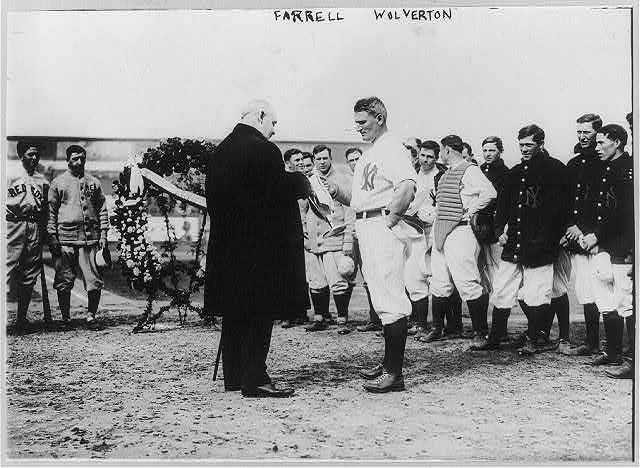
Below: Farrell with a Yankees team member in 1912. He would sell off the losing team a few years later. Courtesy Library of Congress

A Night at the Tables

The only people taking risks at the Bronze Door, however, were the rich and well connected clientele. On any given evening you could find the head honchos of Tammany Hall smoking cigars in the corner, or ‘Diamond’ Jim Brady and his entourage at the upstairs roulette wheel.

According to Lloyd Morris: “The casino was conducted with the quiet decorum of a gentleman’s club.” These men expected the royal treatment, and they got it. A midnight buffet of lobsters and steaks, open bar of the best liqueurs, fine cigars for a $1 apiece. More importantly, Farrell strictly applied a philosophy of ‘the customer is always right’. Unlike many of Farrell’s downtown dive, where the house often rigged games and marked cards, the gambling den behind the Bronze Door was straight.

There was little nickel and diming here. It’s purported that fifty thousand dollars would hit the tables each night.

Gamblers would win, and then lose, vast fortunes each night. As Luc Sante so elegantly states: “… the stories of rich men dropping enormous sums in a single evening kept topping each other, so that the phenomenon almost comes to seem like a version of potlatch, in which wealth is proven by the ability to shed it.”
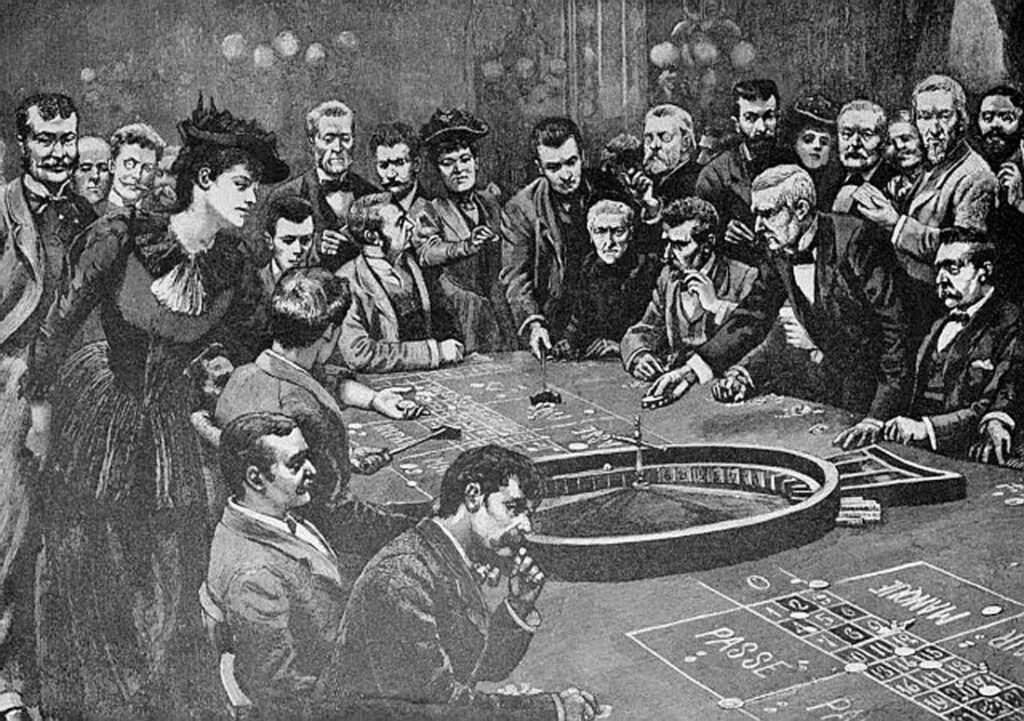
Depiction of a 19th century casino. At the House of the Bronze Door, it was unlikely that women were allowed however.

Luck Runs Out

The casino stood in defiance of the law for almost a dozen years thanks to Farrell’s connections and the reputation of its clientele. However, given the New York’s waxing and waning reform movements, its time would eventually come, and it did so at the hands of one William Travers Jerome, New York’s district attorney with a particular bent for reform.

Jerome shut down casinos and poolrooms throughout the city and didn’t discriminate, successfully breaching that imposing door and raiding the club in 1908.

Although the games were gone, the place remained open for many years afterwards, as a restaurant owned by the Waldorfs according to official sources. What its true nature was in these later years is unknown.

The building is completely gone today, replaced with a condo and the shadow of the Empire State Building.
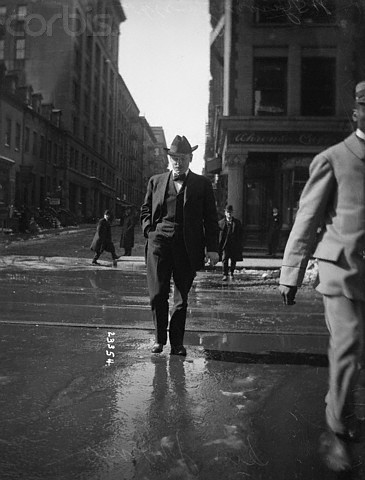
Below: District Attorney Jerome, 1915

*Farrell had other partners in the casino, including racetrack owner Gottfried Walbaum and Billy Burbridge, who later became a hotelier in Havana, Cuba.
Categories
Bowery Boys Bookshelf True Crime

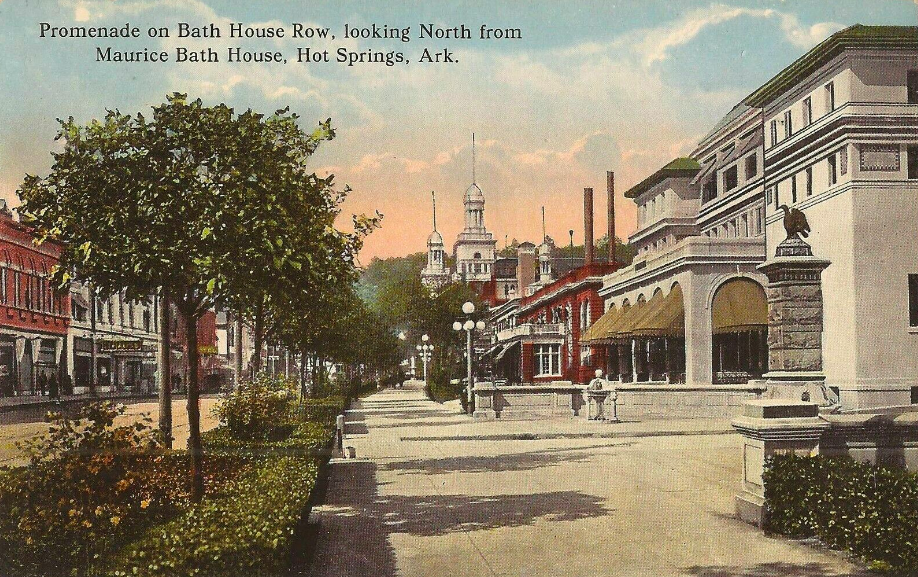
‘The Vapors’: How an Arkansas spa town became a New York gangster paradise

Owney Madden was one of New York’s most infamous gangsters, a bootlegger and murderer who seemed to cross paths with every major cultural marker of the Roaring 20s. He opened the Cotton Club (with Jack Johnson), dated Mae West, and operated a liquor smuggling racket that catered to the city’s busiest speakeasies.

In essence Madden was the blistering face of Prohibition-era Manhattan.

And in 1935, he left it for good to go live in Hot Springs, Arkansas.

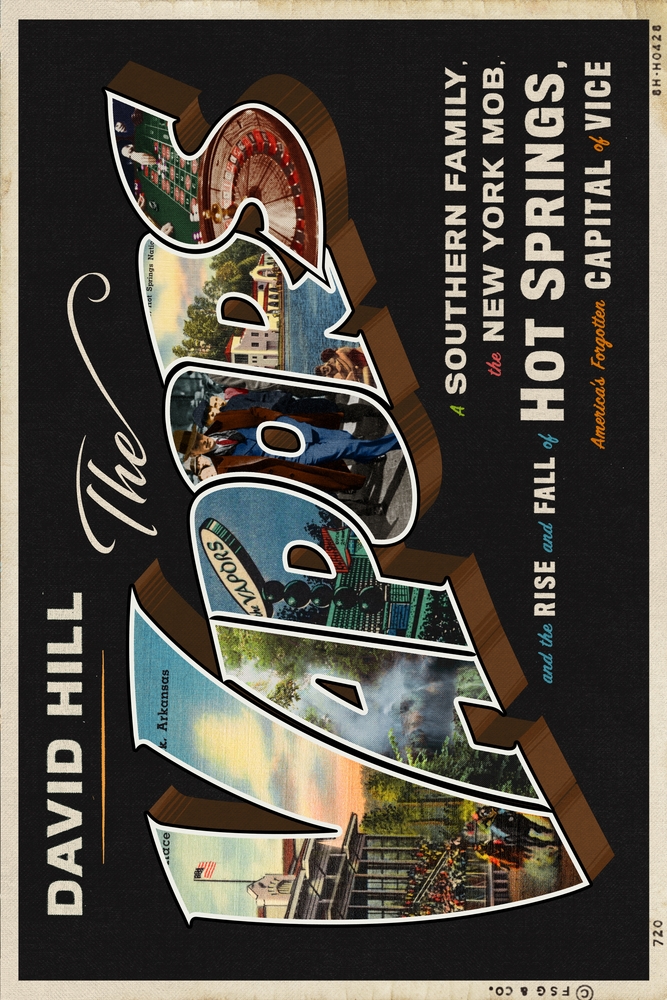
THE VAPORS
A Southern Family, the New York Mob and the Rise and Fall of Hot Springs, America’s Forgotten Capital of Vice
By David Hill
Farrar, Straus and Giroux

For a time, it seemed that Hot Springs, not Las Vegas, would be the vice capital of the United States. In David Hill’s captivating and beautifully written The Vapors, we’re re-introduced to an overlooked corner of history, a historic spa town with troubling secrets and a sleazy underbelly.

The Vapors was one of the last in a series of glamorous casinos and resorts which graced this mountain town during the 20th century, well established as a destination for illegal gambling by the time Madden arrived.

With Prohibition repealed, organized crime lords looked to gambling as their next best bet.

In the 1930s, Vegas was an uncertain proposition, sprouting haphazardly in the middle of the desert.

But here in Hot Springs, tourists had luxuriated in healing spring waters for decades. Sports heroes, politicians and musical entertainers all came here to relax. Lawmakers and law enforcement often looked the other way as it frequently benefited them to do so.

Madden was a celebrity in Hot Springs, a liaison between civic leaders and visiting gangsters, a man with unique powers who nonetheless had to learn the more delicate game of political control.

“Owney’s days of killing his enemies were long behind him,” writes Hill, “but it sure must have seemed cheaper than winning a fair election in Hot Springs. ‘You know, in my day, back in New York, how I’d have handled this…..’ Owney said to the gamblers. ‘No, no, no!’ they quickly cut him off.”

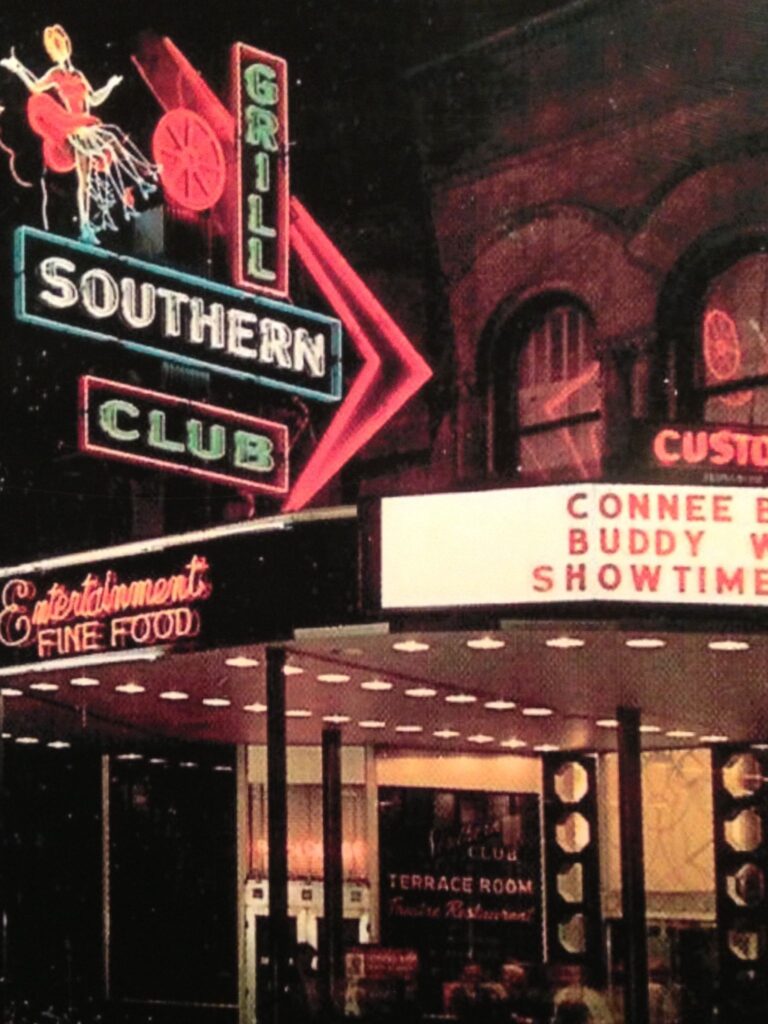
Madden’s roost was the Southern Club, an Arkansas variant of club’s like his old Cotton Club. Hill writes:

At the Southern, Owney was treated with discretion, not as if he were anyone else off the street, but not as anything special, either. The patrons knew to keep their distance. In Hot Springs, people had grown used to seeing famous folks out and about, and had learned to act like it wasn’t any big deal. In this way the spa had a lot in common with much larger cities, and the famous appreciated it as a form of hospitality. The notorious, even more so.”

The fate of Hot Spring’s lucrative gambling scene — and all its vice-ridden sideshows — rested on shady deals with law enforcement and local officials.

The city often resisted the presence of notorious gangsters for fear of the attention; in fact, another New York mob boss Charles ‘Lucky’ Luciano, who had considered Hot Springs a sort of gangster’s retreat, was arrested here in 1936.

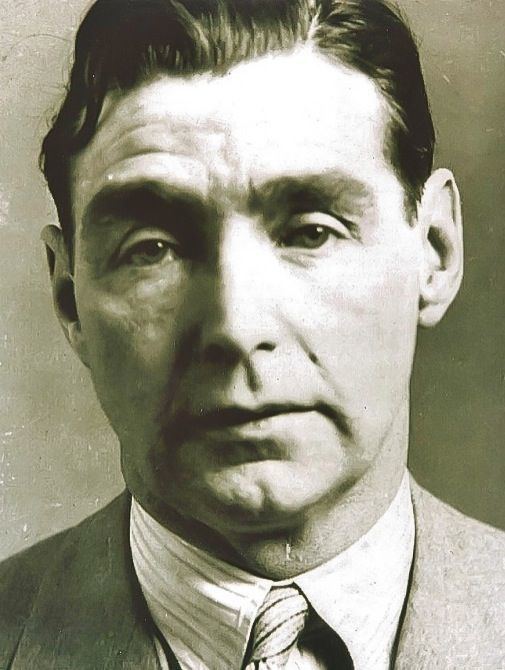
Below: Owney Madden in his later years

Hill reconstructs the resort town with such vivid attention to detail — a haven of mist, fedoras and cheap-lipstick glamour — through exhaustive research and interviews. (Hill, who lives in New York, is a native Arkansan and you feel it.)

Alongside Madden, in a simple stroke of balanced narrative that really elevates The Vapors into the realm of prize-deserving literary magic, the author also follows the stories of Madden’s protege Dane Harris (the “boss gambler” of Hot Springs) and a tough lady named Hazel Hill, raising two sons during the city’s most tumultuous years.

Hazel’s story is told with an added degree of richness and sympathy, as well it should. She’s the author’s grandmother.

Categories
Those Were The Days

Turkey raffles were 19th century versions of bar trivia nights


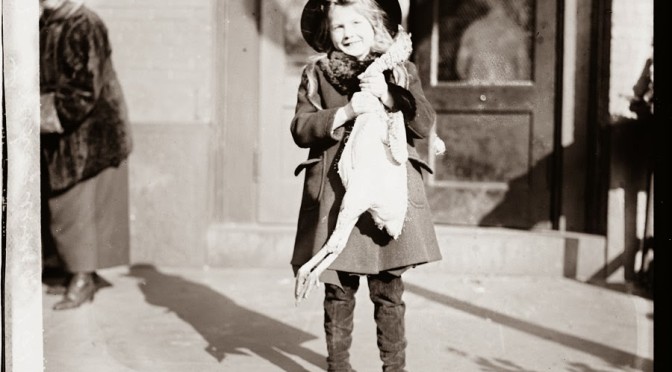
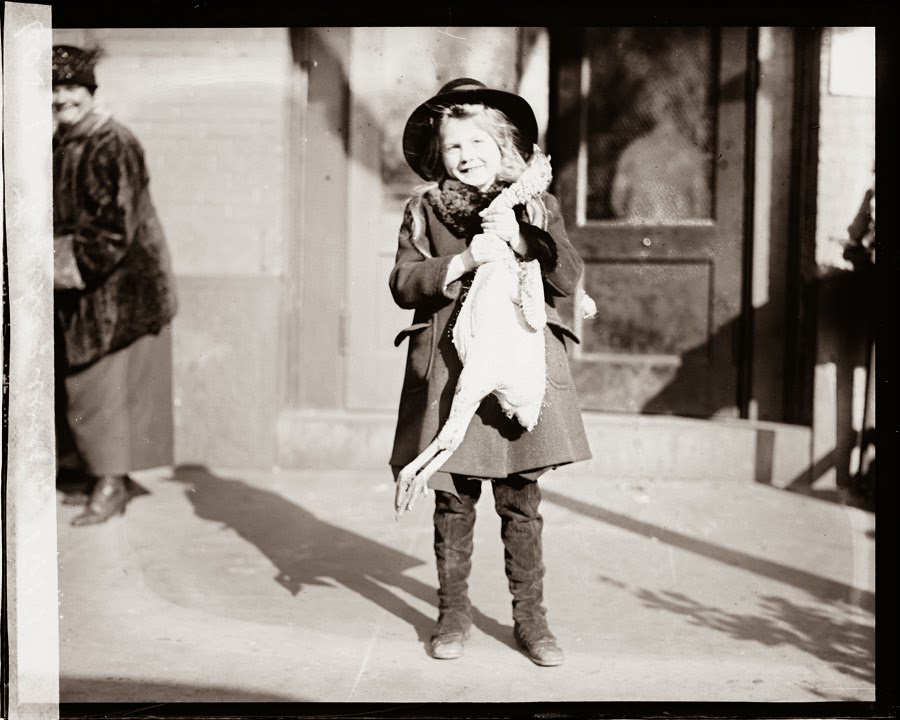
Hopefully this young lady acquired this turkey by legitimate means.

In this week’s podcast, I feign shock at the wild party held at the old home of famed actress Charlotte Melmoth, a former school for etiquette-turned-booze hall.  To quote historian Henry Reed Stiles directly:

After [Charlotte’s] disease, the house was converted into a tavern, which became the favorite resort for the dissipated young men of the town, who there indulged in drinking, eating oysters, raffling for turkeys, geese, etc. their orgies being carried on with a freedom to which the retired character of the spot was particular conducive.”

What’s so indulgent about a raffle?  Today they’re used mostly in expos and high school fund-raisers, a relatively benign form of gambling (although governed by specific state-wide rules).  But in the 19th century, raffles were widely seen in saloons, a jovial excuse for men to get liquored up and throw their money in for a chance at a moderate prize.  In essence, it was gambling most fowl.

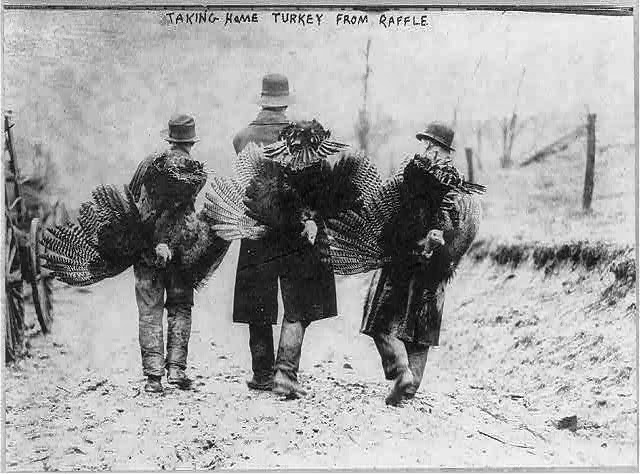
Below: Three victors at a local turkey raffle, 1912, location unknown (LOC)

“[T]here are many men on this fast old planet who are unable to resist the seductiveness of a turkey raffle,” the New York Sun reported in 1891.  “[P]erhaps there are enthusiasts who regard the practice of turkey raffling as not gambling, but a spirited method for the distribution of food products.”

The most common form of turkey raffle involved a game of dice.  Men paid for the privilege of rolling a pair of dice three times, and the man with the highest total score took home the turkey.

Another popular raffle method involved tossing several pennies into a hat, then dumping them out on a table.  The man who had the most pennies to come up heads would get his choice of the turkey or its cash equivalent. (Author Andrew Smith reports of one such raffle with a turkey value of 4 shillings, an approximate value of $10-$20 today.  Most took the money.)

Raffles were a quick and easy way for bartenders to get patrons to drink more. In this way, they’re very much like a weekly karaoke party or a pub trivia night.

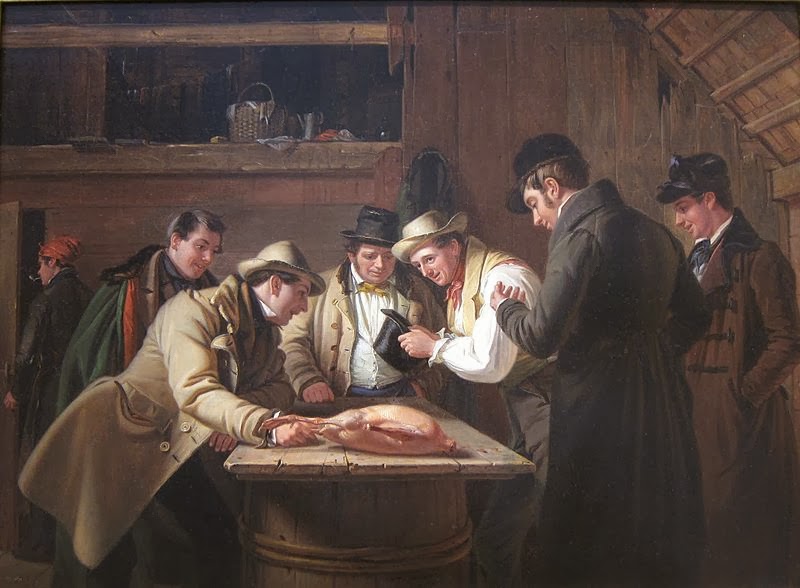
Below: Geese also got into the game. This great 1837 painting is by Long Island artist William Sidney Mount, called “The Raffle (Raffling For The Goose).”  The scene takes place in the backroom of a tavern, the hat containing raffle tickets.  Today this painting hangs at the Metropolitan Museum of Art.

A November 1887 account in the New York Evening World (reprinting an article from Buffalo) recounts the tale of a bank teller who won a six-pound turkey in a bar raffle:

“[H]is friends, many of whom he had never met before, crowded around him and congratulated him.  Then they swarmed him over to the bar and, of course, it was necessary to order some slight liquid refreshment for the gentlemen who felt some amicably disposed to him.  One hundred and fifty lagers were quickly disposed of, and the bank teller waxed hilarious.  Taking the turkey by the legs he swung it around his head in triumph……. Before he had left the place he had paid for $20* worth of liquor.”

*According to the Inflation Calculator, that’s about $500 today. 

The reputation of the turkey raffle as an instrument of vice and debauchery was such that a 1914 article in the New York Sun heralded their demise. “It has long been suspected that this form of gambling was ruining men and wrecking homes.”

Turkey raffles were finally outlawed in New York bars in 1914.  “That kind of chance taking is now classed as gambling, and every holder of a liquor license is forbidden to allow it in his place.” [source]

Categories
Podcasts

Case Files of the New York Police Department 1800-1915

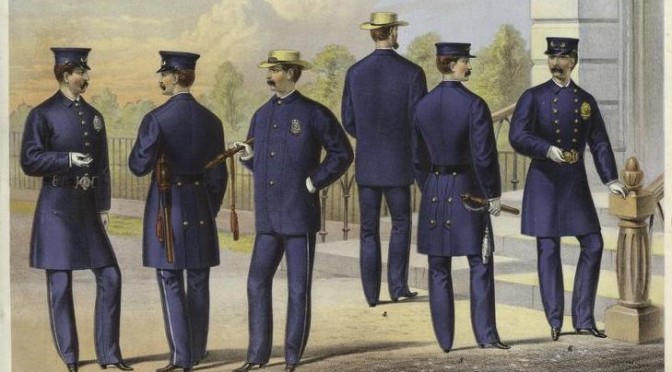
Uniformly chic: Law enforcement officers of the New York Metropolitan Police from 1871 show off their fancy blue threads. Twenty years previous, they weren’t even required to wear standardized apparel. (Courtesy NYPL Digital Library)

PODCAST We’re playing Good Cop / Bad Cop this week, as we take a close look at four events from the early history of the New York Police Department. You’ll meet shining stars of the force like Jacob Hays, who kept the peace in the early 19th century armed with a mean billyclub — and the only man to ever hold the title of High Constable of New York. And then you’ll encounter Joseph Petrosino, the Italian immigrant turned secret weapon in the early battles against organized crime.

Not all the early men in blue were so recommendable. During the Police Riot of 1857, cop turned against cop while the city burned and “Five Points criminals danced in the streets.” And finally there’s the lamentable tale of officer Charles Becker, the only member of the New York Police Department to be executed for criminal misdeed.

But did he really commit the crime — commissioning the murder of a nervous gambler who was prepared to rat him out?

#1 The Saga of High Constable Hays
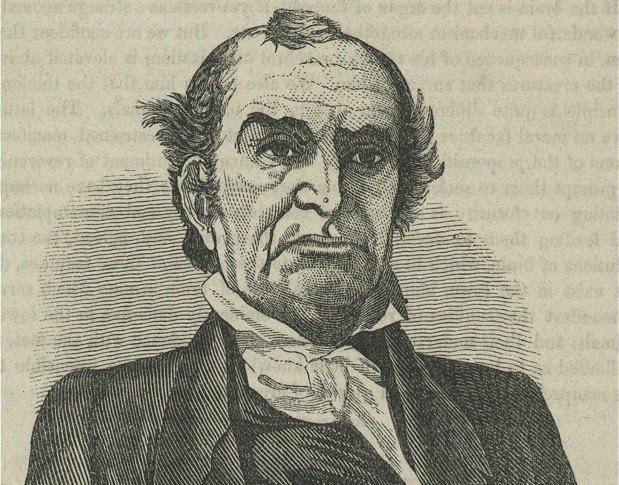
Imagine encountering this face on a gaslit street at night! Jacob Hays watched over the streets of New York for over 40 years, one of the most dedicated men ever to watch over the city. Hays would become one of New York’s best known — and most feared — men, thanks to his agility with a billy club and his early skills of detection and crime solving. (NYPL)

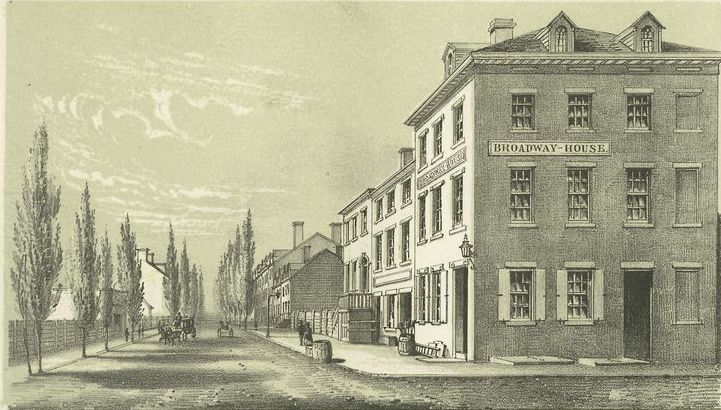
This is the corner of Broadway and Grand Street in 1818. A wildly bustling street corner today, but quite a different story back in Hays’ day. The constable roamed over a much smaller city — this was at the northern outskirts — and a far different range of crimes. By 1818, he would have only had about a couple dozen officers in his employ, all of whom reported directly to him. (NYPL)

#2 The Police Riot of 1857
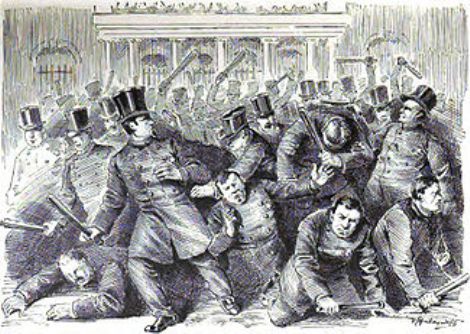
New York once had two different — and competing — police forces and boy they just did NOT get along. It all came to blows one June day in 1857, with state-sponsored Metropolitan police officers attacking the renegade men of the Municipal police force.

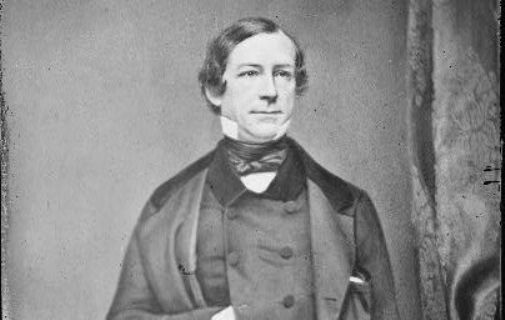
And it was because of Fernando Wood, the crafty mayor of New York in the 1850s who refused to comply to the state’s authority over city law enforcement. Wood used the police for his own political advantage and hastened its descent into corruption.

#3 Petrosino!
The short Italian immigrant Joseph Petrosino, who become the NYPD’s most potent tool against the growing forces of organized crime during the first years of the 20th century.

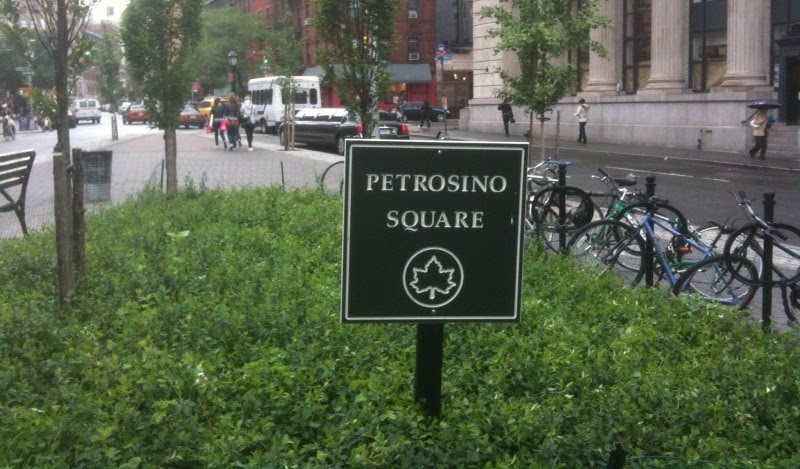
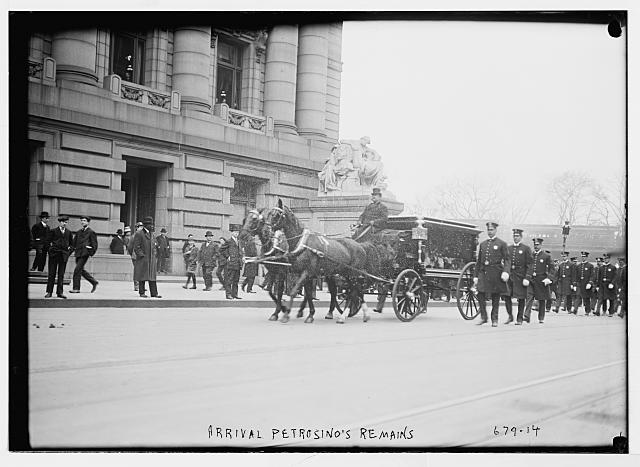
Petrosino was assassinated in Italy by the mob and his funeral procession through the city drew thousands of mourners. Today, you can visit the freshly refurbished Petrosino Square at Lafayette and Kenmare streets and see many artifacts relating to Petrosino at the New York City Police Museum.

Petrosino’s funeral procession passed by the U.S. Custom House, April 9, 1909. (LOC)

#4 Murder At The Metropole
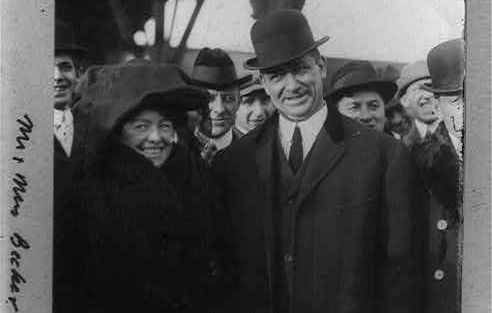
Charles Becker and his wife beaming to the press, although I don’t know what they’re smiling about. Becker was convicted of authorizing the murder of down-and-out gambler Herman Rosenthal. The disgraced cop was eventually sent to the electric chair.

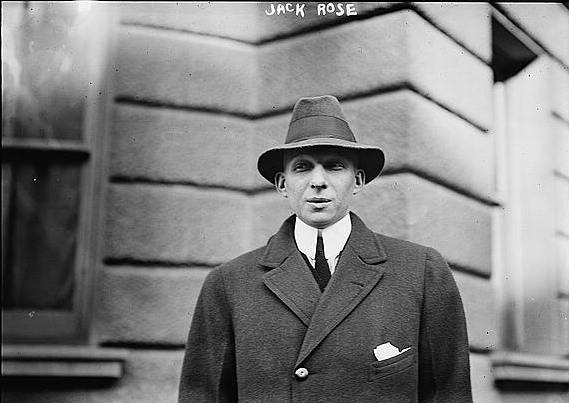
The prime witness against Becker was the otherworldly looking Bald Jack Rose, who claimed to have intimate details linking the officer to the vicious crime, which took place outside the Metropole Hotel in midtown.

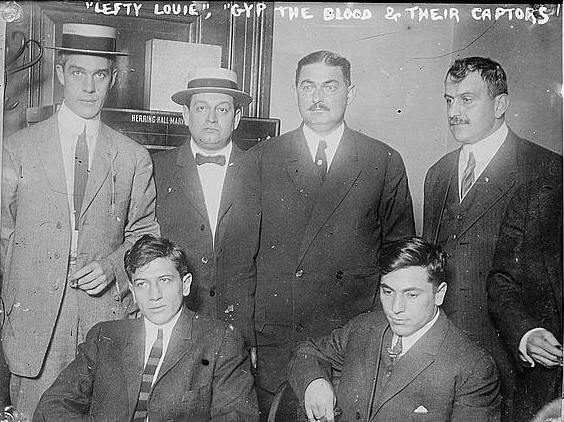
Two of the gunmen in the Rosenthal murder, nicknamed Gyp The Blood and Lefty Louie, pictured here with the men who brought them in.

I wish the first three tales had full-length histories as good as Mike Dash’s Satan’s Circus, which recounts the excrusiating tale of Herman Rosenthal’s murder and Becker’s arrest. The Becker story is actually recounted in several books, including a fairly recent one by Rose Keefe called The Starker: Big Jack Zelig, the Becker-Rosenthal Case, and the Advent of the Jewish Gangster.

CORRECTION: In referring to the new components of the Metropolitan Police, I mention the ‘city of Richmond’ when I meant the ‘county of Richmond’ — aka Staten Island.