Categories
Gilded Age New York Podcasts

Electric New York: Illuminating the shadows, re-visualizing the night

This classic episode of the Bowery Boys: New York City History podcast (originally released in December of 2021) is featured in this week’s episode of the History Channel podcast HISTORY This Week.

Since 2011 the Bowery Boys Podcast has revisited a few of the themes featured in this show. After listening to this episode, give these installments a try:

A more in-depth look at the life of Nikola Tesla:
Edison’s role in the creation of the moving picture:
The second half of this show features the history of Christmas lights:

PODCAST The streets of New York have been lit in various ways through the decades, from the wisps of whale-oil flame to the modern comfort of gas lighting. With the discovery of electricity, it seemed possible to illuminate the world with a more dependable, potentially inexhaustible energy source.

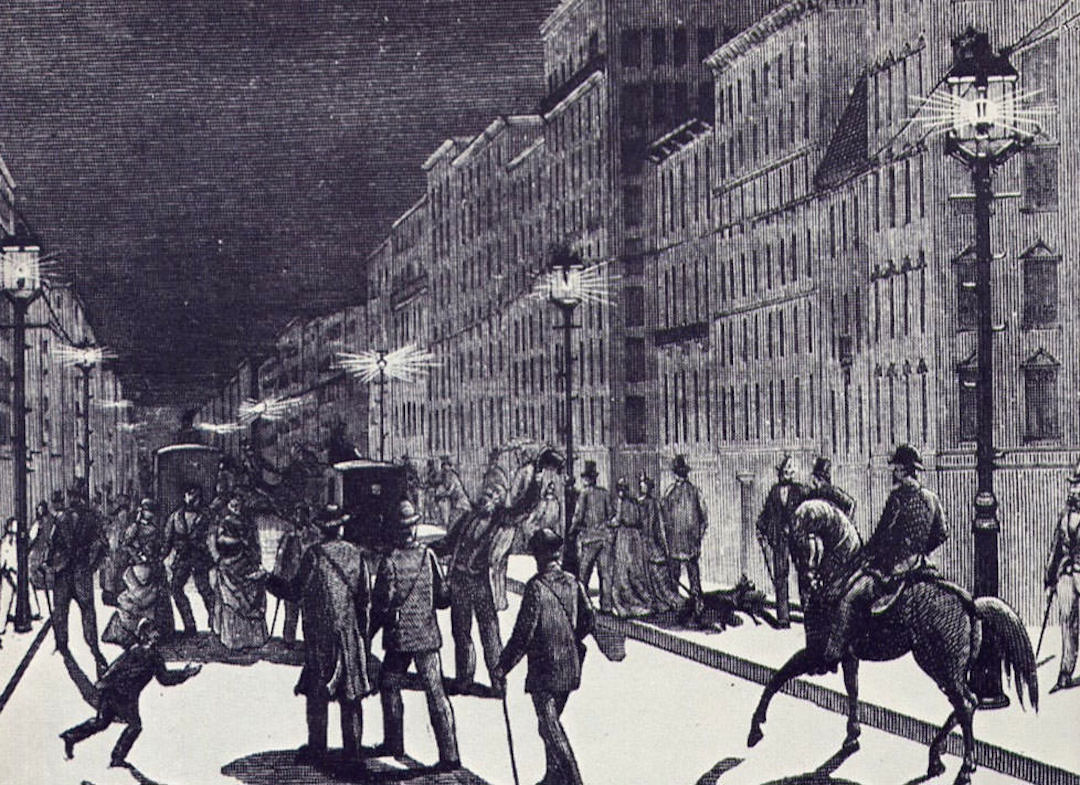
First came arc light and ‘sun towers’ with their brilliant beams of white-hot light casting shadows down among the holiday shoppers of Ladies Mile in 1880.

But the genius of Menlo Park, Thomas Edison, envisioned an entire city grid wired for electricity. From Edison’s Pearl Street station, the inventor turned a handful of blocks north of Wall Street into America’s first area entirely lit with the newly invented incandescent bulbs.

ALSO: It’s the War of Currents, the enigmatic Nicola Tesla and the world’s first electric Christmas lights.


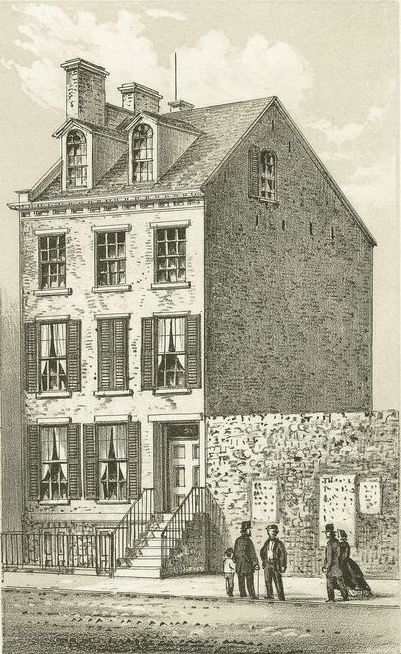
The home of Samuel Leggett, the first to be illuminated with gas lighting, at 7 Cherry Street. This home stood  just a few blocks from the location of Edison’s Pearl Street Station (255-7 Pearl Street), which would also change the way people consider lighting their city. (NYPL)
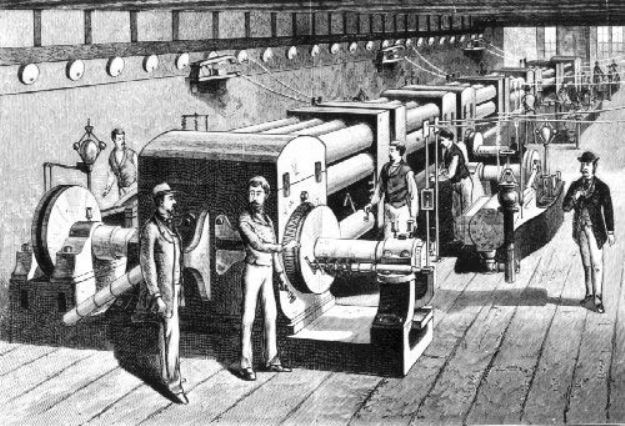
Inside the Pearl Street Station: Direct current surged through Edison’s generators to the neighboring blocks.
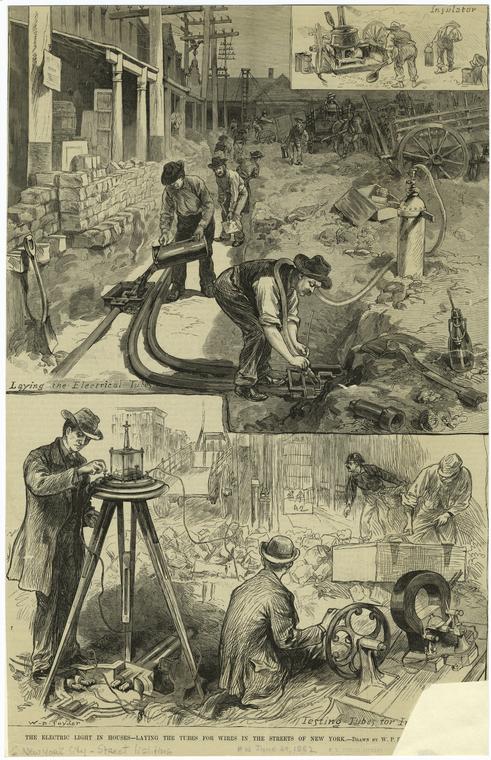
Laying the electrical wires under the streets of the blocks surrounding the Pearl Street station was an arduous, potential dangerous task. It took well over a year to complete the job. (Courtesy NYPL)  
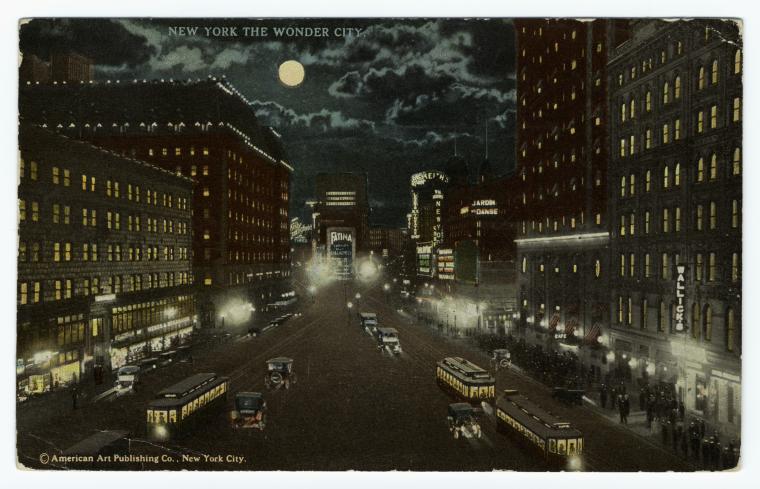
‘New York The Wonder City‘, and indeed it was, thanks to electricity. Whole neighborhoods, like Times Square and Coney Island, were defined by it. Landmarks like the Brooklyn Bridge, thoroughfares like the Bronx’s Grand Concourse and even Broadway itself were transformed at night by electric power. (NYPL)
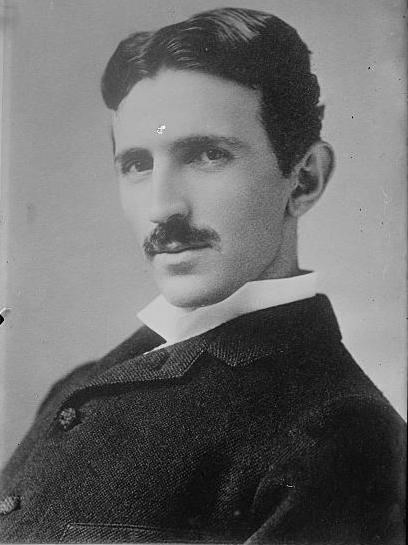
Nikola Tesla, the brilliant Serbian inventor who spent his final decades in New York living at the Hotel New Yorker.
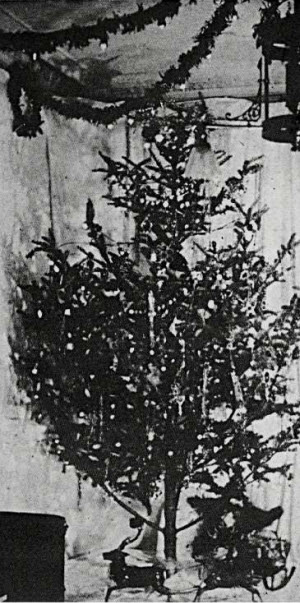
Behold! The first Christmas tree with electrical lighting, courtesy Edison employee Edward Hibberd Johnson. This tree glittered and twirled from Johnson’s home in Murray Hill. (Courtesy Jim on Light)
On the fiftieth anniversary of the invention of the lightbulb, an elderly Thomas Edison ‘reinvents’ it in 1929 at a reconstructed laboratory in Dearborn, Michigan, to the delight of Henry Ford and newly elected President Herbert Hoover.
Categories
Neighborhoods

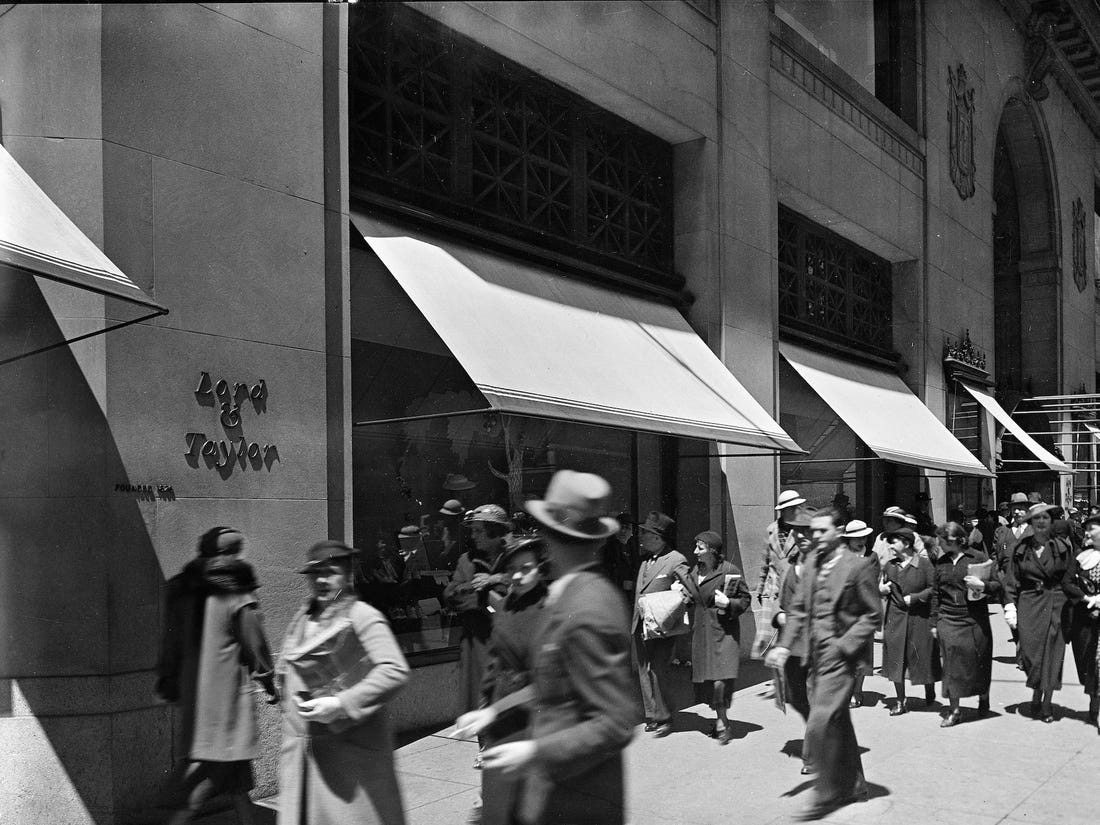
A look back at Lord & Taylor’s splashy move to Fifth Avenue in 1914

UPDATE FOR 2020: It was announced today that Lord & Taylor, America’s first department store, has announced it will go out of business after 193 years. It began in 1826 as women’s clothing store in Lower Manhattan.

In tribute, we are bumping up this article from 1914, framed around its 1914 move to the Fifth Avenue shopping district.

Thank you Lord & Taylor — for the glamour, for the Christmas windows, for legacy that reaches back to the earliest year of New York retail history.


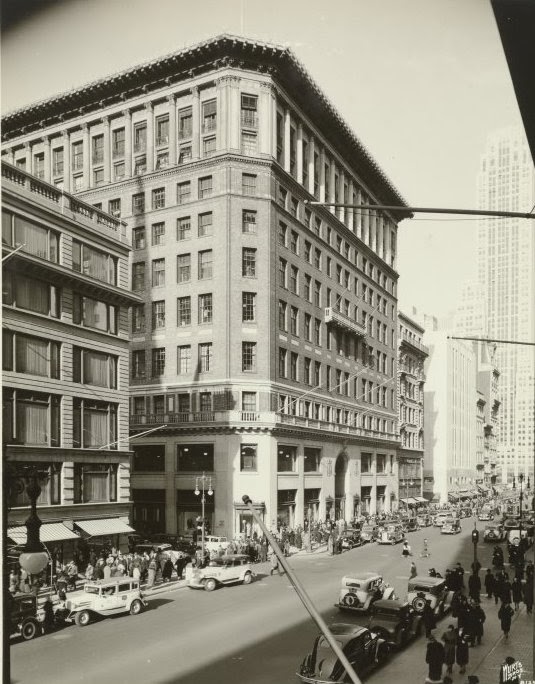
Lord & Taylor’s at Fifth Avenue and 38th Street, in the 1920s, photo by the Wurts Brothers (courtesy NYPL)

Loehmann’s, the once-great Brooklyn-based department store, closes all their locations for good tomorrow, another causality of the changing economy and people’s changing tastes in shopping.

But let’s not dwell on the decline of the department store. Let’s revisit the heyday, shall we?


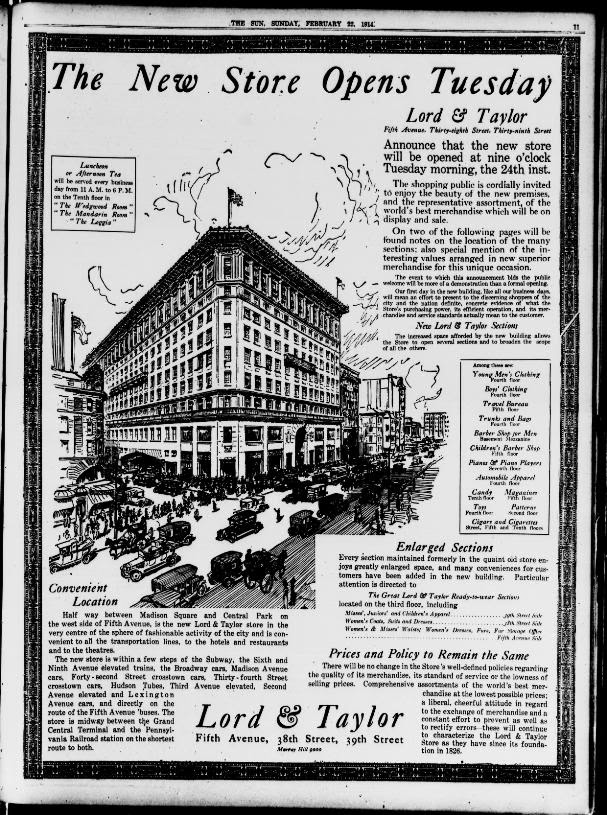
Lord and Taylor Department Store opened the doors to their tony Fifth Avenue address one hundred years ago yesterday, on February 24, 1914.

“Half way between Madison Square and Central Park on the west side of Fifth Avenue, is the new Lord & Taylor store in the very centre of the sphere of fashionable activity of the city and is convenient to all the transportation lines, to the hotels and restaurants and to the theatres.”

The store traces its lineage to a three-story women’s clothing store on 47 Catherine Street, which was opened in 1826 by Samuel Lord and George Washington Taylor.  Nearby, men could find equally fine fashions at the clothier of H & D.H.. Brooks (today Brooks Brothers) at Catherine and Cherry Streets.  Catherine Street is hardly a place where you would look for high-end brands today, located between the Manhattan and Brooklyn Bridges.

Lord & Taylor had subsequent locations in Manhattan at Broadway and Grand Street and, later, at Broadway and 20th Street on Ladies Mile.

Flash forward to 1914 — the new store was an automated wonder, according to the New York Sun, equipped with a system of conveyor belts.  “[T]he human equation has been eliminated wherever possible and machinery performs its part quietly and out of sight.”

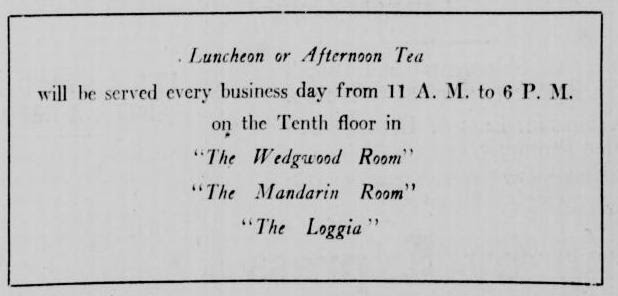
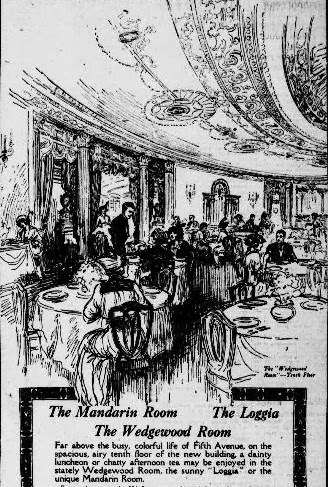
Shoppers could also escape to the tenth floor for “a dainty luncheon” or some afternoon tea:

The building is in the go-to architectural style for department stores — Italian Renaissance Revival — and, apparently, the go-to architectural firm for such places, Starrett and Van Vleck, also known for Bloomingdale’s and Saks Fifth Avenue.

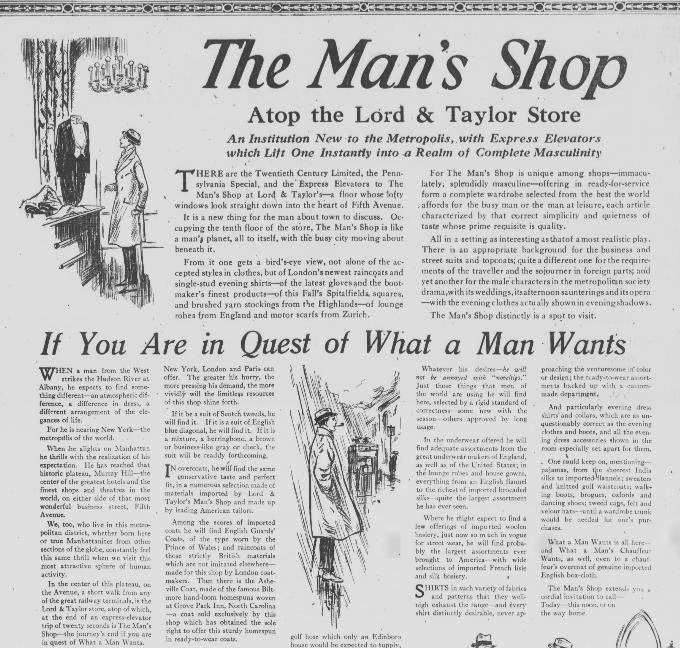
The new store made a unique appeal to the male shopper with its tailored men’s department, “a realm of complete masculinity”.  There was a men’s-only entrance on the 38th Street side where gentlemen could access the Manicuring Parlor.  “[M]ake your purchases, be shaved and manicured, change your clothing, if you like, and leave without passing through any of the departments where women’s goods are sold.”  In addition, the entire fourth floor was “devoted to men’s apparel and accessories for motoring.”

The store also had featured an Equestrienne Section, including “a mechanical horse, duplicating the actual motion of walking, trotting, or cantering.”

In 2007, the Lord & Taylor building was made an official New York landmark.

Categories
Landmarks Podcasts

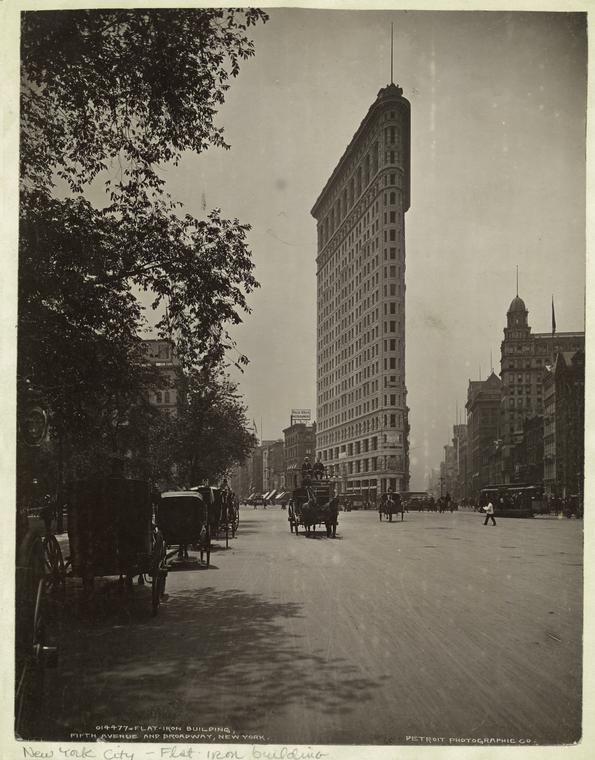
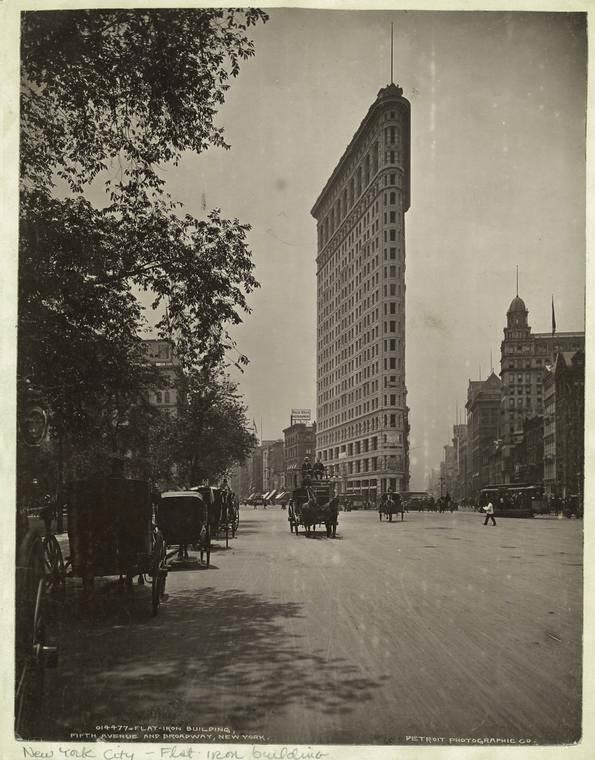
Flatiron Building: A Three-Sided Story

PODCAST For our 8th anniversary episode, we’re revisiting one of New York City’s great treasures and a true architectural oddity — the Flatiron Building.

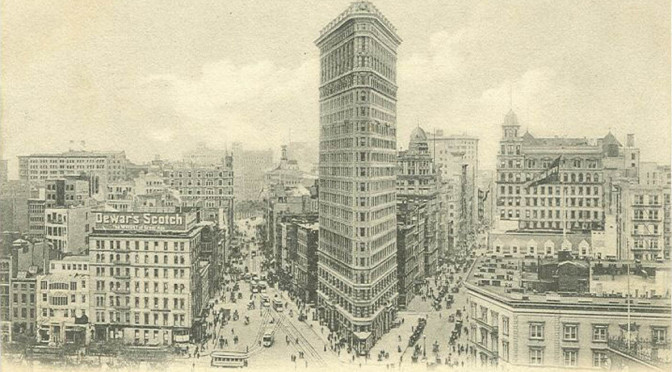
When they built this structure at the corner of Madison Square Park (and completed in 1902), did they realize it would be an architectural icon AND one of the most photographed buildings in New York City?

1

The George A. Fuller Company, one of the most powerful construction firms in Chicago, decided to locate their new New York office building in a flashy place — a neighborhood with no skyscrapers, on a plot of land that was thin and triangular in shape. They brought in Daniel Burnham, one of America’s greatest architects, to create a one-of-a-kind, three-sided marvel, presenting a romantic silhouette and a myriad of optical illusions.

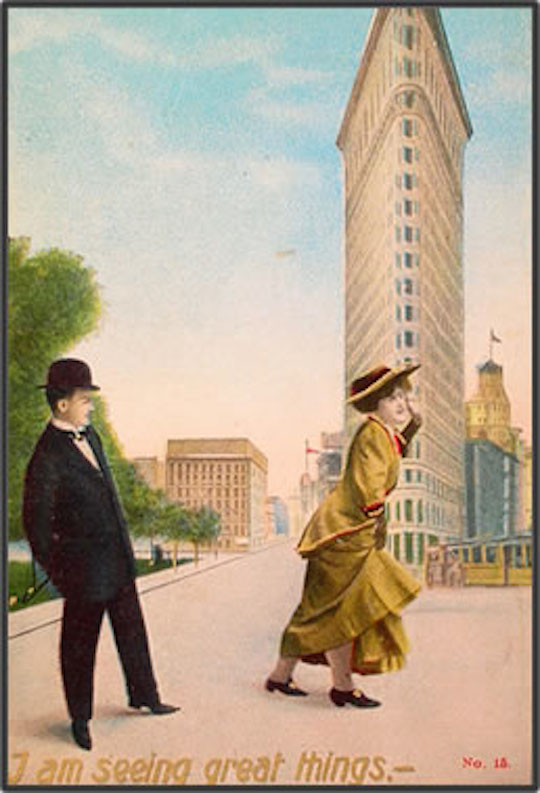
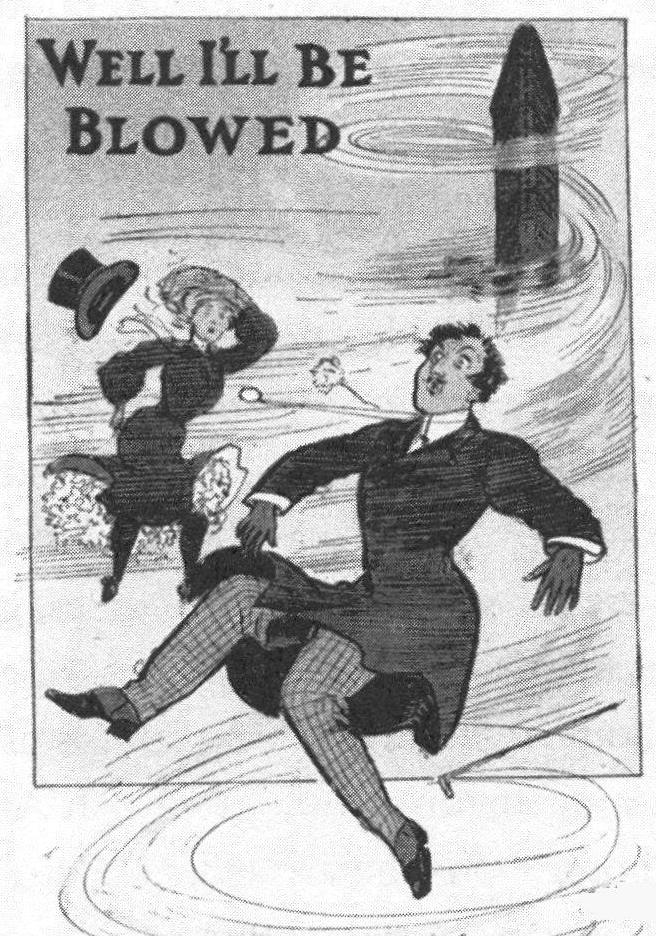
The Flatiron Building was also known for the turbulent winds which sometimes blew out its windows and tossed up the skirts of women strolling to Ladies Mile. It’s a subject of great art and a symbol of the glamorous side of Manhattan.

In this show, we bring you all sides of this structure’s incredible story.


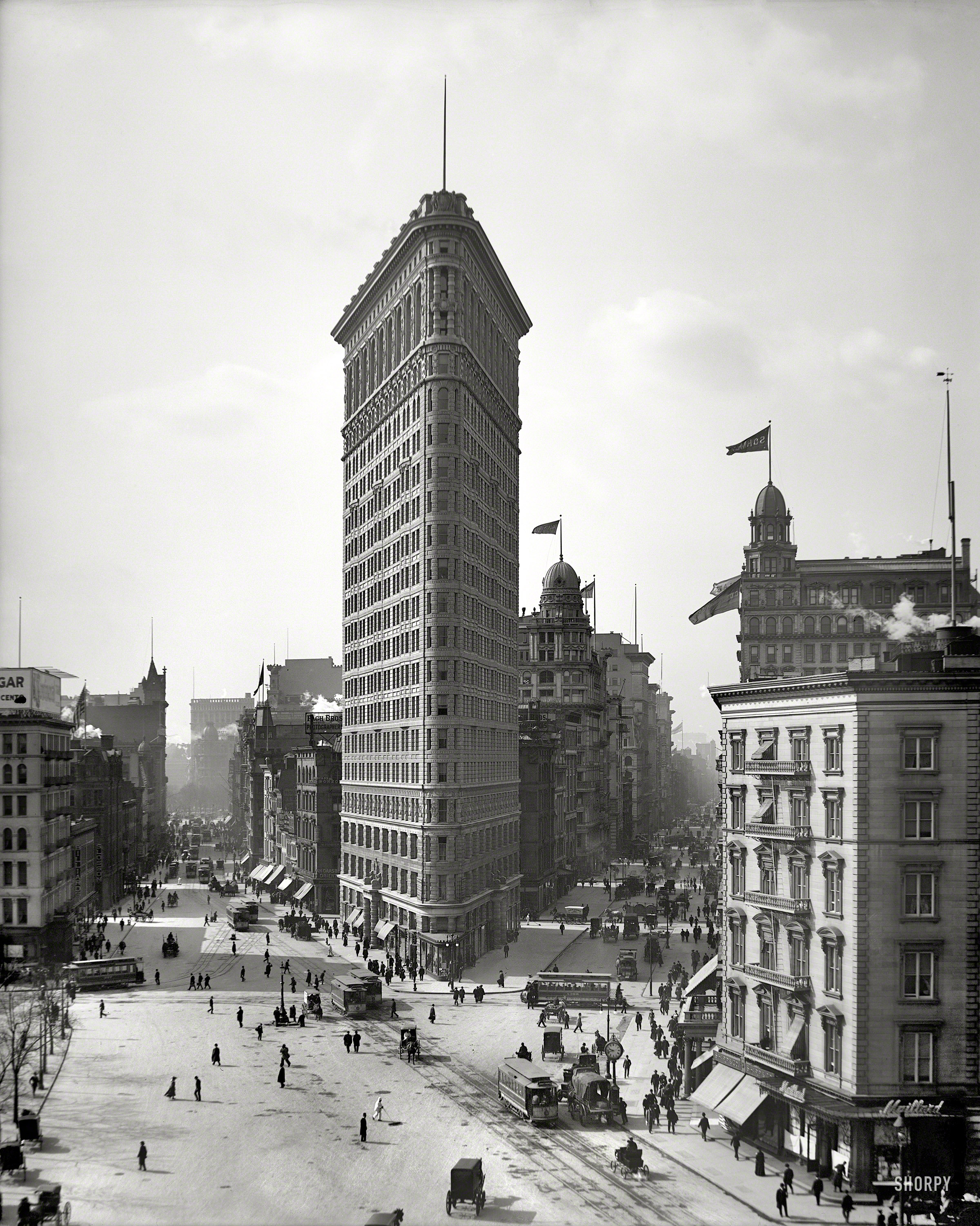
Below: A cleaned up look at the Flatiron Building, courtesy Shorpy. Click here for a look at the details!

Courtesy Shorpy
Courtesy Shorpy

The Bowery Boys: New York City History podcast is brought to you …. by you!

Starting this month, we are doubling our number of episodes per month. Now you’ll hear a new Bowery Boys podcast every two weeks. We’re also looking to improve the show in other ways and expand in other ways as well — through publishing, social media, live events and other forms of media. But we can only do this with your help!

We are now a member of Patreon, a patronage platform where you can support your favorite content creators for as little as a $1 a month.

Please visit our page on Patreon and watch a short video of us recording the show and talking about our expansion plans. If you’d like to help out, there are five different pledge levels (and with clever names too — Mannahatta, New Amsterdam, Five Points, Gilded Age, Jazz Age and Empire State). Check them out and consider being a sponsor.

We greatly appreciate our listeners and readers and thank you for joining us on this journey so far. And the best is yet to come!


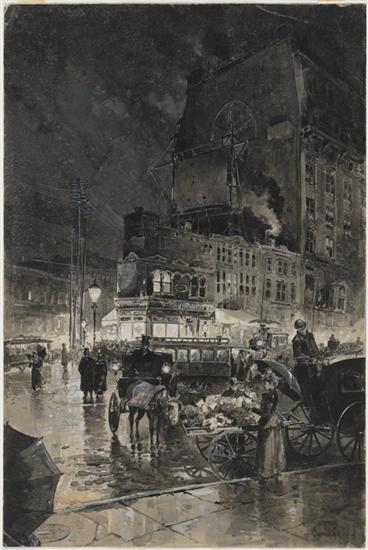
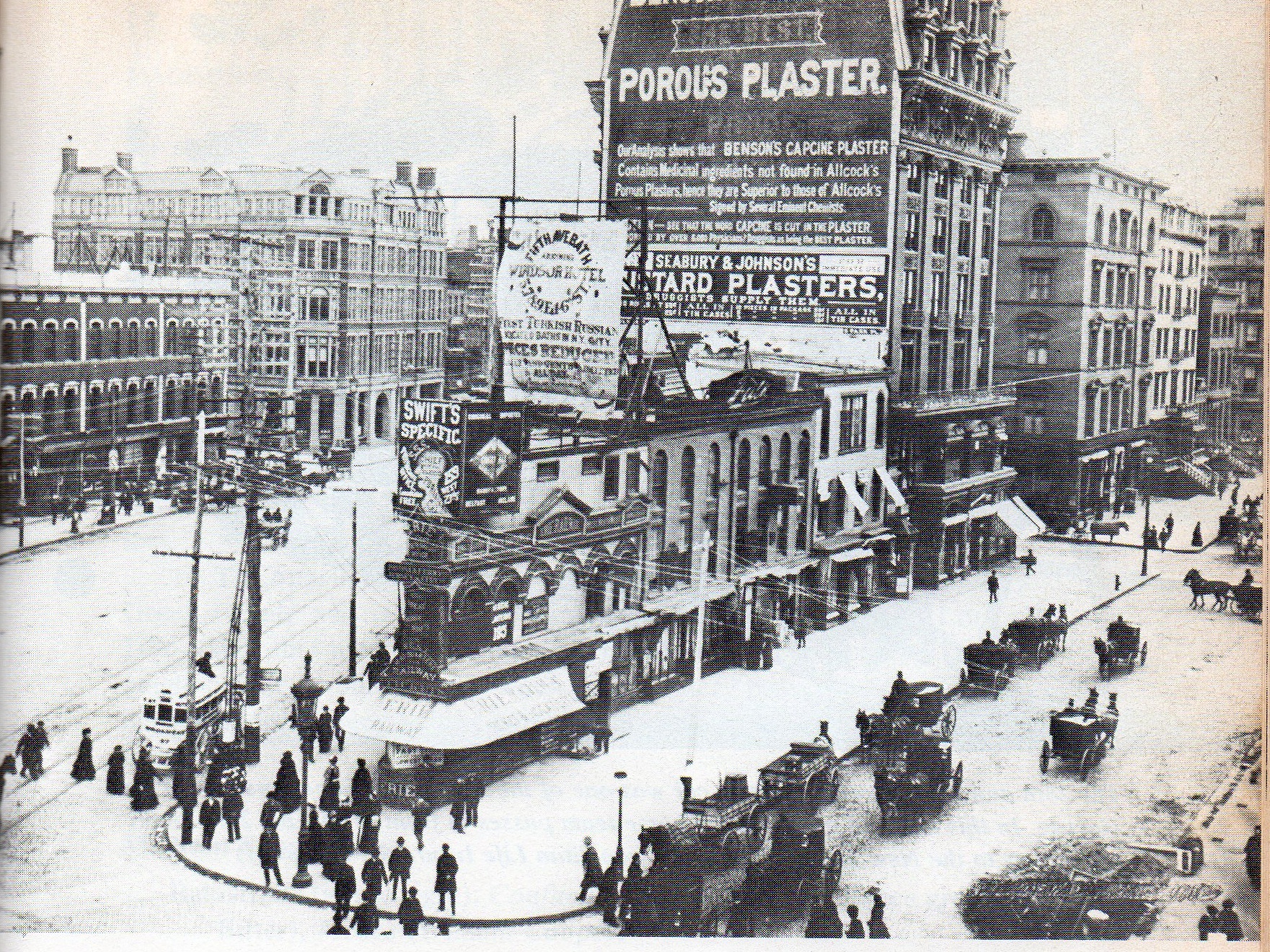
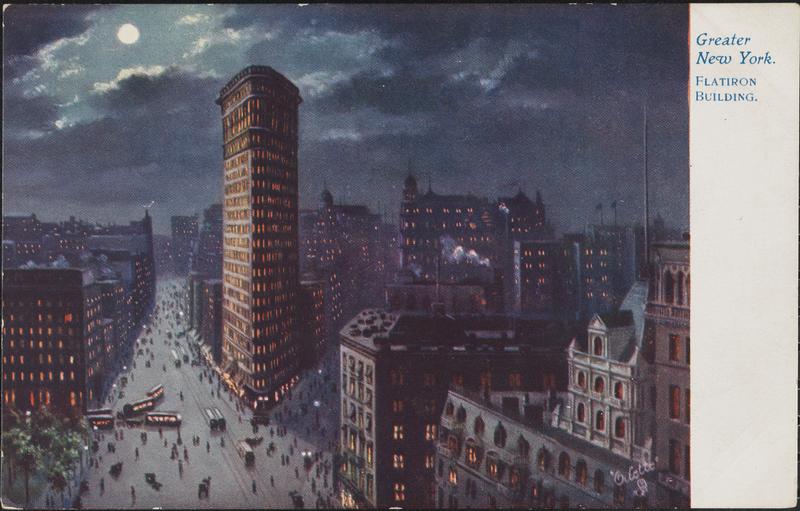
A dramatic illustration of 23rd Street and Fifth Avenue, where the Flatiron Building would soon stand. From here you can see the taller Cumberland building which would be used for billboards.

5

The structures that pre-dated the Flatiron Building, pictured here in 1897.

Courtesy Museum of City of New York
1

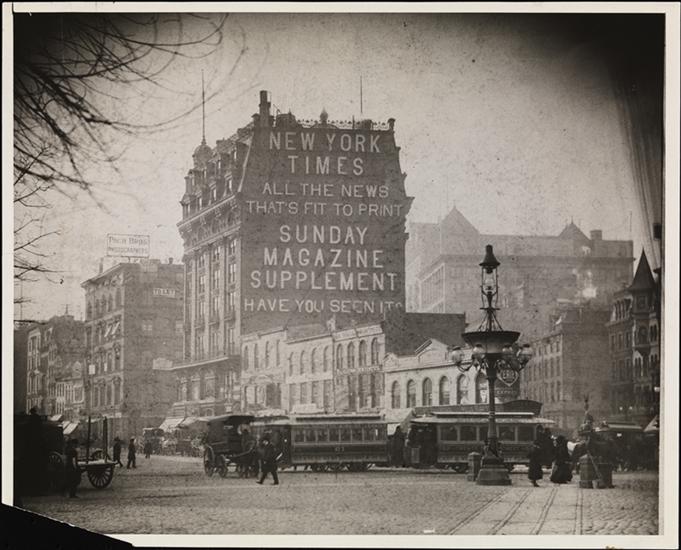
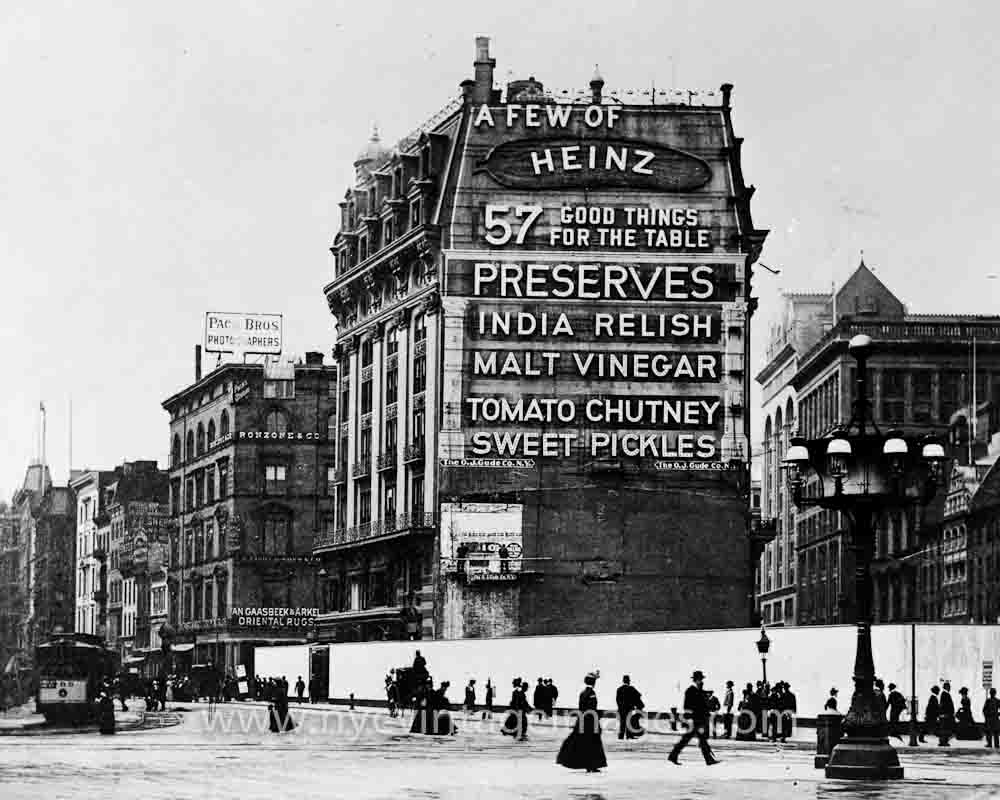
The smaller buildings have already been cleared away for the construction of the Fuller/Flatiron Building, but the taller building remains to some promotion of Heinz products.

Courtesy vintageimages.com

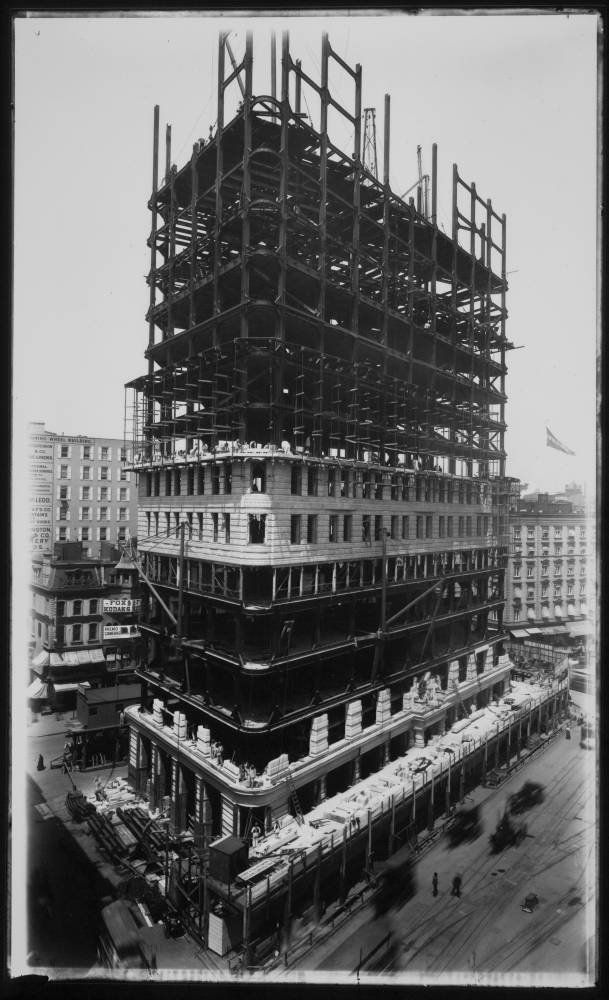
Construction of the Flatiron, picture from late 1901 or early 1902.

6
Courtesy Library of Congress

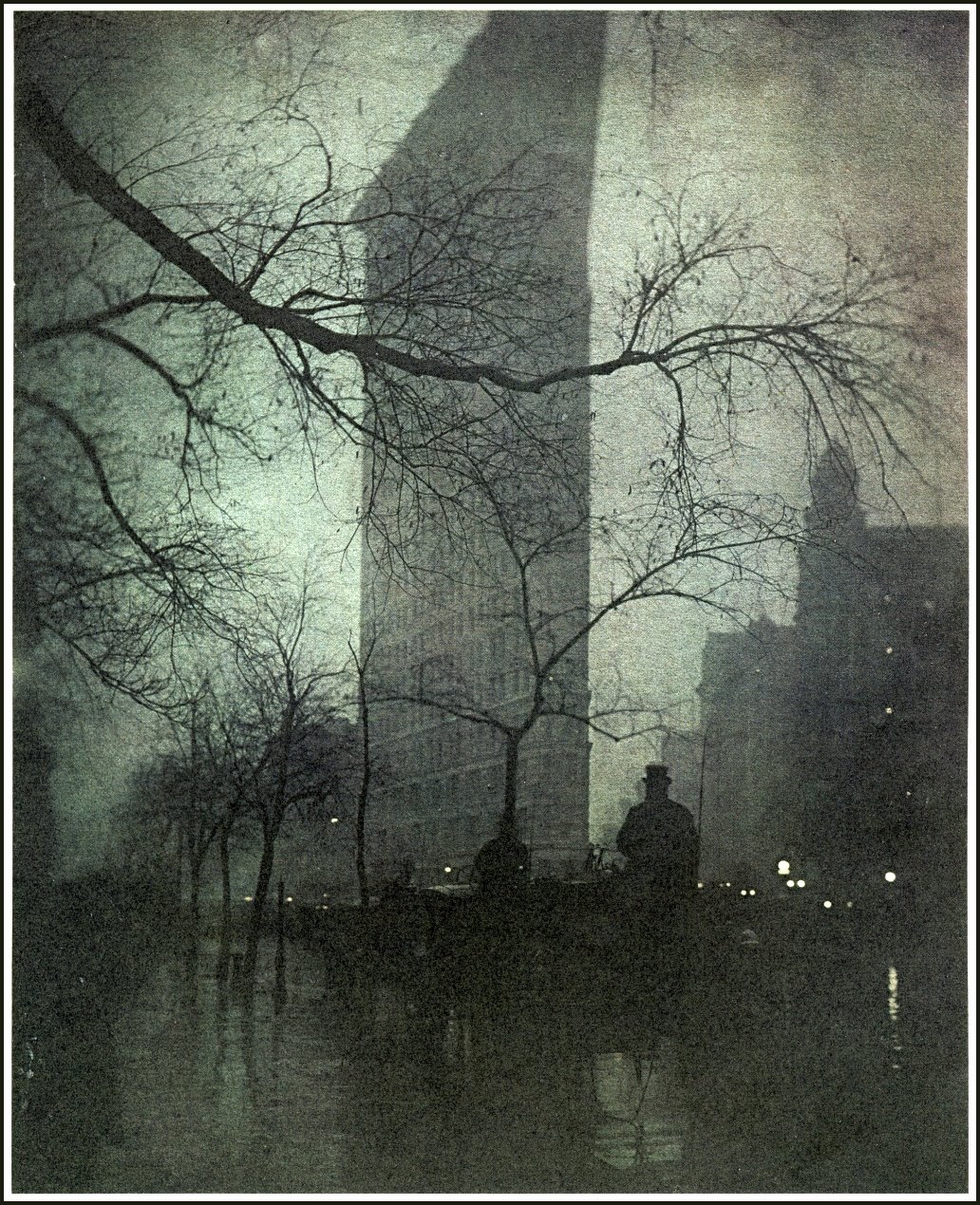
From every angle, the Flatiron takes on a new shape…..

Courtesy New York Public LIbrary

…inspiring artists like Edward Steichen to frame the building in romantic and even mysterious ways (such as his iconic shot from 1904)

edward

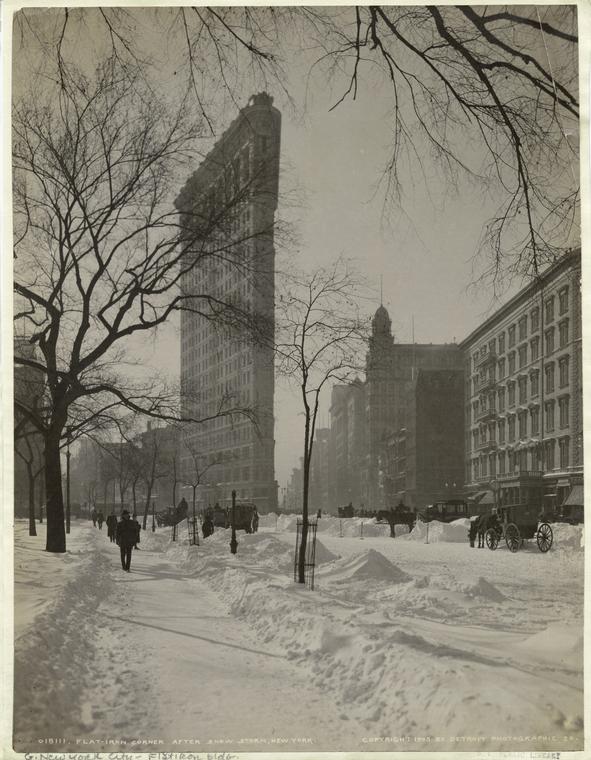
A view, similar to the classic one above, of the Flatiron after a snowstorm in 1905

Courtesy New York Public Library

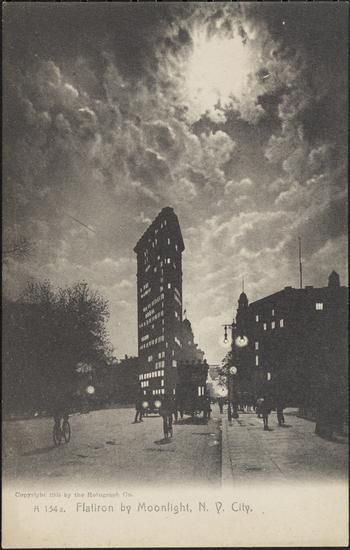
The Flatiron has inspired thousands of photo-mechanical post cards back in the day, highlighting its alluring shape-shifting form upon the changing New  York skyline.

2
Courtesy Museum of the City of New York

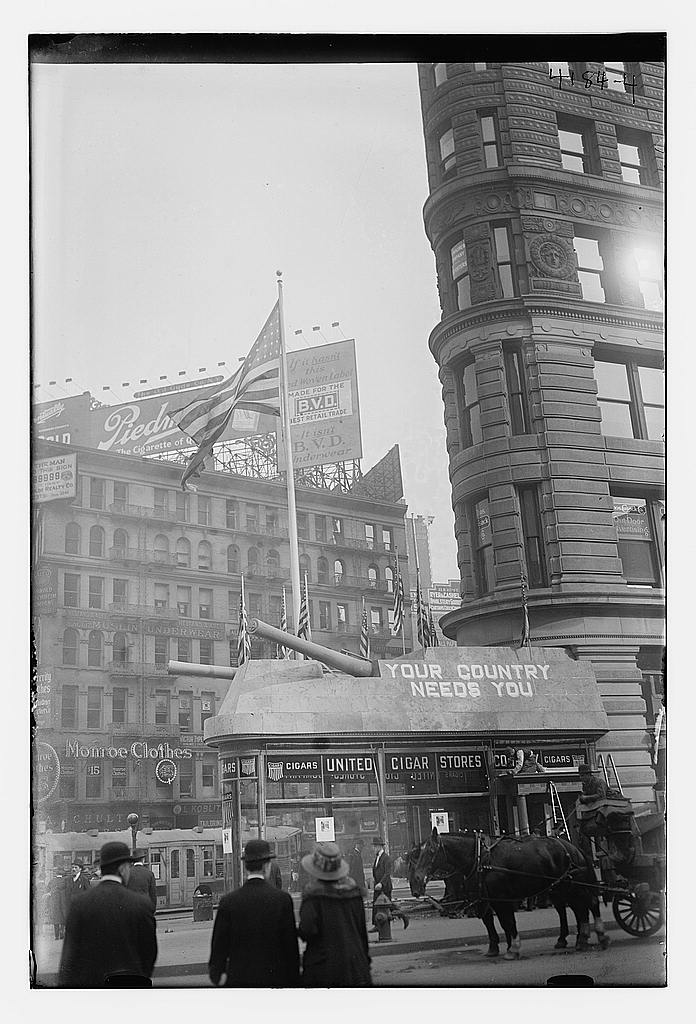
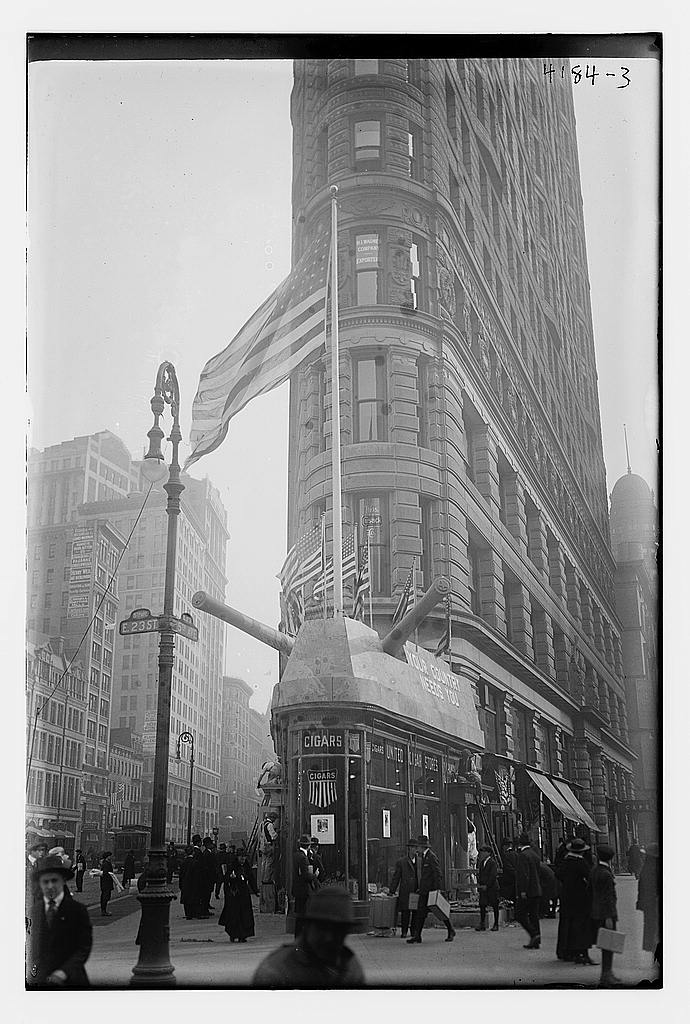
The cigar store in the narrow ‘cowcatcher’ served as a recruitment office during World War I, topped with military weaponry.

Courtesy Library of Congress

Another postcard focused on the Flatiron’s particularly windy properties!

wind

American Mutoscope and Biography Co. filmed this humorous look at ladies in the wind on October 26, 1903:

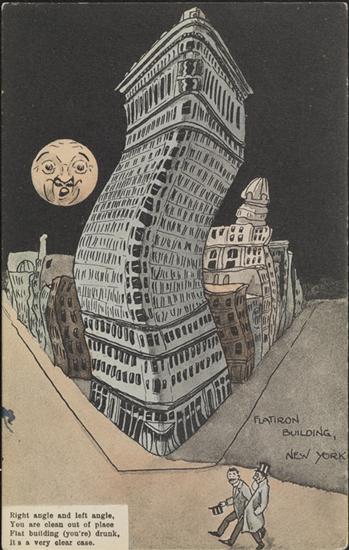
A Max Ettlinger illustration from 1915 — Flatiron, you’re drunk!

Courtesy Museum of City of New York

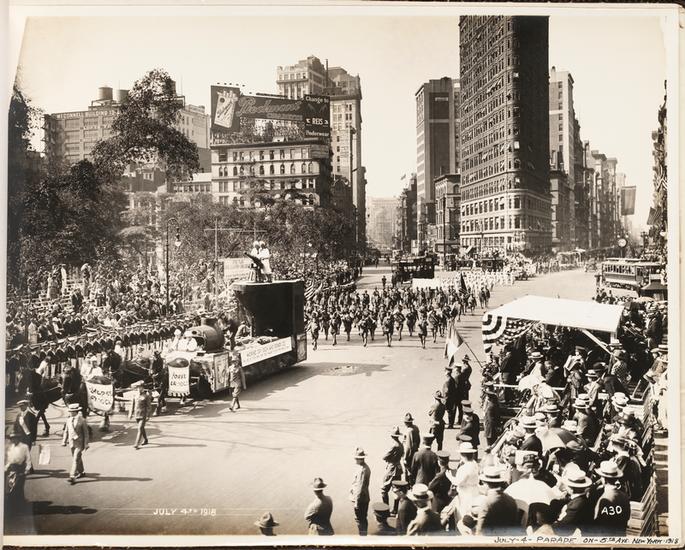
A July 4th parade, passing up Fifth Avenue.

Courtesy Museum of the City of New York

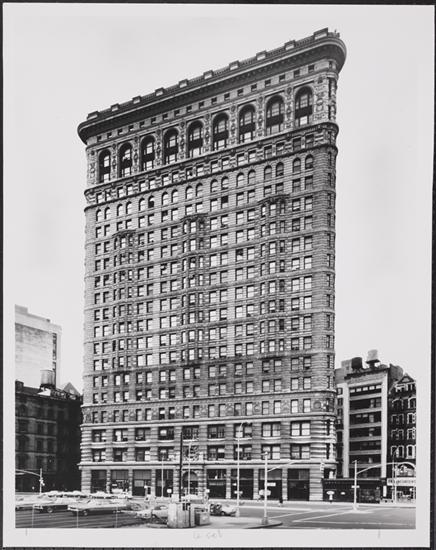
The Flatiron in 1935, from an angle that makes it appear almost two dimensional.

1935

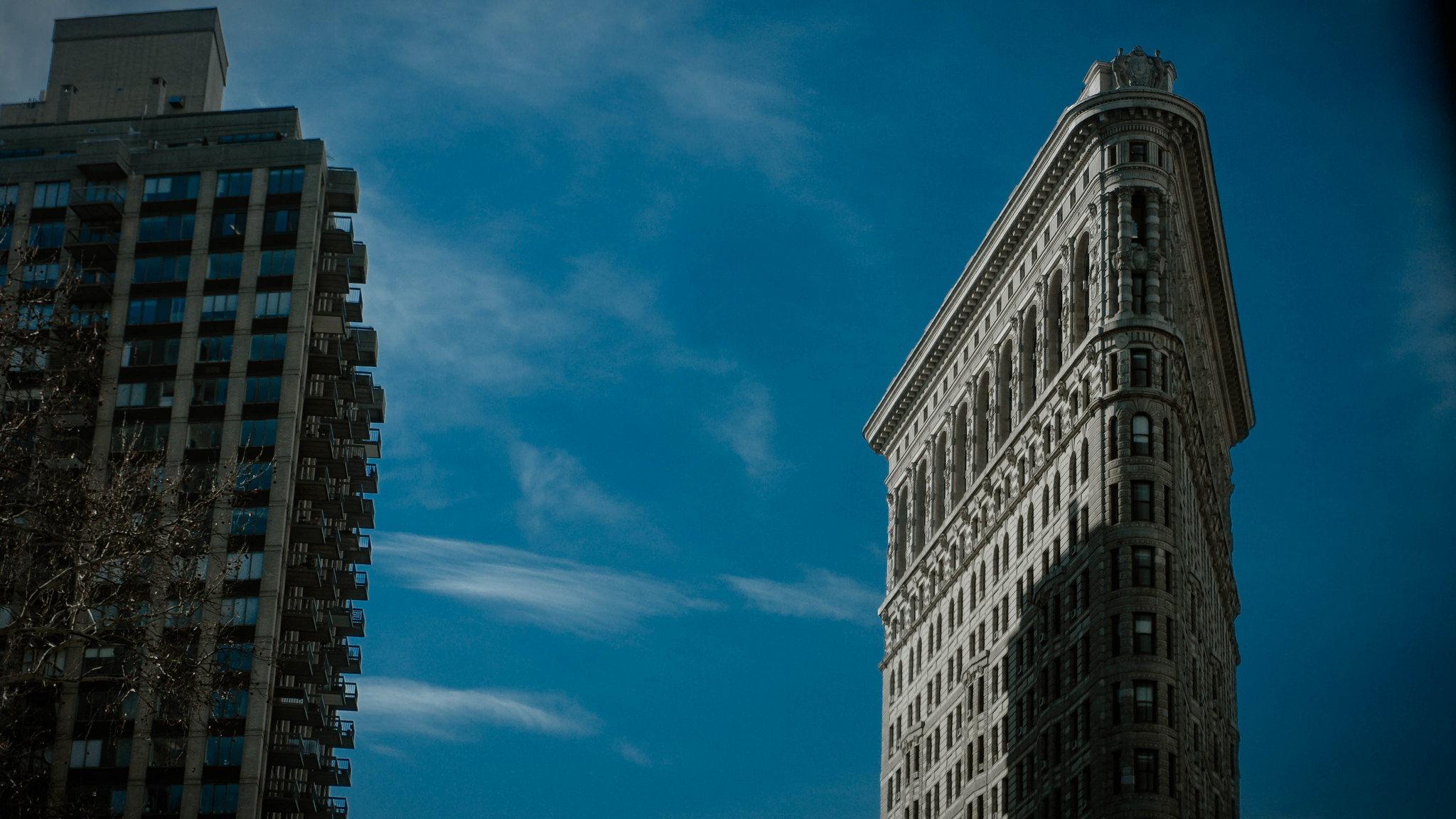
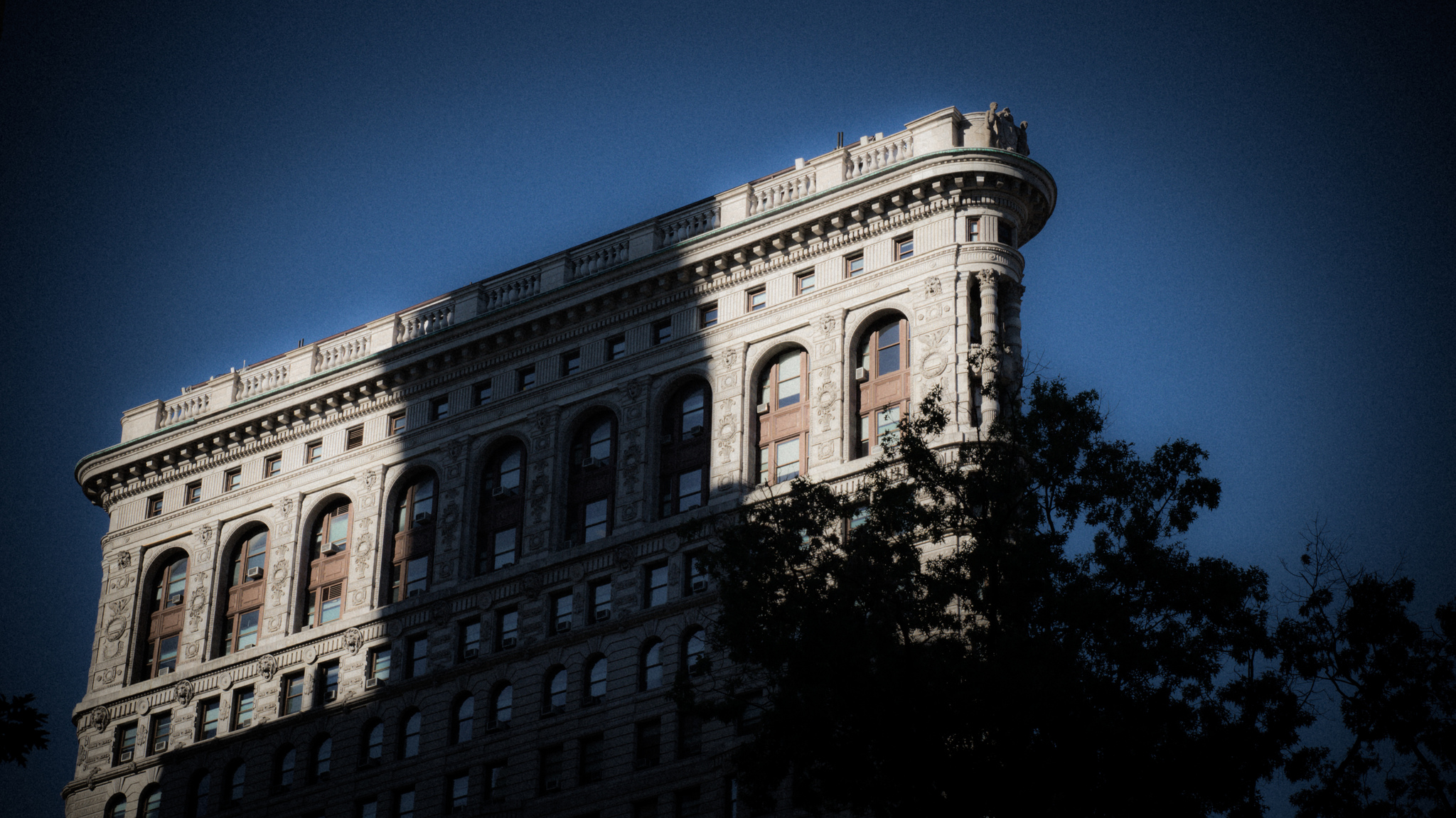
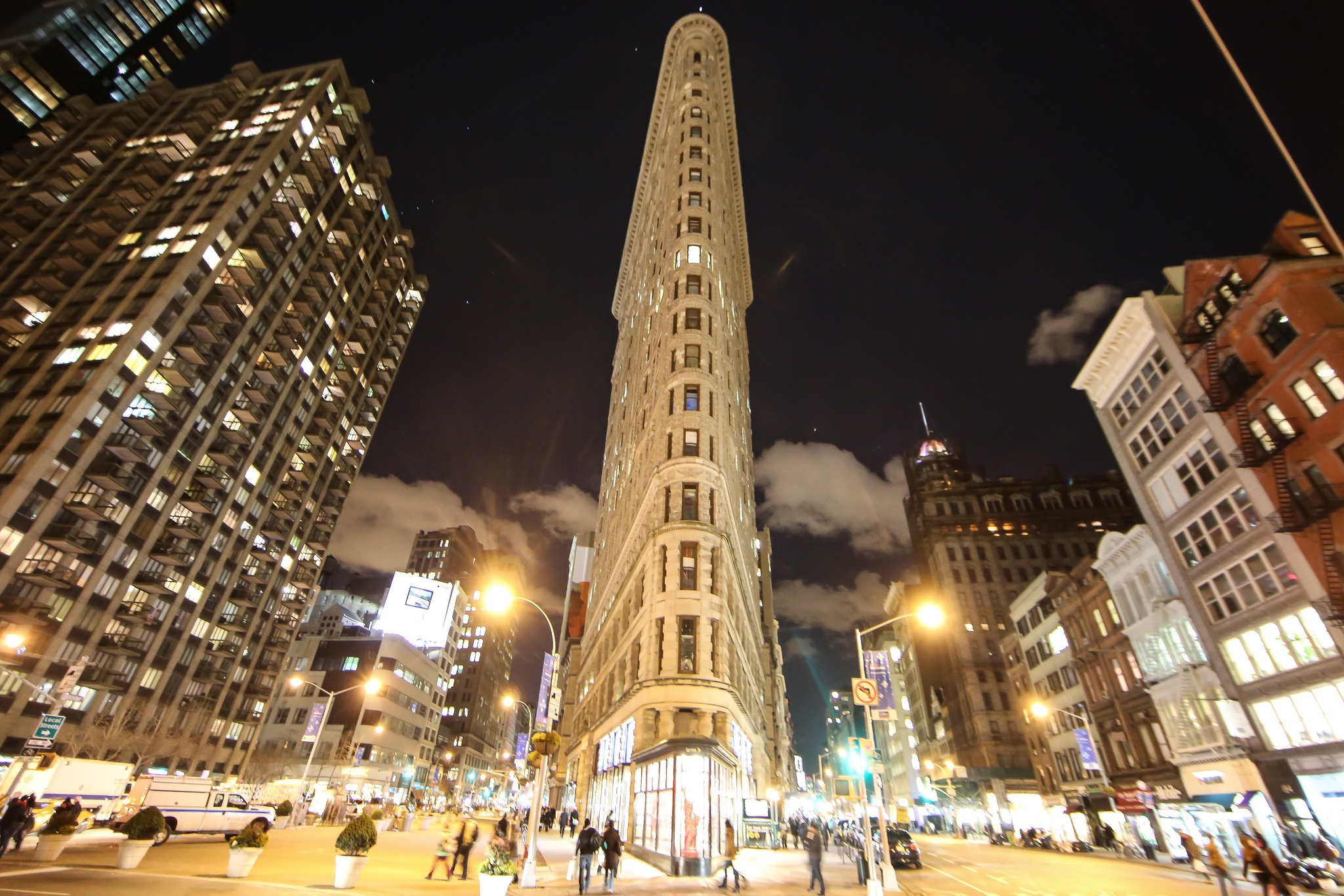
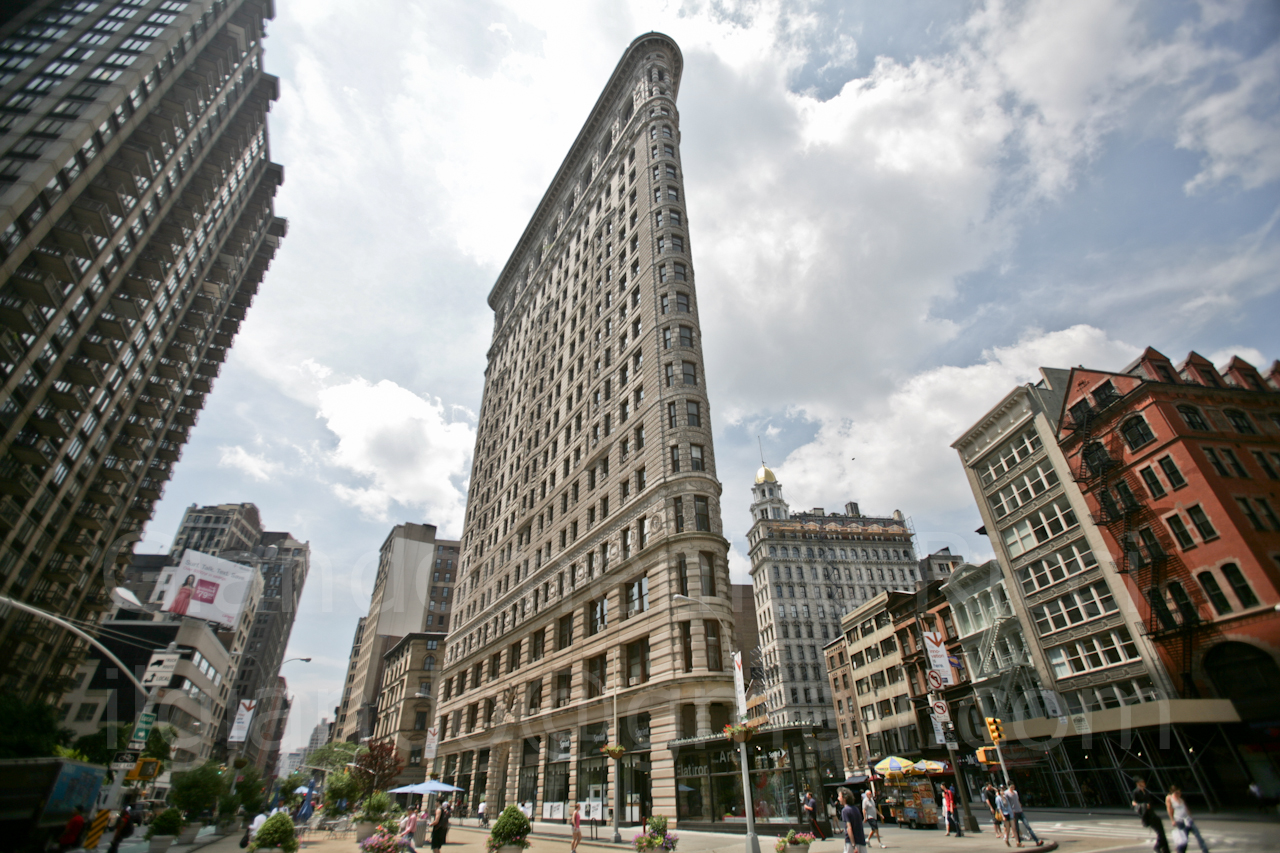
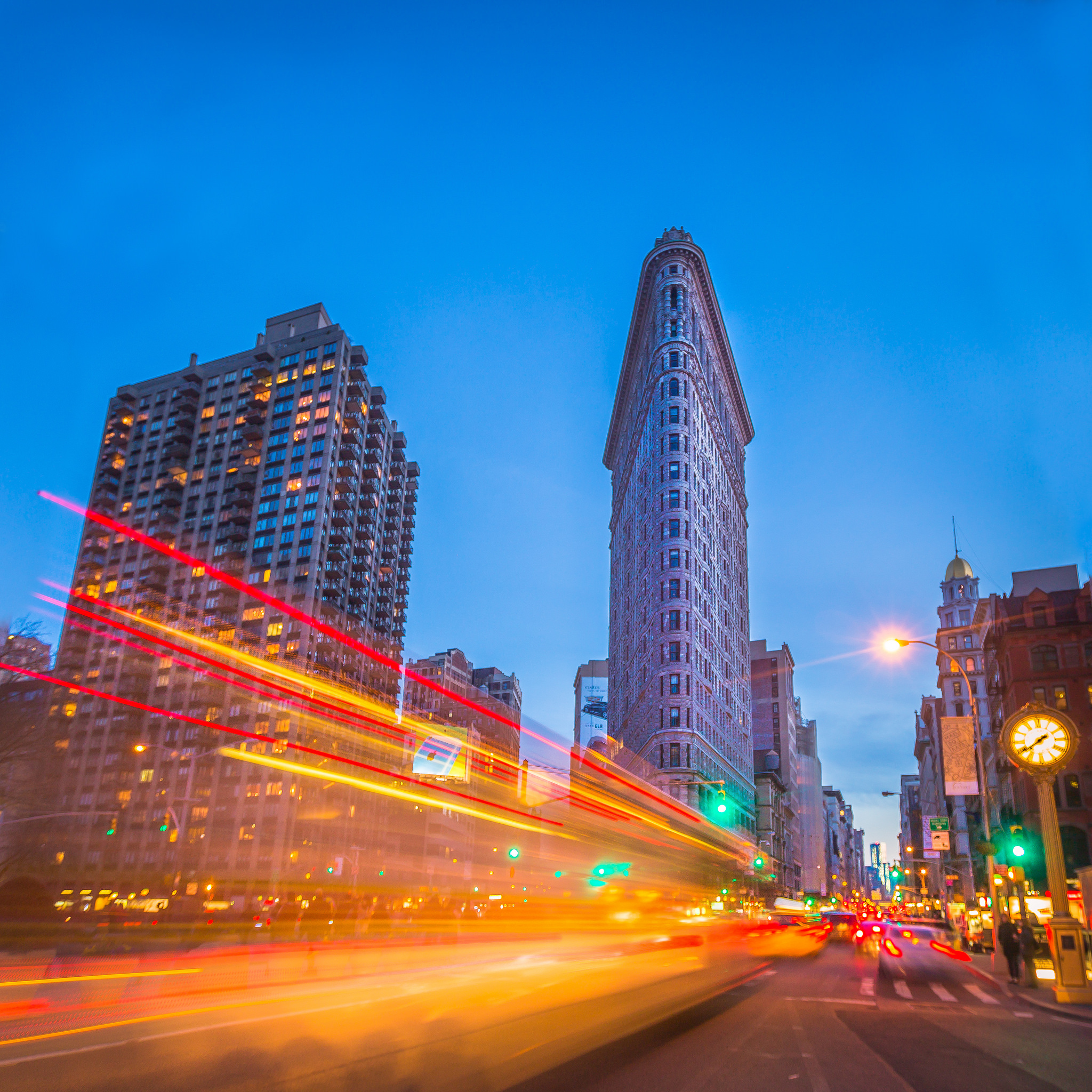
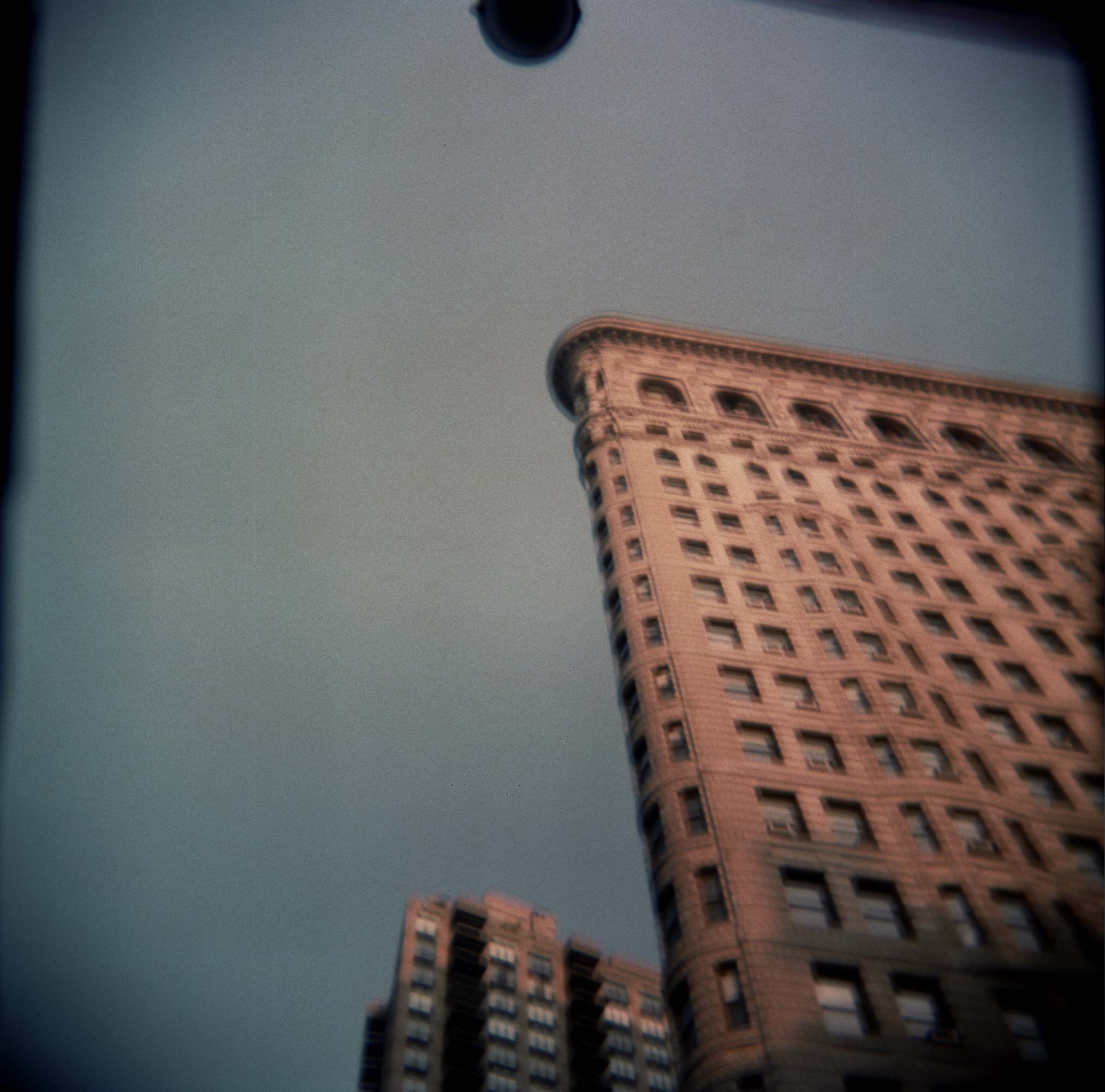
The Flatiron — still a magnet for budding photographers everywhere! Here a couple modern images from photographers Jeffrey Zeldman, Thomas Hawk, Giandomenico Ricci, Anurag Yagnik, and eric molina.

Courtesy Jeffrey Zeldman/Flickr
Courtesy Thomas Hawk/flickr
Courtesy Giandomenico Ricci/Flickr
Courtesy Anurag Yagnik/Flickr
Autosave-File vom d-lab2/3 der AgfaPhoto GmbH

CORRECTION: A small correction to this week’s show. The beautiful Madison Square Garden tower — with the nude Diana statue — is actually in a Spanish style, not an Italian style.

Categories
Neighborhoods

Inside Gimbels traverse, the secret perch near Herald Square

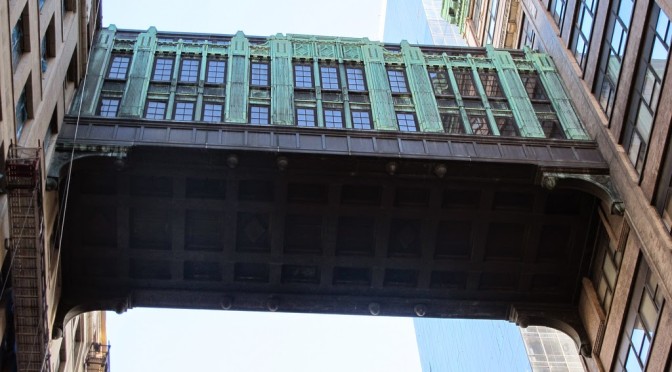
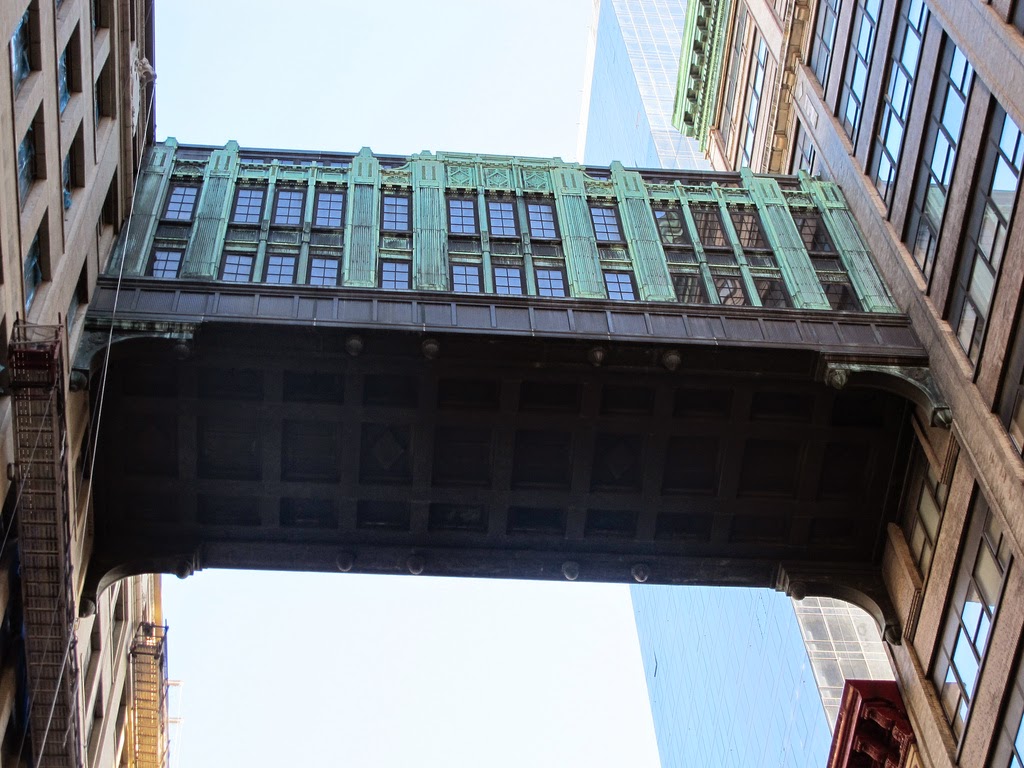
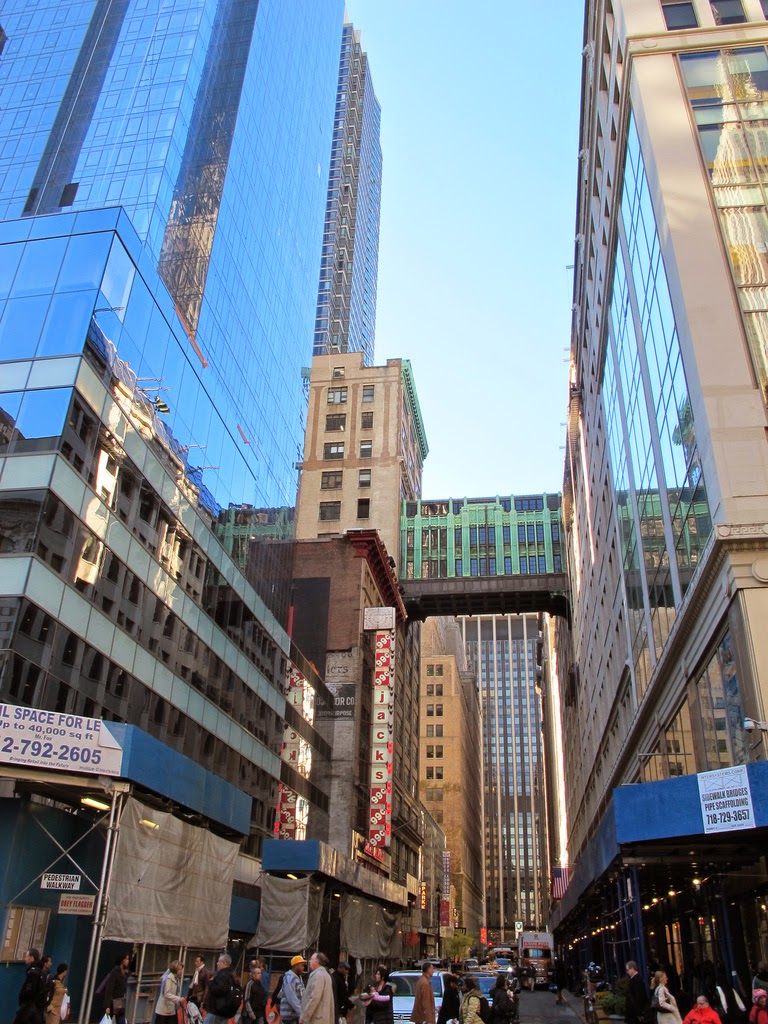
Looking up to the Gimbels traverse overhead on 32nd Street (Flickr/Docking Bay 93)

One of our podcast listeners Alexander Rea sent over the following photographs of a tucked-away place in one of the busiest areas of New York City — the Gimbels traverse on W. 32nd Street, in the Herald Square shopping district.

No doubt you’ve walked around the city and seen other sorts of traverses, those overhead bridges that link two buildings together, several stories up.  But the Gimbels traverse is perhaps the most interesting and the most beautiful in New York.  Today, this ornate treasure amusingly hangs right over Jack’s 99 Cent Store.  Here’s a bit of its history, revised from something I wrote a few years ago:

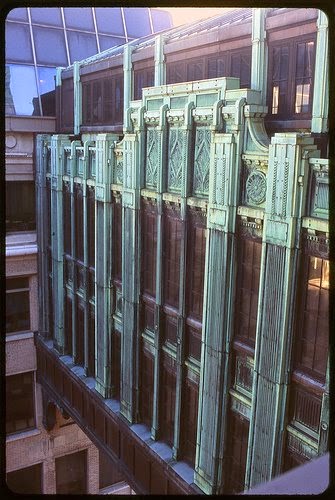
Macy’s kicked off the Herald Square department store district when it transferred here from its original 14th Street home in 1902.  [Listen to our Ladies’ Mile podcast for more information.]  Soon other department-store competitors of Macy’s flocked to the neighborhood in the early part of the 20th century. One strange vestige of this retail nostalgia still exists, in the form of a fabulous green copper traverse above W. 32nd Street.

Gimbels arrived in the Herald Square area in 1910 with a building designed by no less than Daniel Burnham (of Flatiron Building fame).  Gimbels was a more than worthy adversary of nearby Macy’s.  The early catchphrase ‘Well, would Macy’s tell Gimbels?’ exemplified the top-secret, competitive tactics of the two retail giants

Gimbels vied for attention with such wacky publicity stunts as sponsorship of a daredevil airplane race that sailed over the department store in 1911.  But despite (or perhaps, because of) other innovations such as the first ‘bargain basement’, Gimbels never reached the same hallmarks of class and reputation that Macy’s did.

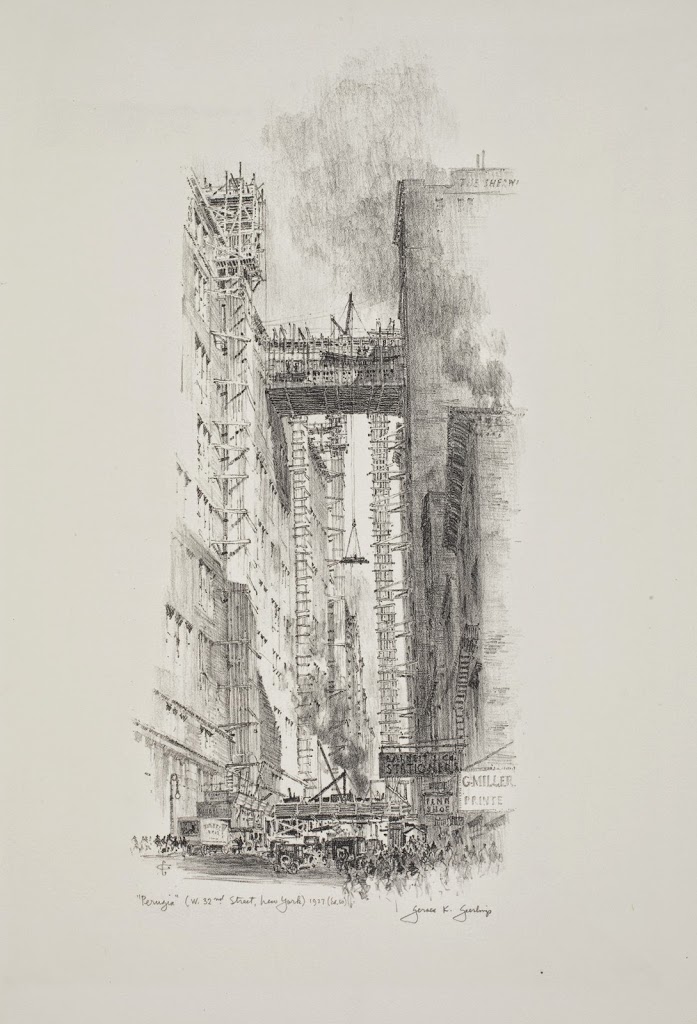
In 1925, Gimbels decided to link its Herald Square store to a recently acquired annex across the street, via a custom traverse, a beautiful copper bridge, three stories tall, created by Richmond H. Shreve and William F. Lamb, a teeth-cutting project for two young architects who would go on to help design the Empire State Building.

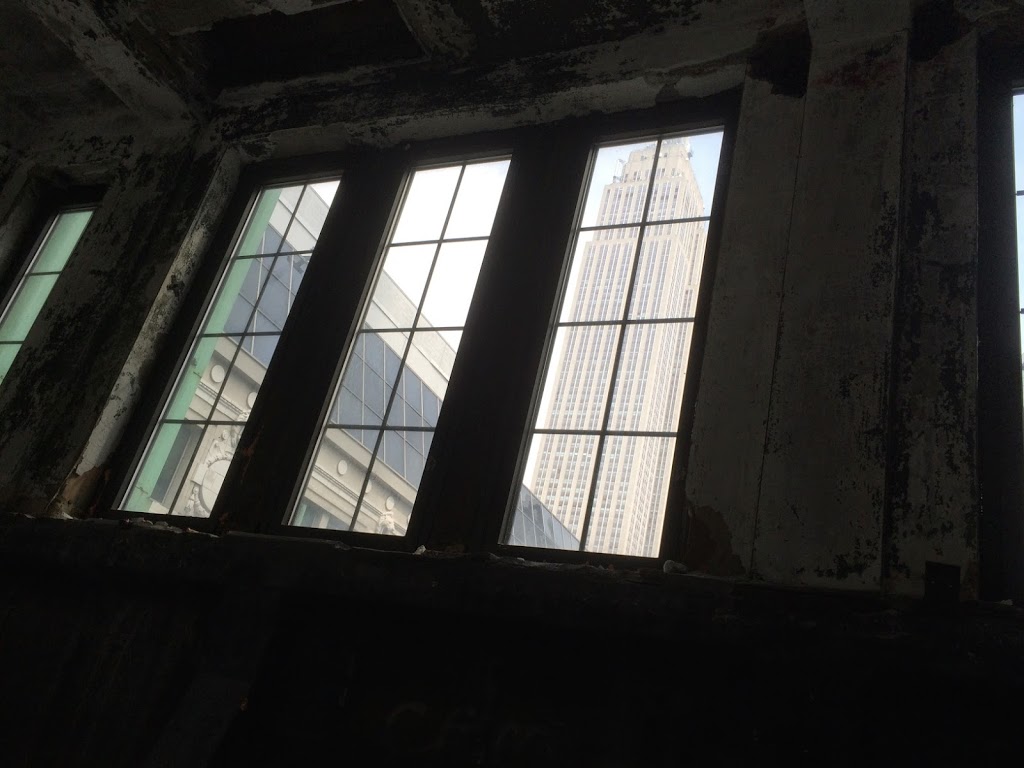
Both the original Gimbels store and its annex have been radically modified over the years. Thankfully, the copper bridge (now, like the Statue of Liberty, in bright verdigris) has been left virtually intact.  Despite some fears that it might be getting ripped down, the musty but still beautiful sky bridge still hangs high above shopper’s heads, a reminder of a universe of cut-throat department-store wars.  (Inset pictures courtesy Flickr/moufle, Docking Bay 93)

Below: A sketch, dated 1927, by Gerald K Geerlings, showing the construction of the Gimbels traverse. Courtesy the Museum of the City of New York


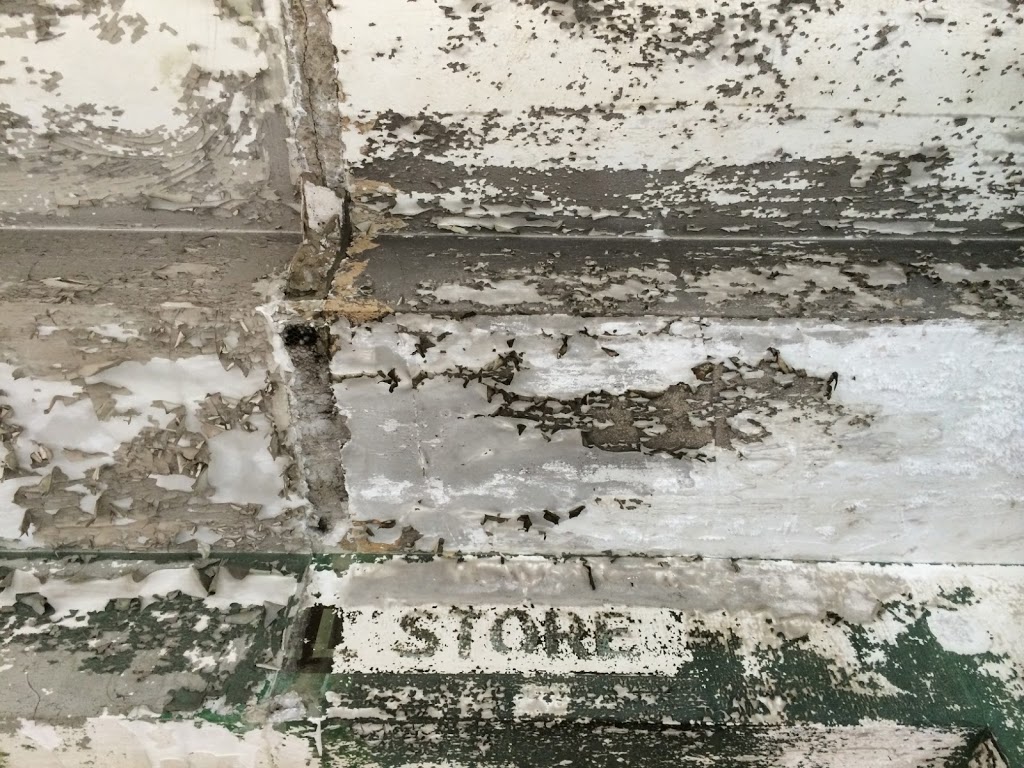
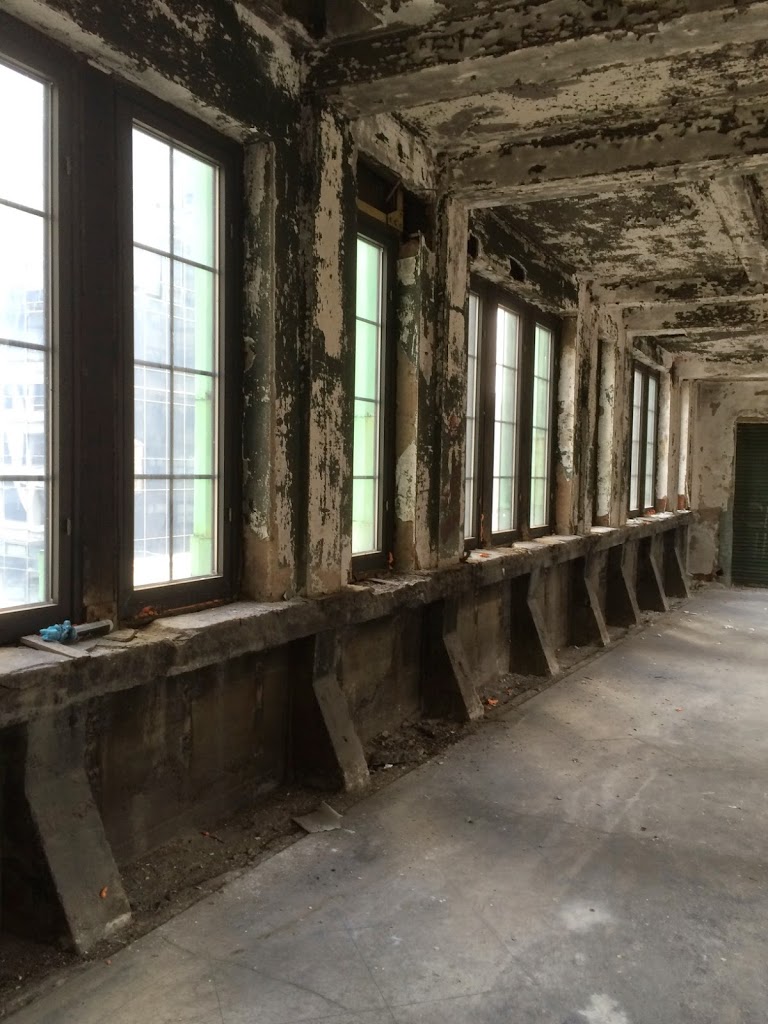
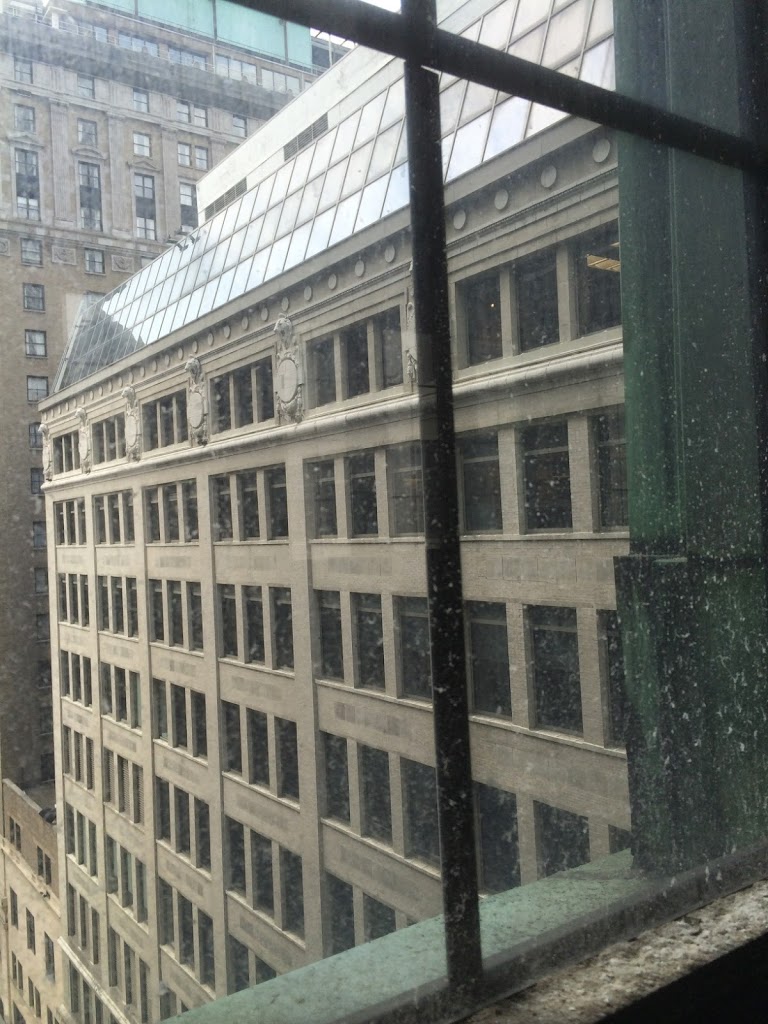
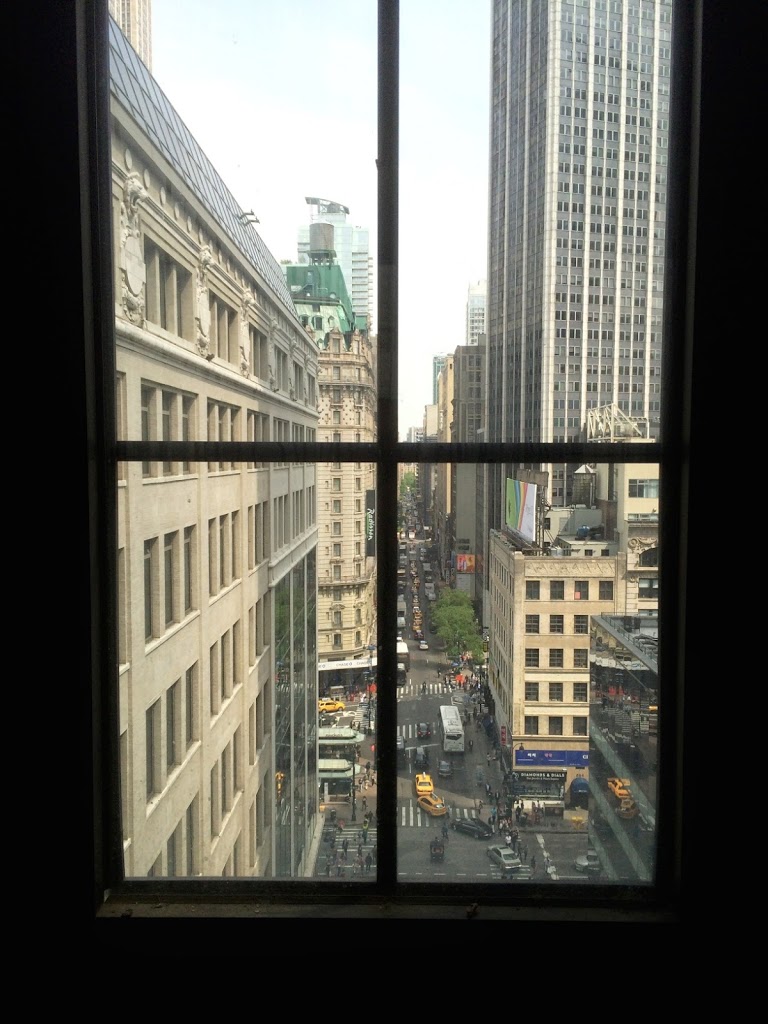
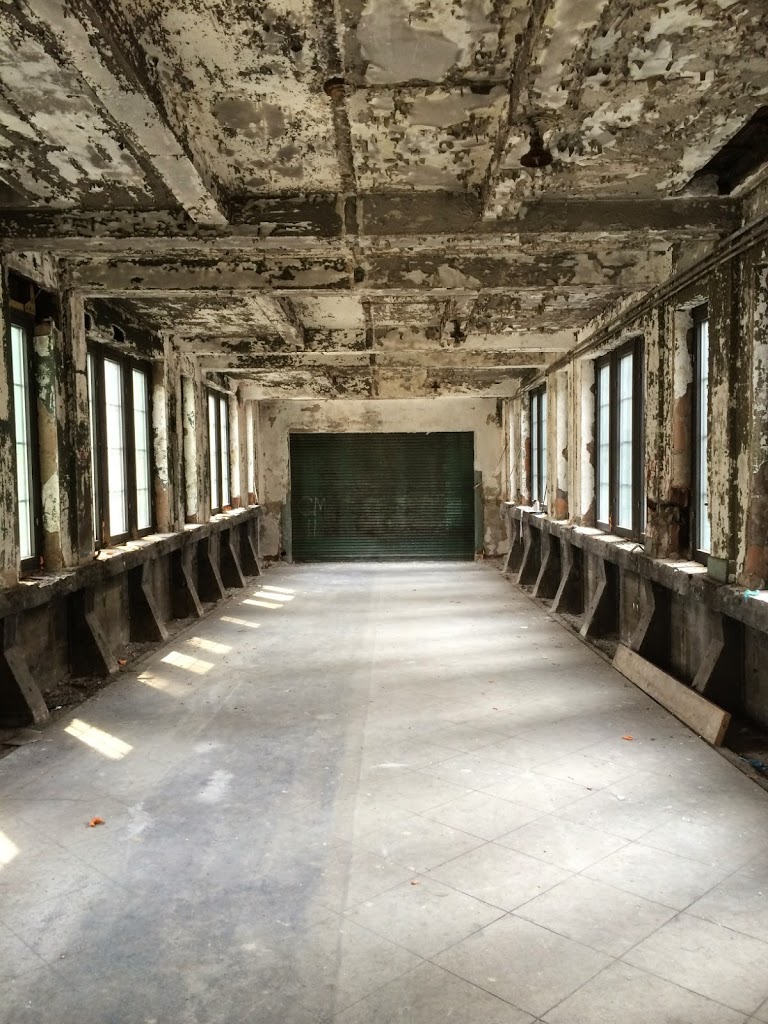
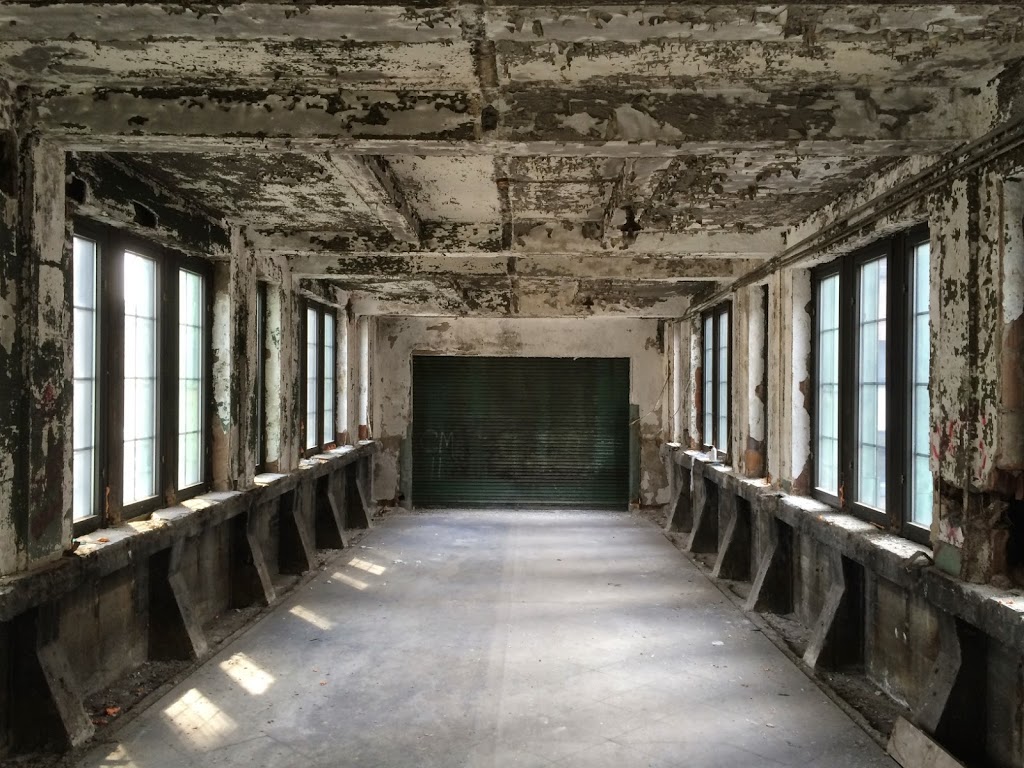
Rea, who works in the old Gimbels building (today the Manhattan Mall), was recently granted brief access into the traverse, which spends most its existence sealed off and empty.  Here are some of the images he was able to capture in his brief time inside, revealing some old signage and the world outside from this rare vantage.  Thanks for sharing, Alexander!

Categories
Neighborhoods

The link between Ladies Mile and the New York Public Library

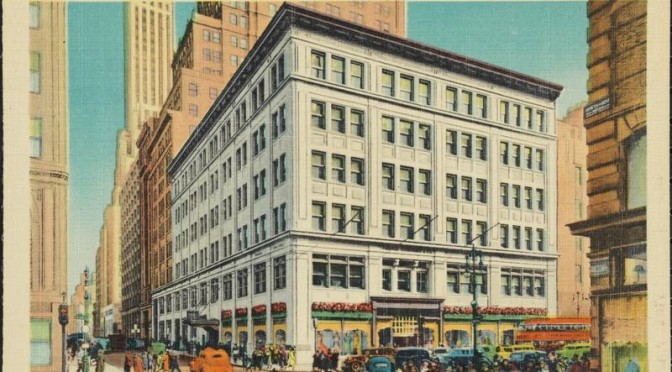
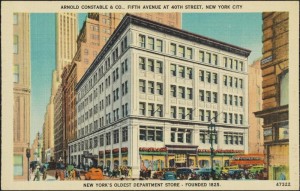
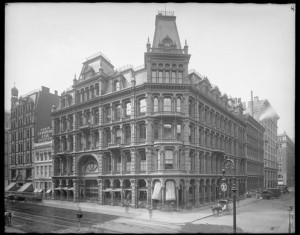
Arnold Constable & Co., Fifth Avenue at 40th Street, New York City, New York's Oldest Department Store -- Founded 1825.

Arnold, Constable and Co’s new Fifth Avenue store.  Today it house the lending library for the New York Public Library.

When did Ladies Mile — New York’s elegant Gilded Age shopping district — finally become un-fashionable?

Unlike the slow demise of so many neighborhoods in the city’s past, the end of Ladies Mile was closely observed by the press.  On October 4, 1914, the New York Sun ran the foreboding headline “Last Chapter in Fall of Old Department Store Zone Recorded Last Week By Arnold, Constable.”

“When Arnold, Constable and Co. move next September to the new building that Frederick W. Vanderbilt is to erect on the site of his home at Fifth Avenue and Fortieth Street, not a department store will remain on Broadway between 14th and 23rd streets, for nearly half a century the recognized high class shopping center of New York City.”

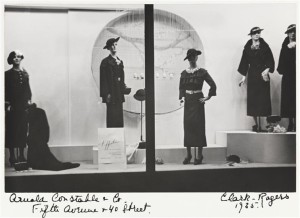
Below: Display windows at the 5th Ave location in 1935 (Pictures are courtesy MCNY)

Arnold Constable & Company, Fifth Avenue and 40th Street.

B Altman, the first of the major department store owners to move to Fifth Avenue, was immediately seen as a visionary. “Every one can see today that this shrewd business man knew what he was doing, for Fifth Avenue is not only the greatest shopping street in New York, but is said to lead all others in the world.”

The B Altman department store building is still around, on the northeast corner of 34th Street and Fifth Avenue. It’s now the home for the City University of New York.

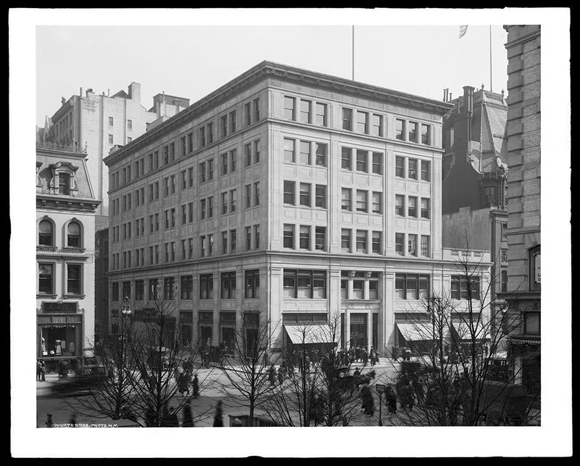
The building which contained the Fifth Avenue store of Arnold, Constable and Co. is still around as well.

The upper-crust store was one of Ladies’ Mile’s last holdouts, even as the other fine shops like Lord & Taylor had already moved uptown.  Their new department store, catty-corner to the New York Public Library main branch, finally opened in November 1915 and stayed open for sixty years, until 1975.  The structure was then bought and turned into the Mid-Manhattan Library.

Incidentally, just yesterday, the New York Public Library released its newest plans to refurbish this much distressed building.

Compare this picture of Arnold Constable & Co., from 1915, with the one taken yesterday at the Mid-Manhattan Library:

Categories
Neighborhoods Podcasts

The sumptuous story of Ladies’ Mile: Cast-iron grandeur and Gilded Age architecture


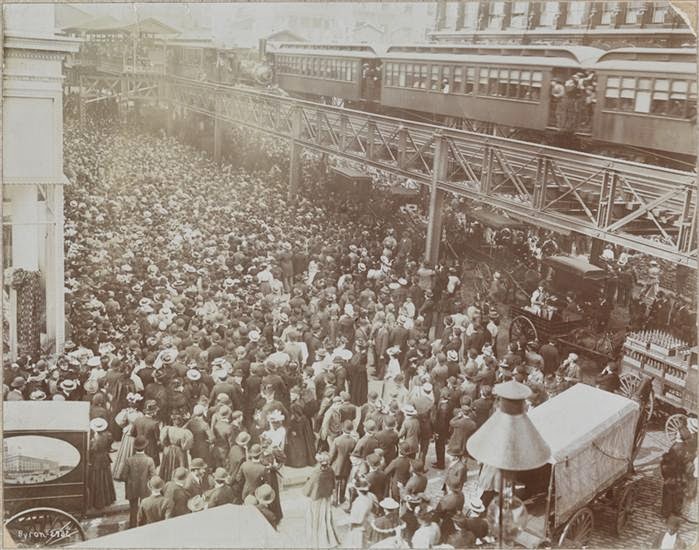
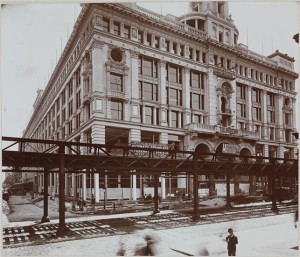
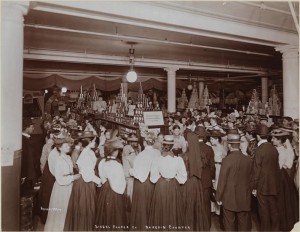
The opening of Siegel-Cooper department store, 1896, created one of the great mob scenes of the Gilded Age.  Today, TJ Maxx and Bed Bath and Beyond occupy this once-great commercial palace.  

PODCAST  Ladies’ Mile — the most famous New York shopping district in the 19th century and the “heart of the Gilded Age,” a district of spectacular commercial palaces of cast-iron. They are some of the city’s greatest buildings, designed by premier architects.

Unlike so many stories about New York City, this is a tale of survival, how behemoths of retail went out of business, but their structures remained to house new stores. This is truly a rare tale of history, where so many of the buildings in question are still around, still active in the purpose in which they were built.

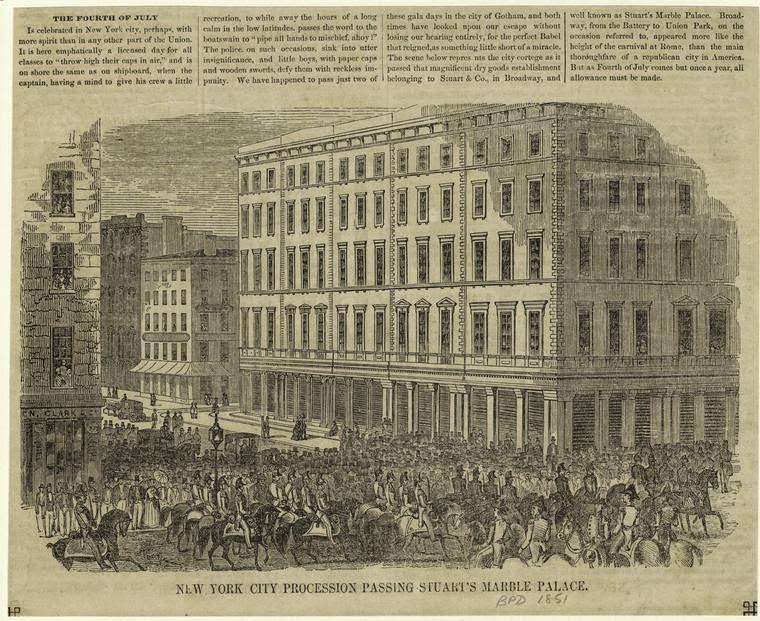
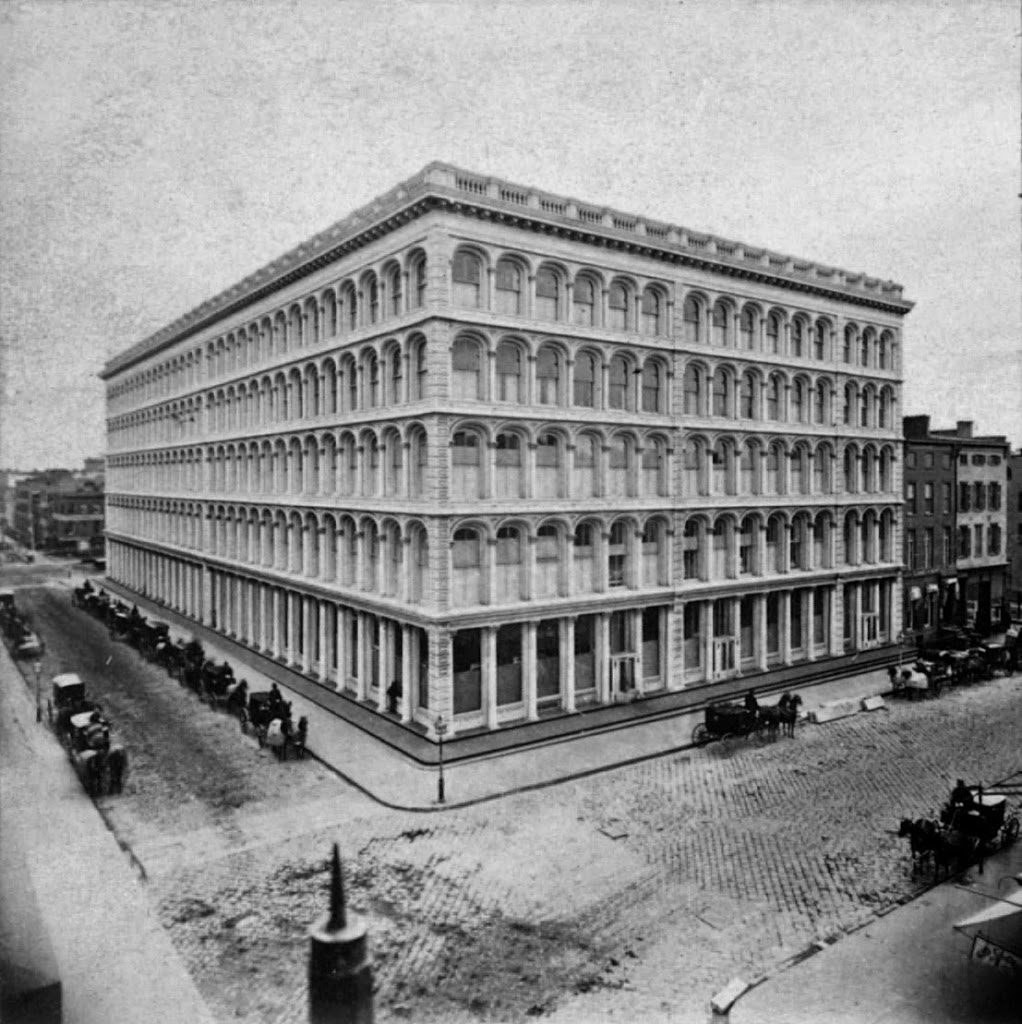
We start this story near City Hall, with the original retail mecca of A.T. Stewart — the Marble Palace and later his cast-iron masterpiece in Astor Place. Stewart set a standard that many held dear, even as his competitors traveled uptown to the blocks between Union Square and Madison Square.

Join us on this glamorous journey through the city’s retail history, including a walking tour circa 1890 (with some role play involved!) of some of the district’s best known buildings.

PLUS: Why is Chelsea’s Bed Bath and Beyond so particularly special in this episode? You’ll never buy towels there the same way again!


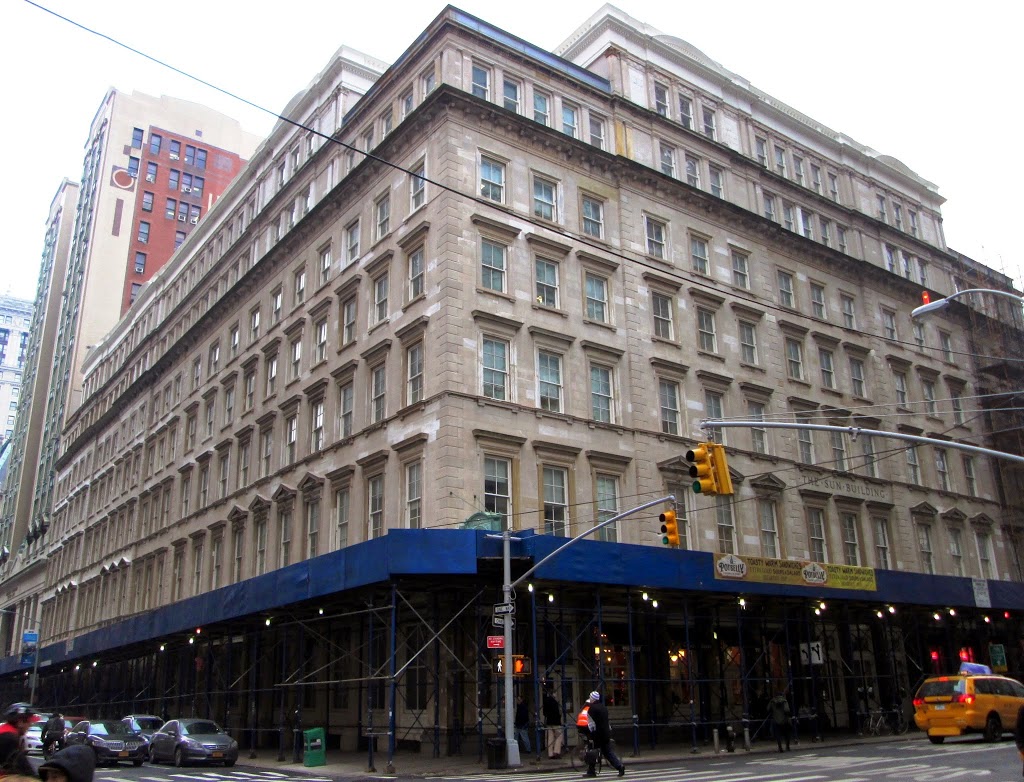
America’s first department store — A.T. Stewart’s Marble Palace, near City Hall. The building is actually still there today! The address is 280 Broadway. (Courtesy NYPL)

Stewart’s even more celebrated department store at Astor Place, nicknamed the Iron Palace with its cast-iron construction. Unlike Stewart’s first store, this one is no longer there. (NYPL)

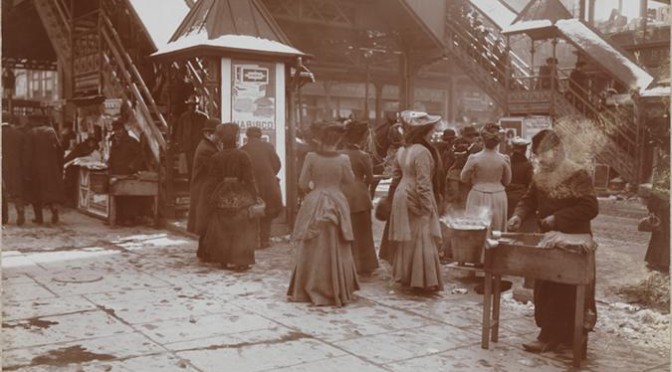
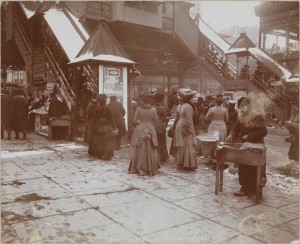
1903: Ladies on a freezing day, surrounding the 23rd Street entrance to the Sixth Avenue Elevated Railroad, placing them just a few blocks from the biggest department stores in the world. (Courtesy Museum of the City of New York)

6th Ave & 23rd St.

The entrance to Stein Brothers on 23rd Street. There’s a Home Depot in this building today, but you can still see the SB insignia over the door. And below, the street scene in 1908.(Photo: Edmond V Gillon, MCNY)

[32-46 West 23rd Street.]
[West 23rd Street from 6th Avenue East.]

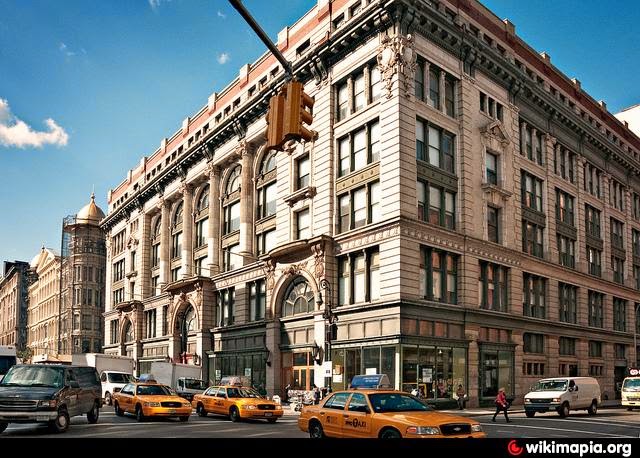
Adams Dry Goods, decades after the shop at closed. In later years, it was a Hershey’s plants and a military storage space. Today, on the ground floor, there’s a Trader Joe’s grocery store. (Photo: Edmond V Gillon, MCNY)

[675 Sixth Avenue.]

1901: Women in front of the Church of the Holy Communion, the elevated train in back of them. (MCNY)

Street Scenes, Sixth Avenue at 20th Street.

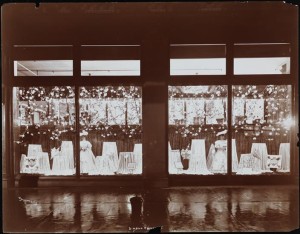
The windows at Simpson Crawford Co. at Sixth Avenue and 20th Street, 1904. (MCNY)

Simpson Crawford Co.

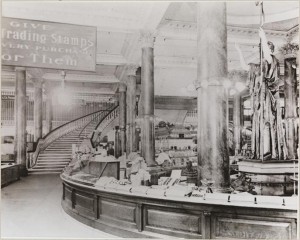
The Siegel-Cooper department store fountain, with a statue of Republic (by Daniel Chester French) and electric lights in a kaleidoscope of colors. And, below it, another view of Siegel Cooper from the opposite side of the tracks. (MCNY)

Siegel Cooper
Retail Trade - Dept. Store 1896. Siegel Cooper Co. (Exterior) 6th Ave at 18th St.

Ladies in the Siegel Cooper canned goods department. The store canned its own food. Very organic! (MCNY)

Retail Trade Dept. Store.

An overhead shot of Macy’s at 14th Street and the Sixth Avenue elevated railroad station. (MCNY)

[6th Avenue and 14th Street.]
Broadway and East 20th Street. Lord and Taylor, old building.

Lord & Taylor’s, at Broadway and 20th Street, 1904. (Wurts Brothers, MCNY)

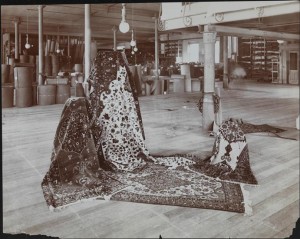
Inside WJ Sloane, Carpets Rugs and Furniture, at Broadway and 19th Street (MCNY)

W.J. Sloane, Carpets Rug & Furniture, 19th St. & Broadway.

The Flatiron Building, completed in 1902, is considered part of the Ladies Mile Historic District, even though it was never a department store.

Categories
Gilded Age New York Neighborhoods

Chelsea and the Chocolate Factory (or rather, Hershey and his Sixth Avenue chewing gum plant)

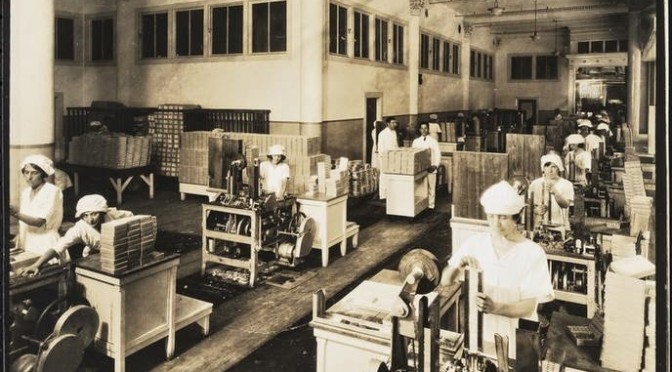
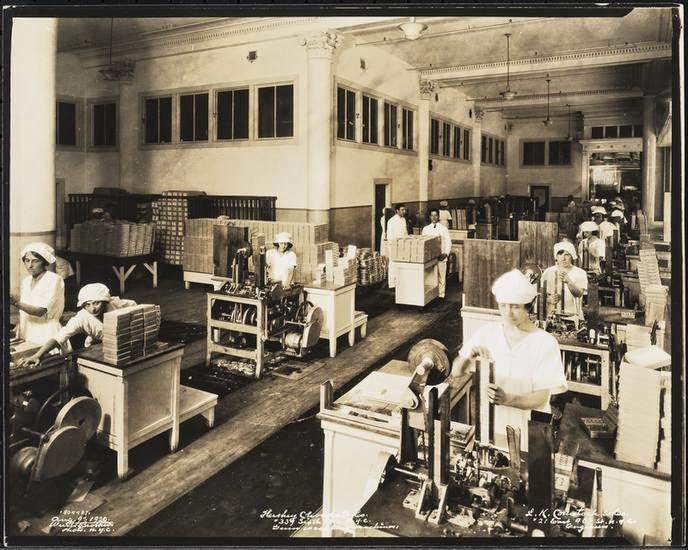
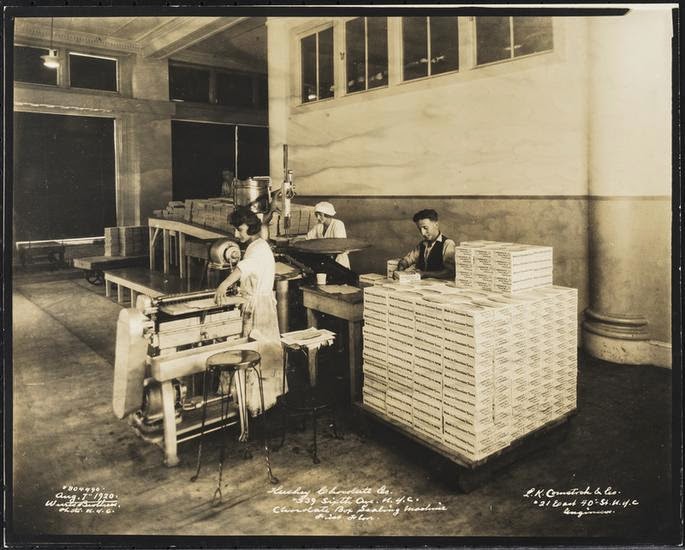
Hershey’s employees cut and pack chewing gum at Sixth Avenue and 21st Street.

For five glorious years in the early 1920s, Hershey’s Chocolate operated a candy plant at Sixth Avenue, in the neighborhood of Chelsea. While chocolate bars and chocolate coating for other candies were produced here, the Chelsea plant primarily focused on a new confection, one that ultimately failed — Hershey’s Chewing Gum.

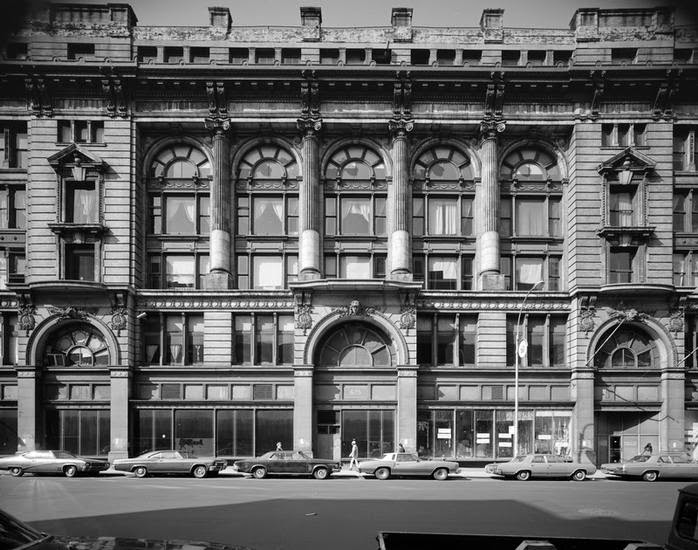
But let me back up. The grand building that sits there today — one of the prominent members of Ladies Mile Historic District and the current home of Trader Joe’s — was originally built for the department store Adams Dry Goods.  Founded in the mid-1880s, Adams Dry Goods had been slowly expanding along this block, enjoying a surge of business thanks to the Sixth Avenue elevated train.

Below: The Adams Dry Goods building in 1978 (photo by Edmund V Gillon, MCNY): 

Other department stores sprouted up along the street, most notably the Siegel-Cooper department store in 1896.  (That building is home today to Bed, Bath and Beyond.)  Siegel-Cooper was a sparkling Beaux-Arts treasure, 750,000 square feet with dozens of departments for shoppers, and its ambition and size drew headlines and the curiosity of New Yorkers.

Naturally, Samuel Adams, the proprietor of Adams Dry Goods, wanted to compete with this retail behemoth, so in 1899 he hired Siegel-Cooper architects DeLemos & Cordes to design a massive new store with an opulent interior central court.  Large second floor windows offered views to elevated train passengers of the store’s most notable trade — men’s clothing.  (Much of Ladies Mile, in contrast, catered to women.)

Below:  Adams Dry Goods today. After a period in the 1990s-2000s as a Barnes and Noble bookstore, today it holds a Trader Joe’s:

But Adams’ timing was rather poor.  For just a few years later, the more successful department stores (including Lord & Taylor and B Altman) fled to Herald Square and Fifth Avenue.  Hugh O’Neill’s, the department store one block south, bought Adams Dry Goods and prepared to merge the businesses, even planning an underground tunnel under West 21st Street to link to two large structures.  This never came to fruition, and both O’Neill’s and Adams Dry Goods went out of business for good.

The abandoned building was briefly used by the US Army for storage before being acquired by a most unusual new tenant — Hershey’s Chocolate.


Candy man Milton S. Hershey had been successfully manufacturing treats in his hometown of Derry Church, Pennsylvania (which now took the mogul’s name — Hershey) and was looking for a another hit after the success of the Hershey’s Kiss.  He thought chewing gum was the logical next step.

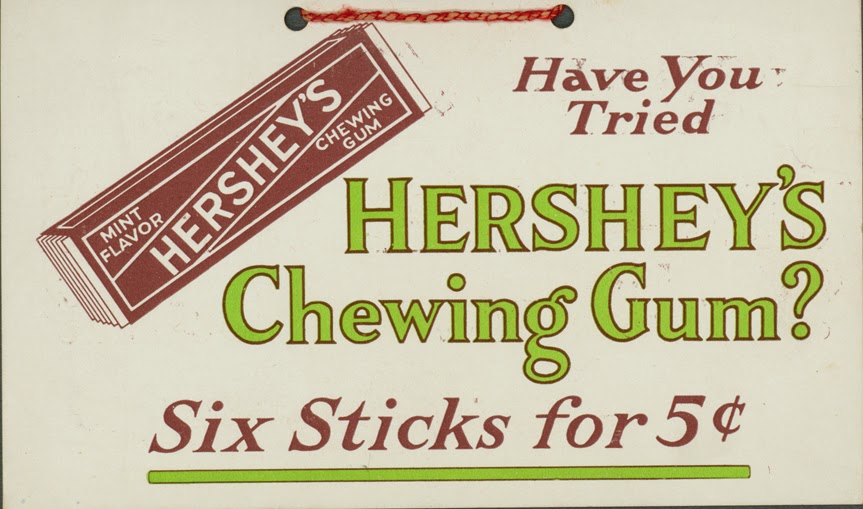
In New York he bought some gum-making equipment and had it shipped to his Pennsylvania plant where production began on Hershey’s Chewing Gum. “Six sticks for a nickel” went the slogan.

In January 1918, Hershey leased Adams’ former department store on Sixth Avenue and eventually moved elements of his candy production there, including his entire chewing gum business.

I haven’t been to locate the exact reason why.  Early in his career, Hershey operated a candy shop on Sixth Avenue and 42nd Street, and his wife had been a clerk at B Altman’s a few blocks down.  With his chief competitor Wrigley’s located in Chicago, perhaps his return to New York was his official stab at planting roots in an urban market.

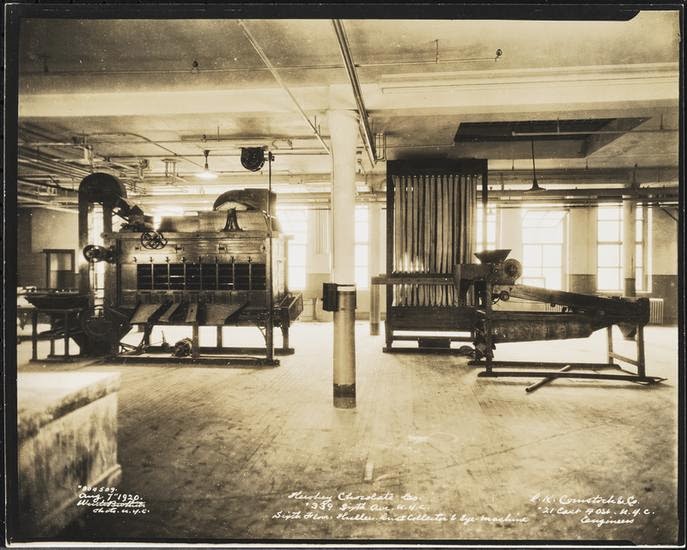
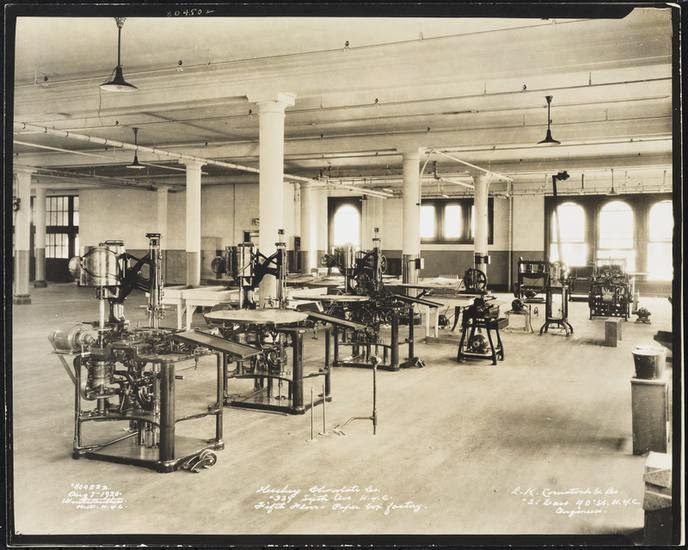
Soon the Sixth Avenue shop was whirring with the sound of boilers, mixers, candy presses and wrapping machines, sending out five thousand boxes of chewing gum a day, and a lesser amount of other candy items.  Wheat was carried in from the Pennsylvania plant and added to the gum to make it more chewy.

As you can see here, the implements of candy-making fit oddly into the cavernous Sixth Avenue department store:

Sadly, future residents of Chelsea would be robbed of the delightful aromas of chicle and chocolate, as Hershey’s chewy offering did not take off.  With raw ingredients being hard to obtain in the early 1920s, the product was discontinued, and Hershey eventually closed the plant in 1924.

However I’m sure you can buy gum at Trader Joe’s that currently occupies the building.

Hershey’s plant photographs courtesy the Museum of the City of New York (see originals here)

Categories
Neighborhoods Podcasts

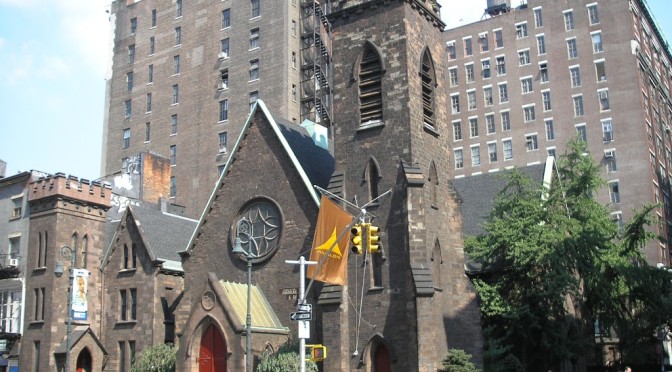
The many lives of the Limelight, aka the facade formerly known as the Church of the Holy Communion


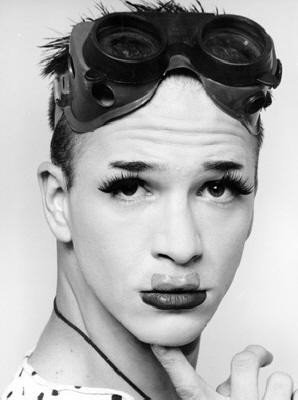
Above: The Church of the Holy Communion — and once the quite infamous nightclub Limelight — as the less lauded follow-up, called Avalon.  Within a couple years, the club would be transformed again — into a high-end retail experience.  Below: Michael Alig, one of its more notorious nightly residents. (source)

PODCAST
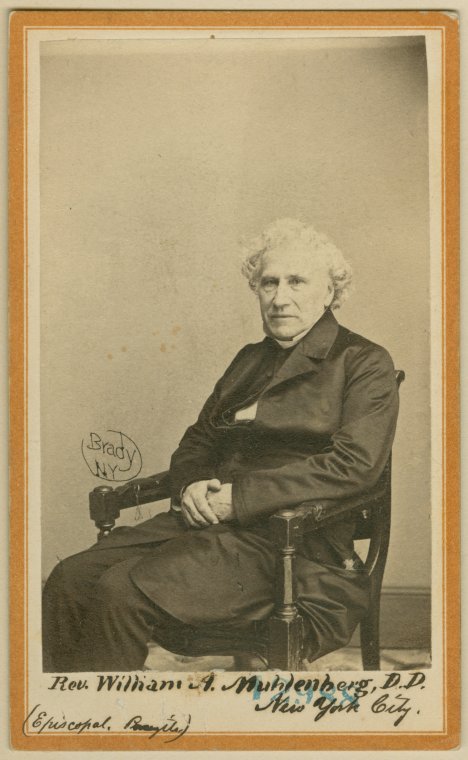
If you had told 1840s religious leader William Augustus Muhlenberg that his innovative new Church of the Holy Communion, designed by renown architect Richard Upjohn, would become the glittering seat of drugs and debauchery 150 years later, he might have burned it down then and there.

But thankfully, this lovely building is still with us, proving to be one of the most flexible examples of building use in New York City history. 

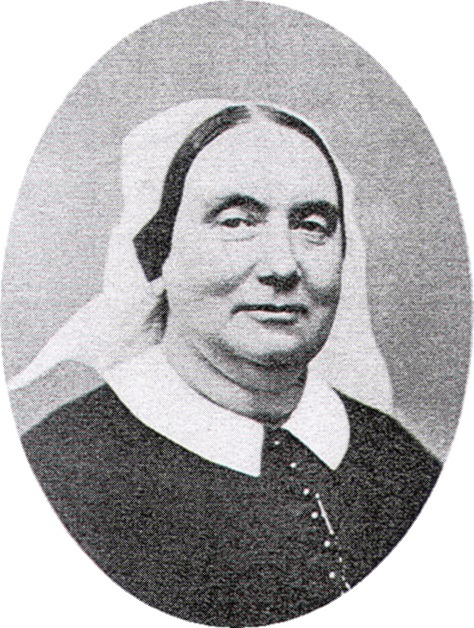
This unusual tale begins with the captivating relationship between Muhlenberg (the grandson of America’s first Speaker of the House) and Anne Ayres, the First Sister in charge of the Sisterhood of the Holy Communion. The two of them helped create one of New York’s great hospital centers. But was something else going on between them? 

The Church of the Holy Communion survives the elevated railroad and the fashionable stores of Ladies Mile, and weathers the various fortunes of the neighborhood.  When it is finally sold and deconsecrated, it briefly houses an intellectual collective and a drug rehabilitation center before being bought by Canadian club impresario Peter Gatien, who turns it into the Limelight, an iconic and sacrilegious symbol of New York nightlife.  And in recent years, the old church has morphed into a rather unique retail experience — shopping mall and department store!


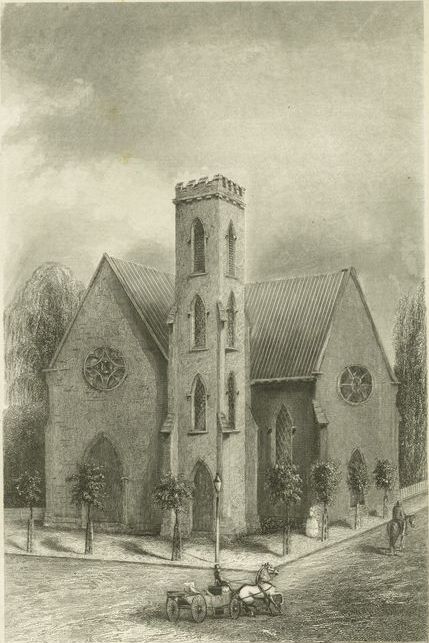
The Church of the Holy Communion in 1846, from an illustration by TD Booth.  The asymmetrical shape of the church was innovative for the time, as was the irregular position of the brownstone bricks along its walls. It had every indication of being a medieval country church, but for the fact of it being on a street corner at Sixth Avenue and 20th Street! (NYPL)

William Augustus Muhlenberg, grandson of Frederick Muhlenberg (America’s first Speaker of the House), was a visionary religious leader.  He opened Church of the Holy Communion as a way to further his progressive religious views.  Pictured below in a carte de visite, probably in the 1860s. (Courtesy NYPL)
Muhlenberg’s reputation was greatly bolstered by Anne Ayres, who became the leading sister as the Reverend’s  Sisterhood of the Holy Communion, the first Anglican convent of its kind in America.  Ayres helped Muhlenberg with most of the church’s major projects and penned an ecstatic biography after his death.  You can read Ayres’ biography of Muhlenberg here.

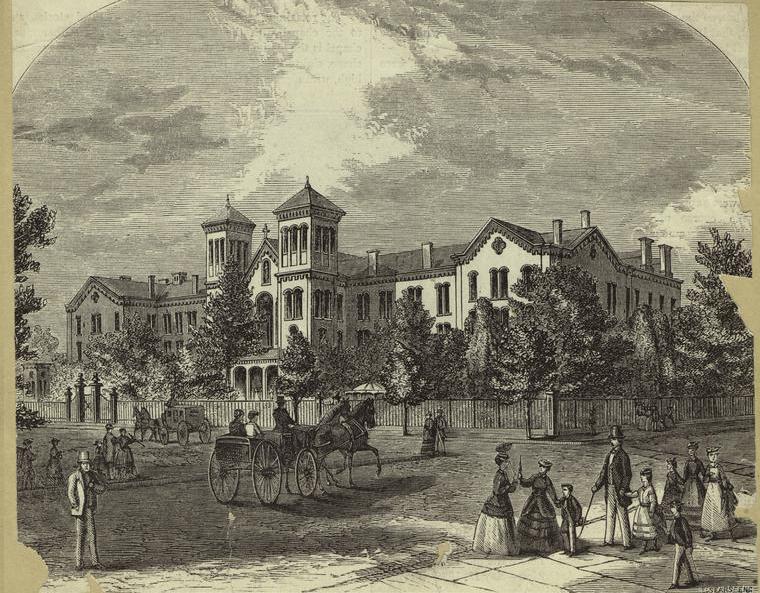
Muhlenberg and Ayres founded a small infirmary near the church, then later expanded it at Fifth Avenue and 54th Street, becoming the first location of St. Luke’s Hospital.  As you can tell from the original hospital building, it seems to reflect a bit of the architecture of the Church of the Holy Communion. (Pic courtesy NYPL)

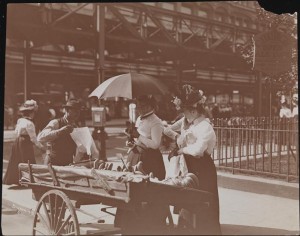
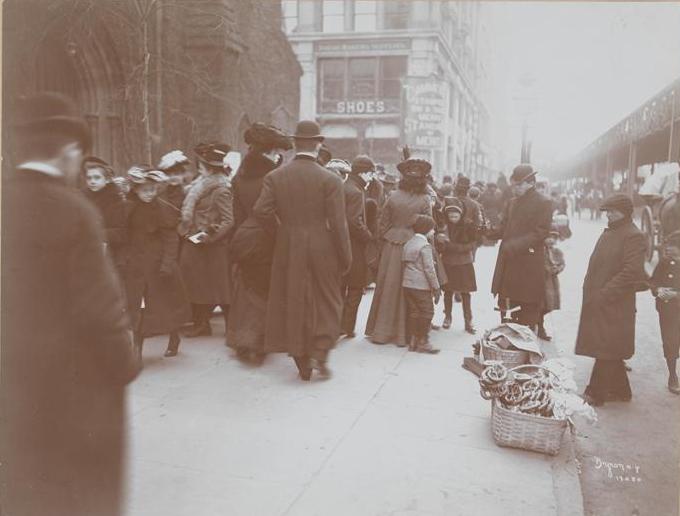
A view from 1895, possibly of a Sunday crowd leaving the church. Vendors like this pretzel seller gathered on the street below, selling treats to shoppers of Ladies Mile.  The church would have been in the heart of New York’s major shopping district during the Gilded Age, with grand department stores stretching on either  side of the street. (Courtesy the Museum of the City of New York)

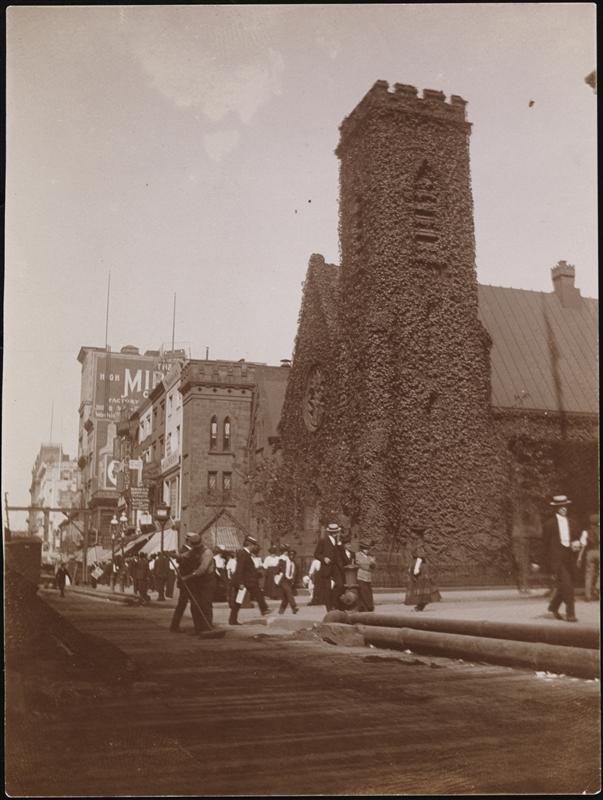
The Church of the Holy Communion, enveloped in thick ivy, as it looked in September 1907.  It also appears this photo was taken in the early afternoon, as the shadow of the elevated railroad begins to creep across the street. (Courtesy Museum of the City of New York)

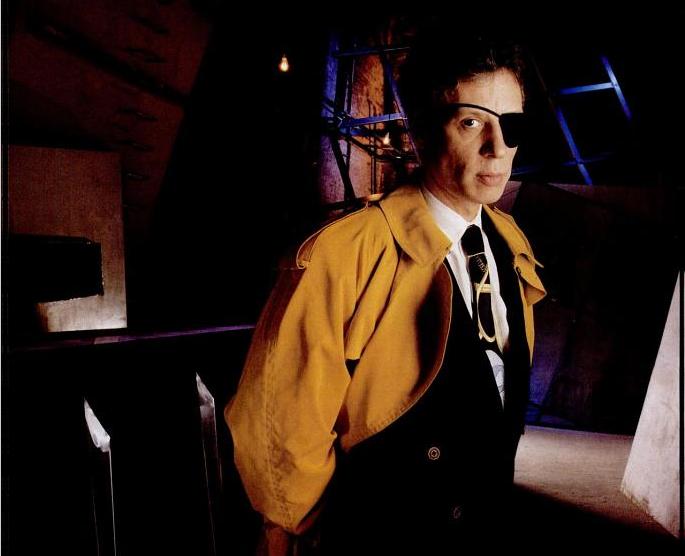
Peter Gatien, pictured here in a 1993 issue of New York Magazine. The Canadian club owner bought the old church and transformed it into a nightclub in 1983.

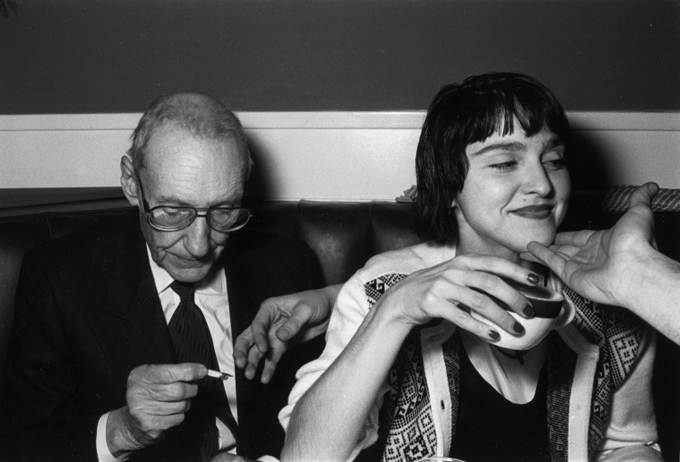
The Limelight was a celebrity hotspot from the very opening in 1983.  When William Burroughs had his 70th birthday at the club in 1984, the young new superstar Madonna came by to wish him well. (Photo by Wolfgang Wesener, courtesy here)

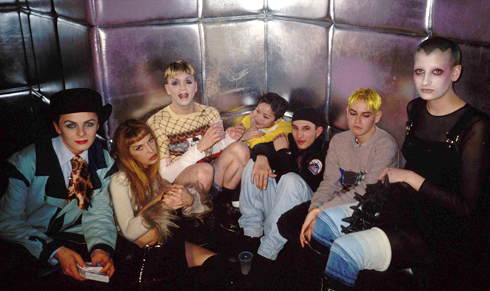
But why conjure real celebrities when you could make some yourself!  By the early 1990s, the club kid set the tone for the Limelight, further turning the old church of Muhlenberg into a surreal playground of music and drugs.

Union Square and the demise of ‘Dead Man’s Curve’

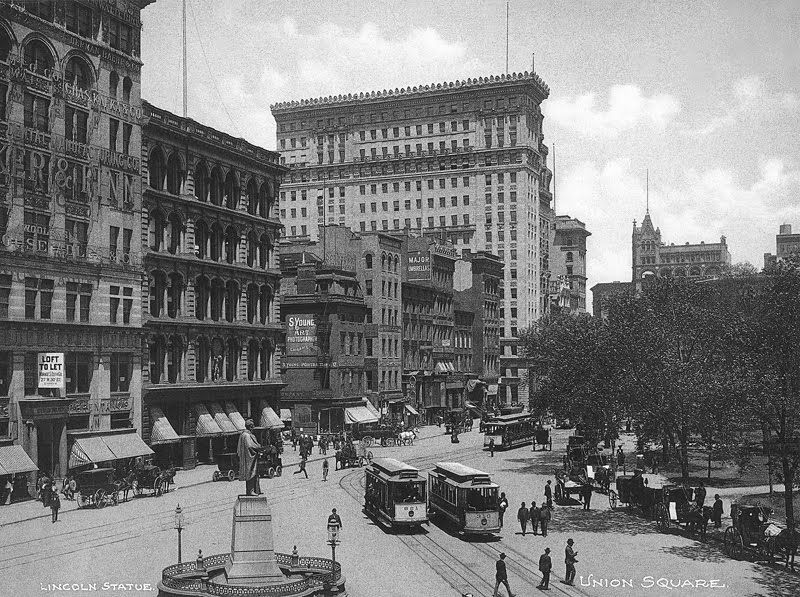
The photo above shows the southwest corner of Union Square in the year 1906. For many years prior, this corner was the scene of several brutal accidents between cable cars and pedestrians. When the Metropolitan Traction Company (now doing business as the powerful New York City Railway Company) ripped out the cable lines and replaced them with streetcar tracks in the early 1900s, New Yorkers hoped that troubles at the so-called ‘Dead Man’s Curve’ would likewise diminish.

Broadway and 14th Street, during the late 19th century, has always been seen as “New York’s Most Dangerous Crossing” (according to a Harpers Weekly article). But even in the new century, this morbid corner could never quite shake its reputation. “McGowan and Keenan Narrowly Escape Death At ‘Dead Man’s Curve” shouted an Evening World headline from February 15, 1906, reporting a serious accident here involving two major city officials, one (Patrick McGowan) the head of the Board of Alderman.

Getting rid of the cable cars reduced — but did not eliminate — the problems posed by the heavily trafficked, sharp corner along New York’s most famous avenue. Grim accidents kept occurring here, such as this one in September 1908: ‘Legs Are Crushed…at Dead Man’s Curve’. One source posits an interesting theory: with the district to the west still considered Ladies Mile, New York’s prime shopping district, male drivers (as they would have mostly been at this time) became distracted at this difficult corner by lively female shoppers.

Fortunately, it seems reputation can be the wonderful deterrent. While other cities would develop their own deadly traffic curves — and apply the nickname ‘dead man’s curve’ to those unfortunate places — New York would see fewer accidents at Broadway and 14th Street in the following decades.

One author in 1917 remarked that the corner’s “perils are now outdone on every street and road since the advent of the automobile.” In 1930, all of Union Square would be redesigned as subway lines were constructed underneath, and traffic was helpfully reduced. Most shopping had moved to Herald Square and Fifth Avenue, so there were fewer alleged distractions anyway.

A witness to all the grim accidents at this corner was, oddly enough, Abraham Lincoln. His sculptural likeness had stood here since 1870, a work by Henry Kirke Brown, surrounded by an austere bronze fence. With the redesign in the 1930s, Lincoln was moved away from the bloody corner and moved into the northern end of the park, where he still stands today.

Photo from the New York Times