Does your personal library overwhelm your home? Are there too many books in your life — but you’ll never get rid of them? Then you have a lot in common with Gilded Age mogul J.P. Morgan!
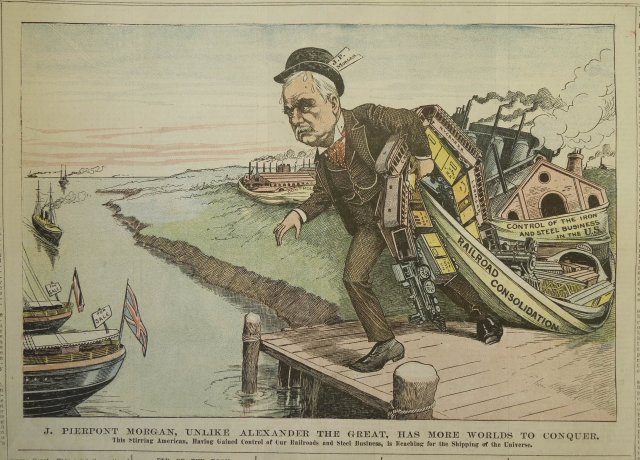
Morgan was a defining figure of the late 19th century, engineering corporate mergers and crafting monopolies from the desk of his Wall Street office. His vast control over the steel and railroad industries paired with his connections in international banking granted him great power over American life and helped fuel the great economic disparities of the Gilded Age.
In the process Morgan became one of the wealthiest men in America — but he did not tread the traditional path through New York high society. He preferred yachts over ballrooms.
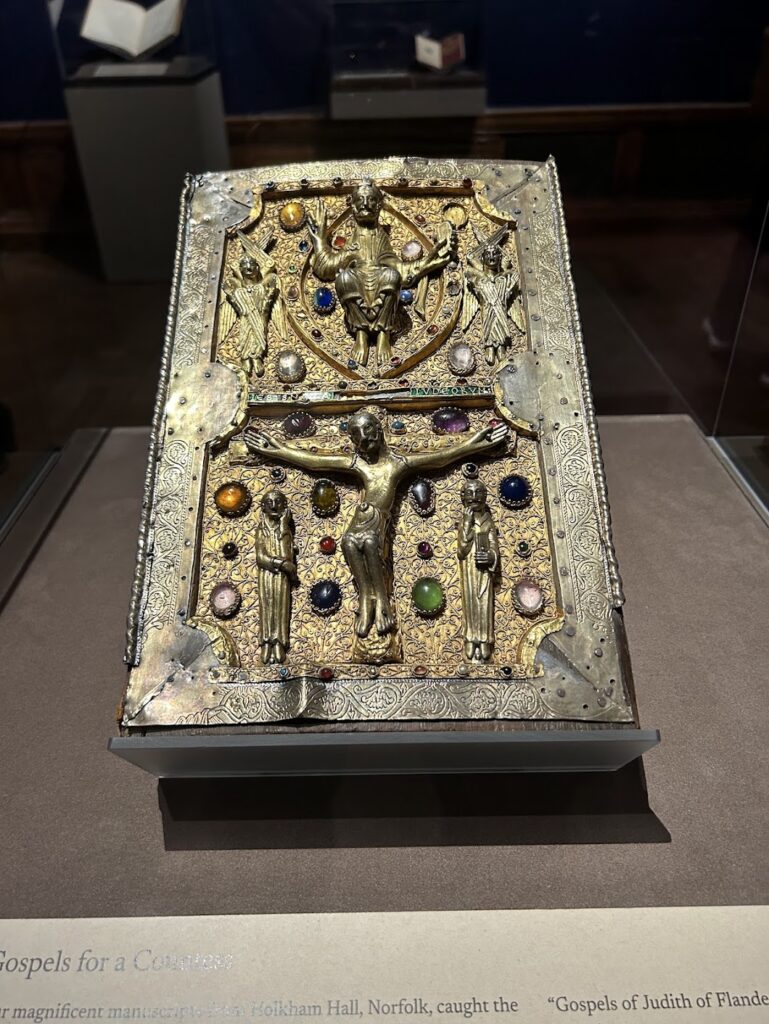
And books! For decades he collected thousands of rare books, letters, paintings and manuscripts from Gutenberg bibles to medieval illuminated tomes. So many books, in fact, that Morgan decided to start the new century with his own personal project — the construction of a library.
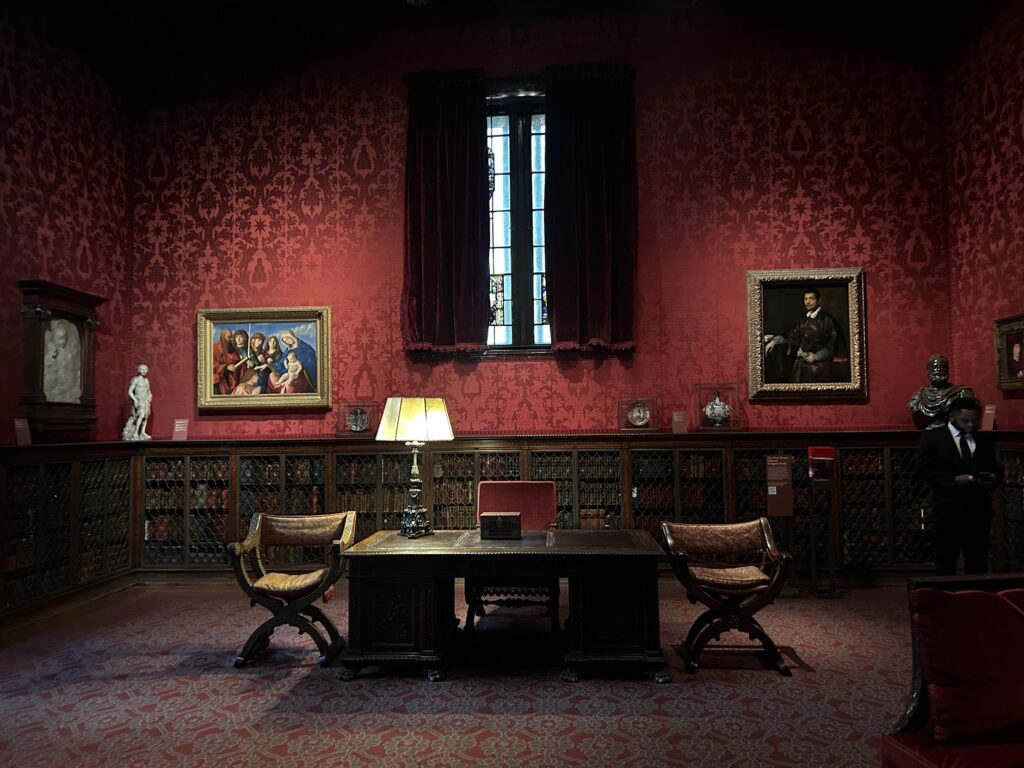
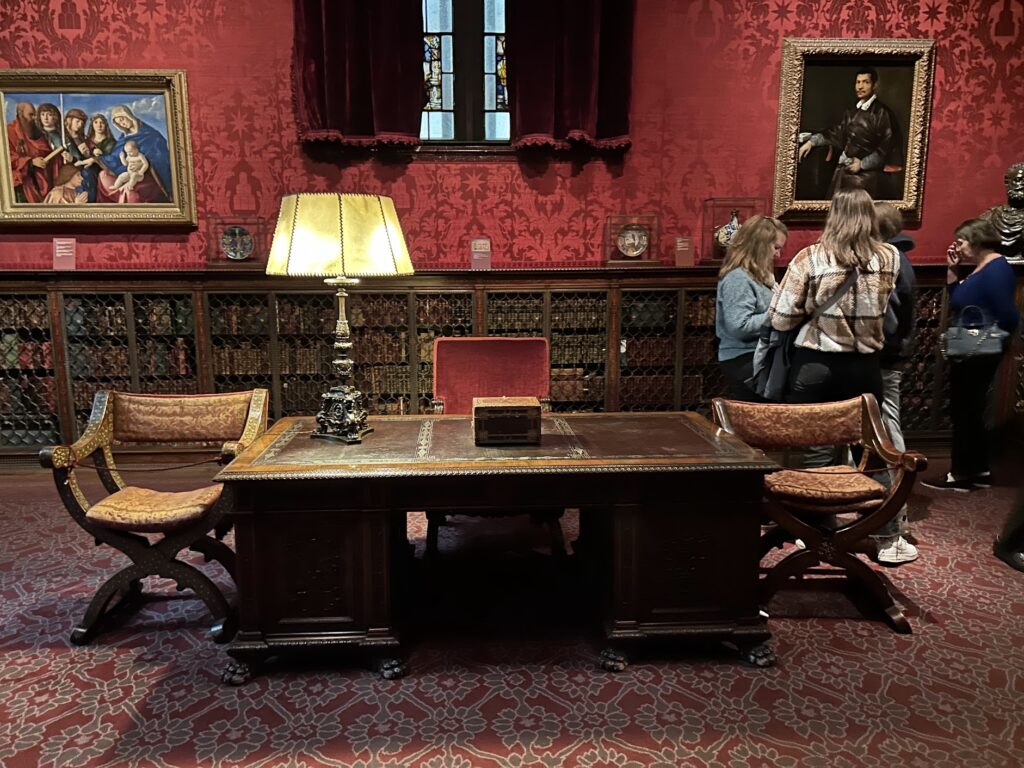
Morgan’s study
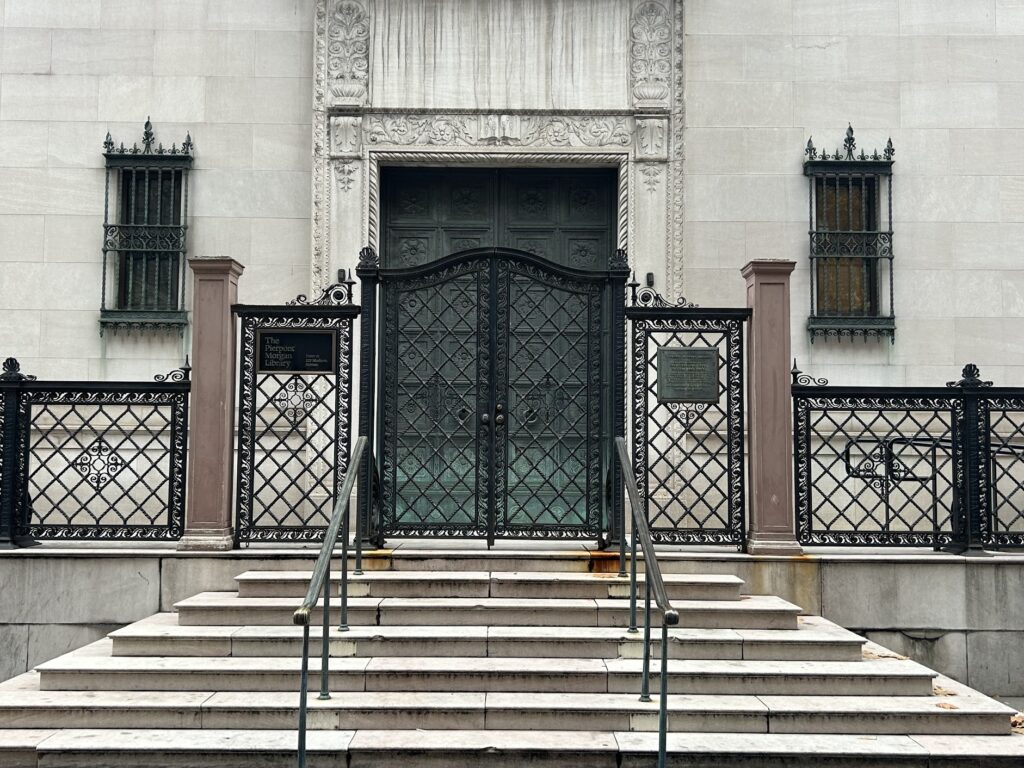
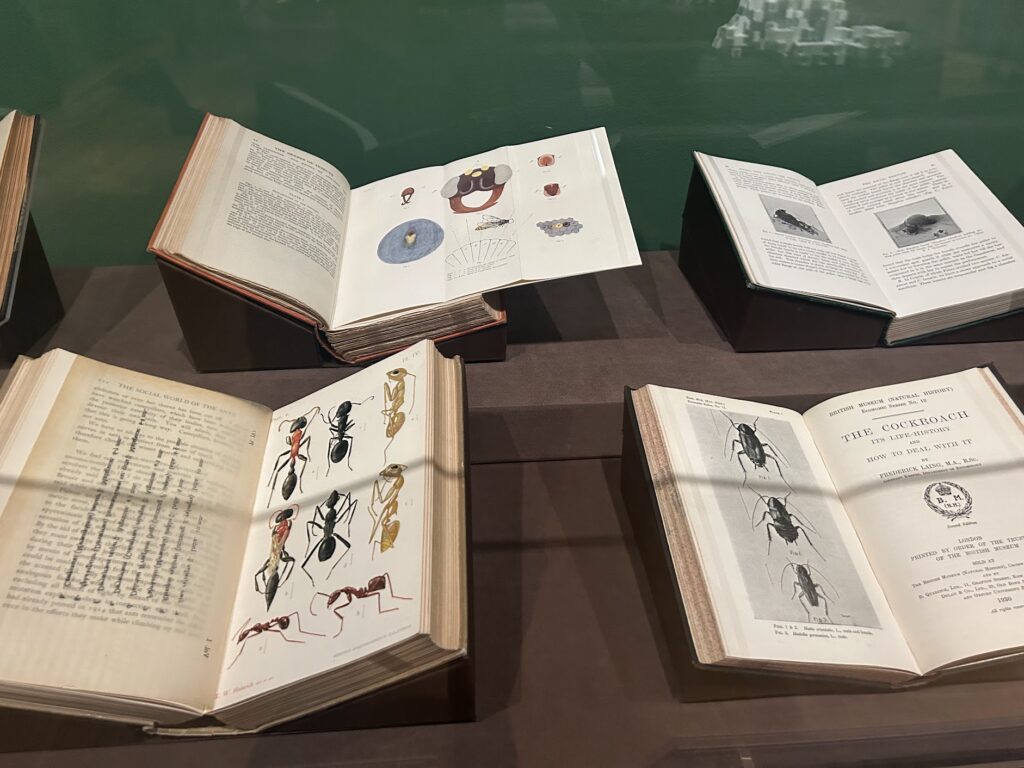
Today the Morgan Library and Museum is open to the public and, as an active and thriving institution, continues to highlight the world’s greatest examples of the printed word — from Charles Dickens manuscript for A Christmas Carol to past exhibitions on Beatrix Potter, James Joyce and even The Little Prince.
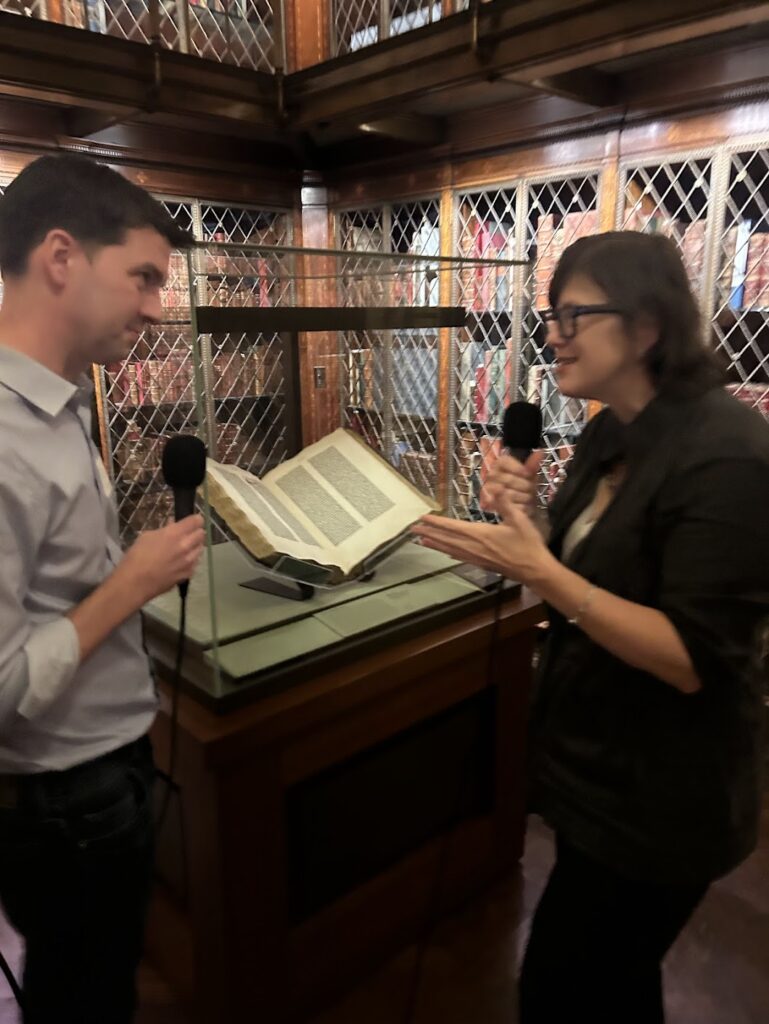
Tom and Greg explore the biography of J. Pierpont Morgan then head to the Morgan Library to speak with Jennifer Tonkovich, the Eugene and Clare Thaw Curator of Drawings and Prints.
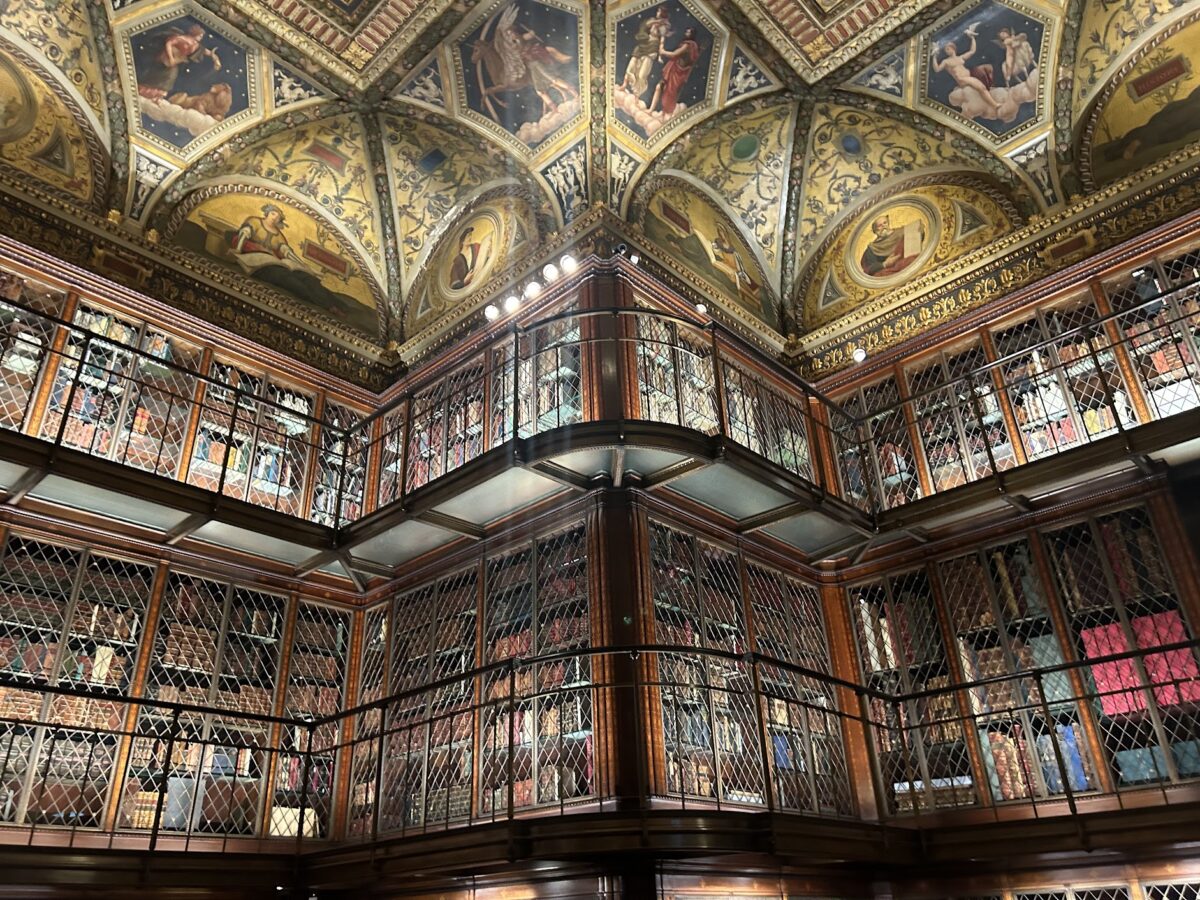
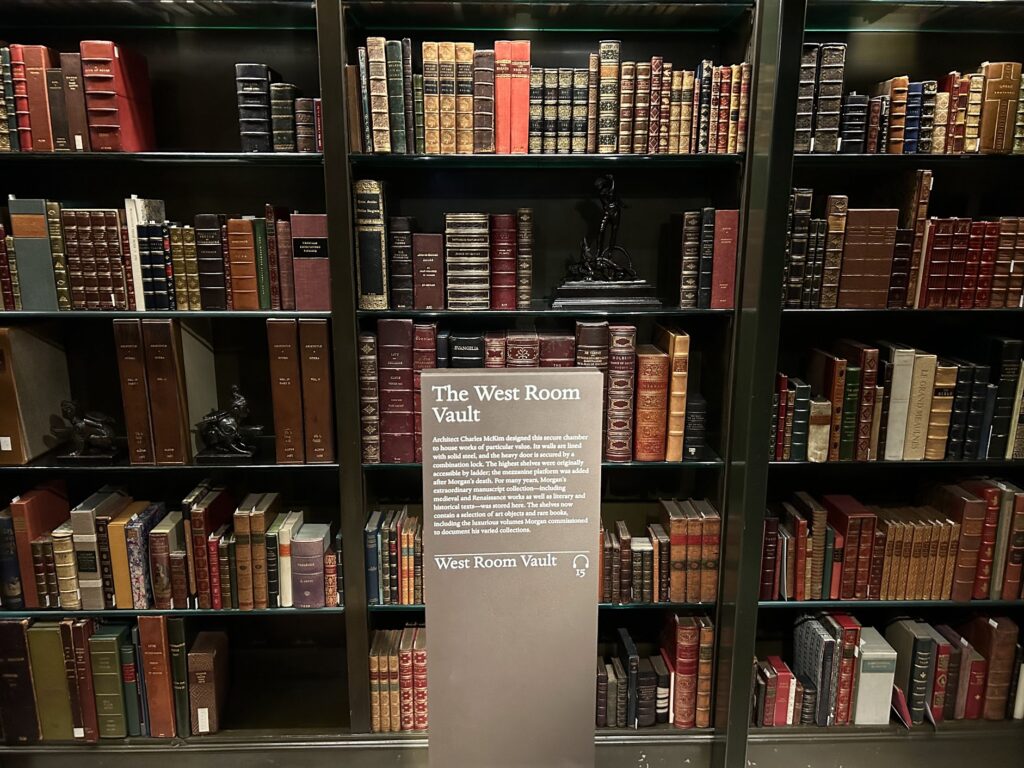
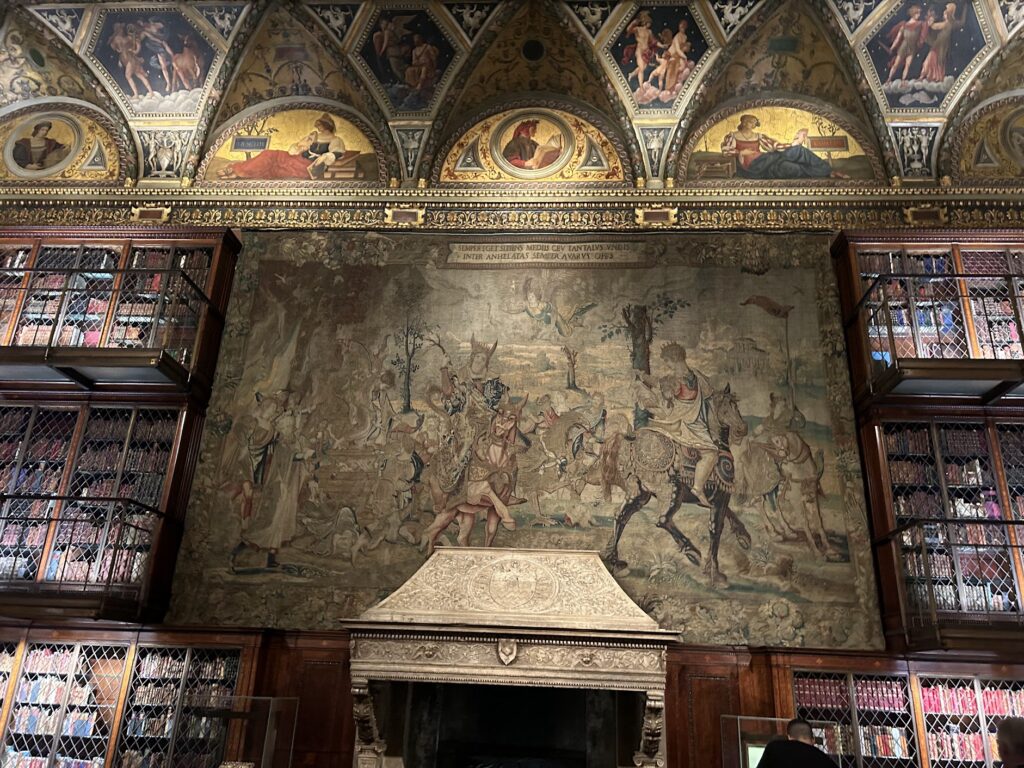
And then they wander through the winding connections of buildings which comprise the Morgan Library & Museum — from Morgan’s study (and its ‘hidden’ vault of books) to the glorious main stacks, lined with triple tiers of bookcases fashioned of bronze and inlaid Circassian walnut.
LISTEN NOW: MR. MORGAN AND HIS MAGNIFICENT LIBRARY
Share your love of the city’s history with a Bowery Boys Walks gift certificate! Our digital gift cards let your loved ones choose their perfect tour and date.
1903 portrait by Fedor EnckeSaturday Globe, 1901From the vaulted room in Morgan’s studyFrom the Franz Kafka showThe tapestry of gluttony
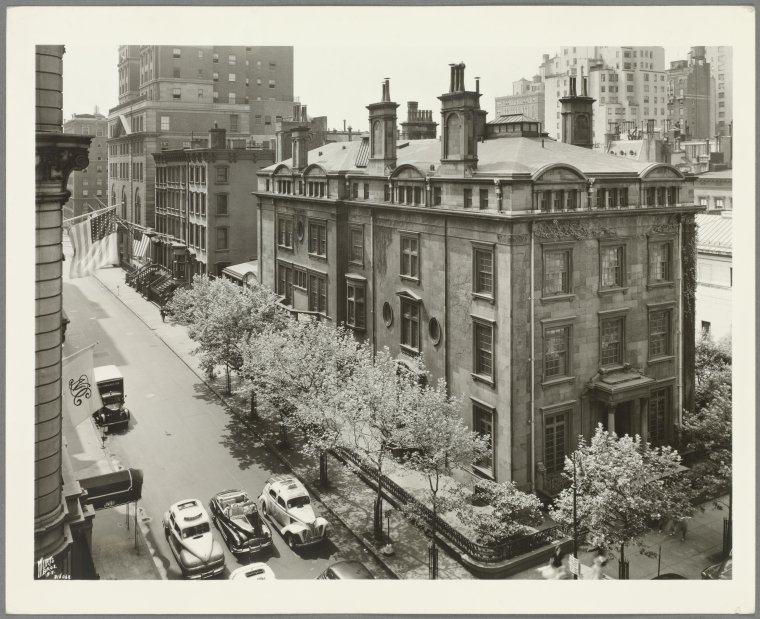
JP Morgan Jr’s brownstone which is today a part of the whole Morgan Library complex. In fact we recorded a portion of the show from its music room!
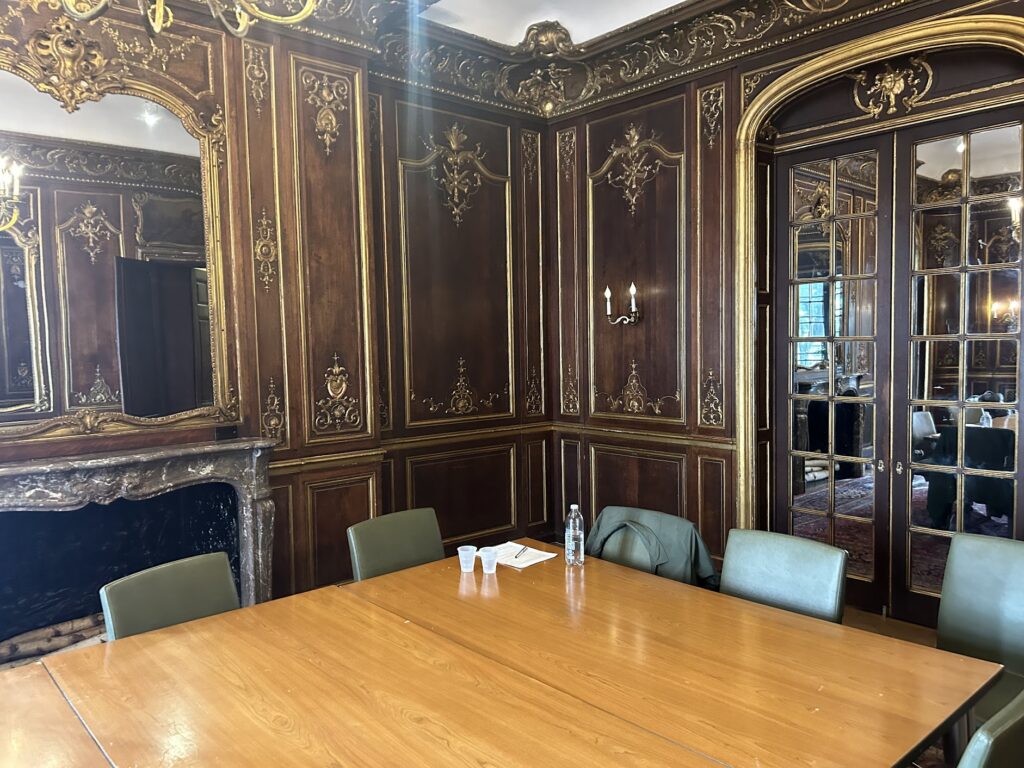
New York Public LibraryThe music room where we recorded a portion of the show.
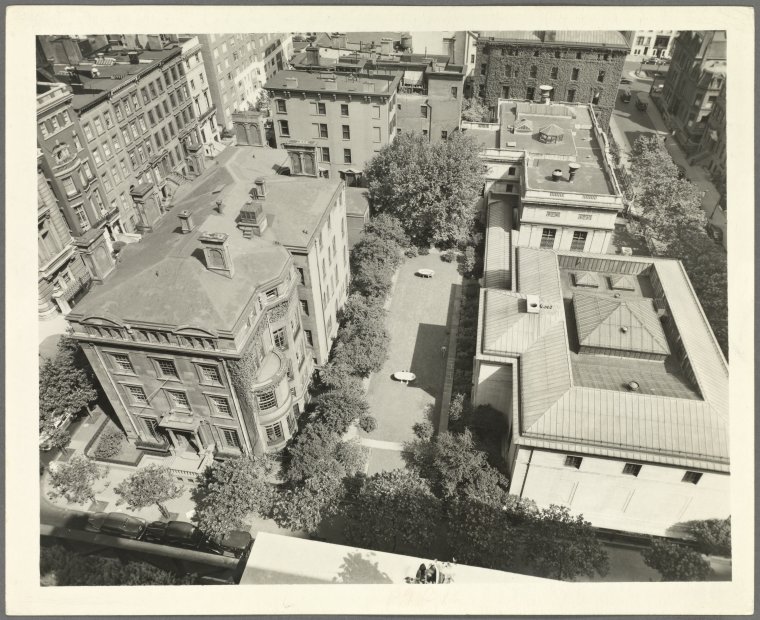
The Morgan Library and Museum from above. The slender garden in the middle was replaced in 2006 by a lavish hall designed by Renzo Piano.
New York Public Library
FURTHER READING
J. Pierpont Morgan’s Library: Building the Bookman’s Paradise / The Morgan Library and Museum The Hour of Fate: Theodore Roosevelt, JP Morgan and the Battle to Transform American Capitalism / Susan Berfield The House of Morgan: An American Banking Dynasty and the Rise of Modern Finance/ Ron Chernow J.P. Morgan – The Life and Deals of America’s Banker / J.R. MacGregor Morgan: American Financier / Jean Strouse
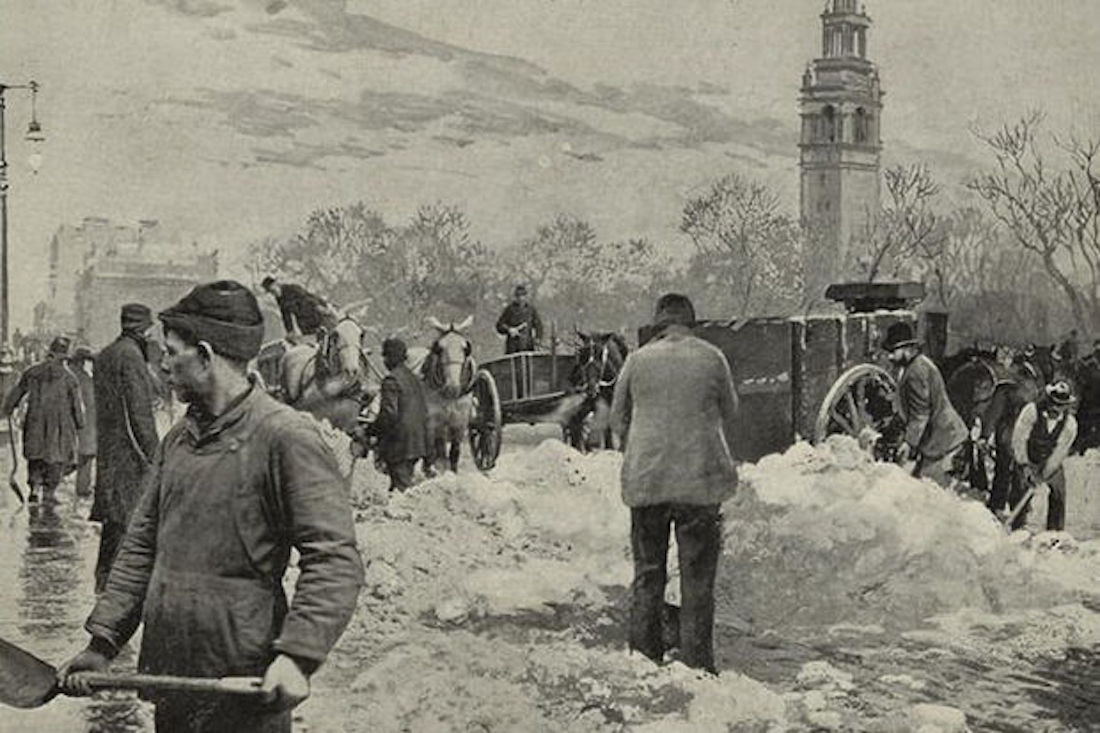
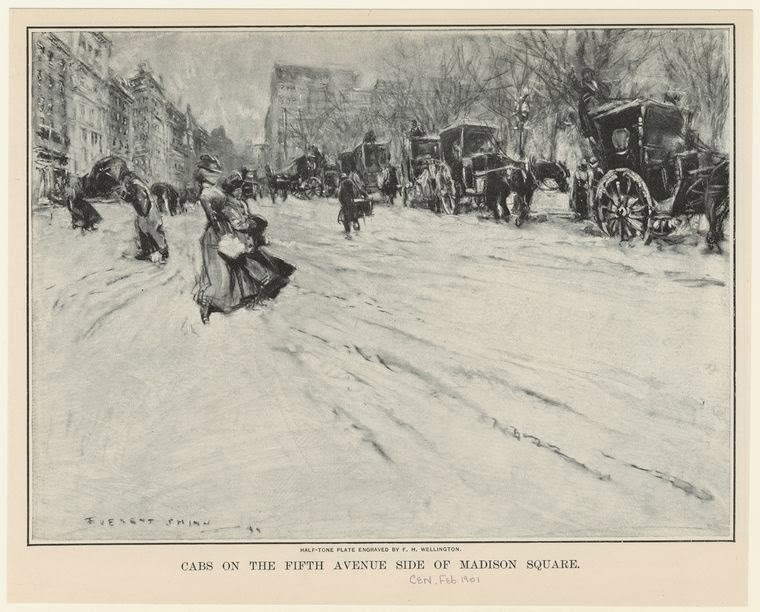
Illustration of Madison Square after a snowstorm, 1899. Courtesy New York Public Library
Missing a good old-fashioned New York City snowfall? Well, then, take in this unusual view from 1902:
What storm is this? The horrific blizzard that hit New York on February 17, 1902. It would be considered the worst snowstorm to hit the metropolitan area since the Great Blizzard of 1888. (Read all about it here.) I assume we’re actually in the aftermath of the blizzard here, as the snow shovels are out, and the kids are playing.
Who made this? Edison Manufacturing Company. Their Manhattan studio was nearby, at 41 East 21st Street.
Who’s the director? The head of Edison’s film division Edwin S. Porter, considered by most to be the first real movie director, inventing basic techniques used by subsequent filmmakers.
What are we seeing? Trolleys, cabs, carriages and other unusual vehicles, braving the icy conditions and dodging pedestrians at the intersection of Broadway, Fifth Avenue and 23rd Street. At one point, you almost see a team of horses slide off the road!
Below: An illustration from 1899, showing cabs parked along Madison Square (courtesy NYPL)
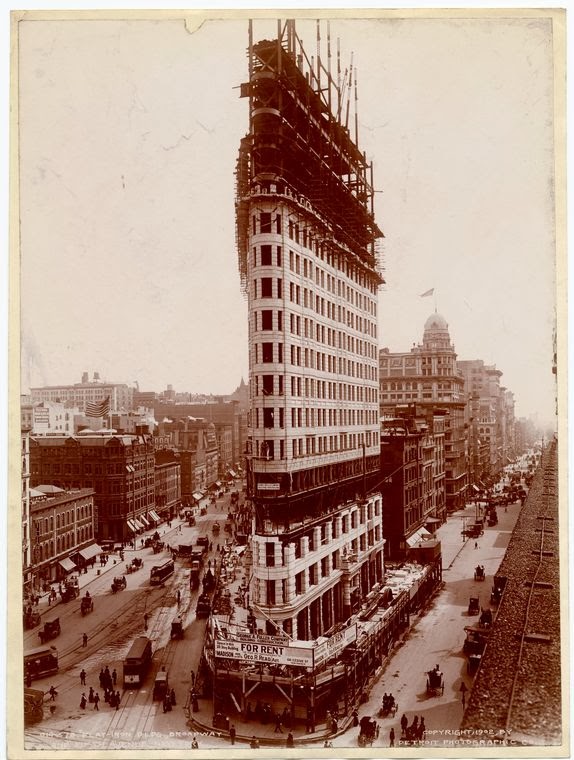
Why aren’t they showing the Flatiron Building? It’s not completed yet! The Daniel Burnham-designed office building would be opened by the summer, to great fanfare. But as an open construction site, it would have been dangerous to linger anywhere around it. I believe the slanted beams you see at the very end are part of the construction site.
This is the first film of a New York blizzard? This is probably the first film of any American blizzard. Primitive film technology had only recently allowed for outdoor filming. Porter and his crew would have been brave indeed dragging Edison’s equipment even two blocks through these conditions.
What’s that statue at the 1:15 mark? The seated, snow-covered figure of William Seward. The statue has sat at that corner since 1876. (More about that here.)
What’s that big building at the end? The Fifth Avenue Hotel, once considered the greatest accommodation in New York City and a headquarters for backroom politics in the 1870s and 1880s. Its glory days are long passed by the time of the blizzard. Six years later, it would be torn down and replaced with the building that stands at that corner today — the International Toy Center.
This classic episode of the Bowery Boys: New York City History podcast (originally released in December of 2021) is featured in this week’s episode of the History Channel podcast HISTORY This Week.
Since 2011 the Bowery Boys Podcast has revisited a few of the themes featured in this show. After listening to this episode, give these installments a try:
PODCAST The streets of New York have been lit in various ways through the decades, from the wisps of whale-oil flame to the modern comfort of gas lighting. With the discovery of electricity, it seemed possible to illuminate the world with a more dependable, potentially inexhaustible energy source.
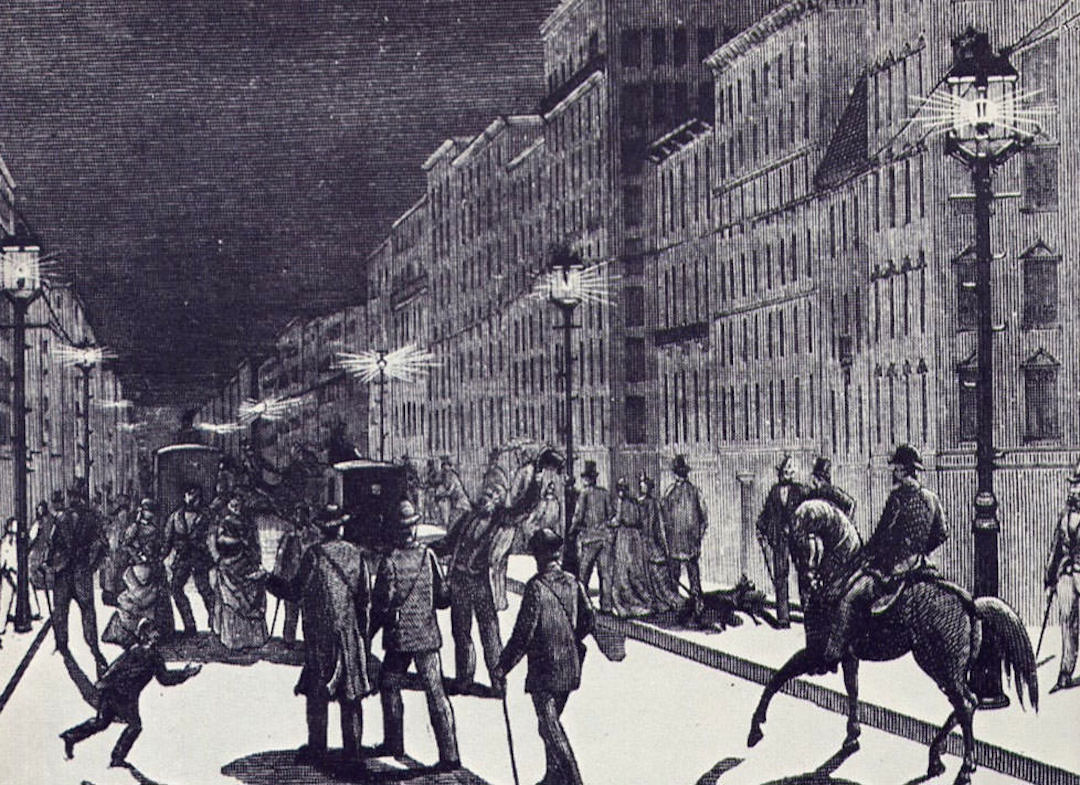
First came arc light and ‘sun towers’ with their brilliant beams of white-hot light casting shadows down among the holiday shoppers of Ladies Mile in 1880.
But the genius of Menlo Park, Thomas Edison, envisioned an entire city grid wired for electricity. From Edison’s Pearl Street station, the inventor turned a handful of blocks north of Wall Street into America’s first area entirely lit with the newly invented incandescent bulbs.
ALSO: It’s the War of Currents, the enigmatic Nicola Tesla and the world’s first electric Christmas lights.
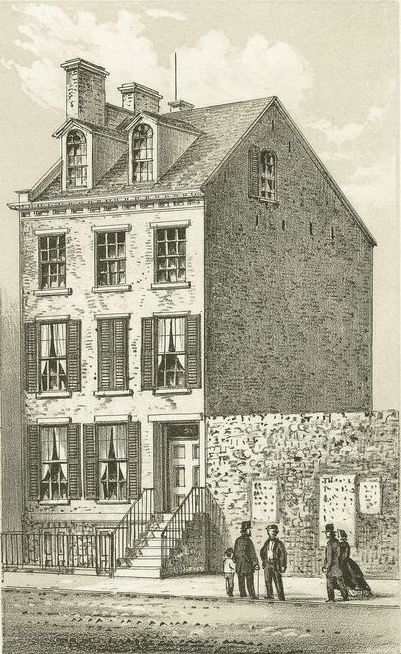
The home of Samuel Leggett, the first to be illuminated with gas lighting, at 7 Cherry Street. This home stood just a few blocks from the location of Edison’s Pearl Street Station (255-7 Pearl Street), which would also change the way people consider lighting their city. (NYPL)
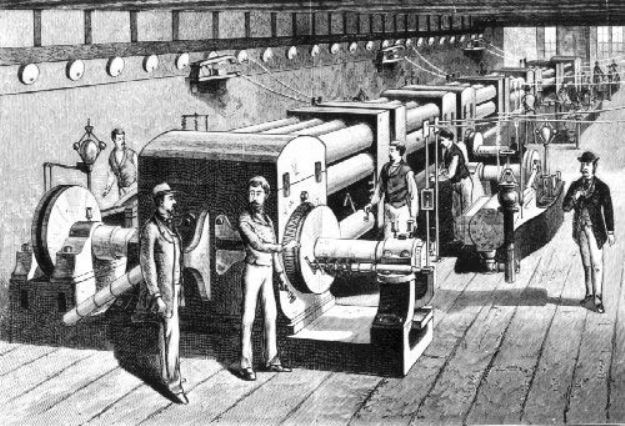
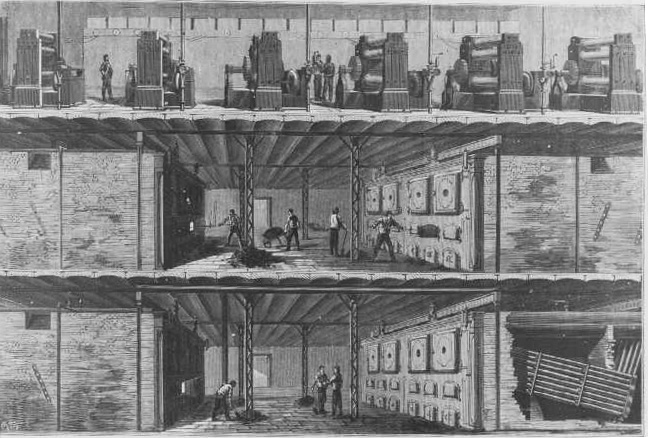
Inside the Pearl Street Station: Direct current surged through Edison’s generators to the neighboring blocks.
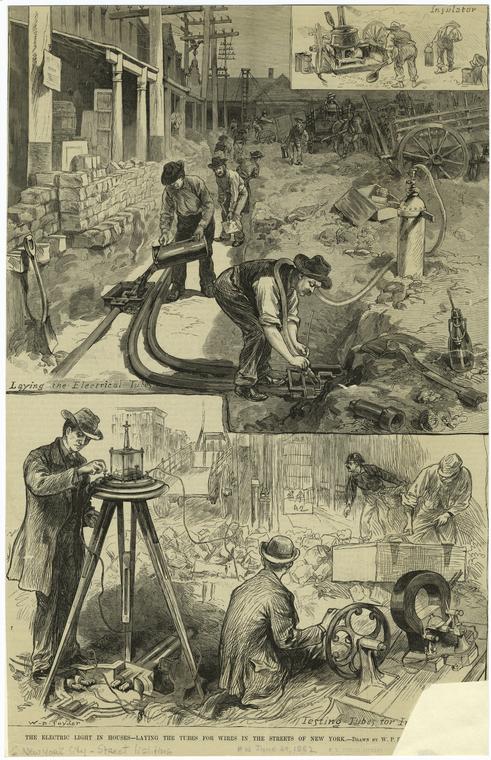
Laying the electrical wires under the streets of the blocks surrounding the Pearl Street station was an arduous, potential dangerous task. It took well over a year to complete the job. (Courtesy NYPL)
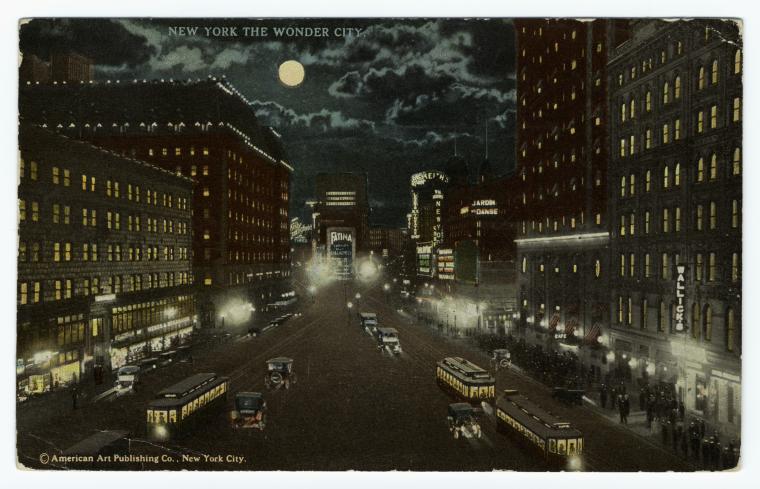
‘New York The Wonder City‘, and indeed it was, thanks to electricity. Whole neighborhoods, like Times Square and Coney Island, were defined by it. Landmarks like the Brooklyn Bridge, thoroughfares like the Bronx’s Grand Concourse and even Broadway itself were transformed at night by electric power. (NYPL)
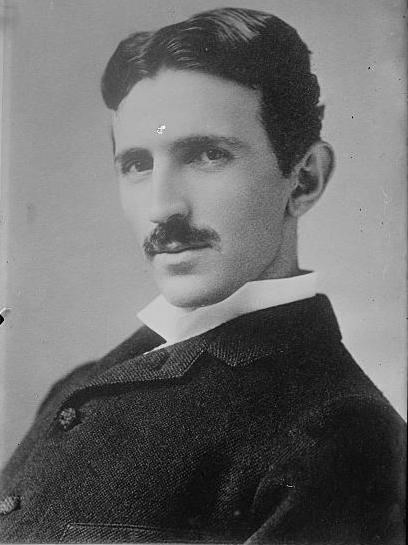
Nikola Tesla, the brilliant Serbian inventor who spent his final decades in New York living at the Hotel New Yorker.
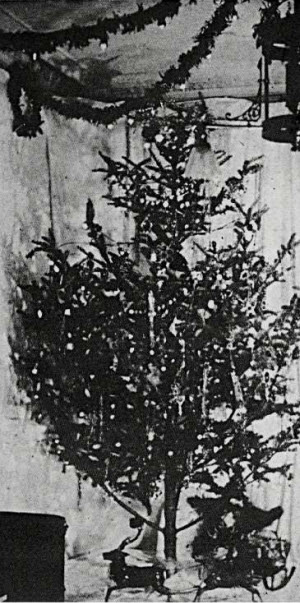
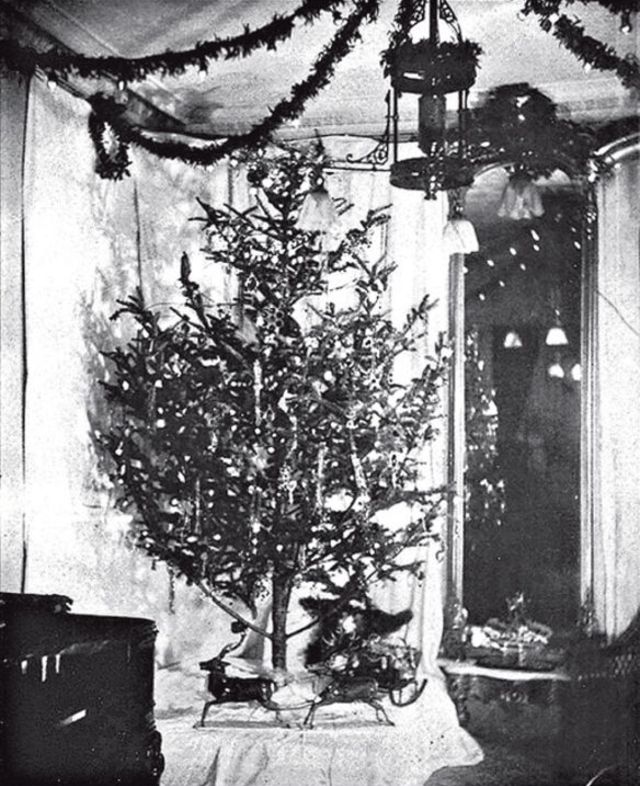
Behold! The first Christmas tree with electrical lighting, courtesy Edison employee Edward Hibberd Johnson. This tree glittered and twirled from Johnson’s home in Murray Hill. (Courtesy Jim on Light)
On the fiftieth anniversary of the invention of the lightbulb, an elderly Thomas Edison ‘reinvents’ it in 1929 at a reconstructed laboratory in Dearborn, Michigan, to the delight of Henry Ford and newly elected President Herbert Hoover.
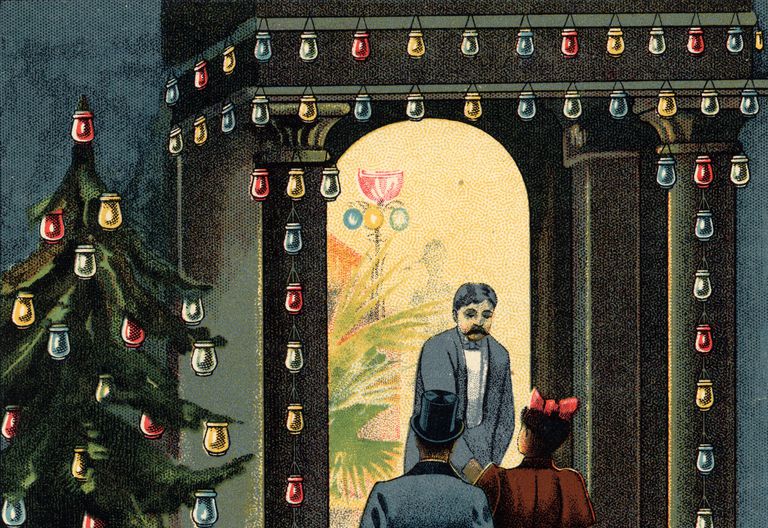
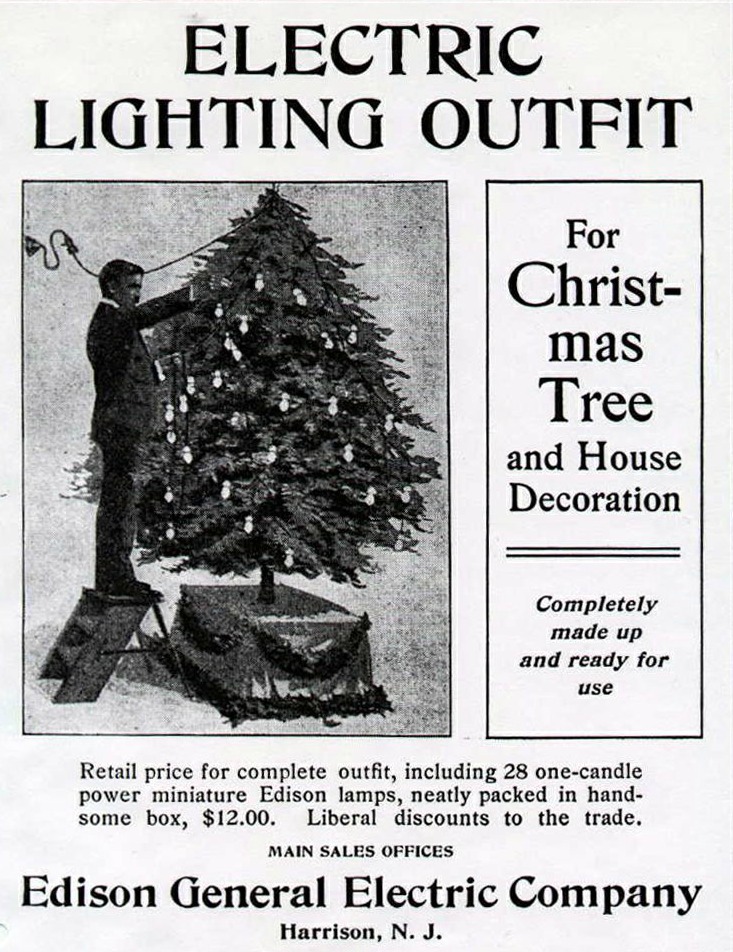
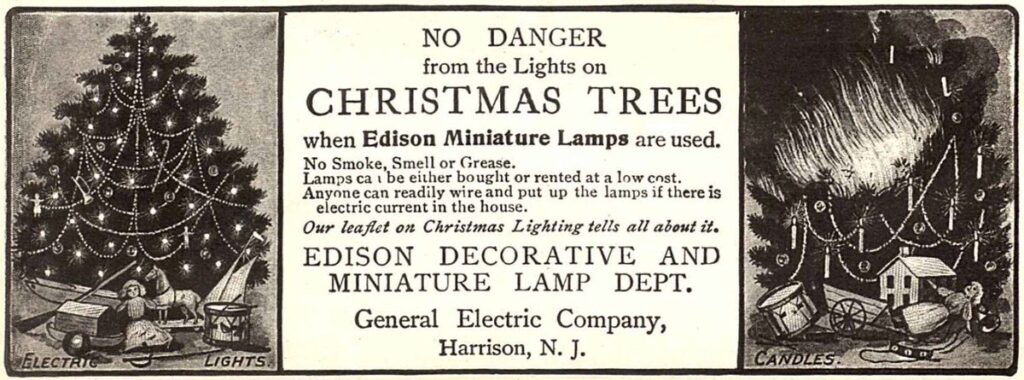
An electric Christmas lights advertisement from the 1890s. Getty Images
The world’s very first Christmas tree with electric lights was displayed in 1882 at the home of Edward Hibberd Johnson in the Murray Hill neighborhood of New York City.
Not only did it glow with this innovative new form of illumination, this Christmas tree also spun around, revolving like a flashy new car at an automobile expo.
The Christmas tree of Edward Hibberd Johnson
Two years later in 1884 the New York Times looked back fondly upon this greatly advanced version of the Christmas tree:
“The tree was lighted by electricity and children never beheld a brighter tree or one more highly colored than the children of Mr. Johnson when the current was turned and the tree began to revolve.
“It stood about six feet high, in an upper room, and dazzled persons entering the room. There were 120 lights on the tree, with globes of different colors, while the light tinsel work and unusual adornment of Christmas trees appeared to their best advantage in illuminating the tree.
“The set of lights were turned off and on at regular intervals as the tree turned around. The first combination was of pure white light then as the revolving tree tree severed the connection of the current that supplied it and made connection with the second set, red and white lights appeared. Then came yellow and white and other colors.”
The children of Mr. Johnson were witnessing a revolution. Yes an actual revolution – of the tree itself – but the beginning of an entirely new way of celebrating the holiday.
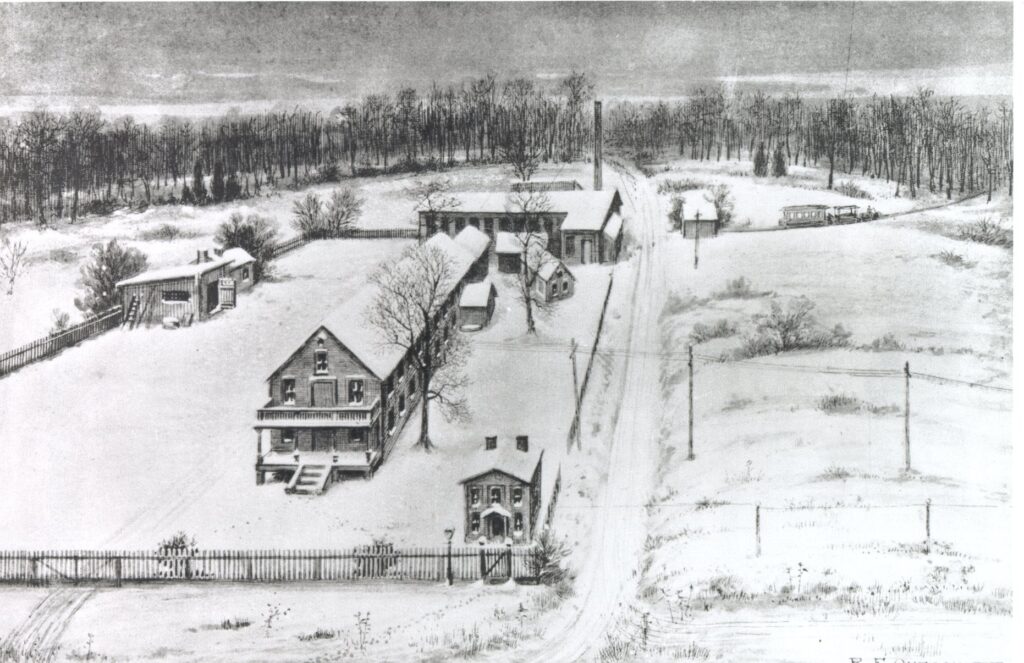
Snow covered Menlo Park
Surrounded by his wealthy investors, Thomas Edison gave the first public demonstraton of the incandescent lightbulb on December 31, 1879.
Now, believe it or not, New Yorkers were already accustomed to electric illumination during the Christmas season. The major Manhattan shopping districts were already exposed to stadium-like arc lighting, a primitive form of electric light that was too harsh and intense for everyday usage.
But Edison’s invention was vastly superior and it wouldn’t just drive away the dark. In its compact size, its durability and eventual convenience, the lightbulb would elaborate on one of candlelight’s most appealing components – mood.
The next year, on December 20, 1880, Edison had additional investors out to Menlo Park, and they were greeted with an extraordinary site.
From the NYT: “The train arrived at Menlo Park at 5:31. Darkness had settled down upon the bleak and uninviting place which Mr. Edison had chosen for his home, but the plank walk from the station to the laboratory was brilliantly lighted by a double row of electric lamps, which cast a soft and mellow light on all sides.
“The incandescent horseshoes gave out a yellow light which shone steadily and without the least painful glare and were beautiful to look upon.”
While this was not intentionally a Christmas lighting display, the arriving investors, in the holiday spirit, remarked upon the appropriate warmth and charm of the lights on the chilly December evening.
The light bulb would change the world but it would also make Edison a lot of money.
Soon Edison began aggressively promoting the various ways that electric lighting could be used to improve life – the more reasons, the more likely other investors would sign on and the more likely cities would hire Edison to install electrical power stations.
For the first time, the homes and offices of lower Manhattan would be able to light their interiors more pleasantly and conveniently than those homes with gaslight.
Whereas as the illuminations from gas would often create a sickly glow, the light from an electric glass bulb would seem romantic and alluring in comparison. Finally the candle had some competition.
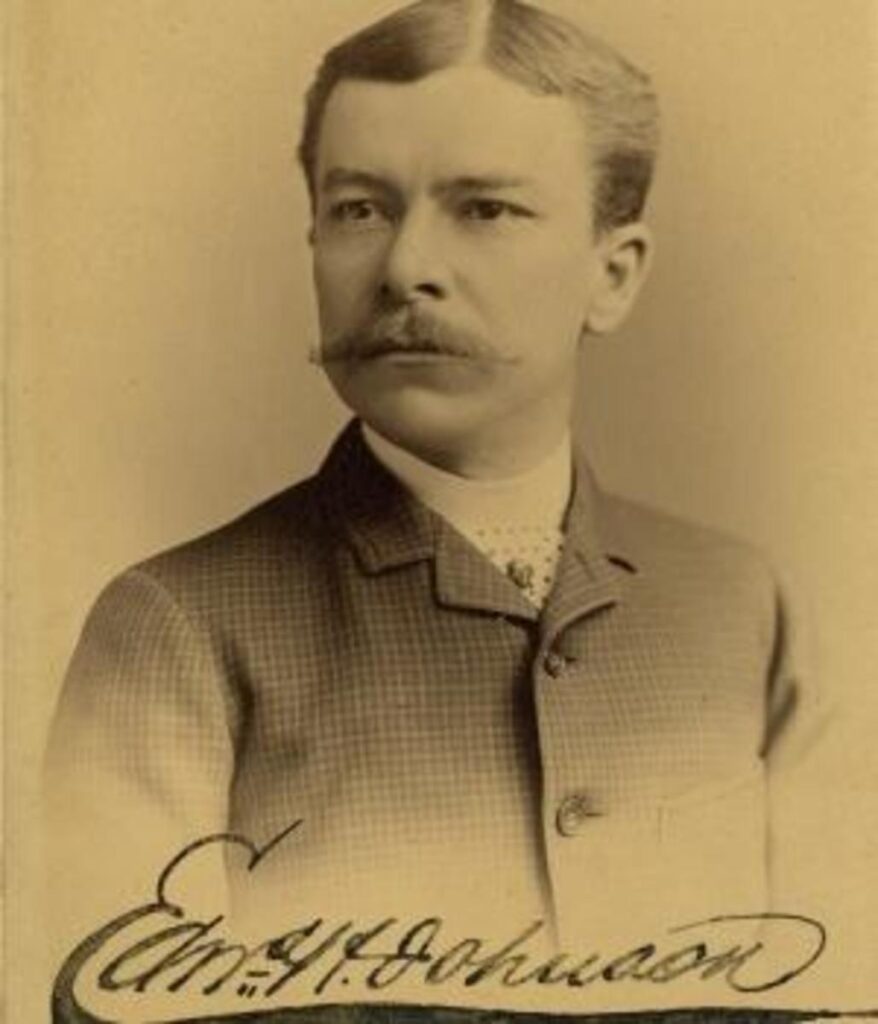
Further uptown, at the home of Edison’s friend and the vice president of the Edison Electric Company Edward Hibberd Johnson (pictured above), electricity was taking the place of a rather hazardous form of decoration.
For Johnson’s electric-tree idea took his inspiration from traditional candle-lit trees.
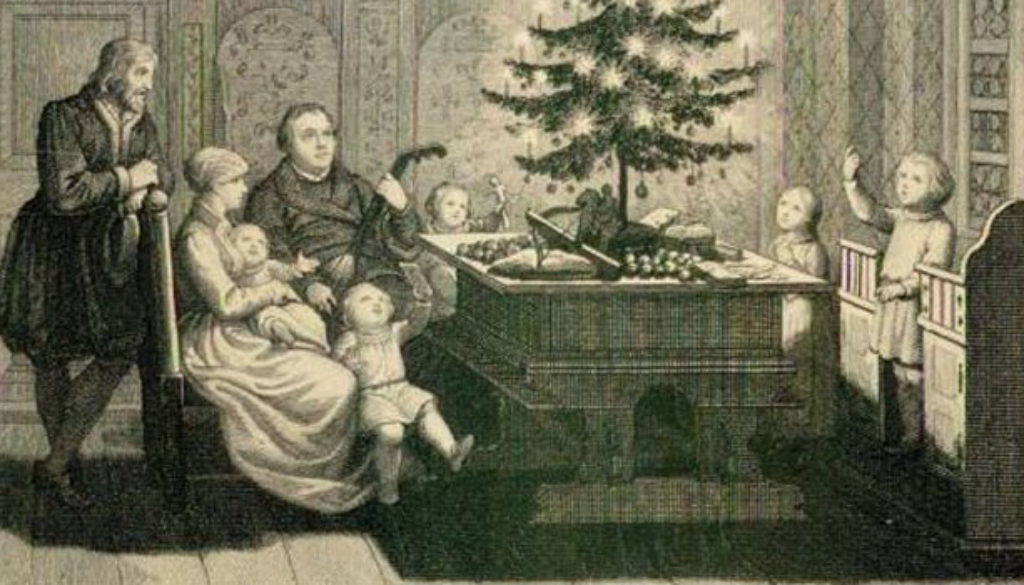
Candles in Christmas trees
In the early 19th century a Christmas tree was considered a luxury of the urban rich who could afford to have a tree cut down for them and installed in their homes. But by the 1850s people could purchase trees at the market and carry them home to decorate for the season.
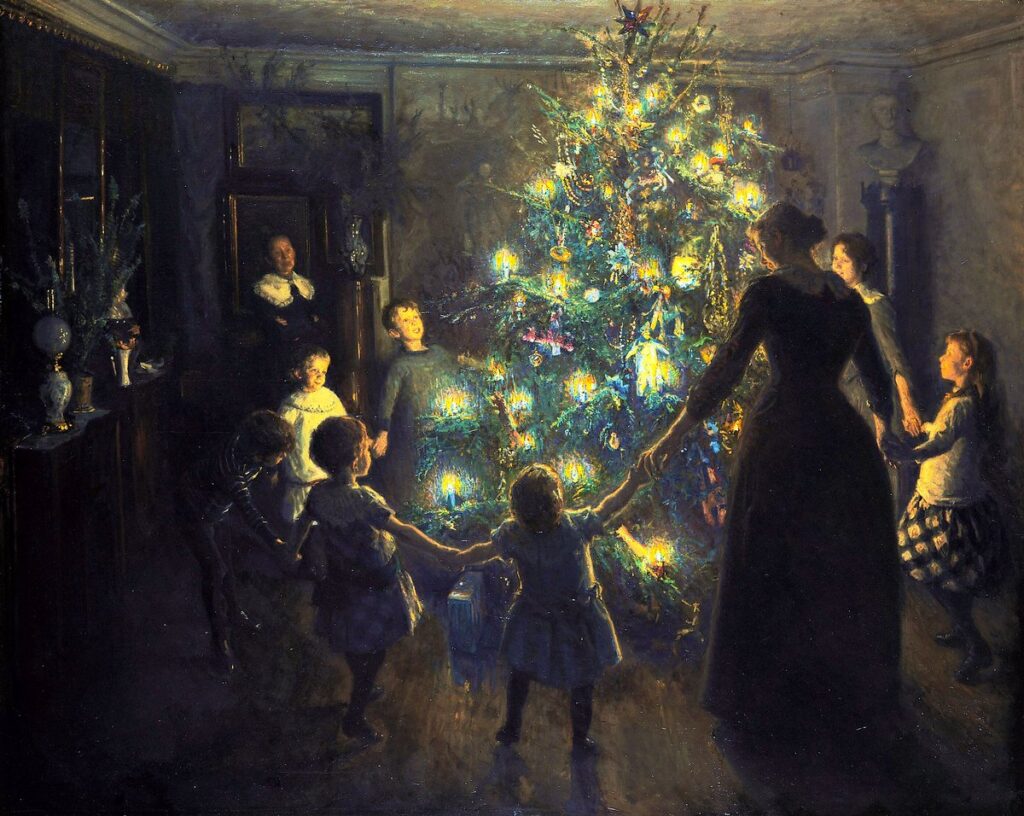
The most beautiful trees — the ones that seemed to fully embody the spirit of the season — were decorated with lit candles.
Getting a candle to stick in a tree was not easy. Some held the melted wax to branches, others pierced the candle with needles, tying them to the tree that way.
Happy Christmas (1891) by Danish artist Viggo Johansen
In 1878 an inventor named Frederick Artz devised a spring clip that could hold candles to the branches.
Now a family could attach lit candles to a Christmas tree and know — with just a touch more assurance — that the waxen dagger would not fall into the branches and burn the house down.
Keep in mind that in the 19th century Christmas trees were only installed in homes for only a few days. People did not lavishly decorate a month and a half before like we do today.
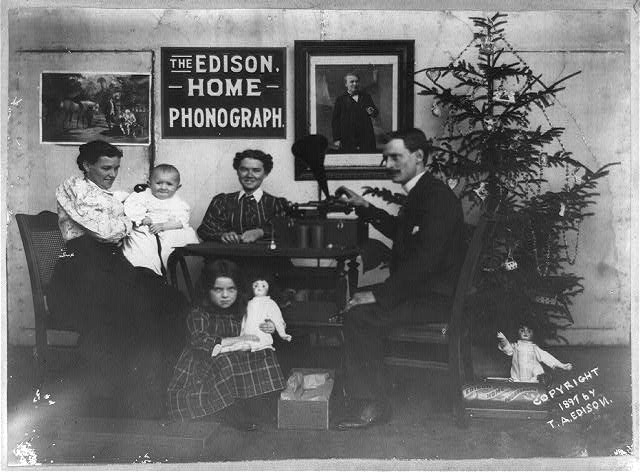
And trees were more closely monitored then. Next to the presents underneath the tree was a bucket of water.
By 1908, some insurance companies refused to cover fires started by candle accidents on Christmas trees, claiming they were a clear and knowing risk.
1897 Library of Congress
So you can understand why people absolutely lit up at the idea of a Christmas tree with electric lights.
In January 1883, the journal Electrical World called Johnson’s tree on Madison Avenue the handsomest tree in the United States.
Pictures would suggest otherwise, although photographic process of the early 1880s were hardly equipt to capture such a unique and peculiar things – a rotating, brilliantly and colorful lit object of natural art.
But of course it wasn’t art. It was promotion.
With each year, Johnson would continue to let in the press into his home to report his unusual holiday marvel.
In addition he would install similar trees in places where Edison electrical power would soon be made available.
For instance, for Christmas 1883, he put up a much larger display tree at the Foreign Exposition in Boston at Mechanics Hall in Boston’s Back Bay.
From a 1904 history of Edison lighting:
“At the Boston Foreign Fair, about 1,500 Edison lamps were employed and the Christmas tree took several hundred more.
“This tree was deisgned to be operated by an automatic device which would make the light of the lamps appear and disappear in time with whatever music might be played and it was manipulated by means of a keyboard of switches, the operator being concealed at the base of the tree.
“The effect was so pleasing that Christine Nilsson, the Swedish Nightingale, who was in the audience begged to be allowed to manipulate it.”
All these wondrous, grandious displays were all for the general promotion of electrical power and not for the production of Christmas home decorating products themselves.
For at least two decades after Johnson’s extraordinary display, electric Christmas sets for the home were sheer novelty and clearly for the richest participants of the Gilded Age, those who could afford electricians and personal generators.
Consumers wouldn’t get to affordably light their home Christmas trees until the 20th century. Well, affordably can be debated.
In 1903, General Electric would finally make strings or festoons of miniature incadesent lamps – with bulbs of all colors — available for home holiday decorating. 24 bulbs for just $12! In 1903 dollars. That’s about $325 dollars today.
To decorate a tree of any meaningful size would require holiday revelers take a small mortgage out on their house.
But of course, by this time, Christmas in America was already being defined by thresholds of wealth. Christmas meant spending.
So for some, spending a week’s paycheck on Christmas lights might have been worth the heartache.
For some of course, it made more sense to RENT Christmas lights, a popular option in the year 1900.
From a General Electric Ad that year: “Edison Miniature Lamps for Christmas Treets. No Danger, Smoke or Smell. Lamps either rented or sold. Full directions furnished, enabling anyone to readily wire and put up the lamps.”
For more information, check out these Bowery Boys podcasts:
The Current War, an epic detailing the battle for electrical power in the 19th century, was supposed hit theaters in the fall of 2017. But its distributor was the Harvey Weinstein Company and its release date was delayed by more important matters.
The film depicts the technological and financial war between Thomas Edison (played by Benedict Cumberbatch) and George Westinghouse (Michael Shannon) to power the United States with electricity — Edison championing direct current (DC) while Westinghouse promoted alternating current (AC).
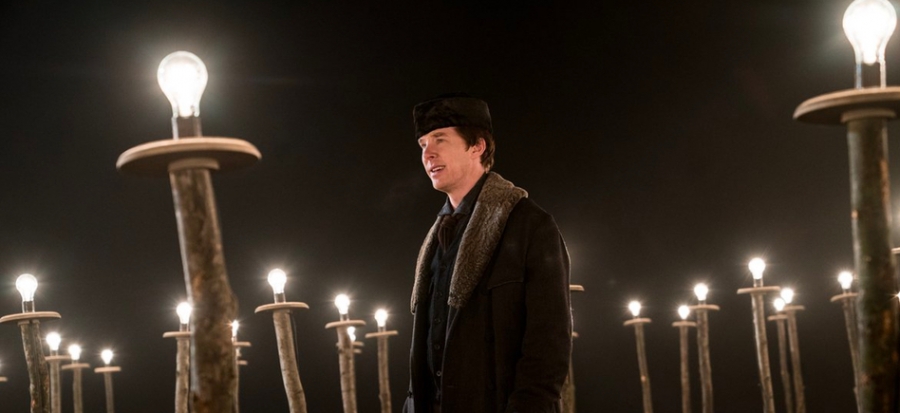
Edison (Benedict Cumberbatch) lights up Menlo Park / Lantern Entertaiment
The film is a bonanza for history lovers — and a bit of a bust for regular film goes and probably an offense to fans of real science on the screen. Gomez-Rejon presents a series of sumptuous, even breathtaking historical recreations — from Menlo Park to Niagara Falls — with a sharp visual style.
Many scenes reminded me of Steven Soderbergh’s The Knick; at its most ambitious, it was Eduard Muybridge by-way-of Brian DePalma.
The Current War gives us images we’ve rarely seen in cinema before — the lighting of lower Manhattan via the Pearl Street Station, the hauntingly lit grounds of Menlo Park, the triumph of the Chicago World’s Fair. (Obviously, at the Ferris Wheel, I gasped aloud.)
Westinghouse (Michael Shannon) in the corridors of Pittsburgh high society / Lantern Entertaiment
The film is so busy checking off the boxes of actual history that it sometimes forgets to make its principal characters interesting. To be fair, there’s so much going on. But Cumberbatch’s Edison hangs from bullet points about Edison’s life that never feel like they add up to the actual man. Shannon provides Westinghouse with more contemplation and carriage.
Tom Holland‘s hanging around too as Edison’s young assistant Samuel Insull. Comic book movie fans, if you’re keeping track — that’s Spider-Man, Dr. Strange, the Beast and General Zod in one movie.
The film’s fatal flaw is its failure to adequately visualize the core conflict — the battle of direct current vs alternating current. You know, the war of The Current War.
If you didn’t know what distinguished these two forms of electrical delivery before the film, it’s doubtful you’ll understand them afterwards. Scientific concepts can be difficult to translate onto film — finance shares the same problem — but the movie doesn’t really try.
Okay, but after all that — history buffs, please seek out this film! The worlds it creates are ravishing, often thrilling. The sense of gaslit rooms, the wonder of Victorian decor drenched in electric light. THE FERRIS WHEEL.
We have spoken about this subject many times on our podcasts. In fact, you can stitch the film’s screenplay together from listening to these past episodes of the Bowery Boys and The First:
The plays and sonnets of William Shakespeare, as the finest examples of the English written word, were also the first recorded sounds ever made. Â The first recording ever made at Alexander Graham Bell‘s Volta Laboratory in Washington DC in 1881 was that of Bell’s very own voice reading Shakespeare’s Hamlet.
Here’s another recording of Bell’s voice from 1885, running through a series of numbers as a sort of ‘test pattern’ for Bell’s new Graphophone:
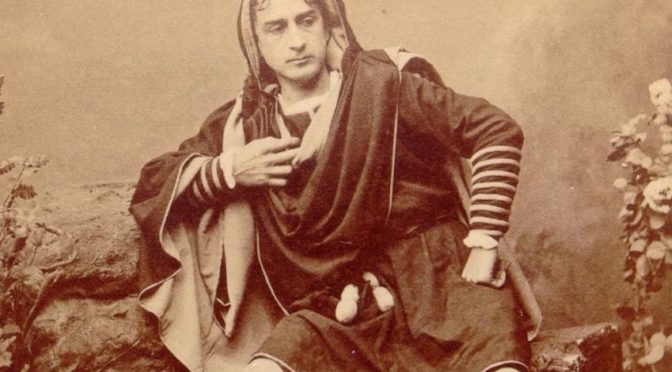
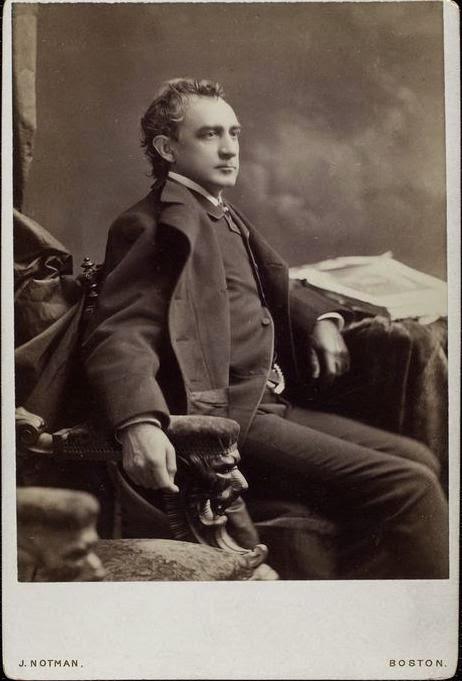
But Bell, visionary and genius, was no actor. Â The first audio of Shakespeare performance by an actor — the greatest actor, in fact –Â Edwin Booth, also known among the creative set in New York for The Players Club in Gramercy Park.
The recordings were made in Chicago in March 1890, of Hamlet and Othello (heard below):
Booth has a couple tie-ins to the subject of our last podcast,the Astor Place Riot. Â He was named for the early American tragedian Edwin Forrest whose rivalry with the British actor William Macready incited the bloody conflict at the crossroads of Broadway and the Bowery on May 10, 1849.
And, of course, Edwin Booth has a serious connection with another 19th century theater tragedy — the assassination of Abraham Lincoln by Edwin’s brother (and acting partner) John Wilkes Booth. Â The assassin was actually known for his own aggressive version of Othello; during one performance, he almost strangled the life out of the actress playing Desdemona!
Listen to Edwin Booth’s recorded performance. Â You’re listening to the world’s most well-regarded actor of the 19th century. Â He’s at the end of his career here. Â One year later, in 1891, he would give his last performance at the Brooklyn Academy of Music. In the role of Hamlet, naturally.
The recordings, using Thomas Edison’s equipment, were never meant for public performance, but rather at the behest of his daughter Edwina.
In 1910, D.W. Griffith made one of first films ever produced in Hollywood, CA, appropriately called In Old California. Before then, film production companies were scattered throughout the United States, with two of the most successful based here in New York City.
The American Vitagraph Company, originally located at the Morse Building on 140 Nassau Street, made film shorts on the roof before moving to the Brooklyn neighborhood of Midwood in 1906. Vitagraph is best known for producing a five-part serial on The Life of Moses strung together to make what some call the first ever feature length motion picture.
More influential, however, was probably Edison Studios, the film company owned by inventor Thomas Edison. With principal studios in the New Jersey town West Orange — and original laboratories in Menlo Park (now Edison, NJ) — Edison eventually set his sights on a Manhattan studio.
He initially moved into the heart of the city in 1901, in a studio at 41 East 21st Street. Such a move made sense at the time; movies were only a few minutes long, essentially just filmed sequences of activities, and had no sound. A small studio smack in the center of New York would not have been disturbed by the bustle of the city.
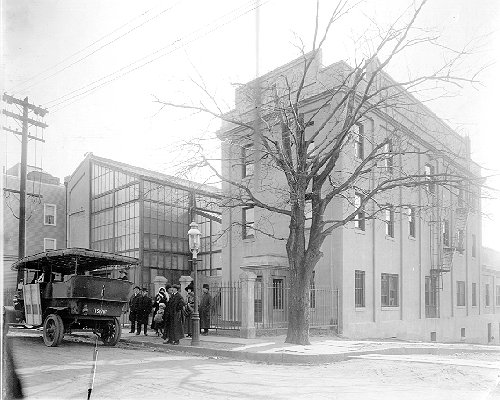
With the growth into narrative films — longer movies with elaborate sets and casts — Edison needed to expand into a larger space and in 1908 moved production to a warehouse in the Bronx, at Decatur Avenue and Oliver Place, sandwiched between the Grand Concourse and the New York Botanical Garden.
“The Edison Studio is said to be one of the finest and largest of its kind in the world,” reported [the theatrical trade paper]The Dramatic Mirror. “The building itself is 60 by 100 feet, built of concrete, iron and glass. The scenic end of the studio, corresponding to the stage in a theatre, except that it is not raised is 60 by 60 feet and 40 feet high. Here the scenes for film productions that cannot be made with natural outdoor backgrounds are painted and set.”
Its glass enclosure was especially revolutionary for the day, allowing for a diversity of film presentations. Â Of a film called While John Bolt Slept, the clearly-not-unbiased Edison Kinetogram journal said in 1913: “The scene in the tenement alley is a wonderful example of the realistic effect which can be obtained in the Studio. Even the ‘fan’ of long standing would hardly believe that the scene was done under the great glass of the Bronx Studio.”
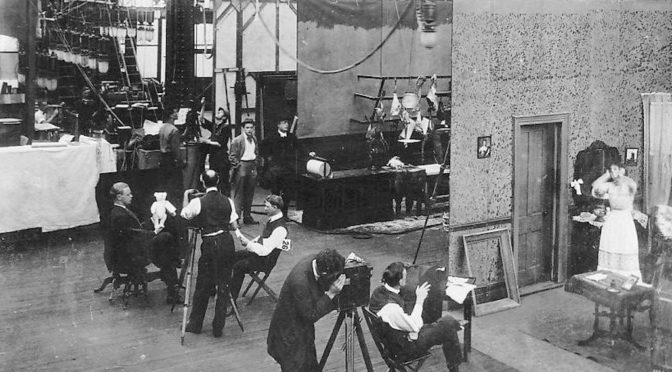
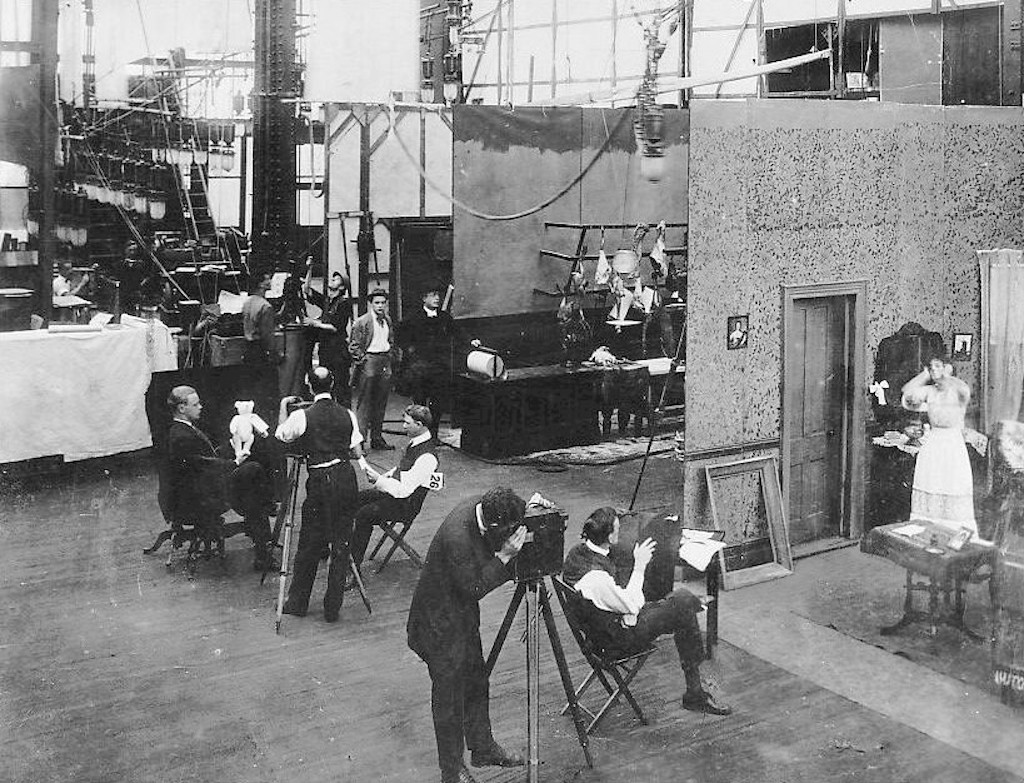
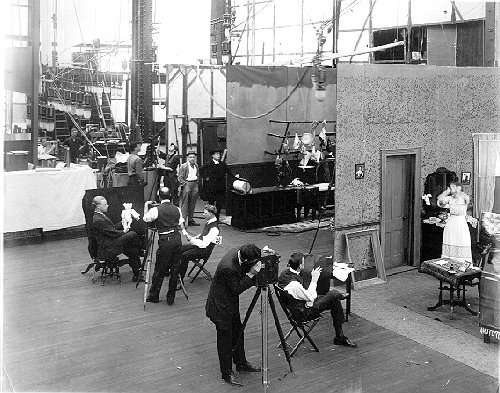
Inside the Bronx Edison Studios:
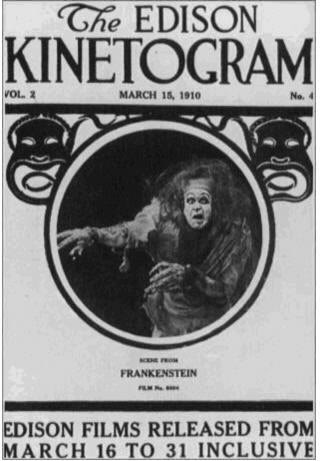
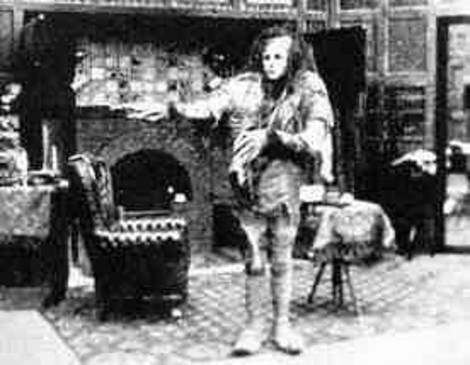
It was at this new Bronx studio in 1910 that Edison’s company produced one of its greatest works, the very first film adaptation of Mary Shelley’s Frankenstein. Shot in a week — rather lengthy for a film shoot in those days — the loose adaptation featured Charles Ogle as the famed monster.
Believe it or not, the film began production on January 17, 1910, and was released by March of that year! Since there just weren’t that many movies houses in 1910, a film release constituted about 40 copieswhich were distributed around the country, then returned several months later.
The film was reportedly lost forever before a single negative was found and restored in the 1970s. I present to you the Bronx-made psycho-horror masterpiece in all its glory:
Unfortunately this glorious studio was destroyed long before the film industry moved out to California, gutted by fire on March 28, 1914. The glass ceiling, shattered during the blaze, proved quite a danger to fire fighters. Â Two men were cut by flying glass though no one was seriously injured, a miracle considering that over a hundred actors had been working there the previous night.
“Thousands of dollars worth of cameras, scenery, costumes and properties were burned, as was all the film so far used in the making of a spectacle to be called The Battle of Mobile Bay.” Other films worth $100,000 including original films of Mayor Gaynor and Andrew Carnegie, stored in fireproof vaults, were saved.”
Edison was not alone in finding inspiration in the Bronx. Â Biograph Studios briefly (from 1913 to 1915) opened a studio at East 175th Street and Marmion Avenue just north of Crotona Park.
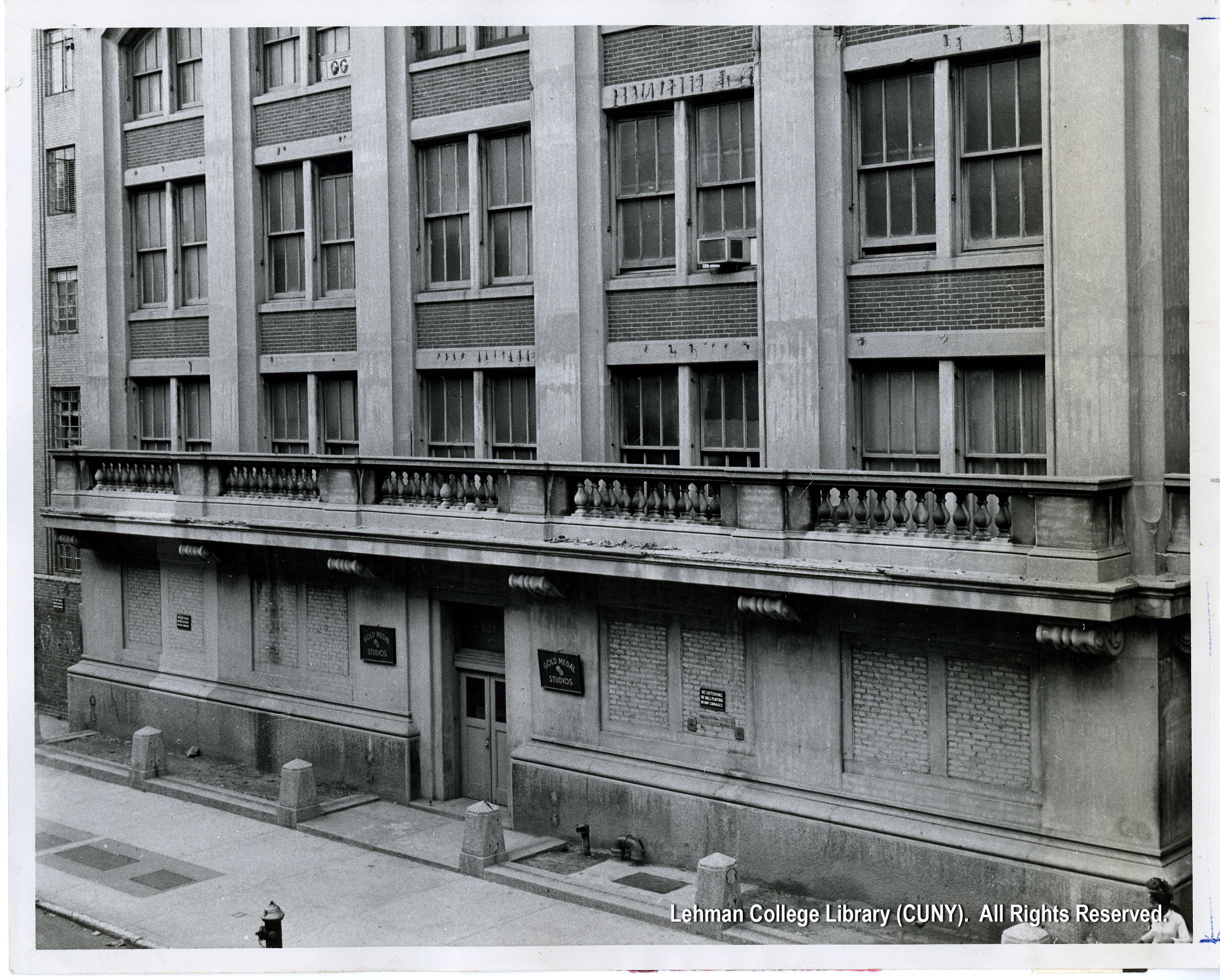
The building would later claim a greater connection to Hollywood int the 1935s when it was transformed into Gold Medal Studios, an early film and television production company. (Below: The unspectacular exterior)
Truly exciting for residents of the Bronx was that these studios often plucked random people off the street to serve as extras in their films.
This article reprinted from a blog posting on January 10 2011.
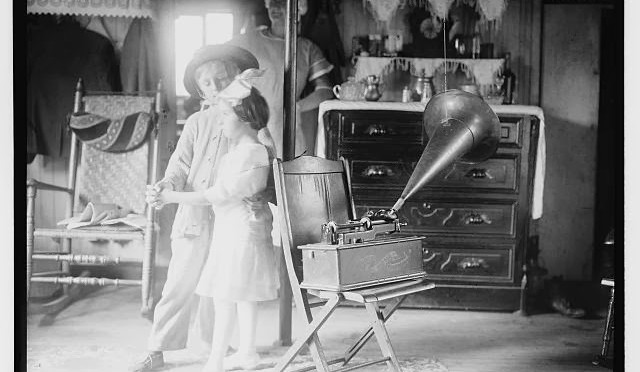
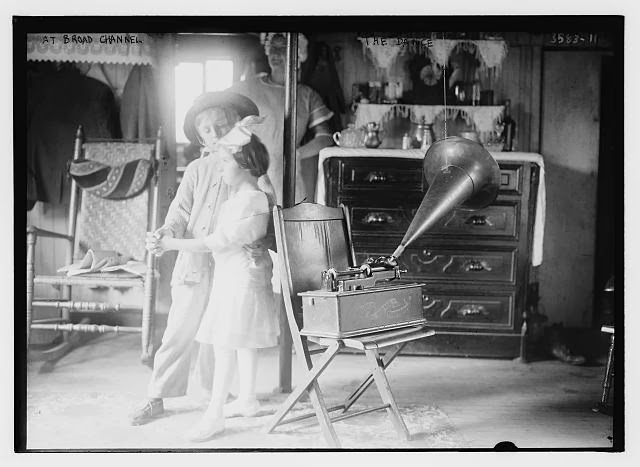
“Photograph shows a boy and a girl dancing while an Edison Home Phonograph plays in a house in Broad Channel, Queens, New York City.” — taken between 1910-1915 Here’s something many people thought they’d never see again in New York City — the opening of a new record store. Rough Trade, known for their famous London record shop, will open an awesomely spacious new store in Williamsburg this week, with vinyl-record listening stations, a coffee shop, live performances and a heap of nostalgia on its shoulders.
Remember Tower Records on Broadway? Virgin Records in Times Square? The old subway Record Mart? The long-vanished Commodore Record Shop? The past is littered with the ghosts of music stores long gone.
But where did people first buy recorded music in New York City? The first recordings came on phonograph cylinders, long tubes with the grooves etched along the front, often made with wax. Essentially, they looked like — and probably smelled like — big, decorative candles.
They were soon in competition with phonographs in a flat, wax disc form, the musical delivery device which eventually won out and became the standard for decades.
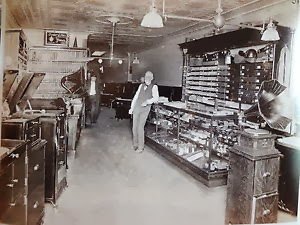
In the beginning, recorded music was played in exhibition halls, not available for home use. By the 1890s, the first musical devices were available for purchase, and phonographs were sold in establishments that offered instruments, music boxes or early electronics — Broadway piano stores (like the one above, in 1910) or the places down on the soon-to-be-named Radio Rowwhich offered New Yorkers the latest technology.
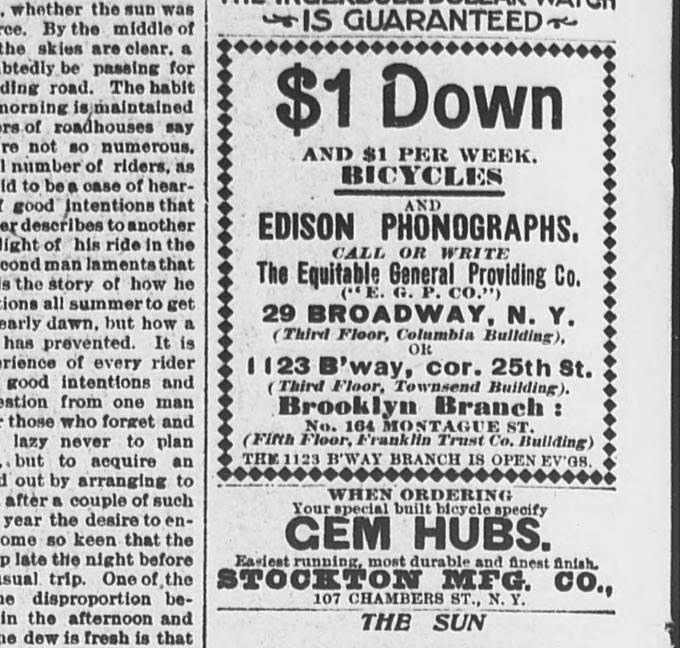
Naturally, the first records were made to play on Edison machines, pricey novelties in the late 1890s. Here, in 1898, you could put a down-payment on the purchase of a phonograph machine and a bicycle — a real hipster double-play today!
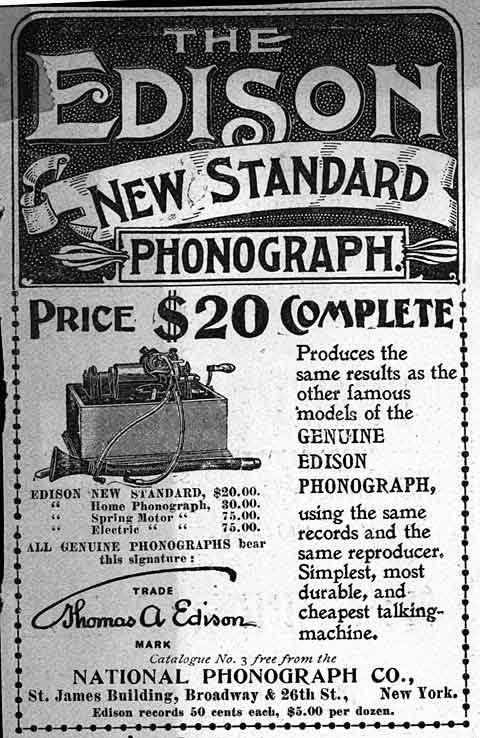
Another advertisement from 1898 presents Edison records at just “$5.00 a dozen”, found at the St. James Building at Broadway and 26th Street. Of course, a great many of these records were spoken word, not music; after all, they were nicknamed ‘talking machines’ at this time.
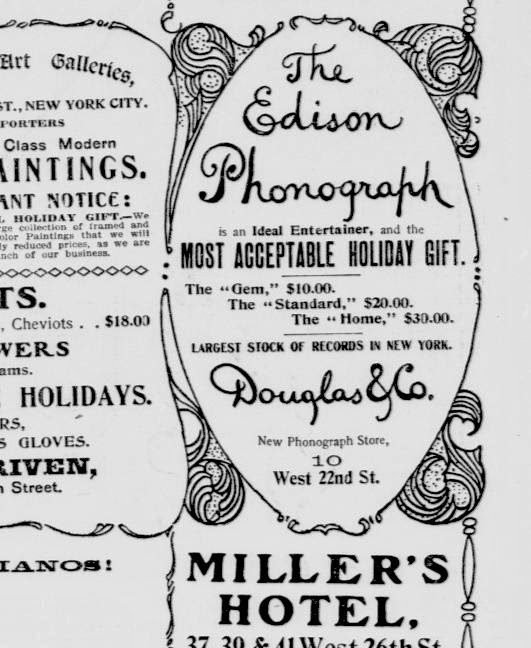
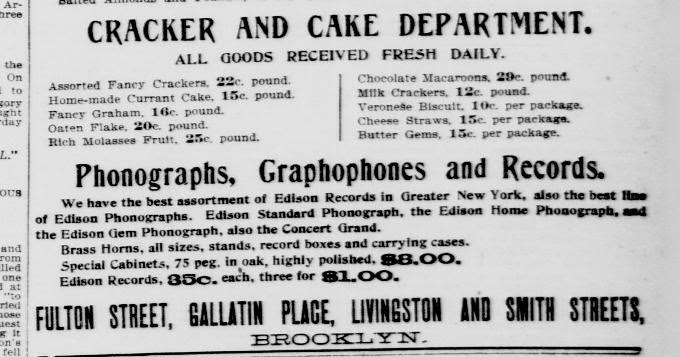
I was able to find a few other early photographer retailers in old newspaper advertisements. For instance, Douglas & Co., at 10 West 22nd Street, appears to be one of New York’s earliest retailers specializing in recorded sound. From Dec 16, 1900:
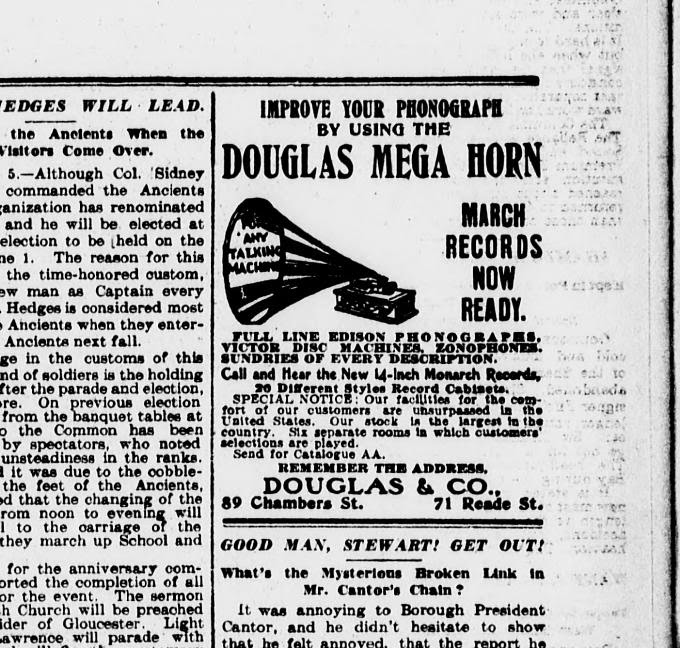
By 1903, Douglas & Co. had moved downtown, closer to the electronic retailers that would later specialize in radio and televisions:
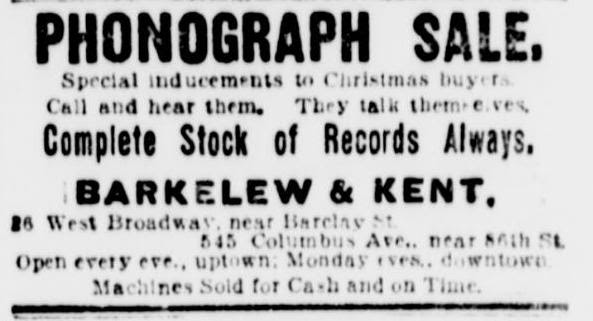
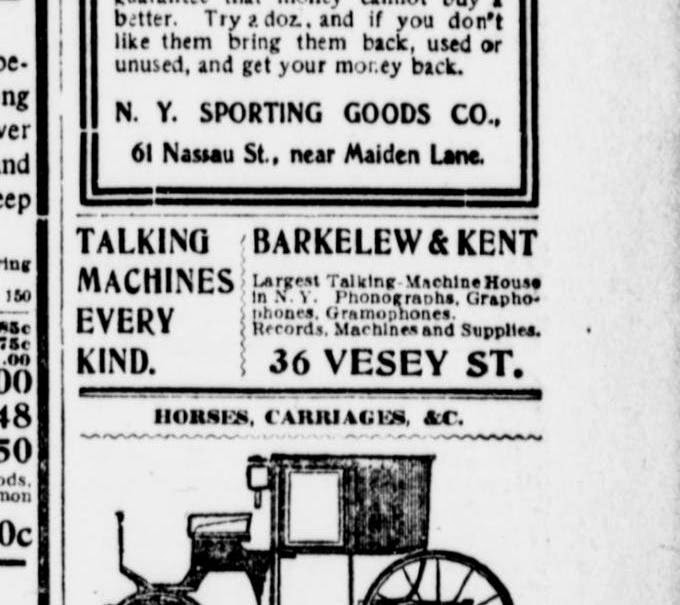
Another early phonograph retailer I was able to locate was A.B Barkelew & Kent. “Call and hear them. They talk themselves.” They would eventually move to Vesey Street and, in 1902, claim “the largest stock in New York.”
As early in 1899, Barkelew & Kent could claim to be one of New York’s first used record stores. From a trade ad: “We exchange records you tire of and do not like.”
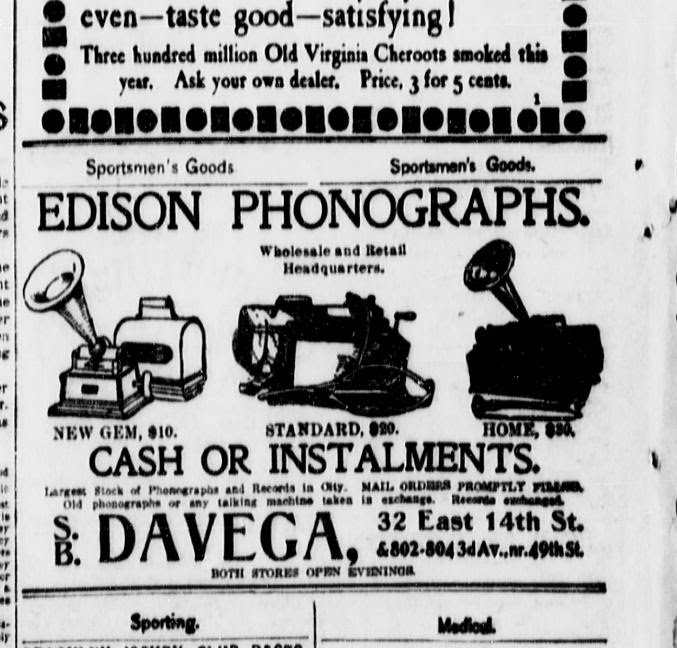
Interestingly, early record stores were listed alongside advertisements for sporting goods. This ad is from May 1902:
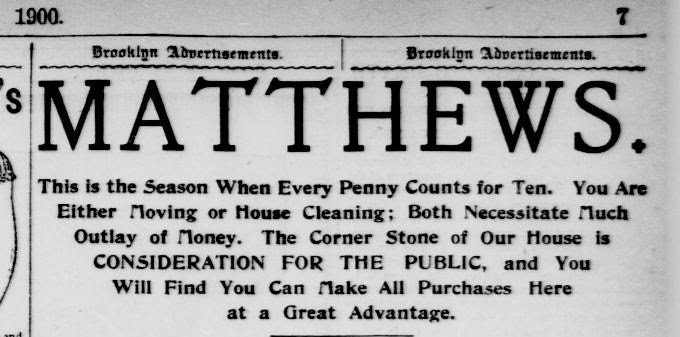
And since we’re celebrating the opening of a new record store in Brooklyn, I should add that one of Brooklyn’s first major record stores was at A.D. Matthews Department Store on Fulton Street.
In 1910, DW Griffith made the first film ever made in Hollywood, CA, called In Old California. Before then, film production companies were scattered throughout the United States, with two of the most successful based here in New York City.
The American Vitagraph Company, originally located at the Morse Building on 140 Nassau Street, made film shorts on the roof before moving to the Brooklyn neighborhood of Midwood in 1906. Vitagraph is best known for producing a five-part serial on The Life of Moses strung together to make what some call the first ever feature length motion picture.
More influential, however, was Edison Studios, the film company owned by inventor Thomas Edison. With principal studios in the New Jersey town West Orange — and original laboratories in Menlo Park (now Edison, NJ) — Edison eventually set his sights on a Manhattan studio.
He initially moved into the heart of the city in 1901, in a studio at 41 East 21st. Such a move made sense at the time; movies were only a few minutes long, essentially just filmed sequences of activities, and had no sound. A small studio smack in the center of New York would not have been disturbed by the bustle of the city.
With the growth into narrative films — longer movies with elaborate sets and casts — Edison needed to expand into a larger space and in 1908 moved production to a warehouse in the Bronx, at Decatur Avenue and Oliver Place, close to the New York Botanical Garden.
Below: Inside Edison’s Bronx studio
“The Edison Studio is said to be one of the finest and largest of its kind in the world,” reported [the theatrical trade paper] The Dramatic Mirror. “The building itself is 60 by 100 feet, built of concrete, iron and glass. The scenic end of the studio, corresponding to the stage in a theatre, except that it is not raised is 60 by 60 feet and 40 feet high. Here the scenes for film productions that cannot be made with natural outdoor backgrounds are painted and set.” [source]
It was at this new Bronx studio in 1910 that Edison’s company produced one of its greatest works, the very first film adaptation of Mary Shelley’s Frankenstein. Shot in a week — rather lengthy for a film shoot in those days — the loose adaptation featured Charles Ogle as the famed monster. Believe it or not, the film began production on January 17, 1910, and was released by March of that year! Since there just weren’t that many movies houses in 1910, a film released constituted about 40 copies which were distributed around the country, then returned several months later.
The film was reportedly lost forever before a single negative was found and restored in the 1970s. I present to you the Bronx-made psycho-horror masterpiece in all its glory (watch it below or click here):
You can find more information about the film at Frankensteinia.
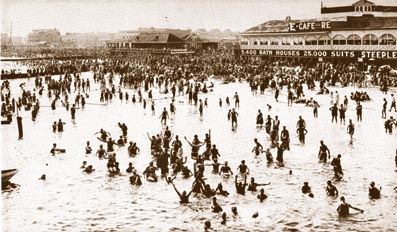
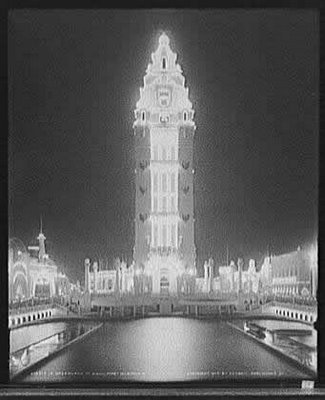
The Coney Island that greeted vacationers and city folk in the years 1904 to 1911 was one of infinite imagination manifested in fantastic but cheaply built extravaganza.
A world of amusement starts here in New York — Coney Island, the world’s oldest and strangest collection of amusement parks, a mishmash of sideshows, concession stands, gambling halls, new-fangled rides and luxury hotels. Take a daytrip with us back to the early days of Coney Island. Hold on to your hat!
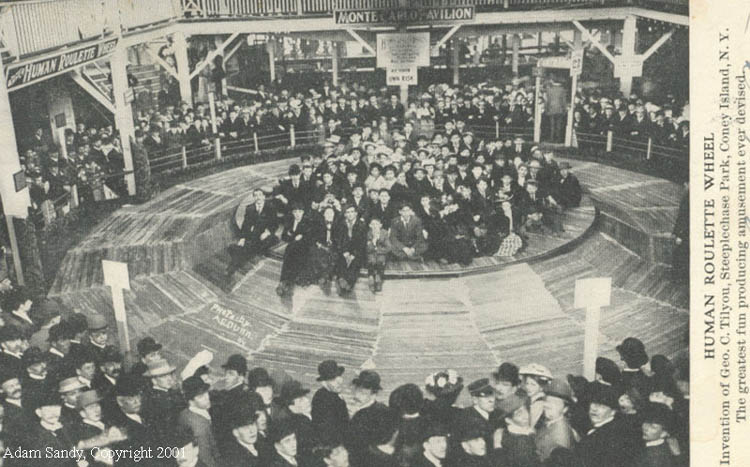
Over at Steeplechase Park, meanwhile, it was more centrifugal and gravitational forces that brought out the crowds, such as the Human Roulette wheel below. I dont know, there’s just something about this that looks profoundly unfun to me:
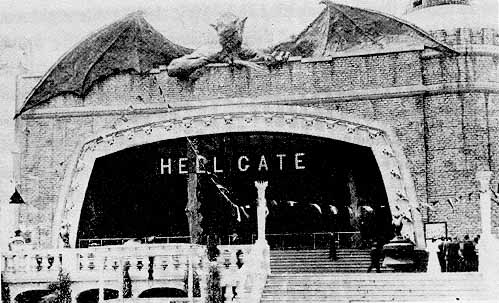
One of the more unusual amusements at Dreamland was Hell’s Gate, which emulated via the guise of starched Victorian morality the possible geography of Biblical Hell. Perhaps unsurpring, it was the combination of a burst lightbulb and a tar bucket inside Hell’s Gate that started the fire that eventually burned all of Dreamland to the ground in 1911, burning for 18 hours.
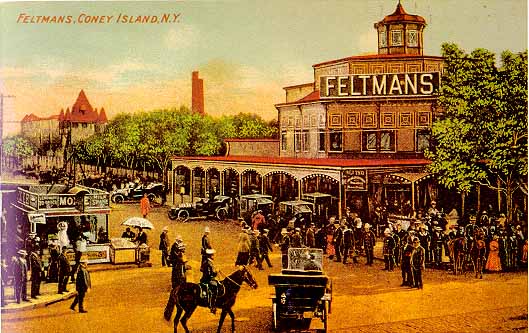
The proper entrepreneur who could maneuver through the early days of Coney Island corruption and make a financial killing. Take the inventer of the hot dog, Charles Feltman, who launched restaurants and hotels from the success of his sausage in a roll carts. This fancy restaurant, a favorite of vacationers of all social classes, sat where modern Astroland sits today:
(Not to spoil anything from our next episode, but in 1915, an employee of Feltman’s Restaurant Nathan Handwerker ate free hot dogs all summer, then devised an idea….)
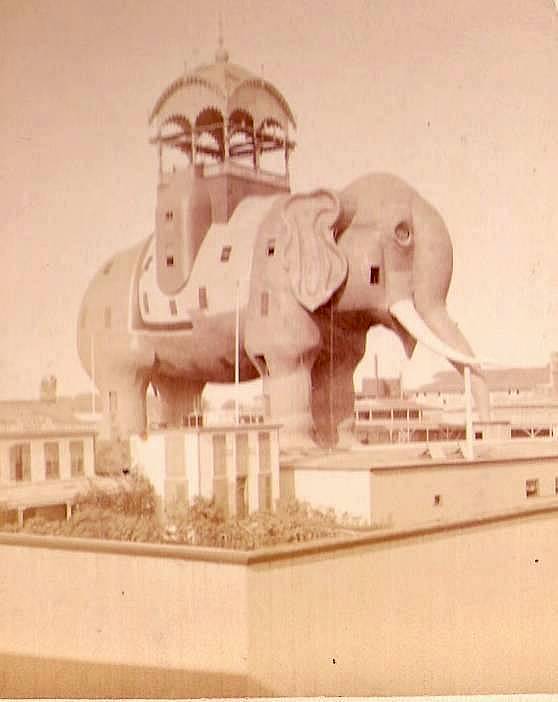
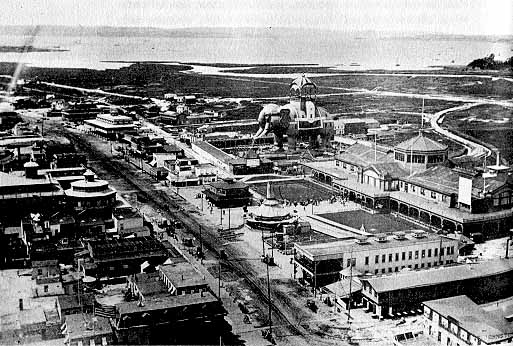
Why stay in a luxury hotel when you can just sleep in a giant elephant? This unusual lodging was built in 1882, just a few steps from the world’s first roller coaster, the Switchback Railway, and you could view the beach revelers via windows that served as the elephant’s eyes. One leg featured a small cigar store, while the back legs had a staircase that led to your room. Perhaps because this doesnt exactly look like the most comfortable revolution in hospitality, the hotel soon became a favorite for prostitues, so that ‘seeing the elephant’ soon became a rather naughty euphemism. Our shabby pachyderm was mercifully put out of its misery in 1896 by fire. I love this aerial view of the area, with the Elephant lording clumsily over the landscape, well before the Island’s peak days a few years later.
Elephants in general didnt fare so well in Coney Island. Then there’s the case of Topsy, the once friendly elephant at Luna Park who went wild and killed three men. Her owners decided to put her down, attempting to poison her with cyanide-laced carrots, to no avail.
Enter Thomas Edison, who was trying to prove the dangers of his rival George Westinghouse’s alternating electrical current to his own ‘safe’ direct current. He did this by going around the country and electricuting dogs and cats as a demonstration. So when he heard that the owners of Luna were trying to off their elephant, he couldnt refuse.
They even made the ‘demonstration’ the topic of a silent film, which you can see here.
By the way, there are so many resources online about early Coney Island history, that I invite you to check a few of these wonderful places out yourself:
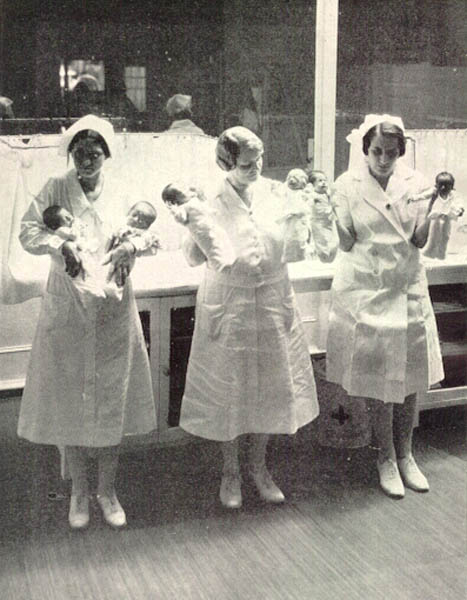
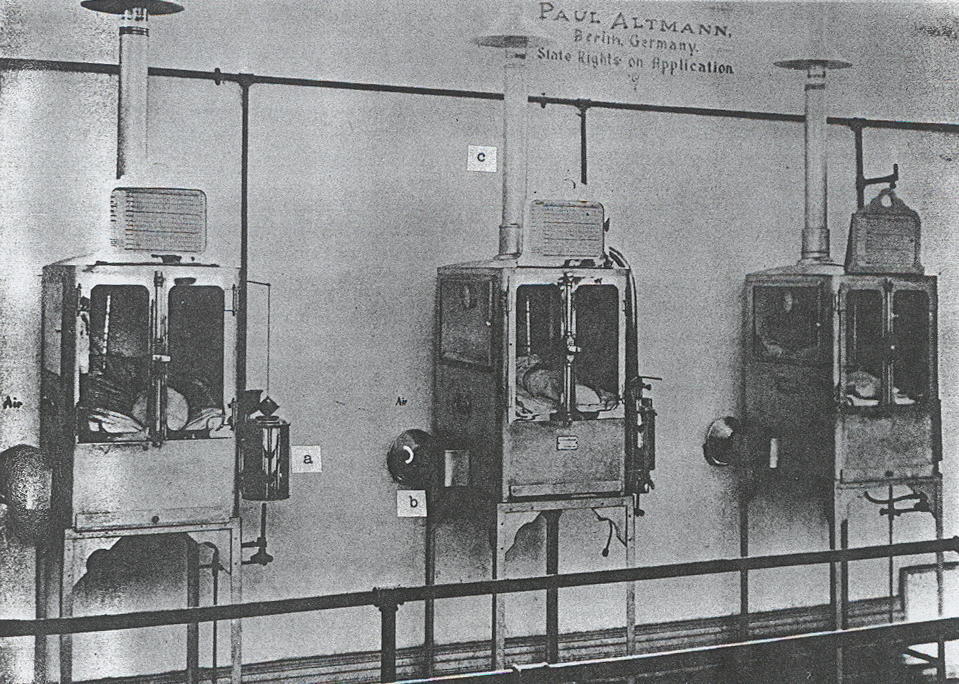
And in case you don’t believe me about that sideshow exhibit involving premie babies in incubators, here’s a shot of some of the nurses displaying the stars of the show, followed by a look at the actual incubators. The exhibit actually ran for decades in Coney Island, until 1945. You know, because there’s nothing more entertaining than watching a newborn infant struggling to survive: