Categories
Christmas Writers and Artists

Sacred Santa: How a self-proclaimed Messiah became a popular Santa Claus model

Early one spring day in 1922, while dutifully posing at the Art Students League on West 57th Street, Santa Claus had a fatal heart attack in front of a classroom of students.
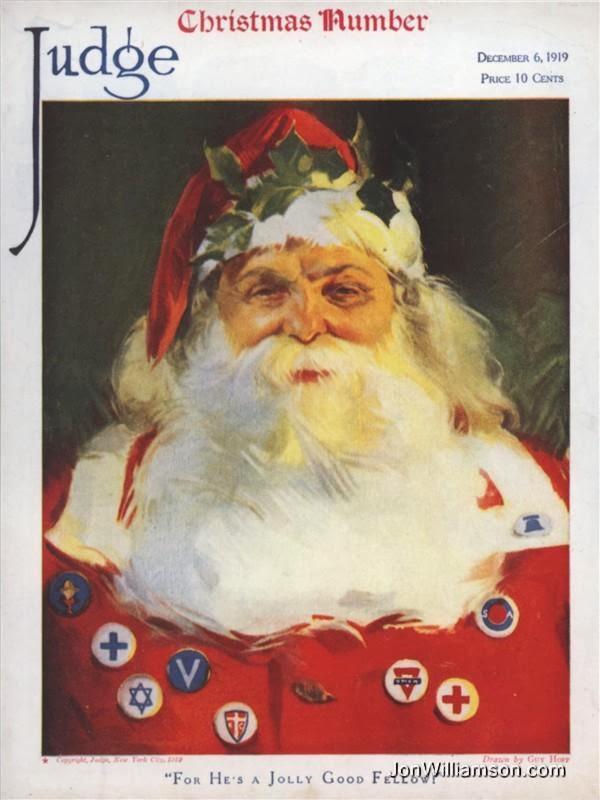
6526295831_8529740d1a_b

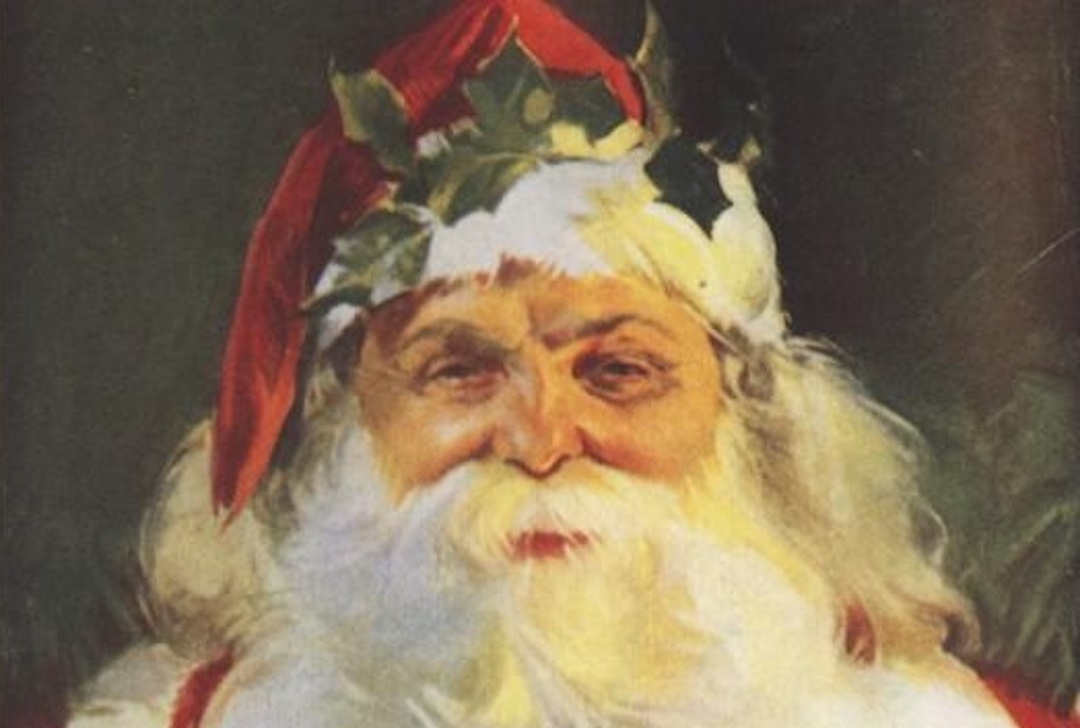
Above — He knows when you’ve been bad or good: A Christmas issue of Judge Magazine from 1919 by Guy Lowy, who studied at the Art Students League and very likely used Mnason for his model. (Courtesy Jon Williamson)

“The man who was Santa Claus is dead,” said the New York Tribune. “He was a man of many names, but at the Art Students League, where he posed for beginners, and in the studios of the best known artists, where he was sent for when a ‘Santa Claus type’ was needed, he was known as Mnason, the first ‘n’ being silent.”

They called him Mnason, although his full name was even more spectacular — Mnason T. Huntsman. (Or Huntsman T. Mnason or even Paul Mnason. His aliases were legion.)

Man of Mystery

The burly artists model lent his body to the ages; thanks to the scores of influential artists who hired him for Christmas projects, today’s modern Santa Claus probably looks more like Mnason than perhaps any other actual human being in history.*

The poet Arthur Chapman declared:  “It’s no exaggeration to say that Mnason posed for most of the Santa Claus pictures that have been made in recent years. And he figured in a good many for which he did not actually pose — as such pictures have been copied from originals for which Mnason was the model.

“Probably there isn’t a man today whose picture has been cut out more times and is treasured in more scrapbooks.”

Mnason, the definitive Santa Claus of the 1910s and early 1920s, was a true “man of mystery” for many who painted and drew him. A few knew the details of his past; perhaps it held the secret to his magnetic allure, to the deep, ancient gleam in his eye.

For Mnason was a former religious cult leader and proselytizer who had served time in jail for child abduction and religious blasphemy, and once he was actually tarred and feathered by an angry mob. He was a charismatic to some, a psychotic to many others.

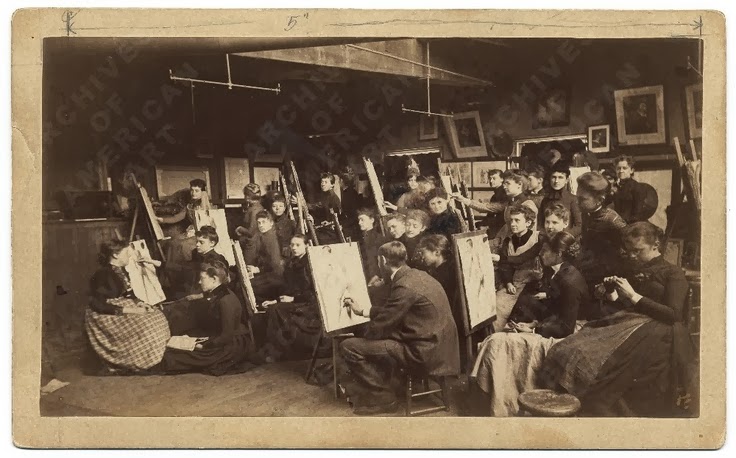
Below: Painter Kenyon Cox and his students at the Art Students League in 1887, a couple decades before the arrival of Mnason (Courtesy aaa.si.edu)
Making A Cult Leader

Mnason was born in Pennsylvania sometime in the 1850s, orphaned at eight years old. His early religious teachings were strict but conventional for the period.

In the 1880s, he worked for New York’s Sunday Closing League, visiting New York shops and saloons to ensure they were not selling anything too amoral on church day. In 1883, he testified that one shop owner illegally sold cigarettes to young boys, but not before the judge excoriated Mnason for lying on the stand.

At some point between that moment and 1888, Mnason was “inspired and bidden by God” to become a preacher. His message was not well received; at one point, the “wild and absurd behavior” of this “obstreperous” man of God got him thrown into jail for disorderly conduct.

By then, he had started a religious commune called the Lord’s Farm in Pascack Valley in New Jersey, where he began to attract (or lure) a young, impressionable flock.

He called himself “The Holy One” or “The Modern Christ” and granted bizarre nicknames to his most loyal followers.  Collectively, they were called the Angel Dancers, or the Church of the Living God.

In 1888, Mnason was arrested “on the charge of blasphemy,” and of enticing two young women who claimed they “were obliged to do anything he required.” He was reportedly tarred and feathered by irate residents. (It is at this point that you might notice the odd coincidence of the name Mnason and ‘Manson’, as in Charles.)

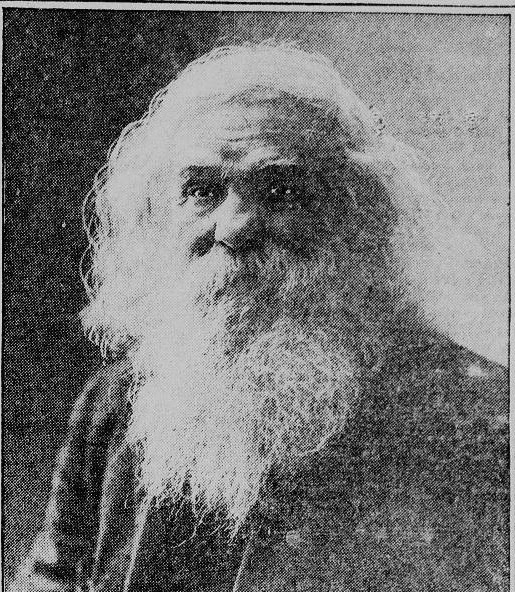
Mnason T. Huntsman, from an image used in the New York Tribune
The Angel Dancers

Even still, the Angel Dancers managed to attract on oddball list of adherents, including a local farmer’s wife and her two children. Eventually, according to a 1893 New York Times article, “the band was increased by two long-haired men, who called themselves ‘Silas’ and ‘John the Baptist’.

This fanatical cult would reportedly practice ‘angel dancing’, “scantily robed and waving a huge blanket with which to drive away the devil.”

Also notable to the press of the day: Mnason and his flock were all vegetarians.  “Nothing save what grows in or on the ground may be eaten.” [source]
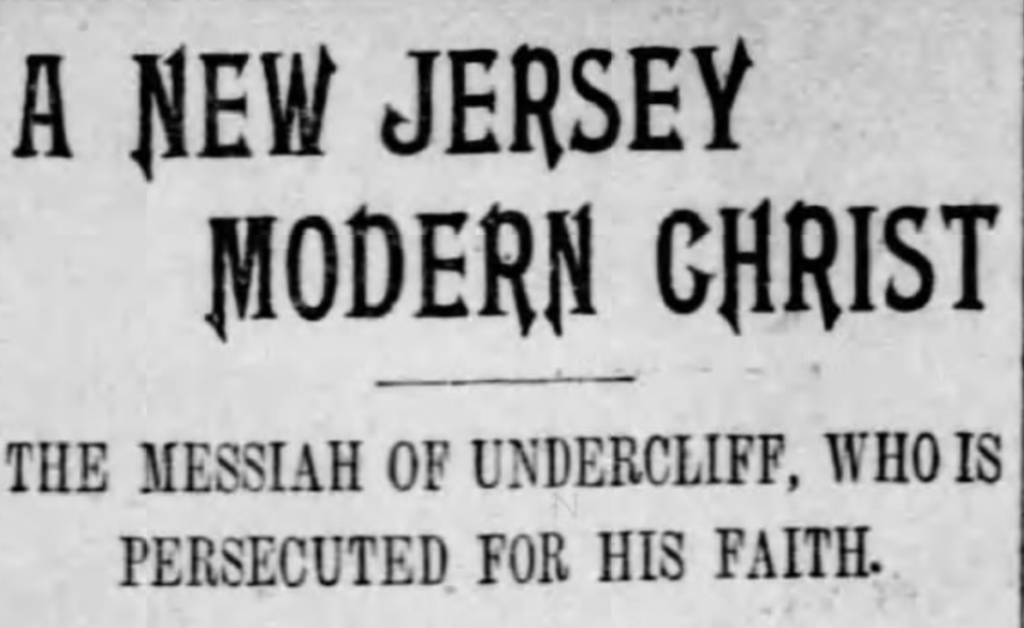
From The Times in Philadelphia, November 25, 1895

The entire lot were arrested in April 1893 for attempting to swindle the aforementioned farmer, although it’s obvious that some religious intolerance was embedded within the charge as well.

The affidavit read: “The conspirators deny, ridicule and curse all regular religion and religious customs, recognize no Sabbath, and set up a false god of their own, declaring the said Mnason to be the only and living God.”
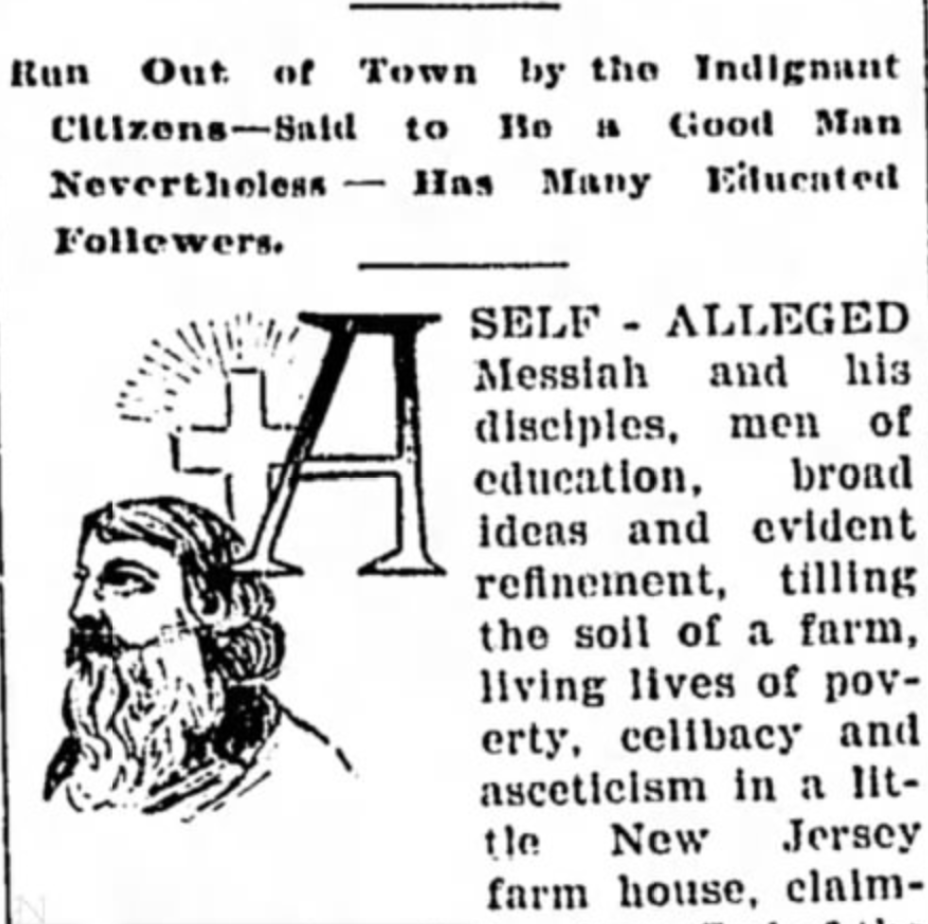
From a syndicated article which ran in the Ironwood News-Record in Michigan, January 11, 1896, courtesy Newspapers.com
The Compound

A few years later, the Angel Dancers had taken over the farmhouse and had grown to a membership of nine males and nineteen females, with two children.

After the reported death of a child in 1897, the Times intoned, “No physician was called to be of any service. Mnason is ‘the Christ’. The dancers are vegetarians.”

Another ugly abduction case reared its head in 1900, when two “little girls” were taken from the compound and then kept in jail for months in order to testify against Mnason. The cult leader seemed to survive these charges, too
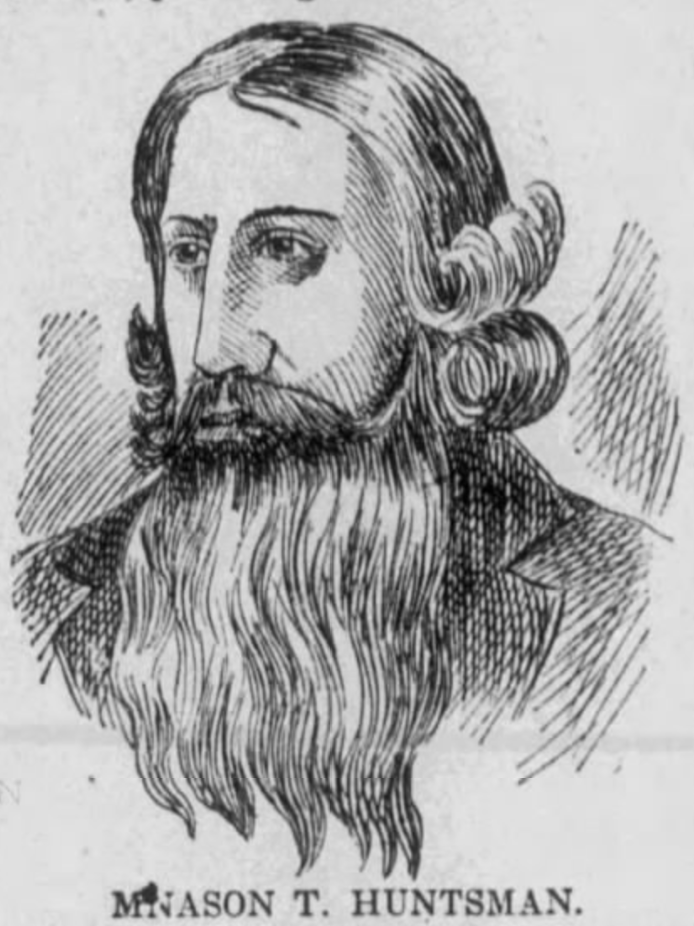
From the same article as above.

The Lord’s Farm became so notorious that by 1909, the state found a good excuse to evict Mnason and his followers. The charismatic moved to New York City and briefly opened a church for black parishioners.

It is then that former ‘Modern Christ’ then disappears, for a time, from public view. But the Times in 1909 noted the following:  “Mnason is a man of many aliases.”
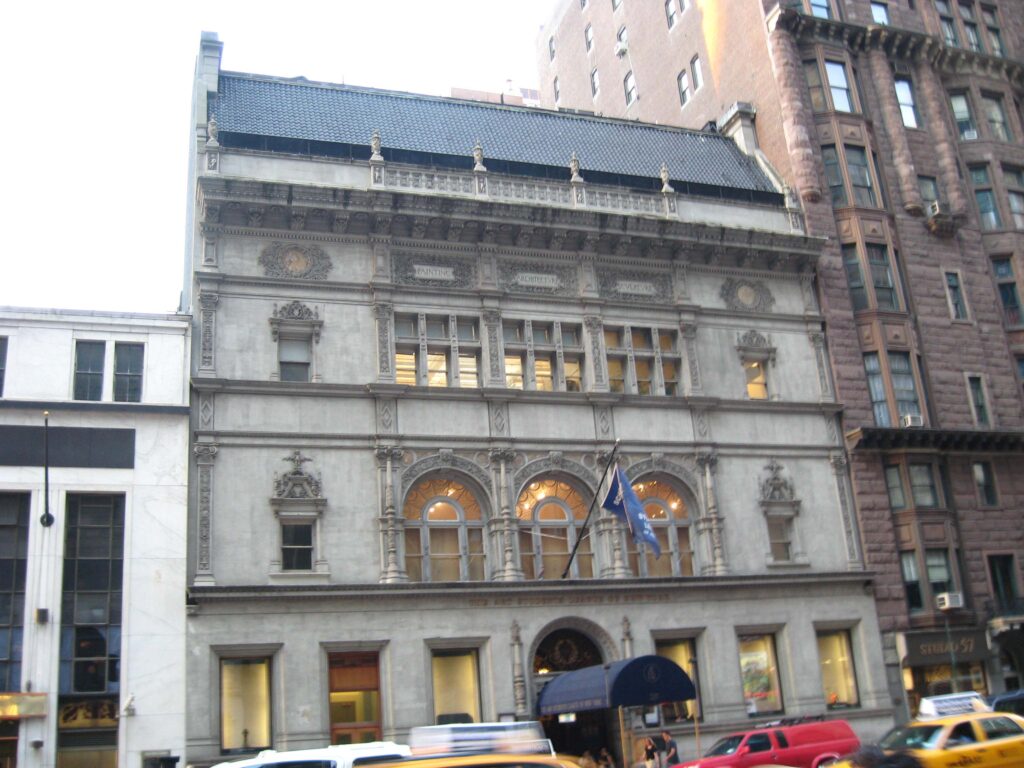
The Art Students Leave, photo by Jim Henderson, Wikimedia Commons

Finally, he popped up again, in 1916, at the Art Students League, and not unnoticed.

The New York Sun mocked his new profession (headline pictured below):  “[R]ecently he had turned himself into Santa Claus or King Lear or any other whiskered person that the embryo John Sargents of the Art Students League wish him to be¦.”

It’s no surprise he would find his way into an art collective — he was a vegetarian, after all — and his timing was rather perfect, given his particular look and body size.
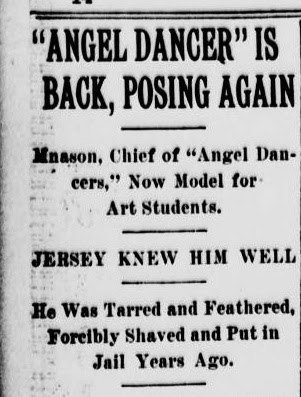
Making Santa Claus

The character of Santa Claus had gone through a major style makeover in the late 19th century.

His annual routine already immortalized in the popular verse A Visit From St. Nicholas — penned by the godfather of the Chelsea neighborhood Clement Clarke Moore — magazine and postcard illustrators began morphing the popular Christmas figure from a thickly robed saint to a child-friendly, candy-colored superhero.

This change came about through the hands of American artists and illustrators, led by Harper’s Weekly artist Thomas Nast in New York. Some of the modern look and mythos is credited to Nast, his influential pen elaborating on Santa’s girth (eventually to rest on near-corpulency) and placing his residence in the North Pole.

By the early 20th century, Santa’s physical characteristics were locked in place, but his spirit and personality were still very much uncertain. Should Santa be energetic or world weary? Wise or playful? Approachable like a parent, or unfathomable like a god?

Perfect Pose

Many of New York’s great illustrators of the period were associated with the prestigious Art Students League, and it was here that Mnason contributed his own sparkle to the characters, as artists recommended the man for his poise, mystery and sparkle.

“They found in him the ideal type, on account of his snowy beard, his bearing, the jolly twinkle in his eye, his fine color and his intelligence.”

Blow: J.C Leyendecker‘s 1919 cover for the Saturday Evening Post.  You can easily tell Leyendecker’s influence on later Evening Post artist Norman Rockwell. Given the artist’s connection to the ASL, Mnason very likely posed for this painting.
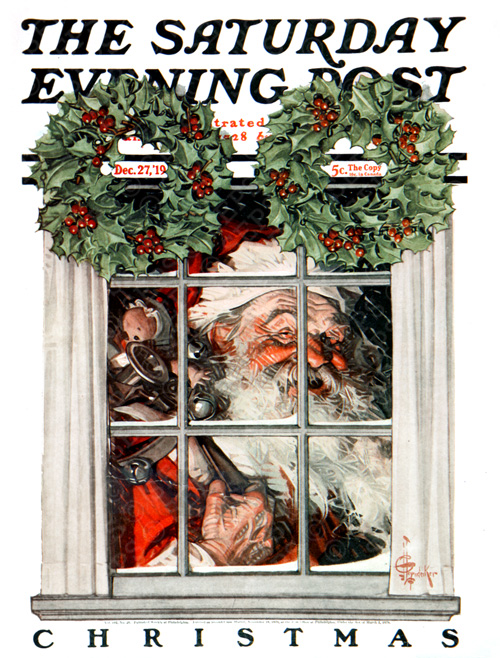
It’s clear that many of these legendary artists were aware of some version of their Santa’s past.  “Mnason would hint to his artists friends regarding certain experiences in his life in which his pronounced and individualistic religious views played a part.” [source]

One year, he was even hired as a department store Santa where he notably espoused his religious views to the children who had come to present their Christmas wishes.

And To All A Good Night

His days of Lord’s Farm were behind him, but Mnason kept writing religious verse while living suitably on his artist-model wages. For years, he was passed among New York’s most renown illustrators, who claimed him the iconic visage of the holiday’s most jolly proponent.

“Nothing could dampen his cheerfulness, but behind his smile there was an element of mystery which the embodiment of Santa Claus maintained to the last.”

When he died in 1922, Mnason had been drawn and painted as Santa Claus dozens of times.

Eventually, Santa Claus would go through his final evolution in the 1930s, thanks to artist Haddon Sondblum, hired by Coca-Cola for their colorful advertising campaigns.

Sondblum’s iconic depiction is directly influenced by Moore’s famous poem, and but equally so by the dozens of artists and magazine illustrators before him, most of which who had used Mnason as their inspiration.

*A retired salesman named Lou Prentice was used by Haddon to create early versions of his Coca-Cola Santa and so might lay claim to being the most important physical inspiration. But Mnason was used by more artists and within several pivotal publications of the day.
Categories
Holidays New Amsterdam

How Dutch New Amsterdam helped create the American Christmas tradition

After reading this article on the origins of Christmas in America, find some information about a virtual Christmas in Old New York tour from Bowery Boys Walks.


There are many different ways to celebrate Christmas, a national holiday derived from the union of Christianity and capitalism. How one chooses to mark the occasion is a reflection of one’s own traditions and faith (or lack thereof).

Christmas can be intensely religious for some, not at all for others. It is ever evolving to fit the population’s needs.

However, if none of the present ideas work, then there is the Puritan way: don’t celebrate it at all.

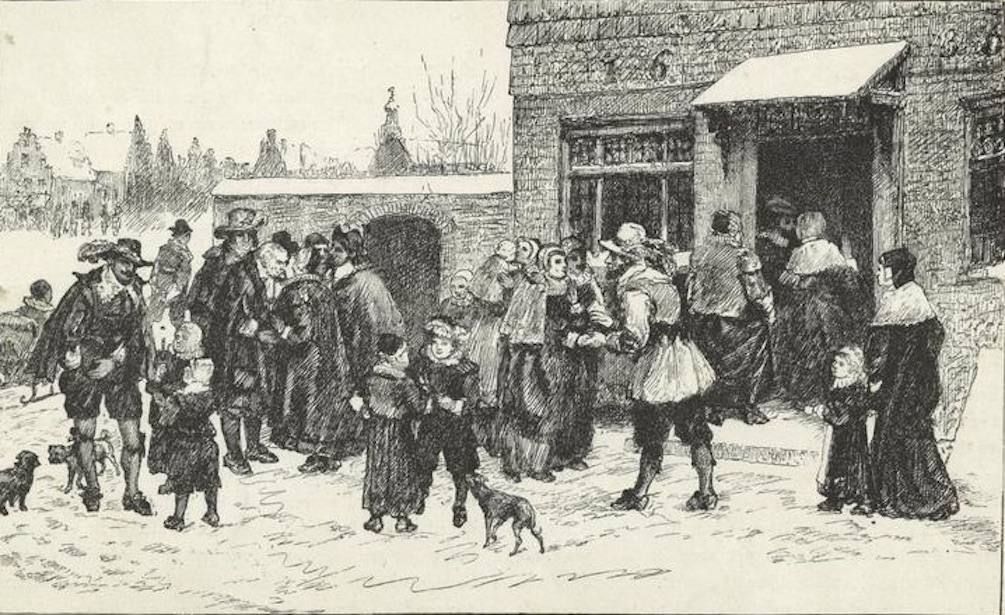
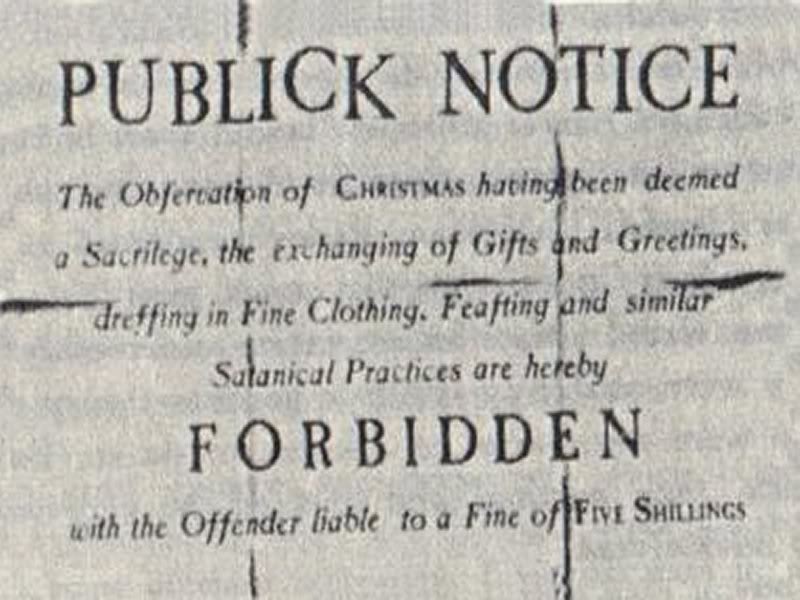
Below: A 1659 notice forbidding the celebration of Christmas in the Puritan-led colonies

There was such opposition to the holiday within the first communities of the New World that it was outright banned among the Puritans of the Massachusetts Bay Colony.

Puritan leaders, ironically enough, took this abolition directly from the Bible; there was no celebration authorized in the book, and since it was doubtful Jesus was actually born on December 25, they considered the day a sinner’s excuse for debauchery.

As Puritans were by nature a homogeneous community, differing traditions were frowned upon, although modest observance of Christ’s birth was occasionally allowed. Generally speaking, December blew through the early English colonies with nary a festivity.

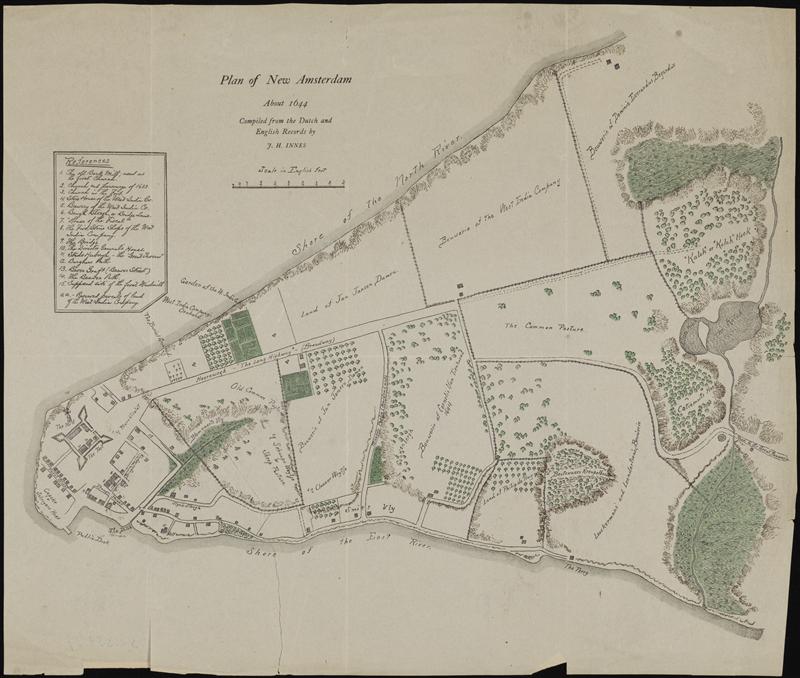
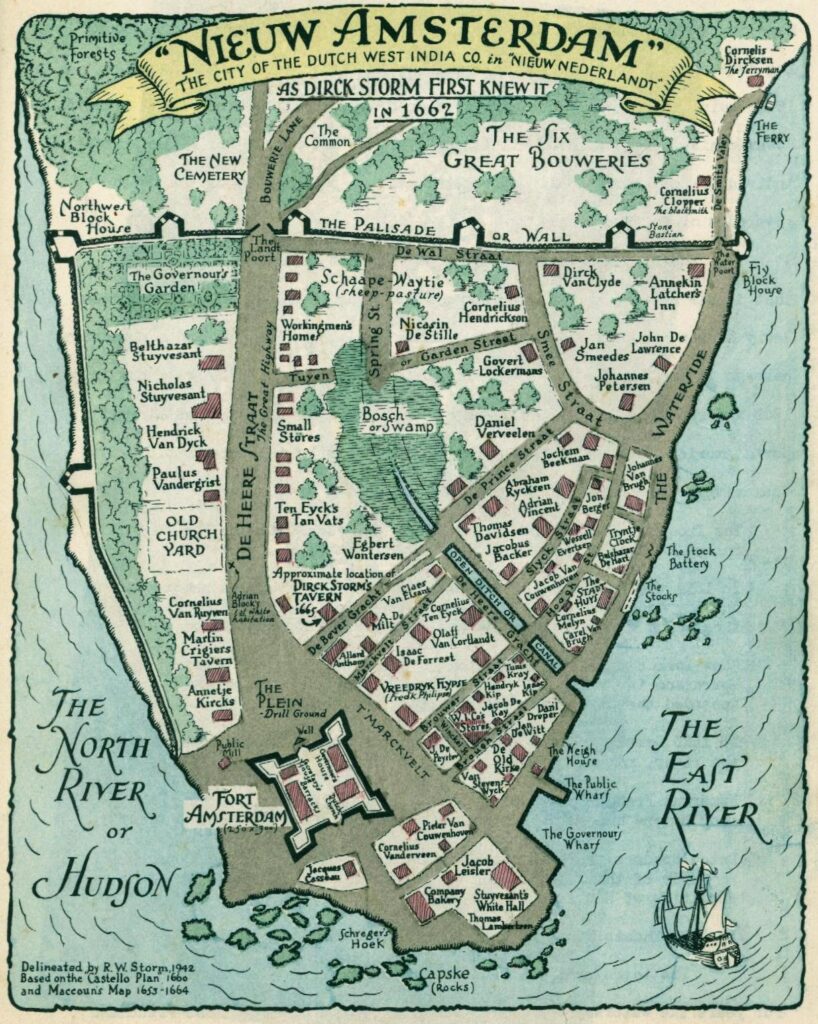
So where did the ingredients of modern Christmas first wash up onto the shores of North America? All signs point to New Amsterdam.

Courtesy Museum of the City of New York

The New Netherland colony of the 17th century was not ruled by such strict restriction of belief.

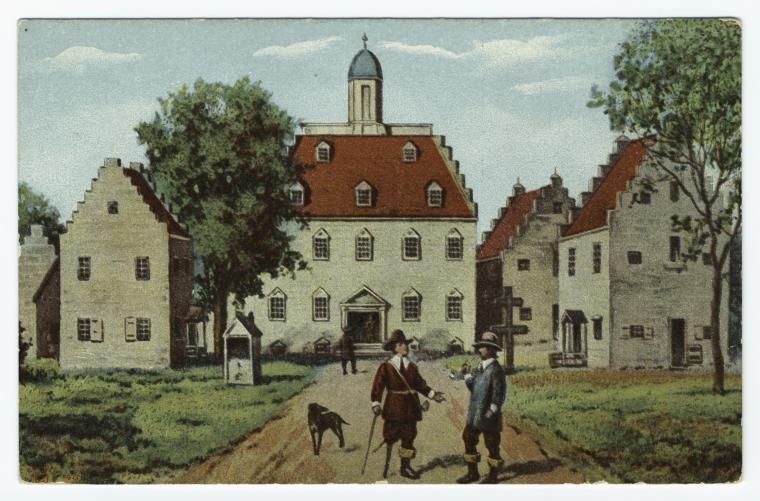
New Amsterdam, New York’s precursor, was a company town. While laws suppressing the celebration of Christmas were on the books until 1681 up in Massachusetts and other places, down in New Amsterdam, rudimentary holiday traditions were openly, even casually, celebrated.

The settlers of Dutch New Netherland could theoretically celebrate how they wished.

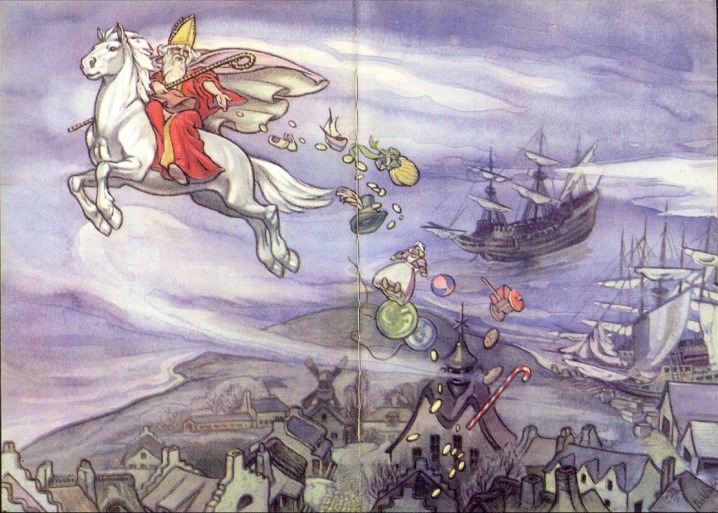
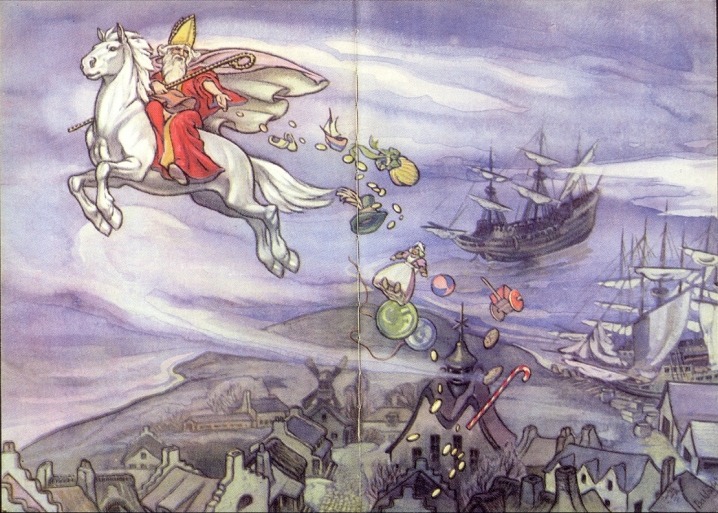
There were certainly observations of Christ’s birth — called Kerstydt — but, it was often overshadowed by a more popular December holiday: Sinterklaas, a Dutch gift-giving tradition where children sat their shoes outside their homes to be filled by a visiting St. Nicolas on December 6th.

(Often, perhaps due to inclement weather, it made sense to have the shoes remain inside, and perhaps better still, to hang stockings near the fireplace.)

A whimsical illustration of St Nicolas over a Dutch city, very possibly New Amsterdam. Artist unknown.

New Netherland’s population in 1624 was only 270 people, with few if any children. Over the next 40 years, however, dozens of families populated the outpost, passing down family customs and linking their distant home with the mainland.

With Dutch residents eventually outnumbering the others, their traditions became the most prevalent.

Combine that prevalence (with its extra-exciting gift-getting component) with the envy of the other non-Dutch children, and suddenly Sinterklaas becomes a highly anticipated holiday among the entire population of New Amsterdam.

This, despite Peter Stuyvesant‘s disgust at any holiday which promoted moral laxity (also known in some circles as fun).

NYPL

Or as author Russell Shorto describes it: “[A]mong the English, the French, the German, the Swedish families of Manhattan, pressure was brought to bear on parents, and the Dutch tradition was adopted and, later, pushed forward a couple of weeks to align with the more generally observed festival of Christmas.”

And New Amsterdamers didn’t stop at Christmas; the party kept going for weeks afterwards, throwing Manhattan’s very first New Year’s parties.

According to one source, “On Nieuw Jaar (New Year) and Kerstydt (Christmas) the Governor’s house was ablaze with candles and the young men and maidens danced in the ‘entry’.”

Official business was closed for weeks after, and “the burghers and their families spent much of their time in firing guns, beating drums, dancing, card-playing, playing at bowls or nine-pins and in drinking beer.”

No wonder Peter Stuyvesant hated holidays!

Over time, Christmas and Sinterklaas — one an observance of Jesus’ birth, the other honoring one of his most popular saints — would melt into each other. Even when the Dutch were kicked out of Manhattan in 1664, Sinterklaas was still celebrated in the region, further infused with English Christmas customs.

However, even as the British were expelled from Manhattan, American holiday traditions were still localized, often tied to one’s specific ethnicity and hardly unified.

It would take New York city leaders in the 19th century and the work of New York’s greatest writers to define new holiday symbols for a national audience.

In some Dutch pockets of upstate New York, the tradition of Sinterklaas is still celebrated today.


Want to hear more about the history of Christmas in New York? Take a Bowery Boys Walking Tour and get into the holiday spirit with a merry virtual stroll through The Big Apple!

On the Christmas In Old New York tour, guide Jeff Dobbins unveils the history of how the Big Apple became the center of all things Christmas from Macy’s to Rockefeller Center.

Book your tickets today! There are several dates available in the month of December. Get your tickets here.

Categories
Gilded Age New York Holidays

The story of the world’s first Christmas tree with electric lights

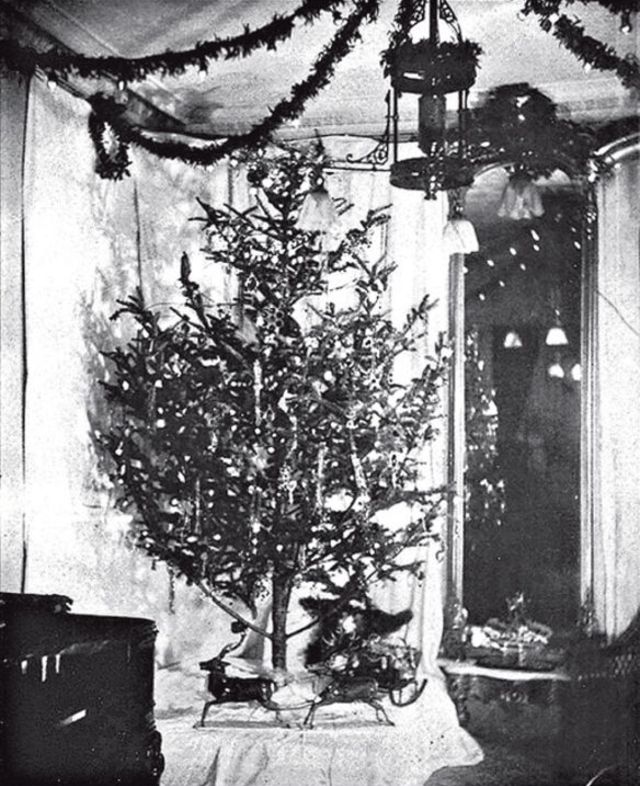
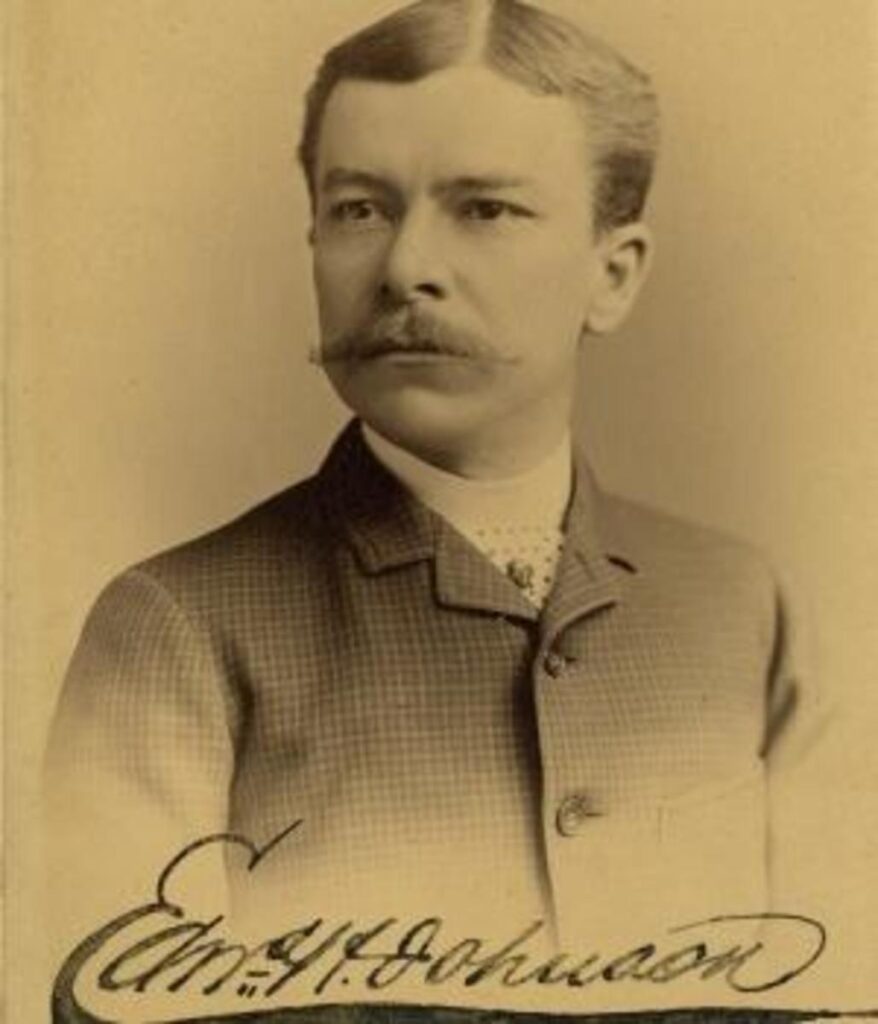
The world’s very first Christmas tree with electric lights was displayed in 1882 at the home of Edward Hibberd Johnson in the Murray Hill neighborhood of New York City.

Not only did it glow with this innovative new form of illumination, this Christmas tree also spun around, revolving like a flashy new car at an automobile expo.

The Christmas tree of Edward Hibberd Johnson

Two years later in 1884 the New York Times looked back fondly upon this greatly advanced version of the Christmas tree: 

The tree was lighted by electricity and children never beheld a brighter tree or one more highly colored than the children of Mr. Johnson when the current was turned and the tree began to revolve.

It stood about six feet high, in an upper room, and dazzled persons entering the room. There were 120 lights on the tree, with globes of different colors, while the light tinsel work and unusual adornment of Christmas trees appeared to their best advantage in illuminating the tree.

“The set of lights were turned off and on at regular intervals as the tree turned around.  The first combination was of pure white light then as the revolving tree tree severed the connection of the current that supplied it and made connection with the second set, red and white lights appeared. Then came yellow and white and other colors.”

The children of Mr.  Johnson were witnessing a revolution. Yes an actual revolution – of the tree itself – but the beginning of an entirely new way of celebrating the holiday.


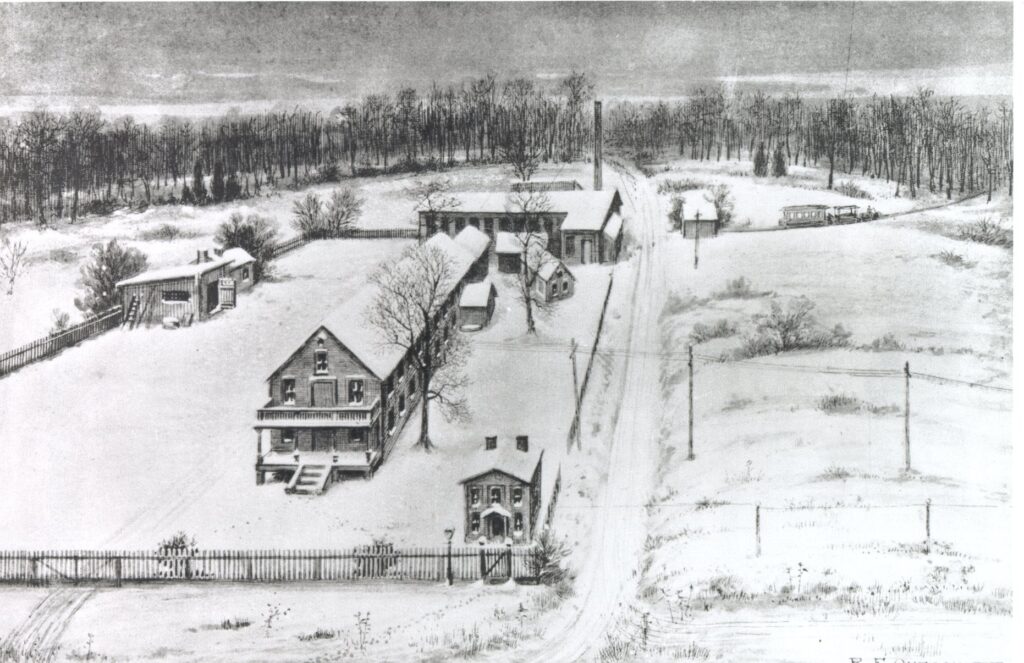
Snow covered Menlo Park

Surrounded by his wealthy investors, Thomas Edison gave the first public demonstraton of the incandescent lightbulb on December 31, 1879.

Now, believe it or not, New Yorkers were already accustomed to electric illumination during the Christmas season. The major Manhattan shopping districts were already exposed to stadium-like arc lighting, a primitive form of electric light that was too harsh and intense for everyday usage.

But Edison’s invention was vastly superior and it wouldn’t just drive away the dark. In its compact size, its durability and eventual convenience, the lightbulb would elaborate on one of candlelight’s most appealing components – mood. 

The next year, on December 20, 1880, Edison had additional investors out to Menlo Park, and they were greeted with an extraordinary site.

From the NYT: “The train arrived at Menlo Park at 5:31. Darkness had settled down upon the bleak and uninviting place which Mr. Edison had chosen for his home, but the plank walk from the station to the laboratory was brilliantly lighted by a double row of electric lamps, which cast a soft and mellow light on all sides. 

The incandescent horseshoes gave out a yellow light which shone steadily and without the least painful glare and were beautiful to look upon.”

While this was not intentionally a Christmas lighting display, the arriving investors, in the holiday spirit, remarked upon the appropriate warmth and charm of the lights on the chilly December evening.


The light bulb would change the world but it would also make Edison a lot of money.

Soon Edison began aggressively promoting the various ways that electric lighting could be used to improve life – the more reasons, the more likely other investors would sign on and the more likely cities would hire Edison to install electrical power stations. 

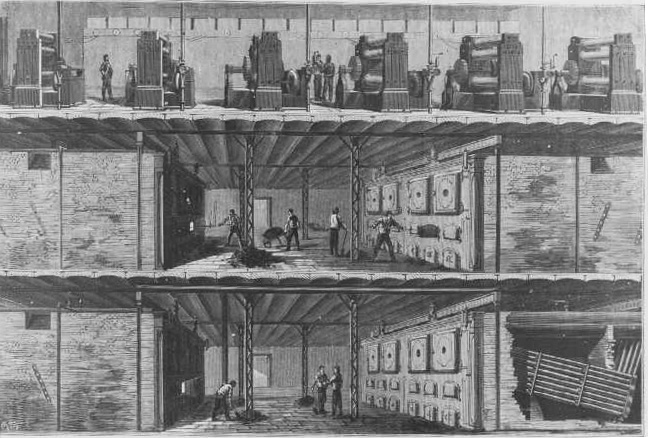
That is precisely what happened in New York on Sept 4, 1882, with the first commercial power plant in the world began operation in lower Manhattan on Pearl Street.

Pearl Street Power Station

For the first time, the homes and offices of lower Manhattan would be able to light their interiors more pleasantly and conveniently than those homes with gaslight.

Whereas as the illuminations from gas would often create a sickly glow, the light from an electric glass bulb would seem romantic and alluring in comparison. Finally the candle had some competition.


Further uptown, at the home of Edison’s friend and the vice president of the Edison Electric Company Edward Hibberd Johnson (pictured above), electricity was taking the place of a rather hazardous form of decoration.

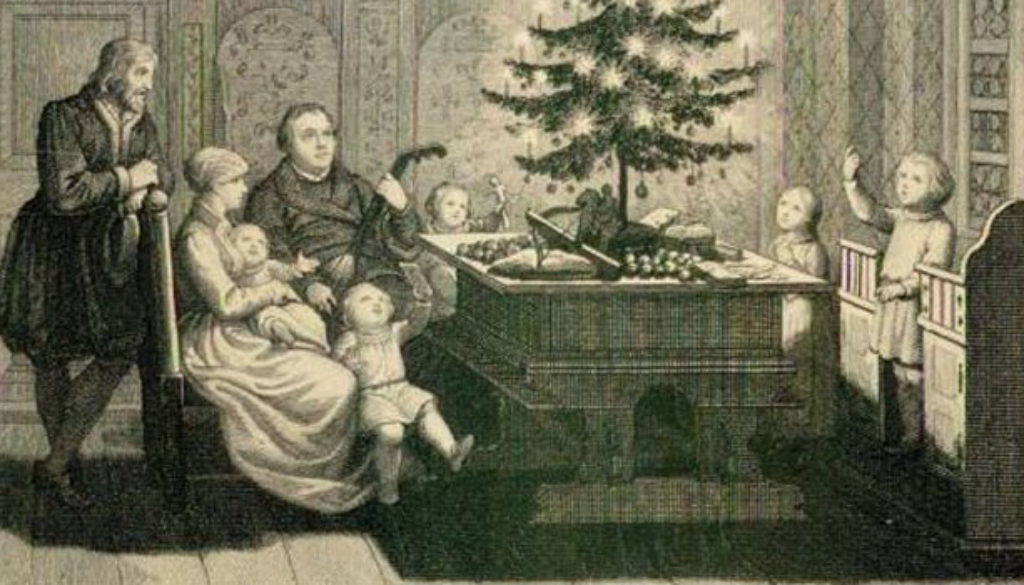
For Johnson’s electric-tree idea took his inspiration from traditional candle-lit trees.

Candles in Christmas trees

In the early 19th century a Christmas tree was considered a luxury of the urban rich who could afford to have a tree cut down for them and installed in their homes. But by the 1850s people could purchase trees at the market and carry them home to decorate for the season.

The most beautiful trees — the ones that seemed to fully embody the spirit of the season — were decorated with lit candles.

Getting a candle to stick in a tree was not easy. Some held the melted wax to branches, others pierced the candle with needles, tying them to the tree that way. 

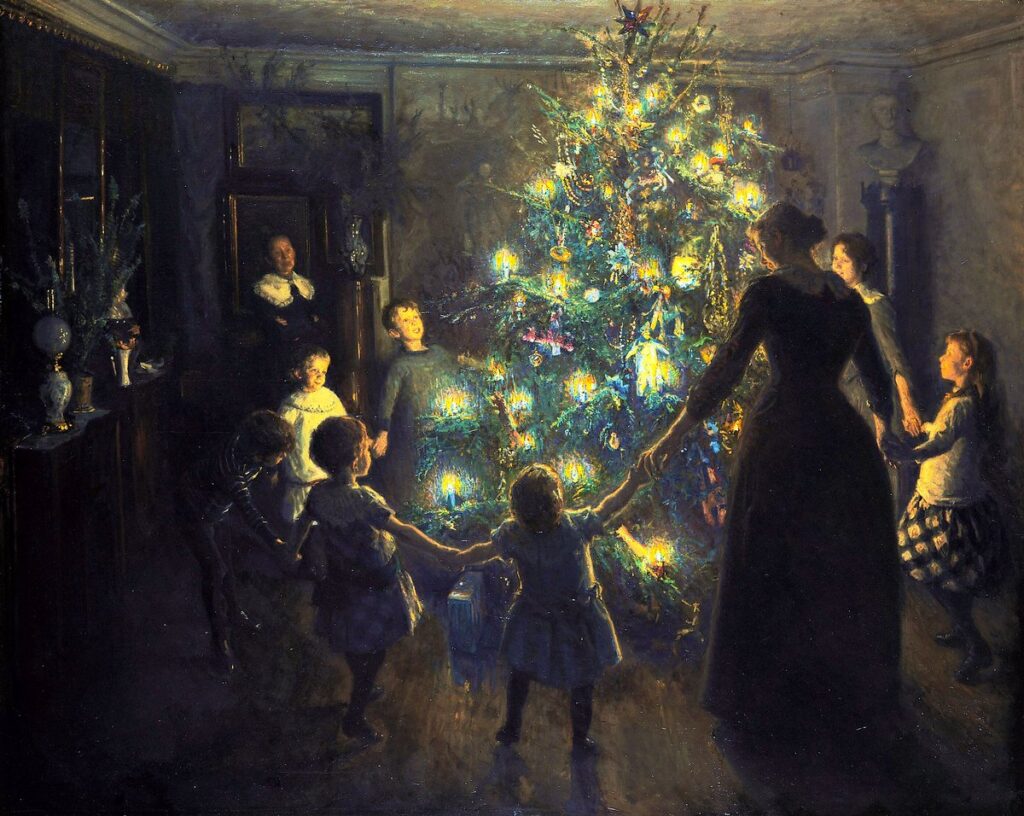
Happy Christmas (1891) by Danish artist Viggo Johansen

In 1878 an inventor named Frederick Artz devised a spring clip that could hold candles to the branches. 

Now a family could attach lit candles to a Christmas tree and know — with just a touch more assurance — that the waxen dagger would not fall into the branches and burn the house down.

Keep in mind that in the 19th century Christmas trees were only installed in homes for only a few days. People did not lavishly decorate a month and a half before like we do today.

And trees were more closely monitored then. Next to the presents underneath the tree was a bucket of water.

By 1908, some insurance companies refused to cover fires started by candle accidents on Christmas trees, claiming they were a clear and knowing risk. 


1897 Library of Congress

So you can understand why people absolutely lit up at the idea of a Christmas tree with electric lights.

In January 1883, the journal Electrical World called Johnson’s tree on Madison Avenue the handsomest tree in the United States.

Pictures would suggest otherwise, although photographic process of the early 1880s were hardly equipt to capture such a unique and peculiar things – a rotating, brilliantly and colorful lit object of natural art.

But of course it wasn’t art. It was promotion

With each year, Johnson would continue to let in the press into his home to report his unusual holiday marvel. 

In addition he would install similar trees in places where Edison electrical power would soon be made available.

For instance, for Christmas 1883, he put up a much larger display tree at the Foreign Exposition in Boston at Mechanics Hall in Boston’s Back Bay.

From a 1904 history of Edison lighting:

“At the Boston Foreign Fair, about 1,500 Edison lamps were employed and the Christmas tree took several hundred more.

This tree was deisgned to be operated by an automatic device which would make the light of the lamps appear and disappear in time with whatever music might be played and it was manipulated by means of a keyboard of switches, the operator being concealed at the base of the tree.

The effect was so pleasing that Christine Nilsson, the Swedish Nightingale, who was in the audience begged to be allowed to manipulate it.”

All these wondrous, grandious displays were all for the general promotion of electrical power and not for the production of Christmas home decorating products themselves.

For at least two decades after Johnson’s extraordinary display, electric Christmas sets for the home were sheer novelty and clearly for the richest participants of the Gilded Age, those who could afford electricians and personal generators. 


Consumers wouldn’t get to affordably light their home Christmas trees until the 20th century. Well, affordably can be debated.

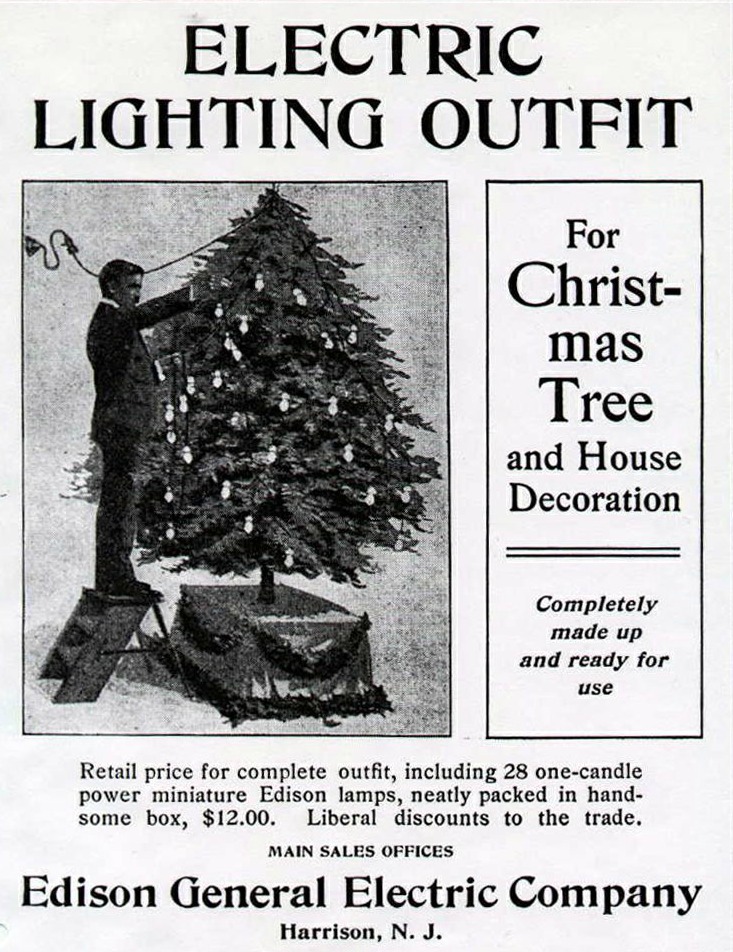
In 1903, General Electric would finally make strings or festoons of miniature incadesent lamps – with bulbs of all colors — available for home holiday decorating. 24 bulbs for just $12! In 1903 dollars. That’s about $325 dollars today.

To decorate a tree of any meaningful size would require holiday revelers take a small mortgage out on their house. 

But of course, by this time, Christmas in America was already being defined by thresholds of wealth. Christmas meant spending.

So for some, spending a week’s paycheck on Christmas lights might have been worth the heartache. 

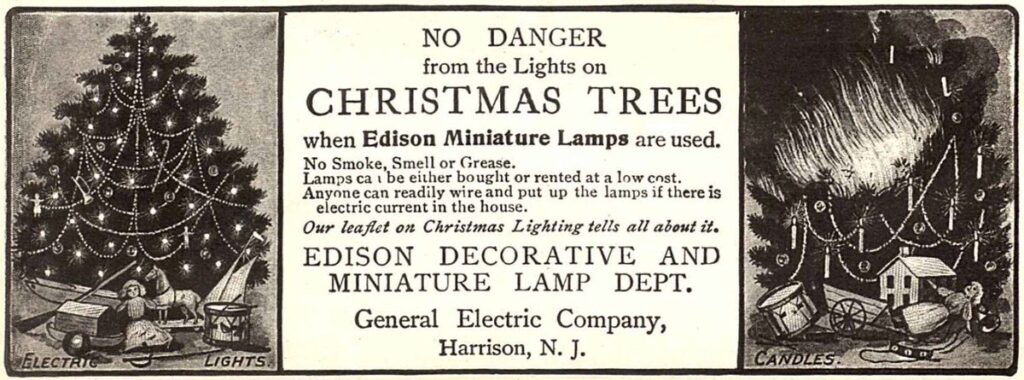
For some of course, it made more sense to RENT Christmas lights, a popular option in the year 1900.

From a General Electric Ad that year: “Edison Miniature Lamps for Christmas Treets. No Danger, Smoke or Smell. Lamps either rented or sold. Full directions furnished, enabling anyone to readily wire and put up the lamps.”

For more information, check out these Bowery Boys podcasts:
Categories
Holidays

Festively bonkers: Welcome to the Dyker Heights Christmas light show

Holiday traditions in Manhattan are of course known the world over, from the glowing light displays of Park Avenue to the Rockefeller Center Christmas tree. But they lack a certain human touch, spun from wealthy corporations and honored tradition.

Which is what makes Dyker Height’s annual lighting spectacular (festival? competition? freak show?) so fascinating. It’s Brooklyn’s biggest holiday event, run entirely by the community.

In the past two decades, the extravaganza has energized a normally quiet neighborhood few in New York know much about. For most of its history, Dyker Heights was virtually uninhabited, either by humans or two-story illuminated snowmen.

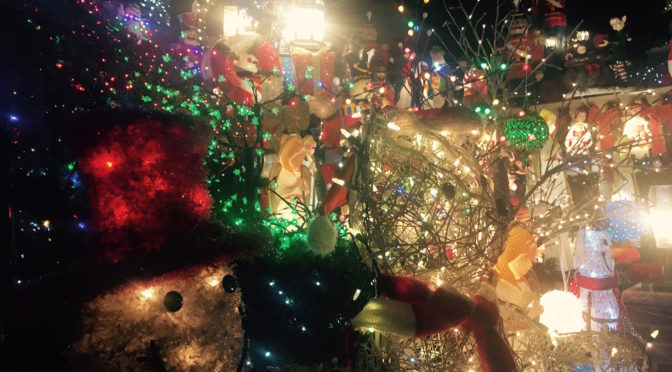
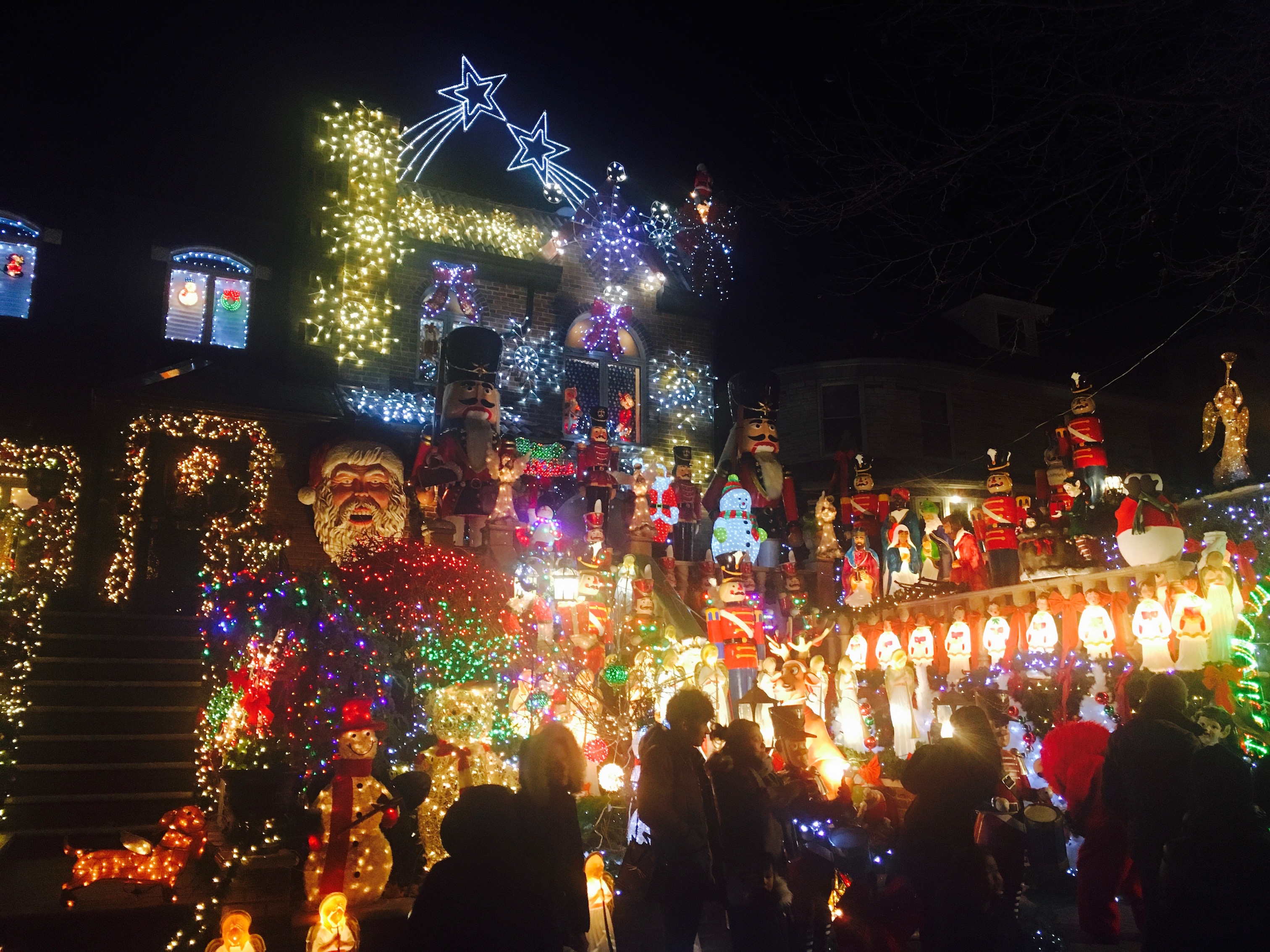
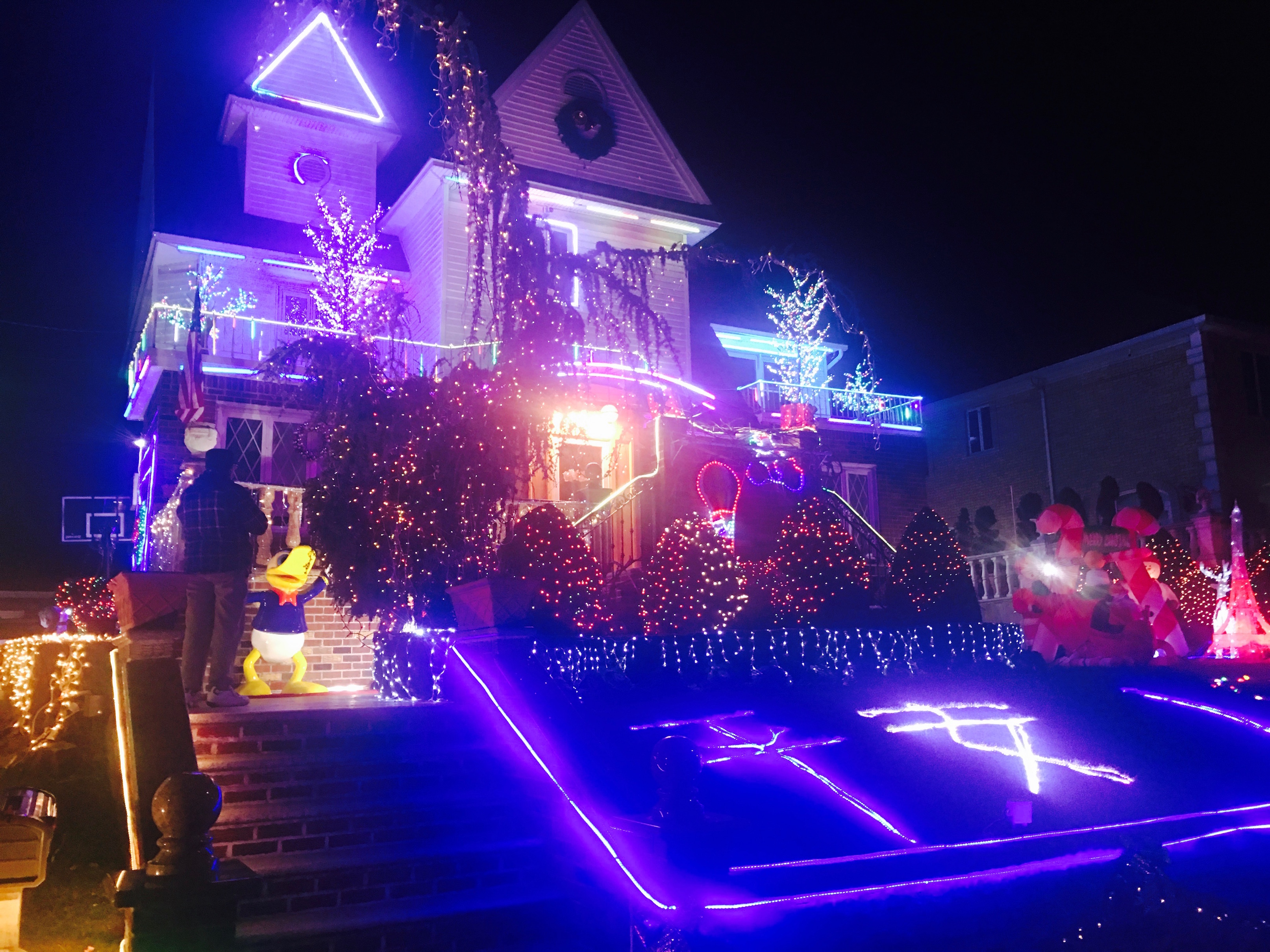
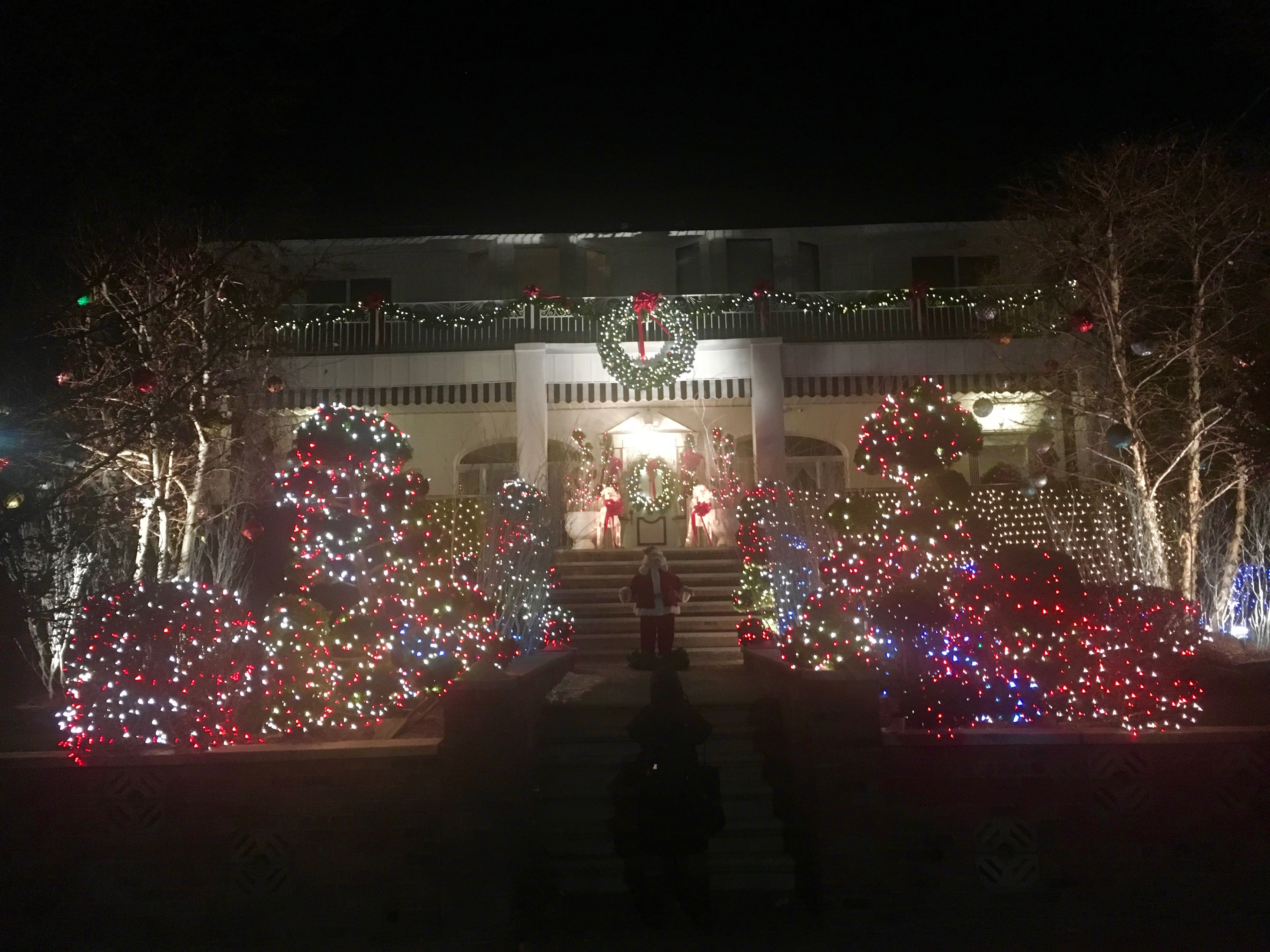
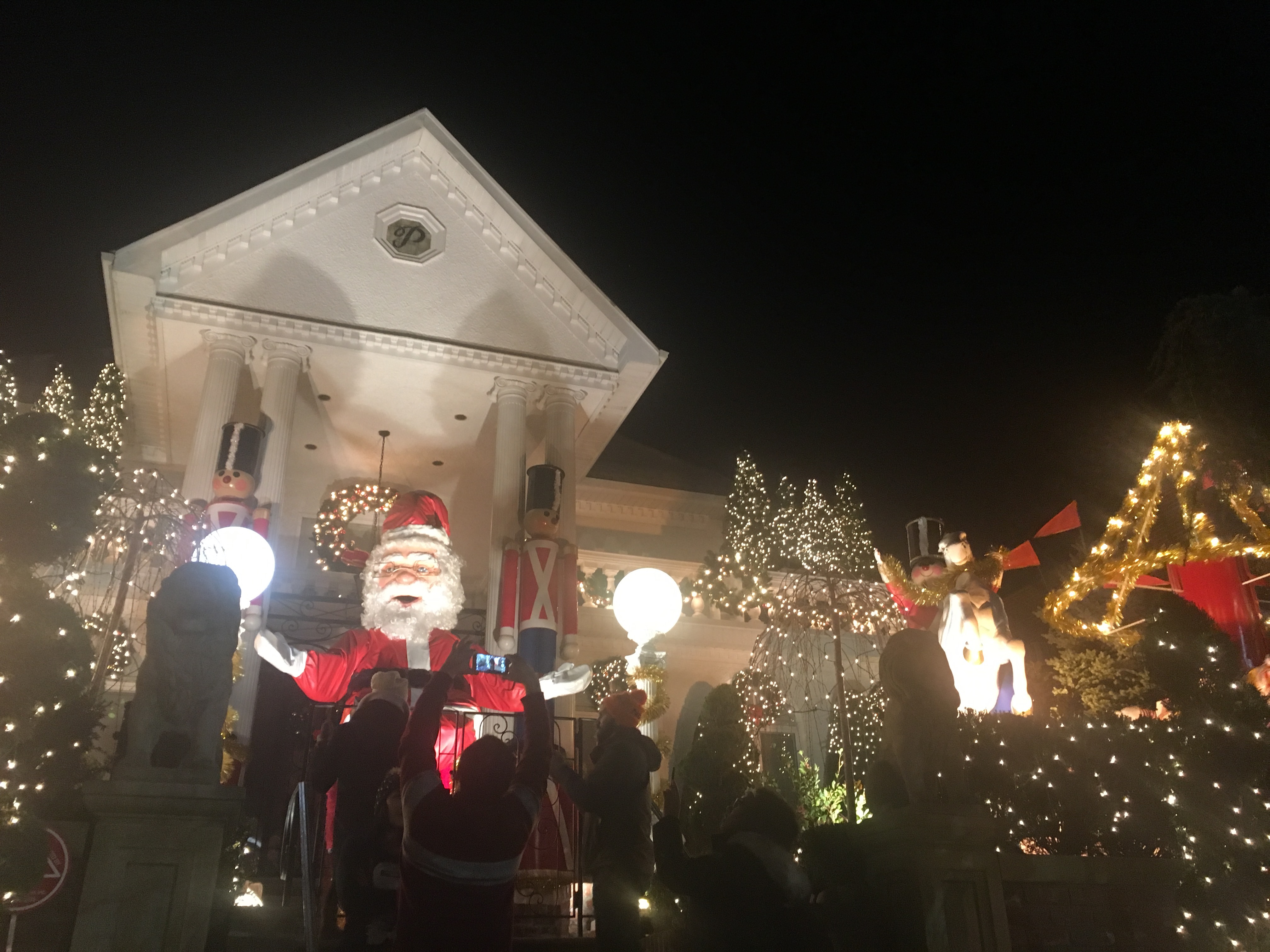
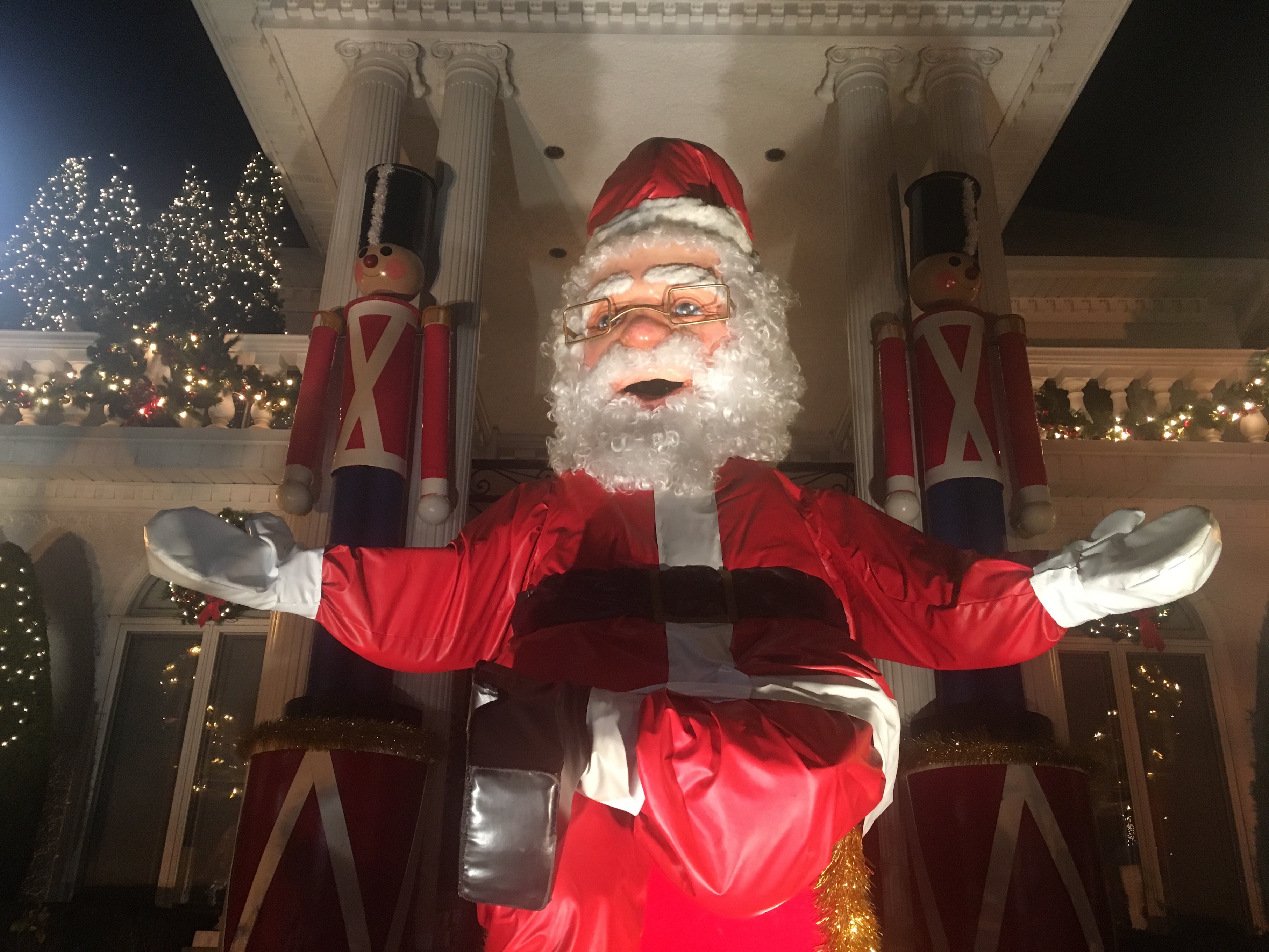
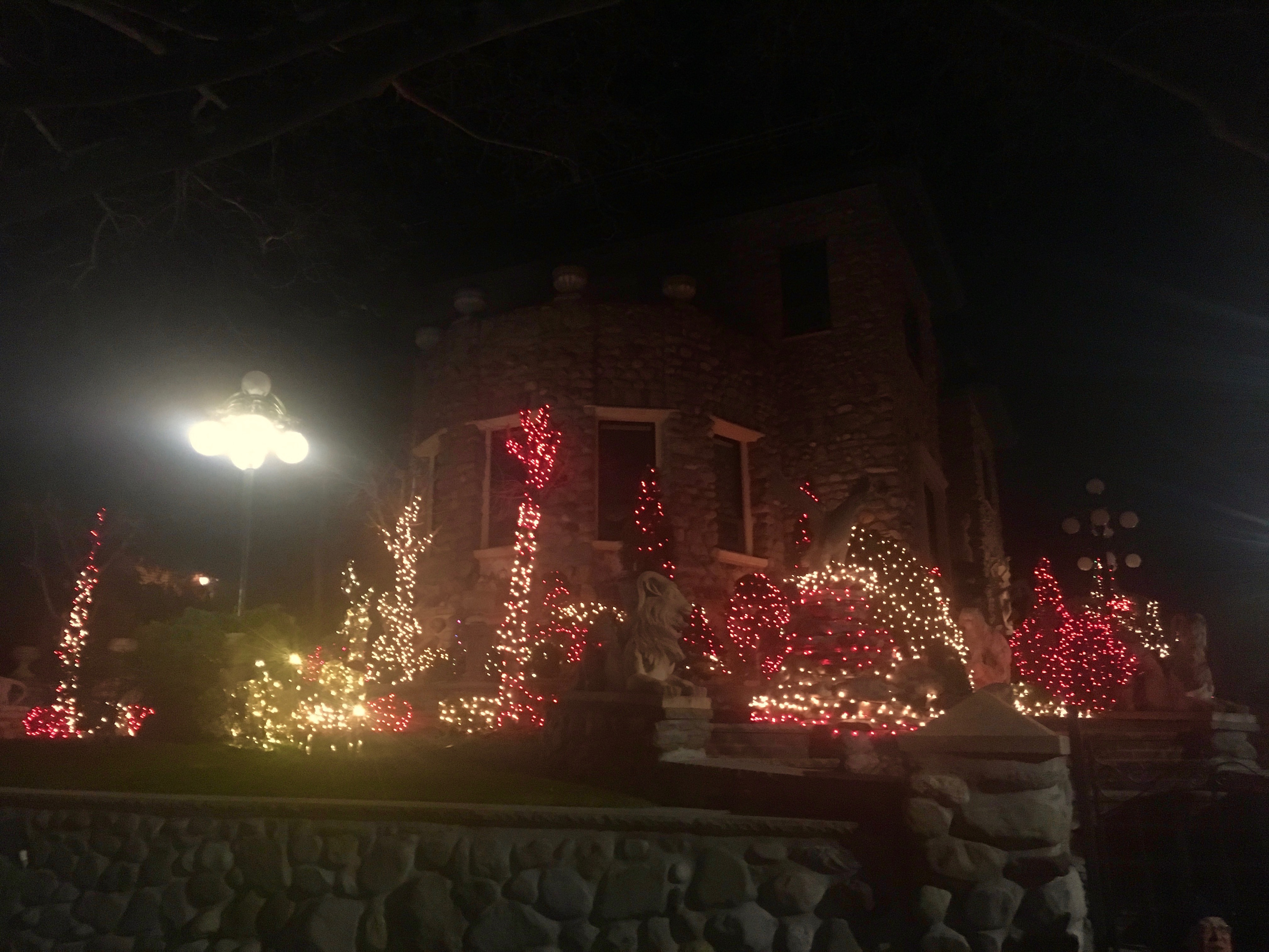
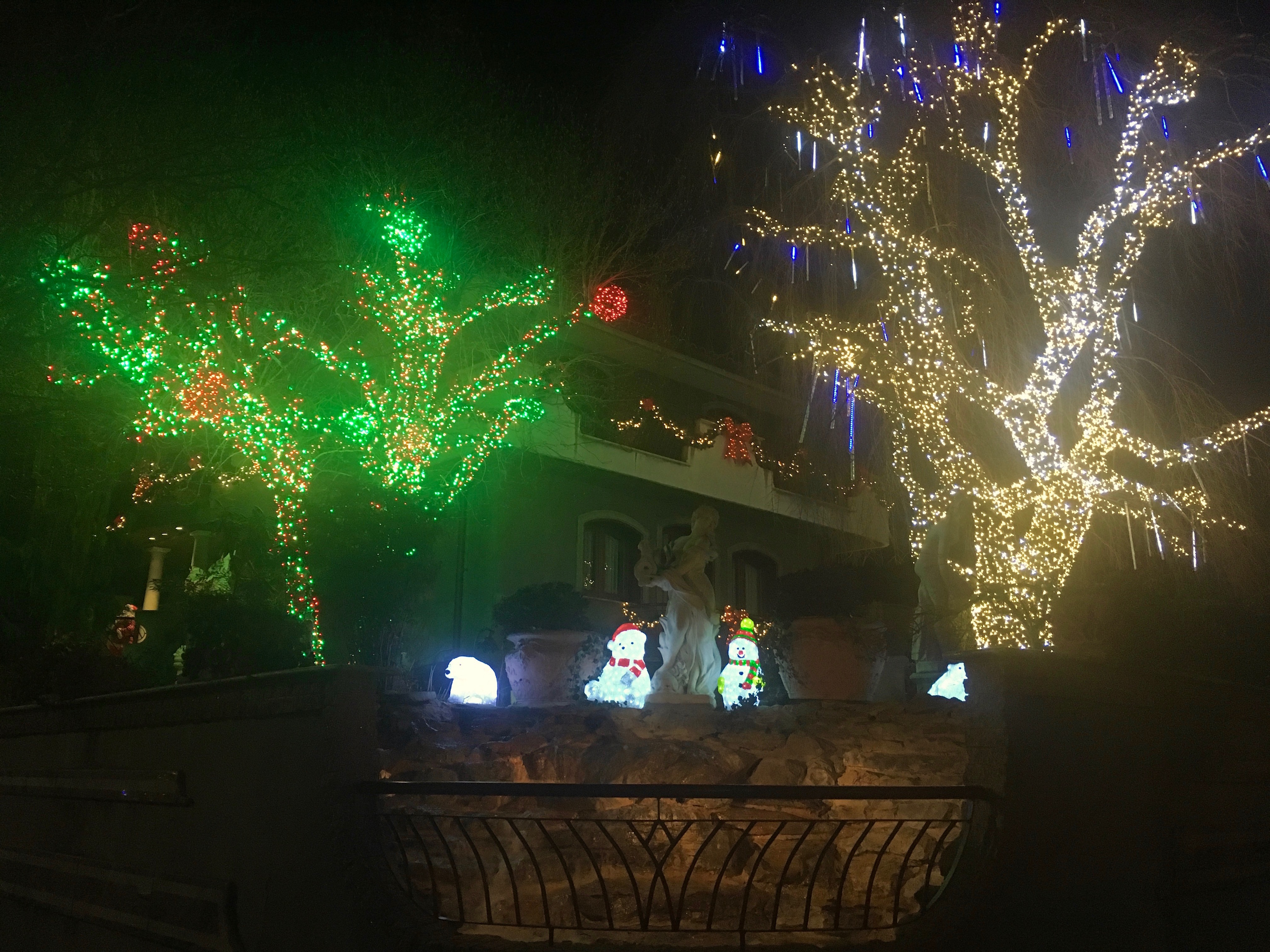
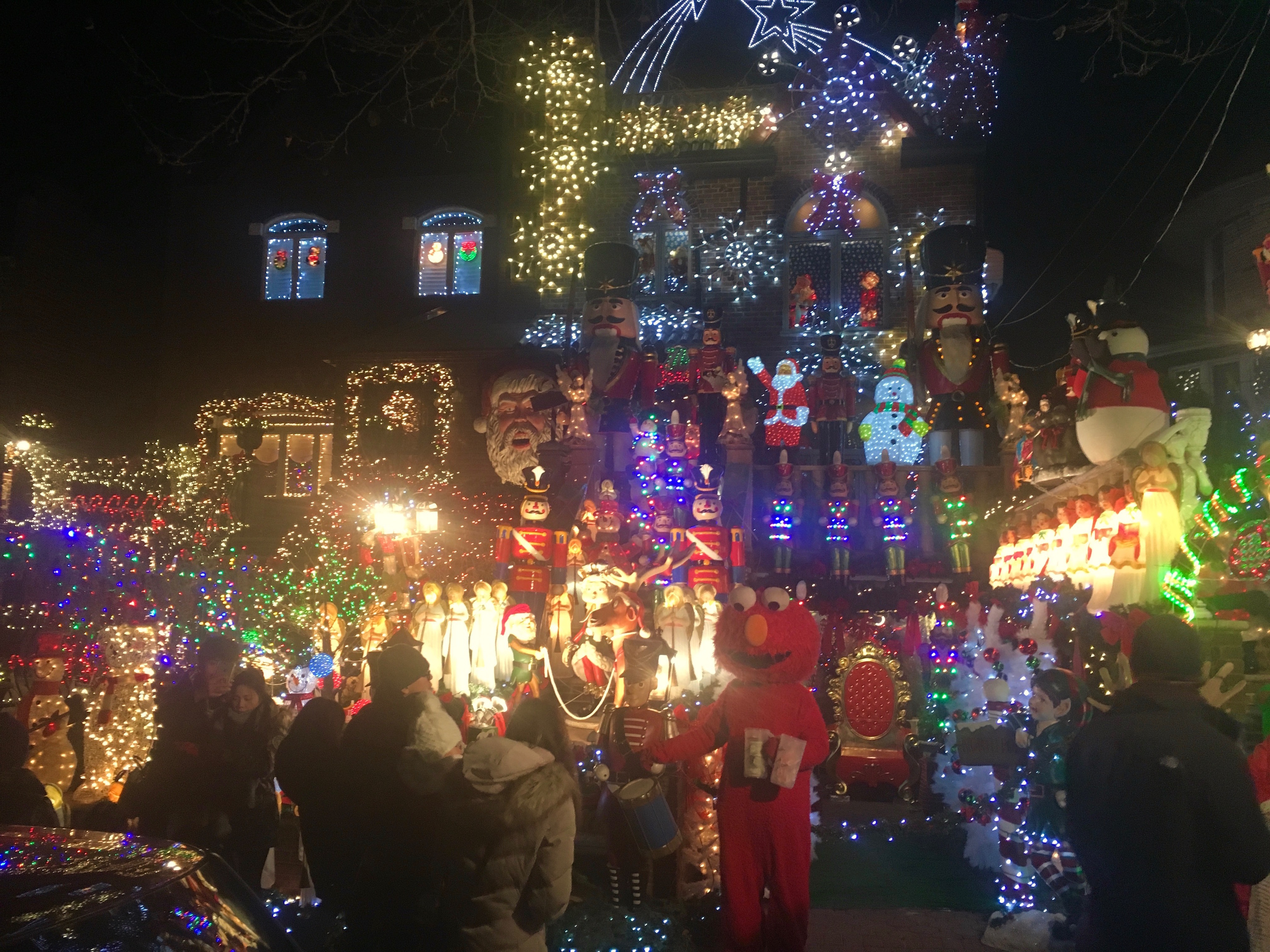
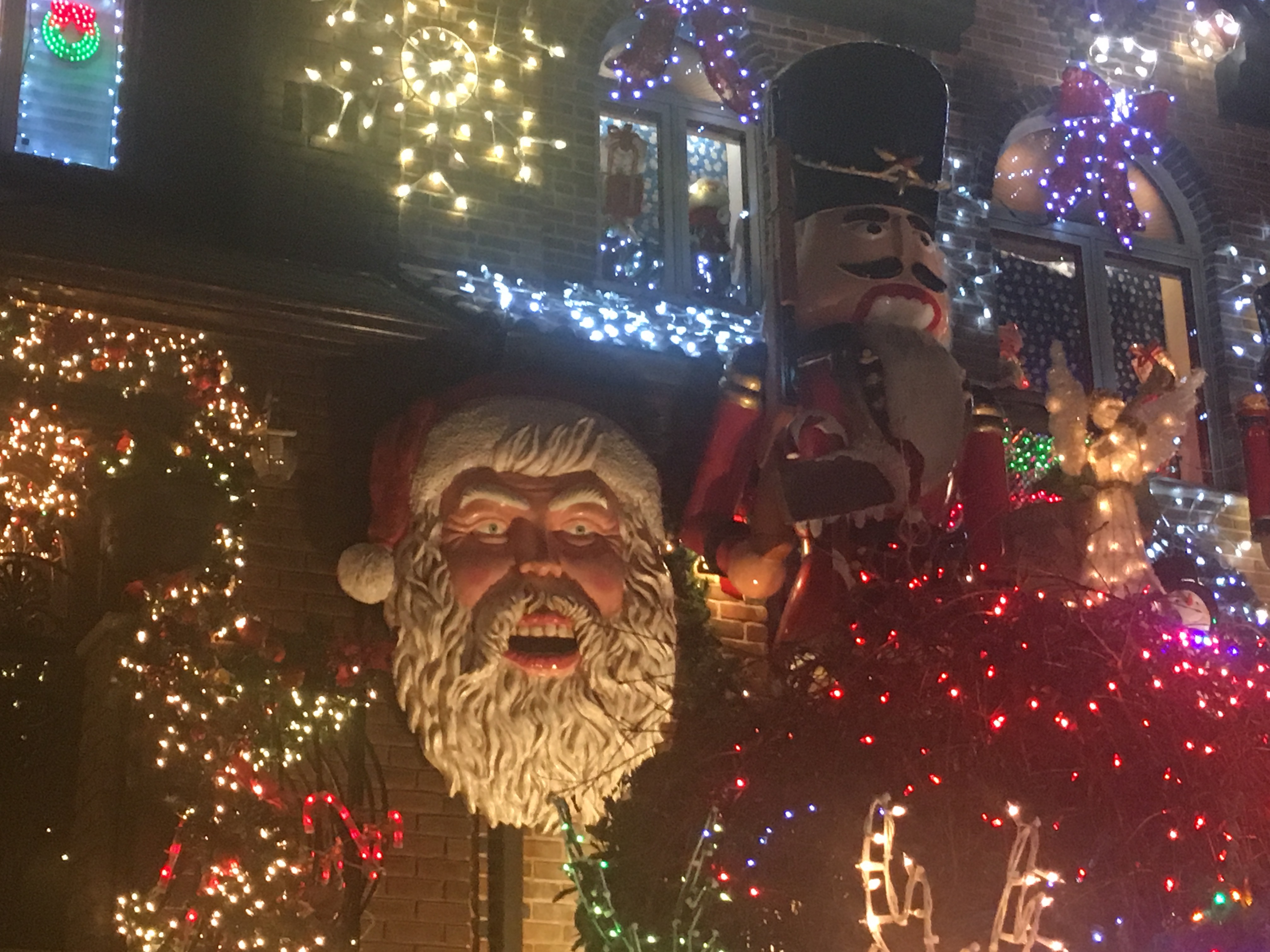
Below is a history of the  Dyker Heights neighborhood, interspersed with pictures I took of this year’s Christmas lights celebration:

Dyker Heights is named for an uninteruppted, sloping meadow which rolled down to the waters edge (today interuppted by the rushing traffic of Shore Parkway). Nobody’s certain where Dyker Meadow got its name, only that it originated from the days of Dutch occupation, either from a Van Dyke family which settled here, or, more generally, from actual dykes the family built to drain the meadow.

Tumuluous history springs up on either side of Dyker meadow and its small forests, as the British who land at nearby Denyce Wharf begin their invasion of Brooklyn in 1776, taking up battle with the Continental Army to the north and east. As part of the township of New Utrecht, the meadow was unsuitable for farming, but its forests were plenty suitable for firewood and materials for building homes.

For awhile, there was only a single dwelling here, atop a hill known as the Lookout, built by civil engineer René Edward De Russy.

Below: Not the home of René Edward De Russy

Development finally came to the area shortly before Brooklyn consolidated with New York. During the 1890s, the nearby area of Bath Beach was quickly becoming a resort getaway similar to Coney Island. Called Bensonhurst-by-the-Sea, the resort adhered to strict moral entertainments (i.e. no booze) and thus was destined to fail.

Luckily, by then, an elevated West End train line (the Brooklyn, Bath and Coney Island line) was attracting speculators eager to draw New Yorkers with residences built on old farmlands. By the late 19th century, the New York Times excitedly noted the saavy practices of land developers in this region of South Brooklyn.

The father of Dyker Heights is developer Walter L. Johnson, who in the 1890s scooped up the land, brought roads and utilities to this fairly remote part of Brooklyn, and quickly created a small community. He even named the area, the ‘Heights’ assumably tacked on to embue it was a cache similar to Brooklyn Heights. Johnson’s gamble paid off; in 1899, the Wall Street Journal proclaimed, “nowhere else in the consolidated city is there anything to compare it with. From here can be seen a marine panorama hard to beat.”


From the beginning, Dyker Heights was designed for home ownership — no tenements and few apartment complexes — and it’s a tradition which mostly lives on today. From an 1899 article: “Dyker Heights is carefully restricted, the restrictions running till 1915 and no building can be erected here on a plot of less than 60 by 100. Each building must cost at least $4.000 and stand well back from the street line.”

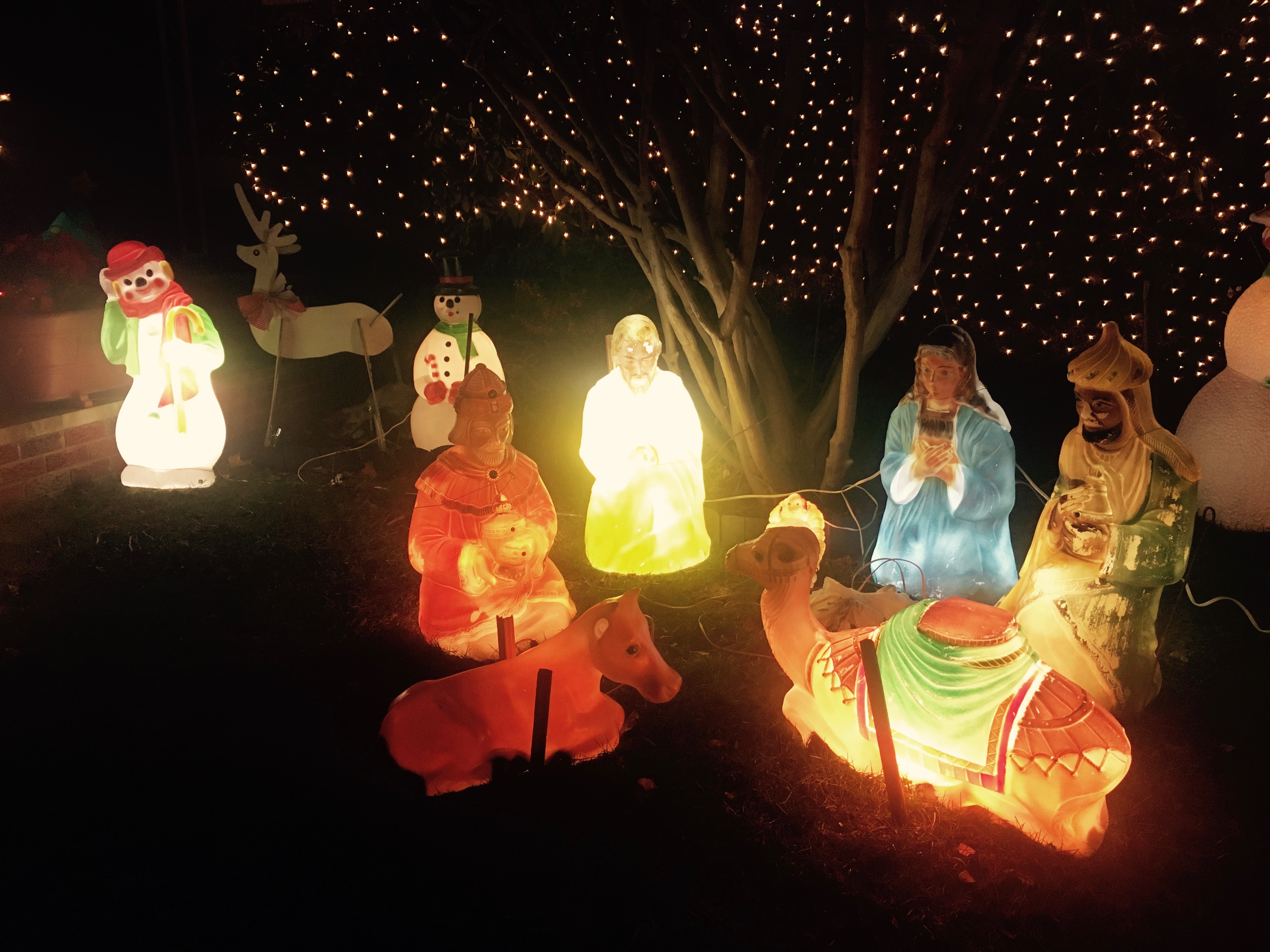
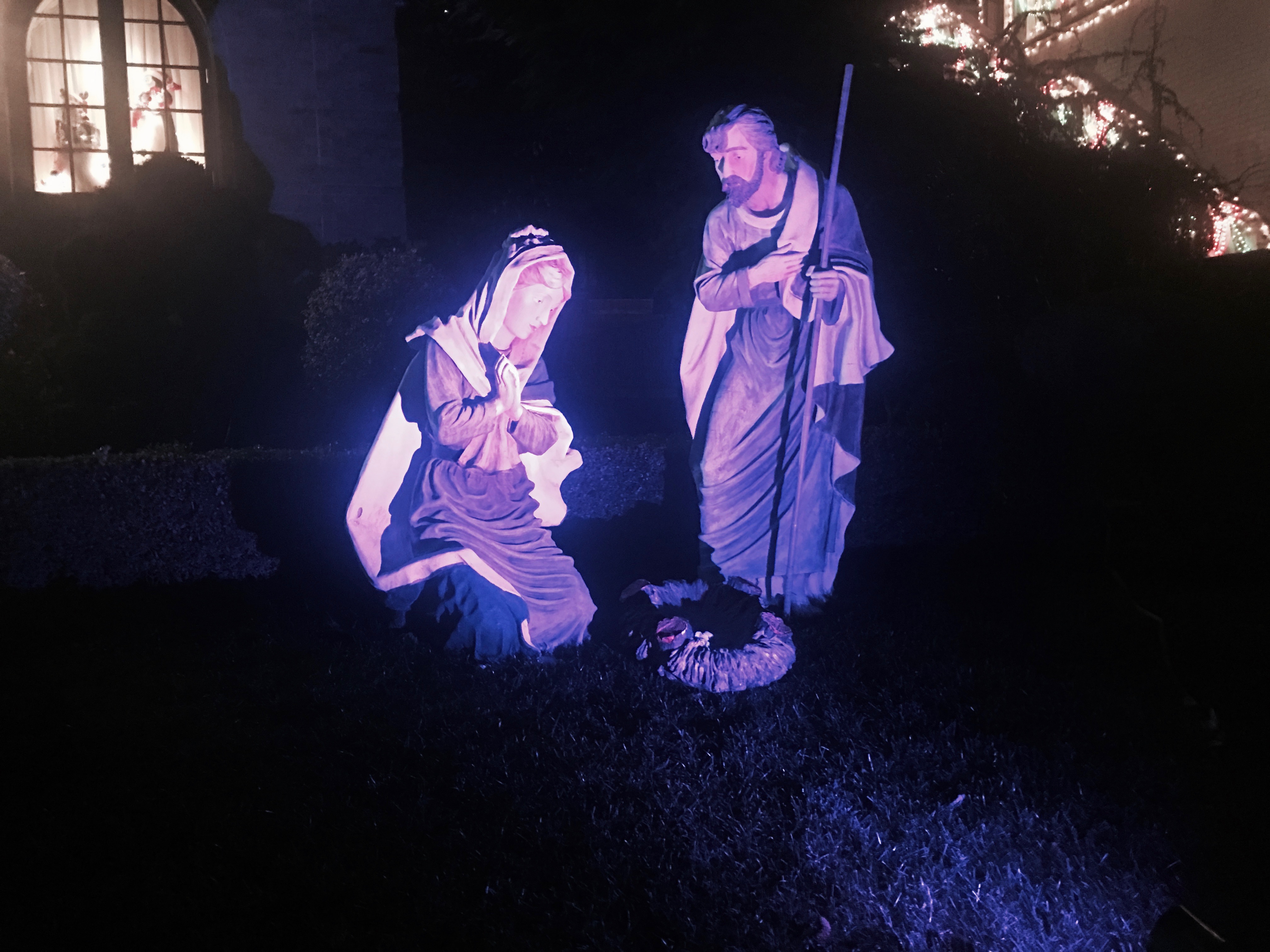
Below: A sampling of the dozens of electric manger scenes awaiting you in Dyker Heights.


Today Dyker Heights is a predominantly middle- to upper-middle class Italian neighborhood, anchored by the Dyker Heights golf course and sandwiched between Bay Ridge and Bensonhurst, with old Fort Hamilton to the southwest and what remains of the old Bath Beach resort area just southeast of here.

What Mr. Johnson could not have predicted — heck, what Thomas Edison, inventor of electric light bulb, could not have foreseen — is the annual holiday expression that occurs on the lawns of many Dyker Heights residences through December.

The neighborhood is already known for its unique, ornamented homes, front lawns festooned with fountains, animal statuary, ornate shrubbery, perfectly manicured grass and home waterfalls.

For the holidays, the busy lawns are then burdened with an abundance of lighted sculptures, animatronic dioramas, and every manner of festive lawn display imaginable. Dozens of trees of all varieties — from willows to even palm trees — are garbed in multi-colored lights.

Befitting an organic neighborhood celebration, the origins of this annual tradition are a bit hazy. Families began hosting displays as far back as the post-war years of the 1940s. An article from the New York Times  suggests that the neighborhood’s Italian leanings may have something to do with it.

The show is concentrated between 81st and 84th Street and between 10th and 13th Avenues, but in recent years, it easily spills over to other blocks and even into the borders of adjoining neighborhoods.

This is a curious tradition, as the best way to enjoy the show — on foot — is obviously the most uncomfortable, especially on brisk December evenings.  There are fine tour companies which present bus tours of the Christmas light show, and if you’re averse to chilly temperatures, they’re the best way to go. (Free Tours By Foot and A Slice of Brooklyn are two reliable tour operators which offer holiday bus tours well into the new year.)

But I prefer seeing the electric light madness on foot, soaking in the Christmas music that seems to emanate from every home. Just grab a giant coffee or cocoa and go! Most of the homes will be festively lit until at least New Year’s Eve.

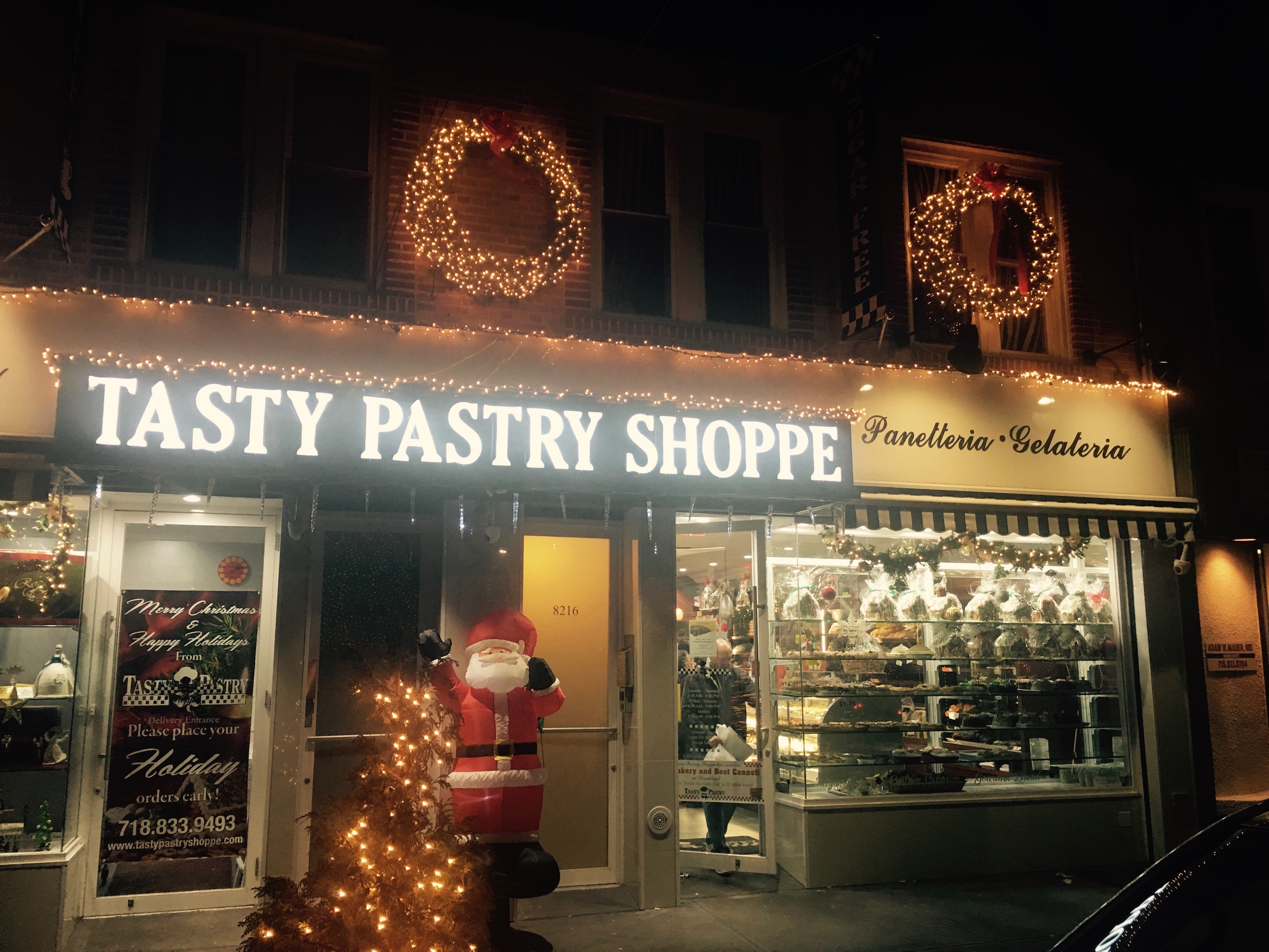
Better yet, before or after your stroll, head up to this amazing place on 13th Avenue and 83rd Street and fill your pockets with cannoli.


By the way, much of the history of Dyker Heights was unearthed several years ago in a thesis paper by then student Christian Zaino.

A model example of a budding New York historian, his research was so exhaustive that one of Dyker Heights’ more glamorous homes — the Saitta House — entered the National Register of Historic Places on the strength of his research. In fact, this is probably one of the few instances that you can use Wikipedia for a resource, as Zaino wrote the page. (In 2014, he also made an hour long documentary film about the history of Dyker Heights. You can watch it here.)


Portions of this article were taken from another Bowery Boys article Blinded By The Lights of Dyker Heights.


Categories
Holidays

Making Green: The history of New York’s Christmas tree market

For many, the Christmas holiday in New York City finally comes to life when the sidewalks sprout evergreens. The sight and smell of curbside Christmas tree sellers ushers in the season in the most pleasing way. (Pleasing for the passerby; on a rather cold day, I can’t imagine it too pleasing for the seller.)

As history has it, the presence of streetside Christmas trees in the city actually predates Christmas as a national holiday (1870).

In the mid-19th century, hardly any modern Christmas traditions existed. One that did was the Christmas tree, a pre-Christian ritual incorporated into holiday festivities in German-speaking European countries (Those traditional settlers, the Puritans, didn’t much care for Christmas at all.)

Although the tradition did exist in the United States thanks to the Dutch, it was German immigrants who popularized it. As a huge surge in German immigration began in the 1840s, it’s not surprising that New York’s first Christmas tree market — in fact, the first mass-market sale of Christmas trees in the United States — came along shortly after, in 1851.

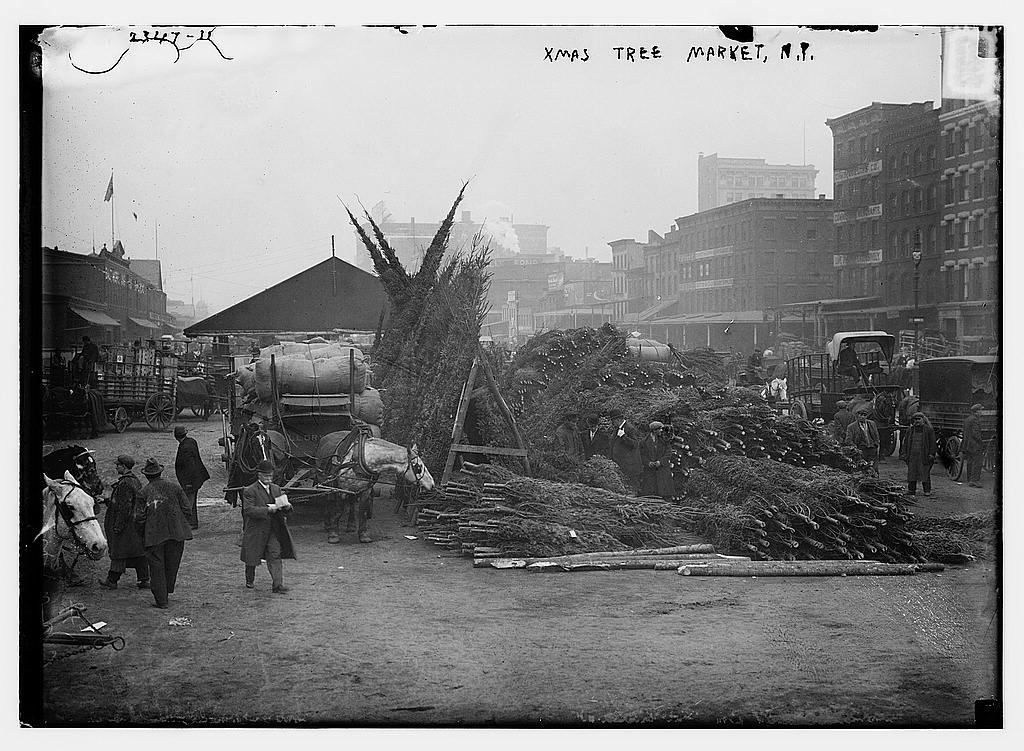
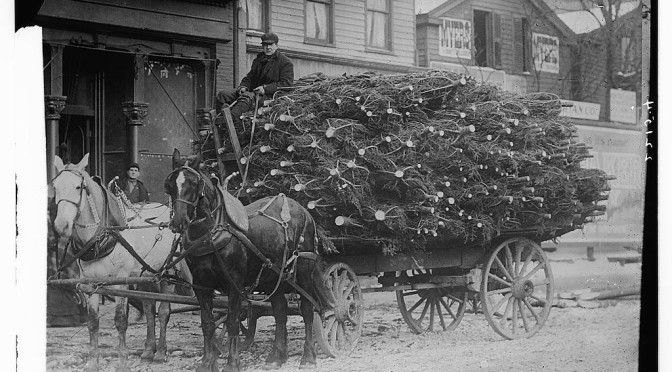
Unloading Christmas trees, photo from 1901-1915

Courtesy Library of Congress

It doesn’t appear that ‘jolly woodsmanMark Carr, living in the lush Catskill Mountains, even celebrated Christmas, but he certainly heard tales of families driving outside of town and chopping down evergreen trees to drag into the city. The go-out-and-get-it-yourself approach probably only benefited the wealthy or anybody with a horse and wagon and the time and energy to travel into the forest and find one. Carr, finding the spirit of the holidays (capitalism) deep within him, thought he’d bring the forest to the city folks.

So a couple weeks before Christmas in 1851 — things didn’t start so early back then — Carr and his sons chopped down a couple dozen fir and spruce trees, shoved them into two ox sleds, carted them over to Manhattan on a ferry and set up shop in the Washington Market paying one dollar for the privilege of taking up a sidewalk at Washington Market with his rather ungainly merchandise.

Holiday revelers were thrilled to be spared the journey out of town, and Carr’s entire stock of evergreens sold out within the day. No surprise this financial opportunity was mimicked by other farmers the next year, and within a few years, the open-air Christmas tree market was born.
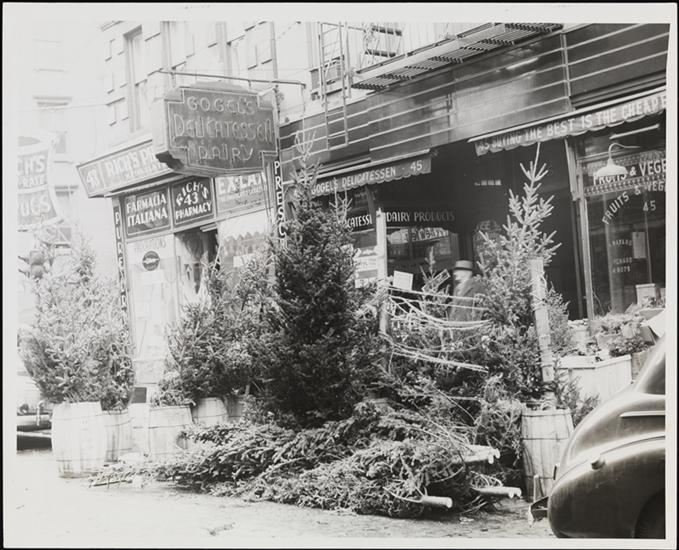
Below: A Christmas tree seller on Catherine Street, 1941, photo by Beecher Ogden

MNY215421
Courtesy Museum of the City of New York

Carr, of course, became the Vanderbilt of the Christmas tree, raking in the dough year after year, selling trees for decades. Carr’s sons were still selling trees in the city as late as 1898, in a city quite transformed, or as the old House Beautiful magazine put it, “Mark Carr’s little sidewalk stand now rents for several hundred times what he paid for it.”

His innovation may be responsible for a whole host of domestic decoration, delivered fresh to the customer. “It is safe to say that 200,000 Christmas trees will be on the market here this year,” said the New York Times in 1880, “besides many tons of Christmas greens.”

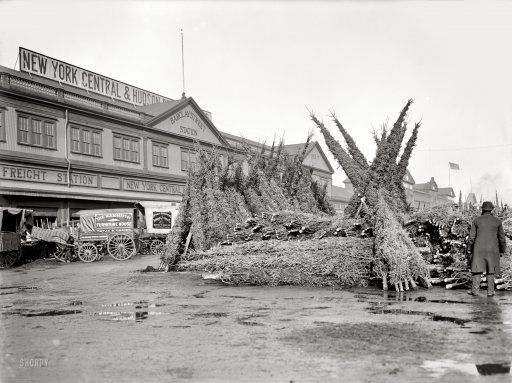
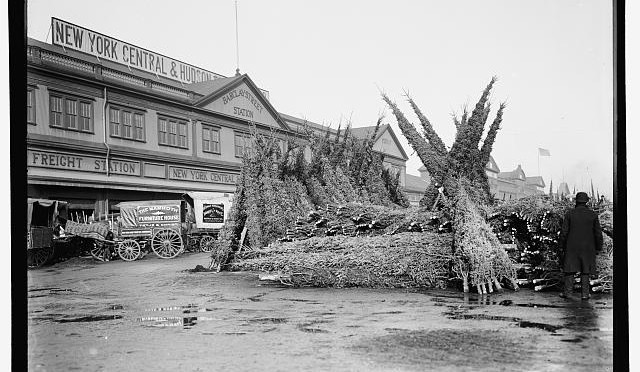
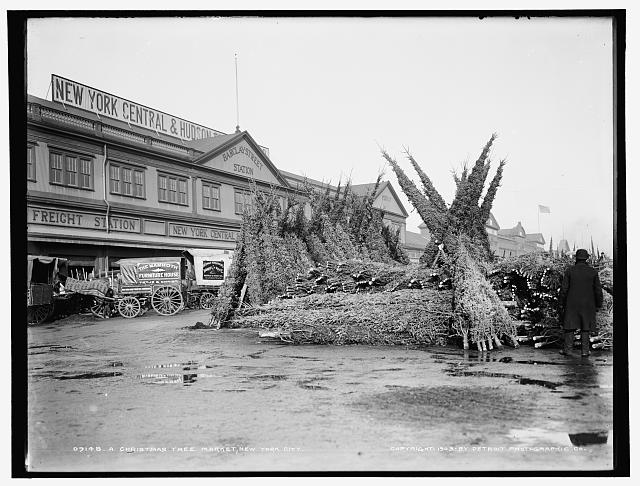
Below: Christmas tree sales at Barclay Street, near the site of today’s World Trade Center

1


By the 1870s boatloads of evergreen trees from Maine were pulling into New York. The task of moving a forest into crowded Manhattan required additional greased palms.

From an 1878 New York Tribune article: “A preliminary trip to the city is … necessary to engage a position on the street or dock, and the rent for this varies from $10 to $75. Then comes the night-watchman and tips (it is whispered) to harbor-masters and police sergeants, so that a dealer who invests $1,000 often realizes little for his labor which extends through three solid months.”

For decades, well into the 20th century, it was easiest to get the trees near the waterfront.  “West Street is now the Christmas tree market in the city,” said the Times in 1908. “Not only is the city’s entire demand supplied practically from this one market, but thousands of Christmas trees are shipped by the West Street dealers to all the surrounding towns and cities in New York State, New Jersey and even to points much further away.”

4

West Street was still the central location of prime Christmas tree sales by the 1930s, but sellers were increasingly bringing their wares onto city streets. Tree markets were a regular seasonal site by the 1950s, with the deterioration of the New York waterfront.

What has drastically changed is the time of year that trees have become available.  “Prospective buyers … feigned surprise at seeing Christmas trees this time of year,” claimed an article published on December 19, 1951. “Most householders, it is well known to Christmas tree retailers, put off buying a tree in the hope that frantic merchants will have to unload at a low price just before Christmas when the market is glutted.”

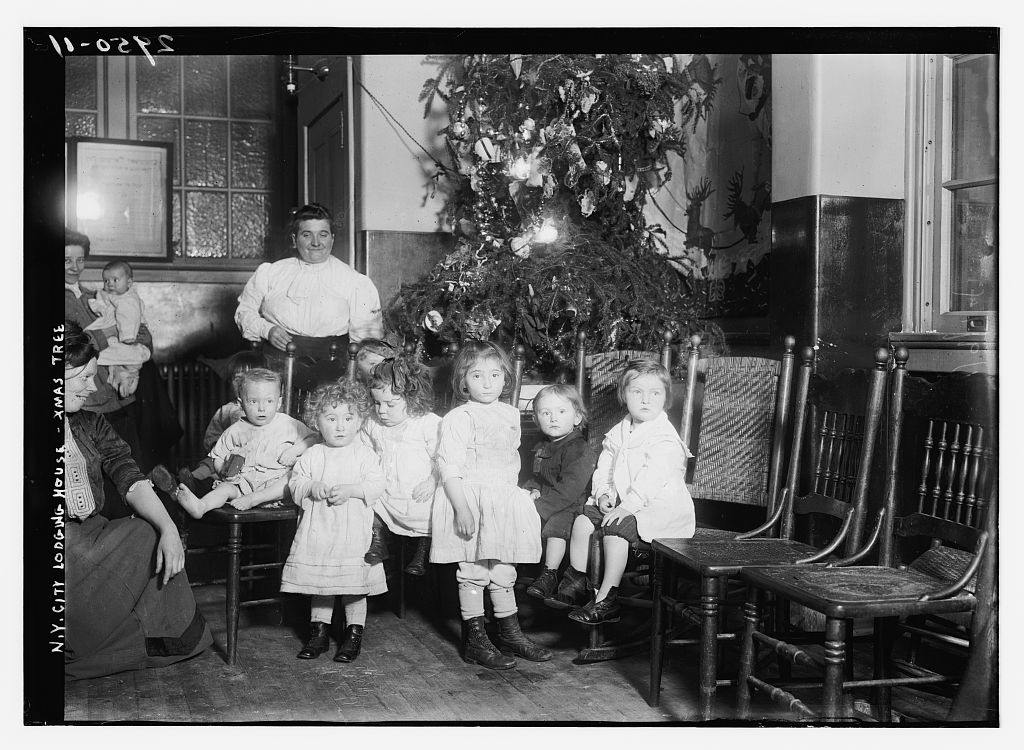
Within a New York lodging house, 1910-1915

Library of Congress
Library of Congress


Note: This is an expanded version of an article which originally ran on this blog in 2009.


‘Twas the Night Before Christmas, 190 years ago, that an iconic poem was written in Chelsea

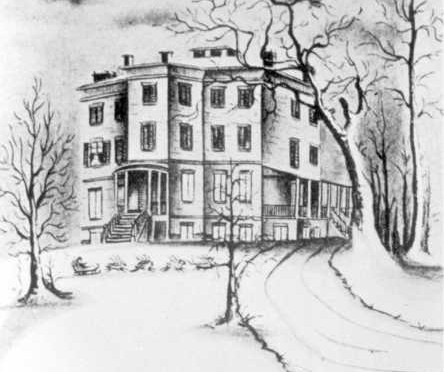
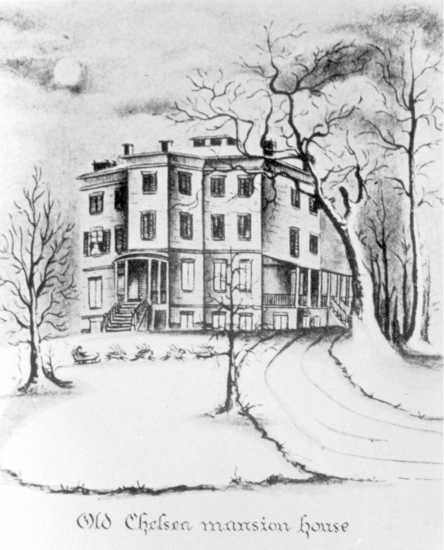
On Christmas Eve, one hundred and ninety years ago today, wealthy landowner and august Columbia professor Clement Clarke Moore completed a seasonal poem to read to his children. He penned the whimsical little tale — a throwaway, really, in comparison to his great and respected writings in Greek and biblical literature — from a desk at his comfortable, snow-covered mansion which the family called Chelsea.

The home sat atop an old hill (at around today’s modern addresses of 422-424 West 23rd Street) overlooking Moore’s estate which stretched south from here. His estate, of course, gives modern Chelsea its name. At right, the Chelsea estate on a cold winter’s night.

Moore was allegedly inspired that afternoon during an outing to Washington Market to purchase a Christmas turkey. The market (pictured below in 1829) would have another holiday claim to fame: it was the site of America’s first outdoor Christmas tree market.

The poem, “A Visit from St. Nicholas” and often referred to as “‘Twas The Night Before Christmas,” would eventually help define Santa Claus mythology. It’s perhaps the most important source in shaping the physical appearance and ritual behavior of the North Pole gift-giver and would provide inspiration to New York illustrators like Thomas Nast and, in the 20th century, the Coca-Cola advertising of Haddon Sunblom.  Moore is even credited with naming the eight reindeer.

But the poem was only originally intended for Moore’s children. I’m not certain how many were around to hear it in 1822, but Moore and his wife Catherine Elizabeth Taylor would eventually have nine of them. One daughter, Mary Ogden, would later produce the first of dozens of illustrated versions of the poem.

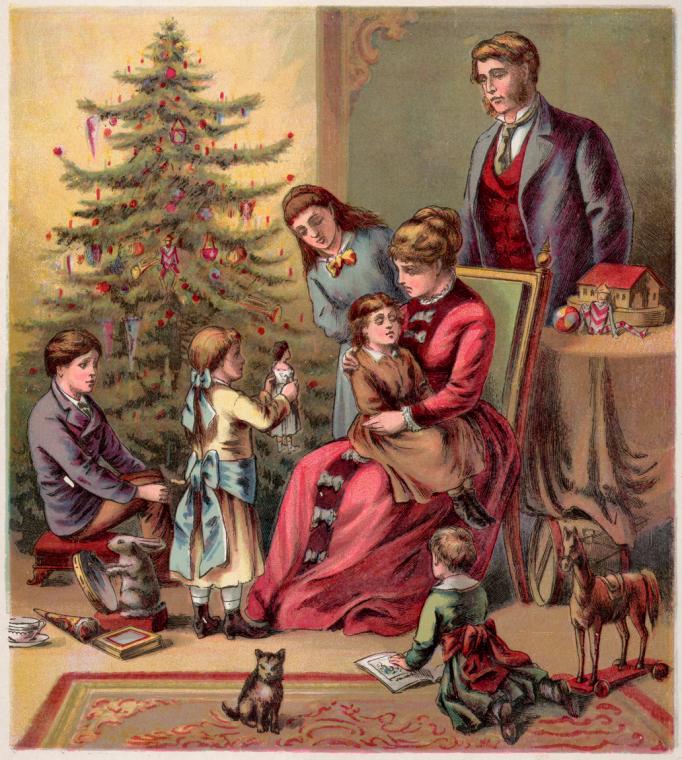
At left: An illustration of Moore and his family from an edition published in 1896 (source)

The poem was published anonymously the following year, and Moore would only take credit — at his children’s insistence — in 1844.

Given Moore’s original hesitation, some scholars have suggested that another New Yorker, Henry Livingston Jr., may have penned it.  Until that is definitely proven, you are allowed to always think of the neighborhood of Chelsea — just two blocks west of the Chelsea Hotel — every time you hear it.

So jump in your ‘kerchief, open your shutters and throw up your sashes, and give this little holiday poem a ripe rendition this year. You can find the full text here. But to quote the final section:

He sprang to his sleigh, to his team gave a whistle,
And away they all flew like the down of a thistle.
But I heard him exclaim, ‘ere he drove out of sight,
“Happy Christmas to all, and to all a good-night!”

For more information on Moore and the Chelsea neighborhood, check out our podcast on the Chelsea Hotel.

Pictures courtesy NYPL

Categories
Holidays

Good grief! Madison Avenue’s connection to ‘A Charlie Brown Christmas’

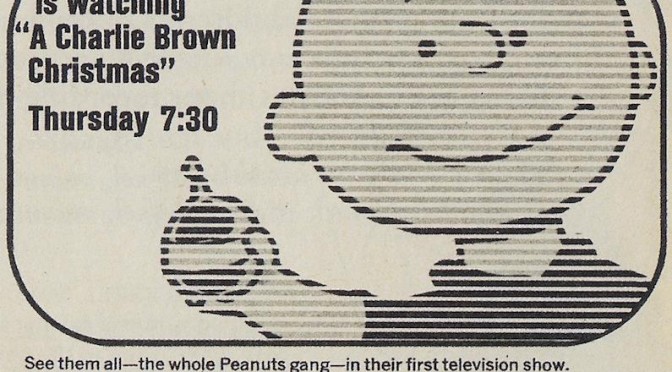
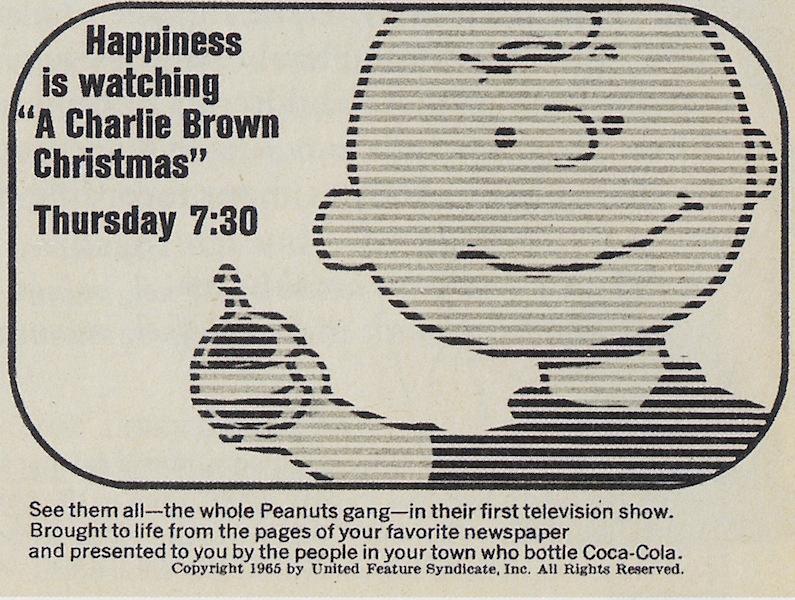
The first time: A TV Guide advertisement from 1965 announcing the upcoming Charlie Brown special, “presented … by the people in your town who bottle Coca-Cola.” [source]

A Charlie Brown Christmas, the holiday special to end all holiday specials, needed a little encouragement from the Madison Avenue advertising world in 1965 to spring into existence.  In fact, Peanuts’ creator Charles Schulz wasn’t exactly clamoring for any kind of television version of his classic characters.

The Minnesota cartoonist’s first fateful encounter in New York came in June 1950, when he met with editors at United Feature Syndicate, located in the Daily News Building on 42nd Street, to form the strip which eventually became Peanuts.  The syndicate initially restricted the size of Schultz’s cartoon panels to flexibly adhere to the various column sizes of their partner newspapers. This forced simplicity into Schultz eventual designs for his characters — the bulbous head of Charlie Brown, the dash of black ears on an all-white beagle.

The syndicate unveiled Schulz’s creation a few months later, on October 2, 1950. Within a decade, it would be one of America’s most famous comic strips.

Flash-forward to another spring in New York, April 1965, and to the bustling offices of advertising agency McCann Erickson, at 485 Lexington Avenue.  They were Madison Avenue’s most successful agency and held among their clients the defining product of post-war America — Coca-Cola.

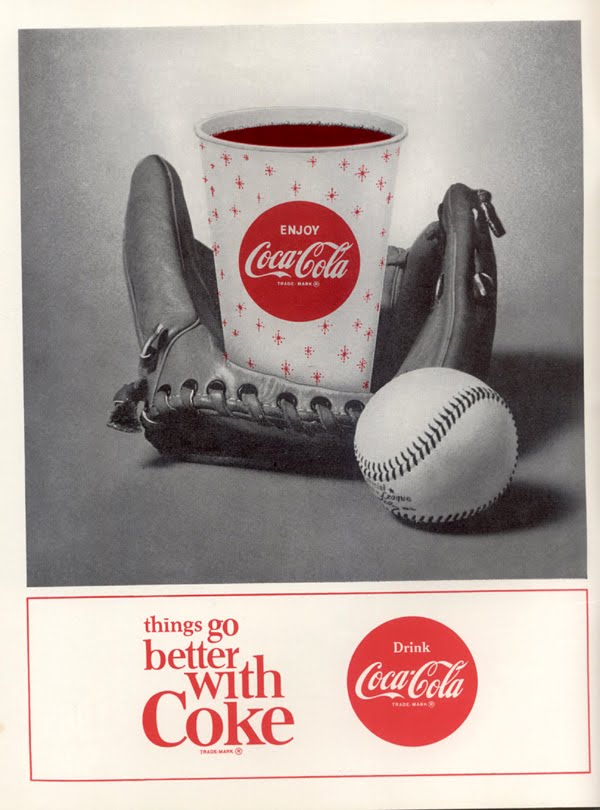
McCann Erickson would be responsible for some of Coke’s most recognizable advertising campaigns during a decade when the beverage would reach international popularity.  In 1971, agency efforts would underscore Coke’s world domination with ‘I’d Like To Buy The World A Coke’.  At left: A McCann-Erickson Coke ad from 1965, courtesy the blog Beautiful Life

Coke was looking for a television show to sponsor for the holiday season of 1965, one that could be developed from scratch, with a Coca-Cola audience in mind — namely, families with children.

(If you’re a ‘Mad Men‘ fan, you may also be familiar with McCann Erickson as the agency from Season 3 who bought out Sterling Cooper, forcing Don Draper and the gang to quit and form a new, fledgling agency. The events of Season 4 — with Ken Cosgrove still in McCann’s employ — play out during 1965, the same year as A Charlie Brown Christmas.)

One of McCann Erickson’s lead executives John Allen had an idea in mind.  He had seen a documentary on Schulz, called A Boy Named Charlie Brown, and that film contained some crudely animated versions of Charlie Brown and Lucy by animator Bill Melendez.  Allen called up Melendez and asked if Schulz had ever been interested in developing a full-length television special.

He had not, actually.  In fact he had turned down many previous offers to produce animated specials. Schulz said at the time, “There are some greater things in the world than TV animated cartoons.”  Yet, perhaps contradictory to this, Schulz seemed open to licensing and merchandising opportunities.  In 1960, Charlie Brown and Lucy made their first animated appearance on television hawking cars for Ford:

But you couldn’t turn down an offer by the world’s biggest sugary beverage, could you?  Melendez agreed, brought the offer to Schulz at his northern California home, and from his studio there, he and a team of animators frantically put together a program in time for the holidays.

Schulz wanted lots of snow and ice skating and talk of “the true meaning of Christmas,” inspiring the special’s lengthy Biblical monologue by Linus.  They auditioned Hollywood children and kids from Schulz’s neighborhood for the voiceovers and called up San Francisco-based musician Vince Guaraldi, who had recently cracked the Billboard charts with the song ‘Cast Your Fate To The Wind‘, to score the special.

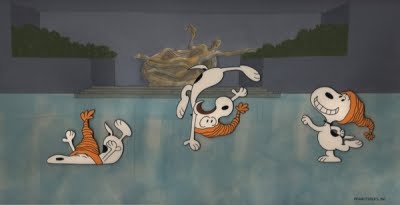
Below: Snoopy careens around the Rockefeller Center ice skating rink in the 1969 film A Boy Named Charlie Brown.

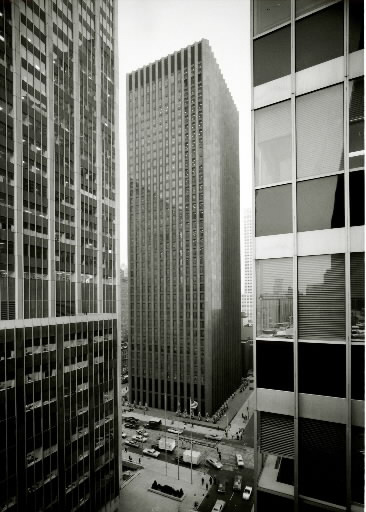
The half-hour feature was finished just a few days before broadcast. TV Guide and newspapers were already advertising the airing when Melendez sped to CBS’s brand new corporate offices at 51 West 52nd Street; the Eero Saarinen-designed building was nicknamed Black Rock for its monolithic design. (Pictured below, pic courtesy Skyscraper.org.)

Melendez screened the special for executives who were greatly underwhelmed with the final product.  “It seems a little flat … a little slow,” said one executive, assuring Melendez that CBS would not be ordering any future Peanuts specials.  According to producer Lee Mendelson, “If the show hadn’t already been scheduled to air in six days, it might never have been broadcast.”

Fortunately, a Time Magazine reviewer was allowed to screen A Charlie Brown Christmas and wrote a rave review that ran a couple days before showtime. From the review: “For one thing, the program is unpretentious; for another, it is unprolonged (30 minutes).”

But television audiences would have the final say and, upon broadcast on Thursday, December 9, it became the week’s second biggest show behind Bonanza.  Popular acclaim was soon joined by critical plaudits; a few months later, Schulz, Melendez and Mendelson arrived back in New York to receive an Emmy Award for Best Animated Special.

The original version of A Charlie Brown Christmas included a short shot of Linus being flung by Snoopy into a Coca-Cola sign. It was later edited to say Danger, which was then edited out entirely, because, well, it’s a bit disturbing. (See below.)  No remnant exists today within A Charlie Brown Christmas of its Coca-Cola advertising reason for being.

Four years later, Charlie Brown, Snoopy and Linus would head to New York themselves, in the 1969 feature length film A Boy Named Charlie Brown (title similar to the 1962 documentary) in which Charlie would nervously compete in the Scripps Spelling Bee competition.

Schulz’s Manhattan is as abstract as any of his landscapes, but he does depict both the New York Public Library and Rockefeller Center.  It’s here that Snoopy reprises his ice skating routine to the music of Guaraldi.

There’s also several scenes of a cracked-out Linus stumbling through the city at night, looking for his blanket, which he has unwisely loaned to Charlie. An excerpt of the film:

A Boy Named Charlie Brown made its premiere at Radio City Music Hall on December 11, 1969. You can check out the original film program here.

Categories
Christmas

Pre-Scrooged: The Ghost of New York Christmas specials


A Bill Murray holiday classic is closely linked to a forgotten 1955 teleplay

Tracing itself back to one of America’s first television broadcast station, New York’s local WCBS-TV can claim a host of significant achievements, including the first regular broadcasts in color and the first baseball game in color (with the Brooklyn Dodgers, naturally).

Their early news documentary series ‘Eye on New York’, hosted and produced by future CBS president Bill Leonard, took a break from serious reporting on the evening of Christmas 1955 to broadcast a live version of Charles Dickens’ ‘A Christmas Carol’.  I don’t believe a version of this classic exists to view today, but holiday television lovers benefit from one odd quirk of this fleeting program.

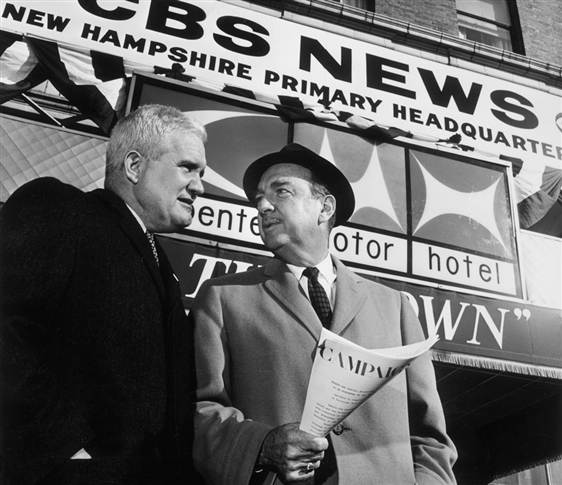
At right: Bill Leonard with CBS News correspondent Walter Cronkite.

This version of ‘Carol’ starred the extraordinary Bronx-born character actor Jonathan Harris (best known as the flamboyant Dr. Smith from ‘Lost In Space’) as Ebenezer Scrooge and Tony Award nominee Biff McGuire as Bob Cratchit.

But far from constructing a dour Victorian London set upon their midtown Manhattan soundstage, Leonard (who wrote the teleplay) decided to change the setting of the story, to modern day New York City. According to author Fred Guida, “this clever conversion preserved the spirit of the original but in the milieu of lower Park Avenue and big industry.”

Harris’ Scrooge was transformed into the bitter old CEO of Metropolitan Plastics, with Cratchit his elevator man. Scrooge was visited by the various ghosts via “a TV receiver as an up-to-date medium for his unearthly visions,” according to Variety.

Leonard’s ‘Carol’ was the very first version of the tale set in New York, and with a modern twist. While this original program has been lost, its cheeky trope has been used in a great many modern shows (especially those of the 1970s and 80s) in ‘very special Christmas episodes’, to bring holiday realizations to jaded characters from Alex P. Keaton of ‘Family Ties’ to even the title character of ‘Xena: Warrior Princess’.

But the greatest beneficiary of Leonard’s holiday twist is the 1988 Bill Murray classicScrooged, where a grumpy New York television producer — filming his own version of ‘A Christmas Carol’ — finds epiphany after an evening with three illuminating spirits, including a cab driver played by former New York Dolls singer David Johansen.

And since we’re on the subject, here’s some more New York holiday themed cheer from Johansen, under the name of his alter ego, Buster Poindexter. Happy holidays from the Bowery Boys!

Categories
Holidays

‘Christmas or Chanukah?’: New Yorkers ‘discover’ the Jewish holiday

Early news reporting on the celebration of Hanukkah (or Chanukah, as it was popularly referred then) in New York usually took a arms-length approach, as most of their readership knew little about the celebration 100 years ago. More than one old Tribune or World carried a variant of the headline ‘Jews Celebrate Chanukah’ , as though there might have been some doubt. A 1905 headline informs: ‘Chanukah, Commemorating Syrian Defeat, Lasts Eight Days.’

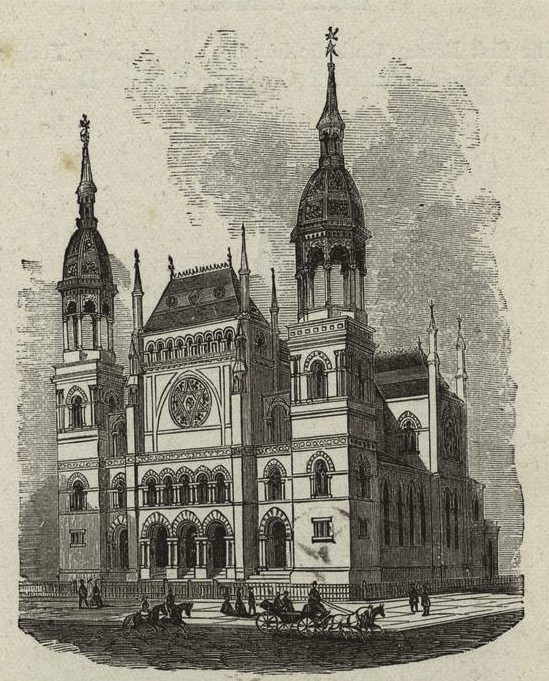
It wasn’t just non-Jews that were misinformed about this seemingly mysterious holiday. A December 1894 edition of the New York Sun asks ‘Christmas or Chanukah?’ as a prominent rabbi from Temple Emanu-El (pictured at right, in its Fifth Avenue incarnation) “rebukes the tendency of Jews to confuse the festivals.”

In fact, many Jewish leaders at this time were concerned that many traditions were being abandoned, the better to acclimate in a city that was decidedly more Christian-seeming.The wife of American Jewish scholar Richard Gotthell* worried in 1900 that “this festival occurs so nearly coincident with the Christian festival of Christmas that there is danger that the observance of one may be lost in a gradual assimilation with the other.”But with the mass immigration of Eastern European Jews to New York in the 1900s, soon thousands celebrated the holiday — and newspapers could hardly be so cavalier.

One event they took particular note of was the Chanukah celebration by the Federation of American Zionists, at the Herald Square Theater on January 1, 1911. One anecdote sprang out at me: “Dr. S. Levin spoke in Hebrew for an hour, on ‘Jewish Life and Art.’ He took exception to a certain Jewish speaker who recently declared that the Jews had produced nothing in art. Dr. Levin asserted that he was greievously wrong.”

Across town at that very moment, a young Russian Jew named Irving Berlin was hammering out tunes in Tin Pan Alley and would debut, just a couple months later, ‘Alexander’s Ragtime Band’, while other songwriters of Jewish heritage, such as Jerome Kern, were right then hard at work reinventing the American songbook. So, yes, Dr. Levin, grievously wrong.

And of course, these Jewish songwriters would go on to even help reinvent Christmas itself via a flurry of popular holiday tunes, like Berlin’s own ‘White Christmas.

*Gotthell was also the founder of America’s first Jewish fraternity, Zeta Beta Tau, formed in New York in 1898.


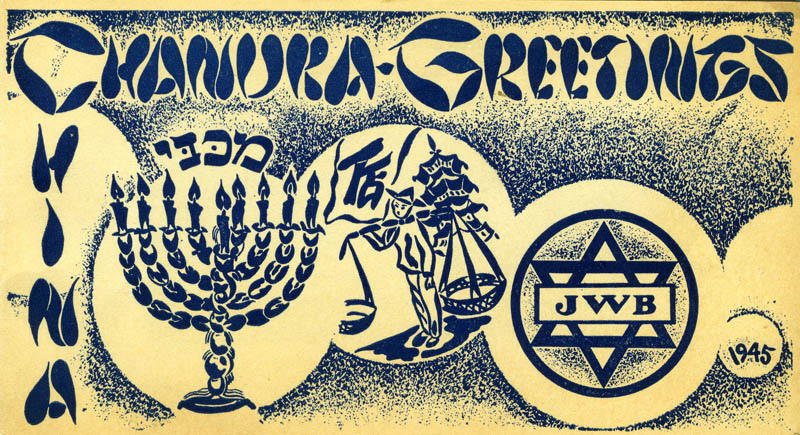
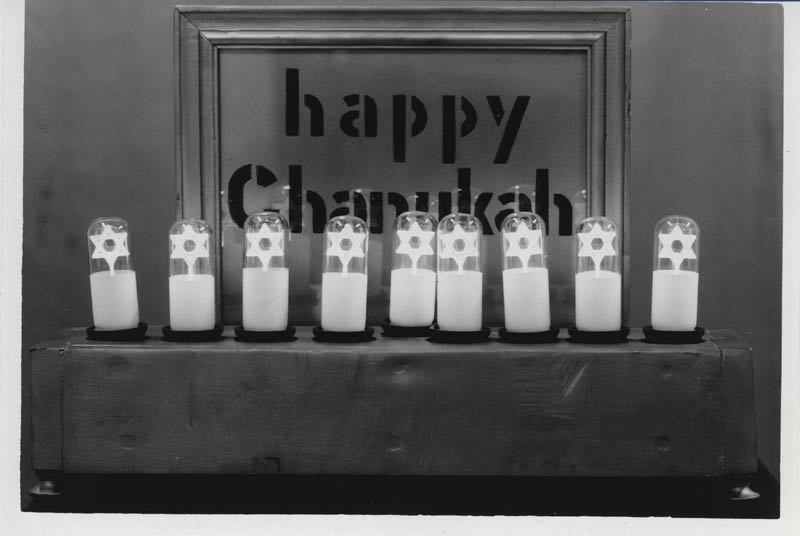
Pictured at top: A 1945 Hanukah greeting card, issued by the Jewish Welfare Board, 1945

The little engine that could in downtown Manhattan

Once upon a time, in December 1900, there was a toy store on 67 Cortlandt Street with very, very sad display windows. The store’s owner, Robert Ingersoll, was best known for his ‘dollar watches’ and, on the success of those, had branched out to include other items for sale, including a great variety of toys and novelties.

But he was not advertising wizard. Ingersoll tried to emulate the windows of the great department stores uptown, but try as he might, the items in his display just sat there, garnering little interest. The fire engines for play, the little trains and boats, toy elephants and clown dolls. People rushed by without a second glance.

They caught no one’s eye, until one day came along Joshua Cowen, a tinkerer and inventor with some training at the Cooper Institute and gifted with a wild imagination. He made small electrical trinkets at an office on 24 Murray Street, just a few blocks north from Ingersoll’s little store, and reveled at coming up with unique ways to utilize electrical power.

Cowen saw the display of toys and immediately thought of an invention he was working on. He ran into Ingersoll’s shop and proposed an idea to the shop owner. What if we could make something that the big department stores hadn’t thought of yet? What if we grabbed the attention of shoppers by putting a little momentum into your window display?

Ingersoll liked the idea and soon installed Cowen’s ideas among his merchandise — a rudimentary electric train, “resembl[ing] the maintenance cars…towed around the city by work trolley” [source], an ingenous little device that wove between toys along a small track.

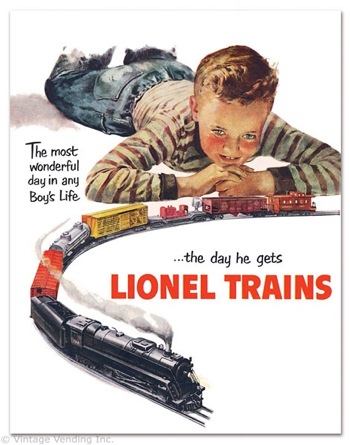
It did the trick. In fact, the electric train, which Cowen sold to Ingersoll for four dollars, was then itself sold to a customer. So Ingersoll asked for six more. From there came demand from other stores, and Cowen suddenly had himself a new business, manufacturing the new toys under a brand taken from his own middle name — Lionel Trains.

From this odd start — built as an advertising ploy — Lionel Train become the leading name in toy trains and a perennial favorite of the Christmas season. In 1999, the Lionel train was named the 4th greatest toy of the 20th Century, beating all by crayons, yo-yos and Barbie dolls.

By the way, do you think Cohen, busily making his miniature trains above ground, knew that right underneath his office at 24 Murray Street was the sole tunnel made for New York’s very first underground train from the 1870s — the pneumatic transit of Alfred Ely Beach?

America’s first holiday Nutcracker, before Balanchine

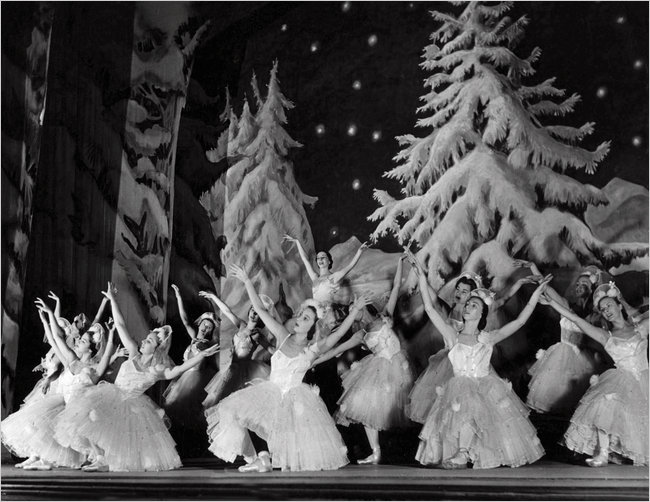
Ballerinas in their first flight of The Nutcracker: the Ballet Russe at the 51st Street Theater, 1940 (Picture courtesy the New York Times)

Few ballet productions of the last century had more influence on American culture than George Balanchine’s 1954 edition of Tchaikovsky’s The Nutcracker, as performed by the New York City Ballet. Although not purely conceived as a Christmastime show, the characters of The Nutcracker were welcomed into the pantheon of holiday images from the moment they appeared on opening night, February 2, 1954, fueled by multiple television appearances during the ’50s and ’60s.

Far from simply presenting the show as originally seen in Russia and throughout Europe in the 1930s, Balanchine made notable changes to the full-length work that have stayed firm even within modern presentations of the ballet. Balanchine’s footwork has also been largely preserved.

But if Balanchine is responsible for making The Nutcracker a valuable holiday tradition, then it is with grief that I inform you that Balanchine’s troupe was not the first to perform The Nutcracker in New York. In fact, his was 14 years too late for that distinction.

The first appearance of The Nutcracker on American soil was performed by the Ballet Russe de Monte Carlo, an offshoot of the great Ballet Russe that eventually splintered into two rival companies. As a united company, they had toured the country in the 1910s, making their New York debut on January 17, 1916, with a selection of shows, including Schéhérezade. By the 1930s, they were two separate, warring ballet troupes; both toured the United States, sometimes to great confusion.

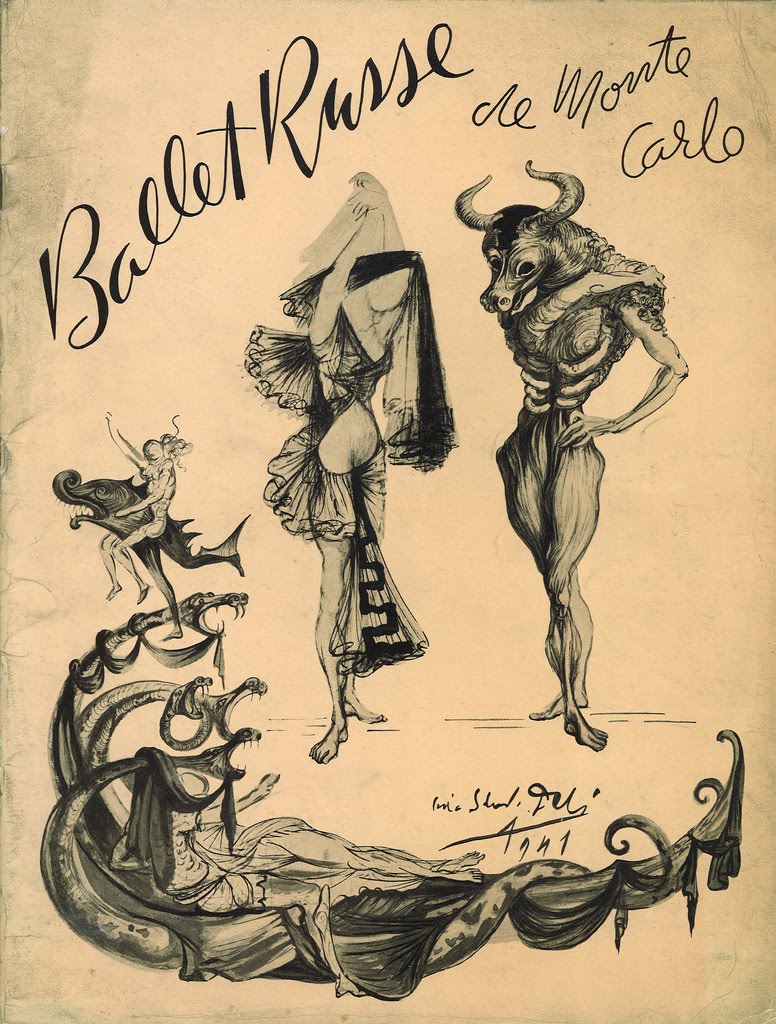
The Ballet Russe de Monte Carlo, under the direction of Sergei Denham, made the 51st Street Theatre their home for their 1940 season. On October 17th, they unfurled their version of The Nutcracker for the very first time, an abridged, one-act version staged by choreographer Alexandra Fedorova.(At left, the cover of a Ballet Russe program from the 1940-41 season.)

It can’t have been that well received because it took four whole years for another production to appear, in San Francisco in 1944.

Balanchine of course was quite aware of these productions; he’d choreographed for both versions of the Ballet Russes, was an adviser on the San Francisco show and had even danced in the show himself, back as a young man in St. Petersburg. He would bring all these experiences into his version which would eventually pirouette into an annual holiday tradition.

The New York City Ballet still performs the show annually; you can check in here for tickets and showtimes, through January 2. If you want to look in on the original stage on which the ballet was first performed, it’ll definitely be open on Christmas Day. The 51st Street Theater now houses the inter-denominational Times Square Church.

HOW NEW YORK SAVED CHRISTMAS Throughout the week I’ll spotlight a few more events in New York history that actually helped establish the standard Christmas traditions many Americans celebrate today. Not just New York-centric events like the Rockefeller Christmas Tree or the Rockettes, but actual components of the holiday festivities that are practiced in America and around the world today. We started this series last year; click hereto read past entries.

A Christmas Tree for the ages in Madison Square Park


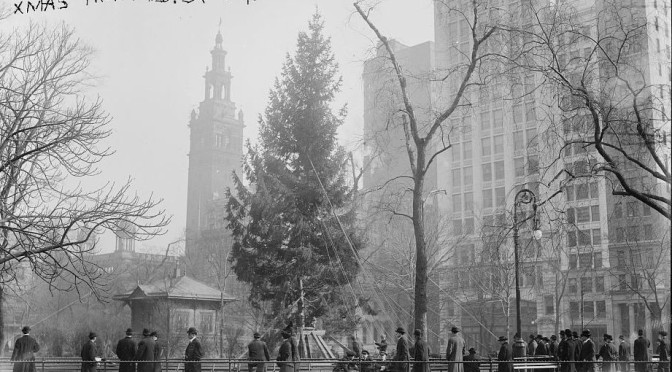
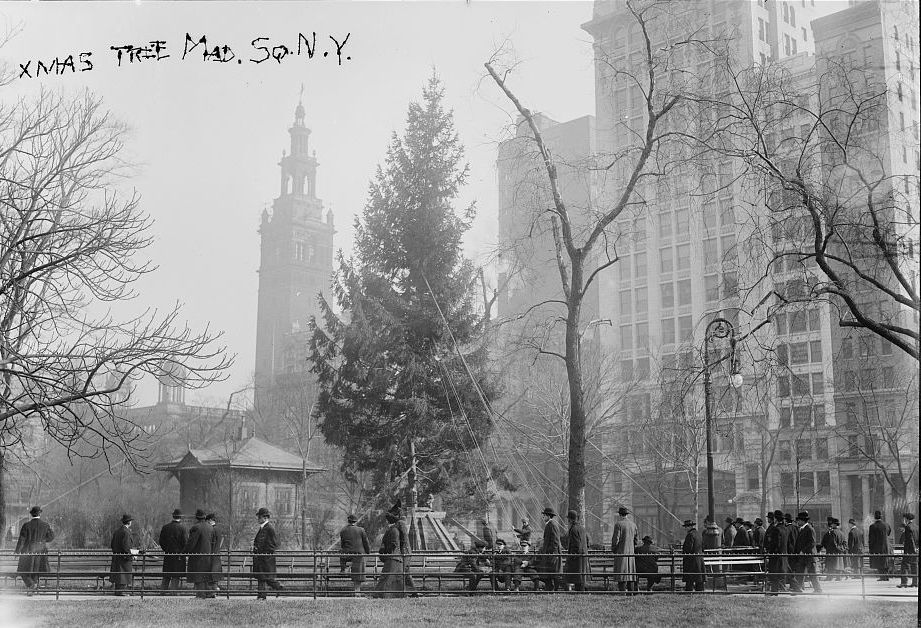
The misty Madison Square Garden greets a stranger to the park: America’s first community Christmas tree. (Courtesy LOC)

HOW NEW YORK SAVED CHRISTMAS Throughout the week I’ll spotlight a few more events in New York history that actually helped establish the standard Christmas traditions many Americans celebrate today. Not just New York-centric events like the Rockefeller Christmas Tree or the Rockettes, but actual components of the holiday festivities that are practiced in America and around the world today. We started this series last year; click here to read past entries.

The New York Tribune from Christmas Eve 1912 cheerfully attempted to use the symbol of the Christmas tree as totem for class struggles between the rich and poor. In case you missed what they were doing, the headline proclaimed: “HOW THE CHILDREN OF THE RICH AND POOR ENJOYED XMAS TREES — BUT IN DIFFERENT WAYS.”

The story recounts two Christmas events. On Ellis Island, children sang carols and patriotic anthems in glee and appreciation around two large trees bedecked with candles. Meanwhile, at the newly opened Ritz-Carlton at 46th and Madison, the children of wealthy New Yorkers gathered around an opulent tree with what is being described as holiday malaise. “Children in broadcloth and furs, accompanied by their mammas in silks and velvets and sables, smiled in well bred manner when something pleased them, but showed no other emotion.”

But it’s the Christmas tree mentioned in an adjoining article that would be more historically relevant. “2,300 LIGHTS ON CHRISTMAS TREE, FINE PROGRAMME IN MADISON SQUARE FROM 4:30 TILL MIDNIGHT, FREE TO MULTITUDE.”

The Christmas Eve Madison Square celebration was derived from the well-meaning progressive push by social activists to care for the city’s poor. Plans for an outdoor public Christmas tree were devised by Emilie Herreshoff, wife of the prominent chemical scientist J.B.F. Herreshoff, in emulation of European civic customs. (Mrs. Herreshoff’s other claim to fame would be her messy divorce from Mr. Herreshoff just a few years later.)

It would be a clean, proper, somber affair, closely tied to Jacob Riis’s equally non-riotous New Years Eve celebration scheduled the week after — righteous counter-programming to the Times Square celebration. Riis believed that the holidays were not a time wild behavior, and these events would provide the poor with ‘acceptable’ alternatives.

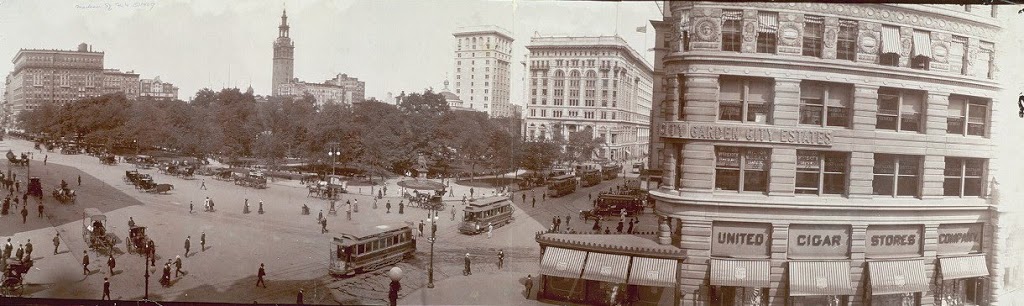
Below: Madison Square, how it looked in 1907 (with the Flatiron to the right. (Courtesy LOC)

The organizers knew they were doing something unique, but probably did not realize the special significance of the event. Their 70-foot-tall imported tree from the Adirondacks, festooned with lights from the Edison Company, would be the first outdoor community Christmas tree in the United States.**

This is not an insignificant milestone, especially today in a age where public displays of holiday expression and religious belief are constantly being debated. This ‘Tree of Light’, mounted in cement, was such a novelty that almost 25,000 people showed up that night to witness it and enjoy an evening-long slate of choral entertainment.

The location was significant as well, as the nearby Madison Square Garden sometimes hosted Christmas celebrations. Those mostly charged an admission price, however, and certainly left the poorest of New Yorkers out in the cold.

The New York Times laid it on thick the following day, reporting, ‘”The Almighty put snow on the tree to make it prosper,” said an old lady who hobbled along in crutches.’

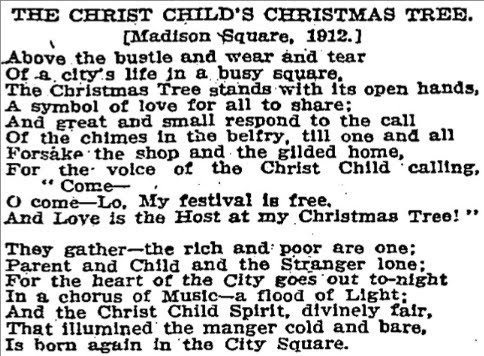
They also ran this poem about the Madison Square tree:

By the following year, the Salvation Army would take the reins of the popular event, offering up “10,000 hot sausages and 10,000 cups of hot coffee” for arriving crowds. According to the same article, ‘moving pictures’ were even shown in a different area of the park.

Today the Star of Hope monument in the park commemorates these early Madison Square celebrations.

**The Tribune article says that “Boston and Hartford, Conn., following the example set here, will have public trees to-day,” so one could generously say at least that the honor is shared.

‘White Christmas’ roots in the Lower East Side


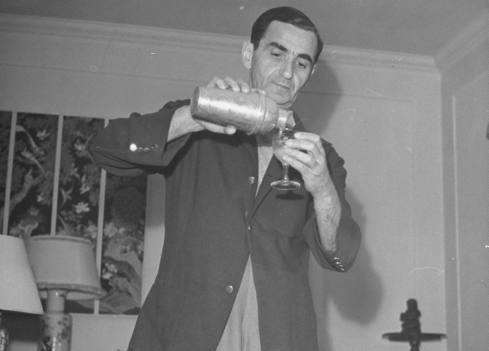
It’s 1943, and Irving Berlin’s pouring himself a cocktail (photo by Peter Stackpole, courtesy LIFE)

HOW NEW YORK SAVED CHRISTMAS Throughout the month I’ll spotlight several events in New York history that actually helped establish the standard Christmas traditions many Americans celebrate today. Not just New York-centric events like the Rockefeller Christmas Tree or the Rockettes, but actual components of the holiday festivities that are practiced in people’s homes today.

Irving Berlin, the most prolific of Tin Pan Alley music men, composed “White Christmas” in 1937 during a trip to California. Dwell upon that statement for a moment. Berlin, the product of Russian Jewish immigrants, wrote one of the most beloved Christmas classics in an area of the world almost entirely devoid of white Christmases.

Although he wrote the song over 25 years after the ‘real’ Tin Pan Alley on 28th Street dissolved into a loose assemblage of businesses throughout midtown, Berlin did get his start on that very street, learning the trade under the employ of Harry von Tilzer’s publishing company and cranking out his own tunes; his first song, written in 1907 at age 19, was the Marie of Sunny Italy. Because of this connection, “White Christmas” is often considered the “most famous, most-recorded Tin Pan Alley song of all time.”

Irving arrived in Ellis Island in 1893 and his family settled first with a relative on Monroe Street, then later on the third floor of a tenement at 330 Cherry Street, just a few steps away from Corlears Hook.

Although new ethnic groups in New York naturally cluster together at this time, Cherry Street was considered one of the most dense blocks in the city, and it would have been impossible to avoid the foreign traditions of others, especially if you were a curious child like Irving. His experiences of Christmas were almost entirely based on Irish friends and neighbors who lived on this ultra-crowded block. The traditions would have had little religious context for him. Although it’s probably overstating to say that his displacement had a hand in the secular nature of ‘White Christmas’, Irving would have had only non-religious experiences upon which to inspire the song’s overwhelming glow of nostalgia.

Or Philip Roth famously says of Irving Berlin’s ‘Easter Parade’ and ‘White Christmas.’ in his classic Operation Shylock: “The two holidays that celebrate the divinity of Christ — the divinity that’s the very heart of the Jewish rejection of Christianity — and what does Irving Berlin brilliantly do? He de-Christs them both! Easter he turns into a fashion show and Christmas into a holiday about snow.”

“White Christmas,” debuted in the 1942 film Holiday Inn and within a couple years became the melancholy holiday anthem for a country in the middle of World War II. More importantly, it kicked off a flurry of secular Christmas classics, as songwriters rushed to find a suitable successor. “I’ll Be Home for Christmas” debuts a year later, with “Have Yourself a Merry Little Christmas” coming a year after that.

Decked out: America’s first Christmas tree market

Outside the Barclay Street train station, circa 1903 (courtesy LOC). The Christmas tree marketplace had been well-established by then.

HOW NEW YORK SAVED CHRISTMAS Throughout the month I’ll spotlight several events in New York history that actually helped establish the standard Christmas traditions many Americans celebrate today. Not just New York-centric events like the Rockefeller Christmas Tree or the Rockettes, but actual components of the holiday festivities that are practiced in people’s homes today.

It’s that time of year again, when you can’t make it a few blocks down a street without having to wind perilously by stacks of evergreen trees for sale standing in the sidewalk, the poor things plucked from far away to give New Yorkers a little holiday spirit (and in turn making their apartments feel ever smaller). As history has it, the presence of streetside Christmas trees in the city actually predates Christmas as a national holiday (1870).

In the mid-19th century, hardly any modern Christmas traditions existed. One that did was the Christmas tree, a pre-Christian ritual incorporated into holiday festivities in German-speaking European countries (Those traditional settlers, the Puritans, didn’t much care for Christmas at all.) Although the tradition did exist in the United States thanks to the Dutch, it was German immigrants who popularized it. As a huge surge in German immigration began in the 1840s, it’s not surprising that New York’s first Christmas tree market — in fact, the first mass-market sale of Christmas trees in the United States — came along in 1851.

It doesn’t appear that ‘woodsman’ Mark Carr, living in the lush Catskill Mountains, even celebrated Christmas, but he certainly heard tales of families driving outside of town and chopping down evergreen trees to drag into the city. The go-out-and-get-it-yourself approach probably only benefited the wealthy or anybody with a horse and wagon and the time and energy to travel into the forest and find one. Carr, finding the spirit of the holidays (capitalism) deep within him, thought he’d bring the forest to the city folks.

So on the week of Christmas 1851 — things didn’t start so early back then — Carr and his sons chopped down a couple dozen fir and spruce trees, shoved them into two ox sleds, carted them over to Manhattan on a ferry and set up shop in the Washington Market paying one dollar for the privilege of taking up a sidewalk at Washington Market with his rather ungainly merchandise. Holiday revelers were thrilled to be spared the journey out of town, and Carr’s entire stock of evergreens sold out within the day. No surprise this financial opportunity was mimicked by other farmers the next year, and within a few years, the open-air Christmas tree market was born.
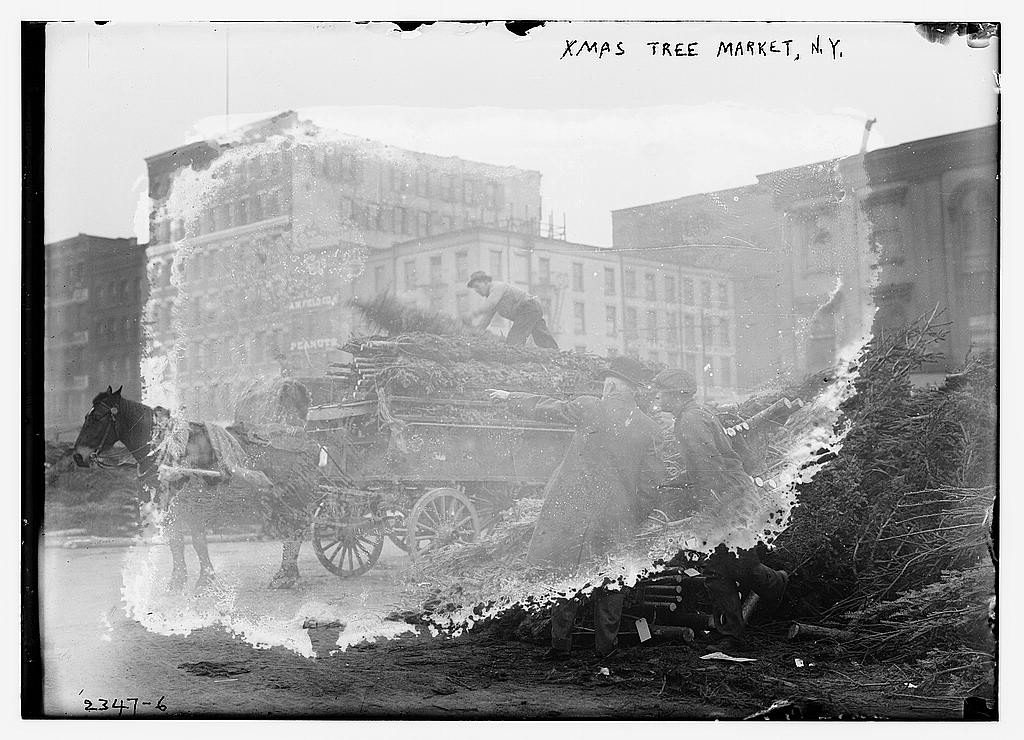
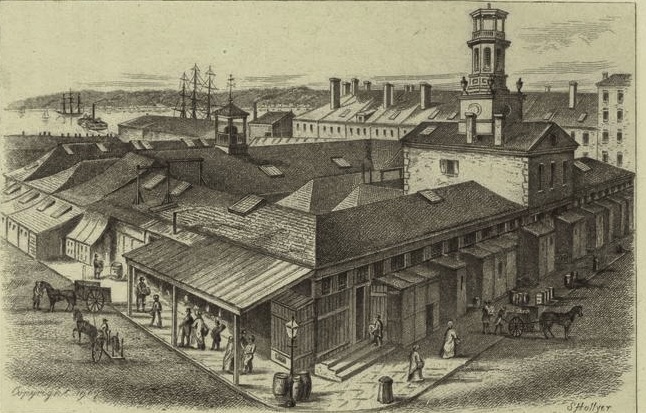
Carr, of course, became the Vanderbilt of the Christmas tree, raking in the dough year after year, selling trees for decades. One source even says that Carr’s sons were still selling trees in the city as late as 1898, in a city quite transformed, or as the old House Beautiful magazine put it, “Mark Carr’s little sidewalk stand now rents for several hundred times what he paid for it.”

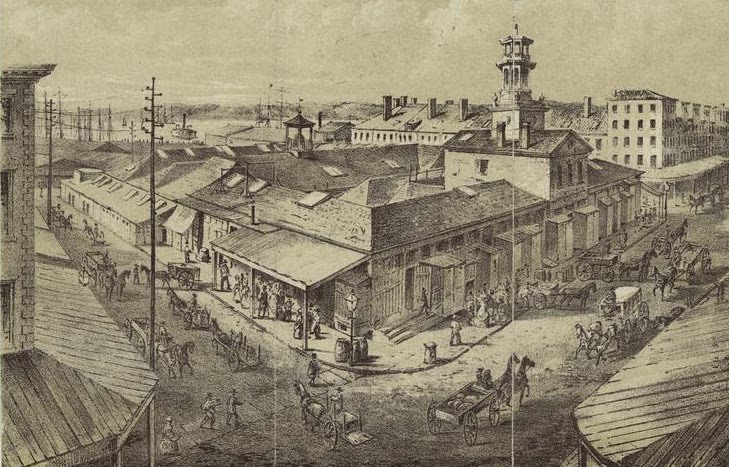
By the way, here’s what Washington Market looked like on a normal day in 1859. The bustling marketplace, opened in 1812, was a rival of the Fulton Fish Market, and not too terribly far from the Barclay Street Station pictured above.

The only remnant of the market today comes in the form of Washington Market Park, sitting where part of the marketplace once resided. Forgotten NY has an interesting write-up on what happened to the market and neighborhood in later years.

View Larger Map