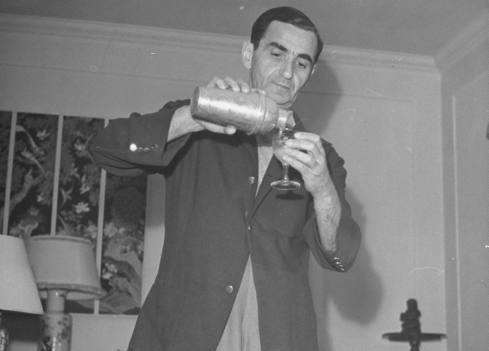
It’s 1943, and Irving Berlin’s pouring himself a cocktail (photo by Peter Stackpole, courtesy LIFE)
HOW NEW YORK SAVED CHRISTMASThroughout the month I’ll spotlight several events in New York history that actually helped establish the standard Christmas traditions many Americans celebrate today. Not just New York-centric events like the Rockefeller Christmas Tree or the Rockettes, but actual components of the holiday festivities that are practiced in people’s homes today.
Irving Berlin, the most prolific of Tin Pan Alley music men, composed “White Christmas” in 1937 during a trip to California. Dwell upon that statement for a moment. Berlin, the product of Russian Jewish immigrants, wrote one of the most beloved Christmas classics in an area of the world almost entirely devoid of white Christmases.
Although he wrote the song over 25 years after the ‘real’ Tin Pan Alley on 28th Street dissolved into a loose assemblage of businesses throughout midtown, Berlin did get his start on that very street, learning the trade under the employ of Harry von Tilzer’s publishing company and cranking out his own tunes; his first song, written in 1907 at age 19, was the Marie of Sunny Italy. Because of this connection, “White Christmas” is often considered the “most famous, most-recorded Tin Pan Alley song of all time.”
Irving arrived in Ellis Island in 1893 and his family settled first with a relative on Monroe Street, then later on the third floor of a tenement at 330 Cherry Street, just a few steps away from Corlears Hook.
Although new ethnic groups in New York naturally cluster together at this time, Cherry Street was considered one of the most dense blocks in the city, and it would have been impossible to avoid the foreign traditions of others, especially if you were a curious child like Irving. His experiences of Christmas were almost entirely based on Irish friends and neighbors who lived on this ultra-crowded block. The traditions would have had little religious context for him. Although it’s probably overstating to say that his displacement had a hand in the secular nature of ‘White Christmas’, Irving would have had only non-religious experiences upon which to inspire the song’s overwhelming glow of nostalgia.
Or Philip Roth famously says of Irving Berlin’s ‘Easter Parade’ and ‘White Christmas.’ in his classic Operation Shylock: “The two holidays that celebrate the divinity of Christ — the divinity that’s the very heart of the Jewish rejection of Christianity — and what does Irving Berlin brilliantly do? He de-Christs them both! Easter he turns into a fashion show and Christmas into a holiday about snow.”
“White Christmas,” debuted in the 1942 film Holiday Inn and within a couple years became the melancholy holiday anthem for a country in the middle of World War II. More importantly, it kicked off a flurry of secular Christmas classics, as songwriters rushed to find a suitable successor. “I’ll Be Home for Christmas” debuts a year later, with “Have Yourself a Merry Little Christmas” coming a year after that.
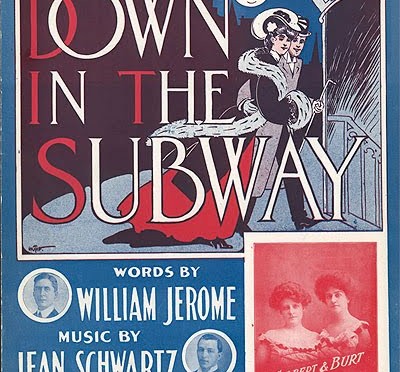
“Down In The Subway,” published in 1904 by one of Tin Pan Alley’s most successful music men Jerome Remick
___________________________________
PODCAST The modern music industry begins…. on 28th Street? A seemingly nondescript street in midtown Manhattan contains some of the most important buildings where early American pop music was created.
Tin Pan Alley was a bustling and frenzied area, the most creative area of the city, with songwriters — and song pluggers — churning out iconic music. Sing along as we talk about the greatest songwriters and the process they went through to create the most influential tunes of the century.
Download this show it for FREE on iTunes or other podcasting services. Click this linkto download it directly from our satellite site. Or click below to listen here:
This week’s show features actual music snippets, featuring “A Pretty Girl Is Like A Melody” by John Steel, “Toot-Toot-Tootsie” by Al Jolson, and “Grand Ole Flag” by Billy Murray.
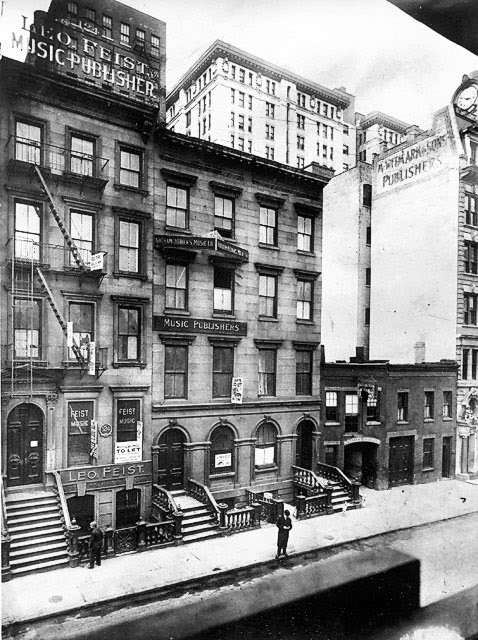
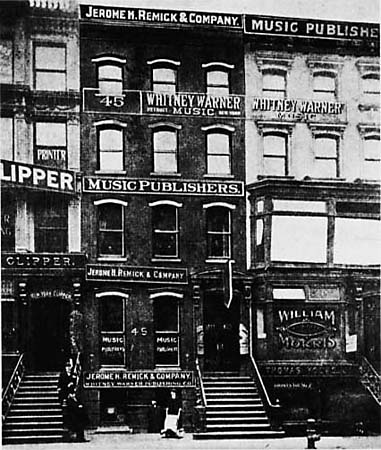
Music Row: Music publishers, once centered around Union Square, began collecting on 28th Street in the late 1880s and most of them stayed there until 1909. Leo Feist, seen in the first picture on the left, was probably the first to move onto the block.
___________________________________
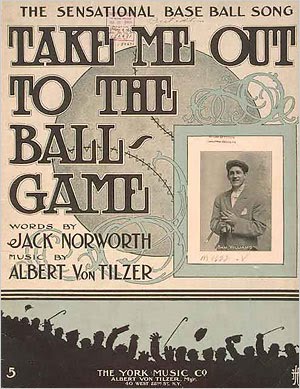
Grand Slam: One of the greatest hits to come out of 28th Street was Albert Von Tilzer’s Take Me Out To the Ballgame. The lyrics were written by vaudeville star Jack Norworth who popularized the song in his routines. Curiously, neither Von Tilzer nor Norworth had ever seen a baseball game at the time the song was written.
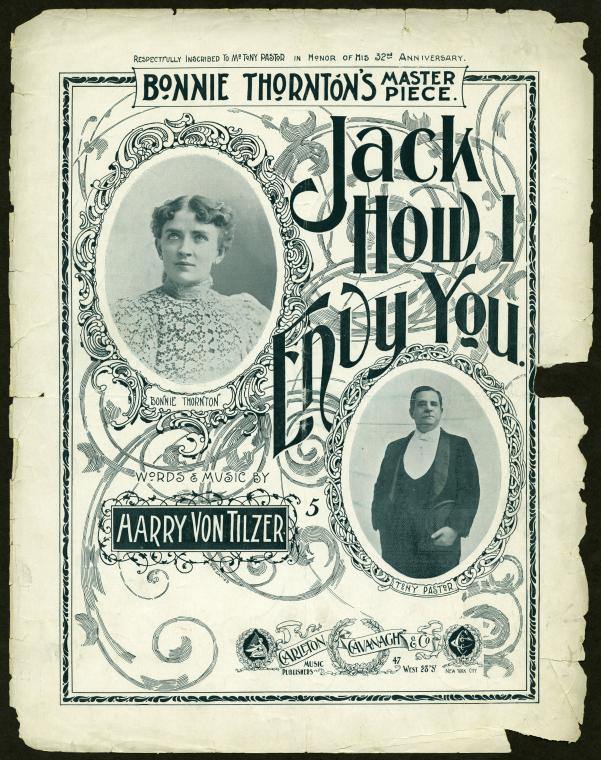
A song by Albert’s brother that is, needless to say, less famous. (Pic courtesy here)
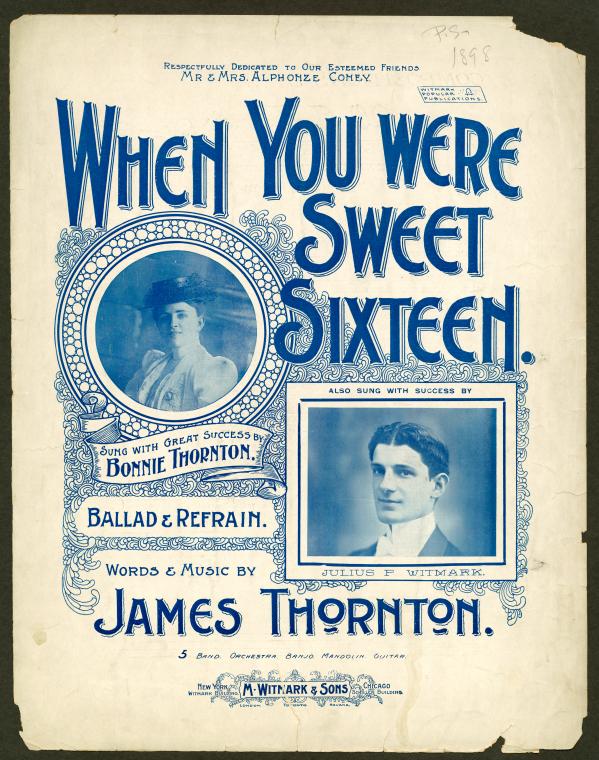
M. Witmark and Sons got their start selling their tunes straight from the vaudeville stage, later to become one of the most successful of the 28th Street firms.
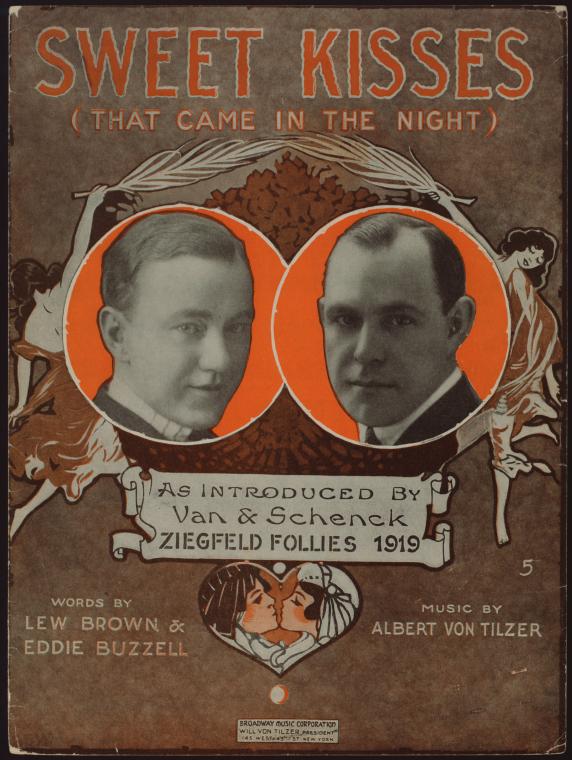
By 1909, most of the music houses had moved off the street into various locations throughout midtown, catering to the budding Broadway market. One of the most lucrative platforms of popularizing songs was the Ziegfeld Follies. (Pic)
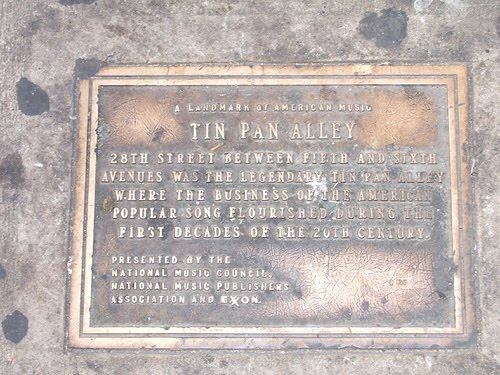
The only sign on 28th Street of its importance to the world of music is a small plaque on the sidewalk
The buildings of Tin Pan Alley are not landmarked, but there are some grassroots efforts underway to make sure the area is protected. In particular, the Historic Districts Council has a lovely writeup and features the addresses of many of Tin Pan Alley’s most successful music houses. No surprise that a website on collectable sheet music should also have a great writeup on the area.
KNOW YOUR MAYORSOur modest little series about some of the greatest, notorious, most important, even most useless, mayors of New York City. Other entrants in our mayoral survey can be found here.
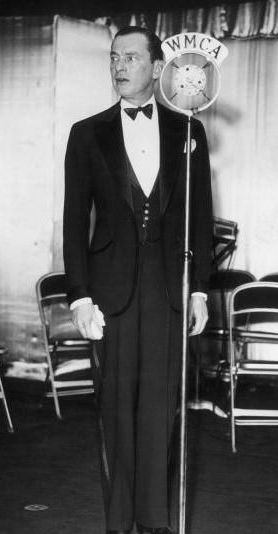
MayorJimmy Walker
In office: 1926-1932
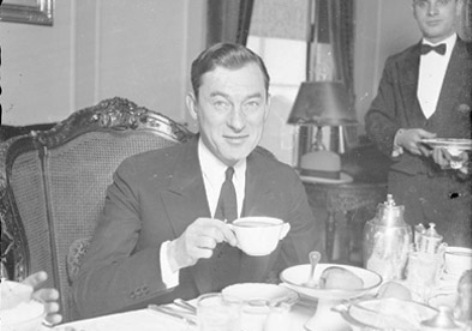
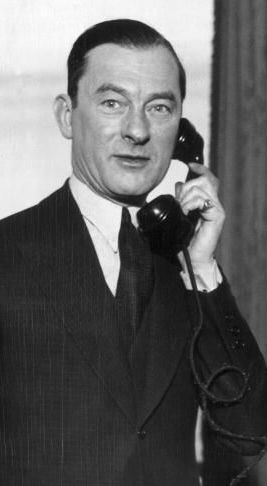
Has a New York mayor ever reflected the decade he governed more perfectly than Jimmy Walker? Although John Hylan was actually the 1920s more effective mayor, it was Walker who embodied the Jazz Age spirit in his style, and the tragic Depression-era change of fortune in his downfall. He glamours us today because he’s both movie star and rebel; but the corruption of his regime is equally as striking and even disturbing in its grandiosity.
Walker is easily one of the most notorious mayors of New York, but today we can appreciate his brashness, his independence and class, just as we can lament his subservience to diabolic Tammany-era politics. He wasn’t the last disgraced mayor the city would see in the 20th century, but his abdication neatly defines the modern era’s defining fall from grace.
Jimmy, born June 19, 1881, was a New York boy and a golden one at that, raised in Greenwich Village among the bohemians, the son of an Irish immigrant who became a well connected Democratic assemblyman. Walker’s first passion seems to be music; in 1905 he stormed Tin Pan Alley writing songs such as “There’s Music In The Rustle Of A Skirt” and “Will You Love Me in December As You Do in May?” with its melancholy refrain:
Will you love me in December as do in May, Will you love in the good old fashioned way? When my hair has all turned gray, Will you kiss me then, and say, That you love me in December as do in May?
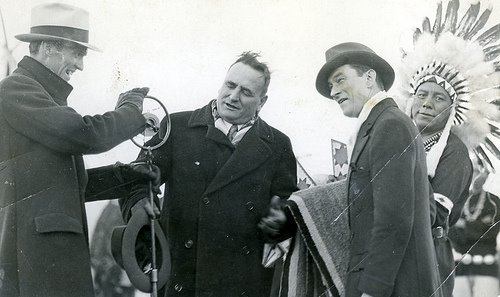
Below: In an odd ceremony with the mayor of Albuquerque
He had even less hesitation in announcing a political career, especially as Father had connections to a certain Al Smith, governor of New York. An adopted son of Tammany Hall, elected first to the state assembly in 1910 then to the state senate in 1914, young Walker sought Smith’s guidance and the governor soon took a fancy to the smooth, impeccably dressed young man, who shone like a new penny on the Senate floor. As he was described by Robert Caro:
“Pinch-waisted, one-button suit, slenderest of cravats, a shirt from a collection of hundreds, pearl-gray spats buttoned around silk-hosed ankles, toes of the toothpick shoes peeking out from the spats polished to a gleam. Pixie smile, the ‘vivacity of a song and dance man,’ a charm that made him arrive n the Senate Chamber like a glad breeze’ The Prince Charming of Politics…..slicing through the ponderous arguments of the ponderous men who sat around him with a wit that flashed like a rapier. Beau James.”
Smith took him under wing, maneuvering him through the entanglements of state politics, shielding Walker when his excesses got the better of him. He was a philandering cad and a boozer, even then. When opportunity arose to challenge the successful John Hylan for mayor of New York, Smith wanted Walker to run, but only if he would change his ways. Walker changed them all right; instead of partying out at speakeasies with chorus girls, he moved the whole production to a private penthouse funded by Tammany favors.
That election in 1925 was fierce. First, Smith had to dispense of Hylan in the Democratic primary — and in the halls of Tammany. The two split the storied political machine, but eventually Walker won out. Next, he faced the Republican-Fusion candidate Frank Waterman in the general election, who cried of potential Tammany corruption to the new subway system if Walker were elected. (Waterman would, of course, be right.) Beau James, however, went unabated. He ran as a people’s mayor, somebody who enjoys and the same pleasures as those voting for him:
“I like the company of my fellow human beings. I like the theatre and am devoted to healthy outdoor sports. Because I like these things, I have reflected my attitude in some of my legislation I have sponsored — 2.75 percent beer, Sunday baseball, Sunday movies, and legalized boxing. But let me allay any fear there may be that, because I believe in personal liberty, wholesome amusement and healthy professional sport, I will countenance for a moment any indecency or vice in New York.”
Right! Walker was one of the people. Everybody bought it but nobody believed it. He swept into office because New York, in 1925, was prosperous, a Jazz Age mayor for a Jazz Age city.
Once elected, of course, Walker countenanced all sorts of indecency and vice. He was frequently in Europe on vacation. When he was in town, it was rarely at City Hall. The lavish new Casino nightclub in Central Park became his unofficial headquarters, with Ziegfield dancer Betty Compton at his side. (Walker’s wife was out of town, frequently.) City business was often discussed with the pop of champagne cork.
Some things got done that first term: the New York hospital system was consolidated on his watch, he purchased thousands of acres for park land (including Great Kills in Staten Island), and grew the municipal bus system — greatly benefiting more than a few friends who happened to own the bus company given the exclusive franchise.
He managed to turn on his old ally the governor, scrubbing City Hall of any Smith loyalists, granting more jobs to his type of Tammany men, filling their own pockets but allied to the charming man in charge.
How did he stay so popular? This was the late ’20s and people wanted the mayor to reflect prosperity and confidence. He also gave back, in symbolic gestures. Even as the new subway system became clogged with corruption, he staved off a strike while keeping the fare at five cents, thought at the time to be an incredible concession.
He easily won election in 1929 against a largely outmatched Fiorello LaGuardia. Tammany was in place and unstoppable; but the voters still chose not to look askance at Walker’s dalliances, and even the newspapers were charmed. The New York Times wrote of his “great personal charm, his talent for friendship, his broad sympathies embracing all sorts of conditions of men,” then recommended him under the guise that “the Mayor that he has been gives only a hint of the Mayor that he might be.”
That hinted-at mayor never materialized, because the Stock Market crash did, plunging the city’s fortunes into ruin and exposing the weaknesses of a government consumed with greed. Suddenly, having an extravagant, indecent mayor didn’t seem like such a good idea.
Archbishop of New York Cardinal Hayes, once dazzled, now condemned the mayor’s amoral ways, opening the flood doors for others to lay the city’s problems was Walker’s feet. Eventually the accusations reached the ear of governor Franklin D. Roosevelt.
A commission lead by Justice Samuel Seabury exposed deep veins of corruption throughout the city’s legal system and police force. Innocent citizens, often women, would be charged with crimes and forced to pay steep fines to get out of jail time. (Many times they couldn’t pay, and off they went, dozens at a time.) Neighborhoods, most often Harlem, would be routinely raided and its residents taken in, wild charges conjured for maximum penalty.
This would line the pockets of dozens of judges and vice squad officers. Newspapers dubbed it the Tin Box Parade, “after one testified that he had found $360,000 in his home in a ‘tin box…a wonderful tin box'” (Caro).
Walker himself was brought to the stand to testify, the judge warning those in the court room not to look the mayor in the eye, lest they succumb to Walker’s sensational charm.
After months of epic battles on the stand — Walker eluding hot button questions about his personal bank accounts, delaying appearances until after Roosevelt’s nomination for president was assured — the embattled mayor could fight no longer. With Roosevelt mere months from his national election, he needed to be rid of Walker. Walker obliged in the classiest way possible: he resigned on September 1, 1932, and went on a grand tour of Europe with his Ziegfeld girl.
He was never charged with a crime. He was barely even held accountable for anything. Back in New York three years later, he held a series of smaller posts, including one for the New York garment industry that was assigned to him by new mayor LaGuardia, his former rival.
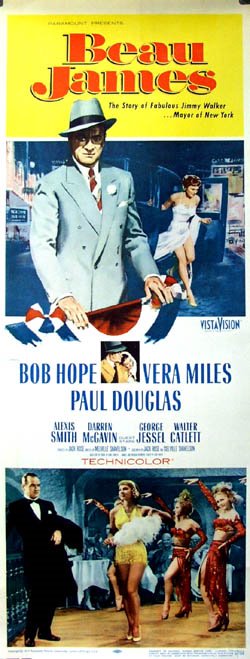
Nothing stuck to him. He died in November 1946 of a brain hemorrhage, just two years after returning to his first love as the head of a big-band record label with a stable of artists that included Louis Prima and Bud Freeman. Ten years later, Hollywood decided to do something very redundant and make a movie of his life, starring Bob Hope as Beau James. It would follow a screenplay only slightly less glamorous than the real thing.