Categories
Those Were The Days

Where did New Yorkers first buy recorded music?

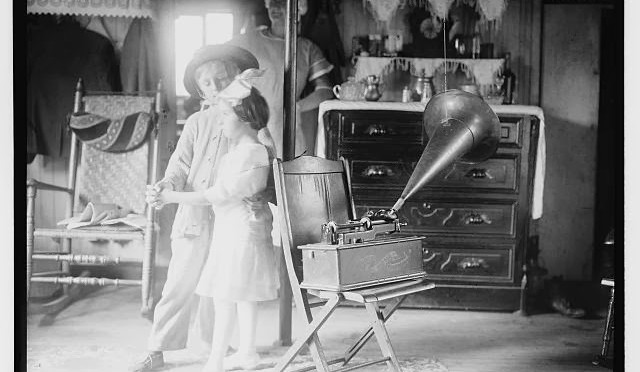
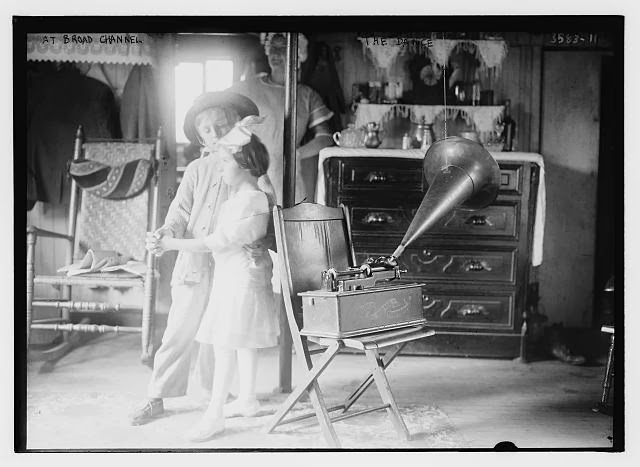
“Photograph shows a boy and a girl dancing while an Edison Home Phonograph plays in a house in Broad Channel, Queens, New York City.” — taken between 1910-1915

Here’s something many people thought they’d never see again in New York City — the opening of a new record store.  Rough Trade, known for their famous London record shop, will open an awesomely spacious new store in Williamsburg this week, with vinyl-record listening stations, a coffee shop, live performances and a heap of nostalgia on its shoulders.
Remember Tower Records on Broadway?  Virgin Records in Times Square?  The old subway Record Mart? The long-vanished Commodore Record Shop?  The past is littered with the ghosts of music stores long gone.

But where did people first buy recorded music in New York City?  The first recordings came on phonograph cylinders, long tubes with the grooves etched along the front, often made with wax.  Essentially, they looked like — and probably smelled like — big, decorative candles.

They were soon in competition with phonographs in a flat, wax disc form, the musical delivery device which eventually won out and became the standard for decades.

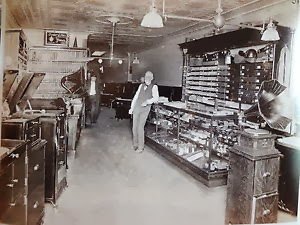
In the beginning, recorded music was played in exhibition halls, not available for home use.  By the 1890s, the first musical devices were available for purchase, and phonographs were sold in establishments that offered instruments, music boxes or early electronics — Broadway piano stores (like the one above, in 1910) or the places down on the soon-to-be-named Radio Row which offered New Yorkers the latest technology.

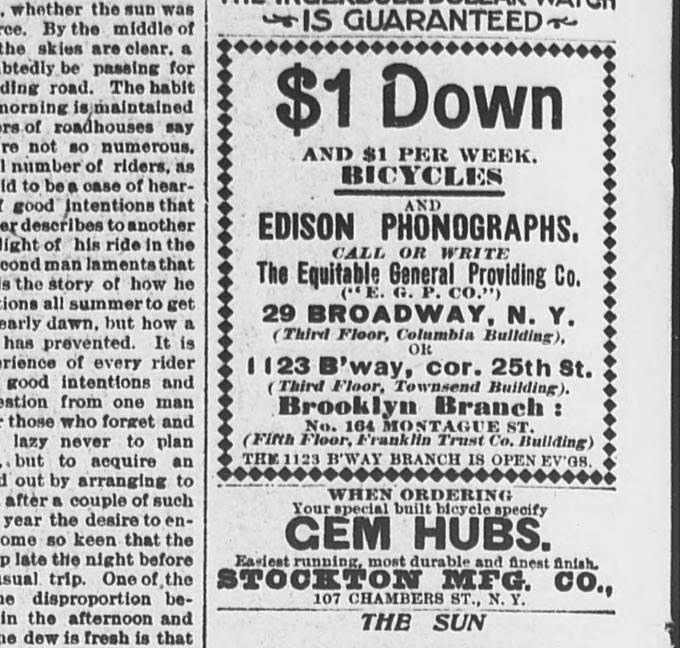
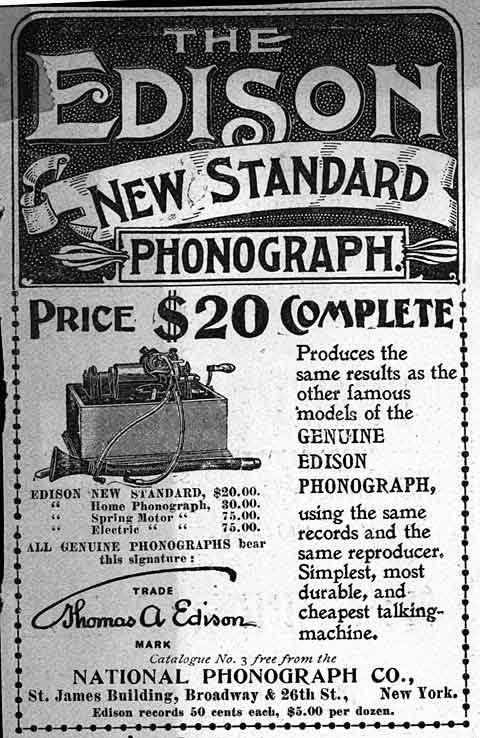
Naturally, the first records were made to play on Edison machines, pricey novelties in the late 1890s.  Here, in 1898, you could put a down-payment on the purchase of a phonograph machine and a bicycle — a real hipster double-play today!
Another advertisement from 1898 presents Edison records at just “$5.00 a dozen”, found at the St. James Building at Broadway and 26th Street.  Of course, a great many of these records were spoken word, not music;  after all, they were nicknamed ‘talking machines’ at this time.
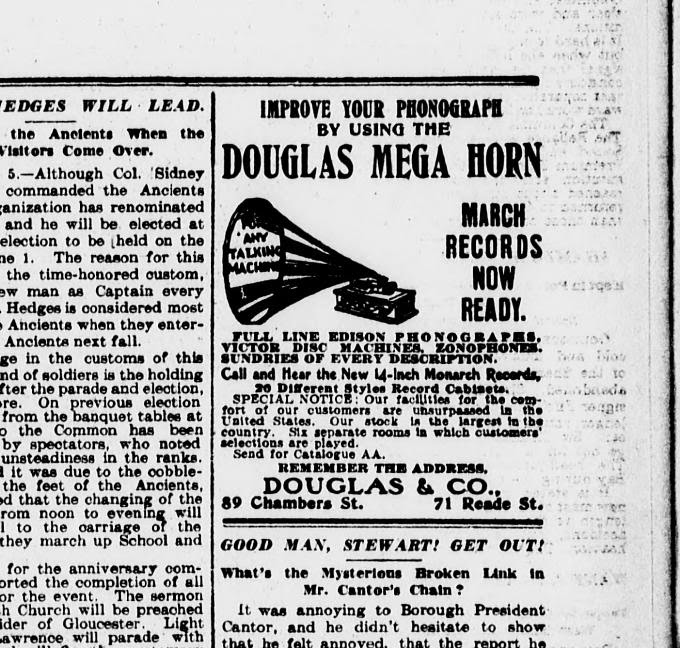
I was able to find a few other early photographer retailers in old newspaper advertisements.  For instance, Douglas & Co., at 10 West 22nd Street, appears to be one of New York’s earliest retailers specializing in recorded sound.  From Dec 16, 1900:
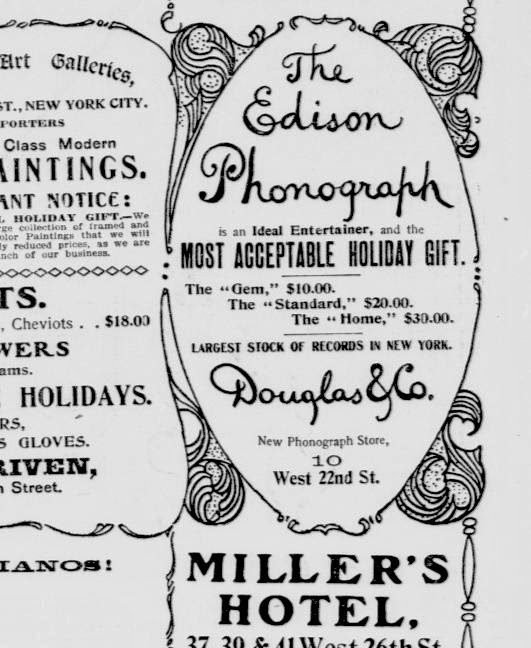
By 1903, Douglas & Co. had moved downtown, closer to the electronic retailers that would later specialize in radio and televisions:

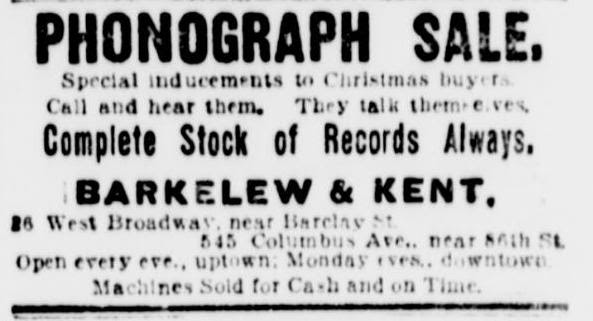
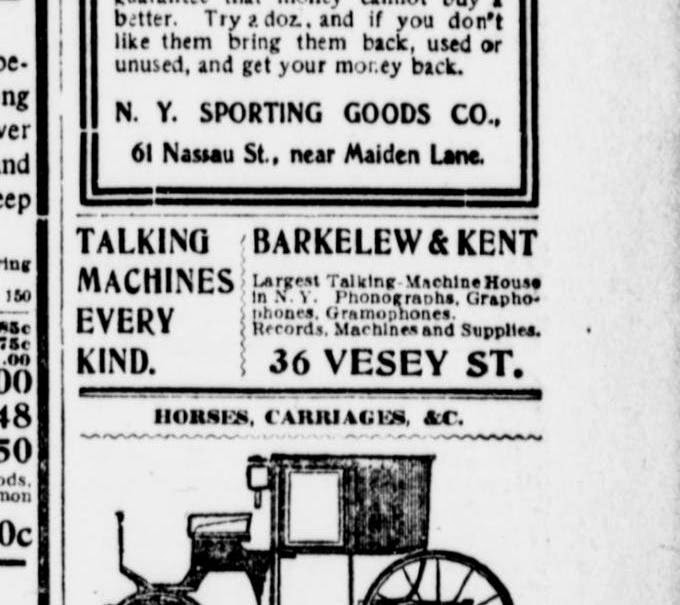
Another early phonograph retailer I was able to locate was A.B Barkelew & Kent.  “Call and hear them. They talk themselves.”  They would eventually move to Vesey Street and, in 1902, claim “the largest stock in New York.”

As early in 1899, Barkelew & Kent could claim to be one of New York’s first used record stores.  From a trade ad: “We exchange records you tire of and do not like.”

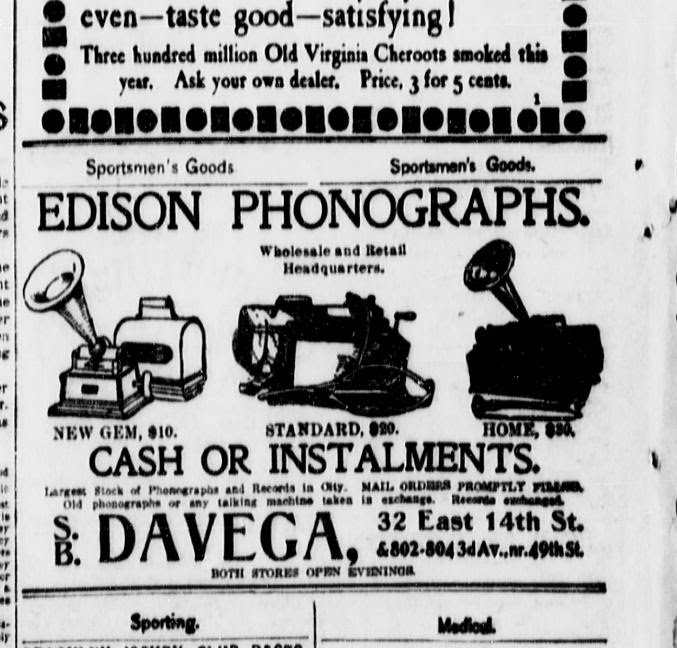
Interestingly, early record stores were listed alongside advertisements for sporting goods.  This ad is from May 1902:
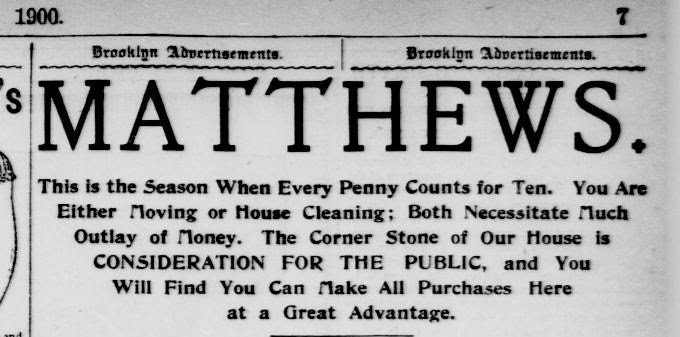
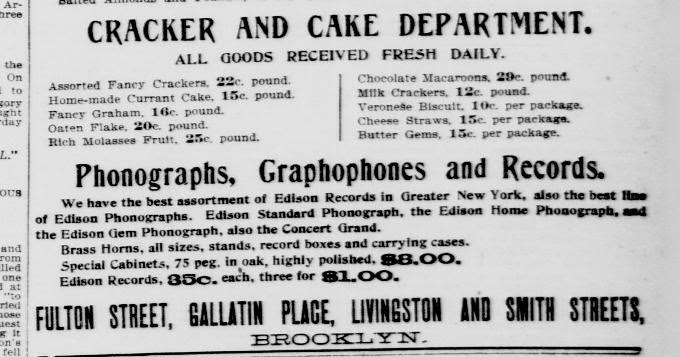
And since we’re celebrating the opening of a new record store in Brooklyn, I should add that one of Brooklyn’s first major record stores was at A.D. Matthews Department Store on Fulton Street.

From an April 1900 advertisement:
Categories
Neighborhoods

The toy radio magic of Fulton Street’s Electro Importing Co.

If you were the type of child who idolized the inventor over the sports hero, then the decade of the 1900s was something of a creative revolution. Children enamored by the flurry of new inventions in the late 19th century — the railroad, the telegraph, the camera — could only imagine interacting with these devices. The Lionel train set, introduced by a toy store on Cortlandt Street in 1900, was a perfectly marvelous device. It just wasn’t the real thing.

But with new wireless telegraphy (soon to be called ‘radio‘), one needed only the basic technology — the battery, the tubes, the coils. No tracks, no excessive lengths of wiring, no expensive film processes. A curious child could jump right into the world of radio, into the very same airwaves being used by adults.

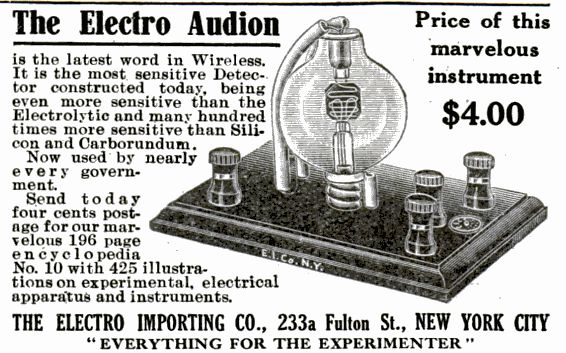
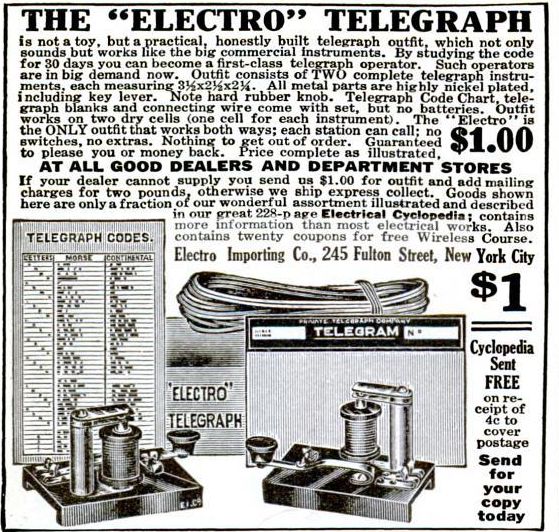
Radio technology was barely a decade old when a marvelous company appeared in downtown Manhattan called the Electro Importing Company which opened for business in 1905. They soon moved to permanent offices on 233 Fulton Street. (An ad below also listed an office at 245 Fulton Street.) Although they also sold radio parts to adult wireless operators, basic receivers and transmitters could be produced and sold to children as sophisticated toys. As radio was vastly unregulated before World War I, a young boy or girl could literally send and receive transmissions from their own bedroom, sending out Morse code and picking up messages from miles away.

Just imagine having that power as a 12-year-old. One hundred years later, children would be dazzled by handheld technologies (video games, cell phones) that not even adults could explain how they work. With Electro products, children could emulate professional wireless operators and quickly understand how the core processes worked. In essence, anybody could imagine themselves on the path to becoming a great inventor. In fact, the early Electro products were almost an exact duplication of devices used by radio inventors Gugliemo Marconi and Lee De Forest.

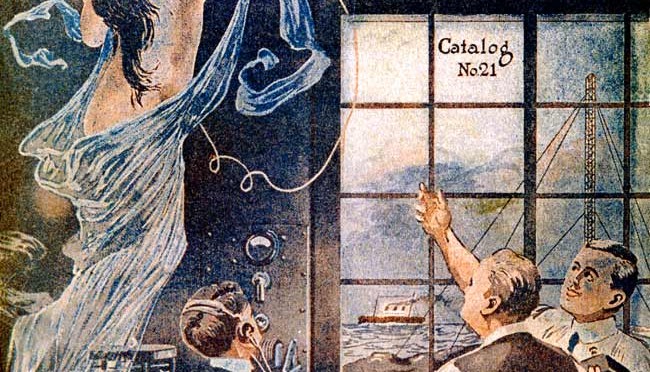
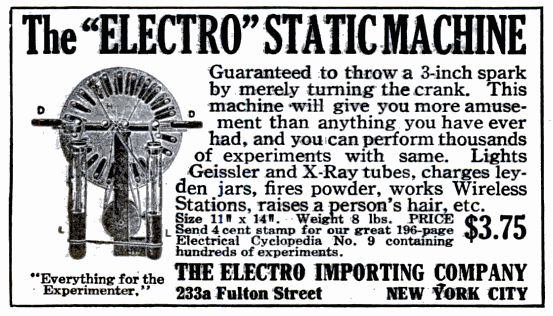
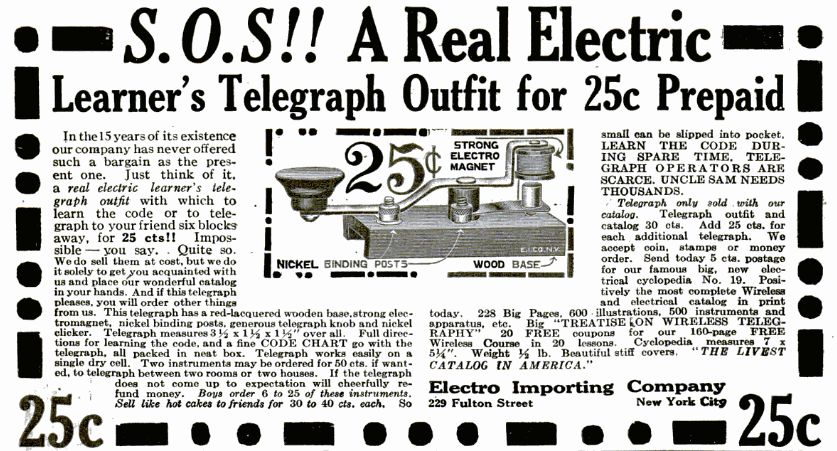
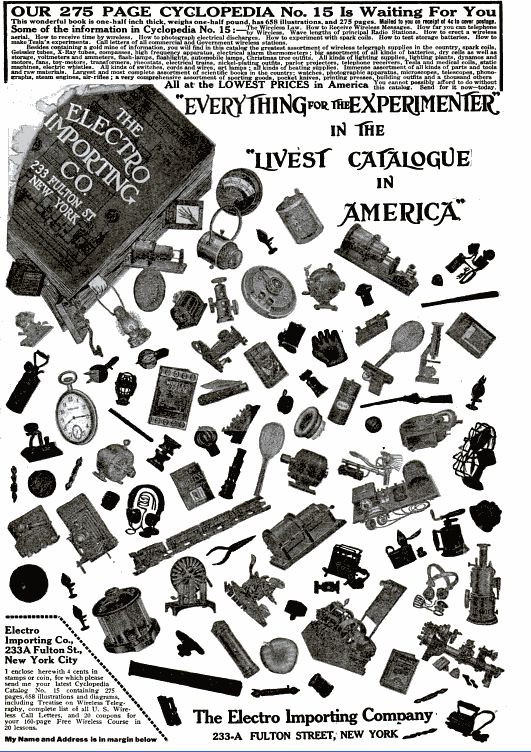
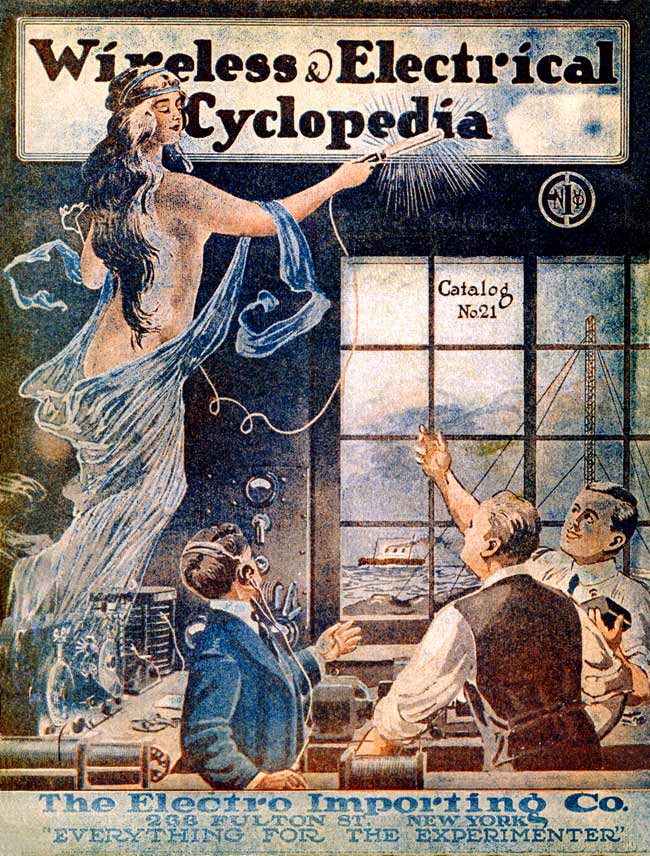
Below are a few advertisements for Electro Importing products advertised in various issues of Popular Mechanics magazine from the 1910s. Although the products were aimed at all radio enthusiasts and in one ad are explicited advertised as ‘not a toy’, their yearly catalogs — as amply illustrated for the cover above — make it clear who their desired audience was ‘every wide-awake American boy’. [source]

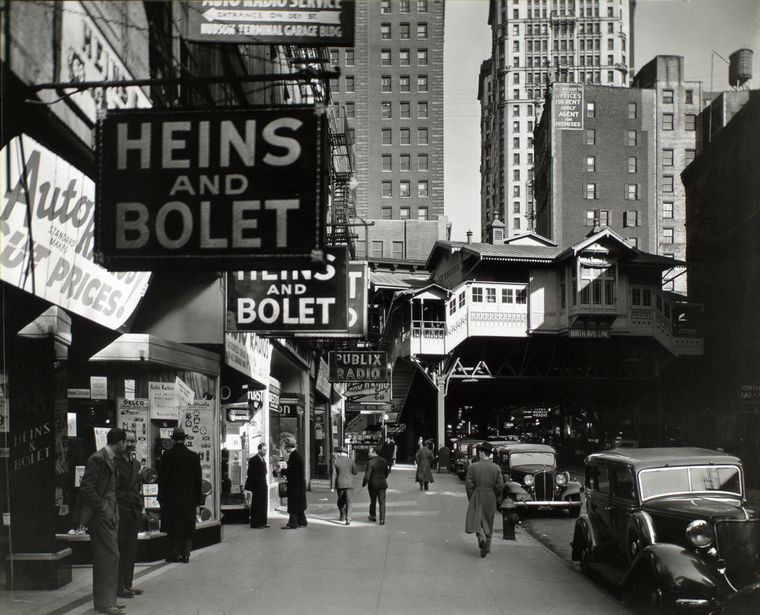
Perhaps this is coincidental, but a few years later, New York’s famed Radio Row soon developed in the neighborhood surrounding the Electro Importing offices. A mere block away, on Cortlandt and Greenwich streets, retailers specializing in home radios sprouted up in the early 1920s. Radio Row soon became the place to buy the latest in home console entertainment.

In the 1960s, the former offices of the Electro Importing Company and all of Radio Row was demolished to make way for the construction of the World Trade Center.

Below: Radio Row in 1936, photo by Berneice Abbott