Categories
Bowery Boys Movie Club Film History Podcasts

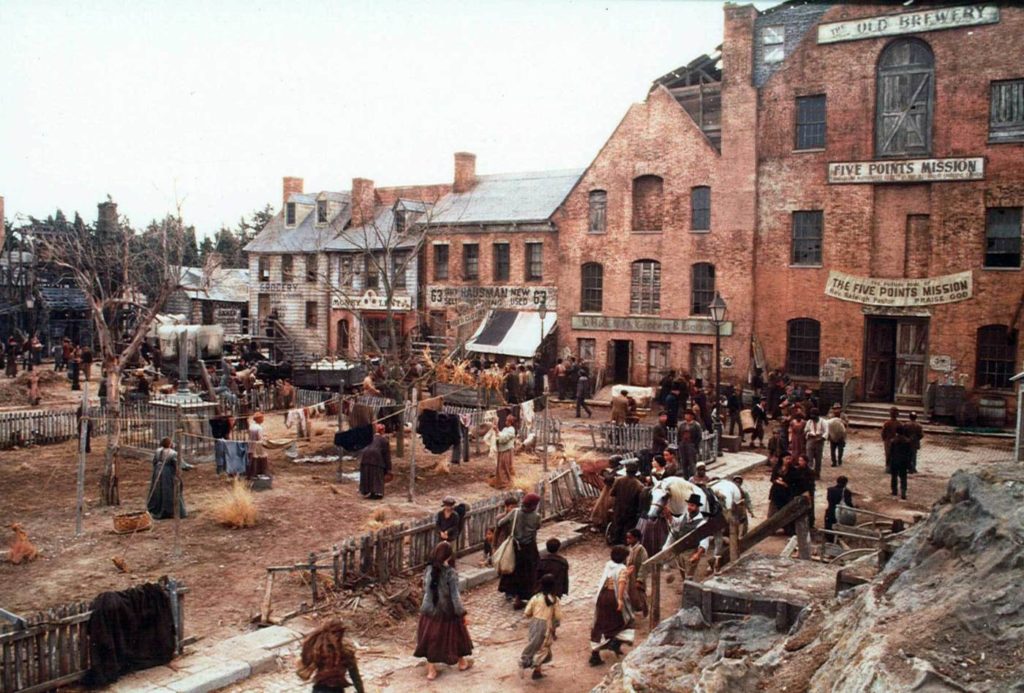
Once Upon A Time In Five Points: The Bowery Boys Movie Club revisits Scorsese’s “Gangs of New York”

As a celebration of filmmaker Martin Scorsese (whose film The Irishman opens this month), we’ve just released an episode of the Bowery Boys Movie Club to the general Bowery Boys: New York City History audience. This is an exclusive podcast for those who support us on Patreon.

For current patrons, we’ve also just released a brand new episode of the Movie Club, looking at the 1987 film Moonstruck. To listen to that episode and the past Movie Club episodes (discussing Midnight Cowboy, On The Town, Eyes of Laura Mars and many other films) become a Patreon supporter today!


Gangs of New York is a one-of-a-kind film, a Martin Scorsese 2002 epic based on a 1927 history anthology by Herbert Asbury that celebrates the grit and grime of Old New York.

Its fictional story line uses a mix of real-life and imagined characters, summoned from a grab bag of historical anecdotes from the gutters of the 19th century and poured out into a setting known as New York City’s most notorious neighborhood — Five Points.

Listen in as Greg and Tom discuss the film’s unique blend of fact and fiction, taking Asbury’s already distorted view of life in the mid 19th century and reviving it with extraordinary set design and art direction. The film itself, released a year after September 11, 2001, had dated itself in some interesting ways.

And unfortunately some elements of the film are more relevant in 2019 than ever.

How do I get regular episodes of the Bowery Boys Movie Club? Simply support the Bowery Boys: New York City History podcast at any level on Patreon. 

Once you’re signed on, you’ll see a private RSS link that can be put directly into your favorite podcast player. It can also be played directly from the Patreon app once you’re signed in. Your support of the Bowery Boys podcast on Patreon assists us in producing our podcast and this website and it helps as we endeavor to share our love of New York City history with the world!

Should you watch the movie before you listen to this episode? This podcast can be enjoyed both by those who have seen the film and those who’ve never even heard of it.  

We think our take on Gangs of New York might inspire you to look for the film’s many fascinating (but easy to overlook) historical details, so if you don’t mind being spoiled on the plot, give it a listen first, then watch the movie! Otherwise, come back to the show after you’ve watched it. 

If you’d like to watch the movie first, it’s currently streaming on iTunes and Amazon. Or rent it from your local library.

Thank you for supporting the Bowery Boys: New York City History podcast!

Categories
Gangs of New York

PODCAST: Wrath of the Whyos, vicious gang of New York

The Whyos (pronounced Why-Ohs) were New York’s most notorious gang after the Civil War, organizing their criminal activities and terrorizing law abiding citizens of the Gilded Age. Find out when they lived, how they broke the law and who they were — from Googie Corcoran to Dandy Johnny, as well as two particularly notable guys named Danny.

ALSO: How much does it cost to have somebody’s ear bitten off?

ORIGINALLY RELEASED MARCH 28, 2009


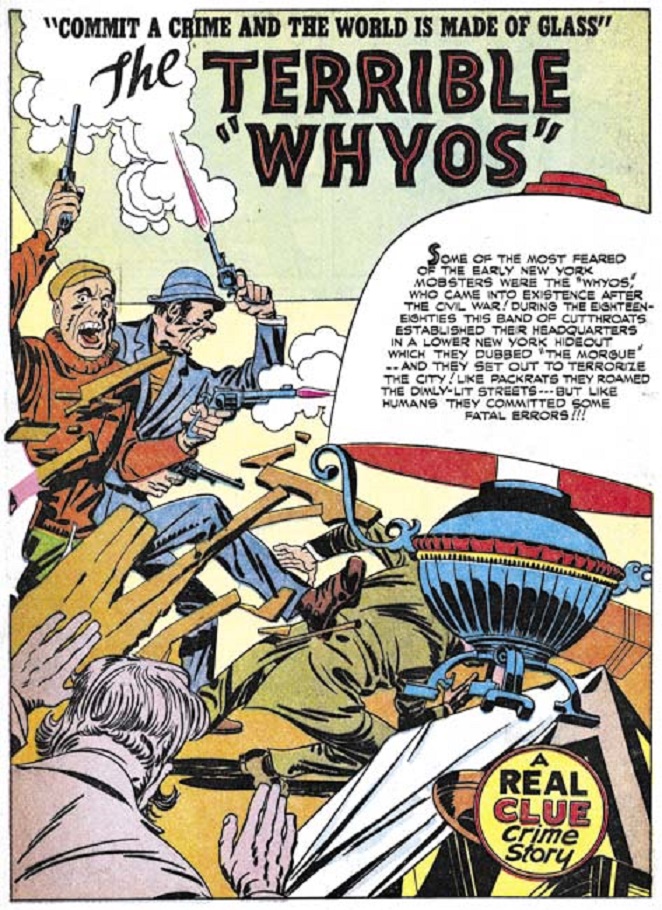
Famed comic creators Joe Simon and Jack Kirby had a fascination with early gang life and once illustrated their adventures for a 1947 comic book called Real Clue Crime Stories.

RCv2n5TerribleWhyos1

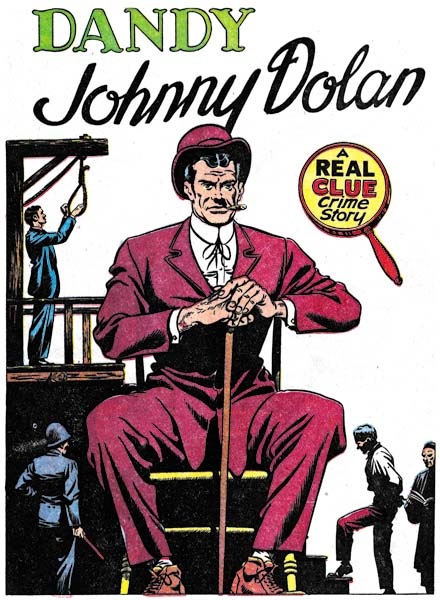
Another artist for the a different issue of the same comic book took a crack at the story of Dandy Johnny Dolan that same year:

realcluev2n4dandyjohnnydolan

Comic art above courtesy the Jack Kirby Museum


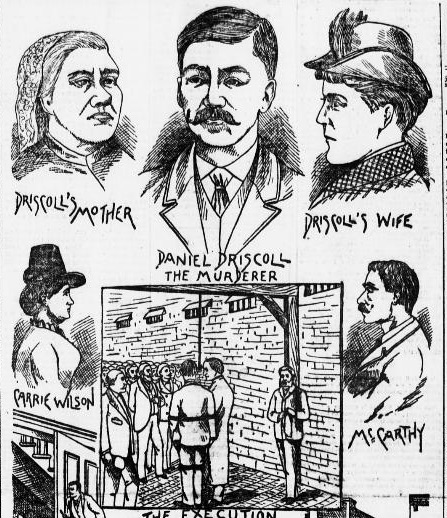
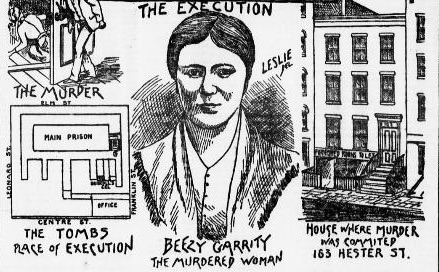
A vivid illustration from the New York World, January 23, 1888, outlining the players involved in Danny Driscoll’s murder of Beezy Garrity.

2 1

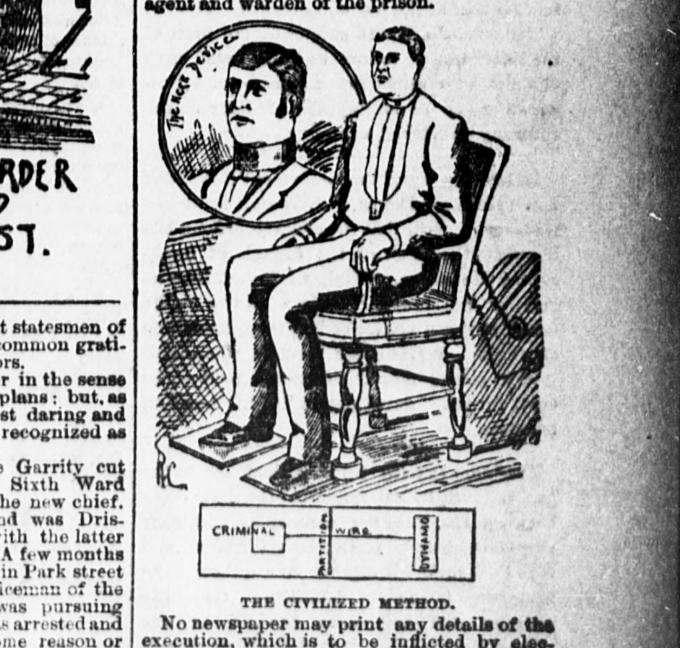
The violent execution of Driscoll lead the World to run a further article (see the right side of the page) condoning the use of a new form of execution — by electrocution.

image_681x648_from_4045,3966_to_5143,5012


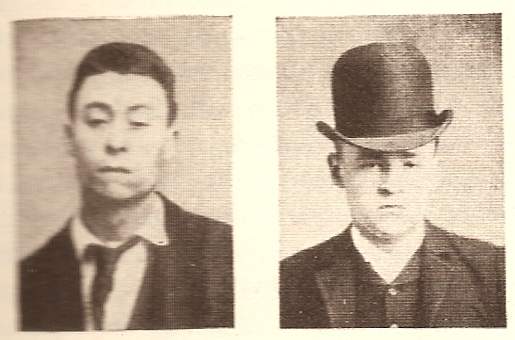
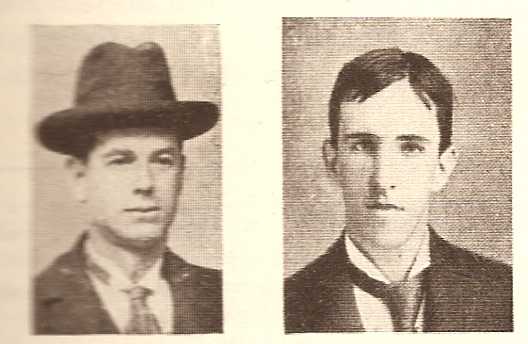
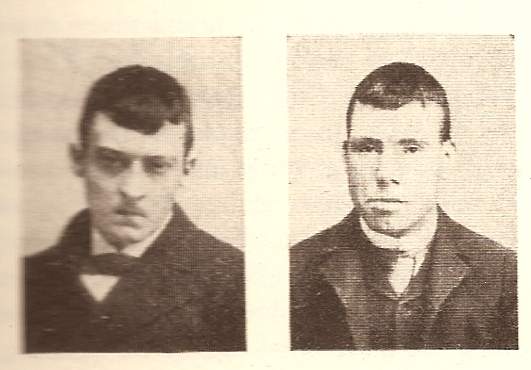
Faces of the Whyo Gang: Googy Corcoran, Clops Connolly, Big Josh Hines and Baboon Connolly


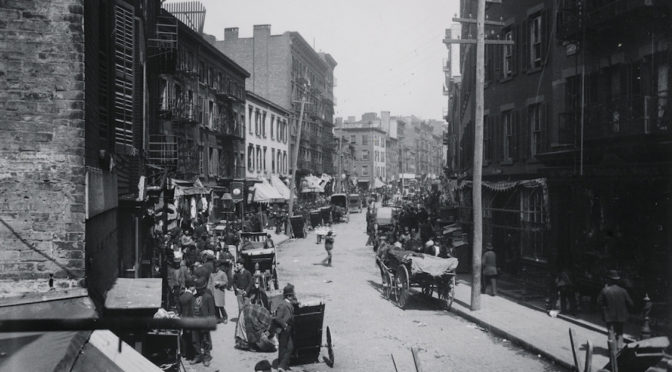
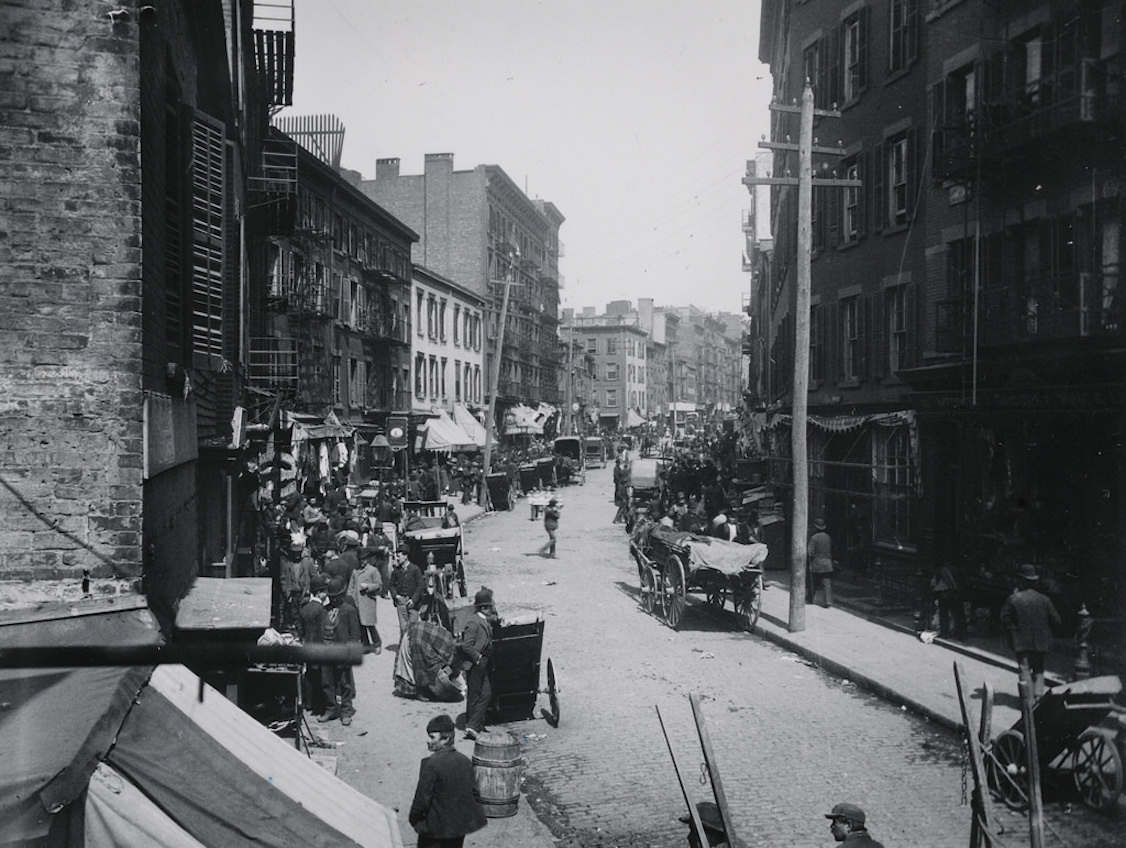
Mulberry Bend: The lair of the Whyos (picture by Jacob Riis)

5389341773_c24e701793_b


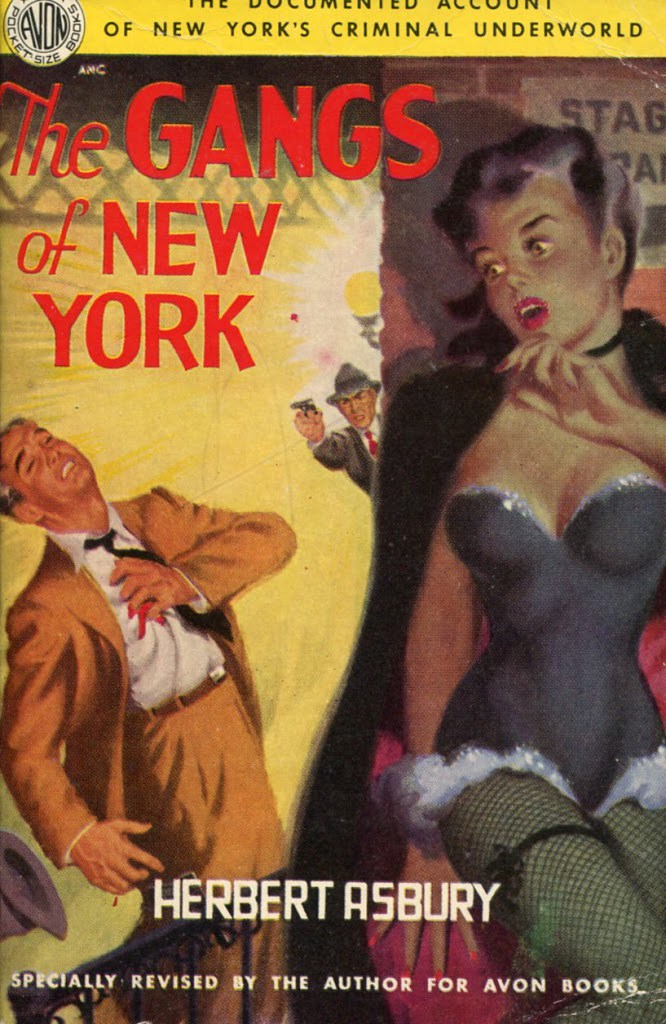
The pulpy cover of Herbert Asbury’s Gangs of New York.

03-2BHerbert-2BAsbury-2BGangs-2Bof-2BNew-2BYork-2BAvon050

Categories
Brooklyn History Gangs of New York

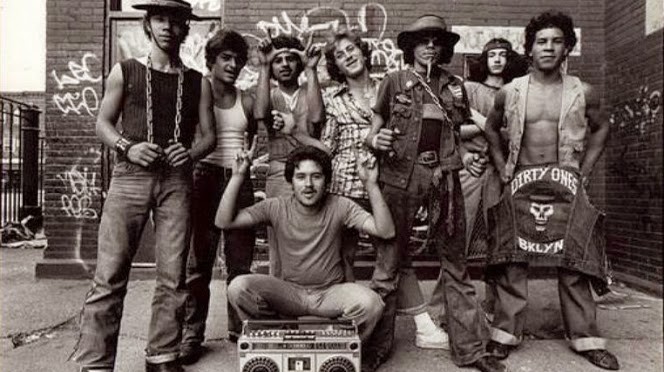
Screaming Phantoms, Tomahawks, Phantom Lords, Dirty Ones and other gangs of 1970s Williamsburg, Brooklyn

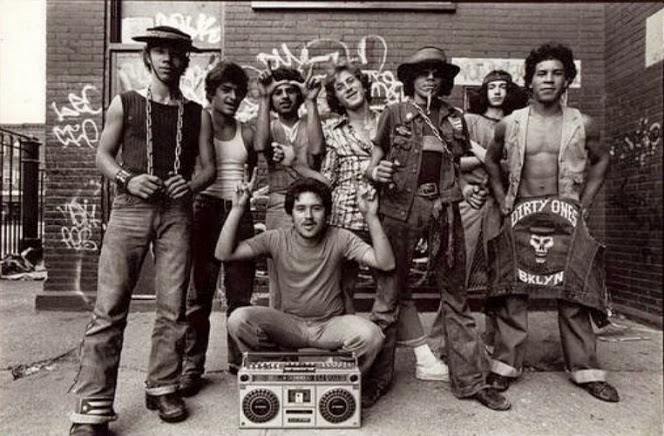
The Dirty Ones, a notorious gang from Williamsburg.

My new column for A24 Films (a tie-in to the new movie A Most Violent Year) is up on their site devoted to culture and events from 1981.

For this article, I look at what some of the dangerous undercurrents to life in Williamsburg, Brooklyn, in 1981. “By the 1970s, Williamsburg was best known for its steeply rising crime rate, harboring both violent street-gang activity and organized crime.” You can read the whole article here.

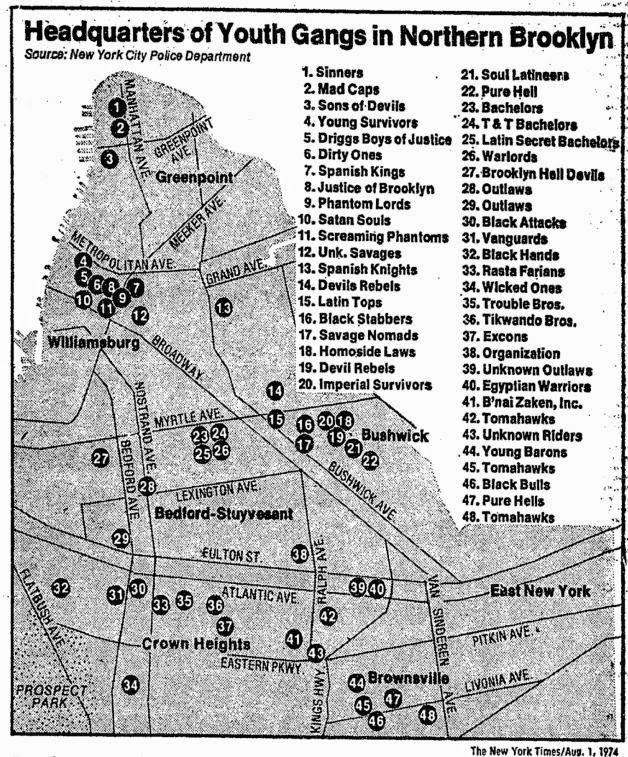
During my research for this piece, I found this rather startling map in the New York Times, August 1, 1974, charting out the various turfs of northern Brooklyn street gangs.

This is not a souvenir from the film The Warriors, but an actual list of the many violent gangs which kept Brooklyn a very dangerous place to walk around in during the 1970s.


Gang activity was so especially vicious at this time — particularly gang-vs-gang violence — that Luis Garten Acosta, the founder of El Puente youth outreach program, called northern Brooklyn ‘the killing fields’ in 1981.

I dug a little further to find some specific incidents which involved some of these gangs.  I’ve put numbers by the gangs so you can find their dedicated turf on the map above:

September 16, 1972 — A gang altercation among the members of the Young Barons (44) resulted in the death of one young man and another whose nose was cut off.Â

— August 21, 1973 — Several members of the Devils Rebels (19) were walking around Bushwick when they were accosted by the Screaming Phantoms (11). Two boys associated with the Devils Rebels were stabbed and killed. Police report “the Screaming Phantoms operated out of the Williamsburg area and had been ‘way out of their area’ at the scene of yesterday’s gang fight.”

— October 12, 1973 — Several gangs have been cast as extras in a new film called The Education of Sonny Carson, including the Tomahawks (48), Pure Hell (22) and the Unknown Riders (43).

— February 25, 1974 — The Times reports on the extortion schemes of various northern Brooklyn gangs, mentioning the Outlaws (28,29), the Tomahawks (48), the Jolly Stompers (not listed) and B’Nai Zaken (41).

Categories
Gangs of New York

Who were the Short Tails? The crazy, violent habits of the real Lower East Side gang

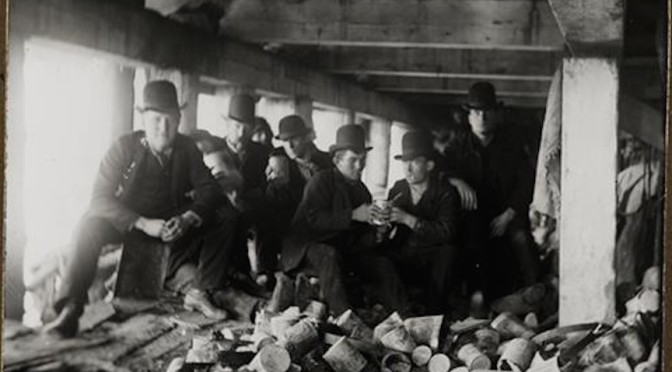
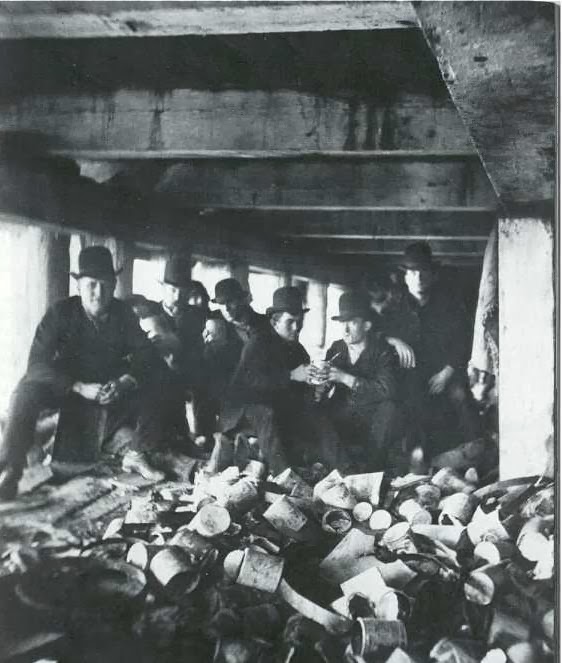
One of the few photos ever taken of any New York street gang was this image shot in 1887 by Jacob Riis of the Short Tails  under a pier in Corlears Hook. 

The Short Tails were a particularly nasty gang of criminals who terrorized the Lower East Side and the docks of Corlears Hook roughly during the period of the Gilded Age.

By the 1910s, this sinister assemblage had been absorbed into other street gangs — some say Monk Eastman‘s criminal organization is an off-shoot — and largely disappeared as a physical threat to innocent New Yorkers.

Then Herbert Asbury‘s Gangs of New York happened, vaulting a number of once-forgotten street gangs into a realm of historic romanticism. Even here, the Short Tails play second fiddle to more organized and mythic groups of young men such as the Dead Rabbits, the Whyos and, ahem, the Bowery Boys.

Confusingly, there was once a gang called the Shirt Tails who coexisted with other Five Points gangs, but this group of ruffians was long gone by the time the Short Tails terrorized neighborhoods to the east of their turf.**

The Short Tails feature as the principal villains in Mark Helprin’s New York fable Winter’s Tale, the film version of which opens today in movie theaters.

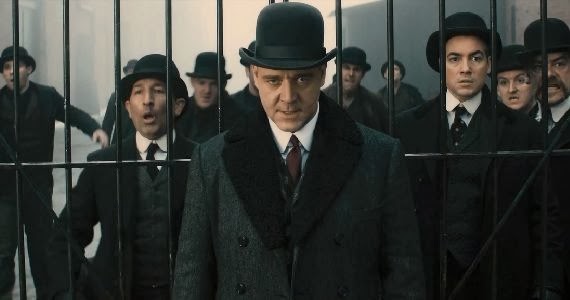
Their fictional leader, Pearly Soames (played by Russell Crowe), is a maniac with a penchant for gold and dangerous hideaways. He and his mob pursue the narrative’s hero Peter Lake (played by Colin Farrell) through the streets of a tinted-postcard New York that seems to shift like a kaleidoscope.

The original Short Tails were less romantic in nature, and less oppressive. (Helprin’s version: “Pearly and sixty of the Short Tails went marching through the street like a Florentine army.”)  Still, their scant appearance in newspapers of the era reveal a most malevolent group of men and boys. What were some of the traits of this menacing band?

They were headquartered at the corner of Rivington and Goerck Street. That’s around the area of Baruch Playground today. Back then, it was a stone yard. In 1882, these ‘East Side desperadoes‘ began terrorizing a German-owned saloon in the area, attacking the proprietor with a broken beer glass. In August, the leader of the Short Tails, Frank Nixon, was seriously injured in a shoot-out here and later arrested. [source]

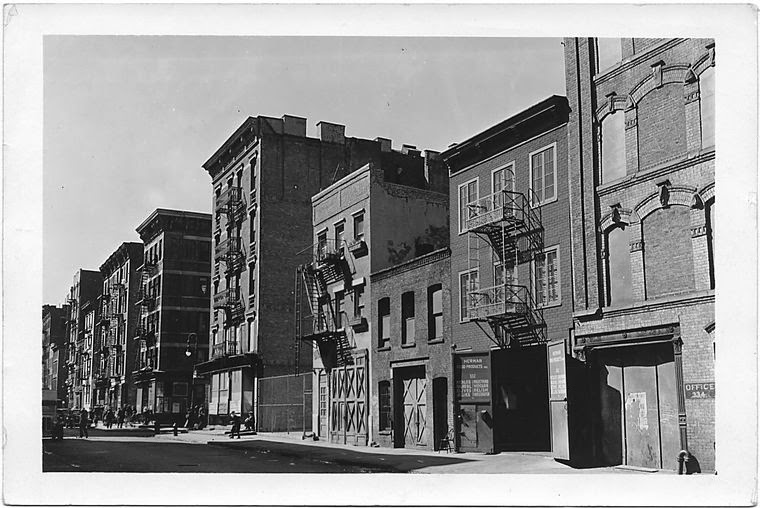
Goerck Street from a much later period (1939) at Stanton Street, just a block from the gang’s headquarters. (NYPL)

They were an outgrowth of another gang called the Border Gang, so named because they were on the border of two police precincts.

They loved beer. They loved it so much they were known for their habit of “rushing the growler,” filling up buckets of beer from local saloons and taking it back to headquarters. “The man who went for it would simply march out of the saloon with the filled receptacle [without paying for it], and if the barkeeper attempted to stop him, he would make a few remarks of a maledictory sort, interlarded with profanity and obscenity” and threaten to bring the wrath of the entire gang down on the saloon if he didn’t “hold his yawp.”  [source]

They were unrelenting murderers and thieves. The gang’s loathsome crimes seem especially brutal, even today.  From a report in 1884: “The members of the gang are known to the police as hard drinkers, thieves, pickpockets and highwaymen.” [source]

They were skilled at boat-related crimes. The Short Tails, being stationed near the piers along Corlears Hook, often committed crimes upon vessels along the water front. The unfortunate members of the Young Men’s Cathedral Association learned this the hard way during an river outing in 1886. “Some members of a notorious gang of desperadoes, calling themselves the Short Tails, smuggled themselves on the boat, got drunk and began to fight.” [source]

Corlears Hook in the 1870s, right before the era of the Short Tails. (NYPL)

Their schemes could sometimes be quite dastardly and clever. They perfected a naughty little trick in 1896 involving wagons which lined up along the water’s edge. As some Short Tails pushed the wagons into the river, others would run to the owners and offer to rescue their drowning wagons for a fee of $3. This money would be used almost entirely on buying beer. (I guess saloon owners got a bit more aggressive by the 1890s!) “When the money was spent they returned and pushed two more trucks into the water.”

Some of them loved music. In fact, the earliest record (from 1881) that I could find of Short Tail-related violence involved an accordion! “Policeman Philip F. Mahoney … observed a crowd of forty young men last night … standing at the corner of Delancey and Sheriff Streets. One of the gang was playing an accordion and Mahoney directed them to move on, as it was 11:30 o’clock. The accordion player refused to stop playing, whereupon Mahoney attempted to arrest him. The gang set upon him and took his club away.” The accordion player and other members were later arrested. [source]

Delancey Street required extra police duty because of them. Officers of the NYPD wised up after the accordion incident, patrolling the area in pairs of two — “one to protect the other.” The gang was certainly no match for the most hearty of souls in the police force.

One officer in the 1880s, avenging a friend killed by a Short Tail, stormed right into their headquarters “without club or firearm of any kind” and personally throttled a great number of them, “grab[bing] two of the more notorious by their coat collars” and dragging them to jail.  [source]

** Neither the Short Tails nor the Shirt Tails are related to this group. (Courtesy Rob Starobin on Twitter )

Categories
Podcasts

At The Ready: The History of the New York City Fire Department


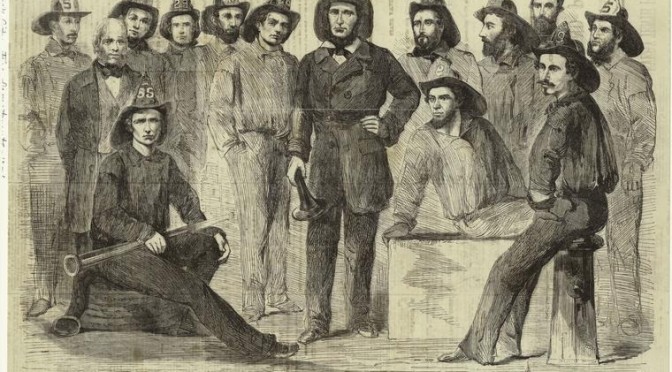
The distinguished members of New York’s various volunteer fire brigades, posing for the photographer Matthew Brady in 1858

PODCAST  The New York City Fire Department (or FDNY) protects the five boroughs from a host of disasters and mishaps — five-alarm blazes, a kitchen fire run amok, rescue operations and even those dastardly midtown elevators, always getting stuck!  But today’s tightly organized team is a far cry from the chaos and machismo that defined New York’s fire apparatus many decades ago.

New York’s early firefighters — Peter Stuyvesant‘s original ratel-watch — were all-purpose guardians, from police work to town timepieces.  Volunteer forces assembled in the 18th century just as innovative new engines arrived from London.

By the 19th century, the fire department was the ultimate boys club, with gangs of rival firefighters, with their own volunteer ‘runners’, raced to fires as though in a sports competition.  Fisticuffs regularly erupted.  From this tradition came Boss Tweed, whose corrupt political ways would forever change New York’s fire services — for better and for worse.

Volunteers were replaced by an official paid division by 1865.  Now using horse power and new technologies, the department fought against the extraordinary challenges of skyscraper and factory fires.  There were internal battles as well as the department struggled to become more inclusive within its ranks.

But the greatest test lay in the modern era — from a deteriorating infrastructure in the 1970s that left many areas of New York unguarded, and then, the new menace of modern terrorism that continues to test the skill of the FDNY.  From burning chimneys in New Amsterdam to the tragedy of 9/11, this is the story of how they earned the nickname New York’s Bravest.

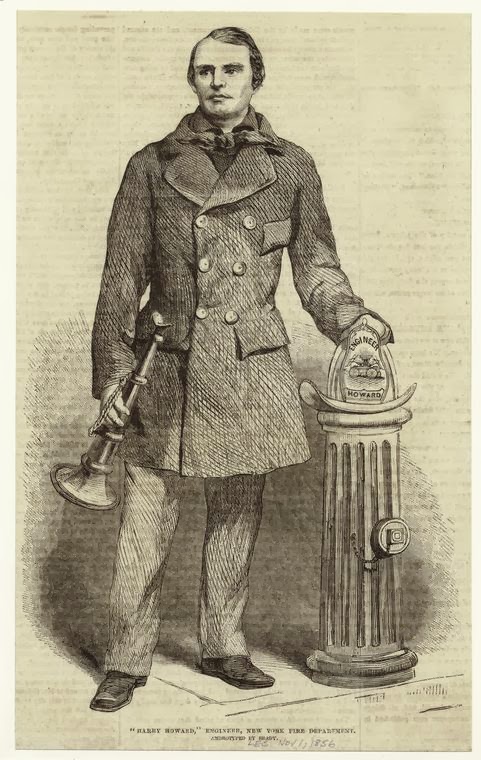
Above:  That’s Harry Howard, one of the FDNY’s greatest firemen and a former member of the Bowery Boys volunteer fire unit!


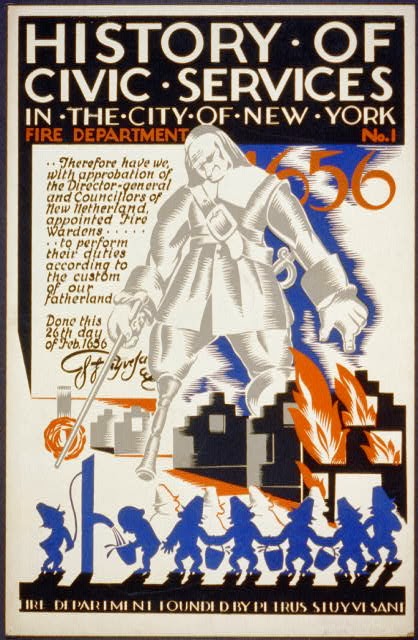
A poster by Vera Bock from 1936, created for a series by the Federal Art Project, touts the contributions of Peter Stuyvesant to the history of New York firefighting. (LOC)

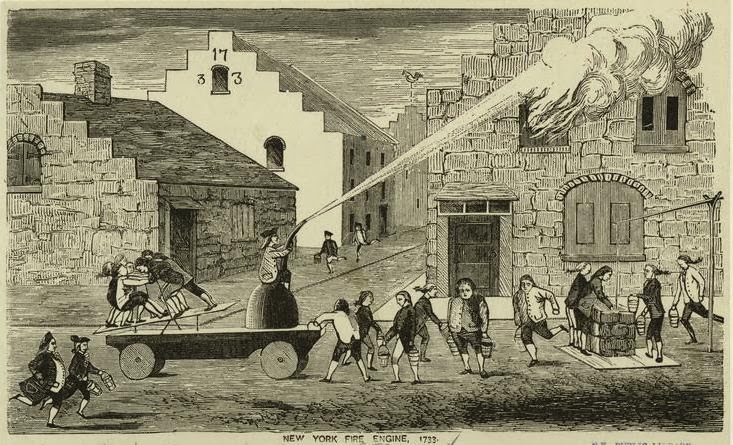
One of two fire engines first received by New York in 1733 (from an 1872 illustration) Courtesy NYPL

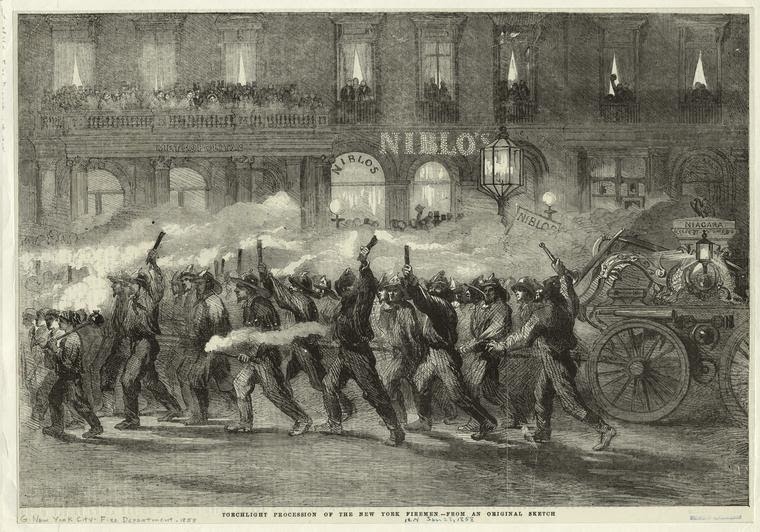
A firefighters’ procession at night, marching past Niblo’s Garden. 1858   Courtesy NYPL

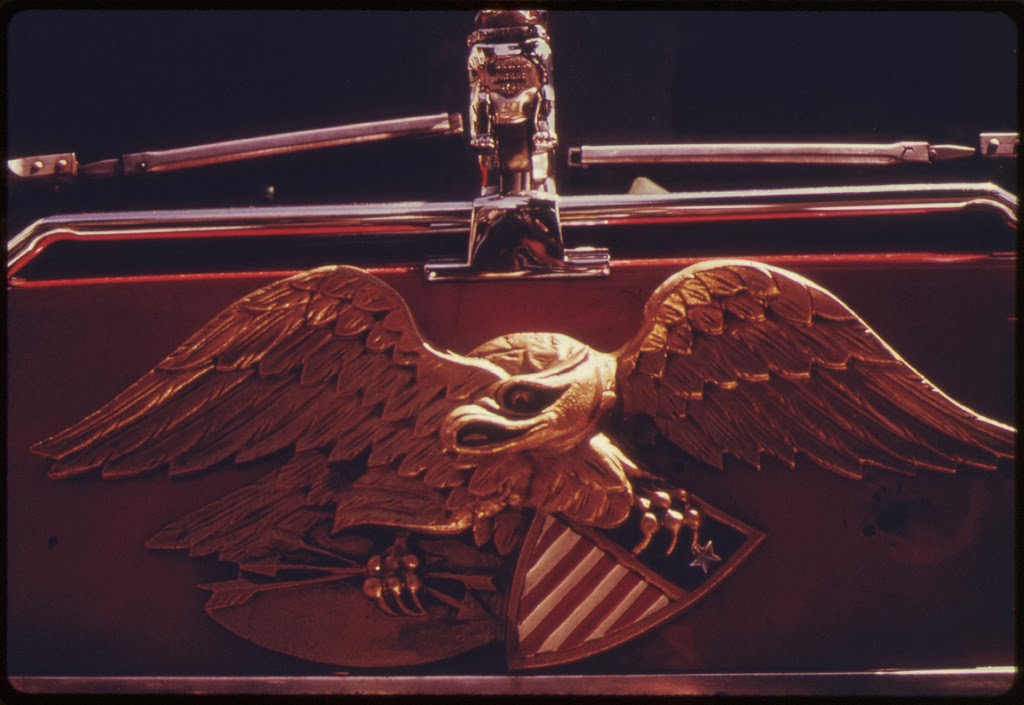
Eagle insignia from a New York fire truck, 19th century, courtesy the US National Archives

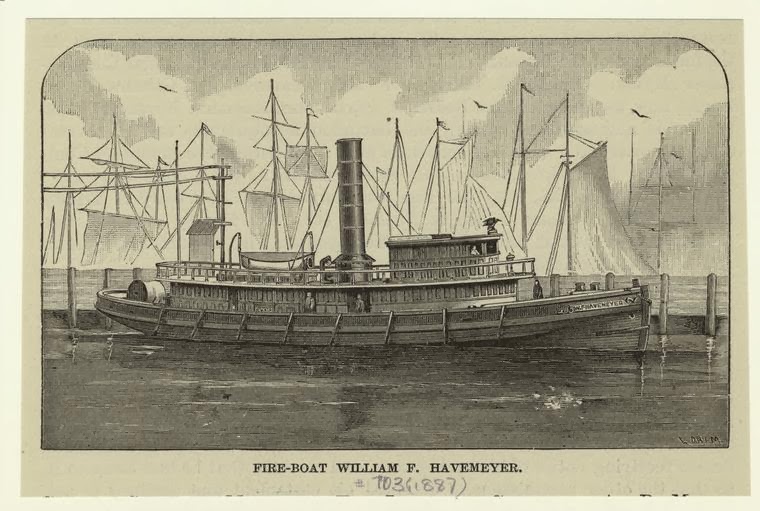
The first official fire boat of the FDNY (although others had been rented before this), named for former mayor William F. Havemeyer.


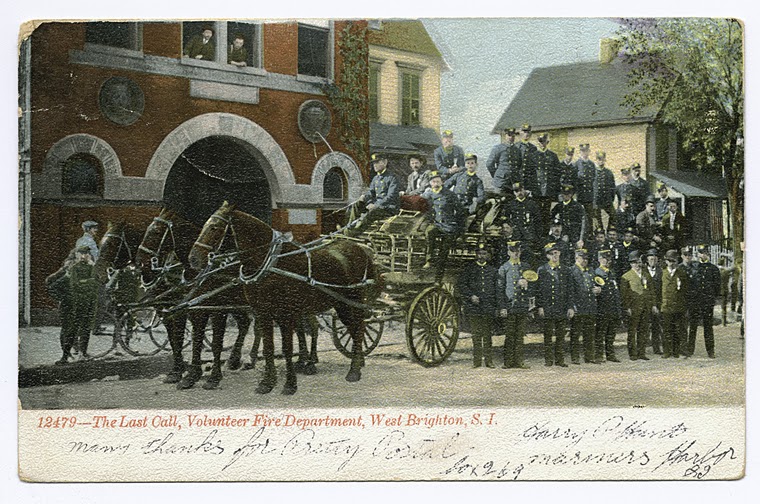
Volunteer fire divisions were slowly fazed out after the introduction of an official paid company.  This was expanded when the five boroughs were created in 1898.  This postcard commemorates the final run of a volunteer fire department in West Brighton, Staten Island. (NYPL)

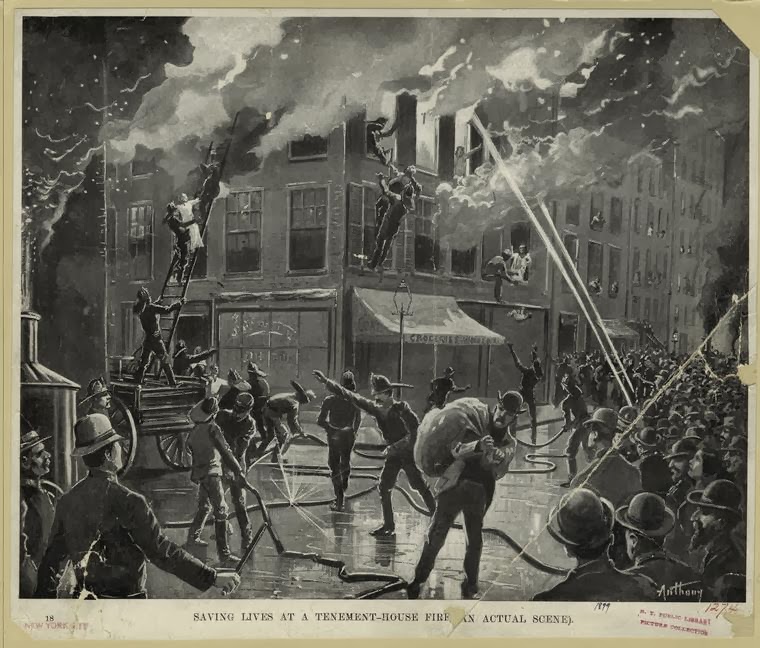
Firefighters battled a tenement blaze in this illustration from 1899, one of thousands that occurred in the poorer districts of town.  Improved fire regulations would ensure newer buildings were more fire proof. (Courtesy NYPL)

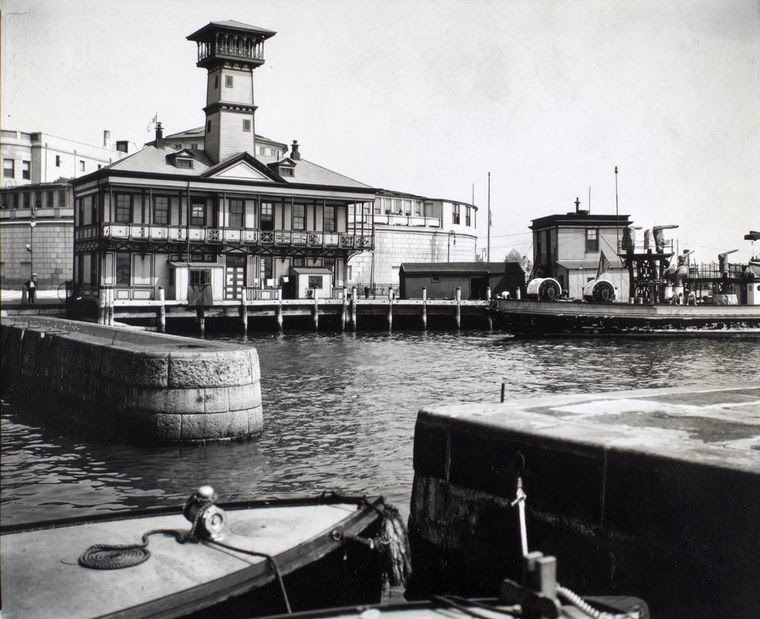
One of New York’s more interesting firehouses — the one for fireboats at the Battery. Photo by Berenice Abbott (courtesy NYPL)

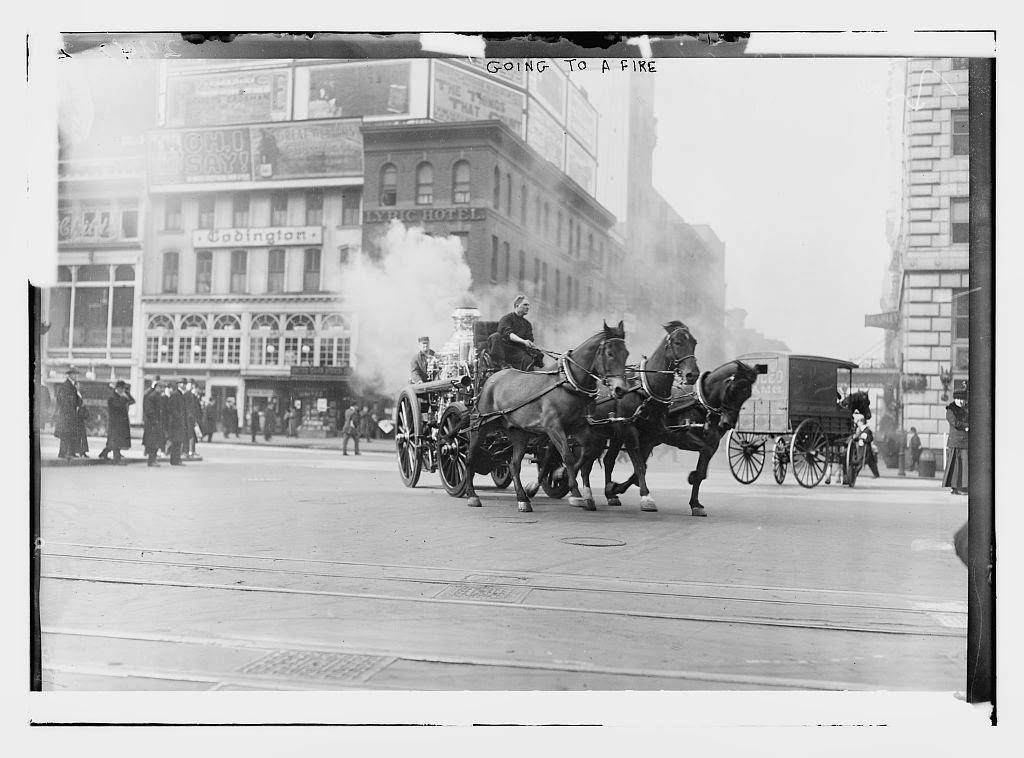
Horses were a hotly contested inclusion to the fire departments during the 19th century.  They were eventually banished during the volunteer years, but re-introduced after 1870 and soon became essential for getting quickly to fires.

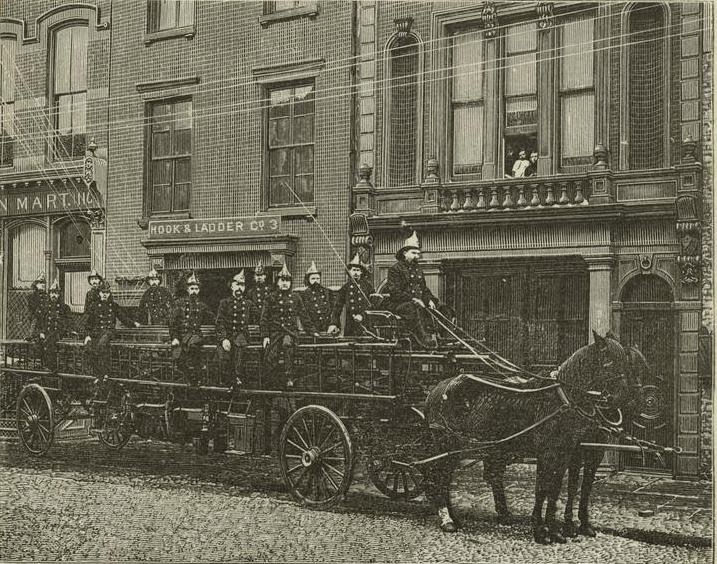
Hook and Ladder Co. No. 8, from 1887


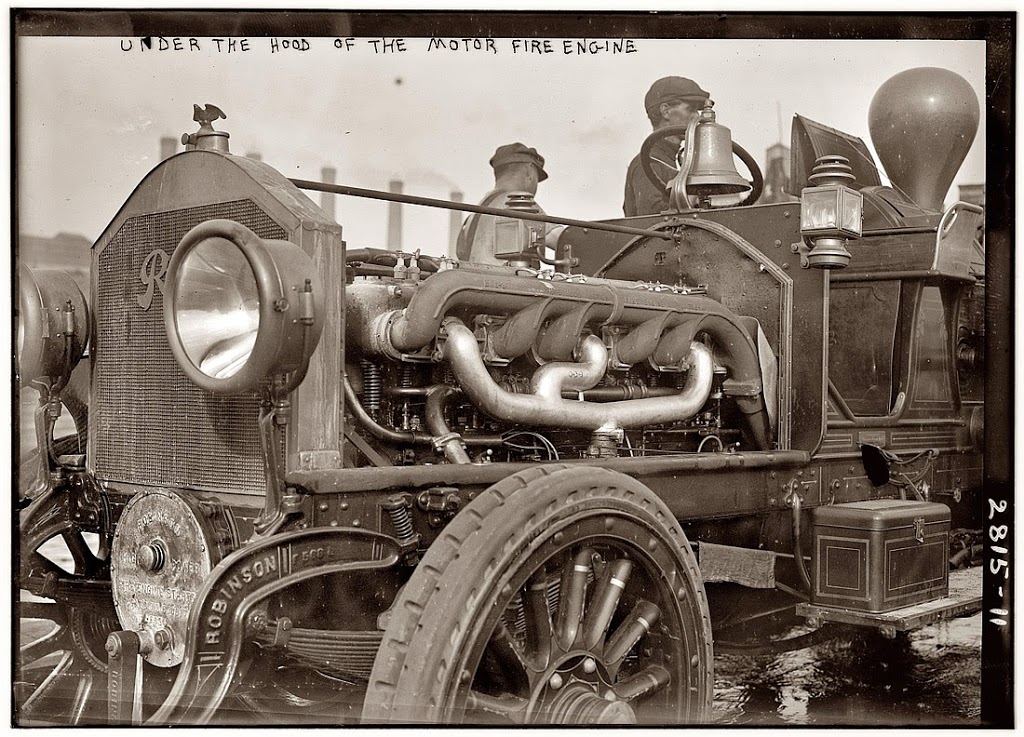
Motorized fire engines and trucks replaced the horse-drawn varieties in the 1910s.  Here’s one model that was used by the FDNY in 1913 (Courtesy Shorpy)

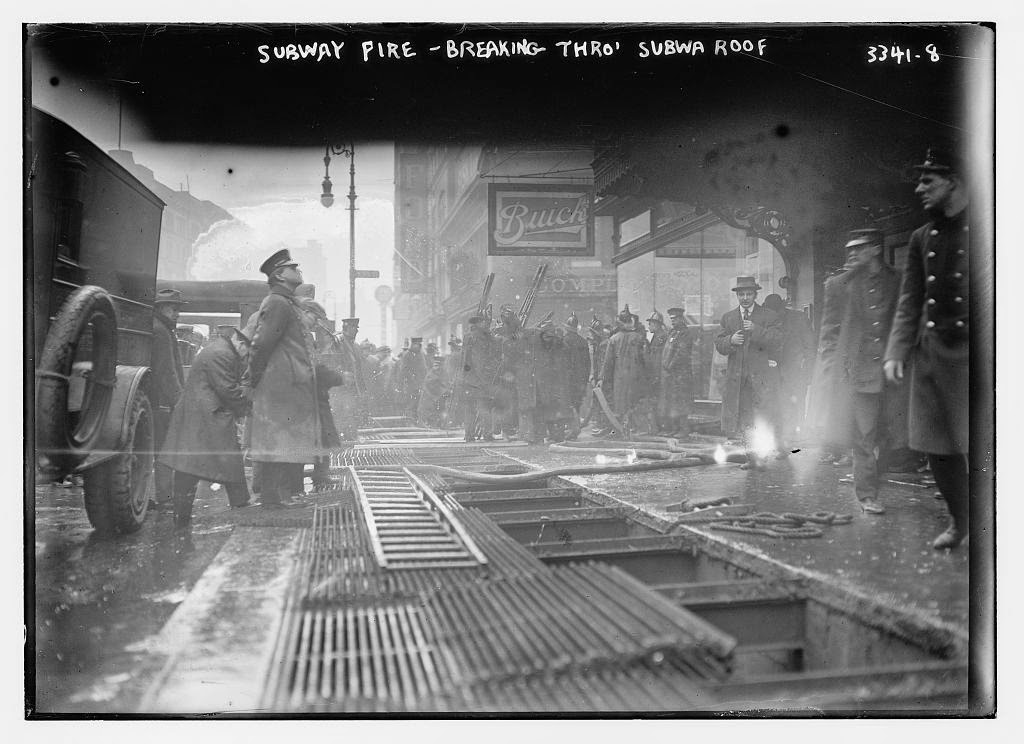
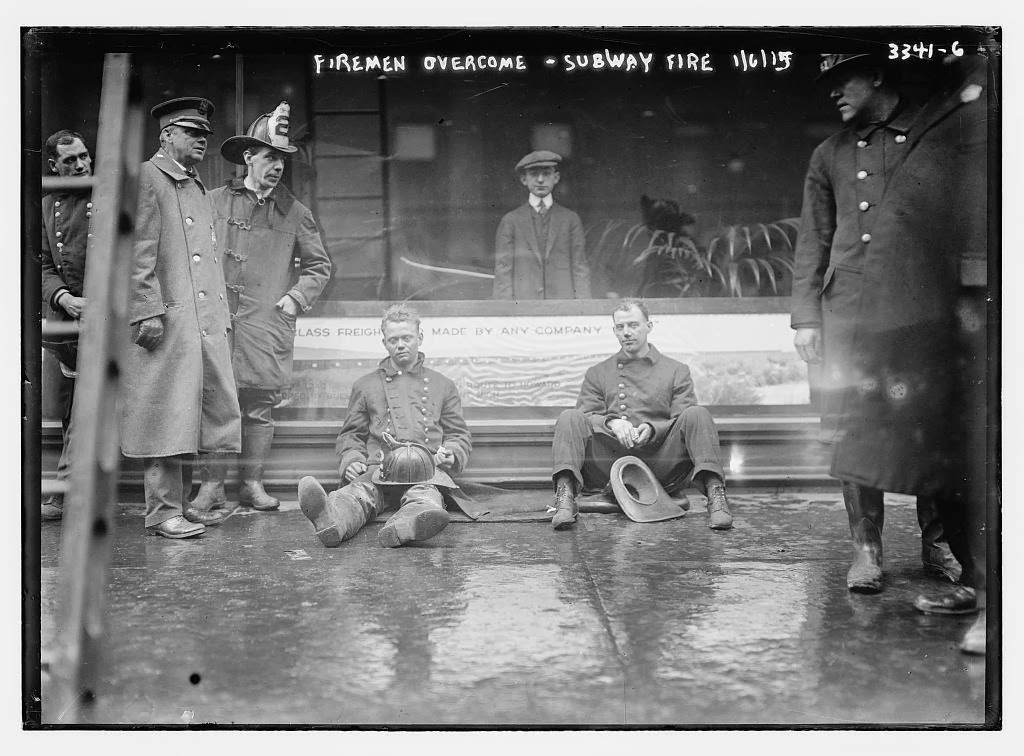
The city’s growth created new challenges for the FDNY.  With the new subway, there was the potential for dangerous fires underground.  Here a team of firefighters battle a subway fire in midtown in 1915, and a couple firemen who braved the inferno underfoot. (LOC)


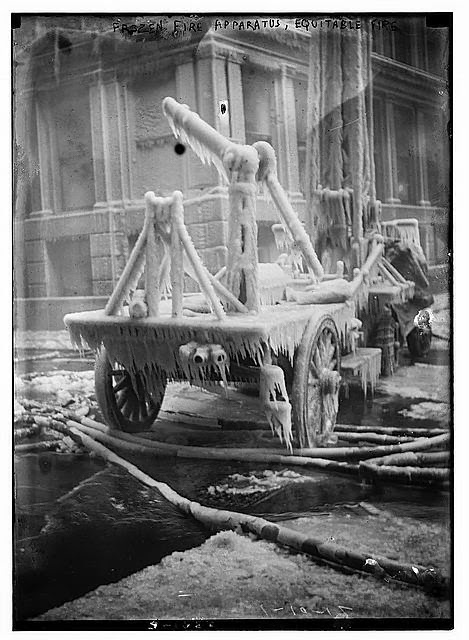
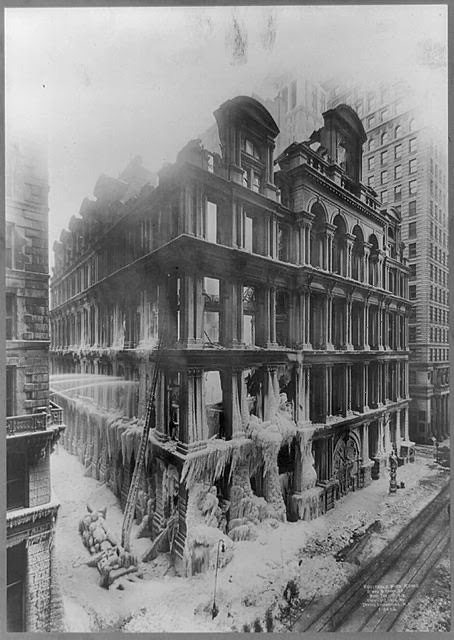
The difficult blaze at the Equitable Building in 1912 produced a bizarre aftermath of icy ruins.


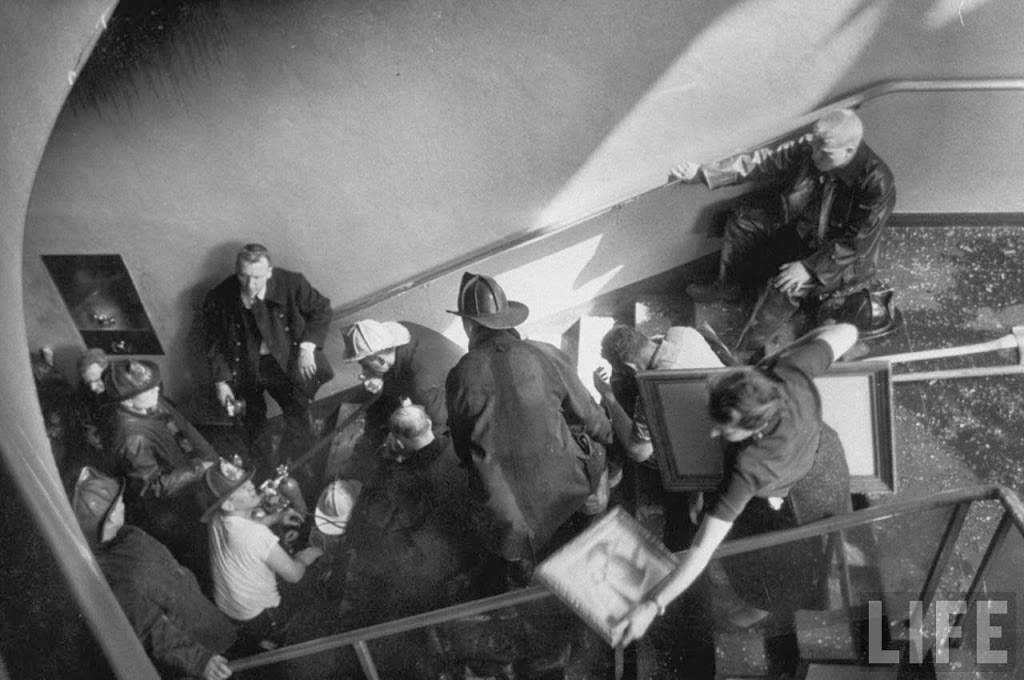
Firefighters rescuing people (and paintings!) from a fire at the Museum of Modern Art, 1958. (Courtesy Life)

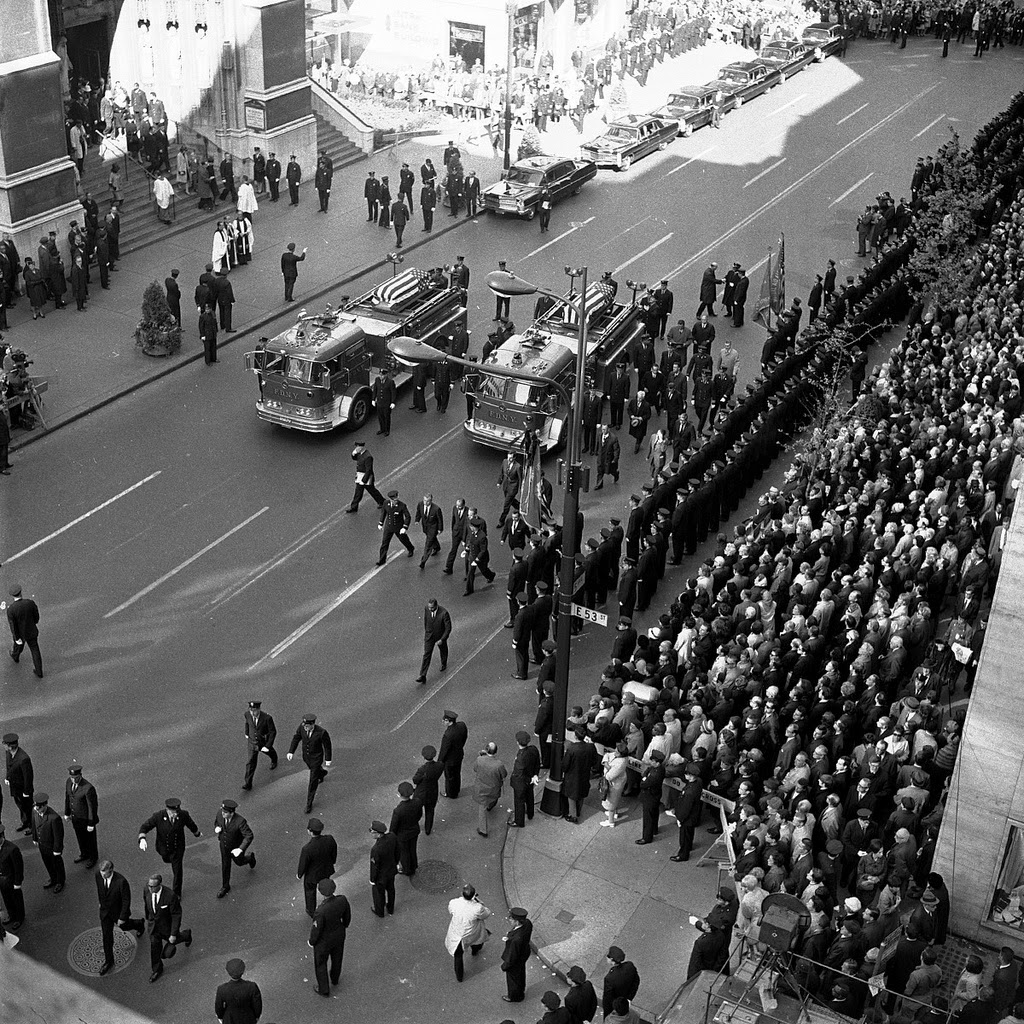
A sorrowful day:  Thousands come out to mourn the 12 firefighters who died fighting a terrible blaze that erupted across from the Flatiron Building on October 21, 1966. (Picture courtesy FDNY)

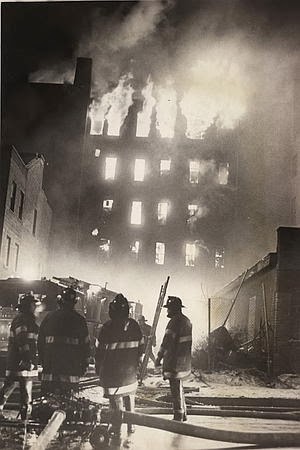
Total mayhem erupted in New York City in the 1970s, as whole districts like the South Bronx, Bushwick, Harlem and the Lower East Side saw a massive increase of fire-related disasters due to the city’s financial woes. (Photo courtesy New York Post/Vernon Shibla photographer)

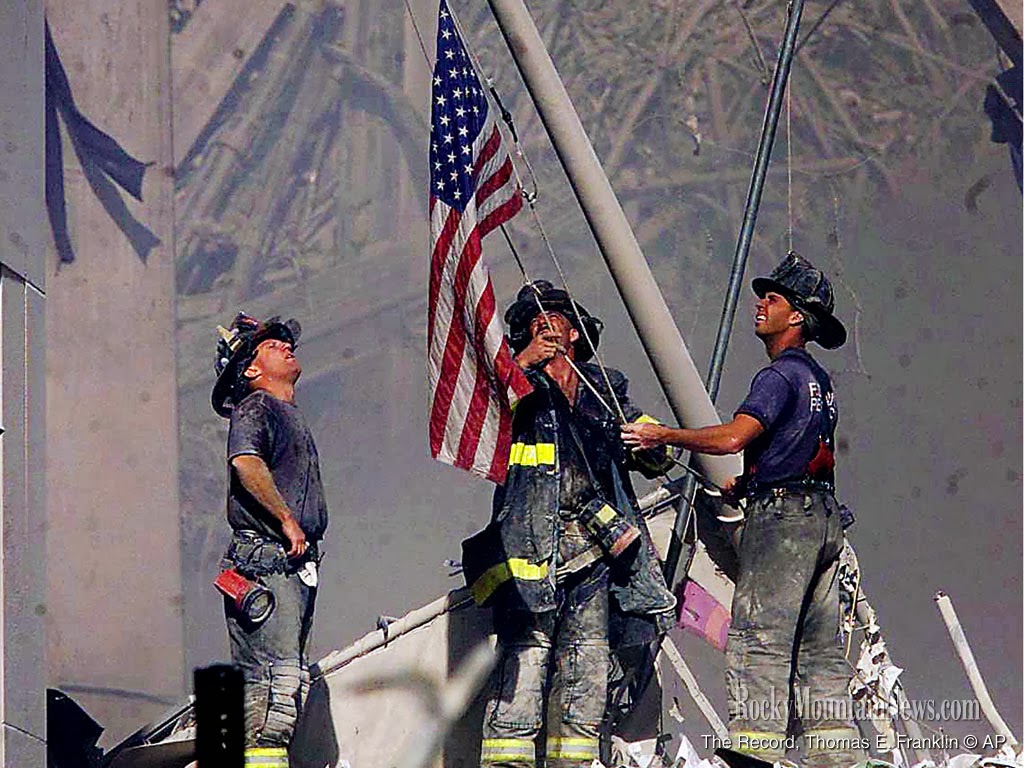
Three hundred and forty-three firefighters and FDNY paramedics died in the September 11, 2001, terrorist attack on the World Trade Center.  But the force, along with the police and other emergency workers, managed to save tens of thousands of people on that day, making one of the largest rescue operations in American history.  In total, 2,977 people were killed that day, 2,606 of them in New York, on the ground and in the towers.

And finally, a rather amazing film documenting the fire department’s emergency response process in 1926, with a breathless dash-cam vantage point!

Categories
On The Waterfront

The South Street kidnappings: During Prohibition, did ‘shanghai gangs’ really lurk in the shadow of the ports?

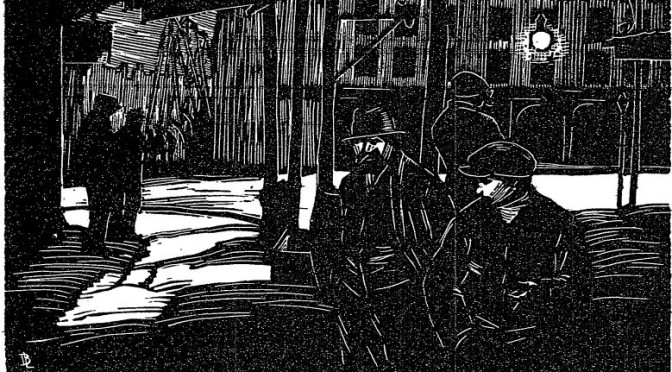
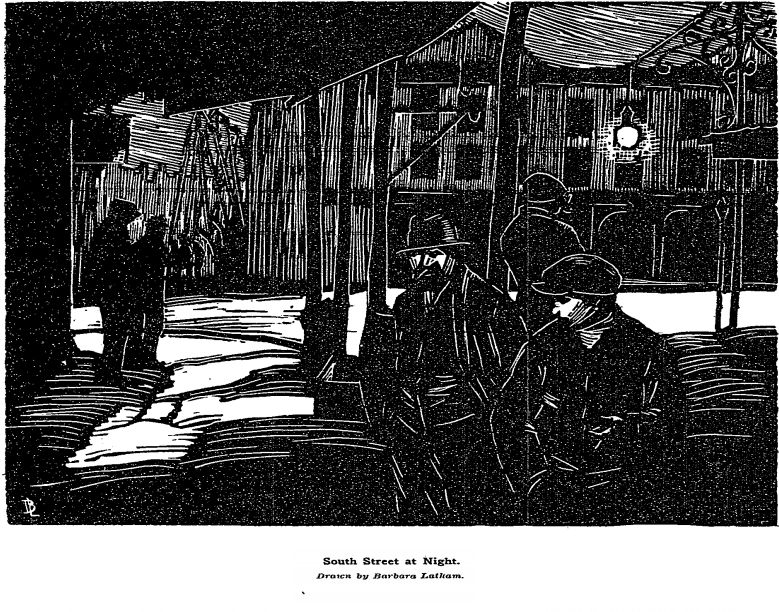
The old port at night was no place to be.

Weathered taverns and boardinghouses sit next to uninhabited warehouses, separated by dimly lit South Street from the shadow of rocking masts and creaking piers that sank into the black water of the East River.

A lonely sailor, soused from the wares of the cheapest Water Street saloon, stumbles down the cobblestone. A figure emerges from the corner. A whistle. Another man steps from behind. And the lonely sailor has vanished.

The fear of ‘disappearing’ in New York kept many awake at night in the 19th century. In a world where everybody was essentially ‘unplugged’ and ‘off the grid’, there was a sense that people could simply vanish, almost as if absorbed into the urban environment without a trace.

Moral crusaders, in a tirade against personal independence, warned parents to keep close watch on their daughters for fear they would be snatched from the street, plied against their will with opium and turned into prostitutes.

Some thought this might have been the fate of ‘cigar girl’ Mary Rogers back in 1841. And as late as 1911, some speculated this was the fate of the socialite Dorothy Arnold, one of the most prominent disappearances of the Gilded Age. [Hear more about her story in our podcast from last May.)

But it was men who were often the victims of street kidnapping. The transient nature of the New York port world mixed with the influx of new immigrants — many of them younger men — fostered a disturbing cottage industry of so-called impressment (or ‘shanghaing’ in the old vernacular), where drunken men were either forcibly taken off the street or taken advantage of in their inebriated state and put to work on a sailing ship.

In 1870, a sailor ‘under the influence of liquor’ was tied up and dragged onto a boat. A Fort Hamilton soldier in 1882 was kidnapped and placed aboard a ship off Staten Island. While his message, thrown overboard in a bottle, was received, officials were unable to rescue him as the boat sailed for its destination: Hamburg, Germany.

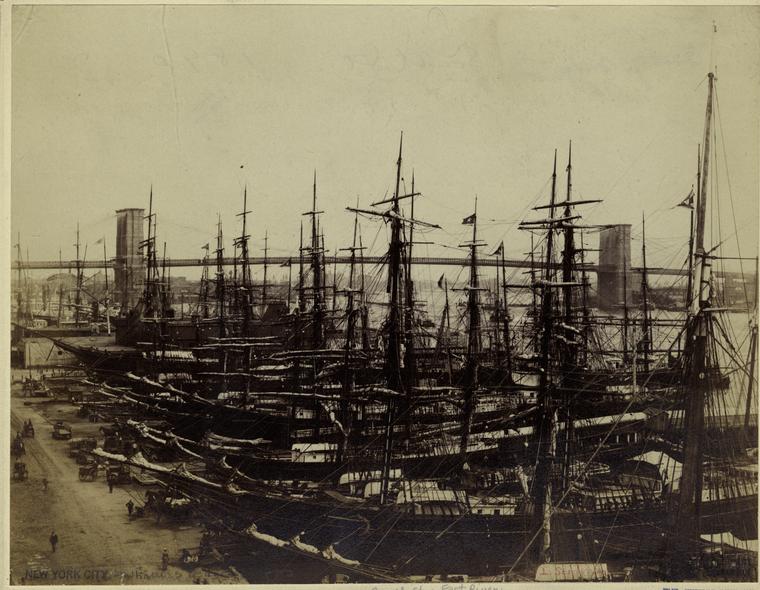
Below: The forest of masts along South Street, 1890

It’s impossible to know exactly how many men were forced onto boats along New York’s port, as the victims were frequently drunk, thrown onto boats that embarked on long voyages and then failed to press charges when they returned. An article in 1910 claims that ‘[h]undreds of sailors were captured [in New York Harbor], usually in the saloons, beaten into insensibility, to awake when the ship was at sea and the Captain an absolute tyrant.”

There would be an actual, near legal version of shanghaiing called crimping where the sailors, still taken at will, would be forced to sign an agreement, paid for their services but not allowed to leave. They would embark on often long voyages, and by the time they got back, “his anger is likely to have died out.”

By the late 1910s, federal laws protected the rights of seamen, and most shanghaiing and crimping practices were abolished. Except, of course, for those in illegal industries, and especially a brand new one created by the advent of Prohibition in 1920.

This type of kidnapping was perhaps the most frightening of all. “South Street Whispers of Shanghaing” announced a rather in-depth New York Times article in 1925. Now, instead of ‘crimps’, who lurked in sailor’s boarding houses, looking for possible captives, it was whole ‘shanghai gangs’ that ruled the shadows of the seaport.

“I have been drugged and held captive on a ship,” claimed one note found in a bottle and mailed to the police. An anonymous shipping master reported hearing of a victim “drugged in one of these newfangled speakeasies that are run as drug stores. They said along the street that a shanghai gang had got him, stole his money and shipped him to sea….The man is gone, and who can trace him?”

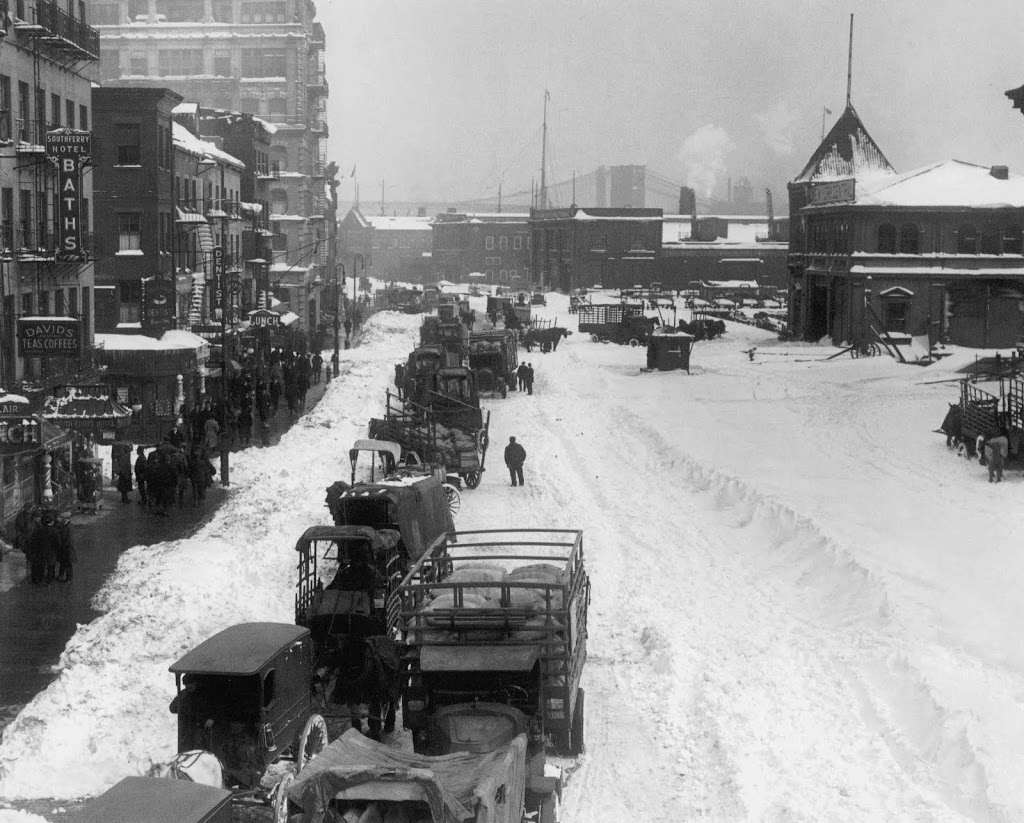
Below: South Street in 1920 in a snowstorm during the first year of Prohibition (Courtesy Flickr/wavz13)

The destination for these unlucky men wasn’t a long-distance voyage but rather a line of near-invisible vessels permanently moored off the American coast. ‘Rum Row‘ facilitated the distribution of alcohol into the United States, with product passing to smaller boats and shady, midnight deals made between mobsters and smugglers. It was an unpleasant and dangerous job, constantly under the fear of capture, betrayal and accident. In an illegal industry with few rules, unwilling men could be discarded.

This also made Prohibition-era impressment a mystery and something of an urban legend. How much forced capture really went on? The Times report interviews several sailors and even a salty South Street bartender, but their names are kept out of the story. Two men, thrown aboard a Rum Row schooner, “were made to work, starve and suffer for water, under threats,” only escaping when the vessel was captured by authorities.

South Street’s changing fortunes may have prevented a widespread problem of the sort which occurred in the 19th century.  The old pubs and grog houses were closed or turned to speakeasies, and heavy shipping had moved on to other ports throughout the harbor, on the Hudson River side, and in Brooklyn and New Jersey. The ports themselves were heavily controlled by mob bosses — and the promise of mob money — which perhaps made such forced recruitment unnecessary. And of course the success of illegal Prohibition industries relied on knowing which laws to abide and which to skirt.

Yet the fear of vanishing kept men on their toes at night as they passed through the neighborhood, keeping in the light as they stumbled down South Street.

At top: Drawing by Barbara Latham courtesy New York Times.  It accompanied the article mentioned above.

Who are the Spring Street Fencibles?


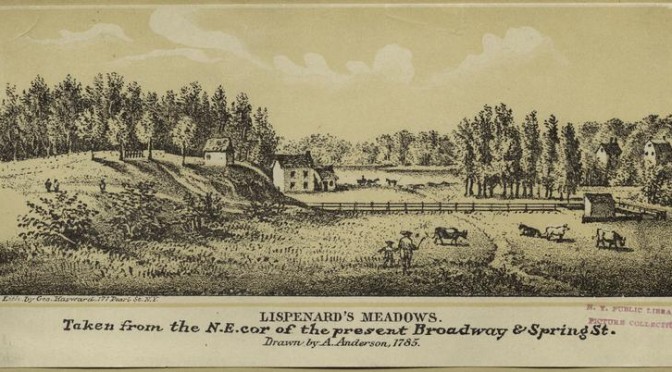
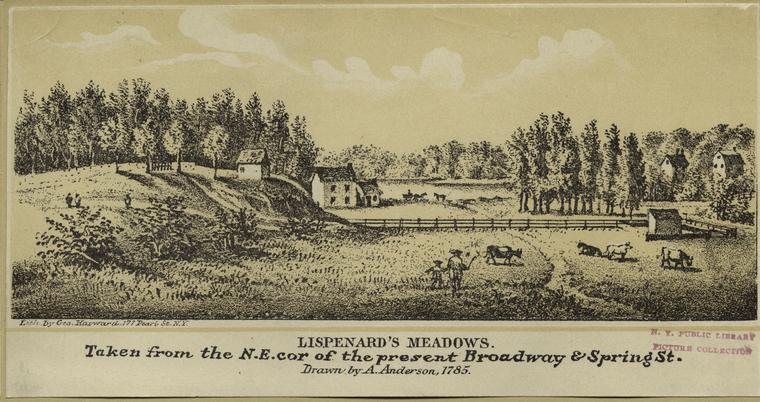
Spring Street and Broadway in 1785, 30 years before the events of the article below. Illustration courtesy NYPL digital images

While researching the Gracie Mansion podcast, I found mention of a street gang by the name of the Spring Street Fencibles, or simply, the Spring Streeters. Obviously, the streets of New York have been crawling with gang activity since the 19th century. But what makes this shadowy gang particularly interesting to me is the date of their only documented crime — 1825, making them one of the earliest mentioned organized gangs in the press. Their foul indiscretion? The murder of a well-known city merchant, an event that may have greatly affected the namesake of Gracie Mansion, Archibald Gracie — depending on which source you believe.

It is not known whether the Spring Streeters were truly organized in same way as later gangs like the Roach Guards and the Dead Rabbits; nor is it clear that their members were strictly Irish-born, as they commonly were in those days. In prior histories, they are loosely clumped with another group called the Grand Streeters. Spring Street runs parallel a couple blocks north of Grand Street, and it’s possible the two gangs were rivals or even one and the same gang.

The only crime by the the Spring Street Fencibles that I could find on record is the horrible slaying that occurred the early morning of June 3, 1825. The young drunken rowdies accosted a private carriage at Broadway and Art Street (or today’s Astor Place). A group of gentlemen accompanying the carriage uptown confronted the gang, and a ‘scuffle’ ensued. One of the gentlemen, one Mr. Lambert, was punched in the stomach and later died of his injuries. The gang members were rounded up and carted off to prison.

The confusion as to the victim’s name underscores one of the problems I often find in researching the early days of New York, when newspapers were not as concerned with exacting and factual detail. One key source, on the history of Gracie Mansion, clearly lists the victim as David Lambert, an associate of Gracie’s who put up the family in one of his townhouses when they fell on hard times. Other sources, however, list the victim’s name as Henry Lambert, of which nothing is known.

An old merchants guide of New York clearly links David as the victim of the crime, “up by Sailors Snug Harbor (near where Tenth Street is now).” The original land for Sailors Snug Harbor sat where today’s Washington Square Park is, which would have been just west of the reported violence. (Snug Harbor would move to its present location in Staten Island in 1833.)

Whatever the identity of the unfortunate man who died 185 years ago in the area of Astor Place, his demise also marked the end for this sorry group of thugs, locked up in prison for either seven or ten years — again, depending on which source you trust*.

Had this group of ruffians come along before 1807, they might have been known as the Brannon Street Fencibles, for that was the original name of Spring Street. The road was named for a Mr. Brannon the keeper of a “noted public house and a beautifully-laid-out garden,” situated nearby an actual spring of water. After 1807, the name switched to Spring Street.

*For the podcast, I clearly went with it being David.

Categories
Podcasts

Corlears Hook and the Pirate Gangs of the East River

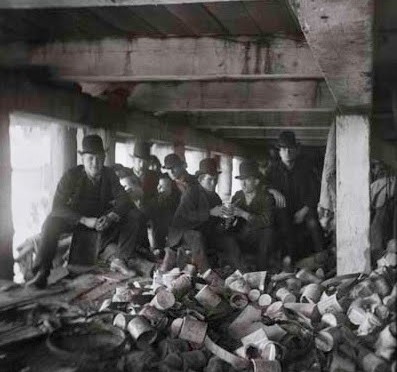
The Short Tail Gang sit underneath a pier at Corlears Hook, picture taken in 1890, long after all the great pirate gangs of the area had disbanded, been eaten by rats, or joined the Confederate army (listen to podcast for explanation!)

___________________________________
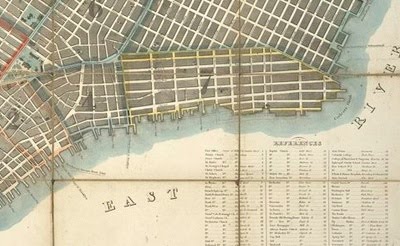
An illustrated map of the ward system of New York in 1817 highlights the Corlears Hook shorefront area of the Seventh Ward and the even more notorious Fourth Ward further down the coast. Much of the Seventh Ward was owned by the Rutgers family, who slowly parcelled out the neighborhood to shipbuilders, business owners and, eventually, tenements.

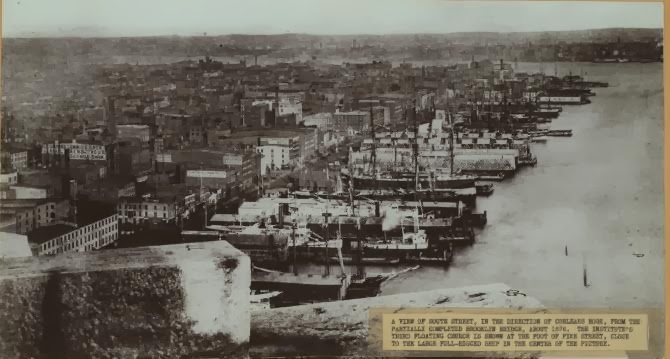
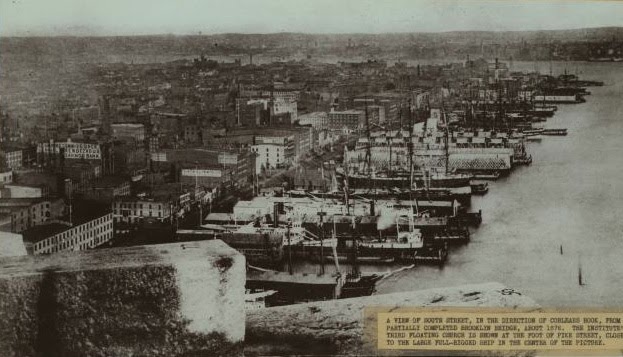
The East River shore in 1876, looking northeast from the uncompleted Brooklyn Bridge, all the way to Corlears Hook

___________________________________
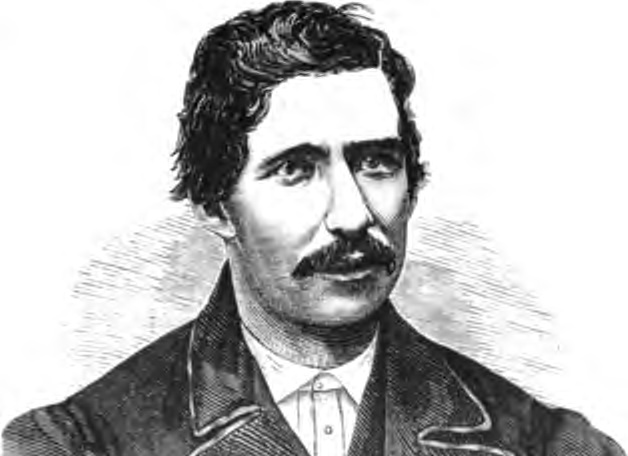
Patsy Conroy, leader of one of the East River’s most ruthless and ambitious gangs, terrorizing shipping vessels throughout New York Harbor.

___________________________________
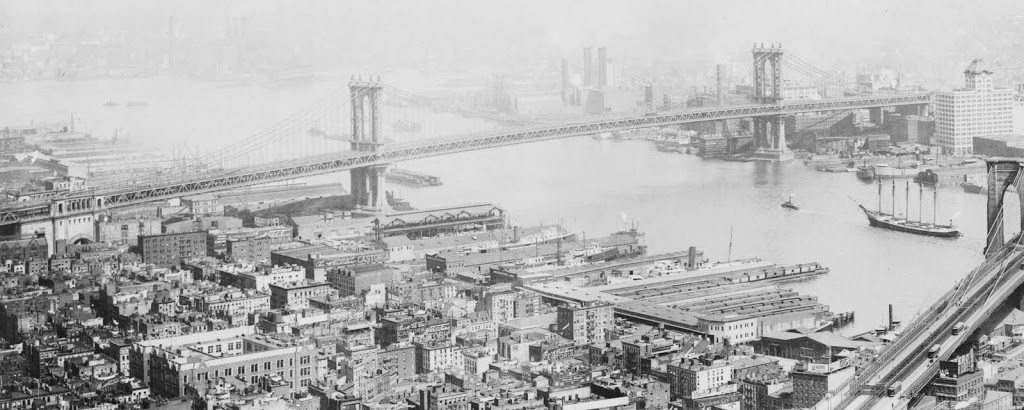
The shore between the Manhattan and Brooklyn bridges, early 20th century.

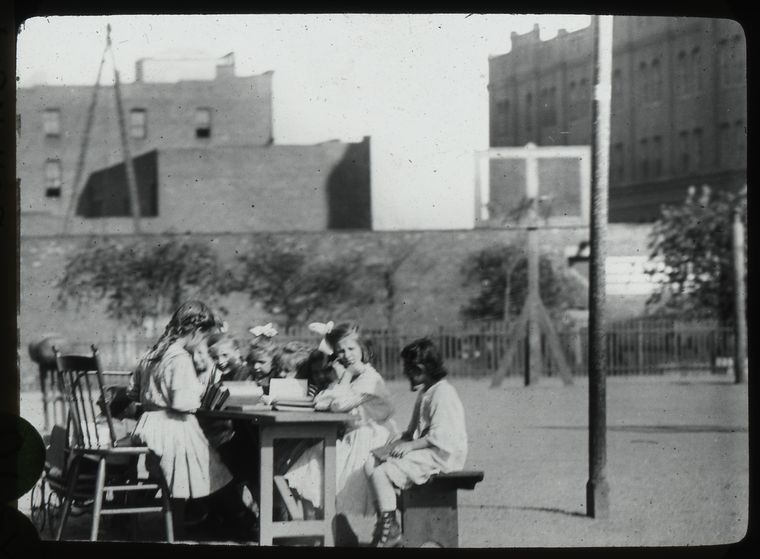
Corlears Hook Park was one of the first municipal parks, opening in 1905. This Lewis Wickes Hine photograph is from 1905 (courtesy of NYPL)

And finally, here’s a film from 1903 depicting the entire East River waterfront at that time. This is more lower Manhattan than Corlears Hook, but it should give you some idea of how clotted and bustling the shoreline was.

Categories
Podcasts

The Whyos: Gang of New York – PODCAST

Faces of the Whyo Gang: Googy Corcoran, Clops Connolly, Big Josh Hines and Baboon Connolly

PODCAST: The Whyos (pronounced Why-Ohs) were New York’s most notorious gang after the Civil War, organizing their criminal activities and terrorizing law abiding citizens of the Gilded Age. Find out when they lived, how they broke the law and who they were — from Googie Corcoran to Dandy Johnny, as well as two particularly notable guys named Danny.

ALSO: How much does it cost to have somebody’s ear bitten off?

Below: Bull Hurley and Dorsey Doyle

Categories
Uncategorized

Beware the Forty Thieves, very first gang of New York

Above: the crowded streets of Five Points, where the Forty Thieves first made mischief

What does it mean to be the ‘first’ gang in New York? Most likely, it means you weren’t really the first. Just the first to be caught at doing it.

New Yorkers seem to create a grim romanticism around 19th century gang life because the underworld they lived in seem increasingly more exotic. They were unofficial rulers of neighborhoods vastly changed today. Hell’s Kitchen. The Tenderloin. The sleazy Fourth Ward.

And of course Five Points, the centerpiece of the Sixth Ward. That’s where New York’s first recorded gang, the Forty Thieves, got their start, in the back room of the ‘grocery store’ owned by one Rosanna Peers.

No evidence remains of what Rosanna might have looked like, but gather together what you will from the evidence. Selling hard liquors along with “brown-streaked cabbages and tattered lettuce,” Rosanna’s establishment was ostensibly the first bar on Centre Street in 1825, and would certainly not be the last.

I wouldn’t exactly lionize her abilities, but you can’t say she wasn’t an entrepreneur of sorts. The cheapness of her “rutgot rum” attracted the most charming thugs and pickpockets in the city, and soon they formed a merry band of crooks, watching each other’s backs, delineating common territory, and sharing their ill-gotten wealth. The Forty Thieves — almost all Irish immigrants and almost certainly more than forty — would grow to terrorize the streets of downtown New York for over 25 years.

Their first leader was Edward Coleman who must have some certain gruff charm as he gathered up teams of dime criminals for more elaborate jobs, including staking out this corner of Five Points, defending it from rivals. His organization included a rather strict quota system, where members had to bring back a certain amount of stolen goods or be thrown out. Rejects were either disposed of or fled to join rival gangs that soon organized in other neighborhoods.

Coleman would lead until 1838, when he violently beat and killed his wife, a ‘hot corn’ girl who had brought back inadequate wages from a day’s work. This heinous crime earned Coleman the distinction of being the first man hung in the newly built Tombs prison, just a few blocks away.

The Forty Thieves lived on without him and were such a successful organization that they recruited younger delinquents for a specialized Forty Little Thieves, filthy tots from the street of Five Points dispatched like ruddy faced Oliver Twists to pick pockets and troll the streets for law enforcement.

They fade away into New York history, breaking off and joining other, more powerful and more politically connected gangs. They were only the seed of lawlessness in a neighborhood that would soon grant a wretched neighborhood its rather notorious status today.

As for Ms. Peer, she apparently felt no ambivalence about her clientele; another early Five Points gang, the Kerryonians, also used her rum-filled backroom as a headquarters. The Kerryonions, comprised specifically of Irish immigrant men from the county Kerry, were less terrifying than the Forty Thieves — unless you were British, whom they reserved a special hatred for.

FRIDAY NIGHT FEVER: Hole-In-The-Wall

To get you in the mood for the weekend, every Friday we’ll be celebrating ‘FRIDAY NIGHT FEVER’, featuring an old New York nightlife haunt, from the dance halls of 19th Century Bowery, to the massive warehouse spaces of the mid-90s. Past entries can be found HERE.

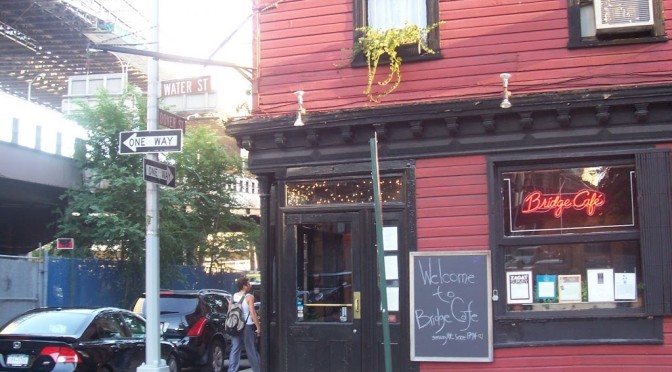
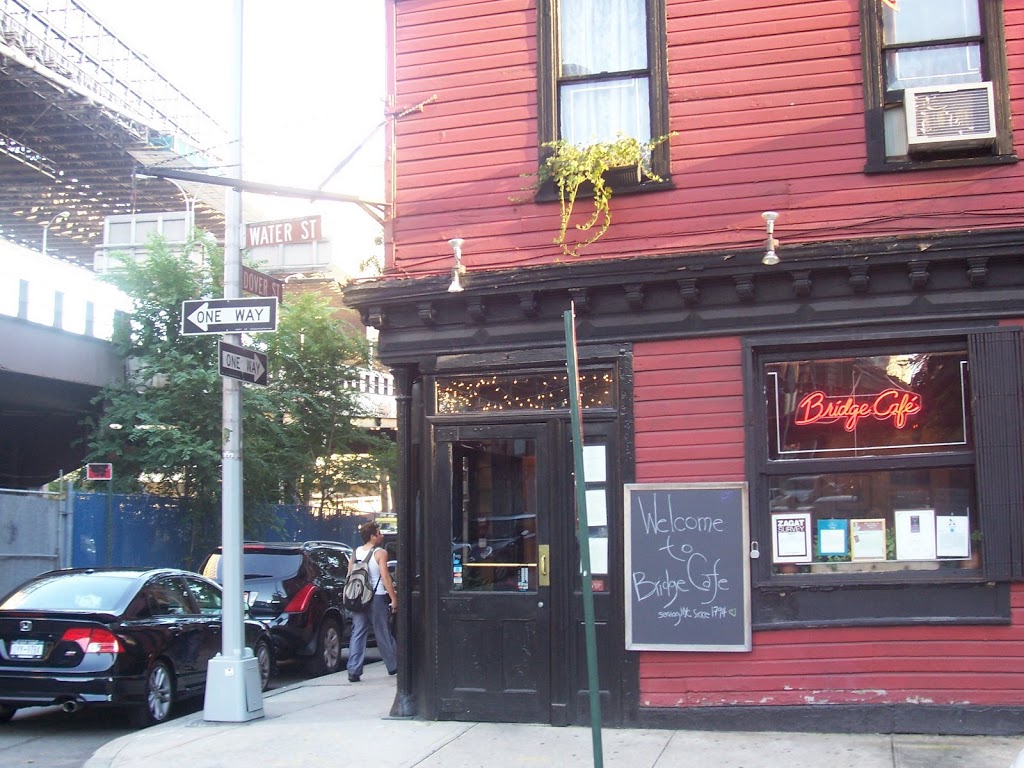
The Bridge Cafe, a quiet bar and brunch destination underneath the Brooklyn Bridge at the corner of Water and Dover streets, has a storied legacy as the oldest tavern in New York City. Although it does take a bit of imagination to envision the red wooden building as former home to the most despicable, most vile and — let’s face it — most fabulous characters in our fair city’s history.

The legend of the Hole In The Wall derives mostly from one place — Herbert Asbury’s infamous ‘Gangs of New York’, a dastardly inspection of New York’s 19th century criminal lowlifes and squalor. As such, given the books fanciful and exagerrated nature, you can’t exactly use it as faithful reference. When journalist Richard McDermott began doing research on the Bridge’s background, he didn’t even find the Hole In The Wall.

What he did discover was a tradition of booze swilling that began with a ‘wine and porter bottler’ in 1794. It was followed by a grocery — one that I guess technically sold liquor, thus keeping the ‘oldest tavern’ title precariously intact. But the date 1826 is most significant as the establishment fell into the hands of Charles G. Ferris, an attorney who leased the property to a host of saloons.

And there were patrons aplenty, for this was New York’s dangerous Fourth Ward; in particular, Water Street was festooned with brothels, boarding houses, dance halls and watering holes. In 1866, writer Bayard Taylor referred to it as “the only rival of the Sixth in its triple distinction of filth, poverty, and vice.” (The Sixth being the Five Points slum, about a half mile away.) ‘On The Town in New York’ by Michael Batterberry says, “Generally speaking, Water Street was a thoroughfare of vice and iniquity to challenge the imagination of the most graphic Victorian preacher.”

So although little evidence remains of a Hole In The Wall in the precise vicinity of the Bridge Cafe, it’s extremely likely such a place existed.

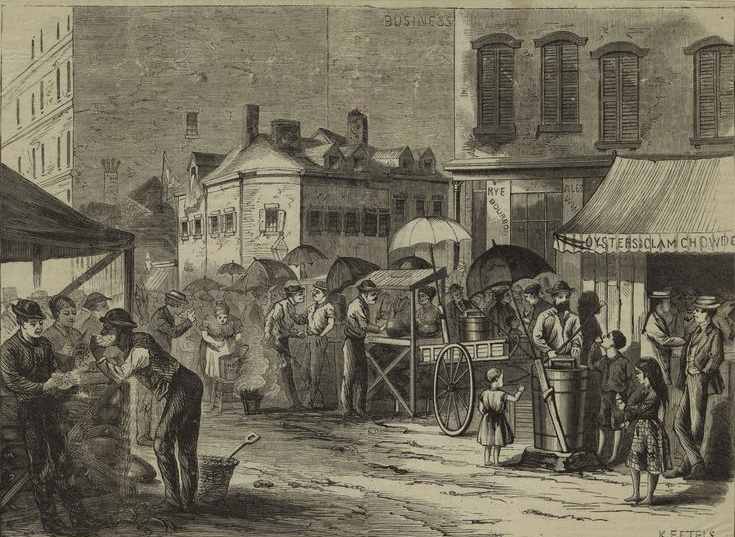
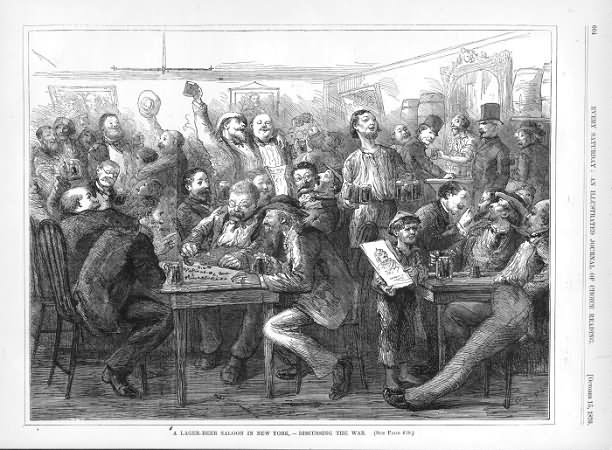
(The picture below is not of Hole In The Wall, or of any particular Water Street saloon, but a print of a New York ‘lager-beer saloon’ from 1870. Sorry, there aren’t a lot of photographic options from this period of time!)

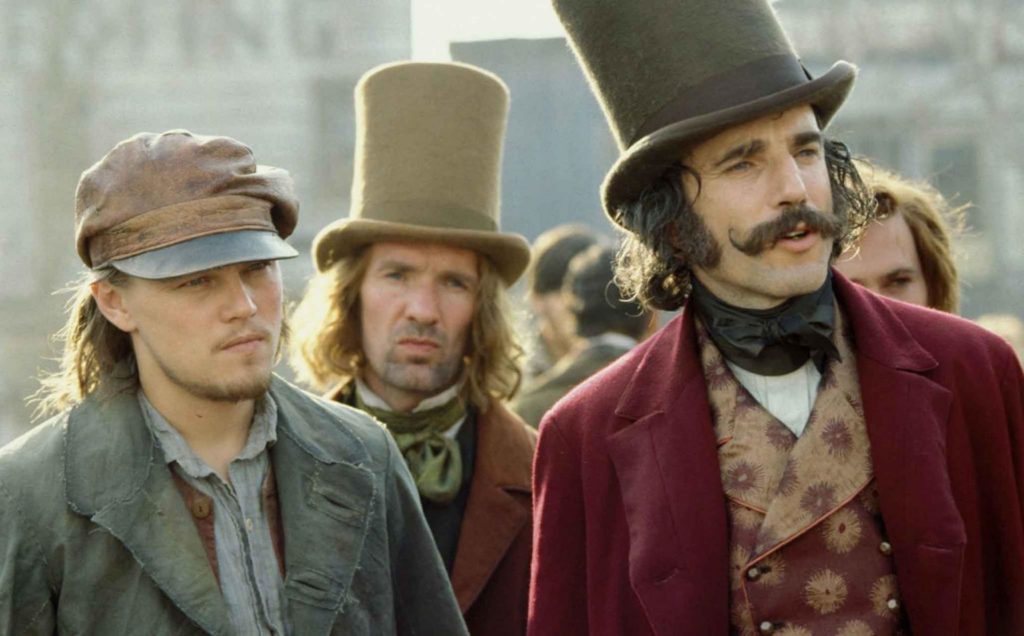
Few tavern staffs today could compare to those of Hole In The Wall’s proprietor ‘One-Armed’ Charley Monell. We’re assuming that sobriquet wasn’t just a cute nickname. For security, he relied on two lovely ladies by the names of Kate Flannery and scrappy Gallus Mag. No ordinary bouncer, Mag kept a pistol at her waist, a club at her side and for good measure sharpened her teeth like a rodent. This was not just a fashion statement; she would need such sharpened incisors for when she would bite off the ears of unruly patrons, spraying blood with delight as she deposited the ear into a gigantic jar behind the bar. (Mag is immortalized in the film version of ‘Gangs of New York’ as well as virtually tributed in every horror movie from ‘Texas Chainsaw Massacre’ onward.)

Gallus (a word for men’s suspenders, which she would frequently wear) wasn’t always so cruel. After chewing off the ear of a female rival named Patsy the Goat, she later gave the body part back after the two mended ways. It’s a plot right out of ‘Sex And The City’, I tells ya.

Sex, sinful dancing and swill — sometimes drank right out of the spout for a small price — were orders of the day on Water Street, as was murder. The most famous brawl in perhaps all of Water Street occurred here between two thugs named Patsy the Barber and Slobbery Jim, both probably teenagers or in their early 20s. They were members of the gang the Daybreak Boys (ahem, I’m sure they were no match for the Bowery Boys), responsible for dozens of deaths in downtown Manhattan in the 1850s.

One day, Patsy and Slobbery casually robbed and killed a German and threw him into the East River. Settling down at Hole In The Wall with their booty (all of twelve cents), the pair fought over the amount, with Jim thinking he deserved more as he did single-handedly throw him into the river. 

Soon the boys were brawling, Mag and Charley stepping back to watch it play out. Patsy had a knife and stuck it into Jim; the knife changed hands and was soon lodged into Patsy’s throat. Patsy passed out from blood loss, and Jim finished the performance by stomping into his partner until he expired. Ten years later Slobbery would enlist in the Confederate Army.

According to Asbury, the Hole In The Wall was permanently closed after a string of seven murders were committed there in less than two months. However, if Bridge Cafe is indeed the former home of Hole In The Wall, it clearly didn’t stay closed for long. It passed through the hands of several saloon owners, including a city alderman Jeremiah J. Cronin in 1898. Even Prohibition couldn’t dry it out; a restaurant in the ’20s served beer on the down low from bootlegger Charlie Brennan.

The current incarnation opened in 1979 and was a favorite of former mayor Ed Koch. Today you can have a good brunch there and just stare down at the floor, picturing Patsy the Barber, pools of blood and a few loose ears lying around.