Categories
Planes Trains and Automobiles

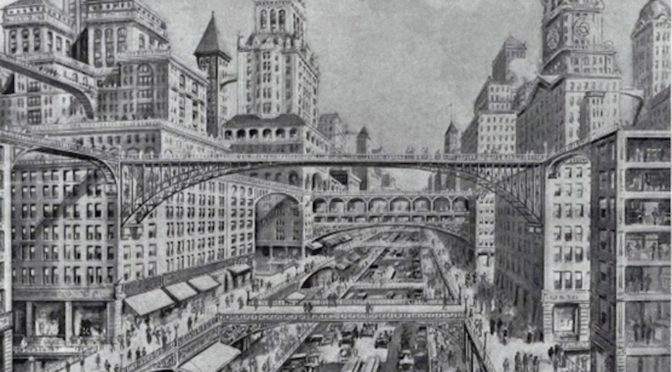
A city of bridges: One century ago, Scientific American predicted a future of elevated sidewalks

sci

Imagine a city where the High Line isn’t just a novel park, but the primary form of urban conveyance.

In 1913, with the proliferation of the automobile, it seemed humans were being crowded out at ground level.  People were beginning to think of themselves as removed from the street.  Daredevils were experimenting with flight, and small, single-man crafts began appearing over the skies of Manhattan.  The world’s tallest building, the Woolworth Building, had been completed a few months before.  Perhaps the streets themselves could elevate, granting pedestrians a space of their own?

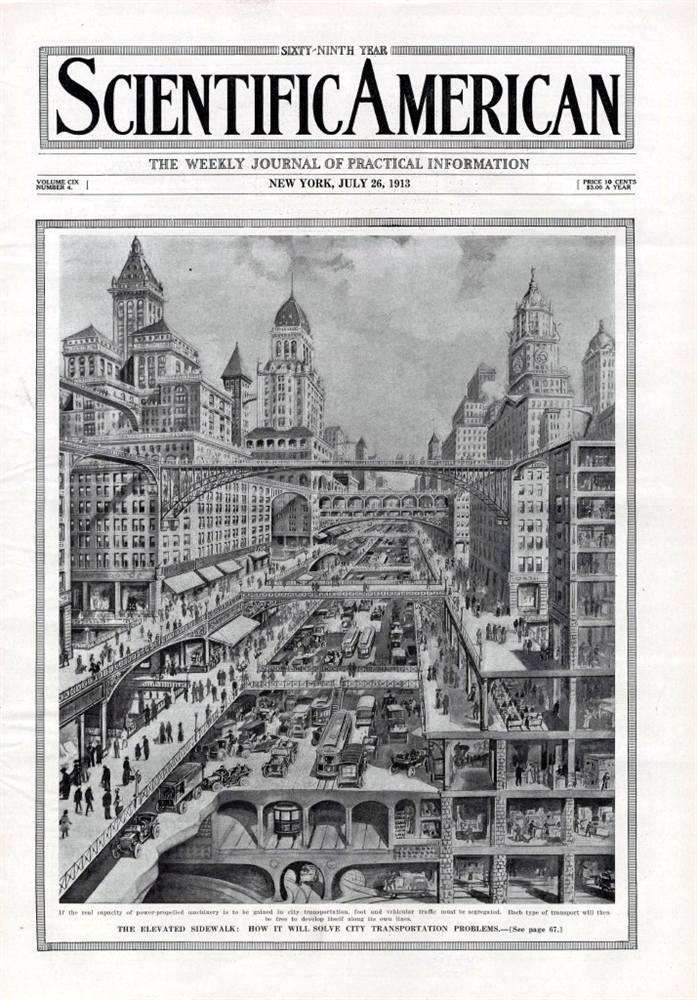
Scientific American suggested the possibilities of a city of elevated layers in its July 26, 1913 issue. “The Elevated Sidewalk: How It Will Solve City Transportation Problems,” written by engineer and science writer Henry Harrison Suplee, posits that humans and automobiles are simply incompatible and opposing engines upon ground level, and that one will have to give way to the other.

“One of the greatest impediments to city transport today is the continuance of the obsolete method of attempting to conduct foot and vehicular traffic upon the same highways.”

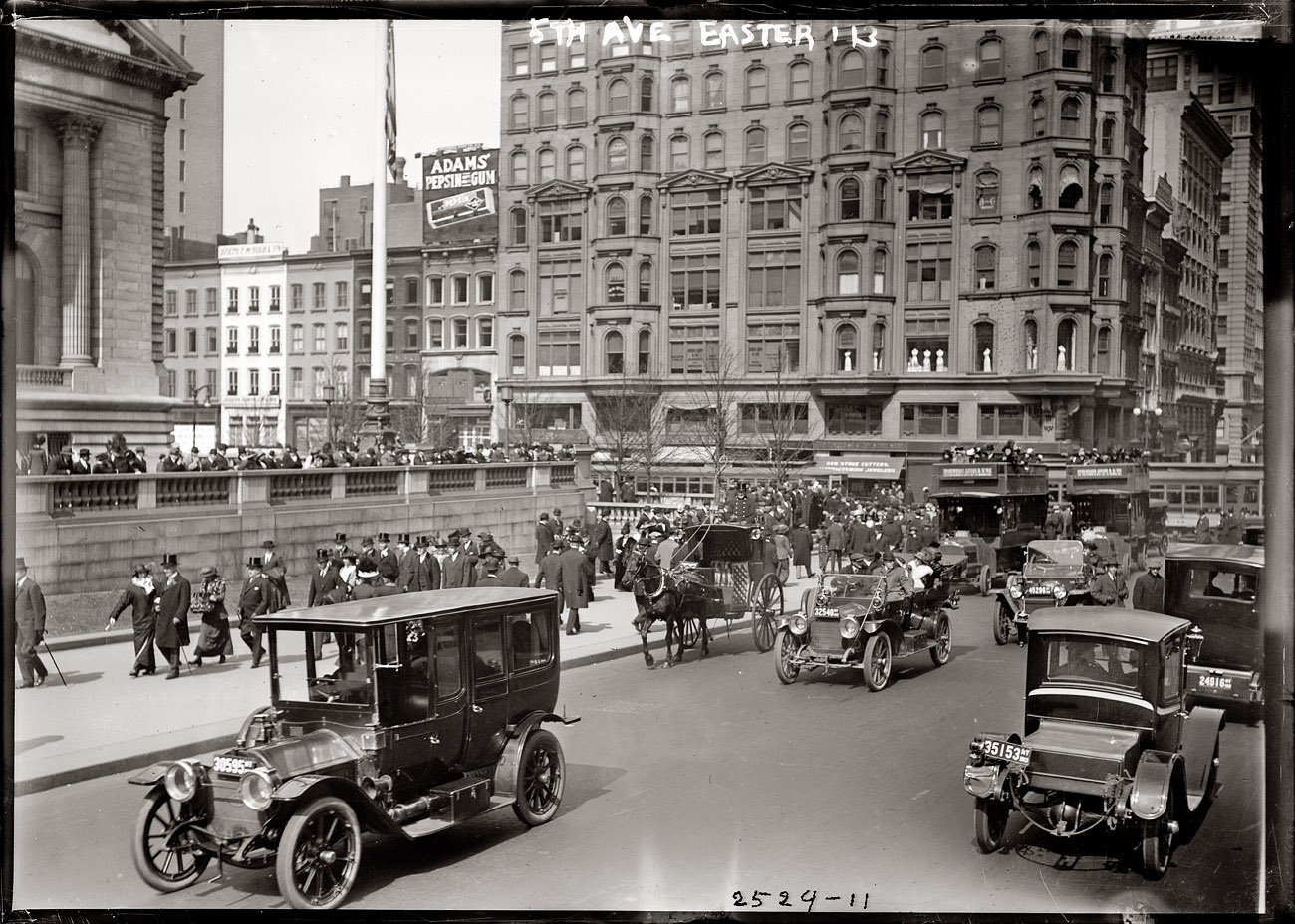
Below: Cars and people seem to co-exist peacefully on Fifth Avenue (pictured here in 1913). But, darn it, automobiles are meant to go fast! 

Courtesy Shorpy
Courtesy Shorpy

After all, cars are meant to go fast.  “In nearly every large city today there appears a tendency to enforce traffic regulations intended to permit the most conflicting elements to be operated together and the result is naturally the impeding of the very traffic which it is desired to help.”

By keeping people and automobiles on the same plane, one risks lives, sure, but more importantly, it slows progress by keeping the potential of auto motion on a short leash.

Suplee’s solution: “Take the foot passengers off the surface of the street entirely, and leave the highways solely for vehicles!”

Below: Evidence of the incompatibility of foot and automobile was being amply displayed all over New York City, most notably on “Death Avenue,” the trecherous tangle of roads on Manhattan’s West Side. Eventually the elevated freight railroad today known as the High Line was built to relieve this issue.
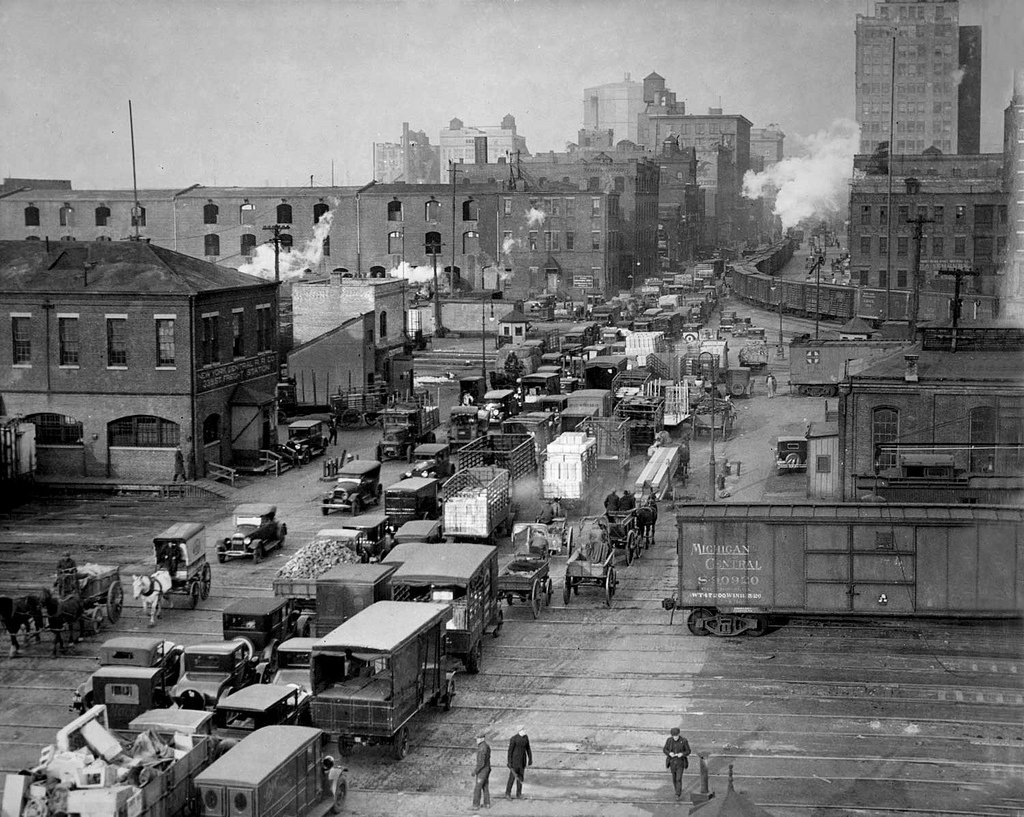
death-ave-thehighline-org


New York had many precedents for this.  The great passages over the East River (the Brooklyn, the Williamsburg and Manhattan bridges) had all been completed with elevated pathways for pedestrians, situated over or alongside those paths for vehicular traffic.  Trains were either elevated overhead along the avenues, or buried underneath the ground.

Suplee doesn’t imagine a world were pedestrians become smarter, or any type of place with sophisticated traffic lights or crosswalks.  Instead, elevated sidewalks would hover over the major thoroughfares; “[S]uch sidewalks might be built on Broadway from the Battery to Union Square, there sloping down to the surface level until further extensions were required,” he writes.

In a city of skyscrapers, bridges could be constructed several stories above the street.  Store fronts would appear on the second or third floors, while the ground floor would be exclusively used for delivery and store.  Life would essentially reside many feet above the ground.

Bicycles figure nowhere in his model, but he does carve out one exception to his pedestrian only level.  “The power vehicles should be kept absolutely to the surface, and there given unrestricted facilities for speed, weight, and numbers; and the foot levels maintained for absolute freedom for pedestrians, with the possible exception of carriages for small children.”

As commenter Boris mentions below, while New York City never adhered to this suggestion, other cities certain did — to a certain extent.

You can read Mr. Suplee’s article here.

(A shorter version of this blog post originally ran June 2013)
Categories
Wartime New York

The Women’s Peace Parade, a moody anti-war protest in 1914

Give Peace A Chance: Women take to the streets in a stunning parade of mourning

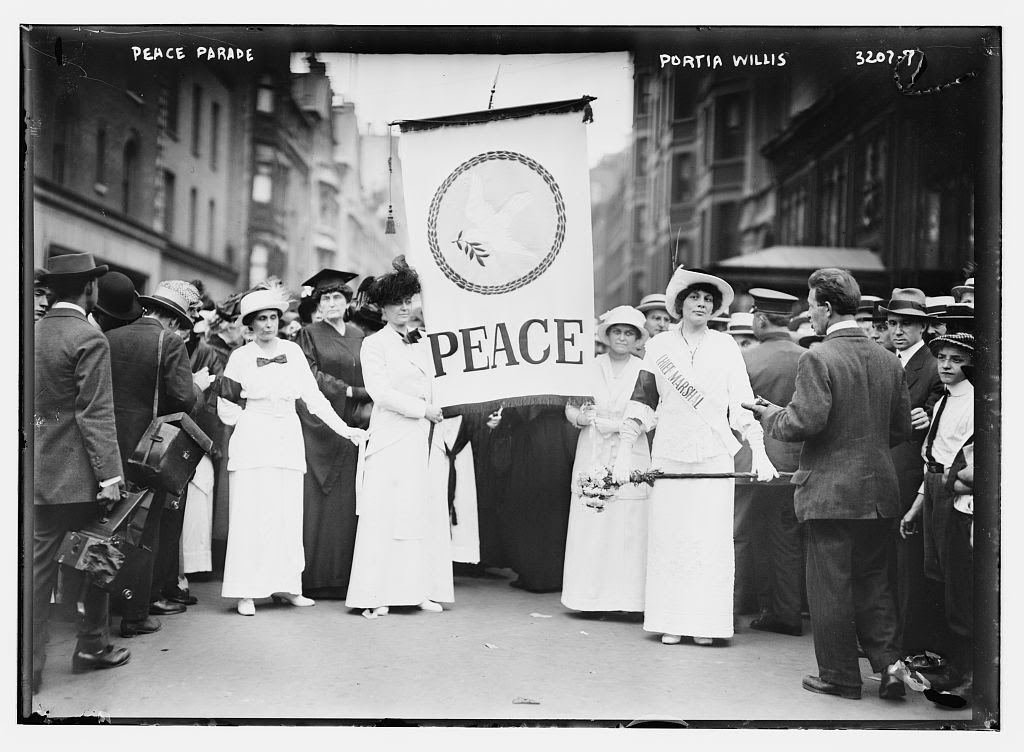
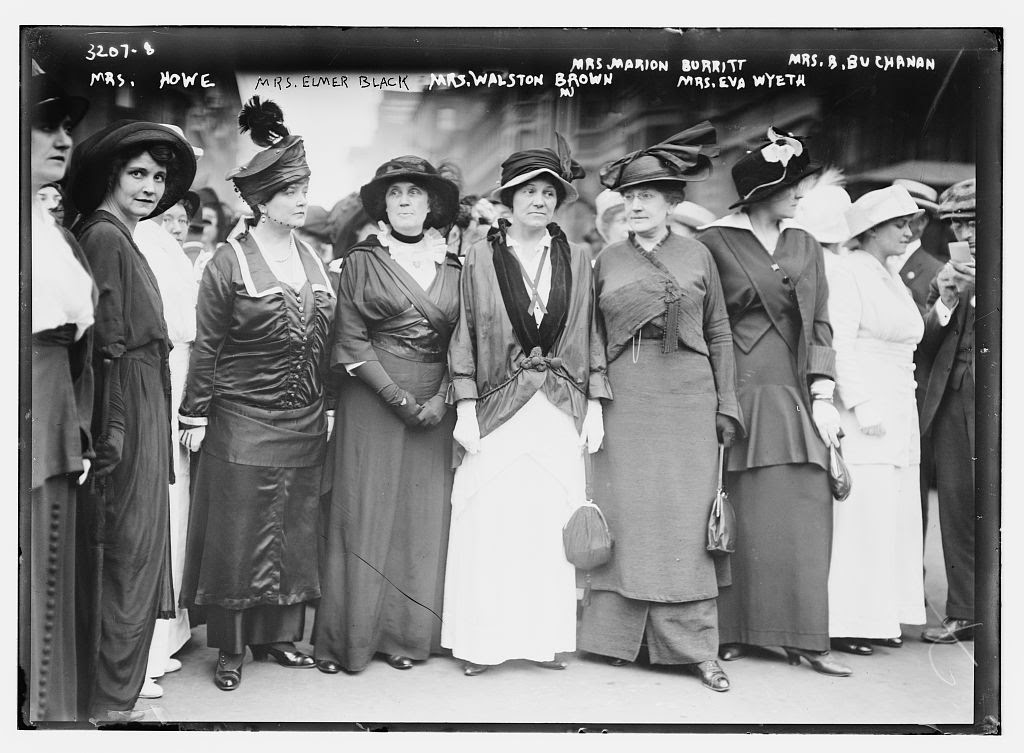
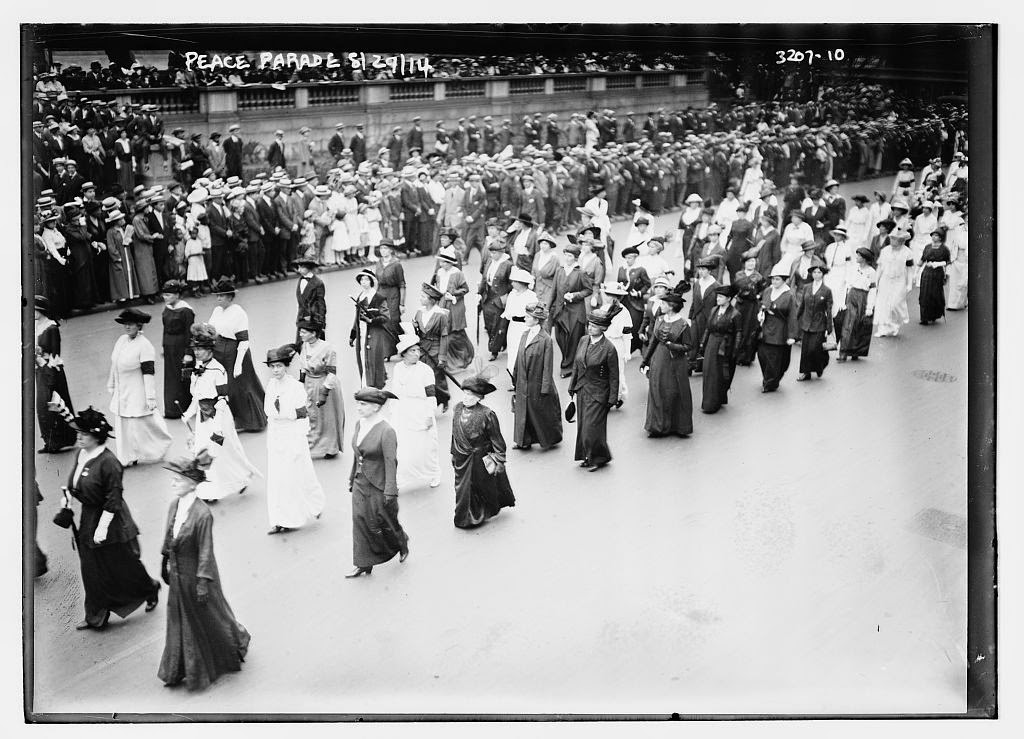
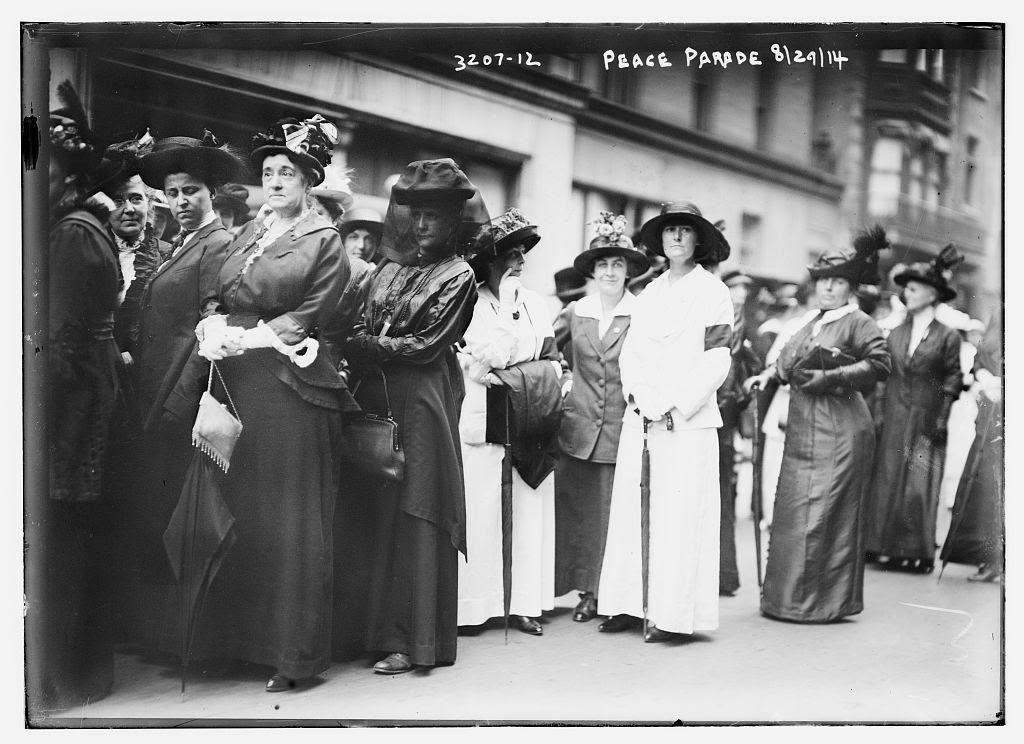
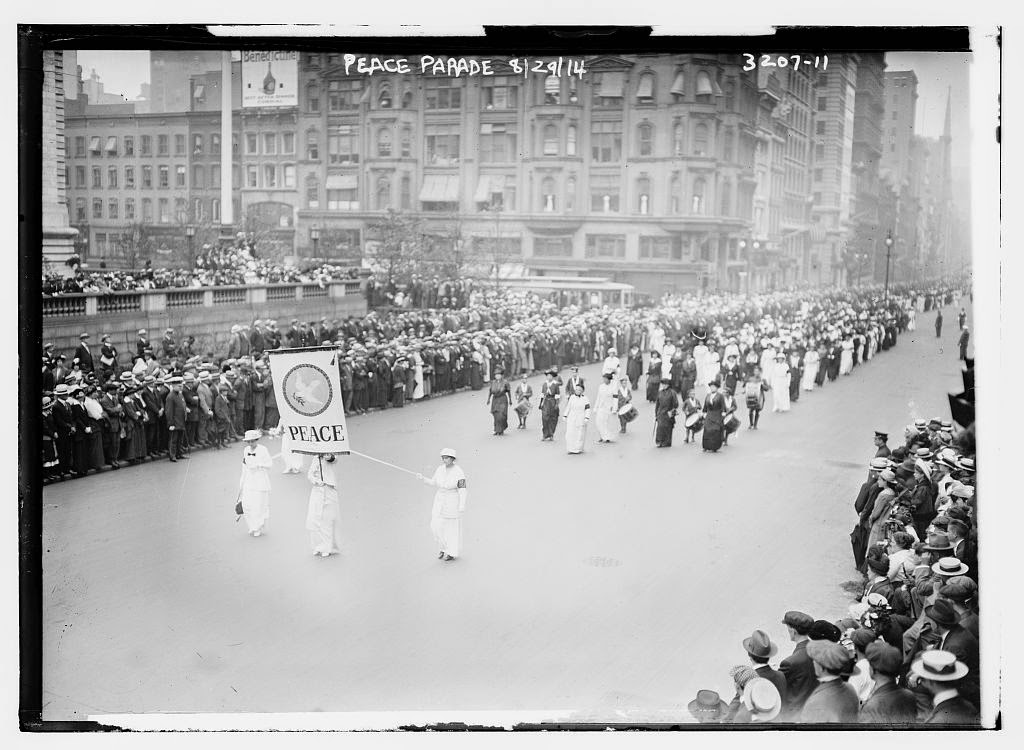
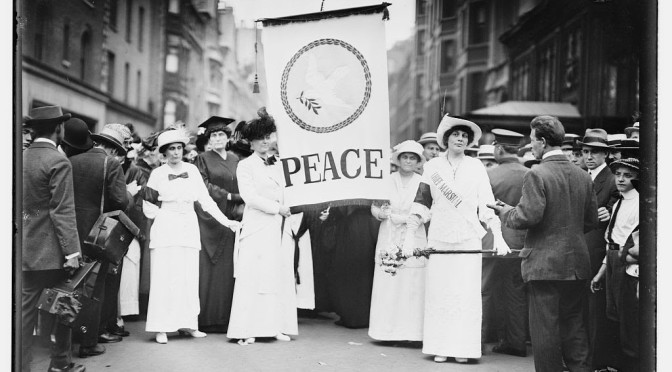
Below are some pictures of what’s possibly New York City’s first anti-war protest organized by women, on August 29, 1914.

War had erupted that summer in Europe, sparked by the assassination of Archduke Franz Ferdinand in late June and unfurling into a continent-wide catastrophe, as countries entered the fray on either side of the conflict.  Within weeks of the conflict, New Yorkers with strong ties to individual nations were raising money and even boarding ships to fight alongside their distant countrymen.

In other cities with sizable European populations — such as Montreal — people were already marching, calling for an end to the conflict.  And leading this call were women already involved in social organizations, in particular, suffragists with networks that reached into high society.

Protesting war has been a touchy issue in New York City. [See the Civil War Draft Riots for such a protest gone wrong.]  The mayor had expressly forbade parades in support of individual nations on New York streets lest a microscopic version of the European conflict erupt here.  Anti-war was often associated with socialist organizations and indeed, that August, several did march in Union Square.  But these were comprised largely of men.

Which makes the Women’s Peace Parade so unusual.  Prominent women met at the Hotel McAlpin in mid-August to plan what was essentially a mourning parade, with its participants — from all walks of life — dressed in black as though in a funeral procession. (As you can see in the pictures, many women also chose to wear white in a symbol of peacetime, garnished with black accessories.)
Many people didn’t quite understand what a peace protest even meant, seeing it as a wasted effort. One letter writer to the New York Times asked. “Will any of the women who intend to parade in protest of the war explain what they mean to accomplish by such a demonstration?”

While the parade drew from prominent individuals in the suffrage movement, others were simply not convinced.  Carrie Chapman Catt, one of America’s most famous suffragists, remarked, “If anybody thinks that a thousand, or a million, women marching through New York or talking about peace in the abstract will have any effect on the situation in Europe, it is because they don’t know the situation in Europe.”

But, in fact, there was a motivation.  One of New York’s leading activists Harriet Stanton Blanch — daughter of Elizabeth Cady Stanton — was very succinct about their motivation. “This is a movement for actual work. We intend to do something definite. We wish to have a meeting at The Hague Peace Conference called.”

The parade began in the afternoon, marching down Fifth Avenue from 58th Street down to Union Square. Women who either lived or shopped along the avenue now marched in formal procession down it, accompanied by the “ominous beat of muffled drums.”  There was occasional applause but otherwise “the general silence of the great gathering was considered the best evidence of understanding.” [source]

Among the marchers were Lillian Wald and the nurses of Henry Street Settlement.
The skies were appropriately gray.  Some participants hoped for rain actually.  “Every woman in the slow-moving line wore some badge of mourning, either a band of black around her sleeve or a bit of crepe fluttering at her breast, as a token of the black death which is hovering over the European battlefields.” [source]

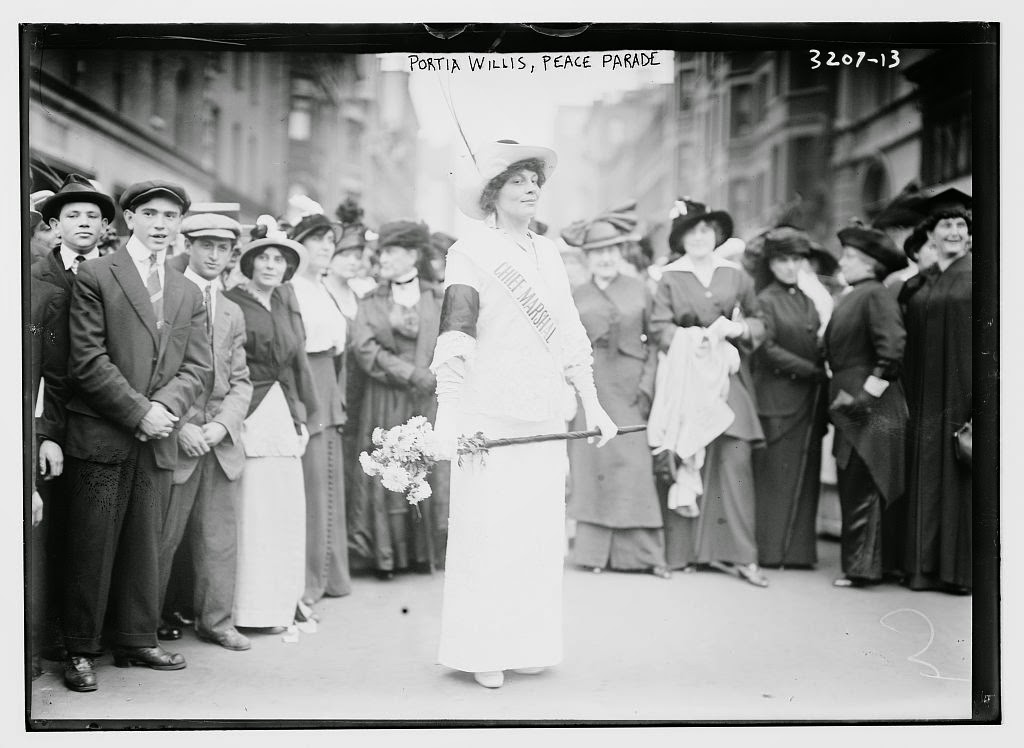
The parade marshal was the young Portia Willis, a magnetic lecturer on the suffragist circuit. .

While the organizers announced there was to be only one flag on display in the parade — the flag for peace — one other crept into the proceedings.  “The smallest Boy Scout was Alfred Greenwald, 4 years old, who … attracted much attention.  Little Alfred unknowingly broke the most stringent rule of the parade by carrying a flag.  He carried a United States flag but it was furled.” [source]

Unfortunately I was not able to locate any pictures of the second half of the parade — with 250 African-American women in solidarity, followed by “a number of Indian and Chinese women” and carloads of elderly women and babies.

Those who witnessed the parade would not soon forget it, especially in the following months as the conflict that would become known as World War I grew to eventually encompass the United States.

Categories
True Crime

That rascal Daniel Sickles, the beloved politician and veteran who killed the son of Francis Scott Key

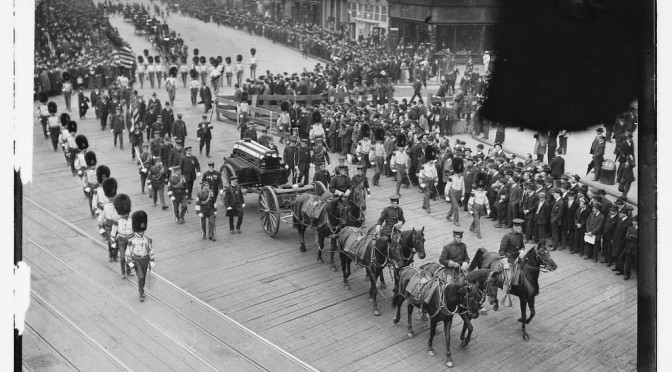
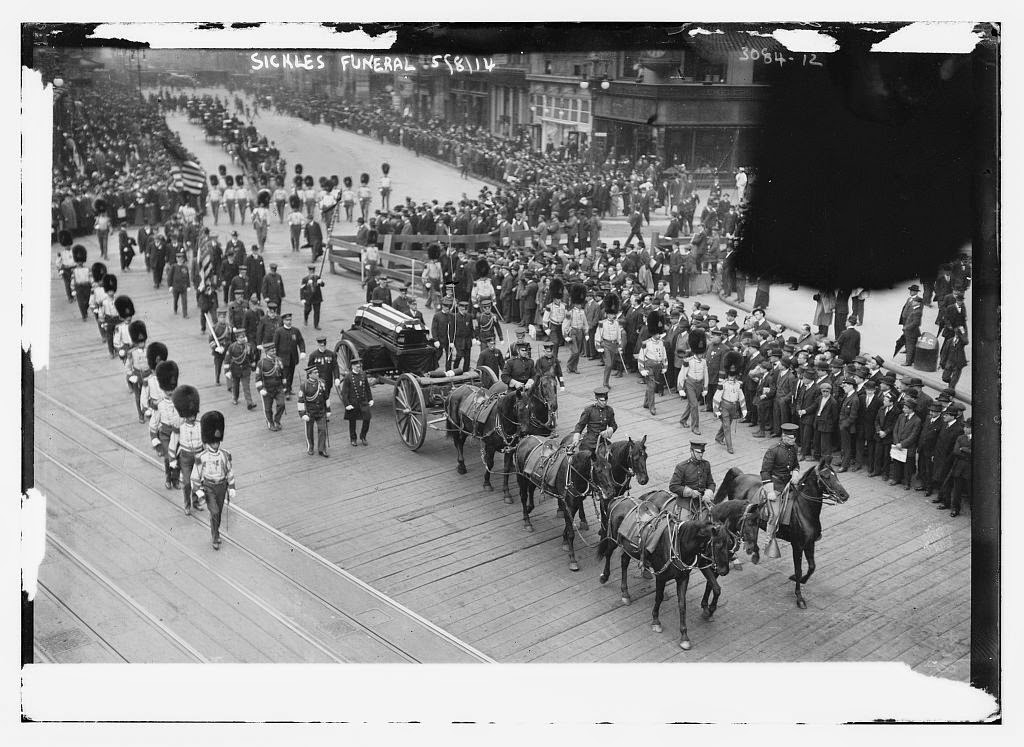
We don’t have large, parade-like funeral processions marching up the avenues as they once did during the Gilded Age and in the early years of the 20th century.

These events were times of public mourning and a bit of festivity.  Most often they involved the passing of a well-connected political leader or a popular entertainers.  They were somber and reverent affairs; afterwards the saloons along the side streets benefited graciously, tributes and toasts into all hours of the night.

1914

One hundred years ago today, on May 8, 1914, New Yorkers filled the streets — from Fifth Avenue up to St. Patrick’s Cathedral — to mourn the passing of Daniel E. Sickles, one of the city’s most heralded war veterans.

Having marshaled up volunteers in New York in the early days of the Civil War, Sickles distinguished himself as a bold and commanding general, gathering military promotions through sheer ambition. (He was one of the few commanders in Abraham Lincoln’s army without a West Point education.)

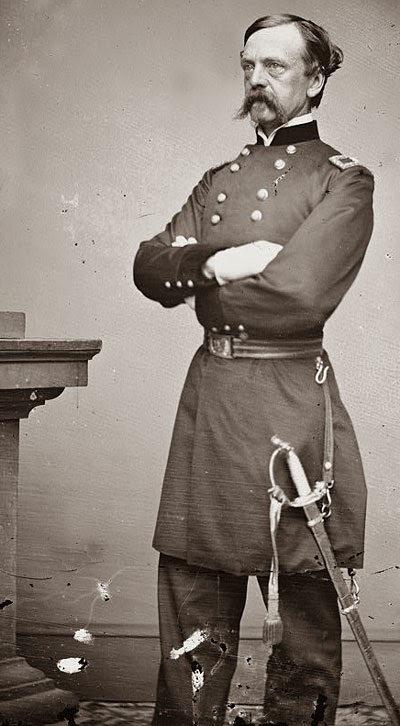
During the Battle of Gettysburg, Sickles was severely injured and had his right leg amputated. (At right: Sickles posing for Matthew Brady, clearly before the events of Gettysburg.)

He spent his years after the war polishing his war credentials and maneuvering from one political appointment to another.  Sickles belatedly received the Medal of Honor and, situated from his home at 23 Fifth Avenue, was acclaimed in later life in one of New York’s greatest living veterans.

Sickles’ military career, however, was built as an exercise in reputation rehabilitation.  When the war with the South arrived, he saw an opportunity to change the conversation about himself.  His bravery in service to the Union, never questioned, served a dual purpose for Sickles.  Today we might call this “re-branding.”

For in the years preceding the Civil War, the young politician was also known as a cold-blooded murderer who held a unique distinction in the history of legal proceedings.

1859
In April of 1859, New York Congressman Daniel Sickles became the first person in history to ever be acquitted of a crime due to temporary insanity.

The crime in this case was the February murder of Philip Barton Key II, the son of Francis Scott Key, author of “The Star-Spangled Banner,” the national anthem of the United States.

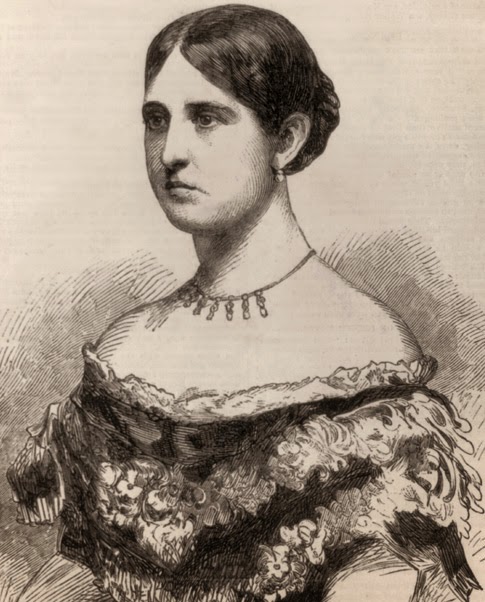
Their lives almost resemble an episode of House of Cards.  Key had been having a very open affair with Sickles’ wife Teresa. (Pictured at right)

Daniel, however, was something of an epic rake himself.  With no thought to his own or his wife’s reputation, Sickles was once passionately obsessed with the New York prostitute Fanny White, going so far as to take her into the Albany assembly chamber for a tour.  There were even rumors that some of Sickles’ campaign election costs were covered by White.

But Key was hardly a wallflower; the famous son was a charming widower who bewitched the women of Washington DC with his intelligence, elegance and wealth.  He and Teresa met in 1857 and began their affair soon after, meeting often once a day and openly flirting with each other at a society balls.

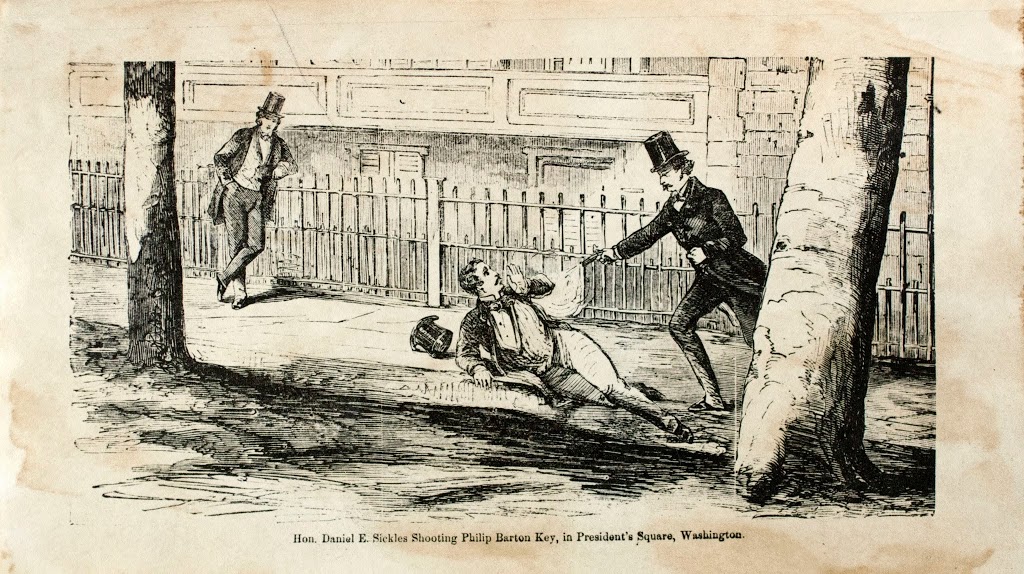
When Sickles did finally discover the affair, he was distraught and sickened, before turning violently angry.  On February 27, 1859, Sickles approached Key in DC’s Lafayette Squarea short distance from the White House — and shot him in the groin.

“You villain, you have dishonored my house, and you must die!” Sickles reportedly said.

He shot Key again in the chest and would have shot him directly in the head had the gun not misfired.

Said the New York Times the following day, “The vulgar monotony of partisan passions and political squabbles has been terribly broken in upon to-day by an outburst of personal revenge, which has filled the city with horror and consternation.”

Above: An illustration of the Sickles trial, courtesy Library of Congress

The condition of Sickles’ mental state during and following the murder would be closely dissected in court. A colorful swath of testimony described Sickle as everything from disturbingly serene to a raging lunatic.

According to authors Michael Lief and H. Mitchell Caldwell, “These conflicting stories may be exaggerations on the part of creative witnesses, or they may be evidence that Sickles was driven to the edge, past the breaking point, entirely out of his mind.”

One of the lawyers who helped craft the insanity defense was Edward M. Stanton, later to be Abraham Lincoln’s Secretary of War.  Their defense of temporary insanity — never successfully tried in a U.S. court — was sprung upon the jury, nested within an extravagant bed of prose, classical quotations and moral quandary.

“It is folly to punish a man for what he cannot help doing?” asked associate defense attorney John Graham.  Apparently so, it seems, for in April, a jury acquitted Sickles, taken with the plight of a man wronged by his unfaithful and deceitful wife. (His attorneys did a spectacular job of burying Sickle’s own unfaithfulness and deceit.)

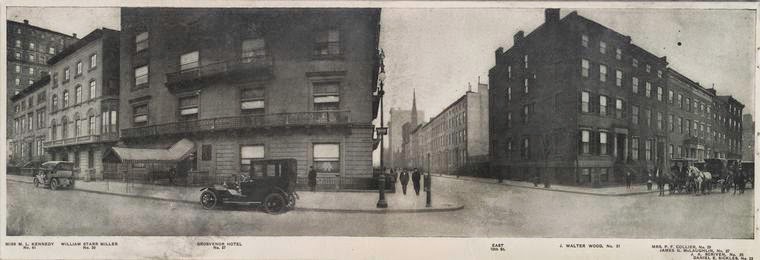
At left: 23 Fifth Avenue, the home of Daniel Sickles and the location of his death on May 5th, 1914

1914
Fifty-five years later, Sickles’ many legitimate accomplishments (and, let’s be honest, his relentless self-promotion) assured that this unusual crime was rendered a footnote when he died on May 5.

His New York Times obituary is an extraordinary bit of word play:  “Philip Barton Key … paid attention to Mrs. Sickles, and Sickles shot and killed Key on the street in Washington D.C. on February 27, 1859.”

The focus then turns on Sickles’ “gracious” forgiveness of his wife: “I am not aware of any statute or code of morals,” said Sickles to his critics, “which makes it infamous to forgive a woman….I shall strive to prove to all that an erring wife and mother may be forgiven and redeemed.”

In reality, the two never reconciled.  Teresa died in 1867 at age 31, her reputation destroyed.  A few years later, Sickles became the ambassador to Spain, returned to his legendary womanizing and eventually married a well-connected daughter of a Spanish official.

He spent his final years at his Fifth Avenue home nearly bankrupt, his only means of support coming from his children and his now-estranged second wife.  “[S]everal attempts were made to seize the art treasures  in his Fifth Avenue home because of debt,” noted the Times.

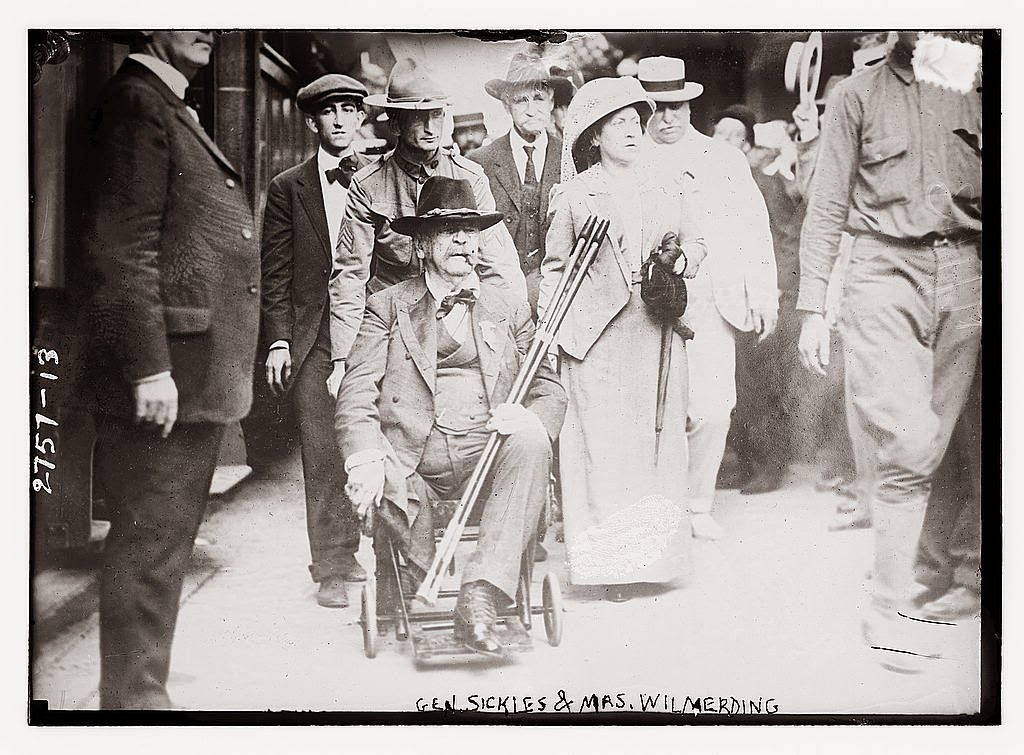
Below: Daniel Sickles at a 1913 Gettysburg reunion, accompanied by his live-in secretary Eleanora Wilmerdirg


Categories
Museums

The Metropolitan Museum of Art, when it was smaller

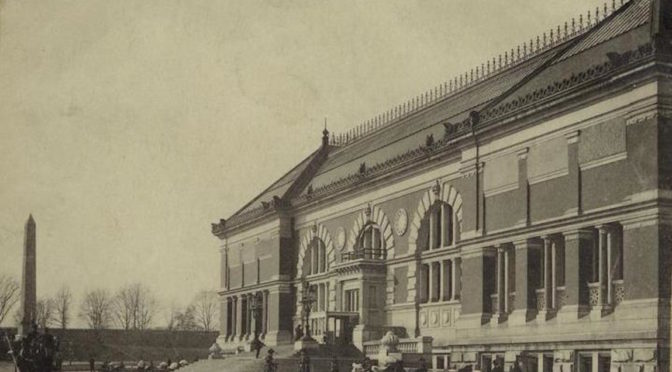
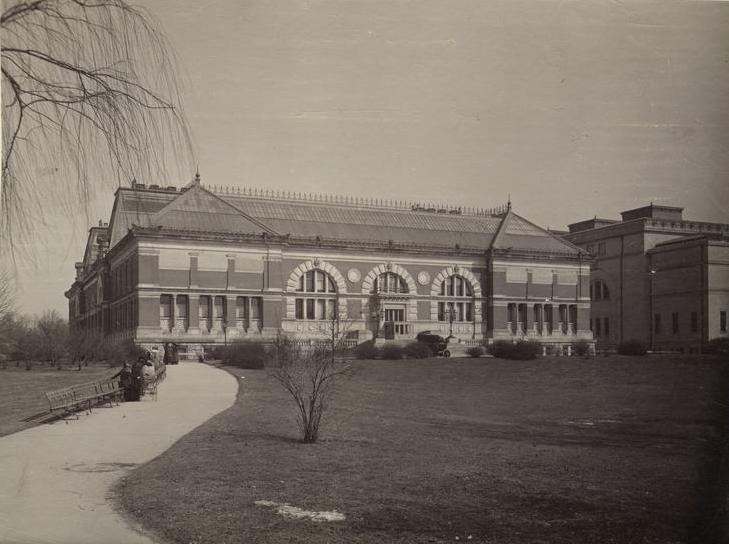
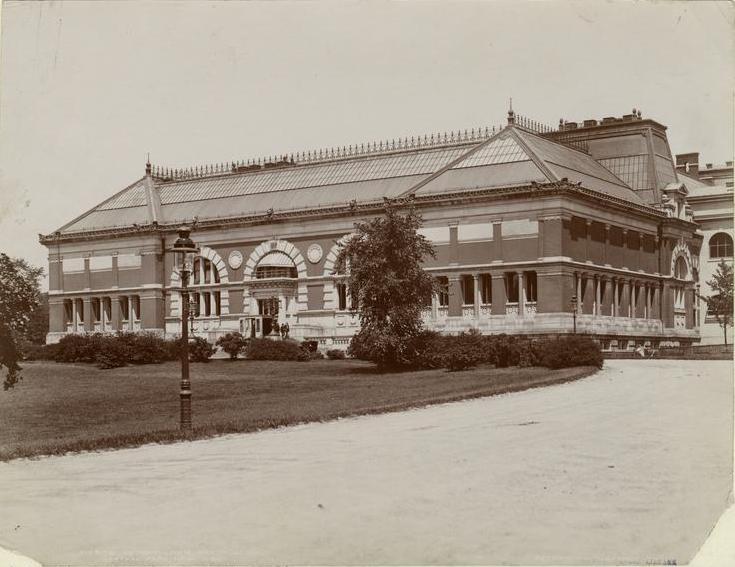
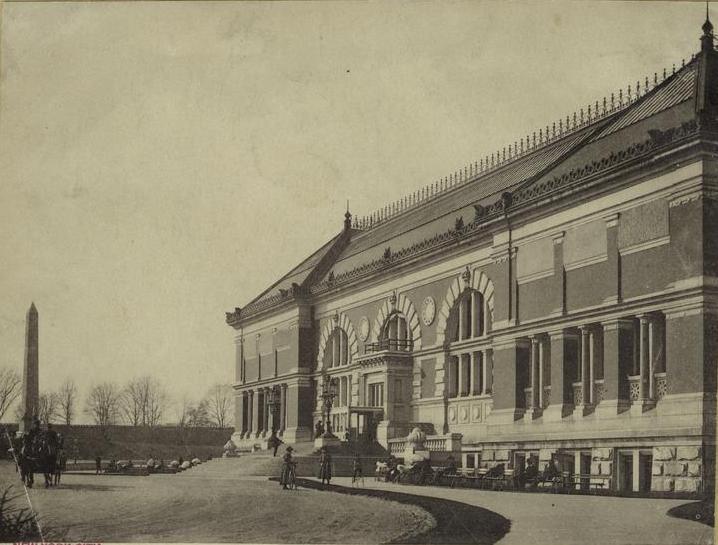
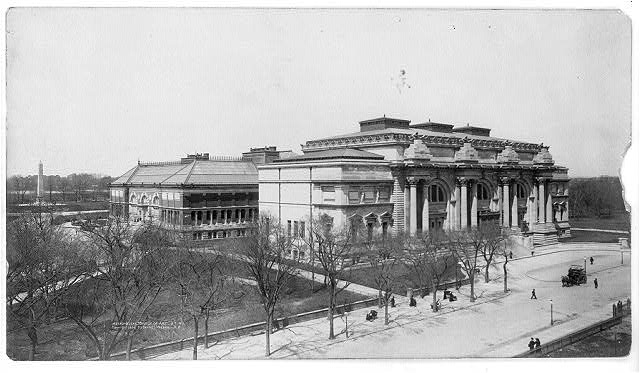
I’m working on a very art-themed podcast which should be ready for release this Friday.  The Metropolitan Museum of Art will be a supporting player in this week’s show, so please enjoy these early photos of the original building, opened in 1880 and designed by Calvert Vaux (to better accentuate his park) and Jacob Wray Mould, of Belvedere Castle fame.

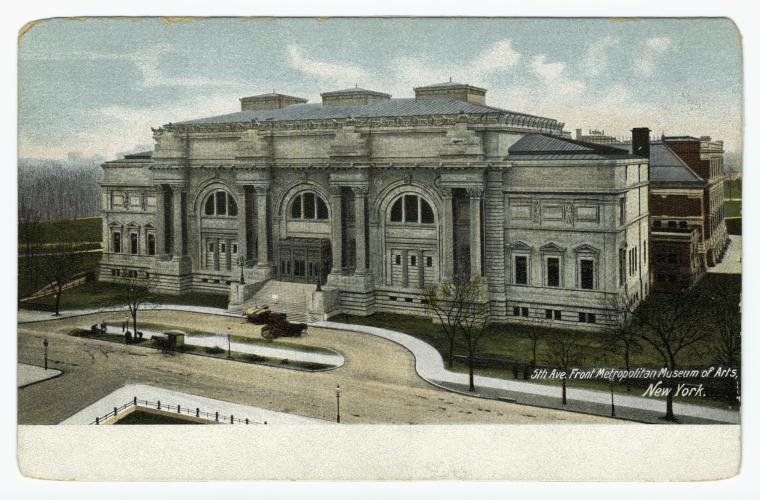
The building was considered out-of-fashion almost as soon as it was finished, and within a couple decades Richard Morris Hunt had created the museum’s more expansive Beaux-Arts facade and wings. What you see here is the old building, next to the new facade, before it was fully consumed by additions.

The postcard and the photo below it gives you a good idea of where the new additions sat in relation to the old building. And this is before the wings were added.

The top four images are courtesy New York Public Library. The last is courtesy Library of Congress.

Categories
Uncategorized

The New York monkey fad of 1907: From Fifth Avenue to the fire department, primates were fashionable companions

The wacky IKEA monkey story of the past few days got me to wondering about wild animals as pets here in New York. After all, the wealthiest classes collected all sorts of unusual beasts for their amusement during the 19th century.  So many in fact that the Central Park Zoo — or Menagerie, as it was called then — was created as a repository for all those unusual creatures abandoned by their owners. (The Central Park Zoo was the topic of one of our first podcasts, all the way back in August 2007!)

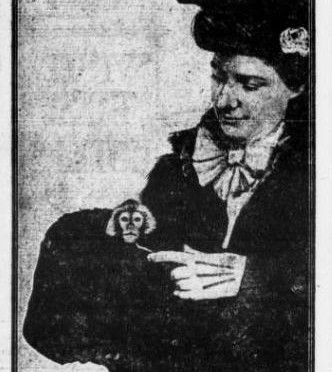
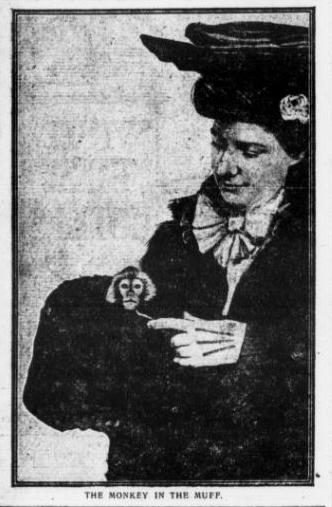
A bizarre New York Sun article from March 1907 found an interesting correlation between elegant women and their companion monkeys.  They were such hot commodities with finer New York ladies that year that the animals were almost considered luxuries.

Monkeys rode snugly amid the elegant furs and finery of a modern woman.  “Out of ermine muffs, carried by smartly dressed women along Fifth Avenue, hideous grinning little faces peep out of you.”  The best examples of woman-monkey companionship were the talk of the town;  one New York lady had her monkey trained to “manicure himself, don the right clothes at the right hour, eat daintily with his fork, pretend to smoke his after dinner cigarette and go to bed in a little iron bedstead.”

At right: From the 1907 Sun article, a lady with her pet monkey (courtesy LOC)

“It is impossible to import enough monkeys to fill the present demand,” one animal importer told the Sun.  “An installment of marmosets or ringtails no sooner reaches port than they are shipped to women all over the country.”

It was an unorthodox but very charismatic choice, popular with actresses, princesses and rich ladies of a certain progressive bent.  The pet monkey was prepared to do the unthinkable in 1907 — replace the yapping dog as the woman’s preferred companion.  “To those who do not like monkeys, the popularity of the beast seems more objectionable than any other recent fad. The horse fad, the dog fad, the cat fad, the automobile fad, the ping pong fad, the bridge fad, the chameleon fad are more excusable to such people.”

The popularity of the pet monkey, once associated with immigrant organ grinders on the streets of Five Points in the late 19th century, arose from increased scholarship on the animal, from stories of African safaris, and from seeing them in action at the House of Primates in the Bronx Zoo.

The animals were brought over on trading ships, basketfuls scooped up off the coasts of South America or even as far away as South Africa. (A boatload of 1,000 monkeys arrived in New York in 1909, a cargo which also included hundreds of exotic birds and a couple dozen pythons.)  If they survived, they were given to importers throughout the city or sometimes sold right of the dock.

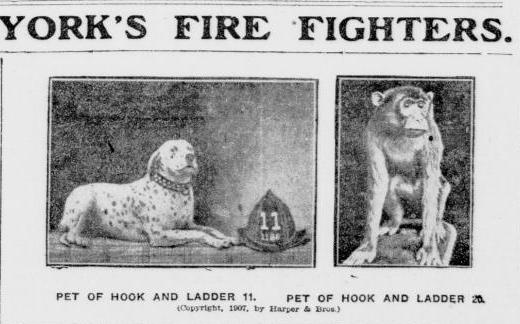
Monkeys even found themselves in the service of New York area fire departments. In 1907, a Mercer Street crew enjoyed the alertness of a monkey named Jenny (pictured below), who once warned her fellow firefighters of a blaze by tossing pool balls down an iron stairway.

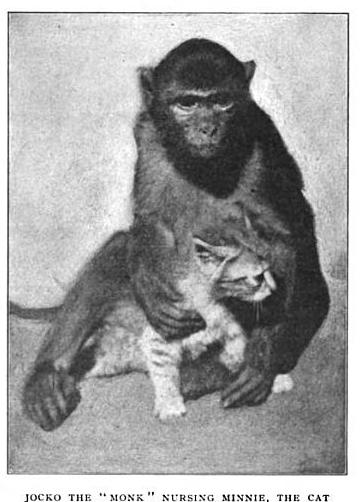
And a fire crew in Rockaway Beach was well-known for their monkey mascot Jocko (pictured at left, with fellow mascot, kitten Minnie) who occasionally attacked Italian peanut vendors.

It seems impossible to comprehend how nonchalant pet owners were regarding disease and injury.  The Sun article runs through some helpful hints about how to personally select your monkey from a writhing litter right off the boat:  “If the skin is yellow do not invest your money, for you may be quite sure that the monkey has tuberculosis. If the skin is black the monkey has blood poisoning.”

Inevitably, the more untamed of these creatures did cause mayhem. In just one example from 1907, a Sixth Avenue monkey named Pete hurled flower pots at pedestrians, almost killing a woman.  On July 4, 1908, a Brooklyn, monkey named Nimbo set a house on fire by lighting fireworks.

And sadly, the monkey too soon fell victim to the inevitability of a passing fad.  By 1908, the New York Times was already proclaiming the Pomeranian as the new “hot” pet.

Below: From the Nov. 17, 1907 New York Tribune, Jenny the pool ball-hurling monkey mascot of the Mercer Street fire crew.

Categories
Landmarks Podcasts

St. Patrick’s Cathedral: Stately grace in bustling Midtown, thanks to a fiery archbishop and a venerable hairdresser

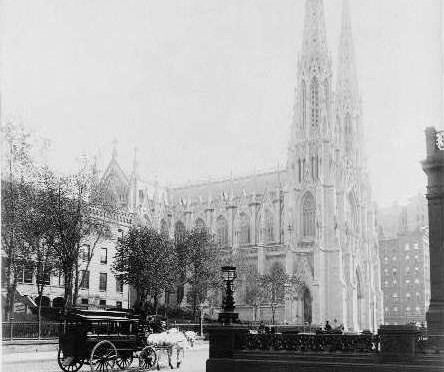
During its early years, St Patrick’s neighbors were luxurious mansions. Today the surrounding streets house retail and tourist attractions. (Picture courtesy Library of Congress)

PODCAST One of America’s most famous churches and a graceful icon upon the landscape of midtown Manhattan, St. Patrick’s Cathedral was also one of New York’s most arduous building projects, taking decades to build. An overflow of worshippers at downtown’s old St Patrick’s demanded a vast new place of worship, even as most Catholic New Yorkers were having an uneasy time due to religious prejudice by angry ‘nativists’.

 Enter ‘Dagger’ John Hughes, the relentless first Archbishop of New York, who hammered the city for equal treatment for Catholics and managed to construct several New York institutions still in existence. Many scoffed at his idea of building a gigantic cathedral so far north of town.

We explore the early years of this once-quiet piece of mid-Manhattan real estate and some of the notable events that have taken place at St. Patrick’s since its opening.

ALSO: The tale of the revered Haitian hairdresser in the crypt!


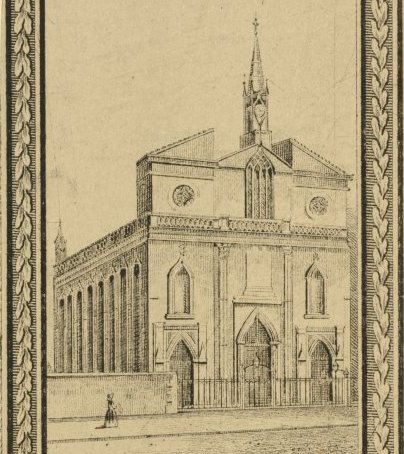
Before ‘uptown’ St. Patrick’s, there was downtown St. Patrick’s, the original cathedral which was consecrated in 1815. By the 1850s, with the number of Catholics growing due to immigration, a larger, grander structure was required, one that reflect the congregants’ growing influence. The image below is from St. Patrick’s before the 1866 fire. The facade was rebuilt with less ornamentation.

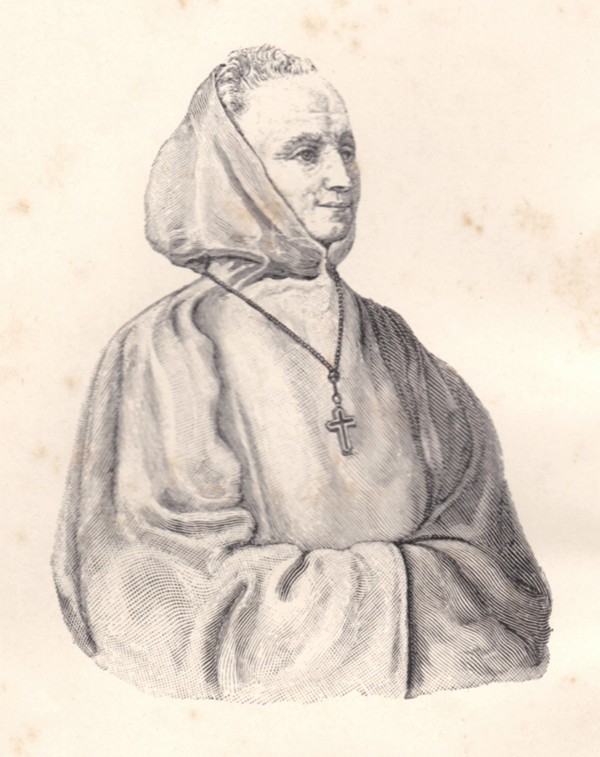
The land where St. Patrick’s sits today was wooded and sparsely populated 210 years ago. But for a short time, in 1814, a Trappist monastery sat here, the haven of French refugee Dom Augustin de Lestrange.

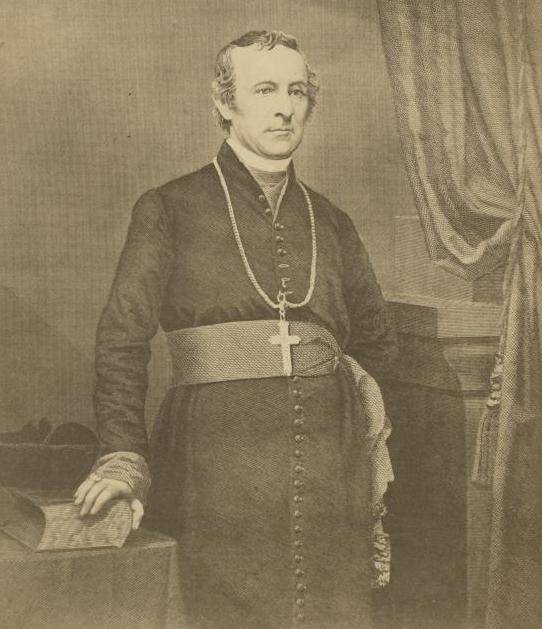
The undisputed religious leader of New York’s Catholic community was Archbishop John Hughes, whose fierce tenacity — and curious signature — earned him the nickname ‘Dagger John’. He spearheaded the construction of a new cathedral, in an area of town that, in the 1850s, was nowhere near the center of the city. ‘Hughes’ Folly’ would take two decades to build; by the time it was completed, Fifth Avenue had entirely transformed. The Archbishop’s risk had paid off. (courtesy NYPL)

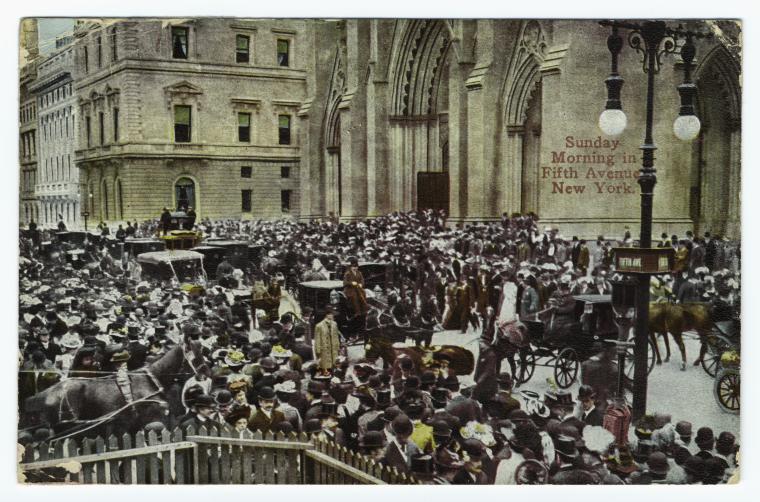
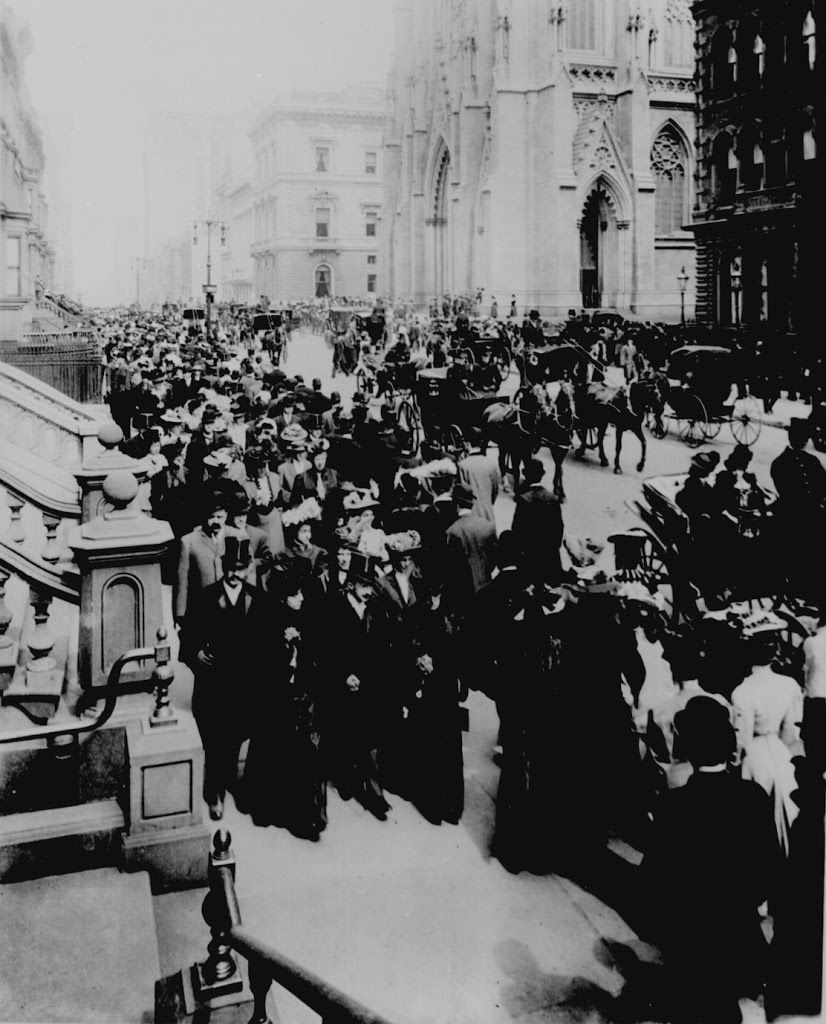
Sunday morning mayhem at St. Patrick’s Cathedral at the start of the 20th century. Fifth Avenue became a veritable procession of New York’s wealthiest residents. (NYPL)

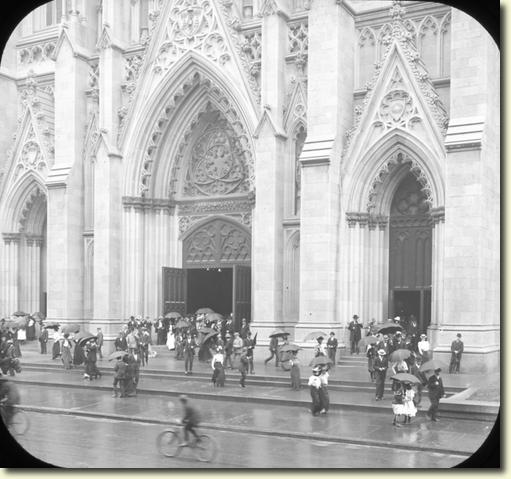
An image from the late 19th century. The famous 20,000-lbs. bronze doors, featuring three-dimensional sculptures of saints, would not be installed until a few decades later. (Courtesy NY State Archives)

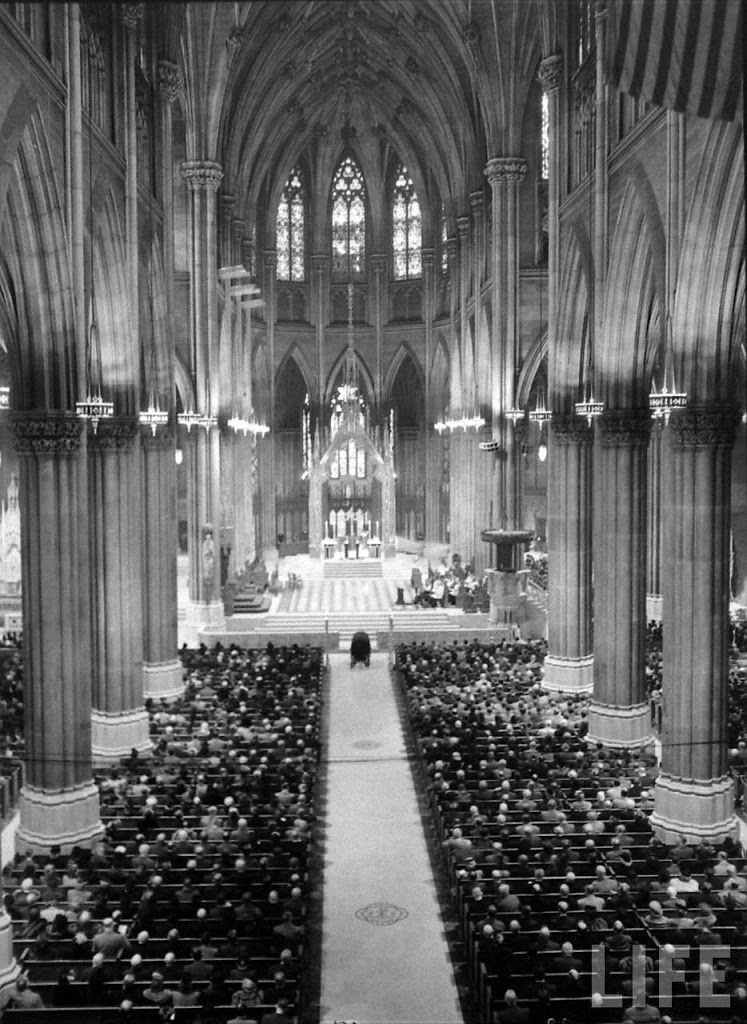
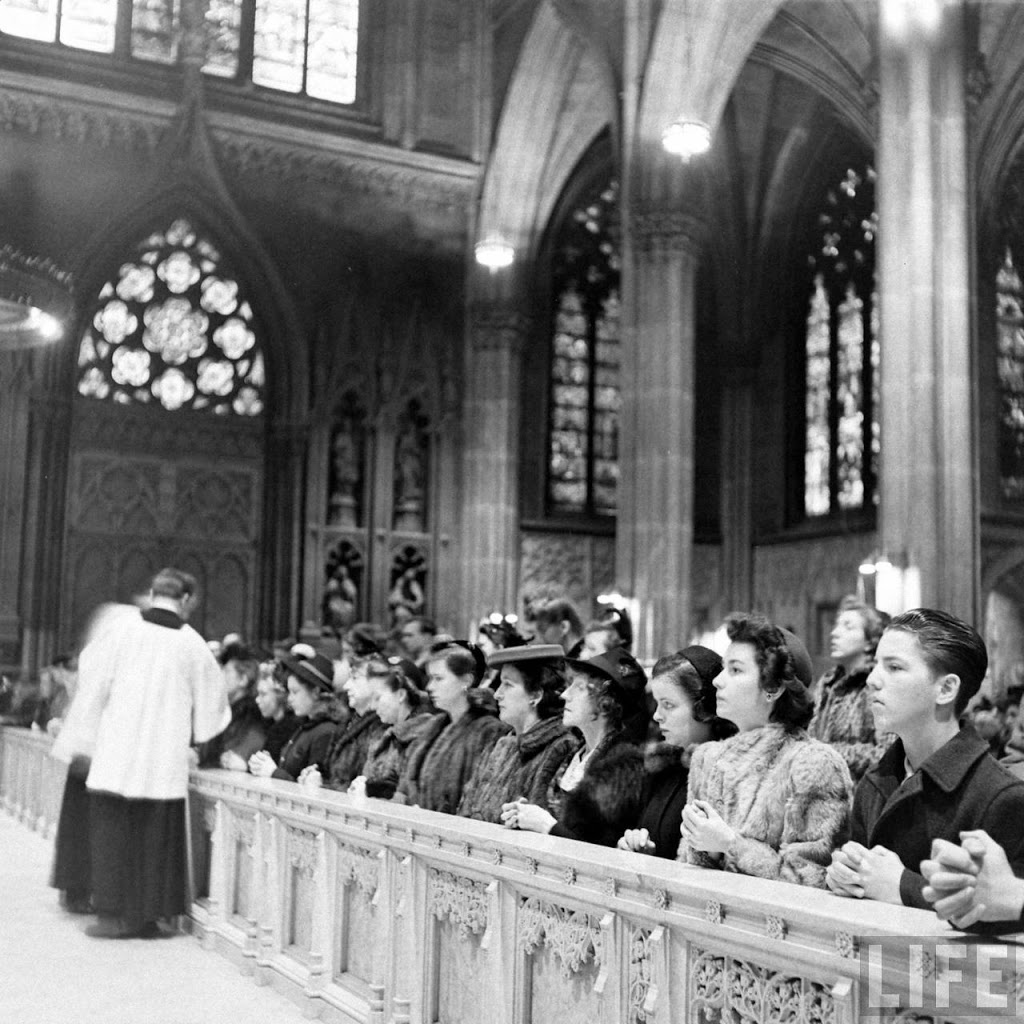
Inside St. Patrick’s Cathedral, during the funeral of former mayor Jimmy Walker, November 1946. (courtesy Life)

Worshippers in 1944, as photographed by Alfred Eisenstaedt for Life Magazine.

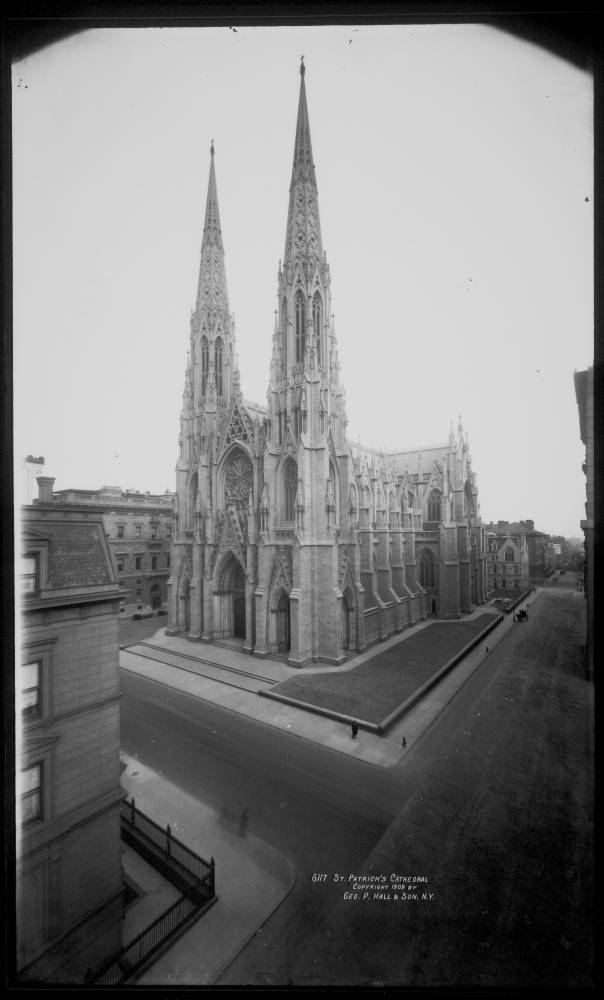
Another shot of St. Patrick’s in 1909, in one of the last years the cathedral would be surrounded with residential homes. By 1924 it would get its neighbor Saks Fifth Avenue. Fifteen years after that, Rockefeller Center would rise across the street.

Categories
Gilded Age New York Podcasts

Mark Twain in New York, or His Adventures on Fifth Avenue

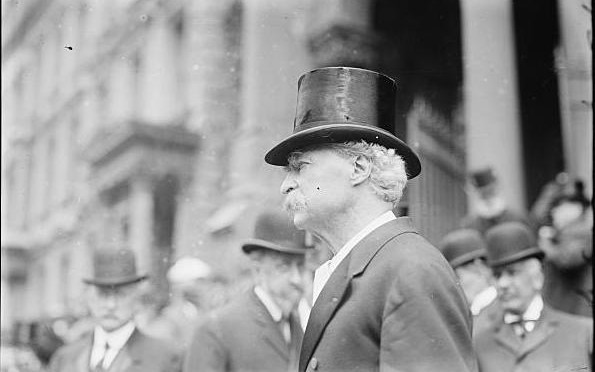
Photo courtesy LOC

PODCAST You hear the name Mark Twain and think of his classic characters Tom Sawyer and Huckleberry Finn, his locales along the Mississippi River and his folksy wit. But he was equal parts New York as well, and the city helped shape his sharp, flamboyant character. Follow his course, from his first visit as an opinionated young man in 1853, to his later years in 1906 as a Fifth Avenue tenant, decked out with a cigar and signature white suit.

His tale offers a glimpse into the glamorous life of turn-of-the-century New York, from the smoke-filled billiard room at the Players Club to late nights at New York’s dining palace Delmonico’s. Tune in and find out which parts of Mark Twain’s city are still around and which of his old homes you can still visit today.

Co-starring Ulysses S. Grant, Helen Keller, Edwin Booth and other toasts of New York during the Gilded Age.

A slight correction: I mentioned in the show that Mark Twain only worked on one play in his lifetime, called ‘Is He Dead?’. That might have been his only solo attempt, but he did try many years earlier to pen one in collaboration with Bret Harte. The play, called “Ah Sin: The Heathen Chinee”, opened and closed in 1877. It was an unmitigated flop and a total creative failure. He worked on another collaborative play called “Cap’n Wheeler” the next year.

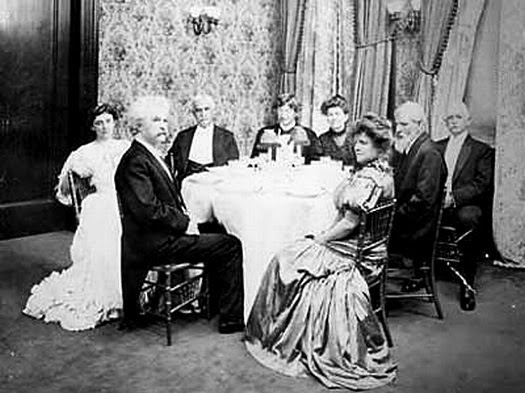
Dinner at Delmonico’s with a few of his closest friends (or at least his fanciest ones) at a celebration for Mark Twain’s 70th birthday.

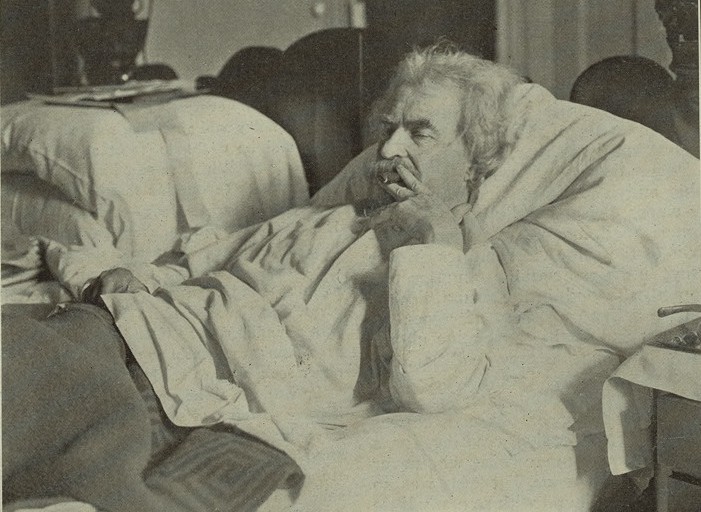
Smoking in bed: Twain’s two favorite places to do business in his Fifth Avenue home was at the pool table and in bed. This wasn’t laziness; in fact, during his final years in the city, the author was constantly out on the town, oftentimes as a guest of honor or featured speaker. He deserved a little time off his feet. (Pic NYPL)

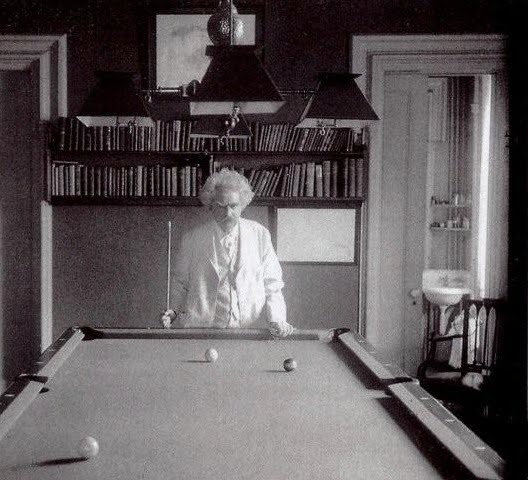
A menacing Mark Twain behind his pool table. (I’m not sure whether this is the Fifth Avenue townhouse or his place in Redding, Connecticut.) Due to his white suit and the photographic process in the 1900s, the writer often looks ghostly and pale.

This extraordinary video is pretty much the only moving images we have of Mark Twain, taken by Thomas Edison in 1909 at Clemens new home Stormfield, in Redding, CT. It’ll give you some idea of Twain’s appearance when he lived in New York the year previous.

If you’re a fan of walking tours — and why shouldn’t you be? — there’s a interesting tour led by author Peter Salwen specializing in Mark Twain’s New York. You can check out their website for more infromation.

For more general information on the life of Mark Twain, I recommend some of the books I used as sources for this show, including Ron Power’s fantastic ‘Mark Twain: A Life’, Michael Sheldon’s ‘Man In White: The Grand Adventure Of His Final Years’ and, of course, the massive, labyrinthine first volume of The Autobiography Of Mark Twain.

And finally, here’s a map of some locations pivotal to Mark Twain’s life in New York — places where he lived and lectured. And you can see, he certainly got around!


View Mark Twain in New York in a larger map

Categories
Podcasts

PODCAST: Saks Fifth Avenue

A podcast that’s “very Saks Fifth Avenue,” we get to the origins of the famous upscale retailer, follow its path from Washington D.C. to Heralds Square and then to “the most expensive street in the world,” and tell you a little about a glamorous milliner.

Listen to it for free on iTunes or other podcasting services. Or you can download or listen to it HERE

A slight clarification on this week’s episode: I describe one style used in the creation of Saks Fifth Avenue as Art Moderne, which is a variation of Art Deco using curved, streamlined surfaces. This clearly describes the inside of Saks, not the outside, which is a bit more formal.

A few historical pictures of old Fifth Avenue — back when it was primarily residential, on the cusp of becoming New York’s center for retail

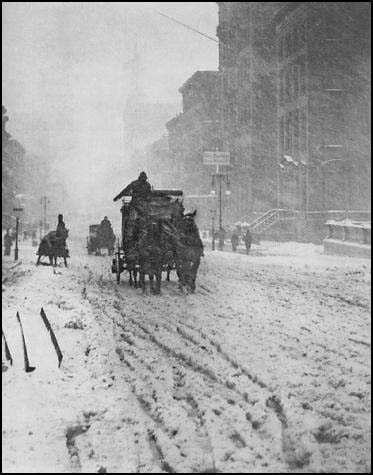
Alfred Stieglitz’s 1893 classic photo ‘Winter on Fifth Avenue’

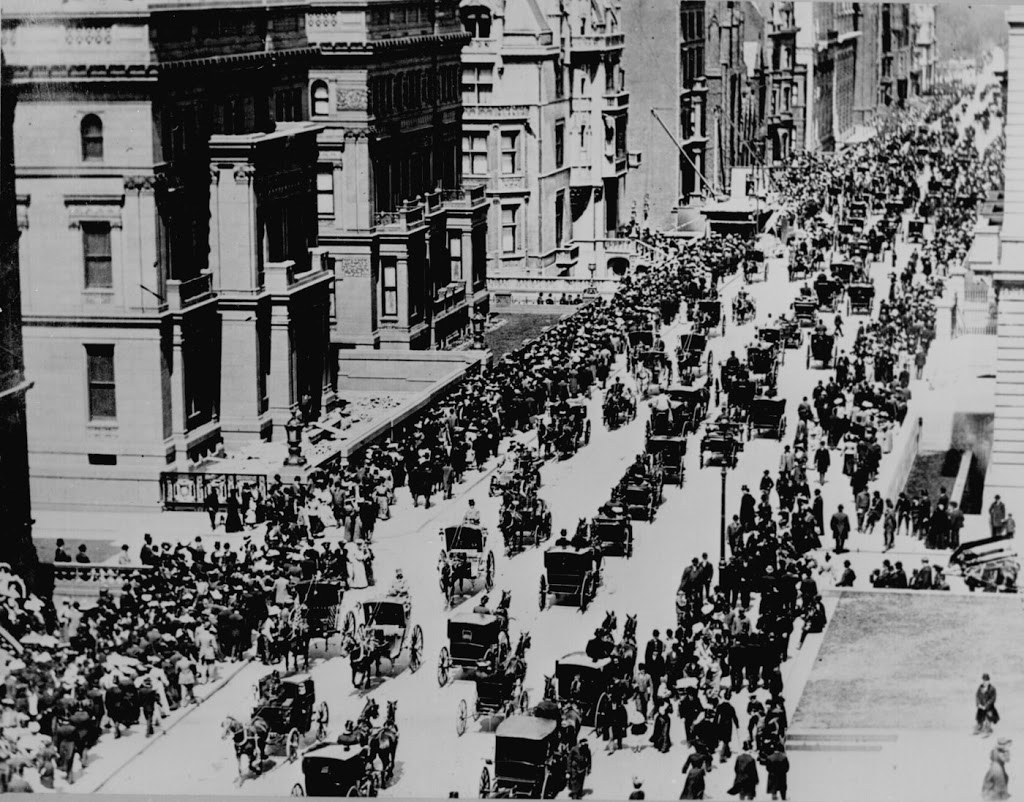
Glorious Fifth Avenue in 1901, Easter morning. The streets are filled with people on their way to church, passing block after amazing block of private homes. Although there is not a retailer in sight, the sidewalks look pretty much the same as they do today though!

Fifth Avenue in 1906 — this is on the west side of the street to the lot that would soon hold Saks Fifth Avenue. (You can see St. Patricks Cathedral in the background.) Photos are from the National Archives.

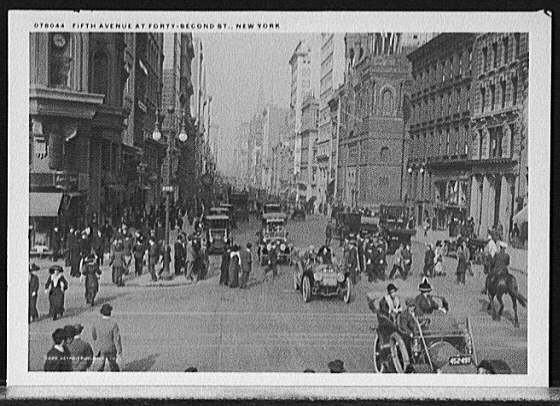
This is definitely the corner of Fifth Avenue and 42st Street, although I’m not to sure of the date, most likely around 1910.

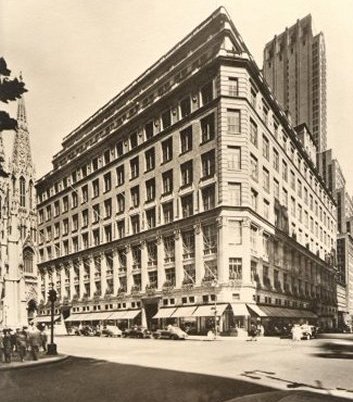
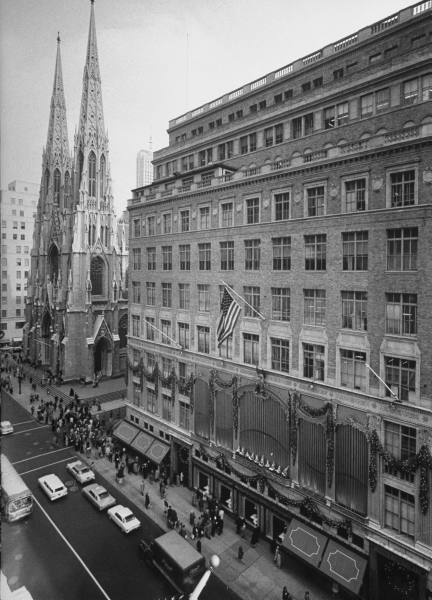
The Fifth Avenue store, circa the 1940s, designed by Starrett and Van Vleck

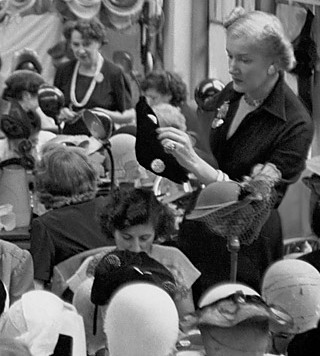
The glamorous workaholic Tatiana Du Plessix, who almost singlehandedly outfitted New York’s society ladies with hats. (Tatiana wasn’t glamorous to everyone, as a recent biography by her daughter takes pains to note.)

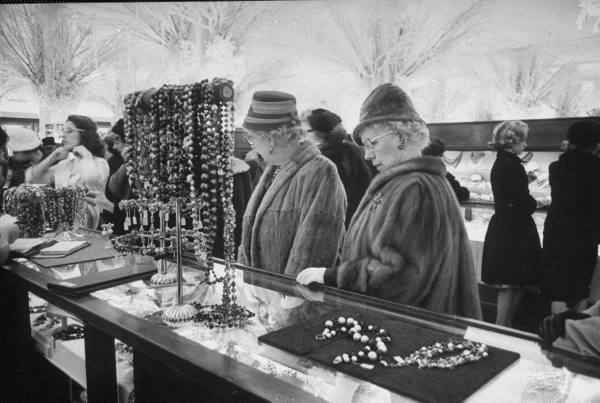
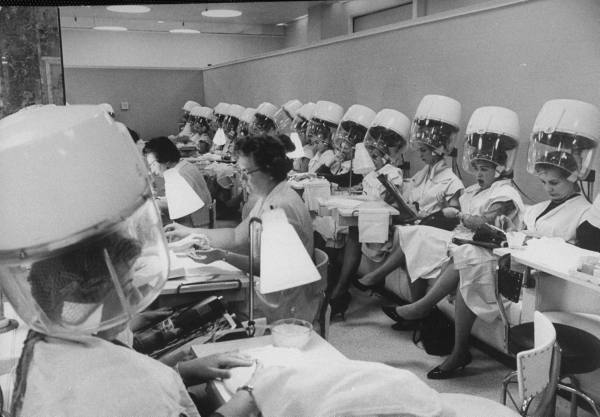
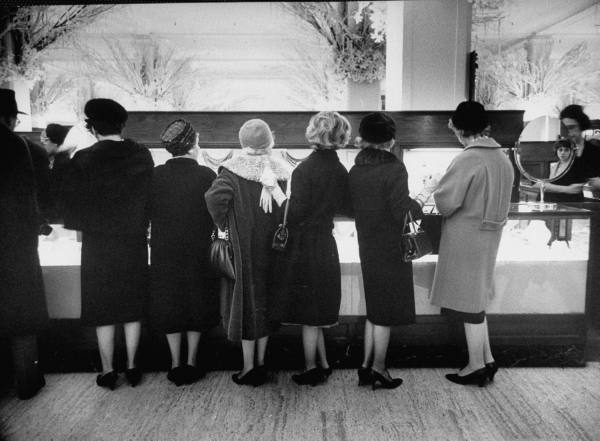
The following shots are from the Google Life archive of interiors of Saks from 1960 by photgrapher Alfred Eisenstaedt.

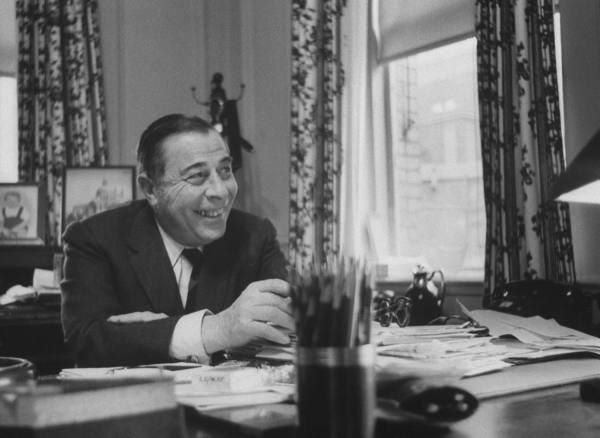
Adam Gimbel in 1962. He took over the company after the deaths of Horace Saks and Bernard Gimbel and helped create its mid-century upscale image. (Photographer Yale Joel)

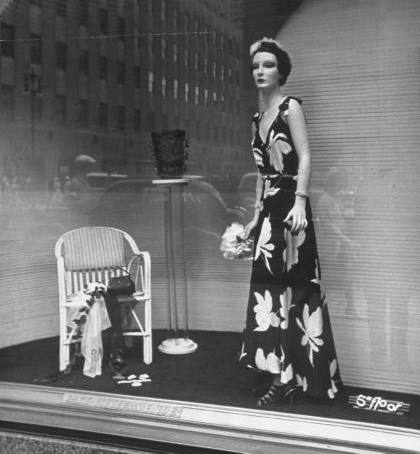
A Saks window in 1937, employing subtlety and grace instead of cramming the window with items

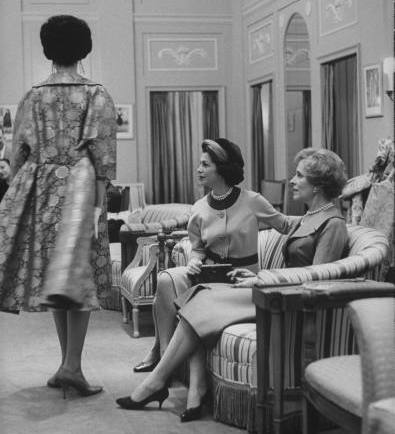
“Sophie of Saks,” Adam’s wife and the in-house designer for Saks Five Avenue, sits far right as a model displays a design to a customer. (1960/Peter Stackpole)