Categories
Mysterious Stories Newspapers and Newsies

The Earthquake of 1884! A few parallels to today’s quake

New York has never suffered severely from the effects of an earthquake. Most recently, the one felt in 2011— reportedly of 5.8 or 5.9 magnitude, centered around Virginia and affecting many Northeast metropolitan areas — ranks quite high on the list of tremors felt here.

There’s no way to compare that local event to the really early quakes, as the Richter scale was only created in 1935. But quakes have hit the city as early as December 18, 1737, when a guesstimated 5.2 rattled holiday chimneys.

But an equally dramatic tremor that hit on Sunday, August 10, 1884, has a few parallels to the one experienced today.

New York Times

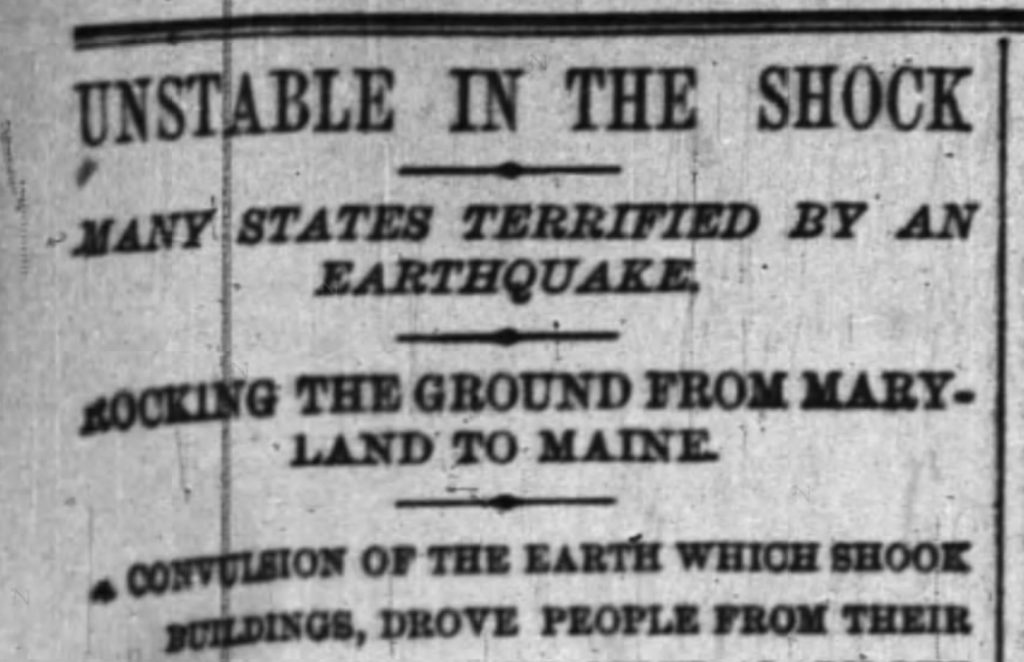
No Damage Done But Queer Sensations Experienced” reported the New York Tribune the next day.

From the Sun: “An Earthquake Shakes Us.” The tremor occurred at 2:07 pm “by the City Hall clock” in a couple separate waves.

Few New Yorkers living in 1884 would have ever experienced an earthquake in an American city. Some ran to their windows expecting to see a runaway horse car. Others standing under the newly built elevated railroad thought the train was arriving.

Those stopped on the street felt something beneath their feet and became starkly confused. Eventually some people left their homes and collected in parks, such as the assemblage the Tribune reports formed outside of City Hall.

Today we feel a rumbling and just assume the subway, which wasn’t built yet in 1884 (outside of the short lived pneumatic tube, of course).

There was some damage reported to homes in the Lower East Side, and some residents — being mostly immigrants, perhaps more in tune to the dangers of tremors in their home lands — rushed out into the street with their furniture. A few horse stables shook open and their residents fled into the streets.

Apparently, those in the poshest hotels felt it strongly, or at least announced to reporters that it had rattled them so.

At the Fifth Avenue Hotel, a clerk described, “On the upper floors the guests say that the oscillations were marked” and reported a rattling of the chandeliers. Apparently, an admired set of colored drinking glasses at the Astor House was thrown from its nook and smashed on the floor.

Rumors spread. Some thought the west side gas works on 14th Street had exploded, while others circulated that dynamite had gone off in the Hell Gate.

A “mouldy headed orator” in Harlem — near one of New York’s natural fault line at 125th Street — proclaimed that Manhattan was built upon a rock shelf that had been abruptly brushed by a passing whale, the tremors caused by its flapping tail.

The sensation of the tremor seemed to be felt almost at random; for instance, those living along the Hudson reporting it rattling dishes, while tourists atop the newly built Brooklyn Bridge barely felt a thing. Some electrical services were briefly disrupted, as was telegraph service. (That’s a lot of extra dots and dashes, I suppose.)

On First Avenue, a drunken afternoon reveler ran out of a local saloon “and hurrahed for earthquakes and for social revolution.” Uptown at the Hoffman House, a California businessman quietly said to his friend, “Well, if everything in New York wasn’t nailed down I should say that we are having an earthquake.”

According to the New York Sun, an aftershock was felt the following afternoon in Far Rockaway, as well as parts of New Jersey.

THIS ARTICLE ORIGINALLY RAN IN 2011 but it’s just as pertinent for today’s earthquake (April 5, 2024)
Categories
American History

Remembering the Wall Street bombing of 1920

On a usual day, lunchtime down on Wall Street today is chaotic mess of brokers and bankers on cell phones, tour groups, messengers on bikes, police officers, construction workers, people delivering lunch and perhaps a stray older lady walking her dog.

One hundred years ago today, in 1920, it would have practically been the same, sans the cell phones.

So it’s particularly disturbing how easy it is to imagine the noontime scene on September 16, 1920.

In fact, most of the surroundings — the Stock Exchange, the Sub-Treasury building (today’s Federal Hall), and most importantly J.P. Morgan‘s headquarters on 23 Wall Street — are still very much active.

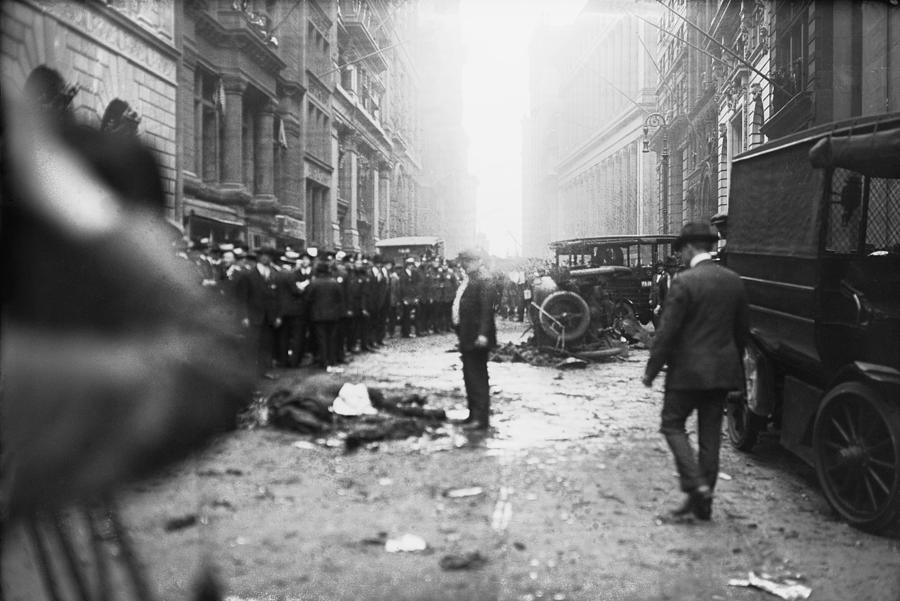
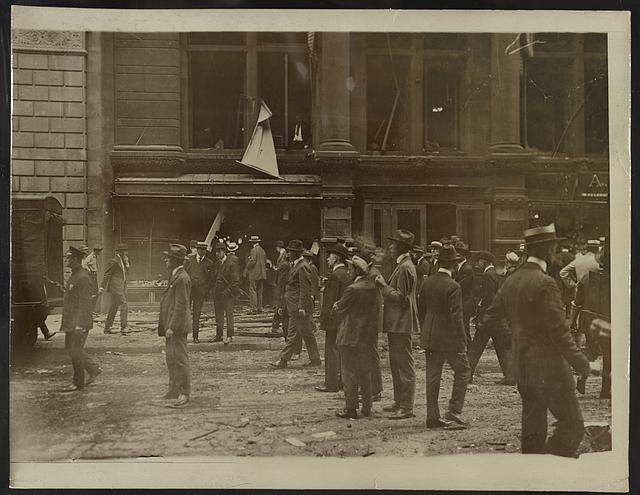
Courtesy Shorpy
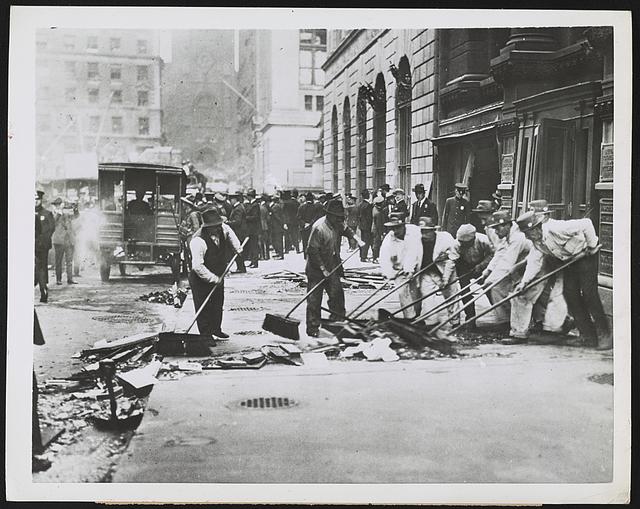
Courtesy Shorpy

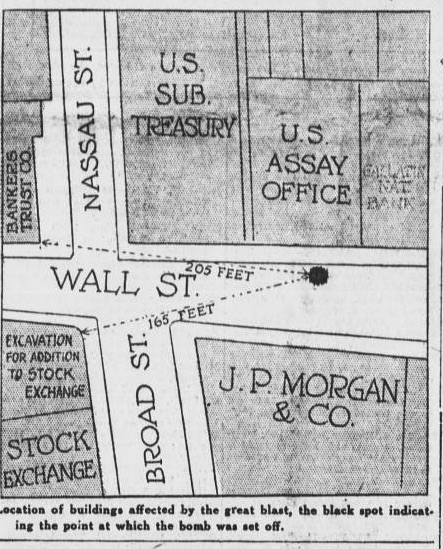
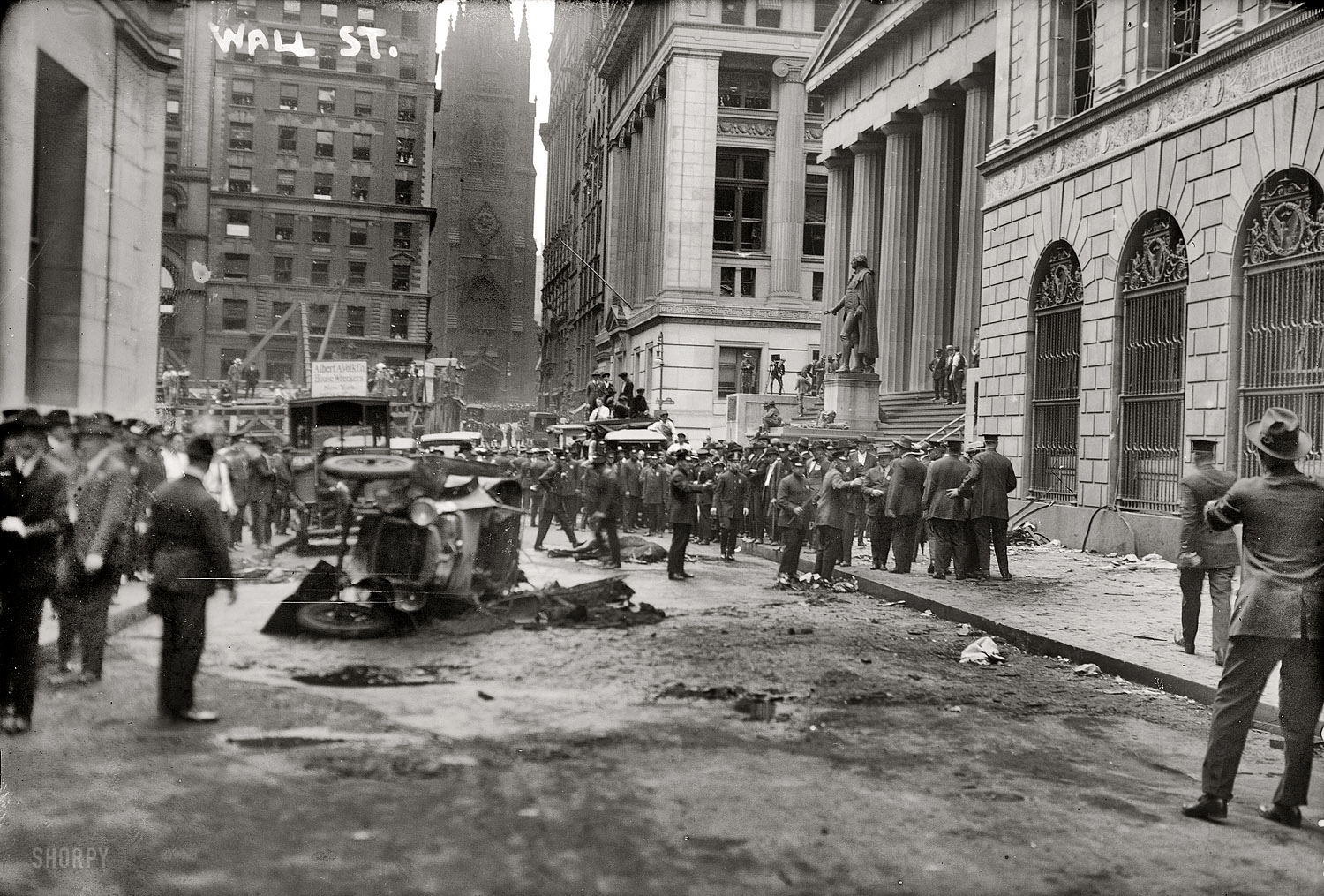
An unidentified man led a horse and carriage down the congested street, fighting to get past crowds, until it rested at the corner about 100 feet east of Broad Street. As the Trinity Church bells rang, the man dropped the reins and fled, never to be seen again.

One minute later, the wagon exploded with 100 pounds of dynamite, eradicating everything in its sphere, then sending dozens of iron slugs through the air to create a horrific scene of carnage.

From the Sun and New York Herald

The best way to really tell this story is to quote a few contemporary accounts from the New York newspapers. NOTE: Some of the accounts are quite graphic.

A 22-year-old woman named Ella Parry survived and was interviewed by the Evening World:

“The glass of our windows fell into the office and the ceiling fell all about us. Where I had just been sitting was covered with heavy plaster. I did not wait to get my hat, but with others rushed into the street.

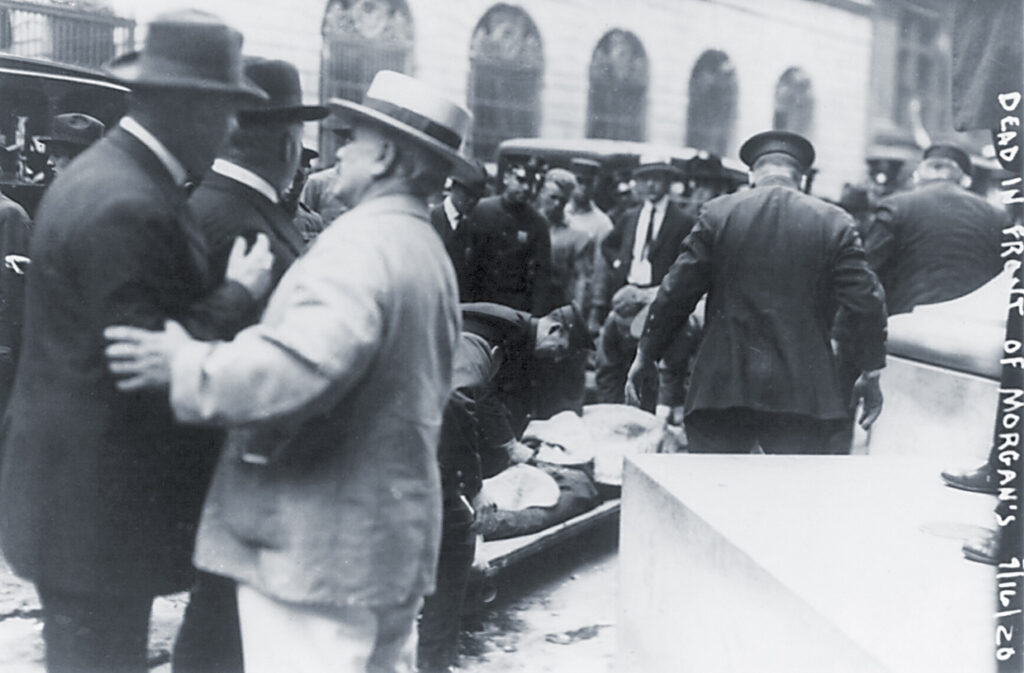
There were not less than a dozen dead persons on the sidewalk in front of tour building and the Sub-Treasury. Some of them had their faces almost completely blown off and their clothing had either been blown from their bodies or burned off. The police threw sheets over the bodies as fast as they could get them.”

Courtesy Museum of the City of New York

From a lawyer named Daniel Nugent who was standing near the site of the explosion:

“I was just about to enter the Morgan Building when the concussion knocked me down on the sidewalk. I arose after I had collected my thoughts and saw broken glass covering the street. All about me men and women were lying bleeding.

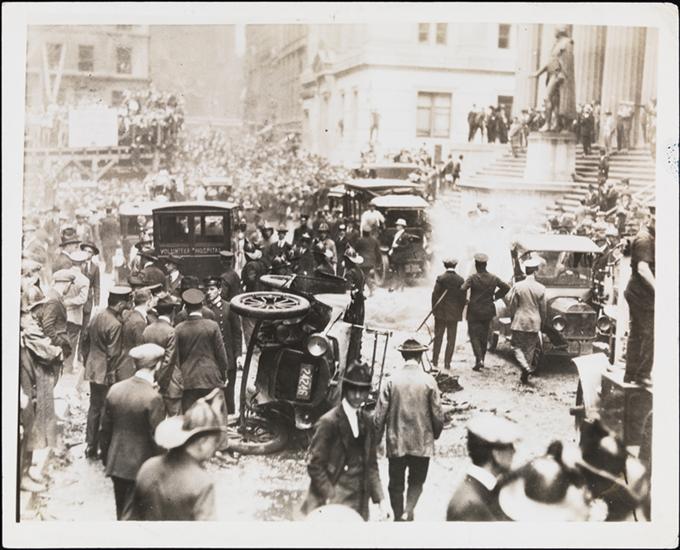
Above fifty feet down Wall Street there was an auto in a mass of flames. Across the street from it there was a shattered wagon and a horse lying dead. I saw several men cut almost in half from the large plate glass which fell from the building.”

Courtesy Library of Congress

From the New York Tribune:

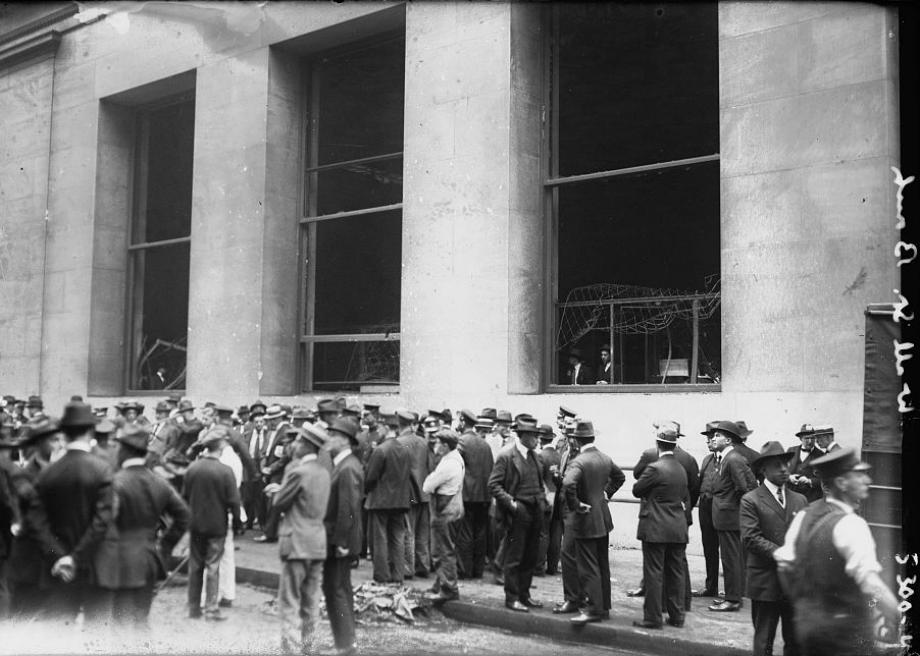
“Not a sound pane of glass remained in the Morgan Building. Screens of copper mesh which were set inside the windows were bent and twisted but had fulfilled their mission of protecting those within.

Fragments of the glass dome above the main office lay on the floor, and one of these, or some similar bit of falling debris, is believed to be responsible for the single death that occurred there. The streets were covered with broken glass, some of it finely powdered, like sugar.

The heroic statue of Washington on the steps of the Sub-Treasury was not so much as scratched by the explosion, and stood firmly, with hand outstretched in a quelling gesture.”

the-wall-street-bombing-a-man-stands-everett

One unusual story of bravery emerged the following day. A teenage office boy named James Saul grabbed a random automobile and began driving injured victims to the local hospital. Fearing the owner of the automobile was among the injured, he then drove the car to a police station.

By the end of the day, 38 people would be dead from the attack, many while sitting at their desks. (An additional man with a “nervous condition” would take his own life due to the event, making the total 39.) And over 400 more would be injured.
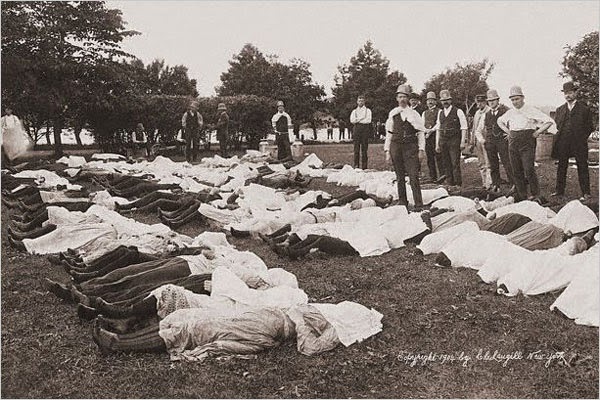
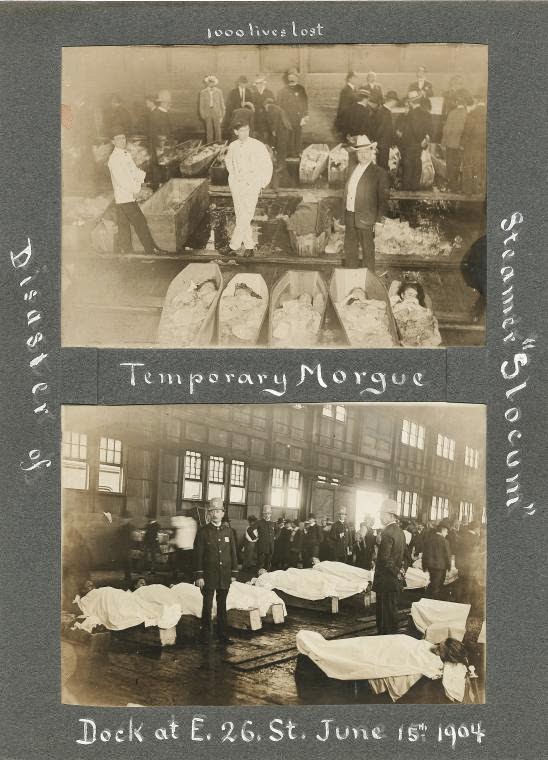
According to the New York Times: “The scene at the Morgue last night [located] resembled in many respects the night of the [General] Slocum disaster.

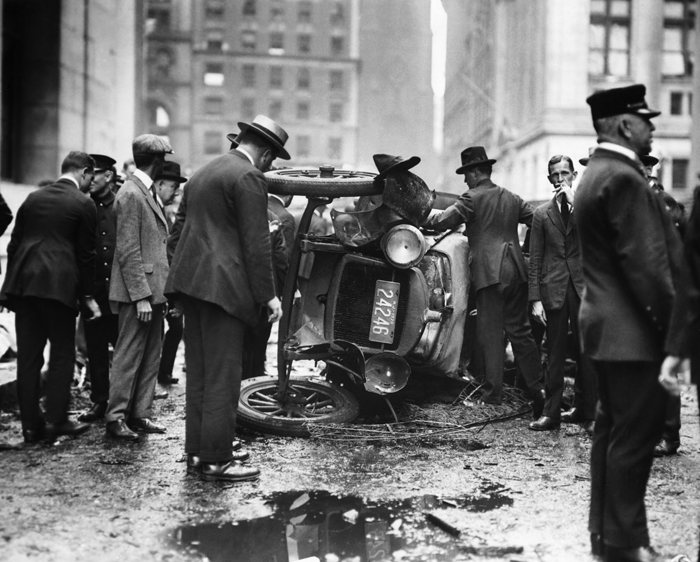
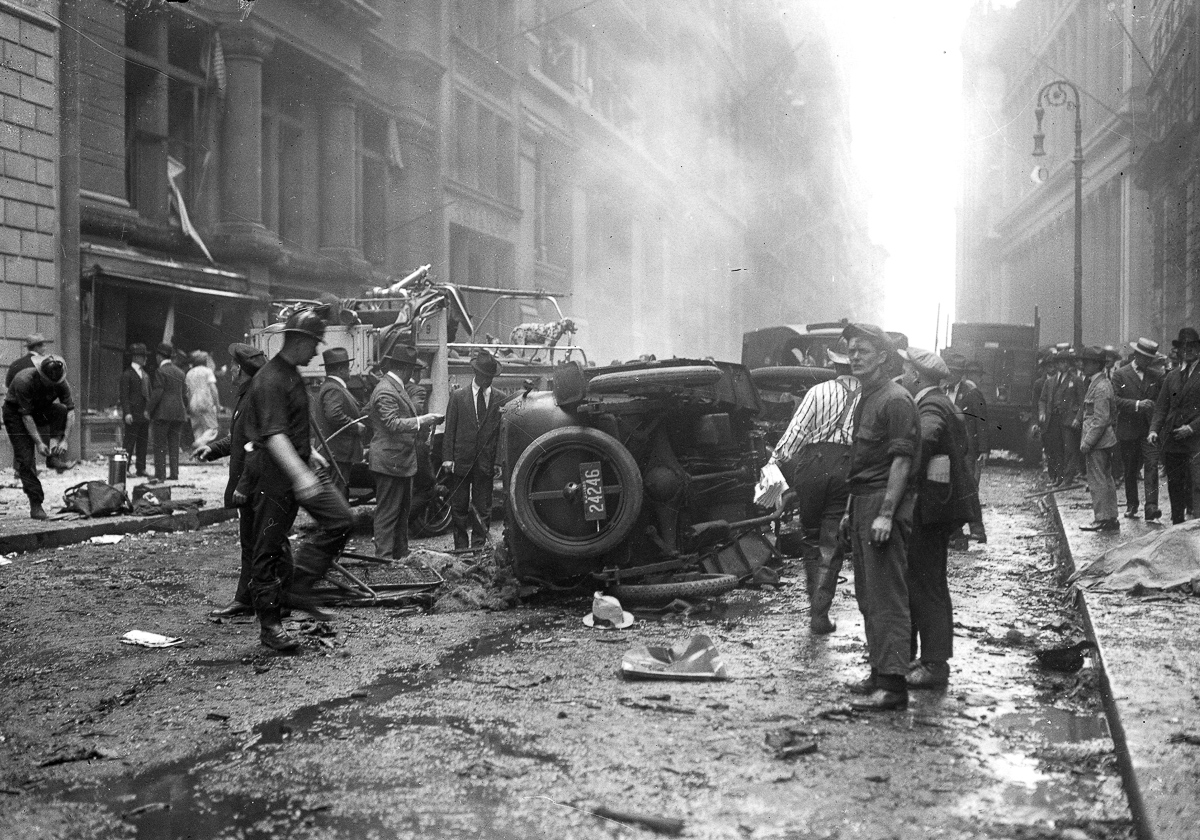
16 Sep 1920, Manhattan, New York, New York, USA --- New York, NY: Demolished automobile at sene of Wall Street Explosion of September 16th, 1920. Photograph. BPA2# 4804 --- Image by © Bettmann/CORBIS
16 Sep 1920, Manhattan, New York, New York, USA — New York, NY: Demolished automobile at sene of Wall Street Explosion of September 16th, 1920. Photograph. BPA2# 4804 — Image by © Bettmann/CORBIS

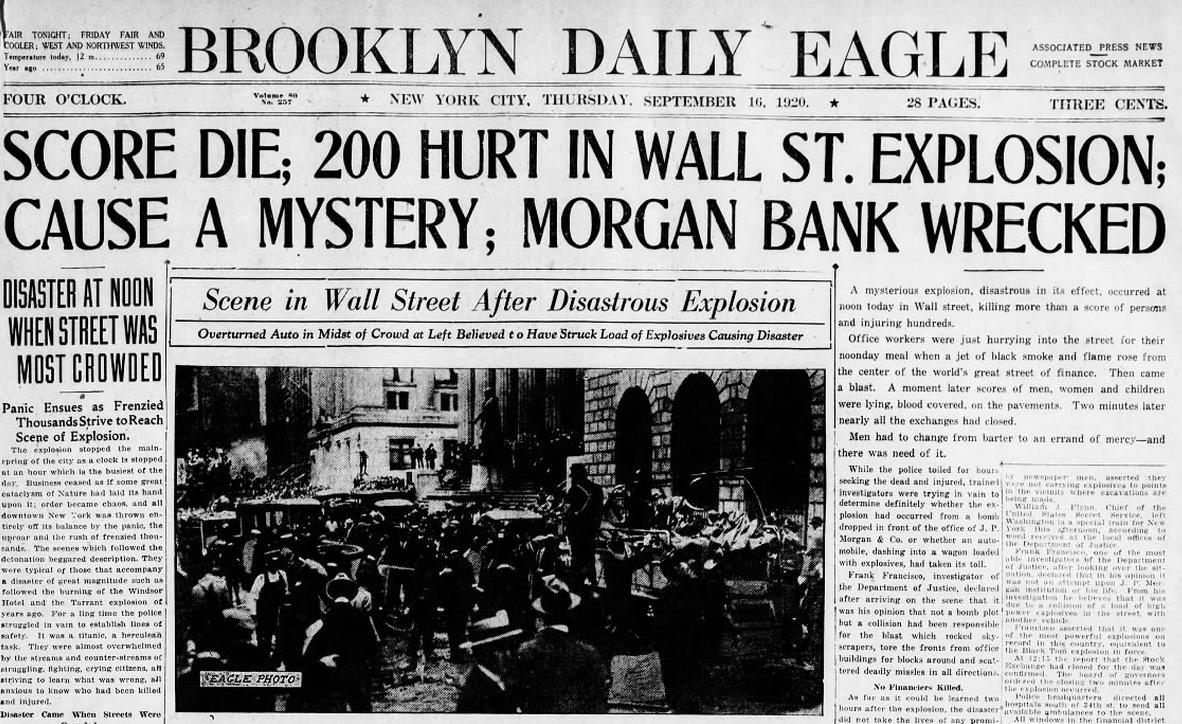
Below: The late edition of the Brooklyn Daily Eagle: “A mysterious explosion, disastrous in its effect, occurred at noon today on Wall Street, killing more than a score of persons and injuring hundreds.”

1

Following the attack, the Madison Avenue mansion of J.P. Morgan (site of the Morgan Library and Museum) was heavily guarded. Morgan himself was actually in England, enjoying a relaxing vacation.

Believe it or not, evidence of this attack can easily be seen from the street today. The banking mogul famously rejected repairs of his bank, preferring to leave the dents and pockmarks on the side of his building in a sign of defiance.

With a little morbid imagination and some amateur CSI work, one can probably trace the trajectory of wall’s injuries to the very spot where the poor horse and wagon exploded.

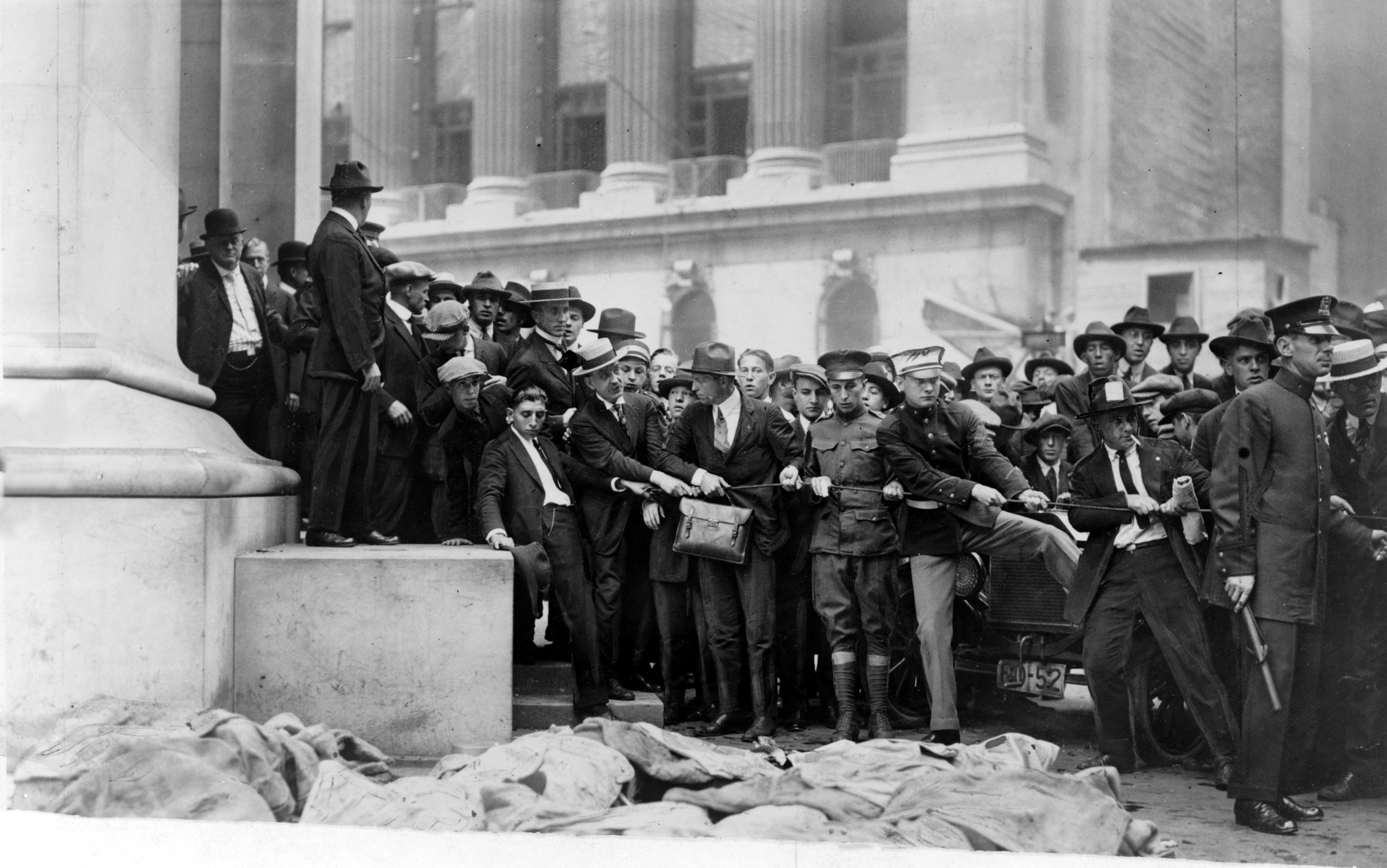
Below: Crowds gather to witness the destruction.

WallStexplosion1920

Despite a federal investigation which led to dozens of arrests, in fact the culprits were never caught.

Largely assumed to be Italian anarchists, any evidence was unfortunately lost when, in an effort to appear unfazed, the city cleaned the street and kept Wall Street open for business the next day, even seeing a rally of thousands pour into the street that Friday.

07047r
Library of Congress
Library of Congress
Categories
Planes Trains and Automobiles

100 years ago today: Seventh Avenue collapsed under rush hour traffic

One hundred years ago today, — a horrifying disaster on Seventh Avenue endangered the lives of New Yorkers on their way to work.

Excavations for the new Seventh Avenue subway line (the IRT Broadway-Seventh Avenue line, aka the 1-2-3 trains) were proceeding well below an active thoroughfare.

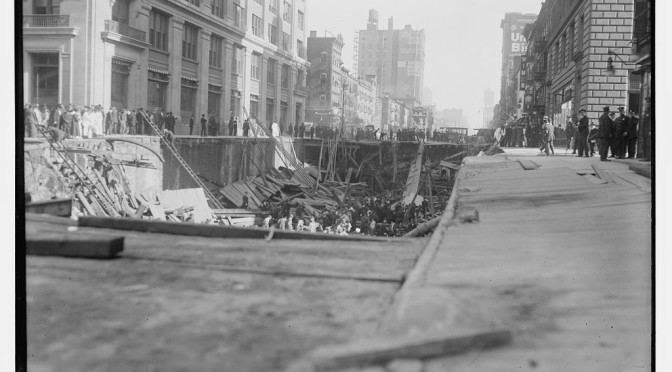
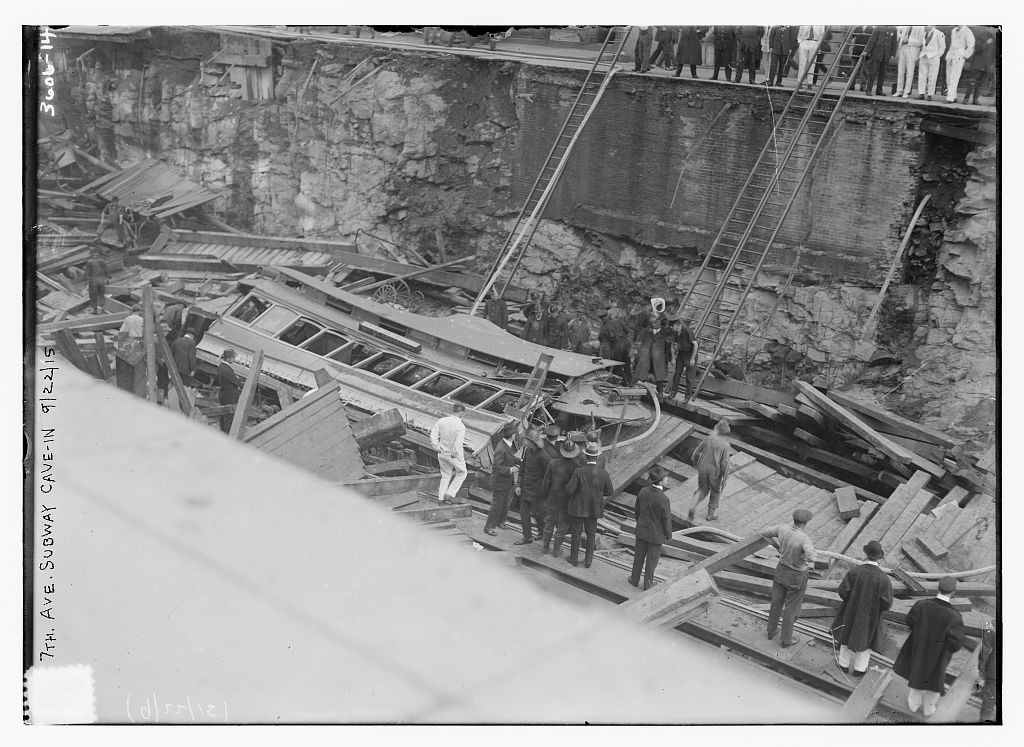
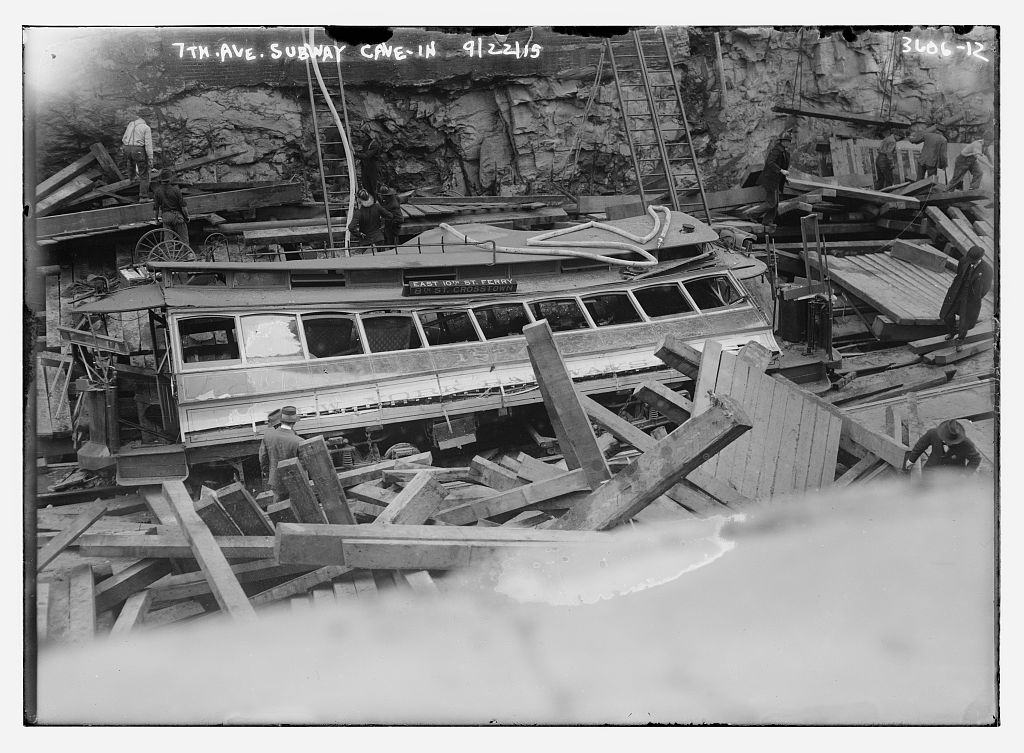
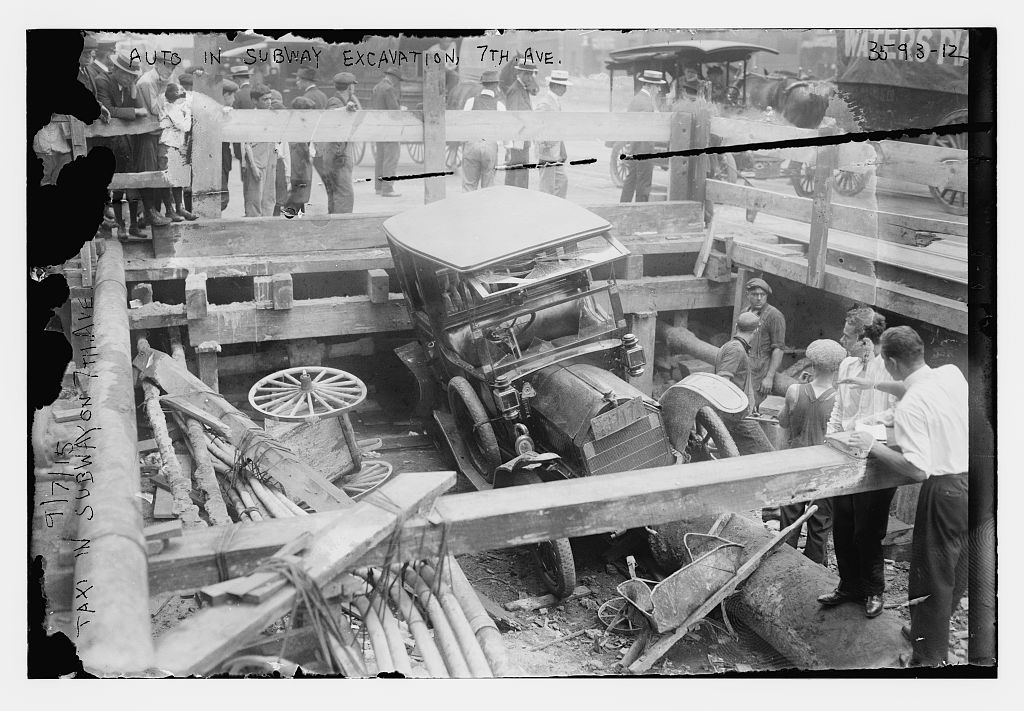
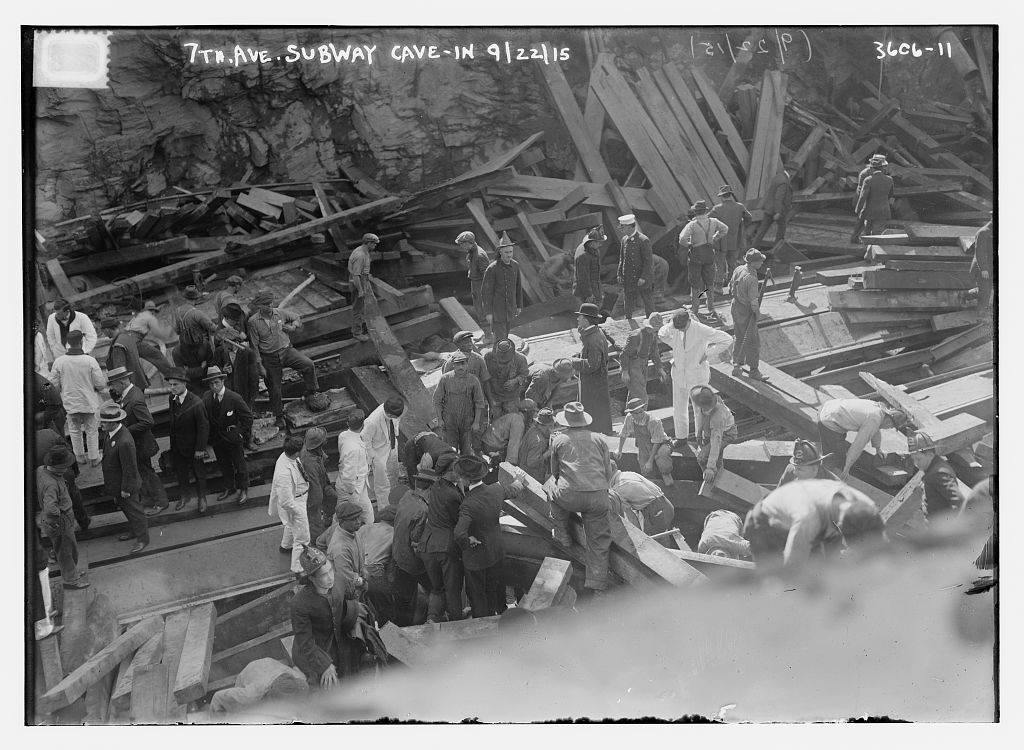
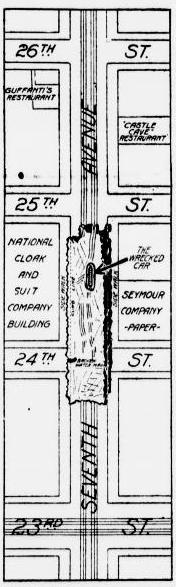
On the morning of September 22, 1915, two detonations inside the tunnel dislodged planking that was holding up the street between 24th and 25th Streets. Dangerously weakened, the temporary roadway folded into the earth, creating a chasm and swallowing up everything on the surface.

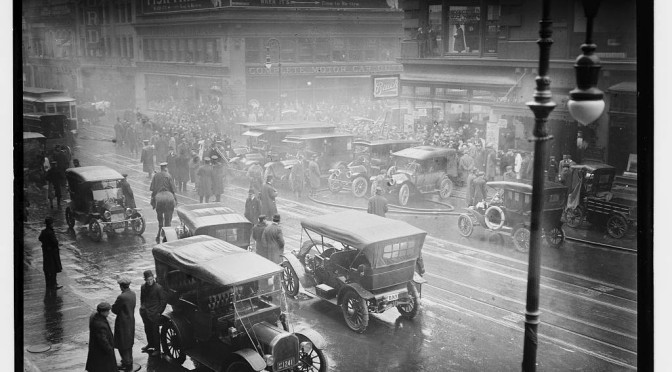
The men working below didn’t stand a chance, buried beneath a deluge of automobiles and debris. Among the vehicles thrown into the 30-foot hole was a streetcar filled with passengers. “Heads and arms were thrust from the windows, and those who looked on helplessly could hear the cries of the ones caught in the wreckage.” [NY Sun, 9/23/15]

Courtesy Library of Congress

Both the water main and gas pipes burst open in the tumult, and trapped streetcar passengers panicked as the enclosure began filling with water.

“Witnesses of the accident quickly recovered from the shock of seeing nearly two blocks of city street sink from sight, carrying down all traffic within reach of the cave in.” [NY World, 9/22/15 late edition]

2
Courtesy Library of Congress
8497177295_80e9a8634f_o

Seven people were killed in the disaster with dozens injured. Most of the deaths were workers in the tunnel although two passengers in the streetcar also died.

Eyewitnesses describe a scene of utter chaos and total confusion. A man named Joseph Urban was standing on the street and got pulled into the hole.

“There was a funny feeling on the planking — a trembling, jerking sort of sensation — and then the whole street seemed to slide down into the hole. There was so much dust that I couldn’t see anything for two minutes. When I could see I appeared to be in a forest of tangled timbers, pointing every which way.” [source]

Police went searching for the culprit. Although it was later deemed an accident, an intentional detonation could not be ruled out especially given the fact that terrorist bombs were going off all over the city. (Back in March, detectives thwarted a second attempt to bomb St. Patrick’s Cathedral.)

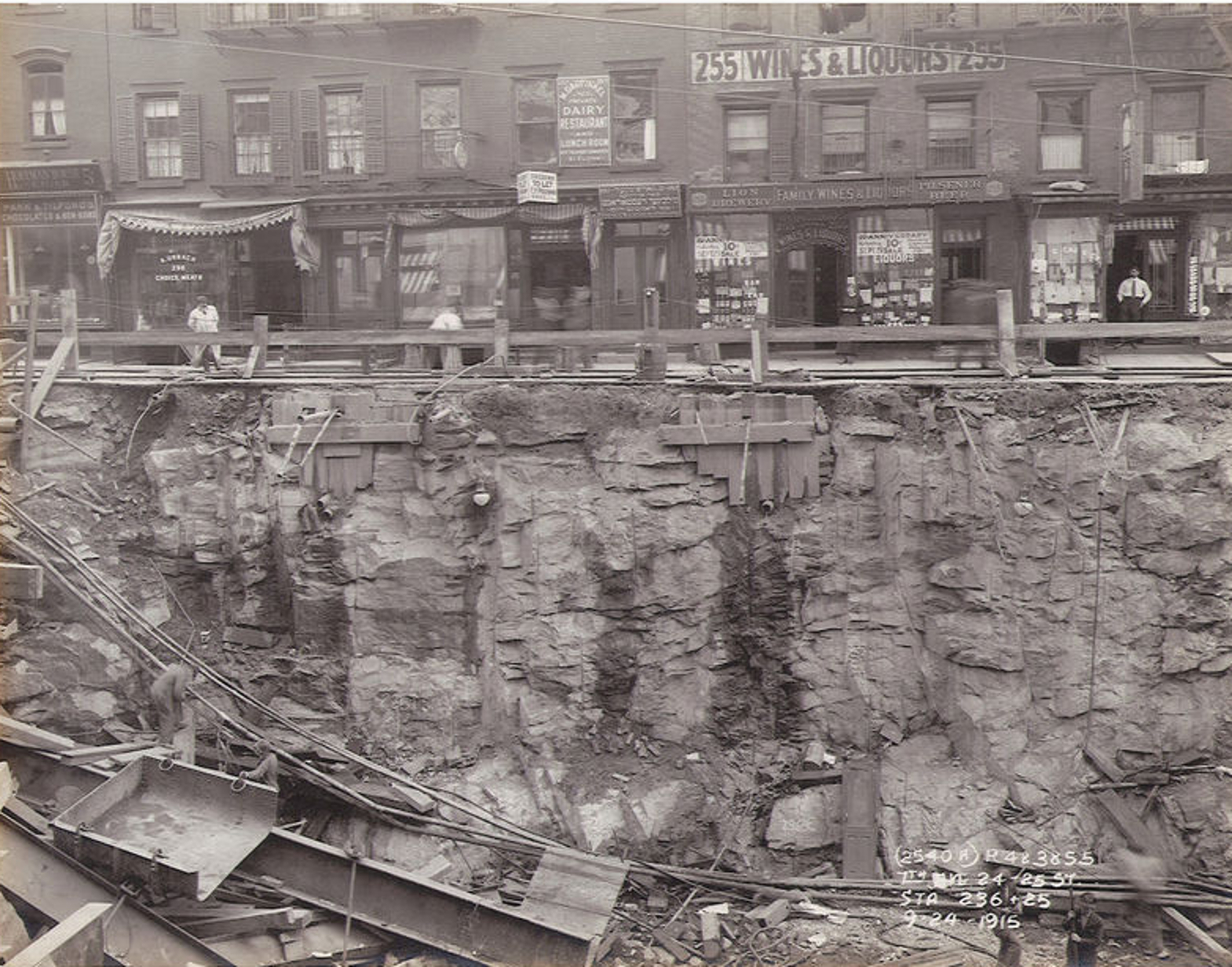
Below: Seventh Avenue as it looked 100 years ago

7th

Fingers quickly pointed to the IRT’s inadequate ‘cut-and-cover’ method, identifying other possibly deadly roadways along Seventh Avenue. Mayor John Purroy Mitchel ordered additional supports be constructed at many excavation sports, and ‘heavy trucking’ was banned from these problem areas.

This wasn’t the city merely being over anxious. In fact, just three days later, another excavation collapsed at Broadway and 38th Street, swallowing a taxicab and killing its passenger. What makes this especially hazardous was its proximity to the popular Knickerbocker and Casino theaters.

As you might imagine, the collapse snarled street traffic for weeks with street closures and detoured routes turning the Tenderloin and Herald Square districts into a mass of congestion.

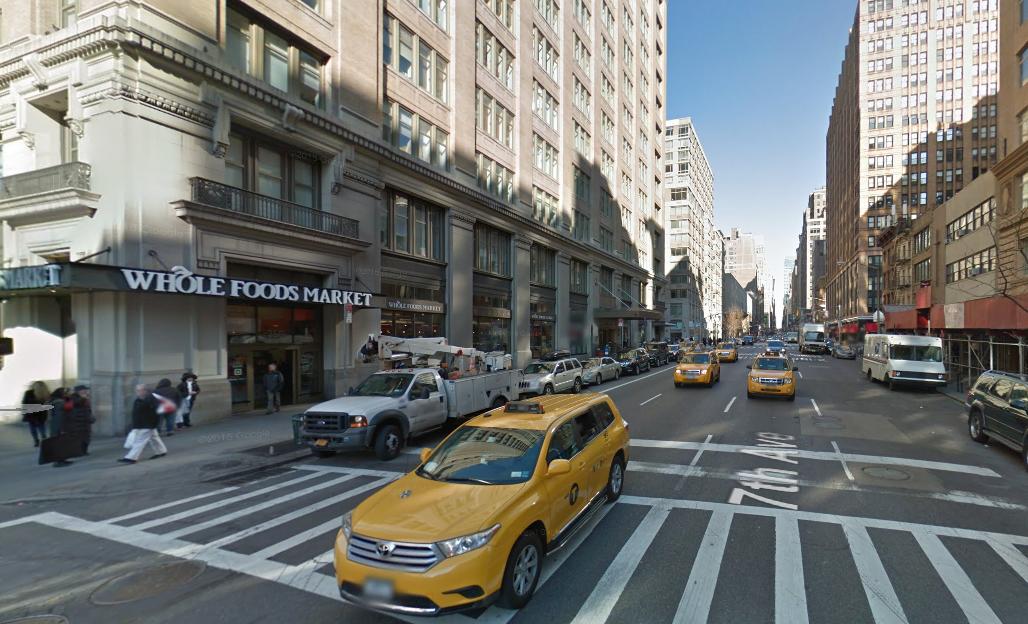
Below: An illustration from the New York Sun, showing the location of the 24th Street street collapse and a Google Maps screen capture of this street today.

1
1
Categories
Planes Trains and Automobiles

The Horror Underground: New York’s first subway disaster — during rush hour, one hundred years ago today

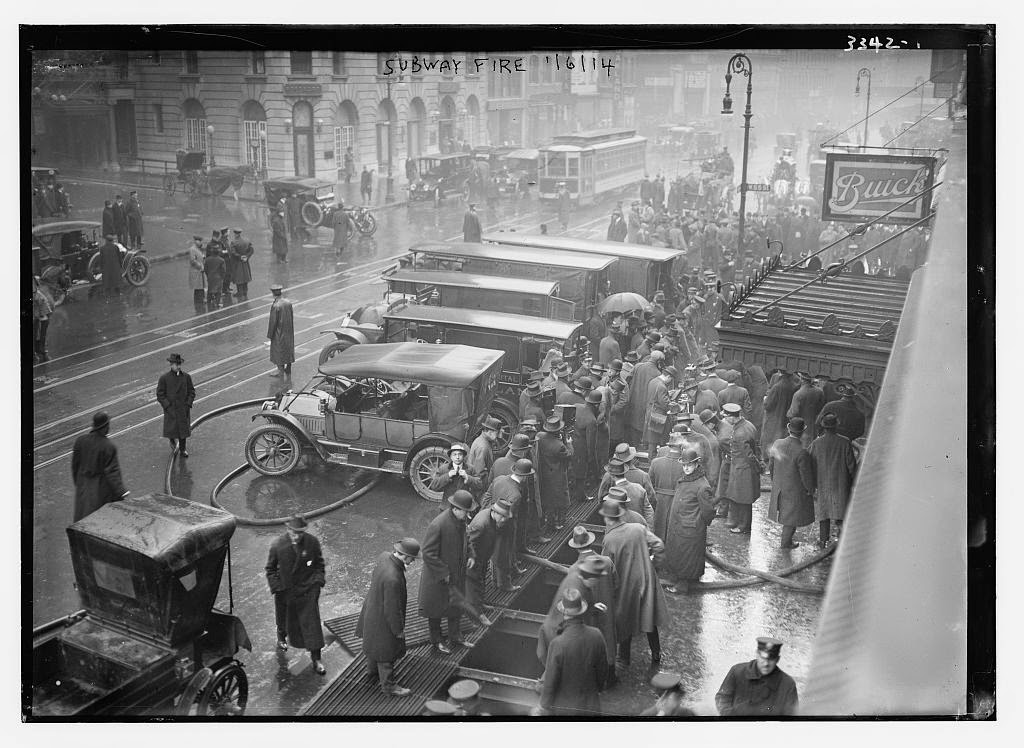
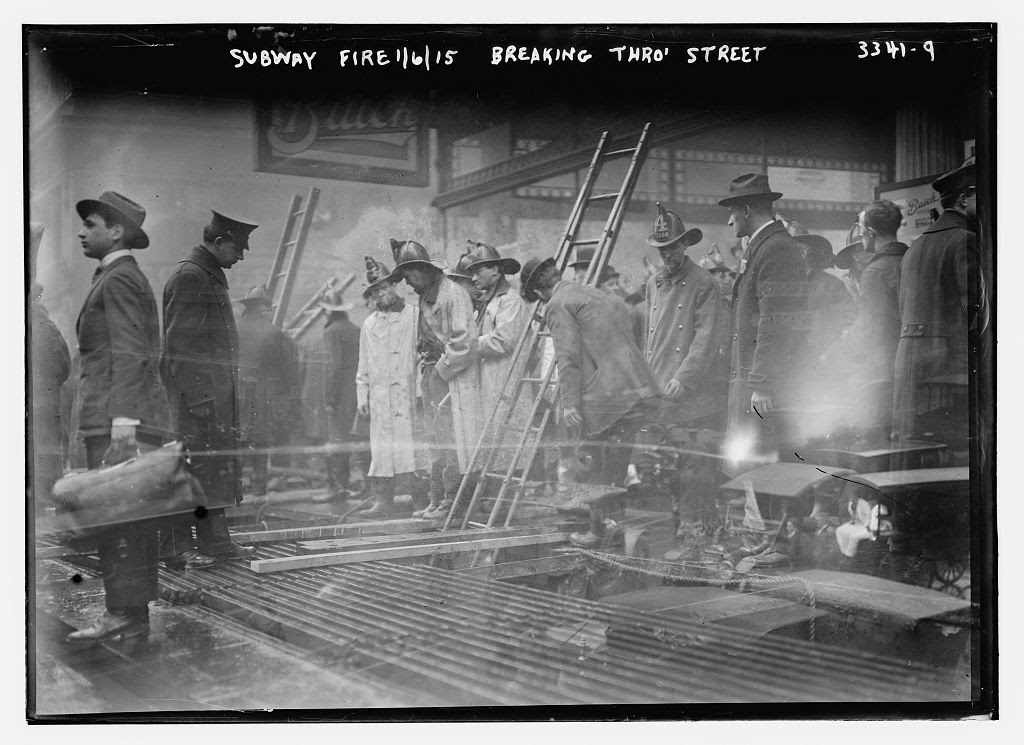
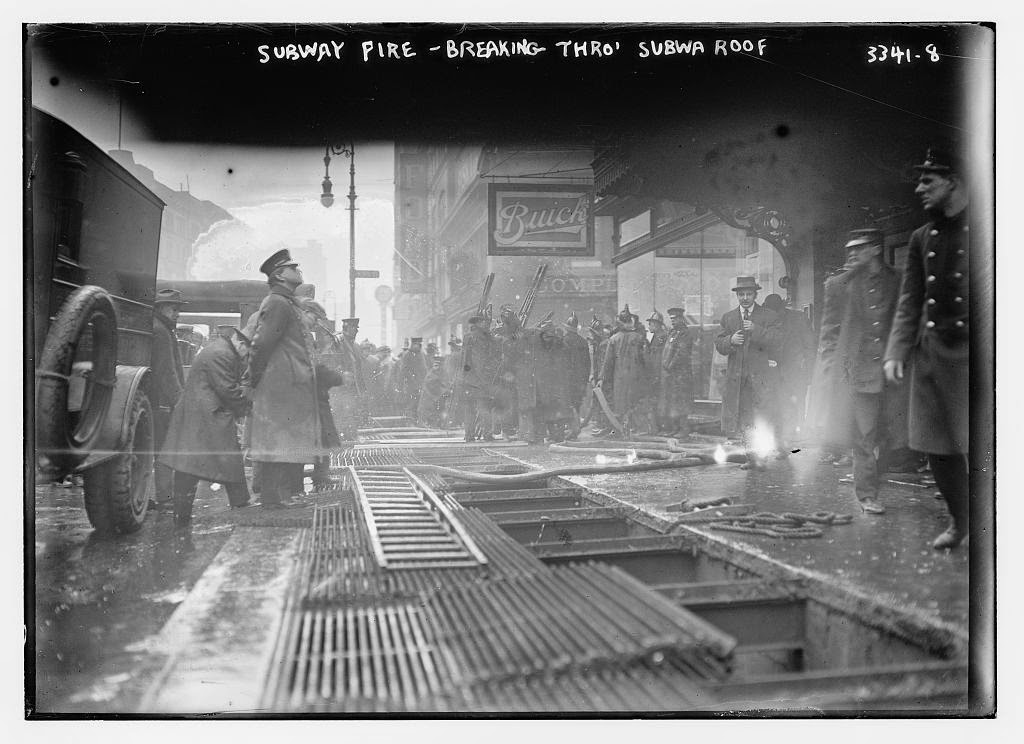
On January 6, 1915, a seemingly minor incident under the streets of Midtown caused a terrible panic, “the worst disaster in the history of the New York subway” up to that date, injuring hundreds of commuters and killing one. 

That morning, two electrical cables feeding into manholes at Broadway and 52nd Street suddenly shorted out, causing a blackout in the subway tunnels below. The cable insulation, not fireproof, began issuing masses of “dense acrid” smoke that soon filled the tunnels.

The event occurred at the start of rush hour so there where three trains between 50th Street and Columbus Circle that were immediately affected. Over 2,500 people were trapped in the subway cars or stuck inside suddenly dark stations.

Nothing but the wires was actually on fire.  But the billowing, toxic smoke in darkened tunnels soon caused a panic as passengers began clawing for the doors, trampling the weak underfoot.


From some newspaper sources:

“The firemen found passengers struggling to get out of the few car doors that were opened while hundreds of persons lay upon the car floors,  having been asphyxiated or trampled on in this panic. Others escaped from cars only to fall besides the tracks blinded and with lungs full of smoke.” [New York Times]

“Blindly shouting and screaming, the passengers ran from the car they were in to the other cars, hoping to find some relief from the fumes and smoke. They knocked each other down in their wild scramble to get air and clawed each other’s clothing……In a few minutes the sound of crashing glass gave higher pitch to the panic.” [New York Tribune]

“There ensued a disgraceful and brutal battle for safety. Men and boys knocked down and trampled women and girls…….Most of the women had practically all their clothing torn off. Many of the men were stripped to the sides from the waist up.” [Evening World]

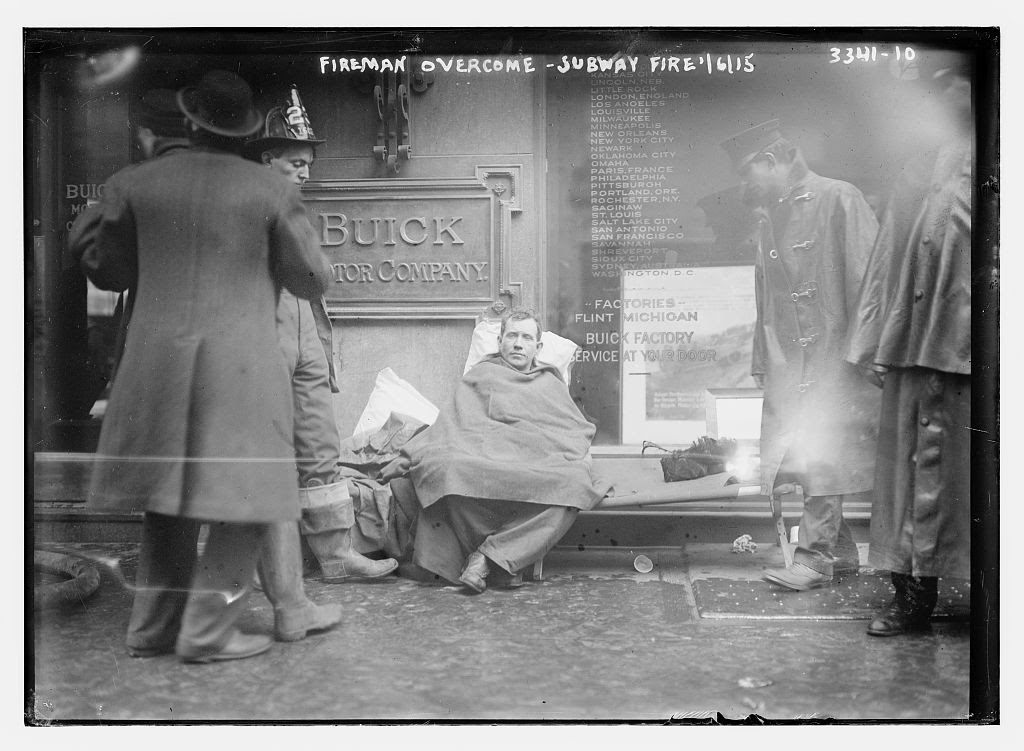
Hundreds were sent to the hospital with various injuries, mostly smoke inhalation, but many from the horrors of being trampled underfoot. Unfortunately, one woman was killed in the incident.

Firefighters had few options in rescuing passengers.  Most were delivered up ladders along a small passage at 55th Street.  The air was so toxic that many firemen were themselves hospitalized.

Subway service was naturally disrupted for a few a days afterwards. Officials initially shrugged off the incident. “In the present state of the art,” said Frank Hedley, general manager of the Interborough Rapid Transit, “there is nothing known which will prevent the recurrence of short circuits.” However, attention soon turned to woefully inadequate insulation used in subway wiring.

“New York received a warning, when hundreds of passengers were suffocated in the subway.   The next occurrence may be far more serious in loss of life due to a similar cause — suffocation. No time should be lost remedying the most serious defect of the subway, viz. lack of suitable ventilation at all times.” [source]

Redesigned subway cars and fireproof wiring would soon ensure such a disaster would not occur again.

Categories
On The Waterfront Podcasts

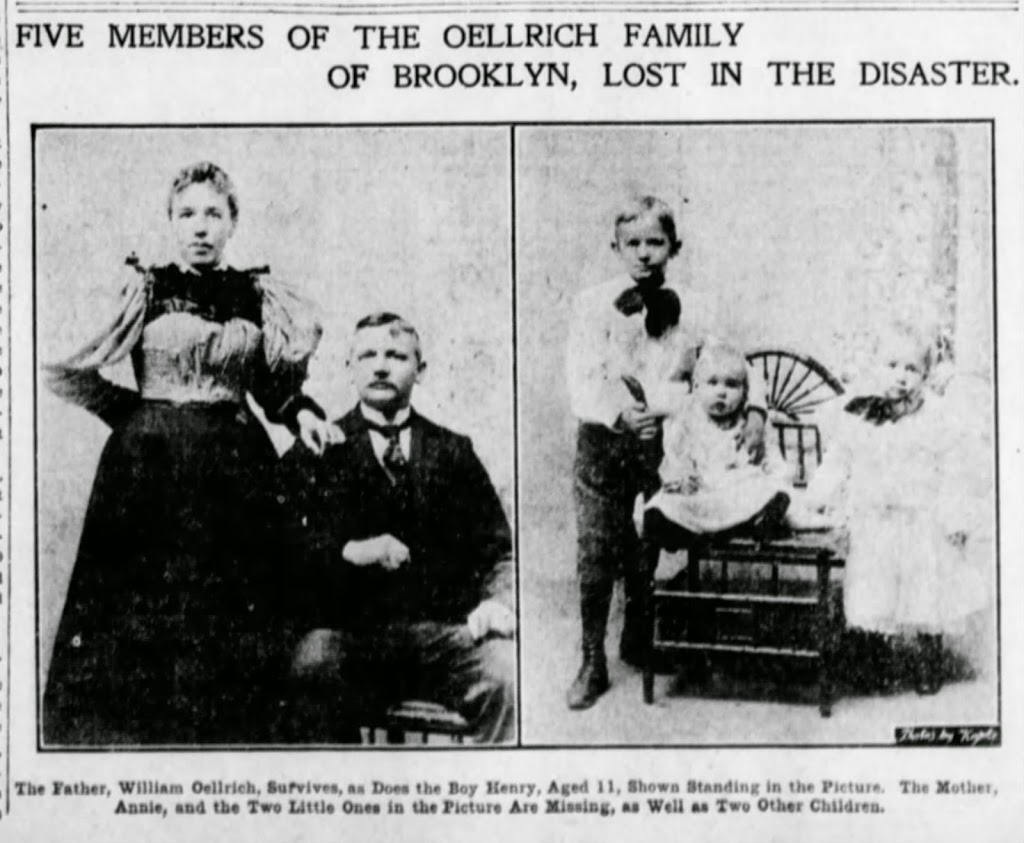
American tragedy: The tale of the General Slocum disaster

PODCAST On June 15, 1904, hundreds of residents of Kleindeutschland, the Lower East Side’s thriving German community, boarded the General Slocum excursion steamer to enjoy a day trip outside the city. Most of them would never return home.

The General Slocum disaster is, simply put, one of the greatest tragedies in American history. Before September 11, 2001, it was the largest loss of life of any event that has ever taken place here.

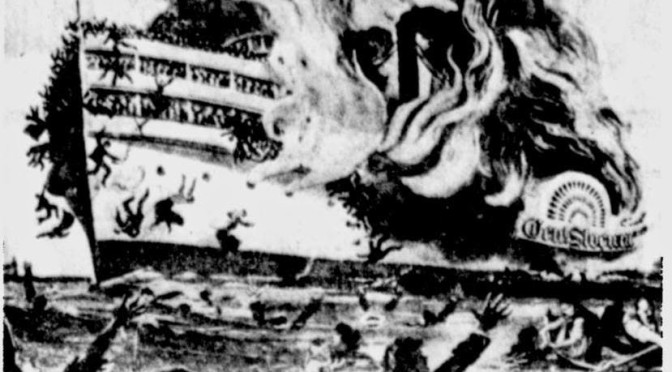
This is a harrowing story, brutal and tragic. The fire that engulfed the ship near the violent waters of the Hell Gate gave the passengers a horrible choice — die by fire or by drowning.

In the end, over one thousand people would lose their lives in an horrific catastrophe that could have been easily prevented. But there are also some surprising and even shocking stories of human survival here, real tales of bravery and heroism.

PLUS: The extraordinary fate of little Adella Liebenow Wotherspoon (at right)


And we would like to thank a new sponsor Audible, the premier provider of digital audiobooks. Get a FREE audiobook download and 30 day free trial at www.audibletrial.com/boweryboys. Over 150,000 titles to choose from for your iPhone, Android, Kindle or mp3 player Audible titles play on iPhone, Kindle, Android and more than 500 devices for listening anytime, anywhere.


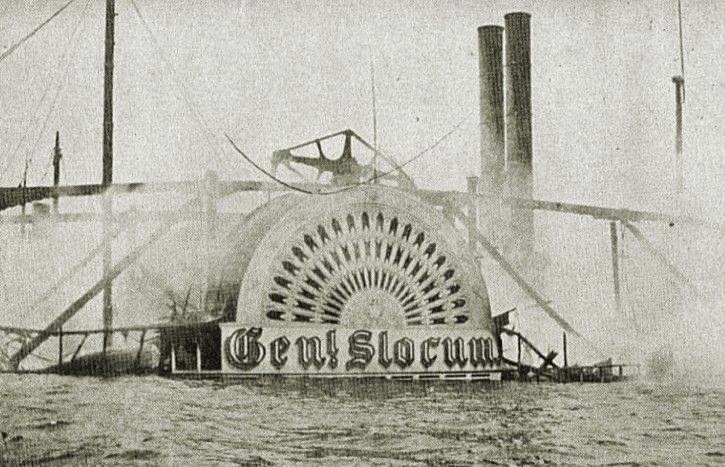
The General Slocum, in its glory days.  I believe this photograph was taken in the Rockaways.

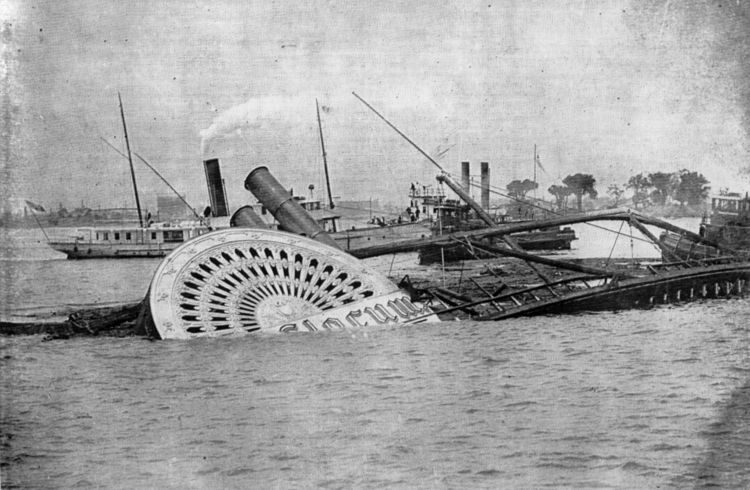
A tugboat attempts to put out the remaining flames of the Slocum, now a burning husk in the water.


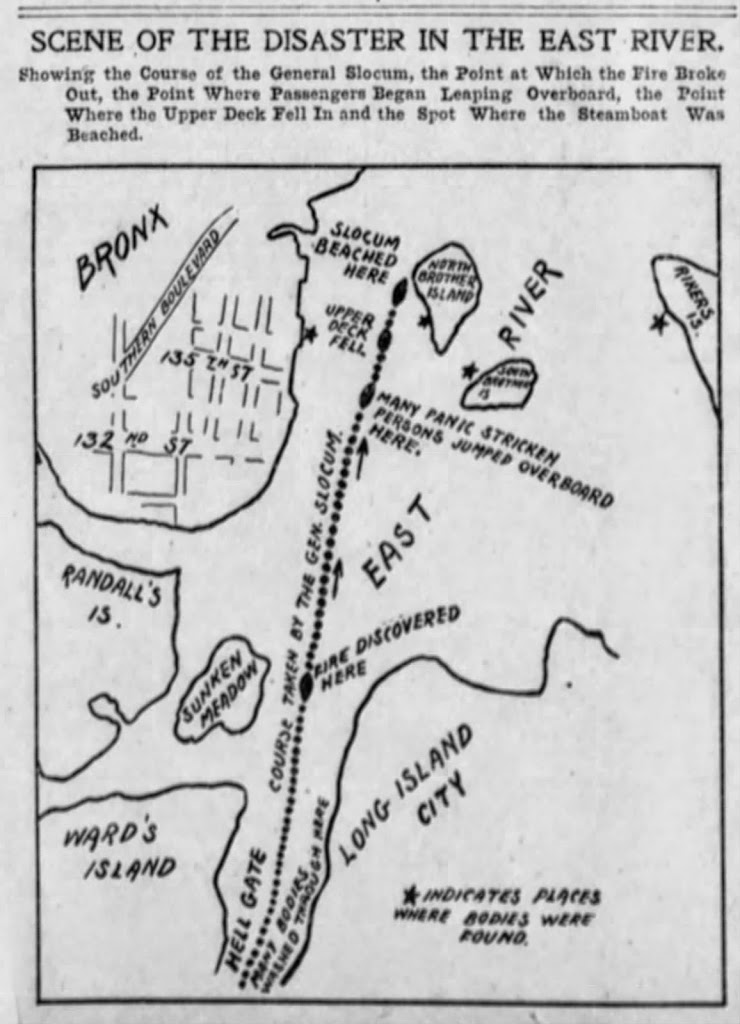
A make-shift map, from the Brooklyn Daily Eagle, June 15, 1904, late edition:

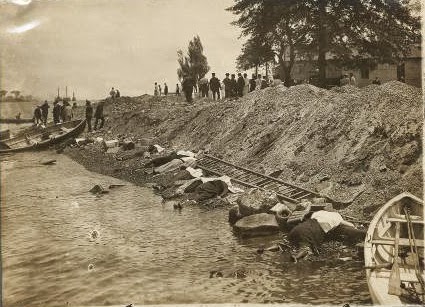
Bodies washed ashore on North Brother Island

Two morbid photographs from Charities Pier:

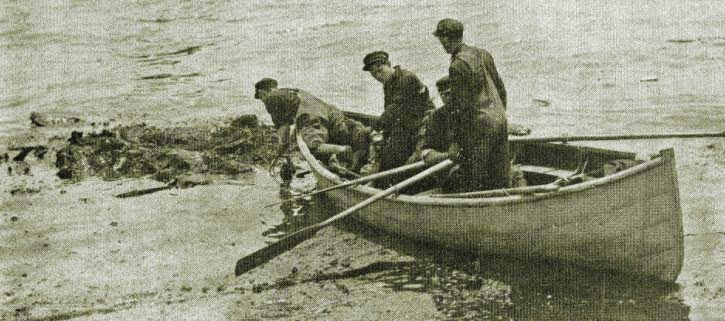
For days later, recovery workers sifted through East River debris, looking for additional bodies:

A funeral procession through the Lower East Side for some of the victims:

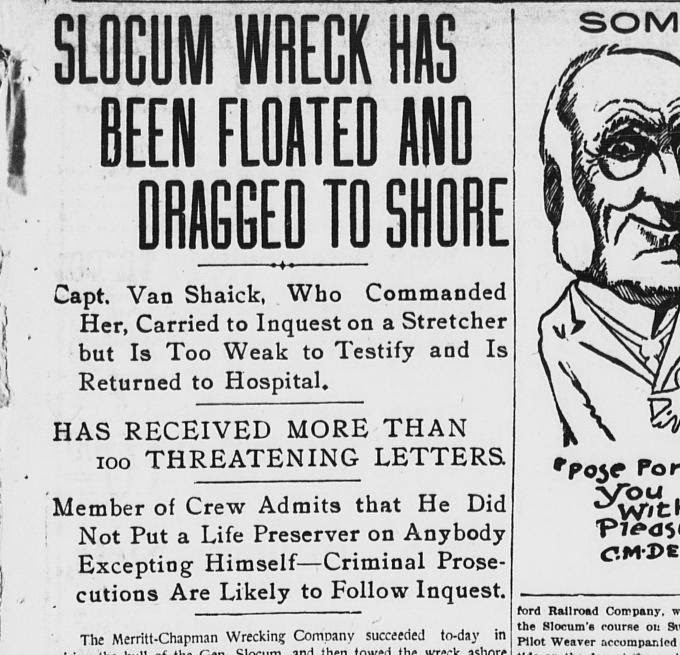
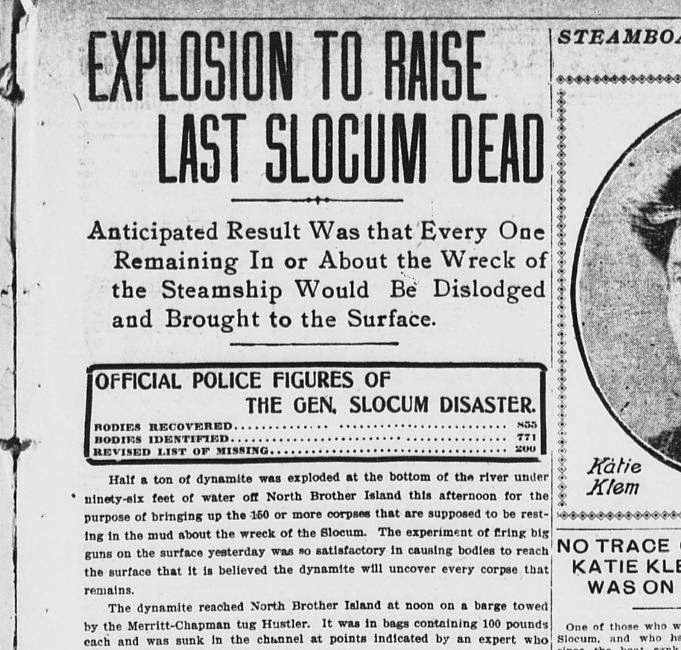
Two headlines from the New York Evening World, one week after the disaster:

The cover of Puck Magazine, one year after the disaster, wondering if justice would ever be served to those under indictment for the disaster. “Illustration shows an old and haggard “Justice” sitting in a chair on a rock in the East River, cobwebs have grown over her sword, scales, and an “Indictment” (Library of Congress)

From the Brooklyn Daily Eagle, the following day:

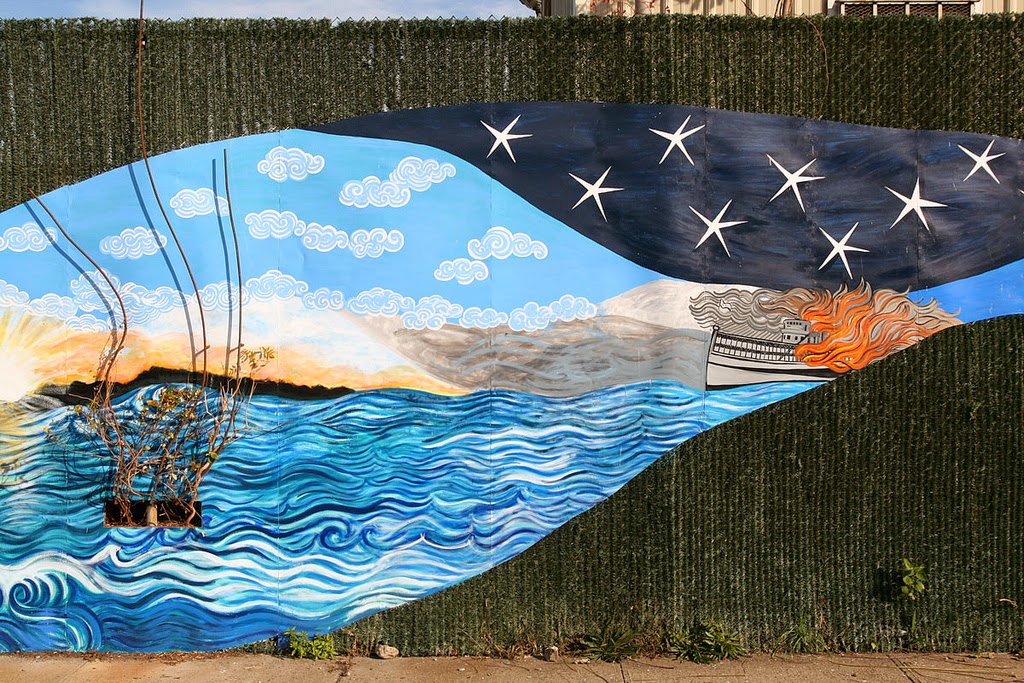
A mural in the Bronx that depicts the General Slocum disaster (courtesy Flickr/Joe Schumacher):

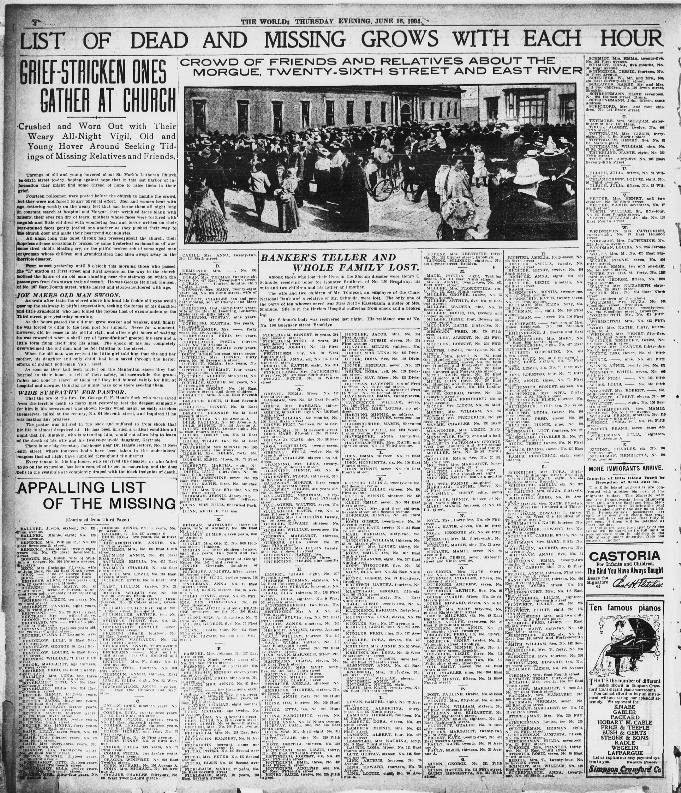
The initial list of the deceased, from the June 16, 1904 edition of the New York Evening World.  The number would increase over the coming days.


Categories
Newspapers and Newsies

What if? Meteors over Manhattan, 1922

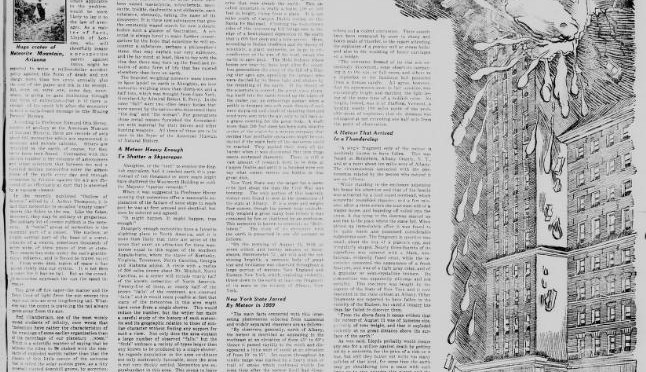
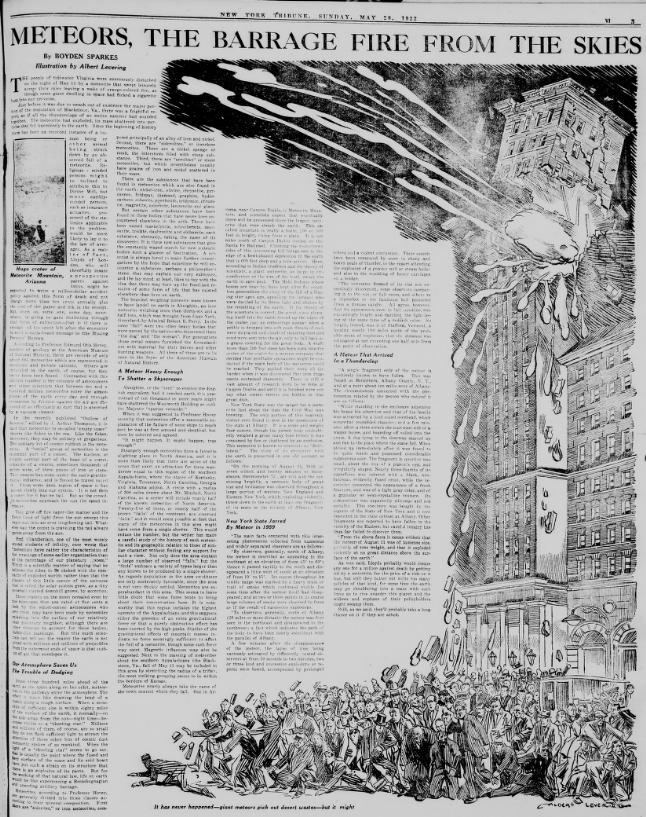
In 1922, the New York Tribune envisioned what it would be like if a meteor hit downtown Manhattan. 

The article is a real scare piece on the potential of meteors destroying life on Earth.  It references the American Museum of Natural History‘s own meteor, Ahnighito, brought to the institution by Robert Peary in 1904.  As I mentioned in my post from 2010, that famous rock was of no particular threat and in fact was itself pummeled by the jackknifes of rowdy young children.

“Ahnighito … had it reached Earth this year instead of ten thousand or more might have shattered the Woolworth Building,” writes Boyden Sparkes in the Tribune article.

Unfortunately, as you’ve probably noticed, this image also accidentally recalls other, more recent tragedies. You can find the original image at the Library of Congress (read it here)

Just in case you think the recent meteor in Russia is somehow an aberration and a true sign of the times, you should remember that meteors have already landed much closer to home  here.   For instance, in 1922, a meteor almost crashed into Asbury Park, NJ!

Categories
On The Waterfront Podcasts

The Staten Island Ferry: its story, from sail to steam

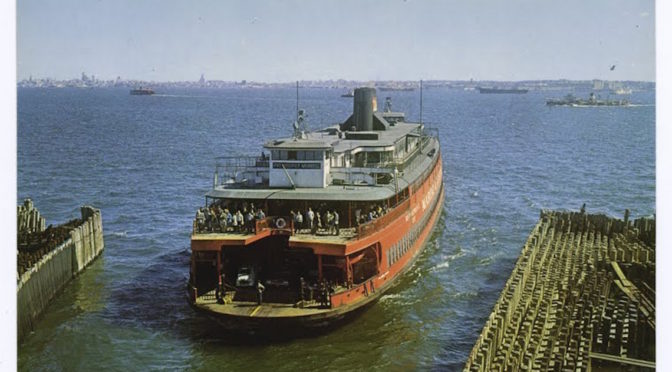
PODCAST The Staten Island Ferry is one of the last remaining vestiges of an entire ferry system in New York, taking people between Manhattan and its future boroughs long before any bridges were built. In Staten Island, the northern shores were spiked in piers, competing ferry operators braving the busy waters of New York harbor.

In the first of our summer-long podcasts BOWERY BOYS ON THE GO on New York public transportation, I look at the history of Staten Island’s famous ferry, its early precursors, its connection to Cornelius Vanderbilt and a Monopoly property, and its evolution when the city took it over in 1905.

ALSO: Find out the curious story behind the name of Victory Boulevard and the neighborhoods of St. George and Tompkinsville.

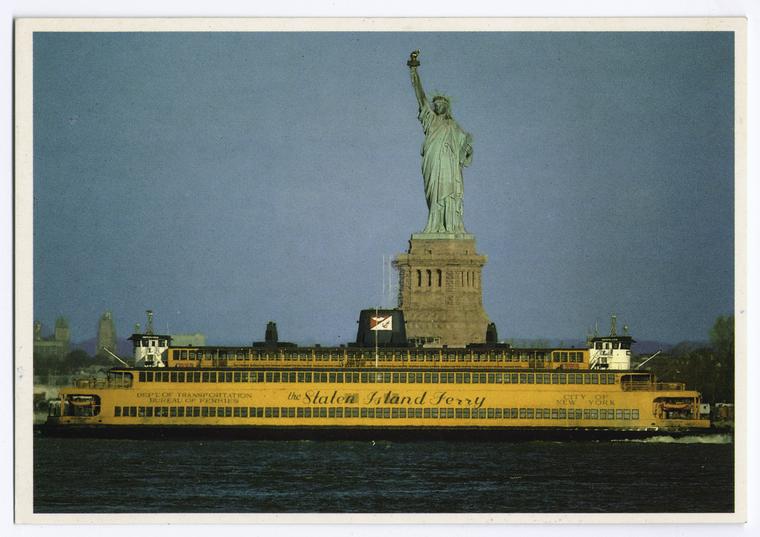
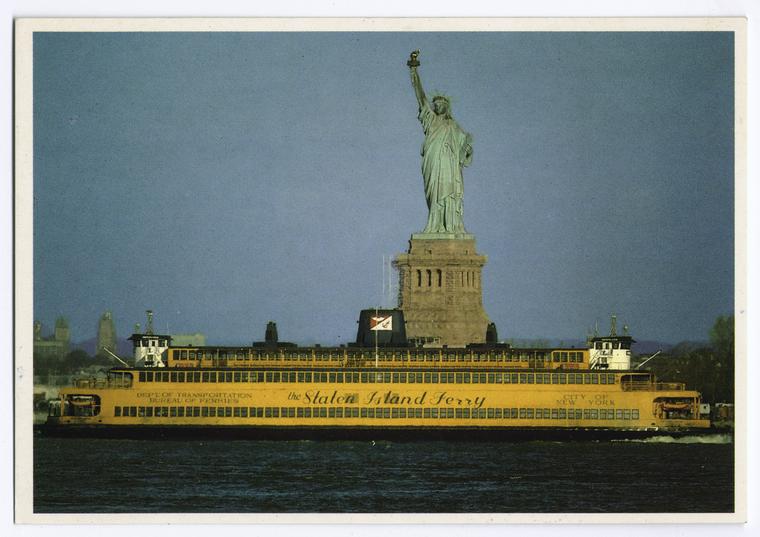
From an old postcard, illlustrating why the Staten Island Ferry has become more than just a way to get to and from work. [NYPL]

ferry2

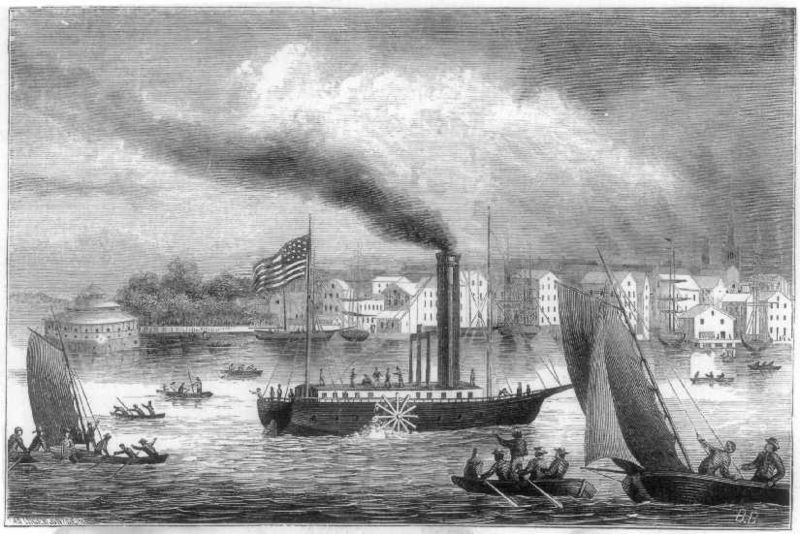
The Clermont in the waters of New York Harbor, 1807. Robert Fulton’s first steamship would revolutionize travel and change the rules of the ferry game. The first steamship off Staten Island waters would be the Nautilus in 1817, property of Daniel Tompkins. This Nautilus should not (obviously) be confused with Fulton’s famous submarine of the same name. Although the boat seems to have inspired a building, called Nautilus Hall, on Tompkins’ property. [Courtesy Gerald Massey]

clermont

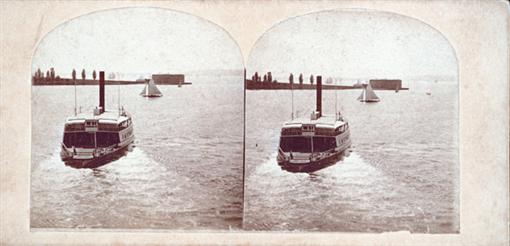
One of the earliest known photographs of a “Staten Island Steamboat”, taken in 1858 and about to chug by Castle William on Governor’s Island, one of “Anthony’s Instantaneous Views” from the George Eastman House archive.

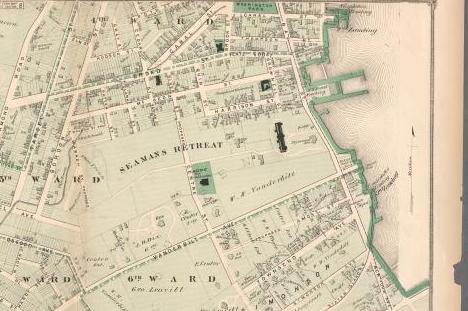
This is a detail from an 1874 map of Stapleton and Clifton along the northeast shore of Staten Island. The area in green along the waterfront is Vanderbilt’s Landing, at least the southern part of it. You can also find the Vanderbilt estate nearby. For a closer look, check out the map directly on the NYPL site and use the zoom in/out tools.

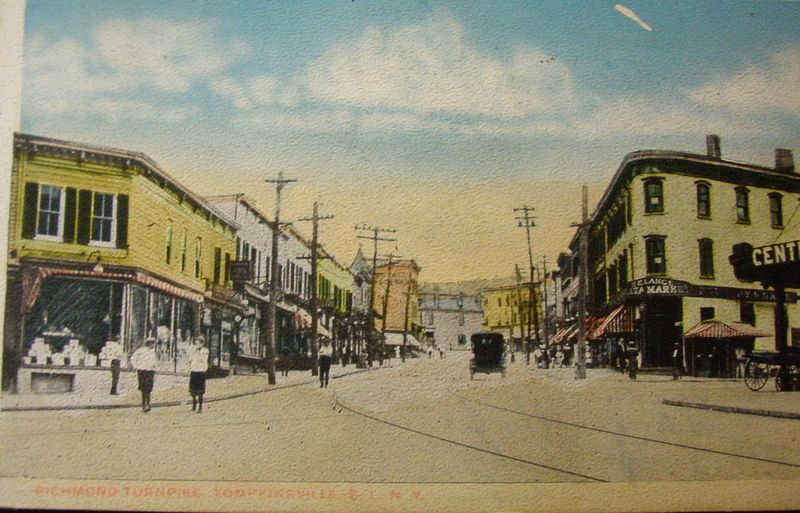
The Richmond Turnpike traveling through Tompkinsville, the town founded by Vice President Daniel D. Tompkins. The Turnpike, formerly a toll road and the basis of the Richmond Turnpike Company, would be renamed Victory Boulevard after World War I.

richmond

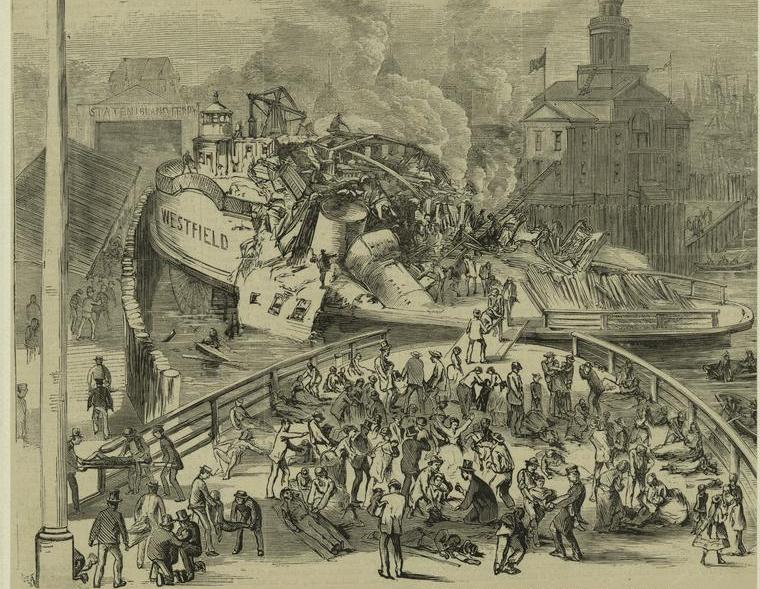
The Westfield disaster on July 1871, a boiler explosion that killed over 80 people, underscored the risks of early steam travel in the crowded waters of New York harbor. It remains the worst of several disasters in the Staten Island ferry’s long history.
westfield

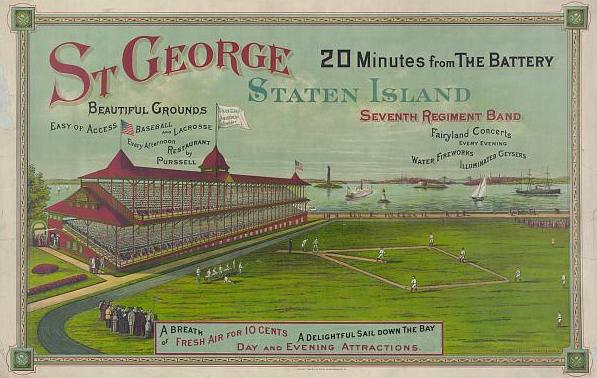
Named for George Law, the neighborhood of St. George was a bustling entertainment district, with hotels, light amusements and sports venues. This postcard is from 1886, illustrating the new St. George Cricket Grounds, built by developer Erastus Wiman.
1886

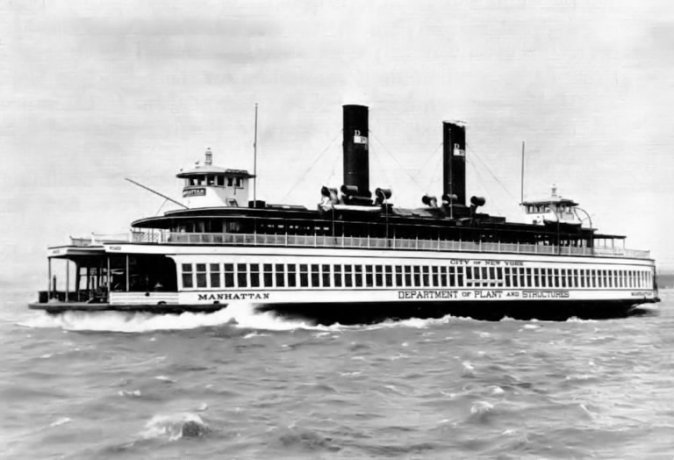
When the city took over operation of the Staten Island Ferry in 1905, they commissioned five new boats, each named for a borough. Here’s the Manhattan:
manhattan

If you want to thumb through a spread of old photographs of prior ferryboats, check out this great site.

And this Flickr picture might be one of my favorite pictures ever.

Grand Central’s Other Explosion

Wednesday’s steam explosion disaster at 41st Street and Lexington Avenue, which at ‘press time’ had killed one person and injured 44, gave many people that sinister feeling of déjà vu they felt on Sept. 11. It reminded us almost as much of the New York blackout of 2003, with hundreds of people filling the streets with busy cellphones and sweaty backs, some annoyed, some good humored.

Believe it or not, however, over a hundred years ago, the Grand Central Station environs bore witness to an even more horrifying explosion … just one block away.

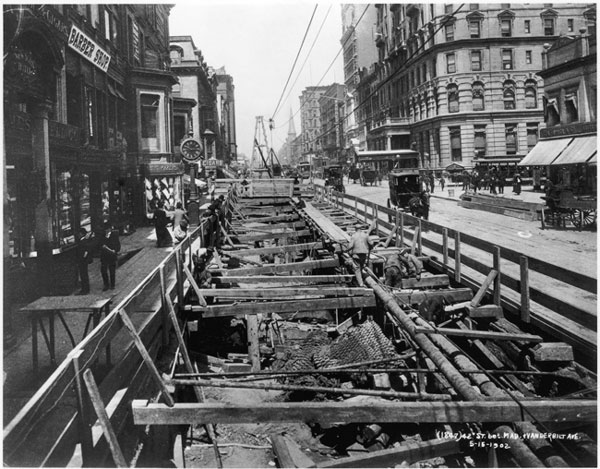
William Barkley Parsons was given the arduous task of installing the first New York City subway system in 1894. After visiting the London Underground, he determined that the best way to drill holes through the varied and sometimes delicate surface of the island was with a method called ‘cut and cover’ –- essentially digging a gigantic, deep trench and sealing it up at street level. This was chosen over the trickier ‘deep tunneling’ which required greater blasting and elaborate subterranean passageways.

One of the subcontractors in Parson’s employ was the unfortunate Ira Shaler, who was in charge of the tunneling of 34th through 42nd Street. This being before the days of union and worker’s protection, Shaler was soon stamped with the mortibund nickname ‘the voodoo contractor’ for a nasty string of deadly accidents along the line.

And so, 105 years after Wednesday’s steam explosion, the greatest of Shaler’s accidents happened a block away at 41st and Park Avenue, on Jan 27, 1902. A wooden shed filled with 200 pounds of dynamite ignited and blew, sending billowing flames high into the sky and glass shards flying for blocks. The nearby Murray Hill Hotel was severely damaged as was the great façade of the Grand Central terminal. Five people were killed and many others seriously injured. The tunnels below, strangely, were barely disturbed.

Shaler continued on, and with him, smaller calamities occured up and down the newly constructed tunnel shaft.

In the end, Shaler’s final unlucky victim was Shaler himself. He died five months later, four blocks down, on 37th and Park, crushed by tumbling rocks while he was demonstating the tunnel’s safety to his boss.

Or to quote professor Clifton Hood, a professor of history at Hobart and William Smith Colleges: “Parsons pointed to a rock and said it looked rotten. Shaler disagreed, stepped out from under a protective cover and tapped the rock with his cane. It all came down on top of him. He died a few days later. It was not a good way of losing an argument.”