A few of the most memorable frenemies and catfights from American history — including the story of New York City’s longest lasting rivalry.
Alexander Hamilton vs Aaron Burr! Delmonico’s vs Sherry’s! John Adams vs everybody! Some of history’s most fascinating stories involve important figures who did not like each other very much.
In this edition of Bowery Boys History Live!, recorded at Manhattan’s City Winery on May 26, 2026, Greg Young from the Bowery Boys brings some of these stories to a live audience, featuring author Laurie Gwen Shapiro, tour guide Billy Nemec, and the Gilded Gentleman himself, Carl Raymond.
Featuring tales of Revolutionary War spite, obscene Gilded Age banquets, and Jazz Age flights of spite. PLUS: New York City’s longest-running rival.
NOTE: We performed at City Winery less than 24 hours after the Knicks clinched their place in the NBA Finals.
This episode for produced and cleaned up by Kieran Gannon.
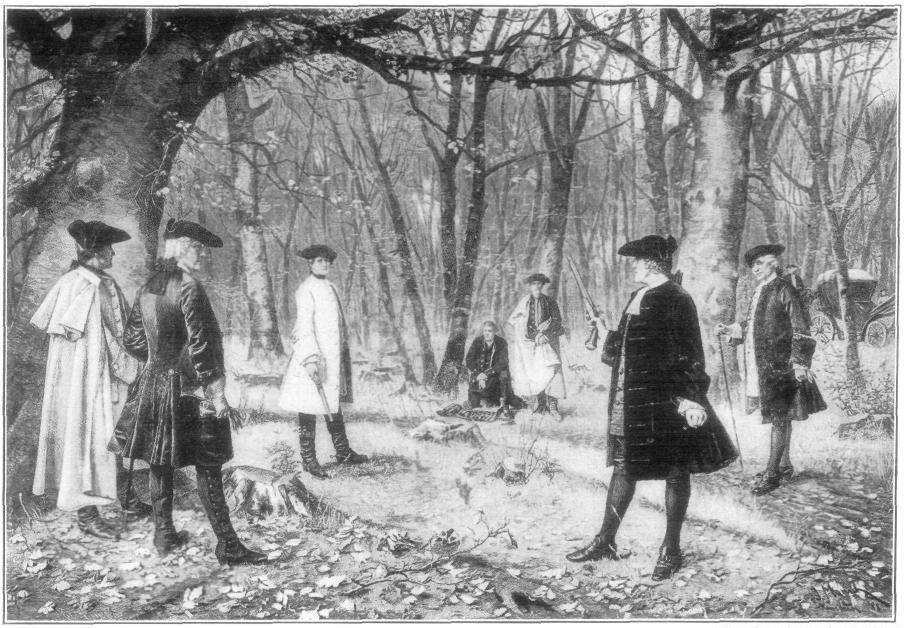
Alexander Hamilton and Aaron Burr met at a clearing in Weehawken, NJ, in the early morning on July 11, 1804, to mount the most famous duel in American history. But why did they do it?
This is the story of two New York lawyers — two Founding Fathers — that so detested each other that their vitriolic words (well, mostly Hamilton’s) led to these two grown men shooting each other out of honor and dignity, while robbing America of their brilliance, leadership and talent.
You may know the story of this duel from history class, but this podcast focuses on its proximity to New York City, to their homes Richmond Hilland Hamilton Grange and to the places they conducted their legal practices and political machinations.
Which side are you on?
ALSO: Find out the fates of sites that are associated with the duel, including the place Hamilton died and the rather disrespectful journey of the dueling grounds in Weehawken.
CORRECTION: Alexander Hamilton had his fateful dinner as the house of Judge James Kent, not John Kent, as I state here.
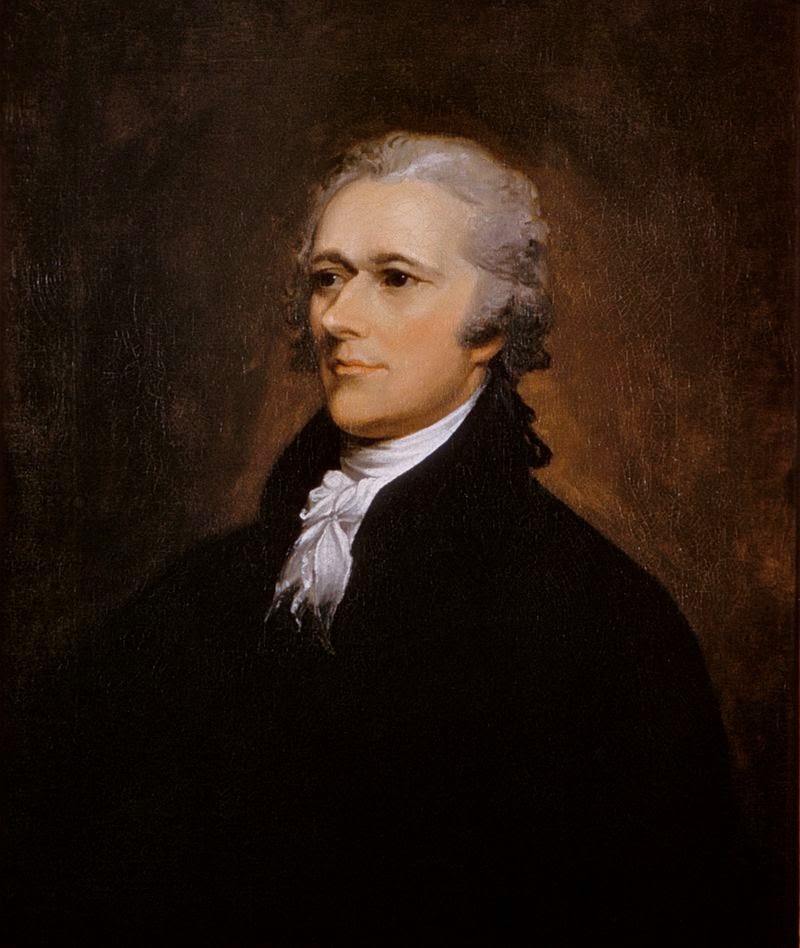
Alexander Hamilton, leader of the Federalists was a played out, stressed out, heavily in debt politician by June 1804. This is John Trumbull’s painting of Hamilton, completed almost over a year after the duel.
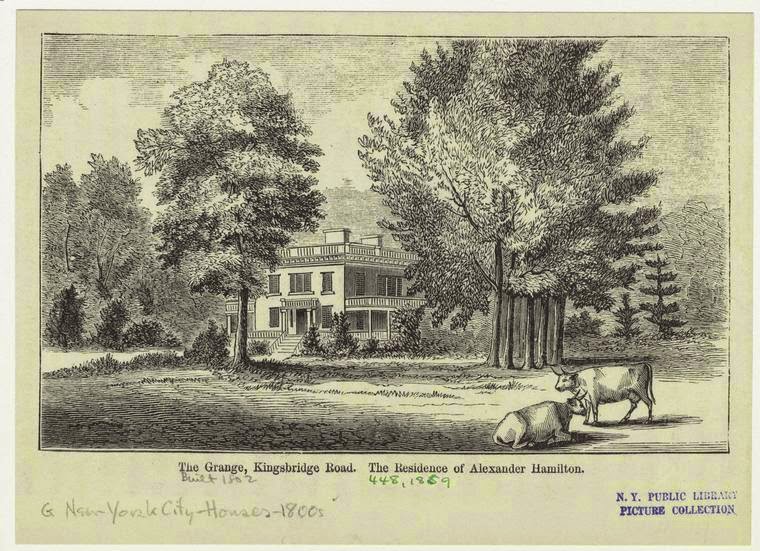
The Hamilton Grange, a beautiful home on the Hudson that Alexander only lived in for a couple years. (NYPL)
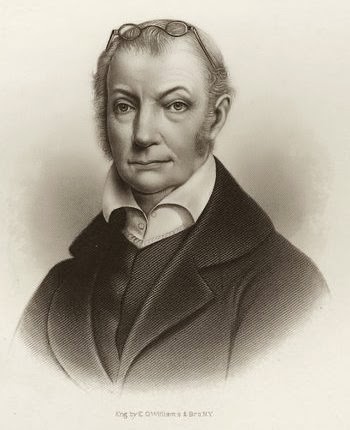
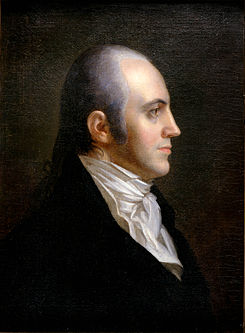
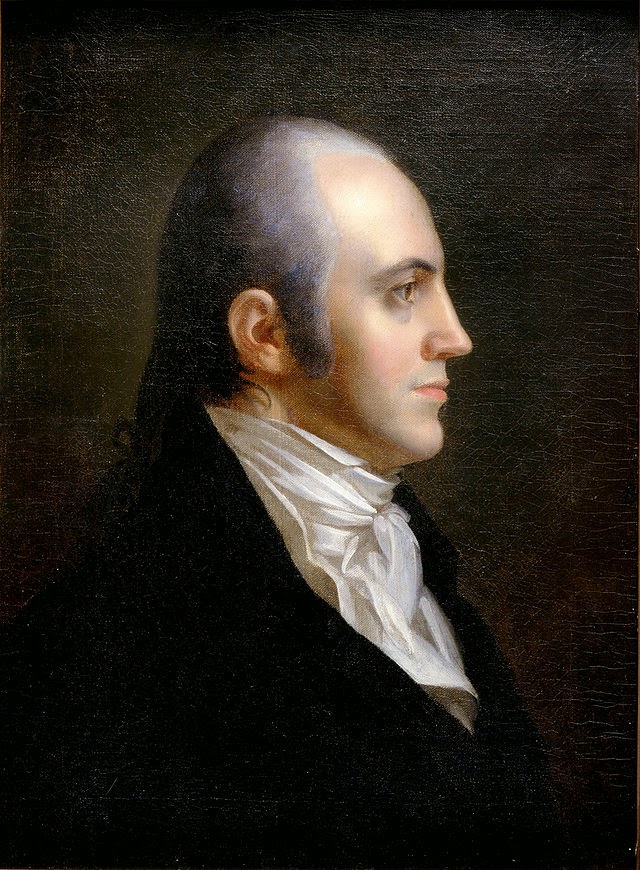
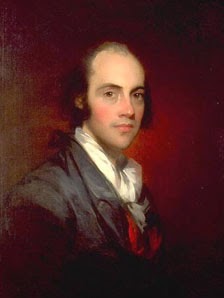
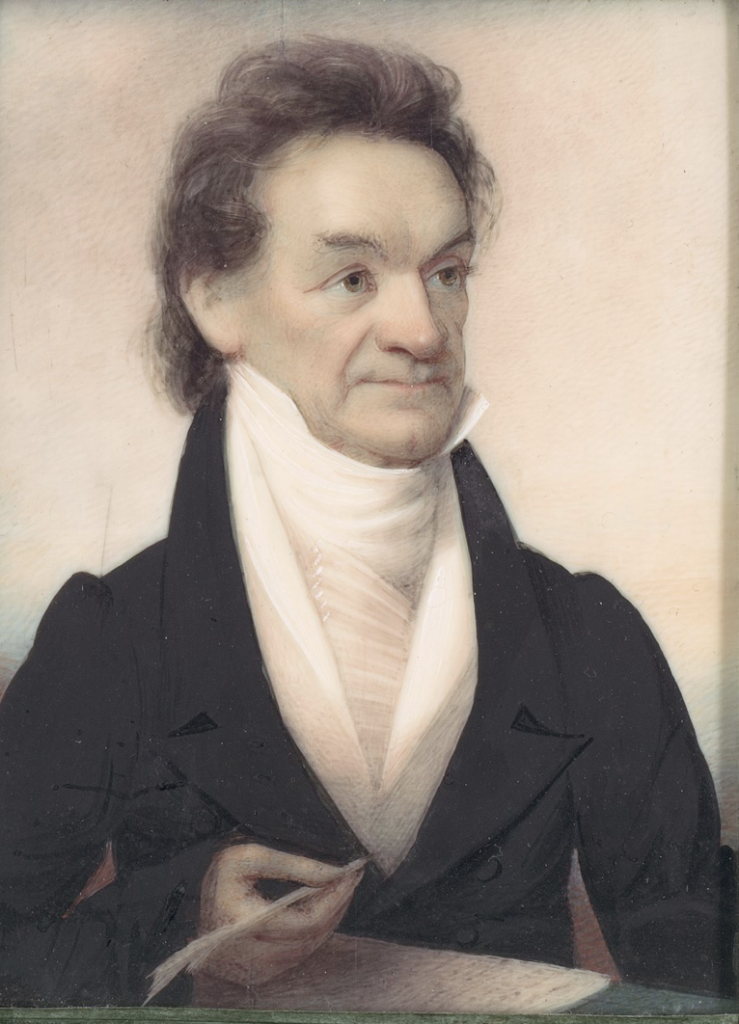
Aaron Burr, Vice President of the United States, was a played out, stressed out, heavily in debt politician by June 1804. This is John Vanderlyn’s portrait of Burr from 1802.
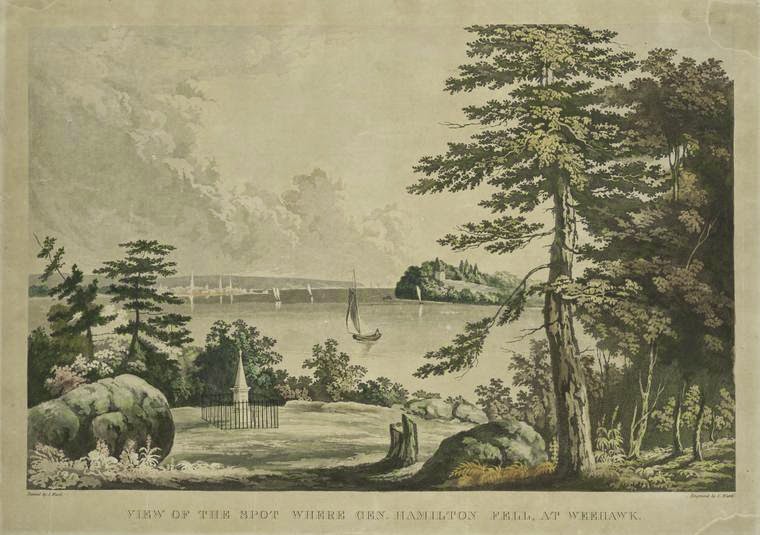
View of the Weekhawken dueling grounds in 1830s. This area most likely still saw some duels at this period. Note the small monument/obelisk marking the spot allegedly where Hamilton fell. (NYPL)
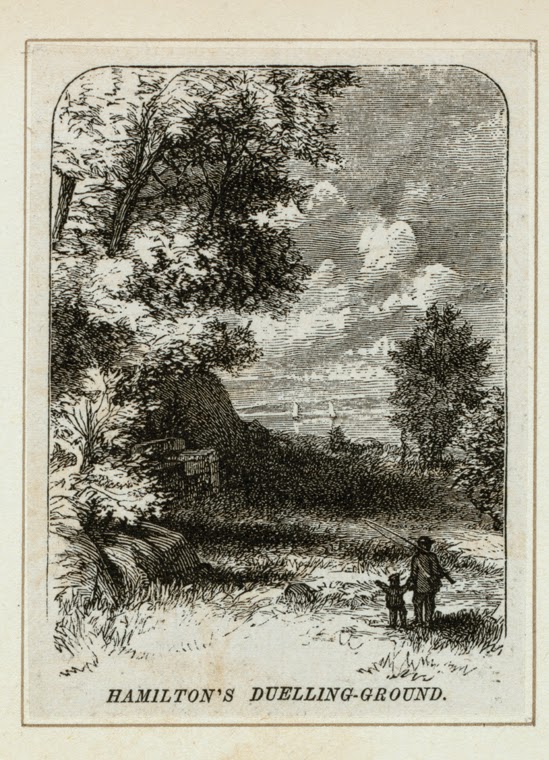
Thomas Addis Emmet’s quaint depiction of the dueling grounds was created in 1881, long after the actual grounds were destroyed by railroad construction. (NYPL)
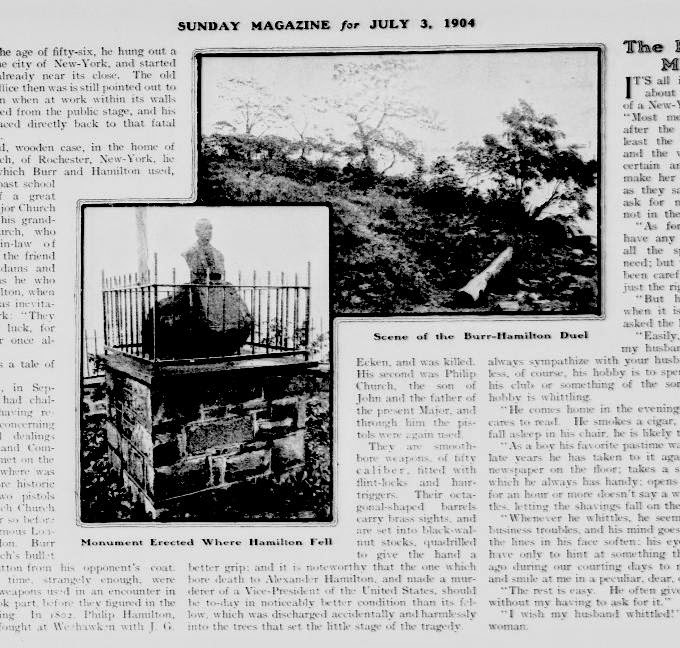
From the New York Tribune, July 1904, a look at the Hamilton bust that once sat in Weehawken. Several years later, vandals took the bust and hurled it off the cliff.
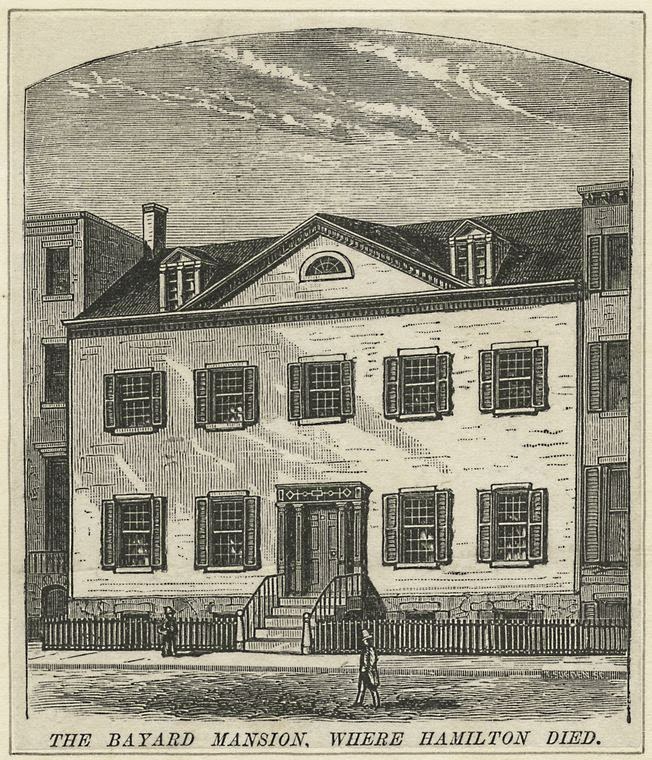
The William Bayard house in later years, with the lots surrounding it obviously sold and built up around it. (NYPL)
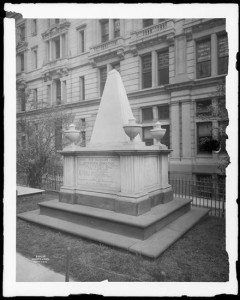
The Hamilton tomb at Trinity Church, picture taken in 1908, although it looks pretty much the same today! (Wurts Brothers, Courtesy MCNY)
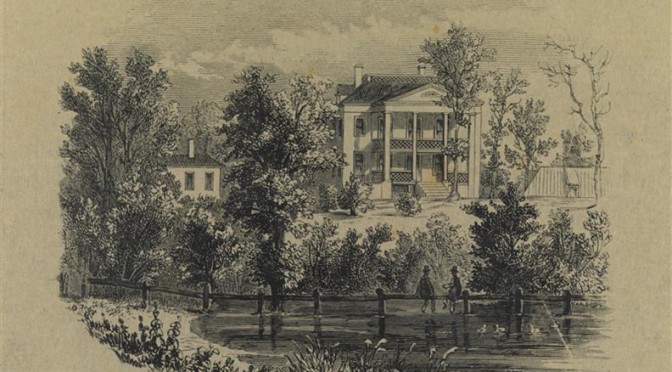
Richmond Hill, the spacious mansion and 26-acre estate on the outskirts of town that had once been George Washington‘s headquarters and later the home of John Adams, was also home to another vice president — Aaron Burr. This was the place he lived on that fateful day, July 11, 1804, when he entered into a duel with Alexander Hamilton. Here’s a lovely description of the home from an 1861 biography of Burr by author James Parton:
“[Burr’s] style of living kept pace with his increasing income. In a few years we find him master of Richmond Hill, the mansion where Washington had lived in 1776, with grounds reaching to the Hudson, with ample gardens, and a considerable extent of grove and farm. Here he maintained a liberal establishment and exercised the hospitality which was then in vogue.
The one particular in which Richmond Hill surpassed the other houses of equal pretensions, was its library. From his college days, Colonel Burr had been a zealous buyer of books, and his stock had gone on increasing till, on attaining to the dignity of householder, he was able to give to his miscellaneous collection something of the completeness of a library.
It is evident enough, from his correspondence, that his favorite ethos were still those whom the ‘well-constituted minds’ of that day regarded with admiring horror. The volumes of Gibbon’s History [The Decline And Fall of the Roman Empire] were appearing in those years, striking the orthodox world with wonder and dismay. They had a very hearty welcome in the circle at Richmond Hill.”
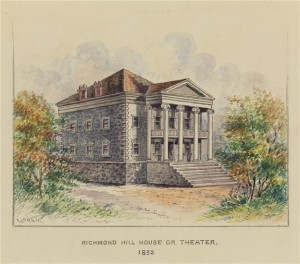
After the duel, Burr liquidated his assets, selling Richmond Hill to John Jacob Astor. With the grounds heavily cut up and sold, he had the mansion rolled on logs to the newly carved street corner and turned into a theater and opera house. At this time, he also moved the carriage house further north, where it was later re-purposed and today houses the romantic restaurant One If By Land, Two If By Sea.
It made for a very sumptuous opera house, it appears. According to author Eric Homberger, “Boxes at the Richmond Hill were furnished as though they were an extension of the elegant parlors of St. John’s Park, with ‘light blue hangings, gilded panels and cornice, arm-chairs, and a sofa.'”
It was parallel in style, perhaps, to the Astor Place Opera House across town. Eventually it deteriorated into a lowly roadhouse and saloon — but certainly, the most gorgeous one in town — called the Tivoli Saloon before being torn down in 1849.
Today the site of Richmond Hill and its former ground are occupied by this building, currently the home of WNYC, and the surrounding blocks of this area of the far West Village.
Top image courtesy the Museum of the City of New York
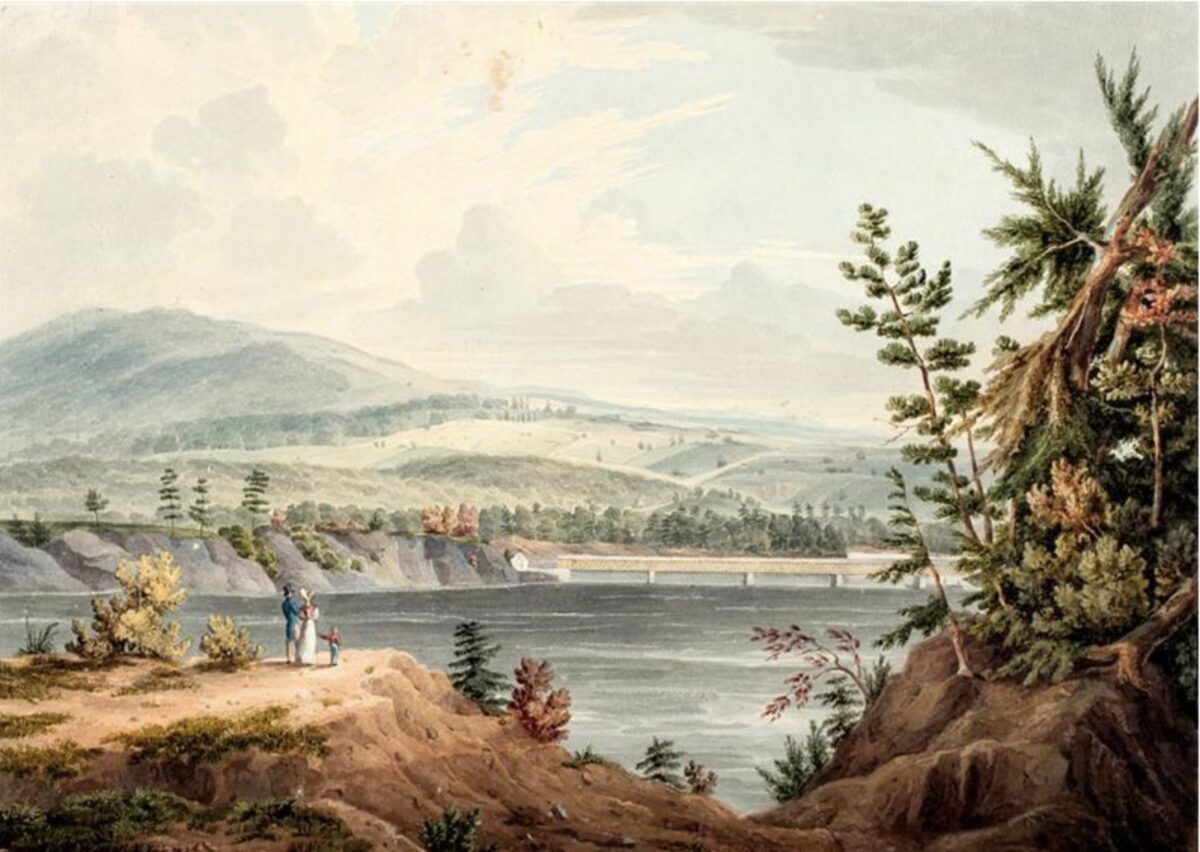
Hudson River Bridge near Waterford, New York, 1832. Courtesy New-York Historical Society
People have schemed to put a bridge over the Hudson River for well over two hundred years. That task would prove most difficult to those in Manhattan, given the distance between its shores and those of New Jersey.
After several failed proposals, the two were linked with the Pennsylvania Railroad tunnels (1910), the Holland Tunnel (1927), and finally, the George Washington Bridge (1931).
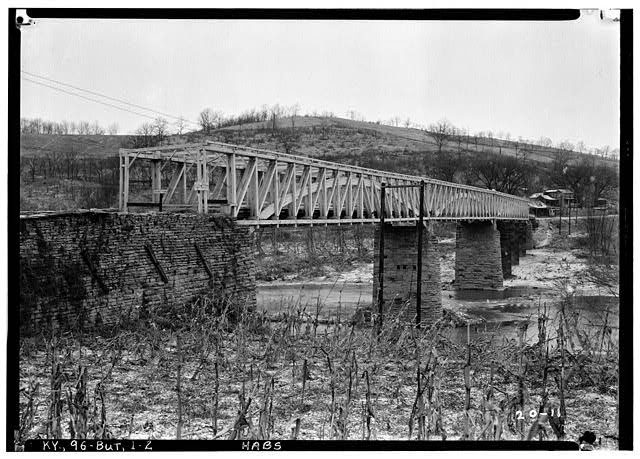
Above: A wooden bridge in Kentucky using the Burr truss, invented by Theodore Burr and first used over the Hudson River’s first bridge span. (Courtesy LOC)
But further upstate, industrious New Yorkers had an easier time of bridging the two sides, as the river became narrower in places and engineers could work upon sparsely populated lands.
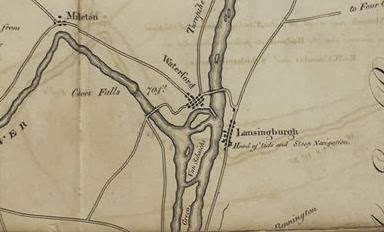
The first bridge over the Hudson River rose at the village of Waterford(near Albany) in 1804, the work of inventor Theodore Burr, the cousin of Vice President Aaron Burr.
From an 1820 map of the Hudson River. You can see where Burr’s bridge was located, situated over the Hudson until the 20th century (courtesy NYPL):
While Aaron was engaging in a vituperative war of words with Alexander Hamilton, his cousin Theodore was crafting an extraordinary bridge, described in a later history by his ancestor as “four combined arch and truss spans, one of 154 feet, one of 161 feet, one of 176 feet, and a fourth at 180 feet.”
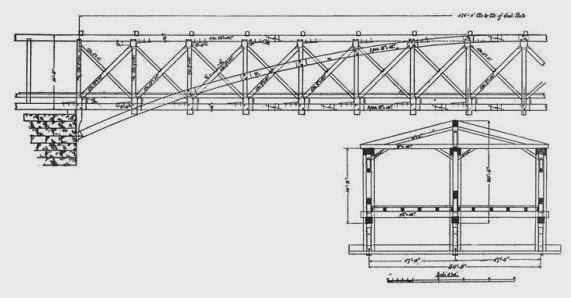
By this point, he was already a well-known, even adventurous builder, but the Waterford bridge was truly something unique. He eventually patented his design, which became known as ‘a Burr Truss,’ used in the construction of covered bridges throughout the United States.
A sketch of the Waterford bridge, as illustrated by Thomas Cooper in 1889, and an excellent view of what became known as the Burr Truss:
The bridge was coming along nicely by the spring of 1804. The local paper noted that “the erection is proceeding rapidly, the abutments, (on shore sides) and one of three piers are already near finished, and the frames of the arches are in a state of equal preparedness.
Concerning the abutments and piers, there is not the least doubt that they will render the bridge secure from ice in spring seasons.”
I’m not sure where Theordore was in July, whether at the bridge site or back at his grist mill in Oxford. The bridge was over one-third completed that month when Theodore got word that his esteemed cousin had met Hamilton in a duel at Weehawken, 150 miles down river, leading to the death of Hamilton.
But while Aaron’s reputation would quickly deteriorate, Theodore’s would briefly flower, becoming America’s most prolific bridge engineer in the early 19th century. His most impressive span, the Susquehanna River Bridge in Pennsylvania, survived until 1857.
Strangely, however, Theodore’s eventual fate would eventually mirror his cousin’s. Many of his bridges fell apart, and his finances were ruefully mismanaged.
He actually disappears from the historical record; according to author Donald E. Wolf, “[h]is heirs report that he died in 1822, but they have been unable to say what caused his death or to identify the place of his burial.”
Originally exposed to the elements, the bridge was later sheathed in a covering. It held sturdy over the Hudson River until it was destroyed in a gas fire in 1909.
With a new mayoral race on the horizon in New York City we think it is time that you Know Your Mayors! Become familiar with other men who’ve held the job, from the ultra-powerful to the political puppets, the most effective to the most useless leaders in New York City history.
This longtime feature of this website is being rebooted with new articles and newly researched and refreshed earlier entries in this series. Check back each week for a new installment.
Edward Livingston Term: 1801-1803 The Mayor Who Went On To Do Better Things
On the spectrum of interesting folks who have occupied the mayor’s seat, Edward Livingston must certainly be noted as the defining example of turning your life around.
In 1801Livingston became the mayor of New York City. Two years later, he left the job in total disgrace, run out of the city due to a financial scandal. He would never work in this town again.
And then things got really interesting.
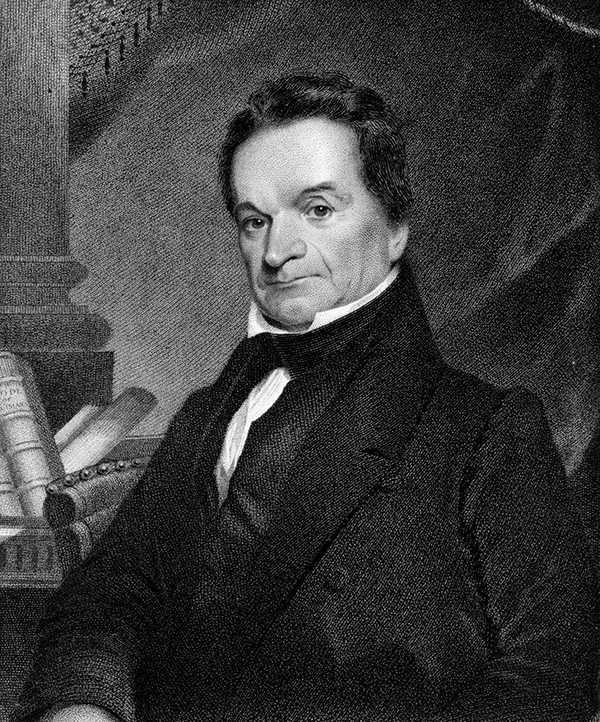
Edward Livingston. Wellmore, E (Engravor) &Longacre, J. L. (Illustrator) Courtesy Library of Congress
Life With The Livingstons
Livingston, born in 1764, was a member of the rich and powerful Livingston clan. There were Livingstons in all aspects of American life — political, social, financial. It was as close as you got to a brand name in the Colonial era.
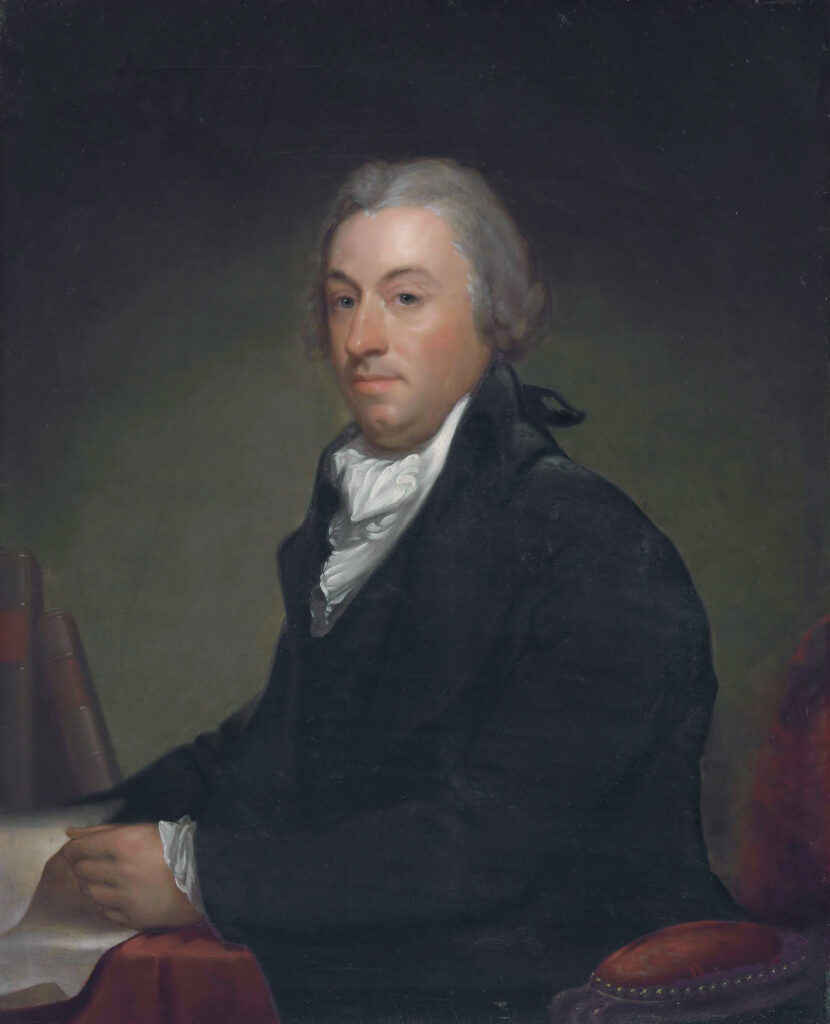
Edward benefited from this common ancestry. He was just eleven years old when his father Peter Van Brugh Livingston became president of New York’s First Provincial Congress in 1775. Another relation Philip Livingston signed the Declaration of Independence in 1776. And Edward’s older brother Robert Livingston (pictured below) would become New York chancellor.
Robert R. Livingston, in a painting by Gilbert Stuart
Young Edward barreled into his career, an ambitious lawyer who settled in New York following the Revolutionary War. Everybody knew his name; he was unsurprisingly a great success. What could go wrong?
Rising Star
In 1795, Beau Ned (as he was called) was elected to represent New York in the U.S. House of Representatives, aligned with the ascendent Democratic-Republican Party, putting him in good graces with Thomas Jefferson, New York Governor George Clinton and various politicians in opposition to the Federalists.
The mayor of New York at that time — Ricard Varick — was a Federalist.
WhenJeffersonwon the presidency in a hotly contested election in 1800, Edward Livingston found himself on the right side of many lucrative political appointments.
In 1801, the governor chose him for U.S district attorney and then, a few months later, Livingston was also appointed mayor. (See entries on Varick and James Duane to understand why these men were even allowed to hold multiple jobs.)
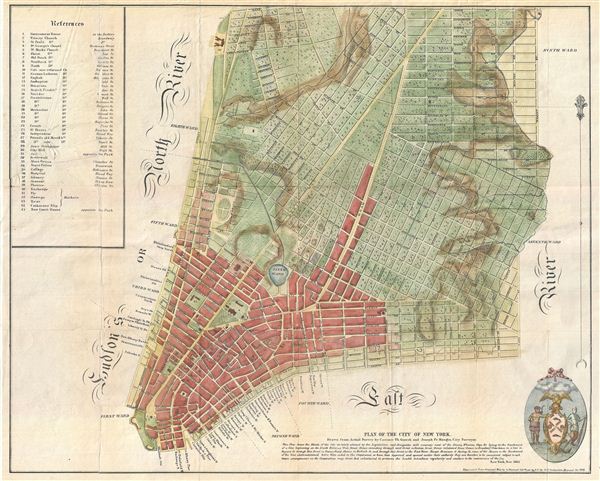
An 1801 map of New York, overlaid with a grid plan proposed by Casimir Goerck and Joseph-François Mangin. This plan was never carried out but it would inspire the Commissioners Plan of 1811.
A Hot Time In The Old Town
Suddenly, Livingston had become mayor of the biggest city in the new nation — a whopping 60,482 according to that year’s census. His opposition to the policies of former president John Adams served him well for a time under the new auspices of a Jefferson presidency.
But the year 1801 in New York was undeniably a volatile one and post-war optimism had given way to bitter skepticism and political chicanery.
New York senator Aaron Burr, Jefferson’s running mate, was nearly voted president in an electoral-college snafu.
Jefferson’s nemesis Alexander Hamilton— who would later be shot and killed by said running mate — would baste his thoughts in the newly created New York Evening Post.
Nearby, a young aide named Washington Irving worked in a law office.
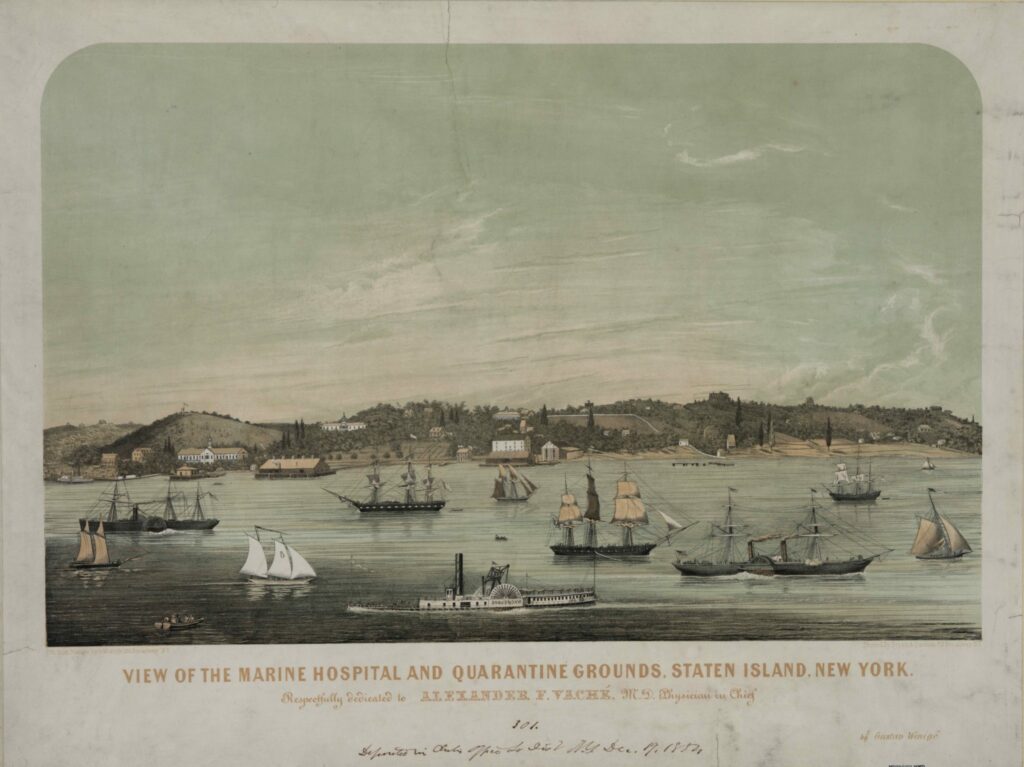
In 1799 New York City built a quarantine station in Staten Island for the treatment of people afflicted by yellow fever and other illnesses. (Image courtesy New York Public Library)
A City Sickness
Unfortunately for Livingston the early 1800s were simply not a great time to be living in New York City. In fact, during his tenure, Edward Livingston almost died of yellow fever.
In 1803, a second epidemic hits New York and hits hard. Hundreds would die, thousands would flee. The stoic Livingston would manage to keep the city operating, even as he himself would become sick and nearly die.
In Disgrace
He recovered only to meet with a scandal that would nearly ruin him.
In the summer of 1803, it was discovered that $45,000 had gone missing from the city’s custom-house fund. While it was determined that a clerk from the district attorney’s office had actually stolen the money, it was Edward Livingston who took the hit politically.
“Although his own integrity was not in question,” according to the book Gotham, the ensuing scandal not only forced Livingston to give up both the state attorney job and the mayor’s seat, but he actually had to sell his property to repay the government.
Livingston had disgraced the family name.
1803 view of New Orleans, looking upriver from the Marigny Plantation House, by J. L. Bouquet de Woiseri
The Ultimate Second Act
Nearly penniless and humiliated, Edward decided to leave New York for good in 1803.
Penniless but not, of course, without family connections.
In 1804 moved to New Orleans, recently purchased from the French by the federal government as part of the Louisiana Purchase. The team negotiating that deal included James Monroe — and Edward’s older brother Robert Livingston.
During the War of 1812, Edward was active in the defense of New Orleans and even served as the aide-de-camp to General Andrew Jackson. The two became close friends.
By 1826, Livingston was successful enough again with his own law practice in New Orleans that he was able to pay back the government all the money he owed plus interest — or almost $100,000, no petty sum back then.
Livingston in 1827. Painting by Anson Dickinson
That same year, Livingston would shape American civil policy with a series of influential penal and judiciary codes for the treatment of prisoners, now referred to as the Livingston Code. While rejected by the State of Louisiana, the legal reforms would live on to shape ideals about incarceration and the death penalty.
Because of these reform codes, Edward Livingston is considered one of the great American legal geniuses of the early 19th century.
After notable stints as representative and a Senator for the State of Louisiana, he became a persuasive Secretary of State for President Jackson from 1831-1833. Edward Livingston died on May 23, 1836.
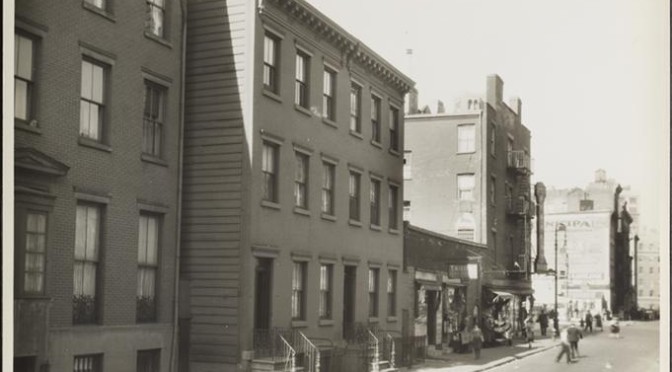
A 1932 photo of 34-36 Barrow Street by Charles Von Urban, courtesy the Museum of the City of New York. Click here to see what this section of the street looks like today
In this week’s Ghost Stories of Old New York podcast, Tom speaks of the ghosts at romantic restaurant One If By Land, Two If By Sea, located in an old carriage house that was moved from its original location to its present home on Barrow Street in today’s West Village.
Barrow Street is a quiet hook of a path, emanating from the southeast side of Sheridan Square, bending west when it meets odd, little Commerce Street, then wanders westward to the water’s edge. If you’ve ever been lost amid the crooked streets of the West Village — and who hasn’t, at some point — then you’ve certainly stumbled onto Barrow.
The road that became Barrow was close to the estate of Richmond Hill, the esteemed manor that was once home to America’s first two vice presidents, John Adams and Aaron Burr. In the heady post-Revolution period, this path was originally named Reason Street, for Thomas Paine‘s ‘The Age of Reason’. Indeed, Paine once lived at a couple nearly locations, at 309 Bleecker Street and 59 Grove Street (where he died).
As legend has it, however, residents soon took to calling it Raisin Street, both as an accented corruption of the original name and a possible insult to Paine (who was not beloved at the time of his death in 1809).
Raisin Street, most notably, became the home of New York’s first ‘Orphan Asylum’ in 1805. Six orphaned children were placed here under the care “of a pious and respectable man and wife.” [source]
While many streets in New York City are named for healthy fruits — Brooklyn produces Pineapple, Orange and Cranberry Streets, for instance— few are named for shriveled ones. In 1807, Trinity Church, the principal landowner of Reason/Raisin Street, directed that the street be renamed for Thomas Barrow, a vestryman and agent for the church.
I’m sure it is a happy accident that a principal character in Downton Abbey is also named Thomas Barrow.
The Van Cortlandt House, 1906 PODCAST This is the Bowery Boys 7th annual Halloween podcast, with four new scary stories to chill your bones and keep you up at night, generously doused with strange and fascinating facts about New York City.
For this episode, we’ve decided to go truly old-school, reaching back to old legends and tales from the years of the Revolutionary War and early 19th century. These ghosts have two things in common — George Washington (directly or indirectly) and ghosts! Although no ghosts of George Washington.
We venture to the haunted woods of Van Cortlandt Park for the tale of an Indian massacre and a forlorn servant girl, looking for her master’s silver. From there, we head to the early days of Greenwich Village and tormented vice president Aaron Burr (at right), waiting for his daughter’s return.
Meanwhile, over in Brooklyn, the ruins of an old Revolutionary War fort in the future neighborhood of Cobble Hill provide the setting for a horrific tale of a late-night booze run gone wrong. And, finally, no Bowery Boys Halloween podcast would be complete without an historic cemetery (in this case, the burial ground at St. Paul’s Chapel) and the ghost of a dramatic actor — in this case, one without his head!
PLUS: How did Westchester County become so rocky? The Devil did it!
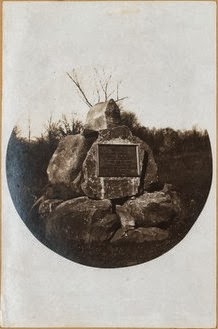
A cairn of stones memorializing Danial Nimham at Indian Field in Van Cortlandt Park, in 1906, the year it was placed here by the Daughters of the American Revolution. The original plaque states that 17 members of the Stockbridge Militia lost their lives, though it’s now believed that up to 40 men may have died during the massacre of August 1778. (NYPL)
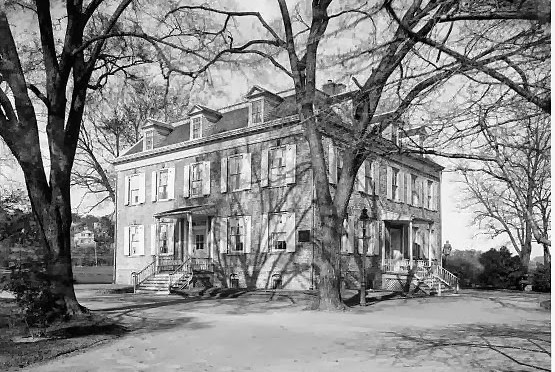
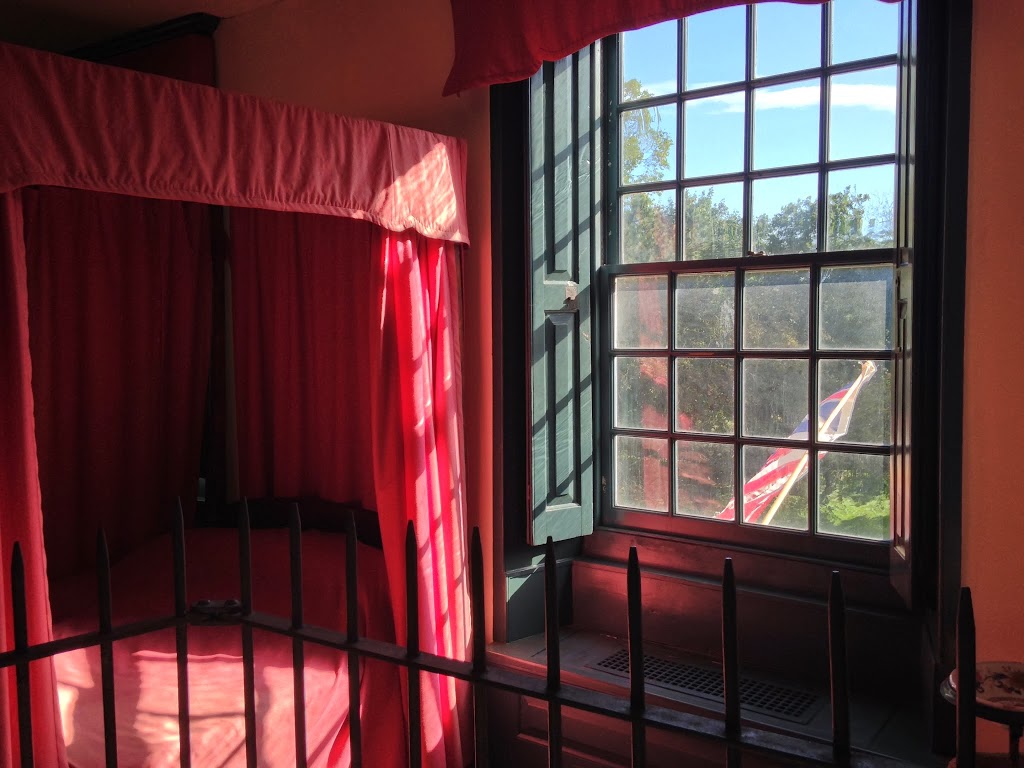
Looking out the upstairs window of the Van Cortlandt House, looking out in the park. The house has seen its share of strife and, if legends can be believed, more than a few spirits.
Van Cortlandt House as it looked last weekend. What’s that in the window?
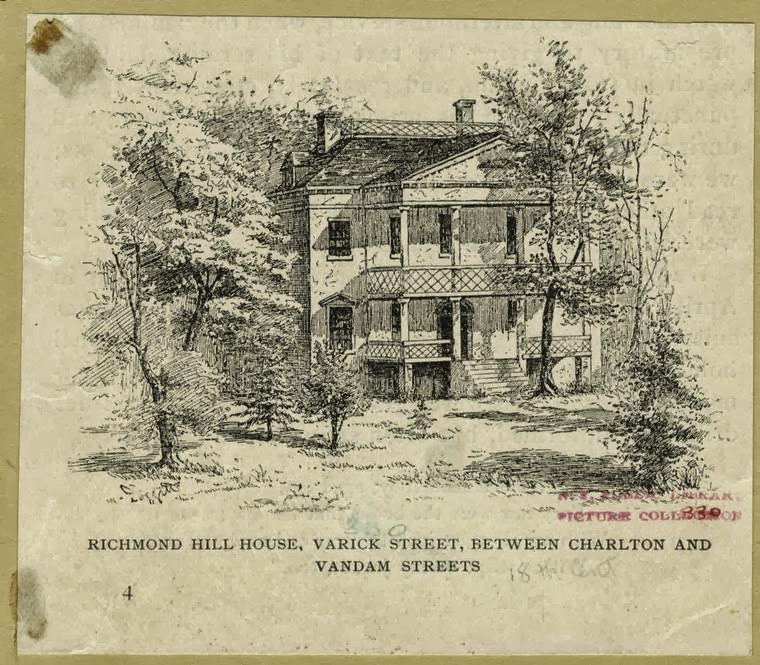
Richmond Hill, the beautiful mansion home of both John Adams and Aaron Burr. The carriage house from this old manor was moved to Barrow Street and is today the restaurant One If By Land, Two If By Sea. (NYPL)
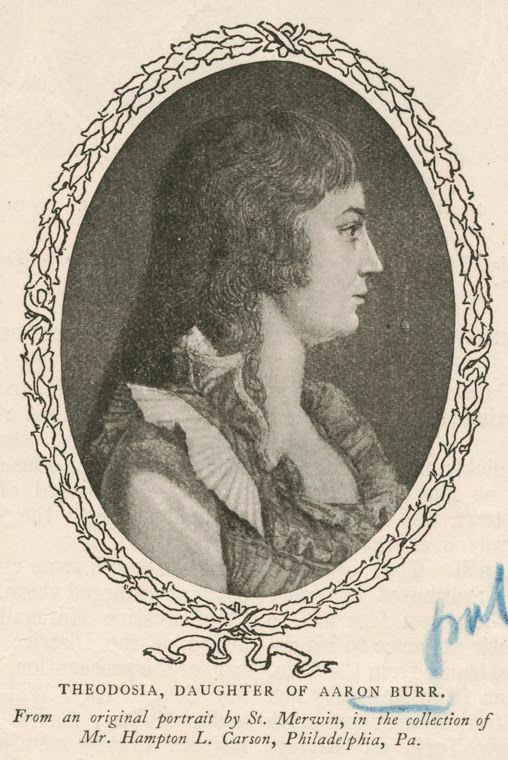
Theodosia Burr, the daughter of Vice President Aaron Burr, who was mysteriously lost at sea. Was she shipwrecked, rescued by an Indian prince, or forced to walk the plank? (Courtesy NYPL)
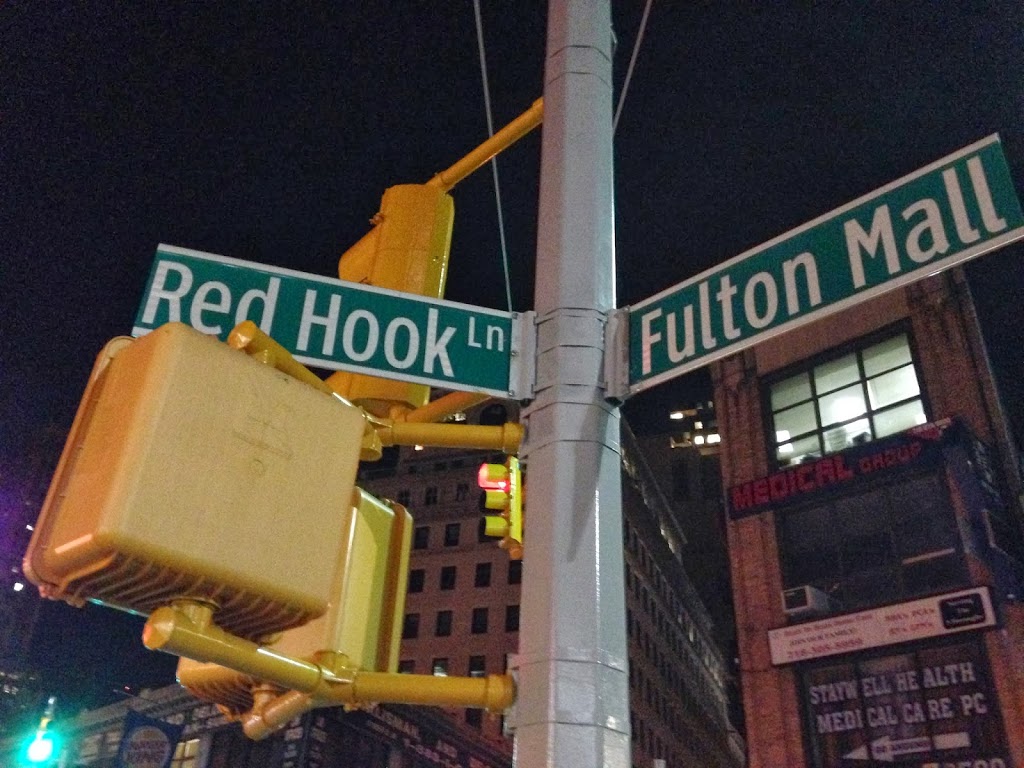
A short remnant of Red Hook Lane still exists in downtown Brooklyn. You are unlikely to find anything too scary at this street corner however.
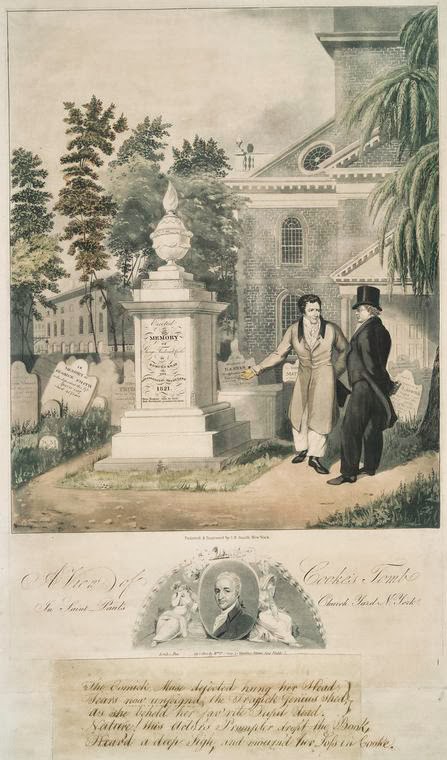
A 1822 illustration of the George Frederick Cooke monument and the man who paid for it, actor Edmund Kean. Kean so admired the late actor that he actually took a very odd portion of his body back with him to England.
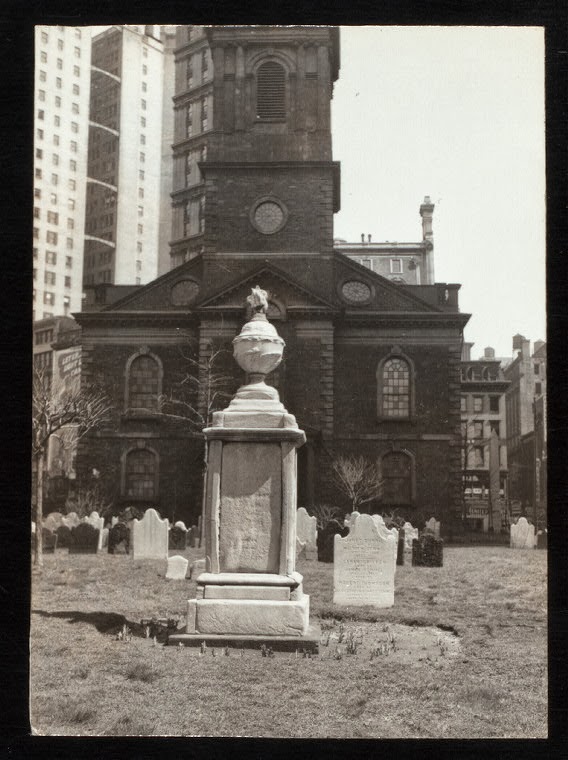
The monument to George Frederick Cooke in the graveyard at St. Paul’s Chapel, pictured here sometime in the 1940s. Does his ghost still linger here? [NYPL]
We had a very chilling event occur as we were recording last weekend. Just as I began to launch into the ghosts of the Stockbridge Militia, our recording equipment went all insane, spewing out a distorted and very disturbing version of our voices. It went on for about 20 minutes. Below is a sampling of the audio. What do you think — otherworldly interference or a faulty mixing board?
Yes, Hamilton fans, we are a proud people, judging from the many notes and supportive comments yesterday left on the Facebook page on the birthday of Alexander Hamilton, tinged with strong anti-Aaron Burr sentiment. But, from our comfortable vantage of the future, have we been too harsh on the killer Vice President?
Sure, he absolutely got away with murder. But it was, after all, a duel, willingly engaged by both participants, however misguided. Murder charges against Burr were eventually dropped, but he obviously avoided New York for many years.
His later misadventures out West — his failed, confusing efforts to infiltrate Spanish territory and allegedly form a new government in 1806 — just slathered on further scorn and distrust for the once respected lawyer. Three years after killing Alexander Hamilton, Burr was brought to federal trial for treason. He was eventually acquitted due to lack of credible evidence, much to Thomas Jefferson‘s chagrin.
After traveling through Europe and eventually going broke, Burr returned to New York and married the alleged ‘black widow’ Eliza Jumel. They divorced just four months later. The Morris-Jumel Mansion, his home during that time, is today less than two miles away from Alexander’s prized Hamilton Grange. They are two of the oldest homes still standing in northern Manhattan. (The Dyckman Farmhouse , in Inwood on 204th Street, is older than Hamilton’s house.)
Aaron Burr died in 1836 in Staten Island at a boardinghouse in the Port Richmond neighborhood, not far from the Bayonne Bridge. The boardinghouse later became the St. James Hotel, where guests could specifically ask to stay in Burr’s room for an evening. And sleep in the same bed! A sign even hung over the mantel, “Aaron Burr died in this room.”
The former Vice President spent his last, lonely days in this particular room, shying away from curious locals and pouring over old love letters from Eliza. According to a 1895 New York Times article on the subject of his ‘deathbed’, Burr was hounded by pious ministers who wished to save his soul and release him from his crippling depression.
The article also highlights a very bizarre visitor. One guest at the boardinghouse had an unnatural fascination with Burr, but never spoke to him and kept quietly to himself. When the landlady discovered that Burr was died in his room, the stranger suddenly appeared at the door, opened his satchel and removed the materials to make a plaster death mask of the Vice President. I believe this may be the morbid mask in question!


![[Richmond Hill, residence of Aaron Burr.]](https://boweryboyshistory.com/wp-content/uploads/2014/07/M3Y29313-300x208.jpg)

![[34-36 Barrow Street]](https://www.boweryboyshistory.com/wp-content/uploads/2013/10/MNY79988-300x242.jpg)