Categories
Holidays Newspapers and Newsies

How New York newspapers covered the first Labor Day — September 5, 1882

Clothing cutters, horseshoers, shoemakers, upholsterers, printers, house painters, freight handlers, cabinet makers, varnishers, cigar makers, bricklayers and piano makers.

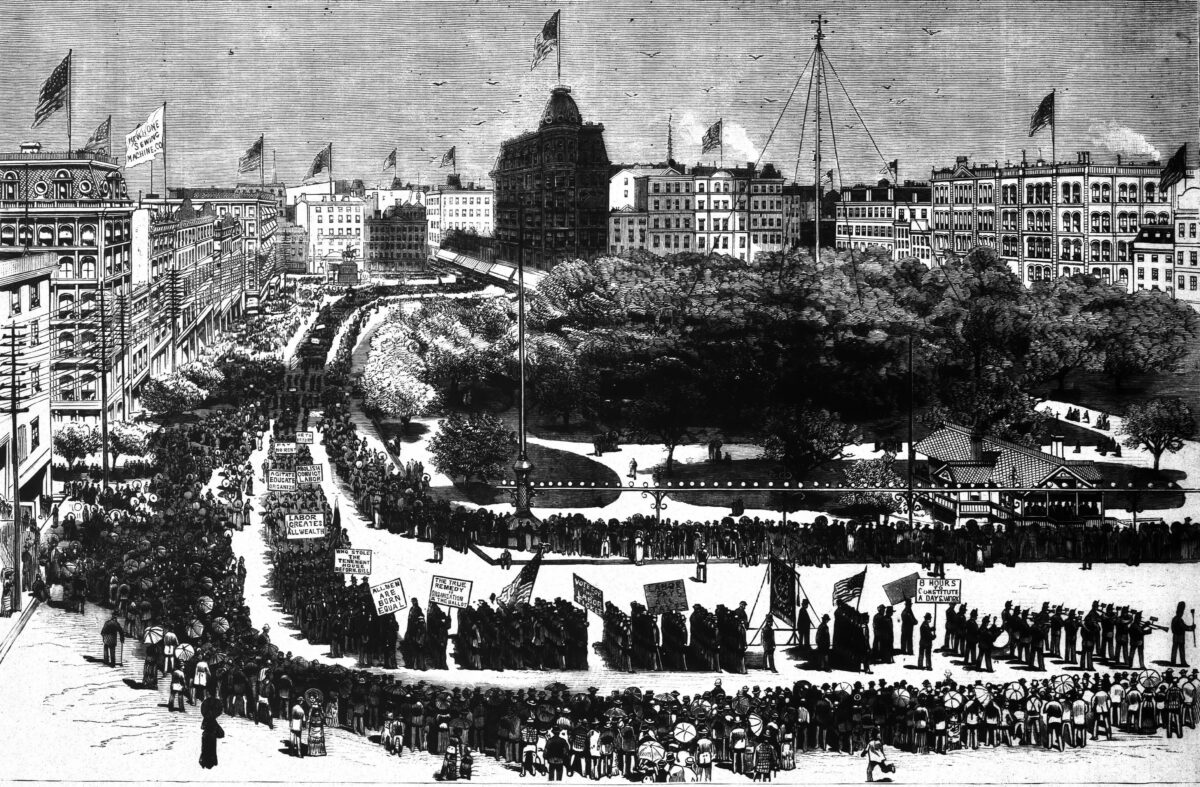
The first American Labor Day began on September 5, 1882, with 10,000 workers from a wide variety of occupations circling Union Square, then parading up to the area of today’s Bryant Park. (A picnic ‘after party’ of sorts took place at a park at today’s Columbus Avenue and 92nd Street.)

Individual workers organizations had taken to the street before, sometimes violently. But this peaceful protest, this public solidarity, took the issues of New York laborers to the heart of the city in a way that could not be ignored.*

*New Yorkers got the Labor Day idea from Canada. Read more about the differences between May Day and Labor Day in this article

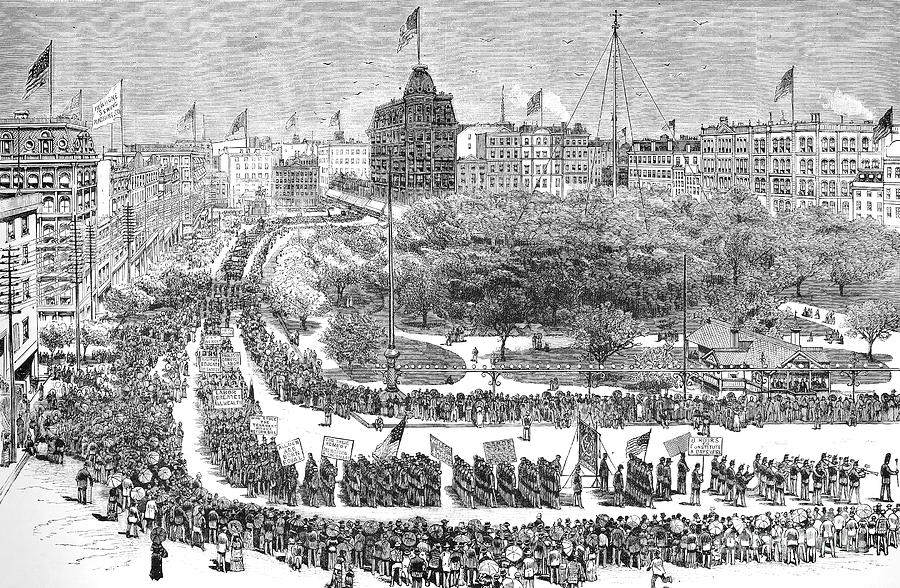
Illustration of the first Labor Day parade around Union Square, 1882
We take it for granted today. Labor Day is no more than a day off for most people today.

But looking at the original press notices from newspapers of the day (from the following day, September 6, 1882) suggest an event certain New Yorkers recognized as monumental.

Others considered it trivial, a nuisance or even a dangerous gathering of malicious intent.

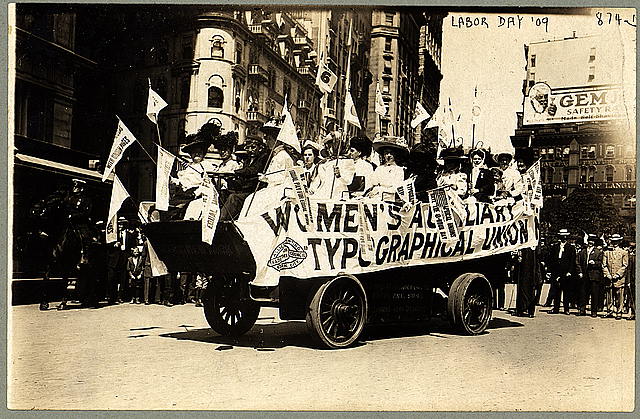
Union Square would continue to be the location of Labor Day festivities for decades afterwards. The image below is of a parade from 1909 (courtesy LOC):
The New York Tribune begins nice enough. “The men who took part in the labor parade generally appeared to be persons of no small intelligence.” The paper’s vitriol was saved for the leaders of the movement, in this case organizers from the Central Labor Union, “demagogues of the worst kind.”

“It is a pity that workingmen allow themselves to be so cheapened.” The Tribune accuse the organizers of an ulterior motive — political chest-thumping.

“But it is not at all unlikely that certain demagogues and dishonest leaders thought it a good time of year to show the two great political parties that there are ten thousand ballots in this city in the hands of men who … might be at the disposal of somebody — for a consideration.”

Indeed, there would be a statewide election exactly two months later, sweeping a host of Democrats into office, including Grover Cleveland into the governor’s office.

Even their reporting of the parade itself is tinged with a little condescension.

“The parade of workingmen yesterday morning was not nearly as large as was expected by the leaders.  This is probably due to the unwillingness of many workmen to lose a day’s work.”

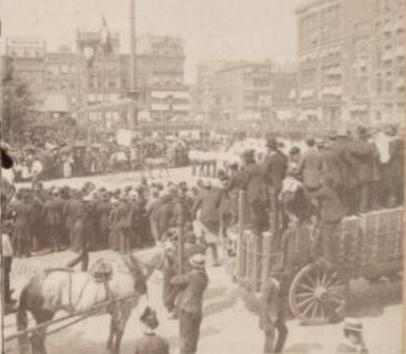
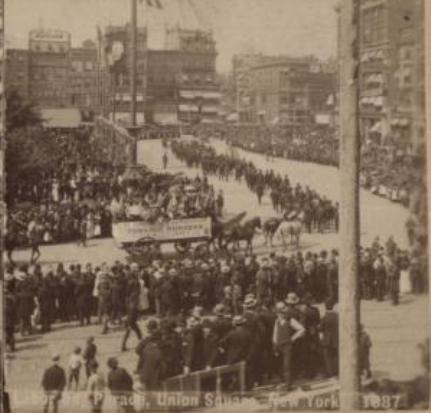
Labor Day parade in Union Square, 1887 (NYPL)
The New York Times seemed to find the parade slightly whimsical, almost superfluous. It echoed the disappointing turnout, but describes the event as calm, “conducted in an orderly and pleasant manner.”

The coverage focuses undue attention on the paraders’ fashionable attire.

“The great majority smoked cigars.” However they stress that the good behavior is attributable to the fact that organizers banned alcohol. This detail is mentioned in no other coverage that I read.

Where the Tribune attested the lower-than-expected turnout to men not leaving their posts, the Times found a different reason — “due to the fact that [laborers] preferred to enjoy the day in quiet excursions in Coney Island, Glen Island and elsewhere.”

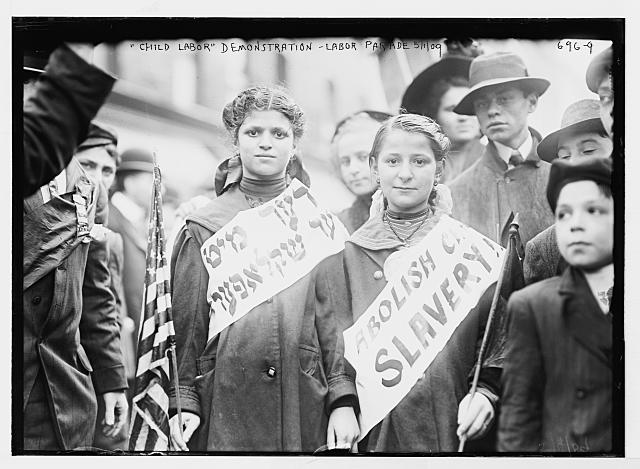
Children at the Union Square Labor Day parade, 1909 (NYPL)
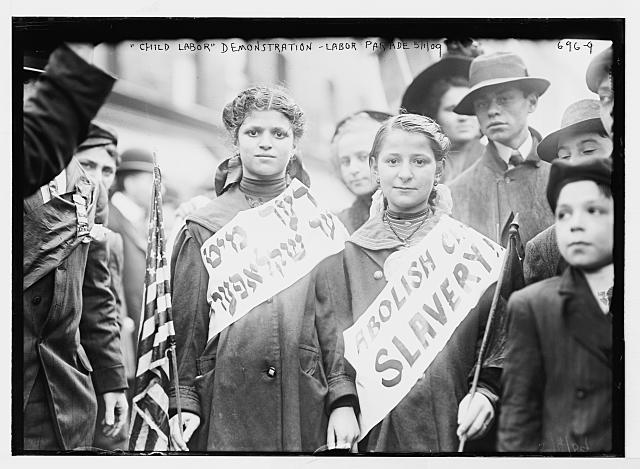
The enthusiastic New York Sun describes it as a dry and brutal day. “[T]he rays of sun even in the early morning were very hot, and not a breath of wind brought relief from the oppressive heat.”

The same parade considered disappointing by the Tribune and the Times was conversely described by the Sun as a mob scene.

“As far ahead as one could see and as far down the side streets as forms and faces could be distinguished, the windows and roofs and even the lamp posts and awning frames were occupied by people anxious to get a good view of the first parade in New York of workingmen of all trades united in one organization.”

Far from a nuisance, the Sun recognized the parade as an important banner moment in history. Its description of events is truly painstaking.

Many newspapers outside New York mentioned the parade the following day.  St. Paul’s Daily Globe in Minnesota said “the great labor demonstration today was a success,” quoting a number in attendance (20,000) almost double the actual projected number.

So did the Dallas Daily Herald, who put the event on their front page.

Meanwhile, it should be noted that most major New York newspapers neglected to put the labor parade on their front pages.
Labor Day vs May Day: or why New Yorkers love a parade

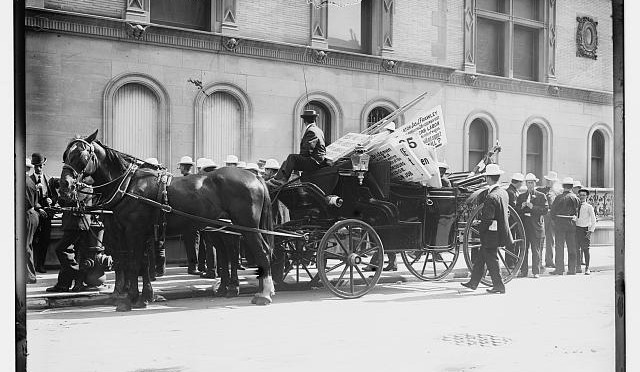
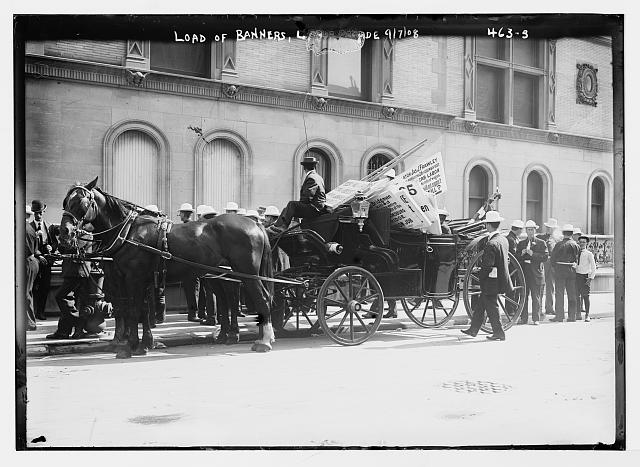
A banner celebration: loading up with signs for the 1908 Labor Day Parade in New York

Labor Day is one of the few national holidays that New York City can lay claim to as their own. The roots of the U.S. holiday began here, with Union Square as its centerpiece, in 1882.

But in fact, New Yorkers borrowed the idea of Labor Day from Canada. Young Peter McGuire, educated at Cooper Union where he met labor activists like Samuel Gompers, was already making a name for himself as an advocate for workers rights as early at 1873, leading sit-ins at City Hall and heading a rally at Tompkins Square Park that was promptly broken up by police.

Workers in Canada were already marching annually by the 1870s. McGuire was invited to speak at one of these events in 1882 and decided to organize a similar event in New York. It’s doubtful that his was the only voice in organizing such a massive spectacle; Matthew Maguire, from Patterson, NJ, and secretary of the New York Central Labor Union, is also said to have proposed the date. Given their deep involvement with the CLU, it’s safe to consider both men (with such similar names!) as originator of the soon-to-be federal holiday.

That September 5 (a Tuesday, incidentally) anywhere from 10,000 to 25,000 participants marched from City Hall to Union Square and eventually on to 42nd Street. Matthew Maguire led the parade in a carraige he share with none other than Henry Ward Beecher. After the parade, the celebration continued with a massive picnic at Wendel’s Elm Park (at 92nd Street and 9th Avenue).

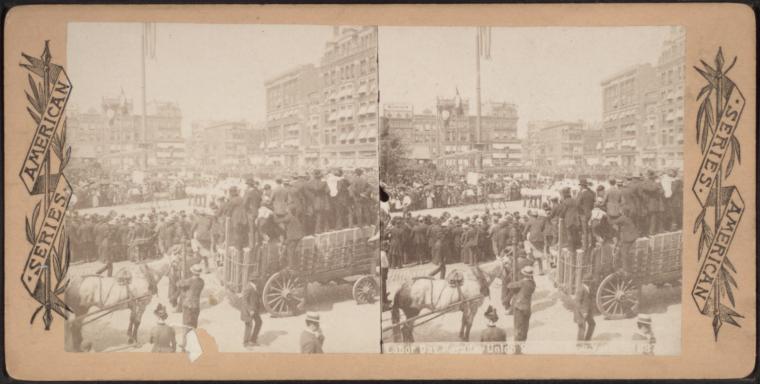
Below: Two of the earliest photos ever taken of a Labor Day celebration, this one from Union Square stands of a 1887 celebration, five years after the first. (Photo courtesy NYPL)

The celebration spread to other cities over the coming years, and by 1894, it was declared a national holiday.

However Labor Day isn’t the only day that workers and labor organizations have rallied and protested in New York. In fact, I would hardly even say it’s the primary day of protest. That would of course by May Day which is still recognized internationally as a day of protest. Unlike Labor Day, May Day actually originated in the United States. In the late 19th and early 20th century, New York workers frequently organized May Day parades, demanding more reasonable working hours, better wages and safer working conditions. The first of these parades debuted across the country in 1886.

Today in New York, the area around Union Square often sees general protests on the first of May, but Labor Day has virtually lost its meaning. In fact, it’s better recognized today as the day of the festive West Indian-American Day Parade.

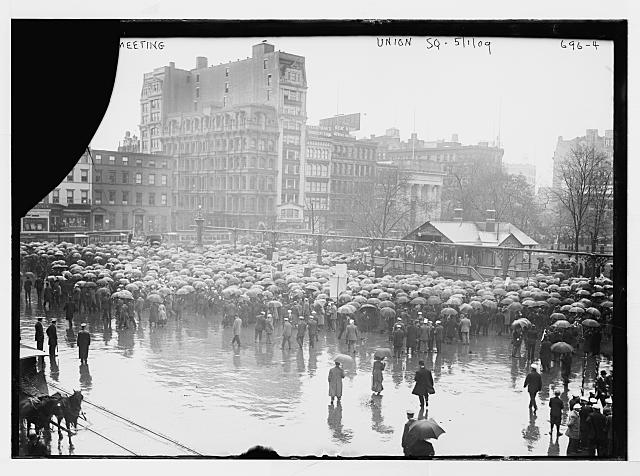
Below: The first is taken from a May Day celebration in 1909, over a hundred years ago. The second picture is taken from the Labor Day parade that very same year

For more information, check out our podcast on the history of Union Square.

Categories
Podcasts

PODCAST: Union Square

This former English-garden style park became the heart of protest and the labor movement. Join the Bowery Boys as we dig into the history of Union Square, from Book Row to Klein’s.

Listen to it for free on iTunes or other podcasting services. Or you can download or listen to it HERE

An old view of Union Place, looking south. The oval shape of the park is readily apparent from this drawing. The park is still oval, but sidewalk extensions and the inclusion of the south ‘traffic islands’ configure the park into a more rectangular shape.

Two views of the 1861 Civil War rally (or Sumter rally), one from the ground…

…and from overhead.

This is Deadman’s Curve, the scene of several accidents due to cable-car operators zipping through

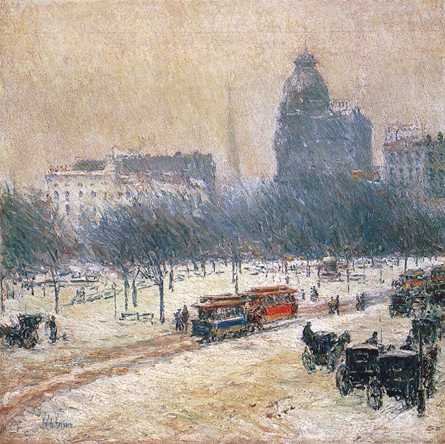
Union Square in 1892, by the American impressionist painter Frederick Childe Hassam

A depiction of the first Labor Day march by the Knights of Labor

Labor leader Emma Goldman was arrested here at Union Square. In this picture, she lectures to an enrapt audience (of men!)

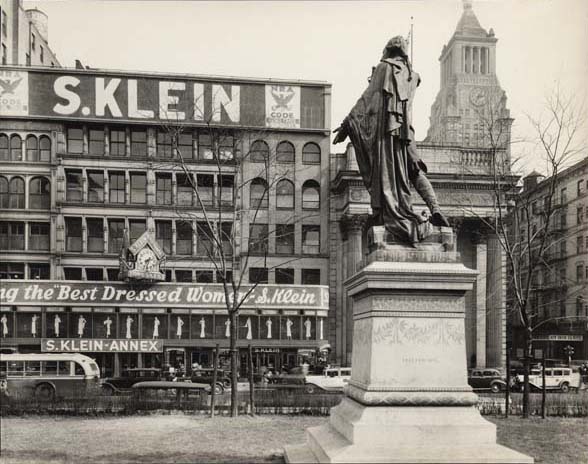
Klein’s on the Square — affordable women’s clothes dominate the park for decades, until they closed in 1975. It was strangely juxtaposed across the street with the Marquis de Lafayette statue, designed by Statue of Liberty creator Frederic Bartholdi.

New York also celebrated the first Earth Day here in Union Square in 1970

Union Square is still a popular and often chaotic place for gathering in protest. Last Saturday (March 22nd), over the course of about an hour, saw a large anti-war gathering, with speakers and singers.

People used the rally to air all sorts of grievances. And wear gory costumes.

Not thirty feet away, this flower seller was offering his springtime wares.

The Greenmarket stretched from the north side and down along the east side of the Square.

At 3 pm, almost as though in opposition to the war protest, people battled in a gigantic pillow fight

Now compare those pictures to this one of a Union Square crowd in 1910:

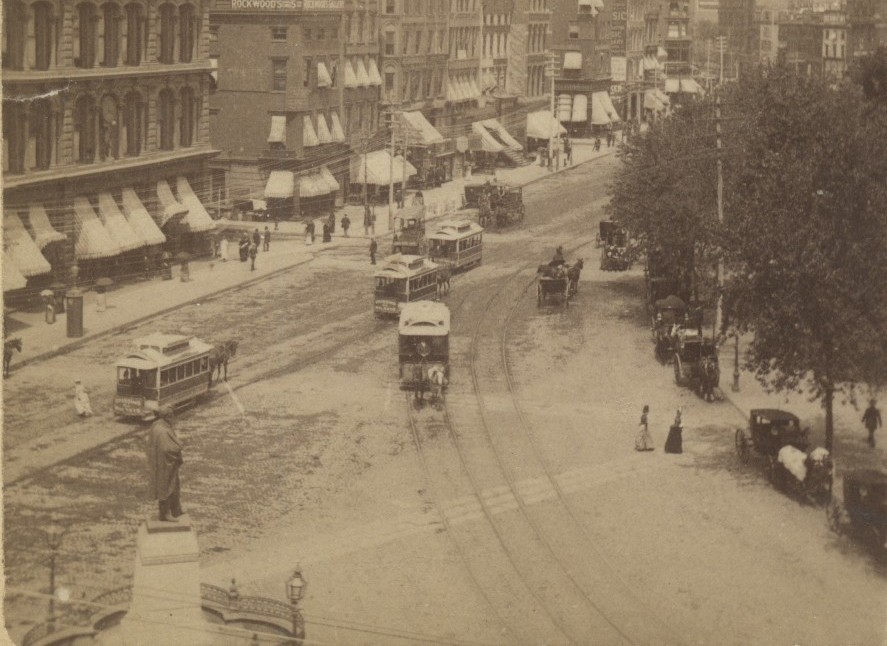
And finally, an extraordinary panoramic view of Broadway from Union Square … via 1890! Click to get a closer view