Categories
It's Showtime Music History Politics and Protest

The Academy of Music: Where High Society and Music Mixed in Old New York

When the Academy of Music opened in 1854, New York City was just about to become the richest, most powerful city in the nation. It was, in fact, almost there.

With the construction of the Erie Canal (which opened in 1825), the port city at the mouth of the Hudson River benefited greatly from the proximity.

The city grew in marvelous ways in the three decades after its opening with a new Croton water system, expanding gaslighting, and a growing grid plan, pushing the city north up the island of Manhattan.
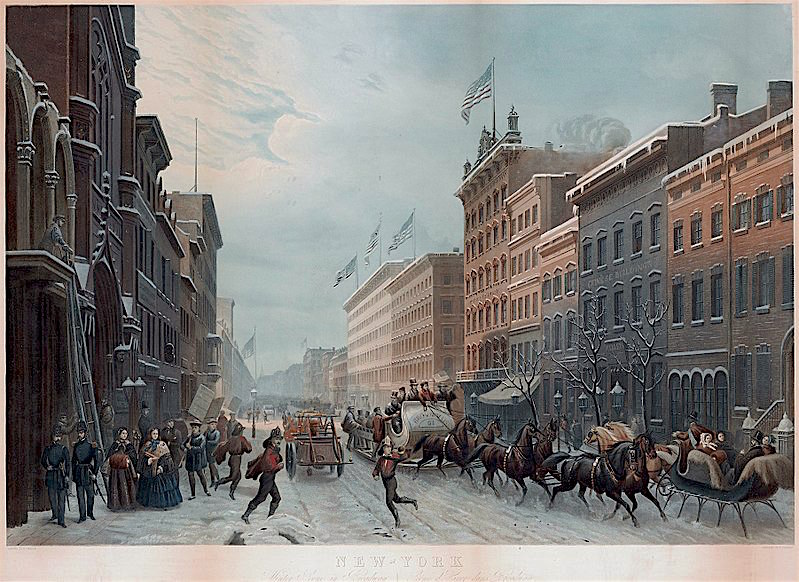
New York winter scene in Broadway, 1857 Eno, Amos F., 1836-1915 (Collector) Girardet, Paul, 1821-1893 (Engraver) Sebron, Hippolyte Victor Valentin, 1801-1879 (Artist); courtesy New York Public Library

The city’s old-money elites soon made room — with an upturned nose, naturally — for the new-money families enriched by both New York real estate and burgeoning American industries fueled by the growth of the railroad. The New York Stock Exchange, re-built after the Great Fire of 1835, was thriving with the nation’s booming (if often volitile) economy.

And so New York society, modeling itself after English and French elites, began importing high cultural venues in which to flaunt their love of the arts — and, more importantly, their money and station in the social pecking order.

The Astor Place Opera House, opening in 1847, had briefly been the center for upper-class entertainments, but the deadly Astor Place Riots a couple years later signaled the end of that venue.
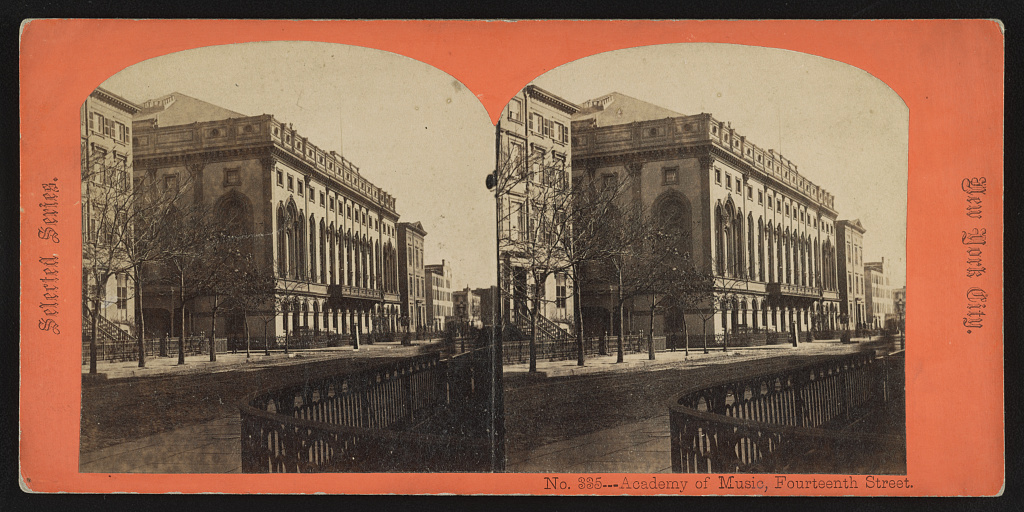
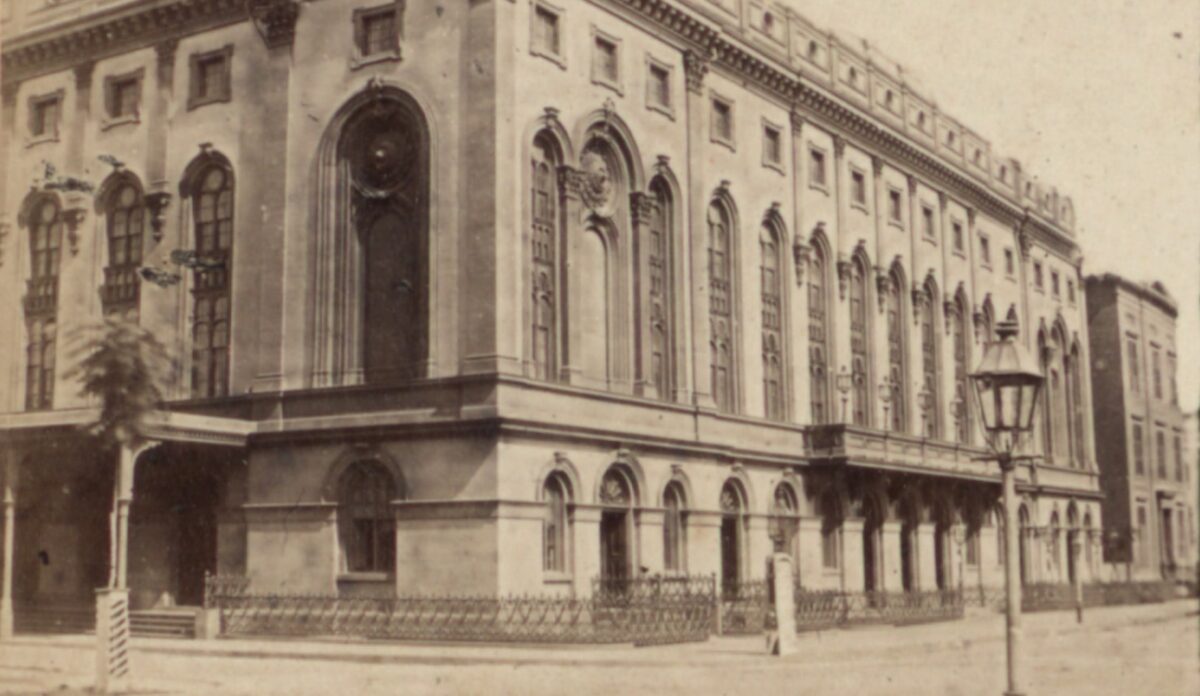
Early photograph of the Academy of Music, NYPL

And thus New York got the Academy of Music in 1854. Located on 14th Street and Irving Place, the new music house was uniquely situated near both Gramercy Park and Union Square, both havens for the elite in the 1850s. (NOTE: The Academy of Music was only a few blocks north from the old Astor Place Opera House.)
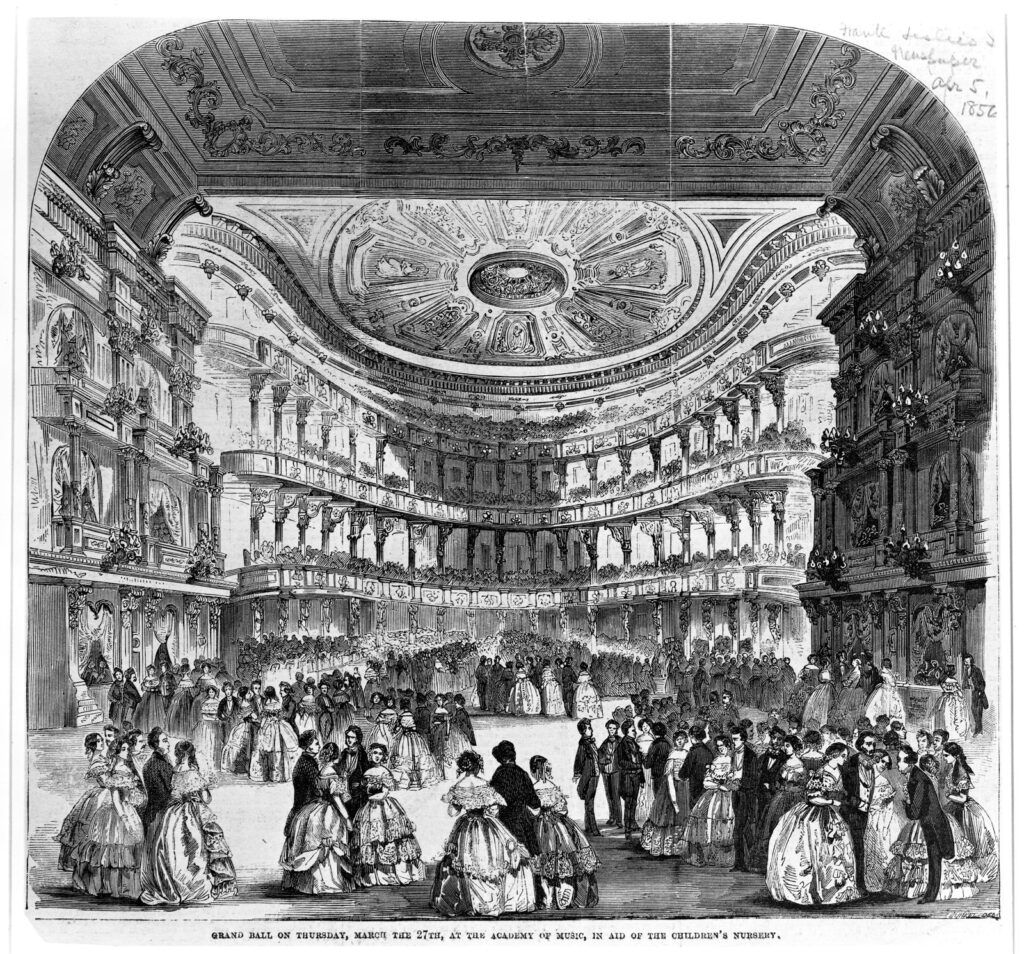
Inside the Academy of Music, 1856, NYPL

The opening bill on October 2 featured a performance of Vincenzo Bellini’s Norma featuring acclaimed Italian soprano Giulia Grisi. (America had very little homegrown talent in these days.) Underscoring its almost immediate dominance in the Americas cultural scene, the operas Rigoletto, La Traviata, Aida, Die Walküre and Carmen made their American debuts upon this stage.
The growing rival city of Brooklyn followed suit — had to follow suit, to satisfy its own elites who were situated mostly around the area of today’s Brooklyn Heights. The first Brooklyn Academy of Music opened there in 1861; after it was destroyed in fire in 1903, it moved to its present location. [More on its history here.]

Brooklyn’s original opera house was beautiful, sure, but it was no match in opulence for New York’s Academy of Music which was the largest opera venue in the world when it opened.
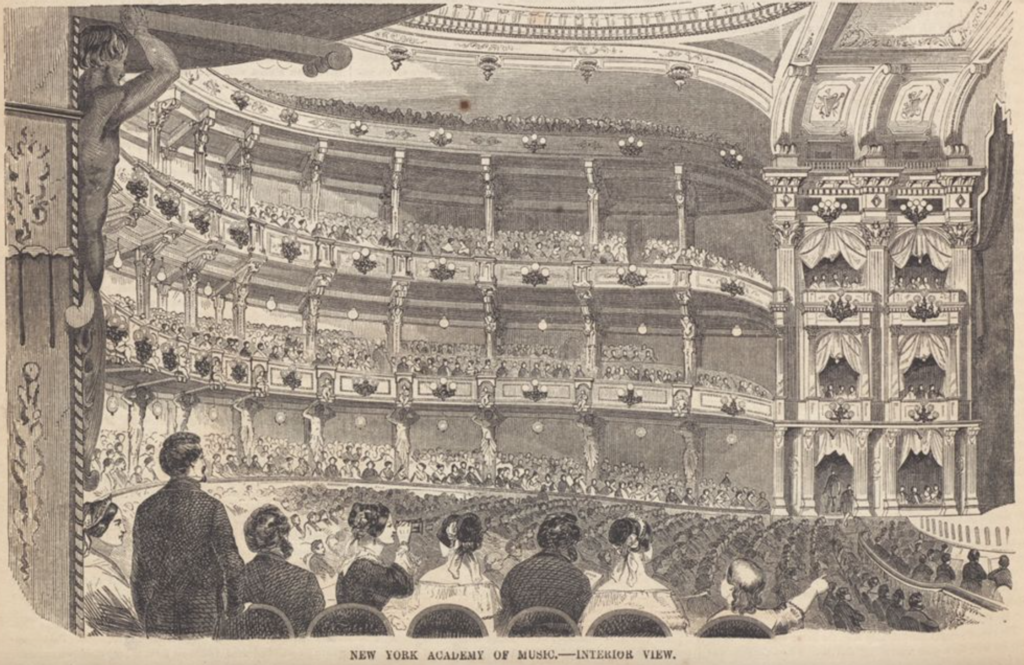
Interior of the Academy of Music 1856

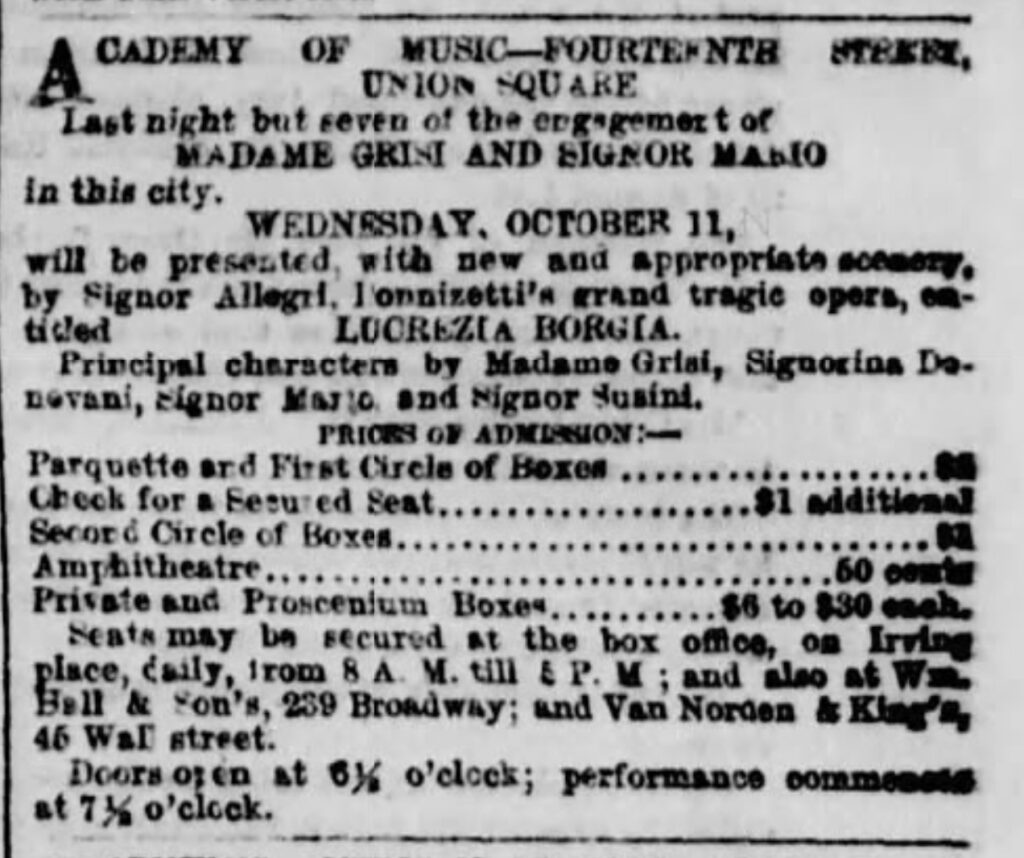
But it designed to be so much more, a multi-purpose building which needed more space befitting the city’s growth. According to this announcement on August 28, 1854, “The New York Academy of Music will be used occasionally for concerts, balls, public meetings and theatrical performances.”
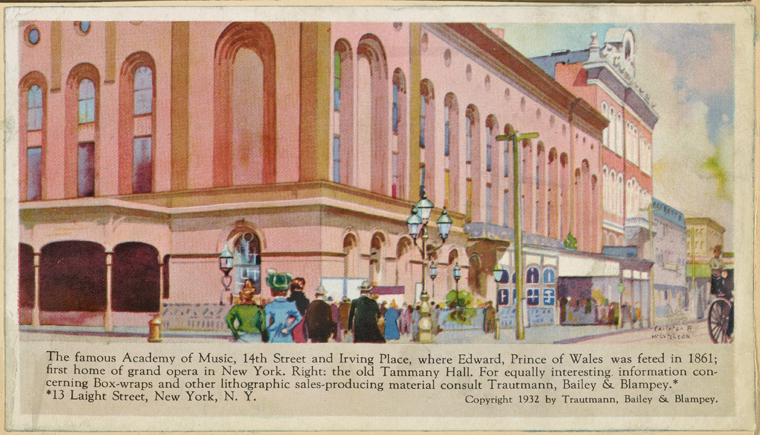
In fact due to its eventual neighbor — the headquarters of Tammany Hall — the Academy of Music would be the location of New York’s first national political convention in 1868.

Perhaps due to its many purposes, the reputation of the Academy of Music became tainted by rowdy “French balls” which took place here off season.
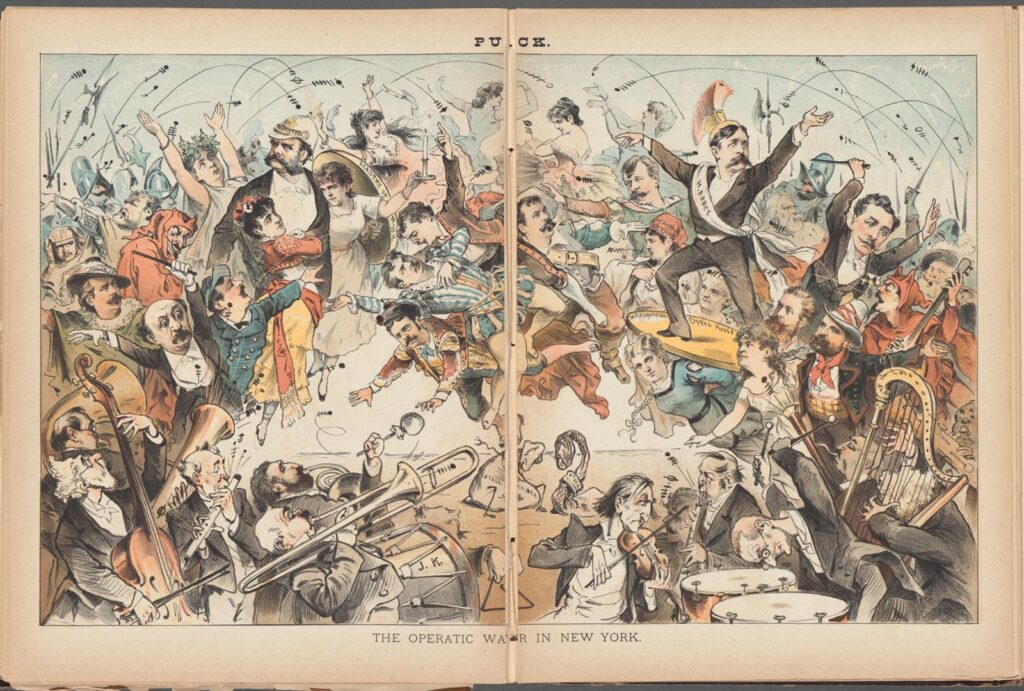
In 1883 Puck Magazine festively lampooned the ‘opera wars’ between the Academy of Music and the Met Opera house.

However it wasn’t until New York’s next wave of moneyed elites — its nouveau riche — opened the Metropolitan Opera House in 1883 further north that opera (and respectability) finally vacated the Academy of Music.

By that time, Union Square was the city’s destination for a more lowbrow entertainment — vaudeville! — and so the Academy welcomed that entertainment form onto its stage. But it could never recapture its glory, and the building was demolished to make way for a skyscraper owned by Consolidated Edison (which still remains).
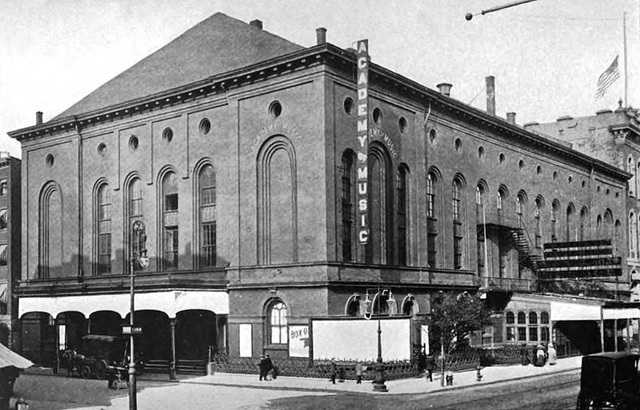
The Academy of Music from the vaudeville years

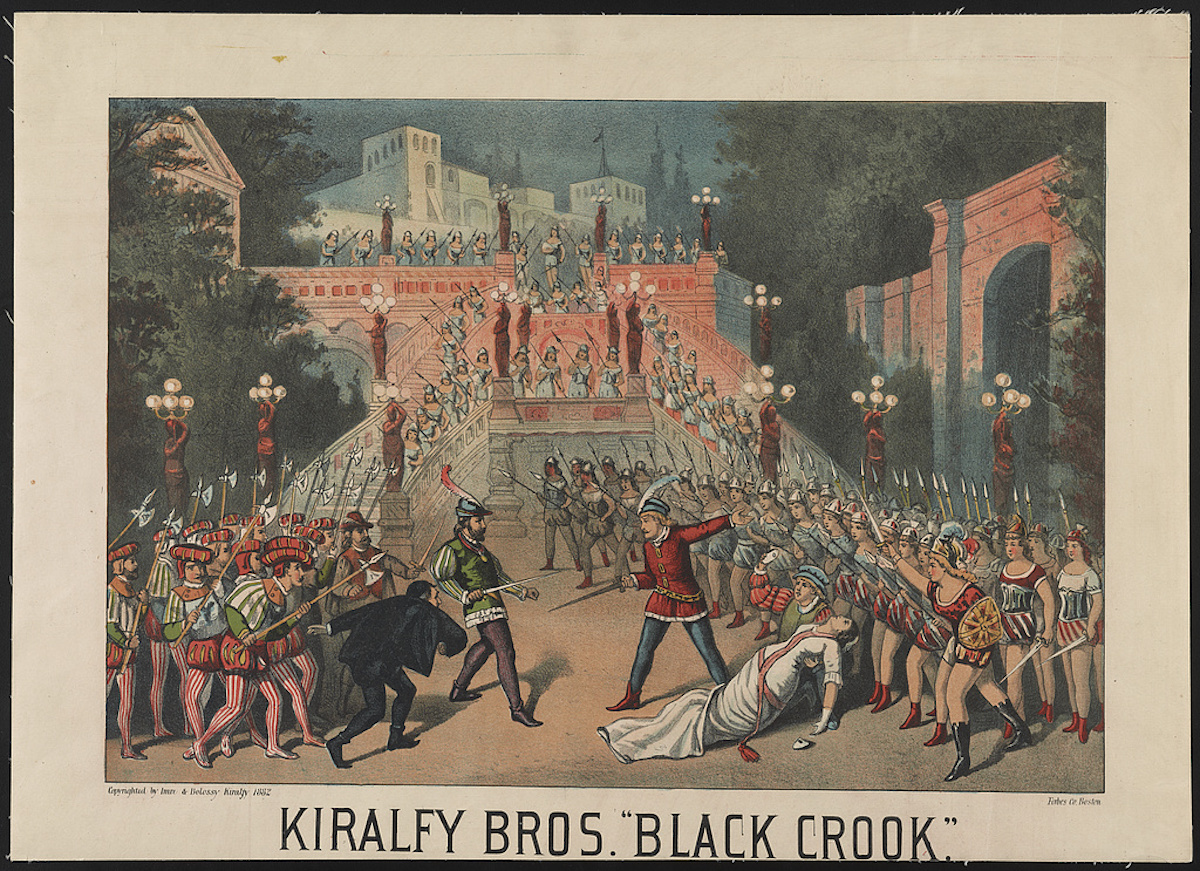
But the name would not leave the neighborhood! A movie palace opened across the street (eventually owned by William Fox) with the name the Academy of Music. During the 1970s it hosted rock music performances and, by the 1980s, had transformed into the seminal dance club the Palladium.
Categories
It's Showtime Podcasts

The Broadway Musical: A trip through American theater history


The Broadway Musical is one of New York City’s greatest inventions, over 150 years in the making! It’s one of the truly American art forms, fueling one of the city’s most vibrant entertainment businesses and defining its most popular tourist attraction — Times Square.

 But why Broadway, exactly? Why not the Bowery or Fifth Avenue? And how did our fair city go from simple vaudeville and minstrel shows to Shuffle Along, Irene and Show Boat, surely the most influential musical of the Jazz Age?

This podcast is an epic, a wild musical adventure in itself, full of musical interludes, zipping through the evolution of musical entertainment in New York City, as it races up the ‘main seam’ of Manhattan — the avenue of Broadway.

We are proud to present a tour up New York City’s most famous street, past some of the greatest theaters and shows that have ever won acclaim here, from the wacky (and highly copied) imports of Gilbert & Sullivan to the dancing girls and singing sensations of the Ziegfeld revue tradition.

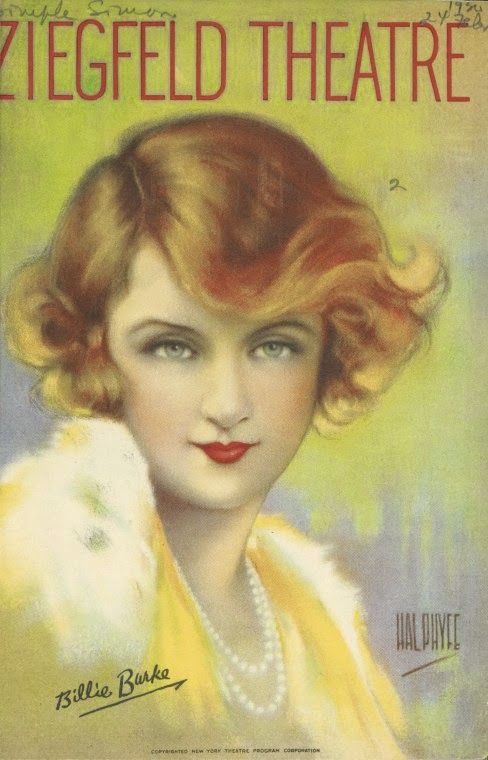
CO-STARRING: Well, some of the biggest names in songwriting, composing and singing. And even a dog who talks in German!  At right: Billie Burke from a latter-year Follies. (NYPL)

This show, originally recorded in 2013, has been re-edited, remastered and even includes extra material which was cut from the original episode.

LISTEN NOW: THE BIRTH OF THE BROADWAY MUSICAL


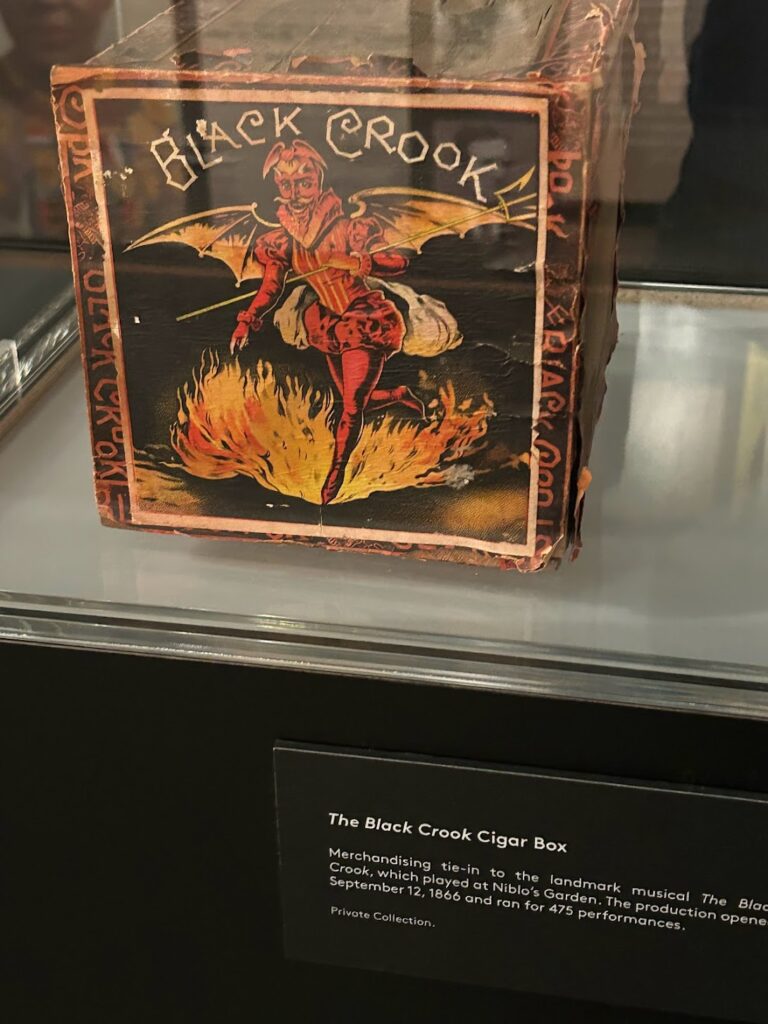
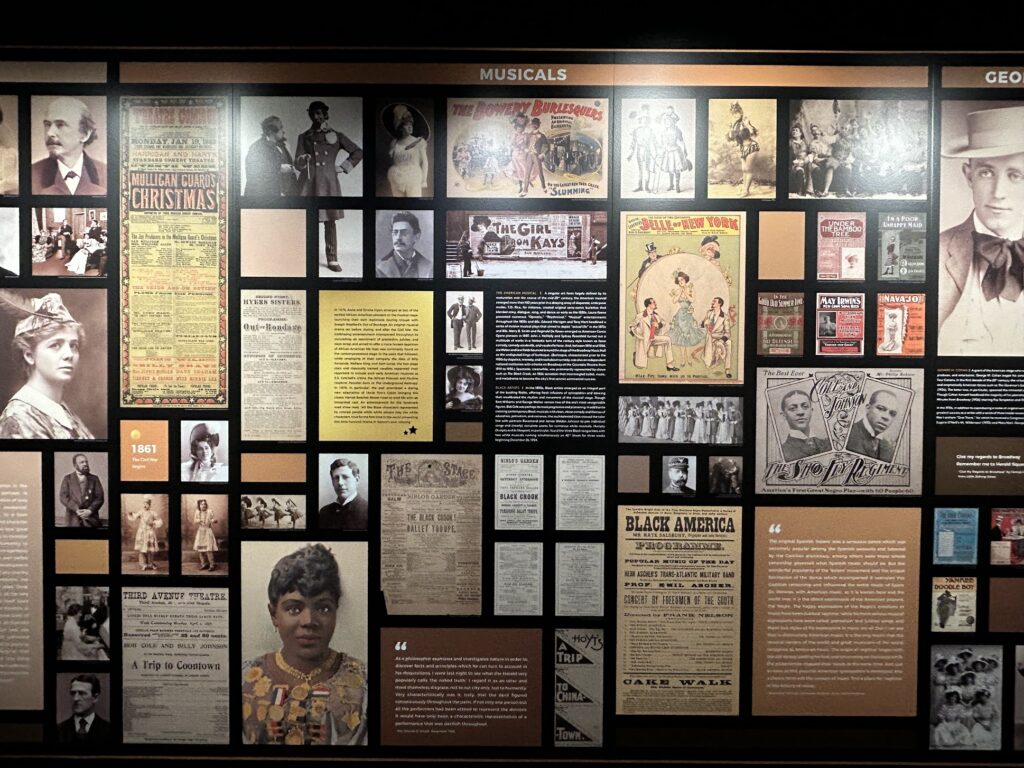
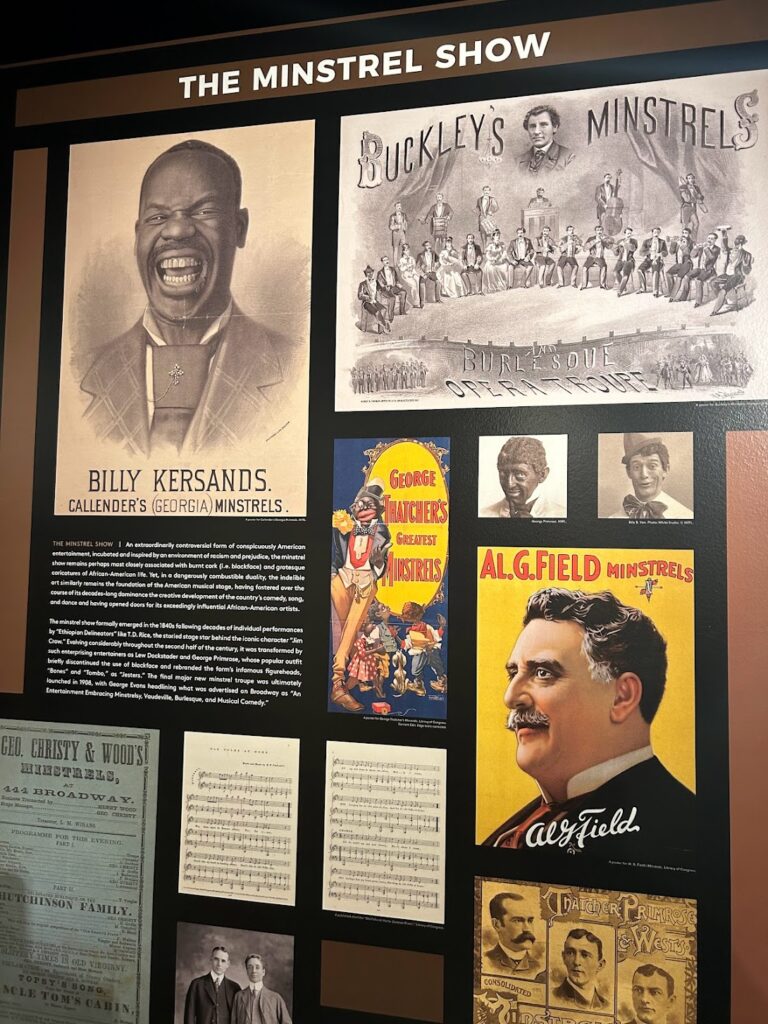
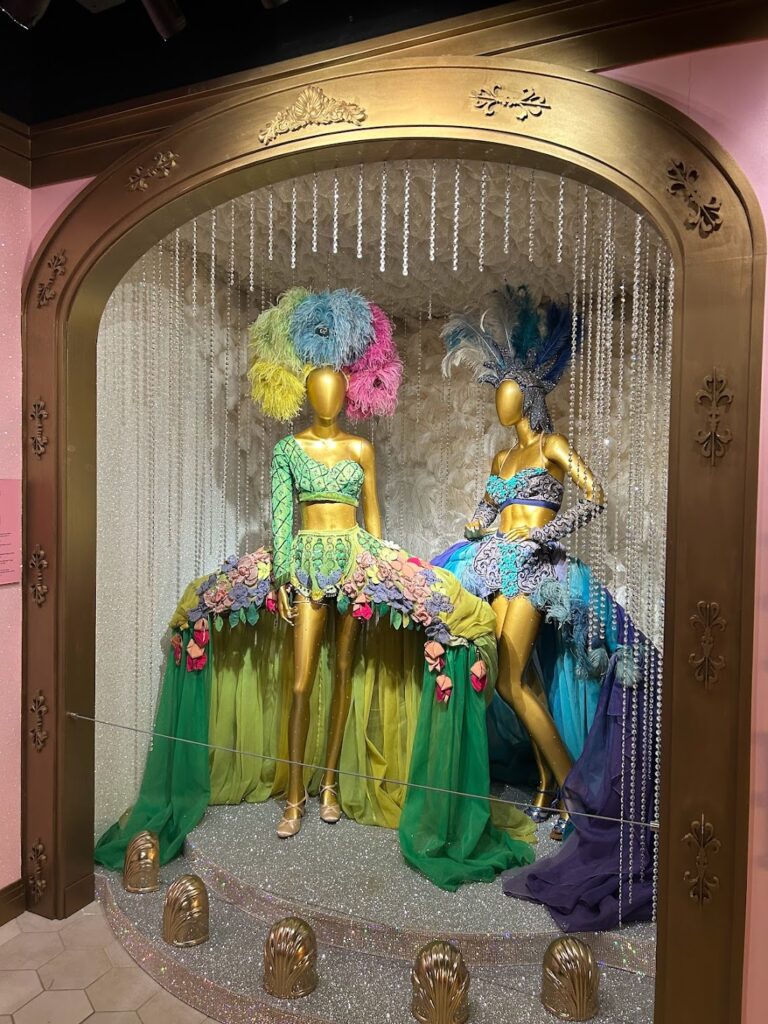
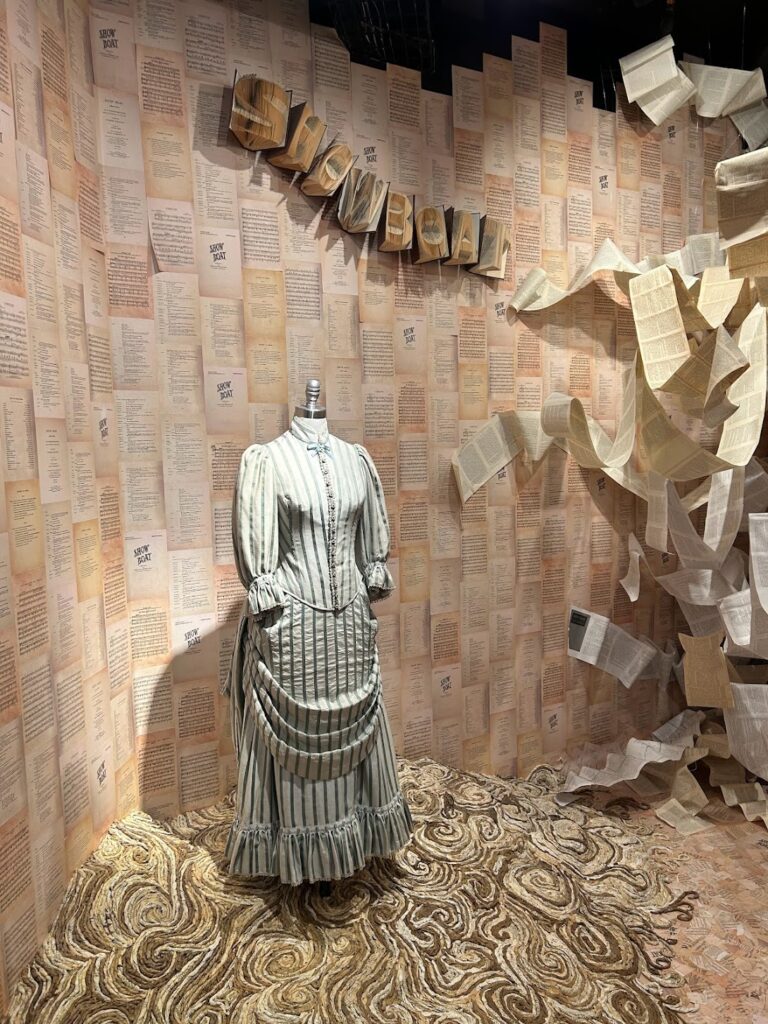
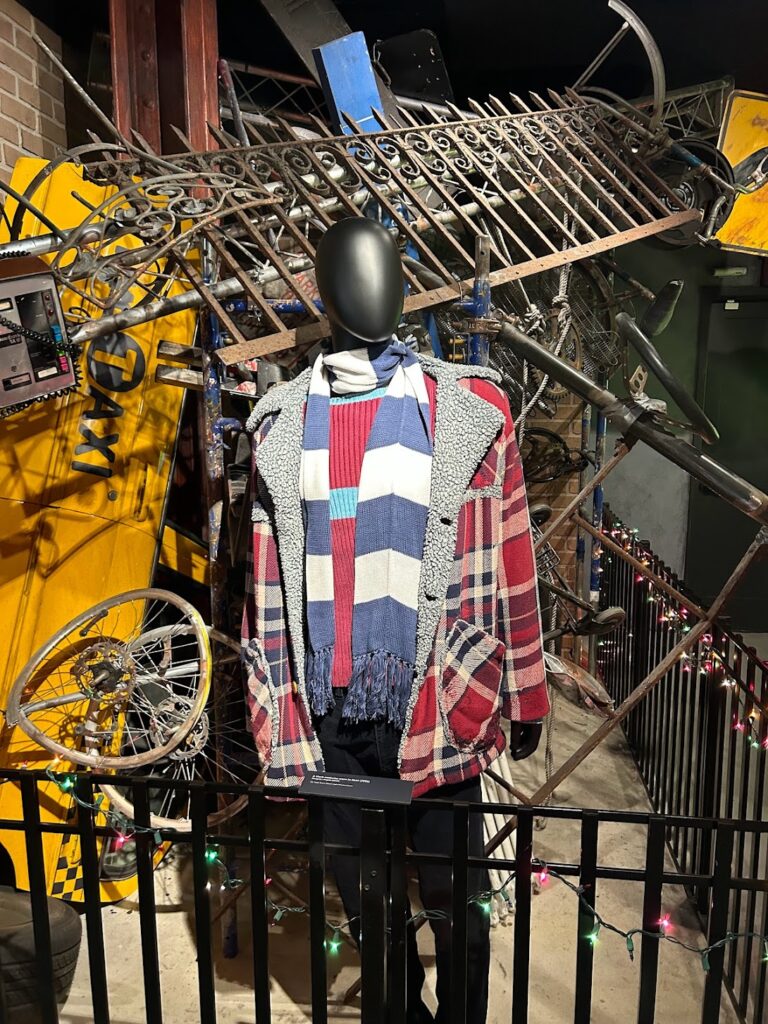
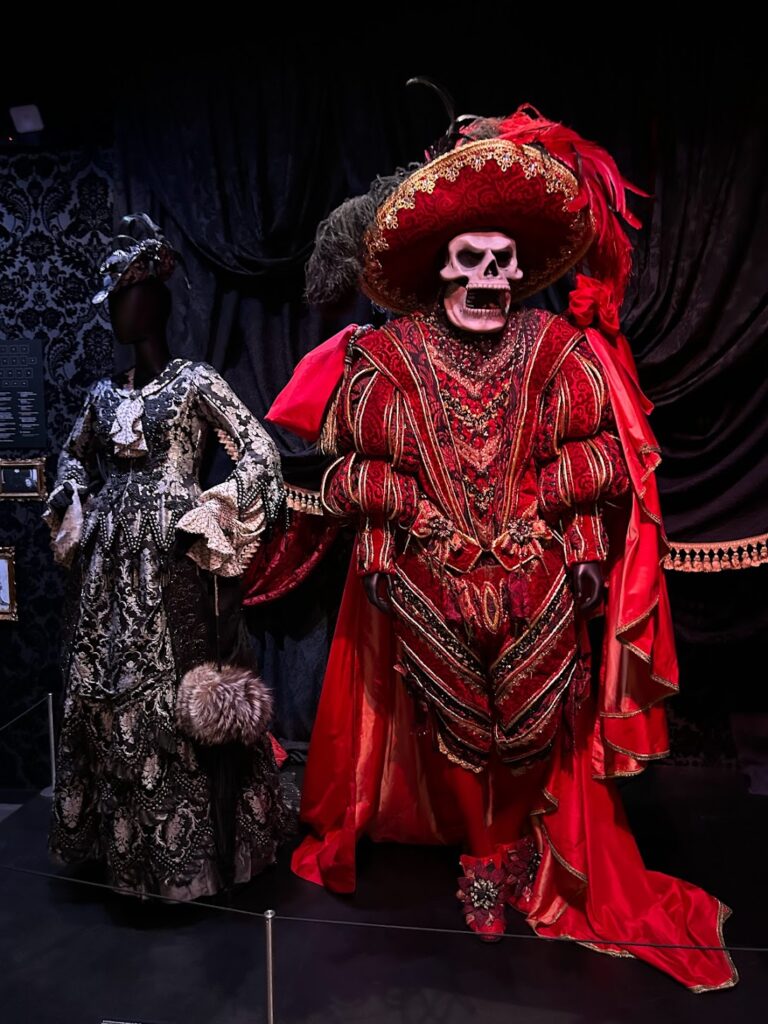
A few images from Greg’s trip to the Museum of Broadway at 145 West 45th Street.

The Black Crook
Ziegfeld Follies
Showboat
Rent
The Phantom of the Opera

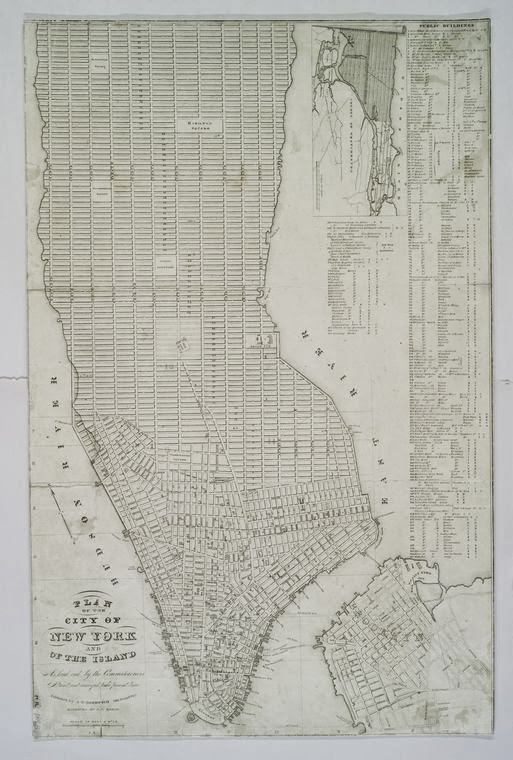
The original grid plan from 1811. As you can see, Broadway was not meant to extend further than the Parade Ground, the largest planned plaza from the Commissioner’s Plan. Years later, the Parade Ground was reduced (becoming Madison Square) and Broadway was allowed to break the grid, creating plazas conducive for transportation and public gathering. (NYPL)

New York Public Library

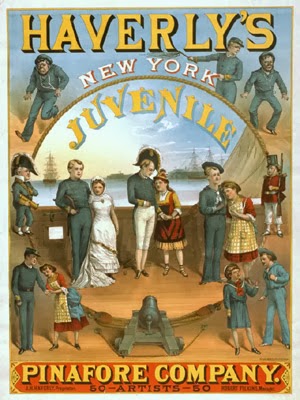
One of dozens of knock-off productions of HMS Pinafore, this one featuring children:

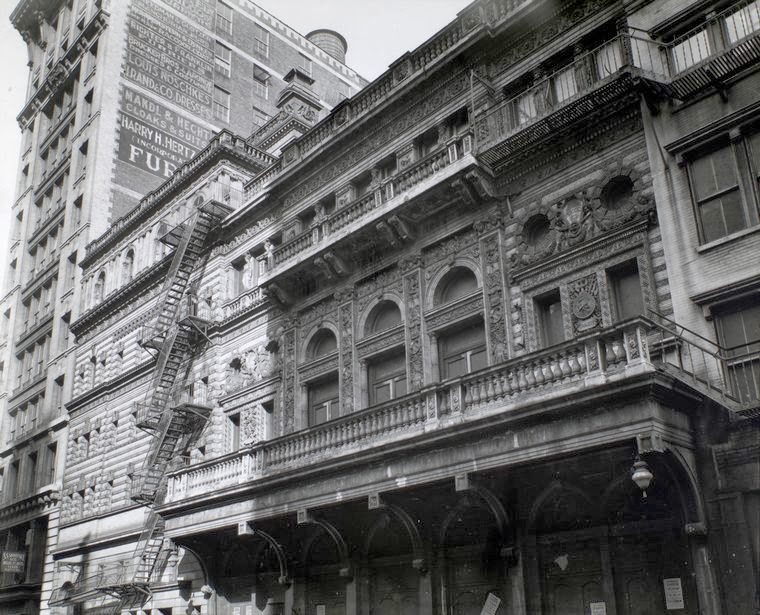
The facade of the Fifth Avenue Theater, once located at 1185 Broadway. Why was it called the Fifth Avenue Theater then? Possibly to just make the society ladies feel at home here!  This was home to three Gilbert & Sullivan original productions, including the premiere of The Pirates of Penzance.

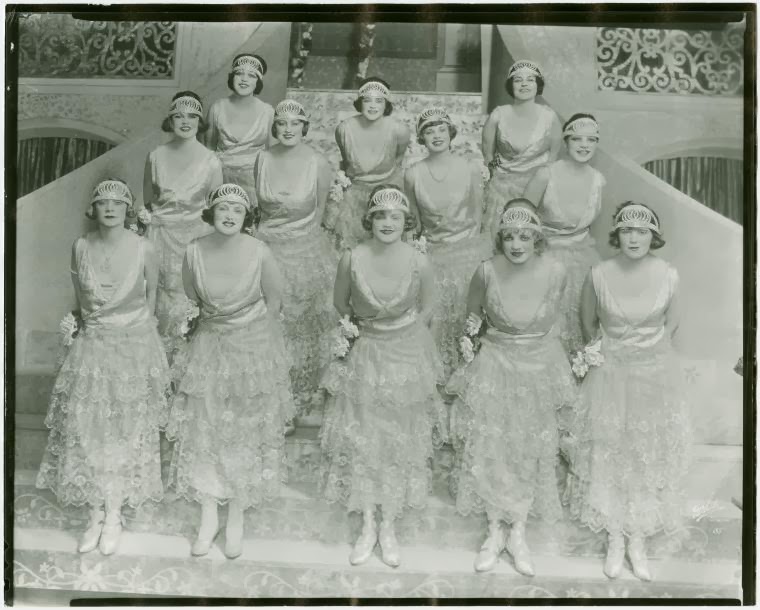
The Florodora girls, from the hugely successful 1900 musical comedy which debuted at the Casino Theater. (NYPL)

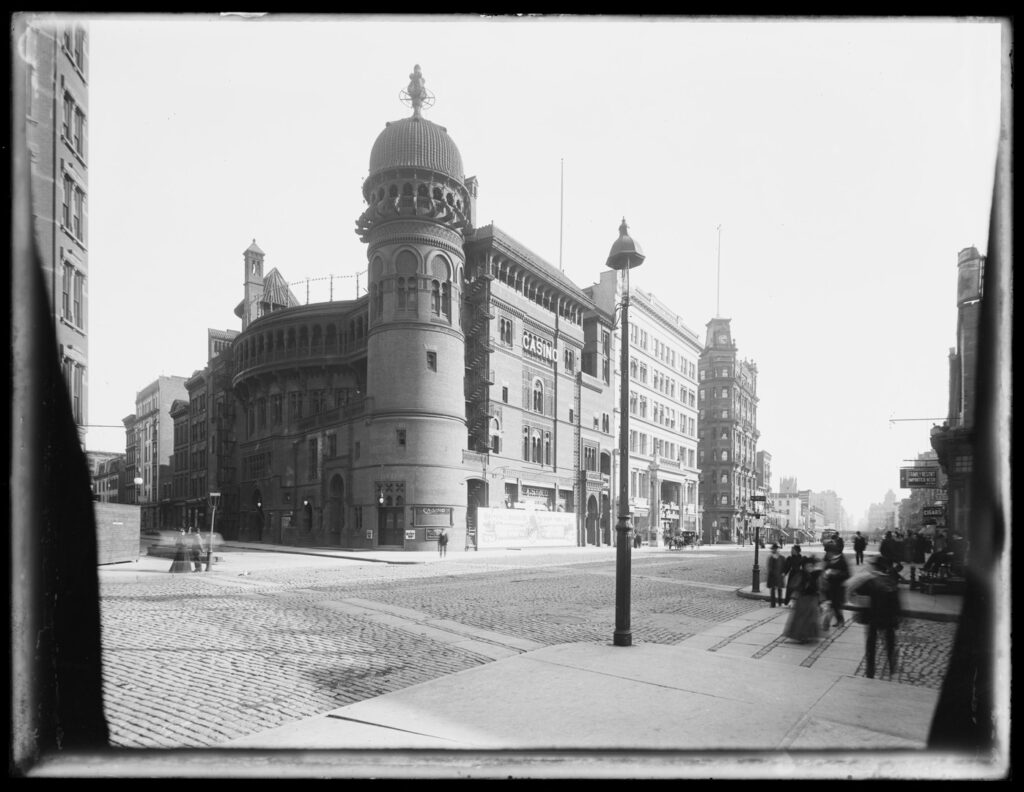
The Casino Theatre at West 39th Street and Broadway.

One of the more fantastic creatures from Victor Herbert’s Babes In Toyland, which made its debut in Columbus Circle’s Majectic Theater. You can read my article here on the musical which inspired Herbert’s show, the musical version of The Wizard of Oz. (NYPL)

New York Public Library

George M Cohan singing “Over There”

Video of a Ziegfeld Follies from 1929, a bit past their heyday, actually. They would only last until 1931:

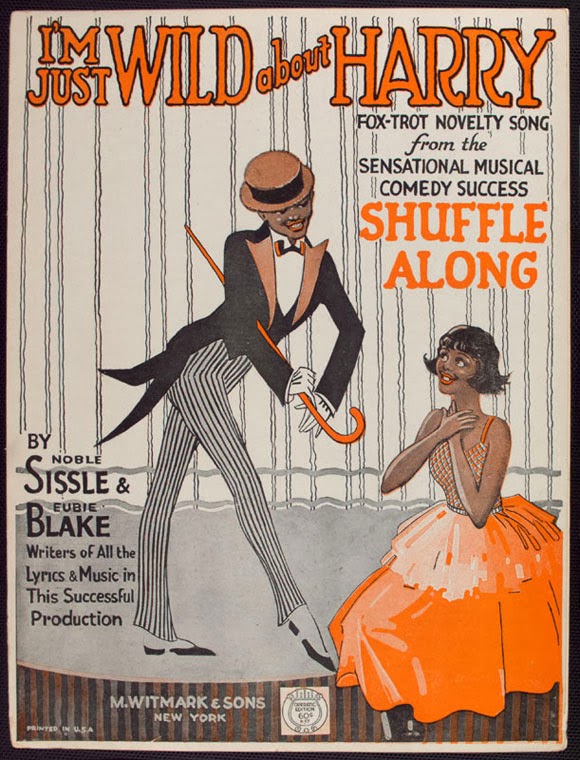
Sheet music from 1921 of one of the most famous songs from Shuffle Along (NYPL):

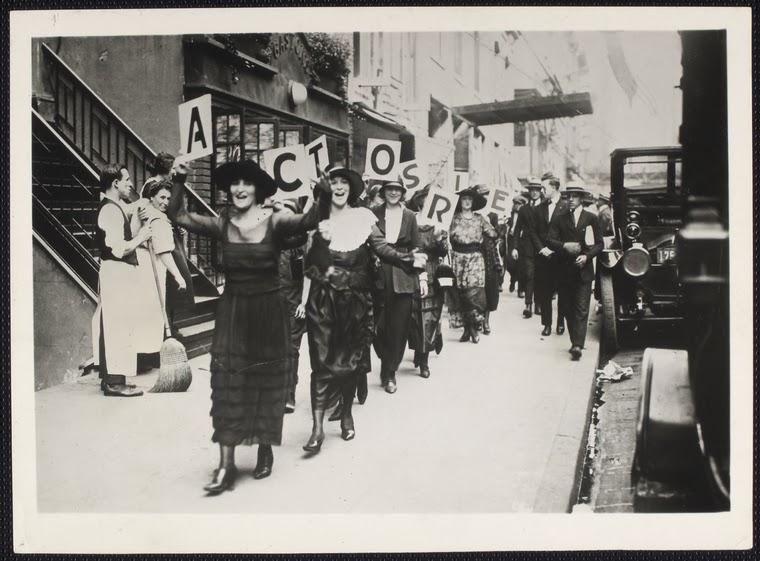
Dancing girls during the Actors Strike of 1919, which galvanized the industry and gave regular New Yorkers a window into the tough conditions faced by many background performers. (NYPL)

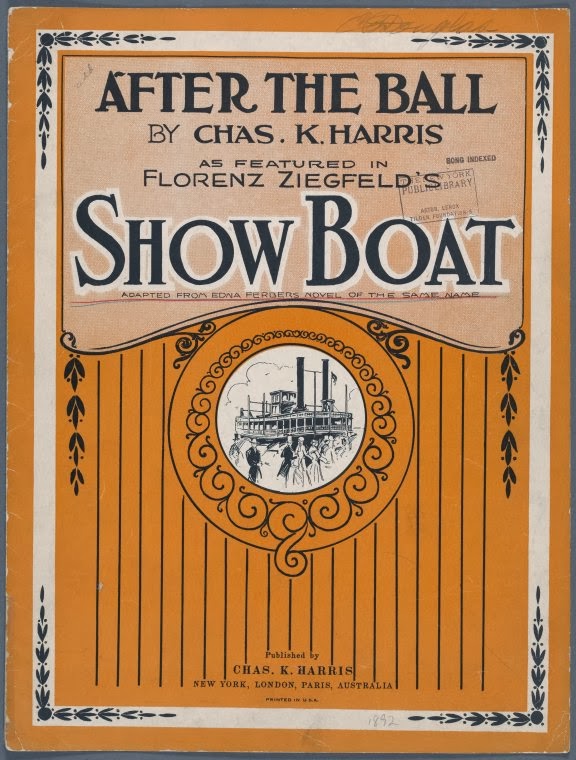
So the number ‘After The Ball’ — a huge hit song that made its stage debut in A Trip To Chinatown — made a return appearance to Broadway in 1927’s Show Boat!

Musical cues from this week’s show:
Give My Regards To Broadway and After the Ball performed by Billy Murray
A version of Make Believe recorded by Bing Crosby, and Ol Man River, performed by Paul Robeson, from a 1932 cast recording, featuring Victor Young and His Orchestra
Love Will Find A Way, from a 1921 recording by Eubie Blake
Selection from HMS Pinafore, from a 1914 recording by the Victory Light Opera Chorus

 And finally, a clip from the film version of ‘Show Boat’, featuring an iconic performance by Paul Robeson.
 

Categories
Amusements and Thrills

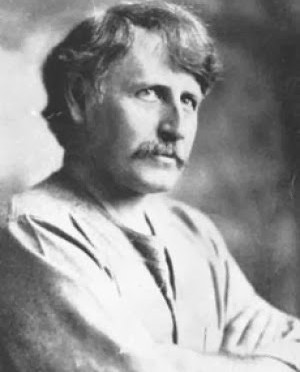
Charles Kellogg, the man who put out fires with his voice

New York has seen its share of bizarre entertainments, especially back in the days of vaudeville, when people would pay for almost anything that amused or titillated.  A few months ago, I wrote about the novelty star Don the Talking Dog, who allegedly spoke a handful of English and German words.

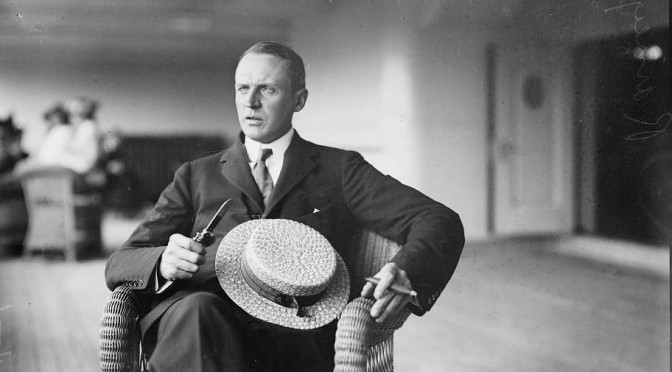
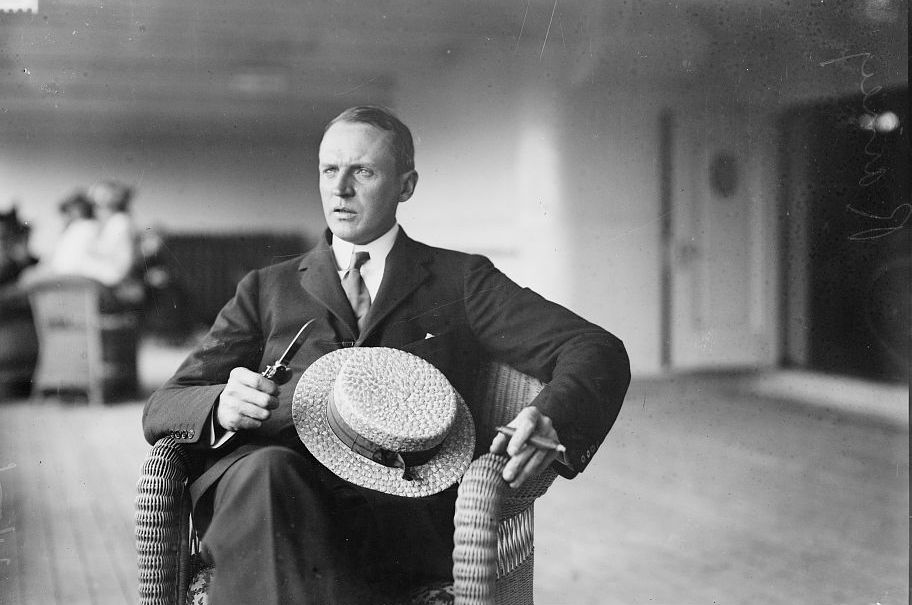
But another vocally talented star was the hot vaudeville ticket one hundred years ago — Charles Kellogg, the man who could extinguish fire with his singing voice.

Kellogg was an early environmentalist and promoter of California’s redwood forests.  He billed him as ‘California’s Nature Singer,’ known for his sterling emulation of bird song,  recording his aviary music for Victor. “He was born with the throat of a bird,” said the New York Times.  Imagine cranking up this record on your Victrola, his ‘duet’ with Romanian soprano Alma Gluck:

Kellogg voice was allegedly superhuman.  It could not only emulate the sounds of nature, but it could protect nature from devastating flame.

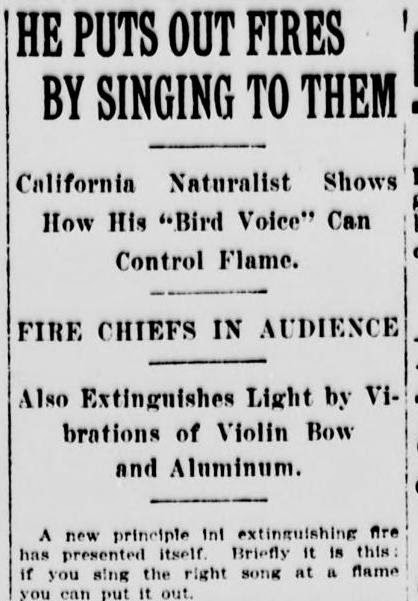
He performed this particular trick in New York on November 11, 1913, at the brand-new Palace Theater (Broadway/47th Street), performing for an audience which included various New York fire chiefs, several scientists, and an auditorium full of curiosity seekers.  Also on hand: William Temple Hornaday of the Bronx Zoo, his reputation recently sullied over the whole Ota Benga scandal.

During the demonstration, Kellogg proved he could affect the flickering flame on the other side of the stage by first aiming his ‘bird song’ at it, then by drawing a bow across a sheet of metal.  “He stood fifty feet away from the flame and drawing the bow across the metal and singing his bird song the flame acted the same way, finally going out.”

Kellogg continued his display of natural gifts by demonstrating a divining rod for finding water, then by dropping to the floor and “demonstrated the Indian way of making fire by friction with two pieces of redwood.”

Captivating, I’m sure, but not enough to convince New York’s fire chiefs.  “It has not yet reached a point where Fire Commissioner Johnson will put male quartets in the fire house ready to dash to a fire and render a popular ballad.” [source]

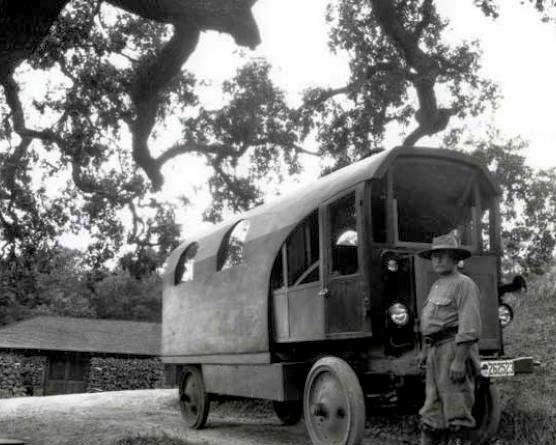
Kellogg returned to New York in 1917 with another redwood-inspired creation — his ‘redwood motor home’, called the Travel Log (pictured below), which he and his wife took cross-country.  The idea of a ‘mobile home’ was a true novelty for the day.  Kellogg’s Travel Log was briefly displayed at a motor car salesroom on Broadway and 57th Street to the delight of auto enthusiasts.

Picture courtesy NPR

By the way, Mythbusters recently took up Kellogg’s challenge as to whether the human voice could put out a fire.  The verdict — yes, it can, but not at any decibel Kellogg could have possibly been singing in. More information here.

Categories
Amusements and Thrills

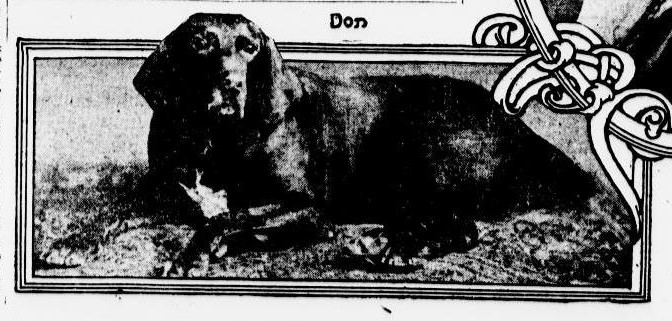
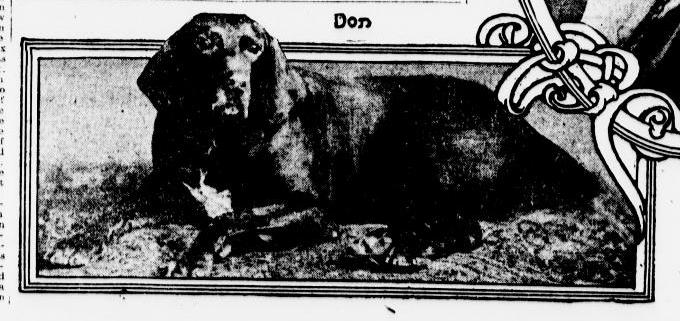
Don the Talking Dog, German vaudeville sensation, saves a drowning man in Brighton Beach

There once was a talking dog named Don.

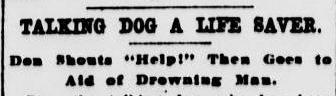
One hundred years ago today, he saved a man from drowning in Brighton Beach.  Don shouted or barked the word ‘Help!’ then ran to the waters to save him.
But perhaps I should explain.
In December 1910, the New York Times ran a startling announcement that a dog in Germany had been discovered that could pronounce certain human words.  The setter from Theerhutte was owned by an eastern German gamekeeper and possessed several human qualities, not the least of which was the name Don.  The dog had beautiful eyes “sometimes almost human in their expression” and was an “uncommonly intelligent animal,” according to the Times.

Naturally, Don spoke only in German.  Being a dog, among the six words at his command were ‘haben’ (want), ‘kuchen’ (cakes) and ‘hunger’.  You had to use your imagination, of course, but one could detect a slight difference in Don’s barks that could be interpreted as separate words.

Despite some understandable cynics out there, Don was on his way to a career in the theater.

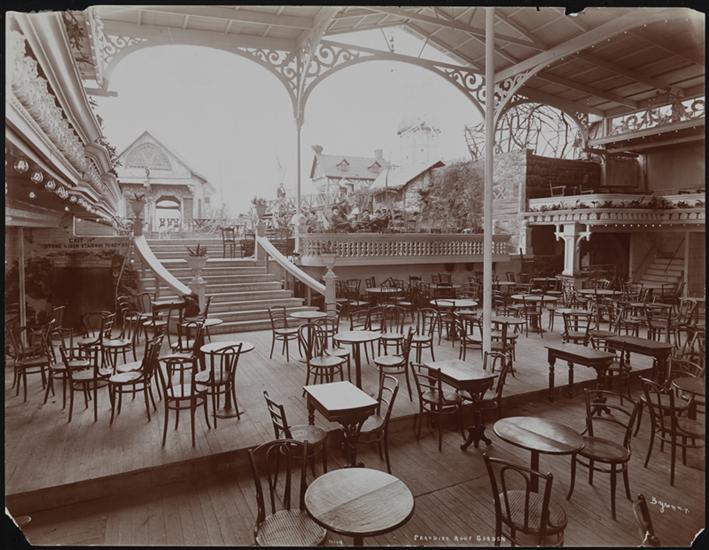
Above: Hammerstein’s rooftop garden at the Victoria Theatre in Times Square, the stage where Don the Talking Dog made his debut.

Generally speaking, dogs were a definite novelty among the stars of the vaudeville stage. A troupe of animals called Wormwood’s Dogs and Monkeys held court on the stages of Coney Island in the 1910s.  More renowned, perhaps, was the cross-dressing pooch Uno the Mind Reading Dog , who wowed theater crowds in 1910.

But the highest paid dog act up to that time was Dan the Drunken Dog, an animal who emulated the wobbling demeanor of an alcoholic, to the delight of audiences at the Oscar Hammerstein‘s Victoria Theater rooftop garden in Times Square.

None of these would reach the fame of Don the Talking Dog.  Hammerstein was so sure New Yorkers would love him that he posted a $50,000 bond to have Don brought to the United States.  The dog arrived in America on July 9, 1912 aboard the German steamship Prinz Friedrich Wilhelm, “absolutely refus[ing] to be interviewed at the pier, and indeed, had been too seasick on the way over to converse with anybody.” [source]

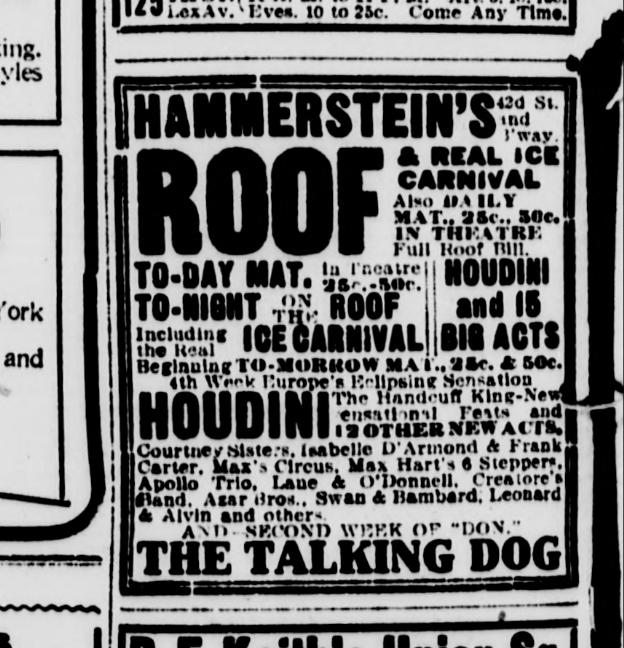
At right: On the bill with Harry Houdini, from the New York Sun, July 21, 1912

A few weeks later, the German canine would make his debut on Hammerstein’s rooftop garden, alongside master of ceremonies Loney Haskell.  “The trained growls which emanate from his throat can readily be mistaken for words,” claimed a Variety reviewer.  “On the roof the audience, skeptical in the first place, became more so at Loney’s [introduction], but after the dog had made its first try they became interested and later enthusiastic.”

His salary was allegedly $1,000 a week, paid, of course, to his owner Martha Haberland.  Like many temperamental divas, Don disliked the roof garden lifestyle due to the sounds of traffic, preferring to perform inside theaters, not atop them. But he was huge success that year, touring to other Hammerstein stages before returning to Germany that fall, a bonafide American star.

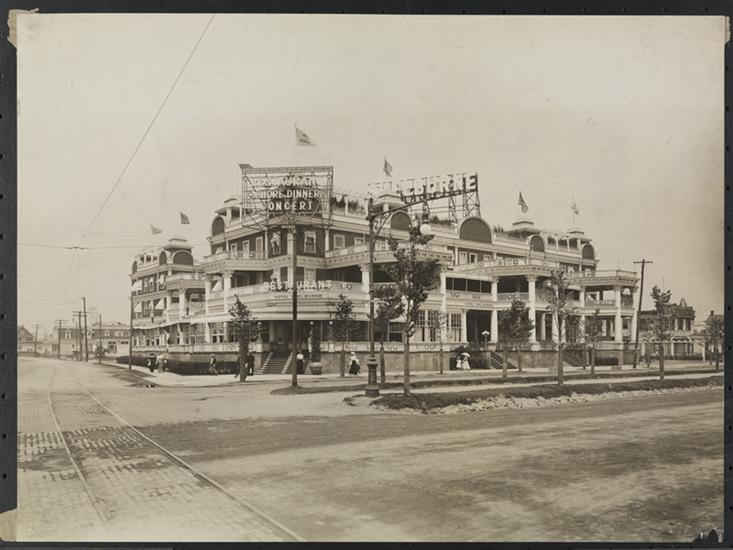
Above: The Hotel Shelburne in Brighton Beach, where Don the Talking Dog saved a man from drowning

Don returned to Hammerstein’s Times Square stage in 1913, this time performing alongside the likes of young comedian Sophie Tucker.  Later that summer he arrived in Brighton Beach to delight Brooklyn audiences.  It was here, on one of his afternoons off, that he rescued a drowning man with his famed ubiquitous voice.

The man was a waiter for the Hotel Shelburne who was actually out walking Don that afternoon.  The man jumped in the water for a swim and instantly lost his footing.  Don saw the man flailing in desperation in the ocean foam and, then, according to the New York Sun, allegedly unfurled one of his new words — “Help!” — startling everyone on the beach.*  The performer then swam over to the drowning man and began pulling on his bathing suit.

A passing policeman leaped into the water on his horse to rescue Don and the waiter.  This whole scene — dog, horse, waiter, policeman — was in turn rescued by three lifeguards in a boat. [source]

This was perhaps Don’s shining moment. He shortly retired from the stage and finally died in 1915 back in Germany.  His final words, according the Evening World:  “Say goodbye to my old pal Loney Haskell.”

*The Tribune reports the same event but does not mention this magical ‘Help!’

Top pic courtesy New York Evening World. Bottom two images courtesy Museum of the City of New York.

Rainey’s African Hunt: A bloody 1912 movie blockbuster

Hunter and gadabout Paul Rainey: An accidental matinee idol

Catching a movie this weekend? Many New Yorkers had the same plan one hundred years ago, but the experience was vastly different.  Motion pictures in 1912 were shorter, without sound and in black-and-white, of course, but they were sometimes presented as part of a set of vaudeville performances, with live musical accompaniment and in repertory with several short films.

In the days before movie palaces, movies were shown in legitimate theaters which often gave them a must-see feel. This was the case with a strange non-fiction film that played in New York for well over a year — Rainey’s African Hunt.

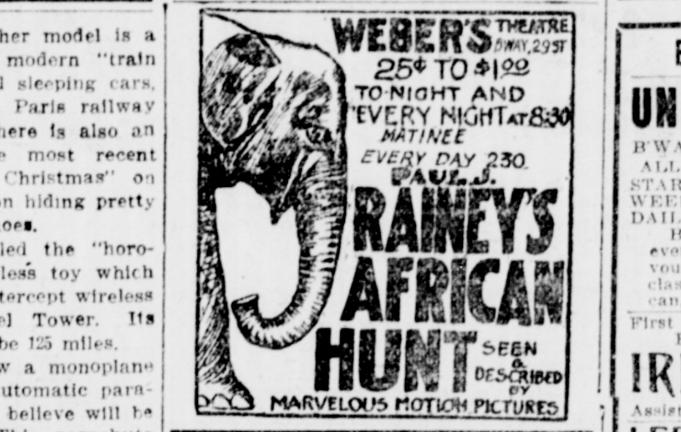
In September 1912, the film played Joe Weber‘s Music Hall at Broadway and 29th Street:

The film made its debut in April 1912 up the street at the Lyceum (45th/Broadway) and played there through the summer, heralded as a serious entertainment, for ‘wealthy people at top prices‘ to distinguish it from the fiction films favored by everybody else.

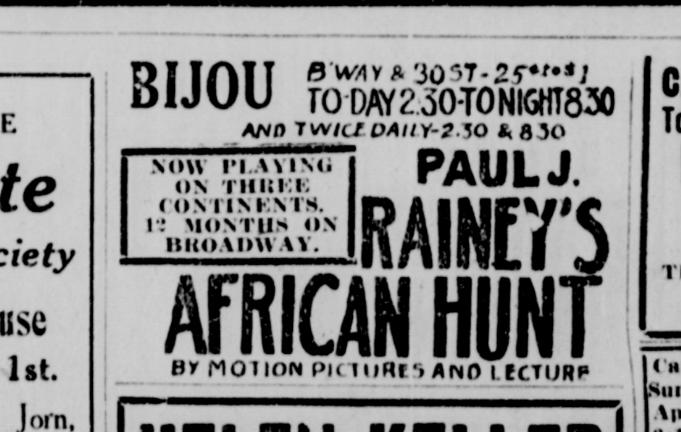
But is seems that ‘African Hunt’ resonated with all sorts of audiences. The film moved to Weber’s in August, then to the Bijou (30th/Broadway) in October, where it stayed put until April 1913!

So what made this film so popular? Americans were still safari crazy in the early 1910s thanks to Theodore Roosevelt‘s famous African trip in 1909, in which he brought back the carcasses of dozens of exotic animals and donated them to natural history museums around the country, including New York’s own American Museum of Natural History.

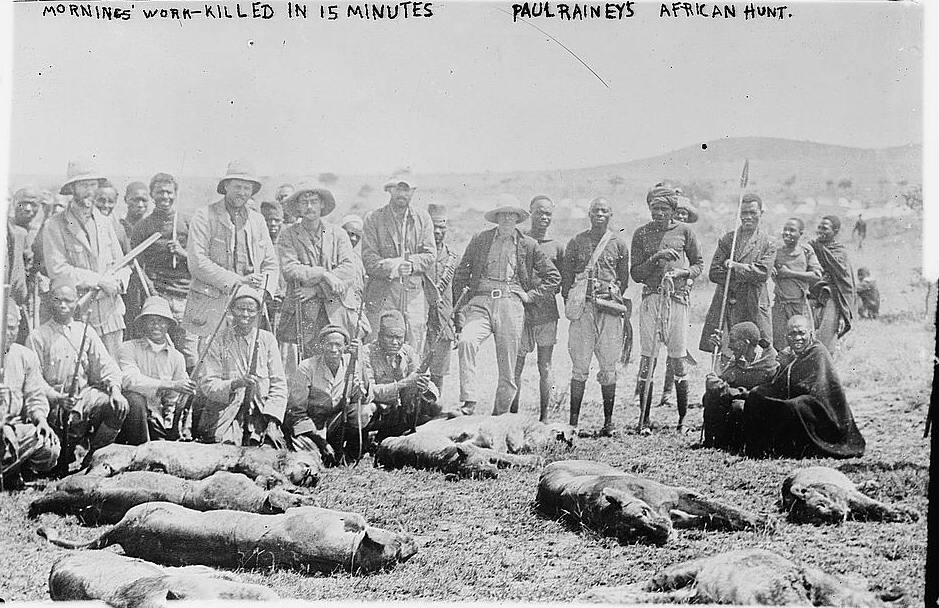
The wealthy playboy Paul Rainey was also a renown game hunter and filmed his exploits in Africa following Roosevelt’s trip there. The film depicts his interaction with African tribes and the trials of hunting exotic animals. Although Rainey claims to have been more interested in photographing and trapping live creatures, he ended up killing several dozen animals, including “twenty-seven lions in thirty-one days.” One notable scene features Rainey’s specially trained fox hounds stalking and killing a leopard.

 Claimed one advertisement: “One touch of nature makes the whole world kin. That is the secret to the extraordinary success of this picture.”

The film came with a sterling pedigree and glowing reviews, include praise from the American Museum’s Henry Fairfield Osborn, who proclaimed it the ‘greatest contribution to natural science of the decade.’ [source]

Distributed by Carl Laemmle’s Universal studios, ‘Rainey’s African Hunt’ grossed over a half-million dollars, an extraordinary sum for an early motion picture. It would stand as one of the most successful non-fiction films of the decade.

Like every box office success, a sequel debuted in 1914 at the Casino Theatre (29th/Broadway). Portions of its first week gross were donated to a newsies home and summer camp in Staten Island. Despite emphatic reviews — “better and clearer” than its predecessor, according to the New York Times —  it appears to be mostly recycled material and was not a hit.

Below: A grim photo from Rainey’s safari. The hunter killed so many animals that is exploits eventually led to stricter regulations on foreign hunters.

According to the site Silent Era, a print exists of the film, although I don’t know if its presently available for view.
For more information on New York’s unique relationship with African safari hunters, check out our podcast on the American Museum of Natural History. For a peek at the early days of cinema in New York, listen to our show on NYC and the Birth of the Movies.
For more information on Paul Rainey, check out this interesting blog page on his Tennessee lodge and his tragic death.
Categories
Uncategorized

Jimian? The strange affair of Lillian and Diamond Jim


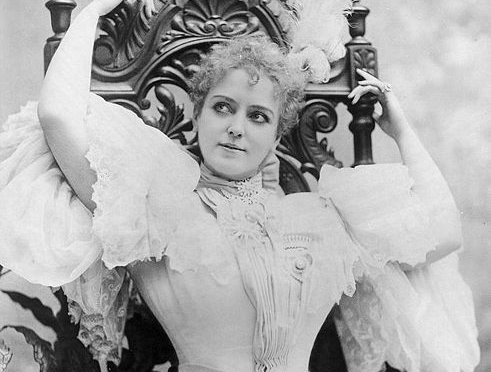
Had there been a paparazzi in the 1880s, the woman they would have hounded the most would be New York stage singer and actress Lillian Russell. Like a Scarlett, she was always hanging on the arm of a famous, powerful man. Like an Angelina, she did dramatic things in her personal life that often upstaged her work. And like a Britney, she was occasionally caught doing things most unbecoming for a lady.

Celebrity fame in those days derived primary from legend and word of mouth; most of the people who idolized Russell had never seen her, in anything. As P.T. Barnum aptly demonstrated with Jenny Lind in the early 1850s, nobody actually needed to hear you sing to become a famous singer; you just had to be desired as one.

Russell (as Helen Louise Leonard) came to New York from Iowa in 1878 to become a opera star, managing to train under no less than Leopold Damrosch, whose son Walter was intimately involved in the creation of Carnegie Hall. The next year, she changed her name to Lillian Russell.

She made her name thanks to Tony Pastor, a vaudeville showman who presented a wide range of acts at his Union Square music hall. Her sweet singing voice and good looks made her perfect for the comic opera circuit, and she quickly became the toast of New York theatre. She eventually toured Europe, hopped from opera company to opera company, and became the first voice in travel over long-distance phone wire in 1890, thanks to admirer Alexander Graham Bell. (She sang the ‘Sabre Song’ to listeners on the other line in Boston and in D.C.)

But it was her penchant for glitz, and roster of suitors that made her a legend among celebrity seekers. She would breeze through four different tempestuous marriages with an actor, a politician, a composer and a newspapermen, but she would be most famous for the one man she didn’t marry — ‘Diamond’ Jim Brady.

Brady was a legend of the Gilded Age, a wealthy businessman who embodied indulgence. Enamored of wearing jewels (thus the nickname), Brady painted the town with his money, a frequent and well-known guest at all the hottest restaurants in town, especially Delmonico’s and later Luchow’s.

He was known for his sizable appetite, a usual evening meal at Charles Rector’s restaurant involving “two whole ducks, six or seven lobsters, a sirloin steak, two servings of terrapin and a variety of vegetables.” And, in the process, growing terribly, unbelievably fat.

He began a public flirtation with Russell that lasted throughout the 1880s and 1890s(throughout her various marriages!) by wooing her with jewels and fancy meals. They made quite a pair. Two celebrities in their thirties, their rubies and diamonds twinkling under gas light in the most exclusive dining room in the world. Oscar Tschirky, later to become the leading chef at the Waldorf-Astoria, got a job at Delmonico’s in his early years just to get a closer glimpse of Russell.

He would see quite a lot of Russell’s eating habits, keeping up with Brady as the pair shucked down oysters and drank champagne, her gluttonous abandon leaving little of her glamorous image intact. Like any actress today, her weight was closely observed, as during her years with her extravagant paramour, she blossomed to 160 pounds.

It seems clear that Brady was in love with Russell, and that Russell was in love with Brady’s attentions. Their public affair crept into the new century as Russell became the defining voice of American operetta. She went on to marry newspaper publisher and later U.S. ambassador Alexander Pollock Moore, and even toured Europe in her later years on behalf of president Warren G Harding. She died in 1922.

Diamond Jim (below) had died five years previous, having never married, with Russell still presumably in his heart, and god knows how many pounds of oysters in his gut.

The REAL story behind those confusing numbers

Some architectural monstrosities just beg to be ripped upon. Topping this list is One Union Square South, a bland 33-story structure and pioneer in the mall-ification of Union Square. Although its storefronts feature a Circuit City and a dying Virgin Mega-store, One Union Square South is defined by a piece of public art that has only gotten more atrocious and weird over time.

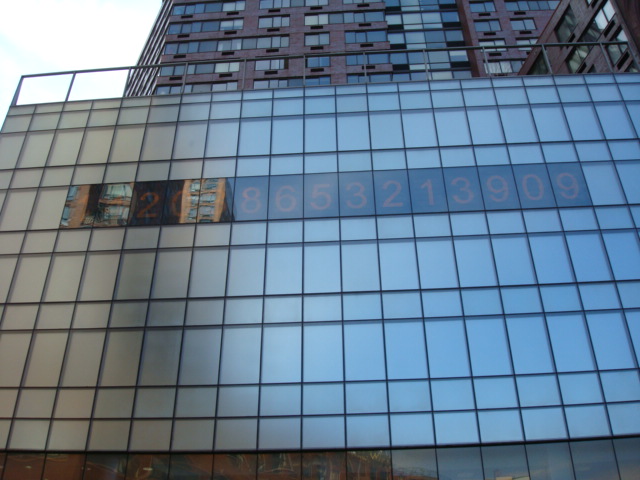
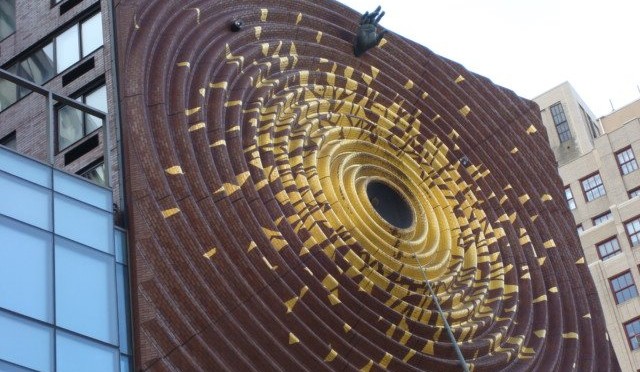
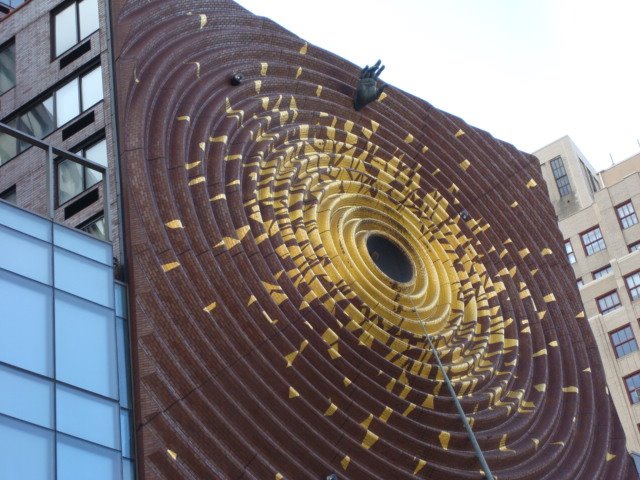
The Metronome was a project three years and $3 million in the making when it was finally installed in February 1999. It has confused and horrified New Yorkers ever since. The 100-foot Kristin Jones and Andrew Ginzel display features a brick wall striated with the undulations of water waves, interrupted with such objects as a boulder, a long tube frozen in the swing of a ‘metronome’, and a sphere which registers the moon cycles. Smoke occasionally burps through the hole in the middle, and a gigantic hand — modeled after the hand of George Washington across the street on his equestrian statue — beckons the viewer to stop and gawk at it.

Nearby is a row of 80s-era calculator digits, rolling at different speeds. The six numbers on the left indicate the proper time (i.e. 9:34 am and 21 seconds = 093421).

The six numbers on the right display the amount of time before midnight, except to be quirky, they put it backwards. So, using the prior example, there are 14 hours, 25 minutes and 39 seconds to midnight. In Metronome world, you write that as 392514.

The three digits in the middle are too blurry, presumably in the rush of micro-seconds. (Except, of course, when you take a picture of it.)

Since this piece begs the viewer to speculate the passage of time, perhaps its time to speculate what sat here at One Union Square South before this dated piece was even here. (To be fair, the piece seemed dated the moment it was installed in 1999.)

One Union Square South replaced the less glamorous address 58 East 14th Street. Passersby in the early 90s saw it as a frumpy building with modest retail space dominated by a gigantic McDonalds sign. What many may not have known was that this building contained the oldest theatrical space in Manhattan.

Rumors of this secret stage had persisted since the 1970s, but it wasn’t until some clever detective work by a New York Times reporter verified in fact interior walls were built during its transition into retail space, severing the stage from a vast auditorium, sitting empty for decades.

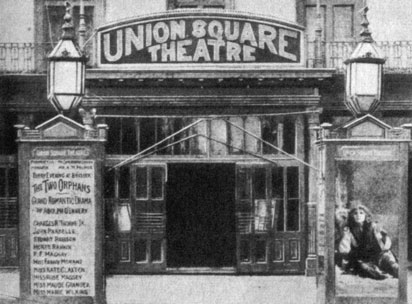
It had once been the Union Square Theater. In its final days of operations, from 1896 until the late 30s, it had been a cinema for silent features and ‘racy’ pre-code pictures. As with many stages, it converted to showing films after a brief stint from 1893 to 1896 as a vaudevillian showcase. The stage saw the debut of a young entertainer named George M. Cohen, who was originally supposed to perform with his family The Four Cohens. But owner B. F. Keith needed to fill up his bill, so young Georgie took the stage himself and the boy was greeted with apparent indifference. (You can see a variant of this event in the film ‘Yankee Doodle Dandy’.)

Before the racy films, before Cohen and the vaudeville, the Union Square Theater was a legitimate stage, showing mostly unsuccessful fare such as the un-intriguingly named ‘A Woman’s Strategem’. That show was apparently significant enough to merit articles about the details of the leading lady’s costumes — “a very quaintly-designed morning gown of crepe,” “a very handsome broche with bodices of the Directoire period and point de gaze’ lace sleeves.”

The early days of the Union Square Theater sound a lot more engaging. When it opened in 1871, it was advertised as a ‘modern temple of amusement’, showcasing everything from burlesque to ballet. Its brief foray into legitimate theater — the kind that could feature costumes of ‘quaintly-designed’ crepe — came only after a small fire gutted the balcony in 1888.

Peeling time back further, we find that the Union Square Theater was carved out of the remnants of vast dining room of an old hotel the Morgan House, which was itself the five-story modification of the original building on this spot — the Union Place Hotel, built in 1850.

A descriptive 1861 travel guide refers to the Union Place Hotel as an ‘elegant establishment’, and truly this was Union Square’s high-class heyday, of upper-crust homes surrounding an earlier version of the square inspired by lush English gardens.

A cheeky 1852 guide to the city called Glimpses of New York — written by “a South Carolinian (who had nothing else to do)” — describes it as ‘kept in equal style to the New York [Hotel, one of the superior hotels of the time] and the charges are a grade higher.’

Among many famous guests of the hotel were Mary Todd Lincoln in the years after the death of her husband.

Union Square eventually became the heart of New York’s theater district, and apparently the Union Square Hotel was a bit of a hangout for the out-of-work. Dwight’s Journal of Music proclaims “…at the Union Square Hotel, there is always a host of unemployed managers and actors.”

Luxury hotels and out-of-work actors — some things about New York haven’t changed a bit.

The Summer Blockbuster of 1928

On this day, 79 years ago in 1928…

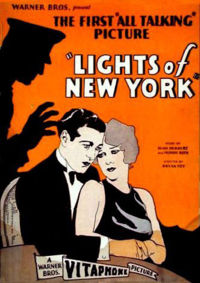
The first ever all-talking movie, “The Lights of New York” debuted in New York’s Strand Theatre at midnight, to an enrapt audience. (It would release nationally on July 28)

“Lights of New York” was a precursor to the great crime films of the 30s that would make Edward G Robinson and James Cagney into huge stars. The plot involves Broadway speakeasies, chorus girls and ‘toughies’, featuring a cast of vaudevillian entertainers.

The film was a box office smash (grossing $2 million dollars, or what Tom Cruise makes for a single day of work today) and presaged the death of the silent era.

Of course, they hadnt quite got the art of editing down, and the film still included ‘transition’ placards.

The Brooklyn Eagle has a few charming anecdotes about the filming:

“In one scene in a barbershop, a character began a speech at one end of the room, walked across the room, and started talking again only when he had come to a complete rest at the other end. He could not speak until he had parked himself under the mike.”

The Eagle also notes the film’s other contribution to the world of cinema: it’s the first of many, many, many gangster films to feature the line “Take him for a ride.” Martin Scorcese and The Sopranos thank you kindly.

Oh, and you might be asking — where’s the Strand Theatre? A premier auditorium for film and Big Band shows for over 70 years, The Strand was demolished in 1978. But you can go see where it used to be; the former address is 1579 Broadway. There’s a Hershey’s Chocolate Super Store there now.

Cinema Treasures, one of our favorite websites, has an elaborate write up on the fate of the Strand.