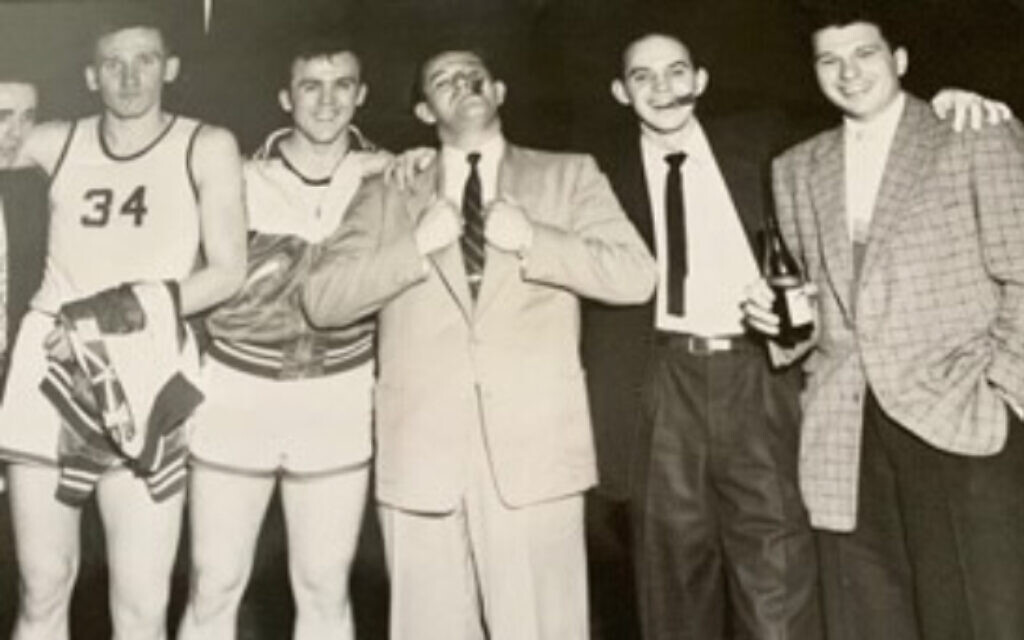
Herbie Cohen, his players and coaches at the Army’s European Basketball League, 1953. (Courtesy of Rich Cohen)
Playboy Magazine called Herb Cohen “the world’s greatest negotiator” and whether or not that was true, Cohen could convince you that it most certainly was.
He wrote You Can Negotiate Anything and in 1982 it became a best-seller during a wave of self-help books. A year before its release, Cohen became involved in the Iran hostage crisis — with both Carter and Reagan.
“Over time, without meaning or wanting to, he gathered a group of disciples. He became a kind of guru. People called at all hours looking for answers.”
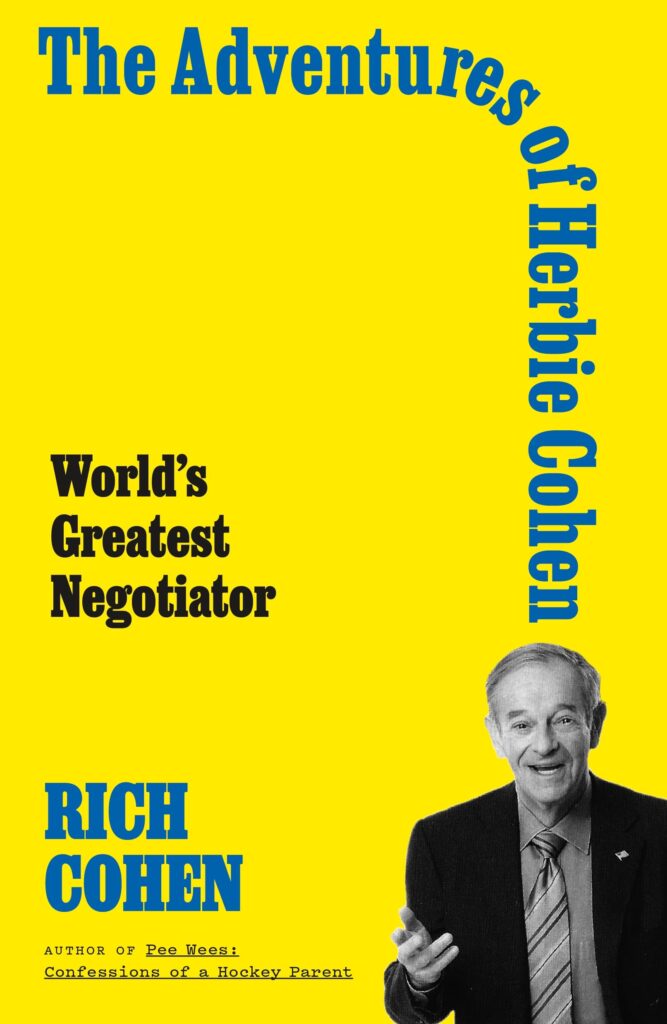
The Adventures of Herbie Cohen: World’s Greatest Negotiator Rich Cohen Farrar, Straus and Giroux
But The Adventures of Herbie Cohen: World’s Greatest Negotiator, written by acclaimed author and journalist Rich Cohen, is not your ordinary profile. For one, Rich is Herbie’s son.
This is no mere ode to a no-nonsense, wise-cracking father. Cohen has managed to craft an absolutely perfect character profile, keeping Herbie’s grounded personality front and center in a hilarious collection of anecdotes, recollections and maybe one or two tall tales (in the way that we share tall tales about ourselves).
“Though he’s lectured at Harvard and Yale and worked for many Fortune 500 companies,” Rich writes of his father, “he says he learned everything he needed to know about negotiation in Brooklyn as a kid.”
He grew up in Bensonhurst in the 1940s and 1950s, a working class Jewish and Italian neighborhood where Herb got into trouble in a street gang with friends nicknamed Sheppo, Iron Lung and Gutter Rat. (The gang was named the Warriors of course.)
Cohen gathers together family stories and his father’s Army tales in a particular way, building upon nostalgia to reveal Herb’s growing talents as a negotiator and lecturer. Everything in The Adventures of Herbie Cohen feels like it’s being told to you over the kitchen table.
On November 19, 1895, Calvert Vaux went for a morning walk from his son’s home in Brooklyn. He never returned.
The 70 year old architect had helped to create the greatest parks in the cities of New York and Brooklyn.
His landscape collaborations with Frederick Law Olmsted had given Manhattan its Central Park and Brooklyn its Prospect Park and Fort Greene Park.
His own architectural work could be seen at Jefferson Market Courthouse, the American Museum of Natural History and the Metropolitan Museum of Art. In 1895 he still retained an honorary role as the parks department’s landscape adviser, although he had mostly retired from public life.
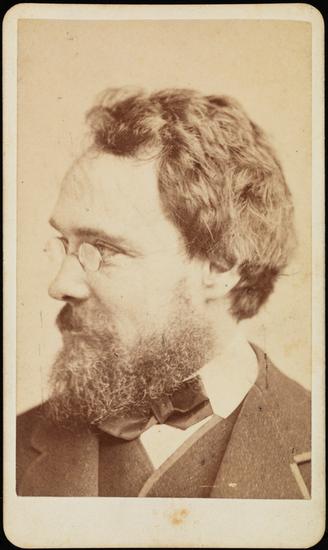
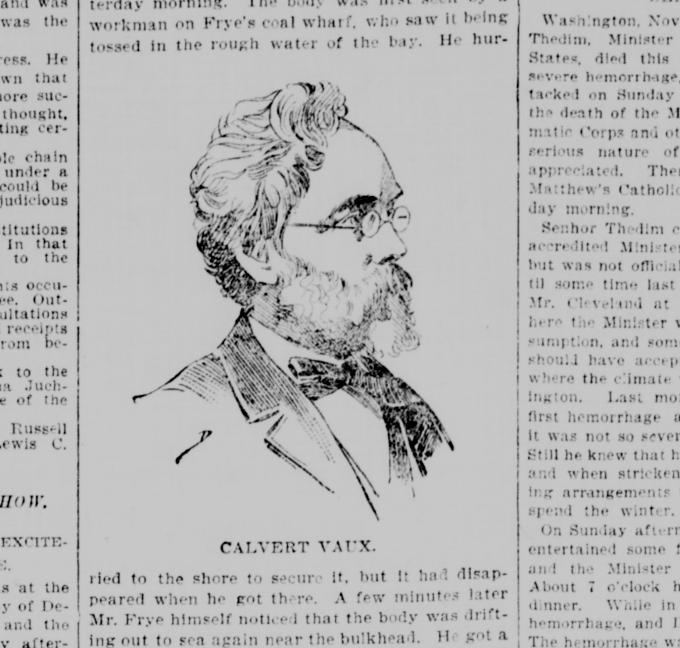
Calvert Vaux, circa 1865-1871
Courtesy Museum of the City of New York
His son Calvert Bowyer Vaux lived in a house on Twentieth Avenue between Bath and Benson Avenues in today’s neighborhood of Bath Beach. The elder Vaux often stayed with his son and was known for taking morning walks along the waterfront
On November 19, 1895, it was gray and foggy on the morning that Vaux departed his son’s home, leaving behind “a gold watch and chain and his vest” with about two dollars in his pocket.
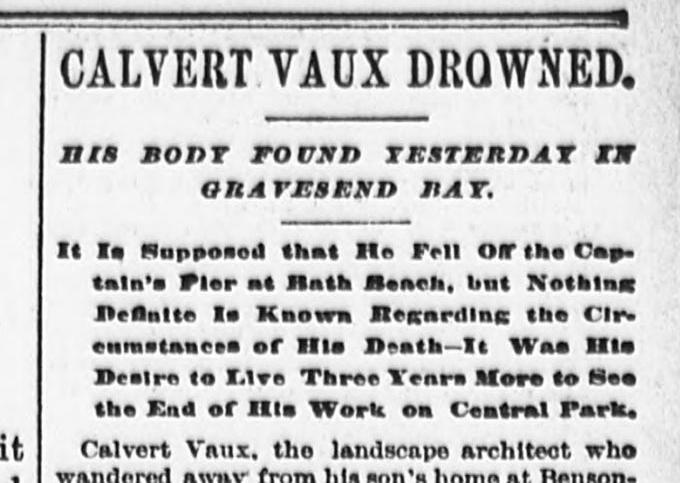
Below: The New York Tribune made a brief mention of Vaux’s vanishing in the followingone-sentence bulletin:
At some point during the day he was spotted by a “Captain Ditmar” — possibly Captain Walter Earl Ditmar — on a pier near the water, and the two briefly spoke. Vaux is reported to have said to the captain, “I’m admiring the improvements you’ve made hereabouts.”
The two briefly talked about methods in which to make the beach area more amenable to visitors before Vaux proceeded to walk the piers by himself.
Ditmar was the last person to see Vaux alive.
The architect must have been known for taking very long walks for he was only discovered missing in the late afternoon.
By the evening his family became worried; the police were called the following morning. All the local hospitals and hotels were checked. While it was well-known that Vaux was a frail man, he was often known to walk up to Prospect Park, several miles from his son’s home. But fears that he may have fallen into the bay were already present.
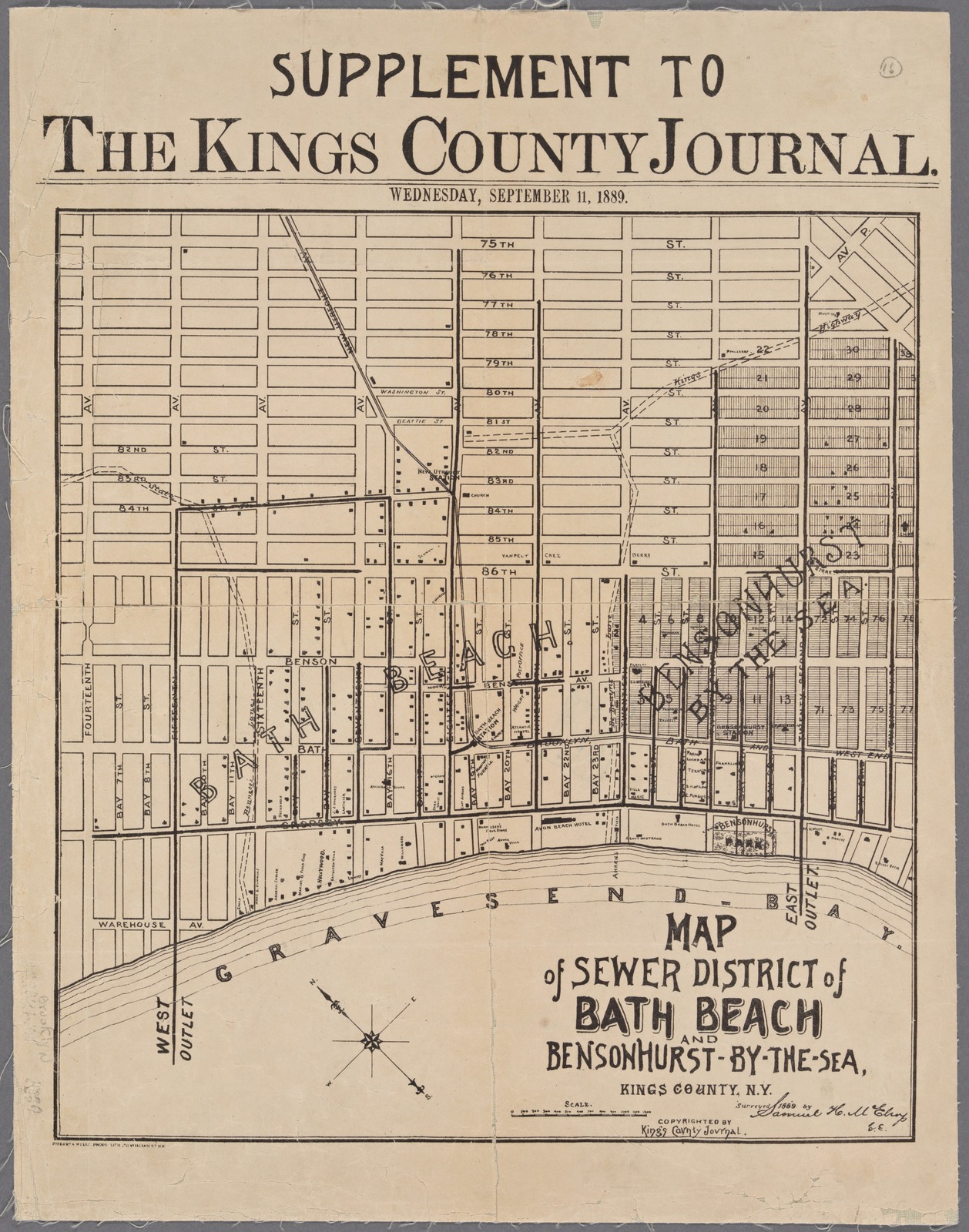
Below: An 1889 map of the district Vaux’s son lived in. The elder Vaux was last seen along the shoreline depicted here.
The following day the body of Calvert Vaux was indeed found in Gravesend Bay at the foot of Bay 17th Street, very close to the site of today’s Bath Beach Park.
As described by the Brooklyn Daily Eagle:
“A workman on Fry’s coal dock [later identified as Benjamin Butler] first saw the body being tossed about in the rough water, but when he rushed to the shore to secure the corpse it disappeared. It was some minutes later before Mr. Fry himself saw it drifting alongside the bulkhead out to sea again. With a boat hook he succeeded in bringing it close to shore.”
The police were called, bringing Vaux’s son down to the shore to identify the body. He could scarcely bring himself to look into his father’s face, recognizing his father’s well-worn suit before looking away.
“There was a bruise on the head, a slight cut over the eye, and the hat, spectacles and left shoe were missing,” reported the Times.
Given the circumstantial evidence, it seems clear as to what may have happened to Mr. Vaux. While on a walk along the shore, he may have fainted or tripped, falling into the water and drowning in the waves.
The Sun further speculated: “As he was interested in the construction of the pier, it may be that he leaned over the stringpiece to examine the foundation piles. In doing so he may have fallen into the water, as he was ill and feeble, being 70 years old.”
Most press reports of the day made it clear no foul play was suspected. Vaux Jr. brushed away any suggestions of suicide on his father’s part. “The theory of suicide has been disclaimed by his relatives who said that [Vaux] had been cheerful and mentally able the evening before he disappeared.” [source]
But not everybody was convinced, and the Tribune reported that the “theory [of suicide] prevails with some people.”
Weeks earlier Vaux had told his daughter that he wanted to live long enough to see the completion of his plans in Central Park. “If I can only manage to live until 1898, my plans for the improvement of Central Park will be completed, and I won’t worry about any other work.”
Sadly Vaux’s death did have a certain impact on Central Park. Without the dutiful eye of its co-creator, maintenance on the park gradually deteriorated, and it would not be until the installation of Parks Commissioner Robert Moses that the condition of the park would be improved.
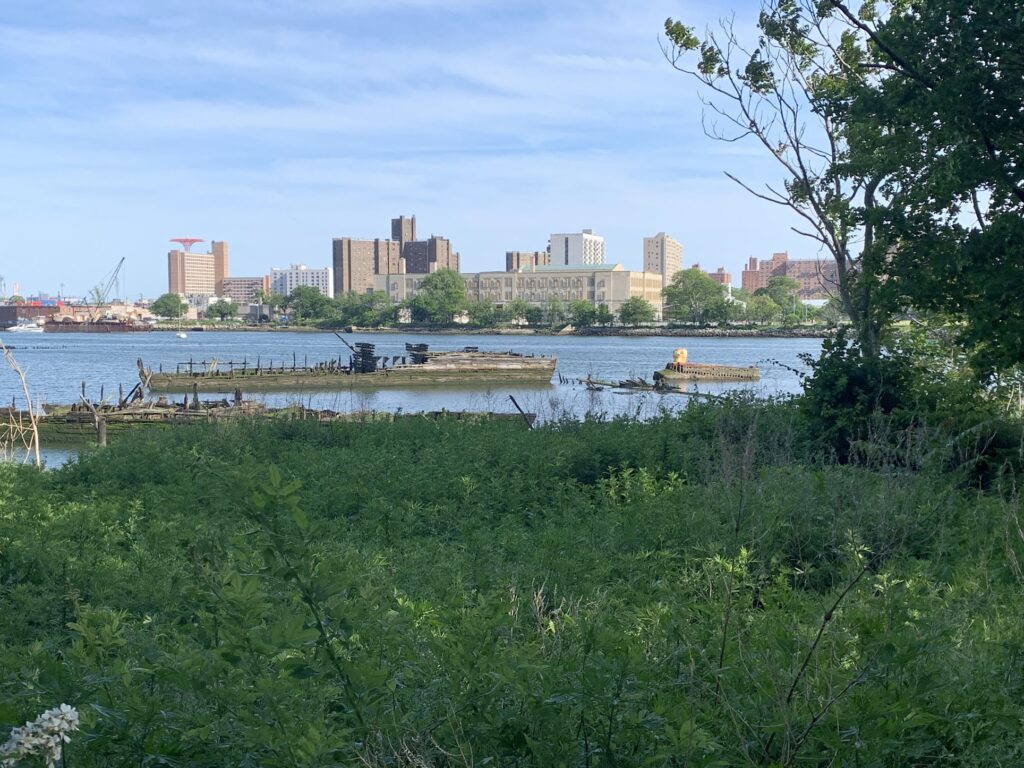
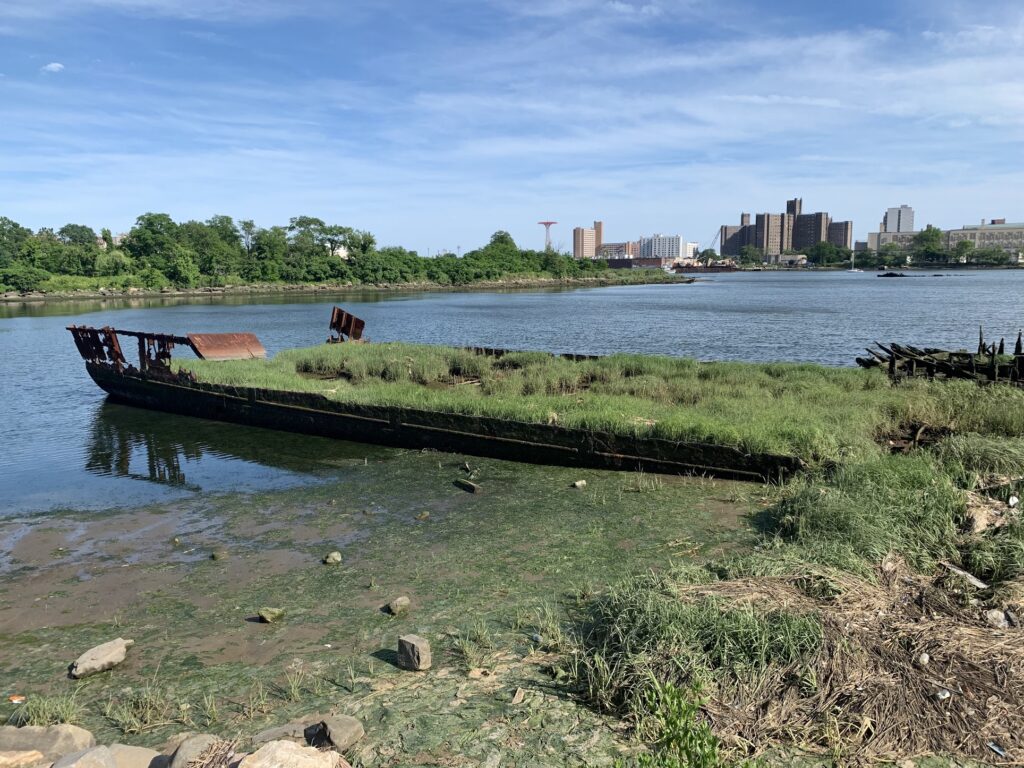
Today, nearby the place where Vaux’s body was discovered, you may enjoy a picnic and a sunset at Calvert Vaux Park in Gravesend.
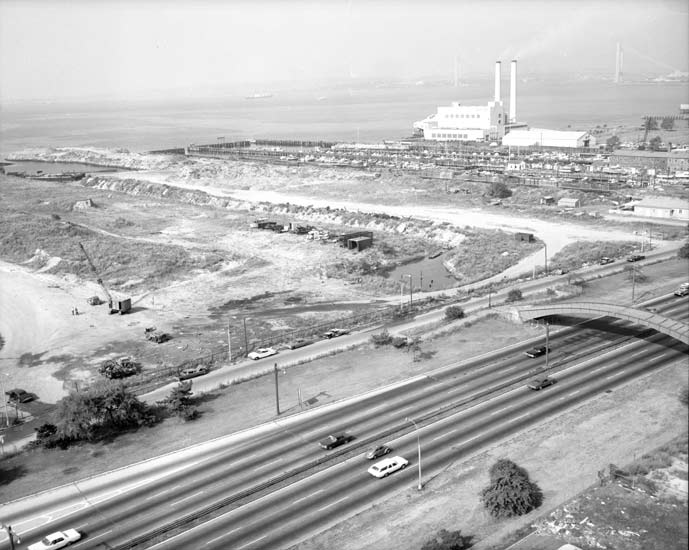
Below: Calvert Vaux Park (the former Dreier-Offerman Park) has greatly improved since the 1960s when it was essentially an undeveloped mess, linked by a pedestrian bridge. Picture courtesy the New York City Parks Archives
It was once called Dreier-Offerman Park for the former home for unwed mothers which once sat here. It was changed to honor the architect in 1998 when it was radically re-landscaped and improved. Knowing that he died close to here, I kind of think being named after an unwed mother’s home is the less depressing name.
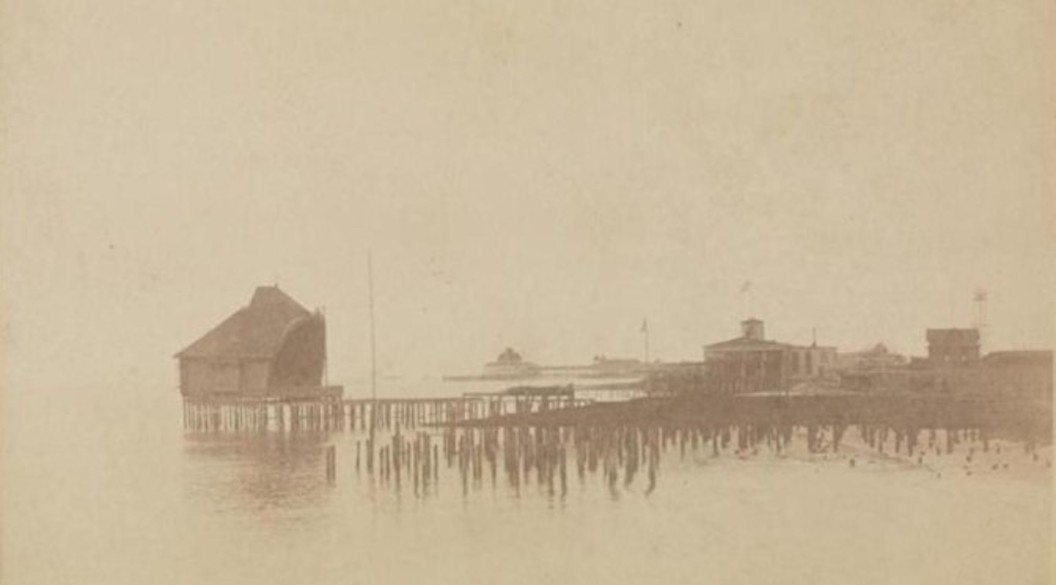
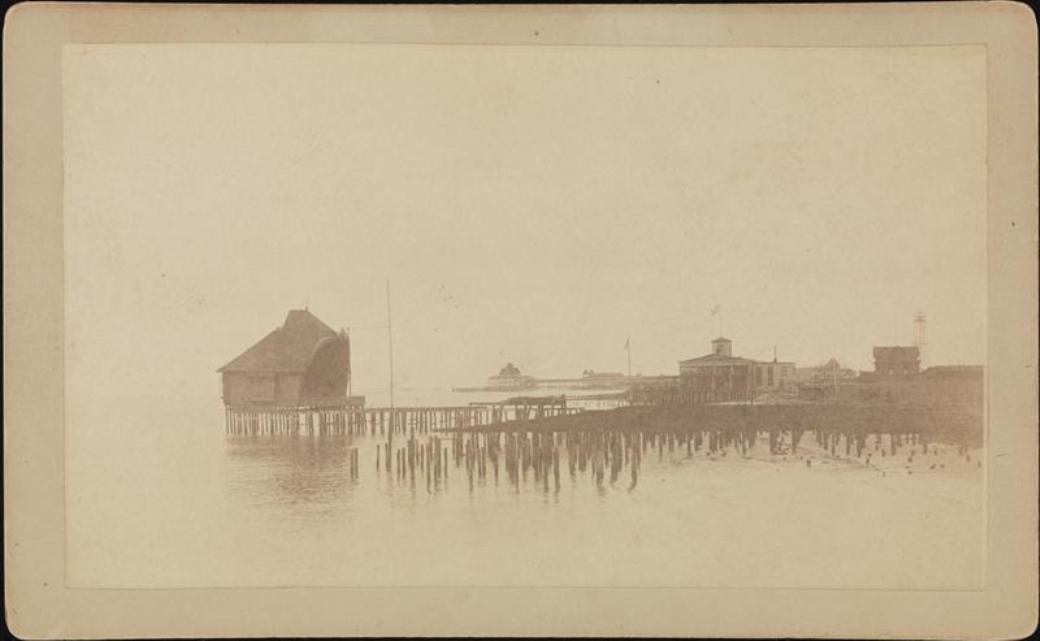
Picture at top: A forlorn pier from 1890, located at West Brighton Beach, Brooklyn.
Photograph by Robert Bracklow. Courtesy Museum of the City of New York
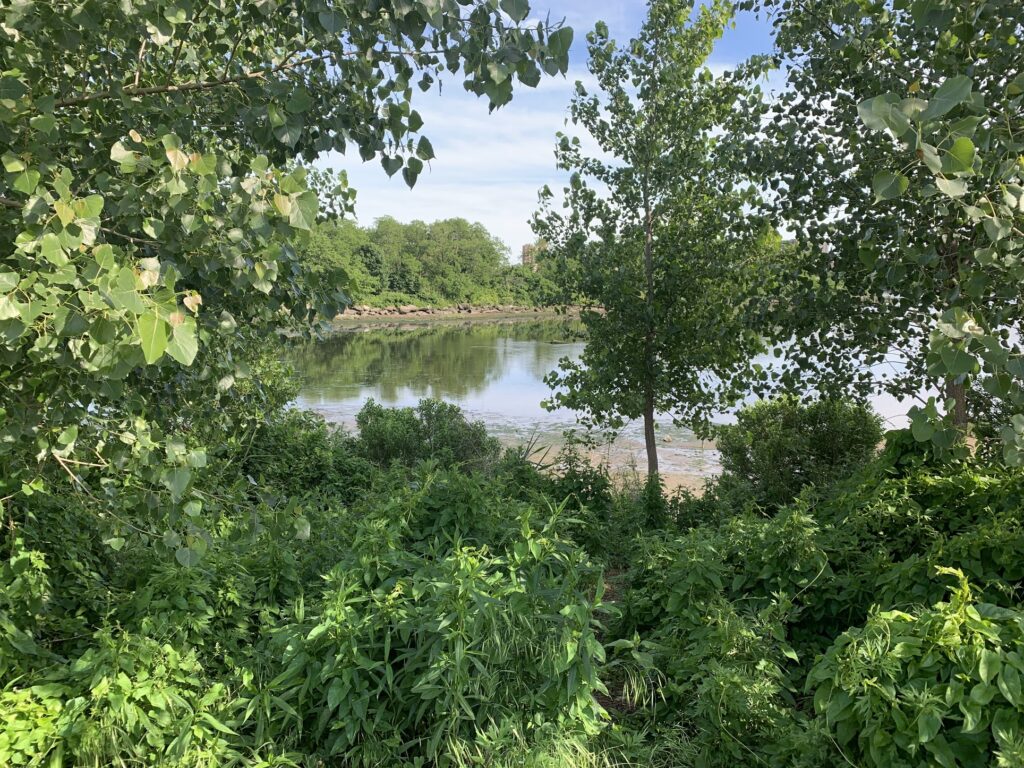
And here are some photographs I took in Calvert Vaux Park from a couple years ago:
Sbarros Pizzais a fixture of shopping malls and roadside traffic stops across the nation. In fact, “across 30 countries” according to the website. In many of these countries, Sbarros is most likely introducing the actual concept of pizza, much less its modified ‘New York style’ offering.
I was surprised to learn that Sbarros actually got its start in Brooklyn, over 50 years ago, and in a fashion similar to Lombardi’s Pizzeria, the tourist-heavy pizzeria in Little Italy.
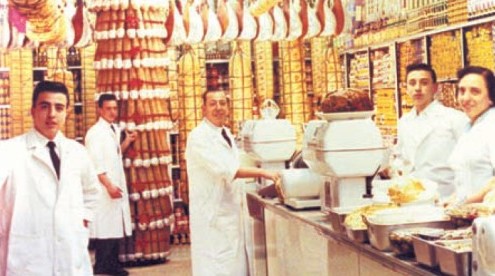
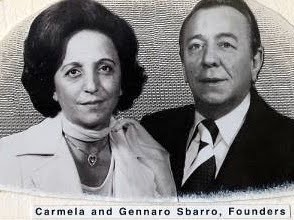
It too was started up by a Neapolitan named Gennaro — the highly alliterative Gennaro Sbarro, to be exact — with his wife Carmela and their three sons. Like Gennaro Lombardi, the Sbarros didn’t start off selling pizza either. Their original salumeria (delicatessen) in Bensonhurst, Brooklyn, was located at 1701 65th Street and 17th Avenue, opening in 1959 and serving the usual Italian-style deli fare, eventually incorporating pasta and pizza onto the menu — and sit-down service along with it.
The similarities to Lombardi’s stop there. The Sbarros had a mind to expand, keeping a tight reign on their operation as they opened 14 additional New York locations well into the 1970s, with all the food made at the original Bensonhurst location. Carmela even continued to personally make the cheesecake.
They could have been content to stop there, but keep in mind that the 1970s was the age of the shopping mall, and the lure of the food court greatly appealed to the Sbarros. Their first experimental pizza outlet was at the King’s Plaza mall in Marine Park. It was here that Sbarros became a counter fast-food restaurant, shedding its salumeria image for a bright, uniform place with a set menu of popular Italian standards.
Needless to say, it was a successful experiment. Incorporating the family business in 1977 and opening the brand up for potential franchises, the Sbarro sons took their restaurant chain national by the 1980s after their father’s death, and rolled it out to international locales by the 1990s.
The original Bensonhurst Sbarros was closed a few years ago, and it’s difficult to find the inherent Brooklyn-ness in a standard-issue Sbarros restaurant today. But if you look carefully, you might find some dusty, fake-looking meats hanging in the window, harkening back to its early Bensonhurst roots. It’s definitely the closest you’re ever going to find New York-style pizza in, say, Salt Lake City or even Kazahkstan. (Picture courtesy PMQ Pizza magazine)
We’re putting together the first new podcast of the year right now, involving a major traumatic event in south Brooklyn history. As I’m getting that together, enjoy this blog posting from summer 2009 about one of southern Brooklyn’s long forgotten pleasure destinations, Ulmer Park. You can find the original article here.
Over a 100 years ago, there was once a time you could get your beer, music and mayhem at a Brooklyn ‘pleasure park’ just a few stops short of Coney Island — near today’s Bensonhurst neighborhood.
Ulmer Park was the lark of William Ulmer, one of Brooklyn’s most successful brewers in an age where much of the nation’s finest beer was coming from the future borough. The German-born son of a wine merchant who learned the trade from his uncle, Ulmer opened his eponymous brewery in the 1870s at Belvedere Street and soon came upon the idea of opening a park as a way of selling more beer. (Not a bad idea. Jacob Ruppert would have similar designs in mind when he bought the New York Yankees in 1915).
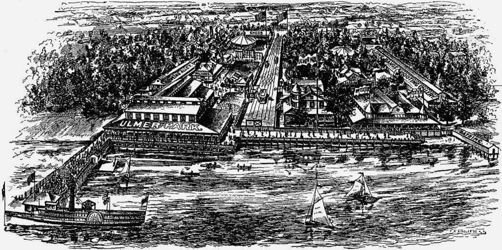
The park would open in 1893 in Gravesend Bay along the southern shore of Brooklyn — back when there was an actual shore — between Coney Island farther south and the more conservative Bath Beach resort community to its west. Ulmer Park seemed to have more in common with Bath Beach — clean, family friendly (keep Dad happy so he keeps drinking!) with a beer garden, carousels and swings, rifle ranges, a dance pavilion and of course plenty of beachfront property.
The park seemed to be particular popular with Germans — Ulmer after all was German, and this was a beer garden — and particularly the annual ‘Saengerfest’ festival. A Times article even claims that 100,000 gathered at Ulmer Park for the end of one such festival.
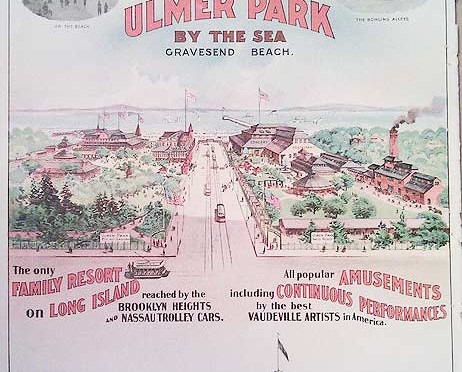
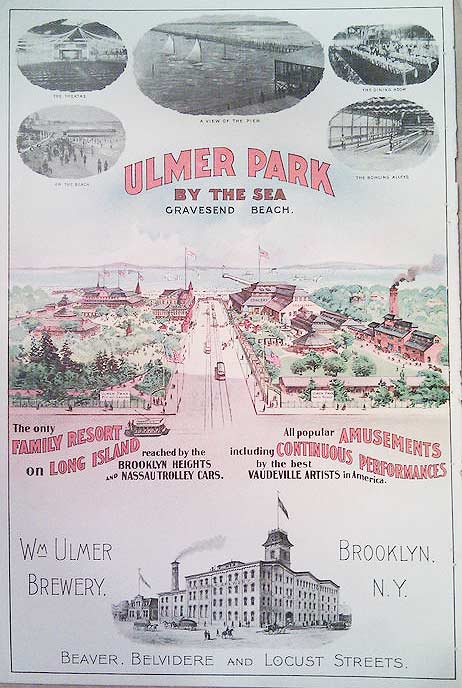
Below: an illustration of Ulmer Park. Note the grand pier which stuck out into into the bay
We can get a good idea of Ulmer’s intentions for the park by looking at his failure at obtaining a “liquor tax certificate” (or license) in a report from 1900. “A picnic ground, or open air pleasure resort, of about two acres” between Harway Avenue and the shore, the park had a bowling alley, a pier with canopied bar at the end, two or three other beer pavilions scattered throughout the property and a hotel.
Ultimately, neither the resort at Bath Beach nor amusements at Ulmer Park could compete with Coney Island which was about to enter its golden age in the early 1900s; apparently, it was grit and decadence people wanted in their summertime Brooklyn getaways. Ulmer closed in 1899.
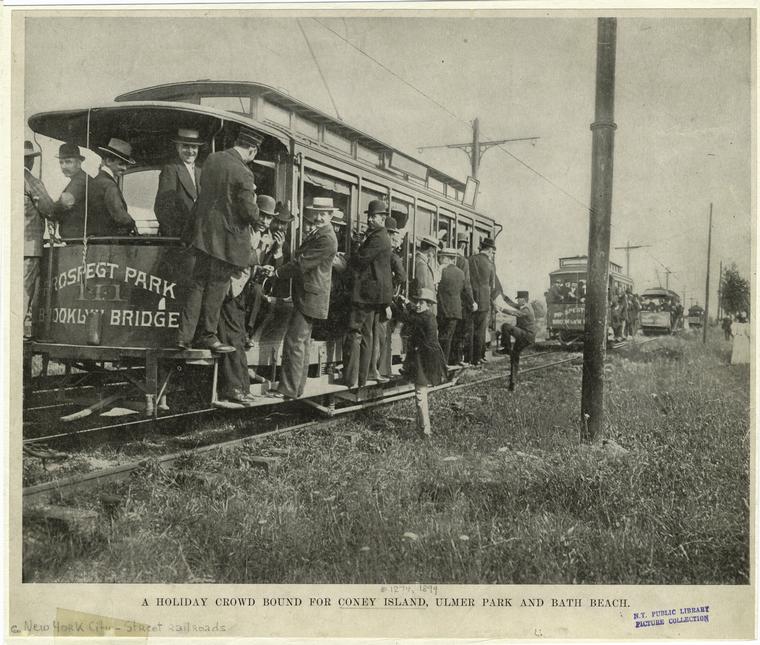
Below: All aboard the train to Coney Island, Ulmer Park and Bath Beach Above pic courtesy NYPL
The land remained a public space hosting baseball, cricket and track and field events. Eventually it was wiped away and redeveloped. It remains in name only, at the Ulmer Park branch of the Brooklyn Public Library and the name of the neighborhood bus depot.
You can find more information about the area surrounding Ulmer Park over at Forgotten New York.
Sbarros Pizza is a fixture of shopping malls and roadside traffic stops across the nation. In fact, “across 30 countries” according to the website. In many of these countries, Sbarros is most likely introducing the actual concept of pizza, much less its modified ‘New York style’ offering.
I was surprised to learn that Sbarros actually got its start in Brooklyn, 50 years ago, and in a fashion similar to Lombardi’s Pizzeria.
It too was started up by a Neapolitan named Gennaro — the highly alliterative Gennaro Sbarro, to be exact — with his wife Carmela and their three sons. Like Gennaro Lombardi, the Sbarros didn’t start off selling pizza either. Their original salumeria (delicatessen) in Bensonhurst, Brooklyn, was located at 1701 65th Street and 17th Avenue, opening in 1959 and serving the usual Italian-style deli fare, eventually incorporating pasta and pizza onto the menu — and sit-down service along with it.
The similarities stop there. The Sbarros had a mind to expand, keeping a tight reign on their operation as they opened 14 additional New York locations well into the 1970s, with all the food made at the original Bensonhurst location. Carmela even continued to personally make the cheesecake.
It could have stopped there, but keep in mind that the 1970s was the age of the shopping mall, and the lure of the food court greatly appealed to the Sbarros. Their first experimental pizza outlet was at the King’s Plaza mall in Marine Park. It was here that Sbarros became a counter fast-food restaurant, shedding its salumeria image for a bright, uniform place with a set menu of popular Italian standards.
Needless to say, it was a successful experiment. Incorporating the family business in 1977 and opening the brand up for potential franchises, the Sbarro sons took their restaurant chain national by the 1980s after their father’s death, and rolled it out to international locales by the 1990s.
The original Bensonhurst Sbarros was closed a few years ago, and it’s difficult to find the inherent Brooklyn-ness in a standard-issue Sbarros restaurant today. But if you look carefully, you might find some dusty, fake-looking meats hanging in the window, harkening back to its early Bensonhurst roots.
It’s definitely the closest you’re ever going to find New York-style pizza in, say, Salt Lake City or even Kazahkstan.