Categories
Podcasts Preservation

Jane Jacobs: Saving Greenwich Village

PODCAST The story of Jane Jacobs, the urban activist and writer who changed the way we live in cities and her fights to preserve Greenwich Village in the 1950s and ’60s.

Washington Square Park torn in two. The West Village erased and re-written. Soho, Little Italy and the Lower East Side ripped asunder by an elevated highway. This is what would have happened in New York City in the 1950s and 60s if not for enraged residents and community activists, lead and inspired by a woman from Scranton, Pennsylvania.

Jane Jacobs is one of the most important urban thinkers of the 20th century. As a young woman, she fell in love with Greenwich Village (and met her husband there) which contained a unique alchemy of life and culture that one could only find in an urban area. As an adroit and intuitive architectural writer, she formed ideas about urban development that flew in the face of mainstream city planning. As a community activist, she fought for her own neighborhood and set an example for other embattled districts in New York City.

Her legacy is fascinating, often radical and not always positive for cities in 2016. But she is an extraordinary New Yorker, and for our 200th episode, we had to celebrate this remarkable woman on the 100th anniversary of her birth.

FEATURING: Mrs. Jacobs herself in clips interspersed through the show.

PLUS: ROOOOBERT MOOOOSES!


The Bowery Boys: New York City History podcast is brought to you …. by you!

We are now producing a new Bowery Boys podcast every two weeks. We’re also looking to improve the show in other ways and expand in other ways as well — through publishing, social media, live events and other forms of media. But we can only do this with your help!

We are now a member of Patreon, a patronage platform where you can support your favorite content creators for as little as a $1 a month.

Please visit our page on Patreon and watch a short video of us recording the show and talking about our expansion plans. If you’d like to help out, there are five different pledge levels (and with clever names too — Mannahatta, New Amsterdam, Five Points, Gilded Age, Jazz Age and Empire State). Check them out and consider being a sponsor.

We greatly appreciate our listeners and readers and thank you for joining us on this journey so far. And the best is yet to come!


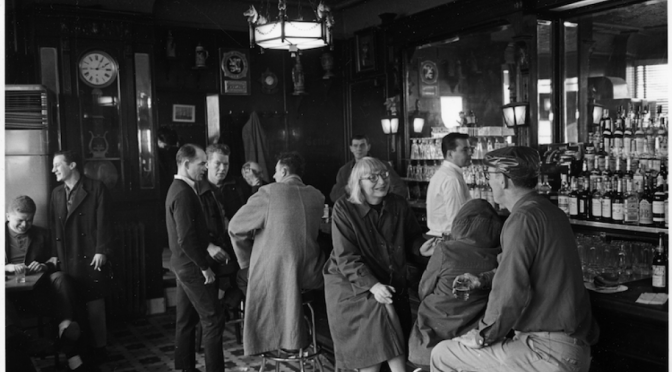
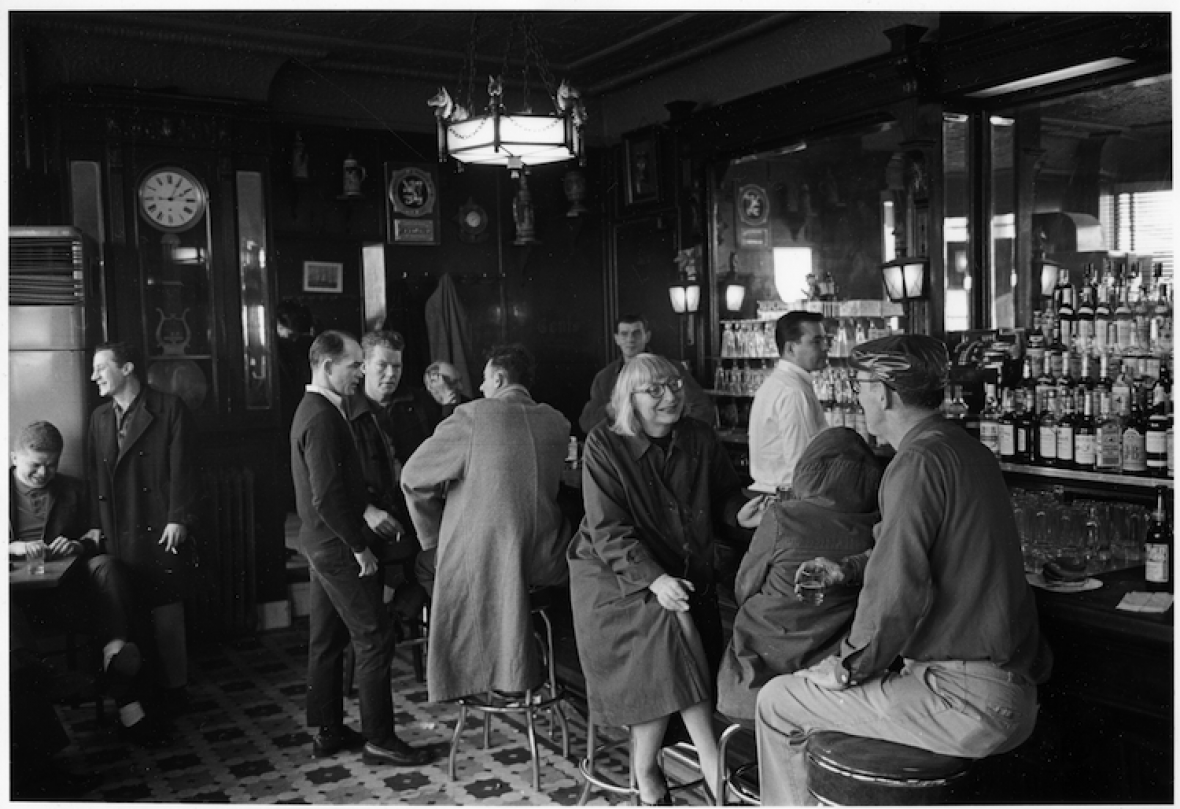
Jacobs at the White Horse Tavern, sometime in the 1960s. Jane lived on the block!

Cervin Robinson/New York Times (http://cervinrobinson.com/)
Photography by Cervin Robinson/New York Times. Visit his website for more extraordinary images of New York City (http://cervinrobinson.com/)

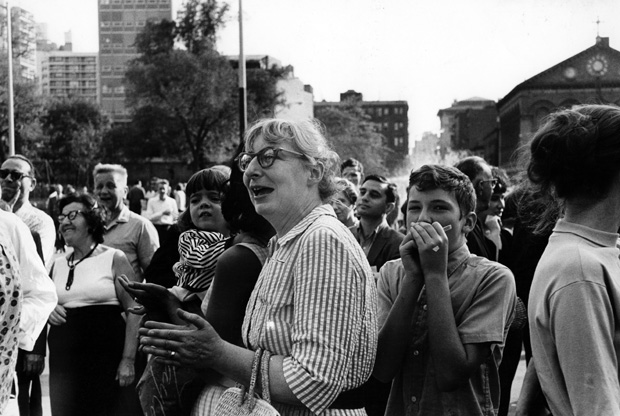
Jacobs in Washington Square Park (though I believe this is 1963 and not during the 1958 protest).

Fred W. McDarrah/Getty Images

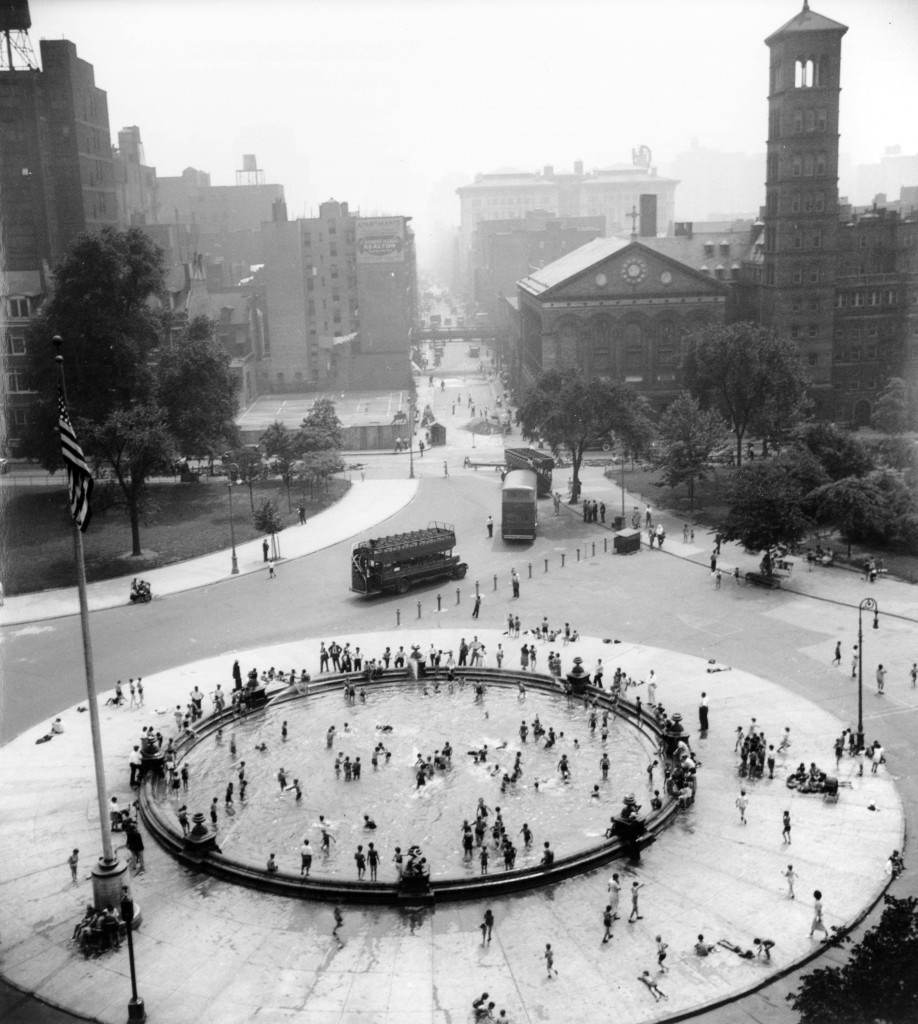
Washington Square Park in 1935. The 1958 activists were so successful in their goal of saving the park that they were able to banish automobile traffic from it entirely.

New York Parks Department

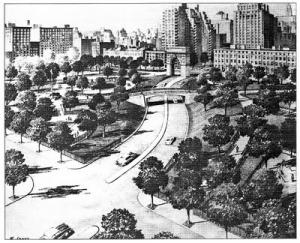
What Moses had planned for the park:

NYPL
NYPL

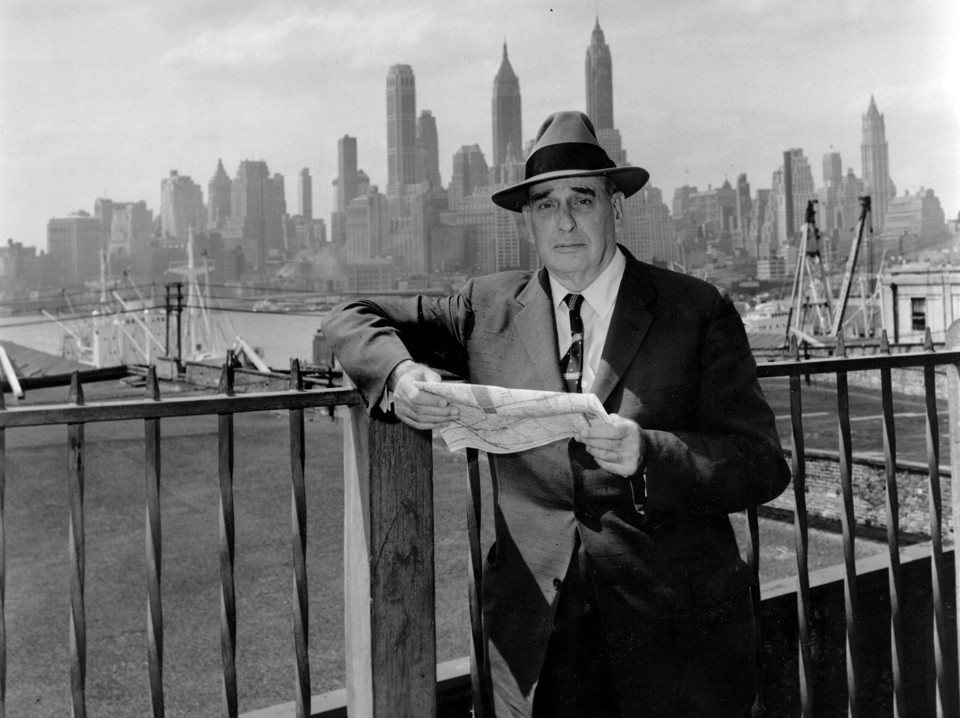
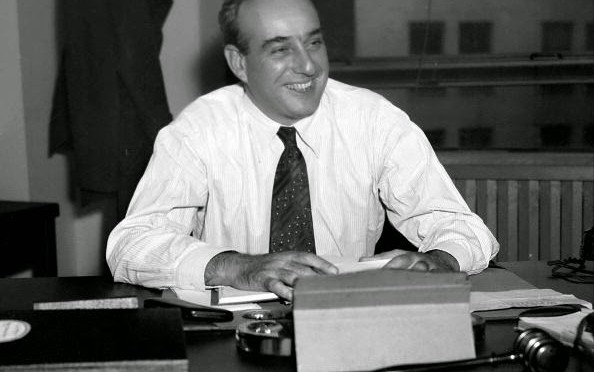
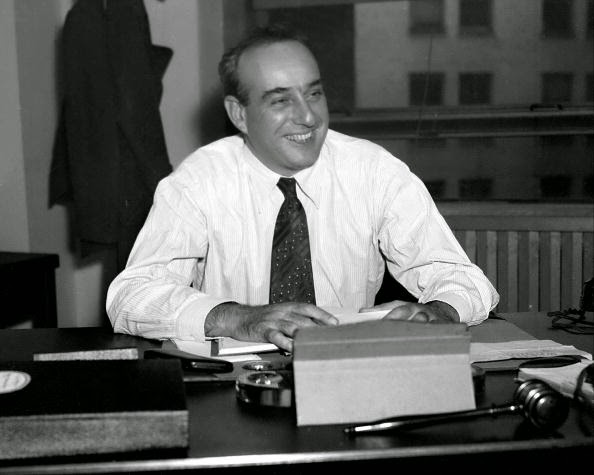
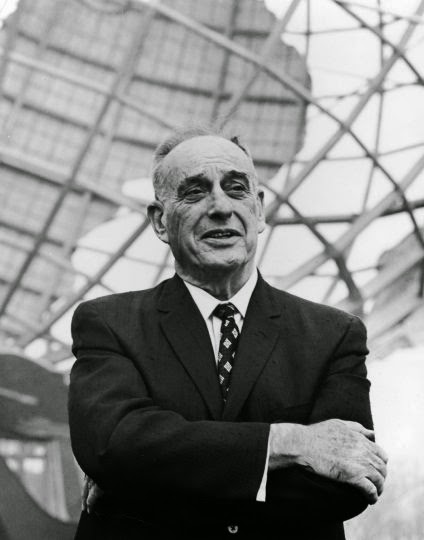
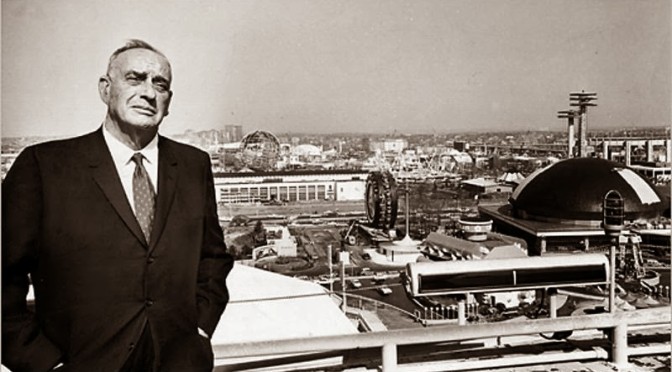
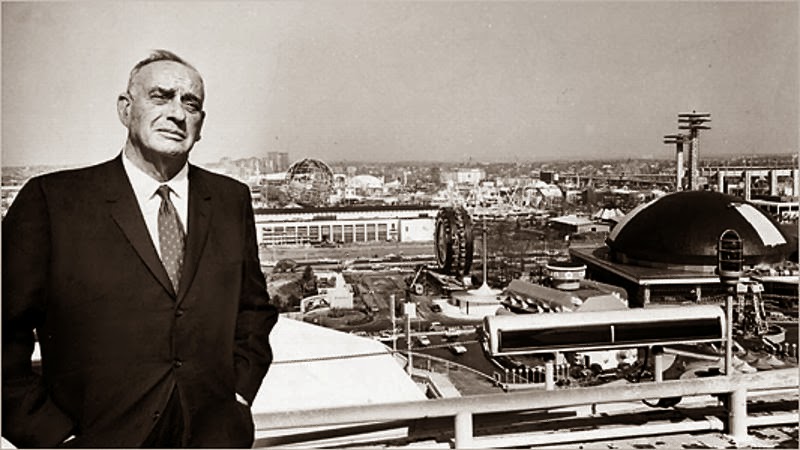
Robert Moses, pictured here in Brooklyn in 1956. Although he frequently situated as the arch-nemesis to Jane Jacobs, in fact they were rarely in the same room together. Their battles were fought in the press and in City Hall.

AP
AP

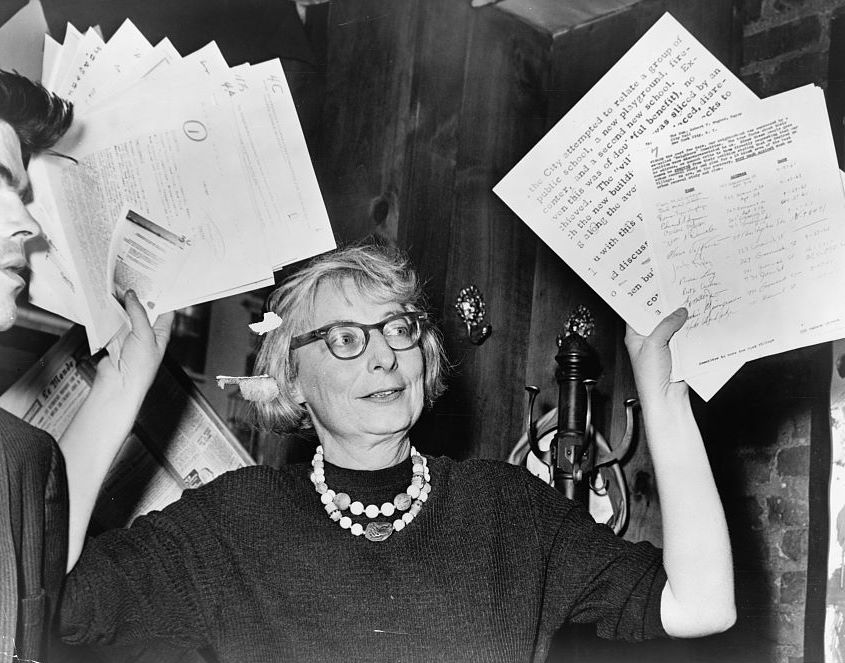
Jacobs presenting damning evidence about the proposed West Village demolition, taken at their main headquarters the Lion’s Head, in 1961 at the corner of Hudson and Charles Streets.

Jane_Jacobs

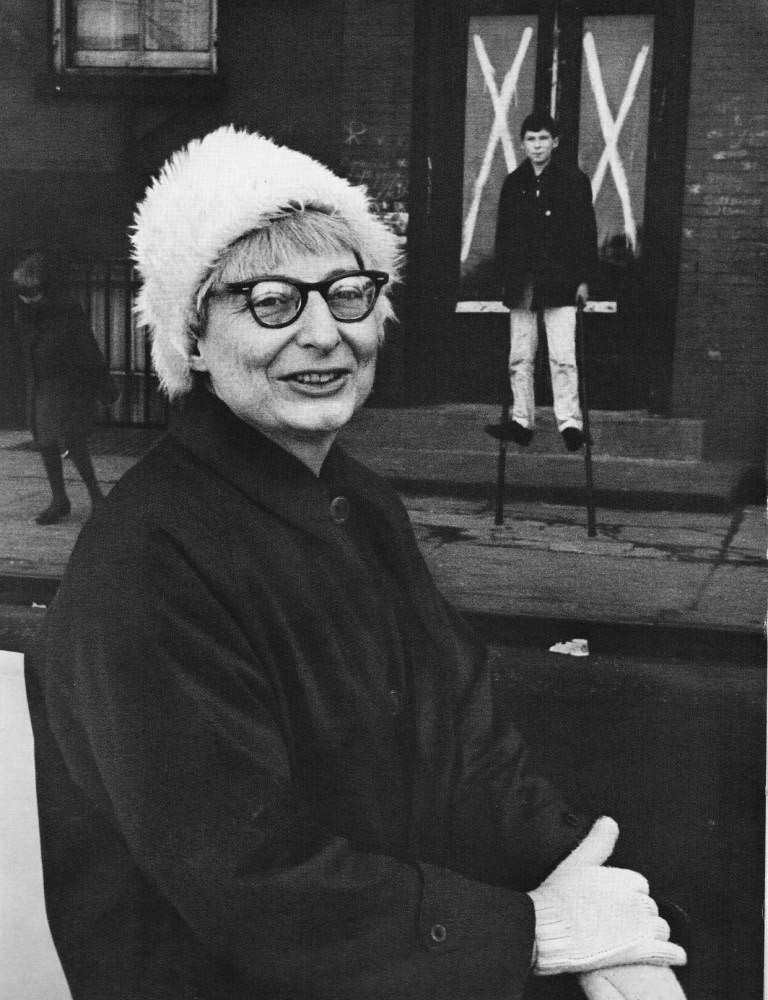
Jane Jacobs and her son Ned in 1961, during the West Village protests. The Xs were placed on buildings to be condemned. Activists wore sunglasses with Xs on the lenses in protest.

1
Photo courtesy Aesthetic Realism

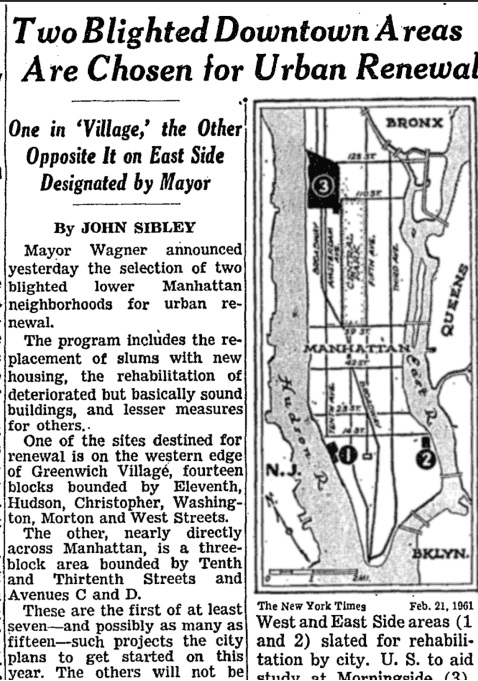
The February 21, 1961, article from the New York Times which riled up the West Village. The East Side project would eventually become Haven Plaza Apartments, but residents would fight off the designation in the West Village.

Untitled

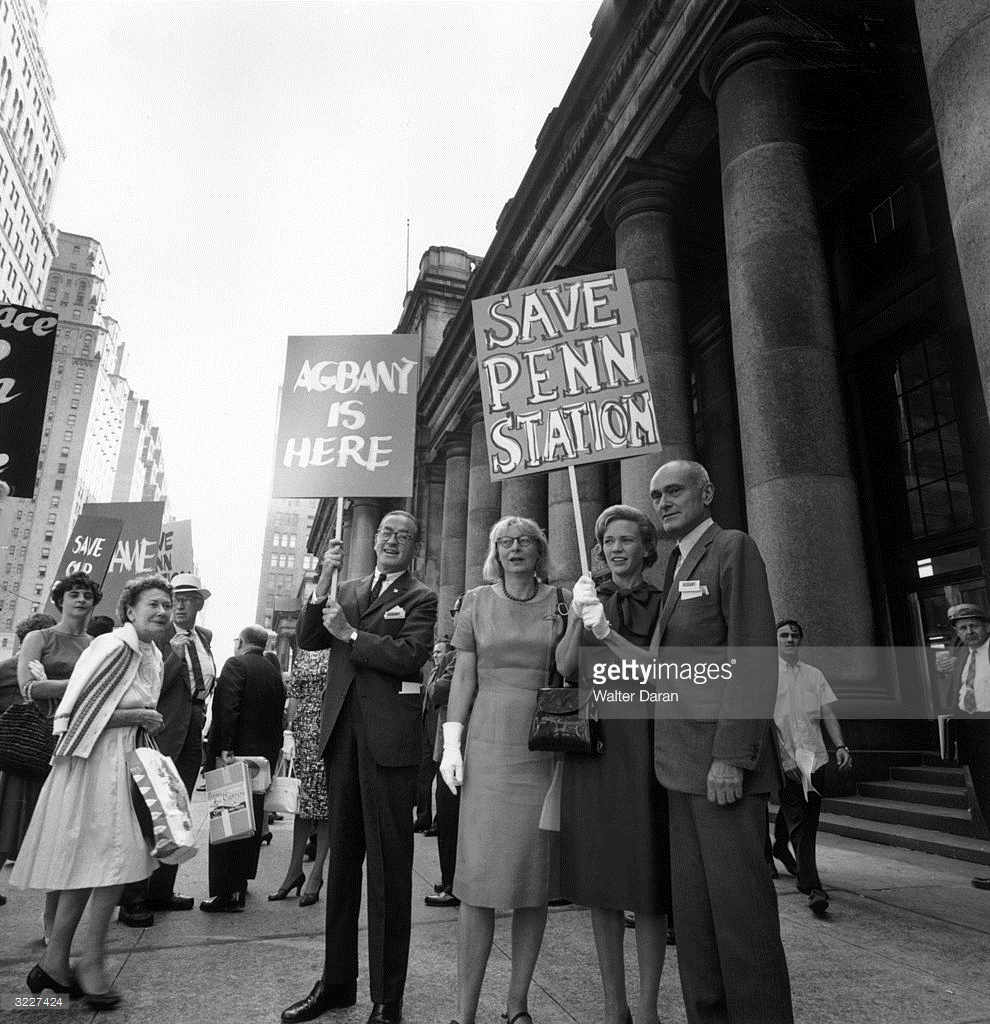
January 01, 1963 — Jacobs protests the destruction of Pennsylvania Station with architect Philip Johnson.

14

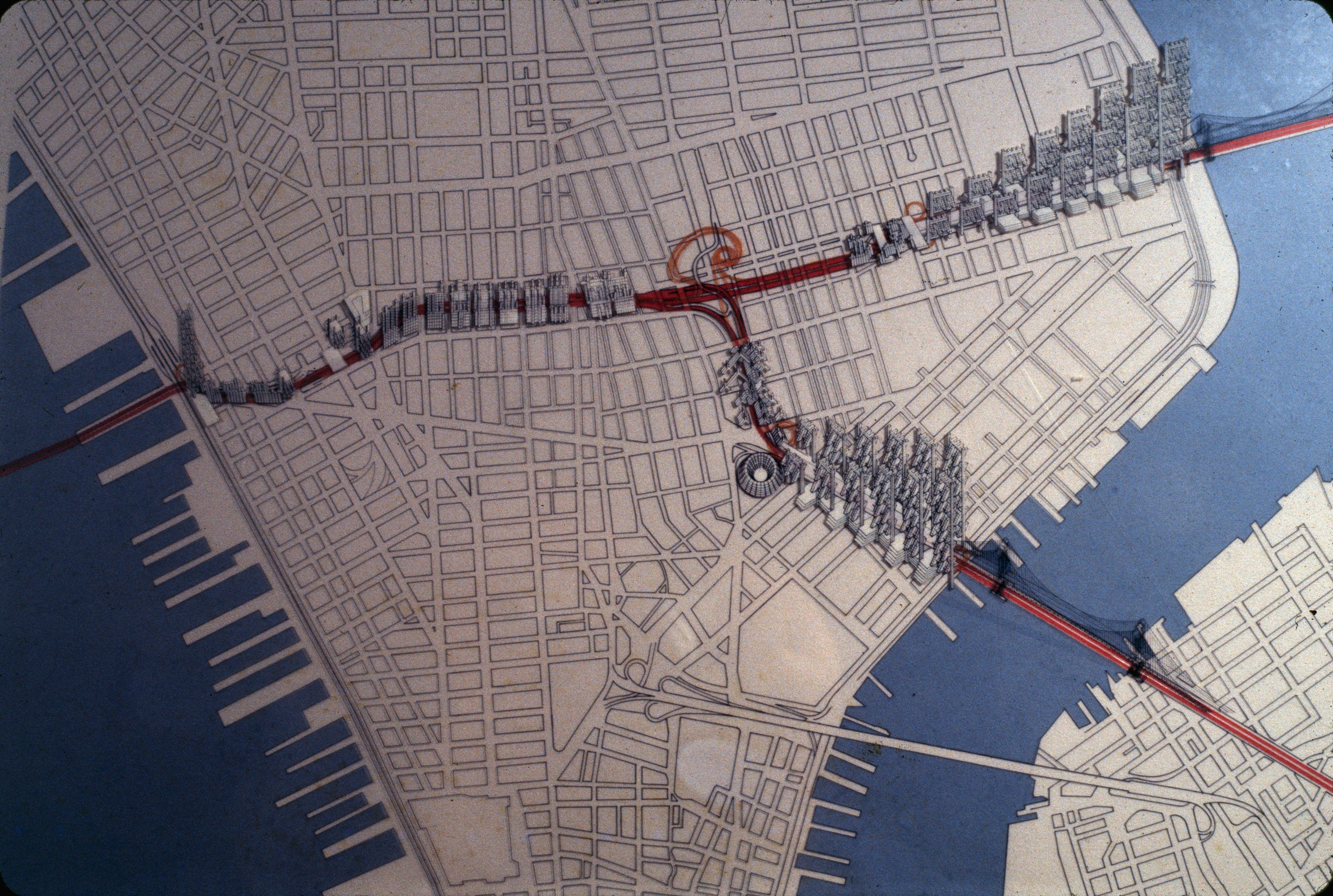
A map of the Lower Manhattan Expressway. Although this plan never came to fruition, the stack of buildings near the bridges seems to be coming to pass — on the Brooklyn side!

Library of Congress
Library of Congress

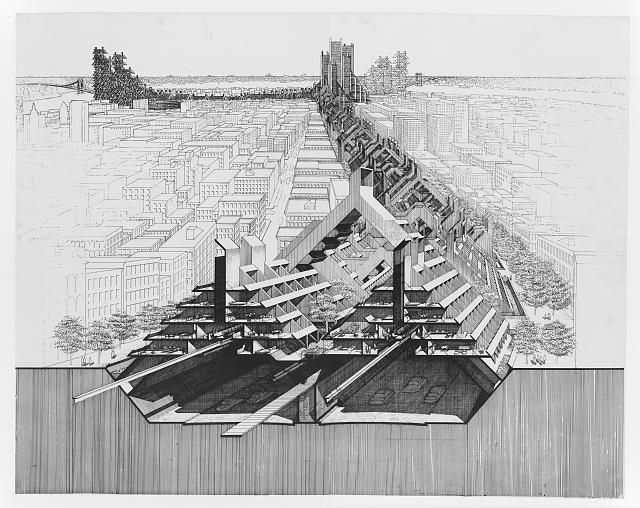
Another sketch by Paul Rudolph of the Lower Manhattan Expressway, showing the new construction from the Holland Tunnel as it enters through Manhattan.

paul

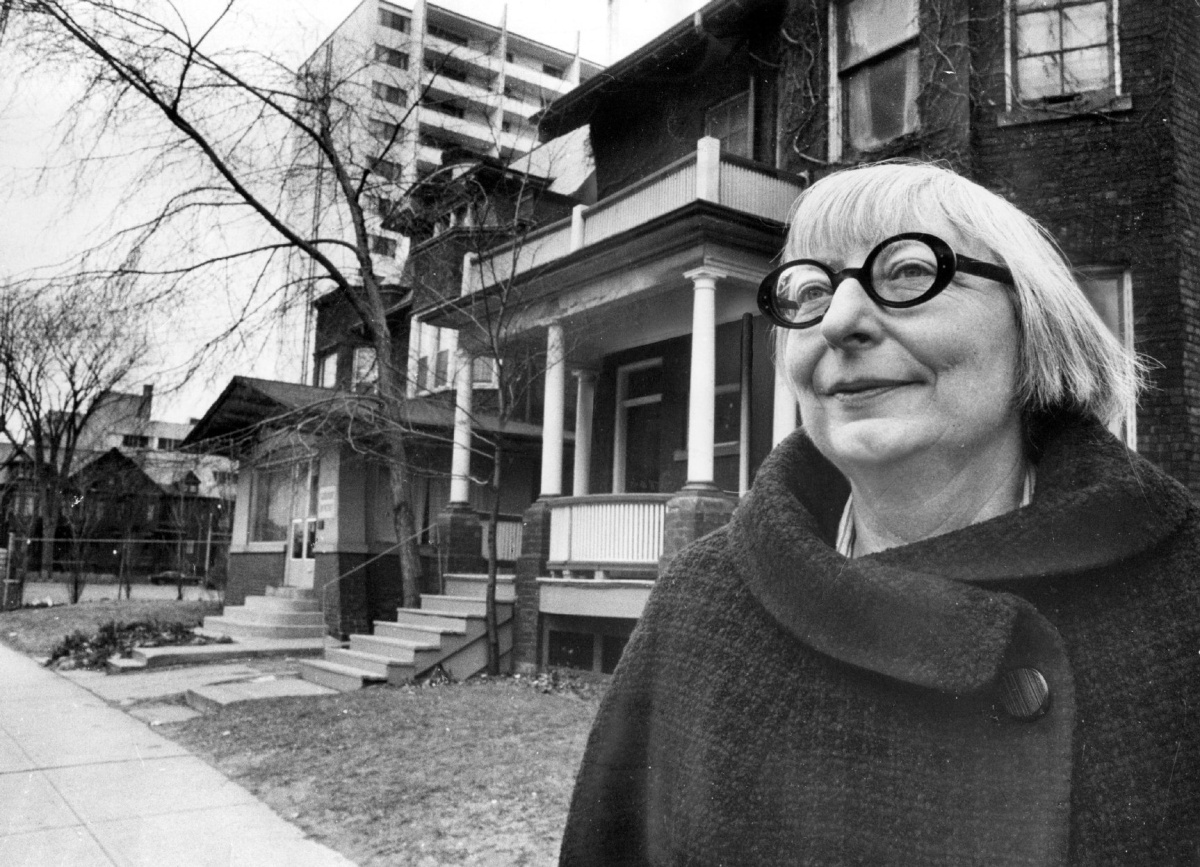
Jane Jacobs in Toronto, Dec. 21, 1968. She would continue her activism there, helping other community activists in foiling plans to build the Spadina Expressway.

SCANNED FROM THE TORONTO STAR LIBRARY *U42 GRAPHIC Jane Jacobs outside her home on Spadina Road just north of Bloor Street. Photo taken by Frank Lennon/Toronto Star Dec. 21, 1968. Also published 19730425 with caption: Jane Jacobs. Urban affairs expert. Also published 19740520 with caption: Toronto's in good shape, says author Jane Jacobs, but "We've got to be thinking about how we make sure it stays that way." Just being Canadian gives it some advantage, she says, but she fears amalgamation will bring some of the problems of cities like New York.
TORONTO STAR LIBRARY
Categories
Amusements and Thrills

The 1965 New York World’s Fair: Opening Day

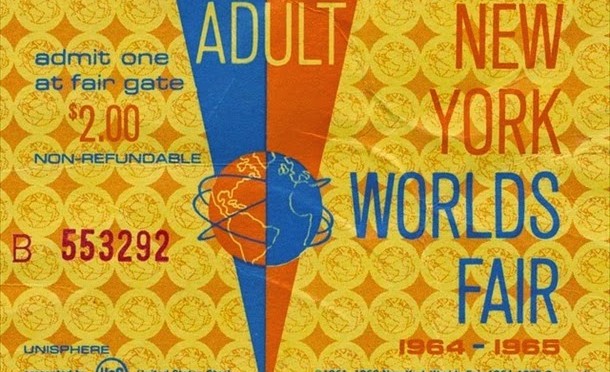
The New York World’s Fair opened for its second and last season on April 21, 1965.  The grand opening the previous year had been rocky indeed — protests, rain, even a parking lot riot.  Thankfully the second season was met with beautiful weather and abundant crowds.  In order to jazz it up a bit — not too much, just enough to increase ticket sales — Robert Moses authorized a host of changes, great and small.  Some of the exciting guest stars and new features that awaited entrants to the 1965 World’s Fair that day included:

1

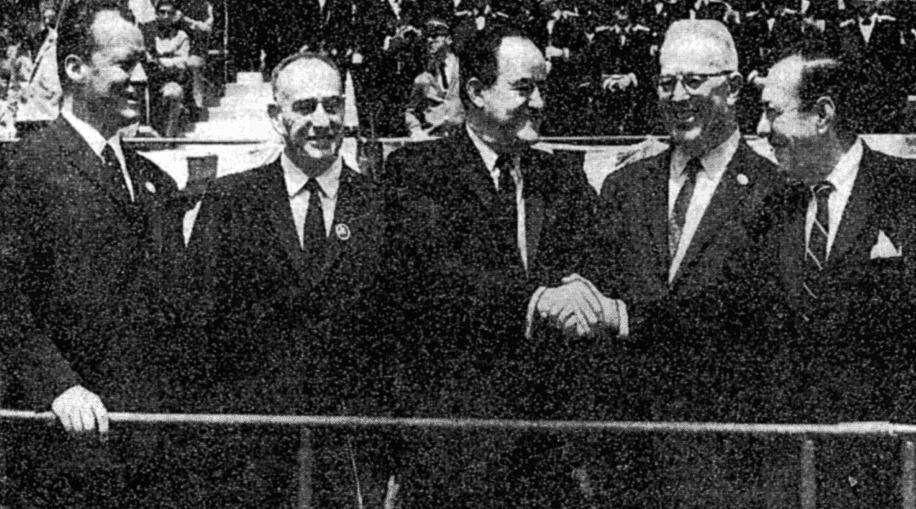
Opening the World’s Fair that day: Mayor Willie Brandt of West Berlin; Robert Moses naturally; Vice President Hubert Humphreys; Chief Justice Earl Warren and New York Mayor Robert Wagner (from NYT file photo)

Vice President Hubert Humphrey took a leisurely stroll through the fair, creating quite a stir. “He’s a walking pavilion,” cracked one observer. His entourage included Chief Justice Earl Warren.  During his visit to the New York State Pavilion, a riot almost ensued.  “Children cried out in terror, parents shouted, toes were trampled, cameras clicked.”

Courtesy Life Magazine

Hall of Presidents: Appropriately, Humphrey’s appearance coincided with the opening of some striking new exhibits within the United States Pavilion (which had opened the previous year) featuring memorabilia from over a dozen American presidents, including original copies of the Bill of Rights, Washington’s inaugural and farewell addresses and Lincoln’s Gettysburg Address.  Meanwhile, a crude Animatronic version of Lincoln continued to greet visitors.

Photo by Bill Cotter/NYT

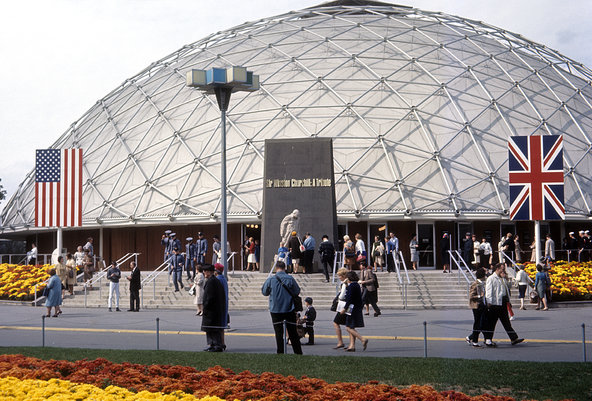
Under The Dome: One of the most anticipated new arrivals to the fair was the Winston Churchill Center, a tribute to the former British Prime Minister who had died in January.  “Included in exhibits documenting Sir Winston’s career are some of his own paintings, and photographs of him at various periods in his life. Also on display are a replica of Churchill’s study at Chartwell; models of Blenheim Palace, where he was born, and Bladon churchyard, where he lies buried; and an exhibit of his personal effects, including his desk, which once belonged to Disraeli.”

The dome of this dramatic pavilion would later be used as the Queens Zoo Aviary.

heinz

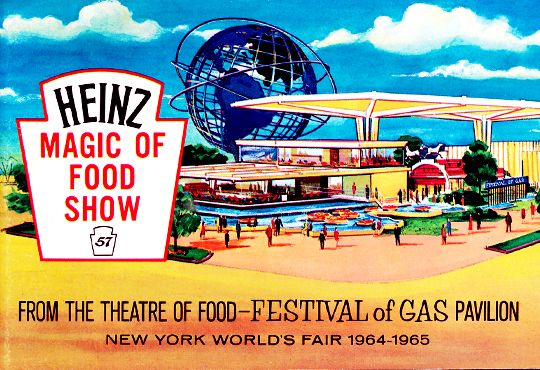
MORE FOOD: According to the New York Times, “the number of restaurants has been increased from 111 to 198. This means the fair can now serve more than 38,000  person simultaneously, or about 8,000 more than last year. ”  Certainly there was food to be found at the Theater of Food-Festival of Gas Pavilion?

The Gutenberg Bible: If you were craving a more spiritual exhibition, look no further than the latest resident of the Vatican Pavilion, one of six existing copies of the Gutenberg Bible. Also on site: The Pope’s jeweled tiara.  These two items were joining the Pieta, perhaps the most historically significant work of art at the fair.

dino

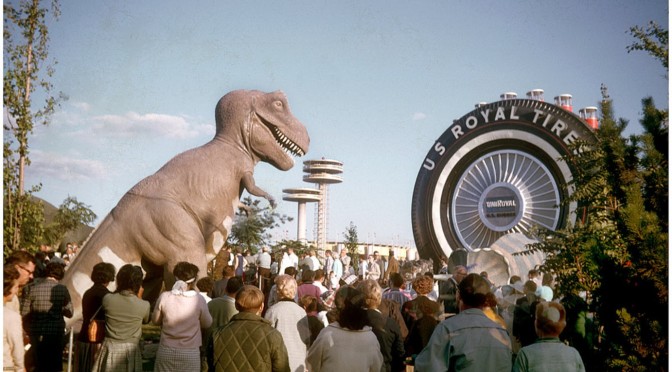
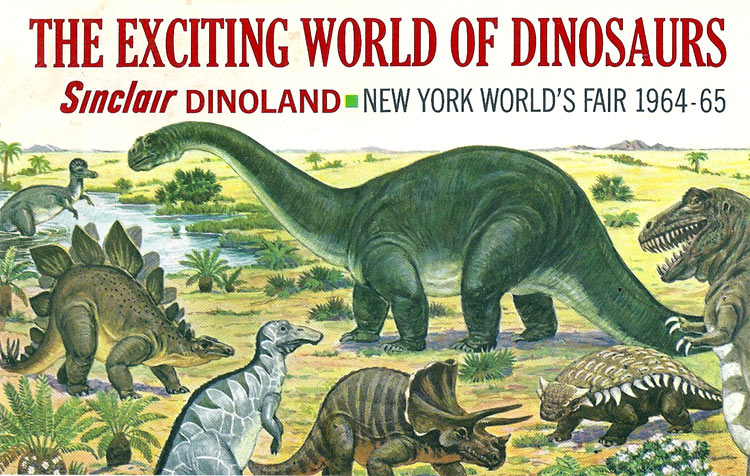
New Dinosaurs at Sinclair’s Dinoland : And not just any dinosaurs, but automated dinosaurs that could roar. “Last year we were of the school that dinosaurs had no vocal cords,” said the exhibit’s fuddyduddy spokesman. “This year we are in a new school.”

Kiddie Phone Center : As a way to get children excited about using the phone, Bell Telephone opened a Phone Fun Fair featuring a variety of wacky telephone games. “The center has three tot-sized phone booths where a youngster, by dialing, can get a pleasant message from one of six Disney characters, or a commercial message from an operator.” BONUS FUN:  “A voice Mirror lets you hear how you sound on the telephone. Weather-phones allow you to dial Weather Bureau information in selected cities. Quiz games, solar battery display — and much more!”

fiesta

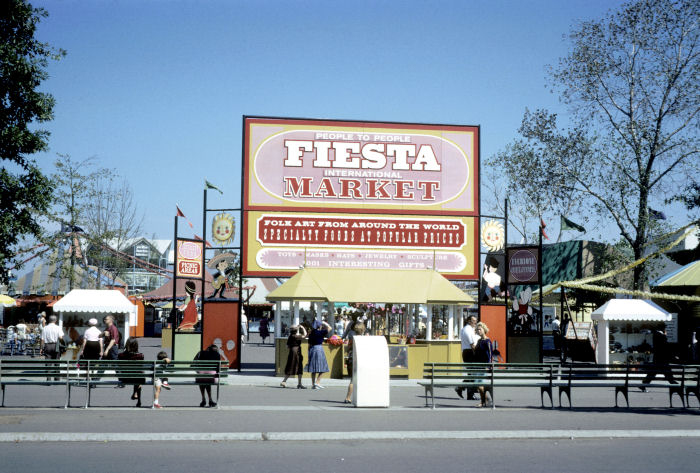
People To People Fiesta: The youth oriented People to People International is a youth outreach non-profit started by President Eisenhower in 1956. “Africa, Asia, Europe, as well as the Americas, are represented in a “village” of kiosks which display and sell a variety of folk art. Admission is charged; proceeds go to a center for world understanding.”   The ‘fiesta’ “will stress folk singing and dancing in the setting of colorful tents.”

Today PTPI takes the World’s Fair’s slogan — Peace Through Understanding — as its own.

(Image courtesy Worlds Fair Community forum.)

mars

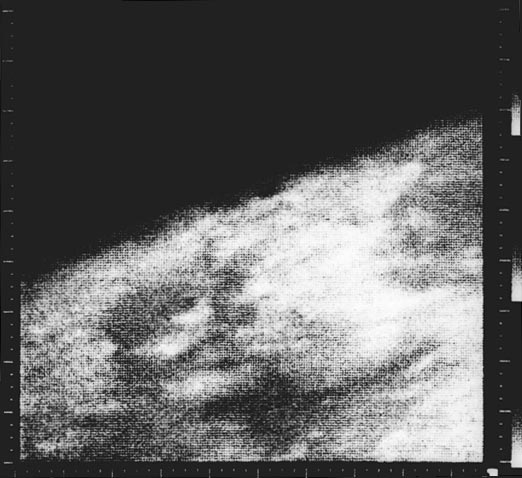
MARS! One of the more innovative new exhibits was located in Space Park with a focus on Mariner 4, a spacecraft launched the previous year that would successfully take the first images of Mars. Photos sent by Mariner 4 would be displayed here as they came in on July 14-15. Above: An image of Mars sent by the orbiting spacecraft.

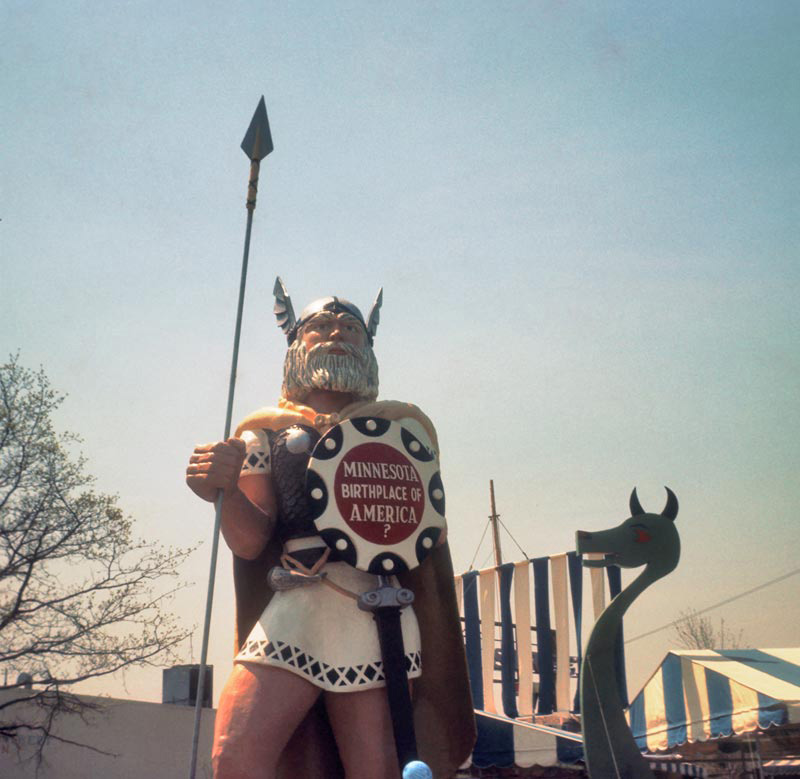
Kensington Runestone: And finally no trip to the fair in 1965 would be complete without a viewing of the mysterious Kensington Runestone, an ancient stone marking found in Minnesota in 1898.  Some believe this to be a link to 14th century Swedish explorers although how it got to Minnesota is anybody’s guess. It was debunked as a hoax in 1910, and yet here it is at the  World’s Fair! It was accompanied, naturally, by the 28-foot-tall Viking that you see below:

viking

Picture courtesy the World’s  Fair Community boards

Categories
Parks and Recreation Podcasts

Bryant Park: The Fall and Rise of Midtown’s Most Elegant Public Space

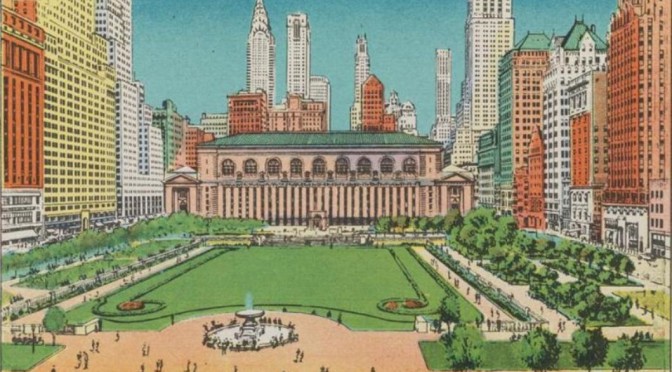
NEW PODCAST  In our last show, we left the space that would become Bryant Park as a disaster area; its former inhabitant, the old Crystal Palace, had tragically burned to the ground in 1858. The area was called Reservoir Square for its proximity to the imposing Egyptian-like structure to its east, but it wouldn’t keep that name for long.

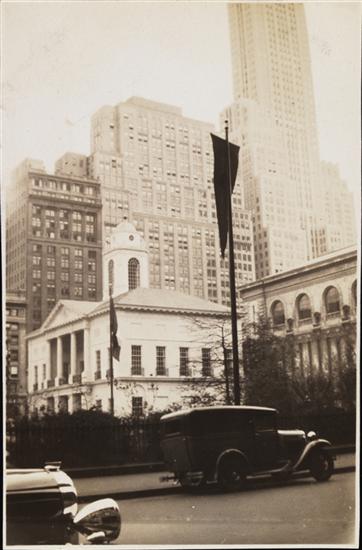
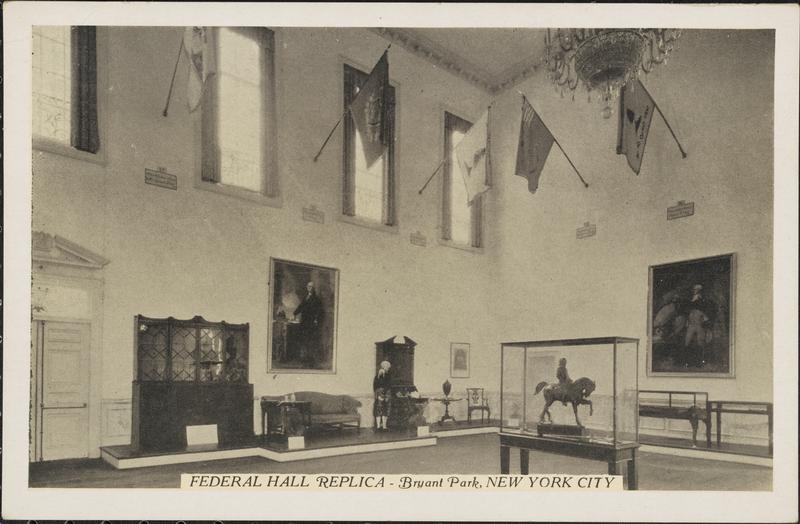
William Cullen Bryant was a key proponent to the creation of Central Park, but it would here that the poet and editor would receive a belated honor in the 1884. With the glorious addition of the New York Public Library in 1911, the park received some substantial upgrades, including its well-known fountain. Over twenty years later, it took on another curious present — a replica of Federal Hall as a tribute to George Washington.

By the 1970s Bryant Park was well known as a destination for drug dealers and most people shied away from its shady paths, even during the day. It would take a unique plan to bring the park back to life and a little help from Hollywood and the fashion world to turn it into New York’s most elegant park.


The Bowery Boys: New York City History podcast is brought to you …. by you!

Starting with this episode, we are doubling our number of episodes per month. Now you’ll hear a new Bowery Boys podcast every two weeks. We’re also looking to improve the show in other ways and expand in other ways as well — through publishing, social media, live events and other forms of media. And we need your help to make these expansion plans happen.

We are now a member of Patreon, a patronage platform where you can support your favorite content creators for as little as a $1 a month.

Please visit our page on Patreon and watch a short video of us recording the show and talking about our expansion plans. If you’d like to help out, there are five different pledge levels (and with clever names too — Mannahatta, New Amsterdam, Five Points, Gilded Age, Jazz Age and Empire State). Check them out and consider being a sponsor.

We greatly appreciate our listeners and readers and thank you for joining us on this journey so far. And the best is yet to come!


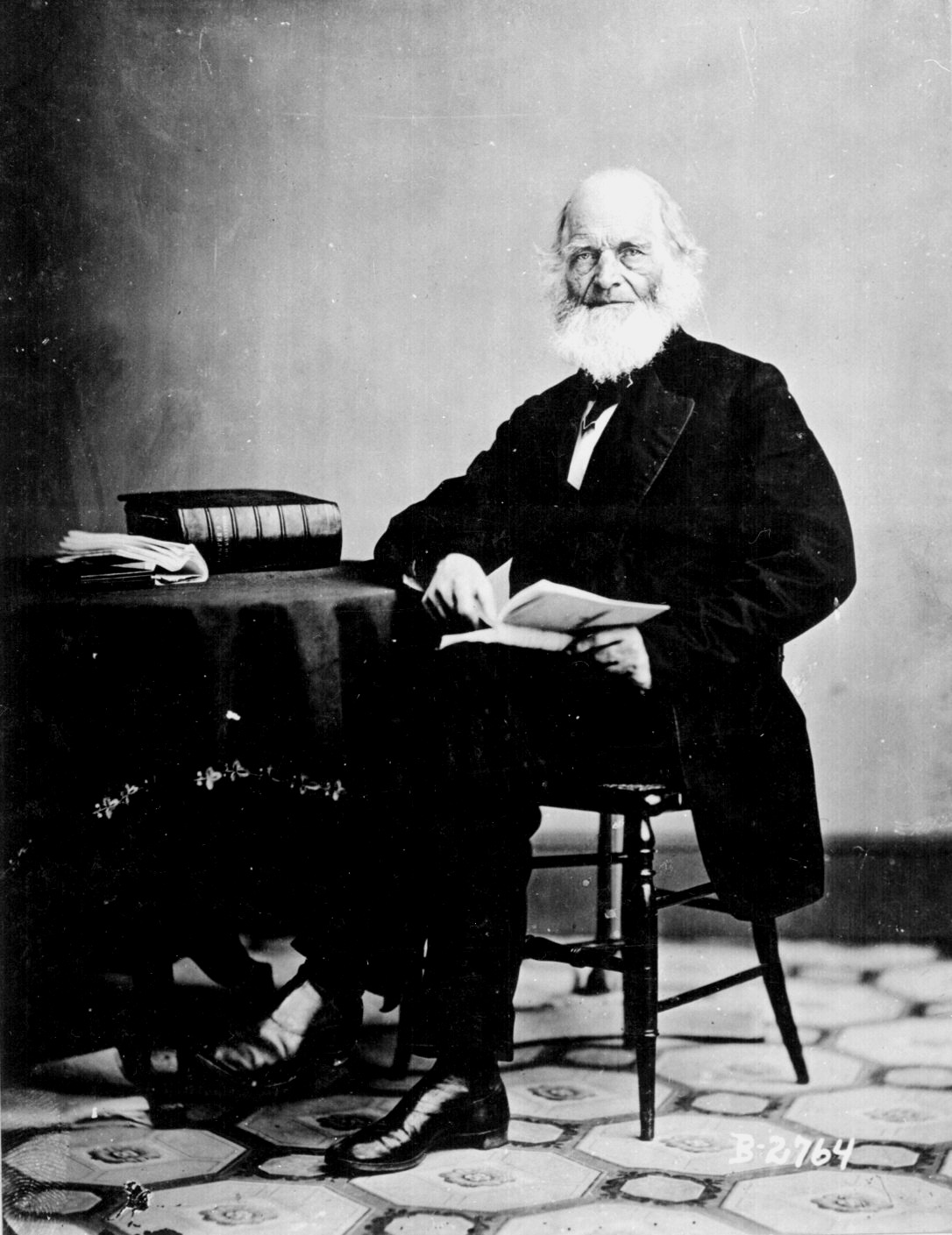
William Cullen Bryant, photo taken by Matthew Brady

2

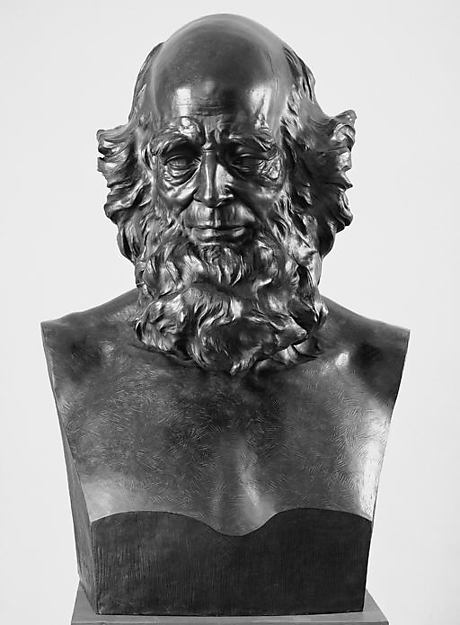
William Cullen Bryant in bust form, but Launt Thompson. It seems this bust has made its way back to the Metropolitan Museum of Art!

2

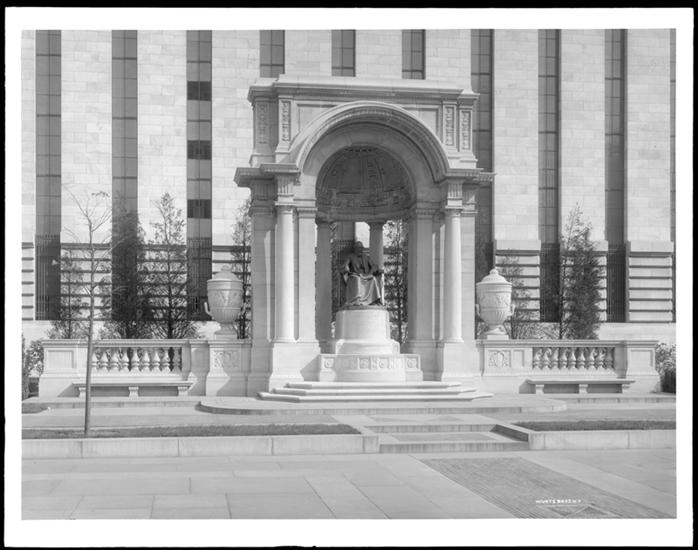
William Cullen Bryant installed in his marble niche behind the New York Public Library. This picture was taken in 1910, well before the radical redesign of the park in the 1930s. (Museum of the City of New York).

3

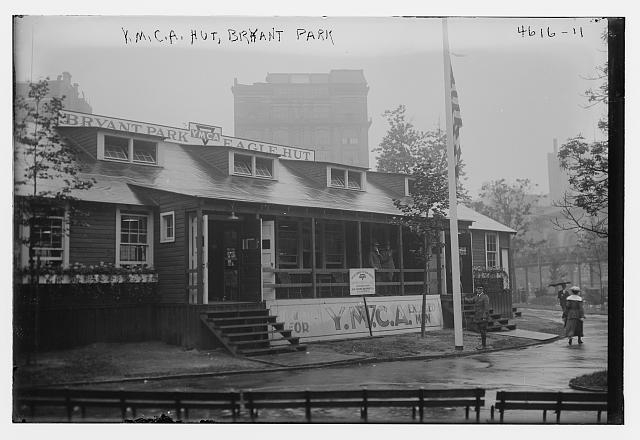
During World War I, the YMCA had a special ‘Eagle Hut’ built in the park for traveling servicemen. (Library of Congress)

2

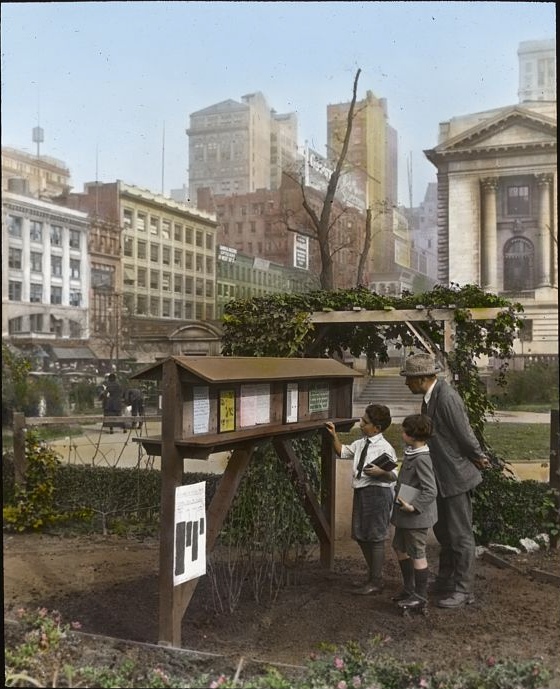
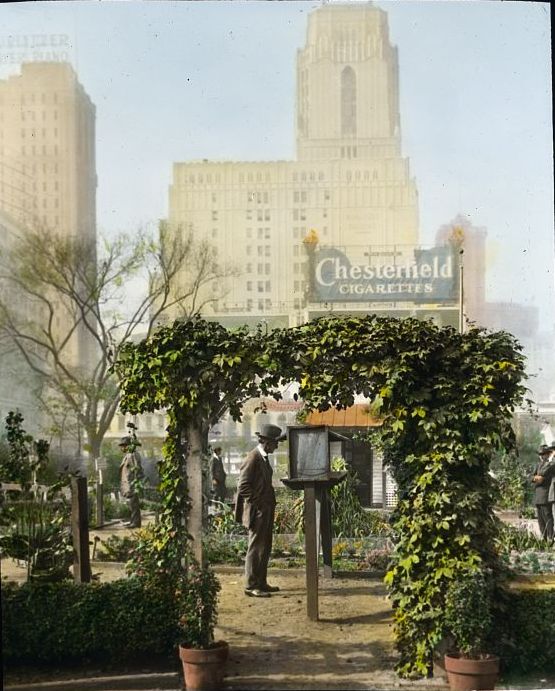
A colorful depiction of the Bryant Park ‘demonstration gardens’ that were planted during the war. (Library of Congress)

7096409143_3df8bc2aa4_b
2

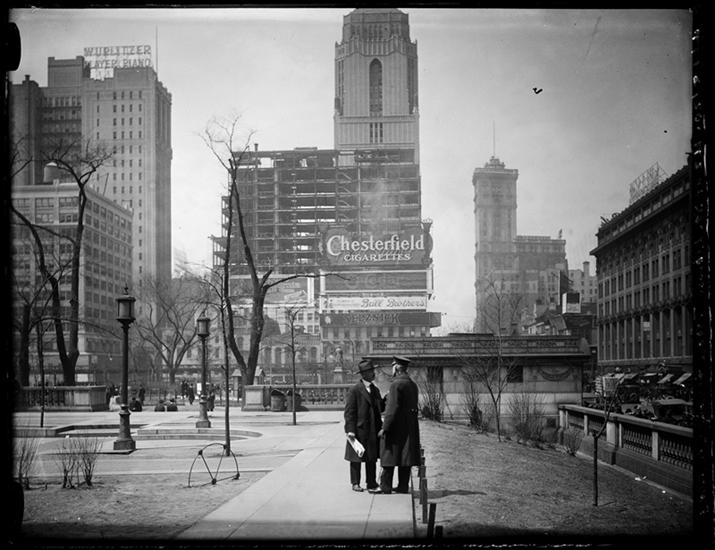
Bryant Park in 1920. Looking west on 42nd Street at 6th Avenue (you can see the elevated railroad!) In the distance is One Times Square. Note the reappearance of the Chesterfield Cigarettes billboard from the picture above. (Museum of the City of New York)

Bryant Park in 1920. Looking west on 42nd Street at 6th Avenue (you can see the elevated railroad!) In the distance is One Times Square. (Museum of the City of New York)

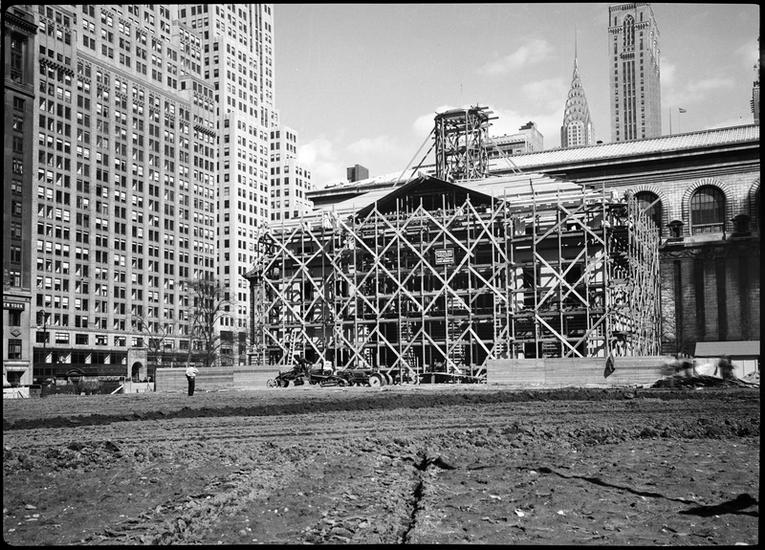
Constructing a replica of Federal Hall in a barren Bryant Park. (Picture taken by the Wurts Brothers, Museum of the City of New York)

8x11mm_X2010_7_1_ 703

The Federal Hall reconstruction had a corporate sponsor — Sears Roebuck & Co. Here’s how it looked in better days. Believe it or not, the reproduction of Mount Vernon actually did get built in New York — in Prospect Park in Brooklyn! (Bryant Park Corporation)

2

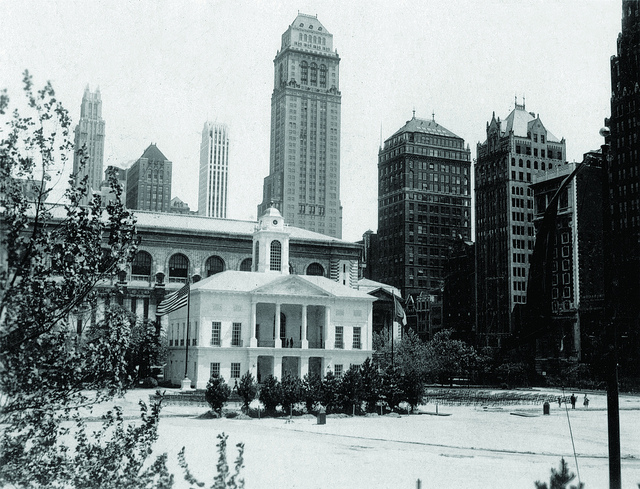
Bryant Park’s Federal Hall, May 1932. (Museum of the City of New York)

Bryant Park's Federal Hall, May 1932. Courtesy Museum of the City of New York

The interior of Bryant Park’s Federal Hall. (Museum of the City of New York)

The interior of Bryant Park's Federal Hall. (Museum of the City of New York)

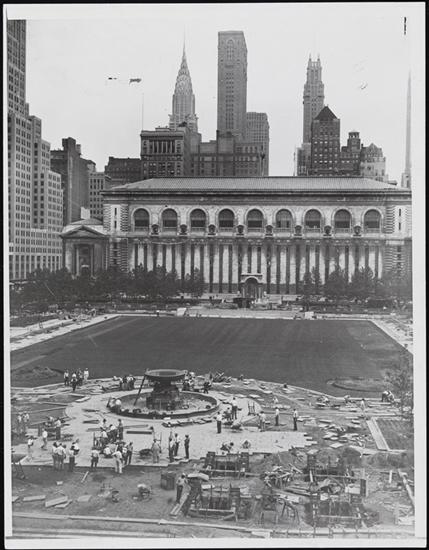
The reconstruction of Bryant Park in 1934, overseen by new Parks Commissioner Robert Moses

The reconstruction of Bryant Park in 1934, overseen by new Parks Commissioner Robert Moses

This photo was taken by Stanley Kubrick during his years as a photographer for Look Magazine. The caption reads “Park Bench Nuisance [Woman reading a newspaper, while a man reads over her shoulder.]” Courtesy Museum of the City of New York

This photo was taken by Stanley Kubrick during his years as a photographer for Look Magazine. The caption reads "Park Bench Nuisance [Woman reading a newspaper, while a man reads over her shoulder.]" Courtesy Museum of the City of New York

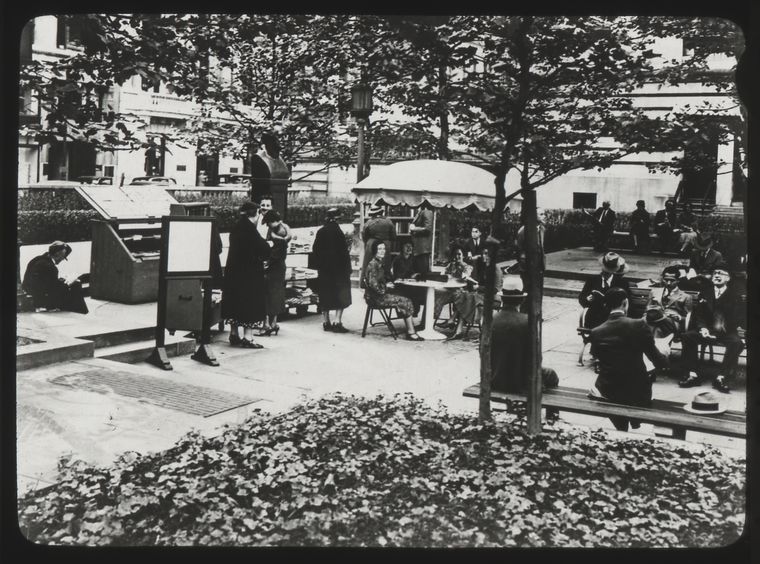
People enjoying the New York Public Library’s outdoor reading room, 1930s. (New York Public Library)

2

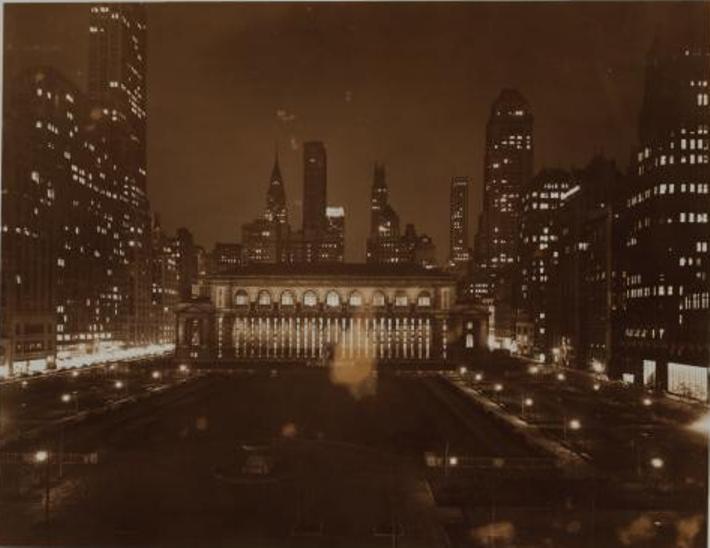
Bryant Park at night, photo by Nathan Schwartz, taken in 1938. (New York Public Library)

1a

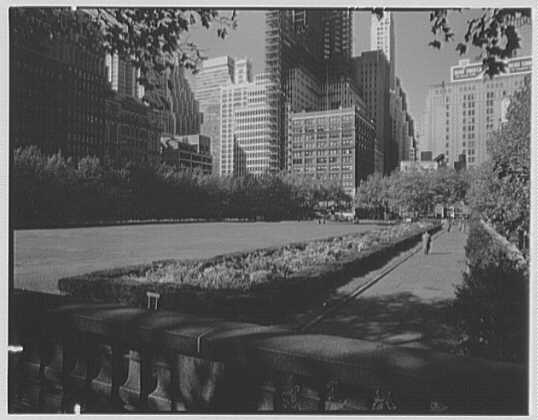
The hedges of the central lawn, photo taken in 1957. These were removed in the desperate effort to clean up the park in the late 1980s. (Library of Congress)

2

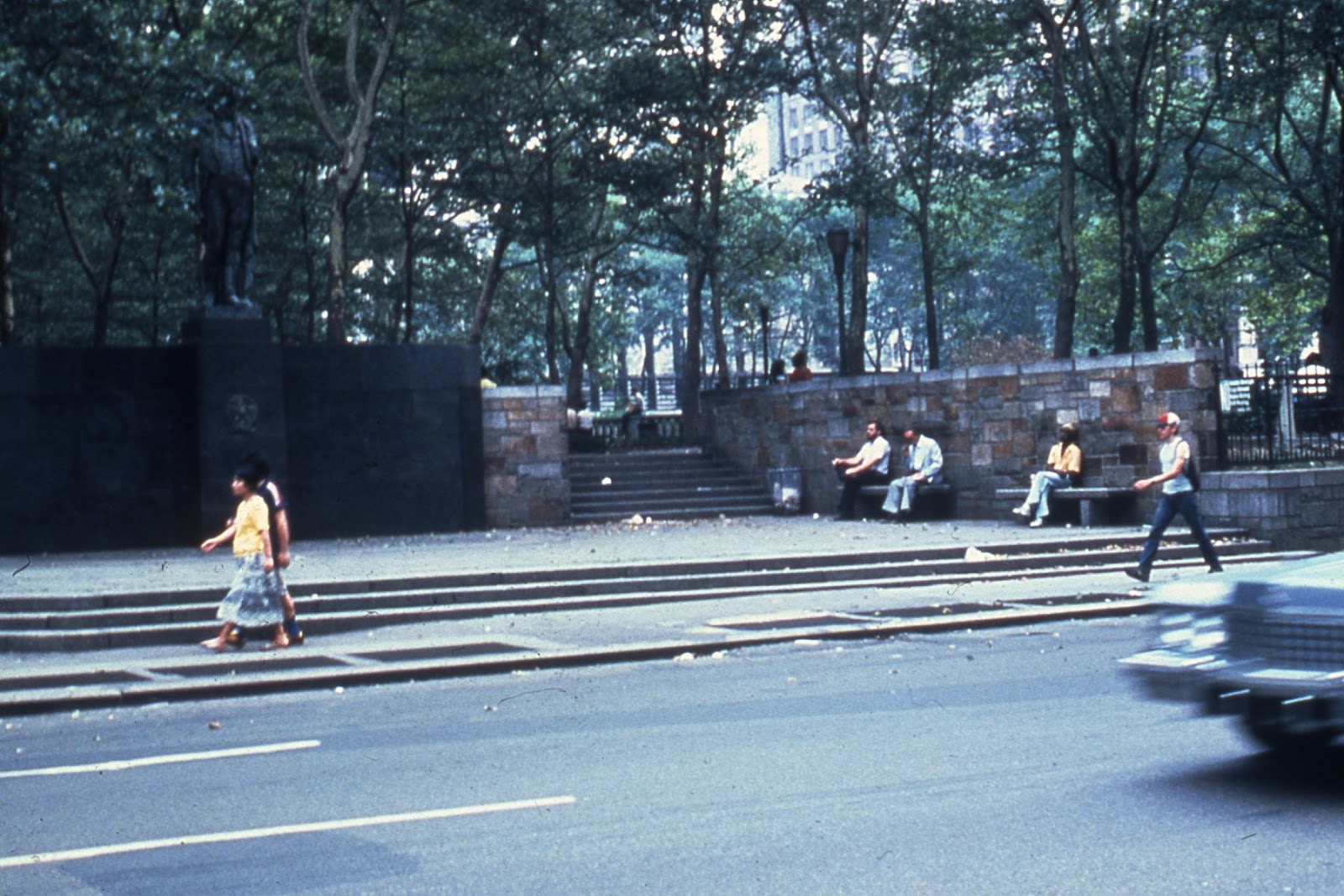
Bryant Park in the 1980s. High walls allowed for suspicious behavior to occur in the at all hours of the day. (Bryant Park Conservancy)

2

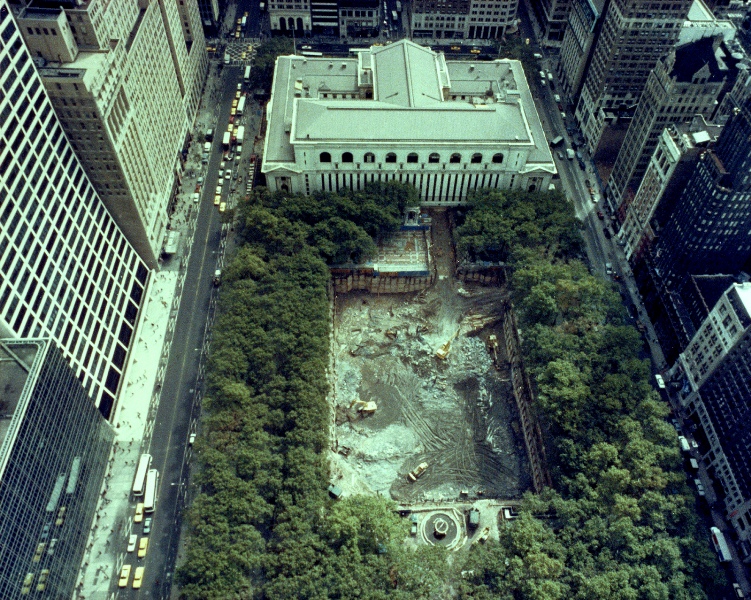
Overlooking the new renovations in the late 1980s (Bryant Park Corporation)

2

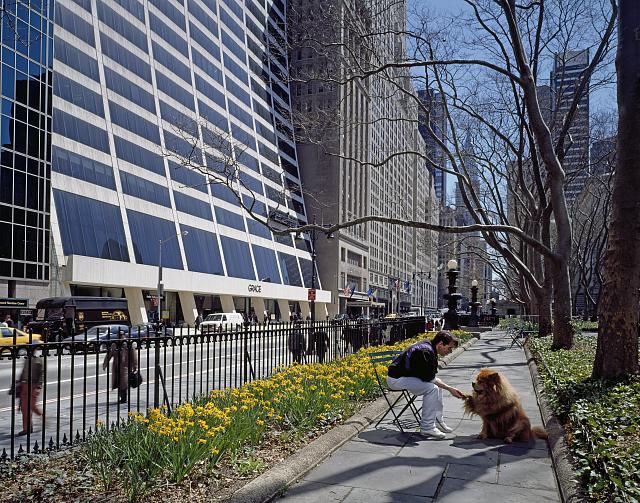
Bryant Park after the clean-up, taken sometime in the 1990s. Photo by Carol Highsmith (Library of Congress)

2

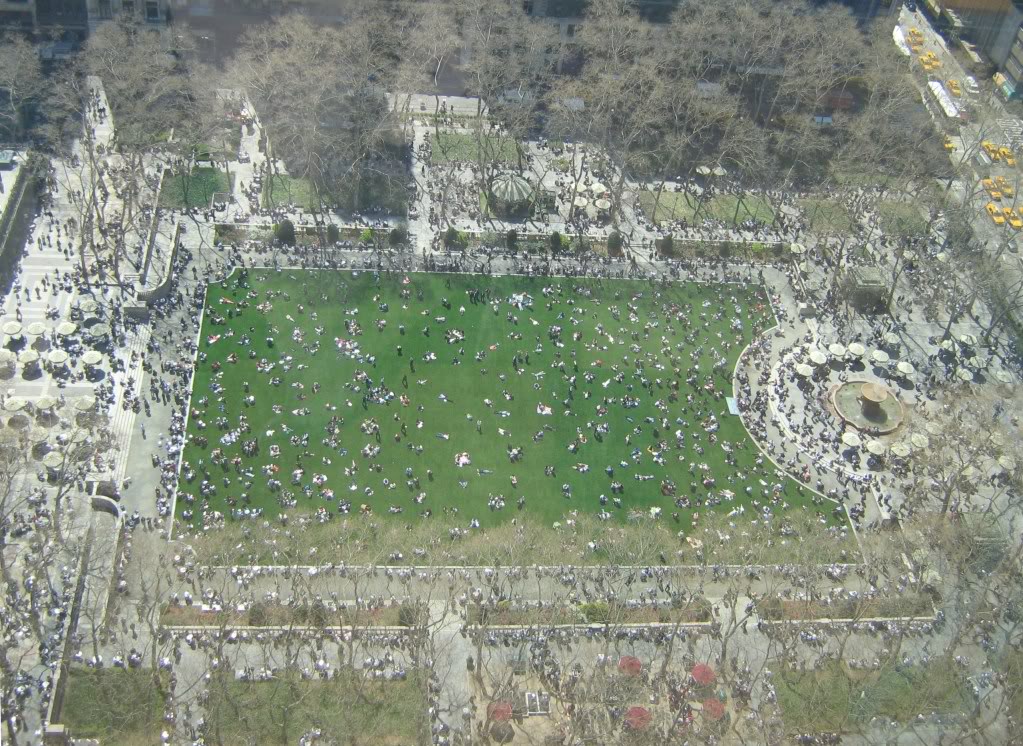
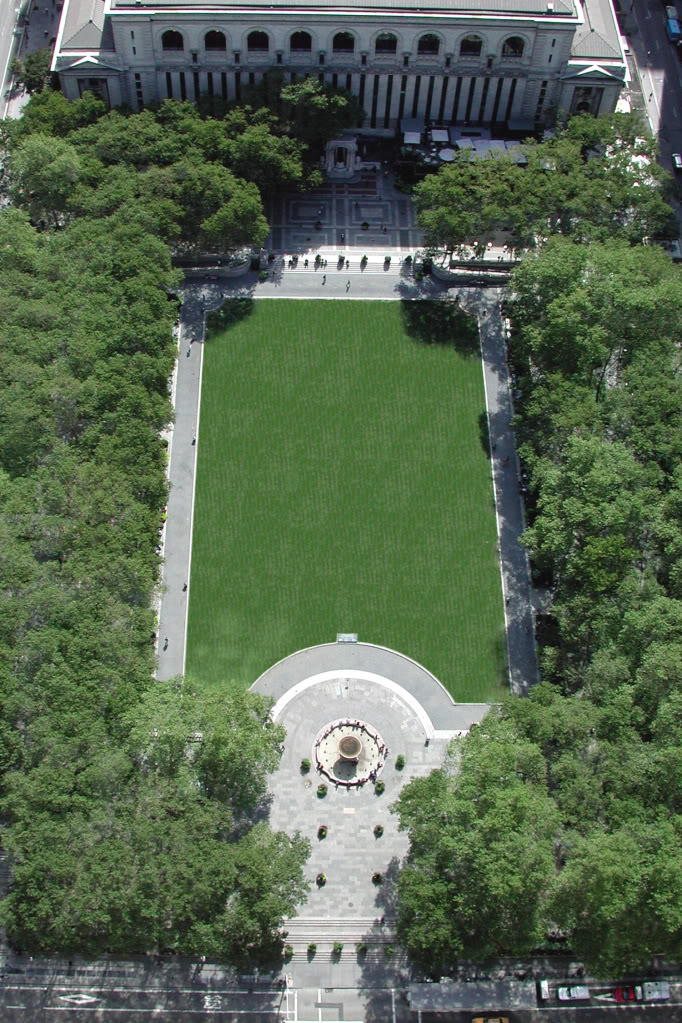
Great overhead shots directly from the Bryant Park Conservancy!

2
3
Categories
Christmas Robert Moses

And Now … Two Christmas Poems By Robert Moses

My new column for A24 Films is up over on their 1981 site (in support of the film A Most Violent Year). 1981 was the year that Robert Moses died, and his death sparked new discussions into what his legacy to the New York City area truly was.  In a word: automobiles.  You can read my article here.

But that’s a little depressing. How about I tell you about the time that the New York Times published a couple Christmas poems written by Moses?

That’s right, the Santa Claus of Long Island, bearing gifts of bridges and highways, did occasionally get into the Christmas spirit, albeit dripping in vitriol and sass.


Moses in 1934 during his failed campaign for governor. (Courtesy New York Daily News Archive)

POEM ONE – ‘TIS THE NIGHT BEFORE ELECTION

This loosely poetic speech first manifested in print during the last gasps of Moses’ failed bid for New York governor in 1934.

As the Republican candidate running against incumbent Herbert H. Lehman, young Moses failed to connect with voters, and the experience soured him on elected positions. He was soundly defeated by Lehman, the investment banker-turned-politician aligned with new president Franklin Delano Roosevelt (who had preceded Lehman as governor).

His final words as a candidate were spoken on radio station WEAF and printed the following day.  Those words paid an awkward homage to the great Christmas poem written by Clement Clarke Moore. Despite the fact that the election was in early November, his point in conjuring the visage of Old St. Nick would become clear.  It’s hardly rhythmic. Imagine this read in his gruff, determined voice:

“‘Tis the night before election, and nothing much is stirring throughout the state.

The stockings in Democratic homes are hung by the chimney with care, in the hope that Jim Farley soon will be there.

The Big Bag Man is dressing himself up as Santa. He doesn’t really look the part, but that’s not important.

Neither is the fact that all the presents were bought on credit, and that Santa Claus is running up a tremendous bill.   

The important question is:  Has he plenty of presents to go around for the boys and girls who have been good?

Governor Smith expressed the fondest hopes of the Democratic party, and summed up the strategy of the whole Democratic campaign when he said that he thought the people would not shoot Santa Claus before a hard Christmas.”

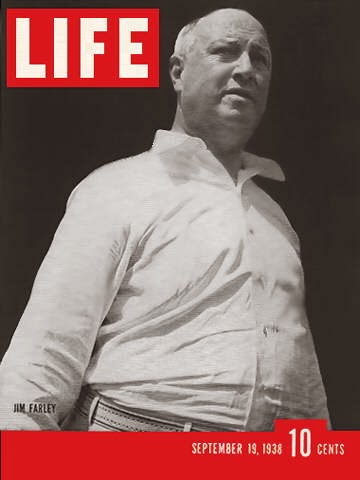
Jim Farley (pictured at right, 1938) was considered a ‘kingmaker’ in Democratic politics, responsible for the election of FDR.  He would become Roosevelt’s U.S. Postmaster General.  The James A. Farley Post Office across from Madison Square Garden is named in his honor.

Using the Santa analogy, Moses was taking a dig at Democratic programs that would soon shape FDR’s New Deal.  Of course, as New York’s power builder, Moses would later benefit greatly from these programs so perhaps he shouldn’t have been complaining.

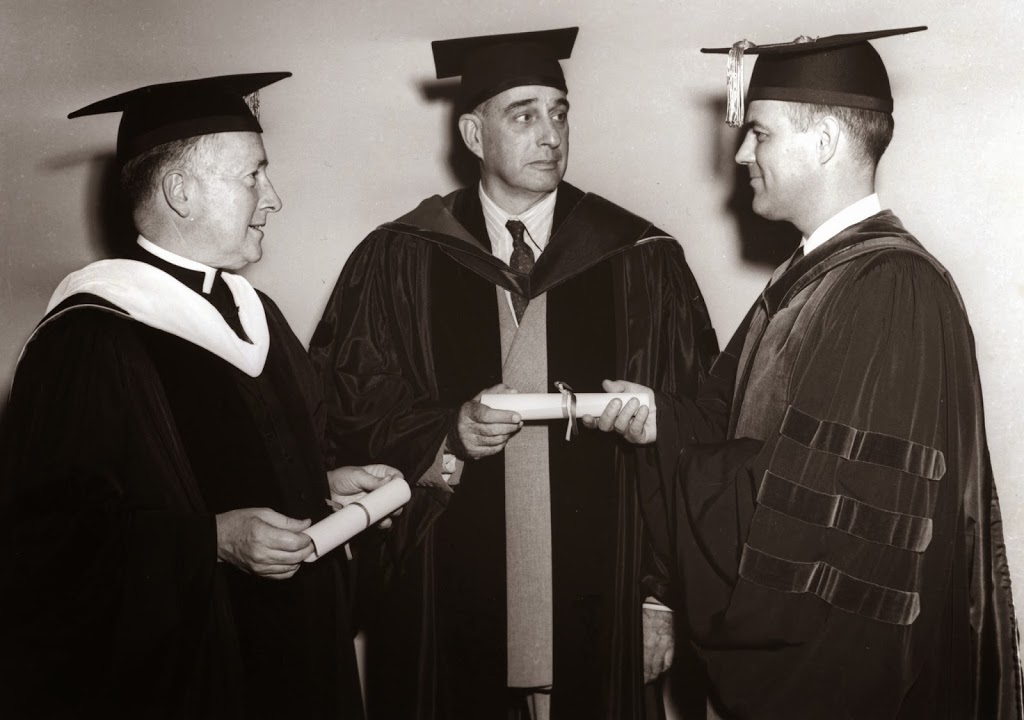
In 1948, Robert Moses received the very first honorary degree from Hofstra University, along with Robert Gannon, the president of Fordham University.  However, that year it would be a phony university that would inspire Moses to pen a sassy Christmas verse. (Courtesy Hofstra University)

POEM TWO: CHRISTMAS GREETINGS (LETTER TO THE CHANCELLOR)

Perhaps more unusual was the poem which ran the day after Christmas in 1948, an inside joke between men of influence.

By the late 1930s, Moses had amassed several positions of responsibility and power and had pushed through a great number of vast, expensive projects, including the Triborough Bridge. Moses had to routinely pitch these projects to the New York Board of Estimate — the men who held the purse strings — which included Henry M. Curran (Deputy Mayor), Newbold Morris (City Council President), and James Lyons (Bronx Borough President).

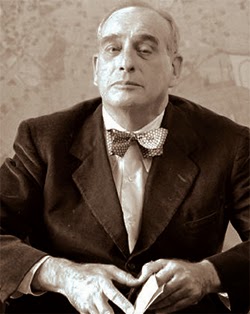
Curran was a bit of a grammar nerd — the kind who cringes at improper usage of words — and recoiled during debates when Moses (at right) and the others misused the English language.

According to the Times, Curran organized among the men a hierarchy of language correction, (jokingly?) referred to as Curran University.  One could only ‘graduate’ from this phony university by excelling in their verbal and written debates with grammatical aplomb.

During a board meeting where the fate of the old Claremont Inn was discussed, Moses used the phrase ‘coign of vantage’ which scandalized Curran but suggested that Moses’ verbal skills were improving.

Then, one day, Moses wrote a memorandum to Lyons using the phrase ‘high-falutin‘ as well an apparent mis-use of the word Aurignacian.  This threw his superiors into a light-hearted conniption.

“We tried to help.  But Moses has failed, flunked.  Up with the bars!  Let Mose wail — without — not within,” wrote Curran.

Moses, who would become more powerful than all three men combined, responded in an unusual way — he wrote a biting Christmas poem.  The following verse, penned by Moses, was delivered to Lyon, who “promptly converted it into a Christmas card — with embellishments — and passed it along to his superior officer.”  The poem, as published in the Times:

CHRISTMAS GREETINGS
To Chancellor Henry H. Curran
Great Chancellor of Curran U
Greetings from Borough Hall and Zoo.
 
Assorted barks and roars and honks
From the four corners of the Bronx.
 
Gannon, Osborn, Robbins and Moses
Greet you with laurel, rhinos and roses.
 
Cheerios and loud hosannas
From Pelham Bay and the Bronx savannas.
 
Great critic of the spoken word,
Greetings with the proverbial bird.
 
From every coign and height definitive
We greet you with a split infinitive.
 
Signed, 
James J Lyons, Dean
Robert Moses, Sophomore Cheer Leader

So remember: the next time you have a friend correct your grammar, remind yourself, “Hey, I have something in common with the Power Broker!”

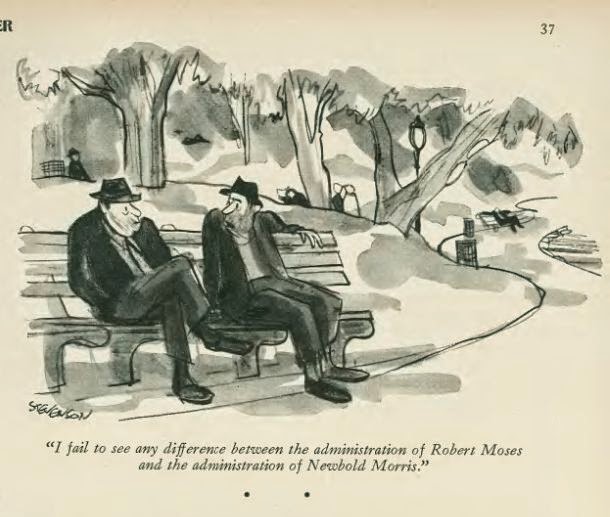
Below: A New Yorker cartoon from 1960, the year when his grammar pal Morris took the job of Parks Commissioner from Moses.


Categories
Bridges

A very happy 50th birthday to the Verrazano–Narrows Bridge! Ten facts you may not know about the bridge’s origins

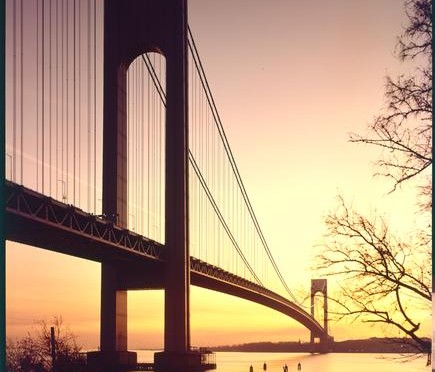
[Verrazano-Narrows Bridge.]

The new span in 1964, photographed by the Wurts Brothers (MCNY)

The Verrazano-Narrows Bridge — the first land crossing between Staten Island and the rest of New York City — officially opened for traffic fifty years ago today. It is one of America’s greatest bridges and a graceful monumental presence in New York Harbor.

Below is a list of ten things you may not have known about the bridge.

1)  The Tunnel to Staten Island
People have been dreaming of spanning the Narrows for several decades before the bridge was finally constructed. In New York’s subway fervor of the early 1920s, Mayor John Hylan authorized a tunnel be built to connect Staten Island to Brooklyn, ostensibly to link it to the city’s expanding subway network. Due to massive cost, however, the project was cancelled. For many years, the remnants of the aborted tunnels on either side of the Narrows were referred to as “Hylan’s Holes.”

2)  Verrazzano-on-Hudson
Giovanni da Verrazzano, who explored the shores of the North American continent in 1524, might have lent his name to the bridge which became the George Washington Bridge, a few decades before the Narrows Bridge was completed. The suggestion was made by a Newark resident and was at least passingly considered that the New York Times ran an article about it: “WOULD NAME NEW SPAN VERRAZANO BRIDGE.”  The article casts aspersions upon the notion that the explorer would ever be seriously considered enough to warrant his own bridge.

[Aerial view of Brooklyn, Staten Island and New York Harbor.]

Overlooking New York Harbor, Staten Island (and Fort Wadsworth) to the left. (MCNY)

3)  What’s In A Name? Tanto!
The Florentine explorer had much symbolic value to Italian New Yorkers, and in 1960, the Italian Historical Society of America managed to convince Governor Nelson Rockefeller to apply the name to the brand new bridge about to go under construction.

Some were not pleased with what many considered mere political appeasement. “I wouldn’t be surprised if the next move is to rename the Hudson River,” grumbled the vice president of the Staten Island chamber of commerce. [source]  Gripes over the name continued well up to its opening and beyond.  A couple weeks before its opening, one naysayer wrote the Times to propose alternate names: “Let’s call it Freedom Gate or Liberty Gate.” [source]

4) Spell Check
Even then, there was some debate about the proper spelling of the explorer’s last name — Verrazzano or Verrazano. (There was even a small, if vocal, group for Verazzano.) Official construction signs did say Verrazzano, in keeping with the traditional Italian spelling. However, despite strong support for the double Z version, the shorter spelling eventually won out.

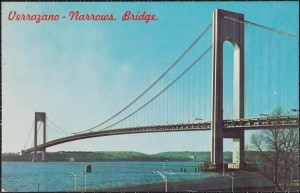
Verrazano-Narrows Bridge

5) The Grand Builders
Although this would be one of the final great projects overseen by Robert Moses, it’s also the final project of New York’s great bridge and tunnel builder Ottmar Ammann.  He died on September 22, 1965, less than a year after the bridge’s opening.

Milton Brumer is sometimes overshadowed by those two great icons of city building, but the chief engineer of the Verrazano-Narrows had worked with Ammann on almost every one of his projects and was probably more involved in the day-to-day operations than his boss.  In total, there were 200 engineers employed on building the bridge, on top of the hundreds of construction workers employed to bridge the Narrows.

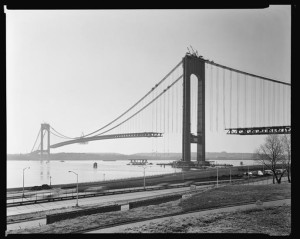
Verrazano Narrows Bridge, general view  from Ft. Hamilton S.E.
Courtesy Museum of City of New York

6) Curvature of the Earth
When it opened on November 21, 1962, the Verrazano-Narrows Bridge was the longest suspension bridge in the world, so long, in fact, that bridge engineers had to take the curvature of the planet into account in its design.  As a result the tops of the towers are slightly farther apart than the bases. Or to put it another way, if the Narrows were drained, the towers would appear to slightly lean away from each other.

7) A Big Boy, and Loud Too
The Verrazano-Narrows Bridge weighs 1,265,000 tons — the longest suspension bridge in the world at its completion, surpassing the Golden Gate Bridge — but was not the most welcomed neighbor to the areas of Bay Ridge and western Staten Island when ground was broken in August 1959.  Many residents railed against its necessity, the displacement of businesses, even the constant noise assault. “That bridge — who needs it?” [source]  Once construction began, however, many business owners benefited from the influx of hundreds of workers entering the area.

Three workers were killed during the construction of the bridge, including young Gerard McKee who fell to his death in an accident which could have been prevented.  His death sparked an improvement in safety procedures at the bridge.  He’s memorably commemorated by Gay Talese, who closely documented the construction of the span in his classic book The Bridge.

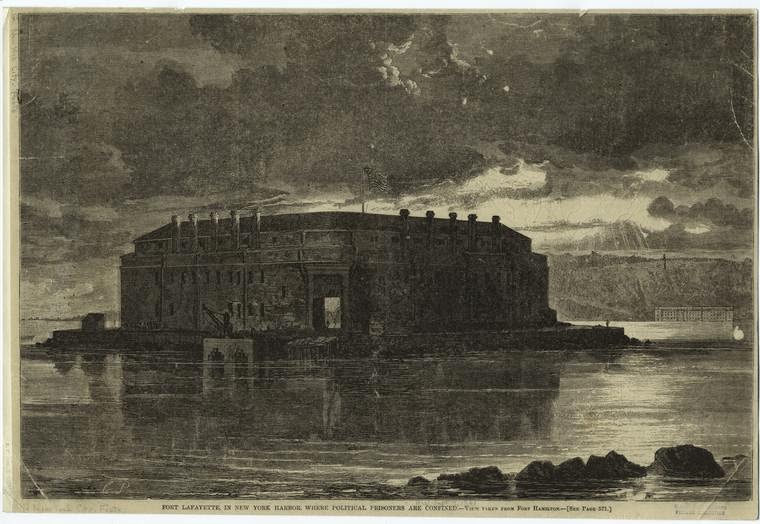
Fort Lafayette, 1861, from Harper’s Weekly (courtesy NYPL)

8) Goodbye Fort Lafayette
In building the Brooklyn anchorage, crews swept away the remainder of old Fort Lafayette, an entrenchment built during the War of 1812.  During the Civil War, Confederates were held prisoner here, including Robert Cobb Kennedy, who attempted to burn down New York during the Great Conspiracy of 1864. During the two World Wars, it held reserve ammunition. Moses personally fought an effort to turn the fort into a night club and now had a hand in dismantling it entirely.

Not only was the fort destroyed, the entire island on which it sat was virtually erased.  In addition, areas near Fort Hamilton and Fort Wadsworth were cleared away to make way for the bridge’s approaches. Perhaps to nobody’s surprise, the construction company tasked with clearing away the old fort employed the son-in-law of Robert Moses.

9) First Class Reception
The U.S. government did something a little different to honor the opening of the bridge — it issued a postage stamp featuring the bridge, to be sold on opening day.  For its 50 year anniversary this year, the Postal Service replicated the honor with an anniversary stamp.  The original stamp was for five cents.  The commemorative stamp is for $5.60 priority mail. (Times change.)

Photo NY Daily News/Leonard Detrick

10) Opening Day, First Traffic Jam
The opening of the bridge not only brought great pride to New York City, although a small number of protesters noted that the span did not have pedestrian walkways or bike paths (and it still doesn’t).  Among the dignitaries as the ribbon cutting ceremony were Governor Rockefeller, the Archbishop of New York Cardinal Spellman, Robert Moses and Mayor Robert Wagner.  They were all transported over the bridge in a somber 52-limousine procession.  The press of vehicles was poorly handled for it resulted in “a traffic jam … a half-mile beyond the point where the ribbon-cutting ceremony had been held.”

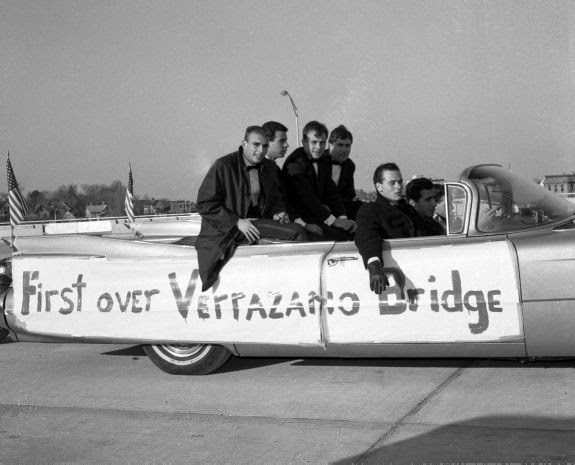
The first ‘regular’ toll-paying person over the Verrazano-Narrows Bridge was a carload of young men in rented tuxedos (pictured above), “driving a pale blue Cadillac convertible with flags flapping from the fenders,” who had parked behind the toll gate for an entire week to earn the special privilege.”

Below: The bridge’s most famous film appearance in Saturday Night Fever — but don’t watch if you haven’t yet seen the entire film!

Categories
Podcasts Queens History

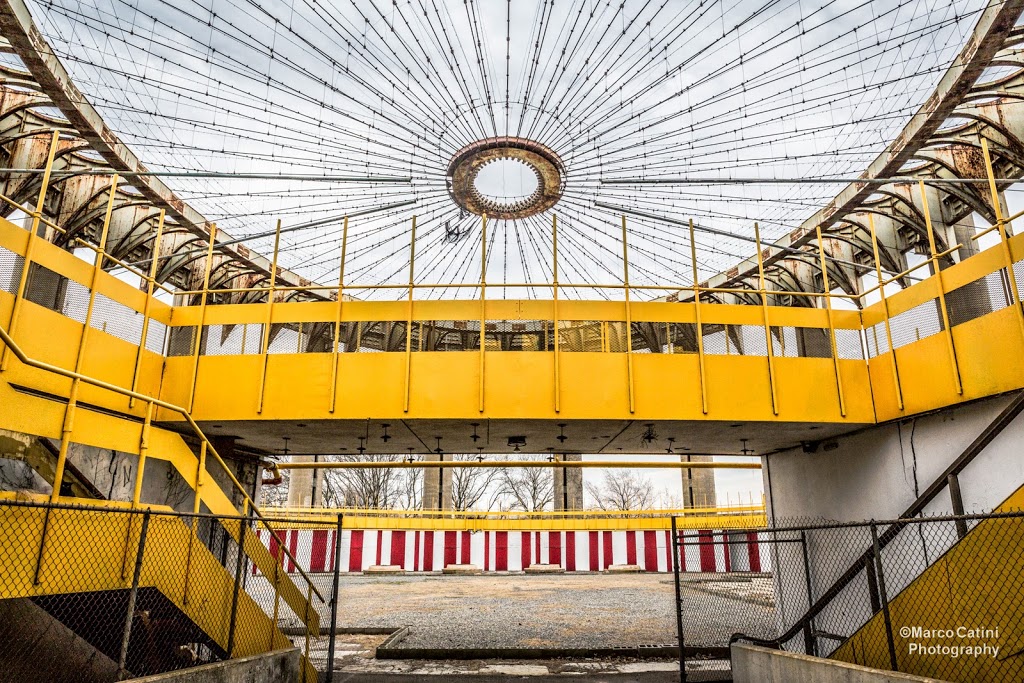
Ruins of the World’s Fair: The New York State Pavilion, or how Philip Johnson’s futuristic architecture was almost forgotten


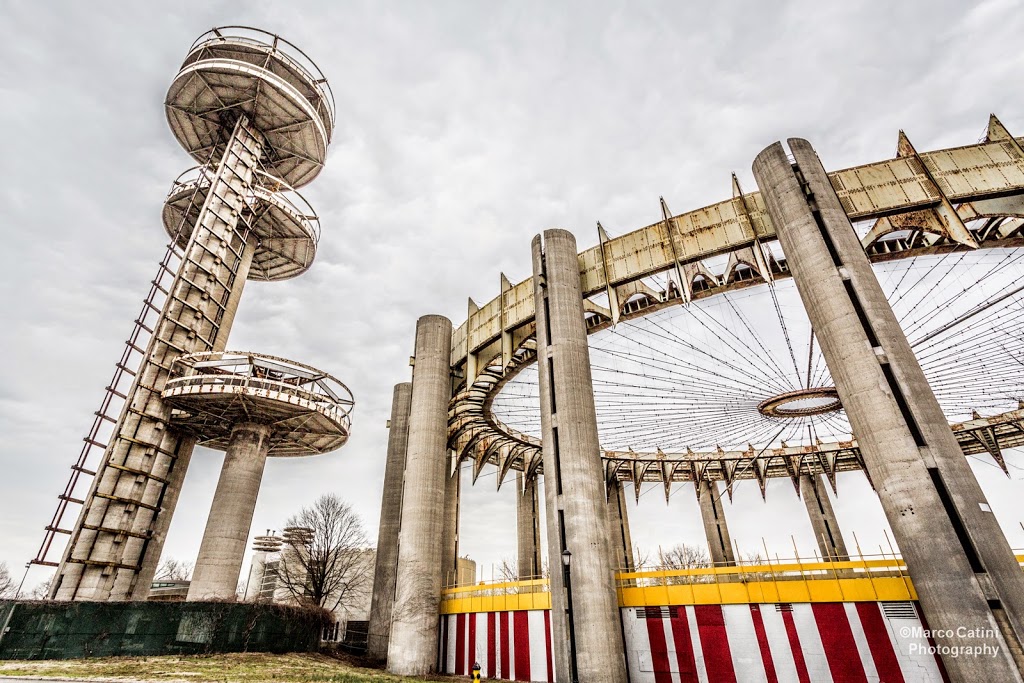
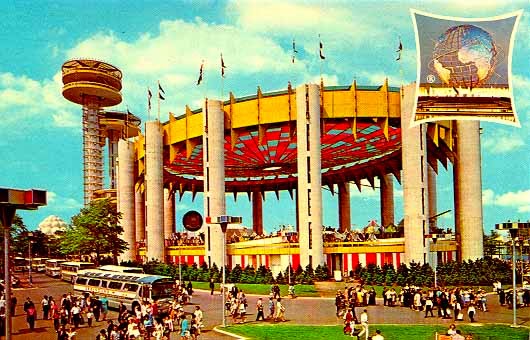
A little bit Jetsons, a little bit Gladiator, a little bit P.T Barnum. Photo/Marco Catini

PODCAST The ruins of the New York State Pavilion, highlight of the 1964-65 World’s Fair in Flushing Meadows-Corona Park, have become a kind of unofficial Statue of Liberty of Queens, greeting people as they head to and from LaGuardia and JFK airports. Its abandoned saucer-like observation decks and steel arena have inspired generations of New Yorkers who have grown up with this oddity on the horizon.


The Pavilion holds a great many surprises, and its best days may be yet to come. Designed by modernist icon Philip Johnson, the Pavilion was saved from the fate of many of the venues in the World’s Fair. But it’s only been used sporadically over the past 50 or so years, and the fear of further deterioration is always present.

For the first part of this very special episode of the Bowery Boys, I take you through the pavilion’s presence in the World’s Fair, a kaleidoscopic attraction that extolled the greatness of the state of New York. In its first year, however, a battle over controversial artwork was waged, pitting Robert Moses and Nelson Rockefeller against the hottest artist of the day — Andy Warhol. Other controversies at the Fair threatened to derail the message behind its slogan ‘Peace Through Understanding.’

In the show’s second half, I head out to record at the Queens Theater — the only part of the New York State Pavilion that’s been rehabilitated — to explore the venue’s ‘lonely years’ with filmmaker Matthew Silva, a co-founder of People For The Pavilion, an organization that’s successfully bringing attention to this weird little treasure. Matthew gives us the scoop of the pavilion’s later years, culled from some of his interviews in the film Modern Ruin: A World’s Fair Pavilion.

This is crucial time in the history of this spectacular relic. With public attention at an all time high, we may now be at the right time to re-purpose the Pavilion into a new destination for New Yorkers. What do you think should be done with the New York State Pavilion?

An airplane passes over the park, its shadow captured inside the Pavilion. (Photo by George Garrigues)


And we would like to thank our sponsors:

Audible, the premier provider of digital audiobooks. Get a FREE audiobook download and 30 day free trial at www.audibletrial.com/boweryboys. Over 150,000 titles to choose from for your iPhone, Android, Kindle or mp3 player Audible titles play on iPhone, Kindle, Android and more than 500 devices for listening anytime, anywhere.


Here’s the trailer to Matthew’s film Modern Ruin: A World’s Fair Pavilion:


Modern Ruin: A World’s Fair Pavilion – Promo I from Matthew Silva on Vimeo.

Thank you Matthew for helping out with the show this week! He’s finishing his film. If you would like to help out, go over to the Modern Ruin GoFundMe page and donate. You just be helping out the film, but the Pavilion itself. The film will probably be the first time many people ever hear of the New York State Pavilion.

And for a different (fictional) film take on the Pavilion, try out these appearances from The Wiz, Men In Black and Iron Man 2:

And thank you to commenter Signed D.C. who points out that the venue was featured in an music video by They Might Be Giants who, generally speaking, who a bit obsessed with the World’s Fair. (It pops up in several of their songs, including a lyric to their song “Ana Ng.“) At one point, the lead singer floats over the Texaco map.


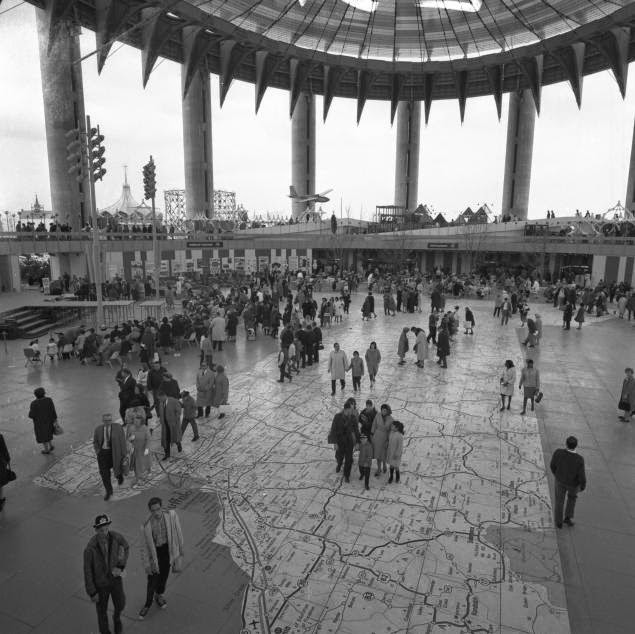
Looking down at the Texaco map of New York state. (Courtesy New York Daily News)


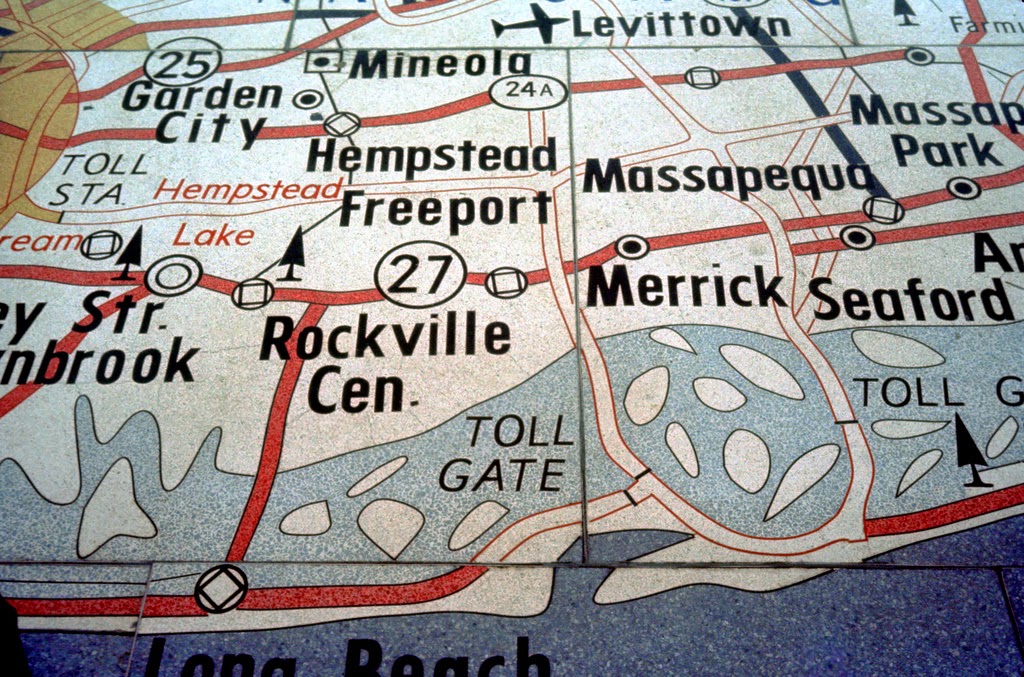
A close up of Long Island, photo taken in 1964. (Courtesy Flickr/Susan DeMark)

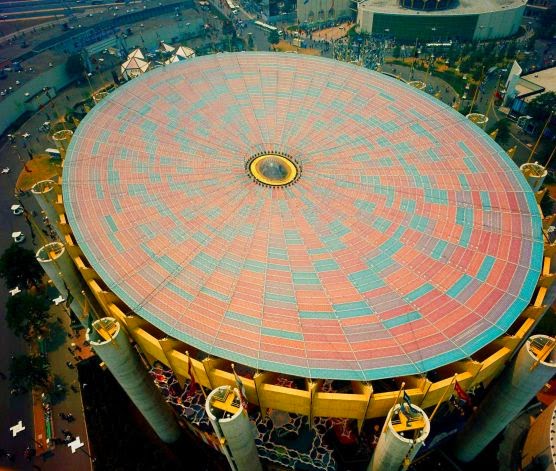
An overhead shot of Philip Johnson’s extraordinary rooftop, a stunning colorful ovoid that projected a rainbow of colors down upon fair-goers. (Courtesy AP)

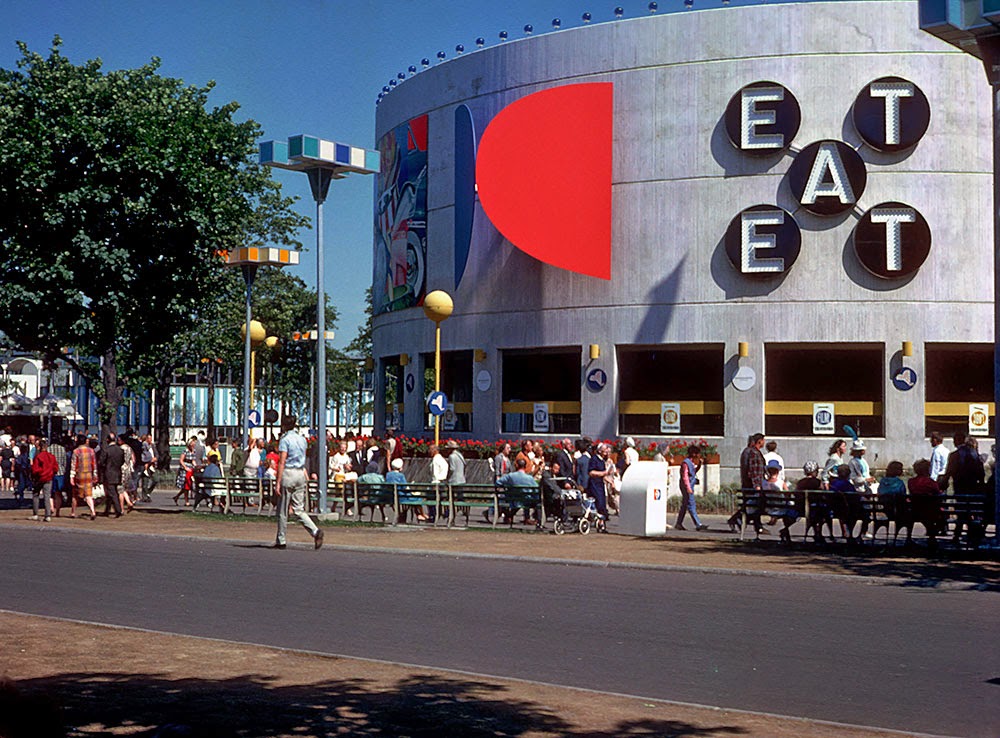
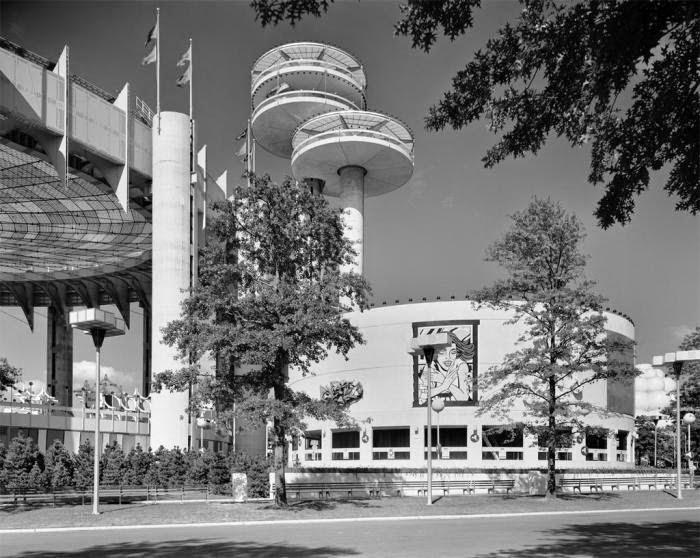
Theaterama, part of the New York State Pavilion, is today’s Queens Theater. Johnson commissioned the work of several pop artists to hang along the walls of the pavilion. (Courtesy Bill Cotter/World’s Fair Community)

A view of Theaterama showing the Roy Lichtenstein mural upon its side (Courtesy Jon Buono):

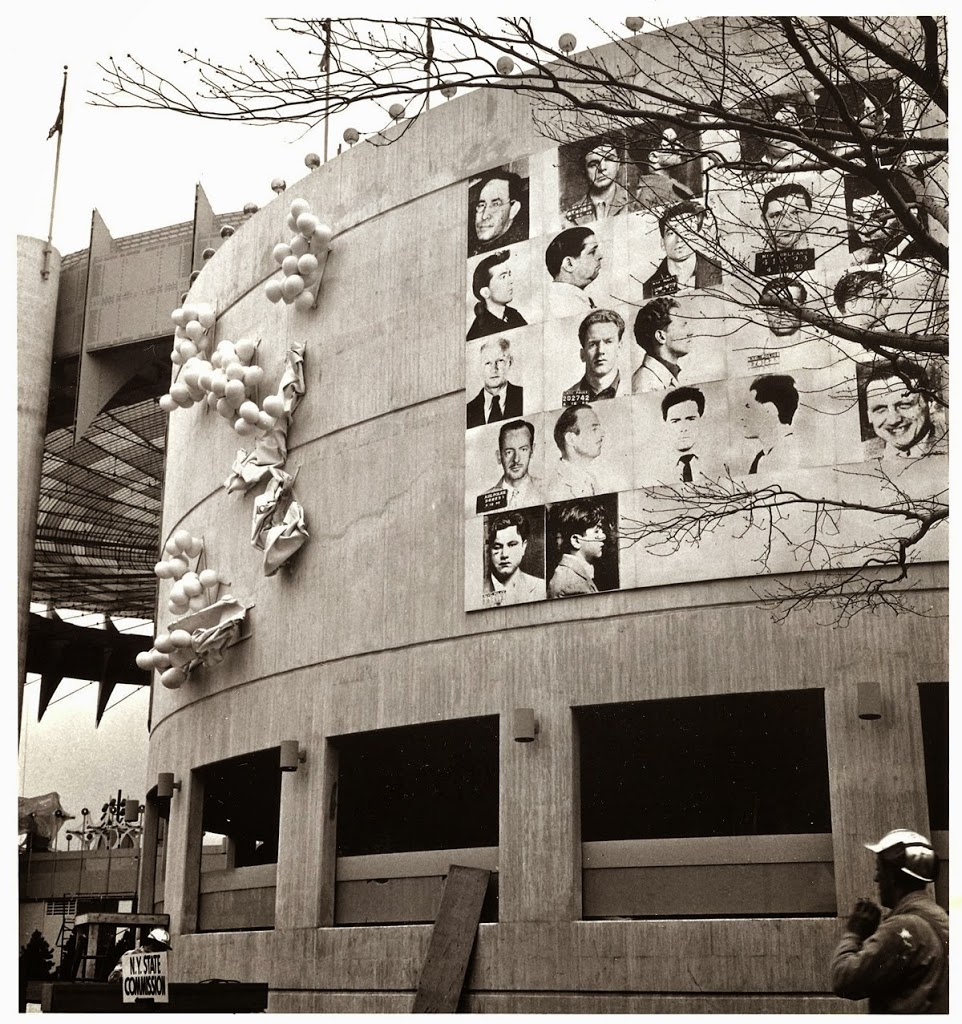
Andy Warhol‘s Ten Wanted Men on the side of Theaterama, with the Tent of Tomorrow in the background. Although we can almost guarantee that it was not beloved by Robert Moses, it’s believed it was taken down because of Governor Rockefeller.

Robert Moses beams from the sidewalk of Flushing Meadows-Corona Park. The mosaic is based on the work of Andy Warhol.

The Federal Pavilion — “the square donut on stilts” — was designed by Charles Luckman, who also designed the current Madison Square Garden.

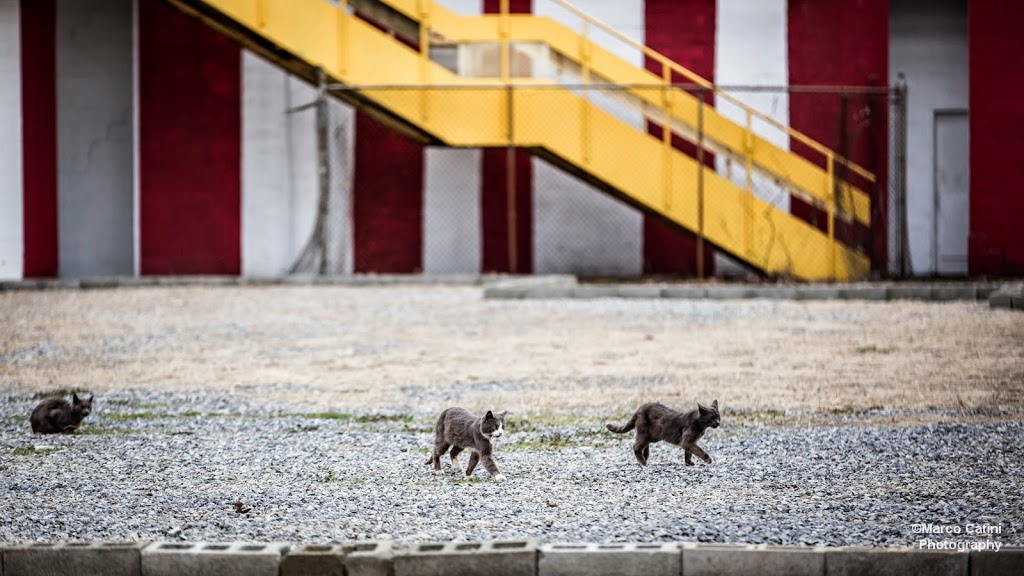
The photographer Marco Catini has taken some recent images of the Pavilion. You can find much more of his work here. Thanks Marco for letting me use your work here!

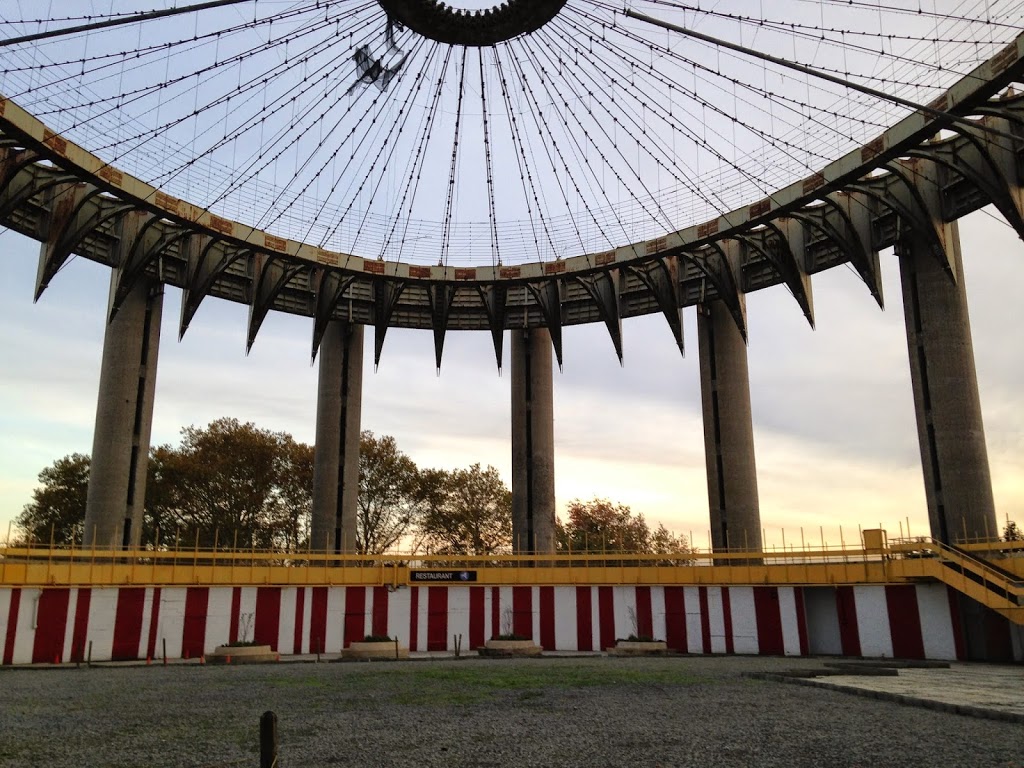
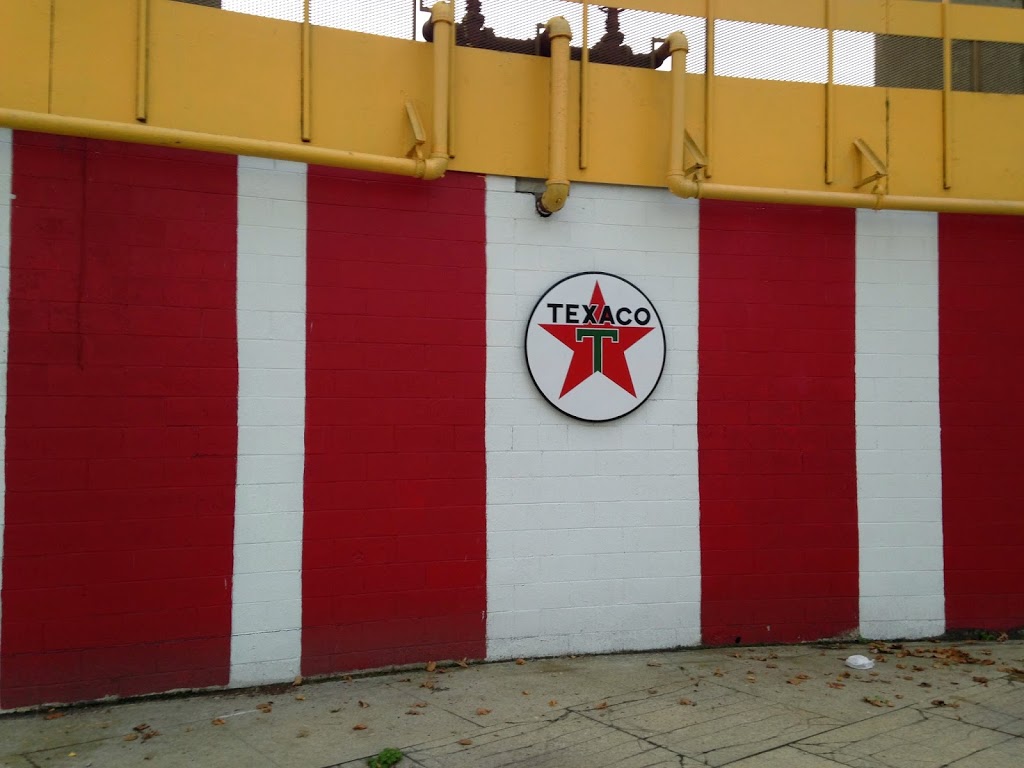
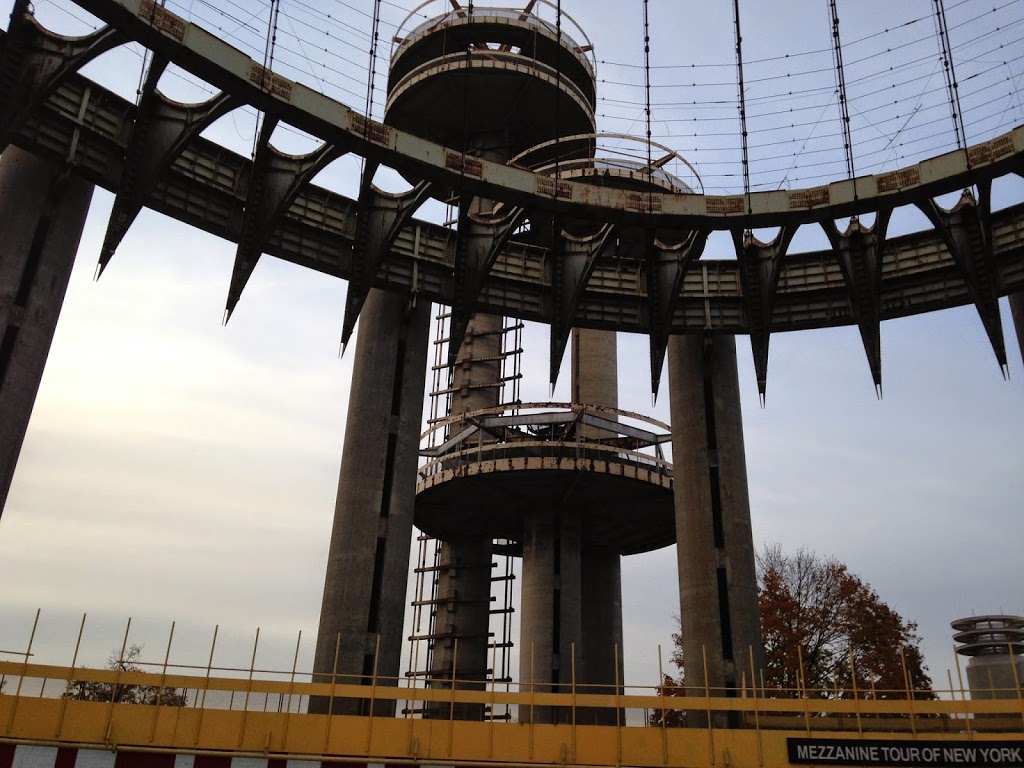
Here are a few of my photos taken on the afternoon of recording. The New York State Pavilion Paint Project is responsible for keeping the place is festive shape. The candy stripes are similar to the look of the 1964 pavilion.

MY THANKS AND GRATITUDE to the Queens Theatre in The Park for allowing us to record in the cabaret room! I know we went on and on about the observation desks and the Tent of Tomorrow, but you should really check out a show within the greatly renovated theater. Coming in December: Charles Dickens’ A Christmas Carol!

Visit the People For The Pavilion website for more information on upcoming events, news and fund-raisers. And a shout-out to the organization’s co-founder Salmaan Khan!

The New York Daily News just yesterday published an article about People For the Pavilion and its co-founder Christian Doran who passed away in February. There’s a fund-raiser tomorrow in his honor. [More info here]

ALSO: I didn’t get to plug this on the show, but historian Christian Kellberg has just released a book of photography of the New York State Pavilion, part of the Images of America series. Most of the pictures are exclusive to this book including some extraordinary shots of the pavilion construction.

And of course there’s Joseph Tirella‘s terrific book Tomorrow-Land: The 1964-65 World’s Fair and the Transformation of America, putting the entire fair within context of the rapidly changing America of the 1960s.

And since I mentioned it on the show, here’s a link for Robert Caro‘s The Power Broker as well!

Categories
Queens History Robert Moses

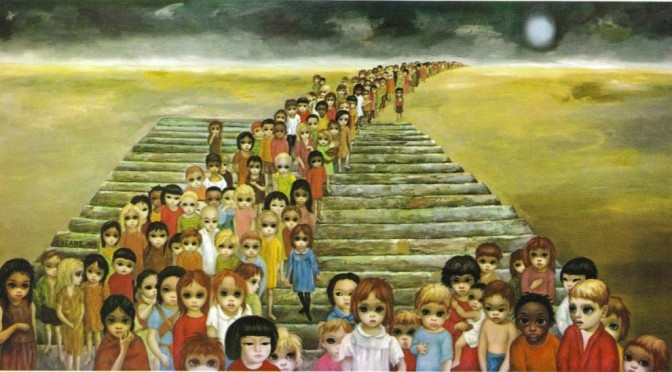
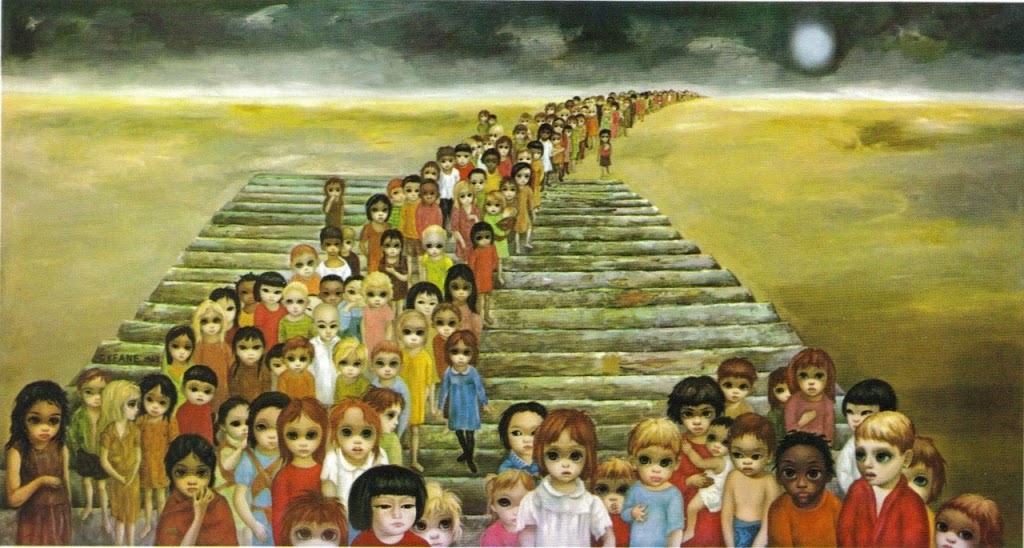
Robert Moses rejected this terrifying Margaret Keane painting from hanging at the 1964-65 World’s Fair

The World’s Fair of 1964-65 at Flushing Meadows-Corona Park was a major American event forward-looking in its intent and, in many ways, backwards in its practice.  In particular, Robert Moses did not care for cheap carnival amusements, nor did he care for music or art that was particular edgy or controversial. Moses’ tastes ruled supreme over the Fair as he held veto power over any works that were in “extreme bad taste or low standard.”

There was no pavilion dedicated to art although several independent partners funded their own art displays.  The New York State Pavilion presented the work of brand-new pop artists; an objectionable piece by Andy Warhol entitled Thirteen Wanted Men was eventually painted over (although it was the governor Nelson Rockefeller who objected in this case).

Moses did eventually throw out one surprising piece of artwork — Tomorrow Forever by Margaret Keane.

The Keane painting was to have been displayed in this building at the fair.**

Keane was known for her bizarre and haunting images of children and animals with large empty eyes.  During the 1960s, her husband Walter Keane claimed to be the creator of her paintings.  It was he who was announced as the painter of this macabre work, chosen in February 1964 to grace the Fair’s Hall of Education.   The venue devoted to the future of schools would feature a scale model of an elementary school from the year 2000, a playground with “futuristic climbing structures,” and from the entrance way, the terrifying painting you see above.

The work by Keane, representing “something which would be symbolic for the aspiration of children,” was not exactly heralded as the pinnacle of artistic expression in 1964.

The New York Times’ art critic John Canaday could barely conceal his disgust at this “grotesque announcement,” adding, “Mr. Keane is the painter who enjoys international cele­bration for grinding out form­ula pictures of wide‐eyed children of such appalling sentimentality that his product has become synonymous among critics with the very definition of tasteless hack work.”   [source]

To be fair, Canaday had only seen a photograph of the painting, which depicts an endless sea of soul-crushing zombie children, rising out of a morose and barren wasteland. “That’s true,” he confessed to a Life Magazine reporter. “It’s normally a principle of mine never to judge just by a photograph, but in this case it didn’t matter.”

Moses seemed to agree with Canaday, demanding the Hall of Education cancel the planned installation before it was even mounted.  Thanks to Canaday’s protest, Moses’ office was inundated with letters from angry intellectuals and aesthetes. “[T]he perpetrators of this art burlesque,” wrote Joseph James Akston, “expose us to veritable scandal sure to incur ridicule and laughter of the whole civilized world with possible exception of Russians.” [source]

Keane, who of course didn’t paint the artwork attributed to him, nonetheless seemed to revel in the critical potshots.  The following year, he issued a press releases from San Francisco and Tahiti, declaring himself “the American Gauguin.”  Canaday would continue to take aim at Keane’s kitschy work.  Imagine how Canaday felt when he discovered that Walter hadn’t even painted the works he so deliciously despised?

Margaret eventually left her husband and sued for rightful ownership of her artwork.

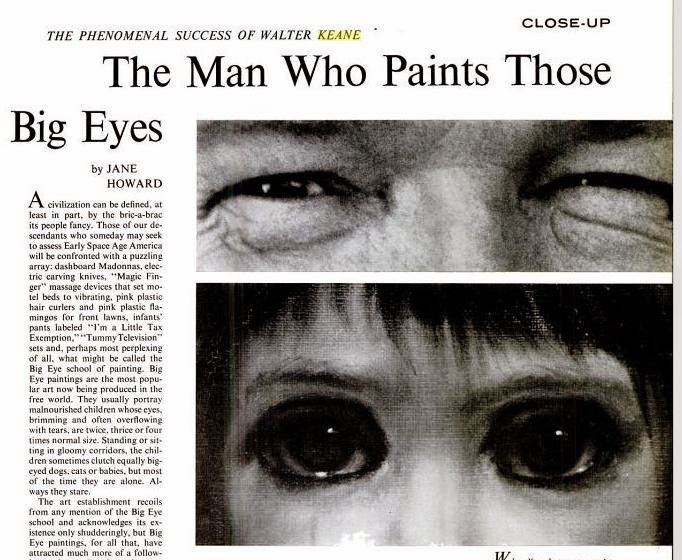
Below: From a Life Magazine profile in August 1965:

NOTE: I’m being a little irreverent in calling the painting “terrifying” as the artist clearly intended the subjects to be starving, sad children.  However, the passage of time has been a little strange to Keane’s legacy.  She is perhaps more beloved than ever — there’s a new Tim Burton film coming out this year — but the flagrant sentimentality of the work has given way to their spectacular kitsch value.

** The Hall of Education picture courtesy the blog Little Owl Ski which has a few other nifty World’s Fair pictures.


Categories
Queens History

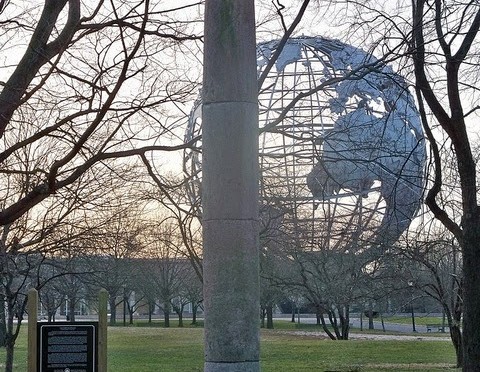
The religious controversy behind a lonely Roman column just standing around by itself in Flushing Meadows Park

.

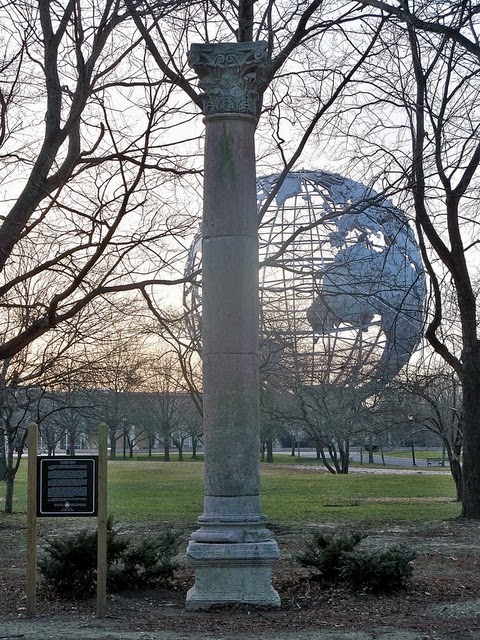
The second oldest manmade object in New York City — outside, that is, not in a museum or private collection — is a solitary little Roman column built in 120 AD for the Temple of Artemis in the ancient city of Jerash.  It once stood among a chorus of ‘whispering columns’, creating an effect in the temple which would magnify the human voice.

So why is it standing all alone in Flushing Meadows Park in Queens?

At right: The column stands alone, with the Unisphere in the background. Courtesy Flickr/Christoslilu

It was a gift of the Kingdom of Jordan for the New York World’s Fair of 1964-65, presented on April 22, 1964, by the young King Hussein to none other than Robert Moses. What did those two have to talk about?

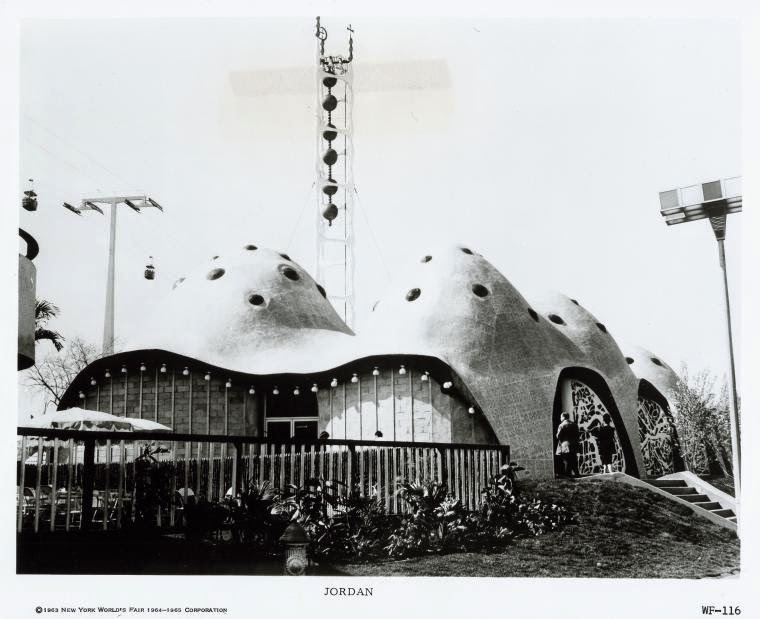
The Jordanian Pavilion at the World’s Fair was a particularly unusual addition to the unofficial (and incomplete) league of nations at the fair. Despite its almost alien appearance — curved and encrusted with gold mosaics — it was one of the most religious buildings there, embodying imagery of both the Christian and Muslim faiths.

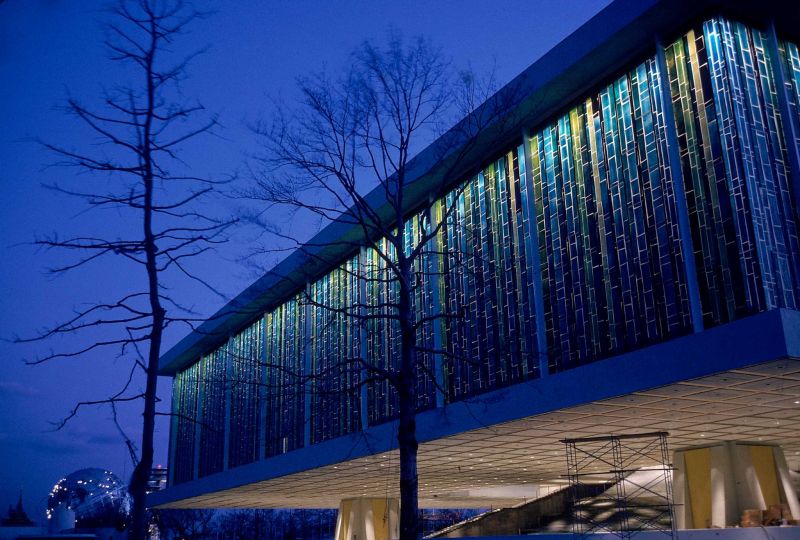
Sculptural displays of Stations of the Cross by Antonio Saura decorated the exterior, and bright stained glass windows lit up spectacularly at night.  The Dead Sea Scrolls were displayed alongside a replica of the Dome of the Rock, and visitors could shop at a jewelry bazaar or eat traditional Middle Eastern food in the snack shop.

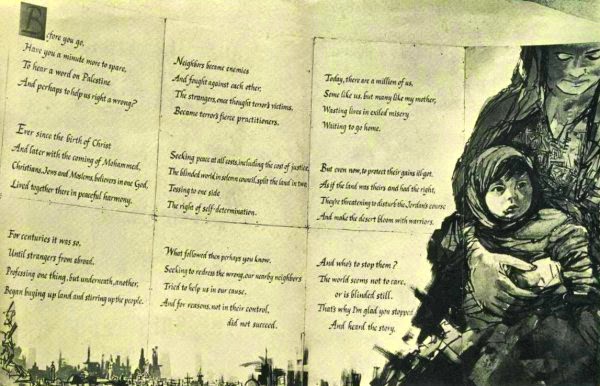
But despite the many artifacts of great historical provenance, the most controversial thing in this odd building were a set of newly painted murals.

Some Jewish visitors to the pavilion were immediately offended by one particular mural depicting a young refugee expounding in a lengthy text about the Israeli-Palestinian situation at the Jordanian border.  “The strangers, once thought terror’s victims, became terror’s practitioners,” it said, implicating the Israelis (but never mentioning them by name).

“But even now, to protect their gains, illgot, as if the lands were theirs and had the right,” went the mural, “they’re threatening to disturb the Jordan’s course and make the desert bloom with warriors.”

Below:  The controversial Jordanian mural (Courtesy the excellent tribute site NYWF64 )

Organizers at the American-Israeli Pavilion wrote Moses to complain, saying the murals were not in keeping with the fair’s theme of “Peace Through Understanding.”  Moses (pictured below) initially rejected the request, but Mayor Robert Wagner, perhaps in an intentional slight to the former parks commissioner, promised to have the murals removed.

Members of the City Council even proposed a bill forcing the fair to remove the mural.  The Jordanians replied that they would rather close the pavilion than tear down the murals under pressure.  Israeli protesters picketed the pavilion;  at one point, the Jordanian flag was taken and temporarily replaced by the Israeli flag by a protester.

Of course, as a result, the Jordanian Pavilion became hugely popular in the early days of the fair, with thousands of visitors streaming in to see what the fuss was about.

The Isaeli pavilion then unveiled its own mural as a response to the Jordanian mural.  Further lawsuits, even fistfights, ensued over the controversy. In the end, none of the murals were removed.

What got sadly overshadowed in all this, of course, was the Column of Jerash, which could have been made of plaster for all the attention it received.

After the fair ended in 1965, the pavilions were mostly all torn down, but the column stayed behind, making the park its home for several decades now.  Today you can find it near the Unisphere next to a plaque which reads:

THIS COLUMN WAS PRESENTED TO/ THE NEW YORK WORLDS FAIR AND THE CITY OF NEW YORK BY/ HIS MAJESTY KING HUSSEIN / OF THE HASHEMITE KINGDOM OF JORDAN/ ON THE OCCASION / OF JORDAN’S PARTICIPATION IN THE FAIR./ THE COLUMN WAS RECEIVED BY THE HONORABLE ROBERT MOSES, PRESIDENT, / NEW YORK WORLD’S FAIR 1964-1965 CORPORATION./ THIS IS ONE OF MANY COLUMNS IN A TEMPLE ERECTED BY THE ROMANS/IN 120 A.D./ THAT STOOD IN THE ROMAN CITY OF JERASH, JORDAN./ THE COLUMNS ARE KNOWN AS THE WHISPERING COLUMNS OF JERASH.

——————————

Okay, so that’s the second oldest large manmade object in New York City?  What’s the oldest?

That’s the subject of our new podcast tomorrow so stay tuned!

Categories
Museums Podcasts

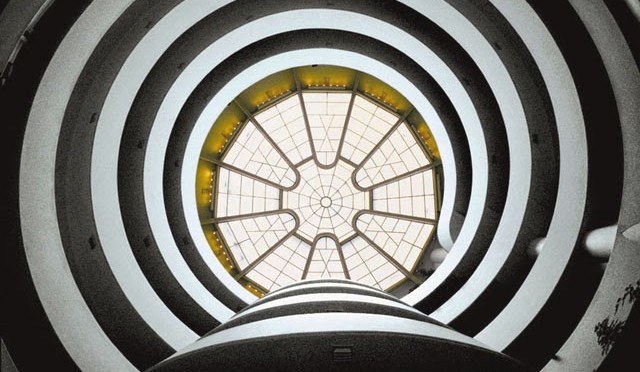
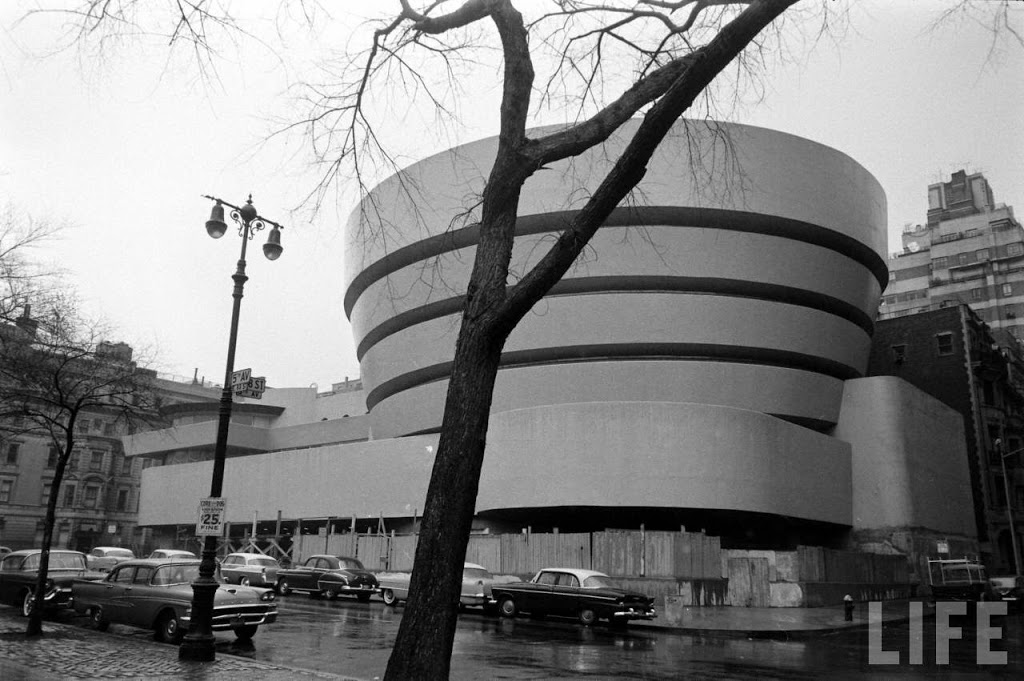
The wonderful mysteries of the Guggenheim Museum, the Frank Lloyd Wright ziggurat turned on its head

It’s ancient mysteries week on the Bowery Boys! What, you ask, I thought you only did New York City history? In fact, at least two great Manhattan landmarks evoke the great mysteries of ancient times, meant to bring mystical energy and revelation to one of the world’s greatest cities.

Here’s a replay of a podcast we recorded back in October 2008 on the history of the Guggenheim Museum, a space-age upside-down ziggurat originally designed to hold only the most unfathomable non-objective art in the world.

The spiral-ramped wonder that is the Guggenheim began as the dream of three colorful characters — a weathy art collector, a severe German artist and her rich patron art-lover. So how did they convince the most famous architect in the world to sign on to their dream for a modern art “museum temple”? Come meander with us through the Guggenheim’s quirky history. Co-starring Robert Moses!


Photographed by Walter Sanders, Life Magazine

PODCAST REWIND A special illustrated version of the podcast on the Guggenheim Museum (Episode #67) is now available on our NYC History Archive feed. Chapter headings with images have been embedded in this show, so if your listening device is compatible, just hit play and a variety of pictures should pop up. The audio is superior than the original as well. So dive into this weird, wild history of one of New York’s great museums!

When we recorded this, George W. Bush was still president of the United States, and the Guggenheim was just reopening after a major renovation. So even this podcast is a bit of history in itself!

Download it here or just subscribe to our archive feed — on iTunes or directly here. You can also stream it on Stitcher, although due to file incapability, it won’t be illustrated.

Categories
Queens History Robert Moses

Assorted mishaps from the 1964 New York World’s Fair — in its first month and before it even opened

Certainly Robert Moses expected there to be a few little problems to arise at the opening of the 1964 World’s Fair on April 22, 1964.  And for the most part, the most popular attractions launched without a hitch.  But a host of bad press on opening day and a litter of minor issues created a sense of unease among some organizers.

The fair was already a controversial venture by Moses — unsanctioned by the official World’s Fair organizers and sold wholesale to a bevy of corporations as a way to fund the hugely expensive endeavor.  Moses’ own reputation was on the wane by 1964; the fair would further tarnish it.

Whatever enthusiasm New Yorkers had for the fair in 1964 evaporated with its completion in the fall of 1965, with reports of ludicrous financial mismanagement and a gradual indifference by fair-goers to its line-up of generally un-amusing amusements.

So these first few mishaps from the months before and after opening, in retrospect, seem to be a harbinger for the greater fiascoes which followed.

Money issues, faulty machinery, injuries, lack of planning — welcome to the World’s Fair of 1964!

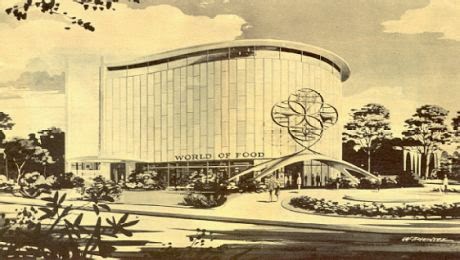
1) The World of Food never opens
With hundreds of new temporary structures going up, you wouldn’t think that a single building lagging behind would be much of an issue.  But the prominently placed World of Food  — standing 75 feet from the fair’s entrance — was one of the largest pavilions on the fair, and little work had been done on it since ground-breaking in January.

The building was to celebrate cooking and gardening, with weekly festivals devoted to a particular food (shrimp, apples), a rooftop ‘edible garden’ and a model kitchen with the most innovative home appliances.  A teen center on the ground floor would host cook-outs and clam-bakes with appearances by the hottest young stars of film and television.

It would have, that is, except the organizers ran out of money, and a large gaping construction site sat like an open sore marring the fairgrounds.

Moses and fair organizers wanted to level the site immediately, fighting it out in court with the World of Food organizers.  Finally, two weeks before the opening, the uncompleted venue was finally torn down.

But there was no time to fill the lot, so on opening day, an odd gap in an otherwise tightly organized grounds greeted visitors.  Gift shops sold World of Food souvenirs anyway.  Meanwhile, the fair paid thousands of dollars to store the unused construction materials off site. [More information at Bill Young’s excellent World’s Fair site. Image above is also from there.]

2) Ceramic catastrophe
The most spectacular displays were often at the pavilions hosted by foreign countries. The Pieta at the Vatican Pavilion, for instance, would become one of the most popular attractions.

The organizers from Spain, however, would have to scramble when they opened crates containing a 50-foot ceramic relief by Antonio Cumella called ‘Homage to Gaudi,” only to discover that much of it had been crushed in transport.

Welders furiously labored to repair the work before the fair opened. Some semblance of the work was eventually displayed.

Courtesy New York Daily News

3) Rain on Opening Day
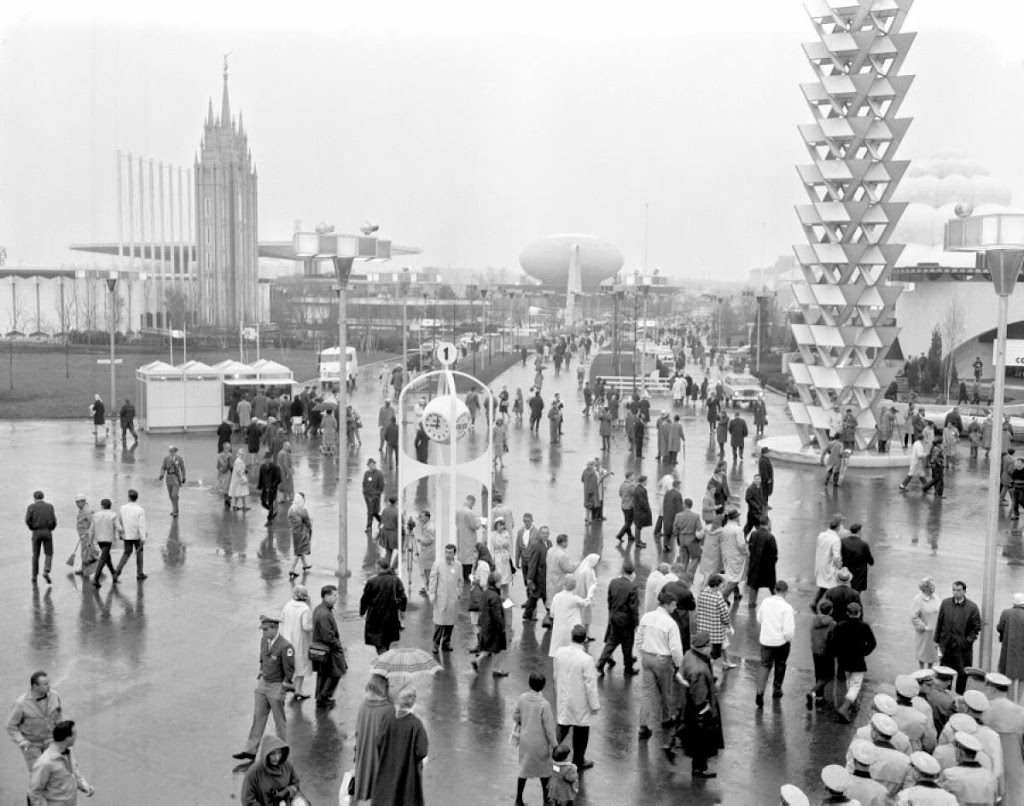
The April 22nd opening was to be one of the greatest events in New York City history, and in volume, it certainly was. Ten of thousands clogged the highways in one of New York’s ugliest traffic days. Over 90,000 made it to the fairgrounds to witness opening ceremonies that included a speech by president Lyndon B. Johnson, president for only a few months after the assassination of John F. Kennedy.

But fair organized had planned for 250,000 attendees. Â Keeping people away was the “November-like weather,” torrential morning rain and a chilly, cloudy afternoon.

The New York Times reported: “The World’s Fair opened yesterday morning with a parade that had everything. But mostly it had rain, and 4,000 sodden marchers outnumbered the hundreds of sodden bystanders.”

4) Protesters and arrests
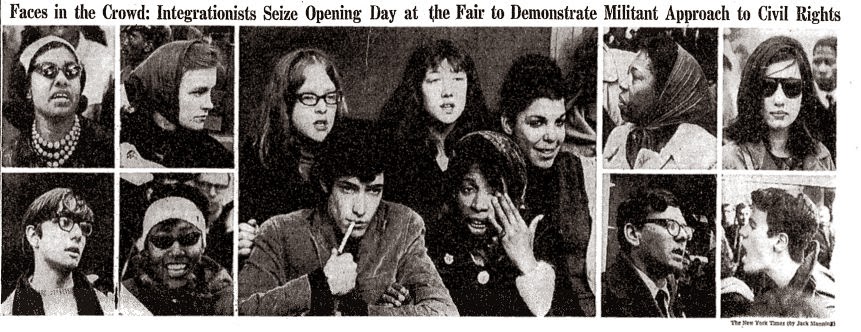
President Johnson and fair organizers were met with picketers and sit-ins, mostly civil rights organizers. They managed to heckle Johnson through his entire speech at the Federal Pavilion and sit in at several fair venues.

In particular, protesters camped out in shrubbery outside the pavilion and had to be forcibly removed. Â “It was dreadful, dreadful,” said one state official.

By the end of the day, over 300 people had been arrested by police. What had particularly incensed protesters was a variety show at the fair called “America, Be Seated,” a “minstrel-style” show that meant to turn the derogatory stereotypes of old into something fun and jazzy for the 1960s.

“I think we’ll start a whole new wave of minstrel shows,” hoped producer Michael Todd Jr, (stepson of Elizabeth Taylor), promising no “burnt cork” and that every performer in the integrated cast would be wearing “his own face.”

It was still deemed too offensive for many and quickly closed within two days, raking in a grand total of $300.

Below: From the New York Times, April 23, 1964

5) City locked down
If you weren’t at the fair, you were probably cursing it out. Â A planned “stall-in” by demonstrators to stop traffic throughout the city failed to materialize, but the city planned for it anyway, created a veritable police state that day.  “Police cars and tow trucks waited sometimes as close as every half mile along Grand Central Parkway.”

This tension led to a near-disaster at one subway station, when four protesters and three police officers were injured “when a crowd tried to stop one morning subway train.” [source]

6) No hospital
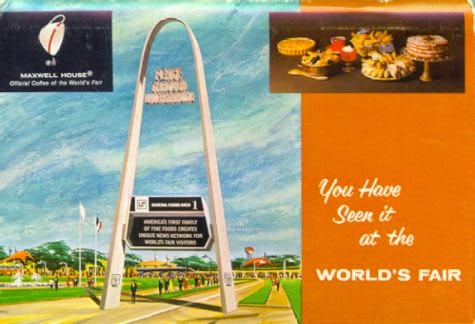
Five days after opening, seven fair goers were injured inside fair transportation sponsored by Greyhound Bus Lines. One of these “Glide-a-Ride” vehicles hit one of the eleven General Foods arches (pictured above), causing minor injuries.

But there was no hospital facility on the fairgrounds — “[T]he hospital was expected to open late next month” — so the injured were treated at the employee’s dispensary and advised to see their own doctors at once. [source]

Leonidoff’s Wonder World. Pic courtesy Randy Treadway at World Fair Community. There are many more rare photos of this event there.)

7) Water and Ice Catastrophes
Two big-name entertainments at the fair were plagued with constant accidents and delays before they opened.  Leon Leonidoff, famed producer at Radio City Music Hall, watched as his “Leonidoff’s Wonder World” befell perpetual mishaps, mostly associated with a faulty mechanical swimming pool.  The show was hugely expensive and not a big draw (see photo above).  It closed within two months.

Meanwhile, Olympic champion Dick Button was having similar issues over at Dick Button’s Ice-Travaganza. His woes involved transportation costs and salaries associated with his mostly European cast. This show, too, was considered a failure, closing a few weeks after its opening opening.

However it did have a skating chimpanzee in a dress, so that’s something to celebrate.

8) Elephant Attack
Six days after the fair opened, a trainer was “stepped on” by a chained elephant named Anna Mae.  Again, as no fair hospital had been opened, the trainer was rushed to Elmhurst Hospital.

You can imagine what the conditions for this poor animal were probably like.  The animal, known for “her erratic temperament,” was chained to two other elephants at the time of the attack.

Above: the Ford Pavilion (NYPL)

9) Ford Pavilion Smoked Out
Nine days after it opened, a transformer at the Ford Pavilion — featuring Walt Disney’s Magic Skyway — caught fire, issuing smoke into the attraction and causing 2,000 people to be evacuated.  The conveyor belt Skyway was also prone in its early days to malfunctions, leaving fair-goers trapped in late-model Ford vehicles in front of caveman and space-age dioramas. [source]

10) The World’s Fair Bus “Riot”
May 16 was a day of record attendance at the fair, so it should be assumed that it was also a day of high tensions and long lines.

People were especially impatient that evening while waiting to board shuttles back to the parking lot.

“A shoving, yelling crowd of 15,000 persons went into near panic,” creating four blocks of mayhem as people attempted to squeeze into an inadequete number of vehicles. A “riot call” was made on the fairgrounds, with additional police and several ambulances called to treat minor injuries and several women who had fainted.

“They acted like animals,” commented one bus inspector. Said another, who had been grabbed and lifted by his tie:  “If we lived through [Saturday] night, we can live through anything.” [source]

Top image courtesy Flickr Marsmett Tallahassee

Categories
Robert Moses

Robert Moses was born 125 years ago today. Here’s ten ways to celebrate/mourn his magnificent, controversial legacy
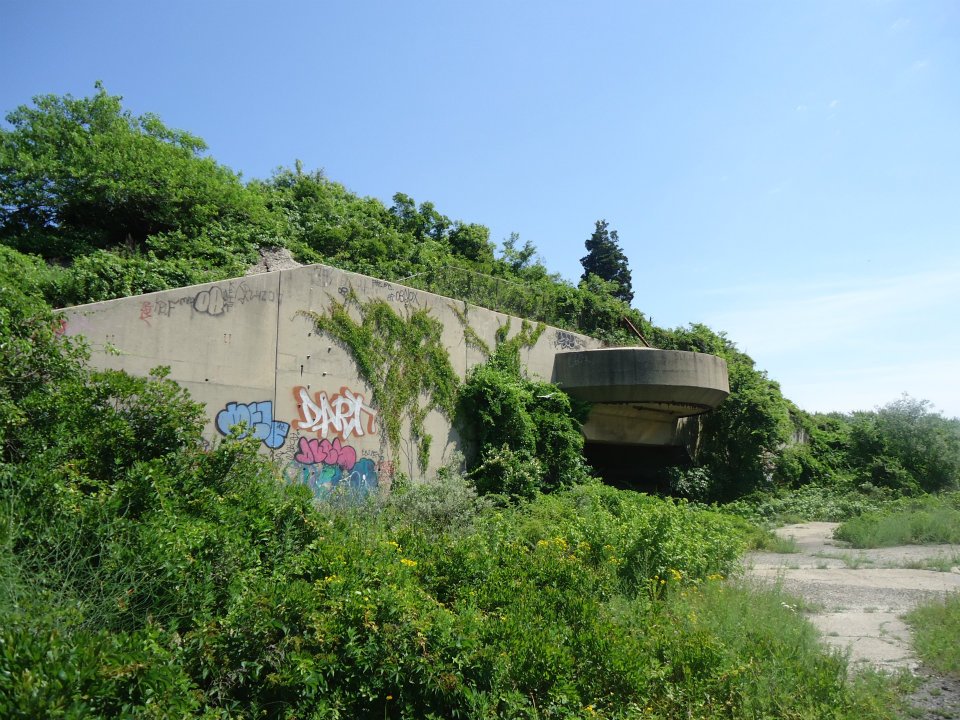
One hundred and twenty-five years ago today, Robert Moses was unleashed upon the world, born in New Haven, Connecticut, on Dwight Street.  He remains today one of the most powerful civic figures in American history, and obviously one of the most controversial.  Because of Moses, we have the modern New York City.  Many of its strengths and its difficulties can be traced, in some way, to decisions he made, from roads and housing to parks and waterways.

Can you really “celebrate” Robert Moses?  Of course you can.  Here’s ten particular ways you can ruminate upon the changes he inflicted upon the city, from the mighty highways to the large, concrete-heavy parks.

1) Read his obituary in the New York Times. Robert Moses died on July 29, 1981.

An excerpt: “Robert Moses was, in every sense of the word, New York’s master builder. Neither an architect, a planner, a lawyer nor even, in the strictest sense, a politician, he changed the face of the state more than anyone who was. Before him, there was no Triborough Bridge, Jones Beach State Park, Verrazano-Narrows Bridge, West Side Highway or Long Island parkway system or Niagara and St. Lawrence power projects. He built all of these and more.”

You might also like to know the contents of his will.

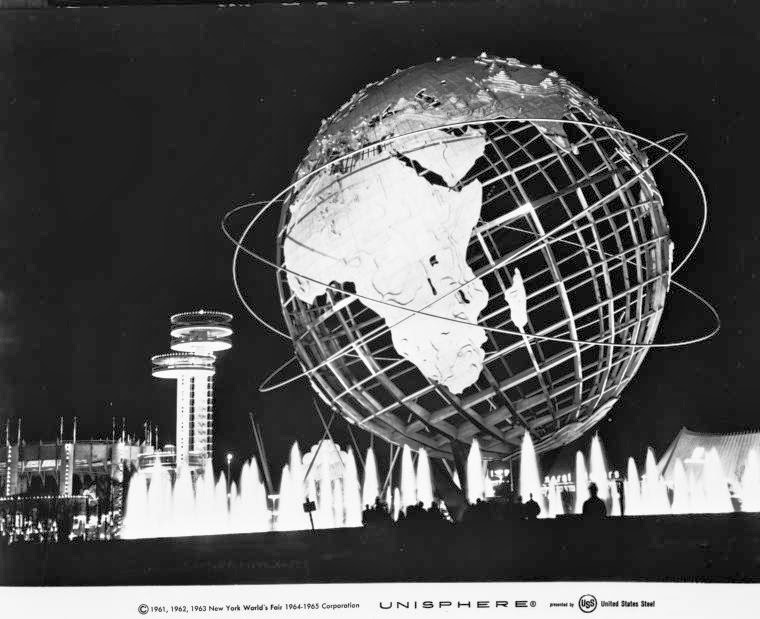
The Unisphere is still around (and presumably in no danger), but the New York State Pavilion, seen in the background, could face demolition. (NYPL)

2) Help save the New  York State Pavilion.  
The curious remnants that remain of the World’s Fair 1964-65, located in Flushing Meadows-Corona Park, are in danger of being torn down.  Certainly Moses himself would have approved of tearing down these useless — and yet, priceless — relics.

After the city projected it would be cheaper to tear them down than to renovate, many in the community rallied to save the embattled old ruins.  A couple weeks ago, Gizmodo asked the question ‘Should Queens Tear Down The 1964 World’s Fair Pavilion’.  Prepare an interesting preservation battle over this historic piece, designed by Philip Johnson.

3) Visit neighborhoods plucked from Robert Moses’ grasp.
Had Moses had his way, a variety of beloved neighborhoods would have been wiped from existence — parts of the Lower East Side and SoHo (thanks to the Lower East Side Expressway proposal), Willowtown in Brooklyn, just to start.

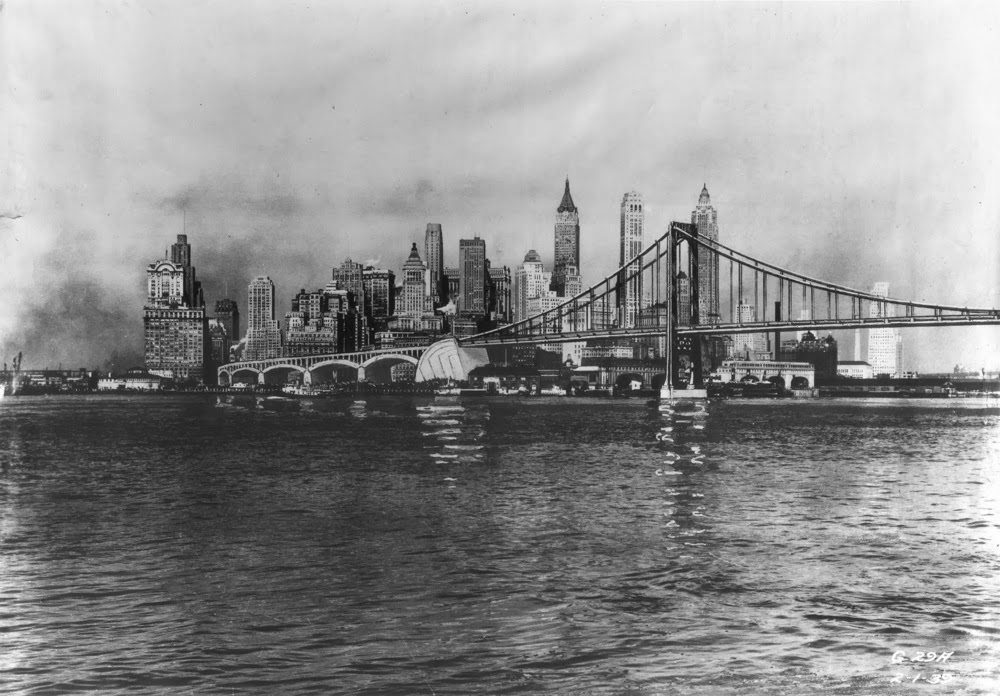
In particular, go to Battery Park and physically embrace Castle Clinton if you can. (It was still behind fences last I checked.)  Moses wanted to construct a bridge over to Brooklyn that would have wiped it from existence.  From my original article:  “The Brooklyn-Battery would be designed by bridge master Othmar Ammann, designer of nearly half the bridges of New York City, with an anchorage plopped in the middle of Governor’s Island.”

Fortunately, the community intervened, and the Brooklyn-Battery Tunnel was built in its place. But a vision of what it might have looked like is above.  (Courtesy Urban Omnibus)

4) Visit those neighborhoods he did replace.
This is a far more depressing stroll and far more common.  Moses’ use of funds from Title I of the 1949 Housing Act replaced some serious New York slum conditions with low-income housing developments, but some of it was poorly designed and shoddily planned.  According to Joel Schwartz, “To a generation of critics … Title I was also synonymous with reckless power that went unchecked until a small band of urban liberals rallied the conscience of the city.”  Not surprisingly, Moses focus was on neighborhoods that were predominantly black and Latino.

Most striking of these was East Tremont in the Bronx and Manhattantown on Manhattan’s Upper East Side:

5) Ride over the Triborough Bridge and head to Randall’s Island
Easily one of Moses’ biggest successes, the Triborough Bridge Authority took in millions of dollars in tolls which then funded other ambitious projects throughout the state.

Over at Randall’s Island,  you should visit the Triborough Bridge Authority Building, which was the homebase for Moses for decades.  It was here that many of his greatest triumphs — and a few city downfalls — were planned.

6) Check out the ghastly Robert Moses mosaic in Flushing-Meadows Park.
The mosaic underfoot is based upon a work by Andy Warhol which the artist created after Moses destroyed Warhol’s outdoor art piece involving the FBI Most Wanted list. From my previous article ‘Most Wanted: Robert Moses vs. Andy Warhol’:  “[H]is mural was literally whitewashed. Warhol intended to replace it with a new design: 25 silkscreen panels of Robert Moses’ face in a Joker-like grin. Unsurprisingly, [Philip] Johnson did not think this appropriate for the main pavilion of Moses’ fair.”

Listen to the WNYC piece from 2010 for more information!

7)  Ponder his vast, virtually unchecked power.
Can you imagine if a politician or city leader were actually as successful as Robert Moses in getting anything done?  His reach and output makes him one of the most powerful city builders in modern human history.

Imagine such power in the hands of a modern politician today. Scratch that. Imagine that power in the hands of an unelected civic leader, as Moses was.

He was so powerful, in fact, that he changed the names of neighborhoods — on a whim!  Like Throggs Neck, for instance.  Excuse me, Throgs Neck.

From my article on the origin of the name: “You may have noticed that John’s last name [Throgg] has two g’s in it, while most common spellings have only one. Legend has it that this is another thing you can blame on Robert Moses.  Not exactly known for reaching out to communities for their thoughts and opinions, Moses decided to drop a ‘g’ in 1955 when the bridge started construction, believing it would fit on more traffic signs without an additional and needless letter.  Who cares if it was in use that way for over 300 years!”

8) Watch Robert Moses on TV in 1953
Moses was even a guest on an early television show called Longines Chronoscope, sponsored by Longines.  This isn’t the most fascinating television that was ever made, but it’s interesting to hear Moses’ authoritative voice during the era of his greatest power.

And check out this bonus video on Robert Moses’ “improvement plans” for Coney Island:

9) Visit his burial site 
He’s buried in a crypt at Woodlawn Cemetery in the Bronx.  So is his most prominent collaborator, Mayor Fiorello LaGuardia.

10) Listen to our podcast (Episode #100) on Robert Moses!

And check out our other podcasts and pages which feature Robert Moses and his effects on the city including the Verrazano-Narrows Bridge, Shea Stadium, Shakespeare In The ParkThe Rockaways and Rockaway Beach and Central Park

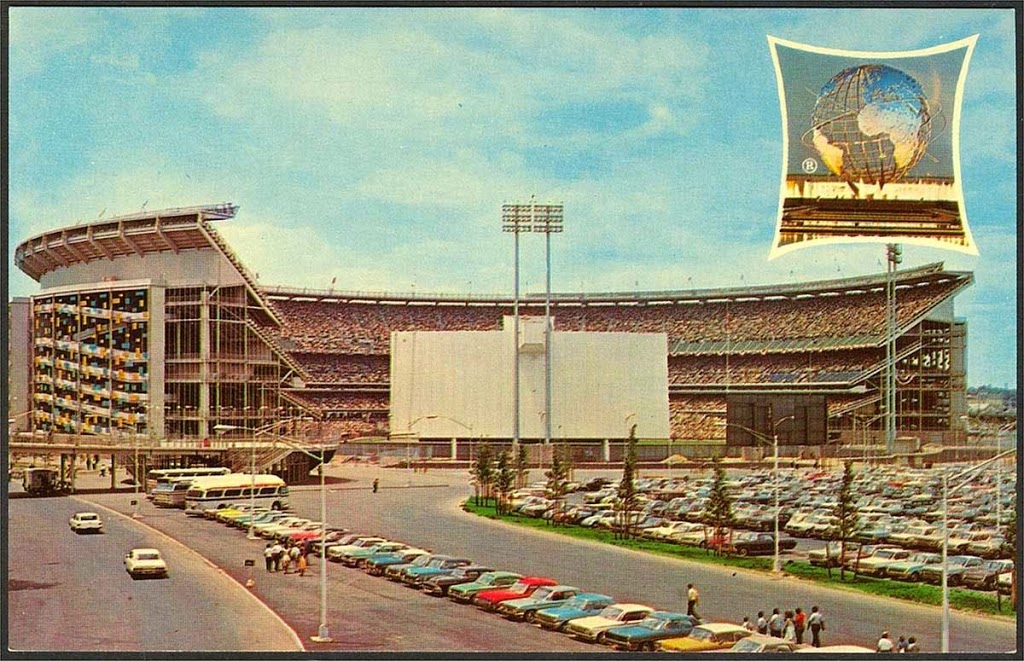
Below:  The glory that was Shea Stadium  (NYPL)

Categories
Queens History

The Corona Ash Dump: Brooklyn’s burden on Queens, a vivid literary inspiration and bleak, rat-filled landscape

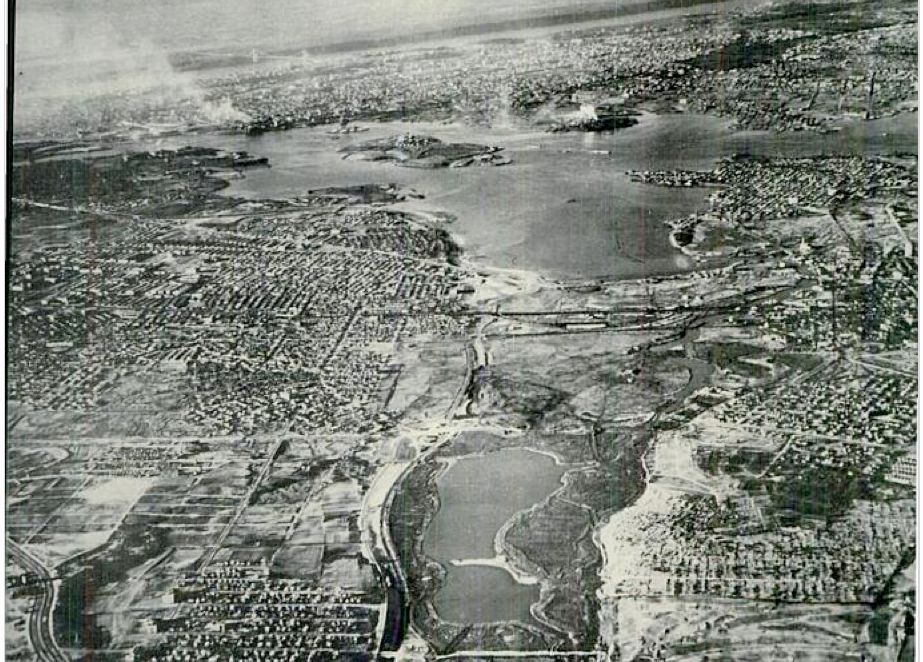
Ah, take in the horrid reality of the Corona marshes with their ashes, manure and garbage! (Courtesy CUNY)

Outside of probably Hell, there is no literary landscape as forlorn and soul-crushing as the ash dumps of Corona, Queens.

This is the valley of ashes,” writes Fitzgerald in The Great Gatsby, “a fantastic farm where ashes grow like wheat into ridges and hills and grotesque gardens; where ashes take the forms of houses and chimneys and rising smoke and, finally, with a transcendent effort, of men who move dimly and already crumbling through the powdery air.”

The Corona ash dump was a stain on Queens every bit as real as Fresh Kills landfill would later be on Staten Island, a repository for the detritus from Brooklyn coal furnace that created crud-caked mountains amid a salty marsh.

The salt marshes sat relatively untouched, along with other large stretches of the newly formed borough. The Brooklyn Ash Removal Company moved here in 1909 after it outgrew its dumping grounds on a small island in Jamaica Bay named Barren Island.  (The island no longer exists per se; landfill connected it to the mainland and Floyd Bennett Field was built there in 1930)

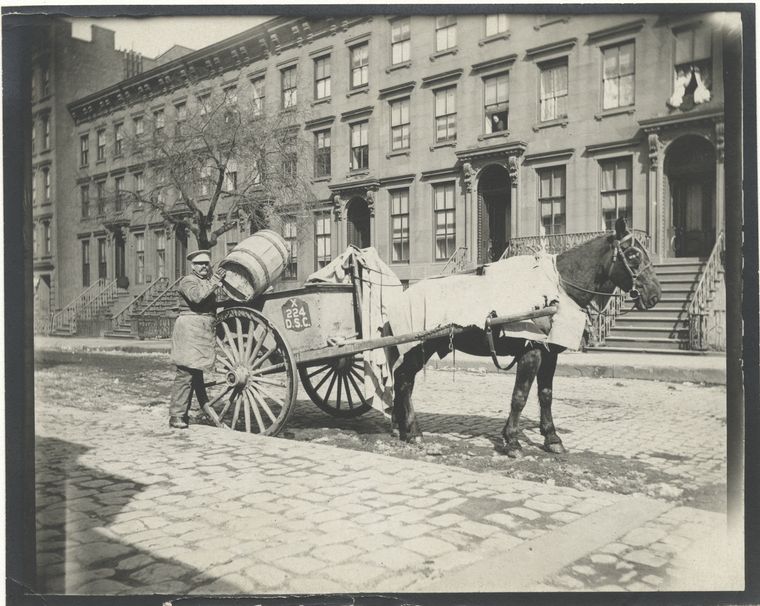
Below: A sanitation worker carting carting away a full barrel of ash. The open cart would be filled, taken to barges, then sent to far-away dumps. In the 1910s, Brooklyn ash went to Corona. {NYPL}

With the increase of coal-burning furnaces in the late 19th century, the city had yet another sanitation crisis sullying the streets.  Even by 1910s, New York was trying to clamp down on the situation — literally — attempting to get residents and private businesses to cover their ash carts and containers “as to protect pedestrians from the annoyance of flying ash dust.” [source]

In Queens, mountains of choking, awful ash made for poor living conditions for neighboring Corona on one side, Flushing on the other.  It was a constant eyesore for early commuters, as the Long Island Railroad went right past it, as did the main thoroughfares of northern Long Island — roads taken by many of the wealthy ‘Gold Coast’ families.

One ash pile was so large — almost 100 feet — that it was christened Mount Corona.  And of course it wasn’t just ash; barges filled with animal manure docked here as well, awaiting local farmers who used the waste as fertilizer.

And new menace was introduced in 1920  — an infestation of rats. “War Declared Upon Rats,” declared the New York Times. An army of exterminators were sent to wipe out the colony of rats that lived among the ashen meadow dumps.

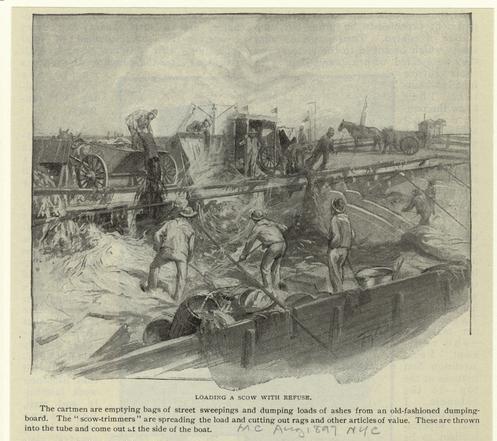
Below: From 1897, loading a scow full of ash to be taken to the local dump (NYPL)

Believe it or not, the Brooklyn Ash Removal Company tried to convince residents that presence of the grim, brimstone terrain next to their homes was getting rid of pests. When they were taken to court in 1923, “charged with permitting dense smoke to issue from the dumps,” they claimed the dumping grounds were good for the salt marshes, as they helped rid the neighborhood of mosquitoes!

With the population of Queens almost doubling during the 1920s, it seemed the days of the Corona Ash Dump were numbered. Enter Robert Moses, with his dreams of a large and spectacular park for the growing borough.  He swiftly moved in, bought all the marshland, all the mountains of ash, and filled in wetlands and the dark hills to create Flushing Meadows-Corona Park.  If you’ve been to Citi Field or the Billie Jean King Tennis Center, then you have sat upon land that was once the Corona ash dumps.

Notes from the podcast (#140) Rockaway Beach

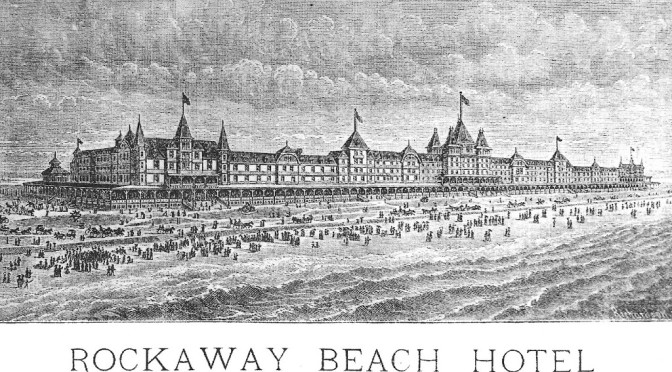
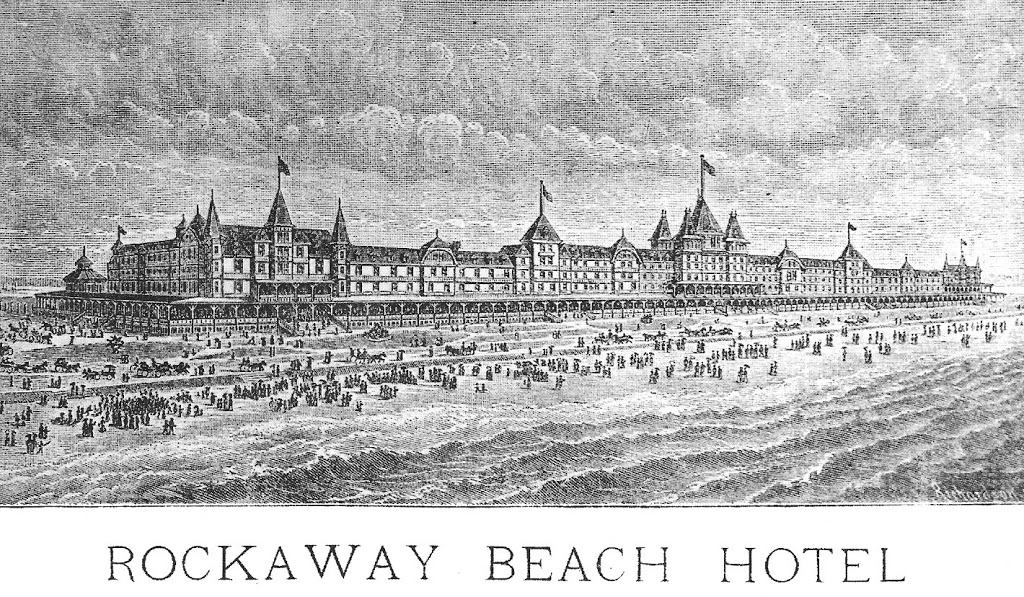
Behold the insanity: (Above) A lithograph of the Rockaway Beach Hotel, one of the most notorious failures in American history

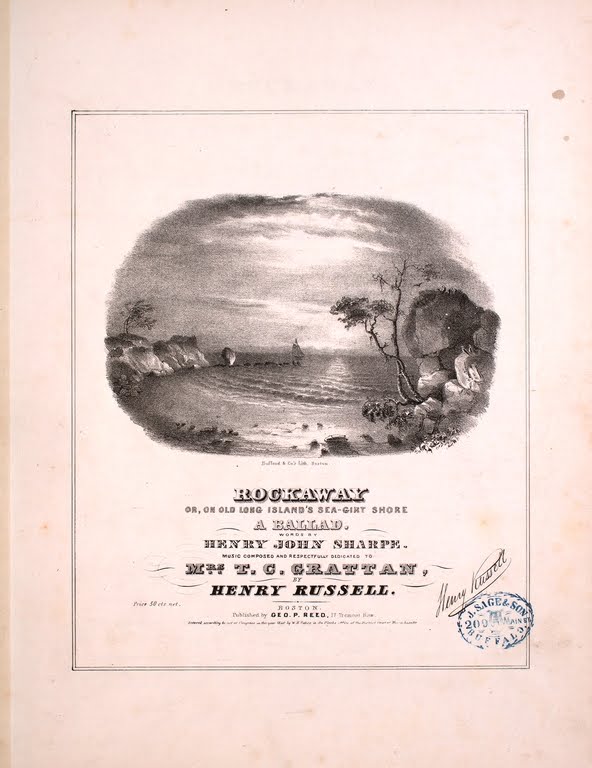
A Song About Brooklyn: I gave you a little taste of a poem about the Rockaways by balladeer Henry John Sharpe. Yes, that’s right, this is actually a song, with music by Henry Russell. Click here to listen to the entire melody.

Rockaway, or, On Long Island’s Sea-Girt Shore. A Ballad

ON old Long Island’s sea-girt shore,

 Many an hour I ’ve whiled away,
 In listening to the breakers’ roar
 That wash the beach at Rockaway.
Transfixed I ’ve stood while Nature’s lyre
In one harmonious concert broke,
And catching its Promethean fire,
 My inmost soul to rapture woke.


To hear the startling night-winds sigh,
 As dreamy twilight lulls to sleep;
While the pale moon reflects from high
 Her image in the mighty deep;
 Majestic scene where Nature dwells,
 Profound in everlasting love,
While her unmeasured music swells, 
The vaulted firmament above.

CORRECTION: We implied that Robert Moses had something to do with the naming of Jacob Riis Park, when in fact it appears to have already had this name applied to it by the time Moses came along to revitalize it in the early 1930s. It was much smaller, of course, and in the 1920s, the Naval Air Station actually wanted to take it over to expand their airfields.

The New York Times thundered in 1922: “By this time the Navy Department must be aware that the people of New York are opposed to the cession to the United States Government of a large part of the Jacob Riis Park at Rockaway Point for a permanent aviation base.” As it turned out, a decade later, it would be the station that closed, and Jacob Riis Park became a mini-Jones Beach.


FURTHER READING: I do think we rather glossed over the later, sadder years of Rockaways history, simply because the causes of the area’s many unusual changes starting in the 1950s are still being debated.

For more information, I must turn your attention to an amazing, if very sobering, book on the subject of the Rockaway’s recent history — Between Ocean And City: The Transformation of Rockaway, New York by Lawrence Kaplan and Carol P. Kaplan. It’s a hearty, in-depth grasp of the social changes of the area and give a nuanced analysis of Robert Moses’ role in the peninsula’s transformation from daytripping destination to a place of inadequate permanent residency for some New Yorkers.

For a stodgy but earnest throwback, you can download a copy of the 1918 book History of the Rockaways from the year 1685 to 1917 by Alfred Henry Bellot. Sandwiched between the lists of names and descriptions of churches that are no longer there are lots of lovely little anecdotes.

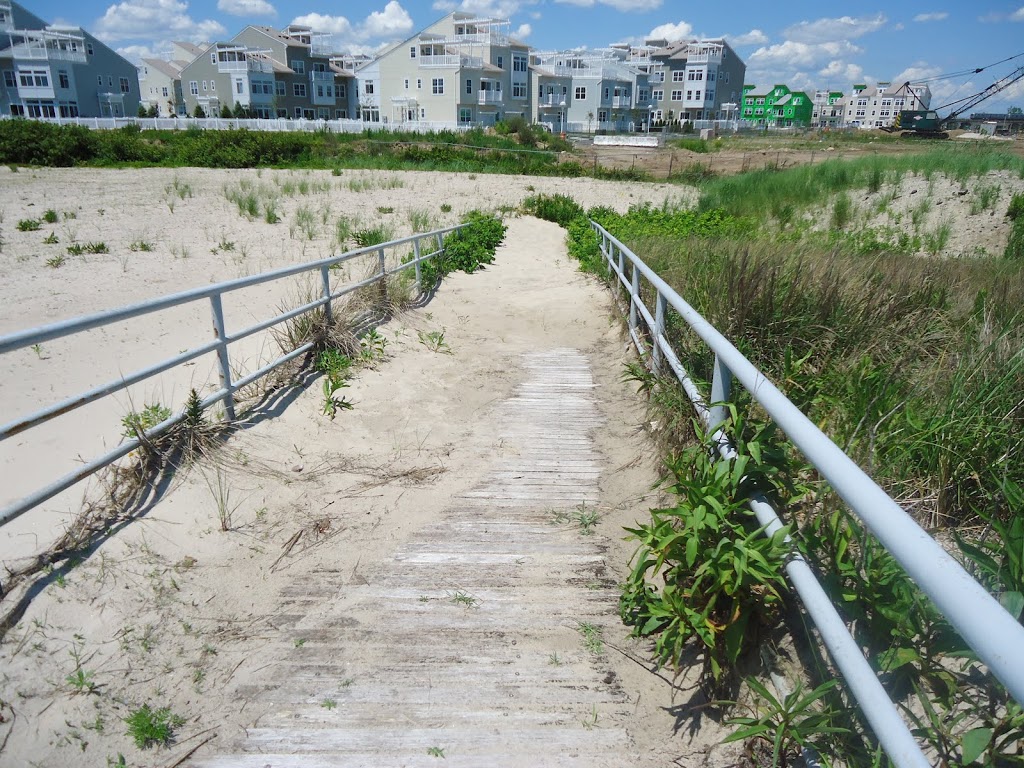
But the best way to explore the history of the Rockaways is to simply roam around the boardwalk. Hints of its glory days — and reminders of its less storied era — can be found scattered all along the way. You’ll see new beach housing that feels like a ghost town, sad 1970s style housing projects, Robert Moses-era storm shelters, surfers, convalescent homes, beach shacks, oddly placed municipal structures, quiet bird sanctuaries, trendy restaurants and rundown pizza joints.

Categories
Podcasts

The Rockaways and Rockaway Beach: The strange fortunes of New York’s former resort oasis and amusement getaway

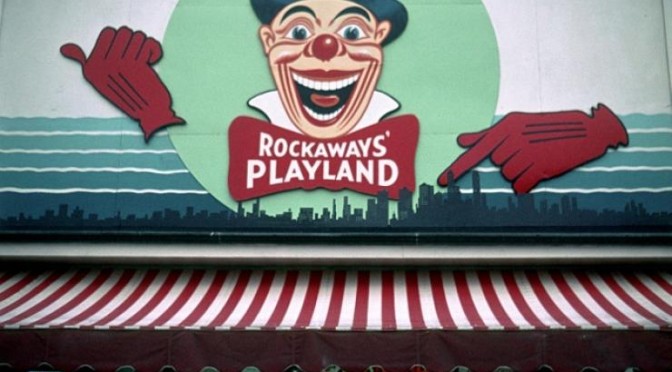
The entrance to Rockaways’ Playland in the 1960s, one of the more nostalgic reminders of an era in the Rockaways gone by. (Image courtesy the blog Sand In Your Shoes)


PODCAST The Rockaways are a world unto its own, a former resort destination with miles of beach facing into the Atlantic Ocean, a collection of diverse neighborhoods and a truly quirky history.

Retaining a variant of its original Lenape name, the peninsula remained relatively peaceful in the early years of New York history, aland holding of the ancestral family of a famous upstate New York university.

The Marine Pavilion, a luxury spa-like lodging which arrived in 1833 featuring the new trend of ‘sea bathing’, opened up vast opportunities for recreation on the peninsula, and soon Rockaway Beach was dotted with dozens of hotels, thousands of daytrippers and a even a famous amusement park.

Not even the fiasco known as the Rockaway Beach Hotel could drive away those seeking recreation here, including a huge population of Irish immigrants who helped define the unique spirit of the Rockaways.

The 20th century brought Robert Moses and his usual brand of reinvention, setting up the Rockaways for an uncertain century of decreased tourism, urban blight and uncommon solutions to preserve its unique identity.


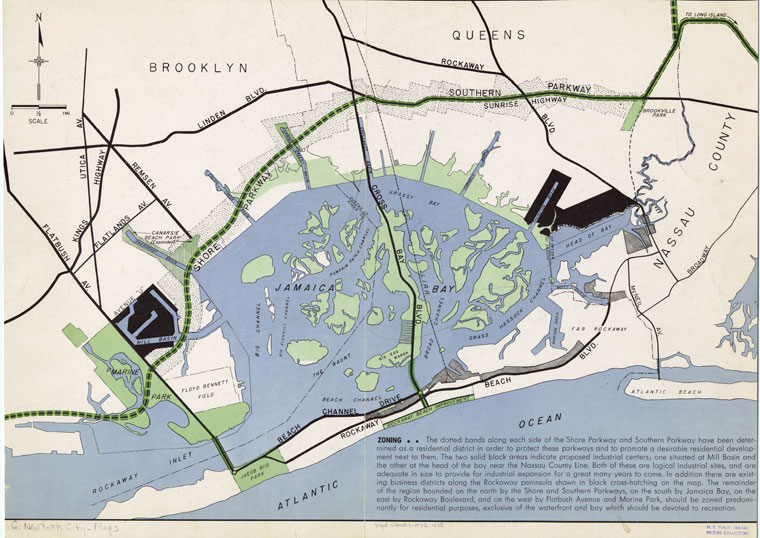
A zoning map of the Jamaica Bay region from 1937, featuring the Rockaway peninsula. A few interesting things to note about this, including: 1) no Idlewild Airport at this time, but Floyd Bennett Field was still in operation, 2) Rockaway Beach Improvement, 3) Everything west of Jacob Riis Park is basically ignored. [source]


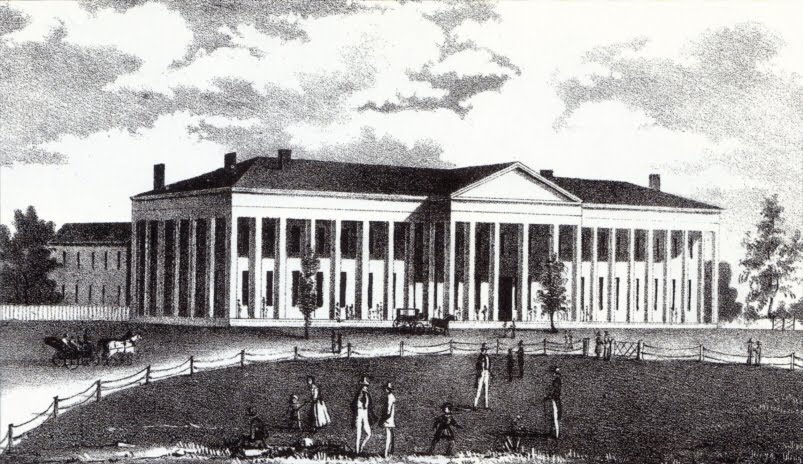
The Marine Pavilion, the first significant resort destination in the Rockaways, introduced the notion of sea bathing to New Yorkers and attracted famous writers and actors to this peaceful area. [Courtesy Rockaway Memories]


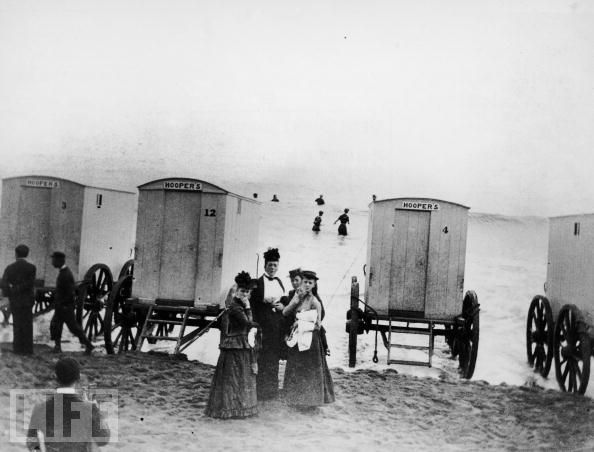
This is not an image from the Rockaways, but ‘bathing machines’ like these were most certainly used in the early days of Rockaway Beach.
 
 
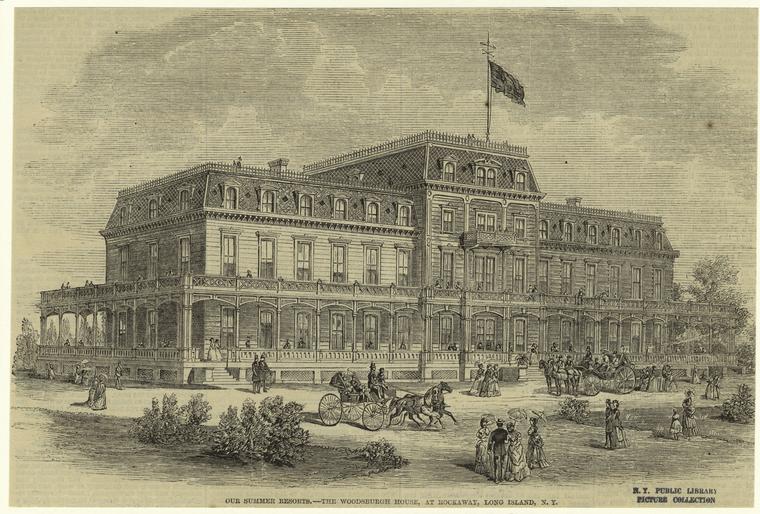
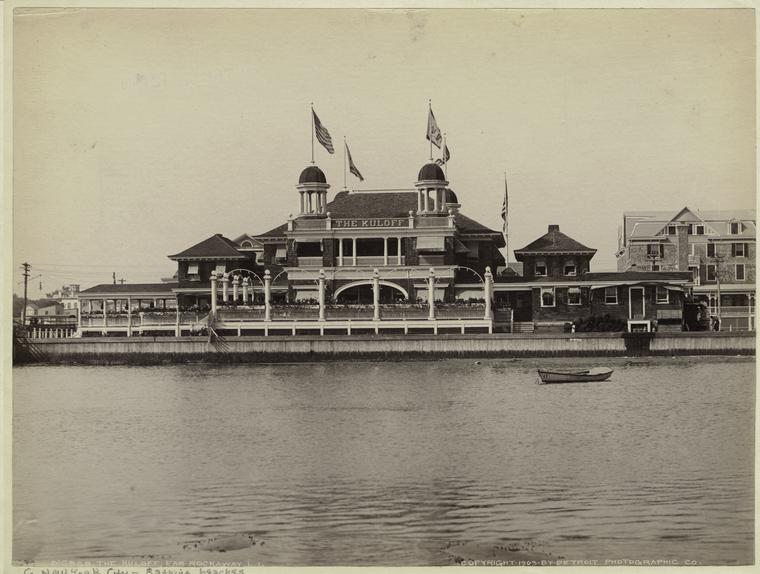
A couple examples of hotels that once filled the peninsula during the late 19th century, early 20th century, the Woodburgh House (at top) from 1870, the Kuloff (at bottom) from 1903.
 

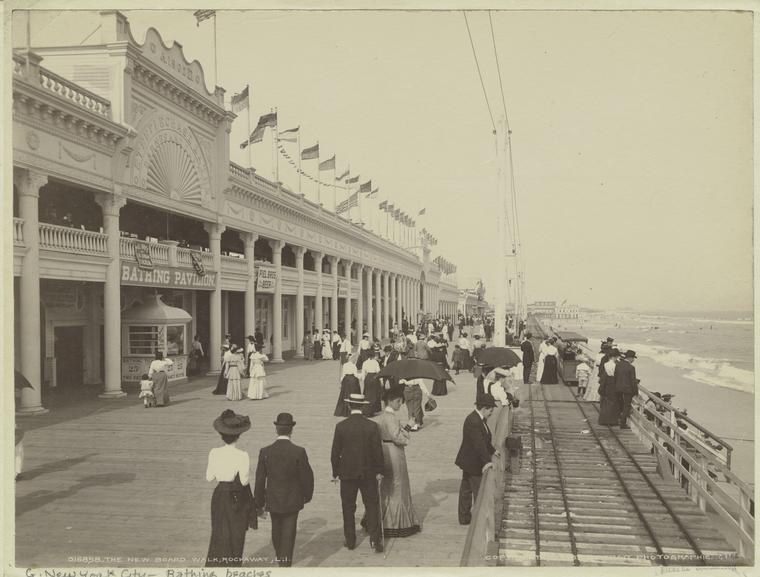
The boardwalk from 1903 in front of or near a section of Steeplechase Park, I believe, judging from the mini-railroad tracks along the side. [source]


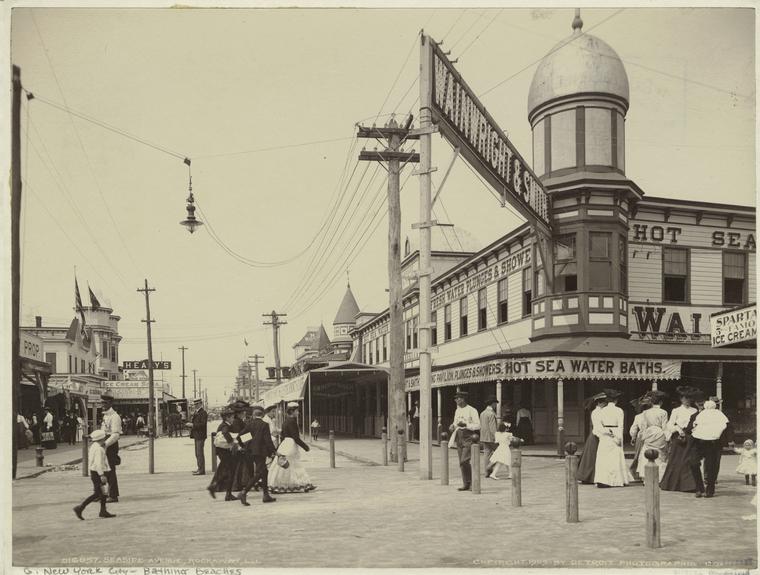
Along Seaside Avenue, possibly depicting an area of ‘Irishtown’, in 1903, rebuilt after a devastating fire the decade previous.

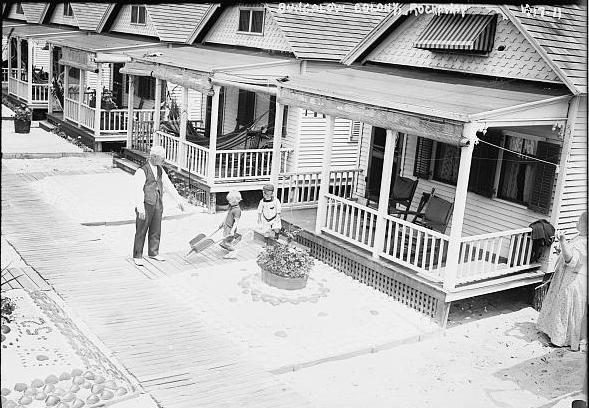
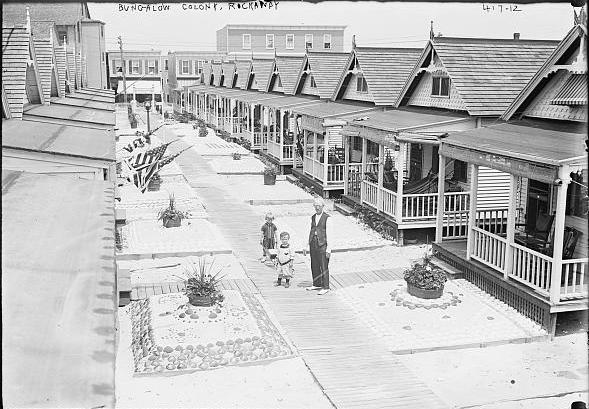
The bungalows of Rockaway. (Courtesy Library of Congress)


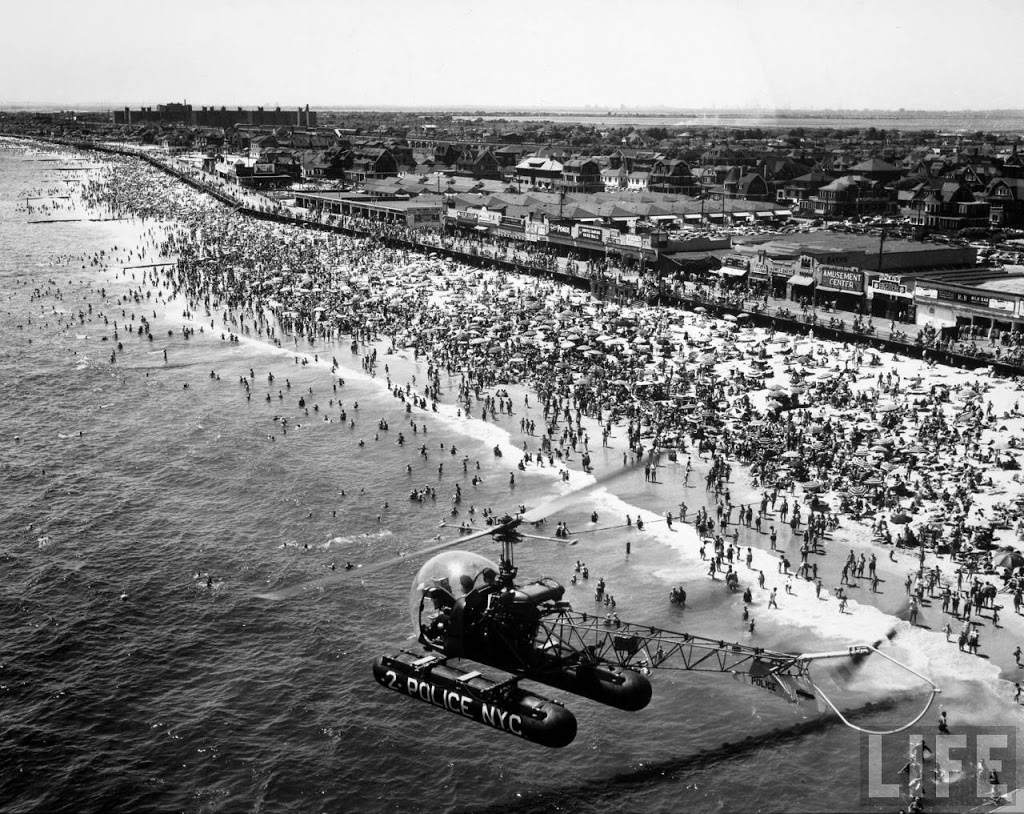
The 1950s began a long era of difficulties for the Rockaways, but you wouldn’t know it from this summertime Life Magazine photo from 1956. Click into the image to inspect some of the interesting and long-vanished shops and amusements along the boardwalk.


This almost-ghostly skeleton of a high-rise housing development never built stood for years as the residents of neighboring Breezy Point successfully fought to kill that project and other intrusive plans by the city in the late 1960s. Picture courtesy Arthur Tress/US National Archives.

The mysterious remains of old Fort Tilden, now part of the Gateway Recreation Area and completely taken over by nature. For many more pictures of this area, please visit our Facebook page and check out my photo album on the ruins of Fort Tilden.

The thrashing waves of Rockaway make for good surfing:

And, what posting about the Rockaways would be complete without:

Categories
Podcasts

The Brooklyn Academy of Music: Enduring floods, fires and snobbery to become New York’s oldest home for the arts

PODCAST One of America’s oldest cultural institutions, the Brooklyn Academy of Music (or BAM) has an unusual history that spans over 150 years and two separate locations. We trace the story from the earliest roots of a Manhattan-Brooklyn rivalry and a discussion of high-class tastes to the greatest stars of the performing arts, including a couple tragic tales and a bizarre event involving the mother of modern dance.

Featuring horse tricks, French balls, a ‘flirtation’ post office, a bit of ski jumping.and a cavalcade of BAM’s greatest stars — Enrico Caruso, Merce Cunningham, Edwin Booth and his brother John Wilkes Booth!

ALSO: We uncover what may be the very first foreign films ever shown at the Brooklyn Academy of Music, many decades before the opening of their movie theaters.


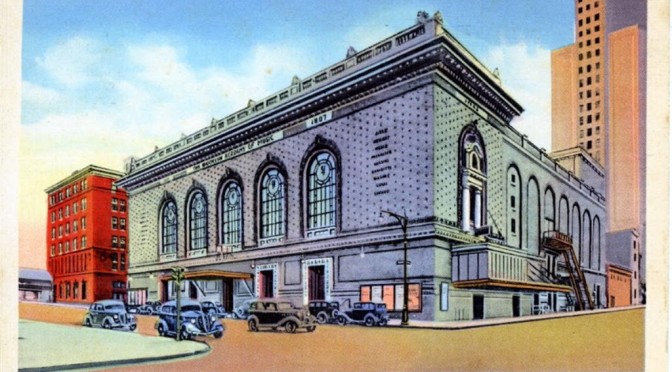
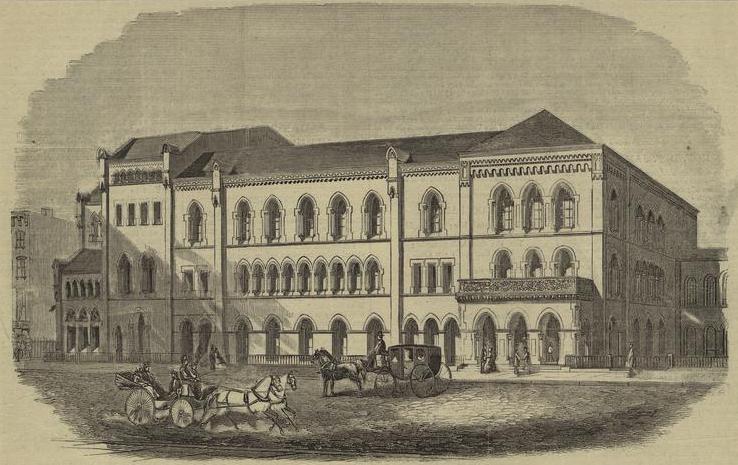
The first Brooklyn Academy of Music, on Montague Street, nearby Brooklyn City Hall. Among the decades of great events here were Brooklyn’s Sanitary Fair, a speech by Booker T. Washington, an amusing lecture by Mark Twain and the final stage performance of Shakespearean actor Edwin Booth. (source)

The building was destroyed by fire in 1903, and not everybody was sad to see it go. Here’s actual film footage of the flames atop the old Brooklyn building:

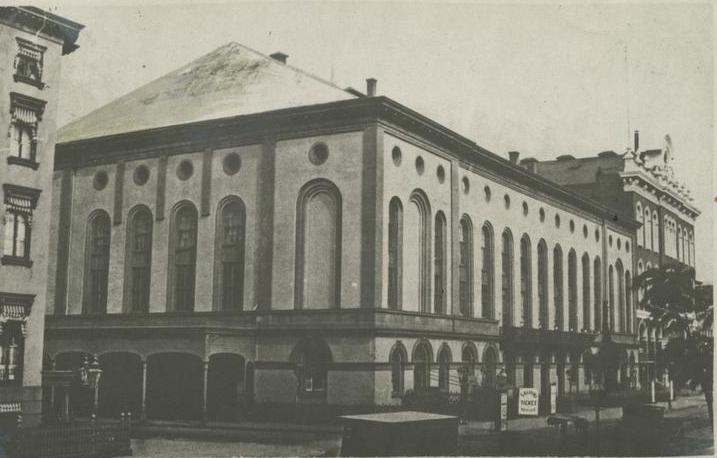
Compare this to New York’s own Academy of Music, at 14th Street and Irving Place. Although this venue brought the American debuts of many famous operas (including Carmen), festivities deteriorated once the Manhattan wealth moved up to the Metropolitan Opera House. This building was demolished in 1926. [source]

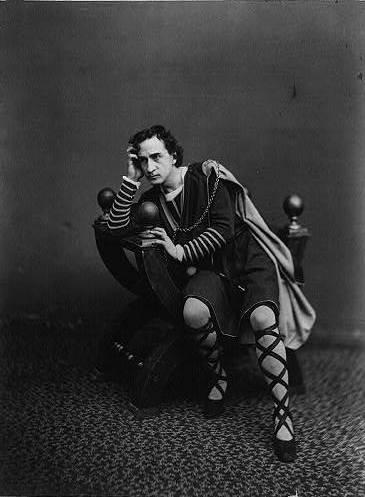
Edwin Booth, in his signature role as Hamlet, 1870. If some at the original Brooklyn Academy of Music had had their way, Booth would never have performed there! [LOC]


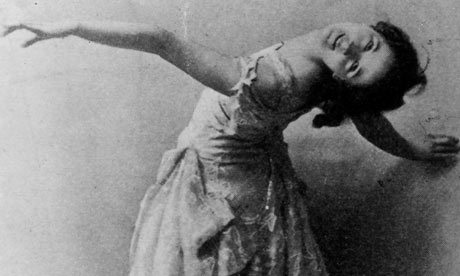
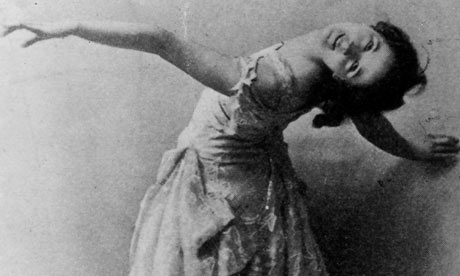
Isadora Duncan, who brought modern dance to BAM, and it never left. (source)


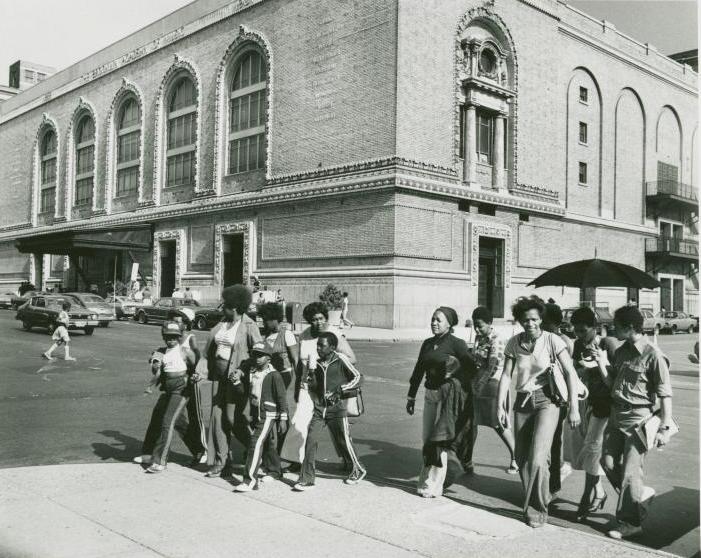
BAM in 1978: After a few decades of hardship, the venue, at its new home on Lafayette Avenue, rebounded in the 1960s, serving the artistic passions of the neighborhood and fostering a provocative relationship with the biggest names in avant garde performance. (Pic by Dinanda Nooney, NYPL)

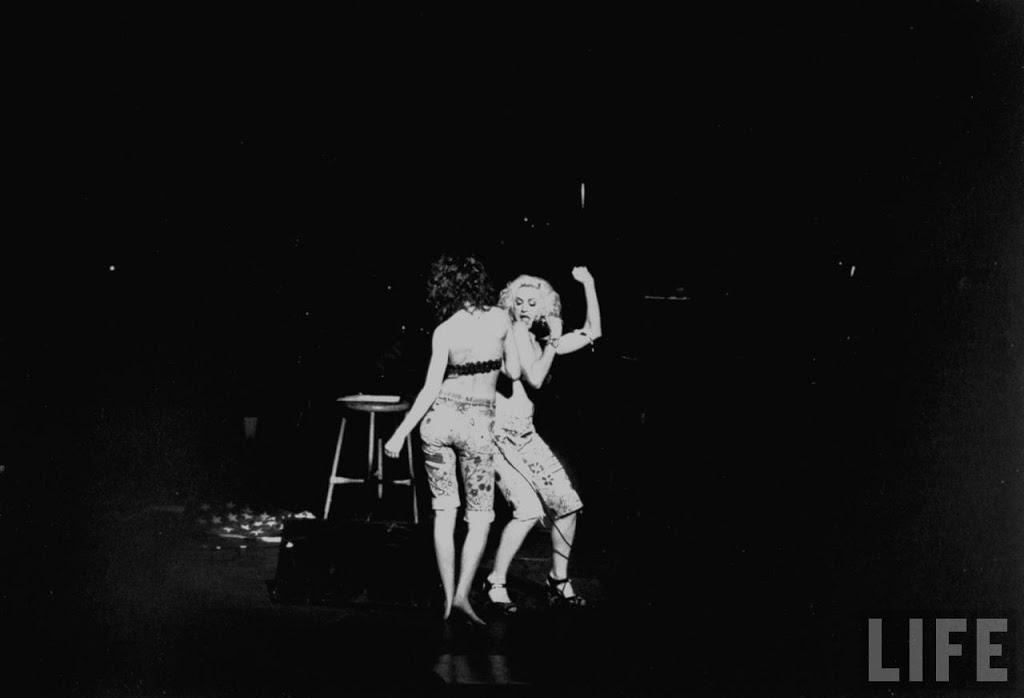
The fascinating directions that BAM executive direction Harvey Lichtenstein took the venue opened its stage up to new and exciting performances. And, often, a raucous good time as well, as with this 1989 rain forest benefit, featuring Madonna and Sandra Bernhard. (Photo by Albert Ferreira, LIFE)

MORE PICTURES ON THE WAY LATER THIS WEEKEND

For more information on their schedule, visit the BAM website. They also have a great history blog BAM 150 Years where we obtained some of our information.