Categories
Know Your Mayors Queens History Religious History

Mayor Walter Bowne and his very exceptional family story

New York City has a new mayor — Eric Adams! So we think it is time that you Know Your Mayors, becoming familiar with other men who’ve held the job, from the ultra-powerful to the political puppets, the most effective to the most useless leaders in New York City history.

This longtime feature of this website is being rebooted with new articles and newly researched and refreshed earlier entries in this series. Check back every other week for a new installment. Read past articles here.
Mayor Walter Bowne
1829-1832 (four one-year terms)

Walter Bowne, mayor of New York City from 1829 to 1832, was born in Flushing in 1770, many years before the region would erupt into a revolutionary war.

But his story really begins well over a century before. Walter would not have been mayor if not for the distinguished reputation of his family name.
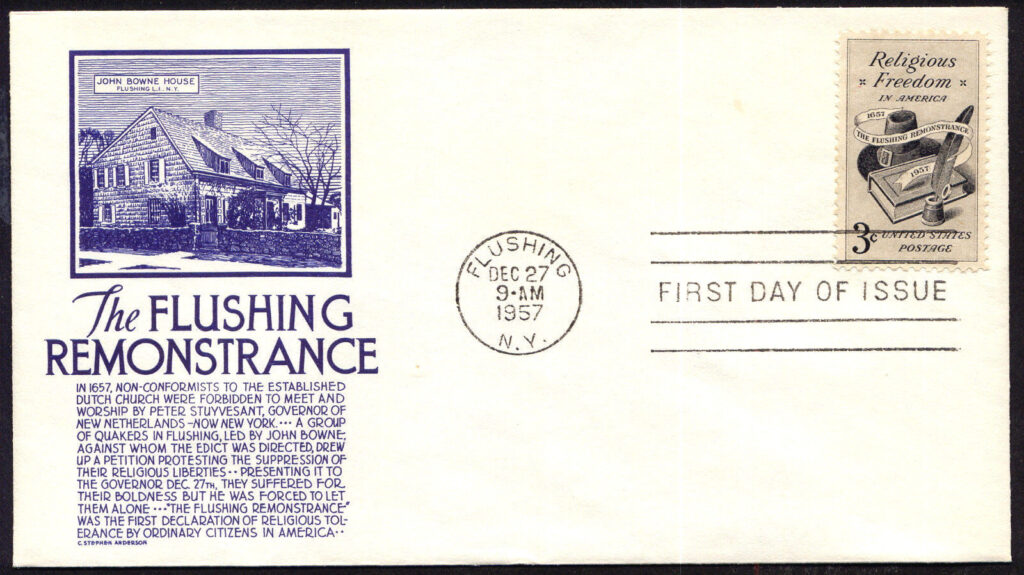
On the 300th anniversary of the Flushing Remonstrance, the US Postal Service issued a commemorative stamp.

A Flushing Revolution

The Bowne family first settled in Flushing (then Vlissingen or Vlishing), Long Island in the 1660s when the region was a part of the Dutch empire, an outpost of New Netherland.

Yet Thomas Bowne, his son John Bowne and their clan were English, and this area of Long Island had been long settled by Quakers.

The Bownes were entering into a religious powder keg. Already by 1657, director-general Peter Stuyvesant considered the religious enclave “a threat to the peace and stability of the colony and probably out of their minds as well,” writes Russell Shorto in The Island At the Center of the World.

The Long Island Quakers responded with an extraordinary document that year called the Flushing Remonstrance, asserting their freedom to worship under Dutch standards of tolerance and “the law of love, peace and liberty.” This only infuriated Stuyvesant further.

By 1662 the home of John Bowne had become a central meeting place for the area’s Quaker population. Stuyvesant had him arrested and deported to Amsterdam — despite the fact that he was English and Holland was not his country of origin.

However Bowne successfully petitioned the Dutch West India Company and in the end, by 1664, he was allowed to return to Long Island.

Stuyvesant, meanwhile, was severely reprimanded and ordered to be more tolerant. (Fortunately for Peter, the English took New Amsterdam that very year so he didn’t have to officially tolerate anybody anymore.)
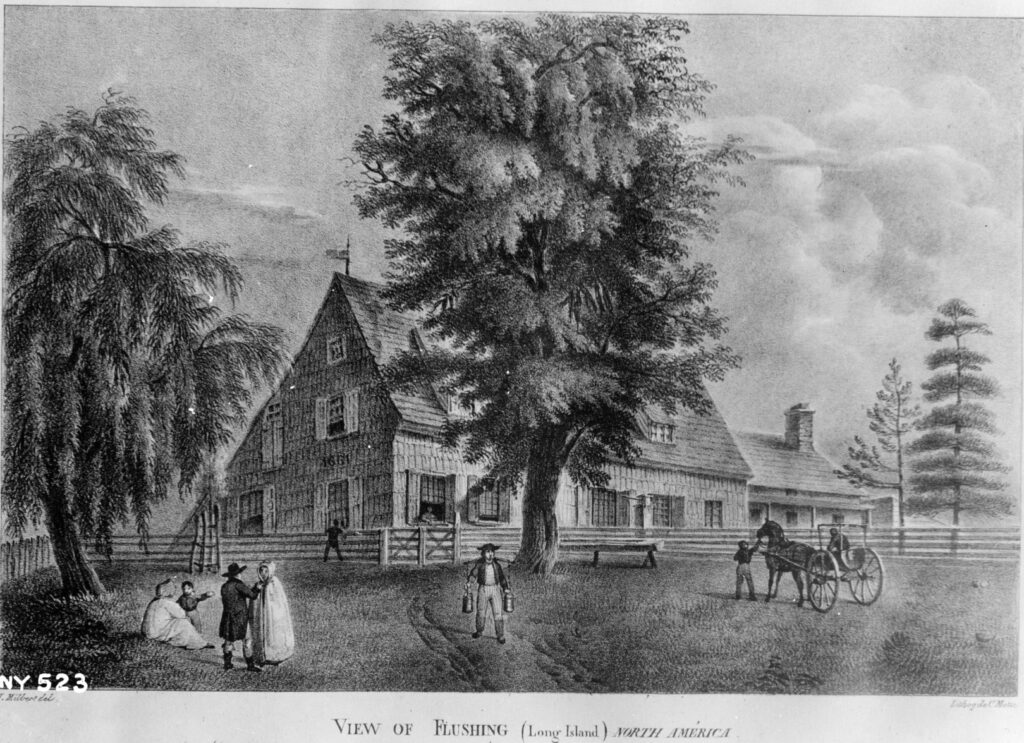
Bowne House, 37-01 Bowne Street, Flushing, Queens County, NY. Image courtesy Library of Congress

The Kings of Queens

The Bownes would become this region’s [i.e the region that would become Queens] most prosperous and politically important families. John Bowne’s home, built in 1661, still stands, one of New York’s oldest and most valuable historic places, a genuine treasure of preservation.

Thanks to John’s battle for religious freedom, the family name would also become a standard bearer for liberty in the years leading up to the American Revolution. Although applying that reputation more broadly is trickier. (For instance John Bowne “owned at least two slaves and an indentured servant.“)

Later descendants would become known as early American abolitionists including Robert Bowne, a contemporary of Alexander Hamilton and John Jay, who helped to form the Manumission Society of New York and later the African Free School.

But Robert would be better known for a publishing firm he established in 1775 — the financial printing house Bowne & Co, today New York’s oldest operating business under the same name.

All of this is to say — when Walter Bowne was appointed by the Common Council in 1839 to be the mayor of New York City, he brought with him the burden of high expectations.
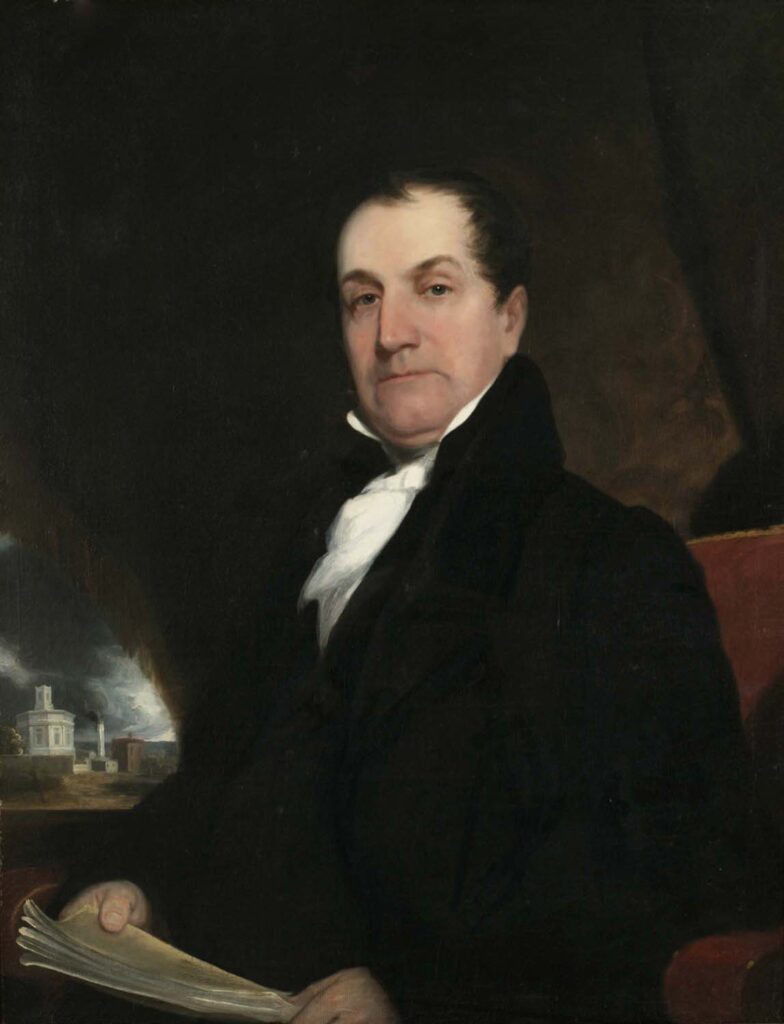
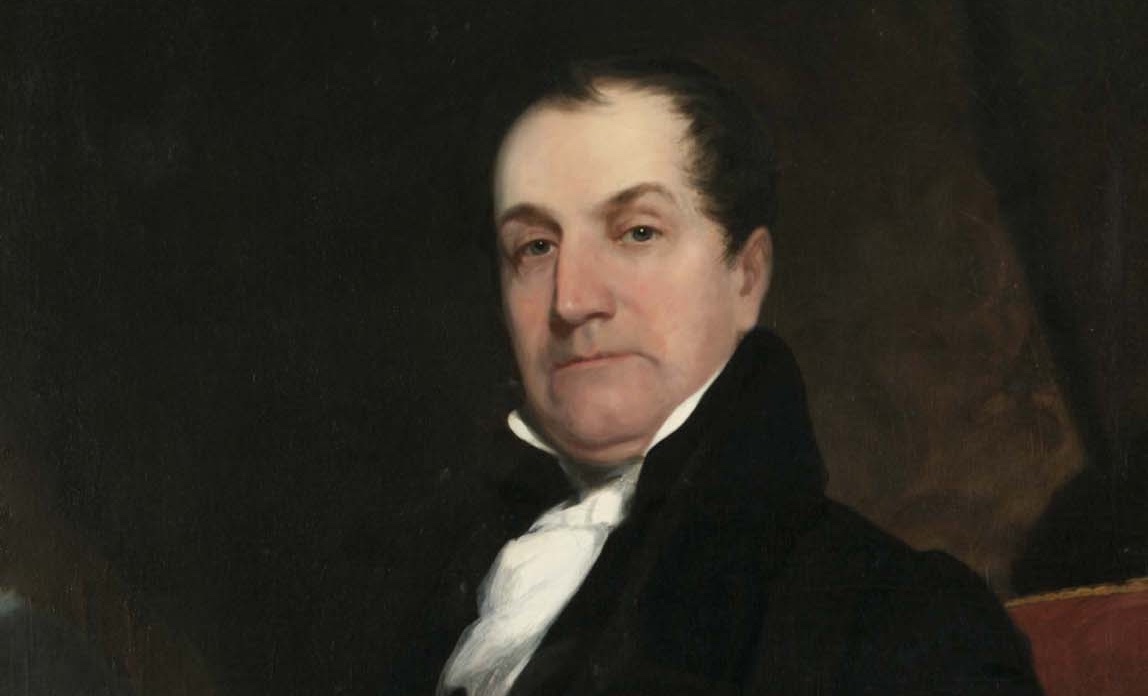
Portrait of Walter Bowne, dated 1833, by Robert Walter Weir. Courtesy City Hall Portrait Collection

Walter’s Rocky Start

Walter Bowne was of the genteel class which participated in politics during this period. He had also at one time been the Grand Sachem of Tammany Hall, the rising Democratic machine. So when he was first appointed mayor, serving in the year 1829, he was very much considered a machine politician.

But he was almost a one-and-done mayor. Tammany had narrowly lost the majority of Council members in 1829, placing a second year for Tammany’s leader as mayor in doubt. (Mayors were appointed for one-year terms at this time.)

But then Bowne made a controversial power move. According to Gustavus Myers’s A History of Tammany Hall:

“[In December 1829] Fourteen Aldermen and Assistants were opposed to Bowne and thirteen favored him. There was but one expedient calculated to re-elect him, and to this Tammany Hall resorted.

Bowne, as presiding officer of the Council, held that the Constitution permitted him to vote for the office of Mayor. “I will persist in this opinion even though the board decide against me,” he said.

To prevent a vote being taken, seven of Bowne’s opponents withdrew on December 28, 1829. They went back on January 6, 1830, when Tammany managed to re-elect Bowne by one vote. How this vote was obtained is a mystery.

Bribery was almost certainly involved in this sudden reversal of Bowne’s fortune.

An investigating committee into the events of January 6 was formed to inquire about this mystery, but as the committee was comprised of those who favored Bowne, no proof was ever discovered of such bribery.
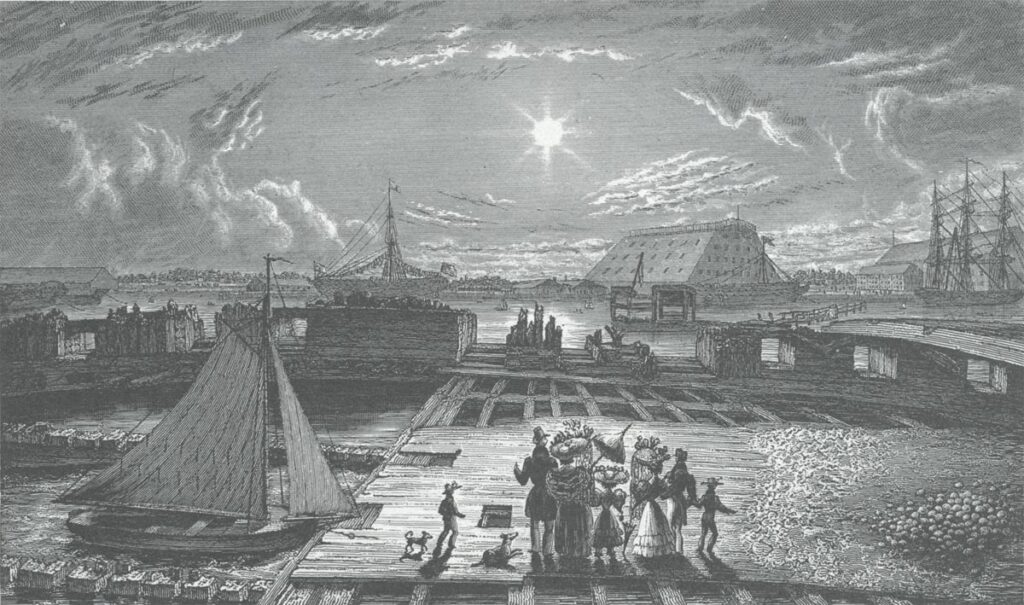
This image of the Brooklyn Navy Yard in the 1830s illustrates the types of pier infrastructure New York was using in these days. From the book Views in New York and its Environs, 1831.

Water and Docks

Bowne’s priorities were pure infrastructure. New York was in the middle of a water crisis with the growing city requiring more supply than its current local wells, cisterns and fresh water ponds could provide.

“We have the opinion of two prominent Civil Engineers that the Byram, Rye and Wompia Ponds will afford such supply,” the mayor declared, then casually mentioning the “Bronx, Saw Mill and Croton rivers” as other options.

But New York was waylaid by funding such a water project at this time, and Bowne was unable to get anything of immediate significance done by the time he left office in early 1833.

Two years later the Great Fire of 1835 underscored the urgency of an improved water system. The Croton Aqueduct system, bringing New York much needed water, finally opened in 1842.

New York’s other great priority was the Erie Canal which had opened in 1825.

Bowne was driven to action by the revered Henry Rutgers who died in Bowne’s first year in office. Rutgers had written to Bowne “expressing great anxiety lest our harbor, which has scarcely an equal in the world should be injured” by the continued building of wooden and dirt piers — ill-equipped to handle the growing international trade.

Under Bowne, work began on constructing an overall improvement of the waterfront for industrial use, with sturdier piers of stone and new warehouses.

This foresight would eventually benefit to growing steamship trade and another transportation revolution arriving soon — industrial railroad freight.
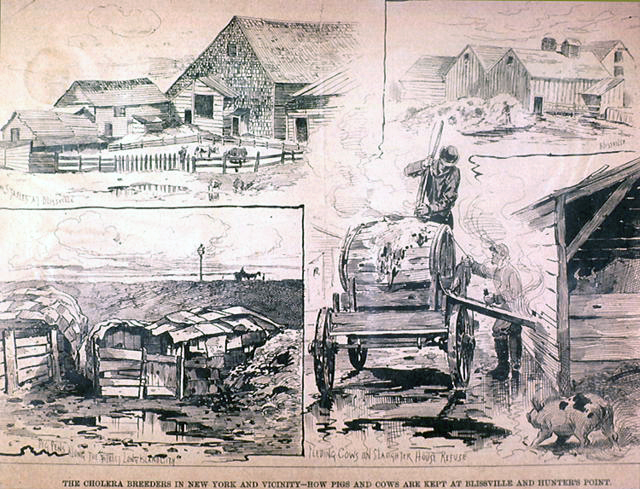
The Cholera Breeders in New York and Vicinity, n.d. (National Library of Medicine via the Merchant’s House)

Cholera Crisis

The ill-preparedness of New York for the full implications of trade were in full effect in 1832, when a major cholera epidemic came to the city.

The state of New York already had a quarantine hospital in Staten Island in place for arriving ships coming through the Narrows. But this did not prevent the disease from coming into the city from other directions.

According to Bowne House historian David Silvernail, “the [cholera] outbreak started in surrounding areas and to prevent it from reaching the city, Walter decided to enact a quarantine for all ships and carriages attempting to enter the city. This included all of the products and people on board.”

Bowne’s quarantine required that all ships keep at least 300 yards from the city’s ports. And carriages arriving from the north were stopped 1.5 miles from the city limits. 

Under Bowne the city also engaged in a vigorous clean-up of its streets (although as Bowne House historian Silvernail reveals, the efforts were inadequate):

“Bowne’s well-meaning attempts to prevent a cholera outbreak failed, and hundreds of New Yorkers died of the disease,” according to NYC Parks. “It was not until 1883 that the German physician Robert Koch discovered that cholera spreads through contaminated water or food.”
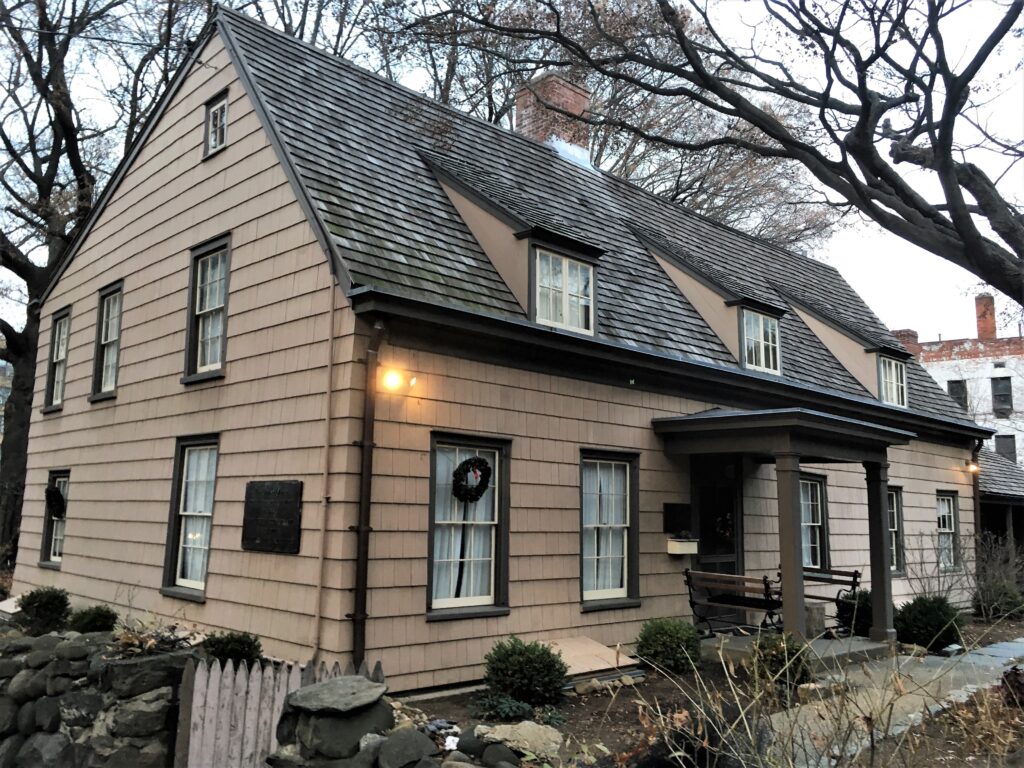
The Bowne House, photographed in 2018 (Station1, courtesy Wikimedia Commons)

A Lasting Landmark

Bowne left office in early January 1833 and, among other things, became the president of 7th Ward Bank of New York City. At times he also retired to his summer home in Flushing, the location of which is today’s Bowne Park. Bowne died in 1846.

New York enjoys many locations associated with the Bowne family. On top of Bowne Park and the Bowne House — both perfect places to visit this fall — Bowne & Co. Stationers provides a glimpse into America’s printing legacy in a rustic shop at the South Street Seaport.
Categories
On The Waterfront

Hidden Waters of New York City: Interview with author Sergey Kadinsky

Sergey Kadinsky is our city’s resident Aquaman. His Hidden Waters of New York City was the big New York City exploration guide book of the spring. In a city often characterized by glass, steel and asphalt, it’s magical to consider the metropolis almost like a human body, comprised and reliant upon water for its well-being.

As though armed with a magical divining rod, Kadinsky identifies almost every significant body of water that ever existed in the five boroughs — from ancient reservoirs to the most obscure Staten Island pond — providing modern context and directions for locating them  using public transit.  It’s a combination history book, hiker’s guide and trip planner.  My copy is presently dog-eared in about twenty places with living streams and lakes that I intend to visit this summer for my own personal mini vacations.


Jacket.aspx

But the waterways that are no longer here are, in a way, even more intriguing, highlighting how New York was often sculpted around bodies of water before they were filled in or buried with the modernity of the city.

And there are a surprising number of old waterways that have disappeared relatively recently. For instance Jackson Pond in Queens. According to Kadinsky: “In 1966, the lake was dried and covered with concrete after the city determined it to be an unsafe ice-skating site.” Oh, but a Jackson Pond Playground sits upon the ghostly outline of this forgotten water today!

How do you even begin putting together such an ambitious project? Kadinsky is well suited for the task. He’s a long-time Queens resident, staff member at the New York Parks Department and an adjunct professor of history at Touro College. I asked Kadinsky a few questions about how his project came together:

Your book really identifies New York’s inescapable connection to water in almost every aspect of its history.  How did you develop the idea to find every water sources (past and present) and put them together in a guide book?

For more than a decade preceding the book, I’ve worked as a Gray Line tour guide, newspaper reporter and Touro College adjunct. These experiences gave me an ability to tell a story in a an easygoing, detailed, and captivating manner.

In my spare time, I led tours and contributed stories to Kevin Walsh’s Forgotten-NY, a blog that has become a book and subject of tours and lectures. It inspired me to think of a specific hidden city element that I felt was not receiving its due.

Seeing the success of Sharon Seitz and Stuart Miller’s book Other Islands of New York City, I remembered my childhood exploring the backyard brooks of Riga, Latvia, and my parents’ home a block away from Meadow Lake in Queens and a rare grid-defying street on their block. I then recognized that I’ve found my niche.

That’s how Hidden Waters of New York City came to be. Other Islands is a blend of history, travel, and geology, with a journalist’s eye for detail and research. I followed its method in documenting the hidden waterways.

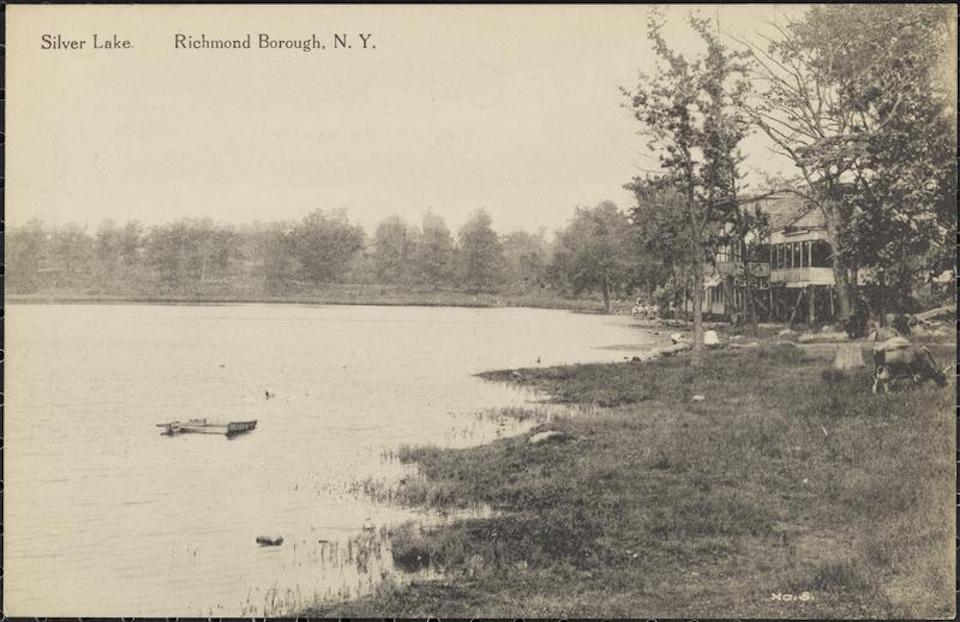
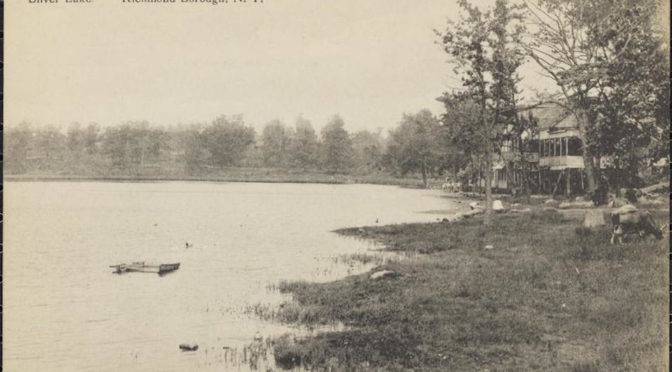
Silver Lake in Staten Island, photographed here in 1915 (and featured on pgs. 246-248 in Kadinsky’s book. Photo courtesy Museum of the City of New York

Courtesy Museum of the City of New York

Hidden Waters feels something like a hiker’s guide to the city.  How much walking around and on-foot exploration did you do while researching it?

When it comes to exploring streams that have become sewers, I’ll leave this task to Steven Duncan. Likewise, when it comes to abandoned properties, I’ve found Nathan Kensinger’s reporting helpful in my research. I took a Circle Line around Manhattan and a Seastreak to Sandy Hook, but have yet to take a boat tour of Newtown Creek or a paddle a canoe down the Bronx River.
I explored the streams on foot and bike, following their banks and recognizing the disparity in public waterfront access. While it is possible to almost entirely circumnavigate the shoreline of Manhattan thanks to ribbons of parkland, places like Bowery Bay and Flushing Bay are not as accessible. Only a few dead-end streets allow for views of the water, and the water is not so fine.

As a historian and Parks Department analyst, I had access to old maps, reports, and photographs. There’s plenty of exploration that you can do at your desk or online. The Municipal Archives, New York Public Library, and Museum of the City of New York have excellent online resources on the city’s past. Finally, for GIS aficionados, the DoITT NYCity Map is second to none, followed my the NYPL Map Collection, and MCNY’s Mapping Staten Island online exhibit.

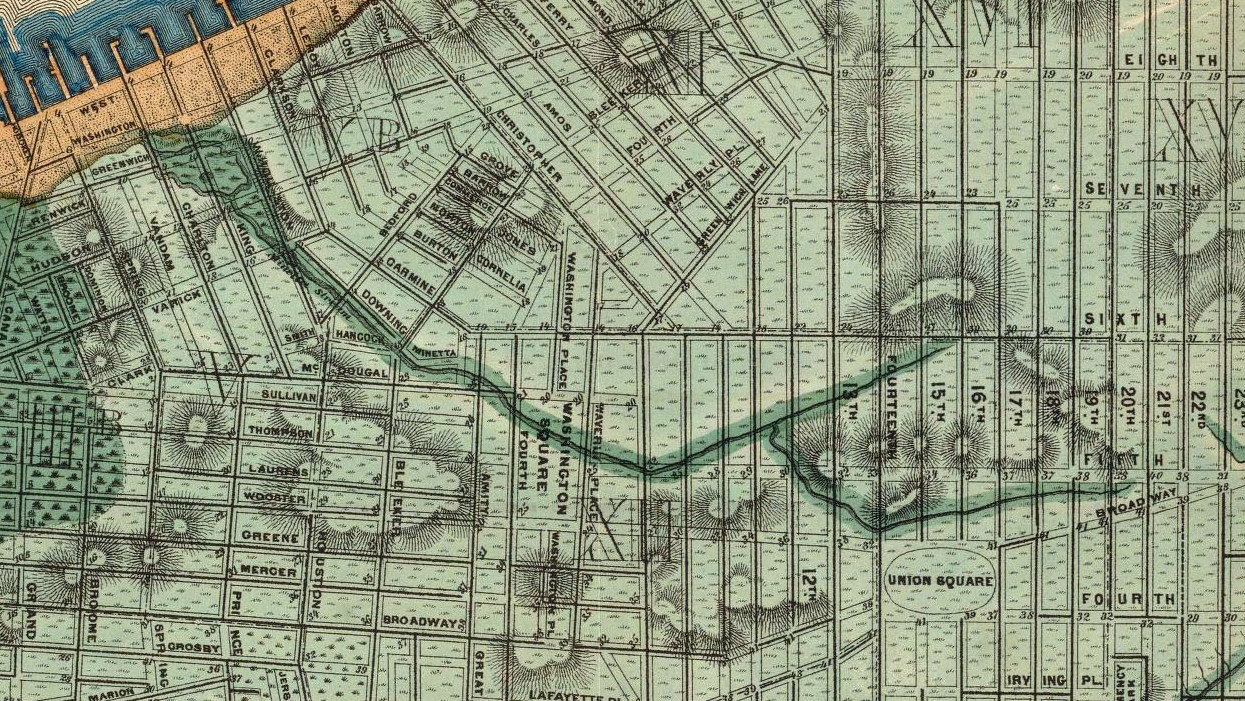
The path of old Minetta Creek from Egbert Viele’s Sanitary & Topographical Map of the City and Island of New York (1865). 

Minetta_Creek

Perhaps the most famous body of water in Manhattan in one that doesn’t really exist above ground – Minetta Brook. You’ll find its name everywhere and, as you mention, it’s dutifully traced by tour guides. What accounts for its appeal and does it truly exist as strictly an underground stream today as some claim?

Minetta Brook’s place in local lore goes back to the Native period, when it was believed to be possessed by a spirit. The neighborhood’s love of history and storytelling ensured that it would never be forgotten, surveyors laid out the streets and with local culture in mind, Minetta Lane and Minetta Street appeared on the map.

In the 19th century following its burial, flooding in basements built along its former course was a persistent problem. Engineer Egbert Ludovicus Viele dutifully noted and mapped these floods and ascribed them to Minetta Brook. He preceded me by 150 years in tracing Manhattan’s hidden waterways.

The 1938 extension of Sixth Avenue though Greenwich Village created small triangular parks near the brook’s former course- another opportunity to restore it to the map with Minetta Green and Minetta Playground. Historical preservationism, tourism, and a way of imagining a pre-urban Greenwich Village, all appeal to Minetta Brook’s popularity.

I do not think that the brook is flowing today underground along its former course. Its sources in the Flatiron District have been covered entirely with buildings. Streets running atop its course have sewers that do not follow the stream bed’s path. Nevertheless, the soil is much softer where creeks once flowed, and that helps explain for the flooding and groundwater. Even the famous well at Two Fifth Avenue could simply be ground water not necessarily associated with Minetta Brook, though the location makes sense.

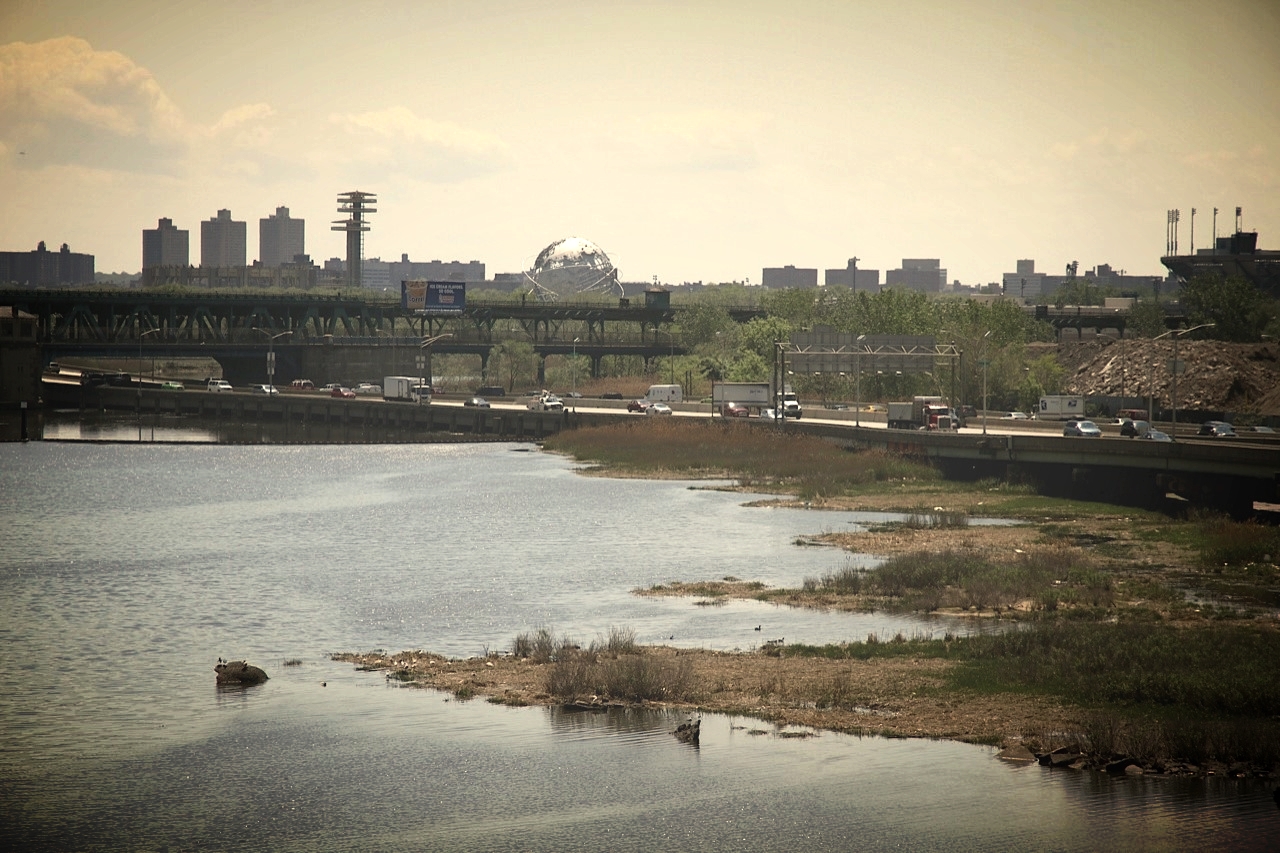
Flushing Creek, with the sites of the old World’s Fair in the distance.

Photo courtesy Friends of Flushing Creek

What is personal favorite body of water in the New York five boroughs (exempting  the Hudson and East Rivers of course)?

Flushing Creek, because it’s a block away from my parents’ home and a five minute drive from my home. Unlike Gowanus Canal, Newtown Creek and Bronx River, this creek does yet not have a grassroots citizen-led conservancy group. The creek flows through a series of conditions such as a nature preserve, a recreational lake, a canal beneath highways, a tunnel, Willets Point, and into Flushing Bay.

The creek was a former salt marsh turned ash dump turned fairground turned park. There was talk in 2008 of daylighting the underground sections of it, but heavily used soccer fields are in the way. The creek was also slated for a grand prix racetrack in the 1980s and an Olympic venue in the past decade.

Adding to the subject are the creek’s tributaries, Mill Creek in College Point, Kissena Creek, and Horse Brook, which also are worth mentioning considering their rich histories.

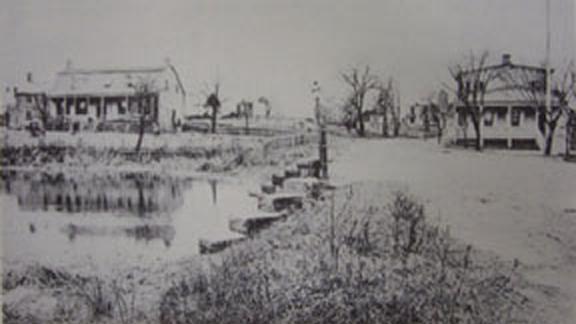
Coe’s Mill on Horse Brook

Courtesy Hidden Waters blog

You mention a great number of old waterways that were completely unknown to me. What was the most surprising discovery you made in your research?

This one is very close to home, Coe’s Mill on Horse Brook, which was demolished in 1930 to make way for what would become the Long Island Expressway.

Not enough books mention the English settlers who lived in New Netherlands having fled England and New England in search of religious freedom. Feeling a lack of respect and recognition from the Dutch, they petitioned England to annex the colony. It was like our own Crimea.

Unlike the Bowne House in nearby Flushing, nothing is left of Coe’s Mill. The mill provided food for the settlement of Newtown, one of the original towns of Queens that is now known as Elmhurst. Seeking a path of least resistance when it came to acquiring land for a road, the city built the Long Island Expressway atop the filled stream bed.

A year ago, I wrote a letter to Councilwoman Julissa Ferreras-Copeland, whose district covers this site, requesting to rename a nearby footbridge after the mill, and I have yet to hear back from her.

Alley Pond Park in 1936, before it was rudely interrupted with highways.

Courtesy Museum of the City of New York

Getting back to the notion of Hidden Waters as a pure nature guide, where would you direct people to go in the five boroughs if they really a little bit of the feeling of ‘getting away from it all’?

Alley Pond Park has the creeks and scenery but because it has highways running through it, it’s difficult to appreciate the place. Even deep in the woods where you can’t see any civilization, you hear cars whooshing nearby. That’s why the Greenbelt in Staten Island is truly the get away park in the city. It has forests, creeks and ponds, but no sounds of motorists driving past.

Check out Sergey’s truly excellent Hidden Waters Blog for more information on New York’s fantastic water sources. His book is currently on book shelves


Categories
Queens History

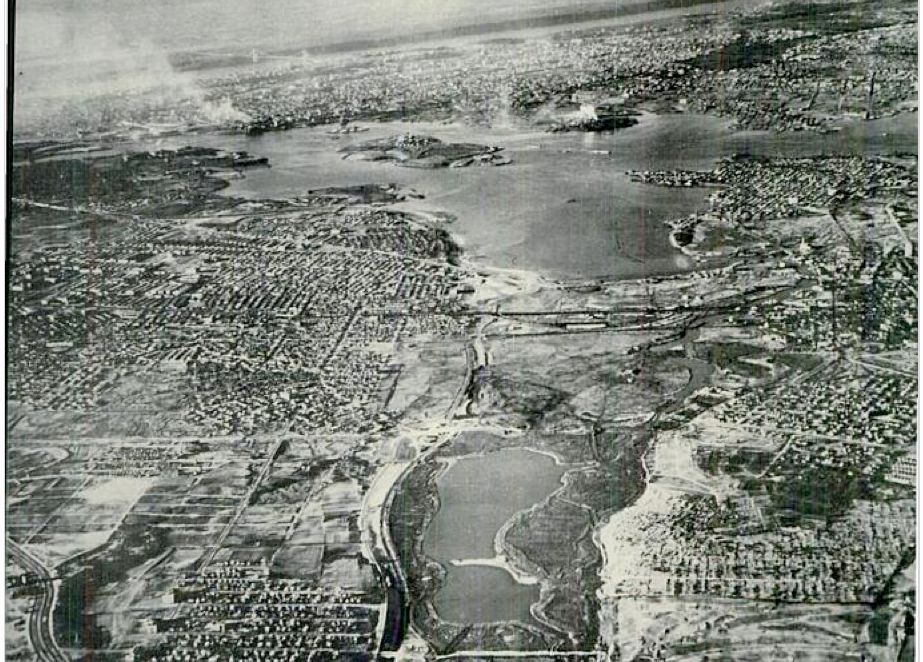
The Corona Ash Dump: Brooklyn’s burden on Queens, a vivid literary inspiration and bleak, rat-filled landscape

Ah, take in the horrid reality of the Corona marshes with their ashes, manure and garbage! (Courtesy CUNY)

Outside of probably Hell, there is no literary landscape as forlorn and soul-crushing as the ash dumps of Corona, Queens.

This is the valley of ashes,” writes Fitzgerald in The Great Gatsby, “a fantastic farm where ashes grow like wheat into ridges and hills and grotesque gardens; where ashes take the forms of houses and chimneys and rising smoke and, finally, with a transcendent effort, of men who move dimly and already crumbling through the powdery air.”

The Corona ash dump was a stain on Queens every bit as real as Fresh Kills landfill would later be on Staten Island, a repository for the detritus from Brooklyn coal furnace that created crud-caked mountains amid a salty marsh.

The salt marshes sat relatively untouched, along with other large stretches of the newly formed borough. The Brooklyn Ash Removal Company moved here in 1909 after it outgrew its dumping grounds on a small island in Jamaica Bay named Barren Island.  (The island no longer exists per se; landfill connected it to the mainland and Floyd Bennett Field was built there in 1930)

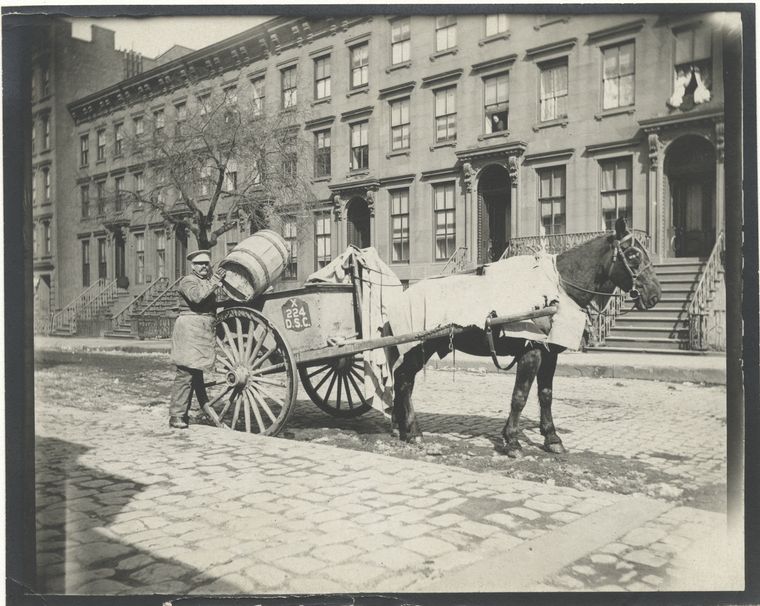
Below: A sanitation worker carting carting away a full barrel of ash. The open cart would be filled, taken to barges, then sent to far-away dumps. In the 1910s, Brooklyn ash went to Corona. {NYPL}

With the increase of coal-burning furnaces in the late 19th century, the city had yet another sanitation crisis sullying the streets.  Even by 1910s, New York was trying to clamp down on the situation — literally — attempting to get residents and private businesses to cover their ash carts and containers “as to protect pedestrians from the annoyance of flying ash dust.” [source]

In Queens, mountains of choking, awful ash made for poor living conditions for neighboring Corona on one side, Flushing on the other.  It was a constant eyesore for early commuters, as the Long Island Railroad went right past it, as did the main thoroughfares of northern Long Island — roads taken by many of the wealthy ‘Gold Coast’ families.

One ash pile was so large — almost 100 feet — that it was christened Mount Corona.  And of course it wasn’t just ash; barges filled with animal manure docked here as well, awaiting local farmers who used the waste as fertilizer.

And new menace was introduced in 1920  — an infestation of rats. “War Declared Upon Rats,” declared the New York Times. An army of exterminators were sent to wipe out the colony of rats that lived among the ashen meadow dumps.

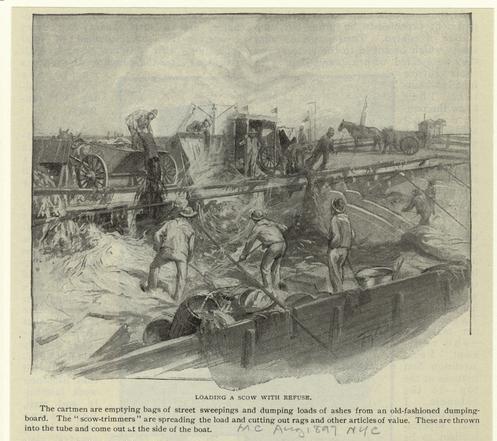
Below: From 1897, loading a scow full of ash to be taken to the local dump (NYPL)

Believe it or not, the Brooklyn Ash Removal Company tried to convince residents that presence of the grim, brimstone terrain next to their homes was getting rid of pests. When they were taken to court in 1923, “charged with permitting dense smoke to issue from the dumps,” they claimed the dumping grounds were good for the salt marshes, as they helped rid the neighborhood of mosquitoes!

With the population of Queens almost doubling during the 1920s, it seemed the days of the Corona Ash Dump were numbered. Enter Robert Moses, with his dreams of a large and spectacular park for the growing borough.  He swiftly moved in, bought all the marshland, all the mountains of ash, and filled in wetlands and the dark hills to create Flushing Meadows-Corona Park.  If you’ve been to Citi Field or the Billie Jean King Tennis Center, then you have sat upon land that was once the Corona ash dumps.

Categories
Pop Culture

The Broadway Melody: New York’s first Oscar victory and an ironic success for the Astor Theatre in Times Square

The second film to ever win the Academy Award for Best Picture was hardly a movie at all.

‘The Broadway Melody’, a frothy Hollywood revue about the mounting of an frothy Broadway revue, was a total celebration of every strength and weakness of the early Broadway stage, and a hopeful sign that the New York entertainment world would still wield some influence over its West Coast counterpart.

“Before an enthusiastic throng there was launched last night at the Astor Theatre a talking picture teeming with the vernacular of the bright lights and back-stage argot,” began the New York Times’ original review by Mordaunt Hall, when the movie opened on February 8, 1929.

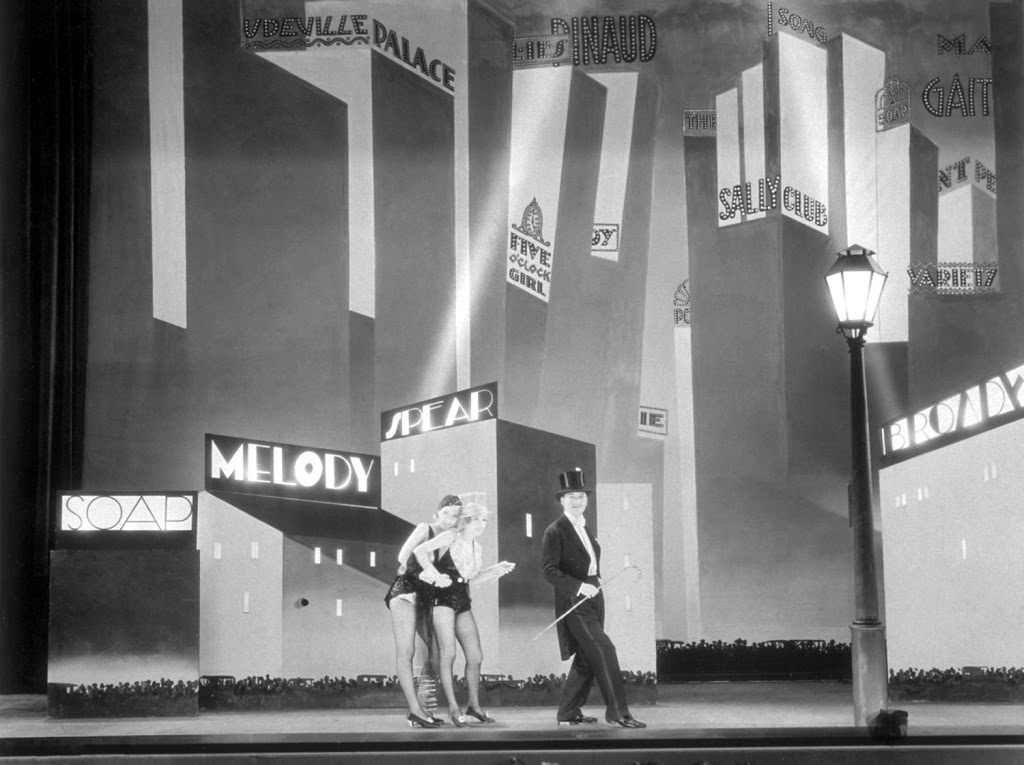
One of the first-ever movie musicals, ‘Broadway’ was, of course, not filmed on Broadway, but in Hollywood, on an MGM soundstage.  Even when movies were regularly filmed in New York in the early years, they were rarely filmed on an actual Broadway stage.

But the movie’s opening shot is within an office on Tin Pan Alley, that sector of songwriters at 28th Street and Broadway who changed American pop music.  The melody of the film’s title is delivered to Zanfield (a thinly disguised Florenz Ziegfeld) who uses it as a vehicle to make stars out of a couple freshfaced sisters.

The puffy love triangle at the heart of ‘The Broadway Melody’ is merely an excuse to launch various musical numbers in the vaudeville-variety style.  The movie was produced at astonishing speeds; filming began in October 1928 and was ready for its two-city premiere (Grauman’s Chinese Theater in Los Angeles, the Astor Theatre in New York) by early February.

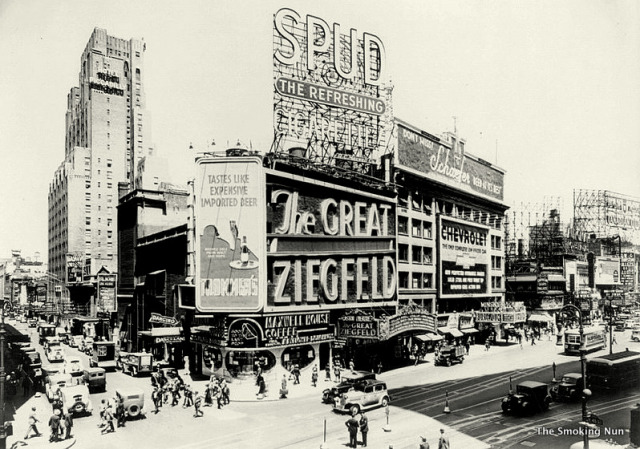
The Astor Theatre, in Times Square at Broadway and 45th Street, played host to ‘The Broadway Melody’ for an entire year.  Some might have thought that deeply ironic, as the Astor had once been a legitimate stage that permanently switched to motion pictures in 1925.  And with great success it was now exhibiting a motion picture about the legitimate stage.

Below: The Astor Theatre in 1936, exhibiting another Broadway-themed film that would go on to win the Oscar for Best Picture —  The Great Ziegfeld (Courtesy LOC)

It’s been claimed that the film was made by MGM’s Irving Thalberg on a suggestion from the owner of the Capitol Theatre, up the street from the Astor.  If so, its debut here must have been a real slap in the face!

In this tenuous day of movie sound, many were unsure people a film with music would work.  “Although the audible devices worked exceedingly well in most instances,” Hall continued in his review, “it is questionable whether it would not have been wiser to leave some of the voices to the imagination, or, at least to have refrained from having a pretty girl volleying slang at her colleagues.”

Audience members, especially those in the Astor’s $2 reserved seats, were rapturous for it.  “‘Broadway Melody’ has everything a silent picture should have outside of its dialog,” praised Variety in 1929.  A basic story with some sense to it, action, excellent direction, laughs, a tear, a couple of great performances and plenty of sex….It’s perfectly set at the Astor.  And will it get dough around the country. Plenty.”

At right: Anita Page, one of the stars of ‘The Broadway Melody’, from Flushing, Queens!

The very first Academy Awards the previous year had rewarded serious fare — and all silent.  The first Best Picture winner, ‘Wings‘, had also been a big box office hit in New York, making its debut in August 1927 at the Criterion Theater, just one block away from the Astor!

But Oscar voters went carefree for their second Best Picture winner. Additionally, ‘The Broadway Melody’ became the first sound picture to be awarded the Best Picture Oscar. And the first of a great many to find inspiration in that great big city on the opposite coast.

It would also introduce a lasting connection between the movies and stage musicals, a connection that still lasts today with the Oscar-nominated ‘Les Miserables’, which had its Broadway debut on March 12, 1987 at the Broadway Theatre (Broadway and 53rd Street).