Categories
Amusements and Thrills

The Monster Tree: A California Sequoia Visits New York City 1855

The mighty Sequoia tree,  principally existing today in northern California, embodied the breathtaking diversity of the North American continent when it was first discovered by European explorers in the 1830s.  The Native American tribes of the west coast revered them.  Early European explorers too marveled at this display of nature’s great flourish, spinning fantastic tales of ‘monster trees’ that breached the sky.
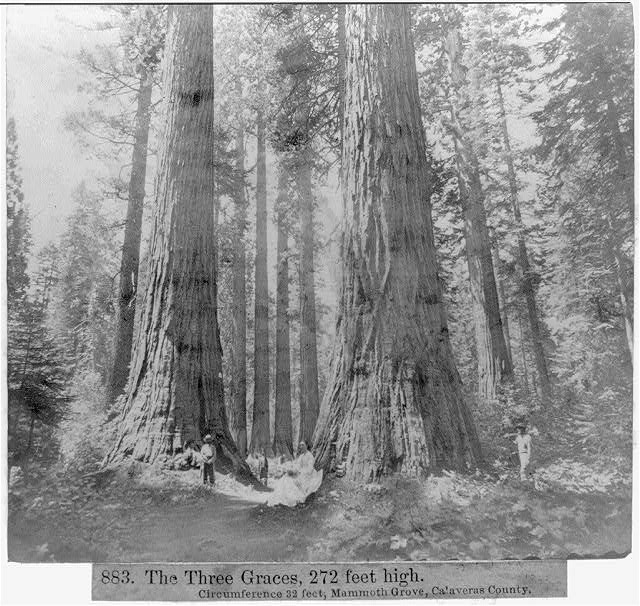
From a photograph in 1866 -- The Three Graces, 272 feet high, circumference 32 feet, Mammoth Grove, Calaveras County (Library of Congress)
From a photograph in 1866 — The Three Graces, 272 feet high, circumference 32 feet, Mammoth Grove, Calaveras County (Library of Congress)


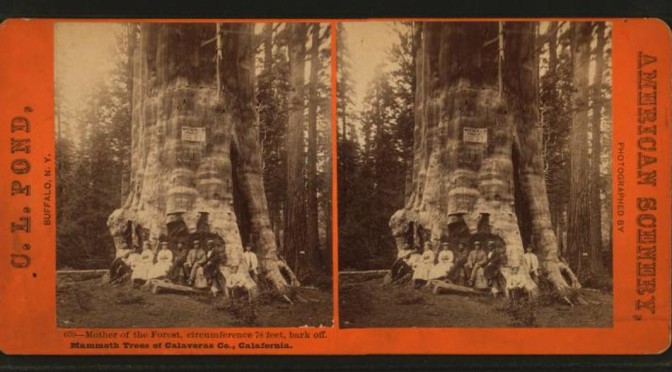
The legends were proven true in the 1840s at the start of what would become known as the California Gold Rush.  The first hotel, monopolizing on the wondrous discovery, was built near a Sequoia grove in Calaveras County. Each of the trees were given nicknames like ‘The Salem Witch’ and the ‘Old Bachelor’. **  But the grandest was ‘Mother of the Forest’, 363 feet tall and thousands of years old.

So naturally in 1854, the Mother of the Forest was stripped of much of its its bark and taken on a tour of the east, courtesy the entrepreneur George L Trask.

The Mother of the Forest, pictured with 78 feet of the tree’s bark already removed.
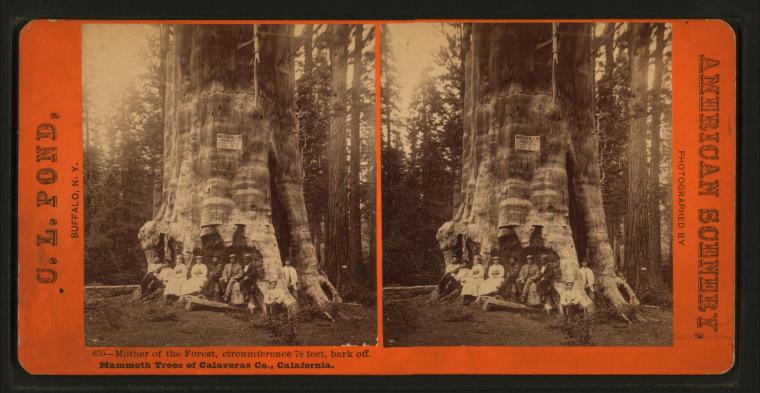
Courtesy New York Public LIbrary


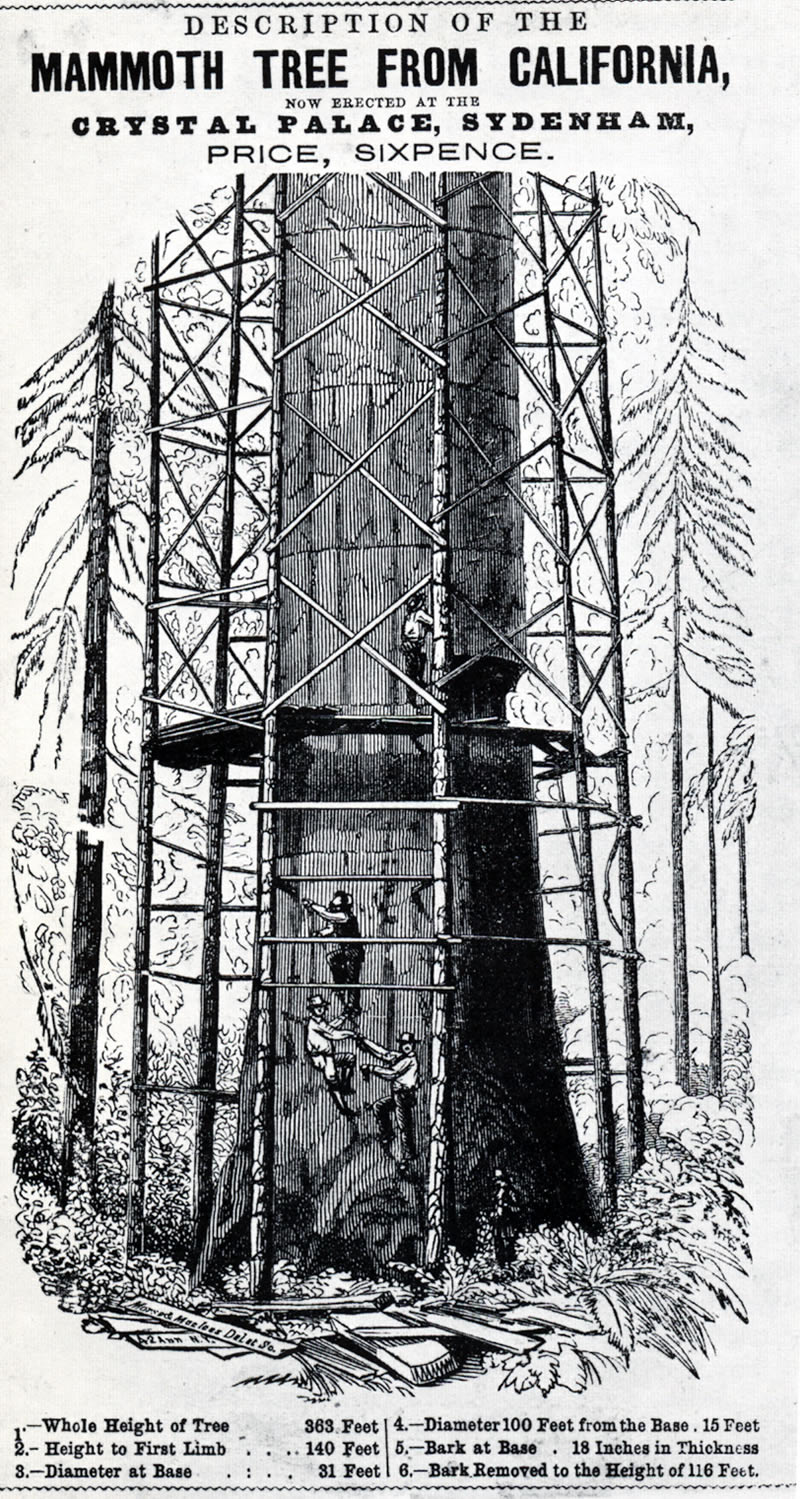
The  bark was carefully sheared from the tree, to a height over 110 feet. The disembodied bark was then “carted overland 80 miles to Stockton, whence it was shipped down the river to San Francisco, and then on a clipper vessel around Cape Horn to New  York.”  It arrived sometime in early 1855 for a grand display in the city.
tree2

But where in New York City in 1855 could you exhibit such a gigantic thing? Why, there was only one place — the Crystal Palace.

The famed Exhibition of the Industry of All Nations – detailed in our podcast on the Crystal Palace – had recently closed, a well-publicized financial failure. However the Palace structure remained open for visitors and the Latting Observatory across the street was still attracting audiences.  (It would not burn down until the following year.)

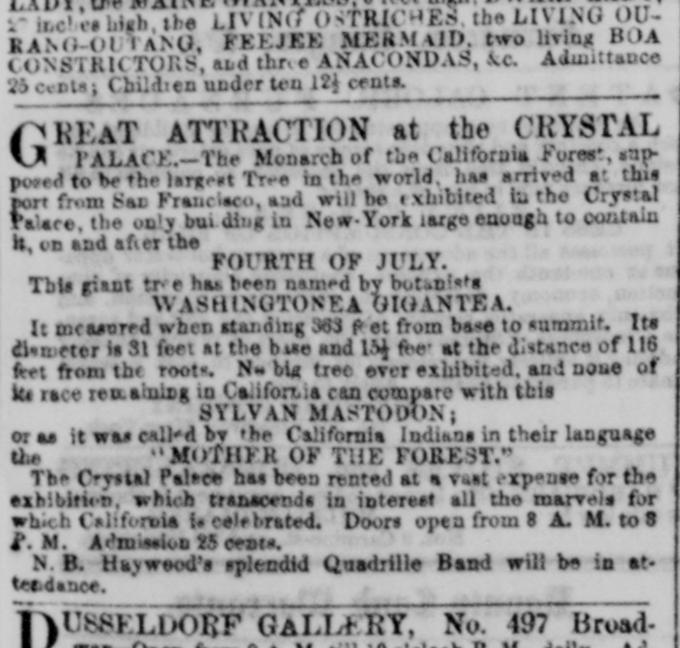
That summer, on July 4th, 1855, the tree bark, laid over a tall scaffolding, was carefully reconstructed in the Palace at the very spot where the George Washington equestrian statue once stood. An appropriate spot, as the exotic trees were originally given the scientific name of Washingtonea Gigantea.

Alongside the constructed tree were a display of daguerreotypes of the tree in context with the forest, well before she was stripped of bark.

Below: From a listing in the New York Daily Tribune, July 6, 1855:
2

It was promoted with a certain Barnum-eque style although without Barnum of course. (His failed tenure as the Crystal Palace president has soured him to the spot immeasurably.)  According to the New York Sunday Courier, over 7,000 visitors came on the first day to admire the tree.

Even a few jaded journalists of the age were impressed by the tree. From a short-lived newspaper called the Leader, under the headline, “The Eighth Wonder of the World – the Mammoth Tree”:

“We have paid a visit to the Crystal Palace and have been gratified beyond our most sanguine expectations. We supposed that this concern was closed and that we should find nothing to please the eye beyond naked walls and vacant space; but, judge of our astonishment, when we found the space under the dome occupied by one of the greatest curiosities of the age….

Sebastapol has not been taken yet [a reference to a lengthy battle in the Crimean War] but this towering monarch of the forest has, and is now in exhibition at the Crystal Palace.”

Because the tree was so clearly cobbled together from parts, others rationally questioned its validity.  From the New York Times, August 8, 1855:

“We very much enjoyed [the tree] but so we did the Automaton Man and the Charmed Snake story … and several other things which a more curious examination of reveals as belonging to the department of questionables.

[W]e have no assurance, from seeing this clothed skeleton, that this tree was actually so large. A little skepticism is somewhat pardonable, taking into account the temptations held out to those who recollect the proverbial gullibility of New York site-seers.”

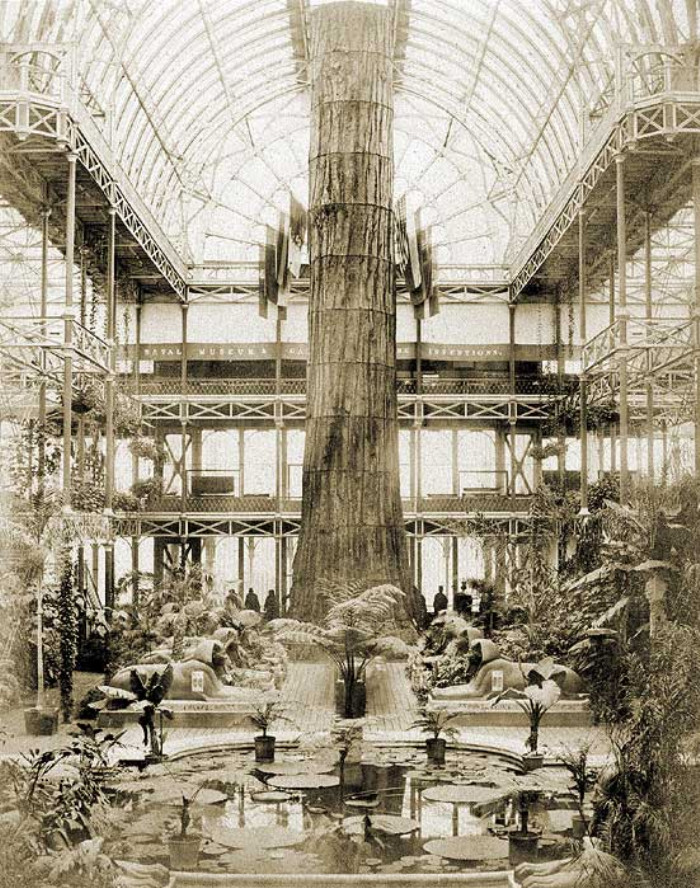
The journeys of this poor tree husk were not quite done.  After the New York display, the pieces were placed upon a ship and taken to London to be displayed at their Crystal Palace.  In 1866 a fire swept through London’s Crystal Palace, destroying this remainder of the Mother of the Forest.

The tree as it appeared at the London Crystal Palace, 1856
3


**By the 1860s most of the trees would be given names. There were even specimens named for Henry Ward Beecher, Daniel Webster and — William Cullen Bryant! (source)


Categories
Uncategorized

Where are New York City’s oldest living trees?

The oldest living New Yorkers outdate all the skyscrapers, the highways and the parks in which most of them live. They have seen generations of New Yorkers come and go. And at least one of them even remembers the region’s original indigenous people.

We’re talking about the native trees of New York City, those that were planted naturally and not transplanted from elsewhere, giants that have weathered storms and interactions with humans long gone.

Of course it is impossible to know with absolute certainty the oldest trees as not every single one has been measured. There are, in fact, according to MillionTreesNYC, 5. 2 million trees in New York City, about a tenth of which are actually on the streets.

Some other wonderful trivia from MillionTreesNYC:

“– Standing trunk to trunk, New York City street trees would form a line 118 miles long–the distance from Manhattan to Hartford.

— Number of tree species: 168

— Percent of land covered in trees: 24%  “

I was not able to find complete info for all five boroughs, and I will indicate where I could not come to a definitive answer. If you have any leads, please post them in the comments section.

I’m obviously no arborist, so the details below are based on the research of others. However maybe someday I’ll trek out to these various sites armed with a tape measure and an layman’s knowledge on how to evaluate tree age.

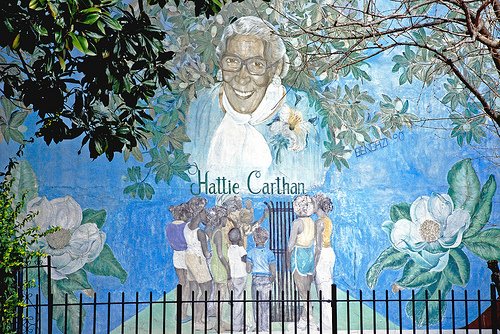
Hattie Carthan, Brooklyn’s tree saviour

BROOKLYN
It appears that the oldest tree in the borough — among, as Betty Smith well knows, the many, many trees that grow in Brooklyn — is undetermined. Most likely it sits in Prospect Park which contains most of the borough’s remaining natural forest — about 100 acres.

Formerly, the title holder was a 220-year old black oak which once stood here; sadly it uprooted during a storm many years ago and tumbled into the ravine.

However, one of Brooklyn’s most famous trees sits in the neighborhood of Bedford-Stuyvesant — a southern magnolia tree Magnolia Grandiflora, brought to Brooklyn from North Carolina in 1885 and located near 667 Lafayette St.

It happens to be the only landmarked living tree in the city, thanks to community leader and nature lover Hattie Carthan, back in 1970.

BRONX
With the borough’s thousands of acres of park land, the real candidate for borough’s oldest may as yet be undiscovered.

However, the leading candidate is currently a handsome white oak tree around the 18th hole of the Split Rock Golf Course in Pelham Bay Park. The oak is well ‘over 200 years old’ although its location by a golf course can’t be good for its health.

Hangin’ around with New York’s oldest and most legendary elm

MANHATTAN
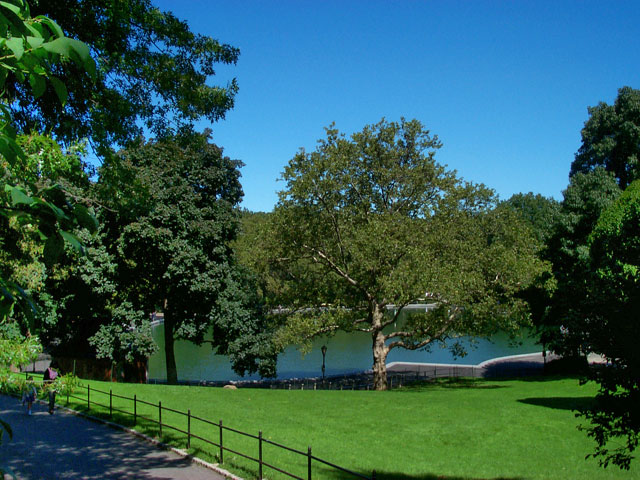
One might naturally assume Manhattan’s oldest tree must be in Central Park. It’s a very manicured place though, and most of its older vegetation was transplanted here. However, the great London plane tree near the Reservoir (pictured below) is said possibly pre-date its construction in 1862.

There are two other candidates for oldest tree on the island. One is in Washington Heights, a 110-foot elm at 163rd Street and St. Nicholas. Known as the Dinosaur, it reportedly shaded George Washington as he surveyed his shifting fortunes during the Battle of Washington Heights.

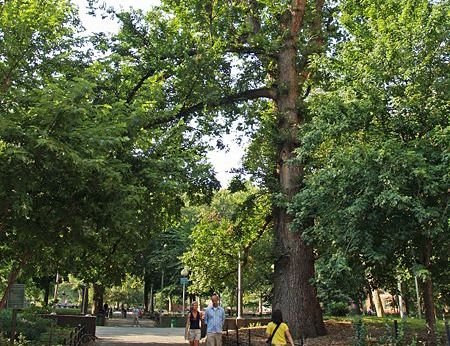
The most renown candidate is, of course, the Hangman’s Elm, in Washington Square Park. At a reported 310 years old, this arboreal old man in the northwest corner of the park most likely never really saw any hangings as its legend indicates, but its certainly fun to morbidly gander at its branches.

The top two candidates for New York’s oldest tree have been the fascination of tree lovers since their discovery.

Below: The London plane tree near the Reservoir, most likely Central Park’s oldest tree (pic courtesy Central Park 2000)

STATEN ISLAND
The two oldest trees in New York happen to be tulip trees, a common tree of the region named for its flower-shaped leaves. The charming Clove Lakes Park, at Forest Avenue and Clove Road, takes its name from the Dutch word “kloven” or cleft. Its granddaddy entry into the tree race is known as the Clove Lakes Colossus is a monstrous 119 feet tall with a circumference of 21.4 feet.

It’s reported to be well over 300 years old, predating all but the most rudimentary European settlement here in Staten Island. It’s actually a thicker tree than the tulip which is New York’s oldest, but that’s due to more ideal growing conditions. Unlike many other ‘oldest tree’ candidates, Clove Lakes takes good care of its elders, easily located at the park’s north end near a paved path.

QUEENS
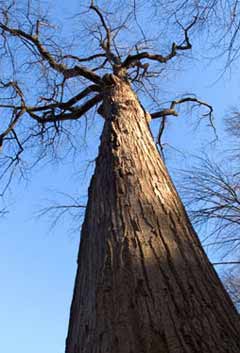
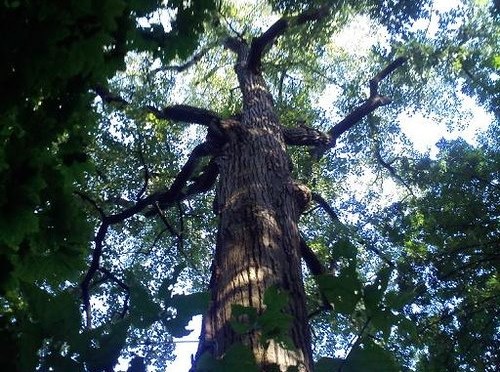
Say hello to the Queens Giant (pictured at top), the grandmother of all native New York City plants. Located along a secluded trail in Queens’ Alley Pond Park, this monster is also one of the city’s tallest trees at 133.8 feet — just 20 feet shorter than the Statue of Liberty.

It may be one of the few remaining living things from the era before Henry Hudson sailed into New York harbor, with its age calculated at anywhere from 350 to 450 years old. This would make it one of New York’s truly extraordinary natural features. Interestingly, in the past, the city has taken a stance of ‘benign neglect‘ to the tree, arguing that it shouldn’t be better accessed in order to protect it.

Revised from a previous article which ran in 2009