Categories
Planes Trains and Automobiles

The Dual Contracts: The New York City subway system gets a serious upgrade 100 years ago today

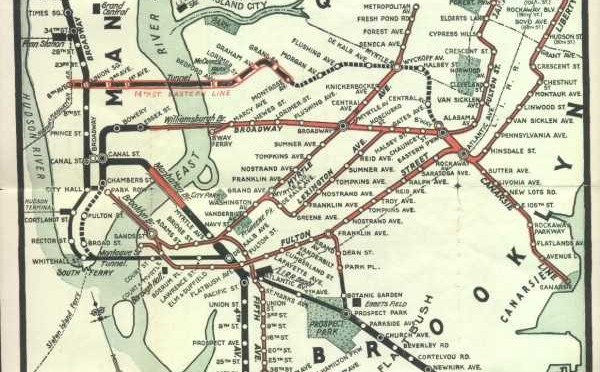
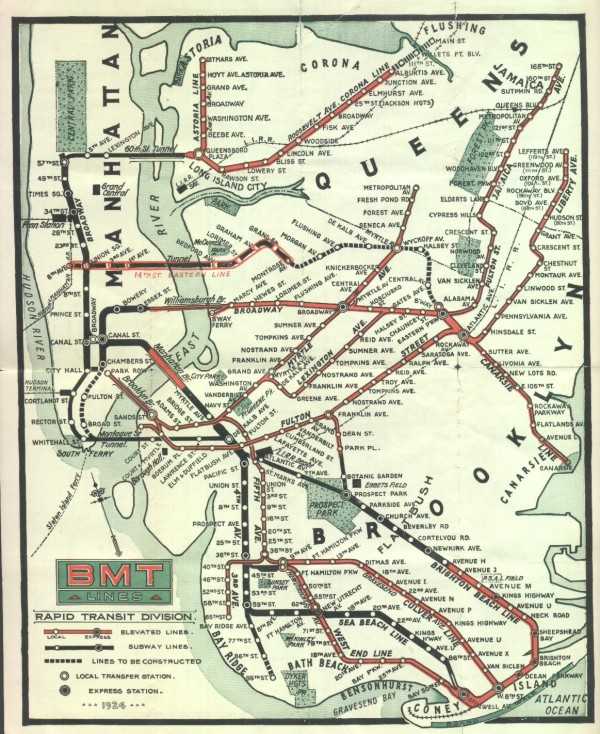
A subway map from 1924, illustrating the system created as a result of the Dual Contracts agreement.

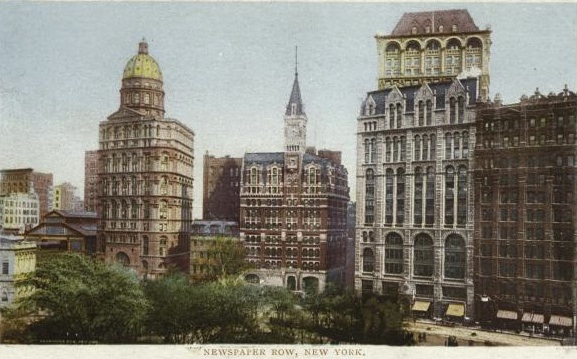
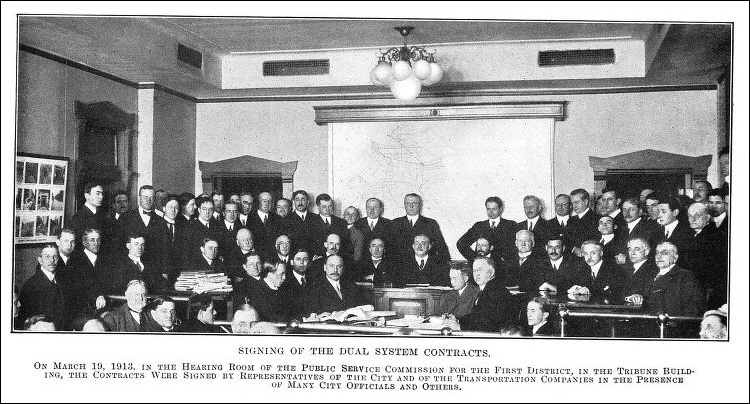
After years of negotiations, false starts and lengthy arguments played out in the press, a group of greatly relieved businessmen entered the large hearing room of the New York Tribune Building (at Nassau and Spruce, where Pace University is today) and put their names to a series of documents that have come to be known as the Dual Contracts.

The beleaguered ceremony ran a half hour late, as a great many gentlemen crammed into the third floor meeting room to sign the official documents, stamped with gold lettering and expensively bound in morocco leather and colored ribbons.

With those signatures, the chaotic New York transportation system — with its fledgling subway and its miles of elevated lines — officially came of age that day — March 19, 1913.

“This makes March 19 a red-letter date on the municipal calendar,” declared the New York Tribune, in whose building the agreement was signed.  The Dual Contracts authorized millions of dollars of new tracks, more than doubling the system in size, from 296 miles of track to 618 miles!

Below: The buildings of Newspaper Row. The towered Tribune Building, in the middle, was the site of the Dual Contracts signing in 1913. 
This seminal agreement in American transportation history is ‘dual’ because the city negotiated two separate contracts — one with August Belmont Jr.’s Interborough Rapid Transit Company (IRT) who operated the New York subway, and the Municipal Railway Company on behalf of the Brooklyn Rapid Transit (BRT), who ran most of Brooklyn’s transit system.
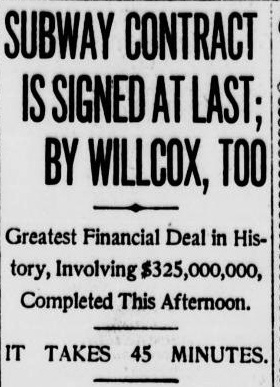
Under the agreement, the city would shoulder some of the cost of building new subway services — many into places where New York expected populations to rise in the coming years — and the two private companies would then lease the new routes from the city and profit from their operation.

At right: the headline from the New York Evening World

Essentially this gave IRT permission to operate into Brooklyn (once the domain of the BRT) and vice versa.  Previously, people arriving from Brooklyn to Manhattan had to immediately change trains once arriving into the new borough.

According to a report by the Public Service Commission later that year: “The Dual System will remove this abnormal condition and give the Brooklyn company a system of subways in Manhattan, by means of which it shall distribute its passengers through the territory south of 59th Street. Thus the present congestion at the Manhattan terminals of the bridges will be ended and the passengers from Brooklyn will be enabled to reach their destinations in lower Manhattan without change of cars or the payment of an additional fare.” [source]

As part of the deal, the two companies agreed to operate two new lines into Queens.  The importance of this particular part of the deal cannot be overstated.  The borough of Queens was just over a dozen years old by this time and still sparsely populated given its size. (Less than 300,000 people in 1910.)  With the arrival of the Queensboro Bridge in 1909, paired with new subway and elevated services provided by the Dual Contracts, the population of Queens would explode in the 1920s to well over a million.

And this didn’t just stimulate development there.  The deal brought a subway to the Manhattan’s Upper East Side and to the West Village, to most Bronx neighborhoods and down the Eastern Parkway in Brooklyn.  New home and apartment developments into those regions soon followed.

Below: City luminaries gather around to watch representatives from government and the two private companies sign the pretentiously bound contracts. (Picture courtesy NYCSubway, an indispensable destination for transit history.)
The Dual Contracts also created express and local trains, facilitating another great development in the history of New York — the arrival of midtown Manhattan as the heart of business and entertainment.

In all, the contract signed one hundred years ago today made the New York City transit system the largest in the world.  In fact, it was larger than all the rapid transit systems of the world at the time — combined (according to Peter Derrick’s excellent book on the subject Tunneling To The Future).

But this also set in motion one of the great flaws of the subway system. Tracks operated by the IRT were a different size from those operated by the BRT.  The track gauge was wider on BRT tracks.  As a result, today the New York subway system still operates two different sizes of cars. (Ed: See notes below for a slight clarification/better explanation.)

On a humorous note, the original contracts, bound as they were in thick leather volumes, were apparently quite heavy to lift.  The president of the IRT remarked, “I am glad that I have enough strength to receive these contracts.”

For more details on the Dual Contracts, please check out the second podcast on the birth of the New York subway system — Subway by the Numbers (and Letters)
‘Staten Island Has Many Charms Worthy Of Consideration’: Ten ways to sell a borough (and a proposed subway) in 1912


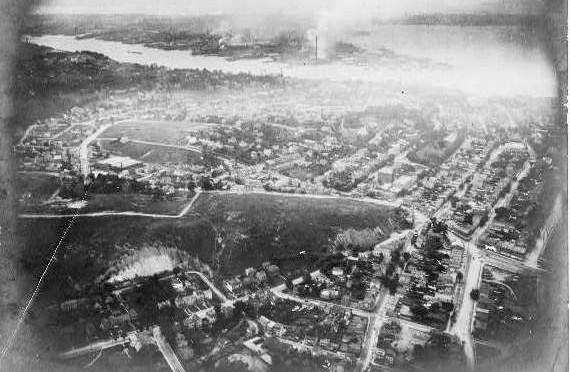
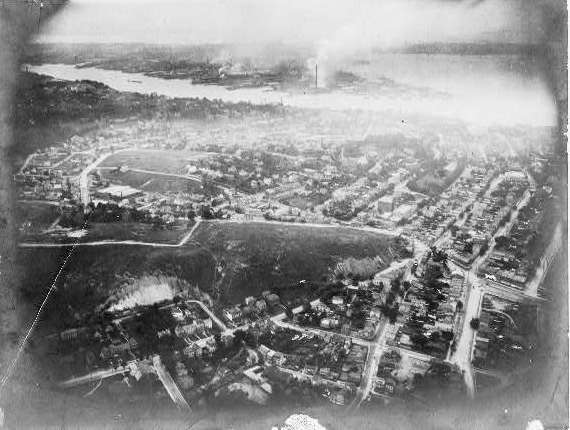
The sky’s the limit: Staten Island from the vantage of a hot air balloon, August 1906. (Courtesy LOC)


“God might have made a more beautiful place than Staten Island, but He never did.” — George William Curtis

If you’ve ever been slightly bemused by the newspaper profiles of trendy neighborhoods, presented as though the reporters were urban archaeologists ‘discovering’ heretofore hidden pockets of the city, then you’ll find amusement in this New York Tribune article from July 1912.

Hopefully to snag the attentions of Manhattan businessmen, the Tribune staff devoted an entire section in their Sunday section to extolling the many virtues of one of its more foreign corners — Staten Island.

The other island borough may have indeed been a mystery to many Tribune readers; the city had taken over ferry service just a few years previous, and there were no bridges yet linking Staten Island to Brooklyn. Many Manhattanites in 1912 harbored the impression that Staten Island, once known as a rural recreational getaway,  was now a dull and uncivilized farmland with a few scattered industries.

But this Tribune article was inspired by a promise that would finally draw Staten Island into the fold — the subway.


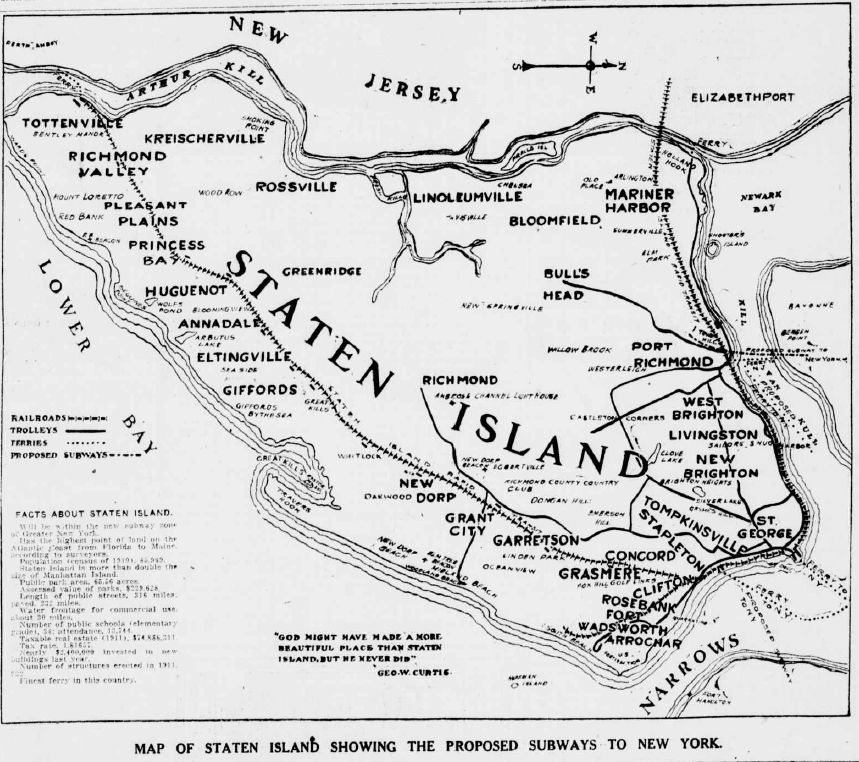
Below: A real estate map of Staten Island from the 1912 article. The dotted lines at the bottom denote where the proposed subway line would have been. 

Manhattan’s Interborough Rapid Transit Company (IRT) and the Brooklyn Rapid Transit Company (BRT) were nearing an agreement with the city to expand the present subway system and create new lines throughout the city. This plan, called the Dual Contracts, helped lay out most of the current New York subway routes today. However there were many potential lines that were never built (despite the efforts of a few future mayors). Among the most ambitious was a subway link to Staten Island.

It was with the anticipation of this underwater track (linking Stapleton to Bensonhurst, see map abovve) that the Tribune hoped to regale readers with the unspoiled wonders of New York City’s least populated borough.

Forget the fact that Staten Island already had an intimate, but thriving old-money scene, the vestiges of a genteel society formed among the mansions of tycoons along the north shore. Fast-paced urbanites would have considered them stubbornly charming but boorish. Society and recreation were not the appeal.

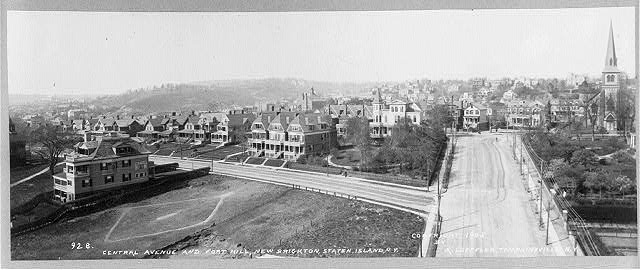
Below: New Brighton, at Central Avenue and Fort Hill, 1905 (LOC)

The Tribune focuses on Staten Island’s destiny as ‘one of the greatest shipping and manufacturing centres of the world’ and wonders deliriously at the delights of that great, underused waterfront. Some highlights from the article (which you may read in full here):

1) Staten Island’s terrific gas supply, the borough’s oldest public service supply, lives up to its motto to ‘Make Gas Service Good Service And Then Some’. Its most recent successes include a yard dyeing manufacturer, the gas engines of the Swift Beef Company, and soldiering furnaces for the U.S. Department of Lighthouses. And the price of gas is going down!, claim management.

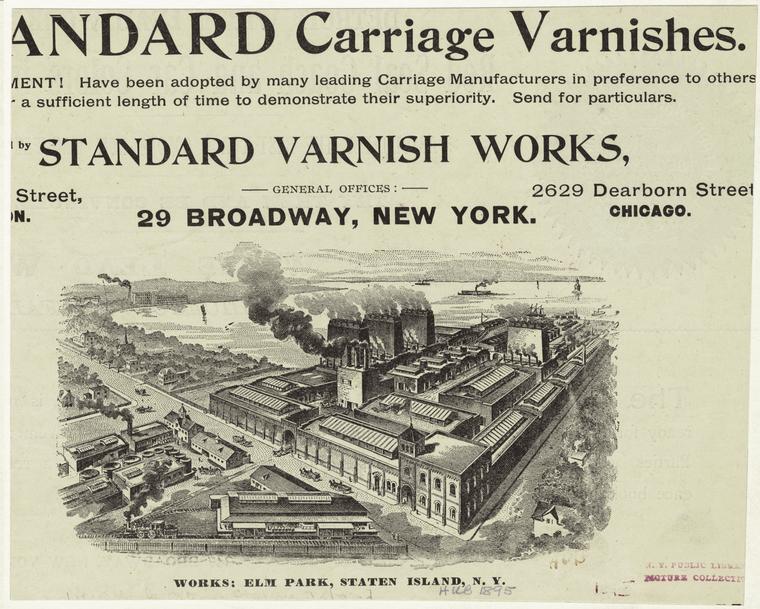
2) The Varnish Capital: One of Staten Island’s great success stories is its varnish industries, most notably Standard Varnish Works, which has miles of underground pipes that filter oil and turpentine from the docks to large storage tanks in the neighborhood of Elm Park. Sold around the globe, “the sun never sets on products manufactured by the Standard Varnish Works.”

3) ‘Country Life’, not ‘Lonely Life’: In New Dorp,  homes upon a ‘noble ranges of hills’ have access to a fine beach, according to the article. “The loneliness that so many people fear as the bane of country life has had in no chance to make itself felt in New Dorp.” A resident describes it as ‘earthly paradise’.

4) Building Innovation: One of Staten Island’s most successful builders is W. H. C. Russell, ‘the pioneer … of the famous asbestos ‘Century’ shingles’, used in the construction of public schools and government buildings.’

Below: The glory of varnish, Standard Varnish Works in Elm Park, that is. (NYPL)

5) Hot Development Opportunities (But Not Too Hot): A St. George realtor admits, “Do not think for a moment that I have been tearing up the earth or anything of that sort, but … I have been doing very satisfactory business.”

6) Great Subway Expectations: The report speculates that the new subway link will get commuters from Stapleton to lower Manhattan in about thirty minutes, bringing the borough’s ‘most entrancing’ residential areas into the subway’s five-cent-fare zone.

7) Don’t Let The Factories Bother You! ‘The man who prefers to live in a place with superb country features, where are green fields, towering shade trees, winding roadways inviting to autoists and owners of harness horses … should not turn his step away from Staten Island because bigger factory zones are going to be built there soon.’

8) There’s Always South Beach: Staten Island’s southern amusement area, rivaling Coney Island, remained a vital recreation center for the city in the 1910s, thanks to Staten Island’s present train services. “Rapid transit has converted an unknown and unused beach into a gay and popular resort, and today South Beach rightly claims to be Coney Island’s only rival.”

9) ‘The Garden Spot of Greater City Of New York‘: ‘Verily, extremes meet here. Already quaint and prosperous little villages have begun to take on new life and expand ……. [E]very day adds to the list of those who through out-of-door life and sunshine are ‘finding themselves’ and adding measurably to the pleasures as well as to the number of their days.’

10) ‘Spotless Town‘: But if you need to be around wealth, the old Vanderbilt estate is being chopped up into ‘high class lots’, near the Fox Hills Golf Course, ‘the finest course in America’!