Still more Brooklyn Bridge jumpers, attention seekers

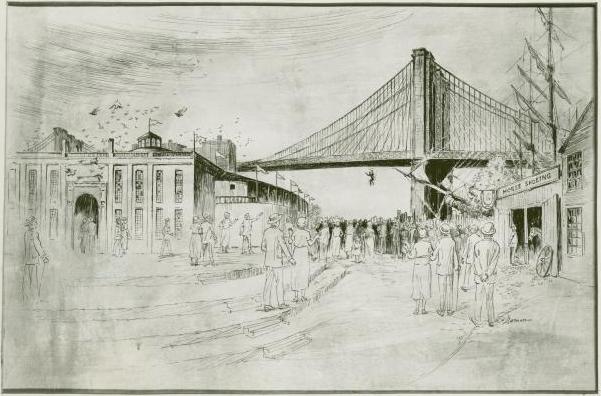
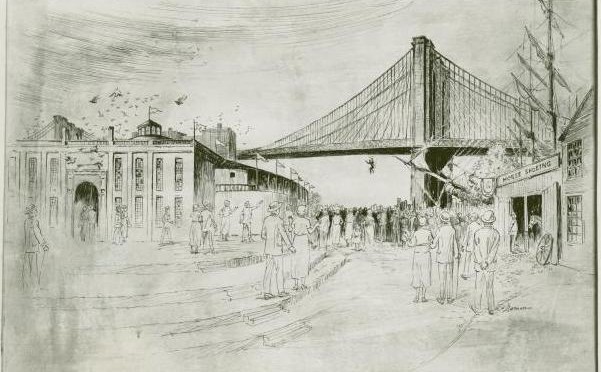
Illustration of Brodie’s infamous jump, from a 1939-40 World’s Fair brochure George Dessel’s Old New York, advertising the Old New York section of the fiar created by Messmore and Damon

Apparently, it’s still the rage to jump from the Brooklyn Bridge, as a forlorn soul (or misguided daredevil) plunged off the side last night, according to Gothamist.

The most famous man to jump from the Bridge — tavern owner and theater star Steve Brodie — actually turned his cheap stunt into a cottage industry. But did he really do it? Read more about Brodie’s adventures here.

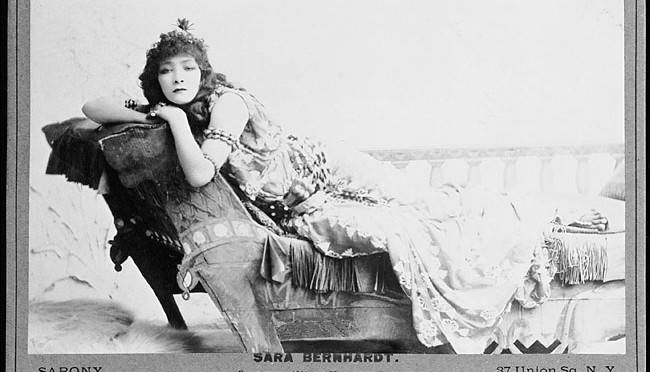
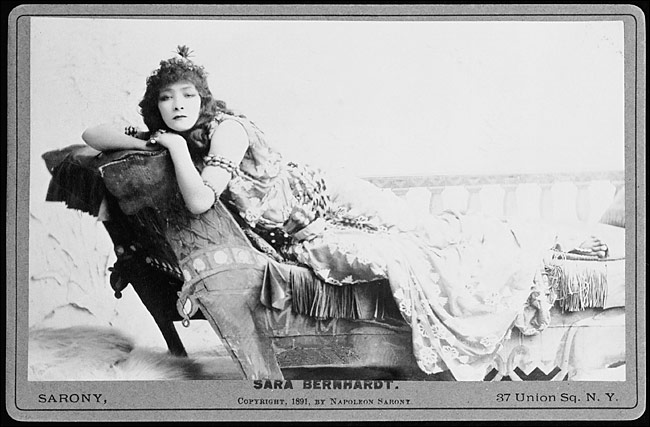
Sarah Bernhardt’s favorite New York landmark

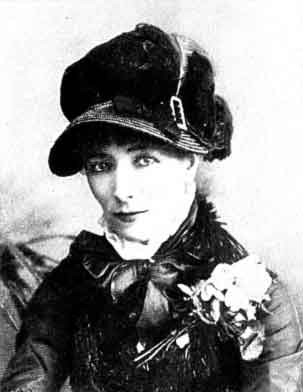
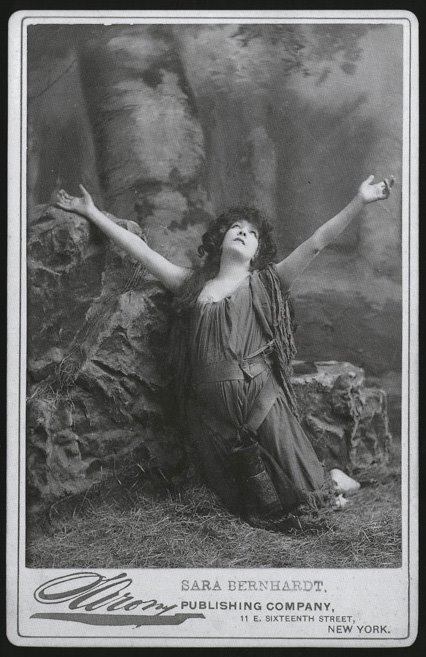
Sarah Bernhardt may be the most famous and most mysterious actress who ever lived and certainly “the greatest celebrity of her era.” Working mostly in the days before recorded medium (there are exceptions), Bernhardt crafted a legend matched by outrageous behavior and provocative stage performance. Naturally, she brought both with her when she came to New York City for her first American tour in 1880 to present the first of many signature roles, Adrienne Lecouveur.

The French actress, lauded as one of Europe’s greatest commodities, didn’t exactly crave a visit to America. Leaving for New York on October 1880, Sarah “was in utter despair, weeping bitter tears, tears that stained my cheek,” according to her autobiography. New York had no such hesitation. When her boat arrived two weeks later into a strangely frozen New York harbor, it was greeted with smaller steamers, filled with fans and decorated with French flags. They feted her onboard in a lengthy, drawn out ceremony of admiration.

Her response? Feeling slightly woozy, “I decided therefore to faint.” She fell gently into waiting arms, people rushed to her attention until “it was time to come to my senses again.”

She stayed that evening at the luxury Albermarle Hotel at Broadway and 24th Street where she blocked her door with furniture to keep other well-wishers and journalists out.

Bernhardt’s auto-biography is so steeped in extremity that you assume she must be exaggerating. Alexandre Dumas did call her a “notorious liar”, but the fact that it took Alexandre Dumas to make that proclamation underscores the exotic circles and experiences in which she traveled.

She greatly distrusted the press who she believed willfully printed lies about her (even when the lies were fed to them by Bernhardt’s own management.) At a press conference at the Albermarle later that day, she dismissed even the simplest questions, especially bristling when she was asked about her religion. “Oh Heavens! Will it be like this in all the cities I visit?”

Two days later, she arrived to rehearse at Booth’s Theater, the tony stage built by theatre legend Edwin Booth (John Wilke’s brother) and located near her hotel, at 23rd and 6th Avenue. Her reaction at seeing fans gathered outside to greet her: “These strange-looking individuals did not belong to the world of actors….with their white neckties and their questionable looking hands.”

Inside the theater, she was finally reunited with her 42 trunks of gowns and costumes — briefly and offensively seized by customs, a “chiffon court martial” — and ordered her underlings to open and inspect each container. So horrified was she at the lowly people opening her possessions that she could only grit her teeth and stand in a state of utter mortification. In fact, the experience exhausted her so much that she failed to even rehearse at all that day.

She would later go on to interact with every strata of New York culture, some more friendly than others, appealing more to liberal minded (and daring) social elites than the stalwarts of Mrs Astors storied Four Hundred. Which seemed fine with Sarah; she didn’t want to meet them either.

But for all her condescension that week, for all the superiority and righteousness, there was one thing that stopped her in her tracks. Believe it or not, something actually gave the legendary imperious actress pause.

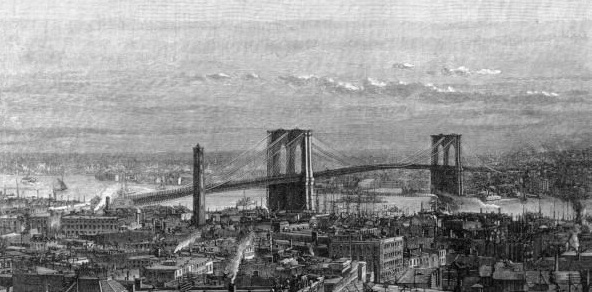
It was Bernhardt vs. the Brooklyn Bridge, and the bridge won. In 1880, it wasn’t even fully completed, yet in her recollection, it was as if it were bustling with traffic. “Oh, that bridge! … One is proud to be a human being when one realizes that a brain has created and suspended in the air….that fearful thing.” The magnificence of the bridge, its extraordinary scale, filled her with “a strange, undefinable sensation of universal chaos.”

Yet she was able to sleep peacefully that evening, “reconciled with this great nation.” And all it took was for something to make the mighty actress feel small.

She would come many, many times to New York and onward to other major cities. By 1910, her tolerance of America was enough that she endeavored to perform future productions in English. (Up until then, all of her performances were rendered in French.)

I highly recommend peeking into her pompous, overblown autobiography My Double Life (well out of print, although Google Books has a copy to review). Simply flip to any random page and get a whiff of her powerful perfumed prose. They seriously do not make them like Sarah Bernhardt anymore.

Below: the spectacular Booth’s Theatre, where Sarah Bernhardt made her U.S. debut on November 8, 1880. It was located on the southeast corner of 23rd and 6th. Today the building there contains a Best Buy and an Olive Garden.

P.S. It appears that Sara and Sarah were interchangable back in the day. You’d think this discrepancy would have driven the poor thing to the fainting couch.

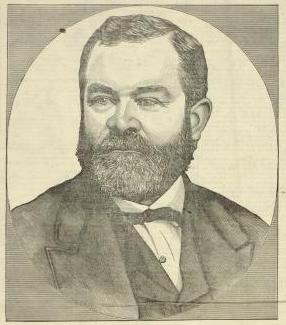
Mayor Franklin Edson: Bronx man and distillery king

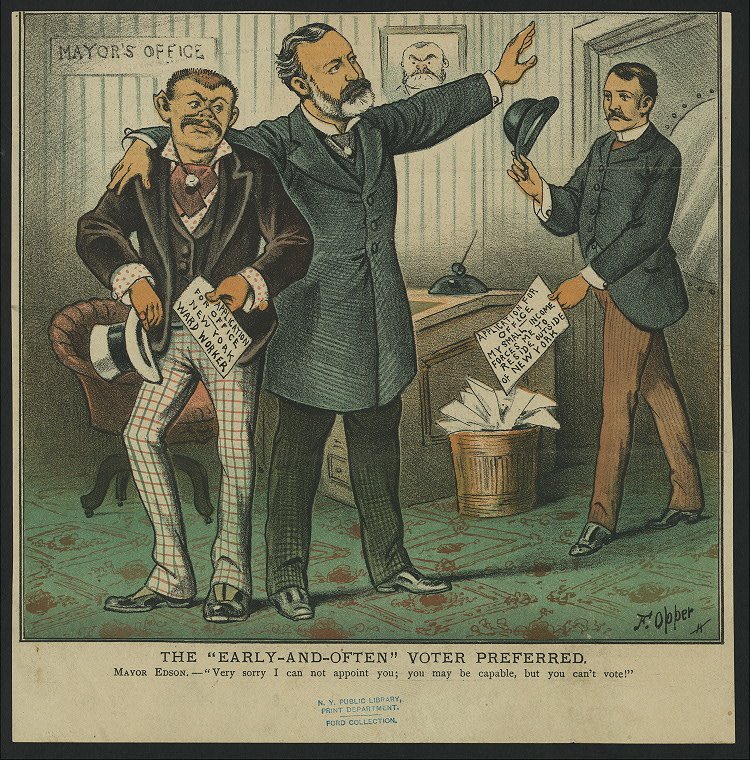
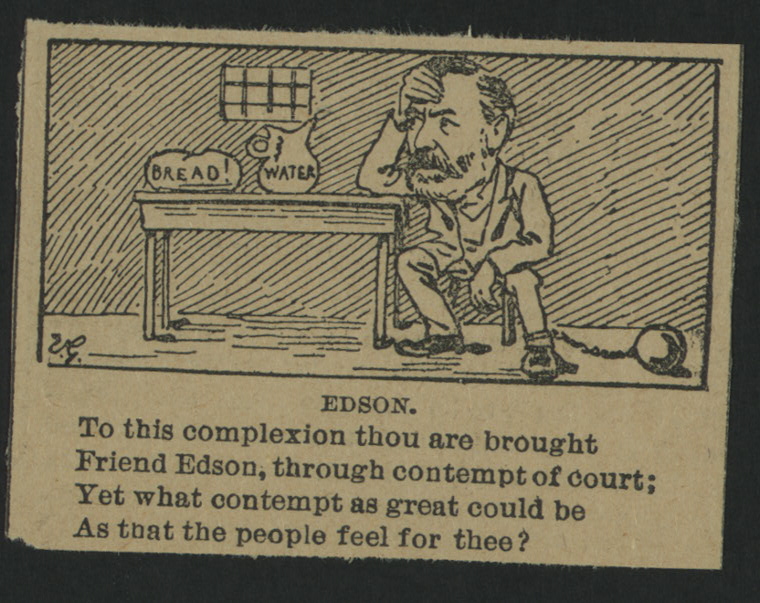
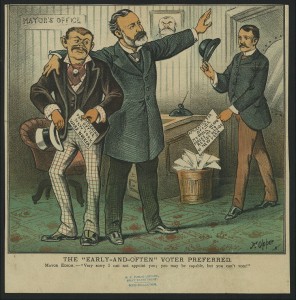
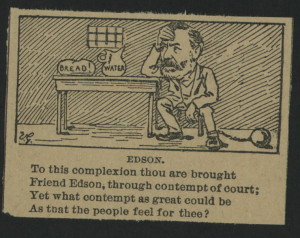
Above: a cartoon mocking Edson’s hiring practices (courtesy New York Public Library Digital Gallery)

KNOW YOUR MAYORS Our modest little series about some of the greatest, notorious, most important, even most useless, mayors of New York City. Other entrants in our mayoral survey can be found here.

Mayor Franklin Edson

In office: 1883-1884

Although the political career of one-term mayor Franklin Edson was indeed brief, he helped commission both the city’s largest acquisition of park land and one of its biggest improvements in drinking water. And he was present for the opening of one of New York’s greatest landmarks. So how did the city thank him for his service? By nearly throwing him into Ludlow Street Jail — where Boss Tweed had been left to rot just a few years before.
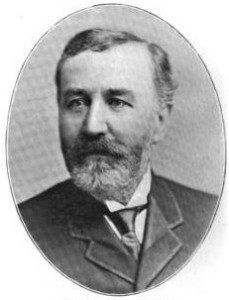
Edson, a transplanted New Yorker, was a farmboy from Chester, Vermont, born in 1832, who distinguished himself in the art of whiskey distillery — distinghished with “precocious tact and sagacity,” in fact.

He worked his way over to Albany, New York, as a successful distiller and grain merchant with his brother. Franklin took full advantage of drink demands during the Civil War; his company soon became so profitable that he moved the entire venture to New York in 1866.

Edson, a burgeoning booze mogul of sorts, immediately became a prominent merchant voice in Manhattan, becoming the president of New York’s Produce Exchange three times, serving his first term in 1866 before he had to time to even unpack his moving boxes.

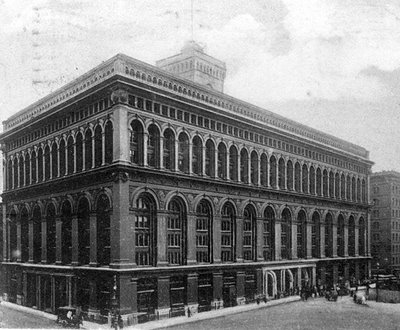
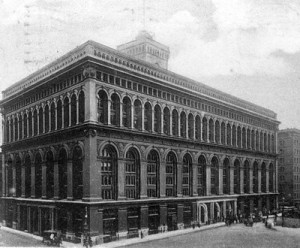
While this naturally afforded Franklin an incredible vantage for commercial power, it would soon place him in the crosshairs of political power as well. In later years he would be most proud of his Exchange days, priding himself in being one of the encouraging voices to tear down the inadequate castle-like Produce Exchange (designed by Leopold Eidlitz) and erecting the larger, more impressive George Post-designed Produce Exchange building near Bowling Green (which itself would be sadly torn down in 1957).

Below: the new Produce Exchange
What sets Edson apart from other future mayors of the time — and what might have potentially hindered his political ambitions — was that he loved the countryside, in this case Old Fordham Village, today a neighborhood in the Bronx.

He would live here for many years and would remain a member of the (now landmarked) Episcopal Saint James Church in Fordham for most of his days. Whether by design or coincidence, this love for what would become New York’s northern borough would soon prove fruitful for the city as a whole.

Franklin was also a practicing anti-Tammany Hall Democrat. And who wouldn’t be anti-Tammany during the 1870s? Edson became politically active in the years following the Boss Tweed scandals, when Tammany was still reeling for the highly publicized affair involving Tweed and then-mayor A. Oakley Hall.
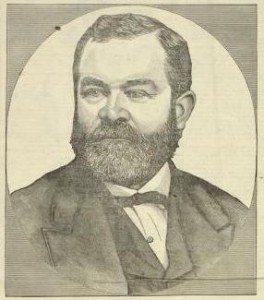

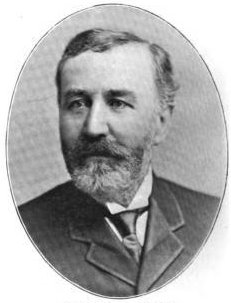
Despite a slow rebounding, Tammany would never fully rinse off the stench of corruption. Naturally, Edson’s prominence among the business class married nicely with mayoral ambitions by the mid 1880s and would eventually include a denunciation of Tammany practices and condemnation of Tammany boss John Kelly (at right). But not at first.

For the election in November 1882, the various Democratic factions, including the still-potent Irving Hall, soon decided on the relatively green Edson, because he was a uncontroversial, neutral choice. To Tammany’s Kelly, Edson must have seemed a fairly agreeable pick indeed compared the previous mayor William Russell Grace, a reform Democrat rebelliously outside the realm of Tammany’s power.

Edson easily swept past his opponent, railroad man Allan Campbell — a sweet victory for John Kelly, as it was Campbell that had replaced Kelly as the city comptroller several years previous under the administration of mayor Edward Cooper. (Check out Edward’s entry for some juicy details of the Kelly/Cooper rivalry.)

How did a political nobody — a “seven day wonder in the political world” — sweep so handily into office? It helps to ride coattails; during that same election, the popular Democrat Grover Cleveland was elected the governor of New York.

At first, Edson gave in readily to political favoritism, paying back some of his Democratic cohorts — including many of the Tammany variety — with lucrative city jobs, a decision which disgruntled many of his former supporters. In fact, he even appointed Richard Croker as fire commissioner; Croker would become the head of Tammany Hall in the 1890s. (Harper’s Weekly has a coy little cartoon chiding the Croker decision.)

Like many before him, however, Edson soon grew tired of Tammany’s corrupting influence and began adopting reform policies which were currently being installed on the state level. And also like many before him, his against-the-wind attempts at reform would essentially spell the end of his political career. Edson would serve but a single term and would almost entirely vanish from politics afterwards.

But not before throwing his weight behind a major expansion of the Croton Aqueduct, which within in a few years would triple the supply of water into the city. (In fact, most of the expansion he pushed for is still in use today.)

Edson is also partially responsible for the huge increase in New York park land, commissioning a citizens group in 1884 to lobby the state to purchase lands in the area of today’s Bronx; accordiing to an old Bronx history, “the ‘new’ parks, as they were called, comprised 3,757 acres, now included in Van Corlandt, Bronx, Pelham Bay, Crotona, St. Mary’s and Claremont parks.”

And most notably, he was the first New York mayor to walk the Brooklyn Bridge, astride president Chester A. Arthur and governor Cleveland on the bridge’s opening day, May 24, 1883. He would be met in the middle by the mayor of Brooklyn — future New York mayor — Seth Low.

He might have crept quietly into obscurity had Edson not been accused of contempt of court shortly after he left office, threatening a man in his early 50s with jail time with a stint at the notorious Ludlow Street Jail. Apparently, despite a court injunction, Edson had quietly made promotions to two posts — the Commissioner of Public Works and the Corporation Council — on his last day in office. However, after a stressful two months in court, Edson was declared not guilty of the crime.

This did not stop people from imagining the ex-Mayor trapped behind bars, as the newspaper illustration below evidences:
Edson died in 1904, at his home on the Upper East Side. 42 West 71st Street, to be exact, a block from the Dakota Apartments, which were completed during his tenure as mayor.

Know Your Mayors: William Jay Gaynor

Our modest little series about some of the greatest, notorious, most important, even most useless, mayors of New York City. Other entrants in our mayoral survey can be found here.

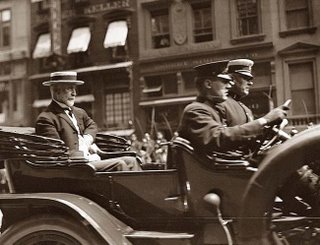
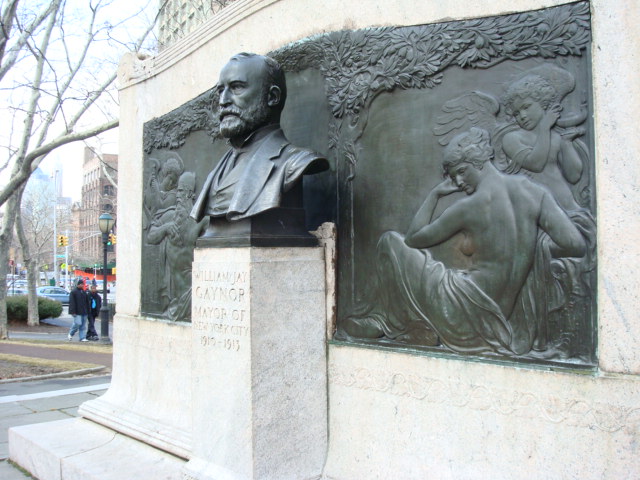
Walk from Manhattan over the Brooklyn Bridge, take the first ramp off the bridge, turn right to Cadman Plaza, and you will run smack dab into a marble slab and the stoic bust (see below) of William Jay Gaynor, mayor of New York City from 1910 to 1913. Very few mayors are honored with statuary in this city, especially a mayor with so short a term in office. Gaynor’s term represented a shakedown of traditional New York Tammany politics, a true bureaucratic reform movement.

But Gaynor is perhaps best remembered as being the only New York mayor to become target of an assassination attempt and to eventually die of his injuries.

It wasn’t supposed to play like this at all. Tammany Hall, entering the dusk of its influence by the early 20th century, thought they had a ringer with Gaynor, a state Supreme Court justice for 14 years chosen to run by still-powerful political machine. One of his opponents — William Randolph Hearst — an early admirer who warned Gaynor to publicly reject his corrupt Tammany sponsors.

Hearst needn’t have worried. Once elected, Gaynor flummoxed his Democratic forebears by eshewing the usual political favors to Tammany cronies and actually hiring qualified individuals in chosen fields. His swiftly became no one’s pawn.

Gaynor continued to live in Brooklyn — 20 Eighth Avenue in Park Slope, to be precise. On his first day of work, he actually walked from home, over the Bridge, and right into City Hall.

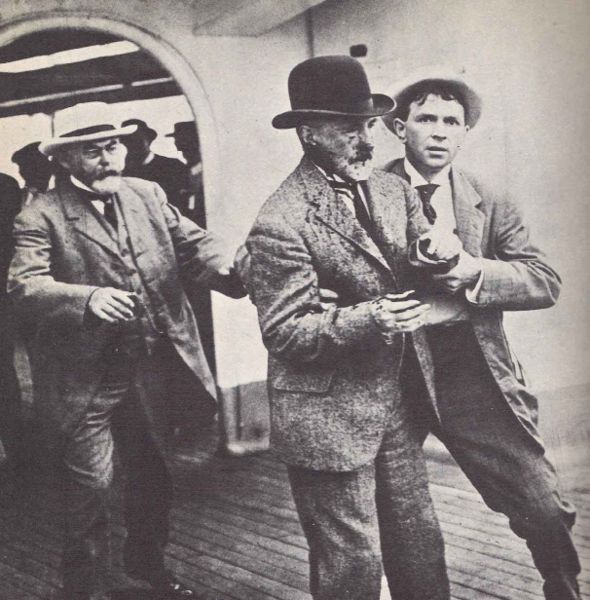
While vacationing on the ocean liner SS Kaiser Wilhelm der Grosse, a disgruntled city employee James J. Gallagher, fired from his job on the docks, took out his frustration on Gaynor, shooting him through the back of the neck. Gallagher claimed, “He took away my bread and meat. I had to do it.” Really, James?

Unbelievably, a photographer for the New York world William Warnecke happened to catch the incident, which quickly became one of the most startling photographs in the short history of photo-journalism:

Gaynor recovered somewhat, although the bullet would remain lodged in his throat, and his entire term of mayor, he would remain weakened and haggard. He would even use the injury as a reason to get out of discussing delicate subjects, saying, “Sorry, can’t talk today. This fish hook in my throat is bothering me.”

The brush with death, paired with his remarkable house-cleaning at City Hall, quickly transformed him into a popular leader, with talk of even running for president. Tammany wouldn’t help him with another term for mayor, naturally, but he was immediately nominated as an independent.

Somebody should have told Gaynor, however, that he should have avoided ocean liners. On Sept. 4 1913 he boarded the ocean liner Baltic for yet another oceanic vacation and six days later was found dead on a deck chair, his body finally giving in to lingering internal injuries. Curiously, Gaynor’s would-be assassin Gallagher had died just a few months prior — at an insane asylum in Trenton, New Jersey.

The New York Press ran a further appreciationof the Gaynor monument itself. Or maybe you’d like to read his extravagent obit from the New York Times.

Know Your Mayors: Abram S. Hewitt

Our modest little series about some of the greatest, notorious, most important, even most useless, mayors of New York City. Other entrants in our mayoral survey can be found here.

Abram Hewitt could easily be considered a very pivotal mayor in New York City, given the significant development and personal connections he had to the heart of the city. However a shipwreck very nearly did him in before he could even get started.

Hewitt, born upstate in Haverstraw, attended Columbia and taught mathmatics, where he became friendly with a student he was tutoring, Edward Cooper. The two of them later voyaged to Europe in 1844, but on the way back to America, their ship capsized off the coast of Cape May.

He, Edward and the crew were later rescued, but the experience affected Hewitt deeply (and rather vaingloriously): “It taught me…that my life which had been miraculously rescued belonged not to me, and from that hour I gave it to the work which from that time has been in my thoughts — the welfare of my fellow-citizens.”

It had a more lucrative effect as well; for Edward Cooper happened to be the only son of industrialist Peter Cooper. Hewitt’s bravery bonded him with the Cooper family, becoming lifelong friends with Edward and marrying Edward’s sister Sarah.

He helped found Trenton Iron Company with the Coopers and became the first to experiment with the inexpensive steel-producing Bessemer process in the United States.

But politics was soon in Abram’s sights, especially with the crumbling of Boss Tweed’s Tammany Hall after his fall in 1871. Hewitt reorganized that once-corrupt Democratic political machine with political rewards for himself, elected to the U.S. House of Representatives in 1874.

He even tried his hand at national politics, managing Samuel Tilden’s nearly-successful quest for the White House in 1876. Remember this from history class? Despite Tilden winning the popular vote, an electoral fiaso gave the election to Rutherford B Hayes.

As Hewitt held court in Washington — becoming, in Henry Adams’ words “the most useful public man in Washington” — his close friend and brother-in-law Edward Cooper would be elected mayor of New York in 1879.

Hewitt’s connections in Washington would assist in getting the neccessary attentions brought to the building of the Brooklyn Bridge. Although David McCullough dryly notes that Hewitt might have inadvertantly helped weaken the Bridge by helping deliever the wire bid to Brooklyn native (and total fraud) J. Lloyd Haugh. (More about him in last week’s podcast.) Hewitt would give a most stirring speech during the Bridge opening ceremony in 1883.

Finally, Hewitt himself would become mayor of New York City in 1886 during a heated election in which a candidate by the name of Theodore Roosevelt would place third.

Hewitt strong distain for corruption in city politics ran him against his old organization Tammany Hall. He also had strong moral convictions, fighting to keep city saloons closed on Sunday. (This did not endear him to many people.) However, he strongly advocated the creation of new city parks and began work on a much-delayed underground train system — which Tweed’s machine had stalled for years. In fact, Hewitt is considered the “Father of the New York Subway.”

He was defeated in 1888, partially due to angering the Irish community because he refused to attend the St Patricks Day Parade. (Hewitt tended to be of a more nativist stripe; among other demands, he required all immigrants take a literacy test.)

He spent his later years as a philanthropist, on the boards of the Carnegie Institution and the Museum of Natural History. When he died in 1903, Andrew Carnegie himself claimed the former mayor was “America’s foremost private citizen“.

Categories
Podcasts Uncategorized

PODCAST: The Brooklyn Bridge

The Bowery Boys explore the story and the family behind the Brooklyn Bridge, one of New York’s most treasured landmarks.

Plus: Looking to get really close with the Brooklyn Bridge? Take one of our Brooklyn Bridge Walking Tours, with the Great Great Grandson of Washington and Emily Roebling, Kriss Roebling!

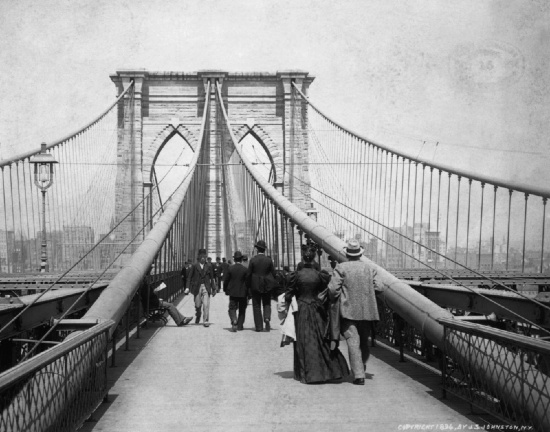
The walkway in 1894….

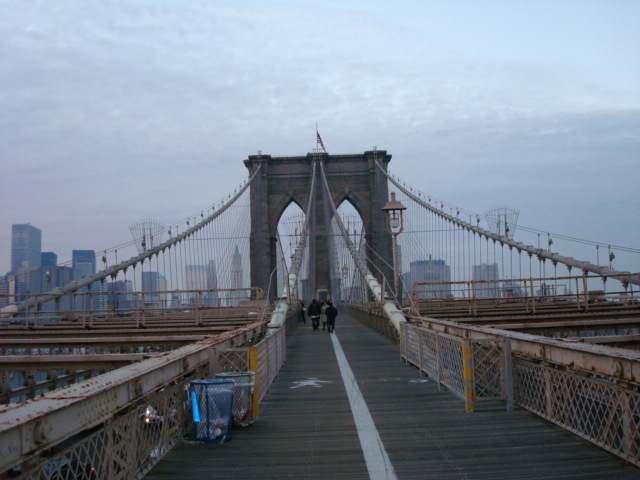
….and today

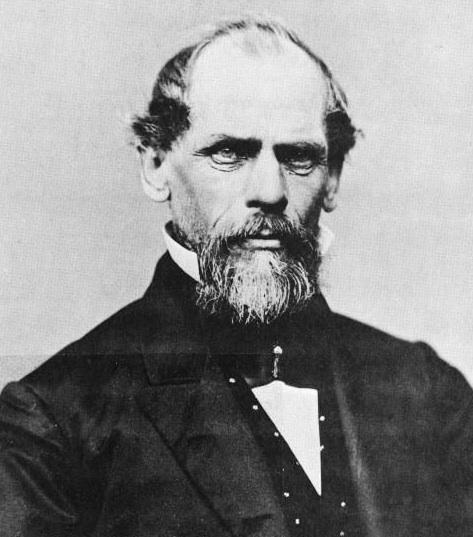
John Roebling

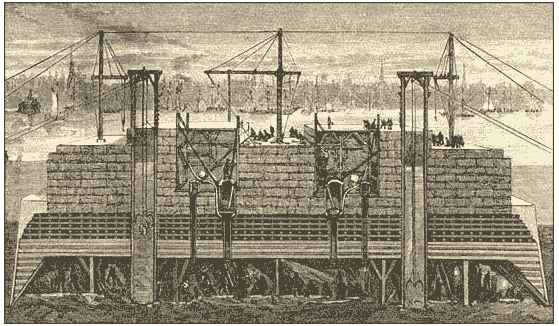
Diagram of a sunken caisson:

A few months back here, we took at look at the bridge stampede. For Friday Night Fever we highlighted the Bridge Cafe, whos prior incarnation Hole-in-the-Wall stood witness to the bridge construction. George Washington once lived on the spot occupied by the New York anchorage. On Tuesday, we highlighted Brooklyn mayor Seth Low, who once tried to get Washington Roebling to step down as Chief Engineer.

KNOW YOUR MAYORS: Seth Low


We speed ahead over a hundred years after our last Know Your Mayors entry to that jovial man with the funny name, Seth Low. He holds a very unique place on the list of mayors, as he has been both the mayor of Brooklyn (from 1881 to 1885, back when it was a separate city) and mayor of the new five boroughed New York City — in fact, the second mayor ever of the consolidated city, from 1902-1903.

A likable organizer and leader, ‘the people’s candidate’ as he was called, fast-tracking through city politics, Low was on-site for a number of significant changes to the city. Elected Brooklyn mayor near the completion of the Brooklyn Bridge, Low was perturbed by seeming delays to its completion and, with the help of New York’s mayor William Grace, attempted to oust its Chief Engineer Washington Roebling. Outvoted at the trustees meeting, Low then about-faced (like any good politician) and, on opening day, symbolically met Grace halfway of the new bridge.

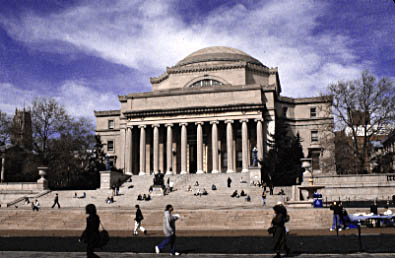
Low made his most influential mark as the president of Columbia College from 1890-1901, shuffling the school from midtown to its present location in Morningside Heights, involving McKim, Mead, and White to design the new buildings, including the wonderful Roman revival throwback Low Memorial Library (named for Low’s father, a successful Brooklyn silk merchant). Oh, and during his tenure, Columbia dropped the College and became a University.

Below: the beautiful Low Memorial Library on the Columbia campus

By 1898, thanks in part to the Bridge, Brooklyn and the other boroughs were combined with Manhattan to create Greater New York. Low was then elected mayor again, of the entire city, crushing the Tammany Hall candidate with the help of his friend Mark Twain, who stumped for him at political rallies. (Think Barack Obama and Oprah Winfrey, or Mike Huckabee and Chuck Norris!)

Low was only mayor for a single year, but brought such reform to the city as lower taxes and a purge of corruption within the police department. His short tenure is more importantly symbolically, as he won the job as a ‘fusion’ candidate of two different major parties — the Republicans and the Citizens Union, both seeking to squash the Tammany Democrats.

Perhaps by way of karma, he lost his re-election bid in 1903 to another name associated with the Brooklyn Bridge, George Brinton McClellan Jr, treasurer of the bridge. McClellan, by the way, would open the Manhattan Bridge during his six-year term as mayor.
Low finished his professional career heading another prestigious school — the Tuskegee Institute in Tuskegee, Alabama — serving as chairman from 1907 until he died in 1916.

Students currently attend the I.S. 96 Seth Low Intermediate School in Bensonhurst, Brooklyn.

George Washington slept here?!

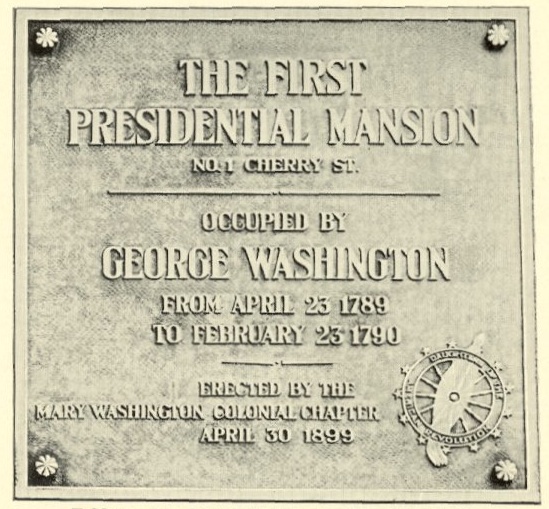
You’ll be forgiven if the corner of Pearl and Dover streets does not happen to ring any bells for you. Although nearby a few South Street Seaport restaurants and bars — including the Bridge Cafe — its mostly unused given its proximity to the entrance of the Brooklyn Bridge and FDR Drive.

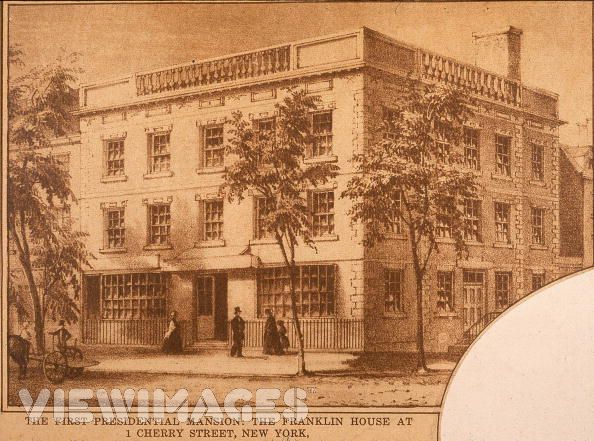
But a sad, tiny plaque here uncovers a surprising fact — here once stood the first presidential mansion of George Washington. The nation’s first president lived here from April 1789 to February 23, 1790, just a short carriage ride to Federal Hall on Wall Street. His inauguration procession on April 30th even began here with a reception for the new nation’s creators.

This was considered uptown to Revolutionary era New Yorkers, and the white Colonial home, built in 1770, was surrounded by other sumptuous houses overlooking the East River. In fact, Washington’s neighbor, at 5 Cherry Street, was John Hancock. DeWitt Clinton would later reside in the former Washington home.

Cherry Street still remains in lower Manhattan, but the section which once included the presidential mansion and the other austere residences was demolished in the 1880s to make way for the Brooklyn Bridge anchorage. That might seem scandalous to modern-day history preservationists, but by then, Cherry Street was far from a tony address.

One Cherry Street was unceremoniously torn down to widen the street in the 1850s, but by then, it was a mercy killing. The neighborhood had become New York’s notorious Fourth Ward, lined with saloons and brothels, the once-glorious mansions turned into boarding houses. It was Manhattan’s most decrepit neighborhood, so few took offense when it was proposed that the neighborhood be partially demolished to make way for the Brooklyn Bridge entrance. Cherry Street still exists but only on the north side of the bridge.

Georgie moved from One Cherry Street to 39 Broadway — shorter commute — in 1790. The tiny plaque is all that remains of a far more genteel day in lower Manhattan.

Here’s more information on community efforts to raise the profile of the site.

Picture of the presidential mansion that once sat there: