Categories
Planes Trains and Automobiles

New York City from the sky: The first aerial photographs

One hundred and nine years ago this month, a tiny airplane made history over the waterways of New York City.

These weren’t the first flights over the city — those had occured in the fall of 1909, during the Hudson-Fulton Celebration — or even the most daring or most publicized. (Aerial competitions like the Great Gimbels Air Race of 1911 might take those titles.)

These flights, which took place in February and March of 1912, were important not only due to the bravery and braggadocio of the pilot, derring-do Frank Coffyn, but because of his companion — American Press Association photographer Adrien C. Duff.

Duff is responsible the very first photographs and the first ever film of New York City — from overhead, taken by an airplane.*

And in taking these photographs, this also makes Duff the very first airplane passenger over New York Harbor.

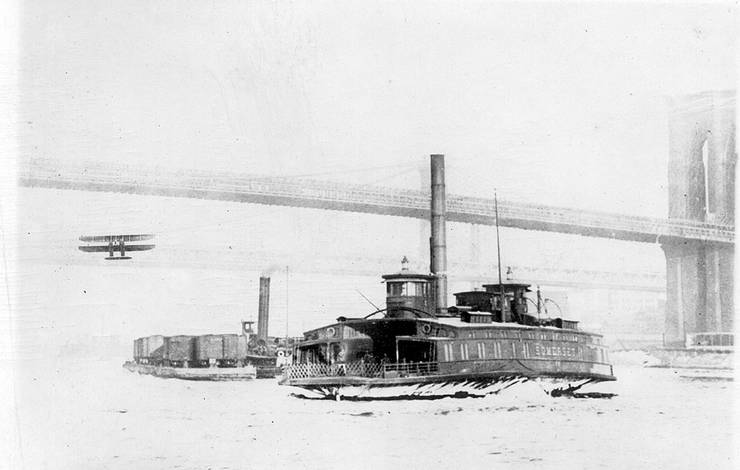
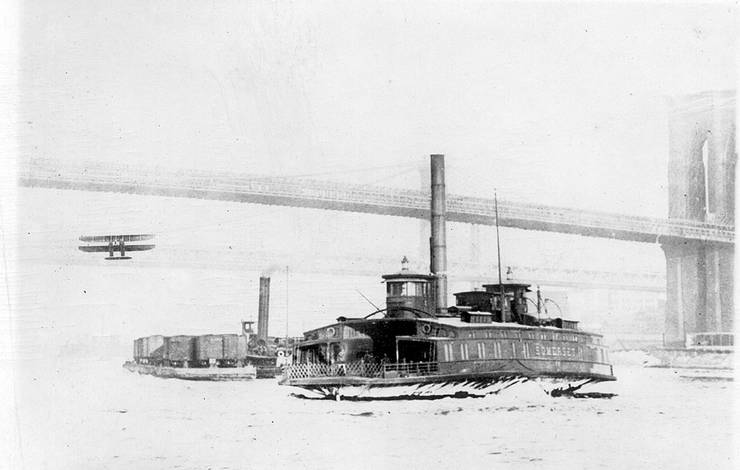
Frozen flight: Frank Coffyn sails underneath the Brooklyn Bridge and above the East River during the dead of winter. 
First In Flight

Coffyn, a former Wright Brothers employee, accepted the offer of Brooklyn film studio American Vitagraph to figure out a way of snapping images of New York from above.

This was a tricky task to be sure in 1912. Manned flights had only been invented by his former employers a few years previous. Planes had to be very light and until that moment could only carry the pilot and necessary equipment.

Below: Frank Coffyn, in a picture with a Wright Bros plane in 1911 (Photos courtesy Library of Congress)
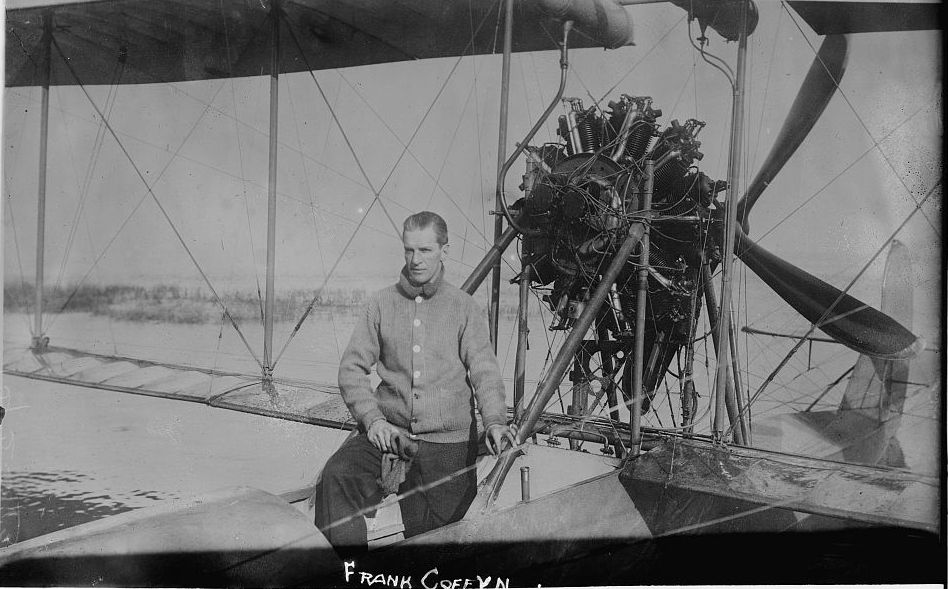
Even trickier, Coffyn wanted to lift off from the harbor directly and not from the icy landing strip based on Governors Island. To that effect, he furnished his plane with pontoons, allowing it to float upon the unfrozen shoreline.

The Sky’s The Limit

His first successful flight skimming off, and then above, the Hudson River was on February 6, 1912, “proving that the aeroplane …is also a near cousin of the mudhen or the duck,” according to the New York Times.
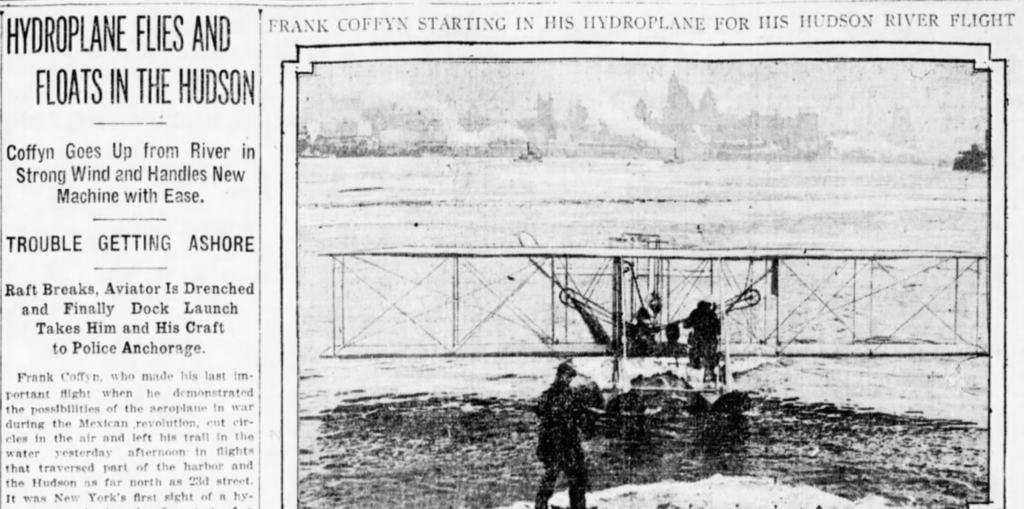
New York Tribune, Feb 7, 1912

He continued to make successive flights over the next few weeks, this time from the shore of the Battery and up the East River.

On February 13, 1912, he became the first pilot to fly underneath the Brooklyn Bridge, so low that he reportedly felt the smoke from a passing tugboat.

As a May 1912 edition of Metropolitan Magazine put it: “In February New Yorkers saw Frank T. Coffyn with his Wright hydro aero-plane travel over the surface of the half-frozen river, maneuvering in the water like a motor-boat, skating on the ice at top speed — then rise in the air over the ferryboats, under and over the bridges and around the Statue of Liberty.

Better Than A Postcard

But it was one particular flight on February 8th that is of historic significance.

For he was joined on this flight this time by Duff, the ‘swashbuckler of the camera’.

During the short flight, Coffyn took Duff from the Battery past Governors Island, over the ships of the harbor, around the Statue of Liberty, then back to Manhattan.
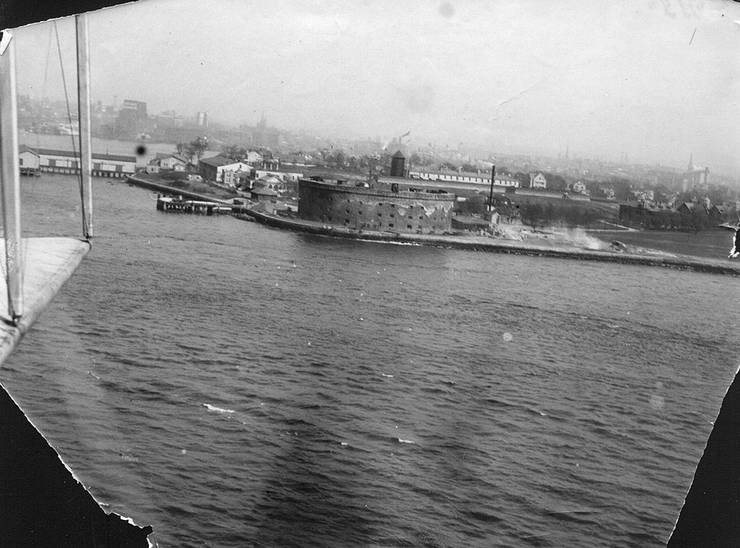
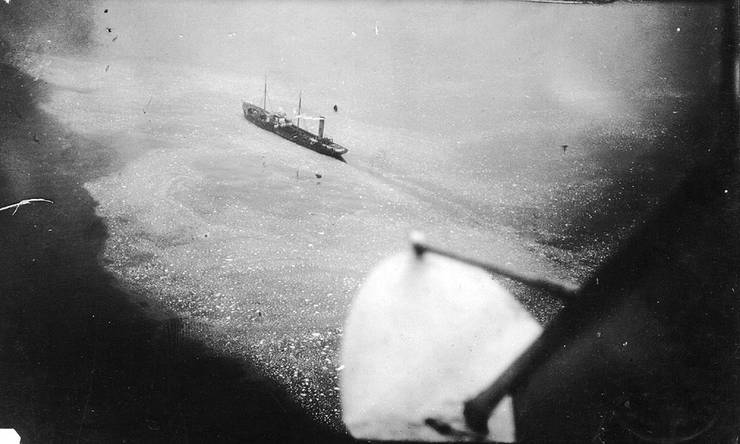
Duff was actually strapped onto the lower wing, with his legs dangling off the side of the plane! Both Coffyn and Duff were frozen to the bone by the time they landed.

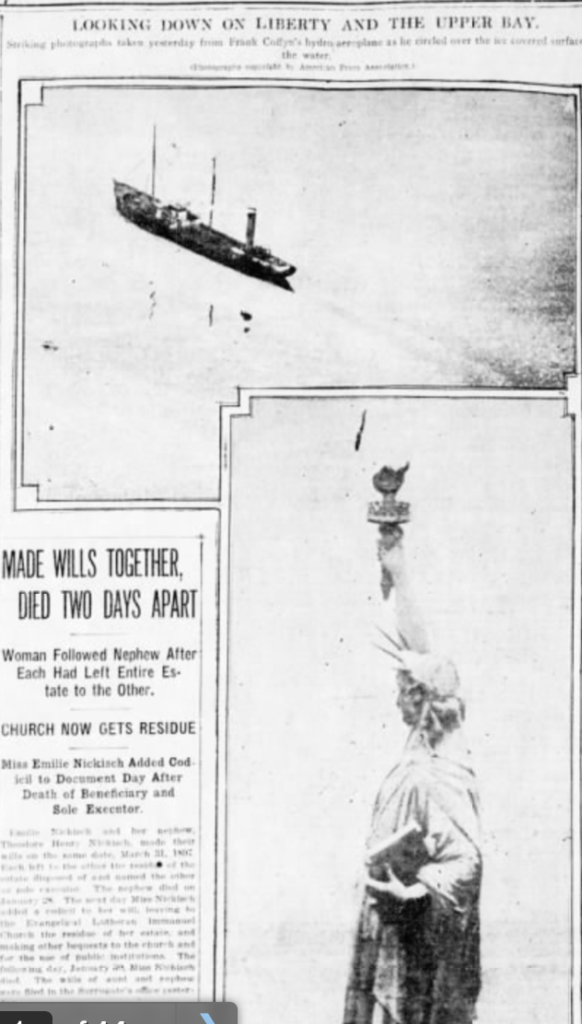
Duff took nine photographs in all, of which only a few were usable. This article features the best of Duff’s pictures, and the first ever taken of New York from the sky.
Below: The first appearance of the photo above in a newspaper, the New York Tribune, Feb 8, 1912. (courtesy Newspapers.com)
Coffyn eventually fulfilled his original mission with Vitagraph, bringing Duff back on his plane on February 12th to operate the moving-picture camera and making the very first film overhead New York.

The footage is not the most vivid, partially because Duff’s hands became so cold that he could barely operate the crank-operated camera.
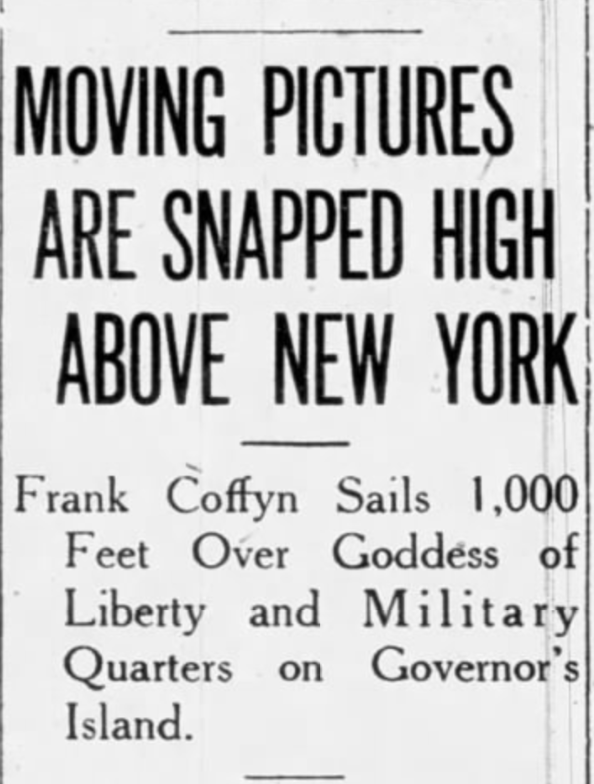
From the Buffalo Courier, Feb 13, 1912

Later on, Coffyn attempted to operate the camera himself. This proved to be less successful, as a couple days later, he dropped the camera into the East River. Vitagraph released the usable footage to theaters in April.

Here’s a newsreel incorporating some of Coffyn’s own footage and some great shots of him taking off from the Battery shore.

And whatever happened to Adrian C. Duff?

He took that sense of adventure, enlisted in the U.S. Army, and became a noted photographer during World War I. Here’s one of his more famous images.
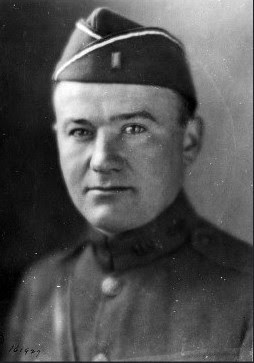
Duff in 1918

He wrote of his exploits in a 1918 article for the Fulton Evening News. 

He survived the rigors of war only to die in a grim taxicab accident in Brooklyn on March 7, 1920. From the New York Times:
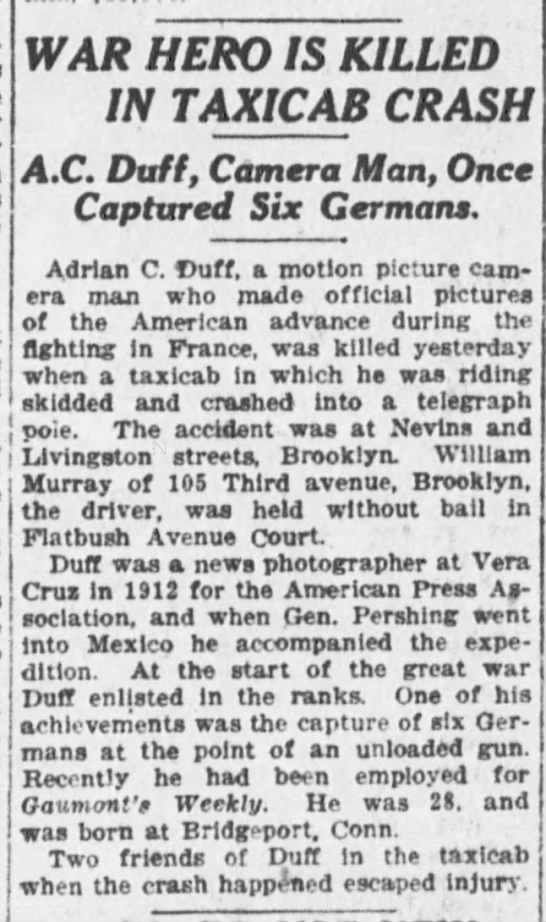
*There is actually ONE photograph older than 1912, taken from a hot air balloon in 1906. More about that here.

Read more about Duff’s life at Shooting The Great War. This article was originally published on this website on February 13, 2012.
Categories
Amusements and Thrills

Wanamaker’s Airship: That one time in 1911 they launched a hydrogen balloon from Astor Place

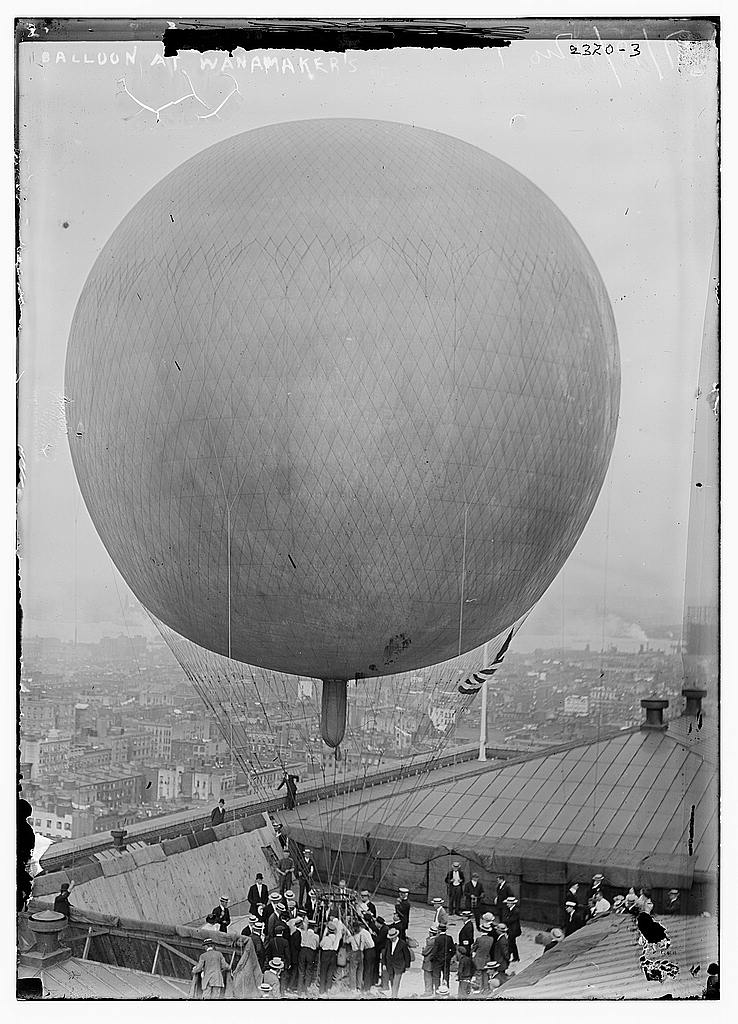
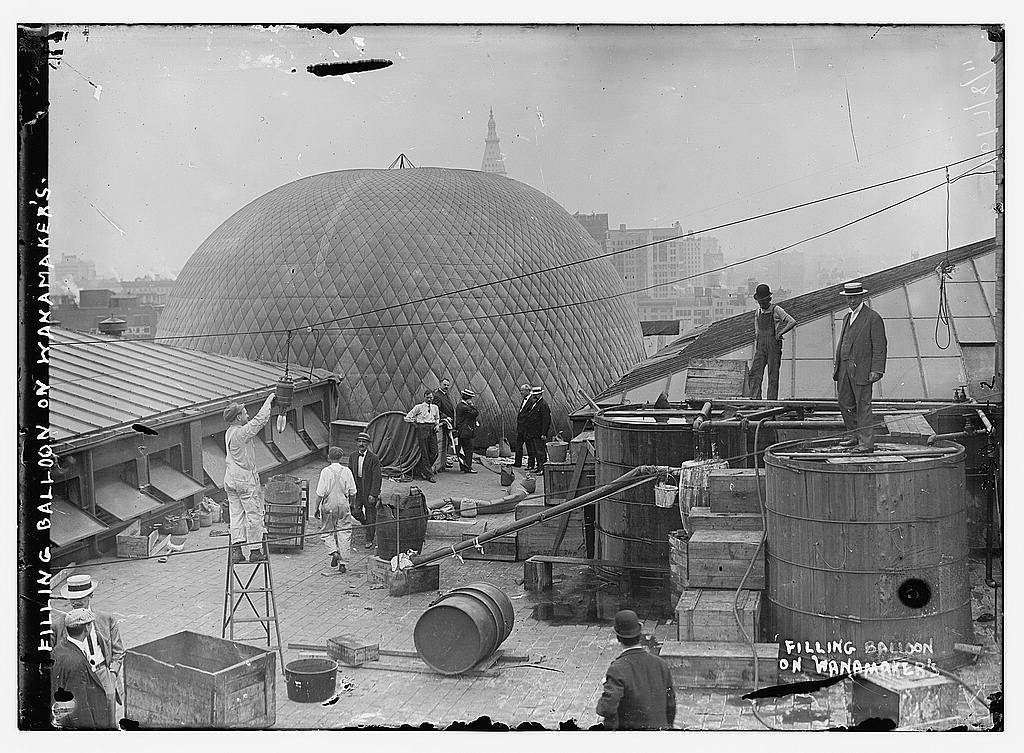
A view of the balloon launch, looking north towards the Metropolitan Life Tower, which can be seen jutting up in the background. The Met Tower was the world’s tallest building in 1911.

Philadelphia retailer John Wanamaker turned an abandoned train station in Philadelphia into the lavish department bearing his name in 1876, just in time for America’s 100th anniversary.  He would become one of Philadelphia’s largest employers, with 5,000 people working in the store, “the most valuable piece of property of its size in the city.” [source]

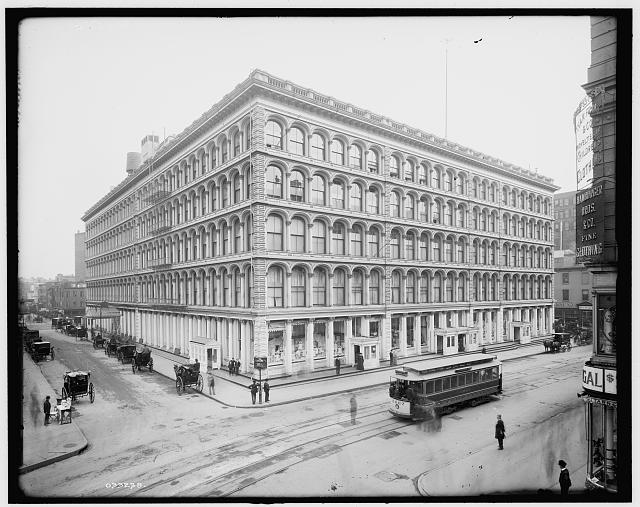
Meanwhile, in New York City, when shoppers weren’t flocking to Ladies Mile, they headed to A.T Stewart‘s equally grand ‘Iron Palace’ department store in Astor Place, with over thirty departments specializing in every sort of modern necessity, making it one of the largest stores of any kind in America.

Stewart’s store was located on Fourth Avenue between 9th and 10th Streets and was called the ‘Iron Palace’ as it was New York’s largest cast-iron building at the time.  (But not the first; that title goes to its neighbor, the American Bible Society building, at 51 Astor Place.)

Below: The original Wanamaker’s between 9th and 10th Streets. The building no longer exists.

It would take two decades for Wanamaker to make his way to New York, eventually buying up an old Iron Palace in 1896 and reopening it as New York’s first Wanamakers.

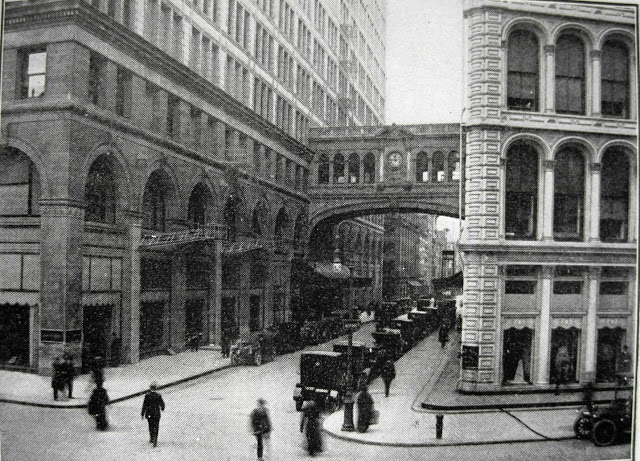
But a man who had filled an entire train station in Philadelphia would not simply be content with one lavish store; across the street, between 8th and 9th, he built another in 1902, using one of the world’s most revered architects — Daniel Burnham, who had just completed work on the Flatiron Building.  Customers could go between the buildings using a fanciful ‘bridge of progress’.

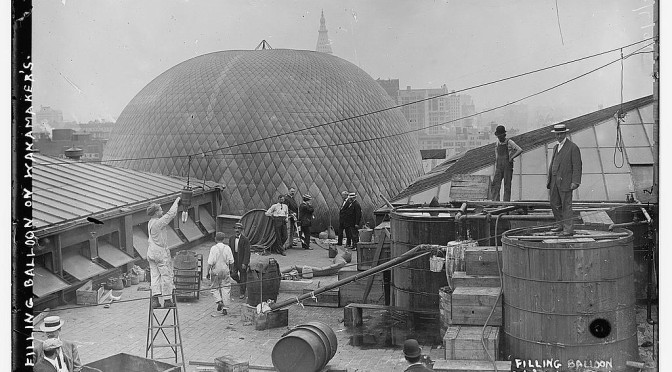
That is all, of course, to set this scene for the curious publicity stunt which occurred on the rooftop of Wanamaker’s on July 8, 1911.  For three days, a large hydrogen balloon (48 feet in diameter) sat tethered upon the rooftop of the new building, filling up with copious amounts of gas for a journey to Philadelphia — with a planned landing near Wanamaker’s other store.

In 1911, that old train-station store would be replaced with a new Wanamaker’s in Philadelphia’s Center City, also built by Burnham.  No better way to grab headlines for his new store in Philadelphia than to float a gigantic eye-catching object from one store to the other!

The balloon (called the Wanamaker No. 1), imported from Paris, was launched at 6 pm and gracefully floated over the city, across the Hudson, fadeing into the mists of Weehawken.

Unfortunately for the balloon’s two pilots, things went immediately awry, the balloon being a tricky one to control.  Instead of floating southwest, it headed due north.  After an hour and a half of wandering blindly through the clouds, the balloon ungraciously came down — in Nyack, New York.

But it wasn’t considered a failure by any means. Wanamaker’s wanted a publicity stunt and got one.  The launch made the front page of newspapers.  For a moment, the whole region seemed transfixed.  “Crowds turned out to gaze at the big airship as it passed over the Hudson River villages,” crowed the New York Times.

Some even claimed this was the beginning of a new phase in New York travel.  Rooftops could regularly be used to launch airships of all sorts.  “This is the first step towards making the roofs of the Wanamaker buildings in New York and Philadelphia into permanent aerial stations,” claimed the Evening World.  “Landing platforms and hangars for balloons and aeroplanes are to be built on the roofs of the department stores in both cities.”

Not to be outdone, the following month, Gimbels Department Store would stage a marvelous airplane race over the streets of Manhattan.

By the way, Mr. Wanamaker wasn’t even in the country when all this happened.  He rolled into town the following week aboard the White Star liner Oceanic, having celebrated his 73rd birthday in style by traveling to England and meeting King George and Queen Mary.

The original Wanamaker’s building is no longer there, but the south building, the one designed by Burnham and the one from which the balloon was launched, still exists today as the home of K-Mart.

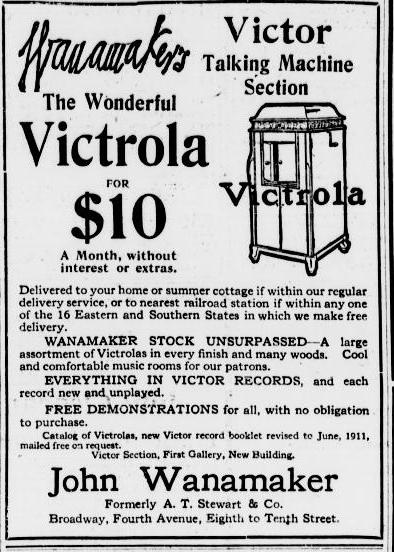
Below: That same week, one could run into the store below the balloon and purchase this swell Victrola. This ad is from the July 10, 1911 issue of the Evening World

Pictures courtesy the Library of Congress.

Who won the Great Gimbels Air Race of 1911?

The place to be one hundred years ago today was Greeley Square, that bustling public space just south of 34th Street from Herald Square. Thousands of people crowded the sidewalks outside the department stores that afternoon, and many hundreds more shoved themselves into the elevated subway station.

These crowds were centered around Gimbels department store at 33rd and Broadway, but nobody was there to look for bargains. No, they were simply looking up.

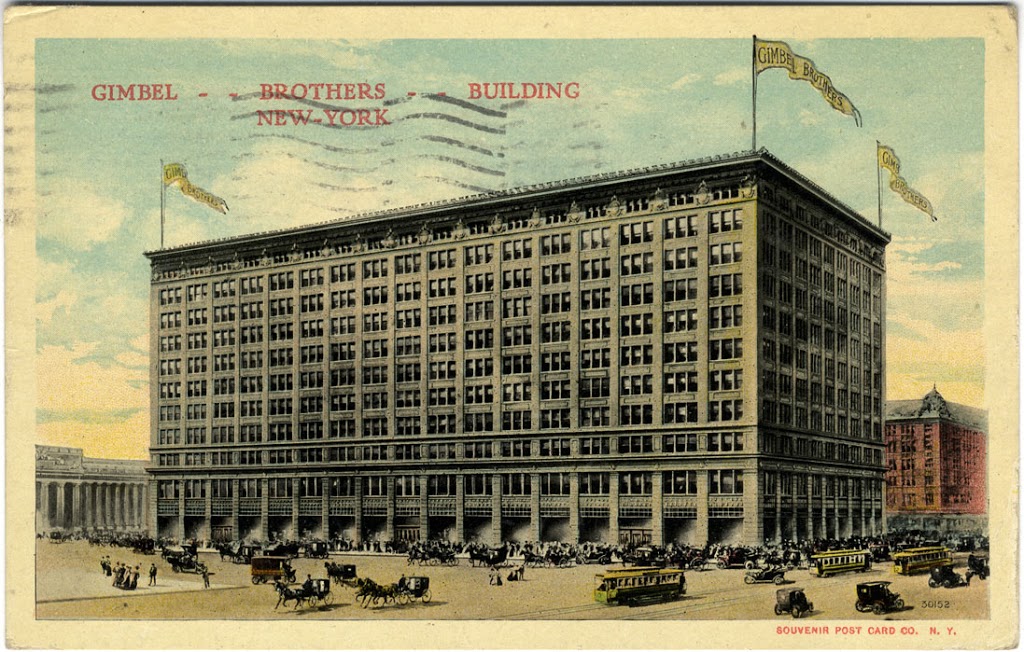
Below: Gimbels store on 33rd Street. Today the building houses the Manhattan Mall, but you can still see vestiges of the old store in its copper green traverse. Courtesy the CUNY archive.

Imagine a century ago when air flight was so novel that just the sight of a plane zipping through the heavens could elicit shock and amazement. Now imagine three aeroplanes racing across the sky, right over your head. Most buildings in midtown Manhattan were no more than a few stories tall in 1911, allowing crowds an unencumbered view of something historic.

In the early days of flight, pilots were often driven by cash rewards. The Gimbels Brothers, the chief rival of Macy’s department store across the street, had opened their new emporium here at 33rd Street just the year before. As a publicity stunt, they offered $5,000 to the pilot who could fly between their New York store and their Philadelphia location the fastest.

Three airmen took up the offer: Hugh Robinson, a young engineer working for early aviation pioneer Glenn Curtiss; Lincoln Beachey, a stunt flyer known for his dapper fashion sense, and another pilot, Charles Hamilton. On the morning of August 4th, 1911, the three pilots headed to the busiest air field in New York — Governor’s Island — to prep their new flying machines.

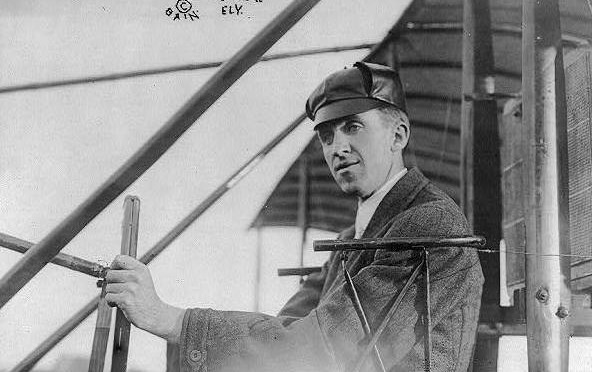
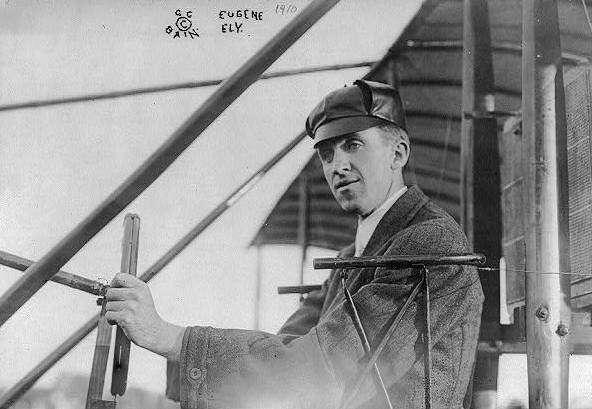
The Gimbels were not the only ones benefiting from publicity that day. All three men would be flying crafts made by Curtiss, who never missed a chance to grab headlines from his bitter rivals, the Wright Brothers. But as flight time approached, the skies above New York appeared overcast, and Hamilton — fearful of flying a new craft in windy conditions — dropped out. No matter! On hand to replace him was faithful Curtiss flyer Eugene Ely. (He’s the one pictured at top, pictured in 1911, photo courtesy LOC.)

At 2:30 that afternoon, the three planes lifted off from Governor’s Island and headed over Manhattan. All over the city, New Yorkers craned their necks to stare at the three specks streaking over the sky. According to the Evening World, “Every window of every hotel and office building which opened towards the route of the flyers were full of faces.” The best seats in the city were atop the Gimbels building itself, where VIPs sipped liquid refreshment and fanned themselves as studious members from the Aero Club of America timed the competitors.

The three planes flew over Manhattan then circled the Gimbels store, to the delight of the crowds, before heading off over the Hudson River and into New Jersey.

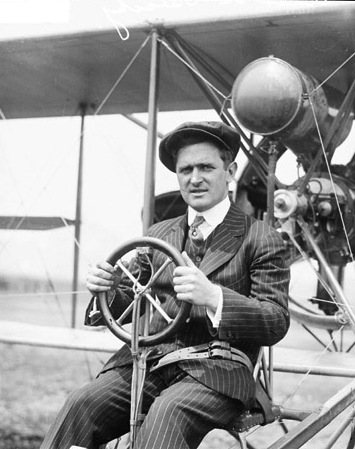
Only two planes made it to Philadelphia that day. At one point, Beachey (pictured at right, impeccably dressed) landed his craft in Trenton, becoming momentarily disoriented. He quickly made it back up in the air. Robinson ran out of gas around Princeton Junction; luckily for him, some cheerful motorists sped into town and retrieved additional fuel for the pilot. Robinson was back up in the air in less than 20 minutes.

Eugene Ely, the replacement derring-do, wasn’t as lucky. Having flown dangerously within feet of Beachey, Ely’s fuel tank began to leak, and he was forced out of the sky. 

The remaining two air crafts arrived in Philly a little over two hours after leaving Governor’s Island. It was raining, but the enthusiastic crowds still filled the streets. Lincoln Beachey got there first, encircling Philadelphia City Hall and the statue of William Penn before flying past the Gimbels store and landing in Fairmount Park. Robinson was close behind and both pilots “were drenched to the skin, having passed through thundershowers between Trenton, NJ, and Philadelphia.” [source]