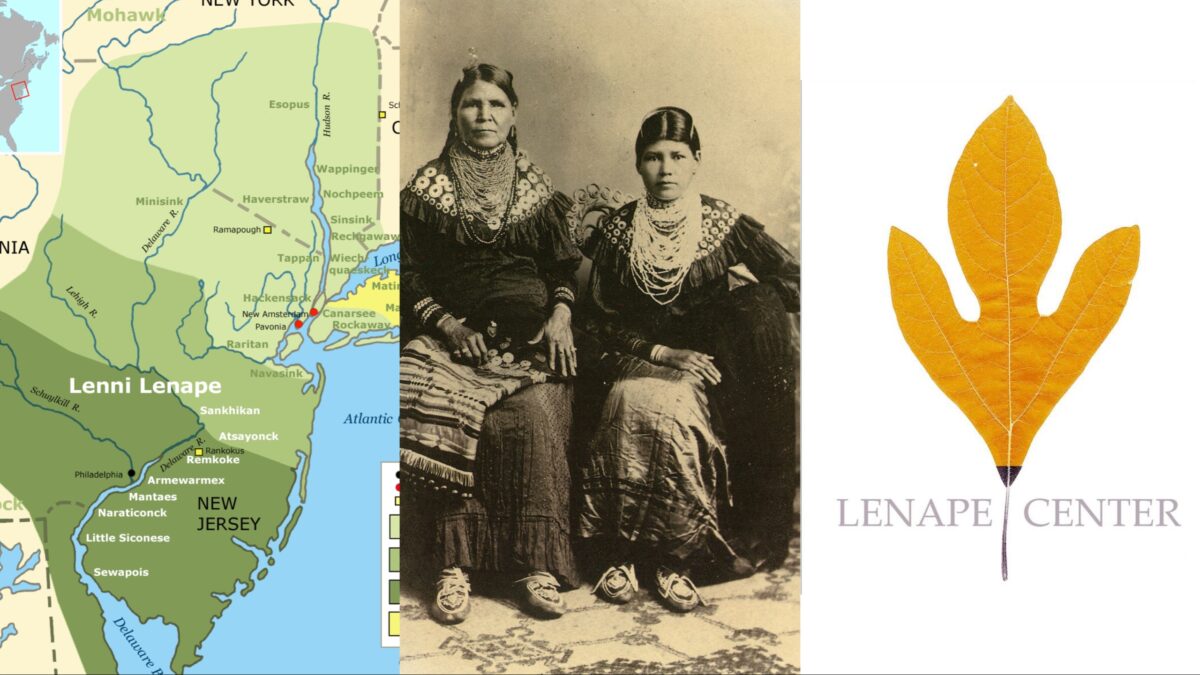
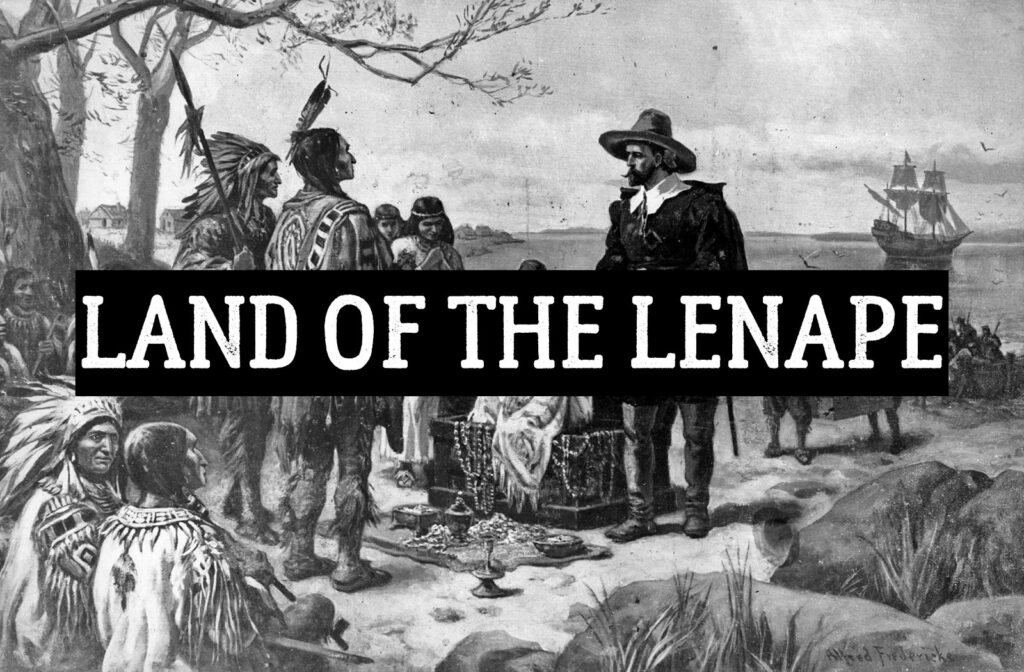
Consider the following show an acknowledgment – of people. For the foundations of 400 years of New York City history were built upon the homeland of the Lenni-Lenape, the tribal stewards of a vast natural area stretching from eastern Pennsylvania to western Long Island.
The Lenape were among the first in northeast North America to be displaced by white colonists — the Dutch and the English. By the late 18th century, their way of life had practically vanished upon the island which would be known by some distorted vestige of a name they themselves may have given it – Manahatta, Manahahtáanung or Manhattan.
But the Lenape did not disappear. Through generations of great hardship they have persevered.
In today’s show we’ll be joined by two guests who are working to keep Lenape culture and language alive throughout the United States, including here on the streets of New York
— Joe Baker, enrolled member of the Delaware Tribe of Indians and a co-founder of the Lenape Center, an organization creating and presenting Lenape art, exhibitions and education in New York.
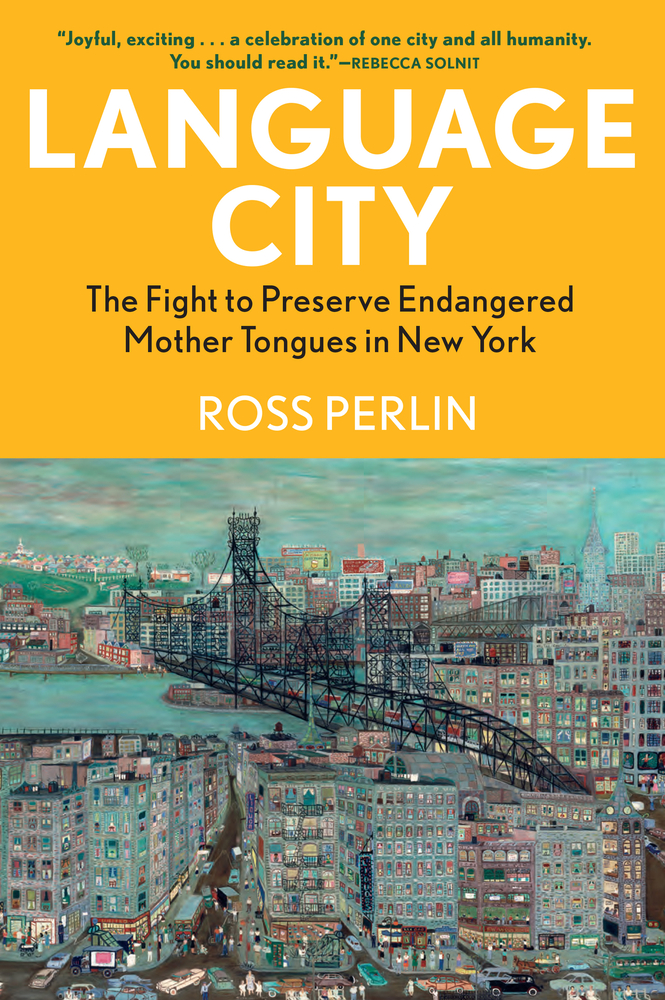
— Ross Perlin, linguist and author of Language City: The Fight to Preserve Endangered Mother Tongues in New York
Joe Baker discusses the cultural significance and history of indigenous seeds and the jewelry they created in this video from the Brooklyn Public Library:
Ross Perlin discussing his book Language City:
FURTHER READING
Ross Perlin/Language City: The Fight To Preserve Endangered Mother Tongues in New York
Ned Blackhawk / The Rediscovery of America: Native Peoples and the Unmaking of U.S. History Pekka Hämäläinen / Indigenous Continent: The Epic Contest for North America Kathleen Duval / Native Nations: A Millennium in North America Roxanne Dunbar-Ortiz/ An Indigenous Peoples’ History of the United States
Two books won the 2022 Pulitzer Prize in History this year, underscoring the excellent offerings on the history shelf in 2021. They are two wildly different stories but they share a similar theme — the complicated relationship between the United States and foreign nations.
In Covered with Night: A Story of Murder and Indigenous Justice in Early America, a shocking murder leads to an historic American treaty and upends stereotypes about the interactions between American colonists and native tribes. In Cuba: An American Story, the epic birth of a country plays out in a constant stream of uprisings, sometimes invisibly steered by American interests.
Covered With Night A Story of Murder and Indigenous Justice in Early America Nicole Eustace Liveright/WW. Norton
Three hundred years ago this year, the Great Treaty of 1722 was signed in Albany, bringing a momentary calm to the Five Nations of the Iroquois and to three British colonies — the Colony of Virginia and Provinces of New York and Pennsylvania.
“The debates, ideas and ideals that gave rise to the [treaty],” writes Nicole Eustace in Covered With Night, “together make up a founding American story that should be considered an essential element of the country’s legacy.”
And at the core of this story is a murder — the brutal death of the Seneca man Sawantaeny by the colonists John and Edmund Cartlidge during a contentious exchange of furs. There is a mystery here; both the intent and the order of violence between the brothers and the murdered man proves to be incredibly important.
But this is not story about bloodshed retaliation, but rather an observation of traditions and a debate between two nations about the proper execution of justice.
In today’s terms, the native village of Conestoga was not far from the growing port town of Philadelphia — about a day’s walk. But custom and language kept both communities as alien residents of the same land.
Eustace sifts through a threadbare record of ancient documents employing three centuries of accumulated knowledge about northeastern native tribes and a fresh understanding of colonial law to craft a remarkable tale. With well informed speculation at times (and a curious trick of present-tense writing), Eustace revitalizes a forgotten moment in American history in terms her modern audience will understand.
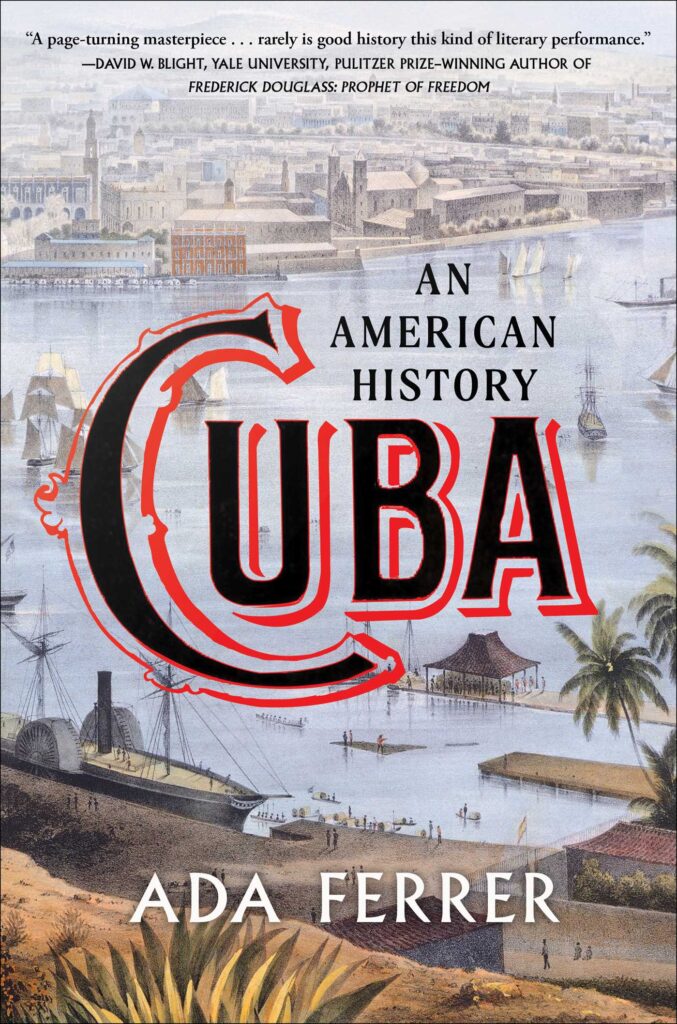
Cuba: An American History Ada Ferrer Scribner
In the beautifully told Cuba: An American History, Ada Ferrer manages a challenging task of epic narrative. Not only is her Pulitzer Prize-winning book an artfully fluid retelling of the history of Cuba, it’s also a sharp, insightful story of the love-hate relationship between the island country and its neighbor to the north.
Spain had already conquered the island (and slowly starved out the indigenous Taino people) by the time England arrived in the northeast United States and set up her colonies. In the mid 18th century, the respective colonies for both countries would be key agricultural producers, requiring hundreds of thousands of African slaves.
Following the American Civil War and the end of the slave trade in the United States, American Southern interests meddled in Cuban affairs to prolong the slave trade there. Meanwhile Cuban revolutionaries were already fighting to sever their connection with Spain; revolutionaries like José Martí often guided the struggle against Spain from his home in New York.
The Spanish-American War passed the island from Spain to the United States — for a time. Yet even with formal independence, the U.S. government kept a firm and often insidious control over the country’s leadership.
My favorite part of Ferrer’s Cuba — a feat of clear story-telling — involves the country’s transformation from a 1920s haven for hedonistic American partiers to an unstable place of cyclical change, often at the hands of the American-backed Fulgencio Batista. By the time Fidel Castro finally appears in the story, you feel the weight of a country beleaguered by foreign manipulation.
PODCAST The story of the Lenape, the native people of New York Harbor region, and their experiences with the first European arrivals — the explorers, the fur traders, the residents of New Amsterdam.
Before New York, before New Amsterdam — there was Lenapehoking, the land of the Lenape, the original inhabitants of the places we call Manhattan, Westchester, northern New Jersey and western Long Island.
This is the story of their first contact with European explorers and settlers and their gradual banishment from their ancestral land.
Fur trading changed the lifestyles of the Lenape well before any permanent European settlers stepped foot in this region. Early explorers had a series of mostly positive experiences with early native people.
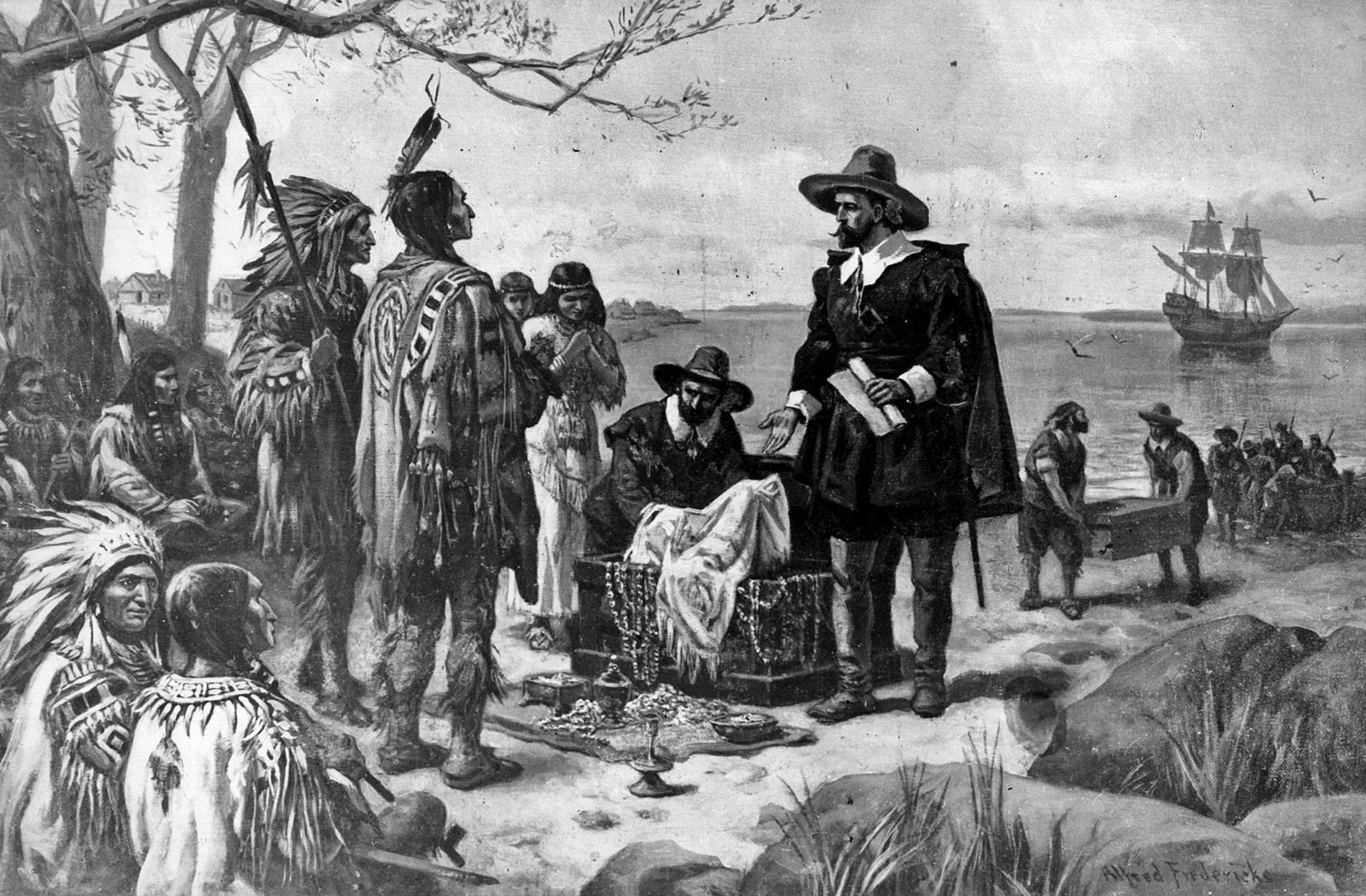
With the Dutch settlement of New Amsterdam, the Lenape entered into various land deals, “selling: the land of Manhattan at a location in the area of today’s Inwood Hill Park.
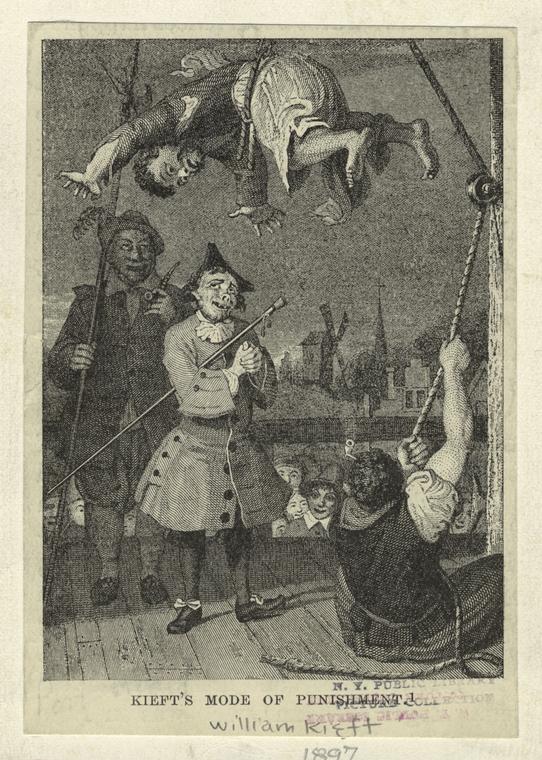
But relations between New Amsterdam and the surrounding native population worsened with the arrival of Director-General William Kieft, leading to bloody attacks and vicious reprisals, killing hundreds of Lenape and colonists alike.
Peter Stuyvesant arrives to salvage the situation, but further attacks threatened any treaties of peace. But the time of English occupation, the Lenape were decimated and without their land.
And yet, descendants of the Lenape live on today in various parts of the United States and Canada. All that and more in this tragic but important tale of New York City history.
The Bowery Boys: New York City History podcast is brought to you …. by you!
We are now producing a new Bowery Boys podcast every two weeks. We’re also looking to improve the show in other ways and expand in other ways as well — through publishing, social media, live events and other forms of media. But we can only do this with your help!
We are now a member of Patreon, a patronage platform where you can support your favorite content creators for as little as a $1 a month.
Please visit our page on Patreon and watch a short video of us recording the show and talking about our expansion plans.
If you’d like to help out, there are five different pledge levels (and with clever names too — Mannahatta, New Amsterdam, Five Points, Gilded Age, Jazz Age and Empire State). Check them out and consider being a sponsor.
We greatly appreciate our listeners and readers and thank you for joining us on this journey so far. And the best is yet to come!
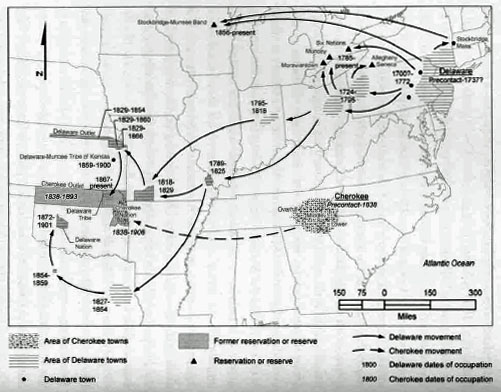
The long road of the Lenape. This 1978 map shows the path of their various relocations across the country in comparison with the relocation path of the Cherokee.
Ives Goddard, “Delaware,†in Handbook of North American Indians, vol. 15: Northeast, ed. Bruce Trigger and William Sturtevant (Washington DC: Smithsonian Institution1 1978)
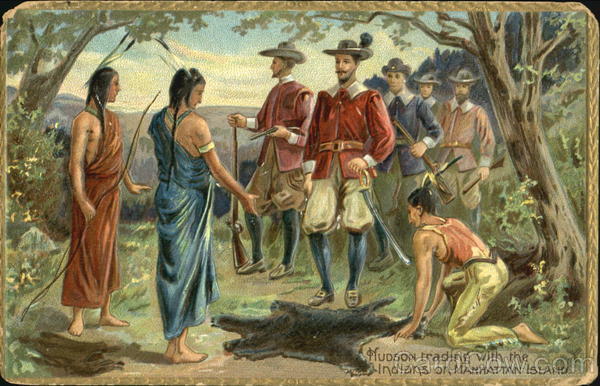
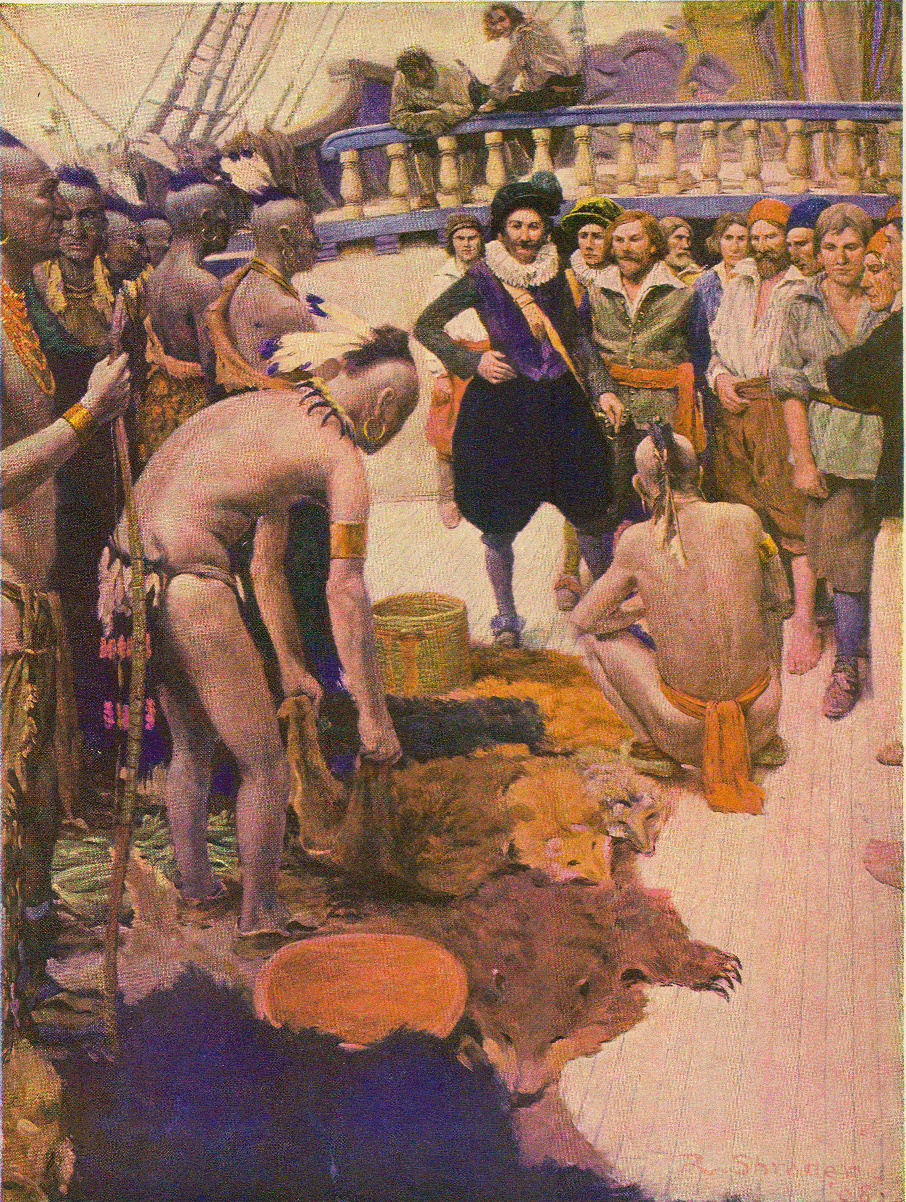
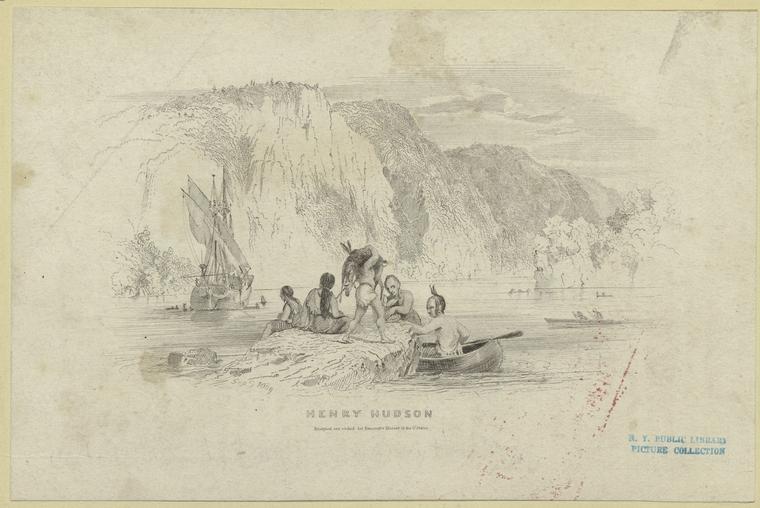
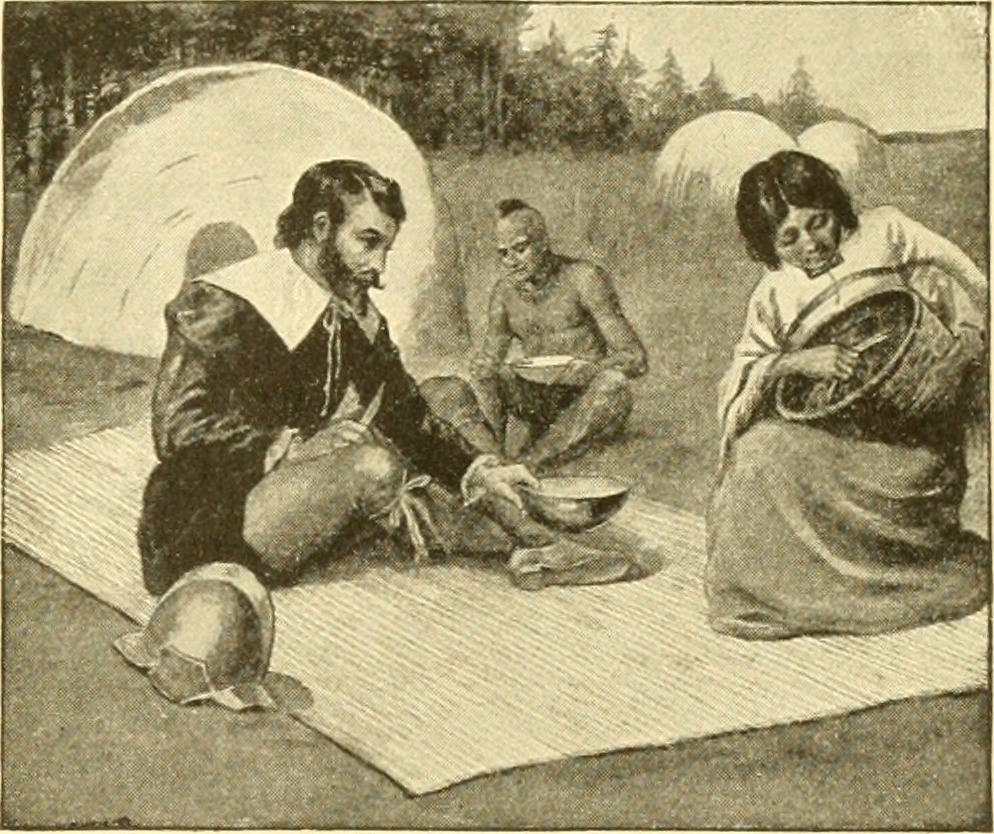
Henry Hudson’s interaction with the native people of the area would much later inspire a host of fanciful depictions.
“‘Designed and etched for Bancroft’s History of the United States’ Written on image: ‘Sept. 7 1609’
Courtesy NYPL
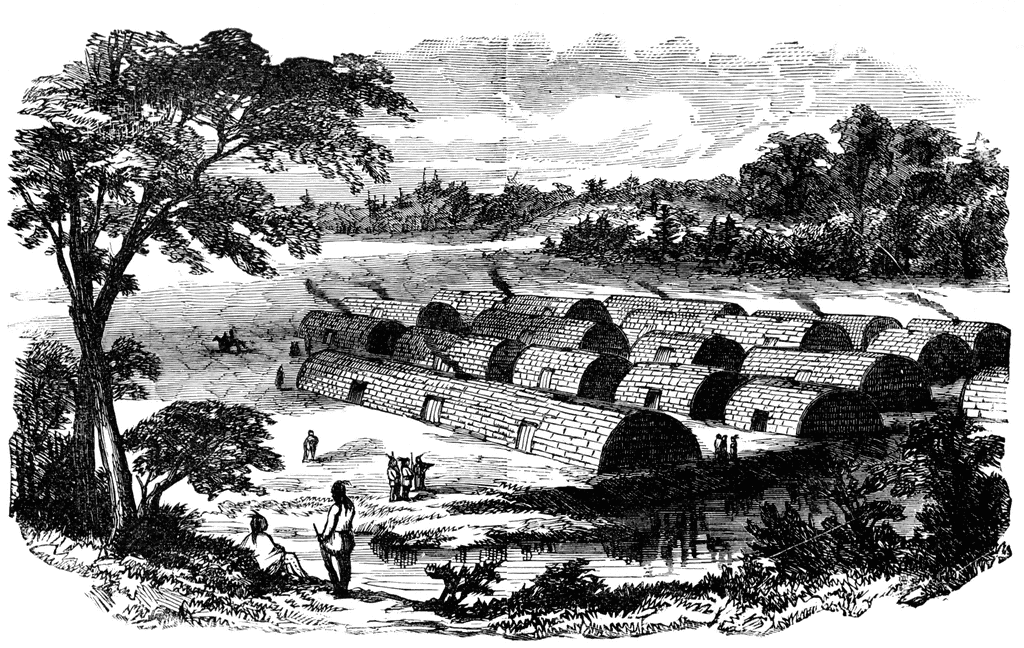
From a 1915 textbook ‘A First Book In American History’ — “Hudson’s ship anchored again opposite the Catskill Mountains, and here he found some very friendly Indians, who brought corn, pumpkins, and to-bacco to sell to the crew. Still farther up the river Hudson visited a tribe onshore, and wondered at their great heaps of corn and beans. The chief lived in around bark house. Captain Hudson wasmade to sit on a mat and eat from a red wooden bowl. The Indians wished him to stay all night; they broke their arrows and threw them into the fire, to show their friendliness.
Internet Archive Book Images
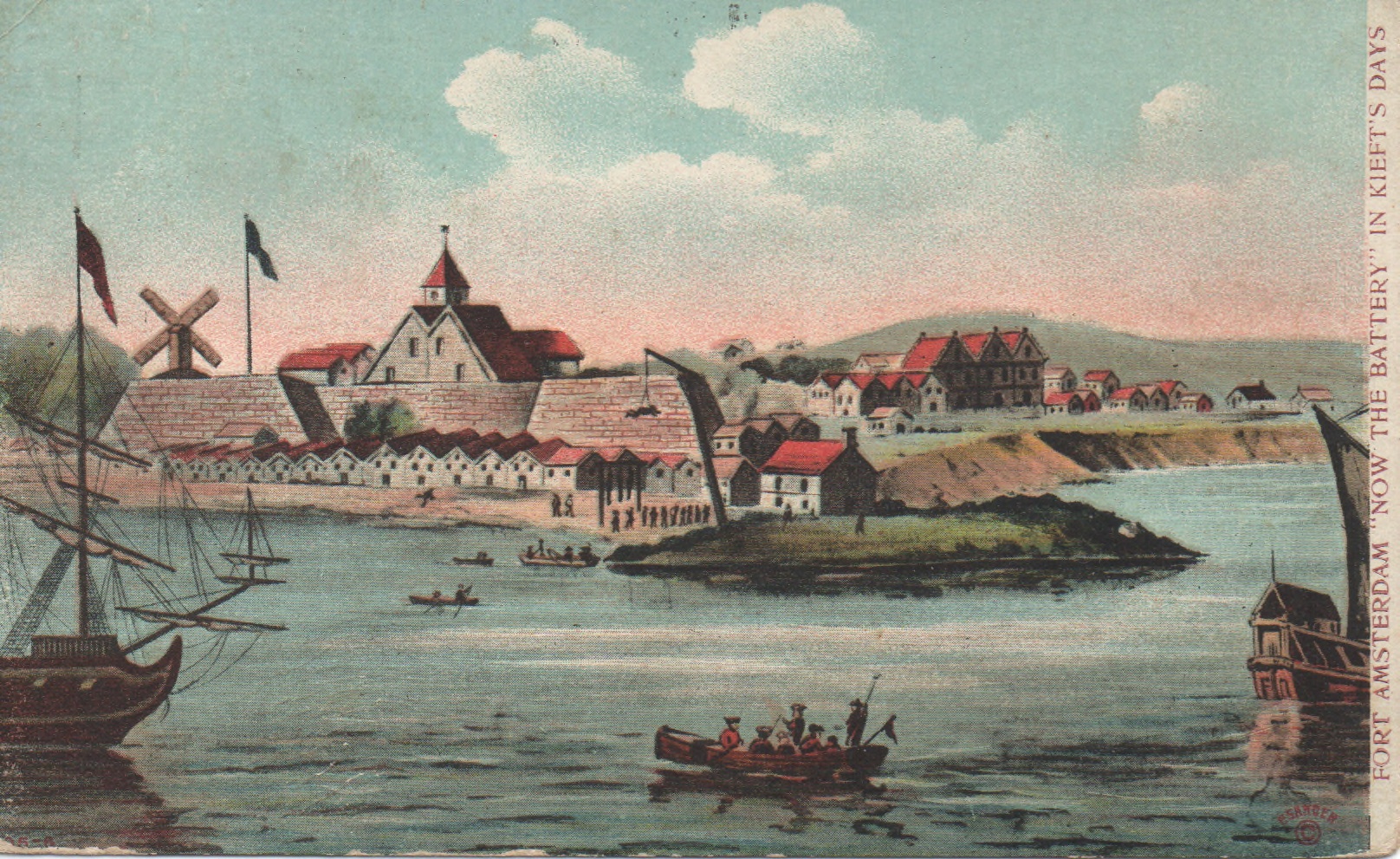
Behold New Amsterdam!
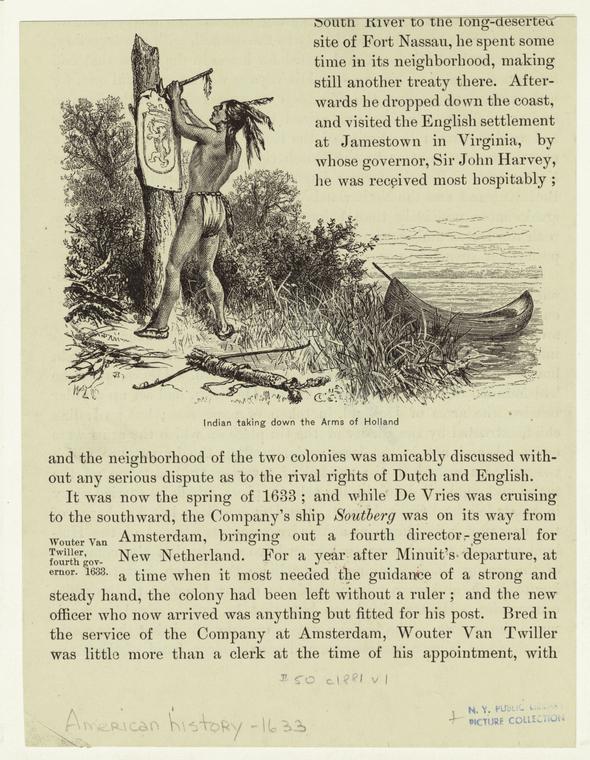
From another text book, this one from 1881:
New York Public Library
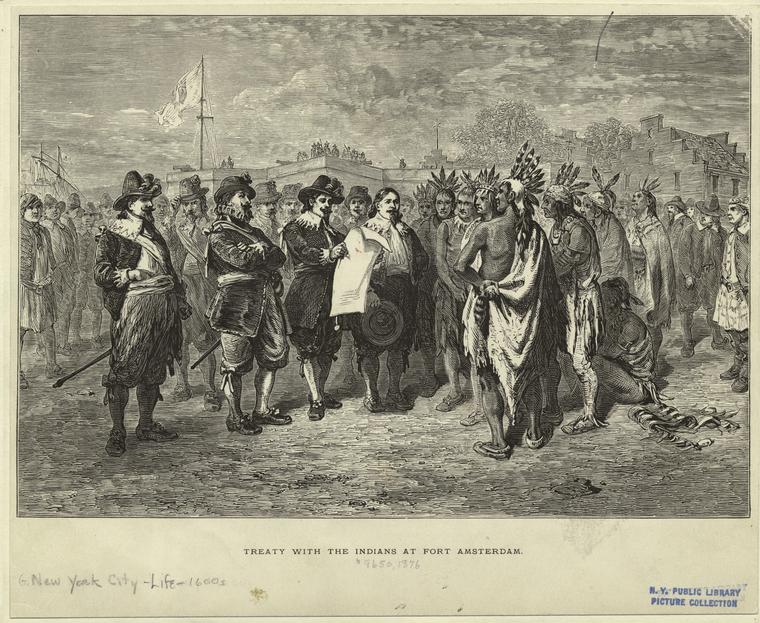
From an 1876 print: ‘Treaty with the Indians at Fort Amsterdam.” Not sure what year this picture depicts but everybody has two legs, so no Peter Stuyvesant!
NYPL
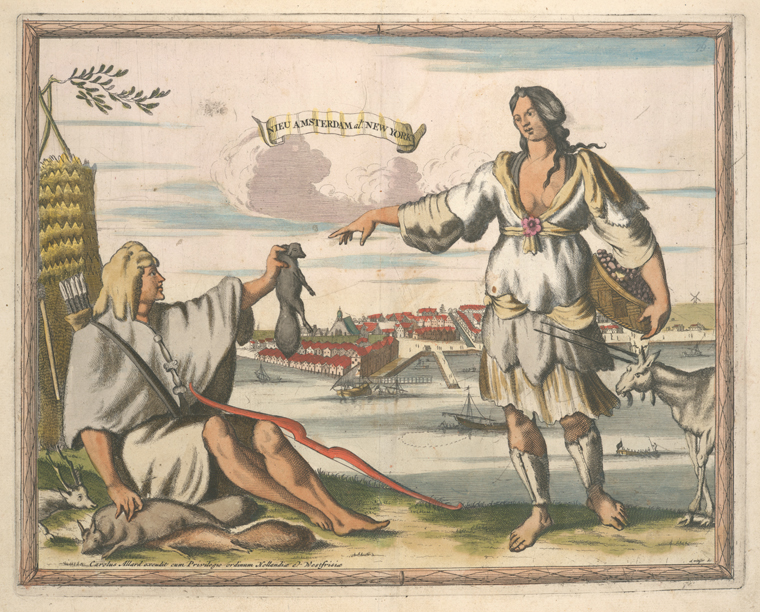
A well-known engraving by Aldert Meijer depicts New Amsterdam as being touched by the hand of providence.
NYPL
A drawing of the 1926 purchase of Manhattan between the native population and Peter Minuit. Image is from Popular Science Magazine, 1909.
NYPL
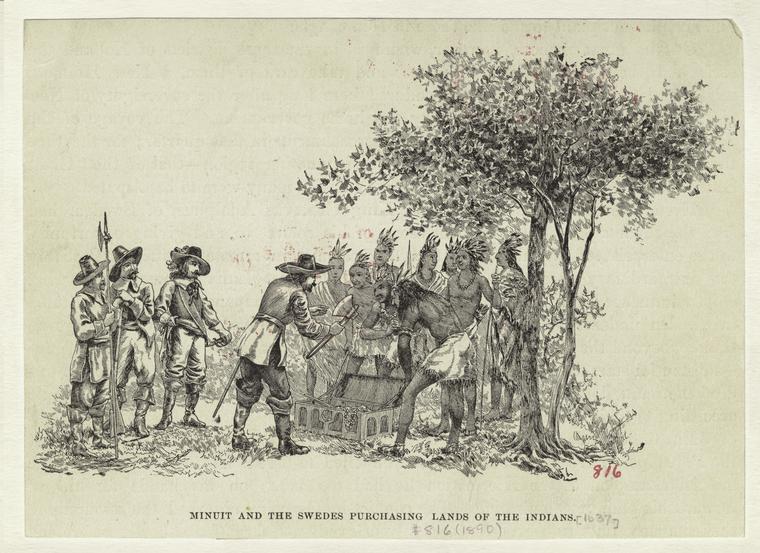
…clearly derived from
“Peter Minuit and the Swedes purchasing lands of the Indians.” Illustration dated 1890
NYPL
William Kieft’s reputation as a vicious tyrant is made apparent here in this 1897 illustration captioned ‘Kieft’s Mode of Punishment.’
NYPL
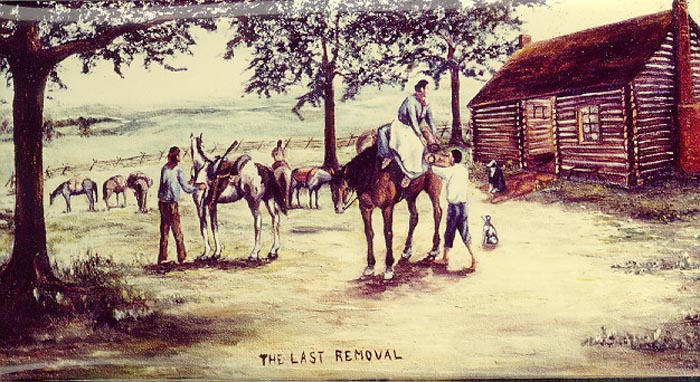
From the Delaware Indians website: “A painting by Lenape artist Jacob Parks (1890-1949), which depicts a Lenape family leaving their home on their reservation in Kansas in 1867. This area had been their home for over thirty-five years, and now the government told them they had to move to Indian Territory (now Oklahoma).”
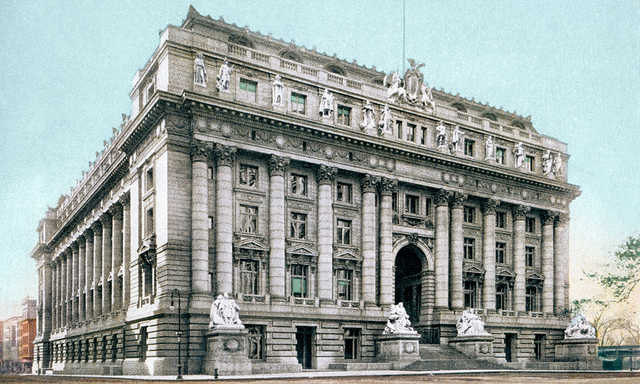
The Smithsonian National Museum of the American Indian is currently living in the Alexander Hamilton U.S. Custom House. It’s a FREE museum so you should stop in anytime you’re in the Battery Park area.
FURTHER READING
The First Manhattans: A History of the Indians of Greater New York by Robert S. Grumet
The Island At The Center Of The World by Russell Shorto
The Delaware Indians: A History by  C.A. Westanger
Native New Yorkers: The Legacy of the Algonquin People of New York by Evan T. Pritchard
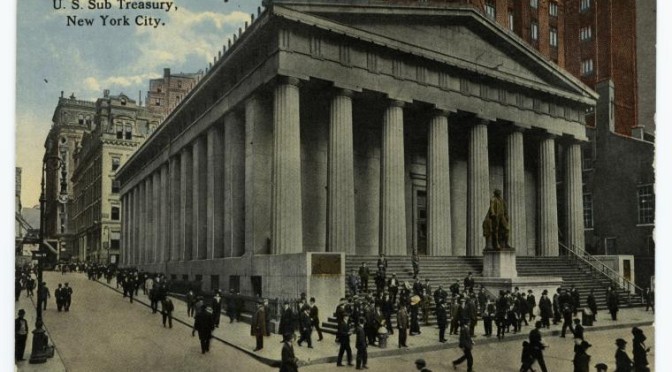
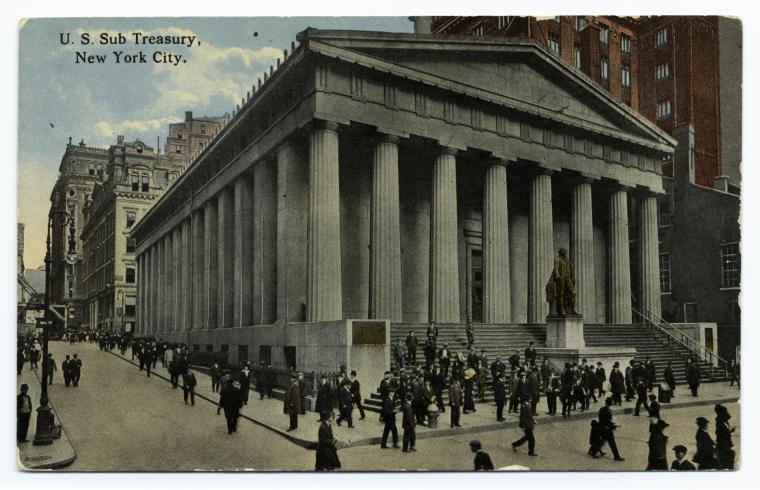
The U.S. Sub Treasury Building — today’s Federal Hall — as it appeared in a colorized postcard in the 1900s (courtesy NYPL) “Hey! Getcha buffalo nickels here. Only 15 cents!”
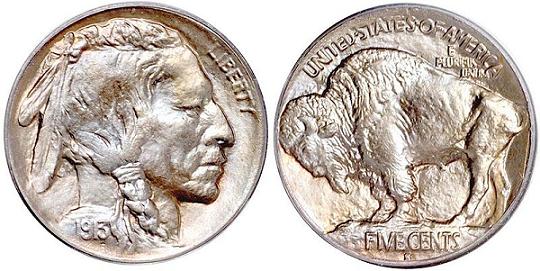
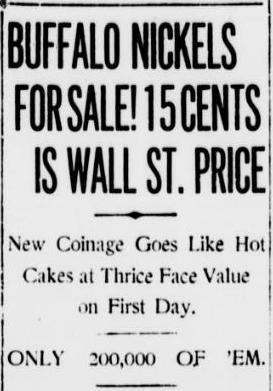
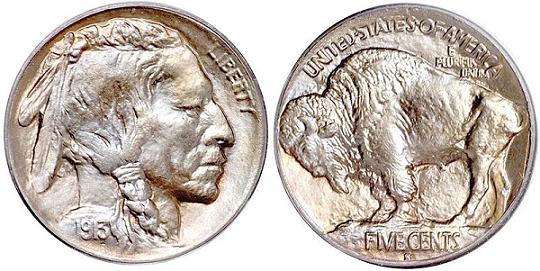
On March 1, 1913, the usual bustle of Wall Street was enlivened with the voices of young men — mostly messenger boys, bank runners and peddlers, according the Evening World — with handfuls of shiny new nickels, the first run of what would become known as the Indian Head nickel or the Buffalo nickel. And in these heady morning hours, many managed to sell the five-cent piece for triple its value.
“The down-at-the-heels men, who sell picture postcards and neckties from pushcarts on Ann Street, scented a bargain and hurried to the Pine Street El Dorado to sink their little capital in nickels.” The “Pine Street El Dorado” in that quote refers the New York Sub Treasury building, later referred to as Federal Hall. (It’s second entrance is on Pine Street.) The Sub Treasury received $10,000 worth of new nickels in ten wooden kegs.
Unfortunately for these budding young nickel entrepreneurs, the novelty wore off by noon and the Buffalo nickel sunk back down to its original face-value cost.
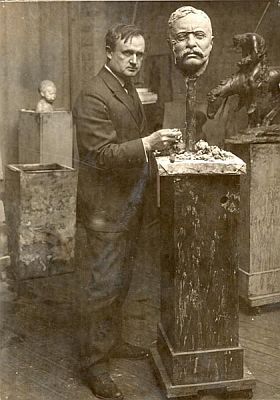
The new nickels were designed by the sculptor James Earle Fraser, a former assistant of the estimable Augustus Saint-Gaudens and best known in New York perhaps for his equestrian statue of Theodore Roosevelt outside the American Museum of Natural History.
Fraser, a professor at the Art Students League, designed the new coin from a studio at 3 MacDougal Alley, off of Washington Square Park. An admirer of Western and Native American imagery, Fraser used a series of models for the noble Indian profile on the front of the coin. For the buffalo on the reverse side, Fraser reportedly went to Central Park Zoo and used their old buffalo Black Diamond for a model.
At right: James Earle Fraser in 1912 with a clay model of a Theodore Roosevelt bust (courtesy National Cowboy Museum)
Or at least, Black Diamond has always been considered the model for the buffalo nickel. In fact, Fraser may also have used specimens from the Bronx Zoo including a fiesty beast named, appropriately, Bronx. Given the renown of the Bronx Zoo collection — the institution essentially saved the buffalo from extinction — it might have made more sense to use their animals as models.
Despite outcries from manufacturers of coin operated devices — who claimed the new five-cent piece would not fit in their machines — the buffalo nickel was minted in February 1913, replacing the Liberty Head nickel that year. (A small handful of Liberty Heads were made in 1913, becoming some of the most prized coinage among the numismatic set.) Americans got a preview of the new coin when a small number were distributed by President William Howard Taft at the groundbreaking for the National American Indian Memorial in Staten Island, a monument that was ultimately never built.
A week later, on the first day of March, rolls of the new buffalo nickels were distributed to New Yorkers on Wall Street, and millions more sent across the country for distribution.
Perhaps Fraser’s design was a tad too whimsical for some. The term ‘buffalo nickel’ soon became slang for something nearly worthless. Just a month later, the New York Sun reported, “[T]he $1,500 mathematical job didn’t mean anymore to him yesterday afternoon than a buffalo nickel.”
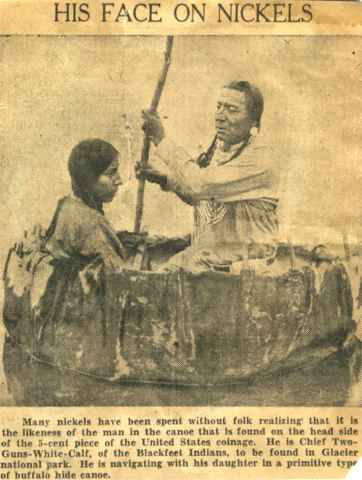
In 1921, one of Fraser’s human models, the chieftain Two Guns White Calf, pitched his teepee atop the luxury Hotel Commodore next door to Grand Central Terminal in a publicity stunt.
The buffalo nickel was replaced in 1938 by the more familiar Thomas Jefferson model.
Below: A news clipping featuring an image of Two Guns White Calf with his daughter. (Courtesy Flickr/sharknose)