Categories
Amusements and Thrills Film History

Come to the Airdome! Over 100 years of outdoor movies in NYC

It may be some time before we all get to truly enjoy the inside of a movie theater again. Hopefully soon!

But outdoor movies — in particular, drive-in movies — have had a bit of a renaissance, a socially distanced way to enjoy blockbusters on a big screen. Mommy Poppins has a great round-up of all the outdoor drive-in movie options in New York City and the surrounding area.

Watching movies outdoors is tradition much older than you think.
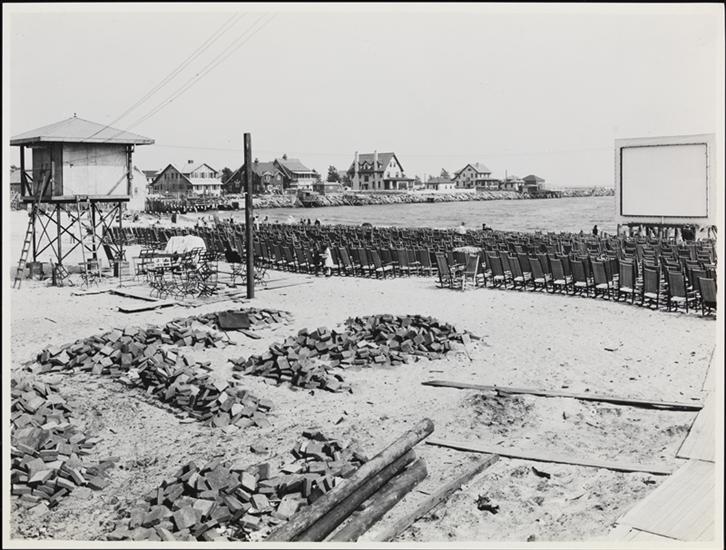
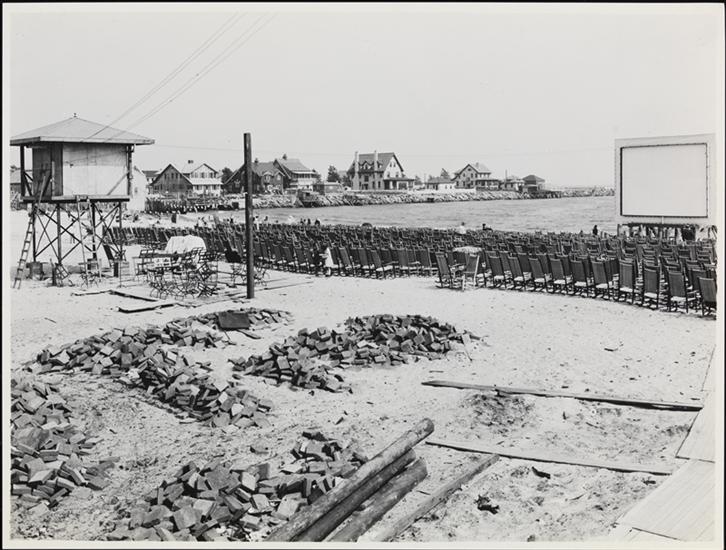
At an outdoor movie theater in Brighton Beach, 1920. (MCNY)

Yes, there were outdoor (or open air) theaters showing films almost as soon as the medium became popular.  

This is not terribly surprising. There were already outdoor playhouses for theater and vaudeville, and, in an era of over-crowded tenements and no air conditioning, any reason to sit outside on a nice summer’s night seemed practically luxurious.
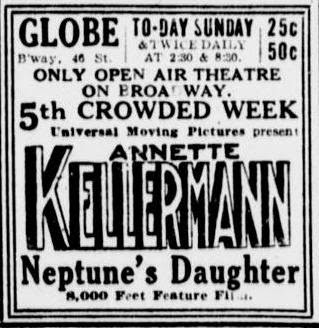
An advertisement for a rare Midtown open-air theater.  The lights of Broadway and street noise would have been a serious impediment. 

One drawback outdoor movie lovers deal with today is the loud city interfering with the sound of the movie.  Not so then; the city might have been loud, but the movies had no sound.  

It was a purely visual sensation, a thrilling entertainment light show under the moonlight.

Early outdoor theaters in New York, sometimes called airdomes, were not usually in city parks, but in abandoned lots or open spaces in upper Manhattan.  

Here’s a description of an airdome from a 1914 exhibition guide:  “An airdome is simply an outside moving picture show that is run on practically the same lines as the old summer garden, and is therefore essentially a fair-weather show, although a few airdomes are equipped with pavilions.”

Airdomes were designed to be temporary although you did need a permit from the city to operate one. Other than that, anybody could do it! “Nothing elaborate …is necessary for a successful airdome,” said the guide. “The chairs and tables may be of the ordinary kitchen variety.”
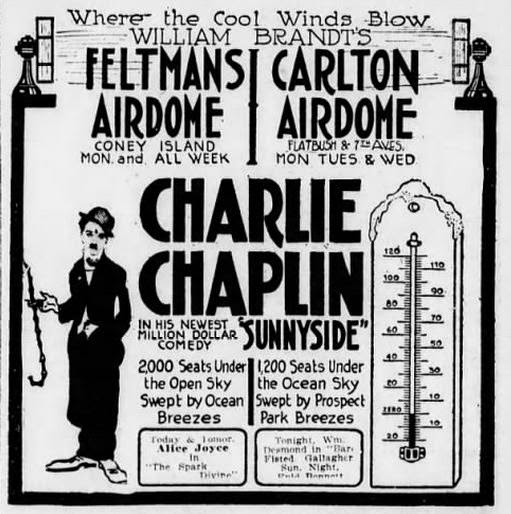
An advertisement for two Brooklyn airdomes — in Coney Island and Prospect Heights (Brooklyn Daily Eagle)

From surveying various newspapers from the 1910s, it appears most airdomes were located either in upper Manhattan and the Bronx (where there were more open lots) or in Coney Island (where the masses went for recreation).

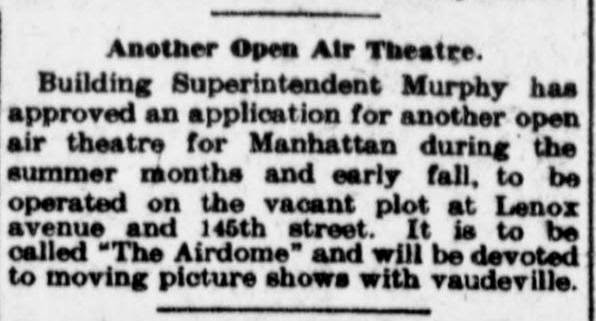
Before 1915, movies were one-reelers, quite short, and often featured alongside live acts as part of a vaudeville routine.  This airdome (listed in the July 1909 New York Sun) was typical of the day:
Outdoor movie theaters were so prevalent in the 1910s that, during planned war time electrical blackouts in 1918, they were specifically mentioned as a “bonafide food and entertainment establishment” alongside “roof gardens and outdoor restaurants.”  [source]

But as with modern outdoor theaters, sometimes reality elbows its way into the picture.  

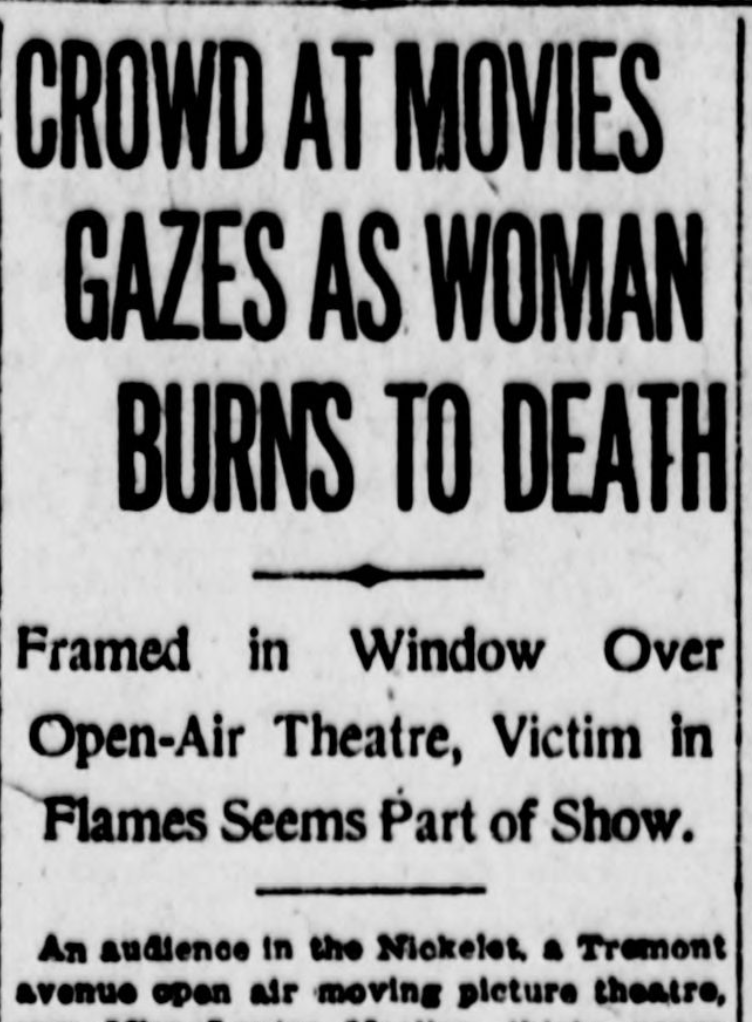
One of the Bronx’s most prominent open air moving picture theatres was the Nickelet (at Tremont and Prospect Avenues), presumably named for the admission price.  

One evening in June 1913, audiences witnessed a terrifying sight — a woman burning to death in a building adjacent to the theater lot.  Audience members scrambled to her rescue to no avail.
The transient nature of the airdome — and the ability for anybody with a license to have one — did cause friction at times.

During the spring of 1909, in the Long Island town of Freeport, a Brooklyn man enraged the town when he set up an airdome there even though he was not a town resident.

The airdome never went away of course.  But the experience paled in comparison to the grand delights of the movie palaces, especially when air conditioning technology came along.  

They eventually died out, along with the rooftop garden, in the 1920s, only to return later in the century when sound and projection technologies allowed for a more enjoyable evening at the movies.

And now, ladies and gentlemen, I hope you’re reading this outside! Create your own airdome experience and watch this film — Charlie Chaplin’s Sunnyside — enjoyed by Brooklynites over 90 years ago in an outdoor moving picture theater:
Categories
Bowery Boys Bookshelf The Jazz Age

‘Adventures of a Jazz Age Lawyer’: The man who helped build the entertainment world

When it comes to artistic creation, we take many fundamentals of law for granted. Most people might not understand the particulars of ‘intellectual property’ but they sure benefit from it.

The very review you are reading — and the website that publishes it — are protected by laws that were hammered out and fought for one century ago.

Yet building the essential protections for free creativity is but one notable achievement in the life of a very busy man — the fabulous New York attorney Nathan Burkan.

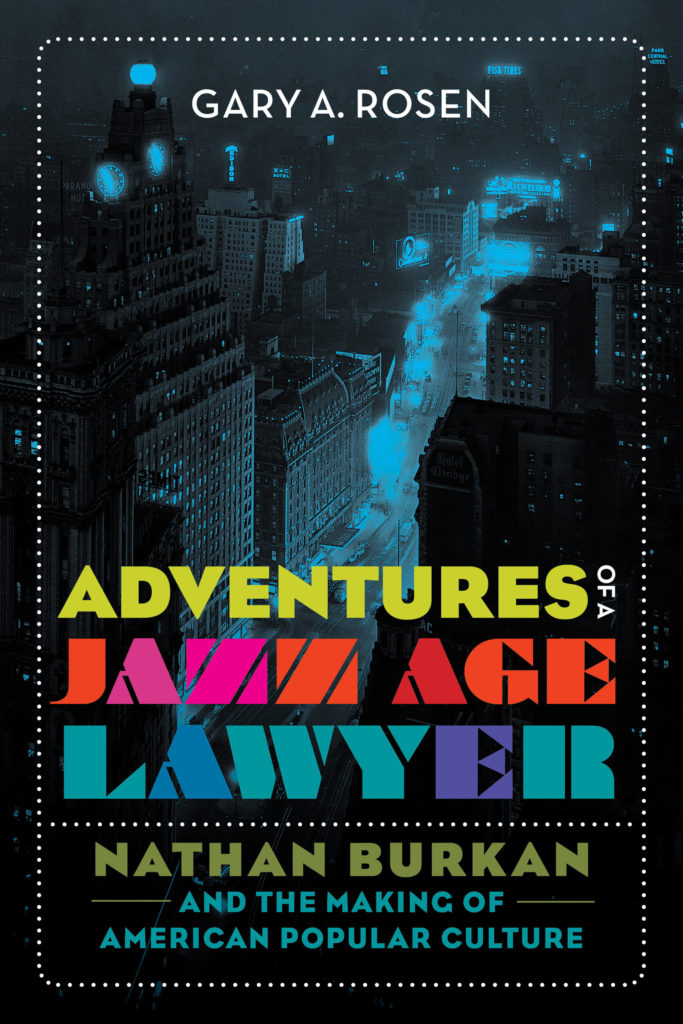
ADVENTURES OF A JAZZ AGE LAWYER
Nathan Burkan and the Making of American Popular Culture

by Gary A. Rosen
University of California Press

In Gary A. Rosen’s absorbing biography of Burkan, we find a somewhat enigmatic presence standing beside some of the most iconic figures of American culture — from songwriters to movie stars, from bootleggers to socialites.

Burkan was one of the most respected lawyers of the early 20th century. He even represented Gloria Morgan Vanderbilt in one of the most sensational (and tragic) trials of the 20th century.

And yet Adventures is not a shallow celebrity tell-all, but a thoughtful and in-depth look at the substance of many foundational cases in the history of entertainment history.

It’s hard to imagine what the music industry would even look like (or sound like) without Burkan’s involvement in the early years of Tin Pan Alley.

With his client Victor Herbert, he helped found ASCAP (American Society of Composers, Authors and Publishers), the organization that protects musical copyrights.

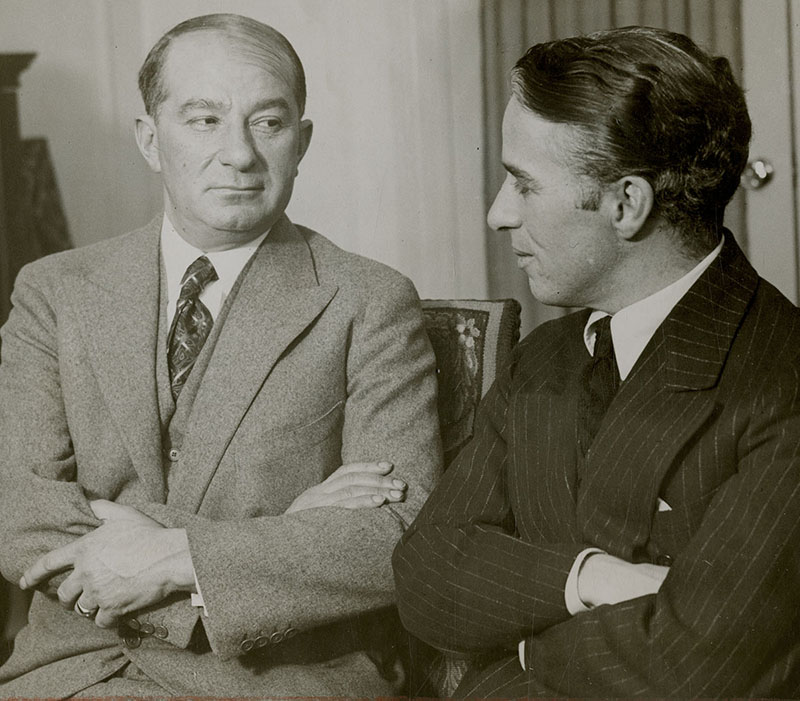
Burkan with Charlie Chaplin

But his most intriguing legal collaboration was with Charlie Chaplin and at a moment (during the mid 1910s) when his star was on the rise.

Charlie’s half-brother and manager Syd Chaplin chose Burkan due to his work with “legitimate theater’s leading comedienne and ingenue of the day Billie Burke,” just one detail that illustrates the attorney’s depth of involvement in the entertainment world.

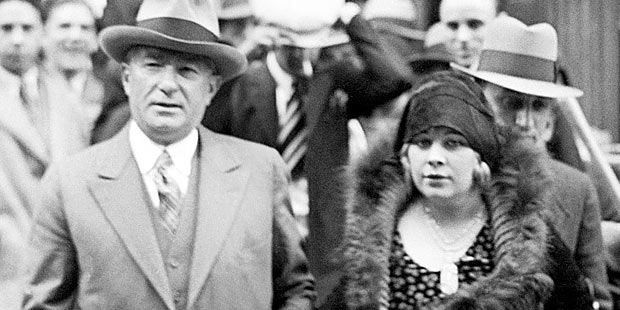
Burkan with Mae West

And then there was his work in defending Mae West, whose provocative plays were being shut down by the police. His battle against “nightstick censorship” inspired some incendiary moments on the stand:

Burkan put seven cast members [of the play The Pleasure Man] on the stand in the defense case-in-chief. They testified that the police had misunderstood dialogue and omitted important context….One cast member sang the offending songs with clasped hands and such exaggerated choirboy earnestness that ‘Mae West, at counsel table, covered her mouth with her black handkerchief to hide her laughter’.”

Categories
Wartime New York

Charlie Chaplin on Wall Street: The tale behind the 1918 photo

The comedy legend Charlie Chaplin was born 125 years ago today in London, so I thought I’d use the opportunity to re-post one of my favorite photographs of Wall Street.

 
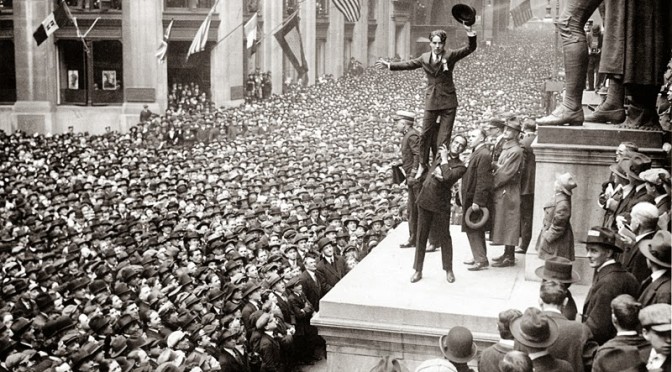
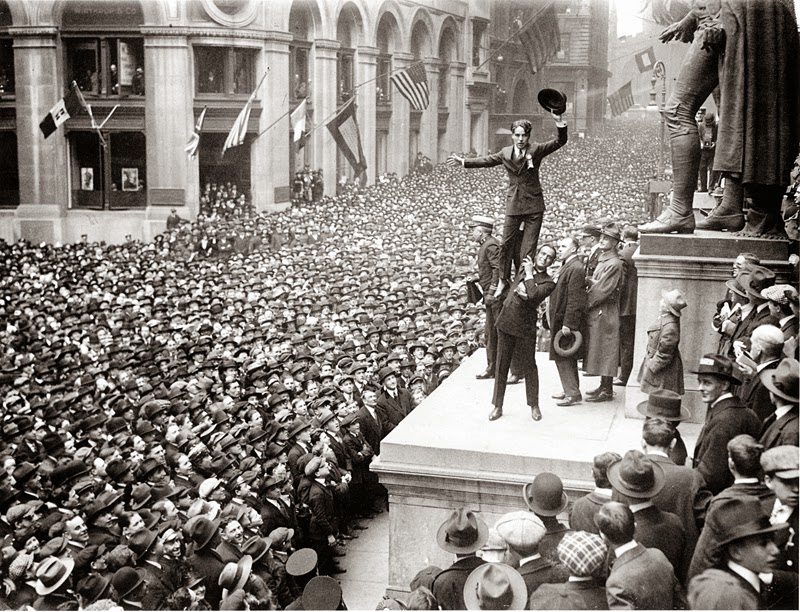
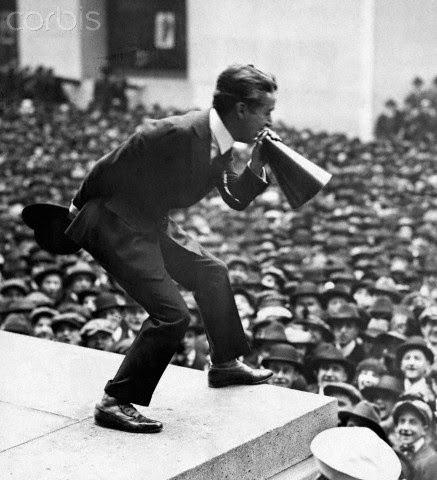
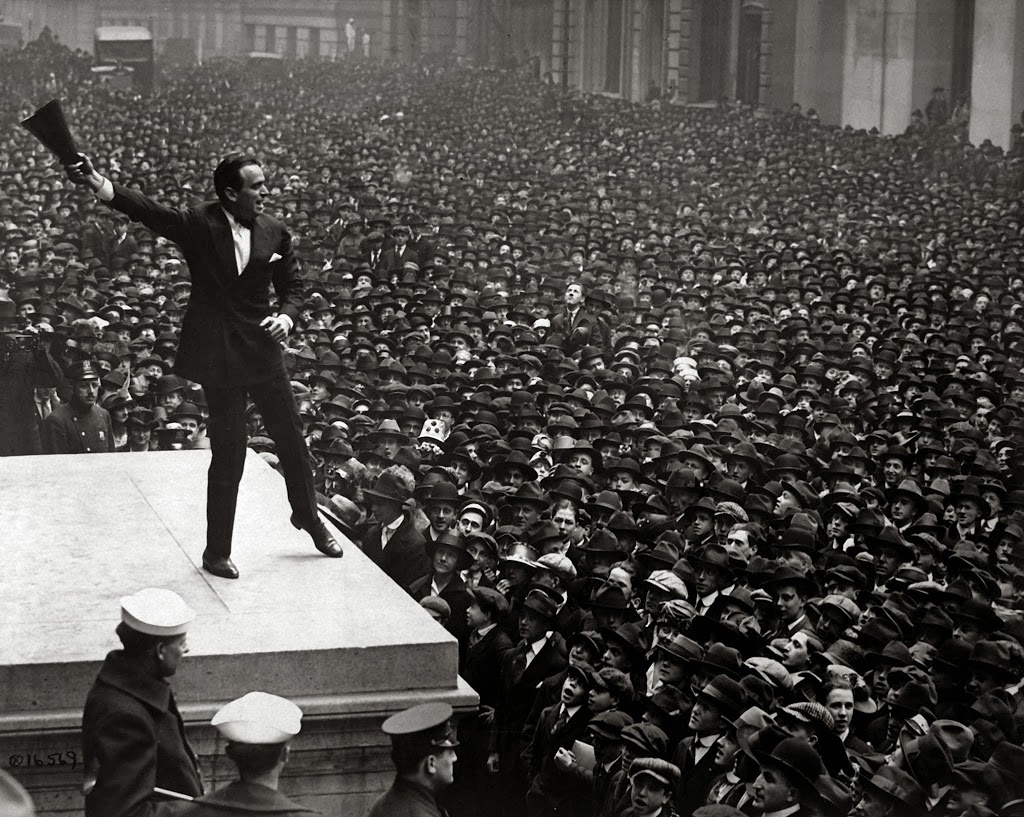
In the 1918 photo above, Charlie Chaplin and Douglas Fairbanks draw tens of thousands to Wall Street and the foot of the United States Sub Treasury building (i.e. today’s Federal Hall) to drum up support for World War I war bonds (or, more precisely, Liberty Bonds).
 
The United States had entered the conflict the prior year, on April 6, 1917, and began selling bonds to raise funds for the war effort.  Although many Americans were caught up in a patriot fervor, war bond sales were initially quite weak.  Most Americans in the late 1910s had never bought a bond of any kind.
 

To promote sales, the government began enlisting celebrities from several fields of entertainment, most notably motion pictures.  Since the New York area was filled with film stars — Hollywood not yet being the center of the film business — its streets were soon filled with dutiful movie stars, extolling the patriotic and moral virtues of supporting their county through bond sales.

 
My favorite instance of this was the sale of doughnuts — considered a symbol of wartime — on the street by glamorous movie stars like Martha Mansfield.  The Sub Treasury building, New York’s largest bond repository, was often the center of such rallies and fund drives.  (There were even doughnut auctions held on the steps here.)  It made sense to bring the biggest stars to the Sub Treasury to drum up the most publicity.
 
And so, on April 9, 1918, as the New York Tribune headline goes, “20,000 Throng Wall Street to Hear Movie Stars Tell How To Win War.”
Chaplin threw himself into the war effort, embarking on a nationwide tour to promote the sale of bonds.  That year he would make a propaganda film called The Bond:
 
 
But there may have been a bit of self-promotion in his appearance at the Sub Treasury.  His film A Dog’s Life would conveniently open in movie theaters five days later.


People weren’t used to hearing their movie stars speak in 1918.  “I never made a speech before in my life,” he proclaimed through a megaphone that noon, standing in front of the statue of George Washington. “But I believe I can make one now.”

The dashing Fairbanks — known for swashbucklers and romances — happily broke character, goofing around with Chaplin to the delight of the crowd.  “Folks, I’m so hoarse from urging people to buy Liberty bonds that I can hardly speak.”

As eager as audiences were to hear their matinee idols, it was their horseplay that caused the greatest satisfaction:

“It was difficult for the lay ear to determine whether Chaplin or Fairbanks got the most enthusiastic reception.   But there one was feature that got more than either. That was the combination of Chaplin and Fairbanks.   The later carried the former around on his shoulders, and the 20,000-odd crowd howled with delight.”

Afterwards, Fairbanks and vocalist Harvey Hindemeyer led the crowd in a rendition of “Over There,” the American war anthem written by Broadway impresario George M. Cohan the previous year. (The story behind that song was featured in our podcast on the birth of the Broadway musical.)

Mary Pickford was also on a war bonds tour through America at this time.  The following year, Pickford, her secret lover Fairbanks, Chaplin and the film director D.W. Griffith would start the film studio United Artists.